EP2373142A2 - Circuit de ballast pour le fonctionnement d'un ventilateur pour un module d'éclairage - Google Patents
Circuit de ballast pour le fonctionnement d'un ventilateur pour un module d'éclairage Download PDFInfo
- Publication number
- EP2373142A2 EP2373142A2 EP20110159850 EP11159850A EP2373142A2 EP 2373142 A2 EP2373142 A2 EP 2373142A2 EP 20110159850 EP20110159850 EP 20110159850 EP 11159850 A EP11159850 A EP 11159850A EP 2373142 A2 EP2373142 A2 EP 2373142A2
- Authority
- EP
- European Patent Office
- Prior art keywords
- fan
- control circuit
- output
- current
- operating
- Prior art date
- Legal status (The legal status is an assumption and is not a legal conclusion. Google has not performed a legal analysis and makes no representation as to the accuracy of the status listed.)
- Withdrawn
Links
- 230000001419 dependent effect Effects 0.000 claims abstract description 15
- 238000001816 cooling Methods 0.000 description 10
- 230000001276 controlling effect Effects 0.000 description 4
- 230000007423 decrease Effects 0.000 description 4
- 239000003990 capacitor Substances 0.000 description 2
- 238000010586 diagram Methods 0.000 description 2
- 238000010276 construction Methods 0.000 description 1
- 230000001105 regulatory effect Effects 0.000 description 1
- 210000002023 somite Anatomy 0.000 description 1
- 239000013589 supplement Substances 0.000 description 1
Images


Classifications
-
- H—ELECTRICITY
- H05—ELECTRIC TECHNIQUES NOT OTHERWISE PROVIDED FOR
- H05K—PRINTED CIRCUITS; CASINGS OR CONSTRUCTIONAL DETAILS OF ELECTRIC APPARATUS; MANUFACTURE OF ASSEMBLAGES OF ELECTRICAL COMPONENTS
- H05K7/00—Constructional details common to different types of electric apparatus
- H05K7/20—Modifications to facilitate cooling, ventilating, or heating
- H05K7/20009—Modifications to facilitate cooling, ventilating, or heating using a gaseous coolant in electronic enclosures
- H05K7/20209—Thermal management, e.g. fan control
Definitions
- the invention relates to an operating circuit for operating a fan, as used in particular for cooling a lighting module.
- the light module has, for example, a plurality of light elements and in particular a plurality of light emitting diodes. It is connected to an output circuit of a ballast, which supplies the light module with electrical energy.
- Lighting modules must be cooled in many cases because of the temperature development of the lighting elements. For this fans are provided.
- the previously known operating circuits for operating the light module and the fan are complex and expensive.
- a dedicated ballast or power supply is used that provides one terminal for the output circuit and the light module and another supply connection for the fan and its control circuit.
- an LED lamp which may have a fan to increase the cooling capacity.
- the fan power can be regulated depending on the temperature.
- the electrical supply and control of the fan is not disclosed in detail.
- EP 1 561 993 A2 It is known to use a motor-driven fan for cooling an LED lamp.
- a DC motor is used which is connected to a DC voltage via a rectifier.
- WHERE 2008/037992 such as US 2003/0040200 A1 describe LED lamps that are cooled by a fan. The electrical supply and control of the fan is not described there.
- the ballast has an output to which an output circuit is connected.
- the output circuit is used to supply the lighting module with electrical energy.
- the control circuit for controlling the fan is electrically connected exclusively to the output circuit.
- Another supply output of the ballast for supplying the control circuit or the fan can be omitted.
- the fan is connected together with the control circuit in parallel or in series with the lighting module or with a part of the lighting elements provided in the lighting module.
- a special embodiment of the ballast is not necessary. With sufficient performance of the ballast, both the fan and the light module can be powered by a common output with electrical energy.
- a control circuit allows the operation of the fan on the output circuit together with the light module.
- the light-emitting module preferably has a series connection of a plurality of light-emitting elements and in particular light-emitting diodes.
- the fan or the control circuit can be parallel to a part of the lighting elements be switched.
- the voltage dropping across the luminous elements is made available to the control circuit or the fan for operation.
- the control circuit is dimensioned such that the fan current is significantly lower than the output current supplied at the output of the ballast in the output circuit.
- the fan current can be 5 to 20% and in particular 10% of the output current.
- the output current is about 500 mA and the fan current up to about 100mA.
- the fan current may be limited, for example, by a resistor connected in series with the fan.
- a device influencing the fan current is connected in series with the fan, for example a temperature-dependent resistor, whereby a temperature-dependent fan current and thus a temperature-dependent fan control can be achieved very simply.
- a power control of the fan can also be achieved in a preferred embodiment in that the control circuit has a longitudinal regulator for the fan.
- the fan voltage or the fan current can also be set variably as a function of the detected temperature at the light module.
- the control circuit preferably has a thermistor (NTC).
- control circuit or the fan in Row connected to the light module.
- the current is not changed by the light module.
- FIG. 1 shows a block diagram of an operating circuit 10, which serves to operate at the output 11 of a ballast 12, a light emitting module 13 and a fan 14.
- the fan 14 is shown by the fan motor M.
- the ballast is connected to a mains voltage source 15.
- an output circuit 16 is electrically connected, which serves for the electrical supply of the lighting module 13.
- the output circuit 16 further includes a control circuit 17 for controlling the fan 14. Both the light emitting module 13, and the control circuit 17 and the fan 14 are thus connected in common to the same output 11 of the ballast 12.
- the control circuit 17 driving the fan 14 is connected in parallel or in series with the light module 13.
- the light-emitting module 13 has a series connection of a plurality of light-emitting elements and preferably a plurality of light-emitting diodes 20, as shown in FIGS Figures 2 or 6 is illustrated.
- the series connection can have, for example, 10 to 20 light-emitting diodes 20.
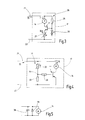
- the control circuit 17 is electrically connected to the lighting module 13 via a first terminal 21 and a second terminal 22. According to the first embodiment FIG. 2 the control circuit 17 is connected in parallel to a part of the light-emitting diodes 20 of the light-emitting module 13. For example, three light-emitting diodes 20 are connected in series between the two terminals 21, 22.
- the number of light-emitting diodes 20 present there depends on which output voltage or which output current is provided at the output 11 of the ballast 12 and how many light-emitting diodes 20 or other light-emitting elements in the light-emitting module 13 are connected in series. Which successive light emitting diodes 20 are connected in parallel to the control circuit 17 is arbitrary.
- the control circuit 17 has a temperature-dependent series resistor 23.
- the temperature-dependent series resistor 23 is designed as a thermistor, so that the current through the fan 14 increases when the temperature of the lighting module 13 increases. In this way, the fan power is increased with increasing temperature and thus improves the cooling.
- the control circuit 17 is tuned to the lighting module 13 so that the recorded by the control circuit 17 control current IS is about 10% of the output 11 of the ballast 12 provided output current IA.
- the first embodiment of the control circuit 17 after FIG. 2 thus provides a temperature-dependent power control of the fan 14 available.
- the control current IS in this case corresponds to the fan current IL, which is provided to the fan motor M.
- FIG. 3 a second embodiment of the control circuit 17 is shown.
- the connection of the control circuit 17 to the lighting module 13 corresponds to the second embodiment according to FIG. 2 ,
- the control circuit 17 is connected in parallel to a part of the light-emitting elements 20 of the light-emitting module 13.
- the control circuit 17 has a series regulator 26, which predefines the fan current IL.
- the fan motor M of the fan 14 is connected to the first terminal 21.
- a transistor T is connected, whose collector is electrically connected to the fan motor M and its emitter with a thermistor 27.
- the thermistor 27 in turn is electrically connected to the second terminal 22.
- the base of the transistor T is on the one hand via a base resistor 28 to the first terminal 21 and on the other hand via a diode circuit 29 to the second terminal 22 electrically connected.
- the diode circuit 29 has, for example, a series connection of two diodes. Alternatively, the diode circuit 29 could also include a zener diode. The diode circuit 29 ensures that the transistor T remains in its conducting state.
- the resistance of the thermistor 27 decreases, whereby the emitter current IE of the transistor T increases. This also increases the fan current IL, so that the cooling power provided by the fan 14 increases. Conversely, if the temperature of the lighting module 13 decreases, the resistance of the thermistor 27 increases and both the emitter current IE and the fan current IL through the fan motor M decrease. The cooling capacity of the fan 14 is reduced accordingly.
- the series regulator 26 thus regulates the fan current IL depending on the temperature and ensures a temperature-dependent cooling capacity of the fan 14.
- FIG. 4 Another embodiment for controlling the fan motor M results from the third embodiment of the control circuit 17 after FIG. 4 ,
- the connection of the control circuit 17 to the lighting module 13 via the terminals 21, 22 corresponds to that of the first two embodiments according to the Figures 2 and 3 .
- a voltage divider 31 is connected, in which a thermistor 32 and a voltage divider resistor 33 are connected in series.
- the center tap 34 of the voltage divider 31 is electrically connected to the base of a transistor T via a base resistor 35.
- the collector of the transistor T is connected to the fan motor M, which in turn is connected to the first terminal 21 connected.
- the emitter of the transistor T is connected to the second terminal 22.
- a capacitor 38 and a diode 39 may be connected to compensate for voltage fluctuations on the fan motor M. This may be provided in all three embodiments described above.
- the fan motor M a constant fan voltage or a constant fan current IL available.
- the temperature-dependent Resistor 23 in the first embodiment according to FIG. 2 be replaced by an ohmic resistance, whereby the fan 14 is operated at a constant fan power.
- a fourth embodiment of the control circuit 17 this is connected in series with the lighting module 13, as shown in FIG. 6 is illustrated.
- the fan motor M is provided between the two terminals 21 and 22. Parallel to the fan motor M, a transistor T is connected. Its base is connected via a base resistor 37 to a center tap 38 of a voltage divider 39.
- the voltage divider 39 has a voltage divider resistor 40 connected between the center tap 38 and the first terminal 21.
- the voltage divider 39 further includes a thermistor 41 connected between the center tap 38 and the second terminal 22.
- the collector of the transistor T is connected to the first terminal 21 and the emitter to the second terminal 22.
- the collector of the transistor is connected via a resistor 42 to the first terminal 21.
- the fourth embodiment of the control circuit 17 operates as follows.
- the resistance of the thermistor 41 is large compared to the resistance of the voltage dividing resistor 40.
- the base-emitter voltage of the transistor T is therefore greater than a threshold value, so that the transistor T conducts.
- the resistor 42 is dimensioned so that the Lüfetrstrom IL enough is not sufficient to operate the fan motor M. The fan 14 is thus quiet. If the temperature of the light module increases, the resistance value of the thermistor 41 drops. If the temperature reaches a predetermined temperature Temperature threshold, the base-emitter voltage of the transistor T is smaller than the threshold, so that the transistor T blocks. By the fan motor M then flows a fan current IL, so that the fan 14 is turned on when the transistor T goes into its off state.
- the invention relates to an operating circuit for a fan 14, which serves for cooling a light-emitting module 13.
- the fan 14 is controlled via a control circuit 17.
- the lighting module 13 is connected via an output circuit 16 to an output 11 of a ballast 12.
- both the control circuit 17 and the fan 14 are connected via the output circuit 16 with the same output 11 to the ballast 12. In this way, the light module 13 on the one hand and the fan 14 on the other hand via the same output 11 of the ballast 12 is supplied with electrical energy.
Landscapes
- Engineering & Computer Science (AREA)
- Microelectronics & Electronic Packaging (AREA)
- Physics & Mathematics (AREA)
- Thermal Sciences (AREA)
- Circuit Arrangement For Electric Light Sources In General (AREA)
Applications Claiming Priority (1)
| Application Number | Priority Date | Filing Date | Title |
|---|---|---|---|
| DE201010013310 DE102010013310B4 (de) | 2010-03-29 | 2010-03-29 | Betriebsschaltung zum Betreiben eines Lüfters für ein Leuchtmodul |
Publications (1)
| Publication Number | Publication Date |
|---|---|
| EP2373142A2 true EP2373142A2 (fr) | 2011-10-05 |
Family
ID=44276047
Family Applications (1)
| Application Number | Title | Priority Date | Filing Date |
|---|---|---|---|
| EP20110159850 Withdrawn EP2373142A2 (fr) | 2010-03-29 | 2011-03-25 | Circuit de ballast pour le fonctionnement d'un ventilateur pour un module d'éclairage |
Country Status (2)
| Country | Link |
|---|---|
| EP (1) | EP2373142A2 (fr) |
| DE (1) | DE102010013310B4 (fr) |
Cited By (2)
| Publication number | Priority date | Publication date | Assignee | Title |
|---|---|---|---|---|
| EP2595457A3 (fr) * | 2011-11-17 | 2015-01-21 | Vossloh-Schwabe Deutschland GmbH | Procédé et installation pour le fonctionnement d'un ventilateur par le biais du signal à largeur d'impulsion modulée d'un appareil placé en amont |
| EP2814301A3 (fr) * | 2013-06-14 | 2015-08-19 | Phoenix Electric Co., Ltd. | Lampe à DEL |
Families Citing this family (2)
| Publication number | Priority date | Publication date | Assignee | Title |
|---|---|---|---|---|
| DE102013214873B4 (de) | 2013-07-30 | 2024-06-27 | Tridonic Gmbh & Co Kg | Spannungs-Konditionierungsmodul für Leuchtmittelkonverter |
| DE102014119623A1 (de) | 2014-12-23 | 2016-06-23 | Pintsch Bamag Antriebs- Und Verkehrstechnik Gmbh | LED-Lichtmodul, Signalleuchte mit einem solchen Lichtmodul sowie Verfahren zum Betreiben eines solchen Lichtmoduls |
Citations (4)
| Publication number | Priority date | Publication date | Assignee | Title |
|---|---|---|---|---|
| US20030040200A1 (en) | 2001-08-24 | 2003-02-27 | Densen Cao | Method for making a semiconductor light source |
| EP1561993A2 (fr) | 2003-11-26 | 2005-08-10 | LumiLeds Lighting U.S., LLC | Lampes à diode électroluminescente et procédé de refroidissement de la diode |
| WO2008037992A1 (fr) | 2006-09-26 | 2008-04-03 | Ghollam Tahmosybayat | Ensemble de lampe à commande thermique |
| DE102007040444A1 (de) | 2007-08-28 | 2009-03-05 | Osram Gesellschaft mit beschränkter Haftung | LED-Lampe |
Family Cites Families (5)
| Publication number | Priority date | Publication date | Assignee | Title |
|---|---|---|---|---|
| WO2007087327A2 (fr) * | 2006-01-25 | 2007-08-02 | Cree Led Lighting Solutions, Inc. | Circuit pour dispositif d'éclairage et procédé d'éclairage |
| US20080303444A1 (en) * | 2007-06-11 | 2008-12-11 | Forcecon Technology Co., Ltd. | Led lighting module with radiating and automatic power-off functions |
| US8070324B2 (en) * | 2008-07-30 | 2011-12-06 | Mp Design Inc. | Thermal control system for a light-emitting diode fixture |
| CN101482255B (zh) * | 2009-01-22 | 2011-03-16 | 广州南科集成电子有限公司 | 带风扇的大功率led灯具电路 |
| EP2214456A1 (fr) * | 2009-01-22 | 2010-08-04 | Nanker(Guang Zhou)Semiconductor Manufacturing Corp. | Circuit de lampe à diodes |
-
2010
- 2010-03-29 DE DE201010013310 patent/DE102010013310B4/de not_active Expired - Fee Related
-
2011
- 2011-03-25 EP EP20110159850 patent/EP2373142A2/fr not_active Withdrawn
Patent Citations (4)
| Publication number | Priority date | Publication date | Assignee | Title |
|---|---|---|---|---|
| US20030040200A1 (en) | 2001-08-24 | 2003-02-27 | Densen Cao | Method for making a semiconductor light source |
| EP1561993A2 (fr) | 2003-11-26 | 2005-08-10 | LumiLeds Lighting U.S., LLC | Lampes à diode électroluminescente et procédé de refroidissement de la diode |
| WO2008037992A1 (fr) | 2006-09-26 | 2008-04-03 | Ghollam Tahmosybayat | Ensemble de lampe à commande thermique |
| DE102007040444A1 (de) | 2007-08-28 | 2009-03-05 | Osram Gesellschaft mit beschränkter Haftung | LED-Lampe |
Cited By (3)
| Publication number | Priority date | Publication date | Assignee | Title |
|---|---|---|---|---|
| EP2595457A3 (fr) * | 2011-11-17 | 2015-01-21 | Vossloh-Schwabe Deutschland GmbH | Procédé et installation pour le fonctionnement d'un ventilateur par le biais du signal à largeur d'impulsion modulée d'un appareil placé en amont |
| EP2814301A3 (fr) * | 2013-06-14 | 2015-08-19 | Phoenix Electric Co., Ltd. | Lampe à DEL |
| US9148926B2 (en) | 2013-06-14 | 2015-09-29 | Phoenix Electric Co., Ltd. | LED lamp |
Also Published As
| Publication number | Publication date |
|---|---|
| DE102010013310A1 (de) | 2011-09-29 |
| DE102010013310B4 (de) | 2012-02-23 |
Similar Documents
| Publication | Publication Date | Title |
|---|---|---|
| EP2792213B1 (fr) | Circuit et procédé d'opération d'une chaîne de del alimentée par une tension alternative | |
| EP2031940B1 (fr) | Agencement de grappe DEL doté d'un commutateur à courant continu | |
| EP3549233B1 (fr) | Équipement de commande comprenant un commutateur de test et un affichage d'état | |
| DE102015117732A1 (de) | Lichtmodulationssteuereinheit, Beleuchtungssystem und eine Anlagenvorrichtung | |
| WO2019020572A1 (fr) | Commande d'au moins deux diodes électroluminescentes montées en série d'un dispositif d'éclairage | |
| DE102018208177A1 (de) | Lichtemissions-Ansteuervorrichtung und Fahrzeugleuchte | |
| DE10102352C2 (de) | Schaltungsanordnung zur Kennlinienanpassung einer Leuchtdiodenanordnung, Leuchtdioden-Signallampe und Leuchtsignalanordnung sowie deren Verwendung | |
| EP2373142A2 (fr) | Circuit de ballast pour le fonctionnement d'un ventilateur pour un module d'éclairage | |
| DE102012205349A1 (de) | Schaltungsanordnung für eine LED-Lampe, LED-Lampe und entsprechendes Verfahren | |
| DE112018000588T5 (de) | Impulssteuervorrichtung | |
| DE102004007278A1 (de) | Beleuchtungsvorrichtung, insbesondere für den Innenraum von Fahrzeugen | |
| DE102016114985A1 (de) | Lichtabgabesteuervorichtung, beleuchtungssystem und einrichtungsvorrichtung | |
| DE102017110928A1 (de) | Leuchtvorrichtung und Beleuchtungskörper | |
| DE112021006053B4 (de) | Treibervorrichtung für ein lichtemittierendes element | |
| DE102009051866A1 (de) | Verfahren zum Herstellen einer Lichtquellenanordnung und Lichtquellenanordnung | |
| DE102016007752B4 (de) | Schutzschaltung, Beleuchtungsanordnung und Betriebsverfahren | |
| EP2182782B1 (fr) | Agencement constitué d'un appareil d'entrée électronique et d'un appareil de commande d'atténuation y étant connecté et procédé de fonctionnement d'une lampe | |
| DE102009041957A1 (de) | LED-Betriebsgerät | |
| EP3268972B1 (fr) | Coupure rapide, par un nombre réduit de composants, d'un contacteur à réglage électronique | |
| DE102011003937A1 (de) | Ansteuerung mehrerer in Reihe geschalteter Leuchtmittel | |
| DE102011112455A1 (de) | Verfahren und elektronische Schaltung zur Stromversorgung für eine gepulste Beleuchtungsquelle | |
| DE102017119999B4 (de) | Verfahren zur Vermeidung des Überschreitens von Stromgrenzwerten in einer lichtemittierenden Diode sowie Steuereinrichtung zur Durchführung des Verfahrens | |
| DE10297769T5 (de) | Elektronischer Schaltmodul | |
| DE102010002355A1 (de) | Modul und Verfahren zur Ansteuerung eines dimmbaren Betriebsgeräts | |
| EP2690927B1 (fr) | Commutateur de commande pour un agencement de moyen d'éclairage avec un sectionneur pouvant être commandé |
Legal Events
| Date | Code | Title | Description |
|---|---|---|---|
| PUAI | Public reference made under article 153(3) epc to a published international application that has entered the european phase |
Free format text: ORIGINAL CODE: 0009012 |
|
| AK | Designated contracting states |
Kind code of ref document: A2 Designated state(s): AL AT BE BG CH CY CZ DE DK EE ES FI FR GB GR HR HU IE IS IT LI LT LU LV MC MK MT NL NO PL PT RO RS SE SI SK SM TR |
|
| AX | Request for extension of the european patent |
Extension state: BA ME |
|
| RAP1 | Party data changed (applicant data changed or rights of an application transferred) |
Owner name: VOSSIOH-SCHWABE OPTOELECTRONIC GMBH & CO. KG |
|
| STAA | Information on the status of an ep patent application or granted ep patent |
Free format text: STATUS: THE APPLICATION IS DEEMED TO BE WITHDRAWN |
|
| 18D | Application deemed to be withdrawn |
Effective date: 20151001 |