EP2373760B1 - Diminution de la présence de contaminants issus d'amine dans des solutions de solvant à base d'amine et/ou de la dégradation de celles-ci - Google Patents
Diminution de la présence de contaminants issus d'amine dans des solutions de solvant à base d'amine et/ou de la dégradation de celles-ci Download PDFInfo
- Publication number
- EP2373760B1 EP2373760B1 EP09836654.5A EP09836654A EP2373760B1 EP 2373760 B1 EP2373760 B1 EP 2373760B1 EP 09836654 A EP09836654 A EP 09836654A EP 2373760 B1 EP2373760 B1 EP 2373760B1
- Authority
- EP
- European Patent Office
- Prior art keywords
- amine
- solvent solution
- additive
- derived
- aminoethyl
- Prior art date
- Legal status (The legal status is an assumption and is not a legal conclusion. Google has not performed a legal analysis and makes no representation as to the accuracy of the status listed.)
- Active
Links
Images
Classifications
-
- B—PERFORMING OPERATIONS; TRANSPORTING
- B01—PHYSICAL OR CHEMICAL PROCESSES OR APPARATUS IN GENERAL
- B01D—SEPARATION
- B01D53/00—Separation of gases or vapours; Recovering vapours of volatile solvents from gases; Chemical or biological purification of waste gases, e.g. engine exhaust gases, smoke, fumes, flue gases, aerosols
- B01D53/14—Separation of gases or vapours; Recovering vapours of volatile solvents from gases; Chemical or biological purification of waste gases, e.g. engine exhaust gases, smoke, fumes, flue gases, aerosols by absorption
- B01D53/1456—Removing acid components
-
- B—PERFORMING OPERATIONS; TRANSPORTING
- B01—PHYSICAL OR CHEMICAL PROCESSES OR APPARATUS IN GENERAL
- B01D—SEPARATION
- B01D53/00—Separation of gases or vapours; Recovering vapours of volatile solvents from gases; Chemical or biological purification of waste gases, e.g. engine exhaust gases, smoke, fumes, flue gases, aerosols
- B01D53/14—Separation of gases or vapours; Recovering vapours of volatile solvents from gases; Chemical or biological purification of waste gases, e.g. engine exhaust gases, smoke, fumes, flue gases, aerosols by absorption
- B01D53/1493—Selection of liquid materials for use as absorbents
-
- C—CHEMISTRY; METALLURGY
- C10—PETROLEUM, GAS OR COKE INDUSTRIES; TECHNICAL GASES CONTAINING CARBON MONOXIDE; FUELS; LUBRICANTS; PEAT
- C10G—CRACKING HYDROCARBON OILS; PRODUCTION OF LIQUID HYDROCARBON MIXTURES, e.g. BY DESTRUCTIVE HYDROGENATION, OLIGOMERISATION, POLYMERISATION; RECOVERY OF HYDROCARBON OILS FROM OIL-SHALE, OIL-SAND, OR GASES; REFINING MIXTURES MAINLY CONSISTING OF HYDROCARBONS; REFORMING OF NAPHTHA; MINERAL WAXES
- C10G21/00—Refining of hydrocarbon oils, in the absence of hydrogen, by extraction with selective solvents
- C10G21/06—Refining of hydrocarbon oils, in the absence of hydrogen, by extraction with selective solvents characterised by the solvent used
- C10G21/12—Organic compounds only
- C10G21/20—Nitrogen-containing compounds
-
- B—PERFORMING OPERATIONS; TRANSPORTING
- B01—PHYSICAL OR CHEMICAL PROCESSES OR APPARATUS IN GENERAL
- B01D—SEPARATION
- B01D2252/00—Absorbents, i.e. solvents and liquid materials for gas absorption
- B01D2252/60—Additives
- B01D2252/604—Stabilisers or agents inhibiting degradation
-
- B—PERFORMING OPERATIONS; TRANSPORTING
- B01—PHYSICAL OR CHEMICAL PROCESSES OR APPARATUS IN GENERAL
- B01D—SEPARATION
- B01D2252/00—Absorbents, i.e. solvents and liquid materials for gas absorption
- B01D2252/60—Additives
- B01D2252/606—Anticorrosion agents
-
- C—CHEMISTRY; METALLURGY
- C02—TREATMENT OF WATER, WASTE WATER, SEWAGE, OR SLUDGE
- C02F—TREATMENT OF WATER, WASTE WATER, SEWAGE, OR SLUDGE
- C02F1/00—Treatment of water, waste water, or sewage
- C02F1/26—Treatment of water, waste water, or sewage by extraction
-
- C—CHEMISTRY; METALLURGY
- C02—TREATMENT OF WATER, WASTE WATER, SEWAGE, OR SLUDGE
- C02F—TREATMENT OF WATER, WASTE WATER, SEWAGE, OR SLUDGE
- C02F1/00—Treatment of water, waste water, or sewage
- C02F1/68—Treatment of water, waste water, or sewage by addition of specified substances, e.g. trace elements, for ameliorating potable water
-
- C—CHEMISTRY; METALLURGY
- C02—TREATMENT OF WATER, WASTE WATER, SEWAGE, OR SLUDGE
- C02F—TREATMENT OF WATER, WASTE WATER, SEWAGE, OR SLUDGE
- C02F2101/00—Nature of the contaminant
- C02F2101/30—Organic compounds
- C02F2101/38—Organic compounds containing nitrogen
-
- C—CHEMISTRY; METALLURGY
- C02—TREATMENT OF WATER, WASTE WATER, SEWAGE, OR SLUDGE
- C02F—TREATMENT OF WATER, WASTE WATER, SEWAGE, OR SLUDGE
- C02F2103/00—Nature of the water, waste water, sewage or sludge to be treated
- C02F2103/18—Nature of the water, waste water, sewage or sludge to be treated from the purification of gaseous effluents
-
- C—CHEMISTRY; METALLURGY
- C02—TREATMENT OF WATER, WASTE WATER, SEWAGE, OR SLUDGE
- C02F—TREATMENT OF WATER, WASTE WATER, SEWAGE, OR SLUDGE
- C02F2103/00—Nature of the water, waste water, sewage or sludge to be treated
- C02F2103/34—Nature of the water, waste water, sewage or sludge to be treated from industrial activities not provided for in groups C02F2103/12 - C02F2103/32
- C02F2103/343—Nature of the water, waste water, sewage or sludge to be treated from industrial activities not provided for in groups C02F2103/12 - C02F2103/32 from the pharmaceutical industry, e.g. containing antibiotics
-
- C—CHEMISTRY; METALLURGY
- C08—ORGANIC MACROMOLECULAR COMPOUNDS; THEIR PREPARATION OR CHEMICAL WORKING-UP; COMPOSITIONS BASED THEREON
- C08G—MACROMOLECULAR COMPOUNDS OBTAINED OTHERWISE THAN BY REACTIONS ONLY INVOLVING UNSATURATED CARBON-TO-CARBON BONDS
- C08G2650/00—Macromolecular compounds obtained by reactions forming an ether link in the main chain of the macromolecule
- C08G2650/28—Macromolecular compounds obtained by reactions forming an ether link in the main chain of the macromolecule characterised by the polymer type
- C08G2650/50—Macromolecular compounds obtained by reactions forming an ether link in the main chain of the macromolecule characterised by the polymer type containing nitrogen, e.g. polyetheramines or Jeffamines(r)
-
- C—CHEMISTRY; METALLURGY
- C10—PETROLEUM, GAS OR COKE INDUSTRIES; TECHNICAL GASES CONTAINING CARBON MONOXIDE; FUELS; LUBRICANTS; PEAT
- C10G—CRACKING HYDROCARBON OILS; PRODUCTION OF LIQUID HYDROCARBON MIXTURES, e.g. BY DESTRUCTIVE HYDROGENATION, OLIGOMERISATION, POLYMERISATION; RECOVERY OF HYDROCARBON OILS FROM OIL-SHALE, OIL-SAND, OR GASES; REFINING MIXTURES MAINLY CONSISTING OF HYDROCARBONS; REFORMING OF NAPHTHA; MINERAL WAXES
- C10G2300/00—Aspects relating to hydrocarbon processing covered by groups C10G1/00 - C10G99/00
- C10G2300/20—Characteristics of the feedstock or the products
- C10G2300/201—Impurities
-
- C—CHEMISTRY; METALLURGY
- C10—PETROLEUM, GAS OR COKE INDUSTRIES; TECHNICAL GASES CONTAINING CARBON MONOXIDE; FUELS; LUBRICANTS; PEAT
- C10G—CRACKING HYDROCARBON OILS; PRODUCTION OF LIQUID HYDROCARBON MIXTURES, e.g. BY DESTRUCTIVE HYDROGENATION, OLIGOMERISATION, POLYMERISATION; RECOVERY OF HYDROCARBON OILS FROM OIL-SHALE, OIL-SAND, OR GASES; REFINING MIXTURES MAINLY CONSISTING OF HYDROCARBONS; REFORMING OF NAPHTHA; MINERAL WAXES
- C10G2300/00—Aspects relating to hydrocarbon processing covered by groups C10G1/00 - C10G99/00
- C10G2300/20—Characteristics of the feedstock or the products
- C10G2300/201—Impurities
- C10G2300/202—Heteroatoms content, i.e. S, N, O, P
-
- C—CHEMISTRY; METALLURGY
- C10—PETROLEUM, GAS OR COKE INDUSTRIES; TECHNICAL GASES CONTAINING CARBON MONOXIDE; FUELS; LUBRICANTS; PEAT
- C10G—CRACKING HYDROCARBON OILS; PRODUCTION OF LIQUID HYDROCARBON MIXTURES, e.g. BY DESTRUCTIVE HYDROGENATION, OLIGOMERISATION, POLYMERISATION; RECOVERY OF HYDROCARBON OILS FROM OIL-SHALE, OIL-SAND, OR GASES; REFINING MIXTURES MAINLY CONSISTING OF HYDROCARBONS; REFORMING OF NAPHTHA; MINERAL WAXES
- C10G2300/00—Aspects relating to hydrocarbon processing covered by groups C10G1/00 - C10G99/00
- C10G2300/20—Characteristics of the feedstock or the products
- C10G2300/201—Impurities
- C10G2300/207—Acid gases, e.g. H2S, COS, SO2, HCN
-
- C—CHEMISTRY; METALLURGY
- C10—PETROLEUM, GAS OR COKE INDUSTRIES; TECHNICAL GASES CONTAINING CARBON MONOXIDE; FUELS; LUBRICANTS; PEAT
- C10G—CRACKING HYDROCARBON OILS; PRODUCTION OF LIQUID HYDROCARBON MIXTURES, e.g. BY DESTRUCTIVE HYDROGENATION, OLIGOMERISATION, POLYMERISATION; RECOVERY OF HYDROCARBON OILS FROM OIL-SHALE, OIL-SAND, OR GASES; REFINING MIXTURES MAINLY CONSISTING OF HYDROCARBONS; REFORMING OF NAPHTHA; MINERAL WAXES
- C10G2300/00—Aspects relating to hydrocarbon processing covered by groups C10G1/00 - C10G99/00
- C10G2300/40—Characteristics of the process deviating from typical ways of processing
- C10G2300/4075—Limiting deterioration of equipment
-
- C—CHEMISTRY; METALLURGY
- C10—PETROLEUM, GAS OR COKE INDUSTRIES; TECHNICAL GASES CONTAINING CARBON MONOXIDE; FUELS; LUBRICANTS; PEAT
- C10G—CRACKING HYDROCARBON OILS; PRODUCTION OF LIQUID HYDROCARBON MIXTURES, e.g. BY DESTRUCTIVE HYDROGENATION, OLIGOMERISATION, POLYMERISATION; RECOVERY OF HYDROCARBON OILS FROM OIL-SHALE, OIL-SAND, OR GASES; REFINING MIXTURES MAINLY CONSISTING OF HYDROCARBONS; REFORMING OF NAPHTHA; MINERAL WAXES
- C10G2300/00—Aspects relating to hydrocarbon processing covered by groups C10G1/00 - C10G99/00
- C10G2300/40—Characteristics of the process deviating from typical ways of processing
- C10G2300/44—Solvents
-
- C—CHEMISTRY; METALLURGY
- C10—PETROLEUM, GAS OR COKE INDUSTRIES; TECHNICAL GASES CONTAINING CARBON MONOXIDE; FUELS; LUBRICANTS; PEAT
- C10G—CRACKING HYDROCARBON OILS; PRODUCTION OF LIQUID HYDROCARBON MIXTURES, e.g. BY DESTRUCTIVE HYDROGENATION, OLIGOMERISATION, POLYMERISATION; RECOVERY OF HYDROCARBON OILS FROM OIL-SHALE, OIL-SAND, OR GASES; REFINING MIXTURES MAINLY CONSISTING OF HYDROCARBONS; REFORMING OF NAPHTHA; MINERAL WAXES
- C10G2300/00—Aspects relating to hydrocarbon processing covered by groups C10G1/00 - C10G99/00
- C10G2300/80—Additives
Definitions
- Embodiments described herein relate generally to amine solvent solutions that absorb acid gases and more particularly to additives that decrease the presence of amine-derived contaminants in- and/or degradation of such amine solvent solutions.
- Plants such as refineries, processing plants, industrial plants and the like may include an amine treating system to treat liquid and/or gas feed streams.
- feed stream treatment includes an amine solvent solution to absorb acid gases from the feed stream.
- Acid gases include gases such as hydrogen sulfide (H 2 S), carbon disulfide (CS 2 ) carbonyl sulfide (COS), and carbon dioxide (CO 2 ). Acid gases may later be removed from the amine solvent solution to regenerated and recycle the amine solvent solution for additional use.
- Amine-derived contaminants can accumulate in the amine solvent solution. If left unchecked, these contaminants can have an adverse effect on the amine treating system. For instance, amine-derived contaminants are associated with a decrease in the amine solvent solution's ability to absorb acid gases and an increase in corrosion within the amine treating system.
- amine-derived contaminants result from a reaction or association between the amine in the amine solvent solution with another molecule resulting in another contaminant or a reaction intermediate involving a contaminant.
- contaminants/intermediates include acid gases, oxygen, strong anions, carboxylic acids, and others.
- Contaminants such as acid gases may come from the feed stream being treated, but contaminants may come from any source such as the make-up water for the amine solvent solution or any other source.
- Heat-stable salts form when a strong anion, such as chloride, formate, or acetate, reacts with or binds an amine cation.
- the resultant salts are heat-stable because the addition of heat does not readily regenerate the amine solvent solution.
- amine-derived degradation products Another type of amine-derived contaminant is amine-derived degradation products.
- amine-derived degradation products result from the breakdown of amine molecules into a different chemical species.
- the chemistry of degradation product formation is complex, and in many cases, the reactions are irreversible.
- a simplified example included the reaction of oxygen or an acid gas with the amine eventually to form an amine-derived degradation product.
- oxygen or an acid gas may react with another contaminant to form an intermediate that reacts with the amine to form the amine-derived degradation product.
- formation of amine-derived degradation products is not limited to the forgoing, much simplified, examples.
- heat-stable salts and amine-derived degradation products can be produced, they can, and usually are, both be present in an amine treating system at the same time. Furthermore, amine treating systems can tolerate only so much accumulation of such amine-derived contaminants before it must be addressed. There are many different ways to clean an amine treating system once the contaminants are produced, but there remains a need for ways to avoid or to decrease amine-derived contaminants from forming in the first place.
- the present invention is directed toward a method according to claim 1.
- the amine solvent solution can be selected from one or more of: monoethanolamine, diethanolamine, triethanolamine, dimethylethanolamine, N-methyldiethanolamine, monomethylethanolamine, 2-(2-aminoethoxy)ethanol, aminoethylethanolamine, diisopropanolamine, piperazine, and derivatives thereof.
- an amine additive may be added to amine solvent solution that is useful in treating liquid feed streams, gas feed streams, or both,.
- the formation of amine-derived contaminants is decreased and/or degradation of the amine in the amine solvent solution is decreased. These decreases may be measured by comparison to a control that does not have an amine additive added thereto.
- the amine additive may inhibit the degradation and/or oxidation of an amine solvent solution, inhibit system corrosion, and/or inhibit formation of amine-derived contaminants.
- the amine-derived contaminants formed in an amine additive free system may include amine-derived heat stable salts and/or degradation products such as bicine, THEED, or both, although amine-derived contaminants are not limited to these few examples.
- amine-derived contaminants may be deceased in embodiments of the method, the amine solvent solution can be regenerated and reused without requiring fresh amine to be added to the solvent solution.
- the amine additives are ethyleneamine derivatives: N-(2-aminoethyl)-N'- ⁇ 2- ⁇ (2-aminoethyl)amino ⁇ ethyl ⁇ -1,2-ethanediamine) (i.e. tetraethylenepentamine), 4-(2-aminoethyl)-N-(2-aminoethyl)-N'- ⁇ 2- ⁇ (2-aminoethyl)amino ⁇ ethyl ⁇ -1,2-ethandiamine), 1-(2-aminoethyl)-4-[(2-aminoethyl)amino]ethyl]-piperazine), and 1-[2-[[2-aminoethtyl)amino]ethyl]-amino]ethyl]-piperazine ;
- decreasing the presence of an amine-derived contaminant may include decreasing the presence of a heat stable salt, amine-derived degradation product, or both in an amine treating system such that the amine solvent solution containing the amine additive can be regenerated and reused within the amine treating system without requiring fresh amine to be added to replenish the amine solvent solution due to the formation of amine-derived contaminants.
- adding the amine additive to the amine solvent solution, treated liquid or gas, or both may include adding the amine additive to the amine solvent solution, treated liquid or gas, or both at any juncture in the amine treating system.
- adding an amine additive may further include adding an ethyleneamine derivative selected from one or more of: ethylenediamine; aminoethylethanolamine; diethylenetriamine; triethylenetetramine; tetraethylenepentamine; pentaethylenehexamine; 1,2-propylenediamine; N-(2-hydroxypropyl)ethylenediamine; N-(2-hydroxybutyl)ethylenediamine; N-(2-hydroxyethyl)-1,2-propylenediamine; N-(2-hydroxypropyl)-1,2-propylenediamine; and N-(2-hydroxybutyl)-1,2-propylenediamine.
- an ethyleneamine derivative selected from one or more of: ethylenediamine; aminoethylethanolamine; diethylenetriamine; triethylenetetramine; tetraethylenepentamine; pentaethylenehexamine; 1,2-propylenediamine; N-(2-hydroxypropyl)ethylenediamine; N-(2-hydroxybutyl)ethylenediamine;
- adding the tetraethylenepentamine may include adding a tetraethylenepentamine selected from one or more of: N-(2-aminoethyl)-N'- ⁇ 2- ⁇ (2-aminoethyl)amino ⁇ ethyl ⁇ -1,2-ethandiamine), 4-(2-aminoethyl)-N-(2-aminoethyl)-N'- ⁇ 2- ⁇ (2-aminoethyl)amino ⁇ ethyl ⁇ -1,2-ethandiamine), 1-(2-aminoethyl)-4-[(2-aminoethyl)amino]ethyl]-piperazine), and 1-[2-[[2-aminoethtyl)amino]ethyl]-amino]ethyl]-piperazine.
- a tetraethylenepentamine selected from one or more of: N-(2-aminoethyl)-N'- ⁇ 2- ⁇ (2-
- adding an amine additive may further include adding a polyalkyleneamine of the formula:
- adding an amine additive may further include adding a substituted propylamine selected from one or more of: dimethylaminopropylamine, methoxypropylamine, aminopropylmorpholine, N,N-Dimethylaminoethyl 3-aminopropyl ether or (2-(2-[(3-aminopropyl)methylamino]ethoxy)ethyl)dimethylamine.
- a substituted propylamine selected from one or more of: dimethylaminopropylamine, methoxypropylamine, aminopropylmorpholine, N,N-Dimethylaminoethyl 3-aminopropyl ether or (2-(2-[(3-aminopropyl)methylamino]ethoxy)ethyl)dimethylamine.
- adding an amine additive may include further adding a substituted piperazine selected from one or more of: 1-(2-aminoethyl)-4-[(2-aminoethyl)amino]ethyl]-piperazine), 1-[2-[[2-aminoethtyl)amino]ethyl]-amino]ethyl]-piperazine), and N-aminoethylpiperazine.
- a substituted piperazine selected from one or more of: 1-(2-aminoethyl)-4-[(2-aminoethyl)amino]ethyl]-piperazine), 1-[2-[[2-aminoethtyl)amino]ethyl]-amino]ethyl]-piperazine), and N-aminoethylpiperazine.
- adding the amine additives includes adding the amine additives in an amount of from 0.005% to 7% of the total composition of the amine solvent solution and the amine additives.
- adding an amine additive may include adding the amine additive in an amount of from 0.05% to 3% of the total composition of the amine solvent solution and the amine additive.
- adding an amine additive may include adding an amine additive in an amount of from 0.2% to 1% of the total composition of the amine solvent solution and the amine additive.
- treating a liquid or gas feed stream with an amine solvent solution may include treating the liquid or gas feed stream with an amine solvent solution selected from one or more of: monoethanolamine, diethanolamine, triethanolamine, dimethylethanolamine, N-methyldiethanolamine, monomethylethanolamine, 2-(2-aminoethoxy)ethanol, aminoethylethanolamine, diisopropanolamine, piperazine, and derivatives thereof.
- an amine solvent solution selected from one or more of: monoethanolamine, diethanolamine, triethanolamine, dimethylethanolamine, N-methyldiethanolamine, monomethylethanolamine, 2-(2-aminoethoxy)ethanol, aminoethylethanolamine, diisopropanolamine, piperazine, and derivatives thereof.
- decreasing the formation of amine-derived contaminants may include decreasing the formation of amine-derived heat-stable salts, amine-derived degradation products, or both.
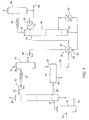
- FIG. 1 is a schematic diagram of an amine treating system.
- the amine in an amine solvent solution may change into a less useable form such as one or more amine-derived contaminants.
- an amine treating system such as one for treating a liquid or gas feed stream with the amine solvent solution, may provide conditions for degrading the amine and/or forming amine-derived contaminants.
- an amine additive may be added to the amine solvent solution to reduce the presence of amine-derived contaminants and/or to reduce the amount of amine solvent solution that degrades into the amine-derived contaminants.
- Embodiments, however, are not limited to adding the amine additive to the amine solvent solution; the amine additive may be added to the liquid or gas feed stream or both the feed stream and the amine solvent solution.
- Heat-stable salts are not just less-useable, they are associated with system corrosion and they bind the amine in the amine solvent solution making it unavailable for acid gas absorption.
- the amine additive inhibits the formation of such heat-stable salts and/or keeps the amine solvent solution from degrading into heat-stable salts. A decrease in the presence of heat-stable salts may contribute to a decrease in system corrosion.
- an amine molecule may react with a contaminant anion such as chloride, potassium, formate, and/or acetate to form heat-stable salts; embodiments, however, are not limited to these few examples.
- Heat-stable salts may also form in an amine treating system when oxygen is a contaminant. For instance, oxygen may oxidize the amine of the amine solvent solution to form acids, which then complex with cations (e.g. amine cations) to form heat-stable salts.
- cations e.g. amine cations
- Amine-derived degradation products are another type of amine-derived contaminant.
- the chemistry for producing amine-derived degradation products is typically complex and is often irreversible.
- resultant amine-derived degradation products may be solvent dependent. For instance, in the presence of CO 2 , monoethanolamine degrades to form hydroxyethyl ethylenediamine (HEED), diethanolamine (DEA) degrades to form tris hydroxyethyl ethylene diamine (THEED), and diisopropanolamine degrades to form hydroxymethyl propyl oxazolidone. Additionally, methyldiethanolamine (MDEA) can degrade to form DEA, which can then further degrade, and in the presence of oxygen MDEA can degrade to form bicine.
- HEED hydroxyethyl ethylenediamine
- DEA diethanolamine
- TBEED tris hydroxyethyl ethylene diamine
- MDEA methyldiethanolamine
- amines that may degrade and as many or more degradation products.
- other known types of amine-derived degradation products include imidazolidones, oxazolidones, ethylenediamines, ureas, thioureas, piperzines, ethanolamines, and more.
- embodiments are not limited to the forgoing examples of amines and degradation products.
- there may be a combination multiple types of amine-derived contaminants such as amine-derived degradation products and/or heat-stable salts.
- degradation of an amine/amine solvent solution refers to amine degradation into any heat-stable and/or irreversible product such as heat-stable salts, amine-derived degradation products, and the like.
- an amine solvent solution includes an amine and water.
- the amine includes one or more amines that are useful in treating a liquid or gas feed stream (in an amine treating system) with an amine solvent solution to remove acid gases from the feed stream.
- These amines may be selected from one or more of primary amines, secondary amines, and tertiary amines.
- one or more physical absorbents such as sulfolane or tetraglyme may be added to the amine solvent solution.
- the amine in the amine solvent solution may be one or more alkanolamines.
- Alkanolamines for treating a liquid or gas feed stream may be selected from, but are not limited to, one or more of: monoethanolamine (MEA), diethanolamine (DEA), triethanolamine (TEA), dimethylethanolamine (DMEA), methyldiethanolamine (MDEA), monomethylethanolamine (MMEA), 2-(2-aminoethoxy)ethanol, aminoethylethanolamine (AEEA), diisopropanolamine (DIPA), piperazine, and derivatives thereof.
- the amine additive may be added at any (or multiple) entry point(s) into an amine system such as the feed stream to be treated, make-up water, and the like.
- the amine additive added to the amine solvent solution may include a substituted propylamine.
- substituted propylamines include one or more of: dimethylaminopropylamine (DMAPA), methoxypropylamine (MOPA), aminopropylmorpholine (APM), N,N-Dimethylaminoethyl 3-aminopropyl ether or (2-(2-[(3-aminopropyl)methylamino]ethoxy)ethyl)dimethylamine, although embodiments are not so limited.
- polyoxyalkyleneamines amine additives include those having the formula: NH 2 CH(CH 3 )CH 2 -[OCH 2 CH(CH 3 )] x -NH 2 , wherein X is between 2 and 70.
- Non-limiting examples of such polyoxyalkyleneamines include JEFFAMINE ® D-230 additive (NH 2 CH(CH 3 )CH 2 -[OCH 2 CH(CH 3 )] 2.5 -NH 2 , Mol. Wt. ⁇ 230), JEFFAMINE ® D-400 additive (NH 2 CH(CH 3 )CH 2 -[OCH 2 CH(CH 3 )] 6.1 -NH 2 , Mol. Wt.
- JEFFAMINE ® D-2000 additive (NH 2 CH(CH 3 )CH 2 -[OCH 2 CH(CH 3 )] 33 -NH 2 , Mol. Wt. ⁇ 2,000), and other similar products made from an ethylene oxide backbone with a propylene oxide cap.
- JEFFAMINE ® products are available from Huntsman, The Woodlands, Texas.
- amine additives also include substituted piperazines selected from one or more of: 1-(2-aminoethyl)-4-[(2-aminoethyl)amino]ethyl]-piperazine) (APEEDA), 1-[2-[[2-aminoethtyl)amino]ethyl]-amino]ethyl]-piperazine) (PEDETA), and N-aminoethylpiperazine (AEP), although embodiments are not limited thereto.
- AEP N-aminoethylpiperazine
- the amine additive is added in an amount such that its concentration is from about 0.005% to about 7% weight of the total composition of the amine solvent solution and the amine additive. In another embodiment, the amine additive is added in an amount from about 0.05% to about 3% weight of the total composition of the amine solvent solution and the amine additive. And in yet another embodiment, the amine additive is added in an amount from about 0.2% to about 1% weight of the total composition of the amine solvent solution and the amine additive. In one embodiment, the total amount of the amine additive relative to the total composition of the amine solvent solution and the amine additive is maintained constant throughout the gas treatment process, as in a continuous gas treatment process.
- the amine treating system is one for treating acid gases from processed hydrocarbon gases.
- an amine additive may be added to variety of amine treating systems.
- the amine additive may be added to an amine treating system for removing acid gases, and in another embodiment the amine additive may be added to a carbon dioxide capture unit, although embodiments are not limited thereto.
- the feed stream 12 enters the amine treating system at a separator 14, where gases are separated from liquids.
- the feed stream 12 may be any feed stream such as a gas or a liquid, which perhaps also includes an amine additive.
- the feed stream 12 is one that contains any combination of H 2 S, CO 2 , similar acid gases, and O 2 .
- the feed gases 12 may be any type of gas including waste gas streams, such as flue gas streams, kiln gas, reverberatory furnace gas, regenerator off gas, sour gas, and combinations thereof.
- the feed gases are piped to an absorber inlet 16, and feed liquids are transmitted out of the separator 14 at a separator outlet 18.
- the feed gases are in fluid communication with an amine solvent solution and an amine additive.
- the absorber 20 may be a column (or other mixing device) with a circulating liquid amine solvent solution and an amine additive introduced at an upper absorber inlet 22. Fluid communication may be obtained as the amine solvent solution and amine additive flow down trays or packing (not shown) in the absorber 20 and the feed gas migrates upwardly among the trays or packing from the absorber inlet 16. After interacting with the amine solvent solution and amine additive, the treated feed gases are transmitted from the absorber 20 through an upper absorber outlet 84.
- the amine solvent solution and amine additive containing absorbed gases is collected at the bottom of the absorber 20 and is transmitted through a lower absorber outlet 88 to a flash tank 24.
- the amine solvent solution and amine additive are subjected to decreased pressure.
- Soluble gases are transmitted from a first outlet 26 of the flash tank 24 and hydrocarbon liquids are collected and transmitted from a second outlet 28 of the flash tank 24.
- the amine solvent solution and amine additive are transmitted through a third outlet 30 of the flash tank 24 to an inlet 36 of a heat exchanger 32.
- the amine solvent solution and amine additive are heated in the heat exchanger 32 and transmitted to an inlet 34 of a regenerator 40.
- regenerator 40 gases including H 2 S and CO 2 are boiled off and transmitted through an upper regenerator outlet 42 for subsequent treatment.
- a reflux condenser 44 and a reflux accumulator 46 condense and accumulate for recirculation through regenerator 40 a condensate of the water contained in the overhead gases.
- Makeup water is introduced into the system at inlet 48.
- the amine additive may enter the amine treating system via the makeup water.
- the makeup water and the condensate from accumulator 46 are pumped to a regenerator inlet 50 by a pump 56.
- a portion of the amine solvent solution and amine additive is circulated from a lower regenerator outlet 54 through a reboiler 60.
- the amine solvent solution and amine additive are heated in the reboiler 60 to their boiling points.
- a second portion of the amine solvent solution and amine additive is collected from the regenerator 40 and transmitted to an inlet 58 of heat exchanger 32.
- Amine solvent solution and amine additive are transmitted from an outlet 64 of the heat exchanger 32 by means of a pump 66 to a filter 70. A portion of the amine solvent solution and amine additive is filtered at the filter 70. The amine solvent solution and amine additive are then further cooled at amine cooler 80 and pumped by pump 82 to the absorber upper inlet 22.
- the amine solvent solution and amine additive may be regenerated and reused to circulate within the amine treating system without requiring fresh amine to be added to the system to replenish the amine solvent solution due to the presence of amine-derived contaminants.
- the amine additive may be added anywhere within the system such that the additive accumulates in the amine solvent solution.
- the amine additive may be added to the amine solvent solution before use in the amine treating system, it may be added to the feed stream, or it may be added to both.
- the amine additive may be added to the amine treating system via the makeup water or any other juncture in the amine treating system.
- test samples containing an amine solvent solution and an amine additive were prepared by adding a sample solution (test or control according to the particular example/experiment) to a 1-liter reaction flask equipped with a cold-water condenser, thermometer, and a sparger tube.
- the reaction flask was heated with a mantel; the sample solution therein was heated to about 90°C during the course of experiment.
- a sparger tube was used to bubble a feed stream, air, through each sample solution at a rate of 0.25 liter/min. Deionized water was added to each sample solution as needed when evaporation of water from the sample solution was noticed.
- amine-derived contaminants The presence of amine-derived contaminants was determined in two ways. One way was to look at the samples to see if they changed color. Generally, samples were colorless at the start of the experiments and were visually observed for color change each day thereafter for seven days. If the color of the sample changed then amine-derived contaminants were present in that sample. The other way was to determine via ion chromatography the concentration of amine-derived contaminants in each sample solution. Generally, concentrations for each sample solution were determined before the experiment began and seven days thereafter.
- total amine content was determined for each sample; measurements were taken before the experiment began and seven days after heating. Total amine content was determined by titration and/or ion chromatography. Furthermore, in some experiments the percent of amine solvent solution was determined both before the experiment began and seven days thereafter. These percentages were determined via titration and/or ion chromatography. The results of quantitative analysis (e.g. chromatography/titration) were normalized to a water-free basis since the water varied in the samples.
- Example 1 is a control sample and Examples 2-4 are test samples, which illustrate the effectiveness of amine additive a tetraethylenepentamine (TEPA) when added to the amine solvent solution 2-(2-aminoethoxy)ethanol.
- TEPA tetraethylenepentamine
- Examples 2-4 TEPA was used in 0.2-1.0% weight of the total test sample : the amine solvent solution, which includes water, and amine additive.
- 2-(2-aminoethoxy)ethanol and TEPA are available from Huntsman, The Woodlands, Texas.
- Example 1 the control sample, Example 1, changed from clear to amber after one day and to brown after six days.
- small amounts of TEPA strongly decreases the formation of amine-derived contaminants.
- Example 1 the samples for Examples 1-4 were tested for the production of certain heat-stable salts and for total amine content. As expected, after seven days of incubating control sample, Example 1, there was a large increase in the concentration of heat-stable salts and a decrease in amine content. In contrast, in the test samples, Examples 2-4, less formate was formed and the other salts were not detected. Furthermore, the concentration of total amine (milliequivalents/gram) remained high in the test samples as compared to the control.
- Example 2 As shown in Table 2, the total amine content of the control sample, Example 1, decreased from 9.66 to 5.36 meg/g, a drop of 4.3 meq/g, whereas in Example 4 adding 1% TEPA resulted in only a 1.1 meq/g drop.
- Table 2 Table 2 - 2-(2-aminoethoxy)ethanol analytical results with TEPA - Water free basis.
- Example # 1 2 3 4 TEPA,% 0.0 0.2 0.5 1.0 Test results Day 0 Day 7 Day 0 Day 7 Day 0 Day 7 Day 0 Day 7 Day 0 Day 7 Formate, (ppm) 15 17,190 14 2,189 13 1,520 7 367 Glycolate, (ppm) 0 1,415 0 0 0 0 0 0 Lactate, (ppm) 0 19,106 0 0 0 0 0 0 0 0 0 Total Amine, (meq/g) 9.66 5.36 10.37 9.61 9.54 9.50 10.67 9.57
- Example 5 is a control sample (without an amine additive) and Examples 6 and 7 test samples with the amine additive TEPA added thereto.
- TEPA was added in 0.2 % and 1.0% of the total solution respectively.
- the amine solvent solution tested in these examples was methyldiethanolamine (MDEA), which is available from Huntsman, The Woodlands, Texas.
- test sample Example 6 was lightly colored on day 7, whereas test sample Example 7 remained colorless for the duration of the experiment.
- test samples had little or no discoloration, which indicates that the amine additive decreased or prevented amine-derived contaminants from forming.
- Example 5 the control sample the ppm of each salt increased after 7 days, but in comparison, Examples 6 and 7, which were test samples, the concentration of heat stable salts remained low. Furthermore, total amine concentration dropped in the control but the drop observed in the test samples was comparatively small. In these Examples, the percent of amine solvent solution was also measured after 7-days. In the control sample there was close to a 30% decrease in amine solvent solution. In contrast, in the test samples the amine solvent solution decreased a maximum of only about 3%.
- Example 8 is a control sample of amine solvent solution monoethanolamine (MEA) and Examples 9-11 are test samples having the amine additive TEPA added to MEA.
- the concentration of TEPA in Examples 9-11 was 0.2-1.0% weight of the total sample solution.
- TEPA did not have a clear-cut effect on preventing sample discoloration. Nonetheless, as is shown in Table 6, TEPA did affect salt formation in the test samples.
- Table 5 Example # 8 9 10 11 MEA (grams) 400 358.4 396 392 TEPA (grams) 0 1.6 4.0 8.0 TEPA,% 0 0.2 0.5 1.0 Water (grams) 400 440 400 400 Appearance Start Clear Clear Clear Clear Day 1 Amber Red Clear Amber Day 2 Red Brown Amber Red Day 3 Red Dark brown Red Red Day 4 Red Dark brown Red Red Day 5 Red Dark brown Red Red Day 6 Red Dark brown Red Red Dav 7 Red Dark brown Red Red Red
- amine-derived contaminants such as acetate, formate, glycolate, and lactate were decreased in the test samples as compared to the control. Furthermore, MEA amine strength remained relatively high in the test samples as compared to the control.
- Table 6 Example 8 9 10 11 TEPA, % 0 0.2 0.5 1.0 Day 0 Day Day 0 Day 7 Day 0 Day 7 Day 0 Day 7 Acetate, (ppm) 0 1,568 0 718 0 344 0 455 Formate, (ppm) 10 37,523 6 9,633 1 15,188 8 13,925 Glycolate, (ppm) 1 6,813 0 2,427 0 1,316 0 1,227 Lactate, (ppm) 0 8,745 0 3,473 0 2,812 0 2,665 MEA, % 100 59.2 100 78.0 100 86.4 100 89.0 total amine meq/g 16.4 8.5 15.5 12.5 17.2 14.2 17.1 14.2
- examples 12 through 14 were completed to test other amines in MDEA solutions such as dimethylaminopropylamine (DMAPA), JEFFAMINE ® D-230 additive, and aminoethylethanolamine (AEEA).
- DMAPA dimethylaminopropylamine
- JEFFAMINE ® D-230 additive aminoethylethanolamine
- AEEA aminoethylethanolamine
- Table 7 DMAPA, JEFFAMINE ® D-230 additive, AEEA, and TEPA (from Example 7) all decrease the loss of total amine content of the final solutions.
- examples 15 through 18 were completed to test other amine additives such as DMAPA, JEFFAMINE ® D-230 additive, and AEEA in 2-(2-aminoethoxy)ethanol amine solvent solution. These experiments were run in the same manner as the earlier experiments. The results are presented on a water-free basis due to slight differences in water content of the final sample solutions. As shown in Table 8, DMAPA, JEFFAMINE ® D-230 additive, AEEA, and TEPA (from Example 7) decrease the loss of total amine content of the amine solvent solution versus not adding an amine additive (Example 1).
- examples 19 through 21 were completed to test other amine additives such as DMAPA, JEFFAMINE ® D-230 additive, and AEEA in MEA amine solvent solution. These experiments were run in the same manner as the earlier experiments. The results are presented on a water free basis due to slight differences in water content of the final sample solutions. As shown in Table 9, DMAPA, JEFFAMINE ® D-230 additive, AEEA, and TEPA (from Example 7) decrease the loss of total amine content of the amine solvent solution versus not adding any other amine additive to the solution (Example 8). Formate salt was significantly decreased in samples where JEFFAMINE ® D-230 additive (Example 20) or TEPA was used (Example 9).
- amine treating system of the plant was similar to the system of Fig. 1 . In this case, however, there were two amine treating systems (System 1 and System 2) each operating with a circulation rate of 100 gallons per minute. Furthermore, the same gas feed stream was treated by both systems. For instance, referring back to Fig. 1 , feed stream 12 was split such that a portion went to System 1 and the remainder went to System 2.
- the amine solvent solution circulating through both systems was a blend of MDEA, DEA, and water, the weight % of amine in the blend was 45% of the total weight of the solvent solution.
- System 1 was the test system having a dose of the amine additive TEPA added thereto and System 2 was the control.
- both amine-derived contaminant formation and amine degradation decreased in the amine solvent solution as compared to amine-additive free system.
- Amine additives can thereby act as degradation inhibitors, amine-derived contaminant inhibitors, or both.
- amine-derived contaminants do not build up and the amine in the solvent solution does not become depleted, the system operates more efficiently, does not suffer from as much corrosion, and can be operated for a longer time period without the need of adding fresh amine to the solvent solution.
- amine additives may also be corrosion inhibitors.
Landscapes
- Chemical & Material Sciences (AREA)
- Oil, Petroleum & Natural Gas (AREA)
- Engineering & Computer Science (AREA)
- General Chemical & Material Sciences (AREA)
- Chemical Kinetics & Catalysis (AREA)
- Analytical Chemistry (AREA)
- Organic Chemistry (AREA)
- Gas Separation By Absorption (AREA)
- Treating Waste Gases (AREA)
- Preventing Corrosion Or Incrustation Of Metals (AREA)
- Extraction Or Liquid Replacement (AREA)
- Organic Low-Molecular-Weight Compounds And Preparation Thereof (AREA)
Claims (6)
- Procédé pour diminuer la présence de contaminants dérivés d'amines, diminuer la dégradation de l'amine dans la solution d'amine dans un solvant, ou pour les deux diminutions, comparativement à ce qui se serait produit dans une solution dans un solvant, un liquide ou un gaz, ou leur ensemble, à base d'amine, dépourvu d'additif du type amine, le procédé consistant à :- traiter un courant liquide ou gazeux d'alimentation avec une solution d'amine dans un solvant ;- ajouter des additifs du type amine consistant en N-(2-aminoéthyl)-N'-{2-{(2-aminoéthyl)amino}éthyl}-1,2-éthane-diamine) et 4-(2-aminoéthyl)-N-(2-aminoéthyl)-N'-{2-{(2-aminoéthyl)amino}éthyl}-1,2-éthanediamine) 1-(2-aminoéthyl)-4-[(2-aminoéthyl)amino]éthyl]-pipérazine), et 1-[2-[[2-amino-éthyl)amino]éthyl]-amino]éthyl]-pipérazine au courant de solution dans un solvant, de liquide ou de gaz d'alimentation à base d'amine, ou de leur ensemble.
- Procédé suivant la revendication 1, dans lequel la diminution de la présence d'un contaminant dérivé d'amines comprend la diminution de la présence d'un sel thermostable, d'un produit de dégradation dérivé d'amine, ou des deux, dans un système de traitement d'amines de telle sorte que la solution d'amine dans un solvant contenant les additifs du type amine puisse être régénérée et réutilisée dans le système de traitement d'amines sans nécessiter l'addition d'une quantité nouvelle d'amine pour renouveler la solution d'amine dans un solvant en raison de la formation de contaminants dérivés d'amines.
- Procédé suivant la revendication 1 ou 2, dans lequel l'addition des additifs du type amine à la solution dans un solvant, au liquide ou au gaz traité à base d'amine, ou à l'ensemble comprend l'addition des additifs du type amine à la solution dans un solvant, au liquide ou au gaz traité à base d'amine ou à l'ensemble à n'importe quelle jonction dans le système de traitement d'amines.
- Procédé suivant l'une quelconque des revendications 1 à 3, dans lequel l'addition d'un additif du type amine comprend l'addition de l'additif du type amine en une quantité de 0,005 % à 7 % de la composition totale de la solution d'amine dans un solvant et de l'additif du type amine.
- Procédé suivant l'une quelconque des revendications 1 à 4, dans lequel le traitement d'un courant liquide ou gazeux d'alimentation avec une solution d'amine dans un solvant comprend le traitement du courant liquide ou gazeux d'alimentation avec une solution dans un solvant d'une ou plusieurs amines choisies entre : la monoéthanolamine, la diéthanolamine, la triéthanolamine, la diméthyléthanolamine, la N-méthyldiéthanolamine, la monométhyléthanolamine, le 2-(2-aminoéthoxy)éthanol, l'aminoéthyléthanolamine, la diisopropanolamine, la pipérazine, et leurs dérivés.
- Procédé suivant l'une quelconque des revendications 1 à 5, dans lequel la diminution de la formation de contaminants dérivés d'amines comprend la diminution de la formation de sels thermostables dérivés d'amines, de produits de dégradation dérivés d'amines, ou bien des deux.
Applications Claiming Priority (2)
| Application Number | Priority Date | Filing Date | Title |
|---|---|---|---|
| US12053608P | 2008-12-08 | 2008-12-08 | |
| PCT/US2009/066531 WO2010077548A1 (fr) | 2008-12-08 | 2009-12-03 | Diminution de la présence de contaminants issus d'amine dans des solutions de solvant à base d'amine et/ou de la dégradation de celles-ci |
Related Child Applications (1)
| Application Number | Title | Priority Date | Filing Date |
|---|---|---|---|
| EP16151076 Division-Into | 2016-01-13 |
Publications (3)
| Publication Number | Publication Date |
|---|---|
| EP2373760A1 EP2373760A1 (fr) | 2011-10-12 |
| EP2373760A4 EP2373760A4 (fr) | 2012-12-26 |
| EP2373760B1 true EP2373760B1 (fr) | 2016-08-03 |
Family
ID=42310093
Family Applications (1)
| Application Number | Title | Priority Date | Filing Date |
|---|---|---|---|
| EP09836654.5A Active EP2373760B1 (fr) | 2008-12-08 | 2009-12-03 | Diminution de la présence de contaminants issus d'amine dans des solutions de solvant à base d'amine et/ou de la dégradation de celles-ci |
Country Status (10)
| Country | Link |
|---|---|
| US (1) | US8945280B2 (fr) |
| EP (1) | EP2373760B1 (fr) |
| JP (2) | JP5789194B2 (fr) |
| CN (1) | CN102239231B (fr) |
| AR (1) | AR074494A1 (fr) |
| AU (1) | AU2009333671B2 (fr) |
| CA (1) | CA2745399C (fr) |
| MX (1) | MX2011005814A (fr) |
| TW (1) | TWI453180B (fr) |
| WO (1) | WO2010077548A1 (fr) |
Families Citing this family (14)
| Publication number | Priority date | Publication date | Assignee | Title |
|---|---|---|---|---|
| WO2011097727A1 (fr) | 2010-02-10 | 2011-08-18 | Queen's University At Kingston | Changement de la force ionique de l'eau |
| JP5865383B2 (ja) * | 2010-10-29 | 2016-02-17 | ハンツマン ペトロケミカル エルエルシーHuntsman Petrochemical LLC | 酸性ガスの除去のための吸着剤としての2−(3−アミノプロポキシ)エタン−1−オールの使用 |
| WO2012079175A1 (fr) | 2010-12-15 | 2012-06-21 | Queen's University At Kingston | Systèmes et procédés pour l'utilisation d'eau présentant une force ionique commutable |
| JP5678260B2 (ja) * | 2011-02-17 | 2015-02-25 | 独立行政法人産業技術総合研究所 | 低揮発性二酸化炭素吸収液およびガス分離方法 |
| FR2983087B1 (fr) * | 2011-11-30 | 2014-01-10 | IFP Energies Nouvelles | Procede d'elimination de composes acides d'un effluent gazeux avec une solution absorbante a base de bis(amino-3-propyl) ethers ou de (amino-2-ethyl)-(amino-3-propyl) ethers |
| CN102559164B (zh) * | 2011-12-09 | 2014-10-22 | 中国石油集团川庆钻探工程有限公司 | 钻井液用缓蚀剂的使用方法 |
| CN104203818A (zh) * | 2012-01-20 | 2014-12-10 | 得克萨斯州大学系统董事会 | 用于co2 捕集的胺与哌嗪共混物 |
| PE20150449A1 (es) * | 2012-09-05 | 2015-04-08 | Basf Se | Proceso para la separacion de gases acidos de una corriente de fluido que comprende agua |
| JP6216150B2 (ja) * | 2013-05-09 | 2017-10-18 | 株式会社東芝 | 二酸化炭素回収システムおよびその運転方法 |
| US10822549B2 (en) * | 2019-01-18 | 2020-11-03 | Baker Hughes Holdings Llc | Methods and compounds for removing non-acidic contaminants from hydrocarbon streams |
| CN114011207B (zh) * | 2021-12-07 | 2023-03-21 | 华北电力大学(保定) | 一种用于碳捕集的低能耗多元胺类液-液相变吸收剂 |
| US12544708B2 (en) | 2023-02-21 | 2026-02-10 | International Business Machines Corporation | Amine solvent-based carbon capture compositions |
| US20250249402A1 (en) * | 2024-02-05 | 2025-08-07 | Saudi Arabian Oil Company | Systems and methods for eliminating flaring in amine sweetening |
| CN119318874B (zh) * | 2024-12-18 | 2025-04-15 | 淄博凯美可工贸有限公司 | 一种节能型复合脱硫剂的制备方法 |
Family Cites Families (15)
| Publication number | Priority date | Publication date | Assignee | Title |
|---|---|---|---|---|
| US4372873A (en) * | 1981-03-16 | 1983-02-08 | Texaco Inc. | Vanadium-amine corrosion inhibitor system for sour gas conditioning solutions |
| US4663124A (en) | 1985-09-03 | 1987-05-05 | Texaco, Inc. | Reaction product of hydrogen sulfide with the reaction product of a dione and a primary polyamine |
| US4814104A (en) | 1987-02-05 | 1989-03-21 | Uop | Tertiary alkanolamine absorbent containing an ethyleneamine promoter and its method of use |
| DE3724223A1 (de) * | 1987-07-22 | 1989-02-02 | Huels Chemische Werke Ag | Stabilisatorsystem |
| US4766186A (en) * | 1987-09-03 | 1988-08-23 | Texaco Inc. | Epoxy adhesive |
| JPH0644972B2 (ja) * | 1988-03-11 | 1994-06-15 | ユニオン・カーバイド・コーポレーション | エチレンアミン促進剤を含有する第三級アルカノールアミン吸収剤及びその使用法 |
| DE69515049T2 (de) * | 1994-10-13 | 2000-06-21 | Catachem, Inc. | Verfahren zum minimieren des lösungsmittelabbaus und korrosion in aminlösungsmittelbehandlungssystemen |
| US6517700B2 (en) * | 2000-05-02 | 2003-02-11 | Carolyn H. Byszewski | Process for the removal of heat stable amine salts |
| JP4025953B2 (ja) * | 2001-01-05 | 2007-12-26 | 荒川化学工業株式会社 | 洗浄剤組成物 |
| US6974553B2 (en) | 2002-10-15 | 2005-12-13 | Ge Betz, Inc. | Polythiaether compounds and their use as corrosion inhibitors |
| CN1826165B (zh) * | 2003-07-22 | 2010-12-08 | 陶氏环球技术公司 | 含酸性气体的处理液的再生 |
| ITRM20040446A1 (it) | 2004-09-20 | 2004-12-20 | Chimec Spa | Disperdente di depositi salini in impianti di processo di idrocarburi. |
| PE20071048A1 (es) * | 2005-12-12 | 2007-10-18 | Basf Ag | Proceso para la recuperacion de dioxido de carbono |
| FR2898284B1 (fr) | 2006-03-10 | 2009-06-05 | Inst Francais Du Petrole | Procede de desacidification d'un gaz par solution absorbante avec regeneration fractionnee par chauffage. |
| US7601315B2 (en) * | 2006-12-28 | 2009-10-13 | Cansolv Technologies Inc. | Process for the recovery of carbon dioxide from a gas stream |
-
2009
- 2009-12-03 EP EP09836654.5A patent/EP2373760B1/fr active Active
- 2009-12-03 JP JP2011539683A patent/JP5789194B2/ja active Active
- 2009-12-03 MX MX2011005814A patent/MX2011005814A/es active IP Right Grant
- 2009-12-03 US US13/132,651 patent/US8945280B2/en active Active
- 2009-12-03 CA CA2745399A patent/CA2745399C/fr active Active
- 2009-12-03 AU AU2009333671A patent/AU2009333671B2/en active Active
- 2009-12-03 CN CN200980148697.4A patent/CN102239231B/zh active Active
- 2009-12-03 WO PCT/US2009/066531 patent/WO2010077548A1/fr not_active Ceased
- 2009-12-07 AR ARP090104725 patent/AR074494A1/es active IP Right Grant
- 2009-12-08 TW TW098141969A patent/TWI453180B/zh active
-
2014
- 2014-01-24 JP JP2014011328A patent/JP2014168774A/ja active Pending
Also Published As
| Publication number | Publication date |
|---|---|
| US20110232489A1 (en) | 2011-09-29 |
| CA2745399A1 (fr) | 2010-07-08 |
| JP2012510894A (ja) | 2012-05-17 |
| TW201029953A (en) | 2010-08-16 |
| CN102239231A (zh) | 2011-11-09 |
| JP5789194B2 (ja) | 2015-10-07 |
| EP2373760A1 (fr) | 2011-10-12 |
| CA2745399C (fr) | 2016-04-19 |
| AU2009333671B2 (en) | 2014-11-06 |
| US8945280B2 (en) | 2015-02-03 |
| TWI453180B (zh) | 2014-09-21 |
| CN102239231B (zh) | 2014-04-09 |
| EP2373760A4 (fr) | 2012-12-26 |
| AU2009333671A1 (en) | 2010-07-08 |
| MX2011005814A (es) | 2011-07-13 |
| WO2010077548A1 (fr) | 2010-07-08 |
| AR074494A1 (es) | 2011-01-19 |
| JP2014168774A (ja) | 2014-09-18 |
Similar Documents
| Publication | Publication Date | Title |
|---|---|---|
| US8945280B2 (en) | Method to decrease decomposition products in solutions that absorb acidic gases such as carbon dioxide and the like in the presence of oxygen | |
| Wang et al. | Amine reclaiming technologies in post-combustion carbon dioxide capture | |
| CN102481518B (zh) | 酸性气体洗涤组合物 | |
| EP2448667B1 (fr) | Composition et procédé pour le lavage de gaz acides | |
| RU2397011C2 (ru) | Способ очистки газовых смесей, содержащих меркаптаны и другие кислые газы | |
| CN110382084B (zh) | 从流体料流中除去酸性气体的方法 | |
| AU2013209428B2 (en) | Blends of amines with piperazine for CO2 capture | |
| US20110256043A1 (en) | Composition for treating acid gas | |
| KR101035148B1 (ko) | 산성가스 분리용 흡수제 | |
| US20110214566A1 (en) | Carbon dioxide absorbents | |
| CN103221125A (zh) | 酸性气体吸收剂组合物 | |
| US20140345458A1 (en) | Reducing nitrosamine content of amine compositions | |
| EP2861698B1 (fr) | Procédé de traitement de gaz hydrocarbure liquéfié à l'aide de composés 2-amino -2 (hydroxyméthyl) propane -1,3-diol | |
| EP3566762A2 (fr) | Procédés et compositions permettant de récupérer des sulfures et du dioxyde de carbone à partir de pétrole et de gaz naturel | |
| JP2022521383A (ja) | 酸性ガスを流体ストリームから、ピペラジン環を含む液体吸収剤で除去する方法 | |
| EP2861699B1 (fr) | Procédé pour le traitement d'hydrocarbures liquéfiés à l'aide de composés 3- (pipérazine -1-yl) propane -1,2-diol | |
| KR101417214B1 (ko) | 이산화탄소 흡수제 | |
| CN114173908B (zh) | 从流体料流中移除酸性气体的方法 | |
| KR20230132105A (ko) | 산성가스 분리용 혼합 흡수제 및 이를 포함하는 산성가스 분리용 조성물, 산성가스 제거장치 및 산성가스 제거방법 |
Legal Events
| Date | Code | Title | Description |
|---|---|---|---|
| PUAI | Public reference made under article 153(3) epc to a published international application that has entered the european phase |
Free format text: ORIGINAL CODE: 0009012 |
|
| 17P | Request for examination filed |
Effective date: 20110708 |
|
| AK | Designated contracting states |
Kind code of ref document: A1 Designated state(s): AT BE BG CH CY CZ DE DK EE ES FI FR GB GR HR HU IE IS IT LI LT LU LV MC MK MT NL NO PL PT RO SE SI SK SM TR |
|
| DAX | Request for extension of the european patent (deleted) | ||
| A4 | Supplementary search report drawn up and despatched |
Effective date: 20121128 |
|
| RIC1 | Information provided on ipc code assigned before grant |
Ipc: C09K 15/16 20060101AFI20121122BHEP Ipc: C07C 209/90 20060101ALI20121122BHEP |
|
| 17Q | First examination report despatched |
Effective date: 20131206 |
|
| GRAP | Despatch of communication of intention to grant a patent |
Free format text: ORIGINAL CODE: EPIDOSNIGR1 |
|
| INTG | Intention to grant announced |
Effective date: 20160226 |
|
| GRAS | Grant fee paid |
Free format text: ORIGINAL CODE: EPIDOSNIGR3 |
|
| GRAA | (expected) grant |
Free format text: ORIGINAL CODE: 0009210 |
|
| AK | Designated contracting states |
Kind code of ref document: B1 Designated state(s): AT BE BG CH CY CZ DE DK EE ES FI FR GB GR HR HU IE IS IT LI LT LU LV MC MK MT NL NO PL PT RO SE SI SK SM TR |
|
| REG | Reference to a national code |
Ref country code: GB Ref legal event code: FG4D |
|
| REG | Reference to a national code |
Ref country code: CH Ref legal event code: EP Ref country code: AT Ref legal event code: REF Ref document number: 817345 Country of ref document: AT Kind code of ref document: T Effective date: 20160815 |
|
| REG | Reference to a national code |
Ref country code: IE Ref legal event code: FG4D |
|
| REG | Reference to a national code |
Ref country code: DE Ref legal event code: R096 Ref document number: 602009040150 Country of ref document: DE |
|
| REG | Reference to a national code |
Ref country code: NO Ref legal event code: T2 Effective date: 20160803 |
|
| REG | Reference to a national code |
Ref country code: NL Ref legal event code: MP Effective date: 20160803 |
|
| REG | Reference to a national code |
Ref country code: LT Ref legal event code: MG4D |
|
| REG | Reference to a national code |
Ref country code: AT Ref legal event code: MK05 Ref document number: 817345 Country of ref document: AT Kind code of ref document: T Effective date: 20160803 |
|
| PG25 | Lapsed in a contracting state [announced via postgrant information from national office to epo] |
Ref country code: HR Free format text: LAPSE BECAUSE OF FAILURE TO SUBMIT A TRANSLATION OF THE DESCRIPTION OR TO PAY THE FEE WITHIN THE PRESCRIBED TIME-LIMIT Effective date: 20160803 Ref country code: IS Free format text: LAPSE BECAUSE OF FAILURE TO SUBMIT A TRANSLATION OF THE DESCRIPTION OR TO PAY THE FEE WITHIN THE PRESCRIBED TIME-LIMIT Effective date: 20161203 Ref country code: NL Free format text: LAPSE BECAUSE OF FAILURE TO SUBMIT A TRANSLATION OF THE DESCRIPTION OR TO PAY THE FEE WITHIN THE PRESCRIBED TIME-LIMIT Effective date: 20160803 Ref country code: FI Free format text: LAPSE BECAUSE OF FAILURE TO SUBMIT A TRANSLATION OF THE DESCRIPTION OR TO PAY THE FEE WITHIN THE PRESCRIBED TIME-LIMIT Effective date: 20160803 Ref country code: LT Free format text: LAPSE BECAUSE OF FAILURE TO SUBMIT A TRANSLATION OF THE DESCRIPTION OR TO PAY THE FEE WITHIN THE PRESCRIBED TIME-LIMIT Effective date: 20160803 |
|
| PG25 | Lapsed in a contracting state [announced via postgrant information from national office to epo] |
Ref country code: ES Free format text: LAPSE BECAUSE OF FAILURE TO SUBMIT A TRANSLATION OF THE DESCRIPTION OR TO PAY THE FEE WITHIN THE PRESCRIBED TIME-LIMIT Effective date: 20160803 Ref country code: GR Free format text: LAPSE BECAUSE OF FAILURE TO SUBMIT A TRANSLATION OF THE DESCRIPTION OR TO PAY THE FEE WITHIN THE PRESCRIBED TIME-LIMIT Effective date: 20161104 Ref country code: SE Free format text: LAPSE BECAUSE OF FAILURE TO SUBMIT A TRANSLATION OF THE DESCRIPTION OR TO PAY THE FEE WITHIN THE PRESCRIBED TIME-LIMIT Effective date: 20160803 Ref country code: PT Free format text: LAPSE BECAUSE OF FAILURE TO SUBMIT A TRANSLATION OF THE DESCRIPTION OR TO PAY THE FEE WITHIN THE PRESCRIBED TIME-LIMIT Effective date: 20161205 Ref country code: AT Free format text: LAPSE BECAUSE OF FAILURE TO SUBMIT A TRANSLATION OF THE DESCRIPTION OR TO PAY THE FEE WITHIN THE PRESCRIBED TIME-LIMIT Effective date: 20160803 Ref country code: LV Free format text: LAPSE BECAUSE OF FAILURE TO SUBMIT A TRANSLATION OF THE DESCRIPTION OR TO PAY THE FEE WITHIN THE PRESCRIBED TIME-LIMIT Effective date: 20160803 Ref country code: PL Free format text: LAPSE BECAUSE OF FAILURE TO SUBMIT A TRANSLATION OF THE DESCRIPTION OR TO PAY THE FEE WITHIN THE PRESCRIBED TIME-LIMIT Effective date: 20160803 |
|
| PG25 | Lapsed in a contracting state [announced via postgrant information from national office to epo] |
Ref country code: EE Free format text: LAPSE BECAUSE OF FAILURE TO SUBMIT A TRANSLATION OF THE DESCRIPTION OR TO PAY THE FEE WITHIN THE PRESCRIBED TIME-LIMIT Effective date: 20160803 Ref country code: RO Free format text: LAPSE BECAUSE OF FAILURE TO SUBMIT A TRANSLATION OF THE DESCRIPTION OR TO PAY THE FEE WITHIN THE PRESCRIBED TIME-LIMIT Effective date: 20160803 |
|
| REG | Reference to a national code |
Ref country code: DE Ref legal event code: R097 Ref document number: 602009040150 Country of ref document: DE |
|
| PG25 | Lapsed in a contracting state [announced via postgrant information from national office to epo] |
Ref country code: DK Free format text: LAPSE BECAUSE OF FAILURE TO SUBMIT A TRANSLATION OF THE DESCRIPTION OR TO PAY THE FEE WITHIN THE PRESCRIBED TIME-LIMIT Effective date: 20160803 Ref country code: CZ Free format text: LAPSE BECAUSE OF FAILURE TO SUBMIT A TRANSLATION OF THE DESCRIPTION OR TO PAY THE FEE WITHIN THE PRESCRIBED TIME-LIMIT Effective date: 20160803 Ref country code: SK Free format text: LAPSE BECAUSE OF FAILURE TO SUBMIT A TRANSLATION OF THE DESCRIPTION OR TO PAY THE FEE WITHIN THE PRESCRIBED TIME-LIMIT Effective date: 20160803 Ref country code: BE Free format text: LAPSE BECAUSE OF FAILURE TO SUBMIT A TRANSLATION OF THE DESCRIPTION OR TO PAY THE FEE WITHIN THE PRESCRIBED TIME-LIMIT Effective date: 20160803 Ref country code: SM Free format text: LAPSE BECAUSE OF FAILURE TO SUBMIT A TRANSLATION OF THE DESCRIPTION OR TO PAY THE FEE WITHIN THE PRESCRIBED TIME-LIMIT Effective date: 20160803 Ref country code: BG Free format text: LAPSE BECAUSE OF FAILURE TO SUBMIT A TRANSLATION OF THE DESCRIPTION OR TO PAY THE FEE WITHIN THE PRESCRIBED TIME-LIMIT Effective date: 20161103 |
|
| PLBE | No opposition filed within time limit |
Free format text: ORIGINAL CODE: 0009261 |
|
| STAA | Information on the status of an ep patent application or granted ep patent |
Free format text: STATUS: NO OPPOSITION FILED WITHIN TIME LIMIT |
|
| 26N | No opposition filed |
Effective date: 20170504 |
|
| REG | Reference to a national code |
Ref country code: CH Ref legal event code: PL |
|
| PG25 | Lapsed in a contracting state [announced via postgrant information from national office to epo] |
Ref country code: SI Free format text: LAPSE BECAUSE OF FAILURE TO SUBMIT A TRANSLATION OF THE DESCRIPTION OR TO PAY THE FEE WITHIN THE PRESCRIBED TIME-LIMIT Effective date: 20160803 |
|
| PG25 | Lapsed in a contracting state [announced via postgrant information from national office to epo] |
Ref country code: MC Free format text: LAPSE BECAUSE OF FAILURE TO SUBMIT A TRANSLATION OF THE DESCRIPTION OR TO PAY THE FEE WITHIN THE PRESCRIBED TIME-LIMIT Effective date: 20160803 |
|
| REG | Reference to a national code |
Ref country code: FR Ref legal event code: ST Effective date: 20170831 |
|
| REG | Reference to a national code |
Ref country code: IE Ref legal event code: MM4A |
|
| PG25 | Lapsed in a contracting state [announced via postgrant information from national office to epo] |
Ref country code: CH Free format text: LAPSE BECAUSE OF NON-PAYMENT OF DUE FEES Effective date: 20161231 Ref country code: FR Free format text: LAPSE BECAUSE OF NON-PAYMENT OF DUE FEES Effective date: 20170102 Ref country code: LI Free format text: LAPSE BECAUSE OF NON-PAYMENT OF DUE FEES Effective date: 20161231 Ref country code: LU Free format text: LAPSE BECAUSE OF NON-PAYMENT OF DUE FEES Effective date: 20161203 |
|
| PG25 | Lapsed in a contracting state [announced via postgrant information from national office to epo] |
Ref country code: IE Free format text: LAPSE BECAUSE OF NON-PAYMENT OF DUE FEES Effective date: 20161203 |
|
| PG25 | Lapsed in a contracting state [announced via postgrant information from national office to epo] |
Ref country code: HU Free format text: LAPSE BECAUSE OF FAILURE TO SUBMIT A TRANSLATION OF THE DESCRIPTION OR TO PAY THE FEE WITHIN THE PRESCRIBED TIME-LIMIT; INVALID AB INITIO Effective date: 20091203 Ref country code: CY Free format text: LAPSE BECAUSE OF FAILURE TO SUBMIT A TRANSLATION OF THE DESCRIPTION OR TO PAY THE FEE WITHIN THE PRESCRIBED TIME-LIMIT Effective date: 20160803 |
|
| PG25 | Lapsed in a contracting state [announced via postgrant information from national office to epo] |
Ref country code: MK Free format text: LAPSE BECAUSE OF FAILURE TO SUBMIT A TRANSLATION OF THE DESCRIPTION OR TO PAY THE FEE WITHIN THE PRESCRIBED TIME-LIMIT Effective date: 20160803 Ref country code: TR Free format text: LAPSE BECAUSE OF FAILURE TO SUBMIT A TRANSLATION OF THE DESCRIPTION OR TO PAY THE FEE WITHIN THE PRESCRIBED TIME-LIMIT Effective date: 20160803 |
|
| PG25 | Lapsed in a contracting state [announced via postgrant information from national office to epo] |
Ref country code: MT Free format text: LAPSE BECAUSE OF NON-PAYMENT OF DUE FEES Effective date: 20161203 |
|
| P01 | Opt-out of the competence of the unified patent court (upc) registered |
Free format text: CASE NUMBER: APP_5826/2025 Effective date: 20250204 |
|
| PGFP | Annual fee paid to national office [announced via postgrant information from national office to epo] |
Ref country code: GB Payment date: 20251223 Year of fee payment: 17 |
|
| PGFP | Annual fee paid to national office [announced via postgrant information from national office to epo] |
Ref country code: NO Payment date: 20251218 Year of fee payment: 17 |
|
| PGFP | Annual fee paid to national office [announced via postgrant information from national office to epo] |
Ref country code: IT Payment date: 20251218 Year of fee payment: 17 |
|
| PGFP | Annual fee paid to national office [announced via postgrant information from national office to epo] |
Ref country code: DE Payment date: 20251229 Year of fee payment: 17 |