EP2374776A1 - Verfahren zur herstellung von kohlenstoffmaterial und kohlenstoffmaterial - Google Patents
Verfahren zur herstellung von kohlenstoffmaterial und kohlenstoffmaterial Download PDFInfo
- Publication number
- EP2374776A1 EP2374776A1 EP09831838A EP09831838A EP2374776A1 EP 2374776 A1 EP2374776 A1 EP 2374776A1 EP 09831838 A EP09831838 A EP 09831838A EP 09831838 A EP09831838 A EP 09831838A EP 2374776 A1 EP2374776 A1 EP 2374776A1
- Authority
- EP
- European Patent Office
- Prior art keywords
- carbon
- metal
- carbon material
- carbon substrate
- substrate
- Prior art date
- Legal status (The legal status is an assumption and is not a legal conclusion. Google has not performed a legal analysis and makes no representation as to the accuracy of the status listed.)
- Withdrawn
Links
- 239000003575 carbonaceous material Substances 0.000 title claims abstract description 60
- 238000004519 manufacturing process Methods 0.000 title claims abstract description 25
- OKTJSMMVPCPJKN-UHFFFAOYSA-N Carbon Chemical compound [C] OKTJSMMVPCPJKN-UHFFFAOYSA-N 0.000 claims abstract description 137
- 229910052799 carbon Inorganic materials 0.000 claims abstract description 101
- 239000000758 substrate Substances 0.000 claims abstract description 73
- 229910052751 metal Inorganic materials 0.000 claims abstract description 63
- 239000002184 metal Substances 0.000 claims abstract description 63
- 229910052723 transition metal Inorganic materials 0.000 claims abstract description 28
- 150000003624 transition metals Chemical class 0.000 claims abstract description 25
- 239000003795 chemical substances by application Substances 0.000 claims abstract description 22
- 229910000039 hydrogen halide Inorganic materials 0.000 claims abstract description 19
- 239000012433 hydrogen halide Substances 0.000 claims abstract description 19
- 239000002923 metal particle Substances 0.000 claims abstract description 14
- NLXLAEXVIDQMFP-UHFFFAOYSA-N Ammonia chloride Chemical compound [NH4+].[Cl-] NLXLAEXVIDQMFP-UHFFFAOYSA-N 0.000 claims abstract description 12
- 235000019270 ammonium chloride Nutrition 0.000 claims abstract description 5
- 229910045601 alloy Inorganic materials 0.000 claims description 17
- 239000000956 alloy Substances 0.000 claims description 17
- 229910052742 iron Inorganic materials 0.000 claims description 10
- 229910052759 nickel Inorganic materials 0.000 claims description 9
- 229910003470 tongbaite Inorganic materials 0.000 claims description 6
- 239000002245 particle Substances 0.000 claims description 2
- 239000000843 powder Substances 0.000 abstract description 30
- 229910002804 graphite Inorganic materials 0.000 abstract description 27
- 239000010439 graphite Substances 0.000 abstract description 27
- 239000010935 stainless steel Substances 0.000 abstract description 8
- 229910001220 stainless steel Inorganic materials 0.000 abstract description 8
- 238000000034 method Methods 0.000 abstract description 7
- 150000001721 carbon Chemical class 0.000 abstract description 6
- -1 stainless steel Chemical class 0.000 abstract 1
- 239000011651 chromium Substances 0.000 description 27
- 238000010438 heat treatment Methods 0.000 description 25
- 239000007789 gas Substances 0.000 description 22
- UFHFLCQGNIYNRP-UHFFFAOYSA-N Hydrogen Chemical compound [H][H] UFHFLCQGNIYNRP-UHFFFAOYSA-N 0.000 description 7
- 229910001030 Iron–nickel alloy Inorganic materials 0.000 description 7
- 229910052804 chromium Inorganic materials 0.000 description 6
- 239000000463 material Substances 0.000 description 6
- 238000007747 plating Methods 0.000 description 6
- IJGRMHOSHXDMSA-UHFFFAOYSA-N Atomic nitrogen Chemical compound N#N IJGRMHOSHXDMSA-UHFFFAOYSA-N 0.000 description 4
- 230000000052 comparative effect Effects 0.000 description 4
- 229910001507 metal halide Inorganic materials 0.000 description 4
- 150000005309 metal halides Chemical class 0.000 description 4
- 239000007769 metal material Substances 0.000 description 4
- UFGZSIPAQKLCGR-UHFFFAOYSA-N chromium carbide Chemical compound [Cr]#C[Cr]C#[Cr] UFGZSIPAQKLCGR-UHFFFAOYSA-N 0.000 description 3
- 239000000203 mixture Substances 0.000 description 3
- 230000009257 reactivity Effects 0.000 description 3
- 238000007751 thermal spraying Methods 0.000 description 3
- XKRFYHLGVUSROY-UHFFFAOYSA-N Argon Chemical compound [Ar] XKRFYHLGVUSROY-UHFFFAOYSA-N 0.000 description 2
- CPELXLSAUQHCOX-UHFFFAOYSA-N Hydrogen bromide Chemical compound Br CPELXLSAUQHCOX-UHFFFAOYSA-N 0.000 description 2
- PNEYBMLMFCGWSK-UHFFFAOYSA-N aluminium oxide Inorganic materials [O-2].[O-2].[O-2].[Al+3].[Al+3] PNEYBMLMFCGWSK-UHFFFAOYSA-N 0.000 description 2
- 238000006243 chemical reaction Methods 0.000 description 2
- 238000000354 decomposition reaction Methods 0.000 description 2
- 229910001873 dinitrogen Inorganic materials 0.000 description 2
- 230000000694 effects Effects 0.000 description 2
- 239000007770 graphite material Substances 0.000 description 2
- 239000011261 inert gas Substances 0.000 description 2
- 229910052755 nonmetal Inorganic materials 0.000 description 2
- 229910052573 porcelain Inorganic materials 0.000 description 2
- 239000011148 porous material Substances 0.000 description 2
- 238000001878 scanning electron micrograph Methods 0.000 description 2
- 239000000126 substance Substances 0.000 description 2
- 230000000007 visual effect Effects 0.000 description 2
- 229920000049 Carbon (fiber) Polymers 0.000 description 1
- KRHYYFGTRYWZRS-UHFFFAOYSA-N Fluorane Chemical compound F KRHYYFGTRYWZRS-UHFFFAOYSA-N 0.000 description 1
- VEXZGXHMUGYJMC-UHFFFAOYSA-N Hydrochloric acid Chemical compound Cl VEXZGXHMUGYJMC-UHFFFAOYSA-N 0.000 description 1
- 239000000853 adhesive Substances 0.000 description 1
- 229910052782 aluminium Inorganic materials 0.000 description 1
- XAGFODPZIPBFFR-UHFFFAOYSA-N aluminium Chemical compound [Al] XAGFODPZIPBFFR-UHFFFAOYSA-N 0.000 description 1
- 229910052786 argon Inorganic materials 0.000 description 1
- 239000012298 atmosphere Substances 0.000 description 1
- 230000015572 biosynthetic process Effects 0.000 description 1
- 239000004917 carbon fiber Substances 0.000 description 1
- 150000001844 chromium Chemical class 0.000 description 1
- 229910052802 copper Inorganic materials 0.000 description 1
- 238000007772 electroless plating Methods 0.000 description 1
- 238000004453 electron probe microanalysis Methods 0.000 description 1
- 238000011156 evaluation Methods 0.000 description 1
- 229910000042 hydrogen bromide Inorganic materials 0.000 description 1
- 229910000041 hydrogen chloride Inorganic materials 0.000 description 1
- IXCSERBJSXMMFS-UHFFFAOYSA-N hydrogen chloride Substances Cl.Cl IXCSERBJSXMMFS-UHFFFAOYSA-N 0.000 description 1
- 229910000040 hydrogen fluoride Inorganic materials 0.000 description 1
- XEEYBQQBJWHFJM-UHFFFAOYSA-N iron Substances [Fe] XEEYBQQBJWHFJM-UHFFFAOYSA-N 0.000 description 1
- 229910052748 manganese Inorganic materials 0.000 description 1
- 230000003340 mental effect Effects 0.000 description 1
- 150000002739 metals Chemical class 0.000 description 1
- VNWKTOKETHGBQD-UHFFFAOYSA-N methane Chemical compound C VNWKTOKETHGBQD-UHFFFAOYSA-N 0.000 description 1
- 230000004048 modification Effects 0.000 description 1
- 238000012986 modification Methods 0.000 description 1
- 229910052750 molybdenum Inorganic materials 0.000 description 1
- 229910052758 niobium Inorganic materials 0.000 description 1
- 229910052757 nitrogen Inorganic materials 0.000 description 1
- 230000005855 radiation Effects 0.000 description 1
- 239000007787 solid Substances 0.000 description 1
- 238000004381 surface treatment Methods 0.000 description 1
- 229910052715 tantalum Inorganic materials 0.000 description 1
- 229910052719 titanium Inorganic materials 0.000 description 1
- 229910052720 vanadium Inorganic materials 0.000 description 1
- 229910052725 zinc Inorganic materials 0.000 description 1
- 229910052726 zirconium Inorganic materials 0.000 description 1
Images
Classifications
-
- C—CHEMISTRY; METALLURGY
- C04—CEMENTS; CONCRETE; ARTIFICIAL STONE; CERAMICS; REFRACTORIES
- C04B—LIME, MAGNESIA; SLAG; CEMENTS; COMPOSITIONS THEREOF, e.g. MORTARS, CONCRETE OR LIKE BUILDING MATERIALS; ARTIFICIAL STONE; CERAMICS; REFRACTORIES; TREATMENT OF NATURAL STONE
- C04B41/00—After-treatment of mortars, concrete, artificial stone or ceramics; Treatment of natural stone
- C04B41/80—After-treatment of mortars, concrete, artificial stone or ceramics; Treatment of natural stone of only ceramics
- C04B41/81—Coating or impregnation
- C04B41/85—Coating or impregnation with inorganic materials
- C04B41/87—Ceramics
-
- C—CHEMISTRY; METALLURGY
- C04—CEMENTS; CONCRETE; ARTIFICIAL STONE; CERAMICS; REFRACTORIES
- C04B—LIME, MAGNESIA; SLAG; CEMENTS; COMPOSITIONS THEREOF, e.g. MORTARS, CONCRETE OR LIKE BUILDING MATERIALS; ARTIFICIAL STONE; CERAMICS; REFRACTORIES; TREATMENT OF NATURAL STONE
- C04B41/00—After-treatment of mortars, concrete, artificial stone or ceramics; Treatment of natural stone
- C04B41/009—After-treatment of mortars, concrete, artificial stone or ceramics; Treatment of natural stone characterised by the material treated
-
- C—CHEMISTRY; METALLURGY
- C04—CEMENTS; CONCRETE; ARTIFICIAL STONE; CERAMICS; REFRACTORIES
- C04B—LIME, MAGNESIA; SLAG; CEMENTS; COMPOSITIONS THEREOF, e.g. MORTARS, CONCRETE OR LIKE BUILDING MATERIALS; ARTIFICIAL STONE; CERAMICS; REFRACTORIES; TREATMENT OF NATURAL STONE
- C04B41/00—After-treatment of mortars, concrete, artificial stone or ceramics; Treatment of natural stone
- C04B41/45—Coating or impregnating, e.g. injection in masonry, partial coating of green or fired ceramics, organic coating compositions for adhering together two concrete elements
- C04B41/50—Coating or impregnating, e.g. injection in masonry, partial coating of green or fired ceramics, organic coating compositions for adhering together two concrete elements with inorganic materials
- C04B41/5053—Coating or impregnating, e.g. injection in masonry, partial coating of green or fired ceramics, organic coating compositions for adhering together two concrete elements with inorganic materials non-oxide ceramics
- C04B41/5057—Carbides
-
- Y—GENERAL TAGGING OF NEW TECHNOLOGICAL DEVELOPMENTS; GENERAL TAGGING OF CROSS-SECTIONAL TECHNOLOGIES SPANNING OVER SEVERAL SECTIONS OF THE IPC; TECHNICAL SUBJECTS COVERED BY FORMER USPC CROSS-REFERENCE ART COLLECTIONS [XRACs] AND DIGESTS
- Y10—TECHNICAL SUBJECTS COVERED BY FORMER USPC
- Y10T—TECHNICAL SUBJECTS COVERED BY FORMER US CLASSIFICATION
- Y10T428/00—Stock material or miscellaneous articles
- Y10T428/12—All metal or with adjacent metals
- Y10T428/12493—Composite; i.e., plural, adjacent, spatially distinct metal components [e.g., layers, joint, etc.]
- Y10T428/12535—Composite; i.e., plural, adjacent, spatially distinct metal components [e.g., layers, joint, etc.] with additional, spatially distinct nonmetal component
- Y10T428/12542—More than one such component
- Y10T428/12549—Adjacent to each other
Definitions
- the present invention relates to a method of manufacturing a surface-modified carbon material, and to the surface-modified carbon material.
- a carbon material is light in weight and excellent in chemical and thermal stability and has good thermal conductivity and electrical conductivity even though it is a non-metal material.
- a carbon material is light in weight and excellent in chemical and thermal stability and has good thermal conductivity and electrical conductivity even though it is a non-metal material.
- a layer of a material other than carbon is formed on the carbon material, there is a problem in adhesion performance between the carbon material and the layer of the other material.
- Patent Documents 1 and 2 describes that, by treating a carbon substrate with halogenated chromium gas, a chromium carbide layer comprising Cr 23 C 6 is formed on the surface, and the chromium carbide layer is coated with a metal by thermal spraying.
- this technique has the following problems. It takes a very long time to form a layer comprising Cr 23 C 6 that can withstand the thermal spraying of a metal.
- the treatment is complicated and troublesome; for example, it is essential to carry out the treatment in a hydrogen gas atmosphere and the treatment needs to be performed under a reduced pressure.
- the present invention has been accomplished in view of the foregoing problems, and it is an object of the present invention to provide a method of manufacturing a surface-modified carbon material that can form a layer of a metal or the like on the surface with good adhesion performance in a simple manner, and to provide the surface-modified carbon material.
- the present invention provides a method of manufacturing a carbon material, characterized by heat-treating a carbon substrate together with a carbon member other than the carbon substrate, the carbon substrate embedded in a surface modifying agent containing a pyrolytic hydrogen halide generating agent and metal particles comprising a transition metal.
- the carbon member include a container made of carbon, such as a graphite crucible, and carbon powder.
- the heat-treating may be performed under normal pressure.
- the metal particles comprising a transition metal may be transition metal particles or alloy particles containing a transition metal, and it is particularly preferable to use an alloy containing Cr, such as stainless steel. The reason is that, by using the alloy containing Cr, a metal carbide containing Cr and a metal carbide layer can be formes by the heat treatment at one time.
- the present invention also provides a carbon material characterized by having a metal carbide layer containing M 2 C or M 3 C 2 (M: transition metal element) on a carbon substrate, and having a metal layer or an alloy layer on the metal carbide layer.
- M metal carbide
- the metal contained in the metal carbide layer be a transition metal, such as Cr, Fe, and Ni.
- the metal carbide layer have a thickness of 100 ⁇ m or less.
- This carbon material can be manufactured desirably by the carbon material manufacturing method of the present invention. By using stainless steel powder as the metal powder containing a transition metal in the manufacturing method, a metal carbide layer containing Cr 2 C or Cr 3 C 2 and containing Ni and Fe can be easily formed on the carbon substrate at one time.
- the carbon material manufacturing method of the present invention makes it possible to shorten the treatment time and at the same time to eliminate the need of supplying a hydrogen gas by using a carbon member such as carbon powder and a container made of a carbon material. Thereby, the surface modification of the carbon substrate can be made more easily. This makes it possible to improve the adhesion performance of the carbon substrate with a layer of a metal or the like that is to be later formed on the surface, and also to improve the strength of the resulting carbon material over the carbon substrate. Moreover, pressure reduction is not needed, and the heat-treating can be conducted under normal pressure (in an atmospheric pressure). Thus, the treatment can be conducted in a simple manner.
- the carbon material according to the present invention shows good adhesion performance with a layer of metal or the like that is to be formed later, and also has improved strength.
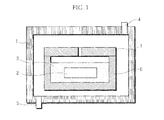
- Fig. 1 is a view illustrating one example of a heating apparatus used for a method, according to the present invention, of manufacturing a carbon material.
- the method of manufacturing a carbon material includes heat-treating a carbon substrate together with a carbon member other than the carbon substrate, the carbon substrate embedded in a surface modifying agent (in a powdery state) comprising a pyrolytic hydrogen halide generating agent and metal particles containing a transition metal.
- the method of manufacturing a carbon material makes it possible to form a metal carbide layer on the surface of the carbon substrate in a simple and easy manner, and the method allows the carbon materials to have good adhesion performance with a layer of a metal or the like that is later formed on the carbon material.
- Examples of the method of later forming a metal layer or the like on the carbon material include plating and thermal spraying, and an example of the method that achieves particularly good adhesion performance is plating.
- the carbon substrate to be treated is heat-treated together with a carbon member other than the carbon substrate.
- the carbon member include a container made of carbon, such as a graphite crucible, and carbon powder.
- the metal carbide layer can be formed without color unevenness and substantially uniformly on the carbon substrate.
- This metal carbide layer can be formed sufficiently even with a treatment time of as long as 30 minutes.
- the treatment time may be longer, for example, 1 hour or longer, if the metal carbide layer needs to be thicker.
- the heat treatment be performed at from 800°C to 1200°C. By performing the treatment within this temperature range, the carbon substrate can be treated efficiently. If the temperature is too low, it is possible that the formation of the metal carbide layer may be slow. If the temperature is too high, it is possible that the powder that has not reacted in the heat treatment may be thermally melted and bonded to the carbon substrate.
- the heat-treating be performed under normal pressure. Since the treatment can be performed under normal pressure, the equipment such as a vacuum pump is unnecessary, and the time required for reducing the pressure is also unnecessary. As a result, the treatment becomes simpler, and the treatment time reduces. Although it is possible to perform the treatment under reduced pressure, it may become difficult to cause an efficient reaction of hydrogen halide since the pyrolytic hydrogen halide generating agent may undergo violent decomposition at low temperature, and also, it is possible that the powder may scatter.
- the carbon material manufacturing method of the present invention does not require introduction of hydrogen gas. Therefore, safety is improved, and the treatment can be conducted easily. It is, however, possible to introduce an inert gas such as nitrogen gas, if necessary.
- the carbon substrate examples include, but not particularly limited to, isotropic graphite materials, anisotropic graphite materials, and carbon fiber materials. It is preferable that the carbon substrate have a bulk density of from 1.4 g/cm 3 to 2.1 g/cm 3 , an average pore radius of 10 ⁇ m or less, and a porosity of 40% or less.
- the pyrolytic hydrogen halide generating agent is such that is kept in a solid state under room temperature and normal pressure but is decomposed by heating to generate a hydrogen halide such as hydrogen chloride, hydrogen fluoride, and hydrogen bromide. It is preferable that the heat decomposition temperature of the pyrolytic hydrogen halide generating agent be 200°C or higher, so that the handling before the heating can be easy.
- the hydrogen halide generated from the pyrolytic hydrogen halide generating agent reacts with the transition metal during the heat treatment and produces a metal halide gas. By treating the carbon substrate with the metal halide gas, the metal carbide layer can be formed on the surface of the carbon substrate.
- the metal carbide layer can be formed substantially uniformly on the carbon substrate even when the carbon substrate has a complicated shape with, for example, holes and grooves. It is preferable that the pyrolytic hydrogen halide generating agent be ammonium chloride from the viewpoint of availability.
- a transition metal is contained in the metal particles containing a transition metal.
- examples include a mixture powder of a transition metal and another metal, and an alloy powder of a transition metal and another metal.
- the transition metal include Ti, V, Cr, Mn, Fe, Co, Ni, Cu, Zn, Zr, Nb, Mo, and Ta, but the transition metal is not particularly limited as long as it reacts with the hydrogen halide and produces a metal halide gas.
- the produced metal halide gas reacts with the carbon in the surface of the carbon substrate and produces a metal carbide.
- Cr be contained in the transition metals from the viewpoint of its high reactivity.
- the metal particles be an alloy powder containing Cr, and an example is stainless steel.
- a layer containing Ni, Fe, and chromium carbide is formed at one time of the heat treatment. It is particularly preferable to use a powder containing stainless steel, which is an alloy containing Cr, and Fe, and ammonium chloride for the heat treatment, from the viewpoints of handling and cost.
- Examples of the carbon member include a container made of carbon, such as a graphite crucible, and carbon powder.
- the treatment time of the carbon substrate can be shortened, and the need of supplying a hydrogen gas can be eliminated.
- the surface modifying of the carbon substrate can be achieved in a simpler manner and more easily. This makes it possible to improve the adhesion performance of the carbon substrate with a layer of a metal or the like that is to be later formed on the surface, and also to improve the strength of the resulting carbon material over the carbon substrate.
- pressure reduction is not needed, and the heat-treating can be conducted under normal pressure (in an atmospheric pressure).
- the treatment can be conducted in a simple manner.
- the carbon member be a graphite crucible.
- the use of a graphite crucible in the treatment makes it possible to suppress the flow of the gas around the embedded carbon substrate, and to form the metal carbide layer without color unevenness and more uniformly on the surface of the carbon substrate.
- the gas produced from the powder can be kept in the graphite crucible to a certain degree, so the produced gas can be utilized effectively.
- a lid be placed on the graphite crucible, and the lid serves to further suppress the flow of the gas around the carbon substrate.
- the lid include one made of graphite, and a sheet made of graphite.
- an air hole be provided in the container or in the lid. When using a sheet made of graphite, the air hole is not particularly necessary since the sheet merely covers the container.
- the metal particles containing a transition metal, the pyrolytic hydrogen halide generating agent, and the carbon powder be filled in the container, the carbon substrate be embedded in the powder filled in the container, and the carbon substrate be heat-treated.
- the container is not particularly limited. In the treatment, it is possible to suppress the flow of the gas in the container by, for example, putting a lid or a sheet made of graphite on the container. It is also possible to use the above-mentioned graphite crucible as the container.
- an introduced gas is not directly blown into the container in which the carbon substrate is embedded. Conversely, if an attempt is made to carry out the treatment while introducing a hydrogen gas, it is difficult to perform the treatment using the hydrogen gas efficiently because the container, such as the graphite crucible, hinders introduction of the hydrogen gas.
- a heating apparatus used in the carbon material manufacturing method of the present invention has a heating furnace 1 having a heater for heat-treating a treatment material placed in the heating furnace 1.
- the heating furnace 1 is provided with a gas inlet port 4 and a gas exhaust port 5.
- An inert gas such as nitrogen gas and argon gas can be introduced from the gas inlet port 5, as necessary.
- a graphite crucible 6 is disposed in the heating furnace 1.
- the graphite crucible 6 is configured so that powder 3 (surface modifying agent) can be filled in the graphite crucible 6, a carbon substrate 2 to be treated can be embedded in the powder 3, and further, a lid 7 can be placed on the graphite crucible 6.
- the lid 7 has an air hole.
- the powder 3 contains a pyrolytic hydrogen halide generating agent and metal powder (metal particles) containing a transition metal. It is possible to add alumina powder, which is not involved in the reaction, to the powder 3.
- the powder 3 is filled in the graphite crucible 6 as the carbon member, the carbon substrate 2 is embedded in the powder 3 filled in the crucible, and the lid is put thereon. Then, the graphite crucible 6 is placed in the heating apparatus and heated.
- the carbon material manufacturing method of the present invention can be implemented.
- a carbon material of the present invention has a metal carbide layer containing a metal and M 2 C or M 3 C 2 (M: a transition metal element) on a carbon substrate, and a metal layer on the metal carbide layer.
- M a metal
- the metal contained in the metal carbide layer be a transition metal, such as Cr, Fe, and Ni, or an alloy thereof.
- the maximum thickness of the metal carbide layer be 100 ⁇ m or less.
- the minimum thickness of the metal carbide layer exceeds 0 ⁇ m, the advantageous effects of the present invention can be exhibited. Nevertheless, in order to obtain the advantageous effects more sufficiently, it is desirable that the minimum thickness be 0.5 ⁇ m or greater.
- This configuration makes it easy to join the carbon material of the present invention with a metal member with the use of a joining material made of a metallic material. Accordingly, the joining strength can be improved.
- Providing a metal layer on the metal carbide layer in this way makes it possible to join the carbon material with a metal member. Thereby, it becomes possible to impart the characteristic of a carbon material to a metal material, which cannot be achieved by the metal alone.
- the carbon material according to the present invention can be manufactured by performing the treatment using transition metals showing different reactivity from one another in the carbon material manufacturing method of the present invention. It is preferable that the transition metals contain Cr because the high reactivity of Cr with carbon can be utilized and the carbon material having a metal carbide layer containing Cr 2 C can be manufactured easily. Moreover, the carbon material having a metal carbide layer containing Cr 2 C, Fe, and Ni is especially preferable, because it can be produced at one time of the treatment by using powder of, for example, stainless steel containing Cr, Fe, and Ni, and a plating layer of Ni or the like can be easily formed later. Furthermore, since a plating layer can be formed firmly thereon, the carbon material can be easily bonded by an adhesive agent to a metal plate such as an aluminum plate, which can be used as a heat radiation plate.
- a mixture powder of stainless steel powder (SUS 314 powder), ammonium chloride (NH 4 Cl), and alumina powder (Al 2 O 3 ) was filled in a graphite crucible (made by Toyo Tanso Co., Ltd, Model number IG-11), and a carbon substrate (high-density isotropic graphite subjected to cold isotropic pressure forming: bulk density 1.8, average pore radius 5 ⁇ m, porosity 20%) having dimensions of 10 mm wide ⁇ 60 mm long ⁇ 10mm thick was embedded in the mixture powder filled in the crucible.
- the crucible was placed in the heating furnace with a lid put thereon, and a heat treatment was performed. When heating, nitrogen was introduced from the gas inlet port, and the gas was discharged naturally from the gas exhaust port.
- the carbon substrate was heat-treated in the same manner as described in Example 1, except that the graphite crucible was not used and in place of the graphite crucible, a porcelain crucible was used as the container.
- the produced carbon materials were evaluated by visual observation and cross-sectional SEM image observation.
- the layer formed thereon was identified by analyzing the metals in vacuum using an EPMA analyzer EMAX-7000 made by Horiba Ltd.
- the produced carbon materials were evaluated by visual observation and cross-sectional SEM image observation.
- Adhesion strength Adhesion strength
- a 2- ⁇ m Ni-plating layer was formed thereon by electroless plating, and the adhesion strength of the plating layer was determined according to JIS H 8666.
- the metal carbide layer could not be formed over the entire surface of the carbon substrate, and color unevenness occurred, so the metal carbide layer could not be formed uniformly on the carbon substrate.
- the carbon materials manufactured according to the carbon material manufacturing method of the present invention showed very high adhesion performance with the later-formed mental layer.
- the carbon material manufacturing method according to the present invention makes it possible to modify the surface of the carbon substrate by a very simple treatment, merely by embedding a carbon substrate in powder and heating the substrate.
Landscapes
- Chemical & Material Sciences (AREA)
- Engineering & Computer Science (AREA)
- Ceramic Engineering (AREA)
- Materials Engineering (AREA)
- Organic Chemistry (AREA)
- Structural Engineering (AREA)
- Inorganic Chemistry (AREA)
- Carbon And Carbon Compounds (AREA)
- Other Surface Treatments For Metallic Materials (AREA)
- Chemical Kinetics & Catalysis (AREA)
- Plasma & Fusion (AREA)
- Mechanical Engineering (AREA)
- Metallurgy (AREA)
- Physics & Mathematics (AREA)
- Ceramic Products (AREA)
- Manufacturing & Machinery (AREA)
Applications Claiming Priority (2)
| Application Number | Priority Date | Filing Date | Title |
|---|---|---|---|
| JP2008312662A JP5415061B2 (ja) | 2008-12-08 | 2008-12-08 | 炭素材の製造方法および炭素材 |
| PCT/JP2009/070226 WO2010067734A1 (ja) | 2008-12-08 | 2009-12-02 | 炭素材の製造方法および炭素材 |
Publications (2)
| Publication Number | Publication Date |
|---|---|
| EP2374776A1 true EP2374776A1 (de) | 2011-10-12 |
| EP2374776A4 EP2374776A4 (de) | 2016-04-06 |
Family
ID=42242722
Family Applications (1)
| Application Number | Title | Priority Date | Filing Date |
|---|---|---|---|
| EP09831838.9A Withdrawn EP2374776A4 (de) | 2008-12-08 | 2009-12-02 | Verfahren zur herstellung von kohlenstoffmaterial und kohlenstoffmaterial |
Country Status (7)
| Country | Link |
|---|---|
| US (1) | US9067834B2 (de) |
| EP (1) | EP2374776A4 (de) |
| JP (1) | JP5415061B2 (de) |
| KR (1) | KR20110092275A (de) |
| CN (1) | CN102216241B (de) |
| TW (1) | TWI500779B (de) |
| WO (1) | WO2010067734A1 (de) |
Families Citing this family (6)
| Publication number | Priority date | Publication date | Assignee | Title |
|---|---|---|---|---|
| CN102781562B (zh) | 2009-12-24 | 2014-11-19 | Lg伊诺特有限公司 | 用于真空热处理设备的热处理容器 |
| JP5670175B2 (ja) * | 2010-12-27 | 2015-02-18 | 東洋炭素株式会社 | 冶具 |
| JP2012171823A (ja) | 2011-02-21 | 2012-09-10 | Toyo Tanso Kk | 炭素材料及びその製造方法 |
| JP6273166B2 (ja) * | 2014-05-19 | 2018-01-31 | 株式会社神戸製鋼所 | 炭素材料の製造方法 |
| US10407769B2 (en) | 2016-03-18 | 2019-09-10 | Goodrich Corporation | Method and apparatus for decreasing the radial temperature gradient in CVI/CVD furnaces |
| CN113529040A (zh) * | 2020-07-06 | 2021-10-22 | 深圳市海维通光电技术有限公司 | 一种碳材料表面处理的方法 |
Family Cites Families (15)
| Publication number | Priority date | Publication date | Assignee | Title |
|---|---|---|---|---|
| US3151852A (en) * | 1958-07-09 | 1964-10-06 | Chrysler Corp | Process for obtaining metal carbide coatings on base materials and metal carbide structures produced thereby |
| US3912827A (en) * | 1973-11-13 | 1975-10-14 | Toyota Chuo Kenkyusko Kk | Method for forming a chromium carbide layer on the surface of an iron, ferrous alloy or cemented carbide article |
| US4256496A (en) * | 1977-12-16 | 1981-03-17 | Ontario Research Foundation | Production of metal carbides in pure form |
| JPH0240636B2 (ja) | 1983-12-20 | 1990-09-12 | Mitsubishi Pencil Co | Tansokabutsuhenokinzokuhifukuhoho |
| AU570799B2 (en) * | 1984-05-17 | 1988-03-24 | Toyota Chuo Kenkyusho K.K. | Vapour phase coating of carbide in fluidised bed |
| US5322824A (en) * | 1993-05-27 | 1994-06-21 | Chia Kai Y | Electrically conductive high strength dense ceramic |
| JPH0859373A (ja) * | 1994-08-25 | 1996-03-05 | Akechi Ceramics Kk | 炭素材料の酸化防止被覆方法 |
| JP3081764B2 (ja) | 1994-11-17 | 2000-08-28 | トーカロ株式会社 | 複合皮膜を有する炭素部材とその製造方法 |
| JP3081765B2 (ja) * | 1994-11-17 | 2000-08-28 | トーカロ株式会社 | 炭素部材およびその製造方法 |
| US5855955A (en) * | 1995-06-07 | 1999-01-05 | Lanxide Technology Company L.P. | Method for making self-supporting composite bodies |
| US5942204A (en) * | 1997-03-31 | 1999-08-24 | Omg Americas, Inc. | Method to produce a transition metal carbide from a partially reduced transition metal compound |
| JP2004155598A (ja) * | 2002-11-01 | 2004-06-03 | Honda Motor Co Ltd | 高温耐酸化性炭素質成形体及びその製造方法 |
| US7163963B2 (en) * | 2003-09-08 | 2007-01-16 | Conocophillips Company | Chemically and thermally stabilized alumina for Fischer-Tropsch catalysts |
| WO2005054126A1 (ja) * | 2003-12-05 | 2005-06-16 | Mitsubishi Heavy Industries, Ltd. | 炭素材料及び排煙処理装置 |
| JP2008137819A (ja) * | 2006-11-30 | 2008-06-19 | Honda Motor Co Ltd | C/cコンポジット材の製造方法及びc/cコンポジット材 |
-
2008
- 2008-12-08 JP JP2008312662A patent/JP5415061B2/ja not_active Expired - Fee Related
-
2009
- 2009-12-02 CN CN200980145499.2A patent/CN102216241B/zh not_active Expired - Fee Related
- 2009-12-02 US US13/133,344 patent/US9067834B2/en not_active Expired - Fee Related
- 2009-12-02 EP EP09831838.9A patent/EP2374776A4/de not_active Withdrawn
- 2009-12-02 WO PCT/JP2009/070226 patent/WO2010067734A1/ja not_active Ceased
- 2009-12-02 KR KR1020117010954A patent/KR20110092275A/ko not_active Ceased
- 2009-12-07 TW TW098141726A patent/TWI500779B/zh not_active IP Right Cessation
Non-Patent Citations (1)
| Title |
|---|
| See references of WO2010067734A1 * |
Also Published As
| Publication number | Publication date |
|---|---|
| JP2010132518A (ja) | 2010-06-17 |
| TWI500779B (zh) | 2015-09-21 |
| CN102216241A (zh) | 2011-10-12 |
| CN102216241B (zh) | 2014-09-10 |
| WO2010067734A1 (ja) | 2010-06-17 |
| KR20110092275A (ko) | 2011-08-17 |
| EP2374776A4 (de) | 2016-04-06 |
| JP5415061B2 (ja) | 2014-02-12 |
| US9067834B2 (en) | 2015-06-30 |
| US20110244267A1 (en) | 2011-10-06 |
| TW201030156A (en) | 2010-08-16 |
Similar Documents
| Publication | Publication Date | Title |
|---|---|---|
| US9067834B2 (en) | Method of manufacturing a carbon material and the carbon material | |
| KR101168422B1 (ko) | 내열성 피복 부재의 제조 방법 | |
| CN101151384B (zh) | 高热导性石墨粒子分散型复合体及其制造方法 | |
| EP2657208A1 (de) | Galliumnitrid-sinterkörper oder galliumnitrid-formartikel und herstellungsverfahren dafür | |
| EP2123616A1 (de) | Graphitmaterial und herstellungsverfahren dafür | |
| EP1645351B1 (de) | Verfahren zur Reduzierung des Sauerstoffgehalts eines Pulvers und das daraus hergestellte Produkt. | |
| EP3968369B1 (de) | Wärmestrahlungselement und herstellungsverfahren dafür | |
| EP3124645B1 (de) | Giessprodukt mit aluminiumoxidsperrschicht | |
| EP2508477A1 (de) | Verfahren zur herstellung von kohlenstoffmaterial | |
| US6364965B1 (en) | Aluminum-containing member and a method for producing such an aluminum-containing member | |
| US6878438B2 (en) | Heat resistant coated member | |
| EP2660225A1 (de) | Kohlenstoffmaterial, vorrichtung und verfahren zur herstellung des kohlenstoffmaterials | |
| EP2679565A1 (de) | Kohlenstoffmaterial und herstellungsverfahren dafür | |
| EP2615075A1 (de) | Kohlenstoffmaterial und herstellungsverfahren dafür | |
| EP1435501B1 (de) | Hitzebeständiges beschichtetes Element | |
| KR100720107B1 (ko) | 금속 다공체의 확산 침투 합금화 방법 | |
| JP3226231B2 (ja) | 部品熱処理用容器 | |
| JP3962354B2 (ja) | 被覆グラファイトトレー | |
| JP2004332012A (ja) | 耐熱性治具及び熱処理・焼結方法 |
Legal Events
| Date | Code | Title | Description |
|---|---|---|---|
| PUAI | Public reference made under article 153(3) epc to a published international application that has entered the european phase |
Free format text: ORIGINAL CODE: 0009012 |
|
| 17P | Request for examination filed |
Effective date: 20110706 |
|
| AK | Designated contracting states |
Kind code of ref document: A1 Designated state(s): AT BE BG CH CY CZ DE DK EE ES FI FR GB GR HR HU IE IS IT LI LT LU LV MC MK MT NL NO PL PT RO SE SI SK SM TR |
|
| DAX | Request for extension of the european patent (deleted) | ||
| RA4 | Supplementary search report drawn up and despatched (corrected) |
Effective date: 20160303 |
|
| RIC1 | Information provided on ipc code assigned before grant |
Ipc: C04B 41/00 20060101ALI20160226BHEP Ipc: C04B 41/87 20060101AFI20160226BHEP Ipc: C04B 41/50 20060101ALI20160226BHEP Ipc: C04B 41/90 20060101ALI20160226BHEP Ipc: C04B 41/88 20060101ALI20160226BHEP |
|
| STAA | Information on the status of an ep patent application or granted ep patent |
Free format text: STATUS: EXAMINATION IS IN PROGRESS |
|
| 17Q | First examination report despatched |
Effective date: 20170803 |
|
| STAA | Information on the status of an ep patent application or granted ep patent |
Free format text: STATUS: THE APPLICATION IS DEEMED TO BE WITHDRAWN |
|
| 18D | Application deemed to be withdrawn |
Effective date: 20180214 |