EP2374822B1 - Catalyseur métallocène mixte sur support, son procédé de préparation, et méthode de préparation de polymères de polyoléfine utilisant ce catalyseur - Google Patents
Catalyseur métallocène mixte sur support, son procédé de préparation, et méthode de préparation de polymères de polyoléfine utilisant ce catalyseur Download PDFInfo
- Publication number
- EP2374822B1 EP2374822B1 EP09832130.0A EP09832130A EP2374822B1 EP 2374822 B1 EP2374822 B1 EP 2374822B1 EP 09832130 A EP09832130 A EP 09832130A EP 2374822 B1 EP2374822 B1 EP 2374822B1
- Authority
- EP
- European Patent Office
- Prior art keywords
- carbon atoms
- radical
- formula
- preparing
- compound represented
- Prior art date
- Legal status (The legal status is an assumption and is not a legal conclusion. Google has not performed a legal analysis and makes no representation as to the accuracy of the status listed.)
- Active
Links
- 0 CC1C(*)C(C)=C(C**)C1C Chemical compound CC1C(*)C(C)=C(C**)C1C 0.000 description 8
Images

Classifications
-
- C—CHEMISTRY; METALLURGY
- C08—ORGANIC MACROMOLECULAR COMPOUNDS; THEIR PREPARATION OR CHEMICAL WORKING-UP; COMPOSITIONS BASED THEREON
- C08F—MACROMOLECULAR COMPOUNDS OBTAINED BY REACTIONS ONLY INVOLVING CARBON-TO-CARBON UNSATURATED BONDS
- C08F10/00—Homopolymers and copolymers of unsaturated aliphatic hydrocarbons having only one carbon-to-carbon double bond
- C08F10/02—Ethene
-
- B—PERFORMING OPERATIONS; TRANSPORTING
- B01—PHYSICAL OR CHEMICAL PROCESSES OR APPARATUS IN GENERAL
- B01J—CHEMICAL OR PHYSICAL PROCESSES, e.g. CATALYSIS OR COLLOID CHEMISTRY; THEIR RELEVANT APPARATUS
- B01J31/00—Catalysts comprising hydrides, coordination complexes or organic compounds
- B01J31/26—Catalysts comprising hydrides, coordination complexes or organic compounds containing in addition, inorganic metal compounds not provided for in groups B01J31/02 - B01J31/24
- B01J31/38—Catalysts comprising hydrides, coordination complexes or organic compounds containing in addition, inorganic metal compounds not provided for in groups B01J31/02 - B01J31/24 of titanium, zirconium or hafnium
-
- C—CHEMISTRY; METALLURGY
- C08—ORGANIC MACROMOLECULAR COMPOUNDS; THEIR PREPARATION OR CHEMICAL WORKING-UP; COMPOSITIONS BASED THEREON
- C08F—MACROMOLECULAR COMPOUNDS OBTAINED BY REACTIONS ONLY INVOLVING CARBON-TO-CARBON UNSATURATED BONDS
- C08F10/00—Homopolymers and copolymers of unsaturated aliphatic hydrocarbons having only one carbon-to-carbon double bond
-
- C—CHEMISTRY; METALLURGY
- C08—ORGANIC MACROMOLECULAR COMPOUNDS; THEIR PREPARATION OR CHEMICAL WORKING-UP; COMPOSITIONS BASED THEREON
- C08F—MACROMOLECULAR COMPOUNDS OBTAINED BY REACTIONS ONLY INVOLVING CARBON-TO-CARBON UNSATURATED BONDS
- C08F4/00—Polymerisation catalysts
- C08F4/42—Metals; Metal hydrides; Metallo-organic compounds; Use thereof as catalyst precursors
- C08F4/44—Metals; Metal hydrides; Metallo-organic compounds; Use thereof as catalyst precursors selected from light metals, zinc, cadmium, mercury, copper, silver, gold, boron, gallium, indium, thallium, rare earths or actinides
- C08F4/60—Metals; Metal hydrides; Metallo-organic compounds; Use thereof as catalyst precursors selected from light metals, zinc, cadmium, mercury, copper, silver, gold, boron, gallium, indium, thallium, rare earths or actinides together with refractory metals, iron group metals, platinum group metals, manganese, rhenium technetium or compounds thereof
- C08F4/62—Refractory metals or compounds thereof
- C08F4/64—Titanium, zirconium, hafnium or compounds thereof
- C08F4/659—Component covered by group C08F4/64 containing a transition metal-carbon bond
- C08F4/6592—Component covered by group C08F4/64 containing a transition metal-carbon bond containing at least one cyclopentadienyl ring, condensed or not, e.g. an indenyl or a fluorenyl ring
-
- C—CHEMISTRY; METALLURGY
- C08—ORGANIC MACROMOLECULAR COMPOUNDS; THEIR PREPARATION OR CHEMICAL WORKING-UP; COMPOSITIONS BASED THEREON
- C08F—MACROMOLECULAR COMPOUNDS OBTAINED BY REACTIONS ONLY INVOLVING CARBON-TO-CARBON UNSATURATED BONDS
- C08F2420/00—Metallocene catalysts
- C08F2420/02—Cp or analog bridged to a non-Cp X anionic donor
-
- C—CHEMISTRY; METALLURGY
- C08—ORGANIC MACROMOLECULAR COMPOUNDS; THEIR PREPARATION OR CHEMICAL WORKING-UP; COMPOSITIONS BASED THEREON
- C08F—MACROMOLECULAR COMPOUNDS OBTAINED BY REACTIONS ONLY INVOLVING CARBON-TO-CARBON UNSATURATED BONDS
- C08F2420/00—Metallocene catalysts
- C08F2420/07—Heteroatom-substituted Cp, i.e. Cp or analog where at least one of the substituent of the Cp or analog ring is or contains a heteroatom
-
- C—CHEMISTRY; METALLURGY
- C08—ORGANIC MACROMOLECULAR COMPOUNDS; THEIR PREPARATION OR CHEMICAL WORKING-UP; COMPOSITIONS BASED THEREON
- C08F—MACROMOLECULAR COMPOUNDS OBTAINED BY REACTIONS ONLY INVOLVING CARBON-TO-CARBON UNSATURATED BONDS
- C08F4/00—Polymerisation catalysts
- C08F4/42—Metals; Metal hydrides; Metallo-organic compounds; Use thereof as catalyst precursors
- C08F4/44—Metals; Metal hydrides; Metallo-organic compounds; Use thereof as catalyst precursors selected from light metals, zinc, cadmium, mercury, copper, silver, gold, boron, gallium, indium, thallium, rare earths or actinides
- C08F4/60—Metals; Metal hydrides; Metallo-organic compounds; Use thereof as catalyst precursors selected from light metals, zinc, cadmium, mercury, copper, silver, gold, boron, gallium, indium, thallium, rare earths or actinides together with refractory metals, iron group metals, platinum group metals, manganese, rhenium technetium or compounds thereof
- C08F4/62—Refractory metals or compounds thereof
- C08F4/64—Titanium, zirconium, hafnium or compounds thereof
- C08F4/659—Component covered by group C08F4/64 containing a transition metal-carbon bond
- C08F4/65912—Component covered by group C08F4/64 containing a transition metal-carbon bond in combination with an organoaluminium compound
-
- C—CHEMISTRY; METALLURGY
- C08—ORGANIC MACROMOLECULAR COMPOUNDS; THEIR PREPARATION OR CHEMICAL WORKING-UP; COMPOSITIONS BASED THEREON
- C08F—MACROMOLECULAR COMPOUNDS OBTAINED BY REACTIONS ONLY INVOLVING CARBON-TO-CARBON UNSATURATED BONDS
- C08F4/00—Polymerisation catalysts
- C08F4/42—Metals; Metal hydrides; Metallo-organic compounds; Use thereof as catalyst precursors
- C08F4/44—Metals; Metal hydrides; Metallo-organic compounds; Use thereof as catalyst precursors selected from light metals, zinc, cadmium, mercury, copper, silver, gold, boron, gallium, indium, thallium, rare earths or actinides
- C08F4/60—Metals; Metal hydrides; Metallo-organic compounds; Use thereof as catalyst precursors selected from light metals, zinc, cadmium, mercury, copper, silver, gold, boron, gallium, indium, thallium, rare earths or actinides together with refractory metals, iron group metals, platinum group metals, manganese, rhenium technetium or compounds thereof
- C08F4/62—Refractory metals or compounds thereof
- C08F4/64—Titanium, zirconium, hafnium or compounds thereof
- C08F4/659—Component covered by group C08F4/64 containing a transition metal-carbon bond
- C08F4/65916—Component covered by group C08F4/64 containing a transition metal-carbon bond supported on a carrier, e.g. silica, MgCl2, polymer
-
- C—CHEMISTRY; METALLURGY
- C08—ORGANIC MACROMOLECULAR COMPOUNDS; THEIR PREPARATION OR CHEMICAL WORKING-UP; COMPOSITIONS BASED THEREON
- C08F—MACROMOLECULAR COMPOUNDS OBTAINED BY REACTIONS ONLY INVOLVING CARBON-TO-CARBON UNSATURATED BONDS
- C08F4/00—Polymerisation catalysts
- C08F4/42—Metals; Metal hydrides; Metallo-organic compounds; Use thereof as catalyst precursors
- C08F4/44—Metals; Metal hydrides; Metallo-organic compounds; Use thereof as catalyst precursors selected from light metals, zinc, cadmium, mercury, copper, silver, gold, boron, gallium, indium, thallium, rare earths or actinides
- C08F4/60—Metals; Metal hydrides; Metallo-organic compounds; Use thereof as catalyst precursors selected from light metals, zinc, cadmium, mercury, copper, silver, gold, boron, gallium, indium, thallium, rare earths or actinides together with refractory metals, iron group metals, platinum group metals, manganese, rhenium technetium or compounds thereof
- C08F4/62—Refractory metals or compounds thereof
- C08F4/64—Titanium, zirconium, hafnium or compounds thereof
- C08F4/659—Component covered by group C08F4/64 containing a transition metal-carbon bond
- C08F4/6592—Component covered by group C08F4/64 containing a transition metal-carbon bond containing at least one cyclopentadienyl ring, condensed or not, e.g. an indenyl or a fluorenyl ring
- C08F4/65922—Component covered by group C08F4/64 containing a transition metal-carbon bond containing at least one cyclopentadienyl ring, condensed or not, e.g. an indenyl or a fluorenyl ring containing at least two cyclopentadienyl rings, fused or not
- C08F4/65925—Component covered by group C08F4/64 containing a transition metal-carbon bond containing at least one cyclopentadienyl ring, condensed or not, e.g. an indenyl or a fluorenyl ring containing at least two cyclopentadienyl rings, fused or not two cyclopentadienyl rings being mutually non-bridged
-
- C—CHEMISTRY; METALLURGY
- C08—ORGANIC MACROMOLECULAR COMPOUNDS; THEIR PREPARATION OR CHEMICAL WORKING-UP; COMPOSITIONS BASED THEREON
- C08F—MACROMOLECULAR COMPOUNDS OBTAINED BY REACTIONS ONLY INVOLVING CARBON-TO-CARBON UNSATURATED BONDS
- C08F4/00—Polymerisation catalysts
- C08F4/42—Metals; Metal hydrides; Metallo-organic compounds; Use thereof as catalyst precursors
- C08F4/44—Metals; Metal hydrides; Metallo-organic compounds; Use thereof as catalyst precursors selected from light metals, zinc, cadmium, mercury, copper, silver, gold, boron, gallium, indium, thallium, rare earths or actinides
- C08F4/60—Metals; Metal hydrides; Metallo-organic compounds; Use thereof as catalyst precursors selected from light metals, zinc, cadmium, mercury, copper, silver, gold, boron, gallium, indium, thallium, rare earths or actinides together with refractory metals, iron group metals, platinum group metals, manganese, rhenium technetium or compounds thereof
- C08F4/62—Refractory metals or compounds thereof
- C08F4/64—Titanium, zirconium, hafnium or compounds thereof
- C08F4/659—Component covered by group C08F4/64 containing a transition metal-carbon bond
- C08F4/6592—Component covered by group C08F4/64 containing a transition metal-carbon bond containing at least one cyclopentadienyl ring, condensed or not, e.g. an indenyl or a fluorenyl ring
- C08F4/65922—Component covered by group C08F4/64 containing a transition metal-carbon bond containing at least one cyclopentadienyl ring, condensed or not, e.g. an indenyl or a fluorenyl ring containing at least two cyclopentadienyl rings, fused or not
- C08F4/65927—Component covered by group C08F4/64 containing a transition metal-carbon bond containing at least one cyclopentadienyl ring, condensed or not, e.g. an indenyl or a fluorenyl ring containing at least two cyclopentadienyl rings, fused or not two cyclopentadienyl rings being mutually bridged
Definitions
- the present invention relates to a method for preparing a hybrid supported metallocene catalyst, and a method for preparing an olefin-based polymer using the same.
- Olefin polymerization catalyst systems can be divided into Ziegler-Natta and metallocene catalysts, and these highly active catalyst systems have been developed in accordance with their characteristics.
- the Ziegler-Natta catalyst has been widely applied to commercial processes since it was developed in the 1950's.
- the Ziegler-Natta catalyst is a multi-active site catalyst, it did not provide polymers of which molecular weight distribution is narrow. Also, since compositional distribution of comonomers is not uniform, it is difficult to provide the desired physical properties.
- the metallocene catalyst system comprises a main catalyst whose main component is a transition metal compound and an organometallic compound cocatalyst whose main component is aluminum.
- a catalyst is a homogeneous single-site catalyst, and offers a polymer having a narrow molecular weight distribution and uniform compositional distribution of comonomers, depending on the single site characteristics.
- the stereoregularity, copolymerization characteristics, molecular weight, crystallinity, and so forth of the obtained polymer can be controlled by changing the ligand structure of the catalyst and the polymerization condition.
- US Pat. No. 5,032,562 describes a method of preparing a polymerization catalyst by supporting two different transition metal catalysts on one support.
- This catalyst is prepared by supporting a Ti-based Ziegler-Natta catalyst which produces a high molecular weight polymer and a Zr-based metallocene catalyst which produces a low molecular weight polymer on one support and results in a bimodal molecular weight distribution.
- the supporting procedure is complicated and morphology of polymers is poor due to a cocatalyst.
- US Pat. No. 5,525,678 discloses a catalyst system for polymerization of olefins in which a metallocene compound and a non-metallocene compound are simultaneously supported on a support to simultaneously polymerize a high molecular weight polymer and a low molecular weight polymer.
- the metallocene compound and non-metallocene compound must be separately supported and the support must be pretreated with various compounds for supporting.
- US Pat. No. 5,914,289 describes a method of controlling the molecular weight and the molecular weight distribution of polymers using metallocene catalysts which are respectively supported on supports. A large amount of solvent and long time are required to prepare the supported catalysts and the process of supporting metallocene catalysts on the respective support is troublesome.
- Korean Patent Application No. 2003-12308 discloses a method of controlling the molecular weight distribution of polymers by polymerizing while changing a combination of catalysts in a reactor by supporting a dinuclear metallocene catalyst and a mononuclear metallocene catalyst on a support with an activating agent.
- this method is limited in simultaneous implementation of properties of the respective catalysts.
- a metallocene catalyst portion is departed from a supported catalyst to cause fouling in the reactor.
- the present invention provides a hybrid supported metallocene catalyst which has an excellent activity and is able to prepare an olefin-based polymer with a high molecular weight and desired physical properties, a method for preparing the same, and a method for preparing an olefin-based polymer using the same.
- the present invention provides a hybrid supported metallocene catalyst comprising a metallocene compound represented by the following Formula 1, a metallocene compound represented by the following Formula 2, a co-catalyst compound, and a support.
- R1 and R2 are the same as or different from each other, and are each independently hydrogen; an alkyl radical having 1 to 20 carbon atoms; an alkenyl radical having 2 to 20 carbon atoms; an aryl radical having 6 to 20 carbon atoms; a silyl radical; an alkylaryl radical having 7 to 20 carbon atoms; an arylalkyl radical having 7 to 20 carbon atoms; or a metalloid radical of Group 4 substituted with hydrocarbyl group; R1 and R2 or two R2s may be connected to each other by an alkylidene radical containing an alkyl radical having 1 to 20 carbon atoms or aryl radical having 6 to 20 carbon atoms to form a ring,
- R3s are the same as or different from each other, and are each independently hydrogen; a halogen radical; an alkyl radical having 1 to 20 carbon atoms; an aryl radical having 6 to 20 carbon atoms; an alkoxy radical having 1 to 20 carbon atoms; an aryloxy radical having 6 to 20 carbon atoms; or amido radical; and two or more of R3 may be connected to each other to form an aliphatic or aromatic ring;
- CY1 is a substituted or unsubstituted aliphatic or aromatic ring, in which CY1 may be substituted with a halogen radical; an alkyl radical having 1 to 20 carbon atoms; an alkenyl radical having 2 to 20 carbon atoms; an aryl radical having 6 to 20 carbon atoms; an alkylaryl radical having 7 to 20 carbon atoms; an arylalkyl radical having 7 to 20 carbon atoms; an alkoxy radical having 1 to 20 carbon atoms; an aryloxy radical having 6 to 20 carbon atoms; or an amido radical, and in the case where CY1 is substituted with the plural substituents, two or more substituents may be connected to each other to form an aliphatic or aromatic ring; M is a Group 4 transition metal; Q1 and Q2 are the same as or different from each other, and are each independently a halogen radical; an alkyl radical having 1 to 20 carbon atoms; an alkenyl radical having 2 to 20 carbon
- the present invention provides a method for preparing the hybrid supported metallocene catalyst, comprising the subsequent steps of:
- the present invention provides a method for preparing an olefin-based polymer, comprising the step of polymerizing olefinic monomers under the hybrid supported metallocene catalyst.
- the hybrid supported metallocene catalyst according to the present invention comprises two different kinds of metallocene compounds, in which one kind of the metallocene compound is a transition metal compound coordinated with quinoline-based amido group-introduced monocyclopentadienyl ligand, and thus the catalyst has an excellent activity and is able to prepare an olefin-based polymer with a high molecular weight and desired physical properties.
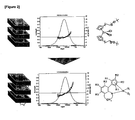
- FIGs. 1 and 2 are diagrams showing the molecular weight distribution and SCB (short chain branch) content of the olefin-based copolymer according to one specific embodiment of the present invention.
- the hybrid supported metallocene catalyst according to the present invention comprises a metallocene compound represented by Formula 1, a metallocene compound represented by Formula 2, a co-catalyst compound and a support.
- the hydrocarbyl is a monovalent moiety formed by removing a hydrogen atom from a hydrocarbon, and comprises ethyl, phenyl or the like.
- the metalloid is an element which behaves chemically both as a metal and as a non-metal, and comprises arsenic, boron, silicon, tellurium or the like.
- metallocene compounds represented by Formula 1 more preferred compounds for the control of electronic, steric environment in the vicinity of metal comprise the metallocene compound represented by the following Formula 3 or 4.
- R4 and R5 are the same as or different from each other, and are each independently hydrogen; an alkyl radical having 1 to 20 carbon atoms; an aryl radical having 6 to 20 carbon atoms; or a silyl radical;
- R6s are the same as or different from each other, and are each independently hydrogen; an alkyl radical having 1 to 20 carbon atoms ; an alkenyl radical having 2 to 20 carbon atoms ; an aryl radical having 6 to 20 carbon atoms; an alkylaryl radical having 7 to 20 carbon atoms; an arylalkyl radical having 7 to 20 carbon atoms; an alkoxy radical having 1 to 20 carbon atoms; an aryloxy radical having 6 to 20 carbon atoms; or an amido radical; and two or more of R6 may be connected to each other to form an aliphatic or aromatic ring; Q3 and Q4 are the same as or different from each other, and are each independently a halogen radical; an alkyl radical having 1 to 20 carbon atoms; an alkyl amido radical having 1 to 20 carbon atoms; or an aryl amido radical having 6 to 20 carbon atoms; and M is a Group 4 transition metal.
- metallocene compounds represented by Formula 1 more preferred compounds for the control of electronic, steric environment in the vicinity of metal comprise the metallocene compounds having the following structure.
- metallocene compound represented by Formula 2 comprise the compounds of following structures, but are not limited thereto.
- metallocene compound represented by Formula 2 comprise the compound represented by the following Formula 5, but are not limited thereto.
- the hybrid supported metallocene catalyst according to the present invention is prepared by supporting the metallocene compound represented by Formula 1 and the metallocene compound represented by Formula 2 with a co-catalyst compound on a support.
- the metallocene compound represented by Formula 1 serves to prepare copolymers having a high molecular weight and SCB (short chain branch) content
- the metallocene compound represented by Formula 2 serves to prepare copolymers having a low molecular weight and SCB (short chain branch) content.
- the molecular weight distribution and SCB (short chain branch) content of the copolymer according to one specific embodiment of the present invention are shown in FIG. 1 .
- the metal position is connected by a cyclopentadienyl ligand, to which an amido group is introduced in a cyclic form via a phenylene bridge, and thus there is tendency that structurally the Cp-M-N angle keeps narrow, while the Q1-M-Q2 angle for approach of the monomers keeps wide.
- the metallocene compound structure represented by Formula 1 has a stable and rigid pentagon ring structure having metal positions with a Cp, a phenylene bridge, and a nitrogen atom due to the cyclic form.
- the nitrogen atom of the amido group is connected with the phenylene bridge by two bonds in a cyclic form, so that the complex has a more rigid structure.
- these transition metal compounds are used to prepare a hybrid supported metallocene catalyst, it is possible that even at a high polymerization temperature, an olefin-based polymer having the characteristics such as high activity, high molecular weight, and high copolymerizability is produced, as compared with the known hybrid supported metallocene catalysts.
- a copolymer having a low molecular weight and SCB (short chain branch) content is prepared.
- the hybrid supported metallocene catalyst comprising the metallocene compound represented by Formula 1 and the metallocene compound represented by Formula 2 is used in the present invention, a copolymer having a high molecular weight and high SCB (short chain branch) content can be prepared, and an olefin polymer having excellent physical properties and processability can be prepared.
- the molecular weight distribution and SCB (short chain branch) content of the copolymer according to one specific embodiment of the present invention are shown in FIG. 2 .
- the co-catalyst compound is preferably a metal compound containing a Group 13 metal of the Periodic Table.
- cocatalyst compound cocatalysts that are generally used for olefin polymerization in the presence of metallocene catalyst can be used. If the cocatalyst is supported on the above described support, a bond between the hydroxyl group on the support and Group 13 metal occurs.
- the co-catalyst compound comprises the compound represented by the following Formula 6.
- Formula 6 [Formula 6] -[Al(R8)-O]a- wherein R8s are the same as or different from each other, and are each independently a halogen radical; a hydrocarbyl radical having 1 to 20 carbon atoms; or a hydrocarbyl radical having 1 to 20 carbon atoms that is substituted with halogen; and a is an integer of 2 or more.
- the compound represented by Formula 5 may have a linear, circular or network structure.
- Examples of the compound comprise methylaluminoxane (MAO), ethylaluminoxane, isobutylaluminoxane, and butylaluminoxane, and preferably methylaluminoxane.
- the weight ratio of the transition metals of the metallocene compound represented by Formula 1 and the metallocene compound represented by Formula 2 to the support is preferably 1 : 10 to 1 : 1,000, the weight ratio of the co-catalyst compound to the support is preferably 1 : 1 to 1 : 100, and the weight ratio of the metallocene compound represented by Formula 1 to the metallocene compound represented by Formula 2 is preferably 1 : 0.01 to 1 : 100.
- a support containing a hydroxyl group on its surface can be used, and preferably, a support containing a highly reactive hydroxyl group and siloxane group, on which the surface is dried without moisture, can be used.
- silica, silica-alumina, and silica-magnesia that are dried at high temperature can be used, and may usually contain oxides, carbonates, sulfates, and nitrates such as Na 2 O, K 2 CO 3 , BaSO 4 , and Mg(NO 3 ) 2 or the like.
- the support is preferably dried at 200 to 800°C, more preferably 300 to 600°C, and most preferably 300 to 400°C. If the drying temperature of the support is less than 200°C, much moisture on its surface may be reacted with the cocatalyst. If the drying temperature is more than 800°C, pores on the support surface are combined with each other to reduce surface area, the hydroxyl groups are removed and only the siloxane groups remain on the surface. Thus, the reactive sites with cocatalyst are reduced.
- An amount of hydroxyl group on the surface of support a) is preferably 0.1 to 10 mmol/g, and more preferably 0.5 to 1 mmol/g.
- the amount of hydroxyl group on the surface of support a) can be controlled depending on the preparation method of the support and its conditions, or drying conditions such as temperature, time, vacuum, and spray drying.
- the amount of hydroxyl group is less than 0.1 mmol/g, the reactive sites with cocatalyst are reduced. If the amount of hydroxyl group is more than 10 mmol/g, the hydroxyl groups may come from moisture, in addition to hydroxyl groups being present on the particle surface of support, which is not preferable.
- the hybrid supported metallocene catalyst according to the present invention can be used for polymerization of olefinic monomers without any treatment. Also, the hybrid supported metallocene catalyst according to the present invention can be prepared into a pre-polymerized catalyst by contacting the catalyst with an olefinic monomer, and for example, it can be prepared into a pre-polymerized catalyst by contacting the catalyst with an olefinic monomer such as ethylene, propylene, 1-butene, 1-hexene, and 1-octene.
- an olefinic monomer such as ethylene, propylene, 1-butene, 1-hexene, and 1-octene.
- the method for preparing the hybrid supported metallocene catalyst according to the present invention comprises the steps of: 1) preparing a support, 2) supporting a co-catalyst compound on the support, 3) supporting a metallocene compound represented by Formula 1 on the support, and 4) additionally supporting a metallocene compound represented by Formula 2 on the support.
- step 3) and step 4) can be performed in any order, if necessary. That is, after supporting the metallocene compound represented by Formula 2 on the support, the metallocene compound represented by Formula 1 can be additionally supported on the support to prepare the hybrid supported metallocene catalyst.
- the present invention provides a method for preparing an olefin-based polymer, comprising the step of polymerizing olefinic monomers in the presence of the hybrid supported metallocene catalyst.
- the olefinic monomer may comprise ethylene, alpha-olefin, cyclic olefin, and diene or triene olefin having at least two double bonds.
- olefinic monomer comprise ethylene, propylene, 1-butene, 1-pentene, 4-methyl-1-pentene, 1-hexene, 1-heptene, 1-octene, 1-decene, 1-undecene, 1-dodecene, 1-tetradecene, 1-hexadecene, 1-eicocene, norbornene, norbornadiene, ethylidenenorbornene, phenylnorbornene, vinylnorbornene, dicyclopentadiene, 1,4-butadiene, 1,5-pentadiene, 1,6-hexadiene, styrene, alpha-methylstyrene, di-vinylbenzene, and 3-chloromethylstyrene, and two or more of monomers may be mixed to be copolymerized.
- a slurry process, a gas phase process, or a combination of slurry and gas phase processes can be applied to the polymerization.
- a slurry process or a gas phase process is preferable.
- the polymerization process is preferably performed at the temperature of 50 to 150°C, and at the pressure of 10 to 50 atm, but it varies depending on the process.
- the hybrid supported metallocene catalyst can be used after being dissolved or diluted using an aliphatic hydrocarbon solvent having 5 to 12 carbon atoms such as pentane, hexane, heptane, nonane, decane and isomers thereof, an aromatic hydrocarbon solvent such as toluene and benzene, or a hydrocarbon solvent substituted with a chlorine atom such as dichloromethane and chlorobenzene.
- the solvent is treated with a trace amount of alkyl aluminum to remove catalytic poisons like water, air or the like, and a cocatalyst can be further used.
- a polymer having a high molecular weight and SCB (short chain branch) content can be prepared, and thus the polymer has excellent physical properties as well as excellent processability.
- t-Butyl-O-(CH 2 ) 6 -Cl was prepared using 6-chlorohexanol according to the method suggested in the literature ( Tetrahedron Lett. 2951 (1988 )), and reacted with NaCp to obtain t-Butyl-O-(CH 2 ) 6 -C 5 H 5 (yield 60%, b.p. 800 / 0.1 mmHg). Zirconium was attached by the same method to obtain another compound, which is also one of the target catalysts (yield: 92 %).
- n-Butylchloride and NaCp are reacted with each other to prepare n-BuCp, and then reacted with ZrCl 4 THF to prepare the catalyst B (yield 50%).
- tBu-O-(CH 2 ) 6 Cl compound and Mg(0) were reacted in a diethyl ether (Et20) solvent to obtain 0.14 mol of a tBu-O-(CH 2 ) 6 MgCl solution, which is a Grignard reagent. Then, a MeSiCl 3 compound (24.7 mL, 0.21 mol) was added at -100°C. Stirring was carried out for over 3 hours at room temperature. Then, the solution was filtered and dried under vacuum to obtain a tBu-O-(CH 2 ) 6 SiMeCl 2 compound (yield: 84%).
- a dilithium salt (2.0 g, 4.5 mmol)/ether (30 mL) solution was slowly added to a ZrCl 4 (1.05 g, 4.50 mmol)/ether (30 mL) suspension at -78°C.
- a reaction was carried out for 3 hours at room temperature. All volatile materials were removed by vacuum drying, and the resultant oily liquid was filtered by adding a dichloromethane solvent. The filtered solution was vacuum dried, and hexane was added to induce precipitation.
- the compound was prepared with reference to WO92/000333 .
- Silica (SYLOPOL 948 manufactured by Grace-Davison) was dehydrated and dried under vacuum at 400°C for 15 hours.
- the resultant polymer was filtered through a polymerization solvent and dried in an 80°C vacuum oven for 4 hours.
- Examples 1 to 6 and Comparative Examples 1 to 4 two different kinds of metallocene catalysts were used.
- One is the metallocene catalyst A or B, which is a catalyst having a low molecular weight and high activity.
- the other is the metallocene catalyst C, D or E, which is a catalyst producing polyethylene with a high molecular weight.
- the metallocene catalyst C was used as a catalyst producing polyethylene with a high molecular weight in the Examples of the present invention.
- the polymerization activity could be controlled in the range of 6.7 to 11.5 (about 30% or more improved, compared to Comparative Example), the weight-average molecular weight (Mw) could be controlled in the range of 210,000 to 500,000, and the molecular weight distribution could be maintained in the range of 3.2 to 5.8 by controlling the ratio of the metallocene catalysts. It is difficult to produce polyethylene with a high molecular weight using the metallocene catalyst D or E in Comparative Examples, as compared to the metallocene catalyst C, showing the low polymerization activity and weight-average molecular weight.
Landscapes
- Chemical & Material Sciences (AREA)
- Chemical Kinetics & Catalysis (AREA)
- Organic Chemistry (AREA)
- Health & Medical Sciences (AREA)
- Medicinal Chemistry (AREA)
- Polymers & Plastics (AREA)
- Engineering & Computer Science (AREA)
- Materials Engineering (AREA)
- Crystallography & Structural Chemistry (AREA)
- Inorganic Chemistry (AREA)
- Transition And Organic Metals Composition Catalysts For Addition Polymerization (AREA)
Claims (9)
- Procédé de préparation d'un catalyseur hybride métallocène supporté, comprenant les étapes suivantes consistant à :1) préparer un support,2) maintenir un composé co-catalyseur sur le support,3) maintenir un composé métallocène représenté par la Formule 2 sur le support, et4) maintenir un composé métallocène représenté par la Formule 1 sur le support:dans laquelle formule R1 et R2 sont identiques ou différents l'un de l'autre et représentent chacun indépendamment un hydrogène ; un radical alkyle portant 1 à 20 atome(s) de carbone ; et un radical alkényle portant 2 à 20 atomes de carbone ; un radical aryle portant 6 à 20 atomes de carbone ; un radical silyle ; un radical alkylaryle portant 7 à 20 atomes de carbone ; un radical arylalkyle portant 7 à 20 atomes de carbone ; ou un radical métalloïde du Groupe 4 substitué par un groupe hydrocarbyle ; R1 et R2 ou deux R2 peuvent être reliés l'un à l'autre par un radical alkylidène contenant un radical alkyle portant 1 à 20 atome(s) de carbone ou un radical aryle portant 6 à 20 atomes de carbone pour former un cycle ;

Les R3 sont identiques ou différents les uns des autres et représentent chacun indépendamment un hydrogène ; un radical halogène ; un radical alkyle portant 1 à 20 atome(s) de carbone ; un radical aryle portant 6 à 20 atomes de carbone ; un radical alcoxy portant 1 à 20 atome(s) de carbone ; un radical aryloxy portant 6 à 20 atomes de carbone ; ou un radical amido ; et deux R3 ou plus peuvent être reliés ensemble pour former un cycle aliphatique ou aromatique ;
CY1 est un cycle aliphatique ou aromatique substitué ou non substitué contenant de l'azote, dans lequel CY1 peut être substitué par un radical halogène ; un radical alkyle portant 1 à 20 atome(s) de carbone ; un radical alkényle portant 2 à 20 atomes de carbone ; un radical aryle portant 6 à 20 atomes de carbone ; un radical alkylaryle portant 7 à 20 atomes de carbone ; un radical arylalkyle portant 7 à 20 atomes de carbone ; un radical alcoxy portant 1 à 20 atome(s) de carbone ; un radical aryloxy portant 6 à 20 atomes de carbone ; ou un radical amido, et dans le cas où CY1 est substitué par plusieurs substituants, deux ou plusieurs substituants peuvent être reliés ensemble pour former un cycle aliphatique ou aromatique ;
M représente un métal de transition du Groupe 4 ;
Q1 et Q2 sont identiques ou différents l'un de l'autre et représentent chacun indépendamment un radical halogène ; un radical alkyle portant 1 à 20 atome(s) de carbone ; un radical alkényle portant 2 à 20 atomes de carbone ; un radical aryle portant 6 à 20 atomes de carbone ; un radical alkylaryle portant 7 à 20 atomes de carbone ; et un radical arylalkyle portant 7 à 20 atomes de carbone ; un radical alkyle amido portant 1 à 20 atome(s) de carbone ; un radical aryle amido portant 6 à 20 atomes de carbone ; ou un radical alkylidène portant 1 à 20 atome(s) de carbone,
[Formule 2] (CpR)n(Cp'R')MQ3-n
dans laquelle M représente un métal de transition du Groupe 4 ;
Cp and Cp' sont identiques ou différents l'un de l'autre et représentent chacun indépendamment l'un quelconque des composés sélectionné parmi le groupe constitué de cyclopentadiényle, d'indényle, de 4,5,6,7-tétrahydro-1-indényle et de radicaux fluorényle, dans lesquels ils peuvent être substitués par un hydrocarbure portant 1 à 20 atome(s) de carbone ;
R et R' sont identiques ou différents l'un de l'autre et représentent chacun indépendamment hydrogène ; alkyle portant 1 à 20 atome(s) de carbone ; alcoxy portant 1 à 10 atome(s) de carbone ; aryle portant 6 à 20 atomes de carbone ; aryloxy portant 6 à 10 atomes de carbone ; alkényle portant 2 à 20 atomes de carbone ; alkylaryle portant 7 à 40 atomes de carbone ; arylalkyle portant 7 à 40 atomes de carbone ; arylalkényle portant 8 à 40 atomes de carbone ; ou alkynyle portant 2 à 10 atomes de carbone ;
Q représente un atome d'halogène ; un alkyle portant 1 à 20 atome(s) de carbone ; un alkényle portant 2 à 10 atomes de carbone ; un alkylaryle portant 7 à 40 atomes de carbone ; un arylalkyle portant 7 à 40 atomes de carbone ; un aryle portant 6 à 20 atomes de carbone ; un alkylidène substitué ou non substitué portant 1 à 20 atome(s) de carbone ; un groupe amino substitué ou non substitué ; un alkylalkoxy portant 2 à 20 atomes de carbone ; ou un arylalkoxy portant 7 à 40 atomes de carbone ; et
n vaut 1 ou 0. - Procédé de préparation d'un catalyseur hybride métallocène supporté selon la revendication 1, dans lequel le composé de métallocène représenté par la Formule 1 est un composé métallocène représenté par la Formule 3 ou 4 suivante :
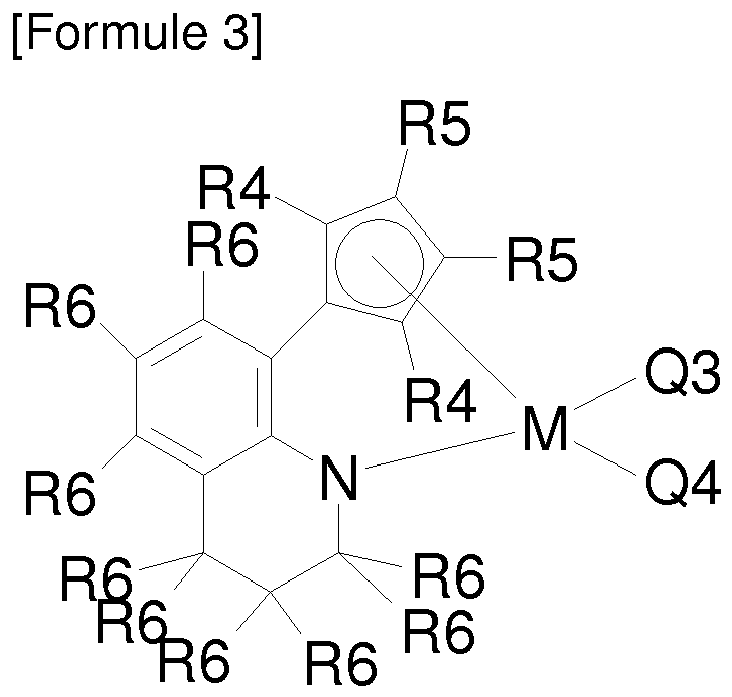

les R6 sont identiques ou différents les uns des autres et représentent chacun indépendamment un hydrogène ; un radical alkyle portant 1 à 20 atome(s) de carbone ; un radical alkényle portant 2 à 20 atomes de carbone ; un radical aryle portant 6 à 20 atomes de carbone ; un radical alkylaryle portant 7 à 20 atomes de carbone ; un radical arylalkyle portant 7 à 20 atomes de carbone ; un radical alcoxy portant 1 à 20 atome(s) de carbone ; un radical aryloxy portant 6 à 20 atomes de carbone ; ou un radical amido ; et deux ou plusieurs des R6 peuvent être reliés ensemble pour former un cycle aliphatique ou aromatique ;
Q3 et Q4 sont identiques ou différents l'un de l'autre et représentent chacun indépendamment un radical halogène ; un radical alkyle portant 1 à 20 atome(s) de carbone ; un radical alkyle amido portant 1 à 20 atome(s) de carbone ; ou un radical aryle amido portant 6 à 20 atomes de carbone ; et
M représente un métal de transition du Groupe 4. - Procédé de préparation d'un catalyseur hybride métallocène supporté selon la revendication 1, dans lequel le composé de métallocène représenté par la Formule 1 est sélectionné parmi le groupe constitué de composés métallocène ayant les structures suivantes :

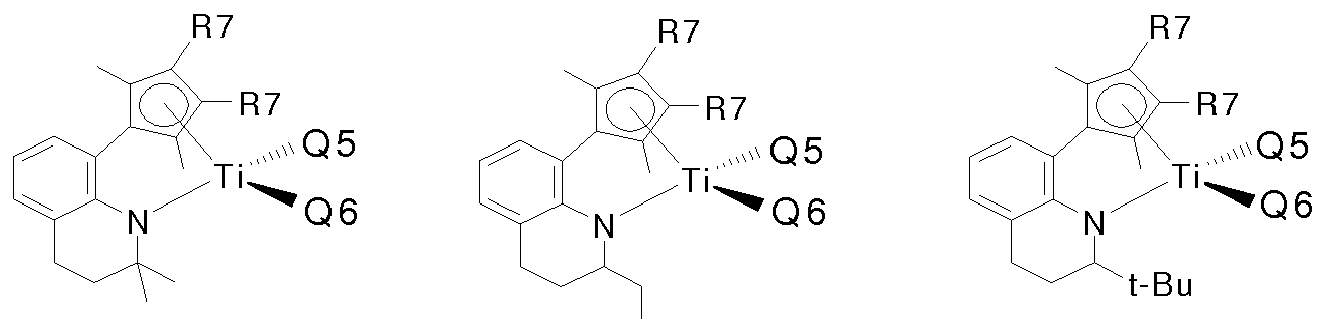

Q5 et Q6 sont identiques ou différents l'un de l'autre et représentent chacun indépendamment sélectionnés parmi un radical méthyle, un radical diméthylamido et un radical chlorure. - Procédé de préparation d'un catalyseur hybride métallocène supporté selon la revendication 1, dans lequel le composé métallocène représenté par la Formule 2 est sélectionné parmi le groupe constitué de composés métallocène ayant les structures suivantes :

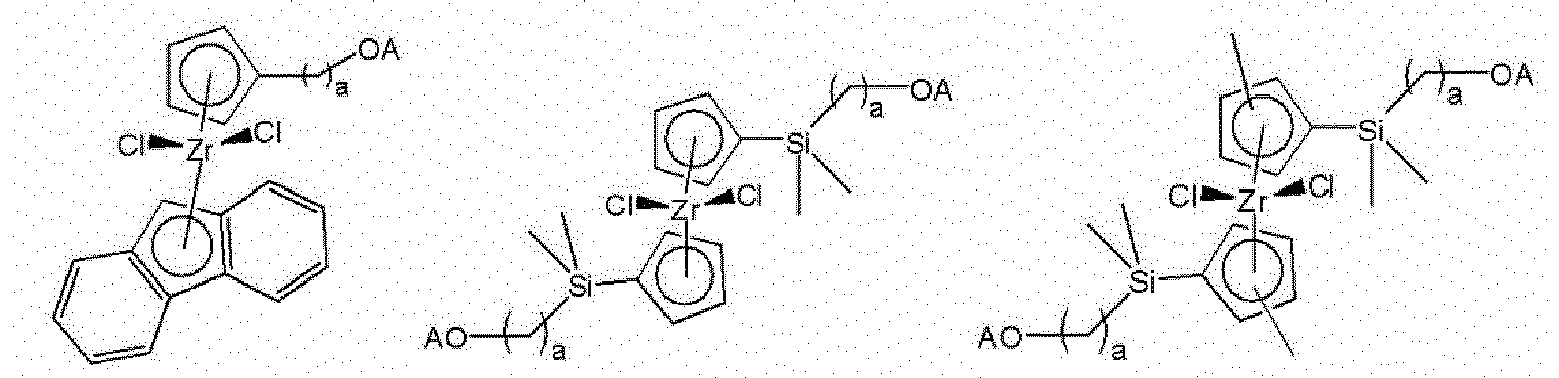


D représente un atome d'oxygène ou d'azote,
A est sélectionné parmi le groupe constitué d'hydrogène, d'alkyle portant 1 à 20 atome(s) de carbone, d'alkényle portant 1 à 20 atome(s) de carbone, d'aryle, d'alkylaryle, d'arylalkyle, d'alkylsilyle, d'arylsilyle, de méthoxyméthyle, de t-butoxyméthyle, de tétrahydropyranyle, de tétrahydrofuranyle, de 1-éthoxyéthyle, de 1-méthyl-1-méthoxyéthyle et de t-butyle. - Procédé de préparation d'un catalyseur hybride métallocène supporté selon la revendication 1, dans lequel le composé co-catalyseur comprend un composé représenté par la Formula 6 suivante :
[Formule 6] -[AI(R8)-O]a-
dans laquelle formule les R8 sont identiques ou différents les uns des autres et représentent chacun indépendamment un radical halogène ; un radical hydrocarbyle portant 1 à 20 atome(s) de carbone ; ou un radical hydrocarbyle portant 1 à 20 atome(s) de carbone qui est substitué par un halogène ; et a est un entier qui valant 2 ou plus. - Procédé de préparation d'un catalyseur hybride métallocène supporté selon la revendication 1, dans lequel le rapport pondéral des métaux de transition du composé métallocène représenté par la Formule 1 et du composé métallocène représenté par la Formule 2 au support est de 1 : 10 à 1 : 1.000.
- Procédé de préparation d'un catalyseur hybride métallocène supporté selon la revendication 1, dans lequel le rapport pondéral du composé co-catalyseur au support est de 1 : 1 à 1 : 100.
- Procédé de préparation d'un catalyseur hybride métallocène supporté selon la revendication 1, dans lequel le rapport pondéral du composé métallocène représenté par la Formule 1 au composé métallocène représenté par la Formule 2 est de 1 : 0.01 à 1 : 100.
- Procédé de préparation d'un catalyseur hybride métallocène supporté selon la revendication 1, dans lequel le support est sélectionné parmi le groupe constitué de silicium, silicium-alumine et silicium-magnésie.
Applications Claiming Priority (2)
| Application Number | Priority Date | Filing Date | Title |
|---|---|---|---|
| KR20080125604 | 2008-12-11 | ||
| PCT/KR2009/007377 WO2010068045A2 (fr) | 2008-12-11 | 2009-12-10 | Catalyseur métallocène mixte sur support, son procédé de préparation, et méthode de préparation de polymères de polyoléfine utilisant ce catalyseur |
Publications (3)
| Publication Number | Publication Date |
|---|---|
| EP2374822A2 EP2374822A2 (fr) | 2011-10-12 |
| EP2374822A4 EP2374822A4 (fr) | 2013-10-16 |
| EP2374822B1 true EP2374822B1 (fr) | 2014-10-15 |
Family
ID=42243223
Family Applications (1)
| Application Number | Title | Priority Date | Filing Date |
|---|---|---|---|
| EP09832130.0A Active EP2374822B1 (fr) | 2008-12-11 | 2009-12-10 | Catalyseur métallocène mixte sur support, son procédé de préparation, et méthode de préparation de polymères de polyoléfine utilisant ce catalyseur |
Country Status (4)
| Country | Link |
|---|---|
| EP (1) | EP2374822B1 (fr) |
| KR (1) | KR101249995B1 (fr) |
| CN (1) | CN102227449A (fr) |
| WO (1) | WO2010068045A2 (fr) |
Cited By (2)
| Publication number | Priority date | Publication date | Assignee | Title |
|---|---|---|---|---|
| US10385146B2 (en) | 2015-06-05 | 2019-08-20 | Lg Chem, Ltd. | Metallocene compound |
| US10723819B2 (en) | 2017-02-20 | 2020-07-28 | Exxonmobil Chemical Patents, Inc. | Supported catalyst systems and processes for use thereof |
Families Citing this family (44)
| Publication number | Priority date | Publication date | Assignee | Title |
|---|---|---|---|---|
| US20120172548A1 (en) * | 2007-05-02 | 2012-07-05 | Lg Chem, Ltd. | Polyolefin and preparation method thereof |
| US8383754B2 (en) | 2010-04-19 | 2013-02-26 | Chevron Phillips Chemical Company Lp | Catalyst compositions for producing high Mz/Mw polyolefins |
| US9000115B2 (en) * | 2011-01-27 | 2015-04-07 | Lg Chem, Ltd. | Olefin block copolymers and production methods thereof |
| SG192089A1 (en) * | 2011-01-27 | 2013-08-30 | Lg Chemical Ltd | Olefin block copolymer |
| KR101499819B1 (ko) | 2011-11-03 | 2015-03-10 | 주식회사 엘지화학 | 비담지 비균일계 폴리올레핀 중합용 촉매 조성물 및 그의 제조 방법 |
| WO2013066109A1 (fr) * | 2011-11-03 | 2013-05-10 | 주식회사 엘지화학 | Composition de catalyseur hétérogène non supporté pour la polymérisation de polyoléfine et son procédé de préparation |
| EP2998308B1 (fr) | 2013-06-25 | 2017-11-29 | LG Chem, Ltd. | Composé de métallocène binucléé et son procédé de préparation |
| US9725531B2 (en) | 2013-06-25 | 2017-08-08 | Lg Chem, Ltd. | Catalyst composition, a method for preparing the same, and a method for preparing polyolefin using the same |
| KR101644113B1 (ko) | 2013-10-18 | 2016-07-29 | 주식회사 엘지화학 | 혼성 담지 메탈로센 촉매 |
| KR101631700B1 (ko) * | 2013-10-18 | 2016-06-17 | 주식회사 엘지화학 | 혼성 담지 메탈로센 촉매의 제조방법 |
| EP3160742B1 (fr) * | 2014-06-26 | 2025-04-30 | Dow Global Technologies LLC | Films coûlés ayant une ténacité améliorée |
| US20170152377A1 (en) * | 2014-06-26 | 2017-06-01 | Dow Global Technologies Llc | Breathable films and articles incorporating same |
| KR101617870B1 (ko) | 2014-09-05 | 2016-05-03 | 주식회사 엘지화학 | 가공성이 우수한 올레핀계 중합체 |
| WO2016036204A1 (fr) * | 2014-09-05 | 2016-03-10 | 주식회사 엘지화학 | Polymère à base d'oléfine présentant une excellente aptitude à la mise en œuvre |
| KR101761394B1 (ko) | 2014-09-30 | 2017-07-25 | 주식회사 엘지화학 | 섬유 제조용 폴리올레핀 중합체의 제조방법 |
| KR101719064B1 (ko) | 2014-11-13 | 2017-03-22 | 주식회사 엘지화학 | 리간드 화합물, 전이금속 화합물 및 이를 포함하는 촉매 조성물 |
| WO2016076509A1 (fr) * | 2014-11-13 | 2016-05-19 | 주식회사 엘지화학 | Composé ligand, composé métal de transition, et composition catalyseur contenant les composés |
| WO2016099118A1 (fr) * | 2014-12-15 | 2016-06-23 | 주식회사 엘지화학 | Polymère à base d'oléfine présentant une excellente aptitude au traitement |
| KR101747396B1 (ko) | 2014-12-15 | 2017-06-14 | 주식회사 엘지화학 | 가공성이 우수한 올레핀계 중합체 |
| WO2016171807A1 (fr) | 2015-04-20 | 2016-10-27 | Exxonmobil Chemical Patents Inc. | Composition catalyseur comprenant un support fluoré et ses procédés d'utilisation |
| WO2016171808A1 (fr) | 2015-04-20 | 2016-10-27 | Exxonmobil Chemical Patents Inc. | Composition catalytique comprenant un support fluoré et procédés d'utilisation associés |
| KR101847702B1 (ko) | 2015-03-26 | 2018-04-10 | 주식회사 엘지화학 | 올레핀계 중합체 |
| WO2016153275A1 (fr) * | 2015-03-26 | 2016-09-29 | 주식회사 엘지화학 | Polymère à base d'oléfine |
| EP3274381B1 (fr) | 2015-04-20 | 2019-05-15 | ExxonMobil Chemical Patents Inc. | Composition de catalyseur comprenant un support fluoré et procédés pour leur utilisation |
| WO2016195423A1 (fr) * | 2015-06-05 | 2016-12-08 | 주식회사 엘지화학 | Composé métallocène |
| KR101711788B1 (ko) | 2016-03-09 | 2017-03-14 | 한화케미칼 주식회사 | 혼성 촉매 조성물, 이의 제조방법, 및 이를 이용하여 제조된 폴리올레핀 |
| KR101725004B1 (ko) * | 2016-04-27 | 2017-04-18 | 한화케미칼 주식회사 | 혼성 담지 메탈로센 촉매 및 이를 이용한 가공성이 우수한 폴리올레핀 수지 |
| KR102065715B1 (ko) | 2016-12-05 | 2020-01-13 | 주식회사 엘지화학 | 혼성 담지 촉매 |
| CN110431160B (zh) | 2017-02-20 | 2021-12-31 | 埃克森美孚化学专利公司 | 负载型催化剂体系及其使用方法 |
| WO2019027585A1 (fr) | 2017-08-04 | 2019-02-07 | Exxonmobil Chemical Patents Inc. | Catalyseurs mixtes comprenant des hafnocènes non pontés avec des fractions -ch2-sime3 |
| US10844150B2 (en) | 2017-08-04 | 2020-11-24 | Exxonmobil Chemical Patents Inc. | Mixed catalysts with 2,6-bis(imino)pyridyl iron complexes and bridged hafnocenes |
| US10703838B2 (en) | 2017-10-31 | 2020-07-07 | Exxonmobil Chemical Patents Inc. | Mixed catalyst systems with four metallocenes on a single support |
| US10926250B2 (en) | 2017-12-01 | 2021-02-23 | Exxonmobil Chemical Patents Inc. | Catalyst systems and polymerization processes for using the same |
| WO2019108977A1 (fr) | 2017-12-01 | 2019-06-06 | Exxonmobil Chemical Patents Inc. | Systèmes de catalyseur et procédés de polymérisation pour leur utilisation |
| WO2019125050A1 (fr) * | 2017-12-22 | 2019-06-27 | 주식회사 엘지화학 | Polymère oléfinique |
| WO2019132475A1 (fr) * | 2017-12-26 | 2019-07-04 | 주식회사 엘지화학 | Polymère à base d'oléfine |
| US10865258B2 (en) | 2018-01-31 | 2020-12-15 | Exxonmobil Chemical Patents Inc. | Mixed catalyst systems containing bridged metallocenes with a pendant group 13 element, processes for making a polymer product using same, and products made from same |
| US10851187B2 (en) | 2018-01-31 | 2020-12-01 | Exxonmobil Chemical Patents Inc. | Bridged metallocene catalysts with a pendant group 13 element, catalyst systems containing same, processes for making a polymer product using same, and products made from same |
| US11198747B2 (en) | 2018-06-04 | 2021-12-14 | Exxonmobil Chemical Patents Inc. | Catalyst systems including two hafnocene catalyst compounds |
| WO2019236349A1 (fr) * | 2018-06-04 | 2019-12-12 | Exxonmobil Chemical Patents Inc. | Systèmes de catalyseurs comprenant deux composés catalyseurs hafnocène |
| KR102753857B1 (ko) | 2018-11-15 | 2025-01-14 | 롯데케미칼 주식회사 | 프로필렌 중합용 담지촉매 및 이를 이용하는 폴리프로필렌 수지의 제조방법 |
| CN116589613B (zh) * | 2023-05-15 | 2025-05-06 | 广州方中化工有限公司 | 一种单茂钛催化剂的制备方法与在烯烃聚合的应用 |
| KR20240169835A (ko) * | 2023-05-25 | 2024-12-03 | 한화솔루션 주식회사 | 혼성 담지 메탈로센 촉매 및 이의 제조방법 |
| CN121646613A (zh) | 2024-07-03 | 2026-03-10 | 株式会社Lg化学 | 混杂负载茂金属催化剂和使用该催化剂制备聚乙烯的方法 |
Family Cites Families (11)
| Publication number | Priority date | Publication date | Assignee | Title |
|---|---|---|---|---|
| US5032562A (en) | 1989-12-27 | 1991-07-16 | Mobil Oil Corporation | Catalyst composition and process for polymerizing polymers having multimodal molecular weight distribution |
| EP0551277B2 (fr) | 1990-06-22 | 2005-03-09 | ExxonMobil Chemical Patents Inc. | Catalyseurs en alliage organometallique de monocyclopentadienyle depourvu d'aluminium destines a la polymerisation d'olefines |
| US5525678A (en) | 1994-09-22 | 1996-06-11 | Mobil Oil Corporation | Process for controlling the MWD of a broad/bimodal resin produced in a single reactor |
| US5914289A (en) | 1996-02-19 | 1999-06-22 | Fina Research, S.A. | Supported metallocene-alumoxane catalysts for the preparation of polyethylene having a broad monomodal molecular weight distribution |
| KR100235180B1 (ko) * | 1996-12-31 | 1999-12-15 | 윤덕용 | 메탈로센 액상담지 촉매 및 그의 제조방법 |
| KR20030012308A (ko) | 2001-07-31 | 2003-02-12 | 주식회사 예스아이비 | 배팅형 복권 시스템 및 배팅 방법 |
| KR20040076965A (ko) * | 2003-02-27 | 2004-09-04 | 호남석유화학 주식회사 | 올레핀 중합용 담지 다중핵 메탈로센 촉매 및 이의 제조방법 |
| KR100579843B1 (ko) * | 2003-04-01 | 2006-05-12 | 주식회사 엘지화학 | 혼성 담지 메탈로센 촉매 및 그의 제조방법과 이를 이용한폴리올레핀의 제조방법 |
| US7619047B2 (en) * | 2006-02-22 | 2009-11-17 | Chevron Phillips Chemical Company, Lp | Dual metallocene catalysts for polymerization of bimodal polymers |
| KR101092572B1 (ko) * | 2006-12-21 | 2011-12-13 | 주식회사 엘지화학 | 담지촉매를 이용한 폴리올레핀의 제조방법 |
| CN101679540B (zh) * | 2007-05-02 | 2012-09-05 | Lg化学株式会社 | 聚烯烃及其制备方法 |
-
2009
- 2009-12-10 KR KR1020090122325A patent/KR101249995B1/ko active Active
- 2009-12-10 EP EP09832130.0A patent/EP2374822B1/fr active Active
- 2009-12-10 CN CN2009801474500A patent/CN102227449A/zh active Pending
- 2009-12-10 WO PCT/KR2009/007377 patent/WO2010068045A2/fr not_active Ceased
Cited By (2)
| Publication number | Priority date | Publication date | Assignee | Title |
|---|---|---|---|---|
| US10385146B2 (en) | 2015-06-05 | 2019-08-20 | Lg Chem, Ltd. | Metallocene compound |
| US10723819B2 (en) | 2017-02-20 | 2020-07-28 | Exxonmobil Chemical Patents, Inc. | Supported catalyst systems and processes for use thereof |
Also Published As
| Publication number | Publication date |
|---|---|
| WO2010068045A3 (fr) | 2010-08-26 |
| CN102227449A (zh) | 2011-10-26 |
| EP2374822A4 (fr) | 2013-10-16 |
| EP2374822A2 (fr) | 2011-10-12 |
| KR101249995B1 (ko) | 2013-04-03 |
| KR20100067627A (ko) | 2010-06-21 |
| WO2010068045A2 (fr) | 2010-06-17 |
Similar Documents
| Publication | Publication Date | Title |
|---|---|---|
| EP2374822A2 (fr) | Catalyseur métallocène mixte sur support, son procédé de préparation, et méthode de préparation de polymères de polyoléfine utilisant ce catalyseur | |
| EP2087012B1 (fr) | Catalyseurs sur support utilisables pour la polymérisation des oléfines utilisant un composé de métal de transition comportant un pont phénylène, procédé de préparation de ceux-ci et procédé de préparation d'une polyoléfine au moyen de ceux- | |
| US7294600B2 (en) | Supported hybrid metallocene catalyst, method for preparing the same, and method for preparing polyolefin using the same | |
| EP1844082B1 (fr) | Procédé de préparation d'un catalyseur métallocène mixte sur support | |
| KR101071400B1 (ko) | 혼성 담지 메탈로센 촉매, 이의 제조 방법 및 혼성 담지메탈로센 촉매를 이용한 폴리올레핀의 제조방법 | |
| EP3225638B1 (fr) | Copolymère éthylène/alpha-oléfine ayant une aptitude au traitement et des caractéristiques de surface excellentes | |
| KR102064990B1 (ko) | 에틸렌 슬러리 중합용 혼성 담지 촉매 시스템 및 이를 이용한 에틸렌 중합체의 제조 방법 | |
| EP3173429B1 (fr) | Composé métallocène, catalyseur métallocène supporté et procédé de préparation de polyoléfines utilisant celui-ci | |
| KR101606825B1 (ko) | 혼성 담지 메탈로센 촉매의 제조방법 | |
| KR20180067945A (ko) | 혼성 담지 메탈로센 촉매 | |
| US20240059816A1 (en) | Olefin-based polymer and method for preparing the same | |
| US12258433B2 (en) | Transition metal compound for a catalyst for olefin polymerization, catalyst for olefin polymerization comprising the same, and polyolefin prepared using the same | |
| CN118829644A (zh) | 用于烯烃聚合催化剂的过渡金属化合物、包含其的烯烃聚合催化剂和使用其聚合的聚烯烃 | |
| US10550207B2 (en) | Method for preparing supported hybrid metallocene catalyst, and supported hybrid metallocene catalyst using the same | |
| US20230406972A1 (en) | Olefin-based polymer and method for preparing same | |
| KR102806313B1 (ko) | 혼성 담지 촉매 | |
| KR102733546B1 (ko) | 전이 금속 화합물, 이의 제조방법, 및 이를 포함하는 촉매 조성물 | |
| KR102753861B1 (ko) | 전이금속 화합물을 포함하는 촉매 조성물을 이용한 폴리올레핀의 제조방법 | |
| JP7860255B2 (ja) | オレフィン重合触媒用遷移金属化合物、これを含むオレフィン重合触媒およびこれを用いて重合されたポリオレフィン | |
| KR102839804B1 (ko) | 전이금속 화합물을 포함하는 촉매 조성물을 이용한 폴리올레핀의 제조방법 | |
| CN111212845A (zh) | 聚烯烃催化剂及利用它的聚烯烃制造方法 | |
| KR20220055863A (ko) | 신규한 메탈로센 화합물, 이를 포함하는 촉매 조성물 및 이를 이용한 올레핀 중합체의 제조 방법 | |
| KR20220101482A (ko) | 신규한 메탈로센 화합물, 이를 포함하는 촉매 조성물 및 이를 이용한 올레핀 중합체의 제조 방법 |
Legal Events
| Date | Code | Title | Description |
|---|---|---|---|
| PUAI | Public reference made under article 153(3) epc to a published international application that has entered the european phase |
Free format text: ORIGINAL CODE: 0009012 |
|
| 17P | Request for examination filed |
Effective date: 20110704 |
|
| AK | Designated contracting states |
Kind code of ref document: A2 Designated state(s): AT BE BG CH CY CZ DE DK EE ES FI FR GB GR HR HU IE IS IT LI LT LU LV MC MK MT NL NO PL PT RO SE SI SK SM TR |
|
| DAX | Request for extension of the european patent (deleted) | ||
| A4 | Supplementary search report drawn up and despatched |
Effective date: 20130917 |
|
| RIC1 | Information provided on ipc code assigned before grant |
Ipc: C08F 210/16 20060101ALI20130911BHEP Ipc: C08F 4/65 20060101ALI20130911BHEP Ipc: C08F 4/6592 20060101AFI20130911BHEP Ipc: C08F 10/00 20060101ALI20130911BHEP Ipc: C08F 4/02 20060101ALI20130911BHEP |
|
| REG | Reference to a national code |
Ref country code: DE Ref legal event code: R079 Ref document number: 602009027253 Country of ref document: DE Free format text: PREVIOUS MAIN CLASS: C08F0004659200 Ipc: C08F0210160000 |
|
| RIC1 | Information provided on ipc code assigned before grant |
Ipc: C08F 4/6592 20060101ALI20140520BHEP Ipc: C08F 210/16 20060101AFI20140520BHEP Ipc: C08F 4/659 20060101ALI20140520BHEP Ipc: C08F 110/02 20060101ALI20140520BHEP |
|
| GRAP | Despatch of communication of intention to grant a patent |
Free format text: ORIGINAL CODE: EPIDOSNIGR1 |
|
| INTG | Intention to grant announced |
Effective date: 20140718 |
|
| GRAS | Grant fee paid |
Free format text: ORIGINAL CODE: EPIDOSNIGR3 |
|
| GRAA | (expected) grant |
Free format text: ORIGINAL CODE: 0009210 |
|
| AK | Designated contracting states |
Kind code of ref document: B1 Designated state(s): AT BE BG CH CY CZ DE DK EE ES FI FR GB GR HR HU IE IS IT LI LT LU LV MC MK MT NL NO PL PT RO SE SI SK SM TR |
|
| REG | Reference to a national code |
Ref country code: CH Ref legal event code: EP Ref country code: GB Ref legal event code: FG4D |
|
| REG | Reference to a national code |
Ref country code: IE Ref legal event code: FG4D |
|
| REG | Reference to a national code |
Ref country code: AT Ref legal event code: REF Ref document number: 691658 Country of ref document: AT Kind code of ref document: T Effective date: 20141115 |
|
| REG | Reference to a national code |
Ref country code: DE Ref legal event code: R096 Ref document number: 602009027253 Country of ref document: DE Effective date: 20141127 |
|
| REG | Reference to a national code |
Ref country code: NL Ref legal event code: VDEP Effective date: 20141015 |
|
| REG | Reference to a national code |
Ref country code: AT Ref legal event code: MK05 Ref document number: 691658 Country of ref document: AT Kind code of ref document: T Effective date: 20141015 |
|
| REG | Reference to a national code |
Ref country code: LT Ref legal event code: MG4D |
|
| PG25 | Lapsed in a contracting state [announced via postgrant information from national office to epo] |
Ref country code: NL Free format text: LAPSE BECAUSE OF FAILURE TO SUBMIT A TRANSLATION OF THE DESCRIPTION OR TO PAY THE FEE WITHIN THE PRESCRIBED TIME-LIMIT Effective date: 20141015 |
|
| PG25 | Lapsed in a contracting state [announced via postgrant information from national office to epo] |
Ref country code: LT Free format text: LAPSE BECAUSE OF FAILURE TO SUBMIT A TRANSLATION OF THE DESCRIPTION OR TO PAY THE FEE WITHIN THE PRESCRIBED TIME-LIMIT Effective date: 20141015 Ref country code: NO Free format text: LAPSE BECAUSE OF FAILURE TO SUBMIT A TRANSLATION OF THE DESCRIPTION OR TO PAY THE FEE WITHIN THE PRESCRIBED TIME-LIMIT Effective date: 20150115 Ref country code: PT Free format text: LAPSE BECAUSE OF FAILURE TO SUBMIT A TRANSLATION OF THE DESCRIPTION OR TO PAY THE FEE WITHIN THE PRESCRIBED TIME-LIMIT Effective date: 20150216 Ref country code: ES Free format text: LAPSE BECAUSE OF FAILURE TO SUBMIT A TRANSLATION OF THE DESCRIPTION OR TO PAY THE FEE WITHIN THE PRESCRIBED TIME-LIMIT Effective date: 20141015 Ref country code: IS Free format text: LAPSE BECAUSE OF FAILURE TO SUBMIT A TRANSLATION OF THE DESCRIPTION OR TO PAY THE FEE WITHIN THE PRESCRIBED TIME-LIMIT Effective date: 20150215 Ref country code: FI Free format text: LAPSE BECAUSE OF FAILURE TO SUBMIT A TRANSLATION OF THE DESCRIPTION OR TO PAY THE FEE WITHIN THE PRESCRIBED TIME-LIMIT Effective date: 20141015 |
|
| PG25 | Lapsed in a contracting state [announced via postgrant information from national office to epo] |
Ref country code: CY Free format text: LAPSE BECAUSE OF FAILURE TO SUBMIT A TRANSLATION OF THE DESCRIPTION OR TO PAY THE FEE WITHIN THE PRESCRIBED TIME-LIMIT Effective date: 20141015 Ref country code: LV Free format text: LAPSE BECAUSE OF FAILURE TO SUBMIT A TRANSLATION OF THE DESCRIPTION OR TO PAY THE FEE WITHIN THE PRESCRIBED TIME-LIMIT Effective date: 20141015 Ref country code: PL Free format text: LAPSE BECAUSE OF FAILURE TO SUBMIT A TRANSLATION OF THE DESCRIPTION OR TO PAY THE FEE WITHIN THE PRESCRIBED TIME-LIMIT Effective date: 20141015 Ref country code: SE Free format text: LAPSE BECAUSE OF FAILURE TO SUBMIT A TRANSLATION OF THE DESCRIPTION OR TO PAY THE FEE WITHIN THE PRESCRIBED TIME-LIMIT Effective date: 20141015 Ref country code: GR Free format text: LAPSE BECAUSE OF FAILURE TO SUBMIT A TRANSLATION OF THE DESCRIPTION OR TO PAY THE FEE WITHIN THE PRESCRIBED TIME-LIMIT Effective date: 20150116 Ref country code: AT Free format text: LAPSE BECAUSE OF FAILURE TO SUBMIT A TRANSLATION OF THE DESCRIPTION OR TO PAY THE FEE WITHIN THE PRESCRIBED TIME-LIMIT Effective date: 20141015 Ref country code: HR Free format text: LAPSE BECAUSE OF FAILURE TO SUBMIT A TRANSLATION OF THE DESCRIPTION OR TO PAY THE FEE WITHIN THE PRESCRIBED TIME-LIMIT Effective date: 20141015 |
|
| PG25 | Lapsed in a contracting state [announced via postgrant information from national office to epo] |
Ref country code: BE Free format text: LAPSE BECAUSE OF NON-PAYMENT OF DUE FEES Effective date: 20141231 |
|
| REG | Reference to a national code |
Ref country code: DE Ref legal event code: R097 Ref document number: 602009027253 Country of ref document: DE |
|
| PG25 | Lapsed in a contracting state [announced via postgrant information from national office to epo] |
Ref country code: SK Free format text: LAPSE BECAUSE OF FAILURE TO SUBMIT A TRANSLATION OF THE DESCRIPTION OR TO PAY THE FEE WITHIN THE PRESCRIBED TIME-LIMIT Effective date: 20141015 Ref country code: RO Free format text: LAPSE BECAUSE OF FAILURE TO SUBMIT A TRANSLATION OF THE DESCRIPTION OR TO PAY THE FEE WITHIN THE PRESCRIBED TIME-LIMIT Effective date: 20141015 Ref country code: EE Free format text: LAPSE BECAUSE OF FAILURE TO SUBMIT A TRANSLATION OF THE DESCRIPTION OR TO PAY THE FEE WITHIN THE PRESCRIBED TIME-LIMIT Effective date: 20141015 Ref country code: CZ Free format text: LAPSE BECAUSE OF FAILURE TO SUBMIT A TRANSLATION OF THE DESCRIPTION OR TO PAY THE FEE WITHIN THE PRESCRIBED TIME-LIMIT Effective date: 20141015 Ref country code: LU Free format text: LAPSE BECAUSE OF FAILURE TO SUBMIT A TRANSLATION OF THE DESCRIPTION OR TO PAY THE FEE WITHIN THE PRESCRIBED TIME-LIMIT Effective date: 20141210 Ref country code: DK Free format text: LAPSE BECAUSE OF FAILURE TO SUBMIT A TRANSLATION OF THE DESCRIPTION OR TO PAY THE FEE WITHIN THE PRESCRIBED TIME-LIMIT Effective date: 20141015 |
|
| REG | Reference to a national code |
Ref country code: CH Ref legal event code: PL |
|
| PLBE | No opposition filed within time limit |
Free format text: ORIGINAL CODE: 0009261 |
|
| STAA | Information on the status of an ep patent application or granted ep patent |
Free format text: STATUS: NO OPPOSITION FILED WITHIN TIME LIMIT |
|
| 26N | No opposition filed |
Effective date: 20150716 |
|
| REG | Reference to a national code |
Ref country code: IE Ref legal event code: MM4A |
|
| PG25 | Lapsed in a contracting state [announced via postgrant information from national office to epo] |
Ref country code: CH Free format text: LAPSE BECAUSE OF NON-PAYMENT OF DUE FEES Effective date: 20141231 Ref country code: IE Free format text: LAPSE BECAUSE OF NON-PAYMENT OF DUE FEES Effective date: 20141210 Ref country code: LI Free format text: LAPSE BECAUSE OF NON-PAYMENT OF DUE FEES Effective date: 20141231 |
|
| REG | Reference to a national code |
Ref country code: FR Ref legal event code: PLFP Year of fee payment: 7 |
|
| PG25 | Lapsed in a contracting state [announced via postgrant information from national office to epo] |
Ref country code: SI Free format text: LAPSE BECAUSE OF FAILURE TO SUBMIT A TRANSLATION OF THE DESCRIPTION OR TO PAY THE FEE WITHIN THE PRESCRIBED TIME-LIMIT Effective date: 20141015 |
|
| PG25 | Lapsed in a contracting state [announced via postgrant information from national office to epo] |
Ref country code: SM Free format text: LAPSE BECAUSE OF FAILURE TO SUBMIT A TRANSLATION OF THE DESCRIPTION OR TO PAY THE FEE WITHIN THE PRESCRIBED TIME-LIMIT Effective date: 20141015 |
|
| PG25 | Lapsed in a contracting state [announced via postgrant information from national office to epo] |
Ref country code: MC Free format text: LAPSE BECAUSE OF FAILURE TO SUBMIT A TRANSLATION OF THE DESCRIPTION OR TO PAY THE FEE WITHIN THE PRESCRIBED TIME-LIMIT Effective date: 20141015 |
|
| PG25 | Lapsed in a contracting state [announced via postgrant information from national office to epo] |
Ref country code: BG Free format text: LAPSE BECAUSE OF FAILURE TO SUBMIT A TRANSLATION OF THE DESCRIPTION OR TO PAY THE FEE WITHIN THE PRESCRIBED TIME-LIMIT Effective date: 20141015 |
|
| PG25 | Lapsed in a contracting state [announced via postgrant information from national office to epo] |
Ref country code: MT Free format text: LAPSE BECAUSE OF FAILURE TO SUBMIT A TRANSLATION OF THE DESCRIPTION OR TO PAY THE FEE WITHIN THE PRESCRIBED TIME-LIMIT Effective date: 20141015 Ref country code: TR Free format text: LAPSE BECAUSE OF FAILURE TO SUBMIT A TRANSLATION OF THE DESCRIPTION OR TO PAY THE FEE WITHIN THE PRESCRIBED TIME-LIMIT Effective date: 20141015 Ref country code: HU Free format text: LAPSE BECAUSE OF FAILURE TO SUBMIT A TRANSLATION OF THE DESCRIPTION OR TO PAY THE FEE WITHIN THE PRESCRIBED TIME-LIMIT; INVALID AB INITIO Effective date: 20091210 |
|
| REG | Reference to a national code |
Ref country code: FR Ref legal event code: PLFP Year of fee payment: 8 |
|
| REG | Reference to a national code |
Ref country code: FR Ref legal event code: PLFP Year of fee payment: 9 |
|
| PG25 | Lapsed in a contracting state [announced via postgrant information from national office to epo] |
Ref country code: MK Free format text: LAPSE BECAUSE OF FAILURE TO SUBMIT A TRANSLATION OF THE DESCRIPTION OR TO PAY THE FEE WITHIN THE PRESCRIBED TIME-LIMIT Effective date: 20141015 |
|
| PGFP | Annual fee paid to national office [announced via postgrant information from national office to epo] |
Ref country code: DE Payment date: 20251120 Year of fee payment: 17 |
|
| PGFP | Annual fee paid to national office [announced via postgrant information from national office to epo] |
Ref country code: GB Payment date: 20251120 Year of fee payment: 17 |
|
| PGFP | Annual fee paid to national office [announced via postgrant information from national office to epo] |
Ref country code: IT Payment date: 20251121 Year of fee payment: 17 |
|
| PGFP | Annual fee paid to national office [announced via postgrant information from national office to epo] |
Ref country code: FR Payment date: 20251125 Year of fee payment: 17 |