EP2375100A2 - Auswuchtgewicht mit Haltefeder - Google Patents
Auswuchtgewicht mit Haltefeder Download PDFInfo
- Publication number
- EP2375100A2 EP2375100A2 EP11002919A EP11002919A EP2375100A2 EP 2375100 A2 EP2375100 A2 EP 2375100A2 EP 11002919 A EP11002919 A EP 11002919A EP 11002919 A EP11002919 A EP 11002919A EP 2375100 A2 EP2375100 A2 EP 2375100A2
- Authority
- EP
- European Patent Office
- Prior art keywords
- weight
- balancing weight
- spring
- rim flange
- weight body
- Prior art date
- Legal status (The legal status is an assumption and is not a legal conclusion. Google has not performed a legal analysis and makes no representation as to the accuracy of the status listed.)
- Granted
Links
Images


Classifications
-
- F—MECHANICAL ENGINEERING; LIGHTING; HEATING; WEAPONS; BLASTING
- F16—ENGINEERING ELEMENTS AND UNITS; GENERAL MEASURES FOR PRODUCING AND MAINTAINING EFFECTIVE FUNCTIONING OF MACHINES OR INSTALLATIONS; THERMAL INSULATION IN GENERAL
- F16F—SPRINGS; SHOCK-ABSORBERS; MEANS FOR DAMPING VIBRATION
- F16F15/00—Suppression of vibrations in systems; Means or arrangements for avoiding or reducing out-of-balance forces, e.g. due to motion
- F16F15/32—Correcting- or balancing-weights or equivalent means for balancing rotating bodies, e.g. vehicle wheels
- F16F15/34—Fastening arrangements therefor
- F16F15/345—Fastening arrangements therefor specially adapted for attachment to a vehicle wheel
Definitions
- the present invention relates to a balancing weight with retaining spring having the features of the preamble of claim 1.
- Balancing weights are known to be used to compensate for the imbalance of vehicle wheels. Imbalance problems arise due to minimal manufacturing tolerances, damage or different wear of the wheels or rims of motor vehicles. These unbalance problems are solved by attaching a balance weight preferably on the rim of the motor vehicle.
- a balancing weight is described with a manufactured by die casting weight body with embedded retaining spring.
- the retaining spring allows a determination of the balance weight by means of the impact of a hammer on the rim of a wheel.
- the shape of the balance weight is adapted to the geometry of the inside of the rim or of the rim flange, so that the balance weight rests directly on the inside of the rim or on the rim flange after assembly.
- a disadvantage of in the DE 101 02 321 B4 Balancing weights described is that the mounting of the weights is done with a relatively large amount of force, the balance weights are beaten by means of a hammer on the rim. there there is a risk of damage to the rim. Due to the rim of the adapted geometry of the balance weight is relatively little space between the spring legs of the retaining spring available for the introduction of the rim flange, so a strong spreading of the spring during assembly is required, which brings with it the risk of overstressing the spring during assembly. In addition, due to the desired fit geometry between balancing weight and rim, the general usability of the balancing weights is limited for different rims.
- a balancing weight is described in the weight body in the middle on the rim facing side a groove is arranged, which has the function to effect a three-point support of the mounted weight on the rim. In practice, such balancing weights could not prevail.
- the invention relates to a balancing weight with a weight body, which is connected to a U-shaped, two spring legs having retaining spring.
- the retaining spring is directly attached to the first of its two spring legs on the weight body, while the second, free spring leg is provided for attaching the balance weight on the rim flange.
- the attachment of the retaining spring can be conventional done by riveting or welding.
- the balancing weight has a weight body produced by die-casting, in which the U-shaped retaining spring is cast.
- the retaining spring can also be clamped in the weight body or fastened in any other way to the weight body.
- the portion of the weight body facing the rim flange during assembly of the balance weight has a profile set back to the first spring leg.
- the balancing weight has a geometrical shape which is largely adapted to the usual motor vehicle wheel, in particular its rim inside or rim flange. In this way, a sufficiently tight fit of the balancing weight is guaranteed on the vehicle wheel after assembly, but not as in the conventional balancing weights of the entire weight body rests on the rim, but in the assembled state between the weight body and the rim in the portion of the recessed profile has, a cavity is formed. Studies have shown that this cavity for the tight fit of the balancing weight brings no disadvantages.
- Suitable materials for the weight body are all conventional materials that are commonly used for balance weights, such as the metals zinc, lead and iron and alloys thereof, but also plastics. According to a general trend in the balancing weights looks a preferred embodiment of the present invention, that the balancing weight consists essentially of zinc. A further advantageous embodiment provides that the zinc is alloyed with small amounts of aluminum and / or copper.
- the retaining spring itself is made of steel, which is preferably galvanized.
- the special geometry of the balance weight has the additional advantage that a balance weight designed in this way can be used even for heavily differently shaped rims, since in the introduction area for the rim flange between the spring legs of the U-shaped retaining spring the recessed profile of the weight body sufficient space for Rim horn leaves, so that even unfavorably shaped rim flanges can be easily equipped with the Auswuchtgeweicht invention. In this context, it has also been found that it is sufficient for a firm hold when the balancing weight is only selectively applied to the rim.
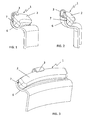
- FIGS. 1 to 3 the interaction of the balancing weight 1 according to the invention with the rim flange 6 is shown in perspective at different angles.
- the weight body 2 together with the retaining spring 3 due to the recessed profile 7 without effort can be pushed relatively far over the rim flange 6, so that a moderate impact with a hammer is sufficient for the final fixation of the balance weight on the rim.
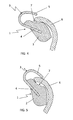
- FIGS. 4 to 7 individual steps of the assembly of the balancing weight 1 according to the invention are illustrated, wherein in particular in the Figures 5 and 6 the advantages of the balancing weight 1 according to the invention are illustrated.
- FIG. 4 shows a section through a balancing weight 1 with a weight body 2 with a cast U-shaped, two spring leg 4, 5 comprehensive retaining spring 3 together with the section through a section of a rim flange 6. It can be seen that the mass of the weight body 2 to the first leg 4 of the U-shaped spring 3 is distributed, so that a portion of the weight body 2 between the two spring legs 4, 5 is arranged. In this partial area, the weight body 2 has a profile 7 set back towards the first spring leg 4. The retraction of the profile 7, the introduction of the rim flange 6 between the two spring legs 4, 5 of the retaining spring 3 is facilitated.
- the next assembly step in which the balancing weight 1 is applied so far to the rim flange 6, as it is possible without a spreading of the retaining spring 3.
- the balancing weight 1 is already relatively close to its end position on the rim flange 6, without the retaining spring 3 having hitherto been stressed.
- FIG. 6 shows the time of assembly, in which the retaining spring 3 undergoes its greatest expansion.
- the weight body 2 is pushed almost completely over the rim flange 6 with its recessed profile 7.
- the dashed representation of a portion of the spring leg 5 is the starting position of this spring leg again, while drawn with solid lines spring leg 5 reflects the current position in the indicated mounting state. From this representation, it is easy to see that during assembly of the balance weight 1, only a slight widening of the retaining spring 3 occurs. An overstretching of the retaining spring 3 is thus not to be feared and the balancing weight 1 can be brought into its final position on the rim flange 6 without much effort.
- FIG. 7 shows the final state with fully assembled balancing weight 1, which is clamped on the rim flange 6.
- dashed lines the starting position of the free spring leg 5 of the retaining spring 3 is drawn to illustrate the degree of tension under which the retaining spring 3 is in the assembled state.
- the clamping force of the retaining spring 3 is chosen so that a firm grip of the balance weight 1 on the rim flange 6 is guaranteed.
- the firm hold of the balance weight on the rim is additionally reinforced by the fact that the shape of the balance weight 1 is largely adapted to the rim inner side or the rim flange 6, so that the balance weight 1 rests on the rim flange 6 over a large area after assembly.
- FIG. 8 shows a plan view of the visible side of a balance weight 1 with the weight body 2 and the approach of the retaining spring 3 on the weight body second
- FIG. 8 an enlarged cross section along the axis A is made FIG. 8 ,
- the profile 7 has an S-shaped curve, which comprises a first high point 8, a turning point 10, a low point 11 and a second high point 9.
- the curve is adapted to the opposite free spring leg 5, which is illustrated by the drawn circular arc 12.
- the low point 11 is arranged directly opposite the end 13 of the free spring leg 5. It is important that in the unmounted state of the balance weight 1, the curve between the first high point 8 and the second high point 9 is selected so that between the free spring leg 5 and the weight body 2 is a substantially uniform distance (d). 0
- This substantially uniform distance (d) between the free spring leg 5 and the weight body 2 is additionally in the size of the Figures 4-7 custom FIG. 10 illustrated.
- the balancing weight 1 Due to this particular geometric configuration, by which the balancing weight 1 according to the invention differs from the known balancing weights according to the prior art, the assembly of the balancing weight 1 is greatly facilitated.
- the balancing weight 1 can be pushed onto the rim flange 6 due to the special geometric conditions with relatively little effort, only in the last step, in which the rim flange 6 must be pushed over the first high point 8, force must be expended, due to adapted circular arc 12 of the profile 7 in the region of the first high point 8 is relatively low.
- the condition before the last assembly step is in the FIG. 6 played.
- the rim flange 6 due to the uniform distance (d) of the profile 7 can be introduced from the free spring leg 5 without force. After overcoming the first high point 8, the rim flange 6 slides without further effort in the end position, in the FIG. 7 is reproduced, and is held there due to the spring force. Stress tests have shown that the balancing weight according to the invention in the mounted state has an extraordinary firm grip on the rim, which is further supported by the fact that the shape of the balancing weight 1 is largely adapted to the rim inside.
Landscapes
- Engineering & Computer Science (AREA)
- General Engineering & Computer Science (AREA)
- Physics & Mathematics (AREA)
- Acoustics & Sound (AREA)
- Aviation & Aerospace Engineering (AREA)
- Mechanical Engineering (AREA)
- Testing Of Balance (AREA)
- Golf Clubs (AREA)
- Motor Power Transmission Devices (AREA)
Abstract
Description
- Die vorliegende Erfindung betrifft ein Auswuchtgewicht mit Haltefeder mit den Merkmalen des Oberbegriffs des Anspruchs 1.
- Auswuchtgewichte werden bekanntermaßen zur Kompensation der Unwucht von Fahrzeugrädern eingesetzt. Unwuchtprobleme entstehen durch minimale Fertigungstoleranzen, Beschädigungen oder unterschiedliche Abnutzung der Räder bzw. der Felgen der Kraftfahrzeuge. Gelöst werden diese Unwuchtprobleme durch Befestigung eines Ausgleichgewichts vorzugsweise an der Felge des Kraftfahrzeugs.
- In der
DE 101 02 321 B4 wird ein Auswuchtgewicht mit einem im Druckgussverfahren hergestellten Gewichtskörper mit eingegossener Haltefeder beschrieben. Dabei ermöglicht die Haltefeder eine Festlegung des Auswuchtgewichts mittels der Schlageinwirkung eines Hammers an der Felge eines Rades. Die Form des Auswuchtgewichts ist der Geometrie der Felgeninnenseite bzw. des Felgenhorns angepasst, sodass das Auswuchtgewicht nach der Montage direkt an der Felgeninnenseite bzw. am Felgenhorn anliegt. Diese angepassten Geometrien zwischen Felge und Auswuchtgewicht, die man bei sämtlichen unterschiedlichen konventionellen Auswuchtgewichten beobachten kann, haben ihre Ursache darin, dass angestrebt wird, das Gewicht möglichst fest und nah an der Felge zu halten, um den während der Fahrt auftretenden Radialkräften möglichst wenig Angriffsfläche zu bieten. - Ein Nachteil der in der
DE 101 02 321 B4 beschriebenen Auswuchtgewichte besteht darin, dass die Montage der Gewichte mit relativ großem Kraftaufwand erfolgt, wobei die Auswuchtgewichte mittels eines Hammers auf die Felge geschlagen werden. Dabei besteht die Gefahr der Beschädigung der Felge. Durch die der Felge angepassten Geometrie des Auswuchtgewichts ist zwischen den Federschenkeln der Haltefeder relativ wenig Platz vorhanden für die Einführung des Felgenhorns, sodass ein starkes Aufspreizen der Feder bei der Montage erforderlich ist, was die Gefahr des Überspannens der Feder bei der Montage mit sich bringt. Hinzu kommt, dass aufgrund der angestrebten passgenauen Geometrie zwischen Auswuchtgewicht und Felge die allgemeine Verwendbarkeit der Auswuchtgewichte für unterschiedliche Felgen eingeschränkt ist. - In der
US 2,576,724 A wird ein Auswuchtgewicht beschrieben, in dessen Gewichtskörper in der Mitte auf der zur Felge weisenden Seite eine Nut angeordnet ist, welche die Funktion hat, eine Dreipunktauflage des montierten Gewichts an der Felge zu bewirken. In der Praxis konnten sich derartige Auswuchtgewichte nicht durchsetzen. - Es besteht somit Bedarf an Auswuchtgewichten, die die Nachteile des Standes der Technik nicht aufweisen.
- Gelöst wird diese Aufgabe durch ein Auswuchtgewicht mit den Merkmalen des Anspruchs 1. Vorteilhafte Ausgestaltungen und Weiterentwicklungen des erfindungsgemäßen Auswuchtgewichts sind Gegenstand der Unteransprüche.
- Gegenstand der Erfindung ist ein Auswuchtgewicht mit einem Gewichtskörper, der mit einer U-förmigen, zwei Federschenkel aufweisenden Haltefeder verbunden ist. Dabei ist die Haltefeder mit dem ersten ihrer beiden Federschenkel am Gewichtskörper direkt befestigt, während der zweite, freie Federschenkel zur Befestigung des Auswuchtgewichts am Felgenhorn vorgesehen ist. Die Befestigung der Haltefeder kann dabei konventionell durch Nieten oder Schweißen erfolgen. Bei einer bevorzugten Ausgestaltung der vorliegenden Erfindung besitzt das Auswuchtgewicht einen im Druckgussverfahren hergestellten Gewichtskörper, in den die U-förmige Haltefeder eingegossen ist. Ebenso kann die Haltefeder aber auch im Gewichtskörper eingeklemmt oder auf sonstige Weise am Gewichtskörper befestigt sein.
- Der bei der Montage des Auswuchtgewichts dem Felgenhorn zugewandte Teilbereich des Gewichtkörpers weist ein zum ersten Federschenkel hin zurückversetztes Profil auf. Dadurch wird zwischen den beiden Federschenkeln Platz geschaffen für die Einführung des Felgenhorns, sodass ein derart profiliertes Auswuchtgewicht problemlos und ohne großen Kraftaufwand auf ein entsprechendes Felgenhorn aufgebracht werden kann.
- Mit Ausnahme dieses zurückversetzten Profils weist das Auswuchtgewicht eine dem üblichen Kraftfahrzeugrad, insbesondere dessen Felgeninnenseite oder Felgenhorn, weitgehend angepasste geometrische Form auf. Auf diese Weise wird nach der Montage ein ausreichend fester Sitz des Auswuchtgewichts am Kraftfahrzeugrad garantiert, wobei jedoch nicht wie bei den konventionellen Auswuchtgewichten der gesamte Gewichtskörper an der Felge anliegt, sondern im Montagezustand zwischen dem Gewichtskörper und der Felge in dem Teilbereich, der das zurückversetzte Profil aufweist, ein Hohlraum ausgebildet ist. Untersuchungen haben gezeigt, dass dieser Hohlraum für den festen Sitz des Auswuchtgewichts keine Nachteile mit sich bringt.
- Als Materialien für den Gewichtskörper kommen alle konventionellen Materialien in Frage, die üblicherweise für Auswuchtgewichte eingesetzt, wie zum Beispiel die Metalle Zink, Blei und Eisen sowie Legierungen davon, aber auch Kunststoffe. Entsprechend einem allgemeinen Trend bei den Auswuchtgewichten sieht eine bevorzugte Ausgestaltung der vorliegenden Erfindung vor, dass das Auswuchtgewicht im Wesentlichen aus Zink besteht. Eine weitere vorteilhafte Ausgestaltung sieht vor, dass das Zink mit geringen Anteilen an Aluminium und/oder Kupfer legiert ist.
- Üblicherweise ist die Haltefeder selber aus Stahl gefertigt, der vorzugsweise verzinkt ist.
- Die besondere Geometrie des Auswuchtgewichts bringt den zusätzlichen Vorteil mit sich, dass ein derart gestaltetes Auswuchtgewicht selbst für stark unterschiedlich geformte Felgen eingesetzt werden kann, da im Einführungsbereich für das Felgenhorn zwischen den Federschenkeln der U-förmigen Haltefeder das zurückversetzte Profil des Gewichtskörpers ausreichend Platz für das Felgenhorn lässt, so dass auch ungünstig geformte Felgenhörner problemlos mit dem erfindungsgemäßen Auswuchtgeweicht bestückt werden können. In diesem Zusammenhang wurde auch festgestellt, dass es für einen festen Halt ausreicht, wenn das Auswuchtgewicht lediglich punktuell an der Felge anliegt.
- Im Folgenden wird das erfindungsgemäße Auswuchtgewicht anhand von Zeichnungen ausführlich erläutert. Dabei zeigen
- Fig. 1-3
- perspektivische Darstellungen aus unterschiedlichen Blickwinkeln jeweils eines Felgenausschnittes mit einem Auswuchtgewicht
- Fig. 4
- eine Schnittdarstellung eines Auswuchtgewichts zusammen mit einem Ausschnitt einer Felge,
- Fig. 5
- die Schnittdarstellung aus
Fig. 1 zu Beginn der Montage, - Fig. 6
- die Schnittdarstellung aus
Fig. 1 während der Montage des Auswuchtgewichts, - Fig. 7
- eine Schnittdarstellung des Auswuchtgewichts mit einem Ausschnitt aus der Felge nach fertiger Montage,
- Fig. 8
- eine Draufsicht auf den Sichtseite des Auswuchtgewichts
- Fig. 9
- eine vergrößerte Schnittdarstellung des Auswuchtgewichts entlang der Achse A aus
Figur 8 und - Fig. 10
- eine den Schnitten aus den
Figuren 4-7 angepasste Schnittdarstellung entlang der Achse A ausFigur 8 . - In den
Figuren 1 bis 3 ist das Zusammenspiel des erfindungsgemäßen Auswuchtgewichts 1 mit dem Felgenhorn 6 perspektivisch bei unterschiedlichen Blickwinkeln dargestellt. Bei diesen Darstellungen wird deutlich, dass sich der Gewichtskörper 2 mitsamt der Haltefeder 3 aufgrund des zurückversetzten Profils 7 ohne Kraftaufwand bereits relativ weit über das Felgenhorn 6 schieben lässt, so dass zur endgültigen Fixierung des Auswuchtgewichts an der Felge ein moderater Schlag mit einem Hammer ausreicht. - In den
Figuren 4 bis 7 werden einzelne Schritte der Montage des erfindungsgemäßen Auswuchtgewichts 1 illustriert, wobei insbesondere bei denFiguren 5 und6 die Vorteile des erfindungsgemäßen Auswuchtgewichts 1 verdeutlicht werden. - Die
Figur 4 zeigt einen Schnitt durch ein Auswuchtgewicht 1 mit einem Gewichtskörper 2 mit einer eingegossenen U-förmigen, zwei Federschenkel 4, 5 umfassenden Haltefeder 3 zusammen mit dem Schnitt durch einen Ausschnitt eines Felgenhorns 6. Es ist zu erkennen, dass die Masse des Gewichtskörpers 2 um den ersten Schenkel 4 der U-förmigen Feder 3 verteilt ist, sodass ein Teilbereich des Gewichtskörpers 2 zwischen den beiden Federschenkeln 4, 5 angeordnet ist. In diesem Teilbereich weist der Gewichtskörper 2 ein zum ersten Federschenkel 4 hin zurückversetztes Profil 7 auf. Durch die Zurückversetzung des Profils 7 wird die Einführung des Felgenhorns 6 zwischen die beiden Federschenkel 4, 5 der Haltefeder 3 erleichtert. - In der
Figur 5 ist der nächste Montageschritt zu sehen, bei dem das Auswuchtgewicht 1 so weit auf das Felgenhorn 6 aufgebracht ist, wie es ohne eine Spreizung der Haltefeder 3 möglich ist. Dabei kommt das Auswuchtgewicht 1 seiner Endposition am Felgenhorn 6 schon relativ nahe, ohne dass die Haltefeder 3 bislang beansprucht wurde. - Die
Figur 6 zeigt den Zeitpunkt der Montage, bei dem die Haltefeder 3 ihre größte Ausdehnung erfährt. Dabei ist der Gewichtskörper 2 mit seinem zurückversetzten Profil 7 nahezu vollständig über das Felgenhorn 6 geschoben. Die gestrichelte Darstellung eines Teilbereichs des Federschenkels 5 gibt die Ausgangsposition dieses Federschenkels wieder, während der mit durchgezogenen Linien gezeichnete Federschenkel 5 die aktuelle Position im aufgezeigten Montagezustand wiedergibt. Aus dieser Darstellung ist leicht zu ersehen, dass es bei der Montage des Auswuchtgewichts 1 insgesamt nur zu einer geringfügigen Aufweitung der Haltefeder 3 kommt. Ein Überspannen der Haltefeder 3 ist somit nicht zu befürchten und das Auswuchtgewicht 1 kann ohne großen Kraftaufwand in seine Endposition am Felgenhorn 6 gebracht werden. - Die
Figur 7 zeigt den Endzustand mit fertig montiertem Auswuchtgewicht 1, das auf dem Felgenhorn 6 aufgeklemmt ist. Auch hier ist wieder gestrichelt die Ausgangsposition des freien Federschenkels 5 der Haltefeder 3 eingezeichnet, um das Maß der Spannung zu verdeutlichen, unter dem die Haltefeder 3 im Montagezustand steht. Selbstverständlich ist die Spannkraft der Haltefeder 3 so gewählt, dass ein fester Halt des Auswuchtgewichts 1 am Felgenhorn 6 garantiert ist. Im vorliegenden Fall wird der feste Halt des Auswuchtgewichts an der Felge zusätzlich dadurch verstärkt, dass die Form des Auswuchtgewichts 1 weitgehend der Felgeninnenseite bzw. dem Felgenhorn 6 angepasst ist, sodass das Auswuchtgewicht 1 nach der Montage großflächig am Felgenhorn 6 anliegt. Dabei fällt es für die Stabilität der Befestigung des Auswuchtgewichts 1 an der Felge nicht ins Gewicht, dass im montierten Zustand zwischen dem das zurückversetzte Profil 7 aufweisenden Teilbereich des Auswuchtgewichts 1 und dem Felgenhorn 6 ein Hohlraum ausgebildet ist. Es wurde darüber hinaus sogar festgestellt, dass eine punktuelle Auflage am Felgenhorn 6, die sich aufgrund der speziellen Geometrie des Gewichtskörpers 2 zwangsläufig bei dem erfindungsgemäßen Auswuchtgewicht 1 ergibt, prinzipiell schon ausreicht, um einen festen Halt des Auswuchtgewichts 1 zu gewährleisten. - Die
Figur 8 zeigt eine Draufsicht auf die Sichtseite eine Auswuchtgewichts 1 mit dem Gewichtskörper 2 und dem Ansatz der Haltefeder 3 am Gewichtskörper 2. - Die
Figur 9 schließlich ist ein vergrößerter Querschnitt entlang der Achse A ausFigur 8 . In dieser aus Gründen der besseren Anschaulichkeit im Vergleich zu den vorherigen Figuren etwas vergrößerten Darstellung wird der Kurvenverlauf des Profils 7 im Detail erläutert. Das Profil 7 hat einen S-förmigen Kurvenverlauf, der einem ersten Hochpunkt 8, einen Wendepunkt 10, einen Tiefpunkt 11 und einen zweiten Hochpunkt 9 umfasst. Im Bereich des ersten Hochpunktes 8 ist die Kurve dem gegenüberliegenden freien Federschenkel 5 angepasst, was mit dem eingezeichneten Kreisbogen 12 verdeutlicht wird. Der Tiefpunkt 11 ist direkt gegenüber dem Ende 13 des freien Federschenkels 5 angeordnet. Wichtig ist, dass im nicht montierten Zustand des Auswuchtgewichts 1 der Kurvenverlauf zwischen dem ersten Hochpunkt 8 und dem zweiten Hochpunkt 9 so ausgewählt ist, dass zwischen dem freien Federschenkel 5 und dem Gewichtskörper 2 ein im Wesentlichen gleichmäßiger Abstand (d) besteht. 0 - Dieser im Wesentlichen gleichmäßige Abstand (d) zwischen dem freiem Federschenkel 5 und dem Gewichtskörper 2 wird zusätzlich in der größenmäßig den
Figuren 4-7 angepasstenFigur 10 veranschaulicht. - Aufgrund dieser besonderen geometrische Konfiguration, durch die sich das erfindungsgemäße Auswuchtgewicht 1 von den bekannten Auswuchtgewichten nach dem Stand der Technik unterscheidet, wird die Montage des Auswuchtgewichtes 1 außerordentlich erleichtert. Wie aus den
Figuren 4 bis 7 ersichtlich, kann das Auswuchtgewicht 1 aufgrund der besonderen geometrischen Verhältnisse mit relativ wenig Kraftaufwand auf das Felgenhorn 6 aufgeschoben werden, wobei erst im letzten Schritt, bei dem das Felgenhorn 6 über den ersten Hochpunkt 8 geschoben werden muss, Kraft aufgewendet werden muss, die aufgrund des angepassten Kreisbogens 12 des Profils 7 im Bereich des ersten Hochpunktes 8 relativ gering ist. Der Zustand vor dem letzten Montageschritt ist in derFigur 6 wiedergegeben. - Bis zu diesem Punkt kann das Felgenhorn 6 aufgrund des gleichmäßigen Abstands (d) des Profils 7 vom freien Federschenkel 5 ohne Kraft eingeführt werden. Nach dem Überwinden des ersten Hochpunktes 8 rutscht das Felgenhorn 6 ohne weiteren Kraftaufwand in die Endposition, die in der
Figur 7 wiedergegeben ist, und wird dort aufgrund der Federkraft gehalten. Belastungstests haben gezeigt, dass das erfindungsgemäße Auswuchtgewicht im montierten Zustand einen außerordentlichen festen Halt an der Felge besitzt, der noch dadurch unterstützt wird, dass die Form des Auswuchtgewichts 1 weitgehend der Felgeninnenseite angepasst ist. -
- 1
- Auswuchtgewicht
- 2
- Gewichtskörper
- 3
- Haltefeder
- 4
- eingegossener Federschenkel
- 5
- freier Federschenkel
- 6
- Felgenhorn
- 7
- Zurückversetztes Profil
- 8
- erster Hochpunkt
- 9
- zweiter Hochpunkt
- 10
- Wendepunkt
- 11
- Tiefpunkt
- 12
- Kreisbogen
- 13
- Ende des Federschenkels
- d
- Abstand
Claims (9)
- Auswuchtgewicht (1) zur Montage am Felgenhorn (6) eines Fahrzeugrades mit einem Gewichtskörper (2), einer U-förmigen, zwei Federschenkel (4, 5) umfassenden Haltefeder (3), wobei die Haltefeder (3) mit einem ersten Federschenkel (4) am Gewichtskörper (2) befestigt ist, während der zweite, freie Federschenkel (5) zur Befestigung des Auswuchtgewichts (1) am Felgenhorn (6) vorgesehen ist, wobei der bei der Montage des Auswuchtgewichts (1) dem Felgenhorn (6) zugewandte Teilbereich des Gewichtskörpers (2) ein zum ersten Federschenkel (4) hin zurückversetztes Profil (7) aufweist,
dadurch gekennzeichnet, dass das Profil (7) einen S-förmigen kantenfreien Kurvenverlauf mit- einem ersten Hochpunkt (8),- einem Wendepunkt (10),- einem Tiefpunkt (11) und- einem zweiten Hochpunkt (9) aufweist,wobei die Kurve im Bereich des ersten Hochpunktes (8) einen dem gegenüberliegenden freien Federschenkel (5) angepassten Kreisbogen (12) aufweist, wobei der Tiefpunkt (11) gegenüber dem Ende (13) des freien Federschenkels (5) angeordnet ist und wobei der Kurvenverlauf im Bereich zwischen dem ersten Hochpunkt (8) und dem zweiten Hochpunkt (9) so ausgewählt ist, dass zwischen dem freien Federschenkel (5) und dem Gewichtskörper (2) ein im Wesentlichen gleichmäßiger Abstand (d) besteht. - Auswuchtgewicht nach Anspruch 1,
dadurch gekennzeichnet, dass
der Gewichtskörper (2) im Druckgussverfahren hergestellt ist. - Auswuchtgewicht nach Anspruch 2,
dadurch gekennzeichnet, dass
die Haltefeder (3) im Gewichtskörper (2) eingegossen ist. - Auswuchtgewicht nach einem der Ansprüche 1 bis 3,
dadurch gekennzeichnet, dass
das Material für den Gewichtskörper (2) ausgewählt ist aus der Gruppe der Metalle Zink, Blei oder Stahl sowie Legierungen davon oder Kunststoff. - Auswuchtgewicht nach Anspruch 4,
dadurch gekennzeichnet, dass
der Gewichtskörper (2) des Auswuchtgewichts (1) im Wesentlichen aus Zink besteht. - Auswuchtgewicht nach Anspruch 5,
dadurch gekennzeichnet, dass
das Zink mit geringen Anteilen an Aluminium und/oder Kupfer legiert ist. - Auswuchtgewicht nach einem der Ansprüche 1 bis 6,
dadurch gekennzeichnet, dass
die Haltefeder (3) aus Stahl gefertigt ist. - Auswuchtgewicht nach Anspruch 7,
dadurch gekennzeichnet, dass
die Haltefeder (3) verzinkt ist. - Auswuchtgewicht nach einem der Ansprüche 1 bis 8,
dadurch gekennzeichnet, dass das Auswuchtgewicht (1) eine dem Kraftfahrzeugrad, insbesondere dessen Felgeninnenseite bzw. Felgenhorn (6), weitgehend angepasste geometrische Form aufweist, wobei im montierten Zustand des Auswuchtgewichts (1) zwischen dem das zurückversetzte Profil (7) aufweisenden Teilbereich des Auswuchtgewichts (1) und dem Felgenhorn (6) ein Hohlraum ausgebildet ist.
Priority Applications (1)
| Application Number | Priority Date | Filing Date | Title |
|---|---|---|---|
| PL11002919T PL2375100T3 (pl) | 2010-04-12 | 2011-04-07 | Ciężarek wyważający ze sprężyną przytrzymującą |
Applications Claiming Priority (1)
| Application Number | Priority Date | Filing Date | Title |
|---|---|---|---|
| DE202010004906U DE202010004906U1 (de) | 2010-04-12 | 2010-04-12 | Auswuchtgewicht mit Haltefeder |
Publications (3)
| Publication Number | Publication Date |
|---|---|
| EP2375100A2 true EP2375100A2 (de) | 2011-10-12 |
| EP2375100A3 EP2375100A3 (de) | 2013-10-23 |
| EP2375100B1 EP2375100B1 (de) | 2014-12-17 |
Family
ID=44168399
Family Applications (1)
| Application Number | Title | Priority Date | Filing Date |
|---|---|---|---|
| EP11002919.6A Active EP2375100B1 (de) | 2010-04-12 | 2011-04-07 | Auswuchtgewicht mit Haltefeder |
Country Status (3)
| Country | Link |
|---|---|
| EP (1) | EP2375100B1 (de) |
| DE (1) | DE202010004906U1 (de) |
| PL (1) | PL2375100T3 (de) |
Citations (2)
| Publication number | Priority date | Publication date | Assignee | Title |
|---|---|---|---|---|
| US2576724A (en) | 1947-06-26 | 1951-11-27 | Harry E Pouell | Automobile wheel-balance weight |
| DE10102321B4 (de) | 2000-07-18 | 2006-08-24 | Franken-Industrie Gmbh & Co.Kg | Auswuchtgewicht |
Family Cites Families (2)
| Publication number | Priority date | Publication date | Assignee | Title |
|---|---|---|---|---|
| CH461841A (de) * | 1967-02-07 | 1968-08-31 | Bergsoe & San Ab P | Gewicht zum Auswuchten von Rädern |
| US4728154A (en) * | 1987-02-04 | 1988-03-01 | Motor Wheel Corporation | Balance weight for vehicle wheel |
-
2010
- 2010-04-12 DE DE202010004906U patent/DE202010004906U1/de not_active Expired - Lifetime
-
2011
- 2011-04-07 EP EP11002919.6A patent/EP2375100B1/de active Active
- 2011-04-07 PL PL11002919T patent/PL2375100T3/pl unknown
Patent Citations (2)
| Publication number | Priority date | Publication date | Assignee | Title |
|---|---|---|---|---|
| US2576724A (en) | 1947-06-26 | 1951-11-27 | Harry E Pouell | Automobile wheel-balance weight |
| DE10102321B4 (de) | 2000-07-18 | 2006-08-24 | Franken-Industrie Gmbh & Co.Kg | Auswuchtgewicht |
Also Published As
| Publication number | Publication date |
|---|---|
| DE202010004906U1 (de) | 2011-08-11 |
| EP2375100A3 (de) | 2013-10-23 |
| EP2375100B1 (de) | 2014-12-17 |
| PL2375100T3 (pl) | 2015-06-30 |
Similar Documents
| Publication | Publication Date | Title |
|---|---|---|
| DE102009034626A1 (de) | Baugruppe bestehend aus einem Ausgleichsbehälter und einem Hauptzylinder für eine hydraulische Kraftfahrzeugbremsanlage | |
| EP1404987A1 (de) | Gummilager, vorzugsweise stabilisatorlager, und verfahren zur montage des lagers | |
| DE102009043269A1 (de) | Radnabe | |
| EP2174819B1 (de) | Verbindungselement für Fahrzeugtanksegmente | |
| DE102016213103A1 (de) | Fahrzeug mit einem Fahrzeugtank und Armierung für einen Fahrzeugtank | |
| DE102016115536A1 (de) | Sicherungskralle | |
| EP2375100B1 (de) | Auswuchtgewicht mit Haltefeder | |
| DE102015205322B4 (de) | Einheit aus Anschlussvorrichtung und spiral- oder schraubenförmig ausgebildeter Zugfeder | |
| DE102013012532B4 (de) | Befestigungsanordnung | |
| DE102006033606A1 (de) | Anordnung zur Befestigung einer Lenksäule eines Kraftfahrzeuges | |
| DE102011014264A1 (de) | Radnabe | |
| DE102015220696A1 (de) | Befestigungsvorrichtung für ein Anbauteil an einem Kraftfahrzeug-Hohlprofilträger | |
| DE10354386B3 (de) | Gummilager zur Lagerung eines Profilstabes | |
| DE102020113706B3 (de) | Montagehilfe und Verfahren zur Montage und Demontage von Blockierelementen an einem Federbein | |
| DE102006009602A1 (de) | Traganordnung eines Behälters an einem tragenden Bauteil eines Lastkraftwagens | |
| EP3108151B1 (de) | Düsenplatte für ein axial dämpfendes hydrolager | |
| DE102012112362B3 (de) | Ventil mit einer Befestigungseinrichtung | |
| DE102012104976A1 (de) | Fadenliefergerät | |
| DE102010054231A1 (de) | Anordnung eines Druckbehälters an einem Fahrzeug | |
| DE102018209343B3 (de) | Kraftfahrzeug | |
| EP1724490A1 (de) | Tauchkolben mit Randverstärkung | |
| DE102010046768A1 (de) | Verbindungsanordnung von zwei Bauteilen über eine Schraubverbindung | |
| DE202014001889U1 (de) | Domstrebe für Kraftfahrzeuge | |
| EP3691961A1 (de) | Tankanordnung an einem rahmen eines kraftrads, rahmenelement für ein kraftrad sowie montageverfahren | |
| DE102005006540B3 (de) | Vorrichtung zum Befestigen eines losen Gegenstandes an einem Träger |
Legal Events
| Date | Code | Title | Description |
|---|---|---|---|
| PUAI | Public reference made under article 153(3) epc to a published international application that has entered the european phase |
Free format text: ORIGINAL CODE: 0009012 |
|
| AK | Designated contracting states |
Kind code of ref document: A2 Designated state(s): AL AT BE BG CH CY CZ DE DK EE ES FI FR GB GR HR HU IE IS IT LI LT LU LV MC MK MT NL NO PL PT RO RS SE SI SK SM TR |
|
| AX | Request for extension of the european patent |
Extension state: BA ME |
|
| PUAL | Search report despatched |
Free format text: ORIGINAL CODE: 0009013 |
|
| AK | Designated contracting states |
Kind code of ref document: A3 Designated state(s): AL AT BE BG CH CY CZ DE DK EE ES FI FR GB GR HR HU IE IS IT LI LT LU LV MC MK MT NL NO PL PT RO RS SE SI SK SM TR |
|
| AX | Request for extension of the european patent |
Extension state: BA ME |
|
| RIC1 | Information provided on ipc code assigned before grant |
Ipc: F16F 15/34 20060101AFI20130917BHEP |
|
| 17P | Request for examination filed |
Effective date: 20140225 |
|
| RBV | Designated contracting states (corrected) |
Designated state(s): AL AT BE BG CH CY CZ DE DK EE ES FI FR GB GR HR HU IE IS IT LI LT LU LV MC MK MT NL NO PL PT RO RS SE SI SK SM TR |
|
| GRAP | Despatch of communication of intention to grant a patent |
Free format text: ORIGINAL CODE: EPIDOSNIGR1 |
|
| INTG | Intention to grant announced |
Effective date: 20140731 |
|
| GRAS | Grant fee paid |
Free format text: ORIGINAL CODE: EPIDOSNIGR3 |
|
| GRAA | (expected) grant |
Free format text: ORIGINAL CODE: 0009210 |
|
| AK | Designated contracting states |
Kind code of ref document: B1 Designated state(s): AL AT BE BG CH CY CZ DE DK EE ES FI FR GB GR HR HU IE IS IT LI LT LU LV MC MK MT NL NO PL PT RO RS SE SI SK SM TR |
|
| REG | Reference to a national code |
Ref country code: GB Ref legal event code: FG4D Free format text: NOT ENGLISH |
|
| REG | Reference to a national code |
Ref country code: CH Ref legal event code: EP |
|
| REG | Reference to a national code |
Ref country code: IE Ref legal event code: FG4D Free format text: LANGUAGE OF EP DOCUMENT: GERMAN |
|
| REG | Reference to a national code |
Ref country code: AT Ref legal event code: REF Ref document number: 702165 Country of ref document: AT Kind code of ref document: T Effective date: 20150115 |
|
| REG | Reference to a national code |
Ref country code: DE Ref legal event code: R096 Ref document number: 502011005268 Country of ref document: DE Effective date: 20150129 |
|
| REG | Reference to a national code |
Ref country code: CH Ref legal event code: NV Representative=s name: R.A. EGLI AND CO, PATENTANWAELTE, CH |
|
| REG | Reference to a national code |
Ref country code: NL Ref legal event code: T3 |
|
| REG | Reference to a national code |
Ref country code: SE Ref legal event code: TRGR |
|
| PG25 | Lapsed in a contracting state [announced via postgrant information from national office to epo] |
Ref country code: LT Free format text: LAPSE BECAUSE OF FAILURE TO SUBMIT A TRANSLATION OF THE DESCRIPTION OR TO PAY THE FEE WITHIN THE PRESCRIBED TIME-LIMIT Effective date: 20141217 Ref country code: NO Free format text: LAPSE BECAUSE OF FAILURE TO SUBMIT A TRANSLATION OF THE DESCRIPTION OR TO PAY THE FEE WITHIN THE PRESCRIBED TIME-LIMIT Effective date: 20150317 Ref country code: FI Free format text: LAPSE BECAUSE OF FAILURE TO SUBMIT A TRANSLATION OF THE DESCRIPTION OR TO PAY THE FEE WITHIN THE PRESCRIBED TIME-LIMIT Effective date: 20141217 |
|
| REG | Reference to a national code |
Ref country code: LT Ref legal event code: MG4D |
|
| PG25 | Lapsed in a contracting state [announced via postgrant information from national office to epo] |
Ref country code: GR Free format text: LAPSE BECAUSE OF FAILURE TO SUBMIT A TRANSLATION OF THE DESCRIPTION OR TO PAY THE FEE WITHIN THE PRESCRIBED TIME-LIMIT Effective date: 20150318 Ref country code: LV Free format text: LAPSE BECAUSE OF FAILURE TO SUBMIT A TRANSLATION OF THE DESCRIPTION OR TO PAY THE FEE WITHIN THE PRESCRIBED TIME-LIMIT Effective date: 20141217 Ref country code: HR Free format text: LAPSE BECAUSE OF FAILURE TO SUBMIT A TRANSLATION OF THE DESCRIPTION OR TO PAY THE FEE WITHIN THE PRESCRIBED TIME-LIMIT Effective date: 20141217 Ref country code: RS Free format text: LAPSE BECAUSE OF FAILURE TO SUBMIT A TRANSLATION OF THE DESCRIPTION OR TO PAY THE FEE WITHIN THE PRESCRIBED TIME-LIMIT Effective date: 20141217 |
|
| REG | Reference to a national code |
Ref country code: PL Ref legal event code: T3 |
|
| PG25 | Lapsed in a contracting state [announced via postgrant information from national office to epo] |
Ref country code: RO Free format text: LAPSE BECAUSE OF FAILURE TO SUBMIT A TRANSLATION OF THE DESCRIPTION OR TO PAY THE FEE WITHIN THE PRESCRIBED TIME-LIMIT Effective date: 20141217 Ref country code: EE Free format text: LAPSE BECAUSE OF FAILURE TO SUBMIT A TRANSLATION OF THE DESCRIPTION OR TO PAY THE FEE WITHIN THE PRESCRIBED TIME-LIMIT Effective date: 20141217 Ref country code: SK Free format text: LAPSE BECAUSE OF FAILURE TO SUBMIT A TRANSLATION OF THE DESCRIPTION OR TO PAY THE FEE WITHIN THE PRESCRIBED TIME-LIMIT Effective date: 20141217 Ref country code: CZ Free format text: LAPSE BECAUSE OF FAILURE TO SUBMIT A TRANSLATION OF THE DESCRIPTION OR TO PAY THE FEE WITHIN THE PRESCRIBED TIME-LIMIT Effective date: 20141217 Ref country code: ES Free format text: LAPSE BECAUSE OF FAILURE TO SUBMIT A TRANSLATION OF THE DESCRIPTION OR TO PAY THE FEE WITHIN THE PRESCRIBED TIME-LIMIT Effective date: 20141217 |
|
| PG25 | Lapsed in a contracting state [announced via postgrant information from national office to epo] |
Ref country code: IS Free format text: LAPSE BECAUSE OF FAILURE TO SUBMIT A TRANSLATION OF THE DESCRIPTION OR TO PAY THE FEE WITHIN THE PRESCRIBED TIME-LIMIT Effective date: 20150417 |
|
| REG | Reference to a national code |
Ref country code: DE Ref legal event code: R026 Ref document number: 502011005268 Country of ref document: DE |
|
| PLBI | Opposition filed |
Free format text: ORIGINAL CODE: 0009260 |
|
| PLAX | Notice of opposition and request to file observation + time limit sent |
Free format text: ORIGINAL CODE: EPIDOSNOBS2 |
|
| 26 | Opposition filed |
Opponent name: WEGMANN AUTOMOTIVE GMBH & CO. KG Effective date: 20150917 |
|
| PG25 | Lapsed in a contracting state [announced via postgrant information from national office to epo] |
Ref country code: DK Free format text: LAPSE BECAUSE OF FAILURE TO SUBMIT A TRANSLATION OF THE DESCRIPTION OR TO PAY THE FEE WITHIN THE PRESCRIBED TIME-LIMIT Effective date: 20141217 |
|
| PG25 | Lapsed in a contracting state [announced via postgrant information from national office to epo] |
Ref country code: MC Free format text: LAPSE BECAUSE OF FAILURE TO SUBMIT A TRANSLATION OF THE DESCRIPTION OR TO PAY THE FEE WITHIN THE PRESCRIBED TIME-LIMIT Effective date: 20141217 |
|
| REG | Reference to a national code |
Ref country code: IE Ref legal event code: MM4A |
|
| PLBB | Reply of patent proprietor to notice(s) of opposition received |
Free format text: ORIGINAL CODE: EPIDOSNOBS3 |
|
| PG25 | Lapsed in a contracting state [announced via postgrant information from national office to epo] |
Ref country code: SI Free format text: LAPSE BECAUSE OF FAILURE TO SUBMIT A TRANSLATION OF THE DESCRIPTION OR TO PAY THE FEE WITHIN THE PRESCRIBED TIME-LIMIT Effective date: 20141217 |
|
| REG | Reference to a national code |
Ref country code: FR Ref legal event code: PLFP Year of fee payment: 6 |
|
| PG25 | Lapsed in a contracting state [announced via postgrant information from national office to epo] |
Ref country code: IE Free format text: LAPSE BECAUSE OF NON-PAYMENT OF DUE FEES Effective date: 20150407 |
|
| PG25 | Lapsed in a contracting state [announced via postgrant information from national office to epo] |
Ref country code: MT Free format text: LAPSE BECAUSE OF FAILURE TO SUBMIT A TRANSLATION OF THE DESCRIPTION OR TO PAY THE FEE WITHIN THE PRESCRIBED TIME-LIMIT Effective date: 20141217 |
|
| REG | Reference to a national code |
Ref country code: FR Ref legal event code: PLFP Year of fee payment: 7 |
|
| PG25 | Lapsed in a contracting state [announced via postgrant information from national office to epo] |
Ref country code: SM Free format text: LAPSE BECAUSE OF FAILURE TO SUBMIT A TRANSLATION OF THE DESCRIPTION OR TO PAY THE FEE WITHIN THE PRESCRIBED TIME-LIMIT Effective date: 20141217 Ref country code: HU Free format text: LAPSE BECAUSE OF FAILURE TO SUBMIT A TRANSLATION OF THE DESCRIPTION OR TO PAY THE FEE WITHIN THE PRESCRIBED TIME-LIMIT; INVALID AB INITIO Effective date: 20110407 Ref country code: BG Free format text: LAPSE BECAUSE OF FAILURE TO SUBMIT A TRANSLATION OF THE DESCRIPTION OR TO PAY THE FEE WITHIN THE PRESCRIBED TIME-LIMIT Effective date: 20141217 |
|
| PG25 | Lapsed in a contracting state [announced via postgrant information from national office to epo] |
Ref country code: CY Free format text: LAPSE BECAUSE OF FAILURE TO SUBMIT A TRANSLATION OF THE DESCRIPTION OR TO PAY THE FEE WITHIN THE PRESCRIBED TIME-LIMIT Effective date: 20141217 |
|
| PG25 | Lapsed in a contracting state [announced via postgrant information from national office to epo] |
Ref country code: PT Free format text: LAPSE BECAUSE OF FAILURE TO SUBMIT A TRANSLATION OF THE DESCRIPTION OR TO PAY THE FEE WITHIN THE PRESCRIBED TIME-LIMIT Effective date: 20150417 |
|
| PG25 | Lapsed in a contracting state [announced via postgrant information from national office to epo] |
Ref country code: TR Free format text: LAPSE BECAUSE OF FAILURE TO SUBMIT A TRANSLATION OF THE DESCRIPTION OR TO PAY THE FEE WITHIN THE PRESCRIBED TIME-LIMIT Effective date: 20141217 |
|
| PLCK | Communication despatched that opposition was rejected |
Free format text: ORIGINAL CODE: EPIDOSNREJ1 |
|
| STAA | Information on the status of an ep patent application or granted ep patent |
Free format text: STATUS: THE PATENT HAS BEEN GRANTED |
|
| APBM | Appeal reference recorded |
Free format text: ORIGINAL CODE: EPIDOSNREFNO |
|
| APBP | Date of receipt of notice of appeal recorded |
Free format text: ORIGINAL CODE: EPIDOSNNOA2O |
|
| APAH | Appeal reference modified |
Free format text: ORIGINAL CODE: EPIDOSCREFNO |
|
| APBQ | Date of receipt of statement of grounds of appeal recorded |
Free format text: ORIGINAL CODE: EPIDOSNNOA3O |
|
| REG | Reference to a national code |
Ref country code: FR Ref legal event code: PLFP Year of fee payment: 8 |
|
| PG25 | Lapsed in a contracting state [announced via postgrant information from national office to epo] |
Ref country code: MK Free format text: LAPSE BECAUSE OF FAILURE TO SUBMIT A TRANSLATION OF THE DESCRIPTION OR TO PAY THE FEE WITHIN THE PRESCRIBED TIME-LIMIT Effective date: 20141217 |
|
| PLAB | Opposition data, opponent's data or that of the opponent's representative modified |
Free format text: ORIGINAL CODE: 0009299OPPO |
|
| R26 | Opposition filed (corrected) |
Opponent name: WEGMANN AUTOMOTIVE GMBH & CO. KG Effective date: 20150917 |
|
| PG25 | Lapsed in a contracting state [announced via postgrant information from national office to epo] |
Ref country code: AL Free format text: LAPSE BECAUSE OF FAILURE TO SUBMIT A TRANSLATION OF THE DESCRIPTION OR TO PAY THE FEE WITHIN THE PRESCRIBED TIME-LIMIT Effective date: 20141217 |
|
| PLAB | Opposition data, opponent's data or that of the opponent's representative modified |
Free format text: ORIGINAL CODE: 0009299OPPO |
|
| R26 | Opposition filed (corrected) |
Opponent name: WEGMANN AUTOMOTIVE GMBH & CO. KG Effective date: 20150917 |
|
| APBU | Appeal procedure closed |
Free format text: ORIGINAL CODE: EPIDOSNNOA9O |
|
| REG | Reference to a national code |
Ref country code: DE Ref legal event code: R100 Ref document number: 502011005268 Country of ref document: DE |
|
| PLBN | Opposition rejected |
Free format text: ORIGINAL CODE: 0009273 |
|
| STAA | Information on the status of an ep patent application or granted ep patent |
Free format text: STATUS: OPPOSITION REJECTED |
|
| 27O | Opposition rejected |
Effective date: 20201214 |
|
| PGFP | Annual fee paid to national office [announced via postgrant information from national office to epo] |
Ref country code: SE Payment date: 20250311 Year of fee payment: 15 |
|
| PGFP | Annual fee paid to national office [announced via postgrant information from national office to epo] |
Ref country code: NL Payment date: 20250422 Year of fee payment: 15 |
|
| PGFP | Annual fee paid to national office [announced via postgrant information from national office to epo] |
Ref country code: LU Payment date: 20250417 Year of fee payment: 15 |
|
| PGFP | Annual fee paid to national office [announced via postgrant information from national office to epo] |
Ref country code: DE Payment date: 20250526 Year of fee payment: 15 |
|
| PGFP | Annual fee paid to national office [announced via postgrant information from national office to epo] |
Ref country code: BE Payment date: 20250422 Year of fee payment: 15 Ref country code: IT Payment date: 20250430 Year of fee payment: 15 |
|
| PGFP | Annual fee paid to national office [announced via postgrant information from national office to epo] |
Ref country code: FR Payment date: 20250425 Year of fee payment: 15 |
|
| PGFP | Annual fee paid to national office [announced via postgrant information from national office to epo] |
Ref country code: CH Payment date: 20250501 Year of fee payment: 15 |
|
| PGFP | Annual fee paid to national office [announced via postgrant information from national office to epo] |
Ref country code: AT Payment date: 20250416 Year of fee payment: 15 |
|
| PGFP | Annual fee paid to national office [announced via postgrant information from national office to epo] |
Ref country code: GB Payment date: 20260327 Year of fee payment: 16 |
|
| PGFP | Annual fee paid to national office [announced via postgrant information from national office to epo] |
Ref country code: PL Payment date: 20260330 Year of fee payment: 16 |