EP2375230A1 - Verfahren zur Steuerung einer Bildanzeigevorrichtung, um die gleiche Farbwahrnehmung für eine Vielzahl von Beobachtern zu gewährleisten - Google Patents
Verfahren zur Steuerung einer Bildanzeigevorrichtung, um die gleiche Farbwahrnehmung für eine Vielzahl von Beobachtern zu gewährleisten Download PDFInfo
- Publication number
- EP2375230A1 EP2375230A1 EP10290194A EP10290194A EP2375230A1 EP 2375230 A1 EP2375230 A1 EP 2375230A1 EP 10290194 A EP10290194 A EP 10290194A EP 10290194 A EP10290194 A EP 10290194A EP 2375230 A1 EP2375230 A1 EP 2375230A1
- Authority
- EP
- European Patent Office
- Prior art keywords
- colour
- observer
- cmfs
- observers
- image display
- Prior art date
- Legal status (The legal status is an assumption and is not a legal conclusion. Google has not performed a legal analysis and makes no representation as to the accuracy of the status listed.)
- Withdrawn
Links
Images


Classifications
-
- G—PHYSICS
- G01—MEASURING; TESTING
- G01J—MEASUREMENT OF INTENSITY, VELOCITY, SPECTRAL CONTENT, POLARISATION, PHASE OR PULSE CHARACTERISTICS OF INFRARED, VISIBLE OR ULTRAVIOLET LIGHT; COLORIMETRY; RADIATION PYROMETRY
- G01J3/00—Spectrometry; Spectrophotometry; Monochromators; Measuring colours
- G01J3/46—Measurement of colour; Colour measuring devices, e.g. colorimeters
-
- G—PHYSICS
- G01—MEASURING; TESTING
- G01J—MEASUREMENT OF INTENSITY, VELOCITY, SPECTRAL CONTENT, POLARISATION, PHASE OR PULSE CHARACTERISTICS OF INFRARED, VISIBLE OR ULTRAVIOLET LIGHT; COLORIMETRY; RADIATION PYROMETRY
- G01J3/00—Spectrometry; Spectrophotometry; Monochromators; Measuring colours
- G01J3/46—Measurement of colour; Colour measuring devices, e.g. colorimeters
- G01J3/462—Computing operations in or between colour spaces; Colour management systems
-
- G—PHYSICS
- G01—MEASURING; TESTING
- G01J—MEASUREMENT OF INTENSITY, VELOCITY, SPECTRAL CONTENT, POLARISATION, PHASE OR PULSE CHARACTERISTICS OF INFRARED, VISIBLE OR ULTRAVIOLET LIGHT; COLORIMETRY; RADIATION PYROMETRY
- G01J3/00—Spectrometry; Spectrophotometry; Monochromators; Measuring colours
- G01J3/46—Measurement of colour; Colour measuring devices, e.g. colorimeters
- G01J3/465—Measurement of colour; Colour measuring devices, e.g. colorimeters taking into account the colour perception of the eye; using tristimulus detection
-
- G—PHYSICS
- G09—EDUCATION; CRYPTOGRAPHY; DISPLAY; ADVERTISING; SEALS
- G09G—ARRANGEMENTS OR CIRCUITS FOR CONTROL OF INDICATING DEVICES USING STATIC MEANS TO PRESENT VARIABLE INFORMATION
- G09G5/00—Control arrangements or circuits for visual indicators common to cathode-ray tube indicators and other visual indicators
- G09G5/02—Control arrangements or circuits for visual indicators common to cathode-ray tube indicators and other visual indicators characterised by the way in which colour is displayed
-
- G—PHYSICS
- G09—EDUCATION; CRYPTOGRAPHY; DISPLAY; ADVERTISING; SEALS
- G09G—ARRANGEMENTS OR CIRCUITS FOR CONTROL OF INDICATING DEVICES USING STATIC MEANS TO PRESENT VARIABLE INFORMATION
- G09G2340/00—Aspects of display data processing
- G09G2340/06—Colour space transformation
-
- G—PHYSICS
- G09—EDUCATION; CRYPTOGRAPHY; DISPLAY; ADVERTISING; SEALS
- G09G—ARRANGEMENTS OR CIRCUITS FOR CONTROL OF INDICATING DEVICES USING STATIC MEANS TO PRESENT VARIABLE INFORMATION
- G09G2354/00—Aspects of interface with display user
Definitions
- the invention relates to a method for controlling an image display device to allow the same perception of colours over a large variety of observers.
- the colour matching functions are very well known as the numerical description of the chromatic response of an observer.
- the CIE has defined a set of three colour-matching functions (CMF"), called x ⁇ ( ⁇ ), y ⁇ ( ⁇ ), and z ⁇ ( ⁇ ), which can be thought of as the spectral sensitivity curves of three linear light detectors that yield the tristimulus values X, Y, and Z in the CIE XYZ linear visual colour space.
- CMF colour-matching functions
- the tristimulus values (X,Y,Z) as expressed in the CIE-XYZ color space, of a color of an object as perceived by a standard observer are obtained by the integration of the spectral power distribution of a standard light source (S ⁇ ), the reflectance factor of the object (R ⁇ ), and the color matching functions of an average, standard observer ( x ⁇ , y ⁇ and Z ⁇ ).
- k is a normalization factor that assigns the luminance of white an arbitrary value of 100.
- X k ⁇ ⁇ S ⁇ ⁇ R ⁇ ⁇ x ⁇ ⁇ ⁇ ⁇ ⁇ ⁇ ⁇ ;
- Y k ⁇ ⁇ S ⁇ ⁇ R ⁇ ⁇ y ⁇ ⁇ ⁇ ⁇ ⁇ ⁇ ;
- An aim of the invention is to calibrate an image display device for a specific observer so that colour matches across various image display devices can be improved for a given observer characterized by a specific set of CMFs, even when this observer is not the CIE standard observer, and thus disagreement among individual observers on displayed colour matches can be minimized.
- the subject of the invention is a method for displaying a second image of colours using a second set of primaries for a second observer visually characterized by a second set of Colour Matching Functions, each colour being delivered as a first set of colour coordinates allowing to display a first image of said colour by using a first set of primaries, said first displayed image allowing the perception of said colour by a first observer visually characterized by a first set of Colour Matching Functions different from said second set of Colour Matching Functions, said method comprising,
- the said second observer is assigned to a class of observers, said class being characterized by said second set of Colour Matching Functions.
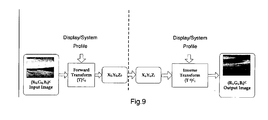
- the functions of the various elements shown in the figures, notably figure 9 may be provided through the use of dedicated hardware as well as hardware capable of executing software in association with appropriate software.
- the functions may be provided by a single dedicated processor, by a single shared processor, or by a plurality of individual processors, some of which may be shared.
- the software may be implemented as an application program tangibly embodied on a program storage unit.
- the application program may be uploaded to, and executed by, a machine comprising any suitable architecture.
- the machine is implemented on a computer platform having hardware such as one or more central processing units (“CPU"), a random access memory (“RAM”), and input/output ("I/O") interfaces.
- the computer platform may also include an operating system and microinstruction code.
- the various processes and functions described herein may be either part of the microinstruction code or part of the application program, or any combination thereof, which may be executed by a CPU.
- the total number of variables is 35 (normalized values at 35 wavelengths) and total number of observations is 108.
- the analysis was performed on LMS cone fundamentals, and the optimal LMS functions were then converted in a manner known per se into CMFs through a 3x3 transformation.
- a cluster analysis starts with undifferentiated groups and attempts to create clusters of objects (i.e. the CMFs) based on the similarities observed among a set of variables (i.e. CMF values at each wavelength). Variables are selected that maximally discriminate among objects (i.e. the CMFs). Increasing sample sizes result in increased cluster reliability.
- Partitioning method begins by partitioning the actual data (rather than similarity measures) into a specific number of clusters, and objects are assigned and reassigned in an iterative method to simultaneously minimize intra-cluster variability and maximize inter-cluster variability. This method was used as it is more likely to lead to a robust solution compared to other methods.
- the first phase used batch updates, in which each iteration consisted of reassigning objects to their nearest cluster centroid, all at once, followed by recalculation of cluster centroids.
- the second phase used online updates, in which objects were individually reassigned if doing so would reduce the sum of distances, and cluster centroids were recomputed after each reassignment.
- Each cluster in the partition is defined by its member objects and by its centroid, or center.
- Suitable wavelength ranges i.e. the number of variables
- Initial cluster centroid locations were selected by dividing 20-80 age range in equal parts and using corresponding CIE-2006 functions. Squared Euclidean distance measure (in LMS space) was used in this analysis. The clustering was repeated 20 times (with same initial cluster centroid positions). Optimal functions were obtained by taking the mean of cluster members.
- Each of the derived optimal sets of CMFs was then used to predict 47 Stiles-Burch observer data.
- the analysis was repeated to derive 3, 4, 5, 6 and 7 optimal sets of CMFs (in each set, one CMF for long-, medium- and short-wavelength range).
- 5 optimal sets of CMFs was found to be the minimal to meet the goal of achieving close to 1 unit of average colour difference ( ⁇ E* 00 ) for a wide range of colors, and for all Stiles-Burch observers.
- ⁇ E* 00 unit of average colour difference
- CIELAB colour coordinates were computed for all colour patches of a reference colour chart (as the 240 colour patches of the Colourchecker DCTM reference colour chart) with a CIE illuminant D65, by using i) real Stiles-Burch observer CMF data, ii) CIE 1964 10° standard observer functions and iii) all possible combinations of each of the optimal set of CMFs derived from the above cluster analysis. Then, for each observer, colour differences ( ⁇ E* 00 ) were computed between the CIELAB values obtained from real observer CMFs [case (i)] and those obtained from the predicted CMFs [case (ii) and (iii)].
- CMF Performance Index PI
- Table 2 shows which of the 125 combinations, and their constituent x-, y-, z- functions were picked for the reduced sets of 7 observer classes.
- 4 x-CMFs, 3 y-CMFs and 3 z-CMFs constitute the reduced sets.
- Total number of Stiles-Burch observers assigned to each set, as well as cumulative percent of observers covered are listed.
- combination 2 is made up of 1 st x-CMF, 1 st y-CMF and 2 nd z-CMF, satisfying the aforementioned ⁇ E* 00 criterion for 17 observers, which is 36.2% of Stiles-Burch observer pool.
- Combination 58 satisfies another 14 observers, so combinations 2 and 58 together satisfy 66% of Stiles-Burch observers, so on and so forth. As shown, these combinations were selected in an iterative process, excluding the observers satisfied by the prior combinations in the subsequent iterations.
- Table 2 Combination No X-CMF No Y-CMF No Z-CMF No Total Obs Iteration No %Obs Covered 2 1 1 2 17 1 36.2 58 3 2 3 14 2 66 6 1 2 1 8 3 83 33 2 2 3 4 4 91.5 81 4 2 1 2 5 95.7 63 3 3 3 1 6 97.9 76 4 1 1 1 7 100 Total Observers 47
- Figures 2 , 3 and 4 illustrate these seven optimal sets of CMFs, respectively for 4 x-CMFs, 3 y-CMFs and 3 z-CMFs.
- two different image display devices are needed : a reference image display device using a first set of primaries to display images, and a test image display device using a second set of primaries, different from the first one.
- the set of primaries of the reference image display device should have a spectral distribution different from the spectral distribution of the set of primaries of the test image display device.
- a CRT display device is used for the reference image display device
- an LCD device preferably with LED backlight
- the luminance of the full white was set close to 97 cd/m 2 .
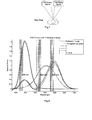
- Spectral power distributions of the two displays are illustrated on figure 5 , which shows that there is a significant difference between the spectral distribution of the primaries of the two image display devices, so that a colour match made on the two image display devices is highly metameric in nature, justifying the choice of these two image display devices for the observer classification.
- the LCD is representative of modern wide-gamut displays with peaky primaries.
- the CRT has a 10-bit HD/SDI input and the LCD has an 8-bit DVI input.
- any other image devices may also be used instead.
- the screens of the reference image display device and of the test image display device were placed side to side as illustrated on figure 7 .
- the two image display devices are characterized to know which spectral power distribution (SPD) can be obtained for any triplet (R,G,B) of control values applied to these image display devices.
- SPD spectral power distribution
- a pair of forward colour transforms and reverse colour transforms are used for each set of CMFs.
- the two image display devices are then characterized separately for various observers such that :
- the colour patches that produce the largest colour differences ( ⁇ E* 00 ) between the seven classes of observers may be advantageously selected, from the 240 colour patches of the Colourchecker DCTM reference colour chart, such as to get an efficient classification chart of colour patches.
- a "Test colour” refers to a given Colourchecker patch (CP) n whose spectral reflectance data are known. From the reflectance data, 10° standard observer CMFs and D 65 illuminant spectral power distribution, tristimulus values (X 0 ,Y 0 ,Z 0 ) are calculated.
- the reference display e.g. CRT
- the reference display inverse model gives a set of control signals (R,G,B) that generate each tristimulus values (X 0 ,Y 0 ,Z 0 ). From this set of control signals, the spectral power distribution (SPD) R n of the colour patch (CP) n displayed on the reference display can be predicted.
- the variance (square of standard deviation) of these seven root-mean-square distances was used as a metric to determine how suitable is a colour patch for observer classification. High variance indicated more variability among the seven versions of the test colour.
- Table 3 lists the first fifteen colour patches ("n" is the number of the colour patch CP as referenced in the reference colour chart) determined to be most suitable as test colours in the experimental setup for observer classification and forming a classification chart of colour patches. According to this determination, we found that these test colours are generally mostly different shades of green, green-yellow and blue-green and blue, but no or few shades of red are present. Table 3 Rank 1 2 3 4 5 6 7 8 9 10 11 12 13 14 15 "n" 92 34 153 158 191 49 197 54 196 216 36 39 48 49 211
- Figure 6 shows two variants of a block diagram of an embodiment of the observer calibration method, that uses the above defined seven sets of CMFs, each corresponding to a class of observers.
- triplets (R,G,B) of control signals are computed in order to display the same colour as the colour given by this spectral power distribution (SPD) n such that:
- each (CP) n of the 1 to N colour patches of the classification chart is successively displayed of both image display devices as follows:
- the number i of the matching stripe is then registered as corresponding, for this specific colour patch (CP) n , to the class i of the observer.
- CP colour patch
- one colour is displayed on the CRT and seven versions of the same colour are displayed on the LCD, one of which should ideally give the best match for a given observer. For example, an observer whose CMFs are closer to the set of CMFs of the first class than other set of CMFs, will find the 1 st version (i.e.
- one of the seven classes of observer CMFs that best correspond to this observer can be identified as being the class to which this observer belongs.
- the control of an image display device C that is used by this observer to watch images should be adapted according to the invention in order to allow this observer to perceive the displayed images as a standard observer would have perceived these images with a usual control of this image display device C.
- An aim of the invention is then to calibrate an image display device for a specific observer so that colour matches for a given observer across image display devices having different sets of CMFs can be improved, and disagreement among observers on displayed colour matches can be minimized. Achieving this goal will ensure that all colour matches are more predictable for individual observers, in spite of the variability in their colour vision characteristics.
- the images to display are generally available in standardized format as, for instance, ITU-R BT.709, such that the colours associated with each pixel of such images are expressed, for instance, in the YUV colour space, from which they may be converted, in a manner known per se, in a linear device-dependent RGB colour space and then in the linear device-independent CIE XYZ colour space.
- each pixel P n of an image can be represented by a trichromatic stimulus (X 0 ,Y 0 ,Z 0 ) n which corresponds to the perception of the colour of this pixel by a CIE standard observer.
- a wavelength-wise spectral power distribution (SPD) n can be associated with this trichromatic stimulus (X 0 , Y 0 , Z 0 ) n such that the following relations are met:
- Z 0 ⁇ ⁇ SPD n ⁇ z 0 ⁇ ⁇ ⁇ ⁇ ⁇
- [x 0 ( ⁇ ), y 0 ( ⁇ ), z 0 ( ⁇ )] is the set of CMFs of the standard observer.
- the image display device C to calibrate is characterized such that a relationship can be established between any trichromatic stimulus (X i , Y i , Z i ) for any given observer of a class i and any triplet (R,G,B) C of control signals applied to this image display device as follows:
- step 1 the input image given in the linear RGB color space is converted to an image in the linear CIE-XYZ color space using a forward transform based on the display profile, as routinely done in most colour management workflows.
- This XYZ image is based on 2° or 10° standard observer and is a device-independent colour representation. If step 1 is skipped, this process starts directly from the XYZ image as perceived by the standard observer. All colour transforms may be lookup tables. Thanks to the invention, (R i ,G i ,B i ) C control signals corresponding to any specific observer CMFs can be obtained. This is called the observer-specific output image.
- the display inverse colour transforms ( T -1 ) C i will generally be pre-computed for each of the seven sets of CMFs discussed above, when each set may correspond to a specific class of observers.
- this observer can now perceive the images displayed by this image display device C as a standard observer would have perceived these images with a usual control of this image display device C.
- this invention will enable a large range of observers having large variations of CMFs to have very similar perception of colours, allowing true comparison of these perceptions.
- This method for observer calibration can be advantageously exploited for improving colour matches for a given observer across image display devices with different spectral characteristics, and for reducing disagreement among individual observers on colour matches.
- An image display device that employs observer calibration can be easily configured to switch from one observer to the other by the push of a button, much like any other configurable colour parameters like gamma, colour temperature etc. that are available in most good-quality image display devices.
Landscapes
- Physics & Mathematics (AREA)
- Spectroscopy & Molecular Physics (AREA)
- General Physics & Mathematics (AREA)
- Engineering & Computer Science (AREA)
- Theoretical Computer Science (AREA)
- Mathematical Physics (AREA)
- Computer Hardware Design (AREA)
- Control Of Indicators Other Than Cathode Ray Tubes (AREA)
- Controls And Circuits For Display Device (AREA)
Priority Applications (4)
| Application Number | Priority Date | Filing Date | Title |
|---|---|---|---|
| EP10290194A EP2375230A1 (de) | 2010-04-09 | 2010-04-09 | Verfahren zur Steuerung einer Bildanzeigevorrichtung, um die gleiche Farbwahrnehmung für eine Vielzahl von Beobachtern zu gewährleisten |
| US13/640,103 US20130033528A1 (en) | 2010-04-09 | 2011-04-08 | Method for controlling an image display device to allow the same perception of colours over a large variety of observers |
| EP11712885A EP2556348A1 (de) | 2010-04-09 | 2011-04-08 | Verfahren zur steuerung einer bildanzeigevorrichtung zur gewährleistung der gleichen farbwahrnehmung für eine vielzahl von beobachtern |
| PCT/EP2011/055542 WO2011124699A1 (en) | 2010-04-09 | 2011-04-08 | Method for controlling an image display device to allow the same perception of colours over a large variety of observers |
Applications Claiming Priority (1)
| Application Number | Priority Date | Filing Date | Title |
|---|---|---|---|
| EP10290194A EP2375230A1 (de) | 2010-04-09 | 2010-04-09 | Verfahren zur Steuerung einer Bildanzeigevorrichtung, um die gleiche Farbwahrnehmung für eine Vielzahl von Beobachtern zu gewährleisten |
Publications (1)
| Publication Number | Publication Date |
|---|---|
| EP2375230A1 true EP2375230A1 (de) | 2011-10-12 |
Family
ID=42355358
Family Applications (2)
| Application Number | Title | Priority Date | Filing Date |
|---|---|---|---|
| EP10290194A Withdrawn EP2375230A1 (de) | 2010-04-09 | 2010-04-09 | Verfahren zur Steuerung einer Bildanzeigevorrichtung, um die gleiche Farbwahrnehmung für eine Vielzahl von Beobachtern zu gewährleisten |
| EP11712885A Ceased EP2556348A1 (de) | 2010-04-09 | 2011-04-08 | Verfahren zur steuerung einer bildanzeigevorrichtung zur gewährleistung der gleichen farbwahrnehmung für eine vielzahl von beobachtern |
Family Applications After (1)
| Application Number | Title | Priority Date | Filing Date |
|---|---|---|---|
| EP11712885A Ceased EP2556348A1 (de) | 2010-04-09 | 2011-04-08 | Verfahren zur steuerung einer bildanzeigevorrichtung zur gewährleistung der gleichen farbwahrnehmung für eine vielzahl von beobachtern |
Country Status (3)
| Country | Link |
|---|---|
| US (1) | US20130033528A1 (de) |
| EP (2) | EP2375230A1 (de) |
| WO (1) | WO2011124699A1 (de) |
Cited By (3)
| Publication number | Priority date | Publication date | Assignee | Title |
|---|---|---|---|---|
| WO2014018700A1 (en) * | 2012-07-27 | 2014-01-30 | Eastman Kodak Company | Observer metameric failure compensation method |
| WO2014018701A1 (en) * | 2012-07-27 | 2014-01-30 | Eastman Kodak Company | Display system providing observer metameric failure reduction |
| WO2014018514A1 (en) * | 2012-07-27 | 2014-01-30 | Eastman Kodak Company | Observer metameric failure reduction method |
Families Citing this family (14)
| Publication number | Priority date | Publication date | Assignee | Title |
|---|---|---|---|---|
| EP2743657B1 (de) | 2012-12-13 | 2016-03-02 | Thomson Licensing | Verfahren zur Steuerung einer Bildanzeigevorrichtung um zu ermöglichen, dass ein Beobachter Farben wahrnehmen kann wie ein anderer Beobachter |
| JP6234041B2 (ja) * | 2013-03-11 | 2017-11-22 | キヤノン株式会社 | 画像表示装置及びその制御方法 |
| HUE032787T2 (en) * | 2014-11-11 | 2017-10-30 | Instrument Systems Optische Messtechnik Gmbh | Calibration colorimeter |
| US10769817B2 (en) | 2017-08-07 | 2020-09-08 | Samsung Display Co., Ltd. | Measures for image testing |
| US10267677B1 (en) | 2018-04-03 | 2019-04-23 | Microsoft Technology Licensing, Llc | Calibrated brightness estimation using ambient color sensors |
| US10648862B2 (en) | 2018-04-03 | 2020-05-12 | Microsoft Technology Licensing, Llc | Color sensing ambient light sensor calibration |
| GB201806945D0 (en) * | 2018-04-27 | 2018-06-13 | Univ Manchester | Apparatus and method for processing colour image data |
| US10345151B1 (en) * | 2018-05-02 | 2019-07-09 | Microsoft Technology Licensing, Llc | Use of multiple calibrated ambient color sensor measurements to generate a single colorimetric value |
| WO2020232032A1 (en) * | 2019-05-13 | 2020-11-19 | Dolby Laboratories Licensing Corporation | Metameric stabilization via custom viewer color matching function |
| US12282694B2 (en) | 2019-10-21 | 2025-04-22 | Rensselaer Polytechnic Institute | Smart visual display |
| JPWO2021149444A1 (de) * | 2020-01-22 | 2021-07-29 | ||
| WO2023094276A1 (en) | 2021-11-25 | 2023-06-01 | Interdigital Vc Holdings France, Sas | Methods and devices for perception-based rendering |
| CN116026770B (zh) * | 2023-01-18 | 2023-07-04 | 广州番禺职业技术学院 | 白玉-青玉颜色分类分级的测定方法、评定方法及装置 |
| CN119252206B (zh) * | 2024-01-23 | 2025-12-02 | 荣耀终端股份有限公司 | 一种显示色彩校正方法和设备 |
Family Cites Families (3)
| Publication number | Priority date | Publication date | Assignee | Title |
|---|---|---|---|---|
| US5956015A (en) * | 1995-12-18 | 1999-09-21 | Ricoh Company, Ltd. | Method and system for correcting color display based upon ambient light |
| KR101213205B1 (ko) * | 2006-11-23 | 2012-12-17 | 삼성전자주식회사 | 컬러 재현 시스템 및 방법 |
| JP5111295B2 (ja) * | 2007-09-12 | 2013-01-09 | キヤノン株式会社 | 色処理装置およびその方法 |
-
2010
- 2010-04-09 EP EP10290194A patent/EP2375230A1/de not_active Withdrawn
-
2011
- 2011-04-08 WO PCT/EP2011/055542 patent/WO2011124699A1/en not_active Ceased
- 2011-04-08 EP EP11712885A patent/EP2556348A1/de not_active Ceased
- 2011-04-08 US US13/640,103 patent/US20130033528A1/en not_active Abandoned
Non-Patent Citations (8)
| Title |
|---|
| BERGQUIST J: "52.2: Display with Arbitrary Primary Spectra", SID SYMPOSIUM DIGEST OF TECHNICAL PAPERS, vol. 39, no. 1, May 2008 (2008-05-01), pages 783 - 786, XP002594657 * |
| FAIRCHILD M. D.; WYBLE D. R.: "Mean Observer Metamerism and the Selection of Display Primaries", FINAL PROGRAM AND PROCEEDINGS-IS&T/SID COLOUR IMAGING CONFERENCE, 2007, pages 151 - 156 |
| KÖNIG F ET AL: "Multiprimary display: discounting observer metamerism", PROC. SPIE, vol. 4421, 9 October 2003 (2003-10-09), pages 898 - 901, XP002594655 * |
| MASAHIRO YAMAGUCHI ET AL: "Color image reproduction based on the multispectral and multispectral and multiprimary imaging: Experimental evaluation", PROCEEDINGS OF THE INTERNATIONAL SOCIETY FOR OPTICAL ENGINEERING (SPIE), SPIE, USA, vol. 4663, 1 January 2002 (2002-01-01), pages 15 - 26, XP002311068, ISSN: 0277-786X * |
| MURAKAMI Y ET AL: "Color conversion method for multi-primary display for spectral color reproduction", J ELECTRON IMAGING, vol. 13, 30 September 2004 (2004-09-30), pages 701 - 708, XP002594656 * |
| RAMANATH R.: "Minimizing Observer Metamerism in Display System", COLOUR RES. & APPL., vol. 34, no. 5, 2009, pages 391 - 398 |
| RAMANATH R: "Minimizing observer metamerism in display systems", COLOUR RESEACH AND APPLICATION, vol. 34, no. 5, 4 August 2009 (2009-08-04), pages 391 - 398, XP002594590 * |
| SARKAR A.; BLONDE L.; LE CALLET P.; AUTRUSSEAU F.; STAUDER J.; MORVAN P.: "Study of Observer Variability on Modern Display Colourimetry: Comparison of CIE 2006 Model and 10° Standard Observer", FINAL PROGRAM AND PROCEEDINGS, THE 11 TH CONGRESS OF THE INTERNATIONAL COLOUR ASSOCIATION, 2009 |
Cited By (17)
| Publication number | Priority date | Publication date | Assignee | Title |
|---|---|---|---|---|
| WO2014018700A1 (en) * | 2012-07-27 | 2014-01-30 | Eastman Kodak Company | Observer metameric failure compensation method |
| WO2014018701A1 (en) * | 2012-07-27 | 2014-01-30 | Eastman Kodak Company | Display system providing observer metameric failure reduction |
| WO2014018514A1 (en) * | 2012-07-27 | 2014-01-30 | Eastman Kodak Company | Observer metameric failure reduction method |
| US8941678B2 (en) | 2012-07-27 | 2015-01-27 | Eastman Kodak Company | Display system providing observer metameric failure reduction |
| CN104509106A (zh) * | 2012-07-27 | 2015-04-08 | 伊斯曼柯达公司 | 观察者同色异谱故障补偿方法 |
| CN104509104A (zh) * | 2012-07-27 | 2015-04-08 | 伊斯曼柯达公司 | 观察者同色异谱故障减小方法 |
| CN104509105A (zh) * | 2012-07-27 | 2015-04-08 | 伊斯曼柯达公司 | 提供观察者同色异谱故障减小的显示系统 |
| JP2015525038A (ja) * | 2012-07-27 | 2015-08-27 | イーストマン コダック カンパニー | 観測者間メタメリズム不一致軽減をもたらす表示システム |
| JP2015525037A (ja) * | 2012-07-27 | 2015-08-27 | イーストマン コダック カンパニー | 観測者間メタメリズム不一致低減方法 |
| US9134178B2 (en) | 2012-07-27 | 2015-09-15 | Imax Corporation | Observer metameric failure compensation method |
| US9140607B2 (en) | 2012-07-27 | 2015-09-22 | Imax Corporation | Observer metameric failure reduction method |
| CN104509105B (zh) * | 2012-07-27 | 2016-10-12 | 图像影院国际有限公司 | 提供观察者同色异谱故障减小的显示系统 |
| CN104509104B (zh) * | 2012-07-27 | 2016-10-12 | 图像影院国际有限公司 | 观察者同色异谱故障减小方法 |
| CN104509106B (zh) * | 2012-07-27 | 2017-05-31 | 图像影院国际有限公司 | 观察者同色异谱故障补偿方法 |
| CN107404638A (zh) * | 2012-07-27 | 2017-11-28 | 图像影院国际有限公司 | 观察者同色异谱故障补偿方法及系统 |
| US9888153B2 (en) | 2012-07-27 | 2018-02-06 | Imax Theatres International Limited | Observer metameric failure compensation method and system |
| CN107404638B (zh) * | 2012-07-27 | 2019-04-16 | 图像影院国际有限公司 | 观察者同色异谱故障补偿方法及系统 |
Also Published As
| Publication number | Publication date |
|---|---|
| WO2011124699A1 (en) | 2011-10-13 |
| US20130033528A1 (en) | 2013-02-07 |
| EP2556348A1 (de) | 2013-02-13 |
Similar Documents
| Publication | Publication Date | Title |
|---|---|---|
| EP2375230A1 (de) | Verfahren zur Steuerung einer Bildanzeigevorrichtung, um die gleiche Farbwahrnehmung für eine Vielzahl von Beobachtern zu gewährleisten | |
| US8532371B2 (en) | Method and apparatus for evaluating color in an image | |
| US7218358B2 (en) | Method and apparatus for calibrating color temperature of color display devices | |
| Alfvin et al. | Observer variability in metameric color matches using color reproduction media | |
| US8988682B2 (en) | High accuracy imaging colorimeter by special designed pattern closed-loop calibration assisted by spectrograph | |
| CN109506781B (zh) | 一种色度测量方法及装置 | |
| CN115131221A (zh) | 颜色校正方法、可校正显示方法、电子装置及芯片 | |
| Bodner et al. | 78‐1: Correcting Metameric Failure of Wide Color Gamut Displays | |
| CN106448525A (zh) | 医用显示器色彩均匀性测量系统及其测量方法 | |
| US8565521B2 (en) | Apparatus for the classification of observers according to their visual characteristics | |
| US9036030B2 (en) | Color calibration of an image capture device in a way that is adaptive to the scene to be captured | |
| CN108844632A (zh) | 一种不同显示设备间观察者同色异谱差异的评价方法 | |
| Sarkar et al. | Toward reducing observer metamerism in industrial applications: colorimetric observer categories and observer classification | |
| Gijsenij et al. | A perceptual comparison of distance measures for color constancy algorithms | |
| EP2375229A1 (de) | Verfahren zur Klassifizierung von Beobachtern entsprechend ihrer visuellen Eigenschaften | |
| CN120467658A (zh) | 光源颜色偏好度评测方法、装置、设备及存储介质 | |
| US7688468B2 (en) | Method of illuminant adaptation | |
| EP2743657B1 (de) | Verfahren zur Steuerung einer Bildanzeigevorrichtung um zu ermöglichen, dass ein Beobachter Farben wahrnehmen kann wie ein anderer Beobachter | |
| CN109508724B (zh) | 用聚类分析分类观察者颜色匹配函数的方法 | |
| EP3035014A1 (de) | Vorrichtung zum Vergleichen und/oder Klassifizieren der Farbempfindungseigenschaften von Beobachtern | |
| Marguier et al. | Color correction of uncalibrated images for the classification of human skin color | |
| Ling et al. | Surface chromaticity distributions of natural objects under changing illumination | |
| Sarkar et al. | Study of observer variability in modern display colorimetry: comparison of CIE 2006 model and 10 standard observer | |
| Zhang et al. | Effect of Display Characteristics and Color Reproduction Method in Computerized Color Vision Test | |
| Huo et al. | LCD colorimetric characterization based on quadratic polynomial |
Legal Events
| Date | Code | Title | Description |
|---|---|---|---|
| PUAI | Public reference made under article 153(3) epc to a published international application that has entered the european phase |
Free format text: ORIGINAL CODE: 0009012 |
|
| AK | Designated contracting states |
Kind code of ref document: A1 Designated state(s): AT BE BG CH CY CZ DE DK EE ES FI FR GB GR HR HU IE IS IT LI LT LU LV MC MK MT NL NO PL PT RO SE SI SK SM TR |
|
| AX | Request for extension of the european patent |
Extension state: AL BA ME RS |
|
| STAA | Information on the status of an ep patent application or granted ep patent |
Free format text: STATUS: THE APPLICATION IS DEEMED TO BE WITHDRAWN |
|
| 18D | Application deemed to be withdrawn |
Effective date: 20120413 |