EP2376482B1 - Substituierte (thiophenyl-carbonyl)imidazolidinone und ihre verwendung - Google Patents
Substituierte (thiophenyl-carbonyl)imidazolidinone und ihre verwendung Download PDFInfo
- Publication number
- EP2376482B1 EP2376482B1 EP09796960A EP09796960A EP2376482B1 EP 2376482 B1 EP2376482 B1 EP 2376482B1 EP 09796960 A EP09796960 A EP 09796960A EP 09796960 A EP09796960 A EP 09796960A EP 2376482 B1 EP2376482 B1 EP 2376482B1
- Authority
- EP
- European Patent Office
- Prior art keywords
- cyano
- halogen
- compound
- alkoxy
- salts
- Prior art date
- Legal status (The legal status is an assumption and is not a legal conclusion. Google has not performed a legal analysis and makes no representation as to the accuracy of the status listed.)
- Not-in-force
Links
- LYYICWHTWUPNLC-UHFFFAOYSA-N 1-(thiophene-2-carbonyl)imidazolidin-2-one Chemical class C=1C=CSC=1C(=O)N1CCNC1=O LYYICWHTWUPNLC-UHFFFAOYSA-N 0.000 title description 3
- 150000001875 compounds Chemical class 0.000 claims description 202
- -1 cyano, hydroxy Chemical group 0.000 claims description 85
- 125000004093 cyano group Chemical group *C#N 0.000 claims description 73
- 239000012453 solvate Substances 0.000 claims description 72
- 229910052736 halogen Inorganic materials 0.000 claims description 66
- 150000002367 halogens Chemical class 0.000 claims description 66
- 238000000034 method Methods 0.000 claims description 63
- 150000003839 salts Chemical class 0.000 claims description 58
- 125000001997 phenyl group Chemical group [H]C1=C([H])C([H])=C(*)C([H])=C1[H] 0.000 claims description 52
- ZAMOUSCENKQFHK-UHFFFAOYSA-N Chlorine atom Chemical group [Cl] ZAMOUSCENKQFHK-UHFFFAOYSA-N 0.000 claims description 35
- 125000000229 (C1-C4)alkoxy group Chemical group 0.000 claims description 34
- 241000700605 Viruses Species 0.000 claims description 34
- 125000001424 substituent group Chemical group 0.000 claims description 34
- 125000002023 trifluoromethyl group Chemical group FC(F)(F)* 0.000 claims description 32
- 125000004178 (C1-C4) alkyl group Chemical group 0.000 claims description 29
- PXGOKWXKJXAPGV-UHFFFAOYSA-N Fluorine Chemical group FF PXGOKWXKJXAPGV-UHFFFAOYSA-N 0.000 claims description 28
- 239000000460 chlorine Chemical group 0.000 claims description 26
- 238000011282 treatment Methods 0.000 claims description 26
- 208000037265 diseases, disorders, signs and symptoms Diseases 0.000 claims description 25
- 201000010099 disease Diseases 0.000 claims description 24
- 229910052801 chlorine Inorganic materials 0.000 claims description 22
- 125000000876 trifluoromethoxy group Chemical group FC(F)(F)O* 0.000 claims description 22
- 125000002887 hydroxy group Chemical group [H]O* 0.000 claims description 21
- 229910052739 hydrogen Inorganic materials 0.000 claims description 19
- 239000001257 hydrogen Substances 0.000 claims description 19
- 239000011737 fluorine Substances 0.000 claims description 18
- 229910052731 fluorine Inorganic materials 0.000 claims description 18
- 125000002924 primary amino group Chemical group [H]N([H])* 0.000 claims description 18
- 239000003814 drug Substances 0.000 claims description 17
- 208000015181 infectious disease Diseases 0.000 claims description 16
- 238000011321 prophylaxis Methods 0.000 claims description 16
- GVONPBONFIJAHJ-UHFFFAOYSA-N imidazolidin-4-one Chemical compound O=C1CNCN1 GVONPBONFIJAHJ-UHFFFAOYSA-N 0.000 claims description 14
- 125000000623 heterocyclic group Chemical group 0.000 claims description 12
- 125000000449 nitro group Chemical group [O-][N+](*)=O 0.000 claims description 12
- 125000005034 trifluormethylthio group Chemical group FC(S*)(F)F 0.000 claims description 12
- 125000006272 (C3-C7) cycloalkyl group Chemical group 0.000 claims description 11
- 238000006069 Suzuki reaction reaction Methods 0.000 claims description 9
- 125000004043 oxo group Chemical group O=* 0.000 claims description 9
- LZPWAYBEOJRFAX-UHFFFAOYSA-N 4,4,5,5-tetramethyl-1,3,2$l^{2}-dioxaborolane Chemical compound CC1(C)O[B]OC1(C)C LZPWAYBEOJRFAX-UHFFFAOYSA-N 0.000 claims description 7
- 125000000753 cycloalkyl group Chemical group 0.000 claims description 6
- 125000002496 methyl group Chemical group [H]C([H])([H])* 0.000 claims description 6
- 230000001177 retroviral effect Effects 0.000 claims description 6
- 238000004519 manufacturing process Methods 0.000 claims description 5
- 125000006274 (C1-C3)alkoxy group Chemical group 0.000 claims description 3
- 125000000956 methoxy group Chemical group [H]C([H])([H])O* 0.000 claims description 3
- 231100000252 nontoxic Toxicity 0.000 claims description 3
- 230000003000 nontoxic effect Effects 0.000 claims description 3
- 239000000546 pharmaceutical excipient Substances 0.000 claims description 3
- 125000004435 hydrogen atom Chemical group [H]* 0.000 claims 6
- 125000001309 chloro group Chemical group Cl* 0.000 claims 2
- 125000001153 fluoro group Chemical group F* 0.000 claims 2
- WEVYAHXRMPXWCK-UHFFFAOYSA-N Acetonitrile Chemical compound CC#N WEVYAHXRMPXWCK-UHFFFAOYSA-N 0.000 description 93
- BDAGIHXWWSANSR-UHFFFAOYSA-N methanoic acid Natural products OC=O BDAGIHXWWSANSR-UHFFFAOYSA-N 0.000 description 58
- XEKOWRVHYACXOJ-UHFFFAOYSA-N Ethyl acetate Chemical compound CCOC(C)=O XEKOWRVHYACXOJ-UHFFFAOYSA-N 0.000 description 51
- 239000000126 substance Substances 0.000 description 48
- XLYOFNOQVPJJNP-UHFFFAOYSA-N water Substances O XLYOFNOQVPJJNP-UHFFFAOYSA-N 0.000 description 44
- 210000004027 cell Anatomy 0.000 description 41
- YMWUJEATGCHHMB-UHFFFAOYSA-N Dichloromethane Chemical compound ClCCl YMWUJEATGCHHMB-UHFFFAOYSA-N 0.000 description 39
- 239000003480 eluent Substances 0.000 description 39
- 238000012360 testing method Methods 0.000 description 37
- IAZDPXIOMUYVGZ-UHFFFAOYSA-N Dimethylsulphoxide Chemical compound CS(C)=O IAZDPXIOMUYVGZ-UHFFFAOYSA-N 0.000 description 36
- WYURNTSHIVDZCO-UHFFFAOYSA-N Tetrahydrofuran Chemical compound C1CCOC1 WYURNTSHIVDZCO-UHFFFAOYSA-N 0.000 description 34
- 239000000203 mixture Substances 0.000 description 34
- 238000005160 1H NMR spectroscopy Methods 0.000 description 33
- 238000004895 liquid chromatography mass spectrometry Methods 0.000 description 33
- XKRFYHLGVUSROY-UHFFFAOYSA-N Argon Chemical compound [Ar] XKRFYHLGVUSROY-UHFFFAOYSA-N 0.000 description 30
- OSWFIVFLDKOXQC-UHFFFAOYSA-N 4-(3-methoxyphenyl)aniline Chemical compound COC1=CC=CC(C=2C=CC(N)=CC=2)=C1 OSWFIVFLDKOXQC-UHFFFAOYSA-N 0.000 description 29
- 235000019253 formic acid Nutrition 0.000 description 29
- XTHFKEDIFFGKHM-UHFFFAOYSA-N Dimethoxyethane Chemical compound COCCOC XTHFKEDIFFGKHM-UHFFFAOYSA-N 0.000 description 28
- 239000000243 solution Substances 0.000 description 28
- OKKJLVBELUTLKV-UHFFFAOYSA-N Methanol Chemical compound OC OKKJLVBELUTLKV-UHFFFAOYSA-N 0.000 description 21
- 241000725303 Human immunodeficiency virus Species 0.000 description 19
- UFHFLCQGNIYNRP-UHFFFAOYSA-N Hydrogen Chemical compound [H][H] UFHFLCQGNIYNRP-UHFFFAOYSA-N 0.000 description 19
- WMFOQBRAJBCJND-UHFFFAOYSA-M lithium hydroxide Inorganic materials [Li+].[OH-] WMFOQBRAJBCJND-UHFFFAOYSA-M 0.000 description 19
- QTBSBXVTEAMEQO-UHFFFAOYSA-N Acetic acid Chemical compound CC(O)=O QTBSBXVTEAMEQO-UHFFFAOYSA-N 0.000 description 18
- RTZKZFJDLAIYFH-UHFFFAOYSA-N Diethyl ether Chemical compound CCOCC RTZKZFJDLAIYFH-UHFFFAOYSA-N 0.000 description 18
- YXFVVABEGXRONW-UHFFFAOYSA-N Toluene Chemical compound CC1=CC=CC=C1 YXFVVABEGXRONW-UHFFFAOYSA-N 0.000 description 18
- 239000011541 reaction mixture Substances 0.000 description 18
- YLQBMQCUIZJEEH-UHFFFAOYSA-N tetrahydrofuran Natural products C=1C=COC=1 YLQBMQCUIZJEEH-UHFFFAOYSA-N 0.000 description 17
- UIIMBOGNXHQVGW-UHFFFAOYSA-M Sodium bicarbonate Chemical compound [Na+].OC([O-])=O UIIMBOGNXHQVGW-UHFFFAOYSA-M 0.000 description 16
- LFQSCWFLJHTTHZ-UHFFFAOYSA-N Ethanol Chemical compound CCO LFQSCWFLJHTTHZ-UHFFFAOYSA-N 0.000 description 15
- 101000610640 Homo sapiens U4/U6 small nuclear ribonucleoprotein Prp3 Proteins 0.000 description 15
- 101710122864 Major tegument protein Proteins 0.000 description 15
- ZMXDDKWLCZADIW-UHFFFAOYSA-N N,N-Dimethylformamide Chemical compound CN(C)C=O ZMXDDKWLCZADIW-UHFFFAOYSA-N 0.000 description 15
- 101710148592 PTS system fructose-like EIIA component Proteins 0.000 description 15
- 101710169713 PTS system fructose-specific EIIA component Proteins 0.000 description 15
- 101001110823 Saccharomyces cerevisiae (strain ATCC 204508 / S288c) 60S ribosomal protein L6-A Proteins 0.000 description 15
- 101000712176 Saccharomyces cerevisiae (strain ATCC 204508 / S288c) 60S ribosomal protein L6-B Proteins 0.000 description 15
- 101710199973 Tail tube protein Proteins 0.000 description 15
- 102100040374 U4/U6 small nuclear ribonucleoprotein Prp3 Human genes 0.000 description 15
- 229910052786 argon Inorganic materials 0.000 description 15
- 238000004128 high performance liquid chromatography Methods 0.000 description 15
- 239000003112 inhibitor Substances 0.000 description 15
- NFHFRUOZVGFOOS-UHFFFAOYSA-N palladium;triphenylphosphane Chemical compound [Pd].C1=CC=CC=C1P(C=1C=CC=CC=1)C1=CC=CC=C1.C1=CC=CC=C1P(C=1C=CC=CC=1)C1=CC=CC=C1.C1=CC=CC=C1P(C=1C=CC=CC=1)C1=CC=CC=C1.C1=CC=CC=C1P(C=1C=CC=CC=1)C1=CC=CC=C1 NFHFRUOZVGFOOS-UHFFFAOYSA-N 0.000 description 15
- 238000002953 preparative HPLC Methods 0.000 description 15
- 102100034349 Integrase Human genes 0.000 description 14
- 238000002360 preparation method Methods 0.000 description 14
- JGFZNNIVVJXRND-UHFFFAOYSA-N N,N-Diisopropylethylamine (DIPEA) Chemical compound CCN(C(C)C)C(C)C JGFZNNIVVJXRND-UHFFFAOYSA-N 0.000 description 13
- 108010092799 RNA-directed DNA polymerase Proteins 0.000 description 13
- ZMANZCXQSJIPKH-UHFFFAOYSA-N Triethylamine Chemical compound CCN(CC)CC ZMANZCXQSJIPKH-UHFFFAOYSA-N 0.000 description 12
- 239000002904 solvent Substances 0.000 description 12
- 208000030507 AIDS Diseases 0.000 description 11
- 241000713772 Human immunodeficiency virus 1 Species 0.000 description 11
- 230000015572 biosynthetic process Effects 0.000 description 11
- 238000003786 synthesis reaction Methods 0.000 description 11
- 241000282414 Homo sapiens Species 0.000 description 10
- 239000002585 base Substances 0.000 description 10
- VLKZOEOYAKHREP-UHFFFAOYSA-N n-Hexane Chemical group CCCCCC VLKZOEOYAKHREP-UHFFFAOYSA-N 0.000 description 10
- 238000000825 ultraviolet detection Methods 0.000 description 10
- UHOVQNZJYSORNB-UHFFFAOYSA-N Benzene Chemical compound C1=CC=CC=C1 UHOVQNZJYSORNB-UHFFFAOYSA-N 0.000 description 9
- PMZURENOXWZQFD-UHFFFAOYSA-L Sodium Sulfate Chemical compound [Na+].[Na+].[O-]S([O-])(=O)=O PMZURENOXWZQFD-UHFFFAOYSA-L 0.000 description 9
- 229910052757 nitrogen Inorganic materials 0.000 description 9
- 239000012074 organic phase Substances 0.000 description 9
- 229910052938 sodium sulfate Inorganic materials 0.000 description 9
- 235000011152 sodium sulphate Nutrition 0.000 description 9
- RYHBNJHYFVUHQT-UHFFFAOYSA-N 1,4-Dioxane Chemical compound C1COCCO1 RYHBNJHYFVUHQT-UHFFFAOYSA-N 0.000 description 8
- 241000282472 Canis lupus familiaris Species 0.000 description 8
- KWYUFKZDYYNOTN-UHFFFAOYSA-M Potassium hydroxide Chemical compound [OH-].[K+] KWYUFKZDYYNOTN-UHFFFAOYSA-M 0.000 description 8
- 239000012980 RPMI-1640 medium Substances 0.000 description 8
- 238000003556 assay Methods 0.000 description 8
- 238000010790 dilution Methods 0.000 description 8
- 239000012895 dilution Substances 0.000 description 8
- 238000002290 gas chromatography-mass spectrometry Methods 0.000 description 8
- 238000011534 incubation Methods 0.000 description 8
- 210000004185 liver Anatomy 0.000 description 8
- 230000003228 microsomal effect Effects 0.000 description 8
- UUEVFMOUBSLVJW-UHFFFAOYSA-N oxo-[[1-[2-[2-[2-[4-(oxoazaniumylmethylidene)pyridin-1-yl]ethoxy]ethoxy]ethyl]pyridin-4-ylidene]methyl]azanium;dibromide Chemical compound [Br-].[Br-].C1=CC(=C[NH+]=O)C=CN1CCOCCOCCN1C=CC(=C[NH+]=O)C=C1 UUEVFMOUBSLVJW-UHFFFAOYSA-N 0.000 description 8
- 229910000030 sodium bicarbonate Inorganic materials 0.000 description 8
- 235000017557 sodium bicarbonate Nutrition 0.000 description 8
- CDBYLPFSWZWCQE-UHFFFAOYSA-L sodium carbonate Substances [Na+].[Na+].[O-]C([O-])=O CDBYLPFSWZWCQE-UHFFFAOYSA-L 0.000 description 8
- 239000000725 suspension Substances 0.000 description 8
- 241000700159 Rattus Species 0.000 description 7
- 210000004369 blood Anatomy 0.000 description 7
- 239000008280 blood Substances 0.000 description 7
- 230000037396 body weight Effects 0.000 description 7
- 238000006243 chemical reaction Methods 0.000 description 7
- 239000012043 crude product Substances 0.000 description 7
- 239000012442 inert solvent Substances 0.000 description 7
- LXNAVEXFUKBNMK-UHFFFAOYSA-N palladium(II) acetate Substances [Pd].CC(O)=O.CC(O)=O LXNAVEXFUKBNMK-UHFFFAOYSA-N 0.000 description 7
- YJVFFLUZDVXJQI-UHFFFAOYSA-L palladium(ii) acetate Chemical compound [Pd+2].CC([O-])=O.CC([O-])=O YJVFFLUZDVXJQI-UHFFFAOYSA-L 0.000 description 7
- 230000008569 process Effects 0.000 description 7
- 150000003254 radicals Chemical class 0.000 description 7
- 239000003826 tablet Substances 0.000 description 7
- DENPQNAWGQXKCU-UHFFFAOYSA-N thiophene-2-carboxamide Chemical class NC(=O)C1=CC=CS1 DENPQNAWGQXKCU-UHFFFAOYSA-N 0.000 description 7
- WKBOTKDWSSQWDR-UHFFFAOYSA-N Bromine atom Chemical compound [Br] WKBOTKDWSSQWDR-UHFFFAOYSA-N 0.000 description 6
- 241000283707 Capra Species 0.000 description 6
- XDTMQSROBMDMFD-UHFFFAOYSA-N Cyclohexane Chemical compound C1CCCCC1 XDTMQSROBMDMFD-UHFFFAOYSA-N 0.000 description 6
- 208000031886 HIV Infections Diseases 0.000 description 6
- CSNNHWWHGAXBCP-UHFFFAOYSA-L Magnesium sulfate Chemical compound [Mg+2].[O-][S+2]([O-])([O-])[O-] CSNNHWWHGAXBCP-UHFFFAOYSA-L 0.000 description 6
- 241001465754 Metazoa Species 0.000 description 6
- 241000699670 Mus sp. Species 0.000 description 6
- SJRJJKPEHAURKC-UHFFFAOYSA-N N-Methylmorpholine Chemical compound CN1CCOCC1 SJRJJKPEHAURKC-UHFFFAOYSA-N 0.000 description 6
- GDTBXPJZTBHREO-UHFFFAOYSA-N bromine Substances BrBr GDTBXPJZTBHREO-UHFFFAOYSA-N 0.000 description 6
- 229910052794 bromium Inorganic materials 0.000 description 6
- 229910000024 caesium carbonate Inorganic materials 0.000 description 6
- 125000004432 carbon atom Chemical group C* 0.000 description 6
- 239000003153 chemical reaction reagent Substances 0.000 description 6
- 230000000694 effects Effects 0.000 description 6
- 238000011156 evaluation Methods 0.000 description 6
- 150000002431 hydrogen Chemical class 0.000 description 6
- 239000012071 phase Substances 0.000 description 6
- SCVFZCLFOSHCOH-UHFFFAOYSA-M potassium acetate Chemical compound [K+].CC([O-])=O SCVFZCLFOSHCOH-UHFFFAOYSA-M 0.000 description 6
- 108090000623 proteins and genes Proteins 0.000 description 6
- 239000003643 water by type Substances 0.000 description 6
- 206010001513 AIDS related complex Diseases 0.000 description 5
- 108060001084 Luciferase Proteins 0.000 description 5
- 239000005089 Luciferase Substances 0.000 description 5
- VYPSYNLAJGMNEJ-UHFFFAOYSA-N Silicium dioxide Chemical compound O=[Si]=O VYPSYNLAJGMNEJ-UHFFFAOYSA-N 0.000 description 5
- 230000002378 acidificating effect Effects 0.000 description 5
- 125000003545 alkoxy group Chemical group 0.000 description 5
- 125000000217 alkyl group Chemical group 0.000 description 5
- FJDQFPXHSGXQBY-UHFFFAOYSA-L caesium carbonate Chemical compound [Cs+].[Cs+].[O-]C([O-])=O FJDQFPXHSGXQBY-UHFFFAOYSA-L 0.000 description 5
- 239000003054 catalyst Substances 0.000 description 5
- 230000002440 hepatic effect Effects 0.000 description 5
- 238000001727 in vivo Methods 0.000 description 5
- 239000002953 phosphate buffered saline Substances 0.000 description 5
- BWHMMNNQKKPAPP-UHFFFAOYSA-L potassium carbonate Chemical compound [K+].[K+].[O-]C([O-])=O BWHMMNNQKKPAPP-UHFFFAOYSA-L 0.000 description 5
- 102000004169 proteins and genes Human genes 0.000 description 5
- 229910000029 sodium carbonate Inorganic materials 0.000 description 5
- HEMHJVSKTPXQMS-UHFFFAOYSA-M sodium hydroxide Inorganic materials [OH-].[Na+] HEMHJVSKTPXQMS-UHFFFAOYSA-M 0.000 description 5
- 239000007787 solid Substances 0.000 description 5
- 241000894007 species Species 0.000 description 5
- UGOMMVLRQDMAQQ-UHFFFAOYSA-N xphos Chemical compound CC(C)C1=CC(C(C)C)=CC(C(C)C)=C1C1=CC=CC=C1P(C1CCCCC1)C1CCCCC1 UGOMMVLRQDMAQQ-UHFFFAOYSA-N 0.000 description 5
- QPFMBZIOSGYJDE-UHFFFAOYSA-N 1,1,2,2-tetrachloroethane Chemical compound ClC(Cl)C(Cl)Cl QPFMBZIOSGYJDE-UHFFFAOYSA-N 0.000 description 4
- PAMIQIKDUOTOBW-UHFFFAOYSA-N 1-methylpiperidine Chemical compound CN1CCCCC1 PAMIQIKDUOTOBW-UHFFFAOYSA-N 0.000 description 4
- HEDRZPFGACZZDS-UHFFFAOYSA-N Chloroform Chemical compound ClC(Cl)Cl HEDRZPFGACZZDS-UHFFFAOYSA-N 0.000 description 4
- DGAQECJNVWCQMB-PUAWFVPOSA-M Ilexoside XXIX Chemical compound C[C@@H]1CC[C@@]2(CC[C@@]3(C(=CC[C@H]4[C@]3(CC[C@@H]5[C@@]4(CC[C@@H](C5(C)C)OS(=O)(=O)[O-])C)C)[C@@H]2[C@]1(C)O)C)C(=O)O[C@H]6[C@@H]([C@H]([C@@H]([C@H](O6)CO)O)O)O.[Na+] DGAQECJNVWCQMB-PUAWFVPOSA-M 0.000 description 4
- 241000699666 Mus <mouse, genus> Species 0.000 description 4
- KDLHZDBZIXYQEI-UHFFFAOYSA-N Palladium Chemical compound [Pd] KDLHZDBZIXYQEI-UHFFFAOYSA-N 0.000 description 4
- 241001494479 Pecora Species 0.000 description 4
- JUJWROOIHBZHMG-UHFFFAOYSA-N Pyridine Chemical compound C1=CC=NC=C1 JUJWROOIHBZHMG-UHFFFAOYSA-N 0.000 description 4
- 125000004453 alkoxycarbonyl group Chemical group 0.000 description 4
- 229960001701 chloroform Drugs 0.000 description 4
- 238000002648 combination therapy Methods 0.000 description 4
- QTMDXZNDVAMKGV-UHFFFAOYSA-L copper(II) bromide Substances [Cu+2].[Br-].[Br-] QTMDXZNDVAMKGV-UHFFFAOYSA-L 0.000 description 4
- 229940042399 direct acting antivirals protease inhibitors Drugs 0.000 description 4
- 229940079593 drug Drugs 0.000 description 4
- 150000002148 esters Chemical class 0.000 description 4
- 238000003818 flash chromatography Methods 0.000 description 4
- RWSXRVCMGQZWBV-WDSKDSINSA-N glutathione Chemical compound OC(=O)[C@@H](N)CCC(=O)N[C@@H](CS)C(=O)NCC(O)=O RWSXRVCMGQZWBV-WDSKDSINSA-N 0.000 description 4
- 210000003494 hepatocyte Anatomy 0.000 description 4
- 229930195733 hydrocarbon Natural products 0.000 description 4
- 150000002430 hydrocarbons Chemical class 0.000 description 4
- HQKMJHAJHXVSDF-UHFFFAOYSA-L magnesium stearate Chemical compound [Mg+2].CCCCCCCCCCCCCCCCCC([O-])=O.CCCCCCCCCCCCCCCCCC([O-])=O HQKMJHAJHXVSDF-UHFFFAOYSA-L 0.000 description 4
- 230000035772 mutation Effects 0.000 description 4
- NQDJXKOVJZTUJA-UHFFFAOYSA-N nevirapine Chemical compound C12=NC=CC=C2C(=O)NC=2C(C)=CC=NC=2N1C1CC1 NQDJXKOVJZTUJA-UHFFFAOYSA-N 0.000 description 4
- 229910052760 oxygen Inorganic materials 0.000 description 4
- 239000000137 peptide hydrolase inhibitor Substances 0.000 description 4
- 229920000036 polyvinylpyrrolidone Polymers 0.000 description 4
- 235000013855 polyvinylpyrrolidone Nutrition 0.000 description 4
- 239000000843 powder Substances 0.000 description 4
- 229920006395 saturated elastomer Polymers 0.000 description 4
- 239000000741 silica gel Substances 0.000 description 4
- 229910002027 silica gel Inorganic materials 0.000 description 4
- 239000007858 starting material Substances 0.000 description 4
- DTQVDTLACAAQTR-UHFFFAOYSA-N trifluoroacetic acid Substances OC(=O)C(F)(F)F DTQVDTLACAAQTR-UHFFFAOYSA-N 0.000 description 4
- OLKIYJDSLMKNLC-UHFFFAOYSA-N (3-cyano-4-fluorophenyl)boronic acid Chemical compound OB(O)C1=CC=C(F)C(C#N)=C1 OLKIYJDSLMKNLC-UHFFFAOYSA-N 0.000 description 3
- 0 *c1c(*)[s]c(C(N(C2)CNC2=O)=O)c1 Chemical compound *c1c(*)[s]c(C(N(C2)CNC2=O)=O)c1 0.000 description 3
- HBAQYPYDRFILMT-UHFFFAOYSA-N 8-[3-(1-cyclopropylpyrazol-4-yl)-1H-pyrazolo[4,3-d]pyrimidin-5-yl]-3-methyl-3,8-diazabicyclo[3.2.1]octan-2-one Chemical class C1(CC1)N1N=CC(=C1)C1=NNC2=C1N=C(N=C2)N1C2C(N(CC1CC2)C)=O HBAQYPYDRFILMT-UHFFFAOYSA-N 0.000 description 3
- 238000002965 ELISA Methods 0.000 description 3
- 241000713800 Feline immunodeficiency virus Species 0.000 description 3
- 208000037357 HIV infectious disease Diseases 0.000 description 3
- 241000282412 Homo Species 0.000 description 3
- 102000000588 Interleukin-2 Human genes 0.000 description 3
- 108010002350 Interleukin-2 Proteins 0.000 description 3
- BELBBZDIHDAJOR-UHFFFAOYSA-N Phenolsulfonephthalein Chemical compound C1=CC(O)=CC=C1C1(C=2C=CC(O)=CC=2)C2=CC=CC=C2S(=O)(=O)O1 BELBBZDIHDAJOR-UHFFFAOYSA-N 0.000 description 3
- 241000700157 Rattus norvegicus Species 0.000 description 3
- FAPWRFPIFSIZLT-UHFFFAOYSA-M Sodium chloride Chemical compound [Na+].[Cl-] FAPWRFPIFSIZLT-UHFFFAOYSA-M 0.000 description 3
- 239000004480 active ingredient Substances 0.000 description 3
- 239000013543 active substance Substances 0.000 description 3
- 239000005557 antagonist Substances 0.000 description 3
- 230000036436 anti-hiv Effects 0.000 description 3
- 230000000798 anti-retroviral effect Effects 0.000 description 3
- 230000000840 anti-viral effect Effects 0.000 description 3
- 239000008346 aqueous phase Substances 0.000 description 3
- 230000017531 blood circulation Effects 0.000 description 3
- 230000031709 bromination Effects 0.000 description 3
- 238000005893 bromination reaction Methods 0.000 description 3
- 239000002775 capsule Substances 0.000 description 3
- 229910002091 carbon monoxide Inorganic materials 0.000 description 3
- 229950005499 carbon tetrachloride Drugs 0.000 description 3
- 231100000433 cytotoxic Toxicity 0.000 description 3
- 230000001472 cytotoxic effect Effects 0.000 description 3
- 150000002170 ethers Chemical class 0.000 description 3
- 230000004927 fusion Effects 0.000 description 3
- 229940052308 general anesthetics halogenated hydrocarbons Drugs 0.000 description 3
- 150000008282 halocarbons Chemical class 0.000 description 3
- 125000005842 heteroatom Chemical group 0.000 description 3
- 208000033519 human immunodeficiency virus infectious disease Diseases 0.000 description 3
- 238000000338 in vitro Methods 0.000 description 3
- 238000002347 injection Methods 0.000 description 3
- 239000007924 injection Substances 0.000 description 3
- 239000000543 intermediate Substances 0.000 description 3
- 238000001990 intravenous administration Methods 0.000 description 3
- 239000007788 liquid Substances 0.000 description 3
- 229910052943 magnesium sulfate Inorganic materials 0.000 description 3
- 235000019341 magnesium sulphate Nutrition 0.000 description 3
- 239000002777 nucleoside Substances 0.000 description 3
- 239000008188 pellet Substances 0.000 description 3
- 239000008194 pharmaceutical composition Substances 0.000 description 3
- 229960003531 phenolsulfonphthalein Drugs 0.000 description 3
- 239000013641 positive control Substances 0.000 description 3
- 235000011056 potassium acetate Nutrition 0.000 description 3
- 229910000027 potassium carbonate Inorganic materials 0.000 description 3
- 230000001566 pro-viral effect Effects 0.000 description 3
- 238000010992 reflux Methods 0.000 description 3
- 230000010076 replication Effects 0.000 description 3
- 238000011160 research Methods 0.000 description 3
- 238000002976 reverse transcriptase assay Methods 0.000 description 3
- 229910052717 sulfur Inorganic materials 0.000 description 3
- 239000006228 supernatant Substances 0.000 description 3
- VZGDMQKNWNREIO-UHFFFAOYSA-N tetrachloromethane Chemical compound ClC(Cl)(Cl)Cl VZGDMQKNWNREIO-UHFFFAOYSA-N 0.000 description 3
- 230000001225 therapeutic effect Effects 0.000 description 3
- 230000029812 viral genome replication Effects 0.000 description 3
- 230000003612 virological effect Effects 0.000 description 3
- WJDZZXIDQYKVDG-UHFFFAOYSA-N (3-chloro-4-fluorophenyl)boronic acid Chemical compound OB(O)C1=CC=C(F)C(Cl)=C1 WJDZZXIDQYKVDG-UHFFFAOYSA-N 0.000 description 2
- XYQDHVBKUNNLGZ-UHFFFAOYSA-N (3-chloro-5-fluorophenyl)boronic acid Chemical compound OB(O)C1=CC(F)=CC(Cl)=C1 XYQDHVBKUNNLGZ-UHFFFAOYSA-N 0.000 description 2
- XDBHWPLGGBLUHH-UHFFFAOYSA-N (3-cyanophenyl)boronic acid Chemical compound OB(O)C1=CC=CC(C#N)=C1 XDBHWPLGGBLUHH-UHFFFAOYSA-N 0.000 description 2
- 125000004169 (C1-C6) alkyl group Chemical group 0.000 description 2
- UOCLXMDMGBRAIB-UHFFFAOYSA-N 1,1,1-trichloroethane Chemical compound CC(Cl)(Cl)Cl UOCLXMDMGBRAIB-UHFFFAOYSA-N 0.000 description 2
- WSLDOOZREJYCGB-UHFFFAOYSA-N 1,2-Dichloroethane Chemical compound ClCCCl WSLDOOZREJYCGB-UHFFFAOYSA-N 0.000 description 2
- 125000005962 1,4-oxazepanyl group Chemical group 0.000 description 2
- ASOKPJOREAFHNY-UHFFFAOYSA-N 1-Hydroxybenzotriazole Chemical compound C1=CC=C2N(O)N=NC2=C1 ASOKPJOREAFHNY-UHFFFAOYSA-N 0.000 description 2
- 125000004214 1-pyrrolidinyl group Chemical group [H]C1([H])N(*)C([H])([H])C([H])([H])C1([H])[H] 0.000 description 2
- 125000004575 3-pyrrolidinyl group Chemical group [H]N1C([H])([H])C([H])([H])C([H])(*)C1([H])[H] 0.000 description 2
- VHYFNPMBLIVWCW-UHFFFAOYSA-N 4-Dimethylaminopyridine Chemical compound CN(C)C1=CC=NC=C1 VHYFNPMBLIVWCW-UHFFFAOYSA-N 0.000 description 2
- OCKGFTQIICXDQW-ZEQRLZLVSA-N 5-[(1r)-1-hydroxy-2-[4-[(2r)-2-hydroxy-2-(4-methyl-1-oxo-3h-2-benzofuran-5-yl)ethyl]piperazin-1-yl]ethyl]-4-methyl-3h-2-benzofuran-1-one Chemical compound C1=C2C(=O)OCC2=C(C)C([C@@H](O)CN2CCN(CC2)C[C@H](O)C2=CC=C3C(=O)OCC3=C2C)=C1 OCKGFTQIICXDQW-ZEQRLZLVSA-N 0.000 description 2
- GUBGYTABKSRVRQ-XLOQQCSPSA-N Alpha-Lactose Chemical compound O[C@@H]1[C@@H](O)[C@@H](O)[C@@H](CO)O[C@H]1O[C@@H]1[C@@H](CO)O[C@H](O)[C@H](O)[C@H]1O GUBGYTABKSRVRQ-XLOQQCSPSA-N 0.000 description 2
- QGZKDVFQNNGYKY-UHFFFAOYSA-N Ammonia Chemical compound N QGZKDVFQNNGYKY-UHFFFAOYSA-N 0.000 description 2
- CIWBSHSKHKDKBQ-JLAZNSOCSA-N Ascorbic acid Chemical compound OC[C@H](O)[C@H]1OC(=O)C(O)=C1O CIWBSHSKHKDKBQ-JLAZNSOCSA-N 0.000 description 2
- 102000004506 Blood Proteins Human genes 0.000 description 2
- 108010017384 Blood Proteins Proteins 0.000 description 2
- 102100035875 C-C chemokine receptor type 5 Human genes 0.000 description 2
- 101710149870 C-C chemokine receptor type 5 Proteins 0.000 description 2
- 102100031650 C-X-C chemokine receptor type 4 Human genes 0.000 description 2
- 241000713756 Caprine arthritis encephalitis virus Species 0.000 description 2
- OKTJSMMVPCPJKN-UHFFFAOYSA-N Carbon Chemical compound [C] OKTJSMMVPCPJKN-UHFFFAOYSA-N 0.000 description 2
- 229910021590 Copper(II) bromide Inorganic materials 0.000 description 2
- NBSCHQHZLSJFNQ-GASJEMHNSA-N D-Glucose 6-phosphate Chemical compound OC1O[C@H](COP(O)(O)=O)[C@@H](O)[C@H](O)[C@H]1O NBSCHQHZLSJFNQ-GASJEMHNSA-N 0.000 description 2
- QOSSAOTZNIDXMA-UHFFFAOYSA-N Dicylcohexylcarbodiimide Chemical compound C1CCCCC1N=C=NC1CCCCC1 QOSSAOTZNIDXMA-UHFFFAOYSA-N 0.000 description 2
- XPOQHMRABVBWPR-UHFFFAOYSA-N Efavirenz Natural products O1C(=O)NC2=CC=C(Cl)C=C2C1(C(F)(F)F)C#CC1CC1 XPOQHMRABVBWPR-UHFFFAOYSA-N 0.000 description 2
- XQSPYNMVSIKCOC-NTSWFWBYSA-N Emtricitabine Chemical compound C1=C(F)C(N)=NC(=O)N1[C@H]1O[C@@H](CO)SC1 XQSPYNMVSIKCOC-NTSWFWBYSA-N 0.000 description 2
- 208000032274 Encephalopathy Diseases 0.000 description 2
- 102100038132 Endogenous retrovirus group K member 6 Pro protein Human genes 0.000 description 2
- 241000283073 Equus caballus Species 0.000 description 2
- QUSNBJAOOMFDIB-UHFFFAOYSA-N Ethylamine Chemical compound CCN QUSNBJAOOMFDIB-UHFFFAOYSA-N 0.000 description 2
- VFRROHXSMXFLSN-UHFFFAOYSA-N Glc6P Natural products OP(=O)(O)OCC(O)C(O)C(O)C(O)C=O VFRROHXSMXFLSN-UHFFFAOYSA-N 0.000 description 2
- 108010024636 Glutathione Proteins 0.000 description 2
- 239000007821 HATU Substances 0.000 description 2
- 108010002459 HIV Integrase Proteins 0.000 description 2
- 101000922348 Homo sapiens C-X-C chemokine receptor type 4 Proteins 0.000 description 2
- 241000598436 Human T-cell lymphotropic virus Species 0.000 description 2
- 206010020460 Human T-cell lymphotropic virus type I infection Diseases 0.000 description 2
- 241000714260 Human T-lymphotropic virus 1 Species 0.000 description 2
- 241000713340 Human immunodeficiency virus 2 Species 0.000 description 2
- 206010061598 Immunodeficiency Diseases 0.000 description 2
- 208000029462 Immunodeficiency disease Diseases 0.000 description 2
- KFZMGEQAYNKOFK-UHFFFAOYSA-N Isopropanol Chemical compound CC(C)O KFZMGEQAYNKOFK-UHFFFAOYSA-N 0.000 description 2
- GUBGYTABKSRVRQ-QKKXKWKRSA-N Lactose Natural products OC[C@H]1O[C@@H](O[C@H]2[C@H](O)[C@@H](O)C(O)O[C@@H]2CO)[C@H](O)[C@@H](O)[C@H]1O GUBGYTABKSRVRQ-QKKXKWKRSA-N 0.000 description 2
- WHXSMMKQMYFTQS-UHFFFAOYSA-N Lithium Chemical compound [Li] WHXSMMKQMYFTQS-UHFFFAOYSA-N 0.000 description 2
- BZLVMXJERCGZMT-UHFFFAOYSA-N Methyl tert-butyl ether Chemical compound COC(C)(C)C BZLVMXJERCGZMT-UHFFFAOYSA-N 0.000 description 2
- FXHOOIRPVKKKFG-UHFFFAOYSA-N N,N-Dimethylacetamide Chemical compound CN(C)C(C)=O FXHOOIRPVKKKFG-UHFFFAOYSA-N 0.000 description 2
- LRHPLDYGYMQRHN-UHFFFAOYSA-N N-Butanol Chemical compound CCCCO LRHPLDYGYMQRHN-UHFFFAOYSA-N 0.000 description 2
- MZRVEZGGRBJDDB-UHFFFAOYSA-N N-Butyllithium Chemical compound [Li]CCCC MZRVEZGGRBJDDB-UHFFFAOYSA-N 0.000 description 2
- PCLIMKBDDGJMGD-UHFFFAOYSA-N N-bromosuccinimide Chemical compound BrN1C(=O)CCC1=O PCLIMKBDDGJMGD-UHFFFAOYSA-N 0.000 description 2
- 238000005481 NMR spectroscopy Methods 0.000 description 2
- CTQNGGLPUBDAKN-UHFFFAOYSA-N O-Xylene Chemical compound CC1=CC=CC=C1C CTQNGGLPUBDAKN-UHFFFAOYSA-N 0.000 description 2
- YHIPILPTUVMWQT-UHFFFAOYSA-N Oplophorus luciferin Chemical compound C1=CC(O)=CC=C1CC(C(N1C=C(N2)C=3C=CC(O)=CC=3)=O)=NC1=C2CC1=CC=CC=C1 YHIPILPTUVMWQT-UHFFFAOYSA-N 0.000 description 2
- 108091005804 Peptidases Proteins 0.000 description 2
- 229920002565 Polyethylene Glycol 400 Polymers 0.000 description 2
- ZLMJMSJWJFRBEC-UHFFFAOYSA-N Potassium Chemical compound [K] ZLMJMSJWJFRBEC-UHFFFAOYSA-N 0.000 description 2
- 239000004365 Protease Substances 0.000 description 2
- PLXBWHJQWKZRKG-UHFFFAOYSA-N Resazurin Chemical compound C1=CC(=O)C=C2OC3=CC(O)=CC=C3[N+]([O-])=C21 PLXBWHJQWKZRKG-UHFFFAOYSA-N 0.000 description 2
- 241000283984 Rodentia Species 0.000 description 2
- 239000012317 TBTU Substances 0.000 description 2
- DKGAVHZHDRPRBM-UHFFFAOYSA-N Tert-Butanol Chemical compound CC(C)(C)O DKGAVHZHDRPRBM-UHFFFAOYSA-N 0.000 description 2
- XSTXAVWGXDQKEL-UHFFFAOYSA-N Trichloroethylene Chemical group ClC=C(Cl)Cl XSTXAVWGXDQKEL-UHFFFAOYSA-N 0.000 description 2
- 108020000999 Viral RNA Proteins 0.000 description 2
- CLZISMQKJZCZDN-UHFFFAOYSA-N [benzotriazol-1-yloxy(dimethylamino)methylidene]-dimethylazanium Chemical compound C1=CC=C2N(OC(N(C)C)=[N+](C)C)N=NC2=C1 CLZISMQKJZCZDN-UHFFFAOYSA-N 0.000 description 2
- 239000002253 acid Substances 0.000 description 2
- 230000009471 action Effects 0.000 description 2
- 239000008186 active pharmaceutical agent Substances 0.000 description 2
- 150000001298 alcohols Chemical class 0.000 description 2
- 229910000288 alkali metal carbonate Inorganic materials 0.000 description 2
- 150000008041 alkali metal carbonates Chemical class 0.000 description 2
- 125000003277 amino group Chemical group 0.000 description 2
- 239000002259 anti human immunodeficiency virus agent Substances 0.000 description 2
- HUMNYLRZRPPJDN-UHFFFAOYSA-N benzaldehyde Chemical compound O=CC1=CC=CC=C1 HUMNYLRZRPPJDN-UHFFFAOYSA-N 0.000 description 2
- RROBIDXNTUAHFW-UHFFFAOYSA-N benzotriazol-1-yloxy-tris(dimethylamino)phosphanium Chemical compound C1=CC=C2N(O[P+](N(C)C)(N(C)C)N(C)C)N=NC2=C1 RROBIDXNTUAHFW-UHFFFAOYSA-N 0.000 description 2
- 125000000484 butyl group Chemical group [H]C([*])([H])C([H])([H])C([H])([H])C([H])([H])[H] 0.000 description 2
- XJHCXCQVJFPJIK-UHFFFAOYSA-M caesium fluoride Chemical compound [F-].[Cs+] XJHCXCQVJFPJIK-UHFFFAOYSA-M 0.000 description 2
- 125000003178 carboxy group Chemical group [H]OC(*)=O 0.000 description 2
- 150000001735 carboxylic acids Chemical class 0.000 description 2
- 238000005119 centrifugation Methods 0.000 description 2
- 239000007795 chemical reaction product Substances 0.000 description 2
- 239000003795 chemical substances by application Substances 0.000 description 2
- 238000002512 chemotherapy Methods 0.000 description 2
- 125000001995 cyclobutyl group Chemical group [H]C1([H])C([H])([H])C([H])(*)C1([H])[H] 0.000 description 2
- 125000000582 cycloheptyl group Chemical group [H]C1([H])C([H])([H])C([H])([H])C([H])([H])C([H])(*)C([H])([H])C1([H])[H] 0.000 description 2
- 125000000113 cyclohexyl group Chemical group [H]C1([H])C([H])([H])C([H])([H])C([H])(*)C([H])([H])C1([H])[H] 0.000 description 2
- 125000001511 cyclopentyl group Chemical group [H]C1([H])C([H])([H])C([H])([H])C([H])(*)C1([H])[H] 0.000 description 2
- 125000001559 cyclopropyl group Chemical group [H]C1([H])C([H])([H])C1([H])* 0.000 description 2
- WHBIGIKBNXZKFE-UHFFFAOYSA-N delavirdine Chemical compound CC(C)NC1=CC=CN=C1N1CCN(C(=O)C=2NC3=CC=C(NS(C)(=O)=O)C=C3C=2)CC1 WHBIGIKBNXZKFE-UHFFFAOYSA-N 0.000 description 2
- SBZXBUIDTXKZTM-UHFFFAOYSA-N diglyme Chemical compound COCCOCCOC SBZXBUIDTXKZTM-UHFFFAOYSA-N 0.000 description 2
- CETRZFQIITUQQL-UHFFFAOYSA-N dmso dimethylsulfoxide Chemical compound CS(C)=O.CS(C)=O CETRZFQIITUQQL-UHFFFAOYSA-N 0.000 description 2
- 238000001035 drying Methods 0.000 description 2
- 229960003804 efavirenz Drugs 0.000 description 2
- XPOQHMRABVBWPR-ZDUSSCGKSA-N efavirenz Chemical compound C([C@]1(C2=CC(Cl)=CC=C2NC(=O)O1)C(F)(F)F)#CC1CC1 XPOQHMRABVBWPR-ZDUSSCGKSA-N 0.000 description 2
- 239000000839 emulsion Substances 0.000 description 2
- 125000003754 ethoxycarbonyl group Chemical group C(=O)(OCC)* 0.000 description 2
- 125000001495 ethyl group Chemical group [H]C([H])([H])C([H])([H])* 0.000 description 2
- 239000000706 filtrate Substances 0.000 description 2
- 238000009472 formulation Methods 0.000 description 2
- 239000011521 glass Substances 0.000 description 2
- 229960003180 glutathione Drugs 0.000 description 2
- PCHJSUWPFVWCPO-UHFFFAOYSA-N gold Chemical compound [Au] PCHJSUWPFVWCPO-UHFFFAOYSA-N 0.000 description 2
- 229910052737 gold Inorganic materials 0.000 description 2
- 239000010931 gold Substances 0.000 description 2
- 239000008187 granular material Substances 0.000 description 2
- 239000001307 helium Substances 0.000 description 2
- 229910052734 helium Inorganic materials 0.000 description 2
- SWQJXJOGLNCZEY-UHFFFAOYSA-N helium atom Chemical compound [He] SWQJXJOGLNCZEY-UHFFFAOYSA-N 0.000 description 2
- NPZTUJOABDZTLV-UHFFFAOYSA-N hydroxybenzotriazole Substances O=C1C=CC=C2NNN=C12 NPZTUJOABDZTLV-UHFFFAOYSA-N 0.000 description 2
- 230000007813 immunodeficiency Effects 0.000 description 2
- 239000007943 implant Substances 0.000 description 2
- 230000002458 infectious effect Effects 0.000 description 2
- 238000001802 infusion Methods 0.000 description 2
- 230000005764 inhibitory process Effects 0.000 description 2
- PNDPGZBMCMUPRI-UHFFFAOYSA-N iodine Chemical compound II PNDPGZBMCMUPRI-UHFFFAOYSA-N 0.000 description 2
- 125000000959 isobutyl group Chemical group [H]C([H])([H])C([H])(C([H])([H])[H])C([H])([H])* 0.000 description 2
- 125000001449 isopropyl group Chemical group [H]C([H])([H])C([H])(*)C([H])([H])[H] 0.000 description 2
- 125000005928 isopropyloxycarbonyl group Chemical group [H]C([H])([H])C([H])(OC(*)=O)C([H])([H])[H] 0.000 description 2
- 239000008101 lactose Substances 0.000 description 2
- 229960001627 lamivudine Drugs 0.000 description 2
- JTEGQNOMFQHVDC-NKWVEPMBSA-N lamivudine Chemical compound O=C1N=C(N)C=CN1[C@H]1O[C@@H](CO)SC1 JTEGQNOMFQHVDC-NKWVEPMBSA-N 0.000 description 2
- 239000003446 ligand Substances 0.000 description 2
- 210000004698 lymphocyte Anatomy 0.000 description 2
- 235000019359 magnesium stearate Nutrition 0.000 description 2
- 238000004949 mass spectrometry Methods 0.000 description 2
- 230000035800 maturation Effects 0.000 description 2
- QSHDDOUJBYECFT-UHFFFAOYSA-N mercury Chemical compound [Hg] QSHDDOUJBYECFT-UHFFFAOYSA-N 0.000 description 2
- 229910052753 mercury Inorganic materials 0.000 description 2
- 230000002503 metabolic effect Effects 0.000 description 2
- 125000001160 methoxycarbonyl group Chemical group [H]C([H])([H])OC(*)=O 0.000 description 2
- 125000002950 monocyclic group Chemical group 0.000 description 2
- 125000004572 morpholin-3-yl group Chemical group N1C(COCC1)* 0.000 description 2
- 125000004573 morpholin-4-yl group Chemical group N1(CCOCC1)* 0.000 description 2
- 125000001298 n-hexoxy group Chemical group [H]C([H])([H])C([H])([H])C([H])([H])C([H])([H])C([H])([H])C([H])([H])O* 0.000 description 2
- 229960000689 nevirapine Drugs 0.000 description 2
- 150000003833 nucleoside derivatives Chemical class 0.000 description 2
- 125000006299 oxetan-3-yl group Chemical group [H]C1([H])OC([H])([H])C1([H])* 0.000 description 2
- 229910052763 palladium Inorganic materials 0.000 description 2
- 238000007911 parenteral administration Methods 0.000 description 2
- 125000004194 piperazin-1-yl group Chemical group [H]N1C([H])([H])C([H])([H])N(*)C([H])([H])C1([H])[H] 0.000 description 2
- 125000000587 piperidin-1-yl group Chemical group [H]C1([H])N(*)C([H])([H])C([H])([H])C([H])([H])C1([H])[H] 0.000 description 2
- 125000004574 piperidin-2-yl group Chemical group N1C(CCCC1)* 0.000 description 2
- 125000004483 piperidin-3-yl group Chemical group N1CC(CCC1)* 0.000 description 2
- 125000004482 piperidin-4-yl group Chemical group N1CCC(CC1)* 0.000 description 2
- 239000000902 placebo Substances 0.000 description 2
- 229940068196 placebo Drugs 0.000 description 2
- 239000013612 plasmid Substances 0.000 description 2
- 229920001223 polyethylene glycol Polymers 0.000 description 2
- 229920000136 polysorbate Polymers 0.000 description 2
- 229950008882 polysorbate Drugs 0.000 description 2
- 239000001267 polyvinylpyrrolidone Substances 0.000 description 2
- 235000011181 potassium carbonates Nutrition 0.000 description 2
- 239000002244 precipitate Substances 0.000 description 2
- 238000012746 preparative thin layer chromatography Methods 0.000 description 2
- 230000000750 progressive effect Effects 0.000 description 2
- BDERNNFJNOPAEC-UHFFFAOYSA-N propan-1-ol Chemical compound CCCO BDERNNFJNOPAEC-UHFFFAOYSA-N 0.000 description 2
- 125000001436 propyl group Chemical group [H]C([*])([H])C([H])([H])C([H])([H])[H] 0.000 description 2
- 238000000746 purification Methods 0.000 description 2
- 125000004309 pyranyl group Chemical group O1C(C=CC=C1)* 0.000 description 2
- UMJSCPRVCHMLSP-UHFFFAOYSA-N pyridine Natural products COC1=CC=CN=C1 UMJSCPRVCHMLSP-UHFFFAOYSA-N 0.000 description 2
- 229960004742 raltegravir Drugs 0.000 description 2
- CZFFBEXEKNGXKS-UHFFFAOYSA-N raltegravir Chemical compound O1C(C)=NN=C1C(=O)NC(C)(C)C1=NC(C(=O)NCC=2C=CC(F)=CC=2)=C(O)C(=O)N1C CZFFBEXEKNGXKS-UHFFFAOYSA-N 0.000 description 2
- QEVHRUUCFGRFIF-MDEJGZGSSA-N reserpine Chemical compound O([C@H]1[C@@H]([C@H]([C@H]2C[C@@H]3C4=C(C5=CC=C(OC)C=C5N4)CCN3C[C@H]2C1)C(=O)OC)OC)C(=O)C1=CC(OC)=C(OC)C(OC)=C1 QEVHRUUCFGRFIF-MDEJGZGSSA-N 0.000 description 2
- 238000001228 spectrum Methods 0.000 description 2
- 239000007921 spray Substances 0.000 description 2
- 238000003756 stirring Methods 0.000 description 2
- 239000000758 substrate Substances 0.000 description 2
- 125000003718 tetrahydrofuranyl group Chemical group 0.000 description 2
- 125000005958 tetrahydrothienyl group Chemical group 0.000 description 2
- 238000002560 therapeutic procedure Methods 0.000 description 2
- 125000004569 thiomorpholin-2-yl group Chemical group N1CC(SCC1)* 0.000 description 2
- 125000004570 thiomorpholin-3-yl group Chemical group N1C(CSCC1)* 0.000 description 2
- 125000004571 thiomorpholin-4-yl group Chemical group N1(CCSCC1)* 0.000 description 2
- FYSNRJHAOHDILO-UHFFFAOYSA-N thionyl chloride Chemical compound ClS(Cl)=O FYSNRJHAOHDILO-UHFFFAOYSA-N 0.000 description 2
- PYOKUURKVVELLB-UHFFFAOYSA-N trimethyl orthoformate Chemical compound COC(OC)OC PYOKUURKVVELLB-UHFFFAOYSA-N 0.000 description 2
- LWIHDJKSTIGBAC-UHFFFAOYSA-K tripotassium phosphate Chemical compound [K+].[K+].[K+].[O-]P([O-])([O-])=O LWIHDJKSTIGBAC-UHFFFAOYSA-K 0.000 description 2
- 241001430294 unidentified retrovirus Species 0.000 description 2
- 235000012431 wafers Nutrition 0.000 description 2
- 239000008096 xylene Substances 0.000 description 2
- BSVHTRRLCAVQCZ-JDEXMCKMSA-N (2s)-1-[(2s)-1-[(2s)-1-[(2s)-1-[(2s)-1-[(2s)-1-[(2s)-2-[[(2s)-1-[(2s)-2-[[(2s)-2-amino-3-(4-hydroxyphenyl)propanoyl]amino]-3-carboxypropanoyl]pyrrolidine-2-carbonyl]amino]propanoyl]pyrrolidine-2-carbonyl]pyrrolidine-2-carbonyl]pyrrolidine-2-carbonyl]pyrro Chemical compound C([C@H](N)C(=O)N[C@@H](CC(O)=O)C(=O)N1CCC[C@H]1C(=O)N[C@@H](C)C(=O)N1[C@@H](CCC1)C(=O)N1[C@@H](CCC1)C(=O)N1[C@@H](CCC1)C(=O)N1[C@@H](CCC1)C(=O)N1[C@@H](CCC1)C(=O)N1[C@@H](CCC1)C(O)=O)C1=CC=C(O)C=C1 BSVHTRRLCAVQCZ-JDEXMCKMSA-N 0.000 description 1
- SDEAGACSNFSZCU-UHFFFAOYSA-N (3-chlorophenyl)boronic acid Chemical compound OB(O)C1=CC=CC(Cl)=C1 SDEAGACSNFSZCU-UHFFFAOYSA-N 0.000 description 1
- CNPVJJQCETWNEU-CYFREDJKSA-N (4,6-dimethyl-5-pyrimidinyl)-[4-[(3S)-4-[(1R)-2-methoxy-1-[4-(trifluoromethyl)phenyl]ethyl]-3-methyl-1-piperazinyl]-4-methyl-1-piperidinyl]methanone Chemical compound N([C@@H](COC)C=1C=CC(=CC=1)C(F)(F)F)([C@H](C1)C)CCN1C(CC1)(C)CCN1C(=O)C1=C(C)N=CN=C1C CNPVJJQCETWNEU-CYFREDJKSA-N 0.000 description 1
- ZMCJFJZOSKEMOM-DNKZPPIMSA-N (4,6-dimethylpyrimidin-5-yl)-[4-[(3s)-4-[(1r,2r)-2-ethoxy-5-(trifluoromethyl)-2,3-dihydro-1h-inden-1-yl]-3-methylpiperazin-1-yl]-4-methylpiperidin-1-yl]methanone Chemical compound N([C@@H]1C2=CC=C(C=C2C[C@H]1OCC)C(F)(F)F)([C@H](C1)C)CCN1C(CC1)(C)CCN1C(=O)C1=C(C)N=CN=C1C ZMCJFJZOSKEMOM-DNKZPPIMSA-N 0.000 description 1
- RNHDAKUGFHSZEV-UHFFFAOYSA-N 1,4-dioxane;hydrate Chemical compound O.C1COCCO1 RNHDAKUGFHSZEV-UHFFFAOYSA-N 0.000 description 1
- YIWGJFPJRAEKMK-UHFFFAOYSA-N 1-(2H-benzotriazol-5-yl)-3-methyl-8-[2-[[3-(trifluoromethoxy)phenyl]methylamino]pyrimidine-5-carbonyl]-1,3,8-triazaspiro[4.5]decane-2,4-dione Chemical compound CN1C(=O)N(c2ccc3n[nH]nc3c2)C2(CCN(CC2)C(=O)c2cnc(NCc3cccc(OC(F)(F)F)c3)nc2)C1=O YIWGJFPJRAEKMK-UHFFFAOYSA-N 0.000 description 1
- PZTLCMUISVSCNZ-UHFFFAOYSA-N 1-[4-(3-chloro-4-fluorophenyl)-5-(3-chloro-5-fluorophenyl)thiophene-2-carbonyl]imidazolidin-4-one Chemical compound FC1=CC(Cl)=CC(C2=C(C=C(S2)C(=O)N2CC(=O)NC2)C=2C=C(Cl)C(F)=CC=2)=C1 PZTLCMUISVSCNZ-UHFFFAOYSA-N 0.000 description 1
- XCPSQTOOTRELFX-UHFFFAOYSA-N 1-[4-(3-chloro-4-fluorophenyl)-5-(3-chlorophenyl)thiophene-2-carbonyl]imidazolidin-4-one Chemical compound C1=C(Cl)C(F)=CC=C1C1=C(C=2C=C(Cl)C=CC=2)SC(C(=O)N2CC(=O)NC2)=C1 XCPSQTOOTRELFX-UHFFFAOYSA-N 0.000 description 1
- NPBCIRHIMUHPJP-UHFFFAOYSA-N 1-[4-bromo-5-(3-chlorophenyl)thiophene-2-carbonyl]imidazolidin-4-one Chemical compound ClC1=CC=CC(C2=C(C=C(S2)C(=O)N2CC(=O)NC2)Br)=C1 NPBCIRHIMUHPJP-UHFFFAOYSA-N 0.000 description 1
- JXNDGIJMDKJCQN-UHFFFAOYSA-N 1-[5-bromo-4-(3-chlorophenyl)thiophene-2-carbonyl]imidazolidin-4-one Chemical compound ClC1=CC=CC(C2=C(SC(=C2)C(=O)N2CC(=O)NC2)Br)=C1 JXNDGIJMDKJCQN-UHFFFAOYSA-N 0.000 description 1
- HORFQJGIQXRYCC-UHFFFAOYSA-N 1-benzyl-3-(hydroxymethyl)imidazolidin-4-one Chemical compound C1C(=O)N(CO)CN1CC1=CC=CC=C1 HORFQJGIQXRYCC-UHFFFAOYSA-N 0.000 description 1
- ZKPRKGXPONVXJF-UHFFFAOYSA-N 1-benzylimidazolidin-4-one;2,2,2-trifluoroacetic acid Chemical compound OC(=O)C(F)(F)F.C1NC(=O)CN1CC1=CC=CC=C1 ZKPRKGXPONVXJF-UHFFFAOYSA-N 0.000 description 1
- WAQFYSJKIRRXLP-UHFFFAOYSA-N 2,4-dibromothiophene Chemical compound BrC1=CSC(Br)=C1 WAQFYSJKIRRXLP-UHFFFAOYSA-N 0.000 description 1
- HZAXFHJVJLSVMW-UHFFFAOYSA-N 2-Aminoethan-1-ol Chemical compound NCCO HZAXFHJVJLSVMW-UHFFFAOYSA-N 0.000 description 1
- SXAMGRAIZSSWIH-UHFFFAOYSA-N 2-[3-[2-(2,3-dihydro-1H-inden-2-ylamino)pyrimidin-5-yl]-1,2,4-oxadiazol-5-yl]-1-(2,4,6,7-tetrahydrotriazolo[4,5-c]pyridin-5-yl)ethanone Chemical compound C1C(CC2=CC=CC=C12)NC1=NC=C(C=N1)C1=NOC(=N1)CC(=O)N1CC2=C(CC1)NN=N2 SXAMGRAIZSSWIH-UHFFFAOYSA-N 0.000 description 1
- OBSIQMZKFXFYLV-UHFFFAOYSA-N 2-amino-3-phenylpropanamide Chemical compound NC(=O)C(N)CC1=CC=CC=C1 OBSIQMZKFXFYLV-UHFFFAOYSA-N 0.000 description 1
- WKNMKGVLOWGGOU-UHFFFAOYSA-N 2-aminoacetamide;hydron;chloride Chemical compound Cl.NCC(N)=O WKNMKGVLOWGGOU-UHFFFAOYSA-N 0.000 description 1
- YOETUEMZNOLGDB-UHFFFAOYSA-N 2-methylpropyl carbonochloridate Chemical compound CC(C)COC(Cl)=O YOETUEMZNOLGDB-UHFFFAOYSA-N 0.000 description 1
- 125000004485 2-pyrrolidinyl group Chemical group [H]N1C([H])([H])C([H])([H])C([H])([H])C1([H])* 0.000 description 1
- MPSXGPCFLAGJOM-UHFFFAOYSA-M 2-tert-butyl-5-methyl-1,2-oxazol-2-ium;perchlorate Chemical compound [O-]Cl(=O)(=O)=O.CC1=CC=[N+](C(C)(C)C)O1 MPSXGPCFLAGJOM-UHFFFAOYSA-M 0.000 description 1
- JKYJCBAFNAMVKQ-UHFFFAOYSA-N 3-[2-(3-chloro-5-fluorophenyl)-5-(4-oxoimidazolidine-1-carbonyl)thiophen-3-yl]benzonitrile Chemical compound FC1=CC(Cl)=CC(C2=C(C=C(S2)C(=O)N2CC(=O)NC2)C=2C=C(C=CC=2)C#N)=C1 JKYJCBAFNAMVKQ-UHFFFAOYSA-N 0.000 description 1
- UELJPFPCYWWQCB-UHFFFAOYSA-N 3-[2-(3-chlorophenyl)-5-(4-oxoimidazolidine-1-carbonyl)thiophen-3-yl]benzonitrile Chemical compound ClC1=CC=CC(C2=C(C=C(S2)C(=O)N2CC(=O)NC2)C=2C=C(C=CC=2)C#N)=C1 UELJPFPCYWWQCB-UHFFFAOYSA-N 0.000 description 1
- GXUBDMLQLAEXNY-UHFFFAOYSA-N 3-[3-(3-chloro-4-fluorophenyl)-5-(4-oxoimidazolidine-1-carbonyl)thiophen-2-yl]-5-fluorobenzonitrile Chemical compound FC1=CC(C#N)=CC(C2=C(C=C(S2)C(=O)N2CC(=O)NC2)C=2C=C(Cl)C(F)=CC=2)=C1 GXUBDMLQLAEXNY-UHFFFAOYSA-N 0.000 description 1
- LHIIMJUVFCBDBA-UHFFFAOYSA-N 3-[3-(3-chlorophenyl)-5-(4-oxoimidazolidine-1-carbonyl)thiophen-2-yl]-5-fluorobenzonitrile Chemical compound FC1=CC(C#N)=CC(C2=C(C=C(S2)C(=O)N2CC(=O)NC2)C=2C=C(Cl)C=CC=2)=C1 LHIIMJUVFCBDBA-UHFFFAOYSA-N 0.000 description 1
- KLDLRDSRCMJKGM-UHFFFAOYSA-N 3-[chloro-(2-oxo-1,3-oxazolidin-3-yl)phosphoryl]-1,3-oxazolidin-2-one Chemical compound C1COC(=O)N1P(=O)(Cl)N1CCOC1=O KLDLRDSRCMJKGM-UHFFFAOYSA-N 0.000 description 1
- IADLVSLZPQYXIF-UHFFFAOYSA-N 3-bromo-5-fluorobenzonitrile Chemical compound FC1=CC(Br)=CC(C#N)=C1 IADLVSLZPQYXIF-UHFFFAOYSA-N 0.000 description 1
- 125000004179 3-chlorophenyl group Chemical group [H]C1=C([H])C(*)=C([H])C(Cl)=C1[H] 0.000 description 1
- WWDTYZLFIFQZDE-UHFFFAOYSA-N 3-fluoro-5-(4,4,5,5-tetramethyl-1,3,2-dioxaborolan-2-yl)benzonitrile Chemical compound O1C(C)(C)C(C)(C)OB1C1=CC(F)=CC(C#N)=C1 WWDTYZLFIFQZDE-UHFFFAOYSA-N 0.000 description 1
- UZALGCHSHCWCLV-UHFFFAOYSA-N 4-(3-chloro-4-fluorophenyl)-5-(3-chloro-5-fluorophenyl)thiophene-2-carboxylic acid Chemical compound S1C(C(=O)O)=CC(C=2C=C(Cl)C(F)=CC=2)=C1C1=CC(F)=CC(Cl)=C1 UZALGCHSHCWCLV-UHFFFAOYSA-N 0.000 description 1
- MGJVTKKERKLPAS-UHFFFAOYSA-N 4-(3-chloro-4-fluorophenyl)-5-(3-cyano-5-fluorophenyl)thiophene-2-carboxylic acid Chemical compound S1C(C(=O)O)=CC(C=2C=C(Cl)C(F)=CC=2)=C1C1=CC(F)=CC(C#N)=C1 MGJVTKKERKLPAS-UHFFFAOYSA-N 0.000 description 1
- UYAYBMYYIRFHSV-UHFFFAOYSA-N 4-bromo-5-(3-chlorophenyl)thiophene-2-carboxylic acid Chemical compound S1C(C(=O)O)=CC(Br)=C1C1=CC=CC(Cl)=C1 UYAYBMYYIRFHSV-UHFFFAOYSA-N 0.000 description 1
- HJZFPRVFLBBAMU-UHFFFAOYSA-M 4-bromothiophene-2-carboxylate Chemical compound [O-]C(=O)C1=CC(Br)=CS1 HJZFPRVFLBBAMU-UHFFFAOYSA-M 0.000 description 1
- HJZFPRVFLBBAMU-UHFFFAOYSA-N 4-bromothiophene-2-carboxylic acid Chemical compound OC(=O)C1=CC(Br)=CS1 HJZFPRVFLBBAMU-UHFFFAOYSA-N 0.000 description 1
- HFPBHGRJOHYXBG-UHFFFAOYSA-N 5-(3-chloro-5-fluorophenyl)-4-(3-cyano-4-fluorophenyl)thiophene-2-carboxylic acid Chemical compound S1C(C(=O)O)=CC(C=2C=C(C(F)=CC=2)C#N)=C1C1=CC(F)=CC(Cl)=C1 HFPBHGRJOHYXBG-UHFFFAOYSA-N 0.000 description 1
- QQOWUZSBXSFWKT-UHFFFAOYSA-N 5-(3-chloro-5-fluorophenyl)-4-(3-cyanophenyl)thiophene-2-carboxylic acid Chemical compound S1C(C(=O)O)=CC(C=2C=C(C=CC=2)C#N)=C1C1=CC(F)=CC(Cl)=C1 QQOWUZSBXSFWKT-UHFFFAOYSA-N 0.000 description 1
- MQKCYPKBWFBBPB-UHFFFAOYSA-N 5-(3-chlorophenyl)-4-(3-cyanophenyl)thiophene-2-carboxylic acid Chemical compound S1C(C(=O)O)=CC(C=2C=C(C=CC=2)C#N)=C1C1=CC=CC(Cl)=C1 MQKCYPKBWFBBPB-UHFFFAOYSA-N 0.000 description 1
- KSWQYNPACFWZEC-UHFFFAOYSA-N 5-[2-(3-chloro-5-fluorophenyl)-5-(4-oxoimidazolidine-1-carbonyl)thiophen-3-yl]-2-fluorobenzonitrile Chemical compound FC1=CC(Cl)=CC(C2=C(C=C(S2)C(=O)N2CC(=O)NC2)C=2C=C(C(F)=CC=2)C#N)=C1 KSWQYNPACFWZEC-UHFFFAOYSA-N 0.000 description 1
- HLYFONHEITZGBD-UHFFFAOYSA-N 5-[2-(3-chlorophenyl)-5-(4-oxoimidazolidine-1-carbonyl)thiophen-3-yl]-2-fluorobenzonitrile Chemical compound C1=C(C#N)C(F)=CC=C1C1=C(C=2C=C(Cl)C=CC=2)SC(C(=O)N2CC(=O)NC2)=C1 HLYFONHEITZGBD-UHFFFAOYSA-N 0.000 description 1
- GPYCGDVMWGIZHQ-UHFFFAOYSA-N 5-[3-(3-chlorophenyl)-5-(4-oxoimidazolidine-1-carbonyl)thiophen-2-yl]-2-fluorobenzonitrile Chemical compound C1=C(C#N)C(F)=CC=C1C1=C(C=2C=C(Cl)C=CC=2)C=C(C(=O)N2CC(=O)NC2)S1 GPYCGDVMWGIZHQ-UHFFFAOYSA-N 0.000 description 1
- CRPNAAFKGZBSBI-UHFFFAOYSA-N 5-bromo-4-(3-chlorophenyl)thiophene-2-carboxylic acid Chemical compound S1C(C(=O)O)=CC(C=2C=C(Cl)C=CC=2)=C1Br CRPNAAFKGZBSBI-UHFFFAOYSA-N 0.000 description 1
- CONKBQPVFMXDOV-QHCPKHFHSA-N 6-[(5S)-5-[[4-[2-(2,3-dihydro-1H-inden-2-ylamino)pyrimidin-5-yl]piperazin-1-yl]methyl]-2-oxo-1,3-oxazolidin-3-yl]-3H-1,3-benzoxazol-2-one Chemical compound C1C(CC2=CC=CC=C12)NC1=NC=C(C=N1)N1CCN(CC1)C[C@H]1CN(C(O1)=O)C1=CC2=C(NC(O2)=O)C=C1 CONKBQPVFMXDOV-QHCPKHFHSA-N 0.000 description 1
- WVLHHLRVNDMIAR-IBGZPJMESA-N AMD 070 Chemical compound C1CCC2=CC=CN=C2[C@H]1N(CCCCN)CC1=NC2=CC=CC=C2N1 WVLHHLRVNDMIAR-IBGZPJMESA-N 0.000 description 1
- 102100027211 Albumin Human genes 0.000 description 1
- 108010088751 Albumins Proteins 0.000 description 1
- WSVLPVUVIUVCRA-KPKNDVKVSA-N Alpha-lactose monohydrate Chemical compound O.O[C@@H]1[C@@H](O)[C@@H](O)[C@@H](CO)O[C@H]1O[C@@H]1[C@@H](CO)O[C@H](O)[C@H](O)[C@H]1O WSVLPVUVIUVCRA-KPKNDVKVSA-N 0.000 description 1
- 239000004475 Arginine Substances 0.000 description 1
- 208000031504 Asymptomatic Infections Diseases 0.000 description 1
- AXRYRYVKAWYZBR-UHFFFAOYSA-N Atazanavir Natural products C=1C=C(C=2N=CC=CC=2)C=CC=1CN(NC(=O)C(NC(=O)OC)C(C)(C)C)CC(O)C(NC(=O)C(NC(=O)OC)C(C)(C)C)CC1=CC=CC=C1 AXRYRYVKAWYZBR-UHFFFAOYSA-N 0.000 description 1
- 108010019625 Atazanavir Sulfate Proteins 0.000 description 1
- BVKZGUZCCUSVTD-UHFFFAOYSA-M Bicarbonate Chemical compound OC([O-])=O BVKZGUZCCUSVTD-UHFFFAOYSA-M 0.000 description 1
- 108091003079 Bovine Serum Albumin Proteins 0.000 description 1
- 208000014644 Brain disease Diseases 0.000 description 1
- COVZYZSDYWQREU-UHFFFAOYSA-N Busulfan Chemical compound CS(=O)(=O)OCCCCOS(C)(=O)=O COVZYZSDYWQREU-UHFFFAOYSA-N 0.000 description 1
- NZQKKQQTXFNEMQ-UHFFFAOYSA-N CCOC(c([s]1)cc(Br)c1Br)=O Chemical compound CCOC(c([s]1)cc(Br)c1Br)=O NZQKKQQTXFNEMQ-UHFFFAOYSA-N 0.000 description 1
- QAGYKUNXZHXKMR-UHFFFAOYSA-N CPD000469186 Natural products CC1=C(O)C=CC=C1C(=O)NC(C(O)CN1C(CC2CCCCC2C1)C(=O)NC(C)(C)C)CSC1=CC=CC=C1 QAGYKUNXZHXKMR-UHFFFAOYSA-N 0.000 description 1
- 101100116570 Caenorhabditis elegans cup-2 gene Proteins 0.000 description 1
- OYPRJOBELJOOCE-UHFFFAOYSA-N Calcium Chemical compound [Ca] OYPRJOBELJOOCE-UHFFFAOYSA-N 0.000 description 1
- 241000282465 Canis Species 0.000 description 1
- 102000018208 Cannabinoid Receptor Human genes 0.000 description 1
- 108050007331 Cannabinoid receptor Proteins 0.000 description 1
- CURLTUGMZLYLDI-UHFFFAOYSA-N Carbon dioxide Chemical compound O=C=O CURLTUGMZLYLDI-UHFFFAOYSA-N 0.000 description 1
- 208000024172 Cardiovascular disease Diseases 0.000 description 1
- 241000282693 Cercopithecidae Species 0.000 description 1
- 102000029816 Collagenase Human genes 0.000 description 1
- 108060005980 Collagenase Proteins 0.000 description 1
- 208000035473 Communicable disease Diseases 0.000 description 1
- 229920002261 Corn starch Polymers 0.000 description 1
- FBPFZTCFMRRESA-KVTDHHQDSA-N D-Mannitol Chemical compound OC[C@@H](O)[C@@H](O)[C@H](O)[C@H](O)CO FBPFZTCFMRRESA-KVTDHHQDSA-N 0.000 description 1
- BWLUMTFWVZZZND-UHFFFAOYSA-N Dibenzylamine Chemical compound C=1C=CC=CC=1CNCC1=CC=CC=C1 BWLUMTFWVZZZND-UHFFFAOYSA-N 0.000 description 1
- XBPCUCUWBYBCDP-UHFFFAOYSA-N Dicyclohexylamine Chemical compound C1CCCCC1NC1CCCCC1 XBPCUCUWBYBCDP-UHFFFAOYSA-N 0.000 description 1
- BXZVVICBKDXVGW-NKWVEPMBSA-N Didanosine Chemical compound O1[C@H](CO)CC[C@@H]1N1C(NC=NC2=O)=C2N=C1 BXZVVICBKDXVGW-NKWVEPMBSA-N 0.000 description 1
- 206010061818 Disease progression Diseases 0.000 description 1
- 101100116572 Drosophila melanogaster Der-1 gene Proteins 0.000 description 1
- 206010059866 Drug resistance Diseases 0.000 description 1
- KCXVZYZYPLLWCC-UHFFFAOYSA-N EDTA Chemical compound OC(=O)CN(CC(O)=O)CCN(CC(O)=O)CC(O)=O KCXVZYZYPLLWCC-UHFFFAOYSA-N 0.000 description 1
- GKQLYSROISKDLL-UHFFFAOYSA-N EEDQ Chemical compound C1=CC=C2N(C(=O)OCC)C(OCC)C=CC2=C1 GKQLYSROISKDLL-UHFFFAOYSA-N 0.000 description 1
- 101710091045 Envelope protein Proteins 0.000 description 1
- 102000004190 Enzymes Human genes 0.000 description 1
- 108090000790 Enzymes Proteins 0.000 description 1
- 108700039887 Essential Genes Proteins 0.000 description 1
- PIICEJLVQHRZGT-UHFFFAOYSA-N Ethylenediamine Chemical compound NCCN PIICEJLVQHRZGT-UHFFFAOYSA-N 0.000 description 1
- 241000714165 Feline leukemia virus Species 0.000 description 1
- WSFSSNUMVMOOMR-UHFFFAOYSA-N Formaldehyde Chemical compound O=C WSFSSNUMVMOOMR-UHFFFAOYSA-N 0.000 description 1
- WQZGKKKJIJFFOK-GASJEMHNSA-N Glucose Natural products OC[C@H]1OC(O)[C@H](O)[C@@H](O)[C@@H]1O WQZGKKKJIJFFOK-GASJEMHNSA-N 0.000 description 1
- 102100031181 Glyceraldehyde-3-phosphate dehydrogenase Human genes 0.000 description 1
- 108010010369 HIV Protease Proteins 0.000 description 1
- 108010078851 HIV Reverse Transcriptase Proteins 0.000 description 1
- 208000005599 HTLV-I Infections Diseases 0.000 description 1
- 208000007687 HTLV-II Infections Diseases 0.000 description 1
- 102000004384 Histamine H3 receptors Human genes 0.000 description 1
- 108090000981 Histamine H3 receptors Proteins 0.000 description 1
- 241000714259 Human T-lymphotropic virus 2 Species 0.000 description 1
- 108010061833 Integrases Proteins 0.000 description 1
- KJHKTHWMRKYKJE-SUGCFTRWSA-N Kaletra Chemical compound N1([C@@H](C(C)C)C(=O)N[C@H](C[C@H](O)[C@H](CC=2C=CC=CC=2)NC(=O)COC=2C(=CC=CC=2C)C)CC=2C=CC=CC=2)CCCNC1=O KJHKTHWMRKYKJE-SUGCFTRWSA-N 0.000 description 1
- ODKSFYDXXFIFQN-BYPYZUCNSA-P L-argininium(2+) Chemical compound NC(=[NH2+])NCCC[C@H]([NH3+])C(O)=O ODKSFYDXXFIFQN-BYPYZUCNSA-P 0.000 description 1
- KDXKERNSBIXSRK-YFKPBYRVSA-N L-lysine Chemical compound NCCCC[C@H](N)C(O)=O KDXKERNSBIXSRK-YFKPBYRVSA-N 0.000 description 1
- MCPUZZJBAHRIPO-UHFFFAOYSA-N Lersivirine Chemical compound CCC1=NN(CCO)C(CC)=C1OC1=CC(C#N)=CC(C#N)=C1 MCPUZZJBAHRIPO-UHFFFAOYSA-N 0.000 description 1
- 241000192130 Leuconostoc mesenteroides Species 0.000 description 1
- 239000004472 Lysine Substances 0.000 description 1
- KDXKERNSBIXSRK-UHFFFAOYSA-N Lysine Natural products NCCCCC(N)C(O)=O KDXKERNSBIXSRK-UHFFFAOYSA-N 0.000 description 1
- 229930195725 Mannitol Natural products 0.000 description 1
- 229920000168 Microcrystalline cellulose Polymers 0.000 description 1
- ZKGNPQKYVKXMGJ-UHFFFAOYSA-N N,N-dimethylacetamide Chemical compound CN(C)C(C)=O.CN(C)C(C)=O ZKGNPQKYVKXMGJ-UHFFFAOYSA-N 0.000 description 1
- NQTADLQHYWFPDB-UHFFFAOYSA-N N-Hydroxysuccinimide Chemical compound ON1C(=O)CCC1=O NQTADLQHYWFPDB-UHFFFAOYSA-N 0.000 description 1
- SECXISVLQFMRJM-UHFFFAOYSA-N N-Methylpyrrolidone Chemical compound CN1CCCC1=O SECXISVLQFMRJM-UHFFFAOYSA-N 0.000 description 1
- UEEJHVSXFDXPFK-UHFFFAOYSA-N N-dimethylaminoethanol Chemical compound CN(C)CCO UEEJHVSXFDXPFK-UHFFFAOYSA-N 0.000 description 1
- 150000001204 N-oxides Chemical class 0.000 description 1
- 238000011789 NOD SCID mouse Methods 0.000 description 1
- 206010028980 Neoplasm Diseases 0.000 description 1
- 206010034133 Pathogen resistance Diseases 0.000 description 1
- 108010077495 Peptide oostatic hormone Proteins 0.000 description 1
- 108091000080 Phosphotransferase Proteins 0.000 description 1
- 206010035664 Pneumonia Diseases 0.000 description 1
- 239000002202 Polyethylene glycol Substances 0.000 description 1
- 108010076039 Polyproteins Proteins 0.000 description 1
- 239000004793 Polystyrene Substances 0.000 description 1
- 102000029797 Prion Human genes 0.000 description 1
- 108091000054 Prion Proteins 0.000 description 1
- 101710188315 Protein X Proteins 0.000 description 1
- 208000005074 Retroviridae Infections Diseases 0.000 description 1
- NCDNCNXCDXHOMX-UHFFFAOYSA-N Ritonavir Natural products C=1C=CC=CC=1CC(NC(=O)OCC=1SC=NC=1)C(O)CC(CC=1C=CC=CC=1)NC(=O)C(C(C)C)NC(=O)N(C)CC1=CSC(C(C)C)=N1 NCDNCNXCDXHOMX-UHFFFAOYSA-N 0.000 description 1
- BQCADISMDOOEFD-UHFFFAOYSA-N Silver Chemical compound [Ag] BQCADISMDOOEFD-UHFFFAOYSA-N 0.000 description 1
- DBMJMQXJHONAFJ-UHFFFAOYSA-M Sodium laurylsulphate Chemical compound [Na+].CCCCCCCCCCCCOS([O-])(=O)=O DBMJMQXJHONAFJ-UHFFFAOYSA-M 0.000 description 1
- 229920002472 Starch Polymers 0.000 description 1
- XNKLLVCARDGLGL-JGVFFNPUSA-N Stavudine Chemical compound O=C1NC(=O)C(C)=CN1[C@H]1C=C[C@@H](CO)O1 XNKLLVCARDGLGL-JGVFFNPUSA-N 0.000 description 1
- 210000001744 T-lymphocyte Anatomy 0.000 description 1
- SUJUHGSWHZTSEU-UHFFFAOYSA-N Tipranavir Natural products C1C(O)=C(C(CC)C=2C=C(NS(=O)(=O)C=3N=CC(=CC=3)C(F)(F)F)C=CC=2)C(=O)OC1(CCC)CCC1=CC=CC=C1 SUJUHGSWHZTSEU-UHFFFAOYSA-N 0.000 description 1
- 206010066901 Treatment failure Diseases 0.000 description 1
- GSEJCLTVZPLZKY-UHFFFAOYSA-N Triethanolamine Chemical compound OCCN(CCO)CCO GSEJCLTVZPLZKY-UHFFFAOYSA-N 0.000 description 1
- 206010058874 Viraemia Diseases 0.000 description 1
- WREGKURFCTUGRC-POYBYMJQSA-N Zalcitabine Chemical compound O=C1N=C(N)C=CN1[C@@H]1O[C@H](CO)CC1 WREGKURFCTUGRC-POYBYMJQSA-N 0.000 description 1
- RLAHNGKRJJEIJL-RFZPGFLSSA-N [(2r,4r)-4-(2,6-diaminopurin-9-yl)-1,3-dioxolan-2-yl]methanol Chemical compound C12=NC(N)=NC(N)=C2N=CN1[C@H]1CO[C@@H](CO)O1 RLAHNGKRJJEIJL-RFZPGFLSSA-N 0.000 description 1
- UWDFWVLAHRQSKK-UHFFFAOYSA-N [3-(trifluoromethoxy)phenyl]boronic acid Chemical compound OB(O)C1=CC=CC(OC(F)(F)F)=C1 UWDFWVLAHRQSKK-UHFFFAOYSA-N 0.000 description 1
- XJLXINKUBYWONI-DQQFMEOOSA-N [[(2r,3r,4r,5r)-5-(6-aminopurin-9-yl)-3-hydroxy-4-phosphonooxyoxolan-2-yl]methoxy-hydroxyphosphoryl] [(2s,3r,4s,5s)-5-(3-carbamoylpyridin-1-ium-1-yl)-3,4-dihydroxyoxolan-2-yl]methyl phosphate Chemical compound NC(=O)C1=CC=C[N+]([C@@H]2[C@H]([C@@H](O)[C@H](COP([O-])(=O)OP(O)(=O)OC[C@@H]3[C@H]([C@@H](OP(O)(O)=O)[C@@H](O3)N3C4=NC=NC(N)=C4N=C3)O)O2)O)=C1 XJLXINKUBYWONI-DQQFMEOOSA-N 0.000 description 1
- 229960004748 abacavir Drugs 0.000 description 1
- MCGSCOLBFJQGHM-SCZZXKLOSA-N abacavir Chemical compound C=12N=CN([C@H]3C=C[C@@H](CO)C3)C2=NC(N)=NC=1NC1CC1 MCGSCOLBFJQGHM-SCZZXKLOSA-N 0.000 description 1
- 238000010521 absorption reaction Methods 0.000 description 1
- PBCJIPOGFJYBJE-UHFFFAOYSA-N acetonitrile;hydrate Chemical compound O.CC#N PBCJIPOGFJYBJE-UHFFFAOYSA-N 0.000 description 1
- 150000007513 acids Chemical class 0.000 description 1
- 125000004442 acylamino group Chemical group 0.000 description 1
- 229960001997 adefovir Drugs 0.000 description 1
- WOZSCQDILHKSGG-UHFFFAOYSA-N adefovir depivoxil Chemical compound N1=CN=C2N(CCOCP(=O)(OCOC(=O)C(C)(C)C)OCOC(=O)C(C)(C)C)C=NC2=C1N WOZSCQDILHKSGG-UHFFFAOYSA-N 0.000 description 1
- 239000002671 adjuvant Substances 0.000 description 1
- 239000000443 aerosol Substances 0.000 description 1
- 229910052783 alkali metal Inorganic materials 0.000 description 1
- 150000008044 alkali metal hydroxides Chemical class 0.000 description 1
- 125000005360 alkyl sulfoxide group Chemical group 0.000 description 1
- 229950005846 amdoxovir Drugs 0.000 description 1
- 150000001412 amines Chemical class 0.000 description 1
- 229910021529 ammonia Inorganic materials 0.000 description 1
- 150000003863 ammonium salts Chemical class 0.000 description 1
- 229960001830 amprenavir Drugs 0.000 description 1
- YMARZQAQMVYCKC-OEMFJLHTSA-N amprenavir Chemical compound C([C@@H]([C@H](O)CN(CC(C)C)S(=O)(=O)C=1C=CC(N)=CC=1)NC(=O)O[C@@H]1COCC1)C1=CC=CC=C1 YMARZQAQMVYCKC-OEMFJLHTSA-N 0.000 description 1
- 230000000202 analgesic effect Effects 0.000 description 1
- 208000007502 anemia Diseases 0.000 description 1
- 150000008064 anhydrides Chemical class 0.000 description 1
- 238000010171 animal model Methods 0.000 description 1
- 230000003110 anti-inflammatory effect Effects 0.000 description 1
- 239000000427 antigen Substances 0.000 description 1
- 108091007433 antigens Proteins 0.000 description 1
- 102000036639 antigens Human genes 0.000 description 1
- 239000003963 antioxidant agent Substances 0.000 description 1
- 235000006708 antioxidants Nutrition 0.000 description 1
- 238000011225 antiretroviral therapy Methods 0.000 description 1
- 229950007936 apricitabine Drugs 0.000 description 1
- RYMCFYKJDVMSIR-RNFRBKRXSA-N apricitabine Chemical compound O=C1N=C(N)C=CN1[C@@H]1S[C@H](CO)OC1 RYMCFYKJDVMSIR-RNFRBKRXSA-N 0.000 description 1
- 239000007864 aqueous solution Substances 0.000 description 1
- 239000007900 aqueous suspension Substances 0.000 description 1
- ODKSFYDXXFIFQN-UHFFFAOYSA-N arginine Natural products OC(=O)C(N)CCCNC(N)=N ODKSFYDXXFIFQN-UHFFFAOYSA-N 0.000 description 1
- 235000010323 ascorbic acid Nutrition 0.000 description 1
- 229960005070 ascorbic acid Drugs 0.000 description 1
- 239000011668 ascorbic acid Substances 0.000 description 1
- 238000003149 assay kit Methods 0.000 description 1
- 229960003277 atazanavir Drugs 0.000 description 1
- AXRYRYVKAWYZBR-GASGPIRDSA-N atazanavir Chemical compound C([C@H](NC(=O)[C@@H](NC(=O)OC)C(C)(C)C)[C@@H](O)CN(CC=1C=CC(=CC=1)C=1N=CC=CC=1)NC(=O)[C@@H](NC(=O)OC)C(C)(C)C)C1=CC=CC=C1 AXRYRYVKAWYZBR-GASGPIRDSA-N 0.000 description 1
- 239000012298 atmosphere Substances 0.000 description 1
- 235000010233 benzoic acid Nutrition 0.000 description 1
- 150000001559 benzoic acids Chemical class 0.000 description 1
- WQZGKKKJIJFFOK-VFUOTHLCSA-N beta-D-glucose Chemical compound OC[C@H]1O[C@@H](O)[C@H](O)[C@@H](O)[C@@H]1O WQZGKKKJIJFFOK-VFUOTHLCSA-N 0.000 description 1
- YJEJKUQEXFSVCJ-WRFMNRASSA-N bevirimat Chemical compound C1C[C@H](OC(=O)CC(C)(C)C(O)=O)C(C)(C)[C@@H]2CC[C@@]3(C)[C@]4(C)CC[C@@]5(C(O)=O)CC[C@@H](C(=C)C)[C@@H]5[C@H]4CC[C@@H]3[C@]21C YJEJKUQEXFSVCJ-WRFMNRASSA-N 0.000 description 1
- 229950002892 bevirimat Drugs 0.000 description 1
- 239000011230 binding agent Substances 0.000 description 1
- 230000033228 biological regulation Effects 0.000 description 1
- IPWKHHSGDUIRAH-UHFFFAOYSA-N bis(pinacolato)diboron Chemical compound O1C(C)(C)C(C)(C)OB1B1OC(C)(C)C(C)(C)O1 IPWKHHSGDUIRAH-UHFFFAOYSA-N 0.000 description 1
- YNHIGQDRGKUECZ-UHFFFAOYSA-L bis(triphenylphosphine)palladium(ii) dichloride Chemical compound [Cl-].[Cl-].[Pd+2].C1=CC=CC=C1P(C=1C=CC=CC=1)C1=CC=CC=C1.C1=CC=CC=C1P(C=1C=CC=CC=1)C1=CC=CC=C1 YNHIGQDRGKUECZ-UHFFFAOYSA-L 0.000 description 1
- 230000000903 blocking effect Effects 0.000 description 1
- 210000000601 blood cell Anatomy 0.000 description 1
- CODNYICXDISAEA-UHFFFAOYSA-N bromine monochloride Chemical compound BrCl CODNYICXDISAEA-UHFFFAOYSA-N 0.000 description 1
- 239000006189 buccal tablet Substances 0.000 description 1
- TVFDJXOCXUVLDH-UHFFFAOYSA-N caesium atom Chemical compound [Cs] TVFDJXOCXUVLDH-UHFFFAOYSA-N 0.000 description 1
- 239000011575 calcium Substances 0.000 description 1
- 229910052791 calcium Inorganic materials 0.000 description 1
- 201000011510 cancer Diseases 0.000 description 1
- 150000001718 carbodiimides Chemical class 0.000 description 1
- 235000011089 carbon dioxide Nutrition 0.000 description 1
- 150000001728 carbonyl compounds Chemical class 0.000 description 1
- PFKFTWBEEFSNDU-UHFFFAOYSA-N carbonyldiimidazole Chemical compound C1=CN=CN1C(=O)N1C=CN=C1 PFKFTWBEEFSNDU-UHFFFAOYSA-N 0.000 description 1
- 150000003857 carboxamides Chemical class 0.000 description 1
- 239000000969 carrier Substances 0.000 description 1
- 230000015556 catabolic process Effects 0.000 description 1
- 230000001413 cellular effect Effects 0.000 description 1
- 208000015114 central nervous system disease Diseases 0.000 description 1
- 230000008859 change Effects 0.000 description 1
- 238000000451 chemical ionisation Methods 0.000 description 1
- KRKNYBCHXYNGOX-UHFFFAOYSA-N citric acid group Chemical group C(CC(O)(C(=O)O)CC(=O)O)(=O)O KRKNYBCHXYNGOX-UHFFFAOYSA-N 0.000 description 1
- 238000000576 coating method Methods 0.000 description 1
- 239000000515 collagen sponge Substances 0.000 description 1
- 229960002424 collagenase Drugs 0.000 description 1
- 230000006957 competitive inhibition Effects 0.000 description 1
- 238000007906 compression Methods 0.000 description 1
- 230000006835 compression Effects 0.000 description 1
- 238000004590 computer program Methods 0.000 description 1
- 238000009833 condensation Methods 0.000 description 1
- 230000005494 condensation Effects 0.000 description 1
- 239000000470 constituent Substances 0.000 description 1
- 238000001816 cooling Methods 0.000 description 1
- 239000008120 corn starch Substances 0.000 description 1
- 239000006071 cream Substances 0.000 description 1
- 229960005107 darunavir Drugs 0.000 description 1
- CJBJHOAVZSMMDJ-HEXNFIEUSA-N darunavir Chemical compound C([C@@H]([C@H](O)CN(CC(C)C)S(=O)(=O)C=1C=CC(N)=CC=1)NC(=O)O[C@@H]1[C@@H]2CCO[C@@H]2OC1)C1=CC=CC=C1 CJBJHOAVZSMMDJ-HEXNFIEUSA-N 0.000 description 1
- 229960002887 deanol Drugs 0.000 description 1
- 238000006731 degradation reaction Methods 0.000 description 1
- 229960005319 delavirdine Drugs 0.000 description 1
- 230000001419 dependent effect Effects 0.000 description 1
- 229960002656 didanosine Drugs 0.000 description 1
- ZBCBWPMODOFKDW-UHFFFAOYSA-N diethanolamine Chemical compound OCCNCCO ZBCBWPMODOFKDW-UHFFFAOYSA-N 0.000 description 1
- 125000004177 diethyl group Chemical group [H]C([H])([H])C([H])([H])* 0.000 description 1
- HPNMFZURTQLUMO-UHFFFAOYSA-N diethylamine Chemical compound CCNCC HPNMFZURTQLUMO-UHFFFAOYSA-N 0.000 description 1
- 230000029087 digestion Effects 0.000 description 1
- UXGNZZKBCMGWAZ-UHFFFAOYSA-N dimethylformamide dmf Chemical compound CN(C)C=O.CN(C)C=O UXGNZZKBCMGWAZ-UHFFFAOYSA-N 0.000 description 1
- GPAYUJZHTULNBE-UHFFFAOYSA-N diphenylphosphine Chemical compound C=1C=CC=CC=1PC1=CC=CC=C1 GPAYUJZHTULNBE-UHFFFAOYSA-N 0.000 description 1
- LOKCTEFSRHRXRJ-UHFFFAOYSA-I dipotassium trisodium dihydrogen phosphate hydrogen phosphate dichloride Chemical compound P(=O)(O)(O)[O-].[K+].P(=O)(O)([O-])[O-].[Na+].[Na+].[Cl-].[K+].[Cl-].[Na+] LOKCTEFSRHRXRJ-UHFFFAOYSA-I 0.000 description 1
- 230000005750 disease progression Effects 0.000 description 1
- 239000002270 dispersing agent Substances 0.000 description 1
- 238000004090 dissolution Methods 0.000 description 1
- 239000008298 dragée Substances 0.000 description 1
- 238000007876 drug discovery Methods 0.000 description 1
- 230000036267 drug metabolism Effects 0.000 description 1
- 239000000975 dye Substances 0.000 description 1
- 230000002500 effect on skin Effects 0.000 description 1
- 238000000132 electrospray ionisation Methods 0.000 description 1
- 229960003586 elvitegravir Drugs 0.000 description 1
- JUZYLCPPVHEVSV-LJQANCHMSA-N elvitegravir Chemical compound COC1=CC=2N([C@H](CO)C(C)C)C=C(C(O)=O)C(=O)C=2C=C1CC1=CC=CC(Cl)=C1F JUZYLCPPVHEVSV-LJQANCHMSA-N 0.000 description 1
- 229960000366 emtricitabine Drugs 0.000 description 1
- 239000003995 emulsifying agent Substances 0.000 description 1
- 230000002255 enzymatic effect Effects 0.000 description 1
- 238000006911 enzymatic reaction Methods 0.000 description 1
- 229940088598 enzyme Drugs 0.000 description 1
- OVPSUMHBXUVYPC-UHFFFAOYSA-N ethyl 4-(3-chloro-4-fluorophenyl)-5-(3-cyano-5-fluorophenyl)thiophene-2-carboxylate Chemical compound S1C(C(=O)OCC)=CC(C=2C=C(Cl)C(F)=CC=2)=C1C1=CC(F)=CC(C#N)=C1 OVPSUMHBXUVYPC-UHFFFAOYSA-N 0.000 description 1
- VDFUEYIUDYCCHR-UHFFFAOYSA-N ethyl 4-bromo-5-(3-cyano-5-fluorophenyl)thiophene-2-carboxylate Chemical compound S1C(C(=O)OCC)=CC(Br)=C1C1=CC(F)=CC(C#N)=C1 VDFUEYIUDYCCHR-UHFFFAOYSA-N 0.000 description 1
- JZGZKRJVTIRPOK-UHFFFAOYSA-N ethyl thiophene-2-carboxylate Chemical compound CCOC(=O)C1=CC=CS1 JZGZKRJVTIRPOK-UHFFFAOYSA-N 0.000 description 1
- 229960002049 etravirine Drugs 0.000 description 1
- PYGWGZALEOIKDF-UHFFFAOYSA-N etravirine Chemical compound CC1=CC(C#N)=CC(C)=C1OC1=NC(NC=2C=CC(=CC=2)C#N)=NC(N)=C1Br PYGWGZALEOIKDF-UHFFFAOYSA-N 0.000 description 1
- 230000000763 evoking effect Effects 0.000 description 1
- 238000013213 extrapolation Methods 0.000 description 1
- 230000002349 favourable effect Effects 0.000 description 1
- 239000012894 fetal calf serum Substances 0.000 description 1
- 239000012997 ficoll-paque Substances 0.000 description 1
- 239000010408 film Substances 0.000 description 1
- 238000001914 filtration Methods 0.000 description 1
- 239000000796 flavoring agent Substances 0.000 description 1
- 235000019634 flavors Nutrition 0.000 description 1
- 239000006260 foam Substances 0.000 description 1
- 235000013305 food Nutrition 0.000 description 1
- 239000008098 formaldehyde solution Substances 0.000 description 1
- 229960003142 fosamprenavir Drugs 0.000 description 1
- MLBVMOWEQCZNCC-OEMFJLHTSA-N fosamprenavir Chemical compound C([C@@H]([C@H](OP(O)(O)=O)CN(CC(C)C)S(=O)(=O)C=1C=CC(N)=CC=1)NC(=O)O[C@@H]1COCC1)C1=CC=CC=C1 MLBVMOWEQCZNCC-OEMFJLHTSA-N 0.000 description 1
- 150000002238 fumaric acids Chemical class 0.000 description 1
- 239000007903 gelatin capsule Substances 0.000 description 1
- 239000008103 glucose Substances 0.000 description 1
- 108020004445 glyceraldehyde-3-phosphate dehydrogenase Proteins 0.000 description 1
- 229960002897 heparin Drugs 0.000 description 1
- 229920000669 heparin Polymers 0.000 description 1
- 150000004677 hydrates Chemical class 0.000 description 1
- 230000002209 hydrophobic effect Effects 0.000 description 1
- ULONTSJHMZKZJR-UHFFFAOYSA-N imidazolidin-4-one;2,2,2-trifluoroacetic acid Chemical compound O=C1CNCN1.OC(=O)C(F)(F)F ULONTSJHMZKZJR-UHFFFAOYSA-N 0.000 description 1
- 210000000987 immune system Anatomy 0.000 description 1
- 238000009863 impact test Methods 0.000 description 1
- 238000002513 implantation Methods 0.000 description 1
- 238000000099 in vitro assay Methods 0.000 description 1
- 238000005462 in vivo assay Methods 0.000 description 1
- 229960001936 indinavir Drugs 0.000 description 1
- CBVCZFGXHXORBI-PXQQMZJSSA-N indinavir Chemical compound C([C@H](N(CC1)C[C@@H](O)C[C@@H](CC=2C=CC=CC=2)C(=O)N[C@H]2C3=CC=CC=C3C[C@H]2O)C(=O)NC(C)(C)C)N1CC1=CC=CN=C1 CBVCZFGXHXORBI-PXQQMZJSSA-N 0.000 description 1
- 230000002401 inhibitory effect Effects 0.000 description 1
- 229910052500 inorganic mineral Inorganic materials 0.000 description 1
- 239000001023 inorganic pigment Substances 0.000 description 1
- 229940124524 integrase inhibitor Drugs 0.000 description 1
- 239000002850 integrase inhibitor Substances 0.000 description 1
- 230000010354 integration Effects 0.000 description 1
- 230000003993 interaction Effects 0.000 description 1
- 229910052740 iodine Inorganic materials 0.000 description 1
- 150000002500 ions Chemical class 0.000 description 1
- UQSXHKLRYXJYBZ-UHFFFAOYSA-N iron oxide Inorganic materials [Fe]=O UQSXHKLRYXJYBZ-UHFFFAOYSA-N 0.000 description 1
- 235000013980 iron oxide Nutrition 0.000 description 1
- VBMVTYDPPZVILR-UHFFFAOYSA-N iron(2+);oxygen(2-) Chemical class [O-2].[Fe+2] VBMVTYDPPZVILR-UHFFFAOYSA-N 0.000 description 1
- 238000002955 isolation Methods 0.000 description 1
- 229960004592 isopropanol Drugs 0.000 description 1
- CTAPFRYPJLPFDF-UHFFFAOYSA-N isoxazole Chemical class C=1C=NOC=1 CTAPFRYPJLPFDF-UHFFFAOYSA-N 0.000 description 1
- 210000004731 jugular vein Anatomy 0.000 description 1
- 210000000265 leukocyte Anatomy 0.000 description 1
- 238000004811 liquid chromatography Methods 0.000 description 1
- 239000006193 liquid solution Substances 0.000 description 1
- 210000001853 liver microsome Anatomy 0.000 description 1
- 229960004525 lopinavir Drugs 0.000 description 1
- 239000006210 lotion Substances 0.000 description 1
- 159000000003 magnesium salts Chemical class 0.000 description 1
- 230000014759 maintenance of location Effects 0.000 description 1
- 150000002689 maleic acids Chemical class 0.000 description 1
- 239000000594 mannitol Substances 0.000 description 1
- 235000010355 mannitol Nutrition 0.000 description 1
- GSNHKUDZZFZSJB-QYOOZWMWSA-N maraviroc Chemical compound CC(C)C1=NN=C(C)N1[C@@H]1C[C@H](N2CC[C@H](NC(=O)C3CCC(F)(F)CC3)C=3C=CC=CC=3)CC[C@H]2C1 GSNHKUDZZFZSJB-QYOOZWMWSA-N 0.000 description 1
- 229960004710 maraviroc Drugs 0.000 description 1
- 238000005259 measurement Methods 0.000 description 1
- 239000002609 medium Substances 0.000 description 1
- 230000004060 metabolic process Effects 0.000 description 1
- 229920000609 methyl cellulose Polymers 0.000 description 1
- YLGXILFCIXHCMC-JHGZEJCSSA-N methyl cellulose Chemical compound COC1C(OC)C(OC)C(COC)O[C@H]1O[C@H]1C(OC)C(OC)C(OC)OC1COC YLGXILFCIXHCMC-JHGZEJCSSA-N 0.000 description 1
- 239000001923 methylcellulose Substances 0.000 description 1
- 229940073584 methylene chloride Drugs 0.000 description 1
- 239000008108 microcrystalline cellulose Substances 0.000 description 1
- 229940016286 microcrystalline cellulose Drugs 0.000 description 1
- 235000019813 microcrystalline cellulose Nutrition 0.000 description 1
- 235000013336 milk Nutrition 0.000 description 1
- 239000008267 milk Substances 0.000 description 1
- 210000004080 milk Anatomy 0.000 description 1
- 235000010755 mineral Nutrition 0.000 description 1
- 239000011707 mineral Substances 0.000 description 1
- 238000002156 mixing Methods 0.000 description 1
- 125000004312 morpholin-2-yl group Chemical group [H]N1C([H])([H])C([H])([H])OC([H])(*)C1([H])[H] 0.000 description 1
- 210000000214 mouth Anatomy 0.000 description 1
- PBMIETCUUSQZCG-UHFFFAOYSA-N n'-cyclohexylmethanediimine Chemical compound N=C=NC1CCCCC1 PBMIETCUUSQZCG-UHFFFAOYSA-N 0.000 description 1
- 239000007923 nasal drop Substances 0.000 description 1
- 229940100662 nasal drops Drugs 0.000 description 1
- 229920005615 natural polymer Polymers 0.000 description 1
- 108700004028 nef Genes Proteins 0.000 description 1
- 101150023385 nef gene Proteins 0.000 description 1
- 239000013642 negative control Substances 0.000 description 1
- 229960000884 nelfinavir Drugs 0.000 description 1
- QAGYKUNXZHXKMR-HKWSIXNMSA-N nelfinavir Chemical compound CC1=C(O)C=CC=C1C(=O)N[C@H]([C@H](O)CN1[C@@H](C[C@@H]2CCCC[C@@H]2C1)C(=O)NC(C)(C)C)CSC1=CC=CC=C1 QAGYKUNXZHXKMR-HKWSIXNMSA-N 0.000 description 1
- 125000004433 nitrogen atom Chemical group N* 0.000 description 1
- LYGJENNIWJXYER-UHFFFAOYSA-N nitromethane Chemical compound C[N+]([O-])=O LYGJENNIWJXYER-UHFFFAOYSA-N 0.000 description 1
- 229940042402 non-nucleoside reverse transcriptase inhibitor Drugs 0.000 description 1
- 239000002726 nonnucleoside reverse transcriptase inhibitor Substances 0.000 description 1
- 239000002674 ointment Substances 0.000 description 1
- 230000003287 optical effect Effects 0.000 description 1
- 229940100688 oral solution Drugs 0.000 description 1
- 150000007530 organic bases Chemical class 0.000 description 1
- PIBWKRNGBLPSSY-UHFFFAOYSA-L palladium(II) chloride Chemical compound Cl[Pd]Cl PIBWKRNGBLPSSY-UHFFFAOYSA-L 0.000 description 1
- QNGNSVIICDLXHT-UHFFFAOYSA-N para-ethylbenzaldehyde Natural products CCC1=CC=C(C=O)C=C1 QNGNSVIICDLXHT-UHFFFAOYSA-N 0.000 description 1
- 239000002245 particle Substances 0.000 description 1
- 239000006072 paste Substances 0.000 description 1
- 230000002085 persistent effect Effects 0.000 description 1
- 239000003208 petroleum Substances 0.000 description 1
- 239000000825 pharmaceutical preparation Substances 0.000 description 1
- 230000000144 pharmacologic effect Effects 0.000 description 1
- 239000008363 phosphate buffer Substances 0.000 description 1
- 102000020233 phosphotransferase Human genes 0.000 description 1
- 150000004885 piperazines Chemical class 0.000 description 1
- 230000036470 plasma concentration Effects 0.000 description 1
- 210000004180 plasmocyte Anatomy 0.000 description 1
- 125000003367 polycyclic group Chemical group 0.000 description 1
- 229940068918 polyethylene glycol 400 Drugs 0.000 description 1
- 238000006116 polymerization reaction Methods 0.000 description 1
- 229920002223 polystyrene Polymers 0.000 description 1
- 235000015497 potassium bicarbonate Nutrition 0.000 description 1
- 229910000160 potassium phosphate Inorganic materials 0.000 description 1
- 235000011009 potassium phosphates Nutrition 0.000 description 1
- 159000000001 potassium salts Chemical class 0.000 description 1
- LPNYRYFBWFDTMA-UHFFFAOYSA-N potassium tert-butoxide Chemical compound [K+].CC(C)(C)[O-] LPNYRYFBWFDTMA-UHFFFAOYSA-N 0.000 description 1
- 238000001556 precipitation Methods 0.000 description 1
- 230000013823 prenylation Effects 0.000 description 1
- 238000003825 pressing Methods 0.000 description 1
- MFDFERRIHVXMIY-UHFFFAOYSA-N procaine Chemical compound CCN(CC)CCOC(=O)C1=CC=C(N)C=C1 MFDFERRIHVXMIY-UHFFFAOYSA-N 0.000 description 1
- 229960004919 procaine Drugs 0.000 description 1
- 102000004196 processed proteins & peptides Human genes 0.000 description 1
- 108090000765 processed proteins & peptides Proteins 0.000 description 1
- 125000006239 protecting group Chemical group 0.000 description 1
- 230000002685 pulmonary effect Effects 0.000 description 1
- 238000011002 quantification Methods 0.000 description 1
- 230000007420 reactivation Effects 0.000 description 1
- 238000003753 real-time PCR Methods 0.000 description 1
- 230000002829 reductive effect Effects 0.000 description 1
- 230000000284 resting effect Effects 0.000 description 1
- 238000012552 review Methods 0.000 description 1
- 229960002814 rilpivirine Drugs 0.000 description 1
- YIBOMRUWOWDFLG-ONEGZZNKSA-N rilpivirine Chemical compound CC1=CC(\C=C\C#N)=CC(C)=C1NC1=CC=NC(NC=2C=CC(=CC=2)C#N)=N1 YIBOMRUWOWDFLG-ONEGZZNKSA-N 0.000 description 1
- 125000006413 ring segment Chemical group 0.000 description 1
- 229960000311 ritonavir Drugs 0.000 description 1
- NCDNCNXCDXHOMX-XGKFQTDJSA-N ritonavir Chemical compound N([C@@H](C(C)C)C(=O)N[C@H](C[C@H](O)[C@H](CC=1C=CC=CC=1)NC(=O)OCC=1SC=NC=1)CC=1C=CC=CC=1)C(=O)N(C)CC1=CSC(C(C)C)=N1 NCDNCNXCDXHOMX-XGKFQTDJSA-N 0.000 description 1
- 102220153484 rs368736137 Human genes 0.000 description 1
- 102220099575 rs878853725 Human genes 0.000 description 1
- 238000007127 saponification reaction Methods 0.000 description 1
- 229960001852 saquinavir Drugs 0.000 description 1
- QWAXKHKRTORLEM-UGJKXSETSA-N saquinavir Chemical compound C([C@@H]([C@H](O)CN1C[C@H]2CCCC[C@H]2C[C@H]1C(=O)NC(C)(C)C)NC(=O)[C@H](CC(N)=O)NC(=O)C=1N=C2C=CC=CC2=CC=1)C1=CC=CC=C1 QWAXKHKRTORLEM-UGJKXSETSA-N 0.000 description 1
- 229910052709 silver Inorganic materials 0.000 description 1
- 239000004332 silver Substances 0.000 description 1
- 238000009097 single-agent therapy Methods 0.000 description 1
- 238000002741 site-directed mutagenesis Methods 0.000 description 1
- 229910052708 sodium Inorganic materials 0.000 description 1
- 239000011734 sodium Substances 0.000 description 1
- 235000015424 sodium Nutrition 0.000 description 1
- 229910000033 sodium borohydride Inorganic materials 0.000 description 1
- 239000012279 sodium borohydride Substances 0.000 description 1
- 239000011780 sodium chloride Substances 0.000 description 1
- 239000003381 stabilizer Substances 0.000 description 1
- 239000008107 starch Substances 0.000 description 1
- 235000019698 starch Nutrition 0.000 description 1
- 238000010972 statistical evaluation Methods 0.000 description 1
- 229960001203 stavudine Drugs 0.000 description 1
- 210000000130 stem cell Anatomy 0.000 description 1
- 239000006190 sub-lingual tablet Substances 0.000 description 1
- 150000003460 sulfonic acids Chemical class 0.000 description 1
- QAOWNCQODCNURD-UHFFFAOYSA-N sulfuric acid Substances OS(O)(=O)=O QAOWNCQODCNURD-UHFFFAOYSA-N 0.000 description 1
- 239000000829 suppository Substances 0.000 description 1
- 208000011580 syndromic disease Diseases 0.000 description 1
- 229920001059 synthetic polymer Polymers 0.000 description 1
- 229940066771 systemic antihistamines piperazine derivative Drugs 0.000 description 1
- 229960004556 tenofovir Drugs 0.000 description 1
- VCMJCVGFSROFHV-WZGZYPNHSA-N tenofovir disoproxil fumarate Chemical compound OC(=O)\C=C\C(O)=O.N1=CN=C2N(C[C@@H](C)OCP(=O)(OCOC(=O)OC(C)C)OCOC(=O)OC(C)C)C=NC2=C1N VCMJCVGFSROFHV-WZGZYPNHSA-N 0.000 description 1
- WHRNULOCNSKMGB-UHFFFAOYSA-N tetrahydrofuran thf Chemical compound C1CCOC1.C1CCOC1 WHRNULOCNSKMGB-UHFFFAOYSA-N 0.000 description 1
- 229960000838 tipranavir Drugs 0.000 description 1
- SUJUHGSWHZTSEU-FYBSXPHGSA-N tipranavir Chemical compound C([C@@]1(CCC)OC(=O)C([C@H](CC)C=2C=C(NS(=O)(=O)C=3N=CC(=CC=3)C(F)(F)F)C=CC=2)=C(O)C1)CC1=CC=CC=C1 SUJUHGSWHZTSEU-FYBSXPHGSA-N 0.000 description 1
- 231100000041 toxicology testing Toxicity 0.000 description 1
- 238000001890 transfection Methods 0.000 description 1
- 125000005270 trialkylamine group Chemical group 0.000 description 1
- PRXNKYBFWAWBNZ-UHFFFAOYSA-N trimethylphenylammonium tribromide Chemical compound Br[Br-]Br.C[N+](C)(C)C1=CC=CC=C1 PRXNKYBFWAWBNZ-UHFFFAOYSA-N 0.000 description 1
- 238000004704 ultra performance liquid chromatography Methods 0.000 description 1
- 229950009860 vicriviroc Drugs 0.000 description 1
- 210000002845 virion Anatomy 0.000 description 1
- 239000000080 wetting agent Substances 0.000 description 1
- 229960000523 zalcitabine Drugs 0.000 description 1
- 229960002555 zidovudine Drugs 0.000 description 1
- HBOMLICNUCNMMY-XLPZGREQSA-N zidovudine Chemical compound O=C1NC(=O)C(C)=CN1[C@@H]1O[C@H](CO)[C@@H](N=[N+]=[N-])C1 HBOMLICNUCNMMY-XLPZGREQSA-N 0.000 description 1
Classifications
-
- C—CHEMISTRY; METALLURGY
- C07—ORGANIC CHEMISTRY
- C07D—HETEROCYCLIC COMPOUNDS
- C07D409/00—Heterocyclic compounds containing two or more hetero rings, at least one ring having sulfur atoms as the only ring hetero atoms
- C07D409/02—Heterocyclic compounds containing two or more hetero rings, at least one ring having sulfur atoms as the only ring hetero atoms containing two hetero rings
- C07D409/06—Heterocyclic compounds containing two or more hetero rings, at least one ring having sulfur atoms as the only ring hetero atoms containing two hetero rings linked by a carbon chain containing only aliphatic carbon atoms
-
- A—HUMAN NECESSITIES
- A61—MEDICAL OR VETERINARY SCIENCE; HYGIENE
- A61P—SPECIFIC THERAPEUTIC ACTIVITY OF CHEMICAL COMPOUNDS OR MEDICINAL PREPARATIONS
- A61P31/00—Antiinfectives, i.e. antibiotics, antiseptics, chemotherapeutics
- A61P31/12—Antivirals
-
- A—HUMAN NECESSITIES
- A61—MEDICAL OR VETERINARY SCIENCE; HYGIENE
- A61P—SPECIFIC THERAPEUTIC ACTIVITY OF CHEMICAL COMPOUNDS OR MEDICINAL PREPARATIONS
- A61P31/00—Antiinfectives, i.e. antibiotics, antiseptics, chemotherapeutics
- A61P31/12—Antivirals
- A61P31/14—Antivirals for RNA viruses
Definitions
- the present invention relates to novel substituted (thiophenyl-carbonyl) imidazolidinones, processes for their preparation, their use for the treatment and / or prophylaxis of diseases and their use for the preparation of medicaments for the treatment and / or prophylaxis of diseases, in particular retroviral diseases Humans and / or animals.
- HIV human immunodeficiency virus
- HIV causes a chronic-persistent, progressive infection.
- the disease progresses through various stages from asymptomatic infection to Acquired Immunodeficiency Syndrome (AIDS).
- AIDS is the final stage of the disease caused by infection.
- Characteristic of the HIV / AIDS disease is the long clinical latency period with persistent viremia, which ultimately leads to failure of the immune system.
- RT inhibitors Two classes of RT inhibitors exist: Nucleosidic and nucleotidic RT inhibitors (NRTIs) act by competitive inhibition or chain termination in DNA polymerization. Non-nucleoside RT inhibitors (NNRTI) bind allosterically to a hydrophobic pocket near the active site of the RT and mediate a conformational change of the enzyme.
- NRTIs nucleosidic and nucleotidic RT inhibitors
- NRTI Non-nucleoside RT inhibitors bind allosterically to a hydrophobic pocket near the active site of the RT and mediate a conformational change of the enzyme.
- protease inhibitors block the active site of the viral protease and thus prevent the maturation of newly formed particles into infectious virions.
- the only currently approved integrase inhibitor raltegravir binds to the HIV integrase active site and prevents integration of the proviral DNA into the host cell genome.
- Enry inhibitors fusion inhibitors and coreceptor antagonists
- prevent HIV infection of cells by interacting with the HIV envelope protein or by blocking the cellular co-receptors CCR5 or CXCR4.
- An urgent goal of HIV research is to identify new chemical leads that either target a new target in the propagation of HIV and / or are effective against the growing number of resistant clinical HIV isolates.
- the WO 91/19708 A1 discloses thiophenecarboxamides having analgesic and antiinflammatory effects.
- the EP 0 065 295 A1 discloses thiophenecarboxamides for the treatment of cardiovascular diseases.
- the WO 94/27979 A1 discloses thiophenecarboxamides as modulators of endothelin-type peptides.
- the WO 02/00649 A1 of the WO 2006/062982 A2 and the WO 2006/062984 A2 are Thiophenecarboxamides described as inhibitors of various kinases.
- thiophenecarboxamides are known as intermediates in the synthesis of polycyclic compounds. From the US 2004/0116425 A1 or the WO 2004/016592 A1 Thiophenecarboxamides are known as inhibitors of protein prenylation. In the WO 2005/035488 A2 Thiophencarboxamide are described as antagonists of the cannabinoid receptor CB 1 and in the WO 2006/023462 A1 as an antagonist of the histamine H3 receptor. From the WO 2008/0903820 A1 For example, thiophenecarboxamides are known for the treatment of prion-evoked diseases, cancer and central nervous system disorders, as well as for the regulation of stem cells.
- Compounds according to the invention are the compounds of the formulas (I) and (Ia) and their salts, solvates and solvates of the salts, and the compounds and their salts referred to below as examples (I) and (Ia), Solvates and solvates of the salts, as far as the compounds of the formulas (I) and (Ia) mentioned below are not already salts, solvates and solvates of the salts.
- the compounds of the invention may exist in stereoisomeric forms (enantiomers, diastereomers).
- the invention therefore includes the enantiomers or diastereomers and their respective mixtures. From such mixtures of enantiomers and / or diastereomers, the stereoisomerically uniform components can be isolated in a known manner.
- the present invention encompasses all tautomeric forms.
- Salts used in the context of the present invention are physiologically acceptable salts of the compounds according to the invention. But are also included salts that are not suitable for pharmaceutical applications themselves, but for example for the isolation or purification of the compounds of the invention can be used.
- Physiologically acceptable salts of the compounds of the invention include acid addition salts of mineral acids, carboxylic acids and sulfonic acids, e.g. Salts of hydrochloric, hydrobromic, sulfuric, phosphoric, methanesulfonic, ethanesulfonic, toluenesulfonic, benzenesulfonic, naphthalenedisulfonic, acetic, trifluoroacetic, propionic, lactic, tartaric, malic, citric, fumaric, maleic and benzoic acids.
- Salts of hydrochloric, hydrobromic, sulfuric, phosphoric, methanesulfonic, ethanesulfonic, toluenesulfonic, benzenesulfonic, naphthalenedisulfonic acetic, trifluoroacetic, propionic, lactic, tartaric, malic, citric, fumaric, maleic and benzoic acids.
- Physiologically acceptable salts of the compounds according to the invention also include salts of customary bases, such as, by way of example and by way of preference, alkali metal salts (for example sodium and potassium salts), alkaline earth salts (for example calcium and magnesium salts) and ammonium salts derived from ammonia or organic amines having 1 to 16 carbon atoms, such as, by way of example and by way of illustration, ethylamine, diethylamine, triethylamine, ethyldiisopropylamine, monoethanolamine, diethanolamine, triethanolamine, dicyclohexylamine, dimethylaminoethanol, procaine, dibenzylamine, N- methylmorpholine, arginine, lysine, ethylenediamine and N- methylpiperidine.
- customary bases such as, by way of example and by way of preference, alkali metal salts (for example sodium and potassium salts), alkaline earth salts (for example calcium and magnesium
- Solvates in the context of the invention are those forms of the compounds according to the invention which form a complex in the solid or liquid state by coordination with solvent molecules. Hydrates are a special form of solvates that coordinate with water.
- radical definitions given in detail in the respective combinations or preferred combinations of radicals are also replaced by radical definitions of other combinations, irrespective of the particular combinations of the radicals indicated.
- the invention further provides a process for the preparation of the compounds of formulas (I) and (Ia), wherein compounds of the formula in which R 1 and R 2 have the abovementioned meaning, with imidazolidin-4-one or a salt of imidazolidin-4-one.
- the reaction is generally carried out in inert solvents, in the presence of a dehydrating reagent, if appropriate in the presence of a base, preferably in a temperature range from -30 ° C to 50 ° C at atmospheric pressure.
- Inert solvents are, for example, halogenated hydrocarbons such as dichloromethane or trichloromethane, hydrocarbons such as benzene or toluene, nitromethane, tetrahydrofuran, 1,4-dioxane, dimethylformamide or acetonitrile. It is likewise possible to use mixtures of the solvents. Particularly preferred are dichloromethane, dimethylformamide, tetrahydrofuran or toluene.
- bases are alkali metal carbonates, such as, for example, sodium or potassium carbonate or bicarbonate, or organic bases such as trialkylamines, for example triethylamine, N- methylmorpholine, N- methylpiperidine, 4-dimethylaminopyridine or diisopropylethylamine.
- alkali metal carbonates such as, for example, sodium or potassium carbonate or bicarbonate
- organic bases such as trialkylamines, for example triethylamine, N- methylmorpholine, N- methylpiperidine, 4-dimethylaminopyridine or diisopropylethylamine.
- carbodiimides are such as N, N 'diethyl, N, N,' dipropyl, N, N '-Diisopropyl-, N, N' -dicyclohexylcarbodiimide, N - (3-dimethylaminoisopropyl) - N '-ethylcarbodiimid hydrochloride (EDC), N -Cyclohexylcarbodiimid -N' -propyloxymethyl polystyrene (PS-carbodiimide) or carbonyl compounds such as carbonyldiimidazole, or 1,2-oxazolium compounds such as 2-ethyl-5-phenyl-1,2-oxazolium-3-sulfate or 2- tert- butyl-5-methylisoxazolium perchlorate, or acylamino compounds such as 2-ethoxy-1-ethoxycarbonyl 1,2-dihydroquino
- the condensation is carried out with PyBOP, TBTU or with EDC in the presence of HOBt.
- the compounds of formula (II) may be reacted first with thionyl chloride and in the second step with imidazolidin-4-one or a salt of imidazolidin-4-one in the presence of a base such as e.g. For example, triethylamine, be implemented.
- a base such as e.g., triethylamine
- the compounds of the formula (I) and (Ia) prepared by the above-mentioned processes optionally carry protective groups which can be cleaved off according to conditions known to the person skilled in the art in order to obtain further compounds of the formula (I) and (Ia).
- the compounds of the formula (II) are known or can be prepared by reacting in compounds of the formula in which R 1 and R 2 have the abovementioned meaning, the ester is saponified with a base.
- the saponification of the ester with a base is generally carried out in inert solvents, preferably in a temperature range from room temperature to the reflux of the solvent at atmospheric pressure.
- bases examples include alkali metal hydroxides such as sodium, lithium or potassium hydroxide, or alkali metal carbonates such as cesium carbonate, sodium or potassium carbonate, preference being given to lithium, potassium or sodium hydroxide.
- Inert solvents are, for example, halogenated hydrocarbons such as methylene chloride, trichloromethane, tetrachloromethane, trichloroethane, tetrachloroethane, 1,2-dichloroethane or trichlorethylene, ethers such as diethyl ether, methyl tert-butyl ether, 1,2-dimethoxyethane, 1,4-dioxane, tetrahydrofuran, glycol dimethyl ether or Diethylene glycol dimethyl ether, alcohols such as methanol, ethanol, n-propanol, iso-propanol, n-butanol or tert -butanol, hydrocarbons such as benzene, xylene, toluene, hexane, cyclohexane or petroleum fractions, or other solvents such as dimethylformamide, dimethylacetamide, dimethyl sul
- the preferred solvents are 1,4-dioxane, tetrahydrofuran and / or methanol. Preference is given to lithium hydroxide in tetrahydrofuran or 1,4-dioxane-water mixtures or potassium hydroxide in methanol.
- the Suzuki couplings are generally carried out in inert solvents, in the presence of a catalyst, optionally in the presence of an additional reagent, preferably in a temperature range from room temperature to 130 ° C at atmospheric pressure.
- catalysts are conventional palladium catalysts for Suzuki reaction conditions, preferably catalysts such as e.g. Dichlorobis (triphenylphosphine) palladium, tetrakistriphenylphosphinepalladium (0), palladium (II) acetate, palladium (II) acetate / triscyclohexylphosphine or bis (diphenylphosphaneferrocenyl) palladium (II) chloride or palladium (II) acetate with a ligand such as dicyclohexyl [2 ', 4', 6'-tri (propan-2-yl) biphenyl-2-yl] phosphane.
- catalysts such as e.g. Dichlorobis (triphenylphosphine) palladium, tetrakistriphenylphosphinepalladium (0), palladium (II) acetate, palladium (II) a
- Additional reagents are, for example, potassium acetate, cesium, potassium or sodium carbonate, potassium tert-butoxide, cesium fluoride or potassium phosphate, preference is given to additional reagents, such as, for example, Potassium acetate and / or an aqueous sodium carbonate solution.
- Inert solvents are, for example, ethers, such as dioxane, tetrahydrofuran or 1,2-dimethoxyethane, hydrocarbons, such as benzene, xylene or toluene, or carboxamides, such as dimethylformamide or dimethylacetamide, alkyl sulfoxides, such as dimethyl sulfoxide, or N-methylpyrrolidone, or mixtures of the solvents with alcohols, such as methanol or ethanol and / or water, preferred is 1,2-dimethoxyethane.
- ethers such as dioxane, tetrahydrofuran or 1,2-dimethoxyethane
- hydrocarbons such as benzene, xylene or toluene
- carboxamides such as dimethylformamide or dimethylacetamide
- alkyl sulfoxides such as dimethyl sulfoxide, or N-methylpyrrolidone
- alcohols such as
- the compounds of the formula (V) are known or can be synthesized by known processes from the corresponding starting materials.
- the compounds of the formula (VIII) are known or can be prepared by reacting compounds of the formula in which R 2 has the meaning indicated above, with imidazolidin-4-one or a salt of imidazolidin-4-one, according to the above-mentioned reaction of (II) to (I) and (Ia), respectively.
- the compounds of the formula (IX) are known or can be prepared by reacting in compounds of the formula in which R 2 has the meaning indicated above, the ester is saponified with a base as described above in the reaction of (III) to (II).
- the compounds of the formula (X) are known or can be prepared by reacting compounds of the formula in which R 1 has the meaning indicated above, with imidazolidin-4-one or a salt of imidazolidin-4-one, according to the above-mentioned reaction of (II) to (I) and (Ia), respectively.
- the compounds of the formula (XI) are known or can be prepared by reacting in compounds of the formula in which R 1 has the meaning indicated above, the ester is saponified with a base as described above in the reaction of (III) to (II).
- the compounds of the formula (XII) are known or can be prepared by reacting compounds of the formula in which R 1 has the meaning indicated above, be brominated.
- Inert solvents for the bromination are, for example, halogenated hydrocarbons such as dichloromethane, trichloromethane, tetrachloromethane, trichloroethane, tetrachloroethane, 1,2-dichloroethane or trichlorethylene, ethers such as diethyl ether, dioxane, tetrahydrofuran, glycol dimethyl ether or diethylene glycol dimethyl ether, hydrocarbons such as hexane or cyclohexane, organic carboxylic acids such as Acetic acid or other solvents such as ethyl acetate, dimethylformamide or dimethyl sulfoxide.
- halogenated hydrocarbons such as dichloromethane, trichloromethane, tetrachloromethane, trichloroethane, tetrachloroethane, 1,2-dichloroethane or trichlorethylene
- Suitable brominating agents are the usual inorganic or organic reagents. These preferably include bromine, N- bromosuccinimide, copper dibromide, pyridine hydrotribromide, dimethylbenzylammonium tribromide or phenyltrimethylammonium tribromide. Particularly preferred are bromine and copper dibromide.
- the bromination is generally carried out in a temperature range of -20 ° C to 150 ° C, preferably from 0 ° C to 80 ° C.
- the reaction can be carried out at normal, elevated or reduced pressure (for example from 0.5 to 5 bar). In general, the bromination is carried out at atmospheric pressure.
- the compound of formula (XIV) is known or can be synthesized by known methods.
- the compounds of the invention show an unpredictable, valuable spectrum of pharmacological activity.
- the compounds of the present invention are characterized in particular by a favorable anti-retroviral spectrum of activity.
- Another object of the present invention is the use of the compounds of the invention for the treatment and / or prophylaxis of diseases caused by retroviruses, in particular of HI viruses.
- Another object of the present invention is the use of the compounds of the invention for the treatment and / or prophylaxis of diseases, in particular the aforementioned diseases.
- Another object of the present invention is the use of the compounds of the invention for the manufacture of a medicament for the treatment and / or prophylaxis of diseases, in particular the aforementioned diseases.
- Another object of the present invention is a method for the treatment and / or prophylaxis of diseases, in particular the aforementioned diseases, using a therapeutically effective amount of the compounds of the invention.
- Another object of the present invention are pharmaceutical compositions containing at least one compound of the invention and at least one or more other active ingredients, in particular for the treatment and / or prophylaxis of the aforementioned diseases.
- the compounds according to the invention can also be used advantageously, in particular in the abovementioned points 2, 3 and 4, as constituents of a combination therapy with one or more other compounds active in these areas of application.
- these compounds can be used in combination with effective doses of antivirally active substances based on the principles of action listed below:
- Inhibitors of the HIV protease examples include: Saquinavir, indinavir, ritonavir, nelfinavir, amprenavir, lopinavir, atazanavir, fosamprenavir, tipranavir, darunavir;
- Nucleosidic, nucleotidic and non-nucleosidic inhibitors of HIV reverse transcriptase examples include: zidovudine, lamivudine, didanosine, zalcitabine, stavudine, lamivudine, abacavir, tenofovir, adefovir, emtricitabine, amdoxovir, apricitabine, racivir, nevirapine, delavirdine, efavirenz, etravirine, rilpivirine, UK-453,061 ;
- Inhibitors of HIV integrase may be mentioned by way of example: raltegravir, elvitegravir;
- Inhibitors of HIV fusion may be mentioned by way of example: Enfuvirtid;
- CXCR4 / CCR5 / gp120 interaction may be mentioned by way of example: Maraviroc, Vicriviroc, INCB009471, AMD-070;
- Inhibition of polyprotein maturation may be mentioned as an example: Bevirimat.
- the compounds according to the invention can act systemically and / or locally.
- they may be applied in a suitable manner, e.g. oral, parenteral, pulmonary, nasal, sublingual, lingual, buccal, rectal, dermal, transdermal, conjunctival, otic or as an implant or stent.
- the compounds according to the invention can be administered in suitable administration forms.
- Parenteral administration can be accomplished by bypassing a resorption step (e.g., intravenously, intraarterially, intracardially, intraspinal, or intralumbar) or by resorting to absorption (e.g., intramuscularly, subcutaneously, intracutaneously, percutaneously, or intraperitoneally).
- a resorption step e.g., intravenously, intraarterially, intracardially, intraspinal, or intralumbar
- absorption e.g., intramuscularly, subcutaneously, intracutaneously, percutaneously, or intraperitoneally.
- parenteral administration are suitable as application forms u.a. Injection and infusion preparations in the form of solutions, suspensions, emulsions, lyophilisates or sterile powders.
- Inhalation medicines including powder inhalers, nebulizers
- nasal drops solutions, sprays
- lingual, sublingual or buccal tablets films / wafers or capsules
- suppositories ear or ophthalmic preparations
- vaginal capsules aqueous suspensions (lotions, shake mixtures)
- lipophilic suspensions ointments
- creams transdermal therapeutic systems (such as patches)
- milk Pastes, foams, scattering powders, implants or stents.
- the compounds according to the invention can be converted into the stated administration forms. This can be done in a conventional manner by mixing with inert, non-toxic, pharmaceutically suitable excipients.
- These adjuvants include, among others. Carriers (for example microcrystalline cellulose, lactose, mannitol), solvents (eg liquid polyethylene glycols), emulsifiers and dispersing or wetting agents (for example sodium dodecyl sulfate, polyoxysorbitanoleate), binders (for example polyvinylpyrrolidone), synthetic and natural polymers (for example albumin), stabilizers (eg antioxidants such as ascorbic acid), dyes (eg, inorganic pigments such as iron oxides), and flavor and / or odor remedies.
- Carriers for example microcrystalline cellulose, lactose, mannitol
- solvents eg liquid polyethylene glycols
- emulsifiers and dispersing or wetting agents for example sodium dodecyl
- compositions containing at least one compound of the invention usually together with one or more inert, non-toxic, pharmaceutically suitable excipients, and their use for the purposes mentioned above.
- the active ingredient (s) according to the invention in total amounts of 0.1 to 200 mg / kg, preferably 1 to 100 mg / kg body weight per 24 hours, optionally in the form of several Single doses to give the desired result.
- a single dose preferably contains the active substance (s) in amounts of 1 to 80 mg / kg, in particular 1 to 30 mg / kg of body weight.
- Device type MS Micromass ZQ
- Device type HPLC HP 1100 Series
- UV DAD Column: Phenomenex Gemini 3p 30 mm x 3.00 mm
- Eluent A 1 l of water + 0.5 ml of 50% formic acid
- eluent B 1 l of acetonitrile + 0.5 ml of 50% formic acid
- Flow 0.0 min 1 ml / min, 2.5 min / 3.0 min / 4.5 min 2 ml / min
- Oven 50 ° C
- UV detection 210 nm.
- Device type MS Micromass ZQ
- Device type HPLC Waters Alliance 2795; Column: Phenomenex Synergi 2 ⁇ Hydro-RP Mercury 20 mm x 4 mm; Eluent A: 1 l of water + 0.5 ml of 50% formic acid, eluent B: 1 l of acetonitrile + 0.5 ml of 50% formic acid; Gradient: 0.0 min 90% A ⁇ 2.5 min 30% A ⁇ 3.0 min 5% A ⁇ 4.5 min 5% A; Flow: 0.0 min 1 ml / min ⁇ 2.5 min / 3.0 min / 4.5 min 2 ml / min; Oven: 50 ° C; UV detection: 210 nm.
- Device Type MS Waters ZQ
- Device type HPLC Waters Alliance 2795
- Column Phenomenex Onyx Monolithic C18, 100 mm x 3 mm
- Eluent A 1 l of water + 0.5 ml of 50% formic acid
- eluent B 1 l of acetonitrile + 0.5 ml of 50% formic acid
- Gradient 0.0 min 90% A ⁇ 2 min 65% A ⁇ 4.5 min 5% A ⁇ 6 min 5% A
- Flow 2 ml / min
- Oven 40 ° C
- UV detection 210 nm.
- Device type MS Micromass ZQ
- Device type HPLC Waters Alliance 2795; Column: Phenomenex Synergi 2.5 ⁇ MAX-RP 100A Mercury 20 mm x 4 mm; Eluent A: 1 l of water + 0.5 ml of 50% formic acid, eluent B: 1 l of acetonitrile + 0.5 ml of 50% formic acid; Gradient: 0.0 min 90% A ⁇ 0.1 min 90% A ⁇ 3.0 min 5% A ⁇ 4.0 min 5% A ⁇ 4.01 min 90% A; Flow: 2 ml / min; Oven: 50 ° C; UV detection: 210 nm.
- Device Type MS Waters (Micromass) Quattro Micro
- Device type HPLC Agilent series 1100
- Eluent A 1 l of water + 0.5 ml of 50% formic acid
- eluent B 1 l of acetonitrile + 0.5 ml of 50% formic acid
- Oven 50 ° C
- Flow 2 ml / min
- UV detection 210 nm.
- Instrument Micromass GCT, GC6890; Column: Restek RTX-35, 15 m ⁇ 200 ⁇ m ⁇ 0.33 ⁇ m; constant flow with helium: 0.88 ml / min; Oven: 70 ° C; Inlet: 250 ° C; Gradient: 70 ° C, 30 ° C / min ⁇ 310 ° C (hold for 3 min).
- Instrument Micromass GCT, GC6890; Column: Restek RTX-35, 15 m ⁇ 200 ⁇ m ⁇ 0.33 ⁇ m; constant flow with helium: 0.88 ml / min; Oven: 70 ° C; Inlet: 250 ° C; Gradient: 70 ° C, 30 ° C / min ⁇ 310 ° C (hold for 12 min).
- the preparation of the title compound is carried out starting from the compound from Example 12A analogously to the synthesis of the compound from Example 19A.
- the organic phase is concentrated and purified by flash chromatography (eluent: cyclohexane / ethyl acetate / ethyl acetate: methanol 1: 1 gradient) on silica gel. This gives 0.43 g (100% of theory) of the title compound.
- reaction mixture is over the preparative HPLC (RP18 column, eluent: acetonitrile / water gradient with addition of 0.1% formic acid) and additional preparative thin layer chromatography (silica gel, eluent dichloromethane / methanol 10/1). 5.3 mg (9% of theory) of the title compound are obtained.
- the title compound is prepared starting from 70.0 mg (0.15 mmol) of the compound from Example 16A and 45.1 mg (0.22 mmol) of 3- (trifluoromethoxy) phenylboronic acid analogously to the synthesis of the compound from Example 5. This gives 26.7 mg (39% of theory) of th .) of the title compound.
- reaction mixture is purified by preparative HPLC (RP18 column, eluent: acetonitrile / water gradient with addition of 0.1% formic acid) and in addition preparative thin layer chromatography (silica gel, mobile phase: ethyl acetate). 8.0 mg (13% of theory) of the title compound are obtained.
- the "reverse transcriptase assay, colorimetric” (Roche Diagnostics GmbH, Mannheim, Germany) is used according to the manufacturer's instructions.
- the test substances are dissolved in DMSO and diluted in steps of 5 in the test (DMSO final concentration 1%).
- the resulting values of the photometric evaluation (405/492 nm) are smaller than 0.1 in the negative control (batch without reverse transcriptase) and in the range of 1.5 in the case of the positive control (batch without test substance).
- the IC 50 values of the test substances are determined as the concentration of test substance dilution at which the measured optical density is 50% of the positive control.
- HIV-1 NL4-3 reporter viruses which carry the lu164 gene (luciferase 164) instead of the nef gene.
- the viruses are generated by transfection of 293T cells with the corresponding proviral pNL4-3 plasmid (Lipofectamine Reagent, Invitrogen, Düsseldorf, Germany). Based on the proviral plasmid DNA, the "QuikChange II XL Site-Directed Mutagenesis Kit" (Stratagene, Cedar Creek, Texas) produces viruses with defined resistance mutations in the reverse transcriptase gene.
- MT4 7F2 cells For the preparation of a 96-well MTP 3 million MT4 7F2 cells are pelleted, suspended in 1 ml RPMI 1640 medium without phenol red (Invitrogen, Düsseldorf, Germany) / 10% FCS / 10% AIM-V (Invitrogen, Düsseldorf, Germany) and together with a suitable amount of the corresponding HIV-1 NL4-3 reporter virus for 2 hours at 37 ° C incubated (pellet infection). Unadsorbed viruses are then washed out with PBS, the infected cells are pelleted again and suspended in 8 ml RPMI 1640 medium without phenol red / 2% or 10% FCS / 10% AIM-V.
- the second vertical row of MTP contains only infected cells (virus control) and the eleventh vertical row only uninfected cells (cell control) each in RPMI 1640 medium without phenol red / 2% or 10% FCS / 10% AIM-V.
- the remaining wells of the MTP contain the inventive Compounds at different concentrations starting from the third vertical row, from which the test substances are diluted 7 -fold in 3-fold increments up to the tenth vertical row 3.
- test substances are dissolved in DMSO, the final DMSO concentration in the test mixture being 1%.
- the test mixtures are incubated for 5 days at 37 ° C./5% CO 2 and after addition of 15 ⁇ l Lu164 substrate (5 mg / ml coelenterazine dissolved in 30 ⁇ M glutathione / DMSO, 100 mM NaCl, 1 M MES, 100 mM glutathione). evaluated luminometrically.
- the resulting values are in the range of 1,000,000 RLUs (relative light units) in the virus control and 300 to 400 RLUs in the cell control.
- the EC 50 values of the test substances are determined as the concentration at which the viral replication measured in RLUs is 50% of the untreated infected cells.
- the HIV is pipetted together with the cells after preparation of the substance dilutions in the MTP and is no longer washed out (supernatant infection).
- the edge wells of the MTP are not used for substance dilutions.
- the second vertical row of MTP contains only infected cells (virus control) and the eleventh vertical row only uninfected cells (cell control) each in RPMI 1640 medium / 10% FCS / interleukin-2 (40 U / ml).
- the remaining wells of the MTP contain the compounds according to the invention in different concentrations starting from the third vertical row, from which the test substances are diluted 7 -fold seven times in the third row up to the tenth vertical row.
- test substances are dissolved in DMSO, the final DMSO concentration in the test mixture being 1%.
- the test mixtures are incubated at 37 ° C / 5% CO 2 .
- each 50 ⁇ l of cell-free supernatant from each well is removed to determine the amount of p24 contained by p24 ELISA (HIV-1 p24 CA Antigen Capture Assay Kit, NCI-Frederick Cancer Research and Development Center, Frederick, USA). From the resulting values of the photometric evaluation (450/620 nm), the EC 50 values of the test substances are determined as the concentration at which the p24 amount is 50% of the untreated infected cells.
- H9 cells (ATCC, Wesel, Germany) are used instead of PBLs for testing the test substances. H9 cells are incubated according to the above described pattern in RPMI 1640 medium with 2% or 10% FCS as HIV-1 LAI supernatant infection for 5 days at 37 ° C./5% CO 2 (20 ⁇ l substance dilution and 80 ⁇ l cells / virus per well) , Subsequently, 10 ⁇ l of AlamarBlue (Invitrogen, Düsseldorf, Germany) are added per well and the MTPs are incubated for 3 hours at 37 ° C. before the fluorimetric evaluation is carried out (544/590 nm).
- the resulting values are about 40,000 for untreated uninfected cells and about 7,000 for untreated infected cells.
- the EC 50 values of the test substances are determined as the concentration at which the fluorescence is 50% of the untreated, uninfected cells (in each case minus the values of the untreated infected cells).
- the CC 50 values of the test substances are determined as the concentration at which the fluorescence is 50% of the untreated uninfected cells (in each case minus the values of the untreated infected cells).
- the substances are pipetted in appropriate concentrations on transparent 96-well MTPs and incubated with uninfected cells (eg H9, PBLs, THP-1, MT4 7F2, CEM, Jurkat) (analogous to the assays described above). After 5 days, 1/10 volume of AlamarBlue is added to the test batches per well and the MTPs are incubated for 3 hours at 37 ° C. This is followed by fluorimetric evaluation (544/590 nm). The resulting values for untreated cells are between 20,000 and 40,000, depending on the cell type. The CC 50 values of the test substances are determined as the concentration at which the fluorescence is 50% of the untreated cells.
- uninfected cells eg H9, PBLs, THP-1, MT4 7F2, CEM, Jurkat
- NOD Scid mice usually 5-6 weeks old, are purchased from commercial breeders (eg Taconic or Jackson Laboratory). The animals are kept in isolators under sterile conditions (including litter and food).
- a defined number of cells eg, 5 x 10 6 T cells (eg, C8166)
- a suitable moi eg, 0.01 TCID 50
- the infected cells are introduced into collagen sponges.
- the sponges pretreated in this way are implanted under the dorsal skin of the mice.
- the mice are treated once or several times a day orally, intraperitoneally, subcutaneously or intravenously, with the first Treatment may be prior to implantation.
- the daily dose of the substance according to the invention is between 0.01 mg and 100 mg per kg of body weight.
- the formulation of the substances is carried out in 2% DMSO / 0.5% methylcellulose in PBS or another suitable mixture which supports the solubility of the substances.
- the duration of treatment is usually four and a half days.
- the animals are killed and the sponges are removed.
- the virus-infected cells are recovered from the sponge by collagenase digestion.
- RNA is obtained, which is checked in the quantitative PCR for the content of viral RNA.
- the amount of viral RNA is normalized by the amount of a housekeeping gene (eg GAPDH).
- the amount of HIV RNA after substance treatment is compared to the placebo-treated control group. If an HIV carrying a luciferase has been used, a luciferase measurement can additionally or alternatively be carried out. In this case, the amount of HIV is determined by the level of the luciferase signal, as it serves as a measure of virus replication in this case.
- the statistical evaluation is carried out by means of suitable computer programs, z. B. Graph Pad Prism.
- test substances are administered intravenously and orally to mice, rats and dogs.
- a dose of 0.5 mg / kg is chosen in all species to determine the pharmacokinetic properties of the test substances.
- rodents receive 3 mg / kg, dogs 1 mg / kg.
- the test substances are formulated for intravenous administration to rodents in 99% plasma, 1% DMSO, when given orally in PEG 400, ethanol and water in varying proportions. The latter vehicle is used in dogs for both routes of administration.
- Male Wistar rats are catheterized prior to application of the test substances so that the blood samples can be withdrawn via the catheter inserted or by puncture of the vena cava at different time points over an interval of 2 minutes to 26 hours.
- test substances are administered intravenously as a bolus injection; in this case the sample is obtained exclusively by puncturing the vena cava over an interval of 2 minutes to 26 hours.
- the application is exclusively by a 15 minute intravenous infusion. Samples are obtained by puncture of the brachial or jugular vein over an interval of 10 minutes to 26 hours.
- the quantitative determination of the substances is carried out from the animal plasma obtained and calibration samples which are adjusted in plasma.
- the plasma proteins are removed by precipitation with acetonitrile (ACN).
- ACN acetonitrile
- the samples are then separated by HPLC on an Agilent 1100 LC instrument (Agilent, Santa Clara, California, USA) using different columns, eg Luna C8, LichroCart Purospher Star RP18e.
- the HPLC system is powered by a Turbo Ion Spray Interface coupled to a triple quadrupole mass spectrometer API 3000 (Applied Biosystems, Darmstadt, Germany).
- the evaluation of the plasma concentration time course is carried out using an internal standard and using a validated kinetics evaluation program.
- the plasma of the different species used (BalbC mouse, Wistar rat, Beagle dog and human) is freshly obtained by blood collection, in Li-heparin coated Monovetten and subsequent centrifugation.
- 500 ng / ml each are incubated at 37 ° C., 2 ml each in plasma.
- samples are taken from the incubation vessel.
- the collected samples are precipitated with ACN to stop the reaction and separate the plasma proteins.
- the samples are analyzed equivalent to the in vivo studies.
- liver microsomes of various species (BalbC mouse, Wistar rat, Beagle dog, human) are carried out in a total volume of 1.5 ml at 37 ° C on a modified Multiprobe II ® Robotersytem (Canberra Packard) or Janus ® robot system (Perkin Elmer).
- the incubation mixtures each contain 0.5 ⁇ g / ml test substance and 0.2 - 0.5 mg / ml microsomal protein.
- the microsomal incubations are started by adding NADP + (final concentration: 1 mM).
- test substance is added to the hepatocytes.
- the specific liver weight is 32 g / kg body weight and the hepatic blood flow 4.2 1 / (h ⁇ kg).
- the specific microsimal protein content of the rat liver was estimated to be 40 mg / g liver.
- the specific extrapolation factors of other species are given in the following table and are based in part on literature data, partly on own determinations.
- For hepatocytes a cell count of 110 Mio / g liver is used in all species.
- the compounds according to the invention can be converted into pharmaceutical preparations as follows:
- Example 1 100 mg of the compound of Example 1, 50 mg of lactose (monohydrate), 50 mg of corn starch (native), 10 mg of polyvinylpyrrolidone (PVP 25) (BASF, Ludwigshafen, Germany) and 2 mg of magnesium stearate.
- the mixture of compound of the invention, lactose and starch is granulated with a 5% solution (m / m) of the PVP in water.
- the granules are mixed after drying with the magnesium stearate for 5 minutes.
- This mixture is compressed with a conventional tablet press (for the tablet format see above).
- a pressing force of 15 kN is used as a guideline for the compression.
- the compound of the invention is suspended in the mixture of polyethylene glycol and polysorbate with stirring. The stirring is continued until complete dissolution of the compound according to the invention.
- the compound of the invention is dissolved in a concentration below the saturation solubility in a physiologically acceptable solvent (e.g., isotonic saline, glucose solution 5%, PEG 400 solution 30%).
- a physiologically acceptable solvent e.g., isotonic saline, glucose solution 5%, PEG 400 solution 30%.
- the solution is sterile filtered and filled into sterile and pyrogen-free injection containers.
Landscapes
- Chemical & Material Sciences (AREA)
- Organic Chemistry (AREA)
- Health & Medical Sciences (AREA)
- Life Sciences & Earth Sciences (AREA)
- Virology (AREA)
- General Chemical & Material Sciences (AREA)
- Oncology (AREA)
- Chemical Kinetics & Catalysis (AREA)
- Communicable Diseases (AREA)
- Medicinal Chemistry (AREA)
- Nuclear Medicine, Radiotherapy & Molecular Imaging (AREA)
- Pharmacology & Pharmacy (AREA)
- Animal Behavior & Ethology (AREA)
- General Health & Medical Sciences (AREA)
- Public Health (AREA)
- Veterinary Medicine (AREA)
- Molecular Biology (AREA)
- Pharmaceuticals Containing Other Organic And Inorganic Compounds (AREA)
Description
- Die vorliegende Erfindung betrifft neue substituierte (Thiophenyl-carbonyl)imidazolidinone, Verfahren zu ihrer Herstellung, ihre Verwendung zur Behandlung und/oder Prophylaxe von Krankheiten sowie ihre Verwendung zur Herstellung von Arzneimitteln zur Behandlung und/oder Prophylaxe von Krankheiten, insbesondere von retroviralen Erkrankungen, bei Menschen und/oder Tieren.
- HIV (Virus der humanen Immundefizienz) verursacht eine chronisch-persistente, progrediente Infektion. Die Erkrankung verläuft über verschiedene Stadien von der asymptomatischen Infektion bis zum Krankheitsbild AIDS (Acquired Immunodeficiency Syndrom). AIDS ist das finale Stadium der durch Infektion hervorgerufenen Erkrankung. Charakteristisch für die HIV/AIDS-Erkrankung ist die lange klinische Latenzzeit mit persistierender Virämie, die im Endstadium zum Versagen der Immunabwehr führt.
- Durch die Einführung der anti-HIV Kombinationstherapie gelang es in den 90-er Jahren, die Krankheitsprogression nachhaltig zu verlangsamen und damit die Lebenserwartung HIV-infizierter Patienten substantiell zu verlängern (Palella et al., N. Engl. J. Med. 1998, 238, 853-860).
- Die derzeit auf dem Markt befindlichen anti-HIV-Substanzen hemmen die Replikation des HI-Virus durch Inhibition der essentiellen viralen Enzyme Reverse Transkriptase (RT), Protease oder Integrase oder des Eintritts von HIV in die Zielzelle (Übersicht in Flexner, Nature Reviews Drug Discovery 2007, 6, 959-966). Es existieren zwei Klassen von RT-Inhibitoren: Nukleosidische und nukleotidische RT-Inhibitoren (NRTI) wirken durch kompetitive Inhibition oder Kettenabbruch bei der DNA-Polymerisation. Nicht-nukleosidische RT-Inhibitoren (NNRTI) binden allosterisch an einer hydrophoben Tasche in der Nähe des aktiven Zentrums der RT und vermitteln eine Konformationsänderung des Enzyms. Die derzeit verfügbaren Proteaseinhibitoren (PI) blockieren das aktive Zentrum der viralen Protease und verhindern somit die Reifung neuentstehender Partikel zu infektiösen Virionen. Der einzige derzeit zugelassene Integrase-Inhibitor Raltegravir bindet in das aktive Zentrum der HIV-Integrase und verhindert die Integration der proviralen DNA in das Wirtszellgenom. "Entry-Inhibitoren" (Fusions-Inhibitoren und Korezeptor-Antagonisten) verhindern die HIV-Infektion von Zellen durch Interaktion mit dem HIV-Hüllprotein oder durch Blockierung der zellulären Korezeptoren CCR5 oder CXCR4.
- Da die Monotherapie mit den momentan verfügbaren anti-HIV-Medikamenten innerhalb sehr kurzer Zeit zum Therapieversagen durch Selektion resistenter Viren führt, erfolgt üblicherweise eine Kombinationstherapie mit mehreren anti-HIV-Substanzen aus verschiedenen Klassen (highly active antiretroviral therapy = HAART; Carpenter et al., J. Am. Med. Assoc. 2000, 283, 381-390).
- Trotz der Fortschritte in der antiretroviralen Chemotherapie zeigen neuere Untersuchungen, dass mit den zur Verfügung stehenden Medikamenten eine Eradikation von HIV und damit verbunden eine Heilung der HIV-Infektion nicht zu erwarten ist. Das latente Virus verbleibt in ruhenden Lymphozyten und stellt ein Reservoir für eine Reaktivierung und damit für eine erneute Virusausbreitung dar (Finzi et al., Nature Med. 1999, 5, 512-517; Ramratnam et al., Nature Med. 2000, 6, 82-85). HIVinfizierte Patienten sind daher zeitlebens auf eine effiziente antivirale Therapie angewiesen. Trotz Kombinationstherapie kommt es nach einiger Zeit zur Selektion resistenter Viren. Da für jede therapeutische Klasse charakteristische Resistenzmutationen akkumulieren, bedeutet das Versagen einer Therapie oft einen Wirkverlust der kompletten Substanzklasse. Diese Kreuzresistenzproblematik ist bei der Klasse der NNRTIs am ausgeprägtesten, da hier oft schon eine einzelne Punktmutation in der RT ausreichen kann, um einen Wirkverlust aller NNRTIs zu bewirken (Übersicht in Kavlick & Mitsuya, Antiretroviral Chemotherapy (Hrsg. De Clercq E.), 2001, ASM Press, 279-312).
- Begünstigt wird die Entstehung von Resistenzen meist durch die schlechte Compliance der Patienten, die durch ein ungünstiges Nebenwirkungsprofil und kompliziertes Dosierungsschema der anti-HIV-Medikamente hervorgerufen wird.
- Somit besteht ein dringender Bedarf nach neuen therapeutischen Optionen zur Bekämpfung der HIV-Infektion. Dazu ist es ein vordringliches Ziel der Therapieforschung zu HIV, neue chemische Leitstrukturen zu identifizieren, die entweder ein neues Target in der Vermehrung des HIV adressieren und/oder gegen die wachsende Zahl resistenter klinischer HIV-Isolate wirksam sind.
- Die
WO 91/19708 A1 EP 0 065 295 A1 offenbart Thiophencarboxamide zur Behandlung von Herz- und Kreislauferkrankungen. DieWO 94/27979 A1 WO 02/00649 A1 WO 2006/062982 A2 und derWO 2006/062984 A2 sind Thiophencarboxamide als Inhibitoren von verschiedenen Kinasen beschrieben. Aus derUS 5,627,203 und derWO 03/014107 A1 US 2004/0116425 A1 bzw. derWO 2004/016592 A1 sind Thiophencarboxamide als Inhibitoren der Proteinprenylierung bekannt. In derWO 2005/035488 A2 sind Thiophencarboxamide als Antagonisten des Cannabinoid-Rezeptors CB1 beschrieben und in derWO 2006/023462 A1 als Antagonisten des Histamin-H3-Rezeptors. Aus derWO 2008/0903820 A1 - Romero et al., J. Med. Chem 1994, 37, 999-1014 offenbart Piperazinderivate zur Behandlung von retroviralen Erkrankungen.
- Eine Aufgabe der vorliegenden Erfindung ist es daher, neue Verbindungen mit gleicher oder verbesserter antiviraler Wirkung zur Behandlung von viralen Infektionskrankheiten bei Menschen und Tieren zur Verfügung zu stellen, die die zuvor beschriebenen Nachteile nicht aufweisen.
- Überraschenderweise wurde gefunden, dass die in der vorliegenden Erfindung beschriebenen substituierten (Thiophenyl-carbonyl)imidazolidinone antiviral wirksam sind.
- Gegenstand der Erfindung sind Verbindungen der Formel

- R1
- für Phenyl steht,
wobei Phenyl substituiert ist mit 1 bis 3 Substituenten, wobei die Substituenten unabhängig voneinander ausgewählt werden aus der Gruppe bestehend aus Halogen, Hydroxy, Cyano, Nitro, Trifluormethyl, Trifluormethoxy, Trifluormethylthio, (C1-C4)-Alkyl und (C1-C4)-Alkoxy,
worin
(C1-C4)-Alkyl und (C1-C4)-Alkoxy ihrerseits ein- bis dreifach, gleich oder verschieden, mit Resten substituiert sein können, die ausgewählt werden aus der Reihe Halogen, Cyano, Hydroxy, (C1-C4)-Alkoxy, Amino, Mono-(C1-C4)-alkylamino, Di-(C1-C4)-alkylamino, (C3-C7)-Cycloalkyl und 4- bis 7-gliedriges Heterocyclyl,
wobei die letztgenannten Cycloalkyl- und Heterocyclyl-Reste ihrerseits jeweils bis zu dreifach, gleich oder verschieden, mit Halogen, Cyano, (C1-C4)-Alkyl, Trifluormethyl, Hydroxy, (C1-C4)-Alkoxy, Trifluormethoxy, Oxo, Amino, Mono-(C1-C4)-alkylamino und Di-(C1-C4)-alkylamino substituiert sein können, und - R2
- für Phenyl steht,
wobei Phenyl substituiert ist mit 1 bis 3 Substituenten, wobei die Substituenten unabhängig voneinander ausgewählt werden aus der Gruppe bestehend aus Halogen, Hydroxy, Cyano, Nitro, Trifluormethyl, Trifluormethoxy, Trifluormethylthio, (C1-C4)-Alkyl und (C1-C4)-Alkoxy,
worin
(C1-C4)-Alkyl und (C1-C4)-Alkoxy ihrerseits ein- bis dreifach, gleich oder verschieden, mit Resten substituiert sein können, die ausgewählt werden aus der Reihe Halogen, Cyano, Hydroxy, (C1-C4)-Alkoxy, Amino, Mono-(C1-C4)-alkylamino, Di-(C1-C4)-alkylamino, (C3-C7)-Cycloalkyl und 4- bis 7-gliedriges Heterocyclyl,
wobei die letztgenannten Cycloalkyl- und Heterocyclyl-Reste ihrerseits jeweils bis zu dreifach, gleich oder verschieden, mit Halogen, Cyano, (C1-C4)-Alkyl, Trifluormethyl, Hydroxy, (C1-C4)-Alkoxy, Trifluormethoxy, Oxo, Amino, Mono-(C1-C4)-alkylamino und Di-(C1-C4)-alkylamino substituiert sein können, - Erfindungsgemäße Verbindungen sind die Verbindungen der Formeln (I) und (Ia) und deren Salze, Solvate und Solvate der Salze, sowie die von den Formeln (I) und (Ia) umfassten, nachfolgend als Ausführungsbeispiel(e) genannten Verbindungen und deren Salze, Solvate und Solvate der Salze, soweit es sich bei den von den Formeln (I) und (Ia) umfassten, nachfolgend genannten Verbindungen nicht bereits um Salze, Solvate und Solvate der Salze handelt.
- Die erfindungsgemäßen Verbindungen können in Abhängigkeit von ihrer Struktur in stereoisomeren Formen (Enantiomere, Diastereomere) existieren. Die Erfindung umfasst deshalb die Enantiomeren oder Diastereomeren und ihre jeweiligen Mischungen. Aus solchen Mischungen von Enantiomeren und/oder Diastereomeren lassen sich die stereoisomer einheitlichen Bestandteile in bekannter Weise isolieren.
- Sofern die erfindungsgemäßen Verbindungen in tautomeren Formen vorkommen können, umfasst die vorliegende Erfindung sämtliche tautomere Formen.
- Als Salze sind im Rahmen der vorliegenden Erfindung physiologisch unbedenkliche Salze der erfindungsgemäßen Verbindungen bevorzugt. Umfasst sind aber auch Salze, die für pharmazeutische Anwendungen selbst nicht geeignet sind, aber beispielsweise für die Isolierung oder Reinigung der erfindungsgemäßen Verbindungen verwendet werden können.
- Physiologisch unbedenkliche Salze der erfindungsgemäßen Verbindungen umfassen Säureadditionssalze von Mineralsäuren, Carbonsäuren und Sulfonsäuren, z.B. Salze der Chlorwasserstoffsäure, Bromwasserstoffsäure, Schwefelsäure, Phosphorsäure, Methansulfonsäure, Ethansulfonsäure, Toluolsulfonsäure, Benzolsulfonsäure, Naphthalindisulfonsäure, Essigsäure, Trifluoressigsäure, Propionsäure, Milchsäure, Weinsäure, Äpfelsäure, Zitronensäure, Fumarsäure, Maleinsäure und Benzoesäure.
- Physiologisch unbedenkliche Salze der erfindungsgemäßen Verbindungen umfassen auch Salze üblicher Basen, wie beispielhaft und vorzugsweise Alkalimetallsalze (z.B. Natrium- und Kaliumsalze), Erdalkalisalze (z.B. Calcium- und Magnesiumsalze) und Ammoniumsalze, abgeleitet von Ammoniak oder organischen Aminen mit 1 bis 16 C-Atomen, wie beispielhaft und vorzugsweise Ethylamin, Diethylamin, Triethylamin, Ethyldiisopropylamin, Monoethanolamin, Diethanolamin, Triethanolamin, Dicyclohexylamin, Dimethylaminoethanol, Prokain, Dibenzylamin, N-Methylmorpholin, Arginin, Lysin, Ethylendiamin und N-Methylpiperidin.
- Als Solvate werden im Rahmen der Erfindung solche Formen der erfindungsgemäßen Verbindungen bezeichnet, welche in festem oder flüssigem Zustand durch Koordination mit Lösungsmittelmolekülen einen Komplex bilden. Hydrate sind eine spezielle Form der Solvate, bei denen die Koordination mit Wasser erfolgt.
- Im Rahmen der vorliegenden Erfindung haben die Substituenten, soweit nicht anders spezifiziert, die folgende Bedeutung:
- Alkyl sowie die Alkylteile in Alkoxy und Alkoxycarbonyl stehen für geradkettiges oder verzweigtes Alkyl und umfassen, wenn nicht anders angegeben, (C1-C6)-Alkyl, insbesondere (C1-C4)-Alkyl, wie z.B. Methyl, Ethyl, Propyl, Isopropyl, Butyl, Isobutyl.
- Alkoxy steht im Rahmen der Erfindung vorzugsweise für einen geradkettigen oder verzweigten Alkoxyrest insbesondere mit 1 bis 6, 1 bis 4 bzw. 1 bis 3 Kohlenstoffatomen. Bevorzugt ist ein geradkettiger oder verzweigter Alkoxyrest mit 1 bis 3 Kohlenstoffatomen. Beispielhaft und vorzugsweise seien genannt: Methoxy, Ethoxy, n-Propoxy, Isopropoxy, t-Butoxy, n-Pentoxy und n-Hexoxy.
- Alkoxycarbonyl steht beispielhaft und vorzugsweise für Methoxycarbonyl, Ethoxycarbonyl, n-Propoxycarbonyl, Isopropoxycarbonyl, t-Butoxycarbonyl, n-Pentoxycarbonyl und n-Hexoxycarbonyl.
- Heterocyclyl steht für einen monocyclischen, heterocyclischen Rest mit 4 bis 7, vorzugsweise 5 bis 6 Ringatomen und bis zu 3, vorzugsweise bis zu 2 Heteroatomen und/oder Heterogruppen aus der Reihe N, O, S, SO, SO2, wobei ein Stickstoffatom auch ein N-Oxid bilden kann. Der Heterocyclus kann gesättigt oder teilweise ungesättigt sein. Bevorzugt sind 5- bis 7-gliedrige, monocyclische gesättigte Heterocyclen mit bis zu zwei Heteroatomen aus der Reihe O, N und S, beispielhaft und vorzugsweise 1,4-Oxazepanyl, Oxetan-3-yl, Pyrrolidin-1-yl, Pyrrolidin-2-yl, Pyrrolidin-3-yl, Tetrahydrofuranyl, Tetrahydrothienyl, Pyranyl, 1,3-Thiazolidinyl, Piperidin-1-yl, Piperidin-2-yl, Piperidin-3-yl, Piperidin-4-yl, Thiopyranyl, Morpholin-2-yl, Morpholin-3-yl, Morpholin-4-yl, Thiomorpholin-2-yl, Thiomorpholin-3-yl, Thiomorpholin-4-yl, Perhydroazepinyl, Piperazin-1-yl, Piperazin-2-yl.
- Halogen steht für Fluor, Chlor, Brom oder Jod, wobei Fluor und Chlor bevorzugt sind, wenn nichts anderes angegeben ist.
- Mono-(C 1 -C 4 )-alkylamino steht im Rahmen der Erfindung für eine Amino-Gruppe mit einem geradkettigen oder verzweigten Alkylsubstituenten, der 1 bis 4 Kohlenstoffatome aufweist. Beispielhaft und vorzugsweise seien genannt: Methylamino, Ethylamino, n-Propylamino, Isopropylamino, n-Butylamino, tert.-Butylamino, n-Pentyl-amino und n-Hexylamino.
- Di-(C 1 -C 4 )-alkylamino steht im Rahmen der Erfindung für eine Amino-Gruppe mit zwei gleichen oder verschiedenen geradkettigen oder verzweigten Alkylsubstituenten, die jeweils 1 bis 4 Kohlenstoffatome aufweisen. Beispielhaft und vorzugsweise seien genannt: N,N-Dimethylamino, N,N-Diethylamino, N-Ethyl-N-methylamino, N-Methyl-N-n-propylamino, N-Isopropyl-N-n-propylamino, N,N-Diisopropylamino, N-n-Butyl-N-methylamino, N-tert.-Butyl-N-methylamino, N-Methyl-N-n-pentylamino und N-n-Hexyl-N-methylamino.
- (C 3 -C 7 )-Cycloalkyl steht im Rahmen der Erfindung für einen monocyclischen, gesättigten Carbocyclus mit 3 bis 7 bzw. 3 bis 6 Ring-Kohlenstoffatomen. Beispielhaft und vorzugsweise seien genannt: Cyclopropyl, Cyclobutyl, Cyclopentyl, Cyclohexyl und Cycloheptyl.
- Die oben aufgeführten allgemeinen oder in Vorzugsbereichen angegebenen Restedefinitionen gelten sowohl für die Endprodukte der Formeln (I) und (Ia) als auch entsprechend für die jeweils zur Herstellung benötigten Ausgangsstoffe bzw. Zwischenprodukte.
- Die in den jeweiligen Kombinationen bzw. bevorzugten Kombinationen von Resten im einzelnen angegebenen Restedefinitionen werden unabhängig von den jeweilig angegebenen Kombinationen der Reste beliebig auch durch Restedefinitionen anderer Kombinationen ersetzt.
- Gegenstand der Erfindung sind auch Verbindungen der Formel (I), in welcher
- R1
- für Phenyl steht,
wobei Phenyl substituiert ist mit 1 bis 2 Substituenten, wobei die Substituenten unabhängig voneinander ausgewählt werden aus der Gruppe bestehend aus Halogen, Hydroxy, Cyano, Nitro, Trifluormethyl, Trifluormethoxy, Trifluormethylthio, (C1-C4)-Alkyl und (C1-C4)-Alkoxy, und - R2
- für Phenyl steht,
wobei Phenyl substituiert ist mit 1 bis 2 Substituenten, wobei die Substituenten unabhängig voneinander ausgewählt werden aus der Gruppe bestehend aus Halogen, Hydroxy, Cyano, Nitro, Trifluormethyl, Trifluormethoxy, Trifluormethylthio, (C1-C4)-Alkyl und (C1-C4)-Alkoxy,
worin
C1-C4-Alkoxy seinerseits ein- bis dreifach, gleich oder verschieden, mit Resten substituiert sein kann, die ausgewählt werden aus der Reihe Halogen, Cyano, Hydroxy, (C1-C4)-Alkoxy, Amino, Mono-(C1-C4)-alkylamino, Di-(C1-C4)-alkylamino, (C3-C7)-Cycloalkyl und 4- bis 7-gliedriges Heterocyclyl,
wobei die letztgenannten Cycloalkyl- und Heterocyclyl-Reste ihrerseits jeweils bis zu dreifach, gleich oder verschieden, mit Halogen, Cyano, (C1-C4)-Alkyl, Trifluormethyl, Hydroxy, (C1-C4)-Alkoxy, Trifluormethoxy, Oxo, Amino, Mono-(C1-C4)-alkylamino und Di-(C1-C4)-alkylamino substituiert sein können, - Gegenstand der Erfindung sind auch Verbindungen der Formel (I), in welcher
- R1
- für Phenyl steht,
wobei Phenyl substituiert ist mit 1 bis 2 Substituenten, wobei die Substituenten unabhängig voneinander ausgewählt werden aus der Gruppe bestehend aus Halogen, Cyano, Trifluormethyl, Methyl und Methoxy, und - R2
- für Phenyl steht,
wobei Phenyl substituiert ist mit 1 bis 2 Substituenten, wobei die Substituenten unabhängig voneinander ausgewählt werden aus der Gruppe bestehend aus Halogen, Cyano, Trifluormethyl, Trifluormethoxy, Methyl und (C1-C3)-Alkoxy, - Gegenstand der Erfindung sind auch Verbindungen der Formel (I), in welcher
- R1
- für Phenyl steht,
wobei Phenyl substituiert ist mit 1 bis 2 Substituenten, wobei die Substituenten unabhängig voneinander ausgewählt werden aus der Gruppe bestehend aus Halogen und Cyano, und - R2
- für Phenyl steht,
wobei Phenyl substituiert ist mit 1 bis 2 Substituenten, wobei die Substituenten unabhängig voneinander ausgewählt werden aus der Gruppe bestehend aus Halogen, Cyano und Trifluormethyl, - Gegenstand der Erfindung sind auch Verbindungen der Formel (I), in welcher
- R1
- für Phenyl steht,
wobei Phenyl substituiert ist mit 1 bis 2 Substituenten, wobei die Substituenten unabhängig voneinander ausgewählt werden aus der Gruppe bestehend aus Halogen und Cyano, und - R2
- für Phenyl steht,
wobei Phenyl substituiert ist mit 1 bis 2 Substituenten, wobei die Substituenten unabhängig voneinander ausgewählt werden aus der Gruppe bestehend aus Halogen und Cyano - Gegenstand der Erfindung sind auch Verbindungen der Formel

- R3
- für Halogen oder Cyano steht,
- R4
- für Wasserstoff oder Halogen steht,
- R5
- für Halogen, Cyano oder Trifluormethyl steht, und
- R6
- für Wasserstoff oder Halogen steht,
- Gegenstand der Erfindung sind auch Verbindungen der Formel (Ia), in welcher
- R3
- für Halogen oder Cyano steht,
- R4
- für Wasserstoff oder Halogen steht,
- R5
- für Halogen oder Cyano steht, und
- R6
- für Wasserstoff oder Halogen steht,
- Gegenstand der Erfindung sind auch Verbindungen der Formel (Ia), in welcher
- R3
- für Fluor, Chlor oder Cyano steht,
- R4
- für Wasserstoff, Chlor oder Fluor steht,
- R5
- für Fluor, Chlor oder Cyano steht, und
- R6
- für Wasserstoff, Chlor oder Fluor steht,
- Gegenstand der Erfindung sind auch Verbindungen der Formel (Ia), in welcher
- R3
- für Chlor oder Cyano steht,
- R4
- für Wasserstoff oder Fluor steht,
- R5
- für Chlor oder Cyano steht, und
- R6
- für Wasserstoff oder Fluor steht,
- Gegenstand der Erfindung sind auch Verbindungen der Formel (Ia), in welcher
- R3
- für Chlor oder Cyano steht,
- R4
- für Fluor steht,
- R5
- für Chlor oder Cyano steht, und
- R6
- für Fluor steht,
- Gegenstand der Erfindung sind auch Verbindungen der Formel (Ia), in welcher
- R3
- für Chlor oder Cyano steht,
- R4
- für Fluor steht,
- R5
- für Chlor oder Cyano steht, und
- R6
- für Wasserstoff steht,
- Gegenstand der Erfindung sind auch Verbindungen der Formel (Ia), in welcher
- R3
- für Chlor oder Cyano steht,
- R4
- für Wasserstoff steht,
- R5
- für Chlor oder Cyano steht, und
- R6
- für Wasserstoff steht,
- Gegenstand der Erfindung sind auch Verbindungen der Formel (Ia), in welcher
- R3
- für Chlor oder Cyano steht,
- R4
- für Wasserstoff steht,
- R5
- für Chlor oder Cyano steht, und
- R6
- für Fluor steht,
- Gegenstand der Erfindung ist weiterhin ein Verfahren zur Herstellung der Verbindungen der Formeln (I) und (Ia), wobei Verbindungen der Formel

R1 und R2 die oben angegebene Bedeutung aufweisen,
mit Imidazolidin-4-on oder einem Salz von Imidazolidin-4-on umgesetzt werden. - Die Umsetzung erfolgt im Allgemeinen in inerten Lösungsmitteln, in Gegenwart eines Dehydratisierungsreagenzes, gegebenenfalls in Gegenwart einer Base, bevorzugt in einem Temperaturbereich von -30°C bis 50°C bei Normaldruck.
- Inerte Lösungsmittel sind beispielsweise Halogenkohlenwasserstoffe wie Dichlormethan oder Trichlormethan, Kohlenwasserstoffe wie Benzol oder Toluol, Nitromethan, Tetrahydrofuran, 1,4-Dioxan, Dimethylformamid oder Acetonitril. Ebenso ist es möglich, Gemische der Lösemittel einzusetzen. Besonders bevorzugt sind Dichlormethan, Dimethylformamid, Tetrahydrofuran oder Toluol.
- Basen sind beispielsweise Alkalicarbonate, wie z.B. Natrium- oder Kaliumcarbonat, oder -hydrogencarbonat, oder organische Basen wie Trialkylamine z.B. Triethylamin, N-Methylmorpholin, N-Methylpiperidin, 4-Dimethylaminopyridin oder Diisopropylethylamin.
- Als Dehydratisierungsreagenzien eignen sich hierbei beispielsweise Carbodiimide wie z.B. N,N'-Diethyl-, N,N,'-Dipropyl-, N,N'-Diisopropyl-, N,N'-Dicyclohexylcarbodiimid, N-(3-Dimethylaminoisopropyl)-N'-ethylcarbodiimid-hydrochlorid (EDC), N-Cyclohexylcarbodiimid-N'-propyloxymethyl-Polystyrol (PS-Carbodiimid) oder Carbonylverbindungen wie Carbonyldiimidazol, oder 1,2-Oxazoliumverbindungen wie 2-Ethyl-5-phenyl-1,2-oxazolium-3-sulfat oder 2-tert-Butyl-5-methylisoxazolium-perchlorat, oder Acylaminoverbindungen wie 2-Ethoxy-1-ethoxycarbonyl-1,2-dihydrochinolin, oder Propanphosphonsäureanhydrid, oder Isobutylchloroformat, oder Bis-(2-oxo-3-oxazolidinyl)phosphorylchlorid, oder O-(Benzotriazol-1-yl)-N,N,N',N'-tetramethyluroniumhexafluorophosphat (HBTU), 2-(2-Oxo-1-(2H)-pyridyl)-1,1,3,3-tetramethyluroniumtetrafluoroborat (TPTU) oder O-(7-Azabenzotriazol-1-yl)-N,N,N',N'-tetramethyluroniumhexafluorophosphat (HATU), oder 1-Hydroxybenzotriazol (HOBt), oder Benzotriazol-1-yloxytris(dimethylamino)phosphoniumhexafluorophosphat (BOP), oder Benzotriazol-1-yloxytris(pyrrolidino)phosphoniumhexafluorophosphat (PyBOP), oder N-Hydroxysuccinimid, oder Mischungen aus diesen, mit Basen.
- Vorzugsweise wird die Kondensation mit PyBOP, TBTU oder mit EDC in Gegenwart von HOBt durchgeführt.
- In einem alternativen Verfahren können die Verbindungen der Formel (II) zunächst mit Thionylchlorid und in der zweiten Stufe mit Imidazolidin-4-on oder einem Salz von Imidazolidin-4-on in Gegenwart einer Base, wie z. B. Triethylamin, umgesetzt werden.
- Die nach den oben angegebenen Verfahren hergestellten Verbindungen der Formel (I) und (Ia) tragen gegebenenfalls Schutzgruppen, die nach dem Fachmann bekannten Bedingungen abgespalten werden können, um weitere Verbindungen der Formel (I) und (Ia) zu erhalten.
- Die Verbindungen der Formel (II) sind bekannt oder können hergestellt werden, indem in Verbindungen der Formel

R1 und R2 die oben angegebene Bedeutung aufweisen,
der Ester mit einer Base verseift wird. - Die Verseifung des Esters mit einer Base erfolgt im Allgemeinen in inerten Lösungsmitteln, bevorzugt in einem Temperaturbereich von Raumtemperatur bis zum Rückfluss des Lösungsmittels bei Normaldruck.
- Basen sind beispielsweise Alkalihydroxide wie Natrium-, Lithium- oder Kaliumhydroxid, oder Alkalicarbonate wie Cäsiumcarbonat, Natrium- oder Kaliumcarbonat, bevorzugt sind Lithium-, Kalium- oder Natriumhydroxid.
- Inerte Lösungsmittel sind beispielsweise Halogenkohlenwasserstoffe wie Methylenchlorid, Trichlormethan, Tetrachlormethan, Trichlorethan, Tetrachlorethan, 1,2-Dichlorethan oder Trichlorethylen, Ether wie Diethylether, Methyl-tert-butylether, 1,2-Dimethoxyethan, 1,4-Dioxan, Tetrahydrofuran, Glykoldimethylether oder Diethylenglykoldimethylether, Alkohole wie Methanol, Ethanol, n-Propanol, iso-Propanol, n-Butanol oder tert-Butanol, Kohlenwasserstoffe wie Benzol, Xylol, Toluol, Hexan, Cyclohexan oder Erdölfraktionen, oder andere Lösungsmittel wie Dimethylformamid, Dimethylacetamid, Dimethylsulfoxid, Acetonitril oder Pyridin, oder Wasser, oder Gemische von Lösungsmitteln. Als Lösungsmittel sind bevorzugt 1,4-Dioxan, Tetrahydrofuran und/oder Methanol. Bevorzugt ist Lithiumhydroxid in Tetrahydrofuran - oder 1,4-Dioxan-Wasser-Gemischen oder Kaliumhydroxid in Methanol.
- Die Verbindungen der Formel (III) sind bekannt oder können hergestellt werden, indem Verbindungen der Formel

R2 die oben angegebene Bedeutung aufweist,
unter Suzuki-Kupplungsbedingungen mit Verbindungen der Formel
R1-Q (V),
in welcher
R1 die oben angegebene Bedeutung aufweist und - Q
- für -B(OH)2, einen Boronsäure-Ester, bevorzugt Boronsäurepinakolester, oder -BF3-K+ steht,
- Die Suzuki-Kupplungen erfolgen im Allgemeinen in inerten Lösungsmitteln, in Gegenwart eines Katalysators, gegebenenfalls in Gegenwart eines Zusatzreagenzes, bevorzugt in einem Temperaturbereich von Raumtemperatur bis 130°C bei Normaldruck.
- Katalysatoren sind beispielsweise für Suzuki-Reaktionsbedingungen übliche Palladium-Katalysatoren, bevorzugt sind Katalysatoren wie z.B. Dichlorbis(triphenylphosphin)palladium, Tetrakistriphenylphosphinpalladium(0), Palladium(II)acetat, Palladium(II)acetat/Triscyclohexylphosphin oder Bis(diphenylphosphanferrocenyl)-palladium-(II)-chlorid oder Palladium(II)acetat mit einem Liganden wie Dicyclohexyl[2',4',6'-tri(propan-2-yl)biphenyl-2-yl]phosphan.
- Zusatzreagenzien sind beispielsweise Kaliumacetat, Cäsium-, Kalium- oder Natriumcarbonat, Kalium-tert.-butylat, Cäsiumfluorid oder Kaliumphosphat, bevorzugt sind Zusatzreagenzien wie z.B. Kaliumacetat und/oder eine wässrige Natriumcarbonatlösung.
- Inerte Lösungsmittel sind beispielsweise Ether wie Dioxan, Tetrahydrofuran oder 1,2-Dimethoxyethan, Kohlenwasserstoffe wie Benzol, Xylol oder Toluol, oder Carbonsäureamide wie Dimethylformamid oder Dimethylacetamid, Alkylsulfoxide wie Dimethylsulfoxid, oder N-Methylpyrrolidon, oder Gemische der Lösungsmittel mit Alkoholen wie Methanol oder Ethanol und/oder Wasser, bevorzugt ist 1,2-Dimethoxyethan.
- Die Verbindungen der Formel (V) sind bekannt oder lassen sich nach bekannten Verfahren aus den entsprechenden Edukten synthetisieren.
- Die Verbindungen der Formel (IV) sind bekannt oder können hergestellt werden, indem die Verbindung der Formel

R2-Q (VII),
in welcher
R2 die oben angegebene Bedeutung aufweist und - Q
- für -B(OH)2, einen Boronsäure-Ester, bevorzugt Boronsäurepinakolester, oder -BF3-K+ steht,
- Die Verbindungen der Formeln (VI) und (VII) sind bekannt oder lassen sich nach bekannten Verfahren aus den entsprechenden Edukten synthetisieren.
- Gegenstand der Erfindung ist weiterhin ein Verfahren zur Herstellung der Verbindungen der Formel (I) und (Ia), wobei Verbindungen der Formel

R2 die oben angegebene Bedeutung aufweist, unter den oben angegebenen Suzuki-Kupplungsbedingungen mit Verbindungen der Formel
R1-Q (V),
in welcher
R1 die oben angegebene Bedeutung aufweist und - Q
- für -B(OH)2, einen Boronsäure-Ester, bevorzugt Boronsäurepinakolester, oder -BF3-K+ steht,
- Die Verbindungen der Formel (VIII) sind bekannt oder können hergestellt werden, indem Verbindungen der Formel

R2 die oben angegebene Bedeutung aufweist,
mit Imidazolidin-4-on oder einem Salz von Imidazolidin-4-on, entsprechend der oben angegebenen Reaktion von (II) zu (I) bzw. (Ia), umgesetzt werden. - Die Verbindungen der Formel (IX) sind bekannt oder können hergestellt werden, indem in Verbindungen der Formel

R2 die oben angegebene Bedeutung aufweist,
der Ester mit einer Base, wie oben bei der Reaktion von (III) zu (II) beschrieben, verseift wird. - Gegenstand der Erfindung ist weiterhin ein Verfahren zur Herstellung der Verbindungen der Formel (I) und (Ia), wobei Verbindungen der Formel
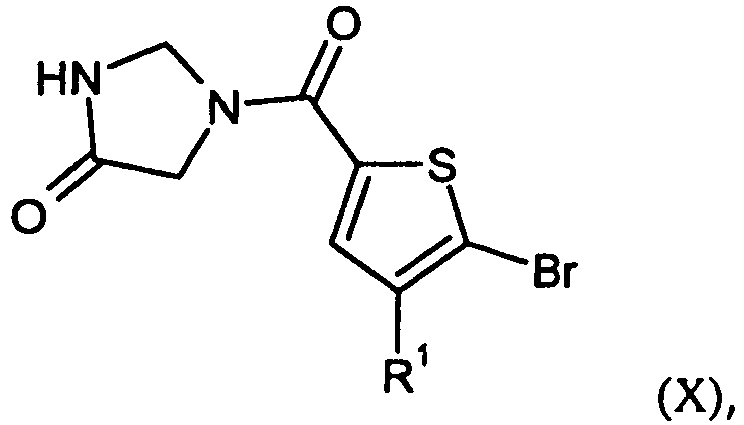
R1 die oben angegebene Bedeutung aufweist,
unter den oben angegebenen Suzuki-Kupplungsbedingungen mit Verbindungen der Formel
R2-Q (VII),
in welcher
R2 die oben angegebene Bedeutung aufweist und - Q
- für -B(OH)2, einen Boronsäure-Ester, bevorzugt Boronsäurepinakolester, oder -BF3-K+ steht,
- Die Verbindungen der Formel (X) sind bekannt oder können hergestellt werden, indem Verbindungen der Formel

R1 die oben angegebene Bedeutung aufweist,
mit Imidazolidin-4-on oder einem Salz von Imidazolidin-4-on, entsprechend der oben angegebenen Reaktion von (II) zu (I) bzw. (Ia), umgesetzt werden. - Die Verbindungen der Formel (XI) sind bekannt oder können hergestellt werden, indem in Verbindungen der Formel

R1 die oben angegebene Bedeutung aufweist,
der Ester mit einer Base, wie oben bei der Reaktion von (III) zu (II) beschrieben, verseift wird. - Die Verbindungen der Formel (XII) sind bekannt oder können hergestellt werden, indem Verbindungen der Formel

R1 die oben angegebene Bedeutung aufweist, bromiert werden. - Inerte Lösungsmittel für die Bromierung sind beispielsweise Halogenkohlenwasserstoffe wie Dichlormethan, Trichlormethan, Tetrachlormethan, Trichlorethan, Tetrachlorethan, 1,2-Dichlorethan oder Trichlorethylen, Ether wie Diethylether, Dioxan, Tetrahydrofuran, Glykoldimethylether oder Diethylenglykoldimethylether, Kohlenwasserstoffe wie Hexan oder Cyclohexan, organische Carbonsäuren wie Essigsäure oder andere Lösungsmittel wie Ethylacetat, Dimethylformamid oder Dimethylsulfoxid. Ebenso ist es möglich, Gemische der genannten Lösungsmittel einzusetzen. Bevorzugt sind Essigsäure, Diethylether, Dioxan, Tetrahydrofuran, Ethylacetat, Trichlormethan und/oder Tetrachlormethan.
- Als Bromierungsmittel eignen sich die üblichen anorganischen oder organischen Reagenzien. Hierzu gehören bevorzugt Brom, N-Bromsuccinimid, Kupferdibromid, Pyridinhydrotribromid, Dimethylbenzylammoniumtribromid oder Phenyltrimethylammoniumtribromid. Besonders bevorzugt sind Brom und Kupferdibromid.
- Die Bromierung wird im Allgemeinen in einem Temperaturbereich von -20°C bis 150°C, bevorzugt von 0°C bis 80°C durchgeführt. Die Umsetzung kann bei normalem, erhöhtem oder erniedrigtem Druck erfolgen (z.B. von 0.5 bis 5 bar). Im Allgemeinen erfolgt die Bromierung bei Normaldruck.
- Die Verbindungen der Formel (XIII) sind bekannt oder können hergestellt werden, indem die Verbindung der Formel

R1-Q (V),
in welcher - R1 die oben angegebene Bedeutung aufweist und
- Q
- für -B(OH)2, einen Boronsäure-Ester, bevorzugt Boronsäurepinakolester, oder -BF3 -K+ steht,
- Die Verbindung der Formel (XIV) ist bekannt oder lässt sich nach bekannten Verfahren synthetisieren.
- Die Herstellung der erfindungsgemäßen Verbindungen kann durch die folgenden Syntheseschemata verdeutlicht werden.


- Die erfindungsgemäßen Verbindungen zeigen ein nicht vorhersehbares, wertvolles pharmakologisches Wirkspektrum.
- Sie eignen sich daher zur Verwendung als Arzneimittel zur Behandlung und/oder Prophylaxe von Krankheiten bei Menschen und Tieren.
- Die Verbindungen der vorliegenden Erfindung zeichnen sich insbesondere durch ein vorteilhaftes anti-retrovirales Wirkspektrum aus.
- Weiterer Gegenstand der vorliegenden Erfindung ist der Einsatz der erfindungsgemäßen Verbindungen zur Behandlung und/oder Prophylaxe von Erkrankungen, die durch Retroviren hervorgerufen werden, insbesondere von HI-Viren.
- Weiterer Gegenstand der vorliegenden Erfindung ist die Verwendung der erfindungsgemäßen Verbindungen zur Behandlung und/oder Prophylaxe von Erkrankungen, insbesondere der zuvor genannten Erkrankungen.
- Weiterer Gegenstand der vorliegenden Erfindung ist die Verwendung der erfindungsgemäßen Verbindungen zur Herstellung eines Arzneimittels zur Behandlung und/oder Prophylaxe von Erkrankungen, insbesondere der zuvor genannten Erkrankungen.
- Weiterer Gegenstand der vorliegenden Erfindung ist ein Verfahren zur Behandlung und/oder Prophylaxe von Erkrankungen, insbesondere der zuvor genannten Erkrankungen, unter Verwendung einer therapeutisch wirksamen Menge der erfindungsgemäßen Verbindungen.
- Als Indikationsgebiete in der Humanmedizin können beispielsweise genannt werden:
- 1.) Die Behandlung und Prophylaxe von menschlichen Retrovirusinfektionen
- 2.) Die Behandlung und Prophylaxe von durch HIV-1 (Virus der humanen Immundefizienz; früher HTLV III/LAV genannt) und HIV-2 verursachten Infektionen und Erkrankungen (AIDS) und den damit assoziierten Stadien wie ARC (AIDS related complex) und LAS (Lymphadenophathie-Syndrom) sowie der durch dieses Virus verursachten Immunschwäche und Enzephalopathie.
- 3.) Die Behandlung von HIV-Infektionen hervorgerufen durch einfach-, mehrfach- oder multi-resistente HI-Viren.
- Resistente HI-Viren bedeutet z.B. Viren mit Resistenzen gegen nukleosidische RT-Inhibitoren (NRTI), nicht-nukleosidische RT-Inhibitoren (NNRTI) oder Proteaseinhibitoren (PI) oder Viren mit Resistenzen gegen andere Wirkprinzipien, z.B. T20 (Fusionsinhibitoren).
- 4.) Für die Behandlung oder die Prophylaxe des AIDS-carrier Zustandes (AIDS-Überträger-Zustand).
- 5.) Für die Behandlung oder die Prophylaxe einer HTLV-I oder HTLV-II Infektion
- Als Indikationen in der Tiermedizin können beispielsweise angeführt werden:
- Infektionen mit
- a) Maedivisna (bei Schafen und Ziegen)
- b) progressivem Pneumonievirus (PPV) (bei Schafen und Ziegen)
- c) caprine arthritis encephalitis Virus (bei Schafen und Ziegen)
- d) Zwoegerziekte Virus (bei Schafen)
- e) infektiösem Virus der Anämie (des Pferdes)
- f) Infektionen verursacht durch das Katzenleukämievirus
- g) Infektionen verursacht durch das Virus der Katzen-Immundefizienz (FIV)
- h) Infektionen verursacht durch das Virus der Affen-Immundefizienz (SIV)
- Bevorzugt werden aus dem Indikationsgebiet in der Humanmedizin die oben aufgeführten Punkte 2, 3 und 4.
- Insbesondere geeignet sind die Substanzen zur Bekämpfung von HI-Viren, die Resistenzen gegen bekannte nicht-nukleosidische Inhibitoren der Reversen Transkripatse, wie z.B. Efavirenz oder Nevirapin, zeigen.
- Weiterer Gegenstand der vorliegenden Erfindung sind Arzneimittel, enthaltend mindestens eine erfindungsgemäße Verbindung und mindestens einen oder mehrere weitere Wirkstoffe, insbesondere zur Behandlung und/oder Prophylaxe der zuvor genannten Erkrankungen.
- Die erfindungsgemäßen Verbindungen können auch vorteilhaft, insbesondere in den oben aufgeführten Punkten 2, 3 und 4, als Bestandteile einer Kombinationstherapie mit einer oder mehreren anderen, in diesen Anwendungsbereichen aktiven Verbindungen eingesetzt werden. Beispielhaft können diese Verbindungen in Kombination mit wirksamen Dosen von antiviral wirksamen Substanzen, die auf den unten aufgeführten Wirkprinzipien beruhen, eingesetzt werden:
- Inhibitoren der HIV Protease; beispielhaft seien genannt: Saquinavir, Indinavir, Ritonavir, Nelfinavir, Amprenavir, Lopinavir, Atazanavir, Fosamprenavir, Tipranavir, Darunavir;
- Nukleosidische, nukleotidische und nicht-nukleosidische Inhibitoren der HIV Reversen Transkriptase; beispielhaft seien genannt: Zidovudin, Lamivudin, Didanosin, Zalcitabin, Stavudin, Lamivudin, Abacavir, Tenofovir, Adefovir, Emtricitabin, Amdoxovir, Apricitabin, Racivir, Nevirapin, Delavirdin, Efavirenz, Etravirin, Rilpivirin,
UK-453,061 - Inhibitoren der HIV Integrase, beispielhaft seien genannt: Raltegravir, Elvitegravir;
- Inhibitoren der HIV Fusion; beispielhaft sei genannt: Enfuvirtid;
- Inhibition der CXCR4/CCR5/gp120 Wechselwirkung; beispielhaft seien genannt: Maraviroc, Vicriviroc, INCB009471, AMD-070;
- Inhibition der Polyproteinreifung; beispielhaft sei genannt: Bevirimat.
- Diese Auswahl soll zur Verdeutlichung der Kombinationsmöglichkeiten, nicht jedoch zur Einschränkung auf die hier aufgeführten Beispiele dienen; prinzipiell ist jede Kombination der erfindungsgemäßen Verbindungen mit antiviral wirksamen Substanzen als im Rahmen der Erfindung zu betrachten.
- Die erfindungsgemäßen Verbindungen können systemisch und/oder lokal wirken. Zu diesem Zweck können sie auf geeignete Weise appliziert werden, wie z.B. oral, parenteral, pulmonal, nasal, sublingual, lingual, buccal, rectal, dermal, transdermal, conjunctival, otisch oder als Implantat bzw. Stent.
- Für diese Applikationswege können die erfindungsgemäßen Verbindungen in geeigneten Applikationsformen verabreicht werden.
- Für die orale Applikation eignen sich nach dem Stand der Technik funktionierende schnell und/oder modifiziert die erfindungsgemäßen Verbindungen abgebende Applikationsformen, die die erfindungsgemäßen Verbindungen in kristalliner und/oder amorphisierter und/oder gelöster Form enthalten, wie z.B. Tabletten (nicht-überzogene oder überzogene Tabletten, beispielsweise mit magensaftresistenten oder sich verzögert auflösenden oder unlöslichen Überzügen, die die Freisetzung der erfindungsgemäßen Verbindung kontrollieren), in der Mundhöhle schnell zerfallende Tabletten oder Filme/Oblaten, Filme/Lyophylisate, Kapseln (beispielsweise Hart- oder Weichgelatinekapseln), Dragees, Granulate, Pellets, Pulver, Emulsionen, Suspensionen, Aerosole oder Lösungen.
- Die parenterale Applikation kann unter Umgehung eines Resorptionsschrittes geschehen (z.B. intravenös, intraarteriell, intrakardial, intraspinal oder intralumbal) oder unter Einschaltung einer Resorption (z.B. intramuskulär, subcutan, intracutan, percutan oder intraperitoneal). Für die parenterale Applikation eignen sich als Applikationsformen u.a. Injektions- und Infusionszubereitungen in Form von Lösungen, Suspensionen, Emulsionen, Lyophilisaten oder sterilen Pulvern.
- Für die sonstigen Applikationswege eignen sich z.B. Inhalationsarzneiformen (u.a. Pulverinhalatoren, Nebulizer), Nasentropfen, -lösungen, -sprays; lingual, sublingual oder buccal zu applizierende Tabletten, Filme/Oblaten oder Kapseln, Suppositorien, Ohren- oder Augenpräparationen, Vaginalkapseln, wässrige Suspensionen (Lotionen, Schüttelmixturen), lipophile Suspensionen, Salben, Cremes, transdermale therapeutische Systeme (wie beispielsweise Pflaster), Milch, Pasten, Schäume, Streupuder, Implantate oder Stents.
- Die erfindungsgemäßen Verbindungen können in die angeführten Applikationsformen überführt werden. Dies kann in an sich bekannter Weise durch Mischen mit inerten, nichttoxischen, pharmazeutisch geeigneten Hilfsstoffen geschehen. Zu diesen Hilfsstoffen zählen u.a. Trägerstoffe (beispielsweise mikrokristalline Cellulose, Laktose, Mannitol), Lösungsmittel (z.B. flüssige Polyethylenglycole), Emulgatoren und Dispergier- oder Netzmittel (beispielsweise Natriumdodecylsulfat, Polyoxysorbitanoleat), Bindemittel (beispielsweise Polyvinylpyrrolidon), synthetische und natürliche Polymere (beispielsweise Albumin), Stabilisatoren (z.B. Antioxidantien wie beispielsweise Ascorbinsäure), Farbstoffe (z.B. anorganische Pigmente wie beispielsweise Eisenoxide) und Geschmacks- und/oder Geruchskorrigentien.
- Weiterer Gegenstand der vorliegenden Erfindung sind Arzneimittel, die mindestens eine erfindungsgemäße Verbindung, üblicherweise zusammen mit einem oder mehreren inerten, nichttoxischen, pharmazeutisch geeigneten Hilfsstoffen enthalten, sowie deren Verwendung zu den zuvor genannten Zwecken.
- Im Allgemeinen hat es sich sowohl in der Human- als auch in der Veterinärmedizin als vorteilhaft erwiesen, den oder die erfindungsgemäßen Wirkstoffe in Gesamtmengen von 0.1 bis 200 mg/kg, vorzugsweise 1 bis 100 mg/kg Körpergewicht je 24 Stunden, gegebenenfalls in Form mehrerer Einzelgaben, zur Erzielung des gewünschten Ergebnisses zu verabreichen. Eine Einzelgabe enthält den oder die Wirkstoffe vorzugsweise in Mengen von 1 bis 80 mg/kg, insbesondere 1 bis 30 mg/kg Körpergewicht.
- Trotzdem kann es gegebenenfalls erforderlich sein, von den genannten Mengen abzuweichen, und zwar in Abhängigkeit von Körpergewicht, Applikationsweg, individuellem Verhalten gegenüber dem Wirkstoff, Art der Zubereitung und Zeitpunkt bzw. Intervall, zu welchem die Applikation erfolgt. So kann es in einigen Fällen ausreichend sein, mit weniger als der vorgenannten Mindestmenge auszukommen, während in anderen Fällen die genannte obere Grenze überschritten werden muss. Im Falle der Applikation größerer Mengen kann es empfehlenswert sein, diese in mehreren Einzelgaben über den Tag zu verteilen.
- Die Prozentangaben in den folgenden Tests und Beispielen sind, sofern nicht anders angegeben, Gewichtsprozente; Teile sind Gewichtsteile. Lösungsmittelverhältnisse, Verdünnungsverhältnisse und Konzentrationsangaben von flüssig/flüssig-Lösungen beziehen sich jeweils auf das Volumen. Die Angabe "w/v" bedeutet "weight/volume" (Gewicht/Volumen). So bedeutet beispielsweise "10% w/v": 100 ml Lösung oder Suspension enthalten 10 g Substanz.
-
aq. wässrig, wässrige Lösung DCI direkte chemische Ionisation (bei MS) DMA N,N-Dimethylacetamid DMF N,N-Dimethylformamid DMSO Dimethylsulfoxid d. Th. der Theorie (bei Ausbeute) EDC N'-(3-Dimethylaminopropyl)-N-ethylcarbodümid x HCl eq. Äquivalent(e) ESI Elektrospray-Ionisation (bei MS) h Stunde(n) HATU O-(7-Azabenzotriazol-1-yl)-N,N,N',N'-tetramethyluronium-hexafluorophosphat HPLC Hochdruck-, Hochleistungsflüssigchromatographie konz. konzentriert LC-MS Flüssigchromatographie-gekoppelte Massenspektroskopie min Minute(n) MS Massenspektroskopie NMR Kernresonanzspektroskopie PyBOP Benzotriazol-1-yloxytris(pyrrolidino)phosphonium-hexafluorophosphat Rt Retentionszeit (bei HPLC) RT Raumtemperatur TBTU O-(Benzotriazol-1-yl)-N,N,N',N'-tetramethyluronium-tetrafluoroborat TFA Trifluoressigsäure THF Tetrahydrofuran TMOF Trimethylorthoformiat - Gerätetyp MS: Micromass ZQ; Gerätetyp HPLC: HP 1100 Series; UV DAD; Säule: Phenomenex Gemini 3p 30 mm x 3.00 mm; Eluent A: 1 1 Wasser + 0.5 ml 50%ige Ameisensäure, Eluent B: 1 1 Acetonitril + 0.5 ml 50%ige Ameisensäure; Gradient: 0.0 min 90%A → 2.5 min 30%A → 3.0 min 5%A → 4.5 min 5%A; Fluss: 0.0 min 1 ml/min, 2.5 min/3.0 min/4.5 min 2 ml/min; Ofen: 50°C; UV-Detektion: 210 nm.
- Instrument: Micromass Quattro LCZ mit HPLC Agilent Serie 1100; Säule: Phenomenex Synergi 2µ Hydro-RP Mercury 20 mm x 4 mm; Eluent A: 1 1 Wasser + 0.5 ml 50%ige Ameisensäure, Eluent B: 1 1 Acetonitril + 0.5 ml 50%ige Ameisensäure; Gradient: 0.0 min 90% A → 2.5 min 30% A → 3.0 min 5% A → 4.5 min 5% A; Fluss: 0.0 min 1 ml/min → 2.5 min/3.0 min/4.5 min 2 ml/min; Ofen: 50°C; UV-Detektion: 208-400 nm.
- Gerätetyp MS: Micromass ZQ; Gerätetyp HPLC: Waters Alliance 2795; Säule: Phenomenex Synergi 2µ Hydro-RP Mercury 20 mm x 4 mm; Eluent A: 1 1 Wasser + 0.5 ml 50%ige Ameisensäure, Eluent B: 1 1 Acetonitril + 0.5 ml 50%ige Ameisensäure; Gradient: 0.0 min 90% A → 2.5 min 30% A → 3.0 min 5% A → 4.5 min 5% A; Fluss: 0.0 min 1 ml/min → 2.5 min/3.0 min/4.5 min 2 ml/min; Ofen: 50°C; UV-Detektion: 210 nm.
- Instrument: Micromass Quattro LCZ mit HPLC Agilent Serie 1100; Säule: Phenomenex Onyx Monolithic C18, 100 mm x 3 mm. Eluent A: 1 1 Wasser + 0.5 ml 50%ige Ameisensäure, Eluent B: 1 1 Acetonitril + 0.5 ml 50%ige Ameisensäure; Gradient: 0.0 min 90%A → 2 min 65%A → 4.5 min 5%A→ 6 min 5%A; Fluss: 2 ml/min; Ofen: 40°C; UV-Detektion: 208-400 nm.
- Instrument: Micromass Quattro Premier mit Waters UPLC Acquity; Säule: Thermo Hypersil GOLD 1,9 µ 50 mm x 1 mm; Eluent A: 1 1 Wasser + 0,5 ml 50%ige Ameisensäure, Eluent B: 1 1 Acetonitril + 0,5 ml 50%ige Ameisensäure; Gradient: 0.0 min 90%A → 0.1 min 90%A → 1.5 min 10%A → 2.2 min 10%A Ofen: 50°C; Fluss: 0.33 ml/min; UV-Detektion: 210 nm.
- Gerätetyp MS: Waters ZQ; Gerätetyp HPLC: Waters Alliance 2795; Säule: Phenomenex Onyx Monolithic C18, 100 mm x 3 mm; Eluent A: 1 1 Wasser + 0.5 ml 50%ige Ameisensäure, Eluent B: 1 1 Acetonitril + 0.5 ml 50%ige Ameisensäure; Gradient: 0.0 min 90%A → 2 min 65%A → 4.5 min 5%A → 6 min 5%A; Fluss: 2 ml/min; Ofen: 40°C; UV-Detektion: 210 nm.
- Gerätetyp MS: Micromass ZQ; Gerätetyp HPLC: Waters Alliance 2795; Säule: Phenomenex Synergi 2.5 µ MAX-RP 100A Mercury 20 mm x 4 mm; Eluent A: 1 1 Wasser + 0.5 ml 50%ige Ameisensäure, Eluent B: 1 1 Acetonitril + 0.5 ml 50%ige Ameisensäure; Gradient: 0.0 min 90%A → 0.1 min 90%A → 3.0 min 5%A → 4.0 min 5%A → 4.01 min 90%A; Fluss: 2 ml/min; Ofen: 50°C; UV-Detektion: 210 nm.
- Instrument: Micromass Quattro LCZ mit HPLC Agilent Serie 1100; Säule: Phenomenex Gemini 3µ 30 mm x 3.00 mm; Eluent A: 1 1 Wasser + 0.5 ml 50%ige Ameisensäure, Eluent B: 1 1 Acetonitril + 0.5 ml 50%ige Ameisensäure; Gradient: 0.0 min 90%A → 2.5 min 30%A → 3.0 min 5%A → 4.5 min 5%A; Fluss: 0.0 min 1 ml/min, 2.5 min/3.0 min/4.5 min 2 ml/min; Ofen: 50°C; UV-Detektion: 208-400 nm.
- Instrument: Micromass Quattro LCZ mit HPLC Agilent Serie 1100; Säule: Phenomenex Synergi 2.5 µ MAX-RP 100A Mercury 20 mm x 4 mm; Eluent A: 1 1 Wasser + 0.5 ml 50%ige Ameisensäure, Eluent B: 1 1 Acetonitril + 0.5 ml 50%ige Ameisensäure; Gradient: 0.0 min 90%A → 0.1 min 90%A → 3.0 min 5%A → 4.0 min 5%A → 4.1 min 90%A; Fluss: 2 ml/min; Ofen: 50°C; UV-Detektion: 208- 400 nm.
- Gerätetyp MS: Waters (Micromass) Quattro Micro; Gerätetyp HPLC: Agilent Serie 1100; Säule: Thermo Hypersil GOLD 3µ 20 mm x 4 mm; Eluent A: 1 1 Wasser + 0.5 ml 50%ige Ameisensäure, Eluent B: 1 1 Acetonitril + 0.5 ml 50%ige Ameisensäure; Gradient: 0.0 min 100%A → 3.0 min 10%A → 4.0 min 10%A → 4.01 min 100%A (Flow 2.5ml) → 5.00 min 100%A; Ofen: 50°C; Fluss: 2 ml/min; UV-Detektion: 210 nm.
- Instrument: Micromass GCT, GC6890; Säule: Restek RTX-35, 15 m x 200 µm x 0.33 µm; konstanter Fluss mit Helium: 0.88 ml/min; Ofen: 70°C; Inlet: 250°C; Gradient: 70°C, 30°C/min → 310°C (3 min halten).
- Instrument: Micromass GCT, GC6890; Säule: Restek RTX-35, 15 m x 200 µm x 0.33 µm; konstanter Fluss mit Helium: 0.88 ml/min; Ofen: 70°C; Inlet: 250°C; Gradient: 70°C, 30°C/min → 310°C (12 min halten).
-

- 44.2 g (0.40 mol) Glycinamid-hydrochlorid werden in 2.2 1 Dichlormethan bei Raumtemperatur unter Argon vorgelegt, mit 112 ml (0.80 mol) Triethylamin versetzt und über Nacht bei Raumtemperatur gerührt. Dann werden 42.5 g (0.40 mol) Benzaldehyd zugegeben und die Reaktionsmischung wird über Nacht am Wasserabscheider unter Rückfluss erhitzt. Man engt ein, löst den Rückstand in 400 ml Tetrahydrofuran/Methanol (1:1), versetzt bei 0°C portionsweise mit 16.7 g (0.44 mol) Natriumborhydrid und rührt zwei Tage bei Raumtemperatur. Die Suspension wird abgesaugt, das Filtrat eingeengt und im Hochvakuum getrocknet. Der Rückstand wird in Essigsäureethylester gerührt, der Niederschlag abfiltriert, das Filtrat eingeengt und der Rückstand in Toluol über Nacht gerührt. Nach Filtration des Feststoffs und anschließendem Trocknen im Hochvakuum erhält man 56.5 g (84% d. Th.) der Titelverbindung.
1H-NMR (400 MHz, DMSO-d6): δ = 7.36-7.28 (m, 4H), 7.27-7.19 (m, 1H), 3.66 (d, 2H), 3.02 (d, 2H).
LC-MS (Methode 10): Rt = 0.40 min; MS (ESIpos): m/z = 165 [M+H]+. -

- 56.5 g (0.34 mol) der Verbindung aus Beispiel 1A werden mit 172 ml (6.20 mol) 37%iger Formaldehyd-Lösung versetzt und 30 Minuten unter Rückfluss erhitzt. Es wird mit Dichlormethan extrahiert, und die vereinigten organischen Phasen werden über Natriumsulfat getrocknet, filtriert und eingeengt. Man erhält 74.5 g (100% d. Th.) der Titelverbindung.
LC-MS (Methode 5): Rt = 0.51 min; MS (ESIpos): m/z = 207 [M+H]+. -

- 74.5 g (0.36 mol) der Verbindung aus Beispiel 2A werden für 6 h bei 150°C im Hochvakuum unter Abdestillieren flüchtiger Reaktionsprodukte erhitzt. Die Aufreinigung erfolgt durch HPLC (Säule: Sunfire C18 5µ, 250 x 20 mm; Eluent: 0.2% Trifluoressigsäure/Wasser-Acetonitril-Gradient). Man erhält 28.4 g (27% d. Th.) der Titelverbindung.
1H-NMR (400 MHz, DMSO-d6): δ = 8.75 (s, 1H), 7.48-7.39 (m, 5H), 4.41 (s, 2H), 4.22 (s, 2H), 3.54 (s, 2H).
LC-MS (Methode 10): Rt = 0.94 min; MS (ESIpos): m/z = 177 [M-CF3COOH+H]+. -

- 28.4 g (97.9 mmol) der Verbindung aus Beispiel 3A werden in 750 ml Ethanol gelöst und unter Argon mit 4.5 g (42.3 mmol) Palladium auf Aktivkohle (5%ig) versetzt. Es wird 24 h unter Wasserstoffatmosphäre hydriert. Die Suspension wird über Celite filtriert, eingeengt und am Hochvakuum getrocknet. Man erhält 19.2 g (98% d. Th.) der Titelverbindung.
1H-NMR (400 MHz, DMSO-d6): δ = 10.1 (s, 2H), 8.89 (s, 1H), 4.55 (s, 2H), 3.63 (s, 2H).
GC-MS (Methode 11): Rt = 3.92 min; MS (EIpos): m/z = 86 [M-CF3COOH]+. -

- 3.60 g (18.0 mmol) 3-Brom-5-fluorbenzolcarbonitril, 5.03 g (19.8 mmol) 4,4,4',4',5,5,5',5'-Octamethyl-2,2'bi-1,3,2-dioxaborolan und 5.30 g (54.0 mmol) Kaliumacetat werden unter Argon in 72 ml entgastem 1,4-Dioxan/DMSO (10/1) vorgelegt und mit 441 mg (0.54 mmol) 1,1'-Bis(diphenylphosphin)ferrocendichlorpalladium(II)-Dichlormethan-Komplex versetzt. Es wird über Nacht bei 90°C gerührt. Anschließend gibt man Wasser hinzu, trennt die Phasen, extrahiert die wässrige Phase mit Essigsäureethylester und engt die vereinigten organischen Phasen ein. Das Rohprodukt wird mittels Flash-Chromatographie (Laufmittel: Cyclohexan/Essigsäureethylester 10:1) gereinigt. Man erhält 4.48 g (92% d. Th.) der Titelverbindung.
1H-NMR (400 MHz, DMSO-d6): δ = 8.01 (ddd, 1H), 7.82 (s, 1H), 7.70 (ddd, 1H), 1.32 (s, 12H).
GC-MS (Methode 11): Rt = 4.94 min; MS (EIpos): m/z = 247 [M]+. -

- 1.00 g (4.13 mmol) 2,4-Dibromthiophen werden unter Argon in 15 ml Diethylether vorgelegt und auf -78°C gekühlt. Es werden 2.6 ml (4.13 mmol) einer 1.6N n-Butyllithium-Lösung in Hexan zugetropft und das Reaktionsgemisch wird 5 Minuten gerührt. Das Reaktionsgemisch wird auf eine Mischung aus Trockeneis und 15 ml Diethylether gegeben und 10 Minuten gerührt. Anschließend wird mit Wasser verdünnt und die Phasen werden getrennt. Die wässrige Phase wird angesäuert und mit Essigsäureethylester extrahiert, die organische Phase wird über Natriumsulfat getrocknet, filtriert und eingeengt. Man erhält 0.66 g (74% d. Th.) der Titelverbindung.
1H-NMR (400 MHz, DMSO-d6): δ = 13.5 (s, 1H), 8.02 (d, 1H), 7.69 (d, 1H).
LC-MS (Methode 1): Rt = 1.88 min; MS (ESIpos): m/z = 207 [M+H]+. -

- 663 mg (3.20 mmol) der Verbindung aus Beispiel 6A werden in 25 ml Ethanol vorgelegt, mit 0.1 ml konzentrierter Schwefelsäure versetzt und über Nacht unter Rückfluss erhitzt. Nach dem Abkühlen auf Raumtemperatur wird gesättigte wässrige Natriumhydrogencarbonat-Lösung zugegeben, mit Wasser verdünnt und mit Essigsäureethylester extrahiert. Die organische Phase wird über Natriumsulfat getrocknet, filtriert und eingeengt. Man erhält 700 mg (89% d. Th.) der Titelverbindung.
1H-NMR (400 MHz, DMSO-d6): δ = 8.07 (d, 1H), 7.78 (d, 1H), 4.30 (q, 2H), 1.30 (t, 3H).
GC-MS (Methode:11): Rt = 4.69 min; MS (EIpos): m/z = 234 [M]+. -

- 16.5 ml (320 mmol) Brom werden in 120 ml Essigsäure vorgelegt und 10.0 g (64.0 mmol) Thiophen-2-carbonsäureethylester in 40 ml Essigsäure gelöst zugetropft. Es wird über Nacht bei 60°C gerührt. Die Reaktionsmischung wird eingeengt, der Rückstand mit gesättigter wässriger Natriumhydrogencarbonat-Lösung versetzt und mit Dichlormethan extrahiert. Man trocknet die organische Phase über Magnesiumsulfat, filtriert und engt ein. Das Rohprodukt wird aus Diethylether umkristallisiert. Man erhält 7.80 g (39% d. Th.) der Titelverbindung.
1H-NMR (400 MHz, DMSO-d6): δ = 7.79 (s, 1H), 4.30 (q, 2H), 1.29 (t, 3H).
GC-MS (Methode 11): Rt = 5.55 min; MS (EIpos): m/z = 314 [M]+. -

- 3.71 g (11.8 mmol) der Verbindung aus Beispiel 8A und 2.16 g (12.4 mmol) 3-Chlor-5-fluorphenylboronsäure werden unter Argon in 125 ml entgastem Toluol/Wasser (2.2/1) vorgelegt und mit 6.75 g (63.7 mmol) Natriumcarbonat und 409 mg (0.35 mmol) Tetrakis(triphenylphosphin)palladium(0) versetzt. Es wird über Nacht bei 60°C gerührt. Die Reaktionsmischung wird mit Wasser versetzt, die Phasen werden getrennt, die wässrige Phase wird mit Dichlormethan extrahiert, und die vereinigten organischen Phasen werden über Natriumsulfat getrocknet, filtriert und eingeengt. Das Rohprodukt wird über präparative HPLC (RP18-Säule; Eluent: Acetonitril/Wasser-Gradient) gereinigt. Man erhält 1.17 g (27% d. Th.) der Titelverbindung.
1H-NMR (400 MHz, DMSO-d6): δ = 7.90 (s, 1H), 7.66-7.54 (m, 3H), 4.34 (q, 2H), 1.31 (t, 3H).
LC-MS (Methode 1): Rt = 3.22 min; MS (ESIpos): m/z = 363 [M+H]+. -

- Die Herstellung der Titelverbindung erfolgt ausgehend von der Verbindung aus Beispiel 8A analog zur Synthese der Verbindung aus Beispiel 9A. Man erhält 125 mg (57% d. Th.) der Titelverbindung.
1H-NMR (400 MHz, DMSO-d6): δ = 7.88 (s, 1H), 7.77-7.73 (m, 1H), 7.67-7.54 (m, 3H), 4.33 (q, 2H), 1.31 (t, 3H).
GC-MS (Methode 11): Rt = 7.91 min; MS (EIpos): m/z = 346 [M]+. -

- 400 mg (1.10 mmol) der Verbindung aus Beispiel 9A und 242 mg (1.65 mmol) 3-Cyanphenylboronsäure werden unter Argon in 15.7 ml 1,2-Dimethoxyethan vorgelegt und mit 5.8 ml (5.50 mmol) wässriger Natriumhydrogencarbonat-Lösung (10%ig) und 38.1 mg (0.03 mmol) Tetrakis(triphenylphosphin)palladium(0) versetzt. Es wird über Nacht bei 80°C gerührt. Die Reaktionsmischung wird über präparative HPLC (RP18-Säule; Eluent: Acetonitril/Wasser-Gradient unter Zusatz von 0.1% Ameisensäure) gereinigt. Man erhält 130 mg (27% d. Th.) der Titelverbindung.
GC-MS (Methode 12): Rt = 9.85 min; MS (EIpos): m/z = 385 [M]+. -

- Die Herstellung der Titelverbindung erfolgt ausgehend von der Verbindung aus Beispiel 9A analog zur Synthese der Verbindung aus Beispiel 11A. Man erhält 59.8 mg (46% d. Th.) der Titelverbindung.
1H-NMR (400 MHz, DMSO-d6): δ = 7.96 (s, 1H), 7.61 (dd, 1H), 7.52 (dt, 1H), 7.41 (t, 1H), 7.26-7.16 (m, 3H), 4.34 (q, 2H), 1.32 (t, 3H).
LC-MS (Methode 1): Rt = 3.36 min; MS (ESIpos): m/z = 317 [M+H]+. -

- 5.00 g (21.3 mmol) der Verbindung aus Beispiel 7A und 4.99 g (31.9 mmol) 3-Chlorphenylboronsäure werden unter Argon in 150 ml 1,2-Dimethoxyethan vorgelegt und mit 113 ml (106 mmol) wässriger Natriumhydrogencarbonat-Lösung (10%ig) und 737 mg (0.64 mmol) Tetrakis(triphenylphosphin)palladium(0) versetzt. Es wird 1.5 Stunden bei 80°C gerührt. Anschließend gibt man 1N wässrige HCl-Lösung zu, extrahiert mit Essigsäureethylester, engt ein und reinigt mittels Flash-Chromatographie (Laufmittel: Cyclohexan/Essigsäureethylester-Gradient). Man erhält 5.60 g (88% d. Th.) der Titelverbindung.
1H-NMR (400 MHz, DMSO-d6): δ = 8.38 (d, 1H), 8.27 (d, 1H), 7.90 (t, 1H), 7.77 (dt, 1H), 7.46 (t, 1H), 7.41-7.37 (m, 1H), 4.33 (q, 2H), 1.32 (t, 3H).
LC-MS (Methode 5): Rt = 1.47 min; MS (ESIpos): m/z = 267 [M+H]+. -

- 0.01 ml (0.22 mmol) Brom wird in 1 ml Essigsäure vorgelegt und 58.0 mg (0.22 mmol) der Verbindung aus Beispiel 13A in 1 ml Essigsäure gelöst, werden zugetropft. Es wird über Nacht bei 60°C gerührt. Anschließend wird 0.01 ml (0.22 mmol) Brom zugegeben und weitere 24 Stunden bei 60°C gerührt. Die Reaktionsmischung wird mit Wasser versetzt, der entstehende Niederschlag abgesaugt, mit Wasser gewaschen und am Hochvakuum getrocknet. Man erhält 43.0 mg (54% d. Th.) der Titelverbindung.
1H-NMR (400 MHz, DMSO-d6): δ = 7.88 (s, 1H), 7.68-7.66 (m, 1H), 7.59-7.54 (m, 1H), 7.54-7.51 (m, 2H), 4.32 (q, 2H), 1.30 (t, 3H).
LC-MS (Methode 1): Rt = 3.35 min; MS (ESIpos): m/z = 345 [M+H]+. -

- 41.0 mg (0.12 mmol) der Verbindung aus Beispiel 14A werden in 3 ml Tetrahydrofuran vorgelegt und bei Raumtemperatur mit 28.4 mg (1.19 mmol) Lithiumhydroxid und 0.8 ml Wasser versetzt. Man rührt bei Raumtemperatur über Nacht, gibt anschließend 1N wässrige HCl-Lösung bis zu einem sauren pH-Wert hinzu, extrahiert dreimal mit Dichlormethan, trocknet über Natriumsulfat, filtriert und engt ein. Man erhält 35.0 mg (83% d. Th.) der Titelverbindung.
1H-NMR (400 MHz, DMSO-d6): δ = 13.6 (s, 1H), 7.77 (s, 1H), 7.66 (s, 1H), 7.58-7.54 (m, 1H), 7.53-7.50 (m, 2H).
LC-MS (Methode 1): Rt = 2.85 min; MS (ESIpos): m/z = 317 [M+H]+. -

- 35.0 mg (0.11 mmol) der Verbindung aus Beispiel 15A, 10.4 mg (0.12 mmol) 4-Imidazolidinon und 86.0 mg (0.17 mmol) PyBOP werden in 2.8 ml Tetrahydrofuran vorgelegt und bei Raumtemperatur mit 0.04 ml (0.23 mmol) N,N-Diisopropylethylamin versetzt. Man rührt bei Raumtemperatur über Nacht und reinigt anschließend die Reaktionsmischung über präparative HPLC (RP18-Säule; Eluent: Acetonitril/Wasser-Gradient). Man erhält 27.0 mg (62% d. Th.) der Titelverbindung.
1H-NMR (400 MHz, DMSO-d6): δ = 8.77 (s, 1H), 7.77 (s, 1H), 7.72 (s, 1H), 7.64-7.59 (m, 1H), 7.55-7.50 (m, 2H), 5.27 (s, 0.5H), 4.85 (s, 1.5H), 4.44 (s, 1.5H), 3.95 (s, 0.5H).
LC-MS (Methode 7): Rt = 1.80 min; MS (ESIpos): m/z = 385 [M+H]+. -

- 3.20 g (9.26 mmol) der Verbindung aus Beispiel 10A werden unter Argon in 100 ml 1,2-Dimethoxyethan vorgelegt und mit 1.36 g (9.26 mmol) 3-Cyanphenylboronsäure, 9.05 g (27.8 mmol) Cäsiumcarbonat, 309 mg (0.65 mmol) Dicyclohexyl[2',4',6'-tri(propan-2-yl)biphenyl-2-yl]phosphan und 62.4 mg (0.28 mmol) Palladium(II)acetat versetzt. Es wird drei Stunden bei 50°C gerührt. Anschließend wird die Reaktionsmischung mit Wasser verdünnt, mit Dichlormethan extrahiert, die organische Phase über Magnesiumsulfat getrocknet, filtriert und eingeengt. Das Rohprodukt wird durch Flash-Chromatographie (Laufmittel: Cyclohexan/Essigsäureethylester-Gradient) an Kieselgel gereinigt. Man erhält 1.71 g (50% d. Th.) der Titelverbindung.
1H-NMR (400 MHz, DMSO-d6): δ = 8.00 (s, 1H), 7.87-7.84 (m, 1H), 7.83-7.78 (m, 1H), 7.57-7.51 (m, 2H), 7.51-7.47 (m, 1H), 7.42 (t, 1H), 7.38 (t, 1H), 7.25 (dt, 1H), 4.35 (q, 2H), 1.32 (t, 3H).
LC-MS (Methode 1): Rt = 3.23 min; MS (ESIpos): m/z = 368 [M+H]+. -

- 220 mg (0.61 mmol) der Verbindung aus Beispiel 9A werden unter Argon in 6.2 ml 1,2-Dimethoxyethan vorgelegt und mit 100 mg (0.61 mmol) 3-Cyan-4-fluorphenyl-boronsäure, 593 mg (1.82 mmol) Cäsiumcarbonat, 20.0 mg (0.04 mmol) Dicyclohexyl[2',4',6'-tri(propan-2-yl)biphenyl-2-yl]phosphan und 4.0 mg (0.02 mmol) Palladium(II)acetat versetzt. Es wird über Nacht bei 50°C gerührt. Es wird erneut die gleiche Menge Katalysator und Ligand zugegeben und über Nacht bei 50°C gerührt. Die Reaktionsmischung wird über präparative HPLC (RP18-Säule; Eluent: Acetonitril/Wasser-Gradient unter Zusatz von 0.1% Ameisensäure) gereinigt. Man erhält 86.0 mg (35% d. Th.) der Titelverbindung.
1H-NMR (400 MHz, DMSO-d6): δ = 8.04-8.00 (m, 2H), 7.61-7.47 (m, 3H), 7.27-7.24 (m, 1H), 7.19 (dt, 1H), 4.35 (q, 2H), 1.32 (t, 3H).
LC-MS (Methode 1): Rt = 3.12 min; MS (ESIpos): m/z = 404 [M+H]+. -

- 130 mg (0.34 mmol) der Verbindung aus Beispiel 11A werden in 6.1 ml Tetrahydrofuran vorgelegt und bei Raumtemperatur mit 80.7 mg (3.37 mmol) Lithiumhydroxid und 2.0 ml Wasser versetzt. Man rührt bei Raumtemperatur über Nacht, gibt anschließend 1N wässrige HCl-Lösung bis zu einem sauren pH-Wert hinzu, extrahiert mit Essigsäureethylester, trocknet über Natriumsulfat, filtriert und engt ein. Man erhält 119 mg (89% d. Th.) der Titelverbindung.
1H-NMR (400 MHz, DMSO-d6): δ = 13.5 (s, 1H), 7.93 (s, 1H), 7.87-7.84 (m, 1H), 7.84-7.80 (m, 1H), 7.57-7.49 (m, 3H), 7.23-7.20 (m, 1H), 7.16 (ddd, 1H).
LC-MS (Methode 1): Rt = 2.68 min; MS (ESIpos): m/z = 358 [M+H]+. -

- Die Herstellung der Titelverbindung erfolgt ausgehend von der Verbindung aus Beispiel 12A analog zur Synthese der Verbindung aus Beispiel 19A. Die organische Phase wird eingeengt und durch Flash-Chromatographie (Laufmittel: Cyclohexan/Essigsäureethylester/Ethylacetat:Methanol 1:1-Gradient) über Kieselgel gereinigt. Man erhält 0.43 g (100% d. Th.) der Titelverbindung.
1H-NMR (400 MHz, DMSO-d6): δ = 13.5 (s, 1H), 7.87 (s, 1H), 7.59 (dd, 1H), 7.51 (dt, 1H), 7.40 (t, 1H), 7.25-7.19 (m, 2H), 7.17 (dt, 1H).
LC-MS (Methode 5): Rt = 1.50 min; MS (ESIneg): m/z = 385 [M-H]-. -

- 182 mg (0.50 mmol) der Verbindung aus Beispiel 17A werden in 2 ml Dioxan vorgelegt und mit 4.4 ml (8.80 mmol) einer 2N wässrigen Lithiumhydroxid-Lösung versetzt. Man rührt 2 Stunden bei 50°C und engt anschließend ein. Der Rückstand wird mit Wasser verdünnt, mit konzentrierter wässriger HCl-Lösung bis zu einem sauren pH-Wert versetzt und mit Dichlormethan extrahiert. Die organische Phase wird über Magnesiumsulfat getrocknet, filtriert und eingeengt. Das Rohprodukt wird über präparative HPLC (RP18-Säule; Eluent: Acetonitril/Wasser-Gradient) gereinigt. Man erhält 159 mg (95% d. Th.) der Titelverbindung.
1H-NMR (400 MHz, DMSO-d6): δ = 13.5 (s, 1H), 7.91 (s, 1H), 7.84-7.77 (m, 2H), 7.57-7.51 (m, 2H), 7.50-7.45 (m, 1H), 7.41 (t, 1H), 7.36 (t, 1H), 7.24 (dt, 1H).
LC-MS (Methode 9): Rt = 2.31 min; MS (ESIneg): m/z = 338 [M-H]-. -

- Die Herstellung der Titelverbindung erfolgt ausgehend von der Verbindung aus Beispiel 18A analog zur Synthese der Verbindung aus Beispiel 19A. Man erhält 82.3 mg (97% d. Th.) der Titelverbindung.
1H-NMR (400 MHz, DMSO-d6): δ = 13.5 (br. s, 1H), 7.99 (dd, 1H), 7.93 (s, 1H), 7.58 (ddd, 1H), 7.55-7.47 (m, 2H), 7.24 (t, 1H), 7.17 (ddd, 1H).
LC-MS (Methode 1): Rt = 2.75 min; MS (ESIpos): m/z = 376 [M+H]+. -

- Die Herstellung der Titelverbindung erfolgt ausgehend von der Verbindung aus Beispiel 10A analog zur Synthese der Verbindung aus Beispiel 19A. Man erhält 1.11 g (100% d. Th.) der Titelverbindung.
1H-NMR (400 MHz, DMSO-d6): δ = 13.7 (s, 1H), 7.78 (s, 1H), 7.75-7.72 (m, 1H), 7.63 (dt, 1H), 7.61-7.54 (m, 2H).
LC-MS (Methode 7): Rt = 2.13 min; MS (ESIneg): m/z = 317 [M-H]-. -

- 334 mg (1.05 mmol) der Verbindung aus Beispiel 23A, 332 mg (1.16 mmol) 4-Imidazolidinon und 821 mg (1.58 mmol) PyBOP werden in 7.2 ml Tetrahydrofuran vorgelegt und bei Raumtemperatur mit 0.4 ml (2.21 mmol) N,N-Diisopropylethylamin versetzt. Man rührt bei Raumtemperatur über Nacht und reinigt anschließend die Reaktionsmischung über präparative HPLC (RP18-Säule; Eluent: Acetonitril/Wasser-Gradient). Man erhält 226 mg (56% d. Th.) der Titelverbindung.
1H-NMR (400 MHz, DMSO-d6): δ = 8.78 (s, 1H), 7.83 (s, 1H), 7.74 (s, 1H), 7.67-7.52 (m, 3H), 5.24 (s, 0.5H), 4.87 (s, 1.5H), 4.41 (s, 1.5H), 3.97 (s, 0.5H).
LC-MS (Methode 1): Rt = 2.35 min; MS (ESIpos): m/z = 387 [M+H]+. -

- 40.5 mg der Verbindung aus Beispiel 19A mit 76%iger Reinheit (0.08 mmol), 24.9 mg (0.13 mmol) der Verbindung aus Beispiel 4A und 88.4 mg (0.17 mmol) PyBOP werden in 2 ml Tetrahydrofuran vorgelegt und bei Raumtemperatur mit 0.04 ml (0.24 mmol) N,N-Diisopropylethylamin versetzt. Man rührt bei Raumtemperatur über Nacht und reinigt anschließend die Reaktionsmischung über präparative HPLC (RP18-Säule; Eluent: Acetonitril/Wasser-Gradient unter Zusatz von 0.1% Ameisensäure). Man erhält 16.8 mg (46% d. Th.) der Titelverbindung.
1H-NMR (400 MHz, DMSO-d6): δ = 8.85-8.76 (m, 1H), 7.98 (s, 1H), 7.90 (s, 1H), 7.84-7.80 (m, 1H), 7.55-7.49 (m, 3H), 7.22-7.20 (m, 1H), 7.15 (ddd, 1H), 5.31 (s, 0.5H), 4.89 (s, 1.5H), 4.48 (s, 1.5H), 3.99 (s, 0.5H).
LC-MS (Methode 1): Rt = 2.37 min; MS (ESIpos): m/z = 426 [M+H]+. -

- Die Herstellung der Titelverbindung erfolgt ausgehend von 49.1 mg (0.13 mmol) der Verbindung aus Beispiel 20A analog zur Synthese der Verbindung aus Beispiel 1. Man erhält 40.9 mg (71% d. Th.) der Titelverbindung.
1H-NMR (400 MHz, DMSO-d6): δ = 8.85-8.75 (m, 1H), 7.86 (s, 0.75H), 7.75 (s, 0.25H), 7.72-7.65 (m, 1H), 7.50 (dt, 1H), 7.40 (t, 1H), 7.25-7.19 (m, 2H), 7.16 (dt, 1H), 5.30 (s, 0.5H), 4.89 (s, 1.5H), 4.47 (s, 1.5H), 3.98 (s, 0.5H).
LC-MS (Methode 1): Rt = 2.58 min; MS (ESIpos): m/z = 453 [M+H]+. -

- 31.3 mg (0.09 mmol) der Verbindung aus Beispiel 21A, 9.5 mg (0.11 mmol) 4-Imidazolidinon und 52.7 mg (0.10 mmol) PyBOP werden in 0.7 ml Tetrahydrofuran vorgelegt und bei Raumtemperatur mit 0.02 ml (0.10 mmol) N,N-Diisopropylethylamin versetzt. Man rührt bei Raumtemperatur über Nacht und reinigt anschließend die Reaktionsmischung über präparative HPLC (RP18-Säule; Eluent: Acetonitril/Wasser-Gradient). Man erhält 15.9 mg (42% d. Th.) der Titelverbindung.
1H-NMR (400 MHz, DMSO-d6): δ = 8.85-8.75 (m, 1H), 7.97-7.87 (m, 2H), 7.83-7.78 (m, 1H), 7.54-7.50 (m, 2H), 7.47 (d, 1H), 7.41 (t, 1H), 7.36 (s, 1H), 7.24 (d, 1H), 5.31 (s, 0.5H), 4.89 (s, 1.5H), 4.48 (s, 1.5H), 3.99 (s, 0.5H).
LC-MS (Methode 1): Rt = 2.40 min; MS (ESIpos): m/z = 408 [M+H]+. -

- Die Herstellung der Titelverbindung erfolgt ausgehend von 82.3 mg (0.22 mmol) der Verbindung aus Beispiel 22A analog zur Synthese der Verbindung aus Beispiel 1. Man erhält 35.0 mg (35% d. Th.) der Titelverbindung.
1H-NMR (400 MHz, DMSO-d6): δ = 8.87-8.76 (m, 1H), 8.13-8.07 (m, 1H), 7.91-7.75 (m, 1H), 7.60-7.47 (m, 3H), 7.25 (s, 1H), 7.17 (d, 1H), 5.30 (s, 0.5H), 4.89 (s, 1.5H), 4.47 (s, 1.5H), 3.98 (s, 0.5H).
LC-MS (Methode 1): Rt = 2.39 min; MS (ESIpos): m/z = 444 [M+H]+. -

- 49.0 mg (0.13 mmol) der Verbindung aus Beispiel 16A und 33.2 mg (0.19 mmol) 3-Chlor-5-fluorphenylboronsäure werden unter Argon in 1.8 ml 1,2-Dimethoxyethan vorgelegt und mit 0.7 ml (0.64 mmol) wässriger Natriumhydrogencarbonat-Lösung (10%ig) und 4.4 mg (0.004 mmol) Tetrakis(triphenylphosphin)palladium(0) versetzt. Es wird über Nacht bei 80°C gerührt. Die Reaktionsmischung wird über präparative HPLC (RP18-Säule; Eluent: Acetonitril/Wasser-Gradient unter Zusatz von 0.1% Ameisensäure) gereinigt. Man erhält 12.0 mg (22% d. Th.) der Titelverbindung.
1H-NMR (400 MHz, DMSO-d6): δ = 8.78 (s, 1H), 7.88-7.70 (m, 1H), 7.53-7.47 (m, 2H), 7.43 (dt, 1H), 7.38 (t, 1H), 7.22-7.18 (m, 2H), 7.14 (dt, 1H), 5.31 (s, 0.5H), 4.89 (s, 1.5H), 4.48 (s, 1.5H), 3.99 (s, 0.5H).
LC-MS (Methode 7): Rt = 2.13 min; MS (ESIpos): m/z = 435 [M+H]+. -
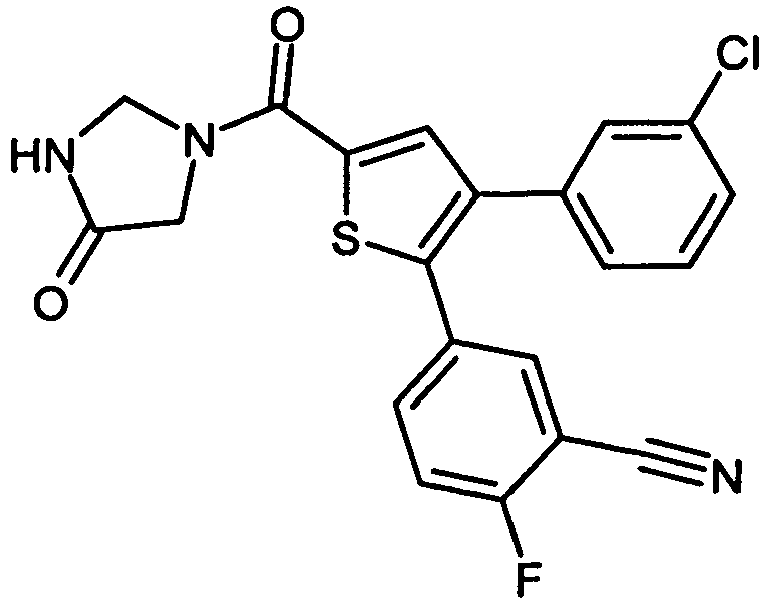
- 70.0 mg (0.15 mmol) der Verbindung aus Beispiel 16A und 36.1 mg (0.22 mmol) 3-Cyan-4-fluorphenylboronsäure werden unter Argon in 2.1 ml 1,2-Dimethoxyethan vorgelegt und mit 0.8 ml (0.73 mmol) wässriger Natriumhydrogencarbonat-Lösung (10%ig) und 5.1 mg (0.004 mmol) Tetrakis(triphenylphosphin)palladium(0) versetzt. Es wird über Nacht bei 80°C gerührt. Die Reaktionsmischung wird über die präparative HPLC (RP18-Säule; Eluent: Acetonitril/Wasser-Gradient unter Zusatz von 0.1% Ameisensäure) und zusätzlich präparative Dünnschichtchromatographie (Kieselgel; Laufmittel Dichlormethan/Methanol 10/1) gereinigt. Man erhält 5.3 mg (9% d. Th.) der Titelverbindung.
1H-NMR (400 MHz, DMSO-d6): δ = 8.78 (s, 1H), 7.87-7.71 (m, 1H), 7.53-7.47 (m, 1H), 7.43 (dt, 1H), 7.38 (t, 1H), 7.31 (tt, 1H), 7.20 (d, 1H), 7.06-6.99 (m, 2H), 5.31 (s, 0.5H), 4.89 (s, 1.5H), 4.48 (s, 1.5H), 3.99 (s, 0.5H).
LC-MS (Methode 7): Rt = 1.88 min; MS (ESIpos): m/z = 426 [M+H]+. -

- Die Herstellung der Titelverbindung erfolgt ausgehend von 70.0 mg (0.15 mmol) der Verbindung aus Beispiel 16A und 45.1 mg (0.22 mmol) 3-(Trifluormethoxy)phenylboronsäure analog zur Synthese der Verbindung aus Beispiel 5. Man erhält 26.7 mg (39% d. Th.) der Titelverbindung.
1H-NMR (400 MHz, DMSO-d6): δ = 8.78 (s, 1H), 7.86 (s, 0.75H), 7.74 (s, 0.25H), 7.56 (t, 1H), 7.46-7.33 (m, 5H), 7.21 (d, 1H), 7.14 (s, 1H), 5.31 (s, 0.5H), 4.89 (s, 1.5H), 4.48 (s, 1.5H), 3.99 (s, 0.5H).
LC-MS (Methode 7): Rt = 2.17 min; MS (ESIpos): m/z = 467 [M+H]+. -
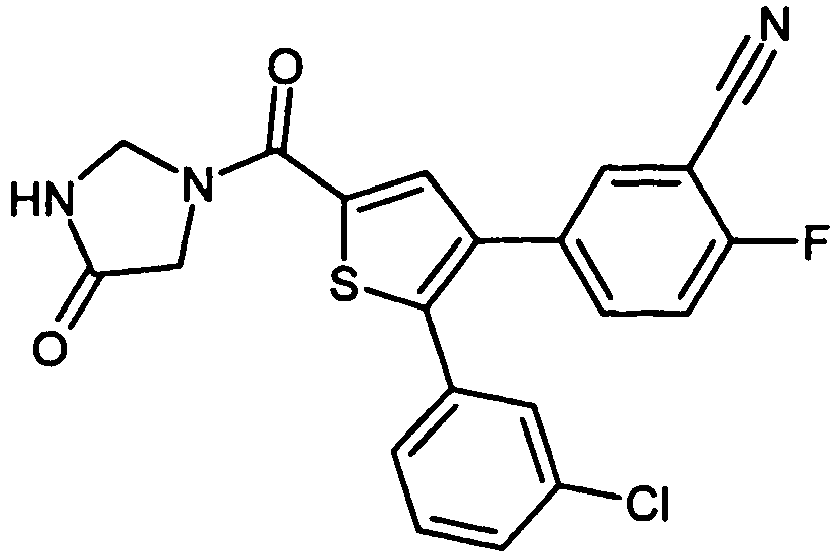
- 61.0 mg (0.16 mmol) der Verbindung aus Beispiel 24A werden unter Argon in 3 ml 1,2-Dimethoxyethan vorgelegt und mit 26.1 mg (0.16 mmol) 3-Cyan-4-fluorphenylboronsäure, 155 mg (0.47 mmol) Cäsiumcarbonat, 5.3 mg (0.01 mmol) Dicyclohexyl[2',4',6'-tri(propan-2-yl)biphenyl-2-yl]phosphan und 1.1 mg (0.005 mmol) Palladium(II)acetat versetzt. Es wird 30 min bei 100°C unter Mikrowellenbestrahlung in einem geschlossenen Glasgefäß erhitzt. Die Reaktionsmischung wird über die präparative HPLC (RP18-Säule; Eluent: Acetonitril/Wasser-Gradient) gereinigt. Man erhält 23.0 mg (34% d. Th.) der Titelverbindung.
1H-NMR (400 MHz, DMSO-d6): δ = 8.86-8.74 (m, 1H), 8.09-8.02 (m, 1H), 7.90-7.73 (m, 1H), 7.56 (ddd, 1H), 7.52-7.46 (m, 2H), 7.44-7.38 (m, 2H), 7.23 (d, 1H), 5.31 (s, 0.5H), 4.89 (s, 1.5H), 4.48 (s, 1.5H), 3.99 (s, 0.5H).
LC-MS (Methode 1): Rt = 2.50 min; MS (ESIpos): m/z = 426 [M+H]+. -

- 70.0 mg der Verbindung aus Beispiel 24A mit 76%iger Reinheit (0.14 mmol) und 47.5 mg (0.27 mmol) 3-Chlor-4-fluorphenylboronsäure werden unter Argon in 2.6 ml 1,2-Dimethoxyethan vorgelegt und mit 1.0 ml (0.91 mmol) wässriger Natriumhydrogencarbonat-Lösung (10%ig) und 6.3 mg (0.005 mmol) Tetrakis(triphenylphosphin)palladium(0) versetzt. Es wird 5 min bei 150°C unter Mikrowellenbestrahlung in einem geschlossenen Glasgefäß erhitzt. Die Reaktionsmischung wird über präparative HPLC (RP18-Säule; Eluent: Acetonitril/Wasser-Gradient unter Zusatz von 0.1% Ameisensäure) und zusätzlich präparative Dünnschichtchromatographie (Kieselgel; Laufmittel Essigsäureethylester) gereinigt. Man erhält 8.0 mg (13% d. Th.) der Titelverbindung.
1H-NMR (400 MHz, DMSO-d6): δ = 8.82-8.75 (m, 1H), 7.87-7.71 (m, 1H), 7.69-7.63 (m, 1H), 7.49-7.35 (m, 4H), 7.27-7.18 (m, 2H), 5.30 (s, 0.5H), 4.88 (s, 1.5H), 4.47 (s, 1.5H), 3.98 (s, 0.5H).
LC-MS (Methode 1): Rt = 2.54 min; MS (ESIpos): m/z = 435 [M+H]+. -

- 1.50 g (4.78 mmol) der Verbindung aus Beispiel 8A werden unter Argon in 75 ml 1,2-Dimethoxyethan vorgelegt und mit 1.30 g (5.26 mmol) der Verbindung aus Beispiel 5A, 4.67 g (14.3 mmol) Cäsiumcarbonat, 159 mg (0.33 mmol) Dicyclohexyl[2',4',6'-tri(propan-2-yl)biphenyl-2-yl]phosphan und 32.0 mg (0.14 mmol) Palladium(II)acetat versetzt. Es wird über Nacht bei 50°C gerührt. Anschließend gibt man Wasser hinzu, extrahiert mit Essigsäureethylester, trocknet über Natriumsulfat, filtriert und engt ein. Das Rohprodukt wird über präparative HPLC (RP18-Säule; Eluent: Acetonitril/Wasser-Gradient unter Zusatz von 0.1% Ameisensäure) gereinigt. Man erhält 1.05 g 4-Brom-5-(3-cyan-5-fluorphenyl)thiophen-2-carbonsäureethylester.
LC-MS (Methode 1): Rt = 2.91 min; MS (ESIpos): m/z = 354 [M+H]+. - Die Hälfte des so erhaltenen Feststoffs und 517 mg (2.96 mmol) 3-Chlor-4-fluorphenylboronsäure werden unter Argon in 21 ml 1,2-Dimethoxyethan vorgelegt und mit 7.9 ml (7.41 mmol) wässriger Natriumhydrogencarbonat-Lösung (10%ig) und 51.0 mg (0.04 mmol) Tetrakis(triphenylphosphin)palladium(0) versetzt. Es wird über Nacht bei 80°C gerührt. Anschließend engt man ein, gibt 1N wässrige HCl-Lösung bis zu einem sauren pH-Wert zu, extrahiert mit Essigsäureethylester, trocknet über Natriumsulfat, filtriert und engt ein. Das Rohprodukt wird über präparative HPLC (RP18-Säule; Eluent: Acetonitril/Wasser-Gradient unter Zusatz von 0.1% Ameisensäure) gereinigt. Man erhält 41.7 mg 4-(3-Chlor-4-fluorphenyl)-5-(3-cyan-5-fluorphenyl)thiophen-2-carbonsäureethylester.
GC-MS (Methode 11): Rt = 9.26 min; MS (EIpos): m/z = 403 [M]+. - Der so erhaltene Feststoff wird in 1.8 ml Tetrahydrofuran vorgelegt und bei Raumtemperatur mit 24.7 mg (1.03 mmol) Lithiumhydroxid und 0.6 ml Wasser versetzt. Man rührt bei Raumtemperatur über Nacht, gibt anschließend 1N wässrige HCl-Lösung bis zu einem sauren pH-Wert hinzu, extrahiert mit Essigsäureethylester, trocknet über Natriumsulfat, filtriert und engt ein. Man erhält 29.8 mg 4-(3-Chlor-4-fluorphenyl)-5-(3-cyan-5-fluorphenyl)thiophen-2-carbonsäure. Dieser Feststoff, 16.0 mg (0.08 mmol) der Verbindung aus Beispiel 4A und 56.8 mg (0.11 mmol) PyBOP werden in 2 ml Tetrahydrofuran vorgelegt und bei Raumtemperatur mit 0.04 ml (0.23 mmol) N,N-Diisopropylethylamin versetzt. Man rührt bei Raumtemperatur über Nacht und reinigt anschließend die Reaktionsmischung über präparative HPLC (RP18-Säule; Eluent: Acetonitril/Wasser-Gradient unter Zusatz von 0.1% Ameisensäure). Man erhält 7.4 mg (1% d. Th.) der Titelverbindung.
1H-NMR (400 MHz, DMSO-d6): δ = 8.85-8.76 (m, 1H), 7.91 (ddd, 1H), 7.88 (s, 0.75H), 7.76 (s, 0.25H), 7.74-7.67 (m, 2H), 7.54 (dt, 1H), 7.39 (t, 1H), 7.19 (ddd, 1H), 5.31 (s, 0.5H), 4.89 (s, 1.5H), 4.48 (s, 1.5H), 3.99 (s, 0.5H).
LC-MS (Methode 5): Rt = 1.21 min; MS (ESIpos): m/z = 444 [M+H]+. -

- Die Herstellung der Titelverbindung erfolgt ausgehend von der Verbindung aus Beispiel 8A analog zur Synthese der Verbindung aus Beispiel 10. Man erhält 8.2 mg (1% d. Th.) der Titelverbindung.
1H-NMR (400 MHz, DMSO-d6): δ = 8.83-8.76 (m, 1H), 7.90 (ddd, 1H), 7.89-7.74 (m, 1H), 7.66 (s, 1H), 7.55-7.49 (m, 2H), 7.43 (ddd, 1H), 7.36 (t, 1H), 7.17 (d, 1H), 5.31 (s, 0.5H), 4.89 (s, 1.5H), 4.48 (s, 1.5H), 3.99 (s, 0.5H).
LC-MS (Methode 5): Rt = 1.20 min; MS (ESIpos): m/z = 426 [M+H]+. -
DMSO Dimethylsulfoxid FKS Fötales Kälber Serum (Biochrom AG, Berlin, Deutschland) PBS Phosphate buffered saline MTP Mikrotiterplatte ELISA Enzyme-linked immunosorbent assay - Die Eignung der erfindungsgemäßen Verbindungen zur Behandlung von durch Retroviren hervorgerufenen Erkrankungen kann in folgenden Assay-Systemen gezeigt werden:
- Es wird der "Reverse Transcriptase Assay, colorimetric" (Roche Diagnostics GmbH, Mannheim, Deutschland) entsprechend den Herstellerangaben verwendet. Die Prüfsubstanzen werden in DMSO gelöst und in 5er Schritten verdünnt in dem Test eingesetzt (DMSO Endkonzentration 1%). Die resultierenden Werte der photometrischen Auswertung (405/492 nm) sind bei der Negativkontrolle (Ansatz ohne Reverse Transkriptase) kleiner 0,1 und liegen bei der Positivkontrolle (Ansatz ohne Prüfsubstanz) im Bereich von 1,5. Die IC50-Werte der Prüfsubstanzen werden als die Konzentration der Prüfsubstanzverdünnung ermittelt, bei der die gemessene optische Dichte 50% der Positivkontrolle beträgt.
- Es wird gefunden, dass die erfindungsgemäßen Verbindungen die Reverse Transkriptase Aktivität hemmen. Experimentelle Daten sind in Tabelle A zusammengefasst.
- Für diesen Assay werden HIV-1NL4-3 Reporterviren verwendet, die anstelle des nef Gens das lu164 Gen (Luziferase 164) tragen. Die Viren werden durch Transfektion von 293T-Zellen mit dem entsprechenden proviralen pNL4-3 Plasmid generiert (Lipofectamine Reagent, Invitrogen, Karlsruhe, Deutschland). Ausgehend von der proviralen Plasmid-DNA werden mit dem "QuikChange II XL Site-Directed Mutagenesis Kit" (Stratagene, Cedar Creek, Texas, USA) Viren mit definierten Resistenzmutationen im Reverse Transkriptase Gen hergestellt. Es werden u.a. folgende Mutationen generiert: A98G, A98G-K103N-V108I, A98S, F227C, F227L, G190A, G190S, K101E, K101Q-K103N, K103N, K103N-F227L, K103N-G190A, K103N-G190S, K103N-M230L, K103N-N348I, K103N-P225H, K103N-V108I, K103N-V108I-P225H, K103N-V179F-Y181C, K103N-Y181C, K103N-Y181C-G190A, L100I, L100I-K103N, L100I-K103N-V179I-Y181C, L100I-K103N-Y181C, L234I, N348I, P225H, P236L, V106A, V106A-E138K, V106A-F227C, V106A-F227L, V106I, V106I-Y188L, V106M, V108I, V179F-Y181C, V179I, V179I-Y181C, Y181C, Y181C-G190A, Y181C-M230L, Y181I, Y188L. Mit diesen Reporterviren infizierte MT4 7F2 Zellen sekretieren Luziferase ins Medium, was die luminometrische Quantifizierung der Virusreplikation ermöglicht.
- Für den Ansatz einer 96-well MTP werden 3 Millionen MT4 7F2 Zellen pelletiert, in 1 ml RPMI 1640 Medium ohne Phenolrot (Invitrogen, Karlsruhe, Deutschland)/10% FKS/10% AIM-V (Invitrogen, Karlsruhe, Deutschland) suspendiert und zusammen mit einer geeigneten Menge des entsprechenden HIV-1NL4-3 Reportervirus für 2 Stunden bei 37°C inkubiert (Pelletinfektion). Nicht adsorbierte Viren werden anschließend mit PBS ausgewaschen, die infizierten Zellen wieder pelletiert und in 8 ml RPMI 1640 Medium ohne Phenolrot/2% oder 10% FKS/10% AIM-V suspendiert. Davon werden 80 µl pro Well in eine weiße 96-well MTP zu 20 µl Prüfsubstanz in geeigneter Verdünnung pipettiert. Um Randeffekte zu vermeiden werden die Randwells der MTP nicht für Substanzverdünnungen verwendet. Die zweite vertikale Reihe der MTP enthält nur infizierte Zellen (Viruskontrolle) und die elfte vertikale Reihe nur nicht infizierte Zellen (Zellkontrolle) jeweils in RPMI 1640 Medium ohne Phenolrot/2% oder 10% FKS/10% AIM-V. Die übrigen Wells der MTP enthalten die erfindungsgemäßen Verbindungen in unterschiedlichen Konzentrationen ausgehend von der dritten vertikalen Reihe, von der aus die Prüfsubstanzen in 3er Schritten bis zur zehnten vertikalen Reihe 37-fach verdünnt werden. Die Prüfsubstanzen sind in DMSO gelöst, wobei die DMSO Endkonzentration im Testansatz 1% beträgt. Die Testansätze werden 5 Tage bei 37°C/5% CO2 inkubiert und nach Zugabe von 15 µl Lu164-Substrat (5 mg/ml Coelenterazin gelöst in 30 µM Glutathion/DMSO, 100 mM NaCl, 1 M MES, 100 mM Glutathion) luminometrisch ausgewertet. Die resultierenden Werte liegen bei der Viruskontrolle im Bereich von 1.000.000 RLUs (relative Lichteinheiten) und bei der Zellkontrolle bei 300 bis 400 RLUs. Die EC50-Werte der Prüfsubstanzen werden als die Konzentration ermittelt, bei der die in RLUs gemessene Virusreplikation 50% der unbehandelten infizierten Zellen beträgt.
- Es wird gefunden, dass die erfindungsgemäßen Verbindungen die HIV-Replikation hemmen. Experimentelle Daten sind in Tabelle A zusammengefasst.
- Primäre menschliche Blutlymphozyten (PBLs) werden über Ficoll-Paque Leucosep Röhrchen (Greiner Bio-One, Frickenhausen, Deutschland) aus Blut isoliert und in RPMI 1640 Medium (Invitrogen, Karlsruhe, Deutschland)/10% FKS mit Phytohaemagglutinin (90 µg/ml) und Interleukin-2 (40 U/ml) 3 Tage stimuliert.
- Für den Ansatz einer 96-well MTP werden 3 Millionen PBLs pelletiert, in 1 ml RPMI 1640 Medium/10% FKS suspendiert und zusammen mit einer geeigneten Menge HIV-1LAI (NIH AIDS Research & Reference Reagent Program, Germantown, USA) für 2 Stunden bei 37°C inkubiert (Pelletinfektion). Nicht adsorbierte Viren werden anschließend mit PBS ausgewaschen, die infizierten Zellen wieder pelletiert und in 18ml RPMI 1640 Medium/10% FKS/Interleukin-2 (40U/ml) suspendiert. Davon werden 180 µl pro well in eine weiße 96-well MTP zu 20 µl Prüfsubstanz in geeigneter Verdünnung pipettiert. Alternativ wird das HIV nach Zubereitung der Substanzverdünnungen in der MTP zusammen mit den Zellen zupipettiert und wird nicht mehr ausgewaschen (Überstandsinfektion). Um Randeffekte zu vermeiden werden die Randwells der MTP nicht für Substanzverdünnungen verwendet. Die zweite vertikale Reihe der MTP enthält nur infizierte Zellen (Viruskontrolle) und die elfte vertikale Reihe nur nicht infizierte Zellen (Zellkontrolle) jeweils in RPMI 1640 Medium/10% FKS/Interleukin-2 (40 U/ml). Die übrigen Wells der MTP enthalten die erfindungsgemäßen Verbindungen in unterschiedlichen Konzentrationen ausgehend von der dritten vertikalen Reihe, von der aus die Prüfsubstanzen in 3er Schritten bis zur zehnten vertikalen Reihe 37-fach verdünnt werden. Die Prüfsubstanzen sind in DMSO gelöst, wobei die DMSO Endkonzentration im Testansatz 1% beträgt. Die Testansätze werden bei 37°C/5% CO2 inkubiert. Nach 5 und 7 Tagen erfolgt die Abnahme von jeweils 50µl zellfreiem Überstand aus jedem Well zur Bestimmung der enthaltenen p24 Menge mittels p24 ELISA (HIV-1 p24CA Antigen Capture Assay Kit, NCI-Frederick Cancer Research and Development Center, Frederick, USA). Aus den resultierenden Werten der photometrischen Auswertung (450/620 nm) werden die EC50-Werte der Prüfsubstanzen als die Konzentration ermittelt, bei der die p24 Menge 50% der unbehandelten infizierten Zellen beträgt.
- Alternativ werden H9-Zellen (ATCC, Wesel, Deutschland) anstelle von PBLs zum Test der Prüfsubstanzen eingesetzt. H9-Zellen werden nach oben beschriebenem Muster in RPMI 1640 Medium mit 2% oder 10% FKS als HIV-1LAI Überstandsinfektion 5 Tage bei 37°C/5% CO2 inkubiert (20 µl Substanzverdünnung und 80 µl Zellen/Virus pro Well). Anschließend wird je Well 10 µl AlamarBlue (Invitrogen, Karlsruhe, Deutschland) zugegeben und die MTPs werden für 3 Stunden bei 37°C inkubiert, bevor die fluorimetrische Auswertung erfolgt (544/590 nm). Die resultierenden Werte liegen bei den unbehandelten nicht infizierten Zellen bei etwa 40.000 und bei den unbehandelten infizierten Zellen bei etwa 7.000. Im niedrigen Konzentrationsbereich werden die EC50-Werte der Prüfsubstanzen als die Konzentration ermittelt, bei der die Fluoreszenz 50% der unbehandelten nicht infizierten Zellen beträgt (jeweils abzüglich der Werte der unbehandelten infizierten Zellen). Außerdem werden im hohen Konzentrationsbereich die CC50-Werte der Prüfsubstanzen als die Konzentration ermittelt, bei der die Fluoreszenz 50% der unbehandelten nicht infizierten Zellen beträgt (jeweils abzüglich der Werte der unbehandelten infizierten Zellen).
- Es wird gefunden, dass die erfindungsgemäßen Verbindungen die HIV-Replikation hemmen. Experimentelle Daten sind in Tabelle A zusammengefasst.
- Zur Bestimmung der zytotoxischen Wirkung der Prüfsubstanzen in nicht infizierten Zellen werden die Substanzen in entsprechenden Konzentrationen auf durchsichtige 96-well MTPs pipettiert und mit nicht infizierten Zellen (z.B. H9, PBLs, THP-1, MT4 7F2, CEM, Jurkat) inkubiert (analog zu den oben beschriebenen Assays). Nach 5 Tagen wird zu den Testansätzen je Well 1/10 Volumen AlamarBlue zugegeben und die MTPs werden für 3 Stunden bei 37°C inkubiert. Anschließend erfolgt die fluorimetrische Auswertung (544/590 nm). Die resultierenden Werte liegen bei nicht behandelten Zellen je nach Zellart zwischen 20.000 und 40.000. Die CC50-Werte der Prüfsubstanzen werden als die Konzentration ermittelt, bei der die Fluoreszenz 50% der unbehandelten Zellen beträgt. Prüfsubstanzen, die im Konzentrationsbereich der Wirkung zytotoxische Befunde zeigen, werden nicht in ihrer antiviralen Wirksamkeit bewertet.
Tabelle A: Beispiel-Nr. IC50 (nM) RT Assay EC50 (nM) H9 Zellen HIV-1LAI 10% FKS EC50 (nM) MT4 ZF2 Zellen HIV-1NLA-3 wt 2% FKS EC50 (nM) MT4 7F2 Zellen HIV-1NL4-3 K103N-Y181C 2% FKS Beispiel 1 9 1 45 Beispiel 2 920 68 20 176 Beispiel 3 740 71 5 100 Beispiel 4 12 <1.5 44 Beispiel 5 2170 85 21 258 Beispiel 6 900 165 348 Beispiel 7 1410 100 150 Beispiel 8 103 5 121 Beispiel 9 593 35 260 Beispiel 10 34 5 40 Beispiel 11 22 2 123 - NOD Scid Mäuse, in der Regel 5 - 6 Wochen alt, werden von kommerziellen Züchtern (z. B. Taconic oder Jackson Laboratory) bezogen. Die Tiere werden unter sterilen Bedingungen (einschließlich Streu und Futter) in Isolatoren gehalten.
- Eine definierte Anzahl von Zellen (z. B. 5 x 10⁶ T-Zellen (z. B. C8166)) wird mit einer geeigneten m.o.i. (z.B. 0.01 TCID50) mit HIV infiziert. Die infizierten Zellen werden in Kollagenschwämme eingebracht. Die so vorbehandelten Schwämme werden den Mäusen unter die Rückenhaut implantiert. Die Mäuse werden einmal oder mehrfach täglich peroral, intraperitoneal, subcutan oder intravenös behandelt, wobei die erste Behandlung vor der Implantation liegen kann. Die Behandlungsgruppen umfassen in der Regel 10 Mäuse. Mindestens eine Gruppe wird mit Placebo behandelt, mindestens eine Gruppe mit einer bekanntermaßen wirksamen Substanz (= Positivkontrolle) und in der Regel mehrere Gruppen mit der erfindungsgemäßen Substanz. Die Tagesdosis der erfindungsgemäßen Substanz liegt zwischen 0.01 mg und 100 mg pro kg Körpergewicht. Die Formulierung der Substanzen erfolgt in 2% DMSO/0.5% Methylcellulose in PBS oder einer anderen geeigneten Mischung, die die Löslichkeit der Substanzen unterstützt. Die Behandlungsdauer beträgt in der Regel viereinhalb Tage. Nach der letzten Substanzapplikation werden die Tiere getötet und die Schwämme entnommen. Die virusinfizierten Zellen werden durch Kollagenaseverdau aus dem Schwamm gewonnen.
- Aus den Zellen wird Gesamt-RNA gewonnen, die in der quantitativen PCR auf den Gehalt an Virus-RNA überprüft wird. Die Menge an Virus-RNA wird anhand der Menge eines house-keeping Gens (z. B. GAPDH) normalisiert. Ermittelt wird die Menge an HIV-RNA nach Substanzbehandlung im Vergleich zur placebobehandelten Kontrollgruppe. Wurde ein HIV verwendet, das eine Luziferase trägt, kann zusätzlich oder ersatzweise eine Luziferase-Messung durchgeführt werden. In diesem Fall wird die HIV-Menge über die Höhe des Luziferase-Signals bestimmt, da es in diesem Fall als Maß für die Virusreplikation dient. Die statistische Auswertung erfolgt mittels geeigneter Computerprogramme, z. B. Graph Pad Prism.
- Zur Bestimmung der in vivo Pharmakokinetik werden die Testsubstanzen Mäusen, Ratten und Hunden intravenös und oral appliziert. Bei intravenösen Studien wird zur Bestimmung der pharmakokinetischen Eigenschaften der Testsubstanzen eine Dosis von 0.5 mg/kg in allen Spezies gewählt. Bei oraler Gabe wird den Nagern 3 mg/kg appliziert, Hunden 1 mg/kg. Die Testsubstanzen werden zur intravenösen Gabe für Nager in 99% Plasma, 1% DMSO formuliert, bei oraler Gabe in PEG 400, Ethanol und Wasser in variierenden Anteilen. Letzteres Vehikel wird bei Hunden für beide Applikationsrouten verwendet.
- Männliche Wistar Ratten werden vor Applikation der Testsubstanzen katheterisiert, so dass die Blutproben mit Hilfe des gelegten Katheters oder durch Punktion der Vena cava zu verschiedenen Zeitenpunkten über ein Intervall von 2 min bis zu 26 h entnommen werden können.
- Weiblichen BalbC Mäusen werden die Testsubstanzen als bolus Injektion intravenös appliziert, die Probengewinnung erfolgt in diesem Falle ausschließlich durch Punktion der Vena cava über ein Intervall von 2 min bis zu 26 h. Bei weiblichen Beagle Hunden erfolgt die Applikation ausschließlich durch eine 15 minütige intravenöse Infusion. Die Proben werden durch Punktion der Vena brachialis oder der Vena jugularis über ein Intervall von 10 min bis zu 26 h gewonnen.
- Die quantitative Bestimmung der Substanzen erfolgt aus dem gewonnenen Tierplasma und Eichproben, die in Plasma eingestellt werden. Die Plasmaproteine werden durch Fällung mit Acetonitril (ACN) entfernt. Anschließend werden die Proben mittels HPLC auf einer Agilent 1100 LC Anlage (Agilent, Santa Clara, Californien, USA) unter Verwendung unterschiedlicher Säulen, z.B. Luna C8, LichroCart Purospher Star RP18e aufgetrennt. Das HPLC System ist über ein Turbo Ion Spray Interface an ein Triple Quadropole Massenspektrometer API 3000 (Applied Biosystems, Darmstadt, Deutschland) gekoppelt. Die Auswertung des Plasmakonzentrations-Zeitverlaufs erfolgt unter Einsatz eines internen Standards und Verwendung eines validierten Kinetikauswerteprogramms.
- Neben Studien zur Bestimmung der pharmakokinetischen Parameter der Testsubstanzen in vivo werden Bestimmungen der relativen Bioverfügbarkeit aus Suspension (Formulierung: Tylose Suspension) versus Lösung in der Ratte sowie Hochdosisstudien im Vorfeld von Wirkversuchen und toxikologischen Studien in Mäusen, Ratten und Hunden durchgeführt.
- Das verwendete Plasma der unterschiedlichen Spezies (BalbC Maus, Wistar Ratte, Beagle Hund und Mensch) wird durch Blutabnahme, in mit Li-Heparin beschichtete Monovetten und anschließender Zentrifugation, frisch gewonnen. Zur Bestimmung der Plasmastabilität der Testsubstanzen wird je 500 ng/ml bei 37°C, zu je 2 ml in Plasma inkubiert. Zu verschiedenen Zeitpunkten, über ein Intervall bis zu 3 h, werden Proben dem Inkubationsgefäß entnommen. Die gewonnenen Proben werden mit ACN gefällt, um die Umsetzung zu stoppen und die Plasmaproteine abzutrennen. Die Proben werden äquivalent zu den in vivo Studien analysiert.
- Inkubationen mit Lebermikrosomen verschiedener Spezies (BalbC Maus, Wistar Ratte, Beagle Hund, Mensch) werden in einem Gesamtvolumen von 1.5 ml bei 37°C auf einem modifizierten Multiprobe II® Robotersytem (Canberra Packard) bzw. Janus® Robotersystem (Perkin Elmer) durchgeführt.
- Die Inkubationsmischungen enthalten jeweils 0.5 µg/ml Testsubstanz sowie 0.2 - 0.5 mg/ml mikrosomales Protein. Zusätzlich wird 0.05 M Phosphatpuffer (pH = 7.4), 1 mM EDTA, 5 mM Glucose-6-phosphat und 1.5 U/ml Glucose-6-phosphat Dehydroxygenase aus Leuconostoc Mesenteroides zugesetzt. Die mikrosomale Inkubationen wird durch Zugabe von NADP+ (Endkonzentration: 1 mM) gestartet.
- Zur Bestimmung der metabolischen Stabilität der Testsubstanzen in frisch isolierten und kultivierten Ratten- Hunde-, und Humanhepatozyten werden jeweils 1 Millionen Zellen/ml verwendet. Äquivalent dem mikrosomalen Assay werden den Hepatozyten jeweils 0.5 µg/ml Testsubstanz zugesetzt.
- Nach 2, 5, 10, 20, 30, 45 und 60 min, oder nach 2, 10, 20, 30, 50, 70 und 90 min bei stabileren Verbindungen, werden 125 µl aus dem jeweiligen Inkubationsansatz entnommen und mit ACN versetzt, um die enzymatischen Reaktionen zu stoppen. Nach der Zentrifugation werden die Proben mittels LC-MS/MS (API 2000 oder 3000, Applied Biosystems) analysiert. "CLblood well-stirred"- und "Fmax well-stirred"-Werte werden aus den jeweiligen Halbwertszeiten der Verbindungen in den mikrosomalen Inkubationen errechnet. Der Substratabbau kann mit folgenden Formeln beschrieben werden (Houston JB, Utility of in-vitro drug-metabolism data in predicting in-vivo metabolic-clearance, Bioch. Pharm. 47 (9) 1469- 1479 (1994); Obach RS; Baxter JG; Liston TE; Silber BM; Jones BC; MacIntyre F; Rance DJ; Wastall P, The prediction of human pharmacokinetic parameters from preclinical and in vitro metabolism data, J. Pharmacol. Exp. Ther. 283 (1) 46- 58 (1997)):

- Die Blut-Clearance "Clblood" wird ohne die Berücksichtigung von Proteinbindungen durch das "well-stirred" Modell beschrieben (Pang KS; Rowland M, Hepatic clearance of drugs. I. Theoretical considerations of a "well-stirred" model and a "parallel tube" model. Influence of hepatic blood flow, plasma and blood cell binding, and the hepatocellular enzymatic activity on hepatic drug clearance, J Pharmacokinet Biopharm 5 (6): 625-53 (1977)):

- Für die Ratten beträgt das spezifische Lebergewicht 32 g/kg Körpergewicht und der hepatische Blutfluss 4.2 1/(h·kg). Der spezifische mikrosmale Proteingehalt der Rattenleber wurde mit 40 mg/g Leber veranschlagt. Die spezifischen Hochrechnungsfaktoren weiterer Spezies sind in folgender Tabelle wiedergegeben und beruhen zum Teil auf Literaturdaten, zum Teil auf eigenen Bestimmungen. Für Hepatozyten wird eine Zellzahl von 110 Mio/g Leber bei allen Spezies zur Berechnung herangezogen.
Maus m Maus w Ratte m Hund m/w Mensch m/w Mikrosomales Protein/g Leber [mg] 40 40 40 40 40 Leber [g]/kg Körpergewicht 50 43 32 39 21 Leberblutfluss [1/(h·kg)] 5.4 5.4 4.2 2.1 1.32 - Die erfindungsgemäßen Verbindungen können folgendermaßen in pharmazeutische Zubereitungen überführt werden:
- 100 mg der Verbindung von Beispiel 1, 50 mg Lactose (Monohydrat), 50 mg Maisstärke (nativ), 10 mg Polyvinylpyrolidon (PVP 25) (Fa. BASF, Ludwigshafen, Deutschland) und 2 mg Magnesiumstearat.
- Tablettengewicht 212 mg. Durchmesser 8 mm, Wölbungsradius 12 mm.
- Die Mischung aus erfindungsgemäßer Verbindung, Lactose und Stärke wird mit einer 5%igen Lösung (m/m) des PVPs in Wasser granuliert. Das Granulat wird nach dem Trocknen mit dem Magnesiumstearat 5 Minuten gemischt. Diese Mischung wird mit einer üblichen Tablettenpresse verpresst (Format der Tablette siehe oben). Als Richtwert für die Verpressung wird eine Presskraft von 15 kN verwendet.
- 500 mg der Verbindung von Beispiel 1, 2.5 g Polysorbat und 97 g Polyethylenglycol 400. Einer Einzeldosis von 100 mg der erfindungsgemäßen Verbindung entsprechen 20 g orale Lösung.
- Die erfindungsgemäße Verbindung wird in der Mischung aus Polyethylenglycol und Polysorbat unter Rühren suspendiert. Der Rührvorgang wird bis zur vollständigen Auflösung der erfindungsgemäßen Verbindung fortgesetzt.
- Die erfindungsgemäße Verbindung wird in einer Konzentration unterhalb der Sättigungslöslichkeit in einem physiologisch verträglichen Lösungsmittel (z.B. isotonische Kochsalzlösung, Glucoselösung 5%, PEG 400 Lösung 30%) gelöst. Die Lösung wird steril filtriert und in sterile und pyrogenfreie Injektionsbehältnisse abgefüllt.
Claims (17)
- Verbindung der Formel
 R1 für Phenyl steht,
wobei Phenyl substituiert ist mit 1 bis 3 Substituenten, wobei die Substituenten unabhängig voneinander ausgewählt werden aus der Gruppe bestehend aus Halogen, Hydroxy, Cyano, Nitro, Trifluormethyl, Trifluormethoxy, Trifluormethylthio, (C1-C4)-Alkyl und (C1-C4)-Alkoxy,
worin
(C1-C4)-Alkyl und (C1-C4)-Alkoxy ihrerseits ein- bis dreifach, gleich oder verschieden, mit Resten substituiert sein können, die ausgewählt werden aus der Reihe Halogen, Cyano, Hydroxy, (C1-C4)-Alkoxy, Amino, Mono-(C1-C4)alkylamino, Di-(C1-C4)-alkylamino, (C3-C7)-Cycloalkyl und 4- bis 7-gliedriges Heterocyclyl,
wobei die letztgenannten Cycloalkyl- und Heterocyclyl-Reste ihrerseits jeweils bis zu dreifach, gleich oder verschieden, mit Halogen, Cyano, (C1-C4)-Alkyl, Trifluormethyl, Hydroxy, (C1-C4)-Alkoxy, Trifluormethoxy, Oxo, Amino, Mono-(C1-C4)-alkylamino und Di-(C1-C4)-alkylamino substituiert sein können, undR2 für Phenyl steht,oder eines ihrer Salze, ihrer Solvate oder der Solvate ihrer Salze.
wobei Phenyl substituiert ist mit 1 bis 3 Substituenten, wobei die Substituenten unabhängig voneinander ausgewählt werden aus der Gruppe bestehend aus Halogen, Hydroxy, Cyano, Nitro, Trifluormethyl, Trifluormethoxy, Trifluormethylthio, (C1-C4)-Alkyl und (C1-C4)-Alkoxy,
worin
(C1-C4)-Alkyl und (C1-C4)-Alkoxy ihrerseits ein- bis dreifach, gleich oder verschieden, mit Resten substituiert sein können, die ausgewählt werden aus der Reihe Halogen, Cyano, Hydroxy, (C1-C4)-Alkoxy, Amino, Mono-(C1-C4)-alkylamino, Di-(C1-C4)-alkylamino, (C3-C7)-Cycloalkyl und 4- bis 7-gliedriges Heterocyclyl,
wobei die letztgenannten Cycloalkyl- und Heterocyclyl-Reste ihrerseits jeweils bis zu dreifach, gleich oder verschieden, mit Halogen, Cyano, (C1-C4)-Alkyl, Trifluormethyl, Hydroxy, (C1-C4)-Alkoxy, Trifluormethoxy, Oxo, Amino, Mono-(C1-C4)-alkylamino und Di-(C1-C4)-alkylamino substituiert sein können, - Verbindung nach Anspruch 1, dadurch gekennzeichnet, dassR1 für Phenyl steht,
wobei Phenyl substituiert ist mit 1 bis 2 Substituenten, wobei die Substituenten unabhängig voneinander ausgewählt werden aus der Gruppe bestehend aus Halogen, Hydroxy, Cyano, Nitro, Trifluormethyl, Trifluormethoxy, Trifluormethylthio, (C1-C4)-Alkyl und (C1-C4)-Alkoxy, undR2 für Phenyl steht,oder eines ihrer Salze, ihrer Solvate oder der Solvate ihrer Salze.
wobei Phenyl substituiert ist mit 1 bis 2 Substituenten, wobei die Substituenten unabhängig voneinander ausgewählt werden aus der Gruppe bestehend aus Halogen, Hydroxy, Cyano, Nitro, Trifluormethyl, Trifluormethoxy, Trifluormethylthio, (C1-C4)-Alkyl und (C1-C4)-Alkoxy,
worin
(C1-C4)-Alkoxy seinerseits ein- bis dreifach, gleich oder verschieden, mit Resten substituiert sein kann, die ausgewählt werden aus der Reihe Halogen, Cyano, Hydroxy, (C1-C4)-Alkoxy, Amino, Mono-(C1-C4)-alkylamino, Di-(C1-C4)-alkylamino, (C3-C7)-Cycloalkyl und 4- bis 7-gliedriges Heterocyclyl,
wobei die letztgenannten Cycloalkyl- und Heterocyclyl-Reste ihrerseits jeweils bis zu dreifach, gleich oder verschieden, mit Halogen, Cyano, (C1-C4)-Alkyl, Trifluormethyl, Hydroxy, (C1-C4)-Alkoxy, Trifluormethoxy, Oxo, Amino, Mono-(C1-C4)-alkylamino und Di-(C1-C4)-alkylamino substituiert sein können, - Verbindung nach Anspruch 1 oder 2, dadurch gekennzeichnet, dassR1 für Phenyl steht,
wobei Phenyl substituiert ist mit 1 bis 2 Substituenten, wobei die Substituenten unabhängig voneinander ausgewählt werden aus der Gruppe bestehend aus Halogen, Cyano, Trifluormethyl, Methyl und Methoxy, undR2 für Phenyl steht,oder eines ihrer Salze, ihrer Solvate oder der Solvate ihrer Salze.
wobei Phenyl substituiert ist mit 1 bis 2 Substituenten, wobei die Substituenten unabhängig voneinander ausgewählt werden aus der Gruppe bestehend aus Halogen, Cyano, Trifluormethyl, Trifluormethoxy, Methyl und (C1-C3)-Alkoxy, - Verbindung nach einem der Ansprüche 1 bis 3, dadurch gekennzeichnet, dass sie der Formel
 R3 für Halogen oder Cyano steht,R4 für Wasserstoff oder Halogen steht,R5 für Halogen, Cyano oder Trifluormethyl steht, undR6 für Wasserstoff oder Halogen steht,oder eines ihrer Salze, ihrer Solvate oder der Solvate ihrer Salze.
 - Verbindung nach Anspruch 4, dadurch gekennzeichnet, dassR3 für Fluor, Chlor oder Cyano steht,R4 für Wasserstoff, Chlor oder Fluor steht,R5 für Fluor, Chlor oder Cyano steht, undR6 für Wasserstoff, Chlor oder Fluor steht,oder eines ihrer Salze, ihrer Solvate oder der Solvate ihrer Salze.
- Verbindung nach Anspruch 4 oder 5, dadurch gekennzeichnet, dassR3 für Chlor oder Cyano steht,R4 für Wasserstoff oder Fluor steht,R5 für Chlor oder Cyano steht, undR6 für Wasserstoff oder Fluor steht,oder eines ihrer Salze, ihrer Solvate oder der Solvate ihrer Salze.
- Verfahren zur Herstellung einer Verbindung der Formel (I) nach Anspruch 1, dadurch gekennzeichnet, dass eine Verbindung der Formel

R1 und R2 die in Anspruch 1 angegebene Bedeutung aufweisen,
mit Imidazolidin-4-on oder einem Salz von Imidazolidin-4-on umgesetzt wird. - Verfahren zur Herstellung einer Verbindung der Formel (I) nach Anspruch 1,
dadurch gekennzeichnet, dass eine Verbindung der Formel
R2 die in Anspruch 1 angegebene Bedeutung aufweist,
unter Suzuki-Kupplungsbedingungen mit einer Verbindung der Formel
R1-Q (V),
in welcher
R1 die in Anspruch 1 angegebene Bedeutung aufweist undQ für -B(OH)2, einen Boronsäure-Ester, bevorzugt Boronsäurepinakolester, oder -BF3 -K+ steht,umgesetzt wird. - Verfahren zur Herstellung einer Verbindung der Formel (I) nach Anspruch 1, dadurch gekennzeichnet, dass eine Verbindung der Formel

R1 die in Anspruch 1 angegebene Bedeutung aufweist,
unter Suzuki-Kupplungsbedingungen mit einer Verbindung der Formel
R7-Q (VII),
in welcher
R2 die in Anspruch 1 angegebene Bedeutung aufweist undQ für -B(OH)2, einen Boronsäure-Ester, bevorzugt Boronsäurepinakolester, oder -BF3 -K+ steht,umgesetzt wird. - Verbindung nach einem der Ansprüche 1 bis 6 zur Behandlung und/oder Prophylaxe von Krankheiten.
- Verwendung einer Verbindung nach einem der Ansprüche 1 bis 6 zur Herstellung eines Arzneimittels zur Behandlung und/oder Prophylaxe von Krankheiten.
- Verwendung einer Verbindung nach einem der Ansprüche 1 bis 6 zur Herstellung eines Arzneimittels zur Behandlung und/oder Prophylaxe von retroviralen Erkrankungen.
- Verwendung nach Anspruch 12, dadurch gekennzeichnet, dass die retrovirale Erkrankung eine Infektion mit dem HI-Virus ist.
- Arzneimittel enthaltend mindestens eine Verbindung nach einem der Ansprüche 1 bis 6 in Kombination mit mindestens einem weiteren Wirkstoff.
- Arzneimittel enthaltend mindestens eine Verbindung nach einem der Ansprüche 1 bis 6 in Kombination mit einem inerten nicht-toxischen pharmazeutisch geeigneten Hilfsstoff.
- Arzneimittel nach Anspruch 14 oder 15 zur Behandlung und/oder Prophylaxe von retroviralen Erkrankungen.
- Arzneimittel nach Anspruch 16, dadurch gekennzeichnet, dass die retrovirale Erkrankung eine Infektion mit dem HI-Virus ist.
Applications Claiming Priority (2)
| Application Number | Priority Date | Filing Date | Title |
|---|---|---|---|
| DE102008062863A DE102008062863A1 (de) | 2008-12-17 | 2008-12-17 | Substituierte (Thiophenyl-carbonyl)imidazolidinone und ihre Verwendung |
| PCT/EP2009/008992 WO2010075962A1 (de) | 2008-12-17 | 2009-12-15 | Substituierte (thiophenyl-carbonyl)imidazolidinone und ihre verwendung |
Publications (2)
| Publication Number | Publication Date |
|---|---|
| EP2376482A1 EP2376482A1 (de) | 2011-10-19 |
| EP2376482B1 true EP2376482B1 (de) | 2013-03-06 |
Family
ID=41725182
Family Applications (1)
| Application Number | Title | Priority Date | Filing Date |
|---|---|---|---|
| EP09796960A Not-in-force EP2376482B1 (de) | 2008-12-17 | 2009-12-15 | Substituierte (thiophenyl-carbonyl)imidazolidinone und ihre verwendung |
Country Status (6)
| Country | Link |
|---|---|
| US (1) | US8546438B2 (de) |
| EP (1) | EP2376482B1 (de) |
| CA (1) | CA2747641C (de) |
| DE (1) | DE102008062863A1 (de) |
| ES (1) | ES2414779T3 (de) |
| WO (1) | WO2010075962A1 (de) |
Families Citing this family (1)
| Publication number | Priority date | Publication date | Assignee | Title |
|---|---|---|---|---|
| DE102009038123A1 (de) | 2009-08-17 | 2011-02-24 | Aicuris Gmbh & Co. Kg | Substituierte (Thiazolyl-carbonyl)imidazolidinone und ihre Verwendung |
Family Cites Families (48)
| Publication number | Priority date | Publication date | Assignee | Title |
|---|---|---|---|---|
| GB453061A (en) | 1935-03-23 | 1936-09-04 | Charles Howard Twigg | Improvements in and relating to gas heated geysers and water heaters |
| US3806506A (en) | 1971-08-05 | 1974-04-23 | Uniroyal Inc | Furan derivatives,compositions thereof and methods for using same |
| DE3119796A1 (de) | 1981-05-19 | 1982-12-23 | Hoechst Ag, 6000 Frankfurt | Substituierte tryptaminderivate von thienyloxpropanolaminen, verfahren zu ihrer herstellung, pharmazeutische praeparate auf basis dieser verbindungen sowie ihre verwendung |
| FR2538388B1 (fr) | 1982-12-24 | 1985-06-21 | Pharmuka Lab | Nouveaux derives de naphtalene- ou azanaphtalenecarboxamide, leurs procedes de preparation et leur utilisation comme medicaments |
| US5591761A (en) | 1993-05-20 | 1997-01-07 | Texas Biotechnology Corporation | Thiophenyl-, furyl-and pyrrolyl-sulfonamides and derivatives thereof that modulate the activity of endothelin |
| PH27357A (en) | 1989-09-22 | 1993-06-21 | Fujisawa Pharmaceutical Co | Pyrazole derivatives and pharmaceutical compositions comprising the same |
| GB9012936D0 (en) | 1990-06-11 | 1990-08-01 | Fujisawa Pharmaceutical Co | Thiophene derivatives,processes for preparation thereof and pharmaceutical composition comprising the same |
| US5571810A (en) | 1990-06-11 | 1996-11-05 | Fujisawa Pharmaceutical Co., Ltd. | Thiophene derivatives |
| IL104311A (en) | 1992-02-05 | 1997-07-13 | Fujisawa Pharmaceutical Co | Pyrazole derivatives, processes for the preparation thereof and pharmaceutical compositions containing the same |
| FR2692575B1 (fr) | 1992-06-23 | 1995-06-30 | Sanofi Elf | Nouveaux derives du pyrazole, procede pour leur preparation et compositions pharmaceutiques les contenant. |
| JPH084281B2 (ja) | 1992-09-30 | 1996-01-17 | 橋本コーポレイション株式会社 | オンフック後相手の声を拡声する電話装置 |
| FR2728571B1 (fr) | 1994-12-22 | 1997-01-31 | Adir | Nouveaux ethers d'oximes tricycliques, leurs procedes de preparation et les compositions pharmaceutiques qui les contiennent |
| US5696151A (en) | 1995-11-30 | 1997-12-09 | Uniroyal Chemical Company, Inc. | Compounds useful for the inhibition of the replication of HIV-1 and HIV-1 mutants |
| US6143780A (en) | 1999-09-17 | 2000-11-07 | Uniroyal Chemical Company, Inc. | N-arylmethylthioanilide compounds useful for the inhibition of the replication of HIV |
| IL153246A0 (en) | 2000-06-28 | 2003-07-06 | Astrazeneca Ab | Substituted quinazoline derivatives and their use as inhibitors |
| GB0113524D0 (en) | 2001-06-04 | 2001-07-25 | Hoffmann La Roche | Pyrazole derivatives |
| JP2005501841A (ja) | 2001-08-01 | 2005-01-20 | バセル ポリオレフィン ジーエムビーエイチ | 複素環式ペンタレン誘導体の製造方法 |
| WO2003037274A2 (en) | 2001-11-01 | 2003-05-08 | Icagen, Inc. | Pyrazole-amides and-sulfonamides |
| AU2003265395A1 (en) | 2002-08-14 | 2004-03-03 | Ppd Discovery, Inc. | Prenylation inhibitors and methods of their synthesis and use |
| GB0221477D0 (en) | 2002-09-16 | 2002-10-23 | Pfizer Ltd | Chemical compounds |
| GB0223232D0 (en) | 2002-10-07 | 2002-11-13 | Pfizer Ltd | Chemical compounds |
| ES2379076T3 (es) | 2002-12-02 | 2012-04-20 | Astellas Pharma Inc. | Derivados de pirazol útiles como inhibidores de COX-I |
| US7622471B2 (en) | 2003-02-07 | 2009-11-24 | Daiichi Pharmaceutical Co., Ltd. | Pyrazole derivatives having a pyridazine and pyridine functionality |
| DE602004023586D1 (de) | 2003-02-27 | 2009-11-26 | Neurosearch As | Neue diazabicyclische arylderivate |
| FR2856683A1 (fr) | 2003-06-25 | 2004-12-31 | Sanofi Synthelabo | Derives de 4-cyanopyrazole-3-carboxamide, leur preparation et leur application en therapeutique |
| GB0315657D0 (en) | 2003-07-03 | 2003-08-13 | Astex Technology Ltd | Pharmaceutical compounds |
| WO2005007625A2 (en) | 2003-07-14 | 2005-01-27 | The University Of Tennessee Research Foundation | Heterocyclic amides with anti-tuberculosis activity |
| US7220772B2 (en) | 2003-09-05 | 2007-05-22 | Pfizer, Inc. | Pyrazole derivatives |
| FR2860792B1 (fr) | 2003-10-10 | 2006-02-24 | Sanofi Synthelabo | Derives de thiophene-2-carboxamide, leur preparation et leur application en therapeutique |
| RU2375349C2 (ru) | 2004-02-20 | 2009-12-10 | Астразенека Аб | Производные 3-замещенного 1,5-дифенилпиразола, полезные в качестве св1 модуляторов |
| CN1980912A (zh) | 2004-07-01 | 2007-06-13 | 第一制药株式会社 | 吡唑衍生物 |
| GB0417910D0 (en) | 2004-08-11 | 2004-09-15 | Novartis Ag | Organic compounds |
| CN101006082B (zh) | 2004-08-23 | 2010-09-29 | 伊莱利利公司 | 组胺h3受体药剂、制备方法和治疗用途 |
| DE102004054666A1 (de) | 2004-11-12 | 2006-05-18 | Bayer Cropscience Gmbh | Substituierte Pyrazol-3-carboxamide, Verfahren zur Herstellung und Verwendung als Herbizide und Pflanzenwachstumsregulatoren |
| US7741479B2 (en) | 2004-12-07 | 2010-06-22 | Locus Pharmaceuticals, Inc. | Urea inhibitors of MAP kinases |
| US7612200B2 (en) | 2004-12-07 | 2009-11-03 | Locus Pharmaceuticals, Inc. | Inhibitors of protein kinases |
| MX2007006743A (es) | 2004-12-15 | 2007-07-09 | Astrazeneca Ab | Ligandos del receptor de acetilcolina nicotinica. |
| US20110098301A1 (en) | 2005-03-10 | 2011-04-28 | Bayer Healthcare Llc | Pyrimidine Derivatives for Treatment of Hyperproliferative Disorders |
| BRPI0612287A8 (pt) | 2005-06-27 | 2019-01-22 | Exelixis Inc | composição para uso farmacêutico no tratamento de doenças através da medicina nuclear e métodos de uso e para modulação de atividade de receptor nuclear |
| EP1743637A1 (de) | 2005-07-15 | 2007-01-17 | Laboratorios Del Dr. Esteve, S.A. | Verwendung substituierter Pyrazolinderivate und Kombinationen davon zur Behandlung des metabolischen Syndroms |
| WO2007009701A2 (en) | 2005-07-15 | 2007-01-25 | Laboratorios Del Dr. Esteve, S.A. | Use of substituted pyrazole compounds and combinations thereof for the treatment of the metabolic syndrome |
| GB0516661D0 (en) | 2005-08-13 | 2005-09-21 | Astrazeneca Ab | Therapeutic agents |
| WO2008043775A1 (en) | 2006-10-12 | 2008-04-17 | Janssen Pharmaceutica Nv | Substituted pyrazinone derivatives for use as a medicine |
| EP2518063B1 (de) | 2006-12-21 | 2017-02-01 | Sloan-Kettering Institute For Cancer Research | Pyridazinone und furanhaltige Verbindungen |
| GB0701426D0 (en) | 2007-01-25 | 2007-03-07 | Univ Sheffield | Compounds and their use |
| DE102008015033A1 (de) | 2008-03-17 | 2009-09-24 | Aicuris Gmbh & Co. Kg | Substituierte (Pyrazolyl-carbonyl)imidazolidinone und ihre Verwendung |
| DE102008015032A1 (de) | 2008-03-17 | 2009-09-24 | Aicuris Gmbh & Co. Kg | Substituierte Pyrazolamide und ihre Verwendung |
| DE102008062878A1 (de) | 2008-12-17 | 2010-06-24 | Aicuris Gmbh & Co. Kg | Substituierte Furancarboxamide und ihre Verwendung |
-
2008
- 2008-12-17 DE DE102008062863A patent/DE102008062863A1/de not_active Ceased
-
2009
- 2009-12-15 CA CA2747641A patent/CA2747641C/en not_active Expired - Fee Related
- 2009-12-15 ES ES09796960T patent/ES2414779T3/es active Active
- 2009-12-15 WO PCT/EP2009/008992 patent/WO2010075962A1/de not_active Ceased
- 2009-12-15 EP EP09796960A patent/EP2376482B1/de not_active Not-in-force
-
2011
- 2011-06-16 US US13/162,522 patent/US8546438B2/en not_active Expired - Fee Related
Also Published As
| Publication number | Publication date |
|---|---|
| CA2747641A1 (en) | 2010-07-08 |
| ES2414779T3 (es) | 2013-07-22 |
| DE102008062863A1 (de) | 2010-06-24 |
| WO2010075962A1 (de) | 2010-07-08 |
| US8546438B2 (en) | 2013-10-01 |
| US20120022123A1 (en) | 2012-01-26 |
| EP2376482A1 (de) | 2011-10-19 |
| CA2747641C (en) | 2017-02-14 |
Similar Documents
| Publication | Publication Date | Title |
|---|---|---|
| EP2278965B1 (de) | Substituierte pyrazolamide und ihre verwendung | |
| EP2254885B1 (de) | (pyrazolyl-carbonyl) imidazolidinone-derivate zur behandlung retroviraler erkrankungen | |
| EP2054053A1 (de) | Biphenyl substituierte spirotetronsäuren und ihre verwendung zur behandlung retroviraler erkrankungen | |
| EP2376479B1 (de) | Substituierte furancarboxamide und ihre verwendung | |
| DE102012016908A1 (de) | Tris-(Hetero)Aryl-Pyrazole und ihre Verwendung | |
| EP2376482B1 (de) | Substituierte (thiophenyl-carbonyl)imidazolidinone und ihre verwendung | |
| DE102011055815A1 (de) | Carboxamid-substituierte Heteroaryl-Pyrazole und ihre Verwendung | |
| EP2467381B1 (de) | Substituierte (thiazolyl-carbonyl)imidazolidinone und ihre verwendung zur behandlung von retroviralen krankheiten | |
| WO2011012630A1 (de) | Substituierte bis-arylpyrazolamide mit terminaler primärer amidfunktionalisierung zur behandlung retroviraler erkrankungen | |
| DE102005031580A1 (de) | Substituierte Sulfolanylpyrazole und ihre Verwendung | |
| DE10337993A1 (de) | Aminobenzimidazole | |
| EP2102180A1 (de) | Substituierte aminofuranone und ihre verwendung |
Legal Events
| Date | Code | Title | Description |
|---|---|---|---|
| PUAI | Public reference made under article 153(3) epc to a published international application that has entered the european phase |
Free format text: ORIGINAL CODE: 0009012 |
|
| 17P | Request for examination filed |
Effective date: 20110715 |
|
| AK | Designated contracting states |
Kind code of ref document: A1 Designated state(s): AT BE BG CH CY CZ DE DK EE ES FI FR GB GR HR HU IE IS IT LI LT LU LV MC MK MT NL NO PL PT RO SE SI SK SM TR |
|
| RIN1 | Information on inventor provided before grant (corrected) |
Inventor name: GRESCHAT, SUSANNE Inventor name: WILDUM, STEFFEN Inventor name: PAULSEN, DANIELA Inventor name: THEDE, KAI |
|
| DAX | Request for extension of the european patent (deleted) | ||
| GRAP | Despatch of communication of intention to grant a patent |
Free format text: ORIGINAL CODE: EPIDOSNIGR1 |
|
| GRAS | Grant fee paid |
Free format text: ORIGINAL CODE: EPIDOSNIGR3 |
|
| GRAA | (expected) grant |
Free format text: ORIGINAL CODE: 0009210 |
|
| AK | Designated contracting states |
Kind code of ref document: B1 Designated state(s): AT BE BG CH CY CZ DE DK EE ES FI FR GB GR HR HU IE IS IT LI LT LU LV MC MK MT NL NO PL PT RO SE SI SK SM TR |
|
| REG | Reference to a national code |
Ref country code: GB Ref legal event code: FG4D Free format text: NOT ENGLISH |
|
| REG | Reference to a national code |
Ref country code: AT Ref legal event code: REF Ref document number: 599548 Country of ref document: AT Kind code of ref document: T Effective date: 20130315 Ref country code: CH Ref legal event code: EP |
|
| REG | Reference to a national code |
Ref country code: IE Ref legal event code: FG4D Free format text: LANGUAGE OF EP DOCUMENT: GERMAN |
|
| REG | Reference to a national code |
Ref country code: DE Ref legal event code: R096 Ref document number: 502009006431 Country of ref document: DE Effective date: 20130502 |
|
| REG | Reference to a national code |
Ref country code: ES Ref legal event code: FG2A Ref document number: 2414779 Country of ref document: ES Kind code of ref document: T3 Effective date: 20130722 |
|
| PG25 | Lapsed in a contracting state [announced via postgrant information from national office to epo] |
Ref country code: LT Free format text: LAPSE BECAUSE OF FAILURE TO SUBMIT A TRANSLATION OF THE DESCRIPTION OR TO PAY THE FEE WITHIN THE PRESCRIBED TIME-LIMIT Effective date: 20130306 Ref country code: BG Free format text: LAPSE BECAUSE OF FAILURE TO SUBMIT A TRANSLATION OF THE DESCRIPTION OR TO PAY THE FEE WITHIN THE PRESCRIBED TIME-LIMIT Effective date: 20130606 Ref country code: SE Free format text: LAPSE BECAUSE OF FAILURE TO SUBMIT A TRANSLATION OF THE DESCRIPTION OR TO PAY THE FEE WITHIN THE PRESCRIBED TIME-LIMIT Effective date: 20130306 Ref country code: NO Free format text: LAPSE BECAUSE OF FAILURE TO SUBMIT A TRANSLATION OF THE DESCRIPTION OR TO PAY THE FEE WITHIN THE PRESCRIBED TIME-LIMIT Effective date: 20130606 |
|
| REG | Reference to a national code |
Ref country code: NL Ref legal event code: VDEP Effective date: 20130306 |
|
| REG | Reference to a national code |
Ref country code: LT Ref legal event code: MG4D |
|
| PG25 | Lapsed in a contracting state [announced via postgrant information from national office to epo] |
Ref country code: SI Free format text: LAPSE BECAUSE OF FAILURE TO SUBMIT A TRANSLATION OF THE DESCRIPTION OR TO PAY THE FEE WITHIN THE PRESCRIBED TIME-LIMIT Effective date: 20130306 Ref country code: LV Free format text: LAPSE BECAUSE OF FAILURE TO SUBMIT A TRANSLATION OF THE DESCRIPTION OR TO PAY THE FEE WITHIN THE PRESCRIBED TIME-LIMIT Effective date: 20130306 Ref country code: FI Free format text: LAPSE BECAUSE OF FAILURE TO SUBMIT A TRANSLATION OF THE DESCRIPTION OR TO PAY THE FEE WITHIN THE PRESCRIBED TIME-LIMIT Effective date: 20130306 Ref country code: GR Free format text: LAPSE BECAUSE OF FAILURE TO SUBMIT A TRANSLATION OF THE DESCRIPTION OR TO PAY THE FEE WITHIN THE PRESCRIBED TIME-LIMIT Effective date: 20130607 |
|
| PG25 | Lapsed in a contracting state [announced via postgrant information from national office to epo] |
Ref country code: HR Free format text: LAPSE BECAUSE OF FAILURE TO SUBMIT A TRANSLATION OF THE DESCRIPTION OR TO PAY THE FEE WITHIN THE PRESCRIBED TIME-LIMIT Effective date: 20130306 |
|
| PG25 | Lapsed in a contracting state [announced via postgrant information from national office to epo] |
Ref country code: IS Free format text: LAPSE BECAUSE OF FAILURE TO SUBMIT A TRANSLATION OF THE DESCRIPTION OR TO PAY THE FEE WITHIN THE PRESCRIBED TIME-LIMIT Effective date: 20130706 Ref country code: EE Free format text: LAPSE BECAUSE OF FAILURE TO SUBMIT A TRANSLATION OF THE DESCRIPTION OR TO PAY THE FEE WITHIN THE PRESCRIBED TIME-LIMIT Effective date: 20130306 Ref country code: CZ Free format text: LAPSE BECAUSE OF FAILURE TO SUBMIT A TRANSLATION OF THE DESCRIPTION OR TO PAY THE FEE WITHIN THE PRESCRIBED TIME-LIMIT Effective date: 20130306 Ref country code: SK Free format text: LAPSE BECAUSE OF FAILURE TO SUBMIT A TRANSLATION OF THE DESCRIPTION OR TO PAY THE FEE WITHIN THE PRESCRIBED TIME-LIMIT Effective date: 20130306 Ref country code: NL Free format text: LAPSE BECAUSE OF FAILURE TO SUBMIT A TRANSLATION OF THE DESCRIPTION OR TO PAY THE FEE WITHIN THE PRESCRIBED TIME-LIMIT Effective date: 20130306 Ref country code: PT Free format text: LAPSE BECAUSE OF FAILURE TO SUBMIT A TRANSLATION OF THE DESCRIPTION OR TO PAY THE FEE WITHIN THE PRESCRIBED TIME-LIMIT Effective date: 20130708 Ref country code: RO Free format text: LAPSE BECAUSE OF FAILURE TO SUBMIT A TRANSLATION OF THE DESCRIPTION OR TO PAY THE FEE WITHIN THE PRESCRIBED TIME-LIMIT Effective date: 20130306 |
|
| PG25 | Lapsed in a contracting state [announced via postgrant information from national office to epo] |
Ref country code: PL Free format text: LAPSE BECAUSE OF FAILURE TO SUBMIT A TRANSLATION OF THE DESCRIPTION OR TO PAY THE FEE WITHIN THE PRESCRIBED TIME-LIMIT Effective date: 20130306 |
|
| PLBE | No opposition filed within time limit |
Free format text: ORIGINAL CODE: 0009261 |
|
| STAA | Information on the status of an ep patent application or granted ep patent |
Free format text: STATUS: NO OPPOSITION FILED WITHIN TIME LIMIT |
|
| PG25 | Lapsed in a contracting state [announced via postgrant information from national office to epo] |
Ref country code: DK Free format text: LAPSE BECAUSE OF FAILURE TO SUBMIT A TRANSLATION OF THE DESCRIPTION OR TO PAY THE FEE WITHIN THE PRESCRIBED TIME-LIMIT Effective date: 20130306 |
|
| 26N | No opposition filed |
Effective date: 20131209 |
|
| REG | Reference to a national code |
Ref country code: DE Ref legal event code: R097 Ref document number: 502009006431 Country of ref document: DE Effective date: 20131209 |
|
| BERE | Be: lapsed |
Owner name: AICURIS G.M.B.H. & CO. KG Effective date: 20131231 |
|
| REG | Reference to a national code |
Ref country code: CH Ref legal event code: PL |
|
| PG25 | Lapsed in a contracting state [announced via postgrant information from national office to epo] |
Ref country code: LU Free format text: LAPSE BECAUSE OF FAILURE TO SUBMIT A TRANSLATION OF THE DESCRIPTION OR TO PAY THE FEE WITHIN THE PRESCRIBED TIME-LIMIT Effective date: 20131215 |
|
| REG | Reference to a national code |
Ref country code: IE Ref legal event code: MM4A |
|
| PG25 | Lapsed in a contracting state [announced via postgrant information from national office to epo] |
Ref country code: LI Free format text: LAPSE BECAUSE OF NON-PAYMENT OF DUE FEES Effective date: 20131231 Ref country code: BE Free format text: LAPSE BECAUSE OF NON-PAYMENT OF DUE FEES Effective date: 20131231 Ref country code: IE Free format text: LAPSE BECAUSE OF NON-PAYMENT OF DUE FEES Effective date: 20131215 Ref country code: CH Free format text: LAPSE BECAUSE OF NON-PAYMENT OF DUE FEES Effective date: 20131231 |
|
| PG25 | Lapsed in a contracting state [announced via postgrant information from national office to epo] |
Ref country code: MC Free format text: LAPSE BECAUSE OF FAILURE TO SUBMIT A TRANSLATION OF THE DESCRIPTION OR TO PAY THE FEE WITHIN THE PRESCRIBED TIME-LIMIT Effective date: 20130306 |
|
| PG25 | Lapsed in a contracting state [announced via postgrant information from national office to epo] |
Ref country code: SM Free format text: LAPSE BECAUSE OF FAILURE TO SUBMIT A TRANSLATION OF THE DESCRIPTION OR TO PAY THE FEE WITHIN THE PRESCRIBED TIME-LIMIT Effective date: 20130306 |
|
| PG25 | Lapsed in a contracting state [announced via postgrant information from national office to epo] |
Ref country code: CY Free format text: LAPSE BECAUSE OF FAILURE TO SUBMIT A TRANSLATION OF THE DESCRIPTION OR TO PAY THE FEE WITHIN THE PRESCRIBED TIME-LIMIT Effective date: 20130306 Ref country code: TR Free format text: LAPSE BECAUSE OF FAILURE TO SUBMIT A TRANSLATION OF THE DESCRIPTION OR TO PAY THE FEE WITHIN THE PRESCRIBED TIME-LIMIT Effective date: 20130306 |
|
| PG25 | Lapsed in a contracting state [announced via postgrant information from national office to epo] |
Ref country code: HU Free format text: LAPSE BECAUSE OF FAILURE TO SUBMIT A TRANSLATION OF THE DESCRIPTION OR TO PAY THE FEE WITHIN THE PRESCRIBED TIME-LIMIT; INVALID AB INITIO Effective date: 20091215 Ref country code: MK Free format text: LAPSE BECAUSE OF FAILURE TO SUBMIT A TRANSLATION OF THE DESCRIPTION OR TO PAY THE FEE WITHIN THE PRESCRIBED TIME-LIMIT Effective date: 20130306 |
|
| PG25 | Lapsed in a contracting state [announced via postgrant information from national office to epo] |
Ref country code: MT Free format text: LAPSE BECAUSE OF FAILURE TO SUBMIT A TRANSLATION OF THE DESCRIPTION OR TO PAY THE FEE WITHIN THE PRESCRIBED TIME-LIMIT Effective date: 20130306 |
|
| REG | Reference to a national code |
Ref country code: FR Ref legal event code: PLFP Year of fee payment: 7 |
|
| REG | Reference to a national code |
Ref country code: AT Ref legal event code: MM01 Ref document number: 599548 Country of ref document: AT Kind code of ref document: T Effective date: 20141215 |
|
| PG25 | Lapsed in a contracting state [announced via postgrant information from national office to epo] |
Ref country code: AT Free format text: LAPSE BECAUSE OF NON-PAYMENT OF DUE FEES Effective date: 20141215 |
|
| REG | Reference to a national code |
Ref country code: FR Ref legal event code: PLFP Year of fee payment: 8 |
|
| PGFP | Annual fee paid to national office [announced via postgrant information from national office to epo] |
Ref country code: GB Payment date: 20161222 Year of fee payment: 8 |
|
| PGFP | Annual fee paid to national office [announced via postgrant information from national office to epo] |
Ref country code: ES Payment date: 20161213 Year of fee payment: 8 Ref country code: FR Payment date: 20161222 Year of fee payment: 8 |
|
| PGFP | Annual fee paid to national office [announced via postgrant information from national office to epo] |
Ref country code: DE Payment date: 20161229 Year of fee payment: 8 |
|
| PGFP | Annual fee paid to national office [announced via postgrant information from national office to epo] |
Ref country code: IT Payment date: 20161223 Year of fee payment: 8 |
|
| REG | Reference to a national code |
Ref country code: DE Ref legal event code: R119 Ref document number: 502009006431 Country of ref document: DE |
|
| GBPC | Gb: european patent ceased through non-payment of renewal fee |
Effective date: 20171215 |
|
| REG | Reference to a national code |
Ref country code: FR Ref legal event code: ST Effective date: 20180831 |
|
| PG25 | Lapsed in a contracting state [announced via postgrant information from national office to epo] |
Ref country code: FR Free format text: LAPSE BECAUSE OF NON-PAYMENT OF DUE FEES Effective date: 20180102 Ref country code: IT Free format text: LAPSE BECAUSE OF NON-PAYMENT OF DUE FEES Effective date: 20171215 Ref country code: DE Free format text: LAPSE BECAUSE OF NON-PAYMENT OF DUE FEES Effective date: 20180703 |
|
| PG25 | Lapsed in a contracting state [announced via postgrant information from national office to epo] |
Ref country code: GB Free format text: LAPSE BECAUSE OF NON-PAYMENT OF DUE FEES Effective date: 20171215 |
|
| REG | Reference to a national code |
Ref country code: ES Ref legal event code: FD2A Effective date: 20190703 |
|
| PG25 | Lapsed in a contracting state [announced via postgrant information from national office to epo] |
Ref country code: ES Free format text: LAPSE BECAUSE OF NON-PAYMENT OF DUE FEES Effective date: 20171216 |