EP2378314A2 - Zielverknüpftes Strahlungsbildgebungssystem - Google Patents
Zielverknüpftes Strahlungsbildgebungssystem Download PDFInfo
- Publication number
- EP2378314A2 EP2378314A2 EP11162144A EP11162144A EP2378314A2 EP 2378314 A2 EP2378314 A2 EP 2378314A2 EP 11162144 A EP11162144 A EP 11162144A EP 11162144 A EP11162144 A EP 11162144A EP 2378314 A2 EP2378314 A2 EP 2378314A2
- Authority
- EP
- European Patent Office
- Prior art keywords
- detector
- target
- source
- events
- radiation
- Prior art date
- Legal status (The legal status is an assumption and is not a legal conclusion. Google has not performed a legal analysis and makes no representation as to the accuracy of the status listed.)
- Withdrawn
Links
Images


Classifications
-
- G—PHYSICS
- G01—MEASURING; TESTING
- G01T—MEASUREMENT OF NUCLEAR OR X-RADIATION
- G01T7/00—Details of radiation-measuring instruments
-
- G—PHYSICS
- G01—MEASURING; TESTING
- G01V—GEOPHYSICS; GRAVITATIONAL MEASUREMENTS; DETECTING MASSES OR OBJECTS; TAGS
- G01V5/00—Prospecting or detecting by the use of ionising radiation, e.g. of natural or induced radioactivity
- G01V5/20—Detecting prohibited goods, e.g. weapons, explosives, hazardous substances, contraband or smuggled objects
- G01V5/26—Passive interrogation, i.e. by measuring radiation emitted by objects or goods
Definitions
- the embodiments described herein relate generally to contraband imaging systems and, more particularly, to contraband imaging systems that track an object associated with the contraband.
- At least some known radiation imaging systems detect contraband.
- the term "contraband” refers to illegal substances, explosives, narcotics, weapons, special nuclear materials, dirty bombs, nuclear threat materials, a threat object, and/or any other material that a person is not allowed to possess in a restricted area, such as a border crossing.
- One known radiation imaging system can determine a direction from a detector to a radiation source when the radiation source is stationary. However, when the radiation source is moving, gamma rays from the source arrive at the detector from a plurality of angles that change over time. The motion of the source with respect to the detector leads to smearing of a radiation image generated from the detector data.
- the generated radiation image is biased because more events are detected when the source is closer to the detector as compared to when the source is located farther from the detector.
- a radiation image is distance-biased, it appears that the source is at an angle corresponding to a distance of closest approach to the detector, rather than at its true location.
- the coded-aperture cameras include a coded mask and a position sensitive detector.
- the coded mask includes a pattern of transparent material and opaque material, which attenuates X-rays in a target energy range.
- the position sensitive detector has a spatial pattern sufficiently matching a grid size of the coded mask pattern. Photons from a certain direction project the coded mask onto the position sensitive detector. The photon projection has the same coding pattern as the mask, but is shifted on a detector plane. The shift correlates with a direction of the incident X-rays. Because the detector can detect any X-rays within an observed space, a relatively large accumulation of X-rays is needed for the coded-aperture gamma camera to be effective.
- an imaging detection system includes at least one location detection device configured to determine coordinates of a target, at least one detector configured to detect events from a source associated with the target, and a processor coupled in communication with the at least one location detection device and the at least one detector.
- the processor is configured to receive the coordinates from the at least one location detection device and the events from the at least one detector, translate the events using the coordinates acquired from the at least one location detection device to compensate for a relative motion between the source and the at least one detector, and output a processed data set having the events translated based on the coordinates.
- an imaging detection system in another aspect, includes a tracking system having a location detection device.
- the tracking system is configured to determine coordinates of a target based on data acquired from the location detection device.
- the imaging system further includes a detection system having a detector.
- the detection system is configured to detect events from a source associated with the target based on data acquired from the detector.
- a processor is coupled in communication with the tracking system and the detection system. The processor is configured to receive the coordinates from the tracking system and the events from the detection system, translate the events using the coordinates from the tracking system to compensate for a relative motion between the source and the detector, and output a processed data set having the events translated based on the coordinates.
- a method for generating an image of a source moving with respect to a detector includes acquiring real-world coordinates of a target associated with the source using a location detection device, detecting events from the source using the detector, translating the events using the real-world coordinates to compensate for a relative motion between the source and the detector, and generating the image having the events translated to intersect generally at a center of a field of view of the image.
- FIGS. 1-9 show exemplary embodiments of the system and methods described herein.
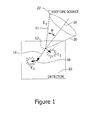
- Figure 1 is a schematic illustration of a geometric relationship for Compton imaging.
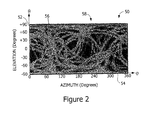
- Figure 2 is a graph representing a backprojection of multiple gamma rays from a stationary source.
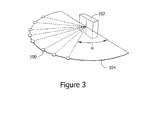
- Figure 3 is a schematic illustration of a radiation source moving relative to a detector.
- Figure 4 is a graph representing a backprojection of multiple gamma rays from the moving source shown in Figure 3 .
- Figure 5 is a graph representing a backprojection of multiple gamma rays from the moving source shown in Figure 4 with a motion of the source compensated for.
- Figure 6 is a schematic illustration of exemplary motion compensated radiation imaging.
- Figure 7 is a schematic illustration of an exemplary target-linked radiation imaging system.
- FIG 8 is a schematic illustration of a tracking system that may be used with the target-linked radiation imaging system shown in Figure 7 .
- Figure 9 are graphs representing non-compensated radiation images and compensated radiation images.
- the target-linked radiation imaging (TLRI) system described herein combines radiation imaging with real-time target tracking to detect moving radiation sources with greater sensitivity as compared to known radiation imaging systems. More specifically, in the exemplary embodiment, the TLRI system uses sophisticated real-time tracking to simultaneously monitor locations of multiple targets and report the locations in three-dimensional (3D) world coordinates.
- a processor and/or a server synchronizes the locations of the sources with real-time gamma ray detection data from at least one cadmium zinc telluride (CZT) Compton imaging detector. By compensating for the motion of the sources, the TLRI system detects weaker sources in a shorter time while they are in continuous motion.
- CZT cadmium zinc telluride
- the TLRI system can be used with any sensing technology that detects a direction from a source to the detector.
- the TLRI system is used when signals accumulate over time to achieve a desired signal-to-noise ratio.
- the herein-described TLRI system can be used to translate any suitable events generated by a moving source.
- the term "event” refers to the detection of any suitable type of radiation, such as a gamma ray, light, microwave, and/or millimeter wave, from a source. An event can be recorded as a discrete signal or a continuously variable signal.
- the continuously variable signal is divided into predetermined time intervals that are each considered to be an event.
- the time interval is selected to be a duration during which a target does not move far, i.e. 1 millisecond (ms).
- events include, but are not limited to, a gamma ray producing a discrete energy deposition in the detector, and millimeter wave imaging producing an image from a short time interval as a continuously variable signal.
- a TLRI system described herein uses Compton imaging to locate a radiation source.
- Compton imaging is a method that determines the energy and incident direction of detected gamma rays in a radiation detector 10.
- a gamma ray 11 having an energy Ey interacts with radiation detector 10
- one possible interaction process is a Compton scatter event.
- part of the gamma ray's energy E 1 is deposited in detector 10 at a point of interaction 12 while the remainder of energy E 2 is retained by a scattered gamma ray 14.
- angle ⁇ defines an opening angle of a cone 20 with axis 16 along a line connecting two interaction points 12 and 18 in detector 10. Based on the measurements of interaction points 12 and 18 and energies, gamma ray 11 is known to have originated from a direction on a surface of cone 20. Because of symmetry in the scatter process, a specific azimuthal angle around cone 20 cannot be determined for an individual gamma ray. However, when multiple gamma rays are detected from the same source 22, each gamma ray contributes its own different cone because the energy and angles of scatter will vary from one event to another. The cones overlap at a true source angle, allowing a direction and/or location of source 22 to be determined through a process of backprojection, as shown in Figure 2 .
- Figure 2 is radiation image 50 of a radiation source that is substantially stationary with respect to a detector.
- Radiation image 50 has a vertical axis 52 showing an elevation angle in degrees and a horizontal axis 54 showing an azimuth angle in degrees.
- Radiation image 50 is a two-dimensional (2D) array of angular positions with respect to a detector. More specifically, each point in radiation image 50 has coordinates in terms of elevation angle ( ⁇ ) and azimuth angle ( ⁇ ) with respect to the detector.
- Each point ( ⁇ , ⁇ ) has a corresponding cone associated therewith and shown in radiation image 50.
- each cone has a finite thickness. Pixels in radiation image 50 are associated with at least one cone, unless no event is detected. Where cones overlap, pixels are associated with more than one cone.
- cones begin to overlap in an area 56 of radiation image 50, while cones remain spaced apart in a remainder 58 of radiation image 50.
- a location of a source corresponds with overlap area 56.
- an imaging algorithm accumulates multiple overlapping gamma events to determine a source location.
- the incident angle changes continuously, and the gamma events no longer accumulate coherently, as illustrated in Figures 3 and 4 .
- FIG 3 a source 100 moves with respect to a detector 102 along an arc 104. If a location of source 100 is known by some other means, an angle ⁇ between source 100 and detector 102 can be determined before the backprojection of each gamma ray.
- Figure 4 illustrates an image 130 of event cones 132 detected from a moving source 100 (shown in Figure 3 ). Because source 100 is moving with respect to detector 102 (shown in Figure 3 ), cones 132 are spaced apart along an azimuth angle axis 134. As such, cones 132 incoherently accumulate in image 130, or "smear".
- the back projection can be continuously adjusted to compensate for the relative motion between source 100 (shown in Figure 3 ) and detector 102 (shown in Figure 3 ) such that cones 132 of emissions from source 100 remain at a center 152 of a reconstructed field of view 154. As such, cones 132 accumulate coherently about center 152 of image 150.
- Figure 6 illustrates exemplary motion compensated radiation imaging (MCRI).
- a radiation backprojection image 170 is rotated or translated to follow a target 172 as target 172 moves with respect to a detector 174.
- target 172 is effectively maintained generally at a center 176 of a reconstructed field of view 178. If target 172 is emitting radiation, detected gamma events will accumulate coherently in backprojection image 170 when the events are translated.
- the reconstructed image is rotated or translated in a virtual sense in a computer's memory, while the detector remains stationary.
- MCRI can therefore be applied simultaneously to multiple targets, even if the targets are moving in different directions and/or at different speeds. More specifically, all of the detected events are rotated or translated for each target in the field of view.
- a target includes an emitting radiation source
- the backprojected detection events will accumulate coherently within the reconstructed image.
- the events will not align with each other in a backprojection image and will blend into the background of the image.
- the target having a radiation source can be distinguished from other, non-radiation-emitting targets in the field of view.
- predetermined criteria are used to distinguish radiation-emitting targets from non-radiation-emitting targets in the field of view.
- the predetermined criteria can be at least partially based on a level of coherency of the accumulation the events and/or alignment of the events with the center of a reconstructed image, as described in more detail below.
- the TLRI system includes a multi-camera, real-time video tracking system to determine target locations, velocity, pose, orientation, shape, and/or any other suitable information relating to a target.
- target locations are reported in real world coordinates by establishing an accurate mapping of the imaging plane of each camera into a 3D world model.
- 2D modeling can be used.
- the model determines at least a location of the target with respect to time.
- FIG 7 is a schematic illustration of an exemplary target-linked radiation imaging (TLRI) system 200.
- TLRI system 200 is also referred to herein as an imaging detection system.
- Figure 8 is a schematic illustration of a tracking system 202 than may be used with TLRI system 200.
- TLRI system 200 includes tracking system 202 and a detection system 204 coupled in communication via a first router 206.
- TLRI system 200 includes any suitable network, such as a WiFi network, that enables the components of TLRI system 200 to communicate data and/or signals to other components of TLRI system 200.
- Tracking system 202 and detection system 204 can be embodied on separate computers or a single computer. Further, TLRI system 200 can be a distributed system.
- Tracking system 202 includes at least one location detection sensor or device 208, a location capture device 210, and a target tracking device 212. More specifically, in the exemplary embodiment, tracking system 202 includes a plurality of cameras 214, an image capture card 216, and target tracking device 212. Cameras 214 are considered to be location detection sensors or devices 208. Alternatively, any suitable location detection sensor or device, such as radar, lidar, millimeter wave imaging, and/or any other suitable imaging and/or tracking technology that enables TLRI system 200 to function as described herein, is used in tracking system 202.
- any suitable location detection sensor or device such as radar, lidar, millimeter wave imaging, and/or any other suitable imaging and/or tracking technology that enables TLRI system 200 to function as described herein, is used in tracking system 202.
- detection system 204 includes at least one sensor or detector 218, such as a radiation detector, a second router 220, a processor 222, and a data storage device 224.
- processor 222 is a TLRI server.
- radiation detectors 218 can be networked together to combine the detected events.
- At least one display 226 is coupled to tracking system 202 and/or detection system 204.
- Tracking system 202 is configured to determine real world coordinates of a target 228 having a radiation source 230 associated therewith.
- the coordinates of target 228 are transmitted from tracking system 202 to processor 222 via first router 206.
- Detection system 204 is configured to determine locations of events caused by radiation source 230, and to transmit the event locations to processor 222.
- Processor 222 uses the coordinates to compensate for relative motion between source 230 and radiation detector 218 to determine a real world location of source target 228 and/or source 230 and track target 228 and/or source 230 as it moves through a tracking field, such as an imaging field 232.
- TLRI system 200 can track a plurality of targets with or without a radiation source associated therewith.
- TLRI system 200 can track multiple targets each having a radiation source associated therewith.
- processor 222 is configured to compensate for a change in pose of target 228 with respect to at least one detector 218.
- pose refers to a position and orientation of one object with respect to another object.
- tracking system 202 includes multiple location detection devices, such as cameras 214, to track targets by making a correspondence between images from cameras 214 and by building a 3D model of the observed space.
- location detection devices such as cameras 214
- precise locations of cameras 214 and radiation detectors 218 are defined within a model by a calibration unit 234, and correspondence among camera views is determined in the model.
- the calibration can also include, for each camera 214, lens parameters, such as focal length, skew, and/or pitch, which define how the observed space maps into camera's 214 image. Lens distortion parameters are often included in the calibration, especially for wide field of view lenses.
- the calibration is a semiautomatic calibration method that uses imagery from cameras 214 to define a geometry of tracking system 202. More specifically, images from cameras 214 are used to back-calculate positions and orientations of cameras 214. To do this, fixed points in the observed space are measured by multiple cameras 214 simultaneously. By determining correspondences between these points in different camera views and building up a sufficient number of such points, an accurate estimate can be made of the camera positions.
- Tracking system 202 uses a model, such as a wire shape model, and points within images from cameras 214 to track target 228 (shown in Figure 7 ) and/or source 230 (shown in Figure 7 ) within the images and determine 3D locations of target 228 and/or source 230 in the real world.
- the model in the exemplary embodiment includes information related to how vehicles move to track a target within the images.
- tracking system 202 includes a VISIOWAVE® Intelligent Video Platform and/or ULTRAVIEW® Enterprise Video Platform manufactured by UTC Fire & Security of Farmington, CT.
- processor 222 can compensate for target's 228 motion in a radiation backprojection image, as described herein.
- tracking system 202 includes a foreground/background segmentation stage 236 that separates the regions in an image that correspond to moving objects from the background of the image. Segmentation stage 236 maintains an internal model of an empty scene of field of view 232 (shown in Figure 7 ) and performs foreground segmentation by calculating, for every pixel in the image, a probability of the color and intensity of the pixel.
- tracking system 202 is explained below as tracking a vehicle, it should be understood that tracking system 202 is configured to track any suitable target through field of view 232.
- a vehicle-detection stage 238 detects vehicles by explaining the observed foreground regions by hypothesized vehicles of a typical size, shape, and orientation.
- vehicle-detection stage 238 performs a greedy search by iteratively placing vehicle hypotheses into a scene of field of view 232 in a way that at every step a maximum amount of image data is explained. The iterative process ends once no vehicle can be placed in the scene.
- Tracking system 202 obtains 3D vehicle locations 240 in one of two ways.
- 3D location 240 of the vehicle.
- vehicle-detection stage 238 relies on 3D vehicle models to be used in conjunction with geometric information about cameras 214 to drive the scale and pose selection process, 3D vehicle locations 240 are given by the 3D model location that is used to drive the detection process.
- a motion tracker 242 uses the 3D vehicle locations 240 to perform track formation, data association between detections and existing tracks, and track maintenance. For data association, general nearest neighbor algorithms or more complex multi-hypothesis tracking (MHT) assignment strategies can be utilized. For tracking, Extended Kalman filters or particle filters are used to perform the tracking of vehicle observations.
- MHT complex multi-hypothesis tracking
- detection system 204 detects events from radiation source 230 using at least one radiation detector 218.
- radiation detector 218 is an intelligent personal radiation locator (IPRL) cadmium zinc telluride (CZT) detector array manufactured by General Electric Company. More specifically, an IPRL detector array is configured to autonomously detect radiation source 230 and discriminate among naturally-occurring radioactive materials, background, medical isotopes, and potential threats or contraband. IPRL detector arrays can determine a direction, a flux, an energy, and an isotope of the detected radiation, while sensing a location and an orientation of itself.
- IPRL personal radiation locator
- CZT cadmium zinc telluride
- radiation detector 218 includes a positioning or orientation sensor, such as a global positioning system (GPS) and/or internal orientation sensors, that enable detectors 218 to continuously transform all directional data into real-world coordinates.
- the positioning or orientation sensor is used when, for example, detector 218 is moving respect to target 228.
- Display 226 includes a graphic user interface (GUI) that displays information to a user.
- the information can be real-time and/or stored data.
- GUI graphic user interface
- an uncompensated radiation image, a compensated radiation image, a graph of an X-Y position of the target, a graph of an energy spectrum, and an overlaid video can be displayed to the user on the GUI.
- the overlaid video includes a substantially real-time video showing target 228 being tracked by tracking system 202 with a substantially real-time compensated radiation image superimposed on the video.
- the user can visually identify target 228 and track target's 228 movement in real-time.
- a still capture can be generated from the video.
- the GUI can provide information relating to each target being tracked with TLRI system 200 and allow the user to select which target's information to display. It should be understood that the GUI provides any suitable information to the user including, but not limited to, a list of available targets, a motion compensated backprojection image, an uncompensated backprojection image, a number of backprojected gamma rays, an X-Y position of a selected target, a graph of target position with respect to time, a spectrum of the selected target, an energy range used for back projection, a video of the selected target, a still capture of the selected target, an image of the target overlaid with a radiation image, and/or a recording/playback time stamp.
- a list of available targets a motion compensated backprojection image, an uncompensated backprojection image, a number of backprojected gamma rays, an X-Y position of a selected target, a graph of target position with respect to time, a spectrum of the selected target, an
- TLRI system 200 is configured to perform a method and/or algorithm to translate detected events to the coordinates of a moving target 228 to compensate for the movement of target 228 with respect to at least one detector 218. More specifically, radiation detector 218 detects Compton scatter to determine a cone for each detected event. The cones for each detected event are backprojected to generate a radiation image. As described above, the radiation image includes an array of points ( ⁇ , ⁇ ) representing the detected event, wherein an intensity of each point ( ⁇ , ⁇ ) is determined based on a corresponding cone.
- Processor 222 transforms each pixel and/or point ( ⁇ , ⁇ ) of the radiation image into a movement-compensated pixel or point ( ⁇ ', ⁇ ') for each event based on an instantaneous angle between target 228 and detector 218 at a time when the event occurred.
- the coordinates from tracking system 202 are used to compensate for the movement of radiation source 230 such that the cones are effectively translated to a center point in the radiation image.
- Any suitable algorithm can be used to calculate the compensation angles for the movement of the radiation source based on the coordinates from the tracking system.
- a rotation matrix is applied to the points ( ⁇ , ⁇ ) to rotate each point ( ⁇ , ⁇ ) based on the coordinates of target 228 as determined by tracking system 202.
- the rotation matrix transforms each point ( ⁇ , ⁇ ) into a movement-compensated point ( ⁇ ', ⁇ ') by rotating each point ( ⁇ , ⁇ ) about an X-axis, a Y-axis, and/or a Z-axis of the tracking system coordinate system. As such, the cones are mapped to a new set of points ( ⁇ ', ⁇ ').
- each cone associated with a point ( ⁇ ', ⁇ ') has a finite thickness or intensity.
- the thickness or intensity of each cone is based on a certainty of each cone. For example, the more certain the cone is, the thinner the cone, and the less certain the cone is, the thicker the cone is.
- the signal associated with each point ( ⁇ ', ⁇ ') is weighted based on the certainty of the cone to produce cones of different thickness in the radiation image. Because the points ( ⁇ ', ⁇ ') have been translated, the cones of varying thicknesses, or intensities, will accumulate coherently if the target is a radiation-emitting target.
- the above-described method is performed for each target 228 within a field of view 232 of TLRI system 200. More specifically, processor 222 assumes that all events within the field of view are emitted from each target and performs the translation and weighting for each target.
- processor 222 assumes that all events within the field of view are emitted from each target and performs the translation and weighting for each target.
- the cones When the method is performed for a non-radiation-emitting target, the cones will have a relatively low level of coherent accumulation and may generate an image similar to image 130 shown in Figure 4 .
- the cones When the method is performed for a radiation-emitting target, the cones will have a relatively high level of coherent accumulation and may generate an image similar to image 150 shown in Figure 5 .
- TLRI system 200 Based on the level of coherency, TLRI system 200 and/or an operator of TLRI system 200 determines which target 228, if any, is emitting radiation. In the exemplary embodiment, TLRI system 200 outputs a processed data set, such as an image, of the translated cones for at least one target 228 in field of view 232.
- a processed data set such as an image
- Figure 9 illustrates graphs representing a non-compensated radiation image 300 and a compensated radiation image 302.
- the graphs represent data acquired during an experiment in which a radiation source was moving at about 10 millimeters (mm) per second (sec) relative to a detector.
- the series of radiation images in the left column show the same radiation image 300 at different times during the experiment.
- Radiation image 300 does not include compensation for the movement of the source. Such images may be generated by a known radiation imaging system.
- the series of radiation images in the right column show the same radiation image 302 at different times during the experiment.
- Radiation image 302 includes the movement compensation as described above.
- the radiation image 302 in the right column is an image generated by the herein-described TLRI system 200 (shown in Figures 7 and 8 ).
- the cones are spaced along an X-axis of each radiation image and become more spaced apart as the radiation source moves a farther distance as shown in the bottom radiation image of the left column.
- the radiation images 300 in the left column appear "smeared" along the X-axis.
- the right column of images 302 shows that the cones are translated to a center of the image, thus compensating for the movement of the source.
- the cones overlap and/or intersect near a center of the radiation image rather than being spaced apart along the X-axis. Accordingly, the TLRI system described herein can detect the presence of a radiation source and locate the radiation source. When multiple targets are within the field of view, non-radiation-emitting targets will produce an image similar to non-compensated image 300, and radiation-emitting targets will produce an image similar to compensated image 302.
- the TLRI or imaging detection system described herein includes a tracking system and a detection system
- other suitable sensors can additionally be included in the imaging detection system.
- a plurality of different types of sensors are used in conjunction with the tracking system, and data from the different types of sensors is fused and integrated coherently.
- different types sensors are integrated together using the imaging detection system such that many relatively smaller sensors can be added to the imaging detection system incrementally to improve coverage and/or sensitivity of the imaging detection system.
- the different types of sensors can include non-directional sensors that correlate data with the proximity of the target. Other sensors may be more sophisticated sensors that allow for directionality and further target discrimination.
- the different types of sensor can be configured to obtain gamma radiation data, neutron data, chemical data, biological data, active inspection data, weight data, and/or any other suitable type of data.
- the imaging detection system additionally includes a scale that measures a weight of a vehicle as it tracked passed a gamma detector. Assuming a slightly elevated radiation level is detected by the detection system and the weight of the vehicle abnormally heavy indicating, for example, shielding, an operator could further confirm the presence of contraband using a neutron detector.
- the above-described TLRI system detects moving radiation sources, such as special nuclear materials (SNM), dirty bombs, other nuclear threat materials, and/or other contraband at, for example, a border crossing and/or a public checkpoint, which has not been possible with known detection systems. Further, the above-described TLRI system can detect weak moving radiation sources by using multiple detectors and the 3D world coordinates from location and/or tracking information. More specifically, by compensating for the motion of the contraband, the detection system described herein produces an image having more overlapping and/or intersecting events as compared to known detection systems that do not compensate for movement of the contraband.
- moving radiation sources such as special nuclear materials (SNM), dirty bombs, other nuclear threat materials, and/or other contraband at, for example, a border crossing and/or a public checkpoint, which has not been possible with known detection systems.
- the above-described TLRI system can detect weak moving radiation sources by using multiple detectors and the 3D world coordinates from location and/or tracking information. More specifically, by compens
- the tracking system described herein enables the TLRI system to report a location of a target for subsequent intervention by law enforcement and/or automated actions such as lowering, or not raising, traffic barriers.
- the tracking system also enables multiple targets to be tracked and differentiated from each other.
- any suitable radiation imaging technique can be used by the above-described TLRI system, the detection of Compton scattering provides 4 ⁇ sensitivity and spectral imaging at higher energies while not requiring a heavy collimator.
- a radiation imaging system includes at least one location detection device configured to determine coordinates of a target, at least one radiation detector configured to detect events from a radiation source associated with the target, and a processor coupled in communication with the at least one location detection device and the at least one radiation detector.
- the processor is configured to receive the coordinates from the at least one location detection device and the events from the at least one radiation detector, compensate for a relative motion between the radiation source and the at least one radiation detector using the coordinates from the at least one location detection device, and output a radiation image having the events translated based on the coordinates.
- a radiation imaging system in another embodiment, includes a tracking system having at least one location detection device.
- the tracking system is configured to determine coordinates of a target based on data from the at least one location detection device.
- the radiation imaging system further includes a radiation detection system having at least one radiation detector.
- the radiation detection system is configured to detect events from a radiation source associated with the target based on data from the at least one radiation detector.
- a processor is coupled in communication with the tracking system and the radiation detection system. The processor is configured to receive the coordinates from the tracking system and the events from the radiation detection system, compensate for a relative motion between the radiation source and the at least one radiation detector using the coordinates from the tracking system, and output a radiation image having the events translated based on the coordinates.
- a method for generating a radiation image includes acquiring real-world coordinates of a target using at least one location detection device, detecting events from a radiation source associated with the target using at least one radiation detector, and translating the events using the real-world coordinates to compensate for a relative motion between the radiation source and the at least one radiation detector.
- the radiation image having the events translated to intersect generally at a center of a field of view of the radiation image is generated.
- Exemplary embodiments of a target-linked radiation imaging system are described above in detail.
- the methods and systems are not limited to the specific embodiments described herein, but rather, components of systems and/or steps of the methods may be utilized independently and separately from other components and/or steps described herein.
- the methods may also be used in combination with other radiation imaging systems and methods, and are not limited to practice with only the Compton scatter systems and methods as described herein. Rather, the exemplary embodiment can be implemented and utilized in connection with many other radiation detection applications.
Landscapes
- Physics & Mathematics (AREA)
- Life Sciences & Earth Sciences (AREA)
- General Physics & Mathematics (AREA)
- High Energy & Nuclear Physics (AREA)
- Health & Medical Sciences (AREA)
- Molecular Biology (AREA)
- Spectroscopy & Molecular Physics (AREA)
- General Life Sciences & Earth Sciences (AREA)
- Geophysics (AREA)
- Measurement Of Radiation (AREA)
- Apparatus For Radiation Diagnosis (AREA)
Applications Claiming Priority (1)
| Application Number | Priority Date | Filing Date | Title |
|---|---|---|---|
| US32357410P | 2010-04-13 | 2010-04-13 |
Publications (2)
| Publication Number | Publication Date |
|---|---|
| EP2378314A2 true EP2378314A2 (de) | 2011-10-19 |
| EP2378314A3 EP2378314A3 (de) | 2013-09-18 |
Family
ID=44318151
Family Applications (1)
| Application Number | Title | Priority Date | Filing Date |
|---|---|---|---|
| EP11162144.7A Withdrawn EP2378314A3 (de) | 2010-04-13 | 2011-04-12 | Zielverknüpftes Strahlungsbildgebungssystem |
Country Status (3)
| Country | Link |
|---|---|
| US (1) | US20120008828A1 (de) |
| EP (1) | EP2378314A3 (de) |
| CN (1) | CN102253420A (de) |
Cited By (2)
| Publication number | Priority date | Publication date | Assignee | Title |
|---|---|---|---|---|
| FR3009881A1 (fr) * | 2013-08-23 | 2015-02-27 | Stmi Soc Des Tech En Milieu Ionisant | Modelisation 3d topographique et radiologique d'un environnement |
| EP2950118A4 (de) * | 2013-01-28 | 2016-09-21 | Mitsubishi Heavy Ind Ltd | System zur erzeugung einer verbreitungskarte von radioaktivem material und verfahren zur erzeugung einer verbreitungskarte von radioaktivem material |
Families Citing this family (5)
| Publication number | Priority date | Publication date | Assignee | Title |
|---|---|---|---|---|
| DE102012204541B4 (de) * | 2012-03-21 | 2024-01-25 | Bayerische Motoren Werke Aktiengesellschaft | Verfahren und Vorrichtung zur Bildverarbeitung von Bilddaten |
| EP2929038A4 (de) | 2012-12-05 | 2016-07-20 | Lanzatech New Zealand Ltd | Fermentierungsverfahren |
| AR090205A1 (es) * | 2013-02-28 | 2014-10-29 | Invap S E | Dispositivo para la deteccion y control del trafico ilicito de materiales nucleares especiales |
| CN105929392A (zh) * | 2016-04-18 | 2016-09-07 | 中国石油大学(华东) | 一种雷达与视频等多系统联动的海上平台系统 |
| CN108776322B (zh) * | 2018-02-26 | 2020-10-16 | 张岚 | 射线源定位方法 |
Family Cites Families (6)
| Publication number | Priority date | Publication date | Assignee | Title |
|---|---|---|---|---|
| US5821541A (en) * | 1996-02-02 | 1998-10-13 | Tuemer; Tuemay O. | Method and apparatus for radiation detection |
| US6546072B1 (en) * | 1999-07-30 | 2003-04-08 | American Science And Engineering, Inc. | Transmission enhanced scatter imaging |
| US7643604B2 (en) * | 2002-02-28 | 2010-01-05 | Jupiter Clyde P | Stationary inspection system for three-dimensional imaging employing electronic modulation of spectral data from Compton-scattered gammas |
| US20050058242A1 (en) * | 2003-09-15 | 2005-03-17 | Peschmann Kristian R. | Methods and systems for the rapid detection of concealed objects |
| US7738687B2 (en) * | 2005-04-07 | 2010-06-15 | L-3 Communications Security And Detection Systems, Inc. | Method of registration in a contraband detection system |
| US7750308B2 (en) * | 2006-06-14 | 2010-07-06 | Hitachi Medical Corporation | Compton camera device |
-
2011
- 2011-04-11 US US13/084,248 patent/US20120008828A1/en not_active Abandoned
- 2011-04-12 EP EP11162144.7A patent/EP2378314A3/de not_active Withdrawn
- 2011-04-13 CN CN2011101436688A patent/CN102253420A/zh active Pending
Cited By (4)
| Publication number | Priority date | Publication date | Assignee | Title |
|---|---|---|---|---|
| EP2950118A4 (de) * | 2013-01-28 | 2016-09-21 | Mitsubishi Heavy Ind Ltd | System zur erzeugung einer verbreitungskarte von radioaktivem material und verfahren zur erzeugung einer verbreitungskarte von radioaktivem material |
| US9990751B2 (en) | 2013-01-28 | 2018-06-05 | Mitsubishi Heavy Industries, Ltd. | Radioactive substance distribution map producing system and method of producing radioactive substance distribution map |
| FR3009881A1 (fr) * | 2013-08-23 | 2015-02-27 | Stmi Soc Des Tech En Milieu Ionisant | Modelisation 3d topographique et radiologique d'un environnement |
| US10733330B2 (en) | 2013-08-23 | 2020-08-04 | Orano Ds—Démantèlement Et Services | 3D topographic and radiological modeling of an environment |
Also Published As
| Publication number | Publication date |
|---|---|
| CN102253420A (zh) | 2011-11-23 |
| EP2378314A3 (de) | 2013-09-18 |
| US20120008828A1 (en) | 2012-01-12 |
Similar Documents
| Publication | Publication Date | Title |
|---|---|---|
| US9625606B2 (en) | Systems and methods for high-Z threat alarm resolution | |
| EP2378314A2 (de) | Zielverknüpftes Strahlungsbildgebungssystem | |
| US9562866B2 (en) | Covert surveillance using multi-modality sensing | |
| CA3078087C (en) | Covert surveillance using multi-modality sensing | |
| US8930165B2 (en) | Source localization using multiple units of a tight-pitched detector array | |
| ES2512502T3 (es) | Aparato y método para la detección de materiales radiactivos | |
| EP3581969B1 (de) | System und verfahren zur volumetrischen und isotopischen identifizierung der strahlungsverteilung in einer radioaktiven umgebung | |
| US8153986B2 (en) | Hybrid Compton camera/coded aperture imaging system | |
| US20050017181A1 (en) | Method and system for high-speed, 3D imaging of optically-invisible radiation and detector and array of such detectors for use therein | |
| US8664609B2 (en) | System and method for three-dimensional imaging using scattering from annihilation coincidence photons | |
| Henderson et al. | Tracking radioactive sources through sensor fusion of omnidirectional LIDAR and isotropic rad-detectors | |
| US10859716B2 (en) | One-dimensional directional shieldless particle detector | |
| WO2015057973A1 (en) | Systems and methods for high-z threat alarm resolution | |
| Simons et al. | Localization of hotspots via a lightweight system combining Compton imaging with a 3D lidar camera | |
| GB2463254A (en) | Radiation detector for determining a direction to a radio-active source | |
| Stadnikia et al. | Data fusion for a vision-aided radiological detection system: Calibration algorithm performance | |
| Sato et al. | 3D position and radioactivity estimation of radiation source by a simple directional radiation detector combined with structure from motion | |
| Hellfeld et al. | Quantitative Compton Imaging in 3D | |
| Rathnayaka et al. | Stereo vision-based gamma-ray imaging for 3d scene data fusion | |
| Riley et al. | Low-cost depth and radiological sensor fusion to detect moving sources | |
| Wulf et al. | MISTI imaging and source localization | |
| Vilim et al. | Integrated treatment of detector arrays for source tracking | |
| Stadnikia et al. | Data-fusion for a vision-aided radiological detection system: sensor dependence and source tracking | |
| Joung et al. | Evaluation of a new gamma emission imaging system and method for nuclear waste in nuclear power plant environments | |
| CN108776322B (zh) | 射线源定位方法 |
Legal Events
| Date | Code | Title | Description |
|---|---|---|---|
| AK | Designated contracting states |
Kind code of ref document: A2 Designated state(s): AL AT BE BG CH CY CZ DE DK EE ES FI FR GB GR HR HU IE IS IT LI LT LU LV MC MK MT NL NO PL PT RO RS SE SI SK SM TR |
|
| AX | Request for extension of the european patent |
Extension state: BA ME |
|
| PUAI | Public reference made under article 153(3) epc to a published international application that has entered the european phase |
Free format text: ORIGINAL CODE: 0009012 |
|
| PUAL | Search report despatched |
Free format text: ORIGINAL CODE: 0009013 |
|
| AK | Designated contracting states |
Kind code of ref document: A3 Designated state(s): AL AT BE BG CH CY CZ DE DK EE ES FI FR GB GR HR HU IE IS IT LI LT LU LV MC MK MT NL NO PL PT RO RS SE SI SK SM TR |
|
| AX | Request for extension of the european patent |
Extension state: BA ME |
|
| RIC1 | Information provided on ipc code assigned before grant |
Ipc: G01T 7/00 20060101AFI20130812BHEP Ipc: G01V 5/00 20060101ALI20130812BHEP |
|
| STAA | Information on the status of an ep patent application or granted ep patent |
Free format text: STATUS: THE APPLICATION IS DEEMED TO BE WITHDRAWN |
|
| 18D | Application deemed to be withdrawn |
Effective date: 20131101 |