EP2378671A1 - Rahmenaggregationsverfahren in einem mobilkommunikationssystem - Google Patents
Rahmenaggregationsverfahren in einem mobilkommunikationssystem Download PDFInfo
- Publication number
- EP2378671A1 EP2378671A1 EP08878667A EP08878667A EP2378671A1 EP 2378671 A1 EP2378671 A1 EP 2378671A1 EP 08878667 A EP08878667 A EP 08878667A EP 08878667 A EP08878667 A EP 08878667A EP 2378671 A1 EP2378671 A1 EP 2378671A1
- Authority
- EP
- European Patent Office
- Prior art keywords
- frame
- frequency bands
- time
- frequency band
- combined
- Prior art date
- Legal status (The legal status is an assumption and is not a legal conclusion. Google has not performed a legal analysis and makes no representation as to the accuracy of the status listed.)
- Withdrawn
Links
- 238000000034 method Methods 0.000 title claims abstract description 43
- 238000010295 mobile communication Methods 0.000 title claims abstract description 16
- 230000004931 aggregating effect Effects 0.000 title 1
- 230000005540 biological transmission Effects 0.000 claims abstract description 27
- 230000002776 aggregation Effects 0.000 abstract description 63
- 238000004220 aggregation Methods 0.000 abstract description 63
- 230000008569 process Effects 0.000 description 26
- 101000741965 Homo sapiens Inactive tyrosine-protein kinase PRAG1 Proteins 0.000 description 9
- 102100038659 Inactive tyrosine-protein kinase PRAG1 Human genes 0.000 description 9
- 238000012545 processing Methods 0.000 description 8
- 230000002123 temporal effect Effects 0.000 description 8
- 238000001228 spectrum Methods 0.000 description 6
- 230000008859 change Effects 0.000 description 5
- 238000013461 design Methods 0.000 description 3
- 238000012986 modification Methods 0.000 description 3
- 230000004048 modification Effects 0.000 description 3
- 230000000694 effects Effects 0.000 description 2
- 230000001360 synchronised effect Effects 0.000 description 2
- 230000002411 adverse Effects 0.000 description 1
- 238000013459 approach Methods 0.000 description 1
- 230000009286 beneficial effect Effects 0.000 description 1
- 230000027455 binding Effects 0.000 description 1
- 238000012790 confirmation Methods 0.000 description 1
- 230000003111 delayed effect Effects 0.000 description 1
- 238000011161 development Methods 0.000 description 1
- 238000010586 diagram Methods 0.000 description 1
- 230000007774 longterm Effects 0.000 description 1
- 238000013507 mapping Methods 0.000 description 1
- 230000000116 mitigating effect Effects 0.000 description 1
- 230000009870 specific binding Effects 0.000 description 1
- 230000003595 spectral effect Effects 0.000 description 1
Images



Classifications
-
- H—ELECTRICITY
- H04—ELECTRIC COMMUNICATION TECHNIQUE
- H04L—TRANSMISSION OF DIGITAL INFORMATION, e.g. TELEGRAPHIC COMMUNICATION
- H04L5/00—Arrangements affording multiple use of the transmission path
- H04L5/0001—Arrangements for dividing the transmission path
- H04L5/0003—Two-dimensional division
- H04L5/0005—Time-frequency
- H04L5/0007—Time-frequency the frequencies being orthogonal, e.g. OFDM(A) or DMT
-
- H—ELECTRICITY
- H04—ELECTRIC COMMUNICATION TECHNIQUE
- H04L—TRANSMISSION OF DIGITAL INFORMATION, e.g. TELEGRAPHIC COMMUNICATION
- H04L5/00—Arrangements affording multiple use of the transmission path
- H04L5/003—Arrangements for allocating sub-channels of the transmission path
-
- H—ELECTRICITY
- H04—ELECTRIC COMMUNICATION TECHNIQUE
- H04L—TRANSMISSION OF DIGITAL INFORMATION, e.g. TELEGRAPHIC COMMUNICATION
- H04L5/00—Arrangements affording multiple use of the transmission path
- H04L5/22—Arrangements affording multiple use of the transmission path using time-division multiplexing
Definitions
- the invention relates to a mobile communication technique, and more particularly, to a method for frame aggregation in a mobile communication system having multiple spectrums aggregated.
- a Beyond 3G (B3G) mobile communication system can support a spectral bandwidth of up to 100MHz. These spectrums, which may be distributed over a number of discontinuous frequency bands, need to be combined together. Currently, this can be achieved by means of spectrum aggregation. That is, the system can transmit/receive data over a number of frequency bands depending on actual capability of its own. However, the spectrum aggregation may bring out a series of problems, such as compatibility with a single-band system, mapping from Media Access Control (MAC) layer to the physical (PHY) layer, design of frame structure, and the like.
- MAC Media Access Control
- PHY physical
- a frame aggregation method can be used for designing the frame structure. That is, frames in individual frequency bands are combined to form a new frame structure in a particular manner depending on the duplex mode.
- a B3G mobile communication system can support two duplex modes: frequency division duplex (FDD) and time division duplex (TDD).
- FDD frequency division duplex
- TDD time division duplex
- the uplink and the downlink are divided with respect to frequency and the resources in a single link direction are temporally continuous.
- the uplink and the downlink are divided with respect to time and the resources in a single link direction are temporally discontinuous.
- HARQ Hybrid Automatic Repeat request
- the average round-trip time may be longer due to the occurrence of wait time between the transmissions of data and ACK/NACK signals.
- RTT round-trip time
- discontinuity in time domain may cause an increased interval between feedback information and uplink grant, which has an adverse impact on the effectiveness of the feedback information, especially for a user equipment moving at a high speed.
- Fig. 1 shows an un-staggered aggregation for a LTE TDD frame structure 1.
- a frame which has duration of 10ms and is composed of 10 sub-frames, supports two configuration periods, 5ms and 10ms, and seven different uplink-downlink ratios.
- a transmission of 100MHz bandwidth can be supported by aggregation of five 20MHz spectrums.
- the portion in black bold lines indicates the aggregated frame structure.
- each of the five frequency bands uses the LTE TDD frame structure 1.
- a LTE TDD user can use any one of the frequency bands to achieve backward compatibility.
- the uplink-downlink ratio remains unchanged after frame aggregation and there is no need for modification of control information. In this way, the specifications in LTE TDD standard can be maintained to the maximum extent.
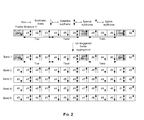
- Figs. 2 and 3 show the HARQ and Channel Quality Information (CQI) feedback processes before and after application of the un-staggered frame aggregation, respectively.
- the HARQ process does not change before and after frame aggregation.
- Data is first transmitted by a NodeB.
- the HARQ process in the TDD system does not change before and after frame aggregation and has a longer RTT and a larger proportion occupied by the wait time when compared with the HARQ process in the FDD system which takes 8ms.
- an uplink grant allocates uplink resources and modulation coding schemes to user equipments based on the latest CQI.
- the time interval between the CQI feedback and the uplink grant is 3ms.
- the interval between uplink and downlink sub-frames is not always 3ms, which results in a delay of Tdelay.
- the CQI referenced by the uplink grant cannot accurately reflect the channel states for the user equipments. That is, the feedback may be outdated, particularly for a user equipment moving at a high speed. Therefore, the CQI feedback process in the TDD system does not change before and after frame aggregation and the delay problem is thus not mitigated.
- An object of the present invention is to provide a method for staggered frame aggregation, capable of mitigating or even eliminating the temporal discontinuity of resources in a single direction in a TDD system by temporally staggering frames in different frequency bands and combining them into a new frame structure.
- a method for combining frames in at least two frequency bands in a mobile communication system comprises the steps of:
- a method for data transmission by combining frames in at least two frequency bands in a mobile communication system comprises the steps of:
- a combined frame for data transmission in a mobile communication system which is composed by frames in at least two frequency bands to be combined, wherein each frame in each of the frequency bands other than a first frequency bands is shifted by a predetermined offset X in time domain with respect to the corresponding frame in the preceding frequency band.
- the resources in a single direction can be staggered and distributed over the respective time slots, such that the temporal discontinuity of resources in a single direction can be mitigated or even eliminated.
- the uplink/downlink resources are temporally discontinuous and it is thus impossible to implement the HARQ and channel feedback processes based on the continuity of uplink/downlink resources as in a FDD system.
- FDD frequency division duplex
- the HARQ and channel feedback processes are based on the continuity of uplink/downlink resources as in a FDD system.
- it is necessary to fully consider the effect of the discontinuity and to mitigate or eliminate the temporal discontinuity of the resources in a single direction, so as to improve the HARQ process. It is also required to reduce the time delay between the information feedback and the uplink grant, so as to improve the effectiveness of the feedback information.
- the requirements of the asymmetric services in the future can be fulfilled by providing sufficient uplink-downlink time configuration ratios.
- the design of a frame aggregation solution for a TDD system can maintain the specifications of existing TDD standards to the maximum extent and maintain a compatibility with a single-band system. That is, in order to evolve from the existing single-band TDD system to a multi-band TDD system smoothly, the frame aggregation solution needs to fulfill the compatibility requirement, such that a user equipment of the single-band TDD system can also be used in a multi-band TDD system.
- the frame aggregation solution according to the present invention still employs in all frequency bands the same frame structure as that of the single-band TDD system, with frames in different frequency bands staggered temporally and combined into a new frame structure. In this way, it is possible to transmit data in different directions over the respective frequency bands at the same time. Thus, it can be referred to as staggered frame aggregation.
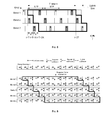
- staggered frame aggregation The detailed process of the staggered frame aggregation according to the present invention is shown in Figs. 4 and 5 .
- the duration of one frame in the single-band TDD system is Tms.
- frames in each frequency band need to be shifted by Xms with respect to the frames in the preceding frequency band for transmission. That is, if the transmission of the n-th frame in the first frequency band starts at t+T and ends at t+2T, the transmission of the n-th frame in the second frequency band needs to be delayed by Xms and thus starts at t+T+X and ends at t+2T+X, the transmission of the n-th frame in the third frequency band is then starts at t+T+2X and ends at t+2T+2X, and so on.
- Fig. 5 shows the aggregated frame structure. It is assumed that the uplink/downlink configuration period is N*Pms where N is the number of time slots and P is the length of one time slot. The following explanation will be given taking the uplink time slots shown in the gray portion of Fig. 5 as an example, although the same principle also applies to other time slots.
- N the number of time slots
- P the length of one time slot.
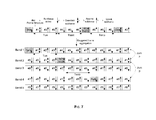
- each frame in each frequency band is shifted by Xms with respect to the corresponding frame in the preceding frequency band. That is, in the entire frequency domain, an uplink time slot is available in the second frequency band at t+T, an uplink time slot is available in the third frequency band at t+T+X, and an uplink time slot is available in the first frequency band at t+T+2X. That is, if a user equipment capable of simultaneously operating in several frequency bands misses a transmission of ACK/NACK signal or CQI feedback in the second frequency band at t+T, it only has to wait another Xms for re-transmission with the uplink resources in the third frequency band. This is the beneficial effect from the staggered frame aggregation.
- the performance of the staggered frame aggregation depends on the value of X.
- the optimal value of X should be set such that the resources in a single direction of the TDD system can be uniformly distributed over the entire configuration period.
- M ⁇ N X can be set as [N/M]*P where [.] denotes rounding operation. This situation is more complicated since there may be a plurality of uplink or downlink time slots within one configuration period in the actual frame structure.
- the temporal discontinuity of the resources in a single direction may be completely eliminated by staggered frame aggregation, depending on the specific frame structure.
- the staggered frame aggregation can at least shorten the temporal interval between resources in a single direction.
- staggered frame aggregation according to the present invention will be explained in the following taking the aggregation for the LTE TDD frame structure 1 having five carrier bands as an example.
- the staggered frame aggregation according to the present invention also applies to other frame structures and other spectrum aggregation scenarios.
- Fig. 6 shows the staggered frame aggregation process in detail. As shown, each frequency band employs the LTE TDD frame structure 1 and each frame is shifted by 1ms with respect to the corresponding frame in a neighboring frequency band for aggregation. Each frequency band supports LTE TDD user equipments.
- the uplink-downlink ratio does not change before and after the frame aggregation, i.e., there are still two uplink frames and two downlink frames in sequence. Thus, it is still possible to represent the uplink-downlink ratio of the system by using 3-bit information in LTE TDD without any modification.
- Fig. 7 shows the HARQ processes of a system before and after application of the staggered frame aggregation solution.
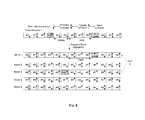
- Fig. 8 shows the CQI feedback processes of a system before and after application of the staggered frame aggregation solution.
- the NodeB Before making a decision of uplink grant, the NodeB needs to allocate uplink resources and modulation coding schemes to the user equipment based on a valid CQI.
- Tdelay Prior to application of the staggered frame aggregation, there is a time delay of Tdelay between the CQI feedback and the uplink grant.
- the uplink grant decision is transmitted in the first frequency band and the CQI fed back in the third frequency band is used. If there is no uplink resource available in the current frequency band, it is possible to "jump" to a frequency band having available uplink resources to perform CQI feedback, such that the time delay Tdelay can be eliminated and the NodeB can schedule in accordance with the latest CQI.
- the HARQ and CQI feedback processes can "jump” across a plurality of frequency bands.
- Such “jump” can be restricted for complexity reason.
- the "jump” can be restricted by means of frequency band binding, such that the "jump” can only be carried out between frequency bands that are bound together.
- the specific binding operation can be designed such that the wait time Twait or the time delay Tdelay is minimized.
- a special time slot is composed of three parts: UpPTS, DownPTS and GP, in which DownPTS contains a synchronization signal.
- UpPTS UpPTS
- DownPTS contains a synchronization signal.
- cell search needs to be performed at an interval of 5ms.
- the synchronization signals are temporally continuous. In this case, the user equipment can continuously search the synchronization signals in different frequency bands, such that the time required for a mobile terminal to access the network can be reduced.
- the same principle also applies to the random access signal in the UpPTS.
- the existing frame structure of the single-band TDD system can be applied in every frequency band, so as to achieve the backward compatibility. Also, the same frame structure is applied in every frequency band.
- the uplink/downlink configuration after frame aggregation remains the same as the single-band TDD system. Thus, it is unnecessary to change control information and basically fulfill the requirements of the future asymmetric services.
- the resources in a single direction are staggered and distributed to the individual time slots, such that the temporal discontinuity of the resources in the single direction can be mitigated or even eliminated.
- a TDD system operating in a plurality of frequency bands it is possible to transmit uplink/downlink data at any time.
- the HARQ process can "jump" across a plurality of frequency bands, such that the wait time of the ACK/NACK signal can be reduced.
- the CQI feedback process can "jump" across a plurality of frequency bands, such that the time interval between the uplink grant and the channel feedback can be reduced.
- the un-staggered aggregation in the prior art can be considered as a special instant of the staggered aggregation according to the present invention in which the X value is zero.
- the frame aggregation solutions for the TDD and the FDD modes can be unified in practice.
- the hardware processing speed at the NodeB and the user equipment will become increasingly faster and the processing time will be further reduced.
- the wait time and time delay will have more severe impact on the HARQ and channel feedback processes and the advantages of the staggered frame aggregation solution of the present invention will be more obvious.
Landscapes
- Engineering & Computer Science (AREA)
- Signal Processing (AREA)
- Computer Networks & Wireless Communication (AREA)
- Mobile Radio Communication Systems (AREA)
Applications Claiming Priority (1)
| Application Number | Priority Date | Filing Date | Title |
|---|---|---|---|
| PCT/CN2008/001999 WO2010066067A1 (zh) | 2008-12-12 | 2008-12-12 | 移动通信系统中的帧汇聚方法 |
Publications (2)
| Publication Number | Publication Date |
|---|---|
| EP2378671A1 true EP2378671A1 (de) | 2011-10-19 |
| EP2378671A4 EP2378671A4 (de) | 2015-12-30 |
Family
ID=42242290
Family Applications (1)
| Application Number | Title | Priority Date | Filing Date |
|---|---|---|---|
| EP08878667.8A Withdrawn EP2378671A4 (de) | 2008-12-12 | 2008-12-12 | Rahmenaggregationsverfahren in einem mobilkommunikationssystem |
Country Status (7)
| Country | Link |
|---|---|
| US (1) | US20110249766A1 (de) |
| EP (1) | EP2378671A4 (de) |
| JP (1) | JP5345699B2 (de) |
| KR (1) | KR20110098943A (de) |
| CN (1) | CN102224684B (de) |
| BR (1) | BRPI0823309A2 (de) |
| WO (1) | WO2010066067A1 (de) |
Cited By (1)
| Publication number | Priority date | Publication date | Assignee | Title |
|---|---|---|---|---|
| US20210392639A1 (en) * | 2016-11-16 | 2021-12-16 | Guangdong Oppo Mobile Telecommunications Corp., Ltd. | Uplink signal transmission method and device |
Families Citing this family (4)
| Publication number | Priority date | Publication date | Assignee | Title |
|---|---|---|---|---|
| US20120314626A1 (en) * | 2011-06-08 | 2012-12-13 | Xg Technology, Inc. | Concurrent multi-band transmitter architecture |
| US9814040B2 (en) | 2014-11-21 | 2017-11-07 | Qualcomm Incorporated | UL/DL waveform and numerology design for low latency communication |
| CN106160955B (zh) * | 2015-03-26 | 2021-02-12 | 瑞昱半导体股份有限公司 | 控制无线用户设备主动重传无线资源控制信息的控制电路 |
| CN112544043B (zh) * | 2019-06-20 | 2024-05-07 | 北京小米移动软件有限公司 | 接收状态反馈方法和装置 |
Family Cites Families (11)
| Publication number | Priority date | Publication date | Assignee | Title |
|---|---|---|---|---|
| US6208627B1 (en) * | 1997-12-10 | 2001-03-27 | Xircom, Inc. | Signaling and protocol for communication system with wireless trunk |
| SE513233C2 (sv) * | 1998-01-23 | 2000-08-07 | Ericsson Telefon Ab L M | TDMA-TDD/FDD Radiokommunikationssystem samt kanalvalsförfarande och -anordning för ett sådant system |
| US6973067B1 (en) * | 1998-11-24 | 2005-12-06 | Telefonaktiebolaget L M Ericsson (Publ) | Multi-media protocol for slot-based communication systems |
| JP3775774B2 (ja) * | 1999-07-26 | 2006-05-17 | 富士通株式会社 | ベアラ統合方法及びその装置 |
| GB2400271B (en) * | 2003-04-02 | 2005-03-02 | Matsushita Electric Industrial Co Ltd | Dynamic resource allocation in packet data transfer |
| KR100582575B1 (ko) * | 2003-10-27 | 2006-05-23 | 삼성전자주식회사 | 멀티 프레임을 이용한 무선 통신 시스템의 데이터 전송방법 |
| KR100601939B1 (ko) * | 2004-01-16 | 2006-07-14 | 삼성전자주식회사 | Ofdm 시스템에서의 초기 주파수 동기 방법 및 장치 |
| GB2431073B (en) * | 2005-10-10 | 2008-05-14 | Ipwireless Inc | Cellular communication system and method for co-existence of dissimilar systems |
| EP1799001A1 (de) * | 2005-12-15 | 2007-06-20 | Siemens Aktiengesellschaft | Verfahren zum Zuweisen von Ressourcen auf Frequenzbändern eines Funkkommunikationssystems sowie Netzvorrichtung und Teilnehmerstation |
| DE602007000566D1 (de) * | 2007-02-14 | 2009-04-02 | Ntt Docomo Inc | Empfängergerät zur Erfassung von Schmalbandinterferenz in einem Mehrträgerempfangssignal |
| ES2614605T3 (es) * | 2008-11-14 | 2017-06-01 | Lg Electronics Inc. | Procedimiento y aparato de transmisión de información en sistema de comunicación inalámbrica |
-
2008
- 2008-12-12 WO PCT/CN2008/001999 patent/WO2010066067A1/zh not_active Ceased
- 2008-12-12 JP JP2011539868A patent/JP5345699B2/ja not_active Expired - Fee Related
- 2008-12-12 US US13/132,584 patent/US20110249766A1/en not_active Abandoned
- 2008-12-12 KR KR1020117015812A patent/KR20110098943A/ko not_active Ceased
- 2008-12-12 BR BRPI0823309-8A patent/BRPI0823309A2/pt not_active IP Right Cessation
- 2008-12-12 CN CN200880132088.5A patent/CN102224684B/zh active Active
- 2008-12-12 EP EP08878667.8A patent/EP2378671A4/de not_active Withdrawn
Non-Patent Citations (1)
| Title |
|---|
| See references of WO2010066067A1 * |
Cited By (2)
| Publication number | Priority date | Publication date | Assignee | Title |
|---|---|---|---|---|
| US20210392639A1 (en) * | 2016-11-16 | 2021-12-16 | Guangdong Oppo Mobile Telecommunications Corp., Ltd. | Uplink signal transmission method and device |
| US11647505B2 (en) * | 2016-11-16 | 2023-05-09 | Guangdong Oppo Mobile Telecommunications Corp., Ltd. | Uplink signal transmission method and device |
Also Published As
| Publication number | Publication date |
|---|---|
| JP2012511844A (ja) | 2012-05-24 |
| EP2378671A4 (de) | 2015-12-30 |
| BRPI0823309A2 (pt) | 2015-06-23 |
| JP5345699B2 (ja) | 2013-11-20 |
| WO2010066067A1 (zh) | 2010-06-17 |
| US20110249766A1 (en) | 2011-10-13 |
| CN102224684B (zh) | 2016-01-20 |
| CN102224684A (zh) | 2011-10-19 |
| KR20110098943A (ko) | 2011-09-02 |
Similar Documents
| Publication | Publication Date | Title |
|---|---|---|
| AU2021212126B2 (en) | Time division duplex (tdd) subframe structure supporting single and multiple interlace modes | |
| US11212067B2 (en) | Configurable bi-directional time division duplex (TDD) subframe structure | |
| EP3100563B1 (de) | Tdm-ul-übertragung auf mehreren versorgenden zellen für eine mobilstation mit einzelsender | |
| EP3295596B1 (de) | Skalierte symbole für autonome zeitduplex (tdd)-subframestruktur | |
| CN107819554B (zh) | 无线通信系统中的动态子帧设置的重传方法及其设备 | |
| KR101623245B1 (ko) | 무선 통신 시스템에서 스케줄링 방법 및 장치 | |
| JP6740385B2 (ja) | 無線通信システムにおいて無線信号の送受信方法及び装置 | |
| Lähetkangas et al. | On the TDD subframe structure for beyond 4G radio access network | |
| WO2016192598A1 (en) | Systems and methods for a subframe structure for wideband lte | |
| EP2359517B1 (de) | Verfahren zur übertragung von steuerinformationen zur durchführung eines harq prozesses in einem drahtlosen kommunikationssystem zur unterstützung einer mehrzahl von übertragungsbändern | |
| WO2017035300A1 (en) | Framing, scheduling, and synchronization in wireless systems | |
| RU2479928C2 (ru) | Устройство и способ передачи данных в системе беспроводной связи | |
| JP2020530243A (ja) | 無線通信システムにおいて無線信号の送受信方法及び装置 | |
| EP2378671A1 (de) | Rahmenaggregationsverfahren in einem mobilkommunikationssystem | |
| US20130182691A1 (en) | Method of and Base Station for Configuring a Data Transmission Scheme Based on Data Frames in a Communication Network | |
| EP3994825B1 (de) | Steuerung von daten über eine vollduplex-fronthaul-verbindung | |
| WO2013111524A1 (ja) | 端末装置、基地局装置、受信方法及び送信方法 | |
| Damnjanovic et al. | Techniques for enabling low latency operation in LTE networks |
Legal Events
| Date | Code | Title | Description |
|---|---|---|---|
| PUAI | Public reference made under article 153(3) epc to a published international application that has entered the european phase |
Free format text: ORIGINAL CODE: 0009012 |
|
| 17P | Request for examination filed |
Effective date: 20110712 |
|
| AK | Designated contracting states |
Kind code of ref document: A1 Designated state(s): AT BE BG CH CY CZ DE DK EE ES FI FR GB GR HR HU IE IS IT LI LT LU LV MC MT NL NO PL PT RO SE SI SK TR |
|
| RAP1 | Party data changed (applicant data changed or rights of an application transferred) |
Owner name: ALCATEL LUCENT |
|
| DAX | Request for extension of the european patent (deleted) | ||
| 111Z | Information provided on other rights and legal means of execution |
Free format text: AT BE BG CH CY CZ DE DK EE ES FI FR GB GR HR HU IE IS IT LI LT LU LV MC MT NL NO PL PT RO SE SI SK TR Effective date: 20130410 |
|
| RAP1 | Party data changed (applicant data changed or rights of an application transferred) |
Owner name: ALCATEL LUCENT |
|
| D11X | Information provided on other rights and legal means of execution (deleted) | ||
| RA4 | Supplementary search report drawn up and despatched (corrected) |
Effective date: 20151202 |
|
| RIC1 | Information provided on ipc code assigned before grant |
Ipc: H04L 5/00 20060101AFI20151126BHEP |
|
| STAA | Information on the status of an ep patent application or granted ep patent |
Free format text: STATUS: THE APPLICATION IS DEEMED TO BE WITHDRAWN |
|
| 18D | Application deemed to be withdrawn |
Effective date: 20160701 |