EP2378787A2 - Prioritätsanzeige einer separaten Anruf- und Trägersteuerungsarchitektur - Google Patents
Prioritätsanzeige einer separaten Anruf- und Trägersteuerungsarchitektur Download PDFInfo
- Publication number
- EP2378787A2 EP2378787A2 EP10012237A EP10012237A EP2378787A2 EP 2378787 A2 EP2378787 A2 EP 2378787A2 EP 10012237 A EP10012237 A EP 10012237A EP 10012237 A EP10012237 A EP 10012237A EP 2378787 A2 EP2378787 A2 EP 2378787A2
- Authority
- EP
- European Patent Office
- Prior art keywords
- bearer
- call control
- priority
- bearer network
- priority indication
- Prior art date
- Legal status (The legal status is an assumption and is not a legal conclusion. Google has not performed a legal analysis and makes no representation as to the accuracy of the status listed.)
- Withdrawn
Links
- 238000013507 mapping Methods 0.000 claims abstract description 14
- 238000004891 communication Methods 0.000 claims abstract description 7
- 230000005540 biological transmission Effects 0.000 claims abstract description 4
- 238000000034 method Methods 0.000 claims description 27
- 230000006872 improvement Effects 0.000 claims description 5
- 230000011664 signaling Effects 0.000 description 6
- 238000004590 computer program Methods 0.000 description 4
- 230000007246 mechanism Effects 0.000 description 3
- 230000008878 coupling Effects 0.000 description 2
- 238000010168 coupling process Methods 0.000 description 2
- 238000005859 coupling reaction Methods 0.000 description 2
- 230000001419 dependent effect Effects 0.000 description 2
- 238000005516 engineering process Methods 0.000 description 2
- 230000000977 initiatory effect Effects 0.000 description 2
- 230000008569 process Effects 0.000 description 2
- 238000012546 transfer Methods 0.000 description 2
- 238000012423 maintenance Methods 0.000 description 1
- 238000012986 modification Methods 0.000 description 1
- 230000004048 modification Effects 0.000 description 1
- 238000011084 recovery Methods 0.000 description 1
- 238000000926 separation method Methods 0.000 description 1
- 230000001360 synchronised effect Effects 0.000 description 1
Images


Classifications
-
- H—ELECTRICITY
- H04—ELECTRIC COMMUNICATION TECHNIQUE
- H04L—TRANSMISSION OF DIGITAL INFORMATION, e.g. TELEGRAPHIC COMMUNICATION
- H04L47/00—Traffic control in data switching networks
- H04L47/10—Flow control; Congestion control
- H04L47/15—Flow control; Congestion control in relation to multipoint traffic
-
- H—ELECTRICITY
- H04—ELECTRIC COMMUNICATION TECHNIQUE
- H04L—TRANSMISSION OF DIGITAL INFORMATION, e.g. TELEGRAPHIC COMMUNICATION
- H04L47/00—Traffic control in data switching networks
- H04L47/70—Admission control; Resource allocation
-
- H—ELECTRICITY
- H04—ELECTRIC COMMUNICATION TECHNIQUE
- H04L—TRANSMISSION OF DIGITAL INFORMATION, e.g. TELEGRAPHIC COMMUNICATION
- H04L47/00—Traffic control in data switching networks
- H04L47/70—Admission control; Resource allocation
- H04L47/80—Actions related to the user profile or the type of traffic
- H04L47/805—QOS or priority aware
-
- H—ELECTRICITY
- H04—ELECTRIC COMMUNICATION TECHNIQUE
- H04L—TRANSMISSION OF DIGITAL INFORMATION, e.g. TELEGRAPHIC COMMUNICATION
- H04L47/00—Traffic control in data switching networks
- H04L47/70—Admission control; Resource allocation
- H04L47/80—Actions related to the user profile or the type of traffic
- H04L47/808—User-type aware
-
- H—ELECTRICITY
- H04—ELECTRIC COMMUNICATION TECHNIQUE
- H04Q—SELECTING
- H04Q3/00—Selecting arrangements
- H04Q3/0016—Arrangements providing connection between exchanges
- H04Q3/0025—Provisions for signalling
-
- H—ELECTRICITY
- H04—ELECTRIC COMMUNICATION TECHNIQUE
- H04Q—SELECTING
- H04Q2213/00—Indexing scheme relating to selecting arrangements in general and for multiplex systems
- H04Q2213/13174—Data transmission, file transfer
-
- H—ELECTRICITY
- H04—ELECTRIC COMMUNICATION TECHNIQUE
- H04Q—SELECTING
- H04Q2213/00—Indexing scheme relating to selecting arrangements in general and for multiplex systems
- H04Q2213/13176—Common channel signaling, CCS7
-
- H—ELECTRICITY
- H04—ELECTRIC COMMUNICATION TECHNIQUE
- H04Q—SELECTING
- H04Q2213/00—Indexing scheme relating to selecting arrangements in general and for multiplex systems
- H04Q2213/13178—Control signals
-
- H—ELECTRICITY
- H04—ELECTRIC COMMUNICATION TECHNIQUE
- H04Q—SELECTING
- H04Q2213/00—Indexing scheme relating to selecting arrangements in general and for multiplex systems
- H04Q2213/13204—Protocols
-
- H—ELECTRICITY
- H04—ELECTRIC COMMUNICATION TECHNIQUE
- H04Q—SELECTING
- H04Q2213/00—Indexing scheme relating to selecting arrangements in general and for multiplex systems
- H04Q2213/13209—ISDN
-
- H—ELECTRICITY
- H04—ELECTRIC COMMUNICATION TECHNIQUE
- H04Q—SELECTING
- H04Q2213/00—Indexing scheme relating to selecting arrangements in general and for multiplex systems
- H04Q2213/13216—Code signals, frame structure
-
- H—ELECTRICITY
- H04—ELECTRIC COMMUNICATION TECHNIQUE
- H04Q—SELECTING
- H04Q2213/00—Indexing scheme relating to selecting arrangements in general and for multiplex systems
- H04Q2213/1325—Priority service
-
- H—ELECTRICITY
- H04—ELECTRIC COMMUNICATION TECHNIQUE
- H04Q—SELECTING
- H04Q2213/00—Indexing scheme relating to selecting arrangements in general and for multiplex systems
- H04Q2213/1329—Asynchronous transfer mode, ATM
-
- H—ELECTRICITY
- H04—ELECTRIC COMMUNICATION TECHNIQUE
- H04Q—SELECTING
- H04Q2213/00—Indexing scheme relating to selecting arrangements in general and for multiplex systems
- H04Q2213/13389—LAN, internet
Definitions
- the present invention relates generally to telecommunication services and, in particular, to communicating priority indications between telecommunication nodes in a telecommunication system having a separated call control and bearer control architecture.
- non-STM non-Synchronous Transfer Mode
- ATM Asynchronous Transfer Mode
- IP Internet Protocol
- FR Full Relay
- FIGS. 1a and 1b show the evolution from current integrated CC/BC public network protocols such as ISUP, to the separated CC/BC solution.
- a protocol is required to enable the coupling between the CC and BC functions when a telecommunications node is implemented in a separated environment.
- ITU-T International Telecommunications Union - Telecommunications Sector
- IETF Internet Engineering Task Force
- This protocol is designed to control multimedia connections from a remote control entity and operatively resides between the CC functionality and the BC functionality, as shown in figures 1 a and 1b. Variants of this protocol are known as H.248 and Q.1950 in the ITU, and Megaco in the IETF.
- Priority Call a function which existed in the integrated CC/BC environment require the functionality to be duplicated in the Call Control and the Bearer Control environment.
- One such function is the "Priority Call” function, which is used, for example, in emergency call situations.
- the definition of the "Priority Call” function may be found in ITU-T Recommendation 1.255.4, Priority Service. In such emergency situations, it is absolutely necessary for emergency calls to progress, but it is not necessary that normal calls progress. Typically, this could be achieved in, for example, one of two ways.
- a node may reserve a certain percentage, for example 2%, of its resources for use by emergency calls only. This means that normal calls cannot use those particular resources. The consequence of this is that in non-emergency situations, the node is running at a sub-optimal capacity. In the example given in this case, 98%.
- the emergency call it is necessary for the emergency call to be marked as a priority call so that the node can identify the emergency call as such. In the separated CC/BC architecture discussed above, this applies to both call and bearer control protocols, as illustrated in Figure 2 .
- the call and bearer connections are initiated at Node 1 and terminated at Node 5.
- the call control traverses the network via Node 3 or path C1-C2 as shown, whereas the bearer control traverses the network via Nodes 2 and 4 or path B1-B2-B3 as shown.
- Node 1 initiates an emergency call, and, since it is running at full capacity, it may not use the normal call set up paths.
- Node 3 should recognise the call as an emergency call and select its internal resources and outgoing path to Node 5 or path C2, appropriately.
- Node 2 should recognise the fact that the bearer path being requested is related to an emergency call, and thus should select its internal resources and outgoing path to Node 4 or path B2, appropriately.
- the Call Control protocol In a separated CC and BC architecture, only the Call Control protocol has an indication that the call has a certain priority.
- One method of transporting this priority information in the protocol is by the BICC (Bearer Independent Call Control) Precedence indication.
- BICC is based on ISUP (Integrated Services Digital Network User Part. That is, the control part of the Signalling System No. 7 protocol, SS7), which is a combined CC/BC protocol.
- MLPP Multi-Level Precedence and Preemption Service
- CS2 Bearer independent call control protocol
- CS2 Signalling System No. 7 - ISDN user part formats and codes.
- the present invention provides in a separated call control, bearer control telecommunications network, a method of communicating a call control level priority indication between a first telecommunications node and a second telecommunications node via the bearer network including the steps of:
- the bearer level indication corresponds to the call control level indication.
- the present invention stems from the realisation that assigning, in accordance with a dedicated relationship, a call control level priority indication to a bearer priority indication in a bearer network protocol message field in accordance with a priority mechanism of the bearer network protocol, allows for an explicit indication of priority at the bearer level in a separated network architecture.
- a solution is provided which maps or assigns the call level priority, for example in the form of the BICC Precedence values, to the bearer level.
- the call control level priority indication is preferably determined from at least one of a call set up message, and, a subscriber profile.
- the present invention provides in a telecommunication system having separated Call Control and Bearer Control architecture:
- the present invention provides in a telecommunication system, the system including a separated Call Control and Bearer Control architecture between a first telecommunication node and a second telecommunication node, an improvement including:
- the present invention provides a network node of a telecommunication system, the system including a separated Call Control and Bearer Control architecture, the node including:
- the present invention provides a bearer network protocol data unit for use in a telecommunications system having a separated Call Control and Bearer Control architecture, the bearer protocol data unit including:
- the present invention provides a computer program product including:
- the call control level priority indication in a preferred embodiment is assigned to a received call set up message. In another preferred embodiment, the call control level priority indication is assigned in accordance with a subscriber profile.
- the method of the present invention may further include the steps of:
- the step of determining the call control level priority indication or the step of assigning a corresponding call control level priority indication may be performed at the first telecommunication node or at any node or nodes intermediate the first and second nodes.
- At least one of the call control level indication or the corresponding call control level indication is determined in accordance with a first or second predetermined designation, respectively.
- the first designation is, preferably, a call control protocol indication and the second designation is, preferably, a bearer protocol indication or bearer control protocol indication.
- the call control protocol is the Bearer Independent Call Control (BICC) and the call control level priority indication is an I.255.3 Multi-level Precedence and Pre-emption Service (MLPP) indication, or a new field based on the requirements from the I.255.4 Priority Service.
- BICC Bearer Independent Call Control
- MLPP Multi-level Precedence and Pre-emption Service
- the bearer network may be a switched AAL2 bearer network and the bearer network protocol message may be a Q2630.2 AAL2 ERQ message.
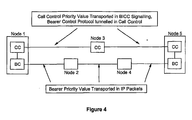
- the bearer network may be a non-switched bearer network and the bearer network protocol message may transmitted by at least one Ipv4 or Ipv6 packet.
- An indication of call control level priority may be determined on a call by call basis or in accordance with a predesignated subscriber profile.
- the call control level priority indication is determined from a call set up message.
- a switched network is one where the bearer path is defined at the time of call set-up, and all user data is transferred along that path for the duration of the call.
- a non-switched network is one whereby the bearer path is not defined at call set-up, and decisions are made in real-time as to the path that user data is communicated.
- An example of a switched network is one where the bearer is AAL2 (ATM Adaption layer 2), whereby the bearer is connected through one or more AAL2 switches and the path of the user packets through the switches is defined at the time of call set-up.
- AAL2 bearer protocol is found at ITU-T Recommendation Q.2630.2, AAL Type 2 Signalling Protocol.
- Further examples of possible bearer control protocols for a switched network as in a switched BICC network include, AAL1 (ATM Adaption Layer 2), PNNI (Private Network to Network Interface), DSS2 (Digital Subscriber Signaling #2 for ATM broadband signaling), B-ISUP (Broadband ISUP).
- An example of a non-switched network is one where the bearer is IP (internet Protocol), where the user packets are transferred through IP routers, where the path of the user packets through the network is decided by the IP routers in real-time.
- IP bearer protocol is found, for example, at RFC791, Internet Protocol (Ipv4).
- Ipv4 Internet Protocol
- each packet takes a different path through the IP network.
- Further examples of possible bearer protocols for a non-switched network, as in a non-switched BICC network include, Structured AAL1 (see 1.363.1) and Trunked AAL2 (see Q.2630.1, Annex A).
- a person skilled in the art would recognise that other bearer network protocols can be used in associated with the invention, without departing from the spirit of the present invention.
- the Bearer Control Protocol is carried through and processed at the switches in the bearer network.
- the Bearer Control Protocol carries a priority indication through the bearer network in the bearer establishment message in order for each switch to recognise the priority of the call. This can be of the form of, say a value of 0-4, with 4 indicating highest priority and 0 indicating lowest priority. Referring to figure 3 , in the AAL type 2 signalling protocol, this is preferably in the simple form of a value of 0 to 4 in the ERQ message.
- Nodes in the bearer network use this value to allocate internal resources and outgoing paths according to particular network conditions. For example, Node 2 can immediately recognise the priority level from the incoming message and route the call to Node 4 along an "emergency-marked" path between the two nodes.
- the call control level priority indication is determined and assigned or mapped to a bearer level priority indication field in a bearer network protocol message.
- the value of the priority indicator in the Q.2630.2 ERQ message is mapped from the BICC Call Control Priority value. This mapping is done in the initiating node, Node 1.
- the invention is embodied by the mapping being performed at any one or a combination of node(s) intermediate a first transmitting node or endpoint and a second receiving node or endpoint for the call. Table 1, below illustrates this mapping.
- Table 1 BICC Call Control Priority Value e.g. MLPP value
- Bearer Control Priority Value e.g. in Q.2630
- Flash Override (0) 0 Flash (1) 1 Immediate (2)
- a non-switched network such as an IP network
- the Bearer Control Protocol is carried, or tunnelled inside the Call Control Protocol.
- the Bearer Control Protocol is not passed through the bearer network, that is, it is not seen by the routers in the bearer network.
- the protocol allocates resources in the network. Due to the nature of a non-switched network, each user packet, in this case IP packet, carries an indication of the priority in order for each router to be able to route the packet according to the priority.
- Other bearer control protocols can be used as would be understood by a person skilled in the art.
- the call control level priority indication is determined and then assigned or mapped between the BICC Call Control Priority values and the values carried in the IP packet.
- a field already exists in the IP header as an example see RFC791, Internet Protocol (Ipv4), which carries this priority, an 8-value field called "Priority”. This is, in turn, carried inside the "Type of Service” field.
- Ipv4 Internet Protocol
- the present invention may be embodied by this mapping being performed at, or by means within the initiating or transmitting node, for example Node 1.
- the invention may be embodied by the mapping being performed at any one or a combination of node(s) intermediate a first transmitting node or endpoint and a second receiving node or endpoint for the call.
- IP Precedence field there are three further values of the IP Precedence field, namely "Network Control (7)", “Internetwork Control (6)", and "CRITIC/ECP (5)" that are not used in the above tabled example.
- IP Precedence field there are three further values of the IP Precedence field, namely "Network Control (7)", “Internetwork Control (6)", and "CRITIC/ECP (5)" that are not used in the above tabled example.
- BICC Priority value for Flash Override (0) is mapped to an IP Priority value for Network Control (7).
- the specifics of this mapping are in accordance with the importance of the particular priority call, network configuration, and current network usage.
- the call control level priority indication is determined by a first designation.
- the bearer level priority indication is determined by a second designation. Tables 1 and 2 above provide examples.
- the first designation can be a BICC indication and the second designation can be a bearer network control Protocol indication. A skilled person would understand that variations are possible within the scope of the present invention.
- the call control priority level indication is processed from the bearer network level to the call control network level by way of decoding/recovery in which the bearer network priority level is determined and assigned to a call control level priority indication of a call, call message or assigned in accordance with a subscriber profile.
- This process is performed at a second or receiving node or endpoint.
- the process is performed at a node(s) intermediate a first transmitting node and a second receiving node where the intermediate node provides a Call Control function.
- Embodiment 1 In a separated call control, bearer control telecommunications network, a method of communicating a call control level priority indication between a first telecommunications node and a second telecommunications node via the bearer network including the steps of:
- Embodiment 2 A method as in embodiment 1, wherein the call control level priority indication is determined from a call set up message.
- Embodiment 3 A method as in embodiment 1, wherein the call control level priority indication is determined from a subscriber profile.
- Embodiment 4 A method as in embodiment 1,2 or 3, further including the step of: allocating internal resources of the bearer network for communicating the bearer network protocol message dependent on the bearer level priority indication.
- Embodiment 5 A method as in anyone of embodiments 1 to 4, wherein at least one of the steps of determining the call control level priority indication and assigning the bearer level priority indication is performed at the first telecommunication node.
- Embodiment 6 A method as in anyone of embodiments 1 to 5, wherein at least one of the steps of determining the call control level priority indication and assigning the bearer level priority indication is performed at a node(s) intermediate the first node and the second node.
- Embodiment 7 A method as in anyone of embodiments 1 to 6, wherein the bearer network is a switched bearer network and the bearer network protocol message is a switched bearer network protocol message.
- Embodiment 8 A method as in anyone of embodiments 1 to 6, wherein the bearer network is a non-switched bearer network and the bearer network protocol message is a non-switched bearer network protocol message.
- Embodiment 9 A method as in anyone of the previous embodiments, wherein the call control level priority indication is determined in accordance with a first predetermined designation.
- Embodiment 10 A method as in anyone of the previous embodiments, wherein the bearer level priority indication is determined in accordance with a second predetermined designation.
- Embodiment 11 A method as in embodiment 9 or 10, wherein the first predetermined designation is a Bearer Independent Call Control (BICC) protocol indication and the call control level priority indication is at least one of a Multi-level Precedence and Pre-emption Service (MLPP) indication, and an indication based on requirements of a Priority Service.
- BICC Bearer Independent Call Control
- MLPP Multi-level Precedence and Pre-emption Service
- Embodiment 12 A method as in embodiments 10 or 11, wherein the second predetermined designation is at least one of a bearer network control protocol indication, and a bearer network protocol indication and the call control level priority indication is at least one of a Multi-Level Precedence and Pre-emption service (MLPP) indication, and an indication based on requirements of a Priority Service.
- MLPP Multi-Level Precedence and Pre-emption service
- Embodiment 13 In a telecommunication system having separated Call Control and Bearer Control architecture:
- Embodiment 14 In a telecommunication system, the system including a separated Call Control and Bearer Control architecture between a first telecommunication node and a second telecommunication node, an improvement including:
- Embodiment 15 A network node of a telecommunication system, the system including a separated Call Control and Bearer Control architecture, the node including:
- Embodiment 16 A bearer network protocol data unit for use in a telecommunications system having a separated Call Control and Bearer Control architecture, the bearer protocol data unit including:
- Embodiment 17 A computer program product including:
- Embodiment 18 In a separated call control, bearer control telecommunications network, a method of communicating a call control level priority indication between a first telecommunications node and a second telecommunications node via a bearer network including the steps of:
- Embodiment 19 In a telecommunication system, the system including a separated Call Control and Bearer Control architecture between a first telecommunication node and a second telecommunication node, an improvement including:
Landscapes
- Engineering & Computer Science (AREA)
- Computer Networks & Wireless Communication (AREA)
- Signal Processing (AREA)
- Data Exchanges In Wide-Area Networks (AREA)
- Telephonic Communication Services (AREA)
- Mobile Radio Communication Systems (AREA)
- Communication Control (AREA)
- Selective Calling Equipment (AREA)
- Alarm Systems (AREA)
- Exchange Systems With Centralized Control (AREA)
Applications Claiming Priority (2)
| Application Number | Priority Date | Filing Date | Title |
|---|---|---|---|
| EP01982645A EP1444854B1 (de) | 2001-11-12 | 2001-11-12 | System und verfahren zur übermittlung einer prioritätsangabe in einem verbindungssteuerungs-/trägersteuertelekommunikationssystem |
| PCT/IB2001/002118 WO2003043368A1 (en) | 2001-11-12 | 2001-11-12 | A system and method of communicating a priority indication in a call control/bearer control telecommunication system |
Related Parent Applications (1)
| Application Number | Title | Priority Date | Filing Date |
|---|---|---|---|
| EP01982645.2 Division | 2001-11-12 |
Publications (2)
| Publication Number | Publication Date |
|---|---|
| EP2378787A2 true EP2378787A2 (de) | 2011-10-19 |
| EP2378787A3 EP2378787A3 (de) | 2012-01-11 |
Family
ID=11004206
Family Applications (2)
| Application Number | Title | Priority Date | Filing Date |
|---|---|---|---|
| EP10012237A Withdrawn EP2378787A3 (de) | 2001-11-12 | 2001-11-12 | Prioritätsanzeige einer separaten Anruf- und Trägersteuerungsarchitektur |
| EP01982645A Expired - Lifetime EP1444854B1 (de) | 2001-11-12 | 2001-11-12 | System und verfahren zur übermittlung einer prioritätsangabe in einem verbindungssteuerungs-/trägersteuertelekommunikationssystem |
Family Applications After (1)
| Application Number | Title | Priority Date | Filing Date |
|---|---|---|---|
| EP01982645A Expired - Lifetime EP1444854B1 (de) | 2001-11-12 | 2001-11-12 | System und verfahren zur übermittlung einer prioritätsangabe in einem verbindungssteuerungs-/trägersteuertelekommunikationssystem |
Country Status (6)
| Country | Link |
|---|---|
| US (2) | US7912079B2 (de) |
| EP (2) | EP2378787A3 (de) |
| AT (1) | ATE502486T1 (de) |
| DE (1) | DE60144250D1 (de) |
| PT (1) | PT1444854E (de) |
| WO (1) | WO2003043368A1 (de) |
Families Citing this family (5)
| Publication number | Priority date | Publication date | Assignee | Title |
|---|---|---|---|---|
| CN101146052B (zh) * | 2005-04-25 | 2011-04-20 | 华为技术有限公司 | 网络通信中处理紧急业务的方法 |
| CN100479374C (zh) | 2005-04-25 | 2009-04-15 | 华为技术有限公司 | 网络通信中处理紧急业务的方法 |
| WO2009040395A1 (en) * | 2007-09-26 | 2009-04-02 | Nokia Siemens Networks Oy | Method, apparatus and system for signalling of buffer status information |
| US8537999B1 (en) | 2011-09-09 | 2013-09-17 | Cisco Technology, Inc. | Managing precedence call preemption in a communication environment |
| EP3103281B1 (de) * | 2014-02-06 | 2020-01-01 | Telefonaktiebolaget LM Ericsson (publ) | Verbindungssteuerung für mehrere träger |
Family Cites Families (28)
| Publication number | Priority date | Publication date | Assignee | Title |
|---|---|---|---|---|
| FR2694466B1 (fr) * | 1992-07-29 | 1994-09-02 | Cit Alcatel | Réseau de télécommunication réalisant séparément un traitement d'appel et un traitement de connexion. |
| GB9418772D0 (en) * | 1994-09-16 | 1994-11-02 | Ionica L3 Limited | Digital telephony |
| GB9621524D0 (en) * | 1996-10-16 | 1996-12-04 | British Telecomm | Multimedia call centre |
| US6449284B1 (en) * | 1997-03-21 | 2002-09-10 | Avaya Technology Corp. | Methods and means for managing multimedia call flow |
| EP1863201A3 (de) * | 1997-04-24 | 2014-03-19 | Ntt Mobile Communications Network Inc. | Verfahren und System zur mobilen Kommunikation |
| US6160818A (en) * | 1997-07-17 | 2000-12-12 | At &T Corp | Traffic management in packet communication networks having service priorities and employing effective bandwidths |
| US6608832B2 (en) * | 1997-09-25 | 2003-08-19 | Telefonaktiebolaget Lm Ericsson | Common access between a mobile communications network and an external network with selectable packet-switched and circuit-switched and circuit-switched services |
| US6418461B1 (en) * | 1997-10-06 | 2002-07-09 | Mci Communications Corporation | Intelligent call switching node in an intelligent distributed network architecture |
| FI108507B (fi) * | 1998-07-23 | 2002-01-31 | Nokia Corp | Menetelmõ ja jõrjestely yhteyksien hallitsemiseksi |
| FI107505B (fi) * | 1999-02-16 | 2001-08-15 | Nokia Networks Oy | Pääsynvalvontamenetelmä |
| US6618378B1 (en) * | 1999-07-21 | 2003-09-09 | Alcatel Canada Inc. | Method and apparatus for supporting multiple class of service connections in a communications network |
| EP1079582A1 (de) * | 1999-08-20 | 2001-02-28 | Telefonaktiebolaget L M Ericsson (Publ) | Verfahren zur Diensteparameter-Zusammenarbeit |
| JP2001237855A (ja) * | 2000-02-25 | 2001-08-31 | Fujitsu Ltd | 交換システムおよびそのルーティング方法 |
| GB0009226D0 (en) * | 2000-04-12 | 2000-05-31 | Nokia Networks Oy | Transporting information in a communication system |
| DE10022089A1 (de) * | 2000-05-08 | 2001-11-22 | Deutsche Telekom Mobil | Verfahren und Einrichtung zur automatischen Prioritätssteuerung von Anrufen bei Automatic Call Distribution-Anlagen |
| US7072329B2 (en) * | 2000-05-22 | 2006-07-04 | Telefonaktiebolaget Lm Ericsson (Publ) | Combining differing transport technologies in a telecommunications system |
| US6765912B1 (en) * | 2000-08-08 | 2004-07-20 | Nortel Networks Limited | Network resource usage in call sessions |
| US7002919B1 (en) * | 2000-08-16 | 2006-02-21 | Lucent Technologies Inc. | Method and system for guaranteeing quality of service for voice-over-IP services |
| US20030125041A1 (en) * | 2000-08-29 | 2003-07-03 | Friedrich Stippel | Method for establishing communication relations |
| US7546376B2 (en) * | 2000-11-06 | 2009-06-09 | Telefonaktiebolaget Lm Ericsson (Publ) | Media binding to coordinate quality of service requirements for media flows in a multimedia session with IP bearer resources |
| EP1259037A1 (de) * | 2001-05-18 | 2002-11-20 | TELEFONAKTIEBOLAGET L M ERICSSON (publ) | Verfahren und Geräte zur Zusammenwirkung von knoten |
| EP1324544A1 (de) * | 2001-12-26 | 2003-07-02 | Telefonaktiebolaget L M Ericsson (Publ) | Methode und System zur Verkehrskontrolle zwischen Multimedien-gateway-kontrolleuren und proxies |
| JP3871604B2 (ja) * | 2002-04-30 | 2007-01-24 | 富士通株式会社 | VoIPネットワークシステム |
| US7532647B2 (en) * | 2004-07-14 | 2009-05-12 | Tekelec | Methods and systems for auto-correlating message transfer part (MTP) priority and internet protocol (IP) type of service in converged networks |
| JP2009111498A (ja) * | 2007-10-26 | 2009-05-21 | Nec Corp | 無線制御装置、無線基地局、無線通信システム、呼受付制御方法、プログラム、及び記録媒体 |
| US8184002B2 (en) * | 2008-07-28 | 2012-05-22 | Huawei Technologies Co., Ltd. | Method and device for receiving emergency event alert |
| JP4742171B2 (ja) * | 2010-01-06 | 2011-08-10 | 株式会社エヌ・ティ・ティ・ドコモ | 移動通信方法、呼制御ノード、優先度制御ノード及び移動管理ノード |
| US8792340B2 (en) * | 2010-06-14 | 2014-07-29 | Alcatel Lucent | Admission control for shared LTE network |
-
2001
- 2001-11-12 US US10/494,831 patent/US7912079B2/en active Active
- 2001-11-12 PT PT01982645T patent/PT1444854E/pt unknown
- 2001-11-12 AT AT01982645T patent/ATE502486T1/de not_active IP Right Cessation
- 2001-11-12 EP EP10012237A patent/EP2378787A3/de not_active Withdrawn
- 2001-11-12 EP EP01982645A patent/EP1444854B1/de not_active Expired - Lifetime
- 2001-11-12 DE DE60144250T patent/DE60144250D1/de not_active Expired - Lifetime
- 2001-11-12 WO PCT/IB2001/002118 patent/WO2003043368A1/en not_active Ceased
-
2011
- 2011-02-08 US US13/022,761 patent/US9049052B2/en not_active Expired - Lifetime
Non-Patent Citations (1)
| Title |
|---|
| None |
Also Published As
| Publication number | Publication date |
|---|---|
| EP1444854A1 (de) | 2004-08-11 |
| US9049052B2 (en) | 2015-06-02 |
| PT1444854E (pt) | 2011-06-29 |
| DE60144250D1 (de) | 2011-04-28 |
| EP1444854B1 (de) | 2011-03-16 |
| EP2378787A3 (de) | 2012-01-11 |
| ATE502486T1 (de) | 2011-04-15 |
| US20110216761A1 (en) | 2011-09-08 |
| US7912079B2 (en) | 2011-03-22 |
| WO2003043368A1 (en) | 2003-05-22 |
| US20050013315A1 (en) | 2005-01-20 |
Similar Documents
| Publication | Publication Date | Title |
|---|---|---|
| EP1069742B1 (de) | Verfahren und Architektur zur Unterstüzung von mehreren Diensten in einem Etikettvermittlungsnetzwerk | |
| JP4889174B2 (ja) | サービスパラメータ網間接続法 | |
| US5734654A (en) | Frame relay switching apparatus and router | |
| US6078586A (en) | ATM virtual private networks | |
| CA2351774C (en) | Communications network | |
| US20060133359A1 (en) | Multiprotocol convergence switch (MPCS) and method for use thereof | |
| EP1192791B1 (de) | Voip unter benutzung von ss7 zeichengabe und zusammenarbeit von ip knoten mit zeichengabepunkten | |
| EP1156686B1 (de) | System und Verfahren zur Realzeitdatenübertragung | |
| WO2002003624A1 (en) | Interaction in a communication system | |
| US7200110B1 (en) | Method and apparatus for prioritized release of connections in a communications network | |
| JP2000196664A (ja) | インタ―ネット網上を伝送される遅延に敏感なトラヒックに対してサ―ビスの品質を提供するための方法 | |
| JPH1117707A (ja) | パス接続方法、接続監視装置および通信ノード | |
| US9049052B2 (en) | System and method of communicating a priority indication in a call control/bearer control telecommunication system | |
| EP0895381A1 (de) | Fernmeldenetz mit Unterdrückung von mehreren Komprimierungen/Dekomprimierungen von Sprachpaketen | |
| US8265696B1 (en) | Digital telecommunication system | |
| US6928069B2 (en) | Bandwidth management apparatus, address resolution assistance apparatus, method for managing bandwidth, and method for assisting address resolution | |
| US20040052256A1 (en) | Method for transmitting data packets in a cellular communication network | |
| US7254130B1 (en) | Predictively allocated bandwidth in a communications network | |
| JP2000324177A (ja) | 網間接続方法及び装置 | |
| WO2001011825A2 (en) | Communications using hybrid circuit-switched and packet-switched networks | |
| EP0912068A2 (de) | Verfahren zur Auswahl einer Signalierungsverbindung | |
| AU725361B2 (en) | A method of transmitting an ATM cell over an ATM network | |
| EP0855845A2 (de) | Interface-Einrichtung für ATM-Netzwerke | |
| KR100288756B1 (ko) | 에이티엠적응계층 타입 2를 채용하는 에이티엠 망에서 노드간 연결을 위한 채널식별자 할당 방법 | |
| CA2412914A1 (en) | Offering differentiated services |
Legal Events
| Date | Code | Title | Description |
|---|---|---|---|
| AC | Divisional application: reference to earlier application |
Ref document number: 1444854 Country of ref document: EP Kind code of ref document: P |
|
| AK | Designated contracting states |
Kind code of ref document: A2 Designated state(s): AT BE CH CY DE DK ES FI FR GB GR IE IT LI LU MC NL PT SE TR |
|
| PUAI | Public reference made under article 153(3) epc to a published international application that has entered the european phase |
Free format text: ORIGINAL CODE: 0009012 |
|
| PUAL | Search report despatched |
Free format text: ORIGINAL CODE: 0009013 |
|
| AK | Designated contracting states |
Kind code of ref document: A3 Designated state(s): AT BE CH CY DE DK ES FI FR GB GR IE IT LI LU MC NL PT SE TR |
|
| RIC1 | Information provided on ipc code assigned before grant |
Ipc: H04Q 3/00 20060101AFI20111206BHEP Ipc: H04L 12/56 20060101ALN20111206BHEP |
|
| 17P | Request for examination filed |
Effective date: 20120316 |
|
| 17Q | First examination report despatched |
Effective date: 20130816 |
|
| STAA | Information on the status of an ep patent application or granted ep patent |
Free format text: STATUS: THE APPLICATION IS DEEMED TO BE WITHDRAWN |
|
| 18D | Application deemed to be withdrawn |
Effective date: 20160601 |