EP2379314B1 - Zahnriemen zum antrieb einer nockenwelle in hochleistungsmotoren - Google Patents
Zahnriemen zum antrieb einer nockenwelle in hochleistungsmotoren Download PDFInfo
- Publication number
- EP2379314B1 EP2379314B1 EP09736218.0A EP09736218A EP2379314B1 EP 2379314 B1 EP2379314 B1 EP 2379314B1 EP 09736218 A EP09736218 A EP 09736218A EP 2379314 B1 EP2379314 B1 EP 2379314B1
- Authority
- EP
- European Patent Office
- Prior art keywords
- toothed belt
- belt according
- fibers
- ply
- epm
- Prior art date
- Legal status (The legal status is an assumption and is not a legal conclusion. Google has not performed a legal analysis and makes no representation as to the accuracy of the status listed.)
- Active
Links
Images
Classifications
-
- B—PERFORMING OPERATIONS; TRANSPORTING
- B29—WORKING OF PLASTICS; WORKING OF SUBSTANCES IN A PLASTIC STATE IN GENERAL
- B29D—PRODUCING PARTICULAR ARTICLES FROM PLASTICS OR FROM SUBSTANCES IN A PLASTIC STATE
- B29D29/00—Producing belts or bands
- B29D29/08—Toothed driving belts
-
- F—MECHANICAL ENGINEERING; LIGHTING; HEATING; WEAPONS; BLASTING
- F16—ENGINEERING ELEMENTS AND UNITS; GENERAL MEASURES FOR PRODUCING AND MAINTAINING EFFECTIVE FUNCTIONING OF MACHINES OR INSTALLATIONS; THERMAL INSULATION IN GENERAL
- F16G—BELTS, CABLES, OR ROPES, PREDOMINANTLY USED FOR DRIVING PURPOSES; CHAINS; FITTINGS PREDOMINANTLY USED THEREFOR
- F16G1/00—Driving-belts
- F16G1/28—Driving-belts with a contact surface of special shape, e.g. toothed
Definitions
- the invention relates to a toothed belt for driving a camshaft in high-performance engines having a vulcanized rubber compound body comprising a rubber component or a rubber component blend as well as mixture ingredients, wherein the base body comprises a cover layer as belt back, an embedded strength member and a base with a tooth-shaped power transmission zone ,
- a vulcanized rubber mixture based on a copolymer of butadiene and acrylonitrile is presented.
- Such a copolymer is also known by the name nitrile rubber (NBR).
- NBR nitrile rubber
- HNBR hydrogenated nitrile rubber
- Drive belts, which may contain HNBR rubber are, for example, from De 10 2006 018717 A1 known.
- the proportion of acrylonitrile (ACN content) is from 33 to 49% by weight. For optimum oil resistance, it has hitherto been assumed that an ACN content of> 33% by weight is required.
- timing belts made of HNBR with an ACN content of> 33 wt .-% have a lower service temperature of - 25 ° C. At lower temperatures it cracks and the drive belt fails.
- the material concept based on NBR, in particular HNBR is cost-intensive.
- the object of the invention is to provide a toothed belt for driving a camshaft in high-performance engines, which is characterized at least partially, in particular complete abandonment of NBR and HNBR by improved low-temperature flexibility and longer life at least for the same or better especially power transmission ,
- the rubber mixture contains as rubber component / s at least one ethylene-propylene copolymer (EPM) or at least one ethylene-propylene-diene copolymer (EPDM) and also fibers, wherein the fibers of polyvinyl alcohol (PVA), Aramid, cotton, cellulose, coal or glass are made ..
- EPM ethylene-propylene copolymer
- EPDM ethylene-propylene-diene copolymer
- EPM and EPDM are each uncut after an alternative.
- EPM or EPDM with at least one further rubber component which in the background of the problem is in particular not NBR or HNBR, form a blend, an EPM / EPDM blend then being preferred.
- the vulcanized rubber mixture contains besides the rubber component (s) still mixture ingredients.
- the blend ingredients comprise at least one crosslinker or crosslinker system (crosslinker and accelerator), here the peroxide crosslink is in the foreground.
- Other mixing ingredients are usually still a filler and / or a processing aid and / or a plasticizer and / or an aging inhibitor and optionally further additives (eg color pigments, resins).
- crosslinker and accelerator crosslinker and accelerator
- Other mixing ingredients are usually still a filler and / or a processing aid and / or a plasticizer and / or an aging inhibitor and optionally further additives (eg color pigments, resins).
- the rubber mixture fibers are mixed, wherein the fibers of polyvinyl alcohol (PVA), aramid, cotton, cellulose, carbon or glass.
- PVA polyvinyl alcohol
- aramid fibers of PVA and aramid, especially in the form of para-aramid.
- the fibers are preferably short fibers having a fiber length of 1 to 5 mm, in particular of 3 to 4 mm.
- the proportion of fibers is 5 to 20 phr, in particular again 5 to 15 phr.
- the fibers are evenly distributed within the rubber mixture.
- the combination of oriented polyester fibers and oriented aramid fibers for the durability of V-belts or V-ribbed belts is, for example, in WO 2004/015300 A1 discussed.
- the fibers are prepared adhesive friendly and / or an adhesive is added to the rubber mixture.
- the fibers are coated with an adhesive system based on a resorcinol-formaldehyde resin, in particular a resorcinol-melamine resin. Uncoated fibers give lower adhesion values.
- Table 5 shows that it is advantageous to use a resin-melamine resin-based adhesive system, which also has the meaning of a reinforcing resin.
- Mixture IV shows higher strengths and tensions than M without the resin system. Especially the tear propagation resistance, which contributes to the service life increase, is significantly improved.
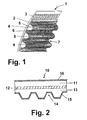
- Fig. 1 shows a toothed belt with a cover layer 2 as a belt back, an embedded strength member 3 and a substructure 4.
- the reinforcement consists of several tensile strands, which arranged side by side form a reinforcement layer, here in the context of a single-layer design.
- the tensile strand in particular in the form of cords, may consist of polyamide (PA), aramid, polyester, glass (eg E or K glass), carbon, polyetheretherketone (PEEK) or polyethylene-2,6-naphthalate (PEN).
- the top layer (2) and the base (4) form as a whole the elastic body, which advantageously consists of a vulcanizate based on uncut EPM or also uncut EPDM or an EPM / EPD blend.
- the vulcanizate contains the fibers of polyvinyl alcohol (PVA), aramid, cotton, cellulose, carbon or glass, which have already been presented in more detail, in particular with the assistance of an adhesive system.
- the base 4 is provided with a tooth-shaped profiling comprising teeth 5 and tooth webs 6, and forms the power transmission zone 7, which is particularly susceptible to wear due to abrasion and the influence of oils.
- the power transmission zone is equipped with an abrasion-resistant coating 8 in the form of a textile support.
- the textile cover consists of a woven, knitted or knitted fabric, wherein the timing belt in toothed belts is of particular importance.
- the textile cover in turn consists of polyamide (PA) and / or polyester and / or cotton and / or aramid and / or polyetheretherketone (PEEK).
- the textile cover is preferably additionally impregnated with a lubricious and oil-resistant plastic and / or surface-coated (outer layer 9).
- the plastic is usually a fluorine-containing plastic and / or a silicone and / or a polyurethane (PU).
- the fluorine-containing plastic is in particular polyvinyl fluoride (PVF) and / or polyvinylidene fluoride (PVDF) and / or polytetrafluoroethylene (PTFE). Of particular importance is PTFE.
- the two sub-layers 8 and 9 with different function occur here as a common protective layer.
- the cover layer 2 is according to the embodiment Fig. 1 free from a protective coating.
- the timing belt after Fig. 2 comprises a top layer 11 as a belt back, an embedded strength member 12 in the form of tension cords and a base 13 with a tooth-shaped power transmission zone 14.
- both the top layer 11 and the power transmission zone is provided with a coating 15 and 16 respectively.
- the two coatings each comprise a textile cover, in particular in the form of a fabric, which in turn are preferably additionally impregnated with a lubricious and oil-resistant plastic and / or surface-coated. Regarding material details of textile cover and plastic is based on the description Fig. 1 directed.
Landscapes
- Engineering & Computer Science (AREA)
- Mechanical Engineering (AREA)
- General Engineering & Computer Science (AREA)
- Compositions Of Macromolecular Compounds (AREA)
- Laminated Bodies (AREA)
Description
- Die Erfindung betrifft einen Zahnriemen zum Antrieb einer Nockenwelle in Hochleistungsmotoren mit einem Grundkörper aus einer vulkanisierten Kautschukmischung (Vulkanisat), enthaltend eine Kautschukkomponente oder einen Kautschukkomponentenverschnitt sowie Mischungsingredienzien, wobei der Grundkörper eine Decklage als Riemenrücken, einen eingebetteten Festigkeitsträger und einen Unterbau mit einer zahnförmigen Kraftübertragungszone umfasst.
- Hinsichtlich des Standes der Technik von Zahnriemen wird insbesondere auf folgende Patentliteratur verwiesen.
EP 0 599 145 B1 EP 1 129 308 B1 EP 0 737 228 B1 WO 2005/080821 A1 EP 0 866 834 B1 WO 2006/066669 A1 EP 1 088 177 B1 US 5 417 618 - In der Offenlegungsschrift
WO 2005/080821 A1 , die hier als nächstliegender Stand der Technik anzusehen ist, wird eine vulkanisierte Kautschukmischung auf der Basis eines Copolymeren aus Butadien und Acrylnitril vorgestellt. Ein derartiges Copolymer ist auch unter der Bezeichnung Nitrilkautschuk (NBR) bekannt. Von besonderer Bedeutung ist dabei der (teil)hydrierte Nitrilkautschuk (HNBR). Antriebsriemen, welche HNBR-Kautschuk enthalten können, sind bspw. ausDe 10 2006 018717 A1 bekannt. Nach dieser hier zitierten Lehre beträgt in Bezug auf das Gesamtgewicht des Copolymeren der Anteil an Acrylnitril (ACN-Gehalt) 33 bis 49 Gew.-%. Für eine optimale Ölbeständigkeit ist man bislang davon ausgegangen, dass ein ACN-Gehalt von > 33 Gew.-% erforderlich ist. - Nachteile ergeben sich bei einem hohen ACN-Gehalt jedoch hinsichtlich der Kälteflexibilität. So haben beispielsweise Zahnriemen aus HNBR mit einem ACN-Gehalt von > 33 Gew.-% eine untere Einsatztemperatur von - 25 °C. Bei tieferen Temperaturen kommt es zu Rissen und der Antriebsriemen fällt aus. Hinzu kommt, dass das Werkstoffkonzept auf Basis NBR, insbesondere HNBR, kostenintensiv ist.
- Im Rahmen einer Weiterentwicklung besteht die Aufgabe der Erfindung darin, einen Zahnriemen zum Antrieb einer Nockenwelle in Hochleistungsmotoren bereitzustellen, der sich zumindest unter teilweisem, insbesondere vollständigem Verzicht von NBR und HNBR durch eine verbesserte Tieftemperaturflexibiltät und höherer Lebensdauer bei zumindest bei gleicher oder insbesondere besserer Kraftübertragung auszeichnet.
- Gelöst wird diese Aufgabe dadurch, dass die Kautschukmischung als Kautschukkomponente/n zumindest ein Ethylen-Propylen-Mischpolymerisat (EPM) oder zumindest ein Ethylen-Propylen-Dien-Mischpolymerisat (EPDM) sowie ferner Fasern enthält, wobei die Fasern aus Polyvinylalkohol (PVA), Aramid, Baumwolle, Cellulose, Kohle oder Glas bestehen..
- Das EPM und EPDM sind nach einer Alternative jeweils unverschnitten. Nach einer weiteren Alternative kann EPM oder EPDM mit wenigstens einer weiteren Kautschukkomponente, die im Hintergrund der Aufgabenstellung insbesondere nicht NBR oder HNBR ist, einen Verschnitt bilden, wobei dann ein EPM/EPDM-Verschnitt bevorzugt ist.
- Die vulkanisierte Kautschukmischung enthält neben der/den Kautschukkomponente/n noch Mischungsingredienzien. Die Mischungsingredienzien umfassen wenigstens einen Vernetzer oder Vernetzersystem (Vernetzungsmittel und Beschleuniger), wobei hier die peroxidische Vernetzung im, Vordergrund steht. Weitere Mischungsingredienzien sind zumeist noch ein Füllstoff und/oder ein Verarbeitungshilfsmittel und/oder ein Weichmacher und/oder ein Alterungsschutzmittel sowie gegebenenfalls weitere Zusatzstoffe (z.B. Farbpigmente, Harze). Diesbezüglich wird auf den allgemeinen Stand der Kautschukmischungstechnologie verwiesen.
- Von erfindungswesentlicher Bedeutung ist, dass der Kautschukmischung Fasern beigemischt sind, wobei die Fasern aus Polyvinylalkohol (PVA), Aramid, Baumwolle, Cellulose, Kohle oder Glas bestehen. Von besonderer Bedeutung sind Fasern aus PVA und Aramid, insbesondere in Form von para-Aramid. Die Fasern sind bevorzugt Kurzfasern mit einer Faserlänge von 1 bis 5 mm, insbesondere von 3 bis 4 mm. Der Mengenanteil an Fasern beträgt 5 bis 20 phr, insbesondere wiederum 5 bis 15 phr. Die Fasern sind innerhalb der Kautschukmischung gleichmäßig verteilt.
Die Kombination aus orientierten Polyesterfasern und orientierten Aramidfasern für die Haltbarkeit von Keilriemen bzw. Keilrippenriemen wird bspw. inWO 2004/015300 A1 diskutiert. - Vorteilhafterweise sind die Fasern haftfreundlich präpariert und/oder ein Haftmittel ist der Kautschukmischung beigemischt. Nach einem Ausführungsbeispiel sind die Fasern mit einem Haftsystem auf der Basis eines Resorcin-Formaldehyd-Harzes, insbesondere eines Resorcin-Melamin-Harzes, beschichtet. Unbeschichtete Fasern ergeben geringere Haftwerte.
- Im Rahmen einer Versuchsdurchführung werden nun drei Zahnriemenmischung I bis III miteinander verglichen, wobei die Tabelle 1 die Zusammensetzungen der jeweils peroxidisch vernetzten Mischungen in phr (per hundred rubber) unter Angabe von vorteilhaften Alternativen und die Tabellen 2 und 3 die Ergebnisse festhalten:
Tabelle 1 Mischungsbestandteile I II III EPM (a) oder EPDM (b) 100 100 30 HNBR (c) - - 70 Ruß (d) 25 25 25 Kurzfasern (e) 8 - 8 Kieselsäure (f) 15 15 15 Sorbinsäure 15 15 15 Stearinsäure 1 1 1 Weichmacher (g) 8 8 8 Zinkoxid 10 10 10 Alterungsschutzmittel (h) 2,5 2,5 2,5 Peroxid (i) 7,5 7,5 7,5 (a) ReEPM: Keltan 740® von DSM
(b) EPDM: BUNA EP G 6850® von Lanxess
(c) HNBR: 34 % ACN-Gehalt, 4 % Restdoppelbindungsgehalt (Therban C3446® von Lanxess)
(d) Rußtypen: N 550, SAF, ISAF, HAF, FEF oder GPF
(e) Kurzfasern: PVA (4 mm), beispielsweise Kuralon® oder Mewlon® oder Kurzfasern: para-Aramid (3 mm), beispielsweise Twaron® oder Technora®
(f) Hochdisperse Kieselsäure VN 3
(g) Ester der Trimellitsäure
(h) Zinksalz von Methylmercaptobenzimidazol
(i) Di(tert-butylperoxyisopropyl)benzolTabelle 2 Kriterien Angaben in I II III 20 min, 180 °C Heizzeit Prüfung 23 °C Härte Shore A 83 81 84 Festigkeit (1*) MPa 17,3 17,9 19,4 Festigkeit (q**) MPa 15,7 17,8 17,0 Dehnung (1) % 35 196 87 Dehnung (q) % 240 196 267 Spannungswert (10 %) (1) MPa 9,1 1,8 9,5 Spannungswert (10 %) (q) MPa 2,0 1,8 2,1 Spannungswert (100 %) (l) MPa - 8,1 - Spannungswert (100 %) (q) MPa 10,3 8,0 7,6 Weiterreißfestigkeit (1) N/mm 8,34 3,68 10,45 Weiterreißfestigkeit (q) N/mm 7,74 2,92 10,42 Prüfung bei 100 °C Weiterreißfestigkeit (1) N/mm 3,10 1,10 3,47 Weiterreißfestigkeit (q) N/mm 3,77 1,18 3,57 * längs
** quer - Den Ergebnissen der Tabelle 2 lagen folgende Prüfvorschriften zugrunde:
- Härte: DIN 53504
- Festigkeit, Dehnung, Spannungswert: DIN 53504, DIN 53455, DIN 53571 Weiterreißfestigkeit: DIN 53507
- Den Ergebnissen der Tabelle 3 lagen folgen Prüfvorschriften zugrunde:
- Laufzeittest bei 150 °C: Interner 5-Scheibenprüfstand des Anmelders
- Kältetest: Interner Kälteprüfstand des Anmelders, Abbruch bei Auftreten von Rissen in der Decklage
- In Bezug auf die Zahnriemenmischung gemäß
WO2005/080821 A1 wurden bei der Zahnriemenmischung III 30 phr HNBR durch EPM oder EPDM ersetzt, wobei zusätzlich eine Faserverstärkung vorgenommen wurde. Durch die Beimischung von EPM oder EPDM tritt bereits im Rahmen des Kältetestes ein verbessertes Eigenschaftsniveau auf. Eine noch deutlichere Verbesserung im Hinblick auf die Kälteflexibilität tritt bei den Zahnriemenmischungen I und II auf, die als Kautschukkomponente ausschließlich EPM oder EPDM enthalten. Zwecks Erfüllung einer erhöhten Lebensdauer ist es jedoch von wesentlicher Bedeutung, dass der Zahnriemenmischung Fasern aus Polyvinylalkohol (PVA), Aramid, Baumwolle, Cellulose, Kohle oder Glas beigemischt werden, was der Vergleichsversuch der Zahnriemenmischung I und II anhand der Ergebnisse der Tabellen 2 und 3 verdeutlicht. - Im Rahmen einer weiteren Versuchsdurchführung werden nun zwei Zahnriemenmischungen IV und V auf der Basis EPM oder EPDM miteinander verglichen, die beide faserverstärkt sind. Bei der Mischung IV kommt jedoch im Gegensatz zu der Mischung V noch ein Haftsystem für die Fasern zum Einsatz. Die Zusammensetzungen der beiden ebenfalls peroxidisch vernetzten Mischungen in phr sind in der Tabelle 4 zusammengetragen, während die Tabelle 5 die diesbezüglichen Ergebnisse festhält.
Tabelle 4 Kriterien IV V EPM oder EPDM 100 100 Russ 30 30 Kurzfasern 6 6 Kieselsäure 15 15 Sorbinsäure 15 15 Stearinsäure 1 1 Weichmacher 8 8 Zinkoxid 10 10 Alterungsschutz 2,5 2,5 Cohedur RK (j) 5 - HMMM (k) 3,5 - Peroxid 7 7 (i) Resorcinol Derivat von Lanxess
(j) Hexa(methoxmethyl)melaminether, beispielsweise Resimene XT 922 - Hinsichtlich der anderen Mischungsbestandteile wird auf die Erläuterungen zu der Tabelle 1 verwiesen.
Tabelle 5 Kriterien Angaben in IV V 20 min, 180 °C Heizzeit Prüfung 23 °C Härte Shore A 88 83 Festigkeit (1*) MPa 14,1 13,0 Festigkeit (q*) MPa 12,6 12,0 Dehnung (1) % 135 188 Dehnung (q) % 195 206 Spannungswert (10 %) (1) MPa 4,9 4,0 Spannungswert (10 %) (q) MPa 1,9 1,4 Spannungswert (100 %) (1) MPa 10,1 8,2 Spannungswert (100 %) (q) MPa 7,4 6,9 Weiterreißfestigkeit (1) N/mm 9,05 7,83 Weiterreißfestigkeit (q) N/mm 9,82 8,11 Prüfung bei 100 °C Weiterreißfestigkeit (1) N/mm 3,07 2,10 Weiterreißfestigkeit (q) N/mm 3,12 2,24 * längs
** quer - Hinsichtlich der Prüfvorschriften wird auf die Erläuterungen zu der Tabelle 2 verwiesen.
- Die Tabelle 5 verdeutlicht, dass der Einsatz eines Haftsystems auf der Basis eines Resorcin-Melamin-Harzes, das auch die Bedeutung eines Verstärkungsharzes hat, vorteilhaft ist. Die Mischung IV zeigt höhere Festigkeiten und Spannungswerte als die Mischung V ohne das Harzsystem. Besonders die Weiterreißfestigkeit, die zur Lebensdauererhöhung beiträgt, wird signifikant verbessert.
- Die Erfindung wird nun anhand von Ausführungsbeispielen unter Bezugnahme auf schematische Zeichnungen erläutert. Es zeigen:
- Fig. 1
- eine dreidimensionale Darstellung eines Zahnriemens mit Draufsicht auf die Kraftübertragungszone, die mit einer Beschichtung ausgestattet ist;
- Fig. 2
- einen Längsschnitt durch einen Zahnriemen mit einer Beschichtung für die Kraftübertragungszone und für die Decklage.
-
Fig. 1 zeigt einen Zahnriemen mit einer Decklage 2 als Riemenrücken, einem eingebetteten Festigkeitsträger 3 sowie mit einem Unterbau 4. Der Festigkeitsträger besteht aus mehreren Zugsträngen, die nebeneinander angeordnet eine Festigkeitsträgerlage bilden, und zwar hier im Rahmen einer einlagigen Ausführung. Der Zugstrang, insbesondere in Form von Corden, kann aus Polyamid (PA), Aramid, Polyester, Glas (z.B. E- oder K-Glas), Kohle, Polyetheretherketon (PEEK) oder Polyethylen-2,6-naphthalat (PEN) bestehen. - Die Decklage (2) und der Unterbau (4) bilden als Gesamteinheit den elastischen Grundkörper, der vorteilhafterweise aus einem Vulkanisat auf Basis von unverschnittenem EPM oder ebenfalls unverschnittenem EPDM oder eines EPM/EPD-Verschnittes besteht. In das Vulkanisat sind die bereits näher vorgestellten Fasern aus Polyvinylalkohol (PVA), Aramid, Baumwolle, Cellulose, Kohle oder Glas eingemischt, insbesondere unter Mitwirkung eines Haftsystems.
- Der Unterbau 4 ist mit einer zahnförmigen Profilierung, umfassend Zähne 5 und Zahnstege 6, versehen und bildet die Kraftübertragungszone 7, die besonders verschleißanfällig ist durch Abrieb und den Einfluss von Ölen. Aus diesem Grunde ist die Kraftübertragungszone mit einer abriebfesten Beschichtung 8 in Form einer Textilauflage ausgestattet. Die Textilauflage besteht aus einem Gewebe, Gewirke oder Gestrick, wobei bei Zahnriemen die Gewebevariante von besonderer Bedeutung ist. Die Textilauflage wiederum besteht aus Polyamid (PA) und/oder Polyester und/oder Baumwolle und/oder Aramid und/oder Polyetheretherketon (PEEK). Die Textilauflage ist vorzugsweise zusätzlich mit einem gleitfähigen und ölbeständigen Kunststoff getränkt und/oder oberflächenbeschichtet (Außenschicht 9). Der Kunststoff ist zumeist ein fluorhaltiger Kunststoff und/oder ein Silicon und/oder ein Polyurethan (PU). Der fluorhaltige Kunststoff ist insbesondere Polyvinylfluorid (PVF) und/oder Polyvinylidenfluorid (PVDF) und/oder Polytetrafluorethylen (PTFE). Von besonderer Bedeutung ist PTFE. Die beiden Teilschichten 8 und 9 mit unterschiedlicher Funktion treten hier als gemeinsame Schutzschicht auf. Die Decklage 2 ist bei dem Ausführungsbeispiel gemäß
Fig. 1 frei von einer schützenden Beschichtung. - Der Zahnriemen nach
Fig. 2 umfasst eine Decklage 11 als Riemenrücken, einen eingebetteten Festigkeitsträger 12 in Form von Zugsträngen und einen Unterbau 13 mit einer zahnförmigen Kraftübertragungszone 14. Bei diesem Ausführungsbeispiel ist sowohl die Decklage 11 als auch die Kraftübertragungszone mit einer Beschichtung 15 bzw. 16 ausgestattet. Die beiden Beschichtungen umfassen jeweils eine Textilauflage, insbesondere in Form eines Gewebes, die wiederum vorzugsweise zusätzlich mit einem gleitfähigen und ölbeständigen Kunststoff getränkt und/oder oberflächenbeschichtet sind. Hinsichtlich Werkstoffdetails von Textilauflage und Kunststoff wird auf die Beschreibung gemäßFig. 1 verwiesen. -
- 1
- Zahnriemen
- 2
- Decklage als Riemenrücken
- 3
- Festigkeitsträger in Form von Zugsträngen
- 4
- Unterbau
- 5
- Zahn
- 6
- Zahnsteg
- 7
- Kraftübertragungszone
- 8
- Beschichtung in Form einer Textilauflage
- 9
- Außenschicht aus Kunststoff
- 10
- Zahnriemen
- 11
- Decklage als Riemenrücken
- 12
- Festigkeitsträger in Form von Zugsträngen
- 13
- Unterbau
- 14
- Kraftübertragungszone
- 15
- Beschichtung in Form einer Textilauflage
- 16
- Beschichtung in Form einer Textilauflage
| Kriterien | Angaben in | I | II | III |
| Laufzeit 150 °C | h | 110 | 12 | 43 |
| Kältetest | °C | -45 | -45 | -32 |
Claims (18)
- Zahnriemen (1, 10) zum Antrieb einer Nockenwelle in Hochleistungsmotoren mit einem Grundkörper aus einer vulkanisierten Kautschukmischung, enthaltend eine Kautschukkomponente oder einen Kautschukkomponentenverschnitt sowie Mischungsingredienzien, wobei der Grundkörper eine Decklage (2, 11) als Riemenrücken, einen eingebetteten Festigkeitsträger (3, 12) und einen Unterbau (4, 13) mit einer zahnförmigen Kraftübertragungszone (7, 14) umfasst, dadurch gekennzeichnet, dass die Kautschukmischung als Kautschukkomponente/n zumindest ein Ethylen-Propylen-Mischpolymerisat (EPM) oder zumindest ein Ethylen-Propylen-Dien-Mischpolymerisat (EPDM) sowie ferner Fasern enthält, wobei die Fasern aus Polyvinylalkohol (PVA), Aramid, Baumwolle, Cellulose, Kohle oder Glas bestehen..
- Zahnriemen nach Anspruch 1, dadurch gekennzeichnet, dass das EPM und EPDM jeweils unverschnitten sind.
- Zahnriemen nach Anspruch 1, dadurch gekennzeichnet, dass das EPM oder EPDM mit wenigstens einer weiteren Kautschukkomponente einen Verschnitt bildet.
- Zahnriemen nach einem der Ansprüche 1 bis 3, dadurch gekennzeichnet, dass die Kautschukmischung peroxidisch vernetzt ist.
- Zahnriemen nach einem der Ansprüche 1 bis 4, dadurch gekennzeichnet, dass die Fasern Kurzfasern sind.
- Zahnriemen nach Anspruch 5, dadurch gekennzeichnet, dass die Faserlänge 1 bis 5 mm beträgt.
- Zahnriemen nach einem der Ansprüche 1 bis 6, dadurch gekennzeichnet, dass der Mengenanteil an Fasern 5 bis 20 phr beträgt.
- Zahnriemen nach einem der Ansprüche 1 bis 7, dadurch gekennzeichnet, dass die Fasern haftfreundlich präpariert sind und/oder der Kautschukmischung ein Haftmittel beigemischt ist.
- Zahnriemen nach einem der Ansprüche 1 bis 8, dadurch gekennzeichnet, dass der Festigkeitsträger (3, 12) aus zwei oder mehreren Zugsträngen besteht, die nebeneinander angeordnet eine Festigkeitsträgerlage bilden, die ein- oder mehrlagig ausgeführt ist.
- Zahnriemen nach Anspruch 9, dadurch gekennzeichnet, dass der Zugstrang (3, 12) aus Polyamid (PA), Aramid, Polyester, Glas, Kohle, Polyetheretherketon (PEEK) oder Polyethylen-2,6-naphthalat (PEN) besteht.
- Zahnriemen nach einem der Ansprüche 1 bis 10, dadurch gekennzeichnet, dass wenigstens die Kraftübertragungszone (7, 14) mit einer abriebfesten Beschichtung (8, 15) versehen ist.
- Zahnriemen nach Anspruch 11, dadurch gekennzeichnet, dass die Kraftübertragungszone (7, 14) und die Decklage (11) jeweils mit einer abriebfesten Beschichtung (8, 15, 16) versehen sind.
- Zahnriemen nach Anspruch 11 oder 12, dadurch gekennzeichnet, dass die abriebfeste Beschichtung (8, 15, 16) eine Textilauflage umfasst.
- Zahnriemen nach Anspruch 13, dadurch gekennzeichnet, dass die Textilauflage (8, 15, 16) aus einem Gewebe, Gewirke oder Gestrick besteht.
- Zahnriemen nach Anspruch 13 oder 14, dadurch gekennzeichnet, dass die Textilauflage (8, 15, 16) aus Polyamid (PA) und/oder Polyester und/oder Baumwolle und/oder Aramid und/oder Polyetheretherketon (PEEK) und/oder Polyimid (PI) besteht.
- Zahnriemen nach einem der Ansprüche 13 bis 15, dadurch gekennzeichnet, dass die Textilauflage (8, 15, 16) zusätzlich mit einem gleitfähigen und/oder ölbeständigen Kunststoff getränkt und/oder oberflächenbeschichtet ist.
- Zahnriemen nach Anspruch 16, dadurch gekennzeichnet, dass der Kunststoff ein fluorhaltiger Kunststoff und/oder ein Silicon und/oder ein Polyurethan (PU) ist.
- Zahnriemen nach Anspruch 17, dadurch gekennzeichnet, dass der fluorhaltige Kunststoff Polyvinylfluorid (PVF) und/oder Polyvinylidenfluorid (PVDF) und/oder Polytetrafluorethylen (PTFE) ist.
Applications Claiming Priority (2)
| Application Number | Priority Date | Filing Date | Title |
|---|---|---|---|
| DE200810055530 DE102008055530A1 (de) | 2008-12-16 | 2008-12-16 | Zahnriemen zum Antrieb einer Nockenwelle in Hochleistungsmotoren |
| PCT/EP2009/063471 WO2010069630A1 (de) | 2008-12-16 | 2009-10-15 | Zahnriemen zum antrieb einer nockenwelle in hochleistungsmotoren |
Publications (2)
| Publication Number | Publication Date |
|---|---|
| EP2379314A1 EP2379314A1 (de) | 2011-10-26 |
| EP2379314B1 true EP2379314B1 (de) | 2014-12-10 |
Family
ID=41445456
Family Applications (1)
| Application Number | Title | Priority Date | Filing Date |
|---|---|---|---|
| EP09736218.0A Active EP2379314B1 (de) | 2008-12-16 | 2009-10-15 | Zahnriemen zum antrieb einer nockenwelle in hochleistungsmotoren |
Country Status (5)
| Country | Link |
|---|---|
| EP (1) | EP2379314B1 (de) |
| CN (1) | CN102256775A (de) |
| BR (1) | BRPI0922369A2 (de) |
| DE (1) | DE102008055530A1 (de) |
| WO (1) | WO2010069630A1 (de) |
Families Citing this family (5)
| Publication number | Priority date | Publication date | Assignee | Title |
|---|---|---|---|---|
| JP5367006B2 (ja) * | 2011-03-31 | 2013-12-11 | ゲイツ・ユニッタ・アジア株式会社 | 摩擦伝動ベルト |
| JP5885240B2 (ja) | 2011-11-21 | 2016-03-15 | ゲイツ・ユニッタ・アジア株式会社 | 伝動ベルト |
| FR2996617B1 (fr) | 2012-10-08 | 2014-12-26 | Hutchinson | Courroie de transmission de puissance avec film thermoplastique comprenant un elastomere silicone. |
| DE102020216256A1 (de) | 2020-12-18 | 2022-06-23 | Contitech Antriebssysteme Gmbh | Hochleistungszahnriemen aus EPDM |
| DE102021205779A1 (de) | 2021-06-08 | 2022-12-08 | Contitech Antriebssysteme Gmbh | Elastomerartikel auf Basis einer EPDM Mischung mit verbesserter Hafteigenschaft und verbesserter Lebensdauer |
Family Cites Families (13)
| Publication number | Priority date | Publication date | Assignee | Title |
|---|---|---|---|---|
| CZ285004B6 (cs) | 1992-11-27 | 1999-04-14 | Continental Aktiengesellschaft | Způsob výroby ozubeného řemene a ozubený řemen |
| JP2514568B2 (ja) | 1993-04-19 | 1996-07-10 | 三ツ星ベルト株式会社 | 歯付ベルト |
| HU218420B (hu) | 1994-10-31 | 2000-08-28 | The Gates Corp. | Dinamikus terhelés alatti tárgyba történő alkalmazásra szolgáló elasztomer kompozíció és dinamikus tehelési körülmények közötti használatra szánt cikkek |
| DE19547025A1 (de) | 1995-12-15 | 1997-06-19 | Contitech Antriebssysteme Gmbh | Antriebsriemen |
| CA2349707C (en) * | 1998-11-19 | 2005-03-29 | The Gates Corporation | Power transmission belt |
| GB2349113B (en) | 1999-04-21 | 2003-07-02 | Gates Corp | Wear resistant belts and a process for their manufacture |
| JP2003139198A (ja) * | 2001-01-26 | 2003-05-14 | Mitsuboshi Belting Ltd | 短繊維の接着処理方法及びゴム組成物並びに動力伝動用ベルト |
| JP4133595B2 (ja) | 2002-08-08 | 2008-08-13 | ゲイツ・ユニッタ・アジア株式会社 | 伝動ベルト |
| EP1735543B1 (de) | 2004-02-23 | 2008-04-09 | DAYCO EUROPE S.r.l. | Zahnriemen |
| DE102004062760A1 (de) | 2004-12-21 | 2006-06-22 | Contitech Antriebssysteme Gmbh | Zahnriemen mit Zahnauflage aus Gewebe |
| US8197372B2 (en) * | 2006-04-07 | 2012-06-12 | The Gates Corporation | Power transmission belt |
| DE102006018717A1 (de) * | 2006-04-20 | 2007-10-25 | Contitech Antriebssysteme Gmbh | Elastomerprodukt mit radikalisch vernetzter Kautschukmischung |
| DE102006056716A1 (de) * | 2006-12-01 | 2008-06-05 | Contitech Antriebssysteme Gmbh | Antriebsriemen |
-
2008
- 2008-12-16 DE DE200810055530 patent/DE102008055530A1/de not_active Withdrawn
-
2009
- 2009-10-15 WO PCT/EP2009/063471 patent/WO2010069630A1/de not_active Ceased
- 2009-10-15 CN CN2009801509622A patent/CN102256775A/zh active Pending
- 2009-10-15 BR BRPI0922369A patent/BRPI0922369A2/pt not_active Application Discontinuation
- 2009-10-15 EP EP09736218.0A patent/EP2379314B1/de active Active
Also Published As
| Publication number | Publication date |
|---|---|
| WO2010069630A1 (de) | 2010-06-24 |
| BRPI0922369A2 (pt) | 2016-01-26 |
| CN102256775A (zh) | 2011-11-23 |
| DE102008055530A1 (de) | 2010-06-17 |
| EP2379314A1 (de) | 2011-10-26 |
Similar Documents
| Publication | Publication Date | Title |
|---|---|---|
| EP2567122B1 (de) | Kraftübertragungsriemen, insbesondere zahnriemen | |
| DE4441156C2 (de) | Kraftübertragungsriemen | |
| EP2313257A1 (de) | Ölbeständiger antriebsriemen, insbesondere zahnriemen | |
| EP2773500B1 (de) | Riemen mit einem zugträger, insbesondere carbon-zugträger, der mit einem vernetzten polyurethan präpariert ist, sowie präparationsverfahren | |
| DE102014200920A1 (de) | Zahnriemen | |
| DE112017001725T5 (de) | Zahnriemen | |
| WO2009030529A1 (de) | Biegeelastischer antriebsriemen, insbesondere keilrippenriemen, mit einer textilauflage auf seiner verschleissanfälligen arbeitsseite | |
| DE102010016393A1 (de) | PAK-freier Antriebsriemen, insbesondere Zahnriemen | |
| EP2379314B1 (de) | Zahnriemen zum antrieb einer nockenwelle in hochleistungsmotoren | |
| EP4264084B1 (de) | Hochleistungszahnriemen aus epdm | |
| EP2306045A2 (de) | Antriebsriemen, insbesondere Zahnriemen, mit Basaltzugstrang | |
| EP2773808B1 (de) | Verfahren zur präparation eines zugträgers, insbesondere carbon-zugträgers, bei der fertigung eines riemens | |
| EP2106511B1 (de) | Gummizahnriemen | |
| DE102008038322A1 (de) | Heizmanschette als Bauteil einer Vulkanisationsvorrichtung, insbesondere zur Herstellung eines endlos geschlossenen Antriebsriemens | |
| DE102010060216A1 (de) | Antriebsriemen, insbesondere Keilrippenriemen, und Verfahren zu dessen Herstellung | |
| EP2844890B1 (de) | Antriebsriemen mit verbesserter textilhaftung | |
| DE102008037415A1 (de) | Antriebsriemen, insbesondere Keilrippenriemen, mit einer Textilauflage und Verfahren zu dessen Herstellung | |
| DE102006056718A1 (de) | Antriebsriemen | |
| DE102021201705A1 (de) | Keilrippenriemen | |
| EP4636028A1 (de) | Nachhaltiger weichmacher für epdm | |
| EP3234405B1 (de) | Antriebsriemen, insbesondere zahnriemen | |
| DE102013110053A1 (de) | Antriebsriemen, insbesondere Keilrippenriemen | |
| DE102011056332A1 (de) | Elastischer Antriebsriemen, insbesondere Keilrippenriemen, mit verringertem Schrumpfungsverhalten und Riementrieb |
Legal Events
| Date | Code | Title | Description |
|---|---|---|---|
| PUAI | Public reference made under article 153(3) epc to a published international application that has entered the european phase |
Free format text: ORIGINAL CODE: 0009012 |
|
| 17P | Request for examination filed |
Effective date: 20110718 |
|
| AK | Designated contracting states |
Kind code of ref document: A1 Designated state(s): AT BE BG CH CY CZ DE DK EE ES FI FR GB GR HR HU IE IS IT LI LT LU LV MC MK MT NL NO PL PT RO SE SI SK SM TR |
|
| DAX | Request for extension of the european patent (deleted) | ||
| 17Q | First examination report despatched |
Effective date: 20120719 |
|
| GRAP | Despatch of communication of intention to grant a patent |
Free format text: ORIGINAL CODE: EPIDOSNIGR1 |
|
| INTG | Intention to grant announced |
Effective date: 20140718 |
|
| GRAS | Grant fee paid |
Free format text: ORIGINAL CODE: EPIDOSNIGR3 |
|
| GRAA | (expected) grant |
Free format text: ORIGINAL CODE: 0009210 |
|
| AK | Designated contracting states |
Kind code of ref document: B1 Designated state(s): AT BE BG CH CY CZ DE DK EE ES FI FR GB GR HR HU IE IS IT LI LT LU LV MC MK MT NL NO PL PT RO SE SI SK SM TR |
|
| REG | Reference to a national code |
Ref country code: GB Ref legal event code: FG4D Free format text: NOT ENGLISH |
|
| REG | Reference to a national code |
Ref country code: CH Ref legal event code: EP |
|
| REG | Reference to a national code |
Ref country code: IE Ref legal event code: FG4D Free format text: LANGUAGE OF EP DOCUMENT: GERMAN |
|
| REG | Reference to a national code |
Ref country code: AT Ref legal event code: REF Ref document number: 700427 Country of ref document: AT Kind code of ref document: T Effective date: 20150115 |
|
| REG | Reference to a national code |
Ref country code: DE Ref legal event code: R096 Ref document number: 502009010334 Country of ref document: DE Effective date: 20150122 |
|
| REG | Reference to a national code |
Ref country code: NL Ref legal event code: VDEP Effective date: 20141210 |
|
| REG | Reference to a national code |
Ref country code: NL Ref legal event code: VDEP Effective date: 20141210 |
|
| PG25 | Lapsed in a contracting state [announced via postgrant information from national office to epo] |
Ref country code: ES Free format text: LAPSE BECAUSE OF FAILURE TO SUBMIT A TRANSLATION OF THE DESCRIPTION OR TO PAY THE FEE WITHIN THE PRESCRIBED TIME-LIMIT Effective date: 20141210 Ref country code: NO Free format text: LAPSE BECAUSE OF FAILURE TO SUBMIT A TRANSLATION OF THE DESCRIPTION OR TO PAY THE FEE WITHIN THE PRESCRIBED TIME-LIMIT Effective date: 20150310 Ref country code: FI Free format text: LAPSE BECAUSE OF FAILURE TO SUBMIT A TRANSLATION OF THE DESCRIPTION OR TO PAY THE FEE WITHIN THE PRESCRIBED TIME-LIMIT Effective date: 20141210 Ref country code: LT Free format text: LAPSE BECAUSE OF FAILURE TO SUBMIT A TRANSLATION OF THE DESCRIPTION OR TO PAY THE FEE WITHIN THE PRESCRIBED TIME-LIMIT Effective date: 20141210 |
|
| REG | Reference to a national code |
Ref country code: LT Ref legal event code: MG4D |
|
| PG25 | Lapsed in a contracting state [announced via postgrant information from national office to epo] |
Ref country code: LV Free format text: LAPSE BECAUSE OF FAILURE TO SUBMIT A TRANSLATION OF THE DESCRIPTION OR TO PAY THE FEE WITHIN THE PRESCRIBED TIME-LIMIT Effective date: 20141210 Ref country code: GR Free format text: LAPSE BECAUSE OF FAILURE TO SUBMIT A TRANSLATION OF THE DESCRIPTION OR TO PAY THE FEE WITHIN THE PRESCRIBED TIME-LIMIT Effective date: 20150311 Ref country code: HR Free format text: LAPSE BECAUSE OF FAILURE TO SUBMIT A TRANSLATION OF THE DESCRIPTION OR TO PAY THE FEE WITHIN THE PRESCRIBED TIME-LIMIT Effective date: 20141210 Ref country code: SE Free format text: LAPSE BECAUSE OF FAILURE TO SUBMIT A TRANSLATION OF THE DESCRIPTION OR TO PAY THE FEE WITHIN THE PRESCRIBED TIME-LIMIT Effective date: 20141210 |
|
| PG25 | Lapsed in a contracting state [announced via postgrant information from national office to epo] |
Ref country code: NL Free format text: LAPSE BECAUSE OF FAILURE TO SUBMIT A TRANSLATION OF THE DESCRIPTION OR TO PAY THE FEE WITHIN THE PRESCRIBED TIME-LIMIT Effective date: 20141210 |
|
| PG25 | Lapsed in a contracting state [announced via postgrant information from national office to epo] |
Ref country code: CZ Free format text: LAPSE BECAUSE OF FAILURE TO SUBMIT A TRANSLATION OF THE DESCRIPTION OR TO PAY THE FEE WITHIN THE PRESCRIBED TIME-LIMIT Effective date: 20141210 Ref country code: RO Free format text: LAPSE BECAUSE OF FAILURE TO SUBMIT A TRANSLATION OF THE DESCRIPTION OR TO PAY THE FEE WITHIN THE PRESCRIBED TIME-LIMIT Effective date: 20141210 Ref country code: EE Free format text: LAPSE BECAUSE OF FAILURE TO SUBMIT A TRANSLATION OF THE DESCRIPTION OR TO PAY THE FEE WITHIN THE PRESCRIBED TIME-LIMIT Effective date: 20141210 Ref country code: SK Free format text: LAPSE BECAUSE OF FAILURE TO SUBMIT A TRANSLATION OF THE DESCRIPTION OR TO PAY THE FEE WITHIN THE PRESCRIBED TIME-LIMIT Effective date: 20141210 Ref country code: PT Free format text: LAPSE BECAUSE OF FAILURE TO SUBMIT A TRANSLATION OF THE DESCRIPTION OR TO PAY THE FEE WITHIN THE PRESCRIBED TIME-LIMIT Effective date: 20150410 |
|
| PG25 | Lapsed in a contracting state [announced via postgrant information from national office to epo] |
Ref country code: IS Free format text: LAPSE BECAUSE OF FAILURE TO SUBMIT A TRANSLATION OF THE DESCRIPTION OR TO PAY THE FEE WITHIN THE PRESCRIBED TIME-LIMIT Effective date: 20150410 Ref country code: PL Free format text: LAPSE BECAUSE OF FAILURE TO SUBMIT A TRANSLATION OF THE DESCRIPTION OR TO PAY THE FEE WITHIN THE PRESCRIBED TIME-LIMIT Effective date: 20141210 |
|
| REG | Reference to a national code |
Ref country code: DE Ref legal event code: R097 Ref document number: 502009010334 Country of ref document: DE |
|
| PLBE | No opposition filed within time limit |
Free format text: ORIGINAL CODE: 0009261 |
|
| STAA | Information on the status of an ep patent application or granted ep patent |
Free format text: STATUS: NO OPPOSITION FILED WITHIN TIME LIMIT |
|
| PG25 | Lapsed in a contracting state [announced via postgrant information from national office to epo] |
Ref country code: DK Free format text: LAPSE BECAUSE OF FAILURE TO SUBMIT A TRANSLATION OF THE DESCRIPTION OR TO PAY THE FEE WITHIN THE PRESCRIBED TIME-LIMIT Effective date: 20141210 |
|
| 26N | No opposition filed |
Effective date: 20150911 |
|
| PG25 | Lapsed in a contracting state [announced via postgrant information from national office to epo] |
Ref country code: IT Free format text: LAPSE BECAUSE OF FAILURE TO SUBMIT A TRANSLATION OF THE DESCRIPTION OR TO PAY THE FEE WITHIN THE PRESCRIBED TIME-LIMIT Effective date: 20141210 |
|
| PG25 | Lapsed in a contracting state [announced via postgrant information from national office to epo] |
Ref country code: SI Free format text: LAPSE BECAUSE OF FAILURE TO SUBMIT A TRANSLATION OF THE DESCRIPTION OR TO PAY THE FEE WITHIN THE PRESCRIBED TIME-LIMIT Effective date: 20141210 |
|
| PG25 | Lapsed in a contracting state [announced via postgrant information from national office to epo] |
Ref country code: LU Free format text: LAPSE BECAUSE OF FAILURE TO SUBMIT A TRANSLATION OF THE DESCRIPTION OR TO PAY THE FEE WITHIN THE PRESCRIBED TIME-LIMIT Effective date: 20151015 |
|
| REG | Reference to a national code |
Ref country code: CH Ref legal event code: PL |
|
| GBPC | Gb: european patent ceased through non-payment of renewal fee |
Effective date: 20151015 |
|
| PG25 | Lapsed in a contracting state [announced via postgrant information from national office to epo] |
Ref country code: MC Free format text: LAPSE BECAUSE OF FAILURE TO SUBMIT A TRANSLATION OF THE DESCRIPTION OR TO PAY THE FEE WITHIN THE PRESCRIBED TIME-LIMIT Effective date: 20141210 |
|
| REG | Reference to a national code |
Ref country code: IE Ref legal event code: MM4A |
|
| PG25 | Lapsed in a contracting state [announced via postgrant information from national office to epo] |
Ref country code: CH Free format text: LAPSE BECAUSE OF NON-PAYMENT OF DUE FEES Effective date: 20151031 Ref country code: LI Free format text: LAPSE BECAUSE OF NON-PAYMENT OF DUE FEES Effective date: 20151031 Ref country code: GB Free format text: LAPSE BECAUSE OF NON-PAYMENT OF DUE FEES Effective date: 20151015 |
|
| REG | Reference to a national code |
Ref country code: FR Ref legal event code: ST Effective date: 20160630 |
|
| PG25 | Lapsed in a contracting state [announced via postgrant information from national office to epo] |
Ref country code: FR Free format text: LAPSE BECAUSE OF NON-PAYMENT OF DUE FEES Effective date: 20151102 |
|
| PG25 | Lapsed in a contracting state [announced via postgrant information from national office to epo] |
Ref country code: IE Free format text: LAPSE BECAUSE OF NON-PAYMENT OF DUE FEES Effective date: 20151015 |
|
| REG | Reference to a national code |
Ref country code: AT Ref legal event code: MM01 Ref document number: 700427 Country of ref document: AT Kind code of ref document: T Effective date: 20151015 |
|
| PG25 | Lapsed in a contracting state [announced via postgrant information from national office to epo] |
Ref country code: AT Free format text: LAPSE BECAUSE OF NON-PAYMENT OF DUE FEES Effective date: 20151015 |
|
| PG25 | Lapsed in a contracting state [announced via postgrant information from national office to epo] |
Ref country code: BG Free format text: LAPSE BECAUSE OF FAILURE TO SUBMIT A TRANSLATION OF THE DESCRIPTION OR TO PAY THE FEE WITHIN THE PRESCRIBED TIME-LIMIT Effective date: 20141210 Ref country code: HU Free format text: LAPSE BECAUSE OF FAILURE TO SUBMIT A TRANSLATION OF THE DESCRIPTION OR TO PAY THE FEE WITHIN THE PRESCRIBED TIME-LIMIT; INVALID AB INITIO Effective date: 20091015 Ref country code: SM Free format text: LAPSE BECAUSE OF FAILURE TO SUBMIT A TRANSLATION OF THE DESCRIPTION OR TO PAY THE FEE WITHIN THE PRESCRIBED TIME-LIMIT Effective date: 20141210 |
|
| PG25 | Lapsed in a contracting state [announced via postgrant information from national office to epo] |
Ref country code: CY Free format text: LAPSE BECAUSE OF FAILURE TO SUBMIT A TRANSLATION OF THE DESCRIPTION OR TO PAY THE FEE WITHIN THE PRESCRIBED TIME-LIMIT Effective date: 20141210 |
|
| PG25 | Lapsed in a contracting state [announced via postgrant information from national office to epo] |
Ref country code: BE Free format text: LAPSE BECAUSE OF NON-PAYMENT OF DUE FEES Effective date: 20151031 |
|
| PG25 | Lapsed in a contracting state [announced via postgrant information from national office to epo] |
Ref country code: MT Free format text: LAPSE BECAUSE OF FAILURE TO SUBMIT A TRANSLATION OF THE DESCRIPTION OR TO PAY THE FEE WITHIN THE PRESCRIBED TIME-LIMIT Effective date: 20141210 Ref country code: TR Free format text: LAPSE BECAUSE OF FAILURE TO SUBMIT A TRANSLATION OF THE DESCRIPTION OR TO PAY THE FEE WITHIN THE PRESCRIBED TIME-LIMIT Effective date: 20141210 |
|
| PG25 | Lapsed in a contracting state [announced via postgrant information from national office to epo] |
Ref country code: MK Free format text: LAPSE BECAUSE OF FAILURE TO SUBMIT A TRANSLATION OF THE DESCRIPTION OR TO PAY THE FEE WITHIN THE PRESCRIBED TIME-LIMIT Effective date: 20141210 |
|
| REG | Reference to a national code |
Ref country code: DE Ref legal event code: R084 Ref document number: 502009010334 Country of ref document: DE |
|
| PGFP | Annual fee paid to national office [announced via postgrant information from national office to epo] |
Ref country code: DE Payment date: 20251031 Year of fee payment: 17 |
|
| REG | Reference to a national code |
Ref country code: DE Ref legal event code: R081 Ref document number: 502009010334 Country of ref document: DE Owner name: CONTITECH DEUTSCHLAND GMBH, DE Free format text: FORMER OWNER: CONTITECH ANTRIEBSSYSTEME GMBH, 30165 HANNOVER, DE |