EP2380554A2 - Haar- und Kopfhautschonende Haafärbe- und Dauerwellmittel - Google Patents
Haar- und Kopfhautschonende Haafärbe- und Dauerwellmittel Download PDFInfo
- Publication number
- EP2380554A2 EP2380554A2 EP10195187A EP10195187A EP2380554A2 EP 2380554 A2 EP2380554 A2 EP 2380554A2 EP 10195187 A EP10195187 A EP 10195187A EP 10195187 A EP10195187 A EP 10195187A EP 2380554 A2 EP2380554 A2 EP 2380554A2
- Authority
- EP
- European Patent Office
- Prior art keywords
- amino
- acid
- agent
- hydroxyethyl
- weight
- Prior art date
- Legal status (The legal status is an assumption and is not a legal conclusion. Google has not performed a legal analysis and makes no representation as to the accuracy of the status listed.)
- Ceased
Links
- 239000003795 chemical substances by application Substances 0.000 title claims description 135
- 210000004209 hair Anatomy 0.000 title claims description 63
- 239000000118 hair dye Substances 0.000 title description 7
- 239000000203 mixture Substances 0.000 claims abstract description 63
- CCOQPGVQAWPUPE-UHFFFAOYSA-N 4-tert-butylcyclohexan-1-ol Chemical compound CC(C)(C)C1CCC(O)CC1 CCOQPGVQAWPUPE-UHFFFAOYSA-N 0.000 claims abstract description 20
- -1 HC Red 1 Chemical compound 0.000 claims description 77
- MHAJPDPJQMAIIY-UHFFFAOYSA-N Hydrogen peroxide Chemical compound OO MHAJPDPJQMAIIY-UHFFFAOYSA-N 0.000 claims description 55
- 239000000975 dye Substances 0.000 claims description 49
- 150000001875 compounds Chemical class 0.000 claims description 47
- 239000000835 fiber Substances 0.000 claims description 46
- 238000007254 oxidation reaction Methods 0.000 claims description 44
- 230000003647 oxidation Effects 0.000 claims description 43
- 239000002243 precursor Substances 0.000 claims description 38
- 238000004043 dyeing Methods 0.000 claims description 27
- 150000003839 salts Chemical class 0.000 claims description 25
- 239000000982 direct dye Substances 0.000 claims description 17
- 230000008859 change Effects 0.000 claims description 15
- GHMLBKRAJCXXBS-UHFFFAOYSA-N resorcinol Chemical compound OC1=CC=CC(O)=C1 GHMLBKRAJCXXBS-UHFFFAOYSA-N 0.000 claims description 11
- 239000003581 cosmetic carrier Substances 0.000 claims description 10
- KJCVRFUGPWSIIH-UHFFFAOYSA-N 1-naphthol Chemical compound C1=CC=C2C(O)=CC=CC2=C1 KJCVRFUGPWSIIH-UHFFFAOYSA-N 0.000 claims description 8
- 238000005282 brightening Methods 0.000 claims description 8
- CWLKGDAVCFYWJK-UHFFFAOYSA-N 3-aminophenol Chemical compound NC1=CC=CC(O)=C1 CWLKGDAVCFYWJK-UHFFFAOYSA-N 0.000 claims description 7
- OIPPWFOQEKKFEE-UHFFFAOYSA-N orcinol Chemical compound CC1=CC(O)=CC(O)=C1 OIPPWFOQEKKFEE-UHFFFAOYSA-N 0.000 claims description 6
- 125000002924 primary amino group Chemical group [H]N([H])* 0.000 claims description 6
- BMTSZVZQNMNPCT-UHFFFAOYSA-N 2-aminopyridin-3-ol Chemical compound NC1=NC=CC=C1O BMTSZVZQNMNPCT-UHFFFAOYSA-N 0.000 claims description 5
- DBFYESDCPWWCHN-UHFFFAOYSA-N 5-amino-2-methylphenol Chemical compound CC1=CC=C(N)C=C1O DBFYESDCPWWCHN-UHFFFAOYSA-N 0.000 claims description 5
- 230000006378 damage Effects 0.000 claims description 5
- 229910052739 hydrogen Inorganic materials 0.000 claims description 5
- 230000002087 whitening effect Effects 0.000 claims description 5
- ZTMADXFOCUXMJE-UHFFFAOYSA-N 2-methylbenzene-1,3-diol Chemical compound CC1=C(O)C=CC=C1O ZTMADXFOCUXMJE-UHFFFAOYSA-N 0.000 claims description 4
- SYRZWFBWUASJJI-UHFFFAOYSA-N 3-amino-2,4-dichlorophenol Chemical compound NC1=C(Cl)C=CC(O)=C1Cl SYRZWFBWUASJJI-UHFFFAOYSA-N 0.000 claims description 4
- XYRDGCCCBJITBH-UHFFFAOYSA-N 3-amino-2-chloro-6-methylphenol Chemical compound CC1=CC=C(N)C(Cl)=C1O XYRDGCCCBJITBH-UHFFFAOYSA-N 0.000 claims description 4
- MWKPYVXITDAZLL-UHFFFAOYSA-N 4-[3-(2,4-diaminophenoxy)propoxy]benzene-1,3-diamine Chemical compound NC1=CC(N)=CC=C1OCCCOC1=CC=C(N)C=C1N MWKPYVXITDAZLL-UHFFFAOYSA-N 0.000 claims description 4
- PLIKAWJENQZMHA-UHFFFAOYSA-N 4-aminophenol Chemical compound NC1=CC=C(O)C=C1 PLIKAWJENQZMHA-UHFFFAOYSA-N 0.000 claims description 4
- JQVAPEJNIZULEK-UHFFFAOYSA-N 4-chlorobenzene-1,3-diol Chemical compound OC1=CC=C(Cl)C(O)=C1 JQVAPEJNIZULEK-UHFFFAOYSA-N 0.000 claims description 4
- YXFVVABEGXRONW-UHFFFAOYSA-N Toluene Chemical compound CC1=CC=CC=C1 YXFVVABEGXRONW-UHFFFAOYSA-N 0.000 claims description 4
- CSFWPUWCSPOLJW-UHFFFAOYSA-N lawsone Chemical compound C1=CC=C2C(=O)C(O)=CC(=O)C2=C1 CSFWPUWCSPOLJW-UHFFFAOYSA-N 0.000 claims description 4
- DFQICHCWIIJABH-UHFFFAOYSA-N naphthalene-2,7-diol Chemical compound C1=CC(O)=CC2=CC(O)=CC=C21 DFQICHCWIIJABH-UHFFFAOYSA-N 0.000 claims description 4
- FRASJONUBLZVQX-UHFFFAOYSA-N 1,4-dioxonaphthalene Natural products C1=CC=C2C(=O)C=CC(=O)C2=C1 FRASJONUBLZVQX-UHFFFAOYSA-N 0.000 claims description 3
- BOKGTLAJQHTOKE-UHFFFAOYSA-N 1,5-dihydroxynaphthalene Chemical compound C1=CC=C2C(O)=CC=CC2=C1O BOKGTLAJQHTOKE-UHFFFAOYSA-N 0.000 claims description 3
- XAWPKHNOFIWWNZ-UHFFFAOYSA-N 1h-indol-6-ol Chemical compound OC1=CC=C2C=CNC2=C1 XAWPKHNOFIWWNZ-UHFFFAOYSA-N 0.000 claims description 3
- BXBOXUNPNIJELB-UHFFFAOYSA-N 2,6-dimethoxypyridine-3,5-diamine Chemical compound COC1=NC(OC)=C(N)C=C1N BXBOXUNPNIJELB-UHFFFAOYSA-N 0.000 claims description 3
- ASHGTJPOSUFTGB-UHFFFAOYSA-N 3-methoxyphenol Chemical compound COC1=CC=CC(O)=C1 ASHGTJPOSUFTGB-UHFFFAOYSA-N 0.000 claims description 3
- QGNGOGOOPUYKMC-UHFFFAOYSA-N 4-hydroxy-6-methylaniline Chemical compound CC1=CC(O)=CC=C1N QGNGOGOOPUYKMC-UHFFFAOYSA-N 0.000 claims description 3
- NLMQHXUGJIAKTH-UHFFFAOYSA-N 4-hydroxyindole Chemical compound OC1=CC=CC2=C1C=CN2 NLMQHXUGJIAKTH-UHFFFAOYSA-N 0.000 claims description 3
- KIEGFAYDOKCBOK-UHFFFAOYSA-N 6-hydroxy-4,5-dimethyl-1h-pyridin-2-one Chemical compound CC1=CC(=O)NC(O)=C1C KIEGFAYDOKCBOK-UHFFFAOYSA-N 0.000 claims description 3
- TWLMSPNQBKSXOP-UHFFFAOYSA-N 6358-09-4 Chemical compound NC1=CC([N+]([O-])=O)=CC(Cl)=C1O TWLMSPNQBKSXOP-UHFFFAOYSA-N 0.000 claims description 3
- KZQYIMCESJLPQH-UHFFFAOYSA-N Demethylated antipyrine Chemical compound N1C(C)=CC(=O)N1C1=CC=CC=C1 KZQYIMCESJLPQH-UHFFFAOYSA-N 0.000 claims description 3
- 150000004056 anthraquinones Chemical class 0.000 claims description 3
- 239000000987 azo dye Substances 0.000 claims description 3
- 230000003806 hair structure Effects 0.000 claims description 3
- FYTRVVJHEWUARG-UHFFFAOYSA-N n-(2-aminophenyl)nitramide Chemical class NC1=CC=CC=C1N[N+]([O-])=O FYTRVVJHEWUARG-UHFFFAOYSA-N 0.000 claims description 3
- DZQXQAXLDXJEAG-UHFFFAOYSA-N n-(2-hydroxyphenyl)nitramide Chemical class OC1=CC=CC=C1N[N+]([O-])=O DZQXQAXLDXJEAG-UHFFFAOYSA-N 0.000 claims description 3
- 239000000049 pigment Substances 0.000 claims description 3
- PZRKPUQWIFJRKZ-UHFFFAOYSA-N pyrimidine-2,4,5,6-tetramine Chemical compound NC1=NC(N)=C(N)C(N)=N1 PZRKPUQWIFJRKZ-UHFFFAOYSA-N 0.000 claims description 3
- FBMQNRKSAWNXBT-UHFFFAOYSA-N 1,4-diaminoanthracene-9,10-dione Chemical compound O=C1C2=CC=CC=C2C(=O)C2=C1C(N)=CC=C2N FBMQNRKSAWNXBT-UHFFFAOYSA-N 0.000 claims description 2
- CBCKQZAAMUWICA-UHFFFAOYSA-N 1,4-phenylenediamine Chemical compound NC1=CC=C(N)C=C1 CBCKQZAAMUWICA-UHFFFAOYSA-N 0.000 claims description 2
- OQWWMUWGSBRNMA-UHFFFAOYSA-N 1-(2,4-diaminophenoxy)ethanol Chemical compound CC(O)OC1=CC=C(N)C=C1N OQWWMUWGSBRNMA-UHFFFAOYSA-N 0.000 claims description 2
- NLXFWUZKOOWWFD-UHFFFAOYSA-N 1-(2-hydroxyethylamino)-4-(methylamino)anthracene-9,10-dione Chemical compound O=C1C2=CC=CC=C2C(=O)C2=C1C(NCCO)=CC=C2NC NLXFWUZKOOWWFD-UHFFFAOYSA-N 0.000 claims description 2
- ICVRBKCRXNVOJC-UHFFFAOYSA-N 1-amino-4-(methylamino)anthracene-9,10-dione Chemical compound O=C1C2=CC=CC=C2C(=O)C2=C1C(N)=CC=C2NC ICVRBKCRXNVOJC-UHFFFAOYSA-N 0.000 claims description 2
- 229940113489 2,4-diaminophenoxyethanol Drugs 0.000 claims description 2
- UHUGKDBDBPOVTJ-UHFFFAOYSA-N 2-(2,3-diamino-4-methoxyphenyl)ethanol;sulfuric acid Chemical compound OS(O)(=O)=O.COC1=CC=C(CCO)C(N)=C1N UHUGKDBDBPOVTJ-UHFFFAOYSA-N 0.000 claims description 2
- ZEXQZDBPFALETL-UHFFFAOYSA-N 2-(2,4-diamino-6-chloro-3-nitrophenyl)ethanol Chemical compound NC1=CC(Cl)=C(CCO)C(N)=C1[N+]([O-])=O ZEXQZDBPFALETL-UHFFFAOYSA-N 0.000 claims description 2
- STNOBKHYSBEHCH-UHFFFAOYSA-N 2-(2-amino-4-nitrophenyl)ethylurea Chemical compound NC(=O)NCCC1=CC=C([N+]([O-])=O)C=C1N STNOBKHYSBEHCH-UHFFFAOYSA-N 0.000 claims description 2
- JILWUYWXYQTKLL-UHFFFAOYSA-N 2-(3-amino-4-methyl-2-nitrophenyl)ethanol Chemical compound CC1=CC=C(CCO)C([N+]([O-])=O)=C1N JILWUYWXYQTKLL-UHFFFAOYSA-N 0.000 claims description 2
- KDBUTNSQYYLYOY-UHFFFAOYSA-N 2-(4,5-diaminopyrazol-1-yl)ethanol Chemical compound NC=1C=NN(CCO)C=1N KDBUTNSQYYLYOY-UHFFFAOYSA-N 0.000 claims description 2
- LGZSBRSLVPLNTM-UHFFFAOYSA-N 2-(4-amino-2-methyl-5-nitroanilino)ethanol Chemical compound CC1=CC(N)=C([N+]([O-])=O)C=C1NCCO LGZSBRSLVPLNTM-UHFFFAOYSA-N 0.000 claims description 2
- YESOPQNVGIQNEV-UHFFFAOYSA-N 2-(4-amino-2-nitroanilino)benzoic acid Chemical compound [O-][N+](=O)C1=CC(N)=CC=C1NC1=CC=CC=C1C(O)=O YESOPQNVGIQNEV-UHFFFAOYSA-N 0.000 claims description 2
- RBUQOUQQUQCSAU-UHFFFAOYSA-N 2-(4-aminoanilino)ethanol Chemical compound NC1=CC=C(NCCO)C=C1 RBUQOUQQUQCSAU-UHFFFAOYSA-N 0.000 claims description 2
- LGGKGPQFSCBUOR-UHFFFAOYSA-N 2-(4-chloro-2-nitroanilino)ethanol Chemical compound OCCNC1=CC=C(Cl)C=C1[N+]([O-])=O LGGKGPQFSCBUOR-UHFFFAOYSA-N 0.000 claims description 2
- VLZVIIYRNMWPSN-UHFFFAOYSA-N 2-Amino-4-nitrophenol Chemical compound NC1=CC([N+]([O-])=O)=CC=C1O VLZVIIYRNMWPSN-UHFFFAOYSA-N 0.000 claims description 2
- DMUXRIHPNREBPF-UHFFFAOYSA-N 2-[2-[2-[2-(2,5-diaminophenoxy)ethoxy]ethoxy]ethoxy]benzene-1,4-diamine Chemical compound NC1=CC=C(N)C(OCCOCCOCCOC=2C(=CC=C(N)C=2)N)=C1 DMUXRIHPNREBPF-UHFFFAOYSA-N 0.000 claims description 2
- NZKTVPCPQIEVQT-UHFFFAOYSA-N 2-[4-[(4-aminophenyl)diazenyl]-n-(2-hydroxyethyl)anilino]ethanol Chemical compound C1=CC(N)=CC=C1N=NC1=CC=C(N(CCO)CCO)C=C1 NZKTVPCPQIEVQT-UHFFFAOYSA-N 0.000 claims description 2
- CUPNSOVJUGIWJS-UHFFFAOYSA-N 2-[4-hydrazinyl-n-(2-hydroxyethyl)anilino]ethanol Chemical compound NNC1=CC=C(N(CCO)CCO)C=C1 CUPNSOVJUGIWJS-UHFFFAOYSA-N 0.000 claims description 2
- CDFNUSAXZDSXKF-UHFFFAOYSA-N 2-chloro-6-(ethylamino)-4-nitrophenol Chemical compound CCNC1=CC([N+]([O-])=O)=CC(Cl)=C1O CDFNUSAXZDSXKF-UHFFFAOYSA-N 0.000 claims description 2
- MXCDRFGKHNFKIP-UHFFFAOYSA-N 2-hydroxy-5-[(4-sulfophenyl)diazenyl]benzoic acid Chemical compound C1=C(O)C(C(=O)O)=CC(N=NC=2C=CC(=CC=2)S(O)(=O)=O)=C1 MXCDRFGKHNFKIP-UHFFFAOYSA-N 0.000 claims description 2
- OBCSAIDCZQSFQH-UHFFFAOYSA-N 2-methyl-1,4-phenylenediamine Chemical compound CC1=CC(N)=CC=C1N OBCSAIDCZQSFQH-UHFFFAOYSA-N 0.000 claims description 2
- SRJCJJKWVSSELL-UHFFFAOYSA-N 2-methylnaphthalen-1-ol Chemical compound C1=CC=CC2=C(O)C(C)=CC=C21 SRJCJJKWVSSELL-UHFFFAOYSA-N 0.000 claims description 2
- HVHNMNGARPCGGD-UHFFFAOYSA-N 2-nitro-p-phenylenediamine Chemical compound NC1=CC=C(N)C([N+]([O-])=O)=C1 HVHNMNGARPCGGD-UHFFFAOYSA-N 0.000 claims description 2
- HWWIVWKTKZAORO-UHFFFAOYSA-N 3,4-dihydro-2h-1,4-benzoxazin-6-ol Chemical compound O1CCNC2=CC(O)=CC=C21 HWWIVWKTKZAORO-UHFFFAOYSA-N 0.000 claims description 2
- XDHQHBSDKYPJRG-UHFFFAOYSA-N 3-[2-nitro-4-(trifluoromethyl)anilino]propane-1,2-diol Chemical compound OCC(O)CNC1=CC=C(C(F)(F)F)C=C1[N+]([O-])=O XDHQHBSDKYPJRG-UHFFFAOYSA-N 0.000 claims description 2
- SIYKOUNMJAUPEV-UHFFFAOYSA-N 3-amino-2-(2-hydroxyethyl)-4,6-dinitrophenol Chemical compound NC1=C(CCO)C(O)=C([N+]([O-])=O)C=C1[N+]([O-])=O SIYKOUNMJAUPEV-UHFFFAOYSA-N 0.000 claims description 2
- HEVTVENFBFXVGR-UHFFFAOYSA-N 3-amino-4-chloro-2-methylphenol Chemical compound CC1=C(N)C(Cl)=CC=C1O HEVTVENFBFXVGR-UHFFFAOYSA-N 0.000 claims description 2
- ZQBHGSSAKLGUBH-UHFFFAOYSA-N 4,5,6-triamino-1h-pyrimidin-2-one Chemical compound NC1=NC(=O)NC(N)=C1N ZQBHGSSAKLGUBH-UHFFFAOYSA-N 0.000 claims description 2
- HSDSBIUUVWRHTM-UHFFFAOYSA-N 4-(2-nitroanilino)phenol Chemical compound C1=CC(O)=CC=C1NC1=CC=CC=C1[N+]([O-])=O HSDSBIUUVWRHTM-UHFFFAOYSA-N 0.000 claims description 2
- VTXBLQLZQLHDIL-UHFFFAOYSA-N 4-(3-hydroxypropylamino)-3-nitrophenol Chemical compound OCCCNC1=CC=C(O)C=C1[N+]([O-])=O VTXBLQLZQLHDIL-UHFFFAOYSA-N 0.000 claims description 2
- UNBOSJFEZZJZLR-UHFFFAOYSA-N 4-(4-nitrophenylazo)aniline Chemical compound C1=CC(N)=CC=C1N=NC1=CC=C([N+]([O-])=O)C=C1 UNBOSJFEZZJZLR-UHFFFAOYSA-N 0.000 claims description 2
- XPLTXYDVYDWSSO-UHFFFAOYSA-N 4-(ethylamino)-3-nitrobenzoic acid Chemical compound CCNC1=CC=C(C(O)=O)C=C1[N+]([O-])=O XPLTXYDVYDWSSO-UHFFFAOYSA-N 0.000 claims description 2
- HLIGKHFHQXRAOX-UHFFFAOYSA-N 4-amino-2-[(5-amino-2-hydroxyphenyl)methyl]phenol Chemical compound NC1=CC=C(O)C(CC=2C(=CC=C(N)C=2)O)=C1 HLIGKHFHQXRAOX-UHFFFAOYSA-N 0.000 claims description 2
- IQXUIDYRTHQTET-UHFFFAOYSA-N 4-amino-3-nitrophenol Chemical compound NC1=CC=C(O)C=C1[N+]([O-])=O IQXUIDYRTHQTET-UHFFFAOYSA-N 0.000 claims description 2
- YGRFRBUGAPOJDU-UHFFFAOYSA-N 5-(2-hydroxyethylamino)-2-methylphenol Chemical compound CC1=CC=C(NCCO)C=C1O YGRFRBUGAPOJDU-UHFFFAOYSA-N 0.000 claims description 2
- ATCBPVDYYNJHSG-UHFFFAOYSA-N 6-methoxy-2-n-methylpyridine-2,3-diamine Chemical compound CNC1=NC(OC)=CC=C1N ATCBPVDYYNJHSG-UHFFFAOYSA-N 0.000 claims description 2
- ZVDCYZVYRXZJQF-UHFFFAOYSA-N 6-nitro-1,2,3,4-tetrahydroquinoxaline Chemical compound N1CCNC2=CC([N+](=O)[O-])=CC=C21 ZVDCYZVYRXZJQF-UHFFFAOYSA-N 0.000 claims description 2
- CQPFMGBJSMSXLP-ZAGWXBKKSA-M Acid orange 7 Chemical compound OC1=C(C2=CC=CC=C2C=C1)/N=N/C1=CC=C(C=C1)S(=O)(=O)[O-].[Na+] CQPFMGBJSMSXLP-ZAGWXBKKSA-M 0.000 claims description 2
- AOMZHDJXSYHPKS-DROYEMJCSA-L Amido Black 10B Chemical compound [Na+].[Na+].[O-]S(=O)(=O)C1=CC2=CC(S([O-])(=O)=O)=C(\N=N\C=3C=CC=CC=3)C(O)=C2C(N)=C1\N=N\C1=CC=C(N(=O)=O)C=C1 AOMZHDJXSYHPKS-DROYEMJCSA-L 0.000 claims description 2
- MIWUTEVJIISHCP-UHFFFAOYSA-N HC Blue No. 2 Chemical compound OCCNC1=CC=C(N(CCO)CCO)C=C1[N+]([O-])=O MIWUTEVJIISHCP-UHFFFAOYSA-N 0.000 claims description 2
- GZGZVOLBULPDFD-UHFFFAOYSA-N HC Red No. 3 Chemical compound NC1=CC=C(NCCO)C([N+]([O-])=O)=C1 GZGZVOLBULPDFD-UHFFFAOYSA-N 0.000 claims description 2
- PNENOUKIPPERMY-UHFFFAOYSA-N HC Yellow No. 4 Chemical compound OCCNC1=CC=C([N+]([O-])=O)C=C1OCCO PNENOUKIPPERMY-UHFFFAOYSA-N 0.000 claims description 2
- 229940019789 acid black 52 Drugs 0.000 claims description 2
- 229940099540 acid violet 43 Drugs 0.000 claims description 2
- LQJVOKWHGUAUHK-UHFFFAOYSA-L disodium 5-amino-4-hydroxy-3-phenyldiazenylnaphthalene-2,7-disulfonate Chemical compound [Na+].[Na+].OC1=C2C(N)=CC(S([O-])(=O)=O)=CC2=CC(S([O-])(=O)=O)=C1N=NC1=CC=CC=C1 LQJVOKWHGUAUHK-UHFFFAOYSA-L 0.000 claims description 2
- 235000012701 green S Nutrition 0.000 claims description 2
- WDPIZEKLJKBSOZ-UHFFFAOYSA-M green s Chemical compound [Na+].C1=CC(N(C)C)=CC=C1C(C=1C2=CC=C(C=C2C=C(C=1O)S([O-])(=O)=O)S([O-])(=O)=O)=C1C=CC(=[N+](C)C)C=C1 WDPIZEKLJKBSOZ-UHFFFAOYSA-M 0.000 claims description 2
- SXQCTESRRZBPHJ-UHFFFAOYSA-M lissamine rhodamine Chemical compound [Na+].C=12C=CC(=[N+](CC)CC)C=C2OC2=CC(N(CC)CC)=CC=C2C=1C1=CC=C(S([O-])(=O)=O)C=C1S([O-])(=O)=O SXQCTESRRZBPHJ-UHFFFAOYSA-M 0.000 claims description 2
- NYGZLYXAPMMJTE-UHFFFAOYSA-M metanil yellow Chemical compound [Na+].[O-]S(=O)(=O)C1=CC=CC(N=NC=2C=CC(NC=3C=CC=CC=3)=CC=2)=C1 NYGZLYXAPMMJTE-UHFFFAOYSA-M 0.000 claims description 2
- CTIQLGJVGNGFEW-UHFFFAOYSA-L naphthol yellow S Chemical compound [Na+].[Na+].C1=C(S([O-])(=O)=O)C=C2C([O-])=C([N+]([O-])=O)C=C([N+]([O-])=O)C2=C1 CTIQLGJVGNGFEW-UHFFFAOYSA-L 0.000 claims description 2
- QXYMVUZOGFVPGH-UHFFFAOYSA-N picramic acid Chemical compound NC1=CC([N+]([O-])=O)=CC([N+]([O-])=O)=C1O QXYMVUZOGFVPGH-UHFFFAOYSA-N 0.000 claims description 2
- GTKIEPUIFBBXJQ-UHFFFAOYSA-M sodium;2-[(4-hydroxy-9,10-dioxoanthracen-1-yl)amino]-5-methylbenzenesulfonate Chemical compound [Na+].[O-]S(=O)(=O)C1=CC(C)=CC=C1NC1=CC=C(O)C2=C1C(=O)C1=CC=CC=C1C2=O GTKIEPUIFBBXJQ-UHFFFAOYSA-M 0.000 claims description 2
- FTUYQIPAPWPHNC-UHFFFAOYSA-M sodium;4-[[4-[benzyl(ethyl)amino]phenyl]-[4-[benzyl(ethyl)azaniumylidene]cyclohexa-2,5-dien-1-ylidene]methyl]benzene-1,3-disulfonate Chemical compound [Na+].C=1C=C(C(=C2C=CC(C=C2)=[N+](CC)CC=2C=CC=CC=2)C=2C(=CC(=CC=2)S([O-])(=O)=O)S([O-])(=O)=O)C=CC=1N(CC)CC1=CC=CC=C1 FTUYQIPAPWPHNC-UHFFFAOYSA-M 0.000 claims description 2
- UJMBCXLDXJUMFB-GLCFPVLVSA-K tartrazine Chemical compound [Na+].[Na+].[Na+].[O-]C(=O)C1=NN(C=2C=CC(=CC=2)S([O-])(=O)=O)C(=O)C1\N=N\C1=CC=C(S([O-])(=O)=O)C=C1 UJMBCXLDXJUMFB-GLCFPVLVSA-K 0.000 claims description 2
- 235000012756 tartrazine Nutrition 0.000 claims description 2
- 239000004149 tartrazine Substances 0.000 claims description 2
- UJMBCXLDXJUMFB-UHFFFAOYSA-K trisodium;5-oxo-1-(4-sulfonatophenyl)-4-[(4-sulfonatophenyl)diazenyl]-4h-pyrazole-3-carboxylate Chemical compound [Na+].[Na+].[Na+].[O-]C(=O)C1=NN(C=2C=CC(=CC=2)S([O-])(=O)=O)C(=O)C1N=NC1=CC=C(S([O-])(=O)=O)C=C1 UJMBCXLDXJUMFB-UHFFFAOYSA-K 0.000 claims description 2
- DPZNOMCNRMUKPS-UHFFFAOYSA-N 1,3-Dimethoxybenzene Chemical compound COC1=CC=CC(OC)=C1 DPZNOMCNRMUKPS-UHFFFAOYSA-N 0.000 claims 1
- FHHDPRNJLKDPEV-UHFFFAOYSA-N 2-[2-amino-4-(2-hydroxyethyl)-3-nitrophenyl]ethanol Chemical compound NC1=C(CCO)C=CC(CCO)=C1[N+]([O-])=O FHHDPRNJLKDPEV-UHFFFAOYSA-N 0.000 claims 1
- MPGFDYDCTBHZQG-UHFFFAOYSA-N 2-amino-4-(2-hydroxyethyl)-3-nitrophenol Chemical compound NC1=C(O)C=CC(CCO)=C1[N+]([O-])=O MPGFDYDCTBHZQG-UHFFFAOYSA-N 0.000 claims 1
- 229930182559 Natural dye Natural products 0.000 claims 1
- RJWLXGOSIRVRAR-UHFFFAOYSA-N dimethylresorcinol Natural products CC1=CC=C(O)C(C)=C1O RJWLXGOSIRVRAR-UHFFFAOYSA-N 0.000 claims 1
- 239000000978 natural dye Substances 0.000 claims 1
- 238000004040 coloring Methods 0.000 abstract description 3
- 239000007800 oxidant agent Substances 0.000 description 44
- 238000002360 preparation method Methods 0.000 description 39
- OSCJHTSDLYVCQC-UHFFFAOYSA-N 2-ethylhexyl 4-[[4-[4-(tert-butylcarbamoyl)anilino]-6-[4-(2-ethylhexoxycarbonyl)anilino]-1,3,5-triazin-2-yl]amino]benzoate Chemical compound C1=CC(C(=O)OCC(CC)CCCC)=CC=C1NC1=NC(NC=2C=CC(=CC=2)C(=O)NC(C)(C)C)=NC(NC=2C=CC(=CC=2)C(=O)OCC(CC)CCCC)=N1 OSCJHTSDLYVCQC-UHFFFAOYSA-N 0.000 description 28
- 239000000126 substance Substances 0.000 description 27
- LFQSCWFLJHTTHZ-UHFFFAOYSA-N Ethanol Chemical compound CCO LFQSCWFLJHTTHZ-UHFFFAOYSA-N 0.000 description 21
- 229920001296 polysiloxane Polymers 0.000 description 21
- 239000003086 colorant Substances 0.000 description 19
- PEDCQBHIVMGVHV-UHFFFAOYSA-N Glycerine Chemical compound OCC(O)CO PEDCQBHIVMGVHV-UHFFFAOYSA-N 0.000 description 16
- 239000000284 extract Substances 0.000 description 15
- 210000003491 skin Anatomy 0.000 description 14
- 229920000435 poly(dimethylsiloxane) Polymers 0.000 description 13
- XLYOFNOQVPJJNP-UHFFFAOYSA-N water Substances O XLYOFNOQVPJJNP-UHFFFAOYSA-N 0.000 description 13
- 239000000047 product Substances 0.000 description 12
- 150000003254 radicals Chemical class 0.000 description 12
- PUPZLCDOIYMWBV-UHFFFAOYSA-N (+/-)-1,3-Butanediol Chemical compound CC(O)CCO PUPZLCDOIYMWBV-UHFFFAOYSA-N 0.000 description 11
- LYCAIKOWRPUZTN-UHFFFAOYSA-N Ethylene glycol Chemical compound OCCO LYCAIKOWRPUZTN-UHFFFAOYSA-N 0.000 description 11
- 102000011782 Keratins Human genes 0.000 description 11
- 108010076876 Keratins Proteins 0.000 description 11
- FJKROLUGYXJWQN-UHFFFAOYSA-N papa-hydroxy-benzoic acid Natural products OC(=O)C1=CC=C(O)C=C1 FJKROLUGYXJWQN-UHFFFAOYSA-N 0.000 description 11
- QGZKDVFQNNGYKY-UHFFFAOYSA-N Ammonia Chemical compound N QGZKDVFQNNGYKY-UHFFFAOYSA-N 0.000 description 10
- 241000222666 Boerhavia diffusa Species 0.000 description 10
- 239000002253 acid Substances 0.000 description 10
- 150000007513 acids Chemical class 0.000 description 10
- ROOXNKNUYICQNP-UHFFFAOYSA-N ammonium persulfate Chemical compound [NH4+].[NH4+].[O-]S(=O)(=O)OOS([O-])(=O)=O ROOXNKNUYICQNP-UHFFFAOYSA-N 0.000 description 10
- 239000002537 cosmetic Substances 0.000 description 10
- WQXNXVUDBPYKBA-YFKPBYRVSA-N ectoine Chemical compound CC1=[NH+][C@H](C([O-])=O)CCN1 WQXNXVUDBPYKBA-YFKPBYRVSA-N 0.000 description 10
- 230000001590 oxidative effect Effects 0.000 description 10
- 239000004094 surface-active agent Substances 0.000 description 10
- VYPSYNLAJGMNEJ-UHFFFAOYSA-N Silicium dioxide Chemical compound O=[Si]=O VYPSYNLAJGMNEJ-UHFFFAOYSA-N 0.000 description 9
- 229940024606 amino acid Drugs 0.000 description 9
- 235000001014 amino acid Nutrition 0.000 description 9
- 230000000694 effects Effects 0.000 description 9
- 150000002191 fatty alcohols Chemical class 0.000 description 9
- 230000007794 irritation Effects 0.000 description 9
- 239000000843 powder Substances 0.000 description 9
- 239000011734 sodium Substances 0.000 description 9
- 125000004169 (C1-C6) alkyl group Chemical group 0.000 description 8
- 150000001413 amino acids Chemical class 0.000 description 8
- 235000013870 dimethyl polysiloxane Nutrition 0.000 description 8
- 229920000642 polymer Polymers 0.000 description 8
- 210000004761 scalp Anatomy 0.000 description 8
- 229910052708 sodium Inorganic materials 0.000 description 8
- 239000000243 solution Substances 0.000 description 8
- 239000002562 thickening agent Substances 0.000 description 8
- WQZGKKKJIJFFOK-GASJEMHNSA-N Glucose Natural products OC[C@H]1OC(O)[C@H](O)[C@@H](O)[C@@H]1O WQZGKKKJIJFFOK-GASJEMHNSA-N 0.000 description 7
- DGAQECJNVWCQMB-PUAWFVPOSA-M Ilexoside XXIX Chemical compound C[C@@H]1CC[C@@]2(CC[C@@]3(C(=CC[C@H]4[C@]3(CC[C@@H]5[C@@]4(CC[C@@H](C5(C)C)OS(=O)(=O)[O-])C)C)[C@@H]2[C@]1(C)O)C)C(=O)O[C@H]6[C@@H]([C@H]([C@@H]([C@H](O6)CO)O)O)O.[Na+] DGAQECJNVWCQMB-PUAWFVPOSA-M 0.000 description 7
- 239000004480 active ingredient Substances 0.000 description 7
- WQZGKKKJIJFFOK-VFUOTHLCSA-N beta-D-glucose Chemical compound OC[C@H]1O[C@@H](O)[C@H](O)[C@@H](O)[C@@H]1O WQZGKKKJIJFFOK-VFUOTHLCSA-N 0.000 description 7
- 239000007844 bleaching agent Substances 0.000 description 7
- 238000000034 method Methods 0.000 description 7
- 239000002453 shampoo Substances 0.000 description 7
- 238000011282 treatment Methods 0.000 description 7
- QTBSBXVTEAMEQO-UHFFFAOYSA-N Acetic acid Chemical compound CC(O)=O QTBSBXVTEAMEQO-UHFFFAOYSA-N 0.000 description 6
- OKKJLVBELUTLKV-UHFFFAOYSA-N Methanol Chemical compound OC OKKJLVBELUTLKV-UHFFFAOYSA-N 0.000 description 6
- KWYUFKZDYYNOTN-UHFFFAOYSA-M Potassium hydroxide Chemical compound [OH-].[K+] KWYUFKZDYYNOTN-UHFFFAOYSA-M 0.000 description 6
- HEMHJVSKTPXQMS-UHFFFAOYSA-M Sodium hydroxide Chemical compound [OH-].[Na+] HEMHJVSKTPXQMS-UHFFFAOYSA-M 0.000 description 6
- 125000000217 alkyl group Chemical group 0.000 description 6
- WERYXYBDKMZEQL-UHFFFAOYSA-N butane-1,4-diol Chemical compound OCCCCO WERYXYBDKMZEQL-UHFFFAOYSA-N 0.000 description 6
- 150000001727 carbonic acid monoesters Chemical class 0.000 description 6
- 125000002091 cationic group Chemical group 0.000 description 6
- KRKNYBCHXYNGOX-UHFFFAOYSA-N citric acid Chemical compound OC(=O)CC(O)(C(O)=O)CC(O)=O KRKNYBCHXYNGOX-UHFFFAOYSA-N 0.000 description 6
- 229940008099 dimethicone Drugs 0.000 description 6
- 239000004205 dimethyl polysiloxane Substances 0.000 description 6
- 239000003995 emulsifying agent Substances 0.000 description 6
- 230000009969 flowable effect Effects 0.000 description 6
- 235000011187 glycerol Nutrition 0.000 description 6
- RAXXELZNTBOGNW-UHFFFAOYSA-N imidazole Natural products C1=CNC=N1 RAXXELZNTBOGNW-UHFFFAOYSA-N 0.000 description 6
- JVTAAEKCZFNVCJ-UHFFFAOYSA-N lactic acid Chemical compound CC(O)C(O)=O JVTAAEKCZFNVCJ-UHFFFAOYSA-N 0.000 description 6
- 125000002496 methyl group Chemical group [H]C([H])([H])* 0.000 description 6
- DNIAPMSPPWPWGF-UHFFFAOYSA-N monopropylene glycol Natural products CC(O)CO DNIAPMSPPWPWGF-UHFFFAOYSA-N 0.000 description 6
- 239000003960 organic solvent Substances 0.000 description 6
- 150000004976 peroxydisulfates Chemical class 0.000 description 6
- 150000008442 polyphenolic compounds Chemical class 0.000 description 6
- 235000013824 polyphenols Nutrition 0.000 description 6
- 239000003755 preservative agent Substances 0.000 description 6
- CHQMHPLRPQMAMX-UHFFFAOYSA-L sodium persulfate Chemical compound [Na+].[Na+].[O-]S(=O)(=O)OOS([O-])(=O)=O CHQMHPLRPQMAMX-UHFFFAOYSA-L 0.000 description 6
- VBICKXHEKHSIBG-UHFFFAOYSA-N 1-monostearoylglycerol Chemical compound CCCCCCCCCCCCCCCCCC(=O)OCC(O)CO VBICKXHEKHSIBG-UHFFFAOYSA-N 0.000 description 5
- 239000004475 Arginine Substances 0.000 description 5
- KXDHJXZQYSOELW-UHFFFAOYSA-N Carbamic acid Chemical class NC(O)=O KXDHJXZQYSOELW-UHFFFAOYSA-N 0.000 description 5
- ODKSFYDXXFIFQN-BYPYZUCNSA-P L-argininium(2+) Chemical compound NC(=[NH2+])NCCC[C@H]([NH3+])C(O)=O ODKSFYDXXFIFQN-BYPYZUCNSA-P 0.000 description 5
- 244000179886 Moringa oleifera Species 0.000 description 5
- 235000011347 Moringa oleifera Nutrition 0.000 description 5
- 229920002472 Starch Polymers 0.000 description 5
- 239000003513 alkali Substances 0.000 description 5
- 229910052783 alkali metal Inorganic materials 0.000 description 5
- 230000003113 alkalizing effect Effects 0.000 description 5
- 229910021529 ammonia Inorganic materials 0.000 description 5
- 239000001099 ammonium carbonate Substances 0.000 description 5
- 229910001870 ammonium persulfate Inorganic materials 0.000 description 5
- 125000000129 anionic group Chemical group 0.000 description 5
- ODKSFYDXXFIFQN-UHFFFAOYSA-N arginine Natural products OC(=O)C(N)CCCNC(N)=N ODKSFYDXXFIFQN-UHFFFAOYSA-N 0.000 description 5
- 229960003121 arginine Drugs 0.000 description 5
- 125000003118 aryl group Chemical group 0.000 description 5
- 238000004061 bleaching Methods 0.000 description 5
- 125000004432 carbon atom Chemical group C* 0.000 description 5
- 229920001577 copolymer Polymers 0.000 description 5
- 239000006071 cream Substances 0.000 description 5
- 150000002148 esters Chemical class 0.000 description 5
- 125000001495 ethyl group Chemical group [H]C([H])([H])C([H])([H])* 0.000 description 5
- 238000009472 formulation Methods 0.000 description 5
- 125000001449 isopropyl group Chemical group [H]C([H])([H])C([H])(*)C([H])([H])[H] 0.000 description 5
- LXCFILQKKLGQFO-UHFFFAOYSA-N methylparaben Chemical compound COC(=O)C1=CC=C(O)C=C1 LXCFILQKKLGQFO-UHFFFAOYSA-N 0.000 description 5
- 125000004108 n-butyl group Chemical group [H]C([H])([H])C([H])([H])C([H])([H])C([H])([H])* 0.000 description 5
- 125000004123 n-propyl group Chemical group [H]C([H])([H])C([H])([H])C([H])([H])* 0.000 description 5
- 239000002736 nonionic surfactant Substances 0.000 description 5
- 238000004806 packaging method and process Methods 0.000 description 5
- 230000009467 reduction Effects 0.000 description 5
- 235000019698 starch Nutrition 0.000 description 5
- 125000000999 tert-butyl group Chemical group [H]C([H])([H])C(*)(C([H])([H])[H])C([H])([H])[H] 0.000 description 5
- 229920001285 xanthan gum Polymers 0.000 description 5
- MTCFGRXMJLQNBG-REOHCLBHSA-N (2S)-2-Amino-3-hydroxypropansäure Chemical compound OC[C@H](N)C(O)=O MTCFGRXMJLQNBG-REOHCLBHSA-N 0.000 description 4
- 125000006823 (C1-C6) acyl group Chemical group 0.000 description 4
- OVRQYONINLCICN-UHFFFAOYSA-N 1-(1-prop-2-enylpyridin-1-ium-4-yl)ethanone Chemical compound CC(=O)C1=CC=[N+](CC=C)C=C1 OVRQYONINLCICN-UHFFFAOYSA-N 0.000 description 4
- HZAXFHJVJLSVMW-UHFFFAOYSA-N 2-Aminoethan-1-ol Chemical compound NCCO HZAXFHJVJLSVMW-UHFFFAOYSA-N 0.000 description 4
- NIXOWILDQLNWCW-UHFFFAOYSA-N 2-Propenoic acid Natural products OC(=O)C=C NIXOWILDQLNWCW-UHFFFAOYSA-N 0.000 description 4
- PMNLUUOXGOOLSP-UHFFFAOYSA-N 2-mercaptopropanoic acid Chemical compound CC(S)C(O)=O PMNLUUOXGOOLSP-UHFFFAOYSA-N 0.000 description 4
- LEACJMVNYZDSKR-UHFFFAOYSA-N 2-octyldodecan-1-ol Chemical compound CCCCCCCCCCC(CO)CCCCCCCC LEACJMVNYZDSKR-UHFFFAOYSA-N 0.000 description 4
- KXZQVTDNJWSVJN-UHFFFAOYSA-M 4-methylbenzenesulfonate;1-(1-methylpyridin-1-ium-4-yl)ethanone Chemical compound CC(=O)C1=CC=[N+](C)C=C1.CC1=CC=C(S([O-])(=O)=O)C=C1 KXZQVTDNJWSVJN-UHFFFAOYSA-M 0.000 description 4
- QTBSBXVTEAMEQO-UHFFFAOYSA-M Acetate Chemical compound CC([O-])=O QTBSBXVTEAMEQO-UHFFFAOYSA-M 0.000 description 4
- QGZKDVFQNNGYKY-UHFFFAOYSA-O Ammonium Chemical compound [NH4+] QGZKDVFQNNGYKY-UHFFFAOYSA-O 0.000 description 4
- ATRRKUHOCOJYRX-UHFFFAOYSA-N Ammonium bicarbonate Chemical compound [NH4+].OC([O-])=O ATRRKUHOCOJYRX-UHFFFAOYSA-N 0.000 description 4
- CIWBSHSKHKDKBQ-JLAZNSOCSA-N Ascorbic acid Chemical compound OC[C@H](O)[C@H]1OC(=O)C(O)=C1O CIWBSHSKHKDKBQ-JLAZNSOCSA-N 0.000 description 4
- WQXNXVUDBPYKBA-UHFFFAOYSA-N Ectoine Natural products CC1=NCCC(C(O)=O)N1 WQXNXVUDBPYKBA-UHFFFAOYSA-N 0.000 description 4
- DHMQDGOQFOQNFH-UHFFFAOYSA-N Glycine Chemical compound NCC(O)=O DHMQDGOQFOQNFH-UHFFFAOYSA-N 0.000 description 4
- 101800001751 Melanocyte-stimulating hormone alpha Proteins 0.000 description 4
- 102000003945 NF-kappa B Human genes 0.000 description 4
- 108010057466 NF-kappa B Proteins 0.000 description 4
- 102000015636 Oligopeptides Human genes 0.000 description 4
- 108010038807 Oligopeptides Proteins 0.000 description 4
- NBIIXXVUZAFLBC-UHFFFAOYSA-N Phosphoric acid Chemical compound OP(O)(O)=O NBIIXXVUZAFLBC-UHFFFAOYSA-N 0.000 description 4
- 102100027467 Pro-opiomelanocortin Human genes 0.000 description 4
- CDBYLPFSWZWCQE-UHFFFAOYSA-L Sodium Carbonate Chemical compound [Na+].[Na+].[O-]C([O-])=O CDBYLPFSWZWCQE-UHFFFAOYSA-L 0.000 description 4
- PPBRXRYQALVLMV-UHFFFAOYSA-N Styrene Chemical compound C=CC1=CC=CC=C1 PPBRXRYQALVLMV-UHFFFAOYSA-N 0.000 description 4
- 230000009471 action Effects 0.000 description 4
- 239000013543 active substance Substances 0.000 description 4
- 150000001340 alkali metals Chemical class 0.000 description 4
- 239000003945 anionic surfactant Substances 0.000 description 4
- 150000001450 anions Chemical class 0.000 description 4
- 229940077388 benzenesulfonate Drugs 0.000 description 4
- 150000008366 benzophenones Chemical class 0.000 description 4
- BVKZGUZCCUSVTD-UHFFFAOYSA-N carbonic acid Chemical class OC(O)=O BVKZGUZCCUSVTD-UHFFFAOYSA-N 0.000 description 4
- 239000003638 chemical reducing agent Substances 0.000 description 4
- SASYSVUEVMOWPL-NXVVXOECSA-N decyl oleate Chemical compound CCCCCCCCCCOC(=O)CCCCCCC\C=C/CCCCCCCC SASYSVUEVMOWPL-NXVVXOECSA-N 0.000 description 4
- QAOWNCQODCNURD-UHFFFAOYSA-M hydrogensulfate Chemical compound OS([O-])(=O)=O QAOWNCQODCNURD-UHFFFAOYSA-M 0.000 description 4
- 230000002757 inflammatory effect Effects 0.000 description 4
- 239000004615 ingredient Substances 0.000 description 4
- 125000000959 isobutyl group Chemical group [H]C([H])([H])C([H])(C([H])([H])[H])C([H])([H])* 0.000 description 4
- 239000011572 manganese Substances 0.000 description 4
- 229910021645 metal ion Inorganic materials 0.000 description 4
- JRKICGRDRMAZLK-UHFFFAOYSA-L peroxydisulfate Chemical compound [O-]S(=O)(=O)OOS([O-])(=O)=O JRKICGRDRMAZLK-UHFFFAOYSA-L 0.000 description 4
- BWHMMNNQKKPAPP-UHFFFAOYSA-L potassium carbonate Chemical compound [K+].[K+].[O-]C([O-])=O BWHMMNNQKKPAPP-UHFFFAOYSA-L 0.000 description 4
- USHAGKDGDHPEEY-UHFFFAOYSA-L potassium persulfate Chemical compound [K+].[K+].[O-]S(=O)(=O)OOS([O-])(=O)=O USHAGKDGDHPEEY-UHFFFAOYSA-L 0.000 description 4
- 230000004224 protection Effects 0.000 description 4
- 239000002994 raw material Substances 0.000 description 4
- YGSDEFSMJLZEOE-UHFFFAOYSA-N salicylic acid Chemical compound OC(=O)C1=CC=CC=C1O YGSDEFSMJLZEOE-UHFFFAOYSA-N 0.000 description 4
- 239000000377 silicon dioxide Substances 0.000 description 4
- 159000000000 sodium salts Chemical class 0.000 description 4
- NTHWMYGWWRZVTN-UHFFFAOYSA-N sodium silicate Chemical compound [Na+].[Na+].[O-][Si]([O-])=O NTHWMYGWWRZVTN-UHFFFAOYSA-N 0.000 description 4
- 239000003381 stabilizer Substances 0.000 description 4
- 238000010186 staining Methods 0.000 description 4
- 239000008107 starch Substances 0.000 description 4
- QAOWNCQODCNURD-UHFFFAOYSA-L sulfate group Chemical group S(=O)(=O)([O-])[O-] QAOWNCQODCNURD-UHFFFAOYSA-L 0.000 description 4
- CWERGRDVMFNCDR-UHFFFAOYSA-N thioglycolic acid Chemical compound OC(=O)CS CWERGRDVMFNCDR-UHFFFAOYSA-N 0.000 description 4
- JOXIMZWYDAKGHI-UHFFFAOYSA-N toluene-4-sulfonic acid Chemical compound CC1=CC=C(S(O)(=O)=O)C=C1 JOXIMZWYDAKGHI-UHFFFAOYSA-N 0.000 description 4
- 150000003918 triazines Chemical class 0.000 description 4
- WHNFPRLDDSXQCL-UAZQEYIDSA-N α-msh Chemical compound C([C@@H](C(=O)N[C@@H](CO)C(=O)N[C@@H](CCSC)C(=O)N[C@@H](CCC(O)=O)C(=O)N[C@@H](CC=1NC=NC=1)C(=O)N[C@@H](CC=1C=CC=CC=1)C(=O)N[C@@H](CCCNC(N)=N)C(=O)N[C@@H](CC=1C2=CC=CC=C2NC=1)C(=O)NCC(=O)N[C@@H](CCCCN)C(=O)N1[C@@H](CCC1)C(=O)N[C@@H](C(C)C)C(N)=O)NC(=O)[C@H](CO)NC(C)=O)C1=CC=C(O)C=C1 WHNFPRLDDSXQCL-UAZQEYIDSA-N 0.000 description 4
- CDAWCLOXVUBKRW-UHFFFAOYSA-N 2-aminophenol Chemical compound NC1=CC=CC=C1O CDAWCLOXVUBKRW-UHFFFAOYSA-N 0.000 description 3
- KXTAOXNYQGASTA-UHFFFAOYSA-N 2-benzylidenepropanedioic acid Chemical compound OC(=O)C(C(O)=O)=CC1=CC=CC=C1 KXTAOXNYQGASTA-UHFFFAOYSA-N 0.000 description 3
- 229940018563 3-aminophenol Drugs 0.000 description 3
- 150000005418 4-aminobenzoic acid derivatives Chemical class 0.000 description 3
- UHOVQNZJYSORNB-UHFFFAOYSA-N Benzene Chemical compound C1=CC=CC=C1 UHOVQNZJYSORNB-UHFFFAOYSA-N 0.000 description 3
- 125000000882 C2-C6 alkenyl group Chemical group 0.000 description 3
- VEXZGXHMUGYJMC-UHFFFAOYSA-M Chloride anion Chemical compound [Cl-] VEXZGXHMUGYJMC-UHFFFAOYSA-M 0.000 description 3
- SNPLKNRPJHDVJA-ZETCQYMHSA-N D-panthenol Chemical compound OCC(C)(C)[C@@H](O)C(=O)NCCCO SNPLKNRPJHDVJA-ZETCQYMHSA-N 0.000 description 3
- 102000004190 Enzymes Human genes 0.000 description 3
- 108090000790 Enzymes Proteins 0.000 description 3
- DBVJJBKOTRCVKF-UHFFFAOYSA-N Etidronic acid Chemical compound OP(=O)(O)C(O)(C)P(O)(O)=O DBVJJBKOTRCVKF-UHFFFAOYSA-N 0.000 description 3
- 206010061218 Inflammation Diseases 0.000 description 3
- WSMYVTOQOOLQHP-UHFFFAOYSA-N Malondialdehyde Chemical class O=CCC=O WSMYVTOQOOLQHP-UHFFFAOYSA-N 0.000 description 3
- RWRDLPDLKQPQOW-UHFFFAOYSA-N Pyrrolidine Chemical compound C1CCNC1 RWRDLPDLKQPQOW-UHFFFAOYSA-N 0.000 description 3
- 239000004115 Sodium Silicate Substances 0.000 description 3
- 239000003463 adsorbent Substances 0.000 description 3
- WQZGKKKJIJFFOK-PHYPRBDBSA-N alpha-D-galactose Chemical compound OC[C@H]1O[C@H](O)[C@H](O)[C@@H](O)[C@H]1O WQZGKKKJIJFFOK-PHYPRBDBSA-N 0.000 description 3
- 235000012538 ammonium bicarbonate Nutrition 0.000 description 3
- 235000019395 ammonium persulphate Nutrition 0.000 description 3
- QVGXLLKOCUKJST-UHFFFAOYSA-N atomic oxygen Chemical compound [O] QVGXLLKOCUKJST-UHFFFAOYSA-N 0.000 description 3
- SRSXLGNVWSONIS-UHFFFAOYSA-M benzenesulfonate Chemical compound [O-]S(=O)(=O)C1=CC=CC=C1 SRSXLGNVWSONIS-UHFFFAOYSA-M 0.000 description 3
- 230000015572 biosynthetic process Effects 0.000 description 3
- 239000000969 carrier Substances 0.000 description 3
- 239000003054 catalyst Substances 0.000 description 3
- 239000003093 cationic surfactant Substances 0.000 description 3
- 229940081733 cetearyl alcohol Drugs 0.000 description 3
- 239000013065 commercial product Substances 0.000 description 3
- 239000008139 complexing agent Substances 0.000 description 3
- 239000010949 copper Substances 0.000 description 3
- 125000004122 cyclic group Chemical group 0.000 description 3
- MTHSVFCYNBDYFN-UHFFFAOYSA-N diethylene glycol Chemical compound OCCOCCO MTHSVFCYNBDYFN-UHFFFAOYSA-N 0.000 description 3
- 239000000839 emulsion Substances 0.000 description 3
- UVCJGUGAGLDPAA-UHFFFAOYSA-N ensulizole Chemical compound N1C2=CC(S(=O)(=O)O)=CC=C2N=C1C1=CC=CC=C1 UVCJGUGAGLDPAA-UHFFFAOYSA-N 0.000 description 3
- 229940088598 enzyme Drugs 0.000 description 3
- NUVBSKCKDOMJSU-UHFFFAOYSA-N ethylparaben Chemical compound CCOC(=O)C1=CC=C(O)C=C1 NUVBSKCKDOMJSU-UHFFFAOYSA-N 0.000 description 3
- 239000000834 fixative Substances 0.000 description 3
- 229930182830 galactose Natural products 0.000 description 3
- 239000008103 glucose Substances 0.000 description 3
- UBHWBODXJBSFLH-UHFFFAOYSA-N hexadecan-1-ol;octadecan-1-ol Chemical compound CCCCCCCCCCCCCCCCO.CCCCCCCCCCCCCCCCCCO UBHWBODXJBSFLH-UHFFFAOYSA-N 0.000 description 3
- 125000002887 hydroxy group Chemical group [H]O* 0.000 description 3
- XEEYBQQBJWHFJM-UHFFFAOYSA-N iron Substances [Fe] XEEYBQQBJWHFJM-UHFFFAOYSA-N 0.000 description 3
- 239000004310 lactic acid Substances 0.000 description 3
- 235000014655 lactic acid Nutrition 0.000 description 3
- 239000006210 lotion Substances 0.000 description 3
- 239000011777 magnesium Substances 0.000 description 3
- 238000004519 manufacturing process Methods 0.000 description 3
- 239000000178 monomer Substances 0.000 description 3
- 239000001301 oxygen Substances 0.000 description 3
- 229910052760 oxygen Inorganic materials 0.000 description 3
- 125000001997 phenyl group Chemical group [H]C1=C([H])C([H])=C(*)C([H])=C1[H] 0.000 description 3
- 229920003229 poly(methyl methacrylate) Polymers 0.000 description 3
- NLKNQRATVPKPDG-UHFFFAOYSA-M potassium iodide Chemical compound [K+].[I-] NLKNQRATVPKPDG-UHFFFAOYSA-M 0.000 description 3
- 150000003142 primary aromatic amines Chemical class 0.000 description 3
- 230000001681 protective effect Effects 0.000 description 3
- 125000001453 quaternary ammonium group Chemical group 0.000 description 3
- 230000005855 radiation Effects 0.000 description 3
- 125000002914 sec-butyl group Chemical group [H]C([H])([H])C([H])([H])C([H])(*)C([H])([H])[H] 0.000 description 3
- 229960001153 serine Drugs 0.000 description 3
- FVAUCKIRQBBSSJ-UHFFFAOYSA-M sodium iodide Chemical compound [Na+].[I-] FVAUCKIRQBBSSJ-UHFFFAOYSA-M 0.000 description 3
- 229910052911 sodium silicate Inorganic materials 0.000 description 3
- 239000007787 solid Substances 0.000 description 3
- 125000001424 substituent group Chemical group 0.000 description 3
- 229920001059 synthetic polymer Polymers 0.000 description 3
- OUYCCCASQSFEME-UHFFFAOYSA-N tyrosine Chemical compound OC(=O)C(N)CC1=CC=C(O)C=C1 OUYCCCASQSFEME-UHFFFAOYSA-N 0.000 description 3
- AQLJVWUFPCUVLO-UHFFFAOYSA-N urea hydrogen peroxide Chemical compound OO.NC(N)=O AQLJVWUFPCUVLO-UHFFFAOYSA-N 0.000 description 3
- 238000005406 washing Methods 0.000 description 3
- 239000002888 zwitterionic surfactant Substances 0.000 description 3
- YBJHBAHKTGYVGT-ZKWXMUAHSA-N (+)-Biotin Chemical compound N1C(=O)N[C@@H]2[C@H](CCCCC(=O)O)SC[C@@H]21 YBJHBAHKTGYVGT-ZKWXMUAHSA-N 0.000 description 2
- DNIAPMSPPWPWGF-VKHMYHEASA-N (+)-propylene glycol Chemical compound C[C@H](O)CO DNIAPMSPPWPWGF-VKHMYHEASA-N 0.000 description 2
- VKZRWSNIWNFCIQ-WDSKDSINSA-N (2s)-2-[2-[[(1s)-1,2-dicarboxyethyl]amino]ethylamino]butanedioic acid Chemical compound OC(=O)C[C@@H](C(O)=O)NCCN[C@H](C(O)=O)CC(O)=O VKZRWSNIWNFCIQ-WDSKDSINSA-N 0.000 description 2
- OIQXFRANQVWXJF-QBFSEMIESA-N (2z)-2-benzylidene-4,7,7-trimethylbicyclo[2.2.1]heptan-3-one Chemical compound CC1(C)C2CCC1(C)C(=O)\C2=C/C1=CC=CC=C1 OIQXFRANQVWXJF-QBFSEMIESA-N 0.000 description 2
- GHOKWGTUZJEAQD-ZETCQYMHSA-N (D)-(+)-Pantothenic acid Chemical compound OCC(C)(C)[C@@H](O)C(=O)NCCC(O)=O GHOKWGTUZJEAQD-ZETCQYMHSA-N 0.000 description 2
- DNIAPMSPPWPWGF-GSVOUGTGSA-N (R)-(-)-Propylene glycol Chemical compound C[C@@H](O)CO DNIAPMSPPWPWGF-GSVOUGTGSA-N 0.000 description 2
- WZCQRUWWHSTZEM-UHFFFAOYSA-N 1,3-phenylenediamine Chemical compound NC1=CC=CC(N)=C1 WZCQRUWWHSTZEM-UHFFFAOYSA-N 0.000 description 2
- YPFDHNVEDLHUCE-UHFFFAOYSA-N 1,3-propanediol Substances OCCCO YPFDHNVEDLHUCE-UHFFFAOYSA-N 0.000 description 2
- PAMIQIKDUOTOBW-UHFFFAOYSA-N 1-methylpiperidine Chemical compound CN1CCCCC1 PAMIQIKDUOTOBW-UHFFFAOYSA-N 0.000 description 2
- ZGZHWIAQICBGKN-UHFFFAOYSA-N 1-nonanoylpyrrolidine-2,5-dione Chemical compound CCCCCCCCC(=O)N1C(=O)CCC1=O ZGZHWIAQICBGKN-UHFFFAOYSA-N 0.000 description 2
- NEPUSMMANAIXNX-UHFFFAOYSA-N 1-pyridin-1-ium-1-ylethanone Chemical class CC(=O)[N+]1=CC=CC=C1 NEPUSMMANAIXNX-UHFFFAOYSA-N 0.000 description 2
- OVSKIKFHRZPJSS-UHFFFAOYSA-N 2,4-D Chemical compound OC(=O)COC1=CC=C(Cl)C=C1Cl OVSKIKFHRZPJSS-UHFFFAOYSA-N 0.000 description 2
- LCPVQAHEFVXVKT-UHFFFAOYSA-N 2-(2,4-difluorophenoxy)pyridin-3-amine Chemical compound NC1=CC=CN=C1OC1=CC=C(F)C=C1F LCPVQAHEFVXVKT-UHFFFAOYSA-N 0.000 description 2
- SMZOUWXMTYCWNB-UHFFFAOYSA-N 2-(2-methoxy-5-methylphenyl)ethanamine Chemical compound COC1=CC=C(C)C=C1CCN SMZOUWXMTYCWNB-UHFFFAOYSA-N 0.000 description 2
- RWLALWYNXFYRGW-UHFFFAOYSA-N 2-Ethyl-1,3-hexanediol Chemical compound CCCC(O)C(CC)CO RWLALWYNXFYRGW-UHFFFAOYSA-N 0.000 description 2
- YNJSNEKCXVFDKW-UHFFFAOYSA-N 3-(5-amino-1h-indol-3-yl)-2-azaniumylpropanoate Chemical class C1=C(N)C=C2C(CC(N)C(O)=O)=CNC2=C1 YNJSNEKCXVFDKW-UHFFFAOYSA-N 0.000 description 2
- 229940090248 4-hydroxybenzoic acid Drugs 0.000 description 2
- RSMQCCWLLDMAFC-UHFFFAOYSA-M 4-methylbenzenesulfonate;1-(1-methylpyridin-1-ium-2-yl)ethanone Chemical compound CC(=O)C1=CC=CC=[N+]1C.CC1=CC=C(S([O-])(=O)=O)C=C1 RSMQCCWLLDMAFC-UHFFFAOYSA-M 0.000 description 2
- XLSZMDLNRCVEIJ-UHFFFAOYSA-N 4-methylimidazole Chemical compound CC1=CNC=N1 XLSZMDLNRCVEIJ-UHFFFAOYSA-N 0.000 description 2
- WDQMXRWYXILWPT-UHFFFAOYSA-N 5-amino-4-chloro-2-methylphenol Chemical compound CC1=CC(Cl)=C(N)C=C1O WDQMXRWYXILWPT-UHFFFAOYSA-N 0.000 description 2
- GJCOSYZMQJWQCA-UHFFFAOYSA-N 9H-xanthene Chemical compound C1=CC=C2CC3=CC=CC=C3OC2=C1 GJCOSYZMQJWQCA-UHFFFAOYSA-N 0.000 description 2
- 229910002016 Aerosil® 200 Inorganic materials 0.000 description 2
- NLXLAEXVIDQMFP-UHFFFAOYSA-N Ammonia chloride Chemical compound [NH4+].[Cl-] NLXLAEXVIDQMFP-UHFFFAOYSA-N 0.000 description 2
- 229910000013 Ammonium bicarbonate Inorganic materials 0.000 description 2
- GHVHDYYKJYXFGU-UHFFFAOYSA-N Beta-Orcinol Chemical compound CC1=CC(O)=C(C)C(O)=C1 GHVHDYYKJYXFGU-UHFFFAOYSA-N 0.000 description 2
- BVKZGUZCCUSVTD-UHFFFAOYSA-M Bicarbonate Chemical class OC([O-])=O BVKZGUZCCUSVTD-UHFFFAOYSA-M 0.000 description 2
- LSNNMFCWUKXFEE-UHFFFAOYSA-M Bisulfite Chemical compound OS([O-])=O LSNNMFCWUKXFEE-UHFFFAOYSA-M 0.000 description 2
- CPELXLSAUQHCOX-UHFFFAOYSA-M Bromide Chemical compound [Br-] CPELXLSAUQHCOX-UHFFFAOYSA-M 0.000 description 2
- VTYYLEPIZMXCLO-UHFFFAOYSA-L Calcium carbonate Chemical compound [Ca+2].[O-]C([O-])=O VTYYLEPIZMXCLO-UHFFFAOYSA-L 0.000 description 2
- OKTJSMMVPCPJKN-UHFFFAOYSA-N Carbon Chemical compound [C] OKTJSMMVPCPJKN-UHFFFAOYSA-N 0.000 description 2
- 239000004215 Carbon black (E152) Substances 0.000 description 2
- BVKZGUZCCUSVTD-UHFFFAOYSA-L Carbonate Chemical compound [O-]C([O-])=O BVKZGUZCCUSVTD-UHFFFAOYSA-L 0.000 description 2
- 241001440269 Cutina Species 0.000 description 2
- 235000004866 D-panthenol Nutrition 0.000 description 2
- 239000011703 D-panthenol Substances 0.000 description 2
- XMSXQFUHVRWGNA-UHFFFAOYSA-N Decamethylcyclopentasiloxane Chemical compound C[Si]1(C)O[Si](C)(C)O[Si](C)(C)O[Si](C)(C)O[Si](C)(C)O1 XMSXQFUHVRWGNA-UHFFFAOYSA-N 0.000 description 2
- FEWJPZIEWOKRBE-JCYAYHJZSA-N Dextrotartaric acid Chemical compound OC(=O)[C@H](O)[C@@H](O)C(O)=O FEWJPZIEWOKRBE-JCYAYHJZSA-N 0.000 description 2
- LCGLNKUTAGEVQW-UHFFFAOYSA-N Dimethyl ether Chemical compound COC LCGLNKUTAGEVQW-UHFFFAOYSA-N 0.000 description 2
- KCXVZYZYPLLWCC-UHFFFAOYSA-N EDTA Chemical compound OC(=O)CN(CC(O)=O)CCN(CC(O)=O)CC(O)=O KCXVZYZYPLLWCC-UHFFFAOYSA-N 0.000 description 2
- 229930091371 Fructose Natural products 0.000 description 2
- RFSUNEUAIZKAJO-ARQDHWQXSA-N Fructose Chemical compound OC[C@H]1O[C@](O)(CO)[C@@H](O)[C@@H]1O RFSUNEUAIZKAJO-ARQDHWQXSA-N 0.000 description 2
- 239000005715 Fructose Substances 0.000 description 2
- 239000004366 Glucose oxidase Substances 0.000 description 2
- 108010015776 Glucose oxidase Proteins 0.000 description 2
- 239000004471 Glycine Substances 0.000 description 2
- ZTJORNVITHUQJA-UHFFFAOYSA-N Heptyl p-hydroxybenzoate Chemical compound CCCCCCCOC(=O)C1=CC=C(O)C=C1 ZTJORNVITHUQJA-UHFFFAOYSA-N 0.000 description 2
- UFHFLCQGNIYNRP-UHFFFAOYSA-N Hydrogen Chemical compound [H][H] UFHFLCQGNIYNRP-UHFFFAOYSA-N 0.000 description 2
- QIGBRXMKCJKVMJ-UHFFFAOYSA-N Hydroquinone Chemical compound OC1=CC=C(O)C=C1 QIGBRXMKCJKVMJ-UHFFFAOYSA-N 0.000 description 2
- KFZMGEQAYNKOFK-UHFFFAOYSA-N Isopropanol Chemical compound CC(C)O KFZMGEQAYNKOFK-UHFFFAOYSA-N 0.000 description 2
- CMHMMKSPYOOVGI-UHFFFAOYSA-N Isopropylparaben Chemical compound CC(C)OC(=O)C1=CC=C(O)C=C1 CMHMMKSPYOOVGI-UHFFFAOYSA-N 0.000 description 2
- FYYHWMGAXLPEAU-UHFFFAOYSA-N Magnesium Chemical compound [Mg] FYYHWMGAXLPEAU-UHFFFAOYSA-N 0.000 description 2
- CERQOIWHTDAKMF-UHFFFAOYSA-N Methacrylic acid Chemical compound CC(=C)C(O)=O CERQOIWHTDAKMF-UHFFFAOYSA-N 0.000 description 2
- 229920000881 Modified starch Polymers 0.000 description 2
- YNAVUWVOSKDBBP-UHFFFAOYSA-N Morpholine Chemical compound C1COCCN1 YNAVUWVOSKDBBP-UHFFFAOYSA-N 0.000 description 2
- LRHPLDYGYMQRHN-UHFFFAOYSA-N N-Butanol Chemical compound CCCCO LRHPLDYGYMQRHN-UHFFFAOYSA-N 0.000 description 2
- SJRJJKPEHAURKC-UHFFFAOYSA-N N-Methylmorpholine Chemical compound CN1CCOCC1 SJRJJKPEHAURKC-UHFFFAOYSA-N 0.000 description 2
- YQSBLBIMDUNVGO-UHFFFAOYSA-N ONOS(=O)(=O)[N+]([O-])=O Chemical group ONOS(=O)(=O)[N+]([O-])=O YQSBLBIMDUNVGO-UHFFFAOYSA-N 0.000 description 2
- 108090000854 Oxidoreductases Proteins 0.000 description 2
- 102000004316 Oxidoreductases Human genes 0.000 description 2
- 229910019142 PO4 Inorganic materials 0.000 description 2
- 108700020962 Peroxidase Proteins 0.000 description 2
- 102000003992 Peroxidases Human genes 0.000 description 2
- NQRYJNQNLNOLGT-UHFFFAOYSA-N Piperidine Chemical compound C1CCNCC1 NQRYJNQNLNOLGT-UHFFFAOYSA-N 0.000 description 2
- 229920003171 Poly (ethylene oxide) Polymers 0.000 description 2
- ATUOYWHBWRKTHZ-UHFFFAOYSA-N Propane Chemical compound CCC ATUOYWHBWRKTHZ-UHFFFAOYSA-N 0.000 description 2
- 208000003251 Pruritus Diseases 0.000 description 2
- LCTONWCANYUPML-UHFFFAOYSA-N Pyruvic acid Chemical compound CC(=O)C(O)=O LCTONWCANYUPML-UHFFFAOYSA-N 0.000 description 2
- MTCFGRXMJLQNBG-UHFFFAOYSA-N Serine Natural products OCC(N)C(O)=O MTCFGRXMJLQNBG-UHFFFAOYSA-N 0.000 description 2
- 206010040880 Skin irritation Diseases 0.000 description 2
- FEWJPZIEWOKRBE-UHFFFAOYSA-N Tartaric acid Natural products [H+].[H+].[O-]C(=O)C(O)C(O)C([O-])=O FEWJPZIEWOKRBE-UHFFFAOYSA-N 0.000 description 2
- BGRWYDHXPHLNKA-UHFFFAOYSA-N Tetraacetylethylenediamine Chemical compound CC(=O)N(C(C)=O)CCN(C(C)=O)C(C)=O BGRWYDHXPHLNKA-UHFFFAOYSA-N 0.000 description 2
- 108010092464 Urate Oxidase Proteins 0.000 description 2
- XSQUKJJJFZCRTK-UHFFFAOYSA-N Urea Chemical compound NC(N)=O XSQUKJJJFZCRTK-UHFFFAOYSA-N 0.000 description 2
- ISRLGZXSKRDKID-JXBDSQKUSA-N [3-bis[3-[dimethyl-[3-[[(9z,12z)-octadeca-9,12-dienoyl]amino]propyl]azaniumyl]-2-hydroxypropoxy]phosphoryloxy-2-hydroxypropyl]-dimethyl-[3-[[(9z,12z)-octadeca-9,12-dienoyl]amino]propyl]azanium;trichloride Chemical compound [Cl-].[Cl-].[Cl-].CCCCC\C=C/C\C=C/CCCCCCCC(=O)NCCC[N+](C)(C)CC(O)COP(=O)(OCC(O)C[N+](C)(C)CCCNC(=O)CCCCCCC\C=C/C\C=C/CCCCC)OCC(O)C[N+](C)(C)CCCNC(=O)CCCCCCC\C=C/C\C=C/CCCCC ISRLGZXSKRDKID-JXBDSQKUSA-N 0.000 description 2
- 235000011054 acetic acid Nutrition 0.000 description 2
- 125000002777 acetyl group Chemical group [H]C([H])([H])C(*)=O 0.000 description 2
- 230000004913 activation Effects 0.000 description 2
- 125000002252 acyl group Chemical group 0.000 description 2
- 239000000654 additive Substances 0.000 description 2
- 125000001931 aliphatic group Chemical group 0.000 description 2
- 229910052784 alkaline earth metal Inorganic materials 0.000 description 2
- 150000001342 alkaline earth metals Chemical class 0.000 description 2
- 125000003342 alkenyl group Chemical group 0.000 description 2
- POJWUDADGALRAB-UHFFFAOYSA-N allantoin Chemical compound NC(=O)NC1NC(=O)NC1=O POJWUDADGALRAB-UHFFFAOYSA-N 0.000 description 2
- 230000002009 allergenic effect Effects 0.000 description 2
- 229910000147 aluminium phosphate Inorganic materials 0.000 description 2
- 150000001412 amines Chemical class 0.000 description 2
- 235000012501 ammonium carbonate Nutrition 0.000 description 2
- BFNBIHQBYMNNAN-UHFFFAOYSA-N ammonium sulfate Chemical compound N.N.OS(O)(=O)=O BFNBIHQBYMNNAN-UHFFFAOYSA-N 0.000 description 2
- 229910052921 ammonium sulfate Inorganic materials 0.000 description 2
- 235000011130 ammonium sulphate Nutrition 0.000 description 2
- 239000002280 amphoteric surfactant Substances 0.000 description 2
- 229920006318 anionic polymer Polymers 0.000 description 2
- 235000010323 ascorbic acid Nutrition 0.000 description 2
- 229960005070 ascorbic acid Drugs 0.000 description 2
- 239000011668 ascorbic acid Substances 0.000 description 2
- IWOUKMZUPDVPGQ-UHFFFAOYSA-N barium nitrate Chemical compound [Ba+2].[O-][N+]([O-])=O.[O-][N+]([O-])=O IWOUKMZUPDVPGQ-UHFFFAOYSA-N 0.000 description 2
- ZJRXSAYFZMGQFP-UHFFFAOYSA-N barium peroxide Chemical compound [Ba+2].[O-][O-] ZJRXSAYFZMGQFP-UHFFFAOYSA-N 0.000 description 2
- 239000002585 base Substances 0.000 description 2
- 239000000440 bentonite Substances 0.000 description 2
- 229910000278 bentonite Inorganic materials 0.000 description 2
- SVPXDRXYRYOSEX-UHFFFAOYSA-N bentoquatam Chemical compound O.O=[Si]=O.O=[Al]O[Al]=O SVPXDRXYRYOSEX-UHFFFAOYSA-N 0.000 description 2
- GGNQRNBDZQJCCN-UHFFFAOYSA-N benzene-1,2,4-triol Chemical compound OC1=CC=C(O)C(O)=C1 GGNQRNBDZQJCCN-UHFFFAOYSA-N 0.000 description 2
- 239000012965 benzophenone Substances 0.000 description 2
- BMRWNKZVCUKKSR-UHFFFAOYSA-N butane-1,2-diol Chemical compound CCC(O)CO BMRWNKZVCUKKSR-UHFFFAOYSA-N 0.000 description 2
- OWBTYPJTUOEWEK-UHFFFAOYSA-N butane-2,3-diol Chemical compound CC(O)C(C)O OWBTYPJTUOEWEK-UHFFFAOYSA-N 0.000 description 2
- 239000011575 calcium Substances 0.000 description 2
- ZCCIPPOKBCJFDN-UHFFFAOYSA-N calcium nitrate Chemical compound [Ca+2].[O-][N+]([O-])=O.[O-][N+]([O-])=O ZCCIPPOKBCJFDN-UHFFFAOYSA-N 0.000 description 2
- 235000013877 carbamide Nutrition 0.000 description 2
- 229910052799 carbon Inorganic materials 0.000 description 2
- 150000005323 carbonate salts Chemical class 0.000 description 2
- 125000002915 carbonyl group Chemical group [*:2]C([*:1])=O 0.000 description 2
- 150000007942 carboxylates Chemical class 0.000 description 2
- 150000001732 carboxylic acid derivatives Chemical class 0.000 description 2
- 239000001913 cellulose Substances 0.000 description 2
- 229920002678 cellulose Polymers 0.000 description 2
- 150000001851 cinnamic acid derivatives Chemical class 0.000 description 2
- 235000015165 citric acid Nutrition 0.000 description 2
- MRUAUOIMASANKQ-UHFFFAOYSA-N cocamidopropyl betaine Chemical compound CCCCCCCCCCCC(=O)NCCC[N+](C)(C)CC([O-])=O MRUAUOIMASANKQ-UHFFFAOYSA-N 0.000 description 2
- 229940080421 coco glucoside Drugs 0.000 description 2
- 230000003750 conditioning effect Effects 0.000 description 2
- 229940086555 cyclomethicone Drugs 0.000 description 2
- 229960003949 dexpanthenol Drugs 0.000 description 2
- XEYBRNLFEZDVAW-ARSRFYASSA-N dinoprostone Chemical compound CCCCC[C@H](O)\C=C\[C@H]1[C@H](O)CC(=O)[C@@H]1C\C=C/CCCC(O)=O XEYBRNLFEZDVAW-ARSRFYASSA-N 0.000 description 2
- 229960002986 dinoprostone Drugs 0.000 description 2
- 150000002009 diols Chemical class 0.000 description 2
- DUYCTCQXNHFCSJ-UHFFFAOYSA-N dtpmp Chemical compound OP(=O)(O)CN(CP(O)(O)=O)CCN(CP(O)(=O)O)CCN(CP(O)(O)=O)CP(O)(O)=O DUYCTCQXNHFCSJ-UHFFFAOYSA-N 0.000 description 2
- NFDRPXJGHKJRLJ-UHFFFAOYSA-N edtmp Chemical compound OP(O)(=O)CN(CP(O)(O)=O)CCN(CP(O)(O)=O)CP(O)(O)=O NFDRPXJGHKJRLJ-UHFFFAOYSA-N 0.000 description 2
- 235000010228 ethyl p-hydroxybenzoate Nutrition 0.000 description 2
- 239000003925 fat Substances 0.000 description 2
- 239000000499 gel Substances 0.000 description 2
- 235000019420 glucose oxidase Nutrition 0.000 description 2
- 229940116332 glucose oxidase Drugs 0.000 description 2
- 230000037308 hair color Effects 0.000 description 2
- 230000003700 hair damage Effects 0.000 description 2
- 150000004820 halides Chemical class 0.000 description 2
- 229910052736 halogen Inorganic materials 0.000 description 2
- 125000005843 halogen group Chemical group 0.000 description 2
- 150000002367 halogens Chemical class 0.000 description 2
- 235000019251 heptyl p-hydroxybenzoate Nutrition 0.000 description 2
- 125000001072 heteroaryl group Chemical group 0.000 description 2
- 125000000623 heterocyclic group Chemical group 0.000 description 2
- 125000004051 hexyl group Chemical group [H]C([H])([H])C([H])([H])C([H])([H])C([H])([H])C([H])([H])C([H])([H])* 0.000 description 2
- 239000005556 hormone Substances 0.000 description 2
- 229940088597 hormone Drugs 0.000 description 2
- 229930195733 hydrocarbon Natural products 0.000 description 2
- 239000001257 hydrogen Substances 0.000 description 2
- 125000004435 hydrogen atom Chemical group [H]* 0.000 description 2
- KDNFLUWYIMPBSA-UHFFFAOYSA-N hydrogen peroxide;1,3,5-triazine-2,4,6-triamine Chemical compound OO.NC1=NC(N)=NC(N)=N1 KDNFLUWYIMPBSA-UHFFFAOYSA-N 0.000 description 2
- 150000005165 hydroxybenzoic acids Chemical class 0.000 description 2
- 125000004029 hydroxymethyl group Chemical group [H]OC([H])([H])* 0.000 description 2
- 230000006872 improvement Effects 0.000 description 2
- 230000004054 inflammatory process Effects 0.000 description 2
- 150000002484 inorganic compounds Chemical class 0.000 description 2
- 150000002500 ions Chemical class 0.000 description 2
- 125000001972 isopentyl group Chemical group [H]C([H])([H])C([H])(C([H])([H])[H])C([H])([H])C([H])([H])* 0.000 description 2
- 230000007803 itching Effects 0.000 description 2
- 210000002510 keratinocyte Anatomy 0.000 description 2
- KWGKDLIKAYFUFQ-UHFFFAOYSA-M lithium chloride Chemical compound [Li+].[Cl-] KWGKDLIKAYFUFQ-UHFFFAOYSA-M 0.000 description 2
- 229940018564 m-phenylenediamine Drugs 0.000 description 2
- 229910052749 magnesium Inorganic materials 0.000 description 2
- NUJOXMJBOLGQSY-UHFFFAOYSA-N manganese dioxide Chemical compound O=[Mn]=O NUJOXMJBOLGQSY-UHFFFAOYSA-N 0.000 description 2
- 235000010270 methyl p-hydroxybenzoate Nutrition 0.000 description 2
- 230000004048 modification Effects 0.000 description 2
- 238000012986 modification Methods 0.000 description 2
- 235000019426 modified starch Nutrition 0.000 description 2
- HWYHDWGGACRVEH-UHFFFAOYSA-N n-methyl-n-(4-pyrrolidin-1-ylbut-2-ynyl)acetamide Chemical compound CC(=O)N(C)CC#CCN1CCCC1 HWYHDWGGACRVEH-UHFFFAOYSA-N 0.000 description 2
- ZUVBIBLYOCVYJU-UHFFFAOYSA-N naphthalene-1,7-diol Chemical compound C1=CC=C(O)C2=CC(O)=CC=C21 ZUVBIBLYOCVYJU-UHFFFAOYSA-N 0.000 description 2
- OENHRRVNRZBNNS-UHFFFAOYSA-N naphthalene-1,8-diol Chemical compound C1=CC(O)=C2C(O)=CC=CC2=C1 OENHRRVNRZBNNS-UHFFFAOYSA-N 0.000 description 2
- 230000005937 nuclear translocation Effects 0.000 description 2
- 150000005677 organic carbonates Chemical class 0.000 description 2
- 229940094443 oxytocics prostaglandins Drugs 0.000 description 2
- 230000008058 pain sensation Effects 0.000 description 2
- 125000001147 pentyl group Chemical group C(CCCC)* 0.000 description 2
- 150000002978 peroxides Chemical class 0.000 description 2
- 125000000864 peroxy group Chemical group O(O*)* 0.000 description 2
- 235000021317 phosphate Nutrition 0.000 description 2
- 150000003013 phosphoric acid derivatives Chemical class 0.000 description 2
- 230000003711 photoprotective effect Effects 0.000 description 2
- 229910052615 phyllosilicate Inorganic materials 0.000 description 2
- 239000000419 plant extract Substances 0.000 description 2
- 229920001223 polyethylene glycol Polymers 0.000 description 2
- 229920000166 polytrimethylene carbonate Polymers 0.000 description 2
- 235000013855 polyvinylpyrrolidone Nutrition 0.000 description 2
- 229920000036 polyvinylpyrrolidone Polymers 0.000 description 2
- KMUONIBRACKNSN-UHFFFAOYSA-N potassium dichromate Chemical compound [K+].[K+].[O-][Cr](=O)(=O)O[Cr]([O-])(=O)=O KMUONIBRACKNSN-UHFFFAOYSA-N 0.000 description 2
- 235000019353 potassium silicate Nutrition 0.000 description 2
- 238000010944 pre-mature reactiony Methods 0.000 description 2
- BDERNNFJNOPAEC-UHFFFAOYSA-N propan-1-ol Chemical compound CCCO BDERNNFJNOPAEC-UHFFFAOYSA-N 0.000 description 2
- WGYKZJWCGVVSQN-UHFFFAOYSA-N propylamine Chemical compound CCCN WGYKZJWCGVVSQN-UHFFFAOYSA-N 0.000 description 2
- 235000013772 propylene glycol Nutrition 0.000 description 2
- QELSKZZBTMNZEB-UHFFFAOYSA-N propylparaben Chemical compound CCCOC(=O)C1=CC=C(O)C=C1 QELSKZZBTMNZEB-UHFFFAOYSA-N 0.000 description 2
- XEYBRNLFEZDVAW-UHFFFAOYSA-N prostaglandin E2 Natural products CCCCCC(O)C=CC1C(O)CC(=O)C1CC=CCCCC(O)=O XEYBRNLFEZDVAW-UHFFFAOYSA-N 0.000 description 2
- 150000003180 prostaglandins Chemical class 0.000 description 2
- 108010001816 pyranose oxidase Proteins 0.000 description 2
- 229960004889 salicylic acid Drugs 0.000 description 2
- 150000003902 salicylic acid esters Chemical class 0.000 description 2
- 229920006395 saturated elastomer Polymers 0.000 description 2
- 125000000467 secondary amino group Chemical group [H]N([*:1])[*:2] 0.000 description 2
- 150000003336 secondary aromatic amines Chemical class 0.000 description 2
- 230000035807 sensation Effects 0.000 description 2
- 230000037307 sensitive skin Effects 0.000 description 2
- 238000000926 separation method Methods 0.000 description 2
- 229920005573 silicon-containing polymer Polymers 0.000 description 2
- 230000036556 skin irritation Effects 0.000 description 2
- 231100000475 skin irritation Toxicity 0.000 description 2
- 239000001488 sodium phosphate Substances 0.000 description 2
- 229910000162 sodium phosphate Inorganic materials 0.000 description 2
- 235000011008 sodium phosphates Nutrition 0.000 description 2
- MWNQXXOSWHCCOZ-UHFFFAOYSA-L sodium;oxido carbonate Chemical compound [Na+].[O-]OC([O-])=O MWNQXXOSWHCCOZ-UHFFFAOYSA-L 0.000 description 2
- 239000000758 substrate Substances 0.000 description 2
- 150000003458 sulfonic acid derivatives Chemical class 0.000 description 2
- 239000011975 tartaric acid Substances 0.000 description 2
- 235000002906 tartaric acid Nutrition 0.000 description 2
- CCOQPGVQAWPUPE-KYZUINATSA-N trans4-tert-butylcyclohexan-1-ol Chemical compound CC(C)(C)[C@H]1CC[C@H](O)CC1 CCOQPGVQAWPUPE-KYZUINATSA-N 0.000 description 2
- URAYPUMNDPQOKB-UHFFFAOYSA-N triacetin Chemical compound CC(=O)OCC(OC(C)=O)COC(C)=O URAYPUMNDPQOKB-UHFFFAOYSA-N 0.000 description 2
- LWIHDJKSTIGBAC-UHFFFAOYSA-K tripotassium phosphate Chemical compound [K+].[K+].[K+].[O-]P([O-])([O-])=O LWIHDJKSTIGBAC-UHFFFAOYSA-K 0.000 description 2
- RYFMWSXOAZQYPI-UHFFFAOYSA-K trisodium phosphate Chemical compound [Na+].[Na+].[Na+].[O-]P([O-])([O-])=O RYFMWSXOAZQYPI-UHFFFAOYSA-K 0.000 description 2
- 229940088594 vitamin Drugs 0.000 description 2
- 239000011782 vitamin Substances 0.000 description 2
- 235000013343 vitamin Nutrition 0.000 description 2
- 229930003231 vitamin Natural products 0.000 description 2
- 235000010493 xanthan gum Nutrition 0.000 description 2
- 239000000230 xanthan gum Substances 0.000 description 2
- 229940082509 xanthan gum Drugs 0.000 description 2
- WTVHAMTYZJGJLJ-UHFFFAOYSA-N (+)-(4S,8R)-8-epi-beta-bisabolol Natural products CC(C)=CCCC(C)C1(O)CCC(C)=CC1 WTVHAMTYZJGJLJ-UHFFFAOYSA-N 0.000 description 1
- RGZSQWQPBWRIAQ-CABCVRRESA-N (-)-alpha-Bisabolol Chemical compound CC(C)=CCC[C@](C)(O)[C@H]1CCC(C)=CC1 RGZSQWQPBWRIAQ-CABCVRRESA-N 0.000 description 1
- HEOCBCNFKCOKBX-RELGSGGGSA-N (1s,2e,4r)-4,7,7-trimethyl-2-[(4-methylphenyl)methylidene]bicyclo[2.2.1]heptan-3-one Chemical compound C1=CC(C)=CC=C1\C=C/1C(=O)[C@]2(C)CC[C@H]\1C2(C)C HEOCBCNFKCOKBX-RELGSGGGSA-N 0.000 description 1
- XINQFOMFQFGGCQ-UHFFFAOYSA-L (2-dodecoxy-2-oxoethyl)-[6-[(2-dodecoxy-2-oxoethyl)-dimethylazaniumyl]hexyl]-dimethylazanium;dichloride Chemical compound [Cl-].[Cl-].CCCCCCCCCCCCOC(=O)C[N+](C)(C)CCCCCC[N+](C)(C)CC(=O)OCCCCCCCCCCCC XINQFOMFQFGGCQ-UHFFFAOYSA-L 0.000 description 1
- OIQXFRANQVWXJF-ACCUITESSA-N (2e)-2-benzylidene-4,7,7-trimethylbicyclo[2.2.1]heptan-3-one Chemical compound CC1(C)C2CCC1(C)C(=O)\C2=C\C1=CC=CC=C1 OIQXFRANQVWXJF-ACCUITESSA-N 0.000 description 1
- AALXZHPCKJILAZ-UHFFFAOYSA-N (4-propan-2-ylphenyl)methyl 2-hydroxybenzoate Chemical compound C1=CC(C(C)C)=CC=C1COC(=O)C1=CC=CC=C1O AALXZHPCKJILAZ-UHFFFAOYSA-N 0.000 description 1
- FFLHFURRPPIZTQ-UHFFFAOYSA-N (5-acetyloxy-2,5-dihydrofuran-2-yl) acetate Chemical compound CC(=O)OC1OC(OC(C)=O)C=C1 FFLHFURRPPIZTQ-UHFFFAOYSA-N 0.000 description 1
- BJEPYKJPYRNKOW-REOHCLBHSA-N (S)-malic acid Chemical compound OC(=O)[C@@H](O)CC(O)=O BJEPYKJPYRNKOW-REOHCLBHSA-N 0.000 description 1
- WBYWAXJHAXSJNI-VOTSOKGWSA-M .beta-Phenylacrylic acid Natural products [O-]C(=O)\C=C\C1=CC=CC=C1 WBYWAXJHAXSJNI-VOTSOKGWSA-M 0.000 description 1
- GIWQSPITLQVMSG-UHFFFAOYSA-N 1,2-dimethylimidazole Chemical compound CC1=NC=CN1C GIWQSPITLQVMSG-UHFFFAOYSA-N 0.000 description 1
- 150000005207 1,3-dihydroxybenzenes Chemical class 0.000 description 1
- 150000000185 1,3-diols Chemical class 0.000 description 1
- WNXJIVFYUVYPPR-UHFFFAOYSA-N 1,3-dioxolane Chemical compound C1COCO1 WNXJIVFYUVYPPR-UHFFFAOYSA-N 0.000 description 1
- RYHBNJHYFVUHQT-UHFFFAOYSA-N 1,4-Dioxane Chemical compound C1COCCO1 RYHBNJHYFVUHQT-UHFFFAOYSA-N 0.000 description 1
- LYPVKWMHGFMDPD-UHFFFAOYSA-N 1,5-diacetyl-1,3,5-triazinane-2,4-dione Chemical compound CC(=O)N1CN(C(C)=O)C(=O)NC1=O LYPVKWMHGFMDPD-UHFFFAOYSA-N 0.000 description 1
- IEEJKEQJALIQEH-UHFFFAOYSA-N 1-(1-methylpyridin-1-ium-2-yl)ethanone Chemical compound CC(=O)C1=CC=CC=[N+]1C IEEJKEQJALIQEH-UHFFFAOYSA-N 0.000 description 1
- FPRJOUKFPTZVIP-UHFFFAOYSA-M 1-(1-methylpyridin-1-ium-2-yl)ethanone;acetate Chemical compound CC([O-])=O.CC(=O)C1=CC=CC=[N+]1C FPRJOUKFPTZVIP-UHFFFAOYSA-M 0.000 description 1
- FDKGIXCUGKPNRB-UHFFFAOYSA-N 1-(1-methylpyridin-1-ium-4-yl)ethanone Chemical compound CC(=O)C1=CC=[N+](C)C=C1 FDKGIXCUGKPNRB-UHFFFAOYSA-N 0.000 description 1
- IIULUOVAGZLYHI-UHFFFAOYSA-M 1-(1-methylpyridin-1-ium-4-yl)ethanone;acetate Chemical compound CC([O-])=O.CC(=O)C1=CC=[N+](C)C=C1 IIULUOVAGZLYHI-UHFFFAOYSA-M 0.000 description 1
- VXNZUUAINFGPBY-UHFFFAOYSA-N 1-Butene Chemical group CCC=C VXNZUUAINFGPBY-UHFFFAOYSA-N 0.000 description 1
- QTGJISWBNWCZLI-UHFFFAOYSA-N 1-[1-(2-hydroxyethyl)pyridin-1-ium-2-yl]ethanone Chemical compound CC(=O)C1=CC=CC=[N+]1CCO QTGJISWBNWCZLI-UHFFFAOYSA-N 0.000 description 1
- KCJLZMISXOTLAE-UHFFFAOYSA-N 1-[1-(2-hydroxyethyl)pyridin-1-ium-4-yl]ethanone Chemical compound CC(=O)C1=CC=[N+](CCO)C=C1 KCJLZMISXOTLAE-UHFFFAOYSA-N 0.000 description 1
- JOLQKTGDSGKSKJ-UHFFFAOYSA-N 1-ethoxypropan-2-ol Chemical compound CCOCC(C)O JOLQKTGDSGKSKJ-UHFFFAOYSA-N 0.000 description 1
- WGCYRFWNGRMRJA-UHFFFAOYSA-N 1-ethylpiperazine Chemical compound CCN1CCNCC1 WGCYRFWNGRMRJA-UHFFFAOYSA-N 0.000 description 1
- MCTWTZJPVLRJOU-UHFFFAOYSA-N 1-methyl-1H-imidazole Chemical compound CN1C=CN=C1 MCTWTZJPVLRJOU-UHFFFAOYSA-N 0.000 description 1
- 125000001637 1-naphthyl group Chemical group [H]C1=C([H])C([H])=C2C(*)=C([H])C([H])=C([H])C2=C1[H] 0.000 description 1
- RZRNAYUHWVFMIP-KTKRTIGZSA-N 1-oleoylglycerol Chemical compound CCCCCCCC\C=C/CCCCCCCC(=O)OCC(O)CO RZRNAYUHWVFMIP-KTKRTIGZSA-N 0.000 description 1
- LALVCWMSKLEQMK-UHFFFAOYSA-N 1-phenyl-3-(4-propan-2-ylphenyl)propane-1,3-dione Chemical compound C1=CC(C(C)C)=CC=C1C(=O)CC(=O)C1=CC=CC=C1 LALVCWMSKLEQMK-UHFFFAOYSA-N 0.000 description 1
- WMQUKDQWMMOHSA-UHFFFAOYSA-N 1-pyridin-4-ylethanone Chemical class CC(=O)C1=CC=NC=C1 WMQUKDQWMMOHSA-UHFFFAOYSA-N 0.000 description 1
- 125000001462 1-pyrrolyl group Chemical group [*]N1C([H])=C([H])C([H])=C1[H] 0.000 description 1
- HYZJCKYKOHLVJF-UHFFFAOYSA-N 1H-benzimidazole Chemical compound C1=CC=C2NC=NC2=C1 HYZJCKYKOHLVJF-UHFFFAOYSA-N 0.000 description 1
- ORVPXPKEZLTMNW-UHFFFAOYSA-N 1h-indol-7-ol Chemical compound OC1=CC=CC2=C1NC=C2 ORVPXPKEZLTMNW-UHFFFAOYSA-N 0.000 description 1
- AXINVSXSGNSVLV-UHFFFAOYSA-N 1h-pyrazol-4-amine Chemical class NC=1C=NNC=1 AXINVSXSGNSVLV-UHFFFAOYSA-N 0.000 description 1
- MEZZCSHVIGVWFI-UHFFFAOYSA-N 2,2'-Dihydroxy-4-methoxybenzophenone Chemical compound OC1=CC(OC)=CC=C1C(=O)C1=CC=CC=C1O MEZZCSHVIGVWFI-UHFFFAOYSA-N 0.000 description 1
- OWWAUBQOFLVUMS-UHFFFAOYSA-N 2,3-dihydro-1h-indol-4-ol Chemical compound OC1=CC=CC2=C1CCN2 OWWAUBQOFLVUMS-UHFFFAOYSA-N 0.000 description 1
- JWLQULBRUJIEHY-UHFFFAOYSA-N 2,3-dihydro-1h-indol-6-ol Chemical compound OC1=CC=C2CCNC2=C1 JWLQULBRUJIEHY-UHFFFAOYSA-N 0.000 description 1
- UBTQTHRBXZXHAD-UHFFFAOYSA-N 2,3-dihydro-1h-indol-7-ol Chemical compound OC1=CC=CC2=C1NCC2 UBTQTHRBXZXHAD-UHFFFAOYSA-N 0.000 description 1
- 239000000263 2,3-dihydroxypropyl (Z)-octadec-9-enoate Substances 0.000 description 1
- WCPGNFONICRLCL-UHFFFAOYSA-N 2-(2,4-diaminophenoxy)ethanol Chemical compound NC1=CC=C(OCCO)C(N)=C1 WCPGNFONICRLCL-UHFFFAOYSA-N 0.000 description 1
- ILDXSRFKXABMHH-UHFFFAOYSA-N 2-(2-aminophenyl)ethanol Chemical compound NC1=CC=CC=C1CCO ILDXSRFKXABMHH-UHFFFAOYSA-N 0.000 description 1
- OAYXUHPQHDHDDZ-UHFFFAOYSA-N 2-(2-butoxyethoxy)ethanol Chemical compound CCCCOCCOCCO OAYXUHPQHDHDDZ-UHFFFAOYSA-N 0.000 description 1
- KKFDCBRMNNSAAW-UHFFFAOYSA-N 2-(morpholin-4-yl)ethanol Chemical compound OCCN1CCOCC1 KKFDCBRMNNSAAW-UHFFFAOYSA-N 0.000 description 1
- AJKVQEKCUACUMD-UHFFFAOYSA-N 2-Acetylpyridine Chemical class CC(=O)C1=CC=CC=N1 AJKVQEKCUACUMD-UHFFFAOYSA-N 0.000 description 1
- KWVPFECTOKLOBL-KTKRTIGZSA-N 2-[(z)-octadec-9-enoxy]ethanol Chemical compound CCCCCCCC\C=C/CCCCCCCCOCCO KWVPFECTOKLOBL-KTKRTIGZSA-N 0.000 description 1
- YBRJTUFWBLSLHY-UHFFFAOYSA-N 2-[2-(2-octadecanoyloxyethoxy)ethoxy]ethyl octadecanoate Chemical compound CCCCCCCCCCCCCCCCCC(=O)OCCOCCOCCOC(=O)CCCCCCCCCCCCCCCCC YBRJTUFWBLSLHY-UHFFFAOYSA-N 0.000 description 1
- JTXMVXSTHSMVQF-UHFFFAOYSA-N 2-acetyloxyethyl acetate Chemical compound CC(=O)OCCOC(C)=O JTXMVXSTHSMVQF-UHFFFAOYSA-N 0.000 description 1
- 125000004974 2-butenyl group Chemical group C(C=CC)* 0.000 description 1
- LCQXXVFFJHBYME-UHFFFAOYSA-N 2-butyl-4-hydroxybenzoic acid Chemical compound CCCCC1=CC(O)=CC=C1C(O)=O LCQXXVFFJHBYME-UHFFFAOYSA-N 0.000 description 1
- 125000000143 2-carboxyethyl group Chemical group [H]OC(=O)C([H])([H])C([H])([H])* 0.000 description 1
- SWZVJOLLQTWFCW-UHFFFAOYSA-N 2-chlorobenzene-1,3-diol Chemical compound OC1=CC=CC(O)=C1Cl SWZVJOLLQTWFCW-UHFFFAOYSA-N 0.000 description 1
- PQAMFDRRWURCFQ-UHFFFAOYSA-N 2-ethyl-1h-imidazole Chemical compound CCC1=NC=CN1 PQAMFDRRWURCFQ-UHFFFAOYSA-N 0.000 description 1
- XVUAGXVTOQITOH-UHFFFAOYSA-N 2-ethylhexyl 3-(2-cyano-3-phenylphenyl)prop-2-enoate Chemical compound CCCCC(CC)COC(=O)C=CC1=CC=CC(C=2C=CC=CC=2)=C1C#N XVUAGXVTOQITOH-UHFFFAOYSA-N 0.000 description 1
- JGUMTYWKIBJSTN-UHFFFAOYSA-N 2-ethylhexyl 4-[[4,6-bis[4-(2-ethylhexoxycarbonyl)anilino]-1,3,5-triazin-2-yl]amino]benzoate Chemical compound C1=CC(C(=O)OCC(CC)CCCC)=CC=C1NC1=NC(NC=2C=CC(=CC=2)C(=O)OCC(CC)CCCC)=NC(NC=2C=CC(=CC=2)C(=O)OCC(CC)CCCC)=N1 JGUMTYWKIBJSTN-UHFFFAOYSA-N 0.000 description 1
- QBBKKFZGCDJDQK-UHFFFAOYSA-N 2-ethylpiperidine Chemical compound CCC1CCCCN1 QBBKKFZGCDJDQK-UHFFFAOYSA-N 0.000 description 1
- 125000000954 2-hydroxyethyl group Chemical group [H]C([*])([H])C([H])([H])O[H] 0.000 description 1
- CLAHOZSYMRNIPY-UHFFFAOYSA-N 2-hydroxyethylurea Chemical compound NC(=O)NCCO CLAHOZSYMRNIPY-UHFFFAOYSA-N 0.000 description 1
- LXBGSDVWAMZHDD-UHFFFAOYSA-N 2-methyl-1h-imidazole Chemical compound CC1=NC=CN1 LXBGSDVWAMZHDD-UHFFFAOYSA-N 0.000 description 1
- 125000001622 2-naphthyl group Chemical group [H]C1=C([H])C([H])=C2C([H])=C(*)C([H])=C([H])C2=C1[H] 0.000 description 1
- ICIDSZQHPUZUHC-UHFFFAOYSA-N 2-octadecoxyethanol Chemical compound CCCCCCCCCCCCCCCCCCOCCO ICIDSZQHPUZUHC-UHFFFAOYSA-N 0.000 description 1
- 125000000094 2-phenylethyl group Chemical group [H]C1=C([H])C([H])=C(C([H])=C1[H])C([H])([H])C([H])([H])* 0.000 description 1
- WFCSWCVEJLETKA-UHFFFAOYSA-N 2-piperazin-1-ylethanol Chemical compound OCCN1CCNCC1 WFCSWCVEJLETKA-UHFFFAOYSA-N 0.000 description 1
- FUOZJYASZOSONT-UHFFFAOYSA-N 2-propan-2-yl-1h-imidazole Chemical compound CC(C)C1=NC=CN1 FUOZJYASZOSONT-UHFFFAOYSA-N 0.000 description 1
- 125000003903 2-propenyl group Chemical group [H]C([*])([H])C([H])=C([H])[H] 0.000 description 1
- 125000004105 2-pyridyl group Chemical group N1=C([*])C([H])=C([H])C([H])=C1[H] 0.000 description 1
- 125000000389 2-pyrrolyl group Chemical group [H]N1C([*])=C([H])C([H])=C1[H] 0.000 description 1
- 125000004975 3-butenyl group Chemical group C(CC=C)* 0.000 description 1
- IUPHTVOTTBREAV-UHFFFAOYSA-N 3-hydroxybutanoic acid;3-hydroxypentanoic acid Chemical compound CC(O)CC(O)=O.CCC(O)CC(O)=O IUPHTVOTTBREAV-UHFFFAOYSA-N 0.000 description 1
- RZRNAYUHWVFMIP-GDCKJWNLSA-N 3-oleoyl-sn-glycerol Chemical compound CCCCCCCC\C=C/CCCCCCCC(=O)OC[C@H](O)CO RZRNAYUHWVFMIP-GDCKJWNLSA-N 0.000 description 1
- 125000003349 3-pyridyl group Chemical group N1=C([H])C([*])=C([H])C([H])=C1[H] 0.000 description 1
- FZQCIWKUHYZRGY-UHFFFAOYSA-N 4-(2-methoxyethoxy)-5-methylbenzene-1,3-diamine Chemical compound COCCOC1=C(C)C=C(N)C=C1N FZQCIWKUHYZRGY-UHFFFAOYSA-N 0.000 description 1
- XWNSFEAWWGGSKJ-UHFFFAOYSA-N 4-acetyl-4-methylheptanedinitrile Chemical compound N#CCCC(C)(C(=O)C)CCC#N XWNSFEAWWGGSKJ-UHFFFAOYSA-N 0.000 description 1
- YYWNXJKMAJYRSP-UHFFFAOYSA-N 4-carbamoylpent-4-enyl(trimethyl)azanium;chloride Chemical compound [Cl-].C[N+](C)(C)CCCC(=C)C(N)=O YYWNXJKMAJYRSP-UHFFFAOYSA-N 0.000 description 1
- 125000005274 4-hydroxybenzoic acid group Chemical class 0.000 description 1
- KOVAQMSVARJMPH-UHFFFAOYSA-N 4-methoxybutan-1-ol Chemical compound COCCCCO KOVAQMSVARJMPH-UHFFFAOYSA-N 0.000 description 1
- UZOFELREXGAFOI-UHFFFAOYSA-N 4-methylpiperidine Chemical compound CC1CCNCC1 UZOFELREXGAFOI-UHFFFAOYSA-N 0.000 description 1
- 125000000339 4-pyridyl group Chemical group N1=C([H])C([H])=C([*])C([H])=C1[H] 0.000 description 1
- 244000215068 Acacia senegal Species 0.000 description 1
- KWOLFJPFCHCOCG-UHFFFAOYSA-N Acetophenone Chemical class CC(=O)C1=CC=CC=C1 KWOLFJPFCHCOCG-UHFFFAOYSA-N 0.000 description 1
- HRPVXLWXLXDGHG-UHFFFAOYSA-N Acrylamide Chemical compound NC(=O)C=C HRPVXLWXLXDGHG-UHFFFAOYSA-N 0.000 description 1
- 229910002012 Aerosil® Inorganic materials 0.000 description 1
- 229920001817 Agar Polymers 0.000 description 1
- 108010025188 Alcohol oxidase Proteins 0.000 description 1
- POJWUDADGALRAB-PVQJCKRUSA-N Allantoin Natural products NC(=O)N[C@@H]1NC(=O)NC1=O POJWUDADGALRAB-PVQJCKRUSA-N 0.000 description 1
- GUBGYTABKSRVRQ-XLOQQCSPSA-N Alpha-Lactose Chemical compound O[C@@H]1[C@@H](O)[C@@H](O)[C@@H](CO)O[C@H]1O[C@@H]1[C@@H](CO)O[C@H](O)[C@H](O)[C@H]1O GUBGYTABKSRVRQ-XLOQQCSPSA-N 0.000 description 1
- 239000005995 Aluminium silicate Substances 0.000 description 1
- 244000144725 Amygdalus communis Species 0.000 description 1
- 235000011437 Amygdalus communis Nutrition 0.000 description 1
- 229920000945 Amylopectin Polymers 0.000 description 1
- 229920000856 Amylose Polymers 0.000 description 1
- 229910052582 BN Inorganic materials 0.000 description 1
- 229920013642 Biopol™ Polymers 0.000 description 1
- PZNSFCLAULLKQX-UHFFFAOYSA-N Boron nitride Chemical compound N#B PZNSFCLAULLKQX-UHFFFAOYSA-N 0.000 description 1
- QFOHBWFCKVYLES-UHFFFAOYSA-N Butylparaben Chemical compound CCCCOC(=O)C1=CC=C(O)C=C1 QFOHBWFCKVYLES-UHFFFAOYSA-N 0.000 description 1
- VPIDXLJVGVBFOW-UHFFFAOYSA-N C=1C=[C-]PC=1 Chemical compound C=1C=[C-]PC=1 VPIDXLJVGVBFOW-UHFFFAOYSA-N 0.000 description 1
- YIMUXJDHIMCQSC-UHFFFAOYSA-N CNC1=NC(=CC=C1)OC.NC=1C=CC=CC1 Chemical compound CNC1=NC(=CC=C1)OC.NC=1C=CC=CC1 YIMUXJDHIMCQSC-UHFFFAOYSA-N 0.000 description 1
- OYPRJOBELJOOCE-UHFFFAOYSA-N Calcium Chemical compound [Ca] OYPRJOBELJOOCE-UHFFFAOYSA-N 0.000 description 1
- UXVMQQNJUSDDNG-UHFFFAOYSA-L Calcium chloride Chemical compound [Cl-].[Cl-].[Ca+2] UXVMQQNJUSDDNG-UHFFFAOYSA-L 0.000 description 1
- 235000007866 Chamaemelum nobile Nutrition 0.000 description 1
- GHOKWGTUZJEAQD-UHFFFAOYSA-N Chick antidermatitis factor Natural products OCC(C)(C)C(O)C(=O)NCCC(O)=O GHOKWGTUZJEAQD-UHFFFAOYSA-N 0.000 description 1
- 108010000659 Choline oxidase Proteins 0.000 description 1
- WBYWAXJHAXSJNI-SREVYHEPSA-N Cinnamic acid Chemical compound OC(=O)\C=C/C1=CC=CC=C1 WBYWAXJHAXSJNI-SREVYHEPSA-N 0.000 description 1
- BYMMIQCVDHHYGG-UHFFFAOYSA-N Cl.OP(O)(O)=O Chemical class Cl.OP(O)(O)=O BYMMIQCVDHHYGG-UHFFFAOYSA-N 0.000 description 1
- 229910021580 Cobalt(II) chloride Inorganic materials 0.000 description 1
- 244000060011 Cocos nucifera Species 0.000 description 1
- 235000013162 Cocos nucifera Nutrition 0.000 description 1
- 244000303965 Cyamopsis psoralioides Species 0.000 description 1
- 229920000858 Cyclodextrin Polymers 0.000 description 1
- 208000001840 Dandruff Diseases 0.000 description 1
- 239000004375 Dextrin Substances 0.000 description 1
- 229920001353 Dextrin Polymers 0.000 description 1
- RWSOTUBLDIXVET-UHFFFAOYSA-N Dihydrogen sulfide Chemical class S RWSOTUBLDIXVET-UHFFFAOYSA-N 0.000 description 1
- FPVVYTCTZKCSOJ-UHFFFAOYSA-N Ethylene glycol distearate Chemical compound CCCCCCCCCCCCCCCCCC(=O)OCCOC(=O)CCCCCCCCCCCCCCCCC FPVVYTCTZKCSOJ-UHFFFAOYSA-N 0.000 description 1
- FMRHJJZUHUTGKE-UHFFFAOYSA-N Ethylhexyl salicylate Chemical compound CCCCC(CC)COC(=O)C1=CC=CC=C1O FMRHJJZUHUTGKE-UHFFFAOYSA-N 0.000 description 1
- 241000206672 Gelidium Species 0.000 description 1
- 229920000084 Gum arabic Polymers 0.000 description 1
- 229920000569 Gum karaya Polymers 0.000 description 1
- 206010020751 Hypersensitivity Diseases 0.000 description 1
- XPJVKCRENWUEJH-UHFFFAOYSA-N Isobutylparaben Chemical compound CC(C)COC(=O)C1=CC=C(O)C=C1 XPJVKCRENWUEJH-UHFFFAOYSA-N 0.000 description 1
- XUJNEKJLAYXESH-REOHCLBHSA-N L-Cysteine Chemical compound SC[C@H](N)C(O)=O XUJNEKJLAYXESH-REOHCLBHSA-N 0.000 description 1
- AHLPHDHHMVZTML-BYPYZUCNSA-N L-Ornithine Chemical compound NCCC[C@H](N)C(O)=O AHLPHDHHMVZTML-BYPYZUCNSA-N 0.000 description 1
- RHGKLRLOHDJJDR-BYPYZUCNSA-N L-citrulline Chemical compound NC(=O)NCCC[C@H]([NH3+])C([O-])=O RHGKLRLOHDJJDR-BYPYZUCNSA-N 0.000 description 1
- HNDVDQJCIGZPNO-YFKPBYRVSA-N L-histidine Chemical compound OC(=O)[C@@H](N)CC1=CN=CN1 HNDVDQJCIGZPNO-YFKPBYRVSA-N 0.000 description 1
- KDXKERNSBIXSRK-YFKPBYRVSA-N L-lysine Chemical compound NCCCC[C@H](N)C(O)=O KDXKERNSBIXSRK-YFKPBYRVSA-N 0.000 description 1
- OUYCCCASQSFEME-QMMMGPOBSA-N L-tyrosine Chemical compound OC(=O)[C@@H](N)CC1=CC=C(O)C=C1 OUYCCCASQSFEME-QMMMGPOBSA-N 0.000 description 1
- 108010029541 Laccase Proteins 0.000 description 1
- 108010073450 Lactate 2-monooxygenase Proteins 0.000 description 1
- 102000008192 Lactoglobulins Human genes 0.000 description 1
- 108010060630 Lactoglobulins Proteins 0.000 description 1
- GUBGYTABKSRVRQ-QKKXKWKRSA-N Lactose Natural products OC[C@H]1O[C@@H](O[C@H]2[C@H](O)[C@@H](O)C(O)O[C@@H]2CO)[C@H](O)[C@@H](O)[C@H]1O GUBGYTABKSRVRQ-QKKXKWKRSA-N 0.000 description 1
- 229920000161 Locust bean gum Polymers 0.000 description 1
- KDXKERNSBIXSRK-UHFFFAOYSA-N Lysine Natural products NCCCCC(N)C(O)=O KDXKERNSBIXSRK-UHFFFAOYSA-N 0.000 description 1
- 239000004472 Lysine Substances 0.000 description 1
- SPAGIJMPHSUYSE-UHFFFAOYSA-N Magnesium peroxide Chemical compound [Mg+2].[O-][O-] SPAGIJMPHSUYSE-UHFFFAOYSA-N 0.000 description 1
- 229910021380 Manganese Chloride Inorganic materials 0.000 description 1
- GLFNIEUTAYBVOC-UHFFFAOYSA-L Manganese chloride Chemical compound Cl[Mn]Cl GLFNIEUTAYBVOC-UHFFFAOYSA-L 0.000 description 1
- 244000042664 Matricaria chamomilla Species 0.000 description 1
- 235000007232 Matricaria chamomilla Nutrition 0.000 description 1
- 229920000877 Melamine resin Polymers 0.000 description 1
- 239000004368 Modified starch Substances 0.000 description 1
- SECXISVLQFMRJM-UHFFFAOYSA-N N-Methylpyrrolidone Chemical compound CN1CCCC1=O SECXISVLQFMRJM-UHFFFAOYSA-N 0.000 description 1
- RHGKLRLOHDJJDR-UHFFFAOYSA-N Ndelta-carbamoyl-DL-ornithine Natural products OC(=O)C(N)CCCNC(N)=O RHGKLRLOHDJJDR-UHFFFAOYSA-N 0.000 description 1
- YBGZDTIWKVFICR-JLHYYAGUSA-N Octyl 4-methoxycinnamic acid Chemical compound CCCCC(CC)COC(=O)\C=C\C1=CC=C(OC)C=C1 YBGZDTIWKVFICR-JLHYYAGUSA-N 0.000 description 1
- AHLPHDHHMVZTML-UHFFFAOYSA-N Orn-delta-NH2 Natural products NCCCC(N)C(O)=O AHLPHDHHMVZTML-UHFFFAOYSA-N 0.000 description 1
- UTJLXEIPEHZYQJ-UHFFFAOYSA-N Ornithine Natural products OC(=O)C(C)CCCN UTJLXEIPEHZYQJ-UHFFFAOYSA-N 0.000 description 1
- WYWZRNAHINYAEF-UHFFFAOYSA-N Padimate O Chemical compound CCCCC(CC)COC(=O)C1=CC=C(N(C)C)C=C1 WYWZRNAHINYAEF-UHFFFAOYSA-N 0.000 description 1
- LGRFSURHDFAFJT-UHFFFAOYSA-N Phthalic anhydride Natural products C1=CC=C2C(=O)OC(=O)C2=C1 LGRFSURHDFAFJT-UHFFFAOYSA-N 0.000 description 1
- 239000004952 Polyamide Substances 0.000 description 1
- 239000004698 Polyethylene Substances 0.000 description 1
- 239000004743 Polypropylene Substances 0.000 description 1
- 239000004793 Polystyrene Substances 0.000 description 1
- 239000004372 Polyvinyl alcohol Substances 0.000 description 1
- ZLMJMSJWJFRBEC-UHFFFAOYSA-N Potassium Chemical compound [K] ZLMJMSJWJFRBEC-UHFFFAOYSA-N 0.000 description 1
- 239000004153 Potassium bromate Substances 0.000 description 1
- 239000004111 Potassium silicate Substances 0.000 description 1
- OFOBLEOULBTSOW-UHFFFAOYSA-N Propanedioic acid Natural products OC(=O)CC(O)=O OFOBLEOULBTSOW-UHFFFAOYSA-N 0.000 description 1
- 108010009736 Protein Hydrolysates Proteins 0.000 description 1
- JUJWROOIHBZHMG-UHFFFAOYSA-N Pyridine Chemical group C1=CC=NC=C1 JUJWROOIHBZHMG-UHFFFAOYSA-N 0.000 description 1
- 108010042687 Pyruvate Oxidase Proteins 0.000 description 1
- UIIMBOGNXHQVGW-DEQYMQKBSA-M Sodium bicarbonate-14C Chemical compound [Na+].O[14C]([O-])=O UIIMBOGNXHQVGW-DEQYMQKBSA-M 0.000 description 1
- 229920002125 Sokalan® Polymers 0.000 description 1
- 241000934878 Sterculia Species 0.000 description 1
- LSNNMFCWUKXFEE-UHFFFAOYSA-N Sulfurous acid Chemical class OS(O)=O LSNNMFCWUKXFEE-UHFFFAOYSA-N 0.000 description 1
- YSMRWXYRXBRSND-UHFFFAOYSA-N TOTP Chemical compound CC1=CC=CC=C1OP(=O)(OC=1C(=CC=CC=1)C)OC1=CC=CC=C1C YSMRWXYRXBRSND-UHFFFAOYSA-N 0.000 description 1
- 239000004809 Teflon Substances 0.000 description 1
- 229920006362 Teflon® Polymers 0.000 description 1
- 244000269722 Thea sinensis Species 0.000 description 1
- 229920001615 Tragacanth Polymers 0.000 description 1
- 206010044625 Trichorrhexis Diseases 0.000 description 1
- GSEJCLTVZPLZKY-UHFFFAOYSA-N Triethanolamine Chemical compound OCCN(CCO)CCO GSEJCLTVZPLZKY-UHFFFAOYSA-N 0.000 description 1
- DTQVDTLACAAQTR-UHFFFAOYSA-M Trifluoroacetate Chemical compound [O-]C(=O)C(F)(F)F DTQVDTLACAAQTR-UHFFFAOYSA-M 0.000 description 1
- PHYFQTYBJUILEZ-UHFFFAOYSA-N Trioleoylglycerol Natural products CCCCCCCCC=CCCCCCCCC(=O)OCC(OC(=O)CCCCCCCC=CCCCCCCCC)COC(=O)CCCCCCCC=CCCCCCCCC PHYFQTYBJUILEZ-UHFFFAOYSA-N 0.000 description 1
- 102000003425 Tyrosinase Human genes 0.000 description 1
- 108060008724 Tyrosinase Proteins 0.000 description 1
- 239000004904 UV filter Substances 0.000 description 1
- 230000006750 UV protection Effects 0.000 description 1
- LEHOTFFKMJEONL-UHFFFAOYSA-N Uric Acid Chemical compound N1C(=O)NC(=O)C2=C1NC(=O)N2 LEHOTFFKMJEONL-UHFFFAOYSA-N 0.000 description 1
- TVWHNULVHGKJHS-UHFFFAOYSA-N Uric acid Natural products N1C(=O)NC(=O)C2NC(=O)NC21 TVWHNULVHGKJHS-UHFFFAOYSA-N 0.000 description 1
- 229920001938 Vegetable gum Polymers 0.000 description 1
- 229920004482 WACKER® Polymers 0.000 description 1
- 235000010489 acacia gum Nutrition 0.000 description 1
- 239000000205 acacia gum Substances 0.000 description 1
- 150000001242 acetic acid derivatives Chemical class 0.000 description 1
- 230000002378 acidificating effect Effects 0.000 description 1
- 239000002535 acidifier Substances 0.000 description 1
- 229920006322 acrylamide copolymer Polymers 0.000 description 1
- 125000005041 acyloxyalkyl group Chemical group 0.000 description 1
- 230000002411 adverse Effects 0.000 description 1
- 239000000443 aerosol Substances 0.000 description 1
- 235000010419 agar Nutrition 0.000 description 1
- 230000001476 alcoholic effect Effects 0.000 description 1
- 235000010443 alginic acid Nutrition 0.000 description 1
- 229920000615 alginic acid Polymers 0.000 description 1
- 125000003545 alkoxy group Chemical group 0.000 description 1
- 125000005210 alkyl ammonium group Chemical group 0.000 description 1
- 150000005215 alkyl ethers Chemical class 0.000 description 1
- 150000008051 alkyl sulfates Chemical class 0.000 description 1
- 125000005263 alkylenediamine group Polymers 0.000 description 1
- 229960000458 allantoin Drugs 0.000 description 1
- 208000026935 allergic disease Diseases 0.000 description 1
- 230000007815 allergy Effects 0.000 description 1
- 235000020224 almond Nutrition 0.000 description 1
- RGZSQWQPBWRIAQ-LSDHHAIUSA-N alpha-Bisabolol Natural products CC(C)=CCC[C@@](C)(O)[C@@H]1CCC(C)=CC1 RGZSQWQPBWRIAQ-LSDHHAIUSA-N 0.000 description 1
- BJEPYKJPYRNKOW-UHFFFAOYSA-N alpha-hydroxysuccinic acid Natural products OC(=O)C(O)CC(O)=O BJEPYKJPYRNKOW-UHFFFAOYSA-N 0.000 description 1
- AZDRQVAHHNSJOQ-UHFFFAOYSA-N alumane Chemical class [AlH3] AZDRQVAHHNSJOQ-UHFFFAOYSA-N 0.000 description 1
- 235000012211 aluminium silicate Nutrition 0.000 description 1
- 125000003277 amino group Chemical group 0.000 description 1
- IMUDHTPIFIBORV-UHFFFAOYSA-N aminoethylpiperazine Chemical compound NCCN1CCNCC1 IMUDHTPIFIBORV-UHFFFAOYSA-N 0.000 description 1
- CBTVGIZVANVGBH-UHFFFAOYSA-N aminomethyl propanol Chemical compound CC(C)(N)CO CBTVGIZVANVGBH-UHFFFAOYSA-N 0.000 description 1
- BVCZEBOGSOYJJT-UHFFFAOYSA-N ammonium carbamate Chemical compound [NH4+].NC([O-])=O BVCZEBOGSOYJJT-UHFFFAOYSA-N 0.000 description 1
- PRKQVKDSMLBJBJ-UHFFFAOYSA-N ammonium carbonate Chemical class N.N.OC(O)=O PRKQVKDSMLBJBJ-UHFFFAOYSA-N 0.000 description 1
- 235000011162 ammonium carbonates Nutrition 0.000 description 1
- 235000019270 ammonium chloride Nutrition 0.000 description 1
- 150000003868 ammonium compounds Chemical class 0.000 description 1
- 150000003863 ammonium salts Chemical class 0.000 description 1
- 229940051880 analgesics and antipyretics pyrazolones Drugs 0.000 description 1
- 229940101006 anhydrous sodium sulfite Drugs 0.000 description 1
- 239000000420 anogeissus latifolia wall. gum Substances 0.000 description 1
- 230000003110 anti-inflammatory effect Effects 0.000 description 1
- 229940058302 antinematodal agent piperazine and derivative Drugs 0.000 description 1
- 239000003963 antioxidant agent Substances 0.000 description 1
- 235000006708 antioxidants Nutrition 0.000 description 1
- 239000008365 aqueous carrier Substances 0.000 description 1
- 239000007864 aqueous solution Substances 0.000 description 1
- BTFJIXJJCSYFAL-UHFFFAOYSA-N arachidyl alcohol Natural products CCCCCCCCCCCCCCCCCCCCO BTFJIXJJCSYFAL-UHFFFAOYSA-N 0.000 description 1
- 239000000305 astragalus gummifer gum Substances 0.000 description 1
- XNEFYCZVKIDDMS-UHFFFAOYSA-N avobenzone Chemical compound C1=CC(OC)=CC=C1C(=O)CC(=O)C1=CC=C(C(C)(C)C)C=C1 XNEFYCZVKIDDMS-UHFFFAOYSA-N 0.000 description 1
- RQPZNWPYLFFXCP-UHFFFAOYSA-L barium dihydroxide Chemical compound [OH-].[OH-].[Ba+2] RQPZNWPYLFFXCP-UHFFFAOYSA-L 0.000 description 1
- 229910001863 barium hydroxide Inorganic materials 0.000 description 1
- 235000013871 bee wax Nutrition 0.000 description 1
- 239000012166 beeswax Substances 0.000 description 1
- XHGPGPUSZRBOJE-UHFFFAOYSA-M benzenesulfonate;1-(1-methylpyridin-1-ium-2-yl)ethanone Chemical compound CC(=O)C1=CC=CC=[N+]1C.[O-]S(=O)(=O)C1=CC=CC=C1 XHGPGPUSZRBOJE-UHFFFAOYSA-M 0.000 description 1
- STAOHBRMWUVCCI-UHFFFAOYSA-M benzenesulfonate;1-(1-methylpyridin-1-ium-4-yl)ethanone Chemical compound CC(=O)C1=CC=[N+](C)C=C1.[O-]S(=O)(=O)C1=CC=CC=C1 STAOHBRMWUVCCI-UHFFFAOYSA-M 0.000 description 1
- SRSXLGNVWSONIS-UHFFFAOYSA-N benzenesulfonic acid Chemical compound OS(=O)(=O)C1=CC=CC=C1 SRSXLGNVWSONIS-UHFFFAOYSA-N 0.000 description 1
- 229940092714 benzenesulfonic acid Drugs 0.000 description 1
- 125000003236 benzoyl group Chemical group [H]C1=C([H])C([H])=C(C([H])=C1[H])C(*)=O 0.000 description 1
- 125000001797 benzyl group Chemical group [H]C1=C([H])C([H])=C(C([H])=C1[H])C([H])([H])* 0.000 description 1
- 229960002685 biotin Drugs 0.000 description 1
- 235000020958 biotin Nutrition 0.000 description 1
- 239000011616 biotin Substances 0.000 description 1
- 229940036350 bisabolol Drugs 0.000 description 1
- HHGZABIIYIWLGA-UHFFFAOYSA-N bisabolol Natural products CC1CCC(C(C)(O)CCC=C(C)C)CC1 HHGZABIIYIWLGA-UHFFFAOYSA-N 0.000 description 1
- 229920001400 block copolymer Polymers 0.000 description 1
- 229910021538 borax Inorganic materials 0.000 description 1
- SXDBWCPKPHAZSM-UHFFFAOYSA-M bromate Inorganic materials [O-]Br(=O)=O SXDBWCPKPHAZSM-UHFFFAOYSA-M 0.000 description 1
- SXDBWCPKPHAZSM-UHFFFAOYSA-N bromic acid Chemical compound OBr(=O)=O SXDBWCPKPHAZSM-UHFFFAOYSA-N 0.000 description 1
- HOWJQLVNDUGZBI-UHFFFAOYSA-N butane;propane Chemical compound CCC.CCCC HOWJQLVNDUGZBI-UHFFFAOYSA-N 0.000 description 1
- JHIWVOJDXOSYLW-UHFFFAOYSA-N butyl 2,2-difluorocyclopropane-1-carboxylate Chemical compound CCCCOC(=O)C1CC1(F)F JHIWVOJDXOSYLW-UHFFFAOYSA-N 0.000 description 1
- 125000000484 butyl group Chemical group [H]C([*])([H])C([H])([H])C([H])([H])C([H])([H])[H] 0.000 description 1
- 229910052791 calcium Inorganic materials 0.000 description 1
- 235000001465 calcium Nutrition 0.000 description 1
- 229910000019 calcium carbonate Inorganic materials 0.000 description 1
- 235000010216 calcium carbonate Nutrition 0.000 description 1
- 239000001110 calcium chloride Substances 0.000 description 1
- 229910001628 calcium chloride Inorganic materials 0.000 description 1
- 235000011148 calcium chloride Nutrition 0.000 description 1
- AXCZMVOFGPJBDE-UHFFFAOYSA-L calcium dihydroxide Chemical compound [OH-].[OH-].[Ca+2] AXCZMVOFGPJBDE-UHFFFAOYSA-L 0.000 description 1
- 239000000920 calcium hydroxide Substances 0.000 description 1
- 229910001861 calcium hydroxide Inorganic materials 0.000 description 1
- YKPUWZUDDOIDPM-SOFGYWHQSA-N capsaicin Chemical compound COC1=CC(CNC(=O)CCCC\C=C\C(C)C)=CC=C1O YKPUWZUDDOIDPM-SOFGYWHQSA-N 0.000 description 1
- 239000004202 carbamide Substances 0.000 description 1
- 229960001631 carbomer Drugs 0.000 description 1
- 150000004649 carbonic acid derivatives Chemical class 0.000 description 1
- 150000001728 carbonyl compounds Chemical class 0.000 description 1
- 125000003178 carboxy group Chemical group [H]OC(*)=O 0.000 description 1
- 150000001244 carboxylic acid anhydrides Chemical class 0.000 description 1
- 150000001735 carboxylic acids Chemical class 0.000 description 1
- 125000002057 carboxymethyl group Chemical group [H]OC(=O)C([H])([H])[*] 0.000 description 1
- 235000010418 carrageenan Nutrition 0.000 description 1
- 239000000679 carrageenan Substances 0.000 description 1
- 229920001525 carrageenan Polymers 0.000 description 1
- 229940113118 carrageenan Drugs 0.000 description 1
- 238000006555 catalytic reaction Methods 0.000 description 1
- 229920006317 cationic polymer Polymers 0.000 description 1
- 150000001768 cations Chemical class 0.000 description 1
- 210000004027 cell Anatomy 0.000 description 1
- 229940106189 ceramide Drugs 0.000 description 1
- 150000001783 ceramides Chemical class 0.000 description 1
- VYLVYHXQOHJDJL-UHFFFAOYSA-K cerium trichloride Chemical compound Cl[Ce](Cl)Cl VYLVYHXQOHJDJL-UHFFFAOYSA-K 0.000 description 1
- OZECDDHOAMNMQI-UHFFFAOYSA-H cerium(3+);trisulfate Chemical compound [Ce+3].[Ce+3].[O-]S([O-])(=O)=O.[O-]S([O-])(=O)=O.[O-]S([O-])(=O)=O OZECDDHOAMNMQI-UHFFFAOYSA-H 0.000 description 1
- 229940073669 ceteareth 20 Drugs 0.000 description 1
- 229940073642 ceteareth-30 Drugs 0.000 description 1
- 239000002738 chelating agent Substances 0.000 description 1
- QBWCMBCROVPCKQ-UHFFFAOYSA-N chlorous acid Chemical class OCl=O QBWCMBCROVPCKQ-UHFFFAOYSA-N 0.000 description 1
- 229960001231 choline Drugs 0.000 description 1
- OEYIOHPDSNJKLS-UHFFFAOYSA-N choline Chemical compound C[N+](C)(C)CCO OEYIOHPDSNJKLS-UHFFFAOYSA-N 0.000 description 1
- 229930016911 cinnamic acid Natural products 0.000 description 1
- 235000013985 cinnamic acid Nutrition 0.000 description 1
- 229960002173 citrulline Drugs 0.000 description 1
- 235000013477 citrulline Nutrition 0.000 description 1
- GVPFVAHMJGGAJG-UHFFFAOYSA-L cobalt dichloride Chemical compound [Cl-].[Cl-].[Co+2] GVPFVAHMJGGAJG-UHFFFAOYSA-L 0.000 description 1
- 229940073507 cocamidopropyl betaine Drugs 0.000 description 1
- 229940096386 coconut alcohol Drugs 0.000 description 1
- ZNEWHQLOPFWXOF-UHFFFAOYSA-N coenzyme M Chemical compound OS(=O)(=O)CCS ZNEWHQLOPFWXOF-UHFFFAOYSA-N 0.000 description 1
- 239000006103 coloring component Substances 0.000 description 1
- 230000003766 combability Effects 0.000 description 1
- 239000000470 constituent Substances 0.000 description 1
- 229910052802 copper Inorganic materials 0.000 description 1
- 229910000365 copper sulfate Inorganic materials 0.000 description 1
- ORTQZVOHEJQUHG-UHFFFAOYSA-L copper(II) chloride Chemical compound Cl[Cu]Cl ORTQZVOHEJQUHG-UHFFFAOYSA-L 0.000 description 1
- ARUVKPQLZAKDPS-UHFFFAOYSA-L copper(II) sulfate Chemical compound [Cu+2].[O-][S+2]([O-])([O-])[O-] ARUVKPQLZAKDPS-UHFFFAOYSA-L 0.000 description 1
- 229940097362 cyclodextrins Drugs 0.000 description 1
- UFULAYFCSOUIOV-UHFFFAOYSA-O cysteaminium Chemical compound [NH3+]CCS UFULAYFCSOUIOV-UHFFFAOYSA-O 0.000 description 1
- 235000018417 cysteine Nutrition 0.000 description 1
- XUJNEKJLAYXESH-UHFFFAOYSA-N cysteine Natural products SCC(N)C(O)=O XUJNEKJLAYXESH-UHFFFAOYSA-N 0.000 description 1
- 230000036576 dermal application Effects 0.000 description 1
- 230000006866 deterioration Effects 0.000 description 1
- 235000019425 dextrin Nutrition 0.000 description 1
- GUJOJGAPFQRJSV-UHFFFAOYSA-N dialuminum;dioxosilane;oxygen(2-);hydrate Chemical compound O.[O-2].[O-2].[O-2].[Al+3].[Al+3].O=[Si]=O.O=[Si]=O.O=[Si]=O.O=[Si]=O GUJOJGAPFQRJSV-UHFFFAOYSA-N 0.000 description 1
- 235000014113 dietary fatty acids Nutrition 0.000 description 1
- XXJWXESWEXIICW-UHFFFAOYSA-N diethylene glycol monoethyl ether Chemical compound CCOCCOCCO XXJWXESWEXIICW-UHFFFAOYSA-N 0.000 description 1
- 229940075557 diethylene glycol monoethyl ether Drugs 0.000 description 1
- 235000011180 diphosphates Nutrition 0.000 description 1
- 229940047642 disodium cocoamphodiacetate Drugs 0.000 description 1
- 229940079857 disodium cocoamphodipropionate Drugs 0.000 description 1
- 235000019820 disodium diphosphate Nutrition 0.000 description 1
- GYQBBRRVRKFJRG-UHFFFAOYSA-L disodium pyrophosphate Chemical compound [Na+].[Na+].OP([O-])(=O)OP(O)([O-])=O GYQBBRRVRKFJRG-UHFFFAOYSA-L 0.000 description 1
- 229940038485 disodium pyrophosphate Drugs 0.000 description 1
- KJDVLQDNIBGVMR-UHFFFAOYSA-L disodium;3-[2-aminoethyl-[2-(2-carboxylatoethoxy)ethyl]amino]propanoate Chemical compound [Na+].[Na+].[O-]C(=O)CCN(CCN)CCOCCC([O-])=O KJDVLQDNIBGVMR-UHFFFAOYSA-L 0.000 description 1
- VTIIJXUACCWYHX-UHFFFAOYSA-L disodium;carboxylatooxy carbonate Chemical compound [Na+].[Na+].[O-]C(=O)OOC([O-])=O VTIIJXUACCWYHX-UHFFFAOYSA-L 0.000 description 1
- TVQLLNFANZSCGY-UHFFFAOYSA-N disodium;dioxido(oxo)tin Chemical compound [Na+].[Na+].[O-][Sn]([O-])=O TVQLLNFANZSCGY-UHFFFAOYSA-N 0.000 description 1
- LQZZUXJYWNFBMV-UHFFFAOYSA-N dodecan-1-ol Chemical compound CCCCCCCCCCCCO LQZZUXJYWNFBMV-UHFFFAOYSA-N 0.000 description 1
- 229940079593 drug Drugs 0.000 description 1
- 239000003814 drug Substances 0.000 description 1
- QELUYTUMUWHWMC-UHFFFAOYSA-N edaravone Chemical compound O=C1CC(C)=NN1C1=CC=CC=C1 QELUYTUMUWHWMC-UHFFFAOYSA-N 0.000 description 1
- 230000009982 effect on human Effects 0.000 description 1
- 239000003623 enhancer Substances 0.000 description 1
- 230000002255 enzymatic effect Effects 0.000 description 1
- RTZKZFJDLAIYFH-UHFFFAOYSA-N ether Substances CCOCC RTZKZFJDLAIYFH-UHFFFAOYSA-N 0.000 description 1
- 238000007046 ethoxylation reaction Methods 0.000 description 1
- 229960001617 ethyl hydroxybenzoate Drugs 0.000 description 1
- 239000004403 ethyl p-hydroxybenzoate Substances 0.000 description 1
- 239000000194 fatty acid Substances 0.000 description 1
- 229930195729 fatty acid Natural products 0.000 description 1
- 150000004665 fatty acids Chemical class 0.000 description 1
- 210000003746 feather Anatomy 0.000 description 1
- 229930003935 flavonoid Natural products 0.000 description 1
- 150000002215 flavonoids Chemical class 0.000 description 1
- 235000017173 flavonoids Nutrition 0.000 description 1
- 239000006260 foam Substances 0.000 description 1
- 238000005187 foaming Methods 0.000 description 1
- 235000013305 food Nutrition 0.000 description 1
- 125000000524 functional group Chemical group 0.000 description 1
- 108010090622 glycerol oxidase Proteins 0.000 description 1
- 229940075529 glyceryl stearate Drugs 0.000 description 1
- 239000001087 glyceryl triacetate Substances 0.000 description 1
- 235000013773 glyceryl triacetate Nutrition 0.000 description 1
- 229960002449 glycine Drugs 0.000 description 1
- 229940100608 glycol distearate Drugs 0.000 description 1
- 125000001046 glycoluril group Chemical group [H]C12N(*)C(=O)N(*)C1([H])N(*)C(=O)N2* 0.000 description 1
- 235000009569 green tea Nutrition 0.000 description 1
- 150000002357 guanidines Chemical class 0.000 description 1
- 229920000591 gum Polymers 0.000 description 1
- 235000019314 gum ghatti Nutrition 0.000 description 1
- 230000003648 hair appearance Effects 0.000 description 1
- KWLMIXQRALPRBC-UHFFFAOYSA-L hectorite Chemical compound [Li+].[OH-].[OH-].[Na+].[Mg+2].O1[Si]2([O-])O[Si]1([O-])O[Si]([O-])(O1)O[Si]1([O-])O2 KWLMIXQRALPRBC-UHFFFAOYSA-L 0.000 description 1
- 229910000271 hectorite Inorganic materials 0.000 description 1
- 150000002391 heterocyclic compounds Chemical class 0.000 description 1
- XXMIOPMDWAUFGU-UHFFFAOYSA-N hexane-1,6-diol Chemical compound OCCCCCCO XXMIOPMDWAUFGU-UHFFFAOYSA-N 0.000 description 1
- PMYUVOOOQDGQNW-UHFFFAOYSA-N hexasodium;trioxido(trioxidosilyloxy)silane Chemical class [Na+].[Na+].[Na+].[Na+].[Na+].[Na+].[O-][Si]([O-])([O-])O[Si]([O-])([O-])[O-] PMYUVOOOQDGQNW-UHFFFAOYSA-N 0.000 description 1
- HNDVDQJCIGZPNO-UHFFFAOYSA-N histidine Natural products OC(=O)C(N)CC1=CN=CN1 HNDVDQJCIGZPNO-UHFFFAOYSA-N 0.000 description 1
- 229960002885 histidine Drugs 0.000 description 1
- WJRBRSLFGCUECM-UHFFFAOYSA-N hydantoin Chemical compound O=C1CNC(=O)N1 WJRBRSLFGCUECM-UHFFFAOYSA-N 0.000 description 1
- 229940091173 hydantoin Drugs 0.000 description 1
- XMBWDFGMSWQBCA-UHFFFAOYSA-N hydrogen iodide Chemical compound I XMBWDFGMSWQBCA-UHFFFAOYSA-N 0.000 description 1
- DUBGNKPTYMHBGR-UHFFFAOYSA-M hydrogen sulfate;1-(1-methylpyridin-1-ium-2-yl)ethanone Chemical compound OS([O-])(=O)=O.CC(=O)C1=CC=CC=[N+]1C DUBGNKPTYMHBGR-UHFFFAOYSA-M 0.000 description 1
- FMZHWOLIWXKVDA-UHFFFAOYSA-M hydrogen sulfate;1-(1-methylpyridin-1-ium-4-yl)ethanone Chemical compound OS([O-])(=O)=O.CC(=O)C1=CC=[N+](C)C=C1 FMZHWOLIWXKVDA-UHFFFAOYSA-M 0.000 description 1
- 229920013821 hydroxy alkyl cellulose Polymers 0.000 description 1
- 125000004356 hydroxy functional group Chemical group O* 0.000 description 1
- WGCNASOHLSPBMP-UHFFFAOYSA-N hydroxyacetaldehyde Natural products OCC=O WGCNASOHLSPBMP-UHFFFAOYSA-N 0.000 description 1
- 229930005346 hydroxycinnamic acid Natural products 0.000 description 1
- DEDGUGJNLNLJSR-UHFFFAOYSA-N hydroxycinnamic acid group Chemical class OC(C(=O)O)=CC1=CC=CC=C1 DEDGUGJNLNLJSR-UHFFFAOYSA-N 0.000 description 1
- 235000010359 hydroxycinnamic acids Nutrition 0.000 description 1
- 229940031575 hydroxyethyl urea Drugs 0.000 description 1
- 230000003752 improving hair Effects 0.000 description 1
- 238000011065 in-situ storage Methods 0.000 description 1
- 229910010272 inorganic material Inorganic materials 0.000 description 1
- 229910052500 inorganic mineral Inorganic materials 0.000 description 1
- 150000004694 iodide salts Chemical class 0.000 description 1
- 239000002563 ionic surfactant Substances 0.000 description 1
- 229910052742 iron Inorganic materials 0.000 description 1
- BAUYGSIQEAFULO-UHFFFAOYSA-L iron(2+) sulfate (anhydrous) Chemical compound [Fe+2].[O-]S([O-])(=O)=O BAUYGSIQEAFULO-UHFFFAOYSA-L 0.000 description 1
- 229910000359 iron(II) sulfate Inorganic materials 0.000 description 1
- 239000002085 irritant Substances 0.000 description 1
- 231100000021 irritant Toxicity 0.000 description 1
- 125000006229 isopropoxyethyl group Chemical group [H]C([H])([H])C([H])(OC([H])([H])C([H])([H])*)C([H])([H])[H] 0.000 description 1
- 229940113094 isopropylparaben Drugs 0.000 description 1
- NLYAJNPCOHFWQQ-UHFFFAOYSA-N kaolin Chemical compound O.O.O=[Al]O[Si](=O)O[Si](=O)O[Al]=O NLYAJNPCOHFWQQ-UHFFFAOYSA-N 0.000 description 1
- 235000010494 karaya gum Nutrition 0.000 description 1
- 239000000231 karaya gum Substances 0.000 description 1
- 229940039371 karaya gum Drugs 0.000 description 1
- 150000003893 lactate salts Chemical class 0.000 description 1
- 239000008101 lactose Substances 0.000 description 1
- 239000004816 latex Substances 0.000 description 1
- 229920000126 latex Polymers 0.000 description 1
- 239000007788 liquid Substances 0.000 description 1
- 235000010420 locust bean gum Nutrition 0.000 description 1
- 239000000711 locust bean gum Substances 0.000 description 1
- 229960003646 lysine Drugs 0.000 description 1
- 150000004988 m-phenylenediamines Chemical class 0.000 description 1
- UEGPKNKPLBYCNK-UHFFFAOYSA-L magnesium acetate Chemical compound [Mg+2].CC([O-])=O.CC([O-])=O UEGPKNKPLBYCNK-UHFFFAOYSA-L 0.000 description 1
- 239000011654 magnesium acetate Substances 0.000 description 1
- 235000011285 magnesium acetate Nutrition 0.000 description 1
- 229940069446 magnesium acetate Drugs 0.000 description 1
- 229960004995 magnesium peroxide Drugs 0.000 description 1
- 229940091250 magnesium supplement Drugs 0.000 description 1
- VZCYOOQTPOCHFL-UPHRSURJSA-N maleic acid Chemical compound OC(=O)\C=C/C(O)=O VZCYOOQTPOCHFL-UPHRSURJSA-N 0.000 description 1
- 239000011976 maleic acid Substances 0.000 description 1
- 239000001630 malic acid Substances 0.000 description 1
- 235000011090 malic acid Nutrition 0.000 description 1
- 229910052748 manganese Inorganic materials 0.000 description 1
- 239000011565 manganese chloride Substances 0.000 description 1
- 235000002867 manganese chloride Nutrition 0.000 description 1
- SQQMAOCOWKFBNP-UHFFFAOYSA-L manganese(II) sulfate Chemical compound [Mn+2].[O-]S([O-])(=O)=O SQQMAOCOWKFBNP-UHFFFAOYSA-L 0.000 description 1
- 229910000357 manganese(II) sulfate Inorganic materials 0.000 description 1
- JDSHMPZPIAZGSV-UHFFFAOYSA-N melamine Chemical compound NC1=NC(N)=NC(N)=N1 JDSHMPZPIAZGSV-UHFFFAOYSA-N 0.000 description 1
- 229960003151 mercaptamine Drugs 0.000 description 1
- 229960004635 mesna Drugs 0.000 description 1
- 229910052751 metal Inorganic materials 0.000 description 1
- 239000002184 metal Substances 0.000 description 1
- FQPSGWSUVKBHSU-UHFFFAOYSA-N methacrylamide Chemical compound CC(=C)C(N)=O FQPSGWSUVKBHSU-UHFFFAOYSA-N 0.000 description 1
- 125000005395 methacrylic acid group Chemical group 0.000 description 1
- 229920000609 methyl cellulose Polymers 0.000 description 1
- WBYWAXJHAXSJNI-UHFFFAOYSA-N methyl p-hydroxycinnamate Natural products OC(=O)C=CC1=CC=CC=C1 WBYWAXJHAXSJNI-UHFFFAOYSA-N 0.000 description 1
- 239000001923 methylcellulose Substances 0.000 description 1
- MJVGBKJNTFCUJM-UHFFFAOYSA-N mexenone Chemical compound OC1=CC(OC)=CC=C1C(=O)C1=CC=C(C)C=C1 MJVGBKJNTFCUJM-UHFFFAOYSA-N 0.000 description 1
- 235000010755 mineral Nutrition 0.000 description 1
- 239000011707 mineral Substances 0.000 description 1
- 150000007522 mineralic acids Chemical class 0.000 description 1
- 239000003607 modifier Substances 0.000 description 1
- RZRNAYUHWVFMIP-UHFFFAOYSA-N monoelaidin Natural products CCCCCCCCC=CCCCCCCCC(=O)OCC(O)CO RZRNAYUHWVFMIP-UHFFFAOYSA-N 0.000 description 1
- 239000012170 montan wax Substances 0.000 description 1
- 229910052901 montmorillonite Inorganic materials 0.000 description 1
- 150000004780 naphthols Chemical class 0.000 description 1
- SLCVBVWXLSEKPL-UHFFFAOYSA-N neopentyl glycol Chemical compound OCC(C)(C)CO SLCVBVWXLSEKPL-UHFFFAOYSA-N 0.000 description 1
- 230000007935 neutral effect Effects 0.000 description 1
- MGFYIUFZLHCRTH-UHFFFAOYSA-N nitrilotriacetic acid Chemical compound OC(=O)CN(CC(O)=O)CC(O)=O MGFYIUFZLHCRTH-UHFFFAOYSA-N 0.000 description 1
- QJGQUHMNIGDVPM-UHFFFAOYSA-N nitrogen group Chemical group [N] QJGQUHMNIGDVPM-UHFFFAOYSA-N 0.000 description 1
- CXQXSVUQTKDNFP-UHFFFAOYSA-N octamethyltrisiloxane Chemical class C[Si](C)(C)O[Si](C)(C)O[Si](C)(C)C CXQXSVUQTKDNFP-UHFFFAOYSA-N 0.000 description 1
- FMJSMJQBSVNSBF-UHFFFAOYSA-N octocrylene Chemical group C=1C=CC=CC=1C(=C(C#N)C(=O)OCC(CC)CCCC)C1=CC=CC=C1 FMJSMJQBSVNSBF-UHFFFAOYSA-N 0.000 description 1
- 229960000601 octocrylene Drugs 0.000 description 1
- 239000003921 oil Substances 0.000 description 1
- 229940095127 oleth-20 Drugs 0.000 description 1
- 229920001542 oligosaccharide Polymers 0.000 description 1
- 150000002482 oligosaccharides Chemical class 0.000 description 1
- 239000003605 opacifier Chemical group 0.000 description 1
- 150000002894 organic compounds Chemical class 0.000 description 1
- 229960003104 ornithine Drugs 0.000 description 1
- DXGLGDHPHMLXJC-UHFFFAOYSA-N oxybenzone Chemical compound OC1=CC(OC)=CC=C1C(=O)C1=CC=CC=C1 DXGLGDHPHMLXJC-UHFFFAOYSA-N 0.000 description 1
- 229940101267 panthenol Drugs 0.000 description 1
- SERHXTVXHNVDKA-UHFFFAOYSA-N pantolactone Chemical compound CC1(C)COC(=O)C1O SERHXTVXHNVDKA-UHFFFAOYSA-N 0.000 description 1
- 229940115458 pantolactone Drugs 0.000 description 1
- SIEVQTNTRMBCHO-UHFFFAOYSA-N pantolactone Natural products CC1(C)OC(=O)CC1O SIEVQTNTRMBCHO-UHFFFAOYSA-N 0.000 description 1
- 229940055726 pantothenic acid Drugs 0.000 description 1
- 235000019161 pantothenic acid Nutrition 0.000 description 1
- 239000011713 pantothenic acid Substances 0.000 description 1
- 235000020957 pantothenol Nutrition 0.000 description 1
- 239000011619 pantothenol Substances 0.000 description 1
- 239000002245 particle Substances 0.000 description 1
- 235000010987 pectin Nutrition 0.000 description 1
- 239000001814 pectin Substances 0.000 description 1
- 229920001277 pectin Polymers 0.000 description 1
- 230000000149 penetrating effect Effects 0.000 description 1
- 230000035515 penetration Effects 0.000 description 1
- 230000016446 peptide cross-linking Effects 0.000 description 1
- VLTRZXGMWDSKGL-UHFFFAOYSA-M perchlorate Inorganic materials [O-]Cl(=O)(=O)=O VLTRZXGMWDSKGL-UHFFFAOYSA-M 0.000 description 1
- VLTRZXGMWDSKGL-UHFFFAOYSA-N perchloric acid Chemical compound OCl(=O)(=O)=O VLTRZXGMWDSKGL-UHFFFAOYSA-N 0.000 description 1
- 239000002304 perfume Substances 0.000 description 1
- 125000005385 peroxodisulfate group Chemical group 0.000 description 1
- PATMLLNMTPIUSY-UHFFFAOYSA-N phenoxysulfonyl 7-methyloctanoate Chemical compound CC(C)CCCCCC(=O)OS(=O)(=O)OC1=CC=CC=C1 PATMLLNMTPIUSY-UHFFFAOYSA-N 0.000 description 1
- 229940057874 phenyl trimethicone Drugs 0.000 description 1
- 150000003904 phospholipids Chemical class 0.000 description 1
- PTMHPRAIXMAOOB-UHFFFAOYSA-N phosphoramidic acid Chemical class NP(O)(O)=O PTMHPRAIXMAOOB-UHFFFAOYSA-N 0.000 description 1
- XNGIFLGASWRNHJ-UHFFFAOYSA-N phthalic acid Chemical compound OC(=O)C1=CC=CC=C1C(O)=O XNGIFLGASWRNHJ-UHFFFAOYSA-N 0.000 description 1
- 229920000058 polyacrylate Polymers 0.000 description 1
- 229920002647 polyamide Polymers 0.000 description 1
- 239000004417 polycarbonate Substances 0.000 description 1
- 229920000515 polycarbonate Polymers 0.000 description 1
- 229920000728 polyester Polymers 0.000 description 1
- 229920000573 polyethylene Polymers 0.000 description 1
- 229920000193 polymethacrylate Polymers 0.000 description 1
- 229920005862 polyol Polymers 0.000 description 1
- 229920000098 polyolefin Polymers 0.000 description 1
- 150000003077 polyols Chemical class 0.000 description 1
- 229920001155 polypropylene Polymers 0.000 description 1
- 229920002223 polystyrene Polymers 0.000 description 1
- 229920002635 polyurethane Polymers 0.000 description 1
- 239000004814 polyurethane Substances 0.000 description 1
- 229920002451 polyvinyl alcohol Polymers 0.000 description 1
- 239000001267 polyvinylpyrrolidone Substances 0.000 description 1
- 239000011591 potassium Substances 0.000 description 1
- 229910052700 potassium Inorganic materials 0.000 description 1
- 239000011736 potassium bicarbonate Substances 0.000 description 1
- 235000015497 potassium bicarbonate Nutrition 0.000 description 1
- 229910000028 potassium bicarbonate Inorganic materials 0.000 description 1
- 235000019396 potassium bromate Nutrition 0.000 description 1
- 229940094037 potassium bromate Drugs 0.000 description 1
- 235000015320 potassium carbonate Nutrition 0.000 description 1
- 229910000027 potassium carbonate Inorganic materials 0.000 description 1
- 235000011181 potassium carbonates Nutrition 0.000 description 1
- TYJJADVDDVDEDZ-UHFFFAOYSA-M potassium hydrogencarbonate Chemical compound [K+].OC([O-])=O TYJJADVDDVDEDZ-UHFFFAOYSA-M 0.000 description 1
- 229940096992 potassium oleate Drugs 0.000 description 1
- 229910000160 potassium phosphate Inorganic materials 0.000 description 1
- 235000011009 potassium phosphates Nutrition 0.000 description 1
- 159000000001 potassium salts Chemical class 0.000 description 1
- NNHHDJVEYQHLHG-UHFFFAOYSA-N potassium silicate Chemical compound [K+].[K+].[O-][Si]([O-])=O NNHHDJVEYQHLHG-UHFFFAOYSA-N 0.000 description 1
- 229910052913 potassium silicate Inorganic materials 0.000 description 1
- MLICVSDCCDDWMD-KVVVOXFISA-M potassium;(z)-octadec-9-enoate Chemical compound [K+].CCCCCCCC\C=C/CCCCCCCC([O-])=O MLICVSDCCDDWMD-KVVVOXFISA-M 0.000 description 1
- 230000008569 process Effects 0.000 description 1
- UFUASNAHBMBJIX-UHFFFAOYSA-N propan-1-one Chemical group CC[C]=O UFUASNAHBMBJIX-UHFFFAOYSA-N 0.000 description 1
- 239000001294 propane Substances 0.000 description 1
- 239000003380 propellant Substances 0.000 description 1
- WZXKPNYMUZGZIA-RMKNXTFCSA-N propyl (e)-3-(4-methoxyphenyl)prop-2-enoate Chemical compound CCCOC(=O)\C=C\C1=CC=C(OC)C=C1 WZXKPNYMUZGZIA-RMKNXTFCSA-N 0.000 description 1
- 235000010232 propyl p-hydroxybenzoate Nutrition 0.000 description 1
- 229960003415 propylparaben Drugs 0.000 description 1
- 239000003531 protein hydrolysate Substances 0.000 description 1
- JEXVQSWXXUJEMA-UHFFFAOYSA-N pyrazol-3-one Chemical class O=C1C=CN=N1 JEXVQSWXXUJEMA-UHFFFAOYSA-N 0.000 description 1
- 125000004289 pyrazol-3-yl group Chemical group [H]N1N=C(*)C([H])=C1[H] 0.000 description 1
- 125000003226 pyrazolyl group Chemical group 0.000 description 1
- 125000006514 pyridin-2-ylmethyl group Chemical group [H]C1=C([H])C([H])=C([H])C(=N1)C([H])([H])* 0.000 description 1
- ZZYXNRREDYWPLN-UHFFFAOYSA-N pyridine-2,3-diamine Chemical class NC1=CC=CN=C1N ZZYXNRREDYWPLN-UHFFFAOYSA-N 0.000 description 1
- 125000000246 pyrimidin-2-yl group Chemical group [H]C1=NC(*)=NC([H])=C1[H] 0.000 description 1
- 230000001698 pyrogenic effect Effects 0.000 description 1
- 229940107700 pyruvic acid Drugs 0.000 description 1
- 150000003856 quaternary ammonium compounds Chemical class 0.000 description 1
- 150000004053 quinones Chemical class 0.000 description 1
- 229910052707 ruthenium Inorganic materials 0.000 description 1
- 229960001860 salicylate Drugs 0.000 description 1
- YGSDEFSMJLZEOE-UHFFFAOYSA-M salicylate Chemical compound OC1=CC=CC=C1C([O-])=O YGSDEFSMJLZEOE-UHFFFAOYSA-M 0.000 description 1
- 238000007493 shaping process Methods 0.000 description 1
- 150000004760 silicates Chemical class 0.000 description 1
- 235000012239 silicon dioxide Nutrition 0.000 description 1
- XUXNAKZDHHEHPC-UHFFFAOYSA-M sodium bromate Chemical compound [Na+].[O-]Br(=O)=O XUXNAKZDHHEHPC-UHFFFAOYSA-M 0.000 description 1
- 229910000029 sodium carbonate Inorganic materials 0.000 description 1
- 235000017550 sodium carbonate Nutrition 0.000 description 1
- FQENQNTWSFEDLI-UHFFFAOYSA-J sodium diphosphate Chemical compound [Na+].[Na+].[Na+].[Na+].[O-]P([O-])(=O)OP([O-])([O-])=O FQENQNTWSFEDLI-UHFFFAOYSA-J 0.000 description 1
- 235000009518 sodium iodide Nutrition 0.000 description 1
- 229940057950 sodium laureth sulfate Drugs 0.000 description 1
- MDSQKJDNWUMBQQ-UHFFFAOYSA-M sodium myreth sulfate Chemical compound [Na+].CCCCCCCCCCCCCCOCCOCCOCCOS([O-])(=O)=O MDSQKJDNWUMBQQ-UHFFFAOYSA-M 0.000 description 1
- 229960001922 sodium perborate Drugs 0.000 description 1
- 229940045872 sodium percarbonate Drugs 0.000 description 1
- NNMHYFLPFNGQFZ-UHFFFAOYSA-M sodium polyacrylate Chemical compound [Na+].[O-]C(=O)C=C NNMHYFLPFNGQFZ-UHFFFAOYSA-M 0.000 description 1
- 235000019794 sodium silicate Nutrition 0.000 description 1
- 229940079864 sodium stannate Drugs 0.000 description 1
- GEHJYWRUCIMESM-UHFFFAOYSA-L sodium sulfite Chemical compound [Na+].[Na+].[O-]S([O-])=O GEHJYWRUCIMESM-UHFFFAOYSA-L 0.000 description 1
- 235000010339 sodium tetraborate Nutrition 0.000 description 1
- SXHLENDCVBIJFO-UHFFFAOYSA-M sodium;2-[2-(2-dodecoxyethoxy)ethoxy]ethyl sulfate Chemical compound [Na+].CCCCCCCCCCCCOCCOCCOCCOS([O-])(=O)=O SXHLENDCVBIJFO-UHFFFAOYSA-M 0.000 description 1
- YKLJGMBLPUQQOI-UHFFFAOYSA-M sodium;oxidooxy(oxo)borane Chemical compound [Na+].[O-]OB=O YKLJGMBLPUQQOI-UHFFFAOYSA-M 0.000 description 1
- 230000000087 stabilizing effect Effects 0.000 description 1
- 238000007447 staining method Methods 0.000 description 1
- 125000005402 stannate group Chemical group 0.000 description 1
- 229940100459 steareth-20 Drugs 0.000 description 1
- 238000003756 stirring Methods 0.000 description 1
- 238000005728 strengthening Methods 0.000 description 1
- 150000005846 sugar alcohols Polymers 0.000 description 1
- BDHFUVZGWQCTTF-UHFFFAOYSA-M sulfonate Chemical compound [O-]S(=O)=O BDHFUVZGWQCTTF-UHFFFAOYSA-M 0.000 description 1
- 125000000542 sulfonic acid group Chemical group 0.000 description 1
- 150000003467 sulfuric acid derivatives Chemical class 0.000 description 1
- CXVGEDCSTKKODG-UHFFFAOYSA-N sulisobenzone Chemical compound C1=C(S(O)(=O)=O)C(OC)=CC(O)=C1C(=O)C1=CC=CC=C1 CXVGEDCSTKKODG-UHFFFAOYSA-N 0.000 description 1
- 230000003319 supportive effect Effects 0.000 description 1
- 230000008961 swelling Effects 0.000 description 1
- 239000000454 talc Substances 0.000 description 1
- 229910052623 talc Inorganic materials 0.000 description 1
- 150000003892 tartrate salts Chemical class 0.000 description 1
- YVDPOVXIRVBNAL-UHFFFAOYSA-J tetrapotassium;phosphonatooxy phosphate Chemical compound [K+].[K+].[K+].[K+].[O-]P([O-])(=O)OOP([O-])([O-])=O YVDPOVXIRVBNAL-UHFFFAOYSA-J 0.000 description 1
- 235000019818 tetrasodium diphosphate Nutrition 0.000 description 1
- 125000003396 thiol group Chemical group [H]S* 0.000 description 1
- 150000003573 thiols Chemical class 0.000 description 1
- NJRXVEJTAYWCQJ-UHFFFAOYSA-N thiomalic acid Chemical compound OC(=O)CC(S)C(O)=O NJRXVEJTAYWCQJ-UHFFFAOYSA-N 0.000 description 1
- DHCDFWKWKRSZHF-UHFFFAOYSA-L thiosulfate(2-) Chemical group [O-]S([S-])(=O)=O DHCDFWKWKRSZHF-UHFFFAOYSA-L 0.000 description 1
- 230000002110 toxicologic effect Effects 0.000 description 1
- 231100000027 toxicology Toxicity 0.000 description 1
- VZCYOOQTPOCHFL-UHFFFAOYSA-N trans-butenedioic acid Natural products OC(=O)C=CC(O)=O VZCYOOQTPOCHFL-UHFFFAOYSA-N 0.000 description 1
- 229960002622 triacetin Drugs 0.000 description 1
- 229940061629 trideceth-9 Drugs 0.000 description 1
- ITMCEJHCFYSIIV-UHFFFAOYSA-M triflate Chemical compound [O-]S(=O)(=O)C(F)(F)F ITMCEJHCFYSIIV-UHFFFAOYSA-M 0.000 description 1
- UMQCZSNKDUWJRI-UHFFFAOYSA-M tris(2-hydroxyethyl)-octadecylazanium;chloride Chemical compound [Cl-].CCCCCCCCCCCCCCCCCC[N+](CCO)(CCO)CCO UMQCZSNKDUWJRI-UHFFFAOYSA-M 0.000 description 1
- BSVBQGMMJUBVOD-UHFFFAOYSA-N trisodium borate Chemical compound [Na+].[Na+].[Na+].[O-]B([O-])[O-] BSVBQGMMJUBVOD-UHFFFAOYSA-N 0.000 description 1
- 150000003672 ureas Chemical class 0.000 description 1
- 229940116269 uric acid Drugs 0.000 description 1
- VLOPEOIIELCUML-UHFFFAOYSA-L vanadium(2+);sulfate Chemical compound [V+2].[O-]S([O-])(=O)=O VLOPEOIIELCUML-UHFFFAOYSA-L 0.000 description 1
- 235000008979 vitamin B4 Nutrition 0.000 description 1
- 239000011579 vitamin B4 Substances 0.000 description 1
- 150000003722 vitamin derivatives Chemical class 0.000 description 1
- 239000001993 wax Substances 0.000 description 1
- 210000002268 wool Anatomy 0.000 description 1
- UHVMMEOXYDMDKI-JKYCWFKZSA-L zinc;1-(5-cyanopyridin-2-yl)-3-[(1s,2s)-2-(6-fluoro-2-hydroxy-3-propanoylphenyl)cyclopropyl]urea;diacetate Chemical compound [Zn+2].CC([O-])=O.CC([O-])=O.CCC(=O)C1=CC=C(F)C([C@H]2[C@H](C2)NC(=O)NC=2N=CC(=CC=2)C#N)=C1O UHVMMEOXYDMDKI-JKYCWFKZSA-L 0.000 description 1
Classifications
-
- A—HUMAN NECESSITIES
- A61—MEDICAL OR VETERINARY SCIENCE; HYGIENE
- A61K—PREPARATIONS FOR MEDICAL, DENTAL OR TOILETRY PURPOSES
- A61K8/00—Cosmetics or similar toiletry preparations
- A61K8/18—Cosmetics or similar toiletry preparations characterised by the composition
- A61K8/30—Cosmetics or similar toiletry preparations characterised by the composition containing organic compounds
- A61K8/33—Cosmetics or similar toiletry preparations characterised by the composition containing organic compounds containing oxygen
- A61K8/34—Alcohols
-
- A—HUMAN NECESSITIES
- A61—MEDICAL OR VETERINARY SCIENCE; HYGIENE
- A61Q—SPECIFIC USE OF COSMETICS OR SIMILAR TOILETRY PREPARATIONS
- A61Q5/00—Preparations for care of the hair
- A61Q5/002—Preparations for repairing the hair, e.g. hair cure
-
- A—HUMAN NECESSITIES
- A61—MEDICAL OR VETERINARY SCIENCE; HYGIENE
- A61Q—SPECIFIC USE OF COSMETICS OR SIMILAR TOILETRY PREPARATIONS
- A61Q5/00—Preparations for care of the hair
- A61Q5/04—Preparations for permanent waving or straightening the hair
-
- A—HUMAN NECESSITIES
- A61—MEDICAL OR VETERINARY SCIENCE; HYGIENE
- A61Q—SPECIFIC USE OF COSMETICS OR SIMILAR TOILETRY PREPARATIONS
- A61Q5/00—Preparations for care of the hair
- A61Q5/06—Preparations for styling the hair, e.g. by temporary shaping or colouring
-
- A—HUMAN NECESSITIES
- A61—MEDICAL OR VETERINARY SCIENCE; HYGIENE
- A61Q—SPECIFIC USE OF COSMETICS OR SIMILAR TOILETRY PREPARATIONS
- A61Q5/00—Preparations for care of the hair
- A61Q5/06—Preparations for styling the hair, e.g. by temporary shaping or colouring
- A61Q5/065—Preparations for temporary colouring the hair, e.g. direct dyes
-
- A—HUMAN NECESSITIES
- A61—MEDICAL OR VETERINARY SCIENCE; HYGIENE
- A61Q—SPECIFIC USE OF COSMETICS OR SIMILAR TOILETRY PREPARATIONS
- A61Q5/00—Preparations for care of the hair
- A61Q5/08—Preparations for bleaching the hair
-
- A—HUMAN NECESSITIES
- A61—MEDICAL OR VETERINARY SCIENCE; HYGIENE
- A61Q—SPECIFIC USE OF COSMETICS OR SIMILAR TOILETRY PREPARATIONS
- A61Q5/00—Preparations for care of the hair
- A61Q5/10—Preparations for permanently dyeing the hair
-
- A—HUMAN NECESSITIES
- A61—MEDICAL OR VETERINARY SCIENCE; HYGIENE
- A61K—PREPARATIONS FOR MEDICAL, DENTAL OR TOILETRY PURPOSES
- A61K2800/00—Properties of cosmetic compositions or active ingredients thereof or formulation aids used therein and process related aspects
- A61K2800/74—Biological properties of particular ingredients
- A61K2800/75—Anti-irritant
Definitions
- the invention relates to an agent for color and / or permanent change in shape of keratinic fibers, which contains it in a cosmetic carrier at least one color and / or shape-changing component and trans -4- tert -butyl-cyclohexanol.
- the agents according to the invention are particularly suitable for the reduction of hair damage and for the improvement of skin tolerance.
- the invention relates to a method for using such agents on keratin-containing fibers.
- the invention relates to the use of the dyeing agent and / or permanent change in shape with reduced irritation potential.
- the permanent deformation of keratin fibers is usually carried out by mechanically deforming the fiber and defining the deformation by suitable means. Before and / or after this deformation, the fiber is treated with the aqueous preparation of a keratin reducing substance, which part of the disulfide bonds of the keratin to thiol groups, so that it splits to a loosening of the peptide cross-linking and due to the tension of the fiber through the Mechanical deformation leads to a reorientation of Keratinge circages, and rinses after exposure to water or an aqueous solution.
- the fiber is then treated with the aqueous preparation of an oxidizing agent, under the influence of which disulfide bonds are again knotted, and the keratin structure is then refixed in the predetermined deformation. After a period of action, this is also rinsed and the fiber of the mechanical deformation aids (winder, Papilloten) freed.
- aqueous preparation of an oxidizing agent under the influence of which disulfide bonds are again knotted
- this is also rinsed and the fiber of the mechanical deformation aids (winder, Papilloten) freed.
- One such such method is the permanent wave treatment of human hair. This can be used both to create curls and waves in straight hair and to smooth ruffled hair.
- the permanent, oxidative staining as well as the hair bleaching and fixation in the context of perm usually take place as an oxidative hair treatment in the presence of oxidizing agents, such as hydrogen peroxide.
- oxidizing agents such as hydrogen peroxide.
- the oxidizing agent not only achieves the desired cosmetic effect, but also has a negative effect on the stability, the feel and the appearance of the keratin-containing fiber, in particular the human hair. Such damaged hair works dull and brittle. In extreme cases, it even leads to hair breakage.
- the convenience of the consumer tends to be overcome by the use of a 2-in-1 product for subsequent applications to conceal the aforementioned undesirable effects.
- the object of the present invention is therefore to provide cosmetic compositions for the color and / or shape change of keratinic fibers which have improved hair and skin compatibility. It is a particular object of the present application to reduce the irritation potential for the skin and thus to achieve a minimization of the allergy potential. Furthermore, it is an object of the present invention to provide a means which allows the use of increased amounts of oxidation dye precursors and / or oxidants so that the exposure time of these agents can be shortened without the increased concentration of these irritants leading to irritation and irritation of the scalp or leads to a residual damage to the keratinic fibers.
- compositions containing trans -4- tert -Butyl-cyclohexanol are, for example, from WO2009 / 087242 A2 known. However, this document relates exclusively to compositions for dermal application, but there is no reference to cosmetic agents for color and / or shape change.
- trans -4- tert -Butyl-cyclohexanol is suitable in the skin, especially the scalp, the nuclear translocation and activation of the transcription factor NF- ⁇ B (nuclear factor ⁇ B / (kappa) B) and the Production of anti-inflammatory prostaglandins, especially PGE2, in the keratinocytes to reduce.
- trans -4- tert -butyl-cyclohexanol promotes the formation of the hormone ⁇ -MSH (alpha melanocyte stimulating hormone), which plays a crucial role in the regulation and reduction of inflammatory sensations, particularly itching. As a result, the overall tolerance threshold of the skin to respond to irritating substances with irritation and inflammation is lowered.
- trans -4- tert -butyl-cyclohexanol in agents for color and / or shape modification of human hair to improve the skin compatibility and to reduce irritation on the scalp.
- trans -4- tert -butyl-cyclohexanol in agents for color and / or shape modification of human hair to improve the moisture balance, in particular the moisturization keratin inconveniencer fibers, to improve the freshness of keratin fibers, especially human hair, to improve the gloss of keratin fibers, in particular human hair, and to protect the destructuring keratin fibers, especially human hair, by UV radiation.
- a first subject of the invention is therefore an agent for changing the color and / or shape of keratinic fibers, in particular human hair, containing in a cosmetic carrier at least one color and / or shape- modifying component and additionally trans- tert- butyl-cyclohexanol.
- compositions according to the invention are primarily suitable for dyeing keratin fibers, in principle there is nothing to prevent their use in other fields as well.
- the agents according to the invention contain the active ingredients in a cosmetic carrier.
- this cosmetic carrier is aqueous, alcoholic or aqueous-alcoholic.
- hair coloring such carriers are, for example, creams, emulsions, gels or surfactant-containing foaming solutions, such as shampoos, foam aerosols or other preparations which are suitable for use on the hair.
- aqueous-alcoholic carriers are water-containing compositions containing 3 to 70% by weight of a C 1 -C 4 -alcohol, based on the total weight of the application mixture, in particular ethanol or isopropanol.
- an aqueous carrier contains at least 30% by weight, in particular at least 50% by weight, of water, based on the total weight of the application mixture.
- compositions according to the invention can be formulated as a dyeing agent and / or as a brightening agent for keratinous fibers or as a keratinic fiber modifier.
- Agents for brightening keratinic fibers usually contain at least one oxidizing agent, dyeing agents contain at least one substantive dye and / or oxidation dye precursors.
- Agents which simultaneously have a coloring and whitening action usually contain both oxidants and at least one substantive dye and / or oxidation dye precursors. If only substantive dyes are present, for example, the formulation of a dyeing shampoo is possible.
- Preferred agents of the invention are colorants, i. Means for changing the color of keratinic fibers.
- the so-called oxidation dyes are particularly preferred.
- the oxidation colorants of the invention contain at least one coupler and at least one developer component. Coupler and developer components are also referred to as oxidation dye precursors.
- the oxidation colorants according to the invention may also contain substantive dyes as nuances.
- Agents preferred according to the invention for dyeing and / or lightening keratinic fibers are accordingly characterized in that they additionally contain, based on their weight, from 0.001 to 5% by weight of one or more oxidation dye precursors and / or direct dyes. These are described in detail below.
- compositions of the invention contain as a care substance to prevent or compensate for loss of moisture and to improve the mechanical properties, in particular to prevent or compensate for brittleness of the keratinic fibers and for the protection of the scalp trans -4- tert -Butyl-cyclohexanol.
- trans -4- tert -butyl-cyclohexanol encompasses both the (+) - trans -4- tert -butyl-cyclohexanol of the formula (I) and the (-) - trans -4- tert Butyl-cyclohexanol of the formula (II) and mixtures thereof, in particular their racemic mixture.
- trans -4- tert -Butyl-cyclohexanol is used in amounts above 0.01 wt .-%.
- Preferred agents according to the invention are characterized in that they contain, based on their weight, from 0.05 to 10% by weight, preferably from 0.1 to 7.5% by weight, more preferably from 0.25 to 5% by weight, particularly preferably 0.5 to 2.5 and in particular 0.5 to 1.25 wt .-% trans -4- tert -Butyl-cyclohexanol.
- agents according to the invention are used particularly advantageously for the color change of keratinic fibers.
- Agents preferred according to the invention are therefore characterized in that the agent contains as color-modifying component at least one oxidation dye precursor and / or at least one substantive dye and / or at least one precursor of naturally-analogous dyes and / or at least one brightener.
- the color-changing components are selected from oxidation dye precursors.
- the oxidation dye precursors are preferably used in an amount of 0.005 to 25 wt .-%, preferably from 0.05 to 20 wt .-% and particularly preferably from 0.1 to 15 wt .-%, each based on the ready-to-use oxidation colorant.
- Very particularly preferred agents according to the invention are characterized in that they contain as color-modifying component at least one oxidation dye precursor, wherein the weight fraction of all oxidation dye precursors between 0.001 and 20 wt .-%, preferably between 0.1 and 10 wt .-% and in particular between 0.2 and 5.0% by weight, based in each case on the total weight of the ready-to-use agent.
- the colorant contains at least one developer component.
- developer components are usually primary aromatic amines with another, located in the para or ortho position, free or substituted hydroxy or amino group, diaminopyridine derivatives, heterocyclic hydrazones, 4-aminopyrazole derivatives and 2,4,5,6-tetraaminopyrimidine and its derivatives used ,
- Agents preferred according to the invention for dyeing and / or lightening keratinic fibers are characterized in that they comprise at least one developer component as oxidation dye precursor, preferred developer components being selected from p-phenylenediamine, p-toluenediamine, N, N-bis (2-hydroxyethyl) amino-p-phenylenediamine, 1,3-bis - [(2-hydroxyethyl-4'-aminophenyl) amino] -propan-2-ol, hydroxyethyl-p-phenylenediamine, 1,10-bis- (2 ', 5' -diaminophenyl) -1,4,7,10-tetraoxadecane, 4-aminophenol, 4-amino-3-methylphenol, bis (5-amino-2-hydroxyphenyl) methane, 2,4,5,6-tetraaminopyrimidine, 2 -Hydroxy-4,5,6
- the colorants of the invention may further contain at least one coupler component.
- coupler components m-phenylenediamine derivatives, naphthols, resorcinol and resorcinol derivatives, pyrazolones and m-aminophenol derivatives are generally used.
- Suitable coupler substances are in particular 1-naphthol, 1,5-, 2,7- and 1,7-dihydroxynaphthalene, 5-amino-2-methylphenol, m-aminophenol, resorcinol, resorcinol monomethyl ether, m-phenylenediamine, 1-phenyl-3 -methyl-pyrazolone-5, 2,4-dichloro-3-aminophenol, 1,3-bis (2 ', 4'-diaminophenoxy) -propane, 2-chloro-resorcinol, 4-chloro-resorcinol, 2-chloro 6-methyl-3-aminophenol, 2-amino-3-hydroxypyridine, 2-methylresorcinol, 5-methylresorcinol and 2-methyl-4-chloro-5-aminophenol.
- Coupler components do not form a significant color within the framework of the oxidative dyeing alone, but always require the presence of developer components. Therefore, it is preferred according to the invention that at least one coupler component is additionally used when using at least one developer component.
- Particularly preferred coupler components are selected from m-aminophenol, 5-amino-2-methylphenol, 3-amino-2-chloro-6-methylphenol, 2-hydroxy-4-aminophenoxyethanol, 5-amino-4-chloro-2-methylphenol , 5- (2'-hydroxyethyl) amino-2-methylphenol, 2,4-dichloro-3-aminophenol, o-aminophenol, m-phenylenediamine, 2- (2,4-diaminophenoxy) ethanol, 1,3-bis (2,4-diaminophenoxy) propane, 1-methoxy-2-amino -4- (2'-hydroxyethylamino) benzene, 1,3-bis (2,4-diaminophenyl) propane, 2,6-bis (2'-hydroxyethylamino) -1-methylbenzene, 2 - ((3 - [(2 -Hydroxyeth
- the coupler components are preferably used in an amount of 0.005 to 20 wt .-%, preferably 0.1 to 5 wt .-%, each based on the ready-to-use oxidation colorant.
- developer components and coupler components are generally used in approximately molar amounts to each other.
- a certain excess of individual oxidation dye precursors is not disadvantageous, so that developer components and coupler components in a molar ratio of 1: 0.5 to 1: 3, in particular 1: 1 to 1: 2 , can stand.
- Preferred agents for dyeing and / or lightening keratinic fibers according to the invention are characterized in that they contain at least one coupler component as the oxidation dye precursor, preferred coupler components being selected from resorcinol, 2-methylresorcinol, 5-methylresorcinol, 2,5-dimethylresorcinol, 4- Chlororesorcinol, resorcinol monomethyl ether, 5-aminophenol, 5-amino-2-methylphenol, 5- (2-hydroxyethyl) amino-2-methylphenol, 3-amino-4-chloro-2-methylphenol, 3-amino-2-chloro-6 methylphenol, 3-amino-2,4-dichlorophenol, 2,4-diaminophenoxyethanol, 2-amino-4- (2'-hydroxyethyl) amino-anisole sulphate, 1,3-bis (2,4-diaminophenoxy) propane, 2-amino-3-hydroxypyridine, 2-methylamino-3-amino-6-me
- coupler and developer components are used in a particular ratio to each other.
- oxidation colorants of the present invention containing the coupler component (s) in an amount of 0.01 to 20 wt%, preferably 0.5 to 5 wt%, and the developer component (n) in an amount of 0, are preferable. 01 to 20 wt .-%, preferably from 0.5 to 5 wt .-%, each based on the total oxidation colorant included.
- colorants may contain one or more substantive dyes for shade.
- Direct dyes are usually nitrophenylenediamines, nitroaminophenols, azo dyes, anthraquinones or indophenols.
- the substantive dyes are each preferably used in an amount of 0.001 to 20 wt .-%, based on the total application preparation.
- the total amount of substantive dyes is preferably at most 20% by weight.
- Direct dyes can be subdivided into anionic, cationic and nonionic substantive dyes.
- Agents preferred according to the invention for dyeing and / or brightening keratinic fibers are characterized in that they contain at least one substantive dye selected from nitrophenylenediamines, nitroaminophenols, azo dyes, anthraquinones or indophenols, preferably from the group known by the international names or trade names Dye HC Yellow 2, HC Yellow 4, HC Yellow 5, HC Yellow 6, HC Yellow 12, Acid Yellow 1, Acid Yellow 10, Acid Yellow 23, Acid Yellow 36, HC Orange 1, Disperse Orange 3, Acid Orange 7, HC Red Red 1, HC Red 3, HC Red 10, HC Red 11, HC Red 13, Acid Red 33, Acid Red 52, HC Red BN, Pigment Red 57: 1, HC Blue 2, HC Blue 12, Disperse Blue 3, Acid Blue 7, Acid Green 50, HC Violet 1, Disperse Violet 1, Disperse Violet 4, Acid Violet 43, Disperse Black 9, Acid Black 1, and Acid Black 52 known compounds as well as 1,4-diamino-2-nitrobenzene, 2- Amino-4-nitrophenol,
- oxidation dye precursors or the direct dyes it is not necessary for the oxidation dye precursors or the direct dyes to be in each case homogeneous compounds. Rather, in the hair colorants according to the invention, due to the production process for the individual dyes, in minor amounts, further components may be included, as far as they do not adversely affect the dyeing result or for other reasons, e.g. toxicological, must be excluded.
- Staining of keratinic fibers can also be accomplished by dyes formed in an oxidatively catalyzed reaction of C, H-acidic compounds with reactive carbonyl compounds.
- compositions according to the invention for dyeing and / or lightening keratinic fibers can also be prepared directly before use from two or more separately packaged preparations. This is particularly useful for the separation of incompatible ingredients to avoid premature reaction.
- Another object of the present invention is therefore an inventive means for dyeing and / or brightening keratinic fibers, in particular human hair, which immediately before application to the hair of a flowable preparation A, an oxidizing agent preparation B containing at least one oxidizing agent selected from hydrogen peroxide and its addition compounds to solid carriers and optionally a preparation C, which are mixed together to form a dyeing and / or Aufhellansatz is obtained.
- an oxidizing agent preparation B containing at least one oxidizing agent selected from hydrogen peroxide and its addition compounds to solid carriers and optionally a preparation C, which are mixed together to form a dyeing and / or Aufhellansatz is obtained.
- these preparations A, B and / or C accordingly contain trans- tert- butyl-cyclohexanol. Oxidation dye precursors and / or substantive dyes are usually contained in the preparation A.
- the mixture of the preparations A, B and C before use leads to an application mixture containing trans -4- tert -butyl-cyclohexanol and oxidizing agents and / or dyes and / or dye precursors.
- the preparations A and B are particularly preferably used together in a weight ratio of 4: 1 to 1: 4, preferably 3: 1 to 1: 3, more preferably 2: 1 to 1: 2 and in particular 1: 2 to 1: 1.5 mixed.
- Preferred mixing ratios of (A + B) to C are in the range of 120: 1 to 1: 1, preferably from 100: 1 to 1.5: 1, more preferably from 80: 1 to 2: 1 and in particular from 50: 1 to 3: 1.
- the agents according to the invention are preferably provided as brightening agents (hereinafter also referred to as bleaching agents) and / or as colorants. Agents which simultaneously dye and brighten are also referred to as lightening dyes.
- the developer-coupler type oxidation dye precursors are preferably contained in the preparation A.
- the oxidizing agent preparation B contains at least one oxidizing agent selected from hydrogen peroxide and its addition compounds to solid supports.
- hydrogen peroxide itself is preferably used.
- the hydrogen peroxide is used as a solution or in the form of a solid addition compound of hydrogen peroxide to inorganic or organic compounds such as sodium perborate, sodium percarbonate, magnesium percarbonate, sodium percarbamide, polyvinylpyrrolidone ⁇ H 2 O 2 (n is a positive integer greater than 0), urea peroxide and melamine peroxide used.
- aqueous hydrogen peroxide solutions are aqueous hydrogen peroxide solutions.
- concentration of a hydrogen peroxide solution is determined on the one hand by the legal requirements and on the other hand by the desired effect; preferably 6 to 12 percent solutions in water are used.
- Agents preferred according to the invention for dyeing and / or lightening keratinic fibers are characterized in that they contain 0.5 to 15% by weight, preferably 1 to 12.5% by weight, particularly preferably 1 to 10% by weight and in particular 1 to 8 wt .-% hydrogen peroxide (calculated as 100% H 2 O 2 ) included.
- Examples of those mentioned as substituents of the compounds of the formula (I) are mentioned below by way of non-limiting example:
- Examples of C 1 -C 6 -alkyl radicals are the groups -CH 3 , -CH 2 CH 3 , -CH 2 CH 2 CH 3 , -CH (CH 3 ) 2 , -CH 2 CH 2 CH 2 CH 3 , -CH 2 CH (CH 3 ) 2 , -CH (CH 3 ) CH 2 CH 3 , -C (CH 3 ) 3 .
- Examples of a C 2 -C 6 alkenyl group are a prop-2-enyl group (allyl group), a 2-methyl-prop-2-enyl group, a but-3-enyl group, a but-2-enyl group, a pent-4 -enyl group or a pent-3-enyl group, with the prop-2-enyl group being preferred.
- Examples of a C 2 -C 6 -hydroxyalkyl group are -CH 2 CH 2 OH, -CH 2 CH 2 CH 2 OH, -CH 2 CH (OH) CH 3 and -CH 2 CH 2 CH 2 CH 2 OH, where the Group -CH 2 CH 2 OH is preferred.
- C 1 -C 6 -alkoxy-C 2 -C 6 -alkyl groups are the groups -CH 2 CH 2 OCH 3 , -CH 2 CH 2 CH 2 OCH 3 , -CH 2 CH 2 OCH 2 CH 3 , - CH 2 CH 2 CH 2 OCH 2 CH 3 , -CH 2 CH 2 OCH (CH 3 ) 2 , -CH 2 CH 2 CH 2 OCH (CH 3 ) 2 .
- Examples of a carboxy-C 1 -C 6 -alkyl group are the carboxymethyl group, the 2-carboxyethyl group or the 3-carboxypropyl group.
- Examples of aryl-C 1 -C 6 -alkyl groups are the benzyl group and the 2-phenylethyl group.
- Examples of a heteroaryl-C 1 -C 6 -alkyl group are the pyridin-2-ylmethyl group, the pyridin-3-ylmethyl group, the pyridin-4-ylmethyl group, the pyrimidin-2-ylmethyl group, the pyrrol-1-ylmethyl group, the pyrrole 1-ylethyl group, the pyrazol-1-ylmethyl group or the pyrazol-1-ylethyl group.
- Examples of an aryl group are the phenyl group, the 1-naphthyl group or the 2-naphthyl group.
- Examples of a heteroaryl group are the pyridin-2-yl group, the pyridin-3-yl group, the pyridin-4-yl group, the pyrimidin-2-yl group, the pyrrol-1-yl group, the pyrrol-2-yl group, the pyrazole group.
- Examples of a C 1 -C 6 acyl group are acetyl (1-oxo-ethyl), 1-oxo-propyl, 1-oxo-butyl, 1-oxo-pentyl, 1-oxo-2,2-dimethylpropyl and 1-oxo hexyl.
- radical R 1 has the general structure (I) for a C 1 -C 6 -alkyl group, for a C 2 -C 6 -alkenyl group or for a C C 2 -C 6 hydroxyalkyl group. It is preferred according to the invention if the radical R 1 is a C 1 -C 6 -alkyl group, preferably methyl, ethyl, n-propyl or isopropyl and particularly preferably methyl.
- the acylpyridinium derivatives of the formula (I) according to the invention have particularly advantageous properties when they carry the acyl group either in the 2- or 4-position on the pyridine ring.
- Preferred compounds of the formula (I) are furthermore those compounds in which either the radical R 2 or the radical R 4 is a C 1 -C 6 acyl group, preferably an acetyl group. It is further preferred if one of the radicals R 2 or R 4 is an acetyl group, while the other of these radicals and the radical R 3 are each hydrogen.
- a further embodiment of the present invention is therefore characterized in that the agent contains as acylpyridinium derivative according to formula (I) at least one 2-acetylpyridinium derivative and / or 4-acetylpyridinium derivative.
- Suitable acetylpyridinium derivatives are in particular the physiologically tolerated salts which contain as cation an acetylpyridinium derivative selected from 4-acetyl-1-methylpyridinium, 4-acetyl-1-allylpyridinium, 4-acetyl-1- (2-hydroxyethyl) pyridinium, 2-acetyl 1-methylpyridinium, 2-acetyl-1-allylpyridinium and 2-acetyl-1- (2-hydroxyethyl) pyridinium.
- anion X- of formula (I) is selected from halide, especially chloride, bromide and iodide, benzenesulfonate, p-toluenesulfonate, C 1 -C 4 -alkylsulfonate, trifluoromethanesulfonate, acetate, trifluoroacetate, perchlorate, 1 ⁇ 2 sulfate , Hydrogen sulfate, tetrafluoroborate, hexafluorophosphate or tetrachlorozincate.
- halide especially chloride, bromide and iodide, benzenesulfonate, p-toluenesulfonate, C 1 -C 4 -alkylsulfonate, trifluoromethanesulfonate, acetate, trifluoroacetate, perchlorate, 1 ⁇ 2 sulfate , Hydrogen sulfate,
- the physiologically acceptable anion X- is a halide ion (in particular chloride or bromide), hydrogensulfate, p-toluenesulfonate, benzenesulfonate or acetate.
- those agents are preferred according to the invention which are characterized in that the acylpyridinium derivative of the formula (I) is selected from the group formed from 4-acetyl-1-methylpyridinium p-toluenesulfonate, 4-acetyl-1-methylpyridinium benzenesulfonate, 4-acetyl-1-methylpyridinium hydrogensulfate, 4-acetyl-1-methylpyridinium acetate, 4-acetyl-1-allylpyridinium p-toluenesulfonate, 4-acetyl-1-allylpyridinium-benzenesulfonate, 4-acetyl-1-allylpyridinium hydrogensulfate, 4-acetyl-1-allylpyridinium acetate, 2-acetyl-1-methylpyridinium p-toluenesulfonate, 2-acetyl-1-methylpyridinium-benzenesulfonate,
- Agents preferred according to the invention are characterized in that they contain as the acylpyridinium derivative of the formula (I) a compound selected from 4-acetyl-1-methylpyridinium p-toluenesulfonate and / or 2-acetyl-1-methylpyridinium p-toluenesulfonate, in particular 4 -Acetyl-1-methylpyridinium p-toluenesulfonate.
- An embodiment of the present invention is characterized in that in the composition according to the invention the acylpyridinium derivatives of the formula (I), in particular in particular 4-acetyl-1-methylpyridinium p-toluenesulfonate, in an amount of from 0.1 to 10% by weight, in particular from 0.2 to 4 wt .-%, each based on the total weight of the composition are included.
- the acylpyridinium derivatives of the formula (I) in particular in particular 4-acetyl-1-methylpyridinium p-toluenesulfonate
- the oxidizer formulation B is preferably an aqueous, flowable oxidizer formulation. Accordingly, preferred agents according to the invention are characterized in that the flowable oxidizing agent preparation B - based on their weight-40 to 90 wt .-%, preferably 50 to 85 wt .-%, particularly preferably 55 to 80 wt .-%, more preferably 60 to Contains 77.5 wt .-% and in particular 65 to 75 wt .-% water.
- an emulsifier or a surfactant is added to the flowable oxidizing agent preparation B, surfactants depending on the field of use being referred to as surfactants or as emulsifiers and being selected from anionic, cationic, zwitterionic, ampholytic and nonionic surfactants and emulsifiers. These substances are described in detail below.
- the oxidizing agent preparation may contain other oxidizing agents, also referred to as "boosters".
- the selection of this further peroxo compound is in principle not limited; Typical peroxo compounds known to the person skilled in the art are, for example, ammonium peroxydisulfate, potassium peroxodisulfate, sodium peroxodisulfate, ammonium persulfate, potassium persulfate, sodium persulfate, percarbonates, such as magnesium percarbonate, peroxides, such as barium peroxide, perborates, urea peroxide and melamine peroxide. Under these Peroxo compounds which can also be used in combination, according to the invention, the inorganic compounds are preferred.
- the peroxydisulfates in particular combinations of at least two peroxydisulfates.
- agents according to the invention are preferred in which the flowable oxidizing agent preparation B additionally contains at least one peroxo compound, which is preferably selected from ammonium and alkali metal persulfates and peroxydisulfates, preferred agents containing at least 2 different peroxydisulfates.
- the actual colorant is, as mentioned above, expediently prepared immediately before use by mixing the preparation of the oxidizing agent B with the preparation containing the dye precursors.
- the resulting ready-to-use hair dye preparation should preferably have a pH in the range of 6 to 12. Particularly preferred is the use of the hair dye in a weakly alkaline medium.
- the application temperatures can range between 15 and 40 ° C. After a contact time of 5 to 45 minutes, the hair dye is removed by rinsing of the hair to be dyed. The washing with a shampoo is omitted if a strong surfactant-containing carrier, e.g. a dyeing shampoo was used.
- an agent according to the invention may optionally be applied to the hair with additional dye precursors but also without prior mixing with the oxidation component. After an exposure time of 20 to 30 minutes, the oxidation component is then applied, if appropriate after an intermediate rinse. After a further exposure time of 10 to 20 minutes is then rinsed and nachshampooniert if desired.
- the corresponding agent is adjusted to a pH of about 4 to 7.
- an air oxidation is initially desired, wherein the applied agent preferably has a pH of 7 to 10.
- the use of acidified peroxydisulfate solutions may be preferred as the oxidizing agent.
- At least one bleaching booster is preferably used in the cosmetic compositions according to the invention.
- Bleach boosters are preferably used to increase the bleaching action of the oxidizing agent, in particular the hydrogen peroxide.
- Suitable bleach boosters are (BV-i) compounds which, under perhydrolysis conditions, are aliphatic peroxycarboxylic acids and / or optionally substituted perbenzoic acid, and / or (BV-ii) carbonate salts and / or bicarbonate salts, and / or (BV-iii) organic carbonates, and / or (BV-iv) carboxylic acids, and / or (BV-v) Peroxo compounds.
- bleach amplifiers it is possible to use compounds which, under perhydrolysis conditions, give aliphatic peroxycarboxylic acids having preferably 1 to 10 C atoms, in particular 2 to 4 C atoms, and / or optionally substituted perbenzoic acid.
- Suitable substances are those which carry oxygen- and / or nitrogen-bonded acyl groups with the stated number of carbon atoms and / or optionally substituted benzoyl groups.
- polyacylated alkylenediamines in particular tetraacetylethylenediamine (TAED), acylated triazine derivatives, in particular 1,5-diacetyl-2,4-dioxohexahydro-1,3,5-triazine (DADHT), acylated glycolurils, in particular tetraacetylglycoluril (TAGU), N- Acylimides, in particular N-nonanoylsuccinimide (NOSI), acylated phenolsulfonates, in particular n-nonanoyl or isononanoyloxybenzenesulfonate (n- or iso-NOBS), carboxylic anhydrides, in particular phthalic anhydride, acylated polyhydric alcohols, in particular triacetin, ethylene glycol diacetate and 2,5-diacetoxy- 2,5-dihydrofuran.
- TAED tetraacet
- the carbonate or bicarbonate salts are preferably selected from at least one compound of the group consisting of ammonium, alkali (especially sodium and potassium), and alkaline earth (especially calcium), carbonate salts and bicarbonate salts.
- Particularly preferred carbonate or bicarbonate salts are carbonate or bicarbonate salts.
- Ammonium bicarbonate, ammonium carbonate, sodium bicarbonate, disodium carbonate, potassium bicarbonate, dipotassium carbonate and calcium carbonate are particularly preferred salts. These particularly preferred salts can be used alone or in their mixtures of at least two representatives as bleaching amplifiers.
- Preferably usable organic carbonates are selected from at least one compound of the group of carbonic acid monoesters and / or from at least one compound of the group of carbonic acid monoamides.
- carbonic acid monoesters are the carbonic acid monoesters of the formula (BV-1),
- R is a saturated or unsaturated, straight-chain, branched, or cyclic, substituted or unsubstituted hydrocarbon radical, or a substituted or unsubstituted aryl group or a substituted or unsubstituted heterocycle.
- R preferably represents a substituted or unsubstituted, straight-chain or branched alkyl, alkenyl or alkynyl radical, preference being given to hydroxy, amino, nitro, sulfonic acid groups or halogens as substituents.
- Further preferred radicals R are phenyl and benzyl radicals and further substituted representatives. More preferably, R is a C 1-6 alkyl group.
- C 1 -C 6 -alkyl groups are the groups methyl, ethyl, n-propyl, isopropyl, n-butyl, sec-butyl, isobutyl, tert-butyl, pentyl, isopentyl and hexyl.
- compositions particularly preferably used according to the invention are characterized in that the radical R in formula (BV-1) is selected from methyl, ethyl, n-propyl, iso-propyl, n-butyl, isobutyl, tert -butyl - As well as hydroxymethyl and hydroxyethyl radicals.
- Preferred carbonic acid monoamides are the compounds of the formula (BV-2),
- R is a saturated or unsaturated, straight-chain, branched, or cyclic, substituted or unsubstituted hydrocarbon radical, or a substituted or unsubstituted aryl group or a substituted or unsubstituted heterocycle.
- R preferably represents a substituted or unsubstituted, straight-chain or branched alkyl, alkenyl or alkynyl radical, preference being given to hydroxy, amino, nitro, sulfonic acid groups or halogens as substituents.
- Further preferred radicals R are phenyl and benzyl radicals and further substituted representatives. More preferably, R is a C 1-6 alkyl group.
- C 1 -C 6 -alkyl groups are the groups methyl, ethyl, n-propyl, isopropyl, n-butyl, sec-butyl, isobutyl, tert-butyl, pentyl, isopentyl and hexyl.
- Bleach enhancers of the formula (BV-2) which are particularly preferred according to the invention are characterized in that the radical R in formula (BV-2) is selected from methyl, ethyl, n-propyl, isopropyl, n-butyl, isobutyl, Butyl, tert- butyl and hydroxymethyl and hydroxyethyl radicals.
- the acidic H atom of the carbonic acid monoester or monoamide may also be in neutralized form, i. salts of carbonic acid monoesters or carbonic acid monoamides can also be used according to the invention.
- At least one compound selected from the group consisting of acetic acid, lactic acid, tartaric acid, citric acid, salicylic acid and orthophthalic acid may preferably be contained.
- Bleach boosters are preferably peroxo compounds, in particular inorganic peroxo compounds.
- the bleach-enhancing peroxy compounds according to the invention there are no addition products of hydrogen peroxide to other components and also not hydrogen peroxide itself.
- the choice of peroxo compounds is subject to no restrictions.
- Preferred peroxy compounds are peroxydisulfate salts, persulfate salts, peroxydiphosphate salts (especially ammonium peroxydisulfate, potassium peroxodisulfate, sodium peroxydisulfate, ammonium persulfate, potassium persulfate, sodium persulfate, potassium peroxydiphosphate) and peroxides (such as barium peroxide and magnesium peroxide).
- the peroxydisulfates in particular ammonium peroxydisulfate, are preferred.
- the bleach boosters are contained in the cosmetic agents according to the invention preferably in amounts of from 5 to 30% by weight, in particular in amounts of from 8 to 20% by weight, based in each case on the weight of the ready-to-use agent.
- compositions according to the invention may contain further ingredients.
- use of certain metal ions or complexes may be preferred to obtain intense colorations.
- Agents according to the invention which additionally contain Cu, Fe, Mn, Ru ions or complexes of these ions are preferred here.
- Preferred hair coloring and lightening agents according to the invention contain from 0.0001 to 2.5% by weight, preferably from 0.001 to 1% by weight, based on the total composition of the composition, of at least one compound from the group consisting of copper chloride (CuCl 2 ), copper sulfate ( CuSO 4 ), iron (II) sulfate, manganese (II) sulfate, manganese (II) chloride, cobalt (II) chloride, cerium sulfate, cerium chloride, vanadium sulfate, potassium iodide, sodium iodide, lithium chloride, potassium dichromate, magnesium acetate, calcium chloride, calcium nitrate, barium nitrate, Manganese dioxide (MnO 2 ) and / or hydroquinone.
- CuCl 2 copper chloride
- CuSO 4 copper sulfate
- iron (II) sulfate manganese (II) sulfate
- compositions according to the invention may contain at least one ammonium compound from the group of ammonium chloride, ammonium carbonate, ammonium bicarbonate, ammonium sulfate and / or ammonium carbamate in an amount of from 0.5 to 10, preferably from 1 to 5,% by weight, based on the total composition of the composition ,
- Oxidative dyeing of the fibers can in principle be carried out with atmospheric oxygen in the presence of oxidation dye precursors.
- a chemical oxidizing agent is used, especially if, in addition to the coloring, a lightening effect on human hair is desired. This lightening effect may be desired regardless of the staining method.
- the presence of oxidation dye precursors is not a mandatory requirement for the use of oxidizing agents in the compositions according to the invention.
- Suitable oxidizing agents are persulfates, chlorites and in particular hydrogen peroxide or its addition products of urea, melamine and sodium borate.
- the oxidation colorant can also be applied to the hair together with a catalyst which promotes the oxidation of the dye precursors, e.g. by atmospheric oxygen, activated.
- catalysts are e.g. Metal ions, iodides, quinones or certain enzymes.
- Suitable metal ions are, for example, Zn 2+ , Cu 2+ , Fe 2+ , Fe 3+ , Mn 2+ , Mn 4+ , Li + , Mg 2+ , Ca 2+ and Al 3+ . Particularly suitable are Zn 2+ , Cu 2+ and Mn 2+ .
- the metal ions can in principle be used in the form of any physiologically acceptable salt or in the form of a complex compound.
- Preferred salts are the acetates, sulfates, halides, lactates and tartrates.
- trans -4- tert -butyl-cyclohexanol can in principle be used in any of the stated preparations, it has proved to be particularly preferred according to the invention if it is contained in the corrugating agent.
- the corrugating agents according to the invention necessarily contain at least one keratin-reducing substance as a shape-changing component, preferably mercaptans.
- a shape-changing component preferably mercaptans.
- Such compounds are, for example, thioglycolic acid, thiolactic acid, thiomalic acid, mercaptoethanesulfonic acid and its salts and esters, cysteamine, cysteine, Bunte salts and salts of sulfurous acid.
- suitable as shape-changing components are the alkali metal or ammonium salts of thioglycolic acid and / or thiolactic acid and the free acids.
- the corrugating agents according to the invention usually contain alkalizing agents such as ammonia, alkali metal and ammonium carbonates and bicarbonates or organic amines such as monoethanolamine.
- the corrugated lotions according to the invention may contain components which enhance the power, preferably selected from heterocyclic compounds such as imidazole, pyrrolidine, piperidine, dioxolane, dioxane, morpholine, piperazine and derivatives of these compounds, in particular 1-methylimidazole, 2-methylimidazole, 4 (5) -methylimidazole, 1 , 2-Dimethylimidazole, 2-ethylimidazole, 2-isopropylimidazole, N-methylpyrrolidone, 1-methylpiperidine, 4-methylpiperidine, 2-ethylpiperidine, 4-methylmorpholine, 4- (2-hydroxyethyl) morpholine, 1-ethylpiperazine, 1- (2 Hydroxyethyl) piperazine, 1- (2-aminoethyl) piperazine, biotin, hydantoin and benzimidazole, with imidazole being particularly preferred; Amino acids such as in particular argin
- the wellenverstärverEntnden compounds may be present in the corrugated lotions according to the invention in amounts of 0.5 to 5 wt .-%, based on the total wave lotion. Amounts of 1 to 4 wt .-%, in the case of the diols of 0.5 to 3 wt .-%, have been found to be sufficient, which is why these amounts are particularly preferred.
- oxidizing agents for.
- Aqueous H 2 O 2 preparations which can be used according to the invention contain about 0.5 to 15% by weight, usually about 0.5 to 3% by weight, of hydrogen peroxide, ready for use.
- the pH of such aqueous H 2 O 2 preparations is preferably from 2 to 6, in particular from 2 to 4, and is adjusted by inorganic acids, preferably phosphoric acid.
- Bromate-based fixatives are usually used in concentrations of from 1 to 10% by weight and the pH of the solutions is adjusted to 4 to 7.
- enzymatic-based fixatives eg peroxidases
- contain no or only small amounts of oxidizing agents in particular hydrogen peroxide.
- corrugating agents or fixing agents according to the invention are usually formulated in a single phase, including by this term are systems which have a continuous phase, such as, for example, pure oil-in-water or water-in-oil emulsions. It has been found that two-phase and multi-phase systems according to the invention are also preferred. These are systems where there are at least two separate, continuous phases.
- oxidizing agent preparations of oxidation colorants, brightening agents and / or fixing agents of shape-changing agents contain at least one stabilizer or complexing agent.
- Customary and preferred chelating agents in the context of the present invention are, for example, polycarboxylic acids, nitrogen-containing monocarboxylic or polycarboxylic acids, especially ethylenediaminetetraacetic acid (EDTA), ethylenediamine disuccinic acid (EDDS) and nitrilotriacetic acid (NTA), geminal diphosphonic acids, in particular 1-hydroxyethane-1,1-diphosphonic acid (HEDP ), Aminophosphonic acids such as ethylenediaminetetra (methylenephosphonic acid) (EDTMP), diethylenetriaminepenta- (methylenephosphonic acid) (DTPMP), phosphonopolycarboxylic acids such as 2-phosphonobutane-1,2,4-tricarboxylic acid and cyclodextrins,
- EDTA ethylened
- compositions of the invention contain other auxiliaries and additives.
- the agent further contains at least one water-soluble, organic solvent.
- the organic solvents are liquid at room temperature under normal pressure.
- water-soluble herein is meant the miscibility in any ratio under normal conditions.
- Preferred organic solvents are C 1 -C 6 -alcohols which optionally carry further functional groups for improving the water solubility, such as, for example, 4-methoxybutanol, ethyldiglycol, 1,2-propylene glycol, n-propanol, n-butanol, n-butylene glycol, Glycerol, diethylene glycol monoethyl ether, and diethylene glycol mono-n-butyl ether.
- Preferred water-soluble organic solvents contain at least two hydroxyl groups. These are preferably selected from the group formed from 1,2-ethanediol, 1,2-propanediol (1,2-propylene glycol), 1,3-propanediol, 1,2-butanediol, 1,3-butanediol, 1 , 4-butanediol, 2,3-butanediol, 1,6-hexanediol, 2- (2-hydroxyethoxy) ethanol and glycerol. Glycerol and butylene glycol (1,2-butanediol, 1,3-butanediol, 1,4-butanediol and 2,3-butanediol) are particularly preferred.
- the agent according to the invention preferably contains water-soluble, organic solvents at from 0.01 to 10% by weight, preferably from 0.05 to 5% by weight, in each case based on the total weight of the ready-to-use agent.
- the skin irritation caused by hair dyeing and / or hair waving agents can additionally be unexpectedly significantly reduced by the addition of certain care substances.
- the cell protection substance ectoine ((4S) -1,4,5,6-tetrahydro-2-methylpyrimidines-4-carboxylic acid, INCl designation: ectoine) has proven to be particularly advantageous according to the invention.
- a further preferred embodiment of the present invention is therefore given by the fact that the agent additionally contains ectoine.
- the agent according to the invention preferably contains ectoine at from 0.0001 to 3.0% by weight, preferably from 0.001 to 1.0% by weight, in each case based on the total weight of the ready-to-use agent.
- the hair treatment compositions contain, based on their weight, in addition to the combination of active substances according to the invention, further from 0.01 to 2% by weight, preferably from 0.05 to 1.5% by weight and in particular from 0.1 to 1% by weight .-% D-panthenol.
- the hair treatment compositions contain - based on their weight - in addition to the combination of active substances 0.01 to 2 according to the invention
- Wt .-% preferably 0.05 to 1.5 wt .-% and in particular 0.1 to 1 wt .-% glycine, serine and / or arginine.
- the extracts of green tea, chamomile, almond and Moringa are very particularly preferred according to the invention because of their hair-strengthening action and their supportive effect with regard to hair fullness.
- a Moringa extract for example, a product sold under the trade name Puricare ® LS 9658 or Moringa Oleifera ® product.
- the hair-cleansing and / or conditioning agents-based on their weight-in addition to the combination of active substances according to the invention further 0.01 to 2 wt .-%, preferably 0.05 to 1.5 wt .-% and in particular 0.1 to 1% by weight of Moringa extract.
- Agents preferred according to the invention contain a sebum-sorbing active ingredient, preferably selected from inorganic and organic cosmetic adsorbents having average particle diameters of 0.1-100 .mu.m, preferably 0.5-50 .mu.m, more preferably 5-30 .mu.m and most preferably 10-25 .mu.m.
- Particularly preferred inorganic adsorbents are selected from silicas, particularly Aerosil ® grades, silica gels, silica, clays and layered silicates, in particular bentonite or kaolin, magnesium aluminum silicates, in particular talc, and boron nitride, and mixtures of said substances.
- Particularly preferred organic adsorbents are selected from starches and starch derivatives, which may be chemically and / or physically modified, in particular modified starch derivatives of type DRY FLO ® of National Starch and Chemical Company, cellulose powders, lactoglobulin, particularly sodium C 8-16 -Isoalkylsuccinyllactoglobulinsulfonat, z.
- polymer powders from polyolefins in particular polyethylene powders and polypropylene powders, polycarbonates, polyurethanes, polyamides, polyesters, polystyrenes, polyacrylates, polymethacrylates, polymethyl methacrylates, (meth) acrylate or (meth) acrylate-vinylidene copolymers, Teflon or silicones, wherein the polymer powders can be crosslinked in a particularly preferred embodiment of the invention, and mixtures of said substances.
- Preferred agents according to the invention contain as care active ingredient at least one extract from the root of Boerhavia diffusa. Due to the protective effect when using the composition according to the invention, the skin compatibility can be significantly improved thereby.
- the extracts of the root of Boerhavia diffusa are suitable in the skin, especially the scalp, the nuclear translocation and activation of the transcription factor NF- ⁇ B (nuclear factor ⁇ B / (kappa) B) as well as the production of inflammation-enhancing prostaglandins, in particular PGE2, in the keratinocytes and thus to improve overall the skin compatibility of agents according to the invention.
- the active ingredients from the root extract of Boerhavia diffusa promote the formation of the hormone ⁇ -MSH (alpha-melanocyte-stimulating hormone), which is a crucial Role in the regulation and reduction of inflammatory sensations, especially the itching, plays.
- These extracts can be made by picking up the ground, pulverized roots of Boerhavia diffusa with a mixture of water and alcohol, preferably butylene glycol.
- the water-alcohol mixture preferably has a mixing ratio of 3: 1 to 1: 3 parts by volume, more preferably 1: 1.
- the insoluble portion is separated and the soluble portion inactivated by thermal action, then filtered and then sterilized.
- the main active ingredients of the extract are the polyphenols they contain.
- Preferred extracts contain about 0.05 to 5 g / L of polyphenols, in particular 0.20 to 0.55 g / L.
- the polyphenols are predominantly composed of hydroxybenzoic acids (about 50 to 70% by weight of all the polyphenols present) and of flavonoids (24 to 33% by weight) and subordinate to hydroxycinnamic acids (1 to 5% by weight).
- a according to the invention particularly suitable extract from the roots of Boerhavia diffusa is the commercial product Mediacalm ®, which is marketed by the company Silab and which is referred to with INCI Aqua, Butylene glycol and Boerhavia diffusa root extract.
- agents according to the invention are characterized in that they contain the extract of roots of Boerhavia diffusa in an amount of 0.00001 to 10.0% by weight, in particular from 0.0001 to 8.0% by weight, in each case on the total weight of the ready-to-use agent.
- a particularly preferred agent according to the invention is characterized in that it contains the extract of roots of Boerhavia diffusa in an amount of 0.0001 to 5 wt .-%, in particular from 0.001 to 1.0 wt .-%, each based on the total weight of ready to use agent.
- These care substances can be used individually, but preferably in combinations with one another in the composition according to the invention.
- a further embodiment of the present invention is therefore characterized in that the agent contains as additional hair-care substance at least one care substance selected from the group formed from D-panthenol, glycine, serine, arginine, Moringa oleifera and / or ectoin.
- the ready-to-use agents preferably comprise free-flowing preparations.
- the flowable preparations preferably additionally comprise as surface-active substance an emulsifier or a surfactant, surface-active substances being referred to as surfactants or as emulsifiers, depending on the field of application, and anionic, cationic, amphoteric, zwitterionic and other nonionic surfactants and emulsifiers. These substances will be described in detail below.
- Suitable anionic surfactants in preparations according to the invention are all anionic surfactants suitable for use on the human body.
- Preferred anionic surfactants are alkyl sulfates, alkyl ether sulfates, each having from 10 to 18 carbon atoms in the alkyl group, and polyalkoxylated ether carboxylic acids having from 10 to 18 carbon atoms in the alkyl group and up to 12 glycol ether groups in the molecule.
- Zwitterionic surfactants are surface-active compounds which carry at least one quaternary ammonium group and at least one carboxylate, sulfonate or sulfate group in the molecule.
- a preferred zwitterionic surfactant is the fatty acid amide derivative known by the INCI name Cocamidopropyl Betaine.
- the agent further contains at least one amphoteric surfactant.
- amphoteric surfactants are sold under the INCI name Disodium Cocoamphodipropionate with the trade names Miranol C2M SF conc. (Rhodia), Amphoterge K-2 (Lonza) and Monateric CEM-38 (Unichema) and designation Disodium Cocoamphodiacetate with the trade names Dehyton (Cognis), Miranol C2M (Rhodia) and Ampholak XCO 30 (Akzo Nobel).
- composition according to the invention produces an excellent finish, in particular improved wet combability.
- ком ⁇ онент-active compounds By adding surface-active compounds, the effectiveness of the agents according to the invention can be further improved.
- further surface-active compounds of the nonionic surfactant type have been found to be particularly advantageous.
- Such compounds are, for example, adducts of polyethylene oxide with fatty alcohols, wherein addition products of polyethylene oxide to fatty alcohols are particularly preferred which have an average degree of ethoxylation of 10 to 45, in particular from 12 to 30, such as steareth-20, coceth-15, oleth-20 or also ceteareth-30 and alkyl polyglycosides corresponding to the general formula RO- (Z) x , where R is alkyl, Z is sugar and x is the number of sugar units.
- Agents preferred according to the invention contain as nonionic surfactant the adduct of coconut fatty alcohol with (poly) glucose, which is known by the INCI name Coco-Glucoside.
- the anionic, zwitterionic, amphoteric and other nonionic surfactants are preferably present in a total amount of from 0.1 to 45% by weight, preferably from 1 to 30% by weight and very particularly preferably from 1 to 20% by weight, based on the total amount of ready-to-use agent.
- cationic surfactants of the quaternary ammonium compound type are also preferred according to the invention.
- the cationic surfactants are contained in the compositions according to the invention preferably in amounts of 0.05 to 10 wt .-%, based on the total agent. Amounts of 0.1 to 5 wt .-% are particularly preferred.
- agents contain at least one thickener.
- the thickener is an anionic, synthetic polymer.
- anionic polymers are acrylic acid and / or methacrylic acid polymers or copolymers which are preferably present in the compositions according to the invention in an amount of from 0.1 to 10% by weight, particularly preferably from 1 to 5% by weight, based in each case on the weight of the agent, are included.
- the thickener is a cationic synthetic polymer.
- Preferred cationic groups are quaternary ammonium groups.
- those polymers in which the quaternary ammonium group is bonded via a C 1 -C 4 -hydrocarbon group to a polymer main chain constructed from acrylic acid, methacrylic acid or derivatives thereof have proven to be particularly suitable.
- Such polymers can also be used as copolymers with nonionic monomer units, preferably acrylamide, methacrylamide, acrylic acid-C 1 -C 4 -alkyl ester and methacrylic acid-C 1 -C 4 -alkyl ester.
- Nonionic, fully synthetic polymers, such as polyvinyl alcohol or polyvinylpyrrolidinone, are also useful as thickeners of the invention. Preference is furthermore given to using naturally occurring, optionally modified thickening agents.
- guar gums such as gum arabic, ghatti gum, karaya gum, tragacanth gum, carrageenan gum, agar agar, locust bean gum, pectins, alginates, starch, starch fractions and derivatives such as Amylose, amylopectin and dextrins, cellulose derivatives such as methylcellulose, carboxyalkylcelluloses and hydroxyalkylcelluloses.
- inorganic thickeners phyllosilicates (polymeric, crystalline sodium disilicates) have proven to be particularly suitable in the context of the present invention.
- clays in particular magnesium aluminum silicates, such as, for example, bentonite, especially smectites, such as montmorillonite or hectorite, which may optionally also be suitably modified, and synthetic sheet silicates are preferred.
- the agents are free of organic UV light protection filter substances.
- UV light filters are organic substances to understand that are able to absorb ultraviolet rays and the absorbed energy in the form of longer-wave radiation, eg. B. to give off heat again.
- the agent according to the invention preferably contains no UV filter substances from the following substance classes: 3-Benzylidencampher and its derivatives, eg. B.
- 4-aminobenzoic acid derivatives preferably 2-ethylhexyl 4- (dimethylamino) benzoate, 2-octyl 4- (dimethylamino) benzoate and 4- (dimethylamino) benzoic acid ester;
- Esters of cinnamic acid preferably 4-methoxycinnamic acid 2-ethylhexyl ester, propyl 4-methoxycinnamate, isoamyl 4-methoxycinnamate, 2-ethylhexyl 2-cyano-3-phenylcinnamate (octocrylene);
- Esters of salicylic acid preferably 2-ethylhexyl 4- (dimethylamino) benzoate, 2-octyl 4- (dimethylamino) benzoate and 4- (dimethylamino) benzoic acid ester;
- Esters of cinnamic acid preferably 4-methoxycinnamic acid 2-e
- the agents according to the invention are free from UV protection filters selected from the group consisting of 3-benzylidene camphor and its derivatives, 4-aminobenzoic acid derivatives, cinnamic acid esters, salicylic acid esters, benzophenone derivatives, benzalmalonic acids, triazine derivatives, propane-1 , 3-diones, 2-phenylbenzimidazole-5-sulfonic acids, benzophenone sulfonic acids and benzoylmethane derivatives.
- UV protection filters selected from the group consisting of 3-benzylidene camphor and its derivatives, 4-aminobenzoic acid derivatives, cinnamic acid esters, salicylic acid esters, benzophenone derivatives, benzalmalonic acids, triazine derivatives, propane-1 , 3-diones, 2-phenylbenzimidazole-5-sulfonic acids, benzophenone sulfonic acids and benzoylmethane derivatives.
- free from UV light protection filters means that the ready-to-use agents are less than 0.05% by weight, preferably less than 0.005% by weight and very particularly preferably less than 0.0001% by weight of UV radiation.
- Photoprotective filter selected from the group consisting of 3-benzylidene camphor and derivatives thereof, 4-aminobenzoic acid derivatives, cinnamic acid esters, salicylic acid esters, benzophenone derivatives, benzalmalonic acids, triazine derivatives, propane-1,3-diones, 2-phenylbenzimidazole-5-sulfonic acids, Benzophenonsulfonklaren and Benzoylmethanderivaten included.
- paraben-based preservatives are known in the art as preservatives for food as well as for cosmetic products.
- paraben-based preservatives are the branched and unbranched C 1 -C 10 -alkyl esters of 4-hydroxybenzoic acid and their physiologically tolerated salts, the so-called 4-hydroxybenzoates.
- the agents of the invention are free from methyl 4-hydroxybenzoate (methyl paraben), ethyl 4-hydroxybenzoate (ethyl paraben), propyl 4-hydroxybenzoate (propyl paraben), 2-propyl 4-hydroxybenzoate (isopropyl paraben), Butyl-4-hydroxybenzoate (butyl paraben), 2-butyl-4-hydroxybenzoate (isobutyl paraben) and n-heptyl-4-hydroxybenzoate (heptyl paraben) and the sodium and / or potassium salts of methyl 4-hydroxybenzoate.
- the agents according to the invention are therefore free from paraben-based preservatives.
- Free of paraben-based preservatives in the sense of the present invention means that the ready-to-use agents less than 0.05 wt .-%, preferably less than 0.005 wt .-% and most preferably less than 0.0001 wt .-% of Parabens, selected from the group that is formed from the branched and unbranched C 1 -C 10 -alkyl esters of 4-hydroxybenzoic acid and their physiologically acceptable salts.
- Such silicones are known, for example, under the trade names: Dow Corning 929 emulsion (hydroxylamino-modified silicone, amodimethicone), DC 2-2078 (manufacturer Dow Corning, INCI name: Aminopropyl Phenyl Trimethicone), DC 5-7113 (manufacturer Dow Corning, INCI). Designation: Silicone Quaternium 16), SM-2059 (manufacturer: General Electric), SLM-55067 (manufacturer: Wacker), Abil-Quat 3270 and 3272 (manufacturer: Th.
- Goldschmidt diquaternary polydimethylsiloxanes, Quaternium-80), Q2-7224 (Manufacturer: Dow Corning, a stabilized trimethylsilylamodimethicone), DC 8500 (bis (C13-15 alkoxy) PG amodimethicone, Dow Corning), Silcare Silicone SEA (trideceth-9 PG-amodimethicone, Clariant), SILWET (Union Carbide Corporation), Dow Corning 190 (dimethicone polyol) and Dow Corning 193.
- Free of silicones in the sense of the present invention means that the ready-to-use agents less than 0.01 wt .-%, preferably less than 0.005 wt .-% and most preferably less than 0.0001 wt .-% of silicones, each based on the total weight of the ready-to-use agent included.
- Agents preferred according to the invention are free from the abovementioned UV photoprotective filters, free from paraben-based preservatives and / or free from silicones.
- the agents according to the invention may contain further active ingredients, auxiliaries and additives, for example nonionic polymers, cationic polymers, zwitterionic and amphoteric polymers, anionic polymers, structurants such as glucose, maleic acid and lactic acid, hair conditioning compounds such as phospholipids, fiber-structure-improving active ingredients, in particular mono- , Di- and oligosaccharides such as glucose, galactose, fructose, fructose and lactose, defoamers such as silicones, preferably dimethicone, dyes for staining the agent, anti-dandruff agents, drugs such as amino acids, oligopeptides and protein hydrolysates, polyphenols and (pseudo) ceramides, panthenol, pantothenic acid , Pantolactone, allantoin, pyrrolidinonecarboxylic acids and their salts, and bisabolol, vitamins, provitamins and vitamin
- the ready-to-use agent has a pH between 4.0 and 12.0, preferably between 5.0 and 11.5, particularly preferably between 6.0 and 11.0.
- the pH values are pH values which were measured at a temperature of 22 ° C.
- the pH is adjusted with pH adjusters. In order to adjust the pH, those skilled in the art are familiar with common acidifying and alkalizing agents.
- the alkalizing agents which can be used for adjusting the pH are typically selected from inorganic salts, in particular the alkali metals and alkaline earth metals, organic alkalizing agents, in particular amines, basic amino acids and alkanolamines, and ammonia.
- Acidifying agents which are preferred according to the invention are pleasure acids, such as, for example, citric acid, acetic acid, malic acid or tartaric acid, and also dilute mineral acids.
- preferred Alkalizing agents are selected from the group consisting of sodium hydroxide, potassium hydroxide, calcium hydroxide, barium hydroxide, sodium phosphate, potassium phosphate, sodium silicate, potassium silicate, sodium carbonate, potassium carbonate, 2-aminoethane-1-ol (monoethanolamine), triethanolamine, ammonia, 1-amino-propane. 2-ol and 2-amino-2-methylpropan-1-ol.
- the finishing of the color and shape-changing agents according to the invention is subject in principle to no restrictions.
- the agents according to the invention are formulated as 1-component agents which, if appropriate, are mixed immediately before use with a second preparation containing, for example, an oxidizing agent.
- a second preparation containing, for example, an oxidizing agent.
- the means according to the invention are therefore made up in such a way that one of the components essential to the invention is packaged separately. According to the invention, it does not initially matter which of the components according to the invention is packaged separately; however, it may be preferable to package the preparation containing trans- tert -butyl-cyclohexanol separately until use.
- Agents preferred according to the invention are characterized in that the agent is prepared immediately before use by mixing at least two preparations, wherein the at least two preparations are provided in at least two separate prefabricated containers and wherein a container contains a colorant, which in a cosmetic carrier at least one Oxidation dye precursor and trans -4- tert -butyl-cyclohexanol, and another container contains an oxidizer preparation containing at least one oxidizing agent.
- the colorant preferably has a pH of between 5.0 and 12.0, preferably between 6.0 and 11.0.
- Another object of the present invention is a method for color and / or shape change keratinischer fibers, in which an inventive composition according to the above specifications is applied to the hair, for a contact time of 2 to 60 minutes, preferably from 5 to 45 minutes on the Hair is left, and then the hair is rinsed out.
- a preferred embodiment of the method according to the invention for the color change of keratinic fibers is when a composition in a cosmetic carrier containing at least one oxidation dye precursor and trans- tert -butyl-cyclohexanol mixed with an oxidizing agent preparation containing hydrogen peroxide to form a homogeneous composition is applied to the hair, is left on the hair for an exposure time of 2 to 60 minutes, preferably 5 to 45 minutes, and then the hair is rinsed out.
- the application temperatures in the color change of keratinic fibers according to the invention can be in a range between 15 and 45 ° C.
- the hair dye is removed by rinsing the hair to be dyed.
- the washing with a shampoo can be omitted if a strong surfactant-containing carrier, eg. As a dyeing shampoo was used.
- a further preferred embodiment of the method according to the invention for permanently changing the shape of keratinic fibers is when a composition in a cosmetic Carrier comprising at least one keratin- reducing substance and trans -4- tert- butyl-cyclohexanol is applied to the hair is left on the hair for a contact time of 2 to 45 minutes, preferably from 10 to 30 minutes, and then optionally the hair is rinsed out.
- a fixing agent containing at least one oxidizing agent, preferably hydrogen peroxide, and preferably additionally at least one stabilizer or complexing agent applied to the hair, left on the hair for a contact time of 2 to 45 minutes, preferably from 10 to 30 minutes, and then the Hair is rinsed out.
- the application temperatures in the case of the permanent change in shape of keratinic fibers according to the invention can be in a range between 15 and 45 ° C.
- the fixative is removed by rinsing off the hair.
- the washing with a shampoo can be omitted if a strong surfactant-containing carrier was used.
- compositions according to the invention can also be prepared directly before use from two or more separately packaged preparations. This is particularly useful for the separation of incompatible ingredients to avoid premature reaction.
- the ready-to-use agent in such systems is manufactured by the user or consumer just prior to use by mixing the components.
- a further subject of the present invention is therefore a multi-component packaging unit (kit-of-parts) containing at least two separate containers, one container containing at least one color and / or shape-changing compound and trans- tert -butyl-cyclohexanol and a container containing an oxidizer composition containing at least one chemical oxidizer, especially hydrogen peroxide.
- kit-of-parts containing at least two separate containers, one container containing at least one color and / or shape-changing compound and trans- tert -butyl-cyclohexanol and a container containing an oxidizer composition containing at least one chemical oxidizer, especially hydrogen peroxide.
- kits-of-parts comprising at least two separately prefabricated container, with a container, a staining mixture in a cosmetic carrier containing at least one coloring component, especially at least one oxidation dye precursor, trans - 4- tert -butyl-cyclohexanol, and a container containing an oxidizing agent composition containing at least one chemical oxidizing agent, in particular hydrogen peroxide.
- the inventive multicomponent packaging unit (kit-of-parts) in the form of an optionally dusted powder or a shaped article pressed in the form of a separately packaged additional component.
- a further preferred embodiment of the subject of the invention is a multi-component packaging unit (kit-of-parts) containing at least two separate containers, one container comprising a shape-change mixture in a cosmetic carrier comprising at least one shape- modifying component and trans- tert- butyl Cyclohexanol, and a container containing an oxidizing agent composition containing at least one chemical oxidizing agent, in particular hydrogen peroxide.
- the multi-component packaging unit (kit-of-parts) preferably additionally contains an instruction manual.
- a mixing aid such as a shell
- an application aid such as a comb or a brush
- personal protective equipment such as disposable gloves attached to the kit.
- Another object of the invention is the use of the means of the first subject of the invention for reducing the damage to the hair structure in the color and / or permanent change in shape of human hair.
- Another object of the invention is finally the use of the means of the first subject of the invention for improving the skin compatibility in the color and / or permanent change in shape of human hair.
- Another object of the invention is finally the use of a composition according to the invention for reducing the damage to the hair structure in the color and / or permanent change in shape of human hair.
- C 12 -C 18 fatty alcohol (INCl designation: coconut alcohol) (Cognis) Eumulgin B2 C 16 -C 18 fatty alcohol, ethoxylated (20 EO) (INCI name: Ceteareth-20) (Cognis) Eumulgin B1 C 16 -C 18 fatty alcohol, ethoxylated (12 EO) (INCI name: Ceteareth-12) (Cognis) Lamesoft PO 65 C 12 -C 18 -alkyl polyglucoside, glyceryl monooleate (about 66%, INCI name: Coco-Glucoside, Glyceryl Oleate, Aqua) (Cognis) Akypo Soft 45HP C 12 -C 14 alkyl ether, ethoxylated (6 EO) carboxylic acid, sodium salt (about 21%, INCI name: sodium laureth-6 carboxylates, Aqua) (KAO) Texapon K14 S Special C 12 -C 14 Alkyl Ether Sulfate, e
- the fat base was melted together at 80 ° C and dispersed with a portion of the amount of water. Subsequently, the remaining recipe ingredients were incorporated with stirring in order. It was then made up to 100% by weight with water and the formulation was stirred cold.
- the dyeing creams E1 to E6 were mixed before use with a developer solution EW1 in a weight ratio of 1: 1 and intimately mixed.
- the dyeing creams E7 and E8 were mixed before use with a developer solution EW2 in a weight ratio of 1: 1 and intimately mixed.
- the dyeing creams E9 to E12 were mixed before use with a 6 wt .-% strength hydrogen peroxide in a weight ratio of 1: 2 and intimately mixed.
- Per gram of hair European human hair, Alkinco 6634, # 10/2003, A9 was applied 4 grams of the freshly prepared, ready-to-use colorant. The exposure time was 30 minutes at 35 ° C for the colorants. Thereafter, the tresses were rinsed with warm water for 30 seconds and air dried. The colored strands were characterized by brilliant colors and a pleasant feel.
Landscapes
- Health & Medical Sciences (AREA)
- Life Sciences & Earth Sciences (AREA)
- Animal Behavior & Ethology (AREA)
- General Health & Medical Sciences (AREA)
- Public Health (AREA)
- Veterinary Medicine (AREA)
- Emergency Medicine (AREA)
- Birds (AREA)
- Epidemiology (AREA)
- Dermatology (AREA)
- Cosmetics (AREA)
Abstract
Description
- Gegenstand der Erfindung ist ein Mittel zur Farb- und/oder dauerhaften Formveränderung von keratinischen Fasern, das es in einem kosmetischen Träger mindestens eine farb- und/oder formverändernde Komponente sowie trans-4-tert-Butyl-Cyclohexanol enthält. Die erfindungsgemäßen Mittel eignen sich insbesondere zur Reduktion der Haarschädigung und zur Verbesserung der Hautverträglichkeit. Weiterhin betrifft die Erfindung ein Verfahren zur Anwendung solcher Mittel auf keratinhaltigen Fasern. Darüber hinaus betrifft die Erfindung die Verwendung des Mittels zur Färbung und/oder dauerhaften Formveränderung mit verringertem Irritationspotential.
- Die Veränderung von Form und Farbe der Haare stellt einen wichtigen Bereich der modernen Kosmetik dar. Dadurch kann das Erscheinungsbild der Haare sowohl aktuellen Modeströmungen als auch den individuellen Wünschen der einzelnen Person angepasst werden. Diese Mittel sollen neben der gewünschten Färbe und Formleistung möglichst minimale Schädigungen auf dem Haar hervorrufen und insbesondere eine gute Hautverträglichkeit aufweisen.
- Die dauerhafte Verformung von Keratinfasern wird üblicherweise so durchgeführt, dass man die Faser mechanisch verformt und die Verformung durch geeignete Hilfsmittel festlegt. Vor und/oder nach dieser Verformung behandelt man die Faser mit der wässrigen Zubereitung einer keratinreduzierenden Substanz, wobei diese einen Teil der Disulfid-Bindungen des Keratins zu ThiolGruppen, so dass es zu einer Lockerung der Peptidvernetzung spaltet und es infolge der Spannung der Faser durch die mechanische Verformung zu einer Neuorientierung des Keratingefüges kommt, und spült nach einer Einwirkungszeit mit Wasser oder einer wässrigen Lösung. In einem zweiten Schritt behandelt man dann die Faser mit der wässrigen Zubereitung eines Oxidationsmittels, unter dessen Einfluss erneut Disulfid-Bindungen geknüpft werden, und so das Keratingefüge in der vorgegebenen Verformung neu fixiert wird. Nach einer Einwirkungszeit wird auch dieses ausgespült und die Faser von den mechanischen Verformungshilfsmitteln (Wickler, Papilloten) befreit. Ein bekanntes derartiges Verfahren stellt die Dauerwell-Behandlung menschlicher Haare dar. Dieses kann sowohl zur Erzeugung von Locken und Wellen in glattem Haar als auch zur Glättung von gekräuselten Haaren angewendet werden.
- Die permanente, oxidative Färbung sowie die Haarbleiche und die Fixierung im Rahmen der Dauerwelle finden meist als oxidative Haarbehandlung in Gegenwart von Oxidationsmitteln, wie Wasserstoffperoxid, statt. Das Oxidationsmittel erzielt hierbei leider nicht nur die erwünschte kosmetische Wirkung, sondern wirkt sich negativ auf die Stabilität, die Haptik und die Optik der keratinhaltigen Faser, insbesondere der menschlichen Haare, aus. Derart geschädigtes Haar wirkt stumpf und spröde. In extremen Fällen kommt es sogar zum Haarbruch. Bei einer Anwendung solcher oxidativen Haarbehandlungsmittel hegt der bequeme Verbraucher den Wunsch, durch Verwendung eines 2-in-1-Produkts um Folgeanwendungen zur Kaschierung der oben genannten unerwünschten Auswirkungen herumzukommen.
- Es besteht das Bedürfnis, Haarpflegeprodukte- insbesondere Haarfärbemittel - weiter zu verbessern und ihnen weitere vorteilhafte Eigenschaften zu verleihen. Dabei sollte insbesondere dem Feuchtigkeitsverlust keratinischer Fasern und der damit einhergehenden Verschlechterung der mechanischen Eigenschaften und der Versprödung Einhalt geboten werden.
- Es ist daher eine Aufgabe der vorliegenden Erfindung, die zuvor beschriebenen Nebenwirkungen oxidativer Haarbehandlungen im Rahmen eines 2-in-1-Produktes bereits während der oxidativen Haarbehandlung zu verringern, ohne den Wirkungsgrad des oxidativen Kosmetikums, insbesondere bezüglich Farbintensität, Farbechtheit, Aufhellleistung bzw. Wellwirkung, zu verschlechtern.
- Aufgabe der vorliegenden Erfindung ist daher die Bereitstellung kosmetischer Mittel zur Farb- und/oder Formveränderung keratinischer Fasern, die eine verbesserte Haar- und Hautverträglichkeit aufweisen. Es ist insbesondere Aufgabe der vorliegenden Anmeldung, das Irritationspotential für die Haut zu senken und so eine Minimierung des Allergiepotentials zu erzielen. Weiterhin ist es Aufgabe der vorliegenden Erfindung, ein Mittel bereitzustellen, welches den Einsatz von erhöhten Mengen an Oxidationsfarbstoffvorprodukten und/oder Oxidationsmittel erlauben, so daß die Einwirkzeit dieser Mittel verkürzt werden kann, ohne daß die erhöhte Konzentration dieser Reizstoffe zu Irritationen und Reizungen der Kopfhaut führt oder zu einer übrmäßigen Schädigung der keratinischen Fasern führt.
- Es konnte nun gefunden werden, daß farb- und/oder formverändernde Mittel, die neben einer farb- und/oder formverändernden Komponente trans-4-tert-Butyl-Cyclohexanol enthalten, die oben genannten Nachteile vermeiden. Bedingt durch die Schutzwirkung bei Anwendung des erfindungsgemäßen Mittels kann die Haar- und Hautverträglichkeit hierdurch deutlich verbessert werden. Zusammensetzungen, die trans-4-tert-Butyl-Cyclohexanol enthalten, sind beispielsweise aus der
WO2009/087242 A2 bekannt. Diese Schrift betrifft aber ausschließlich Zusammensetzungen für die Dermalanwendung, es findet sich allerdings darin kein Hinweis auf kosmetische Mittel zur Farb- und/oder Formveränderung. - Es hat sich gezeigt, daß trans-4-tert-Butyl-Cyclohexanol dazu geeignet ist, in der Haut, insbesondere der Kopfhaut, die nucleare Translocation und Aktivierung von des Transkriptionsfaktors NF-κB (nuclearer Faktor κB / (kappa)B) sowie die Produktion von entzündungsverstärkenden Prostaglandinen, insbesondere PGE2, in den Keratinocyten zu reduzieren. Darüber hinaus begünstigt trans-4-tert-Butyl-Cyclohexanol die Bildung des Hormons α-MSH (alpha-Melanocyten-stimulierendes Hormon), welches eine entscheidende Rolle bei der Regulation und Verringerung von entzündlichen Empfindungen, insbesondere des Juckreizes, spielt. Dadurch wird insgesamt die Toleranzschwelle der Haut, auf irritierende Substanzen mit Reizung und Entzündungen zu reagieren, herabgesenkt. Somit werden sowohl Entzündungspotential wie auch Schmerzempfindung der Kopfhaut reduziert. Außerdem kann sich angegriffene, empfindliche Haut beruhigen und so potentiell allergienauslösende Substanzen besser tolerieren. Insgesamt führt die Verwendung von trans-4-tert-Butyl-Cyclohexanol in Mittel zur Farb- und/oder Formveränderung von menschlichen Haaren zu einer Verbesserung der Hautverträglichkeit und zu einer Verringerung an Irritationen auf der Kopfhaut. Gleichzeitig führt die Verwendung von trans-4-tert-Butyl-Cyclohexanol in Mittel zur Farb- und/oder Formveränderung von menschlichen Haaren zur Verbesserung des Feuchtigkeitshaushaltes, insbesondere der Feuchthaltung keratinhaltiger Fasern, zur Verbesserung der Avivage keratinhaltiger Fasern, insbesondere menschlicher Haare, zur Verbesserung des Glanzes keratinhaltiger Fasern, insbesondere menschlicher Haare, sowie zum Schutz der Destrukturierung keratinhaltiger Fasern, insbesondere menschlicher Haare, durch UV-Strahlung.
- Ein erster Gegenstand der Erfindung ist daher ein Mittel zur Farb- und/oder Formveränderung von keratinischen Fasern, insbesondere menschlichen Haaren, enthaltend in einem kosmetischen Träger mindestens eine farb- und/oder formverändernde Komponente und zusätzlich trans-4-tert-Butyl-Cyclohexanol.
- Unter keratinischen Fasern oder auch Keratinfasern sind dabei Pelze, Wolle, Federn und insbesondere menschliche Haare zu verstehen. Obwohl die erfindungsgemäßen Mittel in erster Linie zum Färben von Keratinfasern geeignet sind, steht prinzipiell einer Verwendung auch auf anderen Gebieten nichts entgegen.
- Die erfindungsgemäßen Mittel enthalten die Wirkstoffe in einem kosmetischen Träger. Dieser kosmetische Träger ist im Sinne der Erfindung ist wässrig, alkoholisch oder wässrig-alkoholisch. Zum Zwecke der Haarfärbung sind solche Träger beispielsweise Cremes, Emulsionen, Gele oder auch tensidhaltige schäumende Lösungen, wie beispielsweise Shampoos, Schaumaerosole oder andere Zubereitungen, die für die Anwendung auf dem Haar geeignet sind. Unter wässrig-alkoholischen Trägern sind im Sinne der vorliegenden Erfindung wasserhaltige Zusammensetzungen, enthaltend 3 bis 70 Gew.-% eines C1-C4-Alkohols, bezogen auf das Gesamtgewicht der Anwendungsmischung, insbesondere Ethanol bzw. Isopropanol, zu verstehen. Ein wässriger Träger enthält im Sinne der Erfindung mindestens 30 Gew.-%, insbesondere mindestens 50 Gew.-% Wasser, bezogen auf das Gesamtgewicht der Anwendungsmischung.
- Erfindungsgemäße Mittel können als Mittel zum Färben und/oder als Mittel zum Aufhellen keratinischer Fasern oder als Mittel zur Formveränderung keratinischer Fasern konfektioniert werden. Mittel zum Aufhellen keratinischer Fasern enthalten üblicherweise mindestens ein Oxidationsmittel, Mittel zum Färben enthalten mindestens einen direktziehende Farbstoff und/oder Oxidationsfarbstoffvorprodukte. Mittel, die gleichzeitig färbend und aufhellend wirken, enthalten meist sowohl Oxidationsmittel als auch mindestens einen direktziehende Farbstoff und/oder Oxidationsfarbstoffvorprodukte. Sind nur direktziehende Farbstoffe vorhanden, ist beispielsweise auch die Formulierung eines Färbeshampoos möglich.
- Bevorzugte erfindungsgemäße Mittel sind Färbemittel, d.h. Mittel zur Veränderung der Farbe keratinischer Fasern. Unter diesen sind insbesondere die so genannten Oxidationsfärbemittel bevorzugt. Die erfindungsgemäßen Oxidationsfärbemittel enthalten mindestens eine Kuppler- und mindestens eine Entwicklerkomponente. Kuppler- und Entwicklerkomponenten werden auch als Oxidationsfarbstoffvorprodukte bezeichnet. Zudem können die erfindungsgemäßen Oxidationsfärbemittel auch noch direktziehende Farbstoffe als Nuanceure enthalten. Erfindungsgemäß bevorzugte Mittel zum Färben und/oder Aufhellen keratinischer Fasern sind demnach dadurch gekennzeichnet, daß sie zusätzlich - bezogen auf ihr Gewicht - 0,001 bis 5 Gew.-% eines oder mehrerer Oxidationsfarbstoffvorprodukte und/oder direktziehender Farbstoffe enthalten. Diese werden weiter unten detailliert beschrieben.
- Die erfindungsgemäßen Mittel enthalten als Pflegesubstanz zur Verhinderung oder zum Ausgleich von Feuchtigkeitsverlust und zur Verbesserung der mechanischen Eigenschaften, insbesondere zur Verhinderung oder zum Ausgleich von Sprödigkeit der keratinischen fasern sowie zur Kopfhautschonung trans-4-tert-Butyl-Cyclohexanol.
- Im Rahmen der vorliegenden Erfindung umfaßt die Bezeichnung trans-4-tert-Butyl-Cyclohexanol sowohl das (+)-trans-4-tert-Butyl-Cyclohexanol der Formel (I), als auch das (-)-trans-4-tert-Butyl-Cyclohexanol der Formel (II) als auch deren Mischungen, insbesondere deren racemisches Gemisch.

- In besonders bevrozugten Mitteln wird trans-4-tert-Butyl-Cyclohexanol in Mengen oberhalb von 0,01 Gew.-% eingesetzt. Bevorzugte erfindungsgemäße Mittel sind dadurch gekennzeichnet, daß sie - bezogen auf ihr Gewicht - 0,05 bis 10 Gew.-%, vorzugsweise 0,1 bis 7,5 Gew.-%, weiter bevorzugt 0,25 bis 5 Gew.-%, besonders bevorzugt 0,5 bis 2,5 und insbesondere 0,5 bis 1,25 Gew.-% trans-4-tert-Butyl-Cyclohexanol enthalten.
- Die erfindungsgemäßen Mittel werden besonders vorteilhaft zur Farbveränderung keratinischer Fasern eingesetzt. Erfindungsgemäß bevorzugte Mittel sind daher dadurch gekennzeichnet, das Mittel als farbverändernde Komponente mindestens ein Oxidationsfarbstoffvorprodukt und/oder mindestens einen direktziehenden Farbstoff und/oder mindestens einer Vorstufe naturanaloger Farbstoffe und/oder mindestens ein Aufhellmittel enthalten.
- In einer ersten Ausführungsform werden die farbverändernden Komponenten ausgewählt aus Oxidationsfarbstoffvorprodukten.
- Die Oxidationsfarbstoffvorprodukte werden bevorzugt in einer Menge von 0,005 bis 25 Gew.-%, bevorzugt von 0,05 bis 20 Gew.-% und besonders bevorzugt von 0,1 bis 15 Gew.-%, jeweils bezogen auf das anwendungsbereite Oxidationsfärbemittel, verwendet.
- Ganz besonders bevorzugte erfindungsgemäße Mittel sind dadurch gekennzeichnet, daß sie als farbverändernde Komponente mindestens ein Oxidationsfarbstoffvorprodukt enthalten, wobei der Gewichtsanteil aller Oxidationsfarbstoffvorprodukte zwischen 0,001 und 20 Gew.-%, bevorzugt zwischen 0,1 und 10 Gew.-% und insbesondere zwischen 0,2 und 5,0 Gew.-%, jeweils bezogen auf das Gesamtgewicht des anwendungsbereiten Mittels, liegt.
- In einer ersten bevorzugten Ausführungsform enthält das Färbemittel mindestens eine Entwicklerkomponente. Als Entwicklerkomponenten werden üblicherweise primäre aromatische Amine mit einer weiteren, in para- oder ortho-Position befindlichen, freien oder substituierten Hydroxy- oder Aminogruppe, Diaminopyridinderivate, heterozyklische Hydrazone, 4-Aminopyrazolderivate sowie 2,4,5,6-Tetraaminopyrimidin und dessen Derivate eingesetzt.
- Bevorzugte Entwicklerkomponenten werden im Prioritätsdokument detailliert beschrieben. Erfindungsgemäß bevorzugte Mittel zum Färben und/oder Aufhellen keratinischer Fasern sind dadurch gekennzeichnet, daß sie als Oxidationsfarbstoffvorprodukt mindestens eine Entwicklerkomponente enthalten, wobei bevorzugte Entwicklerkomponenten ausgewählt sind aus p-Phenylendiamin, p-Toluylendiamin, , N,N-Bis-(2-hydroxyethyl)amino-p-phenylendiamin, 1,3-Bis-[(2-hydroxyethyl-4'-aminophenyl)amino]-propan-2-ol, Hydroxyethyl-p-Phenylendiamin, 1,10-Bis-(2',5'-diaminophenyl)-1,4,7,10-tetraoxadecan, 4-Aminophenol, 4-Amino-3-methylphenol, Bis-(5-amino-2-hydroxyphenyl)methan, 2,4,5,6- Tetraaminopyrimidin, 2-Hydroxy-4,5,6- triaminopyrimidin, 4,5-Diamino-1-(2-hydroxyethyl)-pyrazol.
- Die erfindungsgemäßen Färbemittel können weiterhin mindestens eine Kupplerkomponente enthalten. Als Kupplerkomponenten werden in der Regel m-Phenylendiaminderivate, Naphthole, Resorcin und Resorcinderivate, Pyrazolone und m-Aminophenolderivate verwendet. Als Kupplersubstanzen eignen sich insbesondere 1-Naphthol, 1,5-, 2,7- und 1,7-Dihydroxynaphthalin, 5-Amino-2-methylphenol, m-Aminophenol, Resorcin, Resorcinmonomethylether, m-Phenylendiamin, 1-Phenyl-3-methyl-pyrazolon-5, 2,4-Dichlor-3-aminophenol, 1,3-Bis-(2',4'-diaminophenoxy)-propan, 2-Chlor-resorcin, 4-Chlor-resorcin, 2-Chlor-6-methyl-3-aminophenol, 2-Amino-3-hydroxypyridin, 2-Methylresorcin, 5-Methylresorcin und 2-Methyl-4-chlor-5-aminophenol.
- Kupplerkomponenten bilden im Rahmen der oxidativen Färbung allein keine signifikante Färbung aus, sondern benötigen stets die Gegenwart von Entwicklerkomponenten. Daher ist es erfindungsgemäß bevorzugt, dass bei Verwendung mindestens einer Entwicklerkomponente zusätzlich mindestens eine Kupplerkomponente zum Einsatz kommt.
- Bevorzugte Entwicklerkomponenten werden im Prioritätsdokument detailliert beschrieben. Erfindungsgemäß besonders bevorzugte Kupplerkomponenten werden ausgewählt unter m-Aminophenol, 5-Amino-2-methylphenol, 3-Amino-2-chlor-6-methylphenol, 2-Hydroxy-4-aminophenoxyethanol, 5-Amino-4-chlor-2-methylphenol, 5-(2'-Hydroxyethyl)-amino-2-methylphenol, 2,4-Dichlor-3-aminophenol, o-Aminophenol, m-Phenylendiamin, 2-(2,4-Diaminophenoxy)ethanol, 1,3-Bis(2,4-diaminophenoxy)propan, 1-Methoxy-2-amino-4-(2'-hydroxyethylamino)benzol, 1,3-Bis(2,4-diaminophenyl)propan, 2,6-Bis(2'-hydroxyethylamino)-1-methylbenzol, 2-((3-[(2-Hydroxyethyl)amino]-4-methoxy-5-methylphenyl)amino)ethanol, 2-({3-[(2-Hydroxyethyl)amino]-2-methoxy-5-methylphenyl}amino)ethanol, 2-({3-[(2-Hydroxyethyl)amino]-4,5-dimethylphenyl}amino)ethanol, 2-[3-Morpholin-4-ylphenyl)amino]ethanol, 3-Amino-4-(2-methoxy-ethoxy)-5-methylphenylamin, 1-Amino-3-bis-(2'-hydroxyethyl)-aminobenzol, Resorcin, 2-Methylresorcin, 4-Chlorresorcin, 1,2,4-Trihydroxybenzol, 2-Amino-3-hydroxypyridin, 3-Amino-2-methylamino-6-methoxypyridin, 2,6-Dihydroxy-3,4-dimethylpyridin, 3,5-Diamino-2,6-dimethoxypyridin, 1-Phenyl-3-methylpyrazol-5-on, 1-Naphthol, 1,5-Dihydroxynaphthalin, 2,7-Dihydroxynaphthalin, 1,7-Dihydroxynaphthalin, 1,8-Dihydroxynaphthalin, 4-Hydroxyindol, 6-Hydroxyindol, 7-Hydroxyindol, 4-Hydroxyindolin, 6-Hydroxyindolin, 7-Hydroxyindolin oder Gemischen dieser Verbindungen oder den physiologisch verträglichen Salzen der vorgenannten Verbindungen.
- Die Kupplerkomponenten werden bevorzugt in einer Menge von 0,005 bis 20 Gew.-%, vorzugsweise 0,1 bis 5 Gew.-%, jeweils bezogen auf das anwendungsbereite Oxidationsfärbemittel, verwendet.
- Dabei werden Entwicklerkomponenten und Kupplerkomponenten im Allgemeinen in etwa molaren Mengen zueinander eingesetzt. Wenn sich auch der molare Einsatz als zweckmäßig erwiesen hat, so ist ein gewisser Überschuss einzelner Oxidationsfarbstoffvorprodukte nicht nachteilig, so dass Entwicklerkomponenten und Kupplerkomponenten in einem Mol-Verhältnis von 1:0,5 bis 1:3, insbesondere 1:1 bis 1:2, stehen können.
- Erfindungsgemäß bevorzugte Mittel zum Färben und/oder Aufhellen keratinischer Fasern sind dadurch gekennzeichnet, daß sie als Oxidationsfarbstoffvorprodukt mindestens eine Kupplerkomponente enthalten, wobi bevorzugte Kupplerkomponenten ausgewählt sind aus Resorcin, 2-Methylresorcin, 5-Methyl-resorcin, 2,5-Dimethylresorcin, 4-Chlorresorcin, Resorcinmonomethylether, 5-Aminophenol, 5-Amino-2-methylphenol, 5-(2-Hydroxyethyl)amino-2-methylphenol, 3- Amino-4-chlor-2-methylphenol, 3-Amino-2-chlor-6-methylphenol, 3-Amino-2,4-Dichlorphenol, 2,4-Diaminophenoxyethanol, 2-Amino-4-(2'-hydroxyethyl)amino-anisolsulfat, 1,3-Bis-(2,4-diaminophenoxy)propan, 2-Amino-3-hydroxypyridin, 2-Methylamino-3-amino-6-methoxypyridin, 2,6-Dihydroxy-3,4-dimethylpyridin, 3,5-Diamino-2,6-dimethoxypyridin, 1-Naphthol, 2-Methyl-1-naphthol, 1,5-Dihydroxynaphthalin, 2,7-Dihydroxynaphthalin, 1-Phenyl-3-methylpyrazol-5-on, 2,6-Bis-[(2'-hydroxyethyl)amino]-toluol, 4-Hydroxyindol, 6-Hydroxyindol, 6-Hydroxybenzomorpholin.
- Vorzugsweise werden Kuppler- und Entwicklerkomponenten in einem bestimmten Verhältnis zueinander eingesetzt. Hier sind erfindungsgemäße Oxidationsfärbemittel bevorzugt, die die Kupplerkomponente(n) in einer Menge von 0,01 bis 20 Gew.-%, vorzugsweise von 0,5 bis 5 Gew.-%, und die Entwicklerkomponente(n) in einer Menge von 0,01 bis 20 Gew.-%, vorzugsweise von 0,5 bis 5 Gew.-%, jeweils bezogen auf das gesamte Oxidationsfärbemittel, enthalten.
- Zusätzlich können die Färbemittel zur Nuancierung einen oder mehrere direktziehende Farbstoffe enthalten.
- Dabei handelt sich um Farbstoffe, die direkt auf das Haar aufziehen und keinen oxidativen Prozess zur Ausbildung der Farbe benötigen. Direktziehende Farbstoffe sind üblicherweise Nitrophenylendiamine, Nitroaminophenole, Azofarbstoffe, Anthrachinone oder Indophenole.
- Die direktziehenden Farbstoffe werden jeweils bevorzugt in einer Menge von 0,001 bis 20 Gew.-%, bezogen auf die gesamte Anwendungszubereitung, eingesetzt. Die Gesamtmenge an direktziehenden Farbstoffen beträgt vorzugsweise höchstens 20 Gew.-%.
- Direktziehende Farbstoffe können in anionische, kationische und nichtionische direktziehende Farbstoffe unterteilt werden.
- Erfindungsgemäß bevorzugte Mittel zum Färben und/oder Aufhellen keratinischer Fasern sind dadurch gekennzeichnet, daß sie mindestens einen direktziehenden Farbstoff enthalten, der ausgewählt ist aus Nitrophenylendiaminen, Nitroaminophenolen, Azofarbstoffen, Anthrachinonen oder Indophenolen, vorzugsweise aus der Gruppe der unter den internationalen Bezeichnungen bzw. Handelsnamen bekannten Farbstoffe HC Yellow 2, HC Yellow 4, HC Yellow 5, HC Yellow 6, HC Yellow 12, Acid Yellow 1, Acid Yellow 10, Acid Yellow 23, Acid Yellow 36, HC Orange 1, Disperse Orange 3, Acid Orange 7, HC Red 1, HC Red 3, HC Red 10, HC Red 11, HC Red 13, Acid Red 33, Acid Red 52, HC Red BN, Pigment Red 57:1, HC Blue 2, HC Blue 12, Disperse Blue 3, Acid Blue 7, Acid Green 50, HC Violet 1, Disperse Violet 1, Disperse Violet 4, Acid Violet 43, Disperse Black 9, Acid Black 1, und Acid Black 52 bekannten Verbindungen sowie 1,4-Diamino-2-nitrobenzol, 2-Amino-4-nitrophenol, 1,4-Bis-(β-hydroxyethyl)-amino-2-nitrobenzol, 3-Nitro-4-(β-hydroxyethyl)-aminophenol, 2-(2-Hydroxyethyl)amino-4,6-dinitrophenol, 1-(2'-Hydroxyethyl)amino-4-methyl-2-nitrobenzol, 1-Amino-4-(2-hydroxyethyl)-amino-5-chlor-2-nitrobenzol, 4-Amino-3-nitrophenol, 1-(2-Ureidoethyl)amino-4-nitrobenzol, 4-Amino-2-nitrodiphenylamin-2'-carbonsäure, 6-Nitro-1,2,3,4-tetrahydrochinoxalin, 2-Hydroxy-1,4-naphthochinon, Pikraminsäure und deren Salze, 2-Amino-6-chloro-4-nitrophenol, 4-Ethylamino-3-nitrobenzoesäure und 2-Chloro-6-ethylamino-1-hydroxy-4-nitrobenzol.
- Es ist nicht erforderlich, dass die Oxidationsfarbstoffvorprodukte oder die direktziehenden Farbstoffe jeweils einheitliche Verbindungen darstellen. Vielmehr können in den erfindungsgemäßen Haarfärbemitteln, bedingt durch die Herstellungsverfahren für die einzelnen Farbstoffe, in untergeordneten Mengen noch weitere Komponenten enthalten sein, soweit diese nicht das Färbeergebnis nachteilig beeinflussen oder aus anderen Gründen, z.B. toxikologischen, ausgeschlossen werden müssen.
- Eine Färbung keratinischer Fasern kann auch mittels Farbstoffen erfolgen, die in einer oxidativ katalysierten Reaktion von C,H-aciden Verbindungen mit reaktiven Carbonylverbindungen gebildet werden.
- In einer weiteren Ausführungsform enthält das erfindungsgemäße Mittel daher eine Kombination aus Komponente
- A Verbindungen, die eine reaktive Carbonylgruppe enthalten mit Komponente
- B Verbindungen, ausgewählt aus (a) CH-aciden Verbindungen, (b) Verbindungen mit primärer oder sekundärer Aminogruppe oder Hydroxygruppe, ausgewählt aus primären oder sekundären aromatischen Aminen, stickstoffhaltigen heterozyklischen Verbindungen und aromatischen Hydroxyverbindungen, (c) Aminosäuren, (d) aus 2 bis 9 Aminosäuren aufgebauten Oligopeptiden.
- Als Oxofarbstoffvorprodukte kommt bevorzugt eine Kombination aus
- mindestens einer Verbindung, die mindestens eine reaktive Carbonylgruppe enthält
(Komponente (Oxo 1))
mit mindestens einer Verbindung (Komponente Oxo2) - Verbindungen, ausgewählt aus
(Oxo2a) CH-aciden Verbindungen
und/oder aus
(Oxo2b) Verbindungen mit primärer oder sekundärer Aminogruppe oder Hydroxygruppe,
ausgewählt aus mindestens einer Verbindung der Gruppe, die gebildet wird aus primären oder sekundären aromatischen Aminen, stickstoffhaltigen heterozyklischen
Verbindungen und aromatischen Hydroxyverbindungen
zum Einsatz. - Diese Verbindungen werden im Prioritätsdokument detailliert beschrieben.
- Die erfindungsgemäßen Mittel zum Färben und/oder Aufhellen keratinischer Fasern können auch direkt vor der Anwendung aus zwei oder mehreren getrennt verpackten Zubereitungen hergestellt werden. Dies bietet sich insbesondere zur Trennung inkompatibler Inhaltsstoffe an, um eine vorzeitige Reaktion zu vermeiden.
- Ein weiterer Gegenstand der vorliegenden Erfindung ist daher ein erfindungsgemäßes Mittel zum Färben und/oder Aufhellen keratinischer Fasern, insbesondere menschlicher Haare, welches unmittelbar vor dem Aufbringen auf das Haar aus einer fließfähigen Zubereitung A, einer Oxidationsmittelzubereitung B, enthaltend mindestens ein Oxidationsmittel, ausgewählt aus Wasserstoffperoxid und dessen Anlagerungsverbindungen an feste Träger und gegebenenfalls einer Zubereitung C, die miteinander zu einem Färbe- und/oder Aufhellansatz vermischt werden, erhalten wird. Eine oder mehrere dieser Zubereitungen A, B und/oder C enthalten demnach trans-4-tert-Butyl-Cyclohexanol. Oxidationsfarbstoffvorprodukte und/oder direktziehende Farbstoffe sind dabei zumeist in der Zubereitung A enthalten.
- Die Mischung der Zubereitungen A, B und C vor der Anwendung führt zu einer Anwendungsmischung, die trans-4-tert-Butyl-Cyclohexanol sowie Oxidationsmittel und/oder Farbstoffe und/oder Farbstoffvorprodukte enthält.
- Besonders bevorzugt werden die Zubereitungen A und B miteinander in einem Gewichtsverhältnis von 4:1 bis 1:4, vorzugsweise 3:1 bis 1:3, weiter bevorzugt 2:1 bis 1:2 und insbesondere 1:2 bis 1:1,5 vermischt. Bevorzugte Mischungsverhältnisse von (A+B) zu C liegen im Bereich von 120:1 bis 1:1, vorzugsweise von 100:1 bis 1,5:1, weiter bevorzugt von 80:1 bis 2:1 und insbesondere von 50:1 bis 3:1.
- Vorzugsweise werden die erfindungsgemäßen Mittel als Aufhellmittel (nachfolgend auch als Blondiermittel bezeichnet) und/oder als Färbemittel bereitgestellt. Mittel, welche gleichzeitig färbend und aufhellend wirken, werden auch als aufhellende Färbemittel bezeichnet.
- Im Falle der Mehrkomponentenmittel gemäß der zweiten Ausführungsform der vorliegenden Erfindung sind die Oxidationsfarbstoffvorprodukte vom Entwickler- und Kupplertyp vorzugsweise in der Zubereitung A enthalten.
- Die Oxidationsmittelzubereitung B enthält mindestens ein Oxidationsmittel, ausgewählt aus Wasserstoffperoxid und dessen Anlagerungsverbindungen an feste Träger. Als erfindungsgemäßes Oxidationsmittel wird bevorzugt Wasserstoffperoxid selbst verwendet. Das Wasserstoffperoxid wird als Lösung oder in Form einer festen Anlagerungsverbindung von Wasserstoffperoxid an anorganische oder organische Verbindungen, wie beispielsweise Natriumperborat, Natriumpercarbonat, Magnesiumpercarbonat, Natriumpercarbamid, Polyvinylpyrrolidon·n H2O2 (n ist eine positive ganze Zahl größer 0), Harnstoffperoxid und Melaminperoxid, eingesetzt.
- Erfindungsgemäß ganz besonders bevorzugt sind wässrige Wasserstoffperoxid-Lösungen. Die Konzentration einer Wasserstoffperoxid-Lösung wird einerseits von den gesetzlichen Vorgaben und andererseits von dem gewünschten Effekt bestimmt; vorzugsweise werden 6- bis 12- prozentige Lösungen in Wasser verwendet. Erfindungsgemäß bevorzugte Mittel zum Färben und/oder Aufhellen keratinischer Fasern sind dadurch gekennzeichnet, daß sie 0,5 bis 15 Gew.-%, vorzugsweise 1 bis 12,5 Gew.-%, besonders bevorzugt 1 bis 10 Gew.-% und insbesondere 1 bis 8 Gew.-% Wasserstoffperoxid (berechnet als 100%iges H2O2) enthalten.
- Ein bevorzugtes erfindungsgemäßes Mittel enthält neben dem Oxidationsmittel Wasserstoffperoxid mindestens ein kationisches Acylpyridiniumderivat der Formel (I),
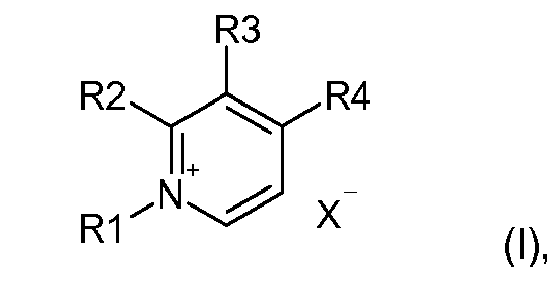
- R1
- für eine C1-C6-Alkylgruppe, eine C2-C6-Alkenylgruppe, eine C2-C6-Hydroxy-alkylgruppe, eine C1-C6-Alkoxy-C2-C6-alkylgruppe, eine Carboxy-C2-C6-alkylgruppe, eine Aryl-C1-C6-alkylgruppe, eine Heteroaryl-C1-C6-alkylgruppe, eine Arylgruppe oder eine Heteroarylgruppe steht,
- R2, R3 und R4
- jeweils unabhängig voneinander für Wasserstoff, eine C1-C6-Alkylgruppe, ein Halogenatom oder eine C1-C6-Acylgruppe steht, mit der Massgabe, dass zumindest einer der Reste R2, R3 und R4 für eine C1-C6-Acylgruppe steht,
- X-
- für ein physiologisch verträgliches Anion steht,
- Beispiele für die als Substituenten der Verbindungen der Formel (I) genannten werden nachfolgend, aber nicht beschränkend genannt: Beispiele für C1-C6-Alkylreste sind die Gruppen -CH3, - CH2CH3, -CH2CH2CH3, -CH(CH3)2, -CH2CH2CH2CH3, -CH2CH(CH3)2, -CH(CH3)CH2CH3, -C(CH3)3. Beispiele für eine C2-C6-Alkenylgruppe sind eine Prop-2-enylgruppe (Allylgruppe), eine 2-Methyl-prop-2-enylgruppe, eine But-3-enylgruppe, eine But-2-enylgruppe, eine Pent-4-enylgruppe oder eine Pent-3-enylgruppe, wobei die Prop-2-enylgruppe bevorzugt ist. Beispiele für eine C2-C6-Hydroxyalkylgruppe sind -CH2CH2OH, -CH2CH2CH2OH, -CH2CH(OH)CH3 und - CH2CH2CH2CH2OH, wobei die Gruppe -CH2CH2OH bevorzugt ist. Beispiele für C1-C6-Alkoxy-C2-C6-alkylgruppen sind die Gruppen -CH2CH2OCH3, -CH2CH2CH2OCH3, -CH2CH2OCH2CH3, - CH2CH2CH2OCH2CH3, -CH2CH2OCH(CH3)2, -CH2CH2CH2OCH(CH3)2. Beispiele für eine Carboxy-C1-C6-alkylgruppe sind die Carboxymethylgruppe, die 2-Carboxyethylgruppe oder die 3-Carboxypropylgruppe. Beispiele für Aryl-C1-C6-alkylgruppen sind die Benzylgruppe und die 2-Phenylethylgruppe. Beispiele für eine Heteroaryl-C1-C6-alkylgruppe sind die Pyridin-2-ylmethylgruppe, die Pyridin-3-ylmethylgruppe, die Pyridin-4-ylmethylgruppe, die Pyrimidin-2-ylmethylgruppe, die Pyrrol-1-ylmethylgruppe, die Pyrrol-1-ylethylgruppe, die Pyrazol-1-ylmethylgruppe oder die Pyrazol-1-ylethylgruppe. Beispiele für eine Arylgruppe sind die Phenylgruppe, die 1-Naphthylgruppe oder die 2-Naphthylgruppe. Beispiele für eine Heteroarylgruppe sind die Pyridin-2-ylgruppe, die Pyridin-3-ylgruppe, die Pyridin-4-ylgruppe, die Pyrimidin-2-ylgruppe, die Pyrrol-1-ylgruppe, die Pyrrol-2-ylgruppe, die Pyrazol-1-ylgruppe, die Pyrazol-3-ylgruppe oder die Pyrazol-4-ylgruppe. Beispiele einer C1-C6-Acylgruppe sind Acetyl (1-Oxo-ethyl), 1-Oxo-propyl, 1-Oxo-butyl, 1-Oxo-Pentyl, 1-Oxo-2,2-dimethylpropyl und 1-Oxo-hexyl.
- In einer Ausführungsform der vorliegenden Erfindung sind solche Verbindungen gemäß Formel (I) bevorzugt, bei welchen der Rest R1 der allgemeinen Struktur (I) für eine C1-C6-Alkylgruppe, für eine C2-C6-Alkenylgruppe oder für eine C2-C6-Hydroxyalkylgruppe steht. Es ist erfindungsgemäß bevorzugt, wenn der Rest R1 für eine C1-C6-Alkylgruppe, bevorzugt für Methyl, Ethyl, n-Propyl oder Isopropyl und insbesondere bevorzugt für Methyl, steht.
- Es hat sich herausgestellt, dass die Acylpyridiniumderivate gemäß Formel (I) erfindungsgemäß besonders vorteilhafte Eigenschaften besitzen, wenn sie die Acyl-Gruppe entweder in 2- oder 4-Position am Pyridin-Ring tragen. Bevorzugte Verbindungen der Formel (I) sind weiterhin solche Verbindungen, bei denen entweder der Rest R2 oder der Rest R4 für eine C1-C6-Acylgruppe, bevorzugt für eine Acetylgruppe, steht. Es ist weiterhin bevorzugt, wenn einer der Reste R2 oder R4 für eine Acetylgruppe steht, während der andere dieser Reste sowie der Rest R3 jeweils für Wasserstoff stehen. Eine weitere Ausführungsform der vorliegenden Erfindung ist daher dadurch gekennzeichnet, dass das Mittel als Acylpyridiniumderivat gemäß Formel (I) mindestens ein 2-Acetylpyridiniumderivat und/oder 4-Acetylpyridiniumderivat enthält. Geeignete Acetylpyridiniumderivate sind dabei insbesondere die physiologisch verträglichen Salze, die als Kation ein Acetylpyridiniumderivat, ausgewählt aus 4-Acetyl-1-methylpyridinium, 4-Acetyl-1-allylpyridinium, 4-Acetyl-1-(2-hydroxyethyl)pyridinium, 2-Acetyl-1-methylpyridinium, 2-Acetyl-1-allylpyridinium und 2-Acetyl-1-(2-hydroxyethyl)pyridinium, enthalten.
- Es ist bevorzugt, wenn das Anion X- gemäß Formel (I) ausgewählt wird aus Halogenid, insbesondere Chlorid, Bromid und Iodid, Benzolsulfonat, p-Toluolsulfonat, C1-C4-Alkylsulfonat, Trifluormethansulfonat, Acetat, Triflluoracetat, Perchlorat, ½ Sulfat, Hydrogensulfat, Tetrafluorborat, Hexafluorphosphat oder Tetrachlorzinkat. Erfindungsgemäß vorteilhaft ist es, wenn das physiologisch verträgliche Anion X- für ein Halogenidion (insbesondere Chlorid oder Bromid), Hydrogensulfat, p-Toluolsulfonat, Benzolsulfonat oder Acetat steht.
- Insbesondere sind solche Mittel erfindungsgemäß bevorzugt, die dadurch gekennzeichnet sind, dass das Acylpyridiniumderivat gemäß Formel (I) ausgewählt ist aus der Gruppe, die gebildet wird aus 4-Acetyl-1-methylpyridinium-p-toluolsulfonat, 4-Acetyl-1-methylpyridinium-benzolsulfonat, 4-Acetyl-1-methylpyridiniumhydrogensulfat, 4-Acetyl-1-methylpyridiniumacetat, 4-Acetyl-1-allylpyridinium-p-toluolsulfonat, 4-Acetyl-1-allylpyridinium-benzolsulfonat, 4-Acetyl-1-allylpyridinium-hydrogensulfat, 4-Acetyl-1-allylpyridiniumacetat, 2-Acetyl-1-methylpyridinium-p-toluolsulfonat, 2-Acetyl-1-methylpyridinium-benzolsulfonat, 2-Acetyl-1-methylpyridiniumhydrogensulfat, 2-Acetyl-1-methylpyridiniumacetat, 2-Acetyl-1-allylpyridinium-p-toluolsulfonat, 2-Acetyl-1-allylpyridinium-benzolsulfonat, 2-Acetyl-1-allylpyridiniumhydrogensulfat und 2-Acetyl-1-allylpyridiniumacetat. Erfindungsgemäß bevorzugte Mittel sind dadurch gekennzeichnet, dass sie als das Acylpyridiniumderivat gemäß Formel (I) eine Verbindung, ausgewählt aus 4-Acetyl-1-methylpyridinium-p-toluolsulfonat und/oder 2-Acetyl-1-methylpyridinium-p-toluolsulfonat, insbesondere 4-Acetyl-1-methylpyridinium-p-toluolsulfonat, enthalten.
- Eine Ausführungsform der vorliegenden Erfindung ist dabei dadurch gekennzeichnet, dass im erfindungsgemäßen Mittel die Acylpyridiniumderivate der Formel (I), insbesondere insbesondere 4-Acetyl-1-methylpyridinium-p-toluolsulfonat, in einer Menge von 0,1 bis 10 Gew.-%, insbesondere von 0,2 bis 4 Gew.-%, jeweils bezogen das Gesamtgewicht des Mittels, enthalten sind.
- Die Oxidationsmittelzubereitung B ist vorzugsweise eine wäßrige, fließfähige Oxidationsmittelzubereitung. Demnach sind bevorzugte erfindungsgemäße Mittel dadurch gekennzeichnet, daß die fließfähige Oxidationsmittelzubereitung B - bezogen auf ihr Gewicht-40 bis 90 Gew.-%, vorzugsweise 50 bis 85 Gew.-%, besonders bevorzugt 55 bis 80 Gew.-%, weiter bevorzugt 60 bis 77,5 Gew.-% und insbesondere 65 bis 75 Gew.-% Wasser enthält. Vorzugsweise wird der fließfähigen Oxidationsmittelzubereitung B ein Emulgator bzw. ein Tensid zugesetzt, wobei oberflächenaktive Substanzen je nach Anwendungsgebiet als Tenside oder als Emulgatoren bezeichnet werden und aus anionischen, kationischen, zwitterionischen, ampholytischen und nichtionischen Tensiden und Emulgatoren ausgewählt sind. Diese Stoffe werden weiter unten ausführlich beschrieben.
- Die Oxidationsmittelzubereitung kann weitere Oxidationsmittel enthalten, die auch als "Booster" bezeichnet werden. Die Auswahl dieser weiteren Peroxoverbindung unterliegt prinzipiell keinen Beschränkungen; übliche, dem Fachmann bekannte Peroxoverbindungen sind beispielsweise Ammoniumperoxidisulfat, Kaliumperoxidisulfat, Natriumperoxidisulfat, Ammoniumpersulfat, Kaliumpersulfat, Natriumpersulfat, Percarbonate wie Magnesiumpercarbonat, Peroxide wie Bariumperoxid sowie Perborate, Harnstoffperoxid und Melaminperoxid. Unter diesen Peroxoverbindungen, die auch in Kombination eingesetzt werden können, sind erfindungsgemäß die anorganischen Verbindungen bevorzugt. Besonders bevorzugt sind die Peroxidisulfate, insbesondere Kombinationen aus mindestens zwei Peroxidisulfaten. Hier sind erfindungsgemäße Mittel bevorzugt, bei denen die fließfähige Oxidationsmittelzubereitung B zusätzlich mindestens eine Peroxoverbindung enthält, die vorzugsweise ausgewählt ist aus Ammonium- und Alkalimetallpersulfaten und -peroxidisulfaten, wobei bevorzugte Mittel mindestens 2 verschiedene Peroxidisulfate enthalten.
- Bei einer Anwendung von Oxidationsmitteln wird das eigentliche Färbemittel wie weiter oben erwähnt, zweckmäßigerweise unmittelbar vor der Anwendung durch Mischung der Zubereitung des Oxidationsmittels B mit der Zubereitung, enthaltend die Farbstoffvorprodukte, hergestellt. Das dabei entstehende gebrauchsfertige Haarfärbepräparat sollte bevorzugt einen pH-Wert im Bereich von 6 bis 12 aufweisen. Besonders bevorzugt ist die Anwendung der Haarfärbemittel in einem schwach alkalischen Milieu. Die Anwendungstemperaturen können in einem Bereich zwischen 15 und 40 °C liegen. Nach einer Einwirkungszeit von 5 bis 45 Minuten wird das Haarfärbemittel durch Ausspülen von dem zu färbenden Haar entfernt. Das Nachwaschen mit einem Shampoo entfällt, wenn ein stark tensidhaltiger Träger, z.B. ein Färbeshampoo, verwendet wurde.
- Insbesondere bei schwer färbbarem Haar kann ein erfindungsgemäßes Mittel gegebenenfalls mit zusätzlichen Farbstoffvorprodukten aber auch ohne vorherige Vermischung mit der Oxidationskomponente auf das Haar aufgebracht werden. Nach einer Einwirkdauer von 20 bis 30 Minuten wird dann - gegebenenfalls nach einer Zwischenspülung - die Oxidationskomponente aufgebracht. Nach einer weiteren Einwirkdauer von 10 bis 20 Minuten wird dann gespült und gewünschtenfalls nachshampooniert. Bei dieser Ausführungsform wird gemäß einer ersten Variante, bei der das vorherige Aufbringen der Farbstoffvorprodukte eine bessere Penetration in das Haar bewirken soll, das entsprechende Mittel auf einen pH-Wert von etwa 4 bis 7 eingestellt. Gemäß einer zweiten Variante wird zunächst eine Luftoxidation angestrebt, wobei das aufgebrachte Mittel bevorzugt einen pH-Wert von 7 bis 10 aufweist. Bei der anschließenden beschleunigten Nachoxidation kann die Verwendung von sauer eingestellten Peroxidisulfat-Lösungen als Oxidationsmittel bevorzugt sein.
- Für eine Farbveränderung mittels Aufhellung bzw. Bleichung des Substrats, beispielsweise der Haare, wird bevorzugt in den erfindungsgemäßen kosmetischen Mitteln neben den Oxidationsmitteln zusätzlich mindestens ein Bleichverstärker eingesetzt.
- Bleichverstärker werden bevorzugt zur Steigerung der Bleichwirkung des Oxidationsmittels, insbesondere des Wasserstoffperoxids, eingesetzt. Geeignete Bleichverstärker sind (BV-i) Verbindungen, die unter Perhydrolysebedingungen aliphatische Peroxocarbonsäuren
und/oder gegebenenfalls substituierte Perbenzoesäure ergeben, und/oder
(BV-ii) Carbonatsalze und/oder Hydrogencarbonatsalze, und/oder
(BV-iii) organische Carbonate, und/oder
(BV-iv) Carbonsäuren, und/oder
(BV-v) Peroxoverbindungen. - Als Bleichverstärker können Verbindungen, die unter Perhydrolysebedingungen aliphatische Peroxocarbonsäuren mit vorzugsweise 1 bis 10 C-Atomen, insbesondere 2 bis 4 C-Atomen, und/oder gegebenenfalls substituierte Perbenzoesäure ergeben, eingesetzt werden. Geeignet sind Substanzen, die sauerstoff- und/oder stichstoffgebundene Acylgruppen mit der genannten Anzahl an Kohlenstoffatomen und/oder gegebenenfalls substituierte Benzoylgruppen tragen. Bevorzugt sind mehrfach acylierte Alkylendiamine, insbesondere Tetraacetylethylendiamin (TAED), acylierte Triazinderivate, insbesondere 1,5-Diacetyl-2,4-dioxohexahydro-1,3,5-triazin (DADHT), acylierte Glykolurile, insbesondere Tetraacetylglykoluril (TAGU), N-Acylimide, insbesondere N-Nonanoylsuccinimid (NOSI), acylierte Phenolsulfonate, insbesondere n-Nonanoyl- oder Isononanoyloxybenzolsulfonat (n- bzw. iso-NOBS), Carbonsäureanhydride, insbesondere Phthalsäureanhydrid, acylierte mehrwertige Alkohole, insbesondere Triacetin, Ethylenglykoldiacetat und 2,5-Diacetoxy-2,5-dihydrofuran.
- Die Carbonat- bzw. Hydrogencarbonatsalze werden bevorzugt ausgewählt aus mindestens einer Verbindung der Gruppe bestehend aus Ammonium-, Alkali- (insbesondere Natrium- und Kalium-), sowie Erdalkali- (insbesondere Calcium-), -carbonatsalzen und -hydrogencarbonatsalzen.
- Besonders bevorzugte Carbonat-, bzw. Hydrogencarbonatsalze sind
- Ammoniumhydrogencarbonat, Ammoniumcarbonat, Natriumhydrogencarbonat, Dinatriumcarbonat, Kaliumhydrogencarbonat, Dikaliumcarbonat und Calciumcarbonat. Diese besonders bevorzugten Salze können allein oder in deren Mischungen von mindestens zwei Vertretern als Bleichverstärker verwendet werden.
- Bevorzugt nutzbare organische Carbonate werden ausgewählt aus mindestens einer Verbindung der Gruppe der Kohlensäuremonoester und/oder aus mindestens einer Verbindung der Gruppe der Kohlensäuremonoamide.
- Bevorzugt verwendbare Kohlensäuremonoester sind die Kohlensäuremonoester der Formel (BV-1),

- in der R für einen gesättigten oder ungesättigten, geradkettigen, verzweigten, oder cyclischen, substituierten oder unsubstituierten Kohlenwasserstoffrest, oder eine substituierte oder unsubstituierte Arylgruppe bzw. einen substituierten oder unsubstituierten Heterocyclus steht.
- In Formel (BV-1) steht R vorzugsweise für einen substituierten oder unsubstituierten, geradkettigen oder verzweigten Alkyl-, Alkenyl- oder Alkinylrest, wobei als Substituenten bevorzugt Hydroxy-, Amino-, Nitro-, Sulfonsäuregruppen oder Halogene in Frage kommen. Weitere bevorzugte Reste R sind Phenyl- und Benzylreste sowie weiter substituierte Vertreter. Besonders bevorzugt steht R für eine C1-6-Alkylgruppe. Beispiele für erfindungsgemäße C1-C6-Alkylgruppen sind die Gruppen Methyl, Ethyl, n-Propyl, Isopropyl, n-Butyl, sec-Butyl, iso-Butyl, tert-Butyl, Pentyl, iso-Pentyl und Hexyl.
- Erfindungsgemäß besonders bevorzugt verwendete Zusammensetzungen sind dadurch gekennzeichnet, daß der Rest R in Formel (BV-1) ausgewählt ist aus Methyl-, Ethyl-, n-Propyl-, isoPropyl-, n-Butyl-, iso-Butyl-, tert-Butyl- sowie Hydroxymethyl- und Hydroxyethyl-Resten. Bevorzugte Kohlensäuremonoamide sind die Verbindungen der Formel (BV-2),

- in der R für einen gesättigten oder ungesättigten, geradkettigen, verzweigten, oder cyclischen, substituierten oder unsubstituierten Kohlenwasserstoffrest, oder eine substituierte oder unsubstituierte Arylgruppe bzw. einen substituierten oder unsubstituierten Heterocyclus steht.
- In Formel (BV-2) steht R vorzugsweise für einen substituierten oder unsubstituierten, geradkettigen oder verzweigten Alkyl-, Alkenyl- oder Alkinylrest, wobei als Substituenten bevorzugt Hydroxy-, Amino-, Nitro-, Sulfonsäuregruppen oder Halogene in Frage kommen. Weitere Bevorzugte Reste R sind Phenyl- und Benzylreste sowie weiter substituierte Vertreter. Besonders bevorzugt steht R für eine C1-6-Alkylgruppe. Beispiele für erfindungsgemäße C1-C6-Alkylgruppen sind die Gruppen Methyl, Ethyl, n-Propyl, Isopropyl, n-Butyl, sec-Butyl, iso-Butyl, tert-Butyl, Pentyl, iso-Pentyl und Hexyl.
- Erfindungsgemäß besonders bevorzugte Bleichverstärker der Formel (BV-2) sind dadurch gekennzeichnet, daß der Rest R in Formel (BV-2) ausgewählt ist aus Methyl-, Ethyl-, n-Propyl-, isoPropyl-, n-Butyl-, iso-Butyl-, tert-Butyl- sowie Hydroxymethyl- und Hydroxyethyl-Resten.
- Das acide H-Atom des Kohlensäuremonoesters bzw. -monoamids kann auch in neutralisierter Form vorliegen, d.h. es können erfindungsgemäß auch Salze von Kohlensäuremonoestern bzw. Kohlensäuremonoamiden eingesetzt werden. Hier sind erfindungsgemäß Kohlensäuremonoester bzw. das Kohlensäuremonoamide bevorzugt, die in ganz oder teilweise neutralisierter Form, vorzugsweise in Form des Alkalimetall-, Ammonium-, Erdalkalimetall- oder Aluminiumsalzes und insbesondere in Form seines Natriumsalzes, vorliegen.
- Als bleichverstärkende Carbonsäure kann in den erfindungsgemäßen Zusammensetzungen bevorzugt mindestens eine Verbindung aus der Gruppe, bestehend aus Essigsäure, Milchsäure, Weinsäure, Zitronensäure, Salicylsäure und ortho-Phthalsäure, enthalten sein.
- Bleichverstärker sind bevorzugt Peroxoverbindungen, insbesondere anorganische Peroxoverbindungen. Unter die erfindungsgemäß bleichverstärkenden Peroxoverbindungen fallen keine Anlagerungsprodukte von Wasserstoffperoxid an andere Komponenten und auch nicht Wasserstoffperoxid selbst. Die Auswahl der Peroxoverbindungen unterliegt darüber hinaus keinen Beschränkungen. Bevorzugte Peroxoverbindungen sind Peroxidisulfatsalze, Persulfatsalze, Peroxidiphosphatsalze (insbesondere Ammoniumperoxidisulfat, Kaliumperoxidisulfat, Natriumperoxidisulfat, Ammoniumpersulfat, Kaliumpersulfat, Natriumpersulfat, Kaliumperoxidiphosphat) und Peroxide (wie Bariumperoxid und Magnesiumperoxid). Unter diesen Peroxoverbindungen, die auch in Kombination eingesetzt werden können, sind erfindungsgemäß die Peroxidisulfate, insbesondere Ammoniumperoxidisulfat, bevorzugt.
- Die Bleichverstärker sind in den erfindungsgemäßen, kosmetischen Mitteln bevorzugt in Mengen von 5 bis 30 Gew.-%, insbesondere in Mengen von 8 bis 20 Gew.-%, jeweils bezogen auf das Gewicht des anwendungsbereiten Mittels, enthalten.
- Zusätzlich können die erfindungsgemäßen Mittel weitere Inhaltsstoffe enthalten. Ein Einsatz bestimmter Metallionen oder-komplexe kann beispielsweise bevorzugt sein, um intensive Färbungen zu erhalten. Hier sind erfindungsgemäße Mittel bevorzugt, die zusätzlich Cu-, Fe-, Mn-, Ru-Ionen oder Komplexe dieser Ionen enthalten.
- Bevorzugte erfindungsgemäße Haarfärbe- und - aufhellungsmittel enthalten 0,0001 bis 2,5 Gew.-%, vorzugsweise 0,001 bis 1 Gew.-%, bezogen auf die Gesamtzusammensetzung des Mittels, mindestens einer Verbindung aus der Gruppe Kupferchlorid (CuCl2), Kupfersulfat (CuSO4), Eisen(II)sulfat, Mangan(II)sulfat, Mangan(II)chlorid, Kobalt(II)chlorid, Cersulfat, Cerchlorid, Vanadiumsulfat, Kaliumjodid, Natriumjodid, Lithiumchlorid, Kaliumdichromat, Magnesiumacetat, Calciumchlorid, Calciumnitrat, Bariumnitrat, Mangandioxid (MnO2) und/oder Hydrochinon.
- Als weiteren Bestandteil können die erfindungsgemäßen Zusammensetzungen mindestens eine Ammoniumverbindung aus der Gruppe Ammoniumchlorid, Ammoniumcarbonat, Ammoniumbicarbonat, Ammoniumsulfat und/oder Ammoniumcarbamat in einer Menge von 0,5 bis 10, vorzugsweise 1 bis 5 Gew.-%, bezogen auf die Gesamtzusammensetzung des Mittels enthalten.
- Eine oxidative Färbung der Fasern kann in Gegenwart von Oxidationsfarbstoffvorprodukten grundsätzlich mit Luftsauerstoff erfolgen. Bevorzugt wird jedoch ein chemisches Oxidationsmittel eingesetzt, besonders dann, wenn neben der Färbung ein Aufhelleffekt an menschlichem Haar gewünscht ist. Dieser Aufhelleffekt kann unabhängig von der Färbemethode gewünscht sein. Die Gegenwart von Oxidationsfarbstoffvorprdukten ist demnach keine zwingende Voraussetzung für einen Einsatz von Oxidationsmitteln in den erfindungsgemäßen Mitteln. Als Oxidationsmittel kommen Persulfate, Chlorite und insbesondere Wasserstoffperoxid oder dessen Anlagerungsprodukte an Harnstoff, Melamin sowie Natriumborat in Frage.
- Erfindungsgemäß kann aber das Oxidationsfärbemittel auch zusammen mit einem Katalysator auf das Haar aufgebracht werden, der die Oxidation der Farbstoffvorprodukte, z.B. durch Luftsauerstoff, aktiviert. Solche Katalysatoren sind z.B. Metallionen, Iodide, Chinone oder bestimmte Enzyme.
- Geeignete Metallionen sind beispielsweise Zn2+, Cu2+, Fe2+, Fe3+, Mn2+, Mn4+, Li+, Mg2+, Ca2+ und Al3+. Besonders geeignet sind dabei Zn2+, Cu2+ und Mn2+. Die Metallionen können prinzipiell in der Form eines beliebigen, physiologisch verträglichen Salzes oder in Form einer Komplexverbindung eingesetzt werden. Bevorzugte Salze sind die Acetate, Sulfate, Halogenide, Lactate und Tartrate. Durch Verwendung dieser Metallsalze kann sowohl die Ausbildung der Färbung beschleunigt als auch die Farbnuance gezielt beeinflusst werden.
- Geeignete Enzyme sind z.B. Peroxidasen, die die Wirkung geringer Mengen an Wasserstoffperoxid deutlich verstärken können. Weiterhin sind solche Enzyme erfindungsgemäß geeignet, die mit Hilfe von Luftsauerstoff die Oxidationsfarbstoffvorprodukte direkt oxidieren, wie beispielsweise die Laccasen, oder in situ geringe Mengen Wasserstoffperoxid erzeugen und auf diese Weise die Oxidation der Farbstoffvorprodukte biokatalytisch aktivieren. Besonders geeignete Katalysatoren für die Oxidation der Farbstoffvorläufer sind die sogenannten 2-Elektronen-Oxidoreduktasen in Kombination mit den dafür spezifischen Substraten, z.B.
- Pyranose-Oxidase und z.B. D-Glucose oder Galactose,
- Glucose-Oxidase und D-Glucose,
- Glycerin-Oxidase und Glycerin,
- Pyruvat-Oxidase und Benztraubensäure oder deren Salze,
- Alkohol-Oxidase und Alkohol (MeOH, EtOH),
- Lactat-Oxidase und Milchsäure und deren Salze,
- Tyrosinase-Oxidase und Tyrosin,
- Uricase und Harnsäure oder deren Salze,
- Cholinoxidase und Cholin,
- Aminosäure-Oxidase und Aminosäuren.
- Im Rahmen einer bevorzugten Ausführungsform handelt es sich bei den erfindungsgemäßen Mittel um dauerhaft formverändernde Mittel. Diese Mittel bestehen üblicherweise aus zwei beziehungsweise drei Zubereitungen, die nacheinander auf die Fasern aufgebracht werden. Im Weiteren werden folgende Bezeichnungen verwendet:
- "Wellmittel" für die wässrige Zubereitung der keratinreduzierenden Substanz,
- "Zwischenspülung" für die erste Spülung und
- "Fixiermittel" für die wässrige Zubereitung des Oxidationsmittels.
- Obwohl das trans-4-tert-Butyl-Cyclohexanol prinzipiell in jeder der genannten Zubereitungen eingesetzt werden kann, hat es sich als erfindungsgemäß besonders bevorzugt erwiesen, wenn es im Wellmittel enthalten ist.
- Die erfindungsgemäßen Wellmittel enthalten zwingend mindestens ein keratinreduzierende Substanz als formverändernde Komponente, vorzugsweise Mercaptane. Solche Verbindungen sind beispielsweise Thioglykolsäure, Thiomilchsäure, Thioäpfelsäure, Mercaptoethansulfonsäure sowie deren Salze und Ester, Cysteamin, Cystein, Bunte Salze und Salze der schwefligen Säure. Bevorzugt geeignet als formverändernde Komponenten sind die Alkali- oder Ammoniumsalze der Thioglykolsäure und/oder der Thiomilchsäure sowie die freien Säuren. Diese werden in den Wellmitteln bevorzugt in Konzentrationen von 0,5 bis 1,0 mol/kg bei einem pH-Wert von 5 bis 12, insbesondere von 7 bis 9,5, eingesetzt. Zur Einstellung dieses pH-Wertes enthalten die erfindungsgemäßen Wellmittel üblicherweise Alkalisierungsmittel wie Ammoniak, Alkali- und Ammoniumcarbonate und -hydrogencarbonate oder organische Amine wie Monoethanolamin. Weiterhin können die erfindungsgemäßen Welllotionen wellkraftverstärkende Komponenten enthalten, bevorzugt ausgewählt aus heterocyclischen Verbindungen wie Imidazol, Pyrrolidin, Piperidin, Dioxolan, Dioxan, Morpholin, Piperazin sowie Derivate dieser Verbindungen, insbesondere 1-Methylimidazol, 2-Methylimidazol, 4(5)-Methylimidazol, 1,2-Dimethylimidazol, 2-Ethylimidazol, 2-Isopropylimidazol, N-Methylpyrrolidon, 1-Methylpiperidin, 4-Methylpiperidin, 2-Ethylpiperidin, 4-Methylmorpholin, 4-(2-Hydroxyethyl)morpholin, 1-Ethylpiperazin, 1-(2-Hydroxyethyl)piperazin, 1-(2-Aminoethyl)piperazin, Biotin, Hydantoin und Benzimidazol, wobei Imidazol besonders bevorzugt ist; Aminosäuren wie insbesondere Arginin, Citrullin, Histidin, Ornithin, Lysin, Oligopeptiden aus durchschnittlich 2-3 Aminosäuren, die einen hohen Anteil (> 50 %, insbesondere > 70 %) an den genannten Aminosäuren haben, sowie deren Salze, bevorzugt Arginin sowie dessen Salze und Arginin-reiche Oligopeptide; Diole wie beispielsweise 2-Ethyl-1,3-hexandiol, 1,3-Butandiol, 1,4-Butandiol, 1,2-Propandiol, 1,3-Propandiol, Neopentylglykol und Ethylenglykol, wobei 1,3-Diole, insbesondere 2-Ethyl-1,3-hexandiol und 1,3-Butandiol besonders bevorzugt sind. Die wellkraftverstärkenden Verbindungen können in den erfindungsgemäßen Welllotionen in Mengen von 0,5 bis 5 Gew.-%, bezogen auf die gesamte Welllotion, enthalten sein. Mengen von 1 bis 4 Gew.-%, im Falle der Diole von 0,5 bis 3 Gew.-%, haben sich als ausreichend erwiesen, weshalb diese Mengen besonders bevorzugt sind.
- Zwingender Bestandteil der erfindungsgemäßen Fixiermittel sind Oxidationsmittel, z. B. Natriumbromat, Kaliumbromat, Wasserstoffperoxid, und die zur Stabilisierung wässriger Wasserstoffperoxidzubereitungen üblichen Stabilisatoren. Erfindungsgemäß einsetzbare wässriger H2O2-Zubereitungen enthalten etwa 0,5 bis 15 Gew.-%, gebrauchsfertig in der Regel etwa 0,5 bis 3 Gew.-%, Wasserstoffperoxid. Der pH-Wert solcher wässriger H2O2-Zubereitungen liegt bevorzugt bei 2 bis 6, insbesondere 2 bis 4 und wird durch anorganische Säuren, bevorzugt Phosphorsäure, eingestellt. Fixiermittel auf Bromat-Basis enthalten die Bromate üblicherweise in Konzentrationen von 1 bis 10 Gew.-% eingesetzt und der pH-Wert der Lösungen wird auf 4 bis 7 eingestellt. Gleichfalls geeignet sind Fixiermittel auf enzymatischer Basis (z. B. Peroxidasen), die keine oder nur geringe Mengen an Oxidationsmitteln, insbesondere Wasserstoffperoxid, enthalten.
- Die erfindungsgemäßen Wellmittel beziehungsweise Fixiermittel sind üblicherweise einphasig formuliert, eingeschlossen von diesem Begriff sind dabei Systeme, die eine kontinuierliche Phase aufweisen, wie beispielsweise reine ÖI-in-Wasser- oder Wasser-in-ÖI-Emulsionen. Es hat sich gezeigt, das erfindungsgemäß auch Zwei- und Mehrphasensysteme bevorzugt sind. Dies sind Systeme, bei denen mindestens zwei separate, kontinuierliche Phasen vorliegen.
- Weiterhin hat es sich als vorteilhaft erweisen, wenn die Oxidationsmittelzubereitungen aus Oxidationsfärbemitteln, Aufhellmitteln und/oder Fixiermitteln von formverändernden Mitteln mindestens einen Stabilisator oder Komplexbildner enthalten. Gebräuchliche und im Rahmen der vorliegenden Erfindung bevorzugte Chelatkomplexbildner sind beispielsweise Polycarbonsäuren, stickstoffhaltige Mono- oder Polycarbonsäuren, insbesondere Ethylendiamintetraessigsäure (EDTA), Ethylendiamindibernsteinsäure (EDDS) und Nitrilotriessigsäure (NTA), geminale Diphosphonsäuren, insbesondere 1-Hydroxyethan-1,1-diphosphonsäure (HEDP), Aminophosphonsäuren wie Ethylendiamintetra(methylenphosphonsäure) (EDTMP), Diethylentriaminpenta-(methylenphosphonsäure) (DTPMP), Phosphonopolycarbonsäuren wie 2-Phosphonobutan-1,2,4-tricarbonsäure sowie Cyclodextrine, Alkalistannate (Natriumstannat), Alkalipyrophosphate (Tetranatriumpyrophosphat, Dinatriumpyrophosphat), Alkaliphosphate (Natriumphosphat), und Phosphorsäure. Erfindungsgemäß bevorzugt enthalten die Mittel Komplexbildner zu 0,01 bis 3 Gew.-%, bevorzugt 0,05 bis 1 Gew.-%, jeweils bezogen auf das Gesamtgewicht des erfindungsgemäßen Mittels.
- Die erfindungsgemäßen Mittel enthalten weitere Hilfs- und Zusatzstoffe.
- Es hat sich herausgestellt, dass durch den Zusatz eines wasserlöslichen, organischen Lösungsmittels in das erfindungsgemäße Mittel die Haarschädigung weiter verringert.
- Eine bevorzugte Ausführungsform der vorliegenden Erfindung ist daher dadurch gegeben, dass das Mittel weiterhin mindestens ein wasserlösliches, organisches Lösungsmittel enthält. Die organischen Lösungsmittel sind bei Raumtemperatur unter Normaldruck flüssig. Unter wasserlöslich wird hierin die Mischbarkeit in jedem Verhältnis unter Normalbedingungen verstanden. Bevorzugte organische Lösungsmittel sind dabei C1-C6-Alkohole, die gegebenenfalls weitere funktionelle Gruppen zur Verbesserung der Wasserlöslichkeit tragen, wie beispielsweise 4-Methoxybutanol, Ethyldiglykol, 1,2-Propylenglykol, n-Propanol, n-Butanol, n-Butylenglykol, Glycerin, Diethylenglykolmonoethylether, und Diethylenglykolmono-n-butylether. Bevorzugte wasserlösliche, organische Lösungsmittel enthalten mindestens zwei Hydroxylgruppen. Bevorzugt sind diese ausgewählt aus der Gruppe, die gebildet wird aus 1,2-Ethandiol, 1,2-Propandiol (1,2-Propylenglykol), 1,3-Propandiol, 1,2-Butandiol, 1,3-Butandiol, 1,4-Butandiol, 2,3-Butandiol, 1,6-Hexandiol, 2-(2-Hydroxyethoxy)ethanol und Glycerin. Besonders bevorzugt sind dabei Glycerin sowie Butylenglycol (1,2-Butandiol, 1,3-Butandiol, 1,4-Butandiol und 2,3-Butandiol).
- Bevorzugt enthält das erfindungsgemäße Mittel wasserlösliche, organische Lösungsmittel zu 0,01 bis 10 Gew.-%, bevorzugt zu 0,05 bis 5 Gew.-%, jeweils bezogen auf das Gesamtgewicht des anwendungsbereiten Mittels.
- Es hat sich weiterhin herausgestellt, dass sich die Hautirritation durch Haarfärbe- und/oder Haarwellmittel durch den Zusatz bestimmter Pflegestoffe zusätzlich unerwartet deutlich reduzieren lässt. Als erfindungsgemäß besonders vorteilhaften zusätzlichen Pflegestoff hat sich dabei der Zellschutzstoff Ectoin ((4S)-1,4,5,6-Tetrahydro-2-methyl-pyrimidine-4-carboxylic acid; INCl-Bezeichnung: Ectoin) erwiesen. Eine weiterhin bevorzugte Ausführungsform der vorliegenden Erfindung ist daher dadurch gegeben, dass das Mittel zusätzlich Ectoin enthält. Bevorzugt enthält das erfindungsgemäße Mittel Ectoin zu 0,0001 bis 3,0 Gew.-%, bevorzugt zu 0,001 bis 1,0 Gew.-%, jeweils bezogen auf das Gesamtgewicht des anwendungsbereiten Mittels.
- In einer bevorzugten Ausführungsform der Einfindung enthalten die Haarbehandlungsmittel - bezogen auf ihr Gewicht - neben der erfindungsgemäßen Wirkstoffkombination weiterhin 0,01 bis 2 Gew.-%, bevorzugt 0,05 bis 1,5 Gew.-% und insbesondere 0,1 bis 1 Gew.-% D-Panthenol.
- In einer weiteren bevorzugten Ausführungsform der Einfindung enthalten die Haarbehandlungsmittel - bezogen auf ihr Gewicht - neben der erfindungsgemäßen Wirkstoffkombination 0,01 bis 2
- Gew.-%, bevorzugt 0,05 bis 1,5 Gew.-% und insbesondere 0,1 bis 1 Gew.-% Glycin, Serin und/oder Arginin.
- Erfindungsgemäß ganz besonders bevorzugt aufgrund ihrer haarkräftigenden Wirkung sowie ihrer unterstützenden Wirkung in Bezug auf die Haarfülle sind die Extrakte aus Grünem Tee, Kamille, Mandel und Moringa. Insbesondere bevorzugt ist erfindungsgemäß ein Moringa-Extrakt, beispielsweise ein unter dem Handelsnamen Puricare® LS 9658 oder Moringa Oleifera® vertriebenes Produkt.
- In einer weiteren bevorzugten Ausführungsform der Einfindung enthalten die Haarreinigungs- und/oder -konditioniermittel - bezogen auf ihr Gewicht - neben der erfindungsgemäßen Wirkstoffkombination weiterhin 0,01 bis 2 Gew.-%, bevorzugt 0,05 bis 1,5 Gew.-% und insbesondere 0,1 bis 1 Gew.-% Moringa-Extrakt.
- Erfindungsgemäß bevorzugte Mittel enthalten einen sebumsorbierenden Wirkstoff, vorzugsweise ausgewählt aus anorganischen und organischen kosmetischen Adsorbentien mit mittleren Partikeldurchmessern von 0,1-100 µm, bevorzugt 0,5-50 µm, besonders bevorzugt 5-30 µm und außerordentlich bevorzugt 10-25 µm. Besonders bevorzugte anorganische Adsorbentien sind ausgewählt aus Kieselsäuren, insbesondere Aerosil®-Typen, Kieselgelen, Siliciumdioxid, Tonen und Schichtsilicaten, insbesondere Bentoniten oder Kaolin, Magnesiumaluminiumsilikaten, insbesondere Talkum, und Bornitrid, sowie Mischungen der genannten Substanzen. Besonders bevorzugte organische Adsorbentien sind ausgewählt aus Stärken und Stärkederivaten, die chemisch und/oder physikalisch modifiziert sein können, insbesondere modifizierten Stärkederivaten vom Typ DRY FLO® der National Starch and Chemical Company, Cellulosepulvern, Lactoglobulinderivaten, insbesondere Natrium-C8-16-Isoalkylsuccinyllactoglobulinsulfonat, z. B. als Handelsprodukt Biopol® OE von Brooks Industries erhältlich, Polymerpulvern aus Polyolefinen, insbesondere Polyethylen-Pulvern und Polypropylen-Pulvern, Polycarbonaten, Polyurethanen, Polyamiden, Polyestern, Polystyrolen, Polyacrylaten, Polymethacrylaten, Polymethylmethacrylaten, (Meth)acrylat- oder (Meth)acrylat-Vinyliden-Copolymeren, Teflon oder Siliconen, wobei die Polymerpulver in einer besonders bevorzugten Ausführungsform der Erfindung vernetzt sein können, sowie Mischungen der genannten Substanzen.
- Bevorzugte erfindungsgemäße Mittel enthalten als Pflegewirkstoff mindestens einen Extrakt aus der Wurzel von Boerhavia diffusa. Bedingt durch die Schutzwirkung bei Anwendung des erfindungsgemäßen Mittels kann die Hautverträglichkeit hierdurch deutlich verbessert werden.
- Es hat sich gezeigt, dass die Extrakte aus der Wurzel von Boerhavia diffusa dazu geeignet sind, in der Haut, insbesondere der Kopfhaut, die nucleare Translocation und Aktivierung von des Transkriptionsfaktors NF-κB (nuclearer Faktor κB / (kappa)B) sowie die Produktion von entzündungsverstärkenden Prostaglandinen, insbesondere PGE2, in den Keratinocyten zu reduzieren und damit insgesamt die Hautverträglichkeit erfindungsgemäßer Mittel zu verbessern. Darüber hinaus begünstigen die Wirkstoffe aus dem Extrakt der Wurzeln von Boerhavia diffusa die Bildung des Hormons α-MSH (alpha-Melanocyten-stimulierendes Hormon), welches eine entscheidende Rolle bei der Regulation und Verringerung von entzündlichen Empfindungen, insbesondere des Juckreizes, spielt. Dadurch wird insgesamt die Toleranzschwelle der Haut, auf irritierende Substanzen mit Reizung und Entzündungen zu reagieren, herabgesenkt. Somit werden sowohl Entzündungspotential wie auch Schmerzempfindung der Kopfhaut reduziert. Außerdem kann sich angegriffene, empfindliche Haut beruhigen und so potentiell allergienauslösende Substanzen besser tolerieren. Insgesamt führt die Verwendung von Extrakten aus der Wurzel von Boerhavia diffusa in Mittel zur Farb- und/oder Formveränderung von menschlichen Haaren zu einer Verbesserung der Hautverträglichkeit und zu einer Verringerung an Irritationen auf der Kopfhaut. Der Extrakt aus der Wurzel der Boerhavia diffusa ist dabei reich an unterschiedlichsten Polyphenolen und Hydroxybenzoesäuren, welche für die Wirksamkeit des Pflanzenextrakts verantwortlich sind. Diese Extrakte lassen sich herstellen, indem die gemahlenen, pulverisierten Wurzeln von Boerhavia diffusa mit einer Mischung aus Wasser und Alkohol, bevorzugt Butylenglycol, aufgenommen werden. Die Wasser-Alkohol-Mischung besitzt dabei bevorzugt ein Mischungsverhältnis von 3:1 bis 1:3 Volumenteilen, besonders bevorzugt von 1:1. Der unlösliche Anteil wird abgetrennt und der lösliche Anteil durch thermische Einwirkung inaktiviert, anschließend filtriert und dann sterilisiert. Als hauptsächliche Wirkstoffe des Extrakts gelten die darin enthaltenen Polyphenole. Bevorzugte Extrakte enthalten ca. 0,05 bis 5 g/L an Polyphenolen, insbesondere 0,20 bis 0,55 g/L. Die Polyphenole setzen sich dabei überwiegend aus Hydroxybenzoesäuren (ca. 50 bis 70 Gew.-% aller enthaltenen Polyphenole) sowie aus Flavonoiden (24 bis 33 Gew.-%) und untergeordnet aus Hydroxyzimtsäuren (1 bis 5 Gew.-%) zusammen.
- Ein erfindungsgemäß besonders geeigneter Extrakt aus den Wurzeln von Boerhavia diffusa ist das Handelsprodukt Mediacalm®, welches von der Firma Silab vertrieben wird und welches nach INCl mit Aqua, Butylene glycol und Boerhavia diffusa root extract bezeichnet wird.
- In einer Ausführungsform sind erfindungsgemäße Mittel dadurch gekennzeichnet, dass sie den Extrakt aus Wurzeln von Boerhavia diffusa in einer Menge von 0,00001 bis 10,0 Gew.-%, insbesondere von 0,0001 bis 8,0 Gew.-%, jeweils bezogen auf das Gesamtgewicht des anwendungsbereiten Mittels, enthalten. Ein erfindungsgemäß besonders bevorzugtes Mittel ist dadurch gekennzeichnet, dass es den Extrakt aus Wurzeln von Boerhavia diffusa in einer Menge von 0,0001 bis 5 Gew.-%, insbesondere von 0,001 bis 1,0 Gew.-%, jeweils bezogen auf das Gesamtgewicht des anwendungsbereiten Mittels, enthält. Diese Pflegestoffe können einzeln, bevorzugt jedoch in Kombinationen untereinander im erfindungsgemäßen Mittel eingesetzt werden. Eine weitere Ausführungsform der vorliegenden Erfindung ist daher dadurch gekennzeichnet, dass das Mittel als zusätzlichen Haarpflegestoff mindestens einen Pflegestoff, ausgewählt aus der Gruppe, gebildet aus D-Panthenol, Glycin, Serin, Arginin, Moringa Oleifera und/oder Ectoin, enthält. Vorzugsweise stellen die anwendungsbereiten Mittel fließfähige Zubereitungen dar. Bevorzugt enthalten die fließfähigen Zubereitungen zusätzlich als oberflächenaktive Substanz ein Emulgator bzw. ein Tensid, wobei oberflächenaktive Substanzen je nach Anwendungsgebiet als Tenside oder als Emulgatoren bezeichnet werden und aus anionischen, kationischen, amphoteren, zwitterionischen und weiteren nichtionischen Tensiden und Emulgatoren ausgewählt sind. Diese Stoffe werden nachfolgend ausführlich beschrieben.
- Als anionische Tenside eignen sich in erfindungsgemäßen Zubereitungen alle für die Verwendung am menschlichen Körper geeigneten anionischen oberflächenaktiven Stoffe.
- Bevorzugte anionische Tenside sind Alkylsulfate, Alkylethersulfate, jeweils mit 10 bis 18 C-Atomen in der Alkylgruppe, und polyalkoxylierte Ethercarbonsäuren mit 10 bis 18 C-Atomen in der Alkylgruppe und bis zu 12 Glykolethergruppen im Molekül.
- Als zwitterionische Tenside werden solche oberflächenaktiven Verbindungen bezeichnet, die im Molekül mindestens eine quartäre Ammoniumgruppe und mindestens eine Carboxylat-, Sulfonat- oder Sulfat-Gruppe tragen. Ein bevorzugtes zwitterionisches Tensid ist das unter der INCI-Bezeichnung Cocamidopropyl Betaine bekannte Fettsäureamid-Derivat.
- In einer weiteren, bevorzugten Ausführungsform der vorliegenden Erfindung enthält das Mittel weiterhin mindestens ein amphoteres Tensid. Besonders bevorzugte amphotere Tenside werden unter der INCI-Bezeichnung Disodium Cocoamphodipropionate mit den Handelsnamen Miranol C2M SF conc. (Rhodia), Amphoterge K-2 (Lonza) und Monateric CEM-38 (Unichema) und Bezeichnung Disodium Cocoamphodiacetate mit den Handelsnamen Dehyton (Cognis), Miranol C2M (Rhodia) und Ampholak XCO 30 (Akzo Nobel) vermarktet.
- Der Zusatz im erfindungsgemäßen Mittel bewirkt eine hervorragende Avivage, insbesondere eine verbesserte Nasskämmbarkeit.
- Durch den Zusatz oberflächenaktiver Verbindungen lässt sich die Effektivität der erfindungsgemäßen Mittel weiter verbessern. Als besonders vorteilhaft haben sich insbesondere weitere oberflächenaktiver Verbindungen vom Typ nichtionischer Tenside herausgestellt. Solche Verbindungen sind beispielsweise Anlagerungsprodukte von Polyethylenoxid an Fettalkohole, wobei Anlagerungsprodukte von Polyethylenoxid an Fettalkohole besonders bevorzugt sind, die einen durchschnittlichen Ethoxylierungsgrad von 10 bis 45, insbesondere von 12 bis 30 aufweisen, wie beispielsweise Steareth-20, Coceth-15, Oleth-20 oder auch Ceteareth-30 sowie Alkylpolyglykoside entsprechend der allgemeinen Formel RO-(Z)x, wobei R für Alkyl, Z für Zucker sowie x für die Anzahl der Zuckereinheiten steht. Erfindungsgemäß bevorzugte Mittel enthalten als nichtionisches Tensid das Anlagerungsprodukt von Cocos-Fettalkohol an (Poly-)glucose, welches unter der INCI-Bezeichnung Coco-Glucoside bekannt ist.
- Die anionischen, zwitterionischen, amphoteren und weiteren nichtionischen Tenside werden in bevorzugt in einer Gesamtmenge von 0,1 bis 45 Gew.%, bevorzugt 1 bis 30 Gew.% und ganz besonders bevorzugt von 1 bis 20 Gew.%, bezogen auf die Gesamtmenge des anwendungsbereiten Mittels, eingesetzt.
- Erfindungsgemäß bevorzugt sind ebenfalls kationische Tenside vom Typ der quartären Ammoniumverbindungen, der Esterquats und der Amidoamine. Die kationischen Tenside sind in den erfindungsgemäß verwendeten Mitteln bevorzugt in Mengen von 0,05 bis 10 Gew.-%, bezogen auf das gesamte Mittel, enthalten. Mengen von 0,1 bis 5 Gew.-% sind besonders bevorzugt.
- Es hat sich erfindungsgemäß als vorteilhaft erwiesen, wenn Mittel mindestens ein Verdickungsmittel enthalten. Bezüglich dieser Verdickungsmittel bestehen keine prinzipiellen Einschränkungen. Es können sowohl organische als auch rein anorganische Verdickungsmittel zum Einsatz kommen. Bevorzugt handelt es sich bei dem Verdickungsmittel um ein anionisches, synthetisches Polymer. Bevorzugte anionische Polymere sind Acrylsäure- und/oder Methacrylsäure-Polymerisate oder-Copolymerisate, die in den erfindungsgemäßen Mitteln bevorzugt in einer Menge von 0,1 bis 10 Gew.-%, besonders bevorzugt von 1 bis 5 Gew.-%, jeweils bezogen auf das Gewicht des Mittels, enthalten sind. Weiterhin bevorzugt handelt es sich bei dem Verdickungsmittel um ein kationisches synthetisches Polymer. Bevorzugte kationische Gruppen sind quartäre Ammoniumgruppen. Insbesondere solche Polymere, bei denen die quartäre Ammoniumgruppe über eine C1-C4-Kohlenwasserstoffgruppe an eine aus Acrylsäure, Methacrylsäure oder deren Derivaten aufgebaute Polymerhauptkette gebunden sind, haben sich als besonders geeignet erwiesen. Solche Polymere können auch als Copolymere mit nichtionogene Monomereinheiten bevorzugt Acrylamid, Methacrylamid, Acrylsäure-C1-C4-Alkylester und Methacrylsäure-C1-C4-Alkylester eingesetzt werden. Nichtionische, vollsynthetische Polymere, wie beispielsweise Polyvinylalkohol oder Polyvinylpyrrolidinon, sind ebenfalls als erfindungsgemäße Verdickungsmittel einsetzbar. Weiterhin bevorzugt werden natürlich vorkommende, gegebenenfalls modifizierte Verdickungsmittel eingesetzt. Dazu zählen z.B. Guargums, Skleroglucangums oder Xanthangums, pflanzliche Gums, wie Gummi arabicum, Ghatti-Gummi, Karaya-Gummi, Tragant-Gummi, Carrageen-Gummi, Agar-Agar, Johannisbrotkernmehl, Pektine, Alginate, Stärke, Stärke-Fraktionen und Derivate wie Amylose, Amylopektin und Dextrine, Cellulosederivate, wie beispielsweise Methylcellulose, Carboxyalkylcellulosen und Hydroxyalkylcellulosen. Als anorganische Verdickungsmittel haben sich Schichtsilikate (polymere, kristalline Natriumdisilicate) als besonders geeignet im Sinne der vorliegenden Erfindung erwiesen. Insbesondere Tone, insbesondere Magnesium Aluminium Silicate, wie beispielsweise Bentonit, besonders Smektite, wie Montmorillonit oder Hectorit, die gegebenenfalls auch geeignet modifiziert sein können, und synthetische Schichtsilikate sind bevorzugt.
- Es hat sich zur weiteren Verringerung des Irritationspotentials der erfindungsgemäßen Mittel als vorteilhaft herausgestellt, wenn die Mittel frei sind von organischen UV-Lichtschutzfiltersubstanzen. Unter UV-Lichtschutzfiltern sind organische Substanzen zu verstehen, die in der Lage sind, ultraviolette Strahlen zu absorbieren und die aufgenommene Energie in Form längerwelliger Strahlung, z. B. Wärme wieder abzugeben. Bevorzugt enthält das erfindungsgemäße Mittel keine UV-Filtersubstanzen aus den folgenden Substanzklassen: 3-Benzylidencampher und dessen Derivate, z. B. 3-(4-Methylbenzyliden)campher; 4-Aminobenzoesäurederivate, vorzugsweise 4-(Dimethylamino)benzoesäure-2-ethylhexylester, 4-(Dimethylamino)benzoesäure-2-octylester und 4-(Dimethylamino)benzoesäureamylester; Ester der Zimtsäure, vorzugsweise 4-Methoxyzimtsäure-2-ethylhexylester, 4-Methoxyzimtsäurepropylester, 4-Methoxyzimtsäureisoamylester, 2-Cyano-3-phenyl-zimtsäure-2-ethylhexylester (Octocrylene); Ester der Salicylsäure, vorzugsweise
- Salicylsäure-2-ethylhexylester, Salicylsäure-4-isopropylben-zylester,
- Salicylsäurehomomenthylester; Derivate des Benzophenons, vorzugsweise 2-Hydroxy-4-methoxybenzophenon, 2-Hydroxy-4-meth-oxy-4'-methylbenzophenon, 2,2'-Dihydroxy-4-methoxy-benzophenon; Ester der Benzalmalonsäure, vorzugsweise 4-Methoxybenzmalonsäuredi-2-ethylhexylester; Triazinderivate, wie z.B. 2,4,6-Trianilino-(p-carbo-2'-ethyl-1'-hexyloxy)-1,3,5-triazin und Octyltriazon; Propan-1,3-dione, wie z.B. 1-(4-tert-Butylphenyl)-3-(4'-methoxyphenyl)propan-1,3-dion oder 1-Phenyl-3-(4'-isopropylphenyl)-propan-1,3-dion; 2-Phenylbenzimidazol-5-sulfonsäure und deren Alkali-, Erdalkali-, Ammonium-, Alkylammonium-, Alkanolammonium- und Glucammoniumsalze; Sulfonsäurederivate von Benzophenonen, vorzugsweise 2-Hydroxy-4-methoxybenzophenon-5-sulfonsäure und ihre Salze; Sulfonsäurederivate des 3-Benzylidencamphers, wie z.B. 4-(2-Oxo-3-bornylidenmethyl)benzolsulfonsäure und 2-Methyl-5-(2-oxo-3-bornyliden)sulfonsäure und deren Salze. In einer weiteren Ausführungsform der vorliegenden Erfindung sind die erfindungsgemäßen Mittel frei von UV-Lichtschutzfiltern, ausgewählt aus der Gruppe, die gebildet wird aus 3-Benzylidencampher und dessen Derivaten, 4-Aminobenzoesäurederivaten, Zimtsäureestern, Salicylsäureestern, Benzophenonderivaten, Benzalmalonsäuren, Triazinderivaten, Propan-1,3-dionen, 2-Phenylbenzimidazol-5-sulfonsäuren, Benzophenonsulfonsäuren und Benzoylmethanderivaten. Frei von UV-Lichtschutzfiltern im Sinne der vorliegenden Erfindung bedeutet, dass die anwendungsbereiten Mittel weniger als 0,05 Gew.-%, bevorzugt weniger als 0,005 Gew.-% und ganz besonders bevorzugt weniger als 0,0001 Gew.-% der UV-Lichtschutzfilter, ausgewählt aus der Gruppe, die gebildet wird aus 3-Benzylidencampher und dessen Derivaten, 4-Aminobenzoesäurederivaten, Zimtsäureestern, Salicylsäureestern, Benzophenonderivaten, Benzalmalonsäuren, Triazinderivaten, Propan-1,3-dionen, 2-Phenylbenz-imidazol-5-sulfonsäuren, Benzophenonsulfonsäuren und Benzoylmethanderivaten, enthalten. Weiterhin hat es sich im Hinblick auf Reduktion der Hautirritation als vorteilhaft herausgestellt, wenn das erfindungsgemäße Mittel frei von Konservierungsmitteln auf Paraben-Basis ist. Parabene sind dem Fachmann als Konservierungsmittel für Lebensmittel wie auch für kosmetische Produkte bekannt. Unter Konservierungsmitteln auf Paraben-Basis sind im Sinne der vorliegenden Anmeldung die verzweigten und unverzweigten C1-C10-Alkylester der 4-Hydroxybenzoesäure sowie deren physiologisch verträglichen Salze, die sogenannten 4-Hydroxybenzoate, zu verstehen. Insbesondere bevorzugt sind die erfindungsgemäßen Mittel frei von Methyl-4-hydroxybenzoat (Methyl Paraben), Ethyl-4-hydroxybenzoat (Ethyl Paraben), Propyl-4-hydroxybenzoat (Propyl Paraben), 2-Propyl-4-hydroxybenzoat (Isopropyl Paraben), Butyl-4-hydroxybenzoat (Butyl Paraben), 2-Butyl-4-hydroxybenzoat (Isobutyl Paraben) und n-Heptyl-4-hydroxybenzoat (Heptyl Paraben) sowie den Natrium- und/oder Kaliumsalzen von Methyl-4-hydroxybenzoat. In einer bevorzugten Ausführungsform sind die erfindungsgemäßen Mittel daher frei von Konservierungsmitteln auf Paraben-Basis. Frei von Konservierungsmitteln auf Paraben-Basis im Sinne der vorliegenden Erfindung bedeutet, dass die anwendungsbereiten Mittel weniger als 0,05 Gew.-%, bevorzugt weniger als 0,005 Gew.-% und ganz besonders bevorzugt weniger als 0,0001 Gew.-% der Parabene, ausgewählt aus der Gruppe, die gebildet wird aus den verzweigten und unverzweigten C1-C10-Alkylestern der 4-Hydroxybenzoesäure sowie deren physiologisch verträglichen Salzen, enthält.
- Schließlich hat es sich als vorteilhaft herausgestellt, wenn das erfindungsgemäße Mittel frei von Silikonen ist. Unter Silikonen sind im Sinne der vorliegenden Anmeldung flüchtige und nichtflüchtige Silikone zu verstehen. Insbesondere sind die erfindungsgemäßen Mittel frei von Silikonen, die ausgewählt sind aus
- (i) Polyalkylsiloxanen (wie Dimethicone), Polyarylsiloxanen, Polyalkylarylsiloxanen, die jeweils flüchtig oder nicht flüchtig, geradkettig, verzweigt oder cyclisch (INCI-Bezeichnung Cyclomethicone), vernetzt oder nicht vernetzt sind;
- (ii) Polysiloxanen, die in ihrer allgemeinen Struktur eine oder mehrere organofunktionelle Gruppen enthalten, die ausgewählt sind unter:
- substituierten oder unsubstituierten aminierten Gruppen (INCI-Bezeichnung:
- Amodimethicone u/o Trimethylsilylamodimethicone); (per)fluorierten Gruppen;
- Thiolgruppen; Carboxylatgruppen; hydroxylierten Gruppen (insb. Dimethiconcopolyole); alkoxylierten Gruppen; Acyloxyalkylgruppen; amphoteren Gruppen; Bisulfitgruppen;
- Hydroxyacylaminogruppen; Carboxygruppen; Sulfonsäuregruppen; und Sulfat- oder Thiosulfatgruppen;
- substituierten oder unsubstituierten aminierten Gruppen (INCI-Bezeichnung:
- (iii) linearen Polysiloxan(A)-Polyoxyalkylen(B)-Blockcopoylmeren vom Typ (A-B)n mit n > 3;
- (iv) gepfropften Silikonpolymeren mit nicht silikonhaltigem, organischen Grundgerüst, die aus einer organischen Hauptkette bestehen, welche aus organischen Monomeren gebildet wird, die kein Silikon enthalten, auf die in der Kette sowie gegebenenfalls an mindestens einem Kettenende mindestens ein Polysiloxanmakromer gepfropft wurde;
- (v) gepfropften Silikonpolymeren mit Polysiloxan-Grundgerüst, auf das nicht silikonhaltige, organische Monomere gepfropft wurden, die eine Polysiloxan-Hauptkette aufweisen, auf die in der Kette sowie gegebenenfalls an mindestens einem ihrer Enden mindestens ein organisches Makromer gepfropft wurde, das kein Silikon enthält, wie beispielsweise das unter der INCI-Bezeichnung Bis-PEG/PPG-20/20 Dimethicone vertriebene Handelsprodukt Abil B 8832 der Firma Degussa;
- (vi) oder deren Gemischen.
- Solche Silikone werden beispielsweise unter den Handelsnamen: Dow Corning 929 Emulsion (hydroxylamino-modifiziertes Silikon, Amodimethicone), DC 2-2078 (Hersteller Dow Corning, INCI-Bezeichung: Aminopropyl Phenyl Trimethicone), DC 5-7113 (Hersteller Dow Corning, INCI-Bezeichnung: Silicone Quaternium 16), SM-2059 (Hersteller: General Electric), SLM-55067 (Hersteller: Wacker), Abil-Quat 3270 und 3272 (Hersteller: Th. Goldschmidt; diquaternäre Polydimethylsiloxane, Quaternium-80), Q2-7224 (Hersteller: Dow Corning; ein stabilisiertes Trimethylsilylamodimethicon), DC 8500 (Bis(C13-15 Alkoxy) PG Amodimethicone, Fa. Dow Corning), Silcare Silicone SEA (Trideceth-9 PG-Amodimethicone, Fa. Clariant), SILWET (Union Carbide Corporation), Dow Corning 190 (Dimethiconpolyol) und Dow Corning 193 vertrieben. Frei von Silikonen im Sinne der vorliegenden Erfindung bedeutet dabei, dass die anwendungsbereiten Mittel weniger als 0,01 Gew.-%, bevorzugt weniger als 0,005 Gew.-% und ganz besonders bevorzugt weniger als 0,0001 Gew.-% an Silikonen, jeweils bezogen auf das Gesamtgewicht des anwendungsbereiten Mittels, enthalten.
- Erfindungsgemäß bevorzugte Mittel sind frei von den oben genannten UV-Lichtschutzfiltern, frei von Konservierungsmitteln auf Paraben-Basis und/oder frei von Silikonen.
- Ferner können die erfindungsgemäßen Mittel weitere Wirk-, Hilfs- und Zusatzstoffe enthalten, wie beispielsweise nichtionische Polymere, kationische Polymere, zwitterionische und amphotere Polymere, anionische Polymere, Strukturanten wie Glucose, Maleinsäure und Milchsäure, haarkonditionierende Verbindungen wie Phospholipide, faserstrukturverbessernde Wirkstoffe, insbesondere Mono-, Di- und Oligosaccharide wie beispielsweise Glucose, Galactose, Fructose, Fruchtzucker und Lactose, Entschäumer wie Silikone, bevorzugt Dimethicon, Farbstoffe zum Anfärben des Mittels, Antischuppenwirkstoffe, Wirkstoffe wie Aminosäuren, Oligopeptide und Proteinhydrolysate, Polyphenole und (Pseudo)Ceramide, Panthenol, Pantothensäure, Pantolacton, Allantoin, Pyrrolidinoncarbonsäuren und deren Salze sowie Bisabolol, Vitamine, Provitamine und Vitaminvorstufen, insbesondere solche der Gruppen A, B3, B5, B6, C, E, F und H, Pflanzenextrakte, Fette und Wachse wie Bienenwachs, Montanwachs und Paraffine, Quell- und Penetrationsstoffe wie Glycerin, Propylenglykolmonoethylether, Carbonate, Hydrogencarbonate, Guanidine, Harnstoffe sowie primäre, sekundäre und tertiäre Phosphate, Trübungsmittel wie Latex, Styrol/PVP- und Styrol/Acrylamid-Copolymere, Perlglanzmittel wie Ethylenglykolmono- und - distearat sowie PEG-3-distearat, Pigmente, Treibmittel wie Propan-Butan-Gemische, N2O, Dimethylether, CO2 und Luft und Antioxidantien.
- Die Auswahl dieser weiteren Stoffe wird der Fachmann gemäß der gewünschten Eigenschaften der Mittel treffen. Bezüglich weiterer fakultativer Komponenten sowie der eingesetzten Mengen dieser Komponenten wird ausdrücklich auf die dem Fachmann bekannten einschlägigen Handbücher, z. B. Kh. Schrader, Grundlagen und Rezepturen der Kosmetika, 2. Auflage, Hüthig Buch Verlag, Heidelberg, 1989, verwiesen.
- Erfindungsgemäß bevorzugte Mittel zur Farb- und Formveränderung der Haare sind dadurch gekennzeichnet, dass sie einen möglichst neutralen pH-Wert besitzen. Eine weitere bevorzugte Ausführungsform der vorliegenden Erfindung besteht darin, dass das anwendungsbereite Mittel einen pH-Wert zwischen 4,0 und 12,0, bevorzugt zwischen 5,0 und 11,5, insbesondere bevorzugt zwischen 6,0 und 11,0 besitzt. Bei den pH-Werten im Sinne der vorliegenden Erfindung handelt es sich um pH-Werte, die bei einer Temperatur von 22 °C gemessen wurden. Üblicherweise wird der pH-Wert mit pH-Stellmitteln eingestellt. Zur Einstellung des pH-Werts sind dem Fachmann in der Kosmetik gängige Acidifizierungs- und Alkalisierungsmittel geläufig. Die zur Einstellung des pH-Wertes verwendbaren Alkalisierungsmittel werden typischerweise gewählt aus anorganischen Salzen, insbesondere der Alkali- und Erdalkalimetalle, organischen Alkalisierungsmitteln, insbesondere Aminen, basische Aminosäuren und Alkanolaminen, und Ammoniak. Erfindungsgemäß bevorzugte Acidifizierungsmittel sind Genuss-Säuren, wie beispielsweise Zitronensäure, Essigsäure, Äpfelsäure oder Weinsäure, sowie verdünnte Mineralsäuren. Erfindungsgemäß bevorzugte Alkalisierungsmittel sind ausgewählt aus der Gruppe, die gebildet wird aus Natriumhydroxid, Kaliumhydroxid, Calciumhydroxid, Bariumhydroxid, Natriumphosphat, Kaliumphosphat, Natriumsilicat, Kaliumsilicat, Natriumcarbonat, Kaliumcarbonat, 2-Aminoethan-1-ol (Monoethanolamin), Triethanolamin, Ammoniak, 1-Aminopropan-2-ol und 2-Amino-2-methylpropan-1-ol.
- Die Konfektionierung der erfindungsgemäßen Farb- und Formveränderungsmittel unterliegt prinzipiell keinerlei Beschränkungen. Üblicherweise werden die erfindungsgemäßen Mittel als 1-Komponentenmittel konfektioniert, die gegebenenfalls unmittelbar vor der Anwendung mit einer zweiten Zubereitung, enthaltend beispielsweise ein Oxidationsmittel, vermischt werden. Es hat sich aber in einigen Fällen auch als bevorzugt erwiesen, wenn das Produkt als 2-Komponentenmittel konfektioniert ist. Im Rahmen einer bevorzugten Ausführungsform werden die erfindungsgemäßen Mittel daher derart konfektioniert, dass eine der erfindungswesentlichen Komponenten separat verpackt ist. Dabei spielt es erfindungsgemäß zunächst keine Rolle, welche der erfindungsgemäßen Komponenten separat verpackt wird; es kann aber bevorzugt sein, die Zubereitung, die das trans-4-tert.-Butyl-Cyclohexanol enthält, bis zur Anwendung separat zu verpacken. Erfindungsgemäß bevorzugte Mittel sind dadurch gekennzeichnet, dass das Mittel unmittelbar vor der Anwendung durch Vermischen mindestens zweier Zubereitungen hergestellt wird, wobei die mindestens zwei Zubereitungen in mindestens zwei getrennt konfektionierten Containern bereitgestellt werden und wobei ein Container ein Färbemittel enthält, welches in einem kosmetischen Träger mindestens ein Oxidationsfarbstoffvorprodukt und trans-4-tert.-Butyl-Cyclohexanol enthält, und ein weiterer Container eine Oxidationsmittelzubereitung, enthaltend mindestens ein Oxidationsmittel, enthält. Das Färbemittel besitzt dabei bevorzugt einen pH-Wert zwischen 5,0 und 12,0, bevorzugt zwischen 6,0 und 11,0.
- Ein weiterer Gegenstand der vorliegenden Erfindung ist ein Verfahren zur Farb- und/oder Formveränderung keratinischer Fasern, bei dem ein erfindungsgemäßes Mittel gemäß obiger Vorgaben auf das Haar aufgetragen wird, für eine Einwirkzeit von 2 bis 60 Minuten, bevorzugt von 5 bis 45 Minuten auf dem Haar belassen wird, und anschließend das Haar ausgespült wird.
- Eine bevorzugte Ausführungsform des erfindungsgemäßen Verfahrens zur Farbveränderung keratinischer Fasern liegt vor, wenn eine Zusammensetzung in einem kosmetischen Träger, enthaltend mindestens ein Oxidationsfarbstoffvorprodukt und trans-4-tert.-Butyl-Cyclohexanol mit einer Oxidationsmittelzubereitung, enthaltend Wasserstoffperoxid, zu einer homogenen Zusammensetzung vermischt, diese auf das Haar aufgebracht wird, für eine Einwirkzeit von 2 bis 60 Minuten, bevorzugt von 5 bis 45 Minuten auf dem Haar belassen wird, und anschließend das Haar ausgespült wird. Die Anwendungstemperaturen bei der erfindungsgemäßen Farbveränderung keratinischer Fasern können in einem Bereich zwischen 15 und 45 °C liegen. Nach einer Einwirkungszeit wird das Haarfärbemittel durch Ausspülen von dem zu färbenden Haar entfernt. Das Nachwaschen mit einem Shampoo kann entfallen, wenn ein stark tensidhaltiger Träger, z. B. ein Färbeshampoo, verwendet wurde.
- Eine weitere bevorzugte Ausführungsform des erfindungsgemäßen Verfahrens zur dauerhaften Formveränderung keratinischer Fasern liegt vor, wenn eine Zusammensetzung in einem kosmetischen Träger, enthaltend mindestens eine keratinreduzierende Substanz sowie trans-4-tert.-Butyl-Cyclohexanol auf das Haar aufgebracht wird, für eine Einwirkzeit von 2 bis 45 Minuten, bevorzugt von 10 bis 30 Minuten auf dem Haar belassen wird, und anschließend gegebenenfalls das Haar ausgespült wird. Anschließend wird ein Fixiermittel, enthaltend mindestens ein Oxidationsmittel, vorzugsweise Wasserstoffperoxid, sowie vorzugsweise zusätzlich mindestens einen Stabilisator oder Komplexbildner, auf das Haar aufgebracht, für eine Einwirkzeit von 2 bis 45 Minuten, bevorzugt von 10 bis 30 Minuten auf dem Haar belassen, und anschließend das Haar ausgespült wird. Die Anwendungstemperaturen bei der erfindungsgemäßen dauerhaften Formveränderung keratinischer Fasern können in einem Bereich zwischen 15 und 45 °C liegen. Nach einer Einwirkungszeit wird das Fixiermittel durch Ausspülen von dem Haar entfernt. Das Nachwaschen mit einem Shampoo kann entfallen, wenn ein stark tensidhaltiger Träger verwendet wurde.
- Bezüglich weiterer bevorzugter Ausführungsformen der erfindungsgemäßen Verfahren gilt mutatis mutandis das zu den erfindungsgemäßen Mitteln Gesagte.
- Wie bereits erwähnt, können die erfindungsgemäßen Mittel auch direkt vor der Anwendung aus zwei oder mehreren getrennt verpackten Zubereitungen hergestellt werden. Dies bietet sich insbesondere zur Trennung inkompatibler Inhaltsstoffe an, um eine vorzeitige Reaktion zu vermeiden. Das anwendungsbereite Mittel wird bei solchen Systemen vom Anwender oder Verbraucher direkt vor der Anwendung durch Vermischen der Komponenten hergestellt. Ein Färbe- und/oder Aufhellungsmittel, bei dem die Oxidationsfarbstoffvorprodukte zunächst getrennt von der Oxidationsmittelzubereitung, enthaltend bevorzugt Wasserstoffperoxid, vorliegen, ist dabei bevorzugt.
- Ein weiterer Gegenstand der vorliegenden Erfindung ist daher eine Mehrkomponentenverpackungseinheit (Kit-of-Parts), enthaltend mindestens zwei getrennt voneinander konfektionierte Container, wobei ein Container mindestens eine farb- und/oder formverändernde Verbindung und trans-4-tert.-Butyl-Cyclohexanol enthält und ein Container eine Oxidationsmittelzusammensetzung, enthaltend mindestens ein chemisches Oxidationsmittel, insbesondere Wasserstoffperoxid, enthält. Eine bevorzugte Ausführungsform dieses Gegenstand der vorliegenden Erfindung ist eine Mehrkomponentenverpackungseinheit (Kit-of-Parts), enthaltend mindestens zwei getrennt voneinander konfektionierte Container, wobei ein Container eine Färbemischung in einem kosmetischen Träger, enthaltend mindestens eine farbgebende Komponente, insbesondere mindestens ein Oxidationsfarbstoffvorprodukt, trans-4-tert.-Butyl-Cyclohexanol, und ein Container eine Oxidationsmittelzusammensetzung, enthaltend mindestens ein chemisches Oxidationsmittel, insbesondere Wasserstoffperoxid, enthält.
- Wird eine besonders starke Aufhellwirkung durch Einsatz von Persulfatsalzen bzw. Peroxodisulfatsalzen gewünscht, ist es erfindungsgemäß bevorzugt, diese der erfindungsgemäßen Mehrkomponentenverpackungseinheit (Kit-of-Parts) in Form eines gegebenenfalls entstaubten Pulvers oder eines in Form gepressten Formkörpers als separat verpackte, zusätzliche Komponente beizufügen.
- Eine weitere bevorzugte Ausführungsform des Erfindungsgegenstands ist eine Mehrkomponentenverpackungseinheit (Kit-of-Parts), enthaltend mindestens zwei getrennt voneinander konfektionierte Container, wobei ein Container eine Formveränderungsmischung in einem kosmetischen Träger, enthaltend mindestens eine formverändernde Komponente und trans-4-tert.-Butyl-Cyclohexanol, und ein Container eine Oxidationsmittelzusammensetzung, enthaltend mindestens ein chemisches Oxidationsmittel, insbesondere Wasserstoffperoxid, enthält. Bevorzugt enthält die Mehrkomponentenverpackungseinheit (Kit-of-Parts) zusätzlich eine Gebrauchsanleitung. Darüber hinaus kann es bevorzugt sein, wenn weiterhin eine Anmischhilfe, wie beispielsweise eine Schale, eine Applikationshilfe, wie beispielsweise ein Kamm oder ein Pinsel, und/oder eine persönliche Schutzausrüstung, wie beispielsweise Einweg-Handschuhe dem Kit beigefügt ist. Bezüglich weiterer bevorzugter Ausführungsformen der Mehrkomponentenverpackungseinheit (Kit-of-Parts) gilt mutatis mutandis das zu den erfindungsgemäßen Mitteln Gesagte.
- Ein weiterer Gegenstand der Erfindung ist die Verwendung der Mittel des ersten Erfindungsgegenstandes zur Verringerung der Schädigung der Haarstruktur bei der Farb- und/oder dauerhaften Formveränderung menschlicher Haare.
- Ein weiterer Gegenstand der Erfindung ist schließlich die Verwendung der Mittel des ersten Erfindungsgegenstandes zur Verbesserung der Hautverträglichkeit bei der Farb- und/oder dauerhaften Formveränderung menschlicher Haare.
- Ein weiterer Gegenstand der Erfindung ist schließlich die Verwendung eines erfindungsgemäßen Mittels zur Verringerung der Schädigung der Haarstruktur bei der Farb- und/oder dauerhaften Formveränderung menschlicher Haare.
- Bezüglich weiterer bevorzugter Ausführungsformen der erfindungsgemäßen Verwendungen gilt mutatis mutandis das zu den erfindungsgemäßen Mitteln Gesagte.
- Die nachfolgenden Beispiele sollen die vorliegende Erfindung verdeutlichen, ohne sie auf darauf einzuschränken.
-
Rohstoff E1 E2 E3 E4 E5 E6 E7 E8 Lanette D 6,60 6,60 6,60 6,60 6,60 5,50 -- -- Lorol techn. 2,40 2,40 2,40 2,40 2,43 2,00 -- -- Ammonium Carbomer, 1% -- -- -- -- -- -- 12,00 12,00 Lanette E, Pulver -- -- -- -- -- -- 0,56 0,56 Texapon NSF, 27% -- -- -- -- -- -- 3,52 3,52 Kalium Oleat, 12,5% -- -- -- -- -- -- 2,40 2,40 Cutina GMS SE -- -- -- -- -- -- 1,60 1,60 Cutina AGS -- -- -- -- -- -- 1,60 1,60 Eutanol G -- -- -- -- -- -- 1,60 1,60 Hydrenol D -- -- -- -- -- -- 9,60 9,60 Phospholipid EFA -- -- -- -- -- -- 0,10 0,10 Eumulgin B 2 0,60 0,60 0,60 0,60 0,60 0,50 2,40 2,40 Eumulgin B 1 0,60 0,60 0,60 0,60 0,60 0,50 -- -- Lamesoft PO 65 2,00 2,00 2,00 2,00 2,00 2,00 -- -- Akypo Soft 45HP 10,0 0 10,00 10,00 10,00 10,00 10,00 -- -- Texapon K 14 S Special, 70 % 2,80 2,80 2,80 2,80 2,80 2,80 1,38 1,38 Produkt W 37194 3,75 3,75 3,75 3,75 3,75 3,75 -- -- p-Toluylendiaminsulfat 0,300 0,822 0,029 -- 1,533 1,161 -- -- Resorcin 0,350 0,416 0,011 -- 0,410 0,298 0,53 0,53 2-Methylresorcin 0,24 6 -- -- 0,004 0,343 0,128 -- -- 5-Amino-2-methylphenol -- 0,023 0,001 -- -- -- -- -- 2-Amino-4-hydroxyethylamino-anisolsulfat -- -- -- -- -- -- 0,02 0,02 4-Amino-3-methylphenol 0,460 0,019 -- -- -- -- -- -- 2-Chlor-6-methyl-3-aminophenol -- 0,047 -- -- -- -- -- -- Bis-(5-Amino-2-hydroxyphenyl)methan 2HCl -- 0,539 -- 0,010 -- -- -- -- 2,4-Diaminophenoxyethanol 2HCl -- -- 0,002 -- -- -- -- -- 3-Aminophenol -- -- 0,002 -- -- 0,058 0,16 0,16 2,7-Dihydroxynaphthalin -- -- -- 0,104 -- -- -- -- 2,4,5,6-Tetraaminopyrimidinsulfat -- -- -- 0,146 -- -- -- -- 2-Amino-3-hydroxypyridin -- -- -- -- 0,046 0,078 -- -- Aerosil 200 -- -- -- -- -- -- 0,25 0,25 Ammoniumsulfat, techn. rein 0,82 0,51 1,00 0,92 -- 0,50 -- -- Natriumsulfit, wasserfrei, 96% 0,40 0,40 0,40 0,40 0,40 0,40 0,20 0,20 HEDP, 60% 0,20 0,20 0,20 0,20 -- 0,20 -- -- Na4-EDTA, Pulver, 87% -- -- -- -- -- -- 0,20 0,20 Natriumhydroxid, 45% 1,00 1,12 0,10 0,30 1,70 -- -- -- Kaliumhydroxid, 50% -- -- -- -- -- 0,90 0,85 0,85 Ascorbinsäure -- -- -- -- -- 0,05 0,05 0,05 Natriumsilikat 40/42 0,50 0,50 0,50 0,50 0,50 0,50 -- -- Hydrovance -- -- -- -- -- -- 2,00 2,00 L-Serin 1,00 1,00 1,00 1,00 1,00 -- 0,50 0,50 trans-4-tert Butyl-Cyclohexanol 0,40 0,55 0,65 0,75 2,00 1,10 2,50 0,75 Ronacare Ectoin -- 0,50 1,00 -- 0,50 1,00 -- 0,50 Ammoniak, 25 % 7,00 6,50 7,00 7,00 6,50 7,50 6,00 6,00 Parfum qs qs qs qs qs qs qs qs Wasser, entsalzt add 100 Lanette D C16-C18-Fettalkohol (INCl-Bezeichnung: Cetearyl alcohol) (Cognis)
Lorol tech. C12-C18-Fettalkohol (INCl-Bezeichnung: Coconut alcohol) (Cognis)
Eumulgin B2 C16-C18-Fettalkohol, ethoxyliert (20 EO) (INCI-Bezeichnung: Ceteareth-20) (Cognis)
Eumulgin B1 C16-C18-Fettalkohol, ethoxyliert (12 EO) (INCI-Bezeichnung: Ceteareth-12) (Cognis)
Lamesoft PO 65 C12-C18-Alkylpolyglucosid, Glycerylmonooleat (ca. 66 %, INCI-Bezeichnung: Coco-Glucoside, Glyceryl Oleate, Aqua) (Cognis)
Akypo Soft 45HP C12-C14-Alkylether, ethoxyliert (6 EO) Carbonsäure, Natriumsalz (ca. 21 %, INCI-Bezeichnung: Sodium Laureth-6 Carboxylate, Aqua) (KAO)
Texapon K14 S Special C12-C14-Alkylethersulfat, ethoxyliert (3 EO), Natriumsalz (ca. 70 %, INCI-Bezeichnung: Sodium Myreth Sulfate, Aqua) (Cognis)
Produkt W 37194 Copolymer aus Acrylsäure, Natriumsalz und Trimethylammoniopropylacrylamidchlorid (ca. 20 %, INCI-Bezeichnung: Acrylamidopropyltrimonium Chloride/Acrylates Copolymer, Aqua) (Stockhausen)
Natriumsilikat 40/42 Natronwasserglas
Ronacare Ectoin (4S)-1,4,5,6-Tetrahydro-2-methyl-pyrimidin-4-carbonsäure (INCI-Bezeichnung: Ectoin) (Rona)
Lanette E, Pulver C16-C18-Fettalkoholsulfat, Natrium-Salz (INCI-Bezeichnung: Sodium Cetearyl Sulfate) (Cognis)
Texapon NSF, 27% C12-Fettalkoholsulfat, ethoxyliert (2 EO) Natrium-Salz (INCI-Bezeichnung: Sodium Laureth Sulfate) (Cognis)
Cutina GMS SE Stearinsäureglycerylester (INCI-Bezeichnung: Glyceryl Stearate) (Cognis)
Cutina AGS Ethylenglycoldistearylester (INCI-Bezeichnung: Glycol Distearate) (Cognis)
Eutanol G 2-Octyldodecanol (INCI-Bezeichnung: Octyldodecanol) (Cognis)
Hydrenol D C16-C18-Fettalkohol (INCI-Bezeichnung: Cetearyl alcohol) (Cognis)
Phospholipid EFA zwitterionisches Phospholid (INCI-Bezeichnung: Linoleamidopropyl PGdimonium chloride phosphate) (Uniqema)
Aerosil 200 Siliciumdioxid, pyrogen (INCI-Bezeichnung: Silica) (Evonik)
Hydrovance Hydroxyethylharnstoff (ca. 50 %; INCI-Bezeichnung: Hydroxyethylura, Aqua) (National Starch)Rohstoff E9 E10 E11 E12 Cetiol V 2,30 2,30 2,30 2,30 Xanthan FN 0,05 0,05 0,05 0,05 Lanette N 14,00 14,00 14,00 14,00 Lanette D 3,90 3,90 3,90 3,90 Cutina GMS SE 6,00 6,00 6,00 6,00 Kokosamidopropylbetain, 40 % 2,00 2,00 2,00 2,00 Monoethanolamin 0,30 0,30 0,30 0,30 Natriumsulfit wasserfrei, 96% 0,20 0,20 0,20 0,20 RonaCare Ectoin 1,00 1,00 -- -- trans-4-tert Butyl-Cyclohexanol 0,55 2,50 0,80 1,00 Ascorbinsäure 0,05 0,05 0,05 0,05 Ammoniak, 25 % 6,00 6,00 6,00 6,00 4,5-Diamino-1-(2-hydroxyethyl)pyrazolsulfat 1,00 1,00 1,00 1,00 5-Amino-2-methylphenol 0,20 0,20 0,20 0,20 2-Amino-3-hydroxypyridin 0,20 0,20 0,20 0,20 2-Amino-6-chloro-4-nitrophenol 0,30 -- 0,30 -- Wasser, vollentsalzt add 100 Cetiol V Ölsäuredecylester (INCI-Bezeichnung: Decyl Oleate) (Cognis)
Xanthan FN Xanthan Gum (INCI-Bezeichnung: Xanthan Gum) (Jungbunzlauer)
Lanette N C16-C18-Fettalkohol, Natrium C16-C18-Fettalkoholsulfat (INCI-Bezeichnung: Cetearyl alcohol, Sodium Cetearyl Sulfate) (Cognis) - Die Fettbasis wurde jeweils zusammen bei 80 °C aufgeschmolzen und mit einem Teil der Wassermenge dispergiert. Anschließend wurden die restlichen Rezepturbestandteile unter Rühren der Reihe nach eingearbeitet. Dann wurde mit Wasser auf 100 Gew.-% aufgefüllt und die Formulierung kalt gerührt.
-

- Die Färbecremes E1 bis E6 wurden vor der Anwendung mit einer Entwicklerlösung EW1 im Gewichtsverhältnis von 1:1 versetzt und innig vermischt. Die Färbecremes E7 und E8 wurden vor der Anwendung mit einer Entwicklerlösung EW2 im Gewichtsverhältnis von 1:1 versetzt und innig vermischt. Die Färbecremes E9 bis E12 wurden vor der Anwendung mit einer 6 Gew.-%igen Wasserstoffperoxidzubereitung im Gewichtsverhältnis von 1:2 versetzt und innig vermischt. Pro Gramm Haar (europäisches Humanhaar, Alkinco 6634, #10/2003, A9) wurden 4 g des frisch hergestellten, anwendungsbereiten Färbemittels aufgetragen. Die Einwirkzeit betrug 30 min bei 35°C für die Färbemittel. Danach wurden die Strähnen 30 s lang mit warmem Wasser ausgespült und luftgetrocknet. Die gefärbten Strähnen zeichneten sich durch glänzende Farben und einen angenehmen Griff aus.
Claims (10)
- Mittel zur Farb- und/oder Formveränderung von keratinischen Fasern, insbesondere menschlichen Haaren, enthaltend in einem kosmetischen Träger mindestens eine farb- und/oder formverändernde Komponente, dadurch gekennzeichnet, dass das Mittel zusätzlich trans-4-tert-Butyl-Cyclohexanol enthält.
- Mittel nach Anspruch 1, dadurch gekennzeichnet, daß es - bezogen auf sein Gewicht-0,05 bis 10 Gew.-%, vorzugsweise 0,1 bis 7,5 Gew.-%, weiter bevorzugt 0,25 bis 5 Gew.-%, besonders bevorzugt 0,5 bis 2,5 und insbesondere 0,5 bis 1,25 Gew.-% trans-4-tert-Butyl-Cyclohexanol enthält.
- Mittel nach einem der Ansprüche 1 bis 2, dadurch gekennzeichnet, daß das Mittel als farbverändernde Komponente mindestens ein Oxidationsfarbstoffvorprodukt und/oder mindestens einen direktziehenden Farbstoff und/oder mindestens einer Vorstufe naturanaloger Farbstoffe und/oder mindestens ein Aufhellmittel enthält.
- Mittel zum Färben und/oder Aufhellen keratinischer Fasern nach einem der Ansprüche 1 bis 3, dadurch gekennzeichnet, daß es 0,5 bis 15 Gew.-%, vorzugsweise 1 bis 12,5 Gew.-%, besonders bevorzugt 2,5 bis 10 Gew.-% und insbesondere 3 bis 7 Gew.-% Wasserstoffperoxid (berechnet als 100%iges H2O2) enthält.
- Mittel nach einem der Ansprüche 1 bis 4, dadurch gekennzeichnet, daß es als farbverändernde Komponente mindestens ein Oxidationsfarbstoffvorprodukt enthält, wobei der Gewichtsanteil aller Oxidationsfarbstoffvorprodukte zwischen 0,001 und 20 Gew.-%, bevorzugt zwischen 0,1 und 10 Gew.-% und insbesondere zwischen 0,2 und 5,0 Gew.-%, jeweils bezogen auf das Gesamtgewicht des anwendungsbereiten Mittels, liegt.
- Mittel zum Färben und/oder Aufhellen keratinischer Fasern nach Anspruch 5, dadurch gekennzeichnet, daß es als Oxidationsfarbstoffvorprodukt mindestens eine Entwicklerkomponente enthält, wobei bevorzugte Entwicklerkomponenten ausgewählt sind aus p-Phenylendiamin, p-Toluylendiamin, , N,N-Bis-(2-hydroxyethyl)amino-p-phenylendiamin, 1,3-Bis-[(2-hydroxyethyl-4'-aminophenyl)amino]-propan-2-ol, Hydroxyethyl-p-Phenylendiamin, 1,10-Bis-(2',5'- diaminophenyl)-1,4,7,10-tetraoxadecan, 4-Aminophenol, 4-Amino-3-methylphenol, Bis-(5- amino-2-hydroxyphenyl)methan, 2,4,5,6- Tetraaminopyrimidin, 2-Hydroxy-4,5,6- triaminopyrimidin, 4,5-Diamino-1-(2-hydroxyethyl)-pyrazol.
- Mittel zum Färben und/oder Aufhellen keratinischer Fasern nach einem der Ansprüche 5 oder 6, dadurch gekennzeichnet, daß es als Oxidationsfarbstoffvorprodukt mindestens eine Kupplerkomponente enthält, wobei bevorzugte Kupplerkomponenten ausgewählt sind aus Resorcin, 2-Methylresorcin, 5-Methyl-resorcin, 2,5-Dimethylresorcin, 4-Chlorresorcin, Resorcinmonomethylether, 5-Aminophenol, 5-Amino-2-methylphenol, 5-(2-Hydroxyethyl)amino-2-methylphenol, 3- Amino-4-chlor-2-methylphenol, 3-Amino-2-chlor-6-methylphenol, 3-Amino-2,4-Dichlorphenol, 2,4-Diaminophenoxyethanol, 2-Amino-4-(2'-hydroxyethyl)amino-anisolsulfat, 1,3-Bis-(2,4-diaminophenoxy)propan, 2-Amino-3-hydroxypyridin, 2-Methylamino-3-amino-6-methoxypyridin, 2,6-Dihydroxy-3,4-dimethylpyridin, 3,5-Diamino-2,6-dimethoxypyridin, 1-Naphthol, 2-Methyl-1-naphthol, 1,5-Dihydroxynaphthalin, 2,7-Dihydroxynaphthalin, 1-Phenyl-3-methylpyrazol-5-on, 2,6-Bis-[(2'-hydroxyethyl)amino]-toluol, 4-Hydroxyindol, 6-Hydroxyindol, 6-Hydroxybenzomorpholin.
- Mittel zum Färben und/oder Aufhellen keratinischer Fasern nach einem der Ansprüche 5 bis 7, dadurch gekennzeichnet, daß es mindestens einen direktziehenden Farbstoff enthält, der ausgewählt ist aus Nitrophenylendiaminen, Nitroaminophenolen, Azofarbstoffen, Anthrachinonen oder Indophenolen, vorzugsweise aus der Gruppe der unter den internationalen Bezeichnungen bzw. Handelsnamen bekannten Farbstoffe HC Yellow 2, HC Yellow 4, HC Yellow 5, HC Yellow 6, HC Yellow 12, Acid Yellow 1, Acid Yellow 10, Acid Yellow 23, Acid Yellow 36, HC Orange 1, Disperse Orange 3, Acid Orange 7, HC Red 1, HC Red 3, HC Red 10, HC Red 11, HC Red 13, Acid Red 33, Acid Red 52, HC Red BN, Pigment Red 57:1, HC Blue 2, HC Blue 12, Disperse Blue 3, Acid Blue 7, Acid Green 50, HC Violet 1, Disperse Violet 1, Disperse Violet 4, Acid Violet 43, Disperse Black 9, Acid Black 1, und Acid Black 52 bekannten Verbindungen sowie 1,4-Diamino-2-nitrobenzol, 2-Amino-4-nitrophenol, 1,4-Bis-(β-hydroxyethyl)-amino-2-nitrobenzol, 3-Nitro-4-(β-hydroxyethyl)-aminophenol, 2-(2-Hydroxyethyl)amino-4,6-dinitrophenol, 1-(2'-Hydroxyethyl)amino-4-methyl-2-nitrobenzol, 1-Amino-4-(2-hydroxyethyl)-amino-5-chlor-2-nitrobenzol, 4-Amino-3-nitrophenol, 1-(2-Ureidoethyl)amino-4-nitrobenzol, 4-Amino-2-nitrodiphenylamin-2'-carbonsäure, 6-Nitro-1,2,3,4-tetrahydrochinoxalin, 2-Hydroxy-1,4-naphthochinon, Pikraminsäure und deren Salze, 2-Amino-6-chloro-4-nitrophenol, 4-Ethylamino-3-nitrobenzoesäure und 2-Chloro-6-ethylamino-1-hydroxy-4-nitrobenzol
- Verwendung eines Mittels gemäß einem der Ansprüche 1 bis 8 zur Verbesserung der Hautverträglichkeit bei der Farb- und/oder dauerhaften Formveränderung menschlicher Haare.
- Verwendung eines Mittels gemäß einem der Ansprüche 1 bis 8 zur Verringerung der Schädigung der Haarstruktur bei der Farb- und/oder dauerhaften Formveränderung menschlicher Haare.
Applications Claiming Priority (1)
| Application Number | Priority Date | Filing Date | Title |
|---|---|---|---|
| DE201010027949 DE102010027949A1 (de) | 2010-04-20 | 2010-04-20 | Haar- und Kopfhautschonende Haarfärbe- und Dauerwellmittel |
Publications (2)
| Publication Number | Publication Date |
|---|---|
| EP2380554A2 true EP2380554A2 (de) | 2011-10-26 |
| EP2380554A3 EP2380554A3 (de) | 2015-05-06 |
Family
ID=44310368
Family Applications (1)
| Application Number | Title | Priority Date | Filing Date |
|---|---|---|---|
| EP20100195187 Ceased EP2380554A3 (de) | 2010-04-20 | 2010-12-15 | Haar- und Kopfhautschonende Haafärbe- und Dauerwellmittel |
Country Status (2)
| Country | Link |
|---|---|
| EP (1) | EP2380554A3 (de) |
| DE (1) | DE102010027949A1 (de) |
Cited By (1)
| Publication number | Priority date | Publication date | Assignee | Title |
|---|---|---|---|---|
| WO2015180738A1 (en) * | 2012-12-20 | 2015-12-03 | Kao Germany Gmbh | Oxidative dyeing composition |
Citations (4)
| Publication number | Priority date | Publication date | Assignee | Title |
|---|---|---|---|---|
| US20020178513A1 (en) * | 2001-01-19 | 2002-12-05 | Jack Massoni | Hair dye composition |
| DE102006038449A1 (de) * | 2006-06-08 | 2007-12-13 | Henkel Kgaa | Oxidative Haarbehandlung mit verringerter Haarschädigung |
| EP2072037A1 (de) * | 2007-12-17 | 2009-06-24 | Farmen International Cosmetics Distribution S.p.A | Haarfärbemittel |
| WO2009087242A2 (en) | 2009-04-09 | 2009-07-16 | Symrise Gmbh & Co. Kg | Compositions comprising trans-tert-butyl cyclohexanol as skin irritation-reducing agent |
Family Cites Families (3)
| Publication number | Priority date | Publication date | Assignee | Title |
|---|---|---|---|---|
| US3933422A (en) * | 1972-02-18 | 1976-01-20 | Avon Products, Inc. | Non-staining keratinic coloring product |
| FR2785183B1 (fr) | 1998-11-04 | 2002-04-05 | Oreal | COMPOSITION TINCTORIALE CONTENANT UN COLORANT DIRECT CATIONIQUE ET UNE PYRAZOLO-[1,5-a]- PYRIMIDINE A TITRE DE BASE D'OXYDATION, ET PROCEDES DE TEINTURE |
| FR2920303B1 (fr) | 2007-09-03 | 2017-11-17 | Soc Ind Limousine D'application Biologique Ditesilab | Utilisation d'un extrait de boerhavia pour apaiser la peau. |
-
2010
- 2010-04-20 DE DE201010027949 patent/DE102010027949A1/de not_active Withdrawn
- 2010-12-15 EP EP20100195187 patent/EP2380554A3/de not_active Ceased
Patent Citations (4)
| Publication number | Priority date | Publication date | Assignee | Title |
|---|---|---|---|---|
| US20020178513A1 (en) * | 2001-01-19 | 2002-12-05 | Jack Massoni | Hair dye composition |
| DE102006038449A1 (de) * | 2006-06-08 | 2007-12-13 | Henkel Kgaa | Oxidative Haarbehandlung mit verringerter Haarschädigung |
| EP2072037A1 (de) * | 2007-12-17 | 2009-06-24 | Farmen International Cosmetics Distribution S.p.A | Haarfärbemittel |
| WO2009087242A2 (en) | 2009-04-09 | 2009-07-16 | Symrise Gmbh & Co. Kg | Compositions comprising trans-tert-butyl cyclohexanol as skin irritation-reducing agent |
Non-Patent Citations (1)
| Title |
|---|
| KH. SCHRADER: "Grundlagen und Rezepturen der Kosmetika", 1989, HÜTHIG BUCH VERLAG |
Cited By (1)
| Publication number | Priority date | Publication date | Assignee | Title |
|---|---|---|---|---|
| WO2015180738A1 (en) * | 2012-12-20 | 2015-12-03 | Kao Germany Gmbh | Oxidative dyeing composition |
Also Published As
| Publication number | Publication date |
|---|---|
| DE102010027949A1 (de) | 2011-10-20 |
| EP2380554A3 (de) | 2015-05-06 |
Similar Documents
| Publication | Publication Date | Title |
|---|---|---|
| EP2320854B1 (de) | Aufhellmittel mit 2-acylpyridinium-derivaten | |
| EP2315576B1 (de) | Kationische acetylpyridinium-derivate als bleichaktivatoren | |
| EP2355778A2 (de) | Verstärkte aufhellung bei gleichzeitiger haarkräftigung | |
| WO2009135700A1 (de) | Aufhellmittel mit kationischen acylpyridiniumderivaten, co-bleichaktivatoren und wasserstoffperoxid | |
| EP2925284B1 (de) | Farbglanzmittel mit speziellen kationischen farbstoffen, tensiden und polymeren | |
| EP2559456A2 (de) | Mittel zum Behandeln und/oder Färben keratinischer Fasern, enthaltend spezifische Aminosilikone und Alkalisierungsmittel | |
| DE102006008149A1 (de) | Bleichmittel | |
| WO2010102928A2 (de) | Haarbehandlungsmittel mit gelee royale | |
| EP2427173B1 (de) | Kopfhautberuhigendes haarfärbe/wellmittel enthaltend boerhavia extrakt | |
| EP2380554A2 (de) | Haar- und Kopfhautschonende Haafärbe- und Dauerwellmittel | |
| DE102012213251A1 (de) | Pflegende Haarfärbemittel mit Silicon-Blockcopolymeren | |
| EP2314351B1 (de) | Haarfärbemittel mit verbesserter Hautverträglickeit | |
| EP2190402B2 (de) | Biotin und kieselsäure in färbemitteln | |
| EP3076927B1 (de) | Mittel zum oxidativen färben von haaren enthaltend spezielle kombinationen von entwicklern und kupplern | |
| DE102009029275A1 (de) | Pflegende Haarfarbe | |
| EP2347752A2 (de) | Haarfärbemittel und Haarwellmittel mit verbesserter Hautverträglichkeit | |
| DE102009002286A1 (de) | Haarfärbe/wellmittel mit verbesserter Hautverträglichkeit | |
| EP2630198B1 (de) | Dikationische 4-aza-1-azoniabicyclo[2.2.2]octane und mittel zum färben von keratinhaltigen fasern | |
| EP2012742B1 (de) | Aufhell- und/oder färbemittel mit piperidonen | |
| DE102012213250A1 (de) | Pflegende Haarfärbemittel mit Blockcopolymeren | |
| WO2015082228A1 (de) | Mittel zum oxidativen färben von haaren enthaltend spezielle kombinationen von entwicklern und kupplern | |
| WO2013087469A1 (de) | Haarschonende haarfärbe- und dauerwellmittel | |
| DE102012213248A1 (de) | Pflegende Haarfärbemittel mit Silicon(en) und Polymer(en) | |
| DE102013225185A1 (de) | Mittel zum oxidationen Färben von Haaren enthaltend spezielle Kombinationen von Entwicklern und Kupplern | |
| DE102015212003A1 (de) | Mittel zum oxidativen Färben von Haaren in Kupfernuancen mit verbesserter Grauabdeckung |
Legal Events
| Date | Code | Title | Description |
|---|---|---|---|
| 17P | Request for examination filed |
Effective date: 20101215 |
|
| AK | Designated contracting states |
Kind code of ref document: A2 Designated state(s): AL AT BE BG CH CY CZ DE DK EE ES FI FR GB GR HR HU IE IS IT LI LT LU LV MC MK MT NL NO PL PT RO RS SE SI SK SM TR |
|
| AX | Request for extension of the european patent |
Extension state: BA ME |
|
| PUAI | Public reference made under article 153(3) epc to a published international application that has entered the european phase |
Free format text: ORIGINAL CODE: 0009012 |
|
| PUAL | Search report despatched |
Free format text: ORIGINAL CODE: 0009013 |
|
| AK | Designated contracting states |
Kind code of ref document: A3 Designated state(s): AL AT BE BG CH CY CZ DE DK EE ES FI FR GB GR HR HU IE IS IT LI LT LU LV MC MK MT NL NO PL PT RO RS SE SI SK SM TR |
|
| AX | Request for extension of the european patent |
Extension state: BA ME |
|
| RIC1 | Information provided on ipc code assigned before grant |
Ipc: A61Q 5/10 20060101ALI20150401BHEP Ipc: A61Q 5/08 20060101ALI20150401BHEP Ipc: A61Q 5/04 20060101ALI20150401BHEP Ipc: A61Q 5/00 20060101ALI20150401BHEP Ipc: A61Q 5/06 20060101ALI20150401BHEP Ipc: A61K 8/34 20060101AFI20150401BHEP |
|
| 17Q | First examination report despatched |
Effective date: 20150424 |
|
| STAA | Information on the status of an ep patent application or granted ep patent |
Free format text: STATUS: THE APPLICATION HAS BEEN REFUSED |
|
| 18R | Application refused |
Effective date: 20171124 |