EP2380977A2 - Zur Krebsvoraussage anwendbare Gengruppe - Google Patents
Zur Krebsvoraussage anwendbare Gengruppe Download PDFInfo
- Publication number
- EP2380977A2 EP2380977A2 EP11005112A EP11005112A EP2380977A2 EP 2380977 A2 EP2380977 A2 EP 2380977A2 EP 11005112 A EP11005112 A EP 11005112A EP 11005112 A EP11005112 A EP 11005112A EP 2380977 A2 EP2380977 A2 EP 2380977A2
- Authority
- EP
- European Patent Office
- Prior art keywords
- breast cancer
- transcript
- metastatic breast
- marker gene
- expression level
- Prior art date
- Legal status (The legal status is an assumption and is not a legal conclusion. Google has not performed a legal analysis and makes no representation as to the accuracy of the status listed.)
- Withdrawn
Links
Images




Classifications
-
- C—CHEMISTRY; METALLURGY
- C12—BIOCHEMISTRY; BEER; SPIRITS; WINE; VINEGAR; MICROBIOLOGY; ENZYMOLOGY; MUTATION OR GENETIC ENGINEERING
- C12Q—MEASURING OR TESTING PROCESSES INVOLVING ENZYMES, NUCLEIC ACIDS OR MICROORGANISMS; COMPOSITIONS OR TEST PAPERS THEREFOR; PROCESSES OF PREPARING SUCH COMPOSITIONS; CONDITION-RESPONSIVE CONTROL IN MICROBIOLOGICAL OR ENZYMOLOGICAL PROCESSES
- C12Q1/00—Measuring or testing processes involving enzymes, nucleic acids or microorganisms; Compositions therefor; Processes of preparing such compositions
- C12Q1/68—Measuring or testing processes involving enzymes, nucleic acids or microorganisms; Compositions therefor; Processes of preparing such compositions involving nucleic acids
- C12Q1/6876—Nucleic acid products used in the analysis of nucleic acids, e.g. primers or probes
- C12Q1/6883—Nucleic acid products used in the analysis of nucleic acids, e.g. primers or probes for diseases caused by alterations of genetic material
- C12Q1/6886—Nucleic acid products used in the analysis of nucleic acids, e.g. primers or probes for diseases caused by alterations of genetic material for cancer
-
- C—CHEMISTRY; METALLURGY
- C12—BIOCHEMISTRY; BEER; SPIRITS; WINE; VINEGAR; MICROBIOLOGY; ENZYMOLOGY; MUTATION OR GENETIC ENGINEERING
- C12Q—MEASURING OR TESTING PROCESSES INVOLVING ENZYMES, NUCLEIC ACIDS OR MICROORGANISMS; COMPOSITIONS OR TEST PAPERS THEREFOR; PROCESSES OF PREPARING SUCH COMPOSITIONS; CONDITION-RESPONSIVE CONTROL IN MICROBIOLOGICAL OR ENZYMOLOGICAL PROCESSES
- C12Q2600/00—Oligonucleotides characterized by their use
- C12Q2600/158—Expression markers
Definitions
- the present invention relates to a novel method for determining the risk of lymph node metastasis of breast cancer. More specifically, the present invention relates to a method for determining the risk of lymph node metastasis of breast cancer that is based on comparison of the expression levels of marker genes having specific base sequences between metastatic breast cancer cells and non-metastatic breast cancer cells.
- Breast cancer is generally divided into three classes: non-invasive carcinomas, invasive carcinomas and Paget's disease of the breast. Most of the incidences of breast cancer that form lumps are invasive. There are common and special types of invasive breast cancers. The common types include scirrhoma, papillotubular carcinoma and solid-tubular carcinoma. The special types include mucinous carcinoma.
- Patent Literatures 1 and 2 Recent studies have shown that cancers are caused by anomalies in genes. For example, techniques have been proposed that detect cancer cells by making use of the fact that certain genes are expressed at different levels in a cancer tissue and a normal tissue (Patent Literatures 1 and 2).
- prognosis is predicted based on indices such as tumor size, nuclear pleomorphism of the removed cancer cells and of hormone receptor levels. Where necessary, adjuvant therapy is given to prevent metastasis to lymph nodes or the recurrence of cancer.
- the prediction of prognosis based on these presently available indices is not accurate enough, however, and more accurate indices for the prognosis of breast cancer patients are therefore needed to reduce the risk of recurrence and improve patients' quality of life by proper medication.
- the present inventors have conducted extensive studies and observed that certain marker genes are expressed at different levels in metastatic breast cancer cells or tissues and in non-metastatic breast cancer cells or tissues.
- the present inventors found that these marker genes could be used to determine the risk of lymph node metastasis of breast cancer and ultimately devised the present invention. Accordingly, the present invention provides the following measures to address the above-described problems.
- the method of the present invention enables quick and simple determination of the risk of lymph node metastasis of breast cancer at the genetic level, thus providing an effective way to prevent metastasis of breast cancer.
- the present invention concerns a method for determining the risk of lymph node metastasis of breast cancer that uses as an index of the risk of metastasis the difference in the expression levels of specific marker genes between metastatic breast cancer cells or tissues and non-metastatic breast cancer cells or tissues.
- marker gene refers to a gene that enables the determination of the risk of metastasis of breast cancer cells by comparing its expression levels between metastatic breast cancer cells or tissues and non-metastatic breast cancer cells or tissues.
- the present invention also concerns a method for determining the risk of lymph node metastasis of breast cancer in which the expression levels of the marker genes are determined by the amounts of mRNA of the marker genes. More specifically, the present invention concerns a method for determining the risk of lymph node metastasis of breast cancer that involves extracting total RNA from cells obtained from metastatic and non-metastatic breast cancer tissues, and comparing the amounts of mRNA transcripts transcribed from the marker genes. Different techniques for gene expression analysis can be used to determine the amounts of mRNA of genes of interest, including comprehensive transcriptome analysis (high-coverage gene expression profiling, HiCEP), DNA microarrays, quantitative RT-PCR and northern hybridization.
- comprehensive transcriptome analysis high-coverage gene expression profiling, HiCEP
- DNA microarrays DNA microarrays
- quantitative RT-PCR quantitative RT-PCR and northern hybridization.
- Gene expression analysis techniques that can determine the amounts of mRNA without extracting total RNA from cells, such as in situ hybridization, may also be used in the present invention.
- the above-described techniques may be used in combination to improve the accuracy of detection.
- the translated products of the genes of the present invention may also be quantified by, for example, determining the amounts of proteins coded by the genes.
- Proteins of interest can be quantified by using techniques such as immunological assays using antibodies specific for the proteins (such as ELISA, western blotting and RIA), two-dimensional electrophoresis and high-performance liquid chromatography (HPLC).
- Antibodies specific for the proteins coded by the genes of the present invention can be prepared by common techniques using the proteins coded by the genes as antigens.
- HiCEP is one of the transcriptome analysis techniques and is characterized by its comprehensiveness and high sensitivity. The following is a brief overview of the technique (See Nucleic Acids Res., 2003, Vol.31, No.16 e94 for more details): Using common techniques, total RNA is extracted and purified from tissue or cell samples. Double-stranded cDNA is synthesized from the total RNA using 5'-biotinylated oligo(dT) primers. The cDNA is then digested with a restriction enzyme MspI. Poly(A)-containing fragments are collected by avidin beads and 3'-adaptor is ligated to the MspI-digested ends of the collected fragments.
- PCR primers are constructed by adding all possible combinations of two selected bases to the same adapter sequences as those ligated to 5' and 3' ends (16 5'-end primers and 16 3'-end primers with 5'-end primers fluorescent-labeled). Using these primers, 256 different quantitative PCRs are performed. The PCR products obtained for each primer pair are loaded on a fragment analyzer to obtain 256 electrophoresis profiles (gene expression profiles), each containing multiple fluorescence peaks, for a sample. The expression levels of transcripts can then be compared by comparing the fluorescence peaks among different samples.
- the marker gene for use in the present invention may be any gene that is expressed at significantly different levels between metastatic breast cancer cells or tissues and non-metastatic breast cancer cells or tissues.
- the marker gene may be at least one selected from the group consisting of genes having base sequences of GenBank accession Nos.
- Data stored in the GenBank database may contain the same gene registered by different researchers, at different times, in different fields and under different names or gene polymorphisms or splicing variants of the same gene registered as novel genes.
- different base sequences that can be considered to be originated from a single gene may be registered with different accession numbers. These base sequences are collectively referred to as "homologs.” The term is used in the same context throughout this specification.
- One characteristic feature of the method of the present invention for determining the risk of lymph node metastasis of breast cancer is the use of marker genes that are expressed at significantly different expression levels between metastatic breast cancer cells or tissues and non-metastatic breast cancer cells or tissues.
- expression level may refer to either the amount of mRNA transcribed from a marker gene or the amount of a protein translated from mRNA.
- the ratio of the expression level of a marker gene in non-metastatic breast cancer cells or tissues to the expression level of the same gene in metastatic breast cancer cells or tissues is preferably in the range of 1.5 or higher or 2/3 or lower, and more preferably in the range of 2 or higher or 1/2 or lower.
- a marker gene does not serve as an accurate index of the risk of lymph node metastasis of breast cancer and is therefore not desirable when the ratio of its expression level in non-metastatic breast cancer cells or tissues to that in metastatic breast cancer cells or tissues is outside the above-described range.
- breast cancer including breast ductal carcinomas (such as papillotubular carcinoma, solid-tubular carcinoma and scirrhoma), lobular carcinomas, special-type carcinomas (such as mucinous carcinoma, medullary carcinoma and tubular carcinoma) and Paget's disease of the breast, it is preferably applied to scirrhoma, lobular carcinomas or solid-tubular carcinoma.
- breast ductal carcinomas such as papillotubular carcinoma, solid-tubular carcinoma and scirrhoma
- lobular carcinomas such as mucinous carcinoma, medullary carcinoma and tubular carcinoma
- Paget's disease of the breast it is preferably applied to scirrhoma, lobular carcinomas or solid-tubular carcinoma.
- RNA transcription levels are compared between human metastatic breast cancer tissue and non-metastatic tissue using one of the gene expression analysis techniques known as high-coverage gene expression profiling technique (HiCEP), a known comprehensive, highly sensitive technique for transcriptome analysis ( Nucleic Acids Res., 2003, vol.31(16), e94 ).
- HiCEP high-coverage gene expression profiling technique
- the breast cancer tissues used in Example were shown in Table 1.
- the tissues were collected from five stage II breast cancer patients (commercial products, all Caucasian, primary tumor, lymph node metastasis (2), no lymph node metastasis (3), all had stage II cancer based on TNM classification).
- Table 1 Samples Metastasis Tumor size Age #A + 12cm 57 #B + 2cm x 1.5cm x 1.5cm 69 #C - 2.5cm 50 #D - 4cm x 2cm x 1.7cm 61 #E - 6cm x 5.5cm x 4.5cm 68
- DNA polymerase I 80 units
- RNAase H 4 units, Invitrogen
- E. coli DNA ligase 40 units, Invitrogen
- Adaptor sequences were ligated to the ends of the resulting DNA fragments. Selective PCRs were performed using the adaptor-ligated DNA fragments as templates. The amplified products were analyzed by capillary electrophoresis. The waveform data were used to determine gene expression levels, compare the gene expression levels among the samples, and classify the genes into different expression patterns to obtain data for clustering (expression variation peaks).
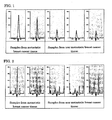
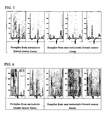
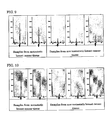
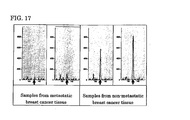
- Transcripts 1 through 11 each show a significant fluorescence peak in each of the metastasis samples but show no expression peak or, if any, a peak intensity that is half or less of the peak intensity of the metastasis samples in each of the non-metastasis samples.
- Transcripts 12 through 17 each show a significant fluorescence peak in each of the non-metastasis samples but show no expression peak or, if any, a peak intensity that is half or less of the peak intensity of the non-metastasis samples in each of the metastasis samples.
- Annotation Characteristics #1 Transcript sequence containing a base sequence from 68302490bp to 68317861bp of (-) strand of chromosome 16 NM_000903 NAD(P)H menadione oxidoreductase 1 Experssion enhanced in metastatic breast cancer #2 Transcript sequence containing a base sequence from 178882962bp to 178883181bp of (+) strand N/A N/A #3 Transcript sequence containing a base sequence from 35050592bp to 35050643bp of (+) strand of chromosome 17 NM_006804 steroidogenic acute regulatory protein related #4 Transcript sequence containing a base sequence from 77267542bp to 77272569bp of (-) strand of chromosome 11 NM_033547 Homo sapiens hypothetical gene MGC16733 similar to CG12113 (MGC16733), mRNA.
- Transcripts as markers for breast cancer metastasis Transcripts Sequences GenBank Accession No. Annotation Characteristics #11 Transcript sequence containing a base sequence from 35126382 bp to 35127393 bp of (+) strand of chromosome 17 CR592336 V-erb-b2 erythroblastic leukemia viral oncogene homolog 2, neuro/glioblastoma derived oncogene homolog (avian)
- Genes according to the present invention enable the highly sensitive and subjective, yet simple and quick determination of lymph node metastasis of breast cancer, a task that has never been achieved by any of the conventional techniques.
- the genes of the present invention therefore serve as markers for the prognosis of breast cancer.
Landscapes
- Chemical & Material Sciences (AREA)
- Life Sciences & Earth Sciences (AREA)
- Health & Medical Sciences (AREA)
- Organic Chemistry (AREA)
- Proteomics, Peptides & Aminoacids (AREA)
- Engineering & Computer Science (AREA)
- Immunology (AREA)
- Pathology (AREA)
- Analytical Chemistry (AREA)
- Zoology (AREA)
- Genetics & Genomics (AREA)
- Wood Science & Technology (AREA)
- Physics & Mathematics (AREA)
- Biotechnology (AREA)
- Microbiology (AREA)
- Molecular Biology (AREA)
- Hospice & Palliative Care (AREA)
- Biophysics (AREA)
- Oncology (AREA)
- Biochemistry (AREA)
- Bioinformatics & Cheminformatics (AREA)
- General Engineering & Computer Science (AREA)
- General Health & Medical Sciences (AREA)
- Measuring Or Testing Involving Enzymes Or Micro-Organisms (AREA)
Applications Claiming Priority (3)
| Application Number | Priority Date | Filing Date | Title |
|---|---|---|---|
| JP2006027735 | 2006-02-03 | ||
| EP10014665A EP2295561A3 (de) | 2006-02-03 | 2007-02-02 | Gengruppe Zur Krebsprognostik |
| EP07707949A EP1983046A4 (de) | 2006-02-03 | 2007-02-02 | Auf die krebsprognostizierung anwendbare gengruppe |
Related Parent Applications (2)
| Application Number | Title | Priority Date | Filing Date |
|---|---|---|---|
| EP07707949.9 Division | 2007-02-02 | ||
| EP10014665.3 Division | 2010-11-16 |
Publications (2)
| Publication Number | Publication Date |
|---|---|
| EP2380977A2 true EP2380977A2 (de) | 2011-10-26 |
| EP2380977A3 EP2380977A3 (de) | 2012-02-15 |
Family
ID=38327539
Family Applications (4)
| Application Number | Title | Priority Date | Filing Date |
|---|---|---|---|
| EP10014665A Withdrawn EP2295561A3 (de) | 2006-02-03 | 2007-02-02 | Gengruppe Zur Krebsprognostik |
| EP07707949A Withdrawn EP1983046A4 (de) | 2006-02-03 | 2007-02-02 | Auf die krebsprognostizierung anwendbare gengruppe |
| EP11005112A Withdrawn EP2380977A3 (de) | 2006-02-03 | 2007-02-02 | Zur Krebsvoraussage anwendbare Gengruppe |
| EP11005113A Withdrawn EP2380978A3 (de) | 2006-02-03 | 2007-02-02 | Zur Krebsvoraussage anwendbare Gengruppe |
Family Applications Before (2)
| Application Number | Title | Priority Date | Filing Date |
|---|---|---|---|
| EP10014665A Withdrawn EP2295561A3 (de) | 2006-02-03 | 2007-02-02 | Gengruppe Zur Krebsprognostik |
| EP07707949A Withdrawn EP1983046A4 (de) | 2006-02-03 | 2007-02-02 | Auf die krebsprognostizierung anwendbare gengruppe |
Family Applications After (1)
| Application Number | Title | Priority Date | Filing Date |
|---|---|---|---|
| EP11005113A Withdrawn EP2380978A3 (de) | 2006-02-03 | 2007-02-02 | Zur Krebsvoraussage anwendbare Gengruppe |
Country Status (5)
| Country | Link |
|---|---|
| US (1) | US20090011423A1 (de) |
| EP (4) | EP2295561A3 (de) |
| JP (1) | JPWO2007088971A1 (de) |
| CA (1) | CA2641410A1 (de) |
| WO (1) | WO2007088971A1 (de) |
Families Citing this family (2)
| Publication number | Priority date | Publication date | Assignee | Title |
|---|---|---|---|---|
| AU2009337963B2 (en) * | 2009-01-21 | 2015-05-07 | Universita' Degli Studi Di Padova | Prognosis of breast cancer patients by monitoring the expression of two genes |
| JP5018918B2 (ja) * | 2010-03-17 | 2012-09-05 | パナソニック株式会社 | アンテナ装置およびそれを用いた携帯端末装置 |
Citations (2)
| Publication number | Priority date | Publication date | Assignee | Title |
|---|---|---|---|---|
| JP2003284594A (ja) | 2002-03-29 | 2003-10-07 | Sumitomo Chem Co Ltd | 卵巣がん細胞の検出方法 |
| JP2003284596A (ja) | 2002-03-29 | 2003-10-07 | Sumitomo Chem Co Ltd | 乳がん細胞の検出方法 |
Family Cites Families (15)
| Publication number | Priority date | Publication date | Assignee | Title |
|---|---|---|---|---|
| JPH11178578A (ja) * | 1997-12-24 | 1999-07-06 | Otsuka Pharmaceut Co Ltd | ヒトrnf5遺伝子 |
| EP1269193A2 (de) * | 2000-03-13 | 2003-01-02 | Research Foundation for Mental Hygiene, Inc. | Eine lysosomale pepstatin-unempfindliche proteinase als biomarker für brustkrebs |
| WO2002004683A2 (en) * | 2000-07-11 | 2002-01-17 | Vanderbilt University | Method of detecting an increased susceptibility to breast cancer |
| US20020107215A1 (en) * | 2000-08-01 | 2002-08-08 | Lifespan Biosciences, Inc. | Tissue-associated proteins and their uses |
| WO2002080844A2 (en) * | 2001-04-04 | 2002-10-17 | Genzyme Corporation | Novel bgp compounds for therapy and diagnosis and methods for using same |
| AU2002330714A1 (en) * | 2001-05-30 | 2003-01-02 | Biomedical Center | In silico screening for phenotype-associated expressed sequences |
| JP2003043046A (ja) * | 2001-07-31 | 2003-02-13 | Chemo Sero Therapeut Res Inst | 乳癌判定用マーカー及び該マーカーを用いる乳癌の判定方法 |
| CA2478510A1 (en) * | 2002-03-07 | 2003-09-18 | The Johns Hopkins University | Genomic screen for epigenetically silenced tumor suppressor genes |
| US7473526B2 (en) * | 2002-03-29 | 2009-01-06 | Veridex, Llc | Breast cancer prognostic portfolio |
| JP2004151003A (ja) * | 2002-10-31 | 2004-05-27 | Hiroko Nogi | Muc1およびケラチン19の検査方法 |
| US20030224411A1 (en) * | 2003-03-13 | 2003-12-04 | Stanton Lawrence W. | Genes that are up- or down-regulated during differentiation of human embryonic stem cells |
| US7306910B2 (en) * | 2003-04-24 | 2007-12-11 | Veridex, Llc | Breast cancer prognostics |
| WO2005024067A2 (en) * | 2003-09-04 | 2005-03-17 | Intergenetics, Inc. | Genetic analysis for stratification of breast cancer risk |
| WO2005029067A2 (en) * | 2003-09-24 | 2005-03-31 | Oncotherapy Science, Inc. | Method of diagnosing breast cancer |
| JP2008502326A (ja) * | 2004-06-03 | 2008-01-31 | バイエル・ヘルスケア・アクチェンゲゼルシャフト | 癌治療に対する反応を予測およびモニターする方法 |
-
2007
- 2007-02-02 EP EP10014665A patent/EP2295561A3/de not_active Withdrawn
- 2007-02-02 EP EP07707949A patent/EP1983046A4/de not_active Withdrawn
- 2007-02-02 CA CA002641410A patent/CA2641410A1/en not_active Abandoned
- 2007-02-02 WO PCT/JP2007/051800 patent/WO2007088971A1/ja not_active Ceased
- 2007-02-02 EP EP11005112A patent/EP2380977A3/de not_active Withdrawn
- 2007-02-02 EP EP11005113A patent/EP2380978A3/de not_active Withdrawn
- 2007-02-02 JP JP2007556931A patent/JPWO2007088971A1/ja active Pending
-
2008
- 2008-07-31 US US12/183,610 patent/US20090011423A1/en not_active Abandoned
Patent Citations (2)
| Publication number | Priority date | Publication date | Assignee | Title |
|---|---|---|---|---|
| JP2003284594A (ja) | 2002-03-29 | 2003-10-07 | Sumitomo Chem Co Ltd | 卵巣がん細胞の検出方法 |
| JP2003284596A (ja) | 2002-03-29 | 2003-10-07 | Sumitomo Chem Co Ltd | 乳がん細胞の検出方法 |
Non-Patent Citations (1)
| Title |
|---|
| NUCLEIC ACIDS RES., vol. 31, no. 16, 2003, pages E94 |
Also Published As
| Publication number | Publication date |
|---|---|
| JPWO2007088971A1 (ja) | 2009-06-25 |
| EP2380977A3 (de) | 2012-02-15 |
| WO2007088971A1 (ja) | 2007-08-09 |
| EP1983046A4 (de) | 2009-03-25 |
| EP1983046A1 (de) | 2008-10-22 |
| EP2295561A3 (de) | 2011-06-29 |
| CA2641410A1 (en) | 2007-08-09 |
| US20090011423A1 (en) | 2009-01-08 |
| EP2380978A3 (de) | 2012-02-29 |
| EP2295561A2 (de) | 2011-03-16 |
| EP2380978A2 (de) | 2011-10-26 |
Similar Documents
| Publication | Publication Date | Title |
|---|---|---|
| US9416422B2 (en) | Methods for detecting minimum residual disease | |
| JP6140202B2 (ja) | 乳癌の予後を予測するための遺伝子発現プロフィール | |
| Cheung et al. | Exploiting gene expression profiling to identify novel minimal residual disease markers of neuroblastoma | |
| EP2309273B1 (de) | Neue Tumormarkiererbestimmung | |
| US20050239079A1 (en) | Predicting outcome with tamoxifen in breast cancer | |
| CN116761899B (zh) | 结直肠癌分子分型及生存风险基因群及诊断产品和应用 | |
| CN105316341A (zh) | 一种LncRNA及其在作为前列腺癌检测标记物或前列腺癌预后复发标记物中的应用 | |
| CN111518908B (zh) | 尿液前列腺癌标志物组合及其在制备精准诊断试剂中的用途 | |
| Kasugai et al. | Identification of CCND3 and BYSL as candidate targets for the 6p21 amplification in diffuse large B-cell lymphoma | |
| Finley et al. | Molecular analysis of Hurthle cell neoplasms by gene profiling | |
| CA2504403A1 (en) | Prognostic for hematological malignancy | |
| WO2013071410A1 (en) | Biomarkers for t cell malignancies and uses thereof | |
| JP6551967B2 (ja) | 肝細胞がんの転移性再発リスクの予測方法 | |
| Poorhosseini et al. | New gene profiling in determination of breast cancer recurrence and prognosis in Iranian women | |
| CN106319062A (zh) | 一种用于甲状腺癌辅助诊断或疗效预测的微创试剂盒 | |
| EP2380977A2 (de) | Zur Krebsvoraussage anwendbare Gengruppe | |
| CN110295232B (zh) | 用于结直肠癌的microRNA生物标记物 | |
| EP3535417B1 (de) | Früherkennung von vorstufen von hodenkeimzellentumoren | |
| EP1682679B1 (de) | Molekularer marker | |
| US20120276531A1 (en) | Genes for prognosis of cancer | |
| CN120138160A (zh) | 乳腺癌生存风险基因群及诊断产品和应用 | |
| US20090311671A1 (en) | Diagnosis of risk of breast cancer | |
| WO2024162265A1 (ja) | 転移性ホルモン感受性前立腺癌の予後予測法 | |
| AU2007345912B2 (en) | Method of detecting mammary cancer cells | |
| ELaidy et al. | Assessment of Non Coding RNA Expression as a Potential Stem Cell Biomarker in Breast Cancer |
Legal Events
| Date | Code | Title | Description |
|---|---|---|---|
| 17P | Request for examination filed |
Effective date: 20110622 |
|
| AC | Divisional application: reference to earlier application |
Ref document number: 2295561 Country of ref document: EP Kind code of ref document: P Ref document number: 1983046 Country of ref document: EP Kind code of ref document: P |
|
| AK | Designated contracting states |
Kind code of ref document: A2 Designated state(s): DE FR GB IT |
|
| PUAI | Public reference made under article 153(3) epc to a published international application that has entered the european phase |
Free format text: ORIGINAL CODE: 0009012 |
|
| PUAL | Search report despatched |
Free format text: ORIGINAL CODE: 0009013 |
|
| AK | Designated contracting states |
Kind code of ref document: A3 Designated state(s): DE FR GB IT |
|
| RIC1 | Information provided on ipc code assigned before grant |
Ipc: C12N 15/00 20060101AFI20120111BHEP Ipc: C12Q 1/68 20060101ALI20120111BHEP Ipc: C12N 15/09 20060101ALI20120111BHEP |
|
| 17Q | First examination report despatched |
Effective date: 20121015 |
|
| STAA | Information on the status of an ep patent application or granted ep patent |
Free format text: STATUS: THE APPLICATION IS DEEMED TO BE WITHDRAWN |
|
| 18D | Application deemed to be withdrawn |
Effective date: 20130226 |