EP2382044B1 - Nouveaux catalyseurs pour la reaction entre un isocyanate et un alcool - Google Patents
Nouveaux catalyseurs pour la reaction entre un isocyanate et un alcool Download PDFInfo
- Publication number
- EP2382044B1 EP2382044B1 EP09736848.4A EP09736848A EP2382044B1 EP 2382044 B1 EP2382044 B1 EP 2382044B1 EP 09736848 A EP09736848 A EP 09736848A EP 2382044 B1 EP2382044 B1 EP 2382044B1
- Authority
- EP
- European Patent Office
- Prior art keywords
- tmod
- diisocyanate
- anion
- trimethyl
- compound
- Prior art date
- Legal status (The legal status is an assumption and is not a legal conclusion. Google has not performed a legal analysis and makes no representation as to the accuracy of the status listed.)
- Not-in-force
Links
Classifications
-
- C—CHEMISTRY; METALLURGY
- C07—ORGANIC CHEMISTRY
- C07C—ACYCLIC OR CARBOCYCLIC COMPOUNDS
- C07C269/00—Preparation of derivatives of carbamic acid, i.e. compounds containing any of the groups, the nitrogen atom not being part of nitro or nitroso groups
- C07C269/02—Preparation of derivatives of carbamic acid, i.e. compounds containing any of the groups, the nitrogen atom not being part of nitro or nitroso groups from isocyanates with formation of carbamate groups
-
- C—CHEMISTRY; METALLURGY
- C08—ORGANIC MACROMOLECULAR COMPOUNDS; THEIR PREPARATION OR CHEMICAL WORKING-UP; COMPOSITIONS BASED THEREON
- C08G—MACROMOLECULAR COMPOUNDS OBTAINED OTHERWISE THAN BY REACTIONS ONLY INVOLVING UNSATURATED CARBON-TO-CARBON BONDS
- C08G18/00—Polymeric products of isocyanates or isothiocyanates
- C08G18/06—Polymeric products of isocyanates or isothiocyanates with compounds having active hydrogen
- C08G18/28—Polymeric products of isocyanates or isothiocyanates with compounds having active hydrogen characterised by the compounds used containing active hydrogen
- C08G18/40—High-molecular-weight compounds
- C08G18/48—Polyethers
-
- B—PERFORMING OPERATIONS; TRANSPORTING
- B01—PHYSICAL OR CHEMICAL PROCESSES OR APPARATUS IN GENERAL
- B01J—CHEMICAL OR PHYSICAL PROCESSES, e.g. CATALYSIS OR COLLOID CHEMISTRY; THEIR RELEVANT APPARATUS
- B01J31/00—Catalysts comprising hydrides, coordination complexes or organic compounds
- B01J31/16—Catalysts comprising hydrides, coordination complexes or organic compounds containing coordination complexes
- B01J31/18—Catalysts comprising hydrides, coordination complexes or organic compounds containing coordination complexes containing nitrogen, phosphorus, arsenic or antimony as complexing atoms, e.g. in pyridine ligands, or in resonance therewith, e.g. in isocyanide ligands C=N-R or as complexed central atoms
- B01J31/1805—Catalysts comprising hydrides, coordination complexes or organic compounds containing coordination complexes containing nitrogen, phosphorus, arsenic or antimony as complexing atoms, e.g. in pyridine ligands, or in resonance therewith, e.g. in isocyanide ligands C=N-R or as complexed central atoms the ligands containing nitrogen
-
- B—PERFORMING OPERATIONS; TRANSPORTING
- B01—PHYSICAL OR CHEMICAL PROCESSES OR APPARATUS IN GENERAL
- B01J—CHEMICAL OR PHYSICAL PROCESSES, e.g. CATALYSIS OR COLLOID CHEMISTRY; THEIR RELEVANT APPARATUS
- B01J31/00—Catalysts comprising hydrides, coordination complexes or organic compounds
- B01J31/16—Catalysts comprising hydrides, coordination complexes or organic compounds containing coordination complexes
- B01J31/22—Organic complexes
-
- B—PERFORMING OPERATIONS; TRANSPORTING
- B01—PHYSICAL OR CHEMICAL PROCESSES OR APPARATUS IN GENERAL
- B01J—CHEMICAL OR PHYSICAL PROCESSES, e.g. CATALYSIS OR COLLOID CHEMISTRY; THEIR RELEVANT APPARATUS
- B01J31/00—Catalysts comprising hydrides, coordination complexes or organic compounds
- B01J31/16—Catalysts comprising hydrides, coordination complexes or organic compounds containing coordination complexes
- B01J31/22—Organic complexes
- B01J31/2204—Organic complexes the ligands containing oxygen or sulfur as complexing atoms
- B01J31/2208—Oxygen, e.g. acetylacetonates
- B01J31/2226—Anionic ligands, i.e. the overall ligand carries at least one formal negative charge
- B01J31/223—At least two oxygen atoms present in one at least bidentate or bridging ligand
- B01J31/2234—Beta-dicarbonyl ligands, e.g. acetylacetonates
-
- C—CHEMISTRY; METALLURGY
- C07—ORGANIC CHEMISTRY
- C07C—ACYCLIC OR CARBOCYCLIC COMPOUNDS
- C07C271/00—Derivatives of carbamic acids, i.e. compounds containing any of the groups, the nitrogen atom not being part of nitro or nitroso groups
- C07C271/06—Esters of carbamic acids
-
- C—CHEMISTRY; METALLURGY
- C08—ORGANIC MACROMOLECULAR COMPOUNDS; THEIR PREPARATION OR CHEMICAL WORKING-UP; COMPOSITIONS BASED THEREON
- C08G—MACROMOLECULAR COMPOUNDS OBTAINED OTHERWISE THAN BY REACTIONS ONLY INVOLVING UNSATURATED CARBON-TO-CARBON BONDS
- C08G18/00—Polymeric products of isocyanates or isothiocyanates
- C08G18/06—Polymeric products of isocyanates or isothiocyanates with compounds having active hydrogen
- C08G18/08—Processes
- C08G18/10—Prepolymer processes involving reaction of isocyanates or isothiocyanates with compounds having active hydrogen in a first reaction step
-
- C—CHEMISTRY; METALLURGY
- C08—ORGANIC MACROMOLECULAR COMPOUNDS; THEIR PREPARATION OR CHEMICAL WORKING-UP; COMPOSITIONS BASED THEREON
- C08G—MACROMOLECULAR COMPOUNDS OBTAINED OTHERWISE THAN BY REACTIONS ONLY INVOLVING UNSATURATED CARBON-TO-CARBON BONDS
- C08G18/00—Polymeric products of isocyanates or isothiocyanates
- C08G18/06—Polymeric products of isocyanates or isothiocyanates with compounds having active hydrogen
- C08G18/08—Processes
- C08G18/16—Catalysts
- C08G18/22—Catalysts containing metal compounds
- C08G18/222—Catalysts containing metal compounds metal compounds not provided for in groups C08G18/225 - C08G18/26
-
- C—CHEMISTRY; METALLURGY
- C08—ORGANIC MACROMOLECULAR COMPOUNDS; THEIR PREPARATION OR CHEMICAL WORKING-UP; COMPOSITIONS BASED THEREON
- C08G—MACROMOLECULAR COMPOUNDS OBTAINED OTHERWISE THAN BY REACTIONS ONLY INVOLVING UNSATURATED CARBON-TO-CARBON BONDS
- C08G18/00—Polymeric products of isocyanates or isothiocyanates
- C08G18/06—Polymeric products of isocyanates or isothiocyanates with compounds having active hydrogen
- C08G18/70—Polymeric products of isocyanates or isothiocyanates with compounds having active hydrogen characterised by the isocyanates or isothiocyanates used
- C08G18/72—Polyisocyanates or polyisothiocyanates
- C08G18/74—Polyisocyanates or polyisothiocyanates cyclic
- C08G18/76—Polyisocyanates or polyisothiocyanates cyclic aromatic
-
- B—PERFORMING OPERATIONS; TRANSPORTING
- B01—PHYSICAL OR CHEMICAL PROCESSES OR APPARATUS IN GENERAL
- B01J—CHEMICAL OR PHYSICAL PROCESSES, e.g. CATALYSIS OR COLLOID CHEMISTRY; THEIR RELEVANT APPARATUS
- B01J2231/00—Catalytic reactions performed with catalysts classified in B01J31/00
- B01J2231/30—Addition reactions at carbon centres, i.e. to either C-C or C-X multiple bonds
- B01J2231/34—Other additions, e.g. Monsanto-type carbonylations, addition to 1,2-C=X or 1,2-C-X triplebonds, additions to 1,4-C=C-C=X or 1,4-C=-C-X triple bonds with X, e.g. O, S, NH/N
-
- B—PERFORMING OPERATIONS; TRANSPORTING
- B01—PHYSICAL OR CHEMICAL PROCESSES OR APPARATUS IN GENERAL
- B01J—CHEMICAL OR PHYSICAL PROCESSES, e.g. CATALYSIS OR COLLOID CHEMISTRY; THEIR RELEVANT APPARATUS
- B01J2531/00—Additional information regarding catalytic systems classified in B01J31/00
- B01J2531/20—Complexes comprising metals of Group II (IIA or IIB) as the central metal
- B01J2531/26—Zinc
Definitions
- the invention relates to novel catalysts for the reaction between an isocyanate and an alcohol, a key step for the preparation of polyurethane polymers. It relates more specifically to the use of new catalysts that are not based on tin.
- Polyurethanes were initially used in the manufacture of foams and plastic compounds. Since then, these polymers have developed in very diverse fields of application such as elastomers, thermoplastics, thermosetting resins, expanded systems, textile fibers and coating systems (coating baths for paper, wood coatings , automotive paints, adhesives, ).
- Polyurethanes are polymers that contain at least one urethane group (also called carbamate). This group is derived from the reaction between an alcohol group and an isocyanate group.
- EP1634903 teaches us the use of a zinc complex, preferably zinc octoate or zinc acetylacetonate, as a catalyst.
- EP1878493 discloses the use of a potentially zinc carbanion as a catalyst.
- the essential object of the present invention is therefore to provide a catalyst for the reaction between an isocyanate and an alcohol which is at least as active as dibutyltin dilaurate, but which is not based on tin.
- Another essential objective of the present invention is to provide a catalyst which can be used for the synthesis of polyurethanes.
- the inventors have had the merit of highlighting, quite surprisingly and unexpectedly, that the use of a complex or metal salt of formula (1) which is based on zinc can catalyze the reaction between an isocyanate and an alcohol, a key step for the preparation of polyurethane polymers.
- inventive character of the invention is due to the judicious and advantageous selection of delimited associations of metal compounds C according to the invention used as a catalyst.
- the amount of catalyst is advantageously determined in such a way that the molar ratio Zn / isocyanate function (Zn / NCO) is between 1/1000
- the process according to the invention is characterized in that step 1) consists of reacting in the absence of moisture and in the presence of an effective amount of catalyst C according to the invention. and as described above, at least one compound B which is an isocyanate selected from the group consisting of: monoisocyanates, diisocyanates, polyisocyanates and mixtures thereof, and at least one compound D which is an alcohol selected from the group consisting of: monoalcohols, diols, polyols and mixtures thereof.
- step 1) consists of reacting in the absence of moisture and in the presence of an effective amount of catalyst C according to the invention. and as described above, at least one compound B which is an isocyanate selected from the group consisting of: monoisocyanates, diisocyanates, polyisocyanates and mixtures thereof, and at least one compound D which is an alcohol selected from the group consisting of: monoalcohols, diols, polyols and mixtures thereof.
- aromatic isocyanates mention may be made of diphenylmethane diisocyanate (MDI), in particular diphenylmethane-4,4'-diisocyanate, diphenylmethane-2,4'-diisocyanate and toluene diisocyanate (TDI), in particular toluene-2,4-diisocyanate and toluene-2,6-diisocyanate.
- MDI diphenylmethane diisocyanate
- TDI toluene diisocyanate
- aliphatic isocyanates examples include hexamethylene diisocyanate (HMDI), 1,3-tetramethylxylylene diisocyanate, isophorone diisocyanate and dicyclohexamethylmethane diisocyanate.
- HMDI hexamethylene diisocyanate
- 1,3-tetramethylxylylene diisocyanate 1,3-tetramethylxylylene diisocyanate
- isophorone diisocyanate dicyclohexamethylmethane diisocyanate.
- IPDI isophorone diisocyanate
- compound D having at least one hydroxyl function By way of example of compound D having at least one hydroxyl function, mention may be made, without intention of being limited thereto, of polyols such as glycerol, polyglycerol, glycol, propylene glycol and glycols comprising from 2 to 10 carbon atoms.
- polyols such as glycerol, polyglycerol, glycol, propylene glycol and glycols comprising from 2 to 10 carbon atoms.
- carbon atoms preferably from 2 to 6 carbon atoms such as ethylene glycol, diethylene glycol, 1,4 butanediol, 1,5 pentanediol, 1,6 hexanediol, 1,10-decanediol, 1,3-propanediol, dipropylene glycol polyethylene glycol, polypropylene glycol, neopentyl glycol, pentaerythritol, neopentyl glycol hydroxypivalate, dipentaerythritol, trimethylolpropane, butyl-2-ethyl-2-propanediol-1,3, sorbitol, mannitol, xylitol and mesoerythritol. It is also possible to use esters of these diols or polyesters polyols as well as polyol polyethers.
- the polyester polyols are generally chosen from aliphatic and aromatic polyester polyols and mixtures of these compounds.
- polyester polyols resulting from the condensation of aliphatic, cyclic or aromatic polyols such as 1,2-ethanediol, 1,2-propanediol, 1,3-propanediol, glycerol, trimethylolpropane, 1,6-hexanediol, 1,2,6-hexanetriol, butenediol, sucrose, glucose, sorbitol, pentaerythritol, mannitol, triethanolamine, N-methyl diethanolamine and mixtures of these compounds with a dicarboxylic acid such as 1,6-hexanedioic acid, dodecanedioic acid, azelaic acid, sebacic acid, adipic acid, 1,18-octadecanedioic acid, phthalic acid, succinic acid and mixtures of these diacids, an unsaturated anhydride such as maleic or phthal
- Polyester polyols are generally obtained by the use of an excess of di- or polyfunctional alcohol in their polyesterification with diacids or carboxylic anhydrides.
- the polyether polyols are generally obtained by the anionic or cationic polyaddition of cyclic monomers, such as ethylene oxide, propylene oxide or tetrahydrofuran.
- the molar masses of the polyether polyols used in the synthesis of polyurethanes generally vary from 250 to 8000. Their functionality can range from 2 to 7 depending on the nature of the molecule used as initiator.
- the terminal groups of these polyether diols may be primary or secondary.
- step 1) is carried out in the presence of a pore-forming agent.
- blowing agents are well known in the art and are used in varying amounts depending on the desired cell size in the final product which is a polyurethane foam.
- the most economical of these agents is water, but halogenated short-chain alkanes carrying chlorine and / or fluorine are often used alone or mixed with water. Pore forming agents are often used in amounts up to 50% by weight of the polyol.
- a formulation composed of a hexamethylenediisocyanate prepolymer with 0.522 mol NCO / 100g is prepared.
- 10 g of this polymer are introduced into 25 g of xylene (in the form of a previously prepared solution), then 6.8 g of 2-ethylhexanol (1 mol of OH / mol NCO).
- the activity of the new catalysts is compared with that of dibutyltin dilaurate.
- one equivalent of dibutyltin dilauraurate corresponds to 1.58 ⁇ 10 -5 mol of tin per 10 g of hexamethylene diisocyanate prepolymer.
- the catalysts according to the invention make it possible to obtain a good degree of conversion of the isocyanate functional groups after 10 minutes of reaction. They show an activity which is 46% higher (for [Zn (TMOD) 2 (N, N'-dimethyl-ethylenediamine)]) than that of [Zn (acac) 2 ].
- the catalysts according to the invention therefore represent an effective alternative to tin catalysts for the reaction between an isocyanate and an alcohol.
Landscapes
- Chemical & Material Sciences (AREA)
- Organic Chemistry (AREA)
- Chemical Kinetics & Catalysis (AREA)
- Health & Medical Sciences (AREA)
- Medicinal Chemistry (AREA)
- Polymers & Plastics (AREA)
- Inorganic Chemistry (AREA)
- Engineering & Computer Science (AREA)
- Materials Engineering (AREA)
- Polyurethanes Or Polyureas (AREA)
- Organic Low-Molecular-Weight Compounds And Preparation Thereof (AREA)
- Catalysts (AREA)
- Low-Molecular Organic Synthesis Reactions Using Catalysts (AREA)
Description
- L'invention concerne de nouveaux catalyseurs pour la réaction entre un isocyanate et un alcool, étape clé pour la préparation de polymères polyuréthanes. Elle concerne plus spécifiquement l'utilisation de nouveaux catalyseurs qui ne soient pas à base d'étain.
- Les polyuréthanes ont été initialement utilisés dans la fabrication de mousses et composés plastiques. Depuis, ces polymères se sont développés dans des domaines d'application très divers tels les élastomères, les thermoplastiques, les résines thermodurcissables, les systèmes expansés, les fibres textiles et les systèmes d'enduction (bains de couchage pour le papier, revêtements du bois, peintures automobiles, adhésifs,...).
- Les polyuréthanes sont des polymères qui contiennent au moins un groupement uréthane (aussi appelé carbamate). Ce groupement est issu de la réaction entre un groupement alcool et un groupement isocyanate.
- D'une manière générale, la synthèse d'un polyuréthane par réaction, non catalysée, d'un isocyanate avec un alcool primaire ou secondaire est conduite entre 50 et 100°C. Ainsi d'optimiser cette réaction, de nombreux catalyseurs ont déjà été proposés, par exemple les acides et les bases de Lewis, ainsi que de nombreux sels ou complexes métalliques. Des exemples de ces catalyseurs sont décrits dans les articles suivants:
- Gambiroza-Jukic, etal Kinetic analysis of bulk polymerization of diisocyanate and polyol; J. Appl. Polym. Sci., 1993, vol 47, p 513-519,
- Wong etal., Catalysis in competing isocyanate reactions, Competing phenyl isocyanate reaction catalyzed with N,N',N"-pentamethyldipropylenetriamine; J. Polym. Sci.; Part A, Polym. Chem. Ed., 1986, vol 24, p 2877-2890,
- Okada, H., etal The kinetics of the polyurethane-forming reaction between organic diisocyanates and glycols; Makromol. Chem., 1963, vol 66, p 91-101 et
- Blank, W J, etal Catalysis of the isocyanate-hydroxy reaction by non-tin catalysts.
-
EP1634903 nous enseigne l'utilisation d'un complexe de zinc de préférence l'octoate de zinc ou l'acetylacetonate de zinc comme catalyseur. -
EP1878493 décrit l'utilisation d'un carbanion potentiellement de zinc comme catalyseur. - Les catalyseurs métalliques les plus utilisés sont les carboxylates d'alkylétain dont le plus connu est le dilaurate de dibutylétain. Cependant, les catalyseurs à base d'alkylétain, bien que très efficaces présentent l'inconvénient d'être toxiques (CMR-2: toxiques pour la reproduction).
- Aussi cherche-t-on pour de nombreuses applications à les remplacer par des composés ne présentant pas ces inconvénients. En outre, l'industrie est toujours à l'affût de composés qui soient au moins aussi actifs que le dilaurate de dibutylétain, mais qui ne soient pas à base d'étain.
- L'objectif essentiel de la présente invention est donc de fournir un catalyseur pour la réaction entre un isocyanate et un alcool qui soit au moins aussi actif que le dilaurate de dibutylétain, mais qui ne soit pas à base d'étain.
- Un autre objectif essentiel de la présente invention est de fournir un catalyseur qui soit utilisable pour la synthèse des polyuréthanes.
- Il a maintenant été trouvé, et c'est ce qui constitue l'objet de la présente invention un nouveau procédé pour préparer un composé A ayant au moins une fonction uréthane comprenant une étape 1) consistant à faire réagir un composé B ayant au moins une fonction isocyanate avec un composé D ayant au moins une fonction hydroxyle en présence d'une quantité catalytiquement efficace d'au moins un catalyseur C caractérisé en ce que ledit catalyseur C est un complexe ou sel métallique de formule (1) suivante:
[Zn(L1)l1(Y)x] (1)
dans laquelle: - l1 = 2, et x= 1 ou 2,
- le symbole Y représente une amine ou une diamine, et
- le symbole L1 est un anion β-dicétonato dérivé d'une β-dicétone de formule R1COCHR2COR3 (2) et ladite β-dicétone est choisie parmi le groupe constitué par les β-dicétones: l'hexanedione-2,4; heptanedione-2,4; heptanedione-3,5; l'éthyl-3 pentanedione-2,4; méthyl-5 hexanedione-2,4; octanedione-2,4; octanedione-3,5; diméthyl-5,5 hexanedione-2,4; méthyl-6 heptanedione-2,4; diméthyl-2, 2 nonanedione-3,5; diméthyl-2,6 heptanedione-3,5; 2-acétylcyclohexanone (Cy-acac); 2,2,6,6-tétraméthyl-3,5-heptanedione (t-Bu-acac); 2,2,7-triméthyl-3,5-octanedione; 1,1,1,5,5,5-hexafluoro-2,4-pentanedione (F-acac)]; benzoylacétone; dibenzoyl-méthane; 3-méthyl-2,4-pentadione; 3-acétyl-pentane-2-one; 3-acétyl-2-hexanone; 3-acétyl-2-heptanone; 3-acétyl-5-méthyl-2-hexanone; stéaroylbenzoylméthane; octanoylbenzoylméthane; 4-t-butyl-4'-méthoxy-dibenzoylméthane; 4,4'-diméthoxy-dibenzoylméthane ; 4,4'-di-tert-butyl-dibenzoylméthane et 2,4-undécanedione,
- Pour atteindre cet objectif, les inventeurs ont eu le mérite de mettre en évidence, de manière tout à fait surprenante et inattendue, que l'utilisation d'un complexe ou sel métallique de formule (1) qui est à base de zinc permet de catalyser la réaction entre un isocyanate et un alcool, étape clé pour la préparation de polymères polyuréthanes.
- Il est à noter qu'au moins une partie du caractère inventif de l'invention, tient à la sélection judicieuse et avantageuse des associations délimitées de composés métalliques C selon l'invention utilisées à titre de catalyseur.
- Selon un autre mode de réalisation préféré le catalyseur C est un complexe ou sel métallique choisi parmi le groupe constitué par les composés de formules (8) à (9) suivantes:
- (8) : [Zn(TMOD)2(N,N'-diméthyl-éthylènediamine)] avec (TMOD) = l'anion 2,2,7-triméthyl-3,5-octanedionato ou l'anion énolate de la 2,2,7-triméthyl-3,5-octanedione, et
- (9) : [Zn(TMOD)2 (N-propyl-éthylènediamine)] avec (TMOD) = l'anion 2,2,7-triméthyl-3,5-octanedionato ou l'anion énolate de la 2,2,7Htriméthyl-3,5-octanedione.
- La quantité de catalyseur est avantageusement déterminée de manière à ce que le rapport molaire Zn/fonction isocyanate (Zn/NCO) soit compris entre 1/1000
- Selon un autre mode de réalisation préféré, le procédé selon l'invention est caractérisé en ce que l'étape 1) consiste à faire réagir en l'absence d'humidité et en présence d'une quantité efficace du catalyseur C selon l'invention et tel que décrit ci-dessus, au moins un composé B qui est un isocyanate choisi parmi le groupe constitué par: les monoisocyanates, les diisocyanates, les polyisocyanates et leurs mélanges, et au moins un composé D qui est un alcool choisi parmi le groupe constitué par: les monoalcools, les diols, les polyols et leurs mélanges.
- A titre d'illustration de composés B utile selon l'invention et ayant au moins une fonction isocyanate, on peut citer les mono, di ou polyisocyanates aromatiques, cycliques saturés ou aliphatiques bien connus de l'homme du métier, ainsi que les mélanges de ces composés.
- Selon l'usage courant en chimie, lorsqu'une fonction a donné son nom a une famille de composés (en d'autres termes quand une fonction sert d'éponyme a une famille de produits, comme c'est le cas pour les isocyanates), on définit le caractère aromatique ou aliphatique selon le point d'attache de la fonction considérée.
- Lorsqu'un isocyanate est situé sur un carbone de nature aliphatique, alors on considère que le compose isocyanate est lui-même de nature aliphatique. De même, lorsqu'une fonction isocyanate est rattachée au squelette par l'intermédiaire d'un carbone de nature aromatique, alors on désignera l'ensemble du monomère par l'expression isocyanate aromatique. Ainsi on considère comme:
- "aromatique", toute fonction isocyanate dont le point d'attache de l'azote est un maillon d'un cycle aromatique; et
- "aliphatique", toute fonction isocyanate dont le point d'attache de l'azote est un carbone d'hybridation sp3.
- A titre d'exemples d'isocyanates aromatiques, on peut citer le diphénylméthane diisocyanate (MDI), notamment le diphénylméthane-4,4'-diisocyanate, le diphénylméthane-2,4'-diisocyanate, le toluène diisocyanate (TDI), notamment le toluène-2,4-diisocyanate et le toluène-2,6-diisocyanate.
- A titre d'exemples d'isocyanates aliphatiques, on peut citer l'hexaméthylène diisocyanate (HMDI), le 1,3-tétraméthylxylylène diisocyanate, l'isophorone diisocyanate et le dicyclohexaméthylméthane diisocyanate.
- A titre d'exemples de d'isocyanates cycloaliphatiques, on peut citer l'isophorone diisocyanate (IPDI).
- Pour la préparation d'un polymère polyuréthane linéaire, on peut ainsi, de façon classique, faire réagir un diisocyanate et un diol. Les réactions en cause peuvent se développer selon de nombreuses variantes: il doit intervenir au moins deux réactifs de type différent (isocyanate/alcool), ces réactifs peuvent être mono ou difonctionnels.
- A titre d'exemple de composé D ayant au moins une fonction hydroxyle, on peut citer, sans intention de s'y limiter, les polyols comme le glycérol, le polyglycérol, le glycol, le propylène glycol, les glycols comprenant de 2 à 10 atomes de carbone, de préférence de 2 à 6 atomes de carbone tels que l'éthylène glycol, le diéthylène glycol, le 1,4 butanediol, le 1,5 pentanediol, le 1,6 hexanediol, le 1,10-décanediol, le 1,3-propanediol, le dipropylène glycol polyéthylène glycol, le polypropylène glycol, le néopentylglycol, le pentaérythritol, l'hydroxypivalate de néopentylglycol, le dipentaérythritol, le triméthylol- propane, le butyl-2 éthyl-2 propanediol-1,3, le sorbitol, le mannitol, le xylitol et le mésoérythritol. On peut également utiliser des esters de ces diols ou des polyesters polyols ainsi que des polyol polyéthers.
- De manière connue, les polyesters polyols sont généralement choisis parmi les polyesters polyols aliphatiques et aromatiques, et les mélanges de ces composés.
- A titre d'exemple, on peut citer les polyesters polyols résultant de la condensation de polyols aliphatiques, cycliques ou aromatiques tels que le 1,2-éthanediol, le 1,2-propanediol, le 1,3-propanediol, le glycérol, le triméthylolpropane, le 1,6-hexanediol, le 1,2,6-hexanetriol, le butènediol, le sucrose, le glucose, le sorbitol, le pentaérythritol, le mannitol, la triéthanolamine, la N-méthyl diéthanolamine et les mélanges de ces composés avec un diacide carboxylique tel que l'acide 1,6-hexanedioïque, l'acide dodécanedioïque, l'acide azélaïque, l'acide sébacique, l'acide adipique, l'acide 1,18-octadécanedioïque, l'acide phtalique, l'acide succinique et les mélanges de ces diacides, un anhydride insaturé tel que l'anhydride maléique ou phtalique, ou un homopolymère de lactone telle que la ε-caprolactone.
- Les polyesters polyols sont généralement obtenus par l'utilisation d'un excès d'alcool di- ou polyfonctionnel dans leur polyestérification avec des diacides ou des anhydrides carboxyliques.
- Les polyols polyéthers sont en général obtenus par la polyaddition, anionique ou cationique, de monomères cycliques, comme l'oxyde d'éthylène, l'oxyde de propylène ou encore le tétrahydrofurane.
- Les masses molaires des polyols polyéthers utilisés dans la synthèse de polyuréthanes varient en général de 250 à 8000. Leur fonctionnalité peut aller de 2 à 7 en fonction de la nature de la molécule utilisée comme amorceur. Les groupements terminaux de ces diols polyéthers peuvent être primaires ou secondaires.
- Selon un autre mode de réalisation préféré, le procédé selon l'invention est caractérisé en ce que l'étape 1) est effectuée en présence d'un agent porogène.
- De nombreux agents porogènes sont bien connus dans la technique et on les utilise à des quantités variées selon la taille cellulaire désirée dans le produit final qui est une mousse polyuréthane. Le plus économique de ces agents est l'eau mais on utilise souvent, seuls ou mélangés avec de l'eau, des alcanes à courtes chaînes halogénées portant du chlore et/ou du fluor. Les agents porogènes sont souvent utilisés à des quantités s'élevant jusqu'à 50 % du poids du polyol.
- L'invention concerne aussi les nouveaux composés de formule (8) à (9) :
- (8) : [Zn(TMOD)2(N,N'-diméthyl-éthylènediamine)] avec (TMOD) = l'anion 2,2,7-triméthyl-3,5-octanedionato ou l'anion énolate de la 2,2,7-triméthyl-3,5-octanedione, et
- (9) : [Zn(TMOD)2 (N-propyl-éthylènediamine)] avec (TMOD) = l'anion 2,2,7-triméthyl-3,5-octanedionato ou l'anion énolate de la 2,2,7-triméthyl-3,5-octanedione.
- Bien entendu diverses modifications peuvent être apportées par l'homme de l'art aux procédés qui viennent d'être décrits uniquement à titre d'exemples non limitatifs sans sortir du cadre de l'invention.
- D'autres avantages et caractéristiques de la présente invention apparaîtront à la lecture des exemples suivants donnés à titre illustratif nullement limitatif.
- A une solution de 0.21 mol d'hydroxyde de potassium dans 88 g d'éthanol est ajoutée 0.21 mol de 2,2,7-triméthyl-3,5-octanedione à 95% en 1h à 20°C. A la solution homogène est ajoutée ensuite une solution de 0.105 mol de chlorure de zinc anhydre dans 16 g d'éthanol en 1h. Le mélange est agité pendant 3h à 30°C puis 23 g d'heptane sont ajoutés et la suspension est refroidie à 6°C puis filtrée. Le solide est rincé par 100 g d'heptane et le filtrat est évaporé jusqu'à 90°C sous 4 mbar pour donner 46 g de bis(2,2,7-triméthyl-3,5-octanedionate) de zinc sous forme d'un miel épais.
- Zn calc. : 15.14 %pds, Zn trouvé : 14.50 %pds
- IR (nm) : 2953, 1574, 1509, 1410, 1162.
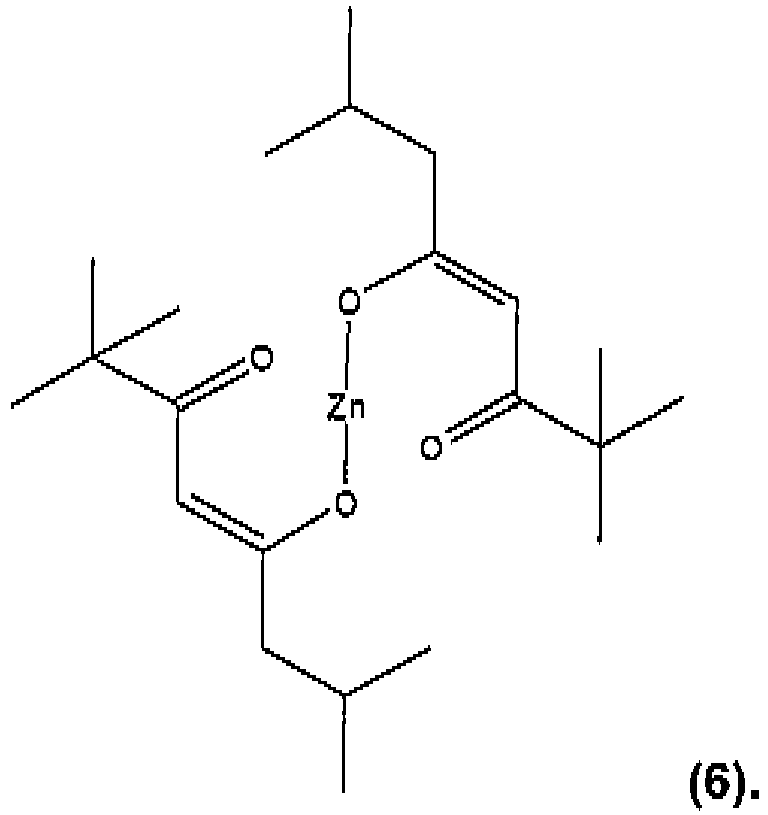
- A une solution de 30 mmol de méthylate de sodium dans 10g d'éthanol à 70°C sont ajoutées 30 mmol de 2,4-undécanedione puis après 1h une solution de 15 mmol de chlorure de zinc anhydre dans 2.5 g d'éthanol. Le mélange est agité pendant 3h à 70°C puis 20 g d'heptane sont ajoutés et la suspension est refroidie à 6°C puis filtrée. Le solide est rincé par 20 g d'heptane et le filtrat est évaporé jusqu'à 90°C sous 4 mbar pour donner 6.2 g de bis(2,4-undécanedionate) de zinc sous forme d'un liquide jaune pâle peu visqueux,
- Zn calc. : 15.14 %pds, Zn trouvé : 15.74 %pds
- IR (nm) : 2992, 1575, 1511, 1389, 1015, 774.

- Ainsi que 2 complexes du Zn(TMOD)2 avec un dérivé de l'éthylènediamine :
- [Zn(TMOD)2(N,N'-diméthyl-éthylènediamine)] (8) préparé de la manière suivante;
A une solution de 1 équivalent molaire de Zn(TMOD)2 (exemple 10 mmol = 4.4g) dans l'éther diisopropylique (exemple 30 ml) est ajouté 1 équivalent molaire de N,N'-diméthyléthylènediamine (exemple 10 mmol = 0.9g) en 5 min. Après 30 min, la solution limpide est évaporée pour donner une huile visqueuse correspondant au complexe attendu (exemple 10 mmol = 5.2 g, 100%).
RMN 1H (C6D14) : 5.23 (s, 2H), 2.77 (s, 4H), 2.41 (s, 6H), 2.04 (m, 2H), 1.94 (d, 4H), 1.08 (s, 18H), 0.94 (d, 12H). - [Zn(TMOD)2 (N-propyl-éthylènediamine)] (9) préparé de la manière suivante:
A une solution de 1 équivalent molaire de Zn(TMOD)2 (exemple 10 mmol = 4.4g) dans l'éther diisopropylique (exemple 30 ml) est ajouté 1 équivalent molaire de N-propyléthylènediamine (exemple 10 mmol = 1.02g) en 5 min. Après 30 min, la solution trouble est évaporée pour donner un solide blanc correspondant au complexe attendu (exemple 10 mmol = 5.4 g, 100%).
RMN 1H (C6D14) : 5.23 (s, 2H), 2.86 (m, 2H), 2.74 (m, 2H), 2.62 (t, 2H), 2.03 (m, 2H), 1.93 (d, 4H), 1.56 (sext, 2H), 1.07 (s, 18H), 0.92 (d, 12H), 0.86 (t, 3H), et- Catalyseur (3): [Zn(t-Bu-acac)2] avec (t-Bu-acac) = l'anion 2,2,6,6-tétraméthyl-3,5-heptanedionato ou l'anion énolate de la 2,2,6,6-tétraméthyl-3,5-heptanedione - CAS 14363-14-5 - fourni par la société Sigma-Aldrich - MM= 431.9 g/mol en solution à 30% dans l'acétate d'éthyle ou l'acétate de butyle après chauffage.
- On prépare une formulation composée d'un prépolymère d'hexaméthylènediisocyanate avec 0.522 mol NCO/100g. Dans un réacteur, on introduit 10 g de ce polymère dans 25 g de xylène (sous forme d'une solution préparée préalablement), puis 6.8 g de 2-éthylhexanol (1 mol d'OH/mol NCO).
- On chauffe et lorsque la température du milieu réactionnel atteint 40°C on introduit :
- soit 5g de xylène pour la réaction non catalysée
- soit 5 g d'une solution du catalyseur choisi dans le xylène.
- Ce qui correspond au t=0 de la réaction (déclenchement du chronomètre).
- Différents catalyseurs ont été testés :
- [Zn(TMOD)2] avec (TMOD) = l'anion 2,2,7-triméthyl-3,5-octanedionato ou l'anion énolate de la 2,2,7-triméthyl-3,5-octanedione (6)
- [Zn(UDD)2] avec (UDD) = l'anion 2,4-undécanedionato ou l'anion énolate de la 2,4-undécanedione (7)
- Ainsi que 2 complexes du Zn(TMOD)2 avec un dérivé de l'éthylènediamine :
- [Zn(TMOD)2(N,N'-diméthyl-éthylènediamine)] (8)
- [Zn(TMOD)2 (N-propyl-éthylènediamine)] (9)
- A titre comparatif ont été également testés deux catalyseurs à base d'étain:
- le dilaurate de dibutylétain (DLDBE).
- le dilaurate de dioctylétain (DLDOE), et
- le [Zn(acac)2] ou diacétylacétonate de zinc.
- L'activité des nouveaux catalyseurs est comparée à celle du dilaurate de dibutyl étain. Dans le tableau suivant, un équivalent de dilauraurate de dibutyl étain correspond à 1.58 × 10⁻⁵ mol d'étain pour 10g de prépolymère d'hexaméthylènediisocyanate. Le potentiel catalytique est évalué par le taux de transformation des fonctions isocyanates à t=10 minutes. La disparition des fonctions isocyanates est suivie par analyse Infra Rouge.
- Les quantités de catalyseur utilisées et les résultats obtenus sont détaillés dans le tableau suivant.
Tableau 1 Essai Catalyseur Equivalent molaire TT des fonctions N=C-O (%) à t=10 min Comparatif 1 DLDBE 1 99,2 Comparatif 2 DLDOE 1 98,9 Comparatif 3 [Zn(aac)2] 3 62,2 Comparatif 4 [Zn (TMOD)2] (6) 3 76,0 Comparatif 5 [Zn(UDD)2] (7) 3 81,1 Invention 6 [Zn(TMOD)2 (N,N'-diméthyl-éthylènediamine)] (8) 3 91,0 Invention 7 [Zn(TMOD)2 (N-propyl-éthylènediamine)] (9) 3 88,8 - Les catalyseurs selon l'invention permettent d'obtenir un bon taux de transformation des fonctions isocyanates après 10 minutes de réaction. Ils présentent une activité qui est supérieure de 46% (pour le [Zn(TMOD)2(N,N'-diméthyl-éthylènediamine)]) à celle du [Zn(acac)2].
- Les catalyseurs selon l'invention représentent donc une alternative efficace aux catalyseurs à base d'étain pour la réaction entre un isocyanate et un alcool.
Claims (8)
- Procédé pour préparer un composé A ayant au moins une fonction uréthane comprenant une étape 1) consistant à faire réagir un composé B ayant au moins une fonction isocyanate avec un composé D ayant au moins une fonction hydroxyle en présence d'une quantité catalytiquement efficace d'au moins un catalyseur C caractérisé en ce que ledit catalyseur C est un complexe ou sel métallique de formule (1) suivante:
[Zn(L1)l1(Y)x] (1)
dans laquelle:- l1 = 2, et x= 1 ou 2,- le symbole Y représente une amine ou une diamine, et- le symbole L1 est un anion β-dicétonato dérivé d'une β-dicétone de formule R1COCHR2COR3 (2) et ladite β-dicétone est choisie parmi le groupe constitué par les β-dicétones: l'hexanedione-2,4; heptanedione-2,4; heptanedione-3,5; l'éthyl-3 pentanedione-2,4; méthyl-5 hexanedione-2,4; octanedione-2,4; octanedione-3,5; diméthyl-5,5 hexanedione-2,4; méthyl-6 heptanedione-2,4; diméthyl-2, 2 nonanedione-3,5; diméthyl-2,6 heptanedione-3,5; 2-acétylcyclohexanone (Cy-acac); 2,2,6,6-tétraméthyl-3,5-heptanedione (t-Bu-acac); 2,2,7-triméthyl-3,5-octanedione ;1,1,1,5,5,5-hexafluoro-2,4-pentanedione (F-acac)]; benzoylacétone; dibenzoyl-méthane; 3-méthyl-2,4-pentadione; 3-acétyl-pentane-2-one; 3-acétyl-2-hexanone; 3-acétyl-2-heptanone; 3-acétyl-5-méthyl-2-hexanone; stéaroylbenzoylméthane; octanoylbenzoylméthane; 4-t-butyl-4'-méthoxy-dibenzoylméthane; 4,4'-diméthoxy-dibenzoylméthane ; 4,4'-di-tert-butyl-dibenzoylméthane et 2,4-undécanedione. - Procédé selon l'une quelconque des revendications précédentes caractérisé en ce que le composé A ayant au moins une fonction uréthane est un polyuréthane, le composé B ayant au moins une fonction isocyanate est un diisocyanate et le composé D ayant au moins une fonction hydroxyle est un polyol.
- Procédé selon la revendication 1 dans lequel l'étape 1) consiste à faire réagir en l'absence d'humidité et en présence d'une quantité catalytiquement efficace du catalyseur C selon la revendication 1, au moins un composé B qui est un isocyanate choisi parmi le groupe constitué par: les monoisocyanates, les diisocyanates et leurs mélanges, et au moins un composé D qui est un alcool choisi parmi le groupe constitué par: les monoalcools, les diols, les polyols et leurs mélanges.
- Procédé selon l'une des revendications précédentes caractérisé en ce que le composé B est un diisocyanate choisi parmi le groupe constitué par les composés suivants: le diphénylméthane diisocyanate (MDI), notamment le diphénylméthane-4,4'-diisocyanate, le diphénylméthane-2,4'-diisocyanate, le toluène diisocyanate (TDI), notamment le toluène-2,4-diisocyanate, le toluène-2,6-diisocyanate, l'hexaméthylène diisocyanate (HMDI), le 1,3-tétraméthylxylylène diisocyanate, l'isophorone diisocyanate, dicyclohexaméthylméthane diisocyanate et l'isophorone diisocyanate (IPDI).
- Procédé selon la revendication 1 caractérisé en ce que le composé D est un polyester polyol.
- Procédé selon la revendication 1 ou 3 caractérisé en ce que ledit catalyseur C est un complexe ou sel métallique choisi parmi le groupe constitué par les composés de formules (8) et (9) suivantes:(8) : [Zn(TMOD)2(N,N'-diméthyl-éthylènediamine)] avec (TMOD) = l'anion 2,2,7-triméthyl-3,5-octanedionato ou l'anion énolate de la 2,2,7-triméthyl-3,5-octanedione, et(9) : [Zn(TMOD)2 (N-propyl-éthylènediamine)] avec (TMOD) = l'anion 2,2,7-triméthyl-3,5-octanedionato ou l'anion énolate de la 2,2,7-triméthyl-3,5-octanedione
- Procédé selon l'une des revendications précédentes caractérisé en ce que l'étape 1) est effectuée en présence d'un agent porogène.
- Composés de formule (8) et (9) :(8) : [Zn(TMOD)2(N,N'-diméthyl-éthylènediamine)] avec (TMOD) = l'anion 2,2,7-triméthyl-3,5-octanedionato ou l'anion énolate de la 2,2,7-triméthyl-3,5-octanedione, et(9) : [Zn(TMOD)2 (N-propyl-éthylènediamine)] avec (TMOD) = l'anion 2,2,7-triméthyl-3,5-octanedionato ou l'anion énolate de la 2,2,7-triméthyl-3,5-octanedione.
Applications Claiming Priority (2)
| Application Number | Priority Date | Filing Date | Title |
|---|---|---|---|
| FR0805637 | 2008-10-13 | ||
| PCT/EP2009/007310 WO2010043354A1 (fr) | 2008-10-13 | 2009-10-12 | Nouveaux catalyseurs pour la reaction entre un isocyanate et un alcool |
Publications (2)
| Publication Number | Publication Date |
|---|---|
| EP2382044A1 EP2382044A1 (fr) | 2011-11-02 |
| EP2382044B1 true EP2382044B1 (fr) | 2018-08-01 |
Family
ID=40677648
Family Applications (1)
| Application Number | Title | Priority Date | Filing Date |
|---|---|---|---|
| EP09736848.4A Not-in-force EP2382044B1 (fr) | 2008-10-13 | 2009-10-12 | Nouveaux catalyseurs pour la reaction entre un isocyanate et un alcool |
Country Status (7)
| Country | Link |
|---|---|
| US (1) | US8816036B2 (fr) |
| EP (1) | EP2382044B1 (fr) |
| JP (1) | JP5442020B2 (fr) |
| KR (1) | KR101400611B1 (fr) |
| CN (1) | CN102223953B (fr) |
| MX (1) | MX2011003926A (fr) |
| WO (1) | WO2010043354A1 (fr) |
Families Citing this family (10)
| Publication number | Priority date | Publication date | Assignee | Title |
|---|---|---|---|---|
| CN103097025B (zh) * | 2010-07-08 | 2015-11-25 | 陶氏环球技术有限责任公司 | 使用铜催化剂制备的聚氨酯 |
| EP2604618A1 (fr) * | 2011-12-12 | 2013-06-19 | Sika Technology AG | Composés à base de complexes métalliques comme catalyseurs de compositions de polyuréthane |
| EP2604613A1 (fr) * | 2011-12-12 | 2013-06-19 | Sika Technology AG | Composés à base de complexes de zinc (II) comme catalyseurs de compositions de polyuréthane |
| EP2935490B1 (fr) | 2012-12-20 | 2022-12-21 | ELKEM SILICONES France SAS | Composition organopolysiloxanique vulcanisable a température ambiante en élastomère et nouveaux catalyseurs de polycondensation d'organopolysiloxanes |
| EP2935492B1 (fr) * | 2012-12-20 | 2016-10-26 | Bluestar Silicones France SAS | Article présentant des propriétés antisalissures et destiné à être utilisé dans des applications aquatiques en particulier marines |
| EP2813529A1 (fr) * | 2013-06-11 | 2014-12-17 | Sika Technology AG | Composition durcissable à base de polymères contenant des groupes silanes et d'un catalyseur de zinc |
| CN106986976A (zh) * | 2016-01-20 | 2017-07-28 | 新纶科技(常州)有限公司 | 一种催化剂组合物 |
| EP3526270B1 (fr) * | 2016-10-12 | 2021-05-26 | Covestro Intellectual Property GmbH & Co. KG | Procédé de fabrication d'élastomères |
| CN110735325B (zh) * | 2019-10-28 | 2021-11-16 | 科凯精细化工(上海)有限公司 | 一种改性环氧基poss无氟防水整理剂及其制备方法 |
| DE102020211572A1 (de) * | 2020-09-15 | 2022-03-17 | Benecke-Kaliko Aktiengesellschaft | Reaktivmasse zur Herstellung von Polyurethanschichten mit thermisch aktivierbaren Katalysatorsystemen |
Family Cites Families (14)
| Publication number | Priority date | Publication date | Assignee | Title |
|---|---|---|---|---|
| GB1183035A (en) * | 1966-06-22 | 1970-03-04 | Ici Ltd | Stabilised Polyurethanes |
| US3917722A (en) * | 1973-04-11 | 1975-11-04 | Continental Oil Co | Process for condensation of alcohols |
| US4879032A (en) * | 1984-06-04 | 1989-11-07 | Allied Resin Corporation | Fluid separatory devices having improved potting and adhesive compositions |
| JP3344820B2 (ja) * | 1994-04-27 | 2002-11-18 | 三井化学株式会社 | 軟質ポリウレタンフォームの製造法 |
| DE602004004561T2 (de) * | 2003-03-18 | 2007-11-15 | Tosoh Corp. | Katalysatorzusammensetzung für die Herstellung von Polyurethanharz und Verfahren zu ihrer Herstellung |
| JP4565897B2 (ja) * | 2004-06-14 | 2010-10-20 | 株式会社Adeka | 薄膜形成用原料及び薄膜の製造方法 |
| DE102004043538A1 (de) * | 2004-09-09 | 2006-03-16 | Bayer Materialscience Ag | Herstellung von neuen strahlenhärtenden Bindemitteln |
| DE102005028785A1 (de) * | 2005-06-22 | 2006-12-28 | Bayer Materialscience Ag | Polyurethanelastomere, Verfahren zu ihrer Herstellung und ihre Verwendung |
| JP4989623B2 (ja) * | 2006-02-21 | 2012-08-01 | 三井化学株式会社 | ポリチオウレタン系光学材料用重合性組成物 |
| US8445555B2 (en) * | 2006-07-13 | 2013-05-21 | Air Products And Chemicals, Inc. | Stabilized carbanions as trimerization catalysts |
| DE102007009286A1 (de) * | 2007-02-26 | 2008-08-28 | Wacker Chemie Ag | Verfahren zur Herstellung von Organyloxygruppen aufweisenden Organosiliciumverbindungen |
| FR2925511A1 (fr) * | 2007-12-20 | 2009-06-26 | Bluestar Silicones France Soc | Composition organopolysiloxanique vulcanisable a temperature ambiante en elastomere et nouveaux catalyseurs de polycondensation d'organopolysiloxanes. |
| CN101932546A (zh) * | 2007-12-20 | 2010-12-29 | 蓝星有机硅法国公司 | 在环境温度下可硫化成弹性体的有机聚硅氧烷组合物以及新的有机聚硅氧烷缩聚催化剂 |
| ES2568924T3 (es) * | 2008-04-30 | 2016-05-05 | Bluestar Silicones France | Artículo que presenta propiedades antiincrustantes y destinado a ser utilizado en aplicaciones acuáticas, en particular marinas |
-
2009
- 2009-10-12 EP EP09736848.4A patent/EP2382044B1/fr not_active Not-in-force
- 2009-10-12 KR KR1020117008444A patent/KR101400611B1/ko not_active Expired - Fee Related
- 2009-10-12 MX MX2011003926A patent/MX2011003926A/es active IP Right Grant
- 2009-10-12 JP JP2011531388A patent/JP5442020B2/ja not_active Expired - Fee Related
- 2009-10-12 WO PCT/EP2009/007310 patent/WO2010043354A1/fr not_active Ceased
- 2009-10-12 CN CN200980146920.1A patent/CN102223953B/zh not_active Expired - Fee Related
- 2009-10-12 US US13/123,972 patent/US8816036B2/en not_active Expired - Fee Related
Also Published As
| Publication number | Publication date |
|---|---|
| CN102223953A (zh) | 2011-10-19 |
| CN102223953B (zh) | 2015-05-20 |
| JP5442020B2 (ja) | 2014-03-12 |
| MX2011003926A (es) | 2011-11-18 |
| US20110257286A1 (en) | 2011-10-20 |
| US8816036B2 (en) | 2014-08-26 |
| EP2382044A1 (fr) | 2011-11-02 |
| KR101400611B1 (ko) | 2014-05-27 |
| KR20110093761A (ko) | 2011-08-18 |
| JP2012511056A (ja) | 2012-05-17 |
| WO2010043354A1 (fr) | 2010-04-22 |
Similar Documents
| Publication | Publication Date | Title |
|---|---|---|
| EP2382044B1 (fr) | Nouveaux catalyseurs pour la reaction entre un isocyanate et un alcool | |
| EP2274092B1 (fr) | Nouveaux catalyseurs et leur utilisation dans la préparation de polyuréthanes | |
| JP4070270B2 (ja) | イソシアネート基を有するアロファネートの製造方法 | |
| EP1899061B1 (fr) | Nouveau compose du zirconium, catalyseur et son utilisation pour la fabrication de polyurethanne | |
| JPH06192206A (ja) | 新規の4,4′−ジ置換ビス(2,6−ジイソプロピルフェニル)カルボジイミド、その製造法、使用法及びその製造に利用される4−置換2,6−ジイソプロピルフェニルイソシアネート | |
| JP4833508B2 (ja) | 高分子量アロファネートおよびそのプレポリマーの製造法、ならびに高分子量アロファネートおよびそのプレポリマー | |
| KR101132864B1 (ko) | 이소시아네이트기를 포함하는 예비중합체의 제조 방법 | |
| EP2370488B1 (fr) | Nouveaux catalyseurs pour la reaction entre un isocyanate et un alcool | |
| US7288213B1 (en) | Method for preparing low viscosity tricondensate polyfunctional isocyanates | |
| EP2698200B1 (fr) | Catalyseurs thermolatents, leur fabrication et leur utilisation | |
| JP4235274B2 (ja) | (シクロ)脂肪族1,4−ジイソシアネートからの多環式イミノオキサジアジンジオン | |
| McCabe et al. | Synthesis of novel polyurethane polyesters using the enzyme Candida antarctica lipase B | |
| US20150266992A1 (en) | Nco prepolymers of low monomer content and their use | |
| JPH05202158A (ja) | 熱可塑性ポリウレタンエラストマーの製造方法 | |
| KR20240152852A (ko) | 폴리우레탄 코팅의 제조를 위한 특정한 촉매의 용도 | |
| JPH0414692B2 (fr) | ||
| KR102289569B1 (ko) | 펜타메틸렌 디이소시아네이트의 제조방법 | |
| EP2493614A1 (fr) | Catalyseurs et leur utilisation | |
| HK1063058B (en) | New polymeric allophanate of diphenylmethane diisocyanate, prepolymers of these polymeric allophanates, and processes for the preparation of the polymeric allophanates and the prepolymers thereof |
Legal Events
| Date | Code | Title | Description |
|---|---|---|---|
| PUAI | Public reference made under article 153(3) epc to a published international application that has entered the european phase |
Free format text: ORIGINAL CODE: 0009012 |
|
| 17P | Request for examination filed |
Effective date: 20110729 |
|
| AK | Designated contracting states |
Kind code of ref document: A1 Designated state(s): AT BE BG CH CY CZ DE DK EE ES FI FR GB GR HR HU IE IS IT LI LT LU LV MC MK MT NL NO PL PT RO SE SI SK SM TR |
|
| DAX | Request for extension of the european patent (deleted) | ||
| STAA | Information on the status of an ep patent application or granted ep patent |
Free format text: STATUS: EXAMINATION IS IN PROGRESS |
|
| 17Q | First examination report despatched |
Effective date: 20170309 |
|
| GRAP | Despatch of communication of intention to grant a patent |
Free format text: ORIGINAL CODE: EPIDOSNIGR1 |
|
| STAA | Information on the status of an ep patent application or granted ep patent |
Free format text: STATUS: GRANT OF PATENT IS INTENDED |
|
| INTG | Intention to grant announced |
Effective date: 20180220 |
|
| RAP1 | Party data changed (applicant data changed or rights of an application transferred) |
Owner name: ELKEM SILICONES FRANCE SAS |
|
| GRAS | Grant fee paid |
Free format text: ORIGINAL CODE: EPIDOSNIGR3 |
|
| GRAA | (expected) grant |
Free format text: ORIGINAL CODE: 0009210 |
|
| STAA | Information on the status of an ep patent application or granted ep patent |
Free format text: STATUS: THE PATENT HAS BEEN GRANTED |
|
| AK | Designated contracting states |
Kind code of ref document: B1 Designated state(s): AT BE BG CH CY CZ DE DK EE ES FI FR GB GR HR HU IE IS IT LI LT LU LV MC MK MT NL NO PL PT RO SE SI SK SM TR |
|
| REG | Reference to a national code |
Ref country code: GB Ref legal event code: FG4D Free format text: NOT ENGLISH |
|
| REG | Reference to a national code |
Ref country code: CH Ref legal event code: EP Ref country code: AT Ref legal event code: REF Ref document number: 1023658 Country of ref document: AT Kind code of ref document: T Effective date: 20180815 |
|
| REG | Reference to a national code |
Ref country code: IE Ref legal event code: FG4D Free format text: LANGUAGE OF EP DOCUMENT: FRENCH |
|
| REG | Reference to a national code |
Ref country code: DE Ref legal event code: R096 Ref document number: 602009053576 Country of ref document: DE |
|
| REG | Reference to a national code |
Ref country code: FR Ref legal event code: PLFP Year of fee payment: 10 |
|
| REG | Reference to a national code |
Ref country code: NL Ref legal event code: MP Effective date: 20180801 |
|
| REG | Reference to a national code |
Ref country code: LT Ref legal event code: MG4D |
|
| REG | Reference to a national code |
Ref country code: AT Ref legal event code: MK05 Ref document number: 1023658 Country of ref document: AT Kind code of ref document: T Effective date: 20180801 |
|
| PG25 | Lapsed in a contracting state [announced via postgrant information from national office to epo] |
Ref country code: FI Free format text: LAPSE BECAUSE OF FAILURE TO SUBMIT A TRANSLATION OF THE DESCRIPTION OR TO PAY THE FEE WITHIN THE PRESCRIBED TIME-LIMIT Effective date: 20180801 Ref country code: PL Free format text: LAPSE BECAUSE OF FAILURE TO SUBMIT A TRANSLATION OF THE DESCRIPTION OR TO PAY THE FEE WITHIN THE PRESCRIBED TIME-LIMIT Effective date: 20180801 Ref country code: SE Free format text: LAPSE BECAUSE OF FAILURE TO SUBMIT A TRANSLATION OF THE DESCRIPTION OR TO PAY THE FEE WITHIN THE PRESCRIBED TIME-LIMIT Effective date: 20180801 Ref country code: GR Free format text: LAPSE BECAUSE OF FAILURE TO SUBMIT A TRANSLATION OF THE DESCRIPTION OR TO PAY THE FEE WITHIN THE PRESCRIBED TIME-LIMIT Effective date: 20181102 Ref country code: AT Free format text: LAPSE BECAUSE OF FAILURE TO SUBMIT A TRANSLATION OF THE DESCRIPTION OR TO PAY THE FEE WITHIN THE PRESCRIBED TIME-LIMIT Effective date: 20180801 Ref country code: NO Free format text: LAPSE BECAUSE OF FAILURE TO SUBMIT A TRANSLATION OF THE DESCRIPTION OR TO PAY THE FEE WITHIN THE PRESCRIBED TIME-LIMIT Effective date: 20181101 Ref country code: IS Free format text: LAPSE BECAUSE OF FAILURE TO SUBMIT A TRANSLATION OF THE DESCRIPTION OR TO PAY THE FEE WITHIN THE PRESCRIBED TIME-LIMIT Effective date: 20181201 Ref country code: LT Free format text: LAPSE BECAUSE OF FAILURE TO SUBMIT A TRANSLATION OF THE DESCRIPTION OR TO PAY THE FEE WITHIN THE PRESCRIBED TIME-LIMIT Effective date: 20180801 Ref country code: NL Free format text: LAPSE BECAUSE OF FAILURE TO SUBMIT A TRANSLATION OF THE DESCRIPTION OR TO PAY THE FEE WITHIN THE PRESCRIBED TIME-LIMIT Effective date: 20180801 Ref country code: BG Free format text: LAPSE BECAUSE OF FAILURE TO SUBMIT A TRANSLATION OF THE DESCRIPTION OR TO PAY THE FEE WITHIN THE PRESCRIBED TIME-LIMIT Effective date: 20181101 |
|
| PG25 | Lapsed in a contracting state [announced via postgrant information from national office to epo] |
Ref country code: LV Free format text: LAPSE BECAUSE OF FAILURE TO SUBMIT A TRANSLATION OF THE DESCRIPTION OR TO PAY THE FEE WITHIN THE PRESCRIBED TIME-LIMIT Effective date: 20180801 Ref country code: HR Free format text: LAPSE BECAUSE OF FAILURE TO SUBMIT A TRANSLATION OF THE DESCRIPTION OR TO PAY THE FEE WITHIN THE PRESCRIBED TIME-LIMIT Effective date: 20180801 Ref country code: ES Free format text: LAPSE BECAUSE OF FAILURE TO SUBMIT A TRANSLATION OF THE DESCRIPTION OR TO PAY THE FEE WITHIN THE PRESCRIBED TIME-LIMIT Effective date: 20180801 |
|
| PG25 | Lapsed in a contracting state [announced via postgrant information from national office to epo] |
Ref country code: RO Free format text: LAPSE BECAUSE OF FAILURE TO SUBMIT A TRANSLATION OF THE DESCRIPTION OR TO PAY THE FEE WITHIN THE PRESCRIBED TIME-LIMIT Effective date: 20180801 Ref country code: CZ Free format text: LAPSE BECAUSE OF FAILURE TO SUBMIT A TRANSLATION OF THE DESCRIPTION OR TO PAY THE FEE WITHIN THE PRESCRIBED TIME-LIMIT Effective date: 20180801 Ref country code: EE Free format text: LAPSE BECAUSE OF FAILURE TO SUBMIT A TRANSLATION OF THE DESCRIPTION OR TO PAY THE FEE WITHIN THE PRESCRIBED TIME-LIMIT Effective date: 20180801 Ref country code: IT Free format text: LAPSE BECAUSE OF FAILURE TO SUBMIT A TRANSLATION OF THE DESCRIPTION OR TO PAY THE FEE WITHIN THE PRESCRIBED TIME-LIMIT Effective date: 20180801 |
|
| REG | Reference to a national code |
Ref country code: DE Ref legal event code: R097 Ref document number: 602009053576 Country of ref document: DE |
|
| PG25 | Lapsed in a contracting state [announced via postgrant information from national office to epo] |
Ref country code: DK Free format text: LAPSE BECAUSE OF FAILURE TO SUBMIT A TRANSLATION OF THE DESCRIPTION OR TO PAY THE FEE WITHIN THE PRESCRIBED TIME-LIMIT Effective date: 20180801 Ref country code: SM Free format text: LAPSE BECAUSE OF FAILURE TO SUBMIT A TRANSLATION OF THE DESCRIPTION OR TO PAY THE FEE WITHIN THE PRESCRIBED TIME-LIMIT Effective date: 20180801 Ref country code: SK Free format text: LAPSE BECAUSE OF FAILURE TO SUBMIT A TRANSLATION OF THE DESCRIPTION OR TO PAY THE FEE WITHIN THE PRESCRIBED TIME-LIMIT Effective date: 20180801 |
|
| REG | Reference to a national code |
Ref country code: CH Ref legal event code: PL |
|
| PLBE | No opposition filed within time limit |
Free format text: ORIGINAL CODE: 0009261 |
|
| STAA | Information on the status of an ep patent application or granted ep patent |
Free format text: STATUS: NO OPPOSITION FILED WITHIN TIME LIMIT |
|
| PG25 | Lapsed in a contracting state [announced via postgrant information from national office to epo] |
Ref country code: LU Free format text: LAPSE BECAUSE OF NON-PAYMENT OF DUE FEES Effective date: 20181012 Ref country code: MC Free format text: LAPSE BECAUSE OF FAILURE TO SUBMIT A TRANSLATION OF THE DESCRIPTION OR TO PAY THE FEE WITHIN THE PRESCRIBED TIME-LIMIT Effective date: 20180801 |
|
| 26N | No opposition filed |
Effective date: 20190503 |
|
| REG | Reference to a national code |
Ref country code: IE Ref legal event code: MM4A |
|
| PG25 | Lapsed in a contracting state [announced via postgrant information from national office to epo] |
Ref country code: SI Free format text: LAPSE BECAUSE OF FAILURE TO SUBMIT A TRANSLATION OF THE DESCRIPTION OR TO PAY THE FEE WITHIN THE PRESCRIBED TIME-LIMIT Effective date: 20180801 Ref country code: LI Free format text: LAPSE BECAUSE OF NON-PAYMENT OF DUE FEES Effective date: 20181031 Ref country code: CH Free format text: LAPSE BECAUSE OF NON-PAYMENT OF DUE FEES Effective date: 20181031 |
|
| PG25 | Lapsed in a contracting state [announced via postgrant information from national office to epo] |
Ref country code: IE Free format text: LAPSE BECAUSE OF NON-PAYMENT OF DUE FEES Effective date: 20181012 |
|
| PG25 | Lapsed in a contracting state [announced via postgrant information from national office to epo] |
Ref country code: MT Free format text: LAPSE BECAUSE OF FAILURE TO SUBMIT A TRANSLATION OF THE DESCRIPTION OR TO PAY THE FEE WITHIN THE PRESCRIBED TIME-LIMIT Effective date: 20180801 |
|
| PG25 | Lapsed in a contracting state [announced via postgrant information from national office to epo] |
Ref country code: TR Free format text: LAPSE BECAUSE OF FAILURE TO SUBMIT A TRANSLATION OF THE DESCRIPTION OR TO PAY THE FEE WITHIN THE PRESCRIBED TIME-LIMIT Effective date: 20180801 |
|
| PG25 | Lapsed in a contracting state [announced via postgrant information from national office to epo] |
Ref country code: PT Free format text: LAPSE BECAUSE OF FAILURE TO SUBMIT A TRANSLATION OF THE DESCRIPTION OR TO PAY THE FEE WITHIN THE PRESCRIBED TIME-LIMIT Effective date: 20180801 |
|
| PG25 | Lapsed in a contracting state [announced via postgrant information from national office to epo] |
Ref country code: HU Free format text: LAPSE BECAUSE OF FAILURE TO SUBMIT A TRANSLATION OF THE DESCRIPTION OR TO PAY THE FEE WITHIN THE PRESCRIBED TIME-LIMIT; INVALID AB INITIO Effective date: 20091012 Ref country code: CY Free format text: LAPSE BECAUSE OF FAILURE TO SUBMIT A TRANSLATION OF THE DESCRIPTION OR TO PAY THE FEE WITHIN THE PRESCRIBED TIME-LIMIT Effective date: 20180801 Ref country code: MK Free format text: LAPSE BECAUSE OF NON-PAYMENT OF DUE FEES Effective date: 20180801 |
|
| PGFP | Annual fee paid to national office [announced via postgrant information from national office to epo] |
Ref country code: FR Payment date: 20200914 Year of fee payment: 12 Ref country code: GB Payment date: 20200930 Year of fee payment: 12 |
|
| PGFP | Annual fee paid to national office [announced via postgrant information from national office to epo] |
Ref country code: BE Payment date: 20200916 Year of fee payment: 12 |
|
| PGFP | Annual fee paid to national office [announced via postgrant information from national office to epo] |
Ref country code: DE Payment date: 20200929 Year of fee payment: 12 |
|
| REG | Reference to a national code |
Ref country code: DE Ref legal event code: R119 Ref document number: 602009053576 Country of ref document: DE |
|
| REG | Reference to a national code |
Ref country code: BE Ref legal event code: MM Effective date: 20211031 |
|
| GBPC | Gb: european patent ceased through non-payment of renewal fee |
Effective date: 20211012 |
|
| PG25 | Lapsed in a contracting state [announced via postgrant information from national office to epo] |
Ref country code: GB Free format text: LAPSE BECAUSE OF NON-PAYMENT OF DUE FEES Effective date: 20211012 Ref country code: DE Free format text: LAPSE BECAUSE OF NON-PAYMENT OF DUE FEES Effective date: 20220503 Ref country code: BE Free format text: LAPSE BECAUSE OF NON-PAYMENT OF DUE FEES Effective date: 20211031 |
|
| PG25 | Lapsed in a contracting state [announced via postgrant information from national office to epo] |
Ref country code: FR Free format text: LAPSE BECAUSE OF NON-PAYMENT OF DUE FEES Effective date: 20211031 |