EP2382814B1 - Transmission de données secondaires dans un flux de données de transmission de communication de groupe - Google Patents
Transmission de données secondaires dans un flux de données de transmission de communication de groupe Download PDFInfo
- Publication number
- EP2382814B1 EP2382814B1 EP10701188.4A EP10701188A EP2382814B1 EP 2382814 B1 EP2382814 B1 EP 2382814B1 EP 10701188 A EP10701188 A EP 10701188A EP 2382814 B1 EP2382814 B1 EP 2382814B1
- Authority
- EP
- European Patent Office
- Prior art keywords
- data
- communication
- group
- wireless communication
- voice
- Prior art date
- Legal status (The legal status is an assumption and is not a legal conclusion. Google has not performed a legal analysis and makes no representation as to the accuracy of the status listed.)
- Not-in-force
Links
- 238000004891 communication Methods 0.000 title claims description 400
- 230000005540 biological transmission Effects 0.000 title claims description 39
- 238000000034 method Methods 0.000 claims description 41
- 238000010586 diagram Methods 0.000 description 11
- 238000003860 storage Methods 0.000 description 11
- 230000006870 function Effects 0.000 description 8
- 230000001413 cellular effect Effects 0.000 description 7
- 230000008569 process Effects 0.000 description 5
- 230000003287 optical effect Effects 0.000 description 4
- 238000012546 transfer Methods 0.000 description 4
- 238000005516 engineering process Methods 0.000 description 3
- 230000007246 mechanism Effects 0.000 description 3
- 238000012545 processing Methods 0.000 description 3
- 239000008186 active pharmaceutical agent Substances 0.000 description 2
- 230000008901 benefit Effects 0.000 description 2
- 239000000835 fiber Substances 0.000 description 2
- 230000002452 interceptive effect Effects 0.000 description 2
- 238000002955 isolation Methods 0.000 description 2
- 238000007726 management method Methods 0.000 description 2
- 230000004913 activation Effects 0.000 description 1
- 230000006978 adaptation Effects 0.000 description 1
- 238000013459 approach Methods 0.000 description 1
- 239000000872 buffer Substances 0.000 description 1
- 239000000969 carrier Substances 0.000 description 1
- 230000015556 catabolic process Effects 0.000 description 1
- 230000008867 communication pathway Effects 0.000 description 1
- 238000004590 computer program Methods 0.000 description 1
- 238000006731 degradation reaction Methods 0.000 description 1
- 230000001419 dependent effect Effects 0.000 description 1
- 238000011161 development Methods 0.000 description 1
- 238000004519 manufacturing process Methods 0.000 description 1
- 230000037361 pathway Effects 0.000 description 1
- 229920001690 polydopamine Polymers 0.000 description 1
- 238000003825 pressing Methods 0.000 description 1
- 238000012552 review Methods 0.000 description 1
- 230000011664 signaling Effects 0.000 description 1
- 230000005236 sound signal Effects 0.000 description 1
- 239000013589 supplement Substances 0.000 description 1
Images



Classifications
-
- H—ELECTRICITY
- H04—ELECTRIC COMMUNICATION TECHNIQUE
- H04W—WIRELESS COMMUNICATION NETWORKS
- H04W4/00—Services specially adapted for wireless communication networks; Facilities therefor
- H04W4/06—Selective distribution of broadcast services, e.g. multimedia broadcast multicast service [MBMS]; Services to user groups; One-way selective calling services
- H04W4/10—Push-to-Talk [PTT] or Push-On-Call services
-
- H—ELECTRICITY
- H04—ELECTRIC COMMUNICATION TECHNIQUE
- H04B—TRANSMISSION
- H04B7/00—Radio transmission systems, i.e. using radiation field
- H04B7/24—Radio transmission systems, i.e. using radiation field for communication between two or more posts
-
- H—ELECTRICITY
- H04—ELECTRIC COMMUNICATION TECHNIQUE
- H04W—WIRELESS COMMUNICATION NETWORKS
- H04W76/00—Connection management
- H04W76/40—Connection management for selective distribution or broadcast
- H04W76/45—Connection management for selective distribution or broadcast for Push-to-Talk [PTT] or Push-to-Talk over cellular [PoC] services
-
- H—ELECTRICITY
- H04—ELECTRIC COMMUNICATION TECHNIQUE
- H04W—WIRELESS COMMUNICATION NETWORKS
- H04W28/00—Network traffic management; Network resource management
- H04W28/02—Traffic management, e.g. flow control or congestion control
- H04W28/06—Optimizing the usage of the radio link, e.g. header compression, information sizing, discarding information
Definitions
- the present invention relates to point-to-point or point-to-multipoint wireless communications systems. More specifically, the present invention relates to systems and methods for transmitting secondary data from within a communication channel established for group communications between wireless telecommunication devices.
- wireless telecommunication devices such as cellular phones, PDAs, mini-laptops, and advanced pagers
- the devices typically communicate over long distances by bridging telephone calls through existing cellular telephone networks and passing data packets across the network.
- These wireless devices often have limited to significant data processing and computing capability, and can accordingly send and receive software programs, in addition to voice, across the telephone network.
- PTT Push-To-Talk
- the specific PTT group of recipient devices for the communicating wireless device is commonly set up by the carrier.
- a PTT communication connection is typically initiated by a single button-push on the wireless device that activates a half-duplex link between the speaker and each member device of the group and-once the-button is released, the device can receive incoming PTT transmissions once the button is released.
- the PTT speaker will have the "floor" where no other group member can speak while the speaker is speaking. Once the speaker releases the PTT button, any other individual member of the group can engage their PTT button and they will have the floor.
- member devices establish a communication channel for an outgoing voice communication and a channel for incoming communications. It is preferable to optimize the quality of voice transmission, and therefore, the full bandwidth of each channel is typically utilized to transmit the voice data packets to insure a high fidelity transmission. If other data is needed to be sent from and to a wireless communication device, typically either a separate channel is opened to the device solely for the additional data, which is expensive, or other existing channels allocated to the device, such as signaling and control channels, are utilized for the additional data. However, utilizing the other channels restricts the communication on those channels, which is often already predetermined by the system such as with control channels, and can impair the functionality of the device on the wireless network.
- WO 2008/157809 discloses systems and methods for sharing media in a group communication among a plurality of wireless group devices.
- US 2006/0291452 discloses a method and apparatus for providing reliable data communication over an unreliable voice dispatch communication.
- the voice communication channel uses a Push-to-View reliability protocol that utilizes real time protocol data packets and real time control messages.
- US 2006/0199594 discloses a method for transmitting a plurality of data packets based on receiving audio input on a first client device, encoding the audio input, measuring a bandwidth utilization of the communications network and transmitting data packets over the communications network
- US 2007/076660 discloses a system and a method for providing a simultaneous multiple push to talk over cellular multimedia service. It allows for efficient media transmission through media adaptation adjusting capacity of each of the media streams provided at the same time.
- EP 1 633 091 discloses a method of bandwidth control comprise storing values of communication bandwidths usable by user terminals in order to verify which users have a first right of transmission.
- the present invention includes a method (claim 1), a wireless communication device (claim 10) and a system (claim 15) that allow the transmission of secondary data in a group-communication data stream between wireless communication devices across a wireless communication network.
- the wireless communication device selectively transmits at least group-directed voice communication data to other members of the group, such as a push-to-talk (PTT) group, and selectively sends secondary data in the same communication channel as the voice data, even though the communication channel has a limited bandwidth.
- a group-communication server can receive the voice communication data and secondary data, and will then selectively transmit at least the voice communication data to other member wireless communication devices of the communication group, and the secondary data can be sent to one or more members of the group.
- the wireless communication device can be embodied so as to reduce the data size of the voice communication data to a second data size that is less than the bandwidth of the communication channel so that secondary data can be transmitted within the communication channel.
- the system for transmitting secondary data in a group-communication data stream between wireless communication devices includes at least one wireless communication device that is a member of a communication group of wireless communication devices that communicate with each other in direct group communications across a wireless communication network, with the wireless communication device configured to selectively transmit at least group-directed voice communication data to other members of the communication group in a communication channel having a limited bandwidth thereof, and secondary data to other computer devices, such as members of the group, across the wireless communication network with the transmission of the secondary data occurring in the communication channel in combination with the voice communication data.
- the system includes at least one group-communication server that is configured to receive voice communication data and secondary data from wireless communication device and selectively transmit at least the voice communication data to other member wireless communication devices of the communication group.
- the voice communication data will have a first data size thereof and the wireless communication device can be further configured to reduce the first data size of the voice communication data to a second data size that is less than the bandwidth of the communication channel and transmit secondary data within the communication channel in combination with he voice communication data of the second data size.
- the method of transmitting secondary data in a group-communication data stream between wireless communication devices includes transmitting at least voice communication data from at least one wireless communication device that is a member of a communication group of wireless communication devices that communicate with each other in direct group communications across a wireless communication network, with the at least one wireless communication device configured to selectively transmit at least group-directed voice communication data to other members of the communication group and secondary data to other computer devices across the wireless communication network, and the transmission of the voice communication data and secondary data occurring in a communication channel having a limited bandwidth thereof.
- the voice communication data has then a first data size thereof, and the method includes reducing the first data size to a second data size that is less than the bandwidth of the communication channel, and transmitting secondary data within the communication channel in combination with the voice communication data of the second size.
- the wireless communication device which is a member of a communication group of wireless communication devices that communicate with each other in direct group communications across a wireless communication network, is configured to selectively transmit at least group-directed voice communication data to other members of the communication group in a communication channel having a limited bandwidth thereof and secondary data to other computer devices across the wireless communication network.
- the transmission of the secondary data occurs in the same communication channel as the voice communication data.
- the voice communication data can have a first data size thereof and the wireless communication device can be further configured to reduce the first data size to a second
- the present system and method are therefore advantageous in that they give a wireless communication device the ability to transmit and receive non-voice data to and from other wireless communication device members of the group without needing to open additional communication channel or utilizing other channels.
- the voice communication data can even be reduced to allow greater secondary data throughput.
- the system and method thus allows the non-voice data to be communicated without unduly utilizing device resources or other dedicated communication channels.
- the terms “communication device,” “wireless device,” “wireless communications device,” “PTT communication device,” “handheld device,” “mobile device,” and “handset” are used interchangeably.
- the terms “call” and “communication” are also used interchangeably.
- the term “application” as used herein is intended to encompass executable and non-executable software files, raw data, aggregated data, patches, and other code segments.
- the term “exemplary” means that the disclosed element or embodiment is only an example, and does not indicate any preference of user.
- the term “communication channel” means the same data flow in a real or virtual data traffic channel or other established socket. Further, like numerals refer to like elements throughout the several views, and the articles “a” and “the” includes plural references, unless otherwise specified in the description.
- Fig. 1 illustrates one embodiment of the system 10 for sharing group media among one or more wireless telecommunication devices in a PTT group 12, such as the wireless telephone 14, smart pager 16 and personal digital assistant (PDA) 18, with other wireless telecommunication devices across a wireless network 20.
- each wireless telecommunication device 14,16,18 is capable of selectively directly communicating across the wireless communication network 20 with a target set of one or more other wireless telecommunication devices of the plurality.
- the target set for mobile telephone 14 can be all devices in the communication group 12 or a subset thereof, such as pager 16 and PDA 18.
- the wireless telecommunication device (such as mobile telephone 14) notifies the group communication computer device, shown here as server 32, which is present on a server-side LAN 30 across the wireless network 20, that the wireless device is present, i.e. accessible, on the wireless network 20.
- the group communication computer device 32 can either keep the information on group member devices on the wireless network 20 or share this information with the set of target wireless telecommunication devices designated by the first wireless telecommunication device, or can also share it with other computer devices resident on the server-side LAN 30 or accessible across the wireless network 20.
- the group communication computer device 32 can have an attached or accessible database 34 to store the group identification data for the wireless devices.
- a data store 36 shown here as file management server, is also present on the server-side LAN 30. It should be appreciated that the number of computer components resident on server-side LAN 30, or across the wireless network 20, or Internet generally, are not limited.
- the direct communication such as a PTT voice communication
- the direct communication can be established through a half-duplex channel between the communicating wireless telecommunication device 14,16,18 and the one or more other wireless telecommunication devices of the target set.
- the group communication computer device 32 can attempt to bridge the requested direct communication with the target set without knowledge of the wireless telecommunication devices of the target set actually receiving the PTT communication sent. Alternately, the group communication computer device 32 can inform the PTT transmitting wireless telecommunication device 14,16,18 of the inability to bridge a direct communication to the target set 12.
- the group communication computer device 32 is shown here as having the attached database 34 of group identification data, the group communication computer device 32 can have group identity data resident thereupon, and perform all storage functions described herein.
- the system 10 can reuse an existing PTT data stream, such as an RTP voice stream, to carry custom application data packets to other computer devices, rather than set up a separate communication pathway.
- a PTT-enabled system already has established connectivity to the group members, so there is a great advantage to reusing the existing connectivity.
- the system 10 allows the transmission of secondary data in a group-communication data stream between wireless communication devices 14,16,18, where at least one wireless communication device, such as telephone 14, that is a member of a communication group 12 of wireless communication devices that communicate with each other in direct group communications across a wireless communication network 20, selectively transmits at least group-directed voice communication data to other members of the communication group 12 and secondary data to other computer devices, such as wireless pager 16 and PDA 18, across the wireless communication network 20.
- the transmission can occur in the communication channel, which has a limited bandwidth, so that additional communication channels are not required to send the secondary data.
- the system 10 it is desirous to maintain a specific "quality of serve" (QoS) for the voice data transmission between the wireless communication devices. If bandwidth is limited for the transmission of data, especially with a limited amount of communication channels available for data transmission, the sending of secondary data within the limited communication channels could interrupt the voice data and degrade the QoS. The system 10 will therefore allow the secondary data transmission in the limited communication channel(s) while still maintaining QoS in the voice communications.
- QoS quality of serve
- a group-communication server 32 receives the voice communication data and secondary data from the at least one wireless communication device (telephone 14) in the same communication channel and selectively transmits at least the voice communication data to other member wireless communication devices of the communication group 12.
- wireless communication device (telephone 14) is preferably further configured to reduce the first data size of the voice communication data (up to the equivalent of bandwidth data slot size A) to a second data size (size C) that is less than the bandwidth (A) of the communication channel, and then transmit secondary data (data block having size B in slot 122) within the communication channel in combination with the voice communication data (data block having size C in data slot 122) of the second data size.
- the wireless communication device 14 can keep the voice communication data at the current size and simply insert secondary data when adequate bandwidth is available, with the inserted secondary data up to the maximum bandwidth A. In such embodiment, however, a guaranteed throughput of secondary data may not be possible as transmission in each data slot 122 is not assured if bandwidth is not available.
- Several communication channels that are in use can also be utilized in the present direction, in both the forward and reverse direction, such that each channel can implement the transmission or receipt of secondary data.
- the system 10 can further include a data store 36 in communication with the group communication computer device(s) 32, with the group communication computer device 32 configured to send group-directed media to the data store 36, as is further described herein.
- the data store 36 is configured to receive the group-designated media from the wireless communication device (such as mobile phone 14) and selectively permit members of the communication group 12 for which the group-directed media was sent to access the stored group-directed media across the wireless communication network 20.
- the secondary data can be group-directed media, such as graphic media, such as pictures in JPEG, TIF, and the like, audio files such as MP3, MP4, WAV, and the like.
- the media can also be streaming media, such as a multimedia application (Powerpoint, MOV file, and the like).
- the group-directed media can also be streaming media, or an interactive session on another computer device on the wireless communication network 20, such as a game hosted on data store 36 or private bulletin board.
- the group-directed media could be half-duplex video conferencing among members of the communication group wherein the picture of the speaker is broadcast to the other group members in substantial real-time, or in delay.
- the size of these media files can be very large, and because of the potential delay of sending the media, or inability of the receiving wireless communication device to handle the sent media, the system 10 can use a data store 36 (or file management server or other computer storage device or memory) to store the secondary data such that the secondary data can be selectively sent to the target members of the communication group 12 able to receive the secondary data, preferably without interrupting other PTT communications.
- the group communication computer device 32 can send to the wireless communication device 14,16,18 sending the secondary data an acknowledgement that at least one member wireless communication device of the communication group 12 received the secondary data.
- the wireless communication device 14,16,18 can target data to the group communication computer device 32 at the time of requesting the secondary data to be sent, e.g. send to a target list, and thus, the group communication device 32 will send or store the secondary data to the member wireless communication devices identified in the communication group identification data based upon one or more criteria as is further discussed herein.
- the wireless communication device 14,16,18 can request member data for a communication group 12 from the group communication computer device 32, and the group communication computer device 32 can identify one or more of the target devices that can and/or will receive the secondary data.
- the communication group computer device 32 can filter the potential communication groups available based upon their member devices' capability to receive secondary data.
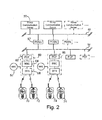
- Fig. 2 is a representative diagram of one embodiment of a wireless network in a common cellular telecommunication configuration, having a series of group communication computer devices (group communication servers) 32 that control communications between the wireless communication devices of set group members (devices 70,72,74,76) in a PTT system.
- the wireless network is merely exemplary and can include any system whereby remote modules communicate over-the-air between and among each other and/or between and among components of a wireless network 20, including, without limitation, wireless network carriers and/or servers.
- a series of group communication servers 32 are connected to a group communication server LAN 50.
- Wireless communication devices 14,16,18 can request packet data sessions from the group communication server(s) 32 using a data service option.
- the group communication server(s) 32 are connected to a wireless service provider's packet data service node (PDSN) such as PDSN 52, shown here resident on a carrier network 54.
- PDSN packet data service node
- Each PSDN 52 can interface with a base station controller 64 of a base station 60 through a packet control function (PCF) 62.
- PCF packet control function
- the carrier network 54 controls messages (generally in the form of data packets) sent to a messaging service controller ("MSC") 58.
- MSC messaging service controller
- the carrier network 54 communicates with the MSC 58 by a network, the Internet and/or POTS ("plain ordinary telephone system").
- the network or Internet connection between the carrier network 54 and the MSC 58 transfers data
- POTS plain ordinary telephone system
- the MSC 58 can be connected to one or more base stations 60.
- the MSC 58 is typically connected to the branch-to-source (BTS) 66 by both the network and/or Internet for data transfer and POTS for voice information.
- BTS branch-to-source
- the BTS 66 ultimately broadcasts and receives messages wirelessly to and from the wireless devices, such as cellular telephones 70,72,74,76, by short messaging service (“SMS”), or other over-the-air methods known in the art.
- SMS short messaging service
- Fig. 3 is a block diagram illustrating one embodiment of the wireless telecommunication device being a mobile telephone 14 with a PTT button 78 that opens the direct communication to a target set of devices, i.e. other members of the communication group 12.
- the wireless device 14 is also shown as having a graphics display 80 to the user of the wireless device 14.
- the wireless device 14 includes a computer platform 82 that can handle voice and data packets, and receive and execute software applications transmitted across the wireless network 20 to include the group-directed media.
- the computer platform 82 includes, among other components, an application-specific integrated circuit (“ASIC") 84, or other processor, microprocessor, logic circuit, programmable gate array, or other data processing device.
- ASIC 84 is installed at the time of manufacture of the wireless device and is not normally upgradeable.
- the ASIC 84 or other processor executes an application programming interface ("API") layer 86, which includes the resident application environment, and can include the operating system loaded on the ASIC 84.
- the resident application environment interfaces with any resident programs in the memory 88 of the wireless device.
- An example of a resident application environment is the "binary runtime environment for wireless" (BREW) software developed by QUALCOMM ® for wireless device platforms.
- the wireless device can be a mobile telephone 14, with a graphics display 80, but can also be any wireless device with a computer platform 82 as known in the art, such as a personal digital assistant (PDA), a pager with a graphics display 80, or even a separate computer platform 82 that has a wireless communication portal, and may otherwise have a wired connection to a network or the Internet.
- the memory 88 can be comprised of read-only or random-access memory (RAM and ROM), EPROM, EEPROM, flash cards, or any memory common to computer platforms.
- the computer platform 82 can also include a local database 90 for storage of software applications not actively used in memory 88.
- the local database 90 is typically comprised of one or more flash memory cells, but can be any secondary or tertiary storage device as known in the art, such as magnetic media, EPROM, EEPROM, optical media, tape, or soft or hard disk.
- the graphics display 80 can present not only information about the ongoing group call, but also the information on the group-directed media, to include a file preview as is more fully described herein.
- the computer platform 82 also includes a communication interface 92 that can open one or more communication channels from the wireless device 14.
- the communication interface 92 is typically configured as a standard communication interface for the wireless communication device which ordinarily carries the voice and data transmitted to and from the wireless device.
- the communication interface 92 typically is comprised of hardware as is known in the art.
- Fig. 4 is a diagram of one embodiment of the software layers of PTT facility and with PTT applications.
- the computer platform 82 in the mobile device environment consists of a series of software "layers" developed on top of the Mobile Station Modem (MSM)100 and the Advanced Mobile Subscriber Software (AMSS) 102, developed by QUALCOMM ® , drives the underlying MSM chipset and implements the software protocol stack for the entire suite of CDMA communication technologies that include CDMA2000 1X and CDMA2000 1xEV-DO.
- MSM Mobile Station Modem
- AMSS Advanced Mobile Subscriber Software
- QUALCOMM ® software protocol stack for the entire suite of CDMA communication technologies that include CDMA2000 1X and CDMA2000 1xEV-DO.
- There is a mobile operating system layer 104 which in this embodiment is BREW®, also developed by QUALCOMM ® .
- the mobile operating system layer 104 application programming interfaces for chip- or device-specific operations, while providing an isolation layer that eliminates direct contact to the AMSS 102 and any OEM software on the computer platform.
- the mobile operating system layer 104 enables application development that uses mobile device features without having to rewrite the application each time a new release of the device-specific software is released.
- the PTT Client 108 is an application that offers access to PTT services and applications 110 through an external interface, here shown at a PTT-aware UI 106.
- the PTT Client 108 includes all the functions required to enable mobile operating system 104 data applications 110.
- the PTT Client 108 preferably acts as an isolation layer between all PTT-aware applications and the interface to the group communication computer device 102.
- the PTT Client 108 maintains access to PTT services, reponds to group communication requests, processes all PTT-aware mobile operating system applications requests for PTT services, processes all outgoing PTT requests, collects and packages vocoder packets for originating PTT talk spurts, and parses packets of vocoder data for terminated PTT talk spurts.
- the data applications 110 can communicate and pass secondary data through the PTT interface, and can be developed entirely as a mobile operating system-based application or used in combination with an AMSS 102 interface.
- the data applications 110 invoking the appropriate APIs and program interfaces, such as those from other resident PTT and applications 110.
- the system will have a new payload type for custom secondary data, which is filtered either at the group communication server 32, or at the receiving wireless communication device 14,16,18.
- a class ID (or generic application ID) will be embedded by the sending data application 110 in the RTP payload such that the receiving computer device can route the received packets to the appropriate data application 110.
- multiple data applications could be using the PTT interface and communication channel at any one time, but only one of them would be data application 110 that would "understand" the received custom data packet.
- the custom data packets can be retransmitted, as necessary.
- the same secondary data packet can simply be retransmitted according to preconfigured or signaled retransmission values.
- the same packet can be transmitted multiple times and the receiving computer device could use the timestamp or a sequence number ("seqnum") to filter out duplicate packets.
- this method of retransmission can violate certain standard transmission protocols, such as RFC4588.
- the application can use multiple PTT streams (but all in the same communication channel, i.e. various talk "spurt" data streams) to transmit the same packet.
- this embodiment will require using different SSRC values.
- the data applications 110 use a convention for a certain range of the SSRC values which are reserved for reuse. For example, the first 3 bits of the SSRC are reserved for identifying multiple streams. A receiving data application 110 then assumes that incoming streams with identical SSRCs from bit 4 to 32 are transmitting the same data, and filter out retransmitted packets on that basis. It should be noted that while Internet protocol dictates that SSRC should be random, this approach makes the SSRCs only mostly random. If the group communication server 32 signals multiple SSRC values to all receiving wireless communication devices (or computer devices), this would not violate the protocol.
- group-communication server 32 can be configured to send both voice and secondary data, but those functions can be distributed among several servers or computer devices, typically across the LAN 50, with the secondary data not necessarily being associated with the voice communication data at the receiving computer device. Although, in PTT communications with the secondary data intended to supplement the voice data, it is preferably to associate the secondary with the voice data for ease of handling at the receiving computer device.
- the communication group is limited to a primary wireless communication device of the member wireless communication devices 14,16,18 that can transmit group-directed voice communications to the group 12 at a specific time, i.e. an arbitrated floor
- the wireless communication device 14 will be configured to transmit voice-communication data and secondary data upon the wireless communication device 14, 16, 18 being the primary wireless communication device, i.e. has the floor.
- the wireless communication device 14,16,18 can be further configured to transmit secondary data independently of having the floor, as is further described below.
- Fig. 5 is a representative diagram of a series of data slots 120 being transmitted in a PTT communication along time axis T.
- the data slots 120 have a bandwidth A into which are transmitted packets of data, which include voice data (block 124) and secondary data (block 126).
- voice data block 124
- secondary data block 126
- secondary data having size B
- the secondary data 126 can be sent in the same communication channel as it fills up the full bandwidth A of the data slot of the channel.
- the transmitting device can purposely lower the data size of the voice data 124 such that a significant bandwidth can be made available to handle the secondary data 126. However, this will degrade the voice data and thus audio at the receiving wireless communication device 14,16,18, so it is preferable that the purposeful degradation of the audio signal not fall beneath a certain threshold. It should also be appreciated that multiple data streams of secondary data can be interleaved such that more than two data blocks can fill a data slot.
- the sending application will break up larger data voice packets into smaller blocks, thereby requiring the receiving computer device (group communication server 32 or wireless communication device 14,16,18) to reassemble the larger data packets and/or the data stream, similar in functionality to segment structuring in transmission control protocol (TCP). This functionality can also be implemented in user datagram protocol (UDP). If so embodied, the starting and ending seqnums are transmitted so the receiving computer device can determine all blocks of the packet are received and if any of the blocks are missing, the received packets can be discarded.
- TCP transmission control protocol
- UDP user datagram protocol
- the group communication server 32 is designed to only forward secondary data from a transmitting wireless communication device 14,16,18 that has been granted the floor.
- the data application 110 can prepend, append, or embed a custom data packet in the middle of a voice data stream, possibly even increasing the overall bandwidth.
- the transmitting wireless communication device can monitor the bandwidth usage by tracking frame size(s) of the voice stream "throttle" when it sends custom data packets. If a stream of several frames are detected (number required would depend on data packet size, for example one standard is a 118-rate) the wireless communication device 14,16,18 can use the extra bandwidth available due to the smaller media packets to send a custom data packet with secondary data.
- the group communication server 32 informs the data application 110 applications (through OS 104 and then the PPT-Aware UI 106) what the group communication bandwidth capability is so applications can adjust the size and/or frequency of data packets being sent. This will allow richer features in the OS 106 and/or PTT layer as larger or more frequent data delivery is achieved when all data applications 110 have larger than normal bandwidth capabilities.
- the group communication server 32 can inform the wireless communication device 14,16,18 what the minimum voice data packet requirement is such that the wireless communication device 14,16,18 can reduce the voice data size to a second data size above that minimum, thereby causing the voice communication data to have voice data of a second, likely poorer quality.
- the wireless communication device 14,16,18 can thereby transmit secondary and voice communication data of a second size to comprise the full bandwidth (bandwidth A in Fig. 5 ) of the communication channel.
- several communication channels can be used with the same method applied to the full bandwidth of each available channel, and the secondary data can be split up across the several channels.
- Fig. 6 is a call flow diagram of one embodiment of the non-voice data transmission occurring during a floor session as a PTT client 162 on the transmitting wireless communication device transmits voice data packets along with non-voice (secondary) data.
- a data application 110 requests that the PTT Client 162 establish a direct PTT call to share voice and non-voice data with the target device, shown here as having resident PTT Client 166 and data application 168.
- the same floor control mechanism can be used for both the voice data and non-voice data.
- the data application 110 desires to send non-voice data packets during subsequent talk bursts from the PTT usage, and thus, there is a single floor control mechanism used for both the voice call and the sharing of the non-voice data.
- the data application 110 requests that the PTT Client 162 establish a PTT direct call with the target user and include a group-directed media type to the PTT call. However, the data application 110 can alternately wait until a PTT call is originated for voice and then attempt to send the secondary data.
- the call setup request can contain, for instance, the target user address, the non-voice data application ID, the media type, and an indication that the non-voice data is to be shared using the same floor control mechanism as the PTT call.
- the call setup request may also be sent with a DataOverSignaling Access channel message.
- a Dispatch Call Handler (not shown) performs the PTT call setup functions, including locating the target, applying call restrictions, selecting a vocoder and assigning Media Control Unit (MCU) 164 resources.
- DCH Dispatch Call Handler
- the target PTT Client 166 verifies that the target user is available to participate in the call and that the data application 160 associated with the secondary data application ID is present on the target client wireless communication device 14,16,18.
- the target PTT Client 166 sends an acknowledgement to the indicating that the call has been accepted. Once the acknowledgement is received from the target PTT Client 166, a floor grant message is sent to the originating PTT Client 162, which indicates the call is being established and the PTT Client 162 can start collecting voice data and/or secondary data for transmission.
- the PTT Client 162 notifies the data application 160 that the call setup was successful and group-directed media can be sent.
- the PTT Client 162 also notifies the user that the user can begin speaking.
- the PTT Client 162 collects and buffers both the voice media (the user's talk spurt) and the non-voice data that is received from the data application 160. Once the MCU 164 contact information message is received and acknowledged by the originating PTT Client 162, the buffered media is sent to the MCU 164. The MCU 164 waits for the target PTT Client's 166 acknowledgment of the MCU 164 contact information message prior to forwarding the voice and non-voice data to the target device. When the target PTT Client 166 receives the media, it may filter the media based on the synchronization source (SSRC) and payload type to process the PTT media correctly. The payload of the custom data packet could contain a list of SSRC (or any identifier) to route data packets to.
- SSRC synchronization source
- a sending data application 110 can transmit data packets to only a subset of the group members 12 who host the requisite data application 110 that is responsible for processing the secondary data.
- the group communication server 32 can maintain a second "floor" used solely for secondary (non-voice) data packet transmission.
- data applications 100 can send custom data at any time during a PTT call regardless of the state of the "voice floor.”
- the data application 110 requests the voice floor for transmitting talk spurts and the data floor for transmitting data packets, or both. If enough bandwidth is available, the group communication server 32 (and supporting devices) can grant multiple data and voice floors. If the wireless environment in which the group members are running have access to adequate resources, for example 38400kbps, the group members would have enough bandwidth to support several RTP streams, both incoming and outgoing.
- the group communication server 32 will then provide multiple floors, permitting more than one data application 110 to hold a floor for data transmission (or potentially also the voice floor) at any one time.
- Fig. 7 is a flowchart of one embodiment of a wireless communication device 14,16,18 transmitting voice data and non-voice data in a PTT communication.
- a request is made at the wireless communication device 14,16,18 to open a PTT communication channel, as shown at step 130, (as is done at the pressing of the PTT button) and then a determination is made as to whether voice data packets are being sent to members of the group, as shown at decision 132. If voice data packets are not being sent at decision 132, then a determination is then made as to whether there is non-voice, secondary data to be sent to other PTT members, as shown at decision 134 (as would happen in the embodiment of Fig. 6 with the data application 160 requesting the PTT activation).
- the secondary data packets are sent in the open channel, as shown by step 136, and the PTT communication is ended, as shown at termination 138. Otherwise, if there is not any secondary data present to send at decision 134, then the voice packets are sent, as shown at step 150, and the PTT communication is ended as shown at termination 152.
- the non-voice packets are send in the PTT stream and the process returns to decision 132 to again determine if there is more voice and non-voice data to be sent. Otherwise, if there is insufficient bandwidth for the non-voice data packet(s) in the PTT communication channel at decision 144, the voice packets size in the PTT data stream are reduced in size (as is shown in Fig.
- the sending of the voice and non-voice data packets is typically to the group communication server 32, but can alternately be directly to a member wireless device on another communication path (e.g. PTP, Internet , or other wireless or wired pathway), or other another computer device on the wireless network 20.
- a member wireless device on another communication path e.g. PTP, Internet , or other wireless or wired pathway
- system 10 provides a method for transmitting secondary data in a group-communication data stream between wireless communication devices 14,16,18, that includes transmitting at least voice communication data from at least one wireless communication device 14,16,18 that is a member of a communication group 12 of wireless communication devices that communicate with each other in direct group communications across a wireless communication network 20, with at least one wireless communication device (such as telephone 14) configured to selectively transmit at least group-directed voice communication data to other members of the communication group 12 and secondary data to other computer devices (such as group member 16 and 18) across the wireless communication network 20.
- the transmission of the voice communication data and secondary data occurs in a communication channel having a limited bandwidth thereof, .e.g. size A in Fig. 5 .
- the voice communication data 124 has a first data size thereof, and the first data size is selectively reduced to a second data size that is less than the bandwidth A of the communication channel, such that the secondary data 126 is transmitted within the communication channel along with the voice communication data of the second size, as shown in Fig. 5 .
- the transmission of the secondary data can be to other wireless communication devices 14,16,18 of the communication group 12, or can be transmission to a group communication server 32 such that the group communication server 32 receiving the secondary data and forwarding the secondary data to other wireless communication devices 14,16,18 of the communication group 12.
- the voice communication data can include voice data of a first quality
- the method includes reducing the first data size to the second data size which thereby causes the voice communication data to have voice data of a second quality.
- the method can include associating the secondary data with the voice communication data, or alternately that the data is not associated and can travel independently of each other.
- the method can also further include sending the secondary data such that the secondary data and voice communication data of a second size comprise a full bandwidth A of the communication channel, as shown in Fig. 5 .
- the transmission to the communication group 12 can be limited to a primary wireless communication device of the member wireless communication devices that can transmit group-directed voice communications to the group at a specific time, such as a device that has the floor, and the transmitting of voice-communication data and secondary data occurs upon the wireless communication device 14,16,18 being the primary wireless communication device. Otherwise, the transmitting of secondary data can occur independently of the wireless communication device 14,16,18 being the primary wireless communication device, such as with a secondary data "floor.”
- the method can accordingly be performed by a program resident in a computer readable medium, where the program directs the mobile device or other computer device having a computer platform to perform the steps of the method.
- the computer readable medium can be the memory of the server, or can be in a connective database. Further, the computer readable medium can be in a secondary storage media that is loadable onto a wireless communications device computer platform, such as a magnetic disk or tape, optical disk, hard disk, flash memory, or other storage media as is known in the art.
- the functions described may be implemented in hardware, software, firmware, or any combination thereof. If implemented in software, the functions may be stored on or transmitted over as one or more instructions or code on a computer-readable medium.
- Computer-readable media includes both computer storage media and communication media including any medium that facilitates transfer of a computer program from one place to another.
- a storage media may be any available media that can be accessed by a computer.
- such computer-readable media can comprise RAM, ROM, EEPROM, CD-ROM or other optical disk storage, magnetic disk storage or other magnetic storage devices, or any other medium that can be used to carry or store desired program code in the form of instructions or data structures and that can be accessed by a computer.
- any connection is properly termed a computer-readable medium.
- the software is transmitted from a website, server, or other remote source using a coaxial cable, fiber optic cable, twisted pair, digital subscriber line (DSL), or wireless technologies such as infrared, radio, and microwave
- the coaxial cable, fiber optic cable, twisted pair, DSL, or wireless technologies such as infrared, radio, and microwave are included in the definition of medium.
- Disk and disc includes compact disc (CD), laser disc, optical disc, digital versatile disc (DVD), floppy disk and blu-ray disc where disks usually reproduce data magnetically, while discs reproduce data optically with lasers. Combinations of the above should also be included within the scope of computer-readable media.
Landscapes
- Engineering & Computer Science (AREA)
- Computer Networks & Wireless Communication (AREA)
- Signal Processing (AREA)
- Multimedia (AREA)
- Mobile Radio Communication Systems (AREA)
- Telephonic Communication Services (AREA)
Claims (15)
- Procédé pour transmettre des données secondaires dans un flux de données de communication de groupe entre des dispositifs de communication sans fil, comprenant :transmettre au moins des données de communication vocale à partir d'au moins un dispositif de communication sans fil (14) qui est membre d'un groupe de communication de dispositifs de communication sans fil qui communiquent entre eux dans des communications de groupe sur un réseau de communication sans fil, ledit au moins un dispositif de communication sans fil étant agencé pour transmettre sélectivement au moins des données de communication vocale dirigées vers un groupe, vers d'autres membres du groupe de communication dans un canal de communication ayant une bande passante limitée ;envoyer sélectivement des données secondaires comprenant des données non vocales à partir dudit au moins un dispositif de communication sans fil vers d'autres dispositifs informatiques sur le réseau de communication sans fil, la transmission survenant en combinaison avec les données de communication vocale dans le canal de communication ;les données de communication vocale ayant une première taille de débit de données, et le procédé étant en outre caractérisé par :réduire la première taille de débit de données à une deuxième taille de débit de données (C) qui est inférieure à la bande passante (A) du canal de communication, ce qui entraîne que les données de communication vocale ont des données vocales de qualité réduite, puistransmettre des données secondaires dans le canal de communication en combinaison avec les données de communication vocale de la deuxième taille de débit de données.
- Procédé selon la revendication 1, dans lequel la transmission des données secondaires consiste en une transmission de média dirigé vers un groupe vers d'autres dispositifs de communication sans fil du groupe de communication.
- Procédé selon la revendication 1, dans lequel la transmission des données secondaires est une transmission de données secondaires vers un serveur de communication de groupe.
- Procédé selon la revendication 3, comprenant en outre le fait que le serveur de communication de groupe reçoit des données secondaires et fait suivre les données secondaires vers d'autres dispositifs de communication sans fil du groupe de communication.
- Procédé selon la revendication 1, comprenant en outre le fait d'associer les données secondaires aux données de communication vocale en transmettant les données secondaires conjointement avec les données de communication vocale dans le canal de communication.
- Procédé selon la revendication 1, comprenant en outre l'envoi des données secondaires de telle sorte que les données secondaires et les données de communication vocale d'une deuxième taille occupent la bande passante complète du canal de communication.
- Procédé selon la revendication 1, dans lequel la transmission vers le groupe de communication est limitée à un dispositif de communication sans fil principal des dispositifs de communication sans fil membres qui peuvent transmettre des communications vocales dirigées vers un groupe vers le groupe à un instant spécifié, et la transmission de données de communication vocale et de données secondaires survient au moment où le dispositif de communication sans fil est le dispositif de communication sans fil principal.
- Procédé selon la revendication 1, dans lequel la transmission vers le groupe de communication est limitée à un dispositif de communication sans fil principal des dispositifs de communication sans fil qui peuvent transmettre des communications vocales dirigées vers un groupe vers le groupe à un instant spécifique, et la transmission des données secondaires survient indépendamment du dispositif de communication sans fil qui est le dispositif de communication sans fil principal.
- Procédé selon la revendication 1, dans lequel ledit au moins un dispositif de communication sans fil envoie et reçoit des données vocales sur une pluralité de canaux de communication, et comprenant en outre le fait d'envoyer sélectivement des données secondaires à partir dudit au moins un dispositif de communication sans fil vers d'autres dispositifs informatiques sur le réseau de communication sans fil, la transmission survenant en combinaison avec les données de communication vocale dans chaque canal de communication.
- Dispositif de communication sans fil qui est membre d'un groupe de communication de dispositifs de communication sans fil qui communiquent entre eux dans des communications de groupe directes sur un réseau de communication sans fil, le dispositif de communication sans fil comprenant :des moyens adaptés pour transmettre au moins des données de communication vocale à partir d'au moins un dispositif de communication sans fil (14) qui est membre d'un groupe de communication de dispositifs de communication sans fil qui communiquent entre eux dans des communications de groupe sur un réseau de communication sans fil, ledit au moins un dispositif de communication sans fil étant agencé pour transmettre sélectivement au moins des données de communication vocale dirigées vers un groupe, vers d'autres membres du groupe de communication dans un canal de communication ayant une bande passante limitée ;des moyens adaptés pour envoyer sélectivement des données secondaires comprenant des données non vocales à partir dudit au moins un dispositif de communication sans fil vers d'autres dispositifs informatiques sur le réseau de communication sans fil, la transmission survenant en combinaison avec les données de communication vocale dans le canal de communication ;les données de communication vocale ayant une première taille de débit de données, et le procédé étant en outre caractérisé par :des moyens adaptés pour réduire la première taille de débit de données à une deuxième taille de débit de données (C) qui est inférieure à la bande passante (A) du canal de communication, ce qui entraîne que les données de communication vocale ont des données vocales de qualité réduite, etdes moyens adaptés pour transmettre des données secondaires après la réduction de la première taille de débit de données dans le canal de communication en combinaison avec les données de communication vocale de la deuxième taille de débit de données.
- Dispositif de communication sans fil selon la revendication 10, agencé en outre pour transmettre des données secondaires indépendamment du dispositif de communication sans fil qui est le dispositif de communication sans fil principal.
- Dispositif de communication sans fil selon la revendication 10, dans lequel les moyens adaptés pour transmettre les données secondaires transmettent un média dirigé vers un groupe à d'autres dispositifs de communication du groupe de communication.
- Dispositif de communication sans fil selon la revendication 10, dans lequel les moyens adaptés pour transmettre les données secondaires transmettent des données secondaires à un serveur de communication de groupe.
- Produit lisible par un ordinateur, comprenant :un support lisible par un ordinateur, comprenant :un ensemble d'instructions agencées pour réaliser le procédé de l'une quelconque des revendications 1 à 9, lorsqu'elles sont exécutées dans un ordinateur.
- Système de transmission de données secondaires dans un flux de données de communication de groupe entre des dispositifs de communication sans fil, comprenant :au moins un dispositif de communication sans fil selon la revendication 10 ; etau moins un serveur de communication de groupe qui est agencé pour recevoir des données de communication vocale et des données secondaires à partir dudit au moins un dispositif de communication sans fil, et transmettre sélectivement au moins les données de communication vocale à d'autres dispositifs de communication sans fil membres du groupe de communication.
Applications Claiming Priority (2)
| Application Number | Priority Date | Filing Date | Title |
|---|---|---|---|
| US12/358,792 US8170596B2 (en) | 2009-01-23 | 2009-01-23 | Secondary data transmission in a group communication transmission data stream |
| PCT/US2010/021854 WO2010085683A1 (fr) | 2009-01-23 | 2010-01-22 | Transmission de données secondaires dans un flux de données de transmission de communication de groupe |
Publications (2)
| Publication Number | Publication Date |
|---|---|
| EP2382814A1 EP2382814A1 (fr) | 2011-11-02 |
| EP2382814B1 true EP2382814B1 (fr) | 2014-07-16 |
Family
ID=42041870
Family Applications (1)
| Application Number | Title | Priority Date | Filing Date |
|---|---|---|---|
| EP10701188.4A Not-in-force EP2382814B1 (fr) | 2009-01-23 | 2010-01-22 | Transmission de données secondaires dans un flux de données de transmission de communication de groupe |
Country Status (6)
| Country | Link |
|---|---|
| US (1) | US8170596B2 (fr) |
| EP (1) | EP2382814B1 (fr) |
| JP (1) | JP5678895B2 (fr) |
| KR (1) | KR101285902B1 (fr) |
| CN (1) | CN102273257B (fr) |
| WO (1) | WO2010085683A1 (fr) |
Families Citing this family (12)
| Publication number | Priority date | Publication date | Assignee | Title |
|---|---|---|---|---|
| JP5044380B2 (ja) * | 2007-12-04 | 2012-10-10 | 株式会社日立国際電気 | 配信装置及びコーデック変換装置、通信システム |
| US8385224B2 (en) * | 2010-09-23 | 2013-02-26 | Verizon Patent And Licensing Inc. | Shared Wi-Fi / wireless broadband access |
| US8959786B2 (en) * | 2012-10-25 | 2015-02-24 | Toyota Motor Engineering & Manufacturing North America, Inc. | Pedal measurement gauge |
| CN104244193B (zh) * | 2013-06-07 | 2019-03-19 | 中兴通讯股份有限公司 | 一种基于集群系统的业务调度方法、系统及终端 |
| DK3047696T3 (da) | 2013-09-18 | 2020-08-03 | Ericsson Telefon Ab L M | Indretning-til-indretning-kommunikation mellem trådløse kommunikationsindretninger under anvendelse af gruppe-ID og applikations-ID |
| CN105323720A (zh) * | 2014-06-30 | 2016-02-10 | 中兴通讯股份有限公司 | 集群通信业务处理方法、集群核心网设备及用户设备 |
| US9420450B2 (en) * | 2014-08-27 | 2016-08-16 | Motorola Solutions, Inc. | Methods and systems for talkgroup-state-dependent routing of group data |
| EP3261313B1 (fr) * | 2015-03-12 | 2019-09-04 | Huawei Technologies Co., Ltd. | Procédé et appareil pour transmettre un paquet de protocole de transport en temps réel (rtp) |
| JP7443852B2 (ja) * | 2020-03-17 | 2024-03-06 | 株式会社Jvcケンウッド | 無線通信装置、及び無線通信方法 |
| US10993088B1 (en) | 2020-06-11 | 2021-04-27 | H.M. Electronics, Inc. | Systems and methods for using role-based voice communication channels in quick-service restaurants |
| US11452073B2 (en) | 2020-08-13 | 2022-09-20 | H.M. Electronics, Inc. | Systems and methods for automatically assigning voice communication channels to employees in quick service restaurants |
| US11356561B2 (en) | 2020-09-22 | 2022-06-07 | H.M. Electronics, Inc. | Systems and methods for providing headset voice control to employees in quick-service restaurants |
Family Cites Families (11)
| Publication number | Priority date | Publication date | Assignee | Title |
|---|---|---|---|---|
| US7908172B2 (en) * | 2000-03-09 | 2011-03-15 | Impulse Radio Inc | System and method for generating multimedia accompaniments to broadcast data |
| US6977888B1 (en) * | 2000-09-14 | 2005-12-20 | Telefonaktiebolaget L M Ericsson (Publ) | Hybrid ARQ for packet data transmission |
| US7106757B2 (en) * | 2001-12-19 | 2006-09-12 | Intel Corporation | System and method for streaming multimedia over packet networks |
| US7346018B2 (en) * | 2003-01-16 | 2008-03-18 | Qualcomm, Incorporated | Margin control in a data communication system |
| JP4029873B2 (ja) | 2004-09-02 | 2008-01-09 | 富士通株式会社 | 同報通話システムにおける通信帯域制御方法、同報通話システムに用いられるサーバ装置および利用者端末、プログラム |
| KR100662360B1 (ko) * | 2004-10-04 | 2007-01-02 | 엘지전자 주식회사 | 그룹 통신 기능을 갖는 이동 통신 단말기를 이용한 데이터 통신 방법 |
| US20060182152A1 (en) | 2005-02-16 | 2006-08-17 | Qi Bi | Combining multiple physical traffic channels in a wireless communication system |
| EP1929800A2 (fr) * | 2005-03-04 | 2008-06-11 | Sonim Technologies Inc. | Restructuration de paquets de donnees pour l'amelioration de la qualite vocale dans des conditions de bandes passantes etroites dans des reseaux sans fil |
| US20060291452A1 (en) * | 2005-06-24 | 2006-12-28 | Motorola, Inc. | Method and apparatus for providing reliable communications over an unreliable communications channel |
| KR101066297B1 (ko) * | 2005-09-30 | 2011-09-20 | 삼성전자주식회사 | 동시 다중 PoC 멀티미디어 서비스 제공 방법 및 그 장치 |
| US9210202B2 (en) | 2007-06-20 | 2015-12-08 | Qualcomm Incorporated | System and method for sharing media in a group communication among wireless communication devices |
-
2009
- 2009-01-23 US US12/358,792 patent/US8170596B2/en active Active
-
2010
- 2010-01-22 KR KR1020117019478A patent/KR101285902B1/ko not_active Expired - Fee Related
- 2010-01-22 EP EP10701188.4A patent/EP2382814B1/fr not_active Not-in-force
- 2010-01-22 JP JP2011548149A patent/JP5678895B2/ja not_active Expired - Fee Related
- 2010-01-22 CN CN201080004425.XA patent/CN102273257B/zh not_active Expired - Fee Related
- 2010-01-22 WO PCT/US2010/021854 patent/WO2010085683A1/fr not_active Ceased
Also Published As
| Publication number | Publication date |
|---|---|
| KR20110107391A (ko) | 2011-09-30 |
| US20100190518A1 (en) | 2010-07-29 |
| CN102273257B (zh) | 2014-04-09 |
| JP2012516117A (ja) | 2012-07-12 |
| US8170596B2 (en) | 2012-05-01 |
| KR101285902B1 (ko) | 2013-07-15 |
| CN102273257A (zh) | 2011-12-07 |
| EP2382814A1 (fr) | 2011-11-02 |
| JP5678895B2 (ja) | 2015-03-04 |
| WO2010085683A1 (fr) | 2010-07-29 |
Similar Documents
| Publication | Publication Date | Title |
|---|---|---|
| US8170596B2 (en) | Secondary data transmission in a group communication transmission data stream | |
| EP2171945B1 (fr) | Système et procédé pour partager des médias dans une communication de groupe parmi des dispositifs de communication sans fil | |
| EP2680622B1 (fr) | Transmission de données de communication de groupe déclenchée par une session | |
| US20070195735A1 (en) | Method of buffering to reduce media latency in group communications on a wireless communication network | |
| US8284737B2 (en) | Method of buffering to reduce media latency in group communications on a wireless communication network | |
| US7796995B2 (en) | Asynchronous signaling and data delivery in wireless communication system | |
| JP2011524114A (ja) | メディア送信の取り扱いを動的にエスカレートするワイヤレス通信デバイス | |
| US20110201375A1 (en) | System and method for selective media object removal in group communications among wireless communication devices |
Legal Events
| Date | Code | Title | Description |
|---|---|---|---|
| PUAI | Public reference made under article 153(3) epc to a published international application that has entered the european phase |
Free format text: ORIGINAL CODE: 0009012 |
|
| 17P | Request for examination filed |
Effective date: 20110727 |
|
| AK | Designated contracting states |
Kind code of ref document: A1 Designated state(s): AT BE BG CH CY CZ DE DK EE ES FI FR GB GR HR HU IE IS IT LI LT LU LV MC MK MT NL NO PL PT RO SE SI SK SM TR |
|
| DAX | Request for extension of the european patent (deleted) | ||
| 17Q | First examination report despatched |
Effective date: 20121214 |
|
| REG | Reference to a national code |
Ref country code: DE Ref legal event code: R079 Ref document number: 602010017469 Country of ref document: DE Free format text: PREVIOUS MAIN CLASS: H04W0028060000 Ipc: H04W0004100000 |
|
| RIC1 | Information provided on ipc code assigned before grant |
Ipc: H04W 76/00 20090101ALN20131205BHEP Ipc: H04W 28/06 20090101ALN20131205BHEP Ipc: H04W 4/10 20090101AFI20131205BHEP |
|
| RIC1 | Information provided on ipc code assigned before grant |
Ipc: H04W 76/00 20090101ALN20131219BHEP Ipc: H04W 4/10 20090101AFI20131219BHEP Ipc: H04W 28/06 20090101ALN20131219BHEP |
|
| GRAP | Despatch of communication of intention to grant a patent |
Free format text: ORIGINAL CODE: EPIDOSNIGR1 |
|
| INTG | Intention to grant announced |
Effective date: 20140131 |
|
| GRAS | Grant fee paid |
Free format text: ORIGINAL CODE: EPIDOSNIGR3 |
|
| GRAA | (expected) grant |
Free format text: ORIGINAL CODE: 0009210 |
|
| AK | Designated contracting states |
Kind code of ref document: B1 Designated state(s): AT BE BG CH CY CZ DE DK EE ES FI FR GB GR HR HU IE IS IT LI LT LU LV MC MK MT NL NO PL PT RO SE SI SK SM TR |
|
| REG | Reference to a national code |
Ref country code: GB Ref legal event code: FG4D |
|
| REG | Reference to a national code |
Ref country code: CH Ref legal event code: EP |
|
| REG | Reference to a national code |
Ref country code: IE Ref legal event code: FG4D |
|
| REG | Reference to a national code |
Ref country code: AT Ref legal event code: REF Ref document number: 678256 Country of ref document: AT Kind code of ref document: T Effective date: 20140815 |
|
| REG | Reference to a national code |
Ref country code: DE Ref legal event code: R096 Ref document number: 602010017469 Country of ref document: DE Effective date: 20140828 |
|
| REG | Reference to a national code |
Ref country code: NL Ref legal event code: VDEP Effective date: 20140716 |
|
| REG | Reference to a national code |
Ref country code: AT Ref legal event code: MK05 Ref document number: 678256 Country of ref document: AT Kind code of ref document: T Effective date: 20140716 |
|
| REG | Reference to a national code |
Ref country code: LT Ref legal event code: MG4D |
|
| PG25 | Lapsed in a contracting state [announced via postgrant information from national office to epo] |
Ref country code: SE Free format text: LAPSE BECAUSE OF FAILURE TO SUBMIT A TRANSLATION OF THE DESCRIPTION OR TO PAY THE FEE WITHIN THE PRESCRIBED TIME-LIMIT Effective date: 20140716 Ref country code: NO Free format text: LAPSE BECAUSE OF FAILURE TO SUBMIT A TRANSLATION OF THE DESCRIPTION OR TO PAY THE FEE WITHIN THE PRESCRIBED TIME-LIMIT Effective date: 20141016 Ref country code: LT Free format text: LAPSE BECAUSE OF FAILURE TO SUBMIT A TRANSLATION OF THE DESCRIPTION OR TO PAY THE FEE WITHIN THE PRESCRIBED TIME-LIMIT Effective date: 20140716 Ref country code: ES Free format text: LAPSE BECAUSE OF FAILURE TO SUBMIT A TRANSLATION OF THE DESCRIPTION OR TO PAY THE FEE WITHIN THE PRESCRIBED TIME-LIMIT Effective date: 20140716 Ref country code: PT Free format text: LAPSE BECAUSE OF FAILURE TO SUBMIT A TRANSLATION OF THE DESCRIPTION OR TO PAY THE FEE WITHIN THE PRESCRIBED TIME-LIMIT Effective date: 20141117 Ref country code: BG Free format text: LAPSE BECAUSE OF FAILURE TO SUBMIT A TRANSLATION OF THE DESCRIPTION OR TO PAY THE FEE WITHIN THE PRESCRIBED TIME-LIMIT Effective date: 20141016 Ref country code: GR Free format text: LAPSE BECAUSE OF FAILURE TO SUBMIT A TRANSLATION OF THE DESCRIPTION OR TO PAY THE FEE WITHIN THE PRESCRIBED TIME-LIMIT Effective date: 20141017 Ref country code: FI Free format text: LAPSE BECAUSE OF FAILURE TO SUBMIT A TRANSLATION OF THE DESCRIPTION OR TO PAY THE FEE WITHIN THE PRESCRIBED TIME-LIMIT Effective date: 20140716 |
|
| PG25 | Lapsed in a contracting state [announced via postgrant information from national office to epo] |
Ref country code: AT Free format text: LAPSE BECAUSE OF FAILURE TO SUBMIT A TRANSLATION OF THE DESCRIPTION OR TO PAY THE FEE WITHIN THE PRESCRIBED TIME-LIMIT Effective date: 20140716 Ref country code: LV Free format text: LAPSE BECAUSE OF FAILURE TO SUBMIT A TRANSLATION OF THE DESCRIPTION OR TO PAY THE FEE WITHIN THE PRESCRIBED TIME-LIMIT Effective date: 20140716 Ref country code: IS Free format text: LAPSE BECAUSE OF FAILURE TO SUBMIT A TRANSLATION OF THE DESCRIPTION OR TO PAY THE FEE WITHIN THE PRESCRIBED TIME-LIMIT Effective date: 20141116 Ref country code: PL Free format text: LAPSE BECAUSE OF FAILURE TO SUBMIT A TRANSLATION OF THE DESCRIPTION OR TO PAY THE FEE WITHIN THE PRESCRIBED TIME-LIMIT Effective date: 20140716 Ref country code: CY Free format text: LAPSE BECAUSE OF FAILURE TO SUBMIT A TRANSLATION OF THE DESCRIPTION OR TO PAY THE FEE WITHIN THE PRESCRIBED TIME-LIMIT Effective date: 20140716 Ref country code: NL Free format text: LAPSE BECAUSE OF FAILURE TO SUBMIT A TRANSLATION OF THE DESCRIPTION OR TO PAY THE FEE WITHIN THE PRESCRIBED TIME-LIMIT Effective date: 20140716 Ref country code: HR Free format text: LAPSE BECAUSE OF FAILURE TO SUBMIT A TRANSLATION OF THE DESCRIPTION OR TO PAY THE FEE WITHIN THE PRESCRIBED TIME-LIMIT Effective date: 20140716 |
|
| REG | Reference to a national code |
Ref country code: DE Ref legal event code: R097 Ref document number: 602010017469 Country of ref document: DE |
|
| PG25 | Lapsed in a contracting state [announced via postgrant information from national office to epo] |
Ref country code: IT Free format text: LAPSE BECAUSE OF FAILURE TO SUBMIT A TRANSLATION OF THE DESCRIPTION OR TO PAY THE FEE WITHIN THE PRESCRIBED TIME-LIMIT Effective date: 20140716 Ref country code: RO Free format text: LAPSE BECAUSE OF FAILURE TO SUBMIT A TRANSLATION OF THE DESCRIPTION OR TO PAY THE FEE WITHIN THE PRESCRIBED TIME-LIMIT Effective date: 20140716 Ref country code: SK Free format text: LAPSE BECAUSE OF FAILURE TO SUBMIT A TRANSLATION OF THE DESCRIPTION OR TO PAY THE FEE WITHIN THE PRESCRIBED TIME-LIMIT Effective date: 20140716 Ref country code: DK Free format text: LAPSE BECAUSE OF FAILURE TO SUBMIT A TRANSLATION OF THE DESCRIPTION OR TO PAY THE FEE WITHIN THE PRESCRIBED TIME-LIMIT Effective date: 20140716 Ref country code: EE Free format text: LAPSE BECAUSE OF FAILURE TO SUBMIT A TRANSLATION OF THE DESCRIPTION OR TO PAY THE FEE WITHIN THE PRESCRIBED TIME-LIMIT Effective date: 20140716 Ref country code: CZ Free format text: LAPSE BECAUSE OF FAILURE TO SUBMIT A TRANSLATION OF THE DESCRIPTION OR TO PAY THE FEE WITHIN THE PRESCRIBED TIME-LIMIT Effective date: 20140716 |
|
| PLBE | No opposition filed within time limit |
Free format text: ORIGINAL CODE: 0009261 |
|
| STAA | Information on the status of an ep patent application or granted ep patent |
Free format text: STATUS: NO OPPOSITION FILED WITHIN TIME LIMIT |
|
| 26N | No opposition filed |
Effective date: 20150417 |
|
| PG25 | Lapsed in a contracting state [announced via postgrant information from national office to epo] |
Ref country code: BE Free format text: LAPSE BECAUSE OF NON-PAYMENT OF DUE FEES Effective date: 20150131 |
|
| REG | Reference to a national code |
Ref country code: CH Ref legal event code: PL |
|
| PG25 | Lapsed in a contracting state [announced via postgrant information from national office to epo] |
Ref country code: LU Free format text: LAPSE BECAUSE OF FAILURE TO SUBMIT A TRANSLATION OF THE DESCRIPTION OR TO PAY THE FEE WITHIN THE PRESCRIBED TIME-LIMIT Effective date: 20150122 |
|
| PG25 | Lapsed in a contracting state [announced via postgrant information from national office to epo] |
Ref country code: MC Free format text: LAPSE BECAUSE OF FAILURE TO SUBMIT A TRANSLATION OF THE DESCRIPTION OR TO PAY THE FEE WITHIN THE PRESCRIBED TIME-LIMIT Effective date: 20140716 |
|
| PG25 | Lapsed in a contracting state [announced via postgrant information from national office to epo] |
Ref country code: LI Free format text: LAPSE BECAUSE OF NON-PAYMENT OF DUE FEES Effective date: 20150131 Ref country code: CH Free format text: LAPSE BECAUSE OF NON-PAYMENT OF DUE FEES Effective date: 20150131 |
|
| REG | Reference to a national code |
Ref country code: FR Ref legal event code: ST Effective date: 20150930 |
|
| REG | Reference to a national code |
Ref country code: IE Ref legal event code: MM4A |
|
| PG25 | Lapsed in a contracting state [announced via postgrant information from national office to epo] |
Ref country code: FR Free format text: LAPSE BECAUSE OF NON-PAYMENT OF DUE FEES Effective date: 20150202 Ref country code: SI Free format text: LAPSE BECAUSE OF FAILURE TO SUBMIT A TRANSLATION OF THE DESCRIPTION OR TO PAY THE FEE WITHIN THE PRESCRIBED TIME-LIMIT Effective date: 20140716 |
|
| PG25 | Lapsed in a contracting state [announced via postgrant information from national office to epo] |
Ref country code: IE Free format text: LAPSE BECAUSE OF NON-PAYMENT OF DUE FEES Effective date: 20150122 |
|
| PG25 | Lapsed in a contracting state [announced via postgrant information from national office to epo] |
Ref country code: BE Free format text: LAPSE BECAUSE OF FAILURE TO SUBMIT A TRANSLATION OF THE DESCRIPTION OR TO PAY THE FEE WITHIN THE PRESCRIBED TIME-LIMIT Effective date: 20140716 |
|
| PG25 | Lapsed in a contracting state [announced via postgrant information from national office to epo] |
Ref country code: MT Free format text: LAPSE BECAUSE OF FAILURE TO SUBMIT A TRANSLATION OF THE DESCRIPTION OR TO PAY THE FEE WITHIN THE PRESCRIBED TIME-LIMIT Effective date: 20140716 |
|
| PG25 | Lapsed in a contracting state [announced via postgrant information from national office to epo] |
Ref country code: HU Free format text: LAPSE BECAUSE OF FAILURE TO SUBMIT A TRANSLATION OF THE DESCRIPTION OR TO PAY THE FEE WITHIN THE PRESCRIBED TIME-LIMIT; INVALID AB INITIO Effective date: 20100122 Ref country code: SM Free format text: LAPSE BECAUSE OF FAILURE TO SUBMIT A TRANSLATION OF THE DESCRIPTION OR TO PAY THE FEE WITHIN THE PRESCRIBED TIME-LIMIT Effective date: 20140716 |
|
| PG25 | Lapsed in a contracting state [announced via postgrant information from national office to epo] |
Ref country code: TR Free format text: LAPSE BECAUSE OF FAILURE TO SUBMIT A TRANSLATION OF THE DESCRIPTION OR TO PAY THE FEE WITHIN THE PRESCRIBED TIME-LIMIT Effective date: 20140716 |
|
| PGFP | Annual fee paid to national office [announced via postgrant information from national office to epo] |
Ref country code: GB Payment date: 20171228 Year of fee payment: 9 |
|
| PGFP | Annual fee paid to national office [announced via postgrant information from national office to epo] |
Ref country code: DE Payment date: 20180109 Year of fee payment: 9 |
|
| PG25 | Lapsed in a contracting state [announced via postgrant information from national office to epo] |
Ref country code: MK Free format text: LAPSE BECAUSE OF FAILURE TO SUBMIT A TRANSLATION OF THE DESCRIPTION OR TO PAY THE FEE WITHIN THE PRESCRIBED TIME-LIMIT Effective date: 20140716 |
|
| REG | Reference to a national code |
Ref country code: DE Ref legal event code: R119 Ref document number: 602010017469 Country of ref document: DE |
|
| GBPC | Gb: european patent ceased through non-payment of renewal fee |
Effective date: 20190122 |
|
| PG25 | Lapsed in a contracting state [announced via postgrant information from national office to epo] |
Ref country code: DE Free format text: LAPSE BECAUSE OF NON-PAYMENT OF DUE FEES Effective date: 20190801 |
|
| PG25 | Lapsed in a contracting state [announced via postgrant information from national office to epo] |
Ref country code: GB Free format text: LAPSE BECAUSE OF NON-PAYMENT OF DUE FEES Effective date: 20190122 |