EP2384879A1 - Méthode et dispositif pour former des produits tubulaires de matériau métallique ou plastique. - Google Patents
Méthode et dispositif pour former des produits tubulaires de matériau métallique ou plastique. Download PDFInfo
- Publication number
- EP2384879A1 EP2384879A1 EP11164385A EP11164385A EP2384879A1 EP 2384879 A1 EP2384879 A1 EP 2384879A1 EP 11164385 A EP11164385 A EP 11164385A EP 11164385 A EP11164385 A EP 11164385A EP 2384879 A1 EP2384879 A1 EP 2384879A1
- Authority
- EP
- European Patent Office
- Prior art keywords
- raw material
- die
- tubular
- forming
- forming device
- Prior art date
- Legal status (The legal status is an assumption and is not a legal conclusion. Google has not performed a legal analysis and makes no representation as to the accuracy of the status listed.)
- Withdrawn
Links
Images


Classifications
-
- B—PERFORMING OPERATIONS; TRANSPORTING
- B21—MECHANICAL METAL-WORKING WITHOUT ESSENTIALLY REMOVING MATERIAL; PUNCHING METAL
- B21C—MANUFACTURE OF METAL SHEETS, WIRE, RODS, TUBES, PROFILES OR LIKE SEMI-MANUFACTURED PRODUCTS OTHERWISE THAN BY ROLLING; AUXILIARY OPERATIONS USED IN CONNECTION WITH METAL-WORKING WITHOUT ESSENTIALLY REMOVING MATERIAL
- B21C23/00—Extruding metal; Impact extrusion
- B21C23/02—Making uncoated products
- B21C23/04—Making uncoated products by direct extrusion
- B21C23/08—Making wire, rods or tubes
- B21C23/085—Making tubes
-
- B—PERFORMING OPERATIONS; TRANSPORTING
- B29—WORKING OF PLASTICS; WORKING OF SUBSTANCES IN A PLASTIC STATE IN GENERAL
- B29C—SHAPING OR JOINING OF PLASTICS; SHAPING OF MATERIAL IN A PLASTIC STATE, NOT OTHERWISE PROVIDED FOR; AFTER-TREATMENT OF THE SHAPED PRODUCTS, e.g. REPAIRING
- B29C48/00—Extrusion moulding, i.e. expressing the moulding material through a die or nozzle which imparts the desired form; Apparatus therefor
- B29C48/03—Extrusion moulding, i.e. expressing the moulding material through a die or nozzle which imparts the desired form; Apparatus therefor characterised by the shape of the extruded material at extrusion
- B29C48/09—Articles with cross-sections having partially or fully enclosed cavities, e.g. pipes or channels
-
- B—PERFORMING OPERATIONS; TRANSPORTING
- B29—WORKING OF PLASTICS; WORKING OF SUBSTANCES IN A PLASTIC STATE IN GENERAL
- B29C—SHAPING OR JOINING OF PLASTICS; SHAPING OF MATERIAL IN A PLASTIC STATE, NOT OTHERWISE PROVIDED FOR; AFTER-TREATMENT OF THE SHAPED PRODUCTS, e.g. REPAIRING
- B29C48/00—Extrusion moulding, i.e. expressing the moulding material through a die or nozzle which imparts the desired form; Apparatus therefor
- B29C48/03—Extrusion moulding, i.e. expressing the moulding material through a die or nozzle which imparts the desired form; Apparatus therefor characterised by the shape of the extruded material at extrusion
- B29C48/09—Articles with cross-sections having partially or fully enclosed cavities, e.g. pipes or channels
- B29C48/10—Articles with cross-sections having partially or fully enclosed cavities, e.g. pipes or channels flexible, e.g. blown foils
-
- B—PERFORMING OPERATIONS; TRANSPORTING
- B29—WORKING OF PLASTICS; WORKING OF SUBSTANCES IN A PLASTIC STATE IN GENERAL
- B29C—SHAPING OR JOINING OF PLASTICS; SHAPING OF MATERIAL IN A PLASTIC STATE, NOT OTHERWISE PROVIDED FOR; AFTER-TREATMENT OF THE SHAPED PRODUCTS, e.g. REPAIRING
- B29C48/00—Extrusion moulding, i.e. expressing the moulding material through a die or nozzle which imparts the desired form; Apparatus therefor
- B29C48/03—Extrusion moulding, i.e. expressing the moulding material through a die or nozzle which imparts the desired form; Apparatus therefor characterised by the shape of the extruded material at extrusion
- B29C48/131—Curved articles
-
- B—PERFORMING OPERATIONS; TRANSPORTING
- B29—WORKING OF PLASTICS; WORKING OF SUBSTANCES IN A PLASTIC STATE IN GENERAL
- B29C—SHAPING OR JOINING OF PLASTICS; SHAPING OF MATERIAL IN A PLASTIC STATE, NOT OTHERWISE PROVIDED FOR; AFTER-TREATMENT OF THE SHAPED PRODUCTS, e.g. REPAIRING
- B29C48/00—Extrusion moulding, i.e. expressing the moulding material through a die or nozzle which imparts the desired form; Apparatus therefor
- B29C48/16—Articles comprising two or more components, e.g. co-extruded layers
- B29C48/18—Articles comprising two or more components, e.g. co-extruded layers the components being layers
- B29C48/21—Articles comprising two or more components, e.g. co-extruded layers the components being layers the layers being joined at their surfaces
-
- B—PERFORMING OPERATIONS; TRANSPORTING
- B29—WORKING OF PLASTICS; WORKING OF SUBSTANCES IN A PLASTIC STATE IN GENERAL
- B29C—SHAPING OR JOINING OF PLASTICS; SHAPING OF MATERIAL IN A PLASTIC STATE, NOT OTHERWISE PROVIDED FOR; AFTER-TREATMENT OF THE SHAPED PRODUCTS, e.g. REPAIRING
- B29C48/00—Extrusion moulding, i.e. expressing the moulding material through a die or nozzle which imparts the desired form; Apparatus therefor
- B29C48/25—Component parts, details or accessories; Auxiliary operations
- B29C48/30—Extrusion nozzles or dies
- B29C48/32—Extrusion nozzles or dies with annular openings, e.g. for forming tubular articles
- B29C48/33—Extrusion nozzles or dies with annular openings, e.g. for forming tubular articles with parts rotatable relative to each other
-
- B—PERFORMING OPERATIONS; TRANSPORTING
- B29—WORKING OF PLASTICS; WORKING OF SUBSTANCES IN A PLASTIC STATE IN GENERAL
- B29C—SHAPING OR JOINING OF PLASTICS; SHAPING OF MATERIAL IN A PLASTIC STATE, NOT OTHERWISE PROVIDED FOR; AFTER-TREATMENT OF THE SHAPED PRODUCTS, e.g. REPAIRING
- B29C48/00—Extrusion moulding, i.e. expressing the moulding material through a die or nozzle which imparts the desired form; Apparatus therefor
- B29C48/25—Component parts, details or accessories; Auxiliary operations
- B29C48/36—Means for plasticising or homogenising the moulding material or forcing it through the nozzle or die
- B29C48/362—Means for plasticising or homogenising the moulding material or forcing it through the nozzle or die using static mixing devices
-
- B—PERFORMING OPERATIONS; TRANSPORTING
- B29—WORKING OF PLASTICS; WORKING OF SUBSTANCES IN A PLASTIC STATE IN GENERAL
- B29C—SHAPING OR JOINING OF PLASTICS; SHAPING OF MATERIAL IN A PLASTIC STATE, NOT OTHERWISE PROVIDED FOR; AFTER-TREATMENT OF THE SHAPED PRODUCTS, e.g. REPAIRING
- B29C48/00—Extrusion moulding, i.e. expressing the moulding material through a die or nozzle which imparts the desired form; Apparatus therefor
- B29C48/25—Component parts, details or accessories; Auxiliary operations
- B29C48/36—Means for plasticising or homogenising the moulding material or forcing it through the nozzle or die
- B29C48/50—Details of extruders
- B29C48/505—Screws
- B29C48/53—Screws having a varying channel depth, e.g. varying the diameter of the longitudinal screw trunk
-
- B—PERFORMING OPERATIONS; TRANSPORTING
- B29—WORKING OF PLASTICS; WORKING OF SUBSTANCES IN A PLASTIC STATE IN GENERAL
- B29C—SHAPING OR JOINING OF PLASTICS; SHAPING OF MATERIAL IN A PLASTIC STATE, NOT OTHERWISE PROVIDED FOR; AFTER-TREATMENT OF THE SHAPED PRODUCTS, e.g. REPAIRING
- B29C48/00—Extrusion moulding, i.e. expressing the moulding material through a die or nozzle which imparts the desired form; Apparatus therefor
- B29C48/25—Component parts, details or accessories; Auxiliary operations
- B29C48/88—Thermal treatment of the stream of extruded material, e.g. cooling
- B29C48/90—Thermal treatment of the stream of extruded material, e.g. cooling with calibration or sizing, i.e. combined with fixing or setting of the final dimensions of the extruded article
- B29C48/908—Thermal treatment of the stream of extruded material, e.g. cooling with calibration or sizing, i.e. combined with fixing or setting of the final dimensions of the extruded article characterised by calibrator surface, e.g. structure or holes for lubrication, cooling or venting
-
- B—PERFORMING OPERATIONS; TRANSPORTING
- B29—WORKING OF PLASTICS; WORKING OF SUBSTANCES IN A PLASTIC STATE IN GENERAL
- B29C—SHAPING OR JOINING OF PLASTICS; SHAPING OF MATERIAL IN A PLASTIC STATE, NOT OTHERWISE PROVIDED FOR; AFTER-TREATMENT OF THE SHAPED PRODUCTS, e.g. REPAIRING
- B29C48/00—Extrusion moulding, i.e. expressing the moulding material through a die or nozzle which imparts the desired form; Apparatus therefor
- B29C48/022—Extrusion moulding, i.e. expressing the moulding material through a die or nozzle which imparts the desired form; Apparatus therefor characterised by the choice of material
-
- B—PERFORMING OPERATIONS; TRANSPORTING
- B29—WORKING OF PLASTICS; WORKING OF SUBSTANCES IN A PLASTIC STATE IN GENERAL
- B29C—SHAPING OR JOINING OF PLASTICS; SHAPING OF MATERIAL IN A PLASTIC STATE, NOT OTHERWISE PROVIDED FOR; AFTER-TREATMENT OF THE SHAPED PRODUCTS, e.g. REPAIRING
- B29C48/00—Extrusion moulding, i.e. expressing the moulding material through a die or nozzle which imparts the desired form; Apparatus therefor
- B29C48/16—Articles comprising two or more components, e.g. co-extruded layers
- B29C48/17—Articles comprising two or more components, e.g. co-extruded layers the components having different colours
-
- B—PERFORMING OPERATIONS; TRANSPORTING
- B29—WORKING OF PLASTICS; WORKING OF SUBSTANCES IN A PLASTIC STATE IN GENERAL
- B29C—SHAPING OR JOINING OF PLASTICS; SHAPING OF MATERIAL IN A PLASTIC STATE, NOT OTHERWISE PROVIDED FOR; AFTER-TREATMENT OF THE SHAPED PRODUCTS, e.g. REPAIRING
- B29C48/00—Extrusion moulding, i.e. expressing the moulding material through a die or nozzle which imparts the desired form; Apparatus therefor
- B29C48/25—Component parts, details or accessories; Auxiliary operations
- B29C48/285—Feeding the extrusion material to the extruder
- B29C48/288—Feeding the extrusion material to the extruder in solid form, e.g. powder or granules
- B29C48/2886—Feeding the extrusion material to the extruder in solid form, e.g. powder or granules of fillers or of fibrous materials, e.g. short-fibre reinforcements
-
- B—PERFORMING OPERATIONS; TRANSPORTING
- B29—WORKING OF PLASTICS; WORKING OF SUBSTANCES IN A PLASTIC STATE IN GENERAL
- B29C—SHAPING OR JOINING OF PLASTICS; SHAPING OF MATERIAL IN A PLASTIC STATE, NOT OTHERWISE PROVIDED FOR; AFTER-TREATMENT OF THE SHAPED PRODUCTS, e.g. REPAIRING
- B29C48/00—Extrusion moulding, i.e. expressing the moulding material through a die or nozzle which imparts the desired form; Apparatus therefor
- B29C48/25—Component parts, details or accessories; Auxiliary operations
- B29C48/36—Means for plasticising or homogenising the moulding material or forcing it through the nozzle or die
- B29C48/361—Means for plasticising or homogenising the moulding material or forcing it through the nozzle or die with the barrel or with a part thereof rotating
-
- B—PERFORMING OPERATIONS; TRANSPORTING
- B29—WORKING OF PLASTICS; WORKING OF SUBSTANCES IN A PLASTIC STATE IN GENERAL
- B29C—SHAPING OR JOINING OF PLASTICS; SHAPING OF MATERIAL IN A PLASTIC STATE, NOT OTHERWISE PROVIDED FOR; AFTER-TREATMENT OF THE SHAPED PRODUCTS, e.g. REPAIRING
- B29C48/00—Extrusion moulding, i.e. expressing the moulding material through a die or nozzle which imparts the desired form; Apparatus therefor
- B29C48/25—Component parts, details or accessories; Auxiliary operations
- B29C48/88—Thermal treatment of the stream of extruded material, e.g. cooling
- B29C48/90—Thermal treatment of the stream of extruded material, e.g. cooling with calibration or sizing, i.e. combined with fixing or setting of the final dimensions of the extruded article
-
- B—PERFORMING OPERATIONS; TRANSPORTING
- B29—WORKING OF PLASTICS; WORKING OF SUBSTANCES IN A PLASTIC STATE IN GENERAL
- B29K—INDEXING SCHEME ASSOCIATED WITH SUBCLASSES B29B, B29C OR B29D, RELATING TO MOULDING MATERIALS OR TO MATERIALS FOR MOULDS, REINFORCEMENTS, FILLERS OR PREFORMED PARTS, e.g. INSERTS
- B29K2105/00—Condition, form or state of moulded material or of the material to be shaped
- B29K2105/06—Condition, form or state of moulded material or of the material to be shaped containing reinforcements, fillers or inserts
-
- B—PERFORMING OPERATIONS; TRANSPORTING
- B29—WORKING OF PLASTICS; WORKING OF SUBSTANCES IN A PLASTIC STATE IN GENERAL
- B29K—INDEXING SCHEME ASSOCIATED WITH SUBCLASSES B29B, B29C OR B29D, RELATING TO MOULDING MATERIALS OR TO MATERIALS FOR MOULDS, REINFORCEMENTS, FILLERS OR PREFORMED PARTS, e.g. INSERTS
- B29K2105/00—Condition, form or state of moulded material or of the material to be shaped
- B29K2105/06—Condition, form or state of moulded material or of the material to be shaped containing reinforcements, fillers or inserts
- B29K2105/16—Fillers
-
- B—PERFORMING OPERATIONS; TRANSPORTING
- B29—WORKING OF PLASTICS; WORKING OF SUBSTANCES IN A PLASTIC STATE IN GENERAL
- B29K—INDEXING SCHEME ASSOCIATED WITH SUBCLASSES B29B, B29C OR B29D, RELATING TO MOULDING MATERIALS OR TO MATERIALS FOR MOULDS, REINFORCEMENTS, FILLERS OR PREFORMED PARTS, e.g. INSERTS
- B29K2995/00—Properties of moulding materials, reinforcements, fillers, preformed parts or moulds
- B29K2995/0037—Other properties
- B29K2995/005—Oriented
-
- B—PERFORMING OPERATIONS; TRANSPORTING
- B29—WORKING OF PLASTICS; WORKING OF SUBSTANCES IN A PLASTIC STATE IN GENERAL
- B29L—INDEXING SCHEME ASSOCIATED WITH SUBCLASS B29C, RELATING TO PARTICULAR ARTICLES
- B29L2009/00—Layered products
-
- B—PERFORMING OPERATIONS; TRANSPORTING
- B29—WORKING OF PLASTICS; WORKING OF SUBSTANCES IN A PLASTIC STATE IN GENERAL
- B29L—INDEXING SCHEME ASSOCIATED WITH SUBCLASS B29C, RELATING TO PARTICULAR ARTICLES
- B29L2023/00—Tubular articles
-
- B—PERFORMING OPERATIONS; TRANSPORTING
- B29—WORKING OF PLASTICS; WORKING OF SUBSTANCES IN A PLASTIC STATE IN GENERAL
- B29L—INDEXING SCHEME ASSOCIATED WITH SUBCLASS B29C, RELATING TO PARTICULAR ARTICLES
- B29L2023/00—Tubular articles
- B29L2023/001—Tubular films, sleeves
Definitions
- the invention relates to a method for forming metals and plastics according to the preamble of claim 1.
- part of the invention is a forming device according to the preamble of claim 8.
- Forming is a generic term for manufacturing processes in which metals or thermoplastics are purposefully plastically converted into another form.
- metals and thermoplastics have an orientation of crystals or molecular chains (fiber direction) formed during the forming in the machining direction, their orientation has an influence on the strength of the material produced (mechanical fatigue strength).
- mechanical fatigue strength As is known, the mechanical fatigue strength of a material is greatest in the direction of the material fibers.
- the thickness of the material in particular in the heavily loaded by applied forces areas, to be considered in addition.
- thermoplastics e.g., PVC polyvinyl chloride, PE polyethylene, PP polypropylene, PA polyamide, PET polyethylene terephthalate, etc.
- PVC polyvinyl chloride PE polyethylene
- PP polypropylene PE polyethylene
- PA polyamide PA polyamide
- PET polyethylene terephthalate etc.
- thermoplastics are typically composed of long, substantially linear hydrocarbon chains that are bonded together only by a weak physical bond. Thermoplastics can be deformed arbitrarily in a certain temperature range.
- Metallic materials are composed of crystallites. Crystallites are metal fibers and are formed when crystals solidify in a melt in which they are prevented from free growth by surrounding crystals. They solidify into a polycrystalline structure. Plastic deformations of metallic materials occur by flowing on crystallographically preferred slip planes and in preferred sliding directions within the crystallites. Certain forming processes can process metallic materials at a certain forming temperature.
- metallic materials can be converted to flexible tubes by an extrusion process into tubes or thermoplastics by a substantially analogous process, a so-called extrusion, by forming processes, for example.
- a raw material block heated to forming temperature is pressed with a punch through a fixed forming tool designed as a die.
- the raw material block is enclosed by a recipient - a very thick-walled guide cylinder.
- the cross-section of the extruded billet is determined by the shape of the forming tool.
- mandrels cavities for the tube can be generated.
- the metal fibers are aligned by the extrusion process substantially in a feed direction, ie in the direction of a longitudinal axis of the formed raw material.
- thermoplastic materials are also pressed by a trained as a die fixed deformation tool.
- a plastic granulate is melted and homogenized in a screw press (so-called extruder) by means of a heating device and internal friction, and a pressure for pressing the molten plastic through the die is built up.
- a screw press so-called extruder
- the extrusion process sets up an airfoil in which the streamlines usually run parallel and only a small lateral mass transfer occurs between the streamlines. Accordingly, the hydrocarbon chains are oriented substantially parallel to the flow lines in the direction of the feed direction, ie to the longitudinal axis of the formed thermoplastic material.
- the tubes or hoses produced by the extrusion or extrusion process described above are thus characterized by material fibers that are substantially in the direction of the longitudinal axis of the formed Raw materials (tube, tube) are aligned.
- the tubes or tubes produced in this way have substantially different mechanical properties in the direction of the longitudinal axis than in the circumferential direction (transverse direction).
- the ratio of the transverse strength to the longitudinal direction can be up to 1: 5.
- the mechanical strength in the direction of rotation is therefore substantially worse, at least in a static area, than in the longitudinal direction.
- a tube or hose produced by the known method for example as a pressure line in a brake system of a motor vehicle (so-called brake line)
- brake line this disadvantageously means that the pressure line can tear open relatively quickly in the event of overpressure or fatigue or aging of the material.
- the basically existing strength of the material can not be optimally utilized. To compensate for this behavior requires a higher wall thickness in order to obtain the necessary mechanical strength in the circumferential direction.
- this increases the manufacturing cost of the pressure line and makes it less flexible.
- the present invention is therefore based on the object to produce tubes and tubes by a forming process, wherein the mechanical fatigue strength is adjusted in the direction of rotation of the mechanical strength in the direction of the longitudinal axis of the tubes and tubes.
- the process should be inexpensive.
- This object is achieved in that during and / or after forming the die or at least portions of the die and / or the raw material is rotated about a longitudinal axis extending in the feed direction.
- the rotation of the die or raw material during forming orients the material fibers of the tubes or tubes thus produced at an orientation angle greater than 0 ° to the longitudinal axis of the formed raw material.
- the rotational speed in conjunction with the feed rate determine - after forming - the orientation angle of the material fibers to the longitudinal axis of the formed material.
- this has the advantage that a force component (eg, a compressive force) occurring in the direction of rotation (circumferential direction) in the tube or hose can act essentially along the material fibers, where the load capacity of the material is greatest.
- the mechanical strength of the formed material can be optimized especially in the direction of rotation.
- the most favorable orientation angle of the material fibers can be determined, for example, by experiments in a measuring laboratory.
- the pressure level, pressure fluctuations, the diameter of the tubes and tubes and their wall thickness and an operating temperature have a special influence on the optimal alignment angle.
- Changing the orientation angle of the material fibers alters a picking possibility of force components in the longitudinal and transverse directions of the material.
- the inventive method results in that walls of the tubes or tubes can be made thinner, since they have a higher mechanical strength in the direction of rotation than in the conventional method. Cracks due to pressure or aging, in particular in the longitudinal direction of the tubes or hoses, are avoided or their occurrence is at least greatly delayed, at least in terms of time.
- the raw material in addition to the rotation of the die and the raw material can be rotated. This can be done by twisting the raw material by twisting a wall of the guide cylinder of the raw material forming apparatus. By adhesion and friction forces the raw material is also twisted. Of course, the matrix and the raw material can be twisted at the same time. It should be noted that a relative movement between the die and the raw material is generated. The rotational movements of the die and the raw material can take place in a same direction at different speeds, but the rotational movements can also be in opposite directions. It is also conceivable that the raw material is twisted in by one side of the material clamped and a second side is twisted.
- thermoplastic materials can be processed by extrusion in the extruder or metals by extrusion in an extrusion device or pulling in a pulling device.
- the known diameter extension can be reduced, with a greater length extension of the plastic tube is accompanied.
- dynamic loading swelling pressure load
- the strength in the circumferential direction and also in the longitudinal direction is increased.
- the orientation angle may be substantially between 1 ° and 89 ° with respect to the longitudinal axis of the formed raw material. Tests and experiments, however, have shown that optimum conditions are created when the molecular chains or crystals of the raw material are preferably aligned at an orientation angle of 35 ° to 60 ° with respect to the longitudinal axis of the formed raw material.
- the twisting of the raw material can advantageously also be realized by bringing the raw material through guide vanes at a predetermined angle to the die.
- the extruder in the feed direction in front of the die on the vanes.
- the guide vanes can also be twisted in themselves or can also rotate in their entirety on a longitudinal axis of the extruder or operate similar to the principle of a kneading machine.
- the vanes may be arranged in an extruder with and without a rotatable die. They enhance the desired twisting of the raw material.
- the tubular products have a multi-layer product wall.
- the extruder for producing the multilayer tubular products for example, a die with concentrically arranged ring openings, through which the raw material flows sequentially in multiple layers and from this the multilayer tubular product is produced.
- each layer is rotated relative to each other by a rotating device within the die.
- the orientation of the molecular chains in the individual layers of the product wall deviates from one another.
- the molecular chains in the individual layers of the product wall are oriented oppositely relative to one another.
- the mechanical strength of the formed material in the circumferential direction can be further improved, in contrast to the single-layer embodiment of the tubular product.
- the mechanical strength of the tubular product can be significantly increased.
- the molecular chains in the layers are mirror images of the longitudinal direction of the tubular or tubular product.
- At least one layer of the product wall additionally comprises a filler of organic or inorganic material in addition to the material with the aligned molecular chains. It is immaterial whether the Artswandung one or more layers is.
- the fillers are admixed with the material of a product wall with the optionally aligned molecular chains, with the aim of changing the mechanical properties (eg stiffness) of the tubular product and possibly color settings in order, for example, to fulfill special customer requirements. It is also possible that at least one complete layer of the multilayer product wall has the filler.
- the filler may be formed fibrous (eg natural fibers, stone fibers, carbon fibers or glass fibers) or globular (eg mineral substances).
- metallic materials can be formed into tubes or thermoplastics by an extrusion or drawing process by a substantially analogous process, an extrusion in an extruder to form flexible hoses.
- FIG. 1 shows in a schematic representation of an extruder 10 of the prior art in a longitudinal section.
- the extruder 10 has a guide cylinder 12 which encloses a rotatably mounted transport screw 14.
- the worm gear of the screw conveyor 14 is not formed uniformly over the entire course in the rule.
- the screw conveyor 14 is rotated by means of a drive device 16 (eg an electric motor) (see reference numeral 18). This means that the rotational speed of the drive device 16 determines the feed rate of the material to be processed.
- the extruder 10 comprises a hopper 20 and for ejecting the finished, formed workpiece a die 22.
- the shape and configuration of the die 22 determine the cross-section manufactured workpiece.
- the cylinder 12 and the die 22 form a firmly connected unit.
- the extruder 10 comprises a discharge nozzle 24.
- the extruder 10 has essentially the task to promote the plastic granules to compress with simultaneous venting, to melt to a forming temperature and then supply the heated plastic mass under pressure in a feed direction 26 of the die 22 and squeeze them out.
- the heating of the plastic mass is usually done by heating the cylinder 12, in particular in a subsequent to the hopper 20 region of the cylinder 12.
- the different design of the screw serves to compress the granules, to vent, to homogenize and ultimately to pressure to build up the material.
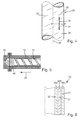
- FIG. 2 shows a section of a produced with the extruder 10 plastic tube 28.
- the processed in the extruder 10 thermoplastic material has long molecular chains 32, which are after forming as a tube 28 - due to the manufacturing process - along a longitudinal axis 30 aligned.
- the hose 28 may burst open parallel to the longitudinal axis 30 (see reference numeral 34). This is because the hose 28 only in the longitudinal direction, ie in the orientation of the Molecular chains 32 (fiber direction), a particularly good mechanical strength has (see reference numeral 36).
- the material on the other hand has only a weak mechanical strength (cf reference numeral 38).
- the wall 39 of the hose 28, referred to below as the product wall can thus accommodate only small force components in the direction of rotation; in the longitudinal direction, the absorbable force components are substantially larger (compare reference numbers 36 and 38).
- FIG. 3 shows an extruder 10 for carrying out the method according to the invention in a longitudinal section in a first embodiment.
- the same reference numerals designate the same components or functions.
- the main difference to the extruder 10 of FIG. 1 is the rotatable by a rotary bearing 40 (eg, sliding or ball bearings) mounted on the cylinder 12 die 22.
- the die 22 can be rotated by a drive device 42 (see reference numeral 43).
- a control device 44 controls the speed and the direction of rotation of the drive devices 16 and 42.
- the drive devices 16 and 42 can also be combined to form a common drive device which independently drives the transport screw 14 and the die 22 via different gear devices (not shown).
- the die 22 is specially designed for the production of hoses. Therefore, the die 22 has one in a center of the die opening for producing a Pipe interior arranged bolt 45 which is rotatably mounted and also driven by the drive means 42 or an additional drive means, not shown, within the die opening.
- the bolt 45 can preferably be picked up in the direction of rotation of the die 22 at the same angular speed. He could also form a unit with the die 22 and thus be collectible with the die 22 together.
- the angular velocities may also be different or even opposite in the case of separate drives of the die 22 and of the bolt 45.
- the bolt 45 could also be fixed, that is not rotatable.
- the raw material placed in the extruder 10 on forming temperature raw material can be rotated at the exit from the die 22 in the forming process in the forming process.
- the raw material is wounded in it.
- the various drive possibilities of the bolt 45 described above offer different possibilities for processing and twisting of the material emerging from the die 22, which can optionally be used if required.
- FIG. 4 shows a section of a with the extruder 10 FIG. 3
- the molecular chains 32 (material fibers) of the tube 28 thus produced, deviating from the orientation known from the prior art along the longitudinal axis 30, are now oblique or approximately transverse to the longitudinal axis 30 are aligned. Thereby If there is a pending internal pressure, there is an altered distribution of forces on the product wall 39 of the hose 28.
- a compressive force component 38 in the circumferential direction is approximately the same size as the compressive force component 36 in the longitudinal direction.
- FIG. 5 shows an extruder 10 for carrying out the method according to the invention in a longitudinal section in a second embodiment.
- the die 22 is fixedly connected to the cylinder 14 in the second embodiment.
- the area in the interior of the cylinder has guide vanes 46 in the feed direction immediately in front of the die 22, which guide the plastic compound heated to the forming temperature at a predetermined angle to the die 22.
- the guide vanes 46 may additionally be twisted in themselves or may rotate in their entirety on a longitudinal axis of the extruder 10 or operate similar to the principle of a kneading machine (not shown). The vanes 46 enhance the desired twist of the raw material prior to exiting the die 22.
- the molecular chains 32 (material fibers) of the tube 28 thus produced are aligned obliquely or even approximately transversely to the longitudinal axis 30, deviating from the orientation known from the prior art along the longitudinal axis 30 during the forming process.
- a force distribution on the product wall 39 of the hose 28, as in FIG. 4 is shown.
- guide vanes can also be arranged directly in front of a rotatable die (as in FIG FIG. 3 shown).
- the vanes in this case would further support the rotational action of the die.
- a cylinder of the extruder 10 can be rotated together with the transport screw relative to the die.
- the raw material can be twisted in by one side of the material clamped and a second side is rotated. This can be done within the forming device, but also directly after the exit of the material from the die.
- the raw material can first be pressed without twisting out of the die and twisted in a subsequent process step.
- the method may preferably be carried out in sections, so that the material is pressed in each case to a part of the die and then rotated by a twisting device in itself.
- the tubular products 28 produced by the forming process have a multi-layer product wall 39.
- FIG. 6 shows such a multi-layer product wall 39 in detail.
- the product wall 39 shown here has, for example, three adjacent layers 48a, 48b, 48c.
- the extruder 10 for example, a die 22 with concentrically arranged ring openings, through which the raw material flows successively in multiple layers and from the layered layer, the multi-layer tubular product 28 is generated.
- each layer 48 is rotated relative to each other by a rotating device within the die 22.
- the orientation of the molecular chains 32 in the individual layers 48a, 48b, 48c of the product wall 39 deviate from one another.
- the molecular chains 32 in the two layers 48a and 48b are oriented oppositely relative to one another.
- An angle of alignment of the molecular chains 32 in the layer 48c differs from the orientation of the molecular chains 32 in the layers 48a and b.
- the molecular chains 32 of the layer 48c are aligned to the longitudinal extension of the product wall 39 shallower.
- the endeavorwandung 39 may have almost any number of layers.
- the orientation angles of the molecular chains 32 can be arbitrarily aligned as needed. A maximum number of possible layers and the orientation angles of the molecular chains 32 are determined essentially by the performance of the extruder 10. Furthermore, different plastics can be used in this way.
- At least one layer 48 of the multilayer product wall 39 or the single layer of the single-layer product wall 39 additionally comprises a filler of organic or inorganic material in addition to the material with the aligned molecular chains.
- the fillers are added to the material with the aligned molecular chains, with the aim of changing the mechanical properties of the tubular product to meet special customer requirements.
- at least one complete layer of the multilayer product wall has the filler.
- the filler may be fibrous (e.g., natural or glass fiber) or globular (e.g., mineral).
- a heated to forming temperature metallic material be converted into a tube by means of an extrusion device in a substantially analogous process.
- the metallic material is introduced as a block (and not as granules) in the extrusion device.
- several passes may be needed in forming the material. Otherwise, the same results apply as obtained with the devices described above.
Landscapes
- Engineering & Computer Science (AREA)
- Mechanical Engineering (AREA)
- Physics & Mathematics (AREA)
- Thermal Sciences (AREA)
- Manufacturing & Machinery (AREA)
- Extrusion Moulding Of Plastics Or The Like (AREA)
Applications Claiming Priority (2)
| Application Number | Priority Date | Filing Date | Title |
|---|---|---|---|
| DE102010028537 | 2010-05-04 | ||
| DE102010061794A DE102010061794A1 (de) | 2010-05-04 | 2010-11-23 | Verfahren und Vorrichtung zum Umformen von Metallen und Kunststoffen |
Publications (1)
| Publication Number | Publication Date |
|---|---|
| EP2384879A1 true EP2384879A1 (fr) | 2011-11-09 |
Family
ID=44276246
Family Applications (1)
| Application Number | Title | Priority Date | Filing Date |
|---|---|---|---|
| EP11164385A Withdrawn EP2384879A1 (fr) | 2010-05-04 | 2011-05-02 | Méthode et dispositif pour former des produits tubulaires de matériau métallique ou plastique. |
Country Status (2)
| Country | Link |
|---|---|
| EP (1) | EP2384879A1 (fr) |
| DE (1) | DE102010061794A1 (fr) |
Cited By (3)
| Publication number | Priority date | Publication date | Assignee | Title |
|---|---|---|---|---|
| WO2017147268A1 (fr) * | 2016-02-23 | 2017-08-31 | Andersen Corporation | Extrusions de composites avec orientation de fibres non alignées et leurs procédés d'extrusion |
| US11680439B2 (en) | 2017-08-17 | 2023-06-20 | Andersen Corporation | Selective placement of advanced composites in extruded articles and building components |
| US11813818B2 (en) | 2016-02-23 | 2023-11-14 | Andersen Corporation | Fiber-reinforced composite extrusion with enhanced properties |
Families Citing this family (1)
| Publication number | Priority date | Publication date | Assignee | Title |
|---|---|---|---|---|
| DE102021115288A1 (de) | 2021-06-14 | 2022-12-15 | Battenfeld-Cincinnati Germany Gmbh | Extrusionswerkzeug und verfahren zum erzeugen eines kunststoffprofils |
Citations (9)
| Publication number | Priority date | Publication date | Assignee | Title |
|---|---|---|---|---|
| FR1324971A (fr) * | 1962-03-12 | 1963-04-26 | Plastus S A | Nouveau procédé de fabrication par extrusion de tubes en matériau plastique |
| US3853661A (en) * | 1971-05-01 | 1974-12-10 | Mitsubishi Petrochemical Co | A method of producing plastic bags |
| US4098861A (en) * | 1976-09-30 | 1978-07-04 | Dow Corning Corporation | Wire coating using a liquid polymer |
| DE2803301A1 (de) * | 1978-01-26 | 1979-08-02 | Sussex Plastics Engineering In | Extruder sowie verfahren zum extrudieren von polymeren |
| US4784594A (en) * | 1983-03-11 | 1988-11-15 | Mobil Oil Corporation | Single lip rotary tubular extrusion die |
| US4793885A (en) * | 1974-12-11 | 1988-12-27 | Rasmussen O B | Method of laminating and stretching film material and apparatus for said method |
| US5288529A (en) * | 1989-06-16 | 1994-02-22 | Foster-Miller Inc. | Liquid crystal polymer film |
| DE19631532A1 (de) * | 1996-07-24 | 1997-01-16 | Stefan Krebs | Verfahren und Vorrichtung zur nichtaxialen Ausrichtung von Fasern in einem rohrförmigen Produkt aus Faserverbund-Werkstoff |
| US5648104A (en) * | 1991-01-17 | 1997-07-15 | The University Of Manchester Institute Of Science And Technology | Extrusion die |
-
2010
- 2010-11-23 DE DE102010061794A patent/DE102010061794A1/de not_active Withdrawn
-
2011
- 2011-05-02 EP EP11164385A patent/EP2384879A1/fr not_active Withdrawn
Patent Citations (9)
| Publication number | Priority date | Publication date | Assignee | Title |
|---|---|---|---|---|
| FR1324971A (fr) * | 1962-03-12 | 1963-04-26 | Plastus S A | Nouveau procédé de fabrication par extrusion de tubes en matériau plastique |
| US3853661A (en) * | 1971-05-01 | 1974-12-10 | Mitsubishi Petrochemical Co | A method of producing plastic bags |
| US4793885A (en) * | 1974-12-11 | 1988-12-27 | Rasmussen O B | Method of laminating and stretching film material and apparatus for said method |
| US4098861A (en) * | 1976-09-30 | 1978-07-04 | Dow Corning Corporation | Wire coating using a liquid polymer |
| DE2803301A1 (de) * | 1978-01-26 | 1979-08-02 | Sussex Plastics Engineering In | Extruder sowie verfahren zum extrudieren von polymeren |
| US4784594A (en) * | 1983-03-11 | 1988-11-15 | Mobil Oil Corporation | Single lip rotary tubular extrusion die |
| US5288529A (en) * | 1989-06-16 | 1994-02-22 | Foster-Miller Inc. | Liquid crystal polymer film |
| US5648104A (en) * | 1991-01-17 | 1997-07-15 | The University Of Manchester Institute Of Science And Technology | Extrusion die |
| DE19631532A1 (de) * | 1996-07-24 | 1997-01-16 | Stefan Krebs | Verfahren und Vorrichtung zur nichtaxialen Ausrichtung von Fasern in einem rohrförmigen Produkt aus Faserverbund-Werkstoff |
Cited By (6)
| Publication number | Priority date | Publication date | Assignee | Title |
|---|---|---|---|---|
| WO2017147268A1 (fr) * | 2016-02-23 | 2017-08-31 | Andersen Corporation | Extrusions de composites avec orientation de fibres non alignées et leurs procédés d'extrusion |
| US10550257B2 (en) | 2016-02-23 | 2020-02-04 | Andersen Corporation | Composite extrusion with non-aligned fiber orientation |
| US11267963B2 (en) | 2016-02-23 | 2022-03-08 | Andersen Corporation | Composite extrusion with non-aligned fiber orientation |
| US11813818B2 (en) | 2016-02-23 | 2023-11-14 | Andersen Corporation | Fiber-reinforced composite extrusion with enhanced properties |
| US12071537B2 (en) | 2016-02-23 | 2024-08-27 | Andersen Corporation | Composite extrusion with non-aligned fiber orientation |
| US11680439B2 (en) | 2017-08-17 | 2023-06-20 | Andersen Corporation | Selective placement of advanced composites in extruded articles and building components |
Also Published As
| Publication number | Publication date |
|---|---|
| DE102010061794A1 (de) | 2011-11-10 |
Similar Documents
| Publication | Publication Date | Title |
|---|---|---|
| DE69210543T2 (de) | Herstellungsverfahren zum Formen eines Verbundproduktes | |
| EP1558437B1 (fr) | Production par extrusion de pieces moulees en matiere plastique reticulable au moyen de peroxydes | |
| DE69424444T2 (de) | Hochfeste seele für drahtseile | |
| DE102013002559B4 (de) | Einschnecken-Extruder und Verfahren zum Plastifizieren von Kunststoff-Polymeren | |
| DE60010294T2 (de) | Verfahren und vorrichtung zur herstellung von kunststofffolie | |
| EP0995567A1 (fr) | Procédé pour la fabrication de résine thermoplastique modifiée, chargée et renforcée de fibres et une extrudeuse-double-vis pour la mise en oeuvre du procédé | |
| EP3592527A1 (fr) | Dégazage lors de l'extrusion de matières, en particulier de matières plastiques | |
| EP3782794A2 (fr) | Installation de fabrication d'une matière plastique fondue et utilisation d'une telle installation de fabrication d'une matière plastique fondue pour une feuille poreuse | |
| EP2347878B1 (fr) | Procédé de fabrication de tuyaux en polyéthylène réticulés par peroxyde dans une ligne d'extrusion | |
| DE102009050543B3 (de) | Verfahren und Vorrichtung zur Herstellung von feinkörnigen, polykristallinen Werkstoffen oder Werkstücken aus länglichen oder rohrförmigen Halbzeugen | |
| EP4010165A1 (fr) | Procédé et appareil d'extrusion destinés à l'extrusion de matière plastique renforcée par des fibres pour la fabrication additive d'un élément | |
| DE69629491T2 (de) | Verfahren zum herstellen von homogenen materialien mit einem extruder, und extruder | |
| EP2921279B1 (fr) | Dispositif et procédé d'homogénéisation de coulées de matière synthétique | |
| EP2384879A1 (fr) | Méthode et dispositif pour former des produits tubulaires de matériau métallique ou plastique. | |
| DE69202884T2 (de) | Verfahren und Vorrichtung zum Herstellen von Rohren aus thermoplastischen, mit Fasern steuerbarer Ausrichtung verstärkten Werkstoffen. | |
| DE102012008169A1 (de) | Extruder mit Materialeintrag durch Gehäuse | |
| DE10235151B4 (de) | Haltevorrichtung für eine Extrusionsdüse | |
| DE102020113408A1 (de) | Vorrichtung zum Aufbauen eines Körpers und Verfahren zur Herstellung eines Körpers mit einer solchen Vorrichtung | |
| DE102012112491A1 (de) | Vorrichtung und Verfahren zum Herstellen von Kunststoffvorformlingen aus einem thermoplastischen Kunststoff | |
| WO2015052338A1 (fr) | Dispositif permettant la fixation d'un profilé extrudé en matière plastique | |
| EP3790729B1 (fr) | Dispositif et procédé de moulage par soufflage continu de profilés creux thermoplastiques, renforcés par des fibres, ayant une section transversale constante ou variable | |
| EP2029289B1 (fr) | Procédé de production d'un composant avec un revêtement nanostructuré | |
| DE2940356C2 (fr) | ||
| EP1235676A1 (fr) | Extrudeuse servant au traitement de melanges de caoutchouc | |
| AT522285A2 (de) | Verfahren und vorrichtung zur additiven herstellung von hochfesten bauteilen |
Legal Events
| Date | Code | Title | Description |
|---|---|---|---|
| AK | Designated contracting states |
Kind code of ref document: A1 Designated state(s): AL AT BE BG CH CY CZ DE DK EE ES FI FR GB GR HR HU IE IS IT LI LT LU LV MC MK MT NL NO PL PT RO RS SE SI SK SM TR |
|
| AX | Request for extension of the european patent |
Extension state: BA ME |
|
| PUAI | Public reference made under article 153(3) epc to a published international application that has entered the european phase |
Free format text: ORIGINAL CODE: 0009012 |
|
| 17P | Request for examination filed |
Effective date: 20120509 |
|
| 17Q | First examination report despatched |
Effective date: 20131119 |
|
| STAA | Information on the status of an ep patent application or granted ep patent |
Free format text: STATUS: THE APPLICATION IS DEEMED TO BE WITHDRAWN |
|
| 18D | Application deemed to be withdrawn |
Effective date: 20141202 |