EP2384911B1 - Appareil, procédé et programme pour détecter la baisse de pression d'air dans les pneus - Google Patents
Appareil, procédé et programme pour détecter la baisse de pression d'air dans les pneus Download PDFInfo
- Publication number
- EP2384911B1 EP2384911B1 EP10015631.4A EP10015631A EP2384911B1 EP 2384911 B1 EP2384911 B1 EP 2384911B1 EP 10015631 A EP10015631 A EP 10015631A EP 2384911 B1 EP2384911 B1 EP 2384911B1
- Authority
- EP
- European Patent Office
- Prior art keywords
- tire
- tires
- rotation speed
- acceleration
- wheel
- Prior art date
- Legal status (The legal status is an assumption and is not a legal conclusion. Google has not performed a legal analysis and makes no representation as to the accuracy of the status listed.)
- Not-in-force
Links
- 238000000034 method Methods 0.000 title claims description 13
- 230000001133 acceleration Effects 0.000 claims description 106
- 238000001514 detection method Methods 0.000 claims description 37
- 230000003247 decreasing effect Effects 0.000 claims description 29
- 230000002159 abnormal effect Effects 0.000 description 6
- 238000002474 experimental method Methods 0.000 description 5
- 230000010354 integration Effects 0.000 description 4
- 238000012937 correction Methods 0.000 description 2
- 238000010586 diagram Methods 0.000 description 2
- 238000007796 conventional method Methods 0.000 description 1
- 230000000694 effects Effects 0.000 description 1
- 239000000446 fuel Substances 0.000 description 1
- 239000004973 liquid crystal related substance Substances 0.000 description 1
- 238000012423 maintenance Methods 0.000 description 1
- 238000005259 measurement Methods 0.000 description 1
- 238000005096 rolling process Methods 0.000 description 1
- 238000005070 sampling Methods 0.000 description 1
- 238000012360 testing method Methods 0.000 description 1
Images




Classifications
-
- B—PERFORMING OPERATIONS; TRANSPORTING
- B60—VEHICLES IN GENERAL
- B60C—VEHICLE TYRES; TYRE INFLATION; TYRE CHANGING; CONNECTING VALVES TO INFLATABLE ELASTIC BODIES IN GENERAL; DEVICES OR ARRANGEMENTS RELATED TO TYRES
- B60C23/00—Devices for measuring, signalling, controlling, or distributing tyre pressure or temperature, specially adapted for mounting on vehicles; Arrangement of tyre inflating devices on vehicles, e.g. of pumps or of tanks; Tyre cooling arrangements
- B60C23/06—Signalling devices actuated by deformation of the tyre, e.g. tyre mounted deformation sensors or indirect determination of tyre deformation based on wheel speed, wheel-centre to ground distance or inclination of wheel axle
- B60C23/061—Signalling devices actuated by deformation of the tyre, e.g. tyre mounted deformation sensors or indirect determination of tyre deformation based on wheel speed, wheel-centre to ground distance or inclination of wheel axle by monitoring wheel speed
Definitions
- the present invention relates to an apparatus, a method, and a program for detecting a decrease in a tire air pressure.
- Run flat tires are designed to enable, even when the tires are punctured and air therein is lost, a running for a distance of about 100km.
- the run flat tires it is possible to avoid a situation where the vehicle is stopped at a dangerous place such as a road having a heavy traffic to change a punctured tire or to fix the puncture, so that the user is allowed to drive the vehicle to the nearest service station to perform maintenance on the vehicle safely.
- the run flat tires also eliminate the need to carry a spare tire on the vehicle, thus providing advantages such as an increased trunk space and improved fuel consumption by the vehicle having a lighter weight.
- the invention of the previous application was made based on the knowledge that, when one tire has a completely-zero air pressure, there is a case where the tire has a rotation speed higher than the rotation speeds of the other tires and there is also a contrary case where the tire has a rotation speed lower than the rotation speeds of the other tires and the degree of such delay in rotation speed is more significant than that in the case of the tire fitted with a snow chain.
- the invention of the previous application includes: a rotation speed detection means for periodically detecting tire rotation speeds of the respective wheels of a vehicle; an acceleration calculation means for calculating accelerations of the respective tires based on rotation speed information obtained from the rotation speed detection means; an acceleration variation calculation means for calculating acceleration variations of the respective tires based on the accelerations of the respective tires calculated by the acceleration calculation means; a comparison means for comparing the acceleration variation of the respective tires calculated by the acceleration variation calculation means; a presumption means for presuming, when the result of the comparison by the comparison means shows that a tire has a larger acceleration variation than the acceleration variations of the other tires, that the tire has a decreased air pressure; an examination means for identifying, based on the tire rotation speed information of the respective wheels, a tire having a rotation speed that is higher than the rotation speeds of the other tires or that is lower than a predetermined criterion; and a determination means for determining that a tire has a decreased air pressure when the tire identified by the estimation means is also identified by the examination means.
- the comparison means is used to compare acceleration variations of the respective tires.
- the result shows that a tire has an acceleration variation larger than acceleration variations of the other tires
- based on tire rotation speed information of the respective wheels there is further detected a tire that has a rotation speed higher than the rotation speeds of the other tires or lower than a predetermined criterion.
- a tire identified through the comparison of the acceleration variation is identical with a tire identified through the comparison of the rotation speed
- a pressure decrease of the tire is determined. This can consequently avoid the generation of a false alarm in the case where only acceleration variations are compared.
- a status where the air pressure of one tire is completely zero can be accurately determined.
- the degree at which one tire has a rotation speed that is lower than the rotation speeds of the other tires may not be differentiated between the case where an internal pressure is zero and the case where the tire is fitted with a snow chain.
- a decreased pressure is not determined in spite of the fact that the internal pressure is actually zero.
- the present invention has been made in view of the situation as described above. It is an objective of the present invention to provide an apparatus, a method, and a program for detecting a decrease in a tire air pressure by which a tire of a completely-zero air pressure can be detected securely.
- one tire having a completely-zero air pressure can be detected securely.
- a detection apparatus includes a normal wheel speed detection means (rotation speed detection means) 1 in order to detect the rotation speeds of four tires provided in a four-wheel vehicle of a left front wheel (FL), a right front wheel (FR), a left rear wheel (RL), and a right rear wheel (RR).
- the normal wheel speed detection means (rotation speed detection means) 1 is provided to be associated with the respective tires.
- the wheel speed detection means 1 may be, for example, a wheel speed sensor that uses an electromagnetic pickup for example to generate a rotation pulse to measure an angular velocity and a wheel speed based on the number of pulses or an angular velocity sensor such as a one that generates power using rotation as in a dynamo to measure an angular velocity and a wheel speed based on the voltage of the gerated power.
- the output from the wheel speed detection means 1 is given to a control unit 2 that is a computer such as ABS.
- a display unit 3 comprising a liquid crystal display element, a plasma display element or CRT for example for displaying a tire having a decreased pressure
- an initialization button 4 that can be operated by a driver
- an alarm unit 5 for notifying a driver of a tire having a decreased pressure.
- the control unit 2 is composed of: an I/O interface 2a required for the exchange of a signal with an external apparatus; a CPU 2b functioning as a computation processing center; a ROM 2c storing therein a control operation program of the CPU 2b; and a RAM 2d into which data is temporarily written or from which the written data is read out when the CPU 2b performs a control operation.
- the wheel speed detection means 1 outputs a pulse signal corresponding to the rotation number of a tire (hereinafter also referred to as "wheel speed pulse”).
- F 1 , F 2 , F 3 and F 4 represent angular velocities of a left front wheel (FL) tire, a right front wheel (FR) tire, a left rear wheel (RL) tire, and a right rear wheel (RR) tire, respectively.
- the tire rotation speed is calculated.
- the tire acceleration is calculated.
- a detection apparatus is composed of: a wheel speed detection means (rotation speed detection means) 1 for periodically detecting rotation speeds of tires of the respective wheels of the vehicle; an acceleration calculation means for calculating, based on rotation speed information obtained from the rotation speed detection means, accelerations of the respective tires; an acceleration variation calculation means for calculating, based on the accelerations of the respective tires calculated by the acceleration calculation means, acceleration variations of the respective tires; a comparison means for comparing the acceleration variations of the respective tires calculated by the acceleration variation calculation means; a presumption means for presuming, when a comparison result by the comparison means shows that a tire has an acceleration variation larger than acceleration variations of the other tires, a pressure decrease of the tire; an examination means for identifying, based on the tire rotation speed information of the respective wheels, a tire having a rotation speed that is higher than the rotation speeds of the other tires or that is lower than a predetermined criterion; and a determination means for determining, when a tire identified by the estimation means is identical with a tire identified by the estimation means
- the predetermined criterion defines a degree at which, when four tires have a normal internal pressure and one of the four tires is fitted with a snow chain, the tire has a lower rotation speed than the rotation speeds of the other tires.
- the examination means is further configured to identify, based on tire rotation speed information of the respective wheels, a tire having a rotation speed lower than the rotation speeds of the other tires.
- the determination means is configured to determine that a tire has a decreased air pressure when the tire identified by the estimation means is identical with the slowest tire identified by the examination means and when the slowest tire is positioned at a driven wheel.
- a program of the present invention causes the control unit 2 to function as the acceleration calculation means, the acceleration variation calculation means, the comparison means, the presumption means, the examination means, and the determination means.
- the acceleration variations of the respective tires are calculated.
- This acceleration variation is an integration value of 25 absolute values of acceleration (corresponding to 1 second) each of which is calculated at a predetermined interval (e.g., 40ms).
- a predetermined interval e.g. 40ms.
- a tire having a rotation speed higher than those of the other three tires, a tire having a rotation speed lower than the predetermined criterion, or a tire having the lowest rotation speed is identified. Then, based on the identification result and the presumption result by the presumption means which will be described later, a tire having a decreased pressure is determined.
- the identification of (A) and (B) can be carried out in the manner as described below for example.
- the rotation speeds of the respective wheels are assumed as FLs (left front wheel), FRs (right front wheel), RLs (left rear wheel), and RRs (right rear wheel).
- DEL1_R, DEL2_R, and DEL3_R represented by the following formulae (1) to (3) are calculated and are compared with predetermined threshold values (see table 1), whereby a tire having a higher rotation speed than those of the other three wheels or a tire having a very low rotation speed can be identified.
- the predetermined threshold value can be obtained by an experiment, and threshold values for determining a tire that has a lower rotation speed than those of the other tires because the tire has a zero-air pressure (#ThSlowerDEL1, #ThSlowerDEL2, #ThSlowerDEL3) take values within a range of 3 to 10, for example. Threshold values for determining a tire that has a higher rotation speed than those of the other tires because the tire has a zero-air pressure (#ThFasterDEL1, #ThFasterDEL2, #ThFasterDEL3) take values within a range of 0 to 0.3, for example.
- the tire fitted with the snow chain has a rotation speed lower than those of the other tires, and a threshold value for identifying the tire having such lower rotation speed is within a range of about 0.05 to 1, for example.
- a threshold value for identifying the tire having such lower rotation speed is within a range of about 0.05 to 1, for example.
- the degree of the lower rotation speed is different between the case where one tire has an internal pressure of zero and the case where one tire is fitted with the snow chain.
- these cases can be clearly differentiated by changing the threshold value.
- the tire rotation speed is generally increased.
- the present inventor has found that the rotation speed is lower in some cases at a more significant degree than in a case where the tire is fitted with a snow chain. It is presumed, as the reason why the tire rotation speed is much lower when the tire has an internal pressure of zero, that the zero internal pressure causes the tire tread to have contact with the rim to generate friction due to which the rotation speed is lowered.
- the tire (c) can be identified by a relative comparison among the rotation speeds of the respective wheels of FLs (left-front wheel), FRs (right front wheel), RLs (left rear wheel), and RRs (right rear wheel). In this case, in consideration of a measurement error, a wheel having a rotation speed lower than the average of the rotation speeds of the other three wheels by 0.2% or more can be determined as "a wheel having the slowest rotation speed.”
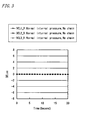
- Fig. 3 to Fig. 5 illustrate examples of the DEL1_R to DEL3_R obtained by experiment.
- Fig. 3 shows the values of DEL1_R to DEL3_R in the case where four tires have a normal internal pressure and none of the tires is fitted with a snow chain.
- Fig. 4 shows the values of DEL1_R to DEL3_R in the case where four tires have a normal internal pressure and the left rear tire (RL wheel) is fitted with a snow chain.
- Fig. 5 shows the values of DEL1_R to DEL3_R in the case where the right front tire (FR wheel) has a zero-internal pressure and none of the tires is fitted with a snow chain.
- Table 2 shows the experimental results, which are also shown in Fig.
- DEL1_R, DEL2_R, and DEL3_R are substantially zero.
- DEL1_R and DEL2_R are within a range of 0.3 to 0.5
- DEL3_R is within a range of -0.33 to -0.5.
- DEL1_R and DEL3_R are within a range of 5.1 to 6.9 and DEL2_R is within a range of -5.1 to -6.9.
- the values of DEL1_R - DEL3_R are significantly different between the case of the experiment with the tire having a zero-internal pressure and the case of the experiment with the tire fitted with a snow chain.
- a threshold value appropriately, a lower rotation speed due to a tire having a zero-internal pressure and a lower rotation speed due to a tire fitted with a snow chain can be clearly differentiated.
- the tire identified (or examined) as the tire (A) or tire (B) based on the rotation speed thereof is identical with the tire identified (or presumed) through the comparison of acceleration variations, it is determined that the tire has a decreased air pressure.
- one tire having a decreased pressure is determined based not only on the determination result based on the acceleration variations but also on the determination result based on the rotation speeds (in this determination, cases of a decreased rotation speed of a tire due to a snow chain are exculded).
- a decreased pressure can be determined with a high degree of accuracy.
- the tire identified (or examined) as the tire (C) based on the rotation speed is identical with a tire identified (or presumed) based on a comparison of acceleration variations, and when the tire is positioned at a driven wheel, it is also determined that the tire has a decreased air pressure.
- some degree at which one tire has a rotation speed that is lower than the rotation speeds of the other tires (and that is not lower than the predetermined criterion) leads a determination that the tire is fitted with a snow chain and thus has a lowered rotation speed, thus failing to determine a decreased pressure.
- the degree at which one tire has a rotation speed that is lower than the rotation speeds of the other tires may not be differentiated between the case where an internal pressure is zero and the case where the tire is fitted with a snow chain.
- a decreased pressure is not determined in spite of the fact that the internal pressure of the tire is actually zero.
- a tire identified (or presumed) by the comparison of acceleration variations is the slowest tire and is also a tire attached to a driven wheel, it is determined that the tire has a decreased pressure. This can consequently eliminate a disadvantage of failing to determine a decreased pressure in spite of the fact that the tire has an air pressure of zero.
- Whether a wheel is a driven wheel or a driving wheel can be determined by acquiring the wheel torque of the wheel. Specifically, whether the wheel is a driven wheel or a driving wheel can be determined based on whether the wheel torque value is zero or other than zero when the vehicle speed has a value other than zero, that is, the vehicle is not stopped. Information on such wheel torque can be obtained together with the speed of the rotating wheel, from the Antilock Brake System (ABS) for example.
- ABS Antilock Brake System
Landscapes
- Engineering & Computer Science (AREA)
- Mechanical Engineering (AREA)
- Measuring Fluid Pressure (AREA)
Claims (6)
- Appareil pour détecter une diminution dans une pression d'air d'un pneumatique attaché à un véhicule, comprenant :un moyen de détection de vitesse de rotation (1) pour détecter périodiquement des vitesses de rotation de pneumatiques des roues respectives du véhicule ;un moyen de calcul d'accélération (2b) pour calculer, sur la base d'une information de vitesse de rotation obtenue du moyen de détection de vitesse de rotation (1), des accélérations des pneumatiques respectifs ;un moyen de calcul de variation d'accélération (2b) pour calculer, sur la base des accélérations des pneumatiques respectifs calculées par le moyen de calcul d'accélération, des variations d'accélération des pneumatiques respectifs ;un moyen de comparaison (2b) pour comparer les variations d'accélération des pneumatiques respectifs calculés par le moyen de calcul de variation d'accélération ;un moyen de supposition (2b) pour supposer, quand un résultat de comparaison par le moyen de comparaison montre qu'une variation d'accélération d'un pneumatique est plus grande que des variations d'accélération des autres pneumatiques, qu'il y a une diminution de pression du pneumatique ;un moyen d'examen (2b) pour identifier, sur la base de l'information de vitesse de rotation du pneumatique des roues respectives, un pneumatique ayant une vitesse de rotation qui est plus grande que les vitesses de rotation des autres pneumatiques ou qui est plus faible qu'un critère prédéterminé ; etun moyen de détermination pour déterminer, quand un pneumatique identifié par le moyen de supposition est identique avec un pneumatique identifié par le moyen d'examen, qu'il y a une diminution de pression du pneumatique,dans lequel le critère prédéterminé définit un degré auquel, quand quatre pneumatiques ont une pression interne normale et que l'un des quatre pneumatiques est équipé d'une chaîne à neige, le pneumatique présente une vitesse de rotation plus faible que les vitesses de rotation des autres pneumatiques,le moyen d'examen est en outre configuré pour identifier, sur la base de l'information de vitesse de rotation du pneumatique des roues respectives, un pneumatique ayant une vitesse de rotation plus basse que les vitesses de rotation des autres pneumatiques, etle moyen de détermination est configuré pour déterminer qu'un pneumatique a une pression d'air diminuée quand le pneumatique identifié par le moyen de supposition est identique avec le pneumatique le plus lent identifié par le moyen d'examen et quand le pneumatique le plus lent est positionné au niveau d'une roue entraînée.
- Appareil pour détecter une diminution dans une pression d'air d'un pneumatique selon la revendication 1, dans lequel l'appareil comprend en outre un moyen d'acquisition de couple de roue (2) pour acquérir des couple de roue des roues respectives du véhicule, et le moyen de détermination détermine qu'une roue pour laquelle une valeur du couple de roue acquise par le moyen d'acquisition de couple de roue est égale à 0 (NM) quand le véhicule n'est pas arrêté est une roue entraînée.
- Procédé pour détecter une diminution dans une pression d'air d'un pneumatique attaché à un véhicule, comprenant :une étape de détection de vitesse de rotation consistant à détecter périodiquement les vitesses de rotation de pneumatiques des roues respectives du véhicule ;une étape de calcul d'accélération consistant à calculer, sur la base de l'information de vitesse de rotation obtenue dans l'étape de détection de vitesse de rotation, les accélérations des pneumatiques respectifs ;une étape de calcul de variation d'accélération consistant à calculer, sur la base d'accélérations des pneumatiques respectifs calculées dans l'étape de calcul d'accélération, des variations d'accélération des pneumatiques respectifs ;une étape de comparaison consistant à comparer des variations d'accélération des pneumatiques respectifs calculées dans l'étape de calcul de variation d'accélération ;une étape de supposition consistant à supposer, quand un résultat de comparaison par l'étape de comparaison montre qu'une variation d'accélération d'un pneumatique est supérieure à des variations d'accélération des autres pneumatiques, qu'il y a diminution de pression du pneumatique ;une étape d'examen consistant à identifier, sur la base de l'information de vitesse de rotation du pneumatique des roues respectives, un pneumatique ayant une vitesse de rotation qui est plus grande que les vitesses de rotation des autres pneumatiques ou qui est plus basse qu'un critère prédéterminé ; etune étape de détermination consistant à déterminer, quand un pneumatique identifié dans l'étape d'estimation est identique à un pneumatique identifié dans l'étape d'examen, qu'il y a diminution de pression du pneumatique,dans lequel le critère prédéterminé définit un degré auquel, quand quatre pneumatiques ont une pression interne normale et quand l'un des quatre pneumatiques est équipé d'une chaîne à neige, le pneumatique a une vitesse de rotation plus faible que les vitesses de rotation des autres pneumatiques,l'étape d'examen identifie en outre, sur la base de l'information de vitesse de rotation du pneumatique des roues respectives, un pneumatique ayant une vitesse de rotation plus faible que les vitesses de rotation des autres pneumatiques, etl'étape de détermination détermine qu'un pneumatique a une pression d'air diminuée quand le pneumatique identifié dans l'étape de supposition est identique au pneumatique le plus lent identifié par l'étape d'examen et quand le pneumatique le plus lent est positionné au niveau d'une roue entraînée.
- Procédé pour détecter une diminution dans une pression d'air d'un pneumatique selon la revendication 3, dans lequel le procédé comprend en outre une étape d'acquisition de couple de roue consistant à acquérir des couples de roue des roues respectives du véhicule, et l'étape de détermination détermine qu'une roue pour laquelle une valeur du couple de roue acquise par l'étape d'acquisition de couple de roue est égale à 0 (NM) quand le véhicule n'est pas arrêté est une roue entraînée.
- Programme qui amène, afin de détecter une diminution dans une pression d'air d'un pneumatique attaché à un véhicule, un ordinateur à fonctionner comme :un moyen de calcul d'accélération pour calculer, sur la base de l'information de vitesse de rotation obtenue depuis un moyen de détection de vitesse de rotation pour détecter périodiquement les vitesses de rotation de pneumatiques des roues respectives du véhicule, les accélérations des pneumatiques respectifs ;un moyen de calcul de variation d'accélération pour calculer, sur la base des accélérations des pneumatiques respectifs calculées par le moyen de calcul d'accélération, des variations d'accélération des pneumatiques respectifs ;un moyen de comparaison pour comparer les variations d'accélération des pneumatiques respectifs calculées par le moyen de calcul de variation d'accélération ;un moyen de supposition pour supposer, quand un résultat de comparaison par le moyen de comparaison montre qu'une variation d'accélération d'un pneumatique est plus grande que des variations d'accélération des autres pneumatiques, qu'il y a une diminution de pression du pneumatique ;un moyen d'estimation pour identifier, sur la base de l'information de vitesse de rotation du pneumatique des roues respectives, un pneumatique ayant une vitesse de rotation qui est plus grande que les vitesses de rotation des autres pneumatiques ou qui est plus basse qu'un critère prédéterminé ; etun moyen de détermination pour déterminer, quand un pneumatique identifié par le moyen de supposition est identique avec un pneumatique identifié par le moyen d'examen, qu'il y a une diminution de pression du pneumatique,dans lequel le critère prédéterminé définit un degré auquel, quand quatre pneumatiques ont une pression interne normale et que l'un des quatre pneumatiques est équipé d'une chaîne à neige, le pneumatique a une vitesse de rotation plus faible que les vitesses de rotation des autres pneumatiques,le moyen d'examen est en outre configuré pour identifier, sur la base de l'information de vitesse de rotation des roues respectives, un pneumatique ayant une vitesse de rotation plus basse que les vitesses de rotation des autres pneumatiques, etle moyen de détermination est configuré pour déterminer qu'un pneumatique a une pression d'air diminuée quand le pneumatique identifié par le moyen de supposition est identique avec le pneumatique le plus lent identifié par le moyen d'examen et quand le pneumatique le plus lent est positionné sur une roue entraînée.
- Programme pour détecter une diminution dans une pression d'air d'un pneumatique selon la revendication 5, dans lequel l'ordinateur est en outre amené à fonctionner comme un moyen d'acquisition de couple de roue pour acquérir des couples de roue des roues respectives du véhicule, et le moyen de détermination détermine qu'une roue pour laquelle une valeur du couple de roue acquise par le moyen d'acquisition de couple de roue est égale à 0 (NM) quand le véhicule n'est pas arrêté est une roue entraînée.
Applications Claiming Priority (1)
| Application Number | Priority Date | Filing Date | Title |
|---|---|---|---|
| JP2010107324A JP4964328B2 (ja) | 2010-05-07 | 2010-05-07 | タイヤ空気圧低下検出装置、方法およびプログラム |
Publications (3)
| Publication Number | Publication Date |
|---|---|
| EP2384911A2 EP2384911A2 (fr) | 2011-11-09 |
| EP2384911A3 EP2384911A3 (fr) | 2012-09-05 |
| EP2384911B1 true EP2384911B1 (fr) | 2013-06-19 |
Family
ID=44269254
Family Applications (1)
| Application Number | Title | Priority Date | Filing Date |
|---|---|---|---|
| EP10015631.4A Not-in-force EP2384911B1 (fr) | 2010-05-07 | 2010-12-14 | Appareil, procédé et programme pour détecter la baisse de pression d'air dans les pneus |
Country Status (3)
| Country | Link |
|---|---|
| US (1) | US8297117B2 (fr) |
| EP (1) | EP2384911B1 (fr) |
| JP (1) | JP4964328B2 (fr) |
Families Citing this family (7)
| Publication number | Priority date | Publication date | Assignee | Title |
|---|---|---|---|---|
| JP5073804B2 (ja) * | 2010-11-17 | 2012-11-14 | 住友ゴム工業株式会社 | タイヤ空気圧低下検出装置及び方法、並びにタイヤの空気圧低下検出プログラム |
| DE112012007179T5 (de) * | 2012-11-28 | 2015-08-13 | Toyota Jidosha Kabushiki Kaisha | Luftdrucküberwachungsvorrichtung und Fehlfunktionsermittlungsschwellwertsermittlungsverfahren |
| US8843267B2 (en) | 2013-01-10 | 2014-09-23 | Infineon Technologies Ag | Wheel localizer, wheel localization device, system, method and computer program for locating a position of a wheel |
| US10281298B2 (en) | 2016-07-22 | 2019-05-07 | Infineon Technologies Ag | Wheel localization from reference magnetic field and angular rotation information in TPMS application |
| US11505014B2 (en) * | 2017-10-09 | 2022-11-22 | Nira Dynamics Ab | Determining a tire change status in a vehicle |
| JP2019113940A (ja) * | 2017-12-21 | 2019-07-11 | アイシン精機株式会社 | タイヤチェーン装着判定装置 |
| CN113721304B (zh) * | 2021-08-31 | 2022-07-15 | 偌轮汽车科技(武汉)有限公司 | 防滑链检测方法、装置、电子设备及存储介质 |
Family Cites Families (12)
| Publication number | Priority date | Publication date | Assignee | Title |
|---|---|---|---|---|
| GB8711310D0 (en) | 1987-05-13 | 1987-06-17 | Sp Tyres Uk Ltd | Tyres deflation warning device |
| US5497657A (en) * | 1991-11-11 | 1996-03-12 | Nippondenso Co., Ltd. | Tire air pressure detecting device |
| US5553491A (en) * | 1991-11-11 | 1996-09-10 | Nippondenso Co., Ltd. | Tire air pressure detecting device |
| US5591906A (en) * | 1992-09-16 | 1997-01-07 | Sumitomo Electric Industries, Ltd. | Tire pressure drop detecting device and method |
| DE602004019175D1 (de) * | 2003-10-27 | 2009-03-12 | Sumitomo Rubber Ind | Verfahren und Vorrichtung zum Detektieren eines Druckabfalls im Reifen |
| JP4324531B2 (ja) * | 2004-09-24 | 2009-09-02 | 住友ゴム工業株式会社 | タイヤ空気圧低下検出装置および方法 |
| JP4159541B2 (ja) * | 2004-12-24 | 2008-10-01 | 住友ゴム工業株式会社 | タイヤ空気圧低下検出方法および装置 |
| JP4707642B2 (ja) * | 2005-12-08 | 2011-06-22 | 住友ゴム工業株式会社 | タイヤ空気圧異常検出装置、方法およびプログラム |
| JP2008306125A (ja) | 2007-06-11 | 2008-12-18 | Canon Anelva Corp | 真空薄膜加工装置 |
| JP4764913B2 (ja) * | 2008-12-01 | 2011-09-07 | 住友ゴム工業株式会社 | タイヤ空気圧低下検出装置および方法、ならびにタイヤの空気圧低下検出プログラム |
| JP4764933B2 (ja) * | 2009-03-06 | 2011-09-07 | 住友ゴム工業株式会社 | タイヤ空気圧低下検出装置及び方法、並びにタイヤ空気圧低下検出プログラム |
| JP4830015B2 (ja) * | 2009-11-10 | 2011-12-07 | 住友ゴム工業株式会社 | タイヤ空気圧低下検出装置及び方法、並びにタイヤの空気圧低下検出プログラム |
-
2010
- 2010-05-07 JP JP2010107324A patent/JP4964328B2/ja not_active Expired - Fee Related
- 2010-12-13 US US12/966,353 patent/US8297117B2/en not_active Expired - Fee Related
- 2010-12-14 EP EP10015631.4A patent/EP2384911B1/fr not_active Not-in-force
Also Published As
| Publication number | Publication date |
|---|---|
| EP2384911A2 (fr) | 2011-11-09 |
| EP2384911A3 (fr) | 2012-09-05 |
| JP4964328B2 (ja) | 2012-06-27 |
| US8297117B2 (en) | 2012-10-30 |
| JP2011235696A (ja) | 2011-11-24 |
| US20110271745A1 (en) | 2011-11-10 |
Similar Documents
| Publication | Publication Date | Title |
|---|---|---|
| EP2384911B1 (fr) | Appareil, procédé et programme pour détecter la baisse de pression d'air dans les pneus | |
| JP4463311B2 (ja) | タイヤ空気圧低下検出方法及び装置、並びにタイヤ減圧判定のプログラム | |
| EP2364865B1 (fr) | Appareil et procédé de détection de pneu ayant une pression interne plus faible, et programme pour détecter un pneu ayant une pression interne réduite | |
| EP1880875B1 (fr) | Procédé, appareil et programme pour d'alarme d'une baisse de pression d'un pneumatique | |
| EP2529957B1 (fr) | Système, procédé et programme pour détecter des pneus dégonflés | |
| EP1564032B1 (fr) | Système d'avertissement du dégonflement d'un pneumatique | |
| EP2390117B1 (fr) | Appareil et procédé de détection de pneu ayant une pression interne plus faible, et programme pour détecter un pneu ayant une pression interne réduite | |
| JP3801945B2 (ja) | タイヤ空気圧低下検出方法および装置、ならびにタイヤ減圧判定のプログラム | |
| EP2583843B1 (fr) | Procédé, appareil et programme de détection de pneu ayant une pression d'air réduite | |
| EP2455238B1 (fr) | Appareil et procédé pour détecter la baisse de pression d'air des pneus et programme pour détecter la baisse de pression d'air des pneus | |
| JP2003211925A (ja) | タイヤ空気圧低下警報方法および装置、ならびにタイヤ減圧判定のプログラム | |
| JP3869762B2 (ja) | タイヤ空気圧低下検出方法および装置、ならびにタイヤ減圧判定のプログラム | |
| EP2191986B1 (fr) | Appareil et procédé pour détecter la baisse de pression d'air des pneus et programme pour détecter la baisse de pression d'air des pneus | |
| JP4707642B2 (ja) | タイヤ空気圧異常検出装置、方法およびプログラム | |
| JP2002178730A (ja) | タイヤ空気圧低下警報方法および装置 | |
| US7609151B2 (en) | Apparatus, method and program for alarming abnormality in tire air-pressure | |
| EP2380759B1 (fr) | Appareil, procédé et programme pour diminuer la pression d'air dans les pneus | |
| US20080084288A1 (en) | Method Of Monitoring Tire Pressure In A Motor Vehicle | |
| JP3167278B2 (ja) | タイヤ空気圧低下検出方法および装置 | |
| JP3626076B2 (ja) | タイヤ空気圧低下警報装置および方法 | |
| CN110958952B (zh) | 用于诊断车辆轮胎的充气状况的方法 | |
| JP2004203302A (ja) | タイヤ空気圧低下検出方法および装置、ならびに減圧タイヤ特定のプログラム | |
| JP5553740B2 (ja) | タイヤ空気圧低下検出装置及び方法、並びにタイヤの空気圧低下検出プログラム |
Legal Events
| Date | Code | Title | Description |
|---|---|---|---|
| AK | Designated contracting states |
Kind code of ref document: A2 Designated state(s): AL AT BE BG CH CY CZ DE DK EE ES FI FR GB GR HR HU IE IS IT LI LT LU LV MC MK MT NL NO PL PT RO RS SE SI SK SM TR |
|
| AX | Request for extension of the european patent |
Extension state: BA ME |
|
| PUAI | Public reference made under article 153(3) epc to a published international application that has entered the european phase |
Free format text: ORIGINAL CODE: 0009012 |
|
| PUAL | Search report despatched |
Free format text: ORIGINAL CODE: 0009013 |
|
| AK | Designated contracting states |
Kind code of ref document: A3 Designated state(s): AL AT BE BG CH CY CZ DE DK EE ES FI FR GB GR HR HU IE IS IT LI LT LU LV MC MK MT NL NO PL PT RO RS SE SI SK SM TR |
|
| AX | Request for extension of the european patent |
Extension state: BA ME |
|
| RIC1 | Information provided on ipc code assigned before grant |
Ipc: B60C 23/06 20060101AFI20120802BHEP |
|
| 17P | Request for examination filed |
Effective date: 20120917 |
|
| GRAP | Despatch of communication of intention to grant a patent |
Free format text: ORIGINAL CODE: EPIDOSNIGR1 |
|
| GRAS | Grant fee paid |
Free format text: ORIGINAL CODE: EPIDOSNIGR3 |
|
| GRAA | (expected) grant |
Free format text: ORIGINAL CODE: 0009210 |
|
| AK | Designated contracting states |
Kind code of ref document: B1 Designated state(s): AL AT BE BG CH CY CZ DE DK EE ES FI FR GB GR HR HU IE IS IT LI LT LU LV MC MK MT NL NO PL PT RO RS SE SI SK SM TR |
|
| REG | Reference to a national code |
Ref country code: GB Ref legal event code: FG4D |
|
| REG | Reference to a national code |
Ref country code: CH Ref legal event code: EP |
|
| REG | Reference to a national code |
Ref country code: AT Ref legal event code: REF Ref document number: 617438 Country of ref document: AT Kind code of ref document: T Effective date: 20130715 |
|
| REG | Reference to a national code |
Ref country code: IE Ref legal event code: FG4D |
|
| REG | Reference to a national code |
Ref country code: DE Ref legal event code: R096 Ref document number: 602010007841 Country of ref document: DE Effective date: 20130814 |
|
| PG25 | Lapsed in a contracting state [announced via postgrant information from national office to epo] |
Ref country code: LT Free format text: LAPSE BECAUSE OF FAILURE TO SUBMIT A TRANSLATION OF THE DESCRIPTION OR TO PAY THE FEE WITHIN THE PRESCRIBED TIME-LIMIT Effective date: 20130619 Ref country code: SI Free format text: LAPSE BECAUSE OF FAILURE TO SUBMIT A TRANSLATION OF THE DESCRIPTION OR TO PAY THE FEE WITHIN THE PRESCRIBED TIME-LIMIT Effective date: 20130619 Ref country code: NO Free format text: LAPSE BECAUSE OF FAILURE TO SUBMIT A TRANSLATION OF THE DESCRIPTION OR TO PAY THE FEE WITHIN THE PRESCRIBED TIME-LIMIT Effective date: 20130919 Ref country code: SE Free format text: LAPSE BECAUSE OF FAILURE TO SUBMIT A TRANSLATION OF THE DESCRIPTION OR TO PAY THE FEE WITHIN THE PRESCRIBED TIME-LIMIT Effective date: 20130619 Ref country code: FI Free format text: LAPSE BECAUSE OF FAILURE TO SUBMIT A TRANSLATION OF THE DESCRIPTION OR TO PAY THE FEE WITHIN THE PRESCRIBED TIME-LIMIT Effective date: 20130619 Ref country code: GR Free format text: LAPSE BECAUSE OF FAILURE TO SUBMIT A TRANSLATION OF THE DESCRIPTION OR TO PAY THE FEE WITHIN THE PRESCRIBED TIME-LIMIT Effective date: 20130920 Ref country code: ES Free format text: LAPSE BECAUSE OF FAILURE TO SUBMIT A TRANSLATION OF THE DESCRIPTION OR TO PAY THE FEE WITHIN THE PRESCRIBED TIME-LIMIT Effective date: 20130930 |
|
| REG | Reference to a national code |
Ref country code: AT Ref legal event code: MK05 Ref document number: 617438 Country of ref document: AT Kind code of ref document: T Effective date: 20130619 |
|
| REG | Reference to a national code |
Ref country code: LT Ref legal event code: MG4D |
|
| PG25 | Lapsed in a contracting state [announced via postgrant information from national office to epo] |
Ref country code: HR Free format text: LAPSE BECAUSE OF FAILURE TO SUBMIT A TRANSLATION OF THE DESCRIPTION OR TO PAY THE FEE WITHIN THE PRESCRIBED TIME-LIMIT Effective date: 20130619 Ref country code: RS Free format text: LAPSE BECAUSE OF FAILURE TO SUBMIT A TRANSLATION OF THE DESCRIPTION OR TO PAY THE FEE WITHIN THE PRESCRIBED TIME-LIMIT Effective date: 20130619 Ref country code: BG Free format text: LAPSE BECAUSE OF FAILURE TO SUBMIT A TRANSLATION OF THE DESCRIPTION OR TO PAY THE FEE WITHIN THE PRESCRIBED TIME-LIMIT Effective date: 20130919 |
|
| REG | Reference to a national code |
Ref country code: NL Ref legal event code: VDEP Effective date: 20130619 |
|
| PG25 | Lapsed in a contracting state [announced via postgrant information from national office to epo] |
Ref country code: LV Free format text: LAPSE BECAUSE OF FAILURE TO SUBMIT A TRANSLATION OF THE DESCRIPTION OR TO PAY THE FEE WITHIN THE PRESCRIBED TIME-LIMIT Effective date: 20130619 |
|
| PG25 | Lapsed in a contracting state [announced via postgrant information from national office to epo] |
Ref country code: EE Free format text: LAPSE BECAUSE OF FAILURE TO SUBMIT A TRANSLATION OF THE DESCRIPTION OR TO PAY THE FEE WITHIN THE PRESCRIBED TIME-LIMIT Effective date: 20130619 Ref country code: BE Free format text: LAPSE BECAUSE OF FAILURE TO SUBMIT A TRANSLATION OF THE DESCRIPTION OR TO PAY THE FEE WITHIN THE PRESCRIBED TIME-LIMIT Effective date: 20130619 Ref country code: IS Free format text: LAPSE BECAUSE OF FAILURE TO SUBMIT A TRANSLATION OF THE DESCRIPTION OR TO PAY THE FEE WITHIN THE PRESCRIBED TIME-LIMIT Effective date: 20131019 Ref country code: PT Free format text: LAPSE BECAUSE OF FAILURE TO SUBMIT A TRANSLATION OF THE DESCRIPTION OR TO PAY THE FEE WITHIN THE PRESCRIBED TIME-LIMIT Effective date: 20131021 Ref country code: CY Free format text: LAPSE BECAUSE OF FAILURE TO SUBMIT A TRANSLATION OF THE DESCRIPTION OR TO PAY THE FEE WITHIN THE PRESCRIBED TIME-LIMIT Effective date: 20130731 Ref country code: AT Free format text: LAPSE BECAUSE OF FAILURE TO SUBMIT A TRANSLATION OF THE DESCRIPTION OR TO PAY THE FEE WITHIN THE PRESCRIBED TIME-LIMIT Effective date: 20130619 Ref country code: CZ Free format text: LAPSE BECAUSE OF FAILURE TO SUBMIT A TRANSLATION OF THE DESCRIPTION OR TO PAY THE FEE WITHIN THE PRESCRIBED TIME-LIMIT Effective date: 20130619 Ref country code: SK Free format text: LAPSE BECAUSE OF FAILURE TO SUBMIT A TRANSLATION OF THE DESCRIPTION OR TO PAY THE FEE WITHIN THE PRESCRIBED TIME-LIMIT Effective date: 20130619 |
|
| PG25 | Lapsed in a contracting state [announced via postgrant information from national office to epo] |
Ref country code: PL Free format text: LAPSE BECAUSE OF FAILURE TO SUBMIT A TRANSLATION OF THE DESCRIPTION OR TO PAY THE FEE WITHIN THE PRESCRIBED TIME-LIMIT Effective date: 20130619 Ref country code: RO Free format text: LAPSE BECAUSE OF FAILURE TO SUBMIT A TRANSLATION OF THE DESCRIPTION OR TO PAY THE FEE WITHIN THE PRESCRIBED TIME-LIMIT Effective date: 20130619 Ref country code: NL Free format text: LAPSE BECAUSE OF FAILURE TO SUBMIT A TRANSLATION OF THE DESCRIPTION OR TO PAY THE FEE WITHIN THE PRESCRIBED TIME-LIMIT Effective date: 20130619 |
|
| PG25 | Lapsed in a contracting state [announced via postgrant information from national office to epo] |
Ref country code: CY Free format text: LAPSE BECAUSE OF FAILURE TO SUBMIT A TRANSLATION OF THE DESCRIPTION OR TO PAY THE FEE WITHIN THE PRESCRIBED TIME-LIMIT Effective date: 20130619 |
|
| PLBE | No opposition filed within time limit |
Free format text: ORIGINAL CODE: 0009261 |
|
| STAA | Information on the status of an ep patent application or granted ep patent |
Free format text: STATUS: NO OPPOSITION FILED WITHIN TIME LIMIT |
|
| PG25 | Lapsed in a contracting state [announced via postgrant information from national office to epo] |
Ref country code: DK Free format text: LAPSE BECAUSE OF FAILURE TO SUBMIT A TRANSLATION OF THE DESCRIPTION OR TO PAY THE FEE WITHIN THE PRESCRIBED TIME-LIMIT Effective date: 20130619 |
|
| 26N | No opposition filed |
Effective date: 20140320 |
|
| PG25 | Lapsed in a contracting state [announced via postgrant information from national office to epo] |
Ref country code: IT Free format text: LAPSE BECAUSE OF FAILURE TO SUBMIT A TRANSLATION OF THE DESCRIPTION OR TO PAY THE FEE WITHIN THE PRESCRIBED TIME-LIMIT Effective date: 20130619 |
|
| REG | Reference to a national code |
Ref country code: DE Ref legal event code: R097 Ref document number: 602010007841 Country of ref document: DE Effective date: 20140320 |
|
| PG25 | Lapsed in a contracting state [announced via postgrant information from national office to epo] |
Ref country code: LU Free format text: LAPSE BECAUSE OF FAILURE TO SUBMIT A TRANSLATION OF THE DESCRIPTION OR TO PAY THE FEE WITHIN THE PRESCRIBED TIME-LIMIT Effective date: 20131214 |
|
| REG | Reference to a national code |
Ref country code: IE Ref legal event code: MM4A |
|
| PG25 | Lapsed in a contracting state [announced via postgrant information from national office to epo] |
Ref country code: IE Free format text: LAPSE BECAUSE OF NON-PAYMENT OF DUE FEES Effective date: 20131214 |
|
| PG25 | Lapsed in a contracting state [announced via postgrant information from national office to epo] |
Ref country code: MC Free format text: LAPSE BECAUSE OF FAILURE TO SUBMIT A TRANSLATION OF THE DESCRIPTION OR TO PAY THE FEE WITHIN THE PRESCRIBED TIME-LIMIT Effective date: 20130619 |
|
| PG25 | Lapsed in a contracting state [announced via postgrant information from national office to epo] |
Ref country code: SM Free format text: LAPSE BECAUSE OF FAILURE TO SUBMIT A TRANSLATION OF THE DESCRIPTION OR TO PAY THE FEE WITHIN THE PRESCRIBED TIME-LIMIT Effective date: 20130619 |
|
| PG25 | Lapsed in a contracting state [announced via postgrant information from national office to epo] |
Ref country code: TR Free format text: LAPSE BECAUSE OF FAILURE TO SUBMIT A TRANSLATION OF THE DESCRIPTION OR TO PAY THE FEE WITHIN THE PRESCRIBED TIME-LIMIT Effective date: 20130619 |
|
| PG25 | Lapsed in a contracting state [announced via postgrant information from national office to epo] |
Ref country code: HU Free format text: LAPSE BECAUSE OF FAILURE TO SUBMIT A TRANSLATION OF THE DESCRIPTION OR TO PAY THE FEE WITHIN THE PRESCRIBED TIME-LIMIT; INVALID AB INITIO Effective date: 20101214 Ref country code: MK Free format text: LAPSE BECAUSE OF FAILURE TO SUBMIT A TRANSLATION OF THE DESCRIPTION OR TO PAY THE FEE WITHIN THE PRESCRIBED TIME-LIMIT Effective date: 20130619 |
|
| REG | Reference to a national code |
Ref country code: CH Ref legal event code: PL |
|
| GBPC | Gb: european patent ceased through non-payment of renewal fee |
Effective date: 20141214 |
|
| PG25 | Lapsed in a contracting state [announced via postgrant information from national office to epo] |
Ref country code: MT Free format text: LAPSE BECAUSE OF FAILURE TO SUBMIT A TRANSLATION OF THE DESCRIPTION OR TO PAY THE FEE WITHIN THE PRESCRIBED TIME-LIMIT Effective date: 20130619 |
|
| PG25 | Lapsed in a contracting state [announced via postgrant information from national office to epo] |
Ref country code: GB Free format text: LAPSE BECAUSE OF NON-PAYMENT OF DUE FEES Effective date: 20141214 Ref country code: CH Free format text: LAPSE BECAUSE OF NON-PAYMENT OF DUE FEES Effective date: 20141231 Ref country code: LI Free format text: LAPSE BECAUSE OF NON-PAYMENT OF DUE FEES Effective date: 20141231 |
|
| REG | Reference to a national code |
Ref country code: FR Ref legal event code: PLFP Year of fee payment: 6 |
|
| REG | Reference to a national code |
Ref country code: FR Ref legal event code: PLFP Year of fee payment: 7 |
|
| REG | Reference to a national code |
Ref country code: FR Ref legal event code: PLFP Year of fee payment: 8 |
|
| PGFP | Annual fee paid to national office [announced via postgrant information from national office to epo] |
Ref country code: DE Payment date: 20171206 Year of fee payment: 8 Ref country code: FR Payment date: 20171113 Year of fee payment: 8 |
|
| PG25 | Lapsed in a contracting state [announced via postgrant information from national office to epo] |
Ref country code: AL Free format text: LAPSE BECAUSE OF FAILURE TO SUBMIT A TRANSLATION OF THE DESCRIPTION OR TO PAY THE FEE WITHIN THE PRESCRIBED TIME-LIMIT Effective date: 20130619 |
|
| REG | Reference to a national code |
Ref country code: DE Ref legal event code: R119 Ref document number: 602010007841 Country of ref document: DE |
|
| PG25 | Lapsed in a contracting state [announced via postgrant information from national office to epo] |
Ref country code: FR Free format text: LAPSE BECAUSE OF NON-PAYMENT OF DUE FEES Effective date: 20181231 Ref country code: DE Free format text: LAPSE BECAUSE OF NON-PAYMENT OF DUE FEES Effective date: 20190702 |