EP2385699A1 - Dispositif et procédé de préparation et d'affichage d'un programme de télévision transmis via une radio numérique - Google Patents
Dispositif et procédé de préparation et d'affichage d'un programme de télévision transmis via une radio numérique Download PDFInfo
- Publication number
- EP2385699A1 EP2385699A1 EP10162041A EP10162041A EP2385699A1 EP 2385699 A1 EP2385699 A1 EP 2385699A1 EP 10162041 A EP10162041 A EP 10162041A EP 10162041 A EP10162041 A EP 10162041A EP 2385699 A1 EP2385699 A1 EP 2385699A1
- Authority
- EP
- European Patent Office
- Prior art keywords
- television program
- file
- files
- program
- namespace
- Prior art date
- Legal status (The legal status is an assumption and is not a legal conclusion. Google has not performed a legal analysis and makes no representation as to the accuracy of the status listed.)
- Withdrawn
Links
Images

Classifications
-
- H—ELECTRICITY
- H04—ELECTRIC COMMUNICATION TECHNIQUE
- H04N—PICTORIAL COMMUNICATION, e.g. TELEVISION
- H04N21/00—Selective content distribution, e.g. interactive television or video on demand [VOD]
- H04N21/40—Client devices specifically adapted for the reception of or interaction with content, e.g. set-top-box [STB]; Operations thereof
- H04N21/41—Structure of client; Structure of client peripherals
- H04N21/414—Specialised client platforms, e.g. receiver in car or embedded in a mobile appliance
- H04N21/4143—Specialised client platforms, e.g. receiver in car or embedded in a mobile appliance embedded in a Personal Computer [PC]
-
- H—ELECTRICITY
- H04—ELECTRIC COMMUNICATION TECHNIQUE
- H04H—BROADCAST COMMUNICATION
- H04H60/00—Arrangements for broadcast applications with a direct linking to broadcast information or broadcast space-time; Broadcast-related systems
- H04H60/68—Systems specially adapted for using specific information, e.g. geographical or meteorological information
- H04H60/72—Systems specially adapted for using specific information, e.g. geographical or meteorological information using electronic programme guides [EPG]
-
- H—ELECTRICITY
- H04—ELECTRIC COMMUNICATION TECHNIQUE
- H04N—PICTORIAL COMMUNICATION, e.g. TELEVISION
- H04N21/00—Selective content distribution, e.g. interactive television or video on demand [VOD]
- H04N21/40—Client devices specifically adapted for the reception of or interaction with content, e.g. set-top-box [STB]; Operations thereof
- H04N21/43—Processing of content or additional data, e.g. demultiplexing additional data from a digital video stream; Elementary client operations, e.g. monitoring of home network or synchronising decoder's clock; Client middleware
- H04N21/44—Processing of video elementary streams, e.g. splicing a video clip retrieved from local storage with an incoming video stream or rendering scenes according to encoded video stream scene graphs
- H04N21/4402—Processing of video elementary streams, e.g. splicing a video clip retrieved from local storage with an incoming video stream or rendering scenes according to encoded video stream scene graphs involving reformatting operations of video signals for household redistribution, storage or real-time display
- H04N21/440218—Processing of video elementary streams, e.g. splicing a video clip retrieved from local storage with an incoming video stream or rendering scenes according to encoded video stream scene graphs involving reformatting operations of video signals for household redistribution, storage or real-time display by transcoding between formats or standards, e.g. from MPEG-2 to MPEG-4
-
- H—ELECTRICITY
- H04—ELECTRIC COMMUNICATION TECHNIQUE
- H04N—PICTORIAL COMMUNICATION, e.g. TELEVISION
- H04N21/00—Selective content distribution, e.g. interactive television or video on demand [VOD]
- H04N21/40—Client devices specifically adapted for the reception of or interaction with content, e.g. set-top-box [STB]; Operations thereof
- H04N21/43—Processing of content or additional data, e.g. demultiplexing additional data from a digital video stream; Elementary client operations, e.g. monitoring of home network or synchronising decoder's clock; Client middleware
- H04N21/443—OS processes, e.g. booting an STB, implementing a Java virtual machine in an STB or power management in an STB
- H04N21/4433—Implementing client middleware, e.g. Multimedia Home Platform [MHP]
-
- H—ELECTRICITY
- H04—ELECTRIC COMMUNICATION TECHNIQUE
- H04N—PICTORIAL COMMUNICATION, e.g. TELEVISION
- H04N21/00—Selective content distribution, e.g. interactive television or video on demand [VOD]
- H04N21/40—Client devices specifically adapted for the reception of or interaction with content, e.g. set-top-box [STB]; Operations thereof
- H04N21/47—End-user applications
- H04N21/482—End-user interface for programme selection
- H04N21/4825—End-user interface for programme selection using a list of items to be played back in a given order, e.g. playlists
-
- H—ELECTRICITY
- H04—ELECTRIC COMMUNICATION TECHNIQUE
- H04N—PICTORIAL COMMUNICATION, e.g. TELEVISION
- H04N5/00—Details of television systems
- H04N5/44—Receiver circuitry for the reception of television signals according to analogue transmission standards
- H04N5/445—Receiver circuitry for the reception of television signals according to analogue transmission standards for displaying additional information
Definitions
- Embodiments of the invention relate to an apparatus and a method for processing and displaying an interactive television program transmitted via digital broadcasting.
- ESG / EPG Electronic Service Guide, Electronic Program Guide, Electronic Program Guide
- ESG / EPG is commonly referred to electronically disseminated information about current and upcoming television or radio programs, which, for example, a program guide with title, time and duration of a broadcast program can be displayed.
- interactivity can only be used to the extent that it is anchored in the standard.
- special keywords are used to define different "interactivity cases”.
- DVB-MHP Digital Video Broadcasting, Digital Video Broadcasting Multimedia Home Platform, Multimedia Home Software Platform
- MHP transmits a Java application to a STB (set-top box). This can interact with the user.
- STB set-top box
- MHP acts as an "add-on" to a linear program offering.
- HbbTV Hybrid Broadcast Broadband TV
- HbbTV Hybrid Broadcast Broadband TV
- a general problem of a prior art system is thus that there are two separate logical distribution paths for transmitting a linear and a non-linear program content.
- the linear program content eg video content
- the non-linear program content i.e., additional information
- the object of the present invention is therefore to provide a concept for the preparation and display of an interactive television program transmitted via digital broadcasting, which enables a dynamic management and / or a more flexible (seamless) integration of interactive television program content.
- Embodiments of the invention provide an apparatus for rendering and displaying an interactive television program transmitted via digital broadcasting comprising a file renderer and a web browser.
- the file preparer is designed to extract from the digital broadcast television program files and map the files into a common namespace.
- the web browser is adapted to select and display television program files to be displayed in response to user interactions from the television program files displayed in the namespace.
- the gist of the present invention is that the above dynamic management / more flexible integration can be achieved when television program files extracted from the digital broadcast are mapped into a common namespace and television program files to be displayed in response to user interactions are selected and displayed from the mapped television program files.
- two separate logical distribution paths for a linear and a non-linear program content, respectively, can be combined into a single path for any digital broadcasting based distribution system, thereby simplifying and simultaneously providing greater flexibility in implementing an interactive TV application by conventional (platform-independent) Web techniques enabled.
- the file renderer is formed as an interface between the web browser and a suitable for digital broadcast transmission medium, so that the display of the transmitted television program from the respective transmission medium is decoupled and independent.
- the present concept can be used as a software system almost unchanged for all possible transmission paths.
- Fig. 1 shows a schematic diagram of an apparatus 100 for editing and displaying an interactive television program transmitted via digital broadcasting according to embodiments of the invention.
- the device 100 includes a file renderer 110 and a web browser 120.
- the file preparer 110 is configured to extract television program files from the digital broadcast 101 and to map the files 105 into a common namespace.
- the web browser 120 is configured to select and display television program files 125 to be displayed in response to user interactions 111 from the television program files 115 mapped to the namespace.
- the web browser 120 and the file renderer 110 are independent of one another on a processor of executable programs, as described in US Pat Fig. 1 exemplified by the separate blocks 110, 120.
- the file renderer 110 essentially reproduces the television program files 105 extracted from the digital broadcast 101, while the web browser 120 can interactively access the television program files 115 so depicted.
- the file renderer 110 is designed as an interface between the web browser 120 and a suitable for digital broadcast transmission medium 101 such that the display of the transmitted television program from the respective transmission medium 101 is decoupled and independent.
- the thereby serving as an intermediate layer file preparer 110 can thus prepare an over an arbitrary transmission medium or distribution system of digital broadcasting transmitted interactive television program for a dynamic or decoupled access of the web browser 120.
- a practically universally applicable software solution can be designed, which in particular enables imaging of the files and making them available to the web browser independently of the respective transmission medium, thus simplifying the implementation of an interactive television system with simultaneously increased flexibility can.
- the file renderer 110 has interfaces in different communication channels, each comprising a transmission medium of one or more transmission media DVB-H (Digital Video Broadcasting Handhelds), DVB-SH (Digital Video Broadcasting Satellite) Services to Handheld Devices, digital video broadcasting via satellite for handsets) or WLAN.
- DVB-H Digital Video Broadcasting Handhelds
- DVB-SH Digital Video Broadcasting Satellite Services
- the file renderer 110 may be configured to search for a file-based television channel in a digital broadcast signal 101 and to create an HTML file in the namespace for each file-based television channel.
- the HTML file is designed to cause the web browser 120 to play the file-based television channel.
- a web page can be created for each television channel, in which interactive elements or objects, such as buttons (buttons) or a mouse click can be involved.
- the display of a television program in the web browser can be dynamically influenced by a user. For example, during playback of a running program in response to user activation of a button, an associated post may be fetched and appended to the current program.
- Such a scenario thus corresponds to an implementation of an interactive television system in which the program selection and recording of additional information, including, for example, a description of the content of a program, is performed by dynamic management.
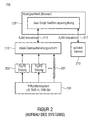
- FIG. 12 shows a schematic structure of a system 200 for editing and displaying an interactive television program transmitted via digital broadcasting according to further embodiments of the invention.
- the system 200 of the Fig. 2 corresponds substantially to the device 100 of Fig. 1 ,
- the following is the in the Fig. 2 shown system 200 by way of example using the protocol framework (or the protocol framework) described by DVB-H. It should be noted, however, that the present invention can be applied without effort to other transmission systems.
- the term "program” used below denotes a content-related flow of information that is perceived by a consumer as a unit.
- the reception of data takes place, for example, via DVB-H and "Flute" protocol.
- the data may be transmitted over digital broadcasting, such as by means of an IP broadcasting system (eg DVB-H, DVB-SH), e.g. B. be transferred as media stream 201 or as media or video files.
- IP broadcasting system e.g DVB-H, DVB-SH
- each contribution or logical unit of the television program may be transmitted as a media / video file.
- files may be distributed which, when contiguous, again result in a television program.
- a flute protocol is generally called a protocol for transferring files, the files are only received from a terminal, but not returned (unidirectional transmission).
- the file renderer 110 is configured to extract a portion of the television program files from a flooding session 205 and to store the extracted portion of the television program files in memory together with an HTML file referencing the television program files.
- the file server is referred to as the "local data rendering layer” in block 110
- the web browser is designated as the "browser” in block 120, which includes a Java script execution environment.
- the term "local data rendering layer” refers to the block 110 being an intermediate layer between the block 101 (IP broadcast system) and the block 120 (browser).
- the file renderer 110 or the local data preparation layer makes it possible for elements that are queried by the web browser 120, ie the extracted television program files or the HTML file referring to them, to be present in a memory and to be informed when requested , can be fetched from the store.
- the query or fetch operation may be via a bidirectional AJAX interaction, as described in US Pat Fig. 2 represented by the double arrow 215 take place.
- the web browser 120 may also communicate directly with the Internet to retrieve the required items. This is in the Fig. 2 represented by the AJAX interaction 217 with the block 210 ("optional: Internet").
- the file renderer 110 may be configured to map the HTML file into the common namespace.
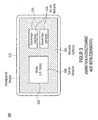
- Fig. 3 shows an application scenario 300 for the in Fig. 2 shown system 200 from a user perspective according to further embodiments of the invention.
- block 310 represents a display device / display with a user interface on which a web page is displayed as full screen 305 (eg, full screen mode of the web browser).
- a portion 320 of the web page includes an integrated media player (media player) containing media content and, in particular, video files ("media").
- media player media player
- another part 330 of the web page has control elements 335 with which the user can control the display of a television program or the associated video files
- Application scenario 300 shown a television channel as a website with various interaction options through additional control functions.
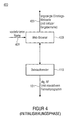
- FIG. 4 shows an illustration for realizing an initialization phase 400 for displaying an entry-level web page for a user according to further embodiments of the invention.
- the web browser 120 accesses a predefined name 401 in the namespace.
- the file renderer 110 extracts an entry-level web page 405 associated with the predefined name 401 from the digital broadcast 101.
- the entry-level web page 405 may be provided and displayed with an initial input mask to a user.
- the user can make the initial settings via the input mask so as to be able to control the further program sequence.
- the reception of data takes place via DVB-H and Flute protocol.
- the access data to this initial flood session is retrieved using an external mechanism, e.g. B. bootstrap session (bootstrap session) via defined access data provided.
- the external mechanism provides the following information for each program.
- the data of all associated flood sessions are mapped by the data preparation layer into a common namespace and can be queried via a special protocol. This builds on the HTTP protocol, so that the objects to be transmitted, as will be described in more detail later, be reached using AJAX requests.
- the visualization of the media content is done by a suitable display unit (browser), which has a Javascript environment.
- a program is shown in which an "initial HTML page" is activated.
- This page references own javascript code, which controls the update and the further program flow. For this purpose, it accesses objects of the data preparation layer with the aid of AJAX.
- the "initial HTML page" is transmitted as part of the excellent flute session and identified by a special keyword.
- Program content updates are supported by well-known FLUTE mechanisms.
- Flute provides a versioning mechanism of the transferred objects. This is made available via the access protocol described in more detail below.
- the Javascript code can check for new content.
- Classic streaming uses the standard DVB-H mechanisms, with the media player representing an object embedded in the HTML page.
- DVB-H standard SDP (session description protocol) files are referenced. All further access data can then be found in the SDP file. The transmission of the SDP file is done with the help of Flute.
- file-based media transfer uses FLUTE objects as an intermediate layer.
- a "sliding play list” is recommended. This references the currently playable media files.
- the required media elements are dynamically installed in the display unit (browser). This includes the element being played and, in preparation, the next elements, with the number of next elements also being installed being variable.
- the playback of the current element is finished, it automatically switches to the next media element that already exists. The past element is removed, and new elements are re-inserted with foresight.
- the query protocol introduced above builds on the HTTP 1. protocol according to further embodiments of the invention.
- the data preparation layer forms all available objects in their own access namespace. This namespace can be addressed in the underlying HTTP protocol as a "Request URL".
- the content of the objects can be accessed using the "HTTP GET" method.
- the following namespace is defined: / Root of the namespace / Current / Access to the current program / ⁇ Prg id> / Access to the program with the Id Prg-Id (the current program (current) is also available)
- the display unit accesses the index.html file of another program, this should trigger a program switchover.
- the new program will then become available under / current /. It should be noted that the index.html of the new program is only loaded after the switchover. This will save you from having to constantly receive all program index.htmls.
- a playback device for example, keeps the index.html files of all favorite stations constantly at hand to speed up the switching process.
- a HEAD query to verify the timeliness can be performed.
- the actuality of a flood object can be checked by the display unit.
- u. a. also takes into account version information of the associated flood object, such as in the so-called "split TOI" concept.
- finding and processing further flute sessions besides the excellent flute session is done as follows.
- a reference file is transferred containing a list of all other associated flute sessions and which sessions are to be received permanently. This list is identified by a special mime type or name.
- the data dressing layer receives the associated FDT from all referenced flood sessions. These are updated according to the entered FDT expire time (FDT expiration time). If a flood session is not to be received permanently, then the decoding is subsequently set until the next FDT update or request for a contained object.
- a method of rendering and displaying an interactive television program transmitted via digital broadcasting includes extracting 130, mapping 140, selecting 150, and displaying 160. Initially, television program files are extracted from the digital broadcast 101 (step 130). Then the files are mapped into a common namespace (step 140). Finally, television program files to be displayed are selected from the television program files depicted in the namespace in response to user interactions 111 (step 150) and displayed (step 160).
- file renderer 110 Although transmission of television program content has always been described above as file-based, it is also possible for the file renderer 110 to be video stream based Maps television programs into the namespace and thus makes them accessible to a user of the web browser 120.
- aspects have been described in the context of a device, it will be understood that these aspects also constitute a description of the corresponding method, so that a block or a component of a device is also to be understood as a corresponding method step or as a feature of a method step. Similarly, aspects described in connection with or as a method step also represent a description of a corresponding block or detail or feature of a corresponding device.
- embodiments of the invention may be implemented in hardware or in software.
- the implementation may be performed using a digital storage medium, such as a floppy disk, a DVD, a Blu-Ray disk, a CD, a ROM, a PROM, an EPROM, an EEPROM or flash memory, a hard disk, or other magnetic disk or optical memory are stored on the electronically readable control signals that can cooperate with a programmable computer system or cooperate such that the respective method is performed. Therefore, the digital storage medium can be computer readable.
- some embodiments according to the invention include a data carrier having electronically readable control signals capable of interacting with a programmable computer system such that one of the methods described herein is performed.
- embodiments of the present invention may be implemented as a computer program product having a program code, wherein the program code is operable to perform one of the methods when the computer program product runs on a computer.
- the program code can also be stored, for example, on a machine-readable carrier.
- inventions include the computer program for performing any of the methods described herein, wherein the computer program is stored on a machine-readable medium.
- an embodiment of the method according to the invention is thus a computer program which has a program code for performing one of the methods described herein when the computer program runs on a computer.
- a further embodiment of the method according to the invention is thus a A storage medium (or a digital storage medium or a computer readable medium) on which the computer program is recorded for performing any of the methods described herein.
- a further embodiment of the method according to the invention is thus a data stream or a sequence of signals, which represent the computer program for performing one of the methods described herein.
- the data stream or the sequence of signals may be configured, for example, to be transferred via a data communication connection, for example via the Internet.
- Another embodiment includes a processing device, such as a computer or a programmable logic device, that is configured or adapted to perform one of the methods described herein.
- a processing device such as a computer or a programmable logic device, that is configured or adapted to perform one of the methods described herein.
- Another embodiment includes a computer on which the computer program is installed to perform one of the methods described herein.
- a programmable logic device e.g., an FPGA (Field Programmable Gate Array) may be used to perform some or all of the functionality of the methods described herein.
- a field programmable gate array may cooperate with a microprocessor to perform one of the methods described herein.
- the methods are performed by any hardware device. This may be a universal hardware such as a computer processor (CPU) or hardware specific to the process, such as an ASIC.
- embodiments of the present invention provide a system for conditioning a data stream received by a digital broadcasting system Contains media data.
- the preparation takes place in the form that the visualization of the media content can be done using conventional web technologies. These include, but are not limited to HTML5, AJAX and Javascript.
- the media contents are provided via a defined query interface (protocol), which has been optimized especially for this application.
- Protocol a defined query interface
- At the center of the process is a component that inserts the push-oriented (press-oriented) data stream of the broadcasting system into the AJAX pull-oriented framework (framework).
- AJAX pull-oriented framework framework
- the method also allows interactions with the user, eg. B. Control of program flow, advertising or games.
- the method presented in the present invention in contrast to HbbTV, is advantageous in that it no longer builds on a linear program but is only a special case of the new system.
- the web techniques are not used for the realization of additional content, but are the core components of the system that composes the program.
Landscapes
- Engineering & Computer Science (AREA)
- Signal Processing (AREA)
- Multimedia (AREA)
- Software Systems (AREA)
- General Engineering & Computer Science (AREA)
- Human Computer Interaction (AREA)
- Two-Way Televisions, Distribution Of Moving Picture Or The Like (AREA)
Priority Applications (2)
| Application Number | Priority Date | Filing Date | Title |
|---|---|---|---|
| EP10162041A EP2385699A1 (fr) | 2010-05-05 | 2010-05-05 | Dispositif et procédé de préparation et d'affichage d'un programme de télévision transmis via une radio numérique |
| PCT/EP2011/057115 WO2011138362A1 (fr) | 2010-05-05 | 2011-05-04 | Appareil et procédé de rendu et d'affichage d'un programme télévisé interactif transmis par radiodiffusion numérique |
Applications Claiming Priority (1)
| Application Number | Priority Date | Filing Date | Title |
|---|---|---|---|
| EP10162041A EP2385699A1 (fr) | 2010-05-05 | 2010-05-05 | Dispositif et procédé de préparation et d'affichage d'un programme de télévision transmis via une radio numérique |
Publications (1)
| Publication Number | Publication Date |
|---|---|
| EP2385699A1 true EP2385699A1 (fr) | 2011-11-09 |
Family
ID=42269644
Family Applications (1)
| Application Number | Title | Priority Date | Filing Date |
|---|---|---|---|
| EP10162041A Withdrawn EP2385699A1 (fr) | 2010-05-05 | 2010-05-05 | Dispositif et procédé de préparation et d'affichage d'un programme de télévision transmis via une radio numérique |
Country Status (2)
| Country | Link |
|---|---|
| EP (1) | EP2385699A1 (fr) |
| WO (1) | WO2011138362A1 (fr) |
Cited By (1)
| Publication number | Priority date | Publication date | Assignee | Title |
|---|---|---|---|---|
| CN109154947A (zh) * | 2016-05-25 | 2019-01-04 | 三星电子株式会社 | 用于呈现定制和交互的方法和设备 |
Families Citing this family (1)
| Publication number | Priority date | Publication date | Assignee | Title |
|---|---|---|---|---|
| CN102595230B (zh) * | 2012-02-17 | 2014-07-30 | 深圳市同洲电子股份有限公司 | 一种节目关联应用的实现方法及数字电视终端 |
Citations (5)
| Publication number | Priority date | Publication date | Assignee | Title |
|---|---|---|---|---|
| US20060053450A1 (en) * | 2004-09-09 | 2006-03-09 | Nokia Corporation | Mobile television electronic service guide delivery system |
| US20060212902A1 (en) * | 2004-12-14 | 2006-09-21 | Samsung Electronics Co., Ltd. | Device and method for displaying broadcasting information in digital broadcasting receiver |
| EP1959596A2 (fr) * | 2007-02-16 | 2008-08-20 | Samsung Electronics Co., Ltd. | Procédé de lecture de données de diffusion numérique pour terminal mobile |
| US20090100475A1 (en) * | 2007-10-12 | 2009-04-16 | Analog Devices, Inc. | Mobile tv system architecture for mobile terminals |
| EP2076032A2 (fr) * | 2007-12-26 | 2009-07-01 | Lg Electronics Inc. | Procédé et appareil pour le traitement d'informations d'un guide de services |
Family Cites Families (3)
| Publication number | Priority date | Publication date | Assignee | Title |
|---|---|---|---|---|
| WO2002075596A2 (fr) * | 2001-03-16 | 2002-09-26 | Nds Limited | Procede et systeme d'acces a des donnees litterales |
| JPWO2005076499A1 (ja) * | 2004-02-05 | 2007-10-18 | 松下電器産業株式会社 | 端末装置及び受信データ表示方法 |
| GB0420531D0 (en) * | 2004-09-15 | 2004-10-20 | Nokia Corp | File delivery session handling |
-
2010
- 2010-05-05 EP EP10162041A patent/EP2385699A1/fr not_active Withdrawn
-
2011
- 2011-05-04 WO PCT/EP2011/057115 patent/WO2011138362A1/fr not_active Ceased
Patent Citations (5)
| Publication number | Priority date | Publication date | Assignee | Title |
|---|---|---|---|---|
| US20060053450A1 (en) * | 2004-09-09 | 2006-03-09 | Nokia Corporation | Mobile television electronic service guide delivery system |
| US20060212902A1 (en) * | 2004-12-14 | 2006-09-21 | Samsung Electronics Co., Ltd. | Device and method for displaying broadcasting information in digital broadcasting receiver |
| EP1959596A2 (fr) * | 2007-02-16 | 2008-08-20 | Samsung Electronics Co., Ltd. | Procédé de lecture de données de diffusion numérique pour terminal mobile |
| US20090100475A1 (en) * | 2007-10-12 | 2009-04-16 | Analog Devices, Inc. | Mobile tv system architecture for mobile terminals |
| EP2076032A2 (fr) * | 2007-12-26 | 2009-07-01 | Lg Electronics Inc. | Procédé et appareil pour le traitement d'informations d'un guide de services |
Cited By (2)
| Publication number | Priority date | Publication date | Assignee | Title |
|---|---|---|---|---|
| CN109154947A (zh) * | 2016-05-25 | 2019-01-04 | 三星电子株式会社 | 用于呈现定制和交互的方法和设备 |
| CN109154947B (zh) * | 2016-05-25 | 2023-03-21 | 三星电子株式会社 | 用于播放呈现的方法和用户设备以及服务器 |
Also Published As
| Publication number | Publication date |
|---|---|
| WO2011138362A1 (fr) | 2011-11-10 |
Similar Documents
| Publication | Publication Date | Title |
|---|---|---|
| DE69731549T2 (de) | Interaktivität mit audiovisueller programmierung | |
| DE69937674T2 (de) | Programmeempfangsgerät | |
| DE202011110736U1 (de) | Vorrichtung zum Bereitstellen einer bisherigen Merkliste von durch verschiedene Quellen bereitgestellten Inhalten, und Anzeigevorrichtung zu dessen Ausführung | |
| DE69801900T2 (de) | System und methode zur bereitstellung eines volldienst-fernsehsystems | |
| DE602004010773T2 (de) | Verfahren zum Extrahieren von Programmen und Gerät zum Extrahieren von Programmen | |
| DE10316654B4 (de) | Fernaufzeichnungsreservierungs-Steuerungssystem und Verfahren dazu | |
| DE60203175T2 (de) | Automatisierte eingabe in einem interaktiven fernsehsystem | |
| DE112016001450B4 (de) | Videoinhaltswiedergabe | |
| EP2315429A1 (fr) | Procédé, dispositif et système d'émission sélective de contenus multimédias | |
| DE20314039U1 (de) | Streamingportal, Computervorrichtung mit dem Streamingportal, Computerprogrammprodukt, computerlesbares Medium, Computernetzwerk zum Bereitstellen des Streamingportals, erstes, zweites und drittes Computersystem | |
| EP2385699A1 (fr) | Dispositif et procédé de préparation et d'affichage d'un programme de télévision transmis via une radio numérique | |
| DE60223054T2 (de) | Verbesserungen bezüglich der inhaltsauswahl | |
| DE69815711T2 (de) | System zur verarbeitung von rundfunksignalen | |
| DE112020001891B4 (de) | Systeme und Methoden der universellen Videoeinbettung | |
| US8904450B2 (en) | Individual internet video link channel | |
| EP2036348B1 (fr) | Dispositif et procede pour la manipulation unifiee d'une pluralite de sources de signaux utiles | |
| EP2437510B1 (fr) | Dispositif de commande de programme interactif doté de fonctions de commande pour un récepteur de télévision numérique | |
| EP2197202A1 (fr) | Procédé et dispositif destinés au traitement de données et système comprenant ce dispositif | |
| DE102013210644B4 (de) | Methode und Einrichtung zum Integrieren von audio-visuellen Medieninhalten von Web-TV bzw. Webradio-Diensten in die Rundfunkkanal- und Programmverzeichnisse eines TV-Empfängers | |
| DE102008028840B3 (de) | Interaktives Fernsehen | |
| DE112008002114B4 (de) | Elektronischer Programmführer | |
| DE10203098B4 (de) | Verfahren zum Bereitstellen eines Video/Audio-on-Demand | |
| EP1978700A1 (fr) | Procédé et système de préparation d'une sélection de données par un degré de concordance entre des offres de programmes et de services et l'intérêt de l'utilisateur | |
| EP2271100A1 (fr) | Procédé et dispositif d'accès à des contenus supplémentaires pour contenus multimédias | |
| DE60203422T2 (de) | Verfahren zum Steuern eines Gerätes mit mehreren Videoquellen |
Legal Events
| Date | Code | Title | Description |
|---|---|---|---|
| AK | Designated contracting states |
Kind code of ref document: A1 Designated state(s): AL AT BE BG CH CY CZ DE DK EE ES FI FR GB GR HR HU IE IS IT LI LT LU LV MC MK MT NL NO PL PT RO SE SI SK SM TR |
|
| AX | Request for extension of the european patent |
Extension state: BA ME RS |
|
| PUAI | Public reference made under article 153(3) epc to a published international application that has entered the european phase |
Free format text: ORIGINAL CODE: 0009012 |
|
| STAA | Information on the status of an ep patent application or granted ep patent |
Free format text: STATUS: THE APPLICATION IS DEEMED TO BE WITHDRAWN |
|
| 18D | Application deemed to be withdrawn |
Effective date: 20120510 |