EP2386794A2 - Dispositif d'éclairage de véhicule - Google Patents
Dispositif d'éclairage de véhicule Download PDFInfo
- Publication number
- EP2386794A2 EP2386794A2 EP11165385A EP11165385A EP2386794A2 EP 2386794 A2 EP2386794 A2 EP 2386794A2 EP 11165385 A EP11165385 A EP 11165385A EP 11165385 A EP11165385 A EP 11165385A EP 2386794 A2 EP2386794 A2 EP 2386794A2
- Authority
- EP
- European Patent Office
- Prior art keywords
- reflection surface
- fixed
- segment
- light
- distribution pattern
- Prior art date
- Legal status (The legal status is an assumption and is not a legal conclusion. Google has not performed a legal analysis and makes no representation as to the accuracy of the status listed.)
- Withdrawn
Links
- 230000003287 optical effect Effects 0.000 description 18
- 230000000007 visual effect Effects 0.000 description 8
- 239000000470 constituent Substances 0.000 description 5
- 230000003247 decreasing effect Effects 0.000 description 5
- 230000004907 flux Effects 0.000 description 5
- 239000011347 resin Substances 0.000 description 5
- 229920005989 resin Polymers 0.000 description 5
- 230000005540 biological transmission Effects 0.000 description 3
- 230000000694 effects Effects 0.000 description 2
- 239000002184 metal Substances 0.000 description 2
- 230000002093 peripheral effect Effects 0.000 description 2
- 238000007789 sealing Methods 0.000 description 2
- 238000003491 array Methods 0.000 description 1
- 238000005094 computer simulation Methods 0.000 description 1
- 239000007787 solid Substances 0.000 description 1
- 239000000758 substrate Substances 0.000 description 1
Images









Classifications
-
- F—MECHANICAL ENGINEERING; LIGHTING; HEATING; WEAPONS; BLASTING
- F21—LIGHTING
- F21S—NON-PORTABLE LIGHTING DEVICES; SYSTEMS THEREOF; VEHICLE LIGHTING DEVICES SPECIALLY ADAPTED FOR VEHICLE EXTERIORS
- F21S41/00—Illuminating devices specially adapted for vehicle exteriors, e.g. headlamps
- F21S41/60—Illuminating devices specially adapted for vehicle exteriors, e.g. headlamps characterised by a variable light distribution
- F21S41/67—Illuminating devices specially adapted for vehicle exteriors, e.g. headlamps characterised by a variable light distribution by acting on reflectors
- F21S41/675—Illuminating devices specially adapted for vehicle exteriors, e.g. headlamps characterised by a variable light distribution by acting on reflectors by moving reflectors
-
- F—MECHANICAL ENGINEERING; LIGHTING; HEATING; WEAPONS; BLASTING
- F21—LIGHTING
- F21S—NON-PORTABLE LIGHTING DEVICES; SYSTEMS THEREOF; VEHICLE LIGHTING DEVICES SPECIALLY ADAPTED FOR VEHICLE EXTERIORS
- F21S41/00—Illuminating devices specially adapted for vehicle exteriors, e.g. headlamps
- F21S41/10—Illuminating devices specially adapted for vehicle exteriors, e.g. headlamps characterised by the light source
- F21S41/14—Illuminating devices specially adapted for vehicle exteriors, e.g. headlamps characterised by the light source characterised by the type of light source
- F21S41/141—Light emitting diodes [LED]
- F21S41/147—Light emitting diodes [LED] the main emission direction of the LED being angled to the optical axis of the illuminating device
- F21S41/148—Light emitting diodes [LED] the main emission direction of the LED being angled to the optical axis of the illuminating device the main emission direction of the LED being perpendicular to the optical axis
-
- F—MECHANICAL ENGINEERING; LIGHTING; HEATING; WEAPONS; BLASTING
- F21—LIGHTING
- F21S—NON-PORTABLE LIGHTING DEVICES; SYSTEMS THEREOF; VEHICLE LIGHTING DEVICES SPECIALLY ADAPTED FOR VEHICLE EXTERIORS
- F21S41/00—Illuminating devices specially adapted for vehicle exteriors, e.g. headlamps
- F21S41/30—Illuminating devices specially adapted for vehicle exteriors, e.g. headlamps characterised by reflectors
- F21S41/32—Optical layout thereof
- F21S41/321—Optical layout thereof the reflector being a surface of revolution or a planar surface, e.g. truncated
-
- F—MECHANICAL ENGINEERING; LIGHTING; HEATING; WEAPONS; BLASTING
- F21—LIGHTING
- F21S—NON-PORTABLE LIGHTING DEVICES; SYSTEMS THEREOF; VEHICLE LIGHTING DEVICES SPECIALLY ADAPTED FOR VEHICLE EXTERIORS
- F21S41/00—Illuminating devices specially adapted for vehicle exteriors, e.g. headlamps
- F21S41/30—Illuminating devices specially adapted for vehicle exteriors, e.g. headlamps characterised by reflectors
- F21S41/32—Optical layout thereof
- F21S41/33—Multi-surface reflectors, e.g. reflectors with facets or reflectors with portions of different curvature
- F21S41/334—Multi-surface reflectors, e.g. reflectors with facets or reflectors with portions of different curvature the reflector consisting of patch like sectors
- F21S41/336—Multi-surface reflectors, e.g. reflectors with facets or reflectors with portions of different curvature the reflector consisting of patch like sectors with discontinuity at the junction between adjacent areas
-
- F—MECHANICAL ENGINEERING; LIGHTING; HEATING; WEAPONS; BLASTING
- F21—LIGHTING
- F21S—NON-PORTABLE LIGHTING DEVICES; SYSTEMS THEREOF; VEHICLE LIGHTING DEVICES SPECIALLY ADAPTED FOR VEHICLE EXTERIORS
- F21S41/00—Illuminating devices specially adapted for vehicle exteriors, e.g. headlamps
- F21S41/30—Illuminating devices specially adapted for vehicle exteriors, e.g. headlamps characterised by reflectors
- F21S41/32—Optical layout thereof
- F21S41/36—Combinations of two or more separate reflectors
-
- F—MECHANICAL ENGINEERING; LIGHTING; HEATING; WEAPONS; BLASTING
- F21—LIGHTING
- F21S—NON-PORTABLE LIGHTING DEVICES; SYSTEMS THEREOF; VEHICLE LIGHTING DEVICES SPECIALLY ADAPTED FOR VEHICLE EXTERIORS
- F21S45/00—Arrangements within vehicle lighting devices specially adapted for vehicle exteriors, for purposes other than emission or distribution of light
- F21S45/40—Cooling of lighting devices
- F21S45/47—Passive cooling, e.g. using fins, thermal conductive elements or openings
- F21S45/48—Passive cooling, e.g. using fins, thermal conductive elements or openings with means for conducting heat from the inside to the outside of the lighting devices, e.g. with fins on the outer surface of the lighting device
-
- F—MECHANICAL ENGINEERING; LIGHTING; HEATING; WEAPONS; BLASTING
- F21—LIGHTING
- F21W—INDEXING SCHEME ASSOCIATED WITH SUBCLASSES F21K, F21L, F21S and F21V, RELATING TO USES OR APPLICATIONS OF LIGHTING DEVICES OR SYSTEMS
- F21W2102/00—Exterior vehicle lighting devices for illuminating purposes
-
- F—MECHANICAL ENGINEERING; LIGHTING; HEATING; WEAPONS; BLASTING
- F21—LIGHTING
- F21W—INDEXING SCHEME ASSOCIATED WITH SUBCLASSES F21K, F21L, F21S and F21V, RELATING TO USES OR APPLICATIONS OF LIGHTING DEVICES OR SYSTEMS
- F21W2102/00—Exterior vehicle lighting devices for illuminating purposes
- F21W2102/10—Arrangement or contour of the emitted light
- F21W2102/13—Arrangement or contour of the emitted light for high-beam region or low-beam region
- F21W2102/135—Arrangement or contour of the emitted light for high-beam region or low-beam region the light having cut-off lines, i.e. clear borderlines between emitted regions and dark regions
- F21W2102/155—Arrangement or contour of the emitted light for high-beam region or low-beam region the light having cut-off lines, i.e. clear borderlines between emitted regions and dark regions having inclined and horizontal cutoff lines
-
- F—MECHANICAL ENGINEERING; LIGHTING; HEATING; WEAPONS; BLASTING
- F21—LIGHTING
- F21W—INDEXING SCHEME ASSOCIATED WITH SUBCLASSES F21K, F21L, F21S and F21V, RELATING TO USES OR APPLICATIONS OF LIGHTING DEVICES OR SYSTEMS
- F21W2102/00—Exterior vehicle lighting devices for illuminating purposes
- F21W2102/20—Illuminance distribution within the emitted light
-
- F—MECHANICAL ENGINEERING; LIGHTING; HEATING; WEAPONS; BLASTING
- F21—LIGHTING
- F21W—INDEXING SCHEME ASSOCIATED WITH SUBCLASSES F21K, F21L, F21S and F21V, RELATING TO USES OR APPLICATIONS OF LIGHTING DEVICES OR SYSTEMS
- F21W2102/00—Exterior vehicle lighting devices for illuminating purposes
- F21W2102/30—Fog lights
-
- F—MECHANICAL ENGINEERING; LIGHTING; HEATING; WEAPONS; BLASTING
- F21—LIGHTING
- F21Y—INDEXING SCHEME ASSOCIATED WITH SUBCLASSES F21K, F21L, F21S and F21V, RELATING TO THE FORM OR THE KIND OF THE LIGHT SOURCES OR OF THE COLOUR OF THE LIGHT EMITTED
- F21Y2115/00—Light-generating elements of semiconductor light sources
- F21Y2115/10—Light-emitting diodes [LED]
Definitions
- the present invention relates to a vehicle lighting device which is comprised of two light source/reflection surface units.
- a vehicle lighting device of such type is conventionally known (for example, Japanese Patent Application Laid-open No. 2006-24509 ).
- a conventional vehicle lighting device will be described.
- a light emitting unit for lighting device is comprised of: an LED as a light source; and a reflection surface for reflecting light from the LED with a predetermined light distribution pattern, and two light emitting units for lighting device are disposed at a top and a bottom of the lighting device.
- functions of the conventional vehicle lighting device will be described.
- two light emitting units for lighting device a respective one of which is comprised of an LED and a reflection surface, are disposed at the top and the bottom of the lighting device. Therefore, in the conventional vehicle lighting device, a nonluminous portion to which the light beams from the top and bottom LEDs are disallowed to be incident, i.e., a dark part may be formed between the top and bottom light emitting units for lighting device.
- the problem to be solved by the present invention is that, in the conventional vehicle lighting device, a nonluminous portion to which the light beams from the top and bottom LEDs are disallowed to be incident, i.e., a dark part may be formed between the top and bottom light emitting units for lighting device.
- a vehicle lighting device of claim 1 in the present invention which is comprised of two light source/reflection surface units, said device comprising:
- the vehicle lighting device of claim 4 in the present invention wherein the fixed reflector and the movable reflector is formed in a shape of a rotating parabolic face.
- the invention according to claim 1 by means for solving the problem described previously, if a first semiconductor-type light source and a second semiconductor-type light source are illuminated to emit light, a major part of light that is radiated from the first semiconductor-type light source is reflected and emitted as a predetermined light distribution pattern on a first reflection surface; and a major part of light that is radiated from a second semiconductor-type light source is reflected and emitted as a predetermined light distribution pattern on a second reflection surface.
- the vehicle lighting device of the present invention (the invention according to claim 1), a remaining portion of a respective one of the light beams that are radiated from the first semiconductor-type light source and the second semiconductor-type light source is reflected on an additional reflection surface and then the reflected light is incident to an intermediate invalid reflection surface, so that the intermediate invalid reflection surface between the first reflection surface and the second reflection surface is allowed to be luminous.
- the vehicle lighting device of the present invention (the invention according to claim 1) is capable of eliminating a dark part between the first reflection surface and the second reflection surface.
- the vehicle lighting device of the present invention is capable of substantially entirely illuminate the intermediate invalid reflection surface between the first reflection surface and the second reflection surface, the first reflection surface, and the second reflection surface.
- the vehicle lighting device of the present invention is improved in quality, is also improved in visual recognition property, and further, is improved in appearance, in comparison with the conventional vehicle lighting device in which a nonluminous dark part may be formed between top and bottom light emitting units for lighting device.
- the vehicle lighting device of the present invention by means for solving the problem described above, when a movable reflector is positioned in a first location, a predetermined first light distribution pattern is reflected and emitted from a fixed reflection surface for first light distribution pattern of a first fixed reflection surface and a second fixed reflection surface; and when the movable reflector is positioned in a second location, a predetermined second light distribution pattern is reflected and emitted from a respective one of a fixed reflection surface for second light distribution pattern of the first fixed reflection surface and the second fixed reflection surface and a movable reflection surface for second light distribution pattern of a first movable reflection surface and a second movable reflection surface.
- the vehicle lighting device of the present invention when the movable reflector is positioned in a second location, a part of light beams that are radiated from a first semiconductor-type light source and a second semiconductor-type light source is reflected on an additional reflection surface and then the reflected light is incident to an intermediate invalid reflection surface, so that the intermediate invalid reflection surface can be illuminated between a fixed reflection surface for second light distribution pattern, which is more outside than the fixed reflection surface for first light distribution pattern of the first fixed reflection surface, and a fixed reflection surface for second light distribution pattern, which is more outside than the fixed reflection surface for first light distribution pattern of the second fixed reflection surface.
- the vehicle lighting device of the present invention is capable of eliminating a dark part between the fixed reflection surface for second light distribution pattern, which is more outside than the fixed reflection surface for first light distribution pattern of the first fixed reflection surface, and the fixed reflection surface for second light distribution pattern, which is more outside than the fixed reflection surface for first light distribution pattern of the second fixed reflection surface.
- the vehicle lighting device of the present invention is capable of substantially entirely illuminating: the fixed reflection surface for second light distribution pattern of the first fixed reflection surface; the fixed reflection surface for second light distribution pattern of the second fixed reflection surface; and the intermediate invalid reflection surface between the fixed reflection surface for second light distribution pattern, which is more outside than the fixed reflection surface for first light distribution pattern of the first fixed reflection surface, and the fixed reflection surface for second light distribution pattern, which is more outside than the fixed reflection surface for first light distribution pattern of the second fixed reflection surface.
- the vehicle lighting device of the present invention (the invention according to claim 2) is improved ins quality, is also improved in visual recognition property, and further, is improved in appearance, in comparison with the conventional vehicle lighting device in which a nonluminous dark part may be formed between top and bottom light emitting units for lighting device.
- an additional reflection surface is positioned in a range other than a high energy range in energy distribution of a first semiconductor-type light source and a second semiconductor-type light source of a movable reflector when it is positioned in a second location.
- the vehicle lighting device of the present invention when the movable reflector is positioned in the second location, the light beams with high energy in energy distribution of the first semiconductor-type light source and the second semiconductor-type light source is disallowed to be interfered with the additional reflection surface from being incident to the fixed reflection surface for second light distribution pattern of the first fixed reflection surface and the second fixed reflection surface and the movable reflection surface for second light distribution pattern of the first movable reflection surface and the second movable reflection surface, respectively.
- the light beams with high energy in energy distribution of the first semiconductor-type light source and the second semiconductor-type light source are reliably incident to the fixed reflection surface for second light distribution pattern of the first fixed reflection surface and the second fixed reflection surface and the movable reflection surface for second light distribution pattern of the first movable reflection surface and the second movable reflection surface, respectively.
- the light quantity (lightness, luminance, luminous flux) of the predetermined second light distribution pattern is disallowed to be decreased by means of the additional reflection surface.
- an additional reflection surface is positioned in a range other than a high energy range in energy distribution of a first semiconductor-type light source and a second semiconductor-type light source of a movable reflector when it is positioned in a second location.
- the vehicle lighting device of the present invention when the movable reflector is positioned in the first location, the respective one of the light beams from the first semiconductor-type light source and the second semiconductor-type light source is reliably incident to the fixed reflection surface for first light distribution pattern of the first fixed reflection surface and the second fixed reflection surface.
- the light quantity (lightness, luminance, luminous flux) of the predetermined first light distribution pattern is disallowed to be decreased on the additional reflection surface.
- the vehicle lighting device of the present invention by means for solving the problem described previously, if a first semiconductor-type light source and a second semiconductor-type light source are illuminated to emit light, a major part of light beams that are radiated from the first semiconductor-type light source and the second semiconductor-type light source are reflected and emitted as a predetermined light distribution pattern on a first fixed reflection surface and a second fixed reflection surface.
- the vehicle lighting device of the present invention (the invention according to claim 3) a remaining part of a respective one of the light beams that are radiated from the first semiconductor-type light source and the second semiconductor-type light source is reflected on an additional reflection surface and then the reflected light is incident to an intermediate invalid reflection surface, so that the intermediate invalid reflection surface between the first fixed reflection surface and the second fixed reflection surface can be illuminated.
- the vehicle lighting device of the present invention (the invention according to claim 3) is capable of eliminating a dark part between the first fixed reflection surface and the second fixed reflection surface.
- the vehicle lighting device of the present invention is capable of substantially entirely illuminate the first fixed reflection surface, the second fixed reflection surface, and the intermediate invalid reflection surface between the first fixed reflection surface and the second fixed reflection surface.
- the vehicle lighting device of the present invention is improved in quality, is also improved in visual recognition property, and further, is improved in appearance, in comparison with the conventional vehicle lighting device in which a nonluminous dark part may be formed between top and bottom light emitting units for lighting device.
- an additional reflection surface is positioned in a range other than a high energy range in energy distribution of a first semiconductor-type light source and a second semiconductor-type light source of a fixed reflector.
- light beams with high energy in energy distribution of the first semiconductor-type light source and the second semiconductor-type light source is disallowed to be interfered with the additional reflection surface from being incident to the first fixed reflection surface and the second fixed reflection surface, respectively.
- the light beams in energy distribution of the first semiconductor-type light source and the second semiconductor-type light source are reliably incident to the first fixed reflection surface and the second fixed reflection surface, respectively.
- the light quantity (lightness, luminance, luminous flux) of the predetermined light distribution pattern is disallowed to be decreased by means of the additional reflection surface.
- the fixed reflector and the movable reflector according to claim 2 or the fixed reflector according to claim 3 are formed in the shape of a rotating parabolic face. Therefore, in the vehicle lighting device of the present invention (the invention according to claim 4), a part of the light beams that are radiated from the first semiconductor-type light source and the second semiconductor-type light source can be cross-reflected easily and reliably on an intermediate invalid reflection surface by means of an additional reflection surface.
- FIGS. 25 and 26 are explanatory views showing a reflection image group of a light emitting chip on the screen obtained by computer simulation.
- the terms “top”, “bottom”, “front”, “rear”, “left”, and “right” designate the top, bottom, front, rear, left, and right of a vehicle when the vehicle headlamp according to the present invention is mounted on a vehicle (automobile).
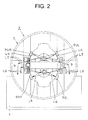
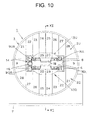
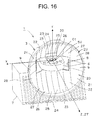
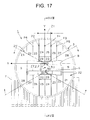
- FIGS. 16 , 17 , and 18 in order to clarify a structure of the invention, an upside movable reflector 13U, a downside movable reflector 13D, and a drive unit 14 are not shown. Further, in FIGS. 1 to 3 , and 8 to 11 a fin shape of a heat sink 7 is not shown.
- FIGS 1 to 28 are showing the embodiment 1 of vehicle lighting device on the present the invention.
- reference numeral 1 denotes a vehicle lighting device (vehicle headlamp) in the embodiment.
- the vehicle lighting device 1 illuminates light toward a forward direction of a vehicle by changing: a light distribution pattern for low beam passing (light distribution pattern for passing: first light distribution pattern), shown in FIG. 27 ; a light distribution pattern for high beam (light distribution pattern for cruising: second light distribution pattern), shown in FIG. 28 .
- the light distribution pattern LP for low beam having, shown in FIG 27 , an oblique cutoff line CL1 on a cruising lane side (left side) and a horizontal cutoff line CL2 on an opposite lane side (right side) with an elbow point E being a boundary.
- An angle formed between the oblique cutoff line CL1 and a horizontal line HL-HR of a screen is about 15 degrees.
- the light distribution pattern for high beam includes, shown in FIG. 28 , a first light distribution pattern HP1 for high beam, a second light distribution pattern HP2 for high beam, a third light distribution pattern HP3 for high beam, and a light distribution pattern LP1 for dimming low beam.
- the vehicle lighting device 1 is made up of: a fixed reflector 3 having an upside reflecting surface 2U (a first reflection surface, a first fixed reflection surface) and a downside reflecting surface 2D (a second reflection surface, a second fixed reflection surface) made of a parabola-based free curved face (NURBS-curved face); upside and downside movable reflectors 13U and 13D having upside and downside reflecting surfaces 12U (a first reflection surface, a first movable reflection surface, a movable reflection surface for second light distribution pattern) and 12D (a second reflection surface, a second movable reflection surface, a movable reflection surface for second light distribution pattern) made of a parabola-based free curved face (NURBS-curved face), similarly; an upside semiconductor-type light source 5U (a first semiconductor-type light source) and a downside semiconductor-type light source 5D (a second semiconductor-type light source) having a light emitting chip of a planar rectangle shape (planar elongated shape); a holder 6; a heat sink member
- the holder 6 is shaped like a plate having a top fixing face and a bottom fixing face.
- the holder 6 is made up of a resin member or a metal member with high thermal conductivity, for example.
- the heat sink member 7 is formed in a trapezoidal shape having an upper fixing face at its upper part, and is shaped like a fin from an intermediate part to a lower part.
- the heat sink member 7 is made up of a resin member or a metal member with high thermal conductivity, for example.
- the fixed reflector 3, the upside movable reflector 13U, the downside movable reflector 13D, the upside semiconductor-type light source 5U, the downside semiconductor-type light source 5D, the holder 6, the heat sink member 7, and the drive unit 14 constitute a lamp unit.
- the fixed reflector 3 is fixed and held on the holder 6.
- the upside movable reflector 13U and the downside movable reflector 13D are rotatably mounted on the holder 6 around a horizontal axis X.
- the upside semiconductor-type light source 5U is fixed and held on the top fixing face of the holder 6.
- the downside semiconductor-type light source 5D is fixed and held on the bottom fixing face of the holder 6.
- the holder 6 is fixed and held on the top fixing face of the hear sink member 7.
- the drive 6 is fixed and held on a top fixing face of the heat sink member 7.
- the drive unit 14 is fixed and held on the top fixing face of the holder 6 and the heat sink member 7
- the lamp units 3, 5U, 5D, 6, 7, 13U, 13D, 14 are disposed via an optical-axis adjustment mechanism, for example, in a lamp room partitioned by the lamp housing and the lamp lens. In the lamp room, apart from the lamp units 3, 5U, 5D, 6, 7, 13U, 13D, 14, other lamp units such as a fog lamp, a cornering lamp, a clearance lamp, and a turn signal lamp may be disposed.
- the upside reflecting surface 2U of the fixed reflector 3; the upside reflecting surface 12U of the upside movable reflector 13U; and the upside semiconductor-type light source 5U constitutes an upside unit (a first light source and reflecting surface unit) in which a light emitting face of the light emitting chip 4 is oriented upward in a vertical-axis Y direction.
- the downside reflecting surface 2D of the fixed reflector 3; the downside reflecting surface 12D of the downside movable reflector 13D; and the downside semiconductor-type light source 5D constitutes a downside unit (a second light source and reflecting surface unit) in which a light emitting face of the light emitting chip 4 is oriented downward in a vertical-axis Y direction.
- the upside units 2U, 5U, 12U, 13U and the downside units 2D, 5D, 12D, 13D, as shown in FIG. 17 are disposed in a point-symmetrical state with a point O being a center.
- a reflecting surface design of the upside reflecting surfaces 2U, 12U and a reflecting surface design of the downside reflecting surfaces 2D, 12D are not merely point-symmetrical (inverted).
- the fixed reflector 3 is made up of an optically opaque resin member or the like, for example.
- the fixed reflector 3 is substantially shaped like a rotational parabola-based face while an axis passing through the point-symmetrical point O is defined as a rotary axis.
- a front side of the fixed reflector 3 is opened in a substantial circle.
- a rear side of the fixed reflector 3 is closed.
- An elongated, substantially rectangular window portion 8 is provided at an intermediate part of the closed portion of the fixed reflector 3.
- the holder 6 is inserted into the window portion 8 of the fixed reflector 3.
- the fixed reflector 3 is fixed and held on the holder 6 at the outside (rear side) of the closed portion.
- the upside reflecting surface 2U and the downside reflecting surface 2D are provided, respectively at the upside and downside of the window portion 8.
- the upside reflecting surface 2U and the downside reflecting surface 2D made of a parabola-based free curved face (NURBS-curved face) has a reference focal point (pseudo-focal point) F and a reference optical axis (pseudo-optical axis) Z.
- An intermediate invalid reflection surface 9 is continually provided between the upside reflecting surface 2U and the downside reflecting surface 2D and at both the left and right sides of the window portion 8 of the inside (front side) of the closed portion of the fixed reflector 3.
- the intermediate invalid reflection surface 9 is a surface to which light beams (direct light beams) from the upside semiconductor-type light source 5U and the downside semiconductor-type light source 5D are disallowed to be incident.
- the upside reflecting surface 2U and the downside reflecting surface 2D of the fixed reflector 3 are made up of: a reflecting surface for low beam (a fixed reflection surface for first light distribution pattern and a fixed reflection surface for second light distribution pattern), forming the light distribution pattern LP for low beam and the light distribution pattern LP1 for dimming low beam; and a first reflecting surface for high beam (a fixed reflection surface for second light distribution pattern) and a second reflecting surface for high beam (a fixed reflection surface for second light distribution pattern), forming the first light distribution pattern HP 1 for high beam and the second light distribution pattern HP2 for high beam.
- the drive unit 14 is made up of a motor 15, a drive force transmission mechanism 16, and a spring for returning a mobile reflector (not shown).
- the motor 15 is directly fixed and held on the top fixing face of the heat sink member 7. In this manner, a heat generated at the time of supplying power to the motor 15 can be radiated (dissipated) to the outside at the heat sink member 7.
- the drive force transmission mechanism 16 is provided between the motor 15 and a respective one of the upside movable reflector 13U and the downside movable reflector 13D
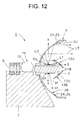
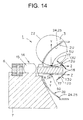
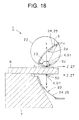
- the drive unit 14 rotates the upside movable reflector 13U and the downside movable reflector 13D with respect to the holder 6 around the horizontal-axis X between a first location (the location in a state shown in FIGS. 8 , 10 , 12 , and 14 ) and a second location (the location in a state shown in FIGS. 1 to 3 , 9, 11, 13, and 15 ).
- the upside movable reflector 13U and the downside movable reflector 13D are made up of an optically opaque resin member, for example.
- the upside movable reflector 13U and the downside movable reflector 13D, positioned in the second location, are substantially shaped like a rotational parabola-based face while an axis passing through the point-symmetrical point O is defined as a rotary axis.
- the front sides of the upside movable reflector 13U and the downside movable reflector 13D, positioned in the second location are opened in a substantial circle.
- the size of the opening i.e., an opening area at the front side of the upside movable reflector 13U and the downside movable reflector 13D is smaller than that of the opening, i.e., an opening area at the front side of the fixed reflector 3.
- Semicircular through holes 17 are provided at central parts of the upside movable reflector 13U and the downside movable reflector 13D, respectively.
- rectangular visor portions 18 are integrally provided at intermediate parts of the peripheral parts of the upside movable reflector 13U and the downside movable reflector 13D, respectively.
- the upside reflecting surface 12U and the downside reflecting surface 12D are provided on faces opposite to the upside semiconductor-type light source 5U of the upside movable reflector 13U and the downside semiconductor-type light source 5D of the downside movable reflector 13D, respectively.
- the upside reflecting surface 12U and the downside reflecting surface 12D that are made of a parabola-based free curved face has a reference focal point (pseudo-focal point) F1 and a reference optical axis (pseudo-optical axis) Z7.
- the upside reflecting surface 12U of the upside movable reflector 13U and the downside reflecting surface 12D of the downside movable reflector 13D are made of a third reflecting surface for high beam, forming the third light distribution pattern HP3 for high beam.
- the semiconductor-type light sources 5U, 5D are made up of: a board 10: the light emitting chip 4 provided on the board 10; and a sealing resin member 11 shaped like a thin rectangular solid, for sealing the light emitting chip 4.
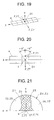
- the light emitting chip 4, as shown in FIGS. 19 and 20 arrays five square chips in a horizontal-axis X direction. One rectangular chip may be used.
- a center O1 of the light emitting chip 4 is positioned at or near reference focal points F, F1 of the reflecting surfaces 2U, 2D, 12U, 12D, and is positioned on reference optical axes Z, Z7 of the reflecting surfaces 2U, 2D, 12U, 12D.
- a light emitting face of the light emitting chip 4 (face opposite to opposite to a face opposed to the substrate 10) is oriented to the vertical-axis Y direction.
- the light emitting face of the light emitting chip 4 of the upside semiconductor-type light source 5U is oriented upward in the vertical-axis Y direction.
- the light emitting face of the light emitting chip 4 of the downside semiconductor-type light source 5D is oriented downward in the vertical-axis Y direction. Further, a long side of the light emitting chip 4 is parallel to a horizontal-axis X which is orthogonal to the reference optical axes Z, Z7 and the vertical axis Y.
- the horizontal axis X passes through the center O1 of the light emitting chip 4 or its vicinity (between the center O1 of the light emitting chip 4 and a long side at the rear side of the light emitting chip 4, and in this example, on the long side at the rear side of the light emitting chip 4), or alternatively, passes through the reference focal points F, F1 or its vicinity of the reflecting surfaces 2U, 2D, 12U, 12D.
- the horizontal axis X, the vertical axis Y, and the reference optical axes Z, Z7 constitute an orthogonal coordinate (X-Y Z orthogonal coordinate system) with the center O1 of the light emitting chip 4 serving as an origin.
- the horizontal axis X in the case of the upside unit 2U, 5U, 12U, the right side corresponds to a positive direction, and the left side corresponds to a negative direction; in the case of the downside units 2D, 5D, 12D, the left side corresponds to a positive direction and the right side corresponds to a negative direction.
- the upside corresponds to a positive direction; and the downside corresponds to a negative direction; and in the case of the downside units 2D, 5D, 12D, the downside corresponds to a positive direction, and the upside corresponds to a negative direction.
- the reference optical axes Z, Z7 in a respective one of the upside units 2U, 5U and the downside units 2D, 5D, the front side corresponds to a positive direction and the rear side corresponds to a negative direction.
- the reflecting surfaces 2U, 2D of the fixed reflector 3 and the reflecting surfaces 12U, 12D of the movable reflectors 13U, 13D are made up of a parabola-based free curved face (NURBS-curved face).
- the reference focal point F of the reflecting surfaces 2U, 2D of the fixed reflector 3 and the reference focal point F1 of the reflecting surfaces 12U, 12D of the movable reflector 13U, 13D are coincident or substantially coincident with each other; and are positioned on the reference optical axes Z, Z7 and between the center O1 of the light emitting chip 4 and a long side at the rear side of the light emitting chip 4. In this example, these points are positioned at the long side at the rear side of the light emitting chip 4.
- the reference focal-point distance of the reflecting surfaces 2U, 2D of the fixed reflector 3 is about 10 mm to 18 mm, and is greater than the reference focal-point distance F1 of the reflecting surfaces 12U, 12D of the movable reflectors 13U, 13D.
- the reference optical axis Z of the reflecting surfaces 2U, 2D of the fixed reflector 9 and the reference optical axis Z7 of the reflecting surfaces 12U, 12D of the movable reflectors 13U, 13D when they are positioned in the second location, are coincident or substantially coincident with each other.
- the optical axis Z are orthogonal to the horizontal axis X; and further, pass through the center O1 of the light emitting chip 4 or its vicinity.
- the reference optical axis Z7 of the reflecting surfaces 12U, 12D of the movable reflectors 13U, 13D is forward from the center O1 of the light emitting chip 4 or its vicinity and is upward with respect to the reference optical axis Z of the reflecting surfaces 2U, 2D of the fixed reflector 9.
- those illuminated toward the forward direction of the vehicle reflection light L4 reflected on the third reflecting surface for high beam are: reflection light L4 reflected on the third reflecting surface of a respective one of the movable reflectors 13U, 13D (the reflecting surfaces 12U, 12D) as the light distribution pattern HP3 for high beam; reflection light beams L5, L2 reflected on the first and second reflecting surfaces for high beam of the fixed reflector 3, shown in FIG. 28 as the first and second light distribution patterns HP1 and HP2 for high beam, shown in FIG.
- a light distribution pattern for high beam (light distribution pattern for cruising) is formed by the first light distribution pattern HP1 for high beam; the second light distribution pattern HP2 for high beam; the light distribution pattern HP3 for high beam; and the light distribution pattern LP1 for dimming low beam, and is illuminated toward the forward direction of the vehicle.
- the light distribution pattern LP for low beam shown in FIG. 27 .
- the movable reflectors 13U, 13D are positioned in the first location, the light from the light emitting chip 4, shaded by means of means of the movable reflectors 13U, 13D, is utilized as the first light distribution pattern HP1 for high beam and the second light distribution pattern HP2 for high beam.
- the reflecting surfaces 12U, 12D of the movable reflectors 13U, 13D are positioned in a range Z3 of high energy in an energy distribution Z2 of the light emitting chip 4.
- the light quantity of a respective one of the light distribution patterns HP1, HP2, HP3, LP1 for high beams (light distribution patterns for cruising), shown in FIG. 28 becomes greater than that of the light distribution pattern LP for low beam (light distribution pattern for passing), shown in FIG. 27 .
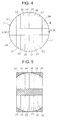
- the reflecting surfaces 2U, 2D are divided into eight sections in the vertical-axis Y direction and the central two are made up of segments 2I, 22, 23, 24, 25, 26, 27, 28, 29, 20, divided into two sections, respectively, in the horizontal-axis X direction.
- the second segment 22, the third segment 23, the fourth segment 24, the fifth segment 25, the sixth segment 26, and the seventh segment 27 at the central part and the peripheral part constitute the reflecting surface for low beam.
- the first segment 21 and the eighth segment 28 at both ends constitute the first reflecting surface for high beam.
- the ninth segment 29 and the tenth segment 20 at the central part constitute the second reflecting surface for high beam.
- the fourth segment 24 of the central part constitutes a first reflecting surface for low beam.
- the fifth segment 25 of the central part constitutes a second reflecting surface for low beam.
- the second segment 22, the third segment 23, the sixth segment 26, and the seventh segment 27 at an end part constitute a third reflecting surface for low beam.
- the fourth segment 24 of the first reflecting surface for low beam and the fifth segment 25 of the second reflecting surface for low beam, of the central part, are provided in the range Z1 between two longitudinal thick solid lines in FIG. 17 , with the range Z1 being a range in which the lattice dashed line in FIG. 21 is drawn, i.e., with the range Z1 being a range in which a longitude angle from the center O1 of the light emitting chip is ⁇ 40 degrees ( ⁇ O degrees in FIG. 20 ).
- the second segment 22, the third segment 23, the sixth segment 26, and the seventh segment 27 of the third reflecting surface for low beam of the end art are provided in a white-ground range in FIG. 21 other than the range Z1, i.e., in a range in which the longitude angle from the center O1 of the light emitting chip is ⁇ 40 degrees or more.
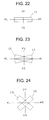
- a reflection image (screen map) of the light emitting chip 4 with a shape of a planar rectangle, obtained in a respective one of segments 22 to 27 of the reflecting surface for low beam among the reflecting surfaces 2U, 2D will be described referring to FIGS. 22, 23, and 24 .
- a reflection image 11 of the light emitting chip with a tilt angle of about 0 degrees is obtained with respect to a horizontal line HL-HR of a screen.
- a boundary P2 between the third segment 23 and the fourth segment 24 as shown in FIG.
- a reflection image 12 of the light emitting chip with a tilt angle of about 20 degrees is obtained with respect to the horizontal line HL-HR of the screen.
- a reflection image 13 of the light emitting chip 4 with a tilt angle of about 20 degrees is obtained with respect to the screen HL-HR of the screen.
- a reflection image 14 of the light emitting chip 4 with a tilt angle of about 40 degrees is obtained with respect to the horizontal line HL-HR of the screen.
- a reflection image 15 of the light emitting chip 4 with a tilt angle of about 40 degrees is obtained with respect to the horizontal line HL-HR of the screen.
- reflection images from the reflection image 11 with the tilt angle of about 0 degrees shown in FIG. 22 to the reflection image 12 with the tilt angle of about 20 degrees shown in FIG. 23 are obtained.
- reflection images from the reflection image 11 with the tilt angle of about 0 degrees shown in FIG. 22 to the reflection image 13 with the tilt angle of about 20 degrees shown in FIG. 23 are obtained.
- reflection images from the reflecting surface 12 with the tilt angle of about 20 degrees shown in FIG. 23 to the reflection image with the tilt angle of about 40 degrees shown in FIG. 24 are obtained.
- reflection images from the reflection images 13 with the tilt angle of about 20 degrees shown in FIG. 23 to the reflection image 15 with the tilt angle of about 40 degrees shown in FIG. 24 are obtained. Still furthermore, in the second segment 22 and the seventh segment 27 of the reflecting surface for low beam, a reflection image with a tilt angle of about 40 degrees or more is obtained.
- the reflection images from the reflection image 11 with the tilt angle of about 0 degree shown in FIG. 22 to the reflection images 12, 13 with the tilt angle of about 20 degrees shown in FIG. 23 are reflection images optimal to form a light distribution including an oblique cutoff line CL1 of the light distribution pattern LP for low beam.
- this is because it is easy to take the reflection images from the reflection image 11 with the tilt angle of about 0 degrees to the reflection images 12, 13 with the tilt angle of about 20 degrees along the oblique cutoff line CL1 1 with the tilt angle of about 15 degrees.
- reflection images which is not suitable to form a light distribution including the oblique cutoff line CL1 of the light distribution pattern LP for low beam.
- this is because, if the reflection image with the tilt angle of about 20 degrees or more is taken along the oblique cutoff line CL1 with the tilt angle of about 15 degrees, a light distribution becomes thick in a vertical direction, resulting in an excessive short-distance light distribution (i.e., light distribution with lowered long-distance visibility).
- a reflecting surface optimal to form the light distribution in the oblique cutoff line CL1 is determined depending upon a relative relationship between a range in which the reflection images 11, 12 within the tilt angle of 20 degrees, of a parabola-based, free curved reflecting surfaces, are obtained, and the energy distribution (Lambertian) of the semiconductor-type light sources 5U, 5D.
- the reflecting surface optimal to form the light distribution in the oblique cutoff line CL1 i.e., the fourth segment 24 and the fifth segment 25 are provided in the range Z1 1 in which the longitudinal angle is ⁇ 40 degrees from the center O1 1 of the light emitting chip 4, in which the reflection images 11, 12 within an angle (about 20 degrees) determined by adding about 5 degrees to the tilt angle (about 15 degrees) of the oblique cutoff line CL1 are obtained, and in the high-energy range Z3 in the energy distribution (Lambertian) Z2 of the light emitting chip 4.
- the first reflecting surface for low beam made of the fourth segment 24, as shown FIGS. 25 and 27 is a reflecting surface made of a free curved face for light-distributing and controlling the reflection images 11, 13 of the light emitting chip 4 in the range Z4 in the light distribution pattern LP for low beam, so that: the reflection images 11, 12 of the light emitting chip 4 do not run out of the oblique cutoff line CL1 and the horizontal cutoff line CL2; and a part of the reflection images 11, 12 of the light emitting chip 4 is substantially in contact with the oblique cutoff line CL1 and the horizontal cutoff line CL2.
- the second reflecting surface for low beam made of the fifth segment 5, as shown in FIGS. 26 and 27 is a reflecting surface made of light-distributing and controlling the reflection images 11, 13 of the light emitting chip 4 in the range Z5 containing the zone Z4 in the light distribution pattern LP for low beam, so that: the reflection images 11, 13 of the light emitting chip 4 do not run out of the oblique cutoff line CL1 and the horizontal cutoff line CL2 and a part of the reflection images 11, 13 of the light emitting chip 4 is substantially in contact with the oblique cutoff line CL1 and the horizontal cutoff line CL2; and so that: the density of a group of the reflection images 11, 13 of the light emitting chip 4 becomes lower than that of a group of the reflection images 11, 12 of the light emitting chip 4 according to the first reflecting surface for low beam made of the fourth segment 24; and the group of the reflecting surfaces 11, 13 of the light emitting chip 4 contains that of the reflection images 11, 12 of the light emitting chip 4 by the first reflecting surface for low beam made of the fourth
- the third reflecting surface for low beam made of the second segment 22, the third segment 23, the sixth segment 26, and the seventh segment 27, as shown in FIG. 27 is a reflecting surface made of a free curved face of light-distributing and controlling reflection images 14, 15 of the light emitting chip 4 in a range Z6 containing ranges Z4, Z5 in the light distribution pattern LP for low beam, so that: the reflection images 14, 15 of the light distribution chip 4 are substantially included in the light distribution pattern LP for low beam; the density of a group of the reflection images 14, 15 of the light emitting chip 4 becomes lower than that of a group of the reflection images 11, 12 of the light emitting chip 4 according to the first reflecting surface for low beam made of the fourth segment 24 and a group of the reflection images 11, 13 of the light emitting chip 4 according to the second reflecting surface for low beam made of the fifth segment 25; and the group of the reflection surfaces 14, 15 of the light emitting chip 4 contains that of the reflection images 11, 13 of the light emitting chip 4 according to the second reflecting surface for low beam made of the fifth segment 25.
- additional reflection surfaces 9UL, 9UR, 9DL, 9DR are provided for reflecting, on the intermediate invalid reflection surface 9, a part L6 of the light beams that are radiated from the light emitting chips 4 of the semiconductor-type light source 5U, 5D.
- the additional reflection surfaces 9UL, 9UR, 9DL, 9DR are positioned in a range other than a high energy range Z3 in energy distribution Z2 of the light emitting chips 4 of the semiconductor-type light sources 5U, 5D of the movable reflectors 13U, 13D when they are positioned in the second location.
- the additional reflection surfaces 9UL, 9UR, 9DL, 9DR as shown in FIG.
- a protrusive portion that is formed in the shape of a small square, which is provided at a site inclined at an angle of ⁇ 1 degree (about 60 degrees in this example) from a Y axis from among outer circumferential edge parts of the movable reflectors 13U, 13D when they are positioned in the second location that is viewed from a front side.
- the additional reflection surfaces 9UL, 9UR, 9DL, 9DR are the ones for reflecting, on the intermediate invalid reflection surface 9, a part L6 of the light beams that are radiated from the light emitting chips 4 of the semiconductor-type light sources 5U, 5D, by means of cross reflection.
- the additional reflection surfaces 9UL, 9DL at the left side as shown in FIG. 1 and FIG.
- FIG. 1 and FIG. 2 are the ones for reflecting, on the intermediate invalid reflection surfaces 9, 9R at the right side, a part L6 of the light beams that are radiated from the light emitting chips 4 of the semiconductor-type light sources 5U, 5D, by means of cross reflection
- the additional reflection surfaces 9UR, 9DR at the right side are the ones for reflecting, on the intermediate invalid reflection surfaces 9, 9L at the left side, a part L6 of the light beams that are radiated from the light emitting chips 4 of the semiconductor-type light sources 5U, 5D, by means of cross reflection.
- the vehicle lighting device 1 of the embodiment is made of the constituent elements as described above, and hereinafter, functions of the constituent elements will be described.
- an upside movable reflector 13U and a downside movable reflector 13D are positioned in a first position (the location in a state shown in FIGS. 8 , 10 , 12 , and 14 ).
- the upside movable reflector 13U and the downside movable reflector 13D are positioned in the first location due to a spring action and a stopper action which is not shown.
- a light emitting chip 4 of a respective one of the upside semiconductor-type light source 5U and the downside semiconductor-type light source 5D is lit to emit light.
- light is radiated from the light emitting chip 4 of the upside semiconductor-type light source 5U and the downside semiconductor-type light source 5D.
- a part of the light, i.e., reflection light L2 reflected on the second reflecting surface for high beam (the ninth segment 29 and the tenth segment 20) of the fixed reflector 3, as shown in FIG. 12 is shaded by means of means of the upside movable reflector 13U and the downside movable reflector 13D.
- the reflection light L3 is illuminated toward a forward direction of a vehicle, as a light distribution pattern LP for low beam, shown in FIG. 27 .
- Direct light (not shown) from the light emitting chip 4 of the upside semiconductor-type light source 5U and the downside semiconductor-type light source 5D is shaded by means of means of the upside movable reflector 13U and the downside reflector 13D, in particular by means of a visor portion 18.
- the optical paths in the downside reflecting surface 2D of the fixed reflector 3 and the downside reflecting surface 12D of the downside movable reflector 13D are not shown.
- reflection light from the first reflecting surface for low beam made of the fourth segment 24 of the reflecting surfaces 2U, 2D is light-distributed and controlled in the range Z4 in the light distribution pattern LP for low beam so that: the reflection images 11, 12 of the light emitting chip 4 does not run out of the oblique cutoff line CL1 and the horizontal cutoff line CL2; and a part of a respective one of the reflection images 11, 12 of the light emitting chip 4 is substantially in contact with the oblique cutoff line CL 1 and the horizontal cutoff line CL2.
- reflection light from the second reflecting surface for low beam made of the fifth segment 25 of the reflecting surfaces 2U, 2D is light-distributed and controlled in a range Z5 containing a range Z4 in the light distribution pattern LP for low beam, so that: the reflection images 11, 13 of the light emitting chip 4 do not run out of the oblique cutoff line CL1 1 and the horizontal cutoff line CL2 and a part of a respective one of the reflection images 11, 13 of the light emitting chip 4 is substantially in contact with the oblique cutoff line CL1 and the horizontal cutoff line CL2; and so that density of the group of the reflection images 11, 13 of the light emitting chip 4 becomes lower than that of the group of the reflection images 11, 12 of the light emitting chip 4 according to the first reflecting surface for low beam made of the fourth segment 24 and the group of the reflection images 11, 12 of the light emitting chip 4 contains that of the reflection images 11, 12 of the light emitting chip 4 according to the first reflecting surface for low beam made of the fourth segment 24.
- the reflection light from the third reflecting surface for low beam made of the second segment 22, the third segment 23, the sixth segment 26, and the seventh segment 27 of the reflecting surfaces 2U, 2D is light-distributed and controlled in the range Z6 containing the ranges Z4, Z5 in the light distribution pattern LP for low beam, so that: the reflection images 14, 15 of the light emitting chip 4 are substantially included in the light distribution pattern LP for low beam; the density of the group of the reflection images 14, 15 of the light emitting chip 4 becomes lower than that of the group of the reflection images 11, 12 of the light emitting chip 4 according to the first reflecting surface for low beam made of the fourth segment 24 and that of the group of the reflection images 11, 13 of the light emitting chip 4 according to the second reflecting surface for low beam made of the fifth segment 25; and the group of the reflection images 14, 15 of the light emitting chip 4 contains that of the reflection images 11, 12 of the light emitting chip 4 according to the first reflecting surface for low beam made of the fourth segment 24 and that of the reflection image 11, 13 of the light emitting chip 4 according to the
- a light distribution pattern LP for low beam is emitted forward of a vehicle.
- this vehicle lighting device 1 in the first embodiment is seen from a substantial front side, as shown in FIG. 5 .
- reflection surfaces for low beam a second segment 22, a third segment 23, a fourth segment 24, a fifth segment 25, a sixth segment 26, a seventh segment 27
- the upside reflection surface 2U and the downside reflection surface 2D of the fixed reflector 3 can be seen to be luminous.
- four corner parts outside of the portions seen to be luminous the outline portions in FIG. 5
- a part of the window portion 8 are seen as dark parts (the parts to which the grating pattern in FIG. 5 is applied).
- an area of these portions seen to be luminous is about 60% or more relative to that of the square surrounding the portion seen to be luminous, which is larger than that of the dark parts. Therefore, according to the vehicle lighting device 1 in the first embodiment, when the light distribution pattern LP for low beam, shown in FIG. 27 , is emitted forward of the vehicle, the entire lighting device is seen luminous; and therefore, even if the portions seen to be luminous are divided into top and bottom by means of the dark parts of the window portion 8, there is no problem in quality, visual recognition property, and appearance of the lighting device.
- the upside movable reflector 13U and the downside movable reflector 13D are positioned in a second location (the location in a state shown in FIGS. 1 to 3 , 9, 11, 13, and 15 ).
- a motor 15 is driven by supplying power to a motor 15 of a drive unit 14, a drive force of the motor 15 is transmitted to the upside movable reflector 13U and the downside movable reflector 13D via a drive force transmission mechanism 16; the upside movable reflector 13U and the downside movable reflector 13D rotate in synchronism from the first location to the second location against a spring force, and are positioned in the second location by means of a stopper action, although not shown.
- light is radiated from the light emitting chip 4 of the upside semiconductor-type light source 5U and the downside semiconductor-type light source 5D.
- the light radiated onto the reflecting surface for low beam (the second segment 22, the third segment 23, the fourth segment 24, the fifth segment 25, the sixth segment 26, the seventh segment 27) of the upside reflecting surface 2U and the downside reflecting surface 2D of the fixed reflector 3, and the remaining light having not been incident to the third reflecting surface (reflecting surfaces 12U, 12D) of the movable reflectors 13U, 13D, as shown in FIG. 13 , are reflected on the reflecting surface for low beam (the second segment 22, the third segment 23, the fourth segment 24, the fifth segment 25, the sixth segment 26, the seventh segment 27) of the fixed reflector 3; and the reflection light L3 is illuminated toward the forward direction of the vehicle, as the light distribution pattern LP1 for dimming low beam, shown in FIG. 28 .
- the upside movable reflector 13U and downside movable reflector 13D are positioned in the first location, light L1 radiated onto the first reflecting surface for high beam (the first segment 21 and the eighth segment 28) of the fixed reflector 3, shaded by means of the upside movable reflector 13U and the downside movable reflector 13D, as shown in FIG. 13 , is reflected on the first reflecting surface for high beam (the first segment 21 and the eighth segment 28) of the fixed reflector 3, and the reflection light L5 is illuminated toward the forward direction of the vehicle, as the light distribution pattern HP1 for high beam, shown in FIG. 28 .
- the optical paths in the downside reflecting surface 2D of the fixed reflector 3 and the downside reflecting surface 12D of the downside movable reflector 13D are not shown.
- a part L6 of the light beams that are radiated from the light emitting chips 4 of the upside semiconductor-type light source 5U and the downside semiconductor-type light source 5D is incident to the additional reflection surfaces 9UL, 9UR, 9DL, 9DR and then the incident light is cross-reflected on the intermediate invalid reflection surfaces 9, 9L, 9R by means of the additional reflection surfaces 9UL, 9UR, 9DL, 9DR.
- reflection light L7 cross-reflected on the additional reflection surfaces 9UL, 9DL at the left side, as shown in FIG 1 and FIG. 2 is incident to the intermediate invalid reflection surfaces 9, 9R at the right side
- the reflection light L7 cross-reflected on the additional reflection surfaces 9UR, 9DR at the right side is incident to the intermediate invalid reflection surfaces 9, 9L at the left side.
- the light L7 incident to the intermediate invalid reflection surfaces 9, 9L, 9R is emitted as reflection light L8 forward of the vehicle.
- the intermediate invalid reflection surfaces 9, 9L, 9R are also seen to be luminous by means of the reflection light L8.
- the first segment 21, the second segment 22, the third segment 23, the fourth segment 24, the fifth segment 25, the sixth segment 26, the seventh segment 27, the eighth segment 28, and the intermediate invalid reflection surfaces 9, 9L, 9R four corner parts outside of these portions seen to be luminous (the outline portions in FIG. 7 ) and a part of the window portion 8 are seen as dark parts (the parts to which the grating pattern in FIG. 7 is applied).
- an area of the portions seen to be luminous is about 60% or more relative to that of a square surrounding the portions seen to be luminous, and is larger than that of the dark parts.
- the portions seen to be luminous are vertically continuous at both of the left and right sides excluding the dark parts of the window portion 8 of a central portion, by means of the portions seen to be luminous, of the intermediate invalid reflection surfaces 9, 9L, 9R that are positioned at the left and right of the dark part of the window portion 8.
- the portions seen to be luminous correspond to the portions of the first segment 21, the second segment 22, the third segment 23, the fourth segment 24, the fifth segment 25, the sixth segment 26, the seventh segment 27, and the eighth segment 28.
- the four corner parts outside of the portions seen to be luminous the outline portions in FIG. 6
- a part of the window portion 8 and portions of the intermediate invalid reflection surfaces 9, 9L, 9R are seen to be dark parts (the parts to which the grating pattern in FIG. 6 is applied).
- an area of the portions seen to be luminous is about 60% or less relative to that of a square surrounding the portions seen to be luminous, and is not so different from that of the dark parts.
- the portions seen to be luminous are divided into a top and a bottom at a dark part of the window portion 8 at a central part and dark parts of the intermediate invalid reflection surfaces 9, 9L, 9R by means of the dark part of the window portion 8 and dark parts of the intermediate invalid reflection surfaces 9, 9L, 9R that are positioned at the left and right of the dark part of the window portion 8. Therefore, in the case of this vehicle lighting device, there is a problem in quality, visual recognition property, and appearance of the lighting device due to the aforementioned dark parts.
- a part L6 of the light beams that are radiated from the light emitting chips 4 of the upside semiconductor-type light source 5U and the downside semiconductor-type light source 5D is cross-reflected on the intermediate invalid reflection surfaces 9, 9L, 9R by means of the additional reflection surfaces 9UL, 9UR, 9DL, 9DR, so that the intermediate invalid reflection surfaces 9, 9L, 9R are seen to be luminous.
- the vehicle lighting device 1 in the first embodiment as described previously, when the light distribution patterns HP1, HP2, HP3, LP1 for high beam, shown in FIG. 28 , are emitted forward of the vehicle, the entire lighting device is seen to be substantially luminous; and therefore, there is no problem in quality, visual recognition property, and appearance of the lighting device.
- the vehicle lighting device 1 of the embodiment is made of the constituent elements and functions, as described above, and hereinafter, advantageous effect(s) thereof will be described.
- the vehicle lighting device 1 in the first embodiment when the movable reflectors 13U, 13D are positioned in the second location, a part L6 of the light beams that are radiated from the semiconductor-type light sources 5U, 5D is reflected on the additional reflection surfaces 9UL, 9UR, 9DL, 9DR and then the reflected light L7 is incident to the intermediate invalid reflection surfaces 9, 9L, 9R, so that there is allowed to be luminous the intermediate invalid reflection surfaces 9, 9L, 9R between: the fixed reflection surface for second light distribution pattern, which are more outside than the fixed reflection surface for first light distribution pattern of the first fixed reflection surface (the first segment 21 and the eighth segment 28 that are more outside than the second segment 22, the third segment 23, the fourth segment 24, the fifth segment 25, the sixth segment 26, and the seventh segment 27 of the upside reflection surface 2U); and the fixed reflection surface for second light distribution pattern, which is more outside than the fixed reflection surface for first light distribution pattern of the second fixed reflection surface (the first segment 21 1 and the eighth segment 28 that are more outside than the second segment 22, the third
- the vehicle lighting device 1 in the first embodiment is capable of eliminating a dark part between: the fixed reflection surfaces for second light distribution pattern, which are more outside than the fixed reflection surfaces for first light distribution pattern of the first fixed reflection surface (i.e., the first segment 21 and the eighth segment 28 of the upside reflection surface 2U); and the fixed reflection surfaces for second light distribution pattern, which are more outside than the fixed reflection surfaces for first light distribution pattern of the second fixed reflection surface (i.e., the first segment 21 and the eighth segment 28 of the downside reflection surface 2D).
- the vehicle lighting device 1 in the first embodiment is capable of substantially entirely illuminating: the fixed reflection surfaces for second light distribution pattern of the first fixed reflection surface (the first segment 21 and the eighth segment 28 of the upside reflection surface 2U); fixed reflection surfaces for second light distribution pattern of the second fixed reflection surface (the first segment 21 and the eight segment 28 of the downside reflection surface 2D); and the intermediate invalid reflection surface 9, 9L, 9R between the fixed reflection surfaces for second light distribution pattern, which are more outside than the fixed reflection surfaces for first light distribution pattern of the first fixed reflection surface (the first segment 21 and the eighth segment 28 of the upper reflection surface 2U), and the fixed reflection surfaces for second light distribution pattern, which are more outside than the fixed reflection surfaces for first light distribution pattern of the second fixed reflection surface (the first segment 21 and the eighth segment 28 of the downside reflection surface 2D).
- the vehicle lighting device 1 in the first embodiment is improved in quality, is also improved in visual recognition property, and further, is improved in appearance, in comparison with the conventional vehicle lighting device in which a nonluminous dark part may be formed,.
- the additional reflection surfaces 9UL, 9UR, 9DL, 9DR are positioned in a range other than a high energy range Z3 in energy distribution of the semiconductor-type light sources 5U, 5D of the movable reflectors 13U, 13D when they are positioned in the second location.
- the vehicle lighting device 1 in the first embodiment when the movable reflectors 13U, 13D are positioned in the second location, the light with high energy in energy distribution of the semiconductor-type light source 5U, 5D is disallowed to be interfered with the additional reflection surfaces 9UL, 9UR, 9DL, 9DR (protrusive portions formed in the shape of small squares in which the additional reflection surfaces 9UL, 9UR, 9DL, 9DR are provided at interior faces by means of reflection surface processing) from being reliably incident to a respective one of the fixed reflection surfaces for second light distribution pattern of the first fixed reflection surface and the second fixed reflection surfaces (the first segment 21 and the eighth segment 28 of the upside reflection surface 2U and the downside reflection surface 2D) and the movable reflection surfaces for second light distribution pattern of the first movable reflection surface and the second movable reflection surface (the upside reflection surface 12U and the downside reflection surface 12D).
- the additional reflection surfaces 9UL, 9UR, 9DL, 9DR protrusive portions formed in the shape of small squares in which the additional reflection surfaces 9
- the light with high energy in energy distribution of the semiconductor-type light sources 5U, 5D is reliably incident to a respective one of the fixed reflection surface for second light distribution pattern of the first fixed reflection surface and the second fixed reflection surface (the first segment 21 and the eighth segment 28 of the upside reflection surface 2U and the downside reflection surface 2D) and the movable reflection surface for second light distribution pattern of the first movable reflection surface and the second movable reflection surface (the upside reflection surface 12U and the downside reflection surface 12D).
- the light quantity (lightness, luminance, luminous flux) of the predetermined second light distribution patterns is disallowed be decreased by means of the additional reflection surfaces 9UL, 9UR, 9DL, 9DR (the protrusive portions formed in the shape of small squares in which the additional reflection surfaces 9UL, 9UR, 9DL, 9DR are provided at interior faces by means of reflection surface processing).
- the additional reflection surfaces 9UL, 9UR, 9DL, 9DR are positioned in a range other than a high energy range Z3 in energy distribution of the semiconductor-type light sources 5U, 5D of the movable reflectors 13U, 13D when they are positioned in the second location.
- the vehicle lighting device 1 in the first embodiment when the movable reflectors 13U, 13D are positioned in the first location, the light beams from the semiconductor-type light sources 5U, 5D are disallowed to be interfered with the additional reflection surfaces 9UL, 9UR, 9DL, 9DR (the protrusive portions formed in the shape of small squares in which the additional reflection surfaces 9UL, 9UR, 9DL, 9DR are provided on interior faces by means of reflection surface processing) from being incident to a respective one of the fixed reflection surfaces for first light distribution pattern of the first fixed reflection surface and the second fixed reflection surface (the first segment 21 and the eighth segment 28 that are more outside than the second segment 22, the third segment 23, the fourth segment 24, the fifth segment 25, the sixth segment 26, and the seventh segment 27 of the upside reflection surface 2U and the downside reflection surface 2D).
- the additional reflection surfaces 9UL, 9UR, 9DL, 9DR the protrusive portions formed in the shape of small squares in which the additional reflection surfaces 9UL, 9UR, 9DL, 9DR are provided on interior faces by means
- the light beams from the two semiconductor-type light sources 5U, 5D are reliably incident to a respective one of the fixed reflection surfaces for first light distribution pattern of the first fixed reflection surface and the second fixed reflection surface (the first segment 21 and the eighth segment 28 that are more outside than the second segment 22, the third segment 23, the fourth segment 24, the fifth segment 25, the sixth segment 26, and the seventh segment 27 of the upside reflection surface 2U and the downside reflection surface 2D).
- the light quantity (lightness, luminance, luminous flux) of a predetermined first light distribution pattern (the light distribution pattern LP for low beam, shown in FIG. 27 ) is disallowed to be decreased by means of the additional reflection surfaces.
- the fixed reflector 3 and the movable reflectors 13U, 13D are formed in the shape of a substantially rotating parabolic face, so that a part L6 of the light beams that are radiated from the semiconductor-type light sources 5U, 5D can be cross-reflected easily and reliably on the intermediate invalid reflections 9, 9L, 9R by means of the additional reflection surfaces 9UL, 9UR, 9DL, 9DR.
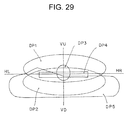
- FIG. 29 shows a second embodiment of a vehicle lighting device according to the present invention.
- the vehicle lighting device in the second embodiment will be described.
- like constituent elements shown in FIG. 1 to FIG. 28 are designated by like reference numerals.
- the vehicle lighting device 1 in the first embodiment when the movable reflectors 13U, 13D are positioned in the second location, the light distribution patterns HP1, HP2, HP3, LP1 for high beam are obtained.
- the vehicle lighting device in the second embodiment when the movable reflectors 13U, 13D are positioned in at least the second location, i.e., when the movable reflectors 13U, 13D are positioned in the second location, the light distribution patterns HP1, HP2, HP3, LP1 for high beam are obtained as described previously and when the movable reflectors 13U, 13D are positioned in a third location (the position proximal to the second location), light distribution patterns DP1, DP2, DP3, DP4, DP5 for daytime running light are obtained as shown in FIG. 29 .
- first and second embodiments describe a light distribution pattern LP for low beam.
- a light distribution pattern other than the light distribution pattern LP for low beam for example, a light distribution pattern having an oblique cutoff line on a driving lane side and a horizontal cutoff line on an opposite lane side with an elbow point being a turning point, such as a light distribution pattern for expressway or a light distribution pattern for fog lamp.
- first and second embodiments describe a vehicle lighting device 1 for left side driving lane.
- the present invention can be applied to a vehicle lighting device for right side driving lane.
- the light distribution pattern LP for low beam, shown in FIG. 27 , and the light distribution patterns HP1, HP2, HP3, LP1 for high beam, shown in FIG. 28 are switched to each other by using the movable reflectors 13U, 13D, or alternatively, there are switched to each other the light distribution pattern LP for low beam, shown in FIG. 27 ; the light distribution patterns HP1, HP2, HP3, LP1 for high beam, shown in FIG. 28 ; and the light distribution patterns DP1, DP2, DP3, DP4, DP5 for daytime running light, shown in FIG. 29 .
- the light distribution patterns DP1, DP2, DP3, DP4, DP5 for daytime running light, shown in FIG. 29 may be obtained by means of only the fixed reflector 3 without use of the movable reflectors 13U, 13D.
- an additional reflection surface is provided in a range other than a high energy range Z3 in energy distribution of the semiconductor-type light sources 5U, 5D of the fixed reflector 3, i.e., in a range of an X-axis side more than the double-dotted chain line, as shown in FIG. 17 .
- the foregoing first and second embodiments describe a headlamp (a vehicle headlamp) which is adapted to switch the light distribution pattern LP for low beam, shown in FIG. 27 , and the light distribution patterns HP1, HP2, HP3, LP1 for high beam, shown in FIG. 28 , to each other, or alternatively, to switch the light distribution pattern LP for low beam, shown in FIG. 27 ; the light distribution patterns HP1, HP2, HP3, LP1 for high beam, shown in FIG. 28 ; and the light distribution patterns DP1, DP2, DP3, DP4, DP5 for daytime running light, shown in FIG. 29 , to each other.
- the present invention can be applied to a lamp other than a fog lamp, a tail lamp, or a stop lamp other than the headlamp.
Landscapes
- Engineering & Computer Science (AREA)
- General Engineering & Computer Science (AREA)
- Physics & Mathematics (AREA)
- Microelectronics & Electronic Packaging (AREA)
- Optics & Photonics (AREA)
- Non-Portable Lighting Devices Or Systems Thereof (AREA)
- Lighting Device Outwards From Vehicle And Optical Signal (AREA)
Applications Claiming Priority (1)
| Application Number | Priority Date | Filing Date | Title |
|---|---|---|---|
| JP2010110109A JP5338746B2 (ja) | 2010-05-12 | 2010-05-12 | 車両用灯具 |
Publications (2)
| Publication Number | Publication Date |
|---|---|
| EP2386794A2 true EP2386794A2 (fr) | 2011-11-16 |
| EP2386794A3 EP2386794A3 (fr) | 2015-11-11 |
Family
ID=44117716
Family Applications (1)
| Application Number | Title | Priority Date | Filing Date |
|---|---|---|---|
| EP11165385.3A Withdrawn EP2386794A3 (fr) | 2010-05-12 | 2011-05-10 | Dispositif d'éclairage de véhicule |
Country Status (4)
| Country | Link |
|---|---|
| US (1) | US8475021B2 (fr) |
| EP (1) | EP2386794A3 (fr) |
| JP (1) | JP5338746B2 (fr) |
| CN (1) | CN102278688B (fr) |
Cited By (2)
| Publication number | Priority date | Publication date | Assignee | Title |
|---|---|---|---|---|
| EP3354971A1 (fr) * | 2017-01-31 | 2018-08-01 | Automotive Lighting Italia S.p.A. | Dispositif d'éclairage pour véhicules pourvus de modules d'éclairage à del |
| FR3062706A1 (fr) * | 2017-02-09 | 2018-08-10 | Valeo Vision | Reflecteur multifonction par deplacement |
Families Citing this family (21)
| Publication number | Priority date | Publication date | Assignee | Title |
|---|---|---|---|---|
| TWI464348B (zh) * | 2012-01-17 | 2014-12-11 | 南亞光電股份有限公司 | 管狀發光二極體照明總成 |
| TWI565605B (zh) * | 2012-02-20 | 2017-01-11 | 鴻海精密工業股份有限公司 | 車前燈燈具模組 |
| KR102000535B1 (ko) * | 2012-03-19 | 2019-07-16 | 이치코 고교가부시키가이샤 | 차량용 전조등 |
| FR2999275A1 (fr) * | 2012-12-07 | 2014-06-13 | Valeo Illuminacion | Dispositif d'emission de lumiere pour projecteur de vehicule automobile et projecteur equipe dudit dispositif |
| TWI565604B (zh) | 2012-12-25 | 2017-01-11 | 鴻海精密工業股份有限公司 | 車燈系統 |
| TWI564184B (zh) * | 2012-12-26 | 2017-01-01 | 鴻海精密工業股份有限公司 | 車燈系統 |
| US9400090B2 (en) * | 2013-05-31 | 2016-07-26 | Panasonic Intellectual Property Management Co., Ltd. | Light source unit and vehicle front lamp using the light source unit |
| US9696008B2 (en) * | 2013-07-02 | 2017-07-04 | Cooper Technologies Company | Reflector for directed beam LED illumination |
| CN104654198B (zh) * | 2015-02-02 | 2016-05-18 | 深圳市朗恒电子有限公司 | 反光杯及灯具 |
| CN105240772A (zh) * | 2015-11-10 | 2016-01-13 | 德文能源股份有限公司 | 一种汽车照明灯具 |
| JP6116660B2 (ja) * | 2015-12-28 | 2017-04-19 | 株式会社小糸製作所 | 車両用前照灯 |
| FR3051536B1 (fr) * | 2016-05-04 | 2018-06-29 | Valeo Vision | Module lumineux comprenant des miroirs mobiles |
| FR3051884A1 (fr) * | 2016-05-27 | 2017-12-01 | Koito Mfg Co Ltd | Lampe de vehicule |
| JP6089350B2 (ja) * | 2016-10-06 | 2017-03-08 | パナソニックIpマネジメント株式会社 | 光源ユニット及びこれを用いた車両用前照灯 |
| EP3354967B1 (fr) * | 2017-01-31 | 2021-09-01 | Marelli Automotive Lighting Italy S.p.A. | Module d'éclairage rotatif ayant une fonction de bienvenue et dispositif d'éclairage pour véhicules |
| DE102017001019A1 (de) * | 2017-02-04 | 2018-08-09 | GM Global Technology Operations LLC (n. d. Ges. d. Staates Delaware) | Fahrzeugscheinwerfer |
| JP2018133164A (ja) * | 2017-02-14 | 2018-08-23 | 株式会社小糸製作所 | 車両用灯具 |
| TWI615581B (zh) * | 2017-07-14 | 2018-02-21 | 達運精密工業股份有限公司 | 光反射罩及具有光反射罩的照明裝置 |
| CN110440218B (zh) * | 2019-09-20 | 2024-12-10 | 嘉兴市光泰照明有限公司 | 一种led汽车车灯 |
| USD1010169S1 (en) * | 2021-01-18 | 2024-01-02 | Arb Corporation Limited | Driving light |
| US12600583B1 (en) | 2025-04-29 | 2026-04-14 | Green Swan Technologies, Llc | Cargo-carrying systems, methods of loading a cargo-carrying system, and systems for loading the cargo-carrying system |
Citations (2)
| Publication number | Priority date | Publication date | Assignee | Title |
|---|---|---|---|---|
| JP2006024509A (ja) | 2004-07-09 | 2006-01-26 | Ichikoh Ind Ltd | 車両用灯具 |
| JP2010110109A (ja) | 2008-10-30 | 2010-05-13 | Fujitsu General Ltd | 三相電力変換装置 |
Family Cites Families (22)
| Publication number | Priority date | Publication date | Assignee | Title |
|---|---|---|---|---|
| JP3908428B2 (ja) * | 2000-01-06 | 2007-04-25 | 株式会社小糸製作所 | 車両用標識灯 |
| JP2003100114A (ja) * | 2001-09-19 | 2003-04-04 | Koito Mfg Co Ltd | 車両用灯具 |
| US6682211B2 (en) * | 2001-09-28 | 2004-01-27 | Osram Sylvania Inc. | Replaceable LED lamp capsule |
| JP4094366B2 (ja) * | 2002-07-24 | 2008-06-04 | 株式会社小糸製作所 | 車両用灯具 |
| US6976775B2 (en) * | 2003-04-25 | 2005-12-20 | Stanley Electric Co., Ltd. | Vehicle lamp |
| JP4264319B2 (ja) * | 2003-09-24 | 2009-05-13 | 株式会社小糸製作所 | 車両用前照灯 |
| JP4044024B2 (ja) * | 2003-09-29 | 2008-02-06 | 株式会社小糸製作所 | 車両用前照灯 |
| JP4413762B2 (ja) * | 2004-12-07 | 2010-02-10 | 株式会社小糸製作所 | 車両用照明灯具 |
| JP2006164858A (ja) * | 2004-12-09 | 2006-06-22 | Koito Mfg Co Ltd | 車両用照明灯具 |
| JP4771723B2 (ja) * | 2005-03-24 | 2011-09-14 | 市光工業株式会社 | 車両用灯具 |
| JP4697951B2 (ja) * | 2005-08-22 | 2011-06-08 | スタンレー電気株式会社 | 車両用テールランプ |
| JP4615417B2 (ja) * | 2005-10-13 | 2011-01-19 | 株式会社小糸製作所 | 車両用前照灯の灯具ユニット |
| JP4996951B2 (ja) * | 2007-03-23 | 2012-08-08 | 本田技研工業株式会社 | テールランプ構造 |
| US8042971B2 (en) * | 2007-06-27 | 2011-10-25 | Cree, Inc. | Light emitting device (LED) lighting systems for emitting light in multiple directions and related methods |
| JP5069985B2 (ja) * | 2007-09-13 | 2012-11-07 | 株式会社小糸製作所 | 車両用前照灯の灯具ユニットおよび車両用前照灯 |
| TW200916690A (en) * | 2007-10-12 | 2009-04-16 | Dosun Solar Technology Co Ltd | LED (light emitting diode) lamps |
| US8292480B2 (en) * | 2008-07-10 | 2012-10-23 | Koito Manufacturing Co., Ltd. | Lamp including main reflector, sub-reflector and LED assembly |
| US8123377B2 (en) * | 2008-08-19 | 2012-02-28 | Honeywell International Inc. | Systems and methods for aircraft LED anti collision light |
| JP5029571B2 (ja) * | 2008-10-30 | 2012-09-19 | 市光工業株式会社 | 車両用前照灯 |
| JP5029570B2 (ja) * | 2008-10-30 | 2012-09-19 | 市光工業株式会社 | 車両用前照灯 |
| JP5141580B2 (ja) * | 2009-01-30 | 2013-02-13 | 市光工業株式会社 | 車両用前照灯 |
| JP2011171121A (ja) * | 2010-02-18 | 2011-09-01 | Ichikoh Ind Ltd | 車両用前照灯 |
-
2010
- 2010-05-12 JP JP2010110109A patent/JP5338746B2/ja not_active Expired - Fee Related
-
2011
- 2011-04-29 US US13/097,607 patent/US8475021B2/en not_active Expired - Fee Related
- 2011-05-10 EP EP11165385.3A patent/EP2386794A3/fr not_active Withdrawn
- 2011-05-11 CN CN201110126534.5A patent/CN102278688B/zh not_active Expired - Fee Related
Patent Citations (2)
| Publication number | Priority date | Publication date | Assignee | Title |
|---|---|---|---|---|
| JP2006024509A (ja) | 2004-07-09 | 2006-01-26 | Ichikoh Ind Ltd | 車両用灯具 |
| JP2010110109A (ja) | 2008-10-30 | 2010-05-13 | Fujitsu General Ltd | 三相電力変換装置 |
Cited By (4)
| Publication number | Priority date | Publication date | Assignee | Title |
|---|---|---|---|---|
| EP3354971A1 (fr) * | 2017-01-31 | 2018-08-01 | Automotive Lighting Italia S.p.A. | Dispositif d'éclairage pour véhicules pourvus de modules d'éclairage à del |
| CN108916800A (zh) * | 2017-01-31 | 2018-11-30 | 意大利汽车照明股份公司 | 具有led照明模块的车辆用照明装置 |
| CN108916800B (zh) * | 2017-01-31 | 2023-04-14 | 意大利汽车照明股份公司 | 具有led照明模块的车辆用照明装置 |
| FR3062706A1 (fr) * | 2017-02-09 | 2018-08-10 | Valeo Vision | Reflecteur multifonction par deplacement |
Also Published As
| Publication number | Publication date |
|---|---|
| JP2011238515A (ja) | 2011-11-24 |
| CN102278688A (zh) | 2011-12-14 |
| JP5338746B2 (ja) | 2013-11-13 |
| EP2386794A3 (fr) | 2015-11-11 |
| US20110280030A1 (en) | 2011-11-17 |
| US8475021B2 (en) | 2013-07-02 |
| CN102278688B (zh) | 2015-04-01 |
Similar Documents
| Publication | Publication Date | Title |
|---|---|---|
| US8475021B2 (en) | Vehicle lighting device | |
| EP2182273B1 (fr) | Phare de véhicule | |
| EP2213935B1 (fr) | Projecteur de véhicule automobile | |
| US9506616B2 (en) | Vehicle headlamp | |
| EP1705422B1 (fr) | Lampe pour véhicule ezt projecteur pour véhicule utilisant cette lampe | |
| JP5321048B2 (ja) | 車両用前照灯 | |
| EP2166279B1 (fr) | Phare de véhicule | |
| US8491171B2 (en) | Vehicle headlamp | |
| CN101761848B (zh) | 车辆用前照灯 | |
| CN209042251U (zh) | 智能头灯 | |
| EP2119959A1 (fr) | Dispositif d'éclairage de véhicule | |
| EP2423567A2 (fr) | Phare de véhicule et dispositif de phare de véhicule | |
| EP2375142A2 (fr) | Phare de véhicule | |
| CN209042252U (zh) | 智能头灯 | |
| CN106838758A (zh) | 前照灯以及移动体 | |
| JP2017091780A (ja) | 車両用前照灯 | |
| JP5338742B2 (ja) | 車両用前照灯 | |
| JP5966674B2 (ja) | 車両用灯具 | |
| JP5407066B2 (ja) | 車両用前照灯 | |
| KR101174801B1 (ko) | 차량용 전조등 |
Legal Events
| Date | Code | Title | Description |
|---|---|---|---|
| AK | Designated contracting states |
Kind code of ref document: A2 Designated state(s): AL AT BE BG CH CY CZ DE DK EE ES FI FR GB GR HR HU IE IS IT LI LT LU LV MC MK MT NL NO PL PT RO RS SE SI SK SM TR |
|
| AX | Request for extension of the european patent |
Extension state: BA ME |
|
| PUAI | Public reference made under article 153(3) epc to a published international application that has entered the european phase |
Free format text: ORIGINAL CODE: 0009012 |
|
| PUAL | Search report despatched |
Free format text: ORIGINAL CODE: 0009013 |
|
| AK | Designated contracting states |
Kind code of ref document: A3 Designated state(s): AL AT BE BG CH CY CZ DE DK EE ES FI FR GB GR HR HU IE IS IT LI LT LU LV MC MK MT NL NO PL PT RO RS SE SI SK SM TR |
|
| AX | Request for extension of the european patent |
Extension state: BA ME |
|
| RIC1 | Information provided on ipc code assigned before grant |
Ipc: F21S 8/12 20060101ALN20151008BHEP Ipc: F21V 7/00 20060101ALI20151008BHEP Ipc: F21V 14/04 20060101ALN20151008BHEP Ipc: F21Y 101/02 20060101ALI20151008BHEP Ipc: F21S 8/10 20060101AFI20151008BHEP |
|
| 17P | Request for examination filed |
Effective date: 20160511 |
|
| RBV | Designated contracting states (corrected) |
Designated state(s): AL AT BE BG CH CY CZ DE DK EE ES FI FR GB GR HR HU IE IS IT LI LT LU LV MC MK MT NL NO PL PT RO RS SE SI SK SM TR |
|
| 17Q | First examination report despatched |
Effective date: 20181115 |
|
| RIC1 | Information provided on ipc code assigned before grant |
Ipc: F21Y 101/02 20000101ALI20151008BHEP Ipc: F21S 8/10 20060101AFI20151008BHEP Ipc: F21V 7/00 20060101ALI20151008BHEP Ipc: F21V 14/04 20060101ALN20151008BHEP Ipc: F21S 8/12 20060101ALN20151008BHEP |
|
| STAA | Information on the status of an ep patent application or granted ep patent |
Free format text: STATUS: THE APPLICATION IS DEEMED TO BE WITHDRAWN |
|
| 18D | Application deemed to be withdrawn |
Effective date: 20190326 |