EP2387176B1 - Verfahren und vorrichtungen zur zuweisung von ressourcen und zur verarbeitung von bestätigungsinformationen - Google Patents
Verfahren und vorrichtungen zur zuweisung von ressourcen und zur verarbeitung von bestätigungsinformationen Download PDFInfo
- Publication number
- EP2387176B1 EP2387176B1 EP10733255.3A EP10733255A EP2387176B1 EP 2387176 B1 EP2387176 B1 EP 2387176B1 EP 10733255 A EP10733255 A EP 10733255A EP 2387176 B1 EP2387176 B1 EP 2387176B1
- Authority
- EP
- European Patent Office
- Prior art keywords
- physical channel
- area
- ack
- nack
- channel area
- Prior art date
- Legal status (The legal status is an assumption and is not a legal conclusion. Google has not performed a legal analysis and makes no representation as to the accuracy of the status listed.)
- Active
Links
Images




Classifications
-
- H—ELECTRICITY
- H04—ELECTRIC COMMUNICATION TECHNIQUE
- H04L—TRANSMISSION OF DIGITAL INFORMATION, e.g. TELEGRAPHIC COMMUNICATION
- H04L5/00—Arrangements affording multiple use of the transmission path
- H04L5/003—Arrangements for allocating sub-channels of the transmission path
- H04L5/0053—Allocation of signalling, i.e. of overhead other than pilot signals
- H04L5/0055—Physical resource allocation for ACK/NACK
-
- H—ELECTRICITY
- H04—ELECTRIC COMMUNICATION TECHNIQUE
- H04L—TRANSMISSION OF DIGITAL INFORMATION, e.g. TELEGRAPHIC COMMUNICATION
- H04L1/00—Arrangements for detecting or preventing errors in the information received
- H04L1/12—Arrangements for detecting or preventing errors in the information received by using return channel
- H04L1/16—Arrangements for detecting or preventing errors in the information received by using return channel in which the return channel carries supervisory signals, e.g. repetition request signals
- H04L1/1607—Details of the supervisory signal
-
- H—ELECTRICITY
- H04—ELECTRIC COMMUNICATION TECHNIQUE
- H04L—TRANSMISSION OF DIGITAL INFORMATION, e.g. TELEGRAPHIC COMMUNICATION
- H04L1/00—Arrangements for detecting or preventing errors in the information received
- H04L1/12—Arrangements for detecting or preventing errors in the information received by using return channel
- H04L1/16—Arrangements for detecting or preventing errors in the information received by using return channel in which the return channel carries supervisory signals, e.g. repetition request signals
- H04L1/18—Automatic repetition systems, e.g. Van Duuren systems
- H04L1/1829—Arrangements specially adapted for the receiver end
- H04L1/1854—Scheduling and prioritising arrangements
-
- H—ELECTRICITY
- H04—ELECTRIC COMMUNICATION TECHNIQUE
- H04L—TRANSMISSION OF DIGITAL INFORMATION, e.g. TELEGRAPHIC COMMUNICATION
- H04L1/00—Arrangements for detecting or preventing errors in the information received
- H04L1/12—Arrangements for detecting or preventing errors in the information received by using return channel
- H04L1/16—Arrangements for detecting or preventing errors in the information received by using return channel in which the return channel carries supervisory signals, e.g. repetition request signals
- H04L1/18—Automatic repetition systems, e.g. Van Duuren systems
- H04L1/1829—Arrangements specially adapted for the receiver end
- H04L1/1861—Physical mapping arrangements
-
- H—ELECTRICITY
- H04—ELECTRIC COMMUNICATION TECHNIQUE
- H04L—TRANSMISSION OF DIGITAL INFORMATION, e.g. TELEGRAPHIC COMMUNICATION
- H04L1/00—Arrangements for detecting or preventing errors in the information received
- H04L1/12—Arrangements for detecting or preventing errors in the information received by using return channel
- H04L1/16—Arrangements for detecting or preventing errors in the information received by using return channel in which the return channel carries supervisory signals, e.g. repetition request signals
- H04L1/18—Automatic repetition systems, e.g. Van Duuren systems
- H04L1/1867—Arrangements specially adapted for the transmitter end
- H04L1/1896—ARQ related signaling
-
- H—ELECTRICITY
- H04—ELECTRIC COMMUNICATION TECHNIQUE
- H04W—WIRELESS COMMUNICATION NETWORKS
- H04W72/00—Local resource management
- H04W72/04—Wireless resource allocation
- H04W72/044—Wireless resource allocation based on the type of the allocated resource
- H04W72/0466—Wireless resource allocation based on the type of the allocated resource the resource being a scrambling code
-
- H—ELECTRICITY
- H04—ELECTRIC COMMUNICATION TECHNIQUE
- H04W—WIRELESS COMMUNICATION NETWORKS
- H04W72/00—Local resource management
- H04W72/20—Control channels or signalling for resource management
-
- H—ELECTRICITY
- H04—ELECTRIC COMMUNICATION TECHNIQUE
- H04W—WIRELESS COMMUNICATION NETWORKS
- H04W72/00—Local resource management
- H04W72/20—Control channels or signalling for resource management
- H04W72/21—Control channels or signalling for resource management in the uplink direction of a wireless link, i.e. towards the network
-
- H—ELECTRICITY
- H04—ELECTRIC COMMUNICATION TECHNIQUE
- H04W—WIRELESS COMMUNICATION NETWORKS
- H04W72/00—Local resource management
- H04W72/20—Control channels or signalling for resource management
- H04W72/23—Control channels or signalling for resource management in the downlink direction of a wireless link, i.e. towards a terminal
Definitions
- the present invention relates to communications technologies, and in particular, to a technology of allocating resources and processing confirmation information.
- carrier aggregation is applied to support wider bandwidth and accomplish the peak value rate.
- multiple branch carriers are aggregated to support wideband transmission. Every branch carrier is backward-compatible.
- the UE can receive or send signals of multiple carriers simultaneously.
- the communication between the UE and the Base Station (BS) is generally based on a Hybrid Automatic Repeat Request (HARQ) technology in the process of sending/receiving data of each branch carrier. That is, the data of a transmission block is code-modulated and sent; after the receiver receives the data, if the data passes the Cyclical Redundancy Check (CRC), the receiver regards the decoding as correct and returns an ACKnowledgement (ACK) message; if the data fails the CRC, the receiver regards the decoding as incorrect, and returns a Non-ACKnowledgement (NACK) message.
- CRC Cyclical Redundancy Check
- NACK Non-ACKnowledgement
- the ACK message and the NACK message are collectively known as confirmation messages, and the transmitter performs further operations such as HARQ according to the received confirmation message.
- an independent HARQ process of each carrier is applied.
- data may be sent over a physical shared channel, and control information may be sent over a physical control channel.
- Physical Downlink Control Channel (PDCCH) is made up of Control Channel Elements (CCEs).
- CCEs Control Channel Elements
- a physical control channel is generally made up of 1, 2, 4, or 8 CCEs.
- PUCCHs Physical Uplink Control Channels
- the resources for the uplink carrier to feed back the ACK/NACK are reserved according to the maximum number of CCEs on the corresponding downlink carrier.
- the single-carrier rule is still applicable to reserving and mapping of the ACK/NACK channel resources.
- the carrier aggregation scheme is aggregation of paired carriers, especially aggregation of UE-specific non-paired carriers, the single-carrier rule is no longer applicable to reserving and mapping of the ACK/NACK channel resources. Because the corresponding feedback channel is uncertain, it is impossible to feed back the ACK/NACK messages corresponding to non-paired downlink carriers or uplink carriers.
- US patent application US 2008/101211 A1 discloses a method and apparatus for assigning uplink acknowledgement channels in scheduled packet data system.
- the method includes providing at least one message indicating that at least one packet is scheduled to be provided to at least one mobile unit over a downlink.
- the message also indicates at least one time-frequency resource for providing acknowledgement of the at least one packet on an uplink.
- the present invention provides a method and an apparatus for allocating resources and processing confirmation information to determine locations of sending or receiving ACK/NACK channels.
- the invention is defined in the independent claims; further embodiments are defined in the dependent claims.
- one physical channel area is determined in multiple physical channel areas, and the location of the ACK/NACK channel is determined on this physical channel area according to the mapping rule.
- the ACK/NACK channels can be scheduled flexibly, and therefore the ACK/NACK corresponding to non-paired uplink carriers or non-paired downlink carriers can be fed back.
- Non-paired uplink carriers or non-paired downlink carriers have no corresponding paired carriers for feeding back ACK/NACK messages. Therefore, resources may be added into the paired carriers to enable feedback of confirmation information of non-paired carriers.
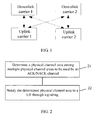
- a User 1 uses downlink carrier 1, downlink carrier 2, and uplink carrier 1.
- Uplink carrier 1 is paired with downlink carrier 1, and the corresponding resource may be added on uplink carrier 1 as a feedback area of downlink carrier 2 (non-paired downlink carrier). That is, the paired downlink carrier feeds back information in the legacy feedback area of the corresponding uplink carrier, and the non-paired downlink carrier feeds back information in a newly added area of the paired uplink carrier.
- the foregoing method serves as a reference.
- the foregoing method enables feedback of ACK/NACK messages of non-paired uplink carriers or non-paired downlink carriers.
- the feedback area is fixed, if many resources are unused in the legacy feedback area, resource waste may occur, and it is impossible to schedule ACK/NACK resources flexibly.
- the confirmation information indicates whether a receiver receives transmission content from a transmitter correctly.
- ACK indicates that the content is received correctly
- NACK indicates that the content is received incorrectly.
- ACK and NACK are only examples of confirmation messages. In practice, other confirmation messages may be applied instead.
- the corresponding confirmation information channel resource is a resource for transmitting confirmation messages.
- the ACK/NACK channel resource is taken as an example of a resource of the corresponding confirmation information channel.
- one physical channel area may be determined among multiple physical channel areas to be used by the ACK/NACK channel on the network side, and then information about the determined physical channel area is notified to the UE by signaling.
- the UE can determine the channel for sending or receiving ACK/NACK information in a corresponding physical channel area according to a mapping rule, and the ACK/NACK information can be sent or received on the physical channel of the physical channel area.
- the corresponding physical channel area may be a legacy area or current area.
- the legacy area is designed for feeding back confirmation information in a legacy system
- the current area is designed for feeding back confirmation information in a current system compatible with the legacy system.
- the legacy area and the current area may respectively be LTE areas and LTE-A-specific areas; the legacy area and the current area are respectively Coordinated Multi-Point (CoMP) areas and non-CoMP areas, where the CoMP areas are used by CoMP users exclusively for sending ACK/NACK information, and the ACK/NACK information sent in the CoMP area may be modulated through the sequences specific to CoMP users; or, the legacy area and the current area may respectively be non-relay areas and relay areas, where the relay areas are used by relay stations for receiving and sending ACK/NACK ; or, the legacy area and the current area may be categorized into other physical channel areas.
- Each area may further include one or more subareas.
- an LTE-A-specific area may include one or more LTE-A-specific subareas
- multiple physical channel areas do not overlap at all, or overlap partly.
- the legacy area may be orthogonal to the current area (namely, without overlap), or may overlap with the current area.
- more than one physical channel area needs to be configured or divided on the network side. At least one of the physical channel areas is designed for feeding back confirmation information of paired carriers, and at least one of the physical channel areas is designed for feeding back confirmation information of non-paired carriers.
- a legacy area is taken as an example of the at least one physical channel area for feeding back confirmation information of paired carriers
- a current area is taken as an example of the at least one physical channel area for feeding back confirmation information of non-paired carriers.
- a physical channel area for feeding back confirmation information of paired carriers is called a first physical channel area; and a physical channel area for feeding back confirmation information of non-paired carriers is called a second physical channel area.
- the LTE-A-specific areas may further include ACK/NACK channels corresponding to CCEs in the public search space in the LTE system, namely, the first 16 ACK/NACK channels of the ACK/NACK channel resources of the LTE, so as to improve utilization ratio of an ACK/NACK channel.
- the foregoing physical channel areas may be placed on one or more carriers, and a physical channel area may be set on one carrier or multiple carriers. In the following embodiments, the setting of the physical channel areas is the same and therefore not described again.
- the process may include:
- the determined physical channel area may be an uplink physical channel area to be used by an uplink ACK/NACK channel, or a downlink physical channel area to be used by a downlink ACK/NACK channel. That is, this step is applicable to both an uplink scenario and a downlink scenario.
- the selection may include: When the channel redundancy of the LTE area is great, for example, the PDCCH has a high CCE level or low load on the paired downlink carriers, and the ACK/NACK mapping of the paired carriers of the current user does not conflict, it is determined that the current user uses the LTE area for ACK/NACK channel mapping, and the user is notified through signaling; when the channel redundancy of the LTE area is small, for example, the PDCCH has a low CCE level or high load on the paired downlink carriers, and the ACK/NACK mapping of the non-paired carriers of the current user does not conflict, it is determined that the current user uses the LTE-A-specific area for ACK/NACK channel mapping, and the user is notified through signaling; when the ACK/NACK mapping of the LTE area conflicts with the ACK/NACK mapping of the LTE-A-specific area of
- Step 22 Notify the determined physical channel area to a UE through signaling.
- the physical channel area that includes the ACK/NACK channel may be notified to the UE dynamically through bits or a scrambling code. That is:
- new bits may be added into the PDCCH to indicate the physical channel area in which the user side receives or sends the ACK/NACK information; or all or part of the states represented by the existing bits in the PDCCH may be multiplexed to indicate the physical channel area in which the user side receives or sends ACK/NACK information.
- three bits in the PDCCH represent an HARQ process, and all or part of the eight states represented by the three bits may be used to indicate the physical channel area in which the user side receives and sends ACK/NACK information.
- the signaling for determining the physical channel area may be encoded together with other signaling in the physical control channel such as PDCCH.
- the signaling for determining the physical channel area may be encoded together with the ACK/NACK indication bits in the PDCCH.
- the ACK/NACK indication bit indicates the occupied ACK/NACK channel in physical control channels.
- eight ACK/NACK channels are configured in a physical channel area, and an ACK/NACK indication with at least three bits may be used to indicate the ACK/NACK channel occupied by a user.
- New bits may be added in the physical control channel as ACK/NACK indication bits, or other bits in the physical control channel may be multiplexed as ACK/NACK indication bits.
- the resource allocation granularity is increased so that the bits of the resource allocation field in the PDCCH are multiplexed as ACK/NACK indication bits.
- the physical channel area may be the first physical channel area, or, preferably, the second physical channel area.
- One or more states represented by the ACK/NACK indication bits may be used to indicate the determined physical channel area to a UE. For example, when there are three ACK/NACK indication bits, 000 indicates that the determined physical channel area is the first physical channel area, and 001-111 indicate the 7 ACK/NACK channels in the second physical channel area respectively.
- the ACK/NACK indication bits may be encoded together with the signaling for determining the physical channel area, namely, one or more states of the ACK/NACK indication bits are used to indicate the determined physical channel area.
- the first physical channel area may employ an implicit mapping rule of CCE index. In this case, one or more states represented by the ACK/NACK indication bits are used to notify the current user, and a ACK/NACK channel of the user is mapped to the first physical channel area according to the implicit mapping rule of PDCCH CCE index.
- the signaling for determining the physical channel area is multiplexed together with other signaling in the physical control channel
- another instance is: the signaling for determining the physical channel area is encoded together with carrier indication bits.
- the carrier indication bits indicate the carrier scheduled by the current physical control channel. For example, in the case of four PDSCH carriers, at least two bits in the PDCCH need to be used as carrier indication bits to indicate which one of the four carriers is currently scheduled for the PDCCH.
- the carrier indication includes three bits and four PDSCH carriers exist currently, one bit or two states are redundant.
- the redundant bit or redundant states of the carrier indication bits may be used to indicate the determined physical channel area.
- both the first physical channel area and the second physical channel area may employ the implicit mapping rule of CCE index; or, the first physical channel area employs the implicit mapping rule of CCE index, and the second physical channel area uses the ACK/NACK indication bits to indicate the specific ACK/NACK channel; or, the first physical channel area uses the implicit mapping rule of CCE index, and the second physical channel area may be configured exclusively for the user indicated by the cross-carrier PDCCH through high-layer semi-static signaling.
- the signaling for determining the physical channel area is encoded together with other signaling in the physical control channel, and the existing fields in the physical control channel may be used to indicate the determined physical channel area to a UE, which reduces conflict of the ACK/NACK channel, improves flexibility of scheduling and saves signaling overhead.
- layer-1 signaling/layer-2 signaling L1/L2 signaling
- RRC Radio Resource Control
- the network may use RRC signaling to send the start offset information.
- the start offset information indicates the start position of the physical channel area for receiving or sending ACK/NACK information, for example, the start position of the LTE area, or the start position of the LTE-specific area (including the start position of an LTE-A-specific subarea).
- the start offset information is used for dividing physical channel areas. Therefore, the start offset information is not sent any more after being sent initially, or is sent at long regular intervals, or sent at long irregular intervals.
- the step of notifying the start offset information to the UE through RRC signaling may be performed before, during or after the foregoing step. After the foregoing step is performed, the step of sending the start offset information is not necessarily performed.
- the mapping rule may be: the start offset information is combined with the sequence number of the CCE to indicate the channel (namely, ACK/NACK channel) used by a specific user side to receive or send ACK/NACK information.
- the LTE-A-specific area includes multiple LTE-A-specific subareas
- the LTE-A-specific subareas may overlap partly or completely with one another, and a LTE-A-specific subarea may overlap with a LTE area of the LTE system partly or completely.
- the corresponding start offset information may be applied so that multiple areas (LTE areas or LTE-A-specific subareas) overlap partly or completely.
- the configuring or allocation of physical channel areas may be performed once or repeatedly on the network side; and may be performed periodically or irregularly.
- the network side needs to notify a UE, and the notification method is described above. Alternately, if both the network side and a UE know the allocation of the physical channel area, it is not necessary to notify the UE through signaling, and the physical channel area known to the network side and the UE is applied.
- the network side can feed back ACK/NACK information corresponding to non-paired uplink carriers or non-paired downlink carriers, and can indicate the physical channel area that includes the ACK/NACK channel to the UE flexibly, which improves utilization ratio of the ACK/NACK channel resources and reduces overhead and possible conflicts.
- the resources are utilized more efficiently and flexibly.
- a method for processing confirmation information (namely, ACK/NACK information) is provided in an embodiment of the present invention. This method is implemented in a UE or a network side, as detailed below.
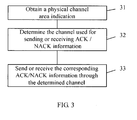
- the process of processing confirmation information may include: obtaining a physical channel area indication which indicates the physical channel area that includes the ACK/NACK channel in multiple physical channel areas; and the UE sends or receives ACK/NACK information on the physical channel area that includes the ACK/NACK channel according to the physical channel area indication.
- the process may include:
- a UE may use (but without being limited to using) one or more bits in the PDCCH to obtain the physical channel area indication for receiving or sending ACK/NACK information; or, the UE may use a scrambling code in the PDCCH to obtain the physical channel area indication for receiving or sending ACK/NACK information; or, the UE may use other high-layer signaling (such as RRC signaling) to receive and obtain the corresponding physical channel area indication information.
- RRC signaling high-layer signaling
- Step 32 Determine the channel used for sending or receiving ACK/NACK information.
- the channel used for sending or receiving ACK/NACK information is determined in the physical channel area indicated by the physical channel area indication according to a predefined mapping rule. That is, the ACK/NACK channel used in the UE for receiving or sending ACK/NACK information is determined according to the predefined mapping rule among multiple ACK/NACK channels included in the physical channel area used by the UE for receiving or sending ACK/NACK information, and therefore, the UE can determine the specific channel for receiving or sending ACK/NACK information in the physical channel area.
- the mapping rule is a principle of selecting a channel for sending or receiving ACK/NACK information in the physical channel area.
- the mapping rule may be:
- the start offset information is combined with the CCE sequence number to indicate the channel used by the UE for receiving or sending ACK/NACK information.
- a user 1 uses uplink carrier 1, downlink carrier 1, and downlink carrier 2; the start offset information is 16; the CCE sequence numbers that need to be fed back on downlink carrier 2 are 20, 21, 22, and 23; the minimum CCE sequence number is combined with the start offset information, and therefore, the ACK/NACK channel numbered 36(20+16) in the corresponding physical channel area is selected for feedback.
- the mapping rule further includes: using the ACK/NACK channel indicated by the ACK/NACK indication bits.
- Step 33 Send or receive the corresponding ACK/NACK information through the channel determined for sending or receiving ACK/NACK information.
- the UE can know the channel used for sending or receiving ACK/NACK information, and receive or send ACK/NACK information accordingly. In this way, the ACK/NACK information corresponding to non-paired uplink carriers or non-paired downlink carriers can be fed back, and the ACK/NACK channels can be scheduled flexibly.
- the process of processing confirmation information may include: The network side obtains locally a physical channel area indication information which indicates the physical channel area that includes the ACK/NACK channel in multiple physical channel areas; and the network side sends or receives ACK/NACK information on the physical channel area that includes the ACK/NACK channel according to the physical channel area indication information.
- the process of processing confirmation information in the network side may be implemented in a Base Station, namely, the Base Station obtains locally a physical channel area indication information for receiving or sending ACK/NACK information, and sends or receives the corresponding ACK/NACK information according to the physical channel area indication information.
- the network side may perform the following operation additionally: determining the channel in the physical channel area used for receiving or sending ACK/NACK information. Specifically, the network side may determine the channel used for receiving or sending ACK/NACK information in multiple channels included in different LTE-A-specific subareas or LTE areas according to different mapping rules.
- the mapping rule is a principle of selecting a channel for sending or receiving ACK/NACK information in a physical channel area.
- the network side can determine the channel used for sending or receiving ACK/NACK information , and send or receive ACK/NACK information accordingly.
- This embodiment may include the following step additionally: A UE obtains the locations of the first physical channel area and the second physical channel area allocated by the network side. This step may be implemented by receiving start offset information. The UE may know the start point of each physical channel area in the multiple physical channel areas according to the start offset information, and determine the location of each physical channel area.
- the first embodiment deals with how the network side allocates ACK/NACK channel resources and receives or sends ACK/NACK information, and how a UE receives or sends ACK/NACK information.
- the network side allocates ACK/NACK channel resources and receives or sends ACK/NACK information
- one bit in the PDCCH may indicate different physical channel areas, namely, indicate that the area mapped to the ACK/NACK channel is the LTE area or LTE-A-specific area.
- the UE determines the physical channel area that includes the uplink or downlink ACK/NACK channel, and determines the physical channel area that includes the ACK/NACK channel used for receiving or sending ACK/NACK information.
- the mapping rule for mapping of the ACK/NACK channel of the downlink carriers (paired downlink carriers) corresponding to the uplink carriers is the same as the mapping rule of the LTE system.
- the corresponding ACK/NACK channel may be determined according to the mapping of the start offset information and the CCE sequence number of the PDCCH on the corresponding downlink carrier.
- the start offset information indicates that the physical channel area covering the ACK/NACK channel is an LTE area or an LTE-A-specific subarea; and the CCE sequence number indicates the location of the ACK/NACK channel in the corresponding LTE area or LTE-A-specific subarea.
- other mapping rules may be applied to determine the corresponding ACK/NACK channel.
- the ACK/NACK channel mapping process may include:
- 1 bit in the PDCCH may indicate the positions of two ACK/NACK channels, and the ACK/NACK channels correspond to the CCE indices of the PDCCH of this downlink carrier, respectively;
- 1 bit in the PDCCH may indicate the positions of two ACK/NACK channels, and the ACK/NACK channels are mapped to the second CCE index and the fourth CCE index among four CCEs, which reduces the probability of conflicting with the ACK/NACK channel resource in the paired carriers;
- the mapping rule is the same as the scenario of 4 CCEs above.
- the ACK/NACK channels are mapped to two CCE indices selected, which are any two CCE indices in the second, fourth, sixth, and eighth CCE indices in the 8 CCEs.
- This embodiment is applicable to determining the uplink ACK/NACK channel, and applicable to dynamic indication of the downlink ACK/NACK channel.
- 1 specific bit in the PDCCH may be used to indicate the specific mapping area of the downlink ACK/NACK channel so that the corresponding downlink ACK/NACK channel can be determined.
- the detailed process is similar to the foregoing process.
- multiple bits in the PDCCH may dynamically indicate the physical channel areas that include the ACK/NACK channels. For example, two bits in the PDCCH dynamically indicate the physical channel areas that include four ACK/NACK channels.
- the start offset information may be notified to the UE through an RRC signaling.
- the corresponding start offset information is broadcast on the corresponding downlink carrier; or, all start offset information is broadcast on the paired carriers, and may be carried on the signaling that carries the reserved ACK/NACK channel resource specific to LTE-A; or, the start offset information is carried on the PDCCH, and the existing bit field represents the start offset information, for example, HARQ process, and Modulation Coding Scheme (MCS) etc.
- MCS Modulation Coding Scheme
- a UE receives an indication of the physical channel area that is sent by the network side, and receives or sends the ACK/NACK messages according to the indication.
- a UE receives the indication sent by the network side. According to the indication, the UE determines the physical channel area allocated by the network side to the UE and the network side for sending ACK/NACK information. Then, the UE can determine the ACK/NACK channel available to the UE in the corresponding physical channel area for sending ACK/NACK information according to a mapping rule, and receive and or send ACK/NACK information through the ACK/NACK channel.
- the method of dynamically notifying the area mapped to the ACK/NACK channel in the first embodiment above may be extended so that the method is applicable to send ACK/NACK information in a CoMP system.
- the corresponding physical channel areas in the CoMP system include CoMP areas and non-CoMP areas.
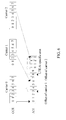
- a CoMP area is applicable to a scenario of crossed ACK/NACK mapping, and applicable to a scenario of non-crossed ACK/NACK mapping as shown in FIG. 9 . That is, in the ACK/NACK mapping of paired downlink carriers, non-CoMP areas or CoMP areas may be selected dynamically.
- the third embodiment deals with a scenario of ACK/NACK channel indication among multiple subframes. That is, the third embodiment accomplishes flexible indication of ACK/NACK channels among multiple subframes, and overcomes conflict.
- the PDCCH may include 1 bit which indicates the ACK/NACK channels between two subframes.
- all PDCCHs of a UE are carried on a downlink carrier (such as downlink main carrier).
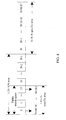
- the data of the current subframe may be in the subframe of the PDCCH, but the data of other carriers indicated and the corresponding PDCCH need to be deferred for one subframe, which is shown by the arrow in downlink carrier 1 and downlink carrier 2 in FIG. 10 ; and the uplink ACK/NACK messages are fed back on the 4th subframe after the corresponding data channel.
- the PDCCHs of the same UE are transmitted on the same subframe, but the uplink ACK/NACK channel feeds back information on different subframes. Consequently, the ACK/NACK corresponding to the PDCCH of the next subframe may conflict.
- an LTE-A-specific area may be reserved on the uplink subframe.
- the indication mode in the processing solution provided herein for example, indication mode described in the first embodiment
- the positions of the ACK/NACK channels are notified to the UE. That is, the positions of the ACK/NACK channels in the LTE area or LTE-A-specific area are indicated.
- the ACK/NACK information corresponding to the non-paired uplink carriers or non-paired downlink carriers can be fed back, a tradeoff is achieved between the ACK/NACK resource reservation overhead and ACK/NACK resource mapping conflict, and the ACK/NACK performance loss caused by interference between cells is reduced.
- start offset information is introduced so that the ACK/NACK channel resources can be scheduled more flexibly. For example, when the Control Format Indication (CFI) value of the paired downlink carriers is small, the start offset information may make the physical channel area fall within the LTE area.
- CFI Control Format Indication
- the redundant ACK/NACK channel in the LTE area can be utilized efficiently, the resources reserved in the LTE-A-specific area can be reduced, and the utilization ratio of the ACK/NACK channel is improved.
- the LTE-A-specific area includes the ACK/NACK channel corresponding to the CCE in the public search space, which further improves the utilization ratio of the ACK/NACK channel.
- an LTE-A-specific area (or LTE-A-specific subarea) can be reserved for each non-paired downlink carrier of a user respectively to reduce conflict of the ACK/NACK channel.
- the ACK/NACK resources can be dynamically released for the sake of transmitting data. For example, when there are few users of LTE, or when the LTE area has considerable redundancy, the ACK/NACK channel can be mapped to the LTE area through dynamic adjustment. In this case, the reserved LTE-A-specific area resources can be released and become available to data channel transmission.
- the program may be stored in computer readable storage media. When the program runs, the steps of the method specified in any embodiment above are executed.
- the storage media may be a magnetic disk, CD-ROM, Read-Only Memory (ROM), or Random Access Memory (RAM).
- the apparatus may be configured on the network side, for example, in a Base Station. As shown in FIG. 11 , the apparatus may include:
- the physical channel areas in the physical channel area information sent by the notifying module 902 may include LTE areas and LTE-A-specific areas.
- the LTE-A-specific areas may include multiple LTE-A-specific subareas, and the LTE-A-specific areas may include the ACK/NACK channels corresponding to the CCE of the public search space in the LTE system; the physical channel areas include COMP areas and non-COMP areas.
- the notification method of the notifying module 902 may be but is not limited to: One or more bits in the PDCCH indicates the physical channel area in which the UE receives or sends ACK/NACK messages; or, different scrambling codes loaded on the PDCCH indicate the physical channel area in which the UE receives or sends ACK/NACK messages.
- the notifying module 902 may be configured to send start offset information to the UE through an RRC signaling.
- the corresponding start offset information may be configured to determine the start point of a physical channel area.
- the start offset information may be combined with a CCE sequence number to indicate the channel used by the UE for receiving or sending ACK/NACK information among multiple channels included in the physical channel area in which the UE receives or sends ACK/NACK information.
- the apparatus may further include a physical channel area allocating module, which is configured to allocate at least one first physical channel area and at least one second physical channel area.
- the first physical channel area includes a confirmation information channel for sending confirmation information of paired carriers
- the second physical channel area includes a confirmation information channel for sending confirmation information of non-paired carriers.
- the apparatus may be configured in a UE. As shown in FIG. 12 , the apparatus may include a physical channel area obtaining module and a confirmation information processing module.
- the confirmation information processing module 1002 is further configured to determine a channel in the physical channel area to be used by the ACK/NACK channel, and specifically, determine the channel available for receiving or sending ACK/NACK information in multiple channels included in different LTE-A-specific subareas or LTE areas according to different mapping rule.
- the corresponding physical channel areas may include LTE areas and LTE-A-specific areas, and includes CoMP areas and non-CoMP areas. Further, the LTE-A-specific areas include multiple LTE-A-specific subareas, and the LTE-A-specific area may include a ACK/NACK channel corresponding to the CCE of the public search space in the LTE system.
- the apparatus may be configured on the network side, for example, set in a Base Station. As shown in FIG. 13 , the apparatus may include a physical channel area obtaining module 1101 and a confirmation information processing module 1102.
- the confirmation information processing module 1102 is further configured to determine a channel in the physical channel area to be used by the ACK/NACK channel, and specifically, determine a channel available for receiving or sending ACK/NACK information in multiple channels included in different LTE-A-specific subareas or LTE areas according to different mapping rule.
- the corresponding physical channel areas may include LTE areas and LTE-A-specific areas, and includes CoMP areas and non-CoMP areas. Further, the LTE-A-specific areas include multiple LTE-A-specific subareas, and the LTE-A-specific area may include ACK/NACK channels corresponding to the CCEs of the public search space in the LTE system.
- the BS may include the physical channel area determining module 901, notifying module 902, physical channel area obtaining module 1101, and confirmation information processing module 1102.
- the physical channel area obtaining module 1101 obtains the physical channel area indication determined by the physical channel area determining module 901. The functions of the modules have been described above, and are not repeated here any further.
- the ACK/NACK information corresponding to the non-paired uplink carrier or downlink carrier can be fed back, the utilization ratio of a ACK/NACK channel is improved, the flexibility of scheduling ACK/NACK resources is improved, and the probability of conflict generated by ACK/NACK channels is reduced.
Landscapes
- Engineering & Computer Science (AREA)
- Signal Processing (AREA)
- Computer Networks & Wireless Communication (AREA)
- Mobile Radio Communication Systems (AREA)
Claims (15)
- Betriebsmittelzuweisungsverfahren, das Folgendes umfasst:Bestimmen (21) eines physikalischen Kanalbereichs aus mehreren physikalischen Kanalbereichen; undMelden (22) des bestimmten physikalischen Kanalbereichs an ein Anwendergerät (User Equipment, UE) durch Signalisierung, um dem UE zu ermöglichen, einen Bestätigungsinformationskanal in dem bestimmten physikalischen Kanalbereich gemäß einer Abbildungsregel zu bestimmen, wobei jeder der mehreren physikalischen Kanalbereiche wenigstens einen Bestätigungsinformationskanal umfasst und die Abbildungsregel ein Prinzip zum Auswählen eines Bestätigungsinformationskanals in dem bestimmten physikalischen Kanalbereich zum Senden oder Empfangen von ACK/NACK-Informationen ist, undwobei das Verfahren dadurch gekennzeichnet ist, dass die mehreren physikalischen Kanalbereiche Folgendes umfassen: einen koordinierten Mehrpunktbereich (Coordinated Multi-Point area, CoMP-Bereich) und einen Nicht-CoMP-Bereich, wobei der CoMP-Bereich durch CoMP-Anwender ausschließlich zum Senden von ACK/NACK-Informationen verwendet wird und die in dem CoMP-Bereich gesendeten ACK/NACK-Informationen durch Folgen, die für CoMP-Anwender spezifisch sind, moduliert sind.
- Verfahren nach Anspruch 1, wobei der Schritt des Meldens (22) des bestimmten physikalischen Kanalbereichs an ein UE durch Signalisierung eines oder eine Kombination aus dem Folgenden umfasst:Verwenden eines oder mehrerer Bits in einem physikalischen Abwärtsstreckensteuerkanal (Physical Downlink Control Channel, PDCCH), um dem UE den bestimmten physikalischen Kanalbereich zu melden; undVerwenden eines Verwürfelungscodes in dem PDCCH, um dem UE den bestimmten physikalischen Kanalbereich zu melden.
- Verfahren nach Anspruch 2, wobei das Verwenden eines oder mehrerer Bits in einem PDCCH, um dem UE den bestimmten physikalischen Kanalbereich zu melden, eines oder eine Kombination aus dem Folgenden umfasst:Verwenden eines neuen Bits, das in dem PDCCH hinzugefügt ist, um dem UE den bestimmten physikalischen Kanalbereich zu melden,Verwenden eines redundanten Bits oder eines redundanten Zustands in dem PDCCH, um dem UE den bestimmten physikalischen Kanalbereich zu melden, undCodieren von Informationen, die den bestimmten physikalischen Kanalbereich angeben, zusammen mit Informationen in dem PDCCH und Verwenden der codierten Informationen, um dem UE den bestimmten physikalischen Kanalbereich zu melden.
- Verfahren nach einem der Ansprüche 1-3, wobei die Signalisierung Funkbetriebsmittelsteuerungs-Signalisierung (Radio Resource Control signaling, RRC-Signalisierung) ist und verwendet wird, um Startversatzinformationen zu senden, und die Startversatzinformationen die Startposition des bestimmten physikalischen Kanalbereichs angeben.
- Verfahren nach einem der Ansprüche 1-4, wobei die Signalisierung Schicht-1-Signalisierung/Schicht-2-Signalisierung (layer-1 signaling/layer-2 signaling, L1/L2-Signalisierung) oder Funkbetriebsmittelsteuerungs-Signalisierung, RRC-Signalisierung, ist.
- Verfahren nach einem der Ansprüche 1-4, wobei der Schritt des Meldens Folgendes umfasst: Melden des bestimmten physikalischen Kanalbereichs an das UE über PDCCH, und wobei der PDCCH verwendet wird, um den einen physikalischen Kanalbereich dynamisch zu bestimmen.
- Betriebsmittelzuweisungsvorrichtung, die Folgendes umfasst:ein Bestimmungsmodul für den physikalischen Kanalbereich, das konfiguriert ist,einen physikalischen Kanalbereich aus mehreren physikalischen Kanalbereichen zu bestimmen; undein Meldemodul, das konfiguriert ist, den bestimmten physikalischen Kanalbereich an ein Anwendergerät, UE, durch Signalisierung zu melden, um dem UE zu ermöglichen, einen Bestätigungsinformationskanal in dem physikalischen Kanalbereich gemäß einer Abbildungsregel zu bestimmen, wobei jeder der mehreren physikalischen Kanalbereiche wenigstens einen Bestätigungsinformationskanal umfasst, der Bestätigungsinformationskanal ein Kanal zum Empfangen oder Senden von ACK/NACK-Informationen ist und die Abbildungsregel ein Prinzip zum Auswählen eines Bestätigungsinformationskanals in dem bestimmten physikalischen Kanalbereich ist, undwobei die Vorrichtung dadurch gekennzeichnet ist, dass die mehreren physikalischen Kanalbereiche Folgendes umfassen: einen koordinierten Mehrpunktbereich, CoMP-Bereich, und einen Nicht-CoMP-Bereich, wobei der CoMP-Bereich durch CoMP-Anwender ausschließlich zum Senden von ACK/NACK-Informationen verwendet wird und die in dem CoMP-Bereich gesendeten ACK/NACK-Informationen durch Folgen, die für CoMP-Anwender spezifisch sind, moduliert sind.
- Vorrichtung nach Anspruch 7, wobei die Signalisierung verwendet wird, um Startversatzinformationen zu senden, und die Startversatzinformationen die Startposition des bestimmten physikalischen Kanalbereichs angeben.
- Vorrichtung nach einem der Ansprüche 7-8, wobei der bestimmte physikalische Kanalbereich dem UE durch einen physikalischen Abwärtsstreckensteuerkanal, PDCCH, gemeldet wird und der PDCCH verwendet wird, um den einen physikalischen Kanalbereich dynamisch zu bestimmen.
- Verfahren zum Verarbeiten von Bestätigungsinformationen, das Folgendes umfasst:Erhalten einer Angabe eines physikalischen Kanalbereichs, die einen physikalischen Kanalbereich aus mehreren physikalischen Kanalbereichen angibt;Bestimmen eines Bestätigungsinformationskanals in dem physikalischen Kanalbereich, der durch die Angabe des physikalischen Kanalbereichs angegeben ist, gemäß einer Abbildungsregel; undSenden oder Empfangen von ACK/NACK-Informationen auf dem bestimmten Bestätigungsinformationskanal, wobei jeder der mehreren physikalischen Kanalbereiche wenigstens einen Bestätigungsinformationskanal umfasst und die Abbildungsregel ein Prinzip zum Auswählen eines Bestätigungsinformationskanals in dem bestimmten physikalischen Kanalbereich zum Senden oder Empfangen von ACK/NACK-Informationen ist, undwobei das Verfahren dadurch gekennzeichnet ist, dass die mehreren physikalischen Kanalbereiche Folgendes umfassen: einen koordinierten Mehrpunktbereich, CoMP-Bereich, und einen Nicht-CoMP-Bereich, wobei der CoMP-Bereich durch CoMP-Anwender ausschließlich zum Senden von ACK/NACK-Informationen verwendet wird und die in dem CoMP-Bereich gesendeten ACK/NACK-Informationen durch Folgen, die für CoMP-Anwender spezifisch sind, moduliert sind.
- Verfahren nach Anspruch 10, wobei die Angabe Funkbetriebsmittel-Steuersignalisierung, RRC-Signalisierung, verwendet und verwendet wird, um Startversatzinformationen zu senden, und die Startversatzinformationen die Startposition des bestimmten physikalischen Kanalbereichs angeben.
- Verfahren nach einem der Ansprüche 10-11, wobei der Schritt des Erhaltens Folgendes umfasst: Erhalten des angegebenen physikalischen Kanalbereichs durch ein Anwendergerät, UE, über einen physikalischen Abwärtsstreckensteuerkanal, PDCCH, wobei der PDCCH verwendet wird, um den einen physikalischen Kanalbereich dynamisch zu bestimmen.
- Vorrichtung zum Verarbeiten von Bestätigungsinformationen, die Folgendes umfasst:ein Erhaltemodul für den physikalischen Kanalbereich, das konfiguriert ist, eine Angabe des physikalischen Kanalbereichs, die einen physikalischen Kanalbereich aus mehreren physikalischen Kanalbereichen angibt, zu erhalten; undein Bestätigungsinformationsverarbeitungsmodul, das konfiguriert ist, Bestätigungsinformationen auf einem Bestätigungsinformationskanal zu senden oder zu empfangen, wobei der Bestätigungsinformationskanal in dem physikalischen Kanalbereich, der durch die Angabe des physikalischen Kanalbereichs angegeben ist, gemäß einer Abbildungsregel bestimmt wird, wobei jeder der mehreren physikalischen Kanalbereiche wenigstens einen Bestätigungsinformationskanal umfasst und die Abbildungsregel ein Prinzip zum Auswählen eines Bestätigungsinformationskanals in dem bestimmten physikalischen Kanalbereich zum Senden oder Empfangen von ACK/NACK-Informationen ist, undwobei die Vorrichtung dadurch gekennzeichnet ist, dass die mehreren physikalischen Kanalbereiche Folgendes umfassen: einen koordinierten Mehrpunktbereich, CoMP-Bereich, und einen Nicht-CoMP-Bereich, wobei der CoMP-Bereich durch CoMP-Anwender ausschließlich zum Senden von ACK/NACK-Informationen verwendet wird und die in dem CoMP-Bereich gesendeten ACK/NACK-Informationen durch Folgen, die für CoMP-Anwender spezifisch sind, moduliert sind.
- Vorrichtung nach Anspruch 13, wobei die Angabe Funkbetriebsmittel-Steuersignalisierung, RRC-Signalisierung, verwendet und verwendet wird, um Startversatzinformationen zu senden, und die Startversatzinformationen die Startposition des bestimmten physikalischen Kanalbereichs angeben.
- Kommunikationssystem, das eine Basisstation, BS, und ein Anwendergerät, UE, umfasst, dadurch gekennzeichnet, dass die BS eine Betriebsmittelzuweisungsvorrichtung nach einem der Ansprüche 7-9 umfasst und das UE eine Vorrichtung zum Verarbeiten von Bestätigungsinformationen nach einem der Ansprüche 13-14 umfasst.
Priority Applications (1)
| Application Number | Priority Date | Filing Date | Title |
|---|---|---|---|
| EP15154068.9A EP2894806B1 (de) | 2009-01-24 | 2010-01-25 | Verfahren und Vorrichtung zur Zuweisung von Ressourcen und zur Verarbeitung von Bestätigungsinformationen |
Applications Claiming Priority (3)
| Application Number | Priority Date | Filing Date | Title |
|---|---|---|---|
| CN200910105293 | 2009-01-24 | ||
| CN200910130084.XA CN101790240B (zh) | 2009-01-24 | 2009-04-14 | Ack/nack信道资源分配及确认信息处理的方法及装置 |
| PCT/CN2010/070352 WO2010083782A1 (zh) | 2009-01-24 | 2010-01-25 | 资源分配及确认信息处理的方法及装置 |
Related Child Applications (2)
| Application Number | Title | Priority Date | Filing Date |
|---|---|---|---|
| EP15154068.9A Division EP2894806B1 (de) | 2009-01-24 | 2010-01-25 | Verfahren und Vorrichtung zur Zuweisung von Ressourcen und zur Verarbeitung von Bestätigungsinformationen |
| EP15154068.9A Division-Into EP2894806B1 (de) | 2009-01-24 | 2010-01-25 | Verfahren und Vorrichtung zur Zuweisung von Ressourcen und zur Verarbeitung von Bestätigungsinformationen |
Publications (3)
| Publication Number | Publication Date |
|---|---|
| EP2387176A1 EP2387176A1 (de) | 2011-11-16 |
| EP2387176A4 EP2387176A4 (de) | 2012-03-14 |
| EP2387176B1 true EP2387176B1 (de) | 2015-04-22 |
Family
ID=42355564
Family Applications (2)
| Application Number | Title | Priority Date | Filing Date |
|---|---|---|---|
| EP15154068.9A Active EP2894806B1 (de) | 2009-01-24 | 2010-01-25 | Verfahren und Vorrichtung zur Zuweisung von Ressourcen und zur Verarbeitung von Bestätigungsinformationen |
| EP10733255.3A Active EP2387176B1 (de) | 2009-01-24 | 2010-01-25 | Verfahren und vorrichtungen zur zuweisung von ressourcen und zur verarbeitung von bestätigungsinformationen |
Family Applications Before (1)
| Application Number | Title | Priority Date | Filing Date |
|---|---|---|---|
| EP15154068.9A Active EP2894806B1 (de) | 2009-01-24 | 2010-01-25 | Verfahren und Vorrichtung zur Zuweisung von Ressourcen und zur Verarbeitung von Bestätigungsinformationen |
Country Status (8)
| Country | Link |
|---|---|
| US (6) | US9219580B2 (de) |
| EP (2) | EP2894806B1 (de) |
| CN (2) | CN104184567B (de) |
| BR (1) | BRPI1007309B1 (de) |
| ES (1) | ES2542971T3 (de) |
| PT (1) | PT2387176E (de) |
| RU (1) | RU2479137C1 (de) |
| WO (1) | WO2010083782A1 (de) |
Families Citing this family (28)
| Publication number | Priority date | Publication date | Assignee | Title |
|---|---|---|---|---|
| CN104184567B (zh) | 2009-01-24 | 2019-11-22 | 华为技术有限公司 | Ack/nack信道资源分配及确认信息处理的方法及装置 |
| CN102025466B (zh) | 2009-09-15 | 2013-10-02 | 华为技术有限公司 | 信令处理方法、基站以及用户设备 |
| WO2011138849A1 (ja) | 2010-05-06 | 2011-11-10 | パナソニック株式会社 | 端末装置及び応答信号マッピング方法 |
| JP5265616B2 (ja) * | 2010-05-18 | 2013-08-14 | 株式会社エヌ・ティ・ティ・ドコモ | 無線通信システム |
| CN102752085B (zh) * | 2011-04-21 | 2014-09-17 | 华为技术有限公司 | Tdd系统中确认或不确认指示信息发送的方法和设备 |
| US9668245B2 (en) * | 2011-04-29 | 2017-05-30 | Nokia Solutions And Networks Oy | Method and device for processing uplink control data in a wireless network |
| CN102869098A (zh) * | 2011-07-08 | 2013-01-09 | 普天信息技术研究院有限公司 | 一种控制信息的发送方法和装置 |
| US8953532B2 (en) * | 2011-09-19 | 2015-02-10 | Futurewei Technologies, Inc. | Method and apparatus for uplink control signaling |
| US9160475B2 (en) * | 2012-06-06 | 2015-10-13 | Industrial Technology Research Institute | Method of handling HARQ resource in TDD system and related communication device |
| US9722719B2 (en) * | 2012-06-06 | 2017-08-01 | Industrial Technology Research Institute | Method of handling HARQ resource in TDD system and related communication device |
| CN103490864B (zh) * | 2012-06-11 | 2017-05-03 | 电信科学技术研究院 | 一种harq‑ack消息的传输及其控制方法、装置 |
| ES2747783T3 (es) * | 2012-11-01 | 2020-03-11 | Huawei Tech Co Ltd | Procedimiento y aparato para determinar un espacio de búsqueda de canal de control |
| US9112662B2 (en) * | 2013-01-17 | 2015-08-18 | Samsung Electronics Co., Ltd. | Overhead reduction for transmission of acknowledgment signals |
| US9634982B2 (en) | 2013-07-18 | 2017-04-25 | Cisco Technology, Inc. | Utilizing multiple interfaces when sending data and acknowledgement packets |
| WO2015114700A1 (ja) * | 2014-01-31 | 2015-08-06 | パナソニック インテレクチュアル プロパティ コーポレーション オブ アメリカ | 端末、基地局、送信方法及び受信方法 |
| CN105391525B (zh) * | 2014-09-03 | 2018-11-27 | 中国电信股份有限公司 | 用于选择资源的方法和系统 |
| US9629066B2 (en) * | 2015-02-24 | 2017-04-18 | Huawei Technologies Co., Ltd. | System and method for transmission time intervals |
| JP6170112B2 (ja) * | 2015-10-21 | 2017-07-26 | ノキア ソリューションズ アンド ネットワークス オサケユキチュア | 無線ネットワークにおけるアップリンク制御データの処理方法及び装置 |
| WO2018000421A1 (zh) * | 2016-07-01 | 2018-01-04 | 广东欧珀移动通信有限公司 | 传输信号的方法、网络设备和终端设备 |
| CN109937596B (zh) * | 2016-11-11 | 2021-02-26 | Oppo广东移动通信有限公司 | 调度终端设备的方法、网络设备和终端设备 |
| CN108347321A (zh) * | 2017-01-25 | 2018-07-31 | 华为技术有限公司 | 一种通信方法及装置 |
| CN108809524B (zh) * | 2017-04-28 | 2021-04-09 | 华为技术有限公司 | 传输反馈信息的方法和装置 |
| WO2018201555A1 (zh) * | 2017-05-04 | 2018-11-08 | 华为技术有限公司 | 一种资源指示的方法和设备 |
| JP6431958B2 (ja) * | 2017-06-27 | 2018-11-28 | ノキア ソリューションズ アンド ネットワークス オサケユキチュア | 無線ネットワークにおけるアップリンク制御データの処理方法及び装置 |
| WO2019022489A1 (en) * | 2017-07-25 | 2019-01-31 | Lg Electronics Inc. | METHOD AND APPARATUS FOR ACK / NACK CHANNEL DESIGN IN WIRELESS COMMUNICATION SYSTEM |
| WO2019153126A1 (zh) * | 2018-02-06 | 2019-08-15 | 华为技术有限公司 | 反馈信息的指示方法及装置 |
| JP2025507259A (ja) * | 2022-02-14 | 2025-03-18 | クゥアルコム・インコーポレイテッド | ハイブリッド自動再送要求フィードバック再送信 |
| CN116095780B (zh) * | 2023-04-10 | 2023-06-27 | 深圳市通恒伟创科技有限公司 | 一种4G和wifi同步通信方法、系统、设备及存储介质 |
Family Cites Families (26)
| Publication number | Priority date | Publication date | Assignee | Title |
|---|---|---|---|---|
| KR100926707B1 (ko) | 2002-11-05 | 2009-11-17 | 엘지전자 주식회사 | 이동통신 시스템의 데이터 통신방법 |
| US8014781B2 (en) | 2004-06-08 | 2011-09-06 | Qualcomm Incorporated | Intra-cell common reuse for a wireless communications system |
| US8879511B2 (en) * | 2005-10-27 | 2014-11-04 | Qualcomm Incorporated | Assignment acknowledgement for a wireless communication system |
| BRPI0616542B1 (pt) | 2005-08-24 | 2019-07-16 | Interdigital Technology Corporation | Método e aparelho de ajuste do período de retroalimentação do indicador de qualidade de canais para aumentar a capacidade do link superior |
| CN100586214C (zh) * | 2006-04-04 | 2010-01-27 | 大唐移动通信设备有限公司 | 正交频分复用系统的基站及其小区载波资源的调度方法 |
| US20080101211A1 (en) | 2006-10-31 | 2008-05-01 | Rao Anil M | Method of assigning uplink acknowledgement channels in scheduled packet data systems |
| US8169956B2 (en) | 2007-01-26 | 2012-05-01 | Qualcomm Incorporated | Mapping uplink acknowledgement transmission based on downlink virtual resource blocks |
| US7873710B2 (en) | 2007-02-06 | 2011-01-18 | 5O9, Inc. | Contextual data communication platform |
| CN101247171A (zh) | 2007-02-16 | 2008-08-20 | 北京三星通信技术研究有限公司 | 使用约定资源发送控制信道的设备和方法 |
| KR100868198B1 (ko) * | 2007-04-02 | 2008-11-10 | 주식회사 대우일렉트로닉스 | 병렬 스케줄러를 이용한 데이터 전송방법, 무선자원할당방법 및 무선 송신기 |
| JP4976543B2 (ja) * | 2007-04-27 | 2012-07-18 | エルジー エレクトロニクス インコーポレイティド | 移動通信システムにおいて下り制御チャネルを伝送する方法並びにブロックインターリーバを用いて制御チャネルを物理リソースにマッピングする方法 |
| US9084277B2 (en) | 2007-05-04 | 2015-07-14 | Qualcomm Incorporated | Method and apparatus for UL ACK allocation |
| WO2008153367A1 (en) | 2007-06-15 | 2008-12-18 | Samsung Electronics Co., Ltd. | Method and apparatus for allocating and acquiring ack/nack resources in a mobile communication system |
| US9516671B2 (en) * | 2007-07-05 | 2016-12-06 | Nokia Solutions And Networks Oy | Shared HARQ feedback channels for virtual grouping in a wireless relay network |
| CN101183920B (zh) * | 2007-12-17 | 2013-01-16 | 中兴通讯股份有限公司 | Phich到物理子载波的映射方法和装置 |
| KR101595022B1 (ko) * | 2008-02-05 | 2016-03-02 | 엘지전자 주식회사 | 효율적인 무선채널 전송방법 |
| CN101540632B (zh) | 2008-03-20 | 2013-03-20 | 华为技术有限公司 | 多载波系统中的信息传输方法和装置 |
| US8724636B2 (en) * | 2008-03-31 | 2014-05-13 | Qualcomm Incorporated | Methods of reliably sending control signal |
| US20090257499A1 (en) * | 2008-04-10 | 2009-10-15 | Qualcomm Incorporated | Advanced interpolation techniques for motion compensation in video coding |
| US8234131B2 (en) | 2008-07-14 | 2012-07-31 | Morehouse School Of Medicine | System and method for chronic illness care |
| CN101651523B (zh) | 2008-08-11 | 2013-04-24 | 华为技术有限公司 | 多载波模式下的反馈控制信息的发送方法和装置 |
| KR101648584B1 (ko) * | 2008-10-15 | 2016-09-02 | 엘지전자 주식회사 | 다중 반송파 시스템에서 harq 수행 방법 |
| US9402247B2 (en) * | 2008-10-20 | 2016-07-26 | Interdigital Patent Holdings, Inc. | Uplink control information transmission methods for carrier aggregation |
| WO2010068069A2 (ko) * | 2008-12-11 | 2010-06-17 | 엘지전자 주식회사 | 다중 반송파 시스템에서 제어채널 검출방법 |
| US8565066B2 (en) * | 2009-01-08 | 2013-10-22 | Samsung Electronics Co., Ltd. | System and method for an uplink acknowledgement transmission in carrier-aggregated wireless communication systems |
| CN104184567B (zh) * | 2009-01-24 | 2019-11-22 | 华为技术有限公司 | Ack/nack信道资源分配及确认信息处理的方法及装置 |
-
2009
- 2009-04-14 CN CN201410421366.6A patent/CN104184567B/zh active Active
- 2009-04-14 CN CN200910130084.XA patent/CN101790240B/zh active Active
-
2010
- 2010-01-25 RU RU2011135282/08A patent/RU2479137C1/ru active
- 2010-01-25 PT PT107332553T patent/PT2387176E/pt unknown
- 2010-01-25 BR BRPI1007309-4A patent/BRPI1007309B1/pt active IP Right Grant
- 2010-01-25 EP EP15154068.9A patent/EP2894806B1/de active Active
- 2010-01-25 US US13/145,984 patent/US9219580B2/en active Active
- 2010-01-25 EP EP10733255.3A patent/EP2387176B1/de active Active
- 2010-01-25 ES ES10733255.3T patent/ES2542971T3/es active Active
- 2010-01-25 WO PCT/CN2010/070352 patent/WO2010083782A1/zh not_active Ceased
-
2015
- 2015-11-24 US US14/951,059 patent/US9345005B2/en active Active
-
2016
- 2016-04-15 US US15/130,678 patent/US9768937B2/en active Active
-
2017
- 2017-09-12 US US15/702,459 patent/US10211962B2/en active Active
-
2019
- 2019-01-22 US US16/253,722 patent/US10686577B2/en active Active
-
2020
- 2020-05-29 US US16/888,064 patent/US20200295904A1/en not_active Abandoned
Also Published As
| Publication number | Publication date |
|---|---|
| CN101790240A (zh) | 2010-07-28 |
| RU2011135282A (ru) | 2013-02-27 |
| US10686577B2 (en) | 2020-06-16 |
| PT2387176E (pt) | 2015-09-01 |
| US9345005B2 (en) | 2016-05-17 |
| EP2894806B1 (de) | 2021-05-19 |
| BRPI1007309A2 (pt) | 2016-02-10 |
| US20180013534A1 (en) | 2018-01-11 |
| BRPI1007309B1 (pt) | 2021-04-27 |
| EP2387176A4 (de) | 2012-03-14 |
| CN104184567B (zh) | 2019-11-22 |
| US20190158255A1 (en) | 2019-05-23 |
| US9219580B2 (en) | 2015-12-22 |
| CN104184567A (zh) | 2014-12-03 |
| EP2894806A1 (de) | 2015-07-15 |
| ES2542971T3 (es) | 2015-08-13 |
| RU2479137C1 (ru) | 2013-04-10 |
| US20160088605A1 (en) | 2016-03-24 |
| US9768937B2 (en) | 2017-09-19 |
| US20160352490A1 (en) | 2016-12-01 |
| EP2387176A1 (de) | 2011-11-16 |
| WO2010083782A1 (zh) | 2010-07-29 |
| US20200295904A1 (en) | 2020-09-17 |
| US10211962B2 (en) | 2019-02-19 |
| US20110286414A1 (en) | 2011-11-24 |
| CN101790240B (zh) | 2015-04-15 |
Similar Documents
| Publication | Publication Date | Title |
|---|---|---|
| US10686577B2 (en) | Method and apparatus for allocating resources and processing confirmation information | |
| US12262361B2 (en) | Method and apparatus for transmitting and receiving physical-layer channel in consideration of priority in wireless communication system | |
| US11777662B2 (en) | Method and apparatus for transmitting hybrid automatic repeat and request information in a wireless communication system | |
| US11528098B2 (en) | Method and apparatus for transmitting hybrid automatic repeat and request information in a wireless communication system | |
| JP6120296B2 (ja) | キャリアアグリゲーション中にack/nackメッセージ上でフィードバックを提供するための方法、基地局、およびユーザ機器 | |
| US11683788B2 (en) | System and method for data channel transmission and reception | |
| RU2583376C2 (ru) | Способ связи в мобильной сети в течение промежуточного режима конфигурирования | |
| US11191099B2 (en) | Data transmission method and device, and storage medium | |
| KR20210065162A (ko) | 데이터 전송 방법 및 장치, 데이터 수신 방법 및 장치, 통신 장치, 통신 시스템, 및 저장 매체 | |
| CN104767595A (zh) | Harq-ack反馈信息的传输方法、系统及终端和基站 | |
| CN103796327A (zh) | 一种子帧调度方法、系统及网络设备、终端 | |
| KR102457944B1 (ko) | 데이터 피드백, 송신 및 수신 방법 및 장치, 수신기기 및 송신기기 |
Legal Events
| Date | Code | Title | Description |
|---|---|---|---|
| PUAI | Public reference made under article 153(3) epc to a published international application that has entered the european phase |
Free format text: ORIGINAL CODE: 0009012 |
|
| 17P | Request for examination filed |
Effective date: 20110810 |
|
| AK | Designated contracting states |
Kind code of ref document: A1 Designated state(s): AT BE BG CH CY CZ DE DK EE ES FI FR GB GR HR HU IE IS IT LI LT LU LV MC MK MT NL NO PL PT RO SE SI SK SM TR |
|
| A4 | Supplementary search report drawn up and despatched |
Effective date: 20120215 |
|
| RIC1 | Information provided on ipc code assigned before grant |
Ipc: H04L 29/06 20060101ALI20120209BHEP Ipc: H04L 1/18 20060101AFI20120209BHEP |
|
| DAX | Request for extension of the european patent (deleted) | ||
| 17Q | First examination report despatched |
Effective date: 20121129 |
|
| GRAP | Despatch of communication of intention to grant a patent |
Free format text: ORIGINAL CODE: EPIDOSNIGR1 |
|
| INTG | Intention to grant announced |
Effective date: 20141107 |
|
| GRAS | Grant fee paid |
Free format text: ORIGINAL CODE: EPIDOSNIGR3 |
|
| GRAA | (expected) grant |
Free format text: ORIGINAL CODE: 0009210 |
|
| AK | Designated contracting states |
Kind code of ref document: B1 Designated state(s): AT BE BG CH CY CZ DE DK EE ES FI FR GB GR HR HU IE IS IT LI LT LU LV MC MK MT NL NO PL PT RO SE SI SK SM TR |
|
| REG | Reference to a national code |
Ref country code: GB Ref legal event code: FG4D |
|
| REG | Reference to a national code |
Ref country code: CH Ref legal event code: EP |
|
| REG | Reference to a national code |
Ref country code: AT Ref legal event code: REF Ref document number: 723793 Country of ref document: AT Kind code of ref document: T Effective date: 20150515 |
|
| REG | Reference to a national code |
Ref country code: IE Ref legal event code: FG4D |
|
| REG | Reference to a national code |
Ref country code: DE Ref legal event code: R096 Ref document number: 602010024129 Country of ref document: DE Effective date: 20150603 |
|
| REG | Reference to a national code |
Ref country code: SE Ref legal event code: TRGR |
|
| REG | Reference to a national code |
Ref country code: NL Ref legal event code: T3 |
|
| REG | Reference to a national code |
Ref country code: ES Ref legal event code: FG2A Ref document number: 2542971 Country of ref document: ES Kind code of ref document: T3 Effective date: 20150813 |
|
| REG | Reference to a national code |
Ref country code: PT Ref legal event code: SC4A Free format text: AVAILABILITY OF NATIONAL TRANSLATION Effective date: 20150714 |
|
| REG | Reference to a national code |
Ref country code: LT Ref legal event code: MG4D |
|
| PG25 | Lapsed in a contracting state [announced via postgrant information from national office to epo] |
Ref country code: NO Free format text: LAPSE BECAUSE OF FAILURE TO SUBMIT A TRANSLATION OF THE DESCRIPTION OR TO PAY THE FEE WITHIN THE PRESCRIBED TIME-LIMIT Effective date: 20150722 Ref country code: HR Free format text: LAPSE BECAUSE OF FAILURE TO SUBMIT A TRANSLATION OF THE DESCRIPTION OR TO PAY THE FEE WITHIN THE PRESCRIBED TIME-LIMIT Effective date: 20150422 Ref country code: LT Free format text: LAPSE BECAUSE OF FAILURE TO SUBMIT A TRANSLATION OF THE DESCRIPTION OR TO PAY THE FEE WITHIN THE PRESCRIBED TIME-LIMIT Effective date: 20150422 |
|
| PG25 | Lapsed in a contracting state [announced via postgrant information from national office to epo] |
Ref country code: IS Free format text: LAPSE BECAUSE OF FAILURE TO SUBMIT A TRANSLATION OF THE DESCRIPTION OR TO PAY THE FEE WITHIN THE PRESCRIBED TIME-LIMIT Effective date: 20150822 Ref country code: GR Free format text: LAPSE BECAUSE OF FAILURE TO SUBMIT A TRANSLATION OF THE DESCRIPTION OR TO PAY THE FEE WITHIN THE PRESCRIBED TIME-LIMIT Effective date: 20150723 Ref country code: LV Free format text: LAPSE BECAUSE OF FAILURE TO SUBMIT A TRANSLATION OF THE DESCRIPTION OR TO PAY THE FEE WITHIN THE PRESCRIBED TIME-LIMIT Effective date: 20150422 |
|
| REG | Reference to a national code |
Ref country code: FR Ref legal event code: PLFP Year of fee payment: 7 |
|
| REG | Reference to a national code |
Ref country code: DE Ref legal event code: R097 Ref document number: 602010024129 Country of ref document: DE |
|
| PG25 | Lapsed in a contracting state [announced via postgrant information from national office to epo] |
Ref country code: DK Free format text: LAPSE BECAUSE OF FAILURE TO SUBMIT A TRANSLATION OF THE DESCRIPTION OR TO PAY THE FEE WITHIN THE PRESCRIBED TIME-LIMIT Effective date: 20150422 Ref country code: EE Free format text: LAPSE BECAUSE OF FAILURE TO SUBMIT A TRANSLATION OF THE DESCRIPTION OR TO PAY THE FEE WITHIN THE PRESCRIBED TIME-LIMIT Effective date: 20150422 |
|
| PLBE | No opposition filed within time limit |
Free format text: ORIGINAL CODE: 0009261 |
|
| STAA | Information on the status of an ep patent application or granted ep patent |
Free format text: STATUS: NO OPPOSITION FILED WITHIN TIME LIMIT |
|
| PG25 | Lapsed in a contracting state [announced via postgrant information from national office to epo] |
Ref country code: RO Free format text: LAPSE BECAUSE OF NON-PAYMENT OF DUE FEES Effective date: 20150422 Ref country code: CZ Free format text: LAPSE BECAUSE OF FAILURE TO SUBMIT A TRANSLATION OF THE DESCRIPTION OR TO PAY THE FEE WITHIN THE PRESCRIBED TIME-LIMIT Effective date: 20150422 Ref country code: PL Free format text: LAPSE BECAUSE OF FAILURE TO SUBMIT A TRANSLATION OF THE DESCRIPTION OR TO PAY THE FEE WITHIN THE PRESCRIBED TIME-LIMIT Effective date: 20150422 Ref country code: SK Free format text: LAPSE BECAUSE OF FAILURE TO SUBMIT A TRANSLATION OF THE DESCRIPTION OR TO PAY THE FEE WITHIN THE PRESCRIBED TIME-LIMIT Effective date: 20150422 |
|
| 26N | No opposition filed |
Effective date: 20160125 |
|
| PG25 | Lapsed in a contracting state [announced via postgrant information from national office to epo] |
Ref country code: BE Free format text: LAPSE BECAUSE OF NON-PAYMENT OF DUE FEES Effective date: 20160131 Ref country code: SI Free format text: LAPSE BECAUSE OF FAILURE TO SUBMIT A TRANSLATION OF THE DESCRIPTION OR TO PAY THE FEE WITHIN THE PRESCRIBED TIME-LIMIT Effective date: 20150422 |
|
| PG25 | Lapsed in a contracting state [announced via postgrant information from national office to epo] |
Ref country code: LU Free format text: LAPSE BECAUSE OF FAILURE TO SUBMIT A TRANSLATION OF THE DESCRIPTION OR TO PAY THE FEE WITHIN THE PRESCRIBED TIME-LIMIT Effective date: 20160125 Ref country code: BE Free format text: LAPSE BECAUSE OF FAILURE TO SUBMIT A TRANSLATION OF THE DESCRIPTION OR TO PAY THE FEE WITHIN THE PRESCRIBED TIME-LIMIT Effective date: 20150422 |
|
| REG | Reference to a national code |
Ref country code: CH Ref legal event code: PL |
|
| PG25 | Lapsed in a contracting state [announced via postgrant information from national office to epo] |
Ref country code: MC Free format text: LAPSE BECAUSE OF FAILURE TO SUBMIT A TRANSLATION OF THE DESCRIPTION OR TO PAY THE FEE WITHIN THE PRESCRIBED TIME-LIMIT Effective date: 20150422 |
|
| PG25 | Lapsed in a contracting state [announced via postgrant information from national office to epo] |
Ref country code: CH Free format text: LAPSE BECAUSE OF NON-PAYMENT OF DUE FEES Effective date: 20160131 Ref country code: LI Free format text: LAPSE BECAUSE OF NON-PAYMENT OF DUE FEES Effective date: 20160131 |
|
| REG | Reference to a national code |
Ref country code: IE Ref legal event code: MM4A |
|
| REG | Reference to a national code |
Ref country code: FR Ref legal event code: PLFP Year of fee payment: 8 |
|
| PG25 | Lapsed in a contracting state [announced via postgrant information from national office to epo] |
Ref country code: IE Free format text: LAPSE BECAUSE OF NON-PAYMENT OF DUE FEES Effective date: 20160125 |
|
| REG | Reference to a national code |
Ref country code: AT Ref legal event code: UEP Ref document number: 723793 Country of ref document: AT Kind code of ref document: T Effective date: 20150422 |
|
| PG25 | Lapsed in a contracting state [announced via postgrant information from national office to epo] |
Ref country code: MT Free format text: LAPSE BECAUSE OF FAILURE TO SUBMIT A TRANSLATION OF THE DESCRIPTION OR TO PAY THE FEE WITHIN THE PRESCRIBED TIME-LIMIT Effective date: 20150422 |
|
| REG | Reference to a national code |
Ref country code: FR Ref legal event code: PLFP Year of fee payment: 9 |
|
| PG25 | Lapsed in a contracting state [announced via postgrant information from national office to epo] |
Ref country code: CY Free format text: LAPSE BECAUSE OF FAILURE TO SUBMIT A TRANSLATION OF THE DESCRIPTION OR TO PAY THE FEE WITHIN THE PRESCRIBED TIME-LIMIT Effective date: 20150422 Ref country code: HU Free format text: LAPSE BECAUSE OF FAILURE TO SUBMIT A TRANSLATION OF THE DESCRIPTION OR TO PAY THE FEE WITHIN THE PRESCRIBED TIME-LIMIT; INVALID AB INITIO Effective date: 20100125 Ref country code: SM Free format text: LAPSE BECAUSE OF FAILURE TO SUBMIT A TRANSLATION OF THE DESCRIPTION OR TO PAY THE FEE WITHIN THE PRESCRIBED TIME-LIMIT Effective date: 20150422 |
|
| PG25 | Lapsed in a contracting state [announced via postgrant information from national office to epo] |
Ref country code: TR Free format text: LAPSE BECAUSE OF FAILURE TO SUBMIT A TRANSLATION OF THE DESCRIPTION OR TO PAY THE FEE WITHIN THE PRESCRIBED TIME-LIMIT Effective date: 20150422 Ref country code: MK Free format text: LAPSE BECAUSE OF FAILURE TO SUBMIT A TRANSLATION OF THE DESCRIPTION OR TO PAY THE FEE WITHIN THE PRESCRIBED TIME-LIMIT Effective date: 20150422 Ref country code: MT Free format text: LAPSE BECAUSE OF FAILURE TO SUBMIT A TRANSLATION OF THE DESCRIPTION OR TO PAY THE FEE WITHIN THE PRESCRIBED TIME-LIMIT Effective date: 20160131 |
|
| PG25 | Lapsed in a contracting state [announced via postgrant information from national office to epo] |
Ref country code: BG Free format text: LAPSE BECAUSE OF FAILURE TO SUBMIT A TRANSLATION OF THE DESCRIPTION OR TO PAY THE FEE WITHIN THE PRESCRIBED TIME-LIMIT Effective date: 20150422 |
|
| P01 | Opt-out of the competence of the unified patent court (upc) registered |
Effective date: 20230514 |
|
| PGFP | Annual fee paid to national office [announced via postgrant information from national office to epo] |
Ref country code: GB Payment date: 20251204 Year of fee payment: 17 |
|
| PGFP | Annual fee paid to national office [announced via postgrant information from national office to epo] |
Ref country code: FI Payment date: 20251230 Year of fee payment: 17 |
|
| PGFP | Annual fee paid to national office [announced via postgrant information from national office to epo] |
Ref country code: NL Payment date: 20251215 Year of fee payment: 17 Ref country code: FR Payment date: 20251208 Year of fee payment: 17 |
|
| PGFP | Annual fee paid to national office [announced via postgrant information from national office to epo] |
Ref country code: SE Payment date: 20251210 Year of fee payment: 17 |
|
| PGFP | Annual fee paid to national office [announced via postgrant information from national office to epo] |
Ref country code: ES Payment date: 20260206 Year of fee payment: 17 |
|
| PGFP | Annual fee paid to national office [announced via postgrant information from national office to epo] |
Ref country code: DE Payment date: 20251203 Year of fee payment: 17 |
|
| PGFP | Annual fee paid to national office [announced via postgrant information from national office to epo] |
Ref country code: AT Payment date: 20251230 Year of fee payment: 17 |
|
| PGFP | Annual fee paid to national office [announced via postgrant information from national office to epo] |
Ref country code: IT Payment date: 20251219 Year of fee payment: 17 |
|
| PGFP | Annual fee paid to national office [announced via postgrant information from national office to epo] |
Ref country code: PT Payment date: 20260123 Year of fee payment: 17 |