EP2388111A2 - Robot et procédé de fonctionnement d'un robot - Google Patents
Robot et procédé de fonctionnement d'un robot Download PDFInfo
- Publication number
- EP2388111A2 EP2388111A2 EP11161370A EP11161370A EP2388111A2 EP 2388111 A2 EP2388111 A2 EP 2388111A2 EP 11161370 A EP11161370 A EP 11161370A EP 11161370 A EP11161370 A EP 11161370A EP 2388111 A2 EP2388111 A2 EP 2388111A2
- Authority
- EP
- European Patent Office
- Prior art keywords
- robot
- control device
- movement
- value
- control
- Prior art date
- Legal status (The legal status is an assumption and is not a legal conclusion. Google has not performed a legal analysis and makes no representation as to the accuracy of the status listed.)
- Granted
Links
Images
Classifications
-
- B—PERFORMING OPERATIONS; TRANSPORTING
- B25—HAND TOOLS; PORTABLE POWER-DRIVEN TOOLS; MANIPULATORS
- B25J—MANIPULATORS; CHAMBERS PROVIDED WITH MANIPULATION DEVICES
- B25J9/00—Program-controlled manipulators
- B25J9/16—Program controls
- B25J9/1674—Program controls characterised by safety, monitoring, diagnostic
-
- G—PHYSICS
- G05—CONTROLLING; REGULATING
- G05B—CONTROL OR REGULATING SYSTEMS IN GENERAL; FUNCTIONAL ELEMENTS OF SUCH SYSTEMS; MONITORING OR TESTING ARRANGEMENTS FOR SUCH SYSTEMS OR ELEMENTS
- G05B2219/00—Program-control systems
- G05B2219/30—Nc systems
- G05B2219/43—Speed, acceleration, deceleration control ADC
- G05B2219/43204—Different, dynamic current limits as function of speed
Definitions
- the invention relates to a robot and a method for operating a robot.
- An example of a robot is an industrial robot. These are handling machines that are equipped for the automatic handling of objects with appropriate tools and programmable in several axes of motion, in particular with regard to orientation, position and workflow.
- Industrial robots essentially have a robotic arm with multiple axes and levers that are moved by regulated electric drives.
- the regulated electric drives include e.g. a synchronous motor, in particular a permanently excited synchronous motor which is driven by a converter by means of a control device. In the event of a fault, the movement of the robot should be stopped as quickly as possible.
- the object of the invention is to provide an improved method for operating a robot, due to which the travel of the robot can be reduced in case of failure.
- the object of the invention is achieved by a method for operating a robot, which is at least one member, which is controlled by a control device of the robot by means of a regulated electric drive movable, and the controlled electric drive at least indirectly with the member mechanically coupled electric motor, a comprising the electric motor controlling actuator and the actuator controlling the control device comprising a robot application specific dynamic limiting the value of the control and / or manipulated variable of the control device.
- the reference variable may in particular be assigned to the electric current intended for moving the electric motor.
- a further aspect of the invention relates to a robot, comprising at least one member, which is controlled by a control device of the robot by means of a regulated electric drive movable, and the regulated electric drive at least indirectly with the member mechanically coupled electric motor, an electric motor driving the actuator and a control device which actuates the control device whose reference variable is assigned to the electric current intended for moving the electric motor, and the control device is set up to dynamically limit the value of the control and / or manipulated variable of the control device in accordance with the method according to the invention.
- the robot may preferably be an industrial robot or a lightweight robot.
- the robot according to the invention may in particular have a robot arm with the member and further, successively connected members connected by means of joints, as well as further electrical drives corresponding to the regulated electrical drive, whose electric motors are at least indirectly mechanically coupled to the other members, wherein the control apparatus is set up to dynamically limit the values of the control and / or manipulated variables of the control devices of the further regulated electrical drives in accordance with the inventive robot according to the application.
- the member is moved by means of the regulated electric drive.
- the control device for example, the position of the member can be regulated.
- the reference variable of the regulating device is preferably associated with the electric current of the electric motor, ie by means of the reference variable of the regulating device, in particular the electric current of the electric motor regulated. Since, according to the invention, the reference variable and / or the manipulated variable of the control device are dynamically or application-specifically limited, the maximum electric current and / or, if applicable, the maximum supply voltage of the electric motor may also be limited dynamically or application-specific. Thus, it is achieved that, for example, in case of error, if appropriate, the travel of the robot is reduced, possibly taking into account simultaneously, for example, the currently required force and acceleration capacity of the robot.
- the robot application-specific dynamic limitation of the value of the control and / or manipulated variable of the control device may, for example, a required speed of a tool center point of the robot for the application and / or a step during the movement of the robot, a current pose of the robot, a security requirement for the Application and / or a step during the movement of the robot, a distance to a critical external structure, which is determined in particular by measurement, a required force capacity for the application and / or a step during the movement of the robot, and / or a load parameter of the Robotic instrument attached.
- the regulated electric drive comprises the actuator, which in particular generates an electrical voltage for driving the electric motor. Then, preferably, the manipulated variable of the control device associated with this electrical voltage.
- Suitable actuators are, for example, inverters or inverters.
- the regulated electric drive may include an inner and an outer control loop. Then the control device is preferably part of the inner control loop.
- the electric motor may be an AC motor according to a variant of the method according to the invention or of the robot according to the invention.
- the AC motor may in particular be a three-phase motor and / or a synchronous motor.
- a synchronous motor can preferably be used a permanently excited synchronous motor. If a three-phase motor is used, then the electric drive can preferably be regulated based on the field-oriented control.
- the control device it is optionally provided to change the value of the reference variable and / or the manipulated variable of the control device during the movement of the robot in dependence on the path planning, in particular to regulate.
- the maximum permissible value of the motor current may therefore be varied during runtime of the movement of the robot.
- planned movements in which, for example, the Achswinkel Marie are known as a function of time, so that the dependence of the maximum necessary electrical voltage can be determined by the time and thus also be pre-controlled.
- this can comprise determining a maximum required value of the control and / or manipulated variable of the control device due to the path planning, in particular the highest speed requirement of the movement planning of the robot or the member moved with the electric drive is assigned, and limiting the value of the control and / or manipulated variable of the control device to the maximum required value of the control and / or manipulated variable of the control device before performing the path planning associated movement of the robot done.
- this has a limiting of the value of the control and / or manipulated variable of the control device to a maximum value due to a maximum allowable payload and / or speed of the application associated with the movement prior to the movement.
- the maximum value of the control and / or manipulated variable based on the during the Application permissible maximum payload and / or speed limited.
- These limits can be set to different values for different work steps within the application-specific workflow.
- the maximum speed value is not exceeded during the movement. This ensures that the member moved by the electric motor or the members moved by the electric motors can not exceed the maximum speed.
- the control architecture of the robot according to the invention can be realized as follows:
- the current regulation takes place on the drive electronics.
- a higher level control e.g. Position control can be carried out on a separate superordinate arithmetic unit.
- the calculation of the current limits i. the calculation of the maximum value of the command variable can preferably be done in a secure technique, for example on a safety control of the robot.
- the adaptation of the reference variable of the control device can, for example, be carried out as follows, if the robot according to the invention is e.g. designed as a medical robot:
- the required force capacity and the safety requirement are transmitted to the safety control for the current application and its work steps, for example in the form of a table in secure technology (eg via FSoE).
- the load data of the instruments used is transferred to the safety controller using safe technology.
- the robot's joint angles are detected in a secure technique and both the currently mounted instrument (e.g., by instrument specific contact matrix or RFID) and the operation in the application workflow (e.g., by activating secure consent buttons) are identified. These data are transmitted to the safety controller using secure technology.
- instrument specific contact matrix or RFID instrument specific contact matrix or RFID
- application workflow e.g., by activating secure consent buttons
- the current limits for the individual motors in the joints on the safety control can be determined. This can be done for example via a calculation rule or via a previously determined table.
- a safety-related transmission can e.g. then not be necessary if the higher-level control is not implemented in safe technology.
- the dynamic limitation of the command variable, and thus of the motor current may be e.g. be realized as follows:
- a check of the actual current which is preferably measured using safe technology, may be provided on the drive electronics for compliance with the current limit. An initiation of an emergency stop can be carried out if the current limit is violated.
- the expected actual current on the drive electronics can be calculated using a model of the control device or the corresponding current control loop. A comparison of the expected actual current with the measured actual current can be made. An initiation of an emergency stop when exceeding a defined deviation can be provided.
- the actual current can be limited by means of electrical fuse.
- the travel of the robot in the event of a fault is limited, for example, by means of dynamically limited physical limitation of the output speed of the individual axes.
- These can preferably be limited in such a way that the movement speed of the robot is adapted to the requirements of the current application.
- This limitation can be varied in known movements, such as milling, during the life of the application, for example, the speed of the individual axes always limit to the maximum necessary speed.
- the movement speed can initially be set to a maximum value that is appropriate for this application.
- the maximum speeds may be relatively high, but in the fine positioning of the end effector of the robot to be relatively low.
- the method according to the invention offers a dynamic adaptation of the physical limitation of the maximum speed of the TCP. Depending on the application, this restriction may even be possible during the runtime of the application, for example during planned movements.
- Possible influencing variables for adapting the output speed of the individual axes are, for example, the required speed of the TCP for application and work step, current pose of the robot, safety requirement for the current application and the current work step, a distance to a critical structure, which is detected in particular by measurement.
- the manipulated variable of the control device is associated with the electrical voltage of the motor, in particular its nominal voltage, then in the case of an intentional limitation of the speed of the motor to a maximum speed, in particular a dynamic limitation of the maximum motor voltage, the voltage setpoints calculated by the control device, ie the manipulated variables of the control device are monitored or limited to a dynamically adjustable value.
- the speed limits may preferably be done in safe technology on the possibly existing safety control of the control device.
- the manipulated variable of the control device is assigned to the motor voltage
- the limitation of the manipulated variable which is preferably transmitted to the control device on the safety control and preferably in safe technology, takes place as follows:
- the voltage setpoints of the control device i. their manipulated variable is monitored and limited.
- This restriction can be set separately for each axis before or during runtime of the application.
- the current voltage limit can be calculated by the higher-level safety controller by means of adapted algorithms.
- the restriction may be preferably designed to allow the limit voltage to be exceeded for a relatively short period of time, e.g. for the duration of the transient process of the electric current.
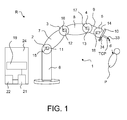
- the FIG. 1 shows an industrial robot R with a robot arm 1.
- the industrial robot R is designed in particular as a lightweight robot.
- the robot arm 1, which allows movement in six or seven degrees of freedom in the case of the present embodiment, essentially constitutes the movable part of the industrial robot R and comprises joints 2 to 5, levers 6 to 9 and a flange in a generally known manner 10, to which an end effector 33 can be attached.
- the joints 2-5 are each associated with respective axes with respect to which the links 6 to 9 can be rotatably moved.
- the industrial robot R can e.g. be designed as a medical industrial robot R.
- the end effector 33 is then e.g. designed as a medical instrument with which the industrial robot R can treat a living being P.
- Each of the joints 2-5 is powered by a regulated electric drive E, one of which in the Fig. 2 shown is moved.
- the electric drive E each have an electric motor 11 to 14.
- the motors 11-14 are eg AC motors, in particular three-phase motors.
- the motors 11-14 are synchronous motors, in particular permanent-magnet synchronous motors.
- the motors 11-14 are each preceded by a converter 15-18 or a three-phase inverter, which generates a three-phase alternating voltage of variable frequency from a DC voltage V, with which the corresponding motors 11-14 are acted upon.
- Inverters or inverters are in principle known to the person skilled in the art and comprise a power section 15a, for example three half-bridges, which are, for example, transistors, in particular MOSFETs include, and a drive electronics 15b.
- the inverters 15-18 are fastened to the respective motors 11-14, at least in or on the robot arm 1.
- the DC voltage V is provided in the case of the present embodiment by a single DC link 20 to which all inverters 15-18 are connected.
- the intermediate circuit 20 comprises e.g. a DC link capacitor and is in the case of the present embodiment part of a DC-DC converter 21, which is also referred to as a DC / DC converter.
- DC-DC converters are known in principle to the person skilled in the art and generate from a, e.g. by means of a rectifier 22 from the mains voltage smoothed DC voltage 23, the DC voltage V.
- the rectifier 22 and especially the DC-DC converter 21 are arranged in a control cabinet 24 in which e.g. also, a control device 19 of the industrial robot R is arranged.
- the control device 19 takes over in the case of the present embodiment, the control of the electric drives E.
- On the control device 19 runs a computer program that controls the operation of the industrial robot R, the electric drives E, in particular the inverter 15-18, so that the robot arm 1 and the flange 10 undergoes a predetermined movement.
- the spacer device 34 may also be provided a spacer device 34, as is the case in the case of the present embodiment.
- the spacer device 34 is connected in a manner not shown to the control device 19 and is arranged, a distance d between the end effector 33, in particular its tool center points TCP, and a critical structure, eg the surface of the living being P to determine.
- the electric drives E by means of field-oriented control, which is also referred to as vector control regulated.
- the electric motors 11-14 are replaced by e.g. speed or position controlled.
- the regulated electric drive E based in the case of the present embodiment on the principle known in the art field-oriented control, which is modified according to the claims.
- field-oriented control the three-phase currents and voltages are transformed into rotating current and voltage vectors and used for regulation.
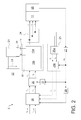
- the control of the electric drive E is implemented in the control device 19 and the Fig. 2 shows functional blocks of this regulation.
- This regulation comprises, in particular, an electrical current regulation, which is embodied in particular as a subordinate regulation.
- the power part 15 a of the inverter 15 generates a three-phase voltage, which is supplied to the motor 11.
- a three-phase alternating current (three-phase) i 1,2,3 which is measured for example by means of a current measuring device 24.
- the measuring device 24 is in turn connected to a transformation device 25, which, as is known in the art in principle, initially transformed by means of a transformation block 25a, the measured three-phase motor currents in stator fixed current space vector with the components I ⁇ and I ⁇ , which synchronously with the Rotor of the engine 11 rotate.
- the stator-fixed current space vectors are subsequently transformed to the rotor-fixed d, q coordinate system by means of a further transformation block 25b, whereby the space vector components I d and I q are formed.
- This transformation comprises a rotation by an angle 2 p ⁇ (number of poles of the motor 11 multiplied by the mechanical rotor angle).
- the mechanical rotor angle is determined for example by means of a rotary encoder 26 and is multiplied by means of a scaling block 27 with the number of poles of the motor 11, whereby the electrical rotor angle ⁇ el arises.
- the space vector components I d, q are supplied to a current regulator 28, which is designed, for example, as a so-called PI regulator.
- a current regulator 28 which can be in particular an analog controller or a digital controller.
- the output of the scaling block 27 is fed to a low-pass filter 29, whose output signal can also be supplied to the current controller 28.
- Further input signals of the current controller 28 or the command values of the current regulator 28 are, in the case of the present exemplary embodiment, nominal values for the current-space vector components I d, soll and I q, soll .
- the target value for I d, soll is equal to zero.
- the output signals or the manipulated variables of the current controller 28 related to the rotor of the motor 11 voltages U d, q which are transformed by means of a transformation block 30 in the related to the stator of the motor 11 voltages U a, ⁇ .
- a transformation block 30 in the related to the stator of the motor 11 voltages U a, ⁇ .
- the transformation block 30 for dese transformation is in the case of the present embodiment nor the 180 ° phase shifted electrical rotor angle ⁇ el the transformation block 30, which is calculated by means of a phase rotation block 31.
- the voltages U ⁇ , ⁇ related to the stator of the motor 11 are the input signals of the converter 15 or its control electronics 15b, which drives the power section 15a of the converter 15 based on the pulse width modulation, for example, so that the latter desired three-phase voltage for the motor 11 generates.
- the control device 19 is embodied in the case of the present exemplary embodiment or the computer program for controlling the robot arm 1 running on the control device is designed such that the motor current i 1 , 2, 3 is monitored and / or limited.
- This is realized in particular by a dynamic adaptation of the current limitation, for example, to the working step of the workflow, in particular of a medical application, to the robot pose and / or the load parameters of the end effector 33 attached to the industrial robot R.
- This is also a reduction, if not minimizing the travel in case of failure while taking into account the momentarily required force and acceleration capacity of the robot R possible.
- control device 19 In order to limit the motor current i 1, 2, 3 dynamically or robot-application-specific, the control device 19 is embodied such that it dynamically limits the values of the command variables of the current controller 28 in a robot-application-specific manner. In particular, the control device 19 limits the value of the reference variable I q, should the current controller 28th
- control device 19 may be configured such that the robot application-specific dynamic limiting of the value of the reference variable I q, soll the current controller 28, for example, on a required speed of the tool center point TCP of the industrial robot R for the application and / or a step during the movement of the industrial robot R, a current pose of the industrial robot R, a safety requirement for the application and / or a work step during the movement of the industrial robot R, the distance d to the living being P, which is determined in particular by means of the distance measuring device 34, a required Force capacity for the application and / or a step during the movement of the industrial robot R, and / or a load parameter of the attached to the industrial robot R end effector 33 is used.
- control device 19 can also be designed in such a way that it first performs path planning in order to plan a movement of the industrial robot R. It then limits the value of the reference variable I q, should the current controller 28 due to the carried out path planning.
- control device 19 is designed to change the value of the command variable Iq, should of the current regulator 28 during the movement of the industrial robot R as a function of the path planning.
- control device 19 can also be designed such that it determines a maximum required value of the command variable I q, should the current controller 28 due to the path planning, in particular the highest speed request the train planning underlying movement of the industrial robot R or associated with the electric drive E member is associated. The control device 19 in particular then limits the value of the reference variable I q, the current controller 28 is to the maximum required value before performing the path planning associated movement of the industrial robot R.
- control device 19 can also be set up in such a way that it calculates the value of the command variable I q, soll of the current controller 28 corresponding to the path planning and during the execution of the path planning associated movement of the industrial robot R or with the electric drive E Moving member the value of the reference variable I q, the current controller 28 is dynamically limited during the movement of the industrial robot R, so varies according to the planned movement, the limit.
- control device 19 may also be set up to limit the value of the reference variable I q, of the current controller 28 to a maximum value based on a maximum permissible speed of the application associated with the movement prior to the movement of the industrial robot R. This maximum value is not exceeded during the movement.
- the adaptation of the reference variable I q, should the current controller 28 by the control device 19 may for example also be as follows:
- the required force capacity and the safety requirement for example the travel in case of error
- the current application and its operations for example transmitted in the form of a table in a secure technique to the control device 19.
- the load data of the end effector 33 used is transferred to the control device 19, in particular using secure technology.
- the joint angles of the industrial robot R are detected, in particular using secure technology, and both the currently fastened end effector 33 and the working step in the application workflow are identified. These data are transmitted to the control device 19, in particular using secure technology.
- control device 19 is set up to dynamically limit the value of the manipulated variables U d, q of the current controller 28 robotically, for example to limit the travel of the industrial robot R in the event of an error, ie to reduce movement of the robot arm 1 in the event of a fault.
- This is realized in particular by a dynamic adaptation of the manipulated variables U d, q of the current controller 28, for example, to the working step of the workflow, in particular of a medical application, to the robot pose and / or the load parameters of the end effector 33 attached to the industrial robot R. This is also a reduction, if not minimizing the travel in case of failure of the industrial robot R possible.
- control device 19 may be set up such that the robot application-specific dynamic limiting of the value of the manipulated variables U d, q of the current controller 28, for example, to a required speed of the tool center point TCP of the industrial robot R for the application and / or a step during the movement of the robot R, a current pose of the industrial robot R, a security request for the application and / or a Operating step during the movement of the robot R, the distance d to the living organism P, which is determined in particular by measurement by means of the distance measuring device 34, and / or a working step during the movement of the industrial robot R, and / or a load parameter of the attached to the industrial robot R end effector 33 based is placed.
- control device 19 can also be designed in such a way that it first performs path planning in order to plan a movement of the industrial robot R. It then limits the value of the manipulated variables U d, q of the current controller 28 on the basis of the path planning carried out.
- control device 19 is designed such that it changes the value of the manipulated variables U d, q of the current controller 28 during the movement of the robot R as a function of the path planning.
- control device 19 can also be designed such that it determines a maximum required value of the manipulated variables U d, q of the current controller 28 due to the path planning, in particular the highest speed requirement of the train planning underlying motion of the industrial robot R or the electric drive E is associated with a moving member.
- the control device 19 in particular then limits the value of the manipulated variables U d, q of the current regulator 28 to the maximum required value before the movement of the industrial robot R. associated with the path planning is carried out.
- control device 19 can also be set up in such a way that it calculates the value of the manipulated variables U d, q of the current controller 28 corresponding to the path planning and during the execution of the path planning associated movement of the industrial robot R or moving the electric drive E member dynamically limits the value of the manipulated variables U d, q of the current controller 28 during the movement of the industrial robot R, so according to the movement varies the limit.
- control device 19 may also be set up to limit the value of the manipulated variables U d, q of the current controller 28 to a maximum value based on a maximum permissible speed of the application associated with the movement prior to the movement of the industrial robot R. This maximum value is not exceeded during the movement.
- the adaptation of the manipulated variables U d, q of the current regulator 28 by the control device 19 can also be carried out, for example, as follows:
- the safety requirement for example the travel path in the event of a fault
- the control device 19 for the current application and its working steps, for example in the form of a table.
- the load data of the end effector 33 used is transferred to the control device 19, in particular using secure technology.
- the joint angles of the industrial robot R are detected, in particular using secure technology, and both the currently fastened end effector 33 and the working step in the application workflow are identified. These data are transmitted to the control device 19, in particular using secure technology.
- Manipulated variables U d, q of the current controller 28 should also be understood to be the value of the output signal of the transformation block 30.
Landscapes
- Engineering & Computer Science (AREA)
- Robotics (AREA)
- Mechanical Engineering (AREA)
- Manipulator (AREA)
Applications Claiming Priority (1)
| Application Number | Priority Date | Filing Date | Title |
|---|---|---|---|
| DE102010015407A DE102010015407A1 (de) | 2010-04-19 | 2010-04-19 | Roboter und Verfahren zum Betreiben eines Roboters |
Publications (3)
| Publication Number | Publication Date |
|---|---|
| EP2388111A2 true EP2388111A2 (fr) | 2011-11-23 |
| EP2388111A3 EP2388111A3 (fr) | 2013-05-22 |
| EP2388111B1 EP2388111B1 (fr) | 2021-02-17 |
Family
ID=44115660
Family Applications (1)
| Application Number | Title | Priority Date | Filing Date |
|---|---|---|---|
| EP11161370.9A Not-in-force EP2388111B1 (fr) | 2010-04-19 | 2011-04-06 | Robot et procédé de fonctionnement d'un robot |
Country Status (2)
| Country | Link |
|---|---|
| EP (1) | EP2388111B1 (fr) |
| DE (1) | DE102010015407A1 (fr) |
Cited By (2)
| Publication number | Priority date | Publication date | Assignee | Title |
|---|---|---|---|---|
| WO2014071989A1 (fr) * | 2012-11-09 | 2014-05-15 | Abb Technology Ltd | Commande de robot ayant une plus grande sécurité |
| DE102014114234A1 (de) * | 2014-09-30 | 2016-03-31 | Kastanienbaum GmbH | Verfahren und Vorrichtung zur Steuerung/Regelung eines Roboter-Manipulators |
Families Citing this family (1)
| Publication number | Priority date | Publication date | Assignee | Title |
|---|---|---|---|---|
| JP7527890B2 (ja) * | 2020-08-24 | 2024-08-05 | 川崎重工業株式会社 | 電流制限装置、ロボットシステムおよび電流制限方法 |
Family Cites Families (8)
| Publication number | Priority date | Publication date | Assignee | Title |
|---|---|---|---|---|
| JPS57113118A (en) * | 1980-12-30 | 1982-07-14 | Fanuc Ltd | Robot control system |
| DE3205672A1 (de) * | 1982-02-17 | 1983-08-25 | Siemens AG, 1000 Berlin und 8000 München | Sicherheitsschaltung fuer freiprogrammierbare industrieroboter |
| DD229642B1 (de) * | 1984-12-14 | 1988-06-22 | Robotron Rationalisierung | Schaltungsanordnung zur kraftrueckkopplung fuer industrieroboter mit elektrischen antrieben |
| JPS61143803A (ja) * | 1984-12-17 | 1986-07-01 | Toshiba Corp | ロボツトの制御装置 |
| US4851748A (en) * | 1986-11-20 | 1989-07-25 | Westinghouse Electric Corp. | Basic digital multi-axis robot control having modular performance expansion capability |
| JPH01310880A (ja) * | 1988-06-06 | 1989-12-14 | Toshiba Corp | 産業用ロボットの制御装置 |
| DE102004026185A1 (de) * | 2004-05-28 | 2005-12-22 | Kuka Roboter Gmbh | Verfahren und Vorrichtung zum Betreiben einer Maschine, wie eines Mehrachs- Industrieroboters |
| AT505868A1 (de) * | 2007-09-26 | 2009-04-15 | Metall Und Kunststoffwaren Erz | Greifsystem fur ein lagersystem sowie lagersystem |
-
2010
- 2010-04-19 DE DE102010015407A patent/DE102010015407A1/de not_active Ceased
-
2011
- 2011-04-06 EP EP11161370.9A patent/EP2388111B1/fr not_active Not-in-force
Non-Patent Citations (1)
| Title |
|---|
| None |
Cited By (7)
| Publication number | Priority date | Publication date | Assignee | Title |
|---|---|---|---|---|
| WO2014071989A1 (fr) * | 2012-11-09 | 2014-05-15 | Abb Technology Ltd | Commande de robot ayant une plus grande sécurité |
| CN104755233A (zh) * | 2012-11-09 | 2015-07-01 | Abb技术有限公司 | 具有提高的安全性的机器人控制 |
| CN104755233B (zh) * | 2012-11-09 | 2017-04-05 | Abb技术有限公司 | 用于控制机器人的方法和机器人驱动单元 |
| US9914216B2 (en) | 2012-11-09 | 2018-03-13 | Abb Schweiz Ag | Robot control with improved safety |
| DE102014114234A1 (de) * | 2014-09-30 | 2016-03-31 | Kastanienbaum GmbH | Verfahren und Vorrichtung zur Steuerung/Regelung eines Roboter-Manipulators |
| US10464210B2 (en) | 2014-09-30 | 2019-11-05 | Kastanienbaum GmbH | Method and device for open-loop/closed-loop control of a robot manipulator |
| DE102014114234B4 (de) | 2014-09-30 | 2020-06-25 | Kastanienbaum GmbH | Verfahren und Vorrichtung zur Steuerung/Regelung eines Roboter-Manipulators |
Also Published As
| Publication number | Publication date |
|---|---|
| EP2388111A3 (fr) | 2013-05-22 |
| DE102010015407A1 (de) | 2011-10-20 |
| EP2388111B1 (fr) | 2021-02-17 |
Similar Documents
| Publication | Publication Date | Title |
|---|---|---|
| EP2631043B1 (fr) | Procédé et dispositif destinés à guider un processus de manipulateur | |
| EP1267234B1 (fr) | Méthode de surveillance d'un équipement technique, en particulier un manipulateur, ainsi qu'un appareil de surveillance et de commande | |
| DE102016110370B4 (de) | Servomotor-stoppsteuerung zum steuern und stoppen eines servomotors während eines notstopps | |
| DE102017008916A1 (de) | Produktionssystem zum Ausführen von kooperativer Arbeit durch eine Bedienperson und einen Roboter | |
| DE102006003362A1 (de) | Koordinatenmessgerät und Verfahren zum Betreiben eines Koordinatenmessgeräts | |
| EP3297794A1 (fr) | Procédé et dispositif de commande/régulation d'une articulation de robot entraînée par actionneur | |
| DE102013204789A1 (de) | Verfahren zum folgern von absichten eines bedieners zum bewegen eines robotersystems | |
| EP3112094B1 (fr) | Procédé de commande d'un système de manipulation | |
| EP3056322B1 (fr) | Procédé et système de fonctionnement d'une machine multiaxiale, en particulier un robot | |
| DE102013010272B4 (de) | Motorsteuervorrichtung, die die von einer Steuerungs- Stromquelle verbrauchte Energie bei Stromausfall vermindert | |
| WO2021151667A1 (fr) | Procédé de commande d'au moins un servomoteur, dispositif de commande associé, robot et produit de programme informatique | |
| EP3037219B1 (fr) | Robot sur ayant des variables de progression de glissiere | |
| DE102013016019B3 (de) | Verfahren zum Betreiben eines mehrgliedrigen Manipulators | |
| EP3061576A1 (fr) | Procédé d'optimisation d'un profil de mouvement, programme informatique, dispositif de commande et système technique | |
| EP2398143A2 (fr) | Procédé et dispositif de surveillance d'une machine commandée par déplacement dotée d'un moteur d'entraînement commuté électroniquement | |
| EP4062527B1 (fr) | Methode pour commander au moins un servomoteur de maniere a freiner, robot, et produit de programme informatique | |
| EP2388111B1 (fr) | Robot et procédé de fonctionnement d'un robot | |
| DE102008061172A1 (de) | Verfahren und Vorrichtung zum Steuern eines Manipulatorsystems | |
| DE102014004375B4 (de) | Host-steuerung zur erzeugung einer positionssteuerungsverstärkung | |
| DE102010015406A1 (de) | Roboter und Verfahren zum Betreiben eines Roboters | |
| EP2146426B1 (fr) | Procédé de fonctionnement d'un dispositif d'entraînement et dispositif d'entraînement destiné à l'exécution du procédé | |
| DE102015103452B4 (de) | Verfahren zum zeitdiskreten Anhalten antreibbarer Achsen, Computerprogrammprodukt und Vorrichtung zur Durchführung eines derartigen Verfahrens | |
| DE102024131684A1 (de) | Verfahren zum Betreiben eines elektrischen Motors, elektrische Steuer- oder Auswertevorrichtung hierfür, sowie damit ausgestattete Maschine | |
| DE102014210027A1 (de) | Verfahren und Vorrichtung zum Initialisieren einer Regelung für einen Strom zum Betrieb einer Asynchron-Drehstrommaschine | |
| EP0440868A1 (fr) | Régulation pour la commande du basculement d'un convertisseur à plusieurs moteurs |
Legal Events
| Date | Code | Title | Description |
|---|---|---|---|
| AK | Designated contracting states |
Kind code of ref document: A2 Designated state(s): AL AT BE BG CH CY CZ DE DK EE ES FI FR GB GR HR HU IE IS IT LI LT LU LV MC MK MT NL NO PL PT RO RS SE SI SK SM TR |
|
| AX | Request for extension of the european patent |
Extension state: BA ME |
|
| PUAI | Public reference made under article 153(3) epc to a published international application that has entered the european phase |
Free format text: ORIGINAL CODE: 0009012 |
|
| PUAL | Search report despatched |
Free format text: ORIGINAL CODE: 0009013 |
|
| AK | Designated contracting states |
Kind code of ref document: A3 Designated state(s): AL AT BE BG CH CY CZ DE DK EE ES FI FR GB GR HR HU IE IS IT LI LT LU LV MC MK MT NL NO PL PT RO RS SE SI SK SM TR |
|
| AX | Request for extension of the european patent |
Extension state: BA ME |
|
| RIC1 | Information provided on ipc code assigned before grant |
Ipc: B25J 9/16 20060101AFI20130418BHEP |
|
| 17P | Request for examination filed |
Effective date: 20131105 |
|
| RBV | Designated contracting states (corrected) |
Designated state(s): AL AT BE BG CH CY CZ DE DK EE ES FI FR GB GR HR HU IE IS IT LI LT LU LV MC MK MT NL NO PL PT RO RS SE SI SK SM TR |
|
| RAP1 | Party data changed (applicant data changed or rights of an application transferred) |
Owner name: KUKA ROBOTER GMBH |
|
| STAA | Information on the status of an ep patent application or granted ep patent |
Free format text: STATUS: EXAMINATION IS IN PROGRESS |
|
| 17Q | First examination report despatched |
Effective date: 20170313 |
|
| RAP1 | Party data changed (applicant data changed or rights of an application transferred) |
Owner name: KUKA DEUTSCHLAND GMBH |
|
| GRAP | Despatch of communication of intention to grant a patent |
Free format text: ORIGINAL CODE: EPIDOSNIGR1 |
|
| STAA | Information on the status of an ep patent application or granted ep patent |
Free format text: STATUS: GRANT OF PATENT IS INTENDED |
|
| INTG | Intention to grant announced |
Effective date: 20200831 |
|
| GRAS | Grant fee paid |
Free format text: ORIGINAL CODE: EPIDOSNIGR3 |
|
| GRAA | (expected) grant |
Free format text: ORIGINAL CODE: 0009210 |
|
| STAA | Information on the status of an ep patent application or granted ep patent |
Free format text: STATUS: THE PATENT HAS BEEN GRANTED |
|
| AK | Designated contracting states |
Kind code of ref document: B1 Designated state(s): AL AT BE BG CH CY CZ DE DK EE ES FI FR GB GR HR HU IE IS IT LI LT LU LV MC MK MT NL NO PL PT RO RS SE SI SK SM TR |
|
| REG | Reference to a national code |
Ref country code: GB Ref legal event code: FG4D Free format text: NOT ENGLISH |
|
| REG | Reference to a national code |
Ref country code: CH Ref legal event code: EP |
|
| REG | Reference to a national code |
Ref country code: DE Ref legal event code: R096 Ref document number: 502011017054 Country of ref document: DE |
|
| REG | Reference to a national code |
Ref country code: AT Ref legal event code: REF Ref document number: 1360873 Country of ref document: AT Kind code of ref document: T Effective date: 20210315 |
|
| REG | Reference to a national code |
Ref country code: IE Ref legal event code: FG4D Free format text: LANGUAGE OF EP DOCUMENT: GERMAN |
|
| REG | Reference to a national code |
Ref country code: LT Ref legal event code: MG9D |
|
| REG | Reference to a national code |
Ref country code: NL Ref legal event code: MP Effective date: 20210217 |
|
| PG25 | Lapsed in a contracting state [announced via postgrant information from national office to epo] |
Ref country code: FI Free format text: LAPSE BECAUSE OF FAILURE TO SUBMIT A TRANSLATION OF THE DESCRIPTION OR TO PAY THE FEE WITHIN THE PRESCRIBED TIME-LIMIT Effective date: 20210217 Ref country code: GR Free format text: LAPSE BECAUSE OF FAILURE TO SUBMIT A TRANSLATION OF THE DESCRIPTION OR TO PAY THE FEE WITHIN THE PRESCRIBED TIME-LIMIT Effective date: 20210518 Ref country code: HR Free format text: LAPSE BECAUSE OF FAILURE TO SUBMIT A TRANSLATION OF THE DESCRIPTION OR TO PAY THE FEE WITHIN THE PRESCRIBED TIME-LIMIT Effective date: 20210217 Ref country code: LT Free format text: LAPSE BECAUSE OF FAILURE TO SUBMIT A TRANSLATION OF THE DESCRIPTION OR TO PAY THE FEE WITHIN THE PRESCRIBED TIME-LIMIT Effective date: 20210217 Ref country code: BG Free format text: LAPSE BECAUSE OF FAILURE TO SUBMIT A TRANSLATION OF THE DESCRIPTION OR TO PAY THE FEE WITHIN THE PRESCRIBED TIME-LIMIT Effective date: 20210517 Ref country code: NO Free format text: LAPSE BECAUSE OF FAILURE TO SUBMIT A TRANSLATION OF THE DESCRIPTION OR TO PAY THE FEE WITHIN THE PRESCRIBED TIME-LIMIT Effective date: 20210517 Ref country code: PT Free format text: LAPSE BECAUSE OF FAILURE TO SUBMIT A TRANSLATION OF THE DESCRIPTION OR TO PAY THE FEE WITHIN THE PRESCRIBED TIME-LIMIT Effective date: 20210617 |
|
| PG25 | Lapsed in a contracting state [announced via postgrant information from national office to epo] |
Ref country code: SE Free format text: LAPSE BECAUSE OF FAILURE TO SUBMIT A TRANSLATION OF THE DESCRIPTION OR TO PAY THE FEE WITHIN THE PRESCRIBED TIME-LIMIT Effective date: 20210217 Ref country code: PL Free format text: LAPSE BECAUSE OF FAILURE TO SUBMIT A TRANSLATION OF THE DESCRIPTION OR TO PAY THE FEE WITHIN THE PRESCRIBED TIME-LIMIT Effective date: 20210217 Ref country code: RS Free format text: LAPSE BECAUSE OF FAILURE TO SUBMIT A TRANSLATION OF THE DESCRIPTION OR TO PAY THE FEE WITHIN THE PRESCRIBED TIME-LIMIT Effective date: 20210217 Ref country code: LV Free format text: LAPSE BECAUSE OF FAILURE TO SUBMIT A TRANSLATION OF THE DESCRIPTION OR TO PAY THE FEE WITHIN THE PRESCRIBED TIME-LIMIT Effective date: 20210217 Ref country code: NL Free format text: LAPSE BECAUSE OF FAILURE TO SUBMIT A TRANSLATION OF THE DESCRIPTION OR TO PAY THE FEE WITHIN THE PRESCRIBED TIME-LIMIT Effective date: 20210217 |
|
| PG25 | Lapsed in a contracting state [announced via postgrant information from national office to epo] |
Ref country code: IS Free format text: LAPSE BECAUSE OF FAILURE TO SUBMIT A TRANSLATION OF THE DESCRIPTION OR TO PAY THE FEE WITHIN THE PRESCRIBED TIME-LIMIT Effective date: 20210617 |
|
| PG25 | Lapsed in a contracting state [announced via postgrant information from national office to epo] |
Ref country code: EE Free format text: LAPSE BECAUSE OF FAILURE TO SUBMIT A TRANSLATION OF THE DESCRIPTION OR TO PAY THE FEE WITHIN THE PRESCRIBED TIME-LIMIT Effective date: 20210217 Ref country code: CZ Free format text: LAPSE BECAUSE OF FAILURE TO SUBMIT A TRANSLATION OF THE DESCRIPTION OR TO PAY THE FEE WITHIN THE PRESCRIBED TIME-LIMIT Effective date: 20210217 Ref country code: SM Free format text: LAPSE BECAUSE OF FAILURE TO SUBMIT A TRANSLATION OF THE DESCRIPTION OR TO PAY THE FEE WITHIN THE PRESCRIBED TIME-LIMIT Effective date: 20210217 |
|
| REG | Reference to a national code |
Ref country code: DE Ref legal event code: R097 Ref document number: 502011017054 Country of ref document: DE |
|
| PG25 | Lapsed in a contracting state [announced via postgrant information from national office to epo] |
Ref country code: RO Free format text: LAPSE BECAUSE OF FAILURE TO SUBMIT A TRANSLATION OF THE DESCRIPTION OR TO PAY THE FEE WITHIN THE PRESCRIBED TIME-LIMIT Effective date: 20210217 Ref country code: DK Free format text: LAPSE BECAUSE OF FAILURE TO SUBMIT A TRANSLATION OF THE DESCRIPTION OR TO PAY THE FEE WITHIN THE PRESCRIBED TIME-LIMIT Effective date: 20210217 Ref country code: ES Free format text: LAPSE BECAUSE OF FAILURE TO SUBMIT A TRANSLATION OF THE DESCRIPTION OR TO PAY THE FEE WITHIN THE PRESCRIBED TIME-LIMIT Effective date: 20210217 Ref country code: SK Free format text: LAPSE BECAUSE OF FAILURE TO SUBMIT A TRANSLATION OF THE DESCRIPTION OR TO PAY THE FEE WITHIN THE PRESCRIBED TIME-LIMIT Effective date: 20210217 Ref country code: MC Free format text: LAPSE BECAUSE OF FAILURE TO SUBMIT A TRANSLATION OF THE DESCRIPTION OR TO PAY THE FEE WITHIN THE PRESCRIBED TIME-LIMIT Effective date: 20210217 |
|
| PLBE | No opposition filed within time limit |
Free format text: ORIGINAL CODE: 0009261 |
|
| STAA | Information on the status of an ep patent application or granted ep patent |
Free format text: STATUS: NO OPPOSITION FILED WITHIN TIME LIMIT |
|
| PG25 | Lapsed in a contracting state [announced via postgrant information from national office to epo] |
Ref country code: LU Free format text: LAPSE BECAUSE OF NON-PAYMENT OF DUE FEES Effective date: 20210406 |
|
| REG | Reference to a national code |
Ref country code: BE Ref legal event code: MM Effective date: 20210430 |
|
| 26N | No opposition filed |
Effective date: 20211118 |
|
| PG25 | Lapsed in a contracting state [announced via postgrant information from national office to epo] |
Ref country code: AL Free format text: LAPSE BECAUSE OF FAILURE TO SUBMIT A TRANSLATION OF THE DESCRIPTION OR TO PAY THE FEE WITHIN THE PRESCRIBED TIME-LIMIT Effective date: 20210217 Ref country code: CH Free format text: LAPSE BECAUSE OF NON-PAYMENT OF DUE FEES Effective date: 20210430 Ref country code: LI Free format text: LAPSE BECAUSE OF NON-PAYMENT OF DUE FEES Effective date: 20210430 |
|
| PG25 | Lapsed in a contracting state [announced via postgrant information from national office to epo] |
Ref country code: SI Free format text: LAPSE BECAUSE OF FAILURE TO SUBMIT A TRANSLATION OF THE DESCRIPTION OR TO PAY THE FEE WITHIN THE PRESCRIBED TIME-LIMIT Effective date: 20210217 |
|
| PG25 | Lapsed in a contracting state [announced via postgrant information from national office to epo] |
Ref country code: IT Free format text: LAPSE BECAUSE OF FAILURE TO SUBMIT A TRANSLATION OF THE DESCRIPTION OR TO PAY THE FEE WITHIN THE PRESCRIBED TIME-LIMIT Effective date: 20210217 Ref country code: IE Free format text: LAPSE BECAUSE OF NON-PAYMENT OF DUE FEES Effective date: 20210406 |
|
| PG25 | Lapsed in a contracting state [announced via postgrant information from national office to epo] |
Ref country code: IS Free format text: LAPSE BECAUSE OF FAILURE TO SUBMIT A TRANSLATION OF THE DESCRIPTION OR TO PAY THE FEE WITHIN THE PRESCRIBED TIME-LIMIT Effective date: 20210617 |
|
| REG | Reference to a national code |
Ref country code: AT Ref legal event code: MM01 Ref document number: 1360873 Country of ref document: AT Kind code of ref document: T Effective date: 20210406 |
|
| PG25 | Lapsed in a contracting state [announced via postgrant information from national office to epo] |
Ref country code: BE Free format text: LAPSE BECAUSE OF NON-PAYMENT OF DUE FEES Effective date: 20210430 |
|
| PG25 | Lapsed in a contracting state [announced via postgrant information from national office to epo] |
Ref country code: AT Free format text: LAPSE BECAUSE OF NON-PAYMENT OF DUE FEES Effective date: 20210406 |
|
| PG25 | Lapsed in a contracting state [announced via postgrant information from national office to epo] |
Ref country code: HU Free format text: LAPSE BECAUSE OF FAILURE TO SUBMIT A TRANSLATION OF THE DESCRIPTION OR TO PAY THE FEE WITHIN THE PRESCRIBED TIME-LIMIT; INVALID AB INITIO Effective date: 20110406 Ref country code: CY Free format text: LAPSE BECAUSE OF FAILURE TO SUBMIT A TRANSLATION OF THE DESCRIPTION OR TO PAY THE FEE WITHIN THE PRESCRIBED TIME-LIMIT Effective date: 20210217 |
|
| P01 | Opt-out of the competence of the unified patent court (upc) registered |
Effective date: 20230528 |
|
| PG25 | Lapsed in a contracting state [announced via postgrant information from national office to epo] |
Ref country code: MK Free format text: LAPSE BECAUSE OF FAILURE TO SUBMIT A TRANSLATION OF THE DESCRIPTION OR TO PAY THE FEE WITHIN THE PRESCRIBED TIME-LIMIT Effective date: 20210217 |
|
| PGFP | Annual fee paid to national office [announced via postgrant information from national office to epo] |
Ref country code: GB Payment date: 20240229 Year of fee payment: 14 |
|
| PGFP | Annual fee paid to national office [announced via postgrant information from national office to epo] |
Ref country code: FR Payment date: 20240308 Year of fee payment: 14 |
|
| PG25 | Lapsed in a contracting state [announced via postgrant information from national office to epo] |
Ref country code: TR Free format text: LAPSE BECAUSE OF FAILURE TO SUBMIT A TRANSLATION OF THE DESCRIPTION OR TO PAY THE FEE WITHIN THE PRESCRIBED TIME-LIMIT Effective date: 20210217 |
|
| PGFP | Annual fee paid to national office [announced via postgrant information from national office to epo] |
Ref country code: DE Payment date: 20240306 Year of fee payment: 14 |
|
| PG25 | Lapsed in a contracting state [announced via postgrant information from national office to epo] |
Ref country code: MT Free format text: LAPSE BECAUSE OF FAILURE TO SUBMIT A TRANSLATION OF THE DESCRIPTION OR TO PAY THE FEE WITHIN THE PRESCRIBED TIME-LIMIT Effective date: 20210217 |
|
| REG | Reference to a national code |
Ref country code: DE Ref legal event code: R119 Ref document number: 502011017054 Country of ref document: DE |
|
| GBPC | Gb: european patent ceased through non-payment of renewal fee |
Effective date: 20250406 |
|
| PG25 | Lapsed in a contracting state [announced via postgrant information from national office to epo] |
Ref country code: DE Free format text: LAPSE BECAUSE OF NON-PAYMENT OF DUE FEES Effective date: 20251104 |
|
| PG25 | Lapsed in a contracting state [announced via postgrant information from national office to epo] |
Ref country code: GB Free format text: LAPSE BECAUSE OF NON-PAYMENT OF DUE FEES Effective date: 20250406 |
|
| PG25 | Lapsed in a contracting state [announced via postgrant information from national office to epo] |
Ref country code: FR Free format text: LAPSE BECAUSE OF NON-PAYMENT OF DUE FEES Effective date: 20250430 |