EP2390646A1 - Prévention de la formation de cristaux dans des solutions liquides pendant le stockage au moyen de bétaïne - Google Patents
Prévention de la formation de cristaux dans des solutions liquides pendant le stockage au moyen de bétaïne Download PDFInfo
- Publication number
- EP2390646A1 EP2390646A1 EP10164129A EP10164129A EP2390646A1 EP 2390646 A1 EP2390646 A1 EP 2390646A1 EP 10164129 A EP10164129 A EP 10164129A EP 10164129 A EP10164129 A EP 10164129A EP 2390646 A1 EP2390646 A1 EP 2390646A1
- Authority
- EP
- European Patent Office
- Prior art keywords
- sat
- bet
- betaine
- nucleic acids
- extraction
- Prior art date
- Legal status (The legal status is an assumption and is not a legal conclusion. Google has not performed a legal analysis and makes no representation as to the accuracy of the status listed.)
- Withdrawn
Links
- KWIUHFFTVRNATP-UHFFFAOYSA-N Betaine Natural products C[N+](C)(C)CC([O-])=O KWIUHFFTVRNATP-UHFFFAOYSA-N 0.000 title claims description 111
- 229960003237 betaine Drugs 0.000 title claims description 43
- 239000013078 crystal Substances 0.000 title description 15
- 230000015572 biosynthetic process Effects 0.000 title description 12
- 239000006193 liquid solution Substances 0.000 title description 4
- KWIUHFFTVRNATP-UHFFFAOYSA-O N,N,N-trimethylglycinium Chemical compound C[N+](C)(C)CC(O)=O KWIUHFFTVRNATP-UHFFFAOYSA-O 0.000 title 1
- 230000002265 prevention Effects 0.000 title 1
- 150000007523 nucleic acids Chemical class 0.000 claims abstract description 92
- 108020004707 nucleic acids Proteins 0.000 claims abstract description 91
- 102000039446 nucleic acids Human genes 0.000 claims abstract description 91
- 239000000523 sample Substances 0.000 claims abstract description 60
- 239000003795 chemical substances by application Substances 0.000 claims abstract description 45
- 230000003196 chaotropic effect Effects 0.000 claims abstract description 44
- 238000000605 extraction Methods 0.000 claims abstract description 44
- 239000000872 buffer Substances 0.000 claims abstract description 41
- 238000000034 method Methods 0.000 claims abstract description 26
- 230000008569 process Effects 0.000 claims abstract description 21
- 150000003839 salts Chemical class 0.000 claims abstract description 16
- 230000000087 stabilizing effect Effects 0.000 claims abstract description 10
- 238000004458 analytical method Methods 0.000 claims abstract description 8
- 239000000243 solution Substances 0.000 claims description 69
- 230000003321 amplification Effects 0.000 claims description 31
- 238000003199 nucleic acid amplification method Methods 0.000 claims description 31
- 230000009089 cytolysis Effects 0.000 claims description 30
- ZJYYHGLJYGJLLN-UHFFFAOYSA-N guanidinium thiocyanate Chemical compound SC#N.NC(N)=N ZJYYHGLJYGJLLN-UHFFFAOYSA-N 0.000 claims description 29
- 239000013612 plasmid Substances 0.000 claims description 28
- 150000001875 compounds Chemical class 0.000 claims description 21
- 238000006243 chemical reaction Methods 0.000 claims description 18
- 108091006503 SLC26A1 Proteins 0.000 claims description 16
- 239000000654 additive Substances 0.000 claims description 14
- 239000007864 aqueous solution Substances 0.000 claims description 13
- 230000005764 inhibitory process Effects 0.000 claims description 10
- 101100422538 Escherichia coli sat-2 gene Proteins 0.000 claims description 8
- 230000000996 additive effect Effects 0.000 claims description 6
- XSQUKJJJFZCRTK-UHFFFAOYSA-N Urea Chemical compound NC(N)=O XSQUKJJJFZCRTK-UHFFFAOYSA-N 0.000 claims description 5
- 239000004202 carbamide Substances 0.000 claims description 5
- PJJJBBJSCAKJQF-UHFFFAOYSA-N guanidinium chloride Chemical compound [Cl-].NC(N)=[NH2+] PJJJBBJSCAKJQF-UHFFFAOYSA-N 0.000 claims description 5
- MHCFAGZWMAWTNR-UHFFFAOYSA-M lithium perchlorate Chemical compound [Li+].[O-]Cl(=O)(=O)=O MHCFAGZWMAWTNR-UHFFFAOYSA-M 0.000 claims description 5
- 229910001486 lithium perchlorate Inorganic materials 0.000 claims description 5
- 229910021645 metal ion Inorganic materials 0.000 claims description 5
- 239000002738 chelating agent Substances 0.000 claims description 4
- 108090000623 proteins and genes Proteins 0.000 claims description 4
- 102000004169 proteins and genes Human genes 0.000 claims description 4
- 239000004094 surface-active agent Substances 0.000 claims description 4
- 150000001720 carbohydrates Chemical class 0.000 claims description 3
- 235000014633 carbohydrates Nutrition 0.000 claims description 3
- 239000003153 chemical reaction reagent Substances 0.000 claims description 3
- 150000002632 lipids Chemical class 0.000 claims description 3
- 239000012139 lysis buffer Substances 0.000 description 63
- 108020004414 DNA Proteins 0.000 description 44
- 238000003752 polymerase chain reaction Methods 0.000 description 26
- VYPSYNLAJGMNEJ-UHFFFAOYSA-N Silicium dioxide Chemical compound O=[Si]=O VYPSYNLAJGMNEJ-UHFFFAOYSA-N 0.000 description 21
- 210000003608 fece Anatomy 0.000 description 19
- 239000000203 mixture Substances 0.000 description 18
- 241000193163 Clostridioides difficile Species 0.000 description 15
- 230000000694 effects Effects 0.000 description 14
- 238000010222 PCR analysis Methods 0.000 description 11
- 239000006166 lysate Substances 0.000 description 11
- 239000000725 suspension Substances 0.000 description 11
- 239000000377 silicon dioxide Substances 0.000 description 10
- 108700009665 Bacillus subtilis comK Proteins 0.000 description 9
- 239000012528 membrane Substances 0.000 description 9
- 239000002244 precipitate Substances 0.000 description 9
- LFQSCWFLJHTTHZ-UHFFFAOYSA-N Ethanol Chemical compound CCO LFQSCWFLJHTTHZ-UHFFFAOYSA-N 0.000 description 8
- 238000005119 centrifugation Methods 0.000 description 7
- 244000063299 Bacillus subtilis Species 0.000 description 6
- 235000014469 Bacillus subtilis Nutrition 0.000 description 6
- KCXVZYZYPLLWCC-UHFFFAOYSA-N EDTA Chemical compound OC(=O)CN(CC(O)=O)CCN(CC(O)=O)CC(O)=O KCXVZYZYPLLWCC-UHFFFAOYSA-N 0.000 description 6
- 238000002474 experimental method Methods 0.000 description 6
- 239000012634 fragment Substances 0.000 description 6
- 238000001556 precipitation Methods 0.000 description 6
- 239000013615 primer Substances 0.000 description 6
- 239000000126 substance Substances 0.000 description 6
- 101150089436 tcdB gene Proteins 0.000 description 6
- BHNQPLPANNDEGL-UHFFFAOYSA-N 2-(4-octylphenoxy)ethanol Chemical compound CCCCCCCCC1=CC=C(OCCO)C=C1 BHNQPLPANNDEGL-UHFFFAOYSA-N 0.000 description 5
- QKNYBSVHEMOAJP-UHFFFAOYSA-N 2-amino-2-(hydroxymethyl)propane-1,3-diol;hydron;chloride Chemical compound Cl.OCC(N)(CO)CO QKNYBSVHEMOAJP-UHFFFAOYSA-N 0.000 description 5
- 239000013504 Triton X-100 Substances 0.000 description 5
- 229920004890 Triton X-100 Polymers 0.000 description 5
- 230000000875 corresponding effect Effects 0.000 description 5
- 239000011534 wash buffer Substances 0.000 description 5
- TWRXJAOTZQYOKJ-UHFFFAOYSA-L Magnesium chloride Chemical compound [Mg+2].[Cl-].[Cl-] TWRXJAOTZQYOKJ-UHFFFAOYSA-L 0.000 description 4
- 238000000137 annealing Methods 0.000 description 4
- 238000004925 denaturation Methods 0.000 description 4
- 230000036425 denaturation Effects 0.000 description 4
- LOKCTEFSRHRXRJ-UHFFFAOYSA-I dipotassium trisodium dihydrogen phosphate hydrogen phosphate dichloride Chemical compound P(=O)(O)(O)[O-].[K+].P(=O)(O)([O-])[O-].[Na+].[Na+].[Cl-].[K+].[Cl-].[Na+] LOKCTEFSRHRXRJ-UHFFFAOYSA-I 0.000 description 4
- 238000010828 elution Methods 0.000 description 4
- 239000007788 liquid Substances 0.000 description 4
- 239000002953 phosphate buffered saline Substances 0.000 description 4
- 238000003753 real-time PCR Methods 0.000 description 4
- 230000006641 stabilisation Effects 0.000 description 4
- 238000011105 stabilization Methods 0.000 description 4
- 101100221537 Bacillus subtilis (strain 168) comK gene Proteins 0.000 description 3
- 238000011529 RT qPCR Methods 0.000 description 3
- 230000009286 beneficial effect Effects 0.000 description 3
- 230000002401 inhibitory effect Effects 0.000 description 3
- 238000002955 isolation Methods 0.000 description 3
- 238000007403 mPCR Methods 0.000 description 3
- 229920002521 macromolecule Polymers 0.000 description 3
- 239000000463 material Substances 0.000 description 3
- 239000002736 nonionic surfactant Substances 0.000 description 3
- 150000002892 organic cations Chemical class 0.000 description 3
- 239000011541 reaction mixture Substances 0.000 description 3
- 108091034117 Oligonucleotide Proteins 0.000 description 2
- 238000012408 PCR amplification Methods 0.000 description 2
- 239000007983 Tris buffer Substances 0.000 description 2
- 230000001580 bacterial effect Effects 0.000 description 2
- 239000012928 buffer substance Substances 0.000 description 2
- 238000002425 crystallisation Methods 0.000 description 2
- 230000008025 crystallization Effects 0.000 description 2
- 229940009976 deoxycholate Drugs 0.000 description 2
- KXGVEGMKQFWNSR-LLQZFEROSA-N deoxycholic acid Chemical compound C([C@H]1CC2)[C@H](O)CC[C@]1(C)[C@@H]1[C@@H]2[C@@H]2CC[C@H]([C@@H](CCC(O)=O)C)[C@@]2(C)[C@@H](O)C1 KXGVEGMKQFWNSR-LLQZFEROSA-N 0.000 description 2
- 230000001627 detrimental effect Effects 0.000 description 2
- 238000011534 incubation Methods 0.000 description 2
- 238000007834 ligase chain reaction Methods 0.000 description 2
- 229910001629 magnesium chloride Inorganic materials 0.000 description 2
- 239000012457 nonaqueous media Substances 0.000 description 2
- 239000002987 primer (paints) Substances 0.000 description 2
- 230000009467 reduction Effects 0.000 description 2
- 238000012360 testing method Methods 0.000 description 2
- LENZDBCJOHFCAS-UHFFFAOYSA-N tris Chemical group OCC(N)(CO)CO LENZDBCJOHFCAS-UHFFFAOYSA-N 0.000 description 2
- 238000011179 visual inspection Methods 0.000 description 2
- 238000005406 washing Methods 0.000 description 2
- QGZKDVFQNNGYKY-UHFFFAOYSA-O Ammonium Chemical compound [NH4+] QGZKDVFQNNGYKY-UHFFFAOYSA-O 0.000 description 1
- 108700022831 Clostridium difficile toxB Proteins 0.000 description 1
- 102000053602 DNA Human genes 0.000 description 1
- 239000003155 DNA primer Substances 0.000 description 1
- 108090000790 Enzymes Proteins 0.000 description 1
- 102000004190 Enzymes Human genes 0.000 description 1
- UFHFLCQGNIYNRP-UHFFFAOYSA-N Hydrogen Chemical compound [H][H] UFHFLCQGNIYNRP-UHFFFAOYSA-N 0.000 description 1
- 108091028043 Nucleic acid sequence Proteins 0.000 description 1
- 108010006785 Taq Polymerase Proteins 0.000 description 1
- 241000700605 Viruses Species 0.000 description 1
- 125000000129 anionic group Chemical group 0.000 description 1
- 239000003945 anionic surfactant Substances 0.000 description 1
- 238000003556 assay Methods 0.000 description 1
- 239000011324 bead Substances 0.000 description 1
- 230000027455 binding Effects 0.000 description 1
- 239000008280 blood Substances 0.000 description 1
- 210000004369 blood Anatomy 0.000 description 1
- 210000001124 body fluid Anatomy 0.000 description 1
- 239000010839 body fluid Substances 0.000 description 1
- 230000015556 catabolic process Effects 0.000 description 1
- 125000002091 cationic group Chemical group 0.000 description 1
- 239000003093 cationic surfactant Substances 0.000 description 1
- 150000004697 chelate complex Chemical class 0.000 description 1
- 230000002596 correlated effect Effects 0.000 description 1
- 238000006731 degradation reaction Methods 0.000 description 1
- 230000003413 degradative effect Effects 0.000 description 1
- 239000005547 deoxyribonucleotide Substances 0.000 description 1
- 125000002637 deoxyribonucleotide group Chemical group 0.000 description 1
- 238000011161 development Methods 0.000 description 1
- 238000004090 dissolution Methods 0.000 description 1
- DEFVIWRASFVYLL-UHFFFAOYSA-N ethylene glycol bis(2-aminoethyl)tetraacetic acid Chemical compound OC(=O)CN(CC(O)=O)CCOCCOCCN(CC(O)=O)CC(O)=O DEFVIWRASFVYLL-UHFFFAOYSA-N 0.000 description 1
- 239000000284 extract Substances 0.000 description 1
- 239000011536 extraction buffer Substances 0.000 description 1
- 230000002538 fungal effect Effects 0.000 description 1
- 239000011521 glass Substances 0.000 description 1
- 238000000227 grinding Methods 0.000 description 1
- ZRALSGWEFCBTJO-UHFFFAOYSA-O guanidinium Chemical compound NC(N)=[NH2+] ZRALSGWEFCBTJO-UHFFFAOYSA-O 0.000 description 1
- 239000001257 hydrogen Substances 0.000 description 1
- 229910052739 hydrogen Inorganic materials 0.000 description 1
- 230000006872 improvement Effects 0.000 description 1
- 239000004615 ingredient Substances 0.000 description 1
- 230000003993 interaction Effects 0.000 description 1
- 230000002452 interceptive effect Effects 0.000 description 1
- 230000008863 intramolecular interaction Effects 0.000 description 1
- 238000004519 manufacturing process Methods 0.000 description 1
- 230000010534 mechanism of action Effects 0.000 description 1
- 230000005012 migration Effects 0.000 description 1
- 238000013508 migration Methods 0.000 description 1
- 239000002773 nucleotide Substances 0.000 description 1
- 125000003729 nucleotide group Chemical group 0.000 description 1
- 239000002751 oligonucleotide probe Substances 0.000 description 1
- 238000012545 processing Methods 0.000 description 1
- 239000000047 product Substances 0.000 description 1
- 230000002035 prolonged effect Effects 0.000 description 1
- 239000007787 solid Substances 0.000 description 1
- 238000000527 sonication Methods 0.000 description 1
- 230000009870 specific binding Effects 0.000 description 1
- 230000008685 targeting Effects 0.000 description 1
- 230000002123 temporal effect Effects 0.000 description 1
- XLYOFNOQVPJJNP-UHFFFAOYSA-N water Substances O XLYOFNOQVPJJNP-UHFFFAOYSA-N 0.000 description 1
- 239000002888 zwitterionic surfactant Substances 0.000 description 1
Images


Classifications
-
- C—CHEMISTRY; METALLURGY
- C09—DYES; PAINTS; POLISHES; NATURAL RESINS; ADHESIVES; COMPOSITIONS NOT OTHERWISE PROVIDED FOR; APPLICATIONS OF MATERIALS NOT OTHERWISE PROVIDED FOR
- C09K—MATERIALS FOR MISCELLANEOUS APPLICATIONS, NOT PROVIDED FOR ELSEWHERE
- C09K15/00—Anti-oxidant compositions; Compositions inhibiting chemical change
- C09K15/04—Anti-oxidant compositions; Compositions inhibiting chemical change containing organic compounds
- C09K15/28—Anti-oxidant compositions; Compositions inhibiting chemical change containing organic compounds containing nitrogen, oxygen and sulfur
-
- C—CHEMISTRY; METALLURGY
- C12—BIOCHEMISTRY; BEER; SPIRITS; WINE; VINEGAR; MICROBIOLOGY; ENZYMOLOGY; MUTATION OR GENETIC ENGINEERING
- C12Q—MEASURING OR TESTING PROCESSES INVOLVING ENZYMES, NUCLEIC ACIDS OR MICROORGANISMS; COMPOSITIONS OR TEST PAPERS THEREFOR; PROCESSES OF PREPARING SUCH COMPOSITIONS; CONDITION-RESPONSIVE CONTROL IN MICROBIOLOGICAL OR ENZYMOLOGICAL PROCESSES
- C12Q1/00—Measuring or testing processes involving enzymes, nucleic acids or microorganisms; Compositions therefor; Processes of preparing such compositions
- C12Q1/68—Measuring or testing processes involving enzymes, nucleic acids or microorganisms; Compositions therefor; Processes of preparing such compositions involving nucleic acids
- C12Q1/6806—Preparing nucleic acids for analysis, e.g. for polymerase chain reaction [PCR] assay
-
- C—CHEMISTRY; METALLURGY
- C09—DYES; PAINTS; POLISHES; NATURAL RESINS; ADHESIVES; COMPOSITIONS NOT OTHERWISE PROVIDED FOR; APPLICATIONS OF MATERIALS NOT OTHERWISE PROVIDED FOR
- C09K—MATERIALS FOR MISCELLANEOUS APPLICATIONS, NOT PROVIDED FOR ELSEWHERE
- C09K15/00—Anti-oxidant compositions; Compositions inhibiting chemical change
- C09K15/04—Anti-oxidant compositions; Compositions inhibiting chemical change containing organic compounds
- C09K15/20—Anti-oxidant compositions; Compositions inhibiting chemical change containing organic compounds containing nitrogen and oxygen
-
- C—CHEMISTRY; METALLURGY
- C12—BIOCHEMISTRY; BEER; SPIRITS; WINE; VINEGAR; MICROBIOLOGY; ENZYMOLOGY; MUTATION OR GENETIC ENGINEERING
- C12Q—MEASURING OR TESTING PROCESSES INVOLVING ENZYMES, NUCLEIC ACIDS OR MICROORGANISMS; COMPOSITIONS OR TEST PAPERS THEREFOR; PROCESSES OF PREPARING SUCH COMPOSITIONS; CONDITION-RESPONSIVE CONTROL IN MICROBIOLOGICAL OR ENZYMOLOGICAL PROCESSES
- C12Q1/00—Measuring or testing processes involving enzymes, nucleic acids or microorganisms; Compositions therefor; Processes of preparing such compositions
- C12Q1/68—Measuring or testing processes involving enzymes, nucleic acids or microorganisms; Compositions therefor; Processes of preparing such compositions involving nucleic acids
- C12Q1/6844—Nucleic acid amplification reactions
- C12Q1/686—Polymerase chain reaction [PCR]
-
- Y—GENERAL TAGGING OF NEW TECHNOLOGICAL DEVELOPMENTS; GENERAL TAGGING OF CROSS-SECTIONAL TECHNOLOGIES SPANNING OVER SEVERAL SECTIONS OF THE IPC; TECHNICAL SUBJECTS COVERED BY FORMER USPC CROSS-REFERENCE ART COLLECTIONS [XRACs] AND DIGESTS
- Y10—TECHNICAL SUBJECTS COVERED BY FORMER USPC
- Y10T—TECHNICAL SUBJECTS COVERED BY FORMER US CLASSIFICATION
- Y10T428/00—Stock material or miscellaneous articles
- Y10T428/13—Hollow or container type article [e.g., tube, vase, etc.]
Definitions
- the present invention relates to the field of improving and stabilizing solutions.
- the present invention relates to improving and stabilizing solutions for the lysis and extraction of nucleic acids from sample material.
- Some of these solutions thus, find application in the field of molecular biology, i.e. for example, in the process of preparing nucleic acids for amplification.
- the present invention therefore further relates to the field of molecular biology.
- a number of solutions for the lysis and extraction of nucleic acids from sample material contain high concentrations of chaotropic agents.
- lysis and extraction are followed by nucleic acid amplification, e.g. for analytical or diagnostic purposes.
- the use of chaotropic agents in lysis and extraction solutions inhibits and/or disturbs the subsequent process of nucleic acid amplification. Therefore, there is, further, a need in the art to provide solutions containing chaotropic agents for the lysis and extraction of nucleic acids from sample material that can be used in lysis and extraction protocols followed by nucleic acid amplification, with good yields for nucleic acid extraction and minimal inhibition and/or disturbance of the nucleic acid amplification.
- a large amount of laboratory work today is related to the isolation of nucleic acids from sample material in order to amplify and/or analyze these nucleic acids.
- a chaotropic agent is used in order to perform this isolation. Therefore, the corresponding solutions of chaotropic agents must be prepared and stored in a large number of laboratories today. Due to their mechanism of action chaotropic agents have to be applied at high concentrations (e.g. close to saturation). These concentrated solutions, however, naturally are prone to precipitation, e.g. as a result of temperature variation. Re-dissolving of precipitates sometimes poses a problem as it can be very tedious and time-consuming.
- the present invention provides a solution to this problem by providing betaines that are effective in stabilizing solutions of organic salts and chaotropic agents.
- betaines that are effective in stabilizing solutions of organic salts and chaotropic agents.
- suitable selection of the concentrations of betaine additive and chaotropic agent allows their use in buffers that can be applied for the isolation of nucleic acids from sample material with minimal or no interference with subsequent nucleic acid amplification reactions, e.g. by polymerase chain reaction (PCR).
- the betaine additives allow to obtain concentrations of organic salts and chaotropic agents in solutions that exceed the saturation concentrations at a given temperature of solutions without betaine additive.
- betaine additives according to the present invention thus allows the manufacture of highly concentrated solutions of organic salts and chaotropic agents that will not precipitate if stored in a refrigerator, i.e. at temperatures of 2 °C to 8 °C. Significantly, this renders unnecessary any assessment of the presence of precipitate in these solutions prior to use. Therefore, solutions stabilized by betaines according to the invention can be packaged into containers that do not allow to assess the presence of precipitate from the outside or which would not allow to take measures suitable to re-dissolve such precipitate.
- the present invention relates to improved lysis and extraction solutions, i.e. solutions for the lysis and extraction of nucleic acids comprising chaotropic agents and betaine additives, wherein the use of these solutions in the course of lysis and extraction protocols results in higher yields of extracted nucleic acids and/or in less inhibition and/or disturbance of subsequent nucleic acid amplification reactions performed with the extracted nucleic acids than the use of lysis and extraction solutions containing no such betaine additives.
- Such improved solutions for the lysis and extraction of nucleic acids can in some cases also be stabilized with respect to precipitation as discussed above, i.e. for example, be stable to precipitation if stored in a refrigerator, i.e.
- solutions according to the present invention that are stabilized with respect to precipitation as discussed above can in some cases also be improved solutions for the lysis and extraction of nucleic acids as discussed above.
- the present invention is directed at processes for the extraction of nucleic acids from sample material using the buffers of the invention as well as to processes for the analysis of sample material, e.g. by PCR, employing the buffers of the present invention.
- the stabilization effect is particularly pronounced for organic salts, i.e. salts of organic cations, and chaotropic agents in aqueous solution.
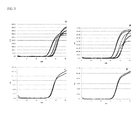
- Fig. 1 PCR analysis of nucleic acid extracted from a human feces sample spiked with Clostridium difficile genomic DNA and Bacillus subtilis comK plasmid DNA using a lysis buffer without betaine (Lysis Buffer A) and a lysis buffer supplemented with 1.0 M betaine (Lysis Buffer B) (see example 2).
- Cultured Clostridium difficile cells were spiked into a 20% suspension of human feces in PBS-DOC/NP-40 in different concentrations, viz. 2.5 x 10 5 cells (solid lines), 2.5 x 10 4 cells (dotted lines), and 2.5 x 10 3 cells (solid lines with triangles).
- Lysis Buffer A or Lysis Buffer B were added to the feces suspensions together with 5000 cps of a plasmid DNA containing a cloned fragment of the Bacillus subtilis comK gene. Nucleic acid was extracted from the lysates and analyzed by real-time PCR amplification.
- A Clostridium difficile genomic DNA extracted with Lysis Buffer A
- B Clostridium difficile genomic DNA extracted with Lysis Buffer B
- C Bacillus subtilis plasmid DNA extracted with Lysis Buffer A
- D Bacillus subtilis plasmid DNA extracted with Lysis Buffer B.
- Fig. 2 PCR analysis of nucleic acid extracted from human feces samples spiked with Clostridium difficile tcdB plasmid DNA and Bacillus subtilis comK plasmid DNA using a lysis buffer without betaine (Lysis Buffer A) and a lysis buffer supplemented with 1.0 M betaine (Lysis Buffer B) (see example 3). Plasmid DNAs were spiked into a 20% suspension of human feces in PBS-DOC/NP-40 at 5000 cps per extraction.
- Lysis Buffer A or Lysis Buffer B were added to the feces suspensions and nucleic acid was extracted from the lysates followed by real-time PCR amplification with multiplex mixtures Mix 1 (solid lines with triangles), Mix 4 (solid lines with rectangles), Mix 5 (dashed lines), and Mix 7 (solid lines).
- A Clostridium difficile plasmid DNA extracted with Lysis Buffer A
- B Clostridium difficile plasmid DNA extracted with Lysis Buffer B
- C Bacillus subtilis plasmid DNA extracted with Lysis Buffer A
- D Bacillus subtilis plasmid DNA extracted with Lysis Buffer B.
- Fig. 3 PCR analysis of nucleic acid extracted from a human feces sample spiked with Clostridium difficile genomic DNA and Bacillus subtilis comK plasmid DNA using a lysis buffer without betaine (Lysis Buffer A) and a lysis buffer supplemented with 1.5 M betaine (Lysis Buffer B) (see example 4).
- Cultured Clostridium difficile cells were spiked into a 20% suspension of human feces in PBS-DOC/NP-40 in different concentrations, viz. 2.5 x 10 5 cells (solid lines), 2.5 x 10 4 cells (dotted lines), and 2.5 x 10 3 cells (solid lines with triangles).
- Lysis Buffer A or Lysis Buffer B were added to the feces suspensions together with 5000 cps of a plasmid DNA containing a cloned fragment of the Bacillus subtilis comK gene. Nucleic acid was extracted from the lysates and analyzed by real-time PCR amplification.
- A Clostridium difficile genomic DNA extracted with Lysis Buffer A
- B Clostridium difficile genomic DNA extracted with Lysis Buffer B
- C Bacillus subtilis plasmid DNA extracted with Lysis Buffer A
- D Bacillus subtilis plasmid DNA extracted with Lysis Buffer B.
- the present invention relates to a buffer comprising in aqueous solution:
- a buffer is a solution containing a buffer substance that is suitable to stabilize the pH value of that solution.
- a buffer substance that is suitable to stabilize the pH value of that solution.
- Numerous buffer substances are well known in the art.
- a typical example for a buffer substance is Tris.
- the present invention relates to compositions and uses employing Tris.
- a chaotropic agent is a compound which is able to disrupt the three dimensional structure of a macromolecule such as a protein or nucleic acid by interfering with stabilizing intramolecular interactions.
- Typical examples of chaotropic agents include urea, guanidinium hydrochloride, guanidinium isothiocyanate (Gua-SCN).
- a chaotropic agent is lithium perchlorate.
- betaines are compounds comprising a positively charged group as well as a negatively charged group in their molecular structure wherein hydrogen migration cannot compensate these charges.
- Preferred betaines include trimethylglycine and sultaine.
- an aqueous solution is a solution formed from solid and liquid components, wherein water is the most abundant liquid component.
- a non-aqueous component is the most abundant liquid component.
- the buffers of the invention comprise additionally, at least one of the following components:
- a surfactant is an agent that reduces the surface tension of a liquid.
- Numerous anionic, cationic, non-ionic, and zwitterionic surfactants are well known in the art amongst which are a large number of surfactants compatible with protocols for the extraction and subsequent analysis of nucleic acids.
- the invention relates to compositions and uses employing non-ionic surfactants.
- a typical example for a non-ionic surfactant is Triton X-100.
- a chelating agent for metal ions is a compound that is capable of forming a chelate-complex with a metal ion, thus preventing its interaction in processes resulting in the degradation of macromolecules and in particular nucleic acids.
- Numerous chelating agents for metal ions are well known in the art. Typical examples are EDTA and EGTA.
- the present invention relates to compositions and uses employing EDTA.
- the present invention relates to compositions that contain at least one compound in a concentration that is close to its saturation concentration.
- saturation concentration denotes the maximum concentration of a compound that can be obtained by dissolving that compound in a solution at a specific temperature.
- the saturation concentration for the purpose of the present invention is defined as the saturation concentration obtained in the absence of betaine additive.
- the present invention relates to buffers, wherein the concentration of the chaotropic agent (C ca ) and the concentration of the betaine (c bet ) are selected from the group of: c sat - 1 M > c ca > c sat - 2 M and 2.5 M > c bet > 1.5 M , c sat - 0.5 M > c ca > c sat - 1 M and 2.5 M > c bet > 1.5 M , c sat - 0.3 M > c ca > c sat - 0.5 M and 2.5 M > c bet > 1.5 M , c sat - 0.1 M > c ca > c sat - 0.3 M and 2.5 M > c bet > 1.5 M , c sat > - 0.1 M > c ca > c sat - 0.3 M and 2.5 M > c bet > 1.5 M , c sat > c ca > c sat - 0.1 M and
- a simple experiment can be performed in order to test if a combination of concentrations chosen for chaotropic agent and betaine is suitable to stabilize a given solution with respect to crystal formation, e.g. during storage:
- a solution containing chaotropic agent and betaine at the concentrations chosen is prepared and subjected to the temperature conditions expected during storage (e.g. 2 °C to 8 °C as in a refrigerator), for a prolonged period of time, e.g. for 24 hours or one week.
- the solution is examined with respect to crystal formation, e.g. by visual inspection. If no crystals are found the concentrations chosen are suitable to sufficiently stabilize the solution (cf. example 1).
- a simple experiment can be performed in order to test if a concentration chosen for a betaine in a lysis and extraction solution containing a chaotropic agent is suitable for improving the yields of extracted nucleic acids and/or is suitable for reducing the inhibitory and/or disturbing effect of the chaotropic agent on subsequent nucleic acid amplification reactions:
- a solution containing chaotropic agent and betaine at the concentrations chosen is prepared, combined with a nucleic acid sample and, subsequently, subjected to a nucleic acid amplification reaction (e.g. PCR).
- a nucleic acid amplification reaction e.g. PCR
- the sample containing the nucleic acid is subjected to a lysis and extraction protocol of interest using a lysis and extraction solution containing chaotropic agent and betaine at the concentrations chosen.
- the nucleic acid extracted thereby is then used for the amplification reaction.
- the experiment is performed with different betaine concentrations and the results of the nucleic acid amplification are compared thus yielding the most suitable betaine concentration.
- the most suitable betaine concentration may be defined as the lowest corresponding C t -value for the sample.
- the corresponding buffers combine the beneficial effect of the betaine additive, i.e. inhibition of the crystallization of guanidinium isothiocyanate at temperatures typical for storage in a refrigerator (e.g. 2°C to 8°C) with improved yields of extracted nucleic acids and/or significantly reduced inhibition and/or disturbance of subsequent amplification reactions (e.g. PCR) performed with the extracted nucleic acids.
- amplification reactions e.g. PCR
- the present invention further comprises a kit comprising, in packaged combination, at least one container containing a buffer of the invention and at least one container containing some or all of the reagents necessary for the amplification of nucleic acids.
- reagents required for nucleic acid amplification comprise at least one of the following: an oligonucleotide primer pair or a plurality of different oligonucleotide primer pairs, nucleotides, a polymerase, a label that allows to monitor the amplification process, a buffer for the amplification reaction.
- the present invention further comprises a cartridge containing a buffer according to the invention.
- a cartridge is suitable to be used by an automated bioanalytical instrument and is further suitable for storing liquid solutions and sample material so that liquid solutions and sample material in one cartridge can temporarily be stored while the liquid solutions and sample material in another cartridge are being processed by the automated bioanalytical instrument.
- the present invention relates to cartridges which are built in such a way that it is difficult or impossible to assess from the outside if precipitate is present in the cartridge.
- the present invention relates to cartridges which are built in such a way that it is difficult or impossible to take measures suitable to re-dissolve precipitate present in the cartridge.
- the present invention further comprises a process for the lysis of sample material and/or extraction and/or analysis of nucleic acids from sample material comprising the step:
- the sample material containing the nucleic acid to be extracted contains in addition to the nucleic acid at least one of the following: proteins, lipids, carbohydrates.
- the sample material is of biological origin. Typical sample materials include for example: cells, viruses, tissue, body fluids.
- the nucleic acid to be analyzed is DNA. In a particularly preferred embodiment of the present invention the nucleic acid to be analyzed is plasmid DNA.
- a large number of processes for the lysis of sample material and/or extraction of nucleic acids from different sample materials are known in the art.
- a number of such processes employ buffers containing chaotropic agents.
- the chaotropic agent effects denaturation of biological macromolecules, the disruption of non-covalent bonds and inhibition of enzymes that would otherwise degrade the nucleic acids.
- the process of lysis and/or extraction can also involve some kind of mechanical disruption, e.g. mechanical blender, glass beads, grinding, French pressure cell, homogenizer, sonication or freeze-thaw-cycles.
- a typical process for the lysis of sample material and extraction of nucleic acids thereof comprises the steps: (i) exposing the sample material to a buffer according to the invention, (ii) specific binding of nucleic acids to a suitable substance in a buffer according to the invention, (iii) washing of the substance with bound nucleic acids with one or more solutions suitable for this step, (iv) elution of the nucleic acids from the substance with a solution suitable for this step.
- processes for the analysis of sample material are preferably processes involving the amplification of nucleic acids contained in the sample material.
- Analysis-methods involving the amplification of nucleic acids e.g. by polymerase chain reaction (PCR), nucleic acid sequence-based amplification (NASBA) or ligase chain reaction (LCR)
- PCR polymerase chain reaction
- NASBA nucleic acid sequence-based amplification
- LCR ligase chain reaction
- the analysis of sample material involves a quantitative real time PCR process.
- the nucleic acid that is analyzed is DNA.
- the nucleic acid that is analyzed is plasmid DNA.
- the present invention further comprises the use of a betaine as an additive for a buffer that is suitable for the extraction of nucleic acids from sample material, wherein the sample material, in addition to the nucleic acids, contains at least one of the following components: proteins, lipids, carbohydrates.
- the present invention further comprises the use of a betaine for improving lysis and extraction solutions containing a chaotropic agent, wherein the use of these solutions in the course of the lysis and extraction procedure results in higher yields of extracted nucleic acids and/or in less inhibition and/or disturbance of subsequent nucleic acid amplification reactions performed with the extracted nucleic acids, than the use of lysis and extraction solutions containing no such betaine additives.
- effects are known in the art that result in the reduction of extraction-yield and/or inhibition and/or disturbance of nucleic acid amplification reactions. Such effects can be caused by the presence of detrimental agents. People of skill in the art can readily identify such effects. In the context of quantitative real time PCR for example such an effect can be identified by comparing the curve displaying the temporal development of the signal correlated to nucleic acid amplification for a sample containing a potentially detrimental agent to that of a sample without such an agent. In a preferred embodiment of the present invention such an effect that results in the reduction of extraction-yield and/or inhibition and/or disturbance of nucleic acid amplification reactions is characterized by an increased C t -value for the sample that is subject to this effect.
- the present invention further comprises the use of a betaine for stabilizing a compound in a solution.
- stabilization of the compound in the solution is achieved if at constant temperature the saturation concentration of that compound can be increased by the addition of the betaine.
- the saturation concentration of a compound is the maximal concentration at which that compound can be dissolved at a specific temperature.
- the solution can be an aqueous solution or a non-aqueous solution. In a preferred embodiment the solution is an aqueous solution.
- the compound to be stabilized in a solution is either an organic salt or a chaotropic agent.
- an organic salt is a salt of an organic cation. Typical organic cations are guanidinium and ammonium.
- the betaine for stabilizing the compound in solution is selected from the group of:
- lysis buffers were used to extract nucleic acid from difficult sample matrices known to contain high concentrations of inhibitory factors for PCR amplification and high levels of background DNA competing with the target DNA of interest for binding places on the silica moiety.
- a 20 % (w/v) suspension of a human feces sample was prepared in Phosphate Buffered Saline (PBS) solution supplemented with 1.0 % deoxycholate (DOC) and 1.0 % Nonidet-P40 (NP-40).
- PBS Phosphate Buffered Saline
- DOC deoxycholate
- NP-40 Nonidet-P40
- the cleared lysate was applied to a NucleoSpin Blood Column (Macherey-Nagel, Düren, Germany) in two portions of 550 ⁇ l and each portion was incubated during 1 minute at room temperature prior to centrifugation through the silica membrane in the spin column. After that the spin column was centrifuged and the flow-through was discarded.
- the silica membrane was washed with a first wash buffer containing a high concentration of chaotropic salt to remove residual unbound substances (600 ⁇ l BW Buffer (Macherey-Nagel, Düren, Germany)) and subsequently with a wash buffer containing a high concentration of ethanol to remove the chaotropic salts while still keeping the nucleic acid bound to the silica membrane (600 ⁇ l B5 Buffer (Macherey-Nagel, Duren, Germany)) followed by centrifugation during 1 minute for each of the wash buffers. After the final washing step, residual ethanol was removed from the silica membrane by an extra centrifugation step of 3 minutes.
- bound nucleic acids were eluted from the silica membrane by applying two aliquots of 75 ⁇ l of BE Buffer (Macherey-Nagel, Düren, Germany) to the spin columns that were pre-warmed to 70°C followed by a short incubation (2 minutes at room temperature) prior to centrifugation (1 minute). Flow-through of the elution step was collected in a clean tube and subsequently used for PCR analysis. Upon elution, the two eluate aliquots were pooled and immediately used for PCR analysis.
- BE Buffer Meacherey-Nagel, Düren, Germany
- PCR reactions 10 ⁇ l of the nucleic acid extracts prepared with either Lysis Buffer A or Lysis Buffer B, were mixed with 12.5 ⁇ l LightCycler® 480 Probes Master (Roche Diagnostics GmbH, Mannheim, Germany) mastermix and 0.5 ⁇ l of a 90 mM MgCl 2 solution. To these mixtures, 2 ⁇ l of a multiplex PCR mix of primers and Taqman probes were added targeting two regions on the tcdB gene of Clostridium difficile and the cloned Bacillus subtilis comK fragment in the plasmid DNA that was spiked into each sample as the SPC.
- Taqman probes for the individual PCR targets were labeled with fluorophores FAM for comK and Yakima Yellow and ATT0647N for the tcdB gene targets.
- PCR reaction mixtures were processed in a Bio-Rad CFX96 system (Bio-Rad Laboratories, Veenendaal, The Netherlands). Denaturation was performed at 95°C during 10 minutes and was followed by 50 cycles, each consisting of 15 seconds denaturation at 95°C and 60 seconds annealing/extension at 60°C. Fluorescence was monitored over time and measured at the end of each annealing/extension step. Real-time PCR curves that were obtained for the different PCR targets in the different samples are shown in Figure 1 .
- Lysis Buffer A consisted of 4.75 M Gua-SCN, 50 mM Tris-HCl (pH 6.4), 20 mM EDTA, and 1.3 % (w/v) Triton X-100.
- the other lysis buffer (Lysis Buffer B) had exactly the same composition with the exception that it additionally contained 1.5 M trimethylglycine. Results of the PCR analysis are depicted in Figure 3 .
Landscapes
- Chemical & Material Sciences (AREA)
- Organic Chemistry (AREA)
- Life Sciences & Earth Sciences (AREA)
- Engineering & Computer Science (AREA)
- Zoology (AREA)
- Proteomics, Peptides & Aminoacids (AREA)
- Health & Medical Sciences (AREA)
- Wood Science & Technology (AREA)
- Analytical Chemistry (AREA)
- Chemical Kinetics & Catalysis (AREA)
- Biophysics (AREA)
- Microbiology (AREA)
- Molecular Biology (AREA)
- Immunology (AREA)
- Biotechnology (AREA)
- Physics & Mathematics (AREA)
- Biochemistry (AREA)
- Bioinformatics & Cheminformatics (AREA)
- General Engineering & Computer Science (AREA)
- General Health & Medical Sciences (AREA)
- Genetics & Genomics (AREA)
- Materials Engineering (AREA)
- Measuring Or Testing Involving Enzymes Or Micro-Organisms (AREA)
Priority Applications (4)
| Application Number | Priority Date | Filing Date | Title |
|---|---|---|---|
| EP10164129A EP2390646A1 (fr) | 2010-05-27 | 2010-05-27 | Prévention de la formation de cristaux dans des solutions liquides pendant le stockage au moyen de bétaïne |
| PCT/CH2011/000127 WO2011147044A2 (fr) | 2010-05-27 | 2011-05-27 | Prévention de la formation de cristaux dans des solutions liquides pendant le stockage par ajout d'une bétaïne |
| US13/699,957 US20130109025A1 (en) | 2010-05-27 | 2011-05-27 | Prevention of crystal formation in liquid solutions during storage by adding a betaine |
| EP11723221.5A EP2577252A2 (fr) | 2010-05-27 | 2011-05-27 | Prévention de la formation de cristaux dans des solutions liquides pendant le stockage au moyen de bétaïne |
Applications Claiming Priority (1)
| Application Number | Priority Date | Filing Date | Title |
|---|---|---|---|
| EP10164129A EP2390646A1 (fr) | 2010-05-27 | 2010-05-27 | Prévention de la formation de cristaux dans des solutions liquides pendant le stockage au moyen de bétaïne |
Publications (1)
| Publication Number | Publication Date |
|---|---|
| EP2390646A1 true EP2390646A1 (fr) | 2011-11-30 |
Family
ID=42269463
Family Applications (2)
| Application Number | Title | Priority Date | Filing Date |
|---|---|---|---|
| EP10164129A Withdrawn EP2390646A1 (fr) | 2010-05-27 | 2010-05-27 | Prévention de la formation de cristaux dans des solutions liquides pendant le stockage au moyen de bétaïne |
| EP11723221.5A Withdrawn EP2577252A2 (fr) | 2010-05-27 | 2011-05-27 | Prévention de la formation de cristaux dans des solutions liquides pendant le stockage au moyen de bétaïne |
Family Applications After (1)
| Application Number | Title | Priority Date | Filing Date |
|---|---|---|---|
| EP11723221.5A Withdrawn EP2577252A2 (fr) | 2010-05-27 | 2011-05-27 | Prévention de la formation de cristaux dans des solutions liquides pendant le stockage au moyen de bétaïne |
Country Status (3)
| Country | Link |
|---|---|
| US (1) | US20130109025A1 (fr) |
| EP (2) | EP2390646A1 (fr) |
| WO (1) | WO2011147044A2 (fr) |
Families Citing this family (3)
| Publication number | Priority date | Publication date | Assignee | Title |
|---|---|---|---|---|
| CN105385676B (zh) * | 2015-11-05 | 2018-10-02 | 杭州易文赛生物技术有限公司 | 一种提取dna的方法和解离染色质的方法以及高氯酸盐的用途 |
| CN113564231B (zh) * | 2021-07-30 | 2023-03-24 | 信念医药科技(苏州)有限公司 | 核酸稀释液 |
| CN116716435A (zh) * | 2023-03-07 | 2023-09-08 | 北京纳捷诊断试剂有限公司 | 一种用于检测新型冠状病毒rna的组合物 |
Citations (4)
| Publication number | Priority date | Publication date | Assignee | Title |
|---|---|---|---|---|
| WO1999039000A1 (fr) * | 1998-01-30 | 1999-08-05 | Akzo Nobel N.V. | Perfectionnement d'un procede d'isolement d'acide nucleique |
| WO2008002740A2 (fr) * | 2006-06-28 | 2008-01-03 | Sigma-Aldrich Co. | Procédés, compositions et coffrets pour l'extraction de l'arn |
| WO2008134470A2 (fr) * | 2007-04-25 | 2008-11-06 | 3M Innovative Properties Company | Procédés d'amplification d'acides nucléiques |
| WO2009085355A2 (fr) * | 2007-10-01 | 2009-07-09 | Longhorn Vaccines & Diagnostics Llc | Système de prélèvement et de transport d'échantillons biologiques et procédés d'utilisation |
-
2010
- 2010-05-27 EP EP10164129A patent/EP2390646A1/fr not_active Withdrawn
-
2011
- 2011-05-27 EP EP11723221.5A patent/EP2577252A2/fr not_active Withdrawn
- 2011-05-27 US US13/699,957 patent/US20130109025A1/en not_active Abandoned
- 2011-05-27 WO PCT/CH2011/000127 patent/WO2011147044A2/fr not_active Ceased
Patent Citations (4)
| Publication number | Priority date | Publication date | Assignee | Title |
|---|---|---|---|---|
| WO1999039000A1 (fr) * | 1998-01-30 | 1999-08-05 | Akzo Nobel N.V. | Perfectionnement d'un procede d'isolement d'acide nucleique |
| WO2008002740A2 (fr) * | 2006-06-28 | 2008-01-03 | Sigma-Aldrich Co. | Procédés, compositions et coffrets pour l'extraction de l'arn |
| WO2008134470A2 (fr) * | 2007-04-25 | 2008-11-06 | 3M Innovative Properties Company | Procédés d'amplification d'acides nucléiques |
| WO2009085355A2 (fr) * | 2007-10-01 | 2009-07-09 | Longhorn Vaccines & Diagnostics Llc | Système de prélèvement et de transport d'échantillons biologiques et procédés d'utilisation |
Non-Patent Citations (2)
| Title |
|---|
| BATEMAN J B ET AL: "Dielectric properties of the system bovine albumin : urea : betaine in aqueous solution", PHYSICS IN MEDICINE AND BIOLOGY, TAYLOR AND FRANCIS LTD. LONDON, GB LNKD- DOI:10.1088/0031-9155/37/1/012, vol. 37, no. 1, 1 January 1992 (1992-01-01), pages 175 - 182, XP020021929, ISSN: 0031-9155 * |
| CHINI E N ET AL: "The enhancement of Ca<2+> efflux from sarcoplasmic reticulum vesicles by urea", ARCHIVES OF BIOCHEMISTRY AND BIOPHYSICS, ACADEMIC PRESS, US LNKD- DOI:10.1016/0003-9861(92)90245-R, vol. 299, no. 1, 15 November 1992 (1992-11-15), pages 73 - 76, XP024762390, ISSN: 0003-9861, [retrieved on 19921115] * |
Also Published As
| Publication number | Publication date |
|---|---|
| WO2011147044A3 (fr) | 2012-03-22 |
| EP2577252A2 (fr) | 2013-04-10 |
| US20130109025A1 (en) | 2013-05-02 |
| WO2011147044A2 (fr) | 2011-12-01 |
Similar Documents
| Publication | Publication Date | Title |
|---|---|---|
| US20240060113A1 (en) | Preservation of fetal nucleic acids in maternal plasma | |
| US20240018605A1 (en) | Method and Kit of Detecting the Absence of Micro-Organisms | |
| US20070015185A1 (en) | Lysis and stabilization buffer suitable for inclusion in PCR reactions | |
| EP3775254B1 (fr) | Séparation et détection de microorganismes | |
| EP2382306A1 (fr) | Traitement et analyse d'échantillons biologiques liquides visqueux | |
| DE10231659B4 (de) | Zusammensetzung zum Binden von Nukleinsäure an eine Festphase | |
| US10829758B2 (en) | Automatable method for nucleic acid isolation | |
| EP1464699B1 (fr) | Procede de detection d'acides nucleiques et systeme associe | |
| US11981893B2 (en) | DNA stabilization of RNA | |
| EP4426864A1 (fr) | Procédés et systèmes d'amplification et de détection dans des échantillons biologiques | |
| EP2390646A1 (fr) | Prévention de la formation de cristaux dans des solutions liquides pendant le stockage au moyen de bétaïne | |
| US6767723B2 (en) | Method for synthesis of nucleic acids | |
| WO2017182775A1 (fr) | Détection de microorganisme impliquant une filtration | |
| EP3277809B1 (fr) | Isolement d'acides nucléiques | |
| EP3329011B1 (fr) | Méthode et composition | |
| EP3329015B1 (fr) | Procédé et composition utilisant un composé d'ammonium quaternaire | |
| HK40085645A (en) | Automatable method for nucleic acid isolation | |
| Thompson et al. | An Analysis of Efficiency and Melt Curve Effects on Quantitative Polymerase Chain Reaction (qPCR) Inhibition | |
| JP2007151470A (ja) | 試料を用いた核酸増幅方法 |
Legal Events
| Date | Code | Title | Description |
|---|---|---|---|
| AK | Designated contracting states |
Kind code of ref document: A1 Designated state(s): AL AT BE BG CH CY CZ DE DK EE ES FI FR GB GR HR HU IE IS IT LI LT LU LV MC MK MT NL NO PL PT RO SE SI SK SM TR |
|
| AX | Request for extension of the european patent |
Extension state: BA ME RS |
|
| PUAI | Public reference made under article 153(3) epc to a published international application that has entered the european phase |
Free format text: ORIGINAL CODE: 0009012 |
|
| 17P | Request for examination filed |
Effective date: 20120604 |
|
| 17Q | First examination report despatched |
Effective date: 20121018 |
|
| STAA | Information on the status of an ep patent application or granted ep patent |
Free format text: STATUS: THE APPLICATION HAS BEEN WITHDRAWN |
|
| 18W | Application withdrawn |
Effective date: 20130501 |