EP2392676B1 - Procédé pour détecter un polymorphisme sur position de nucléotide -1639 de gène VKORC1 et sonde d'acide nucléique et kit associé - Google Patents
Procédé pour détecter un polymorphisme sur position de nucléotide -1639 de gène VKORC1 et sonde d'acide nucléique et kit associé Download PDFInfo
- Publication number
- EP2392676B1 EP2392676B1 EP11168544.2A EP11168544A EP2392676B1 EP 2392676 B1 EP2392676 B1 EP 2392676B1 EP 11168544 A EP11168544 A EP 11168544A EP 2392676 B1 EP2392676 B1 EP 2392676B1
- Authority
- EP
- European Patent Office
- Prior art keywords
- probe
- polymorphism
- oligonucleotide
- seq
- nucleic acid
- Prior art date
- Legal status (The legal status is an assumption and is not a legal conclusion. Google has not performed a legal analysis and makes no representation as to the accuracy of the status listed.)
- Active
Links
Images




Classifications
-
- C—CHEMISTRY; METALLURGY
- C12—BIOCHEMISTRY; BEER; SPIRITS; WINE; VINEGAR; MICROBIOLOGY; ENZYMOLOGY; MUTATION OR GENETIC ENGINEERING
- C12Q—MEASURING OR TESTING PROCESSES INVOLVING ENZYMES, NUCLEIC ACIDS OR MICROORGANISMS; COMPOSITIONS OR TEST PAPERS THEREFOR; PROCESSES OF PREPARING SUCH COMPOSITIONS; CONDITION-RESPONSIVE CONTROL IN MICROBIOLOGICAL OR ENZYMOLOGICAL PROCESSES
- C12Q1/00—Measuring or testing processes involving enzymes, nucleic acids or microorganisms; Compositions therefor; Processes of preparing such compositions
- C12Q1/68—Measuring or testing processes involving enzymes, nucleic acids or microorganisms; Compositions therefor; Processes of preparing such compositions involving nucleic acids
- C12Q1/6876—Nucleic acid products used in the analysis of nucleic acids, e.g. primers or probes
- C12Q1/6883—Nucleic acid products used in the analysis of nucleic acids, e.g. primers or probes for diseases caused by alterations of genetic material
-
- C—CHEMISTRY; METALLURGY
- C12—BIOCHEMISTRY; BEER; SPIRITS; WINE; VINEGAR; MICROBIOLOGY; ENZYMOLOGY; MUTATION OR GENETIC ENGINEERING
- C12Q—MEASURING OR TESTING PROCESSES INVOLVING ENZYMES, NUCLEIC ACIDS OR MICROORGANISMS; COMPOSITIONS OR TEST PAPERS THEREFOR; PROCESSES OF PREPARING SUCH COMPOSITIONS; CONDITION-RESPONSIVE CONTROL IN MICROBIOLOGICAL OR ENZYMOLOGICAL PROCESSES
- C12Q1/00—Measuring or testing processes involving enzymes, nucleic acids or microorganisms; Compositions therefor; Processes of preparing such compositions
- C12Q1/68—Measuring or testing processes involving enzymes, nucleic acids or microorganisms; Compositions therefor; Processes of preparing such compositions involving nucleic acids
- C12Q1/6813—Hybridisation assays
- C12Q1/6827—Hybridisation assays for detection of mutation or polymorphism
-
- C—CHEMISTRY; METALLURGY
- C12—BIOCHEMISTRY; BEER; SPIRITS; WINE; VINEGAR; MICROBIOLOGY; ENZYMOLOGY; MUTATION OR GENETIC ENGINEERING
- C12Q—MEASURING OR TESTING PROCESSES INVOLVING ENZYMES, NUCLEIC ACIDS OR MICROORGANISMS; COMPOSITIONS OR TEST PAPERS THEREFOR; PROCESSES OF PREPARING SUCH COMPOSITIONS; CONDITION-RESPONSIVE CONTROL IN MICROBIOLOGICAL OR ENZYMOLOGICAL PROCESSES
- C12Q2527/00—Reactions demanding special reaction conditions
- C12Q2527/107—Temperature of melting, i.e. Tm
-
- C—CHEMISTRY; METALLURGY
- C12—BIOCHEMISTRY; BEER; SPIRITS; WINE; VINEGAR; MICROBIOLOGY; ENZYMOLOGY; MUTATION OR GENETIC ENGINEERING
- C12Q—MEASURING OR TESTING PROCESSES INVOLVING ENZYMES, NUCLEIC ACIDS OR MICROORGANISMS; COMPOSITIONS OR TEST PAPERS THEREFOR; PROCESSES OF PREPARING SUCH COMPOSITIONS; CONDITION-RESPONSIVE CONTROL IN MICROBIOLOGICAL OR ENZYMOLOGICAL PROCESSES
- C12Q2600/00—Oligonucleotides characterized by their use
- C12Q2600/106—Pharmacogenomics, i.e. genetic variability in individual responses to drugs and drug metabolism
-
- C—CHEMISTRY; METALLURGY
- C12—BIOCHEMISTRY; BEER; SPIRITS; WINE; VINEGAR; MICROBIOLOGY; ENZYMOLOGY; MUTATION OR GENETIC ENGINEERING
- C12Q—MEASURING OR TESTING PROCESSES INVOLVING ENZYMES, NUCLEIC ACIDS OR MICROORGANISMS; COMPOSITIONS OR TEST PAPERS THEREFOR; PROCESSES OF PREPARING SUCH COMPOSITIONS; CONDITION-RESPONSIVE CONTROL IN MICROBIOLOGICAL OR ENZYMOLOGICAL PROCESSES
- C12Q2600/00—Oligonucleotides characterized by their use
- C12Q2600/156—Polymorphic or mutational markers
Definitions
- the present invention relates to a method for detecting a polymorphism at position -1639 of the VKORC1 gene, and a nucleic acid probe and a kit therefor.
- warfarin As a drug for preventing coagulation of blood in a patient suffering from myocardial infarction or cerebral infarction, warfarin has been widely used.
- the optimal dose of warfarin largely varies among different human races, and, even in the same human race, individual differences are observed.
- High-dose administration of warfarin may cause epistaxis or subcutaneous hemorrhage, or, in some cases, side effects such as intracerebral hemorrhage. Therefore, it is very important to determine the optimal dose of warfarin for each patient when the treatment is carried out.
- the CYP2C9 gene is a gene that encodes cytochrome P450, which produces a warfarin metabolic enzyme.
- the VKORC1 gene is a gene that encodes a protein which acts on vitamin K, which is involved in coagulation of blood.
- polymorphisms of these two genes are very important for determining the optimal dose of warfarin depending on the patient, to reduce side effects.
- Known examples of the polymorphism of the VKORC1 gene include 1173C>T (rs9934438) and -1639 G>A (rs9923231).
- Such polymorphisms of the VKORC1 gene are described in TDM Research Vol. 25 No. 4 (2008) 141-144 , Blood, 1 September 2007 Volume 110, Number 5 , and Genet Med. 2008 Feb; 10(2): 89-98 .
- Examples of the method for detecting polymorphisms of a nucleotide include the PCR-RFLP method ( TDM Research Vol. 25 No. 4 (2008) 141-144 ) and the method of detecting a mutation by pyrosequencing ( Blood, 1 September 2007 Volume 110, Number 5 ).
- the PCR-RFLP method in TDM Research Vol. 25 No. 4 (2008) 141-144 requires much labour and cost since, for example, the method needs extraction and purification of DNA and PCR, followed by restriction enzyme treatment of the amplified product and then electrophoresis. Further, since treatment of the amplified product is necessary after the PCR, there is a risk of contamination of the amplified product to the subsequent reaction system; automation is difficult; and testing of multiple nucleic acid sequences at the same time is impossible; which has been problematic.
- the pyrosequencing in Blood, 1 September 2007 Volume 110, Number 5 is based on the principle that, by converting pyrophosphoric acid, which is released upon incorporation of a nucleotide into DNA, to ATP and using it for luminescent reaction, the amount of the nucleotide incorporated into the DNA can be quantified. Practically, by repeating a process in which one of each type of deoxyribonucleotide is added and the amount of luminescence is measured, followed by removing the deoxyribonucleotide, the sequence is determined.
- JP 2009-219445 discloses probes specific for VKORC1-1639 G>A.
- WO2008/117782 a method is described in which melting curve analysis is carried out using a probe whose 5'-end is fluorescently labeled, to detect VKORC1 1173C>T (rs9934438) and CYP2C9*3 at the same time.
- rs99344308 a method to detect the polymorphism VKORC1-1639 G>A
- a method to detect the polymorphism VKORC1-1639 G>A rs9923231
- a polymorphism at the CYP2C9*3 mutation site at the same time.
- the present invention aims to specify a quenching probe effective for detecting a polymorphism at position -1639 of the VKORC1 gene and to provide a method for detecting the polymorphism at position -1639 of the VKORC1 gene and a kit therefor.
- the present inventors discovered that, by designing a quenching probe based on a particular region containing a polymorphism at position -1639 of the VKORC1 gene and carrying out melting curve analysis using the quenching probe, the mutation can be detected, thereby completing the present invention.
- the present invention provides the following.
- the probe of the present invention has a high specificity and a high detection sensitivity.
- the method of the present invention By using the method of the present invention, even in cases where PCR is carried out, the amplification product does not need to be removed, so that there is hardly a risk of contamination. Further, since the method of the present invention has a simple mechanism, its automation can be easily attained.
- a polymorphism at position -1639 of the VKORC1 gene and a polymorphism at the CYP2C9*3 mutation site can be detected at the same time.
- the probe of the present invention is a probe for detecting a polymorphism of the nucleotide at position -1639 of the VKORC1 gene, wherein the probe is an oligonucleotide consisting of the nucleotide sequence of SEQ ID NO:6 wherein the cytosine at the 5' end is labeled with a fluorescent dye.
- the nucleotide at position -1639 of the VKORC1 gene is the nucleotide at position 88 in SEQ ID NO:1 or 2.
- the probe of the present invention can be prepared in the same manner as the quenching probes described in JP 2001-286300 A and JP 2002-119291 A except that the probe of the present invention has the above-described specified sequence in the nucleotide sequence shown in SEQ ID NO:1 (sequence having the wild-type nucleotide at position -1639 of the VKORC1 gene) or the nucleotide sequence shown in SEQ ID NO:2 (sequence having a variant (polymorphic) nucleotide at position - 1639 of the VKORC1 gene).
- the sequence of the present invention shown in SEQ ID NO: corresponds to positions 3501 to 3680 of GenBank Accession No. NG_011564.
- the nucleotide sequence of the probe used in the present invention is an example of the sequence 5'-cattggccrggtgcggt-3' (SEQ ID NO:5).
- r represents a or g.
- the nucleotide sequence of the probe of the invention is 5'-cattggccaggtgcggt-3' (SEQ ID NO:6).
- the fluorescent dye those described in JP 2001-286300 A and JP 2002-119291 A may be used, and particular examples thereof include Pacific Blue (trademark), FAM (trademark), TAMRA (trademark) and BODIPY (trademark) FL.
- the method of linking the fluorescent dye to the oligonucleotide may be carried out according to a conventional method, such as the one described in JP 2001-286300 A and JP 2002-119291 A .
- Fluorescence of the fluorescent dye of the probe of the present invention preferably decreases or increases when the probe is hybridized with a target sequence.
- the probe of the present invention is preferably a quenching probe, wherein fluorescence of the fluorescent dye is quenched upon hybridization.
- the probe of the present invention is labeled at the 5' end with a fluorescent dye.
- the detection method of the present invention is a method wherein a nucleic acid having the polymorphic site at position -1639 of the VKORC1 gene is subjected to melting curve analysis by using a nucleic acid probe labeled with a fluorescent dye and measuring fluorescence of the fluorescent dye, to detect the polymorphism based on the result of the melting curve analysis, which nucleic acid probe is the probe of the present invention.
- the detection method of the present invention can be carried out according to conventional methods for nucleic acid amplification and melting curve analysis (Tm analysis) except that a region containing the polymorphic site at position -1639 of the VKORC1 gene is amplified and that the probe of the present invention is used.
- Tm analysis nucleic acid amplification and melting curve analysis
- the detection method of the present invention uses the probe of the present invention and preferably comprises the following steps:
- the detection method of the present invention may be carried out according to conventional methods for nucleic acid amplification and melting curve analysis (Tm analysis) except that the probe of the present invention is used. Further, the detection method of the present invention may comprise amplification of nucleic acid before Step (I) or at the same time as Step (I).
- the method of nucleic acid amplification is preferably a method using a polymerase, and examples thereof include PCR, ICAN and LAMP.
- the amplification is preferably carried out in the presence of the probe of the present invention.
- Those skilled in the art can easily adjust the reaction conditions and the like of the amplification depending on the probe used. Since, by this, the detection can be carried out just by analyzing the Tm value of the probe after the nucleic acid amplification, there is no need to handle the amplified product after the reaction. Therefore, the risk of contamination by the amplified product can be avoided. Further, since the detection can be carried out using the same instrument as the one necessary for the amplification, there is no need even to transfer the container. Thus, automation can be attained easily.
- the DNA in the sample may be either a single-stranded DNA or a double-stranded DNA.
- a step of dissociating the double-stranded DNA in the sample by heating is preferably included before the hybridization step.
- the ratio (molar ratio) of the probe of the present invention to be added with respect to DNA in the sample is not restricted, and the ratio is preferably not more than 1, more preferably not more than 0.3 with respect to DNA in the sample with a view to securing a sufficient detection signal.
- the DNA in the sample may be either the total of the DNA comprising a polymorphism to be detected and DNA which does not comprise the polymorphism to be detected, or the total of the amplification product containing the sequence comprising a polymorphism to be detected and amplification products containing sequences which do not comprise the polymorphism to be detected.
- the ratio of the DNA to be detected in the DNA in the sample is usually not known, the ratio (molar ratio) of the probe to be added with respect to the DNA to be detected (the amplification product containing the sequence to be detected) is preferably not more than 100, more preferably not more than 50, still more preferably not more than 30 as a result.
- the lower limit of the ratio is not restricted, and the ratio is, for example, not less than 0.001, preferably not less than 0.01, more preferably not less than 0.2.
- the ratio of the probe of the present invention to be added with respect to the DNA may be, for example, either a molar ratio with respect to the double-stranded DNA or a molar ratio with respect to the single-stranded DNA.
- the Tm value will now be described. Heating a solution containing double-stranded DNA causes an increase in the absorbance at 260 nm. This is caused because the hydrogen bonds between the strands of the double-stranded DNA are unraveled by the heat and the double-stranded DNA is dissociated into single-stranded DNAs (melting of DNA). When all the double-stranded DNAs are dissociated into single-stranded DNAs, the absorbance becomes about 1.5 times as large as that observed when the heating was initiated (absorbance for only double-stranded DNA), and by this, completion of the melting can be judged. Based on this phenomenon, the melting temperature Tm is defined as the temperature at which the increase in absorbance reaches 50% of the total increase in absorbance.
- measurement of the signal fluctuation due to the temperature change for determination of the Tm value can be carried out also by measuring the absorbance at 260 nm based on the above-mentioned principle, but the measurement is preferably carried out based on a signal from the label added to the probe of the present invention, which signal fluctuates depending on the state of hybrid formation between the DNA and the probe.
- the probe of the present invention is a fluorescently labeled oligonucleotide probe.
- the probe may emit fluorescence when it is not hybridized with the target sequence and the fluorescence intensity may decrease (the fluorescence is quenched) when the probe is hybridized with the target sequence or the probe may emit fluorescence when it is not hybridized with the target sequence and the fluorescence intensity may increase when the probe is hybridized with the target sequence.
- the probe shows no signal or a weak signal when it is forming a hybrid (double-stranded DNA) with the sequence to be detected, while the probe shows a signal or the signal increases when the probe is released by heating.
- the probe shows a signal by forming a hybrid (double-stranded DNA) with the sequence to be detected, while the signal decreases (disappears) when the probe is released by heating. Therefore, by detecting the change in the signal due to the label under conditions specific to the signal (absorbance and the like), the progress of melting and the determination of Tm value can be carried out similarly to the case of the measurement of absorbance at 260 nm.
- the nucleic acid to be used as the template for carrying out the nucleic acid amplification is not restricted as long as it contains a nucleic acid, and examples thereof include those derived from, or those which may be derived from, arbitrary biological origins such as blood; oral mucosal suspensions; somatic cells of nails, hair and the like; germ cells; milk; ascitic fluid; paraffin-embedded tissues; gastric juices; fluids obtained by gastric lavage; peritoneal fluid; amniotic fluid; and cell cultures.
- the nucleic acid as the template may be used as it is directly after being obtained from the origin, or may be pretreated to modify the properties of the sample before being used.
- the method of nucleic acid amplification is further described by way of an example using PCR.
- the primer pair used in the PCR may be designed in the same manner as in the method for designing a primer pair for conventional PCR, except that the primer pair is designed such that a region with which the probe of the present invention can hybridize is amplified.
- the length and the Tm value of each primer is usually 12 mer to 40 mer and 40 to 70°C, preferably 16 mer to 30 mer and 55 to 60°C.
- the lengths of the respective primers of the primer pair may be different, but the Tm values of both primers are preferably almost the same (the difference is usually not more than 2°C).
- the Tm value is a value calculated by the Nearest Neighbour method.
- Examples of the primer pair include the one composed of the primers having the nucleotide sequences shown in SEQ ID NOs:3 and 4.
- the PCR is preferably carried out in the presence of the probe of the present invention used in the present invention.
- the Tm analysis can be carried out without handling the amplified product after the amplification reaction.
- Those skilled in the art can easily adjust the Tm values of the primers and the reaction conditions for the PCR depending on the probe used.
- the following is a representative temperature cycle, which is usually repeated 25 to 50 times.
- the conditions are 55 to 70°C for 10 to 180 seconds, for example.
- the Tm analysis may be carried out in the same manner as in a conventional method except that fluorescence of the fluorescent dye of the probe of the present invention is measured.
- the measurement of fluorescence may be carried out by using excitation light having a wavelength which varies depending on the fluorescent dye and measuring light having an emission wavelength.
- the heating rate in the Tm analysis is usually 0.1 to 1°C/second.
- the composition of the reaction liquid used for carrying out the Tm analysis is not restricted as long as the probe can be hybridized with a nucleic acid having the complementary sequence of the nucleotide sequence of the probe, and usually, the concentration of monovalent cations is 1.5 to 5 mM, and the pH is 7 to 9. Since a reaction liquid for an amplification method using a DNA polymerase, such as PCR, usually satisfies these conditions, the reaction liquid after the amplification can be used as it is for the Tm analysis.
- Detection of a polymorphism at position -1639 of the VKORC1 gene based on the result of the Tm analysis can be carried out according to a conventional method.
- the detection in the present invention includes detection of the presence/absence of a mutation.
- the optimal dose of warfarin is also included in the present invention. More particularly, in cases where the nucleotide at position -1639 of the VKORC1 gene is A, the sensitivity to warfarin is high, so that reduction of the required dose is suggested. Further, by the method of the present invention, it is also possible to detect a polymorphism at position -1639 of the VKORC1 gene and a polymorphism at the CYP2C9*3 mutation site at the same time. Also in cases where a mutation of CYP2C9*3 exists, the sensitivity to warfarin is high, so that reduction of the required dose is suggested.
- the gene sequence of CYP2C9*3, which is a polymorphism of CYP2C9, and the nucleotide sequence of a probe with which a polymorphism of the mutation site can be detected are described in, for example, WO2008/066163 and WO2008/117782 . More particularly, the probe is a nucleic acid probe labeled at its 3'-end with a fluorescent dye whose fluorescence decreases upon hybridization, which nucleic acid probe has the nucleotide sequence shown in SEQ ID NO:28 or 29 in WO2008/066163 (SEQ ID NO:44 or 45 in WO2008/117782 ).
- Examples of the probe of the present invention with which the polymorphism of the VKORC1 gene and the polymorphism at the CYP2C9*3 mutation site can be detected at the same time (that is, detected in a single system) include the nucleic acid probes described in the above-described WO2008/066163 and WO2008/117782 .
- the kit of the present invention is a kit to be used in the detection method of the present invention.
- This kit comprises a nucleic acid probe labeled with a fluorescent dye whose fluorescence changes upon hybridization (quenching probe, preferably), which nucleic acid probe comprises the above-described oligonucleotide.
- the kit of the present invention can also be used for judging the optimal dose of warfarin.
- the probe is as described above for the probe of the present invention.
- the detection kit of the present invention may further comprise, in addition to the probe, reagents necessary for amplification of nucleic acid in the detection method of the present invention, especially a primer(s) for amplification using a DNA polymerase.
- the probe, primer and other reagents may be contained separately, or a part of these may be contained as a mixture(s).
- the primers shown in Table 2 were designed such that the polymorphic site can be amplified.
- the positions of the F primer and the R primer are represented as the positions in the nucleotide sequence shown in SEQ ID NO:1.
- the position of the probe 1 is represented as the position in the nucleotide sequence shown in SEQ ID NO:2.
- the probe shown in Table 2 which has C at an end, was designed.
- the position of the probe 1 is represented as the position in the nucleotide sequence shown in SEQ ID NO:2.
- P at the 3'-end indicates that the 3'-end is phosphorylated. Labeling with TAMRA was carried out according to a conventional method.
- Tm The melting temperature (Tm) was calculated according to the Nearest Neighbour method in http://www.m-neko.net/tm_calc/, with the settings of: primer conc., 250 nM; Na+ conc., 50 mM.
- PCR and Tm analysis were carried out using a fully automatic SNPs testing device (trade name: i-densy (trademark), manufactured by ARKRAY, Inc.). The conditions for the PCR and the Tm analysis were as shown in Table 5, and the composition of the PCR reaction liquid was as shown in Table 3.
- the emission wavelength and the detection wavelength in the Tm analysis were 520 to 555 nm and 585 to 700 nm (TAMRA), respectively.
- TAMRA 785 to 700 nm
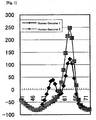
- VKORC1-1639 CYP2C9*3 Human genome 1 Ht(G/A) Wt(A/A) Human genome 2 Mt(A/A) Ht(A/C)
- Ht represents a heterozygote
- Wt represents the wild type
- Mt represents a variant.
- the reaction was carried out in the same manner as in Example 1 except that whole blood was used as the sample.
- the polymorphism at position -1639 of the VKORC1 gene can be detected.
- the reaction was carried out in the same manner as in Example 1 except that a PCR reaction liquid having the composition shown in Table 8 was used.
- the emission wavelength and the detection wavelength in the Tm analysis were 420 to 485 nm and 520 to 555 nm (BODIPY FL), respectively, or 520 to 555 nm and 585 to 700 nm (TAMRA), respectively.
- TAMRA 520 to 555 nm and 585 to 700 nm
- [Table 8] In 50 ⁇ L of the PCR reaction liquid: 1 ⁇ reaction buffer 1.25 U Taq polymerase 1.5 mmol/L MgCl 2 0.2 mmol/L dNTP 14% (v/v) Glycerol 0.5 ⁇ mol/L VKORC1 F primer (Table 2) 1 ⁇ mol/L VKORC1 R primer (Table 2) 0.4 ⁇ mol/L VKORC1 probe 1 (Table 2) 2 ⁇ mol/L CYP2C9*3 F primer (Table 9) 1 ⁇ mol/L CYP2C9*3 R primer (Table 9) 0.2 ⁇ mol/L CYP2C9*3 probe 1 (Table
- the above CYP2C9*3 probe 1 has the nucleotide sequence shown in SEQ ID NO:29 in WO2008/066163 and SEQ ID NO:45 in WO2008/117782 .
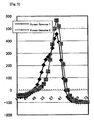
- peaks for TAMRA were observed at about 52°C and about 60°C, and, in terms of the human genome 2, a peak for TAMRA was observed at about 60°C ( Fig. 4 ).
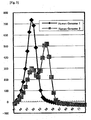
- a peak for BODIPY FL was observed at about 49°C, and, in terms of the human genome 2, peaks for BODIPY FL were observed at about 49°C and about 56°C ( Fig. 5 ).
- the reaction was carried out in the same manner as in Example 3 except that whole blood was used as a sample.
- the whole blood was subjected to pretreatment as follows before use.
- the polymorphism at position -1639 of the VKORC1 gene and the polymorphism at the CYP2C9*3 mutation site can be detected at the same time.
Landscapes
- Chemical & Material Sciences (AREA)
- Life Sciences & Earth Sciences (AREA)
- Organic Chemistry (AREA)
- Health & Medical Sciences (AREA)
- Proteomics, Peptides & Aminoacids (AREA)
- Engineering & Computer Science (AREA)
- Zoology (AREA)
- Wood Science & Technology (AREA)
- Analytical Chemistry (AREA)
- Genetics & Genomics (AREA)
- Bioinformatics & Cheminformatics (AREA)
- Immunology (AREA)
- Microbiology (AREA)
- Molecular Biology (AREA)
- Physics & Mathematics (AREA)
- Biotechnology (AREA)
- Biochemistry (AREA)
- Biophysics (AREA)
- General Engineering & Computer Science (AREA)
- General Health & Medical Sciences (AREA)
- Pathology (AREA)
- Measuring Or Testing Involving Enzymes Or Micro-Organisms (AREA)
- Apparatus Associated With Microorganisms And Enzymes (AREA)
Claims (12)
- Sonde pour détecter un polymorphisme du nucléotide en position -1639 du gène VKORC1 rs9923231, ladite sonde étant un oligonucléotide comprenant la séquence nucléotidique de SEQ ID NO : 6 dans laquelle la cytosine en position 5' est marquée avec un colorant fluorescent.
- Sonde selon la revendication 1, dans laquelle ledit oligonucléotide émet une fluorescence lorsque l'oligonucléotide n'est pas hybridé avec une séquence cible et l'intensité de fluorescence diminue ou augmente lorsque l'oligonucléotide est hybridé avec la séquence cible.
- Sonde selon la revendication 2, dans laquelle ladite oligonucléotide émet une fluorescence lorsque l'oligonucléotide n'est pas hybridé avec une séquence ciible et l'intensité de fluorescence diminue lorsque l'oligonucléotide est hybridé avec la séquence cible.
- Sonde selon l'une quelconque des revendications 1 à 3, ledite sonde étant une sonde pour une analyse de la courbe de fusion.
- Procédé de détection d'un polymorphisme dans le gène VKORC1, ledit procédé comprenant l'utilisation de la sonde selon l'une quelconque des revendications 1 à 4.
- Procédé selon la revendication 5, ledit procédé comprenant :(I) la mise en contact de la sonde selon l'une quelconque des revendications 1 à 4 avec un acide nucléique à brin simple dans un échantillon, pour permettre l'hybridation dudit oligonucléotide marqué par fluorescence avec ledit acide nucléique à brin simple ;(II) le changement de la température de l'échantillon contenant l'hybride pour dissocier l'hybride et la mesure de la fluctuation du signal de fluorescence due à la dissociation de l'hybride ;(III) la détermination de la valeur Tm qui est la température de dissociation de l'hybride, sur la base de la fluctuation dudit signal ; et(IV) la détermination de la présence d'un polymorphisme ou des rapports d'abondance des acides nucléiques ayant des polymorphismes dans le gène VKORC1 sur la base de ladite valeur Tm.
- Procédé selon la revendication 6, ledit procédé comprenant en outre l'amplification de l'acide nucléique avant ladite étape (I) ou en même temps que ladite étape (1).
- Procédé de détermination de la dose optimale de warfarine, ledit procédé comprenant la détection d'un polymorphisme dans le gène VKORC1 par le procédé selon l'une quelconque des revendications 5 à 7, et la détermination de la dose optimale de warfarine sur la base de la présence/absence détectée du polymorphisme.
- Kit de détection d'un polymorphisme, ledit kit comprenant la sonde selon l'une quelconque des revendications 1 à 4.
- Kit selon la revendication 9, comprenant en outre une/des amorce(s) pour l'amplification d'une région dans la séquence nucléotidique présentée dans SEQ ID NO : 1, ladite région comprenant une séquence avec laquelle ledit oligonucléotide s'hybride.
- Kit selon la revendication 10, dans lequel lesdites amorces sont les amorces présentées dans SEQ ID Nos : 3 et 4.
- Kit selon la revendication 10 ou 11, comprenant en outre les amorces présentées dans SEQ ID NOs : 8 et 9 et la sonde présentée dans SEQ ID NO : 10.
Applications Claiming Priority (1)
| Application Number | Priority Date | Filing Date | Title |
|---|---|---|---|
| JP2010126306 | 2010-06-01 |
Publications (2)
| Publication Number | Publication Date |
|---|---|
| EP2392676A1 EP2392676A1 (fr) | 2011-12-07 |
| EP2392676B1 true EP2392676B1 (fr) | 2014-08-27 |
Family
ID=44677388
Family Applications (1)
| Application Number | Title | Priority Date | Filing Date |
|---|---|---|---|
| EP11168544.2A Active EP2392676B1 (fr) | 2010-06-01 | 2011-06-01 | Procédé pour détecter un polymorphisme sur position de nucléotide -1639 de gène VKORC1 et sonde d'acide nucléique et kit associé |
Country Status (5)
| Country | Link |
|---|---|
| US (1) | US8758997B2 (fr) |
| EP (1) | EP2392676B1 (fr) |
| JP (1) | JP5843487B2 (fr) |
| KR (1) | KR101386918B1 (fr) |
| CN (1) | CN102268476B (fr) |
Families Citing this family (4)
| Publication number | Priority date | Publication date | Assignee | Title |
|---|---|---|---|---|
| JP2013162783A (ja) * | 2012-01-10 | 2013-08-22 | Arkray Inc | Pon1遺伝子多型(q192r)を検出する方法 |
| CN102605076B (zh) * | 2012-03-26 | 2014-02-19 | 汪道文 | 指导华法林使用起始剂量快速基因分型的方法和试剂盒 |
| CN104593492A (zh) * | 2014-12-31 | 2015-05-06 | 中国医学科学院阜外心血管病医院 | Vkorc1基因多态性的检测方法以及该方法的核酸探针和试剂盒 |
| CN110872611A (zh) * | 2019-12-16 | 2020-03-10 | 西安和合医学检验所有限公司 | 用于同步检测华法林代谢基因多态性的方法 |
Family Cites Families (10)
| Publication number | Priority date | Publication date | Assignee | Title |
|---|---|---|---|---|
| EP1046717B1 (fr) | 1999-04-20 | 2010-10-06 | National Institute of Advanced Industrial Science and Technology | Procédé et sondes pour la détermination de la concentration de molécules d'acide nucléique et procédé d'analyse des données obtenues |
| JP3437816B2 (ja) | 1999-04-20 | 2003-08-18 | 環境エンジニアリング株式会社 | 核酸の測定方法 |
| CA2383939C (fr) | 2000-06-27 | 2009-12-01 | National Institute Of Advanced Industrial Science And Technology | Nouvelles sondes d'acides nucleiques et procedes d'essai d'acide nucleique par utilisation des memes |
| JP3963422B2 (ja) | 2000-08-03 | 2007-08-22 | 日鉄環境エンジニアリング株式会社 | 核酸の測定方法 |
| ES2347167T3 (es) * | 2004-12-21 | 2010-10-26 | Academia Sinica | Variantes geneticas de vkorc1 que predicen la sensibilidad a warfarina. |
| US20070298426A1 (en) * | 2006-06-02 | 2007-12-27 | Academia Sinica | Warfarin dosage prediction |
| EP2055775A4 (fr) | 2006-11-30 | 2011-04-13 | Arkray Inc | Ensemble d'amorces utilisé dans l'amplification du gène cyp2c9, réactif utilisé dans l'amplification du gène cyp2c9, et son utilisation |
| US8232051B2 (en) * | 2007-03-26 | 2012-07-31 | Arkray, Inc. | Primer set for gene amplification, reagent for gene amplification including the same, and uses thereof |
| JP2009219445A (ja) * | 2008-03-17 | 2009-10-01 | Fujifilm Corp | Vkorc1遺伝子上の1塩基多型を検出する方法およびプライマーセット |
| CN101886117A (zh) * | 2009-05-13 | 2010-11-17 | 世基生物医学股份有限公司 | 用以鉴别目标核酸的单核苷酸多态性的检验套组 |
-
2011
- 2011-06-01 CN CN201110147103.7A patent/CN102268476B/zh active Active
- 2011-06-01 JP JP2011123742A patent/JP5843487B2/ja active Active
- 2011-06-01 EP EP11168544.2A patent/EP2392676B1/fr active Active
- 2011-06-01 US US13/150,680 patent/US8758997B2/en active Active
- 2011-06-01 KR KR1020110052602A patent/KR101386918B1/ko active Active
Also Published As
| Publication number | Publication date |
|---|---|
| CN102268476B (zh) | 2014-02-19 |
| CN102268476A (zh) | 2011-12-07 |
| JP5843487B2 (ja) | 2016-01-13 |
| KR20110132283A (ko) | 2011-12-07 |
| US20110300539A1 (en) | 2011-12-08 |
| KR101386918B1 (ko) | 2014-04-18 |
| JP2012010698A (ja) | 2012-01-19 |
| EP2392676A1 (fr) | 2011-12-07 |
| US8758997B2 (en) | 2014-06-24 |
Similar Documents
| Publication | Publication Date | Title |
|---|---|---|
| JP5509075B2 (ja) | 核酸増幅のコントロールの検出方法およびその用途 | |
| EP2314680A1 (fr) | Procédé d'amplification d'une séquence d'acides nucléiques cible, procédé de détection de la mutation à l'aide du procédé, et réactifs en vue d'une utilisation dans les procédés | |
| EP2518164B1 (fr) | Sonde pour la détection d'une mutation dans l'exon 12 de gène NPM1 et son utilisation | |
| KR20130036146A (ko) | 다형 검출용 프로브, 다형 검출 방법, 약효 판정 방법 및 다형 검출용 시약 키트 | |
| EP2511370B1 (fr) | SONDE DESTINÉE À DÉTECTER UN POLYMORPHISME DANS LE GÈNE K-ras, ET UTILISATION DE CETTE DERNIÈRE | |
| EP2570492B1 (fr) | Méthode de detection de mutations de IL28B (RS8099917) et ITPA (RS1127354) | |
| EP2025764B1 (fr) | Sonde pour la détection d'une mutation dans le gène abl et son utilisation | |
| EP2392676B1 (fr) | Procédé pour détecter un polymorphisme sur position de nucléotide -1639 de gène VKORC1 et sonde d'acide nucléique et kit associé | |
| EP2119796A1 (fr) | Sonde pour la detection d'une mutation dans le gene jak2 et son utilisation | |
| EP2495318A1 (fr) | Sonde pour la détection de polymorphisme du gène mpl et son utilisation | |
| KR20120040705A (ko) | 표적 서열의 증폭 방법, 다형 검출 방법 및 그것에 사용하는 시약 | |
| EP2615182A1 (fr) | Procédé de détection de polymorphisme de gène PON1 (Q192R) | |
| EP2520665B1 (fr) | Sonde, procédé de détection de polymorphisme, procédé d'évaluation de l'efficacité ou de la tolérance de médicaments et trousse de réactifs | |
| EP2653560A1 (fr) | Sonde et procédé de détection de polymorphisme l'utilisant | |
| US20120252024A1 (en) | Probe for Detection of Polymorphism in C-Kit Gene and Use Thereof | |
| EP2383347B1 (fr) | Procédé pour détecter la mutation au niveau d'Exon 12 du gène JAK2, sonde d'acide nucléique et kit correspondant | |
| EP2520666B1 (fr) | Oligonucléotide pour le test de détection de polymorphisme de l'exon EGFR 19 et son utilisation | |
| EP2530166A1 (fr) | Procédé pour détecter plusieurs polymorphismes nucléotidiques à une seule longueur d'onde au moyen de plusieurs oligonucléotides modifiés avec un colorant fluorescent ayant une longueur d'onde de détection identique ou proche | |
| EP2495335B1 (fr) | Sonde de détection de polymorphisme dans les gènes egfr et utilisation associée | |
| EP2447377B1 (fr) | Ensemble d'amorces pour détecter le polymorphisme 21 de l'exon EGFR et application correspondante |
Legal Events
| Date | Code | Title | Description |
|---|---|---|---|
| AK | Designated contracting states |
Kind code of ref document: A1 Designated state(s): AL AT BE BG CH CY CZ DE DK EE ES FI FR GB GR HR HU IE IS IT LI LT LU LV MC MK MT NL NO PL PT RO RS SE SI SK SM TR |
|
| AX | Request for extension of the european patent |
Extension state: BA ME |
|
| PUAI | Public reference made under article 153(3) epc to a published international application that has entered the european phase |
Free format text: ORIGINAL CODE: 0009012 |
|
| 17P | Request for examination filed |
Effective date: 20120607 |
|
| 17Q | First examination report despatched |
Effective date: 20121210 |
|
| GRAJ | Information related to disapproval of communication of intention to grant by the applicant or resumption of examination proceedings by the epo deleted |
Free format text: ORIGINAL CODE: EPIDOSDIGR1 |
|
| GRAP | Despatch of communication of intention to grant a patent |
Free format text: ORIGINAL CODE: EPIDOSNIGR1 |
|
| GRAJ | Information related to disapproval of communication of intention to grant by the applicant or resumption of examination proceedings by the epo deleted |
Free format text: ORIGINAL CODE: EPIDOSDIGR1 |
|
| GRAP | Despatch of communication of intention to grant a patent |
Free format text: ORIGINAL CODE: EPIDOSNIGR1 |
|
| GRAJ | Information related to disapproval of communication of intention to grant by the applicant or resumption of examination proceedings by the epo deleted |
Free format text: ORIGINAL CODE: EPIDOSDIGR1 |
|
| INTG | Intention to grant announced |
Effective date: 20140402 |
|
| RIN1 | Information on inventor provided before grant (corrected) |
Inventor name: KOMORI, MARIKO |
|
| GRAP | Despatch of communication of intention to grant a patent |
Free format text: ORIGINAL CODE: EPIDOSNIGR1 |
|
| INTG | Intention to grant announced |
Effective date: 20140411 |
|
| INTG | Intention to grant announced |
Effective date: 20140507 |
|
| GRAS | Grant fee paid |
Free format text: ORIGINAL CODE: EPIDOSNIGR3 |
|
| GRAA | (expected) grant |
Free format text: ORIGINAL CODE: 0009210 |
|
| RAP1 | Party data changed (applicant data changed or rights of an application transferred) |
Owner name: ARKRAY, INC. |
|
| AK | Designated contracting states |
Kind code of ref document: B1 Designated state(s): AL AT BE BG CH CY CZ DE DK EE ES FI FR GB GR HR HU IE IS IT LI LT LU LV MC MK MT NL NO PL PT RO RS SE SI SK SM TR |
|
| REG | Reference to a national code |
Ref country code: GB Ref legal event code: FG4D |
|
| REG | Reference to a national code |
Ref country code: CH Ref legal event code: EP |
|
| REG | Reference to a national code |
Ref country code: AT Ref legal event code: REF Ref document number: 684581 Country of ref document: AT Kind code of ref document: T Effective date: 20140915 |
|
| REG | Reference to a national code |
Ref country code: IE Ref legal event code: FG4D |
|
| REG | Reference to a national code |
Ref country code: DE Ref legal event code: R096 Ref document number: 602011009404 Country of ref document: DE Effective date: 20141009 |
|
| REG | Reference to a national code |
Ref country code: AT Ref legal event code: MK05 Ref document number: 684581 Country of ref document: AT Kind code of ref document: T Effective date: 20140827 |
|
| REG | Reference to a national code |
Ref country code: LT Ref legal event code: MG4D |
|
| REG | Reference to a national code |
Ref country code: NL Ref legal event code: VDEP Effective date: 20140827 |
|
| PG25 | Lapsed in a contracting state [announced via postgrant information from national office to epo] |
Ref country code: SE Free format text: LAPSE BECAUSE OF FAILURE TO SUBMIT A TRANSLATION OF THE DESCRIPTION OR TO PAY THE FEE WITHIN THE PRESCRIBED TIME-LIMIT Effective date: 20140827 Ref country code: NO Free format text: LAPSE BECAUSE OF FAILURE TO SUBMIT A TRANSLATION OF THE DESCRIPTION OR TO PAY THE FEE WITHIN THE PRESCRIBED TIME-LIMIT Effective date: 20141127 Ref country code: ES Free format text: LAPSE BECAUSE OF FAILURE TO SUBMIT A TRANSLATION OF THE DESCRIPTION OR TO PAY THE FEE WITHIN THE PRESCRIBED TIME-LIMIT Effective date: 20140827 Ref country code: LT Free format text: LAPSE BECAUSE OF FAILURE TO SUBMIT A TRANSLATION OF THE DESCRIPTION OR TO PAY THE FEE WITHIN THE PRESCRIBED TIME-LIMIT Effective date: 20140827 Ref country code: PT Free format text: LAPSE BECAUSE OF FAILURE TO SUBMIT A TRANSLATION OF THE DESCRIPTION OR TO PAY THE FEE WITHIN THE PRESCRIBED TIME-LIMIT Effective date: 20141229 Ref country code: FI Free format text: LAPSE BECAUSE OF FAILURE TO SUBMIT A TRANSLATION OF THE DESCRIPTION OR TO PAY THE FEE WITHIN THE PRESCRIBED TIME-LIMIT Effective date: 20140827 Ref country code: GR Free format text: LAPSE BECAUSE OF FAILURE TO SUBMIT A TRANSLATION OF THE DESCRIPTION OR TO PAY THE FEE WITHIN THE PRESCRIBED TIME-LIMIT Effective date: 20141128 Ref country code: BG Free format text: LAPSE BECAUSE OF FAILURE TO SUBMIT A TRANSLATION OF THE DESCRIPTION OR TO PAY THE FEE WITHIN THE PRESCRIBED TIME-LIMIT Effective date: 20141127 |
|
| PG25 | Lapsed in a contracting state [announced via postgrant information from national office to epo] |
Ref country code: IS Free format text: LAPSE BECAUSE OF FAILURE TO SUBMIT A TRANSLATION OF THE DESCRIPTION OR TO PAY THE FEE WITHIN THE PRESCRIBED TIME-LIMIT Effective date: 20141227 Ref country code: LV Free format text: LAPSE BECAUSE OF FAILURE TO SUBMIT A TRANSLATION OF THE DESCRIPTION OR TO PAY THE FEE WITHIN THE PRESCRIBED TIME-LIMIT Effective date: 20140827 Ref country code: AT Free format text: LAPSE BECAUSE OF FAILURE TO SUBMIT A TRANSLATION OF THE DESCRIPTION OR TO PAY THE FEE WITHIN THE PRESCRIBED TIME-LIMIT Effective date: 20140827 Ref country code: RS Free format text: LAPSE BECAUSE OF FAILURE TO SUBMIT A TRANSLATION OF THE DESCRIPTION OR TO PAY THE FEE WITHIN THE PRESCRIBED TIME-LIMIT Effective date: 20140827 Ref country code: CY Free format text: LAPSE BECAUSE OF FAILURE TO SUBMIT A TRANSLATION OF THE DESCRIPTION OR TO PAY THE FEE WITHIN THE PRESCRIBED TIME-LIMIT Effective date: 20140827 Ref country code: HR Free format text: LAPSE BECAUSE OF FAILURE TO SUBMIT A TRANSLATION OF THE DESCRIPTION OR TO PAY THE FEE WITHIN THE PRESCRIBED TIME-LIMIT Effective date: 20140827 |
|
| PG25 | Lapsed in a contracting state [announced via postgrant information from national office to epo] |
Ref country code: NL Free format text: LAPSE BECAUSE OF FAILURE TO SUBMIT A TRANSLATION OF THE DESCRIPTION OR TO PAY THE FEE WITHIN THE PRESCRIBED TIME-LIMIT Effective date: 20140827 |
|
| PG25 | Lapsed in a contracting state [announced via postgrant information from national office to epo] |
Ref country code: RO Free format text: LAPSE BECAUSE OF FAILURE TO SUBMIT A TRANSLATION OF THE DESCRIPTION OR TO PAY THE FEE WITHIN THE PRESCRIBED TIME-LIMIT Effective date: 20140827 Ref country code: DK Free format text: LAPSE BECAUSE OF FAILURE TO SUBMIT A TRANSLATION OF THE DESCRIPTION OR TO PAY THE FEE WITHIN THE PRESCRIBED TIME-LIMIT Effective date: 20140827 Ref country code: EE Free format text: LAPSE BECAUSE OF FAILURE TO SUBMIT A TRANSLATION OF THE DESCRIPTION OR TO PAY THE FEE WITHIN THE PRESCRIBED TIME-LIMIT Effective date: 20140827 Ref country code: SK Free format text: LAPSE BECAUSE OF FAILURE TO SUBMIT A TRANSLATION OF THE DESCRIPTION OR TO PAY THE FEE WITHIN THE PRESCRIBED TIME-LIMIT Effective date: 20140827 Ref country code: CZ Free format text: LAPSE BECAUSE OF FAILURE TO SUBMIT A TRANSLATION OF THE DESCRIPTION OR TO PAY THE FEE WITHIN THE PRESCRIBED TIME-LIMIT Effective date: 20140827 |
|
| REG | Reference to a national code |
Ref country code: DE Ref legal event code: R097 Ref document number: 602011009404 Country of ref document: DE |
|
| PG25 | Lapsed in a contracting state [announced via postgrant information from national office to epo] |
Ref country code: PL Free format text: LAPSE BECAUSE OF FAILURE TO SUBMIT A TRANSLATION OF THE DESCRIPTION OR TO PAY THE FEE WITHIN THE PRESCRIBED TIME-LIMIT Effective date: 20140827 |
|
| PLBE | No opposition filed within time limit |
Free format text: ORIGINAL CODE: 0009261 |
|
| STAA | Information on the status of an ep patent application or granted ep patent |
Free format text: STATUS: NO OPPOSITION FILED WITHIN TIME LIMIT |
|
| 26N | No opposition filed |
Effective date: 20150528 |
|
| PG25 | Lapsed in a contracting state [announced via postgrant information from national office to epo] |
Ref country code: SI Free format text: LAPSE BECAUSE OF FAILURE TO SUBMIT A TRANSLATION OF THE DESCRIPTION OR TO PAY THE FEE WITHIN THE PRESCRIBED TIME-LIMIT Effective date: 20140827 |
|
| REG | Reference to a national code |
Ref country code: DE Ref legal event code: R082 Ref document number: 602011009404 Country of ref document: DE Representative=s name: DEHNS, GB Ref country code: DE Ref legal event code: R081 Ref document number: 602011009404 Country of ref document: DE Owner name: ARKRAY, INC., JP Free format text: FORMER OWNER: ARKRAY, INC., KYOTO-SHI, JP |
|
| PG25 | Lapsed in a contracting state [announced via postgrant information from national office to epo] |
Ref country code: MC Free format text: LAPSE BECAUSE OF FAILURE TO SUBMIT A TRANSLATION OF THE DESCRIPTION OR TO PAY THE FEE WITHIN THE PRESCRIBED TIME-LIMIT Effective date: 20140827 |
|
| REG | Reference to a national code |
Ref country code: CH Ref legal event code: PL |
|
| PG25 | Lapsed in a contracting state [announced via postgrant information from national office to epo] |
Ref country code: LU Free format text: LAPSE BECAUSE OF FAILURE TO SUBMIT A TRANSLATION OF THE DESCRIPTION OR TO PAY THE FEE WITHIN THE PRESCRIBED TIME-LIMIT Effective date: 20150601 |
|
| REG | Reference to a national code |
Ref country code: IE Ref legal event code: MM4A |
|
| PG25 | Lapsed in a contracting state [announced via postgrant information from national office to epo] |
Ref country code: CH Free format text: LAPSE BECAUSE OF NON-PAYMENT OF DUE FEES Effective date: 20150630 Ref country code: IE Free format text: LAPSE BECAUSE OF NON-PAYMENT OF DUE FEES Effective date: 20150601 Ref country code: LI Free format text: LAPSE BECAUSE OF NON-PAYMENT OF DUE FEES Effective date: 20150630 |
|
| REG | Reference to a national code |
Ref country code: FR Ref legal event code: PLFP Year of fee payment: 6 |
|
| PG25 | Lapsed in a contracting state [announced via postgrant information from national office to epo] |
Ref country code: BE Free format text: LAPSE BECAUSE OF FAILURE TO SUBMIT A TRANSLATION OF THE DESCRIPTION OR TO PAY THE FEE WITHIN THE PRESCRIBED TIME-LIMIT Effective date: 20140827 |
|
| PG25 | Lapsed in a contracting state [announced via postgrant information from national office to epo] |
Ref country code: MT Free format text: LAPSE BECAUSE OF FAILURE TO SUBMIT A TRANSLATION OF THE DESCRIPTION OR TO PAY THE FEE WITHIN THE PRESCRIBED TIME-LIMIT Effective date: 20140827 |
|
| PG25 | Lapsed in a contracting state [announced via postgrant information from national office to epo] |
Ref country code: HU Free format text: LAPSE BECAUSE OF FAILURE TO SUBMIT A TRANSLATION OF THE DESCRIPTION OR TO PAY THE FEE WITHIN THE PRESCRIBED TIME-LIMIT; INVALID AB INITIO Effective date: 20110601 Ref country code: SM Free format text: LAPSE BECAUSE OF FAILURE TO SUBMIT A TRANSLATION OF THE DESCRIPTION OR TO PAY THE FEE WITHIN THE PRESCRIBED TIME-LIMIT Effective date: 20140827 |
|
| REG | Reference to a national code |
Ref country code: FR Ref legal event code: PLFP Year of fee payment: 7 |
|
| PG25 | Lapsed in a contracting state [announced via postgrant information from national office to epo] |
Ref country code: TR Free format text: LAPSE BECAUSE OF FAILURE TO SUBMIT A TRANSLATION OF THE DESCRIPTION OR TO PAY THE FEE WITHIN THE PRESCRIBED TIME-LIMIT Effective date: 20140827 |
|
| REG | Reference to a national code |
Ref country code: FR Ref legal event code: PLFP Year of fee payment: 8 |
|
| PG25 | Lapsed in a contracting state [announced via postgrant information from national office to epo] |
Ref country code: MK Free format text: LAPSE BECAUSE OF FAILURE TO SUBMIT A TRANSLATION OF THE DESCRIPTION OR TO PAY THE FEE WITHIN THE PRESCRIBED TIME-LIMIT Effective date: 20140827 |
|
| PG25 | Lapsed in a contracting state [announced via postgrant information from national office to epo] |
Ref country code: AL Free format text: LAPSE BECAUSE OF FAILURE TO SUBMIT A TRANSLATION OF THE DESCRIPTION OR TO PAY THE FEE WITHIN THE PRESCRIBED TIME-LIMIT Effective date: 20140827 |
|
| REG | Reference to a national code |
Ref country code: DE Ref legal event code: R082 Ref document number: 602011009404 Country of ref document: DE |
|
| PGFP | Annual fee paid to national office [announced via postgrant information from national office to epo] |
Ref country code: DE Payment date: 20250618 Year of fee payment: 15 |
|
| PGFP | Annual fee paid to national office [announced via postgrant information from national office to epo] |
Ref country code: GB Payment date: 20250618 Year of fee payment: 15 |
|
| PGFP | Annual fee paid to national office [announced via postgrant information from national office to epo] |
Ref country code: FR Payment date: 20250624 Year of fee payment: 15 |
|
| PGFP | Annual fee paid to national office [announced via postgrant information from national office to epo] |
Ref country code: IT Payment date: 20250624 Year of fee payment: 15 |