EP2393039A1 - Verfahren zur genauen Erkennung von Bildinhalt - Google Patents
Verfahren zur genauen Erkennung von Bildinhalt Download PDFInfo
- Publication number
- EP2393039A1 EP2393039A1 EP10164867A EP10164867A EP2393039A1 EP 2393039 A1 EP2393039 A1 EP 2393039A1 EP 10164867 A EP10164867 A EP 10164867A EP 10164867 A EP10164867 A EP 10164867A EP 2393039 A1 EP2393039 A1 EP 2393039A1
- Authority
- EP
- European Patent Office
- Prior art keywords
- skin
- pixels
- probability
- values
- processing
- Prior art date
- Legal status (The legal status is an assumption and is not a legal conclusion. Google has not performed a legal analysis and makes no representation as to the accuracy of the status listed.)
- Withdrawn
Links
Images



Classifications
-
- G—PHYSICS
- G06—COMPUTING OR CALCULATING; COUNTING
- G06T—IMAGE DATA PROCESSING OR GENERATION, IN GENERAL
- G06T7/00—Image analysis
- G06T7/10—Segmentation; Edge detection
-
- G—PHYSICS
- G06—COMPUTING OR CALCULATING; COUNTING
- G06V—IMAGE OR VIDEO RECOGNITION OR UNDERSTANDING
- G06V40/00—Recognition of biometric, human-related or animal-related patterns in image or video data
- G06V40/10—Human or animal bodies, e.g. vehicle occupants or pedestrians; Body parts, e.g. hands
- G06V40/12—Fingerprints or palmprints
- G06V40/1365—Matching; Classification
Definitions
- the invention relates to the accurate detection of regions which satisfy certain criteria in images, for example, having a certain attribute, such as a specific colour or texture, or being within a specified range for a certain attribute, or being of a certain content-type, typically characterised by predetermined values or ranges for certain attributes, that are measurable characteristics or features in images. More specifically, in the main embodiment, the invention relates to the accurate detection of skin regions in images.
- Skin detection is a method commonly used in various image and video processing application areas, such as image categorisation, e.g. detection of pornographic images, face detection and tracking and, more recently, for region-specific TV image enhancement.
- image categorisation e.g. detection of pornographic images, face detection and tracking and, more recently, for region-specific TV image enhancement.
- a problem with that method is that the results will depend on whether the local neighbourhoods in which texture strengths are calculated are appropriate for a given skin region size and image resolution. Furthermore, the computation and processing of the texture image can be expensive for larger neighbourhoods.
- a colour-based skin detector is coupled with a local 2D texture measure to detect skin areas.
- the local 2D texture is calculated for a minimal, in terms of size, neighbourhood comprising 4 pixels (above, below, left and right of the pixel of interest), so the image itself has to be scaled and processed at multiple scales.
- a problem with this approach is that, in order to work reliably at all image resolutions and skin region sizes, a large number of scales will have to be processed according to this very localised texture filter, which results in an increased computational complexity and memory costs.
- the choice of scaling method is also important, since it will affect the responses produced by the colour and texture filters, but there is no universal method that will produce optimum results for both small and large skin regions in the original image.
- SKIN AREA DETECTION FOR VIDEO IMAGE SYSTEMS skin tone detection is coupled with a shape detector in order to detect skin areas in videos.
- a shape locator initially identifies the edges of all objects in a video frame to determine whether such edges approximate the outline of a predetermined shape that is likely to contain a skin area. Once objects likely to contain skin areas are located, the tone detector examines the pixels of each located object to determine if such pixels have signal energies that are characteristic of skin areas.
- a new method and apparatus for detecting content for example, skin
- images which performs morphological processing at a very low computational cost, by performing region analysis in a first 1D direction followed by small neighbourhood processing in another 1D direction.
- the new method has a very low computational complexity and memory requirements, and is applicable to both high and low resolution images, and large and small regions, without changes to its operating parameters and without the need for processing an image at multiple resolutions.
- An aspect of the invention provides a method of detecting content in an image using a probability map comprising values reflecting a probability that pixels of an image are of said content, by processing signals corresponding to the image or probability map, the method comprising performing a first processing step to values in the probability map arranged in a first predetermined 1-dimensional arrangement to modify the probability map.
- Detecting content means identifying pixels satisfying predetermined criteria in images, for example, having a certain attribute, such as a specific colour or texture, or being within a specified range for a certain attribute, or representing certain content or content-type, typically characterised by predetermined values or ranges for certain attributes, that are measurable characteristics or features in images, and including having an appropriate probability value.
- a certain attribute such as a specific colour or texture
- certain content or content-type typically characterised by predetermined values or ranges for certain attributes, that are measurable characteristics or features in images, and including having an appropriate probability value.
- the probability map is modified to refine or improve, in other words, to produce probability values which more accurately reflect whether or not each pixel is of the content of interest.
- the second processing step may follow the first processing step, thereby operating on the probability map output from the first processing step.
- the first and second processing steps may both be carried out on the same probability map, and the results combined to produce a modified probability map.
- the first processing step uses only pixels and values arranged in the first arrangement or array
- the second processing step uses only pixels and values arranged in the second arrangement or array.
- the first and second processing steps are repeated for pixels in a plurality of parallel 1-dimensional arrangements, to process all pixels in the image.
- the first and second 1-dimensional arrangement or arrays may be considered as corresponding to first and second directions.
- each 1-dimensional arrangement is a line.
- the directions of the 1-dimensional lines are perpendicular, and preferably horizontal and vertical.
- the invention comprises the step of deriving the initial probability map.
- This can be carried out using any suitable method for the content of interest, for example, a colour- or texture-based method.
- probability values are derived for and correspond to pixels in an image.
- probability values may correspond to larger regions of an image, such as a block of pixels, (possibly representing, for example, an average of probability values of pixels in the block, or a probability value of an average of pixels in the block, or similar) and the term "pixel" is to be interpreted accordingly, unless otherwise apparent from the context.
- the first and/or second processing step is for determining whether or not each pixel is of the content of interest.
- the first and/or second processing step is intended to confirm the pixel as of the content of interest, or to eliminate the pixel as not of the content of interest.
- this is achieved by modifying the corresponding pixel probability values.
- the probability values of at least the initial probability map are multi-valued, and preferably the probability values of at least a final or later probability map are binary.
- the first and/or second processing steps involve region or line analysis of pixels in the first and/or second 1-dimensional arrangements respectively.
- the first processing step is regionally unconstrained, that is, is not based on a predetermined region (or sub-region) or pattern or group or neighbourhood of pixels.
- the second processing step is regionally constrained, preferably based on a predetermined region (or sub-region) or neighbourhood of pixels, for example, in relation to a given pixel being considered.
- the first and/or second processing steps typically involve probability values for pixels, but may also involve a consideration or analysis of pixel values in the image.
- An aspect of the invention is an apparatus for executing the method of the invention.
- This can be in the form of an apparatus adapted to perform the method, or an apparatus comprising means for executing or adapted to execute the method of the invention, such as processing means.
- the apparatus for detecting content in an image using a probability map comprising values reflecting a probability that pixels of an image are of said content may comprise means for performing a first processing step to values in the probability map arranged in a first 1-dimensional arrangement, and means for performing a second processing step to values arranged in a second 1-dimensional arrangement, to produce a modified probability map. Additional means may be provided for additional steps of the method.
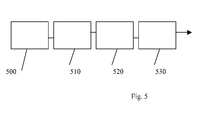
- Fig. 5 shows an apparatus according to an embodiment of the invention.
- the apparatus may be in the form of and comprise, for example, a first probability map processor, a second probability map processor, which carry out the first and second processing steps.
- the method of an embodiment of the invention first calculates the skin probability of each pixel in the image, to create a skin probability map p(x,y).
- the image consists of a MxN array of pixels, each pixel having pixel values f(x,y), and the corresponding skin probability map is a corresponding MxN array of probability values p(x,y), where p(x,y) represents the skin probability value for the respective pixel in the array, determined according to the detection method.
- f(x,y) is a colour image and skin pixels are detected based on their colour.
- non-skin regions will sometimes have colours which are typical of skin and, consequently, high values in the probability map.
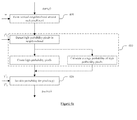
- step 100 shows the initial colour-based skin pixel detection
- step 110 shows the unconstrained region analysis in the horizontal direction
- step 120 shows the post-processing in the vertical direction.
- the preferred colour-based skin pixel detection method employed in step 100 is described in patent US 7,444,022 "METHOD AND APPARATUS FOR SEPARATING CONTENT TYPES IN IMAGES", incorporated herein by reference.
- step 110 processes each horizontal line y individually. This is illustrated in Figure 2 .
- T 1 H can take a relatively low value, lower than would normally be used to threshold the whole probability map p(x,y). This will allow skin pixels with low probability values, e.g. when shadows or highlights are present, to be included in the initial horizontal skin regions.
- a region grouping and/or elimination step may follow (step 210).
- T 2 H some threshold
- T 3 H some threshold
- mean, maximum, minimum or other skin probability statistics of the non-skin and skin regions may be used in an analogous fashion to decide whether regions should be merged or not. This step essentially fills in small holes in skin regions and removes small isolated skin regions.
- the region grouping and/or elimination step may be biased towards either grouping or elimination. This results in an updated initial horizontal skin region list for each line i.
- a horizontal skin region verification step (step 220).
- T 5 H some threshold
- an entire (longer) initial horizontal skin region is verified if a sufficient (smaller) number of its pixels have a high enough skin probability value, which is indicative of a true skin region.
- other statistics of the high-probability skin pixels may be used.
- the verification of the initial horizontal skin region J ri is based not only on the number of high-probability skin pixels relative to the length of J ri , but also on the number of sub-regions within J ri , and/or the topology that these high-probability pixels form. For example, if the high-probability pixels within J ri are fragmented to a large number of sub-regions, rather than one or two long sub-regions, this may be indicative of noise rather than a coherent skin region. Yet another embodiment of the invention may employ the standard deviation of the values of the high-probability pixels within J ri . High-confidence skin regions are usually uniform in terms of their probability values, and a high standard deviation may be indicative of a non-skin region.
- the optional region grouping and/or elimination step may also be employed at this stage instead of, or in addition to, after the detection of the initial horizontal skin regions (step 230).
- p H (x,y) is a binary map, i.e. all pixels which were deemed to belong to horizontal skin region take a value of 1, and all other pixels take a value of 0.
- the value of pixel in p H (x,y) may be determined as the mean, maximum, minimum or other function of the skin probability values p(x,y) for the horizontal region in which it belongs.
- the mean, maximum, minimum or other function may be calculated not from all the pixels in the region, but only from the high-probability pixels.
- a vertical line post-processing step is applied, to give the new probability map p HV (x,y), as shown in step 120 of Figure 1 . This can proceed in an analogous fashion to the horizontal lines.
- p H (x,y) is a multi-valued probability map
- it can be processed in the same fashion as p(x,y), but looking at vertical rather than horizontal lines, as illustrated in Figure 3a .
- p H (x,y) we start by processing each vertical line x individually.
- T 1 V which may be the same as T 1 H .
- a region grouping and/or elimination step may follow (step 310), proceeding in the same fashion as earlier, using thresholds T 2 V and/or T 3 V which may be the same as T 2 H and/or T 3 H .Following the detection of the initial vertical skin regions, we perform a vertical skin region verification step (step 320), using thresholds T 4 V and T 5 V , which may be the same as T 4 H and T 5 H .
- the optional region grouping and/or elimination step may also be employed at this stage instead of, or in addition to, after the detection of the initial vertical skin regions (step 330).
- p H (x,y) is a binary probability map
- the vertical line post-processing step may take the form of just the region grouping and/or elimination step, illustrated in Figure 3b , to fill in small holes in skin regions and remove small isolated skin regions.
- p HV (x,y) is a binary map, i.e. all pixels which were deemed to belong to a skin region take a value of 1, and all other pixels take a value of 0. Note that this is not restrictive, and p HV (x,y) may be calculated as a multi-valued probability map, as described earlier for p H (x,y).
- p H (x,y) is a binary probability map
- p HV (x,y) is a binary map, i.e.
- p HV (x,y) may be calculated as a multi-valued probability map, e.g. based on some function of the skin probabilities in the neighbourhood W.
- This type of neighbourhood-based vertical line post-processing is preferable to region analysis in the vertical direction because it lends itself to a simpler implementation, where it is possible to store and process as little as W lines of p H (x,y) at any one time.
- the simplest option is to carry the skin probabilities from p H (x,y) to p HV (x,y) for those lines.
- This type of neighbourhood-based vertical line post-processing to work well in practice, regardless of the image resolution. This is because, after the horizontal line region processing, the obtained skin regions viewed in 2D are actually very well defined, with only isolated line artefacts which can be resolved within a small vertical neighbourhood.
- An alternative embodiment of the invention may perform region analysis in the vertical direction, giving probability map p V (x,y), followed by post-processing in the horizontal direction, giving probability map p VH (x,y).
- Another embodiment of the invention may carry out both types of processing, giving probability maps p HV (x,y) and p VH (x,y), and then fuse those maps, e.g. by logical AND or OR if binary, or by averaging if multi-valued, to give a final probability map p F (x,y).
- the preferred embodiment of the invention performs processing along the horizontal and vertical directions in an image.
- Alternative embodiments may perform processing along different directions, e.g. horizontal and a diagonal, or one diagonal and another diagonal. This can be achieved by simply redefining the lines along which we process pixels but, once the lines are defined, their processing is the same as above.
- An even simpler alternative to achieve processing along any desired diagonal is to rotate the image accordingly, and process along horizontal or vertical lines in the rotated image.
- other image processing operations may also be used, e.g. skewing or log-polar transform, before the processing along the different directions. In each case, the processing along lines will be the same as above - what changes is which pixels of the original image each line contains.
- alternative embodiments of the invention may directly specify processing in the original image along lines which are not straight, i.e.. curves.
- the preferred embodiment of the invention addresses the problem of accurate identification of a specific content type in images, and in particular skin.
- the invention is also applicable to the accurate identification of other content types characterised by a given colour or texture or other attribute which can lead to the generation of a probability map for processing according to the invention.
- content types can be characterised by image attributes, such as colour, texture etc, including, for example, grass, foliage, buildings.
- image attributes such as colour, texture etc, including, for example, grass, foliage, buildings.
- the texture strength at a pixel location may be calculated by considering a small neighbourhood, e.g.
- the texture strength at any given pixel location may be calculated as the difference between the original intensity image and its filtered version using a median filter.
- pixels corresponding to different content types may be characterised by a different texture strength, just like pixels corresponding to different content types may be characterised by a different colour, and can both lead to the generation of a probability map for processing according to the invention.
- Fig. 5 shows an apparatus according to an embodiment of the invention.
- the apparatus includes an image source 500, which outputs an image in the form of signals, to a probability map generator 510, which generates a first probability map p(x,y), as described above.
- the image source may be, for example, storage means storing images, including DVDs or similar, or a source such as a camera or scanner, or source of other image signals, such as television.
- the first probability map is output to a first probability map processor 520, which carries out the horizontal line processing, as described above, to produce a second probability map p H (x,y).
- the second probability map is output to a second probability map processor 530, which carries out the vertical line processing, as described above, to produce a third probability map p HV (x,y).
- the third probability map is output from the second probability map processor, for further handling, for example, further processing in another processor, or storage in a storage device or storage means.
- An apparatus can be implemented in other ways, for example, in the form of a suitably-programmed computer system.
- Components of the system as described may be provided in software or hardware form, for example using a dedicated chip.
Landscapes
- Engineering & Computer Science (AREA)
- Physics & Mathematics (AREA)
- General Physics & Mathematics (AREA)
- Theoretical Computer Science (AREA)
- Human Computer Interaction (AREA)
- Multimedia (AREA)
- Computer Vision & Pattern Recognition (AREA)
- Image Analysis (AREA)
Priority Applications (1)
| Application Number | Priority Date | Filing Date | Title |
|---|---|---|---|
| EP10164867A EP2393039A1 (de) | 2010-06-03 | 2010-06-03 | Verfahren zur genauen Erkennung von Bildinhalt |
Applications Claiming Priority (1)
| Application Number | Priority Date | Filing Date | Title |
|---|---|---|---|
| EP10164867A EP2393039A1 (de) | 2010-06-03 | 2010-06-03 | Verfahren zur genauen Erkennung von Bildinhalt |
Publications (1)
| Publication Number | Publication Date |
|---|---|
| EP2393039A1 true EP2393039A1 (de) | 2011-12-07 |
Family
ID=43587123
Family Applications (1)
| Application Number | Title | Priority Date | Filing Date |
|---|---|---|---|
| EP10164867A Withdrawn EP2393039A1 (de) | 2010-06-03 | 2010-06-03 | Verfahren zur genauen Erkennung von Bildinhalt |
Country Status (1)
| Country | Link |
|---|---|
| EP (1) | EP2393039A1 (de) |
Cited By (1)
| Publication number | Priority date | Publication date | Assignee | Title |
|---|---|---|---|---|
| CN107424115A (zh) * | 2017-05-31 | 2017-12-01 | 成都品果科技有限公司 | 一种基于人脸关键点的肤色修正算法 |
Citations (4)
| Publication number | Priority date | Publication date | Assignee | Title |
|---|---|---|---|---|
| US1334669A (en) * | 1919-11-24 | 1920-03-23 | William F Moon | Yarn-speck remover |
| EP0836326A2 (de) | 1996-10-08 | 1998-04-15 | Lucent Technologies Inc. | Hautflächedetektion für Videosysteme |
| US6332033B1 (en) * | 1998-01-08 | 2001-12-18 | Sharp Laboratories Of America, Inc. | System for detecting skin-tone regions within an image |
| US7444022B2 (en) | 2003-12-09 | 2008-10-28 | Mitsubishi Denki Kabushiki Kaisha | Method and apparatus for separating content types in images |
-
2010
- 2010-06-03 EP EP10164867A patent/EP2393039A1/de not_active Withdrawn
Patent Citations (4)
| Publication number | Priority date | Publication date | Assignee | Title |
|---|---|---|---|---|
| US1334669A (en) * | 1919-11-24 | 1920-03-23 | William F Moon | Yarn-speck remover |
| EP0836326A2 (de) | 1996-10-08 | 1998-04-15 | Lucent Technologies Inc. | Hautflächedetektion für Videosysteme |
| US6332033B1 (en) * | 1998-01-08 | 2001-12-18 | Sharp Laboratories Of America, Inc. | System for detecting skin-tone regions within an image |
| US7444022B2 (en) | 2003-12-09 | 2008-10-28 | Mitsubishi Denki Kabushiki Kaisha | Method and apparatus for separating content types in images |
Non-Patent Citations (7)
| Title |
|---|
| B. MOHABBATI, M.E. SHIRI AND S. KASAEI: "An efficient wavelet/neural network based face detection algorithm", THE 1ST INTERNATIONAL CONFERENCE ON MODELING, SIMULATION& APPLIED OPTIMIZATION, ICMSAO, February 2005 (2005-02-01), XP002623967 * |
| BAUMES L. ET AL.: "scale-space face detection in unconstrained images", IP2001: ERASMUS INTENSIVE COMPUTER VISION PROGRAM, PAVIA, 7 May 2001 (2001-05-07) - 18 May 2001 (2001-05-18), XP002623968 * |
| FLECK, M.; FORSYTH, D.; BREGLER, C.: "Finding naked people", PROCEEDINGS OF EUROPEAN CONFERENCE ON COMPUTER VISION ECCV'96, vol. 2, 1996, pages 593 - 602 |
| GARCIA-MATEOS G., RUIZ A. AND LOPEZ-DE-TERUEL P.E.: "Face detection using integral projection models", SSPR & SPI 2002, LNCS 2396, T. CAELLI ET AL. EDS, 2002, pages 644 - 653, XP002623966 * |
| JONES, M.J.; REHG, J.M.: "Statistical Color Models with Application to Skin Detection", PROCEEDINGS OF IEEE INTERNATIONAL CONFERENCE ON COMPUTER VISION AND PATTERN RECOGNITION CVPR'99, June 1999 (1999-06-01), pages 274 - 280 |
| MING-HSUAN YANG ET AL: "DETECTING FACES IN IMAGES: A SURVEY", IEEE TRANSACTIONS ON PATTERN ANALYSIS AND MACHINE INTELLIGENCE, IEEE SERVICE CENTER, LOS ALAMITOS, CA, US, vol. 1, no. 24, 1 January 2002 (2002-01-01), pages 34 - 58, XP001140784, ISSN: 0162-8828, DOI: 10.1109/34.982883 * |
| ZAFARIFAR, B.; MARTINIERE, A.; WITH, H.N.: "Improved Skin Segmentation for TV Image Enhancement, Using Color and Texture Features", PROCEEDINGS OF INTERNATIONAL CONFERENCE ON CONSUMER ELECTRONICS ICCE 2010, 2010, pages 373 - 374 |
Cited By (1)
| Publication number | Priority date | Publication date | Assignee | Title |
|---|---|---|---|---|
| CN107424115A (zh) * | 2017-05-31 | 2017-12-01 | 成都品果科技有限公司 | 一种基于人脸关键点的肤色修正算法 |
Similar Documents
| Publication | Publication Date | Title |
|---|---|---|
| CN110678901B (zh) | 信息处理设备、信息处理方法和计算机可读存储介质 | |
| US7742650B2 (en) | Object detection in images | |
| US9230175B2 (en) | System and method for motion detection in a surveillance video | |
| CN111985427B (zh) | 活体检测方法、设备及可读存储介质 | |
| CN108489996B (zh) | 一种绝缘子的缺陷检测方法、系统及终端设备 | |
| JPH07302328A (ja) | 背景差分による動物体領域抽出方法 | |
| KR100601453B1 (ko) | 지문 인식 방법 | |
| EP3073443B1 (de) | 3d-salienzkarte | |
| CN113516609B (zh) | 分屏视频检测方法、装置、计算机设备和存储介质 | |
| KR20130072073A (ko) | 영상 윤곽선 추출 장치 및 방법 | |
| KR20200010658A (ko) | 동일인 인식 방법, 이를 이용하는 컴퓨팅 시스템, 및 프로그램 | |
| CN106446832B (zh) | 一种基于视频的实时检测行人的方法 | |
| Ye et al. | Moving object detection with background subtraction and shadow removal | |
| CN103839035A (zh) | 人数统计方法和人数统计系统 | |
| Miron et al. | Cross-comparison census for colour stereo matching applied to intelligent vehicle | |
| EP2393039A1 (de) | Verfahren zur genauen Erkennung von Bildinhalt | |
| Lin et al. | Face detection based on skin color segmentation and SVM classification | |
| CN110232709B (zh) | 一种变阈值分割的线结构光光条中心提取方法 | |
| CN116543249A (zh) | 模型训练方法、质量评估方法、装置以及电子设备 | |
| Gorovyi et al. | Robust number plate detector based on stroke width transform and neural network | |
| CN111027560B (zh) | 文本检测方法以及相关装置 | |
| Fang et al. | 1-D barcode localization in complex background | |
| KR20220067818A (ko) | 비접촉식 rgb 카메라를 이용한 피부 진단 시스템 및 그 방법 | |
| Vargas et al. | A license plate extraction algorithm based on edge statistics and region growing | |
| JPH08279021A (ja) | 回転角度検出方法および画像認識方法 |
Legal Events
| Date | Code | Title | Description |
|---|---|---|---|
| AK | Designated contracting states |
Kind code of ref document: A1 Designated state(s): AL AT BE BG CH CY CZ DE DK EE ES FI FR GB GR HR HU IE IS IT LI LT LU LV MC MK MT NL NO PL PT RO SE SI SK SM TR |
|
| AX | Request for extension of the european patent |
Extension state: BA ME RS |
|
| PUAI | Public reference made under article 153(3) epc to a published international application that has entered the european phase |
Free format text: ORIGINAL CODE: 0009012 |
|
| STAA | Information on the status of an ep patent application or granted ep patent |
Free format text: STATUS: THE APPLICATION IS DEEMED TO BE WITHDRAWN |
|
| 18D | Application deemed to be withdrawn |
Effective date: 20120609 |