EP2393080A1 - Circuit de stockage de charge pour un pixel et affichage - Google Patents
Circuit de stockage de charge pour un pixel et affichage Download PDFInfo
- Publication number
- EP2393080A1 EP2393080A1 EP11168815A EP11168815A EP2393080A1 EP 2393080 A1 EP2393080 A1 EP 2393080A1 EP 11168815 A EP11168815 A EP 11168815A EP 11168815 A EP11168815 A EP 11168815A EP 2393080 A1 EP2393080 A1 EP 2393080A1
- Authority
- EP
- European Patent Office
- Prior art keywords
- transistor
- voltage
- circuit
- charge storage
- gate
- Prior art date
- Legal status (The legal status is an assumption and is not a legal conclusion. Google has not performed a legal analysis and makes no representation as to the accuracy of the status listed.)
- Granted
Links
- 230000003362 replicative effect Effects 0.000 claims abstract description 6
- 239000011159 matrix material Substances 0.000 claims description 23
- 239000003990 capacitor Substances 0.000 claims description 21
- 239000004973 liquid crystal related substance Substances 0.000 claims description 8
- 230000009977 dual effect Effects 0.000 claims description 6
- 230000001419 dependent effect Effects 0.000 claims 2
- 238000002955 isolation Methods 0.000 abstract description 10
- 230000006870 function Effects 0.000 description 9
- 238000000034 method Methods 0.000 description 8
- 230000009467 reduction Effects 0.000 description 8
- 230000008901 benefit Effects 0.000 description 6
- 230000015556 catabolic process Effects 0.000 description 5
- 238000006731 degradation reaction Methods 0.000 description 5
- 230000008859 change Effects 0.000 description 4
- 230000000295 complement effect Effects 0.000 description 4
- 230000008878 coupling Effects 0.000 description 3
- 238000010168 coupling process Methods 0.000 description 3
- 238000005859 coupling reaction Methods 0.000 description 3
- 230000007423 decrease Effects 0.000 description 3
- 230000005684 electric field Effects 0.000 description 3
- 230000004048 modification Effects 0.000 description 3
- 238000012986 modification Methods 0.000 description 3
- 230000003287 optical effect Effects 0.000 description 3
- 238000004519 manufacturing process Methods 0.000 description 2
- 230000008569 process Effects 0.000 description 2
- 230000006399 behavior Effects 0.000 description 1
- 230000005540 biological transmission Effects 0.000 description 1
- 230000006866 deterioration Effects 0.000 description 1
- 230000000694 effects Effects 0.000 description 1
- 238000005516 engineering process Methods 0.000 description 1
- 235000019557 luminance Nutrition 0.000 description 1
- 230000015654 memory Effects 0.000 description 1
- 238000009736 wetting Methods 0.000 description 1
Images



Classifications
-
- G—PHYSICS
- G09—EDUCATION; CRYPTOGRAPHY; DISPLAY; ADVERTISING; SEALS
- G09G—ARRANGEMENTS OR CIRCUITS FOR CONTROL OF INDICATING DEVICES USING STATIC MEANS TO PRESENT VARIABLE INFORMATION
- G09G3/00—Control arrangements or circuits, of interest only in connection with visual indicators other than cathode-ray tubes
- G09G3/20—Control arrangements or circuits, of interest only in connection with visual indicators other than cathode-ray tubes for presentation of an assembly of a number of characters, e.g. a page, by composing the assembly by combination of individual elements arranged in a matrix no fixed position being assigned to or needed to be assigned to the individual characters or partial characters
- G09G3/34—Control arrangements or circuits, of interest only in connection with visual indicators other than cathode-ray tubes for presentation of an assembly of a number of characters, e.g. a page, by composing the assembly by combination of individual elements arranged in a matrix no fixed position being assigned to or needed to be assigned to the individual characters or partial characters by control of light from an independent source
- G09G3/36—Control arrangements or circuits, of interest only in connection with visual indicators other than cathode-ray tubes for presentation of an assembly of a number of characters, e.g. a page, by composing the assembly by combination of individual elements arranged in a matrix no fixed position being assigned to or needed to be assigned to the individual characters or partial characters by control of light from an independent source using liquid crystals
- G09G3/3611—Control of matrices with row and column drivers
- G09G3/3648—Control of matrices with row and column drivers using an active matrix
-
- G—PHYSICS
- G02—OPTICS
- G02F—OPTICAL DEVICES OR ARRANGEMENTS FOR THE CONTROL OF LIGHT BY MODIFICATION OF THE OPTICAL PROPERTIES OF THE MEDIA OF THE ELEMENTS INVOLVED THEREIN; NON-LINEAR OPTICS; FREQUENCY-CHANGING OF LIGHT; OPTICAL LOGIC ELEMENTS; OPTICAL ANALOGUE/DIGITAL CONVERTERS
- G02F1/00—Devices or arrangements for the control of the intensity, colour, phase, polarisation or direction of light arriving from an independent light source, e.g. switching, gating or modulating; Non-linear optics
- G02F1/01—Devices or arrangements for the control of the intensity, colour, phase, polarisation or direction of light arriving from an independent light source, e.g. switching, gating or modulating; Non-linear optics for the control of the intensity, phase, polarisation or colour
- G02F1/13—Devices or arrangements for the control of the intensity, colour, phase, polarisation or direction of light arriving from an independent light source, e.g. switching, gating or modulating; Non-linear optics for the control of the intensity, phase, polarisation or colour based on liquid crystals, e.g. single liquid crystal display cells
- G02F1/133—Constructional arrangements; Operation of liquid crystal cells; Circuit arrangements
- G02F1/136—Liquid crystal cells structurally associated with a semi-conducting layer or substrate, e.g. cells forming part of an integrated circuit
- G02F1/1362—Active matrix addressed cells
- G02F1/136213—Storage capacitors associated with the pixel electrode
-
- G—PHYSICS
- G09—EDUCATION; CRYPTOGRAPHY; DISPLAY; ADVERTISING; SEALS
- G09G—ARRANGEMENTS OR CIRCUITS FOR CONTROL OF INDICATING DEVICES USING STATIC MEANS TO PRESENT VARIABLE INFORMATION
- G09G3/00—Control arrangements or circuits, of interest only in connection with visual indicators other than cathode-ray tubes
- G09G3/20—Control arrangements or circuits, of interest only in connection with visual indicators other than cathode-ray tubes for presentation of an assembly of a number of characters, e.g. a page, by composing the assembly by combination of individual elements arranged in a matrix no fixed position being assigned to or needed to be assigned to the individual characters or partial characters
- G09G3/22—Control arrangements or circuits, of interest only in connection with visual indicators other than cathode-ray tubes for presentation of an assembly of a number of characters, e.g. a page, by composing the assembly by combination of individual elements arranged in a matrix no fixed position being assigned to or needed to be assigned to the individual characters or partial characters using controlled light sources
- G09G3/30—Control arrangements or circuits, of interest only in connection with visual indicators other than cathode-ray tubes for presentation of an assembly of a number of characters, e.g. a page, by composing the assembly by combination of individual elements arranged in a matrix no fixed position being assigned to or needed to be assigned to the individual characters or partial characters using controlled light sources using electroluminescent panels
- G09G3/32—Control arrangements or circuits, of interest only in connection with visual indicators other than cathode-ray tubes for presentation of an assembly of a number of characters, e.g. a page, by composing the assembly by combination of individual elements arranged in a matrix no fixed position being assigned to or needed to be assigned to the individual characters or partial characters using controlled light sources using electroluminescent panels semiconductive, e.g. using light-emitting diodes [LED]
- G09G3/3208—Control arrangements or circuits, of interest only in connection with visual indicators other than cathode-ray tubes for presentation of an assembly of a number of characters, e.g. a page, by composing the assembly by combination of individual elements arranged in a matrix no fixed position being assigned to or needed to be assigned to the individual characters or partial characters using controlled light sources using electroluminescent panels semiconductive, e.g. using light-emitting diodes [LED] organic, e.g. using organic light-emitting diodes [OLED]
- G09G3/3225—Control arrangements or circuits, of interest only in connection with visual indicators other than cathode-ray tubes for presentation of an assembly of a number of characters, e.g. a page, by composing the assembly by combination of individual elements arranged in a matrix no fixed position being assigned to or needed to be assigned to the individual characters or partial characters using controlled light sources using electroluminescent panels semiconductive, e.g. using light-emitting diodes [LED] organic, e.g. using organic light-emitting diodes [OLED] using an active matrix
-
- G—PHYSICS
- G09—EDUCATION; CRYPTOGRAPHY; DISPLAY; ADVERTISING; SEALS
- G09G—ARRANGEMENTS OR CIRCUITS FOR CONTROL OF INDICATING DEVICES USING STATIC MEANS TO PRESENT VARIABLE INFORMATION
- G09G2300/00—Aspects of the constitution of display devices
- G09G2300/04—Structural and physical details of display devices
- G09G2300/0439—Pixel structures
- G09G2300/0465—Improved aperture ratio, e.g. by size reduction of the pixel circuit, e.g. for improving the pixel density or the maximum displayable luminance or brightness
-
- G—PHYSICS
- G09—EDUCATION; CRYPTOGRAPHY; DISPLAY; ADVERTISING; SEALS
- G09G—ARRANGEMENTS OR CIRCUITS FOR CONTROL OF INDICATING DEVICES USING STATIC MEANS TO PRESENT VARIABLE INFORMATION
- G09G2300/00—Aspects of the constitution of display devices
- G09G2300/08—Active matrix structure, i.e. with use of active elements, inclusive of non-linear two terminal elements, in the pixels together with light emitting or modulating elements
- G09G2300/0809—Several active elements per pixel in active matrix panels
- G09G2300/0814—Several active elements per pixel in active matrix panels used for selection purposes, e.g. logical AND for partial update
-
- G—PHYSICS
- G09—EDUCATION; CRYPTOGRAPHY; DISPLAY; ADVERTISING; SEALS
- G09G—ARRANGEMENTS OR CIRCUITS FOR CONTROL OF INDICATING DEVICES USING STATIC MEANS TO PRESENT VARIABLE INFORMATION
- G09G2300/00—Aspects of the constitution of display devices
- G09G2300/08—Active matrix structure, i.e. with use of active elements, inclusive of non-linear two terminal elements, in the pixels together with light emitting or modulating elements
- G09G2300/0809—Several active elements per pixel in active matrix panels
- G09G2300/0833—Several active elements per pixel in active matrix panels forming a linear amplifier or follower
-
- G—PHYSICS
- G09—EDUCATION; CRYPTOGRAPHY; DISPLAY; ADVERTISING; SEALS
- G09G—ARRANGEMENTS OR CIRCUITS FOR CONTROL OF INDICATING DEVICES USING STATIC MEANS TO PRESENT VARIABLE INFORMATION
- G09G3/00—Control arrangements or circuits, of interest only in connection with visual indicators other than cathode-ray tubes
- G09G3/20—Control arrangements or circuits, of interest only in connection with visual indicators other than cathode-ray tubes for presentation of an assembly of a number of characters, e.g. a page, by composing the assembly by combination of individual elements arranged in a matrix no fixed position being assigned to or needed to be assigned to the individual characters or partial characters
- G09G3/34—Control arrangements or circuits, of interest only in connection with visual indicators other than cathode-ray tubes for presentation of an assembly of a number of characters, e.g. a page, by composing the assembly by combination of individual elements arranged in a matrix no fixed position being assigned to or needed to be assigned to the individual characters or partial characters by control of light from an independent source
- G09G3/36—Control arrangements or circuits, of interest only in connection with visual indicators other than cathode-ray tubes for presentation of an assembly of a number of characters, e.g. a page, by composing the assembly by combination of individual elements arranged in a matrix no fixed position being assigned to or needed to be assigned to the individual characters or partial characters by control of light from an independent source using liquid crystals
- G09G3/3611—Control of matrices with row and column drivers
- G09G3/3648—Control of matrices with row and column drivers using an active matrix
- G09G3/3659—Control of matrices with row and column drivers using an active matrix the addressing of the pixel involving the control of two or more scan electrodes or two or more data electrodes, e.g. pixel voltage dependant on signal of two data electrodes
Definitions
- the invention is a low leakage charge storage circuit, suitable for use in, for example, an active matrix display, a DRAM etc. It also relates to a display incorporating one or more charge storage circuits of the invention.
- FIG 1 shows a typical active matrix display.
- Such a display is made up of a matrix 2 of picture elements (pixels), arranged in M rows and N columns. Each pixel row [column] is connected to a respective row [column] electrode, with the column electrodes being connected to the N outputs of a data driver 4 and the row electrodes being connected to the M outputs of a scan driver 6.
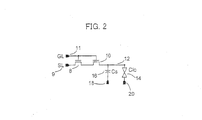
- the circuit of a typical pixel in a liquid crystal display (LCD) is shown in figure 2 .
- the pixel comprises a display element 14 which is connected in parallel to a storage capacitor 16 via a common node 12 (also referred to below as a "charge storage node” or “storage node”).
- the other terminal of the storage capacitor 16 is connected to a common electrode 18, which may in use act as a capacitor bias line.
- the display element may comprise a pixel electrode which is electrically connected to the charge storage node 12 (and in this case the pixel electrode may constitute the charge storage node 12), and the other terminal of the display element 14 is connected to a counter plate electrode 20.
- the charge storage node 12 is also connected to the drain of a transistor 10.
- the source of transistor 10 is connected to the drain of a transistor 8.
- the source of transistor 8 is connected to a common source line 9 which is driven by one of the outputs from the data driver 4.
- the gates of 2 series connected transistor 8, 10 are connected together to a gate line 11 which is common to all the pixels of the row and which is connected to a respective output of the scan driver 6.
- rows of pixel display data are supplied by the data driver 4 to the source electrodes 9 in synchronism with scan pulses which are supplied by the scan driver 6 to the gate lines 11 in a cyclically repeating sequence.
- scan pulses which are supplied by the scan driver 6 to the gate lines 11 in a cyclically repeating sequence.
- the row of pixels are refreshed one at a time until all of the rows have been refreshed so as to complete the refreshing of a frame of display data. The process is then repeated for the next frame of data.
- each pixel When the gate line 11 of each pixel receives a scan pulse from the scan driver 6, the voltage on the source electrode 9 causes the storage capacitor 16, and the pixel electrode of the display element, to be charged.
- the transistors 8, 10 isolate the pixel electrode and the storage capacitor from the source electrode 9 so that the optical property of the associated display element 14 corresponds to the stored voltage across the display element 14 until it is refreshed during the next frame.
- the voltage across the display element 14 is not necessarily equal to the voltage across the storage capacitor 16, since the counter plate electrode 20 of the display element 14 and the second plate 18 of the storage capacitor 16 may be at different potentials to one another.
- Capacitively coupled driving in which the signal data voltage is supplied to the pixel electrode from the source electrode 9, via transistors 8, 10, during the period the gate line 11 of each pixel receives a scan pulse from the scan driver 6, in order to charge the pixel electrode and storage capacitor 16 to the voltage of the data signal, and then after the scan pulse is removed, an offset is imposed to the data voltage on the pixel electrode via capacitive coupling to the pixel electrode of a second voltage applied to the second plate 18 of the storage capacitor 16, is described in EP0336570A1 (11 October 1989 ) and US patent 5296847 (22 March 1994 , Matsushita) and in Tsunashima et al, SID Digest '07, pp 1014 -1017 .
- the isolation transistors 8, 10 are not perfect. They exhibit a finite leakage drain current as illustrated in Figure 3 which shows the typical transfer characteristic of an NMOS transistor.
- the leakage current in the transistor is a function of the drain to source (Vds) and gate to source (Vgs) potentials.
- the pixel electrode voltage degradation due to leakage current requires the display data to be rewritten to minimise image deterioration during the hold time.
- a frame refresh rate of 60Hz is typical. This constant refreshing of the display results in significant power consumption.
- One approach to reducing this power consumption is to reduce the frame refresh rate. Frame rate reduction is only possible if the degradation of the pixel electrode voltage is reduced.
- the pixel electrode voltage degradation can be reduced by either increasing the size of the storage capacitor 16 or reducing the leakage current. A larger storage capacitor 16 is not desirable since it would result in increased pixel area and also increased pixel electrode charging time during scanning of each row.
- the preferred approach to reducing the frame refresh rate is to reduce the leakage current.
- One known technique for reducing the electric field induced leakage current is to replace the 2 series transistors 8 and 10 with 3 or more transistors in series. This is in order to further reduce the drain voltage for each transistor. It may be noted however that the common gate voltage means that the leakage current does not scale with the number of series transistors.
- Another known technique, shown in Figure 4 is to use an additional hold capacitor 15 at the junction of the series connected transistors 8, 10. This technique does not provide sufficient reduction in leakage current to enable reduction of frame refresh rate.
- Figure 5(a) illustrates another technique to increase the hold time over several frames as disclosed in Japanese laid-open patent application No. 5-142573 (11 June 1993 ).
- This technique involves "boot strapping”: a unity gain voltage gain amplifier 22 has its input connected to the charge storage node 12 and the pixel electrode and its output connected to the junction between transistors 8 and 10.
- the circuit of Figure 5(a) is provided with a feedback function through the unity gain voltage amplifier 22, so that the pixel electrode voltage appears at the junction of the series connected transistors 8 and 10. If the buffer amplifier 22 were ideal and drew no charge from the pixel electrode, leakage from the pixel electrode would be eliminated since the drain to source voltage of transistor 10 would be reduced to zero volts.
- buffer amplifier 22 circuits disclosed shown in Figure 5(b) include a CMOS source follower circuit 24 that combines an NMOS transistor and a PMOS transistor, a CMOS 2 stage source follower circuit 26 and voltage follower circuit that uses an operational amplifier 28. All of the proposed implementations of the buffer amplifier 22 result in at least 2 additional transistors and 2 power supply lines which results in an increase in the pixel circuit area. The additional transistors will reduce the yield during the fabrication of the display. Further, the increased active pixel area limits the minimum achievable pixel size and therefore limits the maximum resolution of the display. If a display is of a transmissive or transflective type, the increased active area of the pixel results in reduced light transmission from the backlight through the pixels which reduces the brightness of the display.
- US patents 6064362 (16 May 2000 ) and 7573451 (11 August 2009 ) disclose a pixel circuit with a feedback buffer amplifier which as in the Japanese laid-open patent application No. 5-142573 aims to reduce the leakage from the storage node.
- the buffer amplifier in both disclosures consists of at least 2 additional transistors.
- Figure 3 illustrates typical n-channel transistor input characteristics.
- the drain current initially increases exponentially - and then flattens out (meaning that the rate of increase of the drain current with gate voltage becomes lower for higher gate voltages).
- This exponentially increasing characteristic is the subthreshold region of the transistor operation.
- the figure also shows the dependence of the drain current on the drain potential. In the subthreshold region, the gate voltage has a significantly greater influence upon the drain current compared with the drain voltage. For example, 0.25V change in gate voltage results in 40 times change in the drain current whereas an 8V change in the drain voltage is necessary to achieve the same drain current change.
- a first aspect of the invention provides a charge storage circuit for a pixel, the circuit comprising: a charge storage node; first and second transistors for selectively isolating the charge storage node from a first voltage input for supplying a data voltage, the first and second transistors being series-connected; and a voltage follower circuit for replicating a voltage at the charge storage node (12) at another node in the circuit such that the drain-source voltage across the second transistor is reduced; wherein the voltage follower circuit comprises the first transistor.
- the present invention employs a voltage follower to reduce the leakage current through the first and second transistors, which are isolation transistors for isolating, in a voltage holding mode, the charge storage node from the voltage input.
- the voltage follower replicates, as closely as possible, the voltage at the charge storage node at another node in the circuit so that the drain-source voltage across the second transistor is reduced.
- the drain-source voltage across the second transistor preferably reduced to zero or almost to zero (and is reduced to zero if the voltage follower circuit exactly replicate the voltage at the charge storage node (12) at the other node).
- this reduction in the drain-source voltage across the second transistor leads to a reduction in the leakage current through the second transistor (and in principle the leakage current through the second transistor may be reduced to zero if the drain-source voltage across the second transistor is reduced to zero).
- one of the isolation transistors is used as part of the voltage follower, thereby reducing the number of additional components that must be provided for the voltage follower and also reducing the area occupied by the voltage follower. The invention thus reduces the leakage current, and hence reduces the required frame refresh rate, for little or no increase in the area of the pixel.
- FIG. 6 A first embodiment is shown in Figure 6 . This consists of a pixel circuit for an active matrix display.
- the circuit contains the following elements:
- a load element Clc 14 representing the impedance of the optical element between the charge storage node 12 and the counter plate node 20 in the case of a liquid crystal display.
- the counter plate node 20 may be common to all pixels of the display and so form a common electrode.
- the circuit is connected as follows:
- the voltage writing mode is the same as that of a standard active matrix display described in the prior art, for example is the same as described above with reference to the circuit of figure 2 . That is, when the gate line 11 of each pixel receives a scan pulse from the scan driver 6, the transistors 8, 10 are turned ON and electrically connect the source electrode 9 to the charge storage node (pixel electrode) 12 so that the voltage on the source electrode 9 causes the pixel electrode of the display element and the storage capacitor 16 to be charged. When the scan pulse is removed, the first and second transistors 8, 10 are turned OFF and isolate the pixel electrode and charge storage node 12 from the source electrode 9 so that the optical property of the associated display element 14 corresponds to the voltage across the display element 14 until it is refreshed during the next frame. Thus, the first and second transistors 8, 10 selectively isolate the charge storage node 12 from a voltage input (ie, from the source electrode 9).
- an offset may be imposed to the data voltage on the pixel electrode via capacitive coupling to the pixel electrode of a second voltage applied to the second plate 18 of the storage capacitor 16.
- the voltage holding mode is, in this embodiment, enabled once all rows of the pixel matrix have been written.
- the source line 9 is programmed by the scan driver 6 at a voltage which biases the first transistor 8 in the subthreshold region.
- This voltage is preferably set to be the same as the low level of the gate line 11 voltage, resulting in the first transistor biased with zero volts gate-source voltage (Vgs).
- the power supply line 32 is, in use, maintained at a voltage level higher than the highest data voltage during the hold mode (and also during the write function as well). With these bias conditions the third transistor 30 and first transistor 8 forms a voltage follower with the input being the data voltage written on to the storage node 12 and the output connected to the source of the second transistor 8.
- the Vgs of the first transistor 8 may be set to a non-zero value to allow optimisation of the bias current and therefore the power consumption. (The amount by which the voltage Vgs may vary from zero will depend on the transistor process conditions, but typically may vary from zero by up to a few hundred millivolts.)
- the voltage follower replicates, as closely as possible, the voltage at the charge storage node at another node in the circuit so that the drain-source voltage across the second transistor 10 is reduced, and preferably is reduced to zero or almost to zero.
- the voltage follower may for example replicate the voltage at the charge storage node at a node between the first transistor 8 and the second transistor 10. As a result the leakage current through the second transistor 10 is reduced (and would be reduced to zero if the drain-source voltage across the second transistor 10 is reduced to zero).
- the voltage follower operates as follows:
- the write function is repeated when the storage node data requires updating.
- this embodiment could also be implemented with the second transistor 10 formed as a dual gate transistor 10a, 10b as shown in Figure 7 .
- This implementation further reduces the leakage current from the storage node compared with a single gate transistor 10. Since the node at the source of transistor 8 is biased, the dual gate transistor 10a, 10b has the same electric field reduction effect as a standard pixel circuit shown in Figure 2 .
- FIG. 8 A second embodiment is shown in Figure 8 .
- This embodiment is identical to the first embodiment except transistor 8 is replaced by two series connected transistors 8a, 8b whose gates are connected to the gate line 11 and transistor 30 is replaced by two series connected transistors 30a, 30b whose gates are connected to the storage node 12.
- the operation of the circuit is the same as the first embodiment.
- the voltage follower which is necessary for the voltage holding mode is now formed by the four transistors 8a, 8b, 30a and 30b.
- This voltage follower operates as follows:
- Vpix For the case of a high value pixel electrode voltage, Vpix:
- transistor 8b has absorbed a large Vds which results in transistors 8a and 30b having very similar bias conditions.
- Vpix For the case of a low value pixel electrode voltage, Vpix:
- transistor 30a has absorbed a large Vds which results in transistors 8a and 30b having very similar bias conditions.
- a third embodiment is shown in Figure 9 .
- This embodiment is identical to the first embodiment except the gate line 11 is split into 2 separate gate lines 11 a and 11 b.
- a first gate line 11 a is connected to the gate of the first transistor 8 and a second gate line 11 b is connected to the gate of the second transistor 10.
- the operation of this embodiment is the same as the first embodiment except the first and second gate lines 11 a and 11b are driven separately.
- the driving voltages of both the gate lines are typically the same. However, there may be instances when it is desirable to independently control the bias voltage on the gate of transistor 8 and the switching voltage on the gate of transistor 10.
- the advantage of this embodiment is that the separate gate lines 11a, 11b allow independent control of the voltage follower bias voltage on the first gate line 11 a and therefore the bias current of the voltage follower. Additionally, the voltage on the second gate line 11b may also be adjusted to ensure that transistor 10 operates at the minimum leakage point. The power consumption and operating point of the pixel circuit may therefore be optimised using this embodiment.
- a fourth embodiment is shown in Figure 10 , and is identical to the first embodiment except two additional transistors 34, 36 and one bias line 13 has been added.
- the polarity of the channel of the fifth transistor 34 is opposite of the rest of the transistors in the pixel circuit.
- transistor 34 is p-type and the rest of the transistors in the pixel circuit are n-type.
- the source of the fourth transistor 36 is connected to the source line 9.
- the drain of the fourth transistor 36 is connected to the source of the first transistor 8.
- the gate of the fourth transistor 36 is connected to the gate line 11.
- the source of the fifth transistor 34 is connected to the bias line 13 (which forms a third voltage input), its drain is connected to a second node between the first transistor and the fourth transistor 36 (in this embodiment the second node is between the source of the first transistor 8 and the drain of the fourth transistor 36), and the gate of the fifth transistor 34 is connected to the gate line 11.
- the circuit performs two functions, writing a voltage to the storage node 12 and holding the voltage written on to the storage node 12.
- the write function is the same as the previous embodiments except transistor 34 is switched off when the gate line 11 receives a scan pulse from the scan driver 6.
- the write operation on each row is completed when the scan pulse is removed from the gate line 11 to switch off the two transistors 10, 36.
- This step also switches on transistor 34.
- the voltage holding mode is enabled on a row by row basis immediately after each row has been written.
- the switched on transistor 34 passes the bias line 13 voltage to the source of transistor 8.
- transistors 8 and 30 form a voltage follower with transistor 8 biased in the subthreshold region with a typical 0V Vgs.
- An advantage of this embodiment is that once a pixel been written, the voltage holding mode can be activated immediately by using the bias line 13 to bias the voltage follower.
- Source line 9 can continue to be used to write to pixels of other rows of the active matrix display. Pixel electrode voltage degradation due to source line voltage variations is thus avoided. (The pixel area in this embodiment is likely to be greater than in other embodiments, owing to the need for the additional supply line and transistors.)
- this embodiment could also be implemented with the transistor 34 formed as an n-type transistor. In this case a separate gate line is required to control the switch transistor 34. This gate line is then driven with voltage signals that are complementary to those applied to gate line 11.
- a circuit of the invention may be applied in an active matrix LCD, for example to the AMLCD of figure 1 .
- each pixel of AMLCD may have a circuit of the present invention.
- any of the previous embodiments are not restricted to active matrix LCD.
- the embodiments may be applied to other active matrix display technologies such as organic light emitting diode (OLED) displays, micro electro-mechanical (MEMs) displays and electro-wetting displays.
- OLED organic light emitting diode
- MEMs micro electro-mechanical
- electro-wetting displays The embodiments may be applied as a single circuit or as part of an array or as part of a matrix which is used to store voltage data.
- DRAM dynamic random access memories
- a first aspect of the invention provides a charge storage circuit for a pixel, the circuit comprising: a charge storage node; first and second transistors for selectively isolating the charge storage node from a first voltage input for supplying a data voltage, the first and second transistors being series-connected; and a voltage follower circuit for replicating a voltage at the charge storage node (12) at another node in the circuit such that the drain-source voltage across the second transistor is reduced; wherein the voltage follower circuit comprises the first transistor.
- the present invention employs a voltage follower to reduce the leakage current through the first and second transistors, which are isolation transistors for isolating, in a voltage holding mode, the charge storage node from the voltage input.
- the voltage follower replicates, as closely as possible, the voltage at the charge storage node at another node in the circuit so that the drain-source voltage across the second transistor is reduced.
- the drain-source voltage across the second transistor preferably reduced to zero or almost to zero (and is reduced to zero if the voltage follower circuit exactly replicate the voltage at the charge storage node (12) at the other node).
- this reduction in the drain-source voltage across the second transistor leads to a reduction in the leakage current through the second transistor (and in principle the leakage current through the second transistor may be reduced to zero if the drain-source voltage across the second transistor is reduced to zero).
- one of the isolation transistors is used as part of the voltage follower, thereby reducing the number of additional components that must be provided for the voltage follower and also reducing the area occupied by the voltage follower. The invention thus reduces the leakage current, and hence reduces the required frame refresh rate, for little or no increase in the area of the pixel.
- the first and second transistors may be connected in series between the first voltage input and the charge storage node, the second transistor being connected between the first transistor and the charge storage node.
- the voltage follower may replicates, as closely as possible, the voltage at the charge storage node at a node between the first transistor and the second transistor.
- the circuit may further comprise a third transistor connected between (i) a second voltage input and (ii) a first node between the first transistor and the second transistor, a gate of the third transistor being connected to the charge storage node, the voltage follower circuit comprising the first transistor and the third transistor and, in use, replicating a voltage at the charge storage node at the first node.
- a source of the first transistor may be connected to the first voltage input, a drain of the third transistor is connected to the second voltage input, and a source of the third transistor is connected to the first node.
- the first transistor and the third transistor may be substantially matched with one another.
- two transistors are "matched” with one another is meant that they are matched (to within normal manufacturing tolerances) in at least one, and preferably all of, the following: dimensions (width and length of the transistor), threshold voltage, mobility.
- the circuit may be arranged such that, in a voltage holding mode, a gate-source bias voltage applied to the first transistor is equal or substantially equal to a gate-source bias voltage applied to the third transistor. If the gate-source bias voltage applied to the first transistor is equal to the gate-source bias voltage applied to the third transistor, then the first transistor and the third transistor pass the same current (assuming they are matched to one another). This results in zero leakage current through the second transistor.
- the circuit may be adapted to apply, in a voltage holding mode, a gate-source bias voltage to the first transistor that biases the first transistor in a sub-threshold region of operation, for example in the sub-threshold region described above with reference to figure 3 .
- the circuit may be adapted to apply, in a voltage holding mode, a gate-source bias voltage to the first transistor that is zero or substantially zero. This reduces the power consumption of the charge storage circuit.
- the second voltage input may provide, in use, a voltage that is greater than the highest data voltage supplied in use by the first voltage input.
- the second transistor may be a dual gate transistor.
- the first transistor and the third transistor may each comprise two series-connected transistors.
- the circuit may further comprise: a fourth transistor connected in series between the first voltage input and the first transistor; and a fifth transistor connected between (i) a third voltage input and (ii) a second node between the first transistor and the fourth transistor; and the circuit may be operable such that in a voltage holding mode the fifth transistor is ON whereby the second node is connected to the third voltage input.
- the voltage holding mode may be enabled as soon as a voltage has been written to the charge storage node, by biasing the first transistor using he third voltage input.
- the circuit may be operable such that in the voltage holding mode the fourth transistor is OFF, and may be operable such that in a voltage writing mode the fourth transistor is ON and the fifth transistor is OFF.
- the fourth transistor may be of opposite conductivity type to the fifth transistor and the gate of the fourth transistor may be connected to the gate of the fifth transistor. This is a convenient way of ensuring that the fourth transistor is ON when the fifth transistor is OFF and vice versa.
- the fourth transistor may be of the same conductivity type as the fifth transistor, with the gates of the fourth transistor and the fifth transistor being controlled by complementary gate signals.
- the gate of the fourth transistor may be connected to the gate of the first transistor.
- the circuit may comprise a first gate line connected to the gate of the first transistor and a second gate line connected to the gate of the second transistor. This allows independent control of the voltage follower bias voltage.
- the gate of the second transistor may be connected to the gate of the first transistor.
- the circuit may comprise a storage capacitor connected to the charge storage node. It may comprise a display element connected to the charge storage node.
- the display element may be a liquid crystal display element.
- Each transistor may be a MOSFET.
- a second aspect of the invention provides a display comprising a charge storage circuit of the first aspect.
- the advantage of a lower frame refresh rate will also apply to a display that uses a charge storage circuit of the invention.
- the display may be an active matrix liquid crystal display (AMLCD).
- AMLCD active matrix liquid crystal display
- the AMLCD may have a matrix of pixels, and each pixel may have a charge storage circuit of the first aspect
- the AMLCD may be arranged to have a voltage writing mode for writing voltages to rows of pixels. After voltages have been written to all pixel rows of the AMLCD, the charge storage circuits of the AMLCD are switched to a voltage holding mode.
- each charge storage circuit is a charge storage circuit having the fourth and fifth transistors
- the AMLCD may be arranged to have, for each pixel row, a voltage writing mode for writing to that row and a voltage holding mode.
- the invention is a low leakage charge storage circuit, suitable for use within pixels in active matrix displays.
- the circuit is composed of at least three MOS transistors.
- the channels of the first two transistors are series connected.
- the source of the first transistor is connected to an input line and the drain of the second transistor is connected to a storage capacitor, forming a storage node.
- the storage node is connected to the gate of the third transistor which has its drain connected to a supply line and its source connected to the junction of the series connected first and second transistors.
- Pixel data is written to the storage node by applying a scan pulse to the gates of the first and second transistors.
- the scan pulse is removed, the pixel electrode voltage is maintained on the storage node by minimising the source-drain electric field of the second transistor by using a voltage follower to create a copy of the pixel electrode voltage and applying this to the source of the second transistor.
- the voltage follower is formed by the third and first transistors.
- the storage node forms the input of the voltage follower and the output is connected to the source of the second transistor.
- the bias current of the voltage follower is set by the gate and source voltages of the first transistor.
- the first transistor performs two roles. During the data writing mode it behaves as an isolation switch and during the data hold mode it is used to bias the voltage follower.
- a low leakage charge storage circuit of the invention is suitable for use in, for example, an active matrix display or a DRAM.
Landscapes
- Engineering & Computer Science (AREA)
- Physics & Mathematics (AREA)
- General Physics & Mathematics (AREA)
- Crystallography & Structural Chemistry (AREA)
- Theoretical Computer Science (AREA)
- Chemical & Material Sciences (AREA)
- Computer Hardware Design (AREA)
- Nonlinear Science (AREA)
- Power Engineering (AREA)
- Microelectronics & Electronic Packaging (AREA)
- Mathematical Physics (AREA)
- Optics & Photonics (AREA)
- Control Of Indicators Other Than Cathode Ray Tubes (AREA)
- Liquid Crystal Display Device Control (AREA)
- Liquid Crystal (AREA)
Applications Claiming Priority (1)
| Application Number | Priority Date | Filing Date | Title |
|---|---|---|---|
| GB1009480.3A GB2481008A (en) | 2010-06-07 | 2010-06-07 | Active storage pixel memory |
Publications (2)
| Publication Number | Publication Date |
|---|---|
| EP2393080A1 true EP2393080A1 (fr) | 2011-12-07 |
| EP2393080B1 EP2393080B1 (fr) | 2016-08-10 |
Family
ID=42471252
Family Applications (1)
| Application Number | Title | Priority Date | Filing Date |
|---|---|---|---|
| EP11168815.6A Not-in-force EP2393080B1 (fr) | 2010-06-07 | 2011-06-06 | Circuit de stockage de charge pour un pixel et affichage |
Country Status (5)
| Country | Link |
|---|---|
| US (1) | US8976099B2 (fr) |
| EP (1) | EP2393080B1 (fr) |
| JP (1) | JP2011257752A (fr) |
| CN (1) | CN102354532B (fr) |
| GB (1) | GB2481008A (fr) |
Cited By (1)
| Publication number | Priority date | Publication date | Assignee | Title |
|---|---|---|---|---|
| CN108962158A (zh) * | 2018-06-15 | 2018-12-07 | 信利半导体有限公司 | 一种3Tr的ULP栅极驱动电路及其控制电路 |
Families Citing this family (13)
| Publication number | Priority date | Publication date | Assignee | Title |
|---|---|---|---|---|
| WO2012132630A1 (fr) * | 2011-03-29 | 2012-10-04 | シャープ株式会社 | Dispositif d'affichage à cristaux liquides |
| TWI521498B (zh) * | 2014-02-17 | 2016-02-11 | 友達光電股份有限公司 | 畫素電路及其驅動方法 |
| TWI514364B (zh) * | 2014-03-28 | 2015-12-21 | Au Optronics Corp | 液晶顯示面板之液晶畫素電路及其驅動方法 |
| TWI512740B (zh) * | 2014-05-07 | 2015-12-11 | Au Optronics Corp | 移位暫存裝置及其電壓調整裝置 |
| CN107799062B (zh) | 2017-11-27 | 2019-08-13 | 合肥鑫晟光电科技有限公司 | 一种像素电路及其驱动方法、显示装置 |
| CN108877655A (zh) * | 2018-07-03 | 2018-11-23 | 深圳吉迪思电子科技有限公司 | 一种像素电路、显示屏及电子设备 |
| CN110910825B (zh) | 2019-12-10 | 2021-04-02 | 京东方科技集团股份有限公司 | 一种显示面板及显示装置 |
| US10885843B1 (en) * | 2020-01-13 | 2021-01-05 | Sharp Kabushiki Kaisha | TFT pixel threshold voltage compensation circuit with a source follower |
| CN111261111A (zh) * | 2020-03-13 | 2020-06-09 | 深圳市华星光电半导体显示技术有限公司 | 像素驱动电路及其驱动方法、显示面板 |
| US11107401B1 (en) | 2020-03-13 | 2021-08-31 | Shenzhen China Star Optoelectronics Semiconductor Display Technology Co., Ltd. | Pixel driving circuit, driving method thereof, and display panel |
| CN111462696A (zh) * | 2020-04-24 | 2020-07-28 | 昆山国显光电有限公司 | 像素驱动电路、显示面板及终端设备 |
| CN111768742B (zh) * | 2020-07-17 | 2021-06-01 | 武汉华星光电技术有限公司 | 像素驱动电路及显示面板 |
| CN115862532B (zh) * | 2023-03-03 | 2023-04-25 | 北京数字光芯集成电路设计有限公司 | 一种微显示面板像素驱动电路 |
Citations (6)
| Publication number | Priority date | Publication date | Assignee | Title |
|---|---|---|---|---|
| GB2101437A (en) * | 1981-06-30 | 1983-01-12 | Itt Ind Ltd | Transistor gating circuit |
| EP0336570A1 (fr) | 1988-03-11 | 1989-10-11 | Matsushita Electric Industrial Co., Ltd. | Méthode de contrôle d'un dispositif d'affichage |
| JPH05142573A (ja) | 1991-11-22 | 1993-06-11 | Toshiba Corp | 液晶表示装置 |
| US5296847A (en) | 1988-12-12 | 1994-03-22 | Matsushita Electric Industrial Co. Ltd. | Method of driving display unit |
| EP0807918A1 (fr) * | 1996-05-01 | 1997-11-19 | Sharp Kabushiki Kaisha | Dispositif d'affichage à matrice active |
| US7573451B2 (en) | 2002-11-06 | 2009-08-11 | Mitsubishi Denki Kabushiki Kaisha | Sample hold circuit and image display device using the same |
Family Cites Families (10)
| Publication number | Priority date | Publication date | Assignee | Title |
|---|---|---|---|---|
| FR2524714B1 (fr) * | 1982-04-01 | 1986-05-02 | Suwa Seikosha Kk | Transistor a couche mince |
| CN1161646C (zh) * | 1994-06-02 | 2004-08-11 | 株式会社半导体能源研究所 | 有源矩阵显示器和电光元件 |
| JP3471928B2 (ja) * | 1994-10-07 | 2003-12-02 | 株式会社半導体エネルギー研究所 | アクティブマトリクス表示装置の駆動方法 |
| JP4022990B2 (ja) * | 1998-06-19 | 2007-12-19 | シャープ株式会社 | アクティブマトリクス型液晶表示装置 |
| US6469317B1 (en) * | 1998-12-18 | 2002-10-22 | Semiconductor Energy Laboratory Co., Ltd. | Semiconductor device and method of fabricating the same |
| US6278428B1 (en) * | 1999-03-24 | 2001-08-21 | Intel Corporation | Display panel |
| KR100442257B1 (ko) * | 2002-01-09 | 2004-07-30 | 엘지전자 주식회사 | 전류기입형 amoel 패널의 데이터 구동회로 |
| JP3723507B2 (ja) * | 2002-01-29 | 2005-12-07 | 三洋電機株式会社 | 駆動回路 |
| KR100878066B1 (ko) * | 2007-05-25 | 2009-01-13 | 재단법인서울대학교산학협력재단 | 평판 표시 장치 |
| KR100926634B1 (ko) * | 2008-05-26 | 2009-11-11 | 삼성모바일디스플레이주식회사 | 유기 전계발광 표시장치 |
-
2010
- 2010-06-07 GB GB1009480.3A patent/GB2481008A/en not_active Withdrawn
-
2011
- 2011-05-26 JP JP2011118348A patent/JP2011257752A/ja active Pending
- 2011-06-02 US US13/151,445 patent/US8976099B2/en not_active Expired - Fee Related
- 2011-06-03 CN CN201110148898.3A patent/CN102354532B/zh not_active Expired - Fee Related
- 2011-06-06 EP EP11168815.6A patent/EP2393080B1/fr not_active Not-in-force
Patent Citations (7)
| Publication number | Priority date | Publication date | Assignee | Title |
|---|---|---|---|---|
| GB2101437A (en) * | 1981-06-30 | 1983-01-12 | Itt Ind Ltd | Transistor gating circuit |
| EP0336570A1 (fr) | 1988-03-11 | 1989-10-11 | Matsushita Electric Industrial Co., Ltd. | Méthode de contrôle d'un dispositif d'affichage |
| US5296847A (en) | 1988-12-12 | 1994-03-22 | Matsushita Electric Industrial Co. Ltd. | Method of driving display unit |
| JPH05142573A (ja) | 1991-11-22 | 1993-06-11 | Toshiba Corp | 液晶表示装置 |
| EP0807918A1 (fr) * | 1996-05-01 | 1997-11-19 | Sharp Kabushiki Kaisha | Dispositif d'affichage à matrice active |
| US6064362A (en) | 1996-05-01 | 2000-05-16 | Sharp Kabushiki Kaisha | Active matrix display |
| US7573451B2 (en) | 2002-11-06 | 2009-08-11 | Mitsubishi Denki Kabushiki Kaisha | Sample hold circuit and image display device using the same |
Non-Patent Citations (2)
| Title |
|---|
| TSUNASHIMA ET AL., SID DIGEST '07, pages 1014 - 1017 |
| WILLEM DEN BOER: "Active Martix Liquid Crystal Displays: Fundamentals and Applications", 2005, NEWNES, USA, ISBN: 0750678135, XP040426102 * |
Cited By (1)
| Publication number | Priority date | Publication date | Assignee | Title |
|---|---|---|---|---|
| CN108962158A (zh) * | 2018-06-15 | 2018-12-07 | 信利半导体有限公司 | 一种3Tr的ULP栅极驱动电路及其控制电路 |
Also Published As
| Publication number | Publication date |
|---|---|
| US8976099B2 (en) | 2015-03-10 |
| JP2011257752A (ja) | 2011-12-22 |
| CN102354532B (zh) | 2015-04-29 |
| GB201009480D0 (en) | 2010-07-21 |
| US20110298531A1 (en) | 2011-12-08 |
| EP2393080B1 (fr) | 2016-08-10 |
| CN102354532A (zh) | 2012-02-15 |
| GB2481008A (en) | 2011-12-14 |
Similar Documents
| Publication | Publication Date | Title |
|---|---|---|
| US8976099B2 (en) | Charge storage circuit for a pixel, and a display | |
| US8896512B2 (en) | Display device for active storage pixel inversion and method of driving the same | |
| US7477226B2 (en) | Shift register | |
| US8836680B2 (en) | Display device for active storage pixel inversion and method of driving the same | |
| US8723849B2 (en) | Liquid crystal display device | |
| US20100171739A1 (en) | Display device | |
| US9466252B2 (en) | Partial scanning gate driver and liquid crystal display using the same | |
| CN102498509B (zh) | 像素电路和显示装置 | |
| EP2479760B1 (fr) | Dispositif d'affichage à cristaux liquides muni du dispositif de mémoire | |
| US8115719B2 (en) | Electro-optical device | |
| KR20020059336A (ko) | 화상 표시 장치 | |
| JP5485282B2 (ja) | 表示装置および表示装置の駆動方法 | |
| EP2479746A1 (fr) | Dispositif d'affichage à cristaux liquides et son procédé de commande | |
| JPWO2004042691A1 (ja) | サンプルホールド回路およびそれを用いた画像表示装置 | |
| TWI888449B (zh) | 像素電路、包含像素電路的顯示裝置及像素電路操作方法 | |
| US8896511B2 (en) | Display apparatus and display apparatus driving method | |
| US7742044B2 (en) | Source-follower type analogue buffer, compensating operation method thereof, and display therewith | |
| WO2011033812A1 (fr) | Dispositif d'affichage et procédé de commande pour un dispositif d'affichage | |
| US20230221543A1 (en) | Driving circuit for electrowetting-on-dielectric (ewod) pixel and ewod system using the same |
Legal Events
| Date | Code | Title | Description |
|---|---|---|---|
| AK | Designated contracting states |
Kind code of ref document: A1 Designated state(s): AL AT BE BG CH CY CZ DE DK EE ES FI FR GB GR HR HU IE IS IT LI LT LU LV MC MK MT NL NO PL PT RO RS SE SI SK SM TR |
|
| AX | Request for extension of the european patent |
Extension state: BA ME |
|
| PUAI | Public reference made under article 153(3) epc to a published international application that has entered the european phase |
Free format text: ORIGINAL CODE: 0009012 |
|
| 17P | Request for examination filed |
Effective date: 20120606 |
|
| 17Q | First examination report despatched |
Effective date: 20131029 |
|
| GRAP | Despatch of communication of intention to grant a patent |
Free format text: ORIGINAL CODE: EPIDOSNIGR1 |
|
| INTG | Intention to grant announced |
Effective date: 20160223 |
|
| GRAS | Grant fee paid |
Free format text: ORIGINAL CODE: EPIDOSNIGR3 |
|
| GRAA | (expected) grant |
Free format text: ORIGINAL CODE: 0009210 |
|
| AK | Designated contracting states |
Kind code of ref document: B1 Designated state(s): AL AT BE BG CH CY CZ DE DK EE ES FI FR GB GR HR HU IE IS IT LI LT LU LV MC MK MT NL NO PL PT RO RS SE SI SK SM TR |
|
| REG | Reference to a national code |
Ref country code: GB Ref legal event code: FG4D |
|
| REG | Reference to a national code |
Ref country code: CH Ref legal event code: EP Ref country code: AT Ref legal event code: REF Ref document number: 819673 Country of ref document: AT Kind code of ref document: T Effective date: 20160815 |
|
| REG | Reference to a national code |
Ref country code: IE Ref legal event code: FG4D |
|
| REG | Reference to a national code |
Ref country code: DE Ref legal event code: R096 Ref document number: 602011028932 Country of ref document: DE |
|
| REG | Reference to a national code |
Ref country code: NL Ref legal event code: FP |
|
| REG | Reference to a national code |
Ref country code: LT Ref legal event code: MG4D |
|
| REG | Reference to a national code |
Ref country code: AT Ref legal event code: MK05 Ref document number: 819673 Country of ref document: AT Kind code of ref document: T Effective date: 20160810 |
|
| PG25 | Lapsed in a contracting state [announced via postgrant information from national office to epo] |
Ref country code: LT Free format text: LAPSE BECAUSE OF FAILURE TO SUBMIT A TRANSLATION OF THE DESCRIPTION OR TO PAY THE FEE WITHIN THE PRESCRIBED TIME-LIMIT Effective date: 20160810 Ref country code: FI Free format text: LAPSE BECAUSE OF FAILURE TO SUBMIT A TRANSLATION OF THE DESCRIPTION OR TO PAY THE FEE WITHIN THE PRESCRIBED TIME-LIMIT Effective date: 20160810 Ref country code: NO Free format text: LAPSE BECAUSE OF FAILURE TO SUBMIT A TRANSLATION OF THE DESCRIPTION OR TO PAY THE FEE WITHIN THE PRESCRIBED TIME-LIMIT Effective date: 20161110 Ref country code: IS Free format text: LAPSE BECAUSE OF FAILURE TO SUBMIT A TRANSLATION OF THE DESCRIPTION OR TO PAY THE FEE WITHIN THE PRESCRIBED TIME-LIMIT Effective date: 20161210 Ref country code: IT Free format text: LAPSE BECAUSE OF FAILURE TO SUBMIT A TRANSLATION OF THE DESCRIPTION OR TO PAY THE FEE WITHIN THE PRESCRIBED TIME-LIMIT Effective date: 20160810 Ref country code: RS Free format text: LAPSE BECAUSE OF FAILURE TO SUBMIT A TRANSLATION OF THE DESCRIPTION OR TO PAY THE FEE WITHIN THE PRESCRIBED TIME-LIMIT Effective date: 20160810 |
|
| PG25 | Lapsed in a contracting state [announced via postgrant information from national office to epo] |
Ref country code: AT Free format text: LAPSE BECAUSE OF FAILURE TO SUBMIT A TRANSLATION OF THE DESCRIPTION OR TO PAY THE FEE WITHIN THE PRESCRIBED TIME-LIMIT Effective date: 20160810 Ref country code: ES Free format text: LAPSE BECAUSE OF FAILURE TO SUBMIT A TRANSLATION OF THE DESCRIPTION OR TO PAY THE FEE WITHIN THE PRESCRIBED TIME-LIMIT Effective date: 20160810 Ref country code: PT Free format text: LAPSE BECAUSE OF FAILURE TO SUBMIT A TRANSLATION OF THE DESCRIPTION OR TO PAY THE FEE WITHIN THE PRESCRIBED TIME-LIMIT Effective date: 20161212 Ref country code: PL Free format text: LAPSE BECAUSE OF FAILURE TO SUBMIT A TRANSLATION OF THE DESCRIPTION OR TO PAY THE FEE WITHIN THE PRESCRIBED TIME-LIMIT Effective date: 20160810 Ref country code: LV Free format text: LAPSE BECAUSE OF FAILURE TO SUBMIT A TRANSLATION OF THE DESCRIPTION OR TO PAY THE FEE WITHIN THE PRESCRIBED TIME-LIMIT Effective date: 20160810 Ref country code: GR Free format text: LAPSE BECAUSE OF FAILURE TO SUBMIT A TRANSLATION OF THE DESCRIPTION OR TO PAY THE FEE WITHIN THE PRESCRIBED TIME-LIMIT Effective date: 20161111 Ref country code: SE Free format text: LAPSE BECAUSE OF FAILURE TO SUBMIT A TRANSLATION OF THE DESCRIPTION OR TO PAY THE FEE WITHIN THE PRESCRIBED TIME-LIMIT Effective date: 20160810 |
|
| PG25 | Lapsed in a contracting state [announced via postgrant information from national office to epo] |
Ref country code: EE Free format text: LAPSE BECAUSE OF FAILURE TO SUBMIT A TRANSLATION OF THE DESCRIPTION OR TO PAY THE FEE WITHIN THE PRESCRIBED TIME-LIMIT Effective date: 20160810 Ref country code: RO Free format text: LAPSE BECAUSE OF FAILURE TO SUBMIT A TRANSLATION OF THE DESCRIPTION OR TO PAY THE FEE WITHIN THE PRESCRIBED TIME-LIMIT Effective date: 20160810 |
|
| REG | Reference to a national code |
Ref country code: DE Ref legal event code: R097 Ref document number: 602011028932 Country of ref document: DE |
|
| PG25 | Lapsed in a contracting state [announced via postgrant information from national office to epo] |
Ref country code: DK Free format text: LAPSE BECAUSE OF FAILURE TO SUBMIT A TRANSLATION OF THE DESCRIPTION OR TO PAY THE FEE WITHIN THE PRESCRIBED TIME-LIMIT Effective date: 20160810 Ref country code: BE Free format text: LAPSE BECAUSE OF FAILURE TO SUBMIT A TRANSLATION OF THE DESCRIPTION OR TO PAY THE FEE WITHIN THE PRESCRIBED TIME-LIMIT Effective date: 20160810 Ref country code: SK Free format text: LAPSE BECAUSE OF FAILURE TO SUBMIT A TRANSLATION OF THE DESCRIPTION OR TO PAY THE FEE WITHIN THE PRESCRIBED TIME-LIMIT Effective date: 20160810 Ref country code: SM Free format text: LAPSE BECAUSE OF FAILURE TO SUBMIT A TRANSLATION OF THE DESCRIPTION OR TO PAY THE FEE WITHIN THE PRESCRIBED TIME-LIMIT Effective date: 20160810 Ref country code: CZ Free format text: LAPSE BECAUSE OF FAILURE TO SUBMIT A TRANSLATION OF THE DESCRIPTION OR TO PAY THE FEE WITHIN THE PRESCRIBED TIME-LIMIT Effective date: 20160810 Ref country code: BG Free format text: LAPSE BECAUSE OF FAILURE TO SUBMIT A TRANSLATION OF THE DESCRIPTION OR TO PAY THE FEE WITHIN THE PRESCRIBED TIME-LIMIT Effective date: 20161110 |
|
| PLBE | No opposition filed within time limit |
Free format text: ORIGINAL CODE: 0009261 |
|
| STAA | Information on the status of an ep patent application or granted ep patent |
Free format text: STATUS: NO OPPOSITION FILED WITHIN TIME LIMIT |
|
| 26N | No opposition filed |
Effective date: 20170511 |
|
| PG25 | Lapsed in a contracting state [announced via postgrant information from national office to epo] |
Ref country code: SI Free format text: LAPSE BECAUSE OF FAILURE TO SUBMIT A TRANSLATION OF THE DESCRIPTION OR TO PAY THE FEE WITHIN THE PRESCRIBED TIME-LIMIT Effective date: 20160810 |
|
| PG25 | Lapsed in a contracting state [announced via postgrant information from national office to epo] |
Ref country code: MC Free format text: LAPSE BECAUSE OF FAILURE TO SUBMIT A TRANSLATION OF THE DESCRIPTION OR TO PAY THE FEE WITHIN THE PRESCRIBED TIME-LIMIT Effective date: 20160810 |
|
| REG | Reference to a national code |
Ref country code: CH Ref legal event code: PL |
|
| REG | Reference to a national code |
Ref country code: IE Ref legal event code: MM4A |
|
| REG | Reference to a national code |
Ref country code: FR Ref legal event code: ST Effective date: 20180228 |
|
| PG25 | Lapsed in a contracting state [announced via postgrant information from national office to epo] |
Ref country code: IE Free format text: LAPSE BECAUSE OF NON-PAYMENT OF DUE FEES Effective date: 20170606 Ref country code: LU Free format text: LAPSE BECAUSE OF NON-PAYMENT OF DUE FEES Effective date: 20170606 Ref country code: LI Free format text: LAPSE BECAUSE OF NON-PAYMENT OF DUE FEES Effective date: 20170630 Ref country code: CH Free format text: LAPSE BECAUSE OF NON-PAYMENT OF DUE FEES Effective date: 20170630 |
|
| PG25 | Lapsed in a contracting state [announced via postgrant information from national office to epo] |
Ref country code: FR Free format text: LAPSE BECAUSE OF NON-PAYMENT OF DUE FEES Effective date: 20170630 |
|
| PG25 | Lapsed in a contracting state [announced via postgrant information from national office to epo] |
Ref country code: MT Free format text: LAPSE BECAUSE OF NON-PAYMENT OF DUE FEES Effective date: 20170606 |
|
| PG25 | Lapsed in a contracting state [announced via postgrant information from national office to epo] |
Ref country code: AL Free format text: LAPSE BECAUSE OF FAILURE TO SUBMIT A TRANSLATION OF THE DESCRIPTION OR TO PAY THE FEE WITHIN THE PRESCRIBED TIME-LIMIT Effective date: 20160810 |
|
| PG25 | Lapsed in a contracting state [announced via postgrant information from national office to epo] |
Ref country code: HU Free format text: LAPSE BECAUSE OF FAILURE TO SUBMIT A TRANSLATION OF THE DESCRIPTION OR TO PAY THE FEE WITHIN THE PRESCRIBED TIME-LIMIT; INVALID AB INITIO Effective date: 20110606 |
|
| PGFP | Annual fee paid to national office [announced via postgrant information from national office to epo] |
Ref country code: NL Payment date: 20190619 Year of fee payment: 9 Ref country code: DE Payment date: 20190619 Year of fee payment: 9 |
|
| PG25 | Lapsed in a contracting state [announced via postgrant information from national office to epo] |
Ref country code: CY Free format text: LAPSE BECAUSE OF NON-PAYMENT OF DUE FEES Effective date: 20160810 |
|
| PGFP | Annual fee paid to national office [announced via postgrant information from national office to epo] |
Ref country code: GB Payment date: 20190619 Year of fee payment: 9 |
|
| PG25 | Lapsed in a contracting state [announced via postgrant information from national office to epo] |
Ref country code: MK Free format text: LAPSE BECAUSE OF FAILURE TO SUBMIT A TRANSLATION OF THE DESCRIPTION OR TO PAY THE FEE WITHIN THE PRESCRIBED TIME-LIMIT Effective date: 20160810 |
|
| PG25 | Lapsed in a contracting state [announced via postgrant information from national office to epo] |
Ref country code: TR Free format text: LAPSE BECAUSE OF FAILURE TO SUBMIT A TRANSLATION OF THE DESCRIPTION OR TO PAY THE FEE WITHIN THE PRESCRIBED TIME-LIMIT Effective date: 20160810 |
|
| PG25 | Lapsed in a contracting state [announced via postgrant information from national office to epo] |
Ref country code: HR Free format text: LAPSE BECAUSE OF FAILURE TO SUBMIT A TRANSLATION OF THE DESCRIPTION OR TO PAY THE FEE WITHIN THE PRESCRIBED TIME-LIMIT Effective date: 20160810 |
|
| REG | Reference to a national code |
Ref country code: DE Ref legal event code: R119 Ref document number: 602011028932 Country of ref document: DE |
|
| REG | Reference to a national code |
Ref country code: NL Ref legal event code: MM Effective date: 20200701 |
|
| GBPC | Gb: european patent ceased through non-payment of renewal fee |
Effective date: 20200606 |
|
| PG25 | Lapsed in a contracting state [announced via postgrant information from national office to epo] |
Ref country code: GB Free format text: LAPSE BECAUSE OF NON-PAYMENT OF DUE FEES Effective date: 20200606 Ref country code: NL Free format text: LAPSE BECAUSE OF NON-PAYMENT OF DUE FEES Effective date: 20200701 |
|
| PG25 | Lapsed in a contracting state [announced via postgrant information from national office to epo] |
Ref country code: DE Free format text: LAPSE BECAUSE OF NON-PAYMENT OF DUE FEES Effective date: 20210101 |