EP2395149B1 - Füllermaterial für einen boden und verfahren zur herstellung eines füllermaterials für einen boden - Google Patents
Füllermaterial für einen boden und verfahren zur herstellung eines füllermaterials für einen boden Download PDFInfo
- Publication number
- EP2395149B1 EP2395149B1 EP10738728.4A EP10738728A EP2395149B1 EP 2395149 B1 EP2395149 B1 EP 2395149B1 EP 10738728 A EP10738728 A EP 10738728A EP 2395149 B1 EP2395149 B1 EP 2395149B1
- Authority
- EP
- European Patent Office
- Prior art keywords
- filler material
- artificial turf
- base material
- natural base
- natural
- Prior art date
- Legal status (The legal status is an assumption and is not a legal conclusion. Google has not performed a legal analysis and makes no representation as to the accuracy of the status listed.)
- Active
Links
Images
Classifications
-
- B—PERFORMING OPERATIONS; TRANSPORTING
- B27—WORKING OR PRESERVING WOOD OR SIMILAR MATERIAL; NAILING OR STAPLING MACHINES IN GENERAL
- B27N—MANUFACTURE BY DRY PROCESSES OF ARTICLES, WITH OR WITHOUT ORGANIC BINDING AGENTS, MADE FROM PARTICLES OR FIBRES CONSISTING OF WOOD OR OTHER LIGNOCELLULOSIC OR LIKE ORGANIC MATERIAL
- B27N1/00—Pretreatment of moulding material
- B27N1/02—Mixing the material with binding agent
- B27N1/0209—Methods, e.g. characterised by the composition of the agent
-
- E—FIXED CONSTRUCTIONS
- E01—CONSTRUCTION OF ROADS, RAILWAYS, OR BRIDGES
- E01C—CONSTRUCTION OF, OR SURFACES FOR, ROADS, SPORTS GROUNDS, OR THE LIKE; MACHINES OR AUXILIARY TOOLS FOR CONSTRUCTION OR REPAIR
- E01C13/00—Pavings or foundations specially adapted for playgrounds or sports grounds; Drainage, irrigation or heating of sports grounds
- E01C13/08—Surfaces simulating grass ; Grass-grown sports grounds
-
- Y—GENERAL TAGGING OF NEW TECHNOLOGICAL DEVELOPMENTS; GENERAL TAGGING OF CROSS-SECTIONAL TECHNOLOGIES SPANNING OVER SEVERAL SECTIONS OF THE IPC; TECHNICAL SUBJECTS COVERED BY FORMER USPC CROSS-REFERENCE ART COLLECTIONS [XRACs] AND DIGESTS
- Y10—TECHNICAL SUBJECTS COVERED BY FORMER USPC
- Y10T—TECHNICAL SUBJECTS COVERED BY FORMER US CLASSIFICATION
- Y10T428/00—Stock material or miscellaneous articles
- Y10T428/25—Web or sheet containing structurally defined element or component and including a second component containing structurally defined particles
- Y10T428/253—Cellulosic [e.g., wood, paper, cork, rayon, etc.]
-
- Y—GENERAL TAGGING OF NEW TECHNOLOGICAL DEVELOPMENTS; GENERAL TAGGING OF CROSS-SECTIONAL TECHNOLOGIES SPANNING OVER SEVERAL SECTIONS OF THE IPC; TECHNICAL SUBJECTS COVERED BY FORMER USPC CROSS-REFERENCE ART COLLECTIONS [XRACs] AND DIGESTS
- Y10—TECHNICAL SUBJECTS COVERED BY FORMER USPC
- Y10T—TECHNICAL SUBJECTS COVERED BY FORMER US CLASSIFICATION
- Y10T428/00—Stock material or miscellaneous articles
- Y10T428/29—Coated or structually defined flake, particle, cell, strand, strand portion, rod, filament, macroscopic fiber or mass thereof
- Y10T428/2982—Particulate matter [e.g., sphere, flake, etc.]
-
- Y—GENERAL TAGGING OF NEW TECHNOLOGICAL DEVELOPMENTS; GENERAL TAGGING OF CROSS-SECTIONAL TECHNOLOGIES SPANNING OVER SEVERAL SECTIONS OF THE IPC; TECHNICAL SUBJECTS COVERED BY FORMER USPC CROSS-REFERENCE ART COLLECTIONS [XRACs] AND DIGESTS
- Y10—TECHNICAL SUBJECTS COVERED BY FORMER USPC
- Y10T—TECHNICAL SUBJECTS COVERED BY FORMER US CLASSIFICATION
- Y10T428/00—Stock material or miscellaneous articles
- Y10T428/29—Coated or structually defined flake, particle, cell, strand, strand portion, rod, filament, macroscopic fiber or mass thereof
- Y10T428/2982—Particulate matter [e.g., sphere, flake, etc.]
- Y10T428/2991—Coated
-
- Y—GENERAL TAGGING OF NEW TECHNOLOGICAL DEVELOPMENTS; GENERAL TAGGING OF CROSS-SECTIONAL TECHNOLOGIES SPANNING OVER SEVERAL SECTIONS OF THE IPC; TECHNICAL SUBJECTS COVERED BY FORMER USPC CROSS-REFERENCE ART COLLECTIONS [XRACs] AND DIGESTS
- Y10—TECHNICAL SUBJECTS COVERED BY FORMER USPC
- Y10T—TECHNICAL SUBJECTS COVERED BY FORMER US CLASSIFICATION
- Y10T428/00—Stock material or miscellaneous articles
- Y10T428/29—Coated or structually defined flake, particle, cell, strand, strand portion, rod, filament, macroscopic fiber or mass thereof
- Y10T428/2982—Particulate matter [e.g., sphere, flake, etc.]
- Y10T428/2991—Coated
- Y10T428/2998—Coated including synthetic resin or polymer
-
- Y—GENERAL TAGGING OF NEW TECHNOLOGICAL DEVELOPMENTS; GENERAL TAGGING OF CROSS-SECTIONAL TECHNOLOGIES SPANNING OVER SEVERAL SECTIONS OF THE IPC; TECHNICAL SUBJECTS COVERED BY FORMER USPC CROSS-REFERENCE ART COLLECTIONS [XRACs] AND DIGESTS
- Y10—TECHNICAL SUBJECTS COVERED BY FORMER USPC
- Y10T—TECHNICAL SUBJECTS COVERED BY FORMER US CLASSIFICATION
- Y10T428/00—Stock material or miscellaneous articles
- Y10T428/31504—Composite [nonstructural laminate]
- Y10T428/31971—Of carbohydrate
- Y10T428/31989—Of wood
Definitions
- the present invention relates to filler material for a floor and method for producing the filler material for a floor, more specifically, filler material for a floor enabling generation of dust to be reduced and method for producing such filler material for a floor.
- An object of the present invention is to provide filler material for a floor enabling generation of dust to be reduced and method for producing such filler material for a floor.
- the present invention provides filler material for an artificial turf according to claim 1.
- the present invention provides method for producing filler material for a floor comprising a step of adding natural base material to loess water to produce a mixture; a step of drying the mixture; and a step of adding resin emulsion containing resin to the dried mixture and then mixing and drying them to produce filler material of powder form.
- the filler material for a floor and method for producing the filler material for a floor of the present invention have effects as follows.
- the natural base material since the natural base material is used, there is an effect that the filler material is environmentally-friendly and is not harmful to the human body. Furthermore, if the rice husks are used as the natural base material, since the rice husks are excellent in moisture content, a risk is greatly reduced that a person slipping on the filler material gets burned. Since the rice husks have a low temperature rising rate, the floor scattered with the filler material can be used without a risk of burning, even in summer or for a long period of use time. In addition, the rice husks have an excellent shock-absorbing property.
- the natural fiber material when the natural fiber material is further added, the natural fiber material is entangled with the natural base material, whereby, even when it rains or a lot of water are permeated into the filler material, the natural base material is prevented from being carried away by the water, so the filler material is prevented from being damaged by the water.
- the loess has effects that it prevents inhabitation of mold, emits far infrared radiation and is beneficial to the human body. Furthermore, since the loess inhibits occurrence of atopy, infants or children can play on the artificial turf without any concern about atopy. In addition, since the loess is nonflammable, a combustibility of the filler material is reduced.
- the resin emulsion prevents generation of dust from the natural base material, the dust is prevented from entering the human body via the respiratory organs. Furthermore, the resin emulsion inhibits generation of static electricity.
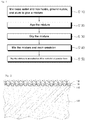
- Fig. 1 illustrates a flowchart showing steps of a method for producing a filler material for a floor (hereinafter, referred to as "filler") according to the embodiment of the present invention.
- filler for a floor
- loess water, natural base material, natural fiber material and adsorbing catalyst material are prepared, and then mixed with each other into a mixture (step S110).
- the natural base material is a basic material of the filler material, and natural material such as rice husks, cork or wood chips is used as the natural base material.
- the rice husks are used as the natural base material.
- the rice husks are less afloat on the water than normal sawdust.
- the rice husks may be formed from expanded rice husks.
- the expanded rice husks have a water-absorbing rate and amount slightly higher than normal rice husks.
- the rice husks absorb a portion of permeated water from the artificial turf. Therefore, since the weight of the rice husks is increased, a problem is reduced that the rice husks move into a sewer and the like afloat on the water.
- the rice husks well drain the water as well as absorb the permeated water from the artificial turf, thereby preventing the water from being collected on the artificial turf.
- a grain size of the rice husks is 1 ⁇ 5 mm, preferably 2 ⁇ 3 mm in order to prevent the rice husks from being afloat on the water and facilitate drainage.
- the rice husks have an excellent shock-absorbing property. Therefore, when a person falls onto the artificial turf, the force is buffered which the person receives when crashing against the artificial turf, whereby the person is prevented from being injured.
- the rice husks are known to emit far infrared radiation.
- amount of emission of far infrared radiation is further increased in summer.
- the rice husks have low inflammability, damages resulting from occurrence of fire can be minimized.
- the rice husks are not apt to rot in nature, a possibility is very low that it rots over a long period of use time.
- the rice husks are natural material that are not harmful to the human body and environmentally-friendly, and it may be utilized for fertilizer in disuse, and easily removed through incineration.
- the rice husks do not form the second industrial wastes, cause a pollution when processed and generate carbon, and accordingly there is no problem of environmental levy originally.
- the rice husks have high moisture content and excellent heat insulation property. Therefore, the temperature of the artificial turf may be kept low, and thus a possibility is greatly reduced that users slipping on the turf get burned.
- the natural fiber material is entangled with the natural base material, thereby preventing the natural base material from floating when it rains.
- the natural fiber material is incorporated when the filler material is used out of doors, for example, in the filler material for the artificial turf.
- the natural fiber material may not be incorporated. In this case, effects are obtained in terms of production and cost.
- ground kudzu residues flax, jute or ground coconut are used, and the present invention is not limited to them.
- the ground kudzu residues are used.
- the ground kudzu residues are entangled with the rice husks when it rains or a lot of water permeate into the filler material, thereby preventing the rice husks from being carried away by the water.
- the ground kudzu residues are produced by grinding the residues leaved behind after removal of the kudzu juice from the kudzu root.
- the ground kudzu residues are in a condition that most of the moisture are removed from it, a lot of fibers remain in the ground kudzu residues.
- the ground kudzu residues are easily entangled with the rice husks, thereby preventing the rice husks from flying away or being carried away by the water.
- the ground kudzu residues have a high water absorptivity, if the ground kudzu residues absorb the water, its weight is increased, so that the rice husks are inhibited from floating on the water.
- the kudzu residues together with the rice husks enhance shock absorptivity of the floor scattered with the filler material.
- the length of the ground kudzu residues is about 1 ⁇ 5 mm, preferably 2 ⁇ 3 mm.
- the loess contained in the loess water stabilizes the rice husks and the ground kudzu residues by pressing the rice husks and the ground kudzu residues by its own weight.
- the loess contains lots of microbe beneficial to the human body and the environment, and thus inhibits inhabitation of the mold and the like to thereby provide the filler material for the artificial turf with a pleasant condition.
- the loess prevents infection of various bacteria in the filler material, and emits lot of far infrared radiation beneficial to the human body at a temperature from 30 to 60 °C, and antioxidant activities of the rice husks is increased due to the far infrared radiation emitted from the loess.
- the loess prevents occurrence of atopy, an effect is obtained that risk of occurrence of atopy is greatly reduced even if infants or children play on the floor scattered with the filler material. Furthermore, since the loess is nonflammable, a problem is greatly reduced that the filler material becomes combustible.
- the adsorbing catalyst material performs a function of enabling the loess to be quickly and firmly adsorbed to the rice husks. By the adsorbing catalyst material the loess sticks to the surface of the rice husks.
- alum or NaCl may used, but the present invention is not limited thereto.
- the mixture is aged for one to seven days (step S120).
- the rice husks are dyed with the loess adsorbed to the rice husks. Since the dyeing loess stably sticks to the rice husks by means of the adsorbing catalyst material, a problem is greatly reduced that the loess smears the clothes.
- the period of the aging may be widely varied according to amount and kind of the mixture etc.
- the aged mixture is dried to remove the moisture therefrom (step S130).
- the rice husks are contained at 40 ⁇ 80 wt.% and the ground kudzu residues are contained at 10 ⁇ 50 wt.%. Furthermore, in the dried mixture, the loess is contained at 30 ⁇ 70 wt.%. If the wt.% of the loess is excessively high, the shock-absorbing effect of the filler material is reduced. Furthermore, since dust of the loess are fine, if the wt.% of the loess is excessively high, draining performance is reduced. Therefore, it is preferable to maintain the wt.% of the loess at or less than 70 wt.%.
- Resin emulsion is mixed with the dried mixture (step S140).
- the resin emulsion is added to the mixture in order to prevent emission of the dust from the natural base material.
- the resin emulsion is made to contain the resin.
- the resin synthetic resin or natural resin may be used, and at least one high polymer may be used which is selected from polysaccharide and its derivatives, polyethylene glycol based copolymer and its derivatives, polyacrylates, acrylic ester copolymer, aliphatic polyester based high polymer and its derivatives, natural or synthetic gum such as acasia gum, or polyvinyl based high polymer and its derivatives.
- the resin emulsion is diluted with the water for its use, and the diluted resin emulsion is formed by mixing 5 ⁇ 50 wt.% of the undiluted resin emulsion and 50 ⁇ 95 wt.% of the water.
- the mixture wetted with the diluted emulsion is dried to produce the filler material in the form of powder from (step S150).
- the resin emulsion is contained at 2 ⁇ 30 wt.% relative to total weight.
- the resin emulsion prevents emission of the dust from the filler material. Furthermore, the resin emulsion inhibits generation of static electricity from the filler material.
- the natural base material and natural fiber material may be coated with anti-bacterial material.
- the anti-bacterial material enhances the anti-bacterial function together with the loess.
- the anti-bacterial material includes photocatalyst material, gold nanomaterial, silver nanomaterial etc.
- the photocatalyst material is material that removes various materials (VOC, bacteria, fine dust, sick house syndrome-causing material etc.) harmful to the human body by using light as energy source. If the photocatalyst material absorbs the light, electrons and holes are produced, and the electrons and holes thus produced participate in oxidation reaction and reduction reaction, respectively, and decompose the harmful material by means of these reactions.
- exemplary material is titanium dioxide. This titanium dioxide is plentiful in its resource and thus low-priced. Furthermore, the titanium dioxide is excellent in durability and abrasion resistance as the photocatalyst material, and as it is safe and nontoxic material as such, there is no concern about secondary pollution even when it is discarded
- a method for coating the natural base material and natural fiber material with the photocatalyst material is as follows.
- the anti-bacteria material is mixed at 0.05 wt.% ⁇ 0.2 wt.% relative to the weight of mixed liquid of the mixture and resin emulsion.
- the mixture After or before the mixture wetted with the diluted emulsion is dried, the mixture is immersed in the aqueous photocatalyst solution, and thereafter taken out to be dried.
- the method for forming the photocatalyst layer is not limited to the method described above.
- the photocatalyst layer may be formed by spraying the aqueous photocatalyst solution to the base material mixed in the diluted emulsion.
- the filler material of powder form may be used as filler material for the artificial turf.
- FIG. 2 the figure illustrates a cross-sectional view showing a state that the filler material (100) is installed on the artificial turf.
- the artificial turf (110) is laminated on the ground (120), and silica sands (130) are scattered between the artificial turfs (110) to perform a function of stably securing the artificial turf (110) to the ground (120) and erecting piles of the artificial turf.
- the filler material (100) is scattered on the silica sand (130), thereby being in the state of being scattered between the artificial turfs (110). In this way, the artificial turf is covered with the filler material (100) of the artificial turf (110) only except for a part thereof.
- the filler material may be variously applicable other than to the artificial turf. That is, the filler material of powder form is processed into pellet from by use of pellet-producing machine, and thereafter may be used in a playground instead of sands. Urethane is generally used instead of sands, but the urethane has a problem that it produces much dust and has a high rate of generation of heat.
- the filler material of pellet form of the present example has effects that it has a very low rate of generation of the dust, and also is environmentally-friendly due to components such as the rice husks, the ground kudzu residues, the loess etc. and has a very low rate of generation of heat.
- the filler material for a floor of the present invention may be used as the filler material for artificial turf and the filler material for playground and the like.
Landscapes
- Engineering & Computer Science (AREA)
- Life Sciences & Earth Sciences (AREA)
- Architecture (AREA)
- Civil Engineering (AREA)
- Structural Engineering (AREA)
- Wood Science & Technology (AREA)
- Manufacturing & Machinery (AREA)
- Forests & Forestry (AREA)
- Floor Finish (AREA)
- Compositions Of Macromolecular Compounds (AREA)
- Road Paving Structures (AREA)
- Sealing Material Composition (AREA)
- Agricultural Chemicals And Associated Chemicals (AREA)
- Synthetic Leather, Interior Materials Or Flexible Sheet Materials (AREA)
Claims (19)
- Füllermaterial für Kunstrasen, das ein natürliches Basismaterial und eine Mischung umfasst, die Löß und Harz enthält, und das Pulver- oder Pelletform aufweist, wobei der Löß in das natürliche Basismaterial adsorbiert ist und das Harz das natürliche Basismaterial umschließt, wodurch verhindert wird, dass sich Staub aus dem natürlichen Basismaterial bildet.
- Füllermaterial für Kunstrasen nach Anspruch 1, das ferner natürliches Fasermaterial umfasst, das mit dem natürlichen Basismaterial verschränkt ist, um zu verhindern, dass das natürliche Basismaterial sich hin- und herbewegt.
- Füllermaterial für Kunstrasen nach Anspruch 2, wobei das natürliche Basismaterial Reishülsen, Kork oder Holzschnitzel umfasst, und wobei das natürliche Fasermaterial gemahlene Kudzureste, Flachs, Jute oder gemahlene Kokosnuss umfasst.
- Füllermaterial für Kunstrasen nach Anspruch 3, wobei das natürliche Basismaterial Reishülsen sind und wobei das natürliche Fasermaterial die gemahlenen Kudzureste sind, und wobei in der Mischung die Reishülsen zu 40 ∼ 80 Gew.-% enthalten sind und die gemahlenen Kudzureste zu 10 ∼ 50 Gew.-% enthalten sind und der Löß zu 30 ∼ 70 Gew.-% enthalten ist.
- Füllermaterial für Kunstrasen nach Anspruch 2, das ferner antibakterielles Material umfasst, um das Verrotten des natürlichen Basismaterials oder natürlichen Fasermaterials zu verhindern.
- Füllermaterial für Kunstrasen nach Anspruch 5, wobei das antibakterielle Material ein beliebiges umfasst, das aus einer Gruppe ausgewählt ist, bestehend aus Photokatalysatormaterial, Goldnanomaterial und Silbernanomaterial.
- Füllermaterial für Kunstrasen nach Anspruch 5, wobei das antibakterielle Material auf das natürliche Basismaterial oder natürliche Fasermaterial beschichtet ist.
- Verfahren zum Herstellen von Füllermaterial für Kunstrasen, umfassend einen Schritt des Hinzufügens von natürlichem Basismaterial zu Lößwasser, um eine Mischung herzustellen; einen Schritt des Trocknens der Mischung; und einen Schritt des Hinzufügens von harzhaltiger Harzemulsion zur getrockneten Mischung und danach Mischen und Trocknen dieser, um Füllermaterial in Pulverform herzustellen.
- Verfahren zum Herstellen von Füllermaterial für Kunstrasen nach Anspruch 8, wobei während des Schritts des Herstellens der Mischung ferner adsorbierendes Katalysatormaterial hinzugefügt wird, um zu ermöglichen, dass der Löß im Lößwasser schnell in das natürliche Basismaterial adsorbiert wird.
- Verfahren zum Herstellen von Füllermaterial für Kunstrasen nach Anspruch 9, das ferner einen Schritt des Reifenlassens der Mischung umfasst, so dass das natürliche Basismaterial mit dem in das natürliche Basismaterial adsorbierten Löß gefärbt werden kann, bevor das Trocknen der Mischung erfolgt.
- Verfahren zum Herstellen von Füllermaterial für Kunstrasen nach Anspruch 9, wobei das adsorbierende Katalysatormaterial NaCl oder Alaun ist.
- Verfahren zum Herstellen von Füllermaterial für Kunstrasen nach Anspruch 8, wobei die Harzemulsion bezogen auf das Gesamtgewicht zu 2 ∼ 30 Gew.-% enthalten ist.
- Verfahren zum Herstellen von Füllermaterial für Kunstrasen nach Anspruch 8, das ferner einen Schritt des Verarbeitens des Füllermaterials in Pulverform zu Pelletform umfasst.
- Verfahren zum Herstellen von Füllermaterial für Kunstrasen nach Anspruch 13, wobei ferner das natürliche Fasermaterial während des Schritts des Herstellens der Mischung hinzugefügt wird, das mit dem natürlichen Basismaterial verschränkt ist, um zu verhindern, dass das natürliche Basismaterial sich hin- und herbewegt.
- Verfahren zum Herstellen von Füllermaterial für Kunstrasen nach Anspruch 14, wobei das natürliche Basismaterial Reishülsen, Kork oder Holzschnitzel umfasst, und wobei das natürliche Fasermaterial gemahlene Kudzureste, Flachs, Jute oder gemahlene Kokosnuss umfasst.
- Verfahren zum Herstellen von Füllermaterial für Kunstrasen nach Anspruch 15, wobei das natürliche Basismaterial Reishülsen sind, wobei das natürliche Fasermaterial die gemahlenen Kudzureste sind, und wobei in der getrockneten Mischung die Reishülsen zu 40 ∼ 80 Gew.-% enthalten sind und die gemahlenen Kudzureste zu 10 ∼ 50 Gew.-% enthalten sind und der Löß zu 30 ∼ 70 Gew.-% enthalten ist.
- Verfahren zum Herstellen von Füllermaterial für Kunstrasen nach Anspruch 16, wobei flüssiges antibakterielles Material ferner gemeinsam mit der Harzemulsion oder nach Zugabe der Harzemulsion hinzugefügt wird, um zu verhindern, dass das natürliche Basismaterial oder natürliche Füllermaterial verrottet.
- Verfahren zum Herstellen von Füllermaterial für Kunstrasen nach Anspruch 17, wobei die Harzemulsion durch Mischen von 5 ∼ 50 Gew.-% unverdünnter Harzemulsion und 50 ∼ 95 Gew.-% Wasser hergestellt wird, und wobei das antibakterielle Material zu 0,05 ∼ 0,2 Gew.-% bezogen auf das Gewicht der gemischten Flüssigkeit aus der Mischung, dem natürlichen Fasermaterial und der Harzemulsion vermischt wird.
- Füllermaterial für Kunstrasen, wobei das Füllermaterial gemäß einem der Ansprüche 8 bis 18 hergestellt wird.
Applications Claiming Priority (5)
| Application Number | Priority Date | Filing Date | Title |
|---|---|---|---|
| KR20090009437 | 2009-02-05 | ||
| KR20090014973A KR100906622B1 (ko) | 2009-02-05 | 2009-02-23 | 인조잔디용 충진재 |
| KR1020090056686A KR101034315B1 (ko) | 2009-06-24 | 2009-06-24 | 인조잔디용 충진재 및 인조잔디 |
| KR1020100007125A KR101139440B1 (ko) | 2010-01-26 | 2010-01-26 | 바닥용 충진재의 제조방법 및 인조잔디 |
| PCT/KR2010/000662 WO2010090444A2 (ko) | 2009-02-05 | 2010-02-03 | 바닥용 충진재 및 바닥용 충진재의 제조방법 |
Publications (3)
| Publication Number | Publication Date |
|---|---|
| EP2395149A2 EP2395149A2 (de) | 2011-12-14 |
| EP2395149A4 EP2395149A4 (de) | 2016-10-19 |
| EP2395149B1 true EP2395149B1 (de) | 2018-04-11 |
Family
ID=42542504
Family Applications (1)
| Application Number | Title | Priority Date | Filing Date |
|---|---|---|---|
| EP10738728.4A Active EP2395149B1 (de) | 2009-02-05 | 2010-02-03 | Füllermaterial für einen boden und verfahren zur herstellung eines füllermaterials für einen boden |
Country Status (6)
| Country | Link |
|---|---|
| US (2) | US8951634B2 (de) |
| EP (1) | EP2395149B1 (de) |
| CN (1) | CN102308047B (de) |
| CA (1) | CA2751340C (de) |
| TR (1) | TR201807791T4 (de) |
| WO (1) | WO2010090444A2 (de) |
Families Citing this family (9)
| Publication number | Priority date | Publication date | Assignee | Title |
|---|---|---|---|---|
| CA2751340C (en) * | 2009-02-05 | 2015-05-26 | Kumryoung Co., Ltd. | Filler material for a floor and method for producing filler material for a floor |
| IT1395627B1 (it) * | 2009-08-27 | 2012-10-16 | Nusca | Materiale di intasamento per manti in erba sintetica e manti in erba sintetica cosi' ottenuti |
| ITPI20120099A1 (it) * | 2012-09-28 | 2014-03-29 | Mar Project S R L | Materiale di intasamento perfezionato per manti in erba sintetica e manti ibridi sintetico-naturale e manti cosi' ottenuti |
| JP6721209B2 (ja) * | 2016-02-15 | 2020-07-08 | 株式会社トークレー | 発塵抑制材、及び発塵抑制方法 |
| US11021842B2 (en) * | 2017-03-29 | 2021-06-01 | Brock Usa, Llc | Infill for artificial turf system |
| WO2018183756A1 (en) | 2017-03-29 | 2018-10-04 | Brock Usa, Llc | Infill for artificial turf system |
| KR101841220B1 (ko) * | 2018-03-06 | 2018-03-22 | 주식회사 지에스케이 | 인조잔디 충진재의 제조방법 및 이에 의해 제조된 인조잔디 충진재 |
| CN109129791A (zh) * | 2018-09-27 | 2019-01-04 | 大亚木业(江苏)有限公司 | 一种零甲醛刨花板的生产工艺 |
| CN113337161B (zh) * | 2021-05-28 | 2022-08-23 | 大茂环保新材料股份有限公司 | 一种包覆彩色弹性外层的木制颗粒及其用途 |
Family Cites Families (12)
| Publication number | Priority date | Publication date | Assignee | Title |
|---|---|---|---|---|
| CN1006143B (zh) * | 1985-04-01 | 1989-12-20 | J·F·阿道里夫股份公司 | 人造草坪 |
| DE10010414A1 (de) * | 2000-03-03 | 2001-09-06 | Trespa Int Bv | Verfahren zur Herstellung eines mattenförmigen Vorprodukts, Vorprodukt und Verwendung eines Vorprodukts |
| DE10129151A1 (de) * | 2000-08-09 | 2002-02-21 | Henkel Kgaa | Wäßriges Klebstoffsystem, Verfahren zu dessen Herstellung und dessen Verwendung |
| JP4556359B2 (ja) * | 2001-07-26 | 2010-10-06 | 住友ゴム工業株式会社 | 人工芝構造体および人工芝競技場 |
| JP4022441B2 (ja) * | 2002-07-04 | 2007-12-19 | 積水樹脂株式会社 | 人工芝製運動競技場 |
| ES2322074T3 (es) * | 2005-12-23 | 2009-06-16 | Mondo S.P.A. | Pavimento de cesped sintetico y procedimiento de colocacion del mismo. |
| EP2957412B1 (de) * | 2006-11-15 | 2017-02-22 | Entex Rust & Mitschke GmbH | Mischung von kunststoff mit holzpartikeln |
| KR20080075350A (ko) * | 2007-02-12 | 2008-08-18 | 윤형순 | 인조잔디 |
| KR100934735B1 (ko) | 2007-08-03 | 2009-12-30 | 코오롱글로텍주식회사 | 천연 소재를 이용한 인조잔디 충진 방법 |
| WO2009065768A1 (en) * | 2007-11-19 | 2009-05-28 | Välinge Innovation Belgium BVBA | Recycling of laminate floorings |
| KR100869585B1 (ko) * | 2008-02-01 | 2008-11-21 | 주식회사 그린켐 | 인조잔디 식재처 충진용 칩 |
| CA2751340C (en) * | 2009-02-05 | 2015-05-26 | Kumryoung Co., Ltd. | Filler material for a floor and method for producing filler material for a floor |
-
2010
- 2010-02-03 CA CA2751340A patent/CA2751340C/en active Active
- 2010-02-03 EP EP10738728.4A patent/EP2395149B1/de active Active
- 2010-02-03 US US13/148,290 patent/US8951634B2/en active Active
- 2010-02-03 WO PCT/KR2010/000662 patent/WO2010090444A2/ko not_active Ceased
- 2010-02-03 TR TR2018/07791T patent/TR201807791T4/tr unknown
- 2010-02-03 CN CN201080006683.1A patent/CN102308047B/zh active Active
-
2014
- 2014-11-26 US US14/555,466 patent/US9278463B2/en active Active
Non-Patent Citations (1)
| Title |
|---|
| None * |
Also Published As
| Publication number | Publication date |
|---|---|
| US20150084226A1 (en) | 2015-03-26 |
| EP2395149A2 (de) | 2011-12-14 |
| CA2751340C (en) | 2015-05-26 |
| WO2010090444A3 (ko) | 2010-11-04 |
| US9278463B2 (en) | 2016-03-08 |
| WO2010090444A2 (ko) | 2010-08-12 |
| EP2395149A4 (de) | 2016-10-19 |
| US8951634B2 (en) | 2015-02-10 |
| CN102308047A (zh) | 2012-01-04 |
| US20110287263A1 (en) | 2011-11-24 |
| CN102308047B (zh) | 2015-01-14 |
| TR201807791T4 (tr) | 2018-06-21 |
| CA2751340A1 (en) | 2010-08-12 |
Similar Documents
| Publication | Publication Date | Title |
|---|---|---|
| US9278463B2 (en) | Filler material for a floor and method for producing filler material for a floor | |
| KR102018068B1 (ko) | 인조잔디용 하이브리드 충진재의 제조 방법과 그를 이용해 제조된 인조잔디용 하이브리드 충진재 및 설치 방법 | |
| Nováková | Use of technical hemp in the construction industry | |
| KR20090083786A (ko) | 식생용 시트, 이를 포함하는 식생매트 및 이를 포함하는식생포대 | |
| KR100906622B1 (ko) | 인조잔디용 충진재 | |
| CN108864907A (zh) | 一种水性内墙涂料及其制备方法 | |
| JP2019504816A (ja) | 機能性イメージタイル及びその製造方法 | |
| KR102202727B1 (ko) | 나노 고분자 콘크리트 자가 치유제에 의한 콘크리트 손상 열화부 및 구체 강화공법 | |
| KR101721660B1 (ko) | 차열 특성을 가지는 인조잔디 충진용 코팅칩 및 그 제조 방법 | |
| CN106833237A (zh) | 一种光催化建筑内墙涂料及其制备方法 | |
| CN105881710A (zh) | 一种生态保水砖 | |
| KR100972090B1 (ko) | 숯을 이용한 실내 마감재 및 그 제조방법 | |
| WO2015184559A1 (fr) | Procede de realisation d'un materiau de construction a base de chaux et materiau de construction obtenu | |
| KR101577527B1 (ko) | 천연바인더를 이용한 친환경 기능성 옥 도료 및 마감재 및 그 제조방법 | |
| KR102735362B1 (ko) | 폐단열재를 이용한 매트형 단열재 | |
| KR101339497B1 (ko) | 황토를 주재로 한 농축산물 신선도 유지용 패치 및 그 제조방법 | |
| KR102499162B1 (ko) | 항균성 탄성 포장재 포장 방법 | |
| KR102787820B1 (ko) | 폐단열재를 이용한 재생 단열재 제조방법 | |
| KR20180001219A (ko) | 플라타너스 열매의 털을 이용한 흡착제 및 그 제조방법 | |
| Zhong et al. | Microplastics in the Environment: Sources, Distribution, Fate, and Transport | |
| JP2021524788A (ja) | 靴素材の製造方法 | |
| KR101126189B1 (ko) | 경량 단열 모르타르와 이를 이용한 시공방법 | |
| JP2010096195A (ja) | エネルギー吸収体の製造方法とエネルギー吸収体 | |
| CN107881876A (zh) | 一种透水汲水生态路面 | |
| JP3128315U (ja) | コルク製品 |
Legal Events
| Date | Code | Title | Description |
|---|---|---|---|
| PUAI | Public reference made under article 153(3) epc to a published international application that has entered the european phase |
Free format text: ORIGINAL CODE: 0009012 |
|
| 17P | Request for examination filed |
Effective date: 20110902 |
|
| AK | Designated contracting states |
Kind code of ref document: A2 Designated state(s): AT BE BG CH CY CZ DE DK EE ES FI FR GB GR HR HU IE IS IT LI LT LU LV MC MK MT NL NO PL PT RO SE SI SK SM TR |
|
| DAX | Request for extension of the european patent (deleted) | ||
| A4 | Supplementary search report drawn up and despatched |
Effective date: 20160915 |
|
| RIC1 | Information provided on ipc code assigned before grant |
Ipc: E01C 13/08 20060101AFI20160909BHEP Ipc: E01C 13/00 20060101ALI20160909BHEP |
|
| GRAP | Despatch of communication of intention to grant a patent |
Free format text: ORIGINAL CODE: EPIDOSNIGR1 |
|
| STAA | Information on the status of an ep patent application or granted ep patent |
Free format text: STATUS: GRANT OF PATENT IS INTENDED |
|
| INTG | Intention to grant announced |
Effective date: 20171009 |
|
| GRAS | Grant fee paid |
Free format text: ORIGINAL CODE: EPIDOSNIGR3 |
|
| GRAA | (expected) grant |
Free format text: ORIGINAL CODE: 0009210 |
|
| STAA | Information on the status of an ep patent application or granted ep patent |
Free format text: STATUS: THE PATENT HAS BEEN GRANTED |
|
| AK | Designated contracting states |
Kind code of ref document: B1 Designated state(s): AT BE BG CH CY CZ DE DK EE ES FI FR GB GR HR HU IE IS IT LI LT LU LV MC MK MT NL NO PL PT RO SE SI SK SM TR |
|
| REG | Reference to a national code |
Ref country code: GB Ref legal event code: FG4D |
|
| REG | Reference to a national code |
Ref country code: CH Ref legal event code: EP |
|
| REG | Reference to a national code |
Ref country code: AT Ref legal event code: REF Ref document number: 988160 Country of ref document: AT Kind code of ref document: T Effective date: 20180415 |
|
| REG | Reference to a national code |
Ref country code: IE Ref legal event code: FG4D |
|
| REG | Reference to a national code |
Ref country code: DE Ref legal event code: R096 Ref document number: 602010049844 Country of ref document: DE |
|
| REG | Reference to a national code |
Ref country code: NL Ref legal event code: FP |
|
| REG | Reference to a national code |
Ref country code: LT Ref legal event code: MG4D |
|
| PG25 | Lapsed in a contracting state [announced via postgrant information from national office to epo] |
Ref country code: ES Free format text: LAPSE BECAUSE OF FAILURE TO SUBMIT A TRANSLATION OF THE DESCRIPTION OR TO PAY THE FEE WITHIN THE PRESCRIBED TIME-LIMIT Effective date: 20180411 Ref country code: SE Free format text: LAPSE BECAUSE OF FAILURE TO SUBMIT A TRANSLATION OF THE DESCRIPTION OR TO PAY THE FEE WITHIN THE PRESCRIBED TIME-LIMIT Effective date: 20180411 Ref country code: PL Free format text: LAPSE BECAUSE OF FAILURE TO SUBMIT A TRANSLATION OF THE DESCRIPTION OR TO PAY THE FEE WITHIN THE PRESCRIBED TIME-LIMIT Effective date: 20180411 Ref country code: LT Free format text: LAPSE BECAUSE OF FAILURE TO SUBMIT A TRANSLATION OF THE DESCRIPTION OR TO PAY THE FEE WITHIN THE PRESCRIBED TIME-LIMIT Effective date: 20180411 Ref country code: FI Free format text: LAPSE BECAUSE OF FAILURE TO SUBMIT A TRANSLATION OF THE DESCRIPTION OR TO PAY THE FEE WITHIN THE PRESCRIBED TIME-LIMIT Effective date: 20180411 Ref country code: NO Free format text: LAPSE BECAUSE OF FAILURE TO SUBMIT A TRANSLATION OF THE DESCRIPTION OR TO PAY THE FEE WITHIN THE PRESCRIBED TIME-LIMIT Effective date: 20180711 Ref country code: BG Free format text: LAPSE BECAUSE OF FAILURE TO SUBMIT A TRANSLATION OF THE DESCRIPTION OR TO PAY THE FEE WITHIN THE PRESCRIBED TIME-LIMIT Effective date: 20180711 |
|
| PG25 | Lapsed in a contracting state [announced via postgrant information from national office to epo] |
Ref country code: GR Free format text: LAPSE BECAUSE OF FAILURE TO SUBMIT A TRANSLATION OF THE DESCRIPTION OR TO PAY THE FEE WITHIN THE PRESCRIBED TIME-LIMIT Effective date: 20180712 Ref country code: LV Free format text: LAPSE BECAUSE OF FAILURE TO SUBMIT A TRANSLATION OF THE DESCRIPTION OR TO PAY THE FEE WITHIN THE PRESCRIBED TIME-LIMIT Effective date: 20180411 Ref country code: HR Free format text: LAPSE BECAUSE OF FAILURE TO SUBMIT A TRANSLATION OF THE DESCRIPTION OR TO PAY THE FEE WITHIN THE PRESCRIBED TIME-LIMIT Effective date: 20180411 |
|
| REG | Reference to a national code |
Ref country code: AT Ref legal event code: MK05 Ref document number: 988160 Country of ref document: AT Kind code of ref document: T Effective date: 20180411 |
|
| PG25 | Lapsed in a contracting state [announced via postgrant information from national office to epo] |
Ref country code: PT Free format text: LAPSE BECAUSE OF FAILURE TO SUBMIT A TRANSLATION OF THE DESCRIPTION OR TO PAY THE FEE WITHIN THE PRESCRIBED TIME-LIMIT Effective date: 20180813 |
|
| REG | Reference to a national code |
Ref country code: DE Ref legal event code: R097 Ref document number: 602010049844 Country of ref document: DE |
|
| PG25 | Lapsed in a contracting state [announced via postgrant information from national office to epo] |
Ref country code: SK Free format text: LAPSE BECAUSE OF FAILURE TO SUBMIT A TRANSLATION OF THE DESCRIPTION OR TO PAY THE FEE WITHIN THE PRESCRIBED TIME-LIMIT Effective date: 20180411 Ref country code: EE Free format text: LAPSE BECAUSE OF FAILURE TO SUBMIT A TRANSLATION OF THE DESCRIPTION OR TO PAY THE FEE WITHIN THE PRESCRIBED TIME-LIMIT Effective date: 20180411 Ref country code: AT Free format text: LAPSE BECAUSE OF FAILURE TO SUBMIT A TRANSLATION OF THE DESCRIPTION OR TO PAY THE FEE WITHIN THE PRESCRIBED TIME-LIMIT Effective date: 20180411 Ref country code: DK Free format text: LAPSE BECAUSE OF FAILURE TO SUBMIT A TRANSLATION OF THE DESCRIPTION OR TO PAY THE FEE WITHIN THE PRESCRIBED TIME-LIMIT Effective date: 20180411 Ref country code: CZ Free format text: LAPSE BECAUSE OF FAILURE TO SUBMIT A TRANSLATION OF THE DESCRIPTION OR TO PAY THE FEE WITHIN THE PRESCRIBED TIME-LIMIT Effective date: 20180411 Ref country code: RO Free format text: LAPSE BECAUSE OF FAILURE TO SUBMIT A TRANSLATION OF THE DESCRIPTION OR TO PAY THE FEE WITHIN THE PRESCRIBED TIME-LIMIT Effective date: 20180411 |
|
| PLBE | No opposition filed within time limit |
Free format text: ORIGINAL CODE: 0009261 |
|
| STAA | Information on the status of an ep patent application or granted ep patent |
Free format text: STATUS: NO OPPOSITION FILED WITHIN TIME LIMIT |
|
| PG25 | Lapsed in a contracting state [announced via postgrant information from national office to epo] |
Ref country code: SM Free format text: LAPSE BECAUSE OF FAILURE TO SUBMIT A TRANSLATION OF THE DESCRIPTION OR TO PAY THE FEE WITHIN THE PRESCRIBED TIME-LIMIT Effective date: 20180411 Ref country code: IT Free format text: LAPSE BECAUSE OF FAILURE TO SUBMIT A TRANSLATION OF THE DESCRIPTION OR TO PAY THE FEE WITHIN THE PRESCRIBED TIME-LIMIT Effective date: 20180411 |
|
| 26N | No opposition filed |
Effective date: 20190114 |
|
| PG25 | Lapsed in a contracting state [announced via postgrant information from national office to epo] |
Ref country code: SI Free format text: LAPSE BECAUSE OF FAILURE TO SUBMIT A TRANSLATION OF THE DESCRIPTION OR TO PAY THE FEE WITHIN THE PRESCRIBED TIME-LIMIT Effective date: 20180411 |
|
| REG | Reference to a national code |
Ref country code: CH Ref legal event code: PL |
|
| PG25 | Lapsed in a contracting state [announced via postgrant information from national office to epo] |
Ref country code: LU Free format text: LAPSE BECAUSE OF NON-PAYMENT OF DUE FEES Effective date: 20190203 Ref country code: MC Free format text: LAPSE BECAUSE OF FAILURE TO SUBMIT A TRANSLATION OF THE DESCRIPTION OR TO PAY THE FEE WITHIN THE PRESCRIBED TIME-LIMIT Effective date: 20180411 |
|
| REG | Reference to a national code |
Ref country code: BE Ref legal event code: MM Effective date: 20190228 |
|
| REG | Reference to a national code |
Ref country code: IE Ref legal event code: MM4A |
|
| PG25 | Lapsed in a contracting state [announced via postgrant information from national office to epo] |
Ref country code: LI Free format text: LAPSE BECAUSE OF NON-PAYMENT OF DUE FEES Effective date: 20190228 Ref country code: CH Free format text: LAPSE BECAUSE OF NON-PAYMENT OF DUE FEES Effective date: 20190228 |
|
| PG25 | Lapsed in a contracting state [announced via postgrant information from national office to epo] |
Ref country code: IE Free format text: LAPSE BECAUSE OF NON-PAYMENT OF DUE FEES Effective date: 20190203 |
|
| PG25 | Lapsed in a contracting state [announced via postgrant information from national office to epo] |
Ref country code: BE Free format text: LAPSE BECAUSE OF NON-PAYMENT OF DUE FEES Effective date: 20190228 Ref country code: FR Free format text: LAPSE BECAUSE OF NON-PAYMENT OF DUE FEES Effective date: 20190228 |
|
| PG25 | Lapsed in a contracting state [announced via postgrant information from national office to epo] |
Ref country code: MT Free format text: LAPSE BECAUSE OF NON-PAYMENT OF DUE FEES Effective date: 20190203 |
|
| PG25 | Lapsed in a contracting state [announced via postgrant information from national office to epo] |
Ref country code: CY Free format text: LAPSE BECAUSE OF FAILURE TO SUBMIT A TRANSLATION OF THE DESCRIPTION OR TO PAY THE FEE WITHIN THE PRESCRIBED TIME-LIMIT Effective date: 20180411 |
|
| PG25 | Lapsed in a contracting state [announced via postgrant information from national office to epo] |
Ref country code: IS Free format text: LAPSE BECAUSE OF FAILURE TO SUBMIT A TRANSLATION OF THE DESCRIPTION OR TO PAY THE FEE WITHIN THE PRESCRIBED TIME-LIMIT Effective date: 20180811 |
|
| PG25 | Lapsed in a contracting state [announced via postgrant information from national office to epo] |
Ref country code: HU Free format text: LAPSE BECAUSE OF FAILURE TO SUBMIT A TRANSLATION OF THE DESCRIPTION OR TO PAY THE FEE WITHIN THE PRESCRIBED TIME-LIMIT; INVALID AB INITIO Effective date: 20100203 |
|
| PG25 | Lapsed in a contracting state [announced via postgrant information from national office to epo] |
Ref country code: MK Free format text: LAPSE BECAUSE OF FAILURE TO SUBMIT A TRANSLATION OF THE DESCRIPTION OR TO PAY THE FEE WITHIN THE PRESCRIBED TIME-LIMIT Effective date: 20180411 |
|
| PGFP | Annual fee paid to national office [announced via postgrant information from national office to epo] |
Ref country code: NL Payment date: 20250206 Year of fee payment: 16 |
|
| PGFP | Annual fee paid to national office [announced via postgrant information from national office to epo] |
Ref country code: GB Payment date: 20250122 Year of fee payment: 16 |
|
| PGFP | Annual fee paid to national office [announced via postgrant information from national office to epo] |
Ref country code: TR Payment date: 20250120 Year of fee payment: 16 |
|
| PGFP | Annual fee paid to national office [announced via postgrant information from national office to epo] |
Ref country code: DE Payment date: 20260217 Year of fee payment: 17 |