EP2395570A2 - Module à éléments thermoélectriques et procédé de production d'éléments thermoélectriques - Google Patents
Module à éléments thermoélectriques et procédé de production d'éléments thermoélectriques Download PDFInfo
- Publication number
- EP2395570A2 EP2395570A2 EP10738744A EP10738744A EP2395570A2 EP 2395570 A2 EP2395570 A2 EP 2395570A2 EP 10738744 A EP10738744 A EP 10738744A EP 10738744 A EP10738744 A EP 10738744A EP 2395570 A2 EP2395570 A2 EP 2395570A2
- Authority
- EP
- European Patent Office
- Prior art keywords
- thermoelectric
- powder
- substrate
- type
- mixture
- Prior art date
- Legal status (The legal status is an assumption and is not a legal conclusion. Google has not performed a legal analysis and makes no representation as to the accuracy of the status listed.)
- Granted
Links
Images



Classifications
-
- H—ELECTRICITY
- H10—SEMICONDUCTOR DEVICES; ELECTRIC SOLID-STATE DEVICES NOT OTHERWISE PROVIDED FOR
- H10N—ELECTRIC SOLID-STATE DEVICES NOT OTHERWISE PROVIDED FOR
- H10N10/00—Thermoelectric devices comprising a junction of dissimilar materials, i.e. devices exhibiting Seebeck or Peltier effects
- H10N10/80—Constructional details
- H10N10/85—Thermoelectric active materials
- H10N10/851—Thermoelectric active materials comprising inorganic compositions
- H10N10/852—Thermoelectric active materials comprising inorganic compositions comprising tellurium, selenium or sulfur
-
- H—ELECTRICITY
- H10—SEMICONDUCTOR DEVICES; ELECTRIC SOLID-STATE DEVICES NOT OTHERWISE PROVIDED FOR
- H10N—ELECTRIC SOLID-STATE DEVICES NOT OTHERWISE PROVIDED FOR
- H10N10/00—Thermoelectric devices comprising a junction of dissimilar materials, i.e. devices exhibiting Seebeck or Peltier effects
- H10N10/01—Manufacture or treatment
-
- H—ELECTRICITY
- H10—SEMICONDUCTOR DEVICES; ELECTRIC SOLID-STATE DEVICES NOT OTHERWISE PROVIDED FOR
- H10N—ELECTRIC SOLID-STATE DEVICES NOT OTHERWISE PROVIDED FOR
- H10N10/00—Thermoelectric devices comprising a junction of dissimilar materials, i.e. devices exhibiting Seebeck or Peltier effects
- H10N10/10—Thermoelectric devices comprising a junction of dissimilar materials, i.e. devices exhibiting Seebeck or Peltier effects operating with only the Peltier or Seebeck effects
- H10N10/17—Thermoelectric devices comprising a junction of dissimilar materials, i.e. devices exhibiting Seebeck or Peltier effects operating with only the Peltier or Seebeck effects characterised by the structure or configuration of the cell or thermocouple forming the device
-
- H—ELECTRICITY
- H10—SEMICONDUCTOR DEVICES; ELECTRIC SOLID-STATE DEVICES NOT OTHERWISE PROVIDED FOR
- H10N—ELECTRIC SOLID-STATE DEVICES NOT OTHERWISE PROVIDED FOR
- H10N10/00—Thermoelectric devices comprising a junction of dissimilar materials, i.e. devices exhibiting Seebeck or Peltier effects
- H10N10/80—Constructional details
- H10N10/81—Structural details of the junction
Definitions
- the present invention relates to a THERMOELECTRIC ELEMENT MODULE AND MANUFACTURING METHOD, and more particularly to a thermocouple-type thermoelectric module configured such that P-type thermoelectric materials and N-type thermoelectric materials are respectively joined between a pair of electrodes, and a method for manufacturing the thermoelectric element.
- thermoelectric element including a thermoelectric converter is configured such that P-type thermoelectric materials and N-type thermoelectric materials are joined between metal electrodes to form a PN junction pair. If different temperatures are endowed to such a PN junction pair, a power is generated due to the Seebeck effect, so the thermoelectric element may function as a power generator. Also, due to the Peltier effect by which one side of the PN junction pair is cooled and the other side is heated, the thermoelectric element may be used as a temperature controller.
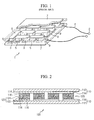
- FIG. 1 is a partially sectioned perspective view schematically showing a general thermoelectric element module.
- the conventional thermoelectric element module 1 includes P-type thermoelectric materials 3 and N-type thermoelectric materials 5. Electrodes 9 are attached in a predetermined pattern to a pair of insulation substrates 7 made of ceramic or silicon nitride. Such materials 3 and 5 are connected to the electrodes 9 in series.
- thermoelectric element module 1 if a DC current is applied to the electrode 9 through a lead wire 4 connected to a terminal 2, heat is generated at a side where the current flows from the P-type thermoelectric material 3 to the N-type thermoelectric material 5, and on the contrary heat is absorbed at a side where the current flows from the N-type thermoelectric material 5 to the P-type thermoelectric material 3, by means of the Peltier effect.
- the insulation substrate 7 joined to the heat-generating side is heated, and the insulation substrate 7 joined to the heat-absorbing side is cooled.
- the thermoelectric element module 1 if the polarity of the DC current applied to the terminal 2 is reversed, the heat-generating side is replaced with the heat-absorbing side.
- thermoelectric element module 1 if different temperatures are endowed to the pair of insulation substrates 7, voltage is generated at the terminal by means of the Seebeck effect.
- thermoelectric element is used as a module in which several ten or several hundred PN junction pairs are connected in series, as an example.
- Common thermoelectric element modules are manufactured by mechanically processing a thermoelectric material, which is a single crystal but has an ingot shape made by the directional solidification, into an element of a specific dimension, then joining electrodes to a patterned substrate made of ceramic or silicon nitride, and then joining the electrodes with thermoelectric materials (P-type, N-type). Each of the thermoelectric materials is joined to a corresponding electrode using an adhesive.
- Bi-Te thermoelectric material of a single crystal or directional solidifier has an inherent plane of cleavage in a crystallographic aspect, so the thermoelectric material may be easily cracked when being processed, which results in a deteriorated recovery rate.
- thermoelectric element when manufacturing a thermoelectric element, two joining processes are required. For example, after the electrodes are joined to a metal-plated ceramic substrate, thermoelectric materials should be joined to the electrodes. In this reason, it is complicated to manufacture a thermoelectric element, and also it is difficult to select a joining solder.
- a conventional thermoelectric element module manufacturing method several hundred (about 200) thermoelectric material dices of a substantially cuboid shape are manually soldered to an electrode of a substrate, which consumes a lot of labor. Thus, it is substantially impossible to lower a production cost below $10-$20 per each unit.
- precise dimension control is not ensured, a gap is formed between the thermoelectric material and the electrode, which may cause an inferior junction.
- thermoelectric element module it may also be considered to mass-product wafer-type thermoelectric elements by means of sputtering, used in a semiconductor manufacture process, in order to lower a price of the module.
- the element has a very small size, so it is difficult to increase the size of the thermoelectric element module.
- the present invention is designed to solve the problems of the prior art, and therefore it is an object of the present invention to provide a method for manufacturing a thermoelectric element of a thermoelectric pair shape, which allows larger size and automation; and a module of the thermoelectric element manufactured by the method.
- the present invention provides a method for manufacturing a thermoelectric element in which P-type thermoelectric materials and N-type thermoelectric materials are alternately joined between a pair of substrates, which includes: (a) preparing a P-type thermoelectric mixture powder and a N-type thermoelectric mixture powder in which a thermoelectric material powder and a low-melting metal powder are mixed at a predetermined ratio, respectively; (b) locating a support having a plurality of holes with a predetermined pattern on a first substrate; (c) injecting the P-type thermoelectric mixture powder and the N-type thermoelectric mixture powder into the corresponding holes of the support; (d) packing the P-type and N-type thermoelectric mixture powders injected into the holes; (e) separating the support from the first substrate; (f) locating a second substrate to the other side of the thermoelectric mixture powders to be opposite to the first substrate; and (g) thermally treating the thermoelectric mixture powders at a temperature lower than a melt point of the thermoelectric material to join
- thermoelectric element in which P-type thermoelectric materials and N-type thermoelectric materials are alternately joined between a pair of substrates, which includes: (a) preparing a P-type thermoelectric mixture powder and a N-type thermoelectric mixture powder by mixing a thermoelectric material powder and a low-melting metal powder at a predetermined ratio, respectively; (b) locating a support having a plurality of holes with a predetermined pattern on a first substrate; (c) injecting and packing the P-type thermoelectric mixture powder and the N-type thermoelectric mixture powder into the corresponding holes of the support; (d) thermally treating the thermoelectric mixture powders at a temperature lower than a melt point of the thermoelectric material to join the thermoelectric mixture powders to the first substrate by means of the melted low-melting metal; (e) separating the support from the first substrate in a state that the thermoelectric mixture powders are adhered to the first substrate; (f) locating a second substrate to the other
- the low-melting metal powder includes any one selected from the group consisting of Bi, Tl, Sn, P, Pb and Cd.
- the thermoelectric mixture powder includes a thermoelectric material powder and about 0.25 to 10 weight% of low-melting metal powder.
- the support includes a first support used for filling the P-type thermoelectric mixture powder and a second support used for filling the N-type thermoelectric mixture powder separately.
- the first and second substrates include an insulation member and a plurality of copper electrodes joined to the insulation member with a predetermined pattern, respectively.
- the insulation member includes aluminum oxide.
- the method further includes forming a nickel buffer layer on at least one surface of the first and second substrates.
- thermoelectric element module in which P-type thermoelectric materials and N-type thermoelectric materials are alternately joined between a pair of substrates, wherein the thermoelectric materials include a thermoelectric mixture powder in which a thermoelectric material powder and a low-melting metal powder are mixed at a predetermined ratio, and wherein the thermoelectric mixture powder is thermally treated at a temperature lower than a melt point of the thermoelectric material, the thermoelectric mixture powder is formed as the low-melting metal is melted, and at the same time both ends of the thermoelectric materials are joined to the pair of substrates.
- the low-melting metal powder includes any one selected from the group consisting of Bi, Tl, Sn, P, Pb and Cd.
- the thermoelectric mixture powder includes a thermoelectric material powder and about 0.25 to 10 weight% of low-melting metal powder.
- thermoelectric element module further includes a nickel buffer layer interposed between the substrate and the thermoelectric mixture powders.
- the substrate includes an insulation member and a plurality of copper electrodes formed on the insulation member with a predetermined pattern.
- the insulation member includes aluminum oxide.
- thermoelectric mixture powder in which N-type or P-type thermoelectric material powder is mixed with a low-melting metal powder having a lower melt point is injected into a support (or, a jig) having holes with a predetermined pattern, and then the low-melting metal is melted at a predetermined temperature to form P-type and N-type thermoelectric materials, respectively.
- a joining process for joining the thermoelectric material to a corresponding substrate may be automated.
- thermoelectric element manufacturing method and the thermoelectric element module according to the present invention ensure use thermoelectric powder, the size of the thermoelectric element module may be greatly increased.
- thermoelectric element module and a method for manufacturing the same according to preferred embodiments of the present invention will be described in detail with reference to the accompanying drawings.
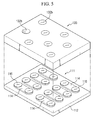
- FIG. 2 is a sectional view schematically showing a thermoelectric element module according to a preferred embodiment of the present invention.
- a thermoelectric element module 100 includes a pair of substrates 110, each having an insulation member 112 and a plurality of electrodes 114 joined to a surface of the insulation member 112 with a predetermined pattern, buffer layers 116 interposed between surfaces of the electrodes 114 opposite to the substrates 110 and having an area corresponding to P-type and N-type thermoelectric portions, and P-type and N-type thermoelectric mixture powders 120 contacted with the buffer layers 116 or the electrodes 114 and melted at a predetermined temperature to fix their shapes.
- Each substrate 110 includes the insulation member 112 made of aluminum oxide or the like and having a plate shape, and a plurality of electrodes 114 joined to one surface of the insulation member 112 and made of copper or the like.
- one electrode 114 preferably has so sufficient size and shape to ensure contact with ends of adjacent P-type and N-type thermoelectric mixture powders 120, respectively.
- the buffer layer 116 may be selectively used in this embodiment.
- the buffer layer 116 is formed on the electrodes 114 containing copper by means of plating (using nickel) or the like.
- the buffer layer 116 plays a role of preventing the thermoelectric mixture powder 120 from being dispersed to corresponding electrodes 114. Thus, in this embodiment, if the buffer layers 116 are excluded, the electrodes 114 are directly contacted with the corresponding thermoelectric mixture powders 120.
- the P-type and N-type thermoelectric mixture powders 120 include a thermoelectric material powder 122 and a low-melting metal powder 124, mixed at a predetermined ratio.
- thermoelectric material powder 122 may use thermoelectric semiconductor materials well known in the art, for example Bi-Te material, Fe-Si material, Si-Ge material and Co-Sb material, among which Bi-Te material is preferred.
- the low-melting metal powder 124 includes metal powders having a relatively lower melt point than a melt point of the thermoelectric material (for example, 450°C in case of Te).
- the low-melting metal powder 124 may be Bi (with a melt point of 271°C), Tl (with a melt point of 303.5°C), Sn (with a melt point of 232°C), P (with a melt point of 44°C), Pb (with a melt point of 327°C), Cd (with a melt point of 321°C) and so on.
- the thermoelectric mixture powder 120 is preferably prepared by mixing the above thermoelectric material powder 122 with 0.25 to 10 weight% of low-melting metal powder 124. Also, the thermoelectric mixture powder 120 is injected into holes 132 of a jig-type support 130 as explained below, and then thermally treated at a temperature higher than a melt point of the low-melting metal powder 124 and lower than a melt point of the thermoelectric material powder 122. After that, the thermoelectric mixture powder 120 is formed as the low-melting metal powder 124 is melted, and at the same time both ends of the thermoelectric mixture powder 120 are joined to the electrodes 114 or the buffer layers 116.
- FIG. 3 is an exploded perspective view schematically illustrating a method for manufacturing a thermoelectric element according to a preferred embodiment of the present invention.
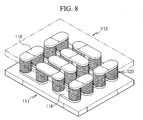
- an upper substrate 113 has an insulation member 112 and electrodes 114 attached to a lower surface of the insulation member 112, and a lower substrate 111 has an insulation member 112 and electrodes 114 attached to an upper surface of the insulation member 112.
- thermoelectric material powder 122 and the low-melting metal powder 124 are mixed at a predetermined ratio (preferably, the thermoelectric material powder and about 0.25 to 10 weight% of low-melting metal powder) to prepare P-type and N-type thermoelectric mixture powders 120 (see FIG. 2 ).
- a pair of substrates 110 is prepared.
- Such substrates 110 are configured such that a plurality of electrodes 114 made of copper or the like are joined on the insulation member 112 made of aluminum oxide or the like and having a plate shape, as mentioned above.
- the lower substrate is referred to as a first substrate 111
- the upper substrate is referred to as a second substrate 113, for convenient explanation.
- P-type and N-type thermoelectric mixture powders are alternately arranged adjacently in four rows and four columns (4x4) and connected in series, and the thermoelectric mixture powder 120 is formed with a cylindrical shape.
- each of the electrodes 114 preferably has a cuboid shape as a whole, but its end is rounded into a hemispherical shape. It should be understood that the shape of such electrodes 114 may be changed as necessary in accordance with design conditions demanded by the module 100, particularly a sectional shape of the thermoelectric mixture powder 120 to be formed.
- the electrodes 114 arranged on the insulation member 112 may have any pattern if the P-type and N-type thermoelectric mixture powders 120 may be connected in series.
- the electrodes 114 are arranged in parallel, but in case of the second substrate 113 at an upper side, electrodes in a center portion are parallel with each other but electrodes at both edges are arranged perpendicular to the electrodes in the center portion.
- the support 130 having a plurality of holes 132 formed with a predetermined pattern is prepared.
- the support 130 is an integrated support in which holes 132a for the P-type thermoelectric mixture powder (hereinafter, referred to as P-type holes) and holes 132b for the N-type thermoelectric mixture powder (hereinafter, referred to as N-type holes) are alternately arranged such that the P-type and N-type thermoelectric mixture powders 120 are injected therein.
- the holes 132a and 132b of the integrated support 130 have predetermined diameter and height.
- the support 130 is located on the first substrate 111.
- a separate positioning mechanism (not shown) is preferably used so as to accurately match the positions of the electrodes 114 of the first electrode 111 with the holes 132 of the support 130.
- the support 130 is fixed with respect to the first substrate 111.
- the P-type and N-type thermoelectric mixture powders are respectively injected into the corresponding holes 132 of the integrated support 130.
- This injection process preferably employs an injector or blade (not shown).
- the thermoelectric mixture is preferably packed using a separate cylinder (not shown).
- This injection and/or packing process may also be performed without using the integrated support 130 as mentioned above.
- thermoelectric mixture powder 120 keeps, for example, a rod-type pellet shape by means of the above packing process.
- the second substrate 113 is located at the other side of the thermoelectric mixture powder (for example, the rod) to be opposite to the first substrate 111.
- This work is preferably performed using a separate positioning means or mechanism, not shown.
- the pellet-type intermediate product having the thermoelectric mixture powder 120 located between the first substrate 111 and the second substrate 113 is thermally treated at a temperature lower than the melt point of the thermoelectric material and higher than the melt point of the low-melting metal.
- the low-melting metal powder 124 included in the pellet is melted to form a pellet itself, and at the same time the low-melting metal powders 124 at the ends of the pellet are fused (or, joined) to the first and second substrates 111 and 113, respectively.
- the support 130 is not removed from the first substrate 111.
- the thermoelectric mixture powder 120 is thermally treated at a temperature higher than the melt point of the low-melting metal and lower than the melt point of the thermoelectric material within a predetermined space in that state to primarily form the thermoelectric mixture powder 120 and also one end of the pellet is joined to the first substrate 111.
- the support 130 is separated from the first substrate 111, and then the second substrate 113 is located at the other side of the pellet.
- the pellet is secondarily heated (under the same conditions as the primary heating) to join the other end of the pellet to the second substrate.
- the joining process between the other end of the pellet and the second substrate 113 may be performed together with soldering, laser welding or the like, which may also be performed as a separate process.
Landscapes
- Engineering & Computer Science (AREA)
- Manufacturing & Machinery (AREA)
- Chemical & Material Sciences (AREA)
- Inorganic Chemistry (AREA)
- Powder Metallurgy (AREA)
Applications Claiming Priority (3)
| Application Number | Priority Date | Filing Date | Title |
|---|---|---|---|
| KR20090009319 | 2009-02-05 | ||
| PCT/KR2010/000690 WO2010090460A2 (fr) | 2009-02-05 | 2010-02-04 | Module à éléments thermoélectriques et procédé de production d'éléments thermoélectriques |
| KR1020100010371A KR101062129B1 (ko) | 2009-02-05 | 2010-02-04 | 열전 소자 모듈 및 열전 소자 제조 방법 |
Publications (3)
| Publication Number | Publication Date |
|---|---|
| EP2395570A2 true EP2395570A2 (fr) | 2011-12-14 |
| EP2395570A4 EP2395570A4 (fr) | 2014-01-22 |
| EP2395570B1 EP2395570B1 (fr) | 2016-04-06 |
Family
ID=42755874
Family Applications (1)
| Application Number | Title | Priority Date | Filing Date |
|---|---|---|---|
| EP10738744.1A Active EP2395570B1 (fr) | 2009-02-05 | 2010-02-04 | Procédé de production d'éléments thermoélectriques |
Country Status (7)
| Country | Link |
|---|---|
| US (1) | US8889453B2 (fr) |
| EP (1) | EP2395570B1 (fr) |
| JP (1) | JP5241928B2 (fr) |
| KR (1) | KR101062129B1 (fr) |
| CN (1) | CN102308402B (fr) |
| TW (1) | TWI415314B (fr) |
| WO (1) | WO2010090460A2 (fr) |
Cited By (2)
| Publication number | Priority date | Publication date | Assignee | Title |
|---|---|---|---|---|
| CN103396122A (zh) * | 2013-08-09 | 2013-11-20 | 中国科学院宁波材料技术与工程研究所 | 一种新型Cd-Te基热电材料及其制备方法 |
| WO2016173758A1 (fr) * | 2015-04-29 | 2016-11-03 | Robert Bosch Gmbh | Générateur thermoélectrique et procédé de fabrication d'un générateur thermoélectrique |
Families Citing this family (23)
| Publication number | Priority date | Publication date | Assignee | Title |
|---|---|---|---|---|
| CN104392933B (zh) | 2007-08-21 | 2017-11-07 | 加州大学评议会 | 具有高性能热电性质的纳米结构 |
| KR20120028687A (ko) * | 2010-09-15 | 2012-03-23 | 삼성전기주식회사 | 비대칭 열전 모듈 및 그 제조방법 |
| US9240328B2 (en) | 2010-11-19 | 2016-01-19 | Alphabet Energy, Inc. | Arrays of long nanostructures in semiconductor materials and methods thereof |
| US8736011B2 (en) | 2010-12-03 | 2014-05-27 | Alphabet Energy, Inc. | Low thermal conductivity matrices with embedded nanostructures and methods thereof |
| US9051175B2 (en) | 2012-03-07 | 2015-06-09 | Alphabet Energy, Inc. | Bulk nano-ribbon and/or nano-porous structures for thermoelectric devices and methods for making the same |
| FR2991207B1 (fr) * | 2012-06-04 | 2014-05-16 | Commissariat Energie Atomique | Procede de fabrication d'un materiau thermoelectrique |
| US9257627B2 (en) | 2012-07-23 | 2016-02-09 | Alphabet Energy, Inc. | Method and structure for thermoelectric unicouple assembly |
| US9082930B1 (en) * | 2012-10-25 | 2015-07-14 | Alphabet Energy, Inc. | Nanostructured thermolectric elements and methods of making the same |
| JP5831468B2 (ja) * | 2013-01-24 | 2015-12-09 | 株式会社デンソー | 熱電変換装置の製造方法 |
| US9309596B2 (en) * | 2013-01-31 | 2016-04-12 | Ngimat Co. | Flame-assisted flash sintering |
| US10388846B2 (en) * | 2014-03-28 | 2019-08-20 | Matrix Industries, Inc. | Formation of a densified object from powdered precursor materials |
| US9691849B2 (en) | 2014-04-10 | 2017-06-27 | Alphabet Energy, Inc. | Ultra-long silicon nanostructures, and methods of forming and transferring the same |
| KR20160063000A (ko) | 2014-11-26 | 2016-06-03 | 현대자동차주식회사 | 열전 발전장치 |
| KR101724847B1 (ko) | 2015-06-01 | 2017-04-18 | 현대자동차주식회사 | 엔진 폐열을 이용가능한 열전발전 모듈 |
| JP6721317B2 (ja) | 2015-11-18 | 2020-07-15 | 日東電工株式会社 | 半導体装置の製造方法 |
| TWI570972B (zh) * | 2016-01-20 | 2017-02-11 | 財團法人工業技術研究院 | 熱電轉換裝置以及熱電轉換器 |
| TWI608638B (zh) | 2016-12-15 | 2017-12-11 | 財團法人工業技術研究院 | 熱電模組 |
| CN108511590B (zh) * | 2017-02-28 | 2019-08-16 | 杭州熵能热导科技有限公司 | 一种热电制冷片及其制造方法 |
| CN109192851B (zh) * | 2018-08-29 | 2020-12-29 | 武汉理工大学 | 一种添加助烧剂制备优异电输运性能柔性热电厚膜材料的方法 |
| CN113272979B (zh) | 2018-11-16 | 2024-12-27 | Ats知识产权有限责任公司 | 热电发电机中用于提高性能的热透镜电极 |
| KR102693403B1 (ko) * | 2019-11-22 | 2024-08-09 | 엘지이노텍 주식회사 | 열전소자 |
| CN113629179A (zh) * | 2021-08-10 | 2021-11-09 | 东莞先导先进科技有限公司 | 一种半导体热电器件及其制备方法 |
| KR102767000B1 (ko) * | 2023-10-11 | 2025-02-14 | 알머티리얼즈 주식회사 | 제조공정을 단순화한 저가, 고강도 열전모듈 제조방법 |
Family Cites Families (21)
| Publication number | Priority date | Publication date | Assignee | Title |
|---|---|---|---|---|
| JP3472593B2 (ja) | 1993-04-22 | 2003-12-02 | 小松エレクトロニクス株式会社 | 熱電装置 |
| US6025554A (en) * | 1995-10-16 | 2000-02-15 | Macris; Chris | Thermoelectric device and method of manufacture |
| JPH09199766A (ja) * | 1995-11-13 | 1997-07-31 | Ngk Insulators Ltd | 熱電気変換モジュールの製造方法 |
| AU4551399A (en) | 1998-06-08 | 1999-12-30 | Ormet Corporation | Process for production of high performance thermoelectric modules and low temperature sinterable thermoelectric compositions therefor |
| US6207886B1 (en) * | 1998-06-30 | 2001-03-27 | Matsushita Electric Industrial Co., Ltd. | Skutterudite thermoelectric material thermoelectric couple and method of producing the same |
| JP2001028462A (ja) * | 1999-07-13 | 2001-01-30 | Yamaha Corp | 熱電素子及び熱電素子の製造方法 |
| JP3600486B2 (ja) * | 1999-08-24 | 2004-12-15 | セイコーインスツル株式会社 | 熱電変換素子の製造方法 |
| US6297441B1 (en) * | 2000-03-24 | 2001-10-02 | Chris Macris | Thermoelectric device and method of manufacture |
| JP4504523B2 (ja) * | 2000-07-13 | 2010-07-14 | 旭化成株式会社 | 熱電材料およびその製造方法 |
| US6410971B1 (en) * | 2001-07-12 | 2002-06-25 | Ferrotec (Usa) Corporation | Thermoelectric module with thin film substrates |
| JP2003046146A (ja) | 2001-07-30 | 2003-02-14 | Komatsu Ltd | 熱電モジュール式温調装置 |
| JP2003174202A (ja) * | 2001-09-25 | 2003-06-20 | Sumitomo Electric Ind Ltd | 熱電装置とこれを用いた光モジュール及びこれらの製造方法 |
| CA2377340A1 (fr) * | 2001-09-25 | 2003-03-25 | Sumitomo Electric Industries, Ltd. | Dispositif thermoelectrique et module optique comportant ce dispositif, et methode de production correspondante |
| JP2005340559A (ja) | 2004-05-28 | 2005-12-08 | Kyocera Corp | 熱電交換モジュール用セラミック基板 |
| US20060157101A1 (en) | 2004-10-29 | 2006-07-20 | Sakamoto Jeff S | System and method for fabrication of high-efficiency durable thermoelectric devices |
| KR100926851B1 (ko) * | 2004-12-20 | 2009-11-13 | 가부시끼가이샤 도시바 | 열전 변환 모듈과 그것을 이용한 열 교환기 및 열전 발전장치 |
| JP3879769B1 (ja) * | 2006-02-22 | 2007-02-14 | 株式会社村田製作所 | 熱電変換モジュールおよびその製造方法 |
| DE102006055120B4 (de) * | 2006-11-21 | 2015-10-01 | Evonik Degussa Gmbh | Thermoelektrische Elemente, Verfahren zu deren Herstellung und deren Verwendung |
| JP4912931B2 (ja) * | 2007-03-22 | 2012-04-11 | 住友化学株式会社 | 熱電変換モジュールの製造方法及び熱電変換モジュール |
| US8193439B2 (en) * | 2009-06-23 | 2012-06-05 | Laird Technologies, Inc. | Thermoelectric modules and related methods |
| KR20120028687A (ko) * | 2010-09-15 | 2012-03-23 | 삼성전기주식회사 | 비대칭 열전 모듈 및 그 제조방법 |
-
2010
- 2010-02-04 WO PCT/KR2010/000690 patent/WO2010090460A2/fr not_active Ceased
- 2010-02-04 JP JP2011549064A patent/JP5241928B2/ja active Active
- 2010-02-04 US US13/148,007 patent/US8889453B2/en active Active
- 2010-02-04 CN CN201080006622.5A patent/CN102308402B/zh active Active
- 2010-02-04 TW TW099103350A patent/TWI415314B/zh active
- 2010-02-04 KR KR1020100010371A patent/KR101062129B1/ko active Active
- 2010-02-04 EP EP10738744.1A patent/EP2395570B1/fr active Active
Cited By (2)
| Publication number | Priority date | Publication date | Assignee | Title |
|---|---|---|---|---|
| CN103396122A (zh) * | 2013-08-09 | 2013-11-20 | 中国科学院宁波材料技术与工程研究所 | 一种新型Cd-Te基热电材料及其制备方法 |
| WO2016173758A1 (fr) * | 2015-04-29 | 2016-11-03 | Robert Bosch Gmbh | Générateur thermoélectrique et procédé de fabrication d'un générateur thermoélectrique |
Also Published As
| Publication number | Publication date |
|---|---|
| JP5241928B2 (ja) | 2013-07-17 |
| WO2010090460A3 (fr) | 2010-11-25 |
| US20110304004A1 (en) | 2011-12-15 |
| WO2010090460A2 (fr) | 2010-08-12 |
| CN102308402B (zh) | 2014-03-19 |
| KR20100090209A (ko) | 2010-08-13 |
| EP2395570B1 (fr) | 2016-04-06 |
| TW201044654A (en) | 2010-12-16 |
| JP2012517116A (ja) | 2012-07-26 |
| US8889453B2 (en) | 2014-11-18 |
| EP2395570A4 (fr) | 2014-01-22 |
| CN102308402A (zh) | 2012-01-04 |
| TWI415314B (zh) | 2013-11-11 |
| KR101062129B1 (ko) | 2011-09-02 |
Similar Documents
| Publication | Publication Date | Title |
|---|---|---|
| EP2395570B1 (fr) | Procédé de production d'éléments thermoélectriques | |
| EP2641281B1 (fr) | Module d'éléments de conversion thermoélectrique | |
| CN101931044A (zh) | 热电模块和相关方法 | |
| US20130118541A1 (en) | Thermoelectric module and method of manufacturing the same | |
| KR20150031216A (ko) | 열전변환모듈 | |
| EP2975660A1 (fr) | Module de conversion thermoélectrique | |
| JPH09199766A (ja) | 熱電気変換モジュールの製造方法 | |
| JP4284589B2 (ja) | 熱電半導体の製造方法、熱電変換素子の製造方法及び熱電変換装置の製造方法 | |
| US10236430B2 (en) | Thermoelectric module | |
| US10833237B2 (en) | Thermoelectric module | |
| JP2013542579A (ja) | 熱電変換素子モジュールの製造方法 | |
| JPH10313134A (ja) | 熱電モジュールの製造方法 | |
| JP3549426B2 (ja) | 熱電素子、及びその製造方法 | |
| RU2234765C1 (ru) | Термоэлектрический модуль | |
| JP2002353522A (ja) | 熱電素子 | |
| JP2990352B2 (ja) | 熱電素子の製造方法 | |
| KR102333422B1 (ko) | 벌크형 열전 소자 및 그 제조방법 | |
| JP3377944B2 (ja) | 熱電素子、及びその製造方法 | |
| JP2893258B1 (ja) | 熱電素子及びその製造方法 | |
| JPH11233838A (ja) | 熱電素子、及びその製造方法 | |
| JP6139439B2 (ja) | 熱電モジュール | |
| EP4275236A1 (fr) | Module thermoélectrique | |
| JPH1174570A (ja) | 熱電素子及びその製造方法 | |
| JP2002190623A (ja) | 熱電素子配列ユニットおよびその製造方法並びに熱電素子配列ユニットを用いた熱電モジュール | |
| JP2013004711A (ja) | 熱電変換モジュール及びその製造方法 |
Legal Events
| Date | Code | Title | Description |
|---|---|---|---|
| PUAI | Public reference made under article 153(3) epc to a published international application that has entered the european phase |
Free format text: ORIGINAL CODE: 0009012 |
|
| 17P | Request for examination filed |
Effective date: 20110727 |
|
| AK | Designated contracting states |
Kind code of ref document: A2 Designated state(s): AT BE BG CH CY CZ DE DK EE ES FI FR GB GR HR HU IE IS IT LI LT LU LV MC MK MT NL NO PL PT RO SE SI SK SM TR |
|
| DAX | Request for extension of the european patent (deleted) | ||
| A4 | Supplementary search report drawn up and despatched |
Effective date: 20131220 |
|
| RIC1 | Information provided on ipc code assigned before grant |
Ipc: H01L 35/32 20060101ALI20131216BHEP Ipc: H01L 35/16 20060101ALI20131216BHEP Ipc: H01L 35/34 20060101AFI20131216BHEP |
|
| GRAP | Despatch of communication of intention to grant a patent |
Free format text: ORIGINAL CODE: EPIDOSNIGR1 |
|
| INTG | Intention to grant announced |
Effective date: 20151117 |
|
| GRAS | Grant fee paid |
Free format text: ORIGINAL CODE: EPIDOSNIGR3 |
|
| GRAA | (expected) grant |
Free format text: ORIGINAL CODE: 0009210 |
|
| AK | Designated contracting states |
Kind code of ref document: B1 Designated state(s): AT BE BG CH CY CZ DE DK EE ES FI FR GB GR HR HU IE IS IT LI LT LU LV MC MK MT NL NO PL PT RO SE SI SK SM TR |
|
| REG | Reference to a national code |
Ref country code: GB Ref legal event code: FG4D |
|
| REG | Reference to a national code |
Ref country code: AT Ref legal event code: REF Ref document number: 788621 Country of ref document: AT Kind code of ref document: T Effective date: 20160415 Ref country code: CH Ref legal event code: EP |
|
| REG | Reference to a national code |
Ref country code: IE Ref legal event code: FG4D |
|
| REG | Reference to a national code |
Ref country code: DE Ref legal event code: R096 Ref document number: 602010032047 Country of ref document: DE |
|
| REG | Reference to a national code |
Ref country code: LT Ref legal event code: MG4D Ref country code: NL Ref legal event code: MP Effective date: 20160406 |
|
| REG | Reference to a national code |
Ref country code: AT Ref legal event code: MK05 Ref document number: 788621 Country of ref document: AT Kind code of ref document: T Effective date: 20160406 |
|
| PG25 | Lapsed in a contracting state [announced via postgrant information from national office to epo] |
Ref country code: NL Free format text: LAPSE BECAUSE OF FAILURE TO SUBMIT A TRANSLATION OF THE DESCRIPTION OR TO PAY THE FEE WITHIN THE PRESCRIBED TIME-LIMIT Effective date: 20160406 |
|
| PG25 | Lapsed in a contracting state [announced via postgrant information from national office to epo] |
Ref country code: PL Free format text: LAPSE BECAUSE OF FAILURE TO SUBMIT A TRANSLATION OF THE DESCRIPTION OR TO PAY THE FEE WITHIN THE PRESCRIBED TIME-LIMIT Effective date: 20160406 Ref country code: FI Free format text: LAPSE BECAUSE OF FAILURE TO SUBMIT A TRANSLATION OF THE DESCRIPTION OR TO PAY THE FEE WITHIN THE PRESCRIBED TIME-LIMIT Effective date: 20160406 Ref country code: IS Free format text: LAPSE BECAUSE OF FAILURE TO SUBMIT A TRANSLATION OF THE DESCRIPTION OR TO PAY THE FEE WITHIN THE PRESCRIBED TIME-LIMIT Effective date: 20160806 Ref country code: NO Free format text: LAPSE BECAUSE OF FAILURE TO SUBMIT A TRANSLATION OF THE DESCRIPTION OR TO PAY THE FEE WITHIN THE PRESCRIBED TIME-LIMIT Effective date: 20160706 Ref country code: LT Free format text: LAPSE BECAUSE OF FAILURE TO SUBMIT A TRANSLATION OF THE DESCRIPTION OR TO PAY THE FEE WITHIN THE PRESCRIBED TIME-LIMIT Effective date: 20160406 |
|
| PG25 | Lapsed in a contracting state [announced via postgrant information from national office to epo] |
Ref country code: GR Free format text: LAPSE BECAUSE OF FAILURE TO SUBMIT A TRANSLATION OF THE DESCRIPTION OR TO PAY THE FEE WITHIN THE PRESCRIBED TIME-LIMIT Effective date: 20160707 Ref country code: ES Free format text: LAPSE BECAUSE OF FAILURE TO SUBMIT A TRANSLATION OF THE DESCRIPTION OR TO PAY THE FEE WITHIN THE PRESCRIBED TIME-LIMIT Effective date: 20160406 Ref country code: PT Free format text: LAPSE BECAUSE OF FAILURE TO SUBMIT A TRANSLATION OF THE DESCRIPTION OR TO PAY THE FEE WITHIN THE PRESCRIBED TIME-LIMIT Effective date: 20160808 Ref country code: AT Free format text: LAPSE BECAUSE OF FAILURE TO SUBMIT A TRANSLATION OF THE DESCRIPTION OR TO PAY THE FEE WITHIN THE PRESCRIBED TIME-LIMIT Effective date: 20160406 Ref country code: SE Free format text: LAPSE BECAUSE OF FAILURE TO SUBMIT A TRANSLATION OF THE DESCRIPTION OR TO PAY THE FEE WITHIN THE PRESCRIBED TIME-LIMIT Effective date: 20160406 Ref country code: LV Free format text: LAPSE BECAUSE OF FAILURE TO SUBMIT A TRANSLATION OF THE DESCRIPTION OR TO PAY THE FEE WITHIN THE PRESCRIBED TIME-LIMIT Effective date: 20160406 Ref country code: HR Free format text: LAPSE BECAUSE OF FAILURE TO SUBMIT A TRANSLATION OF THE DESCRIPTION OR TO PAY THE FEE WITHIN THE PRESCRIBED TIME-LIMIT Effective date: 20160406 |
|
| PG25 | Lapsed in a contracting state [announced via postgrant information from national office to epo] |
Ref country code: BE Free format text: LAPSE BECAUSE OF FAILURE TO SUBMIT A TRANSLATION OF THE DESCRIPTION OR TO PAY THE FEE WITHIN THE PRESCRIBED TIME-LIMIT Effective date: 20160406 Ref country code: IT Free format text: LAPSE BECAUSE OF FAILURE TO SUBMIT A TRANSLATION OF THE DESCRIPTION OR TO PAY THE FEE WITHIN THE PRESCRIBED TIME-LIMIT Effective date: 20160406 |
|
| REG | Reference to a national code |
Ref country code: DE Ref legal event code: R097 Ref document number: 602010032047 Country of ref document: DE |
|
| REG | Reference to a national code |
Ref country code: FR Ref legal event code: PLFP Year of fee payment: 8 |
|
| PG25 | Lapsed in a contracting state [announced via postgrant information from national office to epo] |
Ref country code: RO Free format text: LAPSE BECAUSE OF FAILURE TO SUBMIT A TRANSLATION OF THE DESCRIPTION OR TO PAY THE FEE WITHIN THE PRESCRIBED TIME-LIMIT Effective date: 20160406 Ref country code: EE Free format text: LAPSE BECAUSE OF FAILURE TO SUBMIT A TRANSLATION OF THE DESCRIPTION OR TO PAY THE FEE WITHIN THE PRESCRIBED TIME-LIMIT Effective date: 20160406 Ref country code: DK Free format text: LAPSE BECAUSE OF FAILURE TO SUBMIT A TRANSLATION OF THE DESCRIPTION OR TO PAY THE FEE WITHIN THE PRESCRIBED TIME-LIMIT Effective date: 20160406 Ref country code: SK Free format text: LAPSE BECAUSE OF FAILURE TO SUBMIT A TRANSLATION OF THE DESCRIPTION OR TO PAY THE FEE WITHIN THE PRESCRIBED TIME-LIMIT Effective date: 20160406 Ref country code: CZ Free format text: LAPSE BECAUSE OF FAILURE TO SUBMIT A TRANSLATION OF THE DESCRIPTION OR TO PAY THE FEE WITHIN THE PRESCRIBED TIME-LIMIT Effective date: 20160406 |
|
| PLBE | No opposition filed within time limit |
Free format text: ORIGINAL CODE: 0009261 |
|
| STAA | Information on the status of an ep patent application or granted ep patent |
Free format text: STATUS: NO OPPOSITION FILED WITHIN TIME LIMIT |
|
| PG25 | Lapsed in a contracting state [announced via postgrant information from national office to epo] |
Ref country code: SM Free format text: LAPSE BECAUSE OF FAILURE TO SUBMIT A TRANSLATION OF THE DESCRIPTION OR TO PAY THE FEE WITHIN THE PRESCRIBED TIME-LIMIT Effective date: 20160406 |
|
| 26N | No opposition filed |
Effective date: 20170110 |
|
| PG25 | Lapsed in a contracting state [announced via postgrant information from national office to epo] |
Ref country code: SI Free format text: LAPSE BECAUSE OF FAILURE TO SUBMIT A TRANSLATION OF THE DESCRIPTION OR TO PAY THE FEE WITHIN THE PRESCRIBED TIME-LIMIT Effective date: 20160406 |
|
| PG25 | Lapsed in a contracting state [announced via postgrant information from national office to epo] |
Ref country code: MC Free format text: LAPSE BECAUSE OF FAILURE TO SUBMIT A TRANSLATION OF THE DESCRIPTION OR TO PAY THE FEE WITHIN THE PRESCRIBED TIME-LIMIT Effective date: 20160406 |
|
| REG | Reference to a national code |
Ref country code: CH Ref legal event code: PL |
|
| GBPC | Gb: european patent ceased through non-payment of renewal fee |
Effective date: 20170204 |
|
| PG25 | Lapsed in a contracting state [announced via postgrant information from national office to epo] |
Ref country code: LI Free format text: LAPSE BECAUSE OF NON-PAYMENT OF DUE FEES Effective date: 20170228 Ref country code: CH Free format text: LAPSE BECAUSE OF NON-PAYMENT OF DUE FEES Effective date: 20170228 |
|
| REG | Reference to a national code |
Ref country code: IE Ref legal event code: MM4A |
|
| PG25 | Lapsed in a contracting state [announced via postgrant information from national office to epo] |
Ref country code: LU Free format text: LAPSE BECAUSE OF NON-PAYMENT OF DUE FEES Effective date: 20170204 |
|
| REG | Reference to a national code |
Ref country code: FR Ref legal event code: PLFP Year of fee payment: 9 |
|
| PG25 | Lapsed in a contracting state [announced via postgrant information from national office to epo] |
Ref country code: GB Free format text: LAPSE BECAUSE OF NON-PAYMENT OF DUE FEES Effective date: 20170204 Ref country code: IE Free format text: LAPSE BECAUSE OF NON-PAYMENT OF DUE FEES Effective date: 20170204 |
|
| PG25 | Lapsed in a contracting state [announced via postgrant information from national office to epo] |
Ref country code: MT Free format text: LAPSE BECAUSE OF NON-PAYMENT OF DUE FEES Effective date: 20170204 |
|
| PG25 | Lapsed in a contracting state [announced via postgrant information from national office to epo] |
Ref country code: HU Free format text: LAPSE BECAUSE OF FAILURE TO SUBMIT A TRANSLATION OF THE DESCRIPTION OR TO PAY THE FEE WITHIN THE PRESCRIBED TIME-LIMIT; INVALID AB INITIO Effective date: 20100204 |
|
| PG25 | Lapsed in a contracting state [announced via postgrant information from national office to epo] |
Ref country code: BG Free format text: LAPSE BECAUSE OF FAILURE TO SUBMIT A TRANSLATION OF THE DESCRIPTION OR TO PAY THE FEE WITHIN THE PRESCRIBED TIME-LIMIT Effective date: 20160406 |
|
| PG25 | Lapsed in a contracting state [announced via postgrant information from national office to epo] |
Ref country code: CY Free format text: LAPSE BECAUSE OF NON-PAYMENT OF DUE FEES Effective date: 20160406 |
|
| PG25 | Lapsed in a contracting state [announced via postgrant information from national office to epo] |
Ref country code: MK Free format text: LAPSE BECAUSE OF FAILURE TO SUBMIT A TRANSLATION OF THE DESCRIPTION OR TO PAY THE FEE WITHIN THE PRESCRIBED TIME-LIMIT Effective date: 20160406 |
|
| PG25 | Lapsed in a contracting state [announced via postgrant information from national office to epo] |
Ref country code: TR Free format text: LAPSE BECAUSE OF FAILURE TO SUBMIT A TRANSLATION OF THE DESCRIPTION OR TO PAY THE FEE WITHIN THE PRESCRIBED TIME-LIMIT Effective date: 20160406 |
|
| REG | Reference to a national code |
Ref country code: DE Ref legal event code: R079 Ref document number: 602010032047 Country of ref document: DE Free format text: PREVIOUS MAIN CLASS: H01L0035340000 Ipc: H10N0010010000 |
|
| PGFP | Annual fee paid to national office [announced via postgrant information from national office to epo] |
Ref country code: DE Payment date: 20260120 Year of fee payment: 17 |
|
| PGFP | Annual fee paid to national office [announced via postgrant information from national office to epo] |
Ref country code: FR Payment date: 20260121 Year of fee payment: 17 |