EP2395658A2 - Système et procédé de réglage de signal audio - Google Patents
Système et procédé de réglage de signal audio Download PDFInfo
- Publication number
- EP2395658A2 EP2395658A2 EP10190433A EP10190433A EP2395658A2 EP 2395658 A2 EP2395658 A2 EP 2395658A2 EP 10190433 A EP10190433 A EP 10190433A EP 10190433 A EP10190433 A EP 10190433A EP 2395658 A2 EP2395658 A2 EP 2395658A2
- Authority
- EP
- European Patent Office
- Prior art keywords
- audio signal
- microprocessor
- signal adjusting
- predetermined threshold
- audio
- Prior art date
- Legal status (The legal status is an assumption and is not a legal conclusion. Google has not performed a legal analysis and makes no representation as to the accuracy of the status listed.)
- Withdrawn
Links
Images



Classifications
-
- H—ELECTRICITY
- H03—ELECTRONIC CIRCUITRY
- H03G—CONTROL OF AMPLIFICATION
- H03G3/00—Gain control in amplifiers or frequency changers
- H03G3/20—Automatic control
- H03G3/30—Automatic control in amplifiers having semiconductor devices
- H03G3/32—Automatic control in amplifiers having semiconductor devices the control being dependent upon ambient noise level or sound level
Definitions
- the present invention relates to an audio signal adjusting system and method, and more particularly, to an audio signal adjusting system and method capable of actively adjusting an audio output intensity.
- TVs televisions
- flat displays have become essential entertainment devices for the modern humans.
- Those media playing devices combining both functions of TVs and flat displays can not only provide a television channels for watching but also can be served as computer monitors.
- some of the media playing devices are capable of approaching the real image and sound without distortion.
- whether the audio volume intensity is at an appropriate level is significantly factored in a user's audio-visual feelings.
- An external environment noise may affect that a user is forced to frequently adjust an audio volume of a media playing device. For instance, when the environment noise is made at a high level, the user has to manually increase the audio volume to hear clearer , whereas the user has to manually decrease the audio volume again as long as the environment noise is turned down.
- the intensity of audio volume output must be varied with satisfying the demand of the user's audio comfort. Under a manner that the environmental noise is varied frequently, the user has to manually adjust the audio volume over and over again. This would invoke inconvenient to watch television.
- those conventional systems can not adjust the audio volume according to either the user's habit or different noise environment types, and thereby can not obtain an efficient audio volume adjustment and can not satisfy the needs on the user's audio comfort. Or else, those systems are too complicated to be convenient for the operation and to lower the manufacturing cost.
- a primary objective of the present invention is to provide an audio signal adjusting system and method applicable for a media playing device, which is capable of automatically and dynamically adjusting an audio output intensity of the media playing device.
- Another objective of the present invention is to provide an audio signal adjusting system and method applicable for a media playing device, which is capable of adjusting the audio volume according to either a user's habit or the environmental noise, and thereby satisfying the different user demands on different noise environment types.
- the present invention provides an audio signal adjusting method, which is applicable to an electronic device for receiving at least one input audio signal.
- Said audio signal adjusting method comprises the following steps of:
- the present invention provides an audio signal adjusting system, which is applicable to an electronic device for receiving an input audio signal.
- Said audio signal adjusting system comprises:
- the audio signal adjusting parameter e.g., a volume setting value
- the audio signal adjusting parameter is automatically and dynamically adjusted according to the ratio between the environmental noise level and the output audio signal level for the situation that the user feels comfortable, endurable, or adequate. Therefore, the present invention is capable of solving the drawbacks of frequently adjusting the volume by hand in a noisy place.
- the comfort ratio between the environmental noise level and the output audio signal level is decided by the user or selected from the predetermined values stored in the system. Therefore, the present invention is capable of adjusting the volume according to a user's habit and thereby satisfying the different user demands on different noise environment types.
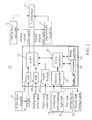
- FIG. 1A is a structural diagram showing an audio signal adjusting system implemented according to a first embodiment of the present invention.
- FIG. 1B is a structural diagram showing that an evaluating and comparing logic unit is implemented as a hardware in another implementation of the first embodiment.
- FIG. 2 is a structural diagram showing an audio signal adjusting system implemented according to a second embodiment of the present invention.
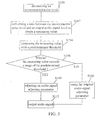
- FIG. 3 is a flow chart showing an audio signal adjusting method implemented according to the present invention.
- FIG. 4 is a flow chart showing Step S 106 of FIG. 3 in detail for determining whether a measuring value exceeds a predetermined threshold.
- FIG. 1A is a structural diagram showing an audio signal adjusting system 1 implemented according to a first embodiment of the present invention.
- the audio signal adjusting system 1 is applied to a media playing device.
- the media playing device may be a type of video systems such as televisions (TVs), and displays, etc. These video systems all have a scaler 10 for adjusting image size, resolution, and processing audio signals.
- FIG. 1A only shows those components relating to audio signal processing. It is noted that the audio signal adjusting system 1 of the present invention is not limited to be applied to multimedia systems (e.g., televisions and displays). The system 1 is also applicable to any kind of media playing devices.
- the audio signal adjusting system 1 of the first embodiment comprises an audio processor 12, an evaluating and comparing logic unit 13, a microprocessor 14, a memory controller 15, an image controller 16, a counter 18, an analog-to-digital converter (ADC) 191, a first data storing region 51, a second data storing region 52, an audio amplifier 20, a loudspeaker 25, an audio signal detector 32, and a filter 34.
- the audio amplifier 20 and the loudspeaker 25 can be components existed in or excluded from the media playing device.
- a part of components in the audio signal adjusting system 1 such as the audio processor 12, the evaluating and comparing logic unit 13, the microprocessor 14, the memory controller 15, the image controller 16, the counter 18, the ADC 191, the first data storing region 51, and the second data storing region 52, are connected to or included within the scaler 10 of the media playing device.
- the image controller 16 e.g., on screen display (OSD) controller
- OSD on screen display
- a part of or all the components in the audio signal adjusting system 1 can be arranged in other electronic portions of the media playing device instead of the scaler 10.
- the audio signal detector 32 is utilized for detecting an external acoustic signal outside the media playing device.
- the external acoustic signal consists of an environmental noise and the sound released from the loudspeaker 25 (e.g., the sound from a television). Then, the detected external acoustic signal is filtered by the filter 34 and then transmitted to the audio processor 12 of the scaler 10.
- the scaler 10 functions on processing the input audio signal and correspondingly outputting an output audio signal (detailed later).
- the output audio signal is amplified by the audio amplifier 20 into an amplified electronic signal
- the amplified electronic signal is further converted by the loudspeaker 25 into a physical acoustic wave which is audible for the user.
- the aforesaid input audio signal can be an analog signal or a digital signal, and can be inputted from various kinds of different interfaces, or an audio source signal oriented from a cable television or a wireless television.
- the aforesaid output audio signal also can be outputted for other devices via different interfaces, besides the loudspeaker 25.
- the audio processor 12 receives the input audio signal and then modulates the input audio signal according to an audio signal adjusting parameter, and thereby correspondingly generates the output audio signal.
- the audio signal adjusting parameter can be a volume setting value of television.
- the audio signal adjusting parameter may be pre-stored in the first data storing region 51 such as a flash memory or in the second data storing region 52 such as a DDR memory (double data rate synchronous dynamic random access memory).
- the audio signal adjusting parameter is adjusted by calculation and determination (described later).
- the microprocessor 14 determines to read out the audio signal adjusting parameter pre-stored in the first data storing region or the second data storing region through the memory controller 15.
- the microprocessor 14 also transmits the audio signal adjusting parameter to the audio processor 12 and then the audio processor 12 modulates the input audio signal according to the audio signal adjusting parameter and thereby correspondingly generates the output audio signal. Then, the output audio signal is transmitted to the audio amplifier 20 and the loudspeaker 25.
- the audio processor 12 can generate an output audio signal level corresponding to the output audio signal.
- the microprocessor 14 is connected to the audio processor 12.
- the microprocessor 14 receives the output audio signal level and the external acoustic signal from the audio processor 12.
- the microprocessor 14 is coupled to the image controller 16 and the counter 18.
- the image controller 16 is utilized for controlling information display on a screen and a command input therefrom.
- the counter 18 is utilized for counting and thereby transmitting the counting results to the microprocessor 14.
- the ADC 191 is utilized for sampling an audio signal and then converting the sampled audio signal from analog to digital.
- the amplitude of the output audio signal is adjusted according to an environmental noise so as to change the sound volume outputted from the loudspeaker 25. For instance, the output volume is increased automatically when the environmental noise is made at a high level and the output volume is decreased automatically when the environmental noise is made at a low level. Therefore, a user does not need to manually adjust the output volume, repeatedly or frequently.
- the audio signal detector 32 e.g., a microphone, is utilized for detecting the external acoustic signal outside the media playing device.
- the audio signal detected by the audio signal detector 32 is transmitted to the filter 34 so as to be filtered out those audio frequencies inaccessible to the human ear, and then the filtered signal is transmitted to the ADC 191 to be sampled.
- N environment Min - ⁇ ⁇ ⁇ ⁇ G ⁇ Ain ⁇ ⁇ ⁇ .
- the calculation of equation 3 is carried out by the evaluating and comparing logic unit 13 under control of the microprocessor 14.
- the evaluating and comparing logic unit 13 can be implemented as a program pre-stored in the first data storing region 51 as shown in FIG. 1A , or a hardware as shown in FIG. 1B .
- the evaluating and comparing logic unit 13' is a hardware arranged in the scaler 10' of the audio signal adjusting system 1'. As shown in FIGs.
- the evaluating and comparing logic unit 13, 13' can access those default parameters pre-stored in the first data storing region 51, e.g., the audio signal adjusting parameter (G), the detecting variation coefficient of the audio signal detector 32 ( ⁇ ), the sampling variation coefficient of the ADC 191 ( ⁇ ), the characteristic curves of the audio amplifier 20 and the loudspeaker 25 ( ⁇ ), for calculating the environmental noise level (N environment ).
- the environmental noise level (N environment ) is not limited to be obtained through the above mentioned equation 3. In the present invention, any other manner to obtain the environmental noise level (N environment ) can be implemented as well.
- a sample can be a root-mean-square value of voltage or power obtained from continuously sampling the input audio signal (Ain) for a time period, e.g., one second.
- the output audio signal level and the environmental noise level (N environment ) also can be a root-mean-square value of voltage or power.
- the evaluating and comparing logic unit 13, 13' is controlled by the microprocessor 14.
- the evaluating and comparing logic unit 13, 13' receives the external acoustic signal (Min) and the input audio signal (Ain) from the microprocessor 14. Then, the evaluating and comparing logic unit 13, 13' performs a calculation to obtain the environmental noise level (N environment ) according to the external acoustic signal (Min), the input audio signal (Ain), and those parameters pre-stored in the data storing region 51 or 52, e.g., the audio signal adjusting parameter (G), the detecting variation coefficient of the audio signal detector 32 ( ⁇ ), the sampling variation coefficient of the ADC 191 ( ⁇ ), the characteristic curves of the audio amplifier 20 and the loudspeaker 25 ( ⁇ ).
- the obtained environmental noise level (N environment ) is transmitted to the audio processor 12 via the microprocessor 14.
- the audio processor 12 calculates a ratio between the environmental noise level (N environment ) and the output audio signal level for correspondingly forming a measuring value and then transmits the measuring value to the microprocessor 14.
- the microprocessor 14 compares the measuring value with a predetermined threshold for determining whether or not to adjust the audio signal adjusting parameter. If the comparing result is incorrect, the microprocessor 14 adjusts the audio signal adjusting parameter and transmits the adjusted audio signal adjusting parameter to the audio processor 12. Then, the audio processor 12 generates a corresponding output audio signal according to the adjusted audio signal adjusting parameter and the input audio signal.
- the predetermined threshold may have an upper limit and a lower limit, and the microprocessor 14 may compare the measuring value respectively with the upper limit and the lower limit.
- the microprocessor 14 adjusts the audio signal adjusting parameter and then the audio processor 12 generates a corresponding output audio signal according to the adjusted audio signal adjusting parameter and the input audio signal.
- the comparing result is incorrect when the microprocessor 14 determines that the measuring value is greater than the upper limit of the predetermined threshold or is smaller than the lower limit of the predetermined threshold for a predetermined number of times, the microprocessor 14 adjusts the audio signal adjusting parameter and then the audio processor 12 generates a corresponding output audio signal according to the adjusted audio signal adjusting parameter and the input audio signal.
- the comparing result is correct when the microprocessor 14 determines that the measuring value does not exceed the range of the predetermined threshold constructed by the upper limit and the lower limit, the microprocessor 14 determines not to adjust the audio signal adjusting parameter, whereby the audio processor 12 generates the output audio signal according to the original audio signal adjusting parameter and the input audio signal.
- FIG. 2 is a structural diagram showing an audio signal adjusting system 1" implemented according to a second embodiment of the present invention.
- the scaler 10" can be inputted with an analog input audio signal and/or a digital input audio signal and the audio processor 12 can output an analog output audio signal and/or a digital output audio signal in the second embodiment of the present invention.
- the analog input audio signal may comes from interfaces or standards such as ATV, DTV, AV, YPbPr, HDMI, PC-line-lin for a television.
- the analog input audio signal is converted to a digital signal by an analog-to-digital converter (ADC) 192 and then the digital signal is transmitted to the audio processor 12.
- ADC analog-to-digital converter
- the digital input audio signal Since the digital input audio signal is compressed inherently, the digital input audio signal has to be decoded by an audio decoder 193 in advance. Then, the decoded input audio signal is transmitted to the audio processor 12.
- the audio processor 12 can output an analog output audio signal and/or a digital output audio signal.
- the analog output audio signal and the digital output audio signal are amplified respectively through an analog audio amplifier and a digital audio amplifier, and then transmitted to the loudspeaker 25. Since the other components in this embodiment are similar to those of the first embodiment, the detailed descriptions regarding these components are omitted herein.
- FIG. 3 is a flow chart showing an audio signal adjusting method implemented according to the present invention, which is applicable for a media playing device.
- the media playing device is capable of receiving an input audio signal and automatically determining whether or not to adjust the audio output according to an environmental noise.
- an audio signal detector 32 is utilized for detecting an external acoustic signal outside the electronic device and transmitting the detected external acoustic signal to an audio processor 12.
- the audio processor 12 is utilized for correspondingly generating an output audio signal according to an audio signal adjusting parameter and the input audio signal.
- the output audio signal has an output audio signal level.
- the audio processor 12 transmits the output audio signal level and the external acoustic signal to a microprocessor 14.
- the microprocessor 14 controls an evaluating and comparing logic unit 13 to determine an environmental noise level.
- the microprocessor 14 controls the evaluating and comparing logic unit 13 to perform the calculation of afore-mentioned equation 3 to obtain the environmental noise level.
- the environmental noise level can be an instant value or an average value with respect to a sampling period.
- the evaluating and comparing logic unit 13 can be implemented as a program pre-stored in a first data storing region 51. This program is capable of performing the calculation of aforesaid equation 3.
- the microprocessor 14 can access the program pre-stored in the first data storing region 51 through a memory controller 15 and control the evaluating and comparing logic unit 13 to execute the program.
- the calculation results can be temporarily stored in a second data storing region 52.
- the evaluating and comparing logic unit 13 can be implemented as a hardware which is capable of performing the calculation of aforesaid equation 3.
- Step S102 the audio processor 12 receives the environmental noise level from the evaluating and comparing logic unit 13 via the microprocessor 14.
- the audio processor 12 calculates a ratio between the environmental noise level and the output audio signal level for correspondingly forming a measuring value.
- the measuring value is defined as a measuring audio environment noise ratio (MAENR). This measuring value can be stored in the second data storing region 52.
- MAENR measuring audio environment noise ratio
- Step S104 the microprocessor 14 and the audio processor 12 are connected and the microprocessor 14 receives the measuring value from the audio processor 12.
- the microprocessor 14 compares the measuring value with a predetermined threshold.
- the predetermined threshold is an audio comfort value with which a user feels comfortable.
- the audio comfort value is defined as a threshold audio environment noise ratio (TAENR).
- TAENR is a ratio between the environmental noise level and the output audio signal level for the situation with which the user feels comfortable, or endurable. For instance, in a particular environment, the user adjusts an original volume to a comfortable volume by hand. After the comfortable volume is set up, the microprocessor 14 calculates the TAENR according to the comfortable volume set by the user and the environmental noise level at the time.
- this predetermined threshold can be set or decided by the user.
- the predetermined threshold is pre-stored in the system.
- the system can be designed to include several different modes corresponding to different predetermined thresholds.
- the predetermined thresholds of different values can be pre-stored in the first data storing region 51.
- the user can select one of the audio comfort values (i.e., the predetermined thresholds) pre-stored in the first data storing region 51, by manipulating or transmitting a command to an image controller 16 via an input interface. Then, the audio comfort value selected by the user is transmitted to the microprocessor 14.
- Step S106 the microprocessor 14 determines whether or not to adjust the audio signal adjusting parameter (e.g., whether or not to adjust the output volume) according to whether the comparing result between the MAENR and the TAENR is correct or not.
- the audio processor 12 modulates the input audio signal and correspondingly generates the output audio signal according to the audio signal adjusting parameter from the microprocessor 14.
- the comparing result is incorrect when the microprocessor 14 determines that the MAENR is greater than the TAENR or the MAENR exceeds a range defined according to the TAENR, the microprocessor 14 adjusts the audio signal adjusting parameter (Step S108) and then transmits the adjusted audio signal adjusting parameter to the audio processor 12. That is, the amplitude of the output audio signal will be adjusted. Then, the audio processor 12 generates a corresponding output audio signal according to the adjusted audio signal adjusting parameter (Step S112).
- the comparing result is correct when the microprocessor 14 determines that the MAENR is smaller than or equal to the TAENR, or the MAENR does not exceed the range defined according to the TAENR, the original audio signal adjusting parameter is maintained or unchanged (Step S109). That is, the audio signal adjusting parameter will not be adjusted. Then, the audio processor 12 generates the output audio signal according to the original audio signal adjusting parameter (Step S 112).
- the microprocessor 14 can increase or decrease the audio signal adjusting parameter by a small unit in one time. For instance, the microprocessor 14 can increase or decrease the volume little by little. The microprocessor 14 also can adjust the volume in one time to make the MAENR approaching the TAENR. In another manner, the audio signal adjusting parameter can be adjusted according to a conversion table or a conversion curve stored in the system. If the volume is already at a high level, the increasing amplitude or the decreasing amplitude can be cut down.
- the audio signal adjusting parameter e.g., a volume setting value
- the audio signal adjusting parameter is automatically and dynamically adjusted according to the ratio between the environmental noise level and the output audio signal level for the situation that the user feels comfortable, or endurable. Therefore, the present invention is capable of solving the drawbacks of frequently adjusting the volume by hand in a noisy place.
- the comfort ratio between the environmental noise level and the output audio signal level is decided by the user or selected from the predetermined values stored in the system. Therefore, the present invention is capable of adjusting the volume according to a user's habit and thereby satisfying the different user demands on different noise environment types.
- FIG. 4 is a flow chart showing the Step S106 of FIG. 3 in detail.
- the Step S 106 is used to determine whether the comparing resulted is incorrect, e.g., whether the measuring value exceeds the range of the predetermined threshold.
- the microprocessor 14 sets a zero value to the two parameters in a counter 18, i.e., CountVolumeUp and CountVolumeDown. These two parameters are utilized for counting a time when the condition is satisfied and accumulating the counts.
- the environmental noise level is determined for calculating the MAENR.
- the microprocessor 14 further compares the MAENR respectively with TAENR ⁇ 1.1 (i.e., the upper limit) and TAENR ⁇ 0.9 (i.e., the lower limit) (as performed by Steps S201, S211).
- Step S202 When the MAENR is found smaller than the lower limit of the TAENR, the counter 18 counts a time and the value of CountVolumeDown is increased by one (as Step S202). When the MAENR is found greater than the upper limit of the TAENR, the counter 18 counts a time and the value of CountVolumeUp is increased by one (as Step S212). When the value of either CountVolumeDown or CountVolumeUp reaches to a predetermined number of times (e.g., 15 times) (Step S203 or Step S213), the microprocessor 14 determines to adjust the audio signal adjusting parameter for correspondingly altering the audio output. For instance, the microprocessor adjusts a volume setting value for increasing or decreasing the volume.
- a predetermined number of times e.g. 15 times
- the MAENR is respectively compared with TAENR ⁇ 11. (i.e., the upper limit) and TAENR ⁇ 0.9 (i.e., the lower limit). Therefore, it can avoid adjusting the audio signal adjusting parameter over and over again, and thereby the power consumption is reduced. Moreover, the audio signal adjusting parameter is adjusted only when the value of CountVolumeDown or CountVolumeUp reaches to 15 times. Therefore, the adjusting process triggered by occasional or temporal noise interferences also can be avoided.
- the microprocessor 14 increases the volume setting value to increase the audio output only when the environmental noise increases and MAENR > TAENR ⁇ 1.1 and when the value of CountVolumeUp reaches to 15 times. Therefore, the user can hear the sound released from a loudspeaker 25 even though the environmental noise increases. Conversely, the microprocessor 14 decreases the volume setting value to decrease the audio output only when the environmental noise decreases and MAENR ⁇ TAENR ⁇ 0.9 and when the value of CountVolumeDown reaches to 15 times. Therefore, the user still can hear the sound released from the loudspeaker 25 under the appropriate volume.
Landscapes
- Circuit For Audible Band Transducer (AREA)
- Control Of Amplification And Gain Control (AREA)
Applications Claiming Priority (1)
| Application Number | Priority Date | Filing Date | Title |
|---|---|---|---|
| TW099118452A TWI441527B (zh) | 2010-06-07 | 2010-06-07 | 音訊調整系統及方法 |
Publications (1)
| Publication Number | Publication Date |
|---|---|
| EP2395658A2 true EP2395658A2 (fr) | 2011-12-14 |
Family
ID=44370585
Family Applications (1)
| Application Number | Title | Priority Date | Filing Date |
|---|---|---|---|
| EP10190433A Withdrawn EP2395658A2 (fr) | 2010-06-07 | 2010-11-09 | Système et procédé de réglage de signal audio |
Country Status (3)
| Country | Link |
|---|---|
| US (1) | US8422700B2 (fr) |
| EP (1) | EP2395658A2 (fr) |
| TW (1) | TWI441527B (fr) |
Cited By (3)
| Publication number | Priority date | Publication date | Assignee | Title |
|---|---|---|---|---|
| WO2017174150A1 (fr) * | 2016-04-08 | 2017-10-12 | Arcelik Anonim Sirketi | Dispositif d'affichage d'image ayant une fonction de réglage du niveau de volume adaptatif |
| EP3188365A4 (fr) * | 2014-08-29 | 2017-12-06 | ZTE Corporation | Procédé de réglage de volume automatique et son dispositif électronique |
| US20190020918A1 (en) * | 2016-01-25 | 2019-01-17 | Thomson Licensing | Method for audio detection and corresponding device |
Families Citing this family (17)
| Publication number | Priority date | Publication date | Assignee | Title |
|---|---|---|---|---|
| US9037276B2 (en) * | 2011-04-06 | 2015-05-19 | International Business Machines Corporation | Dynamic setting of increments on an amplitude scale |
| CN103546109A (zh) * | 2012-07-09 | 2014-01-29 | 鸿富锦精密工业(深圳)有限公司 | 远程多方会议音量调整系统及方法 |
| CN103684302B (zh) * | 2012-09-12 | 2017-08-08 | 国基电子(上海)有限公司 | 音量控制装置及方法 |
| CN104427083B (zh) * | 2013-08-19 | 2019-06-28 | 腾讯科技(深圳)有限公司 | 调节音量的方法和装置 |
| TWI498699B (zh) * | 2013-10-31 | 2015-09-01 | Wistron Corp | 訊號平衡系統、光源控制系統及其平衡訊號之方法 |
| CN103886731B (zh) | 2014-03-10 | 2017-08-22 | 北京智谷睿拓技术服务有限公司 | 一种噪声控制方法及设备 |
| US9923534B2 (en) * | 2014-07-31 | 2018-03-20 | E.F. Johnson Company | Automatic volume control for land mobile radio |
| JP2018534885A (ja) * | 2015-09-25 | 2018-11-22 | ローレンス ジー リックマン | オーディオレベリング及び増強装置 |
| CN105262452A (zh) * | 2015-10-29 | 2016-01-20 | 小米科技有限责任公司 | 音量调整方法、装置及终端 |
| CN105445651A (zh) * | 2015-11-28 | 2016-03-30 | 江门市兰格电子有限公司 | 一种带彩屏专业功放系统 |
| TWI564790B (zh) * | 2016-01-19 | 2017-01-01 | 冠捷投資有限公司 | 顯示器自動偵測及切換音源來源之結構及其判斷方法 |
| US20170372697A1 (en) * | 2016-06-22 | 2017-12-28 | Elwha Llc | Systems and methods for rule-based user control of audio rendering |
| US10606549B2 (en) | 2018-05-07 | 2020-03-31 | Spotify Ab | Automated low power mode based upon aspects associated with vehicle |
| CN109688498B (zh) * | 2018-11-23 | 2020-10-09 | 潍坊歌尔电子有限公司 | 一种音量调节方法、耳机及存储介质 |
| KR102897227B1 (ko) * | 2020-02-10 | 2025-12-10 | 삼성전자주식회사 | 오디오를 제어하는 전자 장치 및 방법 |
| CN114915886A (zh) * | 2021-02-08 | 2022-08-16 | 苏州佳世达电通有限公司 | 动态播音方法及播音装置 |
| TWI770918B (zh) * | 2021-03-31 | 2022-07-11 | 新唐科技股份有限公司 | 設定值自動調整裝置和方法 |
Family Cites Families (4)
| Publication number | Priority date | Publication date | Assignee | Title |
|---|---|---|---|---|
| US5666426A (en) * | 1996-10-17 | 1997-09-09 | Advanced Micro Devices, Inc. | Automatic volume control to compensate for ambient noise variations |
| US6868162B1 (en) * | 2000-11-17 | 2005-03-15 | Mackie Designs Inc. | Method and apparatus for automatic volume control in an audio system |
| US20080085007A1 (en) * | 2004-04-12 | 2008-04-10 | Bryce Engelbrecht | Systems and Methods for Monitoring Temporal Volume Control |
| US20070253578A1 (en) * | 2006-04-19 | 2007-11-01 | Verdecanna Michael T | System and method for adjusting microphone gain based on volume setting of a mobile device |
-
2010
- 2010-06-07 TW TW099118452A patent/TWI441527B/zh active
- 2010-10-29 US US12/916,403 patent/US8422700B2/en active Active
- 2010-11-09 EP EP10190433A patent/EP2395658A2/fr not_active Withdrawn
Non-Patent Citations (1)
| Title |
|---|
| None |
Cited By (4)
| Publication number | Priority date | Publication date | Assignee | Title |
|---|---|---|---|---|
| EP3188365A4 (fr) * | 2014-08-29 | 2017-12-06 | ZTE Corporation | Procédé de réglage de volume automatique et son dispositif électronique |
| US20190020918A1 (en) * | 2016-01-25 | 2019-01-17 | Thomson Licensing | Method for audio detection and corresponding device |
| US10536745B2 (en) * | 2016-01-25 | 2020-01-14 | Interdigital Ce Patent Holdings | Method for audio detection and corresponding device |
| WO2017174150A1 (fr) * | 2016-04-08 | 2017-10-12 | Arcelik Anonim Sirketi | Dispositif d'affichage d'image ayant une fonction de réglage du niveau de volume adaptatif |
Also Published As
| Publication number | Publication date |
|---|---|
| US8422700B2 (en) | 2013-04-16 |
| TW201146027A (en) | 2011-12-16 |
| TWI441527B (zh) | 2014-06-11 |
| US20110299705A1 (en) | 2011-12-08 |
Similar Documents
| Publication | Publication Date | Title |
|---|---|---|
| US8422700B2 (en) | Audio signal adjusting system and method | |
| CN102113313B (zh) | 处理音频信号的方法和装置 | |
| CN110858941B (zh) | 用于在音频系统中进行声音增强的系统和方法 | |
| US9442692B2 (en) | Apparatus, systems and methods for limiting output volume of a media presentation device | |
| US20060013414A1 (en) | Methods and related circuit for automatic audio volume level control | |
| US10824385B2 (en) | Automated audio volume stabilizer | |
| EP2538559B1 (fr) | Appareil de contrôle audio, appareil de correction audio et procédé de correction d'audio | |
| US20180212579A1 (en) | Electronic apparatus and power controlling method thereof | |
| CN114902560B (zh) | 具有环境噪音补偿的用于自动音量控制的设备和方法 | |
| US9037276B2 (en) | Dynamic setting of increments on an amplitude scale | |
| EP3610366B1 (fr) | Appareil d'affichage et procédé de commande associé | |
| KR101672210B1 (ko) | 음향출력장치 및 그 동작 방법 | |
| CN100593323C (zh) | 一种自动音量调节的方法及系统 | |
| CN102299693B (zh) | 音讯调整系统及方法 | |
| US11178498B2 (en) | Hearing device system and a method for dynamically presenting a hearing device modification proposal to a user of a hearing device | |
| US9042562B2 (en) | Audio controlling apparatus, audio correction apparatus, and audio correction method | |
| KR20200074599A (ko) | 전자장치 및 그 제어방법 | |
| CN112997400A (zh) | 具有学习和自适应安静模式能力的音频设备 | |
| US20100067717A1 (en) | Image processing apparatus and control method thereof | |
| EP2018051A2 (fr) | Appareil de traitement de signaux pour l'application d'AVC à des signaux temporisés et procédé correspondant | |
| CN101163215A (zh) | 电视机实际音量的设置方法和装置 | |
| JP2019070688A (ja) | 撮像装置 | |
| KR100692550B1 (ko) | 자동 샤프니스 조정 기능을 구비한 디스플레이 장치 | |
| KR100266602B1 (ko) | 티브이의옵션조절방법 | |
| JP2014086965A (ja) | 音量調整機能を有する電子機器、電子機器システムおよび音量調整方法 |
Legal Events
| Date | Code | Title | Description |
|---|---|---|---|
| AK | Designated contracting states |
Kind code of ref document: A2 Designated state(s): AL AT BE BG CH CY CZ DE DK EE ES FI FR GB GR HR HU IE IS IT LI LT LU LV MC MK MT NL NO PL PT RO RS SE SI SK SM TR |
|
| AX | Request for extension of the european patent |
Extension state: BA ME |
|
| PUAI | Public reference made under article 153(3) epc to a published international application that has entered the european phase |
Free format text: ORIGINAL CODE: 0009012 |
|
| STAA | Information on the status of an ep patent application or granted ep patent |
Free format text: STATUS: THE APPLICATION IS DEEMED TO BE WITHDRAWN |
|
| 18D | Application deemed to be withdrawn |
Effective date: 20140603 |