EP2397507B1 - Epoxidverbindung mit langkettiger alkylengruppe - Google Patents
Epoxidverbindung mit langkettiger alkylengruppe Download PDFInfo
- Publication number
- EP2397507B1 EP2397507B1 EP10741224.9A EP10741224A EP2397507B1 EP 2397507 B1 EP2397507 B1 EP 2397507B1 EP 10741224 A EP10741224 A EP 10741224A EP 2397507 B1 EP2397507 B1 EP 2397507B1
- Authority
- EP
- European Patent Office
- Prior art keywords
- group
- epoxy
- formula
- epoxy compound
- compound
- Prior art date
- Legal status (The legal status is an assumption and is not a legal conclusion. Google has not performed a legal analysis and makes no representation as to the accuracy of the status listed.)
- Active
Links
- GXVGYXFVDQKXGY-UHFFFAOYSA-N C=CCCCN(C(N(CCCC=C)C(N1CCCC=C)=O)=O)C1=O Chemical compound C=CCCCN(C(N(CCCC=C)C(N1CCCC=C)=O)=O)C1=O GXVGYXFVDQKXGY-UHFFFAOYSA-N 0.000 description 1
- SUFUQQOUIFUWTP-UHFFFAOYSA-N CC(C1)OCCC1C(OCC1CC=C2OC2C1)=O Chemical compound CC(C1)OCCC1C(OCC1CC=C2OC2C1)=O SUFUQQOUIFUWTP-UHFFFAOYSA-N 0.000 description 1
- NLKNRAHBYMXSHJ-UHFFFAOYSA-N OC(N(CCCC1OC1)C(N1CCCC2OCC2)=O)N(CCCC2OC2)C1=O Chemical compound OC(N(CCCC1OC1)C(N1CCCC2OCC2)=O)N(CCCC2OC2)C1=O NLKNRAHBYMXSHJ-UHFFFAOYSA-N 0.000 description 1
Classifications
-
- C—CHEMISTRY; METALLURGY
- C08—ORGANIC MACROMOLECULAR COMPOUNDS; THEIR PREPARATION OR CHEMICAL WORKING-UP; COMPOSITIONS BASED THEREON
- C08G—MACROMOLECULAR COMPOUNDS OBTAINED OTHERWISE THAN BY REACTIONS ONLY INVOLVING UNSATURATED CARBON-TO-CARBON BONDS
- C08G59/00—Polycondensates containing more than one epoxy group per molecule; Macromolecules obtained by polymerising compounds containing more than one epoxy group per molecule using curing agents or catalysts which react with the epoxy groups
- C08G59/18—Macromolecules obtained by polymerising compounds containing more than one epoxy group per molecule using curing agents or catalysts which react with the epoxy groups ; e.g. general methods of curing
- C08G59/20—Macromolecules obtained by polymerising compounds containing more than one epoxy group per molecule using curing agents or catalysts which react with the epoxy groups ; e.g. general methods of curing characterised by the epoxy compounds used
-
- C—CHEMISTRY; METALLURGY
- C08—ORGANIC MACROMOLECULAR COMPOUNDS; THEIR PREPARATION OR CHEMICAL WORKING-UP; COMPOSITIONS BASED THEREON
- C08G—MACROMOLECULAR COMPOUNDS OBTAINED OTHERWISE THAN BY REACTIONS ONLY INVOLVING UNSATURATED CARBON-TO-CARBON BONDS
- C08G59/00—Polycondensates containing more than one epoxy group per molecule; Macromolecules obtained by polymerising compounds containing more than one epoxy group per molecule using curing agents or catalysts which react with the epoxy groups
- C08G59/18—Macromolecules obtained by polymerising compounds containing more than one epoxy group per molecule using curing agents or catalysts which react with the epoxy groups ; e.g. general methods of curing
- C08G59/20—Macromolecules obtained by polymerising compounds containing more than one epoxy group per molecule using curing agents or catalysts which react with the epoxy groups ; e.g. general methods of curing characterised by the epoxy compounds used
- C08G59/32—Epoxy compounds containing three or more epoxy groups
- C08G59/3236—Heterocylic compounds
-
- C—CHEMISTRY; METALLURGY
- C08—ORGANIC MACROMOLECULAR COMPOUNDS; THEIR PREPARATION OR CHEMICAL WORKING-UP; COMPOSITIONS BASED THEREON
- C08K—Use of inorganic or non-macromolecular organic substances as compounding ingredients
- C08K5/00—Use of organic ingredients
- C08K5/16—Nitrogen-containing compounds
- C08K5/34—Heterocyclic compounds having nitrogen in the ring
- C08K5/3467—Heterocyclic compounds having nitrogen in the ring having more than two nitrogen atoms in the ring
- C08K5/3477—Six-membered rings
- C08K5/3492—Triazines
-
- C—CHEMISTRY; METALLURGY
- C08—ORGANIC MACROMOLECULAR COMPOUNDS; THEIR PREPARATION OR CHEMICAL WORKING-UP; COMPOSITIONS BASED THEREON
- C08L—COMPOSITIONS OF MACROMOLECULAR COMPOUNDS
- C08L63/00—Compositions of epoxy resins; Compositions of derivatives of epoxy resins
-
- C—CHEMISTRY; METALLURGY
- C08—ORGANIC MACROMOLECULAR COMPOUNDS; THEIR PREPARATION OR CHEMICAL WORKING-UP; COMPOSITIONS BASED THEREON
- C08L—COMPOSITIONS OF MACROMOLECULAR COMPOUNDS
- C08L63/00—Compositions of epoxy resins; Compositions of derivatives of epoxy resins
- C08L63/06—Triglycidylisocyanurates
-
- H—ELECTRICITY
- H10—SEMICONDUCTOR DEVICES; ELECTRIC SOLID-STATE DEVICES NOT OTHERWISE PROVIDED FOR
- H10W—GENERIC PACKAGES, INTERCONNECTIONS, CONNECTORS OR OTHER CONSTRUCTIONAL DETAILS OF DEVICES COVERED BY CLASS H10
- H10W74/00—Encapsulations, e.g. protective coatings
- H10W74/40—Encapsulations, e.g. protective coatings characterised by their materials
Definitions
- the present invention relates to a liquid epoxy compound and a cured composition thereof.
- crystalline epoxy resins have rigid or multifunctional main chain skeletons to show excellent heat resistance and are used in fields in which heat resistance reliability is required, such as the electrical and electronic fields.
- the range of use of the crystalline epoxy resins is limited because cast molding processing, in which a liquid composition is employed, is required in some uses and the crystalline epoxy resins are used only in transfer molding or the like, in which solid material is employed.
- An epoxy resin is disclosed that is produced by lowering the crystallinity of a highly crystalline epoxy compound, such as tris-(2,3-epoxypropyl)-isocyanurate, through partial esterification of the epoxy groups to liquefy the epoxy compound (see Patent Document 1).
- a highly crystalline epoxy compound such as tris-(2,3-epoxypropyl)-isocyanurate
- a compound including an epoxy ring bonded to a triazinetrione ring via a long chain alkylene group is disclosed (see Patent Document 2).
- An epoxy compound including an epoxy ring bonded to a triazinetrione ring via a long chain alkylene group and an epoxy resin composition including the epoxy compound are disclosed (see Patent Documents 3,4, and 5).
- EP 2 530 524 A1 describes a resist composition suitable for forming a microlens and comprising: a component (A): an alkali-soluble polymer; a component (B): a compound having an organic group to be photolyzed to venerate an alkali-soluble group; a component (C): a crosslinkable compound of Formula (1): where R 1 , R 2 , and, R 3 are independently a C 1-6 alkylene group or oxyalkylene group which are optionally branched; and E 1 , E 2 , and E 3 are independently a group containing a structure of Formula (2) or Formula (3): where R 4 is a hydrogen atom or a methyl group; and a component (D): a solvent.
- Liquid epoxy resins are used in potting, coating, casting, and the like by virtue of their characteristics such as having adequate handleability and causing few problems, including increased viscosity due to crystallization, on production. These days, however, particularly in the electrical and electronic fields in which enhanced integration of circuits, the use of lead-free solder, and the like are involved, advanced properties have been demanded on epoxy resin cured products to be used in sealants and the like, and therefore it becomes increasingly difficult for conventional liquid epoxy resins to satisfy these properties.
- thermosetting composition that yields an epoxy resin having physical properties of the cured product such as high transparency and high flexural strength along with adequate handleability as liquid, to be used in transparent sealants for optical semiconductors, such as transparent sealants for LEDs (light-emitting devices) and the like.
- the present invention provides:
- thermosetting composition including an epoxy compound (A) as described in
- thermosetting composition (a liquid epoxy resin composition) can be provided from which an epoxy resin is obtained having physical properties of the cured product including high transparency and high flexural strength along with adequate handleability as liquid.
- Tris-(2,3-epoxypropyl)-isocyanurate which is conventionally used, is an epoxy compound excellent in heat resistance, weather resistance, light resistance, transparency to visible light, and the like by virtue of the triazinetrione skeleton. Tris-(2,3-epoxypropyl)-isocyanurate yields a cured product the physical properties of which are affected by curing temperatures.
- tris-(2,3-epoxypropyl)-isocyanurate is a trifunctional epoxy compound having three carbon atoms per a side chain and having a rigid triazinetrione skeleton that is directly substituted with 2,3-epoxypropyl groups, and therefore thermal motion of the terminal epoxy groups during a curing reaction is limited and an unreacted epoxy group and an unreacted curing agent are likely to remain.
- a side chain between a triazinetrione ring and an epoxy group substituted on the triazinetrione ring is long (elongated) and the number of intermolecular hydrogen bonds is small, resulting in triazine stacking failure.
- the cured product of the epoxy compound has a certain glass transition temperature by virtue of the enhanced completeness of the curing reaction of the epoxy group, and therefore it has a certain crosslink density even in thermal environment to retain its strength and toughness.
- the curing reaction of the epoxy group completes in an early stage of curing, the cured product has a certain flexural strength and elasticity.
- water absorption caused by a hydroxy group resulting from the hydrolysis of an unreacted epoxy group and/or a carboxylic acid resulting from the hydrolysis of an acid anhydride (a curing agent) that does not undergo a reaction can be suppressed, and therefore a cured product low in a change in water absorption is obtained.
- An epoxy resin obtained by thermosetting a compound in which an epoxy ring is bonded to a nitrogen atom of a triazinetrione ring via a long chain alkylene group has greater strength of the cured product when parts of the epoxy rings are epoxy precursors (allyl groups, for example) than when all of the three nitrogen atoms of the triazinetrione ring in the compound are bonded with epoxy rings via long chain alkylene groups. It is considered that the epoxy ring that is bonded via a long chain alkylene group has a great degree of freedom and high reactivity to allow all the epoxy groups to participate in a reaction to yield a cured product high in toughness.
- epoxy precursors allyl groups, for example
- epoxy precursors allyl groups, for example
- epoxy purity 2 to 15 mol% (85 to 98 mol% as epoxy purity) relative to the sum of the epoxy groups (glycidyl groups) and the epoxy precursors
- three-dimensional crosslinking is suppressed to enhance strength and, at the same time, the allyl groups undergo a polymerization reaction, resulting in crosslinking to form a bond that is stronger than the crosslinking in ring formation by epoxy groups, thereby achieving further enhanced strength.
- the present invention provides a thermosetting composition including a compound of Formula (1).
- the compound of Formula (1) itself or the compound of Formula (1) together with a curing agent can cause a curing reaction to form a cured product.
- R 1 , R 2 , and R 3 is independently a branched or linear C 1-6 alkylene group or oxyalkylene group.
- alkylene group examples include C 1-6 alkylene groups such as a methylene group, an ethylene group, an n-propylene group, an isopropylene group, a cyclopropylene group, an n-butylene group, an isobutylene group, a sec-butylene group, a tert-butylene group, a cyclobutylene group, a 1-methyl-cyclopropylene group, a 2-methyl-cyclopropylene group, an n-pentylene group, a 1-methyl-n-butylene group, a 2-methyl-n-butylene group, a 3-methyl-n-butylene group, a 1,1-dimethyl-n-propylene group, a 1,2-dimethyl-n-propylene group, a 2,2-dimethyl-n-propylene group, a 1-ethyl-n-propylene group, a cyclopentylene group, a 1-methyl-cyclobutylene group
- Examples of the oxyalkylene group include C 1-6 oxyalkylene groups such as an oxymethylene group, an oxyethylene group, an oxy-n-propylene group, an oxyisopropylene group, an oxycyclopropylene group, an oxy-n-butylene group, an oxyisobutylene group, an oxy-sec-butylene group, an oxy-tert-butylene group, an oxycyclobutylene group, an oxy-1-methyl-cyclopropylene group, an oxy-2-methyl-cyclopropylene group, an oxy-n-pentylene group, an oxy-1-methyl-n-butylene group, an oxy-2-methyl-n-butylene group, an oxy-3-methyl-n-butylene group, an oxy-1,1-dimethyl-n-propylene group, an oxy-1,2-dimethyl-n-propylene group, an oxy-2,2-dimethyl-n-propylene group, an
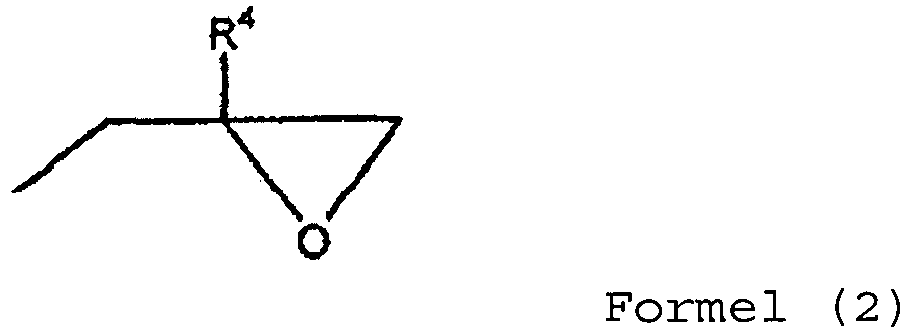
- E 1 , E 2 , and E 3 in Formula (1) is independently an epoxy-containing group of Formula (2), an organic group of Formula (3), or a hydrogen atom.
- the proportion of organic group of Formula (2) to the total number of moles of E 1 , E 2 , and E 3 is 85 to 98 mol% and is preferably 85 to 95 mol%.
- R 4 s each is a hydrogen atom or a methyl group.
- R 1 , R 2 , and R 3 are preferably C 1-3 alkylene groups, and E 1 , E 2 , and E 3 are preferably combinations of the epoxy-containing group of Formula (2) and the organic group of Formula (3) or a hydrogen atom.
- the compounds of Formula (1-1) to Formula (1-21) are preferable.
- An epoxy compound of Formula (1) to be used in the present invention can be obtained, for example, by the process below in the case of the compound of Formula (1-2).
- isocyanuric acid is converted to an isocyanuric acid Na salt using sodium hydroxide.
- This reaction can be carried out in water at 0 to 100°C for 1 to 10 hours.
- the isocyanuric acid Na salt and a halogenated alkene undergo a reaction to yield an alkene-substituted isocyanuric acid.
- This reaction can be carried out, for example, in a DMF (dimethylformamide) solvent at 0 to 150°C for 1 to 10 hours.
- X is a halogen atom, and a monobromoalkene or a monochloroalkene can be used as the halogenated alkene.
- the alkene-substituted isocyanuric acid can be oxidized with a peracid to yield an epoxy compound.
- M-chloroperoxybenzoic acid, peracetic acid, hydrogen peroxide-tungstate, or the like can be used as the peracid.
- This reaction can be carried out in a solvent such as methylene chloride and toluene at 0 to 110°C for 1 to 10 hours.
- the compounds of Formula (1-1), Formula (1-3), Formula (1-6) to Formula (1-8), and Formula (1-11) to Formula (1-13) can also be synthesized by the same process.
- An epoxy compound of Formula (1) to be used in the present invention can be obtained, for example, by the process below in the case of the compound of Formula (1-4).
- a hydroxyalkyl isocyanurate and epihalohydrin undergo a reaction to yield tris(alkyleneoxyglycidyl)isocyanurate.
- the hydroxyalkyl isocyanurate include hydroxyethyl isocyanurate and the like
- examples of the epihalohydrin include epichlorohydrin, epibromohydrin, and the like.
- the reaction is carried out in a solvent such as dioxane using BF 3 or tin chloride as a catalyst at 0 to 100°C for 1 to 10 hours.
- the compounds of Formula (1-5), Formula (1-9), Formula (1-10), Formula (1-14), and Formula (1-15) can also be synthesized by the same process.
- Methyl- and alkenyl-substituted isocyanuric acids as precursors of the compounds of Formula (1-16) to Formula (1-21) are obtained as mixtures with trialkenyl-substituted isocyanuric acids by the reaction of isocyanuric acid with a halogenated alkene.
- This reaction can be carried out, for example, in the presence of potassium carbonate in N,N-dimethylimidazolidinone at 0 to 150°C for 1 to 20 hours.
- potassium hydrogen carbonate, sodium carbonate, and sodium hydrogen carbonate can be used as an inorganic base. It is assumed that, in this reaction, some of the methyl groups of N,N-dimethylimidazolidinone used as a solvent react with isocyanuric acid.
- the methyl- or alkenyl-substituted isocyanuric acid can be oxidized with a peracid to yield an epoxy compound.
- M-chloroperoxybenzoic acid, peracetic acid, hydrogen peroxide-tungstate, or the like can be used as the peracid.
- This reaction can be carried out in a solvent such as methylene chloride and toluene at 0 to 110°C for 1 to 20 hours.
- the present invention provides a thermosetting composition including an epoxy compound (A) of Formula (1) and an epoxy compound (B) having at least two epoxy groups and a structure different from that of the epoxy compound (A), with a mass ratio (A) / [(A) + (B)] of the epoxy compound (A) relative to the total mass of the epoxy compound (A) and the epoxy compound (B) of not smaller than 1% by mass and preferably of not smaller than 1.5% by mass.
- This mass ratio (A) / [(A) + (B)] can be 100% by mass, in other words, the epoxy compound (A) can be used alone.
- the ratio can be in the range of up to 50% by mass.
- the epoxy compound (B) is an epoxy compound of Formula (4) or Formula (5), and is a compound that has two to five epoxy groups in a molecule.
- n and m are integers of 2 to 5
- T is a divalent to pentavalent organic group
- the organic group is a substituted or unsubstituted alkylene group, oxyalkylene group, arylene group, oxyarylene group, triazinetrione ring, oxycarbonyl group, or a combination of these. Examples of the epoxy compounds of Formula (4) and Formula (5) will be shown below.
- a liquid epoxy compound (Formula (4-1), manufactured by Nissan Chemical Industries, Ltd., trade name: TEPIC-PAS B22) obtained by modifying 1 mol of tris-(2,3-epoxypropyl)-isocyanurate by adding 0.8 mol of propionic anhydride thereto
- Formula (4-1) expresses a mixture containing the compound of Formula (4-1-1), the compound of Formula (4-1-2), the compound of Formula (4-1-3), and the compound of Formula (4-1-4) in a molar ratio (4-1-1) : (4-1-2) : (4-1-3) : (4-1-4) of about 35% : 45% : 17% : 3%.
- the viscosity on production at 60°C is 1800 mPas and the viscosity after 90 days at 60°C is 1900 mPas, which means the mixture is stable.
- a liquid epoxy compound (Formula (4-2), manufactured by Nissan Chemical Industries, Ltd., trade name TEPIC-PAS B26) obtained by modifying 1 mol of tris-(2,3-epoxypropyl)-isocyanurate by adding 0.4 mol of propionic anhydride thereto
- Formula (4-2) expresses a mixture including the compound of Formula (4-2-1), the compound of Formula (4-2-2), and the compound of Formula (4-2-3) in a molar ratio (4-2-1): (4-2-2): (4-2-3) of about 60% : about 32%: about 8%.
- the viscosity on production at 60°C is 2800 mPas, and the viscosity after 90 days at 60°C is 3000 mPas, which means the mixture is stable.
- a solid epoxy compound, tris-(2,3-epoxypropyl)-isocyanurate (Formula (4-3), trade name TEPIC, manufactured by Nissan Chemical Industries, Ltd.)
- a liquid epoxy compound trade name Epicoat 828 (Formula (4-4), manufactured by Japan Epoxy Resin Co., Ltd.)
- a liquid epoxy compound trade name YX8000 (Formula (4-5), manufactured by Japan Epoxy Resin Co., Ltd.)
- a liquid epoxy compound trade name DME100 (Formula (4-6), manufactured by New Japan Chemical Co., Ltd.)
- a liquid epoxy compound trade name CE-202IP (Formula (5-1), manufactured by DAICEL Co., LTD.)
- a curing agent can be incorporated in a proportion of 0.5 to 1.5 equivalents and preferably 0.8 to 1.2 equivalents to the epoxy group of the epoxy compound.
- the equivalent value of the curing agent relative to that of the epoxy compound is shown as the equivalent ratio of a curing group in the curing agent relative to the epoxy group.
- curing agent examples include phenol resins, amines, polyamide resins, imidazoles, polymercaptans, acid anhydrides, and the like. Acid anhydrides and amines are particularly preferable.
- the curing agents When the curing agents are solid, they can be used by dissolving them in solvent, however, a decrease in density of the cured product caused by the evaporation of the solvent and decreases in strength and in water resistance caused by the formation of pores occur. Therefore, the curing agent is preferably liquid at normal temperature and under normal pressure.
- phenol resin examples include phenol novolac resins, cresol novolac resins, and the like.
- amine examples include piperidine, N,N-dimethylpiperazine, triethylenediamine, 2,4,6-tris(dimethylaminomethyl)phenol, benzyldimethylamine, 2-(dimethylaminomethyl)phenol, diethylenetriamine, triethylenetetramine, tetraethylenepentamine, diethylaminopropylamine, N-aminoethyl piperazine, di(1-methyl-2-aminocyclohexyl)methane, menthenediamine, isophoronediamine, diaminodicyclohexylmethane, 1,3-diaminomethylcyclohexane, xylenediamine, m-phenylenediamine, diaminodiphenylmethane, diaminodiphenylsulfone, and the like.
- diethylenetriamine triethylenetetramine, tetraethylenepentamine, diethylaminopropylamine, N-aminoethyl piperazine, di(1-methyl-2-aminocyclohexyl)methane, menthenediamine, isophoronediamine, diaminodicyclohexylmethane, and the like, which are liquid, can be preferably used.
- polyamide resin examples include polyamidoamines having a primary amine and a secondary amine in a molecule and resulting from the condensation of a dimer acid and a polyamine.
- imidazole examples include 2-methylimidazole, 2-ethyl-4-methylimidazole, 1-cyanoethyl-2-undecylimidaxolium trimellitate, epoxy imidazole adducts, and the like.
- the polymercaptan has, for example, a polypropylene glycol chain containing a terminal mercaptan group or a polyethylene glycol chain containing a terminal mercaptan group, and is preferably liquid.
- the acid anhydride is preferably an anhydride of a compound having a plurality of carboxy groups in a molecule.
- the acid anhydride include phthalic anhydride, trimellitic anhydride, pyromellitic anhydride, benzophenonetetracarboxylic anhydride, ethylene glycol bistrimellitate, glycerol tristrimellitate, maleic anhydride, tetrahydrophthalic anhydride, methyltetrahydrophthalic anhydride, endomethylene tetrahydrophthalic anhydride, methyl endomethylene tetrahydrophthalic anhydride, methylbutenyltetrahydrophthalic anhydride, dodecenyl succinic anhydride, hexahydrophthalic anhydride, methylhexahydrophthalic anhydride, succinic anhydride, methylcyclohexenedicarboxylic anhydride, chlorendic anhydride, and the like.
- methyltetrahydrophthalic anhydride methyl-5-norbornene-2,3-dicarboxylic anhydride (methylnadic anhydride, methylhimic anhydride), hydrogenated methylnadic anhydride, methylbutenyltetrahydrophthalic anhydride, dodecenyl succinic anhydride, methylhexahydrophthalic anhydride, and a mixture of methylhexahydrophthalic anhydride and hexahydrophthalic anhydride, which are liquid at normal temperature and under normal pressure, are preferable.
- the viscosities of these liquid acid anhydrides are about 10 mPas, to 1000 mPas as measured at 25°C.
- a curing aid may be concurrently used, as needed, to obtain the cured product.
- the curing aid include organophosphorus compounds such as triphenylphosphine and tributylphosphine, quaternary phosphonium salts such as ethyltriphenylphosphonium bromide and diethyl methyltriphenylphosphoniumphosphate, 1,8-diazabicyclo(5,4,0)undecan-7-ene, a salt of 1,8-diazabicyclo(5,4,0)undecan-7-ene and octylic acid, zinc octoate, and quaternary ammonium salts such as tetrabutylammonium bromide.
- the curing aid can be incorporated in a proportion of 0.001 to 0.1 parts by mass to 1 part by mass of the curing agent.
- the epoxy compound of Formula (1), the curing agent and, when needed, the curing aid are mixed to obtain a thermosetting composition.
- the epoxy compound (A), the epoxy compound (B) having at least two epoxy groups and having a structure different from that of the epoxy compound (A), the curing agent and, when needed, the curing aid are mixed to obtain a thermosetting composition.
- the mixing can be performed using a reaction flask and a stirring blade.
- the mixing is performed by heat mixing and is performed at a temperature of 60°C to 100°C for 0.5 to 1 hours.
- the obtained liquid epoxy resin composition (thermosetting composition) has viscosity suitable for use as a liquid sealant.
- the liquid thermosetting composition can be prepared to have any viscosity, and coating thereof can be performed by a casting method, a potting method, a dispensing method, a printing method, or the like.
- the composition when used as a transparent sealant for LEDs or the like, the composition can partly seal any desired area on the LEDs or the like.
- the liquid thermosetting composition is coated to a base material such as LEDs directly as liquid by the above method, is then dried, and is heated at a temperature of 100 to 200°C, and therefore a cured resin article is obtained.
- the product was thoroughly washed with a 10% aqueous solution of sodium hydrogen sulfite and a solution of saturated sodium hydrogen carbonate, then dried, and the solvent was distilled off to obtain a crude product.
- the crude product can be purified by silica gel chromatography to obtain 161.7 g of a transparent oil.
- the obtained epoxy compound was tris(4,5-epoxypentyl) isocyanurate of Formula (1-2).
- Potentiometric titration for epoxy value was performed using a 0.1 mol/L perchloric acid/acetic acid solution, and the epoxy purity measured by potentiometric titration was 98%, and the epoxy compound was a mixture of the compounds of Formula (1-2), Formula (1-7), and Formula (1-12).
- the epoxy compound was called (i-1).
- Tris-(2,3-epoxypropyl)-isocyanurate (manufactured by Nissan Chemical Industries, Ltd., trade name TEPIC) of (Formula (4-3) was prepared. It was called an epoxy compound (i-5).
- a liquid epoxy (trade name TEPIC-PAS B22, manufactured by Nissan Chemical Industries, Ltd.) was prepared.
- the composition of the obtained modified liquid epoxy resin was as shown in Formula (4-1). Referring tris-(2,3-epoxypropyl)-isocyanurate as a compound (4-1-1), tris-(2,3-epoxypropyl)-isocyanurate (monoadduct) in which one molecule of propionic anhydride is added to one epoxy group of tris-(2,3-epoxypropyl)-isocyanurate as a compound (4-1-2), tris-(2,3-epoxypropyl)-isocyanurate (diadduct) in which two molecules af propionic anhydride are added to two epoxy groups of tris-(2,3-epoxypropyl)-isocyanurate as a compound (4-1-3), and tris-(2,3-epoxypropyl)-isocyanurate (triadduct) in which three molecules of propionic anhydride are added to three epoxy groups of tris-(2,3-epoxypropyl)
- the viscosity of the modified epoxy resin on production at 60°C was 1800 mPas and the viscosity after 90 days at 60°C was 1900 mPas, which means the modified epoxy resin was stable.
- the epoxy compound was called (i-6).
- a liquid epoxy (trade name TEPIC-PAS B26, manufactured by Nissan Chemical Industries, Ltd.) was prepared.
- the composition of the obtained modified liquid epoxy resin was as shown in Formula (4-2).
- tris-(2,3-epoxypropyl)-isocyanurate as a compound (4-2-1)
- tris-(2,3-epoxypropyl)-isocyanurate (monoadduct) in which one molecule of propionic anhydride is added to one epoxy group of tris-(2,3-epoxypropyl)-isocyanurate as a compound (4-2-2)
- the molar ratio (4-2-1) : (4-2-2): (4-2-3) of the compound (4-2-1) to the compound (4-2-3) in the modified epoxy resin was 60% : 32% : 8%.
- the viscosity of the modified epoxy resin on production at 60°C was 2800 mPas and the viscosity after 90 days at 60°C was 3000 mPas, which means the modified epoxy resin was stable.
- the modified epoxy resin was called an epoxy compound (i-7).
- a liquid epoxy compound, trade name CE-2021P (manufactured by DAICEL Co., LTD.) of Formula (4-7) was obtained. It was called an epoxy compound (i-8).
- Potentiometric titration for epoxy value was performed using a 0.1 mol/L perchloric acid/acetic acid solution, and the epoxy purity measured by potentiometric titration was 95%, and the epoxy compound was a mixture of the compounds of Formula (1-2), Formula (1-18), and Formula (1-19).
- the epoxy compound was called (i-9).
- a mixture (trade name RIKACID MH-700, manufactured by New Japan Chemical Co., Ltd.) of 4-methylhexahydraphthalic anhydride (70 mol%) and hexahydrophthalic anhydride (30 mol%) was prepared. It was called a curing agent (ii-1).
- Tetrabutylphosphonium O,O'-diethylphosphadithiolate (trade name HISHICOLIN PX-4ET, manufactured by Nippon Chemical Industrial Co., Ltd.) was prepared. It was called a curing accelerator (iii-1).
- thermosetting composition 22.0 g of the epoxy compound (i-1) and 27.85 g of the curing agent (ii-1) were placed in a four-necked flask, and defoaming was performed at 80°C for 30 minutes with stirring, followed by adding 0.23 g of the curing accelerator (iii-1) thereto to obtain a thermosetting composition.
- the obtained thermosetting composition was heated at 100°C for 2 hours and was then heated at 150°C for 5 hours to obtain a cured product.
- thermosetting composition 25.0 g of the epoxy compound (i-3) and 28.8 g of the curing agent (ii-1) were placed in a four-necked flask, and defoaming was performed at 80°C for 30 minutes with stirring, followed by adding 0.26 g of the curing accelerator (iii-1) thereto to obtain a thermosetting composition.
- the obtained thermosetting composition was heated at 100°C for 2 hours and was then heated at 150°C for 5 hours to obtain a cured product.
- thermosetting composition 0.44 g of the epoxy compound (i-3), 27.1 g of the epoxy compound (i-6), and 25.4 g of the curing agent (ii-1) were placed in a four-necked flask, and defoaming was performed at 80°C for 30 minutes with stirring, followed by adding 0.275 g of the curing accelerator (iii-1) thereto to obtain a thermosetting composition.
- the obtained thermosetting composition was heated at 100°C for 2 hours and was then heated at 150°C for 5 hours to obtain a cured product.
- Curing was performed in the same manner as in the case of Example 3 by matching an epoxy value with the equivalent of a curing agent except that the proportion of the epoxy compound (i-3) to the epoxy compound (i-6) was changed to 0.86 g : 28.1 g in Example 4, 1.43 g : 27.2 g in Example 5, 2.57 g : 26.0 g in Example 6, and 4.44 g : 25.3 g in Example 7.
- thermosetting composition 0.37 g of the epoxy compound (i-3), 24.3 g of the epoxy compound (i-8), and 31.25 g of the curing agent (ii-1) were placed in a four-necked flask, and defoaming was performed at 80°C for 30 minutes with stirring, followed by adding 0.245 g of the curing accelerator (iii-1) thereto to obtain a thermosetting composition.
- the obtained thermosetting composition was heated at 100°C for 2 hours and was then heated at 150°C for 5 hours to obtain a cured product.
- Curing was performed in the same manner as in the case of Example 8 by matching an epoxy value with the equivalent of a curing agent except that the proportion of the epoxy compound (i-3) to the epoxy compound (i-8) was changed to 0.8 g : 25.9 g in Example 9, 1.26 g : 23.95 g in Example 10, 2.23 g : 22.2 g in Example 11, and 3.82 g: 21.5 g in Example 12.
- thermosetting composition 0.4 g of the epoxy compound (i-3), 25.75 g of the epoxy compound (i-7), and 31.65 g of the curing agent (ii-1) were placed in a four-necked flask, and defoaming was performed at 80°C for 30 minutes with stirring, followed by adding 0.26 g of the curing accelerator (iii-1) thereto to obtain a thermosetting composition.
- the obtained thermosetting composition was heated at 100°C for 2 hours and was then heated at 150°C for 5 hours to obtain a cured product.
- Curing was performed in the same manner as in the case of Example 13 by matching an epoxy value with the equivalent of a curing agent except that the proportion of the epoxy compound (i-3) to the epoxy compound (i-7) was changed to 0.83 g : 25.8 g in Example 14, 1.3 g : 24.05 g in Example 15, and 2.3 g : 23.0 g in Example 16.
- thermosetting composition 0.3 g of the epoxy compound (i-3), 19.7 g of the epoxy compound (i-5), and 32.7 g of the curing agent (ii-1) were placed in a four-necked flask, and defoaming was performed at 80°C for 30 minutes with stirring, followed by adding 0.2 g of the curing accelerator (iii-1) thereto to obtain a thermosetting composition.
- the obtained thermosetting composition was heated at 100°C for 2 hours and was then heated at 150°C for 5 hours to obtain a cured product.
- Curing was performed in the same manner as in the case of Example 17 by matching an epoxy value with the equivalent of a curing agent except that the proportion of the epoxy compound (i-3) to the epoxy compound (i-5) was changed to 0.67 g : 21.65 g in Example 18, 1.17 g : 22.2 g in Example 19, and 1.98 g : 19.8 g in Example 20.
- thermosetting composition 22.0 g of the epoxy compound (i-9) and 27.85 g of the curing agent (ii-1) were placed in a four-necked flask, and defoaming was performed at 80°C for 30 minutes with stirring, followed by adding 0.23 g of the curing accelerator (iii-1) thereto to obtain a thermosetting composition.
- the obtained thermosetting composition was heated at 100°C for 2 hours and was then heated at 150°C for 5 hours to obtain a cured product.
- thermosetting composition 24.25 g of the epoxy compound (i-2) and 30.75 g of the curing agent (ii-1) were placed in a four-necked flask, and defoaming was performed at 80°C for 30 minutes with stirring, followed by adding 0.25 g of the curing accelerator (iii-1) thereto to obtain a thermosetting composition.
- the obtained thermosetting composition was heated at 100°C for 2 hours and was then heated at 150°C for 5 hours to obtain a cured product.
- thermosetting composition 25.05 g of the epoxy compound (i-4) and 26.5 g of the curing agent (ii-1) were placed in a four-necked flask, and defoaming was performed at 80°C for 30 minutes with stirring, followed by adding 0.25 g of the curing accelerator (iii-1) thereto to obtain a thermosetting composition.
- the obtained thermosetting composition was heated at 100°C for 2 hours and was then heated at 150°C for 5 hours to obtain a cured product.
- thermosetting composition 30.25 g of the epoxy compound (i-6) and 27.75 g of the curing agent (ii-1) were placed in a four-necked flask, and defoaming was performed at 80°C for 30 minutes with stirring, followed by adding 0.3 g of the curing accelerator (iii-1) thereto to obtain a thermosetting composition.
- the obtained thermosetting composition was heated at 100°C for 2 hours and was then heated at 150°C for 5 hours to obtain a cured product.
- thermosetting composition 24.6 g of the epoxy compound (i-8) and 31.15 g of the curing agent (ii-1) were placed in a four-necked flask, and defoaming was performed at 80°C for 30 minutes with stirring, followed by adding 0.25 g of the curing accelerator (iii-1) thereto to obtain a thermosetting composition.
- the obtained thermosetting composition was heated at 100°C for 2 hours and was then heated at 150°C for 5 hours to obtain a cured product.
- thermosetting composition 26.35 g of the epoxy compound (i-7) and 31.85 g of the curing agent (ii-1) were placed in a four-necked flask, and defoaming was performed at 80°C for 30 minutes with stirring, followed by adding 0.26 g of the curing accelerator (iii-1) thereto to obtain a thermosetting composition.
- the obtained thermosetting composition was heated at 100°C for 2 hours and was then heated at 150°C for 5 hours to obtain a cured product.
- thermosetting composition 20.0 g of the epoxy compound (i-5) and 32.8 g of the curing agent (ii-1) were placed in a four-necked flask, and defoaming was performed at 80°C for 30 minutes with stirring, followed by adding 0.2 g of the curing accelerator (iii-1) thereto to obtain a thermosetting composition.
- the obtained thermosetting composition was heated at 100°C for 2 hours and was then heated at 150°C for 5 hours to obtain a cured product.
- the obtained cured products were subjected to a three-point bending test (for flexural strength and flexural moduli), and transmittance, linear expansion, glass transition temperature, and boiling water absorption were measured.
- a flexural modulus (E): (MPa) ⁇ kgf/mm 2 ⁇ is determined by the equation below using F/Y: gradient (N/mm) ⁇ kgf/mm ⁇ of linear part of load-deflection curve.
- E L 3 / 4 W h 3 ⁇ F / Y
- Transmittance at 400 nm was measured using a spectrophotometer.
- a coefficient of linear expansion ⁇ 1 is determined by the equation below using ⁇ L1: amount of change in length of specimen when temperature is raised from 30°C to 80°C, and L: initial length.
- ⁇ 1 ⁇ L 1 / initial length L of specimen ⁇ 50
- Measurements were performed according to JIS K-6911. A specimen is subjected to drying treatment for 24 hours in a thermostat maintained at 50°C. After the treatment, the specimen is cooled to 20°C in a desiccator, and the mass is measured. The specimen is placed in boiling distilled water to be boiled for 100 hours, and is then taken out, followed by cooling in running water at 20°C for 30 minutes and wiping off moisture to immediately measure the mass after water absorption.
- Boiling water absorption (%) is determined by the equation below using A: boiling water absorption (%), W 1 : mass (g) of specimen before boiling, and W 2 : mass (g) of specimen after boiling.
- A W 2 ⁇ W 1 / W 1 ⁇ 100
- Example 1 (with epoxy purity of 98 mol%) and Example 2 (with epoxy purity of 89 mol%) are higher in flexural strength and lower in boiling water absorption of the cured product compared to the cured product of Comparative Example 1 (with epoxy purity of 99 mol%).
- the coefficients of linear expansion of the cured products of Example 1 and Example 2 are in a certain range, and therefore these cured products can be stably used against thermal changes.
- cured products obtained with a certain range of epoxy purity show superiority in strength. This indicates that the physical property of a cured product is affected not only by the crosslinking of the epoxy groups but also by a certain proportion of allyl groups that substitute for the epoxy groups.
- Example 21 From the results in Example 21, it is considered that, in a structure in which 2 to 15 mol% of the nitrogen atoms in Formula (1) was substituted with organic groups (for example, alkyl groups such as a methyl group), the three-dimensional crosslinking was partly loosened, the toughness was enhanced, and the strength was enhanced as compared with a structure in which all of the three nitrogen atoms in Formula (1) were bonded with epoxy rings via long chain alkylene groups.
- organic groups for example, alkyl groups such as a methyl group
- Example 1 (with epoxy purity of 98 mol%) and Example 2 (with epoxy purity of 89 mol%) were higher in flexural strength compared to the cured product of Comparative Example 2 (with epoxy purity of 82 mol%) and, at the epoxy purity value in Comparative Example 2, the flexural strength of the cured product decreased.
- the mass ratio (A) / (A+B) is not smaller than 1% by mass and is preferably 1.5 to 50% by mass. Applying this proportion, flexural strength can be enhanced while retaining the values of transmittance and boiling water absorption of the cured product, compared to using the epoxy (B) alone.
Landscapes
- Chemical & Material Sciences (AREA)
- Health & Medical Sciences (AREA)
- Chemical Kinetics & Catalysis (AREA)
- Medicinal Chemistry (AREA)
- Polymers & Plastics (AREA)
- Organic Chemistry (AREA)
- Epoxy Resins (AREA)
Claims (7)
- Wärmehärtbare Zusammensetzung, umfassend:eine Epoxidverbindung (A) der Formel (1):

 worin R4 ein Wasserstoffatom oder eine Methylgruppe ist, oderein Wasserstoffatom sind und ein Anteil der organischen Gruppe der Formel (2) 85 bis 98 Mol-% zur Gesamtzahl der Mole von E1, E2 und E3 beträgt, undein Härtungsmittel, das in einem Anteil von 0,5 bis 1,5 Äquivalenten zur Epoxid-Gruppe in der Epoxidverbindung (A) enthalten ist.
 - Wärmehärtbare Zusammensetzung gemäß Anspruch 1, wobei R1, R2 und R3 C1-3-Alkylengruppen sind, E1, E2 und E3 Kombinationen der Epoxid-haltigen Gruppe der Formel (2) und der organischen Gruppe der Formel (3) oder des Wasserstoffatoms sind.
- Wärmehärtbare Zusammensetzung, umfassend:eine Epoxidverbindung (A), wie in Anspruch 1 oder 2 definiert; undeine Epoxidverbindung (B), die mindestens zwei Epoxidgruppen enthält und eine Struktur aufweist, die von der Struktur der Epoxidverbindung (A) verschieden ist,mit einem Massenverhältnis (A)/[(A)+(B)] der Epoxidverbindung (A) zu der Gesamtmasse der Epoxidverbindung (A) und der Epoxidverbindung (B) von nicht weniger als 1 Massen-%.
- Wärmehärtbare Zusammensetzung gemäß Anspruch 3, wobei Epoxidverbindung (B) eine Verbindung der Formel (4):


- Wärmehärtbare Zusammensetzung gemäß Anspruch 3 oder 4, wobei ein Härtungsmittel in einem Anteil von 0,5 bis 1,5 Äquivalenten zur Epoxidgruppe enthalten ist.
- Wärmehärtbare Zusammensetzung gemäß Anspruch 1, Anspruch 2 oder Anspruch 5, wobei das Härtungsmittel ein Säureanhydrid oder ein Amin ist.
- Wärmehärtbare Zusammensetzung gemäß Anspruch 1, Anspruch 2, Anspruch 5 oder Anspruch 6, wobei ein Härtungshilfsmittel in einem Anteil von 0,001 bis 0,1 Äquivalenten zur Epoxidgruppe enthalten ist.
Applications Claiming Priority (2)
| Application Number | Priority Date | Filing Date | Title |
|---|---|---|---|
| JP2009028250 | 2009-02-10 | ||
| PCT/JP2010/051865 WO2010092947A1 (ja) | 2009-02-10 | 2010-02-09 | 長鎖アルキレン基含有エポキシ化合物 |
Publications (3)
| Publication Number | Publication Date |
|---|---|
| EP2397507A1 EP2397507A1 (de) | 2011-12-21 |
| EP2397507A4 EP2397507A4 (de) | 2016-08-03 |
| EP2397507B1 true EP2397507B1 (de) | 2017-09-20 |
Family
ID=42561789
Family Applications (1)
| Application Number | Title | Priority Date | Filing Date |
|---|---|---|---|
| EP10741224.9A Active EP2397507B1 (de) | 2009-02-10 | 2010-02-09 | Epoxidverbindung mit langkettiger alkylengruppe |
Country Status (7)
| Country | Link |
|---|---|
| US (1) | US8912295B2 (de) |
| EP (1) | EP2397507B1 (de) |
| JP (1) | JP5553027B2 (de) |
| KR (1) | KR101668301B1 (de) |
| CN (1) | CN102317343B (de) |
| TW (1) | TWI477498B (de) |
| WO (1) | WO2010092947A1 (de) |
Families Citing this family (26)
| Publication number | Priority date | Publication date | Assignee | Title |
|---|---|---|---|---|
| WO2011093188A1 (ja) * | 2010-01-26 | 2011-08-04 | 日産化学工業株式会社 | ポジ型レジスト組成物及びマイクロレンズの製造方法 |
| US8778597B2 (en) * | 2010-01-26 | 2014-07-15 | Nissan Chemical Industries, Ltd. | Long-chain alkylene-containing curable epoxy resin composition |
| JP5638812B2 (ja) * | 2010-02-01 | 2014-12-10 | 株式会社ダイセル | 硬化性エポキシ樹脂組成物 |
| JP5900747B2 (ja) * | 2010-08-05 | 2016-04-06 | 日産化学工業株式会社 | シアヌル酸骨格を有するエポキシ化合物の製造方法 |
| KR101821574B1 (ko) * | 2010-08-05 | 2018-01-25 | 닛산 가가쿠 고교 가부시키 가이샤 | 질소 함유 고리를 갖는 에폭시 화합물 |
| KR101926076B1 (ko) * | 2011-03-23 | 2018-12-06 | 닛산 가가쿠 가부시키가이샤 | 다관능 에폭시 화합물 |
| KR101923244B1 (ko) * | 2011-07-13 | 2018-11-28 | 주식회사 다이셀 | 경화성 에폭시 수지 조성물 |
| WO2013011832A1 (ja) * | 2011-07-20 | 2013-01-24 | 株式会社ダイセル | 硬化性エポキシ樹脂組成物 |
| KR101252063B1 (ko) | 2011-08-25 | 2013-04-12 | 한국생산기술연구원 | 알콕시실릴기를 갖는 에폭시 화합물, 이의 제조 방법, 이를 포함하는 조성물과 경화물 및 이의 용도 |
| KR101984538B1 (ko) * | 2011-09-29 | 2019-05-31 | 닛산 가가쿠 가부시키가이샤 | 광경화성 수지 조성물 |
| CN103906753B (zh) | 2011-11-01 | 2017-02-15 | 韩国生产技术研究院 | 含烷氧基甲硅烷基的异氰脲酸酯环氧化合物、它的制备方法、包括它的组合物、组合物的固化产物和组合物的应用 |
| JP2013189504A (ja) * | 2012-03-12 | 2013-09-26 | Showa Denko Kk | 液状組成物 |
| WO2013137663A1 (ko) | 2012-03-14 | 2013-09-19 | 한국생산기술연구원 | 알콕시실릴기를 갖는 에폭시 화합물, 이를 포함하는 조성물, 경화물, 이의 용도 및 알콕시실릴기를 갖는 에폭시 화합물의 제조방법 |
| WO2013151308A1 (ko) | 2012-04-02 | 2013-10-10 | 한국생산기술연구원 | 알콕시실릴기를 갖는 에폭시 화합물, 이를 포함하는 조성물, 경화물, 이의 용도 및 알콕시실릴기를 갖는 에폭시 화합물의 제조방법 |
| JP6118313B2 (ja) * | 2012-04-03 | 2017-04-19 | 株式会社ダイセル | 硬化性エポキシ樹脂組成物 |
| KR101863111B1 (ko) | 2012-07-06 | 2018-06-01 | 한국생산기술연구원 | 노볼락계 에폭시 화합물, 이의 제조 방법, 이를 포함하는 조성물, 경화물 및 이의 용도 |
| JP5703429B1 (ja) * | 2013-10-30 | 2015-04-22 | 積水化学工業株式会社 | 有機el表示素子用封止剤 |
| WO2015064410A1 (ja) * | 2013-10-30 | 2015-05-07 | 積水化学工業株式会社 | 有機el表示素子用封止剤 |
| JP2015098519A (ja) * | 2013-11-18 | 2015-05-28 | 住友ベークライト株式会社 | 樹脂組成物、部材、光学装置および電子装置 |
| JP6460714B2 (ja) * | 2014-10-10 | 2019-01-30 | 株式会社ダイセル | 硬化性樹脂組成物及びその硬化物、並びに半導体装置 |
| JP6533387B2 (ja) * | 2014-12-26 | 2019-06-19 | 株式会社ダイセル | 硬化性樹脂組成物及びその硬化物、並びに半導体装置 |
| KR102494437B1 (ko) * | 2015-11-10 | 2023-02-01 | 닛산 가가쿠 가부시키가이샤 | 장쇄 알킬렌기함유 에폭시 수지 조성물 |
| JP7229028B2 (ja) * | 2019-01-30 | 2023-02-27 | 日産化学株式会社 | N-モノ(炭化水素)イソシアヌル酸の製造方法 |
| KR102232340B1 (ko) | 2019-11-15 | 2021-03-26 | 한국생산기술연구원 | 알콕시실릴기를 갖는 에폭시 수지의 조성물 및 이의 복합체 |
| JP2023103095A (ja) * | 2022-01-13 | 2023-07-26 | 日産化学株式会社 | 長鎖アルキレン基含有エポキシ化合物含有シリカゾル |
| CN117586243A (zh) * | 2023-11-21 | 2024-02-23 | 上海玟昕科技有限公司 | 一种三缩水甘油异氰脲酸酯环氧树脂及其制备方法和应用 |
Family Cites Families (17)
| Publication number | Priority date | Publication date | Assignee | Title |
|---|---|---|---|---|
| JPS5638223A (en) * | 1979-09-07 | 1981-04-13 | Teijin Ltd | Preparation of polyester laminate film |
| US4369207A (en) * | 1979-02-23 | 1983-01-18 | Teijin Limited | Process for production of laminated film structure of aromatic polyester |
| AT372382B (de) * | 1980-08-14 | 1983-09-26 | Henkel Kgaa | Verfahren zur herstellung von neuen oxiranylisocyanursaeureverbindungen |
| JP3344228B2 (ja) * | 1996-07-29 | 2002-11-11 | 松下電工株式会社 | 積層板用エポキシ樹脂組成物 |
| JP2001181370A (ja) | 1999-12-27 | 2001-07-03 | Asahi Kasei Epoxy Kk | 硬化性脂環基含有化合物およびその組成物 |
| KR100522002B1 (ko) | 2003-09-22 | 2005-10-18 | 주식회사 코오롱 | 액상 포토 솔더 레지스트 조성물 및 이로부터 제조된 포토솔더 레지스트 필름 |
| JP2005306952A (ja) | 2004-04-20 | 2005-11-04 | Japan Epoxy Resin Kk | 発光素子封止材用エポキシ樹脂組成物 |
| EP1795558B1 (de) * | 2004-09-29 | 2009-12-02 | Nissan Chemical Industries, Ltd. | Zusammensetzung auf basis von modifiziertem epoxidharz |
| US20100104794A1 (en) | 2005-08-04 | 2010-04-29 | Shin-Etsu Chemical Co., Ltd. | Thermosetting epoxy resin composition and semiconductor device |
| US20070295956A1 (en) | 2006-06-27 | 2007-12-27 | Gelcore Llc | Optoelectronic device |
| JP2008007782A (ja) | 2006-06-27 | 2008-01-17 | Lumination Llc | オプトエレクトロニックデバイス |
| US20070295983A1 (en) | 2006-06-27 | 2007-12-27 | Gelcore Llc | Optoelectronic device |
| US20070299162A1 (en) | 2006-06-27 | 2007-12-27 | Gelcore Llc | Optoelectronic device |
| KR20100037616A (ko) * | 2007-07-11 | 2010-04-09 | 닛산 가가쿠 고교 가부시키 가이샤 | 무기입자를 함유하는 액상 에폭시수지 형성용 제제 |
| US8221965B2 (en) * | 2008-07-08 | 2012-07-17 | Az Electronic Materials Usa Corp. | Antireflective coating compositions |
| WO2011093188A1 (ja) * | 2010-01-26 | 2011-08-04 | 日産化学工業株式会社 | ポジ型レジスト組成物及びマイクロレンズの製造方法 |
| JP2012025688A (ja) * | 2010-07-22 | 2012-02-09 | National Institute Of Advanced Industrial Science & Technology | エポキシ化合物の製造方法 |
-
2010
- 2010-02-09 EP EP10741224.9A patent/EP2397507B1/de active Active
- 2010-02-09 JP JP2010550518A patent/JP5553027B2/ja active Active
- 2010-02-09 CN CN2010800071647A patent/CN102317343B/zh active Active
- 2010-02-09 WO PCT/JP2010/051865 patent/WO2010092947A1/ja not_active Ceased
- 2010-02-09 KR KR1020117020738A patent/KR101668301B1/ko active Active
- 2010-02-09 US US13/148,823 patent/US8912295B2/en active Active
- 2010-02-10 TW TW099104173A patent/TWI477498B/zh active
Non-Patent Citations (1)
| Title |
|---|
| None * |
Also Published As
| Publication number | Publication date |
|---|---|
| TW201035085A (en) | 2010-10-01 |
| US8912295B2 (en) | 2014-12-16 |
| EP2397507A1 (de) | 2011-12-21 |
| EP2397507A4 (de) | 2016-08-03 |
| US20110319589A1 (en) | 2011-12-29 |
| KR101668301B1 (ko) | 2016-10-21 |
| CN102317343B (zh) | 2013-07-31 |
| JPWO2010092947A1 (ja) | 2012-08-16 |
| JP5553027B2 (ja) | 2014-07-16 |
| TWI477498B (zh) | 2015-03-21 |
| KR20110132364A (ko) | 2011-12-07 |
| WO2010092947A1 (ja) | 2010-08-19 |
| CN102317343A (zh) | 2012-01-11 |
Similar Documents
| Publication | Publication Date | Title |
|---|---|---|
| US8912295B2 (en) | Long chain alkylene group-containing epoxy compound | |
| KR102413953B1 (ko) | 에폭시 수지, 및 이것을 포함하는 에폭시 수지 조성물, 그리고 상기 에폭시 수지 조성물을 사용한 경화물 | |
| KR101848704B1 (ko) | 분지형 아민계 에폭시 수지 경화제와 이의 제조방법 및 이를 포함하는 에폭시 수지 조성물 | |
| JP5973401B2 (ja) | グリシジルグリコールウリル類とその利用 | |
| US3846442A (en) | Glycidyl hydantoin compounds | |
| KR20120089367A (ko) | 다이비닐아렌 옥사이드를 기제로 하는 부가제 | |
| KR102692138B1 (ko) | 에폭시 수지 조성물, 경화물 및 전기·전자 부품 | |
| EP2817347B1 (de) | Herstellung und verwendung von epoxidharzen cyclododecane polyphenole | |
| KR101217385B1 (ko) | 에폭시 수지, 에폭시 수지 조성물 및 그의 경화물 | |
| JP3573530B2 (ja) | エポキシ樹脂混合物、エポキシ樹脂組成物およびその硬化物 | |
| JP3880912B2 (ja) | 半導体封止用エポキシ樹脂組成物 | |
| KR20230028534A (ko) | 개선된 특성을 갖는 바이오소싱된 폴리에폭사이드를 수득하는 방법 | |
| JP5132036B2 (ja) | 液状エポキシ樹脂、エポキシ樹脂組成物及びその硬化物 | |
| JP2023026380A (ja) | エポキシ化合物とエポキシ樹脂及びその硬化物 | |
| JP4674884B2 (ja) | エポキシ樹脂の製造方法 | |
| EP2276770A1 (de) | Silylimidazol-salzkomplexe | |
| JP7711397B2 (ja) | エポキシ樹脂組成物、硬化物及び電気・電子部品 | |
| JPH04209623A (ja) | エポキシ樹脂組成物及びその硬化物 | |
| US20250340524A1 (en) | Polycrystalline form of biphenol diglycidyl ether, and resin composition containing said polycrystalline form and cured product thereof | |
| JPH0434558B2 (de) | ||
| EP4414401A1 (de) | Epoxidharzherstellungsverfahren, epoxidharzzusammensetzung, gehärtetes produkt und elektrische/elektronische komponente | |
| EP0525936A1 (de) | Beschleuniger für die Härtung von Epoxydharzen | |
| WO2021187235A1 (ja) | エポキシ樹脂組成物、硬化物及び電気・電子部品 | |
| JP2004300171A (ja) | エポキシ樹脂混合物およびその製造方法並びに硬化性エポキシ樹脂組成物 | |
| JP2004010878A (ja) | 液状エポキシ樹脂、エポキシ樹脂組成物及びその硬化物 |
Legal Events
| Date | Code | Title | Description |
|---|---|---|---|
| PUAI | Public reference made under article 153(3) epc to a published international application that has entered the european phase |
Free format text: ORIGINAL CODE: 0009012 |
|
| 17P | Request for examination filed |
Effective date: 20110905 |
|
| AK | Designated contracting states |
Kind code of ref document: A1 Designated state(s): AT BE BG CH CY CZ DE DK EE ES FI FR GB GR HR HU IE IS IT LI LT LU LV MC MK MT NL NO PL PT RO SE SI SK SM TR |
|
| DAX | Request for extension of the european patent (deleted) | ||
| RA4 | Supplementary search report drawn up and despatched (corrected) |
Effective date: 20160706 |
|
| RIC1 | Information provided on ipc code assigned before grant |
Ipc: C08G 59/20 20060101AFI20160630BHEP |
|
| GRAP | Despatch of communication of intention to grant a patent |
Free format text: ORIGINAL CODE: EPIDOSNIGR1 |
|
| INTG | Intention to grant announced |
Effective date: 20170526 |
|
| GRAS | Grant fee paid |
Free format text: ORIGINAL CODE: EPIDOSNIGR3 |
|
| GRAA | (expected) grant |
Free format text: ORIGINAL CODE: 0009210 |
|
| AK | Designated contracting states |
Kind code of ref document: B1 Designated state(s): AT BE BG CH CY CZ DE DK EE ES FI FR GB GR HR HU IE IS IT LI LT LU LV MC MK MT NL NO PL PT RO SE SI SK SM TR |
|
| REG | Reference to a national code |
Ref country code: GB Ref legal event code: FG4D |
|
| REG | Reference to a national code |
Ref country code: CH Ref legal event code: EP |
|
| REG | Reference to a national code |
Ref country code: AT Ref legal event code: REF Ref document number: 930064 Country of ref document: AT Kind code of ref document: T Effective date: 20171015 |
|
| REG | Reference to a national code |
Ref country code: IE Ref legal event code: FG4D |
|
| REG | Reference to a national code |
Ref country code: DE Ref legal event code: R096 Ref document number: 602010045369 Country of ref document: DE |
|
| REG | Reference to a national code |
Ref country code: NL Ref legal event code: MP Effective date: 20170920 |
|
| PG25 | Lapsed in a contracting state [announced via postgrant information from national office to epo] |
Ref country code: SE Free format text: LAPSE BECAUSE OF FAILURE TO SUBMIT A TRANSLATION OF THE DESCRIPTION OR TO PAY THE FEE WITHIN THE PRESCRIBED TIME-LIMIT Effective date: 20170920 Ref country code: HR Free format text: LAPSE BECAUSE OF FAILURE TO SUBMIT A TRANSLATION OF THE DESCRIPTION OR TO PAY THE FEE WITHIN THE PRESCRIBED TIME-LIMIT Effective date: 20170920 Ref country code: FI Free format text: LAPSE BECAUSE OF FAILURE TO SUBMIT A TRANSLATION OF THE DESCRIPTION OR TO PAY THE FEE WITHIN THE PRESCRIBED TIME-LIMIT Effective date: 20170920 Ref country code: NO Free format text: LAPSE BECAUSE OF FAILURE TO SUBMIT A TRANSLATION OF THE DESCRIPTION OR TO PAY THE FEE WITHIN THE PRESCRIBED TIME-LIMIT Effective date: 20171220 Ref country code: LT Free format text: LAPSE BECAUSE OF FAILURE TO SUBMIT A TRANSLATION OF THE DESCRIPTION OR TO PAY THE FEE WITHIN THE PRESCRIBED TIME-LIMIT Effective date: 20170920 |
|
| REG | Reference to a national code |
Ref country code: LT Ref legal event code: MG4D |
|
| REG | Reference to a national code |
Ref country code: AT Ref legal event code: MK05 Ref document number: 930064 Country of ref document: AT Kind code of ref document: T Effective date: 20170920 |
|
| REG | Reference to a national code |
Ref country code: FR Ref legal event code: PLFP Year of fee payment: 9 |
|
| PG25 | Lapsed in a contracting state [announced via postgrant information from national office to epo] |
Ref country code: BG Free format text: LAPSE BECAUSE OF FAILURE TO SUBMIT A TRANSLATION OF THE DESCRIPTION OR TO PAY THE FEE WITHIN THE PRESCRIBED TIME-LIMIT Effective date: 20171220 Ref country code: GR Free format text: LAPSE BECAUSE OF FAILURE TO SUBMIT A TRANSLATION OF THE DESCRIPTION OR TO PAY THE FEE WITHIN THE PRESCRIBED TIME-LIMIT Effective date: 20171221 Ref country code: LV Free format text: LAPSE BECAUSE OF FAILURE TO SUBMIT A TRANSLATION OF THE DESCRIPTION OR TO PAY THE FEE WITHIN THE PRESCRIBED TIME-LIMIT Effective date: 20170920 |
|
| PG25 | Lapsed in a contracting state [announced via postgrant information from national office to epo] |
Ref country code: NL Free format text: LAPSE BECAUSE OF FAILURE TO SUBMIT A TRANSLATION OF THE DESCRIPTION OR TO PAY THE FEE WITHIN THE PRESCRIBED TIME-LIMIT Effective date: 20170920 |
|
| PG25 | Lapsed in a contracting state [announced via postgrant information from national office to epo] |
Ref country code: ES Free format text: LAPSE BECAUSE OF FAILURE TO SUBMIT A TRANSLATION OF THE DESCRIPTION OR TO PAY THE FEE WITHIN THE PRESCRIBED TIME-LIMIT Effective date: 20170920 Ref country code: PL Free format text: LAPSE BECAUSE OF FAILURE TO SUBMIT A TRANSLATION OF THE DESCRIPTION OR TO PAY THE FEE WITHIN THE PRESCRIBED TIME-LIMIT Effective date: 20170920 Ref country code: CZ Free format text: LAPSE BECAUSE OF FAILURE TO SUBMIT A TRANSLATION OF THE DESCRIPTION OR TO PAY THE FEE WITHIN THE PRESCRIBED TIME-LIMIT Effective date: 20170920 Ref country code: RO Free format text: LAPSE BECAUSE OF FAILURE TO SUBMIT A TRANSLATION OF THE DESCRIPTION OR TO PAY THE FEE WITHIN THE PRESCRIBED TIME-LIMIT Effective date: 20170920 |
|
| PG25 | Lapsed in a contracting state [announced via postgrant information from national office to epo] |
Ref country code: IT Free format text: LAPSE BECAUSE OF FAILURE TO SUBMIT A TRANSLATION OF THE DESCRIPTION OR TO PAY THE FEE WITHIN THE PRESCRIBED TIME-LIMIT Effective date: 20170920 Ref country code: EE Free format text: LAPSE BECAUSE OF FAILURE TO SUBMIT A TRANSLATION OF THE DESCRIPTION OR TO PAY THE FEE WITHIN THE PRESCRIBED TIME-LIMIT Effective date: 20170920 Ref country code: AT Free format text: LAPSE BECAUSE OF FAILURE TO SUBMIT A TRANSLATION OF THE DESCRIPTION OR TO PAY THE FEE WITHIN THE PRESCRIBED TIME-LIMIT Effective date: 20170920 Ref country code: IS Free format text: LAPSE BECAUSE OF FAILURE TO SUBMIT A TRANSLATION OF THE DESCRIPTION OR TO PAY THE FEE WITHIN THE PRESCRIBED TIME-LIMIT Effective date: 20180120 Ref country code: SM Free format text: LAPSE BECAUSE OF FAILURE TO SUBMIT A TRANSLATION OF THE DESCRIPTION OR TO PAY THE FEE WITHIN THE PRESCRIBED TIME-LIMIT Effective date: 20170920 Ref country code: SK Free format text: LAPSE BECAUSE OF FAILURE TO SUBMIT A TRANSLATION OF THE DESCRIPTION OR TO PAY THE FEE WITHIN THE PRESCRIBED TIME-LIMIT Effective date: 20170920 |
|
| REG | Reference to a national code |
Ref country code: DE Ref legal event code: R097 Ref document number: 602010045369 Country of ref document: DE |
|
| PLBE | No opposition filed within time limit |
Free format text: ORIGINAL CODE: 0009261 |
|
| STAA | Information on the status of an ep patent application or granted ep patent |
Free format text: STATUS: NO OPPOSITION FILED WITHIN TIME LIMIT |
|
| PG25 | Lapsed in a contracting state [announced via postgrant information from national office to epo] |
Ref country code: DK Free format text: LAPSE BECAUSE OF FAILURE TO SUBMIT A TRANSLATION OF THE DESCRIPTION OR TO PAY THE FEE WITHIN THE PRESCRIBED TIME-LIMIT Effective date: 20170920 |
|
| 26N | No opposition filed |
Effective date: 20180621 |
|
| REG | Reference to a national code |
Ref country code: CH Ref legal event code: PL |
|
| PG25 | Lapsed in a contracting state [announced via postgrant information from national office to epo] |
Ref country code: MC Free format text: LAPSE BECAUSE OF FAILURE TO SUBMIT A TRANSLATION OF THE DESCRIPTION OR TO PAY THE FEE WITHIN THE PRESCRIBED TIME-LIMIT Effective date: 20170920 |
|
| REG | Reference to a national code |
Ref country code: IE Ref legal event code: MM4A |
|
| REG | Reference to a national code |
Ref country code: BE Ref legal event code: MM Effective date: 20180228 |
|
| PG25 | Lapsed in a contracting state [announced via postgrant information from national office to epo] |
Ref country code: CH Free format text: LAPSE BECAUSE OF NON-PAYMENT OF DUE FEES Effective date: 20180228 Ref country code: LU Free format text: LAPSE BECAUSE OF NON-PAYMENT OF DUE FEES Effective date: 20180209 Ref country code: LI Free format text: LAPSE BECAUSE OF NON-PAYMENT OF DUE FEES Effective date: 20180228 Ref country code: SI Free format text: LAPSE BECAUSE OF FAILURE TO SUBMIT A TRANSLATION OF THE DESCRIPTION OR TO PAY THE FEE WITHIN THE PRESCRIBED TIME-LIMIT Effective date: 20170920 |
|
| PG25 | Lapsed in a contracting state [announced via postgrant information from national office to epo] |
Ref country code: IE Free format text: LAPSE BECAUSE OF NON-PAYMENT OF DUE FEES Effective date: 20180209 |
|
| PG25 | Lapsed in a contracting state [announced via postgrant information from national office to epo] |
Ref country code: BE Free format text: LAPSE BECAUSE OF NON-PAYMENT OF DUE FEES Effective date: 20180228 |
|
| PG25 | Lapsed in a contracting state [announced via postgrant information from national office to epo] |
Ref country code: MT Free format text: LAPSE BECAUSE OF NON-PAYMENT OF DUE FEES Effective date: 20180209 |
|
| PG25 | Lapsed in a contracting state [announced via postgrant information from national office to epo] |
Ref country code: TR Free format text: LAPSE BECAUSE OF FAILURE TO SUBMIT A TRANSLATION OF THE DESCRIPTION OR TO PAY THE FEE WITHIN THE PRESCRIBED TIME-LIMIT Effective date: 20170920 |
|
| PG25 | Lapsed in a contracting state [announced via postgrant information from national office to epo] |
Ref country code: PT Free format text: LAPSE BECAUSE OF FAILURE TO SUBMIT A TRANSLATION OF THE DESCRIPTION OR TO PAY THE FEE WITHIN THE PRESCRIBED TIME-LIMIT Effective date: 20170920 Ref country code: HU Free format text: LAPSE BECAUSE OF FAILURE TO SUBMIT A TRANSLATION OF THE DESCRIPTION OR TO PAY THE FEE WITHIN THE PRESCRIBED TIME-LIMIT; INVALID AB INITIO Effective date: 20100209 |
|
| PG25 | Lapsed in a contracting state [announced via postgrant information from national office to epo] |
Ref country code: CY Free format text: LAPSE BECAUSE OF FAILURE TO SUBMIT A TRANSLATION OF THE DESCRIPTION OR TO PAY THE FEE WITHIN THE PRESCRIBED TIME-LIMIT Effective date: 20170920 Ref country code: MK Free format text: LAPSE BECAUSE OF NON-PAYMENT OF DUE FEES Effective date: 20170920 |
|
| P01 | Opt-out of the competence of the unified patent court (upc) registered |
Effective date: 20230522 |
|
| PGFP | Annual fee paid to national office [announced via postgrant information from national office to epo] |
Ref country code: FR Payment date: 20251231 Year of fee payment: 17 |
|
| PGFP | Annual fee paid to national office [announced via postgrant information from national office to epo] |
Ref country code: GB Payment date: 20260106 Year of fee payment: 17 |
|
| PGFP | Annual fee paid to national office [announced via postgrant information from national office to epo] |
Ref country code: DE Payment date: 20251230 Year of fee payment: 17 |