EP2399570B1 - Polyether-modifiziertes polysiloxan mit einer perfluorpolyethergruppe und herstellungsverfahren dafür - Google Patents
Polyether-modifiziertes polysiloxan mit einer perfluorpolyethergruppe und herstellungsverfahren dafür Download PDFInfo
- Publication number
- EP2399570B1 EP2399570B1 EP11171513.2A EP11171513A EP2399570B1 EP 2399570 B1 EP2399570 B1 EP 2399570B1 EP 11171513 A EP11171513 A EP 11171513A EP 2399570 B1 EP2399570 B1 EP 2399570B1
- Authority
- EP
- European Patent Office
- Prior art keywords
- group
- polyether
- perfluoropolyether
- modified polysiloxane
- modified
- Prior art date
- Legal status (The legal status is an assumption and is not a legal conclusion. Google has not performed a legal analysis and makes no representation as to the accuracy of the status listed.)
- Ceased
Links
Images

Classifications
-
- C—CHEMISTRY; METALLURGY
- C08—ORGANIC MACROMOLECULAR COMPOUNDS; THEIR PREPARATION OR CHEMICAL WORKING-UP; COMPOSITIONS BASED THEREON
- C08G—MACROMOLECULAR COMPOUNDS OBTAINED OTHERWISE THAN BY REACTIONS ONLY INVOLVING UNSATURATED CARBON-TO-CARBON BONDS
- C08G77/00—Macromolecular compounds obtained by reactions forming a linkage containing silicon with or without sulfur, nitrogen, oxygen or carbon in the main chain of the macromolecule
- C08G77/42—Block-or graft-polymers containing polysiloxane sequences
- C08G77/46—Block-or graft-polymers containing polysiloxane sequences containing polyether sequences
-
- A—HUMAN NECESSITIES
- A61—MEDICAL OR VETERINARY SCIENCE; HYGIENE
- A61K—PREPARATIONS FOR MEDICAL, DENTAL OR TOILETRY PURPOSES
- A61K8/00—Cosmetics or similar toiletry preparations
- A61K8/18—Cosmetics or similar toiletry preparations characterised by the composition
- A61K8/72—Cosmetics or similar toiletry preparations characterised by the composition containing organic macromolecular compounds
- A61K8/84—Cosmetics or similar toiletry preparations characterised by the composition containing organic macromolecular compounds obtained by reactions otherwise than those involving only carbon-carbon unsaturated bonds
- A61K8/89—Polysiloxanes
- A61K8/896—Polysiloxanes containing atoms other than silicon, carbon, oxygen and hydrogen, e.g. dimethicone copolyol phosphate
- A61K8/897—Polysiloxanes containing atoms other than silicon, carbon, oxygen and hydrogen, e.g. dimethicone copolyol phosphate containing halogen, e.g. fluorosilicones
-
- A—HUMAN NECESSITIES
- A61—MEDICAL OR VETERINARY SCIENCE; HYGIENE
- A61Q—SPECIFIC USE OF COSMETICS OR SIMILAR TOILETRY PREPARATIONS
- A61Q19/00—Preparations for care of the skin
-
- B—PERFORMING OPERATIONS; TRANSPORTING
- B01—PHYSICAL OR CHEMICAL PROCESSES OR APPARATUS IN GENERAL
- B01D—SEPARATION
- B01D19/00—Degasification of liquids
- B01D19/02—Foam dispersion or prevention
- B01D19/04—Foam dispersion or prevention by addition of chemical substances
- B01D19/0404—Foam dispersion or prevention by addition of chemical substances characterised by the nature of the chemical substance
- B01D19/0409—Foam dispersion or prevention by addition of chemical substances characterised by the nature of the chemical substance compounds containing Si-atoms
-
- C—CHEMISTRY; METALLURGY
- C07—ORGANIC CHEMISTRY
- C07F—ACYCLIC, CARBOCYCLIC OR HETEROCYCLIC COMPOUNDS CONTAINING ELEMENTS OTHER THAN CARBON, HYDROGEN, HALOGEN, OXYGEN, NITROGEN, SULFUR, SELENIUM OR TELLURIUM
- C07F7/00—Compounds containing elements of Groups 4 or 14 of the Periodic Table
- C07F7/02—Silicon compounds
- C07F7/21—Cyclic compounds having at least one ring containing silicon, but no carbon in the ring
-
- C—CHEMISTRY; METALLURGY
- C08—ORGANIC MACROMOLECULAR COMPOUNDS; THEIR PREPARATION OR CHEMICAL WORKING-UP; COMPOSITIONS BASED THEREON
- C08G—MACROMOLECULAR COMPOUNDS OBTAINED OTHERWISE THAN BY REACTIONS ONLY INVOLVING UNSATURATED CARBON-TO-CARBON BONDS
- C08G65/00—Macromolecular compounds obtained by reactions forming an ether link in the main chain of the macromolecule
- C08G65/002—Macromolecular compounds obtained by reactions forming an ether link in the main chain of the macromolecule from unsaturated compounds
- C08G65/005—Macromolecular compounds obtained by reactions forming an ether link in the main chain of the macromolecule from unsaturated compounds containing halogens
- C08G65/007—Macromolecular compounds obtained by reactions forming an ether link in the main chain of the macromolecule from unsaturated compounds containing halogens containing fluorine
-
- C—CHEMISTRY; METALLURGY
- C08—ORGANIC MACROMOLECULAR COMPOUNDS; THEIR PREPARATION OR CHEMICAL WORKING-UP; COMPOSITIONS BASED THEREON
- C08G—MACROMOLECULAR COMPOUNDS OBTAINED OTHERWISE THAN BY REACTIONS ONLY INVOLVING UNSATURATED CARBON-TO-CARBON BONDS
- C08G65/00—Macromolecular compounds obtained by reactions forming an ether link in the main chain of the macromolecule
- C08G65/02—Macromolecular compounds obtained by reactions forming an ether link in the main chain of the macromolecule from cyclic ethers by opening of the heterocyclic ring
- C08G65/32—Polymers modified by chemical after-treatment
- C08G65/329—Polymers modified by chemical after-treatment with organic compounds
- C08G65/336—Polymers modified by chemical after-treatment with organic compounds containing silicon
-
- C—CHEMISTRY; METALLURGY
- C09—DYES; PAINTS; POLISHES; NATURAL RESINS; ADHESIVES; COMPOSITIONS NOT OTHERWISE PROVIDED FOR; APPLICATIONS OF MATERIALS NOT OTHERWISE PROVIDED FOR
- C09D—COATING COMPOSITIONS, e.g. PAINTS, VARNISHES OR LACQUERS; FILLING PASTES; CHEMICAL PAINT OR INK REMOVERS; INKS; CORRECTING FLUIDS; WOODSTAINS; PASTES OR SOLIDS FOR COLOURING OR PRINTING; USE OF MATERIALS THEREFOR
- C09D171/00—Coating compositions based on polyethers obtained by reactions forming an ether link in the main chain; Coating compositions based on derivatives of such polymers
-
- C—CHEMISTRY; METALLURGY
- C09—DYES; PAINTS; POLISHES; NATURAL RESINS; ADHESIVES; COMPOSITIONS NOT OTHERWISE PROVIDED FOR; APPLICATIONS OF MATERIALS NOT OTHERWISE PROVIDED FOR
- C09D—COATING COMPOSITIONS, e.g. PAINTS, VARNISHES OR LACQUERS; FILLING PASTES; CHEMICAL PAINT OR INK REMOVERS; INKS; CORRECTING FLUIDS; WOODSTAINS; PASTES OR SOLIDS FOR COLOURING OR PRINTING; USE OF MATERIALS THEREFOR
- C09D183/00—Coating compositions based on macromolecular compounds obtained by reactions forming in the main chain of the macromolecule a linkage containing silicon, with or without sulfur, nitrogen, oxygen, or carbon only; Coating compositions based on derivatives of such polymers
- C09D183/10—Block or graft copolymers containing polysiloxane sequences
- C09D183/12—Block or graft copolymers containing polysiloxane sequences containing polyether sequences
-
- A—HUMAN NECESSITIES
- A61—MEDICAL OR VETERINARY SCIENCE; HYGIENE
- A61K—PREPARATIONS FOR MEDICAL, DENTAL OR TOILETRY PURPOSES
- A61K2800/00—Properties of cosmetic compositions or active ingredients thereof or formulation aids used therein and process related aspects
- A61K2800/10—General cosmetic use
-
- C—CHEMISTRY; METALLURGY
- C08—ORGANIC MACROMOLECULAR COMPOUNDS; THEIR PREPARATION OR CHEMICAL WORKING-UP; COMPOSITIONS BASED THEREON
- C08G—MACROMOLECULAR COMPOUNDS OBTAINED OTHERWISE THAN BY REACTIONS ONLY INVOLVING UNSATURATED CARBON-TO-CARBON BONDS
- C08G2650/00—Macromolecular compounds obtained by reactions forming an ether link in the main chain of the macromolecule
- C08G2650/28—Macromolecular compounds obtained by reactions forming an ether link in the main chain of the macromolecule characterised by the polymer type
- C08G2650/46—Macromolecular compounds obtained by reactions forming an ether link in the main chain of the macromolecule characterised by the polymer type containing halogen
- C08G2650/48—Macromolecular compounds obtained by reactions forming an ether link in the main chain of the macromolecule characterised by the polymer type containing halogen containing fluorine, e.g. perfluropolyethers
-
- C—CHEMISTRY; METALLURGY
- C08—ORGANIC MACROMOLECULAR COMPOUNDS; THEIR PREPARATION OR CHEMICAL WORKING-UP; COMPOSITIONS BASED THEREON
- C08G—MACROMOLECULAR COMPOUNDS OBTAINED OTHERWISE THAN BY REACTIONS ONLY INVOLVING UNSATURATED CARBON-TO-CARBON BONDS
- C08G77/00—Macromolecular compounds obtained by reactions forming a linkage containing silicon with or without sulfur, nitrogen, oxygen or carbon in the main chain of the macromolecule
- C08G77/04—Polysiloxanes
- C08G77/22—Polysiloxanes containing silicon bound to organic groups containing atoms other than carbon, hydrogen and oxygen
- C08G77/24—Polysiloxanes containing silicon bound to organic groups containing atoms other than carbon, hydrogen and oxygen halogen-containing groups
Definitions
- This invention relates to a novel polyether-modified polysiloxane containing a perfluoropolyether group which has both the properties of a perfluoropolyether and the properties of a polyether-modified silicone, and which has a high leveling property due to the high affinity for organic solvents, coating compositions, cosmetics, and various coating materials.
- Perfluoropolyether group-containing compounds generally have extremely low surface energy, and hence, they have unique properties such as water and oil repellency, chemical resistance, lubricity, mold releasability, anti-fouling properties. Because of such properties, the perfluoropolyether group-containing compounds have been used as a water and oil-repellant anti-fouling agent for papers and fibers, a lubricant for a magnetic recording medium, a grease-proof agent for precision machines, a mold release agent, cosmetics, protective films, and the like.
- the low surface energy of the perfluoropolyether group-containing compound also means that this compound has extremely low compatibility and affinity for organic solvents as well as substances such as coating composition, cosmetics, and various coating materials, and accordingly, it has been pointed out that, when the perfluoropolyether group-containing compound is added to various industrial materials to thereby impart the materials with the properties as described above, the mixture suffered from insufficient dispersion stability and the like to result in the difficulty of blending.
- polysiloxane compounds also have low surface energy, and hence, the properties such as water repellency, lubricity, and releasability.
- the polysiloxane compounds however, have higher affinity for organic solvents as well as coating compositions, cosmetics, and various coating materials compared to the perfluoropolyether compound, and their dispersion stability can be improved by various types of modification.
- a silicone modified with a polyether chain such as polyethylene glycol or polypropylene glycol is well adapted for use as a nonionic surfactant in applications such as a starting material for cosmetics, foam regulator in urethane foam, additive in the plastics, anti-fogging agent, anti-foaming agent, textile treatment agent, and water-soluble lubricant since the polysiloxane chain functions as a hydrophobic group and the polyether group functions as a hydrophilic group.
- Perfluoropolyether-modified polysiloxane compounds have been synthesized as a compound having both the perfluoropolyether group and the polysiloxane chain. See JP-A 2006-321764 ( EP-A-1724332 ), JP-A 2008-308628 , JP-A 2008-88412 , JP-A 59-22611 , and JP-A 60-22907 ).
- an object of the present invention is to provide new and useful compounds which have the properties of both perfluoropolyether and polyether-modified silicone. Desirably they have improved or high affinity for organic solvents and/or good dispersibility, e.g. in coating compositions, cosmetics, and various coating materials. Another aspect of the present invention is to provide methods for producing such compounds.
- the inventors of the present invention conducted an intensive study to obviate the problems as described above, and found that a novel polyether-modified polysiloxane containing a perfluoropolyether group represented by the following general formula (1) has both the properties of the perfluoropolyether and the properties of the polyether-modified silicone, and also, a high affinity for organic solvents as well as coating compositions, cosmetics, and various coating materials.
- the present invention has been completed on the bases of such finding.
- the present invention provides a polyether-modified polysiloxane containing a perfluoropolyether group as described below.
- the present invention also provides its production method.
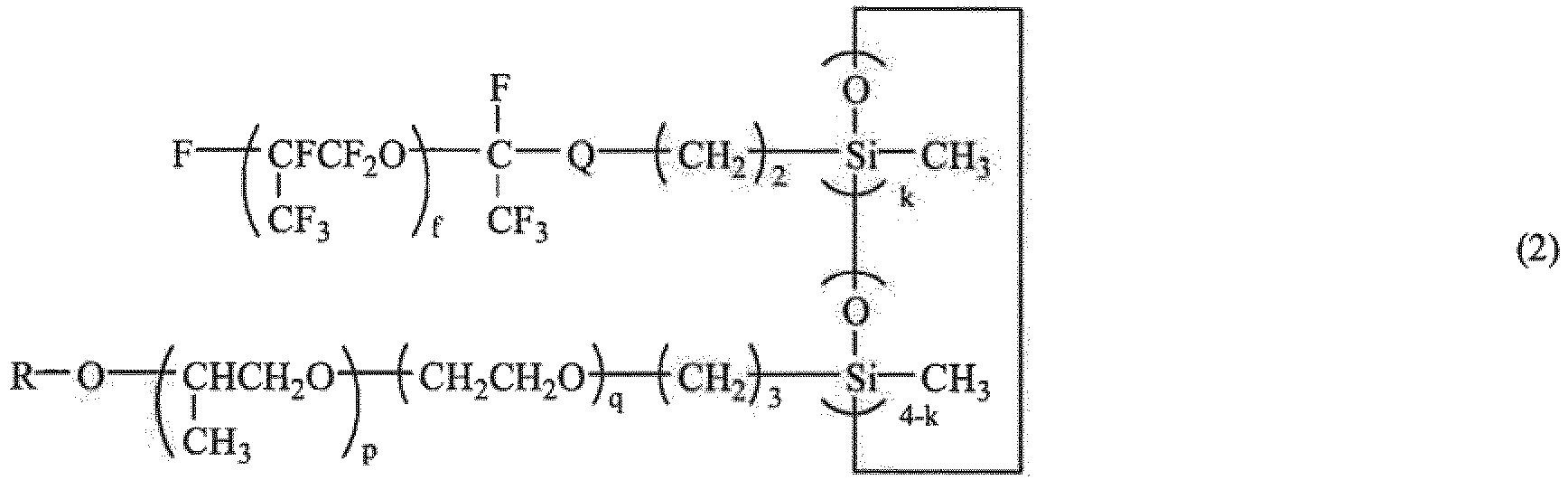
- the polyether-modified polysiloxane may be one represented by the following general formula (2): wherein Q, R, p, q, p+q, and k are as described above, and f is an integer of 2 to 200.
- the content of fluorine atom by weight in the molecule may be in the range of 20 to 70% by weight.
- a method for producing the polyether-modified polysiloxane as defined above comprising steps of reacting a vinyl group-containing perfluoropolyether represented by the following general formula (3): wherein Rf, X, Q, a, b, c, d, a+b+c+d, and e are as described above with a tetraorganocyclotetrasiloxane for hydrosilylation to produce a perfluoropolyether-modified cyclotetrasiloxane; and reacting the perfluoropolyether-modified cyclotetrasiloxane with an allyl group-containing polyether compound represented by the following general formula (4): wherein R, p, q, and p+q are as described above for hydrosilylation to produce the polyether-modified polysiloxane containing a perfluoropolyether group.
- the present invention provides a polyether-modified polysiloxane containing a perfluoropolyether group which has both the properties of a perfluoropolyether and the properties of a polyether-modified silicone. We find it has high leveling property due to the high affinity for organic solvents, coating compositions, cosmetics, and various coating materials.
- FIG. 1 is an IR spectrum of the compound prepared in Example 1.
- polyether-modified polysiloxane containing a perfluoropolyether group of the present invention is represented by the following general formula (1):
- Rf represents a straight chain or branched perfluoroalkyl group containing 1 to 10 carbon atoms, and preferably 1 to 3 carbon atoms.
- the perfluoropolyether chain may have an insufficient flexibility, and generation of toxic perfluorooctanoic acid (PFOA) may be induced in the course of thermal decomposition.
- PFOA toxic perfluorooctanoic acid
- Examples of such perfluoroalkyl group Rf include the groups represented by the following formulae:
- Q is a divalent organic group containing 1 to 12 carbon atoms, and preferably 3 to 8 carbon atoms.
- exemplary such groups include alkylene groups such as methylene group, ethylene group, propylene group (trimethylene group or methylethylene group), butylene group (tetramethylene group or methylpropylene group), hexamethylene group, and octamethylene group; arylene group such as phenylene group; and combination of two or more such groups (for example, an alkylene-arylene group).
- Examples also include any of these groups bonded to at least one structure selected from ether bond, amide bond, ester bond, diorganosylilene group, and the like as well as divalent hydrocarbon groups optionally containing at least one member selected from oxygen atom, nitrogen atom, and silicon atom.
- R is an alkyl group or acyl group containing 1 to 6 carbon atoms, such as methyl group, ethyl group, n-butyl group and acetyl group. Among these, methyl group, n-butyl group, and acetyl group are preferred.
- R 1 and R 2 are independently an alkyl group, an aryl group, or an aralkyl group containing 1 to 10 carbon atoms such as methyl group, ethyl group, isopropyl group, n-butyl group, isobutyl group, cyclohexyl group, phenyl group, benzyl group, phenylethyl group, and 2-phenyl propyl group.
- the preferred are methyl group, n-butyl group, and phenyl group, and the most preferred is methyl group.
- each of R 1 and R 2 may be the same or different group, and R 1 and R 2 may be the same or different.
- each of a, b, c and d independently is an integer of 0 to 200, 2 to 100 or 20 to 100.
- a+b+c+d is at least 1, preferably 2 to 200, more preferably 3 to 100, most preferably 5 to 50.
- e is 0 or 1.
- Each of p and q independently is an integer of 0 to 50, preferably 0 to 30, provided that p+q is at least 2, preferably 3 to 50, more preferably 6 to 40 and most preferably 9 to 30, and k is an integer of 1 to 3, preferably 1 or 2, most preferably 1.
- Upper and lower range limits are of course independent.
- Contents of the perfluoropolyether chain and polyether chain in the compound of formula (1) are preferably such that fluorine atoms are at least 20%, usually up to 70%, and more preferably 25 to 55% by weight of the molecule.
- the content is less than such range, the desired properties are less likely to be realized and the compound is less likely to have the water and oil repellency, lubricity, and mold releasability inherent to the perfluoropolyether chain.
- the content is in excess of such range, the compound may suffer from insufficient affinity for other materials.
- the polyether-modified polysiloxane containing a perfluoropolyether group represented by the general formula (1) is preferably a polyether-modified polysiloxane containing a perfluoropolyether group having the structure represented by the following general formula (2): wherein Q, R, p, q, p+q, and k are as described above, f is an integer of 2 to 200, preferably 3 to 50, and more preferably4 to 40.
- polyether-modified polysiloxane containing a perfluoropolyether group of the present invention examples include those as represented by the following formulae.
- the polyether-modified polysiloxane containing a perfluoropolyether group of the present invention can be produced by promoting hydrosilylation between a vinyl group-containing perfluoropolyether represented by the following general formula (3) and a tetraorganocyclotetrasiloxane preferably in the presence of a platinum catalyst to thereby produce a perfluoropolyether-modified cyclotetrasiloxane, and further promoting hydrosilylation between the resulting perfluoropolyether-modified cyclotetrasiloxane and an allyl group-containing polyether compound represented by the general formula (4) preferably in the presence of a platinum catalyst to thereby produce the polyether-modified polysiloxane containing a perfluoropolyether group.
- the production of the polyether-modified polysiloxane containing a perfluoropolyether group of the present invention is accomplished by a process comprising the following two stages.
- the vinyl group in the vinyl group-containing perfluoropolyether (i) represented by the following general formula (3): wherein Rf, X, Q, a, b, c, d, a+b+c+d, and e are as described above is partially hydrosilylated by addition with the 4 SiH groups in the tetraorganocyclotetrasiloxane (ii) represented by the following formula: wherein R 4 is independently, an alkyl group, an aryl group, or an aralkyl group containing 1 to 10 carbon atoms which may be the same as the one mentioned for the R 1 and R 2 preferably in the presence of a platinum catalyst to thereby produce a perfluoropolyether-modified cyclotetrasiloxane containing SiH group (iii) represented by the following general formula: wherein Rf, X, Q, R 1 , R 2 , a, b, c, d, a+b+c+
- the molar ratio between the molecules namely, [the siloxane (ii)]/[the perfluoropolyether (i)] is preferably at least 2.0, and more preferably at least 3.0.
- Such excessive use of the tetraorganocyclotetrasiloxane namely, the molar ratio ⁇ 2.0
- k 1.
- the molar ratio is preferably up to about 10.0, and more preferably up to about 5.0 in view of the production efficiency (such as yield of the target product and the like).
- the excessive tetraorganocyclotetrasiloxane can be readily removed after the completion of the reaction by distillation under reduced pressure.
- molar ratio of the SiH group in the perfluoropolyether-modified cyclotetrasiloxane containing SiH group (iii) to the allyl group in the allyl group-containing polyether compound (iv) is preferably in the range of 0.8 to 1.2, more preferably 0.9 to 1.1, and most preferably 0.9 to 1.0.
- the SiH group in the cyclotetrasiloxane in excess of such range may result in an insufficient affinity of the resulting compound with other materials, and generation of hydrogen gas by dehydrogenation of the SiH group.
- the allyl group in the polyether compound in excess of such range may result in the loss of properties inherent to the perfluoropolyether.
- a cyclotetrasiloxane modified only by the vinyl group-containing perfluoropolyether (i) or the allyl group-containing polyether compound (iv) may be formed due to the difference in the reactivity with the SiH group of the vinyl group-containing perfluoropolyether (i) and the allyl group-containing polyether compound (iv); or generation of various types of compounds each modified by the vinyl group-containing perfluoropolyether (i) and the allyl group-containing polyether compound (iv) at different modification degree may take place, leading to turbidity of the resulting product.
- the platinum catalyst used in the production process as described above may be a known catalyst which has been used in the hydrosilylation. Since such catalysts are typically a precious metal compound which is expensive, the catalysts commonly used in the hydrosilylation are platinum and platinum compounds which are relatively readily available. Examples of such platinum compound include chloroplatinic acid and a complex of chloroplatinic acid with an olefin such as ethylene; a complex of chloroplatinic acid with an alcohol or vinyl siloxane; and metal platinum supported on silica, alumina, carbon, or the like.
- Platinum Group metal catalyst other than the platinum compounds include rhodium, ruthenium, iridium, and palladium compounds such as RhCl(PPh 3 ) 3 , RhCl(CO(PPh 3 ) 2 , Ru 3 (CO) 12 , IrCl(CO) (PPh 3 ) 2 , and Pd(PPh 3 ) 4 wherein Ph represents phenyl group.
- the platinum catalyst may be used at a catalytic amount, and more specifically, at 0.1 to 500 ppm (in terms of the weight of the platinum) in relation to the total amount of the vinyl group-containing perfluoropolyether (i) and the tetraorganocyclotetrasiloxane (ii), or the total amount of the perfluoropolyether-modified cyclotetrasiloxane containing SiH group (iii) and the allyl group-containing polyether compound (iv).
- the hydrosilylation reaction may be conducted by using a solvent.
- the solvent is preferably the one which is capable of dissolving both reaction materials in each stage of the reaction.
- the solvent may be the one which only dissolves one of the reaction materials, and the solvent is not particularly limited as long as it does not inhibit the hydrosilylation reaction.
- solvents include aliphatic hydrocarbon compounds such as n-hexane, n-heptane, isooctane, and isododecane; aromatic hydrocarbon compounds such as toluene and xylene; fluorine-containing aromatic hydrocarbon compounds such as trifluorotoluene and hexafluoro-m-xylene; hydrofluoroether compounds such as perfluorobutylmethyl ether, perfluorobutylethyl ether, and 1,1,1,2,2,3,4,5,5,5-decafluoro-3-methoxy-4-(trifluoromethyl)pentane; chlorofluorocarbon compounds such as difuroyl (manufactured by Daikin Industries, Ltd.); and perfluoropolyether compounds such as FOMBLIN and GALDEN (manufactured by Solvay Solexis), DEMNUM (manufactured by Daikin Industries, Ltd.), and Krytox (
- the preferred is hexafluoro-m-xylene in view of its high capability of dissolving the vinyl group-containing perfluoropolyether (i) of the formula (3), the perfluoropolyether-modified cyclotetrasiloxane containing SiH group (iii), the allyl group-containing polyether compound (iv) of the formula (4), and the final product (the polyether-modified polysiloxane containing a perfluoropolyether group (v) of the formula (1).
- Amount of the solvent used may be adequately selected depending on the amount and viscosity of each reaction material.
- the solvent is preferably used at 10 to 200 parts by weight, and more preferably at 20 to 100 parts by weight per 100 parts by weight of the total of reaction materials.
- the reaction temperature used in the production process as described above may be adequately selected depending on the amount and type of the solvent, and the preferable temperature is typically in the range of room temperature (25°C) to 140°C, and preferably 70 to 120°C. The temperature in excess of such range is not preferable since use of such temperature may result in thermal decomposition of the polyether chain and the cyclic siloxane chain.
- the reaction time is not particularly limited, and the reaction time may be adequately selected depending on the respective reaction conditions so that the reaction proceeds to a sufficient degree.
- the polyether-modified polysiloxane containing a perfluoropolyether group of the present invention has an excellent water and oil repellency, chemical resistance, lubricity, and mold releasability, as well as an improved affinity for organic solvents, coating composition, cosmetics, various coating materials, and other materials over the conventional perfluoropolyether group-containing compounds.
- the polyether-modified polysiloxane containing a perfluoropolyether group of the present invention is well adapted for use as an additive in cosmetics, a foam regulator in urethane foam, a mold release agent for improving releasability from a metal mold in the molding, an additive for imparting water and oil repellency with greases, an additive for improving abrasion resistance of a lubricant oil, an agent for improving coloring and dispersion property of pigment in the field of dye and pigment industry, or an agent for improving leveling and anti-cratering property to thereby reduce coating defects.
- Corresponding compositions containing the present modified polysiloxane are aspects of the invention.
- the resulting product was analyzed by 1 H-NMR and IR spectrum measurement, and the product was found to be a compound represented by the following formula (8): having a fluorine atom content by weight in the molecule of 31.7%. This compound was used in Use Example 1.
- FIG. 1 IR spectrum of the compound (measured by KBr method using FT-730 manufactured by HORIBA, Ltd.) is shown in FIG. 1 .
- a transparent glass sample bottle was charged with 4.0 g of the polyether-modified polysiloxane containing a perfluoropolyether group produced in Examples 1 to 3 and 16.0 g of the solvent shown in Table 1, and the mixture was thoroughly shaken. After allowing to stand at room temperature for 1 hour, outer appearance was visually examined to evaluate solubility in the solvents by the following criteria. The results are shown in Table 1.
- Polydimethylsiloxane (KF-96 manufactured by Shin-Etsu Chemical Co., Ltd.) having a viscosity at 25°C of 200 mm 2 /s.
- the polyether-modified polysiloxane containing a perfluoropolyether group of the present invention is well adapted for use as an additive in cosmetics, a foam regulator in urethane foam, a mold release agent for improving releasability from a metal mold in the molding, an additive for imparting water and oil repellency with greases, an additive for improving abrasion resistance of a lubricant oil, an agent for improving coloring and dispersion property of pigment in the field of dye and pigment industry, or an agent for improving leveling and anti-cratering property to thereby reduce coating defects.
Landscapes
- Chemical & Material Sciences (AREA)
- Health & Medical Sciences (AREA)
- Organic Chemistry (AREA)
- Chemical Kinetics & Catalysis (AREA)
- Life Sciences & Earth Sciences (AREA)
- Polymers & Plastics (AREA)
- Medicinal Chemistry (AREA)
- Public Health (AREA)
- General Health & Medical Sciences (AREA)
- Materials Engineering (AREA)
- Veterinary Medicine (AREA)
- Wood Science & Technology (AREA)
- Engineering & Computer Science (AREA)
- Animal Behavior & Ethology (AREA)
- Birds (AREA)
- Epidemiology (AREA)
- General Chemical & Material Sciences (AREA)
- Toxicology (AREA)
- Dispersion Chemistry (AREA)
- Dermatology (AREA)
- Silicon Polymers (AREA)
- Polyethers (AREA)
Claims (11)
- Polyether-modifiziertes Polysiloxan, das eine Perfluorpolyethergruppe enthält und durch die folgende allgemeine Formel (1) dargestellt ist:

- Polyether-modifiziertes Polysiloxan nach Anspruch 1, worin R Methyl, n-Butyl oder Acetyl ist.
- Polyether-modifiziertes Polysiloxan nach einem der vorangegangenen Ansprüche, worin in Formel (1) a+b+c+d = 5 bis 50 ist.
- Polyether-modifiziertes Polysiloxan nach einem der vorangegangenen Ansprüche, worin R1 und R2 aus Methyl, Phenyl und n-Butyl ausgewählt sind.
- Polyether-modifiziertes Polysiloxan nach Anspruch 1, das eine Perfluorpolyethergruppe enthält und durch folgende allgemeine Formel (2) dargestellt ist:
- Polyether-modifiziertes Polysiloxan, das eine Perfluorpolyethergruppe enthält, nach einem der vorangegangenen Ansprüche, wobei der Gehalt an Fluoratomen im Molekül im Bereich von 20 bis 70 Gew.-% liegt.
- Polyether-modifiziertes Polysiloxan nach einem der vorangegangenen Ansprüche, worin Q ausgewählt ist aus:- CH2-,- CH2CH2-,- (CH2)n-O-CH2-,- OCH2-,- CO-NH-CH2-,- CO-N(Ph) -CH2-,- CO-NH-CH2CH2-,- CO-N (Ph) -CH2CH2-,- CO-N(CH3)-CH2CH2CH2-,- CO-O-CH2-,- CO-N(CH3)-Ph'- und- CO-NR3-Y'-worin Ph eine Phenylgruppe ist, Ph' eine Phenylengruppe ist, n eine ganze Zahl von 1 bis 10 ist und Y' -CH2- oder eine zweiwertige Gruppe der nachstehenden Formel ist:

- Polyether-modifiziertes Polysiloxan nach einem der vorangegangenen Ansprüche, worin p+q = 6 bis 40 ist.
- Verfahren zur Herstellung eines Polyether-modifizierten Polysiloxans nach einem der Ansprüche 1 bis 8, das folgende Schritte umfasst:das Umsetzen eines Vinylgruppen-hältigen Perfluorpolyethers der allgemeinen Formel (3):
 das Umsetzen des Perfluorpolyether-modifizierten Cyclotetrasiloxans mit einer Allylgruppen-hältigen Polyetherverbindung der nachstehenden allgemeinen Formel (4):
- Verwendung eines Polyether-modifizierten Polysiloxans, das eine Perfluorpolyethergruppe enthält, nach einem der Ansprüche 1 bis 8 als Additiv in Kosmetika, als Schaumregulator in Urethanschaum, als Formtrennmittel zum Formen mit Metallformen, als Additiv zu Schmiere zum Verleihen von Wasser- und Ölabweisungsvermögen, als Additiv zu Schmieröl zur Verbesserung der Abriebfestigkeit, als Mittel zur Verbesserung des Färbens und/oder Dispergierens von Pigment oder als Mittel zur Förderung des Glättens und/oder zur Reduktion der Kraterbildung in Beschichtungszusammensetzungen.
- Beschichtungszusammensetzung, Kosmetikzusammensetzung, Urethanschaumzusammensetzung, Schmiere oder Schmieröl, die/das ein Polyether-modifiziertes Polysiloxan umfasst, das eine Perfluorpolyethergruppe enthält und wie in einem der Ansprüche 1 bis 8 definiert ist.
Applications Claiming Priority (1)
| Application Number | Priority Date | Filing Date | Title |
|---|---|---|---|
| JP2010146251A JP5234057B2 (ja) | 2010-06-28 | 2010-06-28 | パーフルオロポリエーテル基含有ポリエーテル変性ポリシロキサン及びその製造方法 |
Publications (2)
| Publication Number | Publication Date |
|---|---|
| EP2399570A1 EP2399570A1 (de) | 2011-12-28 |
| EP2399570B1 true EP2399570B1 (de) | 2018-10-31 |
Family
ID=44537525
Family Applications (1)
| Application Number | Title | Priority Date | Filing Date |
|---|---|---|---|
| EP11171513.2A Ceased EP2399570B1 (de) | 2010-06-28 | 2011-06-27 | Polyether-modifiziertes polysiloxan mit einer perfluorpolyethergruppe und herstellungsverfahren dafür |
Country Status (3)
| Country | Link |
|---|---|
| US (1) | US8519078B2 (de) |
| EP (1) | EP2399570B1 (de) |
| JP (1) | JP5234057B2 (de) |
Families Citing this family (31)
| Publication number | Priority date | Publication date | Assignee | Title |
|---|---|---|---|---|
| JP5691713B2 (ja) * | 2011-03-23 | 2015-04-01 | 信越化学工業株式会社 | 防汚性付与剤及び防汚性が付与されたハードコート材料 |
| WO2013168514A1 (ja) * | 2012-05-10 | 2013-11-14 | ダイキン工業株式会社 | フルオロポリエーテル基含有シリコーン化合物 |
| JP5737221B2 (ja) * | 2012-05-17 | 2015-06-17 | 信越化学工業株式会社 | 含フッ素アルコール化合物を含む硬化性組成物 |
| JP5751211B2 (ja) * | 2012-05-17 | 2015-07-22 | 信越化学工業株式会社 | 含フッ素アルコール化合物を含む硬化性組成物 |
| JP5814209B2 (ja) * | 2012-10-24 | 2015-11-17 | 信越化学工業株式会社 | コーティング剤組成物、該組成物を含む表面処理剤及び該表面処理剤で表面処理された物品 |
| EP2970668B1 (de) | 2013-03-15 | 2020-07-01 | Bio-rad Laboratories, Inc. | Silikontenside für emulsionsassays |
| US9233533B2 (en) | 2013-06-30 | 2016-01-12 | Xerox Corporation | Grafted polymers as oleophobic low adhesion anti-wetting coatings for printhead applications |
| US9365742B2 (en) * | 2013-06-30 | 2016-06-14 | Xerox Corporation | Grafted polymers as oleophobic or hydrophobic coatings |
| WO2015038454A1 (en) | 2013-09-16 | 2015-03-19 | Honeywell International Inc. | Poly fluorine-containing siloxane coatings |
| JP6128033B2 (ja) * | 2014-03-28 | 2017-05-17 | 信越化学工業株式会社 | 含フッ素アルコール化合物及びその製造方法 |
| JP6402643B2 (ja) * | 2014-03-31 | 2018-10-10 | 信越化学工業株式会社 | 含フッ素アクリル化合物及びその製造方法並びに硬化性組成物、基材 |
| CN107708878B (zh) * | 2015-07-31 | 2021-03-23 | 关西涂料株式会社 | 形成多层涂膜的方法 |
| KR101992582B1 (ko) * | 2015-07-31 | 2019-06-24 | 다이킨 고교 가부시키가이샤 | 퍼플루오로(폴리)에테르기 함유 실란 화합물 |
| EP3345955B1 (de) * | 2015-08-31 | 2022-04-06 | Daikin Industries, Ltd. | Perfluor(poly)ethergruppenhaltige silanverbindung |
| CN107090084A (zh) * | 2017-04-21 | 2017-08-25 | 苏州博纳化学科技有限公司 | 聚醚枝接聚硅氧烷的消泡剂及其制备方法 |
| CN107254052B (zh) * | 2017-06-30 | 2020-09-11 | 山东益丰生化环保股份有限公司 | 脱模剂、其制备方法、复合脱模剂与聚氨酯类树脂材料 |
| WO2019063538A1 (en) * | 2017-09-27 | 2019-04-04 | Byk-Chemie Gmbh | ANTI-FOAMING AGENT BASED ON POLYSILOXANE |
| US20200032065A1 (en) * | 2018-07-30 | 2020-01-30 | James F. Brown | Three-dimensional lattice structures containing operating material, compositions comprising the same, and compositions and methods for making the same |
| CN109188572B (zh) * | 2018-08-27 | 2021-08-13 | 明基材料有限公司 | 抗反射膜、偏光板及影像显示装置 |
| US11001719B2 (en) * | 2018-09-14 | 2021-05-11 | Rohr, Inc. | Multi-layer coating for a flow surface of an aircraft component |
| CN110922582B (zh) * | 2018-09-20 | 2023-06-09 | 东莞东阳光科研发有限公司 | 一种全氟聚醚硅氧烷化合物及其制备方法和应用 |
| CN109867791A (zh) * | 2018-12-24 | 2019-06-11 | 南京美思德新材料有限公司 | 一种具有明确结构的有机硅共聚物及其制备方法 |
| CN110433534B (zh) * | 2019-08-28 | 2021-09-24 | 南京瑞思化学技术有限公司 | 一种有机硅消泡乳液的制备方法 |
| WO2021128092A1 (zh) * | 2019-12-25 | 2021-07-01 | 宁德新能源科技有限公司 | 电化学装置及包含其的电子装置 |
| CN112898574B (zh) * | 2021-04-01 | 2023-05-12 | 成都思立可科技有限公司 | 一种有机硅树脂的制备方法 |
| NO347925B1 (en) | 2021-07-07 | 2024-05-13 | Nanize As | Polysilazane compositions |
| JP7599805B2 (ja) * | 2022-01-24 | 2024-12-16 | 信越化学工業株式会社 | パーフルオロポリエーテル-オルガノポリシロキサンブロックコポリマー |
| JP7628383B2 (ja) | 2022-05-19 | 2025-02-10 | 信越化学工業株式会社 | パーフルオロポリエーテル-オルガノポリシロキサンブロックコポリマー |
| CN115433355B (zh) * | 2022-10-25 | 2023-01-03 | 山东华夏神舟新材料有限公司 | 一种抗指纹化合物、抗指纹剂及制备方法 |
| CN116715855B (zh) * | 2023-07-06 | 2024-05-03 | 深圳市金斯源电子商务有限公司 | 一种疏油肤感手感剂及其制备方法 |
| CN120623576B (zh) * | 2025-07-31 | 2025-12-09 | 吉安豫顺新材料股份有限公司 | 一种球形氧化铝及其硅橡胶导热复合材料 |
Family Cites Families (11)
| Publication number | Priority date | Publication date | Assignee | Title |
|---|---|---|---|---|
| JPS5922611A (ja) | 1982-07-30 | 1984-02-04 | Nippon Mektron Ltd | 消泡剤 |
| JPS6022907A (ja) | 1983-07-15 | 1985-02-05 | Nippon Mektron Ltd | 消泡剤 |
| JPH0517489A (ja) * | 1991-07-04 | 1993-01-26 | Shin Etsu Chem Co Ltd | シロキサン化合物 |
| JP2003113244A (ja) * | 2001-10-03 | 2003-04-18 | Shin Etsu Chem Co Ltd | パーフルオロポリエーテル変性シクロポリシロキサン及び表面処理剤並びに硬化被膜を形成した物品 |
| JP4656307B2 (ja) * | 2005-05-20 | 2011-03-23 | 信越化学工業株式会社 | 含フッ素有機ケイ素化合物及び含フッ素界面活性剤 |
| JP5008192B2 (ja) | 2006-09-08 | 2012-08-22 | 信越化学工業株式会社 | パーフルオロポリエーテル−ポリオルガノシロキサン共重合体及びそれを含む表面処理剤 |
| JP4998723B2 (ja) | 2007-06-18 | 2012-08-15 | 信越化学工業株式会社 | 含フッ素コーティング剤組成物 |
| JP4709272B2 (ja) * | 2008-12-11 | 2011-06-22 | 信越化学工業株式会社 | 含フッ素アクリレート |
| JP4873666B2 (ja) * | 2009-06-10 | 2012-02-08 | 信越化学工業株式会社 | パーフルオロポリエーテル基を有するアクリレート化合物 |
| JP4900854B2 (ja) * | 2009-07-17 | 2012-03-21 | 信越化学工業株式会社 | パーフルオロポリエーテル変性ポリシロキサン及びその製造方法 |
| JP4919437B2 (ja) * | 2009-07-17 | 2012-04-18 | 信越化学工業株式会社 | 消泡剤 |
-
2010
- 2010-06-28 JP JP2010146251A patent/JP5234057B2/ja active Active
-
2011
- 2011-06-27 EP EP11171513.2A patent/EP2399570B1/de not_active Ceased
- 2011-06-27 US US13/169,281 patent/US8519078B2/en not_active Expired - Fee Related
Non-Patent Citations (1)
| Title |
|---|
| None * |
Also Published As
| Publication number | Publication date |
|---|---|
| EP2399570A1 (de) | 2011-12-28 |
| JP2012007124A (ja) | 2012-01-12 |
| US20110319581A1 (en) | 2011-12-29 |
| US8519078B2 (en) | 2013-08-27 |
| JP5234057B2 (ja) | 2013-07-10 |
Similar Documents
| Publication | Publication Date | Title |
|---|---|---|
| EP2399570B1 (de) | Polyether-modifiziertes polysiloxan mit einer perfluorpolyethergruppe und herstellungsverfahren dafür | |
| EP0725113B1 (de) | Fluorierte Amid-Silikonverbindungen und vernetzbare Siloxanzusammensetzungen | |
| EP2301989B1 (de) | Perfluorpolyethermodifiziertes Polysiloxan, Verfahren zu dessen Herstellung und Entschäumer damit | |
| JP5165644B2 (ja) | オルガノポリシロキサン組成物及びその製造方法 | |
| JP2011021158A (ja) | パーフルオロポリエーテル変性ポリシロキサン及びその製造方法 | |
| EP2272896B1 (de) | Perfluorpolyethermodifiziertes Polysiloxan, Verfahren zu dessen Herstellung und Entschäumer damit | |
| JP4900853B2 (ja) | パーフルオロポリエーテル変性ポリシロキサン及びその製造方法 | |
| JP7306334B2 (ja) | パーフルオロポリエーテルブロックを有するオルガノハイドロジェンポリシロキサン、及びその製造方法 | |
| JP7599805B2 (ja) | パーフルオロポリエーテル-オルガノポリシロキサンブロックコポリマー | |
| JP5234065B2 (ja) | 機能性添加剤並びに消泡剤及びレベリング剤 | |
| JP3743495B2 (ja) | 硬化性フルオロポリエーテルゴム組成物 | |
| JP7636130B2 (ja) | パーフルオロポリエーテルブロックと(メタ)アクリロイル基とを有するオルガノポリシロキサン、及びその製造方法 | |
| JP6128033B2 (ja) | 含フッ素アルコール化合物及びその製造方法 | |
| JP7628383B2 (ja) | パーフルオロポリエーテル-オルガノポリシロキサンブロックコポリマー | |
| JP6923300B2 (ja) | フッ素含有ケイ素化合物 | |
| EP1247830A2 (de) | Fluorinierte härtbare Zusammensetzungen, deren Herstellung und Verwendung | |
| EP4600290A1 (de) | Fluoropolyethergruppen enthaltendes polymer | |
| JP2025152308A (ja) | オルガノポリシロキサン | |
| JPH06220200A (ja) | N−ポリオキシアルキレンアミノアルキル基含有ポリオルガノシロキサン | |
| JPH08301881A (ja) | 含フッ素有機ケイ素化合物 | |
| JPWO1998047947A1 (ja) | 加水分解性基含有フルオロシリコーン化合物の製造方法 |
Legal Events
| Date | Code | Title | Description |
|---|---|---|---|
| AK | Designated contracting states |
Kind code of ref document: A1 Designated state(s): AL AT BE BG CH CY CZ DE DK EE ES FI FR GB GR HR HU IE IS IT LI LT LU LV MC MK MT NL NO PL PT RO RS SE SI SK SM TR |
|
| AX | Request for extension of the european patent |
Extension state: BA ME |
|
| PUAI | Public reference made under article 153(3) epc to a published international application that has entered the european phase |
Free format text: ORIGINAL CODE: 0009012 |
|
| 17P | Request for examination filed |
Effective date: 20120123 |
|
| GRAP | Despatch of communication of intention to grant a patent |
Free format text: ORIGINAL CODE: EPIDOSNIGR1 |
|
| INTG | Intention to grant announced |
Effective date: 20180518 |
|
| GRAS | Grant fee paid |
Free format text: ORIGINAL CODE: EPIDOSNIGR3 |
|
| GRAA | (expected) grant |
Free format text: ORIGINAL CODE: 0009210 |
|
| AK | Designated contracting states |
Kind code of ref document: B1 Designated state(s): DE FR GB |
|
| RBV | Designated contracting states (corrected) |
Designated state(s): DE FR GB |
|
| REG | Reference to a national code |
Ref country code: GB Ref legal event code: FG4D |
|
| REG | Reference to a national code |
Ref country code: DE Ref legal event code: R096 Ref document number: 602011053364 Country of ref document: DE |
|
| REG | Reference to a national code |
Ref country code: DE Ref legal event code: R097 Ref document number: 602011053364 Country of ref document: DE |
|
| PLBE | No opposition filed within time limit |
Free format text: ORIGINAL CODE: 0009261 |
|
| STAA | Information on the status of an ep patent application or granted ep patent |
Free format text: STATUS: NO OPPOSITION FILED WITHIN TIME LIMIT |
|
| 26N | No opposition filed |
Effective date: 20190801 |
|
| PGFP | Annual fee paid to national office [announced via postgrant information from national office to epo] |
Ref country code: FR Payment date: 20200512 Year of fee payment: 10 Ref country code: DE Payment date: 20200617 Year of fee payment: 10 |
|
| PGFP | Annual fee paid to national office [announced via postgrant information from national office to epo] |
Ref country code: GB Payment date: 20200618 Year of fee payment: 10 |
|
| REG | Reference to a national code |
Ref country code: DE Ref legal event code: R119 Ref document number: 602011053364 Country of ref document: DE |
|
| GBPC | Gb: european patent ceased through non-payment of renewal fee |
Effective date: 20210627 |
|
| PG25 | Lapsed in a contracting state [announced via postgrant information from national office to epo] |
Ref country code: GB Free format text: LAPSE BECAUSE OF NON-PAYMENT OF DUE FEES Effective date: 20210627 Ref country code: DE Free format text: LAPSE BECAUSE OF NON-PAYMENT OF DUE FEES Effective date: 20220101 |
|
| PG25 | Lapsed in a contracting state [announced via postgrant information from national office to epo] |
Ref country code: FR Free format text: LAPSE BECAUSE OF NON-PAYMENT OF DUE FEES Effective date: 20210630 |