EP2399737B1 - Corps composite en mousse polymère de styrène - Google Patents
Corps composite en mousse polymère de styrène Download PDFInfo
- Publication number
- EP2399737B1 EP2399737B1 EP11004438.5A EP11004438A EP2399737B1 EP 2399737 B1 EP2399737 B1 EP 2399737B1 EP 11004438 A EP11004438 A EP 11004438A EP 2399737 B1 EP2399737 B1 EP 2399737B1
- Authority
- EP
- European Patent Office
- Prior art keywords
- melt adhesive
- adhesive composition
- hot
- composite body
- styrene polymer
- Prior art date
- Legal status (The legal status is an assumption and is not a legal conclusion. Google has not performed a legal analysis and makes no representation as to the accuracy of the status listed.)
- Active
Links
- PPBRXRYQALVLMV-UHFFFAOYSA-N Styrene Chemical compound C=CC1=CC=CC=C1 PPBRXRYQALVLMV-UHFFFAOYSA-N 0.000 title claims description 80
- 239000006260 foam Substances 0.000 title claims description 50
- 229920000642 polymer Polymers 0.000 title claims description 49
- 150000001875 compounds Chemical class 0.000 title 1
- 239000004831 Hot glue Substances 0.000 claims description 70
- 239000000203 mixture Substances 0.000 claims description 70
- 239000002131 composite material Substances 0.000 claims description 58
- 229920013639 polyalphaolefin Polymers 0.000 claims description 39
- 229920001169 thermoplastic Polymers 0.000 claims description 29
- 239000004416 thermosoftening plastic Substances 0.000 claims description 25
- 239000007787 solid Substances 0.000 claims description 22
- 238000000034 method Methods 0.000 claims description 19
- 229920005989 resin Polymers 0.000 claims description 19
- 239000011347 resin Substances 0.000 claims description 19
- 150000001408 amides Chemical class 0.000 claims description 18
- 238000001125 extrusion Methods 0.000 claims description 18
- -1 polyethylene Polymers 0.000 claims description 11
- 239000004795 extruded polystyrene foam Substances 0.000 claims description 10
- 229910052799 carbon Inorganic materials 0.000 claims description 9
- 229920000728 polyester Polymers 0.000 claims description 8
- 239000013032 Hydrocarbon resin Substances 0.000 claims description 7
- 229920013640 amorphous poly alpha olefin Polymers 0.000 claims description 7
- 229920006270 hydrocarbon resin Polymers 0.000 claims description 7
- 239000000155 melt Substances 0.000 claims description 7
- 238000002844 melting Methods 0.000 claims description 7
- 230000008018 melting Effects 0.000 claims description 7
- 238000004049 embossing Methods 0.000 claims description 4
- 239000004698 Polyethylene Substances 0.000 claims description 3
- 125000001931 aliphatic group Chemical group 0.000 claims description 3
- 125000004178 (C1-C4) alkyl group Chemical group 0.000 claims description 2
- 239000004743 Polypropylene Substances 0.000 claims description 2
- 125000001797 benzyl group Chemical group [H]C1=C([H])C([H])=C(C([H])=C1[H])C([H])([H])* 0.000 claims description 2
- 229920000573 polyethylene Polymers 0.000 claims description 2
- 229920001155 polypropylene Polymers 0.000 claims description 2
- 229920006395 saturated elastomer Polymers 0.000 claims description 2
- 238000004381 surface treatment Methods 0.000 claims description 2
- 238000004026 adhesive bonding Methods 0.000 claims 2
- 239000000853 adhesive Substances 0.000 description 41
- 230000001070 adhesive effect Effects 0.000 description 41
- 238000009413 insulation Methods 0.000 description 21
- XLYOFNOQVPJJNP-UHFFFAOYSA-N water Substances O XLYOFNOQVPJJNP-UHFFFAOYSA-N 0.000 description 19
- 238000004519 manufacturing process Methods 0.000 description 16
- 239000010410 layer Substances 0.000 description 12
- 235000014113 dietary fatty acids Nutrition 0.000 description 11
- 239000000194 fatty acid Substances 0.000 description 11
- 229930195729 fatty acid Natural products 0.000 description 11
- 238000009792 diffusion process Methods 0.000 description 10
- 150000004665 fatty acids Chemical class 0.000 description 10
- 239000003063 flame retardant Substances 0.000 description 10
- 238000003860 storage Methods 0.000 description 10
- 150000003254 radicals Chemical class 0.000 description 9
- 239000004793 Polystyrene Substances 0.000 description 7
- 229920002223 polystyrene Polymers 0.000 description 7
- 239000004711 α-olefin Substances 0.000 description 7
- 238000010521 absorption reaction Methods 0.000 description 6
- 238000006243 chemical reaction Methods 0.000 description 6
- 238000005304 joining Methods 0.000 description 6
- 230000007774 longterm Effects 0.000 description 6
- 239000000126 substance Substances 0.000 description 6
- BLRPTPMANUNPDV-UHFFFAOYSA-N Silane Chemical group [SiH4] BLRPTPMANUNPDV-UHFFFAOYSA-N 0.000 description 5
- 239000012790 adhesive layer Substances 0.000 description 5
- 230000004888 barrier function Effects 0.000 description 5
- 238000001816 cooling Methods 0.000 description 5
- 229920006248 expandable polystyrene Polymers 0.000 description 5
- 239000000463 material Substances 0.000 description 5
- 230000008569 process Effects 0.000 description 5
- IHQKEDIOMGYHEB-UHFFFAOYSA-M sodium dimethylarsinate Chemical class [Na+].C[As](C)([O-])=O IHQKEDIOMGYHEB-UHFFFAOYSA-M 0.000 description 5
- IJGRMHOSHXDMSA-UHFFFAOYSA-N Atomic nitrogen Chemical compound N#N IJGRMHOSHXDMSA-UHFFFAOYSA-N 0.000 description 4
- 238000009825 accumulation Methods 0.000 description 4
- 125000004432 carbon atom Chemical group C* 0.000 description 4
- 230000015556 catabolic process Effects 0.000 description 4
- 239000003054 catalyst Substances 0.000 description 4
- 238000010276 construction Methods 0.000 description 4
- 229920001577 copolymer Polymers 0.000 description 4
- 238000006731 degradation reaction Methods 0.000 description 4
- 230000007613 environmental effect Effects 0.000 description 4
- 150000002148 esters Chemical class 0.000 description 4
- 229920001519 homopolymer Polymers 0.000 description 4
- 239000004814 polyurethane Substances 0.000 description 4
- 239000004604 Blowing Agent Substances 0.000 description 3
- 229910000831 Steel Inorganic materials 0.000 description 3
- 238000004132 cross linking Methods 0.000 description 3
- 239000000428 dust Substances 0.000 description 3
- 230000000694 effects Effects 0.000 description 3
- UAUDZVJPLUQNMU-KTKRTIGZSA-N erucamide Chemical compound CCCCCCCC\C=C/CCCCCCCCCCCC(N)=O UAUDZVJPLUQNMU-KTKRTIGZSA-N 0.000 description 3
- 239000003292 glue Substances 0.000 description 3
- 239000008187 granular material Substances 0.000 description 3
- 230000036541 health Effects 0.000 description 3
- 239000007788 liquid Substances 0.000 description 3
- 239000012968 metallocene catalyst Substances 0.000 description 3
- 125000000896 monocarboxylic acid group Chemical group 0.000 description 3
- 229910052757 nitrogen Inorganic materials 0.000 description 3
- 230000035515 penetration Effects 0.000 description 3
- 239000002984 plastic foam Substances 0.000 description 3
- 229920000098 polyolefin Polymers 0.000 description 3
- 239000003380 propellant Substances 0.000 description 3
- 239000010959 steel Substances 0.000 description 3
- DEIGXXQKDWULML-UHFFFAOYSA-N 1,2,5,6,9,10-hexabromocyclododecane Chemical compound BrC1CCC(Br)C(Br)CCC(Br)C(Br)CCC1Br DEIGXXQKDWULML-UHFFFAOYSA-N 0.000 description 2
- VXNZUUAINFGPBY-UHFFFAOYSA-N 1-Butene Chemical compound CCC=C VXNZUUAINFGPBY-UHFFFAOYSA-N 0.000 description 2
- ZGEGCLOFRBLKSE-UHFFFAOYSA-N 1-Heptene Chemical compound CCCCCC=C ZGEGCLOFRBLKSE-UHFFFAOYSA-N 0.000 description 2
- LIKMAJRDDDTEIG-UHFFFAOYSA-N 1-hexene Chemical compound CCCCC=C LIKMAJRDDDTEIG-UHFFFAOYSA-N 0.000 description 2
- KWKAKUADMBZCLK-UHFFFAOYSA-N 1-octene Chemical compound CCCCCCC=C KWKAKUADMBZCLK-UHFFFAOYSA-N 0.000 description 2
- QGZKDVFQNNGYKY-UHFFFAOYSA-N Ammonia Chemical compound N QGZKDVFQNNGYKY-UHFFFAOYSA-N 0.000 description 2
- KAKZBPTYRLMSJV-UHFFFAOYSA-N Butadiene Chemical compound C=CC=C KAKZBPTYRLMSJV-UHFFFAOYSA-N 0.000 description 2
- OKTJSMMVPCPJKN-UHFFFAOYSA-N Carbon Chemical compound [C] OKTJSMMVPCPJKN-UHFFFAOYSA-N 0.000 description 2
- 241000196324 Embryophyta Species 0.000 description 2
- UAUDZVJPLUQNMU-UHFFFAOYSA-N Erucasaeureamid Natural products CCCCCCCCC=CCCCCCCCCCCCC(N)=O UAUDZVJPLUQNMU-UHFFFAOYSA-N 0.000 description 2
- RRHGJUQNOFWUDK-UHFFFAOYSA-N Isoprene Chemical compound CC(=C)C=C RRHGJUQNOFWUDK-UHFFFAOYSA-N 0.000 description 2
- NBIIXXVUZAFLBC-UHFFFAOYSA-N Phosphoric acid Chemical compound OP(O)(O)=O NBIIXXVUZAFLBC-UHFFFAOYSA-N 0.000 description 2
- QQONPFPTGQHPMA-UHFFFAOYSA-N Propene Chemical compound CC=C QQONPFPTGQHPMA-UHFFFAOYSA-N 0.000 description 2
- 239000004433 Thermoplastic polyurethane Substances 0.000 description 2
- UKLDJPRMSDWDSL-UHFFFAOYSA-L [dibutyl(dodecanoyloxy)stannyl] dodecanoate Chemical compound CCCCCCCCCCCC(=O)O[Sn](CCCC)(CCCC)OC(=O)CCCCCCCCCCC UKLDJPRMSDWDSL-UHFFFAOYSA-L 0.000 description 2
- XECAHXYUAAWDEL-UHFFFAOYSA-N acrylonitrile butadiene styrene Chemical compound C=CC=C.C=CC#N.C=CC1=CC=CC=C1 XECAHXYUAAWDEL-UHFFFAOYSA-N 0.000 description 2
- 229920000122 acrylonitrile butadiene styrene Polymers 0.000 description 2
- 239000004676 acrylonitrile butadiene styrene Substances 0.000 description 2
- 125000000217 alkyl group Chemical group 0.000 description 2
- 125000003368 amide group Chemical group 0.000 description 2
- LJCFOYOSGPHIOO-UHFFFAOYSA-N antimony pentoxide Chemical compound O=[Sb](=O)O[Sb](=O)=O LJCFOYOSGPHIOO-UHFFFAOYSA-N 0.000 description 2
- ADCOVFLJGNWWNZ-UHFFFAOYSA-N antimony trioxide Chemical compound O=[Sb]O[Sb]=O ADCOVFLJGNWWNZ-UHFFFAOYSA-N 0.000 description 2
- 125000003118 aryl group Chemical group 0.000 description 2
- WGQKYBSKWIADBV-UHFFFAOYSA-N benzylamine Chemical compound NCC1=CC=CC=C1 WGQKYBSKWIADBV-UHFFFAOYSA-N 0.000 description 2
- 230000015572 biosynthetic process Effects 0.000 description 2
- IAQRGUVFOMOMEM-UHFFFAOYSA-N but-2-ene Chemical compound CC=CC IAQRGUVFOMOMEM-UHFFFAOYSA-N 0.000 description 2
- 150000001721 carbon Chemical group 0.000 description 2
- 239000011203 carbon fibre reinforced carbon Substances 0.000 description 2
- 125000006297 carbonyl amino group Chemical group [H]N([*:2])C([*:1])=O 0.000 description 2
- 239000000470 constituent Substances 0.000 description 2
- 238000013461 design Methods 0.000 description 2
- 239000012975 dibutyltin dilaurate Substances 0.000 description 2
- 238000009826 distribution Methods 0.000 description 2
- 229920001112 grafted polyolefin Polymers 0.000 description 2
- 238000010438 heat treatment Methods 0.000 description 2
- 230000003301 hydrolyzing effect Effects 0.000 description 2
- 239000004615 ingredient Substances 0.000 description 2
- 239000012796 inorganic flame retardant Substances 0.000 description 2
- 239000012774 insulation material Substances 0.000 description 2
- 239000012948 isocyanate Substances 0.000 description 2
- 150000002513 isocyanates Chemical class 0.000 description 2
- 238000004806 packaging method and process Methods 0.000 description 2
- YWAKXRMUMFPDSH-UHFFFAOYSA-N pentene Chemical compound CCCC=C YWAKXRMUMFPDSH-UHFFFAOYSA-N 0.000 description 2
- 229920003023 plastic Polymers 0.000 description 2
- 239000004033 plastic Substances 0.000 description 2
- 229920001200 poly(ethylene-vinyl acetate) Polymers 0.000 description 2
- 229920001955 polyphenylene ether Polymers 0.000 description 2
- 229920006327 polystyrene foam Polymers 0.000 description 2
- 238000002360 preparation method Methods 0.000 description 2
- 238000003825 pressing Methods 0.000 description 2
- 230000009467 reduction Effects 0.000 description 2
- 238000007711 solidification Methods 0.000 description 2
- 230000008023 solidification Effects 0.000 description 2
- 238000005507 spraying Methods 0.000 description 2
- 238000012360 testing method Methods 0.000 description 2
- 229920002803 thermoplastic polyurethane Polymers 0.000 description 2
- XPVIQPQOGTVMSU-UHFFFAOYSA-N (4-acetamidophenyl)arsenic Chemical compound CC(=O)NC1=CC=C([As])C=C1 XPVIQPQOGTVMSU-UHFFFAOYSA-N 0.000 description 1
- RNFJDJUURJAICM-UHFFFAOYSA-N 2,2,4,4,6,6-hexaphenoxy-1,3,5-triaza-2$l^{5},4$l^{5},6$l^{5}-triphosphacyclohexa-1,3,5-triene Chemical compound N=1P(OC=2C=CC=CC=2)(OC=2C=CC=CC=2)=NP(OC=2C=CC=CC=2)(OC=2C=CC=CC=2)=NP=1(OC=1C=CC=CC=1)OC1=CC=CC=C1 RNFJDJUURJAICM-UHFFFAOYSA-N 0.000 description 1
- YEVQZPWSVWZAOB-UHFFFAOYSA-N 2-(bromomethyl)-1-iodo-4-(trifluoromethyl)benzene Chemical compound FC(F)(F)C1=CC=C(I)C(CBr)=C1 YEVQZPWSVWZAOB-UHFFFAOYSA-N 0.000 description 1
- SLRMQYXOBQWXCR-UHFFFAOYSA-N 2154-56-5 Chemical compound [CH2]C1=CC=CC=C1 SLRMQYXOBQWXCR-UHFFFAOYSA-N 0.000 description 1
- VEORPZCZECFIRK-UHFFFAOYSA-N 3,3',5,5'-tetrabromobisphenol A Chemical compound C=1C(Br)=C(O)C(Br)=CC=1C(C)(C)C1=CC(Br)=C(O)C(Br)=C1 VEORPZCZECFIRK-UHFFFAOYSA-N 0.000 description 1
- HHDUMDVQUCBCEY-UHFFFAOYSA-N 4-[10,15,20-tris(4-carboxyphenyl)-21,23-dihydroporphyrin-5-yl]benzoic acid Chemical compound OC(=O)c1ccc(cc1)-c1c2ccc(n2)c(-c2ccc(cc2)C(O)=O)c2ccc([nH]2)c(-c2ccc(cc2)C(O)=O)c2ccc(n2)c(-c2ccc(cc2)C(O)=O)c2ccc1[nH]2 HHDUMDVQUCBCEY-UHFFFAOYSA-N 0.000 description 1
- RSWGJHLUYNHPMX-UHFFFAOYSA-N Abietic-Saeure Natural products C12CCC(C(C)C)=CC2=CCC2C1(C)CCCC2(C)C(O)=O RSWGJHLUYNHPMX-UHFFFAOYSA-N 0.000 description 1
- NLHHRLWOUZZQLW-UHFFFAOYSA-N Acrylonitrile Chemical compound C=CC#N NLHHRLWOUZZQLW-UHFFFAOYSA-N 0.000 description 1
- 108010002493 Arachin Proteins 0.000 description 1
- 229920001634 Copolyester Polymers 0.000 description 1
- 235000013830 Eruca Nutrition 0.000 description 1
- 241000801434 Eruca Species 0.000 description 1
- VGGSQFUCUMXWEO-UHFFFAOYSA-N Ethene Chemical compound C=C VGGSQFUCUMXWEO-UHFFFAOYSA-N 0.000 description 1
- UFHFLCQGNIYNRP-UHFFFAOYSA-N Hydrogen Chemical group [H][H] UFHFLCQGNIYNRP-UHFFFAOYSA-N 0.000 description 1
- 229920000877 Melamine resin Polymers 0.000 description 1
- CERQOIWHTDAKMF-UHFFFAOYSA-N Methacrylic acid Chemical compound CC(=C)C(O)=O CERQOIWHTDAKMF-UHFFFAOYSA-N 0.000 description 1
- 238000007126 N-alkylation reaction Methods 0.000 description 1
- 239000006057 Non-nutritive feed additive Substances 0.000 description 1
- CBENFWSGALASAD-UHFFFAOYSA-N Ozone Chemical compound [O-][O+]=O CBENFWSGALASAD-UHFFFAOYSA-N 0.000 description 1
- 229910019142 PO4 Inorganic materials 0.000 description 1
- OAICVXFJPJFONN-UHFFFAOYSA-N Phosphorus Chemical compound [P] OAICVXFJPJFONN-UHFFFAOYSA-N 0.000 description 1
- KHPCPRHQVVSZAH-HUOMCSJISA-N Rosin Natural products O(C/C=C/c1ccccc1)[C@H]1[C@H](O)[C@@H](O)[C@@H](O)[C@@H](CO)O1 KHPCPRHQVVSZAH-HUOMCSJISA-N 0.000 description 1
- PZBFGYYEXUXCOF-UHFFFAOYSA-N TCEP Chemical compound OC(=O)CCP(CCC(O)=O)CCC(O)=O PZBFGYYEXUXCOF-UHFFFAOYSA-N 0.000 description 1
- YYQRGCZGSFRBAM-UHFFFAOYSA-N Triclofos Chemical compound OP(O)(=O)OCC(Cl)(Cl)Cl YYQRGCZGSFRBAM-UHFFFAOYSA-N 0.000 description 1
- GTVWRXDRKAHEAD-UHFFFAOYSA-N Tris(2-ethylhexyl) phosphate Chemical compound CCCCC(CC)COP(=O)(OCC(CC)CCCC)OCC(CC)CCCC GTVWRXDRKAHEAD-UHFFFAOYSA-N 0.000 description 1
- 239000012963 UV stabilizer Substances 0.000 description 1
- XTXRWKRVRITETP-UHFFFAOYSA-N Vinyl acetate Chemical compound CC(=O)OC=C XTXRWKRVRITETP-UHFFFAOYSA-N 0.000 description 1
- 239000006096 absorbing agent Substances 0.000 description 1
- 239000002253 acid Substances 0.000 description 1
- 239000000654 additive Substances 0.000 description 1
- 239000002318 adhesion promoter Substances 0.000 description 1
- 150000001336 alkenes Chemical class 0.000 description 1
- 125000005907 alkyl ester group Chemical group 0.000 description 1
- WNROFYMDJYEPJX-UHFFFAOYSA-K aluminium hydroxide Chemical compound [OH-].[OH-].[OH-].[Al+3] WNROFYMDJYEPJX-UHFFFAOYSA-K 0.000 description 1
- 229910000147 aluminium phosphate Inorganic materials 0.000 description 1
- 150000001412 amines Chemical class 0.000 description 1
- 229920003180 amino resin Polymers 0.000 description 1
- 229910021529 ammonia Inorganic materials 0.000 description 1
- 150000003868 ammonium compounds Chemical class 0.000 description 1
- BFNBIHQBYMNNAN-UHFFFAOYSA-N ammonium sulfate Chemical compound N.N.OS(O)(=O)=O BFNBIHQBYMNNAN-UHFFFAOYSA-N 0.000 description 1
- 229910052921 ammonium sulfate Inorganic materials 0.000 description 1
- 235000011130 ammonium sulphate Nutrition 0.000 description 1
- 229910000410 antimony oxide Inorganic materials 0.000 description 1
- BNBSCAZCQDLUDU-DOFZRALJSA-N arachidonoyl amine Chemical compound CCCCC\C=C/C\C=C/C\C=C/C\C=C/CCCC(N)=O BNBSCAZCQDLUDU-DOFZRALJSA-N 0.000 description 1
- 230000000386 athletic effect Effects 0.000 description 1
- 239000011324 bead Substances 0.000 description 1
- 230000002146 bilateral effect Effects 0.000 description 1
- 230000000903 blocking effect Effects 0.000 description 1
- 150000001642 boronic acid derivatives Chemical class 0.000 description 1
- BZDKYAZTCWRUDZ-UHFFFAOYSA-N buta-1,3-diene;methyl 2-methylprop-2-enoate;prop-2-enenitrile;styrene Chemical compound C=CC=C.C=CC#N.COC(=O)C(C)=C.C=CC1=CC=CC=C1 BZDKYAZTCWRUDZ-UHFFFAOYSA-N 0.000 description 1
- NOQOJJUSNAWKBQ-UHFFFAOYSA-N buta-1,3-diene;methyl prop-2-enoate;styrene Chemical compound C=CC=C.COC(=O)C=C.C=CC1=CC=CC=C1 NOQOJJUSNAWKBQ-UHFFFAOYSA-N 0.000 description 1
- 235000013877 carbamide Nutrition 0.000 description 1
- CREMABGTGYGIQB-UHFFFAOYSA-N carbon carbon Chemical compound C.C CREMABGTGYGIQB-UHFFFAOYSA-N 0.000 description 1
- 150000001732 carboxylic acid derivatives Chemical class 0.000 description 1
- 150000001735 carboxylic acids Chemical class 0.000 description 1
- WNPXRNJEBMRJGV-UHFFFAOYSA-N chembl1399590 Chemical compound COC1=CC=CC(C=2N=C3C=CC=CC3=C(N3C(CCCC3)C)N=2)=C1O WNPXRNJEBMRJGV-UHFFFAOYSA-N 0.000 description 1
- 150000001805 chlorine compounds Chemical class 0.000 description 1
- 238000004140 cleaning Methods 0.000 description 1
- 239000003245 coal Substances 0.000 description 1
- 230000000052 comparative effect Effects 0.000 description 1
- 230000006835 compression Effects 0.000 description 1
- 238000007906 compression Methods 0.000 description 1
- 238000007596 consolidation process Methods 0.000 description 1
- 238000005520 cutting process Methods 0.000 description 1
- 230000001351 cycling effect Effects 0.000 description 1
- 230000000254 damaging effect Effects 0.000 description 1
- WHHGLZMJPXIBIX-UHFFFAOYSA-N decabromodiphenyl ether Chemical compound BrC1=C(Br)C(Br)=C(Br)C(Br)=C1OC1=C(Br)C(Br)=C(Br)C(Br)=C1Br WHHGLZMJPXIBIX-UHFFFAOYSA-N 0.000 description 1
- 239000002274 desiccant Substances 0.000 description 1
- 238000011161 development Methods 0.000 description 1
- XNMQEEKYCVKGBD-UHFFFAOYSA-N dimethylacetylene Natural products CC#CC XNMQEEKYCVKGBD-UHFFFAOYSA-N 0.000 description 1
- USIUVYZYUHIAEV-UHFFFAOYSA-N diphenyl ether Chemical class C=1C=CC=CC=1OC1=CC=CC=C1 USIUVYZYUHIAEV-UHFFFAOYSA-N 0.000 description 1
- 238000007599 discharging Methods 0.000 description 1
- 238000006073 displacement reaction Methods 0.000 description 1
- 125000003438 dodecyl group Chemical group [H]C([H])([H])C([H])([H])C([H])([H])C([H])([H])C([H])([H])C([H])([H])C([H])([H])C([H])([H])C([H])([H])C([H])([H])C([H])([H])C([H])([H])* 0.000 description 1
- 238000001035 drying Methods 0.000 description 1
- 239000000975 dye Substances 0.000 description 1
- NKSJNEHGWDZZQF-UHFFFAOYSA-N ethenyl(trimethoxy)silane Chemical compound CO[Si](OC)(OC)C=C NKSJNEHGWDZZQF-UHFFFAOYSA-N 0.000 description 1
- 239000005038 ethylene vinyl acetate Substances 0.000 description 1
- 239000003000 extruded plastic Substances 0.000 description 1
- 230000002349 favourable effect Effects 0.000 description 1
- 239000000945 filler Substances 0.000 description 1
- 230000009969 flowable effect Effects 0.000 description 1
- 239000000417 fungicide Substances 0.000 description 1
- 239000007789 gas Substances 0.000 description 1
- 239000012760 heat stabilizer Substances 0.000 description 1
- 239000004619 high density foam Substances 0.000 description 1
- 229920005669 high impact polystyrene Polymers 0.000 description 1
- 239000004797 high-impact polystyrene Substances 0.000 description 1
- 229910052739 hydrogen Inorganic materials 0.000 description 1
- 239000001257 hydrogen Substances 0.000 description 1
- 230000007062 hydrolysis Effects 0.000 description 1
- 238000006460 hydrolysis reaction Methods 0.000 description 1
- 150000004679 hydroxides Chemical class 0.000 description 1
- 238000007654 immersion Methods 0.000 description 1
- 230000006872 improvement Effects 0.000 description 1
- 238000010030 laminating Methods 0.000 description 1
- 238000003475 lamination Methods 0.000 description 1
- 150000002605 large molecules Chemical class 0.000 description 1
- 239000004620 low density foam Substances 0.000 description 1
- VTHJTEIRLNZDEV-UHFFFAOYSA-L magnesium dihydroxide Chemical compound [OH-].[OH-].[Mg+2] VTHJTEIRLNZDEV-UHFFFAOYSA-L 0.000 description 1
- 239000000347 magnesium hydroxide Substances 0.000 description 1
- 229910001862 magnesium hydroxide Inorganic materials 0.000 description 1
- 238000005259 measurement Methods 0.000 description 1
- 150000007974 melamines Chemical class 0.000 description 1
- 229910052751 metal Inorganic materials 0.000 description 1
- 239000002184 metal Substances 0.000 description 1
- 229920012128 methyl methacrylate acrylonitrile butadiene styrene Polymers 0.000 description 1
- SNVLJLYUUXKWOJ-UHFFFAOYSA-N methylidenecarbene Chemical compound C=[C] SNVLJLYUUXKWOJ-UHFFFAOYSA-N 0.000 description 1
- 238000003801 milling Methods 0.000 description 1
- 238000002156 mixing Methods 0.000 description 1
- 239000000178 monomer Substances 0.000 description 1
- NIDYTAHOPFRORG-UHFFFAOYSA-N n-(2-methylnonan-2-yl)-2-(2-methylpiperidin-1-yl)acetamide;hydrochloride Chemical compound Cl.CCCCCCCC(C)(C)NC(=O)CN1CCCCC1C NIDYTAHOPFRORG-UHFFFAOYSA-N 0.000 description 1
- TVMXDCGIABBOFY-UHFFFAOYSA-N n-Octanol Natural products CCCCCCCC TVMXDCGIABBOFY-UHFFFAOYSA-N 0.000 description 1
- 239000000025 natural resin Substances 0.000 description 1
- 125000004433 nitrogen atom Chemical group N* 0.000 description 1
- LYRFLYHAGKPMFH-UHFFFAOYSA-N octadecanamide Chemical compound CCCCCCCCCCCCCCCCCC(N)=O LYRFLYHAGKPMFH-UHFFFAOYSA-N 0.000 description 1
- 239000003921 oil Substances 0.000 description 1
- ZQPPMHVWECSIRJ-KTKRTIGZSA-N oleic acid group Chemical group C(CCCCCCC\C=C/CCCCCCCC)(=O)O ZQPPMHVWECSIRJ-KTKRTIGZSA-N 0.000 description 1
- 230000003287 optical effect Effects 0.000 description 1
- VTRUBDSFZJNXHI-UHFFFAOYSA-N oxoantimony Chemical class [Sb]=O VTRUBDSFZJNXHI-UHFFFAOYSA-N 0.000 description 1
- 239000003973 paint Substances 0.000 description 1
- IPCSVZSSVZVIGE-UHFFFAOYSA-N palmitic acid group Chemical group C(CCCCCCCCCCCCCCC)(=O)O IPCSVZSSVZVIGE-UHFFFAOYSA-N 0.000 description 1
- 239000002245 particle Substances 0.000 description 1
- NBIIXXVUZAFLBC-UHFFFAOYSA-K phosphate Chemical compound [O-]P([O-])([O-])=O NBIIXXVUZAFLBC-UHFFFAOYSA-K 0.000 description 1
- 239000010452 phosphate Substances 0.000 description 1
- OJMIONKXNSYLSR-UHFFFAOYSA-N phosphorous acid Chemical compound OP(O)O OJMIONKXNSYLSR-UHFFFAOYSA-N 0.000 description 1
- 229910052615 phyllosilicate Inorganic materials 0.000 description 1
- 230000000704 physical effect Effects 0.000 description 1
- 239000000049 pigment Substances 0.000 description 1
- 239000004014 plasticizer Substances 0.000 description 1
- 229920000058 polyacrylate Polymers 0.000 description 1
- 229920001610 polycaprolactone Polymers 0.000 description 1
- 239000004632 polycaprolactone Substances 0.000 description 1
- 229920000570 polyether Polymers 0.000 description 1
- 229920005638 polyethylene monopolymer Polymers 0.000 description 1
- 238000006116 polymerization reaction Methods 0.000 description 1
- 229920005629 polypropylene homopolymer Polymers 0.000 description 1
- 229920001296 polysiloxane Polymers 0.000 description 1
- 150000003097 polyterpenes Chemical class 0.000 description 1
- 229920002635 polyurethane Polymers 0.000 description 1
- 238000011417 postcuring Methods 0.000 description 1
- 238000007639 printing Methods 0.000 description 1
- 238000012545 processing Methods 0.000 description 1
- 239000002994 raw material Substances 0.000 description 1
- 230000007420 reactivation Effects 0.000 description 1
- 238000012502 risk assessment Methods 0.000 description 1
- 229910000077 silane Inorganic materials 0.000 description 1
- 150000004756 silanes Chemical class 0.000 description 1
- 125000005372 silanol group Chemical group 0.000 description 1
- 125000005373 siloxane group Chemical group [SiH2](O*)* 0.000 description 1
- 239000000243 solution Substances 0.000 description 1
- 239000011145 styrene acrylonitrile resin Substances 0.000 description 1
- 229920001909 styrene-acrylic polymer Polymers 0.000 description 1
- 229920006249 styrenic copolymer Polymers 0.000 description 1
- 125000001424 substituent group Chemical group 0.000 description 1
- 229920003002 synthetic resin Polymers 0.000 description 1
- 239000000057 synthetic resin Substances 0.000 description 1
- 238000010998 test method Methods 0.000 description 1
- 238000007725 thermal activation Methods 0.000 description 1
- KHPCPRHQVVSZAH-UHFFFAOYSA-N trans-cinnamyl beta-D-glucopyranoside Natural products OC1C(O)C(O)C(CO)OC1OCC=CC1=CC=CC=C1 KHPCPRHQVVSZAH-UHFFFAOYSA-N 0.000 description 1
- 229960001147 triclofos Drugs 0.000 description 1
- XZZNDPSIHUTMOC-UHFFFAOYSA-N triphenyl phosphate Chemical compound C=1C=CC=CC=1OP(OC=1C=CC=CC=1)(=O)OC1=CC=CC=C1 XZZNDPSIHUTMOC-UHFFFAOYSA-N 0.000 description 1
- YQKGJRGUAQVYNL-UHFFFAOYSA-N tris(1,2-dichloropropan-2-yl) phosphate Chemical compound ClCC(Cl)(C)OP(=O)(OC(C)(Cl)CCl)OC(C)(Cl)CCl YQKGJRGUAQVYNL-UHFFFAOYSA-N 0.000 description 1
- BIKXLKXABVUSMH-UHFFFAOYSA-N trizinc;diborate Chemical compound [Zn+2].[Zn+2].[Zn+2].[O-]B([O-])[O-].[O-]B([O-])[O-] BIKXLKXABVUSMH-UHFFFAOYSA-N 0.000 description 1
- 150000003672 ureas Chemical class 0.000 description 1
- 150000003673 urethanes Chemical class 0.000 description 1
- 235000019354 vermiculite Nutrition 0.000 description 1
- 229920001567 vinyl ester resin Polymers 0.000 description 1
- 125000000391 vinyl group Chemical group [H]C([*])=C([H])[H] 0.000 description 1
Classifications
-
- B—PERFORMING OPERATIONS; TRANSPORTING
- B32—LAYERED PRODUCTS
- B32B—LAYERED PRODUCTS, i.e. PRODUCTS BUILT-UP OF STRATA OF FLAT OR NON-FLAT, e.g. CELLULAR OR HONEYCOMB, FORM
- B32B27/00—Layered products comprising a layer of synthetic resin
-
- B—PERFORMING OPERATIONS; TRANSPORTING
- B32—LAYERED PRODUCTS
- B32B—LAYERED PRODUCTS, i.e. PRODUCTS BUILT-UP OF STRATA OF FLAT OR NON-FLAT, e.g. CELLULAR OR HONEYCOMB, FORM
- B32B27/00—Layered products comprising a layer of synthetic resin
- B32B27/06—Layered products comprising a layer of synthetic resin as the main or only constituent of a layer, which is next to another layer of the same or of a different material
- B32B27/065—Layered products comprising a layer of synthetic resin as the main or only constituent of a layer, which is next to another layer of the same or of a different material of foam
-
- B—PERFORMING OPERATIONS; TRANSPORTING
- B32—LAYERED PRODUCTS
- B32B—LAYERED PRODUCTS, i.e. PRODUCTS BUILT-UP OF STRATA OF FLAT OR NON-FLAT, e.g. CELLULAR OR HONEYCOMB, FORM
- B32B27/00—Layered products comprising a layer of synthetic resin
- B32B27/32—Layered products comprising a layer of synthetic resin comprising polyolefins
-
- B—PERFORMING OPERATIONS; TRANSPORTING
- B32—LAYERED PRODUCTS
- B32B—LAYERED PRODUCTS, i.e. PRODUCTS BUILT-UP OF STRATA OF FLAT OR NON-FLAT, e.g. CELLULAR OR HONEYCOMB, FORM
- B32B27/00—Layered products comprising a layer of synthetic resin
- B32B27/36—Layered products comprising a layer of synthetic resin comprising polyesters
-
- B—PERFORMING OPERATIONS; TRANSPORTING
- B32—LAYERED PRODUCTS
- B32B—LAYERED PRODUCTS, i.e. PRODUCTS BUILT-UP OF STRATA OF FLAT OR NON-FLAT, e.g. CELLULAR OR HONEYCOMB, FORM
- B32B5/00—Layered products characterised by the non- homogeneity or physical structure, i.e. comprising a fibrous, filamentary, particulate or foam layer; Layered products characterised by having a layer differing constitutionally or physically in different parts
- B32B5/18—Layered products characterised by the non- homogeneity or physical structure, i.e. comprising a fibrous, filamentary, particulate or foam layer; Layered products characterised by having a layer differing constitutionally or physically in different parts characterised by features of a layer of foamed material
-
- B—PERFORMING OPERATIONS; TRANSPORTING
- B32—LAYERED PRODUCTS
- B32B—LAYERED PRODUCTS, i.e. PRODUCTS BUILT-UP OF STRATA OF FLAT OR NON-FLAT, e.g. CELLULAR OR HONEYCOMB, FORM
- B32B5/00—Layered products characterised by the non- homogeneity or physical structure, i.e. comprising a fibrous, filamentary, particulate or foam layer; Layered products characterised by having a layer differing constitutionally or physically in different parts
- B32B5/22—Layered products characterised by the non- homogeneity or physical structure, i.e. comprising a fibrous, filamentary, particulate or foam layer; Layered products characterised by having a layer differing constitutionally or physically in different parts characterised by the presence of two or more layers which are next to each other and are fibrous, filamentary, formed of particles or foamed
- B32B5/32—Layered products characterised by the non- homogeneity or physical structure, i.e. comprising a fibrous, filamentary, particulate or foam layer; Layered products characterised by having a layer differing constitutionally or physically in different parts characterised by the presence of two or more layers which are next to each other and are fibrous, filamentary, formed of particles or foamed at least two layers being foamed and next to each other
-
- B—PERFORMING OPERATIONS; TRANSPORTING
- B32—LAYERED PRODUCTS
- B32B—LAYERED PRODUCTS, i.e. PRODUCTS BUILT-UP OF STRATA OF FLAT OR NON-FLAT, e.g. CELLULAR OR HONEYCOMB, FORM
- B32B7/00—Layered products characterised by the relation between layers; Layered products characterised by the relative orientation of features between layers, or by the relative values of a measurable parameter between layers, i.e. products comprising layers having different physical, chemical or physicochemical properties; Layered products characterised by the interconnection of layers
- B32B7/04—Interconnection of layers
- B32B7/12—Interconnection of layers using interposed adhesives or interposed materials with bonding properties
-
- B—PERFORMING OPERATIONS; TRANSPORTING
- B32—LAYERED PRODUCTS
- B32B—LAYERED PRODUCTS, i.e. PRODUCTS BUILT-UP OF STRATA OF FLAT OR NON-FLAT, e.g. CELLULAR OR HONEYCOMB, FORM
- B32B2266/00—Composition of foam
- B32B2266/02—Organic
- B32B2266/0214—Materials belonging to B32B27/00
- B32B2266/0221—Vinyl resin
- B32B2266/0228—Aromatic vinyl resin, e.g. styrenic (co)polymers
-
- B—PERFORMING OPERATIONS; TRANSPORTING
- B32—LAYERED PRODUCTS
- B32B—LAYERED PRODUCTS, i.e. PRODUCTS BUILT-UP OF STRATA OF FLAT OR NON-FLAT, e.g. CELLULAR OR HONEYCOMB, FORM
- B32B2274/00—Thermoplastic elastomer material
-
- B—PERFORMING OPERATIONS; TRANSPORTING
- B32—LAYERED PRODUCTS
- B32B—LAYERED PRODUCTS, i.e. PRODUCTS BUILT-UP OF STRATA OF FLAT OR NON-FLAT, e.g. CELLULAR OR HONEYCOMB, FORM
- B32B2307/00—Properties of the layers or laminate
- B32B2307/30—Properties of the layers or laminate having particular thermal properties
- B32B2307/306—Resistant to heat
- B32B2307/3065—Flame resistant or retardant, fire resistant or retardant
-
- B—PERFORMING OPERATIONS; TRANSPORTING
- B32—LAYERED PRODUCTS
- B32B—LAYERED PRODUCTS, i.e. PRODUCTS BUILT-UP OF STRATA OF FLAT OR NON-FLAT, e.g. CELLULAR OR HONEYCOMB, FORM
- B32B2307/00—Properties of the layers or laminate
- B32B2307/70—Other properties
- B32B2307/732—Dimensional properties
Definitions
- the present invention relates to styrenic polymer foam composite bodies, in particular for insulating buildings, preferably for thermal insulation of buildings.
- plastic foam boards preferably styrene polymer foam boards used; which were first produced by means of CFC-containing propellant.
- these propellants are extremely disadvantageous because of their damaging effect on the ozone layer.
- the intended removal of the extrusion skin requires a further process step and thus worsens the space-time yield of said processes. Furthermore, the removal of the extrusion skin leads to a significant loss of material, which increases the material costs and thus the production costs. In addition, safety precautions must be taken to avoid damage to health caused by the milling dust formed during removal of the extrusion skin.
- halogen-free, flame-retardant polymer foams in particular polystyrene particle foams made of expandable polystyrene (EPS) or polystyrene extrusion foam boards (XPS) are already known from other publications and z. B. in the WO 2006/027241 described. Information on the bonding of the XPS panels or the insulation of buildings, however, can not be found in the publication.
- EPS expandable polystyrene
- XPS polystyrene extrusion foam boards
- thermoplastic, solid at 25 ° C silane-grafted poly- ⁇ -olefin already in the publications WO 2009/133093 and EP 2,075,297 A1 described. They are used in these documents for bonding polyolefin films.
- references to the bonding of styrene polymer foams or the insulation of buildings can not be found in the documents.
- the international application WO 98/01294 A1 describes foam structures with improved physical properties that can be used in packaging, athletics, water sports, and construction.
- the structures are laminated polymer foams comprising a low density foam core and one or more relatively high density foam shells.
- Object of the present invention was therefore to show better possibilities for insulation, in particular for the thermal insulation of buildings.
- an improvement of the long-term insulating properties, in particular the long-term insulating properties was desired.
- the solution of the underlying task should be as simple as possible.
- the best possible space-time yield was desired in this connection and the highest possible efficiency as well as a procedure that is as safe as possible for health and environmental reasons.
- thermoplastic silane-grafted poly- ⁇ -olefin (P) solid at 25 ° C optionally post-crosslinked
- the composite styrenic polymer foam sheets of the present invention permit much better insulation, particularly thermal insulation, than integrally foamed, thick styrene polymer foam sheets.
- this can be used to offer lower plate thicknesses with the same insulating effect, in particular the same thermal insulation.
- the smaller plate thickness still has significant structural advantages.
- the advantages of the composite body of the present invention especially when exposed to moisture on an at least three-layered plate to observe.
- the additional diffusion brake layers in the plate ie the adhesive layer and, preferably, the extrusion skins of the starting plates, slow down moisture accumulation in the core region of the plate, which would degrade the insulating properties of the composite.
- the composite bodies according to the invention can be produced and used in a comparatively simple manner. In particular, they permit production with a very high space-time yield and very good efficiency.
- inventive method for producing the composite body for health policy and environmental reasons is absolutely harmless.
- the hot melt adhesive composition to be used according to the invention is particularly advantageous due to the absence of isocyanates due to aspects of occupational hygiene and safety.
- the hot melt adhesive composition to be used according to the invention has an extended open time even in thin layers, ie an open time of typically several, in particular from 3 to 10 minutes, during which joining with a joining partner is easily possible.
- the adhesive is able to wet well the surfaces of the joining partners during open time.
- an early strength quickly builds up, which allows the bond formed within a short time in a position to transmit forces to a certain extent.
- adhesive layer thicknesses of less than 1 mm, typically from 0.05 to 0.5 mm, in particular by 0.1 mm, understood.
- very high ultimate strengths which are typically 1 to 2 MPa, can be achieved by the water-related crosslinking reaction.
- the hot melt adhesive composition described is very stable on storage, has good processing properties, in particular in the application temperature range from 100 ° C. to 200 ° C., and is viscosity-stable over a longer period of time at these temperatures. Curing takes place odor-free, fast and even in thick-layered applications without bubbles.
- the adhesive is characterized by good adhesion and good resistance to environmental influences.
- the necessary storage time of the composite body according to the invention is only a fraction of the storage time traditionally required for the same thickness.
- 60-inch plates (the number denoting the thickness in mm below) can be a 120-plate or a 180-plate or make a 240-inch plate; From a 50's plate a 100eter plate, a 150iger plate, a 200eter plate or a 250iger plate.
- from a single thickness format by doubling connection already three or four other commercially available thickness formats. It is also possible to combine panels of different thicknesses, eg 50's and 60's plates or 40's and 50's plates.
- the composite body of the present invention comprises at least two styrenic polymer foam sheets, which are basically not limited.
- plates denote, in particular, flat, preferably uniformly thick, shaped bodies which are preferably of cubic or cuboidal shape and are delimited on two opposite sides by one flat surface which is very extensive in relation to the thickness.
- the two opposite sides are preferably square or rectangular and preferably have an area greater than 100 cm 2 , in particular greater than 1000 cm 2 , on.
- the thickness of the plates is preferably less than 101 mm, in particular less than 81 mm.
- Styrenic polymers preferred for the purposes of the present invention include both styrene homopolymers and styrenic copolymers. These include in particular clear polystyrene (GPPS), impact polystyrene (HIPS), anionically polymerized polystyrene or impact polystyrene (A-IPS), styrene- ⁇ -methylstyrene copolymers, acrylonitrile-butadiene-styrene polymers (ABS), styrene-acrylonitrile (SAN), acrylonitrile Styrene-acrylic ester (ASA), methyl acrylate-butadiene-styrene (MBS), methyl methacrylate-acrylonitrile-butadiene-styrene (MABS) polymers or mixtures thereof or with polyphenylene ether (PPE).
- GPPS clear polystyrene
- HIPS impact polystyrene
- A-IPS
- foam boards made of expandable styrene polymers (EPS) or of styrene polymer extrusion foams (XPS), in particular of polystyrene extruded foams (XPS), is particularly advantageous.
- EPS expandable styrene polymers
- XPS styrene polymer extrusion foams
- XPS polystyrene extruded foams
- the styrene polymer foams preferably have a density in the range from 8 to 200 g / l, more preferably in the range from 10 to 50 g / l, in particular in the range from 20 to 50 g / l and are preferably more than 80%, particularly preferred 95% to 100% closed-cell.
- the styrene polymer foam boards to be used according to the invention are preferably produced by mixing a blowing agent into the polymer melt and subsequent extrusion into foam boards, foam strands or expandable granules, in which latter case the foam boards are made from Foam strands or expandable granules are obtained in a conventional manner.
- EPS expandable styrene polymers
- XPS styrene polymer extrusion foams
- polymer recyclates of said thermoplastic polymers in particular styrene polymers and expandable styrene polymers (EPS), may also be admixed in amounts which do not substantially impair their properties, as a rule in amounts of not more than 50% by weight, in particular Amounts of 1 to 20 wt .-%.
- EPS expandable styrene polymers
- the composite body according to the invention furthermore comprises at least one optionally cross-linked hot melt adhesive composition which is arranged between two styrene polymer foam sheets.
- the hot melt adhesive composition contains at least one thermoplastic, silane-grafted poly- ⁇ -olefin (P), which is solid at 25 ° C.
- ⁇ -olefin is understood to mean an alkene of the empirical formula C x H 2 ⁇ (x corresponds to the number of carbon atoms) which has a carbon-carbon double bond on the first carbon atom ( ⁇ -carbon).
- Preferred ⁇ -olefins are ethylene, propylene, 1-butene, 1-pentene, 1-hexene, 1-heptene and 1-octene.
- 1,3-butadiene nor 2-butene or styrene represent ⁇ -olefins within the meaning of this document.
- poly- ⁇ -olefins is meant homopolymers of ⁇ -olefins and copolymers of several different ⁇ -olefins.
- Solid substances in the context of the present invention designate all substances in the solid state, which have both a defined volume and a defined shape and the changes in shape, for example, by deformation, crushing o. ⁇ ., Great resistance.
- the solid substances preferably have a dynamic viscosity greater than 10 6 Pa s, preferably greater than 10 9 Pa s, particularly preferably greater than 10 12 Pa s, in particular greater than 10 14 Pa s, each measured at 25 ° C and a frequency of 1 Hz ,
- the silane-grafted poly- ⁇ -olefin (P) preferably has a softening temperature between 70 ° C. and 150 ° C., in particular between 80 ° C. and 120 ° C., preferably between 80 ° C. and 100 ° C.
- the softening temperature is in this case preferably by the ring & ball method, z. B. based on DIN EN 1238, determined and preferably refers to the uncrosslinked poly- ⁇ -olefin (P).
- silane-grafted poly- ⁇ -olefins are well known to those skilled in the art. They can be obtained, for example, by grafting unsaturated silane, such as vinyltrimethoxysilane, onto a poly- ⁇ -olefin.
- unsaturated silane such as vinyltrimethoxysilane
- a detailed description of the preparation of particularly suitable silane-grafted poly- ⁇ -olefins for example, in the patent US 5,994,747 and in the patent application DE 40 80 695 A1 described, the content of which is hereby included in the present application.
- the silane-grafted poly- ⁇ -olefin (P) is a silane-grafted polyethylene or polypropylene.
- silane-grafted poly- ⁇ -olefins are particularly advantageous, which are prepared by metallocene catalysts poly- ⁇ -olefins, were grafted onto which silane groups.
- these are silane-grafted polypropylene homopolymers or polyethylene homopolymers.
- the degree of grafting of the silane-grafted poly- ⁇ -olefin (P) is advantageously above 1% by weight, in particular above 3% by weight, of silane, based on the weight of the poly- ⁇ -olefin.
- this degree of grafting is between 2 and 15 wt .-%, preferably between 4 and 15 wt .-%, most preferably between 8 and 12 wt .-%.
- the graft level is preferably between 8 and 12 wt .-%.
- the hot melt adhesive composition comprises at least two different silane-grafted poly- ⁇ -olefins (P).
- the proportion of all silane-grafted poly- ⁇ -olefins (P), based on the hot-melt adhesive composition, is preferably more than 50% by weight, preferably between 60 and 90% by weight.
- the hot melt adhesive composition further contains a thermoplastic poly- ⁇ -olefin (P '), especially an atactic poly- ⁇ -olefin (APAO), solid at room temperature (25 ° C).
- P ' thermoplastic poly- ⁇ -olefin
- APAO atactic poly- ⁇ -olefin
- atactic poly- ⁇ -olefins can be prepared by polymerization of ⁇ -olefins, in particular of ethene, propene, 1-butene, for example with Ziegler catalysts. It is possible to produce homopolymers or copolymers of ⁇ -olefins. They have an amorphous structure over other polyolefins.
- the solid thermoplastic atactic poly- ⁇ -olefins (P ') have a softening point of over 90 ° C, in particular between 90 ° C and 130 ° C.
- the molecular weight M n is preferably in the range of 7,000 to 25,000 g / mol. It may be advantageous to use metallocene catalysts for the preparation of the atactic poly- ⁇ -olefins (P ').
- the weight ratio of solid silane-grafted poly- ⁇ -olefin (P) to solid thermoplastic poly- ⁇ -olefin (P ') between 25: 1 and 1:25, in particular between 1: 1 and 20: 1.
- the hot melt adhesive composition further contains at least one soft resin (WH) with a melting point or softening point between -10 ° C and 40 ° C. Due to the fact that the soft resin (WH) at room temperature (25 ° C) is very close to the melting or softening point, it is either already liquid or very soft at room temperature.
- a soft resin may be a natural resin or synthetic resin.
- such soft resins (WH) medium to high molecular weight compounds from the classes of paraffinic, hydrocarbon resins, polyolefins, polyesters, polyethers, polyacrylates or amino resins.
- the soft resin (WH) preferably has a melting point or softening point between 0 ° C and 25 ° C, especially 10 ° C and 25 ° C on.
- the soft resin (WH) is a hydrocarbon resin, especially an aliphatic C 5 -C 9 hydrocarbon resin.
- a soft resin an aliphatic C 5 hydrocarbon resin has been shown, which is sold commercially under the trade name Wingtack® by the company Cray Valley.
- suitable soft resins are, for example, polyterpene resins, such as, for example, sold as Sylvares® TR 425 by Arizona Chemical, USA, rosin esters and tall resin esters, for example as Sylvatac® RE 12, Sylvatac® RE 10, Sylvatac® RE 15, Sylvatac® RE 20, Sylvatac® RE 25 or Sylvatac® RE 40 from Arizona Chemical, USA.
- Other suitable soft resins include Escorez TM 5040 (Exxon Mobil Chemical).
- Further suitable hydrocarbon resins for soft resins are, for example, Picco A 10 (Eastman Kodak) and Regalite R1010 (Eastman Kodak).
- the proportion of all soft resins (WH) is preferably 20-40% by weight, in particular 25-35% by weight, based on the hot-melt adhesive composition.
- This weight ratio is preferably between 0.2 and 0.4 and most preferably between 0.3 and 0.4.
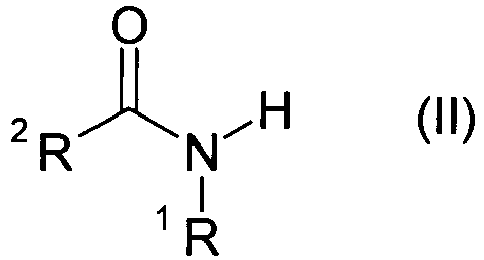
- the hot-melt adhesive composition preferably comprises at least one thermoplastic polyester (TPE) which is solid at 25 ° C. and preferably at least one amide (A) of the formula (I) or (II).
- TPE thermoplastic polyester
- A amide of the formula (I) or (II).
- R 1 is H, a C 1 -C 4 alkyl group or a benzyl group and R 2 is a saturated or unsaturated C 8 -C 22 alkyl group.
- Unsaturated here are understood as meaning radicals containing carbon-carbon double or triple bonds.
- the radicals can also be polyunsaturated, ie it is also possible for a plurality of such double and / or triple bonds to be present in the same radical. If so, these multiple bonds may be conjugated to each other or isolated from each other.
- the radicals R 1 and / or R 2 can be branched or unbranched independently of one another. Preferably, however, the radicals are unbranched. In particular branches in the immediate vicinity of the amide group are disadvantageous.
- the carbon which is directly connected to the nitrogen atom or the carbon atom, the amide group is a hydrogen atom-carrying carbon, in particular, a methylene carbon.
- the radicals R 2 of the amides of the formula (I) preferably have an odd number of carbon atoms, while the radicals R 2 of the amides of the formula (II) preferably has an even number of carbon atoms.
- the amide (A) has a melting point between 40 ° C and 150 ° C, preferably between 50 ° C and 110 ° C, on.
- the amide (A) is an amide of the formula (I).
- Preferred amides (A) of the formula (I) have an H as a substituent R 1 .
- This class of primary amide compounds are known to the person skilled in the art by the term "fatty acid amides". However, not all fatty acid amides are equally well suited. In particular, fatty acids having an alkyl group of more than 22 carbon atoms are not suitable.
- Such fatty acid amides R 2 CONH 2 can be reacted, for example, by the reaction of the corresponding fatty acids R 2 COOH with ammonia.
- the amides (A) of the formula (I) in which R 1 represents a C 1 -C 4 alkyl radical or a benzyl radical can be prepared for example by N-alkylation of the corresponding fatty acid amide R 2 CONH 2 produced by means Alkylhalogenen or can be prepared from the Reaction of a C 1 -C 4 alkylamine or benzylamine with the corresponding fatty acid R 2 COOH.
- the amide (A) is an amide of the formula (II).
- Such amides can be prepared from the reaction of fatty acid amines R 2 NH 2 with the respective carboxylic acid R 1 COOH, or the respective acid chlorides R 1 COCl.
- the fatty amines used for this purpose are usually prepared by reduction from the corresponding fatty acid amides or directly from the corresponding fatty acids.
- the amides (A) are preferably technical mixtures of amides having different lengths of R 2 , R 3 or R 4 , in particular technical mixtures of fatty acid amides.
- the radical R 2 is a C 8 -C 22 -alkyl radical, in particular a C 15 -C 22 -alkyl radical.
- Particularly preferred amides (A) of the formula (I) are selected from the group consisting of lauryl, myristic, palmitic, stearic, arachin, tubercolostearear, palmitoleic, oleic, linoleic, linolenic, elasostearin , Eruca and arachidonic acid amide.
- amides (A) of the formula (I) Preference is given to amides (A) of the formula (I), in particular stearic acid amide or erucamide.
- the most preferred amide (A) is erucamide.
- the amount of amide (A) used is advantageously such that the hot melt adhesive composition has an amount of at least 5% by weight, in particular from 5.0 to 20.0% by weight, preferably 7.0 to 15.0% by weight. , based on the hot melt adhesive composition.
- thermoplastic, silane-grafted polyolefin (P) used in this preferred embodiment is advantageous in that the hot-melt adhesive composition has an amount of at least 50% by weight, in particular from 50 to 95% by weight, preferably from 60 to 80% by weight. , based on the hot melt adhesive composition, on thermoplastic silane-grafted polyolefin (P).
- the amount of the at least one thermoplastic polyester (TPE) which is solid at 25 ° C. is advantageously in the range from 5 to 30% by weight, preferably from 7 to 15% by weight, based on the hot-melt adhesive composition.
- thermoplastic polyester is preferably solid at room temperature (25 ° C). Preference is given to crystalline, preferably aromatic, thermoplastic polyesters (TPE). Particularly suitable such thermoplastic polyesters (TPE) are polycaprolactone copolyester urethanes. In particular, they have a melt flow index (DIN 53,735) of more than 15 g / 10 min, preferably 25-100 g / 10 min (170 ° C., 2.16 kg) and in particular an OH number of less than 5 mg KOH / g, preferably less than 4 mg KOH / g.
- DIN 53,735 melt flow index
- the hot melt adhesive composition may, if desired, additionally comprise further thermoplastic polymers, independently of the aforementioned optional ingredients.
- thermoplastic polyesters TPE
- thermoplastic polyurethanes TPU
- additional thermoplastic polymer are ethylene-vinyl acetate copolymers (EVA).
- EVA ethylene-vinyl acetate copolymers
- these thermoplastic polymers may also be grafted.
- the hot-melt adhesive composition preferably further contains at least one catalyst which catalyzes the reaction of silane groups, in particular in an amount of 0.01-1.0 wt.%, Preferably 0.01-0.5 wt hot melt adhesive composition.
- catalysts include in particular tin-organic compound, preferably dibutyltin dilaurate (DBTL).
- constituents which are selected from the group comprising flame retardants, plasticizers, adhesion promoters, UV absorbers, UV and heat stabilizers, optical brighteners, fungicides, pigments, dyes, fillers and drying agents.
- the flame retardants are preferably inorganic flame retardants, organophosphorus flame retardants, nitrogen-based flame retardants or intumescent flame retardants.
- Halogenated (brominated and chlorinated) flame retardants are also useful, but less preferred because of their risk assessment. Examples of such halogenated flame retardants are polybrominated diphenyl ethers, e.g. DecaBDE, tetrabromobisphenol A and HBCD (hexabromocyclododecane).
- the nitrogen-based flame retardants are preferably melamines and ureas.
- the organophosphorus flame retardants are typically aromatic and alkyl esters of phosphoric acid. Preference is given to using TCEP (trichloroethyl phosphate), TCPP (trischloropropyl phosphate), TDCPP (tris-dichloroisopropyl phosphate), triphenyl phosphate, trioctyl phosphate (tris (2-ethylhexyl) phosphate) and trisnonyl phosphite.
- TCEP trichloroethyl phosphate
- TCPP trischloropropyl phosphate
- TDCPP tris-dichloroisopropyl phosphate
- triphenyl phosphate trihenyl phosphate
- trioctyl phosphate tris (2-ethylhexyl) phosphate
- trisnonyl phosphite trisnonyl phosphite.
- the inorganic flame retardants are typically hydroxides such as aluminum hydroxide and magnesium hydroxide, borates such as zinc borate, ammonium compounds such as ammonium sulfate, red phosphorus, antimony oxides such as antimony trioxide and antimony pentoxide and / or phyllosilicates such as vermiculites.
- thermoplastic fixed at 25 ° C silane-grafted poly- ⁇ -olefins (P), all optionally present soft resins (WH) and all optionally present solid thermoplastic poly- ⁇ -olefins (P ') more than 80 wt .-%, preferably more than 90 wt .-%, the hot melt adhesive composition is.
- the solids content of the hot-melt adhesive composition is expediently greater than 80% by weight, preferably greater than 90% by weight, in particular 100% by weight.
- Hot melt adhesive compositions which consist essentially of thermoplastic, silane-grafted poly- ⁇ -olefin (P), optionally soft resin (WH), optionally solid thermoplastic poly- ⁇ -olefin (P ') and catalyst, have proved to be particularly advantageous which catalyzes the reaction of silane groups.
- the hot melt adhesive composition at 25 ° C preferably has a density in the range of 0.80 to 0.95 kg / l, in particular in the range of 0.85 to 0.90 kg / l.
- the silane groups of the silane-grafted poly- ⁇ -olefin (P) hydrolyze to silanol groups (-SiOH), which in turn react with each other to form siloxane groups (-Si-O-Si) to crosslink the hot melt adhesive composition.
- Such hot melt adhesive compositions are referred to as reactive hot melt adhesives.
- the crosslinking of the hot-melt adhesive composition preferably results in a non-permeable barrier layer between the plates which prevents the penetration of water into the core region of the composite body.
- the diffusion-openability of the barrier layer with reference to DIN 4108-3 is preferably determined on the basis of EN ISO 7783-2.
- the thickness of the sample to be examined is preferably 1 mm.
- the measurement is preferably carried out in a dry climate (between 0% and 65% relative humidity at 20 ° C).
- the s D value (water vapor diffusion equivalent air layer thickness) of the barrier layer is preferably greater than 0.5 m, preferably greater than 0.7 m, in particular greater than 0.8 m.
- the hot melt adhesives which can be used according to the invention can be prepared by customary methods known to the person skilled in the art.
- the composites of the present invention are not subject to further limitations.
- they may comprise more than two styrene polymer plates, between each of which a hot melt adhesive composition of the type described above is suitably arranged.
- the thickness of the composite body can basically be chosen freely.
- the advantages of the present invention are particularly with thick ones To observe composite bodies, which preferably have a thickness of at least 70 mm, measured perpendicular to the surface normal of the adhesive layer and / or the plates.
- the hot melt adhesive composition is liquified by heating by melting the thermoplastic ingredients and / or converting them into a flowable state.
- the viscosity of the hot melt adhesive composition should be adjusted to the application temperature.
- the application temperature is 100 ° C to 200 ° C. At this temperature, the adhesive is easy to process.
- the viscosity is preferably in this temperature range 1,500 mPas - 50,000 mPas, in particular 2,000 mPas - 50,000 mPas, preferably measured at a frequency of 1 Hz. If it is much higher, the application is very difficult. If it is much deeper, the adhesive is so thin that it runs away from the material surface to be bonded during application before it solidifies due to cooling.
- the hot melt adhesive composition can be applied in a manner known per se, in particular by lamination, preferably as a film (gap preferably 0.1 mm - 1 mm), dot or bead, or by spraying.
- a film preferably 0.1 mm - 1 mm
- dot or bead or by spraying.
- suitable filter systems is recommended for use in automated systems.
- Adhesive rollers or nozzles from which the hot-melt adhesive composition is sprayed are particularly suitable for applying the hot-melt adhesive composition.
- any desired distribution (both in terms of areal extent and thickness of the application) of the hot melt adhesive composition on the contact surfaces can be achieved.
- the job can be handled like a paint job. In the sense, instead of the rollers and order plates are suitable for the model of printing plates.
- Nozzles are particularly suitable in the context of the present invention as a glue tool.
- the hot melt adhesive composition is so thin with appropriate heating that it can be sprayed on as a liquid.
- the hot melt adhesive composition may be sprayed in the form of droplets or as a jet.
- the adhesive jets can be applied at intervals and the droplets in a corresponding scattering. It can also be a spread by means of tassel or the like.
- Full-surface application is particularly preferred in the present invention because it results in the formation of a barrier layer in the composite that can slow the ingress of moisture into the core region of the composite. Furthermore, the full-surface application also prevents the frontal penetration of water into the glue joint.
- the amount of adhesive can in principle be chosen freely and adapted to the particular application.
- particularly advantageous application rates of hot melt adhesive composition for the purposes of the present invention are in the range of from 40 grams to 250 grams of hot melt adhesive composition per square meter of adhesive area, preferably in the range of from 60 grams to 150 grams, more preferably in the range of from 60 grams to 120 grams of hot melt adhesive composition per square meter of adhesive area.
- the solidification and solidification of the adhesive caused by the cooling causes a rapid strength build-up and high initial adhesion of the adhesive bond. Care should be taken that the bonding takes place within the time when the adhesive has not yet cooled too much, d. H. the bonding is preferably carried out as long as the adhesive is still liquid or at least still sticky and deformable.
- the adhesive will crosslink by the influence of water, especially humidity, and will continue to gain in mechanical strength within a short time of typically a few hours or days.
- the reactive hot melt adhesive composition can not be reversibly heated and thereby reflowed.
- the use of hot melt adhesive compositions comprising silane-grafted poly- ⁇ -olefins (P) is particularly advantageous for the purposes of the present invention because permanent bonding of the sheets is ensured.
- crosslinking of the hot melt adhesive composition requires significantly less creep.
- extruded styrene polymer foam boards in particular polystyrene foam boards, are glued together, the extrusion skin of which has not been removed before bonding.
- the moisture accumulation in the composite body is comparable to an equally thick single-layered panel, since the penetration on the wet side and the drying out of moisture on the dry side are equally reduced.
- a surface treatment may be advantageous. This can for example be a cleaning or a Apply a primer. Preferably, however, less demanding applications do not require the application of primers.
- the thermal embossing of both surfaces to be bonded by a tempered roller having preferably sandpaper-like surface structure has been found.
- the plate is preferably passed through a tempered steel roller with surface structure (negative) and unstructured counter-roller, whereby the surface structure is transferred to the one plate surface (positive).
- the plate thickness can be "calibrated” or set at the same time. In addition, unevenness of the plate surface is corrected.
- a gap in the range of 95% to less than 100%, in particular in the range of 96.5% to 98.5%, in each case based on the thickness of the styrene polymer plates to be bonded, has proven particularly useful in the context of the present invention.
- the grain size of the surface structure of the roll is preferably between 30 and 200.
- the surface temperature of the roll is suitably selected in the range of 130 ° C to 160 ° C.
- the step of contacting (iii) is preferably carried out at an adhesive temperature of 50 ° C or more, in particular a temperature between 50 ° C and 200 ° C, preferably between 100 ° C and 150 ° C.
- the bonding of the styrene polymer foam boards is preferably supported by applying a contact pressure, in particular between 0.1 bar and 1 bar, preferably of at least 0.8 bar.
- the plates are preferably superimposed so that the resulting product is a multi-layer plastic foam plate with a stepped rebate on the edge or with a tongue and groove connection on the edge.
- a shiplap is obtained when two plates parallel to the broad sides of the plates are offset from one another by an amount corresponding to the desired step width.
- a tongue and groove connection is obtained when three plates are superimposed, with the two outer plates being congruently arranged, while the middle plate is displaced parallel to its broad sides with respect to the outer plates by an amount corresponding to the desired spring and the desired one corresponding groove corresponds.
- the early strength can be so great that it is also possible to machine the narrow sides of the plates.
- the hot melt adhesive composition which can be used according to the invention is distinguished by an optimum open time, the time which is available after application of the adhesive for stacking the plates.
- the hot melt adhesive composition is adjusted to an open time of a few minutes, e.g. B. of less than 30 minutes, preferably less than 15 minutes and still more preferably less than 10 minutes, in particular to a time in the range of 3 minutes to less than 10 minutes.
- the time is sufficient to place the starting plates on top of each other and to position them.
- time is short enough to allow the hot melt adhesive composition to draw short enough to handle and optionally work the panels so bonded.
- the hot melt adhesive composition of the present invention is characterized by durable resistance.
- the curing can be completed after about 24 hours. Curing can take longer.
- the bonding is not affected by weathering, water, high temperature, freeze-thaw cycles.
- styrene polymer foam boards preferably polystyrene foam boards having a density of from 30 kg / m 3 to 45 kg / m 3
- an endless foam strand is preferably produced in a first step by means of a tandem extrusion line.
- the tandem extrusion plant expediently consists of a primary extruder and a secondary extruder.
- a plastic granulate is melted with the usual various additives and processing aids and mixed to form a homogeneous melt.
- the resulting melt is mixed with propellant and the mixture further homogenized on the way through the extruder.
- an extrusion plant with a single extruder is used. It may be extruder of different design, for. B. single screw extruder or twin screw extruder.
- the melt is foamed here in a so-called calibrator.
- calibrator metal plates which give the resulting foam strand its thickness.
- the plates are then obtained by cutting the foam strand to length and can be conveniently used after prior storage, ie connected in accordance with the invention.
- the adhesive is applied by laminating or spraying to at least one surface of at least one plate.
- the starting plates arrive after the application of adhesive in another station in which they are preferably erected and printed against each other. At the same time there is a centering of the output plates to each other or a desired offset of the output plates against each other.
- the bonded panels are then fed to a warehouse.
- Possible fields of application of the composite body according to the invention include its use as insulation material, preferably for the insulation of buildings, in particular for the thermal insulation of buildings.
- the styrene polymer composite according to the invention has various advantages over the prior art or compared to composites of other foams, which are due to the production process as well as the foam boards and adhesives used. Various properties are shown comparatively in the following overview for different types of foam composite bodies.
Landscapes
- Adhesives Or Adhesive Processes (AREA)
- Laminated Bodies (AREA)
Claims (15)
- Corps composite, comprenant au moins deux plaques en mousse de polymère styrénique et, disposée entre ces dernières, une composition adhésive thermofusible le cas échéant réticulée, caractérisé en ce que la composition adhésive thermofusible comprend au moins une poly-α-oléfine (P) thermoplastique greffée au silane, solide à 25°C, qui a été le cas échéant réticulée a posteriori.
- Corps composite selon la revendication 1, caractérisé en ce que la poly-α-oléfine (P) greffée au silane présente un température d'amollissement située entre 70°C et 150°C, en particulier entre 80°C et 120°C, de préférence entre 80°C et 100°C.
- Corps composite selon la revendication 1 ou 2, caractérisé en ce que la poly-α-oléfine (P) greffée au silane est un polyéthylène ou polypropylène greffé au silane.
- Corps composite selon au moins l'une quelconque des revendications précédentes, caractérisé en ce que la composition adhésive thermofusible contient en outre une poly-α-oléfine thermoplastique (P'), en particulier une poly-α-oléfine atactique (APAO), solide à 25°C.
- Corps composite selon au moins l'une quelconque des revendications précédentes, caractérisé en ce que la composition adhésive thermofusible comprend en outre au moins une résine molle (WH) avec un point de fusion ou point d'amollissement situé entre -10°C et 40°C, de préférence 0°C et 25°C, en particulier 10°C et 25°C.
- Corps composite selon la revendication 5, caractérisé en ce que la résine molle (WH) est une résine d'hydrocarbure, en particulier une résine d'hydrocarbure C5-C9 aliphatique.
- Corps composite selon la revendication 5 ou 6, caractérisé en ce que la quantité de résine molle (WH) est égale à 20 - 40 % en poids, en particulier 25 - 35 % en poids, par rapport à la composition adhésive thermofusible.
- Corps composite selon au moins l'une quelconque des revendications précédentes, caractérisé en ce que la composition adhésive thermofusible comprend au moins un polyester thermoplastique (TPE) solide à 25°C et au moins un amide de la formule (I) ou (II), dans laquelle R1 représente H, un groupe alkyle C1-C4 ou un groupe benzyle, R2 représente un groupe alkyle C8-C22 saturé ou non-saturé.

- Corps composite selon au moins l'une quelconque des revendications précédentes, caractérisé en ce que les plaques en mousse de polymère styrénique sont des plaques en mousse de polystyrène extrudé.
- Procédé de collage d'au moins deux plaques en mousse de polymère styrénique, caractérisé en ce que l'on(i) fait fondre une composition adhésive thermofusible, qui comprend au moins une poly-α-oléfine (P) solide à 25°C greffée au silane, et/ou la transfère dans un état fluide,(ii) applique la composition adhésive thermofusible fondue sur une première plaque en mousse de polymère styrénique,(iii) met en contact la composition de colle thermoadhésive fondue sur le côté opposé à la première plaque avec une deuxième plaque en mousse de polymère styrénique,(iv) laisse si nécessaire la composition adhésive thermofusible fondue se refroidir et durcir.(v) la quantité appliquée est égale à 40 g/m2 à 250 g/m2, de préférence 80 g/m2 à 150 g/m2.
- Procédé selon la revendication 10, caractérisé en ce que l'on assiste le collage des plaques en mousse de polymère styrénique par application d'une pression de serrage, en particulier entre 0,1 bar et 1 bar, de préférence d'au moins 0,8 bar.
- Procédé selon la revendication 10 ou 11, caractérisé en ce que l'on colle l'une avec l'autre des plaques en mousse de polymère styrénique extrudées dont la peau d'extrusion n'a pas été enlevée avant le collage.
- Procédé selon l'une quelconque des revendications 10 à 12, caractérisé en ce que l'on colle l'une avec l'autre des plaques en mousse de polymère styrénique extrudées dont les surfaces supérieures ont été prétraitées.
- Procédé selon la revendication 13, caractérisé en ce que le traitement de surface a lieu par gaufrage thermique, de préférence par un rouleau gaufreur tempéré avec une structure de papier sablé avec une granulométrie située de préférence dans la plage de 30 à 200, et une température de surface entre 130°C et 160°C.
- Utilisation d'un corps composite selon au moins l'une quelconque des revendications 1 à 9 pour l'isolation de bâtiments.
Priority Applications (2)
| Application Number | Priority Date | Filing Date | Title |
|---|---|---|---|
| SI201130892A SI2399737T1 (sl) | 2010-06-01 | 2011-05-31 | Kompozitno telo iz stirenske polimerne pene |
| EP11004438.5A EP2399737B1 (fr) | 2010-06-01 | 2011-05-31 | Corps composite en mousse polymère de styrène |
Applications Claiming Priority (2)
| Application Number | Priority Date | Filing Date | Title |
|---|---|---|---|
| EP10005679A EP2392456A1 (fr) | 2010-06-01 | 2010-06-01 | Corps composite en mousse polymère de styrène |
| EP11004438.5A EP2399737B1 (fr) | 2010-06-01 | 2011-05-31 | Corps composite en mousse polymère de styrène |
Publications (2)
| Publication Number | Publication Date |
|---|---|
| EP2399737A1 EP2399737A1 (fr) | 2011-12-28 |
| EP2399737B1 true EP2399737B1 (fr) | 2016-04-27 |
Family
ID=42647370
Family Applications (2)
| Application Number | Title | Priority Date | Filing Date |
|---|---|---|---|
| EP10005679A Withdrawn EP2392456A1 (fr) | 2010-06-01 | 2010-06-01 | Corps composite en mousse polymère de styrène |
| EP11004438.5A Active EP2399737B1 (fr) | 2010-06-01 | 2011-05-31 | Corps composite en mousse polymère de styrène |
Family Applications Before (1)
| Application Number | Title | Priority Date | Filing Date |
|---|---|---|---|
| EP10005679A Withdrawn EP2392456A1 (fr) | 2010-06-01 | 2010-06-01 | Corps composite en mousse polymère de styrène |
Country Status (2)
| Country | Link |
|---|---|
| EP (2) | EP2392456A1 (fr) |
| SI (1) | SI2399737T1 (fr) |
Families Citing this family (1)
| Publication number | Priority date | Publication date | Assignee | Title |
|---|---|---|---|---|
| EP3498798A1 (fr) * | 2017-12-12 | 2019-06-19 | Sika Technology Ag | Colle thermofusible à base de polyoléfine et son utilisation pour le collage de plaques en mousse plastique |
Family Cites Families (8)
| Publication number | Priority date | Publication date | Assignee | Title |
|---|---|---|---|---|
| DE4000695C2 (de) | 1990-01-12 | 1997-07-03 | Huels Chemische Werke Ag | Weitgehend amorphe Polyalphaolefine mit enger Molekulargewichtsverteilung, Verfahren zu deren Herstellung und Verwendung für Teppichschwerbeschichtungsmassen oder Schmelzklebstoffe |
| US5876813A (en) * | 1996-07-09 | 1999-03-02 | Senitnel Products Corp | Laminated foam structures with enhanced properties |
| US5994747A (en) | 1998-02-13 | 1999-11-30 | Texas Instruments-Acer Incorporated | MOSFETs with recessed self-aligned silicide gradual S/D junction |
| EP1213118B1 (fr) * | 2000-12-08 | 2007-02-14 | Jackon Insulation GmbH | Panneaux en mousse d'épaisseur élévée |
| DE10315090A1 (de) * | 2003-04-02 | 2004-10-21 | Gefinex Jackon Gmbh | Kunststoffschaumplatten großer Dicke |
| DE102004044380A1 (de) | 2004-09-10 | 2006-03-30 | Basf Ag | Halogenfreie, flammgeschützte Polymerschaumstoffe |
| EP2075297B1 (fr) | 2007-12-04 | 2010-02-24 | Sika Technology AG | Adhésif thermofusible ayant une bonne adhérence sur des polyoléfines |
| EP2113545A1 (fr) | 2008-04-28 | 2009-11-04 | Sika Technology AG | Adhésifs thermofusibles ayant une durée d'ouverture prolongée |
-
2010
- 2010-06-01 EP EP10005679A patent/EP2392456A1/fr not_active Withdrawn
-
2011
- 2011-05-31 EP EP11004438.5A patent/EP2399737B1/fr active Active
- 2011-05-31 SI SI201130892A patent/SI2399737T1/sl unknown
Also Published As
| Publication number | Publication date |
|---|---|
| EP2399737A1 (fr) | 2011-12-28 |
| SI2399737T1 (sl) | 2016-08-31 |
| EP2392456A1 (fr) | 2011-12-07 |
Similar Documents
| Publication | Publication Date | Title |
|---|---|---|
| EP2668036B1 (fr) | Procédé de production d'un film plastique multicouche | |
| EP2075297B1 (fr) | Adhésif thermofusible ayant une bonne adhérence sur des polyoléfines | |
| EP2274395B1 (fr) | Adhésifs thermofusibles ayant une durée d'ouverture prolongée | |
| EP2235098B1 (fr) | Matière adhésive moussée, en particulier sensible à la pression, procédé de fabrication et utilisation de cette matière | |
| DE68915817T2 (de) | Verfahren zunm Herstellen eines geformten laminierten Gegenstandes. | |
| EP2933090B1 (fr) | Procédé de laminage avec application d'adhésif en forme de grille | |
| EP2305389A2 (fr) | Bandes adhésives de montage | |
| EP2186869A1 (fr) | Polyacrylate réticulable thermiquement et son procédé de fabrication | |
| EP2917296B1 (fr) | Adhésif thermofusible de polyoléfine réactif ayant une faible adhérence aux outils en aluminium non revêtus et son utilisation en tant que masque thermofusible | |
| DE102015001965A1 (de) | Verfahren zum Versehen einer Kaschierfolie mit Klebstoff, Verfahren zum Auftragen eines Hotmelts, Verwendung, Anlage zum Kaschieren und Verfahren zum Umrüsten einer solchen Anlage | |
| EP2890259B1 (fr) | Mélange de matière de remplissage utilisé pour produire des matériaux thermoplastiques de renforcement de chaussure | |
| DE10144524B4 (de) | Verkleben von Kunststoffextrudaten mit Werkstoffoberflächen | |
| EP3218158B2 (fr) | Procédé de fabrication d'un stratifié de film de mousse et son utilisation | |
| DE69838429T2 (de) | Verfahren zur herstellung einer aufschäumbaren polyolefinharzverbundfolie und verbundschaum | |
| EP1471125B1 (fr) | Plaques de mousse épaisses | |
| DE102013217880A1 (de) | Latentreaktive Klebeprodukte mit verbesserter Stanzbarkeit und latentreaktive Klebfolienstanzlinge | |
| DE3001636A1 (de) | Polyolefinfolie mit verbesserter haftung, deren herstellung und verwendung | |
| DE112021004220T5 (de) | Kantenstreifen für Bauteile, insbesondere Möbelbauteile | |
| EP2399737B1 (fr) | Corps composite en mousse polymère de styrène | |
| EP2734365B1 (fr) | Feuille multicouche ayant une résistance accrue à la poursuite du déchirement et une rétraction faible | |
| WO2003022546A1 (fr) | Collage de produits extrudes en plastique sur la surface de pieces | |
| DE102017108078A1 (de) | Verbessertes Verfahren zur Herstellung einer Leichtbau-Sandwichplatte | |
| EP1642950A2 (fr) | Procédé de préparation de rubans auto-adhésifs avec des microsphères expansées dans la couche support | |
| EP2602109A2 (fr) | Corps composite en mousse polymère de styrène | |
| EP2154218A2 (fr) | Film alvéolaire autocollant comme protection pour laques fraîches dans des montages de véhicules et procédé de fabrication |
Legal Events
| Date | Code | Title | Description |
|---|---|---|---|
| AK | Designated contracting states |
Kind code of ref document: A1 Designated state(s): AL AT BE BG CH CY CZ DE DK EE ES FI FR GB GR HR HU IE IS IT LI LT LU LV MC MK MT NL NO PL PT RO RS SE SI SK SM TR |
|
| AX | Request for extension of the european patent |
Extension state: BA ME |
|
| PUAI | Public reference made under article 153(3) epc to a published international application that has entered the european phase |
Free format text: ORIGINAL CODE: 0009012 |
|
| 17P | Request for examination filed |
Effective date: 20120602 |
|
| 17Q | First examination report despatched |
Effective date: 20121204 |
|
| GRAP | Despatch of communication of intention to grant a patent |
Free format text: ORIGINAL CODE: EPIDOSNIGR1 |
|
| INTG | Intention to grant announced |
Effective date: 20151111 |
|
| GRAS | Grant fee paid |
Free format text: ORIGINAL CODE: EPIDOSNIGR3 |
|
| GRAA | (expected) grant |
Free format text: ORIGINAL CODE: 0009210 |
|
| AK | Designated contracting states |
Kind code of ref document: B1 Designated state(s): AL AT BE BG CH CY CZ DE DK EE ES FI FR GB GR HR HU IE IS IT LI LT LU LV MC MK MT NL NO PL PT RO RS SE SI SK SM TR |
|
| AX | Request for extension of the european patent |
Extension state: BA ME |
|
| REG | Reference to a national code |
Ref country code: GB Ref legal event code: FG4D Free format text: NOT ENGLISH |
|
| REG | Reference to a national code |
Ref country code: CH Ref legal event code: EP |
|
| REG | Reference to a national code |
Ref country code: AT Ref legal event code: REF Ref document number: 794272 Country of ref document: AT Kind code of ref document: T Effective date: 20160515 |
|
| REG | Reference to a national code |
Ref country code: IE Ref legal event code: FG4D Free format text: LANGUAGE OF EP DOCUMENT: GERMAN |
|
| REG | Reference to a national code |
Ref country code: DE Ref legal event code: R096 Ref document number: 502011009584 Country of ref document: DE |
|
| REG | Reference to a national code |
Ref country code: FR Ref legal event code: PLFP Year of fee payment: 6 |
|
| REG | Reference to a national code |
Ref country code: LT Ref legal event code: MG4D |
|
| PG25 | Lapsed in a contracting state [announced via postgrant information from national office to epo] |
Ref country code: BE Free format text: LAPSE BECAUSE OF NON-PAYMENT OF DUE FEES Effective date: 20160531 |
|
| REG | Reference to a national code |
Ref country code: NL Ref legal event code: MP Effective date: 20160427 |
|
| PG25 | Lapsed in a contracting state [announced via postgrant information from national office to epo] |
Ref country code: NL Free format text: LAPSE BECAUSE OF FAILURE TO SUBMIT A TRANSLATION OF THE DESCRIPTION OR TO PAY THE FEE WITHIN THE PRESCRIBED TIME-LIMIT Effective date: 20160427 |
|
| PG25 | Lapsed in a contracting state [announced via postgrant information from national office to epo] |
Ref country code: NO Free format text: LAPSE BECAUSE OF FAILURE TO SUBMIT A TRANSLATION OF THE DESCRIPTION OR TO PAY THE FEE WITHIN THE PRESCRIBED TIME-LIMIT Effective date: 20160727 Ref country code: FI Free format text: LAPSE BECAUSE OF FAILURE TO SUBMIT A TRANSLATION OF THE DESCRIPTION OR TO PAY THE FEE WITHIN THE PRESCRIBED TIME-LIMIT Effective date: 20160427 Ref country code: PL Free format text: LAPSE BECAUSE OF FAILURE TO SUBMIT A TRANSLATION OF THE DESCRIPTION OR TO PAY THE FEE WITHIN THE PRESCRIBED TIME-LIMIT Effective date: 20160427 Ref country code: LT Free format text: LAPSE BECAUSE OF FAILURE TO SUBMIT A TRANSLATION OF THE DESCRIPTION OR TO PAY THE FEE WITHIN THE PRESCRIBED TIME-LIMIT Effective date: 20160427 |
|
| PG25 | Lapsed in a contracting state [announced via postgrant information from national office to epo] |
Ref country code: LV Free format text: LAPSE BECAUSE OF FAILURE TO SUBMIT A TRANSLATION OF THE DESCRIPTION OR TO PAY THE FEE WITHIN THE PRESCRIBED TIME-LIMIT Effective date: 20160427 Ref country code: SE Free format text: LAPSE BECAUSE OF FAILURE TO SUBMIT A TRANSLATION OF THE DESCRIPTION OR TO PAY THE FEE WITHIN THE PRESCRIBED TIME-LIMIT Effective date: 20160427 Ref country code: RS Free format text: LAPSE BECAUSE OF FAILURE TO SUBMIT A TRANSLATION OF THE DESCRIPTION OR TO PAY THE FEE WITHIN THE PRESCRIBED TIME-LIMIT Effective date: 20160427 Ref country code: PT Free format text: LAPSE BECAUSE OF FAILURE TO SUBMIT A TRANSLATION OF THE DESCRIPTION OR TO PAY THE FEE WITHIN THE PRESCRIBED TIME-LIMIT Effective date: 20160829 Ref country code: ES Free format text: LAPSE BECAUSE OF FAILURE TO SUBMIT A TRANSLATION OF THE DESCRIPTION OR TO PAY THE FEE WITHIN THE PRESCRIBED TIME-LIMIT Effective date: 20160427 Ref country code: GR Free format text: LAPSE BECAUSE OF FAILURE TO SUBMIT A TRANSLATION OF THE DESCRIPTION OR TO PAY THE FEE WITHIN THE PRESCRIBED TIME-LIMIT Effective date: 20160728 Ref country code: HR Free format text: LAPSE BECAUSE OF FAILURE TO SUBMIT A TRANSLATION OF THE DESCRIPTION OR TO PAY THE FEE WITHIN THE PRESCRIBED TIME-LIMIT Effective date: 20160427 |
|
| REG | Reference to a national code |
Ref country code: DE Ref legal event code: R097 Ref document number: 502011009584 Country of ref document: DE |
|
| PG25 | Lapsed in a contracting state [announced via postgrant information from national office to epo] |
Ref country code: SK Free format text: LAPSE BECAUSE OF FAILURE TO SUBMIT A TRANSLATION OF THE DESCRIPTION OR TO PAY THE FEE WITHIN THE PRESCRIBED TIME-LIMIT Effective date: 20160427 Ref country code: DK Free format text: LAPSE BECAUSE OF FAILURE TO SUBMIT A TRANSLATION OF THE DESCRIPTION OR TO PAY THE FEE WITHIN THE PRESCRIBED TIME-LIMIT Effective date: 20160427 Ref country code: CZ Free format text: LAPSE BECAUSE OF FAILURE TO SUBMIT A TRANSLATION OF THE DESCRIPTION OR TO PAY THE FEE WITHIN THE PRESCRIBED TIME-LIMIT Effective date: 20160427 Ref country code: RO Free format text: LAPSE BECAUSE OF FAILURE TO SUBMIT A TRANSLATION OF THE DESCRIPTION OR TO PAY THE FEE WITHIN THE PRESCRIBED TIME-LIMIT Effective date: 20160427 Ref country code: MC Free format text: LAPSE BECAUSE OF FAILURE TO SUBMIT A TRANSLATION OF THE DESCRIPTION OR TO PAY THE FEE WITHIN THE PRESCRIBED TIME-LIMIT Effective date: 20160427 Ref country code: EE Free format text: LAPSE BECAUSE OF FAILURE TO SUBMIT A TRANSLATION OF THE DESCRIPTION OR TO PAY THE FEE WITHIN THE PRESCRIBED TIME-LIMIT Effective date: 20160427 |
|
| REG | Reference to a national code |
Ref country code: IE Ref legal event code: MM4A |
|
| PG25 | Lapsed in a contracting state [announced via postgrant information from national office to epo] |
Ref country code: SM Free format text: LAPSE BECAUSE OF FAILURE TO SUBMIT A TRANSLATION OF THE DESCRIPTION OR TO PAY THE FEE WITHIN THE PRESCRIBED TIME-LIMIT Effective date: 20160427 |
|
| PLBE | No opposition filed within time limit |
Free format text: ORIGINAL CODE: 0009261 |
|
| STAA | Information on the status of an ep patent application or granted ep patent |
Free format text: STATUS: NO OPPOSITION FILED WITHIN TIME LIMIT |
|
| GBPC | Gb: european patent ceased through non-payment of renewal fee |
Effective date: 20160727 |
|
| 26N | No opposition filed |
Effective date: 20170130 |
|
| REG | Reference to a national code |
Ref country code: FR Ref legal event code: PLFP Year of fee payment: 7 |
|
| PG25 | Lapsed in a contracting state [announced via postgrant information from national office to epo] |
Ref country code: IE Free format text: LAPSE BECAUSE OF NON-PAYMENT OF DUE FEES Effective date: 20160531 Ref country code: GB Free format text: LAPSE BECAUSE OF NON-PAYMENT OF DUE FEES Effective date: 20160727 |
|
| REG | Reference to a national code |
Ref country code: FR Ref legal event code: PLFP Year of fee payment: 8 |
|
| PG25 | Lapsed in a contracting state [announced via postgrant information from national office to epo] |
Ref country code: HU Free format text: LAPSE BECAUSE OF FAILURE TO SUBMIT A TRANSLATION OF THE DESCRIPTION OR TO PAY THE FEE WITHIN THE PRESCRIBED TIME-LIMIT; INVALID AB INITIO Effective date: 20110531 Ref country code: CY Free format text: LAPSE BECAUSE OF FAILURE TO SUBMIT A TRANSLATION OF THE DESCRIPTION OR TO PAY THE FEE WITHIN THE PRESCRIBED TIME-LIMIT Effective date: 20160427 |
|
| PG25 | Lapsed in a contracting state [announced via postgrant information from national office to epo] |
Ref country code: IS Free format text: LAPSE BECAUSE OF FAILURE TO SUBMIT A TRANSLATION OF THE DESCRIPTION OR TO PAY THE FEE WITHIN THE PRESCRIBED TIME-LIMIT Effective date: 20160427 Ref country code: MK Free format text: LAPSE BECAUSE OF FAILURE TO SUBMIT A TRANSLATION OF THE DESCRIPTION OR TO PAY THE FEE WITHIN THE PRESCRIBED TIME-LIMIT Effective date: 20160427 Ref country code: MT Free format text: LAPSE BECAUSE OF FAILURE TO SUBMIT A TRANSLATION OF THE DESCRIPTION OR TO PAY THE FEE WITHIN THE PRESCRIBED TIME-LIMIT Effective date: 20160427 Ref country code: TR Free format text: LAPSE BECAUSE OF FAILURE TO SUBMIT A TRANSLATION OF THE DESCRIPTION OR TO PAY THE FEE WITHIN THE PRESCRIBED TIME-LIMIT Effective date: 20160427 Ref country code: LU Free format text: LAPSE BECAUSE OF NON-PAYMENT OF DUE FEES Effective date: 20160531 |
|
| PG25 | Lapsed in a contracting state [announced via postgrant information from national office to epo] |
Ref country code: BG Free format text: LAPSE BECAUSE OF FAILURE TO SUBMIT A TRANSLATION OF THE DESCRIPTION OR TO PAY THE FEE WITHIN THE PRESCRIBED TIME-LIMIT Effective date: 20160427 |
|
| PGFP | Annual fee paid to national office [announced via postgrant information from national office to epo] |
Ref country code: DE Payment date: 20180530 Year of fee payment: 8 Ref country code: CH Payment date: 20180523 Year of fee payment: 8 |
|
| PGFP | Annual fee paid to national office [announced via postgrant information from national office to epo] |
Ref country code: FR Payment date: 20180523 Year of fee payment: 8 Ref country code: AT Payment date: 20180517 Year of fee payment: 8 Ref country code: SI Payment date: 20180521 Year of fee payment: 8 Ref country code: IT Payment date: 20180518 Year of fee payment: 8 |
|
| PG25 | Lapsed in a contracting state [announced via postgrant information from national office to epo] |
Ref country code: AL Free format text: LAPSE BECAUSE OF FAILURE TO SUBMIT A TRANSLATION OF THE DESCRIPTION OR TO PAY THE FEE WITHIN THE PRESCRIBED TIME-LIMIT Effective date: 20160427 |
|
| REG | Reference to a national code |
Ref country code: DE Ref legal event code: R119 Ref document number: 502011009584 Country of ref document: DE |
|
| REG | Reference to a national code |
Ref country code: CH Ref legal event code: PL |
|
| REG | Reference to a national code |
Ref country code: AT Ref legal event code: MM01 Ref document number: 794272 Country of ref document: AT Kind code of ref document: T Effective date: 20190531 |
|
| PG25 | Lapsed in a contracting state [announced via postgrant information from national office to epo] |
Ref country code: AT Free format text: LAPSE BECAUSE OF NON-PAYMENT OF DUE FEES Effective date: 20190531 Ref country code: LI Free format text: LAPSE BECAUSE OF NON-PAYMENT OF DUE FEES Effective date: 20190531 Ref country code: CH Free format text: LAPSE BECAUSE OF NON-PAYMENT OF DUE FEES Effective date: 20190531 |
|
| PG25 | Lapsed in a contracting state [announced via postgrant information from national office to epo] |
Ref country code: SI Free format text: LAPSE BECAUSE OF NON-PAYMENT OF DUE FEES Effective date: 20190601 |
|
| PG25 | Lapsed in a contracting state [announced via postgrant information from national office to epo] |
Ref country code: IT Free format text: LAPSE BECAUSE OF NON-PAYMENT OF DUE FEES Effective date: 20190531 Ref country code: DE Free format text: LAPSE BECAUSE OF NON-PAYMENT OF DUE FEES Effective date: 20191203 |
|
| PG25 | Lapsed in a contracting state [announced via postgrant information from national office to epo] |
Ref country code: FR Free format text: LAPSE BECAUSE OF NON-PAYMENT OF DUE FEES Effective date: 20190531 |