EP2404991A2 - Procédé et système de production de cellules et produits de cellules et applications associées - Google Patents
Procédé et système de production de cellules et produits de cellules et applications associées Download PDFInfo
- Publication number
- EP2404991A2 EP2404991A2 EP11173373A EP11173373A EP2404991A2 EP 2404991 A2 EP2404991 A2 EP 2404991A2 EP 11173373 A EP11173373 A EP 11173373A EP 11173373 A EP11173373 A EP 11173373A EP 2404991 A2 EP2404991 A2 EP 2404991A2
- Authority
- EP
- European Patent Office
- Prior art keywords
- cell
- cell culture
- cells
- module
- base device
- Prior art date
- Legal status (The legal status is an assumption and is not a legal conclusion. Google has not performed a legal analysis and makes no representation as to the accuracy of the status listed.)
- Withdrawn
Links
- 238000004519 manufacturing process Methods 0.000 title claims abstract description 37
- 238000000034 method Methods 0.000 title claims description 81
- 210000004027 cell Anatomy 0.000 claims abstract description 176
- 238000004113 cell culture Methods 0.000 claims abstract description 77
- 230000010261 cell growth Effects 0.000 claims abstract description 48
- 239000006143 cell culture medium Substances 0.000 claims abstract description 27
- 230000012010 growth Effects 0.000 claims abstract description 24
- 239000002609 medium Substances 0.000 claims abstract description 15
- 210000003040 circulating cell Anatomy 0.000 claims abstract description 4
- 239000012530 fluid Substances 0.000 claims description 68
- 239000000047 product Substances 0.000 claims description 57
- 230000001351 cycling effect Effects 0.000 claims description 35
- 238000003306 harvesting Methods 0.000 claims description 29
- 230000002572 peristaltic effect Effects 0.000 claims description 13
- 230000008569 process Effects 0.000 claims description 13
- 239000003102 growth factor Substances 0.000 claims description 11
- 238000003860 storage Methods 0.000 claims description 10
- 238000004891 communication Methods 0.000 claims description 6
- 238000011010 flushing procedure Methods 0.000 claims description 5
- 230000003993 interaction Effects 0.000 claims description 5
- 230000013011 mating Effects 0.000 claims description 5
- 239000013589 supplement Substances 0.000 claims description 4
- 210000004408 hybridoma Anatomy 0.000 claims description 3
- 239000007789 gas Substances 0.000 description 33
- CURLTUGMZLYLDI-UHFFFAOYSA-N Carbon dioxide Chemical compound O=C=O CURLTUGMZLYLDI-UHFFFAOYSA-N 0.000 description 31
- JVTAAEKCZFNVCJ-UHFFFAOYSA-M Lactate Chemical compound CC(O)C([O-])=O JVTAAEKCZFNVCJ-UHFFFAOYSA-M 0.000 description 29
- 239000000523 sample Substances 0.000 description 28
- 229910002092 carbon dioxide Inorganic materials 0.000 description 23
- 239000012528 membrane Substances 0.000 description 17
- 210000004379 membrane Anatomy 0.000 description 16
- 239000012510 hollow fiber Substances 0.000 description 14
- 230000007246 mechanism Effects 0.000 description 13
- 238000013461 design Methods 0.000 description 11
- BVKZGUZCCUSVTD-UHFFFAOYSA-M Bicarbonate Chemical compound OC([O-])=O BVKZGUZCCUSVTD-UHFFFAOYSA-M 0.000 description 10
- 238000011068 loading method Methods 0.000 description 10
- 230000010412 perfusion Effects 0.000 description 10
- 230000001225 therapeutic effect Effects 0.000 description 10
- 239000000835 fiber Substances 0.000 description 9
- 239000011159 matrix material Substances 0.000 description 9
- 230000001954 sterilising effect Effects 0.000 description 9
- 239000001569 carbon dioxide Substances 0.000 description 8
- 239000000306 component Substances 0.000 description 8
- 238000004659 sterilization and disinfection Methods 0.000 description 8
- 238000010438 heat treatment Methods 0.000 description 7
- 238000009434 installation Methods 0.000 description 7
- 230000033001 locomotion Effects 0.000 description 7
- 238000004886 process control Methods 0.000 description 7
- 238000002560 therapeutic procedure Methods 0.000 description 7
- 230000008901 benefit Effects 0.000 description 6
- 238000010790 dilution Methods 0.000 description 6
- 239000012895 dilution Substances 0.000 description 6
- JVTAAEKCZFNVCJ-UHFFFAOYSA-N lactic acid Chemical compound CC(O)C(O)=O JVTAAEKCZFNVCJ-UHFFFAOYSA-N 0.000 description 6
- 102000004169 proteins and genes Human genes 0.000 description 6
- 108090000623 proteins and genes Proteins 0.000 description 6
- 230000001105 regulatory effect Effects 0.000 description 6
- 238000005070 sampling Methods 0.000 description 6
- 241001465754 Metazoa Species 0.000 description 5
- QVGXLLKOCUKJST-UHFFFAOYSA-N atomic oxygen Chemical compound [O] QVGXLLKOCUKJST-UHFFFAOYSA-N 0.000 description 5
- 238000004140 cleaning Methods 0.000 description 5
- 238000005516 engineering process Methods 0.000 description 5
- 230000002503 metabolic effect Effects 0.000 description 5
- 235000015097 nutrients Nutrition 0.000 description 5
- 229910052760 oxygen Inorganic materials 0.000 description 5
- 239000001301 oxygen Substances 0.000 description 5
- 239000000126 substance Substances 0.000 description 5
- 239000002699 waste material Substances 0.000 description 5
- 238000013459 approach Methods 0.000 description 4
- 238000011109 contamination Methods 0.000 description 4
- 230000001276 controlling effect Effects 0.000 description 4
- 238000010586 diagram Methods 0.000 description 4
- 230000000694 effects Effects 0.000 description 4
- 239000001963 growth medium Substances 0.000 description 4
- 238000001802 infusion Methods 0.000 description 4
- 238000011081 inoculation Methods 0.000 description 4
- 239000007788 liquid Substances 0.000 description 4
- 238000007726 management method Methods 0.000 description 4
- 238000002156 mixing Methods 0.000 description 4
- 238000005204 segregation Methods 0.000 description 4
- 230000004888 barrier function Effects 0.000 description 3
- 230000019522 cellular metabolic process Effects 0.000 description 3
- 230000006870 function Effects 0.000 description 3
- 210000004602 germ cell Anatomy 0.000 description 3
- 208000000509 infertility Diseases 0.000 description 3
- 230000036512 infertility Effects 0.000 description 3
- 208000021267 infertility disease Diseases 0.000 description 3
- 238000003780 insertion Methods 0.000 description 3
- 230000037431 insertion Effects 0.000 description 3
- 239000004310 lactic acid Substances 0.000 description 3
- 235000014655 lactic acid Nutrition 0.000 description 3
- 238000012544 monitoring process Methods 0.000 description 3
- 230000003287 optical effect Effects 0.000 description 3
- 239000012071 phase Substances 0.000 description 3
- 210000001082 somatic cell Anatomy 0.000 description 3
- 230000000392 somatic effect Effects 0.000 description 3
- 239000002253 acid Substances 0.000 description 2
- 210000004504 adult stem cell Anatomy 0.000 description 2
- 230000003466 anti-cipated effect Effects 0.000 description 2
- 230000009286 beneficial effect Effects 0.000 description 2
- 230000003833 cell viability Effects 0.000 description 2
- 239000000919 ceramic Substances 0.000 description 2
- 210000001612 chondrocyte Anatomy 0.000 description 2
- 238000012258 culturing Methods 0.000 description 2
- 230000003247 decreasing effect Effects 0.000 description 2
- 238000009826 distribution Methods 0.000 description 2
- 239000003814 drug Substances 0.000 description 2
- 229920001971 elastomer Polymers 0.000 description 2
- 239000000806 elastomer Substances 0.000 description 2
- 210000001671 embryonic stem cell Anatomy 0.000 description 2
- 238000001914 filtration Methods 0.000 description 2
- 239000011521 glass Substances 0.000 description 2
- 210000002865 immune cell Anatomy 0.000 description 2
- 238000002513 implantation Methods 0.000 description 2
- 238000011031 large-scale manufacturing process Methods 0.000 description 2
- 239000000463 material Substances 0.000 description 2
- 238000005259 measurement Methods 0.000 description 2
- 238000001139 pH measurement Methods 0.000 description 2
- 230000000737 periodic effect Effects 0.000 description 2
- 238000009428 plumbing Methods 0.000 description 2
- 238000000746 purification Methods 0.000 description 2
- 230000028327 secretion Effects 0.000 description 2
- 239000007787 solid Substances 0.000 description 2
- 239000000243 solution Substances 0.000 description 2
- 210000000130 stem cell Anatomy 0.000 description 2
- 231100000331 toxic Toxicity 0.000 description 2
- 230000002588 toxic effect Effects 0.000 description 2
- 206010003445 Ascites Diseases 0.000 description 1
- 102000015081 Blood Coagulation Factors Human genes 0.000 description 1
- 108010039209 Blood Coagulation Factors Proteins 0.000 description 1
- IAYPIBMASNFSPL-UHFFFAOYSA-N Ethylene oxide Chemical compound C1CO1 IAYPIBMASNFSPL-UHFFFAOYSA-N 0.000 description 1
- ISWSIDIOOBJBQZ-UHFFFAOYSA-N Phenol Chemical compound OC1=CC=CC=C1 ISWSIDIOOBJBQZ-UHFFFAOYSA-N 0.000 description 1
- 230000035508 accumulation Effects 0.000 description 1
- 238000009825 accumulation Methods 0.000 description 1
- 239000013543 active substance Substances 0.000 description 1
- 239000000654 additive Substances 0.000 description 1
- 230000002411 adverse Effects 0.000 description 1
- 150000001413 amino acids Chemical class 0.000 description 1
- 238000004458 analytical method Methods 0.000 description 1
- 210000004102 animal cell Anatomy 0.000 description 1
- 210000001188 articular cartilage Anatomy 0.000 description 1
- 210000003567 ascitic fluid Anatomy 0.000 description 1
- 238000005452 bending Methods 0.000 description 1
- 210000000601 blood cell Anatomy 0.000 description 1
- 239000003114 blood coagulation factor Substances 0.000 description 1
- 239000000872 buffer Substances 0.000 description 1
- 239000007853 buffer solution Substances 0.000 description 1
- 210000003321 cartilage cell Anatomy 0.000 description 1
- 238000011072 cell harvest Methods 0.000 description 1
- 238000002659 cell therapy Methods 0.000 description 1
- 230000001413 cellular effect Effects 0.000 description 1
- 238000006243 chemical reaction Methods 0.000 description 1
- 239000003795 chemical substances by application Substances 0.000 description 1
- 238000010960 commercial process Methods 0.000 description 1
- 230000008602 contraction Effects 0.000 description 1
- 238000012864 cross contamination Methods 0.000 description 1
- 230000009849 deactivation Effects 0.000 description 1
- 230000007812 deficiency Effects 0.000 description 1
- 230000001419 dependent effect Effects 0.000 description 1
- 230000001627 detrimental effect Effects 0.000 description 1
- 238000011143 downstream manufacturing Methods 0.000 description 1
- 230000007613 environmental effect Effects 0.000 description 1
- 230000002255 enzymatic effect Effects 0.000 description 1
- 210000002919 epithelial cell Anatomy 0.000 description 1
- 210000004700 fetal blood Anatomy 0.000 description 1
- 210000002950 fibroblast Anatomy 0.000 description 1
- 239000012737 fresh medium Substances 0.000 description 1
- 230000002068 genetic effect Effects 0.000 description 1
- 210000005260 human cell Anatomy 0.000 description 1
- 238000000338 in vitro Methods 0.000 description 1
- 230000010354 integration Effects 0.000 description 1
- 230000002452 interceptive effect Effects 0.000 description 1
- 238000002955 isolation Methods 0.000 description 1
- 238000004989 laser desorption mass spectroscopy Methods 0.000 description 1
- 239000007791 liquid phase Substances 0.000 description 1
- 210000004698 lymphocyte Anatomy 0.000 description 1
- 238000012423 maintenance Methods 0.000 description 1
- 210000004962 mammalian cell Anatomy 0.000 description 1
- 239000012092 media component Substances 0.000 description 1
- 239000012533 medium component Substances 0.000 description 1
- 238000000865 membrane-inlet mass spectrometry Methods 0.000 description 1
- 239000000203 mixture Substances 0.000 description 1
- 238000012986 modification Methods 0.000 description 1
- 230000004048 modification Effects 0.000 description 1
- 210000002894 multi-fate stem cell Anatomy 0.000 description 1
- 210000003098 myoblast Anatomy 0.000 description 1
- 210000000107 myocyte Anatomy 0.000 description 1
- 238000006386 neutralization reaction Methods 0.000 description 1
- 210000004303 peritoneum Anatomy 0.000 description 1
- 238000011338 personalized therapy Methods 0.000 description 1
- 239000011148 porous material Substances 0.000 description 1
- 238000012808 pre-inoculation Methods 0.000 description 1
- 238000002360 preparation method Methods 0.000 description 1
- 238000005086 pumping Methods 0.000 description 1
- 238000000275 quality assurance Methods 0.000 description 1
- 238000003908 quality control method Methods 0.000 description 1
- 230000005855 radiation Effects 0.000 description 1
- 230000009467 reduction Effects 0.000 description 1
- 238000012552 review Methods 0.000 description 1
- 150000003839 salts Chemical class 0.000 description 1
- 238000007789 sealing Methods 0.000 description 1
- 210000002966 serum Anatomy 0.000 description 1
- 239000000758 substrate Substances 0.000 description 1
- 239000004094 surface-active agent Substances 0.000 description 1
- 238000012360 testing method Methods 0.000 description 1
- 210000001519 tissue Anatomy 0.000 description 1
- 238000012384 transportation and delivery Methods 0.000 description 1
- 229960005486 vaccine Drugs 0.000 description 1
- 238000010200 validation analysis Methods 0.000 description 1
- 238000012795 verification Methods 0.000 description 1
- 235000013343 vitamin Nutrition 0.000 description 1
- 239000011782 vitamin Substances 0.000 description 1
- 229940088594 vitamin Drugs 0.000 description 1
- 229930003231 vitamin Natural products 0.000 description 1
Images










Classifications
-
- C—CHEMISTRY; METALLURGY
- C12—BIOCHEMISTRY; BEER; SPIRITS; WINE; VINEGAR; MICROBIOLOGY; ENZYMOLOGY; MUTATION OR GENETIC ENGINEERING
- C12M—APPARATUS FOR ENZYMOLOGY OR MICROBIOLOGY; APPARATUS FOR CULTURING MICROORGANISMS FOR PRODUCING BIOMASS, FOR GROWING CELLS OR FOR OBTAINING FERMENTATION OR METABOLIC PRODUCTS, i.e. BIOREACTORS OR FERMENTERS
- C12M41/00—Means for regulation, monitoring, measurement or control, e.g. flow regulation
- C12M41/40—Means for regulation, monitoring, measurement or control, e.g. flow regulation of pressure
-
- A—HUMAN NECESSITIES
- A61—MEDICAL OR VETERINARY SCIENCE; HYGIENE
- A61K—PREPARATIONS FOR MEDICAL, DENTAL OR TOILETRY PURPOSES
- A61K35/00—Medicinal preparations containing materials or reaction products thereof with undetermined constitution
- A61K35/12—Materials from mammals; Compositions comprising non-specified tissues or cells; Compositions comprising non-embryonic stem cells; Genetically modified cells
-
- C—CHEMISTRY; METALLURGY
- C12—BIOCHEMISTRY; BEER; SPIRITS; WINE; VINEGAR; MICROBIOLOGY; ENZYMOLOGY; MUTATION OR GENETIC ENGINEERING
- C12M—APPARATUS FOR ENZYMOLOGY OR MICROBIOLOGY; APPARATUS FOR CULTURING MICROORGANISMS FOR PRODUCING BIOMASS, FOR GROWING CELLS OR FOR OBTAINING FERMENTATION OR METABOLIC PRODUCTS, i.e. BIOREACTORS OR FERMENTERS
- C12M23/00—Constructional details, e.g. recesses, hinges
- C12M23/26—Constructional details, e.g. recesses, hinges flexible
-
- C—CHEMISTRY; METALLURGY
- C12—BIOCHEMISTRY; BEER; SPIRITS; WINE; VINEGAR; MICROBIOLOGY; ENZYMOLOGY; MUTATION OR GENETIC ENGINEERING
- C12M—APPARATUS FOR ENZYMOLOGY OR MICROBIOLOGY; APPARATUS FOR CULTURING MICROORGANISMS FOR PRODUCING BIOMASS, FOR GROWING CELLS OR FOR OBTAINING FERMENTATION OR METABOLIC PRODUCTS, i.e. BIOREACTORS OR FERMENTERS
- C12M23/00—Constructional details, e.g. recesses, hinges
- C12M23/28—Constructional details, e.g. recesses, hinges disposable or single use
-
- C—CHEMISTRY; METALLURGY
- C12—BIOCHEMISTRY; BEER; SPIRITS; WINE; VINEGAR; MICROBIOLOGY; ENZYMOLOGY; MUTATION OR GENETIC ENGINEERING
- C12M—APPARATUS FOR ENZYMOLOGY OR MICROBIOLOGY; APPARATUS FOR CULTURING MICROORGANISMS FOR PRODUCING BIOMASS, FOR GROWING CELLS OR FOR OBTAINING FERMENTATION OR METABOLIC PRODUCTS, i.e. BIOREACTORS OR FERMENTERS
- C12M23/00—Constructional details, e.g. recesses, hinges
- C12M23/34—Internal compartments or partitions
-
- C—CHEMISTRY; METALLURGY
- C12—BIOCHEMISTRY; BEER; SPIRITS; WINE; VINEGAR; MICROBIOLOGY; ENZYMOLOGY; MUTATION OR GENETIC ENGINEERING
- C12M—APPARATUS FOR ENZYMOLOGY OR MICROBIOLOGY; APPARATUS FOR CULTURING MICROORGANISMS FOR PRODUCING BIOMASS, FOR GROWING CELLS OR FOR OBTAINING FERMENTATION OR METABOLIC PRODUCTS, i.e. BIOREACTORS OR FERMENTERS
- C12M23/00—Constructional details, e.g. recesses, hinges
- C12M23/44—Multiple separable units; Modules
-
- C—CHEMISTRY; METALLURGY
- C12—BIOCHEMISTRY; BEER; SPIRITS; WINE; VINEGAR; MICROBIOLOGY; ENZYMOLOGY; MUTATION OR GENETIC ENGINEERING
- C12M—APPARATUS FOR ENZYMOLOGY OR MICROBIOLOGY; APPARATUS FOR CULTURING MICROORGANISMS FOR PRODUCING BIOMASS, FOR GROWING CELLS OR FOR OBTAINING FERMENTATION OR METABOLIC PRODUCTS, i.e. BIOREACTORS OR FERMENTERS
- C12M23/00—Constructional details, e.g. recesses, hinges
- C12M23/58—Reaction vessels connected in series or in parallel
-
- C—CHEMISTRY; METALLURGY
- C12—BIOCHEMISTRY; BEER; SPIRITS; WINE; VINEGAR; MICROBIOLOGY; ENZYMOLOGY; MUTATION OR GENETIC ENGINEERING
- C12M—APPARATUS FOR ENZYMOLOGY OR MICROBIOLOGY; APPARATUS FOR CULTURING MICROORGANISMS FOR PRODUCING BIOMASS, FOR GROWING CELLS OR FOR OBTAINING FERMENTATION OR METABOLIC PRODUCTS, i.e. BIOREACTORS OR FERMENTERS
- C12M25/00—Means for supporting, enclosing or fixing the microorganisms, e.g. immunocoatings
- C12M25/10—Hollow fibers or tubes
-
- C—CHEMISTRY; METALLURGY
- C12—BIOCHEMISTRY; BEER; SPIRITS; WINE; VINEGAR; MICROBIOLOGY; ENZYMOLOGY; MUTATION OR GENETIC ENGINEERING
- C12M—APPARATUS FOR ENZYMOLOGY OR MICROBIOLOGY; APPARATUS FOR CULTURING MICROORGANISMS FOR PRODUCING BIOMASS, FOR GROWING CELLS OR FOR OBTAINING FERMENTATION OR METABOLIC PRODUCTS, i.e. BIOREACTORS OR FERMENTERS
- C12M27/00—Means for mixing, agitating or circulating fluids in the vessel
-
- C—CHEMISTRY; METALLURGY
- C12—BIOCHEMISTRY; BEER; SPIRITS; WINE; VINEGAR; MICROBIOLOGY; ENZYMOLOGY; MUTATION OR GENETIC ENGINEERING
- C12M—APPARATUS FOR ENZYMOLOGY OR MICROBIOLOGY; APPARATUS FOR CULTURING MICROORGANISMS FOR PRODUCING BIOMASS, FOR GROWING CELLS OR FOR OBTAINING FERMENTATION OR METABOLIC PRODUCTS, i.e. BIOREACTORS OR FERMENTERS
- C12M29/00—Means for introduction, extraction or recirculation of materials, e.g. pumps
-
- C—CHEMISTRY; METALLURGY
- C12—BIOCHEMISTRY; BEER; SPIRITS; WINE; VINEGAR; MICROBIOLOGY; ENZYMOLOGY; MUTATION OR GENETIC ENGINEERING
- C12M—APPARATUS FOR ENZYMOLOGY OR MICROBIOLOGY; APPARATUS FOR CULTURING MICROORGANISMS FOR PRODUCING BIOMASS, FOR GROWING CELLS OR FOR OBTAINING FERMENTATION OR METABOLIC PRODUCTS, i.e. BIOREACTORS OR FERMENTERS
- C12M29/00—Means for introduction, extraction or recirculation of materials, e.g. pumps
- C12M29/10—Perfusion
-
- C—CHEMISTRY; METALLURGY
- C12—BIOCHEMISTRY; BEER; SPIRITS; WINE; VINEGAR; MICROBIOLOGY; ENZYMOLOGY; MUTATION OR GENETIC ENGINEERING
- C12M—APPARATUS FOR ENZYMOLOGY OR MICROBIOLOGY; APPARATUS FOR CULTURING MICROORGANISMS FOR PRODUCING BIOMASS, FOR GROWING CELLS OR FOR OBTAINING FERMENTATION OR METABOLIC PRODUCTS, i.e. BIOREACTORS OR FERMENTERS
- C12M29/00—Means for introduction, extraction or recirculation of materials, e.g. pumps
- C12M29/18—External loop; Means for reintroduction of fermented biomass or liquid percolate
-
- C—CHEMISTRY; METALLURGY
- C12—BIOCHEMISTRY; BEER; SPIRITS; WINE; VINEGAR; MICROBIOLOGY; ENZYMOLOGY; MUTATION OR GENETIC ENGINEERING
- C12M—APPARATUS FOR ENZYMOLOGY OR MICROBIOLOGY; APPARATUS FOR CULTURING MICROORGANISMS FOR PRODUCING BIOMASS, FOR GROWING CELLS OR FOR OBTAINING FERMENTATION OR METABOLIC PRODUCTS, i.e. BIOREACTORS OR FERMENTERS
- C12M33/00—Means for introduction, transport, positioning, extraction, harvesting, peeling or sampling of biological material in or from the apparatus
- C12M33/14—Means for introduction, transport, positioning, extraction, harvesting, peeling or sampling of biological material in or from the apparatus with filters, sieves or membranes
-
- C—CHEMISTRY; METALLURGY
- C12—BIOCHEMISTRY; BEER; SPIRITS; WINE; VINEGAR; MICROBIOLOGY; ENZYMOLOGY; MUTATION OR GENETIC ENGINEERING
- C12M—APPARATUS FOR ENZYMOLOGY OR MICROBIOLOGY; APPARATUS FOR CULTURING MICROORGANISMS FOR PRODUCING BIOMASS, FOR GROWING CELLS OR FOR OBTAINING FERMENTATION OR METABOLIC PRODUCTS, i.e. BIOREACTORS OR FERMENTERS
- C12M41/00—Means for regulation, monitoring, measurement or control, e.g. flow regulation
- C12M41/12—Means for regulation, monitoring, measurement or control, e.g. flow regulation of temperature
- C12M41/18—Heat exchange systems, e.g. heat jackets or outer envelopes
- C12M41/20—Heat exchange systems, e.g. heat jackets or outer envelopes the heat transfer medium being a gas
-
- C—CHEMISTRY; METALLURGY
- C12—BIOCHEMISTRY; BEER; SPIRITS; WINE; VINEGAR; MICROBIOLOGY; ENZYMOLOGY; MUTATION OR GENETIC ENGINEERING
- C12M—APPARATUS FOR ENZYMOLOGY OR MICROBIOLOGY; APPARATUS FOR CULTURING MICROORGANISMS FOR PRODUCING BIOMASS, FOR GROWING CELLS OR FOR OBTAINING FERMENTATION OR METABOLIC PRODUCTS, i.e. BIOREACTORS OR FERMENTERS
- C12M41/00—Means for regulation, monitoring, measurement or control, e.g. flow regulation
- C12M41/26—Means for regulation, monitoring, measurement or control, e.g. flow regulation of pH
-
- C—CHEMISTRY; METALLURGY
- C12—BIOCHEMISTRY; BEER; SPIRITS; WINE; VINEGAR; MICROBIOLOGY; ENZYMOLOGY; MUTATION OR GENETIC ENGINEERING
- C12M—APPARATUS FOR ENZYMOLOGY OR MICROBIOLOGY; APPARATUS FOR CULTURING MICROORGANISMS FOR PRODUCING BIOMASS, FOR GROWING CELLS OR FOR OBTAINING FERMENTATION OR METABOLIC PRODUCTS, i.e. BIOREACTORS OR FERMENTERS
- C12M41/00—Means for regulation, monitoring, measurement or control, e.g. flow regulation
- C12M41/30—Means for regulation, monitoring, measurement or control, e.g. flow regulation of concentration
- C12M41/34—Means for regulation, monitoring, measurement or control, e.g. flow regulation of concentration of gas
-
- C—CHEMISTRY; METALLURGY
- C12—BIOCHEMISTRY; BEER; SPIRITS; WINE; VINEGAR; MICROBIOLOGY; ENZYMOLOGY; MUTATION OR GENETIC ENGINEERING
- C12M—APPARATUS FOR ENZYMOLOGY OR MICROBIOLOGY; APPARATUS FOR CULTURING MICROORGANISMS FOR PRODUCING BIOMASS, FOR GROWING CELLS OR FOR OBTAINING FERMENTATION OR METABOLIC PRODUCTS, i.e. BIOREACTORS OR FERMENTERS
- C12M41/00—Means for regulation, monitoring, measurement or control, e.g. flow regulation
- C12M41/30—Means for regulation, monitoring, measurement or control, e.g. flow regulation of concentration
- C12M41/38—Means for regulation, monitoring, measurement or control, e.g. flow regulation of concentration of metabolites or enzymes in the cells
-
- C—CHEMISTRY; METALLURGY
- C12—BIOCHEMISTRY; BEER; SPIRITS; WINE; VINEGAR; MICROBIOLOGY; ENZYMOLOGY; MUTATION OR GENETIC ENGINEERING
- C12M—APPARATUS FOR ENZYMOLOGY OR MICROBIOLOGY; APPARATUS FOR CULTURING MICROORGANISMS FOR PRODUCING BIOMASS, FOR GROWING CELLS OR FOR OBTAINING FERMENTATION OR METABOLIC PRODUCTS, i.e. BIOREACTORS OR FERMENTERS
- C12M41/00—Means for regulation, monitoring, measurement or control, e.g. flow regulation
- C12M41/48—Automatic or computerized control
-
- C—CHEMISTRY; METALLURGY
- C12—BIOCHEMISTRY; BEER; SPIRITS; WINE; VINEGAR; MICROBIOLOGY; ENZYMOLOGY; MUTATION OR GENETIC ENGINEERING
- C12M—APPARATUS FOR ENZYMOLOGY OR MICROBIOLOGY; APPARATUS FOR CULTURING MICROORGANISMS FOR PRODUCING BIOMASS, FOR GROWING CELLS OR FOR OBTAINING FERMENTATION OR METABOLIC PRODUCTS, i.e. BIOREACTORS OR FERMENTERS
- C12M47/00—Means for after-treatment of the produced biomass or of the fermentation or metabolic products, e.g. storage of biomass
- C12M47/02—Separating microorganisms from the culture medium; Concentration of biomass
-
- C—CHEMISTRY; METALLURGY
- C12—BIOCHEMISTRY; BEER; SPIRITS; WINE; VINEGAR; MICROBIOLOGY; ENZYMOLOGY; MUTATION OR GENETIC ENGINEERING
- C12M—APPARATUS FOR ENZYMOLOGY OR MICROBIOLOGY; APPARATUS FOR CULTURING MICROORGANISMS FOR PRODUCING BIOMASS, FOR GROWING CELLS OR FOR OBTAINING FERMENTATION OR METABOLIC PRODUCTS, i.e. BIOREACTORS OR FERMENTERS
- C12M47/00—Means for after-treatment of the produced biomass or of the fermentation or metabolic products, e.g. storage of biomass
- C12M47/04—Cell isolation or sorting
-
- C—CHEMISTRY; METALLURGY
- C12—BIOCHEMISTRY; BEER; SPIRITS; WINE; VINEGAR; MICROBIOLOGY; ENZYMOLOGY; MUTATION OR GENETIC ENGINEERING
- C12M—APPARATUS FOR ENZYMOLOGY OR MICROBIOLOGY; APPARATUS FOR CULTURING MICROORGANISMS FOR PRODUCING BIOMASS, FOR GROWING CELLS OR FOR OBTAINING FERMENTATION OR METABOLIC PRODUCTS, i.e. BIOREACTORS OR FERMENTERS
- C12M47/00—Means for after-treatment of the produced biomass or of the fermentation or metabolic products, e.g. storage of biomass
- C12M47/10—Separation or concentration of fermentation products
-
- C—CHEMISTRY; METALLURGY
- C12—BIOCHEMISTRY; BEER; SPIRITS; WINE; VINEGAR; MICROBIOLOGY; ENZYMOLOGY; MUTATION OR GENETIC ENGINEERING
- C12M—APPARATUS FOR ENZYMOLOGY OR MICROBIOLOGY; APPARATUS FOR CULTURING MICROORGANISMS FOR PRODUCING BIOMASS, FOR GROWING CELLS OR FOR OBTAINING FERMENTATION OR METABOLIC PRODUCTS, i.e. BIOREACTORS OR FERMENTERS
- C12M47/00—Means for after-treatment of the produced biomass or of the fermentation or metabolic products, e.g. storage of biomass
- C12M47/20—Heating or cooling
-
- C—CHEMISTRY; METALLURGY
- C12—BIOCHEMISTRY; BEER; SPIRITS; WINE; VINEGAR; MICROBIOLOGY; ENZYMOLOGY; MUTATION OR GENETIC ENGINEERING
- C12Q—MEASURING OR TESTING PROCESSES INVOLVING ENZYMES, NUCLEIC ACIDS OR MICROORGANISMS; COMPOSITIONS OR TEST PAPERS THEREFOR; PROCESSES OF PREPARING SUCH COMPOSITIONS; CONDITION-RESPONSIVE CONTROL IN MICROBIOLOGICAL OR ENZYMOLOGICAL PROCESSES
- C12Q3/00—Condition responsive control processes
-
- F—MECHANICAL ENGINEERING; LIGHTING; HEATING; WEAPONS; BLASTING
- F04—POSITIVE - DISPLACEMENT MACHINES FOR LIQUIDS; PUMPS FOR LIQUIDS OR ELASTIC FLUIDS
- F04B—POSITIVE-DISPLACEMENT MACHINES FOR LIQUIDS; PUMPS
- F04B43/00—Machines, pumps, or pumping installations having flexible working members
- F04B43/0009—Special features
- F04B43/0054—Special features particularities of the flexible members
- F04B43/0072—Special features particularities of the flexible members of tubular flexible members
-
- F—MECHANICAL ENGINEERING; LIGHTING; HEATING; WEAPONS; BLASTING
- F04—POSITIVE - DISPLACEMENT MACHINES FOR LIQUIDS; PUMPS FOR LIQUIDS OR ELASTIC FLUIDS
- F04B—POSITIVE-DISPLACEMENT MACHINES FOR LIQUIDS; PUMPS
- F04B43/00—Machines, pumps, or pumping installations having flexible working members
- F04B43/08—Machines, pumps, or pumping installations having flexible working members having tubular flexible members
- F04B43/09—Pumps having electric drive
-
- F—MECHANICAL ENGINEERING; LIGHTING; HEATING; WEAPONS; BLASTING
- F04—POSITIVE - DISPLACEMENT MACHINES FOR LIQUIDS; PUMPS FOR LIQUIDS OR ELASTIC FLUIDS
- F04B—POSITIVE-DISPLACEMENT MACHINES FOR LIQUIDS; PUMPS
- F04B43/00—Machines, pumps, or pumping installations having flexible working members
- F04B43/12—Machines, pumps, or pumping installations having flexible working members having peristaltic action
-
- F—MECHANICAL ENGINEERING; LIGHTING; HEATING; WEAPONS; BLASTING
- F04—POSITIVE - DISPLACEMENT MACHINES FOR LIQUIDS; PUMPS FOR LIQUIDS OR ELASTIC FLUIDS
- F04B—POSITIVE-DISPLACEMENT MACHINES FOR LIQUIDS; PUMPS
- F04B43/00—Machines, pumps, or pumping installations having flexible working members
- F04B43/12—Machines, pumps, or pumping installations having flexible working members having peristaltic action
- F04B43/1253—Machines, pumps, or pumping installations having flexible working members having peristaltic action by using two or more rollers as squeezing elements, the rollers moving on an arc of a circle during squeezing
- F04B43/1292—Pumps specially adapted for several tubular flexible members
Definitions
- the present invention relates to a method and system that creates a self-contained culture environment, and more particularly to a cell culture system incorporating a disposable cultureware module and a reusable compact instrumentation base device that is capable of expanding cells including primary cells and cell lines as well as patient- specific cells or cells lines in an automated, contaminant-free manner.
- T-flasks, roller bottles, stirred bottles or cell bags are manual methods using incubators or warm-rooms to provide environments for cell growth and production. These methods are very labor intensive, subject to mistakes and difficult for large scale production.
- Another method ascites production, uses a host animal (usually a mouse) where the peritoneum is injected with the cells that express the product and are parasitically grown and maintained. The animals are sacrificed and the peritoneal fluid with the product is collected. This method is also very labor intensive, difficult for large scale production and objectionable because of the use of animals.
- Another method is to inoculate and grow the cells in a small stirred tank or bioreactor or bag-type chamber. The tank provides the environmental and metabolic needs and the cell secretions are allowed to accumulate. This method is costly in terms of facility support in order to do a large number of unique cells and produces product at low concentration.
- Another method is to use a bioreactor (hollow fiber, ceramic matrix, fluidizer bed, etc) in lieu of the stirred tank. This can bring facilities costs down and increases product concentration.
- Biovest International of Coon Rapids, MN has or had instruments using these technologies - hollow fiber, ceramic matrix, fluidized bed and stirred tanks.
- a hollow fiber culture device includes a plurality of hollow fiber membranes.
- Medium containing oxygen, nutrients, and other chemical stimuli is transported through the lumen of the hollow fiber membranes or capillaries and diffuses through the walls thereof into an extracapillary (EC) space between the membranes and the shell of the cartridge containing the hollow fibers.
- the cells that are to be maintained collect in the extracapillary space. Metabolic wastes are removed from the bioreactor. The cells or cell products can be harvested from the device.
- Known EC reservoirs have typically been rigid. They are a pressure vessel and therefore require a sealed compartment with tubing ports adding to costs. A gas, typically air, is introduced through a sterile barrier, generally a membrane filter, to control pressure in the vessel. Fluid level control has been limited to ultrasonic, conductive or optical trip points, or by a load cell measuring the weight of the fluid. Reservoirs are expensive and difficult to manufacture. There is limited EC fluid level measurement accuracy- ultrasonic, conductive or optical monitoring of fluid levels are commonly fouled by cell debris in the reservoir. Alternatively, load cells are not a rugged design for reliable fluid level sensing.
- Another problem with the prior art systems is the inability to control lactate and sense pH in the system.
- One prior art method takes samples of the culture medium and analyzes it using an off-line analyzer. The operator adjusts the perfusion medium rate based on values obtained to maintain the lactate concentration at the level desired. The operator must attempt to predict future lactate levels when adjusting media feed rates. This is labor intensive, presents potential breech of sterility, and the level of lactate control accuracy is dependent on operator skill.
- Another method is to connect an automated sampler/analyzer to periodically withdraw sample of the culture media, analyze it and provide feedback for a media feed controller. This method requires additional equipment and increases the risk of sterility breech.
- Yet another method is to use an invasive lactate sensor to directly read the lactate level and provide feedback for a media feed controller.
- lactate sensors need to be sterilizable, biocompatible, typically have low reliability and need periodic maintenance.
- Disposable cultureware generally cannot be autoclaved, so a pH sensor is historically sterilized separately and then added to the cultureware. However, adding the probe risks compromising the sterility of the cultureware. Probe addition is performed in a sterile environment (laminar flow hood) and increases the manpower needed.
- Sampling equipment need interfacing to the culture fluidic circuit, an interface for the feedback signal and periodic calibration of the probes used for sampling.
- the lactate probe requires interface with the fluid circuit, a method for sterilization or a sterile barrier, interface electronics to convert the probe signal to a useful feedback and a method to calibrate in the fluid circuit.
- Preparing the system to start the cell culture is also very labor intensive.
- the cultureware must be assembled and sterilized or probes must be prepared, sterilized and aseptically inserted into the pre-sterilized portion of the cultureware.
- the cultureware assembly is then loaded onto the instrument. A series of manual operations are needed to check the integrity of the assembly, introduce fluid into the cultureware flow path, flush the toxic residuals (e.g. surfactants) from the cultureware, start the cultureware in a pre-inoculation mode, introduce factors into the flow path getting it ready for the cells, inoculating the cells into the bioreactor and starting the run (growth of the cell mass and eventual harvest of product).
- toxic residuals e.g. surfactants
- Two methods are generally used for sterilization.
- One method places an electrode in a holder, steam sterilizes the assembly (probe) and then aseptically inserts the probe into the pre-sterilized cultureware.
- the second method involves placing a non-sterile probe into a holder and then using steam to sterilize the electrode in place, referred to as steam in place. Both methods are labor intensive, prone to failure and the procedures need to be validated.
- Cold sterilants can be used to sterilize the holder and electrode before aseptic insertion.
- a permeable membrane can be used to isolate the non-sterile probe from the sterile fluid being sensed.
- a holder with the membrane is placed in the fluid path, either before sterilization or after if the holder and membrane is sterilized separately, and then the sensor is placed against or close to the membrane and the fluid on both sides of the membrane is assumed to be equilibrated.
- Each unique cell or cell line must be cultured, cell products harvested and purified separately. In order to do a large number of unique cells or cell lines , a considerable number of instruments would be needed. If application of the cells or products for therapeutic purposes is contemplated strict segregation of each cell production process would be required. Consequently, compactness of the design and the amount of ancillary support resources needed will become an important facilities issue. Moreover the systems currently available are general purpose in nature and require considerable time from trained operators to setup, load, flush, inoculate, run, harvest and unload. Each step usually requires manual documentation.
- production tracking mandates generation of a batch record for each cell culture run. Historically this is done with a paper-based system and relies on the operator inputting the information. This is labor intensive and subject to errors.
- SOPs Standard Operational Procedures
- One aspect of the present invention is to provide a modular and integrated system for the production and expansion of cells or cell lines.
- the system consists of a reusable control module housing with all of the mechanical and electronic components and disposable cell growth modules that attach to the control module.
- This system minimizes the need for skilled technicians and more importantly, prevents the possibility of cross-contamination in a multi-use facility.
- the safety provided by complete segregation facilitates direct applicability to therapies or diagnoses that require autologous cell culture.
- This self-contained, automated cell culture device allows for simultaneously culture of numerous cell cultures within a compact facility, without the need for individual, segregated cell culture suites.
- the system of the present invention provides a compact sealed containment system that will enable the cost effective manufacture of cells, cell lines, patient specific cells and cell products on an industrial scale.
- Another aspect of the present invention is to provide a method and system that incorporates disposable cultureware, which eliminates the need for cleaning and reuse.
- Yet another aspect of the present invention is a system that has the stand-alone integration of a large system in a bench top device (pumps, controls, incubator, refrigerator, cultureware, etc).
- Still another aspect of the present invention is a system that incorporates a barcode reader and data gathering software that, when used with an information management system (such as a manufacturing execution system or MIMS), allows for automating generation of the batch record.
- an information management system such as a manufacturing execution system or MIMS
- Another aspect of the present invention is to provide an EC cycling unit that costs less than rigid reservoirs. Moreover, due to the sealed EC circuit design, without vented reservoir, the chance of cell contamination is minimized.
- Still another aspect of the present invention is to provide a system that controls lactate concentration in a perfusion cell culture system using measurement of CO 2 and pH.
- Yet another aspect of the present invention is to eliminate preparation, autoclaving, and insertion of pH electrodes aseptically in the cultureware which requires a significant amount of time and may breach the sterile barrier of the cultureware set.
- the system of the present invention incorporates features that greatly reduce the operator's time needed to support the operations (e.g. integrated pump cassette, pre-sterilized cultureware with pH sensors, quick-load cultureware) and designed automated procedures and apparatuses which allow the system to sequence through the operations (e.g. automated fluid clamps, control software).
- integrated pump cassette pre-sterilized cultureware with pH sensors, quick-load cultureware
- automated procedures and apparatuses which allow the system to sequence through the operations
- the system is capable of integrating the cell culture product production and purification process.
- the design of the cultureware and instrument simplifies and reduces labor needed to produce product. This reduces sources of error in the process.
- the present invention provides an automated cell culture system and method which creates a self-contained culture environment.
- the apparatus incorporates perfusion culture with sealed, pre-sterilized disposable cultureware, such as hollow fiber or other bioreactors , programmable process control, automated fluid valving, pH feedback control, lactic acid feedback control, temperature control, nutrient delivery control, waste removal, gas exchange mechanism, reservoirs, tubing, pumps and harvest vessels.
- the present cell culture apparatus (referred to as AutovaxID Cell Culture ModuleTM) is capable of expanding cells in a highly controlled, contaminant-free manner.
- Cells to which this approach are applicable include transformed or non-transforrrted cell lines, primary cells including somatic cells such as lymphocytes or other immune cells, chondrocytes, myocytes or myoblasts, epithelial cells and patient specific cells, primary or otherwise. Included also are cells or cell lines that have been genetically modified, such as both adult and embryonic stem cells.
- the automated cell culture apparatus allows for production and harvest of cells or cell-secreted protein in a manner that minimizes the need for operator intervention and minimizes the need for segregated clean rooms for the growth and manipulation of the cells. Further, the apparatus provides a culture environment that is completely self-contained and disposable. This eliminates the need for individual clean rooms typically required in a regulated, multi-use facility.
- Control of fluid dynamics within the bioreactor allows for growth conditions to be adjusted, e.g. changing growth factor concentrations, to facilitate application of unique culture protocols or expansion of unique cells or cell lines. As a result, there is less variation and less labor required for consistent, reproducible production of cells for applications to expansion of autologous cells and their use in personalized medicine applications.
- a cell culture system for the production af cells and cell derived products including a reusable instrumentation base device incorporating hardware to support cell culture growth.
- a disposable cultureware module including a cell growth chamber is removably attachable to the instrumentation base device.
- a method for the production of cells and cell products in a highly controlled, contaminant-free environment comprising the steps of providing a disposable cultureware module including a cell growth chamber, and a reusable instrumentation base device incorporating hardware to support cell culture growth.
- the base device includes microprocessor control and a pump for circulating media through the cell growth chamber.
- the cultureware module is removably attached to the instrumentation base device. Cells are introduced into the cell growth chamber. A source of media is fluidly attached to the cultureware module. Operating parameters are programmed into the microprocessor control.
- the pump is operated to circulate the media through the cell growth chamber to grow cells or cell products therein. The grown cells or cell products are harvested from the cell growth chamber.
- the cultureware module is then disposed.
- Fig. 1 is a perspective view of the system for producing cells and/or cell derived products according to the present invention.
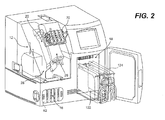
- Fig. 2 is another perspective view of the system of the present invention.
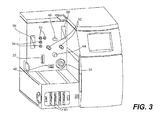
- Fig. 3 is a perspective view of the instrumentation device of the present invention.
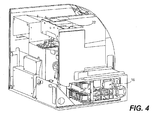
- Fig. 4 is a rear and partial side view of the device with covers removed of Fig. 3 .
- Fig. 5 is a rear view of the device with covers removed of Fig. 3 .
- Fig. 6 is an enlarged view of the heating system of the device of Fig. 3 .
- Fig. 7 is a perspective view of the variable output pump of the system of the present invention.
- Fig. 8 is an exploded view of the pump of Fig. 7 .
- Fig. 9 is a perspective view of the pump cassette of the system of the present invention.
- Fig. 10 illustrates the installation method of the cell culture module and the device of the present invention.
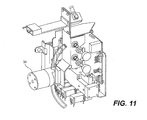
- Fig. 11 is a perspective view of the gas blending and fluid cycling control of the module of the present invention.
- Fig. 12 is a front view of the fluid cycling control of Fig. 11 .
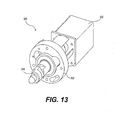
- Fig. 13 is a perspective view of a rotary selection valve drive of the present invention.
- Figs. 14A and 14B are exploded views of the valve rotor of Fig. 13 . and the body used with it.
- Fig. 14C is a rear view of the valve body.
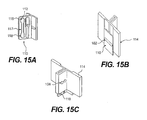
- Figs. 15A-15C are perspective views of a tubing slide clamp of the present invention.
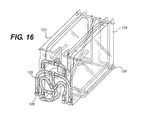
- Fig. 16 is a perspective view of the factor and harvest bags of the present invention.
- Fig. 17 is a perspective view of the disposable culture medium module of the present invention.
- Fig. 18 is an interior view of the module of Fig. 17 .
- Fig. 19 is a perspective interior view of the back of the module of Fig. 17 .
- Fig. 20 is a perspective view of the extra-capillary cycling unit of the present invention.
- Fig. 21A is a flow diagram of the cycling unit of Fig. 20 .
- Fig. 21B is an exploded view of the cycling unit.
- Fig. 22 is a flow diagram of the lactate control system of the present invention.
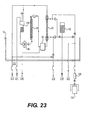
- Fig. 23 is a flow diagram of the system of the present invention.
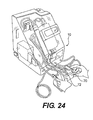
- Fig. 24 is another perspective view of the module of the present invention.
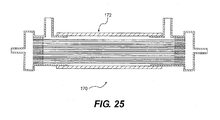
- Fig. 25 is a cross-sectional view of a flexible hollow fiber bioreactor according to the present invention.
- Figs. 26-31 are views of the touch screen associated with the automatic control of the system of the present invention.
- the present invention provides a fully integrated system 10 for producing cells and cell derived products in a closed, self-sufficient environment. More specifically, the system allows for cell expansion and harvest of cells and their products with minimal need for technician interaction.
- the device incorporates cell culture technology, for example, hollow fiber or similar bioreactor perfusion technology, with all tubing components other than the media feed, harvest tubing and tubes threaded through the pump cassette, encased in a single-use, disposable incubator 12.
- the system follows pre-programmed processes to deliver media, maintain pH, maintain lactate levels, control temperature and harvest cells or cell-secreted protein. Standard or unique cell culture growth parameters can be programmed prior to bioreactor inoculation, such that, various cell types can be expanded and such that cells or cell products can be harvested in an efficient, reproducible manner with minimal chance of human error.
- the system is based on cell growth chamber technology.
- bioreactors that have a plurality of semi-permeable hollow fibers or other type of semi-permeable membrane or substrate potted in a housing to create a space inside the fiber or one side of the membrane (referred to as intracapillary or IC space) separate from that outside the fibers or on the other side of the membrane (referred to as extracapillary or EC space). Fluid distribution between the IC and EC space occurs through the fiber pores which can range in size from 10MW(Kd) to 0.2 ⁇ m.
- Cells are placed on one side of the fiber or membrane, usually in the EC space, in a complete cell culture medium, which is usually the same medium used to expand cells prior to bioreactor inoculation (serum containing, serum-free, or protein-free medium). Cells are usually placed in the EC space when secreted protein is the desired product. In some instances, when cells are the desired product, it may be beneficial to place cells in the IC space.
- the medium is perfused through a bioreactor 20 by circulating through the IC space at a fast rate.
- the medium can be a liquid containing a well-defined mixture of salts, amino acids, and vitamins that often contains one or more protein growth factors. This serves to deliver nutrients to the cell space and conversely, removes or prevents a toxic build-up of metabolic waste.
- medium is passed through an oxygenator or gas exchanger cartridge 24 which serves to provide pH control and oxygen for the cells and conversely, remove carbon dioxide from the culture.
- the oxygenator or gas exchange cartridge is used to provide CO 2 and subsequently control pH of the culture environment.
- the oxygenator is used to remove CO 2 which serves to enhance acid neutralization and control the pH of the culture.
- CO 2 serves to enhance acid neutralization and control the pH of the culture.
- Other bioreactor configurations, in addition to hollow fibers, that are designed and optimized for the growth and production of cells and production of cell-derived products are also included.
- the system 10 provides significant efficiencies and cost reduction through its disposable component and enclosed operation. As such, cell lines are contained in a closed system and continuously cultured without the need for specialized, segregated clean rooms. This fully integrated apparatus eliminates the need for cleaning and sterilization validations, as well as the need for hard plumbing associated with conventional cell culture facilities.
- the system consists of two individual parts: an instrumentation base device 14 that is reusable and an enclosed cultureware module 12 that is used for a single production run and is disposable. Numerous modules 12 can be used on a single device 14.
- the instrument provides the hardware to support cell culture growth and production in a compact package.
- an easy-load multiple channel peristaltic pump drive 16 located in base device 14 and a pump cassette 70 move fresh basal media into the cultureware, removes spent media, adds growth factors or other supplements and removes product harvest.
- An integrated cool storage area 18 maintains the factor and harvest at a low temperature (approximately 4°C).
- An integrated heating mechanism 22 ( Fig.
- Gas exchange cartridge 24 ( Fig. 5 ), in conjunction with a cultureware pH sensor 26 controls the pH of the cell culture medium.
- Two automated tube valving drives 90 ( Fig. 3 ) are used to control the cultureware flow path configuration to accomplish the fluidic switching functions needed to initiate and do a successful run.
- Valves 90 and sensors 32 ( Figs. 3 , 5 , 13 ) in the instrument control the fluid cycling in the cultureware module 12.
- a drive pump 34 ( Figs. 3 , 5 ) for fluid circulation is provided.
- An attached barcode reader ( Figs. 3 , 5 ) for fluid circulation is provided.
- An attached barcode reader not shown, facilitates operator and lot tracing.
- a communication port ties the instrument to a data information management system (such as a MIS).
- a flat panel display 36 ( Fig. 1 ) with touch screen is available for user interaction.
- the one-time use cultureware module 12 is provided pre-sterilized. It is designed for quick loading onto the instrument ("quick-load"), as will be described further herein.
- the loading of the cultureware body makes connections to the instrument.
- Pump cassette 70 ( Fig. 2 ), which is physically attached to the tubing, allows the user to quickly load the pump segments. This design and layout minimizes loading errors.
- the cultureware enclosure 12 provides an area that is heated to maintain cell fluid temperature.
- a fluid cycling unit 40 ( Figs. 1 , 18 ) maintains fluid volumes and cycling and is included in the cultureware. Sensors for fluid circulation rate, pH and a thermal well for the instrument's temperature sensor are provided.
- the blended gas from the instrument is routed to gas exchange cartridge 24 that provides oxygen and adds or removes carbon dioxide to the circulated fluid to support cell metabolism.
- a magnetically coupled pump 34 ( Figs. 11-12 ) circulates fluid thru the bioreactor 20 and gas exchange cartridge 24.
- the bioreactor 20 that provides the cell space and media component exchange is also in the cultureware. Disposable containers for harvest collection are provided. Prior to the beginning of the culture the operator attaches a media source, factor bag and spent media container to the cultureware before running. At the conclusion of the run the harvest containers are removed or drained, media and spent media container is disconnected, pump cassette is unloaded, harvest bag disconnected, cultureware body is unloaded and the used cultureware is placed in a biohazard container for disposal.
- MIS information management system
- the system of the present invention has application in a regulated cell culture environment. It is anticipated that autologous whole cell therapies or patient-specific proteins (vaccines) therapies, would by their nature, require the simultaneous culture of numerous cell lines in a single facility. In addition to the segregation created through this closed culture approach, the apparatus is designed to support a standard information management system (such as a LIMS or MIS) protocol. This capability contributes to the creation of thorough batch records and verification of culture conditions to ensure standardization, tracking and safety of each product. This capability facilitates the multi-product concept that is pivotal to facilities involved with autologous or patient-specific products.
- a standard information management system such as a LIMS or MIS
- disposable cell culture module 12 is removably attachable to device 14.
- the module requires multiple mechanical and electrical interfaces to the control instrumentation of device 14.
- Module 12 has interface features integrated into the module that mate with instrument interface features in the device to allow for a single motion installation ( Fig. 10 ). As modules 12 are to be disposed of after use, it should be appreciated that numerous modules can be used in conjunction with a single base device 14.
- the interface features of device 14 include circulation pump 34, actuator valves 90 and cycling sensor 32.
- a temperature probe 44 and a flow sensor 46 interface with the components of module 12.
- Device 14 also includes an electrical connection 48 for pH probe 26 disposed within module 12.
- Gas ports 52 communicate with gas exchanger 24.
- One port 52 communicates with the input to exchanger 24 and the other port 52 communicates with the output of the exchanger.
- Gas ports 54 control pressure to the cycling fixture 40.
- One port 54 communicates with the IC chamber and the other port 54 communicates with the EC space.
- the left port 52 is the exchanger output and the right port 52 is the exchanger input.
- the top port 54 is the IC reservoir pressurization port, and the lower port 54 is the EC reservoir pressurization port.
- module 12 is heated to maintain cell fluid temperature.
- Heating mechanism 22 ( Fig. 6 ) maintains the cell environment to promote growth and production.
- the cell culture, disposable modules 12 requiring elevated temperatures are warmed by fully encapsulating the module and attaching the module to the controlling instrument 14, such that air ports are aligned and warmed air is forced into the module from the instrument at one location and allowed to escaped at another.
- Instrument device 14 has a heated air outlet S8 and a return heated air inlet 56.
- the air inlet 88 ( Fig. 19 ) of the disposable module aligns with the air outlet 58 of the controlling instrument.
- Heating mechanism 22 forces warmed air through outlet 58 and into the warmed air inlet 88 and into disposable module 12.
- the warmed air elevates the temperature of the components inside of the module.
- the exhaust air exits through air outlet 86 and into air inlet 56 of instrument device 14 where it is circulated through recirculated.
- module 12 is aligned with the connections of the device 14 and the module is placed into the operating position as shown in Fig. 10 . All mating interface features are functional. Referring to Fig. 19 , when installed, certain features of the module 12, formed in a back panel 148 of the module, interface with device 14. Module air outlet 86 aligns with device air inlet 56 and module air inlet 88 aligns with device air. outlet 58 to circulate heated air through module 12 as described herein. Gas connectors 152 and 154 engage device gas ports 52 and 54, respectively, to allow gas to enter and exit module 12. Valve bodies 156 receive actuator valves 90. Hub 158 receives pH probe 26 interface and aligns with electrical connector 48. Module 12 is connected to circulation pump drive 34 via module pump connection 164.
- Cycling unit 40 also communicates with cycling sensor 32 when the module is installed.
- the flow sensor 46 of device 12 mates with flow sensor connection 166.
- the temperature sensor 44 of device 14 mates with a non invasive receptacle in module 12 that is in contact with the IC media to provide control feed back to the control mechanism to regulate the thermal output of heater 22.
- the above mating connections facilitate the one-motion installation of the module 12 on the device.
- the present invention incorporates a multi-position, cassette loading, and peristaltic pump 16 ( Fig. 2 ) with discrete, variable output control for each channel.
- a plurality of channels 60 are located in device 14. Although four channels are shown, it should be appreciated that pump 16 could have more or less channels.
- the pump has individual, variable control of the output of each channel.
- Pump rotors 62A-62D have a common fixed axial shaft 64 with individual servo drive.
- the occlusion rotors 66A to 66D are mounted to the pump rotors 62A-62D, which in turn are mounted on the single shaft 64 with internal bearings that allow for independent functional control by a respective reacting servo drive 68A-D.
- the single shaft minimizes tolerance accumulations typically caused by misalignment of individual rotors and shafts mating with a multi-channel cassette. Feedback sensors are included to verify rotation of the pump rotors.
- Typical multi-channel peristaltic pump applications operate using a rotating drive shaft that is common to all rotors. This causes all rotors to turn at the same revolution per minute (RPM), yielding the same fluid output.
- RPM revolution per minute
- Different inside diameter tubing may be used to give a fixed ratio delta output from one rotor to another.
- individual pump heads and drives are used to obtain a variable output of the peristaltic pump segments. This requires individual tubing cassettes that must be loaded individually and does not allow for close center to center distance between pump heads.
- a multi-channel cassette 70 is featured with pre-loaded peristaltic tubing 72 to reduce loading errors and to reduce installation time.
- the mechanism includes a cam operated cassette insertion feature 74 ) that interfaces with 67 on pump 16.
- a knob 65 is rotated to move cam feature 74 into position to aid initial tubing occlusion during loading.
- the cassette configuration is structured to hold multiple peristaltic tubing segments.
- a gripping feature 76 on the top and the bottom prevents the tubing from creeping during operation.
- the design allows for all tubing segments to be loaded into the pump drive mechanism at the same time.
- a latching feature 74 is also included to provide a bearing surface for the cam-operated latch 67 to react upon.
- cassette 70 is pre-loaded with peristaltic tubing ( Fig. 24 )and positioned in groove 80 on module 12. After module 12 is positioned on device 14, cassette 70 is removed and inserted into interface or plate 82. Each cassette section 71 ( Fig. 9 ) supporting the tubing is inserted into a respective channel 60 ( Fig. 3 ) of the interface 82. This configuration reduces tubing segment loading errors with pre-loaded multi-pasition cassettes, and reduces installation time.
- valves and sensors 32 in the instrument control the fluid cycling in the cultureware module 12.
- Two optical sensors detect the low or high position of the cycling position sensor flag 140 ( Fig. 20 ). This information is used by a predictive algorithm to control the pressures applied to the IC chamber and EC pressure bag to effect cycling.
- Valve 90 comprises a valve housing 93 and valve cam 94.
- the elastomer tubing (not shown) is insertable through openings 98 in valve body 92 and is occluded by a rotating cam 94 that compresses the tubing against the valve body. This is accomplished by using a controlled, incremental, servo drive 96 (actuator and position feed back loop) to move cylindrical cam that reacts against immobile valve body 92 that holds the tubing in a constrained state.
- the cam design allows for a high area of the cam 104 to occlude the tubing and a low area of the cam 106 not to occlude, resulting in a closed and open condition respectively.
- Cam rotational positioning features may also be added to move cam 94 to predetermined positions. Configurations can be structured to accommodate multiple tubing segments in one device.
- the two piece design allows for fluid contact portion of the valve to be molded into the backpanel 148 ( Fig. 19 ) as a hub 156 and to be sterilized (EtO, chemical or radiation) with the rest of the fluid circuit and eliminates the need to be added separately.
- this clamp is meant to be used in an automated cell culture application where a disposable cultureware module interfaces with an electro-mechanical instrument.
- the combined unit is to be automated, which required various tubing lines of the disposable to be occluded/open to provide automated process control.
- the selector valve is used to automatically open and close tubing lines to direct fluid or gas flow during process control. Minimizing operator set-up is also a requirement.
- the disposable cultureware must be inserted into the instrument in an operating position with no special operator procedures required for loading the tubing into the clamps. Existing technologies did not meet these requirements, because the manual clamps were not automated, and solenoid valves required a special operator loading procedure.
- valve 90 provides automated actuation of the cam, compactness, multiple lines, maintains valve position even with loss of actuator power, the disposable valve body is less costly than an equivalent switching valve, and can be incorporated into the back panel of 12. Offset occluded/open cam positioning of two tubing lines can insure a make-before-break switching of fluids. No power is required to maintain any operating position, and tubing segments used in the valve body can be sterilized.
- a salenoid driven pinch mechanism can be used in place of the actuator valve.
- This application may utilize a piston plunger actuated by an electrical coil to provide linear motion to pinch the tubing.
- a manual pinch clamp could also be used. The clamping position is manually activated by a mechanical bearing surface compressing the tubing and then held in position by a detent feature. This clamp type requires manual deactivation.
- a membrane over the series of ports could also be used. The membrane is actuated against the port to seal it. Multiple ports are configured for use as a selector mechanism.
- an actuator driven tubing slide clamp 110 with multiple positions and multiple tubing can be used as an alternative to valves 90.
- Elastomer tubing is occluded by sliding the tubing into a narrow slot 112 that compresses the tubing wall against itself. This is accomplished by using a servo drive (actuator and position feed back loop) to move a plate 110 with slot 112 in it and reacting against another plate or slide body 114 that holds the tubing in an immobile state.
- the moveable plate is designed with varying width slots to allow for position/positions to be inactive. This allows for normally open 116 or 118 and normally closed 117 positions. Configurations can be structured to accommodate multiple tubing segments in one clamp.
- slide 110 is positioned into slide body 114.
- Tubing is inserted through tubing ports 108 and slide 110 at position 116 where both tubes are not occluded.
- a remote servo (not shown) engages into server drive slot 102 and moves the slide to position 117 where one tube is occluded and one tube is not occluded.
- the remote Servo than moves the slide to position 118 where the occluded tube from the previous step is not occluded, and the tube from the not occluded tube from the previous step is now occluded.
- both tubes are occluded to insure that one tube is occluded before the other tube is opened. It should be appreciated that the number of tubes and configuration of the slide can be modified to meet customized applications.
- the clamp is meant to be used in an automated cell culture application where a disposable cultureware module interfaces with an electro-mechanical instrument.
- the combined unit is to be automated, which required various tubing lines of the disposable to be occluded/open to provide automated process control.
- the clamps are open/closed to simulate the function of an expensive, "disposable" switching valve.
- Minimizing operator set-up is also a requirement-
- the disposable cultureware must be inserted into the instrument in an operating position with no special operator procedures required for loading the tubing into the clamps. It provides automated actuation of slide clamp, compactness, multiple lines, maintains clamp position even with loss of actuator power, less costly than an equivalent switching valve. Offset occluded/open position of two tubing lines can insure a make-before-break switching of fluids. No power required to maintain any operating position.
- a rack 120 is removably positionable within cool storage area 18.
- Rack 120 is designed to support a plurality of bags 122, 124.
- the bags are used to contain the smaller quantities of product or growth factors. It should be appreciated that other solutions can be disposed with the bags.
- high molecular weight growth factor can be located with bag 122. This factor is connected via tubing 128 to the bioreactor or cell growth chamber 20 and the flow controlled by pump 16.
- Harvested cells or cell products can be stored in bag 124.
- a cell filter 126 is provided to provide additional filtration.
- a filter bypass line is included if filtering of the harvest is not desired as in the case of cell collection. After the process is complete the cells can be removed from the cell culture chamber via the tubing and stored in bag 124 until use.
- disposable cultureware module 12 includes fluid cycling unit 40 to maintain fluid volumes and cycling in the cell growth chamber.
- the present invention utilizes extra-capillary (EC) cycling in cell culture growth chamber 20 ( Fig. 17 ) utilizing a non-rigid, EC reservoir 130 and mechanical or a second flexible reservoir 132 to cause elevated EC pressure. Reservoirs 130, 132 are separated by a sensor plate 134. Reservoirs 130, 132 are restricted in the maximum amount of expansion by a rigid mechanical housing 136. EC cycling is achieved by utilizing a non-rigid reservoir to retain the varying fluid volume associated with an EC circuit.
- Flexible reservoir 130 is fluidly connected to the bioreactor or hollow fiber device 20.
- Second flexible reservoir 132 is pressurized to apply force against the flexible reservoir 130 to provide an elevated EC pressure to cause an ultra-filtrative condition and force fluid into an intracapillary (IC) circuit 138.
- a mechanical feed back position indicator 140 is physically connected to sensor plate 134 and moves with the physical expansion and contraction of the first flexible reservoir. The position of indicator 140 is sensed by the position sensors 32 and is used to control the force that is applied by second flexible reservoir 132. It should be appreciated that an alternate mechanical force apparatus may be used instead of a second flexible reservoir to cause pressure changes.
- the pressure is increased in the IC circuit 138 by pressurizing an IC reservoir 137.
- This pressure causes an ultra-filtrative condition that forces fluid transmembrane across the semi-permeable matrix of the bioreactor 20.
- the fluid is then forced through the connect tubing, through a flow control valve 133 and into the EC reservoir 130.
- Externally controlled pressure in the pressure reservoir 132 is allowed to vent.
- the expanding EC reservoir 130 forces the sensor plate 134 toward the pressure reservoir 132 and compresses it.
- Sensor plate 134 moves external position flag 140 and this is sensed when EC reservoir 130 has filled enough to expand to the EC upper level.
- the external position sensor 32 senses this position and the pressure in the IC reservoir 137, is decreased and the pressure in the pressure reservoir 132 is increased.
- the sensor plate 134 moves the external position flag 140 and the sensor 32 senses when the EC reservoir 130 has contracted to the EC low level.
- the EC cycling unit of the present invention offers fluid dynamics to cause fluid flow in the EC space thus minimizing nutrient and metabolic waste gradients that may be detrimental to the cells. It provides fluid level control without the use of ultrasonics or load cells that is not affected by cell debris.
- the flexible reservoirs are considerably less expensive and are suited for disposable applications.
- the sealed EC reservoir with cycling also limits contamination and isolates the cells.
- the present invention also includes an indirect lactate control method for perfusion culture using CO 2 and pH sensing.
- the method predicts open system, perfusion culture, lactate levels in the circulatory medium by monitoring the pH and off-gas CO 2 level. This is accomplished by calculating the initial bicarbonate level of the media then utilizing the liquid pH and gas level of CO 2 to calculate current lactate concentration. This is used to control media dilution rate of the cell culture. The resulting calculated lactate value is used to set the perfusion rate of media dilution to maintain a pre-determined lactate level. Thus, an invasive sensing system or multiple off-line sampling is not required.
- Equation (3) provides a simple relationship — Henry's Law, that equilibrium dCO 2 is proportional to the gas phase concentration of CO 2 .
- dCO 2 a % CO 2
- the growth media is pumped from an IC reservoir 137 via pump 34, 164, circulated to the gas exchange cartridge (GEX) 24 , pH sensor 26, bioreactor 20, and then back to reservoir 137.137.
- Blended gases are passed through the membrane gas exchange cartridge that oxygenates the media and regulates CO 2 .
- the CO 2 levels in the gas phase or air side of the GEX 24 is in equilibrium with the liquid phase of the media.
- the discharge end of the GEX is monitored with a CO 2 sensor 142 that resides in the device 14 and the lactate is calculated per Equation (6).
- the instrument uses automatic, media dilution, control to maintain the predetermined set point.
- the present invention utilizes existing signals and with the addition of a non-invasive gas CO 2 sensor incorporates lactate control to control media feed rate for cell growth and production. Utilizing the invention reduces materials and labor associated with recurring off-line testing. Utilizing the invention allows for continual adjustment of the dilution rate that would otherwise be inefficient and costly if step increases were used as in previous technologies.
- Utilizing the present invention increases the predictability of cell culture metabolics. Allows a perfusion cell culture system to have an increased level of automation.
- the lactate and media dilution rate can be used to determine the state of cell growth and production.
- the present invention also utilizes a novel approach for pH sensing in a cell culture system.
- pH probe 26 and a holder are built into cell culture disposable 12, thus the user is not required to add the probe to the cultureware.
- Probe 26 is intended to be a one-time use device that is disposed of with the cultureware. The probe is disposed of with the used cultureware, no time is spent recovering the probe for cleaning, revalidating and reuse.
- the probe 26 for example, a solid gel filled electrode, is mounted in a holder 28 ( Fig. 23 ) through which the media to be sensed flow.
- the electrode in the holder is fluidically connected to the cultureware circuit, mounted in the cultureware module, the circuit is checked for fluidic integrity, and sterilized with the completed cultureware (ethylene oxide, EtO). After sterilization, QC checks are performed on the EtO process to provide high confidence of sterilization.
- EtO ethylene oxide
- the cultureware is removed from the pouch, loaded on the instrument and fluid is introduced into the cultureware. A period of time is given to re-hydrate the electrode.
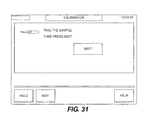
- the cultureware is brought to operating conditions, the electrode is calibrated and then used to control pH in the cultureware.
- the probe has been described as a solid gel electrode other probe types could be used (e.g. an ISFET, liquid filled, immobilized phenol matrix, fluorescence, etc).
- pump 16 moves fresh basal media into the cultureware at media line 210.
- Media line 210 is connected to a user provided container of fresh media to provide the growth nutrients to the cell culture that are pumped into the disposable.
- Outflow line 214 is connected to a user provided container to collect the waste or spent media being pumped out of the disposable.
- Factor line 212 is connected to a user provided container of growth factors that are pumped into the disposable. Inoculate can be added at 220 and IC sample at 216.
- Product harvest is removed at 126. The cells are harvested at 218.
- Harvest line 218 is a pre-attached container that is part of the disposable that is used to collect the product that is pumped out af the disposable.
- Pump 16 has multiple lines 210, 214, 212 and 126. Because the pump of the present invention has a common fixed axial shaft and individual servo driven rotors, the control of the flow of each can be independent, allowing one channel or flow to be increased while another decreased.
- a bioreactor 170 having a flexible outer body 172 allows for physical movement of the cell growth substratum (hollow fibers, membrane or other suitable matrix) when a resultant torqueing or bending moment is applied to the bioreactor ends.
- Flexible outer body 172 allows for the bioreactor case to be flexed causing fiber movement. This fiber movement enhances the release of cells that have attached to the side of the bioreactor matrix. The cells can then be harvested by flushing either after or during the manipulation. This method can provide increased efficiency of cell harvest at high cell viabilities without the use of chemical or enzymatic release additives.
- a bioreactor can be constructed using an outer housing that incorporates a flexible center section.
- This center section consists of a flexible, non-permeable tubing that allows each end of the bioreactor to be manipulated thus causing movement of the growth matrix. The purpose of this movement is to release the attachment or clumping of cell products on the extra-capillary (EC) side of the fibers. The cell products can then be flushed from the EC via the access port at each end of the bioreactor.
- EC extra-capillary
- Harvesting cells from a matrix-containing bioreactor such as a hollow fiber bioreactor has been difficult to accomplish. Typically cells are sticky and attach themselves to the fibers or to other cells and form clusters. Rapid flushing of media through the EC to hydraulically force the cells free and into the harvest stream is the most basic method of harvesting cells from the EC space. Typically the quantity of cells harvested is low because the flushing media tends to shunt through the EC and flush cells only from the limited fluid path.
- Another method is to physically shake or impact the outer housing to release the cells or clumps of cells. This practice may cause physical damage to the bioreactor or its associated components.
- Another method includes the use of chemicals to disrupt the adhesion of cells to the fibers or to disrupt the clumps of cells. Adding chemicals to a controlled process may cause adverse effects on cell viability and can introduce an unwanted agent in the down-stream processing.
- FIG. 26 shows a system overview screen which highlights current conditions.
- Fig. 27 illustrates a run sequence screen which directs the operator through the culture process.
- Fig. 28 illustrates log data which the operator can review and which is available to build the batch record.
- Fig. 29 shows a method for inputting alpha-numeric data.
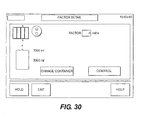
- Figs. 30 and 31 show operator interaction screens to assist in operations (factor addition and pH probe calibration). On line help screens aid the operator for correct operation.
- the system of the present invention fully integrates the concept of disposable cultureware into automated process control for maintaining and expanding specialized (autologous or other) cell lines for a duration of any time needed .
- the system of the present invention was designed for EC space fluid flow that enhances cell growth in high density perfusion culture, yet remains completely closed and disposable.
- the integrated pre-assembled cultureware which consists of all tubing, bioreactor, oxygenator, pH probe, is enclosed in a single unit that easily snaps into the apparatus.
- the entire cultureware unit enclosed by the casing becomes the cell culture incubator with temperature control regulated through automated process control of the instrument. Pumps and fluid control valves facilitate disposability and error-proof installation, eliminating the possibility of technician mistakes.
- the closed system has restricted access except for trained and authorized personnel. Manipulations or sampling, outside of program parameters, require password and bar code access before they can be implemented.
- Each unique cell line must be cultured, cell secretions harvested and purified separately.
- a considerable number of instruments would be needed.
- Compactness of the design and the amount of ancillary support resources needed become an important facilities issue.
- Small stirred tank systems require a means of steam generation and distribution (for steam-in-place sterilization) or autoclaves to sterilize the vessels and supporting plumbing.
- To support a large number of units becomes a logistics problem for the facility.
- the system of the present invention has no such requirement. Larger scale cell culture is historically done in segregated steps that often require separate types of equipment. Manual handling, storage and tracking is needed for all these steps as the culture expands and product is harvested.
- the method of the present invention integrates these steps into a continuous, fully integrated sequential process. This eliminates the handling risk and facilitates the data gathering required for thorough documentation of the entire process.
Landscapes
- Engineering & Computer Science (AREA)
- Health & Medical Sciences (AREA)
- Life Sciences & Earth Sciences (AREA)
- Chemical & Material Sciences (AREA)
- Organic Chemistry (AREA)
- Zoology (AREA)
- Wood Science & Technology (AREA)
- Bioinformatics & Cheminformatics (AREA)
- Biotechnology (AREA)
- General Engineering & Computer Science (AREA)
- General Health & Medical Sciences (AREA)
- Biochemistry (AREA)
- Microbiology (AREA)
- Genetics & Genomics (AREA)
- Biomedical Technology (AREA)
- Sustainable Development (AREA)
- Analytical Chemistry (AREA)
- Clinical Laboratory Science (AREA)
- Mechanical Engineering (AREA)
- Immunology (AREA)
- Molecular Biology (AREA)
- Cell Biology (AREA)
- Computer Hardware Design (AREA)
- Medicinal Chemistry (AREA)
- Physics & Mathematics (AREA)
- Thermal Sciences (AREA)
- Developmental Biology & Embryology (AREA)
- Virology (AREA)
- Proteomics, Peptides & Aminoacids (AREA)
- Pharmacology & Pharmacy (AREA)
- Epidemiology (AREA)
- Animal Behavior & Ethology (AREA)
- Public Health (AREA)
- Veterinary Medicine (AREA)
- Apparatus Associated With Microorganisms And Enzymes (AREA)
- Solid-Sorbent Or Filter-Aiding Compositions (AREA)
- Preparation Of Compounds By Using Micro-Organisms (AREA)
Applications Claiming Priority (2)
| Application Number | Priority Date | Filing Date | Title |
|---|---|---|---|
| US80237606P | 2006-05-22 | 2006-05-22 | |
| EP07777182.2A EP2029722B1 (fr) | 2006-05-22 | 2007-05-21 | Procédé et système pour la production de cellules |
Related Parent Applications (2)
| Application Number | Title | Priority Date | Filing Date |
|---|---|---|---|
| EP07777182.2A Division-Into EP2029722B1 (fr) | 2006-05-22 | 2007-05-21 | Procédé et système pour la production de cellules |
| EP07777182.2 Division | 2007-05-21 |
Publications (2)
| Publication Number | Publication Date |
|---|---|
| EP2404991A2 true EP2404991A2 (fr) | 2012-01-11 |
| EP2404991A3 EP2404991A3 (fr) | 2013-05-22 |
Family
ID=38473943
Family Applications (3)
| Application Number | Title | Priority Date | Filing Date |
|---|---|---|---|
| EP07777182.2A Active EP2029722B1 (fr) | 2006-05-22 | 2007-05-21 | Procédé et système pour la production de cellules |
| EP11173373.9A Withdrawn EP2404991A3 (fr) | 2006-05-22 | 2007-05-21 | Procédé et système de production de cellules et produits de cellules et applications associées |
| EP07777189A Not-in-force EP2027247B1 (fr) | 2006-05-22 | 2007-05-21 | Système et procédé de cyclage de fluide extracapillaire |
Family Applications Before (1)
| Application Number | Title | Priority Date | Filing Date |
|---|---|---|---|
| EP07777182.2A Active EP2029722B1 (fr) | 2006-05-22 | 2007-05-21 | Procédé et système pour la production de cellules |
Family Applications After (1)
| Application Number | Title | Priority Date | Filing Date |
|---|---|---|---|
| EP07777189A Not-in-force EP2027247B1 (fr) | 2006-05-22 | 2007-05-21 | Système et procédé de cyclage de fluide extracapillaire |
Country Status (7)
| Country | Link |
|---|---|
| US (6) | US8540499B2 (fr) |
| EP (3) | EP2029722B1 (fr) |
| AT (1) | ATE496987T1 (fr) |
| DE (1) | DE602007012238D1 (fr) |
| DK (1) | DK2029722T3 (fr) |
| ES (1) | ES2761938T3 (fr) |
| WO (5) | WO2007139747A1 (fr) |
Cited By (2)
| Publication number | Priority date | Publication date | Assignee | Title |
|---|---|---|---|---|
| US9587216B2 (en) | 2012-06-14 | 2017-03-07 | Aglaris Cell S.L. | Cell culture method and system |
| US10494421B2 (en) | 2014-02-10 | 2019-12-03 | Univercells Nv | System, apparatus and method for biomolecules production |
Families Citing this family (141)
| Publication number | Priority date | Publication date | Assignee | Title |
|---|---|---|---|---|
| US8409846B2 (en) | 1997-09-23 | 2013-04-02 | The United States Of America As Represented By The Department Of Veteran Affairs | Compositions, methods and devices for maintaining an organ |
| NZ591524A (en) | 2004-10-07 | 2012-09-28 | Transmedics Inc | Method for timing pulsatile flow of normothermic perfusate to the heart in ex-vivo organ care |
| US8304181B2 (en) | 2004-10-07 | 2012-11-06 | Transmedics, Inc. | Method for ex-vivo organ care and for using lactate as an indication of donor organ status |
| US9301519B2 (en) | 2004-10-07 | 2016-04-05 | Transmedics, Inc. | Systems and methods for ex-vivo organ care |
| US12010987B2 (en) | 2004-10-07 | 2024-06-18 | Transmedics, Inc. | Systems and methods for ex-vivo organ care and for using lactate as an indication of donor organ status |
| US9078428B2 (en) | 2005-06-28 | 2015-07-14 | Transmedics, Inc. | Systems, methods, compositions and solutions for perfusing an organ |
| US7754148B2 (en) | 2006-12-27 | 2010-07-13 | Progentech Limited | Instrument for cassette for sample preparation |
| US7727473B2 (en) | 2005-10-19 | 2010-06-01 | Progentech Limited | Cassette for sample preparation |
| EP3677118A1 (fr) | 2006-04-19 | 2020-07-08 | Transmedics, Inc. | Systèmes de soin d'organes ex vivo |
| ATE496987T1 (de) | 2006-05-22 | 2011-02-15 | Biovest Int Inc | Ausserkapilläres fluidzirkulationssystem und - verfahren |
| EP2129764B1 (fr) | 2007-03-05 | 2018-10-10 | Terumo BCT, Inc. | Système d'expansion cellulaire et procédés d'utilisation |
| US9457179B2 (en) | 2007-03-20 | 2016-10-04 | Transmedics, Inc. | Systems for monitoring and applying electrical currents in an organ perfusion system |
| US8420380B2 (en) | 2008-01-31 | 2013-04-16 | Transmedics, Inc. | Systems and methods for ex vivo lung care |
| GB0808373D0 (en) * | 2008-05-09 | 2008-06-18 | Synexa Life Sciences Pty Ltd | Scalable cell culture bioreactor and cell culture process |
| WO2010019439A2 (fr) | 2008-08-12 | 2010-02-18 | Caridianbct, Inc. | Prédicteur du moment de récolte de cellules cultivées dans un bioréacteur |
| JP2012506257A (ja) * | 2008-10-22 | 2012-03-15 | バイオベスト インターナショナル インコーポレイテッド | 細胞および細胞由来生成物の産生のための、灌流バイオリアクター、細胞培養システム、および方法 |
| US8211692B2 (en) * | 2008-10-24 | 2012-07-03 | Coskata, Inc. | Bioconversion process using liquid phase having to enhance gas phase conversion |
| US9284523B2 (en) | 2008-10-27 | 2016-03-15 | Terumo Bct, Inc. | Premounted fluid conveyance assembly for cell expansion system and method of use associated therewith |
| FR2941385B1 (fr) | 2009-01-23 | 2011-04-01 | Millipore Corp | Procede pour fournir un circuit pour liquide biologique et circuit obtenu. |
| DE102009019868B4 (de) * | 2009-05-06 | 2015-10-22 | Hosokawa Alpine Ag | Verfahrenstechnische Anlage für den Laborbetrieb |
| US9247729B2 (en) * | 2009-05-29 | 2016-02-02 | Institut Georges Lopez | Systems and methods for preserving a human organ for transplantation |
| US9206383B2 (en) * | 2009-12-07 | 2015-12-08 | The Trustees Of Columbia University In The City Of New York | Bioreactor, devices, systems and methods |
| WO2011072039A1 (fr) * | 2009-12-08 | 2011-06-16 | The Trustees Of Columbia University In The City Of New York | Dispositifs, procédés et systèmes de pompe péristaltique |
| WO2011078773A1 (fr) * | 2009-12-22 | 2011-06-30 | Ge Healthcare Bio-Sciences Ab | Procédé pour contrôler les paramètres de culture dans un bioréacteur |
| WO2011090605A2 (fr) | 2009-12-29 | 2011-07-28 | Caridianbct, Inc. | Procédé de chargement et de distribution de cellules dans un bioréacteur d'un système d'expansion cellulaire |
| FR2955119B1 (fr) | 2010-01-13 | 2012-12-28 | Millipore Corp | Circuit pour liquide biologique |
| USD638952S1 (en) * | 2010-01-18 | 2011-05-31 | Hitachi High-Technologies Corporation | Molecular testing machine |
| KR20160088958A (ko) | 2010-02-23 | 2016-07-26 | 루미넥스 코포레이션 | 일체화된 샘플 제조, 반응 및 검출을 위한 장치 및 방법 |
| USD653764S1 (en) * | 2010-03-30 | 2012-02-07 | Helixis, Inc. | Thermal cycling system for biological assays |
| WO2011126650A1 (fr) | 2010-04-09 | 2011-10-13 | Caridianbct, Inc. | Compartiment d'élimination de l'air pour un système de multiplication de cellules et procédé d'utilisation associé |
| US20110265897A1 (en) * | 2010-04-30 | 2011-11-03 | Developmental Technologies, Llc | Fertigation Efficacy Enhancement System And Associated Methods |
| EP2566951B1 (fr) | 2010-05-05 | 2020-03-04 | Terumo BCT, Inc. | Procédé de réensemencement de cellules adhérentes cultivées dans un système de bioréacteur à fibres creuses |
| FR2960796B1 (fr) | 2010-06-08 | 2014-01-24 | Millipore Corp | Dispositif pour une installation de traitement de liquide biologique |
| FR2960795B1 (fr) | 2010-06-08 | 2012-07-27 | Millipore Corp | Dispositif pour une installation de traitement de liquide biologique |
| FR2960794B1 (fr) | 2010-06-08 | 2012-07-27 | Millipore Corp | Dispositif pour une installation de traitement de liquide biologique |
| FR2961713B1 (fr) | 2010-06-23 | 2012-08-10 | Millipore Corp | Poche pour circuit d'une installation de traitement de liquide biologique |
| USD652147S1 (en) * | 2010-06-23 | 2012-01-10 | Fujifilm Corporation | Medical immunoassay device |
| USD651720S1 (en) * | 2010-06-23 | 2012-01-03 | Fujifilm Corporation | Medical immunoassay device |
| FR2961711B1 (fr) | 2010-06-23 | 2012-08-17 | Millipore Corp | Poche pour circuit d'une installation de traitement de liquide biologique |
| USD657067S1 (en) * | 2010-06-29 | 2012-04-03 | Sysmex Corporation | Specimen analyzer |
| USD657068S1 (en) * | 2010-06-29 | 2012-04-03 | Sysmex Corporation | Specimen analyzer |
| USD654184S1 (en) * | 2010-07-23 | 2012-02-14 | Hitachi High-Technologies Corporation | Reagent autoloader with a sample buffer unit for a clinical analyzer |
| USD653765S1 (en) * | 2010-07-23 | 2012-02-07 | Hitachi High-Technologies Corporation | Portion of a clinical analyzer |
| USD654183S1 (en) * | 2010-07-23 | 2012-02-14 | Hitachi High-Technologies Corporation | Reagent autoloader with a sample buffer unit for a clinical analyzer |
| USD663040S1 (en) * | 2010-07-23 | 2012-07-03 | Hitachi High-Technologies Corporation | Clinical analyzer |
| FR2963573B1 (fr) * | 2010-08-03 | 2012-08-31 | Millipore Corp | Chariot de pompage pour une installation de traitement de liquide biologique |
| USD655824S1 (en) * | 2010-09-22 | 2012-03-13 | Sysmex Corporation | Specimen analyzer |
| US8895291B2 (en) | 2010-10-08 | 2014-11-25 | Terumo Bct, Inc. | Methods and systems of growing and harvesting cells in a hollow fiber bioreactor system with control conditions |
| USD655421S1 (en) | 2010-11-03 | 2012-03-06 | Life Technologies Corporation | Cell counter |
| FR2973396B1 (fr) | 2011-03-28 | 2013-05-10 | Millipore Corp | Installation de traitement de liquide biologique |
| WO2012141055A1 (fr) * | 2011-04-13 | 2012-10-18 | 株式会社日立製作所 | Dispositif de culture et dispositif de transport de cellules |
| EP2704560B1 (fr) | 2011-04-14 | 2022-04-06 | Transmedics, Inc. | Solution ocs pour perfusion ex vivo de greffons pulmonaires |
| CN104023834B (zh) | 2011-05-04 | 2016-09-28 | 卢米耐克斯公司 | 用于集成的样品制备、反应和检测的设备与方法 |
| WO2012171026A2 (fr) * | 2011-06-10 | 2012-12-13 | Biovest International, Inc. | Procédés pour la production virale à haut rendement |
| WO2012171030A2 (fr) * | 2011-06-10 | 2012-12-13 | Biovest International, Inc. | Procédé et appareil de production et de purification d'anticorps |
| KR20140096051A (ko) * | 2011-10-07 | 2014-08-04 | 폴 테크놀로지 유케이 리미티드 | 유체 처리 제어 시스템 및 이와 관련된 방법 |
| WO2013086502A1 (fr) * | 2011-12-09 | 2013-06-13 | President And Fellows Of Harvard College | Puces à organes et leurs utilisations |
| USD685495S1 (en) * | 2012-03-23 | 2013-07-02 | Hitachi High-Technologies Corporation | Input and output buffer module for clinical analyzer |
| US9683207B2 (en) * | 2012-05-01 | 2017-06-20 | FiberCell Production Solutions LLC | Method for growing cells in hollow fibers |
| FR2993572B1 (fr) | 2012-07-23 | 2016-04-15 | Emd Millipore Corp | Circuit pour liquide biologique comportant une vanne a pincement |
| US9175259B2 (en) | 2012-08-20 | 2015-11-03 | Terumo Bct, Inc. | Method of loading and distributing cells in a bioreactor of a cell expansion system |
| EP2909302A4 (fr) * | 2012-08-28 | 2016-07-27 | Biovest Int Inc | Enfilade de biofabrication et procédé de production à grande échelle de cellules, virus et biomolécules |
| WO2014036488A1 (fr) | 2012-08-31 | 2014-03-06 | Biovest International, Inc. | Procédés de production de vaccins idiotypiques autologues haute fidélité |
| WO2014038024A1 (fr) * | 2012-09-05 | 2014-03-13 | 株式会社日立製作所 | Mécanisme de valve, dispositif de culture cellulaire mettant en oeuvre celui-ci ainsi que procédé de culture cellulaire |
| JP6612227B2 (ja) | 2013-11-16 | 2019-11-27 | テルモ ビーシーティー、インコーポレーテッド | バイオリアクターにおける細胞増殖 |
| USD727327S1 (en) * | 2013-11-22 | 2015-04-21 | Compliance Software, Inc. | Compact stand with mobile scanner |
| KR102296181B1 (ko) * | 2013-12-06 | 2021-08-31 | 인제대학교 산학협력단 | 복합 자극을 이용한 세포 배양 시스템 |
| USD735883S1 (en) * | 2013-12-30 | 2015-08-04 | Illumina, Inc. | Sample preparation instrument |
| US11008547B2 (en) | 2014-03-25 | 2021-05-18 | Terumo Bct, Inc. | Passive replacement of media |
| US10077421B2 (en) | 2014-04-24 | 2018-09-18 | Terumo Bct, Inc. | Measuring flow rate |
| EP3137590A1 (fr) | 2014-04-28 | 2017-03-08 | VivaBioCell SpA | Dispositif automatisé de culture et de récolte de cellules |
| US10076112B2 (en) | 2014-06-02 | 2018-09-18 | Transmedic, Inc. | Ex vivo organ care system |
| WO2016049421A1 (fr) | 2014-09-26 | 2016-03-31 | Terumo Bct, Inc. | Alimentation programmée |
| WO2016090498A1 (fr) | 2014-12-12 | 2016-06-16 | Freed Darren | Appareil et procédé de perfusion d'organe |
| AU364138S (en) * | 2015-02-05 | 2015-09-14 | Gen Electric | Stackable bioreactor for cell cultivation |
| AU364136S (en) * | 2015-02-05 | 2015-09-14 | Gen Electric | Compact bioreactor for cell cultivation |
| US10611991B2 (en) * | 2015-04-07 | 2020-04-07 | University Of South Carolina | Pulsatile perfusion bioreactor for mimicking, controlling, and optimizing blood vessel mechanics |
| WO2017004592A1 (fr) | 2015-07-02 | 2017-01-05 | Terumo Bct, Inc. | Croissance cellulaire à l'aide de stimuli mécaniques |
| DE102015112343A1 (de) * | 2015-07-29 | 2017-02-02 | Westfälische Wilhelms-Universität Münster | Vorrichtung und Verfahren zum Aufbereiten von Körperflüssigkeiten |
| USD776825S1 (en) * | 2015-08-25 | 2017-01-17 | General Electric Company | Bioreactor housing |
| EP3347084B1 (fr) | 2015-09-09 | 2020-11-11 | Transmedics, Inc. | Canule aortique pour système de traitement ex vivo d'organe |
| CA3002810A1 (fr) | 2015-10-20 | 2017-04-27 | Sharmistha MAZUMDER | Appareil, systemes et procedes pour faire croitre des micro-organismes |
| US10562116B2 (en) * | 2016-02-03 | 2020-02-18 | Milwaukee Electric Tool Corporation | System and methods for configuring a reciprocating saw |
| USD810084S1 (en) | 2016-03-23 | 2018-02-13 | Formfox, Inc. | Mobile scanner |
| WO2017205667A1 (fr) | 2016-05-25 | 2017-11-30 | Terumo Bct, Inc. | Expansion cellulaire |
| CA3025673A1 (fr) | 2016-05-30 | 2017-12-07 | Tevosol, Inc. | Appareil et procede pour ventilation pulmonaire ex vivo avec une pression exterieure variable |
| US11104874B2 (en) | 2016-06-07 | 2021-08-31 | Terumo Bct, Inc. | Coating a bioreactor |
| US11685883B2 (en) | 2016-06-07 | 2023-06-27 | Terumo Bct, Inc. | Methods and systems for coating a cell growth surface |
| FR3053051B1 (fr) * | 2016-06-24 | 2022-11-11 | Cellprothera | Cassette et automate de culture cellulaire |
| CN106047703B (zh) * | 2016-08-22 | 2018-08-10 | 青岛爱博生物科技有限公司 | 一种试验样本培养装置 |
| CN106222087B (zh) * | 2016-08-22 | 2018-07-24 | 王铁苗 | 一种样本培养载体 |
| CN106190843B (zh) * | 2016-08-22 | 2018-06-15 | 刘力伟 | 一种多样本培养装置 |
| CN106119110A (zh) * | 2016-08-22 | 2016-11-16 | 诸葛洁婧 | 一种培养载体结构 |
| CN106244457B (zh) * | 2016-08-22 | 2018-08-03 | 日照安维信生物科技有限公司 | 一种试验用培养载体结构 |
| CN106222090B (zh) * | 2016-08-22 | 2018-07-24 | 王铁苗 | 一种试验辅助载体 |
| CN106282017B (zh) * | 2016-08-22 | 2018-09-21 | 王铁苗 | 一种集成式样本培养装置 |
| CN106244453B (zh) * | 2016-08-22 | 2018-08-24 | 杭州荣泽生物科技有限公司 | 一种用于培养、测定及分析的细胞培育装置 |
| CN106222089B (zh) * | 2016-08-22 | 2018-09-21 | 王铁苗 | 一种试验辅助培养装置 |
| CN106467893B (zh) * | 2016-08-22 | 2018-07-24 | 王铁苗 | 一种试验辅助装置 |
| EP3504315A4 (fr) | 2016-08-27 | 2020-04-15 | 3D Biotek, LLC | Bioréacteur |
| US20190382706A1 (en) * | 2017-02-27 | 2019-12-19 | Koji Tanabe | Somatic cell production system |
| WO2018184028A2 (fr) | 2017-03-31 | 2018-10-04 | Terumo Bct, Inc. | Expansion cellulaire |
| US12234441B2 (en) | 2017-03-31 | 2025-02-25 | Terumo Bct, Inc. | Cell expansion |
| US11624046B2 (en) | 2017-03-31 | 2023-04-11 | Terumo Bct, Inc. | Cell expansion |
| US11518972B2 (en) * | 2017-05-25 | 2022-12-06 | Lun-Kuang Liu | Movable cell incubator |
| US10987636B2 (en) | 2017-08-31 | 2021-04-27 | Massachusetts Institute Of Technology | Filtration systems and methods for manufacturing biologically-produced products |
| US10247724B1 (en) | 2017-09-28 | 2019-04-02 | Autobiologic Inc. | Optically clear sealable petri dish bioreactor |
| GB201717652D0 (en) | 2017-10-26 | 2017-12-13 | Ge Healthcare Bio Sciences Ab | Bioprocess System |
| CN107904170B (zh) * | 2017-12-18 | 2024-07-26 | 上海白泽医疗器械有限公司 | 细胞培养模块及细胞培养系统 |
| US12252683B2 (en) * | 2018-03-30 | 2025-03-18 | Arizona Board Of Regents On Behalf Of The University Of Arizona | Workstation for automated control of an in vitro system |
| IL258738B (en) * | 2018-04-16 | 2020-04-30 | Pluristem Ltd | Methods and compositions for formulating and dispensing pharmaceutical formulations |
| US12203126B2 (en) * | 2018-05-11 | 2025-01-21 | Exothera S.A. | System and method for clarifying a cell culture harvest solution |
| US20190352589A1 (en) * | 2018-05-18 | 2019-11-21 | Huacells Corporation | Automated Cell Culturing |
| EP3584305B1 (fr) * | 2018-06-19 | 2021-07-28 | Lun-Kuang Liu | Incubateur de cellules mobiles |
| MX2022006590A (es) * | 2019-12-02 | 2022-09-19 | Avant Meats Company Ltd | Metodos de produccion de carne por cultivo celular in vitro. |
| USD961115S1 (en) * | 2020-01-20 | 2022-08-16 | Adva Biotechnology Ltd. | Bioreactor cabinet |
| EP4103201A4 (fr) * | 2020-02-14 | 2024-04-03 | Xcell Biosciences Inc. | Système de régulation d'écoulement de gaz et de liquide pour culture cellulaire |
| USD937266S1 (en) | 2020-02-25 | 2021-11-30 | Amazon Technologies, Inc. | Pedestal scanner |
| CN115667491A (zh) | 2020-03-10 | 2023-01-31 | 赛阿瑞斯公司 | 用于细胞处理的系统、装置及方法 |
| USD962239S1 (en) | 2020-08-20 | 2022-08-30 | Amazon Technologies, Inc. | Pedestal scanner |
| US20220135921A1 (en) * | 2020-10-29 | 2022-05-05 | Applied Materials, Inc. | Methods and apparatus for cell development |
| EP4166643A4 (fr) * | 2020-11-06 | 2024-06-26 | PHC Holdings Corporation | Unité de capteur et dispositif d'analyse de culture cellulaire la comprenant |
| CN112553072B (zh) * | 2020-12-10 | 2022-04-08 | 上海艾众生物科技有限公司 | 用于生物反应器罐外循环的微流道动力设备 |
| EP4281537A4 (fr) * | 2021-01-20 | 2025-04-30 | Zeon Corporation | Systèmes et procédés de séparation et de concentration de particules |
| GB2619893A (en) | 2021-03-23 | 2023-12-20 | Terumo Bct Inc | Cell capture and expansion |
| JP2024511914A (ja) * | 2021-03-26 | 2024-03-18 | テルモ株式会社 | 細胞培養システム |
| EP4301842A1 (fr) * | 2021-03-26 | 2024-01-10 | TERUMO Kabushiki Kaisha | Système de culture cellulaire |
| GB202105923D0 (en) | 2021-04-26 | 2021-06-09 | Cytiva Sweden Ab | Reconfigurable bioprocessing systems |
| US12613219B2 (en) | 2021-07-15 | 2026-04-28 | Georgia Tech Research Corporation | Methods of determining viable cell count and impedance-based biosensors for the same |
| US12209689B2 (en) | 2022-02-28 | 2025-01-28 | Terumo Kabushiki Kaisha | Multiple-tube pinch valve assembly |
| USD1099116S1 (en) | 2022-09-01 | 2025-10-21 | Terumo Bct, Inc. | Display screen or portion thereof with a graphical user interface for displaying cell culture process steps and measurements of an associated bioreactor device |
| JP2026510730A (ja) | 2023-03-21 | 2026-04-10 | セラレス コーポレーション | 細胞処理システム内でのエレクトロポレーションのためのシステム、デバイス、及び方法 |
| US12399193B2 (en) | 2023-05-05 | 2025-08-26 | Cellares Corporation | Systems, devices, and methods for combined cell processes |
| CN121752711A (zh) | 2023-06-30 | 2026-03-27 | 赛阿瑞斯公司 | 用于自动化细胞处理系统内的流体转移的系统、装置和方法 |
| WO2025041046A1 (fr) | 2023-08-21 | 2025-02-27 | Cellares Corporation | Systèmes, dispositifs et procédés de régulation de fluide dans un système de traitement de cellules |
| US12497587B2 (en) | 2023-08-21 | 2025-12-16 | Cellares Corporation | Bioreactors and methods of their use in automatic cell processing systems |
| WO2025041064A2 (fr) | 2023-08-21 | 2025-02-27 | Cellares Corporation | Systèmes, dispositifs et procédés de tri automatique de cellules |
| US12583131B2 (en) * | 2024-01-05 | 2026-03-24 | Multiply Labs Inc. | Apparatus for facilitating automation of vessels |
| US12492368B2 (en) | 2024-03-11 | 2025-12-09 | Cellares Corporation | Monitoring air pressure within a cell processing system |
| WO2025202944A2 (fr) | 2024-03-27 | 2025-10-02 | Cellares Corporation | Détection de niveau et de débit de liquide dans un système de traitement de cellules |
| USD1109621S1 (en) | 2024-04-15 | 2026-01-20 | Cellares Corporation | Analytical platform for biological material testing |
Citations (1)
| Publication number | Priority date | Publication date | Assignee | Title |
|---|---|---|---|---|
| US4804628A (en) | 1984-10-09 | 1989-02-14 | Endotronics, Inc. | Hollow fiber cell culture device and method of operation |
Family Cites Families (55)
| Publication number | Priority date | Publication date | Assignee | Title |
|---|---|---|---|---|
| US3148624A (en) * | 1961-06-21 | 1964-09-15 | Alan W Baldwin | Hydraulic pump |
| US4047844A (en) | 1975-12-08 | 1977-09-13 | Searle Cardio-Pulmonary Systems Inc. | Blood pumping system |
| US4167046A (en) * | 1977-12-12 | 1979-09-11 | Andros, Inc. | Blood pumping device |
| US4282902A (en) * | 1979-05-04 | 1981-08-11 | Becton Dickinson & Company | Valve apparatus for simultaneous control of a plurality of fluid paths |
| US4417861A (en) | 1981-08-10 | 1983-11-29 | Monsanto Company | Cell culture pumping system |
| DE3572381D1 (en) * | 1984-05-25 | 1989-09-21 | Isco Inc | Peristaltic pump |
| US4604038A (en) * | 1985-03-08 | 1986-08-05 | The United States Of America As Represented By The Administrator Of The National Aeronautics And Space Administration | Remotely operable peristaltic pump |
| JP2529321B2 (ja) | 1986-04-28 | 1996-08-28 | エンドトロニックス インコーポレーテッド | 白血球を培養する方法 |
| US4973558A (en) | 1988-04-28 | 1990-11-27 | Endotronics, Inc. | Method of culturing cells using highly gas saturated media |
| US5416022A (en) | 1988-08-10 | 1995-05-16 | Cellex Biosciences, Inc. | Cell culture apparatus |
| WO1991002049A1 (fr) | 1989-08-04 | 1991-02-21 | Peter Grandics | Systeme integre de culture de cellules-purification de proteines pour la production et la purification automatisees de produits de culture cellulaire |
| AR244863A1 (es) * | 1989-09-07 | 1993-11-30 | Marcelo Alberto Hoegner | Una valvula multiple y un equipo de esterilizacion que la incorpora. |
| US5656421A (en) | 1990-02-15 | 1997-08-12 | Unisyn Technologies, Inc. | Multi-bioreactor hollow fiber cell propagation system and method |
| US5098261A (en) * | 1990-05-04 | 1992-03-24 | Brandel Corporation | Peristaltic pump and method for adjustable flow regulation |
| US5330915A (en) | 1991-10-18 | 1994-07-19 | Endotronics, Inc. | Pressure control system for a bioreactor |
| US5882918A (en) * | 1995-08-08 | 1999-03-16 | Genespan Corporation | Cell culture incubator |
| US5622857A (en) * | 1995-08-08 | 1997-04-22 | Genespan Corporation | High performance cell culture bioreactor and method |
| EP0775196B1 (fr) * | 1994-08-16 | 1999-03-24 | Powell Biological Machines Ltd. | Dispositif servant a la culture de cellules |
| US5554123A (en) * | 1994-10-31 | 1996-09-10 | Glenn Herskowitz | Portable infusion pump |
| US5688687A (en) * | 1995-06-07 | 1997-11-18 | Aastrom Biosciences, Inc. | Bioreactor for mammalian cell growth and maintenance |
| US5998184A (en) | 1997-10-08 | 1999-12-07 | Unisyn Technologies, Inc. | Basket-type bioreactor |
| US6001585A (en) | 1997-11-14 | 1999-12-14 | Cellex Biosciences, Inc. | Micro hollow fiber bioreactor |
| US6780617B2 (en) * | 2000-12-29 | 2004-08-24 | Chen & Chen, Llc | Sample processing device and method |
| JP3461725B2 (ja) * | 1998-06-26 | 2003-10-27 | 東京エレクトロン株式会社 | 処理液供給装置及び処理液供給方法 |
| NO20002828D0 (no) | 2000-06-02 | 2000-06-02 | Statens Inst For Folkehelse | Proteinholdig vaksine mot Neisseria meningtidis serogruppe samt fremgangsmÕte ved fremstilling derav |
| WO2002087662A1 (fr) * | 2001-04-27 | 2002-11-07 | Nexell Therapeutics Inc. | Traitement de cellules, appareil de transfert de liquides et procede d'utilisation associe |
| US6673595B2 (en) * | 2001-08-27 | 2004-01-06 | Biocrystal, Ltd | Automated cell management system for growth and manipulation of cultured cells |
| US8492140B2 (en) * | 2002-04-08 | 2013-07-23 | Octane Biotech Inc. | Automated tissue engineering system |
| US6733252B2 (en) * | 2002-05-10 | 2004-05-11 | Fqubed | Fluid-handling systems and components comprising a bladder pump, a methods therefor |
| US20030217957A1 (en) * | 2002-05-24 | 2003-11-27 | Bowman Joseph H. | Heat seal interface for a disposable medical fluid unit |
| DE10244090A1 (de) * | 2002-09-23 | 2004-04-01 | Ismatec S.A. | Schlauchkassette für eine peristaltische Pumpe |
| US7377686B2 (en) * | 2003-09-04 | 2008-05-27 | Millipore Corporation | Disposable mixing system |
| US20070148010A1 (en) * | 2003-09-26 | 2007-06-28 | Stephan Michels | Peristaltic pump |
| WO2005087915A2 (fr) | 2004-03-08 | 2005-09-22 | Biovest International, Inc. | Utilisation d'ethanolamine pour renforcer la croissance cellulaire dans des systemes membranaires |
| WO2005090403A2 (fr) | 2004-03-12 | 2005-09-29 | Biovest International, Inc. | Procede et appareil de purification de proteines |
| AU2005247967B2 (en) * | 2004-05-26 | 2011-09-01 | Octane Biotech, Inc. | Advanced tissue engineering system |
| US7143777B2 (en) * | 2004-07-20 | 2006-12-05 | Ing Tzon Co., Ltd. | Control valve having pressure balance effect |
| US7919307B2 (en) | 2005-05-09 | 2011-04-05 | Alpha Plan Gmbh | Supply system for cell culture module |
| US7875184B2 (en) * | 2005-09-22 | 2011-01-25 | Eastman Chemical Company | Crystallized pellet/liquid separator |
| EP2013793A4 (fr) * | 2006-02-27 | 2010-01-06 | Fluidnet Corp | Mesure des volumes en utilisant les principes des gaz |
| DK2514823T3 (en) | 2006-03-03 | 2018-07-23 | Promis Neurosciences Inc | Methods and compositions for treating and detecting failed SOD1-mediated diseases |
| EP3677118A1 (fr) | 2006-04-19 | 2020-07-08 | Transmedics, Inc. | Systèmes de soin d'organes ex vivo |
| SG10201503987WA (en) | 2006-05-13 | 2015-06-29 | Pall Life Sciences Belgium | Disposable Bioreactor |
| ATE496987T1 (de) | 2006-05-22 | 2011-02-15 | Biovest Int Inc | Ausserkapilläres fluidzirkulationssystem und - verfahren |
| JP4585563B2 (ja) * | 2007-12-03 | 2010-11-24 | 株式会社コガネイ | 薬液供給装置およびポンプ組立体 |
| WO2010042644A2 (fr) | 2008-10-07 | 2010-04-15 | Biovest International, Inc. | Procédés d'induction d'une réponse immunitaire prolongée contre un idiotype de cellules b, au moyen de vaccins autologues anti-idiotypiques |
| JP2012506257A (ja) | 2008-10-22 | 2012-03-15 | バイオベスト インターナショナル インコーポレイテッド | 細胞および細胞由来生成物の産生のための、灌流バイオリアクター、細胞培養システム、および方法 |
| US9284523B2 (en) | 2008-10-27 | 2016-03-15 | Terumo Bct, Inc. | Premounted fluid conveyance assembly for cell expansion system and method of use associated therewith |
| US20140037615A1 (en) | 2010-08-13 | 2014-02-06 | Biovest International, Inc. | Materials and methods for designing autologous idiotype vaccines and treatment of b-cell malignancies |
| US8895291B2 (en) | 2010-10-08 | 2014-11-25 | Terumo Bct, Inc. | Methods and systems of growing and harvesting cells in a hollow fiber bioreactor system with control conditions |
| EP2637691A4 (fr) | 2010-11-08 | 2015-09-02 | Biovest Int Inc | Matériels et méthodes pour l'orientation d'une réponse immunitaire vers un épitope |
| WO2012171030A2 (fr) | 2011-06-10 | 2012-12-13 | Biovest International, Inc. | Procédé et appareil de production et de purification d'anticorps |
| WO2012171026A2 (fr) | 2011-06-10 | 2012-12-13 | Biovest International, Inc. | Procédés pour la production virale à haut rendement |
| EP2788025A4 (fr) | 2011-12-09 | 2015-07-22 | Biovest Int Inc | Réponse de cytokine gm-csf spécifique à une tumeur en tant que prédicteur d'efficacité de vaccin anticancéreux |
| EP2909302A4 (fr) | 2012-08-28 | 2016-07-27 | Biovest Int Inc | Enfilade de biofabrication et procédé de production à grande échelle de cellules, virus et biomolécules |
-
2007
- 2007-05-21 AT AT07777189T patent/ATE496987T1/de active
- 2007-05-21 WO PCT/US2007/012052 patent/WO2007139747A1/fr not_active Ceased
- 2007-05-21 EP EP07777182.2A patent/EP2029722B1/fr active Active
- 2007-05-21 DK DK07777182.2T patent/DK2029722T3/da active
- 2007-05-21 EP EP11173373.9A patent/EP2404991A3/fr not_active Withdrawn
- 2007-05-21 WO PCT/US2007/012054 patent/WO2007136821A1/fr not_active Ceased
- 2007-05-21 WO PCT/US2007/012051 patent/WO2007139746A1/fr not_active Ceased
- 2007-05-21 DE DE602007012238T patent/DE602007012238D1/de active Active
- 2007-05-21 WO PCT/US2007/012042 patent/WO2007139742A1/fr not_active Ceased
- 2007-05-21 EP EP07777189A patent/EP2027247B1/fr not_active Not-in-force
- 2007-05-21 ES ES07777182T patent/ES2761938T3/es active Active
- 2007-05-21 WO PCT/US2007/012053 patent/WO2007139748A2/fr not_active Ceased
-
2008
- 2008-11-20 US US12/274,971 patent/US8540499B2/en not_active Expired - Fee Related
- 2008-11-20 US US12/274,993 patent/US8383397B2/en active Active
-
2012
- 2012-10-30 US US13/664,048 patent/US9441195B2/en active Active
-
2013
- 2013-09-23 US US14/033,807 patent/US9534198B2/en active Active
-
2016
- 2016-08-24 US US15/245,601 patent/US10723993B2/en active Active
- 2016-08-24 US US15/245,524 patent/US11345882B2/en active Active
Patent Citations (1)
| Publication number | Priority date | Publication date | Assignee | Title |
|---|---|---|---|---|
| US4804628A (en) | 1984-10-09 | 1989-02-14 | Endotronics, Inc. | Hollow fiber cell culture device and method of operation |
Cited By (3)
| Publication number | Priority date | Publication date | Assignee | Title |
|---|---|---|---|---|
| US9587216B2 (en) | 2012-06-14 | 2017-03-07 | Aglaris Cell S.L. | Cell culture method and system |
| US10494599B2 (en) | 2012-06-14 | 2019-12-03 | Algaris Cell S.L. | Cell culture method and system |
| US10494421B2 (en) | 2014-02-10 | 2019-12-03 | Univercells Nv | System, apparatus and method for biomolecules production |
Also Published As
| Publication number | Publication date |
|---|---|
| EP2029722A1 (fr) | 2009-03-04 |
| US8540499B2 (en) | 2013-09-24 |
| US10723993B2 (en) | 2020-07-28 |
| WO2007139742A1 (fr) | 2007-12-06 |
| WO2007136821A1 (fr) | 2007-11-29 |
| ES2761938T3 (es) | 2020-05-21 |
| US11345882B2 (en) | 2022-05-31 |
| US9441195B2 (en) | 2016-09-13 |
| EP2029722B1 (fr) | 2019-10-16 |
| US20090269841A1 (en) | 2009-10-29 |
| US20160362652A1 (en) | 2016-12-15 |
| EP2027247A2 (fr) | 2009-02-25 |
| WO2007139748A3 (fr) | 2008-03-13 |
| DK2029722T3 (da) | 2020-01-02 |
| US20160362650A1 (en) | 2016-12-15 |
| WO2007139747A1 (fr) | 2007-12-06 |
| US20090215022A1 (en) | 2009-08-27 |
| US9534198B2 (en) | 2017-01-03 |
| US20140024012A1 (en) | 2014-01-23 |
| ATE496987T1 (de) | 2011-02-15 |
| EP2027247B1 (fr) | 2011-01-26 |
| US20130058907A1 (en) | 2013-03-07 |
| WO2007139746A1 (fr) | 2007-12-06 |
| WO2007139748A2 (fr) | 2007-12-06 |
| US8383397B2 (en) | 2013-02-26 |
| EP2404991A3 (fr) | 2013-05-22 |
| DE602007012238D1 (de) | 2011-03-10 |
Similar Documents
| Publication | Publication Date | Title |
|---|---|---|
| US10723993B2 (en) | Method and system for the production of cells and cell products and applications thereof | |
| US7906323B2 (en) | Automated bioculture and bioculture experiments system | |
| JP4195287B2 (ja) | 自動化されたバイオカルチャー及びバイオカルチャー実験システム | |
| US10676705B2 (en) | Automated apparatus and method of cell culture | |
| US10570434B2 (en) | Method and apparatus for antibody production and purification | |
| US9732313B2 (en) | Method and apparatus for virus and vaccine production | |
| EP1756262B1 (fr) | Systeme d'ingenierie de tissu perfectionne | |
| JP2005531300A5 (fr) | ||
| US20240287439A1 (en) | Systems and methods for manufacturing cells | |
| HK1166343A (en) | Method and system for the production of cells and cell products and applications thereof |
Legal Events
| Date | Code | Title | Description |
|---|---|---|---|
| AC | Divisional application: reference to earlier application |
Ref document number: 2029722 Country of ref document: EP Kind code of ref document: P |
|
| AK | Designated contracting states |
Kind code of ref document: A2 Designated state(s): AT BE BG CH CY CZ DE DK EE ES FI FR GB GR HU IE IS IT LI LT LU LV MC MT NL PL PT RO SE SI SK TR |
|
| PUAI | Public reference made under article 153(3) epc to a published international application that has entered the european phase |
Free format text: ORIGINAL CODE: 0009012 |
|
| REG | Reference to a national code |
Ref country code: HK Ref legal event code: DE Ref document number: 1166343 Country of ref document: HK |
|
| PUAL | Search report despatched |
Free format text: ORIGINAL CODE: 0009013 |
|
| AK | Designated contracting states |
Kind code of ref document: A3 Designated state(s): AT BE BG CH CY CZ DE DK EE ES FI FR GB GR HU IE IS IT LI LT LU LV MC MT NL PL PT RO SE SI SK TR |
|
| RIC1 | Information provided on ipc code assigned before grant |
Ipc: C12M 1/12 20060101AFI20130412BHEP Ipc: F04B 43/12 20060101ALI20130412BHEP Ipc: C12M 3/06 20060101ALI20130412BHEP |
|
| 17P | Request for examination filed |
Effective date: 20131122 |
|
| RBV | Designated contracting states (corrected) |
Designated state(s): AT BE BG CH CY CZ DE DK EE ES FI FR GB GR HU IE IS IT LI LT LU LV MC MT NL PL PT RO SE SI SK TR |
|
| 17Q | First examination report despatched |
Effective date: 20160920 |
|
| STAA | Information on the status of an ep patent application or granted ep patent |
Free format text: STATUS: THE APPLICATION IS DEEMED TO BE WITHDRAWN |
|
| 18D | Application deemed to be withdrawn |
Effective date: 20170131 |
|
| REG | Reference to a national code |
Ref country code: HK Ref legal event code: WD Ref document number: 1166343 Country of ref document: HK |