EP2405356A2 - Procédé et dispositif d'actionnement d'une touche d'un clavier à l'aide d'un palpeur robotisé - Google Patents
Procédé et dispositif d'actionnement d'une touche d'un clavier à l'aide d'un palpeur robotisé Download PDFInfo
- Publication number
- EP2405356A2 EP2405356A2 EP11159621A EP11159621A EP2405356A2 EP 2405356 A2 EP2405356 A2 EP 2405356A2 EP 11159621 A EP11159621 A EP 11159621A EP 11159621 A EP11159621 A EP 11159621A EP 2405356 A2 EP2405356 A2 EP 2405356A2
- Authority
- EP
- European Patent Office
- Prior art keywords
- keys
- keyboard
- key
- model
- rows
- Prior art date
- Legal status (The legal status is an assumption and is not a legal conclusion. Google has not performed a legal analysis and makes no representation as to the accuracy of the status listed.)
- Withdrawn
Links
Images


Classifications
-
- H—ELECTRICITY
- H04—ELECTRIC COMMUNICATION TECHNIQUE
- H04M—TELEPHONIC COMMUNICATION
- H04M1/00—Substation equipment, e.g. for use by subscribers
- H04M1/24—Arrangements for testing
-
- B—PERFORMING OPERATIONS; TRANSPORTING
- B25—HAND TOOLS; PORTABLE POWER-DRIVEN TOOLS; MANIPULATORS
- B25J—MANIPULATORS; CHAMBERS PROVIDED WITH MANIPULATION DEVICES
- B25J9/00—Program-controlled manipulators
- B25J9/16—Program controls
- B25J9/1656—Program controls characterised by programming, planning systems for manipulators
- B25J9/1664—Program controls characterised by programming, planning systems for manipulators characterised by motion, path, trajectory planning
-
- B—PERFORMING OPERATIONS; TRANSPORTING
- B25—HAND TOOLS; PORTABLE POWER-DRIVEN TOOLS; MANIPULATORS
- B25J—MANIPULATORS; CHAMBERS PROVIDED WITH MANIPULATION DEVICES
- B25J9/00—Program-controlled manipulators
- B25J9/16—Program controls
- B25J9/1679—Program controls characterised by the tasks executed
-
- G—PHYSICS
- G06—COMPUTING OR CALCULATING; COUNTING
- G06F—ELECTRIC DIGITAL DATA PROCESSING
- G06F11/00—Error detection; Error correction; Monitoring
- G06F11/22—Detection or location of defective computer hardware by testing during standby operation or during idle time, e.g. start-up testing
- G06F11/2205—Detection or location of defective computer hardware by testing during standby operation or during idle time, e.g. start-up testing using arrangements specific to the hardware being tested
- G06F11/2221—Detection or location of defective computer hardware by testing during standby operation or during idle time, e.g. start-up testing using arrangements specific to the hardware being tested to test input/output devices or peripheral units
-
- G—PHYSICS
- G06—COMPUTING OR CALCULATING; COUNTING
- G06F—ELECTRIC DIGITAL DATA PROCESSING
- G06F11/00—Error detection; Error correction; Monitoring
- G06F11/22—Detection or location of defective computer hardware by testing during standby operation or during idle time, e.g. start-up testing
- G06F11/26—Functional testing
-
- G—PHYSICS
- G05—CONTROLLING; REGULATING
- G05B—CONTROL OR REGULATING SYSTEMS IN GENERAL; FUNCTIONAL ELEMENTS OF SUCH SYSTEMS; MONITORING OR TESTING ARRANGEMENTS FOR SUCH SYSTEMS OR ELEMENTS
- G05B2219/00—Program-control systems
- G05B2219/30—Nc systems
- G05B2219/39—Robotics, robotics to robotics hand
- G05B2219/39535—Measuring, test unit build into hand, end effector
-
- G—PHYSICS
- G05—CONTROLLING; REGULATING
- G05B—CONTROL OR REGULATING SYSTEMS IN GENERAL; FUNCTIONAL ELEMENTS OF SUCH SYSTEMS; MONITORING OR TESTING ARRANGEMENTS FOR SUCH SYSTEMS OR ELEMENTS
- G05B2219/00—Program-control systems
- G05B2219/30—Nc systems
- G05B2219/40—Robotics, robotics mapping to robotics vision
- G05B2219/40447—Bitmap based
-
- G—PHYSICS
- G05—CONTROLLING; REGULATING
- G05B—CONTROL OR REGULATING SYSTEMS IN GENERAL; FUNCTIONAL ELEMENTS OF SUCH SYSTEMS; MONITORING OR TESTING ARRANGEMENTS FOR SUCH SYSTEMS OR ELEMENTS
- G05B2219/00—Program-control systems
- G05B2219/30—Nc systems
- G05B2219/40—Robotics, robotics mapping to robotics vision
- G05B2219/40503—Input design parameters of workpiece into path, trajectory planner
Definitions
- the invention relates to a method for actuating a key of a keyboard by means of a robot tactile finger. Furthermore, the invention relates to a device for actuating a key of a keyboard of a terminal by means of a robot tactile finger. Furthermore, the invention relates to a computer program which is adapted so that it can carry out the method according to the invention.
- Terminals such as cell phones, undergo extensive testing to verify their proper functioning.
- the operation of the terminals takes place here by means of the interfaces, which are also used by the users to operate the terminals. This means, in particular, that inputs are made via the keyboards of the terminals.
- From the DE 10 2006 004 284 A1 shows a test method for a technical device having a user interface.
- the method is used to test mobile communication terminals, such as mobile telephones.
- a control module controls a robot-assisted test device, which records outputs of the test device by means of a camera and a microphone. The recorded outputs are evaluated in the control unit to automatically capture device functions.
- the test device has robot touch fingers for actuating a keyboard of the test device.
- the error-free operation of a key on various keyboards of terminals in the performance of tests should be made possible in an efficient manner.
- this object is achieved by a method for actuating a first key of a keyboard by means of a robot tactile finger, comprising the following method steps: detecting parameters of the keyboard, determining a position of the first key in dependence on the detected parameters using a model of the keyboard , Controlling the robot tactile finger to the detected position of the first key and pressing the first key with the robot tactile finger.
- the object is achieved in that the device is a control module and a computing module, wherein the computing module is configured to determine a position of the key in response to the detected parameters of the keyboard using a model of the keyboard, and wherein the control module is configured to connect the robot sensing finger to that in the computing module to determine the determined position of the first key.
- the keyboard on which the first key is located is preferably part of a terminal, for example a communication terminal.
- the actuation of the first key at the calculated position by means of the robot tactile finger can be carried out in particular during a test of the terminal.
- the invention solves the aforementioned problem by allowing key positions to be calculated easily. In particular, it is not necessary to measure the positions of the keys individually. This is because, with this method, from the detection of parameters of the keyboard with the aid of a selected model, the key positions can be calculated and the robot touch finger can be controlled to the calculated positions. This ensures a quick and error-free test execution.
- the model is selected from a plurality of models depending on a detected type of keyboard.
- the keyboard may be configured in various embodiments and with different keyboard layouts.
- the geometric and functional properties of the keyboard make it possible to select the appropriate model from a number of different models and use the model to determine the positions of the keys.
- the models for different keyboard types may include different numbers of rows and columns of keys.
- the models are each based on an arrangement of the keys in rows and columns with equal distances between the keys of a row and the keys of a column.
- a first detected parameter is a distance between two predetermined keys of a row or are positions of predefined further keys of a row.
- the other keys preferably do not include the first key whose position is determined.
- a second parameter recorded is a distance between two predetermined keys of a column or positions of predefined ones further keys of a column.
- the other keys preferably do not include the first key whose position is determined.
- the models used may provide a straightforward arrangement of the keys of a row or column.
- the rows and columns can in particular be arranged substantially at right angles to each other.
- Such models can be used to describe a variety of keyboards.
- an embodiment of the invention provides that at least one model provides an arrangement of the keys of a row and / or a column along a plurality of straight lines to the course of the series or. Reproduce or approximate column.
- the curvilinear course of a key row or column in this embodiment can be approximated using a plurality of straight lines. This allows to easily determine also the key positions of keyboards with non-linear rows and / or columns.
- the straight lines are arranged mirror-symmetrically with respect to a central axis in a keyboard plane.
- the positions of keys on keyboards with an arcuate course of the rows and / or columns can be determined in a simple manner, wherein the mirror symmetry of the sheets can be utilized.
- this results in the alignment of the other, mirror-symmetrical straight lines as a result of the alignment of a straight line, without this having to be determined separately.
- a further parameter is at least one gradient parameter which describes an alignment of at least one straight line.
- the position of another key of the same row or column can be determined by following the straight line over a distance determined from the distance.
- the models differ in the number of rows of keys and / or the columns of keys.
- the various terminal manufacturers produce differently designed keypads in which the number of key rows and / or columns may vary. This may be due to the external dimensions or particular functional arrangements of the keyboard and terminal display. In order to take account of the developments, several models are provided, which make it possible to determine positions of keys on keypads for the different types of keyboards.
- a first model provides an arrangement of the keys in three columns and four rows.
- keyboards can be simulated by a multiplicity of communication terminals on the basis of such a model.
- the first model for determining the position of a key of a reduced keypad is used, in which a key is assigned a plurality of letters.
- keyboards Due to the multiple assignments, such keyboards require a small number of keys and thus a smaller area. Therefore, such keyboards are often used in compact communication terminals, such as cell phones.
- the establishment of a first model for the keyboard type of a reduced keypad, which includes the key occupancy characteristics of keys, enables the key positions of such keyboards to be used based on the model to be used in a variety of terminals.
- a second model provides for an arrangement of the keys in ten columns and three rows.
- the second model is used to determine the position of a key of a full keyboard field. Such is characterized in particular by the fact that exactly one key is provided for each letter.
- Such keyboards are often used in less compact communication terminals to allow for convenient text input, or reduced in size so that they can be used even in compact devices setting a second model for this type of keyboard allows for this group of keypads under Based on the determined positions to operate the keys of this keyboard type, which are also used in a variety of terminals.
- test device 100 which in the embodiment shown by way of example comprises a calculation module 101, a control module 102 and an evaluation and logging module 103 as well as a user interface 105.
- the testing device 100 includes electronic and mechanical components, such as a server or computer device, for performing automated tests.
- the terminals under test 106 have input and output means comprising a keyboard.
- the input and output means preferably comprise a display module 111, with which visual outputs of the terminal 106 can be made and which can be designed as a display.
- acoustic input and output means such as a microphone and a speaker, may be provided.
- An example of a terminal 106 that may be tested with the test device is a mobile communication terminal, such as a mobile phone, a personal data assistant (PDA), a portable computer, or the like.
- PDA personal data assistant
- Other examples are digital cameras, navigation devices, game consoles and medical devices, as far as they have a keyboard.
- the calculation module 101 based on detected parameters and a model selected from a plurality of models, positions of keys on a keyboard of a terminal 106 to be tested are determined.
- the calculation module 101 is configured, for example, as a programmable microprocessor configured to perform calculations to determine the positions of the keys of the keyboard of the terminal 106. Expediently, the calculation module 101 carries out the calculations on the basis of the selected model during the test or before the actual test execution.
- the control module 102 is signal connected to the calculation module 101 and receives the key positions determined by the calculation module 101 based on the selected model.
- the control module 102 communicates control commands to an actuator unit 107 which moves a mechanical robotic feeler finger 108 to actuate keys on a terminal 106.
- the control module 102 is able, based on the determined values from the calculation module 101 and corresponding control commands to the actuator unit 107, the robot tactile finger 108 to a determined position of a desired To control button and using the actuator unit 107, the key on the keyboard of a terminal 106 to operate.
- the correct determination of the key positions is a prerequisite in order to actuate the desired key of a keyboard in a subsequent test run and thus guarantee an error-free test execution.
- control module 102 is a microprocessor-controlled circuit that is configured to generate and transmit control signals to control, for example, robotic devices such as a test robot or robotic arm or robot tactile finger 108.
- Test routine comprises a sequence of test steps to be run to check a terminal for operability. These check steps include checking the sending and receiving of short messages, e-mails, multimedia messages, checking the correct input of letters and numbers, verifying the correct storage of names and phone numbers, or the browser capabilities of the terminal.
- the terminal 106 is clamped in a holding device 109 for safe and error-free testing.
- the holding device 109 may be designed, for example, as a metallic or as a frame made of a different material.
- the holding device 109 comprises mechanical elements arranged on the frame, which are designed for temporarily receiving any desired weight, size and shape-different terminals 106 are. This may be, for example, a clamping device that receives the terminal 106 via a movable spring mechanism or another device in which the terminal 106 is fixed in brackets by means of screws.
- the holding device 109 has a power supply terminal for powering the terminal 106 during a test, a data transmission interface serving to transmit static and dynamic data as information during the test from the terminal 106 to the evaluation and logging module 103 via the data transmission interface transferred to.
- the robot touch finger 108 is arranged in the region of the holding device 109, in particular above that it can operate keyboards of terminals 106, which are inserted into the holding device 109. Positions in a plane to which the keyboard plane of the terminal to be tested is also aligned may be described in a two-dimensional coordinate system 113 having an x-axis and a y-axis arranged at right angles thereto.
- the robot feeler finger 108 is controlled to the position of the key in the coordinate plane; then the key is actuated by a movement of the robot tactile finger 108 in a direction B perpendicular to the coordinate plane.
- the test device 100 has a camera unit 110, which in particular serves for capturing images of a display module 111 and can be positioned accordingly.
- the camera unit 110 is electronically connected to the evaluation and logging module 103.
- the evaluation and logging module 103 the transmitted images of the display module 111 can be evaluated and / or logged.
- numbers and / or letters or graphic representations or color information during a test run can be detected or recognized in such an image.
- an evaluation of the outputs can be made, in particular, it can be checked whether a detected output with an expected output matches or not.
- the module 103 can log the evaluation result and store it in the memory unit located in the evaluation and logging module 103.
- images of the keyboard or the keypad of the terminal 106 are detected.
- the camera unit 110 or another, in the FIG. 1 not shown camera unit can be used.
- the images of the keyboard can also be transmitted to the evaluation and logging unit 103, in which the images can be subjected in particular to a text and / or object recognition.
- the images of the keyboard may also be displayed on the display unit of the user interface 105. Due to the known properties of the optics of the camera unit 110 and the arrangement relative to the keyboard or the holding device, positions of the image, in particular coordinates of the coordinate system 113, can be assigned to the points of the image.
- the user interface 105 of the test device 100 is equipped with one or more input devices, which may be configured, for example, as a keyboard or a microphone.
- the interface 105 allows a user to capture or input parameters of the keyboard of a device under test 106 via the input device or via voice commands.
- test device 100 In order to test a terminal 106 by means of the test device 100, among other test preparations, it is necessary to preset the test device to the type of the terminal 106 in order to be able to perform the test steps during a test run correctly and without errors. This includes setting the positions of the keys on the keyboard of the terminal. There are many different terminal types whose keyboards are designed differently. In particular, the arrangement and positions of keys on the keyboard or a keypad differ.
- the keys are usually arranged in rows and columns. Different keyboard types differ in the number of keys and accordingly in the number of rows and columns. It may happen that keys from design specifications are arranged in evenly or differently curved rows of keys for each row of keys. Similarly, the outer shapes of the terminals may require that rows of keys be arranged, for example, in circles or other curves.
- the assignments of the existing keys and the order in which the keys are arranged on the keyboard are generally substantially the same. This means that a key with a certain occupancy in the keyboards of one type is usually arranged adjacent to keys with a further predetermined assignment. However, the positions of the individual keys are regularly different for different keyboards of the same type.
- the models provide that the keys are arranged in rows and / or in columns.
- the rows each include keys sequentially arranged along a line. Different rows are formed by buttons along lines running side by side.
- a column is formed from the keys of several rows, which in turn run along a line and each contains a key of the various rows.
- the given models each comprise a certain number of rows and columns, as well as a specific assignment of the keys provided.
- the given models each comprise a specific course of the rows and columns.
- the models may provide a straight line of the rows and columns in which the columns perpendicular to the rows.
- the rows in an orientation of the keyboard can be formed by horizontal lines and the columns by vertical lines.
- Various models with such an array of rows and columns differ in the number of rows and columns. Such models can emulate a variety of keyboards.
- keyboards in which the rows and / or columns do not have a straight course, but are curved.
- the key rows can be arcuate.
- other curved arrangements such as circular arrangements of the rows are conceivable.
- models are provided which approximate the course of the rows and columns in a suitable manner.
- the course of the rows and / or columns is partially approximated by straight lines.
- the straight lines may have different directions, each described by a parameter referred to herein as a slope parameter.
- a slope parameter referred to herein as a parameter referred to herein as a slope parameter.
- an approximation can be made on the basis of curved curves.
- the curves may be given in sections or as a closed description of the course and are likewise characterized by slope parameters which describe their orientation and / or curvature.
- the models used provide for equal spacing between adjacent buttons between the keys in a same row. Preferably, it is also assumed that there is the same distance between adjacent keys in all rows. Similarly, the models provide that even between the keys of the same column are the same distances. It is also preferably assumed that in different Columns of a keyboard and equal distances between adjacent keys. In the following, the distance between two adjacent keys of a row will be referred to as ⁇ x and the distance between two adjacent keys of a column as ⁇ y.
- the keyboard type is first determined and a model matched to the keyboard type is selected.
- the model is selected which provides a number of rows and columns corresponding to the number of rows and columns of the present keyboard.
- the model can be selected according to the present history of the rows and / or columns.
- the respective type of keyboard of a device under test 106 is determined by an operator of the test device in one embodiment and detected or entered via the user interface 105. Upon input, for example, the operator may select the keyboard type from a list specifying the keyboard types for each of which a model is available in the calculation module 101. However, the keyboard type can also be determined by means of an automatic object recognition on the basis of an image of the keyboard. Based on the input or selection, the calculation module performs the subsequent calculation of the key positions using the model associated with the keyboard type.
- parameters of the keyboard of the terminal 106 to be tested are detected.
- the parameters include a position of a first predetermined key of the keyboard, i. a first key with a given assignment.
- the distance ⁇ x between adjacent keys of a row of the keyboard of the terminal to be tested becomes 106 used. This distance can be measured directly on the keyboard. Alternatively, the positions of two predetermined keys of a row are detected, and from these positions the distance is calculated. These can be two adjacent keys or preset keys with a number of keys between them. The distance .DELTA.x results from the detected distance of the predetermined keys divided by the number of keys therebetween reduced by one. Preferably, one of the keys is the first key described above and the other key is another key whose position is detected in addition to the position of the first key.
- the calculation module 101 uses the distance ⁇ y between two adjacent keys of a column for the model-based calculation of the key positions. This distance can also be measured directly or determined from the positions of two given keys in a column. These do not have to be adjacent keys, but there may be additional keys between the keys whose position is detected. As with the positions of the keys of a row, it is preferably provided that one of the two keys whose positions are used for the determination of the distance ⁇ y is the aforementioned first key, and the position of the second keys is additionally determined.
- one or more slope parameters are determined. These serve to determine the approximation of the course of the curved rows or columns and can also be determined from the positions of a plurality of predetermined keys of the curved rows and / or the curved columns. In the approximation by straight line described above, the slope parameters correspond to the gradients of the straight line or its angle to an axis of the coordinate system 113. These parameters can be determined in a known manner and explained below from the positions of two keys are determined, which are located in the section of a row or a column which is approximated by the corresponding straight line.
- a model with parallel rows or columns is selected.
- the slope parameters need only be determined for one row or column.
- the mirror symmetry of the arrangement can be exploited.
- a first straight line for approximating a first section of a row or column here may in particular be mirror-symmetrical to a second straight line for approximating a second section of the row.
- the slope parameter is to be determined only for the first straight line. He also determines the course of the second straight line.
- the used positions of the keys relate to the coordinate system 113, in which the control of the robot tactile finger 108 also takes place. They can be determined in several ways.
- an image of the keyboard is used to determine the positions.
- the user of the test device uses the user interface 105 to mark the key (s) whose position is to be determined (preferably the marking is in each case placed in the center of the key). Then, in the evaluation module 103 or in the calculation module 101, the coordinates corresponding to the marks are determined.
- an automatic recognition and marking of the predetermined keys using automatic object or text recognition may also be provided.
- the terminal 106 under test is preferably arranged in the holder 109 such that keyboard rows (not curved) extend along the x-axis of the coordinate system 113 and / or (non-curved) keyboard columns along the y-axis of the coordinate system 113.
- the positions of all keys of the keyboard of the device under test can be determined by the calculation module. This happens, for example, starting from the aforementioned first key.
- the position of a key which is in the same row as the first key or another key whose position has already been determined can be determined by following the course of the row over a distance.
- the course of the series results, in particular, from the gradient parameter or the gradient parameters.
- the distance is (i + 1) ⁇ x, where i is the number of keys that lies between the key concerned and the key whose position is known.
- the position of a key located in the same column as a key whose position is already known can be determined by following the course of the corresponding column over a distance.
- the distance here is (i + 1) ⁇ y, where i again denotes the number of keys which lies between the relevant key and the key with known position.
- keyboard types The following are an example of some keyboard types and their models, and how to identify the key positions for these keyboard types:
- a first type of keyboard is a reduced keypad that allows the size of the cellphone to be kept small in size.
- the reduced keypad at least some keys are multiple, in particular occupied by several letters.
- Such a reduced keypad is modeled as a field of a number of rows and a number of columns.
- the FIG. 2 shows the functional layout of the keys of a keyboard of a terminal 106 and that the keypad consists of four rows and three columns. According to Fig. 2 the key in the first row and first column is occupied by the number "1". The entry and display of this number is achieved by pressing the key once. The next key in the first row and the second column is assigned the number "2" as a function. Furthermore, this button as from the Fig.
- the tester or automatically first determines the keyboard type that can be determined by detecting the arrangement of rows and columns relative to one another on the keypad. It can be provided for reduced keypads several models that differ in the number of rows and columns. Further, models may be provided for straight and curved rows and / or columns. In the in the FIG. 2 In the illustrated case, the keypad comprises three columns and four rows which are arranged rectilinearly and at right angles to each other.
- the position of three predetermined key positions for example, the key "1", the key “2” and the key "4" with their coordinates, as in FIG. 2 represented, are detected.
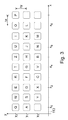
- a second keyboard type is a full keyboard, as in FIG. 3 shown. This type differs from the previous one in that each character has exactly one key assigned to it.
- a model is selected which comprises three rows of keys and ten key columns and provides a rectilinear, rectangular arrangement of the rows and columns.
- the distance ⁇ x from the distance between the keys "Q" and “T” is determined from the assumptions generally described above for this model.
- three other keys can also be selected according to the described rules whose positions are determined as model parameters or for determining the model parameters.
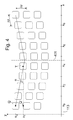
- the terminal 106 may comprise a keyboard, in which the keys are arranged in a curve or curved.
- the keys are arranged in a curve or curved.
- the embodiment shown is a full keyboard with arcuate rows.
- a similar arcuate arrangement can also occur in terminals with a reduced keyboard.
- the arcuate rows are parallel to each other.
- the arc is approximated by two straight lines which, like the arc, are arranged mirror-symmetrically with respect to an axis of symmetry 401.
- a pitch parameter in addition to the distances of the adjacent keys of the rows and columns. This corresponds for example the angle ⁇ between a line and the x-axis of the coordinate system (whose y-axis is parallel to the columns of the keyboard).
- the distance ⁇ x can be determined, for example, from the detected positions of the key "Q" and another key in the first (left-hand) column of the keyboard.
- the positions of the keys of the keyboard of the terminal to be tested are determined in the calculation module 101 as previously explained. In one embodiment, the calculation for all keys is made before the start of the actual device test. At the end of the calculations, the determined positions can be stored in the evaluation and logging module 103 and transmitted to the control module 102. During the test run, the control module 102 then uses these detected positions to control the actuator unit 107 with the sensing finger 108 to the position of a desired key, and then the feeler finger 108 can operate the key correctly.
- the storage of the key positions in the memory module 104 allows the local button, later in the case of an identical device to be tested 106 to perform the required tests faster.
- the key positions can be recalled in such a case without having to carry out a calculation again.
- terminals 106 can be checked in particular when an error occurs in a test routine as described above in order to determine the cause of the error. Further, such terminals 106 may be checked for proper operation prior to their distribution or launch. If these devices 106 are sold in large numbers, as is usually the case for example with communication terminals, the test can also be limited to one or more selected devices, since a test of all manufactured devices would be too costly. In this case, however, the operation of identically constructed devices can be determined with high reliability.
Landscapes
- Engineering & Computer Science (AREA)
- General Engineering & Computer Science (AREA)
- Theoretical Computer Science (AREA)
- Robotics (AREA)
- Mechanical Engineering (AREA)
- Computer Hardware Design (AREA)
- Quality & Reliability (AREA)
- Physics & Mathematics (AREA)
- General Physics & Mathematics (AREA)
- Signal Processing (AREA)
- Input From Keyboards Or The Like (AREA)
Applications Claiming Priority (1)
| Application Number | Priority Date | Filing Date | Title |
|---|---|---|---|
| DE102010003719.2A DE102010003719B4 (de) | 2010-04-08 | 2010-04-08 | Verfahren und Vorrichtung zum Betätigen einer Taste einer Tastatur mit einem Roboter-Tastfinger |
Publications (2)
| Publication Number | Publication Date |
|---|---|
| EP2405356A2 true EP2405356A2 (fr) | 2012-01-11 |
| EP2405356A3 EP2405356A3 (fr) | 2013-04-24 |
Family
ID=44117360
Family Applications (1)
| Application Number | Title | Priority Date | Filing Date |
|---|---|---|---|
| EP11159621.9A Withdrawn EP2405356A3 (fr) | 2010-04-08 | 2011-03-24 | Procédé et dispositif d'actionnement d'une touche d'un clavier à l'aide d'un palpeur robotisé |
Country Status (3)
| Country | Link |
|---|---|
| US (1) | US9043026B2 (fr) |
| EP (1) | EP2405356A3 (fr) |
| DE (1) | DE102010003719B4 (fr) |
Cited By (3)
| Publication number | Priority date | Publication date | Assignee | Title |
|---|---|---|---|---|
| FR3086406A1 (fr) | 2018-09-24 | 2020-03-27 | Ponant Technologies | Banc de test automatise, non intrusif, destine a realiser des tests mecaniques et/ou logiciels et/ou visuels et/ou sonores d’interface homme-machine d’un appareil/equipement |
| FR3101165A1 (fr) | 2019-09-23 | 2021-03-26 | Ponant Technologies | Procédé d’enregistrement de séquences de commande et de contrôle d’un robot de test, logiciel pour mise en œuvre de ce procédé |
| WO2024256390A1 (fr) | 2023-06-15 | 2024-12-19 | Ponant Technologies | Banc de test automatisé pour appareils/équipements électroniques reconditionnés. |
Families Citing this family (41)
| Publication number | Priority date | Publication date | Assignee | Title |
|---|---|---|---|---|
| US11010841B2 (en) | 2008-10-02 | 2021-05-18 | Ecoatm, Llc | Kiosk for recycling electronic devices |
| US10853873B2 (en) | 2008-10-02 | 2020-12-01 | Ecoatm, Llc | Kiosks for evaluating and purchasing used electronic devices and related technology |
| CN105303699B (zh) * | 2008-10-02 | 2018-10-09 | 埃科亚特姆公司 | 针对设备的二手市场和自动售货系统 |
| US9881284B2 (en) | 2008-10-02 | 2018-01-30 | ecoATM, Inc. | Mini-kiosk for recycling electronic devices |
| US7881965B2 (en) | 2008-10-02 | 2011-02-01 | ecoATM, Inc. | Secondary market and vending system for devices |
| US9652077B2 (en) | 2010-12-09 | 2017-05-16 | T-Mobile Usa, Inc. | Touch screen testing platform having components for providing conductivity to a tip |
| US10120474B2 (en) | 2010-12-09 | 2018-11-06 | T-Mobile Usa, Inc. | Touch screen testing platform for engaging a dynamically positioned target feature |
| CA3210819A1 (fr) | 2011-04-06 | 2012-10-11 | Ecoatm, Llc | Procede et kiosque pour le recyclage de dispositifs electroniques |
| CN106462291A (zh) * | 2014-06-25 | 2017-02-22 | T移动美国公司 | 具有向尖端提供导电性部件的触屏测试平台 |
| US10401411B2 (en) | 2014-09-29 | 2019-09-03 | Ecoatm, Llc | Maintaining sets of cable components used for wired analysis, charging, or other interaction with portable electronic devices |
| WO2016053378A1 (fr) | 2014-10-02 | 2016-04-07 | ecoATM, Inc. | Kiosque activé sans fil pour le recyclage de dispositifs de consommateurs |
| EP3859697A1 (fr) | 2014-10-02 | 2021-08-04 | ecoATM, LLC | Application pour l'évaluation de dispositif et d'autres procédés associés au recyclage de dispositif |
| US10445708B2 (en) | 2014-10-03 | 2019-10-15 | Ecoatm, Llc | System for electrically testing mobile devices at a consumer-operated kiosk, and associated devices and methods |
| WO2016069738A1 (fr) | 2014-10-31 | 2016-05-06 | ecoATM, Inc. | Systèmes et procédés pour recycler des dispositifs électroniques grand public |
| US20170169401A1 (en) | 2015-12-11 | 2017-06-15 | ecoATM, Inc. | Systems and methods for recycling consumer electronic devices |
| WO2016069742A1 (fr) | 2014-10-31 | 2016-05-06 | ecoATM, Inc. | Procédés et systèmes pour faciliter des processus associés à des services d'assurance et/ou d'autres services pour dispositifs électroniques |
| EP4560549A3 (fr) | 2014-11-06 | 2025-06-18 | ecoATM, LLC | Procédés et systèmes d'évaluation et de recyclage de dispositifs électroniques |
| WO2016094789A1 (fr) | 2014-12-12 | 2016-06-16 | ecoATM, Inc. | Systèmes et procédés pour le recyclage de dispositifs électroniques grand public |
| CN105049575A (zh) * | 2015-08-20 | 2015-11-11 | 工业和信息化部电信研究院 | 手机温度和功耗检测实验系统及其检测方法 |
| CN105049574A (zh) * | 2015-08-20 | 2015-11-11 | 工业和信息化部电信研究院 | 利用机器人手对手机流畅度进行检测的系统及其检测方法 |
| WO2017085932A1 (fr) * | 2015-11-16 | 2017-05-26 | 川崎重工業株式会社 | Système robotisé, et procédé de commande de celui-ci |
| EP3378607A4 (fr) * | 2015-11-16 | 2019-07-17 | Kawasaki Jukogyo Kabushiki Kaisha | Système robotisé, et procédé de commande de celui-ci |
| US10127647B2 (en) | 2016-04-15 | 2018-11-13 | Ecoatm, Llc | Methods and systems for detecting cracks in electronic devices |
| US9885672B2 (en) | 2016-06-08 | 2018-02-06 | ecoATM, Inc. | Methods and systems for detecting screen covers on electronic devices |
| US10269110B2 (en) | 2016-06-28 | 2019-04-23 | Ecoatm, Llc | Methods and systems for detecting cracks in illuminated electronic device screens |
| US12322259B2 (en) | 2018-12-19 | 2025-06-03 | Ecoatm, Llc | Systems and methods for vending and/or purchasing mobile phones and other electronic devices |
| KR102942007B1 (ko) | 2018-12-19 | 2026-03-19 | 에코에이티엠, 엘엘씨 | 이동 전화기 및 다른 전자 디바이스의 판매 및/또는 구매를 위한 시스템 및 방법 |
| EP3924918B1 (fr) | 2019-02-12 | 2026-04-01 | ecoATM, LLC | Kiosque pour évaluer et acheter des dispositifs électroniques usagés |
| US11462868B2 (en) | 2019-02-12 | 2022-10-04 | Ecoatm, Llc | Connector carrier for electronic device kiosk |
| US11798250B2 (en) | 2019-02-18 | 2023-10-24 | Ecoatm, Llc | Neural network based physical condition evaluation of electronic devices, and associated systems and methods |
| DE102019206444A1 (de) * | 2019-05-06 | 2020-11-12 | Kuka Deutschland Gmbh | Maschinelles Lernen einer Objekterkennung mithilfe einer robotergeführten Kamera |
| JP2023508903A (ja) | 2019-12-18 | 2023-03-06 | エコエーティーエム, エルエルシー | 携帯電話および他の電子デバイスを販売および/または買取するためのシステムならびに方法 |
| CN111251309B (zh) * | 2020-01-08 | 2021-06-15 | 杭州未名信科科技有限公司 | 控制机器人绘制图像的方法、装置、机器人及介质 |
| CN111531531A (zh) * | 2020-03-27 | 2020-08-14 | 向仲宇 | 一种机器人按键控制方法及系统 |
| US12271929B2 (en) | 2020-08-17 | 2025-04-08 | Ecoatm Llc | Evaluating an electronic device using a wireless charger |
| EP4197083B1 (fr) | 2020-08-17 | 2024-10-09 | ecoATM, LLC | Support de connecteur de kiosque de dispositifs électroniques |
| WO2022040667A1 (fr) | 2020-08-17 | 2022-02-24 | Ecoatm, Llc | Évaluation d'un dispositif électronique à l'aide d'un chargeur sans fil |
| US11922467B2 (en) | 2020-08-17 | 2024-03-05 | ecoATM, Inc. | Evaluating an electronic device using optical character recognition |
| EP4738801A2 (fr) | 2020-08-25 | 2026-05-06 | ecoATM, LLC | Évaluation et recyclage de dispositifs électroniques |
| US11854230B2 (en) * | 2020-12-01 | 2023-12-26 | Meta Platforms Technologies, Llc | Physical keyboard tracking |
| US12462635B2 (en) | 2021-07-09 | 2025-11-04 | Ecoatm, Llc | Identifying electronic devices using temporally changing information |
Citations (1)
| Publication number | Priority date | Publication date | Assignee | Title |
|---|---|---|---|---|
| DE102006004284A1 (de) | 2006-01-31 | 2007-08-02 | Robert Bosch Gmbh | Piezoaktor und Verfahren zur Herstellung desselben |
Family Cites Families (14)
| Publication number | Priority date | Publication date | Assignee | Title |
|---|---|---|---|---|
| KR100595926B1 (ko) * | 1998-01-26 | 2006-07-05 | 웨인 웨스터만 | 수동 입력 통합 방법 및 장치 |
| US6304830B1 (en) * | 1999-05-28 | 2001-10-16 | Behavior Tech Computer Corp. | Automatic keyboard testing apparatus |
| JPWO2005071930A1 (ja) | 2004-01-23 | 2007-09-06 | 日本ノーベル株式会社 | 機器の検査装置及びこれを用いた機器の検査システム、携帯電話の保持装置 |
| DE102006004248A1 (de) | 2006-01-30 | 2007-08-02 | Serviceforce.Com Gmbh | Testverfahren für ein eine Benutzerschnittstelle aufweisendes technisches Gerät |
| CN101545938B (zh) * | 2008-03-28 | 2012-01-25 | 深圳富泰宏精密工业有限公司 | 触控式面板的检测装置 |
| US8761938B2 (en) * | 2008-04-18 | 2014-06-24 | David Jenkinson | Robotic device tester |
| US8774793B2 (en) | 2008-06-13 | 2014-07-08 | Jot Automation, Ltd. | Systems and methods of providing intelligent handset testing |
| US8923602B2 (en) * | 2008-07-22 | 2014-12-30 | Comau, Inc. | Automated guidance and recognition system and method of the same |
| US8200533B2 (en) * | 2008-10-02 | 2012-06-12 | ecoATM, Inc. | Apparatus and method for recycling mobile phones |
| US20130046611A1 (en) * | 2008-10-02 | 2013-02-21 | ecoATM, Inc. | Method And Apparatus For Recycling Electronic Devices |
| US8996166B2 (en) * | 2010-12-09 | 2015-03-31 | T-Mobile Usa, Inc. | Touch screen testing platform |
| TWI431508B (zh) * | 2011-04-08 | 2014-03-21 | Primax Electronics Ltd | 鍵盤測試方法 |
| US20120280934A1 (en) * | 2011-05-04 | 2012-11-08 | Apple Inc. | Simulating Single and Multi-Touch Events for Testing A Touch Panel |
| US8806280B2 (en) * | 2012-02-27 | 2014-08-12 | Microsoft Corporation | APIs to test a device |
-
2010
- 2010-04-08 DE DE102010003719.2A patent/DE102010003719B4/de active Active
-
2011
- 2011-03-24 EP EP11159621.9A patent/EP2405356A3/fr not_active Withdrawn
- 2011-04-04 US US13/079,169 patent/US9043026B2/en active Active
Patent Citations (1)
| Publication number | Priority date | Publication date | Assignee | Title |
|---|---|---|---|---|
| DE102006004284A1 (de) | 2006-01-31 | 2007-08-02 | Robert Bosch Gmbh | Piezoaktor und Verfahren zur Herstellung desselben |
Cited By (6)
| Publication number | Priority date | Publication date | Assignee | Title |
|---|---|---|---|---|
| FR3086406A1 (fr) | 2018-09-24 | 2020-03-27 | Ponant Technologies | Banc de test automatise, non intrusif, destine a realiser des tests mecaniques et/ou logiciels et/ou visuels et/ou sonores d’interface homme-machine d’un appareil/equipement |
| WO2020064653A1 (fr) | 2018-09-24 | 2020-04-02 | Ponant Technologies | Banc de test automatise, non intrusif, destine a realiser des tests mecaniques et/ou logiciels et/ou visuels et/ou sonores d'interface homme-machine d'un appareil/equipement |
| FR3101165A1 (fr) | 2019-09-23 | 2021-03-26 | Ponant Technologies | Procédé d’enregistrement de séquences de commande et de contrôle d’un robot de test, logiciel pour mise en œuvre de ce procédé |
| WO2021058307A1 (fr) | 2019-09-23 | 2021-04-01 | Ponant Technologies | Procede d'enregistrement de sequences de commande et de controle d'un robot de test, logiciel pour mise en oeuvre de ce procede |
| WO2024256390A1 (fr) | 2023-06-15 | 2024-12-19 | Ponant Technologies | Banc de test automatisé pour appareils/équipements électroniques reconditionnés. |
| FR3149974A1 (fr) | 2023-06-15 | 2024-12-20 | Ponant Technologies | Banc de test automatisé pour appareils/équipements électroniques reconditionnés. |
Also Published As
| Publication number | Publication date |
|---|---|
| US20110251719A1 (en) | 2011-10-13 |
| US9043026B2 (en) | 2015-05-26 |
| EP2405356A3 (fr) | 2013-04-24 |
| DE102010003719A1 (de) | 2011-10-13 |
| DE102010003719B4 (de) | 2019-01-24 |
Similar Documents
| Publication | Publication Date | Title |
|---|---|---|
| DE102010003719B4 (de) | Verfahren und Vorrichtung zum Betätigen einer Taste einer Tastatur mit einem Roboter-Tastfinger | |
| DE2812396C2 (fr) | ||
| DE3625462A1 (de) | Rechnerunterstuetzte fehlerisolation beim pruefen von gedruckten schaltungen | |
| DE102016105496A1 (de) | System zur Prüfung von Objekten mittels erweiterter Realität | |
| DE2812344A1 (de) | Verfahren und vorrichtung zum pruefen von schaltungsplatten | |
| DE10234135B4 (de) | Verfahren, System und Computerprogramm zum Steuern der Prüfung einer gedruckten Schaltungsplatine in Bezug auf Herstellungsdefekte | |
| DE3702408C2 (fr) | ||
| EP2019283A2 (fr) | Procédé et dispositif de mesure des données de mesure réelles d'un composant | |
| DE102015102238A1 (de) | Verfahren und Anordnung zum Überprüfen einer Fläche | |
| DE10226644A1 (de) | Eingabegerät für eine Datenverarbeitungsanlage | |
| DE3828988C2 (fr) | ||
| DE102022103538A1 (de) | System zum bewerten einer eingebauten videoaufzeichnungsvorrichtung für ein fahrzeug | |
| DE102013102286A1 (de) | Verfahren und Vorrichtung zum Auswerten von Laserscans | |
| DE102020215138A1 (de) | Verfahren und Vorrichtung zum Betreiben eines technischen Systems | |
| DE10213582B4 (de) | Datenberechnungsvorrichtung und Verfahren zur Anwendung der Datenberechnungsvorrichtung zur Einstellung einer elektronischen Steuereinrichtung | |
| DE102012000293A1 (de) | Etikett zur Kennzeichnung eines elektrischen Bauteils und/oder Leiters, Messsonde zur Wartung und/oder Funktionsüberprüfung von elektrischen Schaltungsanordnungen bzw. -anlagen, Vorrichtung zum Lesen eines auf einem Etikett enthaltenen Codes und Verfahren zur Überprüfung von elektrischen Schaltungsanordungen | |
| DE4307590A1 (de) | Visuelles Inspektionsverfahren und Vorrichtung zu seiner Durchführung | |
| DE102008010288A1 (de) | Verfahren zum Erzeugen einer auf einem Testgerät zum Testen eines Mobilfunkgeräts abspielbaren Signalfolge | |
| DE102012211902B4 (de) | Testgerät und Verfahren zum Protokoll-Testen mit einer Spielkartenmetapher | |
| DE102021124274A1 (de) | Automatisches evaluierungsgerät für eine eingebaute videoaufzeichnungsvorrichtung eines fahrzeugs, system dieses aufweisend und verfahren dazu | |
| DE2554611A1 (de) | Verfahren und vorrichtung fuer eine automatische montagesteuerung | |
| DE10319095A1 (de) | Ausrichtung von optischen Faserelementen | |
| DE102009032197A1 (de) | System und Verfahren zum Testen eines elektronischen Geräts | |
| EP3521949A1 (fr) | Dispositif de simulation d'une machine ou d'une installation commandées ainsi que procédé | |
| DE112021003990T5 (de) | Lehrvorrichtung, Lehrsystem und Lehrprogramm |
Legal Events
| Date | Code | Title | Description |
|---|---|---|---|
| AK | Designated contracting states |
Kind code of ref document: A2 Designated state(s): AL AT BE BG CH CY CZ DE DK EE ES FI FR GB GR HR HU IE IS IT LI LT LU LV MC MK MT NL NO PL PT RO RS SE SI SK SM TR |
|
| AX | Request for extension of the european patent |
Extension state: BA ME |
|
| PUAI | Public reference made under article 153(3) epc to a published international application that has entered the european phase |
Free format text: ORIGINAL CODE: 0009012 |
|
| RIN1 | Information on inventor provided before grant (corrected) |
Inventor name: PETLIC, CHRISTOPH Inventor name: LIEN, TAM |
|
| PUAL | Search report despatched |
Free format text: ORIGINAL CODE: 0009013 |
|
| AK | Designated contracting states |
Kind code of ref document: A3 Designated state(s): AL AT BE BG CH CY CZ DE DK EE ES FI FR GB GR HR HU IE IS IT LI LT LU LV MC MK MT NL NO PL PT RO RS SE SI SK SM TR |
|
| AX | Request for extension of the european patent |
Extension state: BA ME |
|
| RIC1 | Information provided on ipc code assigned before grant |
Ipc: B25J 9/16 20060101ALN20130318BHEP Ipc: H04M 1/24 20060101ALN20130318BHEP Ipc: G06F 11/22 20060101ALI20130318BHEP Ipc: G06F 11/26 20060101AFI20130318BHEP |
|
| STAA | Information on the status of an ep patent application or granted ep patent |
Free format text: STATUS: THE APPLICATION IS DEEMED TO BE WITHDRAWN |
|
| 18D | Application deemed to be withdrawn |
Effective date: 20131025 |