EP2406307B1 - Styrolpolymerzusammensetzung - Google Patents
Styrolpolymerzusammensetzung Download PDFInfo
- Publication number
- EP2406307B1 EP2406307B1 EP10704720A EP10704720A EP2406307B1 EP 2406307 B1 EP2406307 B1 EP 2406307B1 EP 10704720 A EP10704720 A EP 10704720A EP 10704720 A EP10704720 A EP 10704720A EP 2406307 B1 EP2406307 B1 EP 2406307B1
- Authority
- EP
- European Patent Office
- Prior art keywords
- styrenic polymer
- flame retardant
- polymer composition
- mixture
- bis
- Prior art date
- Legal status (The legal status is an assumption and is not a legal conclusion. Google has not performed a legal analysis and makes no representation as to the accuracy of the status listed.)
- Not-in-force
Links
- 239000000203 mixture Substances 0.000 title claims description 114
- 229920000642 polymer Polymers 0.000 title claims description 70
- 239000003063 flame retardant Substances 0.000 claims description 85
- RNFJDJUURJAICM-UHFFFAOYSA-N 2,2,4,4,6,6-hexaphenoxy-1,3,5-triaza-2$l^{5},4$l^{5},6$l^{5}-triphosphacyclohexa-1,3,5-triene Chemical compound N=1P(OC=2C=CC=CC=2)(OC=2C=CC=CC=2)=NP(OC=2C=CC=CC=2)(OC=2C=CC=CC=2)=NP=1(OC=1C=CC=CC=1)OC1=CC=CC=C1 RNFJDJUURJAICM-UHFFFAOYSA-N 0.000 claims description 78
- 229920002223 polystyrene Polymers 0.000 claims description 35
- 239000004793 Polystyrene Substances 0.000 claims description 34
- PPBRXRYQALVLMV-UHFFFAOYSA-N Styrene Chemical compound C=CC1=CC=CC=C1 PPBRXRYQALVLMV-UHFFFAOYSA-N 0.000 claims description 33
- 229920006327 polystyrene foam Polymers 0.000 claims description 28
- 229910052794 bromium Inorganic materials 0.000 claims description 26
- -1 phosphate ester Chemical class 0.000 claims description 26
- VEORPZCZECFIRK-UHFFFAOYSA-N 3,3',5,5'-tetrabromobisphenol A Chemical compound C=1C(Br)=C(O)C(Br)=CC=1C(C)(C)C1=CC(Br)=C(O)C(Br)=C1 VEORPZCZECFIRK-UHFFFAOYSA-N 0.000 claims description 24
- 229910019142 PO4 Inorganic materials 0.000 claims description 23
- 239000010452 phosphate Substances 0.000 claims description 19
- WKBOTKDWSSQWDR-UHFFFAOYSA-N Bromine atom Chemical compound [Br] WKBOTKDWSSQWDR-UHFFFAOYSA-N 0.000 claims description 18
- GDTBXPJZTBHREO-UHFFFAOYSA-N bromine Substances BrBr GDTBXPJZTBHREO-UHFFFAOYSA-N 0.000 claims description 18
- 239000004594 Masterbatch (MB) Substances 0.000 claims description 17
- 238000013329 compounding Methods 0.000 claims description 17
- 238000000034 method Methods 0.000 claims description 16
- 239000007787 solid Substances 0.000 claims description 15
- QIGBRXMKCJKVMJ-UHFFFAOYSA-N 1,4-Benzenediol Natural products OC1=CC=C(O)C=C1 QIGBRXMKCJKVMJ-UHFFFAOYSA-N 0.000 claims description 14
- 239000006260 foam Substances 0.000 claims description 14
- 239000008188 pellet Substances 0.000 claims description 14
- 238000001125 extrusion Methods 0.000 claims description 13
- 238000001746 injection moulding Methods 0.000 claims description 13
- 229910052698 phosphorus Inorganic materials 0.000 claims description 13
- 238000002844 melting Methods 0.000 claims description 11
- 230000008018 melting Effects 0.000 claims description 11
- XUMFBUWGVLTWTH-UHFFFAOYSA-N 1,2-dibromo-3-(2,3-dibromo-2-methylpropoxy)-2-methylpropane Chemical compound BrCC(Br)(C)COCC(C)(Br)CBr XUMFBUWGVLTWTH-UHFFFAOYSA-N 0.000 claims description 8
- 229920006248 expandable polystyrene Polymers 0.000 claims description 8
- PYOIYKRKAHYOKO-UHFFFAOYSA-N 1,2,3,4,5-pentabromo-6-(bromomethyl)benzene Chemical compound BrCC1=C(Br)C(Br)=C(Br)C(Br)=C1Br PYOIYKRKAHYOKO-UHFFFAOYSA-N 0.000 claims description 7
- PWXTUWQHMIFLKL-UHFFFAOYSA-N 1,3-dibromo-5-[2-(3,5-dibromo-4-prop-2-enoxyphenyl)propan-2-yl]-2-prop-2-enoxybenzene Chemical compound C=1C(Br)=C(OCC=C)C(Br)=CC=1C(C)(C)C1=CC(Br)=C(OCC=C)C(Br)=C1 PWXTUWQHMIFLKL-UHFFFAOYSA-N 0.000 claims description 7
- OAICVXFJPJFONN-UHFFFAOYSA-N Phosphorus Chemical compound [P] OAICVXFJPJFONN-UHFFFAOYSA-N 0.000 claims description 7
- 239000013078 crystal Substances 0.000 claims description 7
- 239000011574 phosphorus Substances 0.000 claims description 7
- 239000004795 extruded polystyrene foam Substances 0.000 claims description 6
- DEIGXXQKDWULML-UHFFFAOYSA-N 1,2,5,6,9,10-hexabromocyclododecane Chemical compound BrC1CCC(Br)C(Br)CCC(Br)C(Br)CCC1Br DEIGXXQKDWULML-UHFFFAOYSA-N 0.000 claims description 4
- 229920000122 acrylonitrile butadiene styrene Polymers 0.000 claims description 4
- 229920005669 high impact polystyrene Polymers 0.000 claims description 4
- 239000004797 high-impact polystyrene Substances 0.000 claims description 4
- 125000000687 hydroquinonyl group Chemical group C1(O)=C(C=C(O)C=C1)* 0.000 claims description 4
- 125000001997 phenyl group Chemical group [H]C1=C([H])C([H])=C(*)C([H])=C1[H] 0.000 claims description 4
- 229920000638 styrene acrylonitrile Polymers 0.000 claims description 4
- HGTUJZTUQFXBIH-UHFFFAOYSA-N (2,3-dimethyl-3-phenylbutan-2-yl)benzene Chemical compound C=1C=CC=CC=1C(C)(C)C(C)(C)C1=CC=CC=C1 HGTUJZTUQFXBIH-UHFFFAOYSA-N 0.000 claims description 3
- ATVJXMYDOSMEPO-UHFFFAOYSA-N 3-prop-2-enoxyprop-1-ene Chemical compound C=CCOCC=C ATVJXMYDOSMEPO-UHFFFAOYSA-N 0.000 claims description 3
- OMPJBNCRMGITSC-UHFFFAOYSA-N Benzoylperoxide Chemical compound C=1C=CC=CC=1C(=O)OOC(=O)C1=CC=CC=C1 OMPJBNCRMGITSC-UHFFFAOYSA-N 0.000 claims description 3
- NBIIXXVUZAFLBC-UHFFFAOYSA-L Phosphate ion(2-) Chemical compound OP([O-])([O-])=O NBIIXXVUZAFLBC-UHFFFAOYSA-L 0.000 claims description 3
- 235000019400 benzoyl peroxide Nutrition 0.000 claims description 3
- 239000004794 expanded polystyrene Substances 0.000 claims description 3
- 125000000843 phenylene group Chemical group C1(=C(C=CC=C1)*)* 0.000 claims description 3
- 238000010557 suspension polymerization reaction Methods 0.000 claims description 3
- LXIZRZRTWSDLKK-UHFFFAOYSA-N 1,3-dibromo-5-[2-[3,5-dibromo-4-(2,3-dibromopropoxy)phenyl]propan-2-yl]-2-(2,3-dibromopropoxy)benzene Chemical compound C=1C(Br)=C(OCC(Br)CBr)C(Br)=CC=1C(C)(C)C1=CC(Br)=C(OCC(Br)CBr)C(Br)=C1 LXIZRZRTWSDLKK-UHFFFAOYSA-N 0.000 claims description 2
- NODLCKUQQWRUIU-UHFFFAOYSA-N 1-(1-phenylethylsulfonyl)ethylbenzene Chemical compound C=1C=CC=CC=1C(C)S(=O)(=O)C(C)C1=CC=CC=C1 NODLCKUQQWRUIU-UHFFFAOYSA-N 0.000 claims description 2
- BSWWXRFVMJHFBN-UHFFFAOYSA-N 2,4,6-tribromophenol Chemical compound OC1=C(Br)C=C(Br)C=C1Br BSWWXRFVMJHFBN-UHFFFAOYSA-N 0.000 claims description 2
- XMNIXWIUMCBBBL-UHFFFAOYSA-N 2-(2-phenylpropan-2-ylperoxy)propan-2-ylbenzene Chemical compound C=1C=CC=CC=1C(C)(C)OOC(C)(C)C1=CC=CC=C1 XMNIXWIUMCBBBL-UHFFFAOYSA-N 0.000 claims description 2
- 239000004342 Benzoyl peroxide Substances 0.000 claims description 2
- SZGBUFROANKUNE-UHFFFAOYSA-N [1-(1-phenylcyclohexyl)cyclohexyl]benzene Chemical group C1CCCCC1(C1(CCCCC1)C=1C=CC=CC=1)C1=CC=CC=C1 SZGBUFROANKUNE-UHFFFAOYSA-N 0.000 claims description 2
- MWSVUOSVPYCABB-UHFFFAOYSA-N bis(2-bromobutan-2-yl)diazene Chemical compound CCC(C)(Br)N=NC(C)(Br)CC MWSVUOSVPYCABB-UHFFFAOYSA-N 0.000 claims description 2
- FJDFMHRXSYNDIR-UHFFFAOYSA-N bis(2-chlorobutan-2-yl)diazene Chemical compound CCC(C)(Cl)N=NC(C)(Cl)CC FJDFMHRXSYNDIR-UHFFFAOYSA-N 0.000 claims description 2
- JYEUMXHLPRZUAT-UHFFFAOYSA-N 1,2,3-triazine Chemical compound C1=CN=NN=C1 JYEUMXHLPRZUAT-UHFFFAOYSA-N 0.000 claims 1
- 239000007983 Tris buffer Substances 0.000 claims 1
- ZGXHUGQEDPPKGZ-UHFFFAOYSA-N bis(2-methylbutan-2-yl)diazene Chemical compound CCC(C)(C)N=NC(C)(C)CC ZGXHUGQEDPPKGZ-UHFFFAOYSA-N 0.000 claims 1
- XZZNDPSIHUTMOC-UHFFFAOYSA-N triphenyl phosphate Chemical compound C=1C=CC=CC=1OP(OC=1C=CC=CC=1)(=O)OC1=CC=CC=C1 XZZNDPSIHUTMOC-UHFFFAOYSA-N 0.000 description 36
- 238000009472 formulation Methods 0.000 description 22
- 235000021317 phosphate Nutrition 0.000 description 20
- GRPTWLLWXYXFLX-UHFFFAOYSA-N 1,1,2,2,3,3-hexabromocyclodecane Chemical compound BrC1(Br)CCCCCCCC(Br)(Br)C1(Br)Br GRPTWLLWXYXFLX-UHFFFAOYSA-N 0.000 description 14
- OWICEWMBIBPFAH-UHFFFAOYSA-N (3-diphenoxyphosphoryloxyphenyl) diphenyl phosphate Chemical compound C=1C=CC=CC=1OP(OC=1C=C(OP(=O)(OC=2C=CC=CC=2)OC=2C=CC=CC=2)C=CC=1)(=O)OC1=CC=CC=C1 OWICEWMBIBPFAH-UHFFFAOYSA-N 0.000 description 13
- BHYQWBKCXBXPKM-UHFFFAOYSA-N tris[3-bromo-2,2-bis(bromomethyl)propyl] phosphate Chemical compound BrCC(CBr)(CBr)COP(=O)(OCC(CBr)(CBr)CBr)OCC(CBr)(CBr)CBr BHYQWBKCXBXPKM-UHFFFAOYSA-N 0.000 description 13
- 229920001577 copolymer Polymers 0.000 description 12
- 238000012360 testing method Methods 0.000 description 12
- 239000000654 additive Substances 0.000 description 11
- 239000003999 initiator Substances 0.000 description 11
- 239000000463 material Substances 0.000 description 11
- XLYOFNOQVPJJNP-UHFFFAOYSA-N water Substances O XLYOFNOQVPJJNP-UHFFFAOYSA-N 0.000 description 10
- 239000011324 bead Substances 0.000 description 9
- 238000006116 polymerization reaction Methods 0.000 description 9
- ASMQGLCHMVWBQR-UHFFFAOYSA-M diphenyl phosphate Chemical compound C=1C=CC=CC=1OP(=O)([O-])OC1=CC=CC=C1 ASMQGLCHMVWBQR-UHFFFAOYSA-M 0.000 description 7
- 150000001875 compounds Chemical class 0.000 description 6
- 239000007788 liquid Substances 0.000 description 6
- QVGXLLKOCUKJST-UHFFFAOYSA-N atomic oxygen Chemical compound [O] QVGXLLKOCUKJST-UHFFFAOYSA-N 0.000 description 5
- VCCBEIPGXKNHFW-UHFFFAOYSA-N biphenyl-4,4'-diol Chemical compound C1=CC(O)=CC=C1C1=CC=C(O)C=C1 VCCBEIPGXKNHFW-UHFFFAOYSA-N 0.000 description 5
- 125000005340 bisphosphate group Chemical group 0.000 description 5
- RTZKZFJDLAIYFH-UHFFFAOYSA-N ether Substances CCOCC RTZKZFJDLAIYFH-UHFFFAOYSA-N 0.000 description 5
- 238000002347 injection Methods 0.000 description 5
- 239000007924 injection Substances 0.000 description 5
- 238000011068 loading method Methods 0.000 description 5
- 239000001301 oxygen Substances 0.000 description 5
- 229910052760 oxygen Inorganic materials 0.000 description 5
- IJGRMHOSHXDMSA-UHFFFAOYSA-N Atomic nitrogen Chemical compound N#N IJGRMHOSHXDMSA-UHFFFAOYSA-N 0.000 description 4
- KAKZBPTYRLMSJV-UHFFFAOYSA-N Butadiene Chemical compound C=CC=C KAKZBPTYRLMSJV-UHFFFAOYSA-N 0.000 description 4
- APOXBWCRUPJDAC-UHFFFAOYSA-N bis(2,6-dimethylphenyl) hydrogen phosphate Chemical compound CC1=CC=CC(C)=C1OP(O)(=O)OC1=C(C)C=CC=C1C APOXBWCRUPJDAC-UHFFFAOYSA-N 0.000 description 4
- 239000012153 distilled water Substances 0.000 description 4
- 238000005516 engineering process Methods 0.000 description 4
- 238000010438 heat treatment Methods 0.000 description 4
- BHEPBYXIRTUNPN-UHFFFAOYSA-N hydridophosphorus(.) (triplet) Chemical compound [PH] BHEPBYXIRTUNPN-UHFFFAOYSA-N 0.000 description 4
- 238000004519 manufacturing process Methods 0.000 description 4
- 238000002156 mixing Methods 0.000 description 4
- 238000010998 test method Methods 0.000 description 4
- PYSRRFNXTXNWCD-UHFFFAOYSA-N 3-(2-phenylethenyl)furan-2,5-dione Chemical compound O=C1OC(=O)C(C=CC=2C=CC=CC=2)=C1 PYSRRFNXTXNWCD-UHFFFAOYSA-N 0.000 description 3
- UHOVQNZJYSORNB-UHFFFAOYSA-N Benzene Chemical compound C1=CC=CC=C1 UHOVQNZJYSORNB-UHFFFAOYSA-N 0.000 description 3
- OKKJLVBELUTLKV-UHFFFAOYSA-N Methanol Chemical compound OC OKKJLVBELUTLKV-UHFFFAOYSA-N 0.000 description 3
- HEMHJVSKTPXQMS-UHFFFAOYSA-M Sodium hydroxide Chemical compound [OH-].[Na+] HEMHJVSKTPXQMS-UHFFFAOYSA-M 0.000 description 3
- 229920000147 Styrene maleic anhydride Polymers 0.000 description 3
- BQPNUOYXSVUVMY-UHFFFAOYSA-N [4-[2-(4-diphenoxyphosphoryloxyphenyl)propan-2-yl]phenyl] diphenyl phosphate Chemical compound C=1C=C(OP(=O)(OC=2C=CC=CC=2)OC=2C=CC=CC=2)C=CC=1C(C)(C)C(C=C1)=CC=C1OP(=O)(OC=1C=CC=CC=1)OC1=CC=CC=C1 BQPNUOYXSVUVMY-UHFFFAOYSA-N 0.000 description 3
- 239000004676 acrylonitrile butadiene styrene Substances 0.000 description 3
- 238000013019 agitation Methods 0.000 description 3
- 125000001931 aliphatic group Chemical group 0.000 description 3
- 238000001816 cooling Methods 0.000 description 3
- 238000000113 differential scanning calorimetry Methods 0.000 description 3
- 238000000465 moulding Methods 0.000 description 3
- 239000002667 nucleating agent Substances 0.000 description 3
- 229920003023 plastic Polymers 0.000 description 3
- 239000004033 plastic Substances 0.000 description 3
- SCUZVMOVTVSBLE-UHFFFAOYSA-N prop-2-enenitrile;styrene Chemical compound C=CC#N.C=CC1=CC=CC=C1 SCUZVMOVTVSBLE-UHFFFAOYSA-N 0.000 description 3
- 229920005989 resin Polymers 0.000 description 3
- 239000011347 resin Substances 0.000 description 3
- SQGYOTSLMSWVJD-UHFFFAOYSA-N silver(1+) nitrate Chemical compound [Ag+].[O-]N(=O)=O SQGYOTSLMSWVJD-UHFFFAOYSA-N 0.000 description 3
- 239000000243 solution Substances 0.000 description 3
- 239000000725 suspension Substances 0.000 description 3
- 230000002195 synergetic effect Effects 0.000 description 3
- NLHHRLWOUZZQLW-UHFFFAOYSA-N Acrylonitrile Chemical compound C=CC#N NLHHRLWOUZZQLW-UHFFFAOYSA-N 0.000 description 2
- XECAHXYUAAWDEL-UHFFFAOYSA-N acrylonitrile butadiene styrene Chemical compound C=CC=C.C=CC#N.C=CC1=CC=CC=C1 XECAHXYUAAWDEL-UHFFFAOYSA-N 0.000 description 2
- 230000000996 additive effect Effects 0.000 description 2
- 150000001412 amines Chemical class 0.000 description 2
- 238000004458 analytical method Methods 0.000 description 2
- 239000008346 aqueous phase Substances 0.000 description 2
- 125000003118 aryl group Chemical group 0.000 description 2
- CJZGTCYPCWQAJB-UHFFFAOYSA-L calcium stearate Chemical compound [Ca+2].CCCCCCCCCCCCCCCCCC([O-])=O.CCCCCCCCCCCCCCCCCC([O-])=O CJZGTCYPCWQAJB-UHFFFAOYSA-L 0.000 description 2
- 239000008116 calcium stearate Substances 0.000 description 2
- 235000013539 calcium stearate Nutrition 0.000 description 2
- 230000000052 comparative effect Effects 0.000 description 2
- 238000012669 compression test Methods 0.000 description 2
- 239000012141 concentrate Substances 0.000 description 2
- 230000003750 conditioning effect Effects 0.000 description 2
- 239000000470 constituent Substances 0.000 description 2
- 238000000354 decomposition reaction Methods 0.000 description 2
- 238000004090 dissolution Methods 0.000 description 2
- 238000007908 dry granulation Methods 0.000 description 2
- 230000000694 effects Effects 0.000 description 2
- 238000011049 filling Methods 0.000 description 2
- 239000004088 foaming agent Substances 0.000 description 2
- 239000011521 glass Substances 0.000 description 2
- 230000009477 glass transition Effects 0.000 description 2
- 239000008187 granular material Substances 0.000 description 2
- 229920001519 homopolymer Polymers 0.000 description 2
- 239000011261 inert gas Substances 0.000 description 2
- 238000009413 insulation Methods 0.000 description 2
- 239000011159 matrix material Substances 0.000 description 2
- 238000005259 measurement Methods 0.000 description 2
- 239000000155 melt Substances 0.000 description 2
- 239000000178 monomer Substances 0.000 description 2
- 229910052757 nitrogen Inorganic materials 0.000 description 2
- 238000004806 packaging method and process Methods 0.000 description 2
- NBIIXXVUZAFLBC-UHFFFAOYSA-K phosphate Chemical compound [O-]P([O-])([O-])=O NBIIXXVUZAFLBC-UHFFFAOYSA-K 0.000 description 2
- 239000004417 polycarbonate Substances 0.000 description 2
- 229920000515 polycarbonate Polymers 0.000 description 2
- 229920005990 polystyrene resin Polymers 0.000 description 2
- 229920002451 polyvinyl alcohol Polymers 0.000 description 2
- 239000000843 powder Substances 0.000 description 2
- GHMLBKRAJCXXBS-UHFFFAOYSA-N resorcinol Chemical compound OC1=CC=CC(O)=C1 GHMLBKRAJCXXBS-UHFFFAOYSA-N 0.000 description 2
- 125000003011 styrenyl group Chemical group [H]\C(*)=C(/[H])C1=C([H])C([H])=C([H])C([H])=C1[H] 0.000 description 2
- 239000000126 substance Substances 0.000 description 2
- 229920001897 terpolymer Polymers 0.000 description 2
- UONOETXJSWQNOL-UHFFFAOYSA-N tungsten carbide Chemical compound [W+]#[C-] UONOETXJSWQNOL-UHFFFAOYSA-N 0.000 description 2
- JFQRSESREMCLNR-UHFFFAOYSA-N (n-(2,6-dimethylphenyl)-2,6-dimethylanilino)phosphonic acid;piperazine Chemical compound C1CNCCN1.CC1=CC=CC(C)=C1N(P(O)(O)=O)C1=C(C)C=CC=C1C.CC1=CC=CC(C)=C1N(P(O)(O)=O)C1=C(C)C=CC=C1C JFQRSESREMCLNR-UHFFFAOYSA-N 0.000 description 1
- YUAPUIKGYCAHGM-UHFFFAOYSA-N 1,2-dibromo-3-(2,3-dibromopropoxy)propane Chemical compound BrCC(Br)COCC(Br)CBr YUAPUIKGYCAHGM-UHFFFAOYSA-N 0.000 description 1
- KZEVSDGEBAJOTK-UHFFFAOYSA-N 1-(2,4,6,7-tetrahydrotriazolo[4,5-c]pyridin-5-yl)-2-[5-[2-[[3-(trifluoromethoxy)phenyl]methylamino]pyrimidin-5-yl]-1,3,4-oxadiazol-2-yl]ethanone Chemical compound N1N=NC=2CN(CCC=21)C(CC=1OC(=NN=1)C=1C=NC(=NC=1)NCC1=CC(=CC=C1)OC(F)(F)F)=O KZEVSDGEBAJOTK-UHFFFAOYSA-N 0.000 description 1
- CMQUQOHNANGDOR-UHFFFAOYSA-N 2,3-dibromo-4-(2,4-dibromo-5-hydroxyphenyl)phenol Chemical compound BrC1=C(Br)C(O)=CC=C1C1=CC(O)=C(Br)C=C1Br CMQUQOHNANGDOR-UHFFFAOYSA-N 0.000 description 1
- YJLUBHOZZTYQIP-UHFFFAOYSA-N 2-[5-[2-(2,3-dihydro-1H-inden-2-ylamino)pyrimidin-5-yl]-1,3,4-oxadiazol-2-yl]-1-(2,4,6,7-tetrahydrotriazolo[4,5-c]pyridin-5-yl)ethanone Chemical compound C1C(CC2=CC=CC=C12)NC1=NC=C(C=N1)C1=NN=C(O1)CC(=O)N1CC2=C(CC1)NN=N2 YJLUBHOZZTYQIP-UHFFFAOYSA-N 0.000 description 1
- QEJPOEGPNIVDMK-UHFFFAOYSA-N 3-bromo-2,2-bis(bromomethyl)propan-1-ol Chemical compound OCC(CBr)(CBr)CBr QEJPOEGPNIVDMK-UHFFFAOYSA-N 0.000 description 1
- LBLYADSLNDUWKS-UHFFFAOYSA-N 4,5,6-tris(2,3-dibromopropyl)triazine Chemical compound BrCC(Br)CC1=NN=NC(CC(Br)CBr)=C1CC(Br)CBr LBLYADSLNDUWKS-UHFFFAOYSA-N 0.000 description 1
- 239000004604 Blowing Agent Substances 0.000 description 1
- CPELXLSAUQHCOX-UHFFFAOYSA-M Bromide Chemical compound [Br-] CPELXLSAUQHCOX-UHFFFAOYSA-M 0.000 description 1
- 101100172886 Caenorhabditis elegans sec-6 gene Proteins 0.000 description 1
- 101100172892 Caenorhabditis elegans sec-8 gene Proteins 0.000 description 1
- 239000004593 Epoxy Substances 0.000 description 1
- 239000006057 Non-nutritive feed additive Substances 0.000 description 1
- 229920001890 Novodur Polymers 0.000 description 1
- 239000005662 Paraffin oil Substances 0.000 description 1
- 239000004372 Polyvinyl alcohol Substances 0.000 description 1
- 239000000956 alloy Substances 0.000 description 1
- 229910045601 alloy Inorganic materials 0.000 description 1
- 125000001246 bromo group Chemical group Br* 0.000 description 1
- 230000015556 catabolic process Effects 0.000 description 1
- 239000003795 chemical substances by application Substances 0.000 description 1
- 238000004140 cleaning Methods 0.000 description 1
- 239000011248 coating agent Substances 0.000 description 1
- 238000000576 coating method Methods 0.000 description 1
- 238000004737 colorimetric analysis Methods 0.000 description 1
- 238000002485 combustion reaction Methods 0.000 description 1
- 238000007906 compression Methods 0.000 description 1
- 230000006835 compression Effects 0.000 description 1
- 238000000748 compression moulding Methods 0.000 description 1
- 230000001143 conditioned effect Effects 0.000 description 1
- 238000010276 construction Methods 0.000 description 1
- 238000004320 controlled atmosphere Methods 0.000 description 1
- 239000011162 core material Substances 0.000 description 1
- 238000005260 corrosion Methods 0.000 description 1
- 230000007797 corrosion Effects 0.000 description 1
- 239000003431 cross linking reagent Substances 0.000 description 1
- 238000005520 cutting process Methods 0.000 description 1
- 238000010908 decantation Methods 0.000 description 1
- 238000006731 degradation reaction Methods 0.000 description 1
- 239000006185 dispersion Substances 0.000 description 1
- 238000010410 dusting Methods 0.000 description 1
- 229920001971 elastomer Polymers 0.000 description 1
- 239000000806 elastomer Substances 0.000 description 1
- 239000000945 filler Substances 0.000 description 1
- 239000006261 foam material Substances 0.000 description 1
- 239000000314 lubricant Substances 0.000 description 1
- 238000003760 magnetic stirring Methods 0.000 description 1
- FPYJFEHAWHCUMM-UHFFFAOYSA-N maleic anhydride Chemical compound O=C1OC(=O)C=C1 FPYJFEHAWHCUMM-UHFFFAOYSA-N 0.000 description 1
- 229910052751 metal Inorganic materials 0.000 description 1
- 239000002184 metal Substances 0.000 description 1
- 239000012452 mother liquor Substances 0.000 description 1
- 150000002894 organic compounds Chemical class 0.000 description 1
- 150000001451 organic peroxides Chemical class 0.000 description 1
- 238000005453 pelletization Methods 0.000 description 1
- 150000003013 phosphoric acid derivatives Chemical class 0.000 description 1
- 150000003014 phosphoric acid esters Chemical class 0.000 description 1
- 125000004437 phosphorous atom Chemical group 0.000 description 1
- 230000000704 physical effect Effects 0.000 description 1
- 239000000049 pigment Substances 0.000 description 1
- 239000002861 polymer material Substances 0.000 description 1
- 238000010926 purge Methods 0.000 description 1
- 239000011342 resin composition Substances 0.000 description 1
- 239000003381 stabilizer Substances 0.000 description 1
- 238000003756 stirring Methods 0.000 description 1
- 239000004094 surface-active agent Substances 0.000 description 1
- 238000004448 titration Methods 0.000 description 1
- 238000009966 trimming Methods 0.000 description 1
- 230000000007 visual effect Effects 0.000 description 1
Classifications
-
- C—CHEMISTRY; METALLURGY
- C08—ORGANIC MACROMOLECULAR COMPOUNDS; THEIR PREPARATION OR CHEMICAL WORKING-UP; COMPOSITIONS BASED THEREON
- C08J—WORKING-UP; GENERAL PROCESSES OF COMPOUNDING; AFTER-TREATMENT NOT COVERED BY SUBCLASSES C08B, C08C, C08F, C08G or C08H
- C08J9/00—Working-up of macromolecular substances to porous or cellular articles or materials; After-treatment thereof
- C08J9/0014—Use of organic additives
- C08J9/0019—Use of organic additives halogenated
-
- C—CHEMISTRY; METALLURGY
- C08—ORGANIC MACROMOLECULAR COMPOUNDS; THEIR PREPARATION OR CHEMICAL WORKING-UP; COMPOSITIONS BASED THEREON
- C08J—WORKING-UP; GENERAL PROCESSES OF COMPOUNDING; AFTER-TREATMENT NOT COVERED BY SUBCLASSES C08B, C08C, C08F, C08G or C08H
- C08J9/00—Working-up of macromolecular substances to porous or cellular articles or materials; After-treatment thereof
- C08J9/0014—Use of organic additives
- C08J9/0038—Use of organic additives containing phosphorus
-
- C—CHEMISTRY; METALLURGY
- C08—ORGANIC MACROMOLECULAR COMPOUNDS; THEIR PREPARATION OR CHEMICAL WORKING-UP; COMPOSITIONS BASED THEREON
- C08K—Use of inorganic or non-macromolecular organic substances as compounding ingredients
- C08K5/00—Use of organic ingredients
- C08K5/0008—Organic ingredients according to more than one of the "one dot" groups of C08K5/01 - C08K5/59
- C08K5/0066—Flame-proofing or flame-retarding additives
-
- C—CHEMISTRY; METALLURGY
- C08—ORGANIC MACROMOLECULAR COMPOUNDS; THEIR PREPARATION OR CHEMICAL WORKING-UP; COMPOSITIONS BASED THEREON
- C08J—WORKING-UP; GENERAL PROCESSES OF COMPOUNDING; AFTER-TREATMENT NOT COVERED BY SUBCLASSES C08B, C08C, C08F, C08G or C08H
- C08J2201/00—Foams characterised by the foaming process
- C08J2201/02—Foams characterised by the foaming process characterised by mechanical pre- or post-treatments
- C08J2201/024—Preparation or use of a blowing agent concentrate, i.e. masterbatch in a foamable composition
-
- C—CHEMISTRY; METALLURGY
- C08—ORGANIC MACROMOLECULAR COMPOUNDS; THEIR PREPARATION OR CHEMICAL WORKING-UP; COMPOSITIONS BASED THEREON
- C08J—WORKING-UP; GENERAL PROCESSES OF COMPOUNDING; AFTER-TREATMENT NOT COVERED BY SUBCLASSES C08B, C08C, C08F, C08G or C08H
- C08J2201/00—Foams characterised by the foaming process
- C08J2201/02—Foams characterised by the foaming process characterised by mechanical pre- or post-treatments
- C08J2201/03—Extrusion of the foamable blend
-
- C—CHEMISTRY; METALLURGY
- C08—ORGANIC MACROMOLECULAR COMPOUNDS; THEIR PREPARATION OR CHEMICAL WORKING-UP; COMPOSITIONS BASED THEREON
- C08J—WORKING-UP; GENERAL PROCESSES OF COMPOUNDING; AFTER-TREATMENT NOT COVERED BY SUBCLASSES C08B, C08C, C08F, C08G or C08H
- C08J2325/00—Characterised by the use of homopolymers or copolymers of compounds having one or more unsaturated aliphatic radicals, each having only one carbon-to-carbon double bond, and at least one being terminated by an aromatic carbocyclic ring; Derivatives of such polymers
- C08J2325/02—Homopolymers or copolymers of hydrocarbons
- C08J2325/04—Homopolymers or copolymers of styrene
- C08J2325/06—Polystyrene
-
- C—CHEMISTRY; METALLURGY
- C08—ORGANIC MACROMOLECULAR COMPOUNDS; THEIR PREPARATION OR CHEMICAL WORKING-UP; COMPOSITIONS BASED THEREON
- C08K—Use of inorganic or non-macromolecular organic substances as compounding ingredients
- C08K5/00—Use of organic ingredients
- C08K5/02—Halogenated hydrocarbons
-
- C—CHEMISTRY; METALLURGY
- C08—ORGANIC MACROMOLECULAR COMPOUNDS; THEIR PREPARATION OR CHEMICAL WORKING-UP; COMPOSITIONS BASED THEREON
- C08K—Use of inorganic or non-macromolecular organic substances as compounding ingredients
- C08K5/00—Use of organic ingredients
- C08K5/49—Phosphorus-containing compounds
- C08K5/51—Phosphorus bound to oxygen
- C08K5/52—Phosphorus bound to oxygen only
- C08K5/521—Esters of phosphoric acids, e.g. of H3PO4
- C08K5/523—Esters of phosphoric acids, e.g. of H3PO4 with hydroxyaryl compounds
-
- C—CHEMISTRY; METALLURGY
- C08—ORGANIC MACROMOLECULAR COMPOUNDS; THEIR PREPARATION OR CHEMICAL WORKING-UP; COMPOSITIONS BASED THEREON
- C08L—COMPOSITIONS OF MACROMOLECULAR COMPOUNDS
- C08L2201/00—Properties
- C08L2201/02—Flame or fire retardant/resistant
-
- C—CHEMISTRY; METALLURGY
- C08—ORGANIC MACROMOLECULAR COMPOUNDS; THEIR PREPARATION OR CHEMICAL WORKING-UP; COMPOSITIONS BASED THEREON
- C08L—COMPOSITIONS OF MACROMOLECULAR COMPOUNDS
- C08L2203/00—Applications
- C08L2203/14—Applications used for foams
Definitions
- the present invention relates to styrenic polymer composition(s) and specifically flame retarded polystyrene or their foam composition(s).
- FRs Phosphorus based flame retardants
- FRs Phosphorus based flame retardants
- the most preferred FRs for these types of polymers are brominated FRs.
- Aliphatic bromine containing FRs and/or low melting bromine FRs (BFRs) are more flame retardant efficient in styrenic homo- and copolymers at low loadings than are BFRs containing only aromatic bromine when fire retardancy is measured by limited oxygen index (LOI).
- LOI limited oxygen index
- flame retardant additives and synergists incorporated in polystyrene foams must be strictly controlled, since they can negatively affect the structural qualities and skin quality of the foam, reduce the strength of the foam or its insulating properties, at high levels of such additives.
- non-foamed styrenic compositions the typical loading of flame retardant additives is significantly higher than in foamed compositions. Therefore flame retardants for foamed polystyrene compositions must have a high degree of efficiency, or in other words, the suitable organic compounds must release, when subjected to fire, the appropriate amount of bromine at the suitable temperature in order to prevent the foamed polystyrene resin from combustion.
- BFR bromine flame retardant
- Polymer foams have become available in a wide variety of forms, especially foam sheets, films, profiles and slabs for uses such as packaging, pipe and tubing, garment trimmings, construction and insulation.
- Foamed polystyrene is currently used in the insulation of freezers, coolers, trucks, railroad cars, buildings, roof decks and housing.
- Another application of foamed polystyrene is for the packaging of valuable goods such as electronic equipment.
- Polystyrene foams are also used as the core material for structural multilayered panels. There is an increasing demand, partially driven by legislation, to improve the fire retardant properties of polymers in such applications.
- U.S. Patent No. 6,579,911 describes a mixture of hexabromocyclodecane (HBCD) with organophosphorus based FRs, preferably triphenyl phosphate (TPP).
- HBCD hexabromocyclodecane
- TPP triphenyl phosphate
- WO 2006/013554 discloses flame-resistant polystyrene and styrene containing polymers containing a combination of halogenated flame-retardants and phosphate-based synergists such as 4,4'biphenol bis(diphenyl phosphate) and triphenyl phosphate.
- WO 2006/008738 discloses the use of pentabromobenzyl bromide as flame retardant in expanded polystyrene foams in combination with a second flame retardant additive, such as 4,4'biphenol bis(diphenyl phosphate).
- WO 2008/027536 discloses the use of hydroquinone-based phosphates as flame retardants in styrenic resin compositions.
- organophosphorus FRs such as resorcinol bis(diphenyl phosphate) (RDP) and bisphenol A bis(diphenyl phosphate) (BDP) are viscous to very viscous liquids. Liquid is difficult to handle with usual extrusion compounding equipment and in order to overcome this problem, usually complicated and costly means (e.g., viscous liquid handling systems) are needed to be able to introduce them into an extruder. This problem of handling is particularly critical when flame retardant masterbatch concentrates (MB) are prepared that contain high loadings of phosphorous FRs.
- MB flame retardant masterbatch concentrates
- TPP triphenyl phosphate
- TPP thermal dimensional stability of styrenic homo- and copolymers, including expanded polystyrene foams.
- This property of thermal dimensional stability is an important one for many applications, such as in the building, electric and electronic and automotive industries where often objects are exposed to relatively high temperatures.
- a method often used to measure thermal dimensional stability is measurement of the heat distortion temperature (HDT) of the molded objects.
- HDT heat distortion temperature
- Tg glass transition temperature of the flame retarded composition which can be determined by differential scanning calorimetry (DSC) analysis.
- Suitable thermal stability of flame retardant additives is another crucial property in polystyrene foams, since additives of low thermal stability will limit the possibilities for processing the flame retarded material. Flame retardant additives of insufficient thermal stability will cause degradation of the polystyrene foam during processing, and this in turn will immediately cause a drop in all mechanical and insulating properties of the foam, and even corrosion of the equipment in the most severe cases.
- solid phosphate ester having an elevated melting point can be used in combination with brominated flame retardants in polystyrene foam materials to provide desirable flame resistance, thermal dimensional stability and other desirable physical properties.
- the solid phosphate esters with a melting temperature of at least 80 degrees Celsius act as a powerful flame retardant synergist of brominated flame retardants.
- polystyrene compositions prepared by extrusion compounding and molded by injection molding as well as in polystyrene beads prepared by suspension polymerization and compression molded.
- the use of high melting point phosphate ester compounds together with the brominated flame retardant results in another clear advantage, when processing the foamed polystyrene composition.
- the good solubility of the high melting point phosphate ester compound in the styrenic foam results in a lowering of the melt viscosity of the polystyrene composition, and consequently the processing temperature can be lowered while the dispersion of the flame retardant mixture in the foam is kept optimal and the density of the foam is kept low even at lowered processing temperature.
- the present invention relates to a styrenic polymer composition
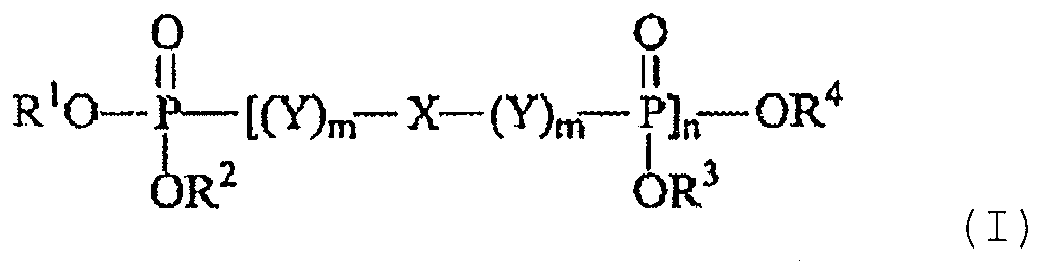
- a styrenic polymer composition comprising a styrenic polymer and a flame retardant effective amount of a mixture comprising (a) at least one brominated flame retardant; and, (b) at least one solid phosphate ester of the general formula (I): wherein each of R 1 , R 2 , R 3 and R 4 are phenyl, X is a divalent phenylene group such that the phosphate ester is a hydroquinone biphosphate, n has an average value of from 1.0 to 2.0, and m is 0.
- the present invention provides a fire retarded polystyrene foam composition in which the flame retardant mixture comprises at least one brominated flame retardant, e.g., an aromatic polybrominated bromomethyl compounds of the general formula (I), such as pentabromobenzyl bromide (PBBBr) otherwise known as benzene pentabromo-(bromomethyl), CAS [38521-51-6], FR-706 (supplied by ICL-IP), and at least one solid phosphate ester.
- PBBBr pentabromobenzyl bromide
- CAS 38521-51-6
- FR-706 supplied by ICL-IP
- the styrenic polymer is styrene homopolymer, i.e., crystal polystyrene, preferably crystal polystyrene, more preferably crystal polystyrene in the form of polystyrene foam
- the styrenic polymer is a polystyrene foam, preferably a molded polystyrene foam or an extrusion compounded polystyrene foam, or an extruded polystyrene foam.
- the polystyrene foam can be formed by molding or extrusion or in any way that is commonly known in the art. Specifically some examples of such polystyrene foam can comprise aliphatic bromine flame retardant or aliphatic-aromatic bromine flame retardant.
- the styrenic polymer herein or the brominated flame retardant herein can comprise any of polystyrene foams or brominated compounds, respectively, described in any of U.S. Patent No. 6,579,911 , WO 2004/094517 , WO 2008/127753 , WO 2008127753 , EP 1724304 A1 , WO 2007/019120 and WO 2008/121135 .
- the polymer is styrene homopolymer (crystal polystyrene), styrene copolymer, and specifically copolymers (including terpolymers), which contain a styrenic structural unit (optionally substituted), however combined with one or more other structural units.
- styrene-based polymer is used in the form of pellets to produce molded parts, for example electronic molded parts.
- Non-limiting examples of styrene-based copolymers are described below.
- HIPS high impact polystyrene
- styrenic monomers obtainable, for example, by mixing an elastomer (butadiene) with the (optionally substituted) styrenic monomer (s) prior to polymerization. Characteristics and compositions of HIPS are described, for example, in " Encyclopedia of Polymer Science and Engineering", Volume 16, pages 88 - 96 (1985 ).
- ABS in the context of the present invention is a family of copolymers and terpolymers that include the structural units corresponding to styrene (optionally substituted), acrylonitrile and butadiene, regardless of the composition and method of production of said polymers. Characteristics and compositions of ABS are described, for example, in Encyclopedia of Polymer Science and Engineering, Volume 16, pages 72 - 74 (1985 ).
- SAN styrene acrylonitrile
- SMA styrene maleic anhydride
- Characteristics of SAN and SMA are described in " Encyclopedia of Polymer Science and Engineering", Volume 16, pages 72 - 73 (1985 ).
- the flame-retarded styrenic polymer composition of the invention may contain an alloy of a styrene-based polymer, namely, a blend of styrene-containing polymer as set forth above with a second polymer or copolymer (such blends are obtained by extruding pellets of the styrene-containing polymer and pellets of the second polymer in desired proportions).
- the brominated flame retardant is an aliphatic and/or low melting brominated flame retardant.
- the brominated flame retardant is selected from the group consisting of hexabromocyclododecane (FR-1206 available from ICL-IP), tetrabromobisphenol A bis (2,3-dibromopropyl ether) (FR-720 available from ICL-IP), pentabromobenzylbromide (FR-706 available from ICL-IP), tetrabromobisphenol A bis(2,3-dibromo-2-methylpropyl ether), tribromophenol allyl ether, tetrabromobisphenol A bis(allyl ether), tris(2,3-dibromopropyl) triazine, tetrabromobisphenol A (FR-1524 available from ICL-IP) and combinations thereof.
- hexabromocyclododecane FR-1206 available from ICL-IP
- tetrabromobisphenol A bis (2,3-dibromopropyl ether)
- bromine flame retardants or mixtures thereof can be used for the purpose of the invention, which is not meant to be limited to any particular compound. It will be understood herein that any bromine-containing compound or any combination of any of such bromine-containing compounds described herein can be used in the present invention regardless of its consideration by those in the art previously as a "brominated flame retardant.”
- the brominated flame retardant has a melting point of less than 300 degrees Celsius, preferably less than 260 degrees Celsius
- the at least one solid phosphate ester has a melting point of at least 80 degrees Celsius, most preferably at least 100 degrees Celsius.
- the solid phosphate ester is of the general formula (I): wherein each of R 1 , R 2 , R 3 and R 4 are phenyl, X is a divalent phenylene group such that the phosphate ester is a hydroquinone biphosphate, n has an average value of from 1.0 to 2.0, and m is 0.
- particularly preferred oligomeric bis-phosphate within formula (I) above is hydroquinone bis(diphenyl phosphate), i.e., R 1 , R 2 , R 3 and R 4 are each phenyl.
- Free-radical generators most preferably C-C initiators may be included in the styrenic polymer composition; in addition, it is also known that they can increase the efficiency of the flame retardant compound. Such free-radical generators are therefore also applied as part of the styrenic polymer composition. The addition of such "free-radical generators" enables, therefore, the use of lower levels of brominated flame retardant.
- free-radical generators include 2,3-dimethyl-2,3-diphenylbutane; bis(alpha-phenylethyl) sulfone; 1,1'-diphenylbicyclohexyl; 2,2'-dimethyl-2,2 1 -azobutane; 2,2'-dibromo-2,2'-azobutane; 2,2'-dichloro-2,2'-azobutane; 2,2'-dimethyl-2,2'-azobutane-3,3'4,4'-tetracarboxylic acid; as well as stable organic peroxides like dicumylperoxide, benzoyl peroxide.
- auxiliaries such as nucleating and foaming agents, cross-linking agents, stabilizers, surfactants, pigments/dye(s), flame retardants, chain-extending agents, and fillers within a range which would not hinder the object of the present invention.
- the styrenic polymer composition may optionally further comprise Tris(tribromoneopentyl)phosphate, Tribromoneopentylalcohol, Tetrabromobisphenol-A, bis(2,3-dibromopropyl ether), Brominated Epoxy Oligomer, or hindered amines (NOR) and mixtures thereof.
- the mixture present in the styrenic polymer composition can comprise bromine flame retardant component (a) in an amount of from 0.2 to 10.0 weight percent, preferably from 0.5 to 5.0 weight percent, and most preferably from 0.5 to 2.5 weight percent and phosphate ester component (b) is in an amount of from 0.2 to 10.0 weight percent, preferably from 0.5 to 3.0 weight percent, and most preferably from 0.5 to 2.0 weight percent, such weight percent being based on the total weight of the mixture.
- bromine flame retardant component (a) in an amount of from 0.2 to 10.0 weight percent, preferably from 0.5 to 5.0 weight percent, and most preferably from 0.5 to 2.5 weight percent
- phosphate ester component (b) is in an amount of from 0.2 to 10.0 weight percent, preferably from 0.5 to 3.0 weight percent, and most preferably from 0.5 to 2.0 weight percent, such weight percent being based on the total weight of the mixture.
- a flame retardant effective amount can vary dramatically depending on the components of the mixture and the specific stryenic polymer and one skilled in the art can determine what would be a flame retardant effective amount.
- such above described amounts of component (a) and (b) as described herein can comprise such flame retardant effective amounts.
- the styrenic polymer composition can comprise where the styrenic polymer is present in an amount of from 80.0 to 99-6 weight percent, preferably from 90.0 to 99.0 weight percent, and most preferably from 95.0 to 98.5 weight percent, and the mixture is present in an amount of from 20.0 to 0.4 weight percent, preferably from 10.0 to 1.0 weight percent, and most preferably from 5.0 to 1.5 weight percent, said weight percent being based on the total weight of the styrenic polymer composition.
- Methods for producing polystyrene foam of the present invention are not particularly limited. Various methods commonly used in the art may be employed. For example, various methods described in, any of U.S. Patent No. 6,579,911 , WO 2004/094517 , WO 2008/127753 , WO 2008127753 , EP 1724304 A1 , WO 2007/019120 and WO 2008/121135 .
- the foam can be prepared by extrusion, injection molding, extrusion compounding or any other known technology.
- the polystyrene foam may be made by mixtures of polystyrenes, solid phosphate ester, brominated flame retardant, and optionally, free-radical generators, and different technologies of nucleating and blowing agents, respectively.
- the polystyrene foam is prepared by suspension polymerization of styrene in the presence of the mixture described herein.
- an article which comprises the styrenic polymer composition described herein, specifically wherein the styrenic polymer is a polystyrene foam, such as for example an extruded polystyrene foam (XPS) or an expandable polystyrene foam (EPS).
- XPS extruded polystyrene foam
- EPS expandable polystyrene foam
- the styrenic polymer composition and the article made there from as described herein can be formed by extrusion, extruder compounding and/or injection molding.
- the article as described herein can be a molded article.
- the heat distortion temperature (HDT) of the styrenic polymer composition and article formed there from as described herein is at least 70 degrees Celsius, preferably at least 73 degrees Celsius and most preferably at least 75 degrees Celsius.
- flame retardance (LOI value) of the styrenic polymer composition and article formed there from as described herein is at least 24, preferably at least 28 and most preferably at least 30.
- the process of manufacturing extruded styrenic polymer foam usually comprises the following steps: a) all of the constituents are blended in any conventional manner and in any desired order. For example the constituents can first be dry mixed and then fed to a twin screw extruder to obtain a blended material for feed to a molding apparatus, b) A more convenient way to add the flame retardant system (mixture) to the styrenic polymer is a master batch, which is a concentrated, heat blended or extruded mixture of the various additives in the polymer, c) The master batch is then added to the bulk of the styrenic polymer material in proportions to give the desired level of additives in the final blended product, d) Styrenic foamed articles are formed by mixing the additives individually or by master batch with the polymer and then feeding the mixture to an extruder with a foaming agent and a nucleating agent. Extrusion technology for the production of foamed polystyrene as described herein is known to those skilled in
- MB as used herein is master batch, which is a concentrate of flame retardant in a resin. It is used to produce a proper concentration of flame retardant, by adding MB to virgin resin instead of the flame retardant itself. The use of MB is commonly done, particularly when there is a desire to avoid the handling of dusty powders.
- pellets of the mixture of bromine flame retardant, phosphorus flame retardant additive (PFR) and any synergists including but not limited to free-radical generator are produced.
- the pellets are produced by solid blending of the components and pelletization by any known technique known by those skilled in the art. Use of pellets in place of powders helps to avoid dusting during extrusion of PS foam. It is also understood that brominated flame retardant and phosphorus flame retardant can be pelletized separately and introduced in the mixture of the styrenic polymer composition herein in the form of pellets.
- the styrenic polymer composition herein can itself be an article or the styrenic polymer composition can be molded or extruded to form the article.
- the molding and extrusion processes are well known by those skilled in the art.
- the polystyrene foam can be formed by injection molding or extrusion or in an extruder or a combination of any of these processes, or in any manner known to those skilled in the art.
- a process of making the styrenic polymer composition as described herein comprising compounding the styrenic polymer, the at least one brominated flame retardant (a) and the at least one solid phosphate ester (b) in any order or combination.
- the styrenic polymer composition is in the absence of a metal phthalocyanine compound or complexes.
- the styrenic polymer compositon herein can be in the absence of an aromatic polycarbonate.
- the styrenic polymer composition can be in the absence of bromine containing flame retardant that contains phosphorus atoms and/or in the absence of phosphate compound that contains bromine atoms.
- the styrenic polymer composition can be in the absence of acrylonitrile butadiene styrene (ABS) resin.
- the styrenic polymer composition can be in the absence of hindered amine.
- the bromine flame retardant can be in the absence of polycarbonate.
- PS polystyrene
- FR flame retardant
- LOI Limited Oxygen Index
- step 1 PS formulations containing FR-706 or HBCD with TPP; RDP; BDP; hydroquinone bis(diphenyl phosphate) (HDP); were compounded and molded. LOI and heat distortion temperature (HDT) were tested.
- Formulations containing combinations of FR-706 or HBCD with TPP or HDP gave the highest LOI values.
- step 2 Polystyrene (PS) formulations containing tetrabromobisphenol A bis(2,3-dibromo-2-methyl propyl ether) or tris(tribromoneopentyl) phosphate (FR-370) with TPP or HDP; were compounded and molded. LOI and HDT were tested.
- Formulations containing tetrabromobisphenol A bis(2,3-dibromo-2-methyl propyl ether) with TPP or HDP gave the same high LOI values; HDT results were lower than the reference, HDP gave higher HDT value.
- Formulations containing FR-370 gave the significantly lower LOI values. Formulations containing FR-370 with TPP or HDP gave slightly higher LOI values than the formulation containing FR-370 only. HDT results were higher with HDP than with TPP.
- the obtained pellets were dried in a circulating air oven ex Heraeus instruments at 75°C for 4 hours.
- Test specimens of the LOI were kept in controlled atmosphere for at least 88 hour at 23°C ⁇ 2°C, 50% ⁇ 5 RH before test.
- composition and LOI results of FR-706 formulations are presented in table 1-5.
- Composition and LOI results of HBCD formulations are presented in table -1-6.
- Composition and LOI results of tetrabromobisphenol A bis(2,3-dibromo-2-methyl propyl ether) formulations are presented in table 1-7.
- Parameter Units Set value Read value Feeding zone temperature °C no heating T 2 °C 20 54-82 T 3 °C 160 156-170 T 4 °C 200 196-216 T 5 °C 200 200-220 T 6 °C 200 200-228 T 7 °C 210 203-230 T 8 °C 210 210-215 T 9 °C 210 205-226 Temperature of melt °C 204-221 Motor speed RPM 340 228-230 TABLE 1-3 Regime ofPS injection molding in Arburg 320S Allrounder 500-150.
- Graph 2-1 shows dependence of LOI vs. concentration of FR 706 in FR 706 + HDP mixture, wherein concentration of FR706 changes from 0 to 2.5 wt. % and concentration of HDP changes from 2.5 to 0 wt. %
- Graph 2-2 shows dependence of LOI vs. concentration of HBCD in HBCD + HDP mixture, wherein concentration of HBCD changes from 0 to 2.7 wt. % concentration of HDP changes from 2.7 to 0 wt. %
- Test specimens were prepared by injection molding using an Arburg 270S Allrounder 250-150.
- the injection molding conditions are presented in Table 3-3.
- Specimens were conditioned at 23°C for 72 hours before testing.
- ICL-IP Hexabromocyclododecane FR C-C initiator SI Group 2,3-dimethyl-2,3-diphenylbutane Synergist Calcium Stearate Mallinckrodt Processing aid Lubricant TABLE 3-2 Compounding in Brabender co-rotating twin-screw extruder.
- Table 3-5 and Table 3-6 show flammability performance and HDT of crystalline PS with FR-706 and various bisphosphates in the presence and absence of C-C initiator free-radical initiator. All bisphosphates show very similar performance. However TPP showed lower HDT probably due to lower melting point and stronger plasticizing effect.
- TABLE 3-5 Flammability performance and HDT of crystalline polystyrene with FR -706 and various solid bisphosphates in the presence of C-C initiator Example Type of PFR CPS Polystyrol 158 K % FR-706 % PFR % C-C initiator % Total FR % % Br % P HDT 264psi °C LOI Ex.
- This example shows production ofmasterbatch (MB) of HDP/FR-706 to be used as FR in XPS formulation
- compositions of formulations are presented in Table 4-1.
- a MB was compounded in a co-rotating twin-screw extruder.
- the ratio was 24% of FR 706 and 16% HDP.
- the compounding was divided to two stages, first, the FR-706 was compounded with PS; HDP was added to the first compound in a second stage.
- the masterbatch (MB) was sent to measure %Br & %P, the result was 21 % Br that correspond to 25.8% FR - 706,1.6 % P that correspond to 14.6% HDP.
- Styrene was purified with aqueous 5% NaOH solution, separated from the water and rinsed with distilled water until the pH of the water was 6-7. The styrene was distilled before each polymerization.
- the aqueous phase was prepared in a 0.25 1 polymerization reactor equipped with a stirrer, jacket and bottom faucet.
- 1.1 gram of polyviol W 48/20 Polyvinyl alcohol, CAS [98002-48-3] ex. Aldrich
- the system was purged with nitrogen.
- the styrene-initiator solution was prepared in a separate vessel by the dissolution of 0.25 g of dibenzoyl peroxide (BP, 75%, the remainder H 2 O) in ⁇ 40 g of purified styrene at room temperature (RT).
- BP dibenzoyl peroxide
- RT room temperature
- Styrene-initiator or initiator + FR solution was fed as one portion into the reactor containing the aqueous phase, heated to 80°C.
- the polymerization was carried out for 2 hours with agitation at 400 rpm, 2 hours at 450-500 rpm and 5 hours at 550 rpm.
- the inert gas purge was continued during the polymerization process.
- the flat flange lid was equipped with a condenser and cooled by ice.
- the temperature in the heating system was elevated to 93°C after 7 hours and the polymerization finished in 2 hours with agitation at 500-550 rpm, with a steady flow of inert gas and with cooling of the flat flange lid by ice.
- the suspension after the end of the polymerization was transferred into a glass vessel with 500 ml of cold distilled water, with magnetic stirring. The agitation was stopped after several minutes, the water and the mother liquor of the polymerization was decanted, the polymer beads were washed twice at least with decantation, and then were transferred to a glass Buchner funnel. The rinsing was carried out with distilled water, and finally with methanol. The wet beads were dried at 60°C.
- the final dried beads had a spherical shape.
- the M w , M n and D of PS beads were estimated by GPC.
- the glass transition temperature of (Tg) of the PS beads was estimated by DSC (10°C/ min, nitrogen, second run).
- the bromine content in the PS beads was measured by decomposition in an oxygen bomb, followed by titration with AgNO 3 .
- the phosphorous content in PS beads was measured by a colorimetric test after decomposition in a Parr bomb with Na 2 O 2 .
- the molecular weight Mw in Tables 5-1 and 5-2 is weight average molecular weight.
- D is polydispersity, which is a known measurement by those skilled in the art.
- Mn is number average molecular weight.
- This example illustrates Dry granulation of powdered hydroquinone bis(diphenylphosphate), HDP.
- Powdered HDP was compacted using a hydraulic press. 20 g tablets were prepared in a tungsten carbide cylindrical mold of 2.5 cm diameter. The pressure applied was 300 kg/cm 2 . Crushing strength (3.1 kg/cm 2 ) was measured by standard compression test. The tablets were then grinded and sieved through 3.35 mm and 1 mm sieve to give granules of HDP.
- This example illustrates dry granulation of a mixture of FR-706 and HDP.
- Powdered FR-706 and HDP were mixed in a weight ratio of 1:1, followed by coating with 1% wt. paraffin oil.
- the mixture obtained was compacted using a hydraulic press.
- 20 g tablets were prepared in a tungsten carbide cylindrical mold of 2.5 cm diameter.
- the pressure applied was 428 kg/cm 2 .
- Crushing strength (3.1 kg/cm 2 ) was measured by standard compression test.
- the tablets were then grinded and sieved through 3.35 mm and 1 mm sieve to give granules consisting of FR-706 and HDP.
Landscapes
- Chemical & Material Sciences (AREA)
- Health & Medical Sciences (AREA)
- Chemical Kinetics & Catalysis (AREA)
- Medicinal Chemistry (AREA)
- Polymers & Plastics (AREA)
- Organic Chemistry (AREA)
- Engineering & Computer Science (AREA)
- Materials Engineering (AREA)
- Compositions Of Macromolecular Compounds (AREA)
- Manufacture Of Porous Articles, And Recovery And Treatment Of Waste Products (AREA)
Claims (14)
- Eine Styrolpolymerzusammensetzung, umfassend ein Styrolpolymer und eine als Flammschutzmittel wirksame Menge einer Mischung, die (a) mindestens ein bromiertes Flammschutzmittel und (b) mindestens einen festen Phosphatester der allgemeinen Formel (I) umfasst:
- Die Styrolpolymerzusammensetzung gemäß Anspruch 1, wobei das Styrolpolymer eines der folgenden ist:i) ein Kristallpolystyrol in Form eines Polystyrolschaums,ii) ein expandierter Polystyrolschaum oder ein Extruder-gemischter Polystyrolschaum,iii) HIPS, ABS, SAN oder SMA.
- Die Styrolpolymerzusammensetzung gemäß Anspruch 1, wobei das bromierte Flammschutzmittel eines der folgenden ist:i) ein aliphatisches bromiertes Flammschutzmittel,ii) aus der Gruppe bestehend aus Hexabromcyclododecan, Tetrabrombisphenol A bis (2,3-Dibrompropylether), Pentabrombenzylbromid, Tetrabrombisphenol A bis (2,3-Dibrom-2-methylpropylether), Tribromphenolallylether, Tetrabrombisphenol A bis (Allylether), Tris(2,3-dibrompropyl)triazin, Tetrabrombisphenol A und Kombinationen davon ausgewählt ist,iii) einen Schmelzpunkt von kleiner als 300 Grad Celsius hat.
- Die Styrolpolymerzusammensetzung gemäß Anspruch 1, ferner eines der folgenden umfassend:i) einen freie Radikale Erzeuger,ii) einen freie Radikale Erzeuger, der aus der Gruppe bestehend aus 2,3-Dimethyl-2,3-diphenylbutan; Bis(alpha-phenylethyl)sulfon; 1,11'-Diphenylbicyclohexyl; 2,2'-Dimethyl-2,2'-azobutan; 2,2'-Dibrom-2,2'-azobutan; 2,2'-Dichlor-2,2'-azobutan; 2,2'-Dimethyl-2,2'-azobutan-3,3'4,4'-tetracarbonsäure; U'-Diphenylbicyclopentyl; Dicumylperoxid; Benzoylperoxid und Kombinationen davon ausgewählt ist.
- Die Styrolpolymerzusammensetzung gemäß Anspruch 1, wobei eines der folgenden gilt:i) in der Mischung, basierend auf dem Gesamtgewicht der Mischung, ist Bestandteil (a) in einer Menge von 0,2 Gew.-% bis 10,0 Gew.-% vorhanden und ist Bestandteil (b) in einer Menge von 0,2 Gew.-% bis 10 Gew.-% vorhanden,ii) basierend auf dem Gesamtgewicht der Styrolpolymerzusammensetzung ist das Styrolpolymer in einer Menge von 80,0 Gew.-% bis 99,6 Gew.-% vorhanden und ist die Mischung in einer Menge von 0,4 Gew.-% bis 20 Gew.-% vorhanden.
- Eine Vormischung, umfassend die Styrolpolymerzusammensetzung gemäß Anspruch 1.
- Die Styrolpolymerzusammensetzung gemäß Anspruch 1, wobei eines der folgenden gilt:i) Bromflammschutzmittel und Phosphorflammschutzmittel werden trockenverdichtet und in Pelletform in die Mischung eingebracht,ii) Bromflammschutzmittel und Phosphorflammschutzmittel werden gemischt, trockenverdichtet und in Pelletform in die Mischung eingebracht.
- Die Styrolpolymerzusammensetzung gemäß Anspruch 2, Teil i), wobei eines der folgenden gilt:i) der Polystyrolschaum wird durch Suspensionspolymerisation von Styrol in der Anwesenheit der Mischung hergestellt,ii) der Polystyrolschaum ist extrudierter Polystyrolschaum (XPS) und/oder ein expandierbarer Polystyrolschaum (EPS).
- Ein Artikel, der die Styrolpolymerzusammensetzung gemäß Anspruch 1 umfasst.
- Der Artikel gemäß Anspruch 9, wobei eines der folgenden gilt:i) der Artikel hat bei einer Messung nach ASTM D2863-00 eine Wärmeverformungstemperatur von mindestens 70 Grad Celsius,ii) der Artikel hat bei einer Messung nach ASTM D-648-72 unter einer Biegebelastung von 18,5 kg/cm2 einen Grenz-Sauerstoff-Index- (LOI) -Wert von mindestens 24,iii) der Artikel wurde durch Extrusions-Mischen und/oder Spritzgießen geformt,iv) der Artikel ist ein geformter Artikel.
- Ein Verfahren zum Herstellen der Styrolpolymerzusammensetzung gemäß Anspruch 1, umfassend das Kontaktieren, z.B. das Mischen, des Styrolpolymers, des mindestens einen bromierten Flammschutzmittels (a) und des mindestens einen festen Phosphatesters (b) in irgendeiner Reihenfolge oder Kombination.
- Eine flammenhemmende Styrolpolymerzusammensetzung, die durch das Verfahren gemäß Anspruch 11 hergestellt ist.
- Ein Polystyrolschaum, umfassend die flammenhemmende Styrolpolymerzusammensetzung gemäß Anspruch 12.
- Das Verfahren gemäß Anspruch 11, wobei für das Bromflammschutzmittel und das Phosphorflammschutzmittel eines der folgenden gilt:i) sie werden trockenverdichtet und in Pelletform in die Mischung eingebracht,ii) sie werden gemischt, trockenverdichtet und in Pelletform in die Mischung eingebracht.
Applications Claiming Priority (2)
| Application Number | Priority Date | Filing Date | Title |
|---|---|---|---|
| US20864909P | 2009-02-26 | 2009-02-26 | |
| PCT/US2010/024550 WO2010099020A2 (en) | 2009-02-26 | 2010-02-18 | Styrenic polymer composition |
Publications (2)
| Publication Number | Publication Date |
|---|---|
| EP2406307A2 EP2406307A2 (de) | 2012-01-18 |
| EP2406307B1 true EP2406307B1 (de) | 2012-12-12 |
Family
ID=42321024
Family Applications (1)
| Application Number | Title | Priority Date | Filing Date |
|---|---|---|---|
| EP10704720A Not-in-force EP2406307B1 (de) | 2009-02-26 | 2010-02-18 | Styrolpolymerzusammensetzung |
Country Status (4)
| Country | Link |
|---|---|
| US (1) | US20120123007A1 (de) |
| EP (1) | EP2406307B1 (de) |
| CN (1) | CN102333816A (de) |
| WO (1) | WO2010099020A2 (de) |
Families Citing this family (14)
| Publication number | Priority date | Publication date | Assignee | Title |
|---|---|---|---|---|
| JP5403169B2 (ja) * | 2010-10-27 | 2014-01-29 | 株式会社カネカ | スチレン系樹脂押出発泡体及びその製造方法 |
| WO2012168261A1 (en) * | 2011-06-09 | 2012-12-13 | Akzo Nobel Chemicals International B.V. | Solid composition comprising a radical forming compound and a flame retardant |
| WO2013009469A1 (en) * | 2011-07-14 | 2013-01-17 | Dow Global Technologies Llc | Impact-modified styrenic polymers containing brominated vinyl aromatic-butadiene copolymer |
| CN103319796B (zh) * | 2012-03-23 | 2015-11-04 | 连云港海水化工有限公司 | 一种复合型阻燃母粒及其制备方法和应用 |
| EP2692786A1 (de) * | 2012-08-02 | 2014-02-05 | Basf Se | Flammgeschützter und wärmeformbeständiger Extrusionsschaumstoff aus Styrolcopolymeren |
| NL2009320C2 (nl) * | 2012-08-14 | 2014-02-18 | Synbra Tech Bv | Deeltjesvormig, expandeerbaar polymeer, werkwijze ter vervaardiging hiervan, alsmede de toepassing. |
| JP6091305B2 (ja) * | 2013-04-16 | 2017-03-08 | 株式会社ジェイエスピー | 難燃剤溶融混練物及びこれを用いたポリスチレン系樹脂押出発泡体の製造方法 |
| JP6133150B2 (ja) * | 2013-07-04 | 2017-05-24 | 株式会社ジェイエスピー | 難燃剤溶融混練物を用いたポリスチレン系樹脂発泡体の製造方法 |
| CN104744840B (zh) * | 2015-03-24 | 2017-11-03 | 合肥创新轻质材料有限公司 | 一种阻燃吸附母粒及其制备方法 |
| IT201600071347A1 (it) | 2016-07-08 | 2018-01-08 | Versalis Spa | Composizioni espandibili contenenti polimeri vinil aromatici aventi proprietà autoestinguenti e migliorata processabilità |
| KR20190046823A (ko) * | 2016-08-29 | 2019-05-07 | 아이씨엘-아이피 아메리카 아이엔씨. | 난연성 폴리아미드 조성물 |
| CN108570205B (zh) * | 2017-03-14 | 2020-09-08 | 金发科技股份有限公司 | 一种阻燃苯乙烯组合物及其制备方法 |
| CN108912582B (zh) * | 2018-07-21 | 2020-12-29 | 扬州工业职业技术学院 | 一种阻燃增韧高抗冲聚苯乙烯材料及其制备方法 |
| US20240336767A1 (en) * | 2021-08-09 | 2024-10-10 | Italmatch Chemicals Spa (50%) | Flame retardant nucleating compositions and corresponding formulations for polystyrene foams |
Family Cites Families (11)
| Publication number | Priority date | Publication date | Assignee | Title |
|---|---|---|---|---|
| AU5900699A (en) | 1998-08-28 | 2000-03-21 | Dow Chemical Company, The | Fire resistant styrene polymer foams with reduced brominated fire retardant |
| IL147490A0 (en) * | 2002-01-06 | 2002-08-14 | Bromine Compounds Ltd | Preparation of phenylphosphate esters of 4,4'-biphenol |
| US20040209967A1 (en) | 2003-04-21 | 2004-10-21 | Ranken Paul F. | Flame retarded styrenic polymer foams |
| JP4755399B2 (ja) | 2004-02-26 | 2011-08-24 | 第一工業製薬株式会社 | 難燃性スチレン系樹脂組成物 |
| EP1773744B1 (de) * | 2004-07-19 | 2013-01-16 | Bromine Compounds Ltd. | SYNTHESE VON PENTABROMBENZYL BROMID (PBB-Br) |
| ES2326036T3 (es) * | 2004-07-19 | 2009-09-29 | Bromine Compounds Ltd. | Poliestirenos pirorretardantes nuevos. |
| BRPI0614787A2 (pt) | 2005-08-08 | 2011-04-12 | Albemarle Corp | espumas poliméricas estirênicas retardadoras de chama e precursores da espuma |
| JP5313690B2 (ja) * | 2006-01-06 | 2013-10-09 | スプレスタ エルエルシー | 非ハロゲン難燃性組成物、それを含有する熱可塑性組成物及び当該組成物の調製方法 |
| EP2089402B1 (de) * | 2006-08-31 | 2015-08-05 | ICL-IP America Inc. | Oligomere biphosphat-flammenhemmer und zusammensetzungen damit |
| US20080221239A1 (en) | 2007-03-07 | 2008-09-11 | Falloon Stephen B | Flame retardant composition for use in styrenics |
| US8084511B2 (en) | 2007-03-08 | 2011-12-27 | Chemtura Corporation | Flame retardants for use in styrenic foams |
-
2010
- 2010-02-18 US US13/201,366 patent/US20120123007A1/en not_active Abandoned
- 2010-02-18 WO PCT/US2010/024550 patent/WO2010099020A2/en not_active Ceased
- 2010-02-18 CN CN201080009582XA patent/CN102333816A/zh active Pending
- 2010-02-18 EP EP10704720A patent/EP2406307B1/de not_active Not-in-force
Also Published As
| Publication number | Publication date |
|---|---|
| US20120123007A1 (en) | 2012-05-17 |
| CN102333816A (zh) | 2012-01-25 |
| WO2010099020A2 (en) | 2010-09-02 |
| WO2010099020A3 (en) | 2010-10-21 |
| EP2406307A2 (de) | 2012-01-18 |
Similar Documents
| Publication | Publication Date | Title |
|---|---|---|
| EP2406307B1 (de) | Styrolpolymerzusammensetzung | |
| EP1711555B1 (de) | Flammschutzzusammensetzungen und verwendung davon | |
| KR101357378B1 (ko) | 난연성 발포 스티렌계 수지 조성물 | |
| EP1791896B1 (de) | Halogenfreie, flammgeschützte polymerschaumstoffe | |
| EP2307493B1 (de) | Flammhemmende zusammsetzungen aus styrolhaltigen polymeren | |
| EP1786853B1 (de) | Neue flammhemmende polystyrene | |
| JP2012512917A (ja) | 改善された断熱能力を備えた発泡性ビニル芳香族ポリマーの組成物、それを製造するプロセス、及びそれから得られる発泡品 | |
| TW200528545A (en) | Flame-retarded polystyrene resin compositions | |
| US20080064774A1 (en) | Stabilized extruded alkenyl aromatic polymer foams and processes for extruding stabilized alkenyl aromatic polymer foams | |
| CN102459435A (zh) | 颗粒状可发性聚苯乙烯及其制备方法 | |
| US20040229982A1 (en) | Stabilized flame retardant additives and their use | |
| US12286520B2 (en) | Flame retardant masterbatch composition for foams containing a pH moderator | |
| US20100261802A1 (en) | Method for Producing Expandable Polystyrene and the Use Thereof | |
| US20050215695A1 (en) | Stabilized flame retardant additives and their use | |
| EP4025635B1 (de) | Schäumbare vinylaromatische polymere mit verbesserter flammwidrigkeit | |
| JP2005145988A (ja) | 難燃性スチレン系樹脂組成物 | |
| JP7780676B1 (ja) | 樹脂組成物、発泡性樹脂組成物および押出発泡成形体 | |
| CA2161887A1 (en) | Improved styrenic resin molding composition and foam | |
| JP2005248051A (ja) | 難燃性発泡スチレン系樹脂組成物 |
Legal Events
| Date | Code | Title | Description |
|---|---|---|---|
| PUAI | Public reference made under article 153(3) epc to a published international application that has entered the european phase |
Free format text: ORIGINAL CODE: 0009012 |
|
| 17P | Request for examination filed |
Effective date: 20110913 |
|
| AK | Designated contracting states |
Kind code of ref document: A2 Designated state(s): AT BE BG CH CY CZ DE DK EE ES FI FR GB GR HR HU IE IS IT LI LT LU LV MC MK MT NL NO PL PT RO SE SI SK SM TR |
|
| DAX | Request for extension of the european patent (deleted) | ||
| GRAP | Despatch of communication of intention to grant a patent |
Free format text: ORIGINAL CODE: EPIDOSNIGR1 |
|
| GRAS | Grant fee paid |
Free format text: ORIGINAL CODE: EPIDOSNIGR3 |
|
| GRAA | (expected) grant |
Free format text: ORIGINAL CODE: 0009210 |
|
| AK | Designated contracting states |
Kind code of ref document: B1 Designated state(s): AT BE BG CH CY CZ DE DK EE ES FI FR GB GR HR HU IE IS IT LI LT LU LV MC MK MT NL NO PL PT RO SE SI SK SM TR |
|
| REG | Reference to a national code |
Ref country code: GB Ref legal event code: FG4D |
|
| REG | Reference to a national code |
Ref country code: CH Ref legal event code: EP |
|
| REG | Reference to a national code |
Ref country code: AT Ref legal event code: REF Ref document number: 588322 Country of ref document: AT Kind code of ref document: T Effective date: 20121215 |
|
| REG | Reference to a national code |
Ref country code: IE Ref legal event code: FG4D |
|
| REG | Reference to a national code |
Ref country code: DE Ref legal event code: R096 Ref document number: 602010004101 Country of ref document: DE Effective date: 20130207 |
|
| PG25 | Lapsed in a contracting state [announced via postgrant information from national office to epo] |
Ref country code: NO Free format text: LAPSE BECAUSE OF FAILURE TO SUBMIT A TRANSLATION OF THE DESCRIPTION OR TO PAY THE FEE WITHIN THE PRESCRIBED TIME-LIMIT Effective date: 20130312 Ref country code: ES Free format text: LAPSE BECAUSE OF FAILURE TO SUBMIT A TRANSLATION OF THE DESCRIPTION OR TO PAY THE FEE WITHIN THE PRESCRIBED TIME-LIMIT Effective date: 20130323 Ref country code: FI Free format text: LAPSE BECAUSE OF FAILURE TO SUBMIT A TRANSLATION OF THE DESCRIPTION OR TO PAY THE FEE WITHIN THE PRESCRIBED TIME-LIMIT Effective date: 20121212 Ref country code: SE Free format text: LAPSE BECAUSE OF FAILURE TO SUBMIT A TRANSLATION OF THE DESCRIPTION OR TO PAY THE FEE WITHIN THE PRESCRIBED TIME-LIMIT Effective date: 20121212 Ref country code: LT Free format text: LAPSE BECAUSE OF FAILURE TO SUBMIT A TRANSLATION OF THE DESCRIPTION OR TO PAY THE FEE WITHIN THE PRESCRIBED TIME-LIMIT Effective date: 20121212 |
|
| REG | Reference to a national code |
Ref country code: NL Ref legal event code: VDEP Effective date: 20121212 |
|
| REG | Reference to a national code |
Ref country code: AT Ref legal event code: MK05 Ref document number: 588322 Country of ref document: AT Kind code of ref document: T Effective date: 20121212 |
|
| REG | Reference to a national code |
Ref country code: LT Ref legal event code: MG4D |
|
| PG25 | Lapsed in a contracting state [announced via postgrant information from national office to epo] |
Ref country code: GR Free format text: LAPSE BECAUSE OF FAILURE TO SUBMIT A TRANSLATION OF THE DESCRIPTION OR TO PAY THE FEE WITHIN THE PRESCRIBED TIME-LIMIT Effective date: 20130313 Ref country code: LV Free format text: LAPSE BECAUSE OF FAILURE TO SUBMIT A TRANSLATION OF THE DESCRIPTION OR TO PAY THE FEE WITHIN THE PRESCRIBED TIME-LIMIT Effective date: 20121212 Ref country code: SI Free format text: LAPSE BECAUSE OF FAILURE TO SUBMIT A TRANSLATION OF THE DESCRIPTION OR TO PAY THE FEE WITHIN THE PRESCRIBED TIME-LIMIT Effective date: 20121212 |
|
| PG25 | Lapsed in a contracting state [announced via postgrant information from national office to epo] |
Ref country code: IS Free format text: LAPSE BECAUSE OF FAILURE TO SUBMIT A TRANSLATION OF THE DESCRIPTION OR TO PAY THE FEE WITHIN THE PRESCRIBED TIME-LIMIT Effective date: 20130412 Ref country code: BG Free format text: LAPSE BECAUSE OF FAILURE TO SUBMIT A TRANSLATION OF THE DESCRIPTION OR TO PAY THE FEE WITHIN THE PRESCRIBED TIME-LIMIT Effective date: 20130312 Ref country code: SK Free format text: LAPSE BECAUSE OF FAILURE TO SUBMIT A TRANSLATION OF THE DESCRIPTION OR TO PAY THE FEE WITHIN THE PRESCRIBED TIME-LIMIT Effective date: 20121212 Ref country code: BE Free format text: LAPSE BECAUSE OF FAILURE TO SUBMIT A TRANSLATION OF THE DESCRIPTION OR TO PAY THE FEE WITHIN THE PRESCRIBED TIME-LIMIT Effective date: 20121212 Ref country code: CZ Free format text: LAPSE BECAUSE OF FAILURE TO SUBMIT A TRANSLATION OF THE DESCRIPTION OR TO PAY THE FEE WITHIN THE PRESCRIBED TIME-LIMIT Effective date: 20121212 Ref country code: EE Free format text: LAPSE BECAUSE OF FAILURE TO SUBMIT A TRANSLATION OF THE DESCRIPTION OR TO PAY THE FEE WITHIN THE PRESCRIBED TIME-LIMIT Effective date: 20121212 Ref country code: AT Free format text: LAPSE BECAUSE OF FAILURE TO SUBMIT A TRANSLATION OF THE DESCRIPTION OR TO PAY THE FEE WITHIN THE PRESCRIBED TIME-LIMIT Effective date: 20121212 |
|
| PG25 | Lapsed in a contracting state [announced via postgrant information from national office to epo] |
Ref country code: NL Free format text: LAPSE BECAUSE OF FAILURE TO SUBMIT A TRANSLATION OF THE DESCRIPTION OR TO PAY THE FEE WITHIN THE PRESCRIBED TIME-LIMIT Effective date: 20121212 Ref country code: PL Free format text: LAPSE BECAUSE OF FAILURE TO SUBMIT A TRANSLATION OF THE DESCRIPTION OR TO PAY THE FEE WITHIN THE PRESCRIBED TIME-LIMIT Effective date: 20121212 Ref country code: RO Free format text: LAPSE BECAUSE OF FAILURE TO SUBMIT A TRANSLATION OF THE DESCRIPTION OR TO PAY THE FEE WITHIN THE PRESCRIBED TIME-LIMIT Effective date: 20121212 Ref country code: PT Free format text: LAPSE BECAUSE OF FAILURE TO SUBMIT A TRANSLATION OF THE DESCRIPTION OR TO PAY THE FEE WITHIN THE PRESCRIBED TIME-LIMIT Effective date: 20130412 |
|
| PG25 | Lapsed in a contracting state [announced via postgrant information from national office to epo] |
Ref country code: MC Free format text: LAPSE BECAUSE OF NON-PAYMENT OF DUE FEES Effective date: 20130228 |
|
| PLBE | No opposition filed within time limit |
Free format text: ORIGINAL CODE: 0009261 |
|
| STAA | Information on the status of an ep patent application or granted ep patent |
Free format text: STATUS: NO OPPOSITION FILED WITHIN TIME LIMIT |
|
| PG25 | Lapsed in a contracting state [announced via postgrant information from national office to epo] |
Ref country code: DK Free format text: LAPSE BECAUSE OF FAILURE TO SUBMIT A TRANSLATION OF THE DESCRIPTION OR TO PAY THE FEE WITHIN THE PRESCRIBED TIME-LIMIT Effective date: 20121212 |
|
| 26N | No opposition filed |
Effective date: 20130913 |
|
| REG | Reference to a national code |
Ref country code: FR Ref legal event code: ST Effective date: 20131031 |
|
| PG25 | Lapsed in a contracting state [announced via postgrant information from national office to epo] |
Ref country code: CY Free format text: LAPSE BECAUSE OF FAILURE TO SUBMIT A TRANSLATION OF THE DESCRIPTION OR TO PAY THE FEE WITHIN THE PRESCRIBED TIME-LIMIT Effective date: 20121212 Ref country code: HR Free format text: LAPSE BECAUSE OF FAILURE TO SUBMIT A TRANSLATION OF THE DESCRIPTION OR TO PAY THE FEE WITHIN THE PRESCRIBED TIME-LIMIT Effective date: 20121212 |
|
| REG | Reference to a national code |
Ref country code: IE Ref legal event code: MM4A |
|
| PG25 | Lapsed in a contracting state [announced via postgrant information from national office to epo] |
Ref country code: IT Free format text: LAPSE BECAUSE OF FAILURE TO SUBMIT A TRANSLATION OF THE DESCRIPTION OR TO PAY THE FEE WITHIN THE PRESCRIBED TIME-LIMIT Effective date: 20121212 |
|
| REG | Reference to a national code |
Ref country code: DE Ref legal event code: R097 Ref document number: 602010004101 Country of ref document: DE Effective date: 20130913 |
|
| PG25 | Lapsed in a contracting state [announced via postgrant information from national office to epo] |
Ref country code: IE Free format text: LAPSE BECAUSE OF NON-PAYMENT OF DUE FEES Effective date: 20130218 Ref country code: FR Free format text: LAPSE BECAUSE OF NON-PAYMENT OF DUE FEES Effective date: 20130228 |
|
| PG25 | Lapsed in a contracting state [announced via postgrant information from national office to epo] |
Ref country code: MT Free format text: LAPSE BECAUSE OF FAILURE TO SUBMIT A TRANSLATION OF THE DESCRIPTION OR TO PAY THE FEE WITHIN THE PRESCRIBED TIME-LIMIT Effective date: 20121212 |
|
| PGFP | Annual fee paid to national office [announced via postgrant information from national office to epo] |
Ref country code: DE Payment date: 20140227 Year of fee payment: 5 Ref country code: GB Payment date: 20140227 Year of fee payment: 5 |
|
| REG | Reference to a national code |
Ref country code: CH Ref legal event code: PL |
|
| PG25 | Lapsed in a contracting state [announced via postgrant information from national office to epo] |
Ref country code: CH Free format text: LAPSE BECAUSE OF NON-PAYMENT OF DUE FEES Effective date: 20140228 Ref country code: LI Free format text: LAPSE BECAUSE OF NON-PAYMENT OF DUE FEES Effective date: 20140228 |
|
| PG25 | Lapsed in a contracting state [announced via postgrant information from national office to epo] |
Ref country code: SM Free format text: LAPSE BECAUSE OF FAILURE TO SUBMIT A TRANSLATION OF THE DESCRIPTION OR TO PAY THE FEE WITHIN THE PRESCRIBED TIME-LIMIT Effective date: 20121212 |
|
| PG25 | Lapsed in a contracting state [announced via postgrant information from national office to epo] |
Ref country code: TR Free format text: LAPSE BECAUSE OF FAILURE TO SUBMIT A TRANSLATION OF THE DESCRIPTION OR TO PAY THE FEE WITHIN THE PRESCRIBED TIME-LIMIT Effective date: 20121212 |
|
| PG25 | Lapsed in a contracting state [announced via postgrant information from national office to epo] |
Ref country code: HU Free format text: LAPSE BECAUSE OF FAILURE TO SUBMIT A TRANSLATION OF THE DESCRIPTION OR TO PAY THE FEE WITHIN THE PRESCRIBED TIME-LIMIT; INVALID AB INITIO Effective date: 20100218 Ref country code: LU Free format text: LAPSE BECAUSE OF NON-PAYMENT OF DUE FEES Effective date: 20130218 Ref country code: MK Free format text: LAPSE BECAUSE OF FAILURE TO SUBMIT A TRANSLATION OF THE DESCRIPTION OR TO PAY THE FEE WITHIN THE PRESCRIBED TIME-LIMIT Effective date: 20121212 |
|
| REG | Reference to a national code |
Ref country code: DE Ref legal event code: R119 Ref document number: 602010004101 Country of ref document: DE |
|
| GBPC | Gb: european patent ceased through non-payment of renewal fee |
Effective date: 20150218 |
|
| PG25 | Lapsed in a contracting state [announced via postgrant information from national office to epo] |
Ref country code: GB Free format text: LAPSE BECAUSE OF NON-PAYMENT OF DUE FEES Effective date: 20150218 Ref country code: DE Free format text: LAPSE BECAUSE OF NON-PAYMENT OF DUE FEES Effective date: 20150901 |