EP2407129B1 - Chirurgischer Stomaverschluss mit integriertem Schutz vor parastomalen Hernien und Überwachung der terminalen Blutversorgung im Hohlorgan - Google Patents
Chirurgischer Stomaverschluss mit integriertem Schutz vor parastomalen Hernien und Überwachung der terminalen Blutversorgung im Hohlorgan Download PDFInfo
- Publication number
- EP2407129B1 EP2407129B1 EP10007302A EP10007302A EP2407129B1 EP 2407129 B1 EP2407129 B1 EP 2407129B1 EP 10007302 A EP10007302 A EP 10007302A EP 10007302 A EP10007302 A EP 10007302A EP 2407129 B1 EP2407129 B1 EP 2407129B1
- Authority
- EP
- European Patent Office
- Prior art keywords
- intestine
- annular structure
- medical device
- stoma
- balloon
- Prior art date
- Legal status (The legal status is an assumption and is not a legal conclusion. Google has not performed a legal analysis and makes no representation as to the accuracy of the status listed.)
- Not-in-force
Links
- 206010019909 Hernia Diseases 0.000 title claims description 10
- 210000000056 organ Anatomy 0.000 title claims description 4
- 230000036770 blood supply Effects 0.000 title description 7
- 238000012544 monitoring process Methods 0.000 title description 7
- 230000002265 prevention Effects 0.000 title description 2
- 210000001066 surgical stoma Anatomy 0.000 title 1
- 210000000936 intestine Anatomy 0.000 claims description 69
- 230000000968 intestinal effect Effects 0.000 claims description 32
- 210000003815 abdominal wall Anatomy 0.000 claims description 21
- 210000000713 mesentery Anatomy 0.000 claims description 12
- OKTJSMMVPCPJKN-UHFFFAOYSA-N Carbon Chemical compound [C] OKTJSMMVPCPJKN-UHFFFAOYSA-N 0.000 claims description 10
- 239000004753 textile Substances 0.000 claims description 7
- 239000012530 fluid Substances 0.000 claims description 6
- 238000011010 flushing procedure Methods 0.000 claims description 5
- 238000007789 sealing Methods 0.000 claims description 5
- 210000003195 fascia Anatomy 0.000 claims description 4
- 239000004033 plastic Substances 0.000 claims description 3
- 229920003023 plastic Polymers 0.000 claims description 3
- 239000000853 adhesive Substances 0.000 claims description 2
- 230000001070 adhesive effect Effects 0.000 claims description 2
- 238000002347 injection Methods 0.000 claims 1
- 239000007924 injection Substances 0.000 claims 1
- 238000009423 ventilation Methods 0.000 claims 1
- 239000007788 liquid Substances 0.000 description 10
- 239000006260 foam Substances 0.000 description 9
- 230000017531 blood circulation Effects 0.000 description 6
- 230000007547 defect Effects 0.000 description 3
- 230000002262 irrigation Effects 0.000 description 3
- 238000003973 irrigation Methods 0.000 description 3
- 238000001356 surgical procedure Methods 0.000 description 3
- 230000015572 biosynthetic process Effects 0.000 description 2
- 239000008280 blood Substances 0.000 description 2
- 210000004369 blood Anatomy 0.000 description 2
- 210000003736 gastrointestinal content Anatomy 0.000 description 2
- 239000002184 metal Substances 0.000 description 2
- 229920000642 polymer Polymers 0.000 description 2
- 230000002787 reinforcement Effects 0.000 description 2
- 210000004872 soft tissue Anatomy 0.000 description 2
- 239000007787 solid Substances 0.000 description 2
- 210000001519 tissue Anatomy 0.000 description 2
- 238000013022 venting Methods 0.000 description 2
- 206010060954 Abdominal Hernia Diseases 0.000 description 1
- 208000021970 Abdominal wall defect Diseases 0.000 description 1
- 206010061218 Inflammation Diseases 0.000 description 1
- 239000004743 Polypropylene Substances 0.000 description 1
- FAPWRFPIFSIZLT-UHFFFAOYSA-M Sodium chloride Chemical compound [Na+].[Cl-] FAPWRFPIFSIZLT-UHFFFAOYSA-M 0.000 description 1
- 206010053648 Vascular occlusion Diseases 0.000 description 1
- 210000000683 abdominal cavity Anatomy 0.000 description 1
- 230000003187 abdominal effect Effects 0.000 description 1
- 239000002313 adhesive film Substances 0.000 description 1
- 239000002390 adhesive tape Substances 0.000 description 1
- 238000009530 blood pressure measurement Methods 0.000 description 1
- 210000004204 blood vessel Anatomy 0.000 description 1
- 210000001072 colon Anatomy 0.000 description 1
- 238000012937 correction Methods 0.000 description 1
- 238000011161 development Methods 0.000 description 1
- 239000004744 fabric Substances 0.000 description 1
- 239000000835 fiber Substances 0.000 description 1
- 238000007455 ileostomy Methods 0.000 description 1
- 230000004054 inflammatory process Effects 0.000 description 1
- 230000003993 interaction Effects 0.000 description 1
- 210000002429 large intestine Anatomy 0.000 description 1
- 230000007774 longterm Effects 0.000 description 1
- 235000019645 odor Nutrition 0.000 description 1
- 229920000728 polyester Polymers 0.000 description 1
- -1 polypropylene Polymers 0.000 description 1
- 229920001155 polypropylene Polymers 0.000 description 1
- 229920001296 polysiloxane Polymers 0.000 description 1
- 229920002635 polyurethane Polymers 0.000 description 1
- 239000004814 polyurethane Substances 0.000 description 1
- 230000003014 reinforcing effect Effects 0.000 description 1
- 238000009958 sewing Methods 0.000 description 1
- 238000011477 surgical intervention Methods 0.000 description 1
Images



Classifications
-
- A—HUMAN NECESSITIES
- A61—MEDICAL OR VETERINARY SCIENCE; HYGIENE
- A61F—FILTERS IMPLANTABLE INTO BLOOD VESSELS; PROSTHESES; DEVICES PROVIDING PATENCY TO, OR PREVENTING COLLAPSING OF, TUBULAR STRUCTURES OF THE BODY, e.g. STENTS; ORTHOPAEDIC, NURSING OR CONTRACEPTIVE DEVICES; FOMENTATION; TREATMENT OR PROTECTION OF EYES OR EARS; BANDAGES, DRESSINGS OR ABSORBENT PADS; FIRST-AID KITS
- A61F5/00—Orthopaedic methods or devices for non-surgical treatment of bones or joints; Nursing devices ; Anti-rape devices
- A61F5/44—Devices worn by the patient for reception of urine, faeces, catamenial or other discharge; Colostomy devices
- A61F5/445—Colostomy, ileostomy or urethrostomy devices
-
- A—HUMAN NECESSITIES
- A61—MEDICAL OR VETERINARY SCIENCE; HYGIENE
- A61F—FILTERS IMPLANTABLE INTO BLOOD VESSELS; PROSTHESES; DEVICES PROVIDING PATENCY TO, OR PREVENTING COLLAPSING OF, TUBULAR STRUCTURES OF THE BODY, e.g. STENTS; ORTHOPAEDIC, NURSING OR CONTRACEPTIVE DEVICES; FOMENTATION; TREATMENT OR PROTECTION OF EYES OR EARS; BANDAGES, DRESSINGS OR ABSORBENT PADS; FIRST-AID KITS
- A61F5/00—Orthopaedic methods or devices for non-surgical treatment of bones or joints; Nursing devices ; Anti-rape devices
- A61F5/0003—Apparatus for the treatment of obesity; Anti-eating devices
- A61F5/0013—Implantable devices or invasive measures
- A61F5/005—Gastric bands
Definitions
- Surgical placement of temporary or permanent ostomies is a very common surgical procedure performed on humans worldwide.
- Ostomy is the surgical creation of a temporary or permanent connection from a hollow organ to the body surface.
- the affected hollow organ is the intestine, especially the large intestine, with the end of the intestine being led out through the abdominal wall and sutured to the skin.
- the doctor speaks of an enterostoma, a colostomy, an ileostomy or generally of a stoma.
- the operation is associated with the loss of continence, i. The patient is no longer able to control the escape of bowel contents to the outside.
- a variety of systems for collecting the intestinal contents are known.
- US 2,542,233 shows a cap, which is pressed by means of abdominal belt on the Enterostoma and this is thus sealed.
- US 4,241,735 shows various embodiments of inflatable closure plug, which are introduced from the outside into the intestine until they lie within the abdominal cavity and are inflated there. Thus, the intestinal passage is sealed and prevented slipping out of the inserted stopper.
- US 4,351,322 shows how a positive closure of the intestine can be achieved via a positive connection between ostomy plug and an implanted on the inner wall of the abdominal wall ring through which the intestine is led to the outside.
- the ostomy stopper is inserted into the intestine until its end is passed behind the implanted ring. Then the balloon integrated in the stopper is inflated and the intestine is pressed from the inside to the implanted ring. This closes the intestinal passageway and prevents the ostomy stopper from slipping out of the intestine.
- the object of the invention is to provide a secure, tight stoma closure by means of sealing plugs, in which the dangers of reduced blood flow to the intestine is eliminated up to the end of the intestine.
- parastomal hernias Another known medical problem of long-term enterostomies is the formation of so-called "parastomal hernias".
- a parastomal hernia abdominal wall defects are referred to, which form next to the intestinal passage through the abdominal wall and can cause intestinal loops are pressed by the defect in the abdominal wall to the outside to below the skin.
- 70% of colostomies colon is led out through the abdominal wall and sutured to the skin
- patients develop a so-called parastomal hernia for a long time, of which 10 to 20% have to be treated surgically.
- a further object of the invention is to provide a secure, tight stoma closure by means of sealing plugs, which at the same time reliably prevents the occurrence of parastomal hernias.
- the tightness of the stoma closure is achieved by an interaction of an ostomy plug located in the intestine and an annular structure which encloses the intestine at the passage of the intestine through the abdominal wall on the entire circumference.
- Integrated, adaptable and pressure-monitored balloons avoid over-pressure on the form-fit intestinal wall and ensure the intramural (in the intestinal wall) blood supply.
- the occurrence of parastomal hernias is prevented by the annular structure comprising the intestine being connected to an implantable mesh with circular passage for the intestine which is sutured through the abdominal wall at the point of passage of the intestine.
- the reinforcement of soft tissue, e.g. the abdominal wall, by means of implantable textile nets is known.
- What is new is the combination of a net with an annular structure which surrounds the intestine at the point of passage through the abdominal wall and which according to claim 1 preferably consists of an inwardly acting ring balloon.
- the ring balloon can be filled and / or emptied by means of a liquid via an access port implanted under the skin under another, which is connected to the ring balloon by a catheter.
- the free inner diameter of the balloon can be adjusted patient-specific.
- the arterial blood supply to the end of the intestine - which is guided through the abdominal wall of the patient and sutured to the skin surface - controlled.
- This is done by a pressure measurement in the hydraulic system of the stoma closure plug, which presses the intestinal wall in a form-fitting manner to a correspondingly shaped contact surface, e.g. the annular structure surrounding the intestine with an externally readable pressure display with corresponding limit value display.
- the opened annular structure in an avascular region of the mesentery is performed therethrough and then the two ends of the opened annular structure are assembled and sealed together ,
- the surgeon backlights the mesentery of the intestine with a light source, chooses an area where no blood vessels are visible, and makes a hole in the mesentery of the intestine just at that point, large enough to carry out the annular structure of the invention.
- the net which is attached to the annular structure, has a slot with according to the invention two overlapping mesh parts, which after sewing together an opening (a window), which is large enough to perform the mesentery of the intestine, without causing disability the blood flow in the mesentery comes.
- the size of the opening in the net during surgery can be adjusted by the surgeon using scissors.
- the circumference, shape and surface of the implantable network which is attached to the intestine comprehensive, annular structure, according to the invention intraoperatively by the surgeon, can be adjusted by means of scissors.
- the anatomically necessary reinforcement of the abdominal wall depending on the position of the stoma, patient-appropriate.
- the attached to the annular structure - for example on the ring balloon - network is supplied correspondingly large and by the surgeon during the operation means Scissors brought into the desired shape. Subsequently and in the drawings, the network is shown in a circular structure.
- the annular structure reinforcing the intestine at the point of passage through the abdominal wall can also be made of a soft, implantable, permanently elastic foam, e.g. Silicone or polyurethane, whose inner diameter -. by a connected cable, which is operated by means of a device located under the skin - can be adjusted to the patient.
- a soft, implantable, permanently elastic foam e.g. Silicone or polyurethane
- the ostomy stopper according to the invention may be provided with a venting channel, which e.g. with activated carbon - to eliminate odors - can be filled.
- the activated carbon filter can be an integral part of the ostomy stopper or else interchangeable, designed as a filter cartridge.
- the stoma closure stopper can additionally be provided with a flushing channel, which is equipped with a commercially available connection for a syringe.
- the commercial connection for syringes is equipped with a check valve.
- the irrigation channel in the stomal stopper allows the patient to introduce rinsing fluid into the intestine in time for emptying by syringe, which softens the contents of the intestine, thereby facilitating the emptying of the intestine.
- the annular structure comprising the intestine at the point of passage through the abdominal wall can be designed as a ring balloon, which is actuated via a system implanted under the skin and seals the intestinal passage by pressure on the intestinal wall.
- the patient operates the check valve, which is also under the skin, the ring balloon empties and the intestinal passage is released to defecate. Subsequently, the patient actuates the soft liquid container, which is also located on the skin, by pressure from the outside, the liquid is forced back into the ring balloon and the intestinal passage is closed.
- Fig. 1 shows a possible embodiment of the device with an annular balloon in the closure phase of the stoma on the patient.
- Fig. 2 shows a possible embodiment of the device with an annular foam ring in the closure phase of the stoma on the patient.
- Fig. 3 shows a possible embodiment of the device in which the annular balloon via a lying under the skin of the patient system consisting of non-return valve and elastic liquid reservoir, opened by pressure from the outside to the check valve and closed by pressure from the outside to the liquid reservoir.
- the ostomy stopper Fig. 1 is conceivable.
- Fig. 4 shows as a possible embodiment a circular net attached to a closed annular balloon and the passage of the intestine through the device.
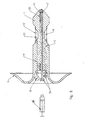
- Fig. 5 shows a possible embodiment of an ostomy stopper with integrated measuring range for measuring the contact pressure of the intestinal wall.
- Fig. 6 shows a possible embodiment of a stoma stopper with integrated, inflatable balloon.
- FIG. 7 Figure 4 shows an embodiment of the device in which the parastomal hernia prevention net is pulled over the gut-ring structure and additionally has a cylindrical, slotted, overlapping extension through which the intestine is pulled.
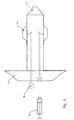
- Fig. 8 shows a further embodiment of the stoma closure plug with an additionally integrated flushing channel.
- the device consists of an ostomy stopper 1 and an annular structure 2 comprising the intestine, with closure device 36, to which a surface structure of implantable textile mesh 3 is attached.
- the annular structure comprising the intestine can be embodied as a fillable ring balloon 4 which is connected via a filling port 6 implanted by a catheter 5 under the skin and filled with liquid, eg saline solution, by means of a syringe with a port needle 7 can be emptied.
- the extensively attached to the annular structure 2, flat mesh 3, is sewn to the inner fascia 12 of the abdominal wall with sufficient sewn stitches 13 of non-absorbable suture.
- the ring balloon 4 is filled via the filling port 6 with liquid and the inwardly expanding, circular balloon pushes from the outside on the intestinal wall and provides a narrowing 8 of the intestine.
- the ostomy stopper 1 is now pushed from the outside into the intestine until the flange 9 lies on the skin 10 of the patient.
- the flange 9 can additionally be secured by means of adhesive tape or bandage on the skin 10 of the patient.
- adhesive tape or bandage Commercially available, thin dressing adhesive films are suitable for this purpose.
- the flange 9 is designed such that the sewn on the skin end of the intestine 11 is completely covered by the flange 9.
- the ostomy stopper 1 is equipped with a pressure measuring device for detecting the contact pressure on the intestinal wall in the region of the positive connection between the annular structure 2 and ostomy stopper 1.
- the pressure measuring device consists of the liquid-filled, cylindrical measuring part 14, which can be filled and vented via a channel 15 by means of a syringe with screw 16.
- a measuring channel 17 connects the measuring part 14 with a pressure gauge 18.
- the pressure gauge 18 is visible to the patient and has a threshold mark, eg red area, which signals to the patient that the contact pressure on the bowel wall 19 is too high and a secure blood circulation of the intestine until the end of the intestine 11 is no longer guaranteed.
- the cylindrical measuring part 14 of the ostomy stopper for example, consists of a thin, cylindrical, elastic piece of tubing 22 which is glued to the ostomy stopper 1 and creates a liquid-filled, external pressure-responsive cavity 23.
- the annular structure comprising the intestine consists of a, e.g. via cable diameter adjustable ring 24 of implantable, soft foam and the ostomy stopper 1 has an integrated, inflatable cylindrical balloon 25.
- the pressure indicator 18 is observed to ensure that no excessive pressure on the intestinal wall 19 stops their blood circulation.
- the ostomy stopper 1 may be equipped with a venting passage 20 filled with activated carbon 21.
- the ring balloon 4 can be closed so far that the passage in the circularly enclosed intestine 19 is closed.
- the patient pushes on a valve 26 implanted elsewhere under the skin.
- the system fluid flows from the expanded, pressurized ring balloon 4 via the catheter 27 into an empty, elastic fluid reservoir 28 which is likewise implanted under the skin
- the patient presses on the under the skin, elastic fluid reservoir 28, while the system fluid is forced through the valve 26 back into the ring balloon 4.
- this embodiment of the invention can also be combined with an ostomy stopper 1, with an integrated measuring part 14.
- the mesentery 29 is a tissue fold that has grown longitudinally along the length of the intestine and supplies it with blood along with other functions.
- the annular structure 2 is passed through a window 30 created by the surgeon in an avascular region of the mesentery 29.
- the net 3 connected to the annular structure 2 is slotted and has two overlapping ends 31 sewn together by the surgeon, overlapping the inner fascia 12 of the abdominal wall. This creates a gap 32 in the network 3, through which the mesentery 29 of the intestine 19 can be performed through the network 3, without causing obstruction of the blood flow in the mesenteric vessels 33.
- the annular structure 2 which circumferentially surrounds the intestine at the point of passage through the abdominal wall, is enveloped by the implantable textile mesh structure 3 and supplemented by a cylindrical extension 34 thereof.
- the cylindrical extension 34 of the net 3 is designed to pass the intestine in the longitudinal direction overlapping, slotted.
- the cylindrical, overlapping part 35 of the network 3 is sewn together after performing the intestine by single button seams 13.
- this is provided with an additional flushing channel 37.
- the flushing channel is executed on the flange 9 with a commercial connection 38 for syringes 16.
- the commercially available port 38 for syringes is equipped with an integrated check valve and closes the irrigation channel when no syringe 16 is connected.
Landscapes
- Health & Medical Sciences (AREA)
- Vascular Medicine (AREA)
- General Health & Medical Sciences (AREA)
- Nursing (AREA)
- Orthopedic Medicine & Surgery (AREA)
- Engineering & Computer Science (AREA)
- Biomedical Technology (AREA)
- Veterinary Medicine (AREA)
- Life Sciences & Earth Sciences (AREA)
- Heart & Thoracic Surgery (AREA)
- Animal Behavior & Ethology (AREA)
- Public Health (AREA)
- Child & Adolescent Psychology (AREA)
- Obesity (AREA)
- Epidemiology (AREA)
- Orthopedics, Nursing, And Contraception (AREA)
Description
- Das chirurgische Anlegen von temporären oder aber dauerhaften Ostomien ist eine weltweit sehr häufig durchgeführte Operation am Menschen. Unter Ostomie versteht man das chirurgische Schaffen einer temporären oder aber dauerhaften Verbindung von einem Hohlorgan zur Körperoberfläche hin. In den meisten Fällen handelt es sich beim betroffenen Hohlorgan um den Darm, im Besonderen um den Dickdarm, wobei das Ende des Darmes durch die Bauchdecke nach außen geführt und mit der Haut vernäht wird. Bei einer solchen Verbindung von Darm zur Körperoberfläche hin spricht der Arzt von einem Enterostoma, einer Kolostomie, einer Ileostomie oder allgemein von einem Stoma. Die Operation geht mit dem Verlust der Kontinenz einher, d.h. der Patient ist nicht mehr in der Lage den Austritt von Darminhalt nach außen zu kontrollieren. Bekannt ist eine Vielzahl von Systemen zum Auffangen des Darminhaltes. Dabei handelt es sich meistens um Auffangbeutel, die mittels Klebeplatten an der Haut des Patienten befestigt werden, dabei die Darmaustrittstelle umfassen und sich der Darminhalt somit in den Beutel entleeren kann. Vielen Patienten fällt es schwer die dauernde Notwendigkeit eines solchen Beutels zu akzeptieren. Deshalb gab es schon in der Vergangenheit viele Überlegungen wie kontinente Versorgung von Enterostomien aussehen könnten, damit der Patient auf das Tragen eines Auffangbeutels verzichten und über den Zeitpunkt der Darmentleerung wieder selbst entscheiden kann.
-
US 2,542,233 zeigt eine Verschlusskappe, die mittels Bauchriemen auf das Enterostoma gedrückt wird und dieses somit abgedichtet wird. - In
US 3,937,224 wird ein Verschlusssystem gezeigt, bei dem aufblasbare Ballone in das Darmlumen (d.h. in den Hohlraum des Darmes) eingeführt und aufgeblasen werden. Die im Darm liegenden aufgeblasenen Ballone sollen für eine Abdichtung nach außen sorgen. -
US 4,241,735 zeigt verschiedene Ausführungsformen aufblasbarer Verschlusstopfen, die von außen in den Darm eingeführt werden, bis sie innerhalb der Bauchhöhle liegen und dort aufgeblasen werden. Damit wird der Darmdurchgang abgedichtet und ein Herausrutschen der eingeführten Verschlussstopfen verhindert. - Eine mögliche Weiterentwicklung des historischen "Erlanger Magnet Verschlusses" wird in
US 4,210,132 gezeigt. Dabei wird der Stomaverschlussstopfen über verschieden angeordnete Magnete in Position gehalten. -
US 4,351,322 zeigt wie über einen Formschluss zwischen Stomaverschlussstopfen und einem an der Innenwand der Bauchdecke implantiertem Ring, durch welchen der Darm nach außen geführt wird, ein sicherer Verschluss des Darmes erzielt werden kann. Dabei wird der Stomaverschlussstopfen in den Darm eingeführt, bis dessen Ende hinter den implantierten Ring geführt wird. Dann wird der im Verschlussstopfen integrierte Ballon aufgeblasen und der Darm von innen an den implantierten Ring gedrückt. Damit wird der Darmdurchgang verschlossen und der Stomaverschlussstopfen am Herausrutschen aus dem Darm gehindert. - Eine Vielzahl von technischen Möglichkeiten zum dichten Verschluss von Enterostomata ist bekannt. Medizinische Komplikationen - meistens entzündliche Reaktionen - im Stomabereich wurden mit all diesen Systemen beobachtet und haben eine weite Anerkennung dieser patientenfreundlichen Möglichkeiten verhindert.
- Medizinische Komplikationen in Verbindung mit Verschlussstopfen, die in die Darmöffnung eingeschoben und durch Formveränderung abdichten und vor dem Herausrutschen gesichert werden, stehen auch sehr oft in Verbindung mit einer reduzierten Blutversorgung des Darmes bis zum Darmende hin, welches an die Haut angenäht ist. Ursache dafür ist Druck, welcher auf die Darmwand ausgeübt wird, um ein Herausrutschen der Verschlussstopfen aus dem Darm zu verhindern, aber auch der zusätzliche Druck, der auf das den Darm mit Blut versorgende Mesenterium (eine Gewebefalte, die entlang des Darmes läuft und diesen mit Blut versorgt) im Bereich der Durchtrittsstelle durch die Bauchdecke ausgeübt wird.
- Aufgabe der Erfindung ist es, einen sicheren, dichten Stomaverschluss mittels Verschlussstopfen zur Verfügung zu stellen, bei welchem die Gefahren der verminderten Durchblutung des Darmes bis zum Darmende hin ausgeschaltet wird.
- Ein weiteres, bekanntes, medizinisches Problem von Langzeitenterostomien ist die Ausbildung von sogenannten "parastomalen Hernien". Als parastomale Hernien werden Bauchwanddefekte bezeichnet, die sich neben dem Darmdurchgang durch die Bauchdecke ausbilden und dazu führen können, dass Darmschlingen durch den Defekt in der Bauchdecke nach außen bis unter die Haut gedrückt werden. Dies erfordert einen weiteren chirurgischen Eingriff zum Beheben des am Darmdurchgang entstandenen Bauchwanddefektes, der sogenannten parastomalen Hernie. Bei 70% der Kolostomien (Dickdarm wird durch die Bauchdecke nach außen geführt und mit der Haut vernäht) entwickeln Patienten über längere Zeit eine sogenannte parastomale Hernie, von denen 10 bis 20% chirurgisch behandelt werden müssen.
- Wie die Ausbildung von parastomalen Hernien verhindert werden kann, wird in
US 4,854,316 gezeigt. Dabei wird die Durchtrittsstelle des Darmes durch die Bauchdecke mittels einer Netzprothese verstärkt. Die Anwendung von sogenannten Netzprothesen zur Behebung von Weichteildefekten ist in der Chirurgie seit Jahrzehnten bekannt. Bei diesen Netzprothesen handelt es sich um textile Gewebestrukturen, die aus geeigneten, implantierfähigen, bioinerten Textilfasern, wie z. B. Polypropylen oder Polyester, erzeugt werden. InUS 4,854,316 wird gezeigt, wie dieses Netz auf der Innenseite der Bauchdecke um den Darm gelegt und mit der Bauchdecke vernäht wird. - Eine weitere Aufgabe der Erfindung ist es, einen sicheren, dichten Stomaverschluss mittels Verschlussstopfen zur Verfügung zu stellen, welcher gleichzeitig auch das Auftreten von parastomalen Hernien sicher verhindert.
- Erfindungsgemäß nach Anspruch 1 wird bei der medizinischen Einrichtung die Dichtheit des Stomaverschlusses durch ein Zusammenwirken von einem im Darm liegenden Stomaverschlussstopfen und einer ringförmigen Struktur, die an der Durchtrittsstelle des Darmes durch die Bauchdecke den Darm am ganzen Umfang umschließt, erreicht. Durch integrierte, anpassbare und drucküberwachte Ballone wird ein Überdruck auf die formschlüssig umfasste Darmwand vermieden und die intramurale (in der Darmwand verlaufende) Blutversorgung sichergestellt.
- Erfindungsgemäß nach Anspruch 1 wird das Auftreten von parastomalen Hernien dadurch verhindert, dass die den Darm umfassende ringförmige Struktur mit einem implantierfähigen Netz mit zirkulärer Durchgangsöffnung für den Darm verbunden ist, welches an der Durchtrittsstelle des Darmes durch die Bauchdecke, mit derselben vernäht wird. Die Verstärkung von Weichteilgewebe, wie z.B. der Bauchdecke, mittels implantierfähigen, textilen Netzen ist bekannt. Neu ist die Kombination eines Netzes mit einer ringförmigen Struktur, die den Darm an der Durchtrittsstelle durch die Bauchdecke umfasst und die nach Anspruch 1 vorzugsweise aus einem nach innen wirkenden Ringballon besteht. Der Ringballon kann über einen, an anderer Stelle unter der Haut implantierten Zugangsport, welcher durch einen Katheter mit dem Ringballon verbunden ist, mittels Flüssigkeit befüllt und / oder entleert werden. Damit kann der freie Innendurchmesser des Ballons patientenspezifisch angepasst werden.
- Erfindungsgemäß wird die arterielle Blutversorgung bis zum Darmende - welches durch die Bauchdecke des Patienten geführt und mit der Hautoberfläche vernäht wird - kontrolliert. Die geschieht durch eine Druckmessung in dem hydraulischen System des Stomaverschlussstopfens, welches die Darmwand formschlüssig an eine entsprechend geformte Anpressfläche drückt, z.B. die den Darm umschließende, ringförmige Struktur mit einer von außen ablesbaren Druckanzeige mit entsprechender Grenzwertanzeige. Ist Gefahr für die Durchgängigkeit der intramuralen (in der Darmwand verlaufenden) Blutversorgung durch zu hohen Anpressdruck auf die Darmwand gegeben, wird das auf der Druckanzeige angezeigt und durch die Anpassung des Füllvolumens im hydraulischen System, einerseits im Stomaverschlussstopfen selbst oder aber andererseits im Ringballon, kann der Anpressdruck auf die Darmwand entsprechend reduziert werden.
- Um die mesenteriale Blutversorgung des Darmes beim Durchtritt durch die ringförmige Struktur mit daran befestigtem Netz nicht zu behindern, wird erfindungsgemäß die geöffnete, ringförmige Struktur in einem avaskulären Bereich des Mesenteriums durch dasselbe durchgeführt und anschließend werden die beiden Enden der geöffneten ringförmigen Struktur zusammengefügt und miteinander verschlossen. Dazu hinterleuchtet der Chirurg mit einer Lichtquelle das Mesenterium des Darmes, wählt einen Bereich, in dem keine Blutgefäße sichtbar sind, und macht genau an dieser Stelle ein Loch in das Mesenterium des Darmes, groß genug zum Durchführen der ringförmigen Struktur der Erfindung. Das Netz, welches an der ringförmigen Struktur befestigt ist, hat einen Schlitz mit erfindungsgemäß zwei überlappenden Netzteilen, welche nach dem Vernähen miteinander eine Öffnung (ein Fenster) freigeben, die groß genug ist, um das Mesenterium des Darmes durchzuführen, ohne dass es zur Behinderung des Blutflusses im Mesenterium kommt.
- Erfindungsgemäß kann die Größe der Öffnung im Netz während der Operation vom Chirurgen mittels Schere angepasst werden.
- Umfang, Form und Fläche des implantierbaren Netzes, welches an der den Darm umfassenden, ringförmigen Struktur angebracht ist, kann erfindungsgemäß intraoperativ vom Chirurgen, mittels Schere angepasst werden. Damit kann die anatomisch notwendige Verstärkung der Bauchdecke, je nach Position des Stomas, patientengerecht gewählt werden. Das an der ringförmigen Struktur - z.B. am Ringballon - befestigte Netz wird entsprechend groß geliefert und vom Chirurgen während der Operation mittels Schere in die gewünschte Form gebracht. In weiterer Folge und in den Zeichnungen ist das Netz in kreisförmiger Struktur abgebildet.
- Erfindungsgemäß kann die den Darm an der Durchtrittsstelle durch die Bauchdecke verstärkende, ringförmige Struktur auch aus einem weichen, implantierfähigen, dauerelastischen Schaumstoff, z.B. Silikon oder Polyurethan, gefertigt sein, deren Innendurchmesser - z.B. durch einen angeschlossenen Seilzug, welcher über eine unter der Haut liegende Einrichtung betätigt wird - patientengerecht eingestellt werden kann.
- Der Stomaverschlussstopfen kann erfindungsgemäß mit einem Entlüftungskanal versehen sein, welcher z.B. mit Aktivkohle - zur Beseitigung von Gerüchen - gefüllt sein kann. Der Aktivkohlefilter kann integrierter Bestandteil des Stomaverschlussstopfens oder aber auch auswechselbar, als Filterpatrone ausgeführt sein.
- Der Stomaverschlussstopfen kann erfindungsgemäß zusätzlich mit einem Spülkanal versehen sein, welcher mit einem handelsüblichen Anschluss für eine Spritze ausgestattet ist. Der handelsübliche Anschluss für Spritzen ist mit einem Rückschlagventil ausgestattet. Dem Patienten ermöglicht der Spülkanal im Stomaverschlussstopfen in den Darm rechtzeitig vor der Entleerung mittels Spritze Spülflüssigkeit einzubringen, welche den Darminhalt aufweicht, wodurch die Entleerung des Darmes erleichtert wird. Erfindungsgemäß kann die ringförmige Struktur, welche den Darm an der Durchtrittsstelle durch die Bauchdecke umfasst, als Ringballon ausgeführt sein, welcher über ein unter der Haut implantiertes System betätigt wird und den Darmdurchgang durch Druck auf die Darmwand dicht verschließt. Zum Entleeren des Darmes betätigt der Patient das ebenfalls unter der Haut liegende Rückschlagventil, der Ringballon entleert sich und der Darmdurchgang wird zur Stuhlentleerung freigegen. Anschließend betätigt der Patient, den ebenfalls und der Haut liegenden, weichen Flüssigkeitsbehälter durch Druck von außen, die Flüssigkeit wird zurück in den Ringballon gedrückt und der Darmdurchgang verschlossen.
- Erfindungsgemäß kann ein sicherer Stomaverschluss durch eine Kombination
- eines äußeren, befüllbaren Ringballons in Verbindung mit einem Stomaverschlussstopfen mit integriertem, befüllbaren Ballon und Drucküberwachung
- eines äußeren Ringes aus Schaumstoff in Verbindung mit einem Stomaverschlussstopfen mit integriertem, befüllbaren Ballon und Drucküberwachung
- eines äußeren, befüllbaren Ringballons in Verbindung mit einem Stomaverschlussstopfen aus weichem Schaumstoff mit integrierter Drucküberwachung
- eines äußeren Ringes aus Schaumstoff in Verbindung mit einem Stomaverschlussstopfen aus weichem Schaumstoff mit integrierter Drucküberwachung,
- einer äußeren, ringförmigen Struktur aus einem festen Körper, z.B. aus implantierfähigem Metall oder Kunststoff, mit einem Stomaverschlussstopfen aus weichem Schaumstoff mit integrierter Drucküberwachung,
- einer äußeren, ringförmigen Struktur aus einem festen Körper, z.B. aus implantierfähigem Metall oder Kunststoff, mit einem Stomaverschlussstopfen mit integriertem, befüllbaren Ballon und Drucküberwachung
- Weitere Vorteile und Einzelheiten der Erfindung werden im Folgenden anhand der beiliegenden Zeichnungen erläutert.
-
Fig. 1 zeigt eine mögliche Ausführungsform der Einrichtung mit einem ringförmigen Ballon in der Verschlussphase des Stomas am Patienten. -
Fig. 2 zeigt eine mögliche Ausführungsform der Einrichtung mit einem ringförmigen Schaumstoffring in der Verschlussphase des Stomas am Patienten. -
Fig. 3 zeigt eine mögliche Ausführungsform der Einrichtung bei welcher der ringförmige Ballon über ein, unter der Haut des Patienten liegendes System bestehend aus Rückschlagventil und elastischem Flüssigkeitsreservoir, durch Druck von außen auf das Rückschlagventil geöffnet und durch Druck von außen auf das Flüssigkeitsreservoir geschlossen wird. Zur Überwachung der Druckverhältnisse auf die Darmwand ist eine Kombination dieser Form der Einrichtung mit dem Stomaverschlussstopfen derFig. 1 ist denkbar. -
Fig. 4 zeigt als mögliche Ausführungsform ein kreisrundes Netz, befestigt an einem, geschlossenen ringförmigen Ballon und die Durchführung des Darmes durch die Einrichtung. -
Fig. 5 zeigt eine mögliche Ausführungsform eines Stomaverschlussstopfens mit integriertem Messbereich zum Messen des Anpressdruckes der Darmwand. -
Fig. 6 zeigt eine mögliche Ausführungsform eines Stomaverschlussstopfens mit intergriertem, befüllbarem Ballon. -
Fig. 7 zeigt eine Ausführungsform der Einrichtung, bei welcher das Netz zur Verhütung von parastomalen Hernien über die, den Darm umfassende Ringstruktur gezogen ist und zusätzlich eine zylindrische, geschlitzte, überlappende Verlängerung aufweist, durch die der Darm durchgezogen wird. -
Fig. 8 zeigt eine weitere Ausführungsform des Stomaverschlussstopfens mit einem zusätzlich integrierten Spülkanal. - Die Figuren weisen unterschiedliche Maßstäbe auf.
- Eine nicht vollständige Auswahl von Ausführungsbeispielen der medizinischen Einrichtung gemäß der Erfindung wird in den
Figuren 1 bis 8 dargestellt. Die Einrichtung besteht aus einem Stomaverschlussstopfen 1 und einer, den Darm umfassenden ringförmigen Struktur 2 mit Verschlusseinrichtung 36, an der eine Flächenstruktur aus implantierfähigem, textilem Netz 3 befestigt ist. Die den Darm umfassende ringförmige Struktur kann als befüllbarer Ringballon 4 ausgeführt sein, welcher über einen durch Katheter 5 mit einem an anderer Stelle unter der Haut implantierten Füllport 6 verbunden ist und mittels Spritze mit Portnadel 7 mit Flüssigkeit, z.B. Kochsalzlösung, befüllt und entleert werden kann. Das an der ringförmigen Struktur 2 umfänglich befestigte, flächige Netz 3, wird an der inneren Faszie 12 der Bauchdecke mit genügend Einzelknopfnähten 13 aus nicht resorbierbarem Nahtmaterial angenäht. - Der Ringballon 4 wird über den Füllport 6 mit Flüssigkeit befüllt und der nach innen ausdehnende, zirkuläre Ballon drückt von außen auf die Darmwand und sorgt für eine Einengung 8 des Darmes. Zum Abdichten der Darmöffnung zur Körperoberfläche hin, wird nun der Stomaverschlussstopfen 1 von außen in den Darm hineingeschoben, bis der Flansch 9 auf der Haut 10 des Patienten liegt.
- Der Flansch 9 kann zusätzlich mittels Klebeband oder Verband auf der Haut 10 des Patienten gesichert werden. Handelsübliche, dünne Verbandklebefolien bieten sich dafür an.
- Der Flansch 9 ist derart ausgeführt, dass das an der Haut angenähte Ende des Darmes 11 vom Flansch 9 vollkommen abgedeckt wird.
- Der Stomaverschlussstopfen 1 ist mit einer Druckmesseinrichtung zum Erfassen des Anpressdruckes auf die Darmwand im Bereich des Formschlusses zwischen ringförmiger Struktur 2 und Stomaverschlussstopfen 1, ausgestattet. Die Druckmesseinrichtung besteht aus dem mit Flüssigkeit gefüllten, zylindrischen Messteil 14, welches über einen Kanal 15 mittels Spritze mit Schraubanschluss 16 befüllt und entlüftet werden kann. Ein Messkanal 17 verbindet das Messteil 14 mit einer Druckanzeige 18. Die Druckanzeige 18 ist vom Patienten einsehbar und verfügt über eine Grenzwertmarkierung, z.B. roter Bereich, welcher dem Patienten signalisiert, dass der Anpressdruck auf die Darmwand 19 zu hoch ist und eine sichere Durchblutung des Darmes bis zum Darmende 11 nicht mehr gewährleistet ist. Durch eine Reduzierung des Füllvolumens im Ringballon 4 kann der Anpressdruck p (siehe
Fig. 1 ) auf die Darmwand 19 verringert werden. Das zylindrische Messteil 14 des Stomaverschlussstopfens 1, besteht z.B. aus einem dünnen, zylindrischen, elastischen Schlauchstück 22, welches auf dem Stomaverschlussstopfen 1 aufgeklebt ist und einen mit Flüssigkeit gefüllten, auf Außendruck reagierenden Hohlraum 23 schafft. - In einer weiteren Ausführungsform der Erfindung, besteht die den Darm umfassende ringförmige Struktur aus einem, z.B. über Seilzug im Durchmesser verstellbaren Ring 24 aus implantierfähigem, weichem Schaumstoff und der Stomaverschlussstopfen 1 verfügt über einen integrierten, befüllbaren zylindrischem Ballon 25. Der zum sicheren Abdichten des Stomas benötigte Formschluss zwischen dem Ring 24 aus Schaumstoff und dem eingeführten Stomaverschlussstopfen 1 wird bei dieser Ausführungsform durch das Befüllen des zylindrischen Ballons 25 erzielt, wobei das Befüllen des Ballons 25 auch nach Einführung des Stomaverschlussstopfen 1 in den Darm, mittels Spritze 16 erfolgen kann. Dabei wird die Druckanzeige 18 beobachtet um sicherzustellen, dass kein zu hoher Anpressdruck auf die Darmwand 19 deren Durchblutung stoppt.
- Der Stomaverschlussstopfen 1 kann mit einem Entlüftungskanal 20 ausgestattet sein, welcher mit Aktivkohle 21 gefüllt ist.
- In einer weiteren Ausführungsform der Erfindung, kann der Ringballon 4 soweit geschlossen werden, dass der Durchgang im zirkulär umschlossenen Darm 19 verschlossen wird. Zum Entleeren des Darmes drückt der Patient auf ein an anderer Stelle unter der Haut implantiertes Ventil 26. Dadurch fließt die Systemflüssigkeit aus dem expandierten, unter Druck stehenden Ringballon 4 über den Katheter 27 in ein, ebenfalls unter der Haut implantiertes, leeres, elastisches Flüssigkeitsreservoirs 28. Zum Schließen des Ringballons 4 drückt der Patient auf das unter der Haut liegende, elastische Flüssigkeitsreservoir 28, dabei wird die Systemflüssigkeit durch das Ventil 26 zurück in den Ringballon 4 gedrückt. Um den Anpressdruck auf die Darmwand 19 in geschlossenem Zustand des Ringballons 4 zu kontrollieren, kann auch diese Ausführungsform der Erfindung mit einem Stomaverschlussstopfen 1, mit integriertem Messteil 14 kombiniert werden.
- Neben dem Aufrechterhalten der intramuralen (in der Darmwand verlaufenden) Durchblutung des Darmes ist es ebenso wichtig, die mesenteriale Blutversorgung des Darmes bis zu dessen Ende 11 sicherzustellen. Das Mesenterium 29 ist eine Gewebefalte, die in Längsrichtung über die ganze Länge am Darm angewachsen ist und diesen neben anderen Funktionen mit Blut versorgt. Um dies zu erreichen wird die ringförmige Struktur 2 durch ein vom Chirurgen in einem avaskulären Bereich des Mesenteriums 29 geschaffenen Fenster 30 geführt. Das mit der ringförmigen Struktur 2 verbundene Netz 3 ist geschlitzt und verfügt über zwei sich überlappende Enden 31, die vom Chirurgen miteinander, überlappend an der inneren Faszie 12 der Bauchdecke vernäht werden. Dabei entsteht eine Lücke 32 im Netz 3, durch welche das Mesenterium 29 des Darmes 19 durch das Netz 3 durchgeführt werden kann, ohne dass es zu einer Behinderung der Durchblutung in den mesenterialen Gefäßen 33 kommt.
- In einem weiteren Ausführungsbeispiel der medizinischen Einrichtung zum Verhindern von parastomalen Hernien, wird die ringförmige Struktur 2, die den Darm an der Durchtrittsstelle durch die Bauchdecke umfänglich umfasst, von der implantierfähigen, textilen Netzstruktur 3 umhüllt und durch eine zylindrische Verlängerung 34 derselben ergänzt. Die zylindrische Verlängerung 34 des Netzes 3 ist zum Durchführen des Darmes in Längsrichtung überlappend, geschlitzt ausgeführt. Der zylindrisch, überlappende Teil 35 des Netzes 3 wird nach dem Durchführen des Darmes durch Einzelknopfnähte 13 miteinander vernäht.
- In einem weiteren Ausführungsbeispiel des Stomaverschlussstopfen 1, ist dieser mit einem zusätzlichen Spülkanal 37 versehen. Der Spülkanal ist auf der Flanschseite 9 mit einem handelsüblichen Anschluss 38 für Spritzen 16 ausgeführt. Der handelsübliche Anschluss 38 für Spritzen ist mit einem integrierten Rückschlagventil ausgestattet und verschließt den Spülkanal, wenn keine Spritze 16 angeschlossen ist.
-
- 1
- Stomaverschlussstopfen
- 2
- Ringförmige Struktur
- 3
- Netz
- 4
- Ringballon
- 5
- Katheter
- 6
- Füllport
- 7
- Spritze mit Portnadel
- 8
- Einengung des Darmes
- 9
- Flansch
- 10
- Haut des Patienten
- 11
- Ende des Darmes
- 12
- Faszie
- 13
- Einzelknopfnähte
- 14
- Messteil
- 15
- Kanal
- 16
- Spritze mit Schraubanschluss
- 17
- Messkanal
- 18
- Druckanzeige
- 19
- Darmwand
- 20
- Entlüftungskanal
- 21
- Aktivkohle
- 22
- Elastisches, weiches Schlauchstück
- 23
- Hohlraum
- 24
- Verstellbarer Ring
- 25
- Zylindrischer Ballon
- 26
- Ventil
- 27
- Katheter
- 28
- Flüssigkeitsreservoir
- 29
- Mesenterium des Darmes
- 30
- Fenster im Mesenterium
- 31
- Überlappende Enden vom Netz
- 32
- Lücke im Netz
- 33
- Mesenteriale Gefäße
- 34
- Zylindrische Verlängerung des Netzes
- 35
- Zylindrisch überlappender Teil des Netzes
- 36
- Verschlusseinrichtung der ringförmigen Struktur
- 37
- Spülkanal
- 38
- Spritzenanschluss mit Rückschlagventil
Claims (10)
- Medizinische Einrichtung zum Verschließen von chirurgisch geschaffenen Öffnungen von Hohlorganen zur Körperoberfläche hin, insbesondere von Kolostomien (11), bei welcher das Abdichten des Darmes zur Körperoberfläche hin durch ein Zusammenwirken einer, den Darm umfassenden ringförmigen Struktur (2) mit Verschlusseinrichtung (36) und einem, in den Darm eingeführten Stomaverschlussstopfen (1) erfolgt, die einen Formschluss bilden, welcher den Darmausgang verschließt, dadurch gekennzeichnet, dass an der den Darm umfassenden, ringförmigen Struktur (2) umfänglich ein flächiges, textiles Netz (3), fest verbunden, angebracht ist, womit die ringförmige Struktur (2) an der Durchtrittsstelle des Darmes sicher an der inneren Faszie (12) der Bauchdecke, z.B. mittels Einzelknopfnähten (13), angenäht werden kann und dadurch das Auftreten von parastomalen Hernien verhindert wird.
- Medizinische Einrichtung nach Anspruch 1 dadurch gekennzeichnet, dass der Anpressdruck auf die Darmwand im Bereich des Formschlusses zwischen der den Darm umfassenden ringförmigen Struktur (2) und dem Stomaverschlussstopfen (1) über eine im Stomaverschlussstopfen integrierte Druckanzeige (18) überwacht wird.
- Medizinische Einrichtung nach Anspruch 1 dadurch gekennzeichnet, dass die ringförmige Struktur (2) als befüllbarer Ringballon (4) ausgeführt ist, dessen Füllvolumen über einen unter der Haut implantierten Füllport (6) angepasst werden kann.
- Medizinische Einrichtung nach Anspruch 1 dadurch gekennzeichnet, dass die ringförmige Struktur (2) aus einem verstellbaren Ring (24) aus weichem, implantierfähigem Schaumstoff besteht und der Stomaverschlussstopfen mit einem zylindrischen, befüllbaren Ballon (25) ausgestattet ist und damit der benötigte Formschluss zwischen äußerer ringförmigen Struktur (2) und dem Stomaverschlussstopfen (1) durch Befüllen des zylindrischen Ballon (25) hergestellt wird.
- Medizinische Einrichtung nach Anspruch 1 dadurch gekennzeichnet, dass das, an der ringförmigen Struktur (2) fest angebrachte, flächige, aus implantierfähigen textilen Fasern gefertigte Netz (3) die ringförmige Struktur an deren Außenumfang umhüllt und mit einer, in Längsrichtung geschlitzten zylindrischen Verlängerung (34) versehen ist, durch welche der zur Körperoberfläche verlaufende Darm durchgeführt wird.
- Medizinische Einrichtung nach Anspruch 1 dadurch gekennzeichnet, dass das flächige, mit der ringförmigen Struktur fest verbundene Netz (3) zum Herumführen um den Darm geschlitzt ist und die beiden sich überlappenden Enden (31) des Netzes (3) beim Zusammennähen durch den Chirurgen eine Lücke (32) ergeben, durch welche das Mesenterium (29) des Darmes durchgeführt werden kann.
- Medizinische Einrichtung nach Anspruch 1 dadurch gekennzeichnet, dass die ringförmige Struktur (2) als Ringballon (4) ausgeführt ist, welcher über ein unter der Haut implantiertes System, bestehend aus Katheter (27), aus Ventil (26) und aus Flüssigkeitsreservoir (28) vom Patienten mittels Druck auf die Haut, geöffnet bzw. geschlossen werden kann.
- Medizinische Einrichtung nach Anspruch 1 dadurch gekennzeichnet, das der Stomaverschlussstopfen (1) mit einem Flansch (9) ausgestattet ist, welcher eine vollständige Abdeckung des offenen Darmendes (11) ermöglicht und auf der Haut (10) des Patienten mit Klebeverband gesichert werden kann.
- Medizinische Einrichtung nach Anspruch 1 dadurch gekennzeichnet, dass der Stomaverschlussstopfen (1) mit einem Entlüftungskanal (20) versehen ist, welcher z.B. zur Verhinderung von Geruchsbelästigung mit Aktivkohle (21) gefüllt ist.
- Medizinische Einrichtung nach Anspruch 1 dadurch gekennzeichnet, dass der Stomaverschlussstopfen (1) zusätzlich mit einem Spülkanal (37) ausgestattet ist, welcher durch einen handelsüblichen Spritzenanschluss mit Rückschlagventil (38) verschlossen ist.
Priority Applications (1)
| Application Number | Priority Date | Filing Date | Title |
|---|---|---|---|
| EP10007302A EP2407129B1 (de) | 2010-07-15 | 2010-07-15 | Chirurgischer Stomaverschluss mit integriertem Schutz vor parastomalen Hernien und Überwachung der terminalen Blutversorgung im Hohlorgan |
Applications Claiming Priority (1)
| Application Number | Priority Date | Filing Date | Title |
|---|---|---|---|
| EP10007302A EP2407129B1 (de) | 2010-07-15 | 2010-07-15 | Chirurgischer Stomaverschluss mit integriertem Schutz vor parastomalen Hernien und Überwachung der terminalen Blutversorgung im Hohlorgan |
Publications (2)
| Publication Number | Publication Date |
|---|---|
| EP2407129A1 EP2407129A1 (de) | 2012-01-18 |
| EP2407129B1 true EP2407129B1 (de) | 2013-01-23 |
Family
ID=43085945
Family Applications (1)
| Application Number | Title | Priority Date | Filing Date |
|---|---|---|---|
| EP10007302A Not-in-force EP2407129B1 (de) | 2010-07-15 | 2010-07-15 | Chirurgischer Stomaverschluss mit integriertem Schutz vor parastomalen Hernien und Überwachung der terminalen Blutversorgung im Hohlorgan |
Country Status (1)
| Country | Link |
|---|---|
| EP (1) | EP2407129B1 (de) |
Cited By (4)
| Publication number | Priority date | Publication date | Assignee | Title |
|---|---|---|---|---|
| US9833352B2 (en) | 2011-08-23 | 2017-12-05 | Mayo Foundation For Medical Education And Research | Ostomy devices |
| US11135084B2 (en) | 2017-11-09 | 2021-10-05 | 11 Health And Technologies Limited | Ostomy monitoring system and method |
| USD935477S1 (en) | 2018-11-08 | 2021-11-09 | 11 Health And Technologies Limited | Display screen or portion thereof with graphical user interface |
| US12357494B2 (en) | 2020-10-15 | 2025-07-15 | Convatec Technologies Inc. | Ostomy systems and methods |
Families Citing this family (7)
| Publication number | Priority date | Publication date | Assignee | Title |
|---|---|---|---|---|
| DE102011102955B4 (de) | 2011-05-31 | 2018-05-03 | Acandis Gmbh & Co. Kg | Medizinisches Implantat zur Anordnung eines Hohlkörpers, insbesondere eines Aneurysmas, und Verfahren zum Herstellen eines medizinischen Implantats |
| DE102011102936B4 (de) | 2011-05-31 | 2013-09-05 | Acandis Gmbh & Co. Kg | Medizinische Vorrichtung zur Einfuhr in ein Hohlorgan |
| RU2503430C1 (ru) * | 2012-05-04 | 2014-01-10 | Общество с ограниченной ответственностью предприятие "Репер-НН" | Эндопротез для лечения параколостомических грыж |
| WO2014008198A1 (en) * | 2012-07-03 | 2014-01-09 | Mayo Foundation For Medical Education And Research | Ostomy devices |
| TWI666008B (zh) * | 2017-07-17 | 2019-07-21 | 林志豪 | 造口接合儲存裝置 |
| ES1196036Y (es) * | 2017-10-18 | 2018-01-19 | Servicio Andaluz De Salud | Dispositivo para colostomía continente |
| CN113397795B (zh) * | 2021-07-21 | 2025-06-03 | 赣南医学院 | 一种肠管造瘘装置 |
Family Cites Families (7)
| Publication number | Priority date | Publication date | Assignee | Title |
|---|---|---|---|---|
| US2542233A (en) | 1949-03-03 | 1951-02-20 | Harry F Carroll | Colostomy closure or guard |
| US3937224A (en) | 1974-04-11 | 1976-02-10 | Uecker Ronald L | Colostomy catheter |
| US4210132A (en) | 1978-07-26 | 1980-07-01 | The Kendall Company | Artificial sphincter |
| US4241735A (en) | 1980-01-24 | 1980-12-30 | Chernov Merrill S | Ileostomy and colostomy plug |
| US4351322A (en) | 1980-10-10 | 1982-09-28 | Prager Elliot D | Stoma control device and method |
| US4854316A (en) | 1986-10-03 | 1989-08-08 | Davis Emsley A | Apparatus and method for repairing and preventing para-stomal hernias |
| DK2789D0 (da) * | 1989-01-04 | 1989-01-04 | Bar Shalom Daniel | Lukkeindretning til tarmaabning |
-
2010
- 2010-07-15 EP EP10007302A patent/EP2407129B1/de not_active Not-in-force
Cited By (5)
| Publication number | Priority date | Publication date | Assignee | Title |
|---|---|---|---|---|
| US9833352B2 (en) | 2011-08-23 | 2017-12-05 | Mayo Foundation For Medical Education And Research | Ostomy devices |
| US11135084B2 (en) | 2017-11-09 | 2021-10-05 | 11 Health And Technologies Limited | Ostomy monitoring system and method |
| US11406525B2 (en) | 2017-11-09 | 2022-08-09 | 11 Health And Technologies Limited | Ostomy monitoring system and method |
| USD935477S1 (en) | 2018-11-08 | 2021-11-09 | 11 Health And Technologies Limited | Display screen or portion thereof with graphical user interface |
| US12357494B2 (en) | 2020-10-15 | 2025-07-15 | Convatec Technologies Inc. | Ostomy systems and methods |
Also Published As
| Publication number | Publication date |
|---|---|
| EP2407129A1 (de) | 2012-01-18 |
Similar Documents
| Publication | Publication Date | Title |
|---|---|---|
| EP2407129A1 (de) | Chirurgischer Stomaverschluss mit integriertem Schutz vor parastomalen Hernien und Überwachung der terminalen Blutversorgung im Hohlorgan | |
| DE4331658B4 (de) | Implantierbare Vorrichtung zum wahlweisen Öffnen und Verschließen von rohrförmigen Körperorganen, insbesondere der Harnröhre | |
| DE60020397T2 (de) | Kontinente ostomieöffnung | |
| EP2004089B1 (de) | Verschlusssystem zur versorgung rektaler bzw. analer inkontinenz | |
| DE60030867T2 (de) | Ostomie-irrigationssystem | |
| DE69839185T2 (de) | Einstellbare, implantierbare vorrichtung im urogenitalbereich | |
| DE69433123T2 (de) | Vorrichtung zum Behandeln von Wunden | |
| DE602004008021T2 (de) | Flexible Injektionsöffnung | |
| EP3103500A1 (de) | Offenporiger ballonkatheter | |
| DE10333706B4 (de) | Verschlußsystem für Anus praeter | |
| DE19511998A1 (de) | Implantierbare Vorrichtung zum wahlweisen Öffnen und Verschließen von rohrförmigen Körperorganen, insbesondere der Harnröhre | |
| EP1509175A1 (de) | Dilatierbares ballonimplantat | |
| EP2242463A2 (de) | Vorrichtung für einen temporären ileo- oder urostomaverschluss | |
| DE102004033425B4 (de) | Verschlußsystem zur Versorgung rektaler bzw. analer Inkontinenz | |
| DE69328310T2 (de) | Prothetische schliessmuskeleinrichtung | |
| EP0955901A1 (de) | Dichter punktionsverschluss | |
| DE602005001890T2 (de) | Verfahren zur Herstellung eines justierbaren Bandes | |
| DE4436796C2 (de) | Verschlußmittel zum Verschließen eines natürlichen Darmausgangs | |
| EP2931135B1 (de) | Ballonkatheter zur behandlung enteroatmosphärischer fisteln bei offenen abdomen | |
| DE602005001891T2 (de) | Ein verbessertes mit Fluid justierbares Band | |
| DE2816391A1 (de) | Vorrichtung zum einbringen von roentgenkontrastmitteln in die samenableitenden wege und die samenblasen | |
| DE102004052408B3 (de) | Gewebekonnektor | |
| EP2392296B1 (de) | Implantierbare magenvolumenreduzierende Einrichtung | |
| DE19515933C2 (de) | Aortale Ballonocclusionsperfusions-Kanüle | |
| EP1060760B1 (de) | Hämostatische Zugangsvorrichtung für Blutgefässe |
Legal Events
| Date | Code | Title | Description |
|---|---|---|---|
| AK | Designated contracting states |
Kind code of ref document: A1 Designated state(s): AL AT BE BG CH CY CZ DE DK EE ES FI FR GB GR HR HU IE IS IT LI LT LU LV MC MK MT NL NO PL PT RO SE SI SK SM TR |
|
| AX | Request for extension of the european patent |
Extension state: BA ME RS |
|
| PUAI | Public reference made under article 153(3) epc to a published international application that has entered the european phase |
Free format text: ORIGINAL CODE: 0009012 |
|
| 17P | Request for examination filed |
Effective date: 20120411 |
|
| RIC1 | Information provided on ipc code assigned before grant |
Ipc: A61F 5/44 20060101AFI20120724BHEP Ipc: A61F 5/445 20060101ALI20120724BHEP Ipc: A61F 2/00 20060101ALI20120724BHEP |
|
| GRAP | Despatch of communication of intention to grant a patent |
Free format text: ORIGINAL CODE: EPIDOSNIGR1 |
|
| GRAS | Grant fee paid |
Free format text: ORIGINAL CODE: EPIDOSNIGR3 |
|
| GRAA | (expected) grant |
Free format text: ORIGINAL CODE: 0009210 |
|
| AK | Designated contracting states |
Kind code of ref document: B1 Designated state(s): AL AT BE BG CH CY CZ DE DK EE ES FI FR GB GR HR HU IE IS IT LI LT LU LV MC MK MT NL NO PL PT RO SE SI SK SM TR |
|
| REG | Reference to a national code |
Ref country code: GB Ref legal event code: FG4D Free format text: NOT ENGLISH |
|
| REG | Reference to a national code |
Ref country code: CH Ref legal event code: EP |
|
| REG | Reference to a national code |
Ref country code: AT Ref legal event code: REF Ref document number: 594546 Country of ref document: AT Kind code of ref document: T Effective date: 20130215 Ref country code: CH Ref legal event code: EP |
|
| REG | Reference to a national code |
Ref country code: IE Ref legal event code: FG4D Free format text: LANGUAGE OF EP DOCUMENT: GERMAN |
|
| REG | Reference to a national code |
Ref country code: DE Ref legal event code: R096 Ref document number: 502010002177 Country of ref document: DE Effective date: 20130321 |
|
| REG | Reference to a national code |
Ref country code: LT Ref legal event code: MG4D |
|
| REG | Reference to a national code |
Ref country code: NL Ref legal event code: VDEP Effective date: 20130123 |
|
| PG25 | Lapsed in a contracting state [announced via postgrant information from national office to epo] |
Ref country code: SE Free format text: LAPSE BECAUSE OF FAILURE TO SUBMIT A TRANSLATION OF THE DESCRIPTION OR TO PAY THE FEE WITHIN THE PRESCRIBED TIME-LIMIT Effective date: 20130123 Ref country code: ES Free format text: LAPSE BECAUSE OF FAILURE TO SUBMIT A TRANSLATION OF THE DESCRIPTION OR TO PAY THE FEE WITHIN THE PRESCRIBED TIME-LIMIT Effective date: 20130504 Ref country code: NO Free format text: LAPSE BECAUSE OF FAILURE TO SUBMIT A TRANSLATION OF THE DESCRIPTION OR TO PAY THE FEE WITHIN THE PRESCRIBED TIME-LIMIT Effective date: 20130423 Ref country code: BG Free format text: LAPSE BECAUSE OF FAILURE TO SUBMIT A TRANSLATION OF THE DESCRIPTION OR TO PAY THE FEE WITHIN THE PRESCRIBED TIME-LIMIT Effective date: 20130423 Ref country code: IS Free format text: LAPSE BECAUSE OF FAILURE TO SUBMIT A TRANSLATION OF THE DESCRIPTION OR TO PAY THE FEE WITHIN THE PRESCRIBED TIME-LIMIT Effective date: 20130523 Ref country code: LT Free format text: LAPSE BECAUSE OF FAILURE TO SUBMIT A TRANSLATION OF THE DESCRIPTION OR TO PAY THE FEE WITHIN THE PRESCRIBED TIME-LIMIT Effective date: 20130123 |
|
| PG25 | Lapsed in a contracting state [announced via postgrant information from national office to epo] |
Ref country code: FI Free format text: LAPSE BECAUSE OF FAILURE TO SUBMIT A TRANSLATION OF THE DESCRIPTION OR TO PAY THE FEE WITHIN THE PRESCRIBED TIME-LIMIT Effective date: 20130123 Ref country code: PT Free format text: LAPSE BECAUSE OF FAILURE TO SUBMIT A TRANSLATION OF THE DESCRIPTION OR TO PAY THE FEE WITHIN THE PRESCRIBED TIME-LIMIT Effective date: 20130523 Ref country code: SI Free format text: LAPSE BECAUSE OF FAILURE TO SUBMIT A TRANSLATION OF THE DESCRIPTION OR TO PAY THE FEE WITHIN THE PRESCRIBED TIME-LIMIT Effective date: 20130123 Ref country code: NL Free format text: LAPSE BECAUSE OF FAILURE TO SUBMIT A TRANSLATION OF THE DESCRIPTION OR TO PAY THE FEE WITHIN THE PRESCRIBED TIME-LIMIT Effective date: 20130123 Ref country code: PL Free format text: LAPSE BECAUSE OF FAILURE TO SUBMIT A TRANSLATION OF THE DESCRIPTION OR TO PAY THE FEE WITHIN THE PRESCRIBED TIME-LIMIT Effective date: 20130123 Ref country code: GR Free format text: LAPSE BECAUSE OF FAILURE TO SUBMIT A TRANSLATION OF THE DESCRIPTION OR TO PAY THE FEE WITHIN THE PRESCRIBED TIME-LIMIT Effective date: 20130424 Ref country code: LV Free format text: LAPSE BECAUSE OF FAILURE TO SUBMIT A TRANSLATION OF THE DESCRIPTION OR TO PAY THE FEE WITHIN THE PRESCRIBED TIME-LIMIT Effective date: 20130123 |
|
| PG25 | Lapsed in a contracting state [announced via postgrant information from national office to epo] |
Ref country code: HR Free format text: LAPSE BECAUSE OF FAILURE TO SUBMIT A TRANSLATION OF THE DESCRIPTION OR TO PAY THE FEE WITHIN THE PRESCRIBED TIME-LIMIT Effective date: 20130123 |
|
| PG25 | Lapsed in a contracting state [announced via postgrant information from national office to epo] |
Ref country code: CZ Free format text: LAPSE BECAUSE OF FAILURE TO SUBMIT A TRANSLATION OF THE DESCRIPTION OR TO PAY THE FEE WITHIN THE PRESCRIBED TIME-LIMIT Effective date: 20130123 Ref country code: DK Free format text: LAPSE BECAUSE OF FAILURE TO SUBMIT A TRANSLATION OF THE DESCRIPTION OR TO PAY THE FEE WITHIN THE PRESCRIBED TIME-LIMIT Effective date: 20130123 Ref country code: SK Free format text: LAPSE BECAUSE OF FAILURE TO SUBMIT A TRANSLATION OF THE DESCRIPTION OR TO PAY THE FEE WITHIN THE PRESCRIBED TIME-LIMIT Effective date: 20130123 Ref country code: EE Free format text: LAPSE BECAUSE OF FAILURE TO SUBMIT A TRANSLATION OF THE DESCRIPTION OR TO PAY THE FEE WITHIN THE PRESCRIBED TIME-LIMIT Effective date: 20130123 Ref country code: RO Free format text: LAPSE BECAUSE OF FAILURE TO SUBMIT A TRANSLATION OF THE DESCRIPTION OR TO PAY THE FEE WITHIN THE PRESCRIBED TIME-LIMIT Effective date: 20130123 |
|
| PG25 | Lapsed in a contracting state [announced via postgrant information from national office to epo] |
Ref country code: CY Free format text: LAPSE BECAUSE OF FAILURE TO SUBMIT A TRANSLATION OF THE DESCRIPTION OR TO PAY THE FEE WITHIN THE PRESCRIBED TIME-LIMIT Effective date: 20130123 |
|
| PLBE | No opposition filed within time limit |
Free format text: ORIGINAL CODE: 0009261 |
|
| STAA | Information on the status of an ep patent application or granted ep patent |
Free format text: STATUS: NO OPPOSITION FILED WITHIN TIME LIMIT |
|
| PG25 | Lapsed in a contracting state [announced via postgrant information from national office to epo] |
Ref country code: IT Free format text: LAPSE BECAUSE OF FAILURE TO SUBMIT A TRANSLATION OF THE DESCRIPTION OR TO PAY THE FEE WITHIN THE PRESCRIBED TIME-LIMIT Effective date: 20130123 |
|
| 26N | No opposition filed |
Effective date: 20131024 |
|
| BERE | Be: lapsed |
Owner name: A.M.I. AGENCY FOR MEDICAL INNOVATIONS GMBH Effective date: 20130731 |
|
| REG | Reference to a national code |
Ref country code: DE Ref legal event code: R097 Ref document number: 502010002177 Country of ref document: DE Effective date: 20131024 |
|
| PG25 | Lapsed in a contracting state [announced via postgrant information from national office to epo] |
Ref country code: MC Free format text: LAPSE BECAUSE OF FAILURE TO SUBMIT A TRANSLATION OF THE DESCRIPTION OR TO PAY THE FEE WITHIN THE PRESCRIBED TIME-LIMIT Effective date: 20130123 |
|
| REG | Reference to a national code |
Ref country code: IE Ref legal event code: MM4A |
|
| PG25 | Lapsed in a contracting state [announced via postgrant information from national office to epo] |
Ref country code: BE Free format text: LAPSE BECAUSE OF NON-PAYMENT OF DUE FEES Effective date: 20130731 |
|
| PG25 | Lapsed in a contracting state [announced via postgrant information from national office to epo] |
Ref country code: IE Free format text: LAPSE BECAUSE OF NON-PAYMENT OF DUE FEES Effective date: 20130715 |
|
| REG | Reference to a national code |
Ref country code: CH Ref legal event code: PL |
|
| PG25 | Lapsed in a contracting state [announced via postgrant information from national office to epo] |
Ref country code: LI Free format text: LAPSE BECAUSE OF NON-PAYMENT OF DUE FEES Effective date: 20140731 Ref country code: CH Free format text: LAPSE BECAUSE OF NON-PAYMENT OF DUE FEES Effective date: 20140731 |
|
| PG25 | Lapsed in a contracting state [announced via postgrant information from national office to epo] |
Ref country code: SM Free format text: LAPSE BECAUSE OF FAILURE TO SUBMIT A TRANSLATION OF THE DESCRIPTION OR TO PAY THE FEE WITHIN THE PRESCRIBED TIME-LIMIT Effective date: 20130123 |
|
| PG25 | Lapsed in a contracting state [announced via postgrant information from national office to epo] |
Ref country code: TR Free format text: LAPSE BECAUSE OF FAILURE TO SUBMIT A TRANSLATION OF THE DESCRIPTION OR TO PAY THE FEE WITHIN THE PRESCRIBED TIME-LIMIT Effective date: 20130123 Ref country code: MT Free format text: LAPSE BECAUSE OF FAILURE TO SUBMIT A TRANSLATION OF THE DESCRIPTION OR TO PAY THE FEE WITHIN THE PRESCRIBED TIME-LIMIT Effective date: 20130123 |
|
| PG25 | Lapsed in a contracting state [announced via postgrant information from national office to epo] |
Ref country code: LU Free format text: LAPSE BECAUSE OF NON-PAYMENT OF DUE FEES Effective date: 20130715 Ref country code: MK Free format text: LAPSE BECAUSE OF FAILURE TO SUBMIT A TRANSLATION OF THE DESCRIPTION OR TO PAY THE FEE WITHIN THE PRESCRIBED TIME-LIMIT Effective date: 20130123 Ref country code: HU Free format text: LAPSE BECAUSE OF FAILURE TO SUBMIT A TRANSLATION OF THE DESCRIPTION OR TO PAY THE FEE WITHIN THE PRESCRIBED TIME-LIMIT; INVALID AB INITIO Effective date: 20100715 |
|
| REG | Reference to a national code |
Ref country code: FR Ref legal event code: PLFP Year of fee payment: 7 |
|
| REG | Reference to a national code |
Ref country code: FR Ref legal event code: PLFP Year of fee payment: 8 |
|
| REG | Reference to a national code |
Ref country code: FR Ref legal event code: PLFP Year of fee payment: 9 |
|
| PG25 | Lapsed in a contracting state [announced via postgrant information from national office to epo] |
Ref country code: AL Free format text: LAPSE BECAUSE OF FAILURE TO SUBMIT A TRANSLATION OF THE DESCRIPTION OR TO PAY THE FEE WITHIN THE PRESCRIBED TIME-LIMIT Effective date: 20130123 |
|
| PGFP | Annual fee paid to national office [announced via postgrant information from national office to epo] |
Ref country code: FR Payment date: 20180726 Year of fee payment: 9 |
|
| PGFP | Annual fee paid to national office [announced via postgrant information from national office to epo] |
Ref country code: GB Payment date: 20180731 Year of fee payment: 9 Ref country code: AT Payment date: 20180710 Year of fee payment: 9 |
|
| PGFP | Annual fee paid to national office [announced via postgrant information from national office to epo] |
Ref country code: DE Payment date: 20180928 Year of fee payment: 9 |
|
| REG | Reference to a national code |
Ref country code: DE Ref legal event code: R231 Ref document number: 502010002177 Country of ref document: DE |
|
| PG25 | Lapsed in a contracting state [announced via postgrant information from national office to epo] |
Ref country code: DE Free format text: LAPSE BECAUSE OF THE APPLICANT RENOUNCES Effective date: 20190617 |
|
| REG | Reference to a national code |
Ref country code: AT Ref legal event code: MM01 Ref document number: 594546 Country of ref document: AT Kind code of ref document: T Effective date: 20190715 |
|
| GBPC | Gb: european patent ceased through non-payment of renewal fee |
Effective date: 20190715 |
|
| PG25 | Lapsed in a contracting state [announced via postgrant information from national office to epo] |
Ref country code: GB Free format text: LAPSE BECAUSE OF NON-PAYMENT OF DUE FEES Effective date: 20190715 Ref country code: AT Free format text: LAPSE BECAUSE OF NON-PAYMENT OF DUE FEES Effective date: 20190715 |
|
| PG25 | Lapsed in a contracting state [announced via postgrant information from national office to epo] |
Ref country code: FR Free format text: LAPSE BECAUSE OF NON-PAYMENT OF DUE FEES Effective date: 20190731 |