EP2409514B1 - Profilage de qos basée aimd à débit binaire relatif hspa - Google Patents
Profilage de qos basée aimd à débit binaire relatif hspa Download PDFInfo
- Publication number
- EP2409514B1 EP2409514B1 EP09788506A EP09788506A EP2409514B1 EP 2409514 B1 EP2409514 B1 EP 2409514B1 EP 09788506 A EP09788506 A EP 09788506A EP 09788506 A EP09788506 A EP 09788506A EP 2409514 B1 EP2409514 B1 EP 2409514B1
- Authority
- EP
- European Patent Office
- Prior art keywords
- rbr
- bit
- rate
- traffic flow
- flow
- Prior art date
- Legal status (The legal status is an assumption and is not a legal conclusion. Google has not performed a legal analysis and makes no representation as to the accuracy of the status listed.)
- Not-in-force
Links
- 230000004069 differentiation Effects 0.000 claims description 26
- 239000000654 additive Substances 0.000 claims description 25
- 230000000996 additive effect Effects 0.000 claims description 25
- 238000000034 method Methods 0.000 claims description 24
- 238000013507 mapping Methods 0.000 claims description 21
- 230000007423 decrease Effects 0.000 claims description 12
- 230000011664 signaling Effects 0.000 claims description 7
- 230000009467 reduction Effects 0.000 description 13
- 238000004891 communication Methods 0.000 description 11
- 229910000906 Bronze Inorganic materials 0.000 description 10
- BQCADISMDOOEFD-UHFFFAOYSA-N Silver Chemical compound [Ag] BQCADISMDOOEFD-UHFFFAOYSA-N 0.000 description 10
- 239000010974 bronze Substances 0.000 description 10
- KUNSUQLRTQLHQQ-UHFFFAOYSA-N copper tin Chemical compound [Cu].[Sn] KUNSUQLRTQLHQQ-UHFFFAOYSA-N 0.000 description 10
- PCHJSUWPFVWCPO-UHFFFAOYSA-N gold Chemical compound [Au] PCHJSUWPFVWCPO-UHFFFAOYSA-N 0.000 description 10
- 229910052737 gold Inorganic materials 0.000 description 10
- 239000010931 gold Substances 0.000 description 10
- 229910052709 silver Inorganic materials 0.000 description 10
- 239000004332 silver Substances 0.000 description 10
- 230000000694 effects Effects 0.000 description 6
- 230000001276 controlling effect Effects 0.000 description 5
- 238000013459 approach Methods 0.000 description 4
- 230000005540 biological transmission Effects 0.000 description 4
- 238000004364 calculation method Methods 0.000 description 3
- 230000001413 cellular effect Effects 0.000 description 2
- 230000001419 dependent effect Effects 0.000 description 2
- 230000002452 interceptive effect Effects 0.000 description 2
- 230000004044 response Effects 0.000 description 2
- 101150012579 ADSL gene Proteins 0.000 description 1
- 102100020775 Adenylosuccinate lyase Human genes 0.000 description 1
- 108700040193 Adenylosuccinate lyases Proteins 0.000 description 1
- 230000009286 beneficial effect Effects 0.000 description 1
- 230000003111 delayed effect Effects 0.000 description 1
- 238000001514 detection method Methods 0.000 description 1
- 238000010586 diagram Methods 0.000 description 1
- 238000012545 processing Methods 0.000 description 1
- 230000001105 regulatory effect Effects 0.000 description 1
- 238000012552 review Methods 0.000 description 1
- 238000007493 shaping process Methods 0.000 description 1
- 238000012546 transfer Methods 0.000 description 1
Images





Classifications
-
- H—ELECTRICITY
- H04—ELECTRIC COMMUNICATION TECHNIQUE
- H04W—WIRELESS COMMUNICATION NETWORKS
- H04W28/00—Network traffic management; Network resource management
- H04W28/16—Central resource management; Negotiation of resources or communication parameters, e.g. negotiating bandwidth or QoS [Quality of Service]
- H04W28/18—Negotiating wireless communication parameters
- H04W28/22—Negotiating communication rate
-
- H—ELECTRICITY
- H04—ELECTRIC COMMUNICATION TECHNIQUE
- H04L—TRANSMISSION OF DIGITAL INFORMATION, e.g. TELEGRAPHIC COMMUNICATION
- H04L47/00—Traffic control in data switching networks
- H04L47/70—Admission control; Resource allocation
-
- H—ELECTRICITY
- H04—ELECTRIC COMMUNICATION TECHNIQUE
- H04W—WIRELESS COMMUNICATION NETWORKS
- H04W28/00—Network traffic management; Network resource management
- H04W28/02—Traffic management, e.g. flow control or congestion control
-
- H—ELECTRICITY
- H04—ELECTRIC COMMUNICATION TECHNIQUE
- H04W—WIRELESS COMMUNICATION NETWORKS
- H04W92/00—Interfaces specially adapted for wireless communication networks
- H04W92/04—Interfaces between hierarchically different network devices
- H04W92/12—Interfaces between hierarchically different network devices between access points and access point controllers
Definitions
- the present invention relates to quality of service (QoS) profiling in telecommunication, and more particularly to a method for controlling, according to an additive increase multiplicative decrease (AIMD) principle, the bandwidth sharing among contending traffic flows over a transport network between a radio network controller and a radio base station.
- QoS quality of service
- AIMD additive increase multiplicative decrease
- the invention also relates to a node in a telecommunication system for performing the method, and to a telecommunication system including such a node.
- the functionality offered by mobile telecommunications systems has been expanded from pure (circuit-switched) voice communication to a variety of services in addition to voice calls.
- Many of these additional services employ packet-switched data communication between a server and a mobile terminal, or between two mobile terminals, over the mobile telecommunications network and associated wide area networks such as the Internet.
- the 3G/LTMTS (3rd Generation/Universal Mobile Telecommunications System) architecture involves packet-based communication in accordance with the High Speed Packet Access (HSPA) protocol set, including High Speed Downlink Packet Access (HSDPA) for downlink communication and High Speed Uplink Packet Access (HSUPA), also known as Enhanced Uplink (EUL), for uplink communication.
- HSPA High Speed Packet Access
- HSDPA High Speed Downlink Packet Access
- HSUPA High Speed Uplink Packet Access
- EUL Enhanced Uplink
- TCP Transmission Control Protocol
- SRNC Serving Radio Network Controller
- FC HSPA Flow Control
- HSDPA For downlink traffic, i.e. HSDPA, the control of radio frame scheduling resides in the Node B:s rather than the SRNC:s. While fix capacity (e.g. 64-384 kbps) can be reserved by way of admission control for traditional Dedicated Channel (DCH) traffic in the radio access network, for HSDPA, per-flow bandwidth reservation is not efficient. This is mainly because the bit-rates can vary considerably between different kinds of traffic flows. Instead, HSDPA flows use a best effort-type of connection over the transport network. When bandwidth reservation is not used, congestion situations can occur both in the transport network and in the air interface. TCP cannot efficiently resolve a congestion situation in the radio access network, because lower layer retransmissions hide the congestion situations from TCP.
- fix capacity e.g. 64-384 kbps
- DCH Dedicated Channel
- FC HSDPA Flow Control
- EUL uplink radio scheduling
- the uplink radio scheduling resides in the Node B.
- the EUL traffic has similar properties to that of HSDPA, though it can reach somewhat lower bitrates.
- EUL too, the transport network is a potential bottleneck, and therefore EUL Flow Control is provided.
- the likelihood for transport network bottlenecks to occur is increased by the fact that in most instances of cellular systems, the transport network is expensive and is therefore not deployed to a degree where all peak bit-rates fit at the same time.
- the transport network is often rolled out in a pace, which corresponds to the average traffic growth over time.
- Rate-based flow control means that the bit-rate of each contending traffic flow is regulated by the FC algorithm, and is used because the lack of sequence numbering and retransmission in the 3GPP standard does not allow a window-based flow control, like TCP.
- RLC in the 3G system provides sequence numbering and retransmission functionality, the RLC protocol layer is not terminated in Node B and is, therefore, difficult to use for FC purposes.
- the FC algorithms operate according to the Additive Increase Multiplicative Decrease (AIMD) principle, which is well known as such and which ensures convergence to fair bandwidth share among contending traffic flows which are subjected to the same transport network bottleneck (having the same Transport Network layer QoS (Quality of Service) class, and sharing same path in the transport network).
- AIMD Additive Increase Multiplicative Decrease
- QoS differentiation is intended to be solved by Transport Network layer QoS differentiation.
- the present inventors have realized that, in situations when the transport network is a bottleneck, it would be beneficial to be able to differentiate between different type of subscriptions, e.g. such that users with a higher-ranked subscription are favored in terms of QoS (Quality of Service) over users with a lower-ranked subscription for the same bottleneck in the transport network.
- QoS Quality of Service
- the present inventors have also realized that Transport Network layer QoS (Quality of Service) differentiation as such may not be a sufficient solution.
- the rate-based per-flow flow control of traffic flows over the transport network may be performed in a way which allows QoS differentiation among traffic flows facing the same transport network bottleneck (e.g. sharing the same TN layer QoS class and the same path between SRNC and Node B).
- a relative bit-rate (RBR) is determined, wherein different RBR values may reflect different subscription types.
- the Additive Increase (AI) part of the flow control algorithm is then modified to depend on the RBR, e.g. by scaling a nominal additive increase bit-rate with the RBR of each traffic flow.
- the bandwidth share of the flows will converge to a proportional fair sharing instead of (equally) fair sharing.
- QoS differentiation may be achieved even among flows sharing the same TN layer QoS class.
- the RBR may also be taken into account when determining a starting bit-rate of a newly arrived traffic flow.
- One aspect of the present invention therefore is a method for controlling, according to an additive increase multiplicative decrease (AIMD) principle, the bandwidth sharing among contending traffic flows over a transport network between a radio network controller and a radio base station, the method comprising:
- said determining occurs when a new traffic flow is generated.
- Said determining may involve: determining a priority indicator (SPI) of said traffic flow, said priority indicator reflecting a subscription type of a user or user equipment being a party to said traffic flow; and determining the RBR of said traffic flow as a function of the determined priority indicator.
- one or more embodiments may further comprise: receiving in the radio base station a High-Speed Downlink Shared Channel (HS-DSCH) data frame in said traffic flow from the radio network controller; deriving the priority indicator (SPI) from a Common Channel Priority Indicator (CmCH-PI) data field in the received HS-DSCH data frame; and determining the RBR of said traffic flow from the derived SPI value.
- HS-DSCH High-Speed Downlink Shared Channel
- CmCH-PI Common Channel Priority Indicator
- the priority indicator may advantageously be derived from Node B Application Part (NBAP) signaling between said radio network controller and said radio base station.
- NBAP Node B Application Part
- the RBR of said traffic flow may conveniently be determined from the derived priority indicator (SPI) using prestored cross reference data, advantageously in the form of a QoS Mapping Table.
- the QoS Mapping Table may contain a plurality of RBR values (for instance 3, 4 or 9 RBR values) for a corresponding plurality of values of the priority indicator (SPI) within one TN QoS differentiation class.
- Another embodiment encompasses more than one TN QoS differentiation class, such that the QoS Mapping Table contains a first plurality of RBR values for a corresponding first plurality of values of the priority indicator (SPI) within a first TN QoS differentiation class, and that the QoS Mapping Table furthermore contains at least a second plurality of RBR values for a corresponding second plurality of values of the priority indicator (SPI) within a second TN QoS differentiation class.
- the first plurality of RBR values are identical to the second plurality of RBR values.
- the QoS Mapping Table may for instance define 3 different RBR values (representing one each among 3 different values of the priority indicator (SPI)) within each of 3 different TN QoS differentiation classes.
- the determining of RBR for each contending traffic flow, and the controlling of the bit-rates of said traffic flows such that additive increase operations of said AIMD principle depend on the respective RBR of each traffic flow, may typically be performed for traffic flows within the same TN QoS differentiation class.
- said additive increase operations of said AIMD principle involve increasing the current bit-rate of each of said traffic flows by a predetermined increment ( caLinIncRate; linearIncreaseAbsBitrate ), scaled by the determined RBR of the respective traffic flow, so as to obtain proportional fair bandwidth sharing between said traffic flows in a congestion avoidance (CA) state.
- caLinIncRate linearIncreaseAbsBitrate
- one or more embodiments may comprise using the determined RBR for determining an initial bit-rate of a new traffic flow.
- the RBR may typically, in one or more embodiments, represent a scale value in the range between X% and Y% of the nominal bit-rate for a traffic flow within a given TN QoS differentiation class, where X > 100% and Y ⁇ 100%.
- An RBR at the upper range limit X may be used for a highest ranked subscription type, whereas an RBR at the lower range limit Y may be used for a lowest ranked subscription type.
- X is about 200% and Y is about 50%; in other embodiments, X and/or Y may have other value(s), and their difference in magnitude may be smaller or larger than for the aforesaid one embodiment.
- the method is performed by an HSDPA rate-based per-flow flow controller and/or an EUL flow controller located in said radio base station.
- a second aspect of the invention is a node for a telecommunication system, which system includes a radio network controller connected via a transport network to one or more radio base stations, said node comprising a flow controller for controlling, according to an additive increase multiplicative decrease (AIMD) principle, the bandwidth sharing among contending traffic flows over said transport network, said flow controller being configured for performing the method according to the first aspect.
- AIMD additive increase multiplicative decrease
- said node is one of said radio base stations.
- a third aspect of the invention is a telecommunication system comprising a radio network controller, a transport network and a node according to the second aspect, wherein said radio network controller is connected to said node by said transport network.
- Embodiments of the second and third aspects of the invention may generally have the same or directly corresponding features as any of the features referred to above for the first aspect.
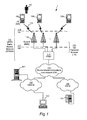
- Fig 1 illustrates a cellular telecommunications system 1 according to the familiar 3G/UMTS system architecture, as defined in the 3GPP standards.
- Users 101 of user equipment (UE) 100 i.e. mobile terminals
- UE user equipment
- An individual UE 100 connects to a mobile telecommunications core network 110 over a radio link 116 to a radio base station (RBS) 114 (also known as Node B), which in turn is connected to a serving radio network controller (SRNC) 112.
- RBS radio base station
- SRNC serving radio network controller
- a transport network (TN) 119 also known as Iub 117, is provided between the SRNC 112 and RBS 114, and an air interface 118, also known as Uu, is provided between RBS 114 and UE 100.
- SRNC 112, TN 119 and RBS 114 thus constitute a UMTS Radio Access Network (UTRAN) 111.
- UTRAN UMTS Radio Access Network
- a Drift Radio Network Controller may act as a switch to route information between the SRNC and the UE.
- a conventional public switched telephone network (PSTN) 130 may be connected to the mobile telecommunications core network 110.
- Various telephone terminals including a stationary telephone 131, may connect to the PSTN 130.
- the mobile telecommunications network 110 is also typically associated with a wide area data network 120, such as the Internet.
- Server computers 121 and client computers 122 may be connected to the wide area data network 120 and therefore allow communication of packet data with the UE 100.
- Such packet-based communication may for instance be in accordance with the HSPA protocol set, including HSDPA for downlink communication and EUL (i.e. HSUPA) for uplink communication.
- HSPA protocol set including HSDPA for downlink communication and EUL (i.e. HSUPA) for uplink communication.
- HSUPA EUL
- 3GPP standards which may be found for instance at http://www.3gpp.com/.
- the inventive concept will now be schematically described with reference to Fig 2a and Fig 2b .
- the invention provides a new type of Quality of Service profiling, where prioritized users may be favored over less prioritized users when it comes to sharing the available bandwidth when contending traffic flows of the users share the same transport network bottleneck.
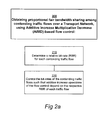
- the invention introduces the notion of relative bit-rate (RBR) and uses it to obtain proportional fair bandwidth sharing among contending traffic flows subjected to the same transport network bottleneck and being controlled by Additive Increase Multiplicative Decrease (AIMD)-based flow control, as seen at 200 in Fig 2a .
- RBR relative bit-rate
- AIMD Additive Increase Multiplicative Decrease
- an RBR is determined for each contending traffic flow (step 210, Fig 2a ), and the bit-rates of the contending traffic flows are controlled such that additive increase operations of the AIMD-based flow control are made to depend on the respective RBR of each traffic flow (step 220, Fig 2a ).
- Fig 2b The concept of such relative bit-rate Quality of Service profiling is also demonstrated in Fig 2b , in comparison with the prior art approach.
- a number of users A, B, C (at 230) of UE:s 100 ( Fig 1 ) receives or generates traffic flows 232 which are subjected to the same transport network bottleneck 240.
- the contending traffic flows 232 have the same TN QoS differentiation class and traverse the same path in the transport network 119.
- AIMD-based flow control 250 is provided to handle the congestion between the contending traffic flows 232.
- the AIMD-based flow control 250 will treat all contending traffic flows 232 equally (albeit individually), by subjecting each flow to additive increase operations with the same amount of bit-rate increase as for the other flows, until congestions occurs, wherein multiplicative decrease operations instead are performed as appropriate.
- all users A, B, C will - after some iterations of the flow control - arrive at about the same bit-rate 262, as seen at 260 in Fig 2b - i.e. a fair bandwidth sharing. This will happen even though the users A, B, C may have different priorities in the mind of the network operator, such as subscriptions with different levels of importance (e.g. differentiated by different subscription fees), since the traffic flows 232 are communicated within the same TN QoS differentiation class.
- proportional fair bandwidth sharing may instead be provided for the traffic flows 232 of the users A, B, C.
- the user A has a subscription of type 1, which is more prioritized than the subscription type 2 of user B, which in turn is more prioritized than the subscription type 3 of user C.
- Each subscription type is assigned a respective RBR value, as seen at 270. Therefore, when contention occurs for the traffic flows 232 of users A-C because of the common TN bottleneck 240, the traffic flow for user A will have a higher RBR value (e.g. X%, where X>100), than the traffic flow for user B (e.g.
- the flow control 252' is adapted to perform its Additive Increase operations such that they depend on the respective RBR of each traffic flow, as indicated by the prefix "W" for "Weighted" at iii) in Fig 2b .
- RBR-based QoS profiling functionality can be enabled or disabled.
- the defined RBR values will have no impact on the flow control 252, therefore resulting in fair bandwidth sharing with equal bit-rates 262 for the users A, B, C (like in the prior art situation seen at i)).
- the RBR values of the traffic flows of users A-C will all be interpreted in the flow control 252 as 100% (i.e. no effect), irrespective of the RBR values defined at 270.
- the defined RBR values will indeed affect the flow control 252'.
- the AI operations of the flow control 252' will depend on the respective RBR of each traffic flow, wherein traffic flows with a higher RBR value (e.g. the flow of user A) will be favored over those with a lower RBR value (e.g. the flow of user B or C).
- proportional-fair bandwidth sharing among the contending traffic flows will be obtained. This means that each flow will get a bit-rate which differs relative to the nominal bit-rate (i.e.
- bit-rate 264 given to user A compared to the nominal bit-rate 262 offered to user B will approach a difference of (X-100)%, reflecting the difference in RBR between subscription types 1 and 2.
- bit-rate 266 given to user C compared to the nominal bit-rate 262 offered to user B will approach a difference of (Y-100)%, corresponding to the difference in RBR between subscription types 2 and 3.
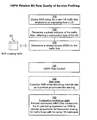
- Fig 3 illustrates the inventive concept of Figs 2a and 2b as generally applied in an HSPA network to provide HSPA relative bit-rate Quality of Service profiling, applicable to HSDPA flow control as well as EUL flow control.
- the functionality of Fig 3 may be performed in an RBS (Node B) 114 when performing per-flow flow control for the traffic flows to or from an SRNC 112 on an Iub transport network 119 according to Fig 1 .
- steps 310-330 have the purpose of establishing a relative bit-rate (RBR), which shall reflect the subscription type of the relevant UE and shall be used for the forthcoming flow control of the new HS traffic flow in transport network congestion situations.
- RBR relative bit-rate
- the flow control functionality of the RBS 114 determines (step 320) a priority indicator for the new traffic flow from information included in or associated with the new traffic flow, i.e. information received from the SRNC.
- an RBR value is determined for the new traffic flow by means of the priority indicator, for instance by reading a cross-reference table 301 or by calculations based on internal system constants and variables.
- HSPA flow control 340 is then performed by the RBS 114 upon the traffic flow in question.
- the RBR value determined in steps 310-330 will be used in a congestion avoidance state, where rate-based AIMD flow control is performed with the AI part of the AIMD flow control being dependent on the RBR value, as described above with reference to situation iii) in Fig 2b .
- proportional fair bandwidth sharing may be obtained with respect to all traffic flows experiencing the same TN bottleneck, so that UE:s with higher-ranked subscription types will be favored, in terms of the bandwidth share, over UE:s with lower-ranked subscription types.
- the RBR value determined in steps 310-330 may also be used during an earlier stage of the HSPA flow control for the new traffic flow in question by considering the RBR value when calculating an initial bit-rate for the new traffic flow. This will provide a proportional fair starting for the new traffic flow, again in effect favoring higher-ranked subscription types over lower-ranked subscription types.
- Fig 4 illustrates the main functional modules which are involved in HSDPA transport network flow control, i.e. for downlink HS traffic in the form of High-Speed Downlink Shared Channel (HS-DSCH) data frames 420 across the transport network 119 between SRNC 112 and RBS (Node B) 114.
- Fig 5 illustrates the protocol stacks involved, which are well known per se. Therefore, for further details about these, reference is made to the available literature, for instance "Szilveszter Nadas, Zoltan Nagy, Sandor Racz and Sandor Molnar "Providing congestion control in the Iub Transport Network for HSDPA", 2007, IEEE Globecom 2007”.
- the RBS part 430 of the HSDPA flow control receives HS-DSCH data frames 420 (module 432) and keep outgoing priority queues (module 436) appropriately filled for further transport towards the air interface (Uu) 118.
- a module 434 detects HSDPA traffic congestions in the transport network (and in the air interface 118). The traffic congestions may be due to e.g. destroyed, lost or dynamically delayed data frames.
- An HSDPA traffic flow is handled by a per-flow control algorithm 444 generally having three main states: Inactive (442), Slow-Start (444) and Congestion Avoidance (446).
- an initialization state 438 determines the aforementioned RBR value for a new HSDPA traffic flow, denoted as hsRbr in Fig 4 . Further details of this initialization will follow.
- the per-flow control algorithm 440 can, in each of its states 442-446, decide upon a Capacity Allocation (CA) bit-rate which is to be applied by the SRNC for the forthcoming HS-DSCH data frames 420 to be sent therefrom.
- CA control frames 422 are transmitted from the RBS to the SRNC.
- the SRNC part 410 of the HSDPA flow control Upon receipt of such a CA control frame (module 416), the SRNC part 410 of the HSDPA flow control performs CA shaping (module 414) which will accordingly adjust the HSDPA bit-rate used by a HS-DSCH data frame assembly & generation module 412 for forthcoming HS-DSCH data frames 420, until further notice is given from the RBS part 430 in the form of a new CA control frame for the traffic flow in question.
- the CA bit-rate is generally controlled by the per-flow control algorithm 440 as follows. At Initialization 438, the CA bit-rate is set to an initial (low) bit-rate for a new traffic flow. Then, during Slow-Start 444, the CA bit-rate is increased from a calculated start point (based on the initial CA bit-rate), until congestion is detected.
- each HSDPA flow is handled separately.
- One HSDPA flow does not know if there are other HSDPA flows in the system or not. Therefore, as the CA bit-rate is increased for each existing flow, and/or as new flows are added, congestion will occur on the traffic network for traffic flows using the same traffic network resource (TN layer QoS class, and path).
- the per-flow control algorithm 440 applies the AIMD principle to handle congestions.
- the AIMD principle is believed to be well known per se to a man skilled in the art and can be summarized as follows.
- each contesting HSDPA flow decreases its CA bit-rate by a certain percentage, such as for instance 20 % - the Multiplicative Decrease (MD) part.
- MD Multiplicative Decrease
- AI Additive Increase
- each of the flows is allowed to increase its CA bit-rate by adding a certain bit-rate increment (commonly represented by a system constant caLinIncRate ), e.g. + 40 kbps.
- the AI part of the AIMD Congestion Avoidance principle is modulated by the determined RBR for each traffic flow, so that each contending HSDPA traffic flow will be subjected to an Additive Increase which depends on its RBR and, ultimately, the subscription type of the UE to which the HSDPA traffic flow is destined (cf situation iii) in Fig 2b ).
- the system handles RBR-based QoS profiling for three different subscription types, Gold, Silver and Bronze. These subscription types are mapped by the core network 110 into different predetermined values of a Scheduling Priority Indicator (SPI), which holds one column in a QoS Mapping Table held by the SRNC and by the RBS.
- SPI Scheduling Priority Indicator
- various RAB attributes are set up and mapped to 16 different SPI values from 0 to 15, where the higher SPI values typically indicate traffic of higher priority and the lower SPI values typically indicate less prioritized traffic.
- the core network 110 maps a Gold user to SPI 4, a Silver user to SPI 3, and a Bronze user to SPI 2.
- the SPI is then communicated to the SRNC 112 and RBS 114 in known ways, e.g. via Radio Access Network Application Part (RANAP) signaling between core network and SRNC, and Node B Application Part (NBAP) signaling between SRNC and RBS.
- RANAP Radio Access Network Application Part
- NBAP Node B Application Part
- the SPI value will also typically be written to a Common Channel Priority Indicator (CmCH-PI) data field of HS-DSCH data frames 420 which are communicated to the RBS.
- CmCH-PI Common Channel Priority Indicator
- the RBS 114 is able to determine the SPI value spi for a new HS traffic flow (cf step 320 of Fig 3 ), either from NBAP signaling with the SRNC, or by reading the CmCH-PI.
- the result is a factor 4 bit-rate difference between a Gold user and a Bronze user.
- this embodiment also uses the opportunity to consider the RBR when calculating the initial CA bit-rate according to the following principle.
- a group of currently active HS traffic flows is considered.
- the active HS traffic flows in this group are flows which share the same TN bottleneck as the new HS traffic flow, and which are in the aforementioned Slow-Start or Congestion Avoidance states 444, 446.
- the group may consist of all active flows in one of the cells handled by the RBS 114, all active flows handled by one HS transmitter (TX) module (handling several cells) in the RBS 114, or even all active flows handled by the entire RBS 114.
- TX HS transmitter
- a normalized average CA bit-rate caAvgNormBitrate is calculated for the group of active HS traffic flows, i.e. with compensation for their RBR values so that the calculated average is not affected by these RBR values. Then, the initial CA bit-rate for the new HS traffic flow may be calculated by weighting the calculated average CA bit-rate caAvgNormBitrate with the RBR hsRbr of the new HS traffic flow as determined above, i.e. by calculating the initial CA bit-rate as hsRbr * caAvgNormBitrate.
- the existing QoS Mapping Table in the RBS (cf 301 in Fig 3 ) is expanded by the introduction of a new column for RBS.
- the SRNC holds such a QoS Mapping Table with an identical RBS column.
- the HSDPA per-flow flow control may use the RBR value hsRbr in the same or corresponding manner as has been described above for Fig 4 , i.e. scaling the additive increment caLinIncRate with hsRbr when increasing the CA bit-rate in the AI part of the AIMD functionality in the Congestion Avoidance state. Further, the optional influence of hsRbr on the initial CA bit-rate may also be used.
- Fig 7 discloses a first example of a QoS Mapping Table 301 in the RBS with an additional RBR column.
- the Gold, Silver and Bronze subscription differentiation of the first embodiment is supported by the QoS Mapping Table 301, using the SPI values 4, 3 and 2, for the same TN QoS differentiation class (denoted "Interactive" in Fig 7 ).
- the same RBR values as for the first embodiment are used; it is however apparent that other RBR values and other SPI values can be used alternatively.
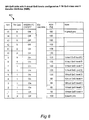
- Fig 8 shows a second example of a QoS Mapping Table 351 in the RBS with an additional RBR column.
- 9 virtual QoS levels are configured as 1 TN QoS differentiation class (class 1) and 9 Relative Bit-Rates (RBS), ranging from 150 % to 50 %.
- Fig 9 shows a third example of a QoS Mapping Table 301, where instead 9 virtual QoS levels are configured as 3 TN QoS differentiation classes (classes 1, 2 and 3) and 3 Relative Bit-Rates.
- the different TN QoS differentiation classes represent different TN availability classes, for instance by using TN QoS 1 for ATM or IP based TN with TN redundancy (i.e. high availability), TN QoS 2 for ATM or IP based TN without TN redundancy, and TN QoS 3 for low-cost xDSL TN towards RBS, such as ADSL lines (i.e. low availability).
- the system may offer RBR-based QoS profiling for different subscription types, such as the Gold, Silver and Bronze subscription types referred to previously in this document.
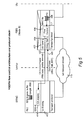
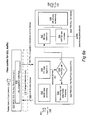
- EUL flow control involves three main parts.
- a first part is the actual EUL per-flow flow control 630 which - in similarity with the HSDPA embodiment of Figs 4 and 5 - is managed from the RBS (Node B).
- a second part is the EUL scheduler 640 that also resides in the RBS and performs the actual EUL bit-rate reduction and increase operations from UE under control from the EUL per-flow flow control 630.
- a third part 610 of the EUL flow control resides in the SRNC and is responsible for detecting transport network layer congestion.
- EUL flow control involves detecting transport network layer congestion by the third part 610 in the SRNC, deciding upon EUL bit-rate reduction by the first part 630 in the RBS, and in response signaling by the EUL scheduler 640 in the RBS to the UE a Scheduling Grant Bit-rate which reflects the commanded EUL bit-rate reduction or subsequent EUL bit-rate increase after the congestion has ended.
- a parameter linearIncreaseAbsBitrate is used in the EUL scheduler 640 when increasing the EUL bit-rate by an amount defined by linearIncreaseAbsBitrate, scaled with an RBR value eulRbr in accordance with the inventive concept.
- the RBR value eulRbr may be determined for a new EUL traffic flow like it is done for the HSDPA embodiments referred to above, e.g. by determining the SPI value for the new EUL traffic flow from the NBAP signaling with the SRNC during RAB setup, and then reading the RBR value from predefined cross-reference data, such as a QoS Mapping Table 301.
- predefined cross-reference data such as a QoS Mapping Table 301.
- Uplink data processing functionality 632 in the RBS demultiplexes the MAC-e data and sends it in E-DCH data frames 620 to the SRNC 112 over the transport network 119 (i.e. Iub/Iur interface 117).
- Transport network layer (TNL) congestion detection functionality 612 in the SRNC 112 investigates the flow of E-DCH data frames to detect congestions in the transport network 119. As is well known per se, different kinds of congestions may be detected, i.e. Soft Dynamic Delay (SCD), Hard Dynamic Delay (DDD) and Hard Frame Loss (FLD).
- SCD Soft Dynamic Delay
- DDD Hard Dynamic Delay
- FLD Hard Frame Loss
- a flow control main algorithm 636 in the RBS 114 receives the TNL Congestion Indication control frames 622 from the SRNC 112. Based on the kind of congestion detected, the flow control main algorithm 636 decides upon a bit-rate reduction reduceEulBitrate, which is expressed as a percentage. For instance, a hard congestion may call for a larger bit-rate reduction (such as 50 %) than a soft congestion (such as 10 %). It is determined at 638 whether the current cell is the serving cell. If not, data frame dropping functionality 634 for non-service cell is invoked, wherein bit-rate reduction will be obtained by dropping E-DCH data frames, preferably long ones. If on the other hand the current cell is the serving cell, then bit-rate reduction functionality 642 in the EUL scheduler 640 is invoked.
- reduceEulBitrate which is expressed as a percentage. For instance, a hard congestion may call for a larger bit-rate reduction (such as 50 %) than a soft congestion (such as 10 %). It is determined at 638 whether
- the bit-rate reduction functionality 642 will use reduceEulBitrate to reflect a nominal bit-rate reduction, i.e. a reduction of the current EUL bit-rate with the percentage defined by reduceEulBitrate - in other words a multiplicative (or exponential) decrease (MD).
- UE bit-rate scheduling functionality 646 in the EUL scheduler 640 will use the nominal bit-rate reduction when determining a Scheduling Grant Rate 648 ( Fig 6b ) to be signaled to the UE 100 as seen at 650 in Fig 6a .
- the functionality 646 will consult a Scheduler Grant Table, which defines real bit-rate changes in steps of, e.g., 1 dB, and then decides upon the Scheduling Grant Rate 648 to be signaled to the UE 100 from the Scheduler Grant Table in view of the nominal bit-rate reduction.
- a Scheduler Grant Table defines real bit-rate changes in steps of, e.g., 1 dB, and then decides upon the Scheduling Grant Rate 648 to be signaled to the UE 100 from the Scheduler Grant Table in view of the nominal bit-rate reduction.
- Other factors such as if UE 100 is happy or not (cf UE Happy Bit at 647 in Fig 6b ), are also considered by the EUL scheduler 640.
- the EUL bit-rate reduction is followed by one or more linear bit-rate increases, as indicated by WAI bit-rate increase functionality 644 in Fig 6a .
- the WAI bit-rate increase functionality 644 operates on the aforementioned linearIncreaseAbsBitrate, which is a system constant, and scales it with the RBR value eulRbr to obtain RBR-based QoS profiling. In other words, when an EUL bit-rate increase is to be performed, the WAI bit-rate increase functionality 644 will determine a weighted additive bit-rate amount as eulRbr*linearIncreaseAbsBitrate.
- the UE bit-rate scheduling functionality 646 in the EUL scheduler 640 will determine the Scheduling Grant Rate 648 in view of this weighted additive bit-rate amount, again with reference to the Scheduler Grant Table and UE Happy Bit, etc.
- the EUL bit-rate of the EUL traffic flow 601 in question will approach a value which reflects its RBR value eulRbr compared to other EUL traffic flows which share the same transport network bottleneck.
- RBR-based QoS profiling is obtained which will favor higher-ranked subscription types over lower-ranked subscription types, as for the HSDPA embodiments.
- the RBR QoS profiling may be optional in this or other EUL embodiments, wherein the RBR value will be set to 100% if RBR QoS profiling is disabled, and thus have no effect on the EUL Flow Control.
- EUL Flow Control See further details about EUL Flow Control, reference is made to the available literature, for instance "Szilveszter Nadas, Zoltan Nagy and Sandor Racz, "HSUPA transport network congestion control", 2008, submitter for review for Globecom 2008 conference".
Landscapes
- Engineering & Computer Science (AREA)
- Computer Networks & Wireless Communication (AREA)
- Signal Processing (AREA)
- Quality & Reliability (AREA)
- Data Exchanges In Wide-Area Networks (AREA)
- Mobile Radio Communication Systems (AREA)
Claims (18)
- Procédé destiné à commander, selon un principe d'augmentation additive/retrait multiplicatif, AIMD, le partage de bande passante parmi des flux de trafic en conflit sur un réseau de transport (119) entre un contrôleur de réseau radio (112) et une station de base radio (114), le procédé comprenant :la détermination (210) d'un débit binaire relatif, RBR, pour chaque flux de trafic ;
etla commande (220) des débits binaires desdits flux de trafics de sorte que des opérations d'augmentation additive dudit principe AIMD dépendent du débit RBR respectif de chaque flux de trafic ;
dans lequel le débit RBR représente une valeur d'échelle dans la plage comprise entre X % et Y % du débit binaire nominal pour un flux de trafic au sein d'une classe de différenciation de la qualité de service, QoS, d'un réseau de transport, TN, donné, où X > 100% et Y<100%. - Procédé selon la revendication 1, dans lequel ladite détermination (320 - 330) est mise en oeuvre lorsqu'un nouveau flux de trafic est généré (310).
- Procédé selon la revendication 1 ou 2, dans lequel ladite détermination (210) inclut :la détermination (320) d'un indicateur de priorité, SPI, dudit flux de trafic, ledit indicateur de priorité reflétant un type d'abonnement d'un utilisateur ou d'un équipement d'utilisateur (100) faisant partie dudit flux de trafic ; etla détermination (330) du débit RBR dudit flux de trafic en fonction de l'indicateur de priorité déterminé.
- Procédé selon la revendication 3, comprenant en outre :la réception, dans la station de base radio (114), d'une trame de données de canal partagé en liaison descendante haut débit, HS-DSCH, dans ledit flux de trafic à partir du contrôleur de réseau radio (112) ;la dérivation de l'indicateur de priorité, SPI, à partir d'un champ de données d'indicateur de priorité de canal commun, CmCH-PI, dans la trame de données de canal HS-DSCH reçue ; etla détermination du débit RBR dudit flux de trafic à partir de la valeur de l'indicateur SPI dérivé.
- Procédé selon la revendication 3, dans lequel l'indicateur de priorité, SPI, est dérivé d'une signalisation de partie d'application de station « NodeB », NBAP, entre ledit contrôleur de réseau radio (112) et ladite station de base radio (114).
- Procédé selon la revendication 4 ou 5, dans lequel le débit RBR dudit flux de trafic est déterminé à partir de l'indicateur de priorité, SPI, dérivé, en utilisant des données de référence croisée pré-stockées (301).
- Procédé selon la revendication 6, dans lequel les données de référence croisée pré-stockées (301) représentent une table de mise en concordance de qualités QoS.
- Procédé selon l'une quelconque des revendications 1 à 7, dans lequel la détermination (210) d'un débit binaire relatif, RBR, pour chaque flux de trafic en conflit, et la commande (220) des débits binaires desdits flux de trafics de sorte que des opérations d'augmentation additive dudit principe AIMD dépendent du débit RBR respectif de chaque flux de trafic, sont mises en oeuvre pour des flux de trafics au sein de la même classe de différenciation de qualité QoS de réseau TN.
- Procédé selon l'une quelconque des revendications 1 à 8, dans lequel lesdites opérations d'augmentation additive dudit principe AIMD consistent à augmenter le débit binaire en cours de chacun desdits flux de trafic d'un incrément prédéterminé, « caLinIncRate » ; « LinearIncreaseAbsBitrate », mis à l'échelle par le débit RBR déterminé du flux de trafic respectif, de manière à obtenir un partage de bande passante proportionnel équitable entre lesdits flux de trafic dans un état d'évitement d'encombrement, CA.
- Procédé selon l'une quelconque des revendications 1 à 9, comprenant en outre :l'utilisation du débit RBR déterminé en vue de déterminer un débit binaire initial d'un nouveau flux de trafic.
- Procédé selon l'une quelconque des revendications précédentes, mis en oeuvre par un contrôleur de flux, flux par flux, à base de débit HSDPA (430).
- Procédé selon l'une quelconque des revendications 1 à 10, mis en oeuvre par un contrôleur de flux EUL (630 ; 640).
- Procédé selon la revendication 7, dans lequel ladite table de mise en concordance de qualités QoS contient une pluralité de valeurs de débit RBR pour une pluralité correspondante de valeurs dudit indicateur de priorité, SPI, dans une classe de différenciation de qualité QoS de réseau TN (figure 7, figure 8).
- Procédé selon la revendication 7, dans lequel ladite table de mise en concordance de qualités QoS contient une première pluralité de valeurs de débit RBR pour une première pluralité correspondante de valeurs dudit indicateur de priorité, SPI, dans une première classe de différenciation de qualité QoS de réseau TN, et dans lequel ladite table de mise en concordance de qualités QoS contient en outre au moins une seconde pluralité de valeurs de débit RBR pour une seconde pluralité correspondante de valeurs dudit indicateur de priorité, SPI, dans une seconde classe de différenciation de qualité QoS de réseau TN (figure 9).
- Procédé selon la revendication 15, dans lequel ladite première pluralité de valeurs de débit RBR est identique à ladite seconde pluralité de valeurs de débit RBR.
- Noeud de réseau de télécommunication, lequel noeud est apte à se connecter, par l'intermédiaire d'un réseau de transport (119), à un contrôleur de réseau radio (112) ou à une station de base radio (114), ledit noeud de réseau de télécommunication comprenant un contrôleur de flux (430 ; 630 ; 640) pour commander, selon un principe d'augmentation additive/retrait multiplicatif, AIMD, le partage de bande passante parmi des flux de trafic en conflit sur ledit réseau de transport, ledit contrôleur de flux étant configuré de manière à mettre en oeuvre le procédé selon l'une quelconque des revendications 1 à 15.
- Noeud de réseau de télécommunication selon la revendication 16, dans lequel ledit noeud est une station de base radio (114).
- Système de télécommunication (1) comprenant un contrôleur de réseau radio (112), un réseau de transport (119) et un noeud de réseau de télécommunication selon la revendication 16 ou 17, dans lequel ledit contrôleur de réseau radio est connecté audit noeud de réseau de télécommunication par ledit réseau de transport.
Applications Claiming Priority (1)
| Application Number | Priority Date | Filing Date | Title |
|---|---|---|---|
| PCT/SE2009/050280 WO2010107348A1 (fr) | 2009-03-19 | 2009-03-19 | Profilage de qos basée aimd à débit binaire relatif hspa |
Publications (2)
| Publication Number | Publication Date |
|---|---|
| EP2409514A1 EP2409514A1 (fr) | 2012-01-25 |
| EP2409514B1 true EP2409514B1 (fr) | 2013-02-13 |
Family
ID=41277434
Family Applications (1)
| Application Number | Title | Priority Date | Filing Date |
|---|---|---|---|
| EP09788506A Not-in-force EP2409514B1 (fr) | 2009-03-19 | 2009-03-19 | Profilage de qos basée aimd à débit binaire relatif hspa |
Country Status (3)
| Country | Link |
|---|---|
| US (1) | US8964551B2 (fr) |
| EP (1) | EP2409514B1 (fr) |
| WO (1) | WO2010107348A1 (fr) |
Families Citing this family (14)
| Publication number | Priority date | Publication date | Assignee | Title |
|---|---|---|---|---|
| EP2553971B1 (fr) | 2010-03-30 | 2016-05-11 | Telefonaktiebolaget LM Ericsson (publ) | Procédé de détection de congestion dans un système radiocellulaire |
| US8687576B2 (en) | 2010-09-03 | 2014-04-01 | Telefonaktiebolaget Lm Ericsson (Publ) | Dynamic bandwidth allocation control in a multi-access radio communication system |
| CN102006628B (zh) * | 2010-12-10 | 2013-04-17 | 华为技术有限公司 | 多模基站的流量控制方法和装置 |
| CN103299675B (zh) | 2011-01-12 | 2019-03-01 | 瑞典爱立信有限公司 | 用于tcp依赖的流控制的自适应相对比特率管理器 |
| ES2401270B1 (es) * | 2011-03-17 | 2014-02-25 | Vodafone España, S.A.U. | Método y entidad de red para descargar vídeo en redes móviles |
| WO2013004256A1 (fr) | 2011-07-05 | 2013-01-10 | Telefonaktiebolaget L M Ericsson (Publ) | Régulation d'encombrement de réseau avec différentiation adaptative du débit binaire selon la qos |
| US20130194937A1 (en) * | 2012-01-31 | 2013-08-01 | Alcatel-Lucent Usa Inc. | Method and apparatus for providing intelligent codec rate adaptation for wireless users |
| CN103379041B (zh) | 2012-04-28 | 2018-04-20 | 国际商业机器公司 | 一种系统检测方法和装置以及流量控制方法和设备 |
| KR20140041310A (ko) * | 2012-09-27 | 2014-04-04 | 삼성전자주식회사 | 패킷 처리 방법 및 장치 |
| US20140169163A1 (en) * | 2012-12-13 | 2014-06-19 | General Electric Company | Systems and methods for communication channel capacity change detection |
| JP6227881B2 (ja) * | 2013-04-05 | 2017-11-08 | 株式会社Nttドコモ | 無線基地局 |
| WO2016081426A1 (fr) * | 2014-11-21 | 2016-05-26 | Arris Enterprises, Inc. | Qualité de service pour des étages de service mélangés |
| CN106507408A (zh) * | 2016-11-02 | 2017-03-15 | 珠海市魅族科技有限公司 | 一种终端控制方法及手持终端 |
| CN113055223B (zh) * | 2021-02-02 | 2022-08-19 | 国网安徽省电力有限公司宣城供电公司 | 基于aimd算法的虚拟化保信子站系统网络通信方法及系统 |
Family Cites Families (11)
| Publication number | Priority date | Publication date | Assignee | Title |
|---|---|---|---|---|
| US6081843A (en) * | 1997-03-20 | 2000-06-27 | Nokia Telecommunications | System using simulation cell and simulation buffer for regulating cell transfer rate according to occupancy level of the simulation buffer |
| EP1096743A1 (fr) * | 1999-10-25 | 2001-05-02 | Lucent Technologies Inc. | Réseau de communication par radio |
| WO2001063855A1 (fr) * | 2000-02-25 | 2001-08-30 | Telefonaktiebolaget Lm Ericsson (Publ) | Ordonnancement de paquets dans un systeme de communication umts au moyen de plusieurs vitesses de transfert calculees |
| EP1318632B1 (fr) * | 2001-11-24 | 2007-01-03 | Lg Electronics Inc. | Planification de transmission de données par paquet |
| US7724656B2 (en) * | 2005-01-14 | 2010-05-25 | Telefonaktiebolaget Lm Ericsson (Publ) | Uplink congestion detection and control between nodes in a radio access network |
| US8085657B2 (en) * | 2005-04-01 | 2011-12-27 | Sony Corporation | Flow control in a cellular communication system |
| US20070070894A1 (en) * | 2005-09-26 | 2007-03-29 | Fan Wang | Method to determine a scheduling priority value for a user data connection based on a quality of service requirement |
| KR20070090466A (ko) | 2006-03-03 | 2007-09-06 | (주)인세이프테크 | 이동통신 서비스 품질을 장기간 만족시키는 pf 스케줄링방법 |
| EP2090130A2 (fr) * | 2006-11-16 | 2009-08-19 | Nokia Corporation | Appareil, procédés et produits programme d'ordinateur permettant d'évaluer un facteur d'activité et de réaliser une meilleure gestion de ressources radio |
| EP1976318B1 (fr) * | 2007-03-28 | 2019-05-15 | Deutsche Telekom AG | Procédé, système et dispositif pour l'attribution d'un flux optimal pour accès à un réseau hétérogène |
| WO2009157854A1 (fr) * | 2008-06-27 | 2009-12-30 | Telefonaktiebolaget L M Ericsson (Publ) | Procédé pour obtenir un débit de mise en forme optimal pour un nouveau flux de paquet |
-
2009
- 2009-03-19 US US13/257,206 patent/US8964551B2/en not_active Expired - Fee Related
- 2009-03-19 WO PCT/SE2009/050280 patent/WO2010107348A1/fr not_active Ceased
- 2009-03-19 EP EP09788506A patent/EP2409514B1/fr not_active Not-in-force
Also Published As
| Publication number | Publication date |
|---|---|
| US20120008501A1 (en) | 2012-01-12 |
| US8964551B2 (en) | 2015-02-24 |
| WO2010107348A1 (fr) | 2010-09-23 |
| EP2409514A1 (fr) | 2012-01-25 |
Similar Documents
| Publication | Publication Date | Title |
|---|---|---|
| EP2409514B1 (fr) | Profilage de qos basée aimd à débit binaire relatif hspa | |
| EP1787436B1 (fr) | Methode et systeme pour gerer des ressources radio dans des reseaux de communication mobile, reseau associe et produit de programme informatique correspondant | |
| EP2080326B1 (fr) | Système et procédé de contrôle de débit en fonction de la charge | |
| EP1654625B1 (fr) | Optimisation de trafic autoip dans des systemes de telecommunications mobiles | |
| EP2005669B1 (fr) | Prioritisation de transmission de données | |
| CA2404523C (fr) | Transmission de donnees en paquets | |
| US20050013287A1 (en) | Method and arrangement for channel type switching | |
| JP2007520131A (ja) | Utran無線アクセスネットワークにおける無線リソース管理方法、コアネットワークサービスノード、および無線アクセスネットワーク制御装置 | |
| HK1040869A1 (en) | A communication system, a wireless terminal, and a method for handing over a connection between mobile communication networks in a wireless terminal | |
| CN1398494A (zh) | 用于码分多址空中接口的基于类别的带宽调度 | |
| EP2375658B1 (fr) | Congestion de trafic dans des contrôleurs de réseau radio | |
| EP2730051B1 (fr) | Contrôle d'encombrement de réseau avec différenciation adaptative du débit binaire de qos | |
| WO2012095169A1 (fr) | Gestionnaire de débit binaire relatif adaptatif pour commande de flux dépendant de tcp | |
| CN100417290C (zh) | 一种第三代移动通讯系统中的拥塞控制方法 | |
| US20050100021A1 (en) | Data transmission in a mobile station of a wireless packet-switched data system | |
| KR100564528B1 (ko) | Wcdma 패킷망에서 디폴트 접속점명(apn)에 대한서비스 품질 결정방법 | |
| EP1819185A1 (fr) | Procédé et appareil pour soutenir des services en temps réel dans des réseaux à commutation de paquets sans fil, réseau et programme d'ordinateur associés | |
| KR101086234B1 (ko) | 이종 트래픽 품질 보장을 위한 스케쥴링 방법 및 장치 | |
| Toseef et al. | Optimized Resource Management using Linear Programming in Integrated Heterogeneous Networks | |
| Luton et al. | Support of mobile TV over an HSPA network |
Legal Events
| Date | Code | Title | Description |
|---|---|---|---|
| PUAI | Public reference made under article 153(3) epc to a published international application that has entered the european phase |
Free format text: ORIGINAL CODE: 0009012 |
|
| 17P | Request for examination filed |
Effective date: 20110824 |
|
| AK | Designated contracting states |
Kind code of ref document: A1 Designated state(s): AT BE BG CH CY CZ DE DK EE ES FI FR GB GR HR HU IE IS IT LI LT LU LV MC MK MT NL NO PL PT RO SE SI SK TR |
|
| REG | Reference to a national code |
Ref country code: DE Ref legal event code: R079 Ref document number: 602009013312 Country of ref document: DE Free format text: PREVIOUS MAIN CLASS: H04W0028020000 Ipc: H04W0028220000 |
|
| DAX | Request for extension of the european patent (deleted) | ||
| RIC1 | Information provided on ipc code assigned before grant |
Ipc: H04W 28/22 20090101AFI20120626BHEP Ipc: H04W 28/10 20090101ALI20120626BHEP Ipc: H04W 28/02 20090101ALI20120626BHEP |
|
| GRAP | Despatch of communication of intention to grant a patent |
Free format text: ORIGINAL CODE: EPIDOSNIGR1 |
|
| GRAS | Grant fee paid |
Free format text: ORIGINAL CODE: EPIDOSNIGR3 |
|
| GRAA | (expected) grant |
Free format text: ORIGINAL CODE: 0009210 |
|
| AK | Designated contracting states |
Kind code of ref document: B1 Designated state(s): AT BE BG CH CY CZ DE DK EE ES FI FR GB GR HR HU IE IS IT LI LT LU LV MC MK MT NL NO PL PT RO SE SI SK TR |
|
| REG | Reference to a national code |
Ref country code: GB Ref legal event code: FG4D |
|
| REG | Reference to a national code |
Ref country code: AT Ref legal event code: REF Ref document number: 597047 Country of ref document: AT Kind code of ref document: T Effective date: 20130215 |
|
| REG | Reference to a national code |
Ref country code: IE Ref legal event code: FG4D |
|
| REG | Reference to a national code |
Ref country code: DE Ref legal event code: R096 Ref document number: 602009013312 Country of ref document: DE Effective date: 20130411 |
|
| REG | Reference to a national code |
Ref country code: NL Ref legal event code: T3 |
|
| REG | Reference to a national code |
Ref country code: AT Ref legal event code: MK05 Ref document number: 597047 Country of ref document: AT Kind code of ref document: T Effective date: 20130213 |
|
| REG | Reference to a national code |
Ref country code: LT Ref legal event code: MG4D |
|
| PG25 | Lapsed in a contracting state [announced via postgrant information from national office to epo] |
Ref country code: IS Free format text: LAPSE BECAUSE OF FAILURE TO SUBMIT A TRANSLATION OF THE DESCRIPTION OR TO PAY THE FEE WITHIN THE PRESCRIBED TIME-LIMIT Effective date: 20130613 Ref country code: AT Free format text: LAPSE BECAUSE OF FAILURE TO SUBMIT A TRANSLATION OF THE DESCRIPTION OR TO PAY THE FEE WITHIN THE PRESCRIBED TIME-LIMIT Effective date: 20130213 Ref country code: NO Free format text: LAPSE BECAUSE OF FAILURE TO SUBMIT A TRANSLATION OF THE DESCRIPTION OR TO PAY THE FEE WITHIN THE PRESCRIBED TIME-LIMIT Effective date: 20130513 Ref country code: BG Free format text: LAPSE BECAUSE OF FAILURE TO SUBMIT A TRANSLATION OF THE DESCRIPTION OR TO PAY THE FEE WITHIN THE PRESCRIBED TIME-LIMIT Effective date: 20130513 Ref country code: SE Free format text: LAPSE BECAUSE OF FAILURE TO SUBMIT A TRANSLATION OF THE DESCRIPTION OR TO PAY THE FEE WITHIN THE PRESCRIBED TIME-LIMIT Effective date: 20130213 Ref country code: LT Free format text: LAPSE BECAUSE OF FAILURE TO SUBMIT A TRANSLATION OF THE DESCRIPTION OR TO PAY THE FEE WITHIN THE PRESCRIBED TIME-LIMIT Effective date: 20130213 Ref country code: ES Free format text: LAPSE BECAUSE OF FAILURE TO SUBMIT A TRANSLATION OF THE DESCRIPTION OR TO PAY THE FEE WITHIN THE PRESCRIBED TIME-LIMIT Effective date: 20130524 |
|
| PG25 | Lapsed in a contracting state [announced via postgrant information from national office to epo] |
Ref country code: SI Free format text: LAPSE BECAUSE OF FAILURE TO SUBMIT A TRANSLATION OF THE DESCRIPTION OR TO PAY THE FEE WITHIN THE PRESCRIBED TIME-LIMIT Effective date: 20130213 Ref country code: PT Free format text: LAPSE BECAUSE OF FAILURE TO SUBMIT A TRANSLATION OF THE DESCRIPTION OR TO PAY THE FEE WITHIN THE PRESCRIBED TIME-LIMIT Effective date: 20130613 Ref country code: BE Free format text: LAPSE BECAUSE OF FAILURE TO SUBMIT A TRANSLATION OF THE DESCRIPTION OR TO PAY THE FEE WITHIN THE PRESCRIBED TIME-LIMIT Effective date: 20130213 Ref country code: GR Free format text: LAPSE BECAUSE OF FAILURE TO SUBMIT A TRANSLATION OF THE DESCRIPTION OR TO PAY THE FEE WITHIN THE PRESCRIBED TIME-LIMIT Effective date: 20130514 Ref country code: FI Free format text: LAPSE BECAUSE OF FAILURE TO SUBMIT A TRANSLATION OF THE DESCRIPTION OR TO PAY THE FEE WITHIN THE PRESCRIBED TIME-LIMIT Effective date: 20130213 Ref country code: LV Free format text: LAPSE BECAUSE OF FAILURE TO SUBMIT A TRANSLATION OF THE DESCRIPTION OR TO PAY THE FEE WITHIN THE PRESCRIBED TIME-LIMIT Effective date: 20130213 Ref country code: PL Free format text: LAPSE BECAUSE OF FAILURE TO SUBMIT A TRANSLATION OF THE DESCRIPTION OR TO PAY THE FEE WITHIN THE PRESCRIBED TIME-LIMIT Effective date: 20130213 |
|
| PG25 | Lapsed in a contracting state [announced via postgrant information from national office to epo] |
Ref country code: HR Free format text: LAPSE BECAUSE OF FAILURE TO SUBMIT A TRANSLATION OF THE DESCRIPTION OR TO PAY THE FEE WITHIN THE PRESCRIBED TIME-LIMIT Effective date: 20130213 |
|
| PG25 | Lapsed in a contracting state [announced via postgrant information from national office to epo] |
Ref country code: DK Free format text: LAPSE BECAUSE OF FAILURE TO SUBMIT A TRANSLATION OF THE DESCRIPTION OR TO PAY THE FEE WITHIN THE PRESCRIBED TIME-LIMIT Effective date: 20130213 Ref country code: RO Free format text: LAPSE BECAUSE OF FAILURE TO SUBMIT A TRANSLATION OF THE DESCRIPTION OR TO PAY THE FEE WITHIN THE PRESCRIBED TIME-LIMIT Effective date: 20130213 Ref country code: MC Free format text: LAPSE BECAUSE OF NON-PAYMENT OF DUE FEES Effective date: 20130331 Ref country code: SK Free format text: LAPSE BECAUSE OF FAILURE TO SUBMIT A TRANSLATION OF THE DESCRIPTION OR TO PAY THE FEE WITHIN THE PRESCRIBED TIME-LIMIT Effective date: 20130213 Ref country code: CZ Free format text: LAPSE BECAUSE OF FAILURE TO SUBMIT A TRANSLATION OF THE DESCRIPTION OR TO PAY THE FEE WITHIN THE PRESCRIBED TIME-LIMIT Effective date: 20130213 Ref country code: EE Free format text: LAPSE BECAUSE OF FAILURE TO SUBMIT A TRANSLATION OF THE DESCRIPTION OR TO PAY THE FEE WITHIN THE PRESCRIBED TIME-LIMIT Effective date: 20130213 |
|
| REG | Reference to a national code |
Ref country code: CH Ref legal event code: PL |
|
| PLBE | No opposition filed within time limit |
Free format text: ORIGINAL CODE: 0009261 |
|
| STAA | Information on the status of an ep patent application or granted ep patent |
Free format text: STATUS: NO OPPOSITION FILED WITHIN TIME LIMIT |
|
| REG | Reference to a national code |
Ref country code: FR Ref legal event code: ST Effective date: 20131129 |
|
| PG25 | Lapsed in a contracting state [announced via postgrant information from national office to epo] |
Ref country code: IT Free format text: LAPSE BECAUSE OF FAILURE TO SUBMIT A TRANSLATION OF THE DESCRIPTION OR TO PAY THE FEE WITHIN THE PRESCRIBED TIME-LIMIT Effective date: 20130213 |
|
| REG | Reference to a national code |
Ref country code: IE Ref legal event code: MM4A |
|
| 26N | No opposition filed |
Effective date: 20131114 |
|
| PG25 | Lapsed in a contracting state [announced via postgrant information from national office to epo] |
Ref country code: CH Free format text: LAPSE BECAUSE OF NON-PAYMENT OF DUE FEES Effective date: 20130331 Ref country code: FR Free format text: LAPSE BECAUSE OF NON-PAYMENT OF DUE FEES Effective date: 20130415 Ref country code: LI Free format text: LAPSE BECAUSE OF NON-PAYMENT OF DUE FEES Effective date: 20130331 Ref country code: IE Free format text: LAPSE BECAUSE OF NON-PAYMENT OF DUE FEES Effective date: 20130319 |
|
| REG | Reference to a national code |
Ref country code: DE Ref legal event code: R097 Ref document number: 602009013312 Country of ref document: DE Effective date: 20131114 |
|
| PG25 | Lapsed in a contracting state [announced via postgrant information from national office to epo] |
Ref country code: MT Free format text: LAPSE BECAUSE OF FAILURE TO SUBMIT A TRANSLATION OF THE DESCRIPTION OR TO PAY THE FEE WITHIN THE PRESCRIBED TIME-LIMIT Effective date: 20130213 |
|
| PG25 | Lapsed in a contracting state [announced via postgrant information from national office to epo] |
Ref country code: TR Free format text: LAPSE BECAUSE OF FAILURE TO SUBMIT A TRANSLATION OF THE DESCRIPTION OR TO PAY THE FEE WITHIN THE PRESCRIBED TIME-LIMIT Effective date: 20130213 Ref country code: CY Free format text: LAPSE BECAUSE OF FAILURE TO SUBMIT A TRANSLATION OF THE DESCRIPTION OR TO PAY THE FEE WITHIN THE PRESCRIBED TIME-LIMIT Effective date: 20130213 |
|
| PG25 | Lapsed in a contracting state [announced via postgrant information from national office to epo] |
Ref country code: MK Free format text: LAPSE BECAUSE OF FAILURE TO SUBMIT A TRANSLATION OF THE DESCRIPTION OR TO PAY THE FEE WITHIN THE PRESCRIBED TIME-LIMIT Effective date: 20130213 Ref country code: HU Free format text: LAPSE BECAUSE OF FAILURE TO SUBMIT A TRANSLATION OF THE DESCRIPTION OR TO PAY THE FEE WITHIN THE PRESCRIBED TIME-LIMIT; INVALID AB INITIO Effective date: 20090319 Ref country code: LU Free format text: LAPSE BECAUSE OF NON-PAYMENT OF DUE FEES Effective date: 20130319 |
|
| PGFP | Annual fee paid to national office [announced via postgrant information from national office to epo] |
Ref country code: DE Payment date: 20200327 Year of fee payment: 12 Ref country code: NL Payment date: 20200326 Year of fee payment: 12 Ref country code: GB Payment date: 20200327 Year of fee payment: 12 |
|
| REG | Reference to a national code |
Ref country code: DE Ref legal event code: R119 Ref document number: 602009013312 Country of ref document: DE |
|
| REG | Reference to a national code |
Ref country code: NL Ref legal event code: MM Effective date: 20210401 |
|
| GBPC | Gb: european patent ceased through non-payment of renewal fee |
Effective date: 20210319 |
|
| PG25 | Lapsed in a contracting state [announced via postgrant information from national office to epo] |
Ref country code: NL Free format text: LAPSE BECAUSE OF NON-PAYMENT OF DUE FEES Effective date: 20210401 Ref country code: GB Free format text: LAPSE BECAUSE OF NON-PAYMENT OF DUE FEES Effective date: 20210319 Ref country code: DE Free format text: LAPSE BECAUSE OF NON-PAYMENT OF DUE FEES Effective date: 20211001 |