EP2410038A2 - Procédé de désulfurisation oxydative assisté par mélange de carburant diesel et dispositif associé - Google Patents
Procédé de désulfurisation oxydative assisté par mélange de carburant diesel et dispositif associé Download PDFInfo
- Publication number
- EP2410038A2 EP2410038A2 EP11161598A EP11161598A EP2410038A2 EP 2410038 A2 EP2410038 A2 EP 2410038A2 EP 11161598 A EP11161598 A EP 11161598A EP 11161598 A EP11161598 A EP 11161598A EP 2410038 A2 EP2410038 A2 EP 2410038A2
- Authority
- EP
- European Patent Office
- Prior art keywords
- phase
- mixing
- accordance
- solution
- desulfurization device
- Prior art date
- Legal status (The legal status is an assumption and is not a legal conclusion. Google has not performed a legal analysis and makes no representation as to the accuracy of the status listed.)
- Ceased
Links
Images

Classifications
-
- C—CHEMISTRY; METALLURGY
- C10—PETROLEUM, GAS OR COKE INDUSTRIES; TECHNICAL GASES CONTAINING CARBON MONOXIDE; FUELS; LUBRICANTS; PEAT
- C10G—CRACKING HYDROCARBON OILS; PRODUCTION OF LIQUID HYDROCARBON MIXTURES, e.g. BY DESTRUCTIVE HYDROGENATION, OLIGOMERISATION, POLYMERISATION; RECOVERY OF HYDROCARBON OILS FROM OIL-SHALE, OIL-SAND, OR GASES; REFINING MIXTURES MAINLY CONSISTING OF HYDROCARBONS; REFORMING OF NAPHTHA; MINERAL WAXES
- C10G27/00—Refining of hydrocarbon oils in the absence of hydrogen, by oxidation
- C10G27/04—Refining of hydrocarbon oils in the absence of hydrogen, by oxidation with oxygen or compounds generating oxygen
-
- C—CHEMISTRY; METALLURGY
- C10—PETROLEUM, GAS OR COKE INDUSTRIES; TECHNICAL GASES CONTAINING CARBON MONOXIDE; FUELS; LUBRICANTS; PEAT
- C10G—CRACKING HYDROCARBON OILS; PRODUCTION OF LIQUID HYDROCARBON MIXTURES, e.g. BY DESTRUCTIVE HYDROGENATION, OLIGOMERISATION, POLYMERISATION; RECOVERY OF HYDROCARBON OILS FROM OIL-SHALE, OIL-SAND, OR GASES; REFINING MIXTURES MAINLY CONSISTING OF HYDROCARBONS; REFORMING OF NAPHTHA; MINERAL WAXES
- C10G21/00—Refining of hydrocarbon oils, in the absence of hydrogen, by extraction with selective solvents
-
- C—CHEMISTRY; METALLURGY
- C10—PETROLEUM, GAS OR COKE INDUSTRIES; TECHNICAL GASES CONTAINING CARBON MONOXIDE; FUELS; LUBRICANTS; PEAT
- C10G—CRACKING HYDROCARBON OILS; PRODUCTION OF LIQUID HYDROCARBON MIXTURES, e.g. BY DESTRUCTIVE HYDROGENATION, OLIGOMERISATION, POLYMERISATION; RECOVERY OF HYDROCARBON OILS FROM OIL-SHALE, OIL-SAND, OR GASES; REFINING MIXTURES MAINLY CONSISTING OF HYDROCARBONS; REFORMING OF NAPHTHA; MINERAL WAXES
- C10G21/00—Refining of hydrocarbon oils, in the absence of hydrogen, by extraction with selective solvents
- C10G21/28—Recovery of used solvent
-
- C—CHEMISTRY; METALLURGY
- C10—PETROLEUM, GAS OR COKE INDUSTRIES; TECHNICAL GASES CONTAINING CARBON MONOXIDE; FUELS; LUBRICANTS; PEAT
- C10G—CRACKING HYDROCARBON OILS; PRODUCTION OF LIQUID HYDROCARBON MIXTURES, e.g. BY DESTRUCTIVE HYDROGENATION, OLIGOMERISATION, POLYMERISATION; RECOVERY OF HYDROCARBON OILS FROM OIL-SHALE, OIL-SAND, OR GASES; REFINING MIXTURES MAINLY CONSISTING OF HYDROCARBONS; REFORMING OF NAPHTHA; MINERAL WAXES
- C10G27/00—Refining of hydrocarbon oils in the absence of hydrogen, by oxidation
- C10G27/04—Refining of hydrocarbon oils in the absence of hydrogen, by oxidation with oxygen or compounds generating oxygen
- C10G27/12—Refining of hydrocarbon oils in the absence of hydrogen, by oxidation with oxygen or compounds generating oxygen with oxygen-generating compounds, e.g. per-compounds, chromic acid, chromates
-
- C—CHEMISTRY; METALLURGY
- C10—PETROLEUM, GAS OR COKE INDUSTRIES; TECHNICAL GASES CONTAINING CARBON MONOXIDE; FUELS; LUBRICANTS; PEAT
- C10G—CRACKING HYDROCARBON OILS; PRODUCTION OF LIQUID HYDROCARBON MIXTURES, e.g. BY DESTRUCTIVE HYDROGENATION, OLIGOMERISATION, POLYMERISATION; RECOVERY OF HYDROCARBON OILS FROM OIL-SHALE, OIL-SAND, OR GASES; REFINING MIXTURES MAINLY CONSISTING OF HYDROCARBONS; REFORMING OF NAPHTHA; MINERAL WAXES
- C10G27/00—Refining of hydrocarbon oils in the absence of hydrogen, by oxidation
- C10G27/04—Refining of hydrocarbon oils in the absence of hydrogen, by oxidation with oxygen or compounds generating oxygen
- C10G27/14—Refining of hydrocarbon oils in the absence of hydrogen, by oxidation with oxygen or compounds generating oxygen with ozone-containing gases
-
- C—CHEMISTRY; METALLURGY
- C10—PETROLEUM, GAS OR COKE INDUSTRIES; TECHNICAL GASES CONTAINING CARBON MONOXIDE; FUELS; LUBRICANTS; PEAT
- C10G—CRACKING HYDROCARBON OILS; PRODUCTION OF LIQUID HYDROCARBON MIXTURES, e.g. BY DESTRUCTIVE HYDROGENATION, OLIGOMERISATION, POLYMERISATION; RECOVERY OF HYDROCARBON OILS FROM OIL-SHALE, OIL-SAND, OR GASES; REFINING MIXTURES MAINLY CONSISTING OF HYDROCARBONS; REFORMING OF NAPHTHA; MINERAL WAXES
- C10G2300/00—Aspects relating to hydrocarbon processing covered by groups C10G1/00 - C10G99/00
- C10G2300/10—Feedstock materials
- C10G2300/1037—Hydrocarbon fractions
- C10G2300/1048—Middle distillates
- C10G2300/1055—Diesel having a boiling range of about 230 - 330 °C
-
- C—CHEMISTRY; METALLURGY
- C10—PETROLEUM, GAS OR COKE INDUSTRIES; TECHNICAL GASES CONTAINING CARBON MONOXIDE; FUELS; LUBRICANTS; PEAT
- C10G—CRACKING HYDROCARBON OILS; PRODUCTION OF LIQUID HYDROCARBON MIXTURES, e.g. BY DESTRUCTIVE HYDROGENATION, OLIGOMERISATION, POLYMERISATION; RECOVERY OF HYDROCARBON OILS FROM OIL-SHALE, OIL-SAND, OR GASES; REFINING MIXTURES MAINLY CONSISTING OF HYDROCARBONS; REFORMING OF NAPHTHA; MINERAL WAXES
- C10G2300/00—Aspects relating to hydrocarbon processing covered by groups C10G1/00 - C10G99/00
- C10G2300/20—Characteristics of the feedstock or the products
- C10G2300/201—Impurities
- C10G2300/202—Heteroatoms content, i.e. S, N, O, P
-
- C—CHEMISTRY; METALLURGY
- C10—PETROLEUM, GAS OR COKE INDUSTRIES; TECHNICAL GASES CONTAINING CARBON MONOXIDE; FUELS; LUBRICANTS; PEAT
- C10G—CRACKING HYDROCARBON OILS; PRODUCTION OF LIQUID HYDROCARBON MIXTURES, e.g. BY DESTRUCTIVE HYDROGENATION, OLIGOMERISATION, POLYMERISATION; RECOVERY OF HYDROCARBON OILS FROM OIL-SHALE, OIL-SAND, OR GASES; REFINING MIXTURES MAINLY CONSISTING OF HYDROCARBONS; REFORMING OF NAPHTHA; MINERAL WAXES
- C10G2300/00—Aspects relating to hydrocarbon processing covered by groups C10G1/00 - C10G99/00
- C10G2300/40—Characteristics of the process deviating from typical ways of processing
- C10G2300/4081—Recycling aspects
-
- C—CHEMISTRY; METALLURGY
- C10—PETROLEUM, GAS OR COKE INDUSTRIES; TECHNICAL GASES CONTAINING CARBON MONOXIDE; FUELS; LUBRICANTS; PEAT
- C10G—CRACKING HYDROCARBON OILS; PRODUCTION OF LIQUID HYDROCARBON MIXTURES, e.g. BY DESTRUCTIVE HYDROGENATION, OLIGOMERISATION, POLYMERISATION; RECOVERY OF HYDROCARBON OILS FROM OIL-SHALE, OIL-SAND, OR GASES; REFINING MIXTURES MAINLY CONSISTING OF HYDROCARBONS; REFORMING OF NAPHTHA; MINERAL WAXES
- C10G2300/00—Aspects relating to hydrocarbon processing covered by groups C10G1/00 - C10G99/00
- C10G2300/40—Characteristics of the process deviating from typical ways of processing
- C10G2300/44—Solvents
Definitions
- This disclosure resides in the field of the desulfurization of petroleum, fossel fuel, and/or petroleum-based fuels.
- Diesel fuel is one of the more commonly-used fossel fuels today in transportation. Because it is widely known that diesel engines are inherently more thermally and energy efficient than gasoline engines, it is expected that the demand for diesel fuel will likely increase more and more in the future due to higher global environmental consciousness as well as the green movement as was seen happening in recent years. Diesel fuels are generally relatively complex mixtures of alkanes, cycloalkanes, and aromatic hydrocarbons with carbon numbers in the range of C9-C28 and with a boiling-range of 150-390 degrees C. Their relative distribution depends on the specific fuel feedstock, refining process, and actual blending schemes based on day-to-day commercial demands of the end user. Two commonly found sulfur compounds in diesel fuel are, for example, alkylbenzothiophenes (BTs) and alkyldibenzothiophenes (DBTs).
- BTs alkylbenzothiophenes
- DBTs alkyldibenzothiophenes
- HDS hydrodesulfurization
- One conventional method for desulfurization of diesel fuels is by means of oxidative desulfurization. This method is based on the operating principle that sulfur compounds are known to be slightly more polar than hydrocarbons. In addition, oxidized sulfur compounds such as sulfones are substantially more polar than sulfides. More importantly, the oxidation of sulfides to sulfones is usually much easier and faster than the oxidation of most hydrocarbons. As such, the conversion of the slightly polar sulfides to the more polar sulfones or sulfoxides allows for the sulfur compounds to be more easily extracted from the fossil fuels into an aqueous phase.
- U.S. Pat. No. 6,402,939 describes a technique in which organic sulfur compounds are removed from a fossil fuel by a process that combines oxidative desulfurization with ultrasound technology.
- the oxidative desulfurization is achieved by combining the fossil fuel with a hydroperoxide oxidizing agent in an aqueous fluid, and the ultrasound is applied to the resulting mixture to increase the reactivity of the various species in the mixture.
- Ultrasound-assisted oxidative desulfurization (UAOD) process which is operated at ambient temperature and atmospheric pressure conditions, permits the selective removal of sulfur compounds from hydrocarbons; however, it was found that some bromo by-products were formed by using the quaternary ammonium bromides as phase transfer agents or catalysts.
- the sonoreactor utilized in the desulfurization process also possesses many disadvantages such as, for example, requiring very expensive equipments which also requires technical sophisticated parts such as an RF amplifier and a function generator, requiring higher electrical power consumption due to the generation of ultrasonic fields, requiring to operate at higher operating temperatures, typical at between 70 to 80°C, and the ultrasound potentially present long term detriment to possible chain cracking of long chain hydrocarbons.
- the conventional recactor or ultrasonic desulfurization equipment possess practical limitations with respect to scale up to mass production because of also the need to scale up of the corresponding function generator and RF amplifier.
- one aspect of this disclosure is directed to a method of mixing-assisted oxidative desulfurization (MAOD) of fossil fuels in which the fossil fuel is combined with an aqueous oxidizer solution including hydrogen peroxide or ozone solution containing a quaternary ammonium salt having at least one carbon chain of 8 or more carbon atoms as a phase transfer catalyst to achieve improved conversion of sulfides to sulfoxides with higher yield and without the unwanted formation of brominated side products.
- MAOD mixed oxidative desulfurization
- in another aspect of this disclosure is directed to a method of mixing-assisted oxidative desulfurization of fossil fuels in which the fossil fuel is combined with an aqueous hydrogen peroxide solution or ozone solution containing a quaternary ammonium salt as a phase transfer catalyst to achieve improved conversion of sulfides to sulfoxides as contained in the organic phase fuel using a plurality of mixing tanks and a plurality of cyclones, without having to require the use of any sonoreactor or ultrasonic device, which can be complex, unreliable, and expensive.
- the mixing-assisted oxidative desulfurization process of this disclosure is also advantageous over the conventional recactor or ultrasonic desulfurization process, for example, with respect to having much fewer problems relating to scale up to mass production because of the lack of the accompanying corresponding function generator and RF amplifier that are found in recactors, and not presenting long term detriment to possible chain cracking of long chain hydrocarbons.
- a continuous flow system for the oxidative desulfurization of fossil fuels utilizes a plurality of mixing tanks of module design along with a portable and continuous flow unit, which includes at least two mixing tanks, a mixer connected to each mixing tank for agitation and mixing to effect emulsion bubble formations, at least two cyclones coupled to the mixing tanks in series, respectively, in tandem, and an evaporative tower.
- the evaporative tower is coupled to one cyclone and to one mixing tank so as to produce sulfones.
- One of the cyclone yields an organic phase that is substantially sulfone-free.
- multiple sets of mixing tank and cyclone combinations, in conjunction with multiple units of evaporator towers can be scaled up to connect in series or in parallel, respectively.
- FIG. 1 is a schematic diagram of a continuous desulfurization device in accordance with an embodiment of the present disclosure.
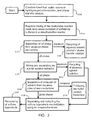
- FIG. 2 is a flow diagram of the continuous desulfurization process in accordance with the embodiment shown in FIG. 1 .
- Quaternary ammonium salts are compounds comprised of a positively charged nitrogen atom having four substituents, paired with a negatively charged counterion.
- hydroperoxide is used herein to denote a compound of the molecular structure in which R represents either a hydrogen atom or an organic or inorganic group.
- examples of hydroperoxides in which R is an organic group are water-soluble hydroperoxides such as methyl hydroperoxide, ethyl hydroperoxide, isopropyl hydroperoxide, n-butyl hydroperoxide, sec-butyl hydroperoxide, tert-butyl hydroperoxide, 2-methoxy-2-propyl hydroperoxide, tert-amyl hydroperoxide, and cyclohexyl hydroperoxide.
- hydroperoxides in which R is an inorganic group are peroxonitrous acid, peroxophosphoric acid, and peroxosulfuric acid.
- Preferred hydroperoxides are hydrogen peroxide (in which R is a hydrogen atom) and tertiary-alkyl peroxides, notably tert-butyl peroxide.
- the aqueous fluid that is combined with the fossil fuel and the oxidizer aqueous solution including hydrogen peroxide, hydroperoxide or ozone.
- the relative amounts of the liquid fossil fuel and oxidizer aqueous solution may vary from about 1:1 to about 1: 3, and preferably about 1:1.25.
- the concentration of hydrogen peroxide in the oxidizer aqueous solution is substantially in the range of 1% to 30%. And although they may affect the efficiency of the process or the ease of handling the fluids, the relative amounts are not critical to this invention.
- ozone generator Pacific Ozone L22
- ozone generator Pacific Ozone L22
- the flow rate of ozone is substantially in the range of 0.01g/hr to 1g/hr.
- the mixture concentration of ozone in the oxidizer aqueous solution can also be dictated by the amount of ozone substantially in the range of 0.01g/l to 1g/l, and preferably about saturated in the oxidizer aqueous solution at the operating conditions.
- the amount of hydroperoxide relative to the fossil fuel and the aqueous fluid can also be varied, and although the conversion rate may vary somewhat with the proportion of hydroperoxide.
- the hydroperoxide is H 2 O 2
- improved results are generally achieved in most systems with an H 2 O 2 concentration within the range of from about 1% to about 30% by volume (as H 2 O 2 ) of the combined aqueous and organic phases, and preferably from about 3%.
- the preferred relative volumes will be those of equivalent molar amounts.
- a metal catalyst is included in the reaction system to regulate the activity of the hydroxyl radical produced by the hydroperoxide.
- catalysts are transition metal catalysts and Fenton catalysts (ferrous salts) and metal ion catalysts in general such as iron (II), iron (III), copper (I), copper (II), chromium (III), chromium (VI), molybdenum, tungsten, and vanadium ions.
- iron (II), iron (III), copper (II), and tungsten catalysts are preferred.
- Fenton-type catalysts are preferred, while for others, such as diesel and other systems where dibenzylthiophene is a prominent component, tungstates are preferred.
- Tungstates include tungstic acid, substituted tungstic acids such as phosphotungstic acid, and metal tungstates.
- the metal catalyst when present will be used in a catalytically effective amount, which means any amount that will enhance the progress of the reaction toward the desired goal, which is the oxidation of the sulfides to sulfones. In most cases, the catalytically effective amount will range from about 0.01g to about 0.5g, and preferably will be about 0.2g, when mixed to 25g of hydrogen peroxide solution (3 ⁇ 30 vol. % solution).
- the phase transfer catalyst can be Tetraoctylphosphonium salt
- the Tetraoctylphosphonium salt can be, for example, tetraoctylphosphonium bromide, tetraoctylphosphonium chloride, tetraoctylphosphonium iodide, tetraoctylphosphonium acetate and tetraoctylphosphonium chromate.
- the Tetraoctylphosphonium salt can have the following formula, where R 1 , R 2 , R 3 , and R 4 are alkyl radicals having 8 carbon atoms in a branched or linear alkyl chain and X - is an anionic species.
- the catalytically effective amount of the Tetraoctylphosphonium salt phase transfer catalyst will range from about 0.01g to about 0.5g, and preferably will be about 0.2g, when mixed to 25g of hydrogen peroxide solution (3 ⁇ 30 vol. % solution).
- the oxidizer aqueous solution, the phase transfer catalyst, the metal catalyst, and the diesel fuel containing relatively high concentration of sulfur are mixed together and transported to a first mixing tank through a plurality of pipes.
- Each of the feed streams can be independent flow-regulated by means of conventional flow valves and flow control system.
- the reaction mixture is thoroughly mixed in the first mixing tank using a mixer.
- the extensive amount of bubble contact surface facilitation formations found in the oil/aqueous emulsion inside the first mixing tank during the reactive mixing process help to improve upon the oxidation reaction rate of sulfides to form sulfoxides or sulfone.
- the product mixture will contain both aqueous and organic phases, and the organic phase will contain the bulk of the sulfones produced by the oxidation reaction.
- the product mixture can be phase-separated prior to sulfone removal. Phase separation can be accomplished by breaking the emulsion caused by the reactive mixing. The breaking of the emulsion is also performed by conventional means. The various possibilities for methods of performing these procedures will be readily apparent to anyone skilled in the art of handling emulsions and continuous stirred tank reactors, and particularly oil-in-water emulsions.
- the sulfones produced are readily removable from either the aqueous phase, the organic phase, or both, by further extracting of the polar species through mixing and separating via a polar solution extractor.
- the polar solution extractor can be realized in the form of a "mixing tank", which is fitted with a mixer, in the present embodiment.
- One mechanism to improve the extraction efficiency is to creating a lot of tiny bubbles in the well-agitated and thoroughly mixed emulsion mixture, to increase the contact area of the polar solution and the fossil fuel.
- the tiny bubbles may be in the form of liquid bubbles such as oil bubbles or aqueous bubbles, or in the form of gas bubbles
- the polar solution extractor can be realized in the form of a liquid-solid adsorption unit.
- Alumina oxide can be filled inside the columns of the solid adsorption unit, and gravity or vacuum can be used to assist in the adsorption process.
- a solvent such as Acetonitrile can be used as the polar solvent in the polar solution extractor. Acetonitrile can be easily separated by distillation from the sulfones with boiling point ranging from 550 to 950 K. Each time, the solvent-to-oil (S/O) ratio can be kept at 1:1 by weight (for example, 1 g diesel per 1 g Acetonitrile).
- liquid fossil fuels is used herein to denote any carbonaceous liquid that is derived from petroleum, coal, or any other naturally occurring material. Included among these fuels are automotive fuels such as gasoline, diesel fuel, jet fuel, and rocket fuel, as well as petroleum residual-based fuel oils including bunker fuels and residual fuels.
- One method for conducting MAOD utilizes a continuous flow system which can be operated at steady state with reactants continuously coming into the reaction vessel and the product continuously being removed.
- a continuous desulfurization device 10 is described, and the continuous desulfurization device 10 can be a portable unit.
- This continuous desulfurization device 10 has demonstrated that large amounts of diesel fuels can be treated in a short time to reach high desulfurization efficiency with low capital investment and maintenance cost.
- this desulfurization device 10 may be operated in the temperature lower than that of sonoreactor. Normally, the operating temperature was raised to around 50-60°C by the chemical reaction of the aqueous fluid. This technology can potentially provide sulfur reduction of 95%. For higher throughput rate and performance, two of these desulfurization devices 10 can be connected in parallel to reach even higher sulfur reduction.
- FIG. 1 A diagram of the continuous desulfurization device 10 is shown in FIG. 1 .
- An oxidizing agent supply tank 30 for supplying the oxidizer aqueous solution, and a diesel supply tank 20 for supplying a diesel fuel containing relatively high concentration of sulfur are coupled to a first mixing tank 100 through a plurality of pipes.
- a phase transfer catalyst vessel 40 and a metal catalyst vessel 50 are further coupled to the first mixing tank 100.
- Each of the oxidizing agent supply tank 30, the diesel supply tank 20, the phase transfer catalyst vessel 40, and the metal catalyst vessel 50 can be independent flow-regulated by means of conventional flow valves and flow control system, respectively.
- the reaction mixture was mixed in the first mixing tank 100 by a mixer 110.
- the first mixing tank 100 is also referred to as a desulfurization reactor herein.
- the reactive mixing which takes place in the oil/aqueous emulsion inside the first mixing tank 100 involves the oxidation of sulfides to sulfoxides or sulfone.
- the reaction mixture then is fed to the first cyclone 140.
- the first cyclone 140 can be seen as a diesel/aqueous separation chamber in which the aqueous phase (containing oxidizer and catalysts) is separated from the organic phase (containing diesel fuel and sulfones), which results in the production of the low sulfur diesel fuel by further processing.
- the aqueous phase was then re-circulated to the first mixing tank 100 through a recirculation loop via te a catalyst activation vessel 55 for a period of time.
- the polar solution extractor in where the solvent mixture containing the sulfone byproduct and the low sulfur diesel (oil phase) are partitioned out after mixing and extraction using the mixer 110, and the oil phase mixture is delivered to the second cyclone 240, The low sulfur diesel thus was obtained and stored in vessel 11.
- the polar solvent phase mixture containing the sulfone byproduct is further sent to an evaporative tower 300 for recycling the polar solvent-by storing it in a solvent recovery tank 65. From this evaporative tower 300, the sulfone byproducts are obtained.
- the optimized MAOD process can reach or exceed 95% sulfur reduction, or final sulfur concentration less than 15 ppm in high efficiency.
- the use of the Tetraoctylphosphonium salt also prevents the formation of unwanted brominated side products.
- improving phase transfer capabilities also permits the improved recovery and highly efficient reuse of the transition metal catalyst, thus executing the same desulfurization efficiency with diluted hydrogen peroxide or ozone solutions.
- FIG. 2 a flow diagram of the continuous desulfurization process for removing sulfides from a liquid fossil fuel in accordance with the embodiment shown in FIG. 1 is presented, as including the following steps:
- a liquid fossil fuel from the diesel supply tank 20 is combined with an oxidizer solution comprising water ozone or hydroperoxide solution which are stored in the oxidizing agent supply tank 30, a phase transfer catalyst stored in the phase transfer catalyst vessel 40, and a metal catalyst stored in the metal catalyst vessel 50 are combined together to form a multiphase reaction medium.
- the phase transfer catalyst such as Tetraoctylphosphonium salt, having four substituents, and the substituents are from the group consisting of an alkyl group having a chain length of from 1 to 20 carbon atoms, an aryl group, or an aralkyl group, and at least one of the substituents is an alkyl group of 8 or more carbon atoms in length.
- the metal catalyst stored in the metal catalyst vessel 50 above is a transition metal catalyst such as phosphotungstic acid.
- the amount of the phase transfer catalyst used is 0. 1 g and the amount of metal catalyst used is 0.2 g per 25 g of a liquid fossil fuel in the form of a sulfur containing diesel fuel, and equal volume of 3 ⁇ 30 vol. % solution of H 2 O 2 or ozone solution being used, for example. (S 100).
- Reactive mixing of the multiphase reaction medium is performed for a time sufficient to cause oxidation of sulfides in the fossil fuel to sulfones and to permit emulsion bubble formations which include either bubble sizes all less than 1 mm or a substantial number of bubbles having bubble sizes of less than 1 mm, and a substantial number of bubbles preferably at about substantially 10 microns, and also where many bubbles can also be less than substantially 0.1 mm, in diameter through a substantial amount of agitation and mixing of the multiphase reaction medium inside the first mixing tank 100.
- the oil phase is separated from the aqueous phase via the first cyclone 140 (S 110), and later the polar solvent phase solution is separated from the nonpolar phase solution via the second cyclone 240 (S 130).
- the oil phase from the polar solvent phase are mixed and separated by using the second mixing tank 200, which is also called the polar solution extractor.
- Solvent such as Acetonitrile can be used as the polar solvent phase in the second mixing tank 200.
- Acetonitrile can be easily separated by distillation from the sulfones with boiling point ranging from 550 to 950 K.
- the solvent-to-oil (S/O) ratio can be kept at 1:1 by weight (for example, 1 g diesel per 1 g Acetonitrile).
- a plurality of emulsion bubbles are formed comprising of bubble sizes less than 1 mm or a substantial number of bubbles having bubble sizes of less than 1 mm, and a substantial number of bubbles preferably at about substantially 10 microns in diameter, where many of the bubbles can also be less than substantially 0.1 mm.
- the bubbles formation produced during steps S105 and S 115 can be comprised of gas bubbles and/or immiscible liquid bubbles.
- phase transfer catalyst and the metal catalyst are collected using the first cyclone 140 and then recycled in the catalyst activation vessel 55 (S120). Meanwhile, the solvent solution such as Acetonitrile used in the second mixing tank 200 are collected and recycled by a distillation process using the evaporative tower 300 (S125).
- the sulfones byproducts are separated from the polar phase and the nonpolar phase at both the second mixing tank 200 and the second cyclone 240 by using the evaporative tower 300 (S140). Then the sulfones are sent from the evaporative tower 300 to a sulfones holding vessel 70 to be collected (S 150). Later, an organic phase that is nonpolar and substantially sulfone-free is collected in a clean diesel fuel holding tank 11 (S135).
Landscapes
- Chemical & Material Sciences (AREA)
- Oil, Petroleum & Natural Gas (AREA)
- Engineering & Computer Science (AREA)
- Chemical Kinetics & Catalysis (AREA)
- General Chemical & Material Sciences (AREA)
- Organic Chemistry (AREA)
- Production Of Liquid Hydrocarbon Mixture For Refining Petroleum (AREA)
Applications Claiming Priority (1)
| Application Number | Priority Date | Filing Date | Title |
|---|---|---|---|
| US12/840,259 US20120018350A1 (en) | 2010-07-20 | 2010-07-20 | Mixing-assisted oxidative desulfurization of diesel fuel using quaternary ammonium salt and portable unit thereof |
Publications (2)
| Publication Number | Publication Date |
|---|---|
| EP2410038A2 true EP2410038A2 (fr) | 2012-01-25 |
| EP2410038A3 EP2410038A3 (fr) | 2012-05-23 |
Family
ID=44496518
Family Applications (1)
| Application Number | Title | Priority Date | Filing Date |
|---|---|---|---|
| EP11161598A Ceased EP2410038A3 (fr) | 2010-07-20 | 2011-04-08 | Procédé de désulfurisation oxydative assisté par mélange de carburant diesel et dispositif associé |
Country Status (6)
| Country | Link |
|---|---|
| US (1) | US20120018350A1 (fr) |
| EP (1) | EP2410038A3 (fr) |
| JP (1) | JP2012025933A (fr) |
| CN (2) | CN201952397U (fr) |
| CA (1) | CA2744257A1 (fr) |
| TW (1) | TWI417375B (fr) |
Cited By (1)
| Publication number | Priority date | Publication date | Assignee | Title |
|---|---|---|---|---|
| CN103585954A (zh) * | 2013-11-04 | 2014-02-19 | 安阳工学院 | 汽油脱硫催化吸附剂及其制备方法和脱硫方法 |
Families Citing this family (14)
| Publication number | Priority date | Publication date | Assignee | Title |
|---|---|---|---|---|
| US8936719B2 (en) * | 2006-03-22 | 2015-01-20 | Ultraclean Fuel Pty Ltd. | Process for removing sulphur from liquid hydrocarbons |
| WO2014138810A1 (fr) * | 2013-03-15 | 2014-09-18 | Ultraclean Pty Ltd | Procédé d'élimination de composés soufrés à partir d'hydrocarbures |
| US9441169B2 (en) | 2013-03-15 | 2016-09-13 | Ultraclean Fuel Pty Ltd | Process for removing sulphur compounds from hydrocarbons |
| CN103450931B (zh) * | 2013-09-06 | 2015-04-15 | 余国贤 | 柴油超声氧化-萃取深度脱硫的方法 |
| CN104989944A (zh) * | 2015-06-30 | 2015-10-21 | 柳州市山泰气体有限公司 | 一种圆筒形液化石油气罐 |
| US10703995B2 (en) * | 2017-03-14 | 2020-07-07 | Alternative Petroleum Technologies, Inc. | System and method for liquid hydrocarbon desulfurization |
| WO2018205113A1 (fr) * | 2017-05-08 | 2018-11-15 | Solvay Sa | Procédé d'élimination de composés soufrés d'une composition liquide |
| BR102017012313B1 (pt) | 2017-06-09 | 2022-06-28 | Petróleo Brasileiro S.A. - Petrobrás | Sistema catalítico para remoção de compostos heteroatômicos de enxofre e/ou nitrogênio dissolvidos em hidrocarbonetos |
| EP3645671A4 (fr) | 2017-06-26 | 2021-03-31 | Alternative Petroleum Technologies, Inc. | Système et procédé de désulfuration d'hydrocarbures liquides |
| US10093868B1 (en) * | 2017-11-15 | 2018-10-09 | Baker Hughes, A Ge Company, Llc | Ionic liquid-based hydrogen sulfide and mercaptan scavengers |
| US11198824B2 (en) * | 2019-05-16 | 2021-12-14 | Alternative Petroleum Technologies Holdings Corp. | System and method for liquid hydrocarbon desulfurization |
| WO2024095167A1 (fr) * | 2022-11-03 | 2024-05-10 | Bakhshi Zadeh Shahryar | Désulfuration oxydative de mazout assistée par ultrasons faisant appel à des catalyseurs à base d'oxydes métalliques |
| CN116535435B (zh) * | 2023-03-15 | 2025-06-06 | 江苏大学 | 一种多孔低共熔溶剂的制备方法及应用 |
| WO2026027903A1 (fr) * | 2024-08-01 | 2026-02-05 | Kuregyan Kamo | Procédé de désulfuration oxydative de pétrole et de carburants liquides hydrocarbonés et réduction des émissions nocives d'oxydes de soufre et de carbone |
Citations (1)
| Publication number | Priority date | Publication date | Assignee | Title |
|---|---|---|---|---|
| US6402939B1 (en) | 2000-09-28 | 2002-06-11 | Sulphco, Inc. | Oxidative desulfurization of fossil fuels with ultrasound |
Family Cites Families (14)
| Publication number | Priority date | Publication date | Assignee | Title |
|---|---|---|---|---|
| US173571A (en) * | 1876-02-15 | Improvement in heat-radiators | ||
| US54538A (en) * | 1866-05-08 | Improved method of neutralizing acid on sheet-iron | ||
| US4410422A (en) * | 1981-10-23 | 1983-10-18 | General Electric Company | Method for removing polyhalogenated hydrocarbons from nonpolar organic solvent solutions |
| JP3227521B2 (ja) * | 1992-04-06 | 2001-11-12 | 舟越 泉 | 液状油中から有機硫黄化合物を回収する方法 |
| US7871512B2 (en) * | 2001-05-10 | 2011-01-18 | Petrosonics, Llc | Treatment of crude oil fractions, fossil fuels, and products thereof |
| US6544409B2 (en) * | 2001-05-16 | 2003-04-08 | Petroleo Brasileiro S.A. - Petrobras | Process for the catalytic oxidation of sulfur, nitrogen and unsaturated compounds from hydrocarbon streams |
| JP2003193066A (ja) * | 2001-12-26 | 2003-07-09 | Mitsui Eng & Shipbuild Co Ltd | 液状石油製品の酸化脱硫法、および酸化脱硫装置 |
| CN1961061A (zh) * | 2004-05-31 | 2007-05-09 | 新加坡科技研究局 | 从燃料中去除硫的新型方法 |
| US20060054538A1 (en) * | 2004-09-14 | 2006-03-16 | Exxonmobil Research And Engineering Company | Emulsion neutralization of high total acid number (TAN) crude oil |
| CN100556992C (zh) * | 2005-03-18 | 2009-11-04 | 中国科学院化学研究所 | 石油产品的一种催化氧化脱硫方法 |
| CN104593055A (zh) * | 2006-03-03 | 2015-05-06 | 沙特阿拉伯石油公司 | 液体运输工具燃料的深度氧化脱硫的催化方法 |
| CN100569917C (zh) * | 2006-04-27 | 2009-12-16 | 中国石油化工股份有限公司 | 一种轻质油品氧化脱硫和脱臭的方法 |
| US8197763B2 (en) * | 2006-09-13 | 2012-06-12 | University Of Southern California | Ultrasound-assisted oxidative desulfurization of diesel fuel using quaternary ammonium fluoride and portable unit for ultrasound-assisted oxidative desulfurization |
| US7758745B2 (en) * | 2008-03-20 | 2010-07-20 | Shun-Sheng Cheng | Diesel desulfurization method |
-
2010
- 2010-07-20 US US12/840,259 patent/US20120018350A1/en not_active Abandoned
- 2010-10-28 TW TW099136872A patent/TWI417375B/zh not_active IP Right Cessation
- 2010-12-23 CN CN2010206753740U patent/CN201952397U/zh not_active Expired - Fee Related
- 2010-12-23 CN CN2010106010846A patent/CN102337149A/zh active Pending
-
2011
- 2011-04-08 EP EP11161598A patent/EP2410038A3/fr not_active Ceased
- 2011-04-25 JP JP2011097457A patent/JP2012025933A/ja active Pending
- 2011-06-23 CA CA2744257A patent/CA2744257A1/fr not_active Abandoned
Patent Citations (1)
| Publication number | Priority date | Publication date | Assignee | Title |
|---|---|---|---|---|
| US6402939B1 (en) | 2000-09-28 | 2002-06-11 | Sulphco, Inc. | Oxidative desulfurization of fossil fuels with ultrasound |
Cited By (1)
| Publication number | Priority date | Publication date | Assignee | Title |
|---|---|---|---|---|
| CN103585954A (zh) * | 2013-11-04 | 2014-02-19 | 安阳工学院 | 汽油脱硫催化吸附剂及其制备方法和脱硫方法 |
Also Published As
| Publication number | Publication date |
|---|---|
| US20120018350A1 (en) | 2012-01-26 |
| TWI417375B (zh) | 2013-12-01 |
| CN201952397U (zh) | 2011-08-31 |
| CN102337149A (zh) | 2012-02-01 |
| EP2410038A3 (fr) | 2012-05-23 |
| JP2012025933A (ja) | 2012-02-09 |
| TW201204825A (en) | 2012-02-01 |
| CA2744257A1 (fr) | 2012-01-20 |
Similar Documents
| Publication | Publication Date | Title |
|---|---|---|
| EP2410038A2 (fr) | Procédé de désulfurisation oxydative assisté par mélange de carburant diesel et dispositif associé | |
| US8197763B2 (en) | Ultrasound-assisted oxidative desulfurization of diesel fuel using quaternary ammonium fluoride and portable unit for ultrasound-assisted oxidative desulfurization | |
| CN101611119B (zh) | 石油的氧化脱硫和脱氮 | |
| US20140374320A1 (en) | Method for Removing Sulfides from a Liquid Fossil Fuel | |
| US8936719B2 (en) | Process for removing sulphur from liquid hydrocarbons | |
| US8002971B2 (en) | Desulfurization process and systems utilizing hydrodynamic cavitation | |
| Gao et al. | Deep desulfurization from fuel oil via selective oxidation using an amphiphilic peroxotungsten catalyst assembled in emulsion droplets | |
| CN113166049A (zh) | 氧化二硫化物油溶剂组合物 | |
| WO2013015936A1 (fr) | Système intégré et procédé de production in-situ de peroxyde organique et de conversion oxydative d'hétéroatomes | |
| WO2012018657A1 (fr) | Procédé de séparation | |
| JP2012162731A (ja) | 改良された分離方法 | |
| US20060081501A1 (en) | Desulfurization processes and systems utilizing hydrodynamic cavitation | |
| CN114437822B (zh) | 一种生产燃料油的方法和系统及其应用以及燃料油及其应用 | |
| CN101402877B (zh) | 一种汽油的催化氧化脱硫方法 | |
| US20140284251A1 (en) | Fuel Desulfurization Method | |
| JP5838211B2 (ja) | 酸化した炭化水素燃料からのスルホンの除去 | |
| Cheng | Ultra clean fuels via modified UAOD process with room temperature ionic liquid (RTIL) & solid catalyst polishing | |
| US8357342B2 (en) | Multiphase multifunctional reactor | |
| WO1997013567A1 (fr) | Procede d'extraction | |
| WO2011022832A1 (fr) | Procédé et système destinés à réduire l'acidité de charges d'alimentation en hydrocarbures | |
| CN1148615A (zh) | 除去烃中环丁砜的方法 | |
| Wan | Development of a portable, modular unit for the optimization of ultrasound-assisted oxidative desulfurization of diesel | |
| TWM406043U (en) | Continuous desulfurization device | |
| TWI453278B (zh) | 燃料脫硫的方法 | |
| Campos Martín et al. | Oxidative processes of desulfurization of liquid |
Legal Events
| Date | Code | Title | Description |
|---|---|---|---|
| AK | Designated contracting states |
Kind code of ref document: A2 Designated state(s): AL AT BE BG CH CY CZ DE DK EE ES FI FR GB GR HR HU IE IS IT LI LT LU LV MC MK MT NL NO PL PT RO RS SE SI SK SM TR |
|
| AX | Request for extension of the european patent |
Extension state: BA ME |
|
| PUAI | Public reference made under article 153(3) epc to a published international application that has entered the european phase |
Free format text: ORIGINAL CODE: 0009012 |
|
| PUAL | Search report despatched |
Free format text: ORIGINAL CODE: 0009013 |
|
| RTI1 | Title (correction) |
Free format text: MIXING-ASSISTED OXIDATIVE DESULFURIZATION METHOD OF DIESEL FUEL AND DEVICE THEREOF |
|
| AK | Designated contracting states |
Kind code of ref document: A3 Designated state(s): AL AT BE BG CH CY CZ DE DK EE ES FI FR GB GR HR HU IE IS IT LI LT LU LV MC MK MT NL NO PL PT RO RS SE SI SK SM TR |
|
| AX | Request for extension of the european patent |
Extension state: BA ME |
|
| RIC1 | Information provided on ipc code assigned before grant |
Ipc: C10G 27/14 20060101ALI20120418BHEP Ipc: C10G 27/12 20060101ALI20120418BHEP Ipc: C10G 27/04 20060101AFI20120418BHEP |
|
| 17P | Request for examination filed |
Effective date: 20120823 |
|
| 17Q | First examination report despatched |
Effective date: 20121221 |
|
| STAA | Information on the status of an ep patent application or granted ep patent |
Free format text: STATUS: THE APPLICATION HAS BEEN REFUSED |
|
| 18R | Application refused |
Effective date: 20140911 |