EP2410085A1 - Procédé de tricotage de tissu tricoté et tissu tricoté - Google Patents
Procédé de tricotage de tissu tricoté et tissu tricoté Download PDFInfo
- Publication number
- EP2410085A1 EP2410085A1 EP11006033A EP11006033A EP2410085A1 EP 2410085 A1 EP2410085 A1 EP 2410085A1 EP 11006033 A EP11006033 A EP 11006033A EP 11006033 A EP11006033 A EP 11006033A EP 2410085 A1 EP2410085 A1 EP 2410085A1
- Authority
- EP
- European Patent Office
- Prior art keywords
- stitch
- bind
- knitting
- knitted fabric
- needle
- Prior art date
- Legal status (The legal status is an assumption and is not a legal conclusion. Google has not performed a legal analysis and makes no representation as to the accuracy of the status listed.)
- Granted
Links
Images

Classifications
-
- D—TEXTILES; PAPER
- D04—BRAIDING; LACE-MAKING; KNITTING; TRIMMINGS; NON-WOVEN FABRICS
- D04B—KNITTING
- D04B1/00—Weft knitting processes for the production of fabrics or articles not dependent on the use of particular machines; Fabrics or articles defined by such processes
- D04B1/22—Weft knitting processes for the production of fabrics or articles not dependent on the use of particular machines; Fabrics or articles defined by such processes specially adapted for knitting goods of particular configuration
Definitions
- the present invention relates to a method for knitting a knitted fabric in which stitches at the end in a wale direction of a knitted fabric portion held on the needle beds are subjected to a bind off process when knitting a knitted fabric using a flat knitting machine, and a knitted fabric obtained by applying such a method for knitting a knitted fabric.
- a bind off process is one of the methods for processing so that the stitches (stitches at the end in the wale direction) in the final course of the relevant knitted fabric do not ravel.
- the bind off process is a process of repeating the knitting in which proximate stitches, of the stitches of the knitted fabric portion held on the needle beds, are overlapped and a new stitch is formed following such overlapped stitches (double stitch), from one end side toward the other end side in the knitting width direction of the knitted fabric.
- the conventional bind off portion may not have sufficient stretchability.
- the collar of a turtle neck sweater needs to enable the head to pass through when wearing the sweater, but the peripheral length cannot be made very long due to restriction in design. Therefore, development of a method for knitting the knitted fabric capable of knitting the bind off portion of high stretchability is desired.
- the present invention has been made in view of the above circumstances, and an object thereof is to provide a method for knitting a knitted fabric capable of knitting a bind off portion of high stretchability, and a knitted fabric knitted by applying such a knitting method.
- the reason the stretchability of the bind off portion is not satisfactory is assumed to be because the new stitch is formed following the double stitch where the proximate stitches are overlapped, and the stretch margin of the knitting yarn at the bind off portion is small.
- the present inventor came to complete the present invention after thoroughly reviewing the method for knitting the knitted fabric for ensuring the stretch margin of the knitting yarn in the bind off portion.
- a method for knitting a knitted fabric according to the present invention is a method for knitting a knitted fabric in which stitches of a knitted fabric portion held on a needle bed is subjected to a bind off process, using a flat knitting machine having at least a pair of front and back needle beds and in which stitches held on a knitting needle of the needle bed are transferable to a different knitting needle.
- the method for knitting the knitted fabric of the present invention includes, when a direction in which a bind off stitch is sequentially formed in a longitudinal direction of the needle bed is a bind off direction and a direction opposite to the bind off direction is a starting end direction, a step A of forming two new stitches, a first stitch and a second stitch, following in a wale direction of a target stitch which is a target of the bind off process, with one as a front stitch and the other as a back stitch; and a step B of overlapping a proximate stitch proximate in the bind off direction with respect to the second stitch, and the second stitch.
- the double stitch formed in the step B is redefined as a new target stitch, and the step A and the step B are repeated.
- the "front stitch” and the “back stitch” in the method for knitting the knitted fabric of the present invention refer to the state of the stitch when the knitted fabric portion is viewed from the needle bed side on which the knitted fabric portion is knitted before the bind off process. For instance, if the knitted fabric portion is mainly knitted with the front needle bed, whether the stitch is the "front stitch” or the “back stitch” is determined from the state of the stitch when the knitted fabric portion is viewed from the front needle bed side. Furthermore, “front side of knitted fabric portion” mentioned in the next paragraph refers to the needle bed side on which the knitted fabric portion is held before the bind off process. For instance, if the knitted fabric portion is mainly knitted with the front needle bed, the front needle bed side of the knitted fabric portion is the "front side of knitted fabric portion".
- proximate stitch in the method for knitting the knitted fabric of the present invention is the stitch positioned at the end in the starting end direction when performing the step B of the stitches held at the needle bed before the step A.
- the following steps are preferably carried out sequentially in the step A if the first stitch is the back stitch, the second stitch is the front stitch, and the second stitch is overlapped on the proximate stitch so that the second stitch is arranged on a front side of the knitted fabric portion.
- a knitted fabric of the present invention is a knitted fabric including a bind off portion formed by repeating overlapping of proximate stitches and forming of a bind off stitch following the double stitch from one end side toward the other end side in a knitting width direction using a flat knitting machine having at least a pair of front and back needle beds and in which stitches held on a knitting needle of the needle bed are transferable to a different knitting needle.
- the bind off stitch in the bind off portion of the knitted fabric of the present invention comprises a first stitch formed following in the wale direction of the double stitch, and a second stitch formed following in the wale direction of the first stitch and to be overlapped on a proximate stitch proximate to the double stitch; where one of the first stitch and the second stitch is a front stitch, and the other is a back stitch.
- a knitted fabric of the present invention in which the bind off stitch in the bind off portion comprises two stitches continuing in the wale direction, one of the two stitches being the front stitch and the other being the back stitch, can be knitted.
- the stretch margin of the bind off stitch becomes greater than in the prior art since the bind off stitch is formed from two stitches continuing in the wale direction. Therefore, the bind off portion of the knitted fabric of the present invention has excellent stretchability compared to the bind off portion of the knitted fabric of the prior art.
- the bind off stitch can be formed to a compactly folded state since one of the two stitches forming the bind off stitch is the front stitch and the other is the back stitch. As a result, the bind off stitch does not appear bulky if the bind off stitch comprises the front stitch and the back stitch compared to when the bind off stitch is simply formed with two front stitches (or back stitches).
- the bind off portion obtained in the knitting of [2] of the knitting of [1] to [4] becomes the bind off portion with the most satisfactory appearance in terms of the arrangement of the knitting yarn.
- the knitting yarn connecting the first stitch and the second stitch in the knitting process pulls and twists the first stitch toward the starting end.
- the bind off portion of the finished knitted fabric is curled toward the back side of the knitted fabric, and hence the line at the end of the bind off portion becomes smooth.
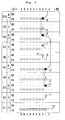
- a knitted fabric portion held on a front needle bed is subjected to a bind off process by a method for knitting a knitted fabric according to the present invention
- the number of knitting needles is less than the number actually used in the knitting to simplify the explanation.
- the knitting method of the present invention may also be applied to the bind off process of a tubular knitted fabric held in a tubular form on the front needle bed and the back needle bed.
- Fig. 1 indicates the process number
- the arrow in the left and right direction indicates the moving direction of the yarn feeder (V in the figure)
- "K” + arrow indicates the knitting direction
- the arrow in the up and down direction or diagonal direction indicates the direction of transfer.
- a to J in the figure indicate the knitting needles of the front needle bed (hereinafter referred to as FB) and the back needle bed (hereinafter referred to as BB).
- O in the figure indicates the stitch held on the needle bed
- ⁇ indicates the double stitch
- ⁇ indicates the stitch knitted in each knitting process, and the operation actually performed in each knitting process is shown with a thick line.
- the operation of racking is omitted in the transfer that involves racking.
- S1 of Fig. 1 shows a state in which the yarn feeder is moved in the right direction in the plane of drawing, and the stitches of the final course of the knitted fabric are knitted. From such a state, the stitches of the final course of the knitted fabric are subjected to the bind off process by the method for knitting the knitted fabric of the present invention.
- the bind off process is carried out toward the left direction starting from the end on the right direction in the plane of drawing, and hence the right direction in the plane of drawing is hereinafter referred to as starting end direction RS and the left direction is referred to as bind off direction LS.
- the bind off process at the BB is carried out with the left direction in the plane of drawing as the starting end direction RS after the bind off process at the FB is finished.
- the stitch (target stitch 1) at the termination of the final course held on the knitting needle I of the FB is transferred to the knitting needle I of the opposing BB.
- the yarn feeder is moved in the bind off direction LS, and a stitch (first stitch 2) following the stitch 1 held on the knitting needle I of the BB transferred in S2 is formed.
- the stitch 2 formed in S3 is a back stitch.
- the back stitch 2 formed in S3 is transferred to the knitting needle I of the FB, and in S5, a stitch (second stitch 3) is formed following the back stitch 2.
- the stitch 3 formed in S5 is a front stitch.
- the stitch column of two stages (stitch column of first stage comprises the back stitch 2, stitch column of second stage comprises the front stitch 3) following the wale direction of the stitch row held on the knitting needle in S1 is formed.
- the bind off process is carried out using the stitch column of two stages.
- a stitch (proximate stitch 4) held on the knitting needle H of the FB and adjoining the front stitch 3 formed in S5 is transferred to the knitting needle H of the opposing BB.
- the proximate stitch 4 is a stitch positioned at the end of the starting end direction RS of a plurality of stitches still held on the knitting needle at the stage S5 is terminated of a plurality of stitches held on the knitting needles in S1.
- the front stitch 3 formed in S5 is overlapped on the stitch 4 transferred to the knitting needle H of the BB (S7).
- the stitch 3 overlapped on the stitch 4 in S7 is arranged on the front side of the knitted fabric with respect to the stitch 4.
- the double stitch held on the knitting needle H of the BB formed in S7 is redefined as a new target stitch 1, and a first stitch 2 following the double stitch 1 is formed.
- the first stitch 2 is transferred to the knitting needle H of the opposing FB (S9), and a new second stitch 3 following the first stitch 2 held on the knitting needle H of the FB by being transferred in S9 is formed (S10).
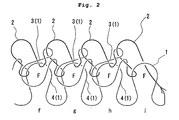
- Fig. 2 shows a loop diagram of the vicinity of a bind off portion in the knitted fabric knitted by applying the knitting method of the knitted fabric described above.
- the stitches shown using reference numerals in Fig. 2 correspond to the stitches shown using reference numerals in Fig. 1 .
- the bind off stitch in the bind off portion comprises two stitches of the first stitch 2 and the second stitch 3 continuing in the wale direction and thus has a large stretch margin in the knitting width direction of the knitted fabric.
- the bind off stitch comprising such stitches 2 and 3 in the actual knitted fabric finely fits between the target stitch 1 and the proximate stitch 4, and thus satisfactory appearance of the bind off portion is realized.
- a knitting method different from the first embodiment will be described with reference to Figs. 3 and 4 .
- the manner of looking at Figs. 3 and 4 is similar to Figs. 1 and 2 of the first embodiment.
- the stitch (target stitch 1) of the knitting needle I of the FB is transferred to the knitting needle I of the opposing BB (T2), and the back stitch (first stitch 2) following the transferred stitch 1 is formed (T3).
- the front stitch (second stitch 3) following the back stitch 2 formed in T3 is formed, but the yarn feeder is moved to the left and right before forming the front stitch 3 in the second embodiment so that the back stitch 2 is in a twisted state.
- the yarn feeder is once moved toward the starting end direction RS side than the back stitch 2 formed in T3 so that the knitting yarn extending from the yarn feeder traverses the front side of the back stitch 2 in the starting end direction RS (T4), and then the back stitch 2 is transferred to the knitting needle I of the opposing FB (T5).
- the yarn feeder is moved toward the bind off direction LS side than the back stitch 2 so that the knitting yarn extending from the yarn feeder traverses the back side of the back stitch 2 in the bind off direction LS (T6).
- the yarn feeder is then reversed and moved in the starting end direction RS, and the front stitch 3 following the back stitch 2 is formed in the meantime (T7).
- the yarn feeder is moved toward the bind off direction LS side than the knitting needle H so that the knitting yarn extending from the yarn feeder traverses the back side of the stitches 3 and 4 in the bind off direction LS.
- the stitch (proximate stitch 4) held on the knitting needle H of the FB is then transferred to the knitting needle H of the opposing BB (T9), and the front stitch 3 formed in T7 is overlapped on the stitch 4 to form a double stitch (T10).
- the double stitch of T10 is then redefined as the target stitch 1, the yarn feeder is moved toward the starting end direction RS side than the double stitch 1 held on the knitting needle H so that the knitting yarn traverses the front side of the double stitch 1 in the starting end direction RS (T11), and the yarn feeder is immediately reversed in the bind off direction LS to form the back stitch 2 following the double stitch 1 (T12).
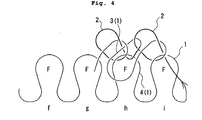
- Fig. 4 shows a loop diagram of the vicinity of the bind off portion in the knitted fabric knitted by applying the knitting method of the knitted fabric of the second embodiment described above.
- the first stitch 2 is pulled in the twisting direction by the knitting yarn connecting from the first stitch 2 to the second stitch 3, and hence the first stitch 2 is drawn toward the far side in the plane of drawing so as to resolve such a twisted state.
- the end of the knitted fabric gets drawn toward the far side in the plane of drawings, so that the line at the end becomes smooth and has satisfactory appearance.
- the embodiments of the present invention are not limited to the embodiments described above, and may be appropriately changed within a scope not deviating from the gist of the present invention.
- one part of the knitting process of the first embodiment may be interchanged and performed.
- the first stitch 2 is the back stitch and the second stitch 3 is the front stitch, but the knitting process may be appropriately interchanged such that the first stitch 2 is the front stitch and the second stitch 3 is the back stitch.
- S6, S7 of Fig. 1 the second stitch 3 is overlapped on the front side of the proximate stitch 4, but S7 may be carried out first and S6 may be carried out afterwards so that the second stitch 3 is overlapped on the back side of the proximate stitch 4.
- two stages of the stitch column having a width of two or more stitches in the knitting width direction may be arranged in the bind off process.
- at least one (may be all) of the stitches configuring the stitch column of the second stage may be overlapped on the proximate stitch as a bind off stitch.
- the stitch column of the first stage is configured by the back stitch (or front stitch)
- the stitch column of the second stage is configured by the front stitch (back stitch).
Landscapes
- Engineering & Computer Science (AREA)
- Textile Engineering (AREA)
- Knitting Of Fabric (AREA)
Applications Claiming Priority (2)
| Application Number | Priority Date | Filing Date | Title |
|---|---|---|---|
| JP2010166485 | 2010-07-23 | ||
| JP2011027733A JP5669607B2 (ja) | 2010-07-23 | 2011-02-10 | 編地の編成方法、および編地 |
Publications (2)
| Publication Number | Publication Date |
|---|---|
| EP2410085A1 true EP2410085A1 (fr) | 2012-01-25 |
| EP2410085B1 EP2410085B1 (fr) | 2014-02-26 |
Family
ID=44658526
Family Applications (1)
| Application Number | Title | Priority Date | Filing Date |
|---|---|---|---|
| EP20110006033 Active EP2410085B1 (fr) | 2010-07-23 | 2011-07-22 | Procédé de tricotage de tissu tricoté et tissu tricoté |
Country Status (3)
| Country | Link |
|---|---|
| EP (1) | EP2410085B1 (fr) |
| JP (1) | JP5669607B2 (fr) |
| CN (1) | CN102345197B (fr) |
Families Citing this family (4)
| Publication number | Priority date | Publication date | Assignee | Title |
|---|---|---|---|---|
| JP6274908B2 (ja) | 2014-02-27 | 2018-02-07 | 株式会社島精機製作所 | 編地の伏目方法 |
| JP6257565B2 (ja) | 2015-09-09 | 2018-01-10 | 株式会社島精機製作所 | 編糸の固定方法 |
| CN112760796B (zh) * | 2019-10-21 | 2022-05-13 | 智能针织软件(深圳)有限公司 | 一种两个双层片的套针拼合方法和装置 |
| JP7641849B2 (ja) | 2021-08-04 | 2025-03-07 | 株式会社島精機製作所 | 編地の編成方法、及び編地 |
Citations (3)
| Publication number | Priority date | Publication date | Assignee | Title |
|---|---|---|---|---|
| EP0468687A1 (fr) * | 1990-07-17 | 1992-01-29 | Shima Seiki Mfg., Ltd. | Procédé pour traiter l'extrémité d'une pièce tricotée |
| EP1306476A1 (fr) * | 2000-07-28 | 2003-05-02 | Shima Seiki Mfg., Ltd | Procede permettant de tricoter des bords-cotes, tricot a bords-cotes et dispositif cao pour tricotage de bords-cotes |
| EP1380677A1 (fr) * | 2001-03-26 | 2004-01-14 | Shima Seiki Mfg., Ltd | Tricot a bord superieur fini et procede de finition de bord |
Family Cites Families (8)
| Publication number | Priority date | Publication date | Assignee | Title |
|---|---|---|---|---|
| EP0449544B1 (fr) * | 1990-03-28 | 1995-05-24 | Shima Seiki Mfg., Ltd. | Procédé de tricotage de la jonction des bouts d'un tricot en forme de ceinture et article tricoté en forme de ceinture dont les bouts sont joints par tricotage |
| EP0781880B1 (fr) * | 1995-12-28 | 2001-12-05 | Shima Seiki Manufacturing, Ltd. | Procédé pour arrêter du tricot, tricot ainsi arrêté et dispositif CAD pour sa mise en oeuvre |
| JP3121278B2 (ja) * | 1997-01-20 | 2000-12-25 | 株式会社島精機製作所 | 編地終端部の編成方法及び該編地終端部の編成方法により編成された編地 |
| EP1211341B1 (fr) * | 1999-07-13 | 2010-04-14 | Shima Seiki Mfg., Ltd | Procede de couture d'ourlets avec une excellente aptitude a l'etirage |
| TW487754B (en) * | 1999-12-17 | 2002-05-21 | Shima Seiki Mfg | Welt seaming method and welt-seamed knitted fabric, and CAD device for welt seaming |
| JP3954324B2 (ja) * | 2001-05-24 | 2007-08-08 | 株式会社島精機製作所 | 伏目方法および伏目処理された編地 |
| JP4814078B2 (ja) * | 2006-12-29 | 2011-11-09 | 株式会社島精機製作所 | 編地の端部を伏せ目処理する方法および伏せ目処理された編地 |
| KR101356441B1 (ko) * | 2008-12-24 | 2014-02-03 | 가부시키가이샤 시마세이키 세이사쿠쇼 | 편사의 풀림방지 방법 및 편성포 |
-
2011
- 2011-02-10 JP JP2011027733A patent/JP5669607B2/ja active Active
- 2011-07-21 CN CN201110208529.9A patent/CN102345197B/zh active Active
- 2011-07-22 EP EP20110006033 patent/EP2410085B1/fr active Active
Patent Citations (3)
| Publication number | Priority date | Publication date | Assignee | Title |
|---|---|---|---|---|
| EP0468687A1 (fr) * | 1990-07-17 | 1992-01-29 | Shima Seiki Mfg., Ltd. | Procédé pour traiter l'extrémité d'une pièce tricotée |
| EP1306476A1 (fr) * | 2000-07-28 | 2003-05-02 | Shima Seiki Mfg., Ltd | Procede permettant de tricoter des bords-cotes, tricot a bords-cotes et dispositif cao pour tricotage de bords-cotes |
| EP1380677A1 (fr) * | 2001-03-26 | 2004-01-14 | Shima Seiki Mfg., Ltd | Tricot a bord superieur fini et procede de finition de bord |
Also Published As
| Publication number | Publication date |
|---|---|
| JP5669607B2 (ja) | 2015-02-12 |
| JP2012041668A (ja) | 2012-03-01 |
| CN102345197B (zh) | 2014-08-20 |
| EP2410085B1 (fr) | 2014-02-26 |
| CN102345197A (zh) | 2012-02-08 |
Similar Documents
| Publication | Publication Date | Title |
|---|---|---|
| EP2634299B1 (fr) | Procédé de tricotage d'une étoffe tricotée avec frange | |
| EP2530197A2 (fr) | Procédé pour tricoter une étoffe et étoffe tricotée | |
| EP2330240B1 (fr) | Procédé pour tricoter une étoffe et étoffe tricotée | |
| EP2465983B1 (fr) | Procédé de formation de tissu | |
| JP5736250B2 (ja) | 編地の編成方法、および編地 | |
| WO2007099709A1 (fr) | Procede de tricotage d'un tricot tubulaire et tricot tubulaire correspondant | |
| EP2366820B1 (fr) | Procédé pour tricoter un vêtement de tricot à col en V et tricot à col en V | |
| EP2410085B1 (fr) | Procédé de tricotage de tissu tricoté et tissu tricoté | |
| JP2015110849A (ja) | 編地の編成方法 | |
| US6789403B2 (en) | Method for knitting a cable pattern into a tubular knitted fabric | |
| EP1211341B1 (fr) | Procede de couture d'ourlets avec une excellente aptitude a l'etirage | |
| EP2581479B1 (fr) | Procédé de jonction pour étoffe tricotée et étoffe tricotée | |
| JP5452791B2 (ja) | 側端部を補強した編地の編成方法およびその編地 | |
| WO2007029695A1 (fr) | Procédé de tricotage de vêtement de tricot à col | |
| KR101844739B1 (ko) | 통모양 편성포의 편성방법 | |
| EP2392708A1 (fr) | Procédé de tricotage d'articles tricotés dont le col présente une pointe d'encolure en v, et tricot | |
| JP5695847B2 (ja) | 内増やし方法、および編地 | |
| JP2014114513A (ja) | 筒状編地の編成方法、および筒状編地 | |
| KR101735362B1 (ko) | 서포터 및 서포터의 편성방법 | |
| JPH10245751A (ja) | 伸縮性に優れた伏せ目処理方法 | |
| JP5274237B2 (ja) | ニットパンツの編成方法とニットパンツ | |
| EP2623651B1 (fr) | Article tricoté | |
| JPH06235148A (ja) | 身頃に両袖がついたセーターの製造方法 |
Legal Events
| Date | Code | Title | Description |
|---|---|---|---|
| AK | Designated contracting states |
Kind code of ref document: A1 Designated state(s): AL AT BE BG CH CY CZ DE DK EE ES FI FR GB GR HR HU IE IS IT LI LT LU LV MC MK MT NL NO PL PT RO RS SE SI SK SM TR |
|
| AX | Request for extension of the european patent |
Extension state: BA ME |
|
| PUAI | Public reference made under article 153(3) epc to a published international application that has entered the european phase |
Free format text: ORIGINAL CODE: 0009012 |
|
| 17P | Request for examination filed |
Effective date: 20120725 |
|
| RIC1 | Information provided on ipc code assigned before grant |
Ipc: D04B 1/22 20060101AFI20130426BHEP |
|
| GRAP | Despatch of communication of intention to grant a patent |
Free format text: ORIGINAL CODE: EPIDOSNIGR1 |
|
| INTG | Intention to grant announced |
Effective date: 20130909 |
|
| GRAS | Grant fee paid |
Free format text: ORIGINAL CODE: EPIDOSNIGR3 |
|
| GRAA | (expected) grant |
Free format text: ORIGINAL CODE: 0009210 |
|
| AK | Designated contracting states |
Kind code of ref document: B1 Designated state(s): AL AT BE BG CH CY CZ DE DK EE ES FI FR GB GR HR HU IE IS IT LI LT LU LV MC MK MT NL NO PL PT RO RS SE SI SK SM TR |
|
| REG | Reference to a national code |
Ref country code: GB Ref legal event code: FG4D |
|
| REG | Reference to a national code |
Ref country code: CH Ref legal event code: EP |
|
| REG | Reference to a national code |
Ref country code: AT Ref legal event code: REF Ref document number: 653676 Country of ref document: AT Kind code of ref document: T Effective date: 20140315 |
|
| REG | Reference to a national code |
Ref country code: IE Ref legal event code: FG4D |
|
| REG | Reference to a national code |
Ref country code: DE Ref legal event code: R096 Ref document number: 602011005007 Country of ref document: DE Effective date: 20140410 |
|
| REG | Reference to a national code |
Ref country code: NL Ref legal event code: VDEP Effective date: 20140226 |
|
| REG | Reference to a national code |
Ref country code: AT Ref legal event code: MK05 Ref document number: 653676 Country of ref document: AT Kind code of ref document: T Effective date: 20140226 |
|
| REG | Reference to a national code |
Ref country code: LT Ref legal event code: MG4D |
|
| PG25 | Lapsed in a contracting state [announced via postgrant information from national office to epo] |
Ref country code: IS Free format text: LAPSE BECAUSE OF FAILURE TO SUBMIT A TRANSLATION OF THE DESCRIPTION OR TO PAY THE FEE WITHIN THE PRESCRIBED TIME-LIMIT Effective date: 20140626 Ref country code: NO Free format text: LAPSE BECAUSE OF FAILURE TO SUBMIT A TRANSLATION OF THE DESCRIPTION OR TO PAY THE FEE WITHIN THE PRESCRIBED TIME-LIMIT Effective date: 20140526 Ref country code: LT Free format text: LAPSE BECAUSE OF FAILURE TO SUBMIT A TRANSLATION OF THE DESCRIPTION OR TO PAY THE FEE WITHIN THE PRESCRIBED TIME-LIMIT Effective date: 20140226 |
|
| PG25 | Lapsed in a contracting state [announced via postgrant information from national office to epo] |
Ref country code: NL Free format text: LAPSE BECAUSE OF FAILURE TO SUBMIT A TRANSLATION OF THE DESCRIPTION OR TO PAY THE FEE WITHIN THE PRESCRIBED TIME-LIMIT Effective date: 20140226 Ref country code: FI Free format text: LAPSE BECAUSE OF FAILURE TO SUBMIT A TRANSLATION OF THE DESCRIPTION OR TO PAY THE FEE WITHIN THE PRESCRIBED TIME-LIMIT Effective date: 20140226 Ref country code: PT Free format text: LAPSE BECAUSE OF FAILURE TO SUBMIT A TRANSLATION OF THE DESCRIPTION OR TO PAY THE FEE WITHIN THE PRESCRIBED TIME-LIMIT Effective date: 20140626 Ref country code: AT Free format text: LAPSE BECAUSE OF FAILURE TO SUBMIT A TRANSLATION OF THE DESCRIPTION OR TO PAY THE FEE WITHIN THE PRESCRIBED TIME-LIMIT Effective date: 20140226 Ref country code: SE Free format text: LAPSE BECAUSE OF FAILURE TO SUBMIT A TRANSLATION OF THE DESCRIPTION OR TO PAY THE FEE WITHIN THE PRESCRIBED TIME-LIMIT Effective date: 20140226 Ref country code: CY Free format text: LAPSE BECAUSE OF FAILURE TO SUBMIT A TRANSLATION OF THE DESCRIPTION OR TO PAY THE FEE WITHIN THE PRESCRIBED TIME-LIMIT Effective date: 20140226 |
|
| PG25 | Lapsed in a contracting state [announced via postgrant information from national office to epo] |
Ref country code: LV Free format text: LAPSE BECAUSE OF FAILURE TO SUBMIT A TRANSLATION OF THE DESCRIPTION OR TO PAY THE FEE WITHIN THE PRESCRIBED TIME-LIMIT Effective date: 20140226 Ref country code: BE Free format text: LAPSE BECAUSE OF FAILURE TO SUBMIT A TRANSLATION OF THE DESCRIPTION OR TO PAY THE FEE WITHIN THE PRESCRIBED TIME-LIMIT Effective date: 20140226 Ref country code: HR Free format text: LAPSE BECAUSE OF FAILURE TO SUBMIT A TRANSLATION OF THE DESCRIPTION OR TO PAY THE FEE WITHIN THE PRESCRIBED TIME-LIMIT Effective date: 20140226 |
|
| PG25 | Lapsed in a contracting state [announced via postgrant information from national office to epo] |
Ref country code: EE Free format text: LAPSE BECAUSE OF FAILURE TO SUBMIT A TRANSLATION OF THE DESCRIPTION OR TO PAY THE FEE WITHIN THE PRESCRIBED TIME-LIMIT Effective date: 20140226 Ref country code: RO Free format text: LAPSE BECAUSE OF FAILURE TO SUBMIT A TRANSLATION OF THE DESCRIPTION OR TO PAY THE FEE WITHIN THE PRESCRIBED TIME-LIMIT Effective date: 20140226 Ref country code: DK Free format text: LAPSE BECAUSE OF FAILURE TO SUBMIT A TRANSLATION OF THE DESCRIPTION OR TO PAY THE FEE WITHIN THE PRESCRIBED TIME-LIMIT Effective date: 20140226 Ref country code: CZ Free format text: LAPSE BECAUSE OF FAILURE TO SUBMIT A TRANSLATION OF THE DESCRIPTION OR TO PAY THE FEE WITHIN THE PRESCRIBED TIME-LIMIT Effective date: 20140226 |
|
| REG | Reference to a national code |
Ref country code: DE Ref legal event code: R097 Ref document number: 602011005007 Country of ref document: DE |
|
| PG25 | Lapsed in a contracting state [announced via postgrant information from national office to epo] |
Ref country code: SK Free format text: LAPSE BECAUSE OF FAILURE TO SUBMIT A TRANSLATION OF THE DESCRIPTION OR TO PAY THE FEE WITHIN THE PRESCRIBED TIME-LIMIT Effective date: 20140226 Ref country code: PL Free format text: LAPSE BECAUSE OF FAILURE TO SUBMIT A TRANSLATION OF THE DESCRIPTION OR TO PAY THE FEE WITHIN THE PRESCRIBED TIME-LIMIT Effective date: 20140226 Ref country code: ES Free format text: LAPSE BECAUSE OF FAILURE TO SUBMIT A TRANSLATION OF THE DESCRIPTION OR TO PAY THE FEE WITHIN THE PRESCRIBED TIME-LIMIT Effective date: 20140226 |
|
| PLBE | No opposition filed within time limit |
Free format text: ORIGINAL CODE: 0009261 |
|
| STAA | Information on the status of an ep patent application or granted ep patent |
Free format text: STATUS: NO OPPOSITION FILED WITHIN TIME LIMIT |
|
| 26N | No opposition filed |
Effective date: 20141127 |
|
| PG25 | Lapsed in a contracting state [announced via postgrant information from national office to epo] |
Ref country code: LU Free format text: LAPSE BECAUSE OF FAILURE TO SUBMIT A TRANSLATION OF THE DESCRIPTION OR TO PAY THE FEE WITHIN THE PRESCRIBED TIME-LIMIT Effective date: 20140722 |
|
| REG | Reference to a national code |
Ref country code: CH Ref legal event code: PL |
|
| REG | Reference to a national code |
Ref country code: DE Ref legal event code: R097 Ref document number: 602011005007 Country of ref document: DE Effective date: 20141127 |
|
| REG | Reference to a national code |
Ref country code: IE Ref legal event code: MM4A |
|
| REG | Reference to a national code |
Ref country code: FR Ref legal event code: ST Effective date: 20150331 |
|
| PG25 | Lapsed in a contracting state [announced via postgrant information from national office to epo] |
Ref country code: LI Free format text: LAPSE BECAUSE OF NON-PAYMENT OF DUE FEES Effective date: 20140731 Ref country code: CH Free format text: LAPSE BECAUSE OF NON-PAYMENT OF DUE FEES Effective date: 20140731 |
|
| PG25 | Lapsed in a contracting state [announced via postgrant information from national office to epo] |
Ref country code: FR Free format text: LAPSE BECAUSE OF NON-PAYMENT OF DUE FEES Effective date: 20140731 Ref country code: SI Free format text: LAPSE BECAUSE OF FAILURE TO SUBMIT A TRANSLATION OF THE DESCRIPTION OR TO PAY THE FEE WITHIN THE PRESCRIBED TIME-LIMIT Effective date: 20140226 |
|
| PG25 | Lapsed in a contracting state [announced via postgrant information from national office to epo] |
Ref country code: IE Free format text: LAPSE BECAUSE OF NON-PAYMENT OF DUE FEES Effective date: 20140722 |
|
| GBPC | Gb: european patent ceased through non-payment of renewal fee |
Effective date: 20150722 |
|
| PG25 | Lapsed in a contracting state [announced via postgrant information from national office to epo] |
Ref country code: MC Free format text: LAPSE BECAUSE OF FAILURE TO SUBMIT A TRANSLATION OF THE DESCRIPTION OR TO PAY THE FEE WITHIN THE PRESCRIBED TIME-LIMIT Effective date: 20140226 Ref country code: GB Free format text: LAPSE BECAUSE OF NON-PAYMENT OF DUE FEES Effective date: 20150722 Ref country code: SM Free format text: LAPSE BECAUSE OF FAILURE TO SUBMIT A TRANSLATION OF THE DESCRIPTION OR TO PAY THE FEE WITHIN THE PRESCRIBED TIME-LIMIT Effective date: 20140226 |
|
| PG25 | Lapsed in a contracting state [announced via postgrant information from national office to epo] |
Ref country code: BG Free format text: LAPSE BECAUSE OF FAILURE TO SUBMIT A TRANSLATION OF THE DESCRIPTION OR TO PAY THE FEE WITHIN THE PRESCRIBED TIME-LIMIT Effective date: 20140226 Ref country code: GR Free format text: LAPSE BECAUSE OF FAILURE TO SUBMIT A TRANSLATION OF THE DESCRIPTION OR TO PAY THE FEE WITHIN THE PRESCRIBED TIME-LIMIT Effective date: 20140527 Ref country code: RS Free format text: LAPSE BECAUSE OF NON-PAYMENT OF DUE FEES Effective date: 20140226 Ref country code: MT Free format text: LAPSE BECAUSE OF FAILURE TO SUBMIT A TRANSLATION OF THE DESCRIPTION OR TO PAY THE FEE WITHIN THE PRESCRIBED TIME-LIMIT Effective date: 20140226 |
|
| PG25 | Lapsed in a contracting state [announced via postgrant information from national office to epo] |
Ref country code: TR Free format text: LAPSE BECAUSE OF FAILURE TO SUBMIT A TRANSLATION OF THE DESCRIPTION OR TO PAY THE FEE WITHIN THE PRESCRIBED TIME-LIMIT Effective date: 20140226 Ref country code: HU Free format text: LAPSE BECAUSE OF FAILURE TO SUBMIT A TRANSLATION OF THE DESCRIPTION OR TO PAY THE FEE WITHIN THE PRESCRIBED TIME-LIMIT; INVALID AB INITIO Effective date: 20110722 |
|
| PG25 | Lapsed in a contracting state [announced via postgrant information from national office to epo] |
Ref country code: MK Free format text: LAPSE BECAUSE OF FAILURE TO SUBMIT A TRANSLATION OF THE DESCRIPTION OR TO PAY THE FEE WITHIN THE PRESCRIBED TIME-LIMIT Effective date: 20140226 |
|
| PG25 | Lapsed in a contracting state [announced via postgrant information from national office to epo] |
Ref country code: AL Free format text: LAPSE BECAUSE OF FAILURE TO SUBMIT A TRANSLATION OF THE DESCRIPTION OR TO PAY THE FEE WITHIN THE PRESCRIBED TIME-LIMIT Effective date: 20140226 |
|
| PGFP | Annual fee paid to national office [announced via postgrant information from national office to epo] |
Ref country code: DE Payment date: 20250604 Year of fee payment: 15 |
|
| PGFP | Annual fee paid to national office [announced via postgrant information from national office to epo] |
Ref country code: IT Payment date: 20250623 Year of fee payment: 15 |