EP2411108B1 - Procédé et appareil de répartition de signaux de mouvement dans un environnement à plusieurs sièges - Google Patents
Procédé et appareil de répartition de signaux de mouvement dans un environnement à plusieurs sièges Download PDFInfo
- Publication number
- EP2411108B1 EP2411108B1 EP10755372.9A EP10755372A EP2411108B1 EP 2411108 B1 EP2411108 B1 EP 2411108B1 EP 10755372 A EP10755372 A EP 10755372A EP 2411108 B1 EP2411108 B1 EP 2411108B1
- Authority
- EP
- European Patent Office
- Prior art keywords
- motion
- array
- signal
- platforms
- network address
- Prior art date
- Legal status (The legal status is an assumption and is not a legal conclusion. Google has not performed a legal analysis and makes no representation as to the accuracy of the status listed.)
- Active
Links
Images



Classifications
-
- G—PHYSICS
- G05—CONTROLLING; REGULATING
- G05D—SYSTEMS FOR CONTROLLING OR REGULATING NON-ELECTRIC VARIABLES
- G05D3/00—Control of position or direction
-
- A—HUMAN NECESSITIES
- A63—SPORTS; GAMES; AMUSEMENTS
- A63J—DEVICES FOR THEATRES, CIRCUSES, OR THE LIKE; CONJURING APPLIANCES OR THE LIKE
- A63J99/00—Subject matter not provided for in other groups of this subclass
-
- A—HUMAN NECESSITIES
- A63—SPORTS; GAMES; AMUSEMENTS
- A63J—DEVICES FOR THEATRES, CIRCUSES, OR THE LIKE; CONJURING APPLIANCES OR THE LIKE
- A63J25/00—Equipment specially adapted for cinemas
-
- G—PHYSICS
- G05—CONTROLLING; REGULATING
- G05B—CONTROL OR REGULATING SYSTEMS IN GENERAL; FUNCTIONAL ELEMENTS OF SUCH SYSTEMS; MONITORING OR TESTING ARRANGEMENTS FOR SUCH SYSTEMS OR ELEMENTS
- G05B15/00—Systems controlled by a computer
- G05B15/02—Systems controlled by a computer electric
-
- H—ELECTRICITY
- H04—ELECTRIC COMMUNICATION TECHNIQUE
- H04L—TRANSMISSION OF DIGITAL INFORMATION, e.g. TELEGRAPHIC COMMUNICATION
- H04L61/00—Network arrangements, protocols or services for addressing or naming
- H04L61/50—Address allocation
- H04L61/5007—Internet protocol [IP] addresses
-
- H—ELECTRICITY
- H04—ELECTRIC COMMUNICATION TECHNIQUE
- H04L—TRANSMISSION OF DIGITAL INFORMATION, e.g. TELEGRAPHIC COMMUNICATION
- H04L9/00—Cryptographic mechanisms or cryptographic arrangements for secret or secure communications; Network security protocols
- H04L9/40—Network security protocols
-
- A—HUMAN NECESSITIES
- A63—SPORTS; GAMES; AMUSEMENTS
- A63J—DEVICES FOR THEATRES, CIRCUSES, OR THE LIKE; CONJURING APPLIANCES OR THE LIKE
- A63J5/00—Auxiliaries for producing special effects on stages, or in circuses or arenas
- A63J2005/001—Auxiliaries for producing special effects on stages, or in circuses or arenas enhancing the performance by involving senses complementary to sight or hearing
- A63J2005/002—Auxiliaries for producing special effects on stages, or in circuses or arenas enhancing the performance by involving senses complementary to sight or hearing moving the spectator's body
Definitions
- This description relates to the field of entertainment motion devices. More precisely, the description pertains to the control of motion platforms such that they are synchronized with a sequence of images.
- a motion decoding unit synchronizes a previously recorded motion stream with the video program by recognizing an audio sample and matching it with its associated recorded motion sample. The synchronized motion stream is then provided to a motion platform.
- Document US 2008/0002390 provides a system to provide a sequence of motion samples to a plurality of motion platforms, such as the plurality of seats in a movie theatre, such that the motion is synchronized with a sequence of images, such as a movie.
- synchronization of a motion data signal with the sequence of images is centralized at a unique synchronizing unit.
- the synchronized sequence of motion samples is distributed to a plurality of motion platform hubs, each controlling and managing a reduced number of motion platforms.
- a motion decoding unit may control a plurality of motion platforms. Each motion platform needs to be provided with a motion data stream and monitored for fault management and maintenance. When the number of platforms to be controlled increases, the complexity of the motion decoding unit increases accordingly.
- a system for providing, to a plurality of motion platforms, motion signals indicative of a motion to be performed by the motion platforms synchronously with video images comprising: an input interface for receiving an input signal according to a control protocol and for extracting said motion signal from said input signal; at least one server for providing a network address to each motion platform of the plurality and for individually monitoring each motion platform of the plurality according to the network address of each motion platform; at least one motion platform interface comprising at least one control port, the at least one control port connected to at least one array of motion platforms from the plurality connected thereto, each motion platform of said at least one array being connected one to another by a wired connection according to said control protocol, said at least one motion platform interface for individually actuating each of said motion platforms of the at least one array by providing a client motion signal to each motion platform of said at least one array, the client motion signal comprising the motion signal extracted from the input signal according to said control protocol with a respective network address,
- the server comprises a network address provider for providing the network address to the motion platform interface for each motion platform of the at least one array to be actuated, and a command unit for sending commands to the motion platform interface for each motion platforms of the at least one array to be actuated.
- said motion signal comprises a stream of motion samples having a sampling rate and wherein said input signal is formatted such that said stream of motion samples is synchronously provided with said sampling rate.
- a delay generator is provided for generating a given time delay in said client motion signal according to a position of said motion platforms relative to sound speakers.
- each motion platform of said at least one array comprises at least one seat of a plurality of seats in a movie theatre.
- a method for distributing motion signals synchronized with a sequence of images to a plurality of motion platforms comprising: providing a network address for each motion platform of at least one array, said at least one array being connected to a control port of a distribution network hub according to a control protocol; receiving an input signal according to said control protocol; extracting said motion signal from said input signal; generating, from the extracted motion signal, client motion signal comprising the extracted motion signal according to said control protocol and the provided network address, said client motion signals to be provided individually to each motion platforms of said at least one array as a function of the network address; and receiving, from at least one of the motion platforms of said at least one array, a feedback signal with the network address according to said control protocol.
- each motion platform of said at least one array is managed according to the respective feedback signal and to said network address of each motion platform of said at least one array according to said control protocol.
- commands are sent to each motion platforms of the plurality of said at least one array according to said control protocol.
- a time delay is generated in said client motion signals according to a position of said motion platforms of said at least one array relative to sound speakers.
- a system for receiving an input signal according to a control protocol and providing motion to a plurality of seats as a function of the input signal comprising: a distribution network hub for providing a motion signal synchronized with a sequence of images and indicative of the motion, said hub comprising an input interface for receiving the input signal according to said control protocol and for extracting said motion signal from said input signal, and at least one motion platform interface comprising at least one control port, the at least one control port for actuating each of said seats of the plurality according to said motion signal according to said control protocol; and at least one array of motion platforms each adapted to support at least one seat of the plurality, said at least one array being connected to a respective one of the at least one control port, each motion platform of said at least one array being connected one to another by a wired connection according to a control protocol to provide the motion to said seats with said motion signal.
- a network address provider for associating a network address to each seat of the plurality, with each of the motion platforms being actuated individually with a client motion signal comprising the motion signal with the network address; and a command unit for sending commands to each motion platforms of the at least on array.
- the motion platform comprises a motion adaptor for receiving commands from the command unit and for sending a feedback signal to the command unit.
- the at least one motion platform interface independently actuates each of said seats of said at least one array according to the client motion signal.
- each seat of said at least one array is to be managed according to a respective feedback signal comprising the respective network address to be received from respective ones of said seats of said at least one array according to said control protocol.
- the wired connection between the motion platforms in the at least one array forms a loop with respect to the control port to which the array is connected.
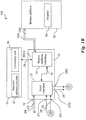
- a system 100 for providing motion signals and commands to a plurality of motion platforms comprises a motion platform hub 10 according to the embodiment illustrated in Fig. 1A .
- the hub 10 is adapted to distribute motion signals, synchronized with a sequence of images, to motion platforms based on the commands received from a server 25 through connection 24 (i.e., physical or logical connection).
- the motion signals may be a sequence of motion samples synchronized with a sequence of images, motion commands or intentions to drive downstream motion platforms in performing preprogrammed movements, etc. It is therefore understood that a similar hub could be used for distributing a sequence of actuation samples of any appropriate type to any other type of actuation devices, including but not limited to motion platform devices.
- the server 25 sends commands to motion platforms through the hub 10.
- the server 25 is a personal computer (PC), a web server or the like, in physical connection with other components of the system.
- the server 25 can be combined with the hub 10 as a single network entity in a logical connection.
- the server 25 may be combined or connected to another server such as a sales management server, a ticket server, a web server or the like.
- the server 25 comprises a network address provider 32 for providing a network address for each motion platform 16.
- the network address provider 32 can be any kind of processor, central processing unit (CPU) or the like adapted to provide a network address, and to associate the provided address with each of the motion platform 16 in a look-up table (not shown).
- the network address provider 32 can be adapted to provide and associate a network address for each motion platform 16 connected to different hubs.
- the network address can also be provided in order to follow distribution of seats, for example, in a movie theatre.
- the network address provider 32 can store the association of the network address of each motion platform 16 in order to define a network topology of the motion platforms 16.
- the network address can be any IP address, logical address, physical address or the like.
- the network address defines a logical point-to-point association for each motion platform.
- the motion platform 16 is provided by D-Box Technologies Inc.
- the motion platform 16 comprises four mechanical actuators, each being positioned on one of the four corners of a seat where a user sits while watching a movie or video images, for example. As the movie goes on, the seat is provided with motions such as pitch, roll and vibrations, which enhances the movie experience of the user.
- the motion platform may also consist of only three mechanical actuators, two in the back corners of the seat and one in the middle front of the seat. Other embodiments with a two-actuator or one-actuator configuration are also useful.
- a plurality of seats may be supported by a single motion platform 16.
- the motion platform 16 comprises an adaptor 56 for managing fault error.
- the adaptor 56 may deactivate the motion platform 16.
- the adaptor 56 may also drive the actuators of the motion platforms 16 in accordance with motion commands received through the client motion signal 20. More specifically, the adaptor 56 may be programmed with motions to be performed upon reception of motion commands.
- a motion platform interface 14 receives the extracted motion signal 18 from the input interface 12, and generates a client motion signal 20A-20D for each motion platform 16 to be actuated.
- the client motion signal 20A-20D may also comprise the respective network address as provided by the server 25, as well as commands from the server 25.
- the motion platform interface 14 is to be connected to four motion platforms 16 or arrays of platforms using the four downstream control ports 21A, 21B, 21C and 21D. The skilled addressee would understand that the motion platform interface 14 may be connected to more than the four motion platforms 16 of Figs. 1A and 1B .
- each downstream control port 21A, 21B, 21C and 21D may be a bidirectional link through which the server 25 controls and manages individually each motion platform 16 and respectively includes an output client motion signal 20A, 20B, 20C and 20D and an input feedback signal 22A, 22B, 22C and 22D.
- the client motion signals 20A, 20B, 20C and 20D may synchronously provide the motion signals indicative of a motion to be performed to each motion platform 16 along with the network address and/or the control data.
- each motion platform 16 returns a feedback signal 22A, 22B, 22C or 22D to the motion platform interface 14.
- the feedback signals 22A, 22B, 22C and 22D provided by each motion platforms 16, are directed to the server 25 through connection 24 and may comprise the network address identifying each motion platform sending a feedback signal 22A, 22B, 22C or 22D to the hub 10 and ultimately to the client server 25.
- the motion platforms 16 are connected one to another with a wired connection, to form an array 58, and the feedback signal is conveyed to the server 25 from each motion platform 16 of the array 58.
- the feedback signal 22 constitutes the feedback of any motion platform 16 of a given array 58, and is relayed with the network address of each motion platform 16 to the control port 21, which connects the array 58 of motion platforms 16 to the hub 10.
- the array 58 may form a loop with respect to the control port to which the array 58 is connected. The feedback 22 from the connected motion platforms 16 will be returned to the server 25 in any direction of the loop.
- the network address of each motion platform 16 is used by command unit 34 ( Fig. 1B ) of the server 25 for management or maintenance purposes by, for example, monitoring specific operating parameters of the motion platform 16 such as the temperature of the actuators being used, the weight, or fault information data. By detecting the weight on a motion platform 16, the presence of a user may be confirmed;
- the command unit 34 provides commands to control each motion platform 16, for instance to turn the actuation of a platform 16 to an "on" state if a seat is attributed to a user in a movie theatre.
- the server 25 manages the motion platforms - 16 connected to the hub 10, including start-up, standby and fault management.
- the network address of a given motion platform 16 allows the server 25 to selectively activate or deactivate a given motion platform 16 in an array 58.
- motion platforms 16 in the array 58 can be managed by the server 25 without using a network address and without feedback, and thus without the server 25.
- the wired connection between the motion platforms 16 in the array 58 may form a loop or a serial link with respect to the control port to which the array 58 is connected.
- the server 25 repeatedly seeks feedback from each motion platform 16. For example, if communication is lost with one actuator of a motion platform 16 of an array 58 or if a failure of one platform 16 is detected during the motion playback, the adaptor 56 detects the error. Based on the type of error, the adaptor 56 may park or freeze the motion platform 16. In another embodiment, the communication between the motion platform 16 and the server 25 is maintained. The server 25 may reactivate the faulty motion platform using commands sent from the command unit 34. Under given circumstances (when failure is due to high temperature of an actuator for example), the server 25 may resume the motion control of a platform 16 that has failed after a given period of time.
- the server 25 uses the network address to identify the appropriate faulty motion platform 16 in the array 58. Accordingly, the remaining non-faulty motion platform would operate as in a normal operation, since the faulty motion platform 16 may still relay the feedback signal from connected non-faulty motion platform 16 in a same array 58.
- the server 25 monitors dynamically the hub 10 to gather real-time data such as, for example, the vital signs of the actuators.
- the motion platforms 16 can be muted, the state of the upstream signal can be monitored, radio parameters can be monitored in the case of a wireless connection, or the hub 10 can be reconfigured (transmitter vs. receiver configuration for example, as will be described herein below).
- the feedback signal 22 comprises actuator state, actuator vital signs data, and the network address of the motion platforms. This is used to provide diagnostics information to properly manage actuator faults.
- the server 25 directly manages an array 58 of platforms 16 connected to one of its downstream control port 21A, 21B, 21C and 21D, this diagnostics data is gathered by the server 25.
- the diagnostics data of motion platforms 16 connected downstream of the hub 10 is not forwarded back upstream. If access to this data is required, the server 25 of the specific hub 10 to which the given motion platform 16 is connected reads the diagnotics data.
- the :hub 10 can also receive a motion signal according to the control protocol used for controlling motion platforms 16 from another hub upstream or directly from a synchronizing unit, as will be discussed herein below.
- the upstream control port 19 allows one or more hubs 10 to be connected downstream of another hub using one or more of its downstream control ports 21A, 21B, 21C and 21D.
- the upstream synchronizing unit or hub broadcasts motion data according to the active state of the control protocol of the motion platform 16.
- the motion platform interface 14 activates an appropriate downstream port 21A, 21B, 21C or 21D to which the array 58 of the motion platform 16 is connected and sends out the motion data via the appropriate client motion signal 20A, 20B, 20C and 20D, as a function of commands from the server 25.
- the upstream synchronizing unit or hub broadcasts an input signal 201 according to the standby state of the control protocol.
- This state and the network address of motion platforms are used to minimize the power consumption of the motion platforms and to avoid unnecessary stressing of the system when no motion is to be played.
- the server 25 sees that input signal 201 received from upstream is severed or in the standby state it places the appropriate platform 16 in the standby state accordingly.
- the hub 10 also comprises an input interface 12 which receives the input signal 201 according to the control protocol.
- the input interface 12 extracts the motion signal (e.g., sequence of motion samples) included in the received input signal 201 to subsequently provide the motion signal to the motion platform interface 14 through a motion data signal 18.
- the motion data signal 18 consists of the motion signal, for instance including a synchronized sequence of motion samples to be provided to the motion platforms 16 by the motion platform interface 14 and according to the network address of the motion platform 16, if applicable.
- the hub 10 also comprise a wired data input/output port 30I/O to receive command data from the server 25 and to transmit feedback data 22 from the motion platforms 16 to the server 25, a wired data input port 271 and a wireless data input port 291 to receive raw or encoded sequence of motion samples.
- the hub 10 may also comprise a wired data output port 27O and a wireless data output port 29O to output the received sequence of motion samples.
- the wired data input/output port 30I/O is a USB, Ethernet Internet protocol (IP) or the like.
- the wired data input port 271 is an S/PDIF (IEC-958 type II) input port.
- This input may be used alternatively to the upstream control port 19 for receiving the motion signal embedded in a digital audio signal, or any other signal.
- the motion signal is extracted from the wired data input signal 26 by the input interface 12 to provide the motion data signal 18.
- the hub 10 may comprise a transceiver (not shown) which may be configured to be used as a wireless data receiver 291 to receive a wireless data signal 28 comprising the motion signal, or as a transmitter as will be discussed herein below. Only one of the three inputs 19, 271 and 291 should be active at a time. The input interface 12 simply selects the active input port or selects the proper input port based on priority if more then one input port is active.
- the highest priority input is the upstream control port 19 and the second highest priority input is the wired data input port 271, the wireless data receiver 291 being selected only if no wired source is present.
- the selection is dynamic and can change whenever a new input becomes available or an existing input is turned off.
- the wireless data receiver 291 only exists on receiver configured hub 10.
- the extracted motion signal is forwarded to the motion platform interface 14 via the motion data signal 18 and may also be outputted at the wired data output port 27O, as well as transmitted by the wireless data transmitter 29O if the transceiver is configured as a transmitter.
- This allows the configuration of multiple network topologies as will be shown in reference to Figs. 2 to 4 .
- the wireless data signal 28 is unidirectional and may include motion data with added redundancy for increased reliability, as well as an indication of the state of activity of the wireless signal (active or standby).
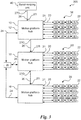
- a system 200 for distributing to a plurality of motion platforms a motion signals that is synchronized with a sequence of images uses hubs 10 as described in reference to Figs. 1A and 1B .
- the system 200 is a distribution network arranged in a tiered-star configuration and comprises a plurality of hubs 10 each receiving a motion signal 20 and forwarding client motion signals to arrays 58 of downstream motion platforms 16 or other hubs 10 using its downstream control port 21.
- the system 200 comprises a synchronizing unit 40, hubs 10, and servers 25 for controlling a plurality of arrays 58 of motion platforms 16 according to the network address of the motion platforms 16.
- the synchronizing unit 40 provides an input signal 201 that is synchronized with the sequence of images. For instance, the synchronizing can be done by matching recorded motion samples with the audio track associated with the sequence of images.
- the audio track is inputted to the synchronizing unit 40 which recognizes an audio sample and synchronously matches it with the corresponding motion sample in a lookup table.
- the motion samples and their associated audio samples may be provided, for example, as a look-up table recorded on a DVD or any other storing device.
- An audio sequence comprising audio samples and being synchronized with the sequence of images is provided as the movie is being played.
- the audio samples of the audio sequence are matched with their associated motion samples to provide a sequence of motion samples. For example, the match may be made using the look-up table.
- the synchronized input signal 201 is provided to a first hub 10' and then to all other hubs 10 connected in a tiered-star topology using the downstream control ports 21 of the hubs 10.
- Each hub 10 synchronously forwards a client motion signal comprising the motion signal and individual network addresses to its downstream control ports 21 to which motion platform(s) 16 are connected. If another hub 10 is connected to a control port 21, the upstream hub 10 may forward the synchronized input signal 201, or extracted motion signal.
- Each hub 10 generates client motion signals 20 comprising the motion signal with the network address for the motion platform 16 of each array 58. As mentioned above, the motion signal 20 may not include the network address of each motion platforms 16 to be actuated if it is forwarded to other hubs 10.
- the commands are used to manage individually each downstream motion platforms 16 of the arrays 58 or hubs 10 according to respective feedback signals 22 received from each unit 16 or 10 according to the control protocol.
- each hub 10 may comprise arrays of motion platforms 16 and thus provides a feedback signal 22 to its upstream hub 10, the upstream hub 10 uses the network address of each motion platform 16 to provide it with a motion signal 20 accordingly.
- the management of a given array 58 of motion platforms 16 is handled by a corresponding motion platform hub 10 to which a sub-group of motion platforms 16 including the given platform is connected.
- the management of the motion platforms 16 being made by the network address of each motion platforms, the operation of the plurality of motion platforms 16 is independent of the operation of the motion platforms 16 connected to another hub 10 or array 58, which is advantageous for maintaining the synchronization, especially in the case of a malfunction of a given motion platform 16.
- the synchronization aspect is centrally handled by the synchronizing unit 40 and the synchronous providing of the motion signal 20 to the motion platforms 16 is provided by the hubs 10.
- FIG. 3 there is shown another embodiment of a system 300 for providing motion signals 20 that are synchronized with a sequence of images to a plurality of motion platforms 16 of an array 58.
- the system 300 also uses hubs 10 as described in reference to Fig. 1 but its distribution network is arranged in a substantially daisy-chain configuration using the wired data output ports 27O.
- System 300 and system 200 comprising similar devices, like reference numerals are used to refer to like devices having like functionalities. Accordingly, the like devices will not be repeatedly described.
- the system 300 comprises a synchronizing unit 40 and cascaded motion platform interface hubs 10, each for controlling and managing a sub-group of motion platforms 16.
- a first hub 10' is connected to the synchronizing unit 40 via its wired data input port 271.
- the first hub 10' thus receives the input signal and forwards it to the next cascaded hub 10 via its wired data output port 27O.
- Each subsequent cascaded hub 10 receives a wired data signal 26 at its wired data input port 271 and forwards it to the next hub 10 using its wired data output port 27O.
- all the downstream control ports 21 of every cascaded hub 10 are available for controlling and managing motion platforms 16.
- the motion signal is extracted in each cascaded hub 10, with a common or multiple servers 25 providing network addresses and commands to generate client motion signals individually addressed to motion platforms 16.
- the hubs 10 may be located in a single control room or may be distributed in the auditorium.
- each seat may be motion controlled using one motion platform 16 comprising four actuators (one on each leg of the seat) and each hub 10 may manage one row or one column of seats.
- each hub 10 has at least as much downstream control ports 21 as the number of seats per row in the theatre, unless the motion platforms 16 are arranged in an array 58.
- FIG. 4 there is shown still another embodiment of a system 400 for providing motion signals that are synchronized with a sequence of images to a plurality of motion platforms.
- the system 400 also uses hubs 10 and server 25 as described in reference to Figs. 1A and 1B but uses wireless communication to distribute the sequence of motion samples to a plurality of motion platforms 16.
- Each hub 10 is thus configured either as a transmitter hub 10T or a receiver hub 10R.
- Systems 200, 300 and 400 comprising similar devices, like reference numerals are used to refer to like devices having like functionalities. Accordingly, the like devices will not be repeatedly described.
- the system 400 comprises a synchronizing unit 40 and networked motion platform interface hubs 10, each for controlling and managing a sub-group of arrays 58 of motion platforms 16.
- a first hub 10T is configured to be used as a transmitter and, in the illustrated embodiment, it is connected to the synchronizing unit 40 via the downstream control port 21 of the synchronizing unit 40.
- the transmitter hub 10T thus receives the sequence of motion samples and wirelessly broadcasts it to a plurality of receiver hubs 10R using the wireless data receivers 291 and transmitter 29O.
- all the downstream control ports 21 of every receiver hub 10R are available for controlling and managing motion platforms 16.
- the synchronizing unit 40 provides the input signal 201 to only one hub 10' (which forwards the motion signal to other hubs 10), the synchronizing unit 40 is adapted to provide an input signal 201 to a plurality of hubs 10 or motion platforms 16.
- the synchronizing unit 40 may be part of the server 25, or the synchronizing tasks may be performed by the server 25.
- the system 200, 300 or 400 it is possible to control a plurality of motion platforms 16 or hubs 10 using a single server 25 and a single synchronizing unit 40.
- An exemplary setting for the presently described embodiments is a movie theatre in which a plurality of motion platforms are required, each motion platform hub handling given arrays of motion platforms.
- the system uses a single server 25 connected to one of the hubs 10, with the connected hub 10 forwarding the network address to other hubs via the motion platform interfaces 14.
- the motion platforms 16 are only active when the motion signal 20 provided by the synchronizing unit 40 is in the active state.
- the standby state is forwarded to the motion platforms 16 and the motion platforms 16 are consequently lowered to their standby mode.
- the downstream control ports 21 are only in the active state when the input signal 201 is actually generated by the synchronizing unit 40 and received at the wired data signal input port 271.
- the downstream control ports 21 are placed in the standby state and the motion platforms 16 are consequently lowered to their standby mode.
- the standby mode can also be based on logical rules such as point-to-point protocol over Ethernet (PPoE), a variant of PPoE or any point-to-point protocol (PPP).
- the communication with the server 25 will be maintained.
- the adaptor 56 of the faulty motion platform 16 detects the type of error and based on the type of error, the motion platform 16 may be stopped.
- the server 25 may reactivate the motion platform 16.
- a user interface may be provided at the seat, in communication with the adaptor 56, for the user of the seat to control a level of actuation of the motion platform 16.
- each of the hubs 10 may be calibrated to delay a motion playback by an adjustable amount of time.
- the skilled addressee will appreciate that it takes approximately 3ms for sound to travel 1m or air space. Therefore, distances of 10m or more, which are typical distances between a speaker and a listener, introduce delays of about 30ms. While this is not critical when considering only audio and video as a listener can tolerate a large amount of de-synchronization between audio and video, the synchronization must be more accurate between audio and motion.
- Each hub 10 or the server 25 may therefore include a delay generator to introduce a motion delay depending on a physical position of an element with respect to a main speaker. In one embodiment, a given motion delay is programmed in each motion platform interface 14.
- a given motion delay can be programmed in each motion platform 16.
- the server 25 can be adjusted for a specific pass-through delay but if the signal received by a motion platform 16 passes through several hubs 10 on its way, the total delay is the sum of the delays encountered at hub in the chain. Accordingly, to facilitate the management of pass-through delays, it is possible to adjust in servers 25 the delays of mid-level hubs 10 to a minimum delay and only introduce a motion delay at the server directly managing motion platforms 16. Also in order to minimize the total delay, it is best to limit the number of hubs 10 that the signal must go through to a minimum.
- Figs. 2 to 4 show a given number of servers 25, hubs 10 and motion platforms 16, an arbitrary number of motion platforms 16 may be controlled using different configurations of hubs 10. It should also be understood that, a given server 25 may be connected to one or more hubs 10. Similarly, a given hub 10 may be connected to one or more motion platform 16 and/or to one or more hubs 10.
- each hub 10 may also be powered using a separate power source.
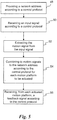
- FIGs. 1A , 1B , 2 and 5 there is provided an example method for distributing a motion signal synchronized with a sequence of images to a plurality of motion platforms 16.
- a network address is provided for each motion platform according to the control protocol.
- an input signal 20 synchronized with a sequence of images is received.
- the input signal 20 is received from the upstream device through the upstream control port 19.
- the input signal 20 is provided by the synchronizing unit 40 to one first hub 10'. It will be understood that the input signal 20 is synchronized with the sequence of images.
- the sequence of images is a movie.
- the input signal comprises a sequence of motion samples in the form of a stream of motion samples having a sampling rate and the input signal 20 is formatted such that the stream of motion samples is synchronously provided with the sampling rate.
- the motion signal is extracted from the received input signal 20.
- the motions samples are split apart from the control data included in the input signal 20 according to the control protocol.
- a client motion signal 20A-20D comprising the extracted synchronized motion signal, the network address and commands is generated according to the control protocol, for each motion platform to be actuated.
- the network address and the commands are generated by the server 25 which broadcasts this data to the motion platform interfaces 14.
- the motion platform interfaces 14 generate the client motion signals 20A-20D for the motion platforms 16 connected to the hub 10'.
- a feedback signal 22 is received according to the control protocol from each motion platform connected and comprises the network address of the motion platform 16 sending the feedback.
- the feedback signals 22 are used in managing the respective motion platform 16.
- Each motion platform 16 is managed individually according to the network address.
- the number of downstream control ports 21 of the hub 10 of Figs. 1A , 1B and 2 to 4 is limited to four, but it is noted that this number may be higher.
- motion platform interface 14and the input unit 12 could be provided as separate units or combined into two sub-units exchanging data.
- the embodiment disclosed enables the provision of an actuation data signal to a plurality of actuation devices.
- the actuation devices consist of motion platforms but it is noted that a server such as the ones described herein could also be used to command another type of actuation device.
- motion platform refers herein to any vibrokinetic platform including a motion platform for providing only vibrations to the user, the provided vibrations being typically related to the sound track of a movie and thus being indirectly synchronized with a sequence of images.
- the present invention can be carried out as a method, can be embodied in a system, a computer readable medium or an electrical or electro-magnetical signal.
Landscapes
- Engineering & Computer Science (AREA)
- Computer Networks & Wireless Communication (AREA)
- Signal Processing (AREA)
- Physics & Mathematics (AREA)
- General Physics & Mathematics (AREA)
- Automation & Control Theory (AREA)
- General Engineering & Computer Science (AREA)
- Computer Security & Cryptography (AREA)
- Computer And Data Communications (AREA)
- Two-Way Televisions, Distribution Of Moving Picture Or The Like (AREA)
- Small-Scale Networks (AREA)
- Closed-Circuit Television Systems (AREA)
Claims (15)
- Système (100) pour fournir, à une pluralité de plateformes mobiles (16), des signaux de mouvement indiquant un mouvement devant être effectué par les plateformes mobiles (16) de manière synchrone avec des images vidéo, le système comprenant :une interface d'entrée (12) pour recevoir un signal d'entrée conformément à un protocole de commande et pour extraire ledit signal de mouvement dudit signal d'entrée ;au moins un serveur (25) pour fournir une adresse de réseau à chaque plateforme mobile (16) de la pluralité et pour surveiller individuellement chaque plateforme mobile (16) de la pluralité conformément à l'adresse de réseau de chaque plateforme mobile (16) ;au moins une interface de plateforme mobile (14) comprenant au moins un port de commande (21) et au moins un ensemble (58) de multiples plateformes mobiles (16), chacun de l'au moins un ensemble (58) étant connecté à un respectif de l'au moins un port de commande (21), chacun de l'au moins un ensemble (58) consistant en une connexion filaire connectant en série les multiples plateformes mobiles (16) dudit au moins un ensemble (58) les unes aux autres conformément audit protocole de commande, ladite au moins une interface de plateforme mobile (14) pour actionner individuellement chacune desdites plateformes mobiles (16) de l'au moins un ensemble (58) en fournissant un signal de mouvement client à chaque plateforme mobile (16) dudit au moins un ensemble (58), le signal de mouvement client comprenant le signal de mouvement extrait du signal d'entrée conformément audit protocole de commande avec une adresse de réseau respective, chaque plateforme mobile (16) dudit au moins un ensemble (58) devant être gérée conformément à un signal de rétroaction respectif devant être reçu à partir de chacune desdites plateformes mobiles (16) dudit au moins un ensemble (58) conformément audit protocole de commande, le signal de rétroaction comprenant l'adresse de réseau fournie de chaque plateforme mobile (16) dudit au moins un ensemble (58).
- Système selon la revendication 1 dans lequel le serveur comprend :un fournisseur d'adresse de réseau pour fournir l'adresse de réseau à l'interface de plateforme mobile (14) pour chaque plateforme mobile (16) de l'au moins un ensemble (58) devant être actionnée ; etune unité d'instructions (34) pour envoyer des instructions à l'interface de plateforme mobile (14) pour chaque plateforme mobile (16) de l'au moins un ensemble (58) devant être actionnée.
- Système selon la revendication 1, dans lequel ledit signal de mouvement comprend un flux d'échantillons de mouvement ayant une vitesse d'échantillonnage et dans lequel ledit signal d'entrée est formaté de sorte que ledit flux d'échantillons de mouvement soit fourni de manière synchrone avec ladite vitesse d'échantillonnage.
- Système selon la revendication 1, comprenant en outre un générateur de retard pour générer un retard temporel donné dans ledit signal de mouvement client conformément à une position desdites plateformes mobiles (16) par rapport à des haut-parleurs sonores.
- Système selon la revendication 3, dans lequel chaque plateforme mobile (16) dudit au moins un ensemble (58) comprend au moins un siège d'une pluralité de sièges dans une salle de cinéma.
- Méthode pour distribuer des signaux de mouvement synchronisés sur une séquence d'images à une pluralité de plateformes mobiles (16) d'au moins un ensemble (58) d'un système selon la revendication 1, ladite méthode comprenant :la fourniture d'une adresse de réseau pour chacune de multiples plateformes mobiles (16) dudit au moins un ensemble (58), ledit au moins un ensemble (58) étant connecté à un port de commande respectif (21) d'un concentrateur de réseau de distribution (10) conformément à un protocole de commande, chacun de l'au moins un ensemble (58) consistant en une connexion filaire connectant en série les unes aux autres les multiples plateformes mobiles (16) dudit au moins un ensemble (58) ;la réception d'un signal d'entrée conformément audit protocole de commande ;l'extraction dudit signal de mouvement dudit signal d'entrée ;la génération, à partir du signal de mouvement extrait, d'un signal de mouvement client comprenant le signal de mouvement extrait conformément audit protocole de commande et l'adresse de réseau fournie, lesdits signaux de mouvement client devant être fournis individuellement à chaque plateforme mobile (16) dudit au moins un ensemble (58) en fonction de l'adresse de réseau ; etla réception, à partir d'au moins une des plateformes mobiles dudit au moins un ensemble, d'un signal de rétroaction avec l'adresse de réseau conformément audit protocole de commande.
- Méthode selon la revendication 6, comprenant en outre la gestion de chaque plateforme mobile (16) dudit au moins un ensemble (58) conformément au signal de rétroaction respectif et à ladite adresse de réseau de chaque plateforme mobile (16) dudit au moins un ensemble (58) conformément audit protocole de commande.
- Méthode selon la revendication 7, comprenant en outre l'envoi d'instructions à chaque plateforme mobile (16) de la pluralité dudit au moins un ensemble (58) conformément audit protocole de commande.
- Méthode selon la revendication 6, comprenant en outre la génération d'un retard temporel dans lesdits signaux de mouvement client conformément à une position desdites plateformes mobiles (16) dudit au moins un ensemble (58) par rapport à des haut-parleurs sonores.
- Système (100) pour recevoir un signal d'entrée conformément à un protocole de commande et fournir un mouvement à une pluralité de sièges en fonction du signal d'entrée, le système comprenant :
un concentrateur de réseau de distribution (10) pour fournir un signal de mouvement synchronisé sur une séquence d'images et indiquant le mouvement, ledit concentrateur (10) comprenant :une interface d'entrée (12) pour recevoir le signal d'entrée conformément audit protocole de commande et pour extraire ledit signal de mouvement dudit signal d'entrée ; etau moins une interface de plateforme mobile (14) comprenant au moins un port de commande (21), l'au moins un port de commande (21) pour actionner chacun desdits sièges de la pluralité conformément audit signal de mouvement conformément audit protocole de commande ; etau moins un ensemble (58) de multiples plateformes mobiles (16) chacune adaptée pour supporter au moins un siège de la pluralité, chacun de l'au moins un ensemble (58) consistant en une connexion filaire connectant en série les multiples plateformes mobiles (16) dudit au moins un ensemble (58) les unes aux autres, chacun dudit au moins un ensemble (58) étant connecté à un respectif de l'au moins un port de commande (21), chaque plateforme mobile (16) dudit au moins un ensemble (58) étant connectée à une autre par une connexion filaire conformément à un protocole de commande pour fournir le mouvement auxdits sièges avec ledit signal de mouvement. - Système selon la revendication 10 comprenant en outre :un fournisseur d'adresse de réseau pour associer une adresse de réseau à chaque siège de la pluralité, avec chacune des plateformes mobiles (16) qui sont actionnées individuellement avec un signal de mouvement client comprenant le signal de mouvement avec l'adresse de réseau ; etune unité d'instructions pour envoyer des instructions à chaque plateforme mobile (16) de l'au moins un ensemble (58).
- Système selon la revendication 11, dans lequel chaque plateforme mobile comprend un adaptateur de mouvement pour recevoir des instructions à partir de l'unité d'instructions et pour envoyer un signal de rétroaction à l'unité d'instructions (34).
- Système selon la revendication 11, dans lequel l'au moins une interface de plateforme mobile (14) actionne individuellement chacun desdits sièges dudit au moins un ensemble (58) conformément au signal de mouvement client.
- Système selon la revendication 13, dans lequel chaque siège dudit au moins un ensemble (58) doit être géré conformément à un signal de rétroaction respectif comprenant l'adresse de réseau respective devant être reçue à partir de respectifs desdits sièges dudit au moins un ensemble (58) conformément audit protocole de commande.
- Système selon la revendication 10, dans lequel la connexion filaire entre les plateformes mobiles (16) dans l'au moins un ensemble (58) forme une boucle par rapport au port de commande (21) auquel l'ensemble (58) est connecté.
Applications Claiming Priority (2)
| Application Number | Priority Date | Filing Date | Title |
|---|---|---|---|
| US16329009P | 2009-03-25 | 2009-03-25 | |
| PCT/CA2010/000464 WO2010108282A1 (fr) | 2009-03-25 | 2010-03-25 | Procédé et appareil de répartition de signaux de mouvement dans un environnement à plusieurs sièges |
Publications (3)
| Publication Number | Publication Date |
|---|---|
| EP2411108A1 EP2411108A1 (fr) | 2012-02-01 |
| EP2411108A4 EP2411108A4 (fr) | 2014-06-18 |
| EP2411108B1 true EP2411108B1 (fr) | 2020-05-06 |
Family
ID=42780115
Family Applications (1)
| Application Number | Title | Priority Date | Filing Date |
|---|---|---|---|
| EP10755372.9A Active EP2411108B1 (fr) | 2009-03-25 | 2010-03-25 | Procédé et appareil de répartition de signaux de mouvement dans un environnement à plusieurs sièges |
Country Status (9)
| Country | Link |
|---|---|
| US (2) | US9178849B2 (fr) |
| EP (1) | EP2411108B1 (fr) |
| JP (1) | JP5893551B2 (fr) |
| KR (1) | KR101621267B1 (fr) |
| CN (1) | CN102438714B (fr) |
| BR (1) | BRPI1014753B1 (fr) |
| CA (1) | CA2756558C (fr) |
| MX (1) | MX2011010016A (fr) |
| WO (1) | WO2010108282A1 (fr) |
Families Citing this family (8)
| Publication number | Priority date | Publication date | Assignee | Title |
|---|---|---|---|---|
| EP2411108B1 (fr) * | 2009-03-25 | 2020-05-06 | D-Box Technologies Inc. | Procédé et appareil de répartition de signaux de mouvement dans un environnement à plusieurs sièges |
| IT1404535B1 (it) * | 2011-02-25 | 2013-11-22 | Zeranta Edutainment S R L | Procedimento e kit per la costruzione e l'allestimento di un set e per l'effettuazione di una rappresentazione teatrale o cinematografica |
| CN102652878B (zh) * | 2011-11-23 | 2013-12-11 | 上海华博信息服务有限公司 | 基于图形化动作编辑的动感平台系统及其应用 |
| KR101154122B1 (ko) * | 2012-02-20 | 2012-06-11 | 씨제이포디플렉스 주식회사 | 영상과 모션 간의 시간 동기화를 이용한 모션 제어 시스템 및 그 방법 |
| KR102240937B1 (ko) | 2014-10-10 | 2021-04-15 | 삼성디스플레이 주식회사 | 표시 장치 |
| CN104984555B (zh) * | 2015-07-31 | 2017-09-29 | 盐城工学院 | 4d影片视频的动感文件采编系统 |
| EP3525898A4 (fr) | 2016-10-13 | 2020-06-17 | Positron, LLC | Système de réalité virtuelle à axes multiples, dynamique, commandé |
| JP7184780B2 (ja) | 2017-01-26 | 2022-12-06 | ディー-ボックス テクノロジーズ インコーポレイテッド | 動きの取り込み、及び記録オーディオ/ビデオとの動きの同期 |
Family Cites Families (30)
| Publication number | Priority date | Publication date | Assignee | Title |
|---|---|---|---|---|
| GB1474166A (en) * | 1973-07-13 | 1977-05-18 | Harris Corp | Controlling actuators for adjusting elements |
| US4066256A (en) * | 1975-11-17 | 1978-01-03 | Future General Corporation | Amusement ride |
| DE2827340C2 (de) * | 1978-06-22 | 1983-08-04 | Keiper Automobiltechnik Gmbh & Co Kg, 5630 Remscheid | Antriebseinrichtung mit wenigstens zwei Elektromotoren |
| US4879849A (en) * | 1987-11-04 | 1989-11-14 | Omni Films International, Inc. | Point-of-view motion simulator system |
| US4879644A (en) * | 1987-12-30 | 1989-11-07 | The Boeing Company | Object positioning apparatus and method |
| US5015933A (en) * | 1989-11-15 | 1991-05-14 | Ridewerks, Ltd. | Seat base motion controller |
| US5467266A (en) * | 1991-09-03 | 1995-11-14 | Lutron Electronics Co., Inc. | Motor-operated window cover |
| US5389865A (en) | 1992-12-02 | 1995-02-14 | Cybernet Systems Corporation | Method and system for providing a tactile virtual reality and manipulator defining an interface device therefor |
| US5433670A (en) * | 1993-02-05 | 1995-07-18 | Ridefilm Corporation | Compact simulator system theater |
| US5420485A (en) * | 1993-08-20 | 1995-05-30 | Forcam Inc. | Uncoordinated machine initialization system and method |
| US5509631A (en) * | 1993-10-01 | 1996-04-23 | Ridefilm Corporation | Three axis motion platform |
| JP3184044B2 (ja) | 1994-05-24 | 2001-07-09 | キヤノン株式会社 | 微動位置決め制御装置 |
| US5857917A (en) | 1994-06-16 | 1999-01-12 | Francis; Mitchell J. | 3-D simulator ride |
| US7053752B2 (en) * | 1996-08-06 | 2006-05-30 | Intuitive Surgical | General purpose distributed operating room control system |
| US5597359A (en) * | 1995-10-26 | 1997-01-28 | Doron Precision Systems, Inc. | Audience motion platform |
| US20040005927A1 (en) * | 2002-04-22 | 2004-01-08 | Bonilla Victor G. | Facility for remote computer controlled racing |
| JP2004159879A (ja) * | 2002-11-13 | 2004-06-10 | Kayaba Ind Co Ltd | 動揺データ配信システム |
| ES2650409T3 (es) * | 2003-05-14 | 2018-01-18 | D-Box Technologies Inc. | Interfaz flexible para controlar una plataforma de movimiento |
| US20080111408A1 (en) * | 2004-02-03 | 2008-05-15 | Raymond Jamie Duran | Video Game Chair |
| TWI245508B (en) * | 2004-04-19 | 2005-12-11 | Lai Yin Liang | Share-memory networked motion simulation system |
| US20060244564A1 (en) * | 2005-04-28 | 2006-11-02 | Madsen Josh D | Secured entertainment seating |
| US20070099708A1 (en) * | 2005-10-31 | 2007-05-03 | Aruze Gaming America, Inc. | Gaming machine with retractable monitor |
| US7780168B2 (en) * | 2005-11-16 | 2010-08-24 | Aruze Gaming America, Inc. | Gaming machine |
| WO2007143849A1 (fr) * | 2006-06-14 | 2007-12-21 | D-Box Technologies Inc. | Commande d'une pluralité de plates-formes de mouvement en synchronisation avec une séquence d'images |
| US8468280B2 (en) * | 2006-10-26 | 2013-06-18 | D-Box Technologies Inc. | Audio interface for controlling a motion platform |
| US8827709B1 (en) * | 2008-05-08 | 2014-09-09 | ACME Worldwide Enterprises, Inc. | Dynamic motion seat |
| CN101355657A (zh) * | 2008-09-08 | 2009-01-28 | 王苡竹 | 一种剧院显示系统及其方法 |
| EP2411108B1 (fr) * | 2009-03-25 | 2020-05-06 | D-Box Technologies Inc. | Procédé et appareil de répartition de signaux de mouvement dans un environnement à plusieurs sièges |
| WO2011060331A1 (fr) * | 2009-11-14 | 2011-05-19 | Wms Gaming, Inc. | Activation de fauteuil de machine de jeu |
| US9089786B2 (en) * | 2011-02-22 | 2015-07-28 | D-Box Technologies Inc. | Method and system for reducing vibration of motion-enabled chairs |
-
2010
- 2010-03-25 EP EP10755372.9A patent/EP2411108B1/fr active Active
- 2010-03-25 MX MX2011010016A patent/MX2011010016A/es active IP Right Grant
- 2010-03-25 BR BRPI1014753-5A patent/BRPI1014753B1/pt active IP Right Grant
- 2010-03-25 CA CA2756558A patent/CA2756558C/fr active Active
- 2010-03-25 US US12/731,514 patent/US9178849B2/en active Active
- 2010-03-25 KR KR1020117025231A patent/KR101621267B1/ko active Active
- 2010-03-25 JP JP2012501099A patent/JP5893551B2/ja active Active
- 2010-03-25 WO PCT/CA2010/000464 patent/WO2010108282A1/fr not_active Ceased
- 2010-03-25 CN CN2010800221729A patent/CN102438714B/zh active Active
-
2015
- 2015-10-02 US US14/873,322 patent/US9878264B2/en active Active
Non-Patent Citations (1)
| Title |
|---|
| None * |
Also Published As
| Publication number | Publication date |
|---|---|
| CA2756558A1 (fr) | 2010-09-30 |
| CN102438714B (zh) | 2013-08-21 |
| JP5893551B2 (ja) | 2016-03-23 |
| BRPI1014753B1 (pt) | 2021-01-05 |
| BRPI1014753A2 (pt) | 2016-04-19 |
| KR20120006026A (ko) | 2012-01-17 |
| CA2756558C (fr) | 2017-07-25 |
| US9178849B2 (en) | 2015-11-03 |
| JP2012521227A (ja) | 2012-09-13 |
| WO2010108282A1 (fr) | 2010-09-30 |
| CN102438714A (zh) | 2012-05-02 |
| EP2411108A4 (fr) | 2014-06-18 |
| US9878264B2 (en) | 2018-01-30 |
| EP2411108A1 (fr) | 2012-02-01 |
| US20100245116A1 (en) | 2010-09-30 |
| MX2011010016A (es) | 2011-12-16 |
| KR101621267B1 (ko) | 2016-05-31 |
| US20160023125A1 (en) | 2016-01-28 |
Similar Documents
| Publication | Publication Date | Title |
|---|---|---|
| US9878264B2 (en) | Method and apparatus for distributing motion signals in a multi-seat environment | |
| EP2038710B1 (fr) | Commande d'une pluralité de plates-formes de mouvement en synchronisation avec une piste son | |
| US20240152314A1 (en) | Synchronous sounds for audio assistant on devices | |
| KR100923490B1 (ko) | 네트워크를 이용한 전관 방송 시스템 | |
| KR20140072012A (ko) | Avb 네트워크 내의 응용 계층 구조들을 사용하여 오디오/비디오 스트림들을 관리하는 시스템 | |
| CN102256188A (zh) | 用于在以太网无源光网络(EPONs)中冗余的系统 | |
| JP2009512021A (ja) | データを転送するためのシステムおよび方法 | |
| KR100917716B1 (ko) | 네트워크를 이용한 전관 방송 시스템의 로컬 방송 장치 | |
| AU2005318872A1 (en) | An improved paging system | |
| WO2007024620A2 (fr) | Procede et systeme pour le controle de dispositifs multimedia permettant de fournir des signaux a une zone avoisinante | |
| KR101812700B1 (ko) | 자체 고장 진단 기능이 있는 음향 장비용 다중 절환 장치 및 방법 | |
| US11140206B2 (en) | Architecture for a media system | |
| KR20140001499A (ko) | 고가용성 관리 방법 및 시스템 | |
| HK1130911B (en) | Control of a plurality of motion platforms in synchrony with an audio track | |
| HK1130911A (en) | Control of a plurality of motion platforms in synchrony with an audio track | |
| KR102251407B1 (ko) | 소프트웨어 정의 네트워크에서 컨트롤러의 이중화 제어 시스템 및 그 방법 | |
| KR101193026B1 (ko) | 오디오 믹싱을 지원하는 구내방송 서비스 장치 | |
| JPH08307855A (ja) | 耐障害性マルチメディア・プログラム配布のための装置 | |
| US9467727B2 (en) | Portable broadcast system accommodating multiple remote users for digital audio/video transmission via wired or wireless IP or 3G/4G networks | |
| KR101052285B1 (ko) | 무인시스템을 원격 제어하기 위한 실시간 이중화 제어시스템 및 무인시스템 원격 제어 방법 | |
| JP2006260223A (ja) | iSCSIストレージシステムおよびそのシステムにおけるパス多重化方法 | |
| JP2023005329A (ja) | 冗長システム、及びコントローラ | |
| KR20200134007A (ko) | 무대장치 제어 시스템 및 이의 운용 방법 | |
| JP6307574B1 (ja) | Can通信を用いたパブリックアドレス装置 | |
| JP2003318927A (ja) | 局内設備制御システム |
Legal Events
| Date | Code | Title | Description |
|---|---|---|---|
| PUAI | Public reference made under article 153(3) epc to a published international application that has entered the european phase |
Free format text: ORIGINAL CODE: 0009012 |
|
| 17P | Request for examination filed |
Effective date: 20111024 |
|
| AK | Designated contracting states |
Kind code of ref document: A1 Designated state(s): AT BE BG CH CY CZ DE DK EE ES FI FR GB GR HR HU IE IS IT LI LT LU LV MC MK MT NL NO PL PT RO SE SI SK SM TR |
|
| DAX | Request for extension of the european patent (deleted) | ||
| REG | Reference to a national code |
Ref country code: HK Ref legal event code: DE Ref document number: 1166747 Country of ref document: HK |
|
| A4 | Supplementary search report drawn up and despatched |
Effective date: 20140515 |
|
| RIC1 | Information provided on ipc code assigned before grant |
Ipc: H04L 29/12 20060101ALI20140509BHEP Ipc: A63J 5/00 20060101ALN20140509BHEP Ipc: A63J 25/00 20090101AFI20140509BHEP |
|
| STAA | Information on the status of an ep patent application or granted ep patent |
Free format text: STATUS: EXAMINATION IS IN PROGRESS |
|
| 17Q | First examination report despatched |
Effective date: 20180823 |
|
| RIC1 | Information provided on ipc code assigned before grant |
Ipc: A63J 25/00 20090101ALI20190517BHEP Ipc: H04L 29/12 20060101AFI20190517BHEP Ipc: A63J 5/00 20060101ALN20190517BHEP |
|
| RIC1 | Information provided on ipc code assigned before grant |
Ipc: G05B 15/02 20060101ALI20190529BHEP Ipc: A63J 25/00 20090101ALI20190529BHEP Ipc: A63J 99/00 20090101ALI20190529BHEP Ipc: H04L 29/12 20060101AFI20190529BHEP Ipc: A63J 5/00 20060101ALN20190529BHEP |
|
| GRAP | Despatch of communication of intention to grant a patent |
Free format text: ORIGINAL CODE: EPIDOSNIGR1 |
|
| STAA | Information on the status of an ep patent application or granted ep patent |
Free format text: STATUS: GRANT OF PATENT IS INTENDED |
|
| INTG | Intention to grant announced |
Effective date: 20190709 |
|
| GRAJ | Information related to disapproval of communication of intention to grant by the applicant or resumption of examination proceedings by the epo deleted |
Free format text: ORIGINAL CODE: EPIDOSDIGR1 |
|
| STAA | Information on the status of an ep patent application or granted ep patent |
Free format text: STATUS: EXAMINATION IS IN PROGRESS |
|
| GRAP | Despatch of communication of intention to grant a patent |
Free format text: ORIGINAL CODE: EPIDOSNIGR1 |
|
| STAA | Information on the status of an ep patent application or granted ep patent |
Free format text: STATUS: GRANT OF PATENT IS INTENDED |
|
| INTC | Intention to grant announced (deleted) | ||
| RIC1 | Information provided on ipc code assigned before grant |
Ipc: A63J 5/00 20060101ALN20191121BHEP Ipc: A63J 99/00 20090101ALI20191121BHEP Ipc: A63J 25/00 20090101ALI20191121BHEP Ipc: G05B 15/02 20060101ALI20191121BHEP Ipc: H04L 29/12 20060101AFI20191121BHEP |
|
| INTG | Intention to grant announced |
Effective date: 20191211 |
|
| GRAJ | Information related to disapproval of communication of intention to grant by the applicant or resumption of examination proceedings by the epo deleted |
Free format text: ORIGINAL CODE: EPIDOSDIGR1 |
|
| STAA | Information on the status of an ep patent application or granted ep patent |
Free format text: STATUS: EXAMINATION IS IN PROGRESS |
|
| REG | Reference to a national code |
Ref country code: DE Ref legal event code: R079 Ref document number: 602010064249 Country of ref document: DE Free format text: PREVIOUS MAIN CLASS: A63J0025000000 Ipc: H04L0029120000 |
|
| GRAR | Information related to intention to grant a patent recorded |
Free format text: ORIGINAL CODE: EPIDOSNIGR71 |
|
| GRAS | Grant fee paid |
Free format text: ORIGINAL CODE: EPIDOSNIGR3 |
|
| STAA | Information on the status of an ep patent application or granted ep patent |
Free format text: STATUS: GRANT OF PATENT IS INTENDED |
|
| INTC | Intention to grant announced (deleted) | ||
| RIC1 | Information provided on ipc code assigned before grant |
Ipc: G05B 15/02 20060101ALI20200226BHEP Ipc: A63J 5/00 20060101ALN20200226BHEP Ipc: H04L 29/12 20060101AFI20200226BHEP Ipc: A63J 99/00 20090101ALI20200226BHEP Ipc: A63J 25/00 20090101ALI20200226BHEP |
|
| GRAA | (expected) grant |
Free format text: ORIGINAL CODE: 0009210 |
|
| STAA | Information on the status of an ep patent application or granted ep patent |
Free format text: STATUS: THE PATENT HAS BEEN GRANTED |
|
| INTG | Intention to grant announced |
Effective date: 20200302 |
|
| AK | Designated contracting states |
Kind code of ref document: B1 Designated state(s): AT BE BG CH CY CZ DE DK EE ES FI FR GB GR HR HU IE IS IT LI LT LU LV MC MK MT NL NO PL PT RO SE SI SK SM TR |
|
| REG | Reference to a national code |
Ref country code: GB Ref legal event code: FG4D |
|
| REG | Reference to a national code |
Ref country code: CH Ref legal event code: EP Ref country code: AT Ref legal event code: REF Ref document number: 1268670 Country of ref document: AT Kind code of ref document: T Effective date: 20200515 |
|
| REG | Reference to a national code |
Ref country code: IE Ref legal event code: FG4D |
|
| REG | Reference to a national code |
Ref country code: DE Ref legal event code: R096 Ref document number: 602010064249 Country of ref document: DE |
|
| REG | Reference to a national code |
Ref country code: LT Ref legal event code: MG4D |
|
| REG | Reference to a national code |
Ref country code: NL Ref legal event code: MP Effective date: 20200506 |
|
| PG25 | Lapsed in a contracting state [announced via postgrant information from national office to epo] |
Ref country code: IS Free format text: LAPSE BECAUSE OF FAILURE TO SUBMIT A TRANSLATION OF THE DESCRIPTION OR TO PAY THE FEE WITHIN THE PRESCRIBED TIME-LIMIT Effective date: 20200906 Ref country code: SE Free format text: LAPSE BECAUSE OF FAILURE TO SUBMIT A TRANSLATION OF THE DESCRIPTION OR TO PAY THE FEE WITHIN THE PRESCRIBED TIME-LIMIT Effective date: 20200506 Ref country code: GR Free format text: LAPSE BECAUSE OF FAILURE TO SUBMIT A TRANSLATION OF THE DESCRIPTION OR TO PAY THE FEE WITHIN THE PRESCRIBED TIME-LIMIT Effective date: 20200807 Ref country code: NO Free format text: LAPSE BECAUSE OF FAILURE TO SUBMIT A TRANSLATION OF THE DESCRIPTION OR TO PAY THE FEE WITHIN THE PRESCRIBED TIME-LIMIT Effective date: 20200806 Ref country code: FI Free format text: LAPSE BECAUSE OF FAILURE TO SUBMIT A TRANSLATION OF THE DESCRIPTION OR TO PAY THE FEE WITHIN THE PRESCRIBED TIME-LIMIT Effective date: 20200506 Ref country code: LT Free format text: LAPSE BECAUSE OF FAILURE TO SUBMIT A TRANSLATION OF THE DESCRIPTION OR TO PAY THE FEE WITHIN THE PRESCRIBED TIME-LIMIT Effective date: 20200506 Ref country code: PT Free format text: LAPSE BECAUSE OF FAILURE TO SUBMIT A TRANSLATION OF THE DESCRIPTION OR TO PAY THE FEE WITHIN THE PRESCRIBED TIME-LIMIT Effective date: 20200907 |
|
| PG25 | Lapsed in a contracting state [announced via postgrant information from national office to epo] |
Ref country code: LV Free format text: LAPSE BECAUSE OF FAILURE TO SUBMIT A TRANSLATION OF THE DESCRIPTION OR TO PAY THE FEE WITHIN THE PRESCRIBED TIME-LIMIT Effective date: 20200506 Ref country code: HR Free format text: LAPSE BECAUSE OF FAILURE TO SUBMIT A TRANSLATION OF THE DESCRIPTION OR TO PAY THE FEE WITHIN THE PRESCRIBED TIME-LIMIT Effective date: 20200506 Ref country code: BG Free format text: LAPSE BECAUSE OF FAILURE TO SUBMIT A TRANSLATION OF THE DESCRIPTION OR TO PAY THE FEE WITHIN THE PRESCRIBED TIME-LIMIT Effective date: 20200806 |
|
| REG | Reference to a national code |
Ref country code: AT Ref legal event code: MK05 Ref document number: 1268670 Country of ref document: AT Kind code of ref document: T Effective date: 20200506 |
|
| PG25 | Lapsed in a contracting state [announced via postgrant information from national office to epo] |
Ref country code: NL Free format text: LAPSE BECAUSE OF FAILURE TO SUBMIT A TRANSLATION OF THE DESCRIPTION OR TO PAY THE FEE WITHIN THE PRESCRIBED TIME-LIMIT Effective date: 20200506 |
|
| PG25 | Lapsed in a contracting state [announced via postgrant information from national office to epo] |
Ref country code: EE Free format text: LAPSE BECAUSE OF FAILURE TO SUBMIT A TRANSLATION OF THE DESCRIPTION OR TO PAY THE FEE WITHIN THE PRESCRIBED TIME-LIMIT Effective date: 20200506 Ref country code: SM Free format text: LAPSE BECAUSE OF FAILURE TO SUBMIT A TRANSLATION OF THE DESCRIPTION OR TO PAY THE FEE WITHIN THE PRESCRIBED TIME-LIMIT Effective date: 20200506 Ref country code: IT Free format text: LAPSE BECAUSE OF FAILURE TO SUBMIT A TRANSLATION OF THE DESCRIPTION OR TO PAY THE FEE WITHIN THE PRESCRIBED TIME-LIMIT Effective date: 20200506 Ref country code: DK Free format text: LAPSE BECAUSE OF FAILURE TO SUBMIT A TRANSLATION OF THE DESCRIPTION OR TO PAY THE FEE WITHIN THE PRESCRIBED TIME-LIMIT Effective date: 20200506 Ref country code: ES Free format text: LAPSE BECAUSE OF FAILURE TO SUBMIT A TRANSLATION OF THE DESCRIPTION OR TO PAY THE FEE WITHIN THE PRESCRIBED TIME-LIMIT Effective date: 20200506 Ref country code: CZ Free format text: LAPSE BECAUSE OF FAILURE TO SUBMIT A TRANSLATION OF THE DESCRIPTION OR TO PAY THE FEE WITHIN THE PRESCRIBED TIME-LIMIT Effective date: 20200506 Ref country code: AT Free format text: LAPSE BECAUSE OF FAILURE TO SUBMIT A TRANSLATION OF THE DESCRIPTION OR TO PAY THE FEE WITHIN THE PRESCRIBED TIME-LIMIT Effective date: 20200506 Ref country code: RO Free format text: LAPSE BECAUSE OF FAILURE TO SUBMIT A TRANSLATION OF THE DESCRIPTION OR TO PAY THE FEE WITHIN THE PRESCRIBED TIME-LIMIT Effective date: 20200506 |
|
| REG | Reference to a national code |
Ref country code: DE Ref legal event code: R097 Ref document number: 602010064249 Country of ref document: DE |
|
| PG25 | Lapsed in a contracting state [announced via postgrant information from national office to epo] |
Ref country code: PL Free format text: LAPSE BECAUSE OF FAILURE TO SUBMIT A TRANSLATION OF THE DESCRIPTION OR TO PAY THE FEE WITHIN THE PRESCRIBED TIME-LIMIT Effective date: 20200506 Ref country code: SK Free format text: LAPSE BECAUSE OF FAILURE TO SUBMIT A TRANSLATION OF THE DESCRIPTION OR TO PAY THE FEE WITHIN THE PRESCRIBED TIME-LIMIT Effective date: 20200506 |
|
| PLBE | No opposition filed within time limit |
Free format text: ORIGINAL CODE: 0009261 |
|
| STAA | Information on the status of an ep patent application or granted ep patent |
Free format text: STATUS: NO OPPOSITION FILED WITHIN TIME LIMIT |
|
| 26N | No opposition filed |
Effective date: 20210209 |
|
| PG25 | Lapsed in a contracting state [announced via postgrant information from national office to epo] |
Ref country code: SI Free format text: LAPSE BECAUSE OF FAILURE TO SUBMIT A TRANSLATION OF THE DESCRIPTION OR TO PAY THE FEE WITHIN THE PRESCRIBED TIME-LIMIT Effective date: 20200506 |
|
| PG25 | Lapsed in a contracting state [announced via postgrant information from national office to epo] |
Ref country code: MC Free format text: LAPSE BECAUSE OF FAILURE TO SUBMIT A TRANSLATION OF THE DESCRIPTION OR TO PAY THE FEE WITHIN THE PRESCRIBED TIME-LIMIT Effective date: 20200506 |
|
| REG | Reference to a national code |
Ref country code: CH Ref legal event code: PL |
|
| REG | Reference to a national code |
Ref country code: DE Ref legal event code: R079 Ref document number: 602010064249 Country of ref document: DE Free format text: PREVIOUS MAIN CLASS: H04L0029120000 Ipc: H04L0067286900 |
|
| REG | Reference to a national code |
Ref country code: BE Ref legal event code: MM Effective date: 20210331 |
|
| PG25 | Lapsed in a contracting state [announced via postgrant information from national office to epo] |
Ref country code: LI Free format text: LAPSE BECAUSE OF NON-PAYMENT OF DUE FEES Effective date: 20210331 Ref country code: LU Free format text: LAPSE BECAUSE OF NON-PAYMENT OF DUE FEES Effective date: 20210325 Ref country code: CH Free format text: LAPSE BECAUSE OF NON-PAYMENT OF DUE FEES Effective date: 20210331 Ref country code: IE Free format text: LAPSE BECAUSE OF NON-PAYMENT OF DUE FEES Effective date: 20210325 |
|
| PG25 | Lapsed in a contracting state [announced via postgrant information from national office to epo] |
Ref country code: BE Free format text: LAPSE BECAUSE OF NON-PAYMENT OF DUE FEES Effective date: 20210331 |
|
| PG25 | Lapsed in a contracting state [announced via postgrant information from national office to epo] |
Ref country code: HU Free format text: LAPSE BECAUSE OF FAILURE TO SUBMIT A TRANSLATION OF THE DESCRIPTION OR TO PAY THE FEE WITHIN THE PRESCRIBED TIME-LIMIT; INVALID AB INITIO Effective date: 20100325 Ref country code: CY Free format text: LAPSE BECAUSE OF FAILURE TO SUBMIT A TRANSLATION OF THE DESCRIPTION OR TO PAY THE FEE WITHIN THE PRESCRIBED TIME-LIMIT Effective date: 20200506 |
|
| PG25 | Lapsed in a contracting state [announced via postgrant information from national office to epo] |
Ref country code: MK Free format text: LAPSE BECAUSE OF FAILURE TO SUBMIT A TRANSLATION OF THE DESCRIPTION OR TO PAY THE FEE WITHIN THE PRESCRIBED TIME-LIMIT Effective date: 20200506 |
|
| PG25 | Lapsed in a contracting state [announced via postgrant information from national office to epo] |
Ref country code: MT Free format text: LAPSE BECAUSE OF FAILURE TO SUBMIT A TRANSLATION OF THE DESCRIPTION OR TO PAY THE FEE WITHIN THE PRESCRIBED TIME-LIMIT Effective date: 20200506 |
|
| PG25 | Lapsed in a contracting state [announced via postgrant information from national office to epo] |
Ref country code: TR Free format text: LAPSE BECAUSE OF FAILURE TO SUBMIT A TRANSLATION OF THE DESCRIPTION OR TO PAY THE FEE WITHIN THE PRESCRIBED TIME-LIMIT Effective date: 20200506 |
|
| PGFP | Annual fee paid to national office [announced via postgrant information from national office to epo] |
Ref country code: FR Payment date: 20251231 Year of fee payment: 17 |
|
| PGFP | Annual fee paid to national office [announced via postgrant information from national office to epo] |
Ref country code: GB Payment date: 20260106 Year of fee payment: 17 |
|
| PGFP | Annual fee paid to national office [announced via postgrant information from national office to epo] |
Ref country code: DE Payment date: 20260102 Year of fee payment: 17 |