EP2412316A2 - Reconfiguration de caractéristiques cardiaques - Google Patents
Reconfiguration de caractéristiques cardiaques Download PDFInfo
- Publication number
- EP2412316A2 EP2412316A2 EP11186500A EP11186500A EP2412316A2 EP 2412316 A2 EP2412316 A2 EP 2412316A2 EP 11186500 A EP11186500 A EP 11186500A EP 11186500 A EP11186500 A EP 11186500A EP 2412316 A2 EP2412316 A2 EP 2412316A2
- Authority
- EP
- European Patent Office
- Prior art keywords
- support
- tissue
- configuration
- annulus
- gripping elements
- Prior art date
- Legal status (The legal status is an assumption and is not a legal conclusion. Google has not performed a legal analysis and makes no representation as to the accuracy of the status listed.)
- Withdrawn
Links
- 210000001519 tissue Anatomy 0.000 claims abstract description 176
- 210000003709 heart valve Anatomy 0.000 claims abstract description 55
- 210000005003 heart tissue Anatomy 0.000 claims abstract description 44
- 239000000463 material Substances 0.000 claims description 59
- 238000009434 installation Methods 0.000 claims description 24
- 230000013011 mating Effects 0.000 claims description 15
- 230000008859 change Effects 0.000 claims description 8
- 210000000080 chela (arthropods) Anatomy 0.000 claims description 6
- 230000002441 reversible effect Effects 0.000 claims description 6
- 230000007423 decrease Effects 0.000 claims description 5
- 238000001356 surgical procedure Methods 0.000 abstract description 9
- 238000003780 insertion Methods 0.000 description 64
- 230000037431 insertion Effects 0.000 description 64
- 238000000034 method Methods 0.000 description 42
- 230000007246 mechanism Effects 0.000 description 17
- 229910052751 metal Inorganic materials 0.000 description 15
- 239000002184 metal Substances 0.000 description 15
- 229910001000 nickel titanium Inorganic materials 0.000 description 14
- HLXZNVUGXRDIFK-UHFFFAOYSA-N nickel titanium Chemical compound [Ti].[Ti].[Ti].[Ti].[Ti].[Ti].[Ti].[Ti].[Ti].[Ti].[Ti].[Ni].[Ni].[Ni].[Ni].[Ni].[Ni].[Ni].[Ni].[Ni].[Ni].[Ni].[Ni].[Ni].[Ni] HLXZNVUGXRDIFK-UHFFFAOYSA-N 0.000 description 14
- 229920001296 polysiloxane Polymers 0.000 description 14
- 230000008569 process Effects 0.000 description 14
- 210000001992 atrioventricular node Anatomy 0.000 description 10
- 239000004744 fabric Substances 0.000 description 10
- 229910045601 alloy Inorganic materials 0.000 description 9
- 239000000956 alloy Substances 0.000 description 9
- 230000035515 penetration Effects 0.000 description 9
- 229910001220 stainless steel Inorganic materials 0.000 description 9
- 239000010935 stainless steel Substances 0.000 description 9
- PXHVJJICTQNCMI-UHFFFAOYSA-N Nickel Chemical compound [Ni] PXHVJJICTQNCMI-UHFFFAOYSA-N 0.000 description 8
- KDLHZDBZIXYQEI-UHFFFAOYSA-N Palladium Chemical compound [Pd] KDLHZDBZIXYQEI-UHFFFAOYSA-N 0.000 description 8
- 210000004369 blood Anatomy 0.000 description 8
- 239000008280 blood Substances 0.000 description 8
- 230000006870 function Effects 0.000 description 8
- BASFCYQUMIYNBI-UHFFFAOYSA-N platinum Chemical compound [Pt] BASFCYQUMIYNBI-UHFFFAOYSA-N 0.000 description 8
- 229920001971 elastomer Polymers 0.000 description 7
- 230000007774 longterm Effects 0.000 description 7
- PCHJSUWPFVWCPO-UHFFFAOYSA-N gold Chemical compound [Au] PCHJSUWPFVWCPO-UHFFFAOYSA-N 0.000 description 6
- 229910052737 gold Inorganic materials 0.000 description 6
- 239000010931 gold Substances 0.000 description 6
- 230000014759 maintenance of location Effects 0.000 description 6
- 238000004519 manufacturing process Methods 0.000 description 6
- 210000004115 mitral valve Anatomy 0.000 description 6
- 239000000203 mixture Substances 0.000 description 6
- 239000004033 plastic Substances 0.000 description 6
- 229920003023 plastic Polymers 0.000 description 6
- 230000008439 repair process Effects 0.000 description 6
- 210000000591 tricuspid valve Anatomy 0.000 description 6
- 230000008602 contraction Effects 0.000 description 5
- 229920000642 polymer Polymers 0.000 description 5
- ZOKXTWBITQBERF-UHFFFAOYSA-N Molybdenum Chemical compound [Mo] ZOKXTWBITQBERF-UHFFFAOYSA-N 0.000 description 4
- 238000013459 approach Methods 0.000 description 4
- 230000008901 benefit Effects 0.000 description 4
- 210000004204 blood vessel Anatomy 0.000 description 4
- 229910017052 cobalt Inorganic materials 0.000 description 4
- 239000010941 cobalt Substances 0.000 description 4
- GUTLYIVDDKVIGB-UHFFFAOYSA-N cobalt atom Chemical compound [Co] GUTLYIVDDKVIGB-UHFFFAOYSA-N 0.000 description 4
- 239000000806 elastomer Substances 0.000 description 4
- 239000012530 fluid Substances 0.000 description 4
- 229910052750 molybdenum Inorganic materials 0.000 description 4
- 239000011733 molybdenum Substances 0.000 description 4
- 229910052759 nickel Inorganic materials 0.000 description 4
- 229910052763 palladium Inorganic materials 0.000 description 4
- 229910052697 platinum Inorganic materials 0.000 description 4
- 239000005020 polyethylene terephthalate Substances 0.000 description 4
- 229910052702 rhenium Inorganic materials 0.000 description 4
- WUAPFZMCVAUBPE-UHFFFAOYSA-N rhenium atom Chemical compound [Re] WUAPFZMCVAUBPE-UHFFFAOYSA-N 0.000 description 4
- 229910052715 tantalum Inorganic materials 0.000 description 4
- GUVRBAGPIYLISA-UHFFFAOYSA-N tantalum atom Chemical compound [Ta] GUVRBAGPIYLISA-UHFFFAOYSA-N 0.000 description 4
- WFKWXMTUELFFGS-UHFFFAOYSA-N tungsten Chemical compound [W] WFKWXMTUELFFGS-UHFFFAOYSA-N 0.000 description 4
- 229910052721 tungsten Inorganic materials 0.000 description 4
- 239000010937 tungsten Substances 0.000 description 4
- 238000013461 design Methods 0.000 description 3
- 230000000694 effects Effects 0.000 description 3
- -1 polyethylene terephthalate Polymers 0.000 description 3
- 229920000139 polyethylene terephthalate Polymers 0.000 description 3
- 238000002360 preparation method Methods 0.000 description 3
- 238000005096 rolling process Methods 0.000 description 3
- 239000005060 rubber Substances 0.000 description 3
- 239000012781 shape memory material Substances 0.000 description 3
- 241000251468 Actinopterygii Species 0.000 description 2
- 230000001154 acute effect Effects 0.000 description 2
- 239000000853 adhesive Substances 0.000 description 2
- 230000001070 adhesive effect Effects 0.000 description 2
- 229910052782 aluminium Inorganic materials 0.000 description 2
- XAGFODPZIPBFFR-UHFFFAOYSA-N aluminium Chemical compound [Al] XAGFODPZIPBFFR-UHFFFAOYSA-N 0.000 description 2
- 239000000560 biocompatible material Substances 0.000 description 2
- 230000015572 biosynthetic process Effects 0.000 description 2
- 238000005520 cutting process Methods 0.000 description 2
- 238000009826 distribution Methods 0.000 description 2
- 238000005755 formation reaction Methods 0.000 description 2
- 239000012634 fragment Substances 0.000 description 2
- 239000007943 implant Substances 0.000 description 2
- 230000005923 long-lasting effect Effects 0.000 description 2
- 238000005259 measurement Methods 0.000 description 2
- 150000002739 metals Chemical class 0.000 description 2
- 238000000465 moulding Methods 0.000 description 2
- RVTZCBVAJQQJTK-UHFFFAOYSA-N oxygen(2-);zirconium(4+) Chemical compound [O-2].[O-2].[Zr+4] RVTZCBVAJQQJTK-UHFFFAOYSA-N 0.000 description 2
- 230000002093 peripheral effect Effects 0.000 description 2
- 229920002635 polyurethane Polymers 0.000 description 2
- 239000004814 polyurethane Substances 0.000 description 2
- 230000000717 retained effect Effects 0.000 description 2
- 229910001285 shape-memory alloy Inorganic materials 0.000 description 2
- 238000012935 Averaging Methods 0.000 description 1
- 229920004934 Dacron® Polymers 0.000 description 1
- MWCLLHOVUTZFKS-UHFFFAOYSA-N Methyl cyanoacrylate Chemical compound COC(=O)C(=C)C#N MWCLLHOVUTZFKS-UHFFFAOYSA-N 0.000 description 1
- 206010067171 Regurgitation Diseases 0.000 description 1
- FAPWRFPIFSIZLT-UHFFFAOYSA-M Sodium chloride Chemical compound [Na+].[Cl-] FAPWRFPIFSIZLT-UHFFFAOYSA-M 0.000 description 1
- 229910000639 Spring steel Inorganic materials 0.000 description 1
- 230000009471 action Effects 0.000 description 1
- 238000004026 adhesive bonding Methods 0.000 description 1
- 210000001008 atrial appendage Anatomy 0.000 description 1
- 239000004568 cement Substances 0.000 description 1
- 238000010276 construction Methods 0.000 description 1
- 230000003247 decreasing effect Effects 0.000 description 1
- 238000005530 etching Methods 0.000 description 1
- 210000003191 femoral vein Anatomy 0.000 description 1
- 239000003292 glue Substances 0.000 description 1
- 230000035876 healing Effects 0.000 description 1
- 230000004217 heart function Effects 0.000 description 1
- 230000010354 integration Effects 0.000 description 1
- 230000002452 interceptive effect Effects 0.000 description 1
- 238000003698 laser cutting Methods 0.000 description 1
- 229920000126 latex Polymers 0.000 description 1
- 239000004816 latex Substances 0.000 description 1
- 210000005248 left atrial appendage Anatomy 0.000 description 1
- 238000005461 lubrication Methods 0.000 description 1
- 238000003754 machining Methods 0.000 description 1
- 239000011159 matrix material Substances 0.000 description 1
- 230000003446 memory effect Effects 0.000 description 1
- 230000000414 obstructive effect Effects 0.000 description 1
- 239000011148 porous material Substances 0.000 description 1
- 238000003825 pressing Methods 0.000 description 1
- 230000002829 reductive effect Effects 0.000 description 1
- 238000002407 reforming Methods 0.000 description 1
- 230000002040 relaxant effect Effects 0.000 description 1
- 230000004044 response Effects 0.000 description 1
- 210000005245 right atrium Anatomy 0.000 description 1
- 238000007790 scraping Methods 0.000 description 1
- 229920002379 silicone rubber Polymers 0.000 description 1
- 239000004945 silicone rubber Substances 0.000 description 1
- 229920001169 thermoplastic Polymers 0.000 description 1
- 238000012546 transfer Methods 0.000 description 1
- 238000011144 upstream manufacturing Methods 0.000 description 1
- 238000003466 welding Methods 0.000 description 1
- 238000004804 winding Methods 0.000 description 1
Images





























Classifications
-
- A—HUMAN NECESSITIES
- A61—MEDICAL OR VETERINARY SCIENCE; HYGIENE
- A61B—DIAGNOSIS; SURGERY; IDENTIFICATION
- A61B17/00—Surgical instruments, devices or methods
- A61B17/00234—Surgical instruments, devices or methods for minimally invasive surgery
-
- A—HUMAN NECESSITIES
- A61—MEDICAL OR VETERINARY SCIENCE; HYGIENE
- A61B—DIAGNOSIS; SURGERY; IDENTIFICATION
- A61B17/00—Surgical instruments, devices or methods
- A61B17/064—Surgical staples, i.e. penetrating the tissue
- A61B17/0644—Surgical staples, i.e. penetrating the tissue penetrating the tissue, deformable to closed position
-
- A—HUMAN NECESSITIES
- A61—MEDICAL OR VETERINARY SCIENCE; HYGIENE
- A61B—DIAGNOSIS; SURGERY; IDENTIFICATION
- A61B17/00—Surgical instruments, devices or methods
- A61B17/068—Surgical staplers, e.g. containing multiple staples or clamps
-
- A—HUMAN NECESSITIES
- A61—MEDICAL OR VETERINARY SCIENCE; HYGIENE
- A61F—FILTERS IMPLANTABLE INTO BLOOD VESSELS; PROSTHESES; DEVICES PROVIDING PATENCY TO, OR PREVENTING COLLAPSING OF, TUBULAR STRUCTURES OF THE BODY, e.g. STENTS; ORTHOPAEDIC, NURSING OR CONTRACEPTIVE DEVICES; FOMENTATION; TREATMENT OR PROTECTION OF EYES OR EARS; BANDAGES, DRESSINGS OR ABSORBENT PADS; FIRST-AID KITS
- A61F2/00—Filters implantable into blood vessels; Prostheses, i.e. artificial substitutes or replacements for parts of the body; Appliances for connecting them with the body; Devices providing patency to, or preventing collapsing of, tubular structures of the body, e.g. stents
- A61F2/02—Prostheses implantable into the body
- A61F2/24—Heart valves ; Vascular valves, e.g. venous valves; Heart implants, e.g. passive devices for improving the function of the native valve or the heart muscle; Transmyocardial revascularisation [TMR] devices; Valves implantable in the body
- A61F2/2442—Annuloplasty rings or inserts for correcting the valve shape; Implants for improving the function of a native heart valve
- A61F2/2445—Annuloplasty rings in direct contact with the valve annulus
-
- A—HUMAN NECESSITIES
- A61—MEDICAL OR VETERINARY SCIENCE; HYGIENE
- A61F—FILTERS IMPLANTABLE INTO BLOOD VESSELS; PROSTHESES; DEVICES PROVIDING PATENCY TO, OR PREVENTING COLLAPSING OF, TUBULAR STRUCTURES OF THE BODY, e.g. STENTS; ORTHOPAEDIC, NURSING OR CONTRACEPTIVE DEVICES; FOMENTATION; TREATMENT OR PROTECTION OF EYES OR EARS; BANDAGES, DRESSINGS OR ABSORBENT PADS; FIRST-AID KITS
- A61F2/00—Filters implantable into blood vessels; Prostheses, i.e. artificial substitutes or replacements for parts of the body; Appliances for connecting them with the body; Devices providing patency to, or preventing collapsing of, tubular structures of the body, e.g. stents
- A61F2/02—Prostheses implantable into the body
- A61F2/24—Heart valves ; Vascular valves, e.g. venous valves; Heart implants, e.g. passive devices for improving the function of the native valve or the heart muscle; Transmyocardial revascularisation [TMR] devices; Valves implantable in the body
- A61F2/2442—Annuloplasty rings or inserts for correcting the valve shape; Implants for improving the function of a native heart valve
- A61F2/2466—Delivery devices therefor
-
- A—HUMAN NECESSITIES
- A61—MEDICAL OR VETERINARY SCIENCE; HYGIENE
- A61B—DIAGNOSIS; SURGERY; IDENTIFICATION
- A61B17/00—Surgical instruments, devices or methods
- A61B17/04—Surgical instruments, devices or methods for suturing wounds; Holders or packages for needles or suture materials
- A61B17/0401—Suture anchors, buttons or pledgets, i.e. means for attaching sutures to bone, cartilage or soft tissue; Instruments for applying or removing suture anchors
-
- A—HUMAN NECESSITIES
- A61—MEDICAL OR VETERINARY SCIENCE; HYGIENE
- A61B—DIAGNOSIS; SURGERY; IDENTIFICATION
- A61B17/00—Surgical instruments, devices or methods
- A61B17/064—Surgical staples, i.e. penetrating the tissue
-
- A—HUMAN NECESSITIES
- A61—MEDICAL OR VETERINARY SCIENCE; HYGIENE
- A61B—DIAGNOSIS; SURGERY; IDENTIFICATION
- A61B17/00—Surgical instruments, devices or methods
- A61B17/00234—Surgical instruments, devices or methods for minimally invasive surgery
- A61B2017/00238—Type of minimally invasive operation
- A61B2017/00243—Type of minimally invasive operation cardiac
-
- A—HUMAN NECESSITIES
- A61—MEDICAL OR VETERINARY SCIENCE; HYGIENE
- A61B—DIAGNOSIS; SURGERY; IDENTIFICATION
- A61B17/00—Surgical instruments, devices or methods
- A61B2017/00743—Type of operation; Specification of treatment sites
- A61B2017/00778—Operations on blood vessels
- A61B2017/00783—Valvuloplasty
-
- A—HUMAN NECESSITIES
- A61—MEDICAL OR VETERINARY SCIENCE; HYGIENE
- A61B—DIAGNOSIS; SURGERY; IDENTIFICATION
- A61B17/00—Surgical instruments, devices or methods
- A61B2017/00831—Material properties
- A61B2017/00862—Material properties elastic or resilient
-
- A—HUMAN NECESSITIES
- A61—MEDICAL OR VETERINARY SCIENCE; HYGIENE
- A61B—DIAGNOSIS; SURGERY; IDENTIFICATION
- A61B17/00—Surgical instruments, devices or methods
- A61B2017/00831—Material properties
- A61B2017/00867—Material properties shape memory effect
-
- A—HUMAN NECESSITIES
- A61—MEDICAL OR VETERINARY SCIENCE; HYGIENE
- A61B—DIAGNOSIS; SURGERY; IDENTIFICATION
- A61B17/00—Surgical instruments, devices or methods
- A61B17/04—Surgical instruments, devices or methods for suturing wounds; Holders or packages for needles or suture materials
- A61B17/0401—Suture anchors, buttons or pledgets, i.e. means for attaching sutures to bone, cartilage or soft tissue; Instruments for applying or removing suture anchors
- A61B2017/0409—Instruments for applying suture anchors
-
- A—HUMAN NECESSITIES
- A61—MEDICAL OR VETERINARY SCIENCE; HYGIENE
- A61B—DIAGNOSIS; SURGERY; IDENTIFICATION
- A61B17/00—Surgical instruments, devices or methods
- A61B17/04—Surgical instruments, devices or methods for suturing wounds; Holders or packages for needles or suture materials
- A61B17/0401—Suture anchors, buttons or pledgets, i.e. means for attaching sutures to bone, cartilage or soft tissue; Instruments for applying or removing suture anchors
- A61B2017/0414—Suture anchors, buttons or pledgets, i.e. means for attaching sutures to bone, cartilage or soft tissue; Instruments for applying or removing suture anchors having a suture-receiving opening, e.g. lateral opening
-
- A—HUMAN NECESSITIES
- A61—MEDICAL OR VETERINARY SCIENCE; HYGIENE
- A61B—DIAGNOSIS; SURGERY; IDENTIFICATION
- A61B17/00—Surgical instruments, devices or methods
- A61B17/04—Surgical instruments, devices or methods for suturing wounds; Holders or packages for needles or suture materials
- A61B17/0401—Suture anchors, buttons or pledgets, i.e. means for attaching sutures to bone, cartilage or soft tissue; Instruments for applying or removing suture anchors
- A61B2017/0464—Suture anchors, buttons or pledgets, i.e. means for attaching sutures to bone, cartilage or soft tissue; Instruments for applying or removing suture anchors for soft tissue
-
- A—HUMAN NECESSITIES
- A61—MEDICAL OR VETERINARY SCIENCE; HYGIENE
- A61B—DIAGNOSIS; SURGERY; IDENTIFICATION
- A61B17/00—Surgical instruments, devices or methods
- A61B17/064—Surgical staples, i.e. penetrating the tissue
- A61B2017/0647—Surgical staples, i.e. penetrating the tissue having one single leg, e.g. tacks
-
- A—HUMAN NECESSITIES
- A61—MEDICAL OR VETERINARY SCIENCE; HYGIENE
- A61B—DIAGNOSIS; SURGERY; IDENTIFICATION
- A61B17/00—Surgical instruments, devices or methods
- A61B17/12—Surgical instruments, devices or methods for ligaturing or otherwise compressing tubular parts of the body, e.g. blood vessels or umbilical cord
- A61B17/12009—Implements for ligaturing other than by clamps or clips, e.g. using a loop with a slip knot
- A61B2017/12018—Elastic band ligators
-
- A—HUMAN NECESSITIES
- A61—MEDICAL OR VETERINARY SCIENCE; HYGIENE
- A61F—FILTERS IMPLANTABLE INTO BLOOD VESSELS; PROSTHESES; DEVICES PROVIDING PATENCY TO, OR PREVENTING COLLAPSING OF, TUBULAR STRUCTURES OF THE BODY, e.g. STENTS; ORTHOPAEDIC, NURSING OR CONTRACEPTIVE DEVICES; FOMENTATION; TREATMENT OR PROTECTION OF EYES OR EARS; BANDAGES, DRESSINGS OR ABSORBENT PADS; FIRST-AID KITS
- A61F2250/00—Special features of prostheses classified in groups A61F2/00 - A61F2/26 or A61F2/82 or A61F9/00 or A61F11/00 or subgroups thereof
- A61F2250/0004—Special features of prostheses classified in groups A61F2/00 - A61F2/26 or A61F2/82 or A61F9/00 or A61F11/00 or subgroups thereof adjustable
- A61F2250/001—Special features of prostheses classified in groups A61F2/00 - A61F2/26 or A61F2/82 or A61F9/00 or A61F11/00 or subgroups thereof adjustable for adjusting a diameter
Definitions
- This description relates to reconfiguring heart features.
- the annulus of a heart valve (a fibrous ring attached to the wall of the heart), for example, maintains the shape of the valve opening and supports the valve leaflets.
- the annulus In a healthy heart, the annulus is typically round and has a diameter that enables the leaflets to close the valve tightly, ensuring no blood regurgitation during contraction of the heart.
- the annulus of the tricuspid valve for example, is supported more stably by the heart tissue on one side of the annulus than on the other side, and for other reasons, the size and shape of the annulus may become distorted over time. The distortion may prevent the valve from closing properly, allowing blood to regurgitate backwards through the valve.
- the distortion can be corrected, for example, during open heart surgery, by attaching a ring or other support around the annulus to restore its shape and size.
- a heart tissue support has gripping elements, each gripping element having a free end that is sharp enough to penetrate heart tissue when pushed against the tissue, and a feature to resist withdrawal of the gripping element from the tissue after the sharp free end has penetrated the tissue.
- Implementations may include one or more of the following features.
- the free ends of the gripping elements may project away from a surface of the support.
- the feature that resists withdrawal of the gripping element from the tissue may comprise a finger projecting laterally from the gripping element.
- the heart tissue support may comprise an annular surface bearing the gripping elements.
- the support may be expandable and contractible.
- the support may have a native size that is configurable.
- a wire may configure the native size.
- the support may comprise at least one of stainless steel, gold, Nitinol, or a biologically compatible elastomer.
- the support may comprise a torus.
- the support may comprise a helically wound portion. Some portions of the support may bear no gripping elements.
- the gripping elements may be organized in a pattern. The pattern may comprise rows.
- the pattern may comprise a group in which the gripping elements are more densely placed and a group in which the gripping elements are less densely placed.
- the pattern may comprise arcs.
- the pattern may comprise clusters.
- the pattern may comprise random placement.
- At least some of the gripping elements may comprise at least one of platinum, gold, palladium, rhenium, tantalum, tungsten, molybdenum, nickel, cobalt, stainless steel, Nitinol, and alloys of any combination of them.
- the gripping elements may have the same size. Some of the gripping elements may be of different sizes. At least some of the gripping elements may have more than one of the feature that resists withdrawal. At least some of the gripping elements may project from the surface orthogonally.
- the heart tissue support may also include a sleeve through which tissue can grow.
- the sleeve may comprise polyethylene terephthalate.
- the gripping elements may comprise burr hooks.
- the gripping elements may comprise arrows.
- the gripping elements may comprise hooks.
- the support may include annular elements, pairs of which are connected along edges of the elements to form a ring.
- Each of annular elements may bear at least one of the grippers.
- Each of the annular elements may also bear a pointed element aimed in an opposite direction from the gripper.
- Each of the annular elements may comprise a hexagon.
- the shape of a heart valve annulus is corrected in a catheter laboratory by orienting a tip of a catheter holding a heart tissue support that has gripping elements at the valve annulus, applying a radial force from the catheter against the annulus by opening a structure at the tip of the catheter, and while the structure is opened, forcing the support onto the valve annulus.
- the shape of a heart valve annulus is corrected during a surgical procedure by pushing a heart tissue support that has gripping elements onto the valve annulus.
- a method comprises attaching, to different sized heart valve annuli in different patients, supports that can be expanded in preparation for attachment and allowed to contract to a common relaxed, non-expanded native size when they are in place on the annuli, and reducing the sizes of at least some of the in-place supports to be smaller than the common relaxed non-expanded native size, to accommodate the different sized heart valve annuli of different patients.
- a heart tissue support comprises a large number of small grippers, each having a tissue penetration feature and a retention feature, and the configuration of the grippers relative to a configuration of a given area of heart tissue to which the support is to be attached by force being such that the penetration features of a failed set of the grippers will fail to penetrate the tissue, the penetration features of a second set of the grippers will successfully penetrate the tissue, the retention features of a subset of the second set of grippers will fail to retain the grippers in the tissue, and the retention features of the remaining grippers of the second set will successfully retain the grippers in the tissue and hold the support in an intended configuration on the tissue.
- a method comprises pushing a support onto a region of heart tissue to cause only a portion of a number of small grippers on the support to embed themselves and be retained in the tissue, the portion being sufficient to attach the support securely to the heart tissue.
- an annular heart valve support is expandable and contractible and bears gripping elements configured to penetrate heart tissue and to retain the elements in the tissue after penetration.
- a tool to attach a support to a heart valve annulus comprises mechanisms to hold the support in an expanded configuration prior to attachment, to expand the heart valve annulus prior to attachment, to enable the attachment of the support in its expanded configuration to the expanded valve annulus, and to release the expanded support to a contracted configuration after the attachment.
- the tool may be attached to an end of a catheter.
- the tool may also comprise an inflatable balloon.
- the balloon may play a role in positioning the tool.
- the mechanisms may also be to remove the tool from the heart after attachment.
- tool to attach a support to a heart valve annulus comprises a structure to expand the annulus of the heart to a predetermined shape under control of an operator.
- Implementations may include one or more of the following features.
- the structure of the tool may have a conical outer surface at least a portion of which conforms to the predetermined shape.
- the structure of the tool may have an outer surface that can be expanded to the predetermined shape.
- a support for living tissue includes gripping elements to attach to the living tissue and to hold the support securely in place.
- An annular structure is coupled to the gripping elements. The annular structure adjusts the support between a first configuration for installing the support and a second configuration in which the support is held securely in place after installation.
- the annular structure is self-supporting in the first and second configurations.
- the living tissue includes heart tissue, for example, a heart valve annulus.
- the gripping elements are configured to penetrate the tissue during installation and to grip the tissue after installation.
- the annular structure is round.
- the annular structure has elements that move annularly relative to one another to adjust the support between the first configuration and the second configuration.
- the annular structure is larger when the support is in the first configuration than when the support is in the second configuration.
- the annular structure changes its shape to adjust the support.
- the annular structure changes its shape during installation without altering locations of the gripping elements relative to the living tissue.
- the annular structure includes a first element to which the gripping elements are attached and a second element that can slide relative to the first element when the annular structure adjusts the support between the first configuration and the second configuration.
- the first element includes a resilient annular tube to which the gripping elements are attached and the second element includes a rigid adjustable piece that can slide within the tube.
- the second element includes a self-supporting coil.
- the self-supporting coil includes a rigid strip material having two free ends that are movable relative to one another to adjust the support between the first configuration and the second configuration.
- the annular structure includes features that define spacings of the gripping elements that are coupled to the annular structure.
- the gripping elements are adjustable between a first arrangement for installing the support and a second arrangement in which the support is held securely in place after installation.
- the annular structure and the gripping elements are configured so that, when the support is adjusted between the first configuration and the second configuration, the gripping elements are automatically adjusted between the first arrangement and the second arrangement.
- the annular structure includes a cross-sectional area that increases when the support is adjusted between the first configuration and the second configuration, and the gripping elements are coupled to the annular structure to cause the gripping elements to be adjusted between the first arrangement and the second arrangement when the cross-sectional area of the annular structure decreases.
- Each of the gripping elements includes a loop and a piercing element attached to the loop, and the orientation of the piercing element changes as a configuration of the loop changes between the first arrangement and the second arrangement.
- the adjustment of the support between the first configuration and the second configuration is reversible without the gripping elements damaging the tissue.
- the annular structure includes a lock that prevents a change in the configuration of the support.
- the lock includes a pair of mating elements.
- One of the mating elements includes a tab and the other includes a slot.
- One of the mating elements includes a pin and the other includes a hole for the pin.
- the annular structure has a central axis and includes two portions that can be moved relative to one another around the central axis to a position at which the mating elements mate.
- a gripper in general, in an aspect, includes a point to penetrate living tissue and a resilient loop to support the point.
- the resilient loop has a relaxed configuration and a non-relaxed configuration.
- the point has different orientations respectively associated with the relaxed configuration and the non-relaxed configuration.
- Implementations may include one or more of the following features.
- the point has at least one barb.
- the gripper includes more than one such point.
- the orientation of the point the resilient support having a configuration that
- the gripper includes wire.
- the loop is round.
- the gripper includes a formed strip of a material. There are two such points that face each other and act as a pincer in at least one of the relaxed configuration and the non-relaxed configuration.
- a heart valve repair ring includes a round self-supporting resilient ring that has a relaxed diameter that corresponds to a healthy heart valve and an enlarged diameter that fits an insertion tool.
- Grippers are attached to the resilient ring and oriented in a direction that changes automatically between an insertion orientation and an installed orientation during installation.
- a method in general, in an aspect, includes forcing pointed grippers on a support to penetrate tissue of a heart valve annulus and to hold the support securely on the annulus to correct a shape of the annulus. Then, at least a portion of the support is removed from the annulus by withdrawing at least some of the pointed grippers without damaging the heart value annulus.
- a method in general, in an aspect, includes mounting an expanded resilient support on a heart valve annulus, allowing the support to contract to a diameter of a healthy annulus, and locking the contracted support in its contracted diameter by causing elements of the support to mate.
- a method includes causing gripping elements that are coupled to a heart annulus support ring to seat in tissue of the annulus by permitting the support ring to contract from an expanded size to a smaller size during installation.
- the operator need not work as slowly in order to correctly attach the heart tissue support to the annulus, nor does placement require as much precision. Not all of the burr hooks or grippers need be attached to the annulus to keep the support in place. Some of the burr hooks or grippers might fail to grab onto tissue, or be pulled away from tissue by force. Nonetheless, as long as a minimum threshold percentage of the burr hooks or grippers remain in place, so will the tissue support. Further, because of its ease and simplicity, this procedure can be done in a catheterization laboratory, as well as in surgery.
- the entire procedure can be performed in less than a minute in many cases.
- By temporarily forcing the annulus of the valve to expand to the desired circular shape it is possible to attach the support quickly, easily, and somewhat automatically by forcing multiple gripping elements into the tissue at one time. Hooks are used in this example, although other types of gripping elements may be used as well.
- the physician avoids the time consuming steps of having to attach individual sutures or clips one at a time along the periphery of a distorted annulus and then cinch them together to reform the supported annulus to a desired shape and size. Thus, the physician does not even need to be able to see the annulus clearly (or at all). Once attached, when the tool is removed, the support automatically springs back to its final shape and size.
- the support includes a circular ring body 110 that bears the hooks 120.
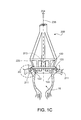
- the body 110 can be expanded from (a) a minimal-diameter long-term configuration ( figure 2A ) to which it conforms after it has been attached to the annulus to (b) an expanded delivery configuration ( figure 2D ) to which it conforms when it is held on the head-end basket of the tool and while it is being attached in the steps shown in figures 1A , 1B , and 1C .
- the long-term configuration is normally circular and has the diameter of a healthy annulus for a particular patient. When attached, the support maintains the healthy configuration of the annulus so that the valve will work properly.
- the body 110 has the same (e.g., circular) shape but different diameters in the delivery configuration and the long-term configuration.
- the body is constructed of a material or in a manner that biases the body to contract to the long-term configuration.
- all or portions of the body 110 may be formed as a helical spring 110a such as a continuous helical spring connected at opposite ends to form a circular body or one or more interconnected helical spring segments ( figure 2B ).
- the support body 110b may be a band of shape memory material such as Nitinol or a biologically compatible elastomer (or other material) that will return to the long-term configuration after being expanded to the delivery configuration ( figure 2C ).
- the hooks 120 may number as few as three or as many as ten or twenty or more and may be arranged at equal intervals along the body or at unequal intervals as needed to make the body easy and quick to deliver, permanent in its placement, and effective in correcting distortion of the valve annulus.
- the hooks are configured and together mounted along the circular outer periphery so that they can be inserted simultaneously into the tissue along the periphery of the annulus and then firmly embedded when the tool is pulled away and the basket is everted.
- a portion or portions of the support body may not have hooks attached if, for example, a segment of the valve annulus shares a boundary with sensitive or delicate tissue, such as the atrioventricular (AV) node of the heart. This tissue should not be pierced by the hooks.
- a support body configured to avoid interfering with the AV node could have a section having no hooks attached or otherwise covered or protected to prevent penetration by hooks into the AV node.
- the support body should be positioned so that this special section of the support body is adjacent the sensitive or delicate tissue as the support body is put into place.
- the support body may have more than one special section lacking hooks, so that the operator has more than one option when placing the support body near the sensitive tissue.
- the support body could have a section removed entirely, and would be shaped somewhat like the letter "C" instead of a complete ring.
- the procedure described above could have an additional step preceding step A, in which the operator rotates the delivery head to position the section having no hooks or to position the gap in the support body to be adjacent to the sensitive tissue at the moment when the hooks are to be embedded in the other tissue.
- the support body may have radiopaque marks to help the operator view the positioning.
- each of the hooks has two pointed features.
- One pointed feature is a sharp free end 122 pointing away from the valve leaflets during delivery.
- the other pointed feature is a barb128 formed at a bend between the sharp free end 122 and an opposite connection end 124 where the hook is attached, e.g., welded or glued, to the body 110.
- the barb points toward the valve leaflets during delivery.
- the barb is arranged to penetrate the tissue when the tool is pushed toward the valve, and the sharp free end is arranged to embed the hook into the tissue when the tool is pulled away from the valve.
- Each hook 120 can be formed of biologically compatible materials such as platinum, gold, palladium, rhenium, tantalum, tungsten, molybdenum, nickel, cobalt, stainless steel, Nitinol, and alloys, polymers, or other materials.
- biologically compatible materials such as platinum, gold, palladium, rhenium, tantalum, tungsten, molybdenum, nickel, cobalt, stainless steel, Nitinol, and alloys, polymers, or other materials.
- the hooks 120 are attached permanently to the support body 110 and the support body can be rolled 123 ( figure 3 ) about a central annular axis 112 of the support body, as indicated.
- One way to cause the rolling of the support body and the associated rotation of the hooks is to enable the body to change its configuration by rotation of the entire body about an axis represented by the central circular axis 123, much as a rubber o-ring can be rolled about its central circular axis.
- the reconfiguration of the body to cause the rotation of the hooks can be achieved in other ways.
- an axial force (arrows 113) to the inner peripheral edge of the ring (we sometimes refer to the support broadly as a ring) will cause the ring to tend to roll and the hooks to embed themselves in the annulus as intended.
- the axial force 113 can be applied by pulling the tool away from the leaflets of the valve, as explained earlier.
- the valve support 100 is first expanded to its delivery configuration and temporarily mounted on a delivery head 220 of the tool 200 ( figure 4A ).
- the support could be expanded enough in its temporary mounting on the tool and mounted far enough away from the tip along the conical head-end basket so that when the head-end basket of the tool is pushed against the annulus to force it to expand to the size and shape of the expanded support, the annulus first has reached a circular, non-distorted shape before the support hook barbs begin to penetrate the tissue.
- the tapered profile of the head-end basket of the delivery tool allows the tool to accommodate supports of various sizes. In some implementations, different shapes and sizes of baskets could be used for supports of different sizes.
- the heart valve support 100 is held in place on the delivery head 220 using one or more releasable connections 246.
- the connections 246 are arranged to translate forces from the tool 200 to the support 100 in each of two opposite directions 248 and 250, toward or away from the leaflets of the valve.
- the connections 246 may be, in some examples, breakable sutures 252 ( figure 4A ), or some other breakaway structure such as clips or adhesive or a structure that can be manipulated from the tool by unscrewing or other manipulation.
- the connections 246 include retainers that can take, e.g., the configurations shown as 254a or 254b ( figures 4B & 4C , respectively).
- the retaining element 254a has one rigid finger 256 to translate forces from the tool 200 to the support 100 when the tool is moved in direction 248 while the support is attached to the tool and being pushed into the heart tissue.
- a second deformable finger 258 aids in maintaining the connection between the support 100 and the tool 200 when the tool is moved in direction 250 and is deformable (dashed lines) to release the valve support 100 from the tool 200 when the force in direction 250 relative to the embedded support exceeds a predetermined threshold.
- the retaining element 254b includes a finger 260 having a crook 262 to receive the support 100 and to translate forces from the tool 200 to the support 100 when the tool is moved in direction 248.
- the finger has a resiliently deformable tip 264 that is biased towards the tapered body 222 and helps to maintain the connection between the support 100 and the tool 200 and is deformable (shown in hidden lines) to release the valve support 100 from the tool 200 when the tool is moved in the second axial direction 250 against an embedded support and the force exceeds a predetermined threshold.
- a basket 220 is connected at its broad end to a set of stiff wires or other rigid projections 216 that are splayed from a long shaft 210 having a handle 212 at the operator's end 214.
- the projections 216 connect the shaft 210 to the basket 220 and transfer pulling or pushing force between the shaft and the basket (and in turn to the support).
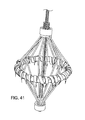
- the example of the basket shown in figure 5 includes a tapered body 222 having a network of interconnected struts 224 defining an array of openings 226 together forming a tapered semi-rigid net.
- the basket (which we also sometimes refer to as a delivery head) 220 has a rounded tip 228.
- the head 222 tapers radially outwardly with distance along a longitudinal axis 234 of the head 220 from the tip 228 towards the operator.
- the broad end 232 of the tapered body 222 is firmly attached to the projections 216, which taper in the opposite direction from the taper of the basket.
- the net formed by the struts 224 is semi-rigid in the sense of having enough stiffness to permit the operator to force the valve support against the heart tissue to cause the barbs of the hooks of the support to penetrate the tissue, and enough flexibility to permit the head-end basket to be everted when the operator pulls on the handle to evert the basket and release the support from the basket.
- the shaft 210 defines a lumen 236 extending between the heart valve end 218 of the shaft 210 and the handle 212.
- a wire 238 is arranged to move freely back and forth within the lumen 236.
- the wire 238 has one end 240 that extends from the handle 212 and an opposite end 242 that is connected to the inside of tip 228.
- the wire 238 can be pulled (arrow 244) to cause the delivery head 220 to collapse (hidden lines) and evert radially inwardly starting at the tip 228 as mentioned earlier.
- the operator begins the delivery of the support by pushing the tapered end 230 of the head basket 220 into the valve 16 (e.g., the tricuspid valve) to cause the valve leaflets 14 to spread apart.
- the tip 230 is small and rounded which makes it relatively easy to insert into the valve without requiring very precise guidance.
- the head-end basket is tapered, by continuing to push, the operator can cause the annulus 18 of the tricuspid valve 16 to expand in size and to conform to a desired shape, typically circular.
- the head-end basket tends to be self-centering.
- the taper of the basket 220 translates the insertion force in direction 248 into a radial force that causes the annulus 18 to expand and temporarily assume a desired shape (and a larger than final diameter).
- the ring of barbs of the hooks touch and then enter (pierce) the heart tissue along a ring of insertion locations defined by the outer periphery of the annulus, and the sharp free ends of the hooks enter and seat themselves within the tissue, much like fish hooks.
- the basket can be oriented during insertion so that essentially all of the hooks enter the tissue at the same time. Or the tool could be tilted during insertion so that hooks on one side of the support enter the tissue first and then the tool delivery angle could be shifted to force other hooks into the tissue in sequence.
- the operator pulls on the near end 240 of wire 238 to cause the basket 220 to collapse, evert, and be drawn out of the valve 16.
- the everted portion of the basket reaches the valve support 100.
- the operator causes the body 110 of the support 100 to roll about its central axis (as in the o-ring example mentioned earlier) which causes the hooks 120 to embed more firmly in the tissue of the annulus 18 of the valve 16.
- the operator breaks the connections between the tool 200 and the valve support 100 and removes the tool 200, leaving the valve support 100 in place.
- the everting basket 220 passes the points of connection 246, the retaining forces exerted by the embedded hooks 120 of the support body 110, acting in direction 248, exceed the forces exerted by the withdrawing basket 220 on the support body 110 (through the connections 246), acting in direction 250, thereby causing the connections 246 to break or release, in turn releasing the support 100.
- the tool 200 is then withdrawn, allowing the valve support 100, along with the annulus 18, to contract to the long-run configuration.
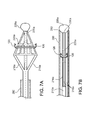
- the delivery head 220a can be made, for example, from a shape memory alloy, such as Nitinol, which will allow the body 222a to be collapsed radially toward the longitudinal axis 234a prior to and during delivery of the head from a percutaneous entry point (say the femoral vein) into the heart.
- the delivery head 220a is biased towards the expanded, tapered configuration shown in figure 6A .
- the delivery head 220a in the form of a tapered semi-rigid net, is connected to a catheter shaft 210a through projections 216a that splay radially outwardly from the catheter shaft 210a and taper in a direction opposite the taper of the delivery head 220a. (Here we refer to the delivery head as the head-end basket.)
- the projections 216a are resiliently mounted to the catheter shaft 210a and are biased towards the expanded, tapered orientation shown, for example, by spring biased projections 216b shown in figure 6B .
- the projections 216a include springs 278, e.g., torsion springs (as shown), mounted to the catheter shaft 210a and forming a resilient connection.
- a wire 238a slides within a lumen 236a of the shaft 210a in a manner similar to the one described earlier.
- the tool 200a also includes a sheath 280 in which the catheter shaft 210a can slide during placement of the support.
- the sheath 280, the catheter shaft 210a, and the wire 238a are all flexible along their lengths to allow the tool 200a to be deflected and articulated along a blood vessel to reach the heart and to permit manipulation of the delivery head once inside the heart.
- valve support 100 is then expanded to the delivery configuration (either by hand or using an expansion tool) and mounted on the tapered body 222a.
- the valve support 100 is connected to the delivery head 220a using releasable connections, e.g., breakable sutures and/or retaining elements (as described earlier).
- the sheath 280 is then moved along the catheter shaft 210a towards the delivery head 220, causing the projections 216a and the delivery head 220a to contract radially inwardly to fit within the sheath 280, as shown in figure 7B .
- the tip 228a of the delivery head 220a bears against the end 282 of the sheath 280.
- the rounded tip 228a may, e.g., provide easier delivery and maneuverability in navigating the blood vessels to reach the heart.
- the end 230 of the tool 200a is fed percutaneously through blood vessels and into the right atrium 24 ( figure 8A ).
- the sheath 280 is then retracted, exposing the valve support 100 and allowing the projections 216a, the delivery head 220a, and the support 100 to expand, as shown in figure 8A .
- the catheter shaft 210a is then advanced, e.g., under image guidance, in the direction 248a along an axis 30 of the annulus 18.
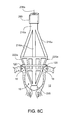
- the operator forces the distal end 230a of the self-centering delivery head 220a into the valve 16 ( figure 8B ) using feel or image guidance, without actually seeing the valve 16.
- the operator pushes on the end 214a of the catheter shaft 210a to force the tool further into the valve 16.
- the tool 200a tends to be self-centering because of its shape.
- the net-like construction of the delivery head 220a (and the head used in open heart surgery, also) allows blood to flow through the valve even while the delivery head 220a is inserted.
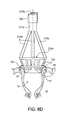
- valve support 100 Once the valve support 100 has been attached to the valve 16, the operator pulls on the proximal end 240a causing the delivery head 220a to evert (hidden dashed lines) and be drawn out of the valve 16 (shown in figure 8D ). Eventually the everted portion of the tool 200a reaches the valve support 100. By further tugging, the operator causes the torus of the support 100 to roll around its periphery which jams the free ends of the hooks 120 securely into the annulus 18 of the valve 16, as illustrated in figure 8E , seating the support permanently and permitting later growth of tissue around the support 100.
- the depth and radial extent of each of the placed hooks 120 can be essentially the same as a conventional suture so that their placement is likely to be as effective and familiar to the operator and others as conventional sutures.
- the operator breaks the connections 246 between the tool 200a and the valve support 100 and retracts the catheter shaft 210, leaving the support 100 in place.
- the catheter shaft 210 is retracted to a position beyond the valve annulus 18 and the wire is advanced in the first direction allowing the delivery head 220a to assume its original tapered shape ( figure 8F ).
- the catheter shaft 210a is then retracted into the sheath 280 ( figure 8G ), and the tool 200a is withdrawn.
- the tip 228a of the tool 200a when everted, has a compressed dimension that is smaller than an internal diameter 284 of the sheath 280, permitting the catheter shaft 210a to be retracted directly into the sheath 280 after deployment, with the everted tip held within the collapsed delivery basket, as shown in figure 8I .
- valve support 100 contracts, reshaping the annulus 18 such that the valve leaflets 14 coapt to prevent a backflow of blood during systole.
- the hooks can be arranged around only about three-quarters of the support and therefore the annulus.
- the operator will rotate the support to position the portion of the support having hooks.
- the hooks can cover the entire periphery of the annulus. In this scenario, the hooks are arranged around the full circumference of the support.
- the hooks can cover only the posterior section of the annulus of the mitral valve. In this scenario, the hooks can be arranged around two-thirds of the support.
- the operator will position the portion of the support having hooks against the posterior section of the mitral valve annulus.
- a back-up valve can be provided as part of the delivery tool to maintain heart function during the delivery procedure.
- Materials other than shape memory materials may be used as the material for the support body, and other ways can be used to force the support back to a desired size following expansion, including, for example, cross-bars that span the opening of the support.
- the left atrial appendage of the heart can be closed by a similar technique.
- the tool can be pushed into an opening of an atrial appendage causing the opening to assume a predetermined shape.
- the tool can continue to be pushed in order to embed the hooks of the expanded support into the periphery of the opening of the appendage.
- the tool can then be withdrawn, releasing the support, and allowing the support to contract.
- the support can have a relatively small contracted diameter such that, when the tool is withdrawn, releasing the support, the support can contract to a relatively small size, effectively closing off the appendage.
- valve support can also be deployed through the chest.
- the head-end of the tool need not be a basket, but can take any form, mechanical arrangement, and strength that enables the valve annulus to be forced open to a shape that corresponds to the shape of the support.
- the basket can be made of a wide variety of materials.
- the basket can be held and pushed using a wide variety of structural mechanisms that permit both pushing and pulling on the support both to seat and embed the support in the annulus tissue and disconnect the support from the tool.
- the tool need not be conical.
- the support could take a wide variety of configurations, sizes, and shapes, and be made of a wide variety of materials.
- the hooks could be replaced by other devices to seat and embed the support using the pushing force of the tool.
- the hooks of the support need not be embedded directly in the annulus but might be embedded in adjacent tissue, for example.
- the support could take other forms and be attached in other ways.
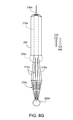
- the support body 110a can be a torus in the form of a helical spring (as mentioned earlier).
- a support body can have a native circumference 116 on the order of ten centimeters in its contracted state, and a proportional native diameter 114. The circumference can be selected based on the physical requirements of a particular patient.
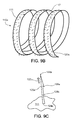
- FIG. 9B A close-up view of a fragment of this support body, figure 9B , shows that some implementations have a number (e.g., a large or very large number, for example, as few as say 15, or 100, and up to hundreds or even thousands) of burr hooks 120a attached to an outer surface 111 of the support body 110a.
- the helical support body is wound from a flat strip that has the outer surface 111 and an inner surface 117.
- burr hooks could also be attached to the inner surface for manufacturing reasons or for other purposes.
- the burr hooks which are small relative to the body, are each configured to partially or fully pierce annular tissue when the part of the body to which the burr hook is attached is pushed against the tissue.
- each burr hook 120a has a sharp free end 122a for piercing tissue and at least one barbed end 128a, 128b (two are shown in figure 9C ) for keeping the burr hooks embedded in tissue.
- Each burr hook also has an end 124a that is attached to the surface of the support body. Once the support (we sometimes refer to the support structure simply as the support) is in contact with heart tissue, the embedded burr hooks hold the body in a proper position and configuration on the annulus.
- Burr hooks can be attached to the surface of the support body using glue, cement, or another type of adhesive, or formed from the support body as part of an industrial process, such as molding, etching, die cutting, welding, or another process, or can be attached by a combination of these techniques. Different burr hooks on a given support can be attached by different mechanisms.
- Each burr hook 120a can be structured and attached so that the free end 122a points in a direction 122b perpendicular (or some other selected effective direction, or deliberately in random directions) to the body surface 111.
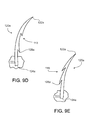
- the burr hook can be curved.
- a barbed end 128a could be located on a concave edge 113 ( figure 9D ) or a convex edge 115 ( figure 9E ) of a curved burr hook.
- the burr hooks bear a resemblance to burr hooks on natural plant burrs.
- a different kind of attachment device could be used by analogy to metal tipped hunting arrows in which a sharp point has two broad and sharp shoulders that cut the tissue as the point enters. The tips of the two shoulders serve a similar function to the barbs, keeping the arrow embedded once it enters the tissue.
- the burr hooks on a support body have two or more (in some cases, many) different shapes, sizes, orientations, materials, and configurations.
- the orientations of the burr hooks it may be more likely that at least some of the burr hooks will become embedded in the tissue, no matter how the support body is oriented at the moment that it comes into contact with the annulus. Varying the number, orientation, and curvature of the hooks may make it more likely that the support body will remain in place.
- a force applied to the support body in a particular direction may unseat or partially unseat some of the burr hooks by disengaging the barbed ends from the tissue, but the same force may not affect other burr hooks that have barbed ends oriented in a different direction or in a different configuration than the unseated burr hooks.
- the force applied to seat the support may cause some burr hooks to embed more securely than other burr hooks.
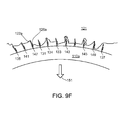
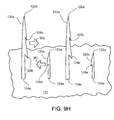
- burr hooks typically not all of (in some cases not even a large portion of) the burr hooks will embed themselves in the tissue when the support body is pushed against the tissue, or remain embedded after placement. As shown in figure 9F , there are enough burr hooks arranged in an appropriate way so only a fraction of the total hooks need be embedded in annular tissue (and in some cases only in certain regions) to create a physical bond to keep the support body properly in place.
- the proportion of burr hooks on a support that need to embed securely in the tissue could range from 1% to 10% or 40% or more.
- the averaging spacing of the successfully embedded burr hooks could range from, say, one burr hook per millimeter of support body length to one burr hook per two or three or more millimeters (or more) to secure the support appropriately.
- burr hooks are grouped rather than arranged evenly on the support, the percentages of and distances between successfully embedded hooks may differ.
- burr hooks When the burr hooks come into contact with the annular tissue during delivery, some 131, 133, but not necessarily all, of the burr hooks pierce the tissue and (when a retracting force is applied to the delivery tool) their barbs grip the tissue. Of the remaining burr hooks, some 135, 137 may (because of the contours of the tissue, for example) not even come into contact with the tissue, and others 139, 141 may not come into contact with the tissue with sufficient force or in the right orientation to pierce the tissue and have their barbs seat securely in the tissue. Some of the burr hooks 143, 145 may penetrate the tissue but fail to grip the tissue.
- burr hooks 147, 149 may only penetrate the tissue at the barbed end 128a, and not with respect to the free end 122a, providing a physical bond that may be weaker than one in which the free end has been embedded in the tissue.
- the barbed ends 128a seat properly and resist forces in the direction 151 that would otherwise unseat the burr hook. Even though a wrenching force applied to a particular burr hook in direction 151 could still be large enough to unseat the barbed end, overall the combination of many burr hooks embedded in tissue tends to keep the support body set in place and in the proper configuration. Over time, some of the burr hooks that were not embedded when the support was placed may become embedded, and some of the burr hooks that were embedded when the support was placed may become unseated.
- each of the barb or barbs to removal of a given burr hook from the tissue may be relatively small.
- the aggregate resistance of the burr hooks that successfully embed themselves will be higher and therefore can reliably keep the support body in place and the annulus of the valve in a desirable shape.
- the stress on any part of the tissue of the annulus is quite small, which helps to keep the support body properly seated and the valve shape properly maintained along its entire periphery, all without damaging the tissue.
- the implementations shown beginning at figure 9A tend to have more and smaller hooks not all of which need to become embedded successfully.
- a common concept between the two arrangements is that the hooks penetrate by being pushed into the tissue and have retaining elements that become securely embedded in the tissue when a pulling force is applied at the end of the placement process.
- the two concepts are not mutually exclusive. Supports like those shown in figure 1A could also have burr hooks and supports like those shown in figure 9A could also have hooks of the kind shown in figure 1A . Placement of the support could rely on a combination of both kinds of hooks.
- Each burr hook can be formed of a biologically compatible material such as platinum, gold, palladium, rhenium, tantalum, tungsten, molybdenum, nickel, cobalt, stainless steel, Nitinol, and alloys, polymers, or another material. As for the hooks shown beginning with figure 1A , the hooks can also be formed of a combination of such materials.
- An individual support body may exhibit burr hooks having a range of compositions. Some of the burr hooks attached to a support body may be composed of one material or combination of materials, and some of the burr hooks may be composed another material or combination of materials. Each burr hook may be unique in composition.
- some parts of a burr hook may be composed of one set of materials, and other parts may be composed of another set of materials.
- the region of the burr hook at the barbed end is composed of one set of materials, alloys, polymers, or mixtures
- the region of the burr hook at the free end is composed of another set of materials, alloys, polymers, or mixtures
- the rest of the burr hook is composed of a further set of materials, alloys, polymers, or mixtures.
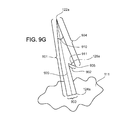
- Figure 9G shows an example burr hook that only has one barbed end 128a.
- the burr hook extends from an attached end 124a to a free end 122a along the path of a principal axis 920 that (in this case) is perpendicular to the support body surface 111.
- the barbed end spans a length 904 from the burr hook's free end 122a to the barbed end's free end 906.
- This free end 906 forms a point spanning an acute angle 910 and the barbed end 128a spans an acute angle 911 to grab the tissue in response to any force that would otherwise pull an embedded burr hook away from tissue.
- each burr hook could be between about 1 and 12 millimeters, as measured from the attached end 124a to the free end 122a along the principal axis.
- Each barbed end could extend a distance 902 from the burr hook lesser or greater than a principal width or diameter 903 of the burr hook as measured at the attached end.
- the cross-section of the body of the burr hook could be flat or cylindrical or ovoid or any other of a wide variety of shapes.
- Different burr hooks may be placed on the support body surface in different sizes and configurations.
- different burr hooks may have different lengths and different numbers and placement of barbed ends.
- a portion of support body surface 111 contains burr hooks 120a that each have two barbed ends 128a, 128b facing in a first direction 950 and shorter burr hooks 120b each having one barbed end 128a facing in a second direction 951.
- the burr hooks may be arranged on the body surface in various densities and patterns of distribution.
- the burr hooks may be placed on the surface of the body in repeating rows 930.
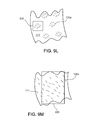
- the burr hooks may be placed on the surface in rows of different lengths and densities 931, 932. As shown in figure 9K , the burr hooks may be placed on the surface along arc formations 933. As shown in figure 9L , the burr hooks may be placed on the surface as cluster formations 934. As shown in figure 9M , the burr hooks may be distributed randomly 935. Other patterns may also be used.
- a single support body can include a wide variety of patterns of burr hooks on its surface, because the physical characteristics of a particular heart valve may mean that the valve tissue is either more receptive or less receptive to a particular pattern of burr hook distribution. Some patterns may be more effective on some types of tissue, and other patterns may be more effective on other types of tissue.
- the burr hooks need not be present at the points where the body 110a contacts the delivery tool 220, including in the area near the rigid fingers 256, 258. This tends to prevent the burr hooks from causing the support body to stick to the tool.
- any two burr hooks may be placed at a distance 905 from each other greater than or less than the length 901, 901a of either one.
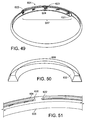
- the ring when a support is formed helically, the ring can be considered to have a front side 961 (which faces the valve when the support is delivered), and a back side 960 that faces away from the valve.
- the support body 110a does not have burr hooks 120a on the back side 960.
- the back side 960 is covered by a sleeve 963.
- the sleeve assists in the long-term process of integration with valve tissue. Over a period of time, heart tissue will attach to the support body as part of the process of healing.
- the sleeve is made of a material that allows this process to occur faster than without the sleeve.
- the sleeve may be composed of a porous material, which allows tissue to grow into the sleeve, thus securing the support to the tissue more effectively than without the sleeve.
- the sleeve material may be a thermoplastic polymer such as Dacron (polyethylene terephthalate).
- the sleeve material may alternatively be a metal or another type of material.
- the sleeve can be placed on the support body at a location other than the back side. For example, the sleeve could be placed on the inner side 965 of the body, with burr hooks remaining on the outer side 964.
- the sleeve is formed as a half-torus in this example, but could have a wide variety of other configurations.
- a sleeve may be used with any kind of support, including the one shown beginning in figure 1A , could cover all or only part of the support, and could cover portions of the support that include hooks or barb hooks or both. In the latter case, the hook may be arranged to penetrate the sleeve during setup and before the support is placed into the heart.
- the sleeve could also cover a portion of the support meant to contact delicate or sensitive tissue, such as the AV node.
- the sleeve is made of a material that is less likely to damage or interfere with the operation of the delicate or sensitive tissue, as compared to other materials that may be used in the support.
- burr hooks may make attaching the support faster, simpler, more reliable, and easier than for the larger hooks described earlier.
- the delivery tool operator may not need to apply as much force as might be necessary to embed larger hooks in the annular tissue. In some cases, the barbs would not need to be rotated as described for the larger hooks in order to embed them securely.
- the operator need not be concerned whether all of the burr hooks have become embedded. Once the operator has determined that the support body has made contact with the tissue and by inference that many of the burr hooks have become attached, the operator can tug on the support to confirm that it has been seated and then release the support body from the delivery tool using one of the mechanisms described earlier. Because of the ease of positioning, the procedure could be performed easily in a non-surgical context, such as in a catheterization laboratory.
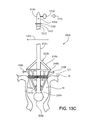
- the catheter may include a balloon 228b at the tip of the delivery tool.
- the balloon remains deflated as the catheter is passed through the patient's blood vessels into the heart, as in figure 13A .
- the balloon can be inflated, shown in figure 13B .
- the inflated balloon floats in the blood being pumped through the heart and (along with the delivery tool) is carried easily and to some extent automatically toward and into the valve that is to be repaired.
- the balloon can continue to move beyond the valve annulus, and, when located as shown in figure 13C , supports the distal end of the catheter while the operator supports the proximal end of the catheter.
- the shaft of the catheter then serves as a "rail" supported at both ends and along which operations involving the delivery tool and the support can be performed with confidence that the rail is being held generally on axis with the valve.
- the annulus of the heart valve is expanded to the desired shape by pushing a conical surface, such as the basket, along the axis of and into the heart valve.
- a conical surface such as the basket
- the pushing of the conical surface into the annulus can be supplemented by or replaced by a technique in which the expansion of the annulus is done after the delivery tool is inserted into the valve.
- Figure 9A shows one diameter of the support body, the native (long-term configuration) diameter 114. Recall that this diameter is different from the diameter in the delivery configuration.
- the former diameter 114 is, as shown in figure 9Q , smaller than the latter diameter 202 of the delivery tool at the point of support body attachment 247.
- FIG. 13D shows that, in the absence of the outward force previously applied by the delivery tool, the coils of the helical spring contract inwardly 1308 so that the support body returns to a final diameter 1309 of approximately its native diameter.
- the support body will also pull the annulus inward, reforming the annulus to a desired smaller diameter 209.
- the support body is made of a material or alloy that is appropriately plastic, the support body may not fully contract to its original native diameter. However, if the support body is made of a shape memory alloy such as Nitinol, the memory effect of the alloy will tend to cause the support body to contract to a diameter nearly identical or identical to its original diameter.
- a shape memory alloy such as Nitinol
- the support body 110a may have other portions bearing no burr hooks.
- sensitive or delicate tissue such as the AV node should not be punctured or bound to hooks.
- the support body 110a can have a binding section 972 having burr hooks and a non-binding section 974 having no burr hooks.
- a non-binding section 974 of sufficient length to abut the AV node spans an angle 975 between about 40 and 60 degrees of the support body circumference.
- the binding section 972 will span an angle 973 of the remaining circumference.
- a non-binding section 974 is covered in a sleeve made of a material suited to contact the AV node or other sensitive tissue.
- the two sections 972, 974 can have radiopaque markers 976, 977 indicating the borders between the two sections.
- the markers 976, 977 are each in the shape of an arrow pointing to the non-binding section.
- an operator can use the radiopaque markers 976, 977 to view the boundary of the non-binding section 974 and position the non-binding section 974 against the AV node or other sensitive tissue.
- the support body 110a can have multiple sections 974, 978 having no burr hooks.
- the operator may be limited in the degree to which the delivery head can be rotated.
- the operator has multiple options for positioning the support body in order to avoid puncturing the AV node, and the operator would not have to rotate the delivery head more than about 90 degrees in any direction.
- Two non-binding sections are shown, but the support body can also have three or more of these sections.
- the non-binding sections 974, 978 span angles 975, 979 between about 40 and 60 degrees of the total circumference.
- the feature of the support body 110a that should abut the AV node can take the form of an open section 990.
- the open section 990 may span an angle 995 between about 40 and 60 degrees of the circle defined by the support body 110a, while the support body spans the remaining angle 993.
- the open section 990 can also have radiopaque markers on the open ends 992, 994 of the support body 110a to assist an operator in positioning the open section 990 against the AV node or other sensitive tissue.
- the delivery head 220 can include a sheath 280a for covering the support body during insertion.
- Figures 10A and 10B show the sheath in a side section
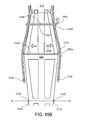
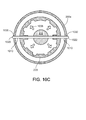
- figures 10C ⁇ 10D show the sheath as well as the delivery head in a cross-section at A ⁇ A in Figure 10B .
- the sheath 280a wraps around the delivery head 220, including the support body 110a, so that the burr hooks do not accidentally puncture or attach to any other tissue or devices prior to reaching the annulus.
- the sheath is made of a flexible material, such as rubber, silicone rubber, latex, or another biologically compatible material or combination of materials.
- the sheath can also be made of the same material or materials as the catheter. Recall that one implementation of the sheath is shown in Figures 6A ⁇ 6B and described in the corresponding text. Other implementations of the sheath are possible.
- the implementation of the sheath 280a shown in side section in figure 10A is kept in place by attachment to an elastic retainer ring 1000 and a crossbar 1010 permanently affixed through and extending outward from the catheter shaft 210 perpendicular to the longitudinal axis 234.
- the retainer ring 1000 is positioned closer to the operator and farther from the distal end than is the support body 110a, and the crossbar 1010 is positioned farther from the operator and closer to the distal end than is the support body.
- This sheath 280a is permanently attached 1002 to the retainer ring 1000.
- the sheath 280a is also attached to the crossbar temporarily at holes 1030, 1032 (visible in figure 10B ) sized to fit the projecting tips 1020, 1022 of the crossbar 1010.
- the combination of the retainer ring and crossbar allows the sheath to automatically detach from the crossbar and retract upward away from the support body as part of the expansion procedure.
- the process by which this happens is as follows.
- the retainer ring 1000 when the delivery head expands outward 1006, the diameter 1008 of the delivery head at the original point of retainer ring attachment 1012 increases to a diameter greater than the diameter 1009 of the retainer ring 1000. As a result, the retainer ring rolls upward 1004 from a point 1012 to a point 1005 on the delivery head of smaller diameter. As the retainer ring rolls, it pulls the distal end of the sheath in the same upward direction 1004 along the delivery head 220 and away from the support body 110a. Part of the sheath 280a wraps around the ring as part of the rolling process; in a sense, the retainer ring is "rolling up" the sheath, in the fashion of a scroll wrapping around a roller.
- the retainer ring 1000 is rubber or another biologically-compatible material with sufficient elasticity to allow the ring to roll up the expanding delivery head.
- the sheath 280a is also released from the crossbar.
- a cross-section of the delivery head 220 including the crossbar 1010 is shown in figure 10C .
- the sheath 280a has holes 1030, 1032 configured to allow the crossbar 1010 to pass through, holding the distal end of the sheath to the crossbar. Because the crossbar projects beyond the sheath, the ends 1020, 1022 of the crossbar are rounded and smooth to prevent the crossbar from piercing or tearing any tissue that it contacts before the delivery head reaches its destination.
- the crossbar remains in place and does not extend outward or change configuration, because the crossbar is permanently and securely attached to the shaft 210.
- the delivery head pushes the sheath beyond the tips 1020, 1022 of the crossbar, releasing the sheath from the crossbar.
- the sheath can move freely when the retainer ring rolls upward along the delivery head, as described above.
- the crossbar 1010 may be made of any of the materials used in the delivery tool, or another biologically-compatible material, provided that the crossbar is sufficiently rigid to keep the sheath 280a in place, as described.
- Figure 11A shows another version of the delivery head 220b.
- This version differs slightly from the versions of the delivery head already shown.
- the rigid projections 216b are composed of an outer sleeve 1140 that encloses an inner arm 1142 attached to the shaft 210b by a hinge 1144.
- the sleeve 1140 extends from the inner portion 1142, and when the delivery head contracts, the sleeve withdraws along the length of the inner arm.
- This version of the delivery head is used in figure 11A to demonstrate the use of a tightening wire 1100, but this tightening wire can be used with other versions of the delivery head as well.
- this tightening wire 1100 is threaded into and back out of a hole 1103 at the operator end 214b of the delivery tool 200b. In doing so, the wire traverses the interior of the shaft 210b of the delivery tool 200b. The ends of the wire exterior to the operator end 214b form a loop 1102 to be manipulated by an operator.
- This wire 1100 can be used to activate a mechanism to adjust the shape of the support body 110a to a small degree, with the goal of contracting the final diameter 1309, an example of which is shown in figure 13B .
- the wire exits the shaft 210b at a hole 1105 placed at a point above the delivery head 220b.
- the wire extends down the side of the delivery head 220b, guided by hoops 1120, 1122.
- the wire is threaded along the interior of the helical coil 1150, 1152 of the support.
- the wire returns up the side of the delivery head and back into the shaft.
- Figure 11C also shows hoops 1124, 1126 that are placed on the struts 224b of the delivery head at regular intervals to keep the wire properly positioned.
- spools 1130, 1132, 1134, 1136 attached to the strut 224b guide the wire and prevent the wire from scraping against 1160, 1162 the helical loops 1150, 1152 at the wire exit region.
- the end of the wire that re-enters the hole 1105 continues back up the shaft alongside itself, and exits the delivery tool ( figure 11B ) to form the loop 1102 by connecting with the other end.
- FIG 11D shows an example of a portion of the support body 110a attached to the periphery 121 of an annulus before the support body is tightened.
- FIG 11E after tightening, the support body 110a pulls the tissue at the periphery 121 closer together. The final diameter of the annulus will be slightly smaller due to this bunching effect. Once the delivery head is removed, the support body, and thus the attached annulus, will contract to the desired size.
- the delivery head 220b has a blade 1170 attached to one of the two rigid fingers 256b, 258b that keep the support body in place.
- the cutting segment 1172 of the blade structure severs the wire. The operator may pull the external loop after the wire has been severed to keep the stray ends of the wire from moving freely outside of the delivery tool when the tool is being removed from the annulus.
- a delivery tool 200b for use in (but not only in) a catheterization context shares elements in common with the delivery tools discussed earlier, including the shaft 210b, collapsible conical head end basket 220b, set of struts 224b, and operator end 214b.
- This delivery tool 200b allows the operator to expand or contract the collapsible conical head-end basket 220b radially from a collapsed (closed) configuration (shown in figure 12A ) to an expanded (open) configuration (shown in figure 12B ), much in the way that an umbrella can be opened.
- the basket can include a set of spars 1210, 1212, 1214, 1216, 1218 arranged about the axis, as shown in figure 12C .
- each spar has one hinged end 1220, 1222 connected to a central collar 1200 that can ride up 1202 and down 1204 along a central shaft 1250 of the basket.
- Its other hinged end 1230, 1232 is connected to the hinged 1240, 1242 struts 224b of the basket in such a way that when the opening and closing mechanism is manipulated 1208 by the user to cause the collar 1200 to move back and forth along the shaft 1250, the spars 1210, 1220 force 1206 the basket open or closed, akin to the mechanism of an umbrella.
- the operator end 214b of the delivery tool has a twist or slide control 1150 that enables the operator to control the collar.
- the control is a slide control, and can be slid downward, for example.
- the annulus can be expanded to the desired shape by radial forces 1206 that are not imposed by moving the entire basket linearly along the valve axis. Instead the basket is moved into the desired position linearly along the valve axis and then the annulus is expanded to its desired shape.
- the radial forces could also be imposed by a combination or sequence of moving the entire basket axially and expanding the basket laterally.
- radiopaque measurement marks 1310, 1312 can be placed on the shaft or basket at regular spacings according to a standard measurement unit (e.g., one mark per centimeter). The marks can be used to determine the distance that the delivery tool has traversed inside the heart and the location of the basket as it is inserted into the valve, allowing the operator to place the basket at a good position along the axis of the valve.
- a standard measurement unit e.g., one mark per centimeter
- the placement of the support from the basket onto the annulus can be done either as part of the operation of opening the basket or following the opening of the basket.
- the basket would be inserted into the valve to a point where the basket is adjacent to the valve annulus.
- burr hooks on the outer periphery of the support would be forced radially into the annulus tissue.
- the porous sleeve described earlier and shown in figure 9P would be positioned on the inner periphery 965, away from the embedded hooks.
- the basket would be inserted into the valve so that the support on the basket was positioned slightly upstream of the location of the annulus.
- the basket would then be opened to force the annulus into the desired shape, then the tool and basket would be pushed slightly to force the support into place, embedding the hooks.
- the basket would be at least partially closed, releasing the basket from the support, and the tool would be withdrawn from the valve.
- the basket could be partially opened, inserted into the annulus, and then fully opened.
- the support is constructed from several pieces including an elastic multiple-loop circular coil 302 of strip material 304.
- the coil is encased in a tubular toroidal sheath 306.
- a large number of burrs or hooks 308 (the number could be, for example, between 20 and 60, but could also be much larger in number, even orders of magnitude larger, or in some cases smaller) are mounted at regular small intervals 310 around the circumference of the toroidal sheath.
- the multiple-loop circular coil is made of Nitinol strip, approximately 1/8 inch wide and approximately 10/1000-15/1000 inch thick.
- the Nitinol strip is shape set into a coil with final desired implant diameter.
- the Nitinol coil would be expanded, as explained later.
- the ends 312, 314 of the strap would move circumferentially around the coil (in the directions indicated by arrows 316 and 318) to accommodate the increase in diameter of the ring.
- the ring is shown in its native, unstressed diameter corresponding to the final desired implant diameter.
- the numbers of loops can be varied depending on the material used, the thickness, and other considerations. In some implementations the number of loops can be 3.5, or 5 or 8, or other numbers ranging from 1 to 10 or more.
- other materials and combinations of them can be used to form the resilient coil. These could include, for example, plastics, metals, and coils of these and other materials.
- the overall shape of the coil could be different from the one shown in figure 14A , including non-circular and non-planar shapes.
- the coil (or other resilient core ring) needs to have enough strength and durability to be expandable to fit on the delivery tool, to be forced onto the heart valve annulus, to contract to pull the annulus back into the desired shape, to tolerate the force incurred when the insertion tool is disconnected, and to form a long-lasting and strong support for the annulus. It also needs to have enough resiliency to be able to contract the support and the annulus to which it is attached to the desired shape and size after insertion and to retain the support in essentially that shape and size against forces in the heart that may act against the support.
- biocompatible materials are used.
- the coil is held within the sheath 306 in a way that permits the coil to slide within the inner lumen of the sheath, especially as the coil is expanding for insertion and contracting after insertion.
- the sheath has an elasticity that allows it to move radially with the coil during expansion and contraction. Because the burrs or hooks (we sometimes refer to burrs and hooks and a wide variety of other gripping devices as grippers) are mounted on the sheath, and not on the coil, the expansion and contraction of the coil can occur without disruption of the angular locations of the grippers relative to the central axis of the support.
- the sheath can be formed of a simple tube. To embed the coil in such a tube the coil can be unwound and wrapped through the tube repeatedly until all turns of the coil have been embedded. Once the coil is completely embedded, in the tube, one end of the tube can be pulled over and glued to the other end to finish the assembly.
- the sheath can be formed of a specially molded piece that has the toroidal shape formed during molding and includes a way to secure the two ends together.
- the sheath is meant to be sealed to prevent fluids from passing into the chamber that contains the coil. In some cases, the sheath is not sealed and fluid can pass freely. In some implementations, a fluid is used to fill the space within the sheath to provide lubrication for the sliding of the coil within the sheath and to displace air which could cause problems when the support is used inside the heart.
- the fluid could be blood or saline solution, for example.
- the sheath must be strong enough to enclose the coil without breaking even when the support is expanded and contracted prior to, during, and after placement in the valve. As the diameter of the support is expanded and contracted, the cross-sectional diameter will also tend to change, and the amount of that change must not be so great as to disrupt the attachment of the grippers to the valve tissue, to constrain the sliding of the coil within the sheath, or to allow the grippers to become dislodged or disoriented relative to the sheath, among other things.
- the sheath can be resilient so that when the support is contracted after being expanded, the sheath contracts along with the coil.
- sheath A wide variety of materials can be used for the sheath, including silicone, plastics, and fabrics, for example. Combinations of materials can also be used.
- an outer surface 322 of the sheath can bear grooves 323 that accommodate (and hold in place) portions of the grippers, as explained below.
- the grooves can be parallel and lie at equal small intervals around the perimeter of the sheath.
- the cross-sectional diameter of the sheath can be large enough so that the inner lumen accommodates the coil and allows it to slide, and the outer surface supports the grippers, and small enough that the support does not obstruct adequate flow of blood through the heart valve after installation.
- each of the grippers can be formed on a length of wire that includes a closed ring 324 that has about the same diameter 326 as (or slightly smaller than) the diameter of the cross section of the sheath.
- a straight section 328 extends from the ring and has the gripper 330 formed on its free end.
- the anchor is prefabricated with the ring in its final shape and the gripper projecting from the ring.
- the anchor is formed of stainless steel or another biocompatible material.
- each of the anchors or groups of them can be used to fabricate each of the anchors or groups of them, including metals and plastics.
- the cross-sectional shape of the anchors can vary and be, for example, round, oval, flat, or bent, or a variety of other shapes.
- the anchors can be made from tiny fishhooks with the hook end serving as the gripper and the other end being bent to fit onto the support.
- the arrangement of the anchors along the sheath can be other than regular and closely spaced. The spacing can be varied along the sheath or the number of anchors can be varied along the sheath, for example.
- the ring portion can be pulled open and slipped over the sheath, then released.
- the ring portions of the anchors can be seated in the grooves.
- the anchors can all be mounted to cause their grippers to point at a common angle 336 from a central axis 338 of the support as shown in figure 14D (in which some of the anchors have not yet been mounted).
- the grippers can be pointed at different angles relative to the central axis.
- the anchors can be mounted in such a way that they do not tend to slip or rotate around the outer surface of the sheath, but rather maintain their installed orientations.
- the stretching and relaxing of the sheath may cause a change in its cross-sectional diameter and therefore an opening and closing of the rings and a corresponding reorientation of the angles of attack of the points of the grippers. This effect can be useful in installing and providing secure attachment of the grippers in the valve tissue.
- the angles of attack of the points of the grippers can be varied slightly from anchor to anchor which would permit a closer spacing while still allowing some clearance between successive grippers.
- the orientations of successive grippers could alternate back and forth around a central line. Other arrangements are also possible.
- each anchor is shown as each having a single free end bearing a point 340.
- each anchor could provide for an extension of the other end 342 of the wire (for example, a symmetrical extension), as implied in dashed line 344.
- a symmetrical extension for example, a symmetrical extension
- the gripper has three barbs on each side of the free end of the wire. In some implementations, there could be more or fewer barbs, and the barbs could have a wide variety of other configurations on the gripper.
- each of the grippers 350 can be formed of wire or other cylindrical material and can be formed, machined, or molded, for example, to have the configuration shown in figures 16 and 17 , including a point 352 having two symmetrical faces 354, 356 each at an angle 358 of, for example, 25 degrees relative to a central axis 360 of the gripper. Below the point are two barbs that are formed, by laser cutting, machining or otherwise imparting slots 362 and 364 at a common angle (15 degrees in this example) to the central axis.
- the barbs can be bent away from the axis in the directions 366 and 368 to form the final barbs.
- the grippers are formed of Nitinol wire that is 1.26 mm in diameter and the length of the gripper to the bottom edge of the slots is 22.87 mm.
- each of the grippers when installed each of the grippers extends from about 2 to about 4 millimeters (dimension 339) from the bottom of the sheath surface.
- the support which includes the coil, the sheath and portions of the anchors—is wrapped in a cloth covering as are many existing rings that are hand-sutured to the valve annulus by a surgeon.
- the cloth allows the heart tissue to attach itself securely to the support over time, making for a secure repair.
- the cloth covering can be a thin strip of material that is helically wound around the other parts of the support.
- the material may be attached to the support by suturing, gluing, or in other ways.
- the helical winding allows an inelastic material to be employed and still accommodate the circumferential expansion of the support.
- the cloth covering may include a series of independent tubular cloth segments placed over the support. The segmented arrangement will allow inelastic cloth to be used without hindering circumferential expansion of the support.
- the covering should be able to accommodate the expansion and contraction of the support without becoming distorted and should be biocompatible and porous enough to accept and encourage the growth of tissue through its structure,
- the sheath can be made of two molded pieces that interlock.
- An outer annular housing 402 (sometimes called the outer piece) has upper and lower flat rings 404, 406 joined by an outer flat cylindrical wall 408.
- the coil 407 sits within the housing.
- the other, inner piece 410 of the sheath is a cylindrical wall that is captured between the upper and lower rings 404, 406 in a way that permits the inner end 408 of the coil to be tightened or loosened by sliding it circumferentially 409, causing the support to be expanded or contracted. During the sliding, the inner piece of the sheath slides circumferentially also.
- the anchors 412 are formed from flat pieces of metal that are bent and then attached to the outer piece of the sheath.
- Each anchor includes an upper finger 417 that grasps the upper portion of the outer piece of the sheath, a vertical arm 419 and a lower finger 414 that grasps the bottom of the outer piece of the sheath.
- the gripper 416 extends downward from the lower finger.
- the inner piece of the sheath has a tab 418 that can be manipulated to pull or release the end of the coil to expand or contract the support. An opposite end of the inner piece of the sheath is attached to the end of the coil for this purpose.
- the tab 418 can be manipulated in a wide variety of ways, including by direct finger manipulation, use of an insertion tool in open heart surgery, or manipulation at the end of a catheter from a distant position in a catheter laboratory.
- a pointed end 430 there is a pointed end 430 and on each side of the pointed end, a pair of barbs 432, 434, 436, 438.
- the barbs 434 and 438 are smaller.
- the two barbs on each side of the point have a similar size and shape.
- the detailed configuration of a Nitinol strip includes the point and the barbs.
- the barbs are bent out of the plane of the strip from which the gripper is formed in order to be more effective as barbs.
- the support to be embedded in the valve tissue can be configured to achieve three related functions: (1) the ability to easily insert the grippers of the support into the tissue once the support has been correctly located at the annulus; (2) the ability to retain the support in the tissue securely in a way that maintains the correct shape for the annulus of the valve and is durable and long lasting, in part by providing a substantial resistance to forces that could cause detachment of all or part of the support after insertion; (3) the ability to deliberately withdraw all or a portion of the grippers during or after the insertion procedure in order to relocate or reorient the support relative to the valve annulus if doing so would be useful.
- a mechanism or configuration can be provided that allows a deliberately reversible process for inserting and removing the grippers in the tissue for repositioning.
- a support 450 could include anchors in the form of, say, 30 loops 452 equally spaced around the body 454 of the support.
- a cross-section of the body 454 could include a circular segment 456 along the inner periphery of the body, and a flat or concave section 458 along the outer periphery of the body.
- Each of the loops could include two free ends 460, 462, one of which 460 is un-pointed and the other of which 462 has a sharp point. The loop does not have any barbed features.
- the curved sharp ends 462 of all of the grippers can be held away from body and aimed in the general direction of the annulus tissue.
- a sheath or other mechanism could be used to move them into and hold them in this temporary insertion position.
- the insertion tool could be applied to force the grippers into the tissue.
- the sheath or mechanism could be manipulated to allow the anchors to assume their final shape, after following curved paths 464 through the tissue 466 and exiting from the tissue to lie next to the support body, as shown in figure 31 .
- This configuration has the advantage that the process could be reversed using a similar sheath or mechanism to withdraw the grippers through the tissue and back to the configuration of figure 30 . Because the gripping has been achieved by the curvature of the shafts of the anchors and not by barbs on the sharp tips, reversing the process is relatively easy. Gripping is also secure. However, insertion may be more difficult than in other implementations, and the reversibility requires an additional mechanism.
- the support could be provided with an adjustment and locking feature that would permit the size (e.g., the diameter) and possibly the shape of the support to be adjusted or locked or both, by the surgeon or operator at the time of insertion.
- the support could be adjusted to different possible sizes at the time of insertion rather than requiring that it reach only a single non-selectable designed size.
- a core structural piece 570 of the support could be made of crimped stainless steel that is plastically deformed by an insertion tool (not shown).
- the tool could engage the top of the structural piece and force the piece temporarily to have a larger diameter for insertion. After pushing the support into the annulus to cause the grippers to attach to the tissue, the tool could collapse and allow the structural piece to collapse in diameter to its final size.
- individual expansion elements 573, 575 would bear holes 576, 578 that have locations and spacing to mate exactly with the locations and spacings of pins 582, 584 in rigid locking elements 580 once the structural piece has been expanded or contracted to exactly the desired dimension.
- the locking elements would be held at the proper places in an annular silicone support that has inner and outer peripheral walls 574, 576 joined by an upper annular wall 578. Pushing down on the silicone support when the support is properly sized will force the pins of the locking elements into the holes.
- the support 600 could be formed of three pieces.
- annular resilient (e.g., silicone) ring 606 has a cross-section that includes four linear segments defining a trapezoid, which provide stability to the shape of the ring. There are four corresponding faces of the ring. Face 632 would have a configuration designed to match surfaces of a face of a dilator part of an insertion tool.
- a second of the pieces is a metal ring 604 formed from a strip of, e.g., stainless steel having a curved cross-section and two overlapping ends 620, and 622.
- the curvature of the cross-section maintains the axial stability of the ring.
- the ring Near one end 622, the ring has a series of slots that are meant to mate with corresponding tabs 623 formed near the other end 620.
- the tabbed end of the ring is on the inside of the overlapping section 627 so that no mating and locking can occur. When finally installed, however, the tabbed end is on the outside of the overlapping section to permit locking.
- the silicone ring is molded around the metal ring. When the silicone ring is stretched and relaxed, the metal ring can expand and contract because the two ends are free to move relative to one another at the overlapping section.
- the support is essentially spring loaded.
- the third piece of this example support is a double-pointed anchor 602, many copies of which are arranged around the ring (in this version, but not necessarily, at regular intervals).
- each of the anchors is made from a single loop 602 of wire that has a gripper (a barb or a fish hook, for example) at opposite free ends 616, 618.
- Each of the anchors is resilient and has a relaxed state shown in figure 53 , with a distance 619 between the two grippers, and the points of the two grippers pointing generally towards each other.
- the loops of the anchors are placed on the metal ring and potted in the molded silicone ring.
- the support is stretched to a larger diameter and mounted on an insertion tool, not shown.
- the stretching has two effects.
- One, shown in figure 51 is that the two ends of the metal ring are pulled apart sufficiently to eliminate the overlap.
- the ends of the ring are biased so that the tabbed end moves to the outside relative to the slotted end. So when the two ends again form the overlap upon the later contraction of the ring, the tabs are positioned to mate with the slots.
- the ends of the metal ring are beveled to assist in achieving this arrangement as the ring contracts.
- the cross-sectional diameter of the silicone ring contracts; because the anchors are potted within the silicone ring, as the ring stretches in length and contracts in diameter, the matrix squeezes the loops 610 of the anchors and forces them into a temporary configuration shown in figure 48 , in which the distance 619 has increased and the orientation of the points of the grippers has rotated to face generally in the insertion direction, ready for insertion.
- the support contracts in diameter, which reconfigures the annulus to the desired shape and size.
- the silicone rings expands in cross-sectional diameter, which allows the anchors to relax ( figure 53 ), driving the grippers to rotate and force the points towards each other, to hold onto the tissue securely.
- the tabs and slots cooperate in a ratchet action which permits the support to contract to its final shape and size, while prevent a reverse expansion from occurring again.
- the locking of the final diameter of the support can be achieved by embedding mating elements in a resilient ring 700.
- One set of elements 704 can be embedded in one plane of the ring, and a corresponding set of elements 706 to be mated can be embedded in a second plane of the ring.
- the embedding is done in a way that permits the two different kinds of mating elements to slide relative to one another as the support is expanded and contracted prior to and during installation.
- a tool can be used to press down on the silicone ring to cause the mating elements to occupy the same plane and be interlocked.
- two interlocking elements 722 and 724 can be formed at the ends of a resilient metal coil 720 that forms part of the support. Once installed and properly sized, the support can be locked by pushing down to cause the interlocking elements to mate.
- a support could have a central annular lumen filled with uncured polyurethane and arranged so that the diameter or shape or both of the support could be adjusted at the time of insertion. Once the desired diameter or shape or both have been reached, ultraviolet light, which could be delivered through a delivery tool or in other ways, would be used to cure and harden the polyurethane. Current curable materials and lighting can achieve curing in about 20 to 30 seconds.
- FIGs 32 through 35 show another example configuration that allows a reversible process for installing and removing the grippers from the annulus tissue for repositioning.
- Each of the anchors 470 incorporates a scissoring or pincering mechanism that has two pointed (but not barbed) grippers 472, 474 on opposite free ends of a 0.015 inch Nitinol wire loop.
- the wire is wound on a jig in the shape 476 shown in figure 32 , which is the open configuration of the anchor. Then heat is used to memory set that open shape.
- the loop diameter 478 in this example could be about 0.20 inches for mounting on a toroidal resilient stretchable support body having a cross-sectional diameter 480 of about 0.25 inches.
- the configuration of the anchor automatically causes the two pointed free ends to close up into a gripping configuration as shown in figure 33 .
- the support body Prior to installation and before the support has been loaded onto the insertion tool, the support body is in its contracted installed shape as shown in figure 33 , with all of the pincers closed.
- the support has been stretched to its insertion configuration, in which the diameter 482 is larger to fit onto (here a simulated) insertion tool 484. Because of the shape and configuration of the support body (for example, a silicone tube), when the body is stretched, its cross-sectional diameter is reduced allowing the anchors to relax to their native, open shape, ready for insertion.
- Insertion proceeds by pushing the support towards the opened and properly shaped annulus causing the sharp points of the grippers to penetrate the tissue.
- the support body contracts to the final desired shape and diameter of the valve annulus.
- the pincers are forced to grasp the tissue of the annulus and hold the support securely in place.
- the support is relatively easy to insert and can be removed and repositioned by reversing the process, that is by expanding the support body, which releases the pincers.
- insertion tools which we also sometimes call dilators
- dilators can be used to attach a support to the heart valve annulus tissue.
- insertion tools enable a surgeon or catheter operator to install the support reliably and easily in a wide range of patients having heart valves that are in a wide variety of conditions and have a wide variety of shapes and sizes,.
- insertion can be achieved routinely and simply. This can be done by an insertion tool that automatically and easily temporarily expands and reconfigures any heart valve annulus to adopt a common expanded shape or size or both so that a support that has been pre-expanded to the common shape or size or both can be attached without concern for the unstreteched context and configuration of the patient's valve annulus.
- the support is configured so that after insertion the support can be reconfigured automatically or by manipulation to a final secure stable desired shape and size, with the insertion tool removed.
- FIGS 36 through 39 illustrate an example of an insertion tool 500 that includes a dilator 502 formed of six arms 504 arranged at equal intervals around an insertion axis 506.
- Each of the arms is formed of a 0.125" wide spring steel metal strip that is bent at two places 508 and 510.
- Ends 512 of the arms are gathered together and held by a segment of plastic tubing 513 on the end of an aluminum inner tube 514 (0.28" outside diameter, 0.24" inside diameter).
- the opposite ends 516 of the arms are gathered together and held by a segment of tubing and a shaft collar 518 to an aluminum outer tube 520 (0.37" outer diameter, 0.30" inner diameter).
- the outer tube is connected to a handle 522.
- the inner tube which slides within the outer tube along the insertion axis, is manipulated by a second handle 524.
- a thin molded sleeve of, e.g., silicone, 530 protects the mechanism and protects the heart tissue and the support from damage.
- the support Prior to installation of the support in the heart valve, the support is stretched and mounted on the dilator at the central ridge 532. It can be held in place by force and friction or can be lashed with sutures that are cut after installation, or the central ridge can be provided with a concavity in which the support is seated. Another view of the central ridge 532 is shown in figure 44 .
- a dilator can include round wire arms 550 that are evenly spaced around the insertion axis and have each been shape set to the expanded configuration shown in figure 42 .
- the ends 552, 554 of each wire are secured respectively to two circular hubs 556 558.
- the upper hub 556 has a central hole (not shown) that is threaded to receive a threaded rod 560 to which a handle 562 is clamped.
- the other end 559 of the threaded rod is fixed to the hub 558.
- the threaded rod advances it or withdraws it (depending on the direction of rotation) through the upper hub, toward or away from the lower hub.
- the rod pushes or pulls on the lower hub, thereby increasing or decreasing the distance 566 between the two hubs and forcing the arms to contract or allowing them to expand to the shape set expanded configuration.
- each arm 538 of an insertion tool 540 is formed of a stiff limb 544 connected at one end 546 to the outer tube 548, and at another end 549 to a broader limb 550.
- the other end 551 of the second limb is connected to the inner tube 554 at a tip 556.
- the limbs are joined by a hinged element that allows them to pivot relative to each other.
- a clip 560 has a recess to capture the support at one location along its perimeter.
- Figure 41 shows a support mounted on an insertion tool ready for insertion.
- Figures 58 and 59 show a version 730 of the support.
- This version 730 has a ring of successive hexagonal sections 732, 734 touching at short edges 736, 738.
- At the junction of longer edges 740, 742, 744, 746 of the hexagonal sections are sharp free ends 748, 750, pointing in opposite directions.
- one sharp free end 750 is longer than the other sharp free end 748 and has barbs 752, 754, 756 for gripping tissue 757 that the barbed sharp free end 750 has pierced. All of the barbed sharp free ends 750 point in the same direction 751 on all of the hexagonal sections 732, 734.
- the other set of free ends 748 have no barbs and can further stabilize the support by piercing other adjacent tissue if any is present, lodging themselves inside and further securing the support to the tissue. All of the other free ends 748 point in the same direction 753 which is opposite the direction 751 that the barbed sharp free ends 750 point to.
- This version 730 of the support is resilient and can be expanded to a delivery configuration and later will contract to a final configuration.
- each hexagonal section 732 increases in width 770 and decreases in height 772.
- each hexagonal section 732 decreases in width 770 and increases in height 772.
- this version 730 of the support can be made of a flexible shape memory material such as Nitinol or a biologically compatible elastomer (or other material) that is configured to contract 764 the support to the final configuration after insertion into tissue.
- the support may be configured to contract upon a period of exposure to the temperature of the human body.
Landscapes
- Health & Medical Sciences (AREA)
- Life Sciences & Earth Sciences (AREA)
- Cardiology (AREA)
- Surgery (AREA)
- Engineering & Computer Science (AREA)
- Heart & Thoracic Surgery (AREA)
- Biomedical Technology (AREA)
- Animal Behavior & Ethology (AREA)
- General Health & Medical Sciences (AREA)
- Public Health (AREA)
- Veterinary Medicine (AREA)
- Medical Informatics (AREA)
- Molecular Biology (AREA)
- Nuclear Medicine, Radiotherapy & Molecular Imaging (AREA)
- Transplantation (AREA)
- Oral & Maxillofacial Surgery (AREA)
- Vascular Medicine (AREA)
- Prostheses (AREA)
- Surgical Instruments (AREA)
Applications Claiming Priority (3)
| Application Number | Priority Date | Filing Date | Title |
|---|---|---|---|
| US12/407,656 US20090182419A1 (en) | 2007-01-08 | 2009-03-19 | Reconfiguring heart features |
| US12/563,293 US20100121433A1 (en) | 2007-01-08 | 2009-09-21 | Reconfiguring heart features |
| EP20100754160 EP2408400A4 (fr) | 2009-03-19 | 2010-03-19 | Reconfiguration de caracteristiques cardiaques |
Related Parent Applications (1)
| Application Number | Title | Priority Date | Filing Date |
|---|---|---|---|
| EP10754160.9 Division | 2010-03-19 |
Publications (2)
| Publication Number | Publication Date |
|---|---|
| EP2412316A2 true EP2412316A2 (fr) | 2012-02-01 |
| EP2412316A3 EP2412316A3 (fr) | 2013-10-23 |
Family
ID=42740011
Family Applications (2)
| Application Number | Title | Priority Date | Filing Date |
|---|---|---|---|
| EP20100754160 Withdrawn EP2408400A4 (fr) | 2009-03-19 | 2010-03-19 | Reconfiguration de caracteristiques cardiaques |
| EP11186500.2A Withdrawn EP2412316A3 (fr) | 2009-03-19 | 2010-03-19 | Reconfiguration de caractéristiques cardiaques |
Family Applications Before (1)
| Application Number | Title | Priority Date | Filing Date |
|---|---|---|---|
| EP20100754160 Withdrawn EP2408400A4 (fr) | 2009-03-19 | 2010-03-19 | Reconfiguration de caracteristiques cardiaques |
Country Status (4)
| Country | Link |
|---|---|
| US (1) | US20100121433A1 (fr) |
| EP (2) | EP2408400A4 (fr) |
| CA (1) | CA2756028A1 (fr) |
| WO (1) | WO2010108079A1 (fr) |
Cited By (1)
| Publication number | Priority date | Publication date | Assignee | Title |
|---|---|---|---|---|
| US11654025B2 (en) | 2017-06-19 | 2023-05-23 | Medtentia International Ltd Oy | Delivery device for an annuloplasty implant |
Families Citing this family (65)
| Publication number | Priority date | Publication date | Assignee | Title |
|---|---|---|---|---|
| US9408607B2 (en) * | 2009-07-02 | 2016-08-09 | Edwards Lifesciences Cardiaq Llc | Surgical implant devices and methods for their manufacture and use |
| US9192471B2 (en) * | 2007-01-08 | 2015-11-24 | Millipede, Inc. | Device for translumenal reshaping of a mitral valve annulus |
| US20100249920A1 (en) * | 2007-01-08 | 2010-09-30 | Millipede Llc | Reconfiguring heart features |
| US8475525B2 (en) | 2010-01-22 | 2013-07-02 | 4Tech Inc. | Tricuspid valve repair using tension |
| US10058323B2 (en) | 2010-01-22 | 2018-08-28 | 4 Tech Inc. | Tricuspid valve repair using tension |
| US9307980B2 (en) | 2010-01-22 | 2016-04-12 | 4Tech Inc. | Tricuspid valve repair using tension |
| US8518107B2 (en) | 2010-08-04 | 2013-08-27 | Valcare, Inc. | Percutaneous transcatheter repair of heart valves |
| US20120053680A1 (en) | 2010-08-24 | 2012-03-01 | Bolling Steven F | Reconfiguring Heart Features |
| WO2012158188A2 (fr) * | 2011-05-17 | 2012-11-22 | Boston Scientific Scimed, Inc. | Cage de positionnement |
| US8747462B2 (en) | 2011-05-17 | 2014-06-10 | Boston Scientific Scimed, Inc. | Corkscrew annuloplasty device |
| US10500038B1 (en) | 2011-05-20 | 2019-12-10 | Tel Hashomer Medical Research Infrastructure And Services Ltd. | Prosthetic mitral valve, and methods and devices for deploying the prosthetic mitral valve |
| US9402721B2 (en) | 2011-06-01 | 2016-08-02 | Valcare, Inc. | Percutaneous transcatheter repair of heart valves via trans-apical access |
| US9011468B2 (en) | 2011-09-13 | 2015-04-21 | Abbott Cardiovascular Systems Inc. | Independent gripper |
| US8945177B2 (en) | 2011-09-13 | 2015-02-03 | Abbott Cardiovascular Systems Inc. | Gripper pusher mechanism for tissue apposition systems |
| WO2013076724A2 (fr) | 2011-11-21 | 2013-05-30 | Mor Research Applications Ltd. | Dispositif destiné à être placé dans l'anneau tricuspidien |
| CN104203157B (zh) | 2011-12-12 | 2016-02-03 | 戴维·阿隆 | 心脏瓣膜修补器械 |
| WO2013130641A1 (fr) | 2012-02-29 | 2013-09-06 | Valcare, Inc. | Système d'annuloplastie percutanée à réglage antérieur-postérieur |
| US9180008B2 (en) | 2012-02-29 | 2015-11-10 | Valcare, Inc. | Methods, devices, and systems for percutaneously anchoring annuloplasty rings |
| US10004600B2 (en) | 2012-05-02 | 2018-06-26 | Renzo Cecere | Device for soft tissue support and method for anchoring |
| CN104684505B (zh) | 2012-05-20 | 2017-07-07 | 戴尔马修墨医学研究内结构和服务有限公司 | 人造二尖瓣 |
| US9526610B2 (en) | 2012-06-12 | 2016-12-27 | Medtronic, Inc. | Method and device for percutaneous valve annuloplasty |
| US10543088B2 (en) | 2012-09-14 | 2020-01-28 | Boston Scientific Scimed, Inc. | Mitral valve inversion prostheses |
| US10849755B2 (en) | 2012-09-14 | 2020-12-01 | Boston Scientific Scimed, Inc. | Mitral valve inversion prostheses |
| US20140128964A1 (en) * | 2012-11-08 | 2014-05-08 | Symetis Sa | Stent Seals and Methods for Sealing an Expandable Stent |
| EP2943132B1 (fr) | 2013-01-09 | 2018-03-28 | 4Tech Inc. | Organes d'ancrage de tissu mou |
| JP6329570B2 (ja) | 2013-03-14 | 2018-05-23 | 4テック インコーポレイテッド | テザーインターフェースを有するステント |
| EP3804646B1 (fr) | 2013-03-15 | 2024-11-13 | Valcare Medical, Inc. | Systèmes d'administration d'anneaux d'annuloplastie |
| US10813751B2 (en) | 2013-05-22 | 2020-10-27 | Valcare, Inc. | Transcatheter prosthetic valve for mitral or tricuspid valve replacement |
| EP3003187B1 (fr) | 2013-05-24 | 2023-11-08 | Valcare, Inc. | Remplacement de valve vasculaire périphérique et cardiaque au moyen d'un anneau de support |
| CN106618802B (zh) | 2013-06-06 | 2018-02-06 | 戴维·阿隆 | 心脏瓣膜修复和更换 |
| EP3013253B1 (fr) | 2013-06-28 | 2021-01-06 | ValCare, Inc. | Dispositif de fixation d'un article à un tissu |
| US10022114B2 (en) | 2013-10-30 | 2018-07-17 | 4Tech Inc. | Percutaneous tether locking |
| US10052095B2 (en) | 2013-10-30 | 2018-08-21 | 4Tech Inc. | Multiple anchoring-point tension system |
| WO2015193728A2 (fr) | 2014-06-19 | 2015-12-23 | 4Tech Inc. | Serrage de tissu cardiaque |
| US9180005B1 (en) | 2014-07-17 | 2015-11-10 | Millipede, Inc. | Adjustable endolumenal mitral valve ring |
| JP2017527373A (ja) * | 2014-09-08 | 2017-09-21 | メドテンティア・インターナショナル・リミテッド・オサケユキチュアMedtentia International Ltd Oy | 弁輪形成インプラント |
| CN106999178B (zh) | 2014-12-02 | 2019-12-24 | 4科技有限公司 | 偏心组织锚定器 |
| CN111437068B (zh) | 2014-12-04 | 2023-01-17 | 爱德华兹生命科学公司 | 用于修复心脏瓣膜的经皮夹具 |
| CN110934665B (zh) | 2014-12-14 | 2022-04-12 | 特瑞森医疗有限公司 | 假体心脏瓣膜及控制通过孔口的流体的方法 |
| JP6735294B2 (ja) | 2015-02-13 | 2020-08-05 | ボストン サイエンティフィック サイムド,インコーポレイテッドBoston Scientific Scimed,Inc. | インプラント可能な心臓弁装置 |
| EP3273912A1 (fr) * | 2015-03-23 | 2018-01-31 | St. Jude Medical, Cardiology Division, Inc. | Valvuloplastie cardiaque |
| ES3001450T3 (en) | 2015-05-14 | 2025-03-05 | Edwards Lifesciences Corp | Heart valve sealing devices and delivery devices therefor |
| EP3539509B1 (fr) | 2015-06-01 | 2021-07-07 | Edwards Lifesciences Corporation | Dispositifs de réparation de valvule cardiaque configurés pour administration percutanée |
| US10335275B2 (en) | 2015-09-29 | 2019-07-02 | Millipede, Inc. | Methods for delivery of heart valve devices using intravascular ultrasound imaging |
| WO2017087424A1 (fr) | 2015-11-17 | 2017-05-26 | Millipede, Inc. | Dispositif implantable et système de mise en place pour remodeler un anneau de valve cardiaque |
| CN107753153B (zh) | 2016-08-15 | 2022-05-31 | 沃卡尔有限公司 | 用于治疗心脏瓣膜关闭不全的装置和方法 |
| CN110381887B (zh) | 2017-02-10 | 2022-03-29 | 波士顿科学国际有限公司 | 用于重塑心脏瓣膜环的可植入装置和输送系统 |
| CN108618871A (zh) | 2017-03-17 | 2018-10-09 | 沃卡尔有限公司 | 具有多方向锚部的二尖瓣或三尖瓣修复系统 |
| PL3558169T3 (pl) * | 2017-04-18 | 2022-04-04 | Edwards Lifesciences Corporation | Urządzenia do uszczelniania zastawki serca i urządzenia do ich doprowadzania |
| US10507109B2 (en) | 2018-01-09 | 2019-12-17 | Edwards Lifesciences Corporation | Native valve repair devices and procedures |
| US10973639B2 (en) | 2018-01-09 | 2021-04-13 | Edwards Lifesciences Corporation | Native valve repair devices and procedures |
| US11285003B2 (en) | 2018-03-20 | 2022-03-29 | Medtronic Vascular, Inc. | Prolapse prevention device and methods of use thereof |
| US11026791B2 (en) | 2018-03-20 | 2021-06-08 | Medtronic Vascular, Inc. | Flexible canopy valve repair systems and methods of use |
| US11389297B2 (en) | 2018-04-12 | 2022-07-19 | Edwards Lifesciences Corporation | Mitral valve spacer device |
| US11207181B2 (en) | 2018-04-18 | 2021-12-28 | Edwards Lifesciences Corporation | Heart valve sealing devices and delivery devices therefor |
| WO2020100050A1 (fr) | 2018-11-14 | 2020-05-22 | Tel Hashomer Medical Research, Infrastructure And Services Ltd. | Réparation de valve auriculo-ventriculaire |
| EP3890658A4 (fr) | 2018-12-03 | 2022-12-21 | Valcare, Inc. | Outil de stabilisation et de réglage pour commander un système de réparation de la valvule mitrale/tricuspide minimalement invasif |
| EP3982881B1 (fr) | 2019-06-11 | 2025-04-16 | Valcare Medical, Inc. | Anneau d'annuloplastie avec feuillet postérieur pour un traitement minimalement invasif |
| WO2020252202A1 (fr) | 2019-06-11 | 2020-12-17 | Valcare, Inc. | Systèmes et procédés pour l'administration d'un système de remplacement de cordages |
| EP4663166A3 (fr) | 2019-07-15 | 2025-12-31 | Evalve, Inc. | Procédés d'actionnement d'élément proximal indépendant |
| US11850151B2 (en) | 2019-07-15 | 2023-12-26 | Evalve, Inc. | Proximal element actuator fixation and release mechanisms |
| EP3998995A4 (fr) | 2019-07-15 | 2023-08-23 | ValCare, Inc. | Élément de bioprothèse transcathéter et structure de support |
| CN114502103B (zh) | 2019-08-14 | 2025-12-12 | 因诺韦尔弗生物医疗有限公司 | 房室瓣置换 |
| CA3143014A1 (fr) | 2019-10-15 | 2021-04-22 | Edwards Lifesciences Corporation | Dispositifs d'etancheite de valve cardiaque et dispositifs de distribution associes |
| CN114569291B (zh) | 2022-05-07 | 2022-08-23 | 杭州德晋医疗科技有限公司 | 房室瓣瓣膜夹合装置及房室瓣瓣膜夹合系统 |
Family Cites Families (77)
| Publication number | Priority date | Publication date | Assignee | Title |
|---|---|---|---|---|
| US755647A (en) * | 1903-03-24 | 1904-03-29 | Stephen Dudley Field | Multiplex telegraphy. |
| DE3230858C2 (de) * | 1982-08-19 | 1985-01-24 | Ahmadi, Ali, Dr. med., 7809 Denzlingen | Ringprothese |
| US5674280A (en) * | 1989-12-21 | 1997-10-07 | Smith & Nephew, Inc. | Valvular annuloplasty rings of a biocompatible low elastic modulus titanium-niobium-zirconium alloy |
| US5234448A (en) * | 1992-02-28 | 1993-08-10 | Shadyside Hospital | Method and apparatus for connecting and closing severed blood vessels |
| US5772590A (en) * | 1992-06-30 | 1998-06-30 | Cordis Webster, Inc. | Cardiovascular catheter with laterally stable basket-shaped electrode array with puller wire |
| DE69630235T2 (de) * | 1995-12-01 | 2004-08-05 | Medtronic, Inc., Minneapolis | Anuloplastik-Prothese |
| US5968053A (en) * | 1997-01-31 | 1999-10-19 | Cardiac Assist Technologies, Inc. | Method and apparatus for implanting a graft in a vessel of a patient |
| US6254642B1 (en) * | 1997-12-09 | 2001-07-03 | Thomas V. Taylor | Perorally insertable gastroesophageal anti-reflux valve prosthesis and tool for implantation thereof |
| US6001127A (en) * | 1998-03-31 | 1999-12-14 | St. Jude Medical, Inc. | Annuloplasty ring holder |
| US6776791B1 (en) * | 1998-04-01 | 2004-08-17 | Endovascular Technologies, Inc. | Stent and method and device for packing of same |
| US6355030B1 (en) * | 1998-09-25 | 2002-03-12 | Cardiothoracic Systems, Inc. | Instruments and methods employing thermal energy for the repair and replacement of cardiac valves |
| US6790229B1 (en) * | 1999-05-25 | 2004-09-14 | Eric Berreklouw | Fixing device, in particular for fixing to vascular wall tissue |
| US20050192629A1 (en) * | 1999-06-25 | 2005-09-01 | Usgi Medical Inc. | Methods and apparatus for creating and regulating a gastric stoma |
| SE514718C2 (sv) * | 1999-06-29 | 2001-04-09 | Jan Otto Solem | Anordning för behandling av bristande tillslutningsförmåga hos mitralisklaffapparaten |
| US6736829B1 (en) * | 1999-11-11 | 2004-05-18 | Linvatec Corporation | Toggle anchor and tool for insertion thereof |
| US7018406B2 (en) * | 1999-11-17 | 2006-03-28 | Corevalve Sa | Prosthetic valve for transluminal delivery |
| CN1806775A (zh) * | 2000-01-14 | 2006-07-26 | 维亚科公司 | 组织瓣环成形术带 |
| US6989028B2 (en) * | 2000-01-31 | 2006-01-24 | Edwards Lifesciences Ag | Medical system and method for remodeling an extravascular tissue structure |
| DE10010073B4 (de) * | 2000-02-28 | 2005-12-22 | Fraunhofer-Gesellschaft zur Förderung der angewandten Forschung e.V. | Verankerung für implantierbare Herzklappenprothesen |
| US6454799B1 (en) * | 2000-04-06 | 2002-09-24 | Edwards Lifesciences Corporation | Minimally-invasive heart valves and methods of use |
| ITPC20000013A1 (it) * | 2000-04-13 | 2000-07-13 | Paolo Ferrazzi | Dispositivo endoventricolare e metodo relativo per il trattamento e la correzione di miocardiopatie. |
| US20040010275A1 (en) * | 2000-05-19 | 2004-01-15 | Daniel Jacobs | Multi-point tissue tension distribution device and method, a custom-fittable variation |
| US6869444B2 (en) * | 2000-05-22 | 2005-03-22 | Shlomo Gabbay | Low invasive implantable cardiac prosthesis and method for helping improve operation of a heart valve |
| EP1330189B1 (fr) * | 2000-06-23 | 2007-12-19 | Viacor Incorporated | Reparation de valvule mitrale par plication annulaire automatisee |
| US6695878B2 (en) * | 2000-06-26 | 2004-02-24 | Rex Medical, L.P. | Vascular device for valve leaflet apposition |
| US6419696B1 (en) * | 2000-07-06 | 2002-07-16 | Paul A. Spence | Annuloplasty devices and related heart valve repair methods |
| US6913608B2 (en) * | 2000-10-23 | 2005-07-05 | Viacor, Inc. | Automated annular plication for mitral valve repair |
| US6582460B1 (en) * | 2000-11-20 | 2003-06-24 | Advanced Cardiovascular Systems, Inc. | System and method for accurately deploying a stent |
| AU2002243851A1 (en) * | 2001-02-05 | 2002-08-19 | Viacor, Inc. | Apparatus and method for reducing mitral regurgitation |
| US6837901B2 (en) * | 2001-04-27 | 2005-01-04 | Intek Technology L.L.C. | Methods for delivering, repositioning and/or retrieving self-expanding stents |
| US7087088B2 (en) * | 2001-05-24 | 2006-08-08 | Torax Medical, Inc. | Methods and apparatus for regulating the flow of matter through body tubing |
| US6726716B2 (en) * | 2001-08-24 | 2004-04-27 | Edwards Lifesciences Corporation | Self-molding annuloplasty ring |
| US6824562B2 (en) * | 2002-05-08 | 2004-11-30 | Cardiac Dimensions, Inc. | Body lumen device anchor, device and assembly |
| US6805710B2 (en) * | 2001-11-13 | 2004-10-19 | Edwards Lifesciences Corporation | Mitral valve annuloplasty ring for molding left ventricle geometry |
| WO2003053289A1 (fr) * | 2001-12-21 | 2003-07-03 | Simcha Milo | Systeme d'implantation d'anneaux d'annuloplastie |
| WO2003105670A2 (fr) * | 2002-01-10 | 2003-12-24 | Guided Delivery Systems, Inc. | Dispositifs et procedes de reparation de valvule cardiaque |
| AU2003225766A1 (en) * | 2002-03-11 | 2003-09-29 | Wardle, John, L. | Surgical coils and methods of deploying |
| US7007698B2 (en) * | 2002-04-03 | 2006-03-07 | Boston Scientific Corporation | Body lumen closure |
| US6752828B2 (en) * | 2002-04-03 | 2004-06-22 | Scimed Life Systems, Inc. | Artificial valve |
| US20040243227A1 (en) * | 2002-06-13 | 2004-12-02 | Guided Delivery Systems, Inc. | Delivery devices and methods for heart valve repair |
| US8287555B2 (en) * | 2003-02-06 | 2012-10-16 | Guided Delivery Systems, Inc. | Devices and methods for heart valve repair |
| US20040067544A1 (en) * | 2002-06-27 | 2004-04-08 | Viola Vogel | Use of adhesion molecules as bond stress-enhanced nanoscale binding switches |
| ATE464028T1 (de) * | 2002-08-29 | 2010-04-15 | St Jude Medical Cardiology Div | Implantierbare vorrichtungen zur kontrolle des inneren durchmessers einer öffnung im körper |
| US7323004B2 (en) * | 2002-09-30 | 2008-01-29 | Ethicon, Inc. | Device for providing automatic stitching of an incision |
| ATE418938T1 (de) * | 2002-10-01 | 2009-01-15 | Ample Medical Inc | Vorrichtungen und systeme zur umformung eines herzklappen-annulus |
| US7112219B2 (en) * | 2002-11-12 | 2006-09-26 | Myocor, Inc. | Devices and methods for heart valve treatment |
| US7247134B2 (en) * | 2002-11-12 | 2007-07-24 | Myocor, Inc. | Devices and methods for heart valve treatment |
| WO2004045456A2 (fr) * | 2002-11-15 | 2004-06-03 | Paracor Medical, Inc. | Dispositif d'implantation de harnais de securite cardiaque |
| US8551162B2 (en) * | 2002-12-20 | 2013-10-08 | Medtronic, Inc. | Biologically implantable prosthesis |
| DE602004026858D1 (de) * | 2003-05-20 | 2010-06-10 | Cleveland Clinic Foundation | Vorrichtung zur reparatur von herzklappen |
| US6942641B2 (en) * | 2003-05-30 | 2005-09-13 | J. Michael Seddon | Catheter |
| US20040260394A1 (en) * | 2003-06-20 | 2004-12-23 | Medtronic Vascular, Inc. | Cardiac valve annulus compressor system |
| JP2007524460A (ja) * | 2003-06-25 | 2007-08-30 | ジョージア テック リサーチ コーポレイション | 弁輪形成チェーン |
| US20050004665A1 (en) * | 2003-07-02 | 2005-01-06 | Lishan Aklog | Annuloplasty rings and methods for repairing cardiac valves |
| US8052751B2 (en) * | 2003-07-02 | 2011-11-08 | Flexcor, Inc. | Annuloplasty rings for repairing cardiac valves |
| US7160322B2 (en) * | 2003-08-13 | 2007-01-09 | Shlomo Gabbay | Implantable cardiac prosthesis for mitigating prolapse of a heart valve |
| US7556647B2 (en) * | 2003-10-08 | 2009-07-07 | Arbor Surgical Technologies, Inc. | Attachment device and methods of using the same |
| US8182528B2 (en) * | 2003-12-23 | 2012-05-22 | Sadra Medical, Inc. | Locking heart valve anchor |
| US7320704B2 (en) * | 2004-05-05 | 2008-01-22 | Direct Flow Medical, Inc. | Nonstented temporary valve for cardiovascular therapy |
| US7361190B2 (en) * | 2004-06-29 | 2008-04-22 | Micardia Corporation | Adjustable cardiac valve implant with coupling mechanism |
| US8012202B2 (en) * | 2004-07-27 | 2011-09-06 | Alameddine Abdallah K | Mitral valve ring for treatment of mitral valve regurgitation |
| US20080067713A1 (en) * | 2004-12-14 | 2008-03-20 | Robert Bordener | Method of producing and business model for applying a thin laminate sheet of a decorative material |
| AU2006206259A1 (en) * | 2005-01-21 | 2006-07-27 | Gen 4, Llc | Modular stent graft employing bifurcated graft and leg locking stent elements |
| US20060206203A1 (en) * | 2005-03-10 | 2006-09-14 | Jun Yang | Valvular support prosthesis |
| WO2006097931A2 (fr) * | 2005-03-17 | 2006-09-21 | Valtech Cardio, Ltd. | Techniques de traitement de la valve mitrale |
| US8864823B2 (en) * | 2005-03-25 | 2014-10-21 | StJude Medical, Cardiology Division, Inc. | Methods and apparatus for controlling the internal circumference of an anatomic orifice or lumen |
| US20060241746A1 (en) * | 2005-04-21 | 2006-10-26 | Emanuel Shaoulian | Magnetic implants and methods for reshaping tissue |
| US7286057B2 (en) * | 2005-06-20 | 2007-10-23 | Biovigil Llc | Hand cleanliness |
| US20070027533A1 (en) * | 2005-07-28 | 2007-02-01 | Medtronic Vascular, Inc. | Cardiac valve annulus restraining device |
| WO2007025028A1 (fr) * | 2005-08-25 | 2007-03-01 | The Cleveland Clinic Foundation | Valve atrioventriculaire percutanee et procede d'utilisation |
| US20070055368A1 (en) * | 2005-09-07 | 2007-03-08 | Richard Rhee | Slotted annuloplasty ring |
| US20070142907A1 (en) * | 2005-12-16 | 2007-06-21 | Micardia Corporation | Adjustable prosthetic valve implant |
| US20070293942A1 (en) * | 2006-06-16 | 2007-12-20 | Daryush Mirzaee | Prosthetic valve and deployment method |
| US9192471B2 (en) * | 2007-01-08 | 2015-11-24 | Millipede, Inc. | Device for translumenal reshaping of a mitral valve annulus |
| US8157853B2 (en) * | 2008-01-24 | 2012-04-17 | Medtronic, Inc. | Delivery systems and methods of implantation for prosthetic heart valves |
| US8287591B2 (en) * | 2008-09-19 | 2012-10-16 | Edwards Lifesciences Corporation | Transformable annuloplasty ring configured to receive a percutaneous prosthetic heart valve implantation |
| US20120053680A1 (en) * | 2010-08-24 | 2012-03-01 | Bolling Steven F | Reconfiguring Heart Features |
-
2009
- 2009-09-21 US US12/563,293 patent/US20100121433A1/en not_active Abandoned
-
2010
- 2010-03-19 WO PCT/US2010/027943 patent/WO2010108079A1/fr not_active Ceased
- 2010-03-19 EP EP20100754160 patent/EP2408400A4/fr not_active Withdrawn
- 2010-03-19 CA CA2756028A patent/CA2756028A1/fr not_active Abandoned
- 2010-03-19 EP EP11186500.2A patent/EP2412316A3/fr not_active Withdrawn
Non-Patent Citations (1)
| Title |
|---|
| None |
Cited By (1)
| Publication number | Priority date | Publication date | Assignee | Title |
|---|---|---|---|---|
| US11654025B2 (en) | 2017-06-19 | 2023-05-23 | Medtentia International Ltd Oy | Delivery device for an annuloplasty implant |
Also Published As
| Publication number | Publication date |
|---|---|
| WO2010108079A1 (fr) | 2010-09-23 |
| CA2756028A1 (fr) | 2010-09-23 |
| EP2412316A3 (fr) | 2013-10-23 |
| US20100121433A1 (en) | 2010-05-13 |
| EP2408400A1 (fr) | 2012-01-25 |
| EP2408400A4 (fr) | 2013-05-29 |
Similar Documents
| Publication | Publication Date | Title |
|---|---|---|
| CA2801344C (fr) | Reconfiguration de caracteristiques cardiaques | |
| EP2412316A2 (fr) | Reconfiguration de caractéristiques cardiaques | |
| US9795480B2 (en) | Reconfiguring tissue features of a heart annulus | |
| AU2010226495A1 (en) | Reconfiguring heart features | |
| US20120109289A1 (en) | Reconfiguring Heart Features | |
| EP2367504B1 (fr) | Système et procédés d'installation d'une valvule cardiaque prothétique repliable/déployable | |
| CN209574963U (zh) | 用于假体瓣膜的卷曲辅助装置 | |
| CN209187072U (zh) | 对接装置和用于植入对接装置的系统 | |
| CN105873545B (zh) | 包括导管及支承瓣膜的植入体的套组 | |
| CN102869321B (zh) | 人工瓣膜锁紧机构 | |
| CN101340861B (zh) | 用于改善心脏瓣膜功能的装置和成套工具 | |
| JP2026012828A (ja) | 左心耳を治療するためのデバイス、システム、および方法 | |
| US12433747B2 (en) | Commissure attachment for prosthetic heart valve | |
| JP2008541863A (ja) | 迅速配置式補綴用心臓弁 | |
| WO2013163762A1 (fr) | Dispositif de support du tissu mou et procédé d'ancrage | |
| EP3998991B1 (fr) | Dispositif d'annuloplastie | |
| HK1166943A (en) | Reconfiguring heart features |
Legal Events
| Date | Code | Title | Description |
|---|---|---|---|
| 17P | Request for examination filed |
Effective date: 20111025 |
|
| AC | Divisional application: reference to earlier application |
Ref document number: 2408400 Country of ref document: EP Kind code of ref document: P |
|
| AK | Designated contracting states |
Kind code of ref document: A2 Designated state(s): AT BE BG CH CY CZ DE DK EE ES FI FR GB GR HR HU IE IS IT LI LT LU LV MC MK MT NL NO PL PT RO SE SI SK SM TR |
|
| AX | Request for extension of the european patent |
Extension state: AL BA ME RS |
|
| PUAI | Public reference made under article 153(3) epc to a published international application that has entered the european phase |
Free format text: ORIGINAL CODE: 0009012 |
|
| RIC1 | Information provided on ipc code assigned before grant |
Ipc: A61B 17/064 20060101ALI20130426BHEP Ipc: A61B 17/068 20060101ALI20130426BHEP Ipc: A61B 17/00 20060101AFI20130426BHEP Ipc: A61F 2/24 20060101ALI20130426BHEP |
|
| PUAL | Search report despatched |
Free format text: ORIGINAL CODE: 0009013 |
|
| AK | Designated contracting states |
Kind code of ref document: A3 Designated state(s): AT BE BG CH CY CZ DE DK EE ES FI FR GB GR HR HU IE IS IT LI LT LU LV MC MK MT NL NO PL PT RO SE SI SK SM TR |
|
| AX | Request for extension of the european patent |
Extension state: AL BA ME RS |
|
| RIC1 | Information provided on ipc code assigned before grant |
Ipc: A61B 17/068 20060101ALI20130916BHEP Ipc: A61B 17/00 20060101AFI20130916BHEP Ipc: A61F 2/24 20060101ALI20130916BHEP Ipc: A61B 17/064 20060101ALI20130916BHEP |
|
| 17Q | First examination report despatched |
Effective date: 20131011 |
|
| STAA | Information on the status of an ep patent application or granted ep patent |
Free format text: STATUS: THE APPLICATION IS DEEMED TO BE WITHDRAWN |
|
| 18D | Application deemed to be withdrawn |
Effective date: 20140222 |