EP2412853A1 - Étoffe tricotée tubulaire pour vêtements et d'articles chaussants - Google Patents
Étoffe tricotée tubulaire pour vêtements et d'articles chaussants Download PDFInfo
- Publication number
- EP2412853A1 EP2412853A1 EP11176015A EP11176015A EP2412853A1 EP 2412853 A1 EP2412853 A1 EP 2412853A1 EP 11176015 A EP11176015 A EP 11176015A EP 11176015 A EP11176015 A EP 11176015A EP 2412853 A1 EP2412853 A1 EP 2412853A1
- Authority
- EP
- European Patent Office
- Prior art keywords
- stitch
- knitted fabric
- clothing
- tubular knitted
- knitting
- Prior art date
- Legal status (The legal status is an assumption and is not a legal conclusion. Google has not performed a legal analysis and makes no representation as to the accuracy of the status listed.)
- Granted
Links
Images


Classifications
-
- D—TEXTILES; PAPER
- D04—BRAIDING; LACE-MAKING; KNITTING; TRIMMINGS; NON-WOVEN FABRICS
- D04B—KNITTING
- D04B1/00—Weft knitting processes for the production of fabrics or articles not dependent on the use of particular machines; Fabrics or articles defined by such processes
- D04B1/10—Patterned fabrics or articles
- D04B1/102—Patterned fabrics or articles with stitch pattern
-
- D—TEXTILES; PAPER
- D04—BRAIDING; LACE-MAKING; KNITTING; TRIMMINGS; NON-WOVEN FABRICS
- D04B—KNITTING
- D04B1/00—Weft knitting processes for the production of fabrics or articles not dependent on the use of particular machines; Fabrics or articles defined by such processes
- D04B1/10—Patterned fabrics or articles
- D04B1/12—Patterned fabrics or articles characterised by thread material
- D04B1/126—Patterned fabrics or articles characterised by thread material with colour pattern, e.g. intarsia fabrics
-
- D—TEXTILES; PAPER
- D04—BRAIDING; LACE-MAKING; KNITTING; TRIMMINGS; NON-WOVEN FABRICS
- D04B—KNITTING
- D04B1/00—Weft knitting processes for the production of fabrics or articles not dependent on the use of particular machines; Fabrics or articles defined by such processes
- D04B1/22—Weft knitting processes for the production of fabrics or articles not dependent on the use of particular machines; Fabrics or articles defined by such processes specially adapted for knitting goods of particular configuration
- D04B1/24—Weft knitting processes for the production of fabrics or articles not dependent on the use of particular machines; Fabrics or articles defined by such processes specially adapted for knitting goods of particular configuration wearing apparel
- D04B1/26—Weft knitting processes for the production of fabrics or articles not dependent on the use of particular machines; Fabrics or articles defined by such processes specially adapted for knitting goods of particular configuration wearing apparel stockings
-
- D—TEXTILES; PAPER
- D04—BRAIDING; LACE-MAKING; KNITTING; TRIMMINGS; NON-WOVEN FABRICS
- D04B—KNITTING
- D04B15/00—Details of, or auxiliary devices incorporated in, weft knitting machines, restricted to machines of this kind
- D04B15/06—Sinkers
Definitions
- the present invention relates to a tubular knitted fabric for clothing and legwear having a plurality of stitches knitted to obtain desired patterns by a circular knitting machine.
- Highly fashionable garments are required as one of the ways to express one's individuality.
- One of the important requirements to provide a highly fashionable knit garment is to represent (obtain) the appearance of the knit garment, such as the delicate and beautiful patterns on the surface of the knit garment, as well as the entire shape of the knit garment.
- Examples of conventional methods for representing a pattern of a knit garment include a method using cut-boss (color in color) patterns ("a method for selectively inserting a yarn (pattern yarn) different than a knitting yarn”), a method using mesh knitting or tuck knitting (a method using a change in a knitted structure), and a method for representing patterns by means of embroidery.
- cut-boss color in color
- mesh knitting or tuck knitting a method using a change in a knitted structure
- a problem involved in "a method using a change in a knitted structure” is such that it is difficult to produce a product conforming with a purpose due to the direct impact of the knitted structure on the thickness of the fabric (a mesh stitch part is thin but a tuck stitch part is thick). Because at least two courses are required in order to construct at least one of such a knitted structure, delicate patterns cannot be represented.
- stitch parts that have at least two different stitch lengths in the same course are formed in at least a part of a foot part in order to provide a contact pressure difference in a weft direction, and the stitch parts with different stitch lengths form a pattern.
- This pantyhose is produced by using a circular knitting machine that has a device capable of changing the stitch lengths in the same course by moving a knitting cam vertically.
- the patterned knitted fabric disclosed in Japanese Patent Application Publication No. 2002-302853 has a pattern that is configured by parts with different loop lengths that are obtained by changing a feeding tension applied to a knitting yarn fed from a yarn guide to a knitting needle.
- the effects obtained by controlling the sizes of stitches include the ones described in Japanese Patent Application Publication No. 2004-316000 .
- a circular knitting machine forms large stitches and small stitches in a knitting texture of the same course without changing how much a knitting needle is pulled in by a stitch cam.
- the main purpose of the technology described in Japanese Patent Application Publication No. 2004-316000 is to prevent a pattern yarn from being removed (prevent it from being exposed on the surface), by reducing the sizes of the stitches in the end part having a cut-boss pattern (the beginning/ending of the pattern in each course).
- this technology does not take into consideration how to obtain the pattern by controlling the stitch density.
- the present invention was contrived in view of the problems described above, and an object thereof is to provide a highly fashionable tubular knitted fabric for clothing that is capable of obtaining a detailed pattern on a surface of a knit garment and is comfortable to wear.
- An additional object of the present invention is to provide a tubular knitted fabric for clothing capable of obtaining vivid shadings of adjacent stitches and achieving a beautiful knitted pattern.
- a tubular knitted fabric for clothing according to the present invention is a tubular knitted fabric that is knitted to obtain a desired pattern by a circular knitting machine capable of moving a sinker in and out between reciprocating knitting needles to knit stitches of a plurality of sizes in a same course, wherein the stitches of the plurality of sizes include a first stitch and a second stitch smaller than the first stitch, the pattern is obtained by selectively disposing the second stitch in units of one stitch, and the second stitch is formed by selectively driving the sinker to move in and out between the knitting needles.
- the stitch density corresponds to a distance between "a contact point between a knitting yarn and the sinker" and "a contact point between the knitting yarn and the knitting needles.” Therefore, the contact point between the knitting yarn and the sinker, which is the position on the sinker on which the knitting yarn is placed, can be selected based on a forward movement/backward movement of the sinker, so that the stitch density can be selectively disposed in a desired position in units of one stitch. In addition, this selection is not constrained even during the reciprocal rotary movement of the needles.
- a part where the second stitch having a smaller stitch density than the first stitch is disposed is tight and therefore appears to have thick colors. For this reason, the pattern can be obtained using the shading of the colors by arbitrarily disposing the first and second stitches.
- the stitch density can be associated with the distance between "the contact point between the knitting yarn and the sinker" and "the contact point between the knitting yarn and the knitting needles.” Therefore, the first stitch with a great stitch density and the second stitch with a small stitch density can be arranged accurately, thereby vividly obtaining a complicated pattern. In other words, a part in which the first stitch and the second stitch are arranged adjacent to each other vividly shows the shading of the adjacent stitches. As a result, a highly fashionable knit garment can be realized.
- the circular knitting machine can continuously knit the entire tubular knitted fabric for clothing, the pattern can be represented using only the knitting yarn for knitting a body (fabric main body) outside the pattern. Therefore, the pattern can be formed only by a normal sock knitting step. This results in an improvement in the production efficiency, cost reduction, and a favorable tubular knitted fabric for clothing.
- a pattern yarn is not required because the pattern can be obtained using a method for controlling the stitch density. This can prevent an increase in costs. Furthermore, since the discharge of the cut end yarn is prevented, wastes and environmental burden can be reduced. Because there is very little change in thickness of the knitted fabric like a fabric obtained by mesh knitting and tuck knitting, the tubular knitted fabric for clothing can be applied widely regardless of the seasons or applications. In addition, the tubular knitted fabric for clothing does not provide a feeling of a foreign body produced by a pattern yarn. Therefore, the tubular knitted fabric for clothing can be worn comfortably and smoothly as with a knitted fabric without patterns.
- the tubular knitted fabric for clothing have a positive rotation region that is formed by knitting by a positive rotation of a cylinder of the circular knitting machine, and a reciprocal rotation region that is formed by knitting by a reciprocal rotation of the cylinder, and that the pattern be obtained continuously astride the positive rotation region and the reciprocal rotation region.
- cylinder means a tubular part of the circular knitting machine for storing the knitting needles. When this cylinder rotates around a vertical central line, the knitting needles move vertically to knit a knitted fabric.
- the knitted fabric formed by the circular knitting machine has a tubular shape.
- a loop knitted by the knitting yarn is called “stitch” and the size of the stitch is called “stitch density.”
- positive rotation means the counterclockwise rotation (left hand turn) of the cylinder and “negative rotation” means the clockwise rotation (right hand turn) of the cylinder, when viewing the knitting machine from above.
- reciprocal rotation means a movement where the cylinder repeats a halfway positive rotation and halfway negative rotation.
- a part knitted by the reciprocal rotation of the cylinder corresponds to, for example, a heel or a toe.
- tubular knitted fabric for clothing for example, a complicated pattern can be continuously formed vividly from a part adjacent to the heel or toe of a sock to the heel or toe. As a result, a new, highly fashionable tubular knitted fabric for clothing can be realized.
- the pattern be visually perceived from any directions, i.e., from the front or back, or from the left or right.
- the tubular knitted fabric for clothing of the present invention preferably, within one course or two or more continuous courses of the tubular knitted fabric for clothing, at least four small stitch bands each having one or two or more of the second stitches are formed. Accordingly, a visually high level of fashion can be realized.
- the tubular knitted fabric for clothing described above can be applied as a legwear.
- the legwear may be a tubular knitted fabric such as a legging without the toe or heel.
- the application of the tubular knitted fabric for clothing of the present invention to a sock can favorably create a fancy style of a leg part or foot part that is important to increase the level of fashion.
- the high level of fashion can be displayed by continuously inserting, into a toe part or heel part knitted by the reciprocal rotation, the pattern from a region other than the toe part and the heel part.
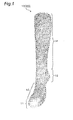
- a sock 10 shown in Fig. 1 has a toe part 11 covering the toes, a foot part 12 that is continued to the toe part 11 to cover the instep and arch, a heel part 13 that is continued to the foot part 12 to cover the heel, and a leg part 14 that is continued to the heel part 13 to cover the ankle and calf.
- the toe part 11, the foot part 12, the heel part 13 and the leg part 14 are configured by a tubular knitted fabric for clothing 20 according to the embodiment of the present invention.
- the tubular knitted fabric for clothing 20 is a tubular knitted fabric knitted continuously by a circular knitting machine and has stitches of a plurality of sizes.
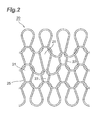
- Fig. 2 is an enlarged view showing the stitches of the tubular knitted fabric for clothing according to the embodiment of the present invention.
- the plurality of stitches configuring the tubular knitted fabric for clothing 20 have first stitches 21 and second stitches 22 having smaller stitch density (size) than the first stitches.
- the tubular knitted fabric for clothing of the present embodiment is configured by only these two types of stitches, the first stitches 21 and the second stitches 22. Note that, in addition to the first stitches 21 and the second stitches 22, the tubular knitted fabric for clothing 20 may have other stitches of different stitch densities.
- the tubular knitted fabric for clothing 20 obtains a desired pattern formed by a circular knitting machine. This pattern is obtained by selectively disposing the smaller second stitches 22 in units of one stitch.
- the circular knitting machine for knitting the tubular knitted fabric for clothing of the present invention is used for knitting a plurality of large stitches by moving a sinker in and out between reciprocating knitting needles.
- the second stitches 22 of the tubular knitted fabric for clothing 20 are formed when a knitting yarn is placed on the sinker as a result of selectively driving the sinker.
- Selectively driving the sinker controls the stitch densities of the tubular knitted fabric for clothing.
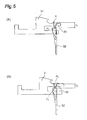
- the stitch density of the first stitches 21 corresponds to a distance D 1 between "a contact point P 1 between a knitting yarn 25 and a sinker 31 (sinker top 33, see Fig. 4 )" and "a contact point P 2 between the knitting yarn 25 and a knitting needle 32," as shown in (A) of Fig. 5 .
- the stitch density of the second stitches 22 corresponds to a distance D 2 between "a contact point P 3 between the knitting yarn 25 and the sinker 31 (a sinker dimple 32, see Fig.
- the tubular knitted fabric for clothing obtains delicate patterns using the shading of the colors by arbitrarily disposing the stitches with the large stitch density and the stitches with the small stitch density.
- the tubular knitted fabric for clothing 20 also has a positive rotation region that is knitted by a positive rotation of the cylinder of the circular knitting machine, and a reciprocal rotation region that is knitted by a reciprocal rotation of the cylinder.
- the pattern of the tubular knitted fabric for clothing is continuously formed astride the positive rotation region and the reciprocal rotation region.
- the toe part 11 and the heel part 13 correspond to the reciprocal rotation region.
- Fig. 3 is an organizational diagram showing an arrangement of the stitches of the tubular knitted fabric for clothing according to the embodiment of the present invention.
- the tubular knitted fabric for clothing 20 in the tubular knitted fabric for clothing 20, at least four small stitch bands 23 each having one or two or more of the second stitches 22 disposed within one circumferentially continuous course (in a lateral direction in Fig. 3 ) are formed. Accordingly, a complicated pattern can be obtained.
- a single-cylinder K-type knitting machine with a 4-inch shuttle diameter and 240 needles can be used as a sock knitting machine (circular knitting machine).
- 30D/2 woolly (textured) nylon was used as a face yarn
- 15/7-5F SCY single covered yarn obtained by covering 7D nylon with 15D polyurethane was used as a back yarn.
- the sinker the one with a sinker height difference of 1.0 mm was used. Under these conditions, a vivid pattern can be obtained.
- the knitting machine with 240 needles was used in the present invention in order to obtain a delicate pattern with the abovementioned yarns, but the number of needles can be arbitrarily selected depending on the yarns suitable for a desired tubular knitted fabric for clothing.
- the shuttle diameter is 4 inches but can be arbitrarily selected depending on the use application of the desired tubular knitted fabric for clothing.
- the knitting yarns are desirably made of a somewhat elastic yarn (woolly-processed yarn) obtained by crimping synthetic fibers such as nylon or polyester.
- a non-elastic yarn such as a cotton yarn on a fabric causes intense stretching of the stitches when a wearer wears the fabric. This cannot keep desired stitch densities, and, as a result, a vivid pattern cannot be obtained.
- use of natural fibers cannot achieve differences in shading using the stitch densities thereof.
- the level of fashion can be further increased brightening up the pattern by using a lame yarn as the knitting yarns.
- the yarn has a thickness of 30D/2 but may have other thickness complying with the knitting machine.
- a height difference Do of the sinker 31 is the difference between the sinker top 33 and the sinker dimple 32, as shown in Fig. 4 .
- the height difference Do of the sinker 31 can be 1.0 mm, 0.8 mm, or 0.6 mm.
- the sinker top 33 corresponds to a part for holding the knitting yarns at a tip end part of the sinker 31.
- the sinker dimple 32 corresponds to a part that is depressed deeper than the sinker top 33 on the rear end side from the sinker top 33.
- the height difference of the sinker has an affect on the difference in stitch density. The greater the height difference of the sinker is, the greater the stitch density difference. The smaller the height difference of the sinker is, the smaller the stitch density difference.
- the height difference of the sinker needs to be adjusted carefully by approximately at least 0.1 mm according to these conditions, in order to obtain vivid shading.
- the height difference of the sinker is 1.0 mm, it is appropriate to use the 30D/2 woolly nylon as the face yarn and the SCY 15/7-5F as the back yarn.
- the height difference is 0.8 mm, it is appropriate to use the 70D/2 woolly nylon as the face yarn and the SCY 20D/12-7F as the back yarn.
- the height difference is 0.6 mm, it is appropriate to use 32/- cotton acryl as the face yarn and FTY 20/75 as the back yarn.
- a delicate, beautiful pattern can be obtained by using these height differences of the sinker and the knitting yarns.
- arbitrarily changing the stitch densities for each stitch by selecting the conditions described above can form different patterns (designs).
- a tubular knitted fabric for clothing according to Example 1 Specifications of a tubular knitted fabric for clothing according to Example 1 are explained. Face yarn: Woolly nylon, 60 deniers (30/2) Back yarn: SCY 15/7-5F produced
- Face yarn Woolly nylon, 60 deniers (30/2)
- Back yarn SCY 15/7-5F produced
- a first stitch part with a great stitch density configures a translucent fabric
- a second stitch part having a stitch density smaller than that of the first stitch part configures a non-translucent pattern.
- a first stitch part represents a region in which the first stitches are formed
- a second stitch part represents a region in which the second stitches are formed.
- This sock according to Example 1 represents a pattern continuously formed astride a region knitted by the reciprocal rotation of the cylinder (the heel part, the toe part) and a region adjacent thereto (knitted by the positive rotation of the cylinder).
- the pattern represented by the tubular knitted fabric for clothing according to the embodiment of the present invention can be any patterns such as stripes obtained in Example 1, geometric designs configured by straight lines or polygons, butterflies or other detailed animal designs obtaining beauty, human faces, and characters.
- the length of the sock is the length of a leg part below knee.
- the tubular knitted fabric for clothing or the socks shown in the examples can be of any length.
- the sock preferably has crew length or longer (the length up to a lower part of calf).
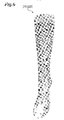
- FIG. 6 is a perspective view showing a sock according to a fifth example of the present invention.
- a sock 10 of Example 5 is obtained by inserting a pattern configured by a different knitting method, in addition to a pattern configured by the difference in stitch density. More specifically, mesh knitting is performed linearly in a vertical direction so that the mesh knitting part forms a white line of space that is opened wider than other parts. Moreover, the first stitch part and the second stitch part are alternately provided between the mesh stitching line to obtain a wave-like pattern.
- the different knitting method can be not only the mesh knitting method but also a tuck knitting method.
- the tubular knitted fabric for clothing of the present embodiment because the second stitches smaller than the first stitches are selectively disposed in units of one stitch, the shading between adjacent stitches becomes obvious, realizing a delicate, beautiful knitted pattern.
- This can achieve a tubular knitted fabric for clothing that represents a desired pattern by using visible shading obtained by the difference in stitch size.
- This can provide a tubular knitted fabric for clothing that obtains a delicate pattern on a surface of the knit garment and provide a high level of fashion and comfortable feeling.
- the sock 10 obtains the pattern by using the shadings of the first stitches 21 and the second stitches 22, but the pattern may be obtained by, for example, a combination of technologies that are normally used (cut-boss, tuck, mesh, embroidery, sewing, etc.).
- the tubular knitted fabric for clothing can be applied as a legwear to pantyhose, supporter, stocking and the like.
- the tubular knitted fabric for clothing can also be applied to a garment used in, for example, a body section other than a leg.
- synthetic fibers such as nylon, polyester and rayon, natural fibers such as cotton, wool and hemp, or a blended yarn thereof can be used as the face yarn of the tubular knitted fabric for clothing.
- Elastic yarns such as SCY, DCY and FTY, or a false twisted yarn such as woolly nylon can be used as the back yarn of the tubular knitted fabric for clothing.
- the tubular knitted fabric for clothing can be knitted even with one of the yarns that can be used as the face yarn and the back yarn.
- the tubular knitted fabric for clothing and the legwear according to the embodiment of the present invention can not only obtain a delicate pattern on a surface of the knit garment but also provide a high level of fashion and comfortable feeling.
- the tubular knitted fabric for clothing and the legwear according to the embodiment of the present invention can express vivid shading between adjacent stitches, as well as a beautiful knitted pattern.
Landscapes
- Engineering & Computer Science (AREA)
- Textile Engineering (AREA)
- Knitting Of Fabric (AREA)
- Socks And Pantyhose (AREA)
- Knitting Machines (AREA)
Applications Claiming Priority (1)
| Application Number | Priority Date | Filing Date | Title |
|---|---|---|---|
| JP2010173096A JP5678322B2 (ja) | 2010-07-30 | 2010-07-30 | 衣料用筒状編地、およびレッグウェア |
Publications (2)
| Publication Number | Publication Date |
|---|---|
| EP2412853A1 true EP2412853A1 (fr) | 2012-02-01 |
| EP2412853B1 EP2412853B1 (fr) | 2018-06-20 |
Family
ID=44677413
Family Applications (1)
| Application Number | Title | Priority Date | Filing Date |
|---|---|---|---|
| EP11176015.3A Active EP2412853B1 (fr) | 2010-07-30 | 2011-07-29 | Étoffe tricotée tubulaire pour vêtements et d'articles chaussants |
Country Status (4)
| Country | Link |
|---|---|
| US (1) | US8468856B2 (fr) |
| EP (1) | EP2412853B1 (fr) |
| JP (1) | JP5678322B2 (fr) |
| CN (1) | CN102373568B (fr) |
Cited By (2)
| Publication number | Priority date | Publication date | Assignee | Title |
|---|---|---|---|---|
| CN103255562A (zh) * | 2012-02-15 | 2013-08-21 | 冈本株式会社 | 线圈尺寸可控的针织机及针织面料的制造方法 |
| EP2628832A1 (fr) * | 2012-02-15 | 2013-08-21 | Okamoto Corporation | Produit tricoté avec mailles de taille contrôlée |
Families Citing this family (15)
| Publication number | Priority date | Publication date | Assignee | Title |
|---|---|---|---|---|
| TW201143646A (en) * | 2010-01-22 | 2011-12-16 | Kowa Co | Foot wear |
| WO2012032457A2 (fr) * | 2010-09-07 | 2012-03-15 | Delta Galil Industries Ltd. | Chaussettes, et système et procédé de fabrication de chaussettes |
| US9297097B2 (en) * | 2012-06-22 | 2016-03-29 | Nike, Inc. | Knit article of apparel and apparel printing system and method |
| ITTO20120744A1 (it) * | 2012-08-29 | 2014-03-01 | Inst Rundfunktechnik Gmbh | Bereitstellung von applikationen auf mehreren elektronischen geraeten |
| CN105019121B (zh) * | 2014-04-24 | 2018-10-26 | 山德霓股份公司 | 制造具有可变紧缩的针织纺织物品的方法和圆型纬编针织机以及针织纺织物品 |
| US20160076175A1 (en) * | 2014-09-11 | 2016-03-17 | Myant Capital Partners Inc. | Compression fabrics with tailored comfort |
| JP6281822B2 (ja) * | 2014-09-24 | 2018-02-21 | アツギ株式会社 | ストッキング類 |
| DK3273816T3 (da) * | 2015-03-27 | 2021-02-08 | Trere Innovation S R L | Beklædningsgenstand med elastiske indsatser fremstillet under anvendelse af rundstrikkemaskiner |
| JP6538485B2 (ja) * | 2015-08-27 | 2019-07-03 | グンゼ株式会社 | パンティストッキング |
| KR101752452B1 (ko) * | 2016-12-19 | 2017-07-03 | 나종현 | 무늬 형성을 위한 편직방법 및 이에 의해 제조되는 무봉제 니트 |
| DE102017223750B4 (de) * | 2017-12-22 | 2021-10-07 | Adidas Ag | Gestrickte oder gewirkte Komponente |
| CN108391890A (zh) * | 2018-02-09 | 2018-08-14 | 青岛即发集团股份有限公司 | 三层无缝复合防水鞋的制作方法 |
| CN108754823A (zh) * | 2018-07-24 | 2018-11-06 | 浙江凯强轻纺机械有限公司 | 一种新型生克片 |
| CN110791863B (zh) * | 2019-09-20 | 2021-06-01 | 斓帛职业培训学校(桐乡)有限公司 | 一种全成型摩尔花纹图案组织结构及其编织方法 |
| CN115652511B (zh) * | 2022-11-11 | 2026-04-07 | 东莞超盈纺织有限公司 | 织物基础单元、织物花型单元及纬编针织物 |
Citations (8)
| Publication number | Priority date | Publication date | Assignee | Title |
|---|---|---|---|---|
| US1877458A (en) * | 1931-12-17 | 1932-09-13 | Largman Gray Company | Knitted fabric for hosiery |
| US2337153A (en) * | 1942-02-18 | 1943-12-21 | Hemphill Co | Machine for knitting |
| US2921454A (en) * | 1956-11-21 | 1960-01-19 | Scott & Williams Inc | Knitting machine |
| GB2155965A (en) * | 1984-03-19 | 1985-10-02 | Precision Fukuhara Works Ltd | Method of knitting mesh fabric and sinker used therefor |
| JPH09195104A (ja) | 1996-01-22 | 1997-07-29 | Asahi Chem Ind Co Ltd | パンティストッキング |
| EP1203837A1 (fr) * | 1999-04-20 | 2002-05-08 | Shima Seiki Mfg., Ltd | Tissu tricote et son procede de tricotage |
| JP2002302853A (ja) | 2001-01-30 | 2002-10-18 | Wakayama Prefecture | 柄付き編地およびその編成方法 |
| JP2004316000A (ja) | 2003-04-14 | 2004-11-11 | Okamoto Kk | 丸編み機での編目編成方法及びその方法により編成された靴下 |
Family Cites Families (18)
| Publication number | Priority date | Publication date | Assignee | Title |
|---|---|---|---|---|
| BE365165A (fr) * | 1929-07-29 | 1929-07-31 | ||
| DE2852883A1 (de) * | 1978-12-07 | 1980-06-12 | Karl Fankhaenel | Rund-gestrickter strumpf |
| US4341095A (en) * | 1980-05-02 | 1982-07-27 | Alba-Waldensian, Incorporated | Stretchable garment knit of cotton yarn |
| GB2131053B (en) * | 1982-09-08 | 1986-01-29 | Okamoto Co Ltd | Circular knitting machines |
| JPS5947455A (ja) * | 1982-09-08 | 1984-03-17 | 岡本株式会社 | 丸編機のシンカ−柄出し法 |
| US5611722A (en) * | 1995-02-03 | 1997-03-18 | Alba-Waldensian, Inc. | Panty having knit-in buttock lift and separation |
| FR2751668B1 (fr) * | 1996-07-26 | 1998-09-11 | Dim Sa | Procede et tricotage d'articles de bonneterie, et articles, notamment collants, realises selon ce procede |
| JPH1060756A (ja) * | 1996-08-09 | 1998-03-03 | Nitto Globe Kk | 編成柄を有する筒状編地及びその編成方法 |
| JP3108790B2 (ja) * | 1996-10-25 | 2000-11-13 | 今西靴下株式会社 | 緯編機 |
| US5991929A (en) * | 1997-12-08 | 1999-11-30 | Sara Lee Corporation | Panty pantyhose combination garment and method for forming same |
| US6055674A (en) * | 1997-12-08 | 2000-05-02 | Sara Lee Corporation | Panty pantyhose combination garment and method for forming same |
| JP3871878B2 (ja) * | 2000-12-05 | 2007-01-24 | イイダ靴下株式会社 | 編機 |
| ITMI20031082A1 (it) * | 2003-05-29 | 2004-11-30 | Calzificio Pinelli Srl | Calza terapeutica e procedimento per la sua produzione |
| CN100518554C (zh) * | 2004-03-16 | 2009-07-29 | 库马株式会社 | 袜子及其制造方法 |
| JP4182025B2 (ja) * | 2004-04-19 | 2008-11-19 | 株式会社ホリホック | 靴下 |
| US7155940B1 (en) * | 2005-03-15 | 2007-01-02 | Hbi Branded Apparel Enterprises, Llc | Three-piece panty garment and methods of making |
| ITMI20051190A1 (it) * | 2005-06-23 | 2006-12-24 | Santoni & C Spa | Procedimento per la produzione di manufatti a maglia con macchine circolari per maglieria con cilindro degli aghi azionabile con moto rotatorio attorno al suo asse in ambedue i sensi di rotazione particolarmente con macchine circolari ad elevata fine |
| US8156768B2 (en) * | 2009-07-20 | 2012-04-17 | Hbi Branded Apparel Enterprises, Llc | System and method of forming a toe seam |
-
2010
- 2010-07-30 JP JP2010173096A patent/JP5678322B2/ja active Active
-
2011
- 2011-07-29 CN CN201110217020.0A patent/CN102373568B/zh active Active
- 2011-07-29 EP EP11176015.3A patent/EP2412853B1/fr active Active
- 2011-07-29 US US13/193,748 patent/US8468856B2/en not_active Expired - Fee Related
Patent Citations (8)
| Publication number | Priority date | Publication date | Assignee | Title |
|---|---|---|---|---|
| US1877458A (en) * | 1931-12-17 | 1932-09-13 | Largman Gray Company | Knitted fabric for hosiery |
| US2337153A (en) * | 1942-02-18 | 1943-12-21 | Hemphill Co | Machine for knitting |
| US2921454A (en) * | 1956-11-21 | 1960-01-19 | Scott & Williams Inc | Knitting machine |
| GB2155965A (en) * | 1984-03-19 | 1985-10-02 | Precision Fukuhara Works Ltd | Method of knitting mesh fabric and sinker used therefor |
| JPH09195104A (ja) | 1996-01-22 | 1997-07-29 | Asahi Chem Ind Co Ltd | パンティストッキング |
| EP1203837A1 (fr) * | 1999-04-20 | 2002-05-08 | Shima Seiki Mfg., Ltd | Tissu tricote et son procede de tricotage |
| JP2002302853A (ja) | 2001-01-30 | 2002-10-18 | Wakayama Prefecture | 柄付き編地およびその編成方法 |
| JP2004316000A (ja) | 2003-04-14 | 2004-11-11 | Okamoto Kk | 丸編み機での編目編成方法及びその方法により編成された靴下 |
Cited By (9)
| Publication number | Priority date | Publication date | Assignee | Title |
|---|---|---|---|---|
| CN103255562A (zh) * | 2012-02-15 | 2013-08-21 | 冈本株式会社 | 线圈尺寸可控的针织机及针织面料的制造方法 |
| EP2628835A1 (fr) * | 2012-02-15 | 2013-08-21 | Okamoto Corporation | Machine à tricoter contrôlable par taille de point et procédé de fabrication d'un tissu tricoté |
| EP2628832A1 (fr) * | 2012-02-15 | 2013-08-21 | Okamoto Corporation | Produit tricoté avec mailles de taille contrôlée |
| CN103255559A (zh) * | 2012-02-15 | 2013-08-21 | 冈本株式会社 | 线圈尺寸受控的针织产品 |
| CN103255559B (zh) * | 2012-02-15 | 2015-05-13 | 冈本株式会社 | 线圈尺寸受控的针织产品 |
| CN103255562B (zh) * | 2012-02-15 | 2015-11-25 | 冈本株式会社 | 线圈尺寸可控的针织机及针织面料的制造方法 |
| TWI582282B (zh) * | 2012-02-15 | 2017-05-11 | 岡本股份有限公司 | 控制線圈尺寸的針織製品 |
| US10011927B2 (en) | 2012-02-15 | 2018-07-03 | Okamoto Corporation | Stitch-size controllable knitting machine, and manufacturing method of knitted fabric |
| US10060055B2 (en) | 2012-02-15 | 2018-08-28 | Okamoto Corporation | Stitch-size controlled knit product |
Also Published As
| Publication number | Publication date |
|---|---|
| US20120024014A1 (en) | 2012-02-02 |
| JP5678322B2 (ja) | 2015-03-04 |
| US8468856B2 (en) | 2013-06-25 |
| CN102373568B (zh) | 2015-02-25 |
| JP2012031542A (ja) | 2012-02-16 |
| EP2412853B1 (fr) | 2018-06-20 |
| CN102373568A (zh) | 2012-03-14 |
Similar Documents
| Publication | Publication Date | Title |
|---|---|---|
| US8468856B2 (en) | Tubular knitted fabric for clothing and legwear | |
| JP6106865B2 (ja) | パイル長を変化させた編地、これを備えたニット製品及び靴下 | |
| Ray | Fundamentals and advances in knitting technology | |
| US7400938B2 (en) | Method for assigning states to stitches of a fabric | |
| JP6808901B2 (ja) | 下半身用衣類 | |
| GB2029466A (en) | Dress weight tube sock and method of knitting | |
| Nawaz et al. | Seamless garments | |
| JP2018048427A (ja) | 編地及び靴下 | |
| JP5603387B2 (ja) | 靴下 | |
| JP6134158B2 (ja) | ヨコ編地、ヨコ編地の編成方法及び衣料 | |
| JP3200361U (ja) | 伸縮性経編地 | |
| EP3019653A1 (fr) | Article vestimentaire recouvrant un pied et procédé de fabrication associé | |
| EP3794170B1 (fr) | Vêtement de contention et procédé associé | |
| JP2009144253A (ja) | 異なる編組織からなる経編地 | |
| JP2006188793A (ja) | レース状経編地 | |
| JP2007063718A (ja) | ラッシェルレース地 | |
| JP2007031879A (ja) | フットカバー | |
| JP3046746U (ja) | レッグウエア | |
| CN103015021A (zh) | 一种织物织造工艺、织造设备和系统 | |
| JP6199195B2 (ja) | 経編地で形成されたストッキング | |
| JP3056820U (ja) | 新規な靴下類 | |
| CN1981653A (zh) | 伸缩性服装 | |
| JP3063340U (ja) | 靴 下 | |
| JP6701495B2 (ja) | 下半身用衣類およびその製造方法 | |
| JP2024034128A (ja) | 下半身用衣類 |
Legal Events
| Date | Code | Title | Description |
|---|---|---|---|
| AK | Designated contracting states |
Kind code of ref document: A1 Designated state(s): AL AT BE BG CH CY CZ DE DK EE ES FI FR GB GR HR HU IE IS IT LI LT LU LV MC MK MT NL NO PL PT RO RS SE SI SK SM TR |
|
| AX | Request for extension of the european patent |
Extension state: BA ME |
|
| PUAI | Public reference made under article 153(3) epc to a published international application that has entered the european phase |
Free format text: ORIGINAL CODE: 0009012 |
|
| 17P | Request for examination filed |
Effective date: 20120731 |
|
| STAA | Information on the status of an ep patent application or granted ep patent |
Free format text: STATUS: EXAMINATION IS IN PROGRESS |
|
| 17Q | First examination report despatched |
Effective date: 20170410 |
|
| GRAP | Despatch of communication of intention to grant a patent |
Free format text: ORIGINAL CODE: EPIDOSNIGR1 |
|
| STAA | Information on the status of an ep patent application or granted ep patent |
Free format text: STATUS: GRANT OF PATENT IS INTENDED |
|
| RIC1 | Information provided on ipc code assigned before grant |
Ipc: D04B 1/26 20060101ALN20171211BHEP Ipc: D04B 1/10 20060101AFI20171211BHEP |
|
| INTG | Intention to grant announced |
Effective date: 20180111 |
|
| GRAS | Grant fee paid |
Free format text: ORIGINAL CODE: EPIDOSNIGR3 |
|
| GRAA | (expected) grant |
Free format text: ORIGINAL CODE: 0009210 |
|
| STAA | Information on the status of an ep patent application or granted ep patent |
Free format text: STATUS: THE PATENT HAS BEEN GRANTED |
|
| AK | Designated contracting states |
Kind code of ref document: B1 Designated state(s): AL AT BE BG CH CY CZ DE DK EE ES FI FR GB GR HR HU IE IS IT LI LT LU LV MC MK MT NL NO PL PT RO RS SE SI SK SM TR |
|
| REG | Reference to a national code |
Ref country code: GB Ref legal event code: FG4D |
|
| REG | Reference to a national code |
Ref country code: IE Ref legal event code: FG4D |
|
| REG | Reference to a national code |
Ref country code: AT Ref legal event code: REF Ref document number: 1010678 Country of ref document: AT Kind code of ref document: T Effective date: 20180715 |
|
| REG | Reference to a national code |
Ref country code: DE Ref legal event code: R096 Ref document number: 602011049374 Country of ref document: DE |
|
| REG | Reference to a national code |
Ref country code: NL Ref legal event code: MP Effective date: 20180620 |
|
| PG25 | Lapsed in a contracting state [announced via postgrant information from national office to epo] |
Ref country code: LT Free format text: LAPSE BECAUSE OF FAILURE TO SUBMIT A TRANSLATION OF THE DESCRIPTION OR TO PAY THE FEE WITHIN THE PRESCRIBED TIME-LIMIT Effective date: 20180620 Ref country code: FI Free format text: LAPSE BECAUSE OF FAILURE TO SUBMIT A TRANSLATION OF THE DESCRIPTION OR TO PAY THE FEE WITHIN THE PRESCRIBED TIME-LIMIT Effective date: 20180620 Ref country code: NO Free format text: LAPSE BECAUSE OF FAILURE TO SUBMIT A TRANSLATION OF THE DESCRIPTION OR TO PAY THE FEE WITHIN THE PRESCRIBED TIME-LIMIT Effective date: 20180920 Ref country code: BG Free format text: LAPSE BECAUSE OF FAILURE TO SUBMIT A TRANSLATION OF THE DESCRIPTION OR TO PAY THE FEE WITHIN THE PRESCRIBED TIME-LIMIT Effective date: 20180920 Ref country code: SE Free format text: LAPSE BECAUSE OF FAILURE TO SUBMIT A TRANSLATION OF THE DESCRIPTION OR TO PAY THE FEE WITHIN THE PRESCRIBED TIME-LIMIT Effective date: 20180620 |
|
| REG | Reference to a national code |
Ref country code: LT Ref legal event code: MG4D |
|
| PG25 | Lapsed in a contracting state [announced via postgrant information from national office to epo] |
Ref country code: RS Free format text: LAPSE BECAUSE OF FAILURE TO SUBMIT A TRANSLATION OF THE DESCRIPTION OR TO PAY THE FEE WITHIN THE PRESCRIBED TIME-LIMIT Effective date: 20180620 Ref country code: GR Free format text: LAPSE BECAUSE OF FAILURE TO SUBMIT A TRANSLATION OF THE DESCRIPTION OR TO PAY THE FEE WITHIN THE PRESCRIBED TIME-LIMIT Effective date: 20180921 Ref country code: HR Free format text: LAPSE BECAUSE OF FAILURE TO SUBMIT A TRANSLATION OF THE DESCRIPTION OR TO PAY THE FEE WITHIN THE PRESCRIBED TIME-LIMIT Effective date: 20180620 Ref country code: LV Free format text: LAPSE BECAUSE OF FAILURE TO SUBMIT A TRANSLATION OF THE DESCRIPTION OR TO PAY THE FEE WITHIN THE PRESCRIBED TIME-LIMIT Effective date: 20180620 |
|
| REG | Reference to a national code |
Ref country code: AT Ref legal event code: MK05 Ref document number: 1010678 Country of ref document: AT Kind code of ref document: T Effective date: 20180620 |
|
| PG25 | Lapsed in a contracting state [announced via postgrant information from national office to epo] |
Ref country code: NL Free format text: LAPSE BECAUSE OF FAILURE TO SUBMIT A TRANSLATION OF THE DESCRIPTION OR TO PAY THE FEE WITHIN THE PRESCRIBED TIME-LIMIT Effective date: 20180620 |
|
| PG25 | Lapsed in a contracting state [announced via postgrant information from national office to epo] |
Ref country code: IS Free format text: LAPSE BECAUSE OF FAILURE TO SUBMIT A TRANSLATION OF THE DESCRIPTION OR TO PAY THE FEE WITHIN THE PRESCRIBED TIME-LIMIT Effective date: 20181020 Ref country code: AT Free format text: LAPSE BECAUSE OF FAILURE TO SUBMIT A TRANSLATION OF THE DESCRIPTION OR TO PAY THE FEE WITHIN THE PRESCRIBED TIME-LIMIT Effective date: 20180620 Ref country code: EE Free format text: LAPSE BECAUSE OF FAILURE TO SUBMIT A TRANSLATION OF THE DESCRIPTION OR TO PAY THE FEE WITHIN THE PRESCRIBED TIME-LIMIT Effective date: 20180620 Ref country code: SK Free format text: LAPSE BECAUSE OF FAILURE TO SUBMIT A TRANSLATION OF THE DESCRIPTION OR TO PAY THE FEE WITHIN THE PRESCRIBED TIME-LIMIT Effective date: 20180620 Ref country code: RO Free format text: LAPSE BECAUSE OF FAILURE TO SUBMIT A TRANSLATION OF THE DESCRIPTION OR TO PAY THE FEE WITHIN THE PRESCRIBED TIME-LIMIT Effective date: 20180620 Ref country code: CZ Free format text: LAPSE BECAUSE OF FAILURE TO SUBMIT A TRANSLATION OF THE DESCRIPTION OR TO PAY THE FEE WITHIN THE PRESCRIBED TIME-LIMIT Effective date: 20180620 Ref country code: PL Free format text: LAPSE BECAUSE OF FAILURE TO SUBMIT A TRANSLATION OF THE DESCRIPTION OR TO PAY THE FEE WITHIN THE PRESCRIBED TIME-LIMIT Effective date: 20180620 |
|
| PG25 | Lapsed in a contracting state [announced via postgrant information from national office to epo] |
Ref country code: ES Free format text: LAPSE BECAUSE OF FAILURE TO SUBMIT A TRANSLATION OF THE DESCRIPTION OR TO PAY THE FEE WITHIN THE PRESCRIBED TIME-LIMIT Effective date: 20180620 Ref country code: SM Free format text: LAPSE BECAUSE OF FAILURE TO SUBMIT A TRANSLATION OF THE DESCRIPTION OR TO PAY THE FEE WITHIN THE PRESCRIBED TIME-LIMIT Effective date: 20180620 |
|
| REG | Reference to a national code |
Ref country code: CH Ref legal event code: PL |
|
| REG | Reference to a national code |
Ref country code: DE Ref legal event code: R097 Ref document number: 602011049374 Country of ref document: DE |
|
| PG25 | Lapsed in a contracting state [announced via postgrant information from national office to epo] |
Ref country code: MC Free format text: LAPSE BECAUSE OF FAILURE TO SUBMIT A TRANSLATION OF THE DESCRIPTION OR TO PAY THE FEE WITHIN THE PRESCRIBED TIME-LIMIT Effective date: 20180620 Ref country code: LU Free format text: LAPSE BECAUSE OF NON-PAYMENT OF DUE FEES Effective date: 20180729 |
|
| REG | Reference to a national code |
Ref country code: BE Ref legal event code: MM Effective date: 20180731 |
|
| PLBE | No opposition filed within time limit |
Free format text: ORIGINAL CODE: 0009261 |
|
| STAA | Information on the status of an ep patent application or granted ep patent |
Free format text: STATUS: NO OPPOSITION FILED WITHIN TIME LIMIT |
|
| PG25 | Lapsed in a contracting state [announced via postgrant information from national office to epo] |
Ref country code: LI Free format text: LAPSE BECAUSE OF NON-PAYMENT OF DUE FEES Effective date: 20180731 Ref country code: CH Free format text: LAPSE BECAUSE OF NON-PAYMENT OF DUE FEES Effective date: 20180731 |
|
| REG | Reference to a national code |
Ref country code: IE Ref legal event code: MM4A |
|
| GBPC | Gb: european patent ceased through non-payment of renewal fee |
Effective date: 20180920 |
|
| 26N | No opposition filed |
Effective date: 20190321 |
|
| PG25 | Lapsed in a contracting state [announced via postgrant information from national office to epo] |
Ref country code: DK Free format text: LAPSE BECAUSE OF FAILURE TO SUBMIT A TRANSLATION OF THE DESCRIPTION OR TO PAY THE FEE WITHIN THE PRESCRIBED TIME-LIMIT Effective date: 20180620 Ref country code: BE Free format text: LAPSE BECAUSE OF NON-PAYMENT OF DUE FEES Effective date: 20180731 |
|
| PG25 | Lapsed in a contracting state [announced via postgrant information from national office to epo] |
Ref country code: IE Free format text: LAPSE BECAUSE OF NON-PAYMENT OF DUE FEES Effective date: 20180729 |
|
| PG25 | Lapsed in a contracting state [announced via postgrant information from national office to epo] |
Ref country code: SI Free format text: LAPSE BECAUSE OF FAILURE TO SUBMIT A TRANSLATION OF THE DESCRIPTION OR TO PAY THE FEE WITHIN THE PRESCRIBED TIME-LIMIT Effective date: 20180620 Ref country code: FR Free format text: LAPSE BECAUSE OF NON-PAYMENT OF DUE FEES Effective date: 20180820 |
|
| PG25 | Lapsed in a contracting state [announced via postgrant information from national office to epo] |
Ref country code: GB Free format text: LAPSE BECAUSE OF NON-PAYMENT OF DUE FEES Effective date: 20180920 |
|
| PG25 | Lapsed in a contracting state [announced via postgrant information from national office to epo] |
Ref country code: AL Free format text: LAPSE BECAUSE OF FAILURE TO SUBMIT A TRANSLATION OF THE DESCRIPTION OR TO PAY THE FEE WITHIN THE PRESCRIBED TIME-LIMIT Effective date: 20180620 |
|
| PG25 | Lapsed in a contracting state [announced via postgrant information from national office to epo] |
Ref country code: MT Free format text: LAPSE BECAUSE OF NON-PAYMENT OF DUE FEES Effective date: 20180729 |
|
| PG25 | Lapsed in a contracting state [announced via postgrant information from national office to epo] |
Ref country code: TR Free format text: LAPSE BECAUSE OF FAILURE TO SUBMIT A TRANSLATION OF THE DESCRIPTION OR TO PAY THE FEE WITHIN THE PRESCRIBED TIME-LIMIT Effective date: 20180620 |
|
| PG25 | Lapsed in a contracting state [announced via postgrant information from national office to epo] |
Ref country code: PT Free format text: LAPSE BECAUSE OF FAILURE TO SUBMIT A TRANSLATION OF THE DESCRIPTION OR TO PAY THE FEE WITHIN THE PRESCRIBED TIME-LIMIT Effective date: 20180620 Ref country code: HU Free format text: LAPSE BECAUSE OF FAILURE TO SUBMIT A TRANSLATION OF THE DESCRIPTION OR TO PAY THE FEE WITHIN THE PRESCRIBED TIME-LIMIT; INVALID AB INITIO Effective date: 20110729 |
|
| PG25 | Lapsed in a contracting state [announced via postgrant information from national office to epo] |
Ref country code: CY Free format text: LAPSE BECAUSE OF FAILURE TO SUBMIT A TRANSLATION OF THE DESCRIPTION OR TO PAY THE FEE WITHIN THE PRESCRIBED TIME-LIMIT Effective date: 20180620 Ref country code: MK Free format text: LAPSE BECAUSE OF NON-PAYMENT OF DUE FEES Effective date: 20180620 |
|
| PGFP | Annual fee paid to national office [announced via postgrant information from national office to epo] |
Ref country code: DE Payment date: 20250604 Year of fee payment: 15 |
|
| PGFP | Annual fee paid to national office [announced via postgrant information from national office to epo] |
Ref country code: IT Payment date: 20250623 Year of fee payment: 15 |