EP2412873A2 - Dispositif de fraisage - Google Patents
Dispositif de fraisage Download PDFInfo
- Publication number
- EP2412873A2 EP2412873A2 EP11175896A EP11175896A EP2412873A2 EP 2412873 A2 EP2412873 A2 EP 2412873A2 EP 11175896 A EP11175896 A EP 11175896A EP 11175896 A EP11175896 A EP 11175896A EP 2412873 A2 EP2412873 A2 EP 2412873A2
- Authority
- EP
- European Patent Office
- Prior art keywords
- milling
- milling device
- excavator
- drive
- hydraulic
- Prior art date
- Legal status (The legal status is an assumption and is not a legal conclusion. Google has not performed a legal analysis and makes no representation as to the accuracy of the status listed.)
- Withdrawn
Links
- 238000003801 milling Methods 0.000 title claims abstract description 101
- 238000010168 coupling process Methods 0.000 claims abstract description 13
- 238000005859 coupling reaction Methods 0.000 claims abstract description 13
- XLYOFNOQVPJJNP-UHFFFAOYSA-N water Substances O XLYOFNOQVPJJNP-UHFFFAOYSA-N 0.000 claims description 34
- 230000008878 coupling Effects 0.000 claims description 12
- 238000010276 construction Methods 0.000 claims description 4
- 239000010426 asphalt Substances 0.000 claims description 2
- 239000007921 spray Substances 0.000 description 8
- 238000011161 development Methods 0.000 description 5
- 230000018109 developmental process Effects 0.000 description 5
- 230000036346 tooth eruption Effects 0.000 description 4
- 239000000428 dust Substances 0.000 description 3
- 239000000463 material Substances 0.000 description 3
- 230000008901 benefit Effects 0.000 description 2
- 230000005484 gravity Effects 0.000 description 2
- 239000000758 substrate Substances 0.000 description 2
- 208000012886 Vertigo Diseases 0.000 description 1
- 230000000903 blocking effect Effects 0.000 description 1
- 230000008859 change Effects 0.000 description 1
- 238000006243 chemical reaction Methods 0.000 description 1
- 238000011109 contamination Methods 0.000 description 1
- 239000005068 cooling lubricant Substances 0.000 description 1
- 230000006378 damage Effects 0.000 description 1
- 238000010586 diagram Methods 0.000 description 1
- 230000000694 effects Effects 0.000 description 1
- 238000004146 energy storage Methods 0.000 description 1
- 230000002349 favourable effect Effects 0.000 description 1
- 239000010720 hydraulic oil Substances 0.000 description 1
- 238000002347 injection Methods 0.000 description 1
- 239000007924 injection Substances 0.000 description 1
- 238000009434 installation Methods 0.000 description 1
- 238000003973 irrigation Methods 0.000 description 1
- 230000002262 irrigation Effects 0.000 description 1
- 230000007246 mechanism Effects 0.000 description 1
- 230000003287 optical effect Effects 0.000 description 1
- 230000009467 reduction Effects 0.000 description 1
- 230000008439 repair process Effects 0.000 description 1
- 230000001052 transient effect Effects 0.000 description 1
- 230000001960 triggered effect Effects 0.000 description 1
- 230000000007 visual effect Effects 0.000 description 1
Images

Classifications
-
- E—FIXED CONSTRUCTIONS
- E01—CONSTRUCTION OF ROADS, RAILWAYS, OR BRIDGES
- E01C—CONSTRUCTION OF, OR SURFACES FOR, ROADS, SPORTS GROUNDS, OR THE LIKE; MACHINES OR AUXILIARY TOOLS FOR CONSTRUCTION OR REPAIR
- E01C23/00—Auxiliary devices or arrangements for constructing, repairing, reconditioning, or taking-up road or like surfaces
- E01C23/06—Devices or arrangements for working the finished surface; Devices for repairing or reconditioning the surface of damaged paving; Recycling in place or on the road
- E01C23/08—Devices or arrangements for working the finished surface; Devices for repairing or reconditioning the surface of damaged paving; Recycling in place or on the road for roughening or patterning; for removing the surface down to a predetermined depth high spots or material bonded to the surface, e.g. markings; for maintaining earth roads, clay courts or like surfaces by means of surface working tools, e.g. scarifiers, levelling blades
- E01C23/085—Devices or arrangements for working the finished surface; Devices for repairing or reconditioning the surface of damaged paving; Recycling in place or on the road for roughening or patterning; for removing the surface down to a predetermined depth high spots or material bonded to the surface, e.g. markings; for maintaining earth roads, clay courts or like surfaces by means of surface working tools, e.g. scarifiers, levelling blades using power-driven tools, e.g. vibratory tools
- E01C23/088—Rotary tools, e.g. milling drums
-
- E—FIXED CONSTRUCTIONS
- E02—HYDRAULIC ENGINEERING; FOUNDATIONS; SOIL SHIFTING
- E02F—DREDGING; SOIL-SHIFTING
- E02F3/00—Dredgers; Soil-shifting machines
- E02F3/04—Dredgers; Soil-shifting machines mechanically-driven
- E02F3/18—Dredgers; Soil-shifting machines mechanically-driven with digging wheels turning round an axis, e.g. bucket-type wheels
- E02F3/22—Component parts
- E02F3/24—Digging wheels; Digging elements of wheels; Drives for wheels
- E02F3/246—Digging wheels; Digging elements of wheels; Drives for wheels drives
-
- E—FIXED CONSTRUCTIONS
- E01—CONSTRUCTION OF ROADS, RAILWAYS, OR BRIDGES
- E01C—CONSTRUCTION OF, OR SURFACES FOR, ROADS, SPORTS GROUNDS, OR THE LIKE; MACHINES OR AUXILIARY TOOLS FOR CONSTRUCTION OR REPAIR
- E01C2301/00—Machine characteristics, parts or accessories not otherwise provided for
- E01C2301/50—Methods or devices for preventing dust by spraying or sucking
Definitions
- the invention relates to a milling device according to the preamble of claim 1.
- EP 1 440 210 B1 describes a milling device that can be attached to an excavator arm.
- a milling device has a hydraulic drive motor which drives a roller-type rotating milling body, on whose surface a plurality of cutting teeth are present.
- Such a milling device is used, for example, in road construction and road construction, but it can also be used when working paved slopes or the repair of canals, etc.
- the object of the present invention is to provide a milling device which can be used as flexibly as possible.
- the milling device can be positioned and operated, for example, with a parallel offset to the excavator.
- the milling device for example, for milling along walls, almost independent of the width of the carrier device, for example, the excavator, are used.
- the rotating device preferably allows an endless rotation of the milling device, that is without limitation of the rotation.
- the rotary device can be driven for example via a self-locking worm gear.
- a first advantageous development of the milling device according to the invention is characterized in that the rotating device comprises a hydraulic drive for carrying out the rotational movement, which is fed by the hydraulic system of the excavator. It would also be conceivable manual adjustment, for example via a crank mechanism or a stepwise adjustment with Positioning. In contrast, the allowed by the Hydraulic system of the excavator caused rotational movement controlling the rotational movement from the cab of the excavator. As a result, the versatility is significantly increased, and it is also the work better because the milling can be optimally adapted during operation to the particular conditions of use.
- the rotating device has a rotary feedthrough for driving the cutter body supplying hydraulic lines.
- the hydraulic system of the excavator is used to drive the milling device without obstructing the rotational movement of the milling device through the connection of the hydraulic system of the milling device with the hydraulic system of the excavator. Since the milling device thus does not require its own energy storage, it can be simpler and thus cheaper and also easier to build.
- the milling device has a depth adjustment device for adjusting the milling depth of the milling body. This also serves to increase the flexibility of use, since the milling device can be optimally adapted to the respective application requirements.
- the depth adjustment device comprises a hydraulic drive for carrying out the adjustment of the milling depth, which is fed by the hydraulic system of the excavator, and in that the rotating device has a rotary feedthrough for driving the depth adjustment feeder hydraulic lines.
- the setting of the depth of cut can also be done from the excavator, which in turn increases the flexibility of use, as the excavator operator can respond immediately to changing conditions. Also, this increases the working speed and improves the work result.
- a concrete embodiment of such a hydraulic control of the milling device from the excavator provides that the rotary feedthrough comprises a first passage for a first pressure line, a second passage for a second pressure line, and a third passage for a return line or leakage line, and that the drive the cutter body is fed by the first pressure line and the drive of the depth adjusting device by the second pressure line.
- This takes into account the fact that conventional excavators have a first pressure line, the so-called hammer line, and a second pressure line, the so-called scissors line.
- the entire operation of the milling device can thus be controlled by the excavator, although a total of only three hydraulic connections between the excavator and the milling device have to be produced.
- a particularly preferred variant of the milling device according to the invention is characterized in that it comprises a valve device for the depth adjustment, which connects the second pressure line optionally with a first downward movement causing input or a second causing an upward movement input of the drive of Tiefenverstell issued, and which valve means a pressure pulse of the first pressure line is switched.
- a valve device for the depth adjustment which connects the second pressure line optionally with a first downward movement causing input or a second causing an upward movement input of the drive of Tiefenverstell issued, and which valve means a pressure pulse of the first pressure line is switched.
- Such a valve thus operates on the "pen principle”.
- a short pulse on the control connection moves it to one or the other position.
- This pressure pulse so the direction of the drive for the depth adjustment can be reversed.
- no additional control lines are required on the part of the excavator, for the drive of the cutter body, the drive of the depth adjustment, and switching the direction of movement of the depth adjustment further only three hydraulic connections between the milling device and exc
- the milling device comprises a water storage and application unit, which can be attached to the milling device by means of a detachable connection device.
- a detachable connection device may be, for example, a quick connection, which allows on-site mounting or dismounting of the water storage and application unit. This also contributes to the versatility of the milling device.
- the milling work can be carried out with a cooling lubricant independently of the water supply network.
- the stocking and Application unit a Versprüh coupled, which is arranged in the direction of movement of the milling device immediately in front of the milling body, so that an optimal irrigation of the cutting tool and theracfräsenden substrate can be done.
- the use of water also binds milling dust produced during milling, as a result of which the amount of contamination during the milling work is reduced and, above all, that the development of dust, such as that of the excavator operator, is reduced.
- the water storage and application unit works completely independently, so does not require any additional control or energy from the excavator. It is possible, for example, that the water alone by gravity from the storage in the Application unit arrives.
- the water level in the storage unit can be read at any time, for example, by an optical control device.
- a water hydrant present in the vicinity of the workstation of the milling device is connected to the water storage and application unit, whereby a continuous water supply is ensured.
- the water storage and application unit has its own delivery pump in order to produce a higher injection pressure can. Such may be necessary, for example, to rinse tough milled material from the Fräs leopardagen of the cutter body.
- the milling device has a quick coupling device for connection to the excavator arm. This makes it possible to quickly retrofit the excavator from one job to another on site, thereby improving the utilization of the excavator and thus reducing labor costs. This is especially true when the quick coupling device has coupling means for automatically coupling the mower-side hydraulic system with the hydraulic system of the excavator.
- a pivot axis of a machine carrier and the surface to be milled at least approximately orthogonal axis can intersect. Especially in context With the above development, this has the advantage that the forces acting on the rotating and pivoting devices reduces moments and thereby the life of the device can be improved.
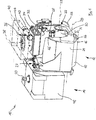
- a milling device carries in FIG. 1 the reference numeral 10.
- FIG. 1 only one milling body 16 is drawn. It is also possible that two milling bodies 16 are arranged side by side.
- the axis of rotation of the cutter body 16 is in FIG. 1 indicated by a dot-dash line, it has the reference numeral 20. It can be seen that this is in the illustrated operating position substantially horizontal or parallel to a surface to be machined, for example, an asphalt or concrete surface in road or road construction.
- the milling body 16 is mounted on a machine carrier designated overall by 22. From this are in FIG. 1 shown, inter alia, an outer housing 24 and lower skids 26 on which the milling device 10 rests in operation on the surface to be machined.
- a projection A of the cutter body 16 on the underside of the skids 26 results in a milling depth, ie the dimension by which the milling body 16 digs into the surface to be machined.
- this depth of cut A can be adjusted by means of a depth adjustment device 27.
- the axis of rotation 20 of the cutter body 16 is made adjustable in height relative to the skids 26.
- FIG. 1 housed invisible hydraulic drive motor, which can put the cutter body 16 in rotation.
- the machine carrier 22 is pivotally mounted on a bow-shaped upper part 28 about an axis 29.
- the milling device or the machine carrier 22 with the milling body 16
- an in FIG. 1 substantially vertical portion 30 of the top 28 on the in FIG. 1 right side of the machine body 22 down.
- the lower end of the section 30 extends from this one in FIG. 1 invisible bearing pin in the machine frame 22 into which the machine frame 22 is rotatably supported.
- a substantially horizontal portion 32 projects inwardly to about the horizontal center of the machine frame 22.
- an intermediate housing 34 is fixed, and its top is in turn with a rotator 36th connected.
- the machine carrier 22 and the upper part 28 to a in FIG. 1 essentially vertical axis 38 are rotated.
- the axes 20, 29, and 38 are all substantially in one plane, the axes 28 and 29 being substantially parallel to each other and the axis 38 being substantially orthogonal to both of them.
- the top of the rotator 36 is provided with a in FIG. 1 only symbolically indicated by a dash-dotted box quick coupler 40, which is also referred to as a quick coupling device connected.
- a quick coupling device By means of this quick coupler 40, the milling device 10 can be coupled to an arm of an excavator, not shown in the figure.
- the quick change 40 connects However, the milling device 10 not only mechanically with the excavator, but also hydraulically via corresponding coupling devices which automatically connect the hydraulic system of the milling device 10 with the hydraulic system of the excavator when connecting the quick coupler 40 to the excavator arm, and vice versa when disengaging the milling device 10 from the excavator automatically release the corresponding hydraulic connections.
- the rotating device 36 has a hydraulic gerotor 42 which drives a self-locking worm gear 44. By this a rotational movement about the axis 38 is effected. This rotational movement is infinitely and infinitely, since the rotating device 36 has a rotary feedthrough which couples the hydraulic areas stationary relative to the excavator arm or the quick coupler 40 with the hydraulic areas rotatable about the axis 38 with respect to the quick coupler 40. In detail, this is on the EP 2 123 831 A2 referenced, in which such a rotating device 36 is shown in detail with hydraulic rotary feedthrough. Their content is therefore expressly included in the content of the present application for protection.
- top 28 is pivotable relative to the machine carrier 22
- top 28 also be locked relative to the machine carrier 22.
- a spring biased latching bolt 46 is provided, which is arranged laterally on the vertical portion 30 of the upper part 28 and engages in a corresponding recess (not visible) in the end face of the machine carrier 22.
- the water storage and application unit 14 of the milling device 10 comprises a water tank 48, on the upper side of a transport lug 50 is attached. This makes it possible to mechanically raise the water tank 50 even when filled.
- a typical capacity of the water tank 48 is three hundred liters.
- the water tank 48 On the side facing the installation unit for the milling unit 12, the water tank 48 has a fastening device 52 with which the water storage and application unit 14 can be fastened to the milling unit 12 and there to the machine carrier 22.
- connecting pins 54 of the fastening device 52 engage in corresponding receptacles (not visible in the drawing) on the machine carrier 22.
- Locking pins 56 prevent unintentional release of the fastening device 52 from the machine carrier 22.
- a transparent show tube 58 is present, which allows a simple visual examination of the level in the water tank 48.
- a water hose 60 which leads to a spray bar 62.
- This can be fastened to the machine carrier 22 via fastening straps 64.
- a manually operated ball valve 66 is arranged, with which the flow of water from the water tank 48 for Spray bar 62 can be enabled or disabled.
- the spray bar 62 is arranged to spray water onto the cutter body 16 and the processing area when the ball valve 66 is opened. As a result, the milling body 16 is cleaned and dust bound.
- a typical volume flow is about ten liters per minute.
- the water storage and dispensing unit 14 includes a pump which draws the water from the water tank 48 and pumps it to the spray bar 62 under pressure. It is also possible to connect the spray bar 62 in an alternative embodiment to a continuously supplying water system, for example a water hydrant.
- the volume flow can be adjusted by means of the diameter of the nozzle openings which are present on the spray bar 62. It is usually between ten and thirty liters per minute.
- the hydraulic water pressure in such a case should be about 2 to 3 bar.
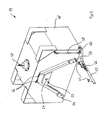
- the hydraulic system of the milling device 10 will now be described with reference to FIG. 3 explained. However, this relates only to the hydraulic system "below" the rotator 36.
- the hydraulic control of the gerotors 42 of the rotator 36 is in FIG. 3 not shown. It takes place via the grab-turning function of the excavator.
- FIG. 3 is the machine carrier side outlet of the rotary feedthrough shown in FIG. 3 is provided with the reference numeral 68. It comprises a first connection 70 of a first pressure line, the so-called “hammer line”, in FIG FIG. 3 denoted by H, a second port 72 of a second pressure line, the so-called “shear line”, in FIG. 3 denoted by S, and one third port 74 for a return or leakage line L.
- the first port 70 is connected to a first port 75 of a hydraulic drive motor 76 of the cutter body 16.
- a second connection 78 of the hydraulic drive motor 76 is connected to the second connection 72 of the rotary feedthrough 68 via a non-return valve 80 blocking the hydraulic drive motor 76.
- a leakage port 82 of the hydraulic drive motor 76 is connected to the third port 74 of the rotary feedthrough 68.
- the two ports 75 and 78 of the hydraulic drive motor 76 are connected to each other via a pressure relief valve 84, which, for example, to compensate for transient operating conditions to allow about a pressure equalization and a controlled braking in the wake after switching off the hydraulic pump of the excavator.
- the second port 72 of the rotary feedthrough 68 is connected to a hydraulically actuated 2/2-way valve 86, as is the third port 74.
- the 2/2-way valve 86 is connected to a servomotor 88 of the above-mentioned depth adjustment device 27.
- a control port 90 of the 2/2-way valve 86 is connected to the first port 70 of the rotary feedthrough 68.
- the milling device 10 works hydraulically as follows: If the cutter body 16 is to be rotated by the hydraulic drive motor 76, the first connection 70 (hammer line) is pressurized by the excavator. Hydraulic oil then flows from the first port 70 (hammer line) via the hydraulic drive motor 76 to the second and in this case depressurized port 72 (scissors line). If the milling depth is to be changed, first the first connection 70 (hammer line) is depressurized by the excavator. The milling body 16 comes now to a halt. Then, the second port 72 (scissors line) is pressurized from the excavator.
- connection 92 or a connection 94 of the servomotor 88 is now pressurized.
- the respective other connection 92 or 94 is instead connected to the third connection 74 of the rotary feedthrough 68.
- the direction of rotation of the servomotor 88 can be reversed by the 2/2-way valve 86.
- the conversion of the 2/2-way valve 86 is effected by a pressure pulse at the first terminal 70, so the so-called hammer line. This pressure pulse is triggered by the excavator.
- the second connection 72 is again depressurized by the excavator and, instead, the first connection 70 is pressurized so that the hydraulic drive motor 76 of the cutter body 16 is again driven.
- the 2/2-way valve 86 thus operates on the "pen principle".
- an adjustable pressure control valve 96 is arranged, through which the adjustment of the depth adjustment 27 can be adjusted by limiting the rotational speed of the servo motor 88. Furthermore, in the region of the 2/2-way valve 86, the line leading from the second connection 72 (without reference sign) and the line leading to the third connection 74 (without reference sign) are connected to one another via a throttle 98.
Landscapes
- Engineering & Computer Science (AREA)
- Mechanical Engineering (AREA)
- Mining & Mineral Resources (AREA)
- Civil Engineering (AREA)
- Structural Engineering (AREA)
- General Engineering & Computer Science (AREA)
- Architecture (AREA)
- Shovels (AREA)
- Road Repair (AREA)
Applications Claiming Priority (1)
| Application Number | Priority Date | Filing Date | Title |
|---|---|---|---|
| DE202010010857U DE202010010857U1 (de) | 2010-07-30 | 2010-07-30 | Fräseinrichtung |
Publications (2)
| Publication Number | Publication Date |
|---|---|
| EP2412873A2 true EP2412873A2 (fr) | 2012-02-01 |
| EP2412873A3 EP2412873A3 (fr) | 2014-03-26 |
Family
ID=42994060
Family Applications (1)
| Application Number | Title | Priority Date | Filing Date |
|---|---|---|---|
| EP11175896.7A Withdrawn EP2412873A3 (fr) | 2010-07-30 | 2011-07-29 | Dispositif de fraisage |
Country Status (2)
| Country | Link |
|---|---|
| EP (1) | EP2412873A3 (fr) |
| DE (1) | DE202010010857U1 (fr) |
Cited By (3)
| Publication number | Priority date | Publication date | Assignee | Title |
|---|---|---|---|---|
| CN108118591A (zh) * | 2017-12-30 | 2018-06-05 | 王世美 | 一种便捷式路面压平机 |
| CN113863107A (zh) * | 2021-11-13 | 2021-12-31 | 于文银 | 一种交通工程用标线清除装置 |
| CN121250764A (zh) * | 2025-12-07 | 2026-01-02 | 湖南省通泰工程有限公司 | 一种基于扩建路面的高精度刨铣与智能摊铺一体化系统 |
Families Citing this family (5)
| Publication number | Priority date | Publication date | Assignee | Title |
|---|---|---|---|---|
| ITBO20110097A1 (it) * | 2011-03-01 | 2012-09-02 | Simex Srl | Apparecchiatura per la lavorazione e in particolare per la demolizione e/o fresatura di superfici orizzontali , verticali o inclinate con scavo senza gradini |
| DE102011086085A1 (de) * | 2011-11-10 | 2013-05-16 | MTS Gesellschaft für Maschinentechnik und Sonderbauten mbH | Anbaugerät für einen Bagger |
| DE102022103022A1 (de) | 2022-02-09 | 2023-08-10 | Wirtgen Gmbh | Anbau-Bodenabtragsvorrichtung mit geteiltem Seitenschild |
| US12037755B2 (en) | 2022-08-18 | 2024-07-16 | Wirtgen Gmbh | Dual drive milling attachment |
| US12071733B2 (en) | 2022-08-18 | 2024-08-27 | Wirtgen Gmbh | Milling attachment with adjustable cover |
Citations (2)
| Publication number | Priority date | Publication date | Assignee | Title |
|---|---|---|---|---|
| EP2123831A2 (fr) | 2008-05-24 | 2009-11-25 | MTS Gesellschaft für Maschinentechnik und Sonderbauten MBH | Appareil supplémentaire pour une excavatrice |
| EP1440210B1 (fr) | 2001-10-16 | 2010-07-14 | Simex Engineering Srl | Fraiseuse pour pelles hydrauliques |
Family Cites Families (5)
| Publication number | Priority date | Publication date | Assignee | Title |
|---|---|---|---|---|
| EP0169248A1 (fr) * | 1984-06-06 | 1986-01-29 | Alfred Dr. Hackmack | Equipement interchangeable combiné de fraisage et de coupe, joint pour excavateurs, chargeurs, pelles chargeuses, rouleaux compresseurs et tracteurs |
| DE9401538U1 (de) * | 1994-01-31 | 1994-03-17 | Humme, Thomas, 52385 Nideggen | Fräsmaschine |
| DE9407487U1 (de) * | 1994-05-05 | 1994-07-07 | Humme, Thomas, 52385 Nideggen | Fräsmaschine |
| ATE183793T1 (de) * | 1995-02-18 | 1999-09-15 | Thumm Heinz Oelhydraulik | Drehvorrichtung für baggergreifer |
| DE20108725U1 (de) * | 2001-05-25 | 2001-08-30 | Schenk, Jürgen, 70188 Stuttgart | Grabgerät mit Saugeinrichtung |
-
2010
- 2010-07-30 DE DE202010010857U patent/DE202010010857U1/de not_active Expired - Lifetime
-
2011
- 2011-07-29 EP EP11175896.7A patent/EP2412873A3/fr not_active Withdrawn
Patent Citations (2)
| Publication number | Priority date | Publication date | Assignee | Title |
|---|---|---|---|---|
| EP1440210B1 (fr) | 2001-10-16 | 2010-07-14 | Simex Engineering Srl | Fraiseuse pour pelles hydrauliques |
| EP2123831A2 (fr) | 2008-05-24 | 2009-11-25 | MTS Gesellschaft für Maschinentechnik und Sonderbauten MBH | Appareil supplémentaire pour une excavatrice |
Cited By (3)
| Publication number | Priority date | Publication date | Assignee | Title |
|---|---|---|---|---|
| CN108118591A (zh) * | 2017-12-30 | 2018-06-05 | 王世美 | 一种便捷式路面压平机 |
| CN113863107A (zh) * | 2021-11-13 | 2021-12-31 | 于文银 | 一种交通工程用标线清除装置 |
| CN121250764A (zh) * | 2025-12-07 | 2026-01-02 | 湖南省通泰工程有限公司 | 一种基于扩建路面的高精度刨铣与智能摊铺一体化系统 |
Also Published As
| Publication number | Publication date |
|---|---|
| EP2412873A3 (fr) | 2014-03-26 |
| DE202010010857U1 (de) | 2010-10-21 |
Similar Documents
| Publication | Publication Date | Title |
|---|---|---|
| EP2412873A2 (fr) | Dispositif de fraisage | |
| EP3985175B1 (fr) | Système de changement rapide permettant de changer les accessoires sur une machine de construction | |
| EP2423384B1 (fr) | Dispositif de pulvérisation pour un engin de traitement de sol, engin doté d'un dispositif de pulvérisation et procédé de fonctionnement d'un dispositif de pulvérisation | |
| DE1902138A1 (de) | Verfahren und Vorrichtung zur Herstellung von Untergrundbauten im Erdkoerper,insbesondere von wasserdichten Dichtungsschuerzen | |
| DE102008006211B4 (de) | Anbauverdichter | |
| WO1996024725A1 (fr) | Engin pour travaux routiers | |
| DE3340382A1 (de) | Hydraulisches hochdrucksystem und selbstreinigende filteranordnung hierfuer | |
| DE10239746A1 (de) | Arbeitsfahrzeug mit Drehgestell | |
| EP2123831A2 (fr) | Appareil supplémentaire pour une excavatrice | |
| DE112014000058T5 (de) | Arbeitsfahrzeug und Arbeitsfahrzeug-Steuerverfahren | |
| EP1136206A2 (fr) | Machine avec tête de fraisage pivotable | |
| EP0762999B1 (fr) | Dispositif mobile pour le malaxage et/ou le retournage de materiaux (en meules) et dispositif d'evacuation utilise de preference a cet effet | |
| DE4413289C2 (de) | Bodenbearbeitungsgerät | |
| DE4016485C2 (de) | Gesteinsschlitzmaschine | |
| EP4086390A1 (fr) | Engin de creusement et procédé de creuser une fente dans le sol | |
| DE4213523B4 (de) | Mobiles Fräsladegerät, insbesondere Bodenfräsgerät | |
| EP1337712B1 (fr) | Machine de compactage du sol | |
| DE102009024523A1 (de) | Bandsägemaschine mit einem Sägerahmen mit Sägeband | |
| DE2357559C3 (de) | Walzenschrämmaschine mit stirnseitig angeordneter Brechwalze | |
| DE102007031106B3 (de) | Umkehrfräse zur Bodenbearbeitung | |
| DE69906409T2 (de) | Behälter mit Förderwalze | |
| AT395877B (de) | Einrichtung zum aufrauhen und einebnen einer mit hartschnee bedeckten und/oder vereisten verkehrsflaeche | |
| EP0392972B1 (fr) | Raccord pour un godet d'excavateur | |
| EP4183934B1 (fr) | Rotateur pivotant pour machine de travail | |
| DE2911326A1 (de) | Druckentlastungsvorrichtung |
Legal Events
| Date | Code | Title | Description |
|---|---|---|---|
| AK | Designated contracting states |
Kind code of ref document: A2 Designated state(s): AL AT BE BG CH CY CZ DE DK EE ES FI FR GB GR HR HU IE IS IT LI LT LU LV MC MK MT NL NO PL PT RO RS SE SI SK SM TR |
|
| AX | Request for extension of the european patent |
Extension state: BA ME |
|
| PUAI | Public reference made under article 153(3) epc to a published international application that has entered the european phase |
Free format text: ORIGINAL CODE: 0009012 |
|
| RAP1 | Party data changed (applicant data changed or rights of an application transferred) |
Owner name: MTS MASCHINENTECHNIK SCHRODE AG |
|
| PUAL | Search report despatched |
Free format text: ORIGINAL CODE: 0009013 |
|
| AK | Designated contracting states |
Kind code of ref document: A3 Designated state(s): AL AT BE BG CH CY CZ DE DK EE ES FI FR GB GR HR HU IE IS IT LI LT LU LV MC MK MT NL NO PL PT RO RS SE SI SK SM TR |
|
| AX | Request for extension of the european patent |
Extension state: BA ME |
|
| RIC1 | Information provided on ipc code assigned before grant |
Ipc: E02F 3/24 20060101ALI20140217BHEP Ipc: E01C 23/088 20060101AFI20140217BHEP |
|
| 17P | Request for examination filed |
Effective date: 20140818 |
|
| RBV | Designated contracting states (corrected) |
Designated state(s): AL AT BE BG CH CY CZ DE DK EE ES FI FR GB GR HR HU IE IS IT LI LT LU LV MC MK MT NL NO PL PT RO RS SE SI SK SM TR |
|
| GRAP | Despatch of communication of intention to grant a patent |
Free format text: ORIGINAL CODE: EPIDOSNIGR1 |
|
| INTG | Intention to grant announced |
Effective date: 20160405 |
|
| STAA | Information on the status of an ep patent application or granted ep patent |
Free format text: STATUS: THE APPLICATION IS DEEMED TO BE WITHDRAWN |
|
| 18D | Application deemed to be withdrawn |
Effective date: 20160817 |