EP2413541A1 - Procédé de communication dans un réseau de communication - Google Patents
Procédé de communication dans un réseau de communication Download PDFInfo
- Publication number
- EP2413541A1 EP2413541A1 EP10007919A EP10007919A EP2413541A1 EP 2413541 A1 EP2413541 A1 EP 2413541A1 EP 10007919 A EP10007919 A EP 10007919A EP 10007919 A EP10007919 A EP 10007919A EP 2413541 A1 EP2413541 A1 EP 2413541A1
- Authority
- EP
- European Patent Office
- Prior art keywords
- data
- application
- server
- channel quality
- wireless communication
- Prior art date
- Legal status (The legal status is an assumption and is not a legal conclusion. Google has not performed a legal analysis and makes no representation as to the accuracy of the status listed.)
- Withdrawn
Links
- 238000004891 communication Methods 0.000 title claims abstract description 123
- 238000000034 method Methods 0.000 title claims abstract description 23
- 230000005540 biological transmission Effects 0.000 claims abstract description 37
- 230000006978 adaptation Effects 0.000 claims abstract description 4
- 238000003860 storage Methods 0.000 claims description 7
- 239000003086 colorant Substances 0.000 claims description 2
- 238000012913 prioritisation Methods 0.000 description 7
- 230000006870 function Effects 0.000 description 3
- 238000013439 planning Methods 0.000 description 3
- 230000009467 reduction Effects 0.000 description 3
- 230000033228 biological regulation Effects 0.000 description 2
- 230000008859 change Effects 0.000 description 2
- 230000007423 decrease Effects 0.000 description 2
- 230000006735 deficit Effects 0.000 description 2
- 230000001419 dependent effect Effects 0.000 description 2
- 238000010586 diagram Methods 0.000 description 2
- 238000009434 installation Methods 0.000 description 2
- 238000013442 quality metrics Methods 0.000 description 2
- 230000001105 regulatory effect Effects 0.000 description 2
- 230000009286 beneficial effect Effects 0.000 description 1
- 230000001276 controlling effect Effects 0.000 description 1
- 125000004122 cyclic group Chemical group 0.000 description 1
- 238000003754 machining Methods 0.000 description 1
- 238000004519 manufacturing process Methods 0.000 description 1
- 238000012544 monitoring process Methods 0.000 description 1
- 238000005457 optimization Methods 0.000 description 1
- 230000008569 process Effects 0.000 description 1
- 230000008672 reprogramming Effects 0.000 description 1
- 230000004044 response Effects 0.000 description 1
Images

Classifications
-
- H—ELECTRICITY
- H04—ELECTRIC COMMUNICATION TECHNIQUE
- H04L—TRANSMISSION OF DIGITAL INFORMATION, e.g. TELEGRAPHIC COMMUNICATION
- H04L47/00—Traffic control in data switching networks
- H04L47/10—Flow control; Congestion control
Definitions
- the invention relates to the communication in a communication network, in particular the at least partially wireless transmission of data in a communication network.
- a wireless communication channel is subject to a large variation in transmission quality.
- the transmission quality can also be referred to as channel quality.
- the maximum possible transmission speed of the wireless communication channel also depends on the channel quality.
- the channel quality decreases as the distance between the transmitter and the receiver increases or when interference factors increase. Disturbing factors can be, for example, obstacles in the transmission path between transmitter and receiver or also interference.
- the channel quality variation is particularly important for the microwave band, where, for example, the industrial WLAN complies with the IEEE 802.11 standard.
- an optimization of the data transfer takes place on the lower communication layers of the OSI layer model. These lower communication layers are, for example, bit transmission layer, the connection layer and the network layer.
- Such measures may be, for example, packet retries or more robust modulation schemes associated with a reduction in the data rate.
- the invention has for its object to provide an improved method for communication in a communication network. It is another object of the present invention to provide an improved server for such a communication network and an improved computer readable storage medium for such a server.
- a method for communication in a communication network takes place at least partially wirelessly via a wireless communication channel.
- the wireless communication channel has a maximum channel quality.
- the maximum channel quality corresponds to a maximum possible data transmission rate or data rate.
- maximum channel quality it is meant herein also a channel quality that provides wireless communication over the communication channel with impairments that could reduce the data rate.
- the maximum channel quality is an indicator of how high the data rate of the data transmitted over the wireless communication channel can be maximum.
- the communication network comprises at least one server and a plurality of network devices.
- a network device can be, for example, a PC, a laptop, a mobile phone, a PDA or an automation device. If an automation device is part of the communication network, it is an automation network.
- An automation network can be designed, for example, as an industrial automation network.
- Such industrial automation networks can eg be designed, configured and / or provided for the control and / or regulation of industrial installations (eg production plants, conveyor systems etc.), machines and / or devices.
- automation networks or industrial automation networks real-time communication protocols (eg Profinet, Profibus, Real-Time Ethernet) for communication at least between the to the Have control and / or regulatory tasks involved components (eg between the control units and the plants to be controlled and / or machines).
- the secure transmission of data via storage media is also covered.
- At least one further communication protocol may also be provided in the automation network or industrial automation network, e.g. for monitoring, setting up, reprogramming or / or reparameterizing one or more control units in the automation network.
- An automation network may e.g. Wired communication components and / or wireless communication components include.
- an automation network may include at least one automation device.
- An automation device can be, for example, a computer, PC and / or controller with control tasks or control capabilities.
- an automation device can be, for example, an industrial automation device which can be designed, set up and / or provided, for example, specifically for controlling and / or regulating industrial installations.
- such automation devices or industrial automation devices can be real-time capable, ie enable real-time control or regulation.
- the automation device or the industrial automation device for example, comprise a real-time operating system and / or at least under a130 nderem support a real-time communication protocol for communication (eg Profinet, Profibus, Real-Time Ethernet).
- An automation network includes multiple sensors and actuators.
- the actuators and sensors are controlled by at least one control device.
- the actuators, the sensors and the at least one control device exchange data with each other.
- An automation protocol is used for data exchange.
- the at least one controller controls the actuators, the sensors and the data exchange so that a machining process takes place in which e.g. a product is produced.
- An industrial automation device may e.g. a programmable logic controller, a module or part of a programmable logic controller, be integrated in a computer or PC programmable logic controller and corresponding field devices, sensors and / or actuators, input and / or output devices or the like for connection to a programmable logic controller or include such.
- any type of protocol is provided, which is provided for communication with automation devices according to the present description, suitable and / or set up.
- Such automation protocols can be, for example, the Profibus protocol (eg in accordance with IEC 61158 / EN50170), a Profi-Bus-DP protocol, a Profibus-PA protocol, a Profinet protocol, a Profi-Net-IO protocol.
- Protocol a protocol according to AS-Interface, a protocol in accordance with IO-Link, a KNX protocol, a protocol according to a multipoint interface (MPI), a protocol for a point-to-point connection (point-to-point connection).
- MPI multipoint interface
- to-Point, PtP a protocol in accordance with the specifications of the S7 communication (which is provided and set up, for example, for the communication of programmable logic controllers from Siemens) or also an Industrial Ethernet protocol or Real-Time Ethernt protocol or be more specific protocols for communication with automation devices.
- S7 communication which is provided and set up, for example, for the communication of programmable logic controllers from Siemens
- Industrial Ethernet protocol or Real-Time Ethernt protocol or be more specific protocols for communication with automation devices.
- any combination of the aforementioned protocols may be provided.
- An application may be, for example, a browser or downloader, via which a PC or a laptop downloads a file from the Internet.
- video applications may transmit video at a first and a second data rate. In this case, it is advantageous, for example, if the video data is transmitted at a lower second data rate, instead of a jerky transmission in a higher first data rate.
- applications can use automation applications, such as PROFINET applications. Such applications serve to exchange automation data in the communication network.
- These data can also be transmitted, for example, with a first, higher and a second, lower data rate.
- the transmission at the second, lower data rate is advantageous if the channel quality of the wireless communication channel is not sufficient for the first data rate.
- Safety-related data such as fail-safe data, can also be transmitted. For this purpose, safety-related applications are executed on the server and / or the network devices.
- application data is transmitted to one another via the communication network between the server and the network devices and / or between the network devices.
- the application data comprises at least first data of a first application and second data of a second application.
- a first data rate and for the transmission of the second data over the wireless communication channel a second data rate is used.
- the maximum channel quality of the wireless communication channel can be determined in particular by means of channel quality characteristics.
- Channel quality characteristics can be, for example, occurring CRC errors, frame repetitions, types of modulation used and / or data rates. For example, if the CRC error rate is high, the channel quality is accordingly low; the number of frame repeats is the same. For example, if the number of CRC errors increases, the maximum channel quality decreases. As the number of frame repeats increases, so does the maximum channel quality. If an application changes the modulation type to a more robust modulation type, a lower channel quality can also be deduced. This also applies if the data rate is reduced. Increasing the maximum channel quality indicates a reduction in CRC errors, a reduction in frame repetitions, an increase in data rates, and / or a change to a faster but less robust modulation scheme.
- the maximum channel quality can be determined by another device in the communication network.
- the other device transmits a signal to the server.
- the signal is an indicator of the maximum channel quality.
- the type of the first and second data can be determined in particular with the aid of application characteristics of the first and second applications.
- Application parameters may, for example, describe the type of application. For example, if it is a video application, the application metrics say that the corresponding data is video data. The same applies to a download program or an Internet browser, which usually downloads files from the Internet.
- the application metrics for an automation application say that it is the Application data is about automation data.
- Safety-related applications usually transmit safety-related data.
- first and second data of the first and second applications may be fixed when the communication network is established. This can be done for example by a parameterization or by default settings of the applications.
- the first and / or the second data rate are adjusted in dependence on the maximum channel quality and on the nature of the first and second data.
- a channel quality variation can be registered by changing the number of CRC errors or frame repeats.
- any variation in a channel quality characteristic may indicate a variation in the maximum channel quality.
- the type of data is taken into account because it may be advantageous not to limit safety-related data in their data rate in the modulation process. On the other hand, it may be beneficial to the user without compromising security and with acceptable impairment, for example, when downloading from the Internet at a lower data rate. It may also be advantageous in such a case that the video data is transmitted at a lower data rate. This is usually more comfortable for a user than a jerky transmission with a higher data rate.
- Safety-related data can be, for example, data that is important for the safety of the automation system.
- these may be failsafe signals. These can be signals that are periodically sent from a network device to the server to signal that the Network device works normally.
- Video data can also be safety-related if, for example, they are used to monitor automation equipment.
- the first and / or the second application may also be terminated in dependence on the maximum channel quality and on the nature of the first and second data. Termination of the first application is advantageous, for example, when the second data requires such a high data rate that any transmission of the first data interferes with the transmission of the second data to an extent that could compromise, for example, the security of an automation system. The same applies to a termination of the second application if such a high data rate is required for the first data.
- Such a method can already be carried out during the planning of the communication network.
- a user defines which data he wants to transmit by which applications at which data rate.
- the user is presented with the maximum channel quality of the wireless communication channel sufficient for the applications and data rates he / she chooses.
- the method is modified according to embodiments of the invention so that no actual communication takes place in the communication network. Instead, communication is simulated only on a PC, whereby any congestion of the wireless communication channel can be presented to the user. The user can then dispense with individual applications or reduce the data rates of individual applications until it is shown that the maximum channel quality of the wireless communication channel is sufficient for the applications and data rates he has selected.
- the first and / or second data are one of the following data types: real-time data, program installation data, document data, video data, voice data and / or safety-related data.
- the first data is real-time data at a first data rate.
- a third application is started.
- the third application transmits third data over the wireless communication channel and the third data is real-time data at a second data rate.
- the data rate of the first application is not throttled, but another application is started with a different data rate. This can be advantageous, for example, if video data of a first application is transmitted and a change in the modulation type and / or the data rate of the video data is not possible.
- the third application then transmits the same video data at a lower data rate and / or with a different modulation type.
- the second data is safety-related data.
- the transmission of the second data requires a minimum data rate.
- the server prevents the second data rate from becoming less than the minimum data rate. For this purpose, for example, when reducing the maximum channel quality, the first application can be terminated or the data rate of the first application can be reduced.
- the channel quality characteristics include at least one of the following quantities: number of CRC errors, number of frame repetitions, modulation type, data rate.
- the data rate of a first application may be reduced if the number of CRC errors or frame iterations rises above a certain threshold.
- a first application can be terminated.
- the server comprises display means. Via the display means, the server outputs an indicator for the utilization of the maximum channel quality of the wireless communication channel. This is advantageous so that, for example, a user is warned when using the maximum channel quality and can optionally decide for himself which data rate should be reduced or which application should be terminated.
- the indicator is displayed in different colors as a function of the utilization of the maximum channel quality.
- the indicator is green when the utilization of the maximum channel quality is below 50%. Above 50%, it changes color to yellow and the closer it gets to 100% usage, the redder the indicator becomes. Other percentage levels are also conceivable. It is conceivable that the indicator changes the color fluently or changes its color gradually from green to yellow to orange to red.
- the invention relates to a server for a communication network.
- the server is designed to prioritize multiple applications.
- the server comprises means for the prioritization of application data over the communication network.
- Prioritization means that certain application data is given a higher priority than other application data.
- safety-related application data is given the highest priority and, for example, download data is a lower priority.
- the application data comprises at least first data of a first application and second data of a second application Application. The first data can therefore be prioritized differently than the second data.
- the server comprises means for determining a first data rate for the transmission of the first data over a wireless communication channel and for determining a second data rate for the transmission of the second data over the wireless communication channel.
- the server comprises means for determining the maximum channel quality of the wireless communication channel, in particular on the basis of channel quality characteristics. The determination of the first and the second data rate can be done for example by a processor. The processor can also be designed to determine the maximum channel quality.
- the server comprises means for determining the type of the first and the second data, in particular based on application characteristics of the first and the second application.
- the server comprises means for adapting the first and / or the second data rate in dependence on the maximum channel quality and on the nature of the first and second data.
- the server comprises means for terminating the first and / or the second application in dependence on the maximum channel quality and on the nature of the first and the second data.
- the invention relates to a computer readable storage medium having instructions for executing its execution in a server according to embodiments of the invention causing the server to perform the following steps.
- application data for the execution of the applications is transmitted over the communication network.
- the application data comprises at least first data of a first application and second data of a second application.
- a first data rate for the transmission of the first data over a wireless communication channel and a second data rate for the transmission of the second data over the wireless communication channel are determined.
- the maximum channel quality of the wireless communication channel is determined in particular on the basis of the channel quality characteristics.
- the nature of the first and second data is determined in particular based on application characteristics of the first and second applications.
- the instructions are executed by a processor.
- the processor can also perform the individual steps.
- the first and / or the second data rate are adjusted as a function of the maximum channel quality and of the type of the first and second data. Additionally or alternatively, the first application and / or the second application is terminated in dependence on the maximum channel quality and on the nature of the first and second data.
- the invention relates to a communications network having a server according to embodiments of the invention.
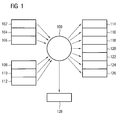
- FIG. 1 FIG. 12 is a schematic representation of application characteristics, channel quality characteristics, and input quantities that may be input to a server 100 upon establishment of a communication network.
- the server 100 is located in the communication network (not shown) and controls and prioritizes application data exchanged in the communication network between network devices of the communication network.
- the server 100 determines a maximum channel quality of a wireless communication channel of the communication network.
- the maximum channel quality corresponds to a maximum possible data rate for the transmission of the application data over the wireless communication channel.
- the server 100 registers the number of cyclic redundancy check (CRC) errors 102, the number of frame repeats 104, and the modulation type and data rate 106 of first and second data transmitted over the wireless communication channel (not shown) channel quality parameters.
- CRC cyclic redundancy check
- automation data 108 transmitted for example, with the PROFInet protocol, may have a relatively high prioritization, while download data 110 may be prioritized lower.
- An even lower prioritization than for the download data 110 may be provided, for example, for video data 112.
- the server 100 controls the applications executing on the server and / or the network devices in the communication network.
- the application data may include, for example, video data at a first data rate 114, video data at a second data rate 116, download data at a first data rate 118, download data at a second data rate 120, automation data at a first data rate 122, automation data at a second data rate 124, and / or safety-related data Be 126.
- the server may stop transmitting the video data at the first data rate 114 and instead start the video data at the second data rate 116. The same can be done with the download data 118 and 120. In order to ensure transmission of the safety-related data 126, the transmission of the video data 114 and / or 116 can also be ended.
- the server 100 outputs via display means a quality parameter of the communication network.
- the indicator 128 indicates how much the maximum channel quality of the wireless communication channel is being utilized. With a high utilization of the maximum channel quality, this is displayed to the user. The user can then manually reduce individual data rates and / or terminate individual applications.
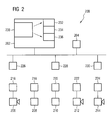
- FIG. 2 16 is a schematic view of a communications network 200 having a server 202, an automation device 204, a plurality of network devices 206, 208, 210, 212, 214, which may also be moved, and each via an associated network client 216, 218, 220, 222, 224 can communicate wirelessly with access points 226, 228, 230 on the wired part of the communication network.
- the server 202 is connected to the access points 226-230 via network cables.
- the wired network includes an automation device 204.
- the data is sent from the server to the access points 226-230.
- the access points 226-230 wirelessly forward the data to the network clients 218-224.
- the network clients 218-224 forward the data to the respective network device 206-214.
- data to be sent from the server 202 to the network device 206 is sent via the access point 226 to the client 216.
- the client 216 forwards the data to the network device 206.
- the network devices 206-214 may execute video applications, for example. This is the case with network devices 206, 212 and 214.
- the network devices 208 and 210 for example, transmit automation data, which may also be safety-related.
- the data from the server is first sent via an access point to the client 218 or 220.
- Client 218 or 220 forwards the data to the associated network device 208 or 210, respectively.
- the network devices 206-214 forward that data to the associated client 216-224.
- the respective client transmits the data wirelessly to an access point 226-230.
- the data can then be forwarded to the server 202.
- This forwarding is done in the wired part of the communication network.
- the automation devices 208 and 210 may also communicate data to the automation device 204 via the access points 226-230 and send the clients 216-224.
- the automation devices 208 and 210 may receive data from the automation device 204 via the access points 226-230 and the clients 216-224.
- Server 202 controls all of these communications by executing multiple applications 232, 234 and 236.
- application 232 is responsible for transmitting video data from network device 212 to server 202.
- the server 202 monitors the channel quality metrics 238. Based on the channel quality metrics 238, the maximum channel quality of the wireless communication channel is determined. If the maximum channel quality is not sufficient for all wireless data transmissions of the network devices 206-214 and the server 202, the server reduces the data rate of at least one of the applications 232-236. For example, the data rate of the application 232 application data may be reduced because it is This is video data that is not safety-related.
- the server 202 may also terminate one of the applications 232-236 if necessary due to the prioritization of the applications 232-236 so as not to interfere with the safety-related data.
- application 236 is responsible for transmitting safety-related data from network device 210 to automation device 204.
- the data rate of the application 236 is not lowered and termination of the application 236 does not occur.
- the data rates of applications 232 and 234 are reduced or applications 232 and 234 are terminated.
- FIG. 3 is a flowchart of a method according to embodiments of the invention.
- step S1 multiple applications are executed on the server with the network devices.
- step 2 application data is transmitted via the communication network between the server and the network devices and / or between the network devices exchanged with each other.
- the application data comprises at least first data of a first application and second data of a second application.
- the transmission of the first data over the wireless communication channel is at a first data rate and the transmission of the second data over the wireless communication channel is at a second data rate.
- the maximum channel quality of the wireless communication channel is determined using channel quality characteristics in step S3.
- the channel quality characteristics may be, for example, CRC errors, frame repetitions, modulation types and / or data rates.
- step S4 the nature of the first and second data is determined using application characteristics of the first and second applications.
- the application characteristics are defined, for example, in the planning of the communication network for each application.
- a video application is defined to be video data.
- an automation device is defined that it is automation data, which may also be safety-related.
- step S5 the first and / or the second data rate are adjusted in dependence on the maximum channel quality and on the type of the first and second data.
- the adaptation takes place in such a way that as far as possible no safety-related data is transmitted or is transmitted more slowly.
- non-security applications such as video applications or download applications are slowed down or terminated.
- step S7 the termination of the first application can optionally be effected as a function of the maximum channel quality and of the type of the first and second data.
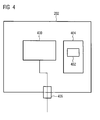
- FIG. 4 is a block diagram of a server according to embodiments of the invention.
- the server comprises a processor 400, which is used to execute a program 402 Instructions is formed.
- the program 402 is stored in the data memory 404.
- the server is also adapted to communicate via an interface 406 with a wired part of a communication network.
- the server is prompted to prioritize application data exchanged over the communication network. This is done by the processor 400 executing the instructions of the program 402.
- the processor 400 also determines a first data rate for the transmission of first data over a wireless communication channel.
- the processor 400 determines a second data rate for the transmission of second data over the wireless communication channel.
- the processor 400 is also configured to determine the maximum channel quality of the wireless communication channel based on channel quality characteristics.
- the channel quality parameters can also be received by the server 202 via the interface 406, and the processor 400 determines the maximum channel quality by executing the program 402.
- the processor 400 determines the nature of the first and second data.
- the application metrics may also be stored in memory 404 for each executable application of the processor 400.
- the processor 400 adjusts the first and / or the second data rate in dependence on the maximum channel quality and on the type of the first and second data.
- the processor 400 is configured to terminate a first application in response to the maximum channel quality and the first and second data.
Landscapes
- Engineering & Computer Science (AREA)
- Computer Networks & Wireless Communication (AREA)
- Signal Processing (AREA)
- Mobile Radio Communication Systems (AREA)
Priority Applications (1)
| Application Number | Priority Date | Filing Date | Title |
|---|---|---|---|
| EP10007919A EP2413541A1 (fr) | 2010-07-29 | 2010-07-29 | Procédé de communication dans un réseau de communication |
Applications Claiming Priority (1)
| Application Number | Priority Date | Filing Date | Title |
|---|---|---|---|
| EP10007919A EP2413541A1 (fr) | 2010-07-29 | 2010-07-29 | Procédé de communication dans un réseau de communication |
Publications (1)
| Publication Number | Publication Date |
|---|---|
| EP2413541A1 true EP2413541A1 (fr) | 2012-02-01 |
Family
ID=43413611
Family Applications (1)
| Application Number | Title | Priority Date | Filing Date |
|---|---|---|---|
| EP10007919A Withdrawn EP2413541A1 (fr) | 2010-07-29 | 2010-07-29 | Procédé de communication dans un réseau de communication |
Country Status (1)
| Country | Link |
|---|---|
| EP (1) | EP2413541A1 (fr) |
Cited By (1)
| Publication number | Priority date | Publication date | Assignee | Title |
|---|---|---|---|---|
| DE102019219648A1 (de) * | 2019-12-16 | 2021-06-17 | Robert Bosch Gmbh | Verfahren zum Betreiben eines Kommunikationsnetzwerks und Kommunikationsnetzwerk |
Citations (2)
| Publication number | Priority date | Publication date | Assignee | Title |
|---|---|---|---|---|
| WO2004017221A1 (fr) * | 2002-08-14 | 2004-02-26 | Drs Technical Services, Inc. | Procede et systeme destines a reguler et a commander l'allocation de bande passante de reseau |
| US20070253332A1 (en) * | 2006-04-28 | 2007-11-01 | Siemens Technology-To-Business Center, Llc | Quality guarantee for real-time applications over shared networks |
-
2010
- 2010-07-29 EP EP10007919A patent/EP2413541A1/fr not_active Withdrawn
Patent Citations (2)
| Publication number | Priority date | Publication date | Assignee | Title |
|---|---|---|---|---|
| WO2004017221A1 (fr) * | 2002-08-14 | 2004-02-26 | Drs Technical Services, Inc. | Procede et systeme destines a reguler et a commander l'allocation de bande passante de reseau |
| US20070253332A1 (en) * | 2006-04-28 | 2007-11-01 | Siemens Technology-To-Business Center, Llc | Quality guarantee for real-time applications over shared networks |
Cited By (1)
| Publication number | Priority date | Publication date | Assignee | Title |
|---|---|---|---|---|
| DE102019219648A1 (de) * | 2019-12-16 | 2021-06-17 | Robert Bosch Gmbh | Verfahren zum Betreiben eines Kommunikationsnetzwerks und Kommunikationsnetzwerk |
Similar Documents
| Publication | Publication Date | Title |
|---|---|---|
| EP3522482B1 (fr) | Procédé de communication de données dans un réseau industriel, procédé de commande, dispositif, programme informatique et support lisible par ordinateur | |
| EP1585266B1 (fr) | Procédé de transfer des données | |
| EP2847942B1 (fr) | Procédé pour transmettre des données au moyen d'un protocole de transport ethernet entre des noeuds d'un véhicule à moteur ainsi qu'un appareil de commande conçu pour la mise en oeuvre de ce pocédé | |
| EP3744045B1 (fr) | Procédé de configuration et/ou de commande d'appareils terminaux d'une installation de domotique | |
| EP2448182B1 (fr) | Procédé de communication dans un système d'automatisation | |
| WO2016045885A1 (fr) | Procédé de transmission de données et nœud de réseau associé et réseau associé | |
| EP3468905B1 (fr) | Installation de transport de personnes comprenant une unite de commande centrale et plusieurs appareils de terrain communiquant avec des telegrammes de donnees prioritaires par des periodes d'attente | |
| WO2023126127A1 (fr) | Procédé et système permettant de fournir des applications de commande prioritaires | |
| EP4070508B1 (fr) | Procédé, dispositif et système d'optimisation de la transmission de données entre des dispositifs de commande et des systèmes en nuage | |
| DE112007000820B4 (de) | Hochansprechende Master-Slave-Ventileinstellung | |
| EP2413541A1 (fr) | Procédé de communication dans un réseau de communication | |
| WO2022049175A1 (fr) | Procédé pour faire fonctionner un réseau | |
| EP2456168A1 (fr) | Système de télémaintenance pour appareils | |
| EP3560153B1 (fr) | Procédé pour faire fonctionner un dispositif de traitement de données et dispositif de traitement de données | |
| EP2355609B1 (fr) | Procédé de commande d'un système de réseau, système de réseau et programme informatique | |
| DE102009036234B4 (de) | Kommunikationsgerät zur Datenkommunikation in einem Industrienetzwerk, Industrienetzwerk und Verfahren zur Steuerung der Datenkommunikation in einem Industrienetzwerk | |
| WO2023093954A1 (fr) | Procédé de transmission de messages de véhicule à x, et module de communication de véhicule à x | |
| DE102022128254A1 (de) | Zustandsbasierte adaptive Funkressourcenzuweisung | |
| DE112013005157T5 (de) | Systeme und Verfahren zur Teilung von Bandbreite über eine Vielzahl von Videodatenströmen | |
| DE102019217463A1 (de) | Verfahren zur Übertragung von Abonnementdaten, sowie Datenbereitstellungskomponente, Datenkonsumkomponente, Netzwerk und Anlage | |
| DE102011003310A1 (de) | Netzwerkgerät für ein Automatisierungsnetzwerk | |
| EP3454222A1 (fr) | Procédé et composants d'automatisation permettant la transmission de données de commande dans une installation d'automatisation industrielle | |
| EP3518470A1 (fr) | Procédé de communication de données dans un dispositif de réseau à base d'ethernet, en particulier industriel, destiné à la mise en uvre dudit procédé, programme informatique ainsi que support lisible par ordinateur | |
| DE102016004340A1 (de) | Verfahren und Vorrichtung für die Kommunikation in einem Haus- oder Gebäudeinstallationssystem | |
| EP3518480A1 (fr) | Procédé de communication de données dans un dispositif de réseau à base d'ethernet, en particulier industriel, destiné à la mise en uvre dudit procédé ainsi que programme informatique et support lisible par ordinateur |
Legal Events
| Date | Code | Title | Description |
|---|---|---|---|
| AK | Designated contracting states |
Kind code of ref document: A1 Designated state(s): AL AT BE BG CH CY CZ DE DK EE ES FI FR GB GR HR HU IE IS IT LI LT LU LV MC MK MT NL NO PL PT RO SE SI SK SM TR |
|
| AX | Request for extension of the european patent |
Extension state: BA ME RS |
|
| PUAI | Public reference made under article 153(3) epc to a published international application that has entered the european phase |
Free format text: ORIGINAL CODE: 0009012 |
|
| STAA | Information on the status of an ep patent application or granted ep patent |
Free format text: STATUS: THE APPLICATION IS DEEMED TO BE WITHDRAWN |
|
| 18D | Application deemed to be withdrawn |
Effective date: 20120802 |