EP2417094B1 - Procédé de recyclage d'un produit de sortie d'hydroformylation liquide - Google Patents
Procédé de recyclage d'un produit de sortie d'hydroformylation liquide Download PDFInfo
- Publication number
- EP2417094B1 EP2417094B1 EP10710548A EP10710548A EP2417094B1 EP 2417094 B1 EP2417094 B1 EP 2417094B1 EP 10710548 A EP10710548 A EP 10710548A EP 10710548 A EP10710548 A EP 10710548A EP 2417094 B1 EP2417094 B1 EP 2417094B1
- Authority
- EP
- European Patent Office
- Prior art keywords
- rhodium
- liquid
- hydroformylation
- hydroformylation reaction
- filter
- Prior art date
- Legal status (The legal status is an assumption and is not a legal conclusion. Google has not performed a legal analysis and makes no representation as to the accuracy of the status listed.)
- Revoked
Links
Images
Classifications
-
- C—CHEMISTRY; METALLURGY
- C07—ORGANIC CHEMISTRY
- C07C—ACYCLIC OR CARBOCYCLIC COMPOUNDS
- C07C45/00—Preparation of compounds having >C = O groups bound only to carbon or hydrogen atoms; Preparation of chelates of such compounds
- C07C45/49—Preparation of compounds having >C = O groups bound only to carbon or hydrogen atoms; Preparation of chelates of such compounds by reaction with carbon monoxide
- C07C45/50—Preparation of compounds having >C = O groups bound only to carbon or hydrogen atoms; Preparation of chelates of such compounds by reaction with carbon monoxide by oxo-reactions
-
- C—CHEMISTRY; METALLURGY
- C07—ORGANIC CHEMISTRY
- C07C—ACYCLIC OR CARBOCYCLIC COMPOUNDS
- C07C45/00—Preparation of compounds having >C = O groups bound only to carbon or hydrogen atoms; Preparation of chelates of such compounds
- C07C45/78—Separation; Purification; Stabilisation; Use of additives
-
- C—CHEMISTRY; METALLURGY
- C07—ORGANIC CHEMISTRY
- C07C—ACYCLIC OR CARBOCYCLIC COMPOUNDS
- C07C45/00—Preparation of compounds having >C = O groups bound only to carbon or hydrogen atoms; Preparation of chelates of such compounds
- C07C45/78—Separation; Purification; Stabilisation; Use of additives
- C07C45/783—Separation; Purification; Stabilisation; Use of additives by gas-liquid treatment, e.g. by gas-liquid absorption
-
- C—CHEMISTRY; METALLURGY
- C07—ORGANIC CHEMISTRY
- C07C—ACYCLIC OR CARBOCYCLIC COMPOUNDS
- C07C45/00—Preparation of compounds having >C = O groups bound only to carbon or hydrogen atoms; Preparation of chelates of such compounds
- C07C45/78—Separation; Purification; Stabilisation; Use of additives
- C07C45/79—Separation; Purification; Stabilisation; Use of additives by solid-liquid treatment; by chemisorption
Definitions
- the invention relates to a process for working up a liquid hydroformylation discharge of a hydroformylation reaction comprising at least one aldehyde as hydroformylation product, unreacted olefinically unsaturated compounds, dissolved synthesis gas, the homogeneously dissolved hydroformylation catalyst and by-products of the hydroformylation reaction.
- Rhodium is used as a complex compound which, in addition to carbon monoxide, preferably contains phosphines as ligands. Rhodium as a metal allows it at low pressures too In addition, one achieves higher yields and preferably the more valuable for further processing unbranched products are formed, starting from straight-chain terminal olefins.
- the hydroformylation of olefinically unsaturated compounds under the catalytic action of Rhodiumcarbonylkomplexen with tertiary organic phosphines or phosphites as ligands is carried out in a homogeneous organic phase, ie, the olefinically unsaturated compound used, the catalyst and the reaction products of the hydroformylation reaction are present together in solution.
- the reaction products are usually separated from the mixture by distillation, more rarely by other methods such as extraction.
- the hydroformylation process carried out in a homogeneous phase can be carried out in the form of a gas circulation process according to US 4,247,486 A1 or in the form of a liquid circulation process according to US 4,148,830 A1 be designed.
- By-products of the hydroformylation reaction are high-boiling aldehyde condensation products which are a complex mixture of oxygenated compounds formed from the aldehydes initially formed by condensation reactions such as the aldol reaction or the Tchenchenko reaction and have a different degree of condensation.
- the liquid discharge from the hydroformylation reaction is first expanded in a flash vessel in which a separation into a gas phase and in a liquid phase takes place.
- the liquid phase essentially contains the catalyst, high-boiling aldehyde condensation products, solvents, the desired aldehyde and small amounts of unreacted olefinically unsaturated compound.
- the gas phase contains excess synthesis gas, inerts and hydrogenated products, small amounts of the aldehyde formed and unreacted olefinically unsaturated compound. After separation and removal of a portion of the inert and hydrogenated products, the gas phase is compressed and returned to the hydroformylation reactor.
- the liquid catalyst-containing stream is passed to a separation device, preferably a distillation device in which the desired aldehydes and small amounts of dissolved synthesis gas and olefinically unsaturated compound are removed as the top product.
- a separation device preferably a distillation device in which the desired aldehydes and small amounts of dissolved synthesis gas and olefinically unsaturated compound are removed as the top product.
- the mixture is then separated in a further purification stage in the pure n- and iso-aldehydes.
- the resulting rhodium-containing material stream which also contains the high-boiling aldehyde condensation products as solvent, is recycled to the hydroformylation reactor.
- WO 01/58844 A2 relates to the work-up of a liquid discharge of a continuously carried out hydroformylation reaction.
- there is a two-stage expansion wherein in the first stage is relaxed to a pressure which is 0.2 to 2 MPa below the reactor pressure.
- the resulting liquid phase is further expanded in a second, lower pressure stage, forming a gas phase, which is essentially the main amount of the desired hydroformylation product contains.
- the resulting liquid phase containing high-boiling by-products and the homogeneously dissolved hydroformylation catalyst is recycled either directly or after distillative workup in the hydroformylation reactor.
- WO 97/07086 A1 also deals with a process for working up a liquid Hydroformyl istsaustrags obtained in a flash vessel next to a gaseous phase.
- the liquid phase is added to the upper part of a column downstream of the flash vessel and the gaseous phase is passed into the lower part of the column so that the liquid phase is brought into contact with the gaseous phase in countercurrent.
- rhodium-containing solids formed by decomposition and deactivation may be present in the distillation residue in suspended and thus pumpable form and recycled to the hydroformylation reactor, such suspended rhodium-containing solids often have only a slight hydroformylation activity. This may also apply to decomposition and deactivation products present in the distillation residue in dissolved form.
- more rhodium in Form of a fresh rhodium catalyst are added as rhodium is taken with the formed high-boiling aldehyde condensation products. The difference between the added amount of fresh rhodium and the discharged amount of deactivated rhodium remains in the system and is initially considered rhodium consumption.
- the process according to the invention is suitable for working up a liquid, rhodium-containing discharge from a hydroformylation reaction carried out in a homogeneous reaction system.
- the term homogeneous reaction system stands for an essentially composed of solvent, catalyst, olefinically unsaturated compound and reaction product homogeneous solution.
- catalysts rhodium complex compounds are used which contain organic phosphorus (III) compounds as ligands.
- complex compounds and their preparation are known (for example US Pat. No. 3,527,809 A1 . US 4 148 830 A1 . US 4 247 486 A1 . US 4,283,562 A1 ). They can be used as a uniform complex compound or as a mixture of different complex compounds.
- the rhodium concentration in the reaction medium extends over a range of about 1 to about 1000 ppm by weight, and is preferably 10 to 500 ppm by weight.
- rhodium is used in concentrations of from 10 to 200 ppm by weight, based in each case on the olefinically unsaturated compound used.
- the catalyst used may be the stoichiometric rhodium complex compound. However, it has proved to be expedient to carry out the hydroformylation in the presence of a catalyst system of the rhodium complex compound and free, ie excess, phosphorus ligand which does not undergo any complex compound with rhodium.
- the free phosphorus ligand can be the same as in the rhodium complex compound, but it can also be used by this different ligands.
- the free ligand may be a unitary compound or consist of a mixture of different organophosphorus compounds. Examples of rhodium complex compounds that can be used as catalysts are in US Pat. No. 3,527,809 A1 described.
- Preferred ligands in the rhodium complex catalysts include, for example, triarylphosphines such as triphenylphosphine, trialkylphosphines such as tri (n-octyl) phosphine, tri (cyclohexyl) phosphine, alkylphenylphosphines, cycloalkylphenylphosphines and organic phosphites, for example tris (2,4-di-t-butylphenyl) phosphite or the out WO96 / 34687 A1 known bisphosphites. Because of its ready availability, triphenylphosphine or tris (2,4-di-t-butylphenyl) phosphite is particularly frequently used.
- triarylphosphines such as triphenylphosphine
- trialkylphosphines such as tri (n-octyl) phosphine, tri
- the molar ratio of rhodium to phosphorus is 1: 1 to 1: 300, but the molar proportion of the phosphorus in the form of organic Phosphorus compounds also be higher. It is preferable to use rhodium and organically bound phosphorus in molar ratios of 1: 3 to 1: 200. When using triarylphosphines in particular Rh / P molar ratios of 1: 30 to 1: 150 have proven.
- the hydroformylation reaction is carried out in the presence of a solvent.
- the solvents used are organic compounds in which starting material, reaction product and catalyst system are soluble. Examples of such compounds are aromatic hydrocarbons such as benzene, toluene or the xylenes. Other common solvents are paraffin oil, ketones or ethers. Particularly suitable solvents have proven to be the high-boiling condensation compounds of the aldehydes, which are formed as high-boiling by-products in the hydroformylation reaction.
- the proportion of the solvent in the reaction medium can be varied over a wide concentration range and is usually between 10 and 90 wt .-%, preferably 10 to 50 wt .-%, based on the reaction mixture.
- the hydroformylation reaction is generally carried out at a pressure of 0.5 to 40 MPa, preferably 0.5 to 10 MPa, but higher pressures of 10 to 40 MPa may also be used.
- the use of such high pressures in the homogeneously carried out hydroformylation reaction with rhodium complex compounds is out EP 0 805 138 A1 known.
- the reaction temperature is generally 50 to 160 ° C. Temperatures of 60 to 150 ° C and in particular 75 to 140 ° C are preferred.
- the molar ratio of hydrogen to carbon monoxide in the synthesis gas is 1:10 to 10: 1, preferably 1: 3 to 3: 1 and in particular 1: 1.
- the Dissolved excess synthesis gas for hydroformylation according to its solubility in the liquid hydroformylation.
- the liquid hydroformylation discharge is first expanded in an expansion stage in which a separation into a liquid phase and into a gas phase takes place.
- the resulting gas phase contains essentially excess synthesis gas, unreacted olefinically unsaturated compound, hydrogenated products and inert gases from the manufacturing process for synthesis gas.
- the gas phase is recompressed after separation of a portion of the inert and returned to the hydroformylation reaction.
- the liquid phase obtained essentially contains the aldehyde, high-boiling by-products of the hydroformylation reaction, such as high-boiling aldehyde condensation products, rhodium complex compounds and dissolved synthesis gas. If added, another organic solvent such as toluene or xylene is present.
- the high-boiling aldehyde condensation products as a solvent without addition of another organic solvent.
- the expansion serves to remove gaseous fractions dissolved in the liquid effluent and is therefore carried out at a pressure which is less than the pressure in the hydroformylation reactor.
- the pressure in the flash tank can be adjusted over a wide range. It can only be slightly less than the reactor pressure and generally correspond to the pressure drop between the reactor and the downstream flash tank. But it can also be relaxed to a lower pressure level, for example to a pressure in a range of 0.1 to 1.5 MPa, preferably from 0.3 to 1.0 MPa.
- the separated in the flash tank liquid phase is then removed and added to a separator in which the desired aldehyde is separated from the homogeneously dissolved hydroformylation catalyst. In this case, it is released to a pressure which is lower than the pressure in the expansion vessel. It forms a gaseous Phase containing the bulk of the desired aldehydes and residues of synthesis gas and low-boiling compounds, for example by alkanes formed by hydrogenation. From the discharged gas phase, the n- and iso-aldehydes are subsequently obtained in further purification stages.
- the liquid phase discharged from the separator contains the homogeneously dissolved hydroformylation catalyst, high-boiling aldehyde condensation products and organic solvent, if added.
- the separator is at a temperature up to 160 ° C; preferably operated from 100 to 140 ° C. In order to minimize damage to the hydroformylation catalyst in its separation from the desired aldehydes, the temperature of 160 ° C must not be exceeded.
- the separator may be configured in any form which permits thermal separation of the hydroformylation catalyst from the aldehyde. For example, it is possible to use a flash distillation apparatus without internals or a conventional distillation column which can be equipped with packing materials such as Raschig rings, spirals or saddles, packings or internals such as trickle floors to improve the separation performance.
- the distillation conditions, such as temperature and pressure depend on the physical properties of the desired aldehydes.
- the liquid phase withdrawn from the last flash vessel is then passed into the separator to separate the aldehyde from the hydroformylation catalyst.
- the withdrawn via the bottom of the separator liquid stream which consists essentially of high-boiling aldehyde condensation products and organic solvent, if added, and in which the rhodium complex catalyst is present homogeneously dissolved and the other rhodium of lesser catalytic activity partly in suspended form, is passed through a filter to separate suspended solids.
- These partially rhodium-containing solids are found to be detrimental and, upon their return to the hydroformylation zone and to the downstream flash tanks and separators, can damage the rhodium complex catalyst and promote the deposition of additional rhodium-containing solids, thus contributing to rhodium losses.
- Suitable filter media are materials customary in the art, such as glass or metal fibers or plastic fibers, for example polypropylene, provided they have sufficient chemical resistance to the organic liquid.
- the built-in filter devices have sufficient mechanical stability to stresses.
- Particularly useful are commercially available filter cartridges or glass fiber filter cartridges with a metal core.
- the pore size of the filter material should be greater than 0.1 microns.
- too coarse-meshed materials are also unsuitable due to a too small separation effect.
- rhodium clusters act as nucleation nuclei and accelerate the conversion of the catalytically active rhodium compounds to inactive solids.
- Such solids not only damage the catalytically active rhodium compounds already present in the liquid phase, but also promote the clustering of freshly added rhodium compounds.
- Fresh rhodium must be added in order to replace the amounts of rhodium discharged via the high-boiling aldehyde condensation products on the one hand and to compensate for the decrease in activity of the rhodium complex compounds remaining in the hydroformylation process on the other hand.
- the resulting after passing through the filter liquid stream is partially discharged to avoid concentration of the aldehyde condensation products.
- concentration of aldehyde condensation products remains constant, since the amount formed during the hydroformylation reaction corresponds approximately to the discharged amount.
- the undepleted and solids freed, rhodium-containing liquid stream is returned to the hydroformylation reaction.
- the rhodium-containing, liquid bottom effluent from the separator is first taken from a partial stream, which is discharged to avoid concentration of the high-boiling aldehyde condensation products.
- the other recirculating partial stream is passed over the filter for solids separation.
- Fresh rhodium and free organic phosphorus (III) compound preferably the phosphorus compound already used in the catalytic process, are added to the rhodium-containing solids-freed liquid stream which is returned to the hydroformylation reaction before it enters the hydroformylation reaction.
- the organic phosphorus (III) compound is added in an amount such that the molar ratio of rhodium to phosphorus is 1: 3 to 1: 200, preferably 1: 30 to 1: 150.
- Fresh rhodium is in the form of rhodium compounds, such as rhodium salts, for example, salts of aliphatic mono- and polycarboxylic acids, such as rhodium 2-ethylhexanoate, acetate, oxalate, propionate or malonate, salts of inorganic hydrogen and oxygen acids, such as nitrate, sulfate or Chloride, rhodium complex compounds such as cyclopentadienyl rhodium compounds, rhodium acetylacetonate, [RhCl (cyclooctadiene-1,5)] 2 , rhodium carbonyl compounds such as Rh 3 (CO) 12 , Rh 6 (CO) 16 or in the form of the various rhodium oxides.
- rhodium salts for example, salts of aliphatic mono- and polycarboxylic acids, such as rhodium 2-ethylhe
- the rhodium compound used for the fresh rhodium addition is dissolved in an organic solvent or, depending on the solution behavior, suspended in the organic solvent.
- Useful solvents are the high-boiling aldehyde condensation products or, preferably, the desired aldehydes.
- the reaction can be carried out either batchwise or continuously, continuous process control being preferred.
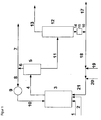
- the gas phase from the flash tank (5) is discharged via the line (6).
- a part is discharged from the process via the line (7) in order to avoid concentration of inerts.
- the discharged gas stream can be utilized thermally.
- the non-discharged gas stream is passed via the line (8) in a compressor (9) and brought there to reactor pressure and returned via the line (10) in the hydroformylation reactor (3).
- the liquid phase obtained is fed via line (11) to a separating device (12).
- the liquid phase essentially contains the aldehydes, high-boiling aldehyde condensation products as high-boiling by-products of the hydroformylation reaction, the rhodium-containing hydroformylation catalyst, further catalytically less active or inactive rhodium complex compounds and optionally solvents.
- the separator (12) the desired aldehydes are separated from the rhodium and high boilers.
- the separating device (12) is preferably a customary distillation column which is equipped, for example, with random packings, packings or internals for an intensive gas / liquid exchange.
- the aldehydes removed at the top of the separating device (12) via the line (13) are subsequently separated into n- and iso-aldehyde in a further distillation stage (not in FIG. 1 shown).
- the rhodium-containing sump from the separator (12) is at a sump temperature of at most 150 ° C via the line (14) dissipated and passed through the filter (15), for example via a commercially available filter cartridge of glass fibers with a pore size of 0.1 to 20 microns.
- solids for example, abrasion from the system parts or during the hydroformylation reaction, the expansion steps and the aldehyde / catalyst separation formed, retained in the organic liquid insoluble compounds. It has been found that such solids present in the organic solution are detrimental and promote the deactivation and decomposition of the rhodium complex catalyst.
- the non-discharged stream is removed via the line (18) and mixed with fresh rhodium solution introduced via line (19) and with phosphorus compound introduced via line (20).
- the solution thus adjusted is then returned to the hydroformylation reactor (3) via line (21). It is also possible to pre-mix the fresh rhodium solution with the phosphorus compound and add together to the rhodium-containing filtrate. As soon as the filter (15) is too heavily occupied, it is replaced by a fresh filter. Separated solids, some of which contain rhodium, are worked up separately.
- olefinically unsaturated compounds of any structure can be applied to olefinically unsaturated compounds of any structure.
- suitable starting materials are both olefins with internal and terminal double bond and also straight-chain or branched olefins.
- the olefins may also be substituted by functional groups, in particular those which are not changed in the course of the reaction. Also multiply olefinically unsaturated compounds come as input materials into consideration.
- the process has proven particularly useful in the hydroformylation of olefinically unsaturated hydrocarbons having 2 to 25 carbon atoms in the molecule, preferably ethylene, propylene, butene-1, mixtures containing butene-1 and butene-2, hexene-1, octene-1, dimeric butenes, Trimerpropylene or technically available olefin mixtures such as Dimersol® or Octol®.
- Propylene was reacted with an equal volume of CO / H2 mixture at a pressure of 5 MPa and a reaction temperature of 132 ° C.
- the catalyst consisted of high-boiling aldehyde condensation products in which triphenylphosphine (TPP) and the rhodium complex compound HRhCO (TPP) 3 were dissolved.
- TPP triphenylphosphine
- HRhCO rhodium complex compound
- the product stream leaving the reactor was first expanded into a flash tank to a pressure of 1.0 MPa.
- the resulting in the flash tank gas phase was removed.
- Part of the discharged gas stream was discharged from the process, the other part returned to the reactor after Aufkomprim ist.
- the liquid phase obtained during the expansion was applied to a commercial distillation column.
- the n / i-butyraldehyde mixture was taken off as the top product and split in a further distillation column in n- and iso-butyraldehyde.
- the discharged rhodium-containing distillation bottoms were then passed through a commercially available glass silk filter cartridge The company Fuhr with a metal core and passed with a pore size of 0.5 microns.
Landscapes
- Chemical & Material Sciences (AREA)
- Organic Chemistry (AREA)
- Chemical Kinetics & Catalysis (AREA)
- Organic Low-Molecular-Weight Compounds And Preparation Thereof (AREA)
- Low-Molecular Organic Synthesis Reactions Using Catalysts (AREA)
- Catalysts (AREA)
Claims (8)
- Procédé pour le traitement d'un produit liquide d'une réaction d'hydroformylation, qui contient l'aldéhyde, des produits secondaires de point d'ébullition élevé de la réaction d'hydroformylation, un catalyseur complexe au rhodium dissous en phase homogène, le composé oléfiniquement insaturé non transformé, un gaz de synthèse et des produits secondaires volatils, dans lequela) le produit d'hydroformylation liquide est détendu dans un récipient de détente, une séparation en une phase liquide et une phase gazeuse se produisant ; etb) la phase liquide obtenue dans le récipient de détente est transférée sur un dispositif de séparation, où se produit une séparation en une phase liquide qui contient essentiellement des produits secondaires de point d'ébullition élevé de la réaction d'hydroformylation, le catalyseur complexe au rhodium dissous en phase homogène et de faibles quantités de l'aldéhyde, et en une phase gazeuse qui contient la quantité principale de l'aldéhyde ; etc) un produit liquide, contenant du rhodium est évacué du dispositif de séparation,caractérisé en ce que le produit liquide, contenant du rhodium, évacué du dispositif de séparation est guidé sur un filtre et les solides séparés sont ainsi séparés du procédé, alors que le filtrat obtenu est recyclé dans la réaction d'hydroformylation.
- Procédé selon la revendication 1, caractérisé en ce qu'une partie du produit liquide, contenant du rhodium, évacué du dispositif de séparation est éliminée du procédé alors que l'autre partie est guidée sur le filtre.
- Procédé selon la revendication 1 ou 2, caractérisé en ce que le dispositif de séparation est exploité à une température de jusqu'à 160°C, de préférence de 100 à 140°C.
- Procédé selon l'une ou plusieurs des revendications 1 à 3, caractérisé en ce qu'on règle dans la phase gazeuse du récipient de détente une pression partielle en monoxyde de carbone de 0,05 à 0,35 MPa, de préférence de 0,1 à 0,3 MPa.
- Procédé selon l'une ou plusieurs des revendications 1 à 4, caractérisé en ce que plusieurs récipients de détente, présentant des niveaux de pression diminuant d'étage en étage, sont exploités.
- Procédé selon l'une ou plusieurs des revendications 1 à 5, caractérisé en ce qu'on utilise, pour le filtre, des fibres de verre, des fibres métalliques ou des fibres en matériau synthétique.
- Procédé selon la revendication 6, caractérisé en ce que le filtre présente une taille de pores de 0,1 à 20 µm, de préférence de 0,5 à 10 µm.
- Procédé selon l'une ou plusieurs des revendications 1 à 7, caractérisé en ce que le filtrat est additionné, avant l'entrée dans la réaction d'hydroformylation, de rhodium frais et de composé organique libre de phosphore (III).
Priority Applications (1)
| Application Number | Priority Date | Filing Date | Title |
|---|---|---|---|
| PL10710548T PL2417094T3 (pl) | 2009-04-07 | 2010-03-18 | Sposób obróbki ciekłego produktu z hydroformylowania |
Applications Claiming Priority (2)
| Application Number | Priority Date | Filing Date | Title |
|---|---|---|---|
| DE102009016652A DE102009016652A1 (de) | 2009-04-07 | 2009-04-07 | Verfahren zur Aufarbeitung eines flüssigen Hydroformylierungsaustrags |
| PCT/EP2010/001719 WO2010115511A1 (fr) | 2009-04-07 | 2010-03-18 | Procédé de recyclage d'un produit de sortie d'hydroformylation liquide |
Publications (2)
| Publication Number | Publication Date |
|---|---|
| EP2417094A1 EP2417094A1 (fr) | 2012-02-15 |
| EP2417094B1 true EP2417094B1 (fr) | 2012-12-26 |
Family
ID=42103905
Family Applications (1)
| Application Number | Title | Priority Date | Filing Date |
|---|---|---|---|
| EP10710548A Revoked EP2417094B1 (fr) | 2009-04-07 | 2010-03-18 | Procédé de recyclage d'un produit de sortie d'hydroformylation liquide |
Country Status (13)
| Country | Link |
|---|---|
| US (1) | US8445728B2 (fr) |
| EP (1) | EP2417094B1 (fr) |
| JP (1) | JP5729884B2 (fr) |
| KR (1) | KR101740296B1 (fr) |
| CN (1) | CN102369176B (fr) |
| BR (1) | BRPI1010313A2 (fr) |
| DE (1) | DE102009016652A1 (fr) |
| MY (1) | MY151989A (fr) |
| PL (1) | PL2417094T3 (fr) |
| RU (1) | RU2486171C1 (fr) |
| SG (1) | SG174941A1 (fr) |
| WO (1) | WO2010115511A1 (fr) |
| ZA (1) | ZA201104797B (fr) |
Cited By (2)
| Publication number | Priority date | Publication date | Assignee | Title |
|---|---|---|---|---|
| WO2023070761A1 (fr) | 2021-10-27 | 2023-05-04 | 南京延长反应技术研究院有限公司 | Catalyseur à base d'iridium et son procédé de préparation, et procédé d'hydroformylation |
| WO2023070760A1 (fr) | 2021-10-27 | 2023-05-04 | 南京延长反应技术研究院有限公司 | Procédé de catalyse de la carbonylation d'oléfines |
Families Citing this family (7)
| Publication number | Priority date | Publication date | Assignee | Title |
|---|---|---|---|---|
| CN102826969B (zh) * | 2011-06-17 | 2015-07-22 | 中国石油化工股份有限公司 | 一种烯烃氢甲酰化反应液相排出物的分离方法 |
| CN104428278B (zh) * | 2012-07-10 | 2017-03-08 | 捷恩智株式会社 | 防止铑催化剂的损失的方法 |
| CA2907598C (fr) | 2013-03-27 | 2021-01-26 | Tatsuya Yoshikawa | Procede de production de dialdehyde |
| CN104248860A (zh) * | 2013-06-27 | 2014-12-31 | 陶氏技术投资有限责任公司 | 热管理方法 |
| DE102013221708A1 (de) * | 2013-10-25 | 2015-04-30 | Evonik Industries Ag | Strahlschlaufenreaktor mit Nanofiltration und Gasseparator |
| EP3466540B1 (fr) * | 2017-05-29 | 2022-04-06 | LG Chem, Ltd. | Composition de catalyseur pour une réaction d'hydroformylation, et procédé de préparation d'aldéhyde l'utilisant |
| KR102307815B1 (ko) * | 2017-07-06 | 2021-10-01 | 주식회사 엘지화학 | 하이드로포밀화 반응에 의한 알데히드 제조방법 |
Family Cites Families (16)
| Publication number | Priority date | Publication date | Assignee | Title |
|---|---|---|---|---|
| US3527809A (en) | 1967-08-03 | 1970-09-08 | Union Carbide Corp | Hydroformylation process |
| US4148830A (en) | 1975-03-07 | 1979-04-10 | Union Carbide Corporation | Hydroformylation of olefins |
| US4247486A (en) | 1977-03-11 | 1981-01-27 | Union Carbide Corporation | Cyclic hydroformylation process |
| US4283562A (en) | 1979-10-26 | 1981-08-11 | Union Carbide Corporation | Hydroformylation process using stable rhodium catalyst |
| KR970703805A (ko) | 1995-05-01 | 1997-08-09 | 유니온 카바이드 케미칼즈 앤드 플라스틱스 테크놀러지 코포레이션 | 막 분리방법(Membrane Separation) |
| DE19530698A1 (de) * | 1995-08-21 | 1997-02-27 | Basf Ag | Verfahren zur Aufarbeitung eines flüssigen Hydroformylierungsaustrags |
| DE19617257A1 (de) | 1996-04-30 | 1997-11-06 | Hoechst Ag | Verfahren zur Hydroformylierung olefinisch ungesättigter Verbindungen |
| DE19801437A1 (de) * | 1998-01-16 | 1999-07-22 | Basf Ag | Verfahren zur Herstellung von Aldehyden |
| JP3847466B2 (ja) * | 1998-09-01 | 2006-11-22 | 三菱化学株式会社 | オレフィンのヒドロホルミル化反応方法 |
| DE60002526T3 (de) * | 1999-07-02 | 2007-08-09 | Mitsubishi Gas Chemical Co., Inc. | Herstellung von Tricyclodecandicarbaldehyd, Pentacyclopentadecandicarbaldehyd und der entsprechenden Dimethanole |
| EP1103303A1 (fr) * | 1999-11-23 | 2001-05-30 | Dsm N.V. | Procédé pour séparer un complexe de rhodium et de phosphite et de ligands de phosphite libres de mélanges d'hydroformylation |
| DE10006489A1 (de) | 2000-02-14 | 2001-08-16 | Basf Ag | Verfahren zur Aufarbeitung eines flüssigen Hydroformylierungsaustrages |
| US6307110B1 (en) * | 2000-03-15 | 2001-10-23 | Union Carbide Chemicals & Plastics Technology Corporation | Separation processes |
| DE10160368B4 (de) * | 2001-12-08 | 2004-04-08 | Celanese Chemicals Europe Gmbh | Verfahren zur Herstellung von Aldehyden |
| DE102005046250B4 (de) * | 2005-09-27 | 2020-10-08 | Evonik Operations Gmbh | Anlage zur Abtrennung von organischen Übergangsmetallkomplexkatalysatoren |
| JP4835228B2 (ja) * | 2006-03-29 | 2011-12-14 | 三菱化学株式会社 | アルデヒドの製造方法 |
-
2009
- 2009-04-07 DE DE102009016652A patent/DE102009016652A1/de not_active Ceased
-
2010
- 2010-03-18 EP EP10710548A patent/EP2417094B1/fr not_active Revoked
- 2010-03-18 BR BRPI1010313A patent/BRPI1010313A2/pt not_active Application Discontinuation
- 2010-03-18 RU RU2011144855/04A patent/RU2486171C1/ru not_active IP Right Cessation
- 2010-03-18 JP JP2012503885A patent/JP5729884B2/ja not_active Expired - Fee Related
- 2010-03-18 MY MYPI2011003231 patent/MY151989A/en unknown
- 2010-03-18 PL PL10710548T patent/PL2417094T3/pl unknown
- 2010-03-18 WO PCT/EP2010/001719 patent/WO2010115511A1/fr not_active Ceased
- 2010-03-18 CN CN201080015577.XA patent/CN102369176B/zh not_active Expired - Fee Related
- 2010-03-18 KR KR1020117023316A patent/KR101740296B1/ko not_active Expired - Fee Related
- 2010-03-18 SG SG2011070281A patent/SG174941A1/en unknown
- 2010-03-18 US US13/138,813 patent/US8445728B2/en not_active Expired - Fee Related
-
2011
- 2011-06-28 ZA ZA2011/04797A patent/ZA201104797B/en unknown
Cited By (2)
| Publication number | Priority date | Publication date | Assignee | Title |
|---|---|---|---|---|
| WO2023070761A1 (fr) | 2021-10-27 | 2023-05-04 | 南京延长反应技术研究院有限公司 | Catalyseur à base d'iridium et son procédé de préparation, et procédé d'hydroformylation |
| WO2023070760A1 (fr) | 2021-10-27 | 2023-05-04 | 南京延长反应技术研究院有限公司 | Procédé de catalyse de la carbonylation d'oléfines |
Also Published As
| Publication number | Publication date |
|---|---|
| PL2417094T3 (pl) | 2013-05-31 |
| MY151989A (en) | 2014-07-31 |
| KR101740296B1 (ko) | 2017-05-26 |
| DE102009016652A1 (de) | 2010-10-14 |
| KR20120015297A (ko) | 2012-02-21 |
| HK1163654A1 (en) | 2012-09-14 |
| CN102369176A (zh) | 2012-03-07 |
| SG174941A1 (en) | 2011-11-28 |
| ZA201104797B (en) | 2012-03-28 |
| EP2417094A1 (fr) | 2012-02-15 |
| US8445728B2 (en) | 2013-05-21 |
| JP2012522813A (ja) | 2012-09-27 |
| BRPI1010313A2 (pt) | 2016-03-15 |
| JP5729884B2 (ja) | 2015-06-03 |
| WO2010115511A1 (fr) | 2010-10-14 |
| RU2486171C1 (ru) | 2013-06-27 |
| RU2011144855A (ru) | 2013-05-20 |
| US20120108852A1 (en) | 2012-05-03 |
| CN102369176B (zh) | 2014-05-28 |
Similar Documents
| Publication | Publication Date | Title |
|---|---|---|
| WO2010115511A1 (fr) | Procédé de recyclage d'un produit de sortie d'hydroformylation liquide | |
| EP2280920B1 (fr) | Procédé pour produire des mélanges d' aldéhydes c5 forte teneur en pentanal | |
| EP1669337B1 (fr) | Procédé pour la fabrication d'alcools à partir d'oléfines par hydroformylation et hydrogenation | |
| EP3027298B1 (fr) | Cascade de membranes à température de séparation descendante | |
| EP1294668B1 (fr) | Procede d'hydroformylation d'olefines ayant 2 a 8 atomes de carbone | |
| EP1172349A2 (fr) | Procédé à plusieurs étapes pour la préparation d'oxo-aldéhydes et/ou d'alcools | |
| DE3301591A1 (de) | Verfahren zur kontinuierlichen hydroformylierung olefinisch ungesaettigter verbindungen | |
| EP4103571A1 (fr) | Hydroformylation de diisobutène à basse pression | |
| EP1294669A1 (fr) | Procede d'hydroformylation d'olefines ayant 2 a 8 atomes de carbone | |
| DE69915669T2 (de) | Hydroformylierungsverfahren unter verwendung eines chlorphosphit-metall katalysatorsystems | |
| EP2417093B1 (fr) | Procédé de préparation d'aldéhydes | |
| WO2002068371A1 (fr) | Procede de fabrication d'aldehydes | |
| EP2318349B1 (fr) | Procédé d'obtention d'aldéhydes aliphatiques en c3 à c10 à partir de composés à point d'ébullition élevé, par traitement thermique | |
| EP1456162B1 (fr) | Procede pour preparer des aldehydes | |
| DE3017651C2 (fr) | ||
| EP4574803A1 (fr) | Procédé de conversion d'oléfines en c11 à c20 par distillation préalable | |
| EP4574806A1 (fr) | Procédé de conversion en deux étapes d'oléfines par distillation intermédiaire | |
| EP4574805A1 (fr) | Procédé de conversion d'oléfines avec séparation préalable du courant d'alimentation | |
| EP4574804A1 (fr) | Procédé de conversion de dibutène avec distillation préalable | |
| EP4574802A1 (fr) | Procédé de conversion d'oléfines avec distillation préalable | |
| EP0795533A1 (fr) | Procédé pour la préparation d'aldéhydes à l'aide d'un système catalytique contenant du rhodium et des diphényldiphosphanes substitués | |
| HK1163654B (en) | Method for reprocessing a liquid hydroformylation product |
Legal Events
| Date | Code | Title | Description |
|---|---|---|---|
| PUAI | Public reference made under article 153(3) epc to a published international application that has entered the european phase |
Free format text: ORIGINAL CODE: 0009012 |
|
| 17P | Request for examination filed |
Effective date: 20111107 |
|
| AK | Designated contracting states |
Kind code of ref document: A1 Designated state(s): AT BE BG CH CY CZ DE DK EE ES FI FR GB GR HR HU IE IS IT LI LT LU LV MC MK MT NL NO PL PT RO SE SI SK SM TR |
|
| DAX | Request for extension of the european patent (deleted) | ||
| GRAP | Despatch of communication of intention to grant a patent |
Free format text: ORIGINAL CODE: EPIDOSNIGR1 |
|
| RIC1 | Information provided on ipc code assigned before grant |
Ipc: C07C 45/79 20060101ALI20120910BHEP Ipc: C07C 45/50 20060101AFI20120910BHEP Ipc: C07C 45/78 20060101ALI20120910BHEP Ipc: C07C 47/02 20060101ALI20120910BHEP |
|
| GRAS | Grant fee paid |
Free format text: ORIGINAL CODE: EPIDOSNIGR3 |
|
| GRAA | (expected) grant |
Free format text: ORIGINAL CODE: 0009210 |
|
| AK | Designated contracting states |
Kind code of ref document: B1 Designated state(s): AT BE BG CH CY CZ DE DK EE ES FI FR GB GR HR HU IE IS IT LI LT LU LV MC MK MT NL NO PL PT RO SE SI SK SM TR |
|
| REG | Reference to a national code |
Ref country code: GB Ref legal event code: FG4D Free format text: NOT ENGLISH |
|
| REG | Reference to a national code |
Ref country code: CH Ref legal event code: EP |
|
| REG | Reference to a national code |
Ref country code: AT Ref legal event code: REF Ref document number: 590362 Country of ref document: AT Kind code of ref document: T Effective date: 20130115 |
|
| REG | Reference to a national code |
Ref country code: SE Ref legal event code: TRGR |
|
| REG | Reference to a national code |
Ref country code: DE Ref legal event code: R096 Ref document number: 502010001975 Country of ref document: DE Effective date: 20130228 |
|
| REG | Reference to a national code |
Ref country code: RO Ref legal event code: EPE |
|
| PG25 | Lapsed in a contracting state [announced via postgrant information from national office to epo] |
Ref country code: LT Free format text: LAPSE BECAUSE OF FAILURE TO SUBMIT A TRANSLATION OF THE DESCRIPTION OR TO PAY THE FEE WITHIN THE PRESCRIBED TIME-LIMIT Effective date: 20121226 Ref country code: NO Free format text: LAPSE BECAUSE OF FAILURE TO SUBMIT A TRANSLATION OF THE DESCRIPTION OR TO PAY THE FEE WITHIN THE PRESCRIBED TIME-LIMIT Effective date: 20130326 Ref country code: HR Free format text: LAPSE BECAUSE OF FAILURE TO SUBMIT A TRANSLATION OF THE DESCRIPTION OR TO PAY THE FEE WITHIN THE PRESCRIBED TIME-LIMIT Effective date: 20121226 Ref country code: FI Free format text: LAPSE BECAUSE OF FAILURE TO SUBMIT A TRANSLATION OF THE DESCRIPTION OR TO PAY THE FEE WITHIN THE PRESCRIBED TIME-LIMIT Effective date: 20121226 |
|
| REG | Reference to a national code |
Ref country code: LT Ref legal event code: MG4D |
|
| REG | Reference to a national code |
Ref country code: NL Ref legal event code: VDEP Effective date: 20121226 |
|
| PG25 | Lapsed in a contracting state [announced via postgrant information from national office to epo] |
Ref country code: LV Free format text: LAPSE BECAUSE OF FAILURE TO SUBMIT A TRANSLATION OF THE DESCRIPTION OR TO PAY THE FEE WITHIN THE PRESCRIBED TIME-LIMIT Effective date: 20121226 Ref country code: SI Free format text: LAPSE BECAUSE OF FAILURE TO SUBMIT A TRANSLATION OF THE DESCRIPTION OR TO PAY THE FEE WITHIN THE PRESCRIBED TIME-LIMIT Effective date: 20121226 Ref country code: GR Free format text: LAPSE BECAUSE OF FAILURE TO SUBMIT A TRANSLATION OF THE DESCRIPTION OR TO PAY THE FEE WITHIN THE PRESCRIBED TIME-LIMIT Effective date: 20130327 |
|
| REG | Reference to a national code |
Ref country code: PL Ref legal event code: T3 |
|
| PG25 | Lapsed in a contracting state [announced via postgrant information from national office to epo] |
Ref country code: IS Free format text: LAPSE BECAUSE OF FAILURE TO SUBMIT A TRANSLATION OF THE DESCRIPTION OR TO PAY THE FEE WITHIN THE PRESCRIBED TIME-LIMIT Effective date: 20130426 Ref country code: CZ Free format text: LAPSE BECAUSE OF FAILURE TO SUBMIT A TRANSLATION OF THE DESCRIPTION OR TO PAY THE FEE WITHIN THE PRESCRIBED TIME-LIMIT Effective date: 20121226 Ref country code: EE Free format text: LAPSE BECAUSE OF FAILURE TO SUBMIT A TRANSLATION OF THE DESCRIPTION OR TO PAY THE FEE WITHIN THE PRESCRIBED TIME-LIMIT Effective date: 20121226 Ref country code: BG Free format text: LAPSE BECAUSE OF FAILURE TO SUBMIT A TRANSLATION OF THE DESCRIPTION OR TO PAY THE FEE WITHIN THE PRESCRIBED TIME-LIMIT Effective date: 20130326 Ref country code: ES Free format text: LAPSE BECAUSE OF FAILURE TO SUBMIT A TRANSLATION OF THE DESCRIPTION OR TO PAY THE FEE WITHIN THE PRESCRIBED TIME-LIMIT Effective date: 20130406 Ref country code: SK Free format text: LAPSE BECAUSE OF FAILURE TO SUBMIT A TRANSLATION OF THE DESCRIPTION OR TO PAY THE FEE WITHIN THE PRESCRIBED TIME-LIMIT Effective date: 20121226 |
|
| PG25 | Lapsed in a contracting state [announced via postgrant information from national office to epo] |
Ref country code: PT Free format text: LAPSE BECAUSE OF FAILURE TO SUBMIT A TRANSLATION OF THE DESCRIPTION OR TO PAY THE FEE WITHIN THE PRESCRIBED TIME-LIMIT Effective date: 20130426 Ref country code: NL Free format text: LAPSE BECAUSE OF FAILURE TO SUBMIT A TRANSLATION OF THE DESCRIPTION OR TO PAY THE FEE WITHIN THE PRESCRIBED TIME-LIMIT Effective date: 20121226 |
|
| PLBI | Opposition filed |
Free format text: ORIGINAL CODE: 0009260 |
|
| BERE | Be: lapsed |
Owner name: OXEA G.M.B.H. Effective date: 20130331 |
|
| PLBI | Opposition filed |
Free format text: ORIGINAL CODE: 0009260 |
|
| 26 | Opposition filed |
Opponent name: EVONIK DEGUSSA GMBH Effective date: 20130924 Opponent name: BASF SE Effective date: 20130924 |
|
| PG25 | Lapsed in a contracting state [announced via postgrant information from national office to epo] |
Ref country code: DK Free format text: LAPSE BECAUSE OF FAILURE TO SUBMIT A TRANSLATION OF THE DESCRIPTION OR TO PAY THE FEE WITHIN THE PRESCRIBED TIME-LIMIT Effective date: 20121226 Ref country code: MC Free format text: LAPSE BECAUSE OF NON-PAYMENT OF DUE FEES Effective date: 20130331 |
|
| PLAX | Notice of opposition and request to file observation + time limit sent |
Free format text: ORIGINAL CODE: EPIDOSNOBS2 |
|
| 26 | Opposition filed |
Opponent name: JOHNSON MATTHEY DAVY TECHNOLOGIES LIMITED Effective date: 20130926 |
|
| PG25 | Lapsed in a contracting state [announced via postgrant information from national office to epo] |
Ref country code: CY Free format text: LAPSE BECAUSE OF FAILURE TO SUBMIT A TRANSLATION OF THE DESCRIPTION OR TO PAY THE FEE WITHIN THE PRESCRIBED TIME-LIMIT Effective date: 20121226 |
|
| REG | Reference to a national code |
Ref country code: DE Ref legal event code: R026 Ref document number: 502010001975 Country of ref document: DE Effective date: 20130924 |
|
| PG25 | Lapsed in a contracting state [announced via postgrant information from national office to epo] |
Ref country code: IT Free format text: LAPSE BECAUSE OF FAILURE TO SUBMIT A TRANSLATION OF THE DESCRIPTION OR TO PAY THE FEE WITHIN THE PRESCRIBED TIME-LIMIT Effective date: 20121226 |
|
| REG | Reference to a national code |
Ref country code: IE Ref legal event code: MM4A |
|
| PLAB | Opposition data, opponent's data or that of the opponent's representative modified |
Free format text: ORIGINAL CODE: 0009299OPPO |
|
| PG25 | Lapsed in a contracting state [announced via postgrant information from national office to epo] |
Ref country code: BE Free format text: LAPSE BECAUSE OF NON-PAYMENT OF DUE FEES Effective date: 20130331 Ref country code: IE Free format text: LAPSE BECAUSE OF NON-PAYMENT OF DUE FEES Effective date: 20130318 |
|
| R26 | Opposition filed (corrected) |
Opponent name: EVONIK DEGUSSA GMBH Effective date: 20130924 |
|
| PLAF | Information modified related to communication of a notice of opposition and request to file observations + time limit |
Free format text: ORIGINAL CODE: EPIDOSCOBS2 |
|
| PGFP | Annual fee paid to national office [announced via postgrant information from national office to epo] |
Ref country code: RO Payment date: 20140225 Year of fee payment: 5 |
|
| PLBB | Reply of patent proprietor to notice(s) of opposition received |
Free format text: ORIGINAL CODE: EPIDOSNOBS3 |
|
| PGFP | Annual fee paid to national office [announced via postgrant information from national office to epo] |
Ref country code: FR Payment date: 20140319 Year of fee payment: 5 |
|
| PG25 | Lapsed in a contracting state [announced via postgrant information from national office to epo] |
Ref country code: MT Free format text: LAPSE BECAUSE OF FAILURE TO SUBMIT A TRANSLATION OF THE DESCRIPTION OR TO PAY THE FEE WITHIN THE PRESCRIBED TIME-LIMIT Effective date: 20121226 |
|
| REG | Reference to a national code |
Ref country code: CH Ref legal event code: PL |
|
| GBPC | Gb: european patent ceased through non-payment of renewal fee |
Effective date: 20140318 |
|
| PG25 | Lapsed in a contracting state [announced via postgrant information from national office to epo] |
Ref country code: GB Free format text: LAPSE BECAUSE OF NON-PAYMENT OF DUE FEES Effective date: 20140318 Ref country code: CH Free format text: LAPSE BECAUSE OF NON-PAYMENT OF DUE FEES Effective date: 20140331 Ref country code: LI Free format text: LAPSE BECAUSE OF NON-PAYMENT OF DUE FEES Effective date: 20140331 |
|
| PG25 | Lapsed in a contracting state [announced via postgrant information from national office to epo] |
Ref country code: SM Free format text: LAPSE BECAUSE OF FAILURE TO SUBMIT A TRANSLATION OF THE DESCRIPTION OR TO PAY THE FEE WITHIN THE PRESCRIBED TIME-LIMIT Effective date: 20121226 |
|
| PGFP | Annual fee paid to national office [announced via postgrant information from national office to epo] |
Ref country code: SE Payment date: 20150319 Year of fee payment: 6 Ref country code: PL Payment date: 20150220 Year of fee payment: 6 |
|
| REG | Reference to a national code |
Ref country code: DE Ref legal event code: R103 Ref document number: 502010001975 Country of ref document: DE Ref country code: DE Ref legal event code: R064 Ref document number: 502010001975 Country of ref document: DE |
|
| RDAF | Communication despatched that patent is revoked |
Free format text: ORIGINAL CODE: EPIDOSNREV1 |
|
| PG25 | Lapsed in a contracting state [announced via postgrant information from national office to epo] |
Ref country code: TR Free format text: LAPSE BECAUSE OF FAILURE TO SUBMIT A TRANSLATION OF THE DESCRIPTION OR TO PAY THE FEE WITHIN THE PRESCRIBED TIME-LIMIT Effective date: 20121226 |
|
| PG25 | Lapsed in a contracting state [announced via postgrant information from national office to epo] |
Ref country code: HU Free format text: LAPSE BECAUSE OF FAILURE TO SUBMIT A TRANSLATION OF THE DESCRIPTION OR TO PAY THE FEE WITHIN THE PRESCRIBED TIME-LIMIT; INVALID AB INITIO Effective date: 20100318 Ref country code: LU Free format text: LAPSE BECAUSE OF NON-PAYMENT OF DUE FEES Effective date: 20130318 Ref country code: MK Free format text: LAPSE BECAUSE OF FAILURE TO SUBMIT A TRANSLATION OF THE DESCRIPTION OR TO PAY THE FEE WITHIN THE PRESCRIBED TIME-LIMIT Effective date: 20121226 |
|
| PGFP | Annual fee paid to national office [announced via postgrant information from national office to epo] |
Ref country code: DE Payment date: 20150331 Year of fee payment: 6 |
|
| RDAG | Patent revoked |
Free format text: ORIGINAL CODE: 0009271 |
|
| STAA | Information on the status of an ep patent application or granted ep patent |
Free format text: STATUS: PATENT REVOKED |
|
| 27W | Patent revoked |
Effective date: 20150610 |
|
| REG | Reference to a national code |
Ref country code: AT Ref legal event code: MM01 Ref document number: 590362 Country of ref document: AT Kind code of ref document: T Effective date: 20150318 |
|
| PG25 | Lapsed in a contracting state [announced via postgrant information from national office to epo] |
Ref country code: AT Free format text: LAPSE BECAUSE OF NON-PAYMENT OF DUE FEES Effective date: 20150318 |
|
| REG | Reference to a national code |
Ref country code: SE Ref legal event code: ECNC |