EP2418257B1 - Nouveau colorant organique et son procédé de préparation - Google Patents
Nouveau colorant organique et son procédé de préparation Download PDFInfo
- Publication number
- EP2418257B1 EP2418257B1 EP11181281.4A EP11181281A EP2418257B1 EP 2418257 B1 EP2418257 B1 EP 2418257B1 EP 11181281 A EP11181281 A EP 11181281A EP 2418257 B1 EP2418257 B1 EP 2418257B1
- Authority
- EP
- European Patent Office
- Prior art keywords
- dye
- compound
- chemical formula
- tio
- photoelectric conversion
- Prior art date
- Legal status (The legal status is an assumption and is not a legal conclusion. Google has not performed a legal analysis and makes no representation as to the accuracy of the status listed.)
- Not-in-force
Links
- 0 CCC1(C)C=C(C=C(C(O)=O)C#N)SC(C(C)(C)C2=CC(C)(*)C=C(C(C)(C)*)S2)=C1 Chemical compound CCC1(C)C=C(C=C(C(O)=O)C#N)SC(C(C)(C)C2=CC(C)(*)C=C(C(C)(C)*)S2)=C1 0.000 description 2
Images
Classifications
-
- C—CHEMISTRY; METALLURGY
- C09—DYES; PAINTS; POLISHES; NATURAL RESINS; ADHESIVES; COMPOSITIONS NOT OTHERWISE PROVIDED FOR; APPLICATIONS OF MATERIALS NOT OTHERWISE PROVIDED FOR
- C09B—ORGANIC DYES OR CLOSELY-RELATED COMPOUNDS FOR PRODUCING DYES, e.g. PIGMENTS; MORDANTS; LAKES
- C09B49/00—Sulfur dyes
- C09B49/06—Sulfur dyes from azines, oxazines, thiazines or thiazoles
-
- C—CHEMISTRY; METALLURGY
- C09—DYES; PAINTS; POLISHES; NATURAL RESINS; ADHESIVES; COMPOSITIONS NOT OTHERWISE PROVIDED FOR; APPLICATIONS OF MATERIALS NOT OTHERWISE PROVIDED FOR
- C09B—ORGANIC DYES OR CLOSELY-RELATED COMPOUNDS FOR PRODUCING DYES, e.g. PIGMENTS; MORDANTS; LAKES
- C09B57/00—Other synthetic dyes of known constitution
- C09B57/008—Triarylamine dyes containing no other chromophores
-
- C—CHEMISTRY; METALLURGY
- C09—DYES; PAINTS; POLISHES; NATURAL RESINS; ADHESIVES; COMPOSITIONS NOT OTHERWISE PROVIDED FOR; APPLICATIONS OF MATERIALS NOT OTHERWISE PROVIDED FOR
- C09B—ORGANIC DYES OR CLOSELY-RELATED COMPOUNDS FOR PRODUCING DYES, e.g. PIGMENTS; MORDANTS; LAKES
- C09B23/00—Methine or polymethine dyes, e.g. cyanine dyes
- C09B23/0008—Methine or polymethine dyes, e.g. cyanine dyes substituted on the polymethine chain
- C09B23/005—Methine or polymethine dyes, e.g. cyanine dyes substituted on the polymethine chain the substituent being a COOH and/or a functional derivative thereof
- C09B23/0058—Methine or polymethine dyes, e.g. cyanine dyes substituted on the polymethine chain the substituent being a COOH and/or a functional derivative thereof the substituent being CN
-
- C—CHEMISTRY; METALLURGY
- C09—DYES; PAINTS; POLISHES; NATURAL RESINS; ADHESIVES; COMPOSITIONS NOT OTHERWISE PROVIDED FOR; APPLICATIONS OF MATERIALS NOT OTHERWISE PROVIDED FOR
- C09B—ORGANIC DYES OR CLOSELY-RELATED COMPOUNDS FOR PRODUCING DYES, e.g. PIGMENTS; MORDANTS; LAKES
- C09B23/00—Methine or polymethine dyes, e.g. cyanine dyes
- C09B23/10—The polymethine chain containing an even number of >CH- groups
- C09B23/105—The polymethine chain containing an even number of >CH- groups two >CH- groups
-
- H—ELECTRICITY
- H01—ELECTRIC ELEMENTS
- H01G—CAPACITORS; CAPACITORS, RECTIFIERS, DETECTORS, SWITCHING DEVICES, LIGHT-SENSITIVE OR TEMPERATURE-SENSITIVE DEVICES OF THE ELECTROLYTIC TYPE
- H01G9/00—Electrolytic capacitors, rectifiers, detectors, switching devices, light-sensitive or temperature-sensitive devices; Processes of their manufacture
- H01G9/20—Light-sensitive devices
- H01G9/2059—Light-sensitive devices comprising an organic dye as the active light absorbing material, e.g. adsorbed on an electrode or dissolved in solution
-
- H—ELECTRICITY
- H10—SEMICONDUCTOR DEVICES; ELECTRIC SOLID-STATE DEVICES NOT OTHERWISE PROVIDED FOR
- H10K—ORGANIC ELECTRIC SOLID-STATE DEVICES
- H10K85/00—Organic materials used in the body or electrodes of devices covered by this subclass
- H10K85/10—Organic polymers or oligomers
- H10K85/111—Organic polymers or oligomers comprising aromatic, heteroaromatic, or aryl chains, e.g. polyaniline, polyphenylene or polyphenylene vinylene
- H10K85/113—Heteroaromatic compounds comprising sulfur or selene, e.g. polythiophene
-
- H—ELECTRICITY
- H10—SEMICONDUCTOR DEVICES; ELECTRIC SOLID-STATE DEVICES NOT OTHERWISE PROVIDED FOR
- H10K—ORGANIC ELECTRIC SOLID-STATE DEVICES
- H10K85/00—Organic materials used in the body or electrodes of devices covered by this subclass
- H10K85/60—Organic compounds having low molecular weight
- H10K85/631—Amine compounds having at least two aryl rest on at least one amine-nitrogen atom, e.g. triphenylamine
- H10K85/633—Amine compounds having at least two aryl rest on at least one amine-nitrogen atom, e.g. triphenylamine comprising polycyclic condensed aromatic hydrocarbons as substituents on the nitrogen atom
-
- H—ELECTRICITY
- H10—SEMICONDUCTOR DEVICES; ELECTRIC SOLID-STATE DEVICES NOT OTHERWISE PROVIDED FOR
- H10K—ORGANIC ELECTRIC SOLID-STATE DEVICES
- H10K85/00—Organic materials used in the body or electrodes of devices covered by this subclass
- H10K85/60—Organic compounds having low molecular weight
- H10K85/631—Amine compounds having at least two aryl rest on at least one amine-nitrogen atom, e.g. triphenylamine
- H10K85/636—Amine compounds having at least two aryl rest on at least one amine-nitrogen atom, e.g. triphenylamine comprising heteroaromatic hydrocarbons as substituents on the nitrogen atom
-
- H—ELECTRICITY
- H01—ELECTRIC ELEMENTS
- H01G—CAPACITORS; CAPACITORS, RECTIFIERS, DETECTORS, SWITCHING DEVICES, LIGHT-SENSITIVE OR TEMPERATURE-SENSITIVE DEVICES OF THE ELECTROLYTIC TYPE
- H01G9/00—Electrolytic capacitors, rectifiers, detectors, switching devices, light-sensitive or temperature-sensitive devices; Processes of their manufacture
- H01G9/20—Light-sensitive devices
- H01G9/2027—Light-sensitive devices comprising an oxide semiconductor electrode
- H01G9/2031—Light-sensitive devices comprising an oxide semiconductor electrode comprising titanium oxide, e.g. TiO2
-
- H—ELECTRICITY
- H10—SEMICONDUCTOR DEVICES; ELECTRIC SOLID-STATE DEVICES NOT OTHERWISE PROVIDED FOR
- H10K—ORGANIC ELECTRIC SOLID-STATE DEVICES
- H10K85/00—Organic materials used in the body or electrodes of devices covered by this subclass
- H10K85/10—Organic polymers or oligomers
- H10K85/111—Organic polymers or oligomers comprising aromatic, heteroaromatic, or aryl chains, e.g. polyaniline, polyphenylene or polyphenylene vinylene
- H10K85/115—Polyfluorene; Derivatives thereof
-
- H—ELECTRICITY
- H10—SEMICONDUCTOR DEVICES; ELECTRIC SOLID-STATE DEVICES NOT OTHERWISE PROVIDED FOR
- H10K—ORGANIC ELECTRIC SOLID-STATE DEVICES
- H10K85/00—Organic materials used in the body or electrodes of devices covered by this subclass
- H10K85/30—Coordination compounds
- H10K85/341—Transition metal complexes, e.g. Ru(II)polypyridine complexes
- H10K85/344—Transition metal complexes, e.g. Ru(II)polypyridine complexes comprising ruthenium
-
- H—ELECTRICITY
- H10—SEMICONDUCTOR DEVICES; ELECTRIC SOLID-STATE DEVICES NOT OTHERWISE PROVIDED FOR
- H10K—ORGANIC ELECTRIC SOLID-STATE DEVICES
- H10K85/00—Organic materials used in the body or electrodes of devices covered by this subclass
- H10K85/60—Organic compounds having low molecular weight
- H10K85/649—Aromatic compounds comprising a hetero atom
- H10K85/655—Aromatic compounds comprising a hetero atom comprising only sulfur as heteroatom
-
- H—ELECTRICITY
- H10—SEMICONDUCTOR DEVICES; ELECTRIC SOLID-STATE DEVICES NOT OTHERWISE PROVIDED FOR
- H10K—ORGANIC ELECTRIC SOLID-STATE DEVICES
- H10K85/00—Organic materials used in the body or electrodes of devices covered by this subclass
- H10K85/60—Organic compounds having low molecular weight
- H10K85/649—Aromatic compounds comprising a hetero atom
- H10K85/657—Polycyclic condensed heteroaromatic hydrocarbons
- H10K85/6576—Polycyclic condensed heteroaromatic hydrocarbons comprising only sulfur in the heteroaromatic polycondensed ring system, e.g. benzothiophene
-
- Y—GENERAL TAGGING OF NEW TECHNOLOGICAL DEVELOPMENTS; GENERAL TAGGING OF CROSS-SECTIONAL TECHNOLOGIES SPANNING OVER SEVERAL SECTIONS OF THE IPC; TECHNICAL SUBJECTS COVERED BY FORMER USPC CROSS-REFERENCE ART COLLECTIONS [XRACs] AND DIGESTS
- Y02—TECHNOLOGIES OR APPLICATIONS FOR MITIGATION OR ADAPTATION AGAINST CLIMATE CHANGE
- Y02E—REDUCTION OF GREENHOUSE GAS [GHG] EMISSIONS, RELATED TO ENERGY GENERATION, TRANSMISSION OR DISTRIBUTION
- Y02E10/00—Energy generation through renewable energy sources
- Y02E10/50—Photovoltaic [PV] energy
- Y02E10/542—Dye sensitized solar cells
-
- Y—GENERAL TAGGING OF NEW TECHNOLOGICAL DEVELOPMENTS; GENERAL TAGGING OF CROSS-SECTIONAL TECHNOLOGIES SPANNING OVER SEVERAL SECTIONS OF THE IPC; TECHNICAL SUBJECTS COVERED BY FORMER USPC CROSS-REFERENCE ART COLLECTIONS [XRACs] AND DIGESTS
- Y02—TECHNOLOGIES OR APPLICATIONS FOR MITIGATION OR ADAPTATION AGAINST CLIMATE CHANGE
- Y02E—REDUCTION OF GREENHOUSE GAS [GHG] EMISSIONS, RELATED TO ENERGY GENERATION, TRANSMISSION OR DISTRIBUTION
- Y02E10/00—Energy generation through renewable energy sources
- Y02E10/50—Photovoltaic [PV] energy
- Y02E10/549—Organic PV cells
-
- Y—GENERAL TAGGING OF NEW TECHNOLOGICAL DEVELOPMENTS; GENERAL TAGGING OF CROSS-SECTIONAL TECHNOLOGIES SPANNING OVER SEVERAL SECTIONS OF THE IPC; TECHNICAL SUBJECTS COVERED BY FORMER USPC CROSS-REFERENCE ART COLLECTIONS [XRACs] AND DIGESTS
- Y02—TECHNOLOGIES OR APPLICATIONS FOR MITIGATION OR ADAPTATION AGAINST CLIMATE CHANGE
- Y02P—CLIMATE CHANGE MITIGATION TECHNOLOGIES IN THE PRODUCTION OR PROCESSING OF GOODS
- Y02P70/00—Climate change mitigation technologies in the production process for final industrial or consumer products
- Y02P70/50—Manufacturing or production processes characterised by the final manufactured product
Definitions
- the present invention relates to an organic dye, and more particularly, to an organic dye which generates a high current, removes instability of an element due to an additive, and sharply improves efficiency of a solar cell with a higher photoelectric conversion efficiency than that of an existing organic dye by introducing a long alkyl chain and preventing ⁇ - ⁇ stacking without an additive, and a making method thereof.
- a solar cell is a cell, an internal semiconductor of which absorbs light and generates an electron and a hole by the photovoltaic effect to thereby generate currents.
- a semiconductor for a solar cell includes a diode type semiconductor forming an n-p junction with inorganic materials such as silicon or gallium arsenide (GaAs).
- inorganic materials such as silicon or gallium arsenide (GaAs).
- GaAs gallium arsenide
- a dye typically has a color by absorbing light mainly in the visible ray band.
- a solar cell which uses the dye generates a current through a so-called redox reaction in which separated electrons and holes are recombined when the organic dye absorbs light.
- Such a solar cell is called a dye-sensitized solar cell.
- the dye-sensitized solar cell is a photoelectrochemical solar cell which includes dye molecules to form electron-hole pairs by absorbing visible rays and transition metal oxide to transfer generated electrons, as main materials.
- the dye-sensitized solar cell requires significantly lower manufacturing costs than an existing silicon solar cell does while providing better efficiency, and can possibly replace an existing amorphous silicon solar cell.
- the dye-sensitized solar cell has low energy conversion efficiency and has its own limitation in actual application.
- the energy conversion efficiency of the solar cell i.e., photoelectric conversion ef ficiency is in proportion to the amount of electrons generated by sunlight absorption.
- the amount of generated electrons may increase with the rise in the sunlight absorption or in absorption amount of the dye, or excited electrons may be prevented from being extinct by electron-hole recombination.
- an organic dye Unlike an organic metal dye (Ru dye) of Octahedral structured Gratzel system almost hardly performing ⁇ - ⁇ stacking between molecules, an organic dye nearly close to a plane as in CHEM. COMMUN. 2003, 252p , and Langmuir, 2004, vol. 20, 4205p , has attraction between molecules.
- LUMO electrons of light absorbing dyes interrupt electrons from easily moving to a TiO 2 conduction band.
- the untransferred electrons lower efficiency of the cell due to a dark-current leaking to electrolytes.
- the phenomenon has considerably improved by adding an additive such as DCA (deoxycholoic acid) or TBP (4-tert-butylpyridine).
- DCA deoxycholoic acid
- TBP 4-tert-butylpyridine
- organic dyes which are used for dye-sensitized solar cells.
- the organic dyes contain N-(9,9-dimethylfluoren-2-yl)carbazole or N-(4-(2,2-diphenylvinyl)phenyl)carbazole as electron donor and cyanoacrylic or rhodanine-3-acetic acid as electron acceptor bridged by unsubstituted thiophene or vinylene thiophene units.
- an organic dye which generates a high current, removes instability of an element due to an additive and sharply improves efficiency of a solar cell with a higher photoelectric conversion efficiency than that of an existing organic dye by introducing a long alkyl chain and preventing ⁇ - ⁇ stacking without an additive, and a making method thereof.
- the compounds of Formula 1c-1 and 1c-2 are special embodiments of an organic dye which is represented by a chemical formula 1 below, wherein R refers to substituted or unsubstituted or , A is substituted or unsubstituted alkyl of C 1 to C 12 , individually and n is a positive number of 1 to 4.
- a compound of Formula 1 can be made by a making method, the making method comprising allowing a compound of a following chemical formula 2 to react with a compound of a chemical formula 3 in 1,2-dimethoxyethane to make a compound of a chemical formula 4 below; allowing the compound of the chemical formula 4 to react with phosphorus oxychloride in dimethylformamide to make a compound of a chemical formula 5 below; and allowing a compound of a chemical formula 5 to react with cyanoacetate under a presence of piperidine in acetonitrile, [Chemical Formula 2] R-Br wherein R, A and n are as defined above.
- a dye-sensitized photoelectric conversion element which comprises oxide semiconductor particles carrying the compound represented by the chemical formula 1c-1 and/or 1c-2.
- An organic dye according to the present invention provides better molar extinction coefficient, J sc (short-circuit photocurrent density) and photoelectric conversion efficiency than a conventional metal complex dye to sharply improve efficiency of a solar cell, has a high current and better photoelectric conversion efficiency than an existing organic dye by preventing ⁇ - ⁇ stacking even without an additive.
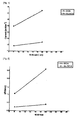
- FIG. 1 is a graph which illustrates currents (J sc ) for thicknesses (8 ⁇ m and 20 ⁇ m) of 20nm TiO 2 when DCA is added and not added to a compound lb-2; and
- FIG. 2 is a graph which illustrates photoelectric conversion efficiency ( ⁇ ) for thicknesses (8 ⁇ m and 20 ⁇ m) of 20nm TiO 2 when DCA is added and not added to the compound 1b-2.
- a dye-sensitized solar cell has high photoelectric conversion efficiency, J sc (short-circuit photocurrent density) and molar extinction coefficient and provides better efficiency than an existing dye-sensitized solar cell does if made by mixing a compound represented by a chemical formula 1, with oxide semiconductor particles, to prevent ⁇ - ⁇ stacking by introducing long alkyl chains without an additive.
- An organic dye is represented by a following chemical formula 1, and more preferably, has a structure of a following chemical formula 1a-1, 1a-2, 1b-1, 1b-2 (which are not embodiments of the present invention), 1c-1 or lc-2 (which are embodiments of the present invention).
- R, A and n are as defined above.
- the dye which is represented by the chemical formula 1, from which compounds 1c-1 and 1c-2 are compounds of the present invention may be made by (1) allowing a compound of the chemical formula 2 to react with a compound of the chemical formula 3 in 1,2-dimethoxyethane to make a compound of the chemical formula 4, (2) allowing the compound of the chemical formula 4 to react with phosphorus oxychloride in dimethylformamide to make a compound of the chemical formula 5 and (3) allowing a compound of the chemical formula 5 to react with cyanoacetate under the presence of piperidine in acetonitrile.
- the schematic may be a following reaction formula 1.
- R, A and n are as defined above.
- the present invention further provides a dye-sensitized photoelectric conversion element, which is characterized by mixing oxide semiconductor particles with a dye represented by the chemical formula 1c-1 and 1c-2.
- the dye-sensitized photoelectric conversion element for a solar cell according to the present invention may be manufactured by using a conventional dye, and more preferably, by forming a oxide semiconductor layer on a substrate with oxide semiconductor particles and then by dipping the layer into the dye according to the present invention.
- the substrate on which the oxide semiconductor layer is formed preferably has a conductive surface.
- the substrate may be commercial. More specifically, the substrate may be used by forming a conductive metal oxide such as tin oxide applied with indium, fluorine and antimony or a metal layer such as steel, silver and gold on a surface of a glass or on a conductive, high molecular surface such as polyethyleneterephthalate or polyethersulfone.
- conductivity is 1000 ⁇ and less, and more preferably 100 ⁇ and less.
- particles of the oxide semiconductor include metal oxide.
- the metal oxide may include oxide such as titanium, tin, zinc, tungsten, zirconium, gallium, indium, yttrium, niobium, tantalium, vanadium, etc.
- the metal oxide includes titanium, tin, zinc, niobium and indium, more preferably titanium dioxide, zinc oxide, tin oxide, and most preferably titanium oxide.
- the oxide semiconductor may be used alone, mixed with others or coated on a surface of the semiconductor.
- the average diameter of the particles of the oxide semiconductor is preferably 1 to 500nm, and more preferably 1 to 100nm.
- the particles of the oxide semiconductor may have large and small diameters together or may have multiple layers.
- the oxide semiconductor layer may be provided by spraying oxide semiconductor particles directly to a substrate, by electrically extracting a semiconductor particle layer using a substrate as an electrode, by drying, hardening or firing a substrate after applying a paste including slurry of semiconductor particles or particles generated by hydrolyzing precursors of semiconductor particles such as semiconductor alkoxide on the substrate, and preferably by applying the paste on the substrate.
- the secondary-coagulated oxide semiconductor particles are dispersed in a dispersion medium by a known method to have an average primary diameter of 1 to 200nm to thereby form the slurry.
- the dispersion medium which disperses the slurry may vary as long as it disperses the semiconductor particles. More specifically, the dispersion medium may include water, alcohol such as ethanol, ketone such as acetone, acetyl acetone or hydrocarbon such as hexane, which may be mixed together to be used. Preferably, the dispersion medium includes water since it less changes viscosity of the slurry. A dispersion stabilizer may be used to stabilize a dispersion status of the oxide semiconductor particles.
- the dispersion stabilizer may include e.g., acid such as acetic acid, hydrochloric acid and nitric acid, acetyl acetone, acrylic acid, polyethyleneglycol, polyvinylalcohol and the like.
- the substrate which is applied with the slurry may be fired at firing temperatures of 100°C and more, and preferably 200°C and more.
- the upper limit of the firing temperatures is the melting point (softening point) of the material, i.e., 900°C, and preferably 600°C and less.
- the firing temperatures according to the present invention are not limited particularly, but preferably within 4 hours.
- a thickness of the layer formed on the substrate may be 1 to 200 ⁇ m, and preferably 1 to 50 ⁇ m. If the substrate is fired, some of the oxide semiconductor particles layer are melted and attached, but do not affect the present invention particularly.
- the oxide semiconductor layer may be secondary treated.
- the layer may be applied with a solution of alkoxide, chloride, nitride and sulfide which are the same metal as a semiconductor, and then dried or fired again to improve performance.
- the metal alkoxide may include titanethoxide, titaniumisoproepoxide, titan t-butoxide, n-dibutyldiacetyl tin and the like, or an alcohol solution thereof.
- the chloride may include e.g., titanium tetrachloride, tin tetrachloride, zinc chloride and the like, or an aqueous solution thereof.
- the obtained oxide semiconductor layer includes particles of the oxide semiconductor.
- a method of applying the dye to the oxide semiconductor particles layer according to the present invention is not limited to a particular method. More specifically, the substrate having the oxide semiconductor layer may be dipped into a solution which is made by dissolving the dye represented by the chemical formula 1, compounds 1c-1 and 1c-2 thereof being embodiments of the present invention, with a solvent or dipped into a dispersion solution which is made by dispersing the dye. The concentration of the solution or the dispersion solution may be properly determined depending on the dye.
- the applying temperature ranges from normal temperatures to the boiling point of the solvent.
- the applying time ranges from one minute to 48 hours.
- the solvent which dissolves the dye may include e.g., methanol, ethanol, acetonitrile, dimethylsulfoxide, dimethylformamide, acetone, t-butanol, etc.
- the dye concentration of the solution is typically 1X10 -6 M to 1M, and preferably 1X10 -5 M to 1X10 -1 M.
- the present invention may provide a dye-sensitized photoelectric conversion element which includes a dye-sensitized oxide semiconductor particles layer.
- the dye which is represented by the chemical formula 1 may include a single or at least two dyes mixed. If the dyes are mixed, other dyes or metal complex dyes may be mixed together.
- the metal complex dye to be mixed may include e.g., ruthenium complex or triarylmethylium salt thereof, phthalocyanine, porphyrine, etc.
- the organic dye to be mixed may include metal-free phthalocyanine, porphyrine, cyanine, merocyanine, oxonol, triphenylmethane, metin dye such as acrylic acid dye disclosed in WO2002/011213 , xanthen dye, azo dye, anthraquinone dye, perylene dye and the like (Document: M. K. Nazeeruddin, A.
- the layer may be dipped into the dye under the presence of an inclusion compound to prevent the dyes from being bonded to one another.
- the inclusion compound may include cholic acid such as deoxycholic acid, dehydrodeoxycholic acid, chenodeoxycholic acid, cholic acid methylester, cholic acid natrium and the like, a steroid compound such as polethyleneoxide, cholic acid and the like, crown ether, cyclodextrin, calixarene, polyethyleneoxide, etc.
- the electrode surface of the semiconductor layer may be treated by an amine compound such as 4-t-butyl pyridine or by a compound such as acetic acid, propionic acid which has an acidic group.
- the substrate which has the semiconductor particles layer carrying the dye may be dipped into an ethanol solution of amine.
- the present invention provides a dye-sensitized solar cell which includes the dye-sensitized photoelectric conversion element.
- the solar cell may be manufactured by a known method by using a conventional photoelectric conversion element as well as using the dye-sensitized photoelectric conversion element having the oxide semiconductor particles layer carrying the dye represented by the chemical formula 1, especially 1c-1 and 1c-2.
- the dye-sensitized solar cell may include an electrode (negative) of a photoelectric conversion element which is formed by applying the dye represented by the chemical formula 1, especially 1c-1 and 1c-2, to the oxide semiconductor particles layer, a counter electrode (positive), a redox electrolyte, a hole transferring material or a p-type semiconductor.
- the manufacturing method of the dye-sensitized solar cell according to the present invention includes an operation of coating TiO 2 paste on a transparent conductive substrate, an operation of firing the paste-coated substrate to form a TiO 2 layer, an operation of dipping the substrate having the TiO 2 layer to a solution including the dissolved dye represented by the chemical formula 1c-1 and/or 1c-2 to form a TiO 2 film electrode having the dye, an operation of providing a second glass substrate including a counter electrode on the TiO 2 film electrode, an operation of forming a hole to pass through the second glass substrate and the counter electrode, an operation of coupling the counter electrode and the TiO 2 film electrode by heat and pressure, leaving a thermoplastic polymer film therebetween, an operation of injecting an electrolyte to the thermoplastic polymer film interposed between the counter electrode and the TiO 2 film electrode through the hole and an operation of sealing the thermoplastic polymer film.
- the redox electrolyte, the hole transferring material and the p-type semiconductor may be liquid, coagulate (gel and gel phase), solid, etc.
- the redox electrolyte, the hole transferring material and the p-type semiconductor may be liquid by being dissolved by a solvent or may include normal temperature-molten salt.
- the redox electrolyte, the hole transferring material and the p-type semiconductor may be coagulate (gel and gel phase) by being included in a polymer matrix or a monomer gelation agent.
- the redox electrolyte, the hole transferring material and the p-type semiconductor may be solid themselves.
- the hole transferring material may include an amine derivative, a conductive polymer such as polyacetylene, polyaniline, polythiophene, a material such as a triphenylene compound using a discotheque liquid crystal phase, etc.
- the p-type semiconductor may include CuI, CuSCN and the like.
- the counter electrode is conductive and acts as a catalyst for a reduction reaction of the redox electrolyte.
- platinum, carbon, rhodium, ruthenium may be deposited on a glass or a polymer film, or conductive particles may be applied to the glass or the polymer film to form the counter electrode.
- the redox electrolyte of the solar cell according to the present invention may include a halogen oxidation reduction electrolyte including a halogen compound having a halogen ion as a counter ion and a halogen molecule, a metal oxidation reduction electrolyte such as ferrocyanide, ferrocene-ferricinium ion or a metal complex such as a cobalt complex, an organic oxidation reduction electrolyte such as alkylthiol-alkyldisulfide, viologen dye and hydroquinone-quinone and the like.
- the redox electrolyte includes a halogen oxidation reduction electrolyte.
- the halogen molecule of the halogen oxidation reduction electrolyte including the halogen compound-halogen molecule includes an iodine molecule.
- the halogen compound which has a halogen ion as a counter ion may include halogenated metal salt such as LiI, NaI, KI, CaI 2 , MgI 2 , CuI, halogen organic ammonium salt such as tetraalkylammoniumiodine, imidazoliumiodine, phyridiumiodine, or I 2 .
- the redox electrolyte may include a solution added with the foregoing materials.
- a solvent may electrochemically be inactive. More specifically, the solvent may include e.g., acetonitrile, propylenecarbonate, ethylenecarbonate, 3-methoxypropionitrile, methoxyacetonitrile, ethyleneglycol, propyleneglycol, diethyleneglycol, triethyleneglycol, butylolactone, dimethoxyethane, dimethylcarbonate, 1,3-dioxolane, methylformate, 2-methyltetrahydrofurane, 3-methoxy-oxazolidine-2-on, sulforane, tetrahydrofurane, water and the like.
- the solvent includes acetonitrile, propylenecarbonate, ethylenecarbonate, 3-methoxypropionitrile, ethyleneglycol, 3-methoxy-oxazolidine-2-on, butylolactone, etc.
- the solvents may be used alone or mixed together to be used.
- the gel phase positive electrolyte may be formed by adding an electrolyte or an electrolyte solution to a matrix such as oligomer and polymer or by adding an electrolyte or an electrolyte solution to a monomer gelation agent.
- the concentration of the redox electrolyte may be 0.01 to 99wt%, and more preferably 0.1 to 30wt%.
- the solar cell according to the present invention may be manufactured by providing the photoelectric conversion element (negative) having the oxide semiconductor particles carrying the dye and the counter electrode (positive) facing the photoelectric conversion element and by injecting the solution including the redox electrolyte therebetween.
- a solar cell was fabricated by using a transparent layer of 20+4 ⁇ m TiO 2 .
- TiO 2 paste (Solaronix, 13nm anatase) was screen-printed to form a first TiO 2 layer as an electrode, in 20 ⁇ m thickness while a second TiO 2 scattering layer of 4 ⁇ m was formed by using another paste (CCIC, HWP-400) for light scattering.
- the dye compounds la-1, la-2, 1b-1, 1b-2 (which are not embodiments according to the present invention), 1c-1 and 1c-2 according to the present invention made at the operations IV), V), XI), XII), XVII) and XVIII) in the exemplary embodiment 1 were applied to the TiO 2 electrode to manufacture a solar cell.
- the electrolyte was used by mixing 0.6M 1-hexyl-2,3-dimethylimidazolium iodide, 0.05M iodine, 0.1 M lithium iodiode, 0.5M tertiary-butylpyridine with an acetonitrile solvent.
- the photoelectrochemical characteristics of the solar cell manufactured by using the dye compounds 1a-1, la-2, 1b-1, 1b-2(which are not embodiments according to the present invention), 1c-1 and 1c-2 according to the present invention made at the operations IV), V), XI), XII), XVII) and XVIII) was measured to be shown in a following Table 1.
- the photoelectrochemical characteristics of the solar cell were measured by a Keithley M236 source measuring device.
- a light source included a 300W Xe lamp equipped with an AM 1.5 filter (Oriel).
- the size of the electrode is 0.4 X 0.4cm 2 and the intensity of light was 1 sun (100mW/cm 2 ).
- the intensity of the light was adjusted by an Si solar cell.
- N719 includes a Ruthenium catalyst used for a conventional dye-sensitized solar cell, and has a following structure.
- the photoelectrochemical characteristics of the solar cell manufactured by adding 10mM DCA to each of the dye compounds 1a-1, la-2, 1b-1, 1b-2, 1c-1 and 1c-2 made at the operations IV), V), XI), XII), XVII) and XVIII) was measured to be shown in Table 2.
- J SC refers to a short-circuit photocurrent density
- Voc is an open circuit photovoltage
- ff is a fill factor
- ⁇ is a total photoelectric conversion efficiency
- the dye compounds according to the present invention have characteristics of a good solar cell dye, and have higher values of J SC , Voc, ff and ⁇ if not added with DCA than added with DCA.
- the compound 1b-2 has a higher J SC value, similar to N719. Also, the total conversion efficiency of the dye compounds was high.
- FIGS. 1 and 2 illustrate current (J SC ) and photoelectric conversion efficiency ( ⁇ ) for thicknesses of 8 ⁇ m and 20 ⁇ m in 20nm TiO 2 when DCA is added and is not added to the compound 1b-2 having the highest J SC value. As shown therein, the compound 1b-2 not using the additive DCA has better current (J SC ) and photoelectric conversion efficiency ( ⁇ ) than that using the DCA.
- An organic dye according to the present invention provides better molar extinction coefficient, J sc (short-circuit photocurrent density) and photoelectric conversion efficiency than a conventional metal complex dye to sharply improve efficiency of a solar cell, has a high current and better photoelectric conversion efficiency than an existing organic dye by preventing ⁇ - ⁇ stacking even without an additive.
Landscapes
- Chemical & Material Sciences (AREA)
- Engineering & Computer Science (AREA)
- Organic Chemistry (AREA)
- Materials Engineering (AREA)
- Power Engineering (AREA)
- Physics & Mathematics (AREA)
- Spectroscopy & Molecular Physics (AREA)
- Microelectronics & Electronic Packaging (AREA)
- Hybrid Cells (AREA)
- Photovoltaic Devices (AREA)
- Heterocyclic Compounds Containing Sulfur Atoms (AREA)
- Plural Heterocyclic Compounds (AREA)
Claims (8)
- Colorant organique, dans lequel le colorant est représenté par la formule chimique 1c-1 ou 1c-2 suivante,


- Procédé de fabrication d'un colorant organique qui est représenté par la formule chimique 1c-1 ou 1c-2 selon la revendication 1, le procédé de fabrication comprenant les étapes consistant à :laisser un composé de formule chimique 2 suivante réagir avec un composé de formule chimique 3 dans du 1,2-diméthoxyéthane pour fabriquer un composé de formule chimique 4 ci-dessous ;laisser le composé de formule chimique 4 réagir avec un oxychlorure de phosphore dans du diméthylformamide afin de fabriquer un composé de formule chimique 5 ci-dessous ; etlaisser un composé de formule chimique 5 réagir avec du cyanoacétate en présence de pipéridine dans l'acétonitrile,
[Formule chimique 2] R-Br


, A est alkyle en C6 et n est un nombre positif de 1 ou 2. - Elément de conversion photoélectrique sensible à un colorant qui comprend des particules de semi-conducteur à oxyde portant le colorant organique selon la revendication 1.
- Elément de conversion photoélectrique sensible à un colorant selon la revendication 3, dans lequel les particules à semi-conducteur à oxyde sont trempées dans le colorant organique en présence d'un composé d'inclusion.
- Elément de conversion photoélectrique sensible à un colorant selon la revendication 3, dans lequel les particules de semi-conducteur à oxyde comprennent du dioxyde de titane comme composant essentiel.
- Elément de conversion photoélectrique sensible à un colorant selon la revendication 3, dans lequel un diamètre moyen des particules de semi-conducteur à oxyde va de 1 à 500 nm.
- Cellule solaire sensible à un colorant qui comprend l'élément de conversion photoélectrique sensible au colorant selon la revendication 3 comme électrode.
- Cellule solaire sensible au colorant selon la revendication 7, dans laquelle la cellule solaire sensible au colorant est fabriquée par revêtement d'une pâte de TiO2 sur un substrat conducteur transparent, cuisson du substrat revêtu de pâte afin de former une couche de TiO2, trempage du substrat ayant la couche de TiO2 dans une solution comportant le colorant dissous représenté par une formule chimique 1c-1 ou 1c-2 selon la revendication 1 afin de former une électrode à film de TiO2 ayant le colorant, fourniture d'un second substrat de verre ayant une contre-électrode sur l'électrode à film de TiO2 formation d'un trou pour passer à travers le second substrat de verre et la contre-électrode, couplage de la contre-électrode et de l'électrode à film de TiO2 par chaleur et pression, laissant un film polymère thermoplastique entre elles, injection d'un électrolyte dans le film polymère thermoplastique interposé entre la contre-électrode et l'électrode à film de TiO2 à travers le trou et scellage du film polymère thermoplastique.
Priority Applications (1)
| Application Number | Priority Date | Filing Date | Title |
|---|---|---|---|
| EP12156667.3A EP2457958B1 (fr) | 2007-05-28 | 2008-05-20 | Nouveau colorant organique et son procédé de préparation |
Applications Claiming Priority (2)
| Application Number | Priority Date | Filing Date | Title |
|---|---|---|---|
| KR1020070051619A KR101008226B1 (ko) | 2007-05-28 | 2007-05-28 | 신규한 유기염료 및 이의 제조방법 |
| EP08753600A EP2148903A4 (fr) | 2007-05-28 | 2008-05-20 | Nouveau colorant organique et son procédé de préparation |
Related Parent Applications (1)
| Application Number | Title | Priority Date | Filing Date |
|---|---|---|---|
| EP08753600.9 Division | 2008-05-20 |
Related Child Applications (2)
| Application Number | Title | Priority Date | Filing Date |
|---|---|---|---|
| EP12156667.3A Division EP2457958B1 (fr) | 2007-05-28 | 2008-05-20 | Nouveau colorant organique et son procédé de préparation |
| EP12156667.3 Division-Into | 2012-02-23 |
Publications (3)
| Publication Number | Publication Date |
|---|---|
| EP2418257A2 EP2418257A2 (fr) | 2012-02-15 |
| EP2418257A3 EP2418257A3 (fr) | 2012-03-14 |
| EP2418257B1 true EP2418257B1 (fr) | 2013-12-18 |
Family
ID=40075651
Family Applications (3)
| Application Number | Title | Priority Date | Filing Date |
|---|---|---|---|
| EP11181281.4A Not-in-force EP2418257B1 (fr) | 2007-05-28 | 2008-05-20 | Nouveau colorant organique et son procédé de préparation |
| EP08753600A Withdrawn EP2148903A4 (fr) | 2007-05-28 | 2008-05-20 | Nouveau colorant organique et son procédé de préparation |
| EP12156667.3A Not-in-force EP2457958B1 (fr) | 2007-05-28 | 2008-05-20 | Nouveau colorant organique et son procédé de préparation |
Family Applications After (2)
| Application Number | Title | Priority Date | Filing Date |
|---|---|---|---|
| EP08753600A Withdrawn EP2148903A4 (fr) | 2007-05-28 | 2008-05-20 | Nouveau colorant organique et son procédé de préparation |
| EP12156667.3A Not-in-force EP2457958B1 (fr) | 2007-05-28 | 2008-05-20 | Nouveau colorant organique et son procédé de préparation |
Country Status (6)
| Country | Link |
|---|---|
| EP (3) | EP2418257B1 (fr) |
| JP (1) | JP2010529226A (fr) |
| KR (1) | KR101008226B1 (fr) |
| CN (1) | CN101679762B (fr) |
| TW (1) | TWI458786B (fr) |
| WO (1) | WO2008147070A2 (fr) |
Families Citing this family (15)
| Publication number | Priority date | Publication date | Assignee | Title |
|---|---|---|---|---|
| KR20100066158A (ko) * | 2008-12-09 | 2010-06-17 | 주식회사 동진쎄미켐 | 트리알콕시실릴기 함유 신규 유기염료 및 이의 제조방법 |
| TWI458787B (zh) | 2009-05-15 | 2014-11-01 | Ind Tech Res Inst | 有機染料及包含其之光電轉換裝置 |
| KR101109548B1 (ko) * | 2009-05-26 | 2012-03-05 | 고려대학교 산학협력단 | 신규의 퓨즈드-트리아릴아민을 함유하는 화합물, 이의 제조 방법, 및 이를 포함하는 염료를 이용한 염료감응 태양전지 |
| KR20110026818A (ko) * | 2009-09-08 | 2011-03-16 | 엘지디스플레이 주식회사 | 염료 감응 태양전지 및 그 제조방법 |
| KR101137941B1 (ko) * | 2010-07-16 | 2012-05-09 | 포항공과대학교 산학협력단 | 가시광선에 감응하는 유기염료/이산화티타늄 광촉매, 이의 제조방법 및 이를 이용한 폐수 처리방법 |
| JP5722579B2 (ja) * | 2010-09-14 | 2015-05-20 | 山本化成株式会社 | ジテトラアザポルフィリン系化合物、該化合物を用いた色素増感太陽電池 |
| US20130167932A1 (en) * | 2010-11-08 | 2013-07-04 | Nec Corporation | Indole compound, and photoelectric conversion dye using same, semiconductor electrode, photoelectric conversion element, and photoelectrochemical cell |
| CN102250484B (zh) * | 2011-05-20 | 2013-10-30 | 常州有则科技有限公司 | 用于染料敏化太阳能电池的咔唑基有机染料的制备方法 |
| CN103450700B (zh) * | 2013-08-23 | 2015-12-02 | 中山大学 | 一种基于咔唑或三苯胺衍生物的树状有机染料及其在制备染料敏化太阳能电池中的应用 |
| CN103834190B (zh) * | 2013-12-09 | 2015-07-22 | 中国科学院长春应用化学研究所 | 含苯并噻二唑-氰基苯丙烯酸受体的有机染料及在染料敏化太阳电池中的应用 |
| JP2017078091A (ja) * | 2014-03-12 | 2017-04-27 | 日本化薬株式会社 | メチン系色素及びそれを用いた色素増感光電変換素子 |
| ITUA20163451A1 (it) * | 2016-05-16 | 2017-11-16 | Eni Spa | Colorante organico per una cella solare sensibilizzata da colorante |
| WO2018061409A1 (fr) * | 2016-09-27 | 2018-04-05 | 保土谷化学工業株式会社 | Colorant sensibilisateur, colorant sensibilisateur pour conversion photoélectrique et transducteur photoélectrique l'utilisant, et cellule solaire à colorant sensibilisateur |
| JP7055292B2 (ja) * | 2017-09-26 | 2022-04-18 | 保土谷化学工業株式会社 | 増感色素、光電変換用増感色素およびそれを用いた光電変換素子ならびに色素増感太陽電池 |
| CN113200957B (zh) * | 2021-04-09 | 2022-02-22 | 西安工业大学 | 一种酸/碱染料共敏体系及其制备方法和应用 |
Family Cites Families (3)
| Publication number | Priority date | Publication date | Assignee | Title |
|---|---|---|---|---|
| US7141735B2 (en) | 2000-07-27 | 2006-11-28 | Nippon Kayaku Kabushiki Kaisha | Dye-sensitized photoelectric conversion device |
| WO2004082061A1 (fr) * | 2003-03-14 | 2004-09-23 | Nippon Kayaku Kabushiki Kaisha | Dispositif de conversion photoelectrique sensibilise par colorant |
| AU2007221706B2 (en) * | 2006-03-02 | 2011-12-22 | Nippon Kayaku Kabushiki Kaisha | Dye-sensitized photoelectric conversion device |
-
2007
- 2007-05-28 KR KR1020070051619A patent/KR101008226B1/ko not_active Expired - Fee Related
-
2008
- 2008-05-20 EP EP11181281.4A patent/EP2418257B1/fr not_active Not-in-force
- 2008-05-20 JP JP2010510200A patent/JP2010529226A/ja active Pending
- 2008-05-20 EP EP08753600A patent/EP2148903A4/fr not_active Withdrawn
- 2008-05-20 EP EP12156667.3A patent/EP2457958B1/fr not_active Not-in-force
- 2008-05-20 WO PCT/KR2008/002804 patent/WO2008147070A2/fr not_active Ceased
- 2008-05-20 CN CN2008800178488A patent/CN101679762B/zh not_active Expired - Fee Related
- 2008-05-27 TW TW097119503A patent/TWI458786B/zh not_active IP Right Cessation
Also Published As
| Publication number | Publication date |
|---|---|
| WO2008147070A3 (fr) | 2009-01-15 |
| EP2457958A3 (fr) | 2012-09-12 |
| EP2418257A3 (fr) | 2012-03-14 |
| KR101008226B1 (ko) | 2011-01-17 |
| WO2008147070A2 (fr) | 2008-12-04 |
| EP2148903A2 (fr) | 2010-02-03 |
| EP2457958B1 (fr) | 2014-05-14 |
| TWI458786B (zh) | 2014-11-01 |
| KR20080104616A (ko) | 2008-12-03 |
| TW200909526A (en) | 2009-03-01 |
| EP2418257A2 (fr) | 2012-02-15 |
| CN101679762A (zh) | 2010-03-24 |
| EP2457958A2 (fr) | 2012-05-30 |
| JP2010529226A (ja) | 2010-08-26 |
| CN101679762B (zh) | 2013-06-05 |
| EP2148903A4 (fr) | 2010-12-22 |
Similar Documents
| Publication | Publication Date | Title |
|---|---|---|
| EP2418257B1 (fr) | Nouveau colorant organique et son procédé de préparation | |
| Chang et al. | Dye-sensitized solar cell utilizing organic dyads containing triarylene conjugates | |
| Hsieh et al. | Synthesis and characterization of porphyrin sensitizers with various electron-donating substituents for highly efficient dye-sensitized solar cells | |
| Yang et al. | Phenothiazine derivatives as organic sensitizers for highly efficient dye-sensitized solar cells | |
| KR100969675B1 (ko) | 신규한 엔-아릴카바졸 잔기-함유 유기염료 및 이의제조방법 | |
| EP1628356A1 (fr) | Dispositif de conversion photoelectrique sensibilise par colorant | |
| TWI472512B (zh) | 貴金屬釕類感光劑及其製備方法 | |
| Chang et al. | Highly efficient triarylene conjugated dyes for sensitized solar cells | |
| Narayanaswamy et al. | Simple metal-free dyes derived from triphenylamine for DSSC: A comparative study of two different anchoring group | |
| Zeng et al. | DA-π-A organic sensitizers containing a benzothiazole moiety as an additional acceptor for use in solar cells | |
| Cao et al. | New D–π–A organic dyes containing a tert-butyl-capped indolo [3, 2, 1-jk] carbazole donor with bithiophene unit as π-linker for dye-sensitized solar cells | |
| KR101082086B1 (ko) | 염료 감응 태양전지용 염료 및 이를 함유하는 태양전지 | |
| Guo et al. | Structure-property relationship of different electron donors: new organic sensitizers based on bithiazole moiety for high efficiency dye-sensitized solar cells | |
| Chiu et al. | Triphenylamine derivatives and the lithium-ion capture of [3.3] cyclophane used in organic dye-sensitized solar cells | |
| Duan et al. | New organic dyes containing tert-butyl-capped N-arylcarbazole moiety for dye-sensitized solar cells | |
| KR100996236B1 (ko) | 신규한 루테늄계 염료 및 이의 제조방법 | |
| KR20100128258A (ko) | 신규한 루테늄계 염료 및 이의 제조방법 | |
| KR102066216B1 (ko) | 염료감응 태양전지의 유기염료용 화합물 및 이를 포함하는 염료감응 태양전지 | |
| Kim et al. | Effects of bis-carbazole based D—π-A sensitizers on solar energy capture in DSSCs | |
| KR101173658B1 (ko) | 염료감응 태양전지용 스쿠아레인계 염료 | |
| KR20100128255A (ko) | 신규한 스파이로바이플루오렌계 염료 및 이의 제조방법 | |
| KR101051111B1 (ko) | 염료 감응 태양전지용 염료 및 이를 함유하는 태양전지 | |
| EP3124552B1 (fr) | Benzodiazaporphyrins trans-disubstitués comme sensibilisateurs pour cellules solaires |
Legal Events
| Date | Code | Title | Description |
|---|---|---|---|
| PUAL | Search report despatched |
Free format text: ORIGINAL CODE: 0009013 |
|
| 17P | Request for examination filed |
Effective date: 20110914 |
|
| AC | Divisional application: reference to earlier application |
Ref document number: 2148903 Country of ref document: EP Kind code of ref document: P |
|
| AK | Designated contracting states |
Kind code of ref document: A2 Designated state(s): AT BE BG CH CY CZ DE DK EE ES FI FR GB GR HR HU IE IS IT LI LT LU LV MC MT NL NO PL PT RO SE SI SK TR |
|
| PUAI | Public reference made under article 153(3) epc to a published international application that has entered the european phase |
Free format text: ORIGINAL CODE: 0009012 |
|
| AK | Designated contracting states |
Kind code of ref document: A3 Designated state(s): AT BE BG CH CY CZ DE DK EE ES FI FR GB GR HR HU IE IS IT LI LT LU LV MC MT NL NO PL PT RO SE SI SK TR |
|
| RIC1 | Information provided on ipc code assigned before grant |
Ipc: C09B 49/00 20060101AFI20120209BHEP Ipc: C09B 49/12 20060101ALI20120209BHEP Ipc: C09B 23/10 20060101ALI20120209BHEP Ipc: H01L 51/00 20060101ALI20120209BHEP Ipc: H01G 9/20 20060101ALI20120209BHEP |
|
| 17Q | First examination report despatched |
Effective date: 20121219 |
|
| GRAP | Despatch of communication of intention to grant a patent |
Free format text: ORIGINAL CODE: EPIDOSNIGR1 |
|
| INTG | Intention to grant announced |
Effective date: 20130814 |
|
| GRAS | Grant fee paid |
Free format text: ORIGINAL CODE: EPIDOSNIGR3 |
|
| GRAA | (expected) grant |
Free format text: ORIGINAL CODE: 0009210 |
|
| AC | Divisional application: reference to earlier application |
Ref document number: 2148903 Country of ref document: EP Kind code of ref document: P |
|
| AK | Designated contracting states |
Kind code of ref document: B1 Designated state(s): AT BE BG CH CY CZ DE DK EE ES FI FR GB GR HR HU IE IS IT LI LT LU LV MC MT NL NO PL PT RO SE SI SK TR |
|
| REG | Reference to a national code |
Ref country code: GB Ref legal event code: FG4D |
|
| REG | Reference to a national code |
Ref country code: CH Ref legal event code: EP |
|
| REG | Reference to a national code |
Ref country code: AT Ref legal event code: REF Ref document number: 645633 Country of ref document: AT Kind code of ref document: T Effective date: 20140115 |
|
| REG | Reference to a national code |
Ref country code: IE Ref legal event code: FG4D |
|
| REG | Reference to a national code |
Ref country code: DE Ref legal event code: R096 Ref document number: 602008029464 Country of ref document: DE Effective date: 20140213 |
|
| REG | Reference to a national code |
Ref country code: NL Ref legal event code: VDEP Effective date: 20131218 |
|
| PG25 | Lapsed in a contracting state [announced via postgrant information from national office to epo] |
Ref country code: SE Free format text: LAPSE BECAUSE OF FAILURE TO SUBMIT A TRANSLATION OF THE DESCRIPTION OR TO PAY THE FEE WITHIN THE PRESCRIBED TIME-LIMIT Effective date: 20131218 Ref country code: HR Free format text: LAPSE BECAUSE OF FAILURE TO SUBMIT A TRANSLATION OF THE DESCRIPTION OR TO PAY THE FEE WITHIN THE PRESCRIBED TIME-LIMIT Effective date: 20131218 Ref country code: FI Free format text: LAPSE BECAUSE OF FAILURE TO SUBMIT A TRANSLATION OF THE DESCRIPTION OR TO PAY THE FEE WITHIN THE PRESCRIBED TIME-LIMIT Effective date: 20131218 Ref country code: NO Free format text: LAPSE BECAUSE OF FAILURE TO SUBMIT A TRANSLATION OF THE DESCRIPTION OR TO PAY THE FEE WITHIN THE PRESCRIBED TIME-LIMIT Effective date: 20140318 Ref country code: LT Free format text: LAPSE BECAUSE OF FAILURE TO SUBMIT A TRANSLATION OF THE DESCRIPTION OR TO PAY THE FEE WITHIN THE PRESCRIBED TIME-LIMIT Effective date: 20131218 |
|
| REG | Reference to a national code |
Ref country code: AT Ref legal event code: MK05 Ref document number: 645633 Country of ref document: AT Kind code of ref document: T Effective date: 20131218 |
|
| REG | Reference to a national code |
Ref country code: LT Ref legal event code: MG4D |
|
| PG25 | Lapsed in a contracting state [announced via postgrant information from national office to epo] |
Ref country code: LV Free format text: LAPSE BECAUSE OF FAILURE TO SUBMIT A TRANSLATION OF THE DESCRIPTION OR TO PAY THE FEE WITHIN THE PRESCRIBED TIME-LIMIT Effective date: 20131218 |
|
| PG25 | Lapsed in a contracting state [announced via postgrant information from national office to epo] |
Ref country code: EE Free format text: LAPSE BECAUSE OF FAILURE TO SUBMIT A TRANSLATION OF THE DESCRIPTION OR TO PAY THE FEE WITHIN THE PRESCRIBED TIME-LIMIT Effective date: 20131218 Ref country code: IS Free format text: LAPSE BECAUSE OF FAILURE TO SUBMIT A TRANSLATION OF THE DESCRIPTION OR TO PAY THE FEE WITHIN THE PRESCRIBED TIME-LIMIT Effective date: 20140418 Ref country code: BE Free format text: LAPSE BECAUSE OF FAILURE TO SUBMIT A TRANSLATION OF THE DESCRIPTION OR TO PAY THE FEE WITHIN THE PRESCRIBED TIME-LIMIT Effective date: 20131218 |
|
| PG25 | Lapsed in a contracting state [announced via postgrant information from national office to epo] |
Ref country code: AT Free format text: LAPSE BECAUSE OF FAILURE TO SUBMIT A TRANSLATION OF THE DESCRIPTION OR TO PAY THE FEE WITHIN THE PRESCRIBED TIME-LIMIT Effective date: 20131218 Ref country code: CY Free format text: LAPSE BECAUSE OF FAILURE TO SUBMIT A TRANSLATION OF THE DESCRIPTION OR TO PAY THE FEE WITHIN THE PRESCRIBED TIME-LIMIT Effective date: 20131218 Ref country code: PL Free format text: LAPSE BECAUSE OF FAILURE TO SUBMIT A TRANSLATION OF THE DESCRIPTION OR TO PAY THE FEE WITHIN THE PRESCRIBED TIME-LIMIT Effective date: 20131218 Ref country code: NL Free format text: LAPSE BECAUSE OF FAILURE TO SUBMIT A TRANSLATION OF THE DESCRIPTION OR TO PAY THE FEE WITHIN THE PRESCRIBED TIME-LIMIT Effective date: 20131218 Ref country code: PT Free format text: LAPSE BECAUSE OF FAILURE TO SUBMIT A TRANSLATION OF THE DESCRIPTION OR TO PAY THE FEE WITHIN THE PRESCRIBED TIME-LIMIT Effective date: 20140418 Ref country code: ES Free format text: LAPSE BECAUSE OF FAILURE TO SUBMIT A TRANSLATION OF THE DESCRIPTION OR TO PAY THE FEE WITHIN THE PRESCRIBED TIME-LIMIT Effective date: 20131218 Ref country code: CZ Free format text: LAPSE BECAUSE OF FAILURE TO SUBMIT A TRANSLATION OF THE DESCRIPTION OR TO PAY THE FEE WITHIN THE PRESCRIBED TIME-LIMIT Effective date: 20131218 Ref country code: RO Free format text: LAPSE BECAUSE OF FAILURE TO SUBMIT A TRANSLATION OF THE DESCRIPTION OR TO PAY THE FEE WITHIN THE PRESCRIBED TIME-LIMIT Effective date: 20131218 Ref country code: SK Free format text: LAPSE BECAUSE OF FAILURE TO SUBMIT A TRANSLATION OF THE DESCRIPTION OR TO PAY THE FEE WITHIN THE PRESCRIBED TIME-LIMIT Effective date: 20131218 |
|
| PGFP | Annual fee paid to national office [announced via postgrant information from national office to epo] |
Ref country code: DE Payment date: 20140515 Year of fee payment: 7 |
|
| REG | Reference to a national code |
Ref country code: DE Ref legal event code: R097 Ref document number: 602008029464 Country of ref document: DE |
|
| PLBE | No opposition filed within time limit |
Free format text: ORIGINAL CODE: 0009261 |
|
| STAA | Information on the status of an ep patent application or granted ep patent |
Free format text: STATUS: NO OPPOSITION FILED WITHIN TIME LIMIT |
|
| PG25 | Lapsed in a contracting state [announced via postgrant information from national office to epo] |
Ref country code: DK Free format text: LAPSE BECAUSE OF FAILURE TO SUBMIT A TRANSLATION OF THE DESCRIPTION OR TO PAY THE FEE WITHIN THE PRESCRIBED TIME-LIMIT Effective date: 20131218 |
|
| 26N | No opposition filed |
Effective date: 20140919 |
|
| PG25 | Lapsed in a contracting state [announced via postgrant information from national office to epo] |
Ref country code: LU Free format text: LAPSE BECAUSE OF FAILURE TO SUBMIT A TRANSLATION OF THE DESCRIPTION OR TO PAY THE FEE WITHIN THE PRESCRIBED TIME-LIMIT Effective date: 20140520 |
|
| REG | Reference to a national code |
Ref country code: CH Ref legal event code: PL Ref country code: DE Ref legal event code: R097 Ref document number: 602008029464 Country of ref document: DE Effective date: 20140919 |
|
| GBPC | Gb: european patent ceased through non-payment of renewal fee |
Effective date: 20140520 |
|
| PG25 | Lapsed in a contracting state [announced via postgrant information from national office to epo] |
Ref country code: MC Free format text: LAPSE BECAUSE OF FAILURE TO SUBMIT A TRANSLATION OF THE DESCRIPTION OR TO PAY THE FEE WITHIN THE PRESCRIBED TIME-LIMIT Effective date: 20131218 Ref country code: CH Free format text: LAPSE BECAUSE OF NON-PAYMENT OF DUE FEES Effective date: 20140531 Ref country code: LI Free format text: LAPSE BECAUSE OF NON-PAYMENT OF DUE FEES Effective date: 20140531 |
|
| REG | Reference to a national code |
Ref country code: IE Ref legal event code: MM4A |
|
| REG | Reference to a national code |
Ref country code: FR Ref legal event code: ST Effective date: 20150130 |
|
| PG25 | Lapsed in a contracting state [announced via postgrant information from national office to epo] |
Ref country code: IE Free format text: LAPSE BECAUSE OF NON-PAYMENT OF DUE FEES Effective date: 20140520 |
|
| PG25 | Lapsed in a contracting state [announced via postgrant information from national office to epo] |
Ref country code: GB Free format text: LAPSE BECAUSE OF NON-PAYMENT OF DUE FEES Effective date: 20140520 Ref country code: SI Free format text: LAPSE BECAUSE OF FAILURE TO SUBMIT A TRANSLATION OF THE DESCRIPTION OR TO PAY THE FEE WITHIN THE PRESCRIBED TIME-LIMIT Effective date: 20131218 Ref country code: FR Free format text: LAPSE BECAUSE OF NON-PAYMENT OF DUE FEES Effective date: 20140602 |
|
| REG | Reference to a national code |
Ref country code: DE Ref legal event code: R119 Ref document number: 602008029464 Country of ref document: DE |
|
| PG25 | Lapsed in a contracting state [announced via postgrant information from national office to epo] |
Ref country code: MT Free format text: LAPSE BECAUSE OF FAILURE TO SUBMIT A TRANSLATION OF THE DESCRIPTION OR TO PAY THE FEE WITHIN THE PRESCRIBED TIME-LIMIT Effective date: 20131218 |
|
| PG25 | Lapsed in a contracting state [announced via postgrant information from national office to epo] |
Ref country code: DE Free format text: LAPSE BECAUSE OF NON-PAYMENT OF DUE FEES Effective date: 20151201 |
|
| PG25 | Lapsed in a contracting state [announced via postgrant information from national office to epo] |
Ref country code: BG Free format text: LAPSE BECAUSE OF FAILURE TO SUBMIT A TRANSLATION OF THE DESCRIPTION OR TO PAY THE FEE WITHIN THE PRESCRIBED TIME-LIMIT Effective date: 20131218 |
|
| PG25 | Lapsed in a contracting state [announced via postgrant information from national office to epo] |
Ref country code: GR Free format text: LAPSE BECAUSE OF FAILURE TO SUBMIT A TRANSLATION OF THE DESCRIPTION OR TO PAY THE FEE WITHIN THE PRESCRIBED TIME-LIMIT Effective date: 20140319 Ref country code: IT Free format text: LAPSE BECAUSE OF FAILURE TO SUBMIT A TRANSLATION OF THE DESCRIPTION OR TO PAY THE FEE WITHIN THE PRESCRIBED TIME-LIMIT Effective date: 20131218 |
|
| PG25 | Lapsed in a contracting state [announced via postgrant information from national office to epo] |
Ref country code: HU Free format text: LAPSE BECAUSE OF FAILURE TO SUBMIT A TRANSLATION OF THE DESCRIPTION OR TO PAY THE FEE WITHIN THE PRESCRIBED TIME-LIMIT; INVALID AB INITIO Effective date: 20080520 Ref country code: TR Free format text: LAPSE BECAUSE OF FAILURE TO SUBMIT A TRANSLATION OF THE DESCRIPTION OR TO PAY THE FEE WITHIN THE PRESCRIBED TIME-LIMIT Effective date: 20131218 |