EP2420548B1 - Flüssigkristallzusammensetzung mit einer polymerisierbaren verbindung und flüssigkristallanzeigeelement damit - Google Patents
Flüssigkristallzusammensetzung mit einer polymerisierbaren verbindung und flüssigkristallanzeigeelement damit Download PDFInfo
- Publication number
- EP2420548B1 EP2420548B1 EP10764364.5A EP10764364A EP2420548B1 EP 2420548 B1 EP2420548 B1 EP 2420548B1 EP 10764364 A EP10764364 A EP 10764364A EP 2420548 B1 EP2420548 B1 EP 2420548B1
- Authority
- EP
- European Patent Office
- Prior art keywords
- group
- liquid crystal
- atom
- substituted
- crystal composition
- Prior art date
- Legal status (The legal status is an assumption and is not a legal conclusion. Google has not performed a legal analysis and makes no representation as to the accuracy of the status listed.)
- Active
Links
- 0 **C(CC1)CCC1C(CC1)Cc(cc2F)c1c(F)c2F Chemical compound **C(CC1)CCC1C(CC1)Cc(cc2F)c1c(F)c2F 0.000 description 2
- CEEPCKWNGZDQCR-UHFFFAOYSA-N CC(CC1)CCC1C(CC1)CCC1C(CC1)Cc(cc2F)c1c(F)c2F Chemical compound CC(CC1)CCC1C(CC1)CCC1C(CC1)Cc(cc2F)c1c(F)c2F CEEPCKWNGZDQCR-UHFFFAOYSA-N 0.000 description 1
Classifications
-
- C—CHEMISTRY; METALLURGY
- C09—DYES; PAINTS; POLISHES; NATURAL RESINS; ADHESIVES; COMPOSITIONS NOT OTHERWISE PROVIDED FOR; APPLICATIONS OF MATERIALS NOT OTHERWISE PROVIDED FOR
- C09K—MATERIALS FOR MISCELLANEOUS APPLICATIONS, NOT PROVIDED FOR ELSEWHERE
- C09K19/00—Liquid crystal materials
- C09K19/52—Liquid crystal materials characterised by components which are not liquid crystals, e.g. additives with special physical aspect: solvents, solid particles
- C09K19/54—Additives having no specific mesophase characterised by their chemical composition
-
- C—CHEMISTRY; METALLURGY
- C09—DYES; PAINTS; POLISHES; NATURAL RESINS; ADHESIVES; COMPOSITIONS NOT OTHERWISE PROVIDED FOR; APPLICATIONS OF MATERIALS NOT OTHERWISE PROVIDED FOR
- C09K—MATERIALS FOR MISCELLANEOUS APPLICATIONS, NOT PROVIDED FOR ELSEWHERE
- C09K19/00—Liquid crystal materials
- C09K19/04—Liquid crystal materials characterised by the chemical structure of the liquid crystal components, e.g. by a specific unit
- C09K19/06—Non-steroidal liquid crystal compounds
- C09K19/32—Non-steroidal liquid crystal compounds containing condensed ring systems, i.e. fused, bridged or spiro ring systems
- C09K19/322—Compounds containing a naphthalene ring or a completely or partially hydrogenated naphthalene ring
-
- C—CHEMISTRY; METALLURGY
- C09—DYES; PAINTS; POLISHES; NATURAL RESINS; ADHESIVES; COMPOSITIONS NOT OTHERWISE PROVIDED FOR; APPLICATIONS OF MATERIALS NOT OTHERWISE PROVIDED FOR
- C09K—MATERIALS FOR MISCELLANEOUS APPLICATIONS, NOT PROVIDED FOR ELSEWHERE
- C09K19/00—Liquid crystal materials
- C09K19/04—Liquid crystal materials characterised by the chemical structure of the liquid crystal components, e.g. by a specific unit
- C09K19/06—Non-steroidal liquid crystal compounds
- C09K19/08—Non-steroidal liquid crystal compounds containing at least two non-condensed rings
- C09K19/10—Non-steroidal liquid crystal compounds containing at least two non-condensed rings containing at least two benzene rings
- C09K19/20—Non-steroidal liquid crystal compounds containing at least two non-condensed rings containing at least two benzene rings linked by a chain containing carbon and oxygen atoms as chain links, e.g. esters or ethers
- C09K19/2007—Non-steroidal liquid crystal compounds containing at least two non-condensed rings containing at least two benzene rings linked by a chain containing carbon and oxygen atoms as chain links, e.g. esters or ethers the chain containing -COO- or -OCO- groups
- C09K19/2014—Non-steroidal liquid crystal compounds containing at least two non-condensed rings containing at least two benzene rings linked by a chain containing carbon and oxygen atoms as chain links, e.g. esters or ethers the chain containing -COO- or -OCO- groups containing additionally a linking group other than -COO- or -OCO-, e.g. -CH2-CH2-, -CH=CH-, -C=C-; containing at least one additional carbon atom in the chain containing -COO- or -OCO- groups, e.g. -(CH2)m-COO-(CH2)n-
-
- C—CHEMISTRY; METALLURGY
- C09—DYES; PAINTS; POLISHES; NATURAL RESINS; ADHESIVES; COMPOSITIONS NOT OTHERWISE PROVIDED FOR; APPLICATIONS OF MATERIALS NOT OTHERWISE PROVIDED FOR
- C09K—MATERIALS FOR MISCELLANEOUS APPLICATIONS, NOT PROVIDED FOR ELSEWHERE
- C09K19/00—Liquid crystal materials
- C09K19/04—Liquid crystal materials characterised by the chemical structure of the liquid crystal components, e.g. by a specific unit
- C09K19/06—Non-steroidal liquid crystal compounds
- C09K19/08—Non-steroidal liquid crystal compounds containing at least two non-condensed rings
- C09K19/30—Non-steroidal liquid crystal compounds containing at least two non-condensed rings containing saturated or unsaturated non-aromatic rings, e.g. cyclohexane rings
- C09K19/3001—Cyclohexane rings
- C09K19/3066—Cyclohexane rings in which the rings are linked by a chain containing carbon and oxygen atoms, e.g. esters or ethers
- C09K19/3068—Cyclohexane rings in which the rings are linked by a chain containing carbon and oxygen atoms, e.g. esters or ethers chain containing -COO- or -OCO- groups
-
- C—CHEMISTRY; METALLURGY
- C09—DYES; PAINTS; POLISHES; NATURAL RESINS; ADHESIVES; COMPOSITIONS NOT OTHERWISE PROVIDED FOR; APPLICATIONS OF MATERIALS NOT OTHERWISE PROVIDED FOR
- C09K—MATERIALS FOR MISCELLANEOUS APPLICATIONS, NOT PROVIDED FOR ELSEWHERE
- C09K19/00—Liquid crystal materials
- C09K19/04—Liquid crystal materials characterised by the chemical structure of the liquid crystal components, e.g. by a specific unit
- C09K19/06—Non-steroidal liquid crystal compounds
- C09K19/34—Non-steroidal liquid crystal compounds containing at least one heterocyclic ring
- C09K19/3402—Non-steroidal liquid crystal compounds containing at least one heterocyclic ring having oxygen as hetero atom
- C09K19/3411—Non-steroidal liquid crystal compounds containing at least one heterocyclic ring having oxygen as hetero atom the heterocyclic ring being a three-membered ring
-
- C—CHEMISTRY; METALLURGY
- C09—DYES; PAINTS; POLISHES; NATURAL RESINS; ADHESIVES; COMPOSITIONS NOT OTHERWISE PROVIDED FOR; APPLICATIONS OF MATERIALS NOT OTHERWISE PROVIDED FOR
- C09K—MATERIALS FOR MISCELLANEOUS APPLICATIONS, NOT PROVIDED FOR ELSEWHERE
- C09K19/00—Liquid crystal materials
- C09K19/04—Liquid crystal materials characterised by the chemical structure of the liquid crystal components, e.g. by a specific unit
- C09K2019/0444—Liquid crystal materials characterised by the chemical structure of the liquid crystal components, e.g. by a specific unit characterized by a linking chain between rings or ring systems, a bridging chain between extensive mesogenic moieties or an end chain group
-
- C—CHEMISTRY; METALLURGY
- C09—DYES; PAINTS; POLISHES; NATURAL RESINS; ADHESIVES; COMPOSITIONS NOT OTHERWISE PROVIDED FOR; APPLICATIONS OF MATERIALS NOT OTHERWISE PROVIDED FOR
- C09K—MATERIALS FOR MISCELLANEOUS APPLICATIONS, NOT PROVIDED FOR ELSEWHERE
- C09K19/00—Liquid crystal materials
- C09K19/04—Liquid crystal materials characterised by the chemical structure of the liquid crystal components, e.g. by a specific unit
- C09K2019/0444—Liquid crystal materials characterised by the chemical structure of the liquid crystal components, e.g. by a specific unit characterized by a linking chain between rings or ring systems, a bridging chain between extensive mesogenic moieties or an end chain group
- C09K2019/0448—Liquid crystal materials characterised by the chemical structure of the liquid crystal components, e.g. by a specific unit characterized by a linking chain between rings or ring systems, a bridging chain between extensive mesogenic moieties or an end chain group the end chain group being a polymerizable end group, e.g. -Sp-P or acrylate
-
- C—CHEMISTRY; METALLURGY
- C09—DYES; PAINTS; POLISHES; NATURAL RESINS; ADHESIVES; COMPOSITIONS NOT OTHERWISE PROVIDED FOR; APPLICATIONS OF MATERIALS NOT OTHERWISE PROVIDED FOR
- C09K—MATERIALS FOR MISCELLANEOUS APPLICATIONS, NOT PROVIDED FOR ELSEWHERE
- C09K19/00—Liquid crystal materials
- C09K19/04—Liquid crystal materials characterised by the chemical structure of the liquid crystal components, e.g. by a specific unit
- C09K19/06—Non-steroidal liquid crystal compounds
- C09K19/34—Non-steroidal liquid crystal compounds containing at least one heterocyclic ring
- C09K19/3402—Non-steroidal liquid crystal compounds containing at least one heterocyclic ring having oxygen as hetero atom
- C09K19/3411—Non-steroidal liquid crystal compounds containing at least one heterocyclic ring having oxygen as hetero atom the heterocyclic ring being a three-membered ring
- C09K2019/3413—Three-membered member ring with oxygen(s), e.g. oxirane in fused, bridged or spiro ring systems
-
- C—CHEMISTRY; METALLURGY
- C09—DYES; PAINTS; POLISHES; NATURAL RESINS; ADHESIVES; COMPOSITIONS NOT OTHERWISE PROVIDED FOR; APPLICATIONS OF MATERIALS NOT OTHERWISE PROVIDED FOR
- C09K—MATERIALS FOR MISCELLANEOUS APPLICATIONS, NOT PROVIDED FOR ELSEWHERE
- C09K19/00—Liquid crystal materials
- C09K19/04—Liquid crystal materials characterised by the chemical structure of the liquid crystal components, e.g. by a specific unit
- C09K19/06—Non-steroidal liquid crystal compounds
- C09K19/34—Non-steroidal liquid crystal compounds containing at least one heterocyclic ring
- C09K19/3402—Non-steroidal liquid crystal compounds containing at least one heterocyclic ring having oxygen as hetero atom
- C09K2019/3416—Non-steroidal liquid crystal compounds containing at least one heterocyclic ring having oxygen as hetero atom the heterocyclic ring being a four-membered ring, e.g. oxetane
-
- C—CHEMISTRY; METALLURGY
- C09—DYES; PAINTS; POLISHES; NATURAL RESINS; ADHESIVES; COMPOSITIONS NOT OTHERWISE PROVIDED FOR; APPLICATIONS OF MATERIALS NOT OTHERWISE PROVIDED FOR
- C09K—MATERIALS FOR MISCELLANEOUS APPLICATIONS, NOT PROVIDED FOR ELSEWHERE
- C09K19/00—Liquid crystal materials
- C09K19/04—Liquid crystal materials characterised by the chemical structure of the liquid crystal components, e.g. by a specific unit
- C09K19/06—Non-steroidal liquid crystal compounds
- C09K19/34—Non-steroidal liquid crystal compounds containing at least one heterocyclic ring
- C09K19/3402—Non-steroidal liquid crystal compounds containing at least one heterocyclic ring having oxygen as hetero atom
- C09K2019/3422—Non-steroidal liquid crystal compounds containing at least one heterocyclic ring having oxygen as hetero atom the heterocyclic ring being a six-membered ring
- C09K2019/3425—Six-membered ring with oxygen(s) in fused, bridged or spiro ring systems
-
- C—CHEMISTRY; METALLURGY
- C09—DYES; PAINTS; POLISHES; NATURAL RESINS; ADHESIVES; COMPOSITIONS NOT OTHERWISE PROVIDED FOR; APPLICATIONS OF MATERIALS NOT OTHERWISE PROVIDED FOR
- C09K—MATERIALS FOR MISCELLANEOUS APPLICATIONS, NOT PROVIDED FOR ELSEWHERE
- C09K2323/00—Functional layers of liquid crystal optical display excluding electroactive liquid crystal layer characterised by chemical composition
-
- G—PHYSICS
- G02—OPTICS
- G02F—OPTICAL DEVICES OR ARRANGEMENTS FOR THE CONTROL OF LIGHT BY MODIFICATION OF THE OPTICAL PROPERTIES OF THE MEDIA OF THE ELEMENTS INVOLVED THEREIN; NON-LINEAR OPTICS; FREQUENCY-CHANGING OF LIGHT; OPTICAL LOGIC ELEMENTS; OPTICAL ANALOGUE/DIGITAL CONVERTERS
- G02F1/00—Devices or arrangements for the control of the intensity, colour, phase, polarisation or direction of light arriving from an independent light source, e.g. switching, gating or modulating; Non-linear optics
- G02F1/01—Devices or arrangements for the control of the intensity, colour, phase, polarisation or direction of light arriving from an independent light source, e.g. switching, gating or modulating; Non-linear optics for the control of the intensity, phase, polarisation or colour
- G02F1/13—Devices or arrangements for the control of the intensity, colour, phase, polarisation or direction of light arriving from an independent light source, e.g. switching, gating or modulating; Non-linear optics for the control of the intensity, phase, polarisation or colour based on liquid crystals, e.g. single liquid crystal display cells
- G02F1/133—Constructional arrangements; Operation of liquid crystal cells; Circuit arrangements
- G02F1/1333—Constructional arrangements; Manufacturing methods
- G02F1/1337—Surface-induced orientation of the liquid crystal molecules, e.g. by alignment layers
-
- G—PHYSICS
- G02—OPTICS
- G02F—OPTICAL DEVICES OR ARRANGEMENTS FOR THE CONTROL OF LIGHT BY MODIFICATION OF THE OPTICAL PROPERTIES OF THE MEDIA OF THE ELEMENTS INVOLVED THEREIN; NON-LINEAR OPTICS; FREQUENCY-CHANGING OF LIGHT; OPTICAL LOGIC ELEMENTS; OPTICAL ANALOGUE/DIGITAL CONVERTERS
- G02F1/00—Devices or arrangements for the control of the intensity, colour, phase, polarisation or direction of light arriving from an independent light source, e.g. switching, gating or modulating; Non-linear optics
- G02F1/01—Devices or arrangements for the control of the intensity, colour, phase, polarisation or direction of light arriving from an independent light source, e.g. switching, gating or modulating; Non-linear optics for the control of the intensity, phase, polarisation or colour
- G02F1/13—Devices or arrangements for the control of the intensity, colour, phase, polarisation or direction of light arriving from an independent light source, e.g. switching, gating or modulating; Non-linear optics for the control of the intensity, phase, polarisation or colour based on liquid crystals, e.g. single liquid crystal display cells
- G02F1/137—Devices or arrangements for the control of the intensity, colour, phase, polarisation or direction of light arriving from an independent light source, e.g. switching, gating or modulating; Non-linear optics for the control of the intensity, phase, polarisation or colour based on liquid crystals, e.g. single liquid crystal display cells characterised by the electro-optical or magneto-optical effect, e.g. field-induced phase transition, orientation effect, guest-host interaction or dynamic scattering
- G02F1/139—Devices or arrangements for the control of the intensity, colour, phase, polarisation or direction of light arriving from an independent light source, e.g. switching, gating or modulating; Non-linear optics for the control of the intensity, phase, polarisation or colour based on liquid crystals, e.g. single liquid crystal display cells characterised by the electro-optical or magneto-optical effect, e.g. field-induced phase transition, orientation effect, guest-host interaction or dynamic scattering based on orientation effects in which the liquid crystal remains transparent
- G02F1/1393—Devices or arrangements for the control of the intensity, colour, phase, polarisation or direction of light arriving from an independent light source, e.g. switching, gating or modulating; Non-linear optics for the control of the intensity, phase, polarisation or colour based on liquid crystals, e.g. single liquid crystal display cells characterised by the electro-optical or magneto-optical effect, e.g. field-induced phase transition, orientation effect, guest-host interaction or dynamic scattering based on orientation effects in which the liquid crystal remains transparent the birefringence of the liquid crystal being electrically controlled, e.g. ECB-, DAP-, HAN-, PI-LC cells
-
- G—PHYSICS
- G02—OPTICS
- G02F—OPTICAL DEVICES OR ARRANGEMENTS FOR THE CONTROL OF LIGHT BY MODIFICATION OF THE OPTICAL PROPERTIES OF THE MEDIA OF THE ELEMENTS INVOLVED THEREIN; NON-LINEAR OPTICS; FREQUENCY-CHANGING OF LIGHT; OPTICAL LOGIC ELEMENTS; OPTICAL ANALOGUE/DIGITAL CONVERTERS
- G02F2202/00—Materials and properties
- G02F2202/02—Materials and properties organic material
- G02F2202/022—Materials and properties organic material polymeric
- G02F2202/023—Materials and properties organic material polymeric curable
Definitions
- the present invention relates to a liquid crystal composition containing a polymerizable compound and to a liquid crystal display element using the liquid crystal composition.
- an element (refer to PTL 1) produced using a compound having a structure such as a 1,4-phenylene group and an element (refer to PTL 2) that uses a compound having a biaryl structure have been proposed to prevent image sticking.
- the polymerizable compounds disclosed in PTLs 1 and 2 are not polymerized when a photopolymerization initiator is not contained, or an unpolymerized monomer is left and such a residual material may adversely affect liquid crystal display elements.
- a production method (refer to PTL 3) that prevents image sticking by polymerizing a polymerizable compound with energy rays and then performing a heat treatment has been proposed.
- a polymerizable compound is not necessarily completely polymerized and thus an unpolymerized residual material may adversely affect liquid crystal display elements as in the methods described above. Further polymerizable compounds are disclosed in PTL 4.
- An object of the present invention is to provide a liquid crystal composition containing a polymerizable compound that is not left or is left in only an extremely small amount even if the polymerizable compound is polymerized without using a photopolymerization initiator, and a liquid crystal composition containing a polymerizable compound that has high compatibility between the polymerizable compound and a liquid crystal material, that has more stable alignment after polymerization, and that causes no degradation of display characteristics. Furthermore, another object of the present invention is to provide a liquid crystal display element to which a liquid crystal alignment capability is provided by polymerizing the liquid crystal composition containing a polymerizable compound, and that has high display performance.
- liquid crystal composition composed of a polymerizable compound having a certain structure and a liquid crystal material can achieve the above-described object, and have completed the present invention.
- the present invention provides a liquid crystal composition including:
- S 11 represents a single bond or an alkylene group having 1 to 12 carbon atoms, where a methylene group in the alkylene group may be substituted with an oxygen atom, -COO-, -OCO-, or -OCOO- as long as oxygen atoms are not directly bonded to each other
- R 21 and R 22 each independently represent an alkyl group having 1 to 10 carbon atoms or an alkenyl group having 2 to 10 carbon atoms, where a methylene group or two or more methylene groups that are not adjacent to each other in these groups may be substituted with -O- or -S-, and at least one hydrogen atom in these groups may be substituted with a fluorine atom or a chlorine atom
- M 21 , M 22 , and M 23 each independently represent a group selected from:
- the polymerizable compound of the present invention is highly compatible with other liquid crystal materials, a stable liquid crystal composition can be obtained.
- the polymerizable compound can be polymerized without using a photopolymerization initiator or with only a small amount of photopolymerization initiator, and an unpolymerized polymerizable compound is not left or is left in only an extremely small amount after the polymerization. This significantly suppresses the display failure of a liquid crystal display element to which an alignment is provided by polymerizing the polymerizable compound contained in the liquid crystal material. Therefore, the liquid crystal composition is useful as a liquid crystal material for the liquid crystal display element.
- a polymerizable compound used in the liquid crystal composition containing a polymerizable compound according to the present invention is a compound represented by the general formula (I).
- R 11 represents a polymerizable group, and the following structures are exemplified as the polymerizable group.
- These polymerizable groups are cured by radical polymerization, radical addition polymerization, cationic polymerization, or anionic polymerization.
- formula (R-1), formula (R-2), formula (R-4), formula (R-5), formula (R-7), formula (R-11), formula (R-13), or formula (R-15) is preferred; formula (R-1), formula (R-2), formula (R-7), formula (R-11), or formula (R-13) is more preferred; and formula (R-1) or formula (R-2) is further preferred.
- S 11 represents a spacer group or a single bond.
- the spacer group is preferably a single bond or an alkylene group having 1 to 12 carbon atoms, where a methylene group in the alkylene group may be substituted with an oxygen atom, -COO-, -OCO-, or -OCOO- as long as oxygen atoms are not directly bonded to each other.
- R 12 independently has the same meaning as R 11
- S 12 independently has the same meaning as S 11
- Z 11 represents -S 12 -R 12
- S 11 and S 12 each independently represent a spacer group or a single bond as described above.
- the spacer group is preferably a single bond or an alkylene group having 2 to 12 carbon atoms; and preferably a single bond or an alkylene group having 2 to 12 carbon atoms, where a methylene group in the alkylene group may be substituted with an oxygen atom, -COO-, -OCO-, or - OCOO- as long as oxygen atoms are not directly bonded to each other.
- the spacer group of at least one of S 11 and S 12 is an alkylene group having 2 to 12 carbon atoms, where a methylene group in the alkylene group may be substituted with an oxygen atom, -COO-, -OCO-, or -OCOO- as long as oxygen atoms are not directly bonded to each other.
- X 11 , X 12 , X 13 , and X 14 each independently preferably represent a hydrogen atom, an alkyl group, an alkyl halide group, an alkoxy group, an alkoxy halide group, a halogen, a cyano group, or a nitro group; more preferably a hydrogen atom, an alkyl group, an alkyl halide group, an alkoxy group, an alkoxy halide group, or a halogen; and further preferably a hydrogen atom, an alkyl group, an alkoxy group, or a halogen.
- M 11 and M 12 each independently preferably represent a 1,4-phenylene group, a 1,4-cyclohexylene group, a pyridine-2,5-diyl group, a pyrimidine-2,5-diyl group, a piperidine-2,5-diyl group, a naphthalene-2,6-diyl group, an indane-2,5-diyl group, a tetrahydronaphthalene-2,6-diyl group, or a 1,3-dioxane-2,5-diyl group; more preferably a 1,4-phenylene group, a 1,4-cyclohexylene group, a naphthalene-2,6-diyl group, or a tetrahydronaphthalene-2,6-diyl group; and particularly preferably a 1,4-phenylene group or a 1,4-cyclohexylene group.
- Hydrogen atoms in the groups of M 11 and M 12 are each independently preferably unsubstituted or substituted with a fluorine atom, a chlorine atom, a cyano group, an alkyl group having 1 to 8 carbon atoms, an alkyl halide group, an alkoxy halide group, an alkoxy group, or a nitro group; more preferably unsubstituted or substituted with a fluorine atom, an alkyl group having 1 to 8 carbon atoms, or an alkoxy group; and particularly preferably unsubstituted or substituted with a fluorine atom.
- n 0 or 1 and n represents 1, 2, or 3.
- n 2 or 3
- two or three M 12 s may be the same as or different from each other and two or three L 14 s may be the same as or different from each other.
- the compound represented by the general formula (I) is preferably selected from compounds represented by general formulae (I-1) to (1-39) below.
- the compound represented by the general formula (I) is more preferably selected from compounds represented by general formulae (I-1) to (1-30) and (1-36) to (I-39).
- the liquid crystal composition containing a polymerizable compound according to the present invention contains one or more polymerizable compounds represented by the general formula (I), preferably contains one to five of the polymerizable compounds, and particularly preferably contains one to three of the polymerizable compounds.
- the lower limit of the content of the compounds represented by the general formula (I) is preferably 0.01% by mass and more preferably 0.03% by mass.
- the upper limit of the content is preferably 2.0% by mass and more preferably 1.0% by mass.
- R 21 and R 22 each independently preferably represent an alkyl group having 1 to 10 carbon atoms or an alkenyl group having 2 to 10 carbon atoms (a methylene group or two or more methylene groups that are not adjacent to each other in these groups may be substituted with -0- or -S-, and at least one hydrogen atom in these groups may be substituted with a fluorine atom or a chlorine atom); more preferably an alkyl group having 1 to 5 carbon atoms, an alkoxy group having 1 to 5 carbon atoms, an alkenyl group having 2 to 5 carbon atoms, or an alkenyloxy group having 3 to 6 carbon atoms; and particularly preferably an alkyl group having 1 to 5 carbon atoms or an alkoxy group having 1 to 5 carbon atoms.
- M 21 , M 22 , and M 23 each independently preferably represent a trans-1,4-cyclohexylene group (a CH 2 group or two CH 2 groups that are not adjacent to each other in this group may be substituted with an oxygen atom), a 1,4-phenylene group (at least one CH group in this group may be substituted with a nitrogen atom), a 3-fluoro-1,4-phenylene group, a 3,5-difluoro-1,4-phenylene group, a 1,4-cyclohexenylene group, a 1,4-bicyclo[2.2.2]octylene group, a piperidine-1,4-diyl group, a naphthalene-2,6-diyl group, a decahydronaphthalene-2,6-diyl group, or a 1,2,3,4-tetrahydronaphthalene-2,6-diyl group; more preferably a trans-1,4-cyclohexylene group,
- the compound of the general formula (II) is preferably a compound selected from the group of compounds represented by general formulae (II-A) to (II-P).
- R 23 and R 24 each independently represent an alkyl group having 1 to 10 carbon atoms, an alkoxy group having 1 to 10 carbon atoms, an alkenyl group having 2 to 10 carbon atoms, or an alkenyloxy group having 3 to 10 carbon atoms.
- R 23 and R 24 each independently preferably represent an alkyl group having 1 to 10 carbon atoms, an alkoxy group having 1 to 10 carbon atoms, or an alkenyl group having 2 to 10 carbon atoms and more preferably an alkyl group having 1 to 5 carbon atoms or an alkoxy group having 1 to 10 carbon atoms.
- the compounds represented by the general formulae (II-A) to (II-P) are preferred; and the compounds represented by the general formulae (II-A), (II-C), (II-E), (II-H), and (II-I) are further preferred.
- one or more compounds represented by the general formula (II) are contained, 1 to 10 of the compounds are preferably contained, and 2 to 8 of the compounds are particularly preferably contained.
- the lower limit of the content of the compounds represented by the general formula (II) is preferably 5% by mass, more preferably 10% by mass, further preferably 20% by mass, and particularly preferably 30% by mass.
- the upper limit of the content is preferably 80% by mass, more preferably 70% by mass, and further preferably 60% by mass.
- R 31 , R 32 , and R 33 each independently preferably represent an alkyl group having 1 to 10 carbon atoms or an alkenyl group having 2 to 10 carbon atoms, or a linear alkyl group having 1 to 15 carbon atoms or an alkenyl group having 2 to 15 carbon atoms (a methylene group or two or more methylene groups that are not adjacent to each other in these groups may be substituted with -O- or -S-, and at least one hydrogen atom in these groups may be substituted with a fluorine atom or a chlorine atom); more preferably a linear alkyl group having 1 to 10 carbon atoms, a linear alkoxy group having 1 to 10 carbon atoms, or an alkenyl group having 2 to 10 carbon atoms; and particularly preferably a linear alkyl group having 1 to 8 carbon atoms or an alkoxy group having 1 to 8 carbon atom
- L 31 , L 32 , L 33 , L 34 , L 35 , L 36 , L 37 , and L 38 each independently preferably represent a single bond, -OCO-, -COO-, -CH 2 CH 2 -, - (CH 2 ) 4 -, -OCH 2 -, -CH 2 O-, -OCF 2 -, -CF 2 O-, or -C ⁇ C-; more preferably a single bond, -CH 2 CH 2 -, -(CH 2 ) 4 -, or -C ⁇ C-; and particularly preferably a single bond or -CH 2 CH 2 -.
- X 31 , X 32 , X 33 , X 34 , X 35 , X 36 , and X 37 each independently represent a hydrogen atom or a fluorine atom.
- Y 31 , Y 32 , and Y 33 each independently preferably represent a hydrogen atom, a fluorine atom, a chlorine atom, a cyano group, a thiocyanate group, a trifluoromethoxy group, a trifluoromethyl group, a 2,2,2-trifluoroethyl group, a difluoromethoxy group, or an alkyl group having 1 to 12 carbon atoms; more preferably a hydrogen atom, a fluorine atom, a chlorine atom, a cyano group, a trifluoromethoxy group, a trifluoromethyl group, a 2,2,2-trifluoroethyl group, or an alkyl group having 1 to 12 carbon atoms; particularly preferably a fluorine
- the compound represented by the general formula (IIIa) preferably has the following structure represented by general formula (IIIa-1).
- R 34 represents an alkyl group having 1 to 8 carbon atoms, an alkoxyl group having 1 to 8 carbon atoms, or an alkenyl group having 2 to 8 carbon atoms;
- L 39 and L 40 each independently represent a single bond, -CH 2 CH 2 -, - (CH 2 ) 4 -, -OCH 2 -, -CH 2 O-, -OCF 2 -, -CF 2 O-, or -C ⁇ C-;
- M 39 represents a 1,4-phenylene group or a trans-1,4-cyclohexylene group;
- X 32 represents a hydrogen atom or a fluorine atom;
- p 1 represents 0 or 1; and
- Y 34 represents a cyano group, a fluorine atom, a chlorine atom, a trifluoromethyl group, a fluoromethoxy group, a difluoromethoxy group, or a trifluoromethoxy group.
- the compound represented by the general formula (IIIa) preferably has the following structures represented by general formulae (IIIa-2a) to (IIIa-4d).
- R 34 represents an alkyl group having 1 to 8 carbon atoms, an alkoxyl group having 1 to 8 carbon atoms, or an alkenyl group having 2 to 8 carbon atoms
- X 31 and X 32 each independently represent a hydrogen atom or a fluorine atom
- Y 34 represents a cyano group, a fluorine atom, a chlorine atom, a trifluoromethyl group, a fluoromethoxy group, a difluoromethoxy group, or a trifluoromethoxy group.
- the compound represented by the general formula (IIIa) also preferably has the following structures.
- R 34 represents an alkyl group having 1 to 8 carbon atoms, an alkoxyl group having 1 to 8 carbon atoms, or an alkenyl group having 2 to 8 carbon atoms; and Y 34 represents a cyano group, a fluorine atom, a chlorine atom, a trifluoromethyl group, a fluoromethoxy group, a difluoromethoxy group, or a trifluoromethoxy group.
- the compound represented by the general formula (IIIb) preferably has the following structures represented by general formulae below.
- R 35 represents an alkyl group having 1 to 8 carbon atoms, an alkoxyl group having 1 to 8 carbon atoms, or an alkenyl group having 2 to 8 carbon atoms; and Y 35 represents a cyano group, a fluorine atom, a chlorine atom, a trifluoromethyl group, a fluoromethoxy group, a difluoromethoxy group, or a trifluoromethoxy group.
- the compound represented by the general formula (IIIc) preferably has the following structures represented by general formulae below.
- R 36 represents an alkyl group having 1 to 8 carbon atoms, an alkoxyl group having 1 to 8 carbon atoms, or an alkenyl group having 2 to 8 carbon atoms; and Y 36 represents a cyano group, a fluorine atom, a chlorine atom, a trifluoromethyl group, a fluoromethoxy group, a difluoromethoxy group, or a trifluoromethoxy group.
- One or more compounds selected from the group consisting of the compounds represented by the general formulae (IIIa), (IIIb), and (IIIc) are contained, 1 to 10 of the compounds are preferably contained, and 2 to 8 of the compounds are particularly preferably contained.
- the lower limit of the content of the compounds represented by the general formulae (IIIa), (IIIb), and (IIIc) is preferably 5% by mass, more preferably 10% by mass, and further preferably 20% by mass.
- the upper limit of the content is preferably 80% by mass, more preferably 70% by mass, further preferably 60% by mass, and particularly preferably 50% by mass.
- R 41 , R 42 , R 43 , R 44 , R 45 , and R 46 each independently preferably represent an alkyl group having 1 to 10 carbon atoms or an alkenyl group having 2 to 10 carbon atoms, or a linear alkyl group having 1 to 15 carbon atoms or an alkenyl group having 2 to 15 carbon atoms (a methylene group or two or more methylene groups that are not adjacent to each other in these groups may be substituted with -O- or -S-, and at least one hydrogen atom in these groups may be substituted with a fluorine atom or a chlorine atom); more preferably a linear alkyl group having 1 to 10 carbon atoms, a linear alkoxy group having 1 to 10 carbon atoms, or an alkenyl group having 2 to 10 carbon atoms; and particularly preferably a linear alkyl group having 1 to 8 carbon atoms or an alkoxy group having
- L 41 , L 42 , L 43 , L 44 , L 45 , L 46 , L 47 , L 48 , and L 49 each independently preferably represent a single bond, -CH 2 CH 2 -, -(CH 2 ) 4 -, -OCO-, -COO-, -OCH 2 -, -CH 2 O-, -OCF 2 -, - CF 2 O-, or -C ⁇ C-; and more preferably a single bond, -CH 2 CH 2 -, -OCH 2 -, or -CH 2 O-.
- X 41 , X 42 , X 43 , X 44 , X 45 , X 46 , and X 47 each independently represent a hydrogen atom or a fluorine atom;
- G represents a methylene group or -O-;
- u, v, w, x, y, and z each independently represent 0, 1, or 2, where u + v, w + x, and y + z are each 2 or less.
- the compound represented by the general formula (IVa) preferably has the following structure represented by general formula (IVa-1).
- R 47 and R 48 each independently represent an alkyl group having 1 to 8 carbon atoms, an alkoxyl group having 1 to 8 carbon atoms, or an alkenyl group having 2 to 8 carbon atoms
- M 50 represents a 1,4-phenylene group or a trans-1,4-cyclohexylene group
- u 1 and v 1 each independently represent 0 or 1.
- the compound represented by the general formula (IVa) preferably has the following structures represented by general formulae (IVa-2a) to (IVa-3i) .
- R 47 and R 48 each independently represent an alkyl group having 1 to 8 carbon atoms, an alkoxyl group having 1 to 8 carbon atoms, or an alkenyl group having 2 to 8 carbon atoms.
- the compound represented by the general formula (IVa) more preferably has a structure in which R 47 and R 48 each independently represent an alkyl group having 1 to 8 carbon atoms or an alkoxyl group having 1 to 8 carbon atoms.
- the compound represented by the general formula (IVb) preferably has the following structure represented by general formula (IVb-1) below.
- R 49 and R 50 each independently represent an alkyl group having 1 to 8 carbon atoms, an alkoxyl group having 1 to 8 carbon atoms, or an alkenyl group having 2 to 8 carbon atoms
- M 51 , M 52 , and M 53 each represent a 1,4-phenylene group or a trans-1,4-cyclohexylene group
- w1 and x1 each independently represent 0, 1, or 2, where w1 + x1 is 2 or less.
- the compound represented by the general formula (IVb) preferably has the following structures represented by general formulae (IVb-2a) to (IVb-31).
- R 49 and R 50 each independently represent an alkyl group having 1 to 8 carbon atoms, an alkoxyl group having 1 to 8 carbon atoms, or an alkenyl group having 2 to 8 carbon atoms.
- the compound represented by the general formula (IVc) preferably has the following structures represented by general formulae (IVc-la) and (IVc-1b) below.
- R 51 and R 52 each independently represent an alkyl group having 1 to 8 carbon atoms, an alkoxyl group having 1 to 8 carbon atoms, or an alkenyl group having 2 to 8 carbon atoms
- L 56 , L 57 , and L 58 each independently represent a single bond, -CH 2 CH 2 -, -(CH 2 ) 4 -, -OCH 2 -, -CH 2 O-, -OCF 2 -, - CF 2 O-, or -C ⁇ C-
- M 54 , M 55 , and M 56 each represent a 1,4-phenylene group or a trans-1,4-cyclohexylene group
- y1 and z1 each independently represent 0, 1, or 2, where y1 + z1 is 2 or less.
- R 51 and R 52 each independently represent an alkyl group having 1 to 8 carbon atoms, an alkoxyl group having 1 to 8 carbon atoms, or an alkenyl group having 2 to 8 carbon atoms.
- One or more compounds selected from the group consisting of the compounds used as third components and represented by the general formulae (IIIa), (IIIb), and (IIIc) or selected from the group consisting of the compounds represented by the general formulae (IVa), (IVb), and (IVc) are contained, 2 to 10 of the compounds are preferably contained, and 2 to 8 of the compounds are particularly preferably contained.
- the lower limit of the content of the compounds is preferably 5% by mass, more preferably 10% by mass, and further preferably 20% by mass.
- the upper limit of the content is preferably 80% by mass, more preferably 70% by mass, further preferably 60% by mass, and particularly preferably 50% by mass.
- ⁇ n is preferably 0.08 to 0.25.
- liquid crystal composition of the present invention a liquid crystal composition having positive or negative ⁇ can be used depending on the display mode of the liquid crystal display element.
- a liquid crystal composition having negative ⁇ is used in liquid crystal display elements with an MVA mode.
- ⁇ is preferably - 1 or less and more preferably -2 or less.
- the liquid crystal composition of the present invention has a wide liquid crystal phase temperature range (the absolute value of a difference between the liquid crystal phase lower limit temperature and the liquid crystal phase upper limit temperature), and the liquid crystal phase temperature range is preferably 100°C or more and more preferably 120°C or more.
- the liquid crystal phase upper limit temperature is preferably 70°C or more and more preferably 80°C or more.
- the liquid crystal phase lower limit temperature is preferably -20°C or less and more preferably -30°C or less.
- the liquid crystal composition of the present invention may contain a typical nematic liquid crystal, smectic liquid crystal, cholesteric liquid crystal, or the like, in addition to the above-described compounds.
- the polymerization of the liquid crystal composition containing a polymerizable compound according to the present invention proceeds even if a polymerization initiator is not present.
- the liquid crystal composition may contain a polymerization initiator to facilitate polymerization.
- the polymerization initiator include benzoin ethers, benzophenones, acetophenones, benzyl ketals, and acylphosphine oxides.
- the liquid crystal composition of the present invention may contain a stabilizer.
- the stabilizer that can be used include hydroquinones, hydroquinone monoalkyl ethers, tertiary butyl catechols, pyrogallols, thiophenols, nitro compounds, ⁇ -naphthylamines, ⁇ -naphthols, and nitroso compounds. If the stabilizer is used, the content is preferably 0.005 to 1% by mass, more preferably 0.02 to 0.5% by mass, and particularly preferably 0.03 to 0.1% by mass relative to the liquid crystal composition.
- a liquid crystal alignment capability is provided by polymerization of the polymerizable compound contained in the liquid crystal composition.
- the liquid crystal composition is used in a liquid crystal display element in which the amount of transmitted light is controlled by using the birefringence of the liquid crystal composition.
- the liquid crystal composition is useful for liquid crystal display elements, such as an AM-LCD (active-matrix liquid crystal display element), a TN (nematic liquid crystal display element), an STN-LCD (super twisted nematic liquid crystal display element), an OCB-LCD, and an IPS-LCD (in-plane-switching liquid crystal display element).
- the liquid crystal composition is particularly useful for an AM-LCD, and can be used in a transmissive or reflective liquid crystal display element.
- Two substrates of a liquid crystal cell used in a liquid crystal display element may be composed of glass or a flexible transparent material such as a plastic material.
- One of the substrates may be composed of an opaque material such as silicon.
- a transparent substrate having a transparent electrode layer can be produced by, for example, sputtering indium tin oxide (ITO) onto a transparent substrate such as a glass plate.
- a color filter can be produced by, for example, a pigment dispersion method, a printing method, an electrodeposition method, or a staining method.
- a method for producing a color filter by a pigment dispersion method will be described.
- a curable coloring composition for a color filter is applied onto the above-mentioned transparent substrate, and is then patterned.
- the curable coloring composition is then cured by heating or light irradiation. These steps are performed for each of three colors of red, green, and blue.
- pixel portions for the color filter can be formed.
- pixel electrodes each including an active element such as a TFT, a thin-film diode, or a metal-insulator-metal specific resistance element may be provided on the substrate.
- the substrates are arranged so as to face each other such that the transparent electrode layer is disposed inside.
- the gap between the substrates may be adjusted by providing a spacer therebetween.
- the gap is preferably adjusted so that the thickness of a light-modulating layer obtained is in the range of 1 to 100 ⁇ m, and more preferably 1.5 to 10 ⁇ m.
- the product of the optical anisotropy ⁇ n of liquid crystals and a cell thickness d is preferably adjusted so that the maximum contrast is achieved.
- the adjustment may also be performed so that a satisfactory angle of view and contrast can be achieved by adjusting the polarizing axis of each of the polarizing plates.
- a retardation film for widening the angle of view may also be used.
- the spacer include glass particles, plastic particles, alumina particles, and photoresist materials.
- a polymer-stabilized liquid crystal composition can be interposed between the two substrates by a typical vacuum injection method, ODF method, or the like.
- the polymerizable compound is preferably polymerized by applying an active energy ray such as ultraviolet light or an electron beam.
- an active energy ray such as ultraviolet light or an electron beam.
- an active energy ray such as ultraviolet light or an electron beam.
- either a polarized light source or an unpolarized light source may be used.
- the ultraviolet exposure is preferably performed while applying an alternating current to the liquid crystal composition.
- the alternating current applied preferably has a frequency of 500 Hz to 10 kHz and more preferably 1 kHz to 10 kHz.
- the temperature during the irradiation is preferably within a temperature range in which the liquid crystal state of the liquid crystal composition of the present invention is maintained.
- Polymerization is preferably performed at a temperature close to room temperature, that is, typically at a temperature of 15 to 35°C.
- a metal halide lamp, a highpressure mercury lamp, an ultrahigh-pressure mercury lamp, or the like can be used as a lamp for generating ultraviolet light.
- the wavelength of ultraviolet light irradiated it is preferable to perform irradiation with ultraviolet light in a wavelength range other than an absorption wavelength range of the liquid crystal composition. It is preferable that a particular wavelength range of ultraviolet light be cut off as required, and the remaining ultraviolet wavelength range be used.
- the intensity of ultraviolet light irradiated is preferably 0.1 mW/cm 2 to 50 W/cm 2 and more preferably 2 mW/cm 2 to 20 W/cm 2 .
- the amount of energy of the ultraviolet light irradiated can be appropriately adjusted, and is preferably 10 to 10000 mJ/cm 2 and more preferably 100 to 7000 mJ/cm 2 .
- the ultraviolet-irradiation time is appropriately selected in accordance with the intensity of the ultraviolet light irradiated, and is preferably 10 to 600 seconds.
- T N-I Liquid crystal phase upper limit temperature, which is nematic phase-isotropic liquid phase transition temperature (°C)
- ⁇ Dielectric anisotropy
- ⁇ n Optical anisotropy
- Vth Applied voltage (threshold voltage) at which the transmittance is changed by 10% when a square wave with a frequency of 1 kHz is applied
- a liquid crystal composition was injected into a liquid crystal cell, and the cell was then irradiated with UV light to polymerize a polymerizable compound. Subsequently, the liquid crystal cell was disassembled, and an acetonitrile solution of an elution component containing a liquid crystal material, a polymerized product, and an unpolymerized polymerizable compound was prepared. This solution was analyzed by high-performance liquid chromatography (column:, developing solvent: acetonitrile) to measure the peak area of each component. The amount of residual polymerizable compound was determined from the ratio of the peak area of the unpolymerized polymerizable compound to the peak area of a liquid crystal material used as an indicator. The amount of residual monomer was determined from this value and the amount of polymerizable compound initially added. The detection limit of the amount of residual polymerizable compound was 1000 ppm.
- a liquid crystal composition LC-1 containing compounds selected from the compounds represented by the general formula (II) and compounds selected from the compounds represented by the general formulae (IIIa), (IIIb), and (IIIc) or compounds selected from the compounds represented by the general formulae (IVa), (IVb), and (IVc) was prepared.
- the compounds constituting the liquid crystal composition LC-1 and the proportions of the compounds are shown as follows.
- Table 1 shows the physical properties of the liquid crystal composition LC-1. [Table 1] T N-I (°C) 80 ⁇ -3.5 ⁇ n 0.087
- a polymerizable liquid crystal composition CLC-1 was prepared by adding 0.3% of a polymerizable compound represented by the general formula (I-1) to 99.7% of the liquid crystal composition LC-1 and uniformly dissolving the polymerizable compound.
- the physical properties of the CLC-1 were substantially the same as those of the LC-1.
- the CLC-1 was injected, by a vacuum injection method, into a cell with ITO, the cell having a cell gap of 3.5 ⁇ m and including polyimide alignment layers that induce a homeotropic alignment.
- the pretilt angle of this cell was measured (by a crystal rotation method), and then the liquid crystal cell was irradiated with ultraviolet light using a high-pressure mercury lamp through a filter that cuts off ultraviolet light with a wavelength of 320 nm or less while a square wave of 1.8 V is applied at a frequency of 1 kHz.
- the irradiation was performed for 600 seconds while the irradiation intensity on the surface of the cell was adjusted to 10 mW/cm 2 to obtain a homeotropic-alignment liquid crystal display element in which the polymerizable compound in the polymerizable liquid crystal composition was polymerized.
- Table 2 shows the pretilt angles of the element measured before and after the ultraviolet irradiation and an electro-optic property of the element. [Table 2] Pretilt angle before ultraviolet irradiation 89.5 Pretilt angle after ultraviolet irradiation 87.5 Vth (V) 2.42
- a polymerizable liquid crystal composition CLC-A was prepared by adding 0.3% of a polymerizable compound represented by general formula (A) to 99.7% of the liquid crystal composition LC-1 and uniformly dissolving the polymerizable compound.
- the CLC-A was injected, by a vacuum injection method, into a cell with ITO, the cell having a cell gap of 3.5 ⁇ m and including polyimide alignment layers that induce a homeotropic alignment.
- the pretilt angle of this cell was measured, and then the liquid crystal cell was irradiated with ultraviolet light using a high-pressure mercury lamp through a filter that cuts off ultraviolet light with a wavelength of 320 nm or less while a square wave of 1.8 V is applied at a frequency of 1 kHz.
- the irradiation was performed for 600 seconds while the irradiation intensity on the surface of the cell was adjusted to 10 mW/cm 2 to obtain a homeotropic-alignment liquid crystal display element in which the polymerizable compound in the polymerizable liquid crystal composition was polymerized.
- the pretilt angle before the ultraviolet irradiation of the element was 89.6 degrees whereas the pretilt angle after the ultraviolet irradiation was 89.5 degrees, which means that a pretilt was not provided. From the results of liquid chromatography, the content of the compound represented by the general formula (A) in the element was the same as the content of the compound before the ultraviolet irradiation, which means that the polymerization of the polymerizable compound (A) did not proceed.
- a polymerizable liquid crystal composition CLC-2 was prepared by adding 0.3% of a polymerizable compound represented by the general formula (I-2) to 99.7% of the liquid crystal composition LC-1 and uniformly dissolving the polymerizable compound.
- the CLC-2 was injected, by a vacuum injection method, into a cell with ITO, the cell having a cell gap of 3.5 ⁇ m and including polyimide alignment layers that induce a homeotropic alignment.
- the pretilt angle of this cell was measured, and then the liquid crystal cell was irradiated with ultraviolet light using a high-pressure mercury lamp through a filter that cuts off ultraviolet light with a wavelength of 320 nm or less while a square wave of 1.8 V is applied at a frequency of 1 kHz.
- the irradiation was performed for 600 seconds while the irradiation intensity on the surface of the cell was adjusted to 10 mW/cm 2 to obtain a homeotropic-alignment liquid crystal display element in which the polymerizable compound in the polymerizable liquid crystal composition was polymerized.
- the pretilt angle before the ultraviolet irradiation of the element was 89.6 degrees whereas the pretilt angle after the ultraviolet irradiation was 87.4 degrees, which means that a pretilt was provided.
- the content of the compound represented by the general formula (I-2) in the element was analyzed by liquid chromatography, but the content was equal to or less than the detection limit.
- the polymerizable compound represented by the general formula (I-2) could be polymerized without using a polymerization initiator, and that the content of the unpolymerized material remaining after the polymerization was equal to or less than the detection limit.
- a polymerizable liquid crystal composition CLC-3 was prepared by adding 0.3% of a polymerizable compound represented by the general formula (I-20) to 99.7% of the liquid crystal composition LC-1 and uniformly dissolving the polymerizable compound.
- the CLC-3 was injected, by a vacuum injection method, into a cell with ITO, the cell having a cell gap of 3.5 ⁇ m and including polyimide alignment layers that induce a homeotropic alignment.
- the pretilt angle of this cell was measured, and then the liquid crystal cell was irradiated with ultraviolet light using a high-pressure mercury lamp through a filter that cuts off ultraviolet light with a wavelength of 320 nm or less while a square wave of 1.8 V is applied at a frequency of 1 kHz.
- the irradiation was performed for 600 seconds while the irradiation intensity on the surface of the cell was adjusted to 10 mW/cm 2 to obtain a homeotropic-alignment liquid crystal display element in which the polymerizable compound in the polymerizable liquid crystal composition was polymerized.
- the pretilt angle before the ultraviolet irradiation of the element was 89.5 degrees whereas the pretilt angle after the ultraviolet irradiation was 87.7 degrees, which means that a pretilt was provided.
- the content of the compound represented by the general formula (I-20) in the element was analyzed by liquid chromatography, but the content was equal to or less than the detection limit.
- the polymerizable compound represented by the general formula (I-20) could be polymerized without using a polymerization initiator, and that the content of the unpolymerized material remaining after the polymerization was equal to or less than the detection limit.
- a polymerizable liquid crystal composition CLC-7 was prepared by adding 0.3% of a polymerizable compound represented by the general formula (I-36) to 99.7% of the liquid crystal composition LC-1 and uniformly dissolving the polymerizable compound.
- the CLC-7 was injected, by a vacuum injection method, into a cell with ITO, the cell having a cell gap of 3.5 ⁇ m and including polyimide alignment layers that induce a homeotropic alignment.
- the pretilt angle of this cell was measured, and then the liquid crystal cell was irradiated with ultraviolet light using a high-pressure mercury lamp through a filter that cuts off ultraviolet light with a wavelength of 320 nm or less while a square wave of 1.8 V is applied at a frequency of 1 kHz.
- the irradiation was performed for 600 seconds while the irradiation intensity on the surface of the cell was adjusted to 10 mW/cm 2 to obtain a homeotropic-alignment liquid crystal display element in which the polymerizable compound in the polymerizable liquid crystal composition was polymerized.
- the pretilt angle before the ultraviolet irradiation of the element was 89.5 degrees whereas the pretilt angle after the ultraviolet irradiation was 87.1 degrees, which means that a pretilt was provided.
- the content of the compound represented by the general formula (I-36) in the element was analyzed by liquid chromatography, but the content was equal to or less than the detection limit.
- the polymerizable compound represented by the general formula (I-36) could be polymerized without using a polymerization initiator, and that the content of the unpolymerized material remaining after the polymerization was equal to or less than the detection limit.
- a polymerizable liquid crystal composition CLC-8 was prepared by adding 0.3% of a polymerizable compound represented by the general formula (I-37) to 99.7% of the liquid crystal composition LC-1 and uniformly dissolving the polymerizable compound.
- the CLC-8 was injected, by a vacuum injection method, into a cell with ITO, the cell having a cell gap of 3.5 ⁇ m and including polyimide alignment layers that induce a homeotropic alignment.
- the pretilt angle of this cell was measured, and then the liquid crystal cell was irradiated with ultraviolet light using a high-pressure mercury lamp through a filter that cuts off ultraviolet light with a wavelength of 320 nm or less while a square wave of 1.8 V is applied at a frequency of 1 kHz.
- the irradiation was performed for 600 seconds while the irradiation intensity on the surface of the cell was adjusted to 10 mW/cm 2 to obtain a homeotropic-alignment liquid crystal display element in which the polymerizable compound in the polymerizable liquid crystal composition was polymerized.
- the pretilt angle before the ultraviolet irradiation of the element was 89.7 degrees whereas the pretilt angle after the ultraviolet irradiation was 87.3 degrees, which means that a pretilt was provided.
- the content of the compound represented by the general formula (I-37) in the element was analyzed by liquid chromatography, but the content was equal to or less than the detection limit.
- the polymerizable compound represented by the general formula (I-37) could be polymerized without using a polymerization initiator, and that the content of the unpolymerized material remaining after the polymerization was equal to or less than the detection limit.
- a polymerizable liquid crystal composition CLC-9 was prepared by adding 0.3% of a polymerizable compound represented by the general formula (I-38) to 99.7% of the liquid crystal composition LC-1 and uniformly dissolving the polymerizable compound.
- the CLC-9 was injected, by a vacuum injection method, into a cell with ITO, the cell having a cell gap of 3.5 ⁇ m and including polyimide alignment layers that induce a homeotropic alignment.
- the pretilt angle of this cell was measured, and then the liquid crystal cell was irradiated with ultraviolet light using a high-pressure mercury lamp through a filter that cuts off ultraviolet light with a wavelength of 320 nm or less while a square wave of 1.8 V is applied at a frequency of 1 kHz.
- the irradiation was performed for 600 seconds while the irradiation intensity on the surface of the cell was adjusted to 10 mW/cm 2 to obtain a homeotropic-alignment liquid crystal display element in which the polymerizable compound in the polymerizable liquid crystal composition was polymerized.
- the pretilt angle before the ultraviolet irradiation of the element was 89.6 degrees whereas the pretilt angle after the ultraviolet irradiation was 87.7 degrees, which means that a pretilt was provided.
- the content of the compound represented by the general formula (I-38) in the element was analyzed by liquid chromatography, but the content was equal to or less than the detection limit.
- the polymerizable compound represented by the general formula (I-38) could be polymerized without using a polymerization initiator, and that the content of the unpolymerized material remaining after the polymerization was equal to or less than the detection limit.
- a polymerizable liquid crystal composition CLC-10 was prepared by adding 0.3% of a polymerizable compound represented by the general formula (I-39) to 99.7% of the liquid crystal composition LC-1 and uniformly dissolving the polymerizable compound.
- the CLC-10 was injected, by a vacuum injection method, into a cell with ITO, the cell having a cell gap of 3.5 ⁇ m and including polyimide alignment layers that induce a homeotropic alignment.
- the pretilt angle of this cell was measured, and then the liquid crystal cell was irradiated with ultraviolet light using a high-pressure mercury lamp through a filter that cuts off ultraviolet light with a wavelength of 320 nm or less while a square wave of 1.8 V is applied at a frequency of 1 kHz.
- the irradiation was performed for 600 seconds while the irradiation intensity on the surface of the cell was adjusted to 10 mW/cm 2 to obtain a homeotropic-alignment liquid crystal display element in which the polymerizable compound in the polymerizable liquid crystal composition was polymerized.
- the pretilt angle before the ultraviolet irradiation of the element was 89.7 degrees whereas the pretilt angle after the ultraviolet irradiation was 87.1 degrees, which means that a pretilt was provided.
- the content of the compound represented by the general formula (I-39) in the element was analyzed by liquid chromatography, but the content was equal to or less than the detection limit.
- the polymerizable compound represented by the general formula (I-39) could be polymerized without using a polymerization initiator, and that the content of the unpolymerized material remaining after the polymerization was equal to or less than the detection limit.
- a liquid crystal composition LC-2 containing compounds selected from the compounds represented by the general formula (II) and compounds selected from the compounds represented by the general formulae (IIIa), (IIIb), and (IIIc) or compounds selected from the compounds represented by the general formulae (IVa), (IVb), and (IVc) was prepared.
- the liquid crystal composition LC-2 contained the following constituent components.
- Table 3 shows the physical properties of the liquid crystal composition LC-2. [Table 3] T N-I (°C) 85 ⁇ -3.4 ⁇ n 0.094
- a polymerizable liquid crystal composition CLC-4 was prepared by adding 0.3% of a polymerizable compound represented by the general formula (I-1) to 99.7% of the liquid crystal composition LC-2 and uniformly dissolving the polymerizable compound.
- the CLC-4 was injected, by a vacuum injection method, into a cell with ITO, the cell having a cell gap of 3.5 ⁇ m and including polyimide alignment layers that induce a homeotropic alignment.
- the pretilt angle of this cell was measured, and then the liquid crystal cell was irradiated with ultraviolet light using a high-pressure mercury lamp through a filter that cuts off ultraviolet light with a wavelength of 320 nm or less while a square wave of 1.8 V is applied at a frequency of 1 kHz.
- the irradiation was performed for 600 seconds while the irradiation intensity on the surface of the cell was adjusted to 10 mW/cm 2 to obtain a homeotropic-alignment liquid crystal display element in which the polymerizable compound in the polymerizable liquid crystal composition was polymerized.
- the pretilt angle before the ultraviolet irradiation of the element was 89.6 degrees whereas the pretilt angle after the ultraviolet irradiation was 87.4 degrees, which means that a pretilt was provided.
- the content of the compound represented by the general formula (I-1) in the element was analyzed by liquid chromatography, but the content was equal to or less than the detection limit.
- the polymerizable compound represented by the general formula (I-1) could be polymerized without using a polymerization initiator, and that the content of the unpolymerized material remaining after the polymerization was equal to or less than the detection limit.
- a liquid crystal composition LC-3 containing compounds selected from the compounds represented by the general formula (II) and compounds selected from the compounds represented by the general formulae (IIIa), (IIIb), and (IIIc) or compounds selected from the compounds represented by the general formulae (IVa), (IVb), and (IVc) was prepared.
- the liquid crystal composition LC-3 contained the following constituent components.
- Table 4 shows the physical properties of the liquid crystal composition LC-3. [Table 4] T N-I (°C) 72 ⁇ -3.3 ⁇ n 0.086
- a polymerizable liquid crystal composition CLC-5 was prepared by adding 0.3% of a polymerizable compound represented by the general formula (I-1) to 99.7% of the liquid crystal composition LC-3 and uniformly dissolving the polymerizable compound.
- the CLC-5 was injected, by a vacuum injection method, into a cell with ITO, the cell having a cell gap of 3.5 ⁇ m and including polyimide alignment layers that induce a homeotropic alignment.
- the pretilt angle of this cell was measured, and then the liquid crystal cell was irradiated with ultraviolet light using a high-pressure mercury lamp through a filter that cuts off ultraviolet light with a wavelength of 320 nm or less while a square wave of 1.8 V is applied at a frequency of 1 kHz.
- the irradiation was performed for 600 seconds while the irradiation intensity on the surface of the cell was adjusted to 10 mW/cm 2 to obtain a homeotropic-alignment liquid crystal display element in which the polymerizable compound in the polymerizable liquid crystal composition was polymerized.
- the pretilt angle before the ultraviolet irradiation of the element was 89.5 degrees whereas the pretilt angle after the ultraviolet irradiation was 87.1 degrees, which means that a pretilt was provided.
- the content of the compound represented by the general formula (I-1) in the element was analyzed by liquid chromatography, but the content was equal to or less than the detection limit.
- the polymerizable compound represented by the general formula (I-1) could be polymerized without using a polymerization initiator, and that the content of the unpolymerized material remaining after the polymerization was equal to or less than the detection limit.
- a liquid crystal composition LC-4 containing compounds selected from the compounds represented by the general formula (II) and compounds selected from the compounds represented by the general formulae (IIIa), (IIIb), and (IIIc) or compounds selected from the compounds represented by the general formulae (IVa), (IVb), and (IVc) was prepared.
- the liquid crystal composition LC-4 contained the following constituent components.
- Table 5 shows the physical properties of the liquid crystal composition LC-4. [Table 5] T N-I (°C) 85 ⁇ -5.5 ⁇ n 0.090
- a polymerizable liquid crystal composition CLC-6 was prepared by adding 0.3% of a polymerizable compound represented by the general formula (I-1) to 99.7% of the liquid crystal composition LC-4 and uniformly dissolving the polymerizable compound.
- the CLC-6 was injected, by a vacuum injection method, into a cell with ITO, the cell having a cell gap of 3.5 ⁇ m and including polyimide alignment layers that induce a homeotropic alignment.
- the pretilt angle of this cell was measured, and then the liquid crystal cell was irradiated with ultraviolet light using a high-pressure mercury lamp through a filter that cuts off ultraviolet light with a wavelength of 320 nm or less while a square wave of 1.8 V is applied at a frequency of 1 kHz.
- the irradiation was performed for 600 seconds while the irradiation intensity on the surface of the cell was adjusted to 10 mW/cm 2 to obtain a homeotropic-alignment liquid crystal display element in which the polymerizable compound in the polymerizable liquid crystal composition was polymerized.
- the pretilt angle before the ultraviolet irradiation of the element was 0.2 degrees whereas the pretilt angle after the ultraviolet irradiation was 3.1 degrees, which means that a pretilt was provided.
- the content of the compound represented by the general formula (I-1) in the element was analyzed by liquid chromatography, but the content was equal to or less than the detection limit.
- the polymerizable compound represented by the general formula (I-1) could be polymerized without using a polymerization initiator, and that the content of the unpolymerized material remaining after the polymerization was equal to or less than the detection limit.
- a liquid crystal composition LC-5 containing compounds selected from the compounds represented by the general formula (II) and compounds selected from the compounds represented by the general formulae (IIIa), (IIIb), and (IIIc) or compounds selected from the compounds represented by the general formulae (IVa), (IVb), and (IVc) was prepared.
- the liquid crystal composition LC-5 contained the following constituent components.
- Table 6 shows the physical properties of the liquid crystal composition LC-5. [Table 6] T N-I (°C) 82 ⁇ ⁇ -3.2 ⁇ n 0.088
- a polymerizable liquid crystal composition CLC-11 was prepared by adding 0.3% of a polymerizable compound represented by the general formula (I-2) to 99.7% of the liquid crystal composition LC-5 and uniformly dissolving the polymerizable compound.
- the CLC-11 was injected, by a vacuum injection method, into a cell with ITO, the cell having a cell gap of 3.5 ⁇ m and including polyimide alignment layers that induce a homeotropic alignment.
- the pretilt angle of this cell was measured, and then the liquid crystal cell was irradiated with ultraviolet light using a high-pressure mercury lamp through a filter that cuts off ultraviolet light with a wavelength of 320 nm or less while a square wave of 1.8 V is applied at a frequency of 1 kHz.
- the irradiation was performed for 600 seconds while the irradiation intensity on the surface of the cell was adjusted to 10 mW/cm 2 to obtain a homeotropic-alignment liquid crystal display element in which the polymerizable compound in the polymerizable liquid crystal composition was polymerized.
- the pretilt angle before the ultraviolet irradiation of the element was 89.6 degrees whereas the pretilt angle after the ultraviolet irradiation was 87.0 degrees, which means that a pretilt was provided.
- the content of the compound represented by the general formula (I-2) in the element was analyzed by liquid chromatography, but the content was equal to or less than the detection limit.
- the polymerizable compound represented by the general formula (I-2) could be polymerized without using a polymerization initiator, and that the content of the unpolymerized material remaining after the polymerization was equal to or less than the detection limit.
- a liquid crystal composition LC-6 containing compounds selected from the compounds represented by the general formula (II) and compounds selected from the compounds represented by the general formulae (IIIa), (IIIb), and (IIIc) or compounds selected from the compounds represented by the general formulae (IVa), (IVb), and (IVc) was prepared.
- the liquid crystal composition LC-6 contained the following constituent components.
- Table 7 shows the physical properties of the liquid crystal composition LC-6. [Table 7] T N-I (°C) 8 0 ⁇ -3.3 ⁇ n 0.103
- a polymerizable liquid crystal composition CLC-12 was prepared by adding 0.3% of a polymerizable compound represented by the general formula (I-37) to 99.7% of the liquid crystal composition LC-6 and uniformly dissolving the polymerizable compound.
- the CLC-12 was injected, by a vacuum injection method, into a cell with ITO, the cell having a cell gap of 3.5 ⁇ m and including polyimide alignment layers that induce a homeotropic alignment.
- the pretilt angle of this cell was measured, and then the liquid crystal cell was irradiated with ultraviolet light using a high-pressure mercury lamp through a filter that cuts off ultraviolet light with a wavelength of 320 nm or less while a square wave of 1.8 V is applied at a frequency of 1 kHz.
- the irradiation was performed for 600 seconds while the irradiation intensity on the surface of the cell was adjusted to 10 mW/cm 2 to obtain a homeotropic-alignment liquid crystal display element in which the polymerizable compound in the polymerizable liquid crystal composition was polymerized.
- the pretilt angle before the ultraviolet irradiation of the element was 89.8 degrees whereas the pretilt angle after the ultraviolet irradiation was 86.5 degrees, which means that a pretilt was provided.
- the content of the compound represented by the general formula (I-37) in the element was analyzed by liquid chromatography, but the content was equal to or less than the detection limit.
- the polymerizable compound represented by the general formula (I-37) could be polymerized without using a polymerization initiator, and that the content of the unpolymerized material remaining after the polymerization was equal to or less than the detection limit.
- a liquid crystal composition LC-7 containing compounds selected from the compounds represented by the general formula (II) and compounds selected from the compounds represented by the general formulae (IIIa), (IIIb), and (IIIc) or compounds selected from the compounds represented by the general formulae (IVa), (IVb), and (IVc) was prepared.
- the liquid crystal composition LC-7 contained the following constituent components.
- Table 8 shows the physical properties of the liquid crystal composition LC-7. [Table 8] T N-I (°C) 75 ⁇ 3.1 ⁇ n 0.115
- a polymerizable liquid crystal composition CLC-13 was prepared by adding 0.3% of a polymerizable compound represented by the general formula (I-37) to 99.7% of the liquid crystal composition LC-7 and uniformly dissolving the polymerizable compound.
- the CLC-13 was injected, by a vacuum injection method, into a cell with ITO, the cell having a cell gap of 3.5 ⁇ m and including polyimide alignment layers that induce a homeotropic alignment.
- the pretilt angle of this cell was measured, and then the liquid crystal cell was irradiated with ultraviolet light using a high-pressure mercury lamp through a filter that cuts off ultraviolet light with a wavelength of 320 nm or less while a square wave of 1.8 V is applied at a frequency of 1 kHz.
- the irradiation was performed for 600 seconds while the irradiation intensity on the surface of the cell was adjusted to 10 mW/cm 2 to obtain a homeotropic-alignment liquid crystal display element in which the polymerizable compound in the polymerizable liquid crystal composition was polymerized.
- the pretilt angle before the ultraviolet irradiation of the element was 89.7 degrees whereas the pretilt angle after the ultraviolet irradiation was 86.6 degrees, which means that a pretilt was provided.
- the content of the compound represented by the general formula (I-37) in the element was analyzed by liquid chromatography, but the content was equal to or less than the detection limit.
- the polymerizable compound represented by the general formula (I-37) could be polymerized without using a polymerization initiator, and that the content of the unpolymerized material remaining after the polymerization was equal to or less than the detection limit.
- liquid crystal display element produced in Comparative Example 1 image sticking occurred after 48 hours from the start of display, and display failure was observed over the substantially entire surface after 168 hours.
- liquid crystal display elements produced in Examples 1 to 13 a satisfactory display state was maintained even after 500 hours had passed. Accordingly, it was confirmed that liquid crystal display elements in which all polymerizable materials were polymerized and consumed as in the compounds of the present invention had high reliability.
- the liquid crystal composition is useful as a liquid crystal material for liquid crystal display elements.
Landscapes
- Chemical & Material Sciences (AREA)
- Crystallography & Structural Chemistry (AREA)
- Engineering & Computer Science (AREA)
- Materials Engineering (AREA)
- Organic Chemistry (AREA)
- Liquid Crystal Substances (AREA)
- Liquid Crystal (AREA)
- Organic Low-Molecular-Weight Compounds And Preparation Thereof (AREA)
- Heterocyclic Carbon Compounds Containing A Hetero Ring Having Oxygen Or Sulfur (AREA)
Claims (7)
- Flüssigkristallzusammensetzung, umfassend:als erste Komponente mindestens eine Verbindung, ausgewählt aus polymerisierbaren Verbindungen, dargestellt durch die allgemeine Formel (I):

 S11 eine Einfachbindung oder eine Alkylengruppe mit 1 bis 12 Kohlenstoffatomen darstellt, wobei eine Methylengruppe in der Alkylengruppe durch ein Sauerstoffatom, -COO-, -OCO- oder -OCOO- ersetzt sein kann, solange die Sauerstoffatome nicht direkt miteinander verbunden sind,Z11 ein Wasserstoffatom, ein Fluoratom, ein Chloratom, eine Cyanogruppe, eine Thiocyanatgruppe, eine Trifluormethoxygruppe, eine Trifluormethylgruppe, eine Difluormethoxygruppe, eine Alkylgruppe mit 1 bis 12 Kohlenstoffatomen, wobei eine Methylengruppe in der Alkylgruppe durch ein Sauerstoffatom, ein Schwefelatom, -CO-, -COO-, -OCO-, -OCOO-, -CH=CH- oder -C≡Cersetzt sein kann, solange die Sauerstoffatome nicht direkt miteinander verbunden sind, oder -S12-R12 darstellt(worin R12 unabhängig die gleiche Bedeutung wie R11 hat und S12 unabhängig die gleiche Bedeutung wie S11 hat),X11, X12, X13 und X14 jeweils unabhängig ein Wasserstoffatom, eine Alkylgruppe, eine Alkylhalogenidgruppe, eine Alkoxygruppe, eine Alkoxyhalogenidgruppe, ein Halogenatom, eine Cyanogruppe oder eine Nitrogruppe darstellen,L11, L12 und L14 jeweils unabhängig voneinander eine Einfachbindung, -O-, -S-, -CH2-, -OCH2-, -CH2O-, -CO-, -C2H4-, -COO-, -OCO-, -OCOOCH2-, -CH2OCOO-, -CO-NRa-, -NRa-CO-, -SCH2-, -CH2S-, -CH=CH-COO-, -COO-CH=CH-, -OCO-CH=CH-, -CH=CH-OCO-, -COOC2H4-, -OCOC2H4-, -C2H4OCO-, -C2H4COO-, -OCOCH2-, -CH2COO-, -CH=CH-, -CF=CH-, -CH=CF-, -CF2-, -CF2O-, -OCF2-, -CF2CH2-, -CH2CF2-, -CF2CF2- oder -C≡C- (wobei Ra eine Alkylgruppe mit 1 bis 4 Kohlenstoffatomen darstellt) darstellen,L13 -CH=CH-COO-, -CH=CH-OCO-, -COO-CH=CH- oder -OCO-CH=CH-darstellt,M11 und M12 jeweils unabhängig voneinander eine 1,4-Phenylengruppe, eine 1,4-Cyclohexylengruppe, eine Pyridin-2,5-diylgruppe, eine Pyrimidin-2,5-diylgruppe, eine Piperidin-2,5-diylgruppe, eine Naphthalin-2,6-diylgruppe, eine Indan-2,5-diylgruppe, eine Tetrahydronaphthalin-2,6-diylgruppe oder eine 1,3-Dioxan-2,5-diylgruppe darstellen, wobei Wasserstoffatome in den Gruppen M11 und M12 jeweils unabhängig voneinander unsubstituiert oder substituiert durch ein Fluoratom, ein Chloratom, eine Cyanogruppe, eine Alkylgruppe mit 1 bis 8 Kohlenstoffatomen, eine Alkylhalogenidgruppe, eine Alkoxyhalogenidgruppe, eine Alkoxygruppe oder eine Nitrogruppe sind, und m stellt 0 oder 1 dar und n stellt 1, 2 oder 3 dar, wobei, wenn n 2 oder 3 darstellt, zwei oder drei M12s gleich oder verschieden voneinander sein können und zwei oder drei L14s können gleich oder voneinander verschieden sein);als zweite Komponente mindestens eine Verbindung, dargestellt durch die allgemeine Formel (II):
[Chem. 3]
R21-M21-L21-M22-(L22-M23)o-R22 (II)
(worin R21 und R22 jeweils unabhängig voneinander eine Alkylgruppe mit 1 bis 10 Kohlenstoffatomen oder eine Alkenylgruppe mit 2 bis 10 Kohlenstoffatomen, wobei eine Methylengruppe oder zwei oder mehr Methylengruppen, die in diesen Gruppen nicht benachbart zueinander sind, durch -O- oder -S- ersetzt sein kann/können, darstellen, und mindestens ein Wasserstoffatom in diesen Gruppen kann durch ein Fluoratom oder ein Chloratom substituiert sein,M21, M22 und M23 stellen jeweils unabhängig voneinander eine Gruppe dar, ausgewählt aus:(a) einer trans-1,4-Cyclohexylengruppe (eine Methylengruppe oder zwei oder mehr Methylengruppen, die in dieser Gruppe nicht zueinander benachbart sind, kann/können durch -O- oder -S- ersetzt sein),(b) einer 1,4-Phenylengruppe (ein -CH= oder zwei oder mehr -CH=, die in dieser Gruppe nicht zueinander benachbart sind, können durch ein Stickstoffatom ersetzt sein), einer 3-Fluor-1,4-phenylengruppe und einer 3,5-Difluor-1,4-phenylengruppe, und(c) einer 1,4-Cyclohexenylengruppe, einer 1,4-Bicyclo(2.2.2)-octylengruppe, einer Piperidin-2,5-diylgruppe, einer Naphthalin-2,6-diylgruppe, einer Decahydronaphthalin-2,6-diylgruppe und einer 1,2,3,4-Tetrahydronaphthalin-2,6-diylgruppe,o stellt 0, 1 oder 2 dar,L21 und L22 stellen jeweils unabhängig voneinander eine Einfachbindung, -CH2CH2-, -(CH2)4-, -OCH2-, -CH2O-, -OCF2-, -CF2O-, -CH=CH-, -CH=N-N=CH- oder -C≡C- dar, wobei, wenn eine Vielzahl von L22s vorhanden sind, können die L22s gleich oder verschieden voneinander sein, und wenn eine Vielzahl von M23s vorhanden sind, können die M23s gleich oder verschieden voneinander sein); undals dritte Komponente mindestens eine Verbindung, ausgewählt aus der Gruppe, bestehend aus Verbindungen, dargestellt durch die allgemeinen Formeln (IIIa), (IIIb) und (IIIc), oder der Gruppe, bestehend aus Verbindungen, dargestellt durch die allgemeinen Formeln (IVa), (IVb) und (IVc): (worin R31, R32 und R33 jeweils unabhängig voneinander eine Alkylgruppe mit 1 bis 10 Kohlenstoffatomen oder eine Alkenylgruppe mit 2 bis 10 Kohlenstoffatomen, wobei eine Methylengruppe oder zwei oder mehr Methylengruppen, die in diesen Gruppen nicht benachbart zueinander sind, durch -O- oder -S-ersetzt sein kann/können, und mindestens ein Wasserstoffatom in diesen Gruppen kann durch ein Fluoratom oder ein Chloratom substituiert sein,M31, M32, M33, M34, M35, M36, M37 und M38 stellen jeweils unabhängig voneinander eine Gruppe dar, ausgewählt aus:(d) einer trans-1,4-Cyclohexylengruppe (eine Methylengruppe oder zwei oder mehr Methylengruppen, die in dieser Gruppe nicht zueinander benachbart sind, kann/können durch -O- oder -S- ersetzt sein),(e) einer 1,4-Phenylengruppe (ein -CH= oder zwei oder mehr -CH=, die in dieser Gruppe nicht zueinander benachbart sind, kann/können durch ein Stickstoffatom ersetzt sein), einer 3-Fluor-1,4-phenylengruppe und einer 3,5-Difluor-1,4-phenylengruppe und(f) einer 1,4-Cyclohexenylengruppe, einer 1,4-Bicyclo(2.2.2)-octylengruppe, einer Piperidin-2,5-diylgruppe, einer Naphthalin-2,6-diylgruppe, einer 1,2,3,4-Tetrahydronaphthalin-2,6-diylgruppe und einer Decahydronaphthalin-2,6-diylgruppe, ein Wasserstoffatom in der Gruppe (d), den Gruppen (e) oder den Gruppen (f) kann durch eine Cyanogruppe, ein Fluoratom, eine Trifluormethylgruppe, eine Trifluormethoxygruppe oder ein Chloratom substituiert sein,L31, L32, L33, L34, L35, L36, L37 und L38 stellen jeweils unabhängig voneinander eine Einfachbindung, -COO-, -OCO-, -CH2CH2-, -(CH2)4-, -OCH2-, -CH2O-, -OCF2-, -CF2O- oder -C≡C- dar, wobei, wenn eine Mehrzahl von M32s, M34s, M35s, M37s, M38s, L31s, L33s, L35s, L36s und/oder L38s vorhanden sind, können diese gleich oder verschieden sein,X31, X32, X33, X34, X35, X36 und X37 stellen jeweils unabhängig voneinander ein Wasserstoffatom oder ein Fluoratom dar,Y31, Y32 und Y33 stellen jeweils unabhängig voneinander ein Wasserstoffatom, ein Fluoratom, ein Chloratom, eine Cyanogruppe, eine Thiocyanatgruppe, eine Trifluormethoxygruppe, eine Trifluormethylgruppe, eine 2,2,2-Trifluorethylgruppe oder eine Difluormethoxygruppe dar,mindestens eines von X31, X32 und Y31 stellt ein Fluoratom, ein Chloratom, eine Cyanogruppe, eine Thiocyanatgruppe, eine Trifluormethoxygruppe, eine Trifluormethylgruppe, eine 2,2,2-Trifluorethylgruppe oder eine Difluormethoxygruppe dar, oder mindestens eines der Wasserstoffatome in M31 oder M32 stellt eine Cyanogruppe, ein Fluoratom, eine Trifluormethylgruppe, eine Trifluormethoxygruppe oder ein Chloratom dar,mindestens eines von X33, X34, X35 und Y32 stellt ein Fluoratom, ein Chloratom, eine Cyanogruppe, eine Thiocyanatgruppe, eine Trifluormethoxygruppe, eine Trifluormethylgruppe, eine 2,2,2-Trifluorethylgruppe oder eine Difluormethoxygruppe dar, oder mindestens eines der Wasserstoffatome in M33, M34 oder M35 stellt eine Cyanogruppe, ein Fluoratom, eine Trifluormethylgruppe, eine Trifluormethoxygruppe oder ein Chloratom dar,mindestens eines von X36, X37 und Y33 stellt ein Fluoratom, ein Chloratom, eine Cyanogruppe, eine Thiocyanatgruppe, eine Trifluormethoxygruppe, eine Trifluormethylgruppe, eine 2,2,2-Trifluorethylgruppe oder eine Difluormethoxygruppe dar, oder mindestens eines der Wasserstoffatome in M36, M37 oder M38 stellt eine Cyanogruppe, ein Fluoratom, eine Trifluormethylgruppe, eine Trifluormethoxygruppe oder ein Chloratom dar, undp, q, r, s und t stellen jeweils unabhängig 0, 1 oder 2 dar, wobei q + r und s + t jeweils 2 oder weniger sind),
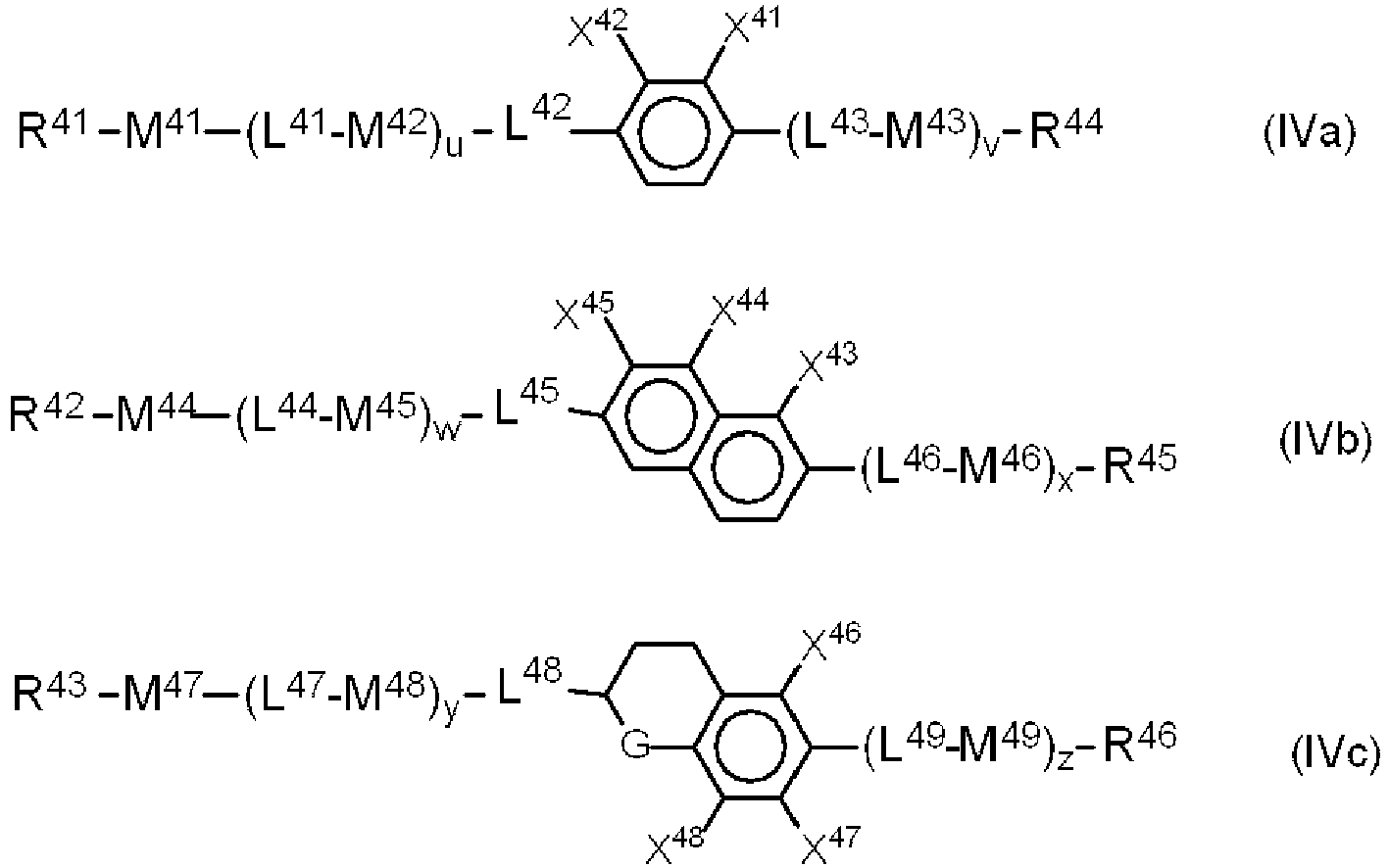 (worin R41, R42, R43, R44, R45 und R46 jeweils unabhängig voneinander eine Alkylgruppe mit 1 bis 10 Kohlenstoffatomen oder eine Alkenylgruppe mit 2 bis 10 Kohlenstoffatomen, wobei eine Methylengruppe oder zwei oder mehr Methylengruppen, die in diesen Gruppen nicht benachbart zueinander sind, durch -O- oder -S- ersetzt sein kann/können, darstellen, und mindestens ein Wasserstoffatom in diesen Gruppen kann durch ein Fluoratom oder ein Chloratom substituiert sein,M41, M42, M43, M44, M45, M46, M47, M48 und M49 stellen jeweils unabhängig voneinander eine Gruppe dar, ausgewählt aus:(d) einer trans-1,4-Cyclohexylengruppe (eine Methylengruppe oder zwei oder mehr Methylengruppen, die in dieser Gruppe nicht zueinander benachbart sind, kann/können durch -O- oder -S- ersetzt sein),(e) einer 1,4-Phenylengruppe (ein -CH= oder zwei oder mehr -CH=, die in dieser Gruppe nicht zueinander benachbart sind, kann/können durch ein Stickstoffatom ersetzt sein) und(f) einer 1,4-Cyclohexenylengruppe, einer 1,4-Bicyclo(2.2.2)-octylengruppe, einer Piperidin-2,5-diylgruppe, einer Naphthalin-2,6-diylgruppe, einer 1,2,3,4-Tetrahydronaphthalin-2,6-diylgruppe und einer Decahydronaphthalin-2,6-diylgruppe,ein Wasserstoffatom in der Gruppe (d), der Gruppe (e) oder den Gruppen (f) kann durch eine Cyanogruppe, ein Fluoratom, eine Trifluormethylgruppe, eine Trifluormethoxygruppe oder ein Chloratom substituiert sein,L41, L42, L43, L44, L45, L46, L47, L48 und L49 stellen jeweils unabhängig voneinander eine Einfachbindung, -COO-, -OCO-, -CH2CH2-, -(CH2)4-, -OCH2-, -CH2O-, -OCF2-, -CF2O- oder -C≡Cdar, wobei, wenn eine Mehrzahl von M42s, M43s, M45s, M46s, M48s,M49s, L49s, L43s, L44s, L46s, L47s und/oder L49s vorhanden sind, können diese gleich oder verschieden sein,X41 und X42 stellen jeweils unabhängig voneinander eine Trifluormethylgruppe, eine Trifluormethoxygruppe oder ein Fluoratom dar und X43, X44, X45, X46, X47 und X48 stellen jeweils unabhängig voneinander ein Wasserstoffatom, eine Trifluormethylgruppe, eine Trifluormethoxygruppe oder ein Fluoratom dar, aber mindestens eines von X41 und X42 stellt ein Fluoratom dar, mindestens eines von X43, X44 und X45 stellt ein Fluoratom dar und mindestens eines von X46, X47 und X48 stellt ein Fluoratom dar, wobei X46 und X47 nicht gleichzeitig Fluoratome und X46 und X48 nicht gleichzeitig Fluoratome darstellen,G stellt eine Methylengruppe oder -O- dar undu, v, w, x, y und z stellen jeweils unabhängig 0, 1 oder 2 dar, wobei u + v, w + x und y + z jeweils 2 oder weniger sind).
 - Flüssigkristallzusammensetzung gemäß Anspruch 1, wobei in der allgemeinen Formel (I), wenn Z11 -S12-R12 darstellt, mindestens eines von S11 und S21 eine Alkylengruppe mit 2 bis 12 Kohlenstoffatomen darstellt, wobei ein Kohlenstoffatom durch ein Sauerstoffatom, -COO-, -OCO- oder -OCOO- ersetzt sein kann, solange Sauerstoffatome nicht direkt miteinander verbunden sind.
- Flüssigkristallzusammensetzung gemäß Anspruch 1 oder 2, wobei die Flüssigkristallzusammensetzung in einem Flüssigkristallanzeigeelement verwendet wird, das eine Struktur aufweist, in der ein Flüssigkristall zwischen einem Paar von Substraten angeordnet ist, die mindestens eine transparente Elektrode und eine polarisierende Platte umfasst, und in welchem die Fähigkeit einer Flüssigkristallausrichtung durch Polymerisieren der polymerisierbaren Verbindung, die in der Flüssigkristallzusammensetzung enthalten ist, bereitgestellt wird.
- Flüssigkristallzusammensetzung gemäß einem der Ansprüche 1 bis 3, wobei die Flüssigkristallzusammensetzung 0,01 bis 2 Massen-% der Verbindung, ausgewählt aus der Verbindung, dargestellt durch die allgemeine Formel (I), 5 bis 70 Massen-% der Verbindung, ausgewählt aus der Verbindung der allgemeinen Formel (II), und 5 bis 70 Massen-% der Verbindung, ausgewählt aus der Gruppe, bestehend aus den Verbindungen der allgemeinen Formeln (IIIa), (IIIb) und (IIIc), oder der Verbindung, ausgewählt aus der Gruppe, bestehend aus den Verbindungen der allgemeinen Formeln (IVa), (IVb) und (IVc), enthält.
- Flüssigkristallzusammensetzung gemäß einem der Ansprüche 1 bis 4, wobei die Flüssigkristallzusammensetzung als dritte Komponente mindestens eine der Verbindungen, dargestellt durch die allgemeinen Formeln (IVa), (IVb) und (IVc), enthält.
- Flüssigkristallanzeigeelement, umfassend die Flüssigkristallzusammensetzung gemäß einem der Ansprüche 1 bis 5, wobei eine Fähigkeit einer Flüssigkristallausrichtung durch Polymerisieren der polymerisierbaren Verbindung, die in der Flüssigkristallzusammensetzung enthalten ist, bereitgestellt wird.
- Flüssigkristallanzeigeelement gemäß Anspruch 6, wobei die Flüssigkristallzusammensetzung eine negative dielektrische Anisotropie aufweist.
Applications Claiming Priority (2)
| Application Number | Priority Date | Filing Date | Title |
|---|---|---|---|
| JP2009097946 | 2009-04-14 | ||
| PCT/JP2010/056009 WO2010119779A1 (ja) | 2009-04-14 | 2010-04-01 | 重合性化合物を含有する液晶組成物及びそれを使用した液晶表示素子 |
Publications (3)
| Publication Number | Publication Date |
|---|---|
| EP2420548A1 EP2420548A1 (de) | 2012-02-22 |
| EP2420548A4 EP2420548A4 (de) | 2017-05-03 |
| EP2420548B1 true EP2420548B1 (de) | 2018-07-04 |
Family
ID=42982441
Family Applications (1)
| Application Number | Title | Priority Date | Filing Date |
|---|---|---|---|
| EP10764364.5A Active EP2420548B1 (de) | 2009-04-14 | 2010-04-01 | Flüssigkristallzusammensetzung mit einer polymerisierbaren verbindung und flüssigkristallanzeigeelement damit |
Country Status (7)
| Country | Link |
|---|---|
| US (1) | US8603358B2 (de) |
| EP (1) | EP2420548B1 (de) |
| JP (2) | JP4803320B2 (de) |
| KR (1) | KR101605038B1 (de) |
| CN (1) | CN102395651B (de) |
| TW (1) | TWI500742B (de) |
| WO (1) | WO2010119779A1 (de) |
Families Citing this family (48)
| Publication number | Priority date | Publication date | Assignee | Title |
|---|---|---|---|---|
| DE102008064171A1 (de) | 2008-12-22 | 2010-07-01 | Merck Patent Gmbh | Flüssigkristallines Medium |
| EP2420548B1 (de) * | 2009-04-14 | 2018-07-04 | DIC Corporation | Flüssigkristallzusammensetzung mit einer polymerisierbaren verbindung und flüssigkristallanzeigeelement damit |
| JP5545516B2 (ja) * | 2009-09-25 | 2014-07-09 | Dic株式会社 | 重合性化合物 |
| JP5720919B2 (ja) * | 2010-02-04 | 2015-05-20 | Dic株式会社 | 重合性化合物を含有する液晶組成物及びそれを使用した液晶表示素子 |
| CN102834487B (zh) * | 2010-04-22 | 2015-04-22 | 捷恩智株式会社 | 液晶组成物及液晶显示元件 |
| TWI560261B (en) * | 2010-05-28 | 2016-12-01 | Jnc Corp | Liquid crystal composition and liquid crystal display element |
| KR101808888B1 (ko) * | 2010-10-04 | 2017-12-13 | 제이엔씨 주식회사 | 액정 조성물 및 액정 표시 소자 |
| CN103459552B (zh) * | 2011-04-06 | 2015-02-25 | Dic株式会社 | 向列液晶组合物和使用其的液晶显示元件 |
| KR101978993B1 (ko) * | 2011-08-11 | 2019-08-28 | 디아이씨 가부시끼가이샤 | 중합성 화합물을 함유하는 액정 조성물 및 그것을 사용한 액정 표시 소자 |
| CN105623674A (zh) | 2011-09-27 | 2016-06-01 | Dic株式会社 | 向列液晶组合物和使用了该组合物的液晶显示元件 |
| WO2013077343A1 (ja) * | 2011-11-24 | 2013-05-30 | Jnc株式会社 | 重合性化合物 |
| US9073850B2 (en) | 2011-11-24 | 2015-07-07 | Jnc Corporation | Polymerizable compound |
| TW201323588A (zh) | 2011-12-05 | 2013-06-16 | Jnc Corp | 液晶組成物與其用途、及液晶顯示元件 |
| DE102012024126A1 (de) * | 2011-12-20 | 2013-06-20 | Merck Patent Gmbh | Flüssigkristallines Medium |
| JP5333694B1 (ja) * | 2012-03-30 | 2013-11-06 | Dic株式会社 | 液晶表示素子及びその製造方法 |
| TWI635164B (zh) * | 2012-04-24 | 2018-09-11 | 迪愛生股份有限公司 | Liquid crystal composition containing polymerizable compound and liquid crystal display element using same |
| US8961823B2 (en) * | 2012-07-05 | 2015-02-24 | Jnc Corporation | Polymerizable compound, liquid crystal composition and liquid crystal display device |
| US9150787B2 (en) * | 2012-07-06 | 2015-10-06 | Jnc Corporation | Liquid crystal composition and liquid crystal display device |
| CN102863968A (zh) * | 2012-09-21 | 2013-01-09 | 深圳市华星光电技术有限公司 | 液晶介质混合物及使用其的液晶显示器 |
| CN102863970A (zh) * | 2012-09-21 | 2013-01-09 | 深圳市华星光电技术有限公司 | 液晶介质混合物及使用其的液晶显示器 |
| KR101726603B1 (ko) * | 2012-10-24 | 2017-04-13 | 디아이씨 가부시끼가이샤 | 네마틱 액정 조성물 및 이것을 사용한 액정 표시 소자 |
| TWI721283B (zh) * | 2013-02-06 | 2021-03-11 | 日商迪愛生股份有限公司 | 液晶顯示元件及其製造方法 |
| WO2014148197A1 (ja) * | 2013-03-21 | 2014-09-25 | Dic株式会社 | 重合性化合物含有液晶組成物及びこれを使用した液晶表示素子 |
| JP5768942B2 (ja) * | 2013-03-21 | 2015-08-26 | Dic株式会社 | 重合性化合物含有液晶組成物及びそれを使用した液晶表示素子 |
| CN105518035B (zh) * | 2013-11-29 | 2017-05-03 | Dic株式会社 | 化合物、聚合物、液晶取向膜、液晶显示元件以及光学各向异性体 |
| CN105899644A (zh) * | 2014-01-06 | 2016-08-24 | Dic株式会社 | 向列液晶组合物及使用其的液晶显示元件 |
| US10752839B2 (en) * | 2014-01-30 | 2020-08-25 | University Of Hyogo | Photoreactive liquid crystal composition, display element, optical element, method for manufacturing display element, and method for manufacturing optical element |
| US10351772B2 (en) | 2014-05-13 | 2019-07-16 | Dic Corporation | Nematic liquid crystal composition and liquid crystal display element using same |
| EP3159393A4 (de) * | 2014-06-19 | 2018-01-24 | DIC Corporation | Flüssigkristallzusammensetzung mit einem polymerisierbaren monomer und flüssigkristallanzeigeelement damit |
| CN105992970A (zh) * | 2014-07-15 | 2016-10-05 | Dic株式会社 | 液晶显示装置 |
| WO2016017521A1 (ja) * | 2014-07-29 | 2016-02-04 | Dic株式会社 | 液晶表示素子 |
| TW201632608A (zh) * | 2014-12-12 | 2016-09-16 | Dainippon Ink & Chemicals | 液晶顯示元件及其製造方法 |
| TW201632609A (zh) * | 2014-12-12 | 2016-09-16 | Dainippon Ink & Chemicals | 液晶顯示元件及其製造方法 |
| WO2016104165A1 (ja) * | 2014-12-25 | 2016-06-30 | Dic株式会社 | ネマチック液晶組成物及びこれを用いた液晶表示素子 |
| KR102272215B1 (ko) * | 2015-01-13 | 2021-07-02 | 삼성디스플레이 주식회사 | 액정 조성물, 이를 포함하는 액정 표시 장치 및 그 제조 방법 |
| CN107434973B (zh) * | 2016-05-27 | 2023-01-10 | 江苏和成显示科技有限公司 | 液晶化合物及其组合物和应用 |
| CN109844066B (zh) * | 2016-12-06 | 2023-09-19 | 捷恩智株式会社 | 液晶复合体及其用途、液晶调光元件、调光窗及智能窗户 |
| CN108169960A (zh) * | 2016-12-07 | 2018-06-15 | 捷恩智株式会社 | 相位差膜及使用聚合性液晶组合物的液晶聚合膜类 |
| DE102018000075A1 (de) * | 2017-02-03 | 2018-08-09 | Merck Patent Gmbh | Flüssigkristalline Verbindungen |
| CN109575939A (zh) * | 2017-09-28 | 2019-04-05 | 江苏和成显示科技有限公司 | 液晶组合物及其液晶显示器件 |
| CN109575950B (zh) * | 2017-09-28 | 2021-07-06 | 江苏和成显示科技有限公司 | 聚合性液晶组合物及其显示器件 |
| CN108130102A (zh) * | 2017-12-28 | 2018-06-08 | 中节能万润股份有限公司 | 一种含侧向含氟单体液晶的制备方法 |
| TW202034045A (zh) * | 2018-10-02 | 2020-09-16 | 日商Dic股份有限公司 | 使用有配向助劑之液晶組成物及液晶顯示元件、以及其製造方法 |
| CN112789344B (zh) * | 2018-12-12 | 2024-12-03 | 石家庄诚志永华显示材料有限公司 | 含聚合性化合物的液晶组合物、及液晶显示元件以及聚合性化合物 |
| JP7472607B2 (ja) * | 2020-04-01 | 2024-04-23 | Dic株式会社 | 液晶組成物及び液晶表示素子 |
| JP7472606B2 (ja) * | 2020-04-01 | 2024-04-23 | Dic株式会社 | 液晶組成物及び液晶表示素子 |
| JP7811146B2 (ja) * | 2021-06-24 | 2026-02-04 | 石家庄▲誠▼志永▲華顕▼示材料有限公司 | 重合性化合物含有液晶組成物並びにこれを用いた液晶表示素子 |
| CN115785971A (zh) * | 2022-12-07 | 2023-03-14 | Tcl华星光电技术有限公司 | 液晶组合物及液晶显示面板 |
Family Cites Families (13)
| Publication number | Priority date | Publication date | Assignee | Title |
|---|---|---|---|---|
| US5056898A (en) | 1989-07-17 | 1991-10-15 | Polytronix, Inc. | Reverse mode microdroplet liquid crystal light shutter displays |
| US5223959A (en) | 1989-07-17 | 1993-06-29 | Polytronix, Inc. | Red, blue and green serial encapsulated liquid crystal display and driving method |
| AU6132796A (en) * | 1995-06-23 | 1997-01-22 | Zylepsis Limited | Chemical compounds and methods of production thereof |
| JP4355971B2 (ja) * | 1998-10-08 | 2009-11-04 | Dic株式会社 | ネマチック液晶組成物及びこれを用いた液晶表示装置 |
| JP4461497B2 (ja) | 1998-10-16 | 2010-05-12 | Dic株式会社 | ネマチック液晶組成物及びこれを用いた液晶表示装置 |
| JP4175826B2 (ja) | 2002-04-16 | 2008-11-05 | シャープ株式会社 | 液晶表示装置 |
| ATE354623T1 (de) | 2002-07-06 | 2007-03-15 | Merck Patent Gmbh | Flüssigkristallines medium |
| ATE334179T1 (de) | 2003-10-17 | 2006-08-15 | Merck Patent Gmbh | Polymerisierbare zimtsäurederivate mit einer seitlichen substitution |
| JP4437408B2 (ja) | 2004-02-04 | 2010-03-24 | 富士通株式会社 | 液晶表示装置およびその製造方法 |
| EP1911828B1 (de) | 2006-10-12 | 2010-09-01 | Merck Patent GmbH | Flüssigkristallanzeige |
| JP5143475B2 (ja) * | 2007-05-17 | 2013-02-13 | Dic株式会社 | ネマチック液晶組成物及びバイステイブルネマチック液晶表示素子 |
| EP2420548B1 (de) * | 2009-04-14 | 2018-07-04 | DIC Corporation | Flüssigkristallzusammensetzung mit einer polymerisierbaren verbindung und flüssigkristallanzeigeelement damit |
| JP5720919B2 (ja) * | 2010-02-04 | 2015-05-20 | Dic株式会社 | 重合性化合物を含有する液晶組成物及びそれを使用した液晶表示素子 |
-
2010
- 2010-04-01 EP EP10764364.5A patent/EP2420548B1/de active Active
- 2010-04-01 US US13/264,034 patent/US8603358B2/en active Active
- 2010-04-01 JP JP2010541623A patent/JP4803320B2/ja active Active
- 2010-04-01 WO PCT/JP2010/056009 patent/WO2010119779A1/ja not_active Ceased
- 2010-04-01 CN CN201080016504.2A patent/CN102395651B/zh active Active
- 2010-04-01 KR KR1020117020258A patent/KR101605038B1/ko active Active
- 2010-04-12 TW TW099111202A patent/TWI500742B/zh active
-
2011
- 2011-05-06 JP JP2011103538A patent/JP5640883B2/ja active Active
Non-Patent Citations (1)
| Title |
|---|
| None * |
Also Published As
| Publication number | Publication date |
|---|---|
| WO2010119779A1 (ja) | 2010-10-21 |
| KR101605038B1 (ko) | 2016-03-21 |
| JP5640883B2 (ja) | 2014-12-17 |
| CN102395651A (zh) | 2012-03-28 |
| JP4803320B2 (ja) | 2011-10-26 |
| CN102395651B (zh) | 2014-06-25 |
| US8603358B2 (en) | 2013-12-10 |
| JP2011202168A (ja) | 2011-10-13 |
| TWI500742B (zh) | 2015-09-21 |
| EP2420548A4 (de) | 2017-05-03 |
| KR20120013303A (ko) | 2012-02-14 |
| JPWO2010119779A1 (ja) | 2012-10-22 |
| US20120097895A1 (en) | 2012-04-26 |
| EP2420548A1 (de) | 2012-02-22 |
| TW201100525A (en) | 2011-01-01 |
Similar Documents
| Publication | Publication Date | Title |
|---|---|---|
| EP2420548B1 (de) | Flüssigkristallzusammensetzung mit einer polymerisierbaren verbindung und flüssigkristallanzeigeelement damit | |
| EP2743331B1 (de) | Flüssigkristallzusammensetzung mit einer polymerisierbaren verbindung und flüssigkristallanzeigeelement damit | |
| KR101717461B1 (ko) | 중합성 화합물을 함유하는 액정 조성물 및 그것을 사용한 액정 표시 소자 | |
| JP5573011B2 (ja) | 重合性化合物を含有する液晶組成物及びそれを使用した液晶表示素子 | |
| JP5743132B2 (ja) | 重合性化合物を含有する液晶組成物及びそれを使用した液晶表示素子 | |
| KR101643207B1 (ko) | 중합성 화합물 함유 액정 조성물 및 그를 사용한 액정 표시 소자 | |
| US9725651B2 (en) | Polymerizable compound-containing liquid crystal composition and liquid crystal display element using same | |
| JP5692565B2 (ja) | 重合性化合物を含有する液晶組成物及びそれを使用した液晶表示素子 | |
| EP2843027A1 (de) | Flüssigkristallzusammensetzung mit einer polymerisierbaren verbindung und flüssigkristallanzeigeelement damit | |
| JP5699518B2 (ja) | 重合性化合物を含有する液晶組成物及びそれを使用した液晶表示素子 | |
| JP5751466B2 (ja) | 重合性化合物含有液晶組成物及びそれを使用した液晶表示素子 | |
| JP5712552B2 (ja) | 重合性化合物含有液晶組成物及びそれを使用した液晶表示素子 |
Legal Events
| Date | Code | Title | Description |
|---|---|---|---|
| PUAI | Public reference made under article 153(3) epc to a published international application that has entered the european phase |
Free format text: ORIGINAL CODE: 0009012 |
|
| 17P | Request for examination filed |
Effective date: 20111110 |
|
| AK | Designated contracting states |
Kind code of ref document: A1 Designated state(s): AT BE BG CH CY CZ DE DK EE ES FI FR GB GR HR HU IE IS IT LI LT LU LV MC MK MT NL NO PL PT RO SE SI SK SM TR |
|
| DAX | Request for extension of the european patent (deleted) | ||
| RA4 | Supplementary search report drawn up and despatched (corrected) |
Effective date: 20170330 |
|
| RIC1 | Information provided on ipc code assigned before grant |
Ipc: C09K 19/30 20060101ALI20170325BHEP Ipc: C09K 19/16 20060101ALI20170325BHEP Ipc: C09K 19/24 20060101ALI20170325BHEP Ipc: G02F 1/139 20060101ALI20170325BHEP Ipc: G02F 1/13 20060101ALI20170325BHEP Ipc: C09K 19/34 20060101ALI20170325BHEP Ipc: C09K 19/32 20060101ALI20170325BHEP Ipc: C09K 19/04 20060101ALI20170325BHEP Ipc: G02F 1/1337 20060101ALI20170325BHEP Ipc: C09K 19/18 20060101ALI20170325BHEP Ipc: C09K 19/54 20060101AFI20170325BHEP Ipc: C09K 19/20 20060101ALI20170325BHEP Ipc: C09K 19/12 20060101ALI20170325BHEP Ipc: C09K 19/14 20060101ALI20170325BHEP |
|
| GRAP | Despatch of communication of intention to grant a patent |
Free format text: ORIGINAL CODE: EPIDOSNIGR1 |
|
| STAA | Information on the status of an ep patent application or granted ep patent |
Free format text: STATUS: GRANT OF PATENT IS INTENDED |
|
| INTG | Intention to grant announced |
Effective date: 20180202 |
|
| GRAS | Grant fee paid |
Free format text: ORIGINAL CODE: EPIDOSNIGR3 |
|
| GRAA | (expected) grant |
Free format text: ORIGINAL CODE: 0009210 |
|
| STAA | Information on the status of an ep patent application or granted ep patent |
Free format text: STATUS: THE PATENT HAS BEEN GRANTED |
|
| AK | Designated contracting states |
Kind code of ref document: B1 Designated state(s): AT BE BG CH CY CZ DE DK EE ES FI FR GB GR HR HU IE IS IT LI LT LU LV MC MK MT NL NO PL PT RO SE SI SK SM TR |
|
| REG | Reference to a national code |
Ref country code: GB Ref legal event code: FG4D |
|
| REG | Reference to a national code |
Ref country code: CH Ref legal event code: EP |
|
| REG | Reference to a national code |
Ref country code: AT Ref legal event code: REF Ref document number: 1014511 Country of ref document: AT Kind code of ref document: T Effective date: 20180715 |
|
| REG | Reference to a national code |
Ref country code: IE Ref legal event code: FG4D |
|
| REG | Reference to a national code |
Ref country code: DE Ref legal event code: R096 Ref document number: 602010051656 Country of ref document: DE |
|
| REG | Reference to a national code |
Ref country code: NL Ref legal event code: MP Effective date: 20180704 |
|
| REG | Reference to a national code |
Ref country code: LT Ref legal event code: MG4D |
|
| REG | Reference to a national code |
Ref country code: AT Ref legal event code: MK05 Ref document number: 1014511 Country of ref document: AT Kind code of ref document: T Effective date: 20180704 |
|
| PG25 | Lapsed in a contracting state [announced via postgrant information from national office to epo] |
Ref country code: NL Free format text: LAPSE BECAUSE OF FAILURE TO SUBMIT A TRANSLATION OF THE DESCRIPTION OR TO PAY THE FEE WITHIN THE PRESCRIBED TIME-LIMIT Effective date: 20180704 |
|
| PG25 | Lapsed in a contracting state [announced via postgrant information from national office to epo] |
Ref country code: NO Free format text: LAPSE BECAUSE OF FAILURE TO SUBMIT A TRANSLATION OF THE DESCRIPTION OR TO PAY THE FEE WITHIN THE PRESCRIBED TIME-LIMIT Effective date: 20181004 Ref country code: SE Free format text: LAPSE BECAUSE OF FAILURE TO SUBMIT A TRANSLATION OF THE DESCRIPTION OR TO PAY THE FEE WITHIN THE PRESCRIBED TIME-LIMIT Effective date: 20180704 Ref country code: AT Free format text: LAPSE BECAUSE OF FAILURE TO SUBMIT A TRANSLATION OF THE DESCRIPTION OR TO PAY THE FEE WITHIN THE PRESCRIBED TIME-LIMIT Effective date: 20180704 Ref country code: IS Free format text: LAPSE BECAUSE OF FAILURE TO SUBMIT A TRANSLATION OF THE DESCRIPTION OR TO PAY THE FEE WITHIN THE PRESCRIBED TIME-LIMIT Effective date: 20181104 Ref country code: GR Free format text: LAPSE BECAUSE OF FAILURE TO SUBMIT A TRANSLATION OF THE DESCRIPTION OR TO PAY THE FEE WITHIN THE PRESCRIBED TIME-LIMIT Effective date: 20181005 Ref country code: FI Free format text: LAPSE BECAUSE OF FAILURE TO SUBMIT A TRANSLATION OF THE DESCRIPTION OR TO PAY THE FEE WITHIN THE PRESCRIBED TIME-LIMIT Effective date: 20180704 Ref country code: CZ Free format text: LAPSE BECAUSE OF FAILURE TO SUBMIT A TRANSLATION OF THE DESCRIPTION OR TO PAY THE FEE WITHIN THE PRESCRIBED TIME-LIMIT Effective date: 20180704 Ref country code: PL Free format text: LAPSE BECAUSE OF FAILURE TO SUBMIT A TRANSLATION OF THE DESCRIPTION OR TO PAY THE FEE WITHIN THE PRESCRIBED TIME-LIMIT Effective date: 20180704 Ref country code: BG Free format text: LAPSE BECAUSE OF FAILURE TO SUBMIT A TRANSLATION OF THE DESCRIPTION OR TO PAY THE FEE WITHIN THE PRESCRIBED TIME-LIMIT Effective date: 20181004 Ref country code: LT Free format text: LAPSE BECAUSE OF FAILURE TO SUBMIT A TRANSLATION OF THE DESCRIPTION OR TO PAY THE FEE WITHIN THE PRESCRIBED TIME-LIMIT Effective date: 20180704 |
|
| PG25 | Lapsed in a contracting state [announced via postgrant information from national office to epo] |
Ref country code: ES Free format text: LAPSE BECAUSE OF FAILURE TO SUBMIT A TRANSLATION OF THE DESCRIPTION OR TO PAY THE FEE WITHIN THE PRESCRIBED TIME-LIMIT Effective date: 20180704 Ref country code: HR Free format text: LAPSE BECAUSE OF FAILURE TO SUBMIT A TRANSLATION OF THE DESCRIPTION OR TO PAY THE FEE WITHIN THE PRESCRIBED TIME-LIMIT Effective date: 20180704 Ref country code: LV Free format text: LAPSE BECAUSE OF FAILURE TO SUBMIT A TRANSLATION OF THE DESCRIPTION OR TO PAY THE FEE WITHIN THE PRESCRIBED TIME-LIMIT Effective date: 20180704 |
|
| REG | Reference to a national code |
Ref country code: DE Ref legal event code: R097 Ref document number: 602010051656 Country of ref document: DE |
|
| PG25 | Lapsed in a contracting state [announced via postgrant information from national office to epo] |
Ref country code: EE Free format text: LAPSE BECAUSE OF FAILURE TO SUBMIT A TRANSLATION OF THE DESCRIPTION OR TO PAY THE FEE WITHIN THE PRESCRIBED TIME-LIMIT Effective date: 20180704 Ref country code: RO Free format text: LAPSE BECAUSE OF FAILURE TO SUBMIT A TRANSLATION OF THE DESCRIPTION OR TO PAY THE FEE WITHIN THE PRESCRIBED TIME-LIMIT Effective date: 20180704 Ref country code: IT Free format text: LAPSE BECAUSE OF FAILURE TO SUBMIT A TRANSLATION OF THE DESCRIPTION OR TO PAY THE FEE WITHIN THE PRESCRIBED TIME-LIMIT Effective date: 20180704 |
|
| PLBE | No opposition filed within time limit |
Free format text: ORIGINAL CODE: 0009261 |
|
| STAA | Information on the status of an ep patent application or granted ep patent |
Free format text: STATUS: NO OPPOSITION FILED WITHIN TIME LIMIT |
|
| PG25 | Lapsed in a contracting state [announced via postgrant information from national office to epo] |
Ref country code: SK Free format text: LAPSE BECAUSE OF FAILURE TO SUBMIT A TRANSLATION OF THE DESCRIPTION OR TO PAY THE FEE WITHIN THE PRESCRIBED TIME-LIMIT Effective date: 20180704 Ref country code: SM Free format text: LAPSE BECAUSE OF FAILURE TO SUBMIT A TRANSLATION OF THE DESCRIPTION OR TO PAY THE FEE WITHIN THE PRESCRIBED TIME-LIMIT Effective date: 20180704 Ref country code: DK Free format text: LAPSE BECAUSE OF FAILURE TO SUBMIT A TRANSLATION OF THE DESCRIPTION OR TO PAY THE FEE WITHIN THE PRESCRIBED TIME-LIMIT Effective date: 20180704 |
|
| 26N | No opposition filed |
Effective date: 20190405 |
|
| PG25 | Lapsed in a contracting state [announced via postgrant information from national office to epo] |
Ref country code: SI Free format text: LAPSE BECAUSE OF FAILURE TO SUBMIT A TRANSLATION OF THE DESCRIPTION OR TO PAY THE FEE WITHIN THE PRESCRIBED TIME-LIMIT Effective date: 20180704 |
|
| REG | Reference to a national code |
Ref country code: CH Ref legal event code: PL |
|
| REG | Reference to a national code |
Ref country code: BE Ref legal event code: MM Effective date: 20190430 |
|
| GBPC | Gb: european patent ceased through non-payment of renewal fee |
Effective date: 20190401 |
|
| PG25 | Lapsed in a contracting state [announced via postgrant information from national office to epo] |
Ref country code: LU Free format text: LAPSE BECAUSE OF NON-PAYMENT OF DUE FEES Effective date: 20190401 Ref country code: MC Free format text: LAPSE BECAUSE OF FAILURE TO SUBMIT A TRANSLATION OF THE DESCRIPTION OR TO PAY THE FEE WITHIN THE PRESCRIBED TIME-LIMIT Effective date: 20180704 |
|
| PG25 | Lapsed in a contracting state [announced via postgrant information from national office to epo] |
Ref country code: CH Free format text: LAPSE BECAUSE OF NON-PAYMENT OF DUE FEES Effective date: 20190430 Ref country code: LI Free format text: LAPSE BECAUSE OF NON-PAYMENT OF DUE FEES Effective date: 20190430 Ref country code: GB Free format text: LAPSE BECAUSE OF NON-PAYMENT OF DUE FEES Effective date: 20190401 |
|
| PG25 | Lapsed in a contracting state [announced via postgrant information from national office to epo] |
Ref country code: FR Free format text: LAPSE BECAUSE OF NON-PAYMENT OF DUE FEES Effective date: 20190430 Ref country code: BE Free format text: LAPSE BECAUSE OF NON-PAYMENT OF DUE FEES Effective date: 20190430 |
|
| PG25 | Lapsed in a contracting state [announced via postgrant information from national office to epo] |
Ref country code: TR Free format text: LAPSE BECAUSE OF FAILURE TO SUBMIT A TRANSLATION OF THE DESCRIPTION OR TO PAY THE FEE WITHIN THE PRESCRIBED TIME-LIMIT Effective date: 20180704 |
|
| PG25 | Lapsed in a contracting state [announced via postgrant information from national office to epo] |
Ref country code: IE Free format text: LAPSE BECAUSE OF NON-PAYMENT OF DUE FEES Effective date: 20190401 |
|
| PG25 | Lapsed in a contracting state [announced via postgrant information from national office to epo] |
Ref country code: PT Free format text: LAPSE BECAUSE OF FAILURE TO SUBMIT A TRANSLATION OF THE DESCRIPTION OR TO PAY THE FEE WITHIN THE PRESCRIBED TIME-LIMIT Effective date: 20181105 |
|
| PG25 | Lapsed in a contracting state [announced via postgrant information from national office to epo] |
Ref country code: CY Free format text: LAPSE BECAUSE OF FAILURE TO SUBMIT A TRANSLATION OF THE DESCRIPTION OR TO PAY THE FEE WITHIN THE PRESCRIBED TIME-LIMIT Effective date: 20180704 |
|
| PG25 | Lapsed in a contracting state [announced via postgrant information from national office to epo] |
Ref country code: HU Free format text: LAPSE BECAUSE OF FAILURE TO SUBMIT A TRANSLATION OF THE DESCRIPTION OR TO PAY THE FEE WITHIN THE PRESCRIBED TIME-LIMIT; INVALID AB INITIO Effective date: 20100401 Ref country code: MT Free format text: LAPSE BECAUSE OF FAILURE TO SUBMIT A TRANSLATION OF THE DESCRIPTION OR TO PAY THE FEE WITHIN THE PRESCRIBED TIME-LIMIT Effective date: 20180704 |
|
| PG25 | Lapsed in a contracting state [announced via postgrant information from national office to epo] |
Ref country code: MK Free format text: LAPSE BECAUSE OF FAILURE TO SUBMIT A TRANSLATION OF THE DESCRIPTION OR TO PAY THE FEE WITHIN THE PRESCRIBED TIME-LIMIT Effective date: 20180704 |
|
| P01 | Opt-out of the competence of the unified patent court (upc) registered |
Effective date: 20230324 |
|
| REG | Reference to a national code |
Ref country code: DE Ref legal event code: R082 Ref document number: 602010051656 Country of ref document: DE Representative=s name: WEIDNER STERN JESCHKE PATENTANWAELTE PARTNERSC, DE Ref country code: DE Ref legal event code: R081 Ref document number: 602010051656 Country of ref document: DE Owner name: SHIJIAZHUANG CHENGZHI YONGHUA DISPLAY MATERIAL, CN Free format text: FORMER OWNER: DIC CORPORATION, TOKYO, JP |
|
| PGFP | Annual fee paid to national office [announced via postgrant information from national office to epo] |
Ref country code: DE Payment date: 20250320 Year of fee payment: 16 |