EP2422643A1 - Outil pour appliquer des cosmétiques - Google Patents
Outil pour appliquer des cosmétiques Download PDFInfo
- Publication number
- EP2422643A1 EP2422643A1 EP09843675A EP09843675A EP2422643A1 EP 2422643 A1 EP2422643 A1 EP 2422643A1 EP 09843675 A EP09843675 A EP 09843675A EP 09843675 A EP09843675 A EP 09843675A EP 2422643 A1 EP2422643 A1 EP 2422643A1
- Authority
- EP
- European Patent Office
- Prior art keywords
- brush
- fibers
- applicator
- section
- brush fibers
- Prior art date
- Legal status (The legal status is an assumption and is not a legal conclusion. Google has not performed a legal analysis and makes no representation as to the accuracy of the status listed.)
- Withdrawn
Links
Images




Classifications
-
- A—HUMAN NECESSITIES
- A45—HAND OR TRAVELLING ARTICLES
- A45D—HAIRDRESSING OR SHAVING EQUIPMENT; EQUIPMENT FOR COSMETICS OR COSMETIC TREATMENTS, e.g. FOR MANICURING OR PEDICURING
- A45D34/00—Containers or accessories specially adapted for handling liquid toiletry or cosmetic substances, e.g. perfumes
- A45D34/04—Appliances specially adapted for applying liquid, e.g. using roller or ball
- A45D34/042—Appliances specially adapted for applying liquid, e.g. using roller or ball using a brush or the like
- A45D34/045—Appliances specially adapted for applying liquid, e.g. using roller or ball using a brush or the like connected to the cap of the container
-
- A—HUMAN NECESSITIES
- A46—BRUSHWARE
- A46B—BRUSHES
- A46B15/00—Other brushes; Brushes with additional arrangements
- A46B15/0055—Brushes combined with other articles normally separate from the brushing process, e.g. combs, razors, mirrors
- A46B15/0061—Brushes combined with other articles normally separate from the brushing process, e.g. combs, razors, mirrors with a container for accessories, e.g. pills, polish, condoms, cells
-
- A—HUMAN NECESSITIES
- A46—BRUSHWARE
- A46B—BRUSHES
- A46B3/00—Brushes characterised by the way in which the bristles are fixed or joined in or on the brush body or carrier
- A46B3/005—Bristle carriers and bristles moulded as a unit
-
- A—HUMAN NECESSITIES
- A46—BRUSHWARE
- A46B—BRUSHES
- A46B5/00—Brush bodies; Handles integral with brushware
- A46B5/0095—Removable or interchangeable brush heads
-
- A—HUMAN NECESSITIES
- A46—BRUSHWARE
- A46B—BRUSHES
- A46B9/00—Arrangements of the bristles in the brush body
- A46B9/02—Position or arrangement of bristles in relation to surface of the brush body, e.g. inclined, in rows, in groups
- A46B9/021—Position or arrangement of bristles in relation to surface of the brush body, e.g. inclined, in rows, in groups arranged like in cosmetics brushes, e.g. mascara, nail polish, eye shadow
-
- A—HUMAN NECESSITIES
- A46—BRUSHWARE
- A46B—BRUSHES
- A46B2200/00—Brushes characterized by their functions, uses or applications
- A46B2200/10—For human or animal care
- A46B2200/1046—Brush used for applying cosmetics
Definitions
- This invention relates to a cosmetic applicator suitable for applying such liquid cosmetics as lip gloss, liquid rouge, eye liner, and enamel. More particularly, the invention relates to a cosmetic applicator equipped with a brush section which is integrally formed at the leading end of the shaft of the applicator and has a multiplicity of integrally molded plastic fibers.
- Patent Document 1 listed below discloses a lip gloss applicator equipped with a brush section having very thin plastic fibers called bristles which are integrally bundled together and then securely swaged to the applicator shaft by means of a metal piece.
- Patent Documents 2 and 3 disclose cosmetic applicators for applying liquid cosmetic such as enamel, which has a multiplicity of integrally molded plastic brush fibers at the leading end of the applicator shaft.
- PATENT DOCUMENT 1 JPA LAID OPEN 2003-169713
- PATENT DOCUMENT 2 JUM LAID OPEN H6-13714
- PATENT DOCUMENT 3 JPA LAID OPEN 2004-196371
- Patent Document 1 has a problem (referred to as first problem), however, in that it is costly due to the fact that it requires multiple steps for fabricating brush fibers and integrating them to a bundle.
- Patent Documents 2 and 3 can be advantageously molded integral with the applicator shafts from cheap materials in fewer steps.
- the prior art concerns cosmetic applicators for applying enamel to nails, so that their brush fibers require certain stiffness and must be made of a relatively hard plastic resin.
- the brush fibers of these applicators are too stiff and thick for use with lip gloss, and unfortunately they have rectangular or triangular transverse cross sections and angulated tips. As a consequence, they may hurt lips when used to apply lip gloss. This is a second problem pertinent to the prior art applicators.
- the inventors of the present invention are motivated to provide a cosmetic applicator having a brush section that can be manufactured from a relatively cheap soft plastic resin in a fewer steps, and can be securely fixed to the leading end of a relatively hard resin applicator shaft, thereby providing a handleable yet tender cosmetic applicator, non-hurtful to lips.
- this applicator can solve the first problem.
- the brush of the inventive cosmetic applicator can be made of a much thinner tapered plastic resin fibers than those of the Patent Documents 2 and 3, with their transverse cross sections and tips rounded to prevent lip injury (second problem).
- the inventors of the present invention made trial products and has verified in repeated tests that the inventive cosmetic applicator has overcome the first and second problems mentioned above.
- the applicator In the process of developing a new type of cosmetic applicators (especially brush sections) the inventors encountered a new problem though, as described below. That is, the applicator has a certain disadvantage in a case where the brush fibers of the brush have the same thickness even if they are relatively soft. If the brush fibers are too thick, the brush section as a whole becomes too stiff, which is convenient for lip gloss application, but can hurt lips. On the other hand, if the brush fibers are too thin, the brush section as a whole becomes too soft, which can prevent lip injury but creates a third problem that the applicator is difficult to use as a lip gloss applicator.
- the inventors made trial products and has verified through tests that in fact this configuration can overcome the third problem.
- a cosmetic applicator having a brush section connected to the leading end of the applicator shaft, the brush section having plastic brush fibers each having a round cross section and a rounded tip, so that the brush will not hurt the facial skin of a user. It is another object of the invention to provide a convenient cosmetic applicator for applying a liquid cosmetic, the applicator having a brush consisting of thick brush fibers mixed with thin brush fibers such that the brush has a sufficient stiffness needed for a liquid cosmetic applicator but has a sufficient softness not to hurt facial skin.
- a cosmetic applicator as defined in claim 1, having:
- the applicator shaft is preferably made of a fairly hard plastic resin from the point of handleability of the applicator.
- the fibers of the brush for applying a cosmetic to facial skin are preferably made of a relatively soft plastic resin not to hurt the facial skin of the user.
- the applicator shaft is preferably selected from a first group of relatively hard plastic resins including, for example, polypropylene, PBT, POM, or a little harder PA (nylon), while the brush fibers are preferably selected from a second group of relatively softer plastic resins including, for example, polyethylene, a little softer PA, PET, and elastomers.
- each of the soft brush fibers is preferably thin and tapered and has a round cross section and a rounded tip, so that the brush will not hurt the lips or facial skin of the user.
- the second of the prior art problems is solved by the present invention. It should be noted that although the brush fibers are made of a relatively soft plastic resin, the handleablity of the applicator is not lost due to the fact that the applicator shaft is made of a rather hard plastic resin.
- the brush of claim 1 may include thick brush fibers and thin brush fibers mixed together, as defined in claim 2.
- Thin brush fibers have poor handleability for cosmetic application in that they are too soft to draw in outline. But they will not hurt lips nor facial skin.
- thick fibers are stiff and convenient to draw in outline with cosmetic, though they can hurt lips and facial skin.
- the stiffness of the brush as a whole can be varied.
- the stiffness of the entire brush can be optimized for desired handleability and softness of applicator not to hurt lips and facial skin. In this way the third problem is solved.
- the applicator of claim 2 may be configured such that the thick and thin brush fibers are distributed at a substantially uniform density, as defined in claim 3.
- the applicator of claim 2 may be configured such that thin brush fibers are arranged in an inner area of the brush and the thick brush fibers in an outer area surrounding the thinner fibers, as defined in claim 4.
- the cosmetic applicator of claim 2 may be configured such that the thick brush fibers are arranged in an inner area of the brush and the thin brush fibers in an outer area surrounding the thinner fibers, as defined in claim 5.
- the outer portion of the brush consists of soft (or thinner) fibers, mainly soft outer portion of the brush touches lips and facial skin while applying a cosmetic.
- the brush of a cosmetic applicator in accordance with claim 1 of the invention can be manufactured from a cheap material in a simple process.
- the brush fibers are not only made thin and tapered but also made to have a round cross section and a rounded tip, the brush will not hurt lips nor facial skin of a user.
- the applicator by providing the applicator with a shaft made of a relatively hard plastic resin, the applicator is made handeable for smooth application of a cosmetic.
- the proportion of the thick brush fibers to thin brush fibers can be altered to vary the stiffness of the brush so that the applicator has both preferred stiffness and softness that meets varied needs of cosmetics users.
- the stiffness and softness of the brush can be optimized to obtain a handleable and tender applicator.
- the brush can properly deform to follow the facial configuration without bending excessively, so that the applicator is easy to draw in outline with a cosmetic.
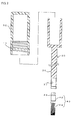
- Fig. 1 is a longitudinal cross sectional view of a cosmetic applicator, in particular a lip gloss applicator, in accordance with a first embodiment of the invention.
- Fig. 2 is an exploded cross sectional view of a main portion of the lip gloss applicator.
- Fig. 3 is a side view of a main section of the lip gloss applicator, in particular the brush section.
- Fig. 4 is an enlarged bottom view of the brush section of the lip gloss applicator (viewed from the tip end of the brush).
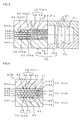
- Fig. 5 is a longitudinal cross sectional view of a mold for injection molding the brush section.
- Fig. 1 is a longitudinal cross sectional view of a cosmetic applicator, in particular a lip gloss applicator, in accordance with a first embodiment of the invention.
- Fig. 2 is an exploded cross sectional view of a main portion of the lip gloss applicator.
- Fig. 3 is a side view of a main section of the lip gloss applicator, in particular
- FIG. 6 is a cross sectional view of a split type mold (moveable mold) for molding the brush fibers of a brush section, taken along Line VI-VI of Fig. 5 .
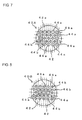
- Fig. 7 is an enlarged bottom view of a main section of a lip gloss applicator, in particular the brush section, in accordance with a second embodiment of the invention (viewed from the tip end of the brush).
- Fig. 8 is an enlarged bottom view of a main section, in particular the brush section, of a lip gloss applicator in accordance with a third embodiment of the invention (viewed from the tip end of the brush).
- Fig. 7 is an enlarged bottom view of a main section of a lip gloss applicator, in particular the brush section, in accordance with a second embodiment of the invention (viewed from the tip end of the brush).
- Fig. 8 is an enlarged bottom view of a main section, in particular the brush section, of a lip gloss applicator in accordance with a third embodiment of the invention (viewed from the tip
- FIG. 9 is an enlarged bottom view of a main section, in particular the brush section, of a lip gloss applicator in accordance with a fourth embodiment of the invention (viewed from the tip end of the brush).
- Fig. 10 is an enlarged bottom view of a main section, in particular the brush section, of a lip gloss applicator in accordance with a fifth embodiment of the invention (viewed from the tip end of the brush).
- Fig. 11 is an enlarged bottom view of a main section, in particular the brush section, of a lip gloss applicator in accordance with a sixth embodiment of the invention (viewed from the tip end of the brush).
- Fig. 10 is an enlarged bottom view of a main section, in particular the brush section, of a lip gloss applicator in accordance with a fifth embodiment of the invention (viewed from the tip end of the brush).
- Fig. 11 is an enlarged bottom view of a main section, in particular the brush section, of a lip gloss applicator in accordance with a sixth embodiment of the invention (viewed
- Fig. 12 is an enlarged bottom view of a main section, in particular the brush section, of a lip gloss applicator in accordance with a seventh embodiment of the invention (viewed from the tip end of the brush).
- Fig. 13 is an enlarged bottom view of a main section, in particular the brush section, of a lip gloss applicator in accordance with a eighth embodiment of the invention (viewed from the tip end of the brush).
- Figs. 1 through 6 shows a first embodiment of the invention. More particularly, Fig. 1 is a longitudinal cross sectional view of a cosmetic applicator, in particular a lip gloss applicator, in accordance with a first embodiment of the invention; Fig. 2 is an exploded cross sectional view of a main portion of the lip gloss applicator; Fig. 3 is a side view of a main section of the lip gloss applicator, in particular the brush section; Fig. 4 is an enlarged bottom view of the brush section of the lip gloss applicator (viewed from the tip end of the brush) ; Fig. 5 is a longitudinal cross sectional view of a mold for injection molding the brush section; and Fig. 6 is a cross sectional view of a split type mold (moveable mold) for molding the brush fibers of the brush section, taken along Line VI-VI of Fig. 5 .
- reference numeral 10 indicates an elongate cylindrical container for containing therein liquid lip gloss L.
- a mouth piece 12 for receiving therein an applicator shaft having an outer diameter smaller than the inner diameter of the container 10.
- a male thread 13 is formed on the outer periphery of the mouth piece 12 for engagement with the female thread 33 formed in the rear end of the shaft 30.
- the shaft 30 is made of polypropylene.
- the stem portion 36 of the shaft 30 is provided at the leading end thereof with a bore 37 which is open in the forward direction.
- a brush section 40 made of polyethylene is integrally fitted in this hole 37.
- the brush section 40 is injection molded to form a substantially cylindrical base 42 and a multiplicity of parallel thin brush fibers 44 (the brush fibers collectively referred to as brush) which are integral with the base 42 and extend forward from the front end 42a of the base 42.
- the stem portion 36 of the shaft 30 is swaged with dowels 38 at multiple circumferential positions near the leading end of the stem 36 so as to securely fix the base 42 to the shaft 30.
- the helve or the shaft 30 of the applicator is made of a fairly hard plastic resin (polypropylene for example), while the brush 44 of the brush section 40 is made of a fairly soft plastic resin (polyethylene for example) so as not to hurt lips.
- reference numeral 43 indicates an annular recess formed in the outer circumference of the base 42, which is designed to engage with the annular protrusion 52 formed on the inner circumferential surface of the cavity C1 of the mold 50A for forming the brush section, as will be described in detail later.
- the annular recess 43 keeps the base 42 of the brush section 40 in the cavity C1, thereby facilitating removal of the brush 44 from (the cavity C2 of) the moveable mold 50B after injection molding is completed.
- Reference numeral 14 indicates a cylindrical middle inner plug made of a resilient plastic resin and securely fitted to the open end 12 of the container 10. Formed near the lower end of the middle inner plug 14 is a wiper 15 that protrudes from the inner surface of the middle inner plug 14 for scraping off superfluous liquid gloss adhering to the stem portion 36 of the shaft 30 or brush 44 as the shaft 30 is withdrawn from the container 10.
- the brush 44 of the brush section 40 consists of 27 brush fibers (11 mm in length) spaced apart at substantially equal distance, each brush fiber having a circular transverse cross section and rounded tip, and being tapered (with the outer diameter being 0.4 mm at the root thereof, 0.2 mm at the tip).
- Each of the brush fibers extending from the forefront face 42a of the base 42 has a total length of 9 mm and outer diameter of 3.4 mm. They are arranged in five rows on the face 42a and spaced apart at equal intervals in the vertical direction (with the pitch of 0.5 mm for example) and in the horizontal direction (with the pitch of 0.7 mm for example), as shown in Figs. 3 and 4 .
- the second and fourth rows of six brush fibers are offset from the first, third, and fifth horizontal rows of five brush fibers in the horizontal direction by a half pitch (0.35 mm).
- the brush fibers of the brush 44 are not only made of thin fibers but also tapered and have round cross sections and rounded tips, that they will not hurt the lips or facial skin of the user.
- a split-type mold is provided for molding the brush 44 as shown in Figs. 5 and 6 .
- a mold for injection molding the brush section 40 which comprises a fixed mold 50A and a moveable mold 50B that can be slid in one linear direction (left-right direction for example) with respect to the fixed mold 50A.
- the fixed mold 50A is provided with one cylindrical cavity C1 for molding the base 42 of the brush section 40, while the moveable mold 50B is provided with 27 elongate cavities C2 for injection molding the brush 44. These cavities are spaced apart at substantially equal distances and communicates with the cavity C1.
- the fixed mold 50A is provided with a resin injection port 51 for receiving a melt resin. In molding the brush, the fixed mold 50A and moveable mold 50B are clamped together when the melt resin is injected into the port 51 as shown in Fig. 4 by an arrow, until the melt resin fills up in the cavities C1 and C2.
- Reference symbol PL shown in Fig. 5 indicates the parting line of the molds 50A and 50B.
- the moveable mold 50B is separated from the fixed mold 50A and the brush 44 is separated from the cavity C2 of the moveable mold 50B. Since the annular recess 43 of the base 42 thus molded is securely held in engagement with the annular protrusion 52 formed in the inner circumferential surface of the cavity C1, the base 42 of the brush 44 is firmly held in the fixed mold 50A when the molds are separated, thereby infallibly separating the molded brush 44 from the moveable mold 50B (cavity C2). Then, the base 42 of the brush section 40 is separated from the fixed mold 50A by forcing push pins (not shown) provided on the fixed mold 50A towards the open end of the fixed mold 50A (to the left in Fig. 5 ).
- the moveable mold 50B comprises six stacking split molds 54A-54F, as shown in Figs. 5 and 6 .
- the split molds 54A and 54B together form the uppermost first row of five cavities C21 for molding five brush fibers of the brush 44
- the split molds 54B and 54C together form the second row of six cavities C22 for six brush fibers
- the split molds 54C and 54D the third row of five cavities C23 for five brush fibers
- the split molds 54D and 54E the fourth row of six cavities C24 for six brush fibers
- the split molds 54E and 54F the fifth row of five cavities C25 for five brush fibers.
- FIG. 7 through 13 there is shown a second through sixth embodiments of the invention, in which thick brush fibers and thin brush fibers coexist in the brush.
- Fig. 7 there is shown in enlarged bottom view (as seen from the tip end of the brush) a main portion of a lip gloss applicator in accordance with a third embodiment of the invention defined in claim 4.
- the brush of the brush section 40A has thin brush fibers 44b in an inner region of the brush, surrounded by thick brush fibers 44a in the outer region of the brush.
- each of the thin brush fibers 44b has a round cross section and a rounded tip, and is tapered (with the outer diameter being 0. 4 mm at the root thereof and 0.2 mm at the tip end, which is 11 mm from the root).
- Each of the thick brush fibers 44a also has a round cross section and a rounded tip, and is tapered (with its outer diameter being 0.5 mm at the root thereof, 0.3 mm at the tip end, which is 11 mm from the root).
- the brush 44 of the brush section 40A consists of stiff thick brush fibers 44a arranged in the outer area of the brush to provide adequate flexibility and prevent excessive deformation of the brush in applying lip gloss when the brush is pressed onto a facial section.
- the brush is convenient for drawing in outline with lip gloss.
- FIG. 8 there is shown in enlarged bottom view (as seen from the tip ends of the brush) a main section of a lip gloss applicator in accordance with a third embodiment of the invention as defined in claim 5.
- the brush of the brush section 40B has outer thin brush fibers 44b surrounding inner thick brush fibers 44a.
- the rest of the features of the third embodiment are the same as in the first embodiment, and further description will be omitted by identifying like components by like reference numerals in both embodiments.
- the outer portion of the brush is made of soft thin fibers 44b, mainly the outer soft brush fibers 44b touch lips without hurting them.
- FIGs. 9 and 10 there is shown in enlarged bottom view (as seen from the tip ends of the brush) a maim portion of a lip gloss applicator in accordance with a fourth and a fifth embodiment of the invention.
- the brush sections comprise vertically arranged 5 rows of horizontal arrays of brush fibers.
- thick brush fibers 44a are disposed in the first, third, and fifth rows (ordered from above), while thin brush fibers 44b are disposed in the second and fourth rows, that is, in the rows interlacing the rows of thick brush fibers 44a.
- stiff thick brush fibers 44a are disposed along the longer sides (or uppermost and lowermost rows) of the brush.
- thin brush fibers are disposed in the first, third, and fifth rows, while thick brush fibers are disposed in the second and fourth rows, that is, between the rows of thin brush fibers.
- soft thin brush fibers 44b are disposed along the longer sides (or uppermost and lowermost rows) of the brush.
- thick brush fibers 44a are arranged between the second and fourth rows of soft brush fibers, they prevent the leading end of the brush section 40D from being deformed excessively, and facilitates easy drawing of an outline and smooth application of lip gloss.
- a lip gloss applicator in accordance with a sixth embodiment of the invention as defined in claim 3.
- the applicator has a brush consisting of twenty seven brush fibers disposed in vertically arranged five rows.
- the brush includes fifteen thick brush fibers 44a and twelve thin brush fibers 44b in alternating order in each row as shown in Fig. 11 .
- stiff brush fibers 44a and soft brush fibers 44b are distributed at a substantially uniform density.
- the brush of the brush section 40E has an optimum stiffness and softness of a lip gloss applicator, not too soft to handle the applicator and not too stiff for lips.
- Figs. 12 and 13 there are shown in enlarged bottom view (as seen from the tip ends of the respective brush sections) main portions of a seventh and an eighth lip gloss applicator in accordance with a seventh and eighth embodiments of the invention.
- the brush section 40F of the seventh embodiment shown in Fig. 12 differs from the brush section 40A of the second embodiment shown in Fig. 6 in that thick brush fibers 44c of the seventh embodiment have an elliptic transverse cross section, in contrast to the thick brush fibers 44a of the second embodiment having a round cross section.
- the brush section 40G of the eighth embodiment shown in Fig. 13 differs from the brush section 40C of the third embodiment shown in Fig. 7 in that thick brush fibers 44a of the eighth embodiment have an elliptic transverse cross section in contrast to the thick brush fibers 44c of the third embodiment having a round cross section.
- the rest of the features are the same as in the second and third embodiments, and further description will be omitted by identifying like components by like reference numerals in all of these embodiments.
- the applicators of the second and third embodiments have the same flexibility in all directions due to the fact that their thick brush fibers 44a have a round transverse cross section as shown in Figs. 7 and 8 .
- the brushes of the brush sections 40A and 40B shown in Figs. 7 and 8 have substantially the same stiffness in all directions.
- the brush fibers of the brush sections 40F and 40G of the seventh and eighth embodiments, respectively have elliptic cross sections, their flexibility depend on the direction in which they are moved.
- the brush fibers having elliptic cross sections have a larger flexibility (or less stiffness) in the vertical direction (perpendicular to the longer sides of the brush) in Figs. 12 and 13 than any other direction, and so are the brush sections 40F and 40G. Accordingly, the brush sections 40F and 40G may be conveniently used in accordance with the intended use. For example, the they can be moved in the horizontal direction (as seen in Figs. 12 and 13 ) to draw in outline, and moved in the vertical direction to apply cosmetic uniformly over a wide area.
- the seventh embodiment shown in Fig. 12 has the same handleability as the second embodiment, that is, it can easily draw in outline and smoothly apply lip gloss, since the brush section can be deformed only moderately along the facial configuration but not excessively. This is due to the fact that the brush section has thin brush fibers 44b surrounded by thick brush fibers 44c having an elliptic cross section.
- thin brush fibers 44b are arranged in an outer area of the brush surrounding thick brush fibers 44c having an elliptic cross section.
- the soft brush fibers 44b touch lips without hurting them, as in the third embodiment shown in Fig. 8 .
- the shaft 30 is made of polypropylene and the brush section 40 is made of polyethylene
- the shaft may be made of another plastic resin having a certain hardness (such as PBT, POM, and a relatively hard PA)
- the brush section 40 may be made of another plastic resin having a certain softness (for example PET, fairly soft PA, and elastomers).
- the base 42 of a brush section 40 is swaged near the leading end of the shaft 30 with dowels.
- the base 42 can be secured using solder, glue, or any other known means.
- the invention can be applied to a wide range of cosmetic applicators for safely applying a liquid cosmetic such as lip gloss, lip rouge, eye liner and enamel to a vulnerable facial skin including lips.
Landscapes
- Brushes (AREA)
Applications Claiming Priority (2)
| Application Number | Priority Date | Filing Date | Title |
|---|---|---|---|
| JP2009106740A JP2010253045A (ja) | 2009-04-24 | 2009-04-24 | 化粧料塗布具 |
| PCT/JP2009/060238 WO2010122681A1 (fr) | 2009-04-24 | 2009-06-04 | Outil pour appliquer des cosmétiques |
Publications (2)
| Publication Number | Publication Date |
|---|---|
| EP2422643A1 true EP2422643A1 (fr) | 2012-02-29 |
| EP2422643A4 EP2422643A4 (fr) | 2012-12-26 |
Family
ID=43010813
Family Applications (1)
| Application Number | Title | Priority Date | Filing Date |
|---|---|---|---|
| EP09843675A Withdrawn EP2422643A4 (fr) | 2009-04-24 | 2009-06-04 | Outil pour appliquer des cosmétiques |
Country Status (4)
| Country | Link |
|---|---|
| US (1) | US20120011674A1 (fr) |
| EP (1) | EP2422643A4 (fr) |
| JP (1) | JP2010253045A (fr) |
| WO (1) | WO2010122681A1 (fr) |
Cited By (3)
| Publication number | Priority date | Publication date | Assignee | Title |
|---|---|---|---|---|
| WO2012104357A1 (fr) * | 2011-02-02 | 2012-08-09 | Geka Gmbh | Pinceau doseur pour application locale ciblée |
| USD771956S1 (en) * | 2015-02-20 | 2016-11-22 | Geka Gmbh | Dosing brush for local application |
| USD774310S1 (en) * | 2014-04-30 | 2016-12-20 | Geka Gmbh | Applicator brush |
Families Citing this family (13)
| Publication number | Priority date | Publication date | Assignee | Title |
|---|---|---|---|---|
| KR100939239B1 (ko) * | 2008-01-23 | 2010-01-29 | (주)알엔디지케이알 | 화장용 솔 |
| JP5667543B2 (ja) | 2011-09-30 | 2015-02-12 | Dowaメタルテック株式会社 | 銀めっき材およびその製造方法 |
| JP2013116195A (ja) * | 2011-12-02 | 2013-06-13 | Tokyo Parts Kk | 液塗布具 |
| JP6193687B2 (ja) | 2012-09-27 | 2017-09-06 | Dowaメタルテック株式会社 | 銀めっき材およびその製造方法 |
| WO2014090325A1 (fr) * | 2012-12-14 | 2014-06-19 | Henkel Ag & Co. Kgaa | Outil d'application |
| USD717496S1 (en) * | 2013-04-04 | 2014-11-11 | Parfums Christian Dior, S.A. | Lipstick case |
| KR101736322B1 (ko) * | 2016-07-04 | 2017-05-16 | 주식회사 리치코스 | 액상화장품 용기 |
| US20200046108A1 (en) * | 2018-08-11 | 2020-02-13 | Dana Bellah | Detachable nail brush apparatus |
| KR20210109581A (ko) * | 2018-12-31 | 2021-09-06 | 게카 게엠베하 | 자성 화장품 어플리케이터 |
| CN110000856A (zh) * | 2019-04-15 | 2019-07-12 | 徐旭辉 | 一种油画笔笔毛加工成型模具及方法 |
| DE202021001993U1 (de) * | 2021-06-08 | 2022-09-09 | Schwan Cosmetics International GmbH | Gerät zum Auftragen einer flüssigen, pastösen und/oder pulverförmigen Substanz und Halteeinrichtung davon |
| JP7410590B1 (ja) | 2022-08-29 | 2024-01-10 | 一昭 山下 | 化粧ブラシ |
| US20240215708A1 (en) * | 2022-12-30 | 2024-07-04 | Kao Corporation | Brush head for facial skin cleaning |
Family Cites Families (13)
| Publication number | Priority date | Publication date | Assignee | Title |
|---|---|---|---|---|
| US1649052A (en) * | 1927-11-15 | Hillel zimmet | ||
| US2783490A (en) * | 1950-04-01 | 1957-03-05 | Louis F Kutik | Brush |
| US4712936A (en) * | 1981-06-26 | 1987-12-15 | Milton Kessler | One-piece cap and brush and method of forming it |
| GB2159699B (en) * | 1984-05-23 | 1988-06-02 | Rodney David Cole | An applicator for the application of cosmetic products |
| FR2687055B1 (fr) * | 1992-02-11 | 1994-04-29 | Oreal | Pinceau pour l'application de vernis a ongles, ou de produit similaire. |
| JP3467451B2 (ja) * | 1999-06-25 | 2003-11-17 | 株式会社呉竹 | 毛 束 |
| IE20000110A1 (en) * | 2000-02-07 | 2001-08-22 | Loctite R & D Ltd | Applicator, Applicator Cap and a Container Having an Applicator Cap |
| DE10033256A1 (de) * | 2000-07-10 | 2002-01-24 | Coronet Werke Gmbh | Verfahren und Vorrichtung zur Herstellung von Borstenwaren sowie Borstenware |
| JP2004196371A (ja) * | 2002-12-19 | 2004-07-15 | Shiseido Co Ltd | 筆一体式塗布具 |
| JP4993239B2 (ja) * | 2003-12-19 | 2012-08-08 | 株式会社吉野工業所 | 化粧品容器 |
| JP2006015211A (ja) * | 2004-06-30 | 2006-01-19 | Pentel Corp | 塗布具 |
| FR2917276B1 (fr) * | 2007-06-15 | 2012-07-27 | Cinqpats | Dispositif et conditionnement de brossage et de peignage de precision, ainsi que procede et outillage d'obtention |
| JP3135131U (ja) * | 2007-06-22 | 2007-09-06 | 洽興塑膠厰股▲分▼有限公司 | マスカラブラシの改良構造 |
-
2009
- 2009-04-24 JP JP2009106740A patent/JP2010253045A/ja active Pending
- 2009-06-04 US US13/259,243 patent/US20120011674A1/en not_active Abandoned
- 2009-06-04 EP EP09843675A patent/EP2422643A4/fr not_active Withdrawn
- 2009-06-04 WO PCT/JP2009/060238 patent/WO2010122681A1/fr not_active Ceased
Cited By (3)
| Publication number | Priority date | Publication date | Assignee | Title |
|---|---|---|---|---|
| WO2012104357A1 (fr) * | 2011-02-02 | 2012-08-09 | Geka Gmbh | Pinceau doseur pour application locale ciblée |
| USD774310S1 (en) * | 2014-04-30 | 2016-12-20 | Geka Gmbh | Applicator brush |
| USD771956S1 (en) * | 2015-02-20 | 2016-11-22 | Geka Gmbh | Dosing brush for local application |
Also Published As
| Publication number | Publication date |
|---|---|
| WO2010122681A1 (fr) | 2010-10-28 |
| US20120011674A1 (en) | 2012-01-19 |
| JP2010253045A (ja) | 2010-11-11 |
| EP2422643A4 (fr) | 2012-12-26 |
Similar Documents
| Publication | Publication Date | Title |
|---|---|---|
| US20120011674A1 (en) | Cosmetic applicator | |
| US11622617B2 (en) | Method for producing brushes, in particular interdental brushes, and brush, in particular interdental brush, and product group comprising a plurality of brushes | |
| US7581546B2 (en) | Brush for applying cosmetic substances | |
| US8151807B2 (en) | Brush assembly with molded brush sleeve | |
| CN111480969B (zh) | 牙刷 | |
| US9326590B2 (en) | Mold for an injection molded applicator head | |
| JP2010221040A (ja) | 化粧用、メーキャップ用又はケア製品用配合物を塗布するアプリケータ及びその製造方法 | |
| JPH0838254A (ja) | 歯間歯ブラシ | |
| CN109219366A (zh) | 具有一个模制刷和一个非模制刷的化妆品涂抹器 | |
| WO2009141098A1 (fr) | Brosse à mascara à pas variable | |
| US10517389B2 (en) | Process and apparatus for creating tufts for tufted article | |
| JP4782454B2 (ja) | 塗布具 | |
| JP5131453B2 (ja) | マスカラブラシ | |
| EP1785056A1 (fr) | Procédé de fabrication d'un applicateur pour cosmétiques et applicateur pour cosmétiques | |
| JP2004208816A (ja) | 歯ブラシ | |
| EP3982789B1 (fr) | Dispositif applicateur | |
| JP6087983B2 (ja) | 舌ブラシの製造方法 | |
| CN111031850B (zh) | 牙刷 | |
| CN106102514A (zh) | 牙刷用柄体、牙刷、以及牙刷用柄体的制造方法 | |
| JP2008194497A (ja) | 用毛の植毛構造 | |
| JP6456316B2 (ja) | 歯間ブラシおよびその製造方法 | |
| CN111836566B (zh) | 具有圆形筋肋的成鬃长丝的涂刷 | |
| TW201313156A (zh) | 牙刷 | |
| JP7004495B2 (ja) | 歯間清掃具 | |
| JP2022051585A (ja) | 口腔用ブラシ及び口腔用ブラシ加工方法 |
Legal Events
| Date | Code | Title | Description |
|---|---|---|---|
| PUAI | Public reference made under article 153(3) epc to a published international application that has entered the european phase |
Free format text: ORIGINAL CODE: 0009012 |
|
| 17P | Request for examination filed |
Effective date: 20110913 |
|
| AK | Designated contracting states |
Kind code of ref document: A1 Designated state(s): AT BE BG CH CY CZ DE DK EE ES FI FR GB GR HR HU IE IS IT LI LT LU LV MC MK MT NL NO PL PT RO SE SI SK TR |
|
| DAX | Request for extension of the european patent (deleted) | ||
| A4 | Supplementary search report drawn up and despatched |
Effective date: 20121128 |
|
| RIC1 | Information provided on ipc code assigned before grant |
Ipc: A46B 3/00 20060101ALI20121122BHEP Ipc: A46B 9/02 20060101ALI20121122BHEP Ipc: A45D 34/04 20060101AFI20121122BHEP |
|
| STAA | Information on the status of an ep patent application or granted ep patent |
Free format text: STATUS: THE APPLICATION IS DEEMED TO BE WITHDRAWN |
|
| 18D | Application deemed to be withdrawn |
Effective date: 20130628 |