EP2423115A2 - Procédé de fabrication d'un récipient d'emballage et récipient d'emballage - Google Patents
Procédé de fabrication d'un récipient d'emballage et récipient d'emballage Download PDFInfo
- Publication number
- EP2423115A2 EP2423115A2 EP20110177852 EP11177852A EP2423115A2 EP 2423115 A2 EP2423115 A2 EP 2423115A2 EP 20110177852 EP20110177852 EP 20110177852 EP 11177852 A EP11177852 A EP 11177852A EP 2423115 A2 EP2423115 A2 EP 2423115A2
- Authority
- EP
- European Patent Office
- Prior art keywords
- inner part
- outer part
- packaging container
- materials
- conceivable
- Prior art date
- Legal status (The legal status is an assumption and is not a legal conclusion. Google has not performed a legal analysis and makes no representation as to the accuracy of the status listed.)
- Ceased
Links
Images




Classifications
-
- B—PERFORMING OPERATIONS; TRANSPORTING
- B29—WORKING OF PLASTICS; WORKING OF SUBSTANCES IN A PLASTIC STATE IN GENERAL
- B29C—SHAPING OR JOINING OF PLASTICS; SHAPING OF MATERIAL IN A PLASTIC STATE, NOT OTHERWISE PROVIDED FOR; AFTER-TREATMENT OF THE SHAPED PRODUCTS, e.g. REPAIRING
- B29C49/00—Blow-moulding, i.e. blowing a preform or parison to a desired shape within a mould; Apparatus therefor
- B29C49/0042—Blow-moulding, i.e. blowing a preform or parison to a desired shape within a mould; Apparatus therefor without using a mould
-
- B—PERFORMING OPERATIONS; TRANSPORTING
- B65—CONVEYING; PACKING; STORING; HANDLING THIN OR FILAMENTARY MATERIAL
- B65D—CONTAINERS FOR STORAGE OR TRANSPORT OF ARTICLES OR MATERIALS, e.g. BAGS, BARRELS, BOTTLES, BOXES, CANS, CARTONS, CRATES, DRUMS, JARS, TANKS, HOPPERS, FORWARDING CONTAINERS; ACCESSORIES, CLOSURES, OR FITTINGS THEREFOR; PACKAGING ELEMENTS; PACKAGES
- B65D25/00—Details of other kinds or types of rigid or semi-rigid containers
- B65D25/34—Coverings or external coatings
-
- B—PERFORMING OPERATIONS; TRANSPORTING
- B65—CONVEYING; PACKING; STORING; HANDLING THIN OR FILAMENTARY MATERIAL
- B65D—CONTAINERS FOR STORAGE OR TRANSPORT OF ARTICLES OR MATERIALS, e.g. BAGS, BARRELS, BOTTLES, BOXES, CANS, CARTONS, CRATES, DRUMS, JARS, TANKS, HOPPERS, FORWARDING CONTAINERS; ACCESSORIES, CLOSURES, OR FITTINGS THEREFOR; PACKAGING ELEMENTS; PACKAGES
- B65D1/00—Rigid or semi-rigid containers having bodies formed in one piece, e.g. by casting metallic material, by moulding plastics, by blowing vitreous material, by throwing ceramic material, by moulding pulped fibrous material or by deep-drawing operations performed on sheet material
- B65D1/22—Boxes or like containers with side walls of substantial depth for enclosing contents
- B65D1/26—Thin-walled containers, e.g. formed by deep-drawing operations
- B65D1/265—Drinking cups
-
- B—PERFORMING OPERATIONS; TRANSPORTING
- B65—CONVEYING; PACKING; STORING; HANDLING THIN OR FILAMENTARY MATERIAL
- B65D—CONTAINERS FOR STORAGE OR TRANSPORT OF ARTICLES OR MATERIALS, e.g. BAGS, BARRELS, BOTTLES, BOXES, CANS, CARTONS, CRATES, DRUMS, JARS, TANKS, HOPPERS, FORWARDING CONTAINERS; ACCESSORIES, CLOSURES, OR FITTINGS THEREFOR; PACKAGING ELEMENTS; PACKAGES
- B65D1/00—Rigid or semi-rigid containers having bodies formed in one piece, e.g. by casting metallic material, by moulding plastics, by blowing vitreous material, by throwing ceramic material, by moulding pulped fibrous material or by deep-drawing operations performed on sheet material
- B65D1/40—Details of walls
- B65D1/42—Reinforcing or strengthening parts or members
- B65D1/44—Corrugations
-
- B—PERFORMING OPERATIONS; TRANSPORTING
- B65—CONVEYING; PACKING; STORING; HANDLING THIN OR FILAMENTARY MATERIAL
- B65D—CONTAINERS FOR STORAGE OR TRANSPORT OF ARTICLES OR MATERIALS, e.g. BAGS, BARRELS, BOTTLES, BOXES, CANS, CARTONS, CRATES, DRUMS, JARS, TANKS, HOPPERS, FORWARDING CONTAINERS; ACCESSORIES, CLOSURES, OR FITTINGS THEREFOR; PACKAGING ELEMENTS; PACKAGES
- B65D65/00—Wrappers or flexible covers; Packaging materials of special type or form
- B65D65/38—Packaging materials of special type or form
- B65D65/46—Applications of disintegrable, dissolvable or edible materials
- B65D65/466—Bio- or photodegradable packaging materials
-
- B—PERFORMING OPERATIONS; TRANSPORTING
- B65—CONVEYING; PACKING; STORING; HANDLING THIN OR FILAMENTARY MATERIAL
- B65D—CONTAINERS FOR STORAGE OR TRANSPORT OF ARTICLES OR MATERIALS, e.g. BAGS, BARRELS, BOTTLES, BOXES, CANS, CARTONS, CRATES, DRUMS, JARS, TANKS, HOPPERS, FORWARDING CONTAINERS; ACCESSORIES, CLOSURES, OR FITTINGS THEREFOR; PACKAGING ELEMENTS; PACKAGES
- B65D81/00—Containers, packaging elements, or packages, for contents presenting particular transport or storage problems, or adapted to be used for non-packaging purposes after removal of contents
- B65D81/24—Adaptations for preventing deterioration or decay of contents; Applications to the container or packaging material of food preservatives, fungicides, pesticides or animal repellants
- B65D81/26—Adaptations for preventing deterioration or decay of contents; Applications to the container or packaging material of food preservatives, fungicides, pesticides or animal repellants with provision for draining away, or absorbing, or removing by ventilation, fluids, e.g. exuded by contents; Applications of corrosion inhibitors or desiccators
- B65D81/266—Adaptations for preventing deterioration or decay of contents; Applications to the container or packaging material of food preservatives, fungicides, pesticides or animal repellants with provision for draining away, or absorbing, or removing by ventilation, fluids, e.g. exuded by contents; Applications of corrosion inhibitors or desiccators for absorbing gases, e.g. oxygen absorbers or desiccants
- B65D81/267—Adaptations for preventing deterioration or decay of contents; Applications to the container or packaging material of food preservatives, fungicides, pesticides or animal repellants with provision for draining away, or absorbing, or removing by ventilation, fluids, e.g. exuded by contents; Applications of corrosion inhibitors or desiccators for absorbing gases, e.g. oxygen absorbers or desiccants the absorber being in sheet form
-
- B—PERFORMING OPERATIONS; TRANSPORTING
- B65—CONVEYING; PACKING; STORING; HANDLING THIN OR FILAMENTARY MATERIAL
- B65D—CONTAINERS FOR STORAGE OR TRANSPORT OF ARTICLES OR MATERIALS, e.g. BAGS, BARRELS, BOTTLES, BOXES, CANS, CARTONS, CRATES, DRUMS, JARS, TANKS, HOPPERS, FORWARDING CONTAINERS; ACCESSORIES, CLOSURES, OR FITTINGS THEREFOR; PACKAGING ELEMENTS; PACKAGES
- B65D81/00—Containers, packaging elements, or packages, for contents presenting particular transport or storage problems, or adapted to be used for non-packaging purposes after removal of contents
- B65D81/24—Adaptations for preventing deterioration or decay of contents; Applications to the container or packaging material of food preservatives, fungicides, pesticides or animal repellants
- B65D81/26—Adaptations for preventing deterioration or decay of contents; Applications to the container or packaging material of food preservatives, fungicides, pesticides or animal repellants with provision for draining away, or absorbing, or removing by ventilation, fluids, e.g. exuded by contents; Applications of corrosion inhibitors or desiccators
- B65D81/266—Adaptations for preventing deterioration or decay of contents; Applications to the container or packaging material of food preservatives, fungicides, pesticides or animal repellants with provision for draining away, or absorbing, or removing by ventilation, fluids, e.g. exuded by contents; Applications of corrosion inhibitors or desiccators for absorbing gases, e.g. oxygen absorbers or desiccants
- B65D81/268—Adaptations for preventing deterioration or decay of contents; Applications to the container or packaging material of food preservatives, fungicides, pesticides or animal repellants with provision for draining away, or absorbing, or removing by ventilation, fluids, e.g. exuded by contents; Applications of corrosion inhibitors or desiccators for absorbing gases, e.g. oxygen absorbers or desiccants the absorber being enclosed in a small pack, e.g. bag, included in the package
-
- B—PERFORMING OPERATIONS; TRANSPORTING
- B65—CONVEYING; PACKING; STORING; HANDLING THIN OR FILAMENTARY MATERIAL
- B65D—CONTAINERS FOR STORAGE OR TRANSPORT OF ARTICLES OR MATERIALS, e.g. BAGS, BARRELS, BOTTLES, BOXES, CANS, CARTONS, CRATES, DRUMS, JARS, TANKS, HOPPERS, FORWARDING CONTAINERS; ACCESSORIES, CLOSURES, OR FITTINGS THEREFOR; PACKAGING ELEMENTS; PACKAGES
- B65D81/00—Containers, packaging elements, or packages, for contents presenting particular transport or storage problems, or adapted to be used for non-packaging purposes after removal of contents
- B65D81/38—Containers, packaging elements, or packages, for contents presenting particular transport or storage problems, or adapted to be used for non-packaging purposes after removal of contents with thermal insulation
- B65D81/3865—Containers, packaging elements, or packages, for contents presenting particular transport or storage problems, or adapted to be used for non-packaging purposes after removal of contents with thermal insulation drinking cups or like containers
- B65D81/3874—Containers, packaging elements, or packages, for contents presenting particular transport or storage problems, or adapted to be used for non-packaging purposes after removal of contents with thermal insulation drinking cups or like containers formed of different materials, e.g. laminated or foam filling between walls
-
- B—PERFORMING OPERATIONS; TRANSPORTING
- B29—WORKING OF PLASTICS; WORKING OF SUBSTANCES IN A PLASTIC STATE IN GENERAL
- B29C—SHAPING OR JOINING OF PLASTICS; SHAPING OF MATERIAL IN A PLASTIC STATE, NOT OTHERWISE PROVIDED FOR; AFTER-TREATMENT OF THE SHAPED PRODUCTS, e.g. REPAIRING
- B29C49/00—Blow-moulding, i.e. blowing a preform or parison to a desired shape within a mould; Apparatus therefor
- B29C49/24—Lining or labelling
- B29C2049/2404—Lining or labelling inside the article
-
- B—PERFORMING OPERATIONS; TRANSPORTING
- B29—WORKING OF PLASTICS; WORKING OF SUBSTANCES IN A PLASTIC STATE IN GENERAL
- B29C—SHAPING OR JOINING OF PLASTICS; SHAPING OF MATERIAL IN A PLASTIC STATE, NOT OTHERWISE PROVIDED FOR; AFTER-TREATMENT OF THE SHAPED PRODUCTS, e.g. REPAIRING
- B29C49/00—Blow-moulding, i.e. blowing a preform or parison to a desired shape within a mould; Apparatus therefor
- B29C49/24—Lining or labelling
- B29C2049/2412—Lining or labelling outside the article
-
- B—PERFORMING OPERATIONS; TRANSPORTING
- B29—WORKING OF PLASTICS; WORKING OF SUBSTANCES IN A PLASTIC STATE IN GENERAL
- B29C—SHAPING OR JOINING OF PLASTICS; SHAPING OF MATERIAL IN A PLASTIC STATE, NOT OTHERWISE PROVIDED FOR; AFTER-TREATMENT OF THE SHAPED PRODUCTS, e.g. REPAIRING
- B29C51/00—Shaping by thermoforming, i.e. shaping sheets or sheet like preforms after heating, e.g. shaping sheets in matched moulds or by deep-drawing; Apparatus therefor
- B29C51/08—Deep drawing or matched-mould forming, i.e. using mechanical means only
-
- B—PERFORMING OPERATIONS; TRANSPORTING
- B29—WORKING OF PLASTICS; WORKING OF SUBSTANCES IN A PLASTIC STATE IN GENERAL
- B29C—SHAPING OR JOINING OF PLASTICS; SHAPING OF MATERIAL IN A PLASTIC STATE, NOT OTHERWISE PROVIDED FOR; AFTER-TREATMENT OF THE SHAPED PRODUCTS, e.g. REPAIRING
- B29C51/00—Shaping by thermoforming, i.e. shaping sheets or sheet like preforms after heating, e.g. shaping sheets in matched moulds or by deep-drawing; Apparatus therefor
- B29C51/16—Lining or labelling
- B29C51/162—Lining or labelling of deep containers or boxes
-
- B—PERFORMING OPERATIONS; TRANSPORTING
- B29—WORKING OF PLASTICS; WORKING OF SUBSTANCES IN A PLASTIC STATE IN GENERAL
- B29K—INDEXING SCHEME ASSOCIATED WITH SUBCLASSES B29B, B29C OR B29D, RELATING TO MOULDING MATERIALS OR TO MATERIALS FOR MOULDS, REINFORCEMENTS, FILLERS OR PREFORMED PARTS, e.g. INSERTS
- B29K2995/00—Properties of moulding materials, reinforcements, fillers, preformed parts or moulds
- B29K2995/0037—Other properties
- B29K2995/0059—Degradable
- B29K2995/006—Bio-degradable, e.g. bioabsorbable, bioresorbable or bioerodible
-
- B—PERFORMING OPERATIONS; TRANSPORTING
- B29—WORKING OF PLASTICS; WORKING OF SUBSTANCES IN A PLASTIC STATE IN GENERAL
- B29L—INDEXING SCHEME ASSOCIATED WITH SUBCLASS B29C, RELATING TO PARTICULAR ARTICLES
- B29L2031/00—Other particular articles
- B29L2031/712—Containers; Packaging elements or accessories, Packages
- B29L2031/7158—Bottles
-
- Y—GENERAL TAGGING OF NEW TECHNOLOGICAL DEVELOPMENTS; GENERAL TAGGING OF CROSS-SECTIONAL TECHNOLOGIES SPANNING OVER SEVERAL SECTIONS OF THE IPC; TECHNICAL SUBJECTS COVERED BY FORMER USPC CROSS-REFERENCE ART COLLECTIONS [XRACs] AND DIGESTS
- Y02—TECHNOLOGIES OR APPLICATIONS FOR MITIGATION OR ADAPTATION AGAINST CLIMATE CHANGE
- Y02W—CLIMATE CHANGE MITIGATION TECHNOLOGIES RELATED TO WASTEWATER TREATMENT OR WASTE MANAGEMENT
- Y02W90/00—Enabling technologies or technologies with a potential or indirect contribution to greenhouse gas [GHG] emissions mitigation
- Y02W90/10—Bio-packaging, e.g. packing containers made from renewable resources or bio-plastics
Definitions
- the invention relates to a method for producing a packaging container and a packaging container produced by this method with an inner part and an outer part, wherein the inner part forms a cup-shaped or cup-shaped container and the outer part surrounds the inner part at least partially.
- the packaging produced by these methods usually do not meet the requirements for a cost-effective, easy to produce, yet robust packaging.
- the object of the invention is to avoid these disadvantages and to propose a simple and inexpensive method for the production of packaging according to the preamble of the main claim, are created with the sophisticated and high quality packaging.
- thermoformable and / or thermoformable material is one or more pieces produced, preferably as a material made of renewable and / or biodegradable raw materials material is provided and that the outer part at least the periphery of the inner part at least partially surrounds and is made of a renewable, biodegradable and / or recycled raw material, preferably fiber-containing materials can be provided.
- the inner part is deep-drawn into the outer part or blown into it, wherein the later inner part can be provided as a flat film or as a preform.
- the inner part is very well adapted to the outer part.
- a sufficient adhesion can be created in this way, which prevents unwanted separation of the two parts.
- a very stable, yet environmentally friendly packaging is created, which is ideally suited for the packaging of foods such as yogurt or the like.
- the inner part of a polymer in particular of PS, PE, PP, PET, PVC, starch polymers, polylactic acid or other natural or synthetic polymers are molded in one or more layers in combination with barrier layers, paints or the like can.
- Another very advantageous embodiment is also when the inner part of a fibrous material such as molded fiber but also paper, cardboard, cardboard is made, which may also be made of recycled materials, and at least on the inside with a resistance layer can be equipped against liquids, fats or the like and wherein these materials can be deep-drawn or introduced into a mold.
- a fibrous material such as molded fiber but also paper, cardboard, cardboard
- the resistance layer may be formed as a plastic coating or the like and ensures that on the one hand the filling material is protected from undesirable environmental influences and on the other hand, the filling material is unable to penetrate into the fibrous components of the inner part.
- the plastic content of the packaging consisting of the two parts is again reduced. The environmental balance will be improved.
- the outer part is made of a fibrous material such as paper, cardboard, cardboard, molded fiber and / or polymer films or parts thereof and wrapped around the inner part, slipped over this or as Tiefziehform for can serve the inner part.
- This outer part which does not come into direct contact with the contents, stabilizes the packaging container and gives it such stiffness that the container can be handled without difficulty.
- the outer part can also serve as a lost mold for the inner part, when the inner part deep drawn into the outer part or blown in this or molded into this injection-molded.
- the outer part should essentially have a biodegradable and / or recyclable character and must provide stability mainly. Suitability for direct food contact is not necessary. Thus, the outer part can be made of comparatively cheap raw materials.
- a likewise very advantageous development of the invention is also present if at least one edge of the outer part can be sealed and / or equipped with moisture, liquid and / or fat insensitive, wherein this seal can be produced by coating, covering and / or folding.
- the outer part By a seal or the Brockmdlich-making against liquid, moisture and / or fat, the outer part is protected from damage, swelling or the like. In addition, it prevents that any imprint is damaged or unsightly.
- the sealing or the Brockempfmdlich-making can be done by a coating or cover.
- a coating for example, a print, an impregnation or a plastic coating is conceivable.
- a printed image can also serve as a coating.
- a separate coating or cover can be attached. But it is also conceivable that the cut edges are folded backwards and so the open cut edge is protected from environmental influences.
- Another very advantageous development of the invention is also the fact that the outer part is connected to the inner part by gluing, clamping and / or notches.
- connection methods which have proven to be particularly suitable, especially when the inner part and the outer part are subsequently assembled. But even if the inner part is molded into the outer part, these connection methods are used.
- a reinforcing rib is provided which can be formed circumferentially.
- the reinforcing rib is directed outwards and can be provided at the same time as a detent for the outer part.
- This rib serves as a latching and / or stop for the outer part and thus prevents accidental slipping of the outer part.
- Another, also very advantageous embodiment of the invention is also present when the outer part is equipped with at least one reinforcing rib, which can be formed circumferentially.
- reinforcing ribs of the inner part and the outer part are matched to one another, support one another and / or can catch one another.
- a packaging container produced by the method according to the invention also has very advantageous features if at least one removal opening is provided, which can be closed with a lid, a sealing foil or other means.
- the container can be very easily closed and has the features created by the method according to the invention features.
- the packaging container has a base and one or more side walls, wherein the inner part forms the packaging container and the outer part at least partially surrounds the side walls.
- the inner part is very well protected against mechanical damage. Above all, accidental puncture of the inner part is prevented. This offers the possibility to greatly reduce the material thickness of the inner part and still achieve a very good strength and stability of the cup. The proportion of possibly difficult to reuse materials and / or parts to be produced from native materials is reduced.
- the outer part at least partially covers the bottom of the inner part.
- Another very advantageous embodiment of the invention is also present when the outer part is arranged exclusively on the side walls of the inner part and may have a distance from the transition between the side wall and the floor.
- the packaging container has at least one mouth roll, an edge or the like, which may be formed as a sealing edge.
- the packaging can also be used very well as a drinking cup or the like.
- the use for example for drinking yoghurt, drinking milk or other fillers is well conceivable.
- Fig. 1 denotes a cup having an inner part 2 and an outer part 3 arranged around it.
- the inner part 2 consists of an at least approximately round bottom 4 and an adjoining, circumferential side wall 5. At the end remote from the bottom 4 of the side wall 5, an outwardly sealing edge 6 is provided.
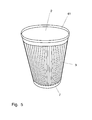
- a thickening or a mouth roll 61 may be provided, as in Fig. 5 is shown.
- a lid sheet may be sealed.
- a snap lid is provided which is capable of supporting itself on the sealing edge 6, on the thickening and / or on the mouth roll 61 and / or engages behind it and thus locks itself.
- the cup can be made of different materials, but according to the invention should preferably be renewable and / or biodegradable.
- materials such as PS, PE, PP, PET, PVC, but also starch polymers, polylactic acid (PLA) or other materials are just as conceivable as fiber-containing materials such as paper, cardboard, fine cardboard or the like, but then equipped with a resistance layer to the contents are.
- PVA polylactic acid
- Such a resistance layer may be formed, for example, as a barrier layer.
- resistance layers are also conceivable which have resistance properties to the filling material at least for a defined period of time.
- a coated or impregnated paper can be used.
- plastic coatings are also conceivable, such as treated or untreated paper layers, for example parchment, glassine, parchment replacement and / or glassine substitute or other papers having the desired properties. Molded fiber is particularly conceivable when the surface is smooth.
- Impregnations for example, based on fat are also conceivable.
- multi-layered internal parts can be used. These can on the one hand have one or more barrier or resistance layers, but also one or more base layers.
- barrier layers for example, EVOH, PA or other common materials with barrier properties are conceivable. These can then also be provided in extremely thin layers in the material of the inner part 2.
- cup 1 in the classical sense with a round bottom 4 and a square container is created. Just then, the cup 1 may be formed in several parts.
- the inner part 2 according to the invention is soft or less stiff. On the one hand, this can be a consequence of the material selection and, on the other hand, a consequence of a very small wall thickness of the inner part 2.
- the aim of the invention is to use as little as possible or poorly biodegradable and / or renewable raw materials, but still to produce the known comfort and the desired stability of the container.
- the wall thicknesses of the inner part 2 are reduced and additionally at least largely produced from renewable and / or biodegradable raw materials.
- the stability and strength of the inner part 2 can also be increased constructively, for example, by an outwardly projecting, designed as a bead edge 7 is arranged at the lower edge of the inner part 2.
- This bead 7 reinforces the one hand, the most heavily loaded transition between the bottom 4 and side wall 5 and can additionally provide even better stability.
- By the bead 7 not only the footprint of the inner part 2 is increased, but also shifted the center of gravity of the inner part 2 down.
- the bead 7 can still serve as a stacking aid when several internal parts 2 or even complete cup 1 are stacked inside each other, which is often done to transport empty cup.
- the bead 7 is supported on the inside of the underlying inner part 2 and thus ensures that the contact area between the cups 1 stacked in one another is reduced.
- the bead 7 may be formed not only circumferentially, but also segment-shaped, whereby even the access of air during unstacking of the cup 1 is facilitated. In the case of a segment-shaped configuration of the bead 7, this does not have to completely recede at the end of a segment, but it is also conceivable that only the thickness of the bead 7 varies.
- the bead 7 can also be used with an in Fig. 4 indicated stacking edge 8 interact, which may for example be mounted as an inwardly projecting shoulder in the inner part 2 and at least slightly above the bead 7 may be arranged. As a distance from the bottom 4 to the stack edge 8 are often set between five and ten millimeters.
- This stack edge 8 reinforces the inner part 2 constructive.
- the outer part 3 encloses in Fig. 1 illustrated embodiment, the side wall 5 of the inner part 2 circumferentially and covers a large part of the height of the inner part. 2
- the distance between the outer part 3 from the bottom of the inner part 2 is usually between one and five millimeters.
- the outer part 3 is fastened by gluing, sealing, detents or the like on the inner part 2.
- a latching can be done, for example, that the outer part 3 is supported on the bead 7.
- Other circumferential or partially locking means such as projections or ribs are conceivable. It is also conceivable that not only the inner part 2 reinforcing ribs or the like, but also the outer part 3. These reinforcing ribs should then be coordinated so that they can engage with each other or one behind the other and so a locking is generated.
- the outer part 3 stabilizes and strengthens the side wall 5 of the inner part 2.
- the outer part 3 may enclose the inner part 2 in the bottom area and has itself a bottom 21.
- the outer part 3 is generally made of paper, cardboard, cardboard or other materials and may also consist of recycled materials. In this case, the outer part 3 may also be formed in multiple layers.
- the outer part 3 is relatively uncritical in terms of food suitability, since the contents do not come into contact with the outer part.
- a printed image 9 can be provided on the outside of the outer part 3.
- the outside can be coated with a particularly smooth and easy to print material. Fine papers are also conceivable here, as well as suitably equipped plastics. In this context, it is also conceivable that a base coat is provided under the actual printed image.
- an overcoat or a protective coating may also be provided.
- the outer part 3 can also be made of corrugated materials such as corrugated cardboard or the like, which can then serve for a very good insulation of the cup 1 or at least have particularly pleasant tactile properties.
- Insulation may also be provided, for example, by a foamed coating, for example based on starch polymers.
- Insulated cups 1 are particularly suitable for cold or hot products.
- the outer part 3 may be at least partially equipped with a protective coating that can make these insensitive to moisture, liquid but also fats.
- the protective coating can be provided. But it is also conceivable that the edges of the outer part 3 are folded inwards and so the cut edges are protected and so the penetration of moisture, liquid or the like is avoided.
- the outer part 3 by means of appropriate equipment at least for a defined period of time resistance properties to these substances. This can be ensured, for example, by an impregnation or an appropriate material selection.
- the outer part 3 may have a predetermined breaking point 10, at which the outer part 3 can be opened and separated from the inner part 2.
- Inner part 2 and outer part 3 can then be supplied separately even for disposal, although this is no longer necessary in a substance selection according to the invention.
- the cup 1 can be produced in various ways.
- the inner part 2 is conventionally deep-drawn in a thermoforming mold, or blown from a preform.
- the inner part 2 can be deep-drawn directly into the outer part 3 in this case.
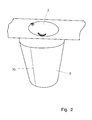
- the inner part 2 can be blown into the outer part 3, as in Figure 3 indicated.
- a latch or the like may be provided. It is conceivable, for example, that, as stated above, recesses are provided in the outer part 3, into which the inner part is formed, and thus a very stable locking can be produced. It is also conceivable that the latch is formed in the reverse direction. This means that inwardly projecting bumps are provided on the outer part 3, around which the inner part 2 is wrapped around during molding, thus creating a mechanical connection between the two parts.
- the two parts are manufactured separately and then joined together.
- the outer part 3 is wrapped around the inner part 2 and adhered to a side seam 41 in itself.
- a bead 7 or the like can be provided.
- the outer part 3 is able to support these elevations.
- an adhesive bonding or welding between the inner part 2 and the outer part 3 can be provided.
Landscapes
- Engineering & Computer Science (AREA)
- Mechanical Engineering (AREA)
- Manufacturing & Machinery (AREA)
- Ceramic Engineering (AREA)
- Food Science & Technology (AREA)
- Life Sciences & Earth Sciences (AREA)
- Biodiversity & Conservation Biology (AREA)
- Containers Having Bodies Formed In One Piece (AREA)
- Wrappers (AREA)
- Packages (AREA)
Applications Claiming Priority (2)
| Application Number | Priority Date | Filing Date | Title |
|---|---|---|---|
| DE201010037168 DE102010037168A1 (de) | 2010-08-25 | 2010-08-25 | Verfahren zur Herstellung eines Verpackungsbehälters und Verpackungsbehälter |
| DE202010008366U DE202010008366U1 (de) | 2010-08-25 | 2010-08-25 | Verpackungsbehälter |
Publications (2)
| Publication Number | Publication Date |
|---|---|
| EP2423115A2 true EP2423115A2 (fr) | 2012-02-29 |
| EP2423115A3 EP2423115A3 (fr) | 2014-08-20 |
Family
ID=44582408
Family Applications (1)
| Application Number | Title | Priority Date | Filing Date |
|---|---|---|---|
| EP20110177852 Ceased EP2423115A3 (fr) | 2010-08-25 | 2011-08-17 | Procédé de fabrication d'un récipient d'emballage et récipient d'emballage |
Country Status (1)
| Country | Link |
|---|---|
| EP (1) | EP2423115A3 (fr) |
Citations (6)
| Publication number | Priority date | Publication date | Assignee | Title |
|---|---|---|---|---|
| EP0371918A1 (fr) | 1988-11-29 | 1990-06-06 | Rundpack Ag | Récipient |
| EP0408515A1 (fr) * | 1989-07-14 | 1991-01-16 | Sandherr Packungen AG | Récipient d'emballage |
| EP0562528A1 (fr) * | 1992-03-27 | 1993-09-29 | MITSUI TOATSU CHEMICALS, Inc. | Récipient biodégradable en polymères d'acide lactique |
| WO1998013270A1 (fr) * | 1996-09-26 | 1998-04-02 | Sandherr Packungen Ag | Procede pour fabriquer un recipient d'emballage combine en forme de coupe, elements interieur et exterieur en plastique pour ledit procede, et recipient d'emballage combine fabrique selon ledit procede |
| WO2009130043A1 (fr) * | 2008-04-24 | 2009-10-29 | Rundpack Ag | Procédé de fabrication d’un récipient d’emballage combiné ainsi que d’une partie extérieure en forme d’enveloppe |
| WO2010065021A1 (fr) * | 2008-12-05 | 2010-06-10 | Primo To Go, LLC | Procédé de moulage par soufflage d’une bouteille à partir d’une biorésine |
Family Cites Families (7)
| Publication number | Priority date | Publication date | Assignee | Title |
|---|---|---|---|---|
| DE2700230C2 (de) * | 1977-01-05 | 1984-08-23 | Maschinenfabrik Rissen Gmbh, 2000 Hamburg | Becherförmiger Behälter |
| GB1602625A (en) * | 1977-03-23 | 1981-11-11 | Tokan Kogyo Co Ltd | Double-walled paper container and a method for producing the same |
| US4409053A (en) * | 1980-07-21 | 1983-10-11 | International Paper Company | Process for making a container for storing food |
| US4368818A (en) * | 1981-04-13 | 1983-01-18 | Mono Containers (U.K.) Limited | Cups for holding ingredients for drinks |
| US5775577A (en) * | 1996-10-15 | 1998-07-07 | Baldocci, Modena, Scherrer, Stanghellini Family Trust, And Titus | Disposable insulated container with microflute structure |
| US6598786B1 (en) * | 2002-03-05 | 2003-07-29 | Tzer-Huang Guo | Melioration of insulating paper container |
| US7699216B2 (en) * | 2003-11-26 | 2010-04-20 | Solo Cup Operating Corporation | Two-piece insulated cup |
-
2011
- 2011-08-17 EP EP20110177852 patent/EP2423115A3/fr not_active Ceased
Patent Citations (6)
| Publication number | Priority date | Publication date | Assignee | Title |
|---|---|---|---|---|
| EP0371918A1 (fr) | 1988-11-29 | 1990-06-06 | Rundpack Ag | Récipient |
| EP0408515A1 (fr) * | 1989-07-14 | 1991-01-16 | Sandherr Packungen AG | Récipient d'emballage |
| EP0562528A1 (fr) * | 1992-03-27 | 1993-09-29 | MITSUI TOATSU CHEMICALS, Inc. | Récipient biodégradable en polymères d'acide lactique |
| WO1998013270A1 (fr) * | 1996-09-26 | 1998-04-02 | Sandherr Packungen Ag | Procede pour fabriquer un recipient d'emballage combine en forme de coupe, elements interieur et exterieur en plastique pour ledit procede, et recipient d'emballage combine fabrique selon ledit procede |
| WO2009130043A1 (fr) * | 2008-04-24 | 2009-10-29 | Rundpack Ag | Procédé de fabrication d’un récipient d’emballage combiné ainsi que d’une partie extérieure en forme d’enveloppe |
| WO2010065021A1 (fr) * | 2008-12-05 | 2010-06-10 | Primo To Go, LLC | Procédé de moulage par soufflage d’une bouteille à partir d’une biorésine |
Also Published As
| Publication number | Publication date |
|---|---|
| EP2423115A3 (fr) | 2014-08-20 |
Similar Documents
| Publication | Publication Date | Title |
|---|---|---|
| EP2423120B1 (fr) | Récipient d'emballage | |
| EP2502850B1 (fr) | Récipient d'emballage et son procédé de fabrication | |
| DE3326369C2 (de) | Tiefgezogener konischer Kunststoffbehälter | |
| AT506750A1 (de) | Verfahren zur herstellung eines kombi - verpackungsbehälters sowie eines mantelförmigen aussenteils | |
| CH690431A5 (de) | Verfahren zum Herstellen eines becherförmigen Kombi-Verpackungsbehälters sowie Kunststoffinnenteil für ein solches Verfahren. | |
| EP2647586B1 (fr) | Récipient d'emballage | |
| AT509421B1 (de) | Verpackungsbehälter | |
| EP2423118A2 (fr) | Récipient d'emballage | |
| DE102010037168A1 (de) | Verfahren zur Herstellung eines Verpackungsbehälters und Verpackungsbehälter | |
| DE102009044772A1 (de) | Becher und Verfahren zur Herstellung | |
| EP2669212B1 (fr) | Couvercle et son procédé de fabrication | |
| EP2423115A2 (fr) | Procédé de fabrication d'un récipient d'emballage et récipient d'emballage | |
| EP3858751A1 (fr) | Conteneur d'emballage en forme de plateau ou de tasse | |
| AT512873A1 (de) | Kombi-Verpackungsbehälter | |
| DE102010016390A1 (de) | Verpackung und Verfahren zur Herstellung der Verpackung | |
| DE202010008366U1 (de) | Verpackungsbehälter | |
| CH693611A5 (de) | Konischer Verpackungsbehälter. | |
| DE69526112T2 (de) | Verfahren zum herstellen eines verpackungsbehälters | |
| EP4144660B1 (fr) | Seau pourvu de fond et de paroi latérale en feuille, ainsi que récipient | |
| DE102023115029A1 (de) | Verpackungsbehälter für Lebensmittel und ein Verfahren zum Herstellen eines Verpackungsbehälters für Lebensmittel | |
| AT506749A1 (de) | Verfahren zur herstellung eines kombi-verpackungsbehälters | |
| EP0659116B1 (fr) | Recipient, son procede de fabrication, son utilisation et conteneur de collecte et de transport dudit recipient | |
| AT507739B1 (de) | Verfahren zur herstellung eines kombi - verpackungsbehälters | |
| WO2026041678A1 (fr) | Contenant en plastique | |
| EP2476630B1 (fr) | Plaque intermédiaire pour l'empilage de fûts |
Legal Events
| Date | Code | Title | Description |
|---|---|---|---|
| AK | Designated contracting states |
Kind code of ref document: A2 Designated state(s): AL AT BE BG CH CY CZ DE DK EE ES FI FR GB GR HR HU IE IS IT LI LT LU LV MC MK MT NL NO PL PT RO RS SE SI SK SM TR |
|
| AX | Request for extension of the european patent |
Extension state: BA ME |
|
| PUAI | Public reference made under article 153(3) epc to a published international application that has entered the european phase |
Free format text: ORIGINAL CODE: 0009012 |
|
| RIC1 | Information provided on ipc code assigned before grant |
Ipc: B29C 49/24 20060101ALN20140224BHEP Ipc: B65D 1/26 20060101AFI20140224BHEP Ipc: B65D 81/38 20060101ALI20140224BHEP Ipc: B65D 1/44 20060101ALI20140224BHEP Ipc: B65D 65/46 20060101ALI20140224BHEP Ipc: B29C 49/00 20060101ALN20140224BHEP Ipc: B29C 51/16 20060101ALN20140224BHEP Ipc: B65D 25/34 20060101ALI20140224BHEP Ipc: B29C 51/08 20060101ALN20140224BHEP |
|
| PUAL | Search report despatched |
Free format text: ORIGINAL CODE: 0009013 |
|
| AK | Designated contracting states |
Kind code of ref document: A3 Designated state(s): AL AT BE BG CH CY CZ DE DK EE ES FI FR GB GR HR HU IE IS IT LI LT LU LV MC MK MT NL NO PL PT RO RS SE SI SK SM TR |
|
| AX | Request for extension of the european patent |
Extension state: BA ME |
|
| RIC1 | Information provided on ipc code assigned before grant |
Ipc: B65D 1/44 20060101ALI20140716BHEP Ipc: B29C 49/00 20060101ALN20140716BHEP Ipc: B29C 51/16 20060101ALN20140716BHEP Ipc: B29C 49/24 20060101ALN20140716BHEP Ipc: B29C 51/08 20060101ALN20140716BHEP Ipc: B65D 65/46 20060101ALI20140716BHEP Ipc: B65D 1/26 20060101AFI20140716BHEP Ipc: B65D 25/34 20060101ALI20140716BHEP Ipc: B65D 81/38 20060101ALI20140716BHEP |
|
| 17P | Request for examination filed |
Effective date: 20141217 |
|
| RBV | Designated contracting states (corrected) |
Designated state(s): AL AT BE BG CH CY CZ DE DK EE ES FI FR GB GR HR HU IE IS IT LI LT LU LV MC MK MT NL NO PL PT RO RS SE SI SK SM TR |
|
| TPAC | Observations filed by third parties |
Free format text: ORIGINAL CODE: EPIDOSNTIPA |
|
| 17Q | First examination report despatched |
Effective date: 20160419 |
|
| TPAC | Observations filed by third parties |
Free format text: ORIGINAL CODE: EPIDOSNTIPA |
|
| TPAC | Observations filed by third parties |
Free format text: ORIGINAL CODE: EPIDOSNTIPA |
|
| TPAC | Observations filed by third parties |
Free format text: ORIGINAL CODE: EPIDOSNTIPA |
|
| 18R | Application refused |
Effective date: 20180919 |