EP2425117B1 - Method of adaptation of a motor to a fuel index by incrementing the learned octane number of the fuel - Google Patents
Method of adaptation of a motor to a fuel index by incrementing the learned octane number of the fuel Download PDFInfo
- Publication number
- EP2425117B1 EP2425117B1 EP10715307.4A EP10715307A EP2425117B1 EP 2425117 B1 EP2425117 B1 EP 2425117B1 EP 10715307 A EP10715307 A EP 10715307A EP 2425117 B1 EP2425117 B1 EP 2425117B1
- Authority
- EP
- European Patent Office
- Prior art keywords
- counter
- zones
- octane number
- zone
- engine
- Prior art date
- Legal status (The legal status is an assumption and is not a legal conclusion. Google has not performed a legal analysis and makes no representation as to the accuracy of the status listed.)
- Active
Links
Images

Classifications
-
- F—MECHANICAL ENGINEERING; LIGHTING; HEATING; WEAPONS; BLASTING
- F02—COMBUSTION ENGINES; HOT-GAS OR COMBUSTION-PRODUCT ENGINE PLANTS
- F02P—IGNITION, OTHER THAN COMPRESSION IGNITION, FOR INTERNAL-COMBUSTION ENGINES; TESTING OF IGNITION TIMING IN COMPRESSION-IGNITION ENGINES
- F02P5/00—Advancing or retarding ignition; Control therefor
- F02P5/04—Advancing or retarding ignition; Control therefor automatically, as a function of the working conditions of the engine or vehicle or of the atmospheric conditions
- F02P5/145—Advancing or retarding ignition; Control therefor automatically, as a function of the working conditions of the engine or vehicle or of the atmospheric conditions using electrical means
- F02P5/15—Digital data processing
- F02P5/152—Digital data processing dependent on pinking
- F02P5/1527—Digital data processing dependent on pinking with means allowing burning of two or more fuels, e.g. super or normal, premium or regular
-
- F—MECHANICAL ENGINEERING; LIGHTING; HEATING; WEAPONS; BLASTING
- F02—COMBUSTION ENGINES; HOT-GAS OR COMBUSTION-PRODUCT ENGINE PLANTS
- F02P—IGNITION, OTHER THAN COMPRESSION IGNITION, FOR INTERNAL-COMBUSTION ENGINES; TESTING OF IGNITION TIMING IN COMPRESSION-IGNITION ENGINES
- F02P5/00—Advancing or retarding ignition; Control therefor
- F02P5/04—Advancing or retarding ignition; Control therefor automatically, as a function of the working conditions of the engine or vehicle or of the atmospheric conditions
- F02P5/145—Advancing or retarding ignition; Control therefor automatically, as a function of the working conditions of the engine or vehicle or of the atmospheric conditions using electrical means
- F02P5/15—Digital data processing
- F02P5/152—Digital data processing dependent on pinking
- F02P5/1523—Digital data processing dependent on pinking with particular laws of return to advance, e.g. step by step, differing from the laws of retard
-
- Y—GENERAL TAGGING OF NEW TECHNOLOGICAL DEVELOPMENTS; GENERAL TAGGING OF CROSS-SECTIONAL TECHNOLOGIES SPANNING OVER SEVERAL SECTIONS OF THE IPC; TECHNICAL SUBJECTS COVERED BY FORMER USPC CROSS-REFERENCE ART COLLECTIONS [XRACs] AND DIGESTS
- Y02—TECHNOLOGIES OR APPLICATIONS FOR MITIGATION OR ADAPTATION AGAINST CLIMATE CHANGE
- Y02T—CLIMATE CHANGE MITIGATION TECHNOLOGIES RELATED TO TRANSPORTATION
- Y02T10/00—Road transport of goods or passengers
- Y02T10/10—Internal combustion engine [ICE] based vehicles
- Y02T10/40—Engine management systems
Definitions
- the invention relates to a method of adapting the engine to the octane number of the fuel.
- This invention relates in particular to spark ignition engines whose ignition timing can be controlled electronically. More particularly, the invention relates to a method of incrementally adapting the learned octane number of the fuel.
- the octane number can commonly take the approximate values of 98, 95, 91 and 87.
- the fuels with indices 98 and 95 are often used in Western Europe, those with an index of octane 91 can be found in the United States and those having an octane number 87 are for example used in Iran.
- the engine may have an unsatisfactory operation. It may, for example, present a pinging phenomenon, particularly in the case where the engine is optimized for a fuel having an octane number greater than the fuel used, or the engine capacities may not be optimized at best in the case a fuel having an octane number lower than that for which the engine is set.
- the rattling may be due to an abnormal combustion phenomenon by detonation generating in particular a large heat transfer may damage the combustion chamber.
- the rattling can appear more or less random in certain operating conditions, especially when the octane number of the fuel is not adapted to the engine setting.
- the fast loop (BR) and the slow loop (BL) are activated in order to obtain a value of X ° of ignition advance correction. to suppress rattling.
- the value of the slow loop (BL) of a given value is reduced. This value is reduced again at each time t + 1 for which the pinging is not detected.
- the fast loop (BR) and the slow loop (BL) are activated again to correct the ignition timing again.
- correction devices are however not ideal. Indeed, either they lack performance and fineness on the detected octane number, or they remain permanently at the limit of detection of knock, which can continue to damage the combustion chamber.
- the invention aims to allow the engine to be adapted to the best octane fuel.
- Incrementation of the number of top dead centers is performed at each top dead center (1 ⁇ 2 engine revolution for a four-cylinder engine).
- 'Motor operating field' means a range of values between the abscissa representing the speed of the engine (engine speed), generally in revolutions per minute (rpm), the y-axis representing the load of the engine. engine, usually in Newton meter (Nm) and a curve representing the maximum performance of the engine.
- reference adjustment is meant the engine control data given a given value of the ignition advance in a motor operating field, the setting being given for a given speed and torque.
- Each reference setting may be particular to a given engine operating field, different depending on the octane number of the fuel. It is then understood that the switchover to a reference adjustment also corresponds to a switchover to a different operating field.
- the correction loop comprises a fast loop (BR) and a slow loop (BL), the incrementation of each counter based on the slow loop values (BL) in the different zones of the operating field. engine.
- the advance correction loop is reset when switching to a reference setting corresponding to a higher octane number.
- the high dead center number counter is reset when switching to a reference setting corresponding to a higher octane number.
- the method comprises at least three reference settings.
- the reference settings are based on adjustable octane numbers, for example the following octane numbers: 98, 95, 91 and 87.
- each reference setting comprises at least four zones and advantageously at least sixteen zones.
- the engine operating field of each reference adjustment comprises at least 18 zones.
- zone 1 A first zone, hereinafter called zone 0, does not require a corrective value of the ignition advance, the risks of knocking being considered sufficiently low.
- zone 17 An extreme zone, hereinafter called zone 17, in which it is difficult to detect engine knock, for which the knocking correction value of the preceding zone will be applied.
- zone 1 to zone 16 The following areas are referred to as zone 1 to zone 16, and each includes an initial knock-on value, as well as two thresholds associated with switching to a higher octane number.
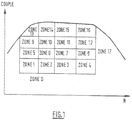
- the figure 1 represents the motor operating field of a vehicle where the abscissa represents the N speed in revolutions of the motor and the y axis represents the engine load, also called the torque, in Nm
- the curve represents the performances maximum motor.
- This figure shows a grid consisting of eighteen zones numbered from 0 to 17.
- Zone 0 determined below a particular torque, does not require a particular ignition advance adjustment, the knocking phenomenon being rare and therefore not likely to damage the combustion chamber.
- zone 17 determined above a given speed, it becomes difficult to detect the pinging phenomenon. The corrective value of the previous zone traversed is then applied.
- Zones 1 to 16 each comprise a slow-loop correction value (BL) anti-rattling of the ignition advance.
- BL slow-loop correction value
- zone 1 can have a corrective value (BL_1) of 2 °, zone 2 a corrective value (BL_2) of 5 °, zone 3 a corrective value (BL_3) of 4 °, zone 4 a corrective value (BL_4) of 1 ° and so on.
- the passage in zone 1 will then assign a spark advance of 29 °, corresponding to the reference setting of 31 °, minus a corrective value of 2 °, corresponding to the corrective value of zone 1 If the motor passes in zone 2, the ignition advance will be 35 °, corresponding to 40 ° of the reference adjustment, minus 5 ° corresponding to the corrective value of zone 2. These different corrective values must correct the ignition advance to achieve a non-rattling operation.
- an advance correction loop is activated, usually comprising a fast loop (BR) and a slow loop (BL).
- the slow loop (BL) provides a correction of a predetermined value.
- the fast loop (BR) provides a correction of 4 °
- the slow loop (BL) a correction of 2 °, with each pinging phenomenon.
- the slow loop (BL) is degressive in time by a predetermined value. For the example, we will consider that at each time t + 1, the value will decrease by a quarter of its initial value, ie by 0.5 °.
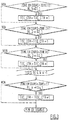
- the invention is based on two modes of switching to a reference setting corresponding to a higher octane number, illustrated by the diagram of the figure 2 .
- the first is based on the fact that at each top dead center (1/2 engine revolution for a 4-cylinder engine), since the slow loop (BL) of the current operating zone is below a threshold specific to this zone , we just increment a counter (TDC_CTR).
- TDC_CTR a threshold value
- S4 which, once exceeded, causes the switching to a reference setting corresponding to a higher octane number.
- CTR threshold value
- threshold value S4 of the high dead counter for the first switching mode the value of 1000.
- the counter TDC_CTR is initialized to 0 upon activation of the method. As long as the current operating zone is different from zone 1 to 16, or if the slow loop advance correction (BL) in the current zone is greater than a threshold specific to this zone, the counter is not incremented. At each top dead center (1/2 engine revolution for a 4-stroke 4-cylinder engine), the slow loop value (BL) of the zone is tested with respect to the threshold of this zone, as illustrated by the the figure 3 , on which "x" represents the number of zones.
- the counter TDC_CTR is incremented by 1.
- the slow loop At high dead point n + 1, still being in this zone, having detected no knock phenomenon from the top dead center n, the slow loop then remains still below the threshold S1_1.
- the counter TDC_TDR is then incremented.
- the counter TDC_TCR is incremented. If pinging is detected in this zone between the high dead points n + 2 and n + 3, the value of the slow loop is then incremented. For example, if it then exceeds the threshold S2_1, at the top dead center n + 3, the counter TDC_CTR is not incremented. This is done as long as the engine is running. When the high dead spot counter TDC_CTR exceeds the threshold S4, the process then switches to a reference setting corresponding to a higher octane number.
- TDC_CTR 0
- the method also includes a condition on the slow loop (BL) advance correction level on a set of zones.
- Each zone is associated with a slow loop correction threshold which, when reached over a number of zones defined by the threshold S3, causes the switchover to a reference setting corresponding to a higher octane number.
- threshold value S3 the number of zones for the second switching mode, the value of 6.
- the absence of rattling during a given number of engine revolutions, or a low level of correction of the slow ping loop (BL) on a plurality of zones of the engine operating field causes the switching to a higher setting. If the operation is considered correct, especially in view of the rattling detected with this setting, stabilize on the current setting. Otherwise, we go down to the previous setting.
Landscapes
- Engineering & Computer Science (AREA)
- Chemical & Material Sciences (AREA)
- Combustion & Propulsion (AREA)
- Mechanical Engineering (AREA)
- General Engineering & Computer Science (AREA)
- Signal Processing (AREA)
- Combined Controls Of Internal Combustion Engines (AREA)
- Electrical Control Of Ignition Timing (AREA)
- Physics & Mathematics (AREA)
- General Physics & Mathematics (AREA)
Description
L'invention concerne un procédé d'adaptation du moteur à l'indice d'octane du carburant. Cette invention concerne notamment les moteurs à allumage commandé dont l'avance à l'allumage peut être contrôlée électroniquement. Plus particulièrement, l'invention concerne un procédé d'adaptation par incrémentation de l'indice d'octane appris du carburant.The invention relates to a method of adapting the engine to the octane number of the fuel. This invention relates in particular to spark ignition engines whose ignition timing can be controlled electronically. More particularly, the invention relates to a method of incrementally adapting the learned octane number of the fuel.
Actuellement, on trouve divers types de carburants présentant des caractéristiques différentes. Parmi ces caractéristiques figure l'indice d'octane. Parmi les différents carburants, l'indice d'octane peut couramment prendre les valeurs approximatives de 98, 95, 91 et 87. Les carburants présentant des indices 98 et 95 sont souvent utilisés en Europe de l'ouest, ceux présentant un indice d'octane 91 peuvent être rencontrés aux Etats-Unis et ceux présentant un indice d'octane 87 sont par exemple utilisés en Iran.Currently, there are various types of fuels with different characteristics. Among these characteristics is the octane number. Among the various fuels, the octane number can commonly take the approximate values of 98, 95, 91 and 87. The fuels with indices 98 and 95 are often used in Western Europe, those with an index of octane 91 can be found in the United States and those having an octane number 87 are for example used in Iran.
Pour optimiser le compromis performance, consommation, fiabilité, il est souhaitable d'avoir un réglage moteur, et notamment le réglage d'avance à l'allumage, adapté pour chaque indice d'octane.To optimize the compromise between performance, consumption and reliability, it is desirable to have an engine adjustment, and in particular the ignition advance adjustment, adapted for each octane number.
Lorsque le réglage d'avance à l'allumage est défini pour un indice d'octane et le carburant utilisé présente un indice d'octane différent, notamment lors d'un changement de zone géographique, le moteur peut présenter un fonctionnement insatisfaisant. Il peut par exemple présenter un phénomène de cliquetis, en particulier dans le cas où le moteur est optimisé pour un carburant ayant un indice d'octane supérieur au carburant utilisé, ou bien les capacités du moteur peuvent ne pas être optimisées au mieux dans le cas d'un carburant ayant un indice d'octane inférieur à celui pour lequel le moteur est réglé.When the ignition advance setting is set for an octane number and the fuel used has a different octane number, especially during a change of geographical area, the engine may have an unsatisfactory operation. It may, for example, present a pinging phenomenon, particularly in the case where the engine is optimized for a fuel having an octane number greater than the fuel used, or the engine capacities may not be optimized at best in the case a fuel having an octane number lower than that for which the engine is set.
Le cliquetis peut notamment être dû à un phénomène de combustion anormale par détonation générant notamment un transfert de chaleur important susceptible d'endommager la chambre de combustion. Le cliquetis peut apparaître de façon plus ou moins aléatoire dans certaines conditions de fonctionnement, notamment lorsque l'indice d'octane du carburant n'est pas adapté au réglage du moteur.The rattling may be due to an abnormal combustion phenomenon by detonation generating in particular a large heat transfer may damage the combustion chamber. The rattling can appear more or less random in certain operating conditions, especially when the octane number of the fuel is not adapted to the engine setting.
Parmi les techniques pour corriger le phénomène de cliquetis on peut citer la correction anti cliquetis expliquée ci dessous. Celle-ci est utilisée essentiellement lorsque les écarts sont faibles. Cette correction, curative, ne permet pas de corriger de façon satisfaisante les effets de cliquetis lorsque la différence d'indice d'octane est trop importante.Among the techniques for correcting the pinging phenomenon is the anti-knock correction explained below. This is used mainly when the differences are small. This corrective correction does not make it possible to satisfactorily correct the rattling effects when the difference in octane number is too great.
Cette correction anti cliquetis connue comprend deux types d'action :
- une correction rapide, appelée aussi boucle rapide (BR), qui réduit fortement l'avance à l'allumage, et
- une correction lente, appelée aussi boucle lente (BL), qui réduit l'avance à l'allumage de façon moins significative.
- a fast correction, also called fast loop (BR), which greatly reduces the ignition timing, and
- a slow correction, also called a slow loop (BL), which reduces the ignition advance less significantly.
Ainsi, par exemple, lors de la détection de cliquetis à un temps t, la boucle rapide (BR) et la boucle lente (BL) sont activées afin d'obtenir une valeur de X° de correction d'avance à l'allumage en vue de supprimer le cliquetis.Thus, for example, during the detection of knocking at a time t, the fast loop (BR) and the slow loop (BL) are activated in order to obtain a value of X ° of ignition advance correction. to suppress rattling.
A un temps t+1, si le cliquetis n'est plus détecté, on réduit la valeur de la boucle lente (BL) d'une valeur donnée. Cette valeur est réduite de nouveau à chaque temps t+1 pour lequel le cliquetis n'est pas détecté.At a time t + 1, if the rattling is no longer detected, the value of the slow loop (BL) of a given value is reduced. This value is reduced again at each time t + 1 for which the pinging is not detected.
Dans le cas où le phénomène de cliquetis est à nouveau détecté, la boucle rapide (BR) et la boucle lente (BL) sont activées à nouveau afin de corriger à nouveau l'avance à l'allumage.In the case where the pinging phenomenon is again detected, the fast loop (BR) and the slow loop (BL) are activated again to correct the ignition timing again.
Il est également connu un dispositif permettant de gérer deux réglages basés sur deux indices d'octane différents. Si le cliquetis est détecté pendant une certaine période de temps avec un réglage basé sur l'indice d'octane 98, le réglage est modifié pour se baser sur le réglage de l'indice d'octane 91. Lors de l'arrêt du moteur, le réglage est « remis à zéro », c'est à dire que le réglage revient au réglage par défaut (basé sur l'indice d'octane 98).There is also known a device for managing two settings based on two different octane numbers. If the pinging is detected for a certain period of time with a setting based on the octane number 98, the setting is changed to be based on the setting of the octane number 91. When stopping the engine , the setting is "reset", ie the setting returns to the default setting (based on octane number 98).
Ces dispositifs de correction ne sont cependant pas idéaux. En effet, soit ils manquent de performance et de finesse sur l'indice d'octane détecté, soit ils restent en permanence à la limite de la détection de cliquetis, ce qui peut continuer à endommager la chambre de combustion.These correction devices are however not ideal. Indeed, either they lack performance and fineness on the detected octane number, or they remain permanently at the limit of detection of knock, which can continue to damage the combustion chamber.
Si l'on utilise un indice d'octane inférieur à celui utilisé pour le réglage du moteur, il n'y a pas de risque d'endommager celui-ci mais les performances du moteur ne sont pas optimisées.If you use a lower octane number than that used to adjust the engine, there is no risk of damaging it but engine performance is not optimized.
Or, il n'existe pas à ce jour de dispositif permettant d'ajuster assez précisément le réglage du moteur à l'indice d'octane du carburant afin d'optimiser les performances du moteur.However, there is currently no device to adjust quite precisely the engine setting to the fuel octane to optimize engine performance.
L'invention a pour objectif de permettre au moteur d'être adapté au mieux à l'indice d'octane du carburant.The invention aims to allow the engine to be adapted to the best octane fuel.
Selon un premier aspect de l'invention, il s'agit d'un procédé d'adaptation du moteur à l'indice d'octane du carburant par incrémentation de l'indice d'octane appris, ledit procédé partant d'un réglage de référence de l'avance à l'allumage dans un champ de fonctionnement moteur pour un indice d'octane déterminé, ledit réglage de référence correspondant à un fonctionnement sans cliquetis (mais à la limite du cliquetis) du moteur pour un régime (N) et un couple déterminés, le champ de fonctionnement moteur étant découpé en plusieurs zones, chacune d'elle comprenant une valeur corrective anti-cliquetis de l'avance à l'allumage du réglage de référence, le procédé comprenant au moins les étapes suivantes :
- Initialisation d'un compteur (TDC_CTR) de nombre de points morts hauts à 0 à l'activation du procédé ;
- Détection de la présence de cliquetis sur une période de temps t;
- Activation d'une boucle de correction de l'avance de l'angle d'allumage dans le cas d'une détection de la présence de cliquetis sur une période de temps t;
- Décrémentation d'une partie de la boucle de correction de l'avance en cas d'absence de détection de la présence de cliquetis sur la période de temps t+1 ;
- Incrémentation du compteur de nombre de points morts hauts si la correction d'avance dans la zone en cours est inférieure à un seuil propre à cette zone,
- Incrémentation d'un autre compteur (CTR) du nombre de zones à chaque période de temps (X ms) du nombre de zones dans lesquelles la boucle de correction d'avance est inférieure à un autre seuil propre à chaque zone ;
- Initialization of a counter (TDC_CTR) of number of dead centers up to 0 at the activation of the process;
- Detecting the presence of rattling over a period of time t;
- Activation of an ignition angle advance correction loop in the case of detection of the presence of knocking over a period of time t;
- Decreasing a part of the advance correction loop in the absence of detection of the presence of rattling over the period of time t + 1;
- Incrementing the counter of the number of top dead centers if the advance correction in the current zone is less than a threshold specific to this zone,
- Incrementing another counter (CTR) by the number of zones at each time period (X ms) of the number of zones in which the advance correction loop is less than another threshold specific to each zone;
L'incrémentation du compteur de nombre de points morts hauts est réalisée à chaque point mort haut (½ tour moteur pour un moteur à quatre cylindres).Incrementation of the number of top dead centers is performed at each top dead center (½ engine revolution for a four-cylinder engine).
Par « champ de fonctionnement moteur », on entend une plage de valeurs comprises entre l'axe des abscisses représentant la vitesse du moteur (régime), généralement en tours par minute (tr/min), l'axe des ordonnées représentant la charge du moteur, généralement en Newton mètre (N.m) et une courbe représentant les performances maximum du moteur.'Motor operating field' means a range of values between the abscissa representing the speed of the engine (engine speed), generally in revolutions per minute (rpm), the y-axis representing the load of the engine. engine, usually in Newton meter (Nm) and a curve representing the maximum performance of the engine.
Par « réglage de référence », on entend les valeurs données de pilotage du moteur dont une valeur donnée de l'avance à l'allumage dans un champ de fonctionnement moteur, le réglage étant donné pour un régime et un couple déterminés.By "reference adjustment" is meant the engine control data given a given value of the ignition advance in a motor operating field, the setting being given for a given speed and torque.
Chaque réglage de référence peut être particulier à un champ de fonctionnement moteur donné, différents en fonction de l'indice d'octane du carburant. On comprend alors que le basculement vers un réglage de référence correspond également à un basculement vers un champ de fonctionnement moteur différent.Each reference setting may be particular to a given engine operating field, different depending on the octane number of the fuel. It is then understood that the switchover to a reference adjustment also corresponds to a switchover to a different operating field.
Selon un mode de réalisation particulier, la boucle de correction comprend une boucle rapide (BR) et une boucle lente (BL), l'incrémentation de chaque compteur reposant sur les valeurs de boucle lente (BL) dans les différentes zones du champ de fonctionnement moteur.According to a particular embodiment, the correction loop comprises a fast loop (BR) and a slow loop (BL), the incrementation of each counter based on the slow loop values (BL) in the different zones of the operating field. engine.
Avantageusement, la boucle de correction de l'avance est remise à zéro lors du basculement vers un réglage de référence correspondant à un indice d'octane supérieur.Advantageously, the advance correction loop is reset when switching to a reference setting corresponding to a higher octane number.
Dans une application préférée, le compteur de nombre de points morts hauts est réinitialisé lors du basculement vers un réglage de référence correspondant à un indice d'octane supérieur.In a preferred application, the high dead center number counter is reset when switching to a reference setting corresponding to a higher octane number.
En particulier, le procédé comprend au moins trois réglages de références.In particular, the method comprises at least three reference settings.
Avantageusement, les réglages de référence sont basés sur des indices d'octane réglables, par exemple les indices d'octane suivants : 98, 95, 91 et 87.Advantageously, the reference settings are based on adjustable octane numbers, for example the following octane numbers: 98, 95, 91 and 87.
Selon un mode de réalisation particulier, on peut ajouter au moins un réglage Ethanol, ayant pour indice E85 et/ou E100.According to a particular embodiment, one can add at least one Ethanol setting, having E85 index and / or E100.
Selon un mode de réalisation particulier, chaque réglage de référence comprend au moins quatre zones et avantageusement au moins seize zones.According to a particular embodiment, each reference setting comprises at least four zones and advantageously at least sixteen zones.
Avantageusement, le champ de fonctionnement moteur de chaque réglage de référence comprend au moins 18 zones.Advantageously, the engine operating field of each reference adjustment comprises at least 18 zones.
Une première zone, ci-après nommée zone 0, ne nécessitant pas de valeur corrective de l'avance à l'allumage, les risques de cliquetis étant jugés suffisamment faibles.A first zone, hereinafter called zone 0, does not require a corrective value of the ignition advance, the risks of knocking being considered sufficiently low.
Une zone extrême, ci-après nommée zone 17, dans laquelle il est délicat de détecter le cliquetis moteur, pour laquelle on appliquera la valeur de correction de cliquetis de la zone précédente.An extreme zone, hereinafter called
Les zones suivantes sont appelées zone 1 à zone 16, et comprennent chacune une valeur initiale corrective de cliquetis, ainsi que deux seuils associés au basculement vers un indice d'octane supérieur.The following areas are referred to as
L'invention est maintenant décrite en faisant référence aux dessins, non limitatifs, dans lesquels :
- La
figure 1 représente le champ de fonctionnement moteur d'un véhicule ; - La
figure 2 représente un diagramme du procédé d'adaptation selon l'invention ; - La
figure 3 représente un diagramme de la boucle d'implémentation du compteur de nombre de points morts effectuée à chaque point mort haut, dont la valeur finale est utilisée dans le diagramme de lafigure 2 pour la condition TDC_CTR>S4.
- The
figure 1 represents the motor operating field of a vehicle; - The
figure 2 represents a diagram of the adaptation method according to the invention; - The
figure 3 represents a diagram of the implementation loop of the number of dead spot counter made at each top dead center, the final value of which is used in the diagram of thefigure 2 for the condition TDC_CTR> S4.
La
Sur cette figure est représenté un quadrillage composé de dix-huit zones numérotées de 0 à 17.This figure shows a grid consisting of eighteen zones numbered from 0 to 17.
La zone 0, déterminée en dessous d'un couple particulier, ne nécessite pas de réglage d'avance à l'allumage particulier, le phénomène de cliquetis étant rare et ne risquant donc pas d'endommager la chambre de combustion.Zone 0, determined below a particular torque, does not require a particular ignition advance adjustment, the knocking phenomenon being rare and therefore not likely to damage the combustion chamber.
Dans la zone 17, déterminée au dessus d'une vitesse donnée, il devient difficile de détecter le phénomène de cliquetis. On applique alors la valeur corrective de la précédente zone traversée.In
Les zones 1 à 16 comprennent chacune une valeur de correction boucle lente (BL) anti-cliquetis de l'avance à l'allumage.
Par exemple, la zone 1 peut avoir une valeur corrective (BL_1) de 2°, la zone 2 une valeur corrective (BL_2) de 5°, la zone 3 une valeur corrective (BL_3) de 4°, la zone 4 une valeur corrective (BL_4) de 1° et ainsi de suite.For example,
Lors du fonctionnement du moteur, le passage dans la zone 1 attribuera alors une avance à l'allumage de 29°, correspondant au réglage de référence de 31°, moins une valeur corrective de 2°, correspondant à la valeur corrective de la zone 1. Si le moteur passe dans la zone 2, l'avance à l'allumage sera de 35°, correspondant au 40° du réglage de référence, moins 5° correspondant à la valeur corrective de la zone 2. Ces différentes valeurs correctives doivent corriger l'avance à l'allumage afin d'obtenir un fonctionnement sans cliquetis.During operation of the engine, the passage in
Toutefois, le phénomène de cliquetis n'est pas toujours éradiqué, notamment si l'on a choisi un carburant possédant un indice d'octane plus faible.However, the rattling phenomenon is not always eradicated, especially if a fuel with a lower octane number has been chosen.
A chaque phénomène de cliquetis, et ce, quelque soit la zone concernée, on active une boucle de correction de l'avance, comprenant habituellement une boucle rapide (BR) et une boucle lente (BL). Ainsi, à chaque phénomène de cliquetis, la boucle lente (BL) apporte une correction d'une valeur prédéterminée. Pour l'exemple, on considérera que la boucle rapide (BR) apporte une correction de 4° et la boucle lente (BL) une correction de 2°, à chaque phénomène de cliquetis. Si le phénomène de cliquetis n'est plus détecté, la boucle lente (BL) est dégressive dans le temps d'une valeur prédéterminée. Pour l'exemple, on considérera qu'à chaque temps t+1, la valeur diminuera du quart de sa valeur initiale, soit de 0,5°.At each pinging phenomenon, whatever the zone concerned, an advance correction loop is activated, usually comprising a fast loop (BR) and a slow loop (BL). Thus, with each pinging phenomenon, the slow loop (BL) provides a correction of a predetermined value. For the example, it will be considered that the fast loop (BR) provides a correction of 4 ° and the slow loop (BL) a correction of 2 °, with each pinging phenomenon. If the pinging phenomenon is no longer detected, the slow loop (BL) is degressive in time by a predetermined value. For the example, we will consider that at each
On obtient alors le fonctionnement suivant, lors du passage dans la zone 1, on applique de la valeur globale déterminée plus haut, soit 31°-2°. Si on détecte un cliquetis, on retranche les valeurs de boucle rapide (BR), 4°, ainsi que la valeur de boucle lente (BL), 2°. On obtient alors un réglage de l'avance à l'allumage de 31° - 4° - 2° soit 25°. A un temps t+1, si le phénomène de cliquetis n'est plus là, on décrémente la valeur de la boucle lente, dans l'exemple de 0,5°. On aura alors à un temps t+1, une valeur corrective de 29,5° et à un temps t+2 une valeur corrective de 30° et ainsi de suite. Quand on détecte à nouveau un phénomène de cliquetis, on active à nouveau la boucle de correction. On peut alors se positionner à un temps t+3 où l'on détecte le cliquetis, la valeur corrective précédente étant de 30°, on en retranche la valeur de BR + BL, soit 4° + 2°. On obtient alors un réglage d'avance à l'allumage de 24°.The following operation is then obtained, when passing through
L'invention repose sur deux modes de basculement vers un réglage de référence correspondant à un indice d'octane supérieur, illustrés par le diagramme de la
Le premier repose sur le fait qu'à chaque point mort haut (1/2 tour moteur pour un moteur 4 cylindres), dès lors que la boucle lente (BL) de la zone de fonctionnement courante est inférieure à un seuil propre à cette zone, on vient incrémenter un compteur (TDC_CTR). Ce dernier possède une valeur seuil (S4) qui, une fois dépassée provoque le basculement vers un réglage de référence correspondant à un indice d'octane supérieur.The first is based on the fact that at each top dead center (1/2 engine revolution for a 4-cylinder engine), since the slow loop (BL) of the current operating zone is below a threshold specific to this zone , we just increment a counter (TDC_CTR). The latter has a threshold value (S4) which, once exceeded, causes the switching to a reference setting corresponding to a higher octane number.
Le second repose sur le fait que toutes les X ms (par exemple X = 100), on compte le nombre de zones dans lesquelles la correction de boucle lente est inférieure à un seuil propre à cette zone. Pour cela, on utilise un compteur (CTR), initialisé à 0 toutes les X ms avant de compter les zones. Ce compteur possède une valeur seuil (S3) qui, une fois atteinte ou dépassée provoque le basculement vers un réglage de référence correspondant à un indice d'octane supérieur.The second is based on the fact that every X ms (for example X = 100), we count the number of zones in which the slow loop correction is less than a threshold specific to this zone. For this, we use a counter (CTR), initialized to 0 every X ms before counting the zones. This counter has a threshold value (S3) which, once reached or exceeded, causes the switchover to a reference setting corresponding to a higher octane number.
Dans notre exemple, nous prendrons comme valeur seuil S4 du compteur de points morts hauts pour le premier mode de basculement, la valeur de 1000.In our example, we will take as threshold value S4 of the high dead counter for the first switching mode, the value of 1000.
Selon ce premier mode de basculement, on initialise le compteur TDC_CTR à 0 à l'activation du procédé. Tant que la zone de fonctionnement courante est différente de la zone 1 à 16, ou que la correction d'avance boucle lente (BL) dans la zone courante est supérieure à un seuil propre à cette zone, le compteur n'est pas incrémenté. A chaque point mort haut (1/2 tour moteur pour un moteur 4 cylindres à 4 temps), on teste la valeur de boucle lente (BL) de la zone par rapport au seuil de cette zone, tel qu'illustré par le diagramme de la
Par exemple, au point mort haut n, dans la zone 1, si la boucle lente (BL) de la zone 1 (BL_ 1) est inférieure au seuil S1_1 défini dans cette zone, on incrémente de 1 le compteur TDC_CTR. Au point mort haut n + 1, étant toujours dans cette zone, n'ayant détecté aucun phénomène de cliquetis depuis le point mort haut n, la boucle lente reste alors encore inférieure au seuil S1_1. Le compteur TDC_TDR est alors encore incrémenté.For example, at high dead point n, in
Si on passe alors au point mort haut n + 2 à une zone différente, par exemple la zone 2, dans laquelle la boucle lente (BL_2) est inférieure au seuil S2_1 de cette zone, on incrémente le compteur TDC_TCR. Si du cliquetis est détecté dans cette zone entre les points morts hauts n + 2 et n + 3, la valeur de la boucle lente est alors incrémentée. Par exemple, si elle dépasse alors le seuil S2_1, au point mort haut n + 3, le compteur TDC_CTR n'est pas incrémenté. On procède ainsi de suite tant que le moteur est en marche. Quand le compteur de points morts hauts TDC_CTR dépasse le seuil S4, le procédé bascule alors vers un réglage de référence correspondant à un indice d'octane supérieur.If we then go to the top dead center n + 2 at a different zone, for
Lors du passage à l'indice d'octane supérieur, on réinitialise le compteur de point mort haut (TDC_CTR=0).When switching to the higher octane number, the top dead center counter (TDC_CTR = 0) is reset.
Le procédé comprend également une condition sur le niveau de correction d'avance boucle lente (BL) sur un ensemble de zones. A chaque zone est associé un seuil de correction boucle lente qui, lorsqu'il est atteint sur un nombre de zones défini par le seuil S3 provoque le basculement vers un réglage de référence correspondant à un indice d'octane supérieur.The method also includes a condition on the slow loop (BL) advance correction level on a set of zones. Each zone is associated with a slow loop correction threshold which, when reached over a number of zones defined by the threshold S3, causes the switchover to a reference setting corresponding to a higher octane number.
Dans notre exemple, nous prendrons comme valeur seuil S3 du nombre de zones pour le second mode de basculement, la valeur de 6.In our example, we will take as threshold value S3 the number of zones for the second switching mode, the value of 6.
Par exemple (voir
Après le passage vers un réglage de référence supérieur, soit par le seuil multizone (S3) soit par la condition sur le nombre de points morts hauts (S4), on vérifie que le fonctionnement sous ce réglage est optimum pendant un temps déterminé. Si le réglage est correct, on continue d'appliquer le nouveau réglage, dans le cas contraire, on redescend au réglage inférieur. Dans le cas où l'on redescend au réglage inférieur, on n'essaye plus alors de remonter de réglage jusqu'à la détection d'ajout de carburant.After switching to a higher reference setting, either by the multi-zone threshold (S3) or by the condition on the number of upper dead centers (S4), it is verified that the operation under this setting is optimum for a given time. If the setting is correct, the new setting will continue to be applied, otherwise you will go back to the lower setting. In the case where one goes down to the lower setting, one does not try then to go back up adjustment until the detection of addition of fuel.
En d'autres termes, l'absence de cliquetis pendant un nombre de tours moteur donné, ou un faible niveau de correction de la boucle lente (BL) de cliquetis sur une pluralité de zones du champ de fonctionnement moteur, provoque le basculement vers un réglage supérieur. Si le fonctionnement est jugé correct, notamment au vu du cliquetis détecté avec ce réglage, on stabilise sur le réglage en cours. Dans le cas contraire, on redescend sur le précédent réglage.In other words, the absence of rattling during a given number of engine revolutions, or a low level of correction of the slow ping loop (BL) on a plurality of zones of the engine operating field, causes the switching to a higher setting. If the operation is considered correct, especially in view of the rattling detected with this setting, stabilize on the current setting. Otherwise, we go down to the previous setting.
Claims (7)
- Method of adapting the engine to the octane number of the fuel by incrementing the learned octane number, said method starting out from a reference setting of the ignition advance in an engine operating range for a determined octane number, said reference setting corresponding to a pinking-free operation of the engine at a determined speed (N) and a determined torque, the operating range of the engine being broken down into several zones, each of them comprising an anti-pinking corrective value to be applied to the ignition advance of the reference setting, the method comprising at least the following steps:- initializing to 0 a top dead centre counter (TDC CTR) upon activation of the method;- detecting the presence of pinking over a current time period (t);- activating an ignition advance angle correction loop if pinking is detected over the current time period (t);- decrementing part of the advance correction loop if the presence of pinking is not detected over a subsequent time period (t+1);- incrementing the top dead centre counter (TDC_CTR) if the advance correction in the current zone is below a threshold specific to that zone;- incrementing another, zones counter (CTR) in each time period (X ms) by the number of zones in which the advance correction loop is below another threshold specific to each zone;the crossing of a determined threshold (S4) by the top dead centres counter (TDC_CTR) or the reaching or crossing of another determined threshold (S3) by the zones counter (CTR) triggering a switch to a reference setting corresponding to a higher octane number.
- Method according to Claim 1, characterized in that the correction loop comprises a fast loop (BR) and a slow loop (BL), the incrementing of each counter relying on the values from the slow loop (BL) in the various zones of the engine operating range.
- Method according to either of Claims 1 and 2, characterized in that the ignition advance correction loop is reset to zero upon a switch to a reference setting corresponding to a higher octane number.
- Method according to any one of Claims 1 to 3, characterized in that the top dead centres counter (TDC_CTR) is reinitialized upon the switch to a reference setting corresponding to a higher octane number.
- Method according to any one of Claims 1 to 4, characterized in that it comprises at least three reference settings.
- Method according to Claim 5, characterized in that the reference settings are based on adjustable octane numbers.
- Method according to any one of Claims 1 to 6, characterized in that each reference setting comprises at least four zones and advantageously at least sixteen zones.
Applications Claiming Priority (2)
| Application Number | Priority Date | Filing Date | Title |
|---|---|---|---|
| FR0952885A FR2945083B1 (en) | 2009-04-30 | 2009-04-30 | PROCESS FOR ADAPTING A FUEL INDEX MOTOR BY INCREMENTING THE FUEL OCTANE INDEX |
| PCT/FR2010/050389 WO2010125260A1 (en) | 2009-04-30 | 2010-03-08 | Method for adapting an engine to the fuel grade by incrementing the initial octane number of the fuel |
Publications (2)
| Publication Number | Publication Date |
|---|---|
| EP2425117A1 EP2425117A1 (en) | 2012-03-07 |
| EP2425117B1 true EP2425117B1 (en) | 2017-11-15 |
Family
ID=41401906
Family Applications (1)
| Application Number | Title | Priority Date | Filing Date |
|---|---|---|---|
| EP10715307.4A Active EP2425117B1 (en) | 2009-04-30 | 2010-03-08 | Method of adaptation of a motor to a fuel index by incrementing the learned octane number of the fuel |
Country Status (8)
| Country | Link |
|---|---|
| US (1) | US9032932B2 (en) |
| EP (1) | EP2425117B1 (en) |
| JP (1) | JP2012525531A (en) |
| CN (1) | CN102414436B (en) |
| BR (1) | BRPI1014346B1 (en) |
| FR (1) | FR2945083B1 (en) |
| RU (1) | RU2526052C2 (en) |
| WO (1) | WO2010125260A1 (en) |
Families Citing this family (6)
| Publication number | Priority date | Publication date | Assignee | Title |
|---|---|---|---|---|
| WO2008036630A2 (en) * | 2006-09-18 | 2008-03-27 | Howard Lutnick | Products and processes for analyzing octane content |
| FR2945084B1 (en) * | 2009-04-30 | 2011-04-08 | Renault Sas | METHOD OF ADAPTATION OF A FUEL INDEX MOTOR BY DECREMENTATION OF OCTANE INDEX LEARNED FROM FUEL |
| CN104948325B (en) * | 2014-03-26 | 2019-08-27 | 周向进 | A kind of gasoline engine and its method for testing octane number |
| CN104500308B (en) * | 2014-12-26 | 2016-04-20 | 叶明� | A kind of automatic control tegulatingdevice being applied to gasoline octane number tester ignition advance angle |
| DE102019125570B4 (en) * | 2019-09-24 | 2023-12-07 | Bayerische Motoren Werke Aktiengesellschaft | Method for detecting the octane number of a fuel used in a gasoline engine |
| CN112682240B (en) * | 2020-12-29 | 2022-12-13 | 联合汽车电子有限公司 | Ignition angle control method and control device thereof |
Family Cites Families (12)
| Publication number | Priority date | Publication date | Assignee | Title |
|---|---|---|---|---|
| JPS6460775A (en) * | 1987-08-31 | 1989-03-07 | Nissan Motor | Ignition timing controller for internal combustion engine |
| DE3881628T2 (en) * | 1987-10-09 | 1993-09-23 | Nissan Motor | CONTROL UNIT FOR THE FUEL COMBUSTION OF A MACHINE. |
| DE4001476A1 (en) * | 1990-01-19 | 1991-08-01 | Audi Ag | Engine knocking control system - uses short and long term adaption and modification figure derived from control excursions |
| DE4001474A1 (en) * | 1990-01-19 | 1991-08-01 | Audi Ag | KNOCK CONTROL OF A FOREIGN IGNITION ENGINE |
| US5131369A (en) * | 1990-08-11 | 1992-07-21 | Honda Giken Kogyo Kabushiki Kaisha | Ignition timing control system for internal combustion engine |
| DE4109433A1 (en) * | 1991-03-22 | 1992-09-24 | Audi Ag | KNOCK CONTROL OF A FOREIGN IGNITION ENGINE |
| JPH05157033A (en) * | 1991-11-29 | 1993-06-22 | Honda Motor Co Ltd | Ignition timing control device for internal combustion engine |
| JP2844418B2 (en) * | 1993-12-30 | 1999-01-06 | 本田技研工業株式会社 | Ignition timing control device for internal combustion engine |
| RU2310832C1 (en) * | 2006-06-05 | 2007-11-20 | Государственное образовательное учреждение высшего профессионального образования "Тверской государственный технический университет" | Method of determining octane number of automotive gasolines |
| US7331327B2 (en) * | 2006-07-21 | 2008-02-19 | Gm Global Technology Operations, Inc. | Zone based knock reduction systems and methods for belt alternator starter hybrid systems |
| RU2310830C1 (en) * | 2006-08-17 | 2007-11-20 | Институт радиотехники и электроники Российской Академии Наук | Method of determining octane number of gasoline |
| RU2331058C1 (en) * | 2007-04-02 | 2008-08-10 | ГОУ ВПО "Саратовский государственный университет им. Н.Г. Чернышевского" | Method of evaluation of benzine octane number and device for application of this method |
-
2009
- 2009-04-30 FR FR0952885A patent/FR2945083B1/en not_active Expired - Fee Related
-
2010
- 2010-03-08 WO PCT/FR2010/050389 patent/WO2010125260A1/en not_active Ceased
- 2010-03-08 RU RU2011148586/07A patent/RU2526052C2/en active
- 2010-03-08 CN CN2010800191460A patent/CN102414436B/en active Active
- 2010-03-08 US US13/266,837 patent/US9032932B2/en not_active Expired - Fee Related
- 2010-03-08 EP EP10715307.4A patent/EP2425117B1/en active Active
- 2010-03-08 JP JP2012507795A patent/JP2012525531A/en not_active Withdrawn
- 2010-03-08 BR BRPI1014346A patent/BRPI1014346B1/en active IP Right Grant
Non-Patent Citations (1)
| Title |
|---|
| None * |
Also Published As
| Publication number | Publication date |
|---|---|
| CN102414436A (en) | 2012-04-11 |
| RU2526052C2 (en) | 2014-08-20 |
| EP2425117A1 (en) | 2012-03-07 |
| CN102414436B (en) | 2013-04-03 |
| FR2945083A1 (en) | 2010-11-05 |
| BRPI1014346B1 (en) | 2019-09-03 |
| US20120186556A1 (en) | 2012-07-26 |
| US9032932B2 (en) | 2015-05-19 |
| RU2011148586A (en) | 2013-06-10 |
| FR2945083B1 (en) | 2011-04-08 |
| WO2010125260A1 (en) | 2010-11-04 |
| BRPI1014346A2 (en) | 2016-04-05 |
| JP2012525531A (en) | 2012-10-22 |
Similar Documents
| Publication | Publication Date | Title |
|---|---|---|
| WO2010125260A1 (en) | Method for adapting an engine to the fuel grade by incrementing the initial octane number of the fuel | |
| EP2128410B1 (en) | Knock detection method for a spark ignited internal combustion engine | |
| FR2466633A1 (en) | SPARK SYNCHRONIZATION CONTROL SYSTEM FOR INTERNAL COMBUSTION ENGINES | |
| FR2546975A1 (en) | DEVICE FOR SUPPRESSING THE KNOWLEDGE IN INTERNAL COMBUSTION ENGINES | |
| WO2013174504A1 (en) | Method for controlling at least one piezoelectric actuator of a fuel injector of an internal combustion engine | |
| FR2890114A1 (en) | METHOD FOR MANAGING AN INTERNAL COMBUSTION ENGINE | |
| FR2987404A1 (en) | Method for defining training speed of adaptive correction of ignition advance of cylinder of car's spark ignition combustion engine, involves establishing training speed for increase of advance based on engine speed and rattling index value | |
| EP2425118B1 (en) | Method of adaptation of a motor to a fuel index by incrementing the learned octane number of the fuel | |
| EP2167802A1 (en) | Method for the cold start of an internal combustion engine | |
| EP0202136B1 (en) | Process and device for limiting the revolution speed of an internal-combustion engine with electronic ignition | |
| FR2797952A1 (en) | KNOCKOUT DETECTION DEVICE FOR AN INTERNAL COMBUSTION ENGINE | |
| FR2937383A1 (en) | Pinking controlling method for internal combustion engine of motor vehicle, involves, storing modification value of spark advance, and modifying spark advance at previous time by applying stored modification value at anterior time | |
| FR3001002A1 (en) | Method for correcting ignition advance applied to heat engine to avoid occurrence of rattling during operation of engine, involves correcting basic rattling limit advance prior to comparison of advance with optimal ignition advance | |
| FR2942006A1 (en) | Ignition advance adjusting method for internal combustion engine, involves determining current advance by decrementing ignition advance of step when chattering event is detected, where step is less than or equal to crankshaft angle | |
| WO2021001131A1 (en) | Engine control method for protecting an internal combustion engine during reverse rotation | |
| FR3051226B1 (en) | METHOD FOR CONTROLLING AT LEAST ONE DEHASTER OF A MOTOR VEHICLE THERMAL MOTOR DURING A STOP PHASE | |
| EP3810919B1 (en) | Verfahren zum verzögern des zündzeitpunktes entsprechend einer dauer zwischen zwei klopfereignissen | |
| WO2021099099A1 (en) | Method for managing the injection of an internal combustion engine | |
| WO2016059312A1 (en) | Internal combustion engine for a motor vehicle provided with cylinder deactivation | |
| FR3130325A1 (en) | Control of a vehicle engine in transient state | |
| WO2006131672A2 (en) | Method for noise reduction of an injection diesel engine | |
| FR2475136A1 (en) | Multi-cylinder IC engine ignition timing regulator - uses single sensor external to slightly advanced cylinder to detect fuel mixture detonation | |
| FR3026141A1 (en) | METHOD FOR ADJUSTING THE IGNITION ADVANCE BY TRIGGERING A CALCULATION OF AN ADAPTIVE CORRECTION | |
| FR2803876A1 (en) | METHOD FOR DETECTING COMBUSTION RATES OF AN INTERNAL COMBUSTION ENGINE WITH MULTIPLE CYLINDERS | |
| FR2974152A1 (en) | METHOD AND CALCULATOR FOR CONTROLLING THE OPERATION OF AN ENGINE EQUIPPED WITH A CYLINDER DISCONNECT SYSTEM |
Legal Events
| Date | Code | Title | Description |
|---|---|---|---|
| PUAI | Public reference made under article 153(3) epc to a published international application that has entered the european phase |
Free format text: ORIGINAL CODE: 0009012 |
|
| 17P | Request for examination filed |
Effective date: 20111017 |
|
| AK | Designated contracting states |
Kind code of ref document: A1 Designated state(s): AT BE BG CH CY CZ DE DK EE ES FI FR GB GR HR HU IE IS IT LI LT LU LV MC MK MT NL NO PL PT RO SE SI SK SM TR |
|
| DAX | Request for extension of the european patent (deleted) | ||
| GRAP | Despatch of communication of intention to grant a patent |
Free format text: ORIGINAL CODE: EPIDOSNIGR1 |
|
| INTG | Intention to grant announced |
Effective date: 20170823 |
|
| GRAS | Grant fee paid |
Free format text: ORIGINAL CODE: EPIDOSNIGR3 |
|
| GRAA | (expected) grant |
Free format text: ORIGINAL CODE: 0009210 |
|
| AK | Designated contracting states |
Kind code of ref document: B1 Designated state(s): AT BE BG CH CY CZ DE DK EE ES FI FR GB GR HR HU IE IS IT LI LT LU LV MC MK MT NL NO PL PT RO SE SI SK SM TR |
|
| REG | Reference to a national code |
Ref country code: CH Ref legal event code: EP Ref country code: GB Ref legal event code: FG4D Free format text: NOT ENGLISH Ref country code: AT Ref legal event code: REF Ref document number: 946556 Country of ref document: AT Kind code of ref document: T Effective date: 20171115 |
|
| REG | Reference to a national code |
Ref country code: IE Ref legal event code: FG4D Free format text: LANGUAGE OF EP DOCUMENT: FRENCH |
|
| REG | Reference to a national code |
Ref country code: DE Ref legal event code: R096 Ref document number: 602010046696 Country of ref document: DE |
|
| REG | Reference to a national code |
Ref country code: NL Ref legal event code: MP Effective date: 20171115 |
|
| REG | Reference to a national code |
Ref country code: LT Ref legal event code: MG4D |
|
| REG | Reference to a national code |
Ref country code: FR Ref legal event code: PLFP Year of fee payment: 9 |
|
| REG | Reference to a national code |
Ref country code: AT Ref legal event code: MK05 Ref document number: 946556 Country of ref document: AT Kind code of ref document: T Effective date: 20171115 |
|
| PG25 | Lapsed in a contracting state [announced via postgrant information from national office to epo] |
Ref country code: NL Free format text: LAPSE BECAUSE OF FAILURE TO SUBMIT A TRANSLATION OF THE DESCRIPTION OR TO PAY THE FEE WITHIN THE PRESCRIBED TIME-LIMIT Effective date: 20171115 Ref country code: ES Free format text: LAPSE BECAUSE OF FAILURE TO SUBMIT A TRANSLATION OF THE DESCRIPTION OR TO PAY THE FEE WITHIN THE PRESCRIBED TIME-LIMIT Effective date: 20171115 Ref country code: SE Free format text: LAPSE BECAUSE OF FAILURE TO SUBMIT A TRANSLATION OF THE DESCRIPTION OR TO PAY THE FEE WITHIN THE PRESCRIBED TIME-LIMIT Effective date: 20171115 Ref country code: LT Free format text: LAPSE BECAUSE OF FAILURE TO SUBMIT A TRANSLATION OF THE DESCRIPTION OR TO PAY THE FEE WITHIN THE PRESCRIBED TIME-LIMIT Effective date: 20171115 Ref country code: FI Free format text: LAPSE BECAUSE OF FAILURE TO SUBMIT A TRANSLATION OF THE DESCRIPTION OR TO PAY THE FEE WITHIN THE PRESCRIBED TIME-LIMIT Effective date: 20171115 Ref country code: NO Free format text: LAPSE BECAUSE OF FAILURE TO SUBMIT A TRANSLATION OF THE DESCRIPTION OR TO PAY THE FEE WITHIN THE PRESCRIBED TIME-LIMIT Effective date: 20180215 |
|
| PG25 | Lapsed in a contracting state [announced via postgrant information from national office to epo] |
Ref country code: AT Free format text: LAPSE BECAUSE OF FAILURE TO SUBMIT A TRANSLATION OF THE DESCRIPTION OR TO PAY THE FEE WITHIN THE PRESCRIBED TIME-LIMIT Effective date: 20171115 Ref country code: GR Free format text: LAPSE BECAUSE OF FAILURE TO SUBMIT A TRANSLATION OF THE DESCRIPTION OR TO PAY THE FEE WITHIN THE PRESCRIBED TIME-LIMIT Effective date: 20180216 Ref country code: BG Free format text: LAPSE BECAUSE OF FAILURE TO SUBMIT A TRANSLATION OF THE DESCRIPTION OR TO PAY THE FEE WITHIN THE PRESCRIBED TIME-LIMIT Effective date: 20180215 Ref country code: HR Free format text: LAPSE BECAUSE OF FAILURE TO SUBMIT A TRANSLATION OF THE DESCRIPTION OR TO PAY THE FEE WITHIN THE PRESCRIBED TIME-LIMIT Effective date: 20171115 Ref country code: LV Free format text: LAPSE BECAUSE OF FAILURE TO SUBMIT A TRANSLATION OF THE DESCRIPTION OR TO PAY THE FEE WITHIN THE PRESCRIBED TIME-LIMIT Effective date: 20171115 |
|
| PG25 | Lapsed in a contracting state [announced via postgrant information from national office to epo] |
Ref country code: CZ Free format text: LAPSE BECAUSE OF FAILURE TO SUBMIT A TRANSLATION OF THE DESCRIPTION OR TO PAY THE FEE WITHIN THE PRESCRIBED TIME-LIMIT Effective date: 20171115 Ref country code: CY Free format text: LAPSE BECAUSE OF FAILURE TO SUBMIT A TRANSLATION OF THE DESCRIPTION OR TO PAY THE FEE WITHIN THE PRESCRIBED TIME-LIMIT Effective date: 20171115 Ref country code: EE Free format text: LAPSE BECAUSE OF FAILURE TO SUBMIT A TRANSLATION OF THE DESCRIPTION OR TO PAY THE FEE WITHIN THE PRESCRIBED TIME-LIMIT Effective date: 20171115 Ref country code: DK Free format text: LAPSE BECAUSE OF FAILURE TO SUBMIT A TRANSLATION OF THE DESCRIPTION OR TO PAY THE FEE WITHIN THE PRESCRIBED TIME-LIMIT Effective date: 20171115 Ref country code: SK Free format text: LAPSE BECAUSE OF FAILURE TO SUBMIT A TRANSLATION OF THE DESCRIPTION OR TO PAY THE FEE WITHIN THE PRESCRIBED TIME-LIMIT Effective date: 20171115 |
|
| REG | Reference to a national code |
Ref country code: DE Ref legal event code: R097 Ref document number: 602010046696 Country of ref document: DE |
|
| PG25 | Lapsed in a contracting state [announced via postgrant information from national office to epo] |
Ref country code: IT Free format text: LAPSE BECAUSE OF FAILURE TO SUBMIT A TRANSLATION OF THE DESCRIPTION OR TO PAY THE FEE WITHIN THE PRESCRIBED TIME-LIMIT Effective date: 20171115 Ref country code: RO Free format text: LAPSE BECAUSE OF FAILURE TO SUBMIT A TRANSLATION OF THE DESCRIPTION OR TO PAY THE FEE WITHIN THE PRESCRIBED TIME-LIMIT Effective date: 20171115 Ref country code: PL Free format text: LAPSE BECAUSE OF FAILURE TO SUBMIT A TRANSLATION OF THE DESCRIPTION OR TO PAY THE FEE WITHIN THE PRESCRIBED TIME-LIMIT Effective date: 20171115 Ref country code: SM Free format text: LAPSE BECAUSE OF FAILURE TO SUBMIT A TRANSLATION OF THE DESCRIPTION OR TO PAY THE FEE WITHIN THE PRESCRIBED TIME-LIMIT Effective date: 20171115 |
|
| PLBE | No opposition filed within time limit |
Free format text: ORIGINAL CODE: 0009261 |
|
| STAA | Information on the status of an ep patent application or granted ep patent |
Free format text: STATUS: NO OPPOSITION FILED WITHIN TIME LIMIT |
|
| PG25 | Lapsed in a contracting state [announced via postgrant information from national office to epo] |
Ref country code: MT Free format text: LAPSE BECAUSE OF FAILURE TO SUBMIT A TRANSLATION OF THE DESCRIPTION OR TO PAY THE FEE WITHIN THE PRESCRIBED TIME-LIMIT Effective date: 20171115 |
|
| 26N | No opposition filed |
Effective date: 20180817 |
|
| REG | Reference to a national code |
Ref country code: CH Ref legal event code: PL |
|
| PG25 | Lapsed in a contracting state [announced via postgrant information from national office to epo] |
Ref country code: SI Free format text: LAPSE BECAUSE OF FAILURE TO SUBMIT A TRANSLATION OF THE DESCRIPTION OR TO PAY THE FEE WITHIN THE PRESCRIBED TIME-LIMIT Effective date: 20171115 Ref country code: MC Free format text: LAPSE BECAUSE OF FAILURE TO SUBMIT A TRANSLATION OF THE DESCRIPTION OR TO PAY THE FEE WITHIN THE PRESCRIBED TIME-LIMIT Effective date: 20171115 |
|
| REG | Reference to a national code |
Ref country code: BE Ref legal event code: MM Effective date: 20180331 |
|
| REG | Reference to a national code |
Ref country code: IE Ref legal event code: MM4A |
|
| PG25 | Lapsed in a contracting state [announced via postgrant information from national office to epo] |
Ref country code: LU Free format text: LAPSE BECAUSE OF NON-PAYMENT OF DUE FEES Effective date: 20180308 |
|
| PG25 | Lapsed in a contracting state [announced via postgrant information from national office to epo] |
Ref country code: IE Free format text: LAPSE BECAUSE OF NON-PAYMENT OF DUE FEES Effective date: 20180308 |
|
| PG25 | Lapsed in a contracting state [announced via postgrant information from national office to epo] |
Ref country code: BE Free format text: LAPSE BECAUSE OF NON-PAYMENT OF DUE FEES Effective date: 20180331 Ref country code: LI Free format text: LAPSE BECAUSE OF NON-PAYMENT OF DUE FEES Effective date: 20180331 Ref country code: CH Free format text: LAPSE BECAUSE OF NON-PAYMENT OF DUE FEES Effective date: 20180331 |
|
| PG25 | Lapsed in a contracting state [announced via postgrant information from national office to epo] |
Ref country code: TR Free format text: LAPSE BECAUSE OF FAILURE TO SUBMIT A TRANSLATION OF THE DESCRIPTION OR TO PAY THE FEE WITHIN THE PRESCRIBED TIME-LIMIT Effective date: 20171115 |
|
| PG25 | Lapsed in a contracting state [announced via postgrant information from national office to epo] |
Ref country code: PT Free format text: LAPSE BECAUSE OF FAILURE TO SUBMIT A TRANSLATION OF THE DESCRIPTION OR TO PAY THE FEE WITHIN THE PRESCRIBED TIME-LIMIT Effective date: 20171115 Ref country code: HU Free format text: LAPSE BECAUSE OF FAILURE TO SUBMIT A TRANSLATION OF THE DESCRIPTION OR TO PAY THE FEE WITHIN THE PRESCRIBED TIME-LIMIT; INVALID AB INITIO Effective date: 20100308 |
|
| PG25 | Lapsed in a contracting state [announced via postgrant information from national office to epo] |
Ref country code: MK Free format text: LAPSE BECAUSE OF NON-PAYMENT OF DUE FEES Effective date: 20171115 |
|
| PG25 | Lapsed in a contracting state [announced via postgrant information from national office to epo] |
Ref country code: IS Free format text: LAPSE BECAUSE OF FAILURE TO SUBMIT A TRANSLATION OF THE DESCRIPTION OR TO PAY THE FEE WITHIN THE PRESCRIBED TIME-LIMIT Effective date: 20180315 |
|
| PGFP | Annual fee paid to national office [announced via postgrant information from national office to epo] |
Ref country code: GB Payment date: 20220321 Year of fee payment: 13 Ref country code: DE Payment date: 20220322 Year of fee payment: 13 |
|
| P01 | Opt-out of the competence of the unified patent court (upc) registered |
Effective date: 20230608 |
|
| REG | Reference to a national code |
Ref country code: DE Ref legal event code: R119 Ref document number: 602010046696 Country of ref document: DE |
|
| GBPC | Gb: european patent ceased through non-payment of renewal fee |
Effective date: 20230308 |
|
| PG25 | Lapsed in a contracting state [announced via postgrant information from national office to epo] |
Ref country code: GB Free format text: LAPSE BECAUSE OF NON-PAYMENT OF DUE FEES Effective date: 20230308 |
|
| PG25 | Lapsed in a contracting state [announced via postgrant information from national office to epo] |
Ref country code: GB Free format text: LAPSE BECAUSE OF NON-PAYMENT OF DUE FEES Effective date: 20230308 Ref country code: DE Free format text: LAPSE BECAUSE OF NON-PAYMENT OF DUE FEES Effective date: 20231003 |
|
| PGFP | Annual fee paid to national office [announced via postgrant information from national office to epo] |
Ref country code: FR Payment date: 20260320 Year of fee payment: 17 |