EP2428232A2 - Procédé de fabrication d'implants pourvus d'une surface ultrahydrophile - Google Patents
Procédé de fabrication d'implants pourvus d'une surface ultrahydrophile Download PDFInfo
- Publication number
- EP2428232A2 EP2428232A2 EP20110159039 EP11159039A EP2428232A2 EP 2428232 A2 EP2428232 A2 EP 2428232A2 EP 20110159039 EP20110159039 EP 20110159039 EP 11159039 A EP11159039 A EP 11159039A EP 2428232 A2 EP2428232 A2 EP 2428232A2
- Authority
- EP
- European Patent Office
- Prior art keywords
- implant
- ultrahydrophilic
- metal
- peptides
- contact angle
- Prior art date
- Legal status (The legal status is an assumption and is not a legal conclusion. Google has not performed a legal analysis and makes no representation as to the accuracy of the status listed.)
- Withdrawn
Links
- 239000007943 implant Substances 0.000 title claims abstract description 149
- 238000004519 manufacturing process Methods 0.000 title claims abstract description 13
- 229910052751 metal Inorganic materials 0.000 claims abstract description 55
- 239000002184 metal Substances 0.000 claims abstract description 55
- 238000000034 method Methods 0.000 claims abstract description 50
- 108090000765 processed proteins & peptides Proteins 0.000 claims abstract description 32
- XLYOFNOQVPJJNP-UHFFFAOYSA-N water Substances O XLYOFNOQVPJJNP-UHFFFAOYSA-N 0.000 claims abstract description 31
- 102000004196 processed proteins & peptides Human genes 0.000 claims abstract description 28
- 229910010293 ceramic material Inorganic materials 0.000 claims abstract description 16
- 239000003102 growth factor Substances 0.000 claims abstract description 14
- 238000011068 loading method Methods 0.000 claims abstract description 13
- 230000003647 oxidation Effects 0.000 claims abstract description 8
- 238000007254 oxidation reaction Methods 0.000 claims abstract description 8
- 238000010586 diagram Methods 0.000 claims abstract description 6
- 229910001092 metal group alloy Inorganic materials 0.000 claims abstract description 5
- 230000005670 electromagnetic radiation Effects 0.000 claims abstract description 3
- RTAQQCXQSZGOHL-UHFFFAOYSA-N Titanium Chemical compound [Ti] RTAQQCXQSZGOHL-UHFFFAOYSA-N 0.000 claims description 39
- 239000010936 titanium Substances 0.000 claims description 39
- 229910052719 titanium Inorganic materials 0.000 claims description 37
- 239000000243 solution Substances 0.000 claims description 25
- 108010049931 Bone Morphogenetic Protein 2 Proteins 0.000 claims description 19
- 102100024506 Bone morphogenetic protein 2 Human genes 0.000 claims description 19
- 239000000463 material Substances 0.000 claims description 18
- 239000007853 buffer solution Substances 0.000 claims description 17
- 239000011248 coating agent Substances 0.000 claims description 14
- 230000001954 sterilising effect Effects 0.000 claims description 13
- 239000000126 substance Substances 0.000 claims description 13
- 239000002253 acid Substances 0.000 claims description 12
- 238000004659 sterilization and disinfection Methods 0.000 claims description 12
- 102100022544 Bone morphogenetic protein 7 Human genes 0.000 claims description 11
- 108010049870 Bone Morphogenetic Protein 7 Proteins 0.000 claims description 10
- 229910001069 Ti alloy Inorganic materials 0.000 claims description 10
- 238000000576 coating method Methods 0.000 claims description 9
- 239000007769 metal material Substances 0.000 claims description 8
- 229910001220 stainless steel Inorganic materials 0.000 claims description 8
- VYZAMTAEIAYCRO-UHFFFAOYSA-N Chromium Chemical compound [Cr] VYZAMTAEIAYCRO-UHFFFAOYSA-N 0.000 claims description 7
- PXHVJJICTQNCMI-UHFFFAOYSA-N Nickel Chemical compound [Ni] PXHVJJICTQNCMI-UHFFFAOYSA-N 0.000 claims description 7
- 102000009618 Transforming Growth Factors Human genes 0.000 claims description 7
- 108010009583 Transforming Growth Factors Proteins 0.000 claims description 7
- 150000002739 metals Chemical class 0.000 claims description 7
- 238000009736 wetting Methods 0.000 claims description 7
- PEDCQBHIVMGVHV-UHFFFAOYSA-N Glycerine Chemical compound OCC(O)CO PEDCQBHIVMGVHV-UHFFFAOYSA-N 0.000 claims description 6
- 229910052804 chromium Inorganic materials 0.000 claims description 6
- 239000011651 chromium Substances 0.000 claims description 6
- 239000007800 oxidant agent Substances 0.000 claims description 6
- 229910052782 aluminium Inorganic materials 0.000 claims description 5
- XAGFODPZIPBFFR-UHFFFAOYSA-N aluminium Chemical compound [Al] XAGFODPZIPBFFR-UHFFFAOYSA-N 0.000 claims description 5
- 230000003993 interaction Effects 0.000 claims description 5
- 239000002904 solvent Substances 0.000 claims description 5
- 230000002411 adverse Effects 0.000 claims description 4
- 239000000203 mixture Substances 0.000 claims description 4
- 229910052759 nickel Inorganic materials 0.000 claims description 4
- 229910000531 Co alloy Inorganic materials 0.000 claims description 3
- 108090000848 Ubiquitin Proteins 0.000 claims description 3
- 102000044159 Ubiquitin Human genes 0.000 claims description 3
- 229910000756 V alloy Inorganic materials 0.000 claims description 3
- 102000005789 Vascular Endothelial Growth Factors Human genes 0.000 claims description 3
- 108010019530 Vascular Endothelial Growth Factors Proteins 0.000 claims description 3
- PNEYBMLMFCGWSK-UHFFFAOYSA-N aluminium oxide Inorganic materials [O-2].[O-2].[O-2].[Al+3].[Al+3] PNEYBMLMFCGWSK-UHFFFAOYSA-N 0.000 claims description 3
- 239000003242 anti bacterial agent Substances 0.000 claims description 3
- 229940088710 antibiotic agent Drugs 0.000 claims description 3
- 239000008366 buffered solution Substances 0.000 claims description 3
- VNNRSPGTAMTISX-UHFFFAOYSA-N chromium nickel Chemical compound [Cr].[Ni] VNNRSPGTAMTISX-UHFFFAOYSA-N 0.000 claims description 3
- 239000008139 complexing agent Substances 0.000 claims description 3
- 239000002131 composite material Substances 0.000 claims description 3
- 229910052588 hydroxylapatite Inorganic materials 0.000 claims description 3
- 229910021645 metal ion Inorganic materials 0.000 claims description 3
- XYJRXVWERLGGKC-UHFFFAOYSA-D pentacalcium;hydroxide;triphosphate Chemical compound [OH-].[Ca+2].[Ca+2].[Ca+2].[Ca+2].[Ca+2].[O-]P([O-])([O-])=O.[O-]P([O-])([O-])=O.[O-]P([O-])([O-])=O XYJRXVWERLGGKC-UHFFFAOYSA-D 0.000 claims description 3
- LEONUFNNVUYDNQ-UHFFFAOYSA-N vanadium atom Chemical compound [V] LEONUFNNVUYDNQ-UHFFFAOYSA-N 0.000 claims description 3
- 230000006444 vascular growth Effects 0.000 claims description 3
- WQZGKKKJIJFFOK-GASJEMHNSA-N Glucose Natural products OC[C@H]1OC(O)[C@H](O)[C@@H](O)[C@@H]1O WQZGKKKJIJFFOK-GASJEMHNSA-N 0.000 claims description 2
- CZMRCDWAGMRECN-UGDNZRGBSA-N Sucrose Chemical compound O[C@H]1[C@H](O)[C@@H](CO)O[C@@]1(CO)O[C@@H]1[C@H](O)[C@@H](O)[C@H](O)[C@@H](CO)O1 CZMRCDWAGMRECN-UGDNZRGBSA-N 0.000 claims description 2
- 229930006000 Sucrose Natural products 0.000 claims description 2
- 239000007864 aqueous solution Substances 0.000 claims description 2
- 150000002016 disaccharides Chemical class 0.000 claims description 2
- 239000008103 glucose Substances 0.000 claims description 2
- 150000004001 inositols Chemical class 0.000 claims description 2
- 230000005865 ionizing radiation Effects 0.000 claims description 2
- 150000002772 monosaccharides Chemical class 0.000 claims description 2
- 239000005720 sucrose Substances 0.000 claims description 2
- 150000005846 sugar alcohols Polymers 0.000 claims description 2
- 230000002378 acidificating effect Effects 0.000 claims 1
- WQZGKKKJIJFFOK-VFUOTHLCSA-N beta-D-glucose Chemical compound OC[C@H]1O[C@@H](O)[C@H](O)[C@@H](O)[C@@H]1O WQZGKKKJIJFFOK-VFUOTHLCSA-N 0.000 claims 1
- 150000003839 salts Chemical class 0.000 abstract description 26
- FAPWRFPIFSIZLT-UHFFFAOYSA-M Sodium chloride Chemical compound [Na+].[Cl-] FAPWRFPIFSIZLT-UHFFFAOYSA-M 0.000 abstract description 20
- 230000008468 bone growth Effects 0.000 abstract description 10
- 239000011780 sodium chloride Substances 0.000 abstract description 10
- 238000004806 packaging method and process Methods 0.000 abstract description 7
- JZULKTSSLJNBQJ-UHFFFAOYSA-N chromium;sulfuric acid Chemical compound [Cr].OS(O)(=O)=O JZULKTSSLJNBQJ-UHFFFAOYSA-N 0.000 abstract description 3
- 239000007788 liquid Substances 0.000 abstract description 3
- 239000003795 chemical substances by application Substances 0.000 abstract 2
- 238000001035 drying Methods 0.000 abstract 1
- 238000009834 vaporization Methods 0.000 abstract 1
- 230000008016 vaporization Effects 0.000 abstract 1
- 239000010410 layer Substances 0.000 description 42
- GRWVQDDAKZFPFI-UHFFFAOYSA-H chromium(III) sulfate Chemical compound [Cr+3].[Cr+3].[O-]S([O-])(=O)=O.[O-]S([O-])(=O)=O.[O-]S([O-])(=O)=O GRWVQDDAKZFPFI-UHFFFAOYSA-H 0.000 description 17
- 102000004169 proteins and genes Human genes 0.000 description 16
- 108090000623 proteins and genes Proteins 0.000 description 16
- 239000000872 buffer Substances 0.000 description 13
- OKKJLVBELUTLKV-UHFFFAOYSA-N Methanol Chemical compound OC OKKJLVBELUTLKV-UHFFFAOYSA-N 0.000 description 12
- 238000001704 evaporation Methods 0.000 description 12
- 230000008020 evaporation Effects 0.000 description 12
- 239000012266 salt solution Substances 0.000 description 11
- 210000000988 bone and bone Anatomy 0.000 description 10
- LFQSCWFLJHTTHZ-UHFFFAOYSA-N Ethanol Chemical compound CCO LFQSCWFLJHTTHZ-UHFFFAOYSA-N 0.000 description 9
- 239000002086 nanomaterial Substances 0.000 description 9
- 238000003860 storage Methods 0.000 description 9
- KCXVZYZYPLLWCC-UHFFFAOYSA-N EDTA Chemical compound OC(=O)CN(CC(O)=O)CCN(CC(O)=O)CC(O)=O KCXVZYZYPLLWCC-UHFFFAOYSA-N 0.000 description 8
- 230000036461 convulsion Effects 0.000 description 8
- 102000007350 Bone Morphogenetic Proteins Human genes 0.000 description 7
- 108010007726 Bone Morphogenetic Proteins Proteins 0.000 description 7
- 230000035876 healing Effects 0.000 description 7
- 230000005660 hydrophilic surface Effects 0.000 description 7
- 230000008569 process Effects 0.000 description 7
- QAOWNCQODCNURD-UHFFFAOYSA-N sulfuric acid Substances OS(O)(=O)=O QAOWNCQODCNURD-UHFFFAOYSA-N 0.000 description 7
- 210000001519 tissue Anatomy 0.000 description 7
- CSCPPACGZOOCGX-UHFFFAOYSA-N Acetone Chemical compound CC(C)=O CSCPPACGZOOCGX-UHFFFAOYSA-N 0.000 description 6
- DBMJMQXJHONAFJ-UHFFFAOYSA-M Sodium laurylsulphate Chemical compound [Na+].CCCCCCCCCCCCOS([O-])(=O)=O DBMJMQXJHONAFJ-UHFFFAOYSA-M 0.000 description 6
- 210000004027 cell Anatomy 0.000 description 6
- 238000006243 chemical reaction Methods 0.000 description 6
- 235000019333 sodium laurylsulphate Nutrition 0.000 description 6
- 238000005406 washing Methods 0.000 description 6
- 229910000831 Steel Inorganic materials 0.000 description 5
- 230000015572 biosynthetic process Effects 0.000 description 5
- 229940112869 bone morphogenetic protein Drugs 0.000 description 5
- 238000002149 energy-dispersive X-ray emission spectroscopy Methods 0.000 description 5
- 238000002474 experimental method Methods 0.000 description 5
- 238000002513 implantation Methods 0.000 description 5
- 210000000963 osteoblast Anatomy 0.000 description 5
- 230000035755 proliferation Effects 0.000 description 5
- 239000011734 sodium Substances 0.000 description 5
- 239000010935 stainless steel Substances 0.000 description 5
- 239000010959 steel Substances 0.000 description 5
- 201000001432 Coffin-Siris syndrome Diseases 0.000 description 4
- GWEVSGVZZGPLCZ-UHFFFAOYSA-N Titan oxide Chemical compound O=[Ti]=O GWEVSGVZZGPLCZ-UHFFFAOYSA-N 0.000 description 4
- 238000010306 acid treatment Methods 0.000 description 4
- 230000000975 bioactive effect Effects 0.000 description 4
- KRVSOGSZCMJSLX-UHFFFAOYSA-L chromic acid Substances O[Cr](O)(=O)=O KRVSOGSZCMJSLX-UHFFFAOYSA-L 0.000 description 4
- 229910001430 chromium ion Inorganic materials 0.000 description 4
- 239000003599 detergent Substances 0.000 description 4
- 230000004069 differentiation Effects 0.000 description 4
- AWJWCTOOIBYHON-UHFFFAOYSA-N furo[3,4-b]pyrazine-5,7-dione Chemical compound C1=CN=C2C(=O)OC(=O)C2=N1 AWJWCTOOIBYHON-UHFFFAOYSA-N 0.000 description 4
- 238000010791 quenching Methods 0.000 description 4
- 230000000171 quenching effect Effects 0.000 description 4
- 238000005185 salting out Methods 0.000 description 4
- 230000006641 stabilisation Effects 0.000 description 4
- 238000011105 stabilization Methods 0.000 description 4
- 229910020366 ClO 4 Inorganic materials 0.000 description 3
- 241001465754 Metazoa Species 0.000 description 3
- GRYLNZFGIOXLOG-UHFFFAOYSA-N Nitric acid Chemical compound O[N+]([O-])=O GRYLNZFGIOXLOG-UHFFFAOYSA-N 0.000 description 3
- 102000004887 Transforming Growth Factor beta Human genes 0.000 description 3
- 108090001012 Transforming Growth Factor beta Proteins 0.000 description 3
- 239000012620 biological material Substances 0.000 description 3
- 238000009835 boiling Methods 0.000 description 3
- 239000005556 hormone Substances 0.000 description 3
- 229940088597 hormone Drugs 0.000 description 3
- 230000002209 hydrophobic effect Effects 0.000 description 3
- 230000001976 improved effect Effects 0.000 description 3
- 230000001965 increasing effect Effects 0.000 description 3
- 230000007774 longterm Effects 0.000 description 3
- 230000007935 neutral effect Effects 0.000 description 3
- 229910017604 nitric acid Inorganic materials 0.000 description 3
- 230000011164 ossification Effects 0.000 description 3
- 210000002381 plasma Anatomy 0.000 description 3
- 239000011148 porous material Substances 0.000 description 3
- 230000001737 promoting effect Effects 0.000 description 3
- 229940083575 sodium dodecyl sulfate Drugs 0.000 description 3
- 238000001179 sorption measurement Methods 0.000 description 3
- 239000003381 stabilizer Substances 0.000 description 3
- 230000000087 stabilizing effect Effects 0.000 description 3
- 210000000130 stem cell Anatomy 0.000 description 3
- -1 tetraalkylammonium cations Chemical class 0.000 description 3
- ZRKFYGHZFMAOKI-QMGMOQQFSA-N tgfbeta Chemical compound C([C@H](NC(=O)[C@H](C(C)C)NC(=O)CNC(=O)[C@H](CCC(O)=O)NC(=O)[C@H](CCCNC(N)=N)NC(=O)[C@H](CC(N)=O)NC(=O)[C@H](CC(C)C)NC(=O)[C@H]([C@@H](C)O)NC(=O)[C@H](CCC(O)=O)NC(=O)[C@H]([C@@H](C)O)NC(=O)[C@H](CC(C)C)NC(=O)CNC(=O)[C@H](C)NC(=O)[C@H](CO)NC(=O)[C@H](CCC(N)=O)NC(=O)[C@@H](NC(=O)[C@H](C)NC(=O)[C@H](C)NC(=O)[C@@H](NC(=O)[C@H](CC(C)C)NC(=O)[C@@H](N)CCSC)C(C)C)[C@@H](C)CC)C(=O)N[C@@H]([C@@H](C)O)C(=O)N[C@@H](C(C)C)C(=O)N[C@@H](CC=1C=CC=CC=1)C(=O)N[C@@H](C)C(=O)N1[C@@H](CCC1)C(=O)N[C@@H]([C@@H](C)O)C(=O)N[C@@H](CC(N)=O)C(=O)N[C@@H](CCC(O)=O)C(=O)N[C@@H](C)C(=O)N[C@@H](CC=1C=CC=CC=1)C(=O)N[C@@H](CCCNC(N)=N)C(=O)N[C@@H](C)C(=O)N[C@@H](CC(C)C)C(=O)N1[C@@H](CCC1)C(=O)N1[C@@H](CCC1)C(=O)N[C@@H](CCCNC(N)=N)C(=O)N[C@@H](CCC(O)=O)C(=O)N[C@@H](CCCNC(N)=N)C(=O)N[C@@H](CO)C(=O)N[C@@H](CCCNC(N)=N)C(=O)N[C@@H](CC(C)C)C(=O)N[C@@H](CC(C)C)C(O)=O)C1=CC=C(O)C=C1 ZRKFYGHZFMAOKI-QMGMOQQFSA-N 0.000 description 3
- 102000002260 Alkaline Phosphatase Human genes 0.000 description 2
- 108020004774 Alkaline Phosphatase Proteins 0.000 description 2
- 229910000851 Alloy steel Inorganic materials 0.000 description 2
- BTBUEUYNUDRHOZ-UHFFFAOYSA-N Borate Chemical compound [O-]B([O-])[O-] BTBUEUYNUDRHOZ-UHFFFAOYSA-N 0.000 description 2
- 102000008186 Collagen Human genes 0.000 description 2
- 108010035532 Collagen Proteins 0.000 description 2
- DHMQDGOQFOQNFH-UHFFFAOYSA-N Glycine Chemical compound NCC(O)=O DHMQDGOQFOQNFH-UHFFFAOYSA-N 0.000 description 2
- 102000016921 Integrin-Binding Sialoprotein Human genes 0.000 description 2
- 108010028750 Integrin-Binding Sialoprotein Proteins 0.000 description 2
- 102000004067 Osteocalcin Human genes 0.000 description 2
- 108090000573 Osteocalcin Proteins 0.000 description 2
- 102000004264 Osteopontin Human genes 0.000 description 2
- 108010081689 Osteopontin Proteins 0.000 description 2
- 229910045601 alloy Inorganic materials 0.000 description 2
- 239000000956 alloy Substances 0.000 description 2
- 150000001450 anions Chemical class 0.000 description 2
- 230000035587 bioadhesion Effects 0.000 description 2
- 230000033558 biomineral tissue development Effects 0.000 description 2
- 210000002449 bone cell Anatomy 0.000 description 2
- 230000010478 bone regeneration Effects 0.000 description 2
- 125000004432 carbon atom Chemical group C* 0.000 description 2
- 150000001768 cations Chemical class 0.000 description 2
- 239000000919 ceramic Substances 0.000 description 2
- 229920001436 collagen Polymers 0.000 description 2
- 239000000470 constituent Substances 0.000 description 2
- 239000004053 dental implant Substances 0.000 description 2
- 238000001514 detection method Methods 0.000 description 2
- 230000018109 developmental process Effects 0.000 description 2
- 230000000694 effects Effects 0.000 description 2
- 238000010438 heat treatment Methods 0.000 description 2
- 108091008039 hormone receptors Proteins 0.000 description 2
- 125000001165 hydrophobic group Chemical group 0.000 description 2
- 238000007654 immersion Methods 0.000 description 2
- 230000010354 integration Effects 0.000 description 2
- 230000007246 mechanism Effects 0.000 description 2
- 229910044991 metal oxide Inorganic materials 0.000 description 2
- 150000004706 metal oxides Chemical class 0.000 description 2
- 230000004048 modification Effects 0.000 description 2
- 238000012986 modification Methods 0.000 description 2
- 230000000921 morphogenic effect Effects 0.000 description 2
- 239000002077 nanosphere Substances 0.000 description 2
- 230000002138 osteoinductive effect Effects 0.000 description 2
- 238000009938 salting Methods 0.000 description 2
- 238000001878 scanning electron micrograph Methods 0.000 description 2
- 230000011664 signaling Effects 0.000 description 2
- OGIDPMRJRNCKJF-UHFFFAOYSA-N titanium oxide Inorganic materials [Ti]=O OGIDPMRJRNCKJF-UHFFFAOYSA-N 0.000 description 2
- 210000004509 vascular smooth muscle cell Anatomy 0.000 description 2
- 108010049955 Bone Morphogenetic Protein 4 Proteins 0.000 description 1
- 108010049976 Bone Morphogenetic Protein 5 Proteins 0.000 description 1
- 108010049974 Bone Morphogenetic Protein 6 Proteins 0.000 description 1
- 102100028728 Bone morphogenetic protein 1 Human genes 0.000 description 1
- 108090000654 Bone morphogenetic protein 1 Proteins 0.000 description 1
- 102100024505 Bone morphogenetic protein 4 Human genes 0.000 description 1
- 102100022526 Bone morphogenetic protein 5 Human genes 0.000 description 1
- 102100022525 Bone morphogenetic protein 6 Human genes 0.000 description 1
- 241000282472 Canis lupus familiaris Species 0.000 description 1
- 241000282693 Cercopithecidae Species 0.000 description 1
- 102000019034 Chemokines Human genes 0.000 description 1
- 108010012236 Chemokines Proteins 0.000 description 1
- 102000004127 Cytokines Human genes 0.000 description 1
- 108090000695 Cytokines Proteins 0.000 description 1
- 206010058314 Dysplasia Diseases 0.000 description 1
- 241001295925 Gegenes Species 0.000 description 1
- 239000004471 Glycine Substances 0.000 description 1
- 101000762366 Homo sapiens Bone morphogenetic protein 2 Proteins 0.000 description 1
- 101000899361 Homo sapiens Bone morphogenetic protein 7 Proteins 0.000 description 1
- 239000007836 KH2PO4 Substances 0.000 description 1
- 241000283973 Oryctolagus cuniculus Species 0.000 description 1
- 102000009890 Osteonectin Human genes 0.000 description 1
- 108010077077 Osteonectin Proteins 0.000 description 1
- 108010029485 Protein Isoforms Proteins 0.000 description 1
- 102000001708 Protein Isoforms Human genes 0.000 description 1
- 241000700159 Rattus Species 0.000 description 1
- 239000004809 Teflon Substances 0.000 description 1
- 229920006362 Teflon® Polymers 0.000 description 1
- 239000007983 Tris buffer Substances 0.000 description 1
- 150000007513 acids Chemical class 0.000 description 1
- 230000009471 action Effects 0.000 description 1
- 150000001298 alcohols Chemical class 0.000 description 1
- 150000001335 aliphatic alkanes Chemical class 0.000 description 1
- 150000001336 alkenes Chemical class 0.000 description 1
- 150000001345 alkine derivatives Chemical class 0.000 description 1
- 150000001413 amino acids Chemical class 0.000 description 1
- 238000004458 analytical method Methods 0.000 description 1
- 125000004429 atom Chemical group 0.000 description 1
- 239000011324 bead Substances 0.000 description 1
- 230000004071 biological effect Effects 0.000 description 1
- 230000037182 bone density Effects 0.000 description 1
- 230000015556 catabolic process Effects 0.000 description 1
- 230000003197 catalytic effect Effects 0.000 description 1
- 125000002091 cationic group Chemical group 0.000 description 1
- 230000001413 cellular effect Effects 0.000 description 1
- 230000008859 change Effects 0.000 description 1
- 230000003399 chemotactic effect Effects 0.000 description 1
- 230000035605 chemotaxis Effects 0.000 description 1
- 210000001612 chondrocyte Anatomy 0.000 description 1
- ZCDOYSPFYFSLEW-UHFFFAOYSA-N chromate(2-) Chemical compound [O-][Cr]([O-])(=O)=O ZCDOYSPFYFSLEW-UHFFFAOYSA-N 0.000 description 1
- 239000000788 chromium alloy Substances 0.000 description 1
- 238000004140 cleaning Methods 0.000 description 1
- 230000001143 conditioned effect Effects 0.000 description 1
- 238000013270 controlled release Methods 0.000 description 1
- 229910052593 corundum Inorganic materials 0.000 description 1
- 239000010431 corundum Substances 0.000 description 1
- 230000008878 coupling Effects 0.000 description 1
- 238000010168 coupling process Methods 0.000 description 1
- 238000005859 coupling reaction Methods 0.000 description 1
- 208000031513 cyst Diseases 0.000 description 1
- 230000007547 defect Effects 0.000 description 1
- 230000007850 degeneration Effects 0.000 description 1
- 238000006731 degradation reaction Methods 0.000 description 1
- 238000002845 discoloration Methods 0.000 description 1
- BNIILDVGGAEEIG-UHFFFAOYSA-L disodium hydrogen phosphate Chemical compound [Na+].[Na+].OP([O-])([O-])=O BNIILDVGGAEEIG-UHFFFAOYSA-L 0.000 description 1
- 229910000397 disodium phosphate Inorganic materials 0.000 description 1
- 238000010494 dissociation reaction Methods 0.000 description 1
- 230000005593 dissociations Effects 0.000 description 1
- 239000012153 distilled water Substances 0.000 description 1
- 230000001516 effect on protein Effects 0.000 description 1
- 230000009881 electrostatic interaction Effects 0.000 description 1
- 230000013020 embryo development Effects 0.000 description 1
- 238000005530 etching Methods 0.000 description 1
- 210000002950 fibroblast Anatomy 0.000 description 1
- 239000012634 fragment Substances 0.000 description 1
- 239000007789 gas Substances 0.000 description 1
- 102000045896 human BMP2 Human genes 0.000 description 1
- 125000002887 hydroxy group Chemical group [H]O* 0.000 description 1
- 210000000987 immune system Anatomy 0.000 description 1
- 229910052738 indium Inorganic materials 0.000 description 1
- 230000001939 inductive effect Effects 0.000 description 1
- 239000011261 inert gas Substances 0.000 description 1
- 239000003112 inhibitor Substances 0.000 description 1
- 125000003010 ionic group Chemical group 0.000 description 1
- 150000002500 ions Chemical class 0.000 description 1
- 210000000265 leukocyte Anatomy 0.000 description 1
- 210000002540 macrophage Anatomy 0.000 description 1
- 230000011278 mitosis Effects 0.000 description 1
- 230000004001 molecular interaction Effects 0.000 description 1
- 229910000402 monopotassium phosphate Inorganic materials 0.000 description 1
- 210000003098 myoblast Anatomy 0.000 description 1
- 230000005305 organ development Effects 0.000 description 1
- 210000004409 osteocyte Anatomy 0.000 description 1
- 150000002989 phenols Chemical class 0.000 description 1
- 229920003023 plastic Polymers 0.000 description 1
- 239000004033 plastic Substances 0.000 description 1
- 229920000747 poly(lactic acid) Polymers 0.000 description 1
- GNSKLFRGEWLPPA-UHFFFAOYSA-M potassium dihydrogen phosphate Chemical compound [K+].OP(O)([O-])=O GNSKLFRGEWLPPA-UHFFFAOYSA-M 0.000 description 1
- 238000004321 preservation Methods 0.000 description 1
- 238000002203 pretreatment Methods 0.000 description 1
- 230000002035 prolonged effect Effects 0.000 description 1
- 239000011241 protective layer Substances 0.000 description 1
- 230000002797 proteolythic effect Effects 0.000 description 1
- 108020003175 receptors Proteins 0.000 description 1
- 238000009877 rendering Methods 0.000 description 1
- 208000037803 restenosis Diseases 0.000 description 1
- 238000005488 sandblasting Methods 0.000 description 1
- 238000004626 scanning electron microscopy Methods 0.000 description 1
- 238000000926 separation method Methods 0.000 description 1
- 230000035939 shock Effects 0.000 description 1
- 241000894007 species Species 0.000 description 1
- 239000007921 spray Substances 0.000 description 1
- 230000003068 static effect Effects 0.000 description 1
- 239000002344 surface layer Substances 0.000 description 1
- 239000004094 surface-active agent Substances 0.000 description 1
- 238000001356 surgical procedure Methods 0.000 description 1
- NMJKIRUDPFBRHW-UHFFFAOYSA-N titanium Chemical compound [Ti].[Ti] NMJKIRUDPFBRHW-UHFFFAOYSA-N 0.000 description 1
- 239000004408 titanium dioxide Substances 0.000 description 1
- 229910052723 transition metal Inorganic materials 0.000 description 1
- 150000003624 transition metals Chemical class 0.000 description 1
- 230000001960 triggered effect Effects 0.000 description 1
- LENZDBCJOHFCAS-UHFFFAOYSA-N tris Chemical compound OCC(N)(CO)CO LENZDBCJOHFCAS-UHFFFAOYSA-N 0.000 description 1
- 238000002604 ultrasonography Methods 0.000 description 1
Images





Classifications
-
- A—HUMAN NECESSITIES
- A61—MEDICAL OR VETERINARY SCIENCE; HYGIENE
- A61L—METHODS OR APPARATUS FOR STERILISING MATERIALS OR OBJECTS IN GENERAL; DISINFECTION, STERILISATION OR DEODORISATION OF AIR; CHEMICAL ASPECTS OF BANDAGES, DRESSINGS, ABSORBENT PADS OR SURGICAL ARTICLES; MATERIALS FOR BANDAGES, DRESSINGS, ABSORBENT PADS OR SURGICAL ARTICLES
- A61L31/00—Materials for other surgical articles, e.g. stents, stent-grafts, shunts, surgical drapes, guide wires, materials for adhesion prevention, occluding devices, surgical gloves, tissue fixation devices
- A61L31/08—Materials for coatings
- A61L31/082—Inorganic materials
- A61L31/088—Other specific inorganic materials not covered by A61L31/084 or A61L31/086
-
- A—HUMAN NECESSITIES
- A61—MEDICAL OR VETERINARY SCIENCE; HYGIENE
- A61F—FILTERS IMPLANTABLE INTO BLOOD VESSELS; PROSTHESES; DEVICES PROVIDING PATENCY TO, OR PREVENTING COLLAPSING OF, TUBULAR STRUCTURES OF THE BODY, e.g. STENTS; ORTHOPAEDIC, NURSING OR CONTRACEPTIVE DEVICES; FOMENTATION; TREATMENT OR PROTECTION OF EYES OR EARS; BANDAGES, DRESSINGS OR ABSORBENT PADS; FIRST-AID KITS
- A61F2/00—Filters implantable into blood vessels; Prostheses, i.e. artificial substitutes or replacements for parts of the body; Appliances for connecting them with the body; Devices providing patency to, or preventing collapsing of, tubular structures of the body, e.g. stents
- A61F2/0095—Packages or dispensers for prostheses or other implants
-
- A—HUMAN NECESSITIES
- A61—MEDICAL OR VETERINARY SCIENCE; HYGIENE
- A61L—METHODS OR APPARATUS FOR STERILISING MATERIALS OR OBJECTS IN GENERAL; DISINFECTION, STERILISATION OR DEODORISATION OF AIR; CHEMICAL ASPECTS OF BANDAGES, DRESSINGS, ABSORBENT PADS OR SURGICAL ARTICLES; MATERIALS FOR BANDAGES, DRESSINGS, ABSORBENT PADS OR SURGICAL ARTICLES
- A61L27/00—Materials for grafts or prostheses or for coating grafts or prostheses
- A61L27/14—Macromolecular materials
- A61L27/22—Polypeptides or derivatives thereof, e.g. degradation products
-
- A—HUMAN NECESSITIES
- A61—MEDICAL OR VETERINARY SCIENCE; HYGIENE
- A61L—METHODS OR APPARATUS FOR STERILISING MATERIALS OR OBJECTS IN GENERAL; DISINFECTION, STERILISATION OR DEODORISATION OF AIR; CHEMICAL ASPECTS OF BANDAGES, DRESSINGS, ABSORBENT PADS OR SURGICAL ARTICLES; MATERIALS FOR BANDAGES, DRESSINGS, ABSORBENT PADS OR SURGICAL ARTICLES
- A61L27/00—Materials for grafts or prostheses or for coating grafts or prostheses
- A61L27/28—Materials for coating prostheses
- A61L27/30—Inorganic materials
-
- A—HUMAN NECESSITIES
- A61—MEDICAL OR VETERINARY SCIENCE; HYGIENE
- A61L—METHODS OR APPARATUS FOR STERILISING MATERIALS OR OBJECTS IN GENERAL; DISINFECTION, STERILISATION OR DEODORISATION OF AIR; CHEMICAL ASPECTS OF BANDAGES, DRESSINGS, ABSORBENT PADS OR SURGICAL ARTICLES; MATERIALS FOR BANDAGES, DRESSINGS, ABSORBENT PADS OR SURGICAL ARTICLES
- A61L27/00—Materials for grafts or prostheses or for coating grafts or prostheses
- A61L27/50—Materials characterised by their function or physical properties, e.g. injectable or lubricating compositions, shape-memory materials, surface modified materials
-
- A—HUMAN NECESSITIES
- A61—MEDICAL OR VETERINARY SCIENCE; HYGIENE
- A61L—METHODS OR APPARATUS FOR STERILISING MATERIALS OR OBJECTS IN GENERAL; DISINFECTION, STERILISATION OR DEODORISATION OF AIR; CHEMICAL ASPECTS OF BANDAGES, DRESSINGS, ABSORBENT PADS OR SURGICAL ARTICLES; MATERIALS FOR BANDAGES, DRESSINGS, ABSORBENT PADS OR SURGICAL ARTICLES
- A61L27/00—Materials for grafts or prostheses or for coating grafts or prostheses
- A61L27/50—Materials characterised by their function or physical properties, e.g. injectable or lubricating compositions, shape-memory materials, surface modified materials
- A61L27/54—Biologically active materials, e.g. therapeutic substances
-
- A—HUMAN NECESSITIES
- A61—MEDICAL OR VETERINARY SCIENCE; HYGIENE
- A61L—METHODS OR APPARATUS FOR STERILISING MATERIALS OR OBJECTS IN GENERAL; DISINFECTION, STERILISATION OR DEODORISATION OF AIR; CHEMICAL ASPECTS OF BANDAGES, DRESSINGS, ABSORBENT PADS OR SURGICAL ARTICLES; MATERIALS FOR BANDAGES, DRESSINGS, ABSORBENT PADS OR SURGICAL ARTICLES
- A61L31/00—Materials for other surgical articles, e.g. stents, stent-grafts, shunts, surgical drapes, guide wires, materials for adhesion prevention, occluding devices, surgical gloves, tissue fixation devices
- A61L31/02—Inorganic materials
- A61L31/022—Metals or alloys
-
- A—HUMAN NECESSITIES
- A61—MEDICAL OR VETERINARY SCIENCE; HYGIENE
- A61L—METHODS OR APPARATUS FOR STERILISING MATERIALS OR OBJECTS IN GENERAL; DISINFECTION, STERILISATION OR DEODORISATION OF AIR; CHEMICAL ASPECTS OF BANDAGES, DRESSINGS, ABSORBENT PADS OR SURGICAL ARTICLES; MATERIALS FOR BANDAGES, DRESSINGS, ABSORBENT PADS OR SURGICAL ARTICLES
- A61L31/00—Materials for other surgical articles, e.g. stents, stent-grafts, shunts, surgical drapes, guide wires, materials for adhesion prevention, occluding devices, surgical gloves, tissue fixation devices
- A61L31/04—Macromolecular materials
- A61L31/043—Proteins; Polypeptides; Degradation products thereof
- A61L31/047—Other specific proteins or polypeptides not covered by A61L31/044 - A61L31/046
-
- A—HUMAN NECESSITIES
- A61—MEDICAL OR VETERINARY SCIENCE; HYGIENE
- A61L—METHODS OR APPARATUS FOR STERILISING MATERIALS OR OBJECTS IN GENERAL; DISINFECTION, STERILISATION OR DEODORISATION OF AIR; CHEMICAL ASPECTS OF BANDAGES, DRESSINGS, ABSORBENT PADS OR SURGICAL ARTICLES; MATERIALS FOR BANDAGES, DRESSINGS, ABSORBENT PADS OR SURGICAL ARTICLES
- A61L31/00—Materials for other surgical articles, e.g. stents, stent-grafts, shunts, surgical drapes, guide wires, materials for adhesion prevention, occluding devices, surgical gloves, tissue fixation devices
- A61L31/14—Materials characterised by their function or physical properties, e.g. injectable or lubricating compositions, shape-memory materials, surface modified materials
- A61L31/16—Biologically active materials, e.g. therapeutic substances
-
- B—PERFORMING OPERATIONS; TRANSPORTING
- B05—SPRAYING OR ATOMISING IN GENERAL; APPLYING FLUENT MATERIALS TO SURFACES, IN GENERAL
- B05D—PROCESSES FOR APPLYING FLUENT MATERIALS TO SURFACES, IN GENERAL
- B05D1/00—Processes for applying liquids or other fluent materials
- B05D1/18—Processes for applying liquids or other fluent materials performed by dipping
-
- B—PERFORMING OPERATIONS; TRANSPORTING
- B65—CONVEYING; PACKING; STORING; HANDLING THIN OR FILAMENTARY MATERIAL
- B65D—CONTAINERS FOR STORAGE OR TRANSPORT OF ARTICLES OR MATERIALS, e.g. BAGS, BARRELS, BOTTLES, BOXES, CANS, CARTONS, CRATES, DRUMS, JARS, TANKS, HOPPERS, FORWARDING CONTAINERS; ACCESSORIES, CLOSURES, OR FITTINGS THEREFOR; PACKAGING ELEMENTS; PACKAGES
- B65D81/00—Containers, packaging elements, or packages, for contents presenting particular transport or storage problems, or adapted to be used for non-packaging purposes after removal of contents
- B65D81/18—Containers, packaging elements, or packages, for contents presenting particular transport or storage problems, or adapted to be used for non-packaging purposes after removal of contents providing specific environment for contents, e.g. temperature above or below ambient
- B65D81/22—Containers, packaging elements, or packages, for contents presenting particular transport or storage problems, or adapted to be used for non-packaging purposes after removal of contents providing specific environment for contents, e.g. temperature above or below ambient in moist conditions or immersed in liquids
-
- A—HUMAN NECESSITIES
- A61—MEDICAL OR VETERINARY SCIENCE; HYGIENE
- A61L—METHODS OR APPARATUS FOR STERILISING MATERIALS OR OBJECTS IN GENERAL; DISINFECTION, STERILISATION OR DEODORISATION OF AIR; CHEMICAL ASPECTS OF BANDAGES, DRESSINGS, ABSORBENT PADS OR SURGICAL ARTICLES; MATERIALS FOR BANDAGES, DRESSINGS, ABSORBENT PADS OR SURGICAL ARTICLES
- A61L2300/00—Biologically active materials used in bandages, wound dressings, absorbent pads or medical devices
- A61L2300/10—Biologically active materials used in bandages, wound dressings, absorbent pads or medical devices containing or releasing inorganic materials
- A61L2300/102—Metals or metal compounds, e.g. salts such as bicarbonates, carbonates, oxides, zeolites, silicates
-
- A—HUMAN NECESSITIES
- A61—MEDICAL OR VETERINARY SCIENCE; HYGIENE
- A61L—METHODS OR APPARATUS FOR STERILISING MATERIALS OR OBJECTS IN GENERAL; DISINFECTION, STERILISATION OR DEODORISATION OF AIR; CHEMICAL ASPECTS OF BANDAGES, DRESSINGS, ABSORBENT PADS OR SURGICAL ARTICLES; MATERIALS FOR BANDAGES, DRESSINGS, ABSORBENT PADS OR SURGICAL ARTICLES
- A61L2300/00—Biologically active materials used in bandages, wound dressings, absorbent pads or medical devices
- A61L2300/20—Biologically active materials used in bandages, wound dressings, absorbent pads or medical devices containing or releasing organic materials
- A61L2300/252—Polypeptides, proteins, e.g. glycoproteins, lipoproteins, cytokines
-
- A—HUMAN NECESSITIES
- A61—MEDICAL OR VETERINARY SCIENCE; HYGIENE
- A61L—METHODS OR APPARATUS FOR STERILISING MATERIALS OR OBJECTS IN GENERAL; DISINFECTION, STERILISATION OR DEODORISATION OF AIR; CHEMICAL ASPECTS OF BANDAGES, DRESSINGS, ABSORBENT PADS OR SURGICAL ARTICLES; MATERIALS FOR BANDAGES, DRESSINGS, ABSORBENT PADS OR SURGICAL ARTICLES
- A61L2300/00—Biologically active materials used in bandages, wound dressings, absorbent pads or medical devices
- A61L2300/40—Biologically active materials used in bandages, wound dressings, absorbent pads or medical devices characterised by a specific therapeutic activity or mode of action
- A61L2300/412—Tissue-regenerating or healing or proliferative agents
- A61L2300/414—Growth factors
-
- A—HUMAN NECESSITIES
- A61—MEDICAL OR VETERINARY SCIENCE; HYGIENE
- A61L—METHODS OR APPARATUS FOR STERILISING MATERIALS OR OBJECTS IN GENERAL; DISINFECTION, STERILISATION OR DEODORISATION OF AIR; CHEMICAL ASPECTS OF BANDAGES, DRESSINGS, ABSORBENT PADS OR SURGICAL ARTICLES; MATERIALS FOR BANDAGES, DRESSINGS, ABSORBENT PADS OR SURGICAL ARTICLES
- A61L2300/00—Biologically active materials used in bandages, wound dressings, absorbent pads or medical devices
- A61L2300/60—Biologically active materials used in bandages, wound dressings, absorbent pads or medical devices characterised by a special physical form
- A61L2300/606—Coatings
- A61L2300/608—Coatings having two or more layers
-
- A—HUMAN NECESSITIES
- A61—MEDICAL OR VETERINARY SCIENCE; HYGIENE
- A61L—METHODS OR APPARATUS FOR STERILISING MATERIALS OR OBJECTS IN GENERAL; DISINFECTION, STERILISATION OR DEODORISATION OF AIR; CHEMICAL ASPECTS OF BANDAGES, DRESSINGS, ABSORBENT PADS OR SURGICAL ARTICLES; MATERIALS FOR BANDAGES, DRESSINGS, ABSORBENT PADS OR SURGICAL ARTICLES
- A61L2400/00—Materials characterised by their function or physical properties
- A61L2400/18—Modification of implant surfaces in order to improve biocompatibility, cell growth, fixation of biomolecules, e.g. plasma treatment
-
- A—HUMAN NECESSITIES
- A61—MEDICAL OR VETERINARY SCIENCE; HYGIENE
- A61L—METHODS OR APPARATUS FOR STERILISING MATERIALS OR OBJECTS IN GENERAL; DISINFECTION, STERILISATION OR DEODORISATION OF AIR; CHEMICAL ASPECTS OF BANDAGES, DRESSINGS, ABSORBENT PADS OR SURGICAL ARTICLES; MATERIALS FOR BANDAGES, DRESSINGS, ABSORBENT PADS OR SURGICAL ARTICLES
- A61L2420/00—Materials or methods for coatings medical devices
- A61L2420/08—Coatings comprising two or more layers
Definitions
- the present invention relates to a method for producing implants having an ultrahydrophilic surface and to the implants produced in this way as well as methods for producing loaded, so-called bioactive implant surfaces of metallic or ceramic materials which are suitable for implants such as artificial bones, joints, dental implants or even small implants.
- the so-called “delivery devices” a controlled release, e.g. via dissociation, which allow bioactive molecules from the implant materials.
- the molecular interaction between the implant, also referred to as biomaterial, and tissue involves a variety of reactions that appear to be strictly hierarchical.
- the first biological reaction is the adsorption of proteins on the surface of the biomaterial.
- individual protein molecules are then converted, for example, by conformational changes to signal substances that are presented on the surface, or by catalytic (proteolytic) reactions are released as signaling substances acting protein fragments.
- the cellular colonization takes place, which may include a variety of cells such as leukocytes, macrophages, immunocytes, and finally tissue cells (fibroblasts, fibro-cysts, osteoblasts, osteocytes).
- tissue cells fibroblasts, fibro-cysts, osteoblasts, osteocytes.
- mediators such as e.g. Cytokines, chemokines, morphogens, tissue hormones and real hormones play a crucial role.
- integration of the implant into the whole organism occurs, and ideally a permanent implant is obtained.
- BMP-1-BMP-15 bone morphogenic proteins
- BMPs are osteoinductive proteins that stimulate bone regeneration and bone healing by causing the proliferation and differentiation of progenitor cells into osteoblasts.
- they promote the formation of alkaline phosphatase, hormone receptors, bone-specific substances such as collagen type 1, osteocalcin, osteopontin and finally mineralization.
- BMPs regulate the three key reactions of chemotaxis, mitosis and differentiation of the respective progenitor cell.
- BMPs play an important role in embryogenesis, bone organogenesis and other tissues, with target cells known to be osteoblasts, chondroblasts, myoblasts and vascular smooth muscle cells (proliferation inhibitor by BMP-2).
- BMPs including multiple isoforms.
- BMP-1 the BMPs belong to the "transforming growth factor beta” (TGF- ⁇ ) superfamily, for which specific receptors have been detected on the surfaces of the corresponding cells.
- TGF- ⁇ transforming growth factor beta
- a method for producing bioactive implant surfaces of metallic or ceramic materials in which in a first step anchor molecules having hydrophobic residues are covalently bound to the surface of the implant material and in a second step peptides are applied to the implant material treated in this way, which covalent interactions between the peptides and the hydrophobic residues of the anchor molecules are immobilized.
- immobilization of peptides on metal surfaces in particular growth factors of the TGF class, e.g. BMP proteins, can be achieved if a sufficiently hydrophilic surface can be provided on the implant material.
- the inventors have found that this can be achieved by producing an ultrahydrophilic oxide layer on the metal surface by treatment with an oxidizing agent.
- the invention makes use of the fact that surfaces with a high surface energy can have a strong tissue bioadhesion. Since surfaces with a high surface energy usually have low contact angles with water, such a surface can be easily identified by measuring dynamic contact angles. Small contact angles characterize a high wettability of a surface.
- a forward angle ( ⁇ forward ) is distinguished from a retreat angle ( ⁇ rear ), and the difference of these angles is referred to as the contact angle hysteresis.
- the advancing angle is characteristic of the hydrophilicity-hydrophobicity properties of a surface and largely corresponds to the so-called static contact angle.
- the greater the hysteresis the greater the heterogeneity of the surface.
- Mechanically polished or electro-polished titanium surfaces normally have dynamic contact angles (advancing angles) of 70-80 ° and, according to relevant literature, have lower tissue bioadhesion. Therefore, according to the inventors' development, it is desirable to provide surfaces with low contact angles even on metals.
- hydrophilic metal surfaces for example of titanium
- titanium are not stable, but spontaneously become hydrophobic again.
- the chemical state of the surface of titanium and titanium-base alloys is complex. It is believed that the surface of titanium metal spontaneously oxidizes in air and water, and then on the surface, that is, in the outermost atomic layer of the oxide, a reaction takes place with water, whereby hydroxyl groups are formed.
- titanium dioxide layers can be rendered hydrophilic by light irradiation. Even these layers lose their hydrophilicity after a short time and become hydrophobic again, the exact mechanism of this change is still unclear.
- the invention is therefore directed to a method of making an implant having an ultrahydrophilic surface, wherein the surface of the implant is treated with an oxidizing agent for an oxide layer on the surface of the metal until a contact angle hysteresis of less than 10 °, preferably less than 5 ° upon wetting of the surface of the implant with water, wherein the implant is selected from a material selected from the group of metals, the metallic alloys and combinations thereof with ceramic materials.
- the metal implant preferably consists of a material which is selected from the group of metals, the metallic alloys and combinations thereof with ceramic materials.
- the implant material used consists of metallic materials such as pure titanium or metallic titanium alloys, chromium / nickel / aluminum / vanadium / cobalt alloys (eg TiAlV4, TiAlFe2.5), stainless steels (eg V2A, V4A, chromium-nickel 316L) or a combination of which with ceramic materials such as hydroxyapatite, alumina, in which the metallic material is present as a composite material with ceramic material.
- ultrahydrophilic metal surfaces can be produced with the aid of the method according to the invention.
- the surface of the metal implant is treated with an oxidizing agent to obtain an oxide layer on the surface of the metal until a contact angle hysteresis of less than 10 °, preferably less than 5 °, more preferably less than 1 °, more preferably from less than 0.5 ° on wetting with pure (distilled) water.
- this treatment lasts until the contact angle hysteresis is in the range of the minimum in the diagram when plotting the contact angle hysteresis against the duration of the oxidation treatment.
- the surface of the metal implant is washed in several washing steps (up to 15) with distilled water. If chromium ions are still to be detected on the surface of the metal implant, the metal implant can be treated with a solution of a complexing agent until no more metal ions can be detected.
- EDTA EDTA
- the solution turns violet violet when chromium is dissolved out of the samples. Accordingly, the inventors propose that the samples be washed in 10% EDTA (1-3x) at pH 7, if necessary also in boiling EDTA solution, until chromium ion discoloration no longer occurs.
- an implant having an ultrahydrophilic surface is thus obtainable, which can be made storable according to a further embodiment of a method according to the invention.
- the evaporation can be done under inert gas or in atmospheric air, the latter having found standard use for simplicity.
- neutral salt solutions according to the invention can be used in solution of a single salt or else of various salts in a concentration and quantity which is inert to the ultrahydrohilic surface and sufficient, after evaporation, to cover the surface of the implant with the desiccation layer. Evaporation may be carried out when the implant is in the solution of neutral salt, or when the implant has been removed from the solution and thus covered only with a thin layer of this solution.
- the "ultrahydrophilic" surface differs from the “hydrophilic” in that the former can be stabilized by methanol, ethanol and acetone. On the other hand, it can not be permanently stabilized by a 0.15 M NaCl solution, but only by a much higher concentration of 0.5 M or higher.
- ultrahydrophilic surfaces can be stabilized by a desiccation layer, wherein it is quite conceivable that the hydrophilic surfaces can also lead to the stabilization of such a hydrophilic surface by the method of desiccation of solutions with non-volatile constituents described here.
- the implant is placed in a saline solution which is inert to the ultrahydrophilic surface and which surrounds the implant on all sides.
- a saline solution which is inert to the ultrahydrophilic surface and which surrounds the implant on all sides.
- an implant produced in a different manner which has similar hydrophilicity properties with the above-mentioned contact angle hysteresis of less than 10 °, preferably less than 5 °, when wetted with water.
- the salt solution may be a solution of a single salt or a combination of different salts in water, wherein the salt is selected from the group consisting of the group of salts with an anion of SO 4 - , HPO 4 - - , CH 3 COO - , Cl, Br - , NO 4 - , ClO 4 - , L - , CNS, ClCH 2 COO - , F 3 CCOO - , Cl 2 CHCOO - , Cl 3 CCOO - , Br 3 CCOO - or a cation of NH 4 + , Rb + , K + , Na + , Cs + , Li + , Mg ++ , Ca ++ , Ba ++ and (CH 3 ) 4 N + , (C 2 H 5 ) 4 N + , (C 3 H 7 ) 4 N + , (C 4 H 9 ) 4 N + .
- a further development of the method according to the invention then comprises the additional step of placing the implant in a transportable package in the salt-containing solution having a total ion concentration of more than 0.5 mol / l, preferably more than 1 mol / l, and the transport packaging gas and liquid tight closes.
- a moist packaging is provided which reliably the implant with an ultrahydrophilic surface protects against degradation of ultrahydrophilia.
- the implant in a saline solution without directly introducing it into a package, so temperature-friendly, without adversely affecting the implant properties, a process, in which the salty solution is evaporated to dryness.
- the salt solution has a lower concentration than for the wet packaging, since the concentration in the course of the "evaporation" increases and exceeds the solubility of the salt when forming the Exsikkations für.
- the salt-containing solution is preferably used in an amount and with a salt concentration which, after evaporation, yields a salt layer covering at least the ultrahydrophilic surface of the implant with a layer thickness of preferably 1 to 500 ⁇ m.
- the salt-containing solution gives, after evaporation, a salt layer surrounding the implant on all sides.
- the resulting implant thus has the so-called desiccation layer, which covers and protects the ultrahydrophilic surface of the implant.
- the implant provided with this desiccation layer can be placed in a dry package and stored for a long time.
- sterilization of the implant is carried out, wherein the sterilization of the implant preferably comprises sterilization with electromagnetic radiation.
- the invention is also directed to such a storable implant, which is available according to the various embodiments of the method according to the invention.
- the height Surface energy leads to the adsorption of suitable proteins.
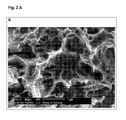
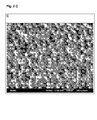
- a novel nanostructure is produced by the new chromosulfuric acid treatment ( Fig. 2 ).
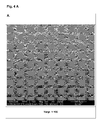
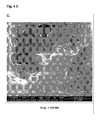
- Fig. 2 On the pre-treatment smooth titanium surface, globular, interconnected structures are formed in a diameter of 50-100 nm, between which nanopores in a diameter of 50-100 nm are present. These nanostructures are believed to be involved in the formation of ultrahydrophilicity. The conditions are described in detail for Figures A, B and C:
- the surface was sandblasted with corundum and then etched in an acid bath (HCl / H 2 SO 4 ).
- the surface shows a smooth microstructure with no evidence of nanostructure.
- the chromosulfuric acid functionally forms an ultrahydrophilic surface and structurally forms a "globular" nanostructure in addition to the SLA microstructure.
- the diameter of the interconnected nano-spheres is about 50-100 nm, with nanopores formed in the same order of magnitude.
- the nanospheres have a diameter of approx. 50 nm and are interconnected. Between the beads pores are formed in a diameter of 10-100 nm.
- peptides such as bone growth factors can be attached to these nanostructures by means of physisorptive or chemisorptive binding, presumably due to hydrophilic interactions on the implant material be immobilized.
- This makes it possible to form a chemotactically acting and / or biologically active, a so-called juxtakrine, implant surface, which leads to the settlement, proliferation and differentiation of bone cells.
- active implants which exhibit a chemotactic effect on cells in the case of molecules released from the surface even at a distance of 500 to 1000 ⁇ m, in the case of BMPs on osteoblasts.
- sufficient loading of the oxidized metal surface is achieved by subjecting the peptides in a physiological buffer solution in a concentration sufficient to a loading of greater than 200 ng / cm 2 , preferably greater than 500 ng / cm 2 , and more preferably from to achieve more than 1000 ng / cm 2 of the peptide on the oxide surface of the metal implant.
- this loading is achieved with a physiological buffer solution of peptides in a concentration of more than 1 ⁇ g / ml, preferably more than 200 ⁇ g / ml of buffer solution.
- the peptides are biomolecules which are advantageous for the biocompatibility of the implant, by counteracting possible rejection of the implant and / or promoting the ingrowth of the implant.
- preferred peptides may be proteins from the class of TGF proteins, in particular bone growth promoting proteins from the class of bone growth factors "Bone Morphogenic Protein", or the class of vascular growth factors such as VEGF or angiotropin or even ubiquitin.
- TGF transforming growth factor
- TGF-ß transforming growth factors beta
- BMP bone morphogenetic proteins
- the latter are osteoinductive proteins that stimulate bone regeneration and bone healing by causing the proliferation and differentiation of progenitor cells into osteoblasts.
- they promote the formation of alkaline phosphatase, Hormone receptors, bone-specific substances such as collagen type 1, osteocalcin, osteopontin, osteonectin, bone sialoprotein (BSP) and finally mineralization.
- a protein of this class alone, in combination with other members of this class or together with biomolecules such as proteins of other classes or low molecular weight hormones or antibiotics can be used to improve the immune system.
- biomolecules such as proteins of other classes or low molecular weight hormones or antibiotics
- these further molecules can also be immobilized on the surface via cleavable bonds in the physiological environment.
- the inventors have already found earlier that the number of oxide groups can surprisingly be increased by treating the surface of the metal with hot chromic sulfuric acid, preferably free from dregs. In contrast to the expectation that the metal will dissolve under these conditions, using this acid produces a substantially uniform 5-50 nm thick hydrophilic oxide layer on the surface of the metal. The procedure is so gentle that even coronary stents (i.e., made of stainless steel or titanium) can be coated without destroying the thin delicate lattice (50-150 ⁇ m in diameter).
- transition metal surfaces such as titanium, steel, steel alloys such as Cr-Mo steel, or stainless steel or titanium surfaces refined with chromosulfuric acid are suitable materials for oxide treatment with dilute acid.
- the ultrahydrophilic oxide layer may have a thickness of 10 nm to 300 nm after the treatment of the metal surface under defined conditions in the form of nanostructures, as in Fig. 2 shown, different geometries (for example, round or polygonal) to be constructed.
- the metal for the implant can be pure titanium or Titanium alloys (eg TiAlV4, TiAlFe2.5), aluminum or stainless steel (eg V2A, V4A, chrome-nickel 316L, Cr-Mo steel) are used.
- the novel process according to the invention allows ultrahydrophilic surfaces to be prepared in all cases in contrast to previous processes.
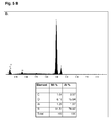
- the EDX detection limit is 0.2-0.5 atom%.
- the new chromium-free ultrahydrophilic surfaces show the particular new BMP-2 binding properties and stabilization of the salt layer shown below.
- a thicker metal oxide layer (> 1000 nm) is to be provided on the metal surface and / or preferably an oxide layer with small micro- and nano-pores, the chromosulfuric acid described above with water to a density of 1.5 to 1.6 g / cm 3 diluted.
- a "rough" surface layer with pits and pores is formed so as to increase the surface area available for loading with peptides.
- the ultrahydrophilic surface produced by the chromosulfuric acid can provide hydrophilic properties upon prolonged storage in the air and in the air lose pure water.
- the contact angle can rise to values of 20-40 ° after 1-2 hours under these conditions.
- the ultrahydrophilic surface can be stabilized according to the invention by means of a salt solution as a stabilizing agent.
- Alcohols of the homologous alkane, alkene and alkyne series which may be straight-chain or branched and may have up to 20 carbon atoms, especially up to 6 carbon atoms, in particular anhydrous methanol and ethanol, as well as phenolic compounds, the latter may also be used according to the invention as such stabilizing agents in aqueous solution.
- aqueous salt solutions which can be ranked according to their salting-out effect on proteins (Table 2).
- these are, for example, the anions SO 4 - , HPO 4 - , CH 3 COO - , Cl - , Br - , NO 4 - , ClO 4 - , L - , CNS, ClCH 2 COO - , F 3 CCOO - , Cl 2 CHCOO - , Cl 3 CCOO - , Br 3 CCOO - or the cations NH 4 + , Rb + , K + , Na + , Cs + , Li + , Mg ++ , Ca ++ , Ba ++ and tetraalkylammonium cations such as (CH 3 ) 4 N + , (C 2 H 5 ) 4 N + , (C 3 H 7 ) 4 N + , (C 4 Hg) 4 N + .
- the invention is therefore also directed to a method of rendering the implants with an oxide layer provided with nanostructures storage-stable with the aid of such "stabilizers".
- the present invention also relates to a method of stabilizing the ultrahydrophilic surfaces by shielding the surfaces from influences that adversely affect ultrahydrophilicity.
- an embodiment of the method according to the invention is also directed to the implant having a hydrophilic surface being placed in a solvent which contains, dissolved therein, a coating agent which adversely affects the ultrahydrophilic surface neither in solution nor in the coating.
- the solvent is evaporated and on the implant with the ultrahydrophilic surface, the coating remains and encloses the implant. In this way, the implant can be reliably preserved for long-term storage.
- An embodiment of the solution with coating agent may be the above-described aqueous salt solution, which on evaporation obtains easily salting out properties.
- a further embodiment can be a solution of a zwitterionic organic substance, for example an amino acid, for example glycine, which can have a similar salting action as SO 4 - , HPO 4 - .
- a zwitterionic organic substance for example an amino acid, for example glycine, which can have a similar salting action as SO 4 - , HPO 4 - .
- Other non-volatile organic substances may be polyalcohols such as glycerol or monosaccharides such as glucose, as well as disaccharides such as sucrose and inositols, which also have a strong influence on the water structure of a surface and give a coating after evaporation of the solvent.
- the implants coated according to the invention have a long-term storage stability and, after washing the coating of salts or organic coating agent, can be used for loading with the peptides acting as mediators.
- the invention is also directed to a method for loading the surface of an implant with peptides, in which one relinquishes to the surface of the implant peptides resulting from physisorptiver or chemisorptive interactions between the peptides and the ultrahydrophilic surface of the implant be immobilized on it.
- the peptides are used in a physiological buffer solution at a concentration which is sufficient, a loading of more than 200 ng / cm 2 , preferably more than 500 ng / cm 2 , and more preferably more than 1000 ng / cm 2 of the peptide to achieve the oxide surface of the metal implant.
- the peptides are used in a physiological buffer solution so in a concentration of more than 1 ug / ml, preferably more than 200 ug / ml buffer solution.
- growth factors from the class of TGF proteins in particular BMP proteins, preferably BMP-2 or BMP-7, vascular growth factors such as VEGF or angiotropin, ubiquitin, antibiotics or mixtures thereof are used as peptides.
- the solubility can be increased by adding surfactants / detergents and the reaction can be carried out.
- sparingly soluble bone growth factors and other mediators by ionic or nonionic detergents in the concentration range 0.05-10%, preferably 1-5 wt.%, In particular at 0.066% SDS at pH> 6, especially at pH 8-12, especially pH 9-11, especially pH 10.0 for binding processes in the alkaline pH range without loss of biological activity in solution.
- the invention is also directed to a method of making peptide coated implants wherein the implant having an ultrahydrophilic surface is treated with a preferably alkaline buffer solution containing one or more detergents.
- Such a method may particularly include treatment with an NBS buffer of 125 mM NaBorate buffer, 0.066% sodium dodecyl sulfate (pH 10.0).
- the invention is also directed to a method for loading implants with bone growth factors, in particular BMP-2, in which the ultrahydrohile surface of the implant is treated with a solution of the bone growth factor at a pH of 9 to 11, preferably 10.
- a method for loading implants with bone growth factors in particular BMP-2, in which the ultrahydrohile surface of the implant is treated with a solution of the bone growth factor at a pH of 9 to 11, preferably 10.
- an implant for example, the implant removed from the dry packaging, which is still covered with the desiccation layer, preferably directly with a buffered solution of bone growth factor at a pH of 9 to 11, preferably 10, treated without the Exsikkations Mrs has to be washed off first.
- the inventors have thus succeeded in coating the ultrahydrohilic surface of an implant made of metallic materials such as pure titanium, metallic titanium alloys, chromium / nickel / aluminum / vanadium / cobalt alloys (eg TiAlV4, TiAlFe2.5), stainless steels (eg V2A , V4A, chromium-nickel 316L), ceramic materials, in particular hydroxyapatite, alumina, or combinations of the metallic materials with ceramic materials thereof, in which the metallic material is present as composite material with ceramic material, with bone growth factors, in particular BMP-2 in which the coating of the ultrahydrophilic surface in an aqueous buffered solution is carried out either in the acid range in the range between pH 4 and 5, in particular at pH 4.5, or in the weakly alkaline range between pH 9 and 11, preferably pH 10.
- the coating in the alkaline range can advantageously be carried out in the presence of detergents such as SDS.
- a particularly preferred embodiment of the method according to the invention is designed such that preference is given to the ultrahydrophilic surface of the implant BMP-2 or BMP-7 in a physiological buffer solution in a concentration of more than 1 ⁇ g BMP-2 or BMP-7 / ml buffer solution more than 200 ⁇ g BMP-2 or BMP-7 / ml buffer solution.
- concentrations are usually sufficient, a loading of more than 200 ng BMP-2 or BMP-7 / cm 2 , preferably more than 500 ng BMP-2 or BMP-7 / cm 2 , and more preferably more than 1000 ng To achieve BMP-2 or BMP-7 / cm 2 of the peptide on the oxidized surface of the metal implant.
- the invention also relates to implants in which the implant material consists of titanium, titanium alloys, aluminum, stainless steel, steel alloys, chromium-containing alloys, ceramic materials such as hydroxapatite or combinations thereof.
- the implant may in this case be a joint or bone prosthesis, a dental implant or in particular one with a peptide, e.g. BMP-2, coated coronary stent (a so-called coronary stent, about 10 mm in length) to therapeutically prevent or ameliorate the late complication of restenosis caused by proliferation of vascular smooth muscle cells, thereby promoting healing and tolerability promote.
- a peptide e.g. BMP-2
- coated coronary stent a so-called coronary stent, about 10 mm in length
- the influence of the materials modified by the method according to the invention on bone cells was investigated in animal experiments, the modified materials for this purpose were prepared in platelet or dumbbell shape. It was observed that 4 weeks after introduction into the animals, accelerated bone formation with contact to the implant surface by BMP-2 on the materials occurred.
- the metals were purified by heating to 80 ° C in 5% HNO 3 for 2 hours. After washing again in water, the platelets were dried by washing in 30 ml of dry methanol. Thereafter, they were either used directly or refined with chromosulfuric acid.
- the titanium flakes were shock-heated at 210-240 ° C. in chromosulfuric acid (92% H 2 SO 4 , 1.35 CrO 3 ), incubated for 30-90 min at this temperature and then treated with conc. Quenched sulfuric acid at room temperature. Thereafter, the metal samples were washed with 10 x 50 ml of water, treated with 2 x 30 min 10% EDTA ((pH 7) ultrasound) and then 1-3 x 30 min in boiling 10% EDTA (pH 7) and then for 30 min washed with boiling water and rinsed with water. In this way, it is possible to provide an ultrahydrophilic surface which is essentially free of chromate, ie it is no longer possible to detect free chromium ions on the surface.
- the pretreated titanium platelets were washed with 125 mM NaBorate buffer, 0.066% sodium dodecylsulfate, pH 10.0, and equilibrated.
- BMP-2 initially in 50 mM Tris, pH 8.0.
- salting-out salting- anionic SO 4 - > HPO 4 - > CH 3 COO - > Cl - > Br - > NO 4 - > ClO 4 - > l - > CNS CH 3 COO - > ClCH 2 COO - > F 3 CCOO - > Cl 2 CHCOO - > Cl 3 CCOO - > Br 3 CCOO - cationic: (CH 3) 4 N +> NH4 +> Rb +, K +, Na +, Cs +> Li +> Mg ++> Ca ++> Ba ++ Cationic / hydrophobic (CH 3 ) 4 N + > (C 2 H 5 ) 4 N + >> (C 3 H 7 ) 4 N + , (C 4 H 9 ) 4 N +
- the effect of the salts takes place i.a. over the water structure.
- the salts stabilize or destabilize the ultrahydrophilic surface via the water molecules and ionic groups bound to the titanium surface. Preference is given to NaCl salt solutions above 0.15 mol / l, more preferably above 0.5 M / l, most preferably in the range of 1 mol / l.
- the storage stability of the ultrahydrophilic surfaces is shown by the dependence of the dynamic contact angles of gamma-sterilized, ultrahydrophilic SLA titanium platelets (14 ⁇ 14 ⁇ 1.5 mm) provided with an inventive desiccation layer on the storage time according to Table 4, whereby titanium-titanium platelets are used. Understands platelets that have sandblasted and acid etched surfaces. As shown, an "unprotected" hydrophilic surface is less hydrophilic after only a few hours in air, while the contact angles of gamma-sterilized, ultrahydrophilic SLA titanium flakes provided with the desiccation layer of the present invention are nearly unchanged at 0 ° after storage for up to 24 weeks.
Landscapes
- Health & Medical Sciences (AREA)
- Life Sciences & Earth Sciences (AREA)
- Chemical & Material Sciences (AREA)
- Veterinary Medicine (AREA)
- Public Health (AREA)
- General Health & Medical Sciences (AREA)
- Animal Behavior & Ethology (AREA)
- Epidemiology (AREA)
- Medicinal Chemistry (AREA)
- Vascular Medicine (AREA)
- Heart & Thoracic Surgery (AREA)
- Surgery (AREA)
- Transplantation (AREA)
- Oral & Maxillofacial Surgery (AREA)
- Inorganic Chemistry (AREA)
- Dermatology (AREA)
- Engineering & Computer Science (AREA)
- Biomedical Technology (AREA)
- Molecular Biology (AREA)
- Mechanical Engineering (AREA)
- Cardiology (AREA)
- Materials For Medical Uses (AREA)
- Prostheses (AREA)
Priority Applications (2)
| Application Number | Priority Date | Filing Date | Title |
|---|---|---|---|
| EP19191782.2A EP3590549B1 (fr) | 2007-02-14 | 2008-02-13 | Procédé de fabrication d'implants dotés d'une surface ultrahydrophile |
| EP22193957.2A EP4151245A1 (fr) | 2007-02-14 | 2008-02-13 | Procédé de fabrication d'implants dotés d'une surface ultrahydrophile |
Applications Claiming Priority (2)
| Application Number | Priority Date | Filing Date | Title |
|---|---|---|---|
| DE102007007865A DE102007007865A1 (de) | 2007-02-14 | 2007-02-14 | Verfahren zur Herstellung von lagerfähigen Implantaten mit einer ultrahydrophilen Oberfläche |
| EP08708969A EP2121058B1 (fr) | 2007-02-14 | 2008-02-13 | Procédé de fabrication d'implants pouvant être stockés et pourvus d'une surface ultrahydrophile |
Related Parent Applications (2)
| Application Number | Title | Priority Date | Filing Date |
|---|---|---|---|
| EP08708969.4 Division | 2008-02-13 | ||
| EP08708969A Division EP2121058B1 (fr) | 2007-02-14 | 2008-02-13 | Procédé de fabrication d'implants pouvant être stockés et pourvus d'une surface ultrahydrophile |
Related Child Applications (2)
| Application Number | Title | Priority Date | Filing Date |
|---|---|---|---|
| EP22193957.2A Division EP4151245A1 (fr) | 2007-02-14 | 2008-02-13 | Procédé de fabrication d'implants dotés d'une surface ultrahydrophile |
| EP19191782.2A Division EP3590549B1 (fr) | 2007-02-14 | 2008-02-13 | Procédé de fabrication d'implants dotés d'une surface ultrahydrophile |
Publications (2)
| Publication Number | Publication Date |
|---|---|
| EP2428232A2 true EP2428232A2 (fr) | 2012-03-14 |
| EP2428232A3 EP2428232A3 (fr) | 2014-06-25 |
Family
ID=39304780
Family Applications (4)
| Application Number | Title | Priority Date | Filing Date |
|---|---|---|---|
| EP22193957.2A Pending EP4151245A1 (fr) | 2007-02-14 | 2008-02-13 | Procédé de fabrication d'implants dotés d'une surface ultrahydrophile |
| EP20110159039 Withdrawn EP2428232A3 (fr) | 2007-02-14 | 2008-02-13 | Procédé de fabrication d'implants pourvus d'une surface ultrahydrophile |
| EP08708969A Revoked EP2121058B1 (fr) | 2007-02-14 | 2008-02-13 | Procédé de fabrication d'implants pouvant être stockés et pourvus d'une surface ultrahydrophile |
| EP19191782.2A Active EP3590549B1 (fr) | 2007-02-14 | 2008-02-13 | Procédé de fabrication d'implants dotés d'une surface ultrahydrophile |
Family Applications Before (1)
| Application Number | Title | Priority Date | Filing Date |
|---|---|---|---|
| EP22193957.2A Pending EP4151245A1 (fr) | 2007-02-14 | 2008-02-13 | Procédé de fabrication d'implants dotés d'une surface ultrahydrophile |
Family Applications After (2)
| Application Number | Title | Priority Date | Filing Date |
|---|---|---|---|
| EP08708969A Revoked EP2121058B1 (fr) | 2007-02-14 | 2008-02-13 | Procédé de fabrication d'implants pouvant être stockés et pourvus d'une surface ultrahydrophile |
| EP19191782.2A Active EP3590549B1 (fr) | 2007-02-14 | 2008-02-13 | Procédé de fabrication d'implants dotés d'une surface ultrahydrophile |
Country Status (10)
| Country | Link |
|---|---|
| US (3) | US9242029B2 (fr) |
| EP (4) | EP4151245A1 (fr) |
| JP (1) | JP5390403B2 (fr) |
| KR (1) | KR20090117807A (fr) |
| AT (1) | ATE503506T1 (fr) |
| AU (1) | AU2008214613B2 (fr) |
| CA (1) | CA2678378C (fr) |
| DE (2) | DE102007007865A1 (fr) |
| ES (2) | ES2929432T3 (fr) |
| WO (1) | WO2008098976A2 (fr) |
Families Citing this family (53)
| Publication number | Priority date | Publication date | Assignee | Title |
|---|---|---|---|---|
| US8177841B2 (en) | 2000-05-01 | 2012-05-15 | Arthrosurface Inc. | System and method for joint resurface repair |
| US6610067B2 (en) | 2000-05-01 | 2003-08-26 | Arthrosurface, Incorporated | System and method for joint resurface repair |
| EP2314257B9 (fr) | 2000-05-01 | 2013-02-27 | ArthroSurface, Inc. | Système de réparation de rectification de joint |
| US20100185294A1 (en) * | 2002-06-04 | 2010-07-22 | Arthrosurface Incorporated | Nanorough Alloy Substrate |
| US8388624B2 (en) | 2003-02-24 | 2013-03-05 | Arthrosurface Incorporated | Trochlear resurfacing system and method |
| AU2006203909A1 (en) | 2003-11-20 | 2006-07-13 | Arthrosurface, Inc. | System and method for retrograde procedure |
| AU2005260590A1 (en) | 2004-06-28 | 2006-01-12 | Arthrosurface, Inc. | System for articular surface replacement |
| US7828853B2 (en) | 2004-11-22 | 2010-11-09 | Arthrosurface, Inc. | Articular surface implant and delivery system |
| US9358029B2 (en) | 2006-12-11 | 2016-06-07 | Arthrosurface Incorporated | Retrograde resection apparatus and method |
| DE102006060958A1 (de) | 2006-12-20 | 2008-06-26 | Jennissen, Herbert P., Prof. Dr. | Verfahren zur Herstellung einer Polymermatrix, daraus bestehende Implantate sowie deren Verwendung |
| DE102007051914A1 (de) * | 2007-10-29 | 2009-05-07 | Herbert Prof. Dr. Jennissen | Verfahren zur Herstellung von mit Wachstumsfaktoren beladenen Partikeln sowie die so erhaltenen Partikel |
| EP2240116B1 (fr) | 2008-01-28 | 2015-07-01 | Biomet 3I, LLC | Surface d'implant présentant un caractère hydrophile augmenté |
| WO2009111481A1 (fr) | 2008-03-03 | 2009-09-11 | Arthrosurface Incorporated | Système de resurfaçage d'os et procédé |
| DE102008021894A1 (de) * | 2008-05-02 | 2009-11-05 | Biotronik Vi Patent Ag | Implantat umfassend eine Oberfläche mit verringerter Thrombogenität |
| GB0902705D0 (en) | 2009-02-19 | 2009-04-01 | Neoss Ltd | Surface treatment process for implant |
| WO2016154393A1 (fr) | 2009-04-17 | 2016-09-29 | Arthrosurface Incorporated | Système de réparation de glénoïde et ses méthodes d'utilisation |
| US9283076B2 (en) | 2009-04-17 | 2016-03-15 | Arthrosurface Incorporated | Glenoid resurfacing system and method |
| US9662126B2 (en) | 2009-04-17 | 2017-05-30 | Arthrosurface Incorporated | Glenoid resurfacing system and method |
| BR112012017535A2 (pt) | 2010-01-15 | 2019-09-24 | Of Medicine And Dentistry Of New Jersey University | uso de compostos de vanádio para cicatrização de osso |
| CA2792048A1 (fr) | 2010-03-05 | 2011-09-09 | Arthrosurface Incorporated | Systeme et procede de resurfacage tibial |
| JP5992917B2 (ja) * | 2010-12-10 | 2016-09-14 | ユニバーシティ オブ メディスン アンド デンティストリー オブ ニュー ジャージー | インスリン疑似剤コンポジットで被覆される埋め込み型デバイスおよびその方法 |
| US20140322292A1 (en) | 2010-12-10 | 2014-10-30 | Rutgers, The State University Of New Jersey | Insulin-mimetics as therapeutic adjuncts for bone regeneration |
| US9066716B2 (en) | 2011-03-30 | 2015-06-30 | Arthrosurface Incorporated | Suture coil and suture sheath for tissue repair |
| EP2723411B1 (fr) * | 2011-06-24 | 2017-04-12 | Straumann Holding AG | Corps fabriqué à partir de matériaux céramiques |
| EP2723410B1 (fr) * | 2011-06-24 | 2018-04-18 | Straumann Holding AG | Corps constitué d'un matériau de céramique |
| KR101304217B1 (ko) * | 2011-09-09 | 2013-09-05 | 오스템임플란트 주식회사 | 친수성 보습막이 코팅된 치과용 임플란트 및 그 제조 방법 |
| US9993319B2 (en) | 2011-10-21 | 2018-06-12 | Straumann Holding Ag | Process for providing structures for improved protein adherence on the surface of a body |
| KR101271403B1 (ko) * | 2011-11-28 | 2013-06-05 | 오스템임플란트 주식회사 | 치과용 임플란트의 친수성 표면 유지를 위한 임플란트 보관방법 |
| AU2012350466B2 (en) | 2011-12-16 | 2015-11-26 | Herbert Jennissen | Substrate with a structured surface and methods for the production thereof, and methods for determining the wetting properties thereof |
| EP2804565B1 (fr) | 2011-12-22 | 2018-03-07 | Arthrosurface Incorporated | Système pour une fixation osseuse |
| KR101248785B1 (ko) * | 2012-04-30 | 2013-04-03 | 오스템임플란트 주식회사 | 초친수성을 갖는 티타늄 임플란트, 그 표면처리 및 보관 방법 |
| DE112013003358T5 (de) | 2012-07-03 | 2015-03-19 | Arthrosurface, Inc. | System und Verfahren für Gelenkoberflächenersatz und -reparatur |
| CN104321034B (zh) | 2013-01-11 | 2018-01-30 | Bvw控股公司 | 可植入的超疏水表面 |
| US9492200B2 (en) | 2013-04-16 | 2016-11-15 | Arthrosurface Incorporated | Suture system and method |
| KR101405859B1 (ko) * | 2013-04-24 | 2014-06-12 | 오스템임플란트 주식회사 | pH 완충 물질과 술폰기를 갖는 유기 양친성 물질의 혼합 용액으로 코팅된 치과용 임플란트 및 그 제조방법 |
| KR101404632B1 (ko) * | 2013-05-02 | 2014-06-27 | 오스템임플란트 주식회사 | 임플란트의 표면처리방법 |
| US10624748B2 (en) | 2014-03-07 | 2020-04-21 | Arthrosurface Incorporated | System and method for repairing articular surfaces |
| US11607319B2 (en) | 2014-03-07 | 2023-03-21 | Arthrosurface Incorporated | System and method for repairing articular surfaces |
| US20150250472A1 (en) | 2014-03-07 | 2015-09-10 | Arthrosurface Incorporated | Delivery System for Articular Surface Implant |
| US10188770B2 (en) | 2014-06-26 | 2019-01-29 | Osstemimplant Co., Ltd. | Dental implant having enhanced early stability and method for manufacturing same |
| EP3034033A1 (fr) | 2014-12-16 | 2016-06-22 | Nobel Biocare Services AG | Implant dentaire |
| EP3178462A1 (fr) | 2015-12-07 | 2017-06-14 | WDT-Wolz-Dental-Technik GmbH | Procede de fabrication d'un corps en ceramique colore polychrome et/ou polychrome spatial ou monochrome et dispositif associe |
| US10907258B1 (en) | 2016-08-25 | 2021-02-02 | Arrowhead Center, Inc. | Surface modification of metals and alloys to alter wetting properties |
| CN110366435A (zh) * | 2017-02-24 | 2019-10-22 | 扩凡科技有限公司 | 用于植入物的表面密封物 |
| CN110753560B (zh) | 2017-04-11 | 2022-07-26 | 斯特劳曼控股公司 | 牙科植入物 |
| CA3108761A1 (fr) | 2017-08-04 | 2019-02-07 | Arthrosurface Incorporated | Implant de surface articulaire a composants multiples |
| KR20210050536A (ko) * | 2018-08-24 | 2021-05-07 | 크판테크 아게 | 혈관 장치 및 혈관 장치를 제조하는 방법 |
| ES2971657T3 (es) * | 2018-11-12 | 2024-06-06 | Nobel Biocare Services Ag | Implante dental, componente para aplicaciones dentales, sistema de implante para aplicaciones dentales, método para formar una capa protectora sobre la superficie de un componente de implante o implantable, componente de implante o implantable que tiene una capa protectora, y uso de una capa protectora |
| GB2616360B (en) | 2019-03-12 | 2023-11-29 | Arthrosurface Inc | Humeral and glenoid articular surface implant systems and methods |
| WO2020219689A1 (fr) * | 2019-04-23 | 2020-10-29 | University Of Pittsburgh - Of The Commonwealth System Of Higher Education | Utilisation de nanoparticules pour stabiliser et préserver la bioactivité de protéines et de peptides |
| JP7362056B2 (ja) * | 2019-07-11 | 2023-10-17 | 国立大学法人広島大学 | 多孔金属薄膜 |
| US12370067B2 (en) | 2019-10-29 | 2025-07-29 | Boston Scientific Scimed, Inc. | Stent including anti-migration capabilities |
| US20240000548A1 (en) | 2020-11-02 | 2024-01-04 | Institut Straumann Ag | Dental implant |
Citations (3)
| Publication number | Priority date | Publication date | Assignee | Title |
|---|---|---|---|---|
| WO1999026674A2 (fr) | 1997-11-24 | 1999-06-03 | Jennissen Herbert P | Procede pour immobiliser des molecules mediatrices sur des materiaux d'implants inorganiques et metalliques |
| EP1150620A1 (fr) | 1999-01-29 | 2001-11-07 | Institut Straumann AG | Implants osteophiles |
| WO2002009788A1 (fr) | 2000-08-01 | 2002-02-07 | Jennissen Herbert P | Procede de production de surfaces d'implants bioactives |
Family Cites Families (22)
| Publication number | Priority date | Publication date | Assignee | Title |
|---|---|---|---|---|
| US4013576A (en) | 1973-11-21 | 1977-03-22 | Wesley-Jessen Inc. | Contact lens treating composition |
| US4504405A (en) | 1980-12-18 | 1985-03-12 | Smith And Nephew Associated Companies P.L.C. | Method of cleaning soft contact lenses |
| US4664666A (en) * | 1983-08-30 | 1987-05-12 | Ezekiel Nominees Pty. Ltd. | Intraocular lens implants |
| US5141507A (en) | 1991-12-06 | 1992-08-25 | Iolab Corporation | Soft intraocular lens |
| ATE235928T1 (de) * | 1998-09-15 | 2003-04-15 | Isotis Nv | Beschichtungsverfahren von medizinischen implantaten |
| EP0987031B1 (fr) | 1998-09-15 | 2003-04-02 | IsoTis N.V. | Procédé de revêtement d'implants médicaux |
| EP1023910A1 (fr) * | 1999-01-29 | 2000-08-02 | Institut Straumann AG | Préparation des surfaces ostéophiles pour prothèses métalliques fixables sur les os |
| DE29913200U1 (de) * | 1999-07-28 | 1999-09-23 | Tutogen Medical GmbH, 91077 Neunkirchen | Implantat aus Knochenmaterial |
| AU2001221607A1 (en) * | 2000-11-20 | 2002-05-27 | Ecole Polytechnique Federale De Lausanne (Epfl) | Endosseous implant |
| GB0111077D0 (en) * | 2001-05-04 | 2001-06-27 | Biochemie Gmbh | Organic compounds |
| JP2005505352A (ja) * | 2001-10-11 | 2005-02-24 | シュトラウマン・ホールディング・アクチェンゲゼルシャフト | 骨親和性インプラント |
| US7740481B2 (en) * | 2002-06-21 | 2010-06-22 | Politecnico Di Milano | Osteointegrative interface for implantable prostheses and a method for the treatment of the osteointegrative interface |
| ATE410196T1 (de) * | 2003-05-28 | 2008-10-15 | Cinv Ag | Implantate mit funktionalisierten kohlenstoffoberflächen |
| WO2005049105A2 (fr) | 2003-11-10 | 2005-06-02 | Angiotech International Ag | Implants medicaux et agents anti-cicatrisation |
| EP1750614B1 (fr) * | 2004-05-11 | 2017-09-27 | The General Hospital Corporation | Procede de fabrication d'une matiere polymere resistant a l'oxydation |
| US20060217777A1 (en) * | 2005-03-22 | 2006-09-28 | James Strom | Apparatus and methods of monitoring cardiac activity utilizing implantable shroud-based electrodes |
| US20070005024A1 (en) * | 2005-06-10 | 2007-01-04 | Jan Weber | Medical devices having superhydrophobic surfaces, superhydrophilic surfaces, or both |
| US7579005B2 (en) | 2005-11-28 | 2009-08-25 | E. I. Du Pont De Nemours And Company | Process for recombinant expression and purification of antimicrobial peptides using periplasmic targeting signals as precipitable hydrophobic tags |
| DE102006004653A1 (de) * | 2006-01-31 | 2007-08-02 | Zipprich, Holger, Dipl.-Ing. | Verfahren zur Herstellung eines Metallkörpers sowie Metallkörper |
| EP1847278A1 (fr) | 2006-04-13 | 2007-10-24 | Camlog Biotechnologies AG | Revêtements bio-dissolubles des implants pour la protection contre des impuretés organiques |
| EP1872805A3 (fr) | 2006-06-27 | 2008-04-09 | Biomed Est. | Implant revêtu |
| EP2240116B1 (fr) | 2008-01-28 | 2015-07-01 | Biomet 3I, LLC | Surface d'implant présentant un caractère hydrophile augmenté |
-
2007
- 2007-02-14 DE DE102007007865A patent/DE102007007865A1/de not_active Ceased
-
2008
- 2008-02-13 KR KR1020097019196A patent/KR20090117807A/ko not_active Ceased
- 2008-02-13 EP EP22193957.2A patent/EP4151245A1/fr active Pending
- 2008-02-13 ES ES19191782T patent/ES2929432T3/es active Active
- 2008-02-13 DE DE502008003007T patent/DE502008003007D1/de active Active
- 2008-02-13 AU AU2008214613A patent/AU2008214613B2/en active Active
- 2008-02-13 EP EP20110159039 patent/EP2428232A3/fr not_active Withdrawn
- 2008-02-13 EP EP08708969A patent/EP2121058B1/fr not_active Revoked
- 2008-02-13 AT AT08708969T patent/ATE503506T1/de active
- 2008-02-13 US US12/527,175 patent/US9242029B2/en active Active
- 2008-02-13 CA CA2678378A patent/CA2678378C/fr active Active
- 2008-02-13 ES ES08708969T patent/ES2361895T3/es active Active
- 2008-02-13 EP EP19191782.2A patent/EP3590549B1/fr active Active
- 2008-02-13 WO PCT/EP2008/051764 patent/WO2008098976A2/fr not_active Ceased
- 2008-02-13 JP JP2009549828A patent/JP5390403B2/ja active Active
-
2015
- 2015-11-24 US US14/949,994 patent/US10376613B2/en active Active
-
2017
- 2017-05-26 US US15/606,004 patent/US10369257B2/en active Active
Patent Citations (3)
| Publication number | Priority date | Publication date | Assignee | Title |
|---|---|---|---|---|
| WO1999026674A2 (fr) | 1997-11-24 | 1999-06-03 | Jennissen Herbert P | Procede pour immobiliser des molecules mediatrices sur des materiaux d'implants inorganiques et metalliques |
| EP1150620A1 (fr) | 1999-01-29 | 2001-11-07 | Institut Straumann AG | Implants osteophiles |
| WO2002009788A1 (fr) | 2000-08-01 | 2002-02-07 | Jennissen Herbert P | Procede de production de surfaces d'implants bioactives |
Also Published As
| Publication number | Publication date |
|---|---|
| US9242029B2 (en) | 2016-01-26 |
| EP2121058B1 (fr) | 2011-03-30 |
| AU2008214613B2 (en) | 2011-09-01 |
| US10376613B2 (en) | 2019-08-13 |
| US20100168854A1 (en) | 2010-07-01 |
| JP5390403B2 (ja) | 2014-01-15 |
| ES2929432T3 (es) | 2022-11-29 |
| DE102007007865A1 (de) | 2008-08-21 |
| EP2121058A2 (fr) | 2009-11-25 |
| ATE503506T1 (de) | 2011-04-15 |
| DE502008003007D1 (de) | 2011-05-12 |
| CA2678378C (fr) | 2015-11-24 |
| US20160136336A1 (en) | 2016-05-19 |
| CA2678378A1 (fr) | 2008-08-21 |
| AU2008214613A1 (en) | 2008-08-21 |
| EP2428232A3 (fr) | 2014-06-25 |
| JP2010517729A (ja) | 2010-05-27 |
| KR20090117807A (ko) | 2009-11-12 |
| WO2008098976A3 (fr) | 2009-07-23 |
| HK1136788A1 (en) | 2010-07-09 |
| EP4151245A1 (fr) | 2023-03-22 |
| ES2361895T3 (es) | 2011-06-24 |
| EP3590549A1 (fr) | 2020-01-08 |
| US10369257B2 (en) | 2019-08-06 |
| US20170258969A1 (en) | 2017-09-14 |
| EP3590549B1 (fr) | 2022-09-07 |
| WO2008098976A2 (fr) | 2008-08-21 |
Similar Documents
| Publication | Publication Date | Title |
|---|---|---|
| EP2121058B1 (fr) | Procédé de fabrication d'implants pouvant être stockés et pourvus d'une surface ultrahydrophile | |
| EP1305058B1 (fr) | Procede de production de surfaces d'implants bioactives | |
| EP1035879B1 (fr) | Procede pour immobiliser des molecules mediatrices sur des materiaux d'implants inorganiques et metalliques | |
| EP2224970B1 (fr) | Implant et procédé de revêtement d'un implant | |
| Shimabukuro et al. | Surface functionalization with copper endows carbonate apatite honeycomb scaffold with antibacterial, proangiogenic, and pro-osteogenic activities | |
| EP1150620A1 (fr) | Implants osteophiles | |
| EP2209505B1 (fr) | Procédé de production de particules chargées en facteurs de croissance, et particules ainsi obtenues | |
| EP3432941B1 (fr) | Corps d'implant comportant une couche porteuse d'agent actif et une couche de commande de libération | |
| WO2003086496A1 (fr) | Implant medical, de preference stent, et procede de fabrication dudit stent | |
| EP0950131B1 (fr) | Objet metallique a fine couche d'oxyde polyphasee et procede permettant de le produire | |
| EP2529763B1 (fr) | Procédé de fabrication d'un revêtement d'implant et implant associé | |
| DE102008040791A1 (de) | Endoprothese und Verfahren zur Herstellung derselben | |
| DE102009024616A1 (de) | Sterilisierbare Implantatbeschichtung und Verfahren zu deren Herstellung | |
| DE10216971A1 (de) | Medizinisches Implantat, vorzugsweise Stent und Verfahren zu dessen Herstellung | |
| AU2011253759B2 (en) | Method for producing implants with an ultrahydrophilic surface | |
| HK1136788B (en) | Method for producing implants with an ultrahydrophilic surface | |
| HK1162983A (en) | Method for producing implants with an ultrahydrophilic surface |
Legal Events
| Date | Code | Title | Description |
|---|---|---|---|
| AC | Divisional application: reference to earlier application |
Ref document number: 2121058 Country of ref document: EP Kind code of ref document: P |
|
| AK | Designated contracting states |
Kind code of ref document: A2 Designated state(s): AT BE BG CH CY CZ DE DK EE ES FI FR GB GR HR HU IE IS IT LI LT LU LV MC MT NL NO PL PT RO SE SI SK TR |
|
| PUAI | Public reference made under article 153(3) epc to a published international application that has entered the european phase |
Free format text: ORIGINAL CODE: 0009012 |
|
| REG | Reference to a national code |
Ref country code: HK Ref legal event code: DE Ref document number: 1162983 Country of ref document: HK |
|
| PUAL | Search report despatched |
Free format text: ORIGINAL CODE: 0009013 |
|
| AK | Designated contracting states |
Kind code of ref document: A3 Designated state(s): AT BE BG CH CY CZ DE DK EE ES FI FR GB GR HR HU IE IS IT LI LT LU LV MC MT NL NO PL PT RO SE SI SK TR |
|
| RIC1 | Information provided on ipc code assigned before grant |
Ipc: A61L 27/54 20060101ALI20140516BHEP Ipc: A61L 27/50 20060101ALI20140516BHEP Ipc: A61L 27/22 20060101AFI20140516BHEP |
|
| 17P | Request for examination filed |
Effective date: 20141229 |
|
| RBV | Designated contracting states (corrected) |
Designated state(s): AT BE BG CH CY CZ DE DK EE ES FI FR GB GR HR HU IE IS IT LI LT LU LV MC MT NL NO PL PT RO SE SI SK TR |
|
| 17Q | First examination report despatched |
Effective date: 20160223 |
|
| STAA | Information on the status of an ep patent application or granted ep patent |
Free format text: STATUS: EXAMINATION IS IN PROGRESS |
|
| RAP1 | Party data changed (applicant data changed or rights of an application transferred) |
Owner name: NOBEL BIOCARE SERVICES AG |
|
| GRAP | Despatch of communication of intention to grant a patent |
Free format text: ORIGINAL CODE: EPIDOSNIGR1 |
|
| STAA | Information on the status of an ep patent application or granted ep patent |
Free format text: STATUS: GRANT OF PATENT IS INTENDED |
|
| RIC1 | Information provided on ipc code assigned before grant |
Ipc: A61L 27/30 20060101ALI20200113BHEP Ipc: A61L 27/22 20060101AFI20200113BHEP Ipc: A61L 27/54 20060101ALI20200113BHEP Ipc: A61L 27/50 20060101ALI20200113BHEP |
|
| INTG | Intention to grant announced |
Effective date: 20200203 |
|
| STAA | Information on the status of an ep patent application or granted ep patent |
Free format text: STATUS: THE APPLICATION IS DEEMED TO BE WITHDRAWN |
|
| 18D | Application deemed to be withdrawn |
Effective date: 20200616 |
|
| REG | Reference to a national code |
Ref country code: HK Ref legal event code: WD Ref document number: 1162983 Country of ref document: HK |